
two violas and two cellos. Secondly a group of decorated instruments, probably made for an Italian
|
|
|
- Barnard Sutton
- 9 years ago
- Views:
Transcription
1 Andrea Amati IN THE FIRST OF A SERIES ON THE AMATI FAMILY ROGER HARGRAVE PRESENTS THEM IN THEIR HISTORICAL CONTEXT AND COMPARES TWO DECORATED EXAMPLES OF THE WORK OF ANDREA AMATI. In this, the first of three articles, I shall be examining the work of Andrea Amati. In the following article I will look at the work of Andrea's two sons, the brothers' Amati. The final article will be about Nicola, Andrea's grandson, the great teacher, who arguably made the most aesthetically beautiful violins of all time. Andrea Amati was born Circa 1505 and died in The little that is actually known about the life and works of the earliest violin makers has certainly not prevented a great deal of misinformation from being published and argued over. At the risk of adding to this misinformation, let me begin by examining the way in which Andrea fits into the known 16th century European scene. We tend perhaps to think of the walled communities in which our heroes lived as being very isolated, but actually there was tremendous interaction between them. Not only did they live on the great trade routes, they lived there because of them. The age was one of discovery and communication and, although secrets did exist, more often than not successful ideas or new materials emerging in one area were quickly taken up in another. This intercourse was not only commercial. A brief look at the lives of artists and artisans will confirm that travel to and from centres of learning and excellence was commonplace. Makers of musical instruments were no exception. During the 16th century we know that many of them were traveling between and settling in foreign towns and cities throughout Europe. The various instrument makers bearing the name Teiffenbrucker are good examples of such behaviour. A few instruments, of a violin family type, have survived from the mid 16th century. These are mainly of viola size and they appear almost simultaneously in several different areas. The conclusion must be that there may have been, and probably were, instruments very similar to the violin before Andrea Amati, but we will certainly never know for sure. Amongst the more or less serious contenders for the title `Inventor of the Violin' are Fussen in the Algan (now a part of Germany), Czechoslovakia and Poland, and., in Italy, Venice, Brescia and Cremona. Without exploring the merits of the non Italian claimants, in Italy the traditional heavyweights have always been Cremonese, represented by Andrea Amati and Brescia by Gasparo' da Salo Previous difficulties in fixing the dates of these two schools were compounded by the facts that the Brescians did not date their work and that the re labelling of anything Brescian as either Gasparo da Salo or Maggini, was the rule rather than the exception. The research of Carlo Bonetti, shows fairly convincingly that Andrea Amati must have been living before Daniel Drayley, editor of the English translation of Bonetti, suggests that Andrea was probably born between 1500 and 1505 and possibly even before. This is based on the, not unreasonable, assumption that Andrea could have lived into his 80s. Other members of the Amati family were certainly long lived, with the exception of Hieronymus who was killed by the plague. Nicola, for example, was in his 88th year when he died and Hieronymus II was just five days short of his 91st birthday. From Bonetti we know for certain that Andrea was a master luthier in Cremona in 1525 or earlier.

2 2 Bonetti's suggestion that Andrea died between 1576 and 1579 is also fairly honourable. Somewhat less plausible is his contention that Andrea's teacher was a Linnardo da Martinengo. In this case Bonetti provides no verifiable evidence. The actual date of Andrea's death was 26 December The document providing this information was uncovered by Professor don Andrea Foglia in 1985 in the Capitular Archive of the Cathedral of Cremona. There have been several similar discoveries concerning the classical makers in recent years, which may eventually require the correction of several accepted maxims. Bonetti himself provided a great deal of information which, amongst other things, enables scholars to correct much of the misinformation about the relationship between Andrea Amati and Gasparo da Salo In an appendix to his Amati research, Bonetti prints a facsimile of Gasparo da Salo's birth certificate. Previously unknown, this certificate shows, that Gasparo was born on 20th May 1540, at least 15 years after Andrea Amati became a master luthier. However, nothing in life can be allowed to be so simple. This same certificate clearly records the fact that Gasparo's father and grandfather were both violin makers (dicti violi). There is a further complication to this already complex story. Evidence is also beginning to emerge that a number of edicts emanating from the church during the 16th century not only forbade the playing but also ordered the destruction of the violin in parts of Italy. This may explain the dearth of violin family instruments from the earliest period. It may also be the reason why so many of the surviving instruments of Andrea Amati were largely those made for the nobility who then, as now, were a law unto themselves. Here, however, I must beware of falling into the speculation trap myself. Whatever the historical circumstances might have been, it is probably significant that in Cremona alone the violin family not only appears complete, but also appears in a highly sophisticated form. From all of the other contenders violas seem to be the common fare, violins are rare and cellos are practically non existent. Furthermore, in Cremona there are no known instruments of any kind surviving from the time before Andrea Amati and no 16th century instruments of the violin family by any maker other than Andrea and his two sons. This is a quote from The Surviving Instruments of Andrea Amati by Laurence C. Witten: `In Cremona, by contrast,' (to Venice and Brescia) `the entire known 16th century production is devoted to the instruments of the violin family, all by the Amati's and that production was very substantial if the survivors are a fair indication.' No matter who made the first violin I think that it can be argued, and with some weight, that Andrea Amati and his two sons Antonia and Girolamo (Hieronymus) created the designs from which all the great Italian, and later all other makers, took their inspiration. In spite of some fantastic stories in the available literature about Andrea Amati being: 'A rich man belonging to a family dating back to A maker of viols and rebecs who only began to make violins in his later years. A widely travelled man who lived and worked in Paris for a time and who bought amber and wood in Venice. A pupil of Bussetto [who was actually born long after Andrea's death] and being, [optionally], a 'contemporary', an 'assistant', a 'pupil' or simply 'born after Gasparo da Salo', the real truth is that we know almost nothing about Andrea and that which we do know is mostly derived from his surviving works. There are four sizes of instruments by Andrea which have come down to us. Remarkably, three new instruments by Andrea have come to light in the past ten years. One, a violin, turned up in a provincial English auction house. The complete list as far as I know consists of the following: four small violins measuring about 342mm (13.5 inches), two of which I shall be examining in detail here; five larger sized violins of about 355mm (14 inches); four large tenor violas, all but one of which have been reduced in size. These must have been about 470mm (18.5 inches) in length; six cellos all of which have been reduced from what must have been quite large instruments, certainly more than 790mm or 31 1/8 inches. Andrea's instruments can be further divided into three groups. Firstly a number of undecorated instruments, consisting of two large and two small violins, two violas and two cellos. Secondly a group of decorated instruments, probably made for an Italian noble family (as yet unidentified). There are three instruments in this group, two large violins and one reduced tenor viola. The final and most important group is the famous set of decorated instruments prepared for Charles IX of France. (Although as yet unsubstantiated, Jean Benjamin de la Borde writing, significantly, shortly

3 3 before the French revolution, claimed that 38 instruments were made by Andrea for Charles IX. These consisted of twelve large and twelve small violins, six violas and eight basses.) These instruments are painted and gilded with the arms and bearings of Charles IX. The earliest dated of these surviving works is the violin housed in the Ashmolean museum which is illustrated here. The manuscript label is almost illegible. It appears to be made of parchment and it bears the date 1564 written in Roman numerals. One of the cellos has the date 1566 written on a column or pillar contained within the heraldic design. This is undoubtedly original, in spite of extensive re touching and repainting (the result of reducing the instrument to a more playable size). This date may refer to the return in 1566 of Charles IX and his mother Catherine de Medici from their tour of France begun in 1564 and undertaken so that the monarchs could be widely seen by the people. Charles IX was the son of Henry 11 of France. After Henry's death Charles succeeded to the throne with his mother Catherine de Medici acting as regent until Charles came of age in 1563 at the age of 13. All of the Charles IX set were probably made after this date. However, whenever these instruments were prepared, it is unlikely that they were complete after 1574 the date of Charles IX's early demise. No one really knows why these instruments were ordered for such an important client, living so far away from a relatively unimportant centre such as Cremona. One possible explanation is that Catherine de Medici was a Florentine. She was the daughter of Lorenzo de Medici, Duke of Urbino. (The Medici family, being one of the most powerful political forces in Florence and Tuscany, not only married into many royal families of Europe, but financed them.) It is known that when Catherine married King Henry II of France, she brought with her musicians and dancers from Italy. Over the years she promoted poetry, music and movement at the French court and much of this was performed or inspired by Italian artists, notably her director of court festivals, Baltazarmi di Belgioso. Such people may have been responsible for ordering the instruments from Andrea. One thing seems fairly certain however, by the mid 16th century, Andrea Amati must have already been fairly famous. One further, rather tenuous connection between the Amati family and the Medicis concerns the second marriage of Hieronymous I, Andrea's son, to Laura de Medici de Lazzarini, in Laura seems to have been only remotely related to the main stem of the Florentine Medicis and since the event took place ten years after the death of Charles IX, it may have no significance. The Charles IX set is unquestionably the most important in existence by Andrea Amati or any other early maker. It is the only group of Andrea's instruments which embraces all four known types; it is the most numerous, with eight examples; it was prepared for a great royal court of the Renaissance; and the beauty of its workmanship, tonal properties and rich decoration have seldom if ever been matched or surpassed,' (The Surviving Instruments of Andrea Amati by Laurence C Witten). For us today the smaller size of violin remains rather a puzzle since no one has yet explained why there are two sizes of violin, nor whether their pitches differed. But this much is demonstrable: violins of a distinctly small size, very often of the 342mm Andrea Amati pattern, were made by Italian violin makers in Cremona and many other centres from Andrea's time well into the 18th century. Britain is blessed in having two of these small Charles IX violins amongst its national treasures. One is to be found in the Hill collection at the Ashmolean Museum in Oxford. In the same collection is the only uncut tenor viola by Andrea Amati. Both violin and viola are pictured and recorded in the catalogue of the Hill collection by David Boyden. The second violin is housed in the Tullie House Museum in Carlisle. It is illustrated in black and white and colour in Capolavori di Andrea Amati published by the Ente Triennale in Cremona The main subject of this article is the Ashmolean violin but regular reference will also be made to the Carlisle museum instrument. Over the years I have handled most of the surviving examples of Andrea Amati's work, but I am particularly attached to those in the Ashmolean museum. This is perhaps because they were the first examples of Andrea's work which I ever saw. Indeed my regular visits to the Ashmolean filled me with a respect for the work of the Amati family, which has remained with me ever since. Of the two small violins the Carlisle example has the best preserved paintwork on the body but the head is undecorated and as I shall discuss later is not 100% typical. For this reason I have chosen to describe the Ashmolean museum violin in detail and I will refer to the Carlisle example only from time to time.

4 4 Let's take it from the top. The head, though softened, has certainly not been ravaged by the passing of almost four and a half centuries. The sharpness of the workmanship still shines through. The only visible tool marks are those on the vertical turns of the bosses and a very few fine gouge marks underneath the head at the throat. These tool marks were a feature which all the great Cremonese makers were to mimic, no matter how clean their work might otherwise appear. Throughout the classical period all the great Cremonese makers continued to follow Andrea's example in method, if not always in style. After the Amati family, all of whom cut superb and very similarly conceived heads, no one came so close to mirroring nature again. Renaissance man may have been inspired by the designs of the classical Greeks and Romans, but for his scrolls Andrea seems to have gone directly back to nature itself. The concept was mathematically and optically so perfect that what followed over the centuries could only be a steady degeneration. Like most Amati scrolls this one has a feeling of pure simplicity about it. Viewed from the side, the spirals unfold from the eye with geometrical precision creating a pent, very rounded scroll form. This unfolding continues into and along the sides of the pegbox itself. It is like the slow awakening of new growth in the spring. There is none of the oval tendency, which is a feature of the Stradivarius, or the squareness of the Guarneris. The gentle undercutting of the volutes begins at the A peg with a slight hollowing in the pegbox cheeks. From here it continues to increase in depth, very evenly, until it becomes quite pronounced at the eye, certainly much deeper than a Stradivari scroll would be cut. The way in which the volutes flow into the eyes gives the eyes that distinctive comma shape which is the hallmark of the Amati school scroll (see Diag 1). On the left hand side of this scroll, now barely visible because of wear, the tiniest cut with a small half round gouge completes the optical roundness of the eye. The chamfer, though well worn, is in places still clearly definable as having been carefully and delicately cut. Viewed from behind, the pegbox tapers evenly and regularly towards the end of the head. This is another feature which was common to the Amati's, but which Stradivari was destined to change (for a comparison see the `Betts' Stradivari poster May 1989). The flutings are well defined and in spite of the decoration quite deeply finished. They are more rounded in section than Stradivari's flat bottomed flutes. The chin is also well rounded. On the spine between the flutes there is no sign of a central scribe line, although the spine itself is quite worn in places. In spite of this wear the remains of, what must have been fairly deep, compass prick marks are still clearly visible on the spine. These indicate another constructional technique which the rest of the Cremonese school followed. Interestingly the central spine disappears under the front of the head so that the two flutes blend into one larger flute. (see photographs). This feature is also typical of the brothers Amati, Bussetto, Januarius and Francesco Ruggeri, but not of Nicola Amati in his later period or any of the other later Cremonese makers. It might be worth mentioning that just before the central spine peters out, under the front of the head there are two small letter Cs stamped deeply into the wood. These are about 1.5mm high and are not original. Similar letters are also stamped on the bottom rib. From the front, the scroll has a strong and well balanced look, with the lines of the second turn complementing perfectly the lines of the first turn. This quality changed little amongst the Amati's, becoming if anything only a little heavier over the years. Unlike much of the later Cremonese work Andrea made the interiors of his pegboxes narrow at the throat. This narrowness was a direct result of the even taper to the back of the pegbox. Conversely, the wider pegbox interiors of Stradivari's later works required the marked change in the pegbox taper, which I mentioned earlier. In spite of this narrow throat, Andrea's pegboxes are still wide enough to be functional and the walls of his pegboxes are sturdy. In common with many 19th century neck replacements, the man who replaced this neck chose a highly figured graft, matching the ribs rather than the head. The same is true of the Carlisle violin's head and neck. Andrea chose plain wood for the head (and neck), again setting a trend followed more often than not by the classical Cremonese makers. (Plain heads simply being easier to carve than highly figured heads.) I must admit to having had difficulty in identifying the head wood on this instrument. Even with the help of a large hand lense and a jeweller's eye glass, I have been unable to distinguish either year rings or medullary rays. I cannot therefore say in which way the wood was cut, nor what kind of wood it is. I can only suggest that it has something of the appearance of a fruit wood. Even where it has not been worn, the

5 5 head looks as if it has been burnished. It has the texture, if not the colour, of polished ivory. The colour is a dark greyish yellow which changes in refracted light to a pinkish brown. It may be that in order to accommodate the paintwork, some special sealer was used which has obliterated the growth features of the wood. The head of the Carlisle violin has no decorated paintwork. When I first saw this violin more than 15 years ago I thought that the head was a replacement, perhaps from Andrea, but not original to the instrument. Today I have less reason to doubt its authenticity, but it has been drastically changed by the hand of the restorer. Only an extremely careful inspection in very good light revealed a large amount of extraordinarily skilful repair work. A great many small irregular pieces have been inserted and I believe that even the left hand eye is a replacement. All the indications point to a head which has been badly ravaged by worm. Inevitably during such extensive repair work the paintwork would have been difficult to preserve. Ultimately therefore, although the main features of this head have been retained, much of the character of Andrea's work is missing. The wood is again very plain, though an extremely fine growth can be seen in direct daylight with a hand lense. It has been cut on the half slab. Again I cannot identify the type of wood used. Let me now detail the body of the Ashmolean violin, beginning with the back. From the outline it can be seen that there is a small indentation next to the button. This is the result of a bad button repair. Otherwise the outline is well rounded. It does not have the flatness across the top and bottom block areas which we so often see on later Amati family instruments or early Andrea Guarneri. (This particular area of the outline is often the most distorted on photographs of instruments, which is why outlines taken directly from the instrument are so important). The centre bouts are also well rounded, but the open effect is probably exaggerated by the extreme wear to the corners. Estimating the original length of the corners is very difficult and I have to admit that my colleagues and I cannot agree. My own view, for what it is worth, is that the corners were slender and fairly long, with the upper corners being slightly hooked. This would make them rather like the Nicola Amati, known as the `Alard' which is also in the Ashmolean museum and which will be featured in a future poster in this magazine. (Those readers who have access to the book Stradivari a la Liuteria Cremonese dall URSS can examine the pictures of the two pristine brothers Amati, 1628 and 29). These instruments both show the influence of Nicola but they do illustrate my point exactly. [More valid perhaps is the photograph of the decorated Andrea Amati viola in the Shrine Museum. These long delicate corners trumpet and hood very slightly at the ends, for sheer elegance they take some beating. This instrument is not thought to be one of the Charles IX set.] The back arching of the Ashmolean violin has a figure of eight fullness which falls quickly at the edges to a well scooped channel. The general effect falls just short of being boxy and square. We still see this kind of arching on the brothers' work but it begins to disappear as Nicola's influence becomes more apparent. The purfling channel is certainly less well defined now because of the excess wear to the edges and corners. I can imagine that the channel would at one time have been capable of holding a large amount of water in a small figure of eight moat. The back arching of the Carlisle instrument is almost identical, but slightly less wear to the edges has left a more well defined channel. On both instruments the purfling is very fine and carefully worked. The blacks are so intense that one might suspect they were of whalebone, ebony or even plastic. They are, however, stained wood and they are of an intensity never surpassed by any maker after the Amati's. Even Stradivari did not seem able to equal them. The corners of the mitres are simply long and slender. There is no sting or bending at the tip. They are all extremely worn but not enough to hide their beauty. On approaching the corners from the top and bottom bouts, the purfling typically begins to move in, away from the edge. This begins at a point just after the concave of the outline reaches its deepest point (see diagrams on poster). The purfling of the brothers usually begins this process slightly earlier and that of Nicola slightly later. The thickening of the individual strips of purfling show some unevenness, suggesting simple planed strips, rather than strips drawn through a thickening gadget. The whites of the purfling on both violins do not have the tiny splits, which we associate with most Cremonese purfling, the one notable exception being Francesco Ruggeri's use of Beech. Andrea's whites seem to be of a fruit wood or just possibly sycamore or maple. On both of these instruments, like the corners, the edges are extremely worn. Again, it is difficult to re construct them in the mind's eye. From the few

6 6 instruments with slightly less wear I would venture to suggest that Andrea's edgework had a distinct flatness to the outside. It is as if the tops and undersides of the edge were only slightly rounded off. This is also a distinctive feature of G.B. Rogeri's edgework. In all cases this feature is best observed in the C bouts. The wood used for the back of the Ashmolean violin is of extremely fine growth. It is a one piece maple back. The figure is well pronounced and of a medium width. This kind of wood is very typical of Andrea Amati and only the cut varies from instrument to instrument. On the Carlisle violin the back is made up of two pieces of maple. It is jointed in a typical Amati way with the flames continuing at the same angle right across the back, here descending from right to left. On the Ashmolean instrument the button has been repaired and crowned with an ebony ring. On the Carlisle violin the button has been replaced and the new piece runs into the back itself, removing some original purfling and the top locating pin. At the bottom the pin also seems to be a later replacement. On the Ashmolean violin there are two small locating pins, one at either end of the back. They are situated about 3mm inside the purfling approximately on the centre line (no centre joint) and they are about 1.75mm in diameter. In the dim lighting of the Ashmolean library I could find no sign of a third central pin on the inside of the back (see STRAD `Kreisler' del Gesu poster May 1988). On the Carlisle violin however, the `third' pin is just visible on the outside as a fine pin hole, in spite of the painted shield which covers the area. On the inside the pin itself is clearly visible and is about 1.5mm in diameter. It sits on the centre line exactly mm from the inside of the purfling at each end. A similar central pin is clearly visible on the Ashmolean's Charles IX viola. (The only uncut viola by Andrea). On both violins the ribs are cut from similar wood to the backs, with the flames running almost vertical around the instrument. On the Ashmolean violin they are cut on the half slab and on the Carlisle instrument they are cut exactly on the quarter. The top rib in both cases, as always on classical works, was originally of one piece. The Ashmolean violin also has a one piece bottom rib with a tiny nick or scratch marking the centre line of the back. Such tiny marks can be seen on many later works and are commonly seen on Stradivarius. The Carlisle bottom rib is of two pieces with a pieces of purfling inserted at the joint. This purfling is not original. At the corners the rib joints are quite short. They have been jointed in the usual way. The rib thickness on both instruments is about 1.4mm. This is certainly much thicker than the ribs of later makers. They may have been made slightly stronger because of the decoration to the outside, however the linings are very small and it may be that the ribs needed to be a little thicker to compensate. Not only are the linings smaller than those of later makers, but they are also of a slightly different shape. They are basically a simple wedge, about 5mm high and 1 to 2mm at their widest point. The linings seem to be let into the corner blocks. This, taken with the size and shape of the corner blocks themselves, indicates the use of an inside mould. Typically for Cremona the blocks have been cut back with a small gouge. On neither instrument are there signs of tooth plane marks on the inside of the ribs as might be expected on a del Gesu, for example, (see poster, STRAD April 1984). The whole of the inside work is solid but not fussy. I have already described the label of the Ashmolean violin. The Carlisle violin, which must be from the same period, has a facsimile label only. The belly wood of the Ashmolean violin is quite different from that of the Carlisle violin. The year rings of the Ashmolean instrument unusually are wider in the centre (2 to 3mm) becoming narrower in the bouts (less than 0.5mm). The growth is straight through the mid section but sweeps quite markedly inwards towards the centre joint at both ends. This kind of feature has led to some speculation that the bellies of some early violin family instruments were bent and carved rather than simply carved. The belly wood of the Carlisle violin has a more conventional structure having a fairly fine growth right across the belly. It does have a slight inward sweep under the tailpiece area but this is very slight. Under the fingerboard it is difficult to see exactly how the year rings run. I recently examined a newly discovered Andrea Amati cello. This instrument has been cut down and some wood was removed from the central area on either side of the centre joint. The belly rings, do converge slightly at the tailpiece end. There were several open cracks by the side of the tailpiece. By examining the direction of the split it is possible to see that this belly probably was not bent. The theory is nevertheless an interesting one and it was certainly a method used by the English Gamba makers. I am convinced

7 7 that a violin by Gasparo da Salo which I examined some years ago was bent and carved on both the back and the front. I must admit however that other makers whose work I respect highly, do not believe that this instrument was bent. Returning now to the Ashmolean violin, the belly arching is fuller than the back arching and the edge fluting is much less scooped. Here again, the Carlisle instrument arching is almost identical. In both cases the long arch rises quickly at both ends under the tailpiece and fingerboard. (In both cases the fingerboards and tailpieces are neither original nor in the style of the Amati's). The sound holes are set wide apart even though these instruments are relatively small. This feature was common to all Andrea's instruments. In Cremona however, soundholes became much closer together over the next century. Only in the late Cremonese period did they again become more widely spaced. Incidentally, the size of the soundholes themselves went through a similar evolution. Clearly the form of Andrea's soundholes is taken directly from a Gamba style C hole, the top half having simply been reversed. This fairly primitive form of F hole was developed into the more sophisticated or true violin F hole, mainly by the brothers Amati. From the two left hand soundholes which I have reproduced here it can be seen that they are very close in both concept and size. The top and bottom circles were drilled like all of the classical Cremonese sound holes which were to follow. The top circles are large and I can think of only one solitary late Cremonese instrument, a del Gesu, with top holes of these dimensions. The nicks were also cut comparatively much bigger. The main body of the holes are cut with only the suggestion of an undercut. There is no question of any undercutting of the extremity of either the Gamba makers or the Brescians. Rather there is a tendency towards a cut which is at right angles to the plate like the Cremonese soundholes which came after Andrea. The wings of the soundholes are characteristically long, thin and straight. They are cut off almost horizontally to the centre line of the instruments. The lower wings are fluted only very slightly as a result of blending them into the purfling channel. There is also a slight raising of the edge around the lower circles on both instruments, a sort of eyebrow effect. Although the early works of the brothers have similar narrow straight wings, they gradually became wider and more curved. Later, in Venice, Goffriller produced a few instruments with F holes seemingly influenced by the work of Andrea Amati. This just about concludes the description of the workmanship, but it is perhaps worth remembering that Andrea Amati lived almost 200 years before Stradivari. This is about the same distance in time as that between Antonio Stradivari and ourselves. How much was on the one hand gained and on the other lost? The decoration All of the instruments for the Charles IX group were painted and gilded, as were most of the other surviving works. I believe that this paintwork was carried out only after the instruments' surface had been carefully sealed. This can be deduced by examining the areas from which the paintwork has been worn away. It can be seen that no significant amounts of colour have penetrated the surface in these areas. The gilded work, carried out with genuine gold leaf, was `picked out' and given definition by the use of fine black line work. This kind of work was all pretty much standard practice for the painters of that time. Again by examining the work closely, we can see that a varnish was applied over the top of everything rather like a glaze. This varnish, where it remains intact, has all the appearance of the normal Amati type of varnish, usually described as warm golden brown, or amber. It was quite normal for artists to `glaze' paintings, and especially when they were gilded, red tinted glazes were used. Red tinted glazes had the effect of warming the whole picture, boosting the colours and giving a warm glow to the gold. Over the years the red pigments in these glazes often faded out or became browner in tone. At the same time the glaze medium, in which the pigments were bound, themselves became yellow or brown with age. On paintings this usually requires the removal of old glazes because they eventually produce the opposite effect to that intended. Because of the flesh tones and gold used on these Charles IX designs it would be surprising if red tinted varnish or `glaze' had not been used. I think it unlikely that Andrea painted these instruments himself. Cremona, at that time, had an active, if slightly second rank school of painters, perfectly capable of producing such high quality decorative work. This speculation raises the following questions: who applied the final varnish coat, if An-

8 8 drea himself did not apply the paintwork, and what colour was the varnish at the time of application? As can be seen from the photographs, excessive use over the centuries has removed much of the paintwork from the violins and violas. Only on the cellos can we detect something of their original splendour. Amongst the violins, the back and ribs of the Carlisle instrument are the best preserved. However, even here, only ghostly shadows, punctuated by an occasional arm, face or foot, indicate where figures and columns once were. With the help of other Charles IX instruments it is possible to reconstruct the basic composition on the Ashmolean and Carlisle violins. The design of the decoration changed slightly both in scale and details depending upon the type of instrument being painted. On the Ashmolean and Carlisle violins the designs are almost identical and correspond very closely to those of the Ashmolean viola, the Shrine cello and the larger, ex Hottinger violin in the Cremona museum. On the cello dated 1566 (on a pillar) the design is certainly quite different. In spite of some considerable re touching, it can be seen that the single columns have been replaced by twin interlocking columns. The two main figures are also absent as are the cherubs. These may or may not have been removed but the important fact remains that the designs are not all the same. The significance of these differing designs may yet prove very instructive. Anyone wishing more information on this theme should consult The History of Violin Playing from its Origins in 1761 by David Boyden. A close comparison of similar features on both violins reveals that although the design has been strictly adhered to in each case, the artist or artists use a certain amount of freedom in interpreting the fine details. On the two violins the main features of the composition are as follows: in the centre is a shield bearing the arms of Charles IX. This is still partly intact on the Carlisle violin. The shield is ringed by a golden chain and topped by a crown. This central structure is supported by two figures one to the right and one to the left. Each of these figures stands upon a tiny cloud. The figure on the right is wearing a crown and waving a sword. This would seem to be justice and in her left hand we would expect to find a set of scales. The enclosed photograph of the Witten Rawlins cello shows this to be the case. The figure of justice has however, been considerably shortened by the removal of wood from either side of the original centre joint. On none of the instruments, is the left hand figure clearly visible. Taking my cue from the motto on the ribs I would assume this to be the figure of Piety (reading a Bible?). To the outside of the two figures are two golden pillars wrapped around with parchment like scrolls. These pillars are also topped with crowns which are being held in place by winged cherubs two to each crown. Outside the pillars are two large letter K's which are again topped by crowns. As with the back, the ribs on the Carlisle instrument are far better preserved than those of the Ashmolean example. Almost the entire motto can be discerned from complete or partly complete letters. It reads 'pietate et ivstitia', meaning Piety and Justice. In the C bouts we again see the letter K topped by a crown. The motto is bordered to the top and bottom by black and gold ropework running around the ribs. On both of these violins the bellies seem completely devoid of any decoration. Indeed they are almost completely devoid of varnish. I believe that the varnish has simply been worn away and there never was any decoration on the belly. In the case of the head however, the situation is slightly different. The head of the Ashmolean instrument is clearly decorated. On the sides of the head are traces of gold line work edged with black. Similar lines begin under the front of the head and run past each side of the throat and onto the walls of the turns. These continue around the bosses until they terminate at the eye. On the back of the pegbox a stylised leaf pattern is arranged around the central spine. These leafy forms are again gilded and picked out with black lines. The exact meaning of these designs may prove difficult to interpret. We know that much of this kind of artwork was allegorical. In a very symbolistic way these designs may have depicted important events surrounding the monarchy, or equally possibly, simply represented the principles of the monarchy. Tonal Qualities The tonal qualities of Andrea Amati's instruments are difficult to evaluate, since so few of his instruments are now being regularly played. The Carlisle

9 9 instrument, which has a modern set up, has been played on a small number of occasions, notably in 1975, when Manoug Parikian played it in an encore at his Carlisle concert. In 1985 it was also briefly played by Bradley Cheswick with the Northern Sinfonia, at the Sands Centre. The Tullie House Museum plans to make a recording of the instrument available in the near future. I have heard cut down violas by Andrea Amati several times in concert and I believe that they belong to the finest sounding violas I have ever heard, but such statements are difficult to substantiate. Perhaps more realistically in the early 1980s I worked on an Andrea cello which had been cut, from a large sized instrument of about 795mm, down to slightly below standard. Amongst the instruments which we tried against the Amati in a large concert hall, were a Francesco Ruggeri, a Montagnana, a Goffriller and a Grancino. I have never been so impressed by the sound of an instrument either before or since. Much to my personal surprise and that of my colleagues as well, the pure sound of the Andrea Amati seemed to power its way into every corner of the auditorium. It simply blew away the younger, but still highly commendable competition. Bibliography I have not included all the books which make reference to Andrea Amati since most are either over imaginative or simply wrong. Without doubt the authority on Andrea Amati is Laurence C Witten. He has written several instructive papers and I urge anyone who has an interest in this subject to read these. Between 1942 and 1943 Ernest N Doring published a series of articles on the Amati family in Violins and Violinists magazine. In 1955 these were reproduced in a small booklet by William Lewis and Son, Chicago. The work by Bonetti is referred to several times in the text. The chauvinistic nature of this work (written in Italy in the later 1930s) somewhat devalues an otherwise first rate reference work. I would nevertheless urge everyone to familiarise themselves with the English translation, edited by Daniel Draley. Daniel Draley is himself something of an authority on the Amati family. In the future I think we can look forward to an iconographical work on the Amati's from him. Daniel also tells me that some interesting new information has been emerging about the designs painted on the Charles IX instruments. However, until such time as this information is published, Boyden's work remains the standard text on the Charles IX designs. The Surviving Instruments of Andrea Amati by Laurence C Witten Cremona 1982 Apollo, Orpheus and David by Laurence C Witten Journal of the American Musical Instrument Society. Vol The Amati Family by E N Doting The New Grove Dictionary article on the Amati Family by Charles Beare; Macmillan Press Ltd The Violin - Famous Makers and their Imitators by G Hart Dulan and Co MDCCCLXXV Die Geigen und Lauten Macher by Lutgendorff, II Baud 1904 Die Geigen und Lauten Macher Erganzungsband by Thomas Drescher Violinini del Palayyo Comunale; Comune Di Cremona 1984 A Genealogy of the Amati Family of Violin Makers A translation of La Genealogia degli Amati Biutai a il Primato della Schola Liutistica Cremonese. by Carlo Bonetti - Cremona 1938; edited by Daniel Draley, translated by Gertrud Graubart Champe; Maecenas Press 1989 Ashmolean Museum Drawings by John Pringel W E Hill and Sons 1979 Carlisle Museum Drawings by George Stoppani 1990 Tullie House Museum The History of Violin Playing from its Origins to 1761 by David Boyden London 1979 The Hill Collection by David D Boyden 1969 Oxford University Press Stradivari a la Liuteria Cremonese Dall' URSS by Editrice Turris - Cremona 1988 (The catalogue of the Russian state collection)

STRINGS OF THE ORCHESTRA WORKSHEET
 STRINGS OF THE ORCHESTRA WORKSHEET THE VIOLIN The development of the modern violin stems from of instruments available in Europe during the middle Ages. Some historians even suggest that the origins of
PUSD High Frequency Word List
 PUSD High Frequency Word List For Reading and Spelling Grades K-5 High Frequency or instant words are important because: 1. You can t read a sentence or a paragraph without knowing at least the most common.
Lesson 26: Reflection & Mirror Diagrams
 Lesson 26: Reflection & Mirror Diagrams The Law of Reflection There is nothing really mysterious about reflection, but some people try to make it more difficult than it really is. All EMR will reflect
The ArT of PrinTing Shakespeare Plays By Charlotte Guthery
 Shakespeare The Art of Printing Plays By Charlotte Guthery The Complete Works of William Shakespeare One Volume, 1878 A teal cloth bound book depicts intricate detail including impressions and gold detailing
When looking for a diamond, keep in mind that if a diamond is cut poorly, it affects the brilliance; the number of facets a stone has
 Diamond Buying Guide We have created a tutorial to provide you with the guidance you need when purchasing diamond jewelry. By developing your knowledge of diamonds, you will find shopping for and making
Installing Window and Door Mouldings
 Installing Window and Door Mouldings About Window and Door Mouldings The trim around windows and doors greatly influences the look and style of your interior. They also bridge the gaps and cover spaces
The Flat Shape Everything around us is shaped
 The Flat Shape Everything around us is shaped The shape is the external appearance of the bodies of nature: Objects, animals, buildings, humans. Each form has certain qualities that distinguish it from
Freehand Sketching. Sections
 3 Freehand Sketching Sections 3.1 Why Freehand Sketches? 3.2 Freehand Sketching Fundamentals 3.3 Basic Freehand Sketching 3.4 Advanced Freehand Sketching Key Terms Objectives Explain why freehand sketching
TOOLS FOR SELF RELIANCE REFURBISHING SHEET No 2. Registered Charity No 280437. Saws for Woodworking
 Registered Charity No 280437 Saws for Woodworking Issued December 2002 Registered Charity No 280437 page no 1 SAW TYPES Rip saw For cutting along the grain Crosscut saw [A smaller version is known as a
YEAR 1: Kings, Queens and Leaders (6 lessons)
 YEAR 1: Kings, Queens and Leaders (6 lessons) Contents Include: The United Kingdom and the Union Jack Kings and Queens The Magna Carta Charles I Parliament The Prime Minister Suggested Teacher Resources:
Worksheets for Teachers. The Lowry
 Worksheets for Teachers The Lowry Worksheets LS Lowry Worksheets for Primary & Secondary Pupils The following pages contain worksheets for you to use with your class. They can be photocopied for each person
WELCOME TO GOD S FAMILY
 WELCOME TO GOD S FAMILY To all who received him, to those who believed in his name, he gave the right to become children of God children born not of natural descent, nor of human decision or a husband
California Treasures High-Frequency Words Scope and Sequence K-3
 California Treasures High-Frequency Words Scope and Sequence K-3 Words were selected using the following established frequency lists: (1) Dolch 220 (2) Fry 100 (3) American Heritage Top 150 Words in English
Metropole System Silent Gliss 6130M with Vega. Silent Gliss Metropole Decorative Curtain Poles
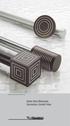 Metropole System Silent Gliss 6130M with Vega Silent Gliss Metropole Decorative Curtain Poles Timeless and Elegant Appearance of a pole Silent Gliss Metropole appears to be like any other high quality
A VIOLIN BY JACOBUS STAINER 1679
 A VIOLIN BY JACOBUS STAINER 1679 146 Roger Hargrave examines the construction and workmanship of this violin, which still retains its original undisturbed baroque neck. Roger Hargrave se penche sur la
Grade 7/8 Math Circles November 3/4, 2015. M.C. Escher and Tessellations
 Faculty of Mathematics Waterloo, Ontario N2L 3G1 Centre for Education in Mathematics and Computing Tiling the Plane Grade 7/8 Math Circles November 3/4, 2015 M.C. Escher and Tessellations Do the following
Do-It-Yourself- Hydraulic Press Make Your Own, by Marshel Rossow
 Do-It-Yourself- Hydraulic Press Make Your Own, by Marshel Rossow This press can be built from readily available metal. Materials and dimensions need not be exactly what is shown here. Much of the material
Phases of the Moon. Preliminaries:
 Phases of the Moon Sometimes when we look at the Moon in the sky we see a small crescent. At other times it appears as a full circle. Sometimes it appears in the daylight against a bright blue background.
3D Drawing. Single Point Perspective with Diminishing Spaces
 3D Drawing Single Point Perspective with Diminishing Spaces The following document helps describe the basic process for generating a 3D representation of a simple 2D plan. For this exercise we will be
OD 1401 9 PRECISION MEASURING INSTRUMENTS
 SUBCOURSE EDITION OD 1401 9 PRECISION MEASURING INSTRUMENTS PRECISION MEASURING INSTRUMENTS SUBCOURSE OD1401 EDITION 9 Unites States Army Combined Arms Support Command Fort Lee, VA 23801-1809 5 CREDIT
BRASS OF THE ORCHESTRA WORKSHEET
 BRASS OF THE ORCHESTRA WORKSHEET THE TRUMPET The history of the trumpet can be traced back to when people used wood, and animal horns to their voice. These primitive instruments were mostly, and were also
LIGHT SECTION 6-REFRACTION-BENDING LIGHT From Hands on Science by Linda Poore, 2003.
 LIGHT SECTION 6-REFRACTION-BENDING LIGHT From Hands on Science by Linda Poore, 2003. STANDARDS: Students know an object is seen when light traveling from an object enters our eye. Students will differentiate
The Know Nothing Movement in Iowa: Editor's Introduction
 The Annals of Iowa Volume 53 Number 1 (Winter 1994) pps. 1-4 The Know Nothing Movement in Iowa: Editor's Introduction Marvin Bergman ISSN 0003-4827 Copyright 1994 State Historical Society of Iowa. This
Picnic Table Plans. Made out of a single sheet of plywood, it s also portable! By Kevin Ayer. This children's picnic table would
 Picnic Table Plans Made out of a single sheet of plywood, it s also portable! By Kevin Ayer Materials One 4- by 8-foot sheet of 3 4-inch AC plywood Twelve 11 4-inch wood screws Primer and exterior paint
Single Cavity Mould. Basic Mould Construction. Ejection System. Multi Cavity Mould
 Basic Mould Construction Basic mould construction: Core plate and Core (moving) Cavity plate and cavity (fixed) Other features include Guide pillars / guide bush Sprue bush Locating ring Single Cavity
An introduction to selling blinds
 An introduction to selling blinds We are a small family owned independent blind manufacturer. We have been manufacturing blinds for trade and contract customers since 1991, from our factory in Hevingham
Lesson #13 Congruence, Symmetry and Transformations: Translations, Reflections, and Rotations
 Math Buddies -Grade 4 13-1 Lesson #13 Congruence, Symmetry and Transformations: Translations, Reflections, and Rotations Goal: Identify congruent and noncongruent figures Recognize the congruence of plane
Inspired Stitch: A Creative Journey
 Inspired Stitch: A Creative Journey Design and Stitch from Photographs Gwen Hedley For many years I have been inspired by the shores of Dungeness in Kent. My creative journeys have always begun by spending
Etch Drawing Preparation
 Etch Drawing Preparation Introduction Most etching companies prefer you to supply the drawing for your design in the form of a computer file. While some will still accept drawn or printed artwork, it is
Primary and Secondary Qualities Charles Kaijo
 Primary and Secondary Qualities Charles Kaijo From examining John Locke s distinction between primary and secondary qualities in an object and Bishop George Berkeley s refutation to Locke s argument, it
Organizing Your Paper Files Using File Folders Guide
 EASY Way to Organize Family History Papers Presented by Beth Powell Susquehanna Valley Family History Conference 14 April 2012 Overview of Principles of Organization Presentation of Mary E.V. Hill s Organizing
Window Repair & Replacement in Conservation Areas
 Window Repair & Replacement in Conservation Areas Introduction Conservation Areas are areas of architectural or historic interest, the character or appearance of which it is desirable to preserve or enhance.
Pole Lathe and Shave Horse Design
 Pole Lathe and Shave Horse Design These pictures and accompanying words are Copyright Michael Hughes February 2002. They are not to be re-produced, in part or whole, without permission from the author.
Advanced MakeUp Tips by Kathy Whittington
 Advanced MakeUp Tips by Kathy Whittington Applying Eye Shadow Eyes are the windows to your soul. The right make up can add to the beauty of your eyes if you know how to accent the positive and minimize
Acts 11 : 1-18 Sermon
 Acts 11 : 1-18 Sermon Imagine a church being riven apart by different personalities leading different groups each trying to pull it in different directions. Imagine a church whose future is threatened
Gear PEPSI CAN STOVE INSTRUCTIONS
 Gear PEPSI CAN STOVE INSTRUCTIONS [NOTE: Updated Instructions are now available. The new stove is less likely to develop flame leaks and the fuel/air mixture is improved. Instructions for a simmer ring
The Fruit of the Spirit is Love
 The Fruit of the Spirit is Love Pre-Session Warm Up (Galatians 5:22-23) Today we are going to learn more about the fruit of the Spirit called, Love. What do you think of when you hear the word love? A
Greetings, Blessings, Scott DeWitt Director of Spiritual Outreach Casas por Cristo
 Team Devotional Greetings, Welcome to Casas por Cristo! If you are reading this, then more than likely you are embarking on a week-long adventure serving our Lord and Savior along the U.S. / México border
about Why You Should Know Melanoma
 about Why You Should Know Melanoma Why You Should Know about Melanoma Each year, more than 3 million Americans are diagnosed with skin cancer. This is the most common form of cancer. Of these, more than
Tudor Resource Box. Introduction
 Introduction Tudor Resource Box Welcome to the Tudor box. This resource is for teachers and group leaders working with Special Educational Needs groups. This box contains resources to support your self-directed
Devotion NT273 CHILDREN S DEVOTIONS FOR THE WEEK OF: LESSON TITLE: The Garden of Gethsemane. THEME: We always need to pray! SCRIPTURE: Luke 22:39-53
 Devotion NT273 CHILDREN S DEVOTIONS FOR THE WEEK OF: LESSON TITLE: The Garden of Gethsemane THEME: We always need to pray! SCRIPTURE: Luke 22:39-53 Dear Parents Welcome to Bible Time for Kids. Bible Time
BUILDINGA 1/10 SCALE FLATBED TRAILER
 VOLUME 1, ISSUE 1 BUILDINGA 1/10 SCALE FLATBED TRAILER BUILT, DESIGNED & WRITTEN BY NATHAN MYERS MATERIALS: FEATURES: While the design was kept simple to allow anyone to be able to build their own trailer,
Gate Leg Drop Leaf Table Plans
 Preparing the table top blanks: Cut and glue enough 3/4 stock to make three panels 40 long by 24 wide (they will be cut to final size at a later time). While the glue dries we will work on the legs. Preparing
What are you. worried about? Looking Deeper
 What are you worried about? Looking Deeper Looking Deeper What are you worried about? Some of us lie awake at night worrying about family members, health, finances or a thousand other things. Worry can
Data problems with Capital in the 21st Century
 1 sur 9 26/05/2014 10:40 ft.com > comment > blogs > Home UK World Companies Markets Global Economy Lex Comment Management Personal Finance Life & Arts Columnists Analysis Opinion The A-List Editorial Blogs
How to Build Your Own CornHole Game
 How to Build Your Own CornHole Game DIMENSIONS Here is a diagram with the basic measurements for the Cornhole board game. SUPPLIES 1/2 thick sheet of plywood one 4 x4 or two 2 x4 s 8 long 2 4 s (4) 4 1/2
Field Report: Caere Project 2015
 Bryn Critz Schockmel Boston University History of Art and Architecture Field Report: Caere Project 2015 This summer I had the pleasure of participating in the Caere Project, led by Professor Fabio Colivicchi
Graphic Design. Background: The part of an artwork that appears to be farthest from the viewer, or in the distance of the scene.
 Graphic Design Active Layer- When you create multi layers for your images the active layer, or the only one that will be affected by your actions, is the one with a blue background in your layers palette.
Twist Drill Grinding Attachment By Steven Skiprat Jackson June 2009
 Twist Drill Grinding Attachment By Steven Skiprat Jackson June 2009 Part 1. About the tool Part 2. Mounting the tool Part 3. Using the tool Part 1. About the tool This little gadget while not a precision
3D Printing LESSON PLAN PHYSICS 8,11: OPTICS
 INVESTIGATE RATIONALE Optics is commonly taught through the use of commercial optics kits that usually include a basic set of 2-4 geometric lenses (such as double convex or double concave). These lenses
Phonics. High Frequency Words P.008. Objective The student will read high frequency words.
 P.008 Jumping Words Objective The student will read high frequency words. Materials High frequency words (P.HFW.005 - P.HFW.064) Choose target words. Checkerboard and checkers (Activity Master P.008.AM1a
Fry Phrases Set 1. TeacherHelpForParents.com help for all areas of your child s education
 Set 1 The people Write it down By the water Who will make it? You and I What will they do? He called me. We had their dog. What did they say? When would you go? No way A number of people One or two How
COMPLIMENTARY WOODWORKING PLAN
 COMPLIMENTARY WOODWORKING PLAN Adirondack Chair This downloadable plan is copyrighted. Please do not share or redistribute this plan in any way. It has been created for Wilton Tools, a division of WMH
The Basics of Robot Mazes Teacher Notes
 The Basics of Robot Mazes Teacher Notes Why do robots solve Mazes? A maze is a simple environment with simple rules. Solving it is a task that beginners can do successfully while learning the essentials
1051-232 Imaging Systems Laboratory II. Laboratory 4: Basic Lens Design in OSLO April 2 & 4, 2002
 05-232 Imaging Systems Laboratory II Laboratory 4: Basic Lens Design in OSLO April 2 & 4, 2002 Abstract: For designing the optics of an imaging system, one of the main types of tools used today is optical
Chapter 17: Light and Image Formation
 Chapter 17: Light and Image Formation 1. When light enters a medium with a higher index of refraction it is A. absorbed. B. bent away from the normal. C. bent towards from the normal. D. continues in the
AP ART HISTORY 2012 SCORING GUIDELINES
 2012 SCORING GUIDELINES Question 5 The images show a plan and an exterior view of Francesco Borromini s San Carlo alle Quattro Fontane. Identify the art-historical period during which San Carlo alle Quattro
COMPACT ELITE MAT CUTTER
 INSTRUCTION MANUAL MODEL 350-1 COMPACT ELITE MAT CUTTER INSTRUCTIONS AND OPERATION MANUAL 32in (81cm) mat cutting system with bevel & straight cutters, production stops and 20 in (51 cm) squaring bar.
US Terms. White Cosmos. Frida s Flowers Blanket Block 1
 US Terms White Cosmos Frida s Flowers Blanket Block Introduction by Jane Crowfoot I am delighted that Stylecraft asked me to design another Crochet Along project for them following the success of the Lily
Realistic Art & Proportion
 Notes 9/8 Name: Period: Date: Realistic Art & Proportion Realistic art is art that shows recognizable objects; just like things you would see in real life. Sometimes, realistic art looks so real, it almost
Researching the Great Masters and Their Works
 Researching the Great Masters and Their Works A culminating project cooperatively planned by Shari Martin and Shannon Libke 2 0 0 2 E122.7 Teaching Materials from the Stewart Resources Centre Table of
Phillis Wheatley, 1753-1784: Early African- American Poet
 17 December 2011 voaspecialenglish.com Phillis Wheatley, 1753-1784: Early African- American Poet A rare signed edition of Phillis Wheatley s poetry from 1773 (Download an MP3 of this story at voaspecialenglish.com)
How To Understand General Relativity
 Chapter S3 Spacetime and Gravity What are the major ideas of special relativity? Spacetime Special relativity showed that space and time are not absolute Instead they are inextricably linked in a four-dimensional
Pink & White Gel Tip Overlay Rules, Judges Instructions & Criteria Student Division Competition Rules
 Competition Rules 1. Total time allowed 3 hours (180 minutes) 2. These are traditional square style competition nails. 3. The nails must be applied with Tips and Gel overlay 4. The competitor must apply
Children s Furniture Projects
 This is an excerpt from the book Children s Furniture Projects by Jeff Miller Copyright 2002 by The Taunton Press www.taunton.com CHILD S ROCKER KIDS ARE ALWAYS IN MOTION. It s not easy to get them even
Reflection and Refraction
 Equipment Reflection and Refraction Acrylic block set, plane-concave-convex universal mirror, cork board, cork board stand, pins, flashlight, protractor, ruler, mirror worksheet, rectangular block worksheet,
--Michael Darnton/VIOLIN MAKING/Templates and the Form-- TEMPLATES AND THE FORM
 [This is a copy of one section of the forthcoming book tentatively titled Violin Making, by Michael Darnton, http://darntonviolins.com, downloaded from http://violinmag.com. It is an incomplete preliminary
Sunflowers. Name. Level and grade. PrimaryTools.co.uk
 Sunflowers Name Score Level and grade 2012 Contents Billy s Sunflower... 3 A story by Nicola Moon So Many Sunflowers!... 14 Vincent Van Gogh... 15 Information about the artist Making a Paper Sunflower...
Barewood Octagon and Elongated Windows Installation Instructions
 Step-by-step instructions to a beautiful window. Measuring and Installation of your new window from Century Specialty Windows couldn't be easier with our step-by-step instructions. Quality, function and
Lesson 6: Measuring Trees
 Review and Introduction Lesson 6: Measuring Trees In Lesson 4 and Lesson 5, you learned how to establish either a fixed plot or a variable plot. With your plot established and your in trees tallied, now
Geometric Optics Converging Lenses and Mirrors Physics Lab IV
 Objective Geometric Optics Converging Lenses and Mirrors Physics Lab IV In this set of lab exercises, the basic properties geometric optics concerning converging lenses and mirrors will be explored. The
22. Mozart Piano Sonata in B flat, K. 333: movement I
 22. Mozart Piano Sonata in B flat, K. 333: movement I (for Unit 3: Developing Musical Understanding) Background Information and Performance Circumstances Biography Mozart was born in Austria on the 27
Chapter 3 Installing Over-the-Post Railing on an L-Shaped Stair
 49 Chapter 3 Installing Over-the-Post Railing on an L-Shaped Stair In this chapter: The Over-the-Post Balustrade System Determining the Rail Centerline Using Rail Bolts Making a Pitch Block Laying Out
LESSON TITLE: Jesus Visits Mary and Martha THEME: Jesus wants us to spend time with \ Him. SCRIPTURE: Luke 10:38-42
 Devotion NT249 CHILDREN S DEVOTIONS FOR THE WEEK OF: LESSON TITLE: Jesus Visits Mary and Martha THEME: Jesus wants us to spend time with \ Him. SCRIPTURE: Luke 10:38-42 Dear Parents Welcome to Bible Time
The Shield of Faith. Pre-Session Warm Up. Opening Prayer. Memory Verse. Lesson
 Pre-Session Warm Up The Shield of Faith (Ephesians 6:16) Would you believe me if I told you that if you fell backward into my arms, I would catch you and not let you hit the floor? [Teacher, have several
The Ten Best Ways. The basket for The Ten Best Ways is on one of the Old Testament shelves.
 The Ten Best Ways Background Focus: the Ten Commandments (Exodus 20:1-17, Deuteronomy 5:1-21) God was present to Moses at Sinai three times. First, God was present in the burning bush when God revealed
Attribution Guide. Variety 1 Small Head; straight line of curls at back of head. Large Head; interrupted line of curls at back of head
 Classic Head Quarter Eagles The Coinage Act of 1834 reduced the standard weight of gold coins to promote coinage and circulation of the coins, previously valued at more than face value. The specifications
Today we are going to talk about Georges Seurat. Seurat was born in 1869.
 Revised Sept. 2011 FAMOUS ARTIST SERIES GEORGES SEURAT (1859-1890) A Sunday Afternoon on the La Grande Jatte, 1884-1886, 6 ½ x 10 Art Institute of Chicago, Illinois Supplies Needed: * Framed picture of
Why pinhole? Long exposure times. Timeless quality. Depth of field. Limitations lead to freedom
 Why pinhole? One of the best things about pinhole photography is its simplicity. Almost any container that can be made light-tight can be turned into a pinhole camera. Building your own camera is not only
UK Terms. White Cosmos. Frida s Flowers Blanket Block 1
 UK Terms White Cosmos Frida s Flowers Blanket Block Introduction by Jane Crowfoot I am delighted that Stylecraft asked me to design another Crochet Along project for them following the success of the Lily
THEME: God desires for us to demonstrate His love!
 Devotion NT320 CHILDREN S DEVOTIONS FOR THE WEEK OF: LESSON TITLE: The Gift of Love THEME: God desires for us to demonstrate His love! SCRIPTURE: 1 Corinthians 13:1-13 Dear Parents Welcome to Bible Time
The Photosynth Photography Guide
 The Photosynth Photography Guide Creating the best synth starts with the right photos. This guide will help you understand how to take photos that Photosynth can use to best advantage. Reading it could
Making A Mirror Grinding Tool By Allen Malsburry
 Making A Mirror Grinding Tool By Allen Malsburry The average person would never think, I can make my own telescope. Most amateur astronomers believe, I can buy a better telescope than I can build. Neither
16 Stitches Style Guide
 16 Stitches Style Guide A lot of detailing goes into the making of a good dress shirt, right from the collar to the cuffs, to the cut of the torso. This style guide has been put together to help you know
Chunking? Sounds like psychobabble!
 Chunking? Sounds like psychobabble! By Sarah Frossell Published in Rapport Magazine Winter 1998 So much of the business world depends on the fast, free flow of information but does the unit size the information
SolidWorks Tutorial 3 MAGNETIC BLOCK
 SolidWorks Tutorial 3 MAGNETIC BLOCK Magnetic Block In this exercise you will make a magnetic block. To do so, you will create a few parts, which you will assemble. You will learn the following new applications
The Physics and Math of Ping-pong and How It Affects Game Play. By: Connor Thompson & Andrew Johnson
 The Physics and Math of Ping-pong and How It Affects Game Play 1 The Physics and Math of Ping-pong and How It Affects Game Play By: Connor Thompson & Andrew Johnson The Practical Applications of Advanced
FRAMED & MOUNTED TILE MURAL
 Page 1 of 5 There is no denying that tile murals have taken the sublimation industry by storm. The unique ability to take a customer s artwork or high resolution photograph, tile it using your software
UNDERSTANDING DIFFERENT COLOUR SCHEMES MONOCHROMATIC COLOUR
 UNDERSTANDING DIFFERENT COLOUR SCHEMES MONOCHROMATIC COLOUR Monochromatic Colours are all the Colours (tints, tones and shades) of a single hue. Monochromatic colour schemes are derived from a single base
I ve always had a great passion. Double-Walled Vessels. Studio Ceramics. by Hiroe Hanazono
 Double-Walled Vessels by Hiroe Hanazono Double-walled vessels cast from original molds, sprayed glazes, fired to cone 6. I ve always had a great passion for food cooking, eating, setting the table, and
PREPARE AHEAD OF TIME FOR CRAFTS
 1 Crafts Bible Story: Paul s Conversion Acts 1-3; 9:1-9 Bottom Line: If you want to know who God is, find out more about Jesus. Memory Verse: When you walk, nothing will slow you down. When you run, you
Written By: Walter Galan
 ipad 2 GSM Front Panel Replacement Replace the front panel in your ipad 2 GSM. Written By: Walter Galan INTRODUCTION Note: this is a complete guide for replacing a plain front panel. If you have a Front
How To Work With Beads. By Rowan
 R O W A N How To Work With Beads By Rowan HOW TO WORK WITH BEADS Adding beads to a knitted or crocheted design gives it a really special touch especially when the beads added are as stunning as those in
SEGMENTED WOODTURNING
 Notes on: SEGMENTED WOODTURNING Malcolm Tibbetts www.tahoeturner.com [email protected] (530) 541-6135 MATHEMATICAL FORMULAS AND CONCEPTS: A circle contains 360 Circumference = Diameter x π(3.1416)
Grade 8 English Language Arts 90 Reading and Responding, Lesson 9
 GRADE 8 English Language Arts Reading and Responding: Lesson 9 Read aloud to the students the material that is printed in boldface type inside the boxes. Information in regular type inside the boxes and
The theory of the six stages of learning with integers (Published in Mathematics in Schools, Volume 29, Number 2, March 2000) Stage 1
 The theory of the six stages of learning with integers (Published in Mathematics in Schools, Volume 29, Number 2, March 2000) Stage 1 Free interaction In the case of the study of integers, this first stage
Session 7 Bivariate Data and Analysis
 Session 7 Bivariate Data and Analysis Key Terms for This Session Previously Introduced mean standard deviation New in This Session association bivariate analysis contingency table co-variation least squares
Basic Shapes. Most paintings can be broken down into basic shapes. See how this famous painting by Cézanne can be broken down into basic shapes.
 Basic Shapes Squares, rectangles, triangles, cones, cylinders, circles, ovals...these are the basic shapes that will aid you in drawing objects more accurately. This technique can be used when doing a
PATTERN: A two-dimensional decorative visual repetition. A pattern has no movement and may or may not have rhythm.
 Project: Elements of Design - NAME Elements: Line, Color, Value, Shape, Space, Texture Principles: Consider what principles you may have used based on the definition of each. Artist to Remember: Research
AN OPINION COMPOSITION
 1 AN OPINION COMPOSITION When you are writing an essay that asks you to discuss a topic or give your opinion on a question, it is important to organize your thoughts and present your arguments clearly