
Rear Differential Rear Differential
|
|
|
- Elwin Alexander
- 9 years ago
- Views:
Transcription
1 Rear Differential Special Tools Component Location Index General Troubleshooting Information DTC Troubleshooting Index Symptom Troubleshooting Index System Description Circuit Diagram DTC Troubleshooting Symptom Troubleshooting Rear Differential Fluid Inspection and Replacement Rear Differential Function Test Rear Differential Fluid Temperature Sensor Replacement VTM-4 LOCK Switch Test/Replacement VTM-4 Control Unit Replacement VTM-4 Relay Replacement Rear Differential Breather, Line, and Hose Replacement Rear Differential Mount Replacement Rear Differential Removal Backlash Inspection Rear Differential Installation

2 Special Tools Ref. No. Tool Number Description Qty 07SZ Backprobe Set 2 07D-S9V000 Driveshaft Remover

3 Component Location Index VTM-4 LOCK INDICTOR VTM-4 INDICTOR VTM-4 LOCK SWITCH Test, page Replacement, page VTM-4 CONTROL UNIT Replacement, page RER DIFFERENTIL BRETHER LINE Replacement, page VTM-4 RELY Test, page Replacement, page RER DIFFERENTIL SSEMBLY Removal, page Installation, page

4 General Troubleshooting Information VTM-4 Indicator The VTM-4 indicator comes on under certain conditions even if the 4WD system is working normally. Here are some examples: When you use high-powered wireless equipment such as a CB or Ham radio in the vehicle. When you keep spinning the front wheels while the vehicle is stuck in sand, mud, snow, etc. When the battery voltage suddenly drops below 8 volts or rises above 16 volts. fter the VTM-4 indicator comes on, it stays on until you turn the ignition switch off. Diagnostic Trouble Code (DTC) The VTM-4 control unit can memorize up to seven different DTCs. The system displays the DTCs by blinking the VTM-4 indicator. Multiple DTCs are displayed in the order they occured, beginning with the most recent. If the same DTC is detected more than once, the most recent DTC is written over the earlier one. Therefore, when the same problem is detected more than once, it is memorized as a single DTC. The DTCs are memorized in the EEPROM (non-volatile memory). Therefore, the memorized DTCs are not cleared when the battery is disconnected or the VTM-4 control unit is disconnected. If there is a problem in the central processing unit (CPU) of the VTM-4 control unit, the VTM-4 indicator comes on, but no DTC is memorized. Self-diagnosis When a problem is detected by self-diagnosis, the system does the following: Turns the VTM-4 indicator on. Memorizes the DTC. Stops 4WD control and puts the vehicle back in 2WD (FWD). Reduces engine torque to suit the driving conditions when the abnormality was detected. 15-4

5 Initialization of the VTM-4 Control Unit Whenever the VTM-4 control unit is replaced, it must be initialized to make the 4WD system function. There are two methods used to initialize the VTM-4 control unit. The recommended method is to use the Honda Diagnostic System (HDS) with the appropriate software plugged into the data link connector (DLC). The other method is to initialize the VTM-4 control unit manually. Initialization with the HDS 1. With the ignition switch OFF, connect the HDS to the data link connector (DLC) () (located behind the driver s dashboard lower cover). Manual Initialization 1. Start the engine (the VTM-4 indicator comes on, and the VTM-4 LOCK switch indicator is off). 2. pply the brakes, and move the shift lever to either R, 1, or 2, then push the VTM-4 LOCK switch (the VTM-4 indicator stays on, and the VTM-4 LOCK switch indicator is on). The 4WD system is now in lock mode. 3. Turn the ignition switch OFF. 4. Turn the ignition switch ON (II) (the VTM-4 indicator and the VTM-4 LOCK indicator both come on for 4 seconds, then go off). The VTM-4 control unit is initialized. VTM-4 INDICTOR VTM-4 LOCK INDICTOR ON OFF ON OFF Engine start VTM-4 LOCK switch push Engine stop IG switch ON (II) 4sec 4sec 2. Make sure the HDS communicates with the VTM-4 control unit. If it doesn t go to the DLC circuit troubleshooting (see page ). 3. Turn the ignition switch ON (II), and follow the prompts on the HDS screen. NOTE: See the HDS user s manual for specific instruction. (cont d) 15-5

6 General Troubleshooting Information (cont d) HowtoCheckforDTCs When the VTM-4 control unit senses an abnormality in the input or output systems, the VTM-4 indicator in the gauge control module will usually come on, and the malfunction indicator lamp (MIL), the D5 indicator, and/ or the VS indicator may also come on. There are two methods used to check for DTCs. The recommended method is to use the HDS with the appropriate software plugged into the data link connector (DLC). The other method is to connect the service check signal (SCS) circuit with the HDS. When the data link connector (DLC) is connected to the HDS, the VTM-4 indicator will blink the diagnostic trouble code (DTC) when the ignition switch is turned ON (II) and the SCS circuit is connected to body ground. HDS Method 1. With the ignition switch OFF, connect the HDS to the data link connector (DLC) () (located behind the driver s dashboard lower cover). 3. Turn the ignition switch ON (II), and follow the prompts on the HDS to display the DTC(s) on the screen. fter determining the DTC(s), refer to the DTC Troubleshooting. NOTE: See the HDS user s manual for specific instruction. 4. If there are fuel and emissions DTCs, /T DTCs, or VS DTCs at the same time, troubleshoot the fuel and emissions DTCs first, then /T DTCs second, then VS third, and then VTM-4 last. 5. fter recording the DTCs, clear all DTCs. 6. Test-drive the vehicle for several minutes in 4WD mode, and check for DTCs. If the DTC returns, refer to the DTC Troubleshooting. If the DTC does not return, there was an intermittent problem within the circuit. Make sure all connectors and terminals in the circuit are tight. Service Check Signal Circuit (SCS) Method 1. Park the vehicle on level ground. Shift to P, then turn off the engine. 2. Release the parking brake pedal. 3. With the ignition switch OFF, connect the HDS to the data link connector (DLC) () (located behind the driver s dashboard lower cover). 2. Make sure the HDS communicates with the VTM-4 control unit. If it doesn t go to the DLC circuit troubleshooting (see page ). 4. Short the SCS circuit to body ground with the HDS. 15-6
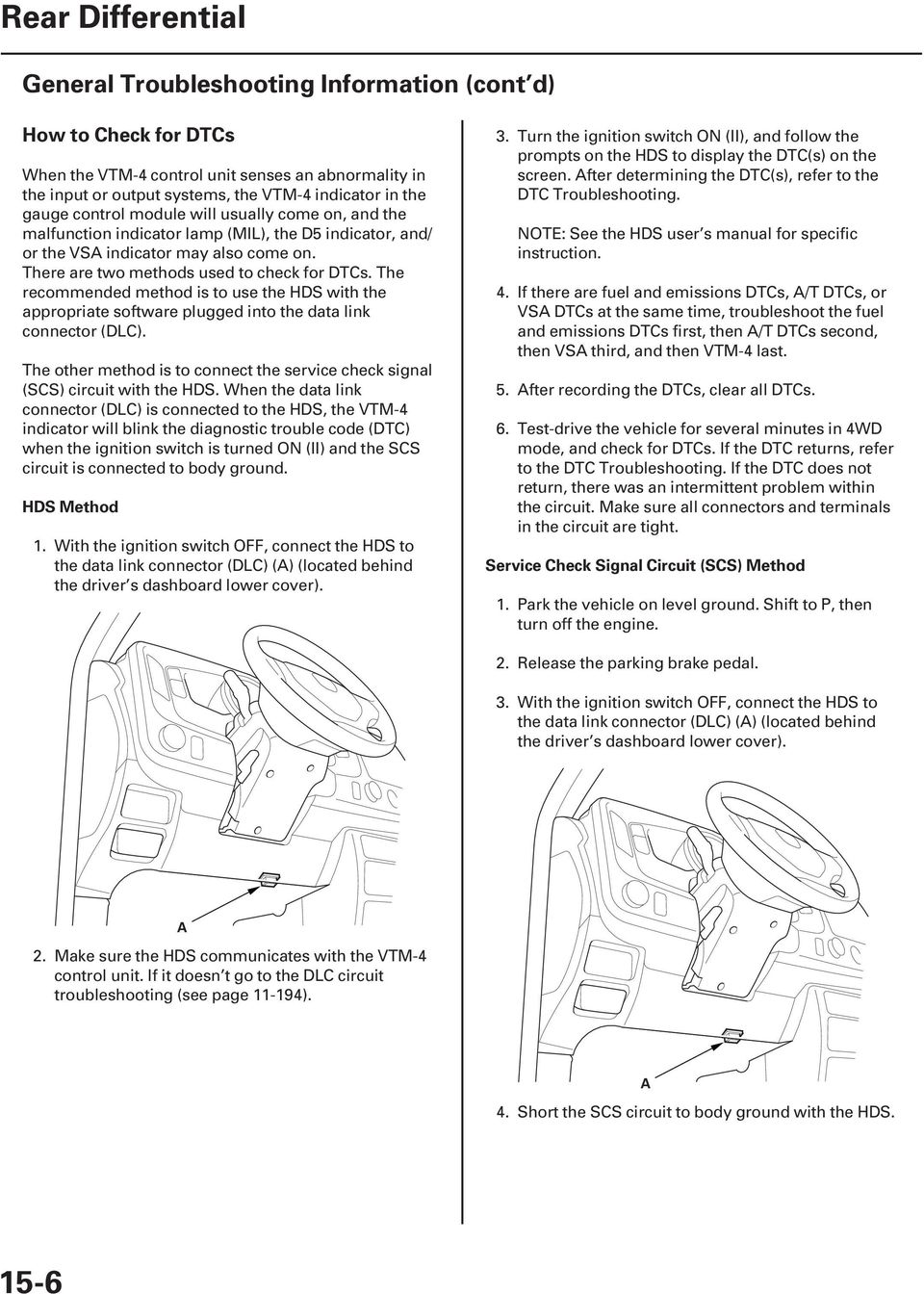
7 5. Turn the ignition switch ON (II), and observe the VTM-4 indicator. NOTE: Codes above 10 are indicated by a series of long and short blinks. One long blink equals 10 short blinks. dd the long and short blinks together to determine the code. fter determining the code, refer to the DTC Troubleshooting. Long blinks Short blinks How to Troubleshoot Circuits at the VTM-4 Control Unit Special Tools Required Backprobe set 07SZ (two required) 1. Remove the right side kick panel (see page 20-60) to gain access tothe VTM-4 control unit. 2. Inspect the circuit on the VTM-4 control unit according to the DTC Troubleshooting using the special tools and a digital multimeter or an analog circuit tester. OFF (2) (4) See DTC Connect the backprobe adapters () to the stacking patch cords (B), and connect the cords to the multimeter or an analog circuit tester (C). Using the wire insulator as a guide for the contoured-tip of the backprobe adapter, gently slide the tip into the connector from the wire side until it comes in contact with the terminal end of the wires. 6. Record all the DTC(s), then refer to the DTC Troubleshooting to determine the meaning of each DTC. 7. Clear the DTCs from the VTM-4 control unit memory. C 8. If the MIL, D5 indicator, or the VS indicator all come on at the same time, troubleshoot the cause for the MIL first, then /T DTCs second, then VS third, and then VTM-4 last. 9. Test-drive the vehicle for several minutes in 4WD mode, and check for DTCs. If the DTC returns, refer to the DTC Troubleshooting. If the DTC does not return, there was an intermittent problem within the circuit. Make sure all connectors and terminals in the circuit are tight. 07SZ B 07SZ (cont d) 15-7

8 General Troubleshooting Information (cont d) How to Clear the VTM-4 Control Unit Memory There are two methods used to clear DTCs from the VTM-4 control unit memory. The recommended method is to use the HDS with the appropriate software plugged into the data link connector (DLC). The other method is to connect the service check signal (SCS) connector with the HDS, and manually clear the memory. Service Check Signal Circuit (SCS) Method 1. Park the vehicle on level ground. Shift to P, then turn off the engine. 2. Release the parking brake pedal. 3. With the ignition switch OFF, connect the HDS to the data link connector (DLC) () (located behind the driver s dashboard lower cover). HDS method 1. With the ignition switch OFF, connect the HDS to the data link connector (DLC) () (located behind the driver s dashboard lower cover). 4. Short the SCS circuit to body ground with the HDS. 5. Turn the ignition switch ON (II). 2. Make sure the HDS communicates with the VTM-4 control unit. If it doesn t go to the DLC circuit troubleshooting (see page ). 3. Turn the ignition switch ON (II), and follow the prompts on the HDS screen to clear the DTC(s). NOTE: See the HDS user s manual for specific instruction. 6. The VTM-4 indicator comes on and stays on for 4 seconds. Press and hold the VTM-4 LOCK swtich while the VTM-4 indicator is on. 7. When the VTM-4 indicator goes off, release the VTM-4 LOCK switch. 8. The VTM-4 indicator comes on and stays on for 4 seconds. Press and hold the VTM-4 LOCK switch while the VTM-4 indicator is on. 15-8

9 9. When the VTM-4 indicator goes off, release the VTM-4 LOCK switch. The VTM-4 indicator will blink twice quickly to confirm that the DTCs have been cleared from the VTM-4 control unit memory. NOTE: If the VTM-4 indicator does not blink twice quickly, the memory has not been cleared. Turn the ignition switch OFF, then repeat steps 5 through 9. IGNITION SWITCH PRKING BRKE SWITCH PGM TESTER CONNECT VTM-4 INDICTOR VTM-4 LOCK INDICTOR ON OFF ON OFF ON OFF ON OFF ON OFF IG switch ON (II) 0.3 sec 4 sec 4 sec 0.3 sec 0.3 sec How to End a Troubleshooting Session (required after any troubleshooting) 1. Turn the ignition switch OFF. 2. Clear the DTCs from the VTM-4 control unit memory. 3. Disconnect the HDS from the data link connector (DLC). 4. Verify that the problem has been repaired; testdrive the vehicle for several minutes in 4WD mode. VTM-4 LOCK VTM-4 LOCK switch pushed switch pushed VTM-4 LOCK VTM-4 LOCK switch released switch released 10. Turn the ignition switch OFF, then disconnect the HDS from the data link connector (DLC). 15-9

10 DTC Troubleshooting Index DTC VTM-4 Indicator Detection Item Possible Cause Page 21-1 ON Left-front wheel sensor Sensor is defective (see page 15-20) 22-1 ON Right-front wheel sensor Open or short in the wire harness 23-1 ON Left-rear wheel sensor VTM-4 control unit is defective (see page 15-22) 24-1 ON Right-rear wheel sensor VS modulator-control unit is defective 26-1 ON VS modulator-control unit or wire Open or short in the wire harness from the (see page 15-24) harness VTM-4 control unit to VS modulator VS modulator-control unit is defective 37-1 ON Engine RPM signal circuit Open or short in the wire harness (see page 15-25) 38-1 ON VTM-4 control unit or PCM is defective 41-1 ON CN communication (PCM/VS system) Open or short in the wire harness from the (see page 15-27) VS modulator-control unit is defective ON ON ON ON Differential oil temperature sensor VTM-4 relay Left clutch electromagnetic coil Sensor is defective Open or short in the wire harness VTM-4 control unit is defective Relay is defective Open or short in the wire harness VTM-4 control unit is defective Electromagnetic coil is defective Open or short in the wire harness VTM-4 control unit is defective 52-1 ON 53-1 ON 54-1 ON 55-1 ON Right clutch electromagnetic coil Electromagnetic coil is defective Open or short in the wire harness VTM-4 control unit is defective 56-1 ON 57-1 ON 58-1 ON 59-1 ON Right/left clutch electromagnetic coil power supply VTM-4 control unit is defective 73-1 ON MP (manifold absolute pressure) Fault in the PCM system/mp (manifold sensor or PCM absolute pressure) sensor is defective 76-1 ON Rear differential clutch warning system Sensor is defective Open or short in the wire harness VTM-4 control unit is defective VS modulator-control unit is defective ON ON ON PCM VTM-4 control unit CN communication (PCM/VS system) PCM is defective VTM-4 control unit is defective Open or short in the wire harness from VTM-4 control unit to PCM (or VS) (see page 15-40) (see page 15-40) (see page 15-27) ON ON ON ON ON ON Differential oil temperature sensor Left-front wheel sensor Right-front wheel sensor Left-rear wheel sensor Right-rear wheel sensor Left or Right clutch electromagnetic coil Sensor is defective Open or short in the wire harness VTM-4 control unit is defective Sensor is defective Open or short in the wire harness VTM-4 control unit is defective VS modulator-control unit is defective Electromagnetic coil is defective Open or short in the wire harness VTM-4 control unit is defective (see page 15-29) (see page 15-20) (see page 15-22) (see page 15-32) (see page 15-34) : DTCs are indicated by the VTM-4 indicator when the data link connector (DLC) is connected to the HDS. VTM-4 control unit to PCM/VS VTM-4 control unit or PCM is defective or Low battery voltage Fault in the charging system (see page 15-29) (see page 15-30) (see page 15-32) (see page 15-34) (see page 15-37) (see page 15-37) (see page 15-38) 15-10

11 Symptom Troubleshooting Index Symptom Diagnostic Procedure lso check for The VTM-4 indicator comes on, but no DTCs are stored in any system: VTM-4, VS, or PCM The VTM-4 indicator does not come on The VTM-4 LOCK indicator does not come on when the VTM-4 LOCK switch is pressed The VTM-4 LOCK indicator comes on when the ignition switch is turned ON (II) and does not go off The VTM-4 LOCK indicator does not come on for about 4 seconds when the ignition switch is turned ON (II) Symptom troubleshooting (see page 15-41). Symptom troubleshooting (see page 15-42). Symptom troubleshooting (see page 15-43). Symptom troubleshooting (see page 15-45). Symptom troubleshooting (see page 15-46). Noise and judder when turning at full lock Drain and refill the rear differential with new VTM-4 fluid (see page 15-47). Do the Differential Function Test (see page 15-48). Repeat steps 1 and 2. Drain the rear differential, then install new drain plug washers, and refill with new VTM-4 fluid (see page 15-47). Clunk noise and then a bump when backing and turning Normal clutch engagement at throttle opening 15-11

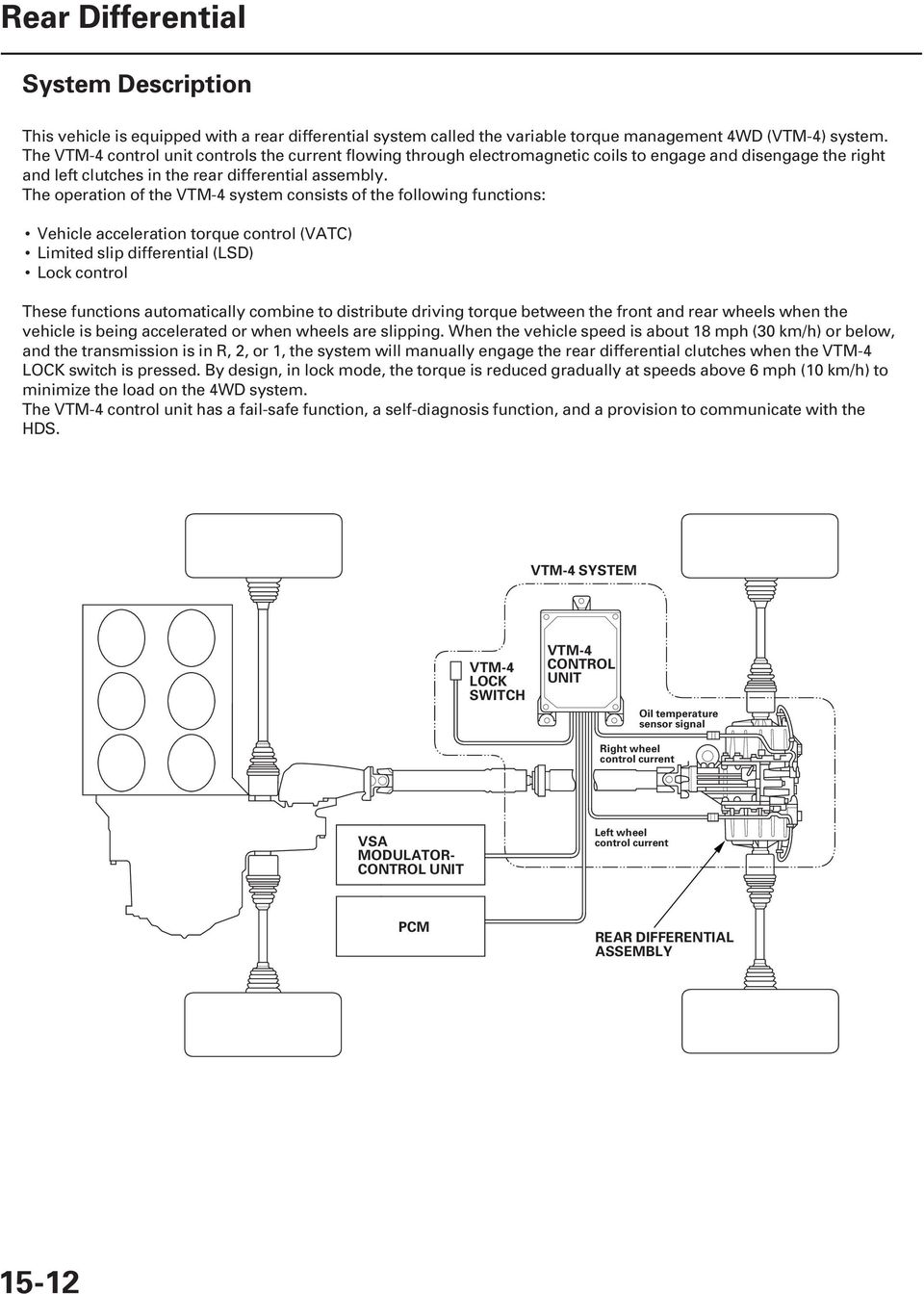
12 System Description This vehicle is equipped with a rear differential system called the variable torque management 4WD (VTM-4) system. The VTM-4 control unit controls the current flowing through electromagnetic coils to engage and disengage the right and left clutches in the rear differential assembly. The operation of the VTM-4 system consists of the following functions: Vehicle acceleration torque control (VTC) Limited slip differential (LSD) Lock control These functions automatically combine to distribute driving torque between the front and rear wheels when the vehicle is being accelerated or when wheels are slipping. When the vehicle speed is about 18 mph (30 km/h) or below, and the transmission is in R, 2, or 1, the system will manually engage the rear differential clutches when the VTM-4 LOCK switch is pressed. By design, in lock mode, the torque is reduced gradually at speeds above 6 mph (10 km/h) to minimize the load on the 4WD system. The VTM-4 control unit has a fail-safe function, a self-diagnosis function, and a provision to communicate with the HDS. VTM-4 SYSTEM VTM-4 LOCK SWITCH VTM-4 CONTROL UNIT Oil temperature sensor signal Right wheel control current VS MODULTOR- CONTROL UNIT Left wheel control current PCM RER DIFFERENTIL SSEMBLY 15-12
13 VTC Control The torque to be delivered to the rear wheels is calculated based on the acceleration of the vehicle calculated in the VTM-4 control unit. mount of control N m (kgf m) Deceleration 0 cceleration cceleration of vehicle (calculation from driving torque) LSD Control The torque to be delivered to the rear wheels is calculated based on the differences in speed and acceleration between the front and rear wheels. mount of control N m (kgf m) Front wheel rotation small 0 Rotation difference between front wheel and rear wheel Front wheel rotation large LOCK Control Rear differential clutch lock control is done by pushing the VTM-4 LOCK switch manually when the shift lever is in R, 1, or 2. mount of control (%) Velocity of vehicle (mph) (cont d) 15-13

14 System Description (cont d) Electronic Control System VTM-4 Control Unit Electrical Connections BTTERY IGNITION SWITCH VTM 4 RELY B7 4 VTM 4 CONTROL UNIT PWR RCOH FSR RCOL B3 B4 RER DIFFERENTIL RIGHT CLUTCH ELECTROMGNETIC COIL IG1 IG1 HOT in ON (II) and STRT (III) 1 IG1 LCOH LCOL B1 B2 LEFT CLUTCH ELECTROMGNETIC COIL 9 FLP TOL TOH DIFFERENTIL OIL TEMPERTURE SENSOR VS MODULTOR CONTROL UNIT 7 5 FRP RLP GUGE CONTROL MODULE 3 RRP WRN1 14 VTM 4 INDICTOR POWERTRIN CONTROL MODULE (PCM) CNH CNL NEP WRN2 LOCKSW LOCKL B VTM 4LOCK SWITCH VTM 4 LOCK INDICTOR DT LINK CONNECTOR SCS K LINE PG B5 16 PRBRK LG1 10 PRKING BRKE SWITCH LG2 B

15 VTM-4 Control Unit Inputs and Outputs The VTM-4 control unit terminal voltage and measuring conditions for the 4WD control system are shown. NOTE: Measure voltage with the connectors connected. VTM-4 Control Unit Connector Terminal Locations B (12P) (22P) Terminal number Wire color Terminal sign (Terminal name) Description 1 YEL IG1 (Ignition 1) Power supply for activating the system 3 GRY/RED RRP (Rear right Detect right-rear wheel pulse) sensor signal 4 ORN/GRN FSR (Fail-safe relay) 5 GRY/YEL RLP (Rear left pulse) 6 GRN/ORN PRBRK (Parking brake) 7 LT GRN FRP (Front right pulse) 8 BRN/WHT LOCKSW (LOCK switch) 9 WHT/RED FLP (Front left pulse) Drives VTM-4 relay Detects left-rear wheel sensor signal Detects parking brake signal Detects right-front wheel sensor signal Detects VTM-4 LOCK switch signal Detects left-front wheel sensor signal Measurement Conditions Voltage Ignition switch Battery voltage ON (II) Turn wheel at 1 There should be 0 rotation/second about 5 V repeatedly. ( digital voltmeter reads about 2.5 V when the wheel is turning faster.) Ignition switch Battery voltage ON (II) Engine running Less than 1 V Turn wheel at 1 There should be 0 rotation/second about 5 V repeatedly. ( digital voltmeter reads about 2.5 V when the wheel is turning faster.) Parking brake on Less than 2 V Parking brake off Battery voltage Turn wheel at 1 There should be 0 rotation/second about 5 V repeatedly. ( digital voltmeter reads about 2.5 V when the wheel is turning faster.) Ignition switch Less than 1 V ON (II) VTM-4 LOCK mode Battery voltage Turn wheel at 1 There should be 0 rotation/second about 5 V repeatedly. ( digital voltmeter reads about 2.5 V when the wheel is turning faster.) (cont d) 15-15

16 System Description (cont d) VTM-4 Control Unit Inputs and Outputs The VTM-4 control unit terminal voltage and measuring conditions for the 4WD control system are shown. NOTE: Measure voltage with the connectors connected. VTM-4 Control Unit Connector Terminal Locations B (12P) (22P) Terminal Wire color Terminal sign Description Measurement number (Terminal name) Conditions Voltage 10 BLK LG1 (Logic ground) Ground Less than 0.5 V 11 WHT CNH CN communication Ignition switch bout 2.5 V (pulses) (CN signal ON (II) communication signal high) 12 BLU NEP (Engine revolution) 13 BLK TOL (Temperature oil low) 14 RED/WHT WRN1 (Warning 1) 15 WHT TOH (Temperature oil high) Detects engine revolution signal Ignition switch ON (II) Engine running at 1,000 rpm bove 8 V 5 8V Detects differential oil temperature sensor Check at normal temperature with 1 3.6V signal the ignition switch ON (II) Drives VTM-4 indicator VTM-4 indicator on Less than 4 V VTM-4 indicator off Battery voltage 4 5V Power supply for differential oil temperature sensor 16 YEL/BLK LOCKL (Lock lamp) Drives VTM-4 LOCK indicator 18 LT BLU K-LINE Communication signal to HDS 20 BRN SCS (Service check signal) 22 RED CNL (CN communication signal low) Detects service check connector signal CN communication signal Check at normal temperature with the ignition switch ON (II) VTM-4 LOCK indicator on VTM-4 LOCK indicator off Ignition switch ON (II) (Not connected to HDS) SCS circuit shorted SCS circuit opened Ignition switch ON (II) Less than 4 V Battery voltage bout 9.0 V Less than 2 V bout 5 V bout 2.5 V (pulses) 15-16

17 Terminal Wire color Terminal sign Description Measurement number (Terminal name) Conditions Voltage B1 BLK/RED LCOH (Left coil Drives left clutch Ignition switch Less than 1 V high) electromagnetic coil ON (II) (positive) Engine running Less than 1 V VTM-4 LOCK mode bove 3 V B2 BLK/WHT LCOL (Left coil Drives left clutch Ignition switch Less than 1 V low) electromagnetic coil ON (II) (negative) Engine running Less than 1 V VTM-4 LOCK mode Less than 1 V B3 BRN RCOH (Right coil Drives right clutch Ignition switch Less than 1 V high) electromagnetic coil ON (II) (positive) Engine running Less than 1 V VTM-4 LOCK mode bove 3 V B4 GRN RCOL (Right coil Drives right clutch Ignition switch Less than 1 V low) electromagnetic coil ON (II) (negative) Engine running Less than 1 V VTM-4 LOCK mode Less than 1 V B5 BLK PG (Power ground) Ground Less than 0.5 V B7 RED/BLU PWR (Power) Power supply for 10 seconds after Less than 3 V VTM-4 control unit ignition switch ON (II) Engine running Battery voltage VTM-4 LOCK mode Battery voltage B11 RED/WHT WRN2 (Warning Drives VTM-4 indicator VTM-4 indicator on Less than 4 V 2) VTM-4 indicator off Battery voltage B12 BLK LG2 (Logic ground) Ground Less than 0.5 V 15-17

18 Circuit Diagram BTTERY UNDER HOOD FUSE/RELY BOX IGNITION SWITCH No.22 (BT) (120 ) No.23 (IG) (50 ) G1 BT 6 No.18 (15 ) IG1 IG1 HOT in ON (II) and STRT (III) No.21 (7.5 ) UNDER DSH FUSE/RELY BOX D1 N44 YEL BLK/YEL WHT/RED No.4 (20 ) UXILILY UNDER HOOD FUSE BOX YEL 5 1 VTM 4 RELY YEL ORN/GRN 3 2 RED/BLU 1 4 B7 IG1 FSR PWR VTM 4 CONTROL UNIT WRN1 WRN2 LOCKH LOCKSW 14 B TILLIGHT RELY RED/WHT RED/WHT YEL/BLK BRN/WHT RED/BLK RED/WHT C3 INDICTOR LIGHT VTM 4 INDICTOR GUGE CONTROL MODULE VTM 4 LOCK SWITCH 2 4 YEL RED DSH LIGHTS BRIGHTNESS CONTROLLER (In the gauge control module) 15-18

19 RER DIFFERENTIL : Shielding LEFT CLUTCH ELECTROMGNETIC COIL RIGHT CLUTCH ELECTROMGNETIC COIL DIFFERENTIL OIL TEMPERTURE SENSOR MULTIPLEX INTEGRTED CONTROL UNIT (MICU) BLK/RED BLK/WHT BRN GRN WHT BLK BRN/BLK GRN/ORN DT LINK CONNECTOR GRN/ORN BLK/RED B1 BLK/WHT B2 BRN GRN WHT BLK B3 B BLK G601 BRN 20 LT BLU 18 GRN/ORN 6 PRKING BRKE SWITCH LCOH LCOL RCOH RCOL TOH TOL SCS K LINE PRBRK VTM 4 CONTROL UNIT NEP CNL CNH RRP RLP FRP FLP PG LG LG B5 10 B12 RED WHT BLU GRY/RED GRY/YEL LT GRN WHT/RED BLK BLK BRN/YEL RED WHT RED WHT POWERTRIN CONTROL MODULE (PCM) VS MODULTOR CONTROL UNIT G

20 DTC Troubleshooting DTC 21-1, 21-2, 22-1, 22-2: Front Wheel Sensors NOTE: Before you troubleshoot, review the general troubleshooting information (see page 15-4). 1. Turn the ignition switch ON (II). 2. Clear the DTC (see page 15-8). 3. Test-drive the vehicle, and check for DTCs with the HDS. 9. Measure voltage between the No. 7 and No. 9 terminals of the VTM-4 control unit connector (22P) and body ground while rotating the appropriate wheel (1 rotation/second). DTC ppropriate Terminal 21 (Left-front) 9 22 (Right-front) 7 VTM-4 CONTROL UNIT CONNECTOR (22P) Is DTC 21-1, 21-2, and/ or 21-2 indicated? YES Go to step 4. NO Intermittent failure, the system is OK at this time. FRP (LT GRN) FLP (WHT/RED) 4. Check for DTCs in the VS system with the HDS. re there any VS DTCs indicated? YES Go to the indicated DTCs troubleshooting. NO Go to step Turn the ignition switch OFF. 6. Raise the vehicle, and make sure it is securely supported. 7. Spin the rear wheels by hand, and check for rear brake drag. YES Go to step 16. NO Go to step 10. Is there about 2 V to 3 V? 10. Turn the ignition switch OFF. 11. Disconnect the VTM-4 control unit connector (22P) and the VS modulator-control unit 46P connector. re the rear brakes dragging? YES Repair cause of rear brake drag, and retest. NO Go to step Turn the ignition switch ON (II)

21 12. Check for continuity between the terminals No. 7 and No. 9 of VTM-4 control unit connector (22P) and body ground. VTM-4 CONTROL UNIT CONNECTOR (22P) 15. Check for continuity between the VS modulatorcontrol unit 46P connector terminals and body ground. ppropriate wheel ppropriate Terminal VS modulator-control unit Right-front 28 Left-front 26 VS MODULTOR-CONTROL UNIT 46P CONNECTOR FRP (LT GRN) FLP (WHT/RED) FLP (WHT/RED) FRP (LT GRN) Is there continuity? YES Repair short to ground in the wire between the VTM-4 control unit (7 and/or 9) and the VS modulator-control unit. NO Go to step Connect the terminals No. 7 and No. 9 of VTM-4 control unit connector (22P) to body ground with the jumper wires. VTM-4 CONTROL UNIT CONNECTOR (22P) Is there continuity? YES Go to step 16. NO Repair open in the wire between the VTM-4 control unit (7 and/or 9) and the VS modulatorcontrol unit. 16. Check for poor connections or loose terminals at the VTM-4 control unit and the VS modulatorcontrol unit connectors. If the connections are OK, replace the VTM-4 control unit, then go to step 17. FRP (LT GRN) JUMPER WIRE FLP (WHT/RED) JUMPER WIRE 17. Test-drive the vehicle, and check for DTCs with the HDS. Is DTCs 21-1, 21-2, and/or 22-2 indicated? 14. Disconnect the VS modulator-control unit 46P connector. YES Replace the VS modulator-control unit (see page 19-94). NO The system is OK at this time
22 DTC Troubleshooting (cont d) DTC 23-1, 23-2, 24-1, 24-2: Rear Wheel Sensors NOTE: Before you troubleshoot, review the general troubleshooting information (see page 15-4). 1. Turn the ignition switch ON (II). 2. Clear the DTC (see page 15-8). 3. Start the engine, shift the transmission into D. Testdrive the vehicle at speeds over 25 mph (40 km/h), while keeping the engine speed below 2,500 rpm for at least 30 seconds. 10. Measure voltage between the No. 3 and No. 5 terminals of the VTM-4 control unit connector (22P) and body ground while rotating the appropriate wheel (1 rotation/second). DTC ppropriate Terminal 23 (Left-rear) 5 24 (Right-rear) 3 VTM-4 CONTROL UNIT CONNECTOR (22P) NOTE: Be careful not to overheat the rear differential clutch system. 4. Check for DTSs with the HDS. RRP (GRY/RED) RLP (GRY/YEL) Is DTCs 23-1, 23-2, 24-1, and/ or 24-2 indicated? YES Go to step 5. NO Intermittent failure, the system is OK at this time. 5. Check for DTCs in the VS system with the HDS. re there any VS DTCs indicated? YES Go to the indicated DTCs troubleshooting. NO Go to step 6. YES Go to step 18. NO Go to step 11. Is there about 2 V to 3 V? 11. Turn the ignition switch OFF. 12. Disconnect the VTM-4 control unit connector (22P) and the VS modulator-control unit 46P connector. 6. Turn the ignition switch OFF. 7. Raise the vehicle, and make sure it is securely supported. 8. Spin the rear wheels by hand, and check for rear brake drag. re the rear brakes dragging? YES Repair cause of rear brake drag, and retest. NO Go to step Turn the ignition switch ON (II)
23 13. Check for continuity between the same terminal of VTM-4 control unit connector (22P) and body ground. VTM-4 CONTROL UNIT CONNECTOR (22P) 16. Check for continuity between the VS modulatorcontrol unit 46P connector terminals and body ground. ppropriate wheel ppropriate Terminal VS modulator-control unit Right-rear 5 Left-rear 7 VS MODULTOR-CONTROL UNIT 46P CONNECTOR RRP (GRY/RED) RLP (GRY/YEL) RLP (GRY/YEL) RRP (GRY/RED) Is there continuity? YES Repair short to ground in the wire between the VTM-4 control unit (3 and/or 5) and the VS modulator-control unit. NO Go to step Connect the terminals No. 3 and No. 5 of VTM-4 control unit connector (22P) to body ground with the jumper wires. VTM-4 CONTROL UNIT CONNECTOR (22P) Is there continuity? YES Go to step 17. NO Repair open in the wire between the VTM-4 control unit (3 and/or 5) and the VS modulatorcontrol unit. 17. Check for poor connection or loose terminals at the VTM-4 control unit and the VS modulator-control unit connectors. If the connections are OK, replace the VTM-4 control unit, then go to step 18. RRP (GRY/RED) JUMPER WIRE RLP (GRY/YEL) JUMPER WIRE 18. Start the engine, shift the transmission into D. Testdrive the vehicle at speeds over 25 mph (40 km/h), while keeping the engine speed below 2,500 rpm for at least 30 seconds. 15. Disconnect the VS modulator-control unit 46P connector. NOTE: Be careful not to overheat the rear differential clutch system. 19. Check for DTCs with the HDS. Is DTCs 23-1, 23-2, 24-1, and/ or 24-2 indicated? YES Replace the VS modulator-control unit (see page 19-94). NO The system is OK at this time
24 DTC Troubleshooting (cont d) DTC 26-1: VS Modulator-Control Unit or Wire Harness NOTE: Before you troubleshoot, review the general troubleshooting information (see page 15-4). 1. Turn the ignition switch ON (II). 2. Clear the DTC (see page 15-8). 3. Test-drive the vehicle, and check for DTCs with the HDS. Is DTC 26-1 indicated? 8. Measure voltage between the No. 3, No. 5, No. 7, and No. 9 terminals of the VTM-4 control unit connector (22P) and body ground while rotating the appropriate wheel one rotation a second. ppropriate wheel Left-front Right-front Left-rear Right-rear VTM-4 CONTROL UNIT CONNECTOR (22P) RRP (GRY/RED) ppropriate Terminal FLP (WHT/RED) YES Go to step 4. NO Intermittent failure, the system is OK at this time. 4. Check for DTCs in the VS system with the HDS. RLP (GRY/YEL) FRP (LT GRN) re there any VS DTCs indicated? YES Go to the indicated DTCs troubleshooting. NO Go to step Turn the ignition switch OFF. 6. Raise the vehicle, and make sure it is securely supported. 7. Turn the ignition switch ON (II). re all four readings about 2 V to 3 V? YES Check for poor connections or loose terminals at the VTM-4 control unit. If the connections are OK, replace the VTM-4 control unit (see page 15-50). NO Check for poor connections or loose terminals between the VTM-4 control unit and the VS modulator-control unit. If the connections are OK, replace the VS modulator-control unit (see page 19-94)
25 DTC 37-1, 38-1: Engine RPM Signal Circuit NOTE: Before you troubleshoot, review the general troubleshooting information (see page 15-4). 1. Turn the ignition switch ON (II). 2. Clear the DTC (see page 15-8). 3. Test-drive the vehicle, and check for DTSs with the HDS. Is DTCs 37-1 and/ or 38-1 indicated? YES Go to step 4. NO Intermittent failure, the system is OK at this time. 4. Check for DTC s in the PGM-FI DTCs indicated re there any PGM-FI DTCs indicated? YES Go to the indicated DTCs troubleshooting. Condition Voltage Ignition switch ON (II) bove 8 V Engine speed at 1,000 rpm 5 8 V Is the voltage correct? YES Go to step 18. NO Go to step Turn the ignition switch OFF. 10. Jump the SCS line with the HDS. 11. Disconnect PCM connector (44P). 12. Turn the ignition switch ON (II). 13. Measure voltage between the No. 12 terminal of the VTM-4 control unit connector (22P) and body ground. VTM-4 CONTROL UNIT CONNECTOR (22P) NO Go to step Turn the ignition switch OFF. 6. Disconnect VTM-4 control unit connector (22P). NEP (BLU) 7. Turn the ignition switch ON (II). 8. Measure voltage between the No. 12 terminal of the VTM-4 control unit connector (22P) and body ground with the engine running. VTM-4 CONTROL UNIT CONNECTOR (22P) Is there voltage? YES Repair short to power in the wire between the VTM-4 control unit (12) and the PCM (28). NO Go to step 14. NEP (BLU) 14. Turn the ignition switch OFF. (cont d) 15-25
26 DTC Troubleshooting (cont d) 15. Check for continuity between the No. 12 terminal of the VTM-4 control unit connector (22P) and body ground. 17. Check for continuity between the No. 28 terminal of the PCM connector (44P) and body ground. PCM CONNECTOR (44P) VTM-4 CONTROL UNIT CONNECTOR (22P) NEP (BLU) NEP (BLU) Is there continuity? YES Repair short to ground in the wire between the VTM-4 control unit (12), and the PCM (28). NO Go to step Connect the No. 12 terminal of the VTM-4 control unit connector (22P) to body ground with a jumper wire. VTM-4 CONTROL UNIT CONNECTOR (22P) Is there continuity? YES Go to step 18. NO Repair open in the wire between the VTM-4 control unit (12), and the PCM (28). 18. Check for poor connections or loose terminals at the VTM-4 control unit, and the PCM connectors. If the connections are OK, replace the VTM-4 control unit, then go to step Test-drive the vehicle, and watch the VTM-4 indicator. Is DTCs 37-1 and/ or 38-1 indicated? NEP (BLU) JUMPER WIRE YES Replace the PCM (see page ). NO The system is OK at this time
27 DTC 41-1, 41-2: CN Communication (PCM/ VS System) NOTE: Before you troubleshoot, review the general troubleshooting information (see page 15-4). 1. Turn the ignition switch ON (II). 2. Clear the DTC (see page 15-8). 3. Test-drive the vehicle, and check for DTCs with the HDS. Is DTCs 41-1 and/ or 41-2 indicated? YES Go to step 4. NO Intermittent failure, the system is OK at this time. 4. Check for a PCM/VS system DTCs. 9. Check for continuity between the VTM-4 control unit connector (22P) terminal No. 11 and PCM connector (44P) terminal No. 44, and between the VTM-4 control unit connector (22P) terminal No. 11 and VS modulator-control unit 46P connector terminal No. 33. VS MODULTOR-CONTROL UNIT 46P CONNECTOR CNH (WHT) CNH (WHT) CNH (WHT) VTM-4 CONTROL UNIT CONNECTOR (22P) PCM CONNECTOR (44P) Is there a DTCs? YES Troubleshoot the indicated PCM/VS DTCs. NO Go to step Disconnect the VTM-4 control unit connector (44P), and VS modulator-control unit 46P connector. 6. Turn the ignition switch OFF. 7. Jump the SCS line with the HDS. 8. Disconnect the PCM connector (44P). Is there continuity? YES Go to step 10. CNH (WHT) NO Repair open in the wire between the VTM-4 control unit (11) and the PCM (44), the VS modulator-control unit. (cont d) 15-27
28 DTC Troubleshooting (cont d) 10. Check for continuity between the VTM-4 control unit connector (22P) terminal No. 22 and PCM connector (44P) terminal No. 9, and between the VTM-4 control unit connector (22P) terminal No. 22 and VS modulator-control unit 46P connector terminal No. 12. VS MODULTOR-CONTROL UNIT 46P CONNECTOR CNL (RED) VTM-4 CONTROL UNIT CONNECTOR (22P) CNL (RED) PCM CONNECTOR (44P) CNL (RED) Is there continuity? YES Check for poor connections or loose terminals at the VTM-4 control unit, PCM, VS modulator-control unit connectors. If the connections are OK, replace the VTM-4 control unit (see page 15-50). NO Repair open in the wire between the VTM-4 control unit (22) and the PCM (9), the VS modulator-control unit
29 DTC 42-1, 42-2, 43-1: Differential Oil Temperature Sensor NOTE: Before you troubleshoot, review the general troubleshooting information (see page 15-4). 9. Measure voltage between the No. 13 and No. 15 terminals of the VTM-4 control unit connector (22P) and body ground. VTM-4 CONTROL UNIT CONNECTOR (22P) 1. Turn the ignition switch ON (II). 2. Clear the DTC (see page 15-8). 3. Test-drive the vehicle, and check for DTCs with in the HDS. Is DTCs 42-1, 42-2, and/ or 43-1 indicated? YES Go to step 4. TOL (BLK) TOH (WHT) NO Intermittent failure, the system is OK at this time. 4. Turn the ignition switch OFF. 5. Remove the wire harness cover from the rear differential (see page 15-49). 6. Disconnect the 2P connector from the differential oil temperature sensor, then measure resistance between the No. 1 and No. 2 terminals of the differential oil temperature sensor. DIFFERENTIL OIL TEMPERTURE SENSOR 2P CONNECTOR Is there voltage? YES Repair short to power in the wire between the VTM-4 control unit (13 or 15) and the differential oil temperature sensor. NO Go to step Turn the ignition switch OFF. 11. Check for continuity between the No. 13 and No. 15 terminals of the VTM-4 control unit connector (22P) and body ground. VTM-4 CONTROL UNIT CONNECTOR (22P) Oil temperature Resistance 32 F (0 C) 5.82 k to 7.26 k 86 F (30 C) 1.53 k to 1.83 k 212 F (100 C) 148 to F (140 C) 52 to 61 YES Go to step 7. Terminal side of male terminals Istheresistancecorrect? NO Replace the differential oil temperature sensor (see page 15-49). 7. Disconnect VTM-4 control unit connector (22P). 8. Turn the ignition switch ON (II). TOL (BLK) Is there continuity? YES Repair short to ground in the wire between the VTM-4 control unit (13 or 15) and the differential oil temperature sensor. NO Go to step 12. TOH (WHT) (cont d) 15-29
30 DTC Troubleshooting (cont d) 12. Connect the differential oil temperature sensor 2P connector terminals to body ground with jumper wires. DIFFERENTIL OIL TEMPERTURE SENSOR 2P CONNECTOR JUMPER WIRE DTC 44-1: VTM-4 Relay NOTE: Before you troubleshoot, review the general troubleshooting information (see page 15-4). 1. Turn the ignition switch ON (II). 2. Clear the DTC (see page 15-8). 3. Test-drive the vehicle, and check for DTCs with the HDS. Is DTC 44-1 indicated? YES Go to step 4. Terminal side of female terminals 13. Check for continuity between the No. 13 and No. 15 terminals of the VTM-4 control unit connector (22P) and body ground. VTM-4 CONTROL UNIT CONNECTOR (22P) NO Intermittent failure, the system is OK at this time. 4. Measure voltage between the No. 4 terminal of the VTM-4 control unit connector (22P) and body ground, and between the No. 7 terminal of the VTM-4 control unit connector B (12P) and body ground with the ignition switch ON (II), and with the engine started. VTM-4 CONTROL UNIT CONNECTORS TOL (BLK) TOH (WHT) FSR (ORN/GRN) (22P) B(12P) PWR (RED/BLU) Is there continuity? YES Check for poor connections or loose terminals at the VTM-4 control unit and the differential oil temperature sensor connectors. If the connections are OK, replace the VTM-4 control unit (see page 15-50). NO Repair open in the wire between the VTM-4 control unit (13 or 15) and the differential oil temperature sensor. Condition B7 (PWR) 4 (FSR) Ignition switch ON (II) Less than 3 V Battery voltage Engine start Battery voltage Less than 1 V Is the voltage correct? YES Go to step 16. NO Go to step Turn the ignition switch OFF
31 6. Remove the VTM-4 relay, and test it (see page 22-75). Is the VTM-4 relay OK? YES Go to step 7. NO Replace the VTM-4 relay (see page 15-50). 7. Turn the ignition switch ON (II) with the VTM-4 relay removed. 8. Measure voltage between the No. 1 and No. 5 terminals of the VTM-4 relay 5P connector and body ground. VTM-4 RELY 5P CONNECTOR 12. Measure voltage between the No. 4 terminal of the VTM-4 control unit connector (22P) and body ground, and between the No. 7 terminal of the VTM-4 control unit connector B (12P) and body ground. FSR (ORN/GRN) VTM-4 CONTROL UNIT CONNECTORS (22P) B(12P) PWR (RED/BLU) WHT/RED BLK/YEL Is there battery voltage? YES Repair short to power in the wire between the VTM-4 control unit (4 or B7) and the VTM-4 relay. NO Go to step 12. Terminal side of female terminals Is there battery voltage? YES Go to step 9. NO Check for blown No. 4 (20 ) fuse in the auxiliary fuse box or No. 18 (15 ) fuse in the driver s under-dash fuse/relay box. If the fuses are OK, repair open in the wire between the auxiliary fuse box or the driver s under-dash fuse/relay box and the VTM-4 relay. 9. Turn the ignition switch OFF. 10. Disconnect the VTM-4 control unit connector (22P) and connector B (12P). 11. Turn the ignition switch ON (II). 13. Turn the ignition switch OFF. 14. Check for continuity between the No. 4 terminal of the VTM-4 control unit connector (22P) and body grond, and between the No. 7 terminal of the VTM-4 control unit connector B (12P) and body ground. FSR (ORN/GRN) Is there continuity? VTM-4 CONTROL UNIT CONNECTORS (22P) B(12P) PWR (RED/BLU) YES Repair short to ground in the wire between the VTM-4 control unit (4 or B7) and the VTM-4 relay. NO Go to step 15. (cont d) 15-31
32 DTC Troubleshooting (cont d) 15. Check for continuity between the No. 4 terminal of the VTM-4 control unit connector (22P) and the No. 3 terminal of the VTM-4 relay, and between the No. 7 terminal of the VTM-4 control unit connector B (12P) and the No. 2 terminal of the VTM-4 relay. VTM-4 RELY CONNECTOR (5P) DTC 51-1, 52-1, 53-1, 53-2, 54-1: Left Clutch Electromagnetic Coil NOTE: Before you troubleshoot, review the general troubleshooting information (see page 15-4). 1. Turn the ignition switch ON (II). RED/BLU VTM-4 CONTROL UNIT CONNECTOR (22P) FSR (ORN/GRN) ORN/GRN VTM-4 CONTROL UNIT CONNECTOR B (12P) PWR (RED/BLU) 2. Clear the DTC (see page 15-8). 3. Test-drive the vehicle, and check for DTCs with the HDS. Is DTCs 51-1, 52-1, 53-2, and/ or 54-1 indicated? YES Go to step 4. Is there continuity? YES Go to step 16. NO Repair open in the wire between the 4 or B7 terminals of the VTM-4 control unit and the VTM-4 relay. 16. Check for poor connections or loose terminals at the VTM-4 control unit and the VTM-4 relay connectors. If the connections are OK, go to step Test-drive the vehicle, and check for DTCs with the HDS. NO Intermittent failure, the system is OK at this time. 4. Turn the ignition switch OFF. 5. Disconnect the left clutch electromagnetic coil 2P connector on the differential. 6. Measure resistance between the No. 1 and No. 2 terminals of the left clutch electromagnetic coil 2P connector. LEFT CLUTCH ELECTROMGNETIC COIL 2P CONNECTOR Is DTC 44-1 indicated? YES Replace the VTM-4 control unit (see page 15-50). NO The system is OK at this time. Terminal side of male terminals Is there 1 to 3? YES Go to step 7. NO Replace the rear differential assembly
33 7. Measure resistance between the No. 1 terminal of the left clutch electromagnetic coil and differential carrier assembly. LEFT CLUTCH ELECTROMGNETIC COIL 2P CONNECTOR 11. Turn the ignition switch OFF. 12. Check for continuity between the No. 1 and No. 2 terminals of the VTM-4 control unit connector B (12P) and body ground. VTM-4 CONTROL UNIT CONNECTOR B (12P) LCOH (BLK/RED) LCOL (BLK/WHT) Terminal side of male terminals Is there about 50 M YES Go to step 8. or more? Is there continuity? NO Replace the rear differential assembly. 8. Disconnect the VTM-4 control unit connector B (12P). 9. Turn the ignition switch ON (II). YES Repair short to ground in the wire between the VTM-4 control unit (B1 or B2) and the left clutch electromagnetic coil. NO Go to step Measure voltage between the No. 1 and No. 2 terminals of the VTM-4 control unit connector B (12P) and body ground. VTM-4 CONTROL UNIT CONNECTOR B (12P) LCOH (BLK/RED) LCOL (BLK/WHT) Is there battery voltage? YES Repair short to power in the wire between the VTM-4 control unit (B1 or B2) and the left clutch electromagnetic coil. NO Go to step 11. (cont d) 15-33
34 DTC Troubleshooting (cont d) 13. Connect a jumper wire between the No. 1 and No. 2 terminals of the left clutch electromagnetic coil 2P connector. LEFT CLUTCH ELECTROMGNETIC COIL 2P CONNECTOR DTC 53-2, 55-1, 56-1, 57-1, 58-1: Right Clutch Electromagnetic Coil NOTE: Before you troubleshoot, review the general troubleshooting information (see page 15-4). 1. Turn the ignition switch ON (II). 2. Clear the DTC (see page 15-8). BLK/WHT BLK/RED JUMPER WIRE 14. Check for continuity between the No. 1 and No. 2 terminals of the VTM-4 control unit connector B (12P). VTM-4 CONTROL UNIT CONNECTOR B (12P) LCOH (BLK/RED) LCOL (BLK/WHT) 3. Test-drive the vehicle, and check for DTCs with the HDS. Is DTCs 53-2, 55-1, 56-1, 57-1, and/or 58-1 indicated? YES Go to step 4. NO Intermittent failure, the system is OK at this time. 4. Turn the ignition switch OFF. 5. Disconnect the right clutch electromagnetic coil/ differential oil temperature sensor 6P connector on the differential. 6. Measure resistance between the No. 3 and No. 6 terminals of the right clutch electromagnetic coil/ differential oil temperature sensor 6P connector. RIGHT CLUTCH ELECTROMGNETIC COIL/ DIFFERENTIL OIL TEMPERTURE SENSOR 6P CONNECTOR Is there continuity? YES Do the Rear Differential Function Test (see page 15-48). If the rear differential is normal, replace the VTM-4 control unit (see page 15-50). NO Repair open in the wire between the VTM-4 control unit (B1 or B2) and the left clutch electromagnetic coil. GRN BRN Terminal side of male terminals Is there 1 to 3? YES Go to step 7. NO Replace the rear differential assembly
35 7. Measure resistance between the No. 3 terminal of the right clutch electromagnetic coil/differential oil temperature sensor 6P connector and the differential carrier assembly. RIGHT CLUTCH ELECTROMGNETIC COIL/ DIFFERENTIL OIL TEMPERTURE SENSOR 6P CONNECTOR 11. Turn the ignition switch OFF. 12. Check for continuity between the No. 3 and No. 4 terminals of the VTM-4 control unit connector B (12P) and body ground. VTM-4 CONTROL UNIT CONNECTOR B (12P) GRN RCOH (BRN) RCOL (GRN) Is there 50 M YES Go to step 8. Terminal side of male terminals or more? NO Replace the rear differential assembly. 8. Disconnect the VTM-4 control unit connector B (12P). Is there continuity? YES Repair short to ground in the wire between the VTM-4 control unit (B3 or B4) and the right clutch electromagnetic coil. NO Go to step Turn the ignition switch ON (II). 10. Measure voltage between the No. 3 and No. 4 terminals of the VTM-4 control unit connector B (12P) and body ground. VTM-4 CONTROL UNIT CONNECTOR B (12P) RCOH (BRN) RCOL (GRN) Is there battery voltage? YES Repair short to power in the wire between the VTM-4 control unit (B3 or B4) and the right clutch electromagnetic coil. NO Go to step 11. (cont d) 15-35
36 DTC Troubleshooting (cont d) 13. Connect a jumper between the No. 3 and No. 6 terminals of the right clutch electromagnetic coil/ differential oil temperature sensor 6P connector. RIGHT CLUTCH ELECTROMGNETIC COIL/ DIFFERENTIL OIL TEMPERTURE SENSOR 6P CONNECTOR JUMPER WIRE GRN BRN 14. Check the for continuity between the No. 3 and No. 4 terminals of the VTM-4 control unit connector B (12P). VTM-4 CONTROL UNIT CONNECTOR B (12P) RCOH (BRN) RCOL (GRN) Is there continuity? YES Do the Rear Differential Function Test (see page 15-48). If the rear differential is normal, replace the VTM-4 control unit (see page 15-50). NO Repair open in the wire between the VTM-4 control unit (B3 or B4) and the right clutch electromagnetic coil
37 DTC 59-1: Right/Left Clutch Electromagnetic DTC 73-1: MP (Manifold bsolute Pressure) Coil Power Supply Sensor or PCM NOTE: Before you troubleshoot, review the general troubleshooting information (see page 15-4). 1. Turn the ignition switch ON (II). 2. Clear the DTC (see page 15-8). 3. Test-drive the vehicle, and check for DTCs with the HDS. Is DTC 59-1 indicated? YES Go to step 4. NO Intermittent failure, the system is OK at this time. 4. Check the battery. Is the specified battery installed, and is it fully charged? YES Go to step 5. NO Replace or charge the battery. 5. Watch the charging system indicator. NOTE: Before you troubleshoot, review the general troubleshooting information (see page 15-4). 1. Turn the ignition switch ON (II). 2. Clear the DTC (see page 15-8). 3. Test-drive the vehicle, and check for DTCs with the HDS. Is DTC 73-1 indicated? YES Go to step 4. NO Intermittent failure, the system is OK at this time. 4. Check for DTCs in the PGM-FI system with the HDS. re there any PGM-FI DTCs indicated? YES Go to the indicated DTCs troubleshooting. NO Check for poor connections or loose terminals at the VTM-4 control unit and the PCM connectors. If the connections are OK, replace the VTM-4 control unit (see page 15-50). Does the charging system indicator come on with the ignition switch ON (II), and go off with the engine started? YES Check for poor connections or loose terminals at the VTM-4 control unit connectors. If the connections are OK, replace the VTM-4 control unit (see page 15-50). NO Check the charging system
38 DTC Troubleshooting (cont d) DTC 76-1: Rear Differential Clutch Warning System NOTE: Before you troubleshoot, review the general troubleshooting information (see page 15-4). 1. Turn the ignition switch ON (II). 2. Clear the DTC (see page 15-8). 3. Start the engine, shift the transmission into D. Testdrive the vehicle at speeds over 25 mph (40 km/h), while keeping the engine speed below 2,500 rpm for at least 30 seconds. 10. Measure voltage between the No. 3 and No. 5 terminals of the VTM-4 control unit connector (22P) and body ground while rotating the appropriate wheel (1 rotation/second). ppropriate wheel Left-rear Right-rear ppropriate Terminal 5 3 VTM-4 CONTROL UNIT CONNECTOR (22P) NOTE: Be careful not to overheat the rear differential clutch system. 4. Check for DTCs with the HDS. RRP (GRY/RED) RLP (GRY/YEL) Is DTC 76-1 indicated? YES Go to step 5. NO Intermittent failure, the system is OK at this time. 5. Check for DTCs in the VS system with the HDS. re there any VS DTCs indicated? YES Check the VS system for DTCs (see page 19-39). YES Go to step 18. NO Go to step 11. Is there about 2 to 3 V? 11. Turn the ignition switch OFF. 12. Disconnect the VTM-4 control unit and the VS modulator-control unit connectors. NO Go to step Turn the ignition switch OFF. 7. Raise the vehicle, and make sure it is securely supported. 8. Spin the rear wheels by hand, and check for rear brake drag. re the rear brakes dragging? YES Repair cause of rear brake drag, and retest. NO Go to step Turn the ignition switch ON (II)
39 13. Check for continuity between the No. 3 and No. 5 terminals of VTM-4 control unit connector (22P) and body ground. VTM-4 CONTROL UNIT CONNECTOR (22P) 15. Check for continuity between the VS modulatorcontrol unit 46P connector terminals and body ground. ppropriate wheel ppropriate Terminal VTM-4 control unit VS modulatorcontrol unit Right-rear 3 5 Left-rear 5 7 RRP (GRY/RED) RLP (GRY/YEL) VS MODULTOR-CONTROL UNIT 46P CONNECTOR RLP (GRY/YEL) RRP (GRY/RED) Is there continuity? YES Repair short to ground in the wire between the VTM-4 control unit (3 and/or 5) and the VS modulator-control unit. NO Go to step Connect the No. 3 and No. 5 terminals of VTM-4 control unit connector (22P) to body ground with the jumper wires. VTM-4 CONTROL UNIT CONNECTOR (22P) RRP (GRY/RED) JUMPER WIRE RLP (GRY/YEL) JUMPER WIRE Is there continuity? YES Go to step 16. NO Repair open in the wire between the VTM-4 control unit (3 and/or 5) and the VS modulatorcontrol unit. 16. Check for poor connections or loose terminals at the VTM-4 control unit and the VS modulatorcontrol unit connectors. If the connections are OK, replace the VTM-4 control unit, then go to step Start the engine, shift the transmission into D. Testdrive the vehicle at speeds over 25 mph (40 km/h), while keeping the engine speed below 2,500 rpm for at least 30 seconds. NOTE: Be careful not to overheat the rear differential clutch system. 18. Check for DTCs with the HDS. Is DTC 76-1 indicated? YES Replace the VS modulator-control unit (see page 19-94). NO The system is OK at this time
40 DTC Troubleshooting (cont d) DTC 77-1: PCM DTC 78-1: VTM-4 Control Unit NOTE: Before you troubleshoot, review the general troubleshooting information (see page 15-4). Check the fuel and emissions system DTCs. If there is a DTC, troubleshoot the indicated DTC first, then troubleshoot DTC Turn the ignition switch ON (II). 2. Clear the DTC (see page 15-8). 3. Test-drive the vehicle, and check for DTCs with the HDS. Is DTC 77-1 indicated? YES Go to step 4. NO Intermittent failure, the system is OK at this time. 4. Update the PCM if it does not have the latest software (see page 11-7), or substitute a knowngood PCM (see page 11-8). 5. Test-drive the vehicle, and check for DTCs with the HDS. Is DTC 77-1 indicated? YES Check for loose terminal fit in the VTM-4 control unit. If it is normal, replace the VTM-4 control unit (see page 15-50). NO If the PCM was updated, troubleshooting is complete. If the PCM was substituted, replace the original PCM (see page ). NOTE: Before you troubleshoot, review the general troubleshooting information (see page 15-4). 1. Turn the ignition switch ON (II). 2. Clear the DTC (see page 15-8). 3. Test-drive the vehicle, and check for DTCs with the HDS. Is DTC 78-1 indicated? YES Go to step 4. NO Intermittent failure, the system is OK at this time. 4. Check the battery. Is the specified battery installed, and is it fully charged? YES Go to step 5. NO Replace or charge the battery. 5. Watch the charging system indicator. Does the charging system indicator come on with the ignition switch ON (II), and go off with the engine started? YES Go to step 6. NO Check the charging system. 6. Check for installation of any aftermarket CB or Ham radios which may cause an RF signal interference. Is there an aftermarket radio installed? YES Disconnect the aftermarket radio, and retest. NO Check for poor connections or loose terminals at the VTM-4 control unit connectors. If the connections are OK, replace the VTM-4 control unit (see page 15-50)
41 Symptom Troubleshooting The VTM-4 indicator comes on, but no DTCs arestoredinanysystem:vtm-4,vs,or PCM 1. Check the No. 21 (7.5 ) fuse in the driver s underdash fuse/relay box. IsthefuseOK? YES Go to step 2. NO Replace the fuse, and recheck. 5. Turn the ignition switch OFF. 6. Disconnect the VTM-4 control unit and the gauge control module connectors. 7. Check for continuity between the No. 14 terminal of the VTM-4 control unit connector (22P), and the No. 11 terminal of the VTM-4 control unit connector B (12P) to body ground. VTM-4 CONTROL UNIT CONNECTORS 2. Reinitialize the VTM-4 control unit, and watch the VTM-4 indicator (see page 15-5). (22P) B (12P) Does the VTM-4 indicator come on and stay on? YES Go to step 3. WRN 1 (RED/WHT) WRN 2 (RED/WHT) NO The system is OK at this time. 3. Turn the ignition switch ON (II). 4. Measure voltage between the No. 1 and No. 10 terminals of the VTM-4 control unit connector (22P), and the No. 1 terminal of the VTM-4 control unit connector (22P) and the No. 12 terminal of the VTM-4 control unit connector B (12P). VTM-4 CONTROL UNIT CONNECTORS Is there continuity? YES Repair short to ground in the wire between the VTM-4 control unit (14 or B11) and the gauge control module. NO Go to step Reconnect the gauge control module connectors. B (12P) IG 1 (YEL) (22P) LG (BLK) 9. Turn the ignition switch ON (II). 10. Watch the VTM-4 indicator. LG (BLK) Does the VTM-4 indicator come on? Is there battery voltage? YES Go to step 5. YES Replace the gauge control module (see page ). NO Check for poor connections or loose terminals at the VTM-4 connectors. If the connections are OK, replace the VTM-4 control unit (see page 15-50). NO Repair open in the wire between the VTM-4 control unit (1) and the driver s under-dash fuse/ relay box, or repair open in the wire between the VTM-4 control unit (10 or B12) and body ground, or check the poor ground (G501)
42 Symptom Troubleshooting (cont d) The VTM-4 indicator does not come on 1. Do the gauge control module self-diagnosis function (see page ). Is the gauge control module OK? YES Go to step 2. NO Go to the gauge control module input test (see page ) and check for an open or short in the power and ground. 2. Disconnect the VTM-4 control unit connectors (22P) and B (12P). 3. Connect the No. 14 terminal of the VTM-4 control unit connector (22P) and No. 11 terminal of the VTM-4 control unit connector B (12P) to body ground with jumper wires. VTM-4 CONTROL UNIT CONNECTORS 8. Connect the No. 3 terminal of the gauge control module connector C (20P) to body ground with a jumper wire. GUGE CONTROL MODULE CONNECTOR C (20P) JUMPER WIRE RED/WHT 9. Check for continuity between the No. 14 terminal of the VTM-4 control unit connector (22P) and body ground, and the No. 11 terminal of the VTM-4 control unit connector B (12P) and body ground. (22P) B (12P) VTM-4 CONTROL UNIT CONNECTORS (22P) B (12P) WRN 1 (RED/WHT) JUMPER WIRE WRN 2 (RED/WHT) JUMPER WIRE WRN 1 (RED/WHT) WRN 2 (RED/WHT) 4. Turn the ignition switch ON (II). 5. Watch the VTM-4 indicator. Does the VTM-4 indicator come on? YES Check for poor connections or loose terminals at the VTM-4 control unit connectors. If the connections are OK, replace the VTM-4 control unit (see page 15-50). NO Go to step 6. Is there continuity? YES Substitute a known-good gauge control module and recheck. If the symptom/indication goes away with the known-good gauge control module, replace the original gauge control module (see page ). NO Repair open in the wire between the gauge control module (C3) and the VTM-4 control unit. 6. Turn the ignition switch OFF. 7. Disconnect gauge control module connector (30P)
43 The VTM-4 LOCK indicator does not come on when the VTM-4 LOCK switch is pressed NOTE: The VTM-4 LOCK indicator will only come on when the engine is running and the transmission is in R, 1, or 2 before the VTM-4 LOCK switch is pressed. 1. Check the No. 21 (7.5 ) fuse in the driver s underdash fuse/relay box. 9. Connect a voltmeter between the 8 terminal of the VTM-4 control unit and body ground. VTM-4 CONTROL UNIT CONNECTOR (22P) LOCKSW (BRN/WHT) IsthefuseOK? YES Go to step 2. NO Replace the fuse, and recheck. 2. Turn the ignition switch ON (II). 3. Watch the VTM-4 LOCK indicator. Does the VTM-4 LOCK indicator come on, and does it go off about 4 seconds later? YES Go to step 4. NO Go to step Start the engine, and move the shift lever to R, 1, and 2, then watch the VTM-4 LOCK indicator. Does the VTM-4 LOCK indicator come on when the VTM-4 LOCK switch is pressed? YES The system is OK at this time. NO Go to step 5. YES Check for poor connections or loose terminals at the VTM-4 control unit connectors. If the connections are OK, replace the VTM-4 control unit (see page 15-50). NO Go to step 10. Is there battery voltage when the VTM-4 LOCK switch is pressed? 10. Test the VTM-4 LOCK switch (see page 15-49). Is the VTM-4 LOCK switch OK? YES Repair open in the wire between the VTM-4 LOCK switch and the VTM-4 control unit (see page 15-50). NO Replace the VTM-4 LOCK switch. 5. Check for an /T system DTC. Is there a DTC? YES Troubleshoot the /T system indicated DTC. NO Go to step Turn the ignition switch OFF. 7. Disconnect the VTM-4 control unit connector (22P). 8. Turn the ignition switch ON (II). (cont d) 15-43
44 Symptom Troubleshooting (cont d) 11. Connect the No. 16 terminal of the VTM-4 control unit connector (22P) to body ground with a jumper wire. 16. Check the continuity between the No. 16 terminal of the VTM-4 control unit connector (22P) and body ground. VTM-4 CONTROL UNIT CONNECTOR (22P) VTM-4 CONTROL UNIT CONNECTOR (22P) LOCKH (YEL/BLK) LOCKH (YEL/BLK) JUMPER WIRE 12. Watch the VTM-4 LOCK indicator. Does the VTM-4 LOCK indicator come on? YES Check for poor connections or loose terminals at the VTM-4 control unit connectors. If the connections are OK, replace the VTM-4 control unit (see page 15-50). NO Go to step Turn the ignition switch OFF. 14. Remove the VTM-4 LOCK switch. 15. Connect the No. 5 terminal of the VTM-4 LOCK switch 6P connector to body ground with a jumper wire. Is there continuity? YES Go to step 17. NO Repair open in the wire between the VTM-4 control unit (16) and the VTM-4 LOCK switch. 17. Turn the ignition switch ON (II). 18. Measure voltage between the No. 2 terminal of the VTM-4 LOCK switch 6P connector and body ground. VTM-4 LOCK SWITCH 6P CONNECTOR YEL VTM-4 LOCK SWITCH 6P CONNECTOR YEL/BLK JUMPER WIRE Is there battery voltage? YES Replace the VTM-4 LOCK indicator bulb. NO Repair open in the wire between the No. 2 terminal of the VTM-4 LOCK switch 6P connector and the driver s under-dash fuse/relay box
45 The VTM-4 LOCK indicator comes on when the ignition switch is turned ON (II) and does not go off 1. Disconnect the VTM-4 control unit connector (22P). 2. Turn the ignition switch ON (II). 3. Watch the VTM-4 LOCK indicator. Does the VTM-4 LOCK indicator come on? YES Go to step 4. NO Check for poor connections or loose terminals at the VTM-4 control unit connectors. If the connections are OK, replace the VTM-4 control unit (see page 15-50). 4. Turn the ignition switch OFF. 5. Disconnect the VTM-4 LOCK switch 6P connector. 6. Check for continuity between the No. 16 terminal of the VTM-4 control unit connector (22P) and body ground. VTM-4 CONTROL UNIT CONNECTOR (22P) LOCKH (YEL/BLK) Is there continuity? YES Repair short to ground in the wire between the VTM-4 control unit (16) and the VTM-4 LOCK switch. NO ReplacetheVTM-4LOCKswitch(seepage 15-49)
46 Symptom Troubleshooting (cont d) The VTM-4 LOCK indicator does not come on for about 4 seconds when the ignition switch is turned ON (II) 1. Disconnect the VTM-4 control unit connector (22P). 8. Check for continuity between the No. 16 terminal of the VTM-4 conntrol unit connector (22P) and body ground. VTM-4 CONTROL UNIT CONNECTOR (22P) 2. Turn the ignition switch ON (II). 3. Connect the No. 16 terminal of the VTM-4 control unit connector (22P) to body ground with a jumper wire. LOCKH (YEL/BLK) VTM-4 CONTROL UNIT CONNECTOR (22P) LOCKH (YEL/BLK) JUMPER WIRE 4. Watch the VTM-4 LOCK indicator. Does the VTM-4 LOCK indicator come on? YES Check for poor connections or loose terminals at the VTM-4 control unit connectors. If the connections are OK, replace the VTM-4 control unit (see page 15-50). Is there continuity? YES Go to step 9. NO Repair open in the wire between the VTM-4 control unit (16) and the VTM-4 LOCK switch. 9. Turn the ignition switch ON (II). 10. Measure voltage between the No. 2 terminal of the VTM-4 LOCK switch 6P connector and body ground. VTM-4 LOCK SWITCH 6P CONNECTOR NO Go to step Turn the ignition switch OFF. YEL 6. Remove the VTM-4 LOCK switch. 7. Connect the No. 5 terminal of the VTM-4 LOCK switch 6P connector to body ground with a jumper wire. VTM-4 LOCK SWITCH 6P CONNECTOR YEL/BLK JUMPER WIRE Is there battery voltage? YES Replace the VTM-4 LOCK indicator bulb. NO Repair open in the wire between the No. 2 terminal of the VTM-4 LOCK switch 6P connector and the driver s under-dash fuse/relay box
47 Fluid Inspection and Replacement 1. With the vehicle on level ground, inspect the differential fluid with the ignition switch OFF. 2. Remove the oil filler plug () and sealing washer (B), then check the condition of the fluid, and make sure the fluid is at the proper level (C). 5. Clean the drain plug, then reinstall with a new washer, and refill the differential with the recommended fluid to the proper level. Fluid capacity: 2.64 L (2.79 US.qt) at fluid change C B 47 N m (4.8 kgf m, 35 lbf ft) Recommended fluid: VTM-4 Differential Fluid (P/N ) 6. Reinstall the oil filler plug with a new washer. B D 47 N m (4.8 kgf m, 35 lbf ft) 3. The fluid level must be up to the fill hole. If it is below the hole, add the recommended fluid until it runs out, then reinstall the oil filler plug with a new sealing washer. 4. If the differential fluid is dirty, remove the drain plug (D) and sealing washer (B), then drain the fluid
48 Rear Differential Function Test NOTE: Before doing the Differential Function Test, the following conditions must be present. No DTCs detected Engine is OFF The VTM-4 control unit must be initialized 1. Connect the HDS to the data link connector (DLC). 2. Turn the ignition switch ON (II). 3. Make sure the HDS communicates with the VTM-4 control unit. If it doesn t go to the DLC circuit troubleshooting (see page ). 4. Confirm that the temperature of the differential oil is between 68 F (20 C) and 140 F (60 C) with the HDS. 5. Turn the ignition switch OFF with the shift lever in P. 6. Raise the vehicle so all four wheels are off the ground, and make sure the vehicle is securely supported (see page 1-10). 7. Remove the rear wheels (see page 18-28). 8. Release the parking brake. 9. Turn the iginition switch ON (II). 10. Select MISCELLNEOUS TEST, then select the LEFT CLUTCH ELECTROMGNETIC COIL TEST with the HDS, and follow the screen prompts. If the results are NORML, the left clutch is OK, go to step 11. If the results are BNORML, replace the rear differential. 11. Select MISCELLNEOUS TEST, then select the RIGHT CLUTCH ELECTROMGNETIC COIL TEST with the HDS, and follow the screen prompts. If the results are NORML, the right clutch is OK. If the results are BNORML, replace the rear differential
49 Fluid Temperature Sensor Replacement VTM-4 LOCK Switch Test/ Replacement 1. Remove the wire harness cover (), then disconnect the differential oil temperature sensor 2P connector (B). 6x1.0mm 12 N m (1.2 kgf m, 8.7 lbf ft) 1. Remove the instrument panel (see page 20-81). 2. Disconnect the 5P connector () from the VTM-4 LOCK switch (B), then remove the VTM-4 LOCK switch. B C 18 N m (1.8 kgf m, 13 lbf ft) D 2. Remove the differential oil temperature sensor (C). B 3. Install the differential oil temperature sensor in the reverse order of removal, with a new O-ring (D). C 3. Check for continuity between the terminals in each switch position according to the table. Position Terminal Release the switch Press the switch 4. If the continuity check is not as specified, replace the bulbs (C) or the VTM-4 LOCK switch
50 VTM-4 Control Unit Replacement VTM-4 Relay Replacement NOTE: The VTM-4 control unit must be initialized (see page 15-5) after replacement, otherwise the 4WD system will not function. 1. Remove the right side kick panel (see page 20-60). 1. Remove the instrument side panel () and the screw (B). D 2. Remove the three bolts () from the VTM-4 control unit (B). 12 N m (1.2 kgf m, 8.7 lbf ft) B C 2. Remove the instrument under panel (C) and the connectors (D). 3. Remove the VTM-4 relay (). B 3. Disconnect the VTM-4 control unit connectors. 4. Install the VTM-4 control unit in the reverse order of removal. 4. Install the VTM-4 relay in the reverse order of removal
51 Breather, Line, and Hose Replacement 1. Remove the left side bed panel (see page ). 2. Remove the bed floor panel (see page ). 3. Remove the breather () and the line (C), then remove the hoses (B, D, F). B F C WHITE MRK D E 110 mm (4.33 in.) 4. Connect and install the breather () and the hose (B). 5. Clamp the line (C) into place, then connect it to the upper hose (B). 6. Connect the breather joint (E) to the line (C) with the short hose (D). 7. Connect the joint to the lower hose (F), then connect the hose to the differential. 8. Make sure that all the hoses are properly routed, clipped into place, and not pinched
52 Rear Differential Mount Replacement RER DIFFERENTIL MOUNT B RUBBER INSULTER Press. RER DIFFERENTIL MOUNT C RUBBER INSULTER Press. RER SUBFRME 15-52
53 Removal Exploded View B B B : 27 N m (2.8 kgf m, 20 lbf ft) B: 12 N m (1.2 kgf m, 8.7 lbf ft) RER DIFFERENTIL CRRIER SSEMBLY RER DIFFERENTIL MOUNT RUBBER INSULTER SET RING Replace. THRUST WSHER Replace. HLF SHFT OUTER SEL Replace. RER DIFFERENTIL HRNESS BRCKET RER DIFFERENTIL CBLE BRCKET C RER DIFFERENTIL CBLE BRCKET F DIFFERENTIL OIL TEMPERTURE SENSOR O-RING Replace. FILLER PLUG 47 N m (4.8 kgf m, 35 lbf ft) SELING WSHER Replace. DRIN PLUG 47 N m (4.8 kgf m, 35 lbf ft) RER DIFFERENTIL HRNESS BRCKET B (cont d) 15-53
54 Rear Differential Removal (cont d) Special Tools Required Driveshaft remover 07D-S9V Drain the differential fluid (see page 15-47). 6. Lower the rear differential a little on the transmission jack. 2. Make a reference mark across the propeller shaft, the transfer, and the rear differential, then remove the propeller shaft (see page 16-40). 3. Remove the rear driveshaft (see page 16-24). 4. Place a transmission jack under the rear differential (). D C B D 7. Disconnect the breather hose (B) from the rear differential. 8. Lower the rear differential on the transmission jack. E 5. Disconnect the 6P (B) and 2P (C) connectors, then remove the mounting bolts (D) and washer (E). D 15-54
55 Backlash Inspection Connecting battery voltage to either the right or left clutch electromagnetic coils for more than 3 minutes will damage the rear differential. 1. Install the left rear driveshaft, then connect the battery power to the No. 1 terminal of the left clutch electromagnetic coil 2P connector () and ground to the No. 2 terminal. B C 2. Check the backlash of the companion flange (B) with a dial indicator (C). Standard: mm ( in.) 3. If the backlash is out of standard, replace the rear differential
56 Rear Differential Installation 1. Raise the rear differential a little on the transmission jack, then connect the breather tube () to the rear differential. 4. Install the rear driveshaft (see page 16-36). 5. Install the new rear differential () onto the propeller shaft (B), by aligning the reference mark (C). Make sure you use new mounting bolts. B C Yellow reference marks 6. ttach the propeller shaft to the transfer and the rear differential by aligning the reference marks (see page 16-41). 2. Raise the rear differential to the mounting level, then install the mounting bolts () and washer (B). 7. Refill the differential with recommended fluid (see page 15-47). 14x1.5mm 85N m(8.7kgf m,63lbf ft) D C 14x1.5mm 85 N m (8.7 kgf m, 63 lbf ft) B 10x1.25mm 55 N m (5.6 kgf m, 41 lbf ft) 3. Connect the 6P (C) and 2P (D) connectors
DESCRIPTION. DTC P0351 Ignition Coil "A" Primary / Secondary Circuit. DTC P0352 Ignition Coil "B" Primary / Secondary Circuit
 1 of 10 6/4/2012 10:38 PM Last Modified: 3-27-2012 6.4 C From: 201203 Model Year: 2013 Model: FR-S Doc ID: RM000000XH40PUX Title: FA20 ENGINE CONTROL: SFI SYSTEM: P0351-P0354: Ignition Coil "A" Primary
CHASSIS - 4WD SYSTEM. Realizes stable start-off and acceleration performance
 CH-66 CHASSIS - 4WD SYSTEM 4WD SYSTEM DESCRIPTION The 4WD system of the 06 RAV4 uses an active torque control 4WD system. It is a compact, lightweight, and high performance 4WD system that optimally controls
INSTRUMENT PANEL. 1995 Volvo 850 DESCRIPTION & OPERATION. 1995-96 ACCESSORIES & EQUIPMENT Volvo Instrument Panels
 INSTRUMENT PANEL 1995 Volvo 850 1995-96 ACCESSORIES & EQUIPMENT Volvo Instrument Panels 850 WARNING: When working around steering column and before performing repairs, disconnect and shield battery ground
VEHICLE SPEED CONTROL SYSTEM
 PL VEHICLE SPEED CONTROL SYSTEM 8H - 1 VEHICLE SPEED CONTROL SYSTEM TABLE OF CONTENTS page DESCRIPTION AND SPEED CONTROL SYSTEM...1 SPEED CONTROL SERVO-PCM OUTPUT....2 SPEED CONTROL SWITCHES PCM INPUT...2
Meritor WABCO Pneumatic Antilock Braking System (ABS) 42.22
 (ABS) 2.22 Troubleshooting WARNING Before testing a vehicle equipped with Automatic Traction Control (ATC) on a dynamometer, the ATC system must be disabled. See Subject 160 for instructions. Activation
DTC P1271/78 FUEL PRESSURE REGULATOR CIRCUIT MALFUNCTION (OPEN/SHORT) DTC P1272/78 FUEL PRESSURE REGULATOR SYSTEM MALFUNCTION
 05 596 DIAGNOSTICS ECD SYSTEM (1KD FTV)(From August, 2004) DTC P1271/78 FUEL PRESSURE REGULATOR CIRCUIT MALFUNCTION (OPEN/SHORT) 05NJ6 01 DTC P1272/78 FUEL PRESSURE REGULATOR SYSTEM MALFUNCTION For more
04 13 ANTILOCK BRAKE SYSTEM
 04 13 ANTILOCK BRAKE SYSTEM ABS LOCATION INDEX............. 04 13 1 ABS SYSTEM DIAGRAM............ 04 13 2 ABS HYDRAULIC UNIT (HU)/ CONTROL MODULE (CM) SYSTEM INSPECTION............. 04 13 3 System Inspection................
Important: Always perform the Diagnostic System Check - Vehicle prior to using this diagnostic procedure. P0106, P0107 P0107
 Page 1 of 5 DTC P0106 DTC Descriptor 2006 Pontiac GTO GTO (VIN V) Service Manual Document ID: 1417869 DTC P0106: Manifold Absolute Pressure (MAP) Sensor Diagnostic Fault Information Important: Always perform
Signature and ISX CM870 Electronics
 Signature and ISX CM870 Electronics Cummins West Training Center System Description General Information The Signature and ISX CM870 engine control system is an electronically operated fuel control system
DIAGNOSIS SYSTEM (3S GTE and 5S FE)
 Diagnosis System (3SGTE and 5SFE) FI39 DIAGNOSIS SYSTEM (3SGTE and 5SFE) DESCRIPTION The ECM contains a builtin, selfdiagnosis system by which troubles with the engine signal network are detected and a
TOYOTA ELECTRONIC TRANSMISSION CHECKS & DIAGNOSIS
 Checks and Adjustments The transmission requires regular maintenance intervals if it is to continue to operate without failure. As we discussed in previous sections, transmission fluid loses certain properties
ELECTRONICALLY CONTROLLED BRAKE SYSTEM
 BRAKE CONTROL ELECTRONICALLY CONTROLLED BRAKE SYSTEM 1 ELECTRONICALLY CONTROLLED BRAKE SYSTEM PRECAUTION 1. TROUBLESHOOTING PRECAUTION When there is a malfunction with terminal contact points or part installation
Pressure Control Solenoid "D" Performance (Shift Solenoid Valve SLT)
 750E UTOMIC TRNSMISSION UTOMIC TRNSMISSION SYSTEM 123 DTC DESCRIPTION P2714 Pressure Control Solenoid "D" Performance (Shift Solenoid Valve SLT) Line Pressure Control Pressure Current Flow to Solenoid
Honda's Dual-Mode Charging System
 Southern Illinois University Carbondale OpenSIUC Presentations Department of Automotive Technology 10-1-2009 Honda's Dual-Mode Charging System Omar Trinidad Southern Illinois University Carbondale, [email protected]
Electronic Power Control
 Service. Self-Study Programme 210 Electronic Power Control Design and Function With the Electronic Power Control system, the throttle valve is actuated only by an electric motor. This eliminates the need
2001 Mercedes-Benz ML320
 MODEL IDENTIFICATION 2001-04 STARTING & CHARGING SYSTEMS Starters - 163 Chassis WARNING: Vehicles are equipped with air bag supplemental restraint system. Before attempting any repairs involving steering
ENGINE DIAGNOSTICS & CONTROL
 ENGINE DIAGNOSTICS & CONTROL CONTROL SYSTEM WIRING DIAGRAM Page 1 Page 2 MONITORING SYSTEM AND CONTROL SYSTEM DEVICE RELATIONSHIP CHART : Applicable Component Input Battery Ignition switch A/C switch,
AUTOMATIC TRANSMISSION
 23-1 AUTOMATIC TRANSMISSION CONTENTS 23109000347 SERVICE SPECIFICATIONS... 2 LUBRICANTS... 2 SPECIAL TOOLS... 2 TROUBLESHOOTI... 4 ON-VEHICLE SERVICE... 46 Essential Service... 46 A/T Control Component
Air conditioning, electrical testing
 just a test. Air conditioning, electrical testing 01-253 Wire and component test using VAG1598 A test box Special tools and equipment VAG 1598 A test box and VAG 1598/11 adapter cable and VAG 1598/12 VAG1526
DTC C1223/43 ABS Control System Malfunction
 RKE CONTROL VEHICLE STILITY CONTROL SYSTEM C 95 DTC C1223/43 S Control System Malfunction DESCRIPTION This DTC is output when the VSC system detects a malfunction in the S system. When DTC C1223/43 is
A/C-HEATER SYSTEM - AUTOMATIC
 A/C-HEATER SYSTEM - AUTOMATIC 1995 Volvo 850 1995-96 Auto. A/C-Heater Systems Volvo 850 * PLEASE READ THIS FIRST * WARNING: To avoid injury from accidental air bag deployment, read and carefully follow
Electronically Controlled Air Suspension (ECAS) for Trucks
 $2.50 Electronically Controlled Air Suspension (ECAS) for Trucks Maintenance Manual No. 36 Issued 7-99 ECAS System for 6 x 2 and 6 x 4 Vehicles with Rear Air Suspensions Service Notes Service Notes This
Subaru Reference. This reference contains the following information: connector pinouts. connector pinouts
 Subject: Source: 1993 2010 Impreza, WRX, and Sti and 2002 07 Outback Sport ABS wiring diagrams, harness routing, and connector locations and pinouts Subaru service manuals This reference contains the following
Electronic Brake Controller Hayes Brake Controller Company ENERGIZE III P/N # 81741B or ENERGIZE XPC P/N #81745 OPERATION MANUAL
 Electronic Brake Controller Hayes Brake Controller Company ENERGIZE III P/N # 81741B or ENERGIZE XPC P/N #81745 OPERATION MANUAL ENERGIZE III is for trailers with 2 or 4 electric brakes and vehicles with
6. Diagnostics for A/C System Malfunction
 6. A: A/C OR SELF-DIAGNOSIS SYSTEMS DO NOT OPERATE TROUBLE SYMPTOM: Set temperature is not indicated on the display, switch LEDs are faulty or switches do not operate. Self-diagnosis system does not operate.
ANTI-THEFT SYSTEM. 1995 Volvo 850 DESCRIPTION & OPERATION BASIC ALARM. 1995-96 ACCESSORIES & EQUIPMENT Volvo Anti-Theft Systems
 ANTI-THEFT SYSTEM 1995 Volvo 850 1995-96 ACCESSORIES & EQUIPMENT Volvo Anti-Theft Systems 850 DESCRIPTION & OPERATION WARNING: Deactivate air bag system before performing any service operation. For 1995
ABS Flash Code (Blink Code) Instructions
 ABS Flash Code (Blink Code) Instructions Innovative Products of America Incorporated Tinker Street, Woodsttock, NY 8 Local: 8-6-00 Toll Free: 888-86-8 Fax: 8-6-600 www.ipatools.com [email protected] ABS
Service Manual Trucks
 Service Manual Trucks Group 36 Vehicle Electronic Control Unit (MID 144), Diagnostic Trouble Code (DTC), Guide From build date 1.2007 PV776-88951780 Foreword The descriptions and service procedures contained
TOYOTA ELECTRONIC CONTROL TRANSMISSION
 Electronic Control Transmission (ECT) The Electronic Control Transmission is an automatic transmission which uses modern electronic control technologies to control the transmission. The transmission itself,
FUEL-16, Troubleshooting Fuel Supply Problems
 FUEL-16, Troubleshooting Fuel Supply Problems Introduction This procedure is used to troubleshooting fuel supply problems including failure of the fuel pump to start during engine cranking. Fuel Pump Not
The Charging System. Section 5. Charging System. Charging System. The charging system has two essential functions:
 The Charging System Charging System The charging system has two essential functions: Generate electrical power to run the vehicle s electrical systems Generate current to recharge the vehicle s battery
Turbocharger system components, servicing
 21-1 Turbocharger system components, servicing Engine codes: AAZ, 1Z, AHU Observe rules of cleanliness Page 21-10 Turbocharger hoses and lines, connecting Page 21-11 WARNING! Do not re-use any fasteners
LOCAL INTERCONNECT NETWORK (LIN)
 54B-1 GROUP 54B LOCAL INTERCONNECT NETWORK (LIN) CONTENTS GENERAL INFORMATION 54B-2 SPECIAL TOOLS 54B-3 54B-4 DIAGNOSIS FUNCTION 54B-4 DIAGNOSTIC TROUBLE CODE CHART 54B-6 DIAGNOSTIC TROUBLE CODE PROCEDURES
INSTALLATION MANUAL 3RP / 5RP 4-BUTTON SERIES VEHICLE SECURITY SYSTEMS
 3RP / 5RP 4-BUTTON SERIES VEHICLE SECURITY SYSTEMS INSTALLATION MANUAL Before you begin the installation Read the INSTRUCTIONS! Always use a multi-meter when verifying vehicle wiring. Before mounting the
LOCAL INTERCONNECT NETWORK (LIN)
 54C-1 GROUP 54C LOCAL INTERCONNECT NETWORK (LIN) CONTENTS GENERAL INFORMATION...54C-2 SPECIAL TOOL...54C-3...54C-4 DIAGNOSTIC FUNCTION...54C-4 DIAGNOSTIC TROUBLE CODE CHART...54C-6 DIAGNOSTIC TROUBLE CODE
TIRE PRESSURE WARNING SYSTEM
 CH-71 TIRE PRESSURE WARNING SYSTEM DESCRIPTION A direct-sensing type tire pressure warning system is used on U.S.A. model. If the vehicle continues to be driven with 1 or more of the 4 inflated to a low
ECM Diagnosis. Section 11. Learning Objectives:
 Section 11 ECM Diagnosis Learning Objectives: 1. Diagnose ECM specific Diagnostic Trouble Codes. 2 Troubleshooting the diagnostic circuit. 3. Reprogramming the ECU. Engine Control Systems II - Course 874
1993 ACCESSORIES & EQUIPMENT Volkswagen Instrument Panels. Volkswagen; EuroVan, Passat
 Article Text Saturday, March 18, 2000 10:33PM ARTICLE BEGINNING 1993 ACCESSORIES & EQUIPMENT Volkswagen Instrument Panels Volkswagen; EuroVan, Passat DESCRIPTION & OPERATION Instrument cluster for most
Section 7. Evaporator thermistor. Under-and-over pressure safety switches. Connections to the ECU
 Automatic Temperature Control Diagnosis and Repair Diagnosis of Automatic A/C Systems The most common automatic A/C system malfunctions tend to be the result of basic air conditioning problems. These problems
CONTINUOUSLY VARIABLE TRANSMISSION (CVT)
 GROUP 23 CONTINUOUSLY VARIABLE TRANSMISSION (CVT) CONTENTS CVT........................... 23-2 GENERAL INFORMATION............. 23-2 ELECTRONIC CONTROL SYSTEM...... 23-3 EEPROM...........................
Part Number: 250-1859
 General Applicability 2010 Honda Insight 07- Kia Optima / Forte / Rondo/ 10- Sedona / 12 Soul 10- Hyundai Tucson / Elantra Touring ETC 2012 Accent / Elantra/ Genesis Recommended Tools Safety Tools Gloves,
AUTOMATIC CONTROL HEATING, VENTILATION AND AIR CONDITIONING SYSTEM
 SECTION 7D AUTOMATIC CONTROL HEATING, VENTILATION AND AIR CONDITIONING SYSTEM TABLE OF CONTENTS Description and Operation... 7D- General... 7D- FATC Control... 7D- FATC Input/Output Routing Diagram...
The Starting System. Section 4. Starting System Overview. Starter. The starting system:
 The Starting System Starter The starter motor drives the engine through a pinion gear that engages the ring gear on the flywheel. Fig. 4-01 TL623f401c Starting System Overview The starting system: Uses
HVAC SYSTEM (AUTO A/C) (DIAGNOSTICS) AC
 HVAC SYSTEM (AUTO A/C) (DIAGNOSTICS) AC Page. Basic Diagnostic Procedure.... General Description...3 3. Electrical Components Location...6 4. A/C Control Module I/O Signal...8 5. Self-diagnosis...0 6.
Class 5 to 7 Truck and Bus Hydraulic Brake System
 Class 5 to 7 Truck and Bus Hydraulic Brake System Diagnostic Guide 1st Edition * 5+0 Important Service tes The information in this publication was current at the time of printing. The information presented
ABS/VDC WHEEL SPEED SENSOR DIAGNOSIS
 Classification: Reference: Date: BR10-007a NTB10-102a September 25, 2012 ABS/VDC WHEEL SPEED SENSOR DIAGNOSIS This bulletin has been amended to revise the Applied Vehicles and Service Information. Please
Heater and Air Conditioner, Blend Air System, Troubleshooting 83.06
 A/C Performance Diagnosis Problem Warm Airflow When the Air Conditioner is On, A/C Not Working, or Poor A/C Performance (dash outlet temperature is too high) Problem Warm Airflow When the Air Conditioner
Technical Service Information
 Technical Service Information COMPLAINT: CAUSE: 1996-20 DEFINITIONS When a VW/Audi vehicle is exhibiting a symptom or is in fail-safe, the technician, in many cases, is unable to communicate with the on-board
DTC P0351 Ignition Coil "A" Primary / Secondary Circuit. DTC P0352 Ignition Coil "B" Primary / Secondary Circuit
 208 2UZ-FE EINE CONTROL SYSTEM SFI SYSTEM DTC P05 Ignition Coil "A" Primary / Secondary Circuit DTC P052 Ignition Coil "B" Primary / Secondary Circuit DTC P05 Ignition Coil "C" Primary / Secondary Circuit
LOCAL INTERCONNECT NETWORK (LIN)
 54B-1 GROUP 54B LOCAL INTERCONNECT NETWORK (LIN) CONTENTS GENERAL INFORMATION 54B-2 SPECIAL TOOLS 54B-3 54B-4 DIAGNOSIS FUNCTION 54B-4 DIAGNOSTIC TROUBLE CODE CHART 54B-5 DIAGNOSTIC TROUBLE CODE PROCEDURES
SIMPLE ELECTRONIC IGNITION WIRE DIAGRAM THERMOSTAT (3) PV PILOT BURNER/IGNITOR - SENSOR Q345A (9) SPARK (4) GND (BURNER) CHASSIS GND
 Honeywell Electronic Ignition Troubleshooting Tech Tip April 2007 The Honeywell S8610H Intermittent Pilot Module provides the ignition sequencing, pilot spark, pilot flame monitoring, Pilot Valve (PV)
i ChatterBox! Motorcycle Security
 i Before you Start the Installation * Please read this manual to become familiar with the requirements necessary to complete the installation. * Use a high quality multi-meter to test all wires before
Diagnosing Hydraulic Problems
 Diagnosing Hydraulic Problems 1 Problems A pressure test is a key check when you need to determine if a problem is caused by something that is inside or outside of the transmission. Low automatic transmission
2007 W-SERIES (CHEVROLET & GMC) N-SERIES (ISUZU) 250 NPR/W3500, NPR HD/W4500, NQR/W5500, NRR/W5500-HD Diesel Electrical Symbols
 2007 W-SERIES (CHEVROLET & GMC) N-SERIES (ISUZU) 250 NPR/W3500, NPR HD/W4500, NQR/W5500, NRR/W5500-HD Diesel Electrical Symbols Symbol Meaning Symbol Meaning Symbol Meaning Fuse Electronic Parts Coil (Inductor),
The Aftertreatment System Technician's Guide has been revised.
 NUMBER: 2 ATS 07 S.M. REF.: Listed in Table 1 ENGINE: ATS DATE: April 2007 SUBJECT: UPDATES TO AFTERTREATMENT SYSTEM TROUBLESHOOTING PUBLICATION: 7SE63 The Aftertreatment System Technician's Guide has
TOYOTA TECHNICAL. An example of a tire pressure monitor valve sub-assembly. This mounts to a drop area in the wheel.
 TOYOTA TIRE PRESSURE WARNING SYSTEM Toyota uses various tire pressure warning systems. Here, we ll discuss the system featured on the 2006 Land Cruiser. Combination meter warning reset switch warning reset
TOYOTA STARTING SYSTEMS. General
 General Starting the engine is possibly the most important function of the vehicle's electrical system. The starting system performs this function by changing electrical energy from the battery to mechanical
Electronically Controlled Clutchless or Variable Drive Compressors
 Electronically Controlled Clutchless or Variable Drive Compressors On many new air conditioning systems, such as Lexus, Cadillac, Chrysler, and others, a new type of compressor has been fitted. There are
DTC P0401, DTC P1491,
 Service Bulletin 05-026 Applies To: 1999 02 Odyssey ALL 2003 Odyssey From VIN 2HKRL18..3H500001 thru 2HKRL18..3H504511 and from VIN 5FNRL18..3B000001 thru 5FNRL18..3B067057 2003 Pilot From VIN 2HKYF18..3H500001
AIR CONDITIONING SYSTEM (FOR AUTOMATIC AIR CONDITIONING SYSTEM)
 2008 HVAC Air Conditioning - RAV4 AIR CONDITIONING SYSTEM (FOR AUTOMATIC AIR CONDITIONING SYSTEM) PRECAUTION 1. IF ANY OF FOLLOWING CONDITIONS ARE MET, KEEP ENGINE IDLING WITH A/C ON (ENGINE SPEED AT LESS
MAX ENERGY POWER PROGRAMMER PART #52001/52501 REFERENCE GUIDE AND INSTALLATION MANUAL ADDENDUM 2007-2010 JEEP WRANGLER WITH ENHANCED OFF-ROAD FEATURES
 MAX ENERGY POWER PROGRAMMER PART #52001/52501 REFERENCE GUIDE AND INSTALLATION MANUAL ADDENDUM 2007-2010 JEEP WRANGLER WITH ENHANCED OFF-ROAD FEATURES The following is a step by step guide for installing
AUTOMATIC TRANSMISSION IN-CAR DIAGNOSTICS
 Learning Guide CHASSIS ELECTRICAL SPECIALIST AUTOMATIC TRANSMISSION IN-CAR DIAGNOSTICS COURSE NUMBER: C050-01 Notice Due to the wide range of vehicles makes and models, the information given during the
Troubleshooting. Appendix B. B.1 Chrysler Communications Problems. B.1.1 Common Vehicle Problems. Engine (Except LH Models)
 Troubleshooting This chapter contains manufacturer-specific information for troubleshooting problems with scan tool-to-vehicle communications. For general troubleshooting information, see the user s manual
ILISC515-A Shift Interlock (Manual Lift Door) 2015 Ford Transit, 3.7L and 3.5L
 An ISO 9001:2008 Registered Company ILISC515-A Shift Interlock (Manual Lift Door) 2015 Ford Transit, 3.7L and 3.5L Introduction The ILISC515-A is a microprocessor driven system for controlling wheelchair
TC Series Hydraulic Brake ABS System
 TC Series Hydraulic Brake ABS System Blue Bird Corporation assumes sole responsibility for ensuring that the information provided herein is accurate to the best of its knowledge at the time of printing.
DTC Database (OBD-II Trouble Codes)
 Auto Consulting S.a.s di Cofano A. & C. Attrezzature diagnostiche Elaborazioni elettroniche Formazione tecnica DTC Database (OBD-II Trouble Codes) Definitions for generic powertrain diagnostic trouble
DTC P0230 Fuel Pump Primary Circuit
 GR-FE EINE CONTROL SYSTEM SFI SYSTEM 6 DTC P030 Fuel Pump Primary Circuit DCRIPTION In the diagram below, when the engine is cranked, current flows from terminal ST of the ignition switch into the ECM
2003 ACCORD - Automatic Transmission Removal
 2003 ACCORD - Automatic Transmission Removal Special Tools Required Engine support hanger, A and Reds AAR-T-12566 Engine hanger balancer bar VSB02C000019 Front subframe adapter VSB02C000016 These special
Diagnostic Trouble Code (DTC) Charts
 Diagnostic Trouble Code (DTC) Charts Note: Before proceeding to the Pinpoint Test, refer to the Diagnostic Trouble Code (DTC) Descriptions for additional information to assist in diagnosis. 6.0L Diesel
LG Air Conditioning - Universal Split Fault Codes Sheet. Universal Split Systems
 Universal Split Systems If there is a fault on any LG Universal unit, a two digit number will appear on the remote controllers led display. If the unit does not have a remote controller the fault will
GENESIS COUPE(BK) >2010 > G 2.0 DOHC > Body Electrical System > Immobilizer System > Description and Operation
 GENESIS COUPE(BK) >2010 > G 2.0 DOHC > Body Electrical System > Immobilizer System > Description and Operation Description The immobilizer system will disable the vehicle unless the proper ignition key
DTC B1423/23 Pressure Sensor Circuit
 AIR CONDITIONI AIR CONDITIONI SYSTEM (for Manual Air Conditioning System) 145 DTC B1423/23 Pressure Sensor Circuit DESCRIPTION This DTC is output when the refrigerant pressure is either extremely low (0.19
Introduction to Electronic Signals
 Introduction to Electronic Signals Oscilloscope An oscilloscope displays voltage changes over time. Use an oscilloscope to view analog and digital signals when required during circuit diagnosis. Fig. 6-01
Tire Pressure Monitoring System
 SECTION 204-04: Wheels and Tires 2011 F-150 Workshop Manual DIAGNOSIS AND TESTING Procedure revision date: 11/15/2010 Tire Pressure Monitoring System Special Tool(s) Activation Tool, Tire Pressure Monitor
Technical Guide 08/15/14
 Technical Guide 08/15/14 1 Table of Contents Contact information.3 Identifying your system..4-8 Model Number Serial number location Parts of your fuel system..9-14 Fuel pump diagram Wire harness schematics
ON-Board Diagnostic Trouble Codes
 ON-Board Diagnostic Trouble Codes The list below contains standard diagnostic trouble codes (DTC s) that are used by some manufacturers to identify vehicle problems. The codes provide below are generic
VEHICLE THEFT/SECURITY SYSTEM
 PL VEHICLE THEFT/SECURITY SYSTEM 8Q - 1 VEHICLE THEFT/SECURITY SYSTEM TABLE OF CONTENTS page DESCRIPTION AND OPERATION INTRODUCTION...1 VEHICLE THEFT/SECURITY SYSTEM (VTSS)... 1 (SKIS)... 2 SENTRY KEY
SAS light Check Engine Malfunction Indicator Lamp
 SAS light Check Engine Malfunction Indicator Lamp Here's how to do it: In car ECM Diagnostics/ECM Reset procedure: 1) Sit in the driver's seat. 2) Turn the ignition key to the ON position and wait three
TROUBLESHOOTING ABS DIAGNOSTIC CODES L20293, Rev. 1/13
 TROUBLESHOOTING ABS DIAGNOSTIC CODES L20293, Rev. 1/13 Additional information regarding complete ABS Systems can be found in the Haldex Service Manual L30041. This manual can be found on the Haldex website
Powertrain DTC Summaries EOBD
 Powertrain DTC Summaries Quick Reference Diagnostic Guide Jaguar XJ Range V6, V8 N/A and V8 SC 2003.5 Model Year Refer to pages 2 9 for important information regarding the use of Powertrain DTC Summaries.
Moomba 2007/2008. Troubleshooting (Electronic Throttle Engines)
 Moomba 2007/2008 Troubleshooting (Electronic Throttle Engines) System Not Controlling/Surging in both RPM & Speed Mode You can quickly perform a Control Test to confirm whether PerfectPass has proper control
Stop Alert Flasher with G-Force sensor
 Stop Alert Flasher with G-Force sensor Stop Alert module creates brake light flashing effect to catch attention of the drivers behind to avoid dangerous rear end collision. The flasher module is a state
Service Bulletin 08-045. Chirp From the Timing Belt Area (Supersedes 08-045, dated May 21, 2010, to revise the information marked by the black bars)
 Service Bulletin 08-045 Applies To: See VEHICLES AFFECTED February 17, 2011 Chirp From the Timing Belt Area (Supersedes 08-045, dated May 21, 2010, to revise the information marked by the black bars) REVISION
EVANS ELECTRONIC TEMPERATURE CONTROL TROUBLESHOOTING GUIDE for systems equipped with electric coolant valve and external PC board.
 EVANS ELECTRONIC TEMPERATURE CONTROL TROUBLESHOOTING GUIDE for systems equipped with electric coolant valve and external PC board. This Troubleshooting Guide covers the electric coolant valve and control
NISSAN: ESSENTIAL TOOL; J-45741 ABS ACTIVE WHEEL SENSOR CHECKER
 Classification: Reference: Date: TF02-009 NTB02-120 December 5, 2002 APPLIED VEHICLES: IF YOU CONFIRM: NISSAN: ESSENTIAL TOOL; J-45741 ABS ACTIVE WHEEL SENSOR CHECKER 2002-2003 Altima (L31) 2002-2003 Maxima
Transmission electronic controls outline. Inputs- processing- outputs
 Transmission electronic controls outline Inputs- processing- outputs Inputs provide the system the environmental conditions that are needed to operate or check the operation of the transmission. Inputs
Evaporative emissions system
 just a test. Evaporative emissions system 20-48 Function description of EVAP canister system Depending upon the air pressure and ambient temperature, fuel vapor will form above the level of fuel in the
Electrical Systems - IQAN Digital Control System. IQAN Control System Components... 5.1.3
 Section 5.1 Electrical Systems - IQAN Digital Control System IQAN Control System Components........................... 5.1.3 IQAN Operational Description: At Machine Startup.....................................
COMMON RAIL SYSTEM (CRS) SERVICE MANUAL: Operation
 ISUZU ELF 4HK1/4JJ1 Engine COMMON RAIL SYSTEM (CRS) SERVICE MANUAL: Operation Issued : June 2007 Revised : July 2009 00400601EA 2009 DENSO CORPORATION All rights reserved. This material may not be reproduced
POWER STEERING GROUP 37A 37A-1 CONTENTS GENERAL INFORMATION... 37A-2 ELECTRICAL POWER STEERING.. 37A-5 STEERING WHEEL... 37A-3
 37A-1 GROUP 37A CONTENTS GENERAL INFORMATION........ 37A-2 STEERING WHEEL.............. 37A-3 STEERING SHAFT AND COLUMN.. 37A-4.. 37A-5 GENERAL INFORMATION............. 37A-5 STEERING GEAR....................
1978-83 Malibu 1978-87 Monte Carlo 1978-87 El Camino
 Important facts about this kit. 1. The dash panel used in this picture is used by permission of Covan's Classic. 2. This kit requires some modification to your original under dash wiring harness. It is
SERVICE INSTRUCTION R410A. WALL MOUNTEDtype INVERTER SPLIT TYPE ROOM AIR CONDITIONER. Models Indoor unit Outdoor unit
 SERVICE INSTRUCTION SPLIT TYPE ROOM AIR CONDITIONER WALL MOUNTEDtype INVERTER Models Indoor unit Outdoor unit ASYG07LECA ASYG09LECA ASYG12LECA ASYG14LECA AOYG07LEC AOYG09LEC AOYG12LEC AOYG14LEC R410A CONTENTS
Diagnosing and Understanding Starting Problems on the ZR-1 Marc Haibeck 28-Sep-13
 Diagnosing and Understanding Starting Problems on the ZR-1 Marc Haibeck 28-Sep-13 There are three basic failure conditions: - A VATS security system lockout - A click from the starter solenoid but no engine
Oregon Fuel Injection
 FORD POWERSTROKE DIAGNOSTICS 1994-2003 This guide is not a substitute for the proper diagnostic manuals and a scan tool. It is intended to be used with the proper tools to help diagnose and solve drivability
Wheel speed sensors in motor vehicles. Function, diagnosis, troubleshooting. Thermal Management. Sales Support. Our Ideas, Your Success.
 Lighting Electrics Electronics Thermal Management Sales Support Technical Service Our Ideas, Your Success. Wheel speed sensors in motor vehicles Function, diagnosis, troubleshooting. Ideas today for the
HOLDEN GEN III V8 ENGINE MANAGEMENT
 HOLDEN HOLDEN LTD A.C.N. 006 893 232 SERVICE TRAINING COPYRIGHT - HOLDEN LTD Reproduction in whole or in part prohibited without written approval February 2000 SUBJECT CONTENTS NOTES GENERAL INFORMATION
RECOMMENDED TOOLS PERSONAL & VEHICLE PROTECTION SAFETY GLASSES
 PART NUMBER: 250-9612 GENERAL APPLICABILITY THIS CRUISE WAS TESTED AND VERIFIED ON: FORD FOCUS SE & S MODELS (AT/MT) FORD TRANSIT ALL MODELS RECOMMENDED TOOLS PERSONAL & VEHICLE PROTECTION SAFETY GLASSES
Diagnostic Fault Codes For Cummins Engines
 Section - Diagnostic Fault Codes For Cummins Engines Applies to Engine Models T, T, QSL T, QSM, QS, QSK9, QSK, QST, QSK//8 Note: These fault codes are current at date of publication. Always refer to engine
Diagnostic Flow Charts... Do They Always Work? Technical article by: Bruce Bonebrake, Managing Editor at BAT Auto
 Diagnostic Flow Charts... Do They Always Work? Technical article by: Bruce Bonebrake, Managing Editor at BAT Auto Well, you know the problem area, now what? You turn to your repair information and there