
2007 UNITED STATES NATIONAL POST- CONSUMER PLASTICS BOTTLE RECYCLING REPORT
|
|
|
- Dayna Virginia Pitts
- 9 years ago
- Views:
Transcription
1 2007 UNITED STATES NATIONAL POST- CONSUMER PLASTICS BOTTLE RECYCLING REPORT INTRODUCTION The 2007 edition of the United States National Post-Consumer Plastics Bottle Recycling Report is the 18 th annual report on plastic bottle recycling. This study is a cooperative effort between the Plastics Division of the American Chemistry Council (ACC) and the Association of Postconsumer Plastic Recyclers (APR), the goal of which is to quantify the amount of high density polyethylene (HDPE) and polypropylene (PP) bottles recycled, as well as the rate of recycling. This study includes postconsumer recycling values and comments for polyethylene terephthalate (PET) developed by the National Association for PET Container Resources (NAPCOR) and the Association of Postconsumer Plastic Recyclers (APR). The reclaimer survey portion of the study was conducted by the Moore Recycling Associates, Inc. HIGHLIGHTS/SUMMARY FOR 2007 Plastic Bottle Pounds Collected for Recycling in the United States The total pounds of plastic bottles collected increased by 115 million pounds for 2007 over The total pounds of plastic bottles recycled reached a record high 2,335 million pounds. The annual increase in pounds of plastic bottles recycled was 5.2%. PET bottles collected increased by 124 million pounds. HDPE bottles collected decreased by 7.5 million pounds to million pounds, reflecting decreases in bottle weight due to light weighting and the shift to using concentrated laundry products. 1

2 Polypropylene bottle recycling totaled 17.6 million pounds. Exports of US-collected HDPE bottle material were 23% of domestically collected material with approximately half of the exports going to Canada. Plastic Bottle Recycling Overview for 2007 Due to the significant environmental and economic benefits and convenience attributes of plastic packaging, overall bottle resin usage continued to increase, reflecting the continuing conversion of packages to plastic and natural growth in traditional markets. PET virgin resin sales remained strong during this period. HDPE virgin resin sales actually decreased from 2006 to 2007, but the use of recycled HDPE back into bottles kept the total amount of HDPE used for bottles slightly increased for 2007 over Many new beverage applications are typically consumed away from the home, and therefore, away from conventional recycling bins. The growth of bottles recycled reflects the following: Bale prices for recycled bottles remained high through 2007 Single stream collection of household recyclables continued to grow, generally resulting in higher overall participation rates California redemption programs collected not only PET, but also HDPE, PP, PVC, and LDPE bottles The common plastic bottle resins, as identified by their resin identification codes, are: Polyethylene Terephthalate, PET High Density Polyethylene, HDPE Polyvinyl Chloride, PVC Low Density Polyethylene, LDPE Polypropylene, PP Polystyrene, PS Other PET and HDPE bottles continue to comprise over 96% (96.3%) of the plastic bottle market and over 99% (99.2%) of the bottles recycled. The largest market share of the other resins used to make bottles is held by polypropylene at 2.1% of plastic bottles followed by PVC at 0.9% of plastic bottles. Many polypropylene bottles are included with pigmented HDPE bottles for recycling. For this report, an allowance based on buyer reports has been included to account for those polypropylene bottles. So long as the total polypropylene concentration stays below 5% in batches of HDPE recyclate, the inclusion is considered benign. 2

3 Although the #3 through #7 resins are recyclable, and occasionally are recycled, the actual level of recycling is limited by the continuing challenge to reach a critical mass of readily recognizable bottles for economical collection and processing. However, it should be noted that bottles made from resins #3 through #7 make up less than 4 percent of the plastic bottle market. Bottles coded bottles with #7, Other are not included in this report as a discrete category. Bottles coded #7 may include HDPE or PET or PP with barrier layer materials. These bottles are often recycled with the primary resins used in each container. Bottles coded #7 may also be made from resins other than those listed above. Data are not available on a national basis for bottle resins other than #1-#6 defined above. Post-Consumer Plastic Bottle Recycling Collection Results Table 1 Post-Consumer Plastics Bottles Recycled in Calendar Year 2007 Compared to Calendar Year 2006 Results [1,2,3,4,5,6,7] (in millions of pounds per year) Calendar Year 2006 Calendar Year 2007 Plastic Bottle Type Plastic Resin Recycling Plastic Resin Recycling Recycled [2] Sales [3,4] Rate Recycled [2] Sales [3,4] Rate PET [4] % % HDPE Natural % % HDPE Pigmented % % Total HDPE Bottles % % PVC [5] % % LDPE [5] % % PP [6] % % TOTAL BOTTLES % % 1] These data provide a snapshot of plastic bottle recycling collection trends from the national perspective. The data are particularly useful in identifying national trends and highlighting changes that have occurred from year to year, and may be a useful tool for planning purposes. While national data may be useful as a comparison with local waste characterization and recycling data, significant differences will exist from locality to locality and from state to state. If communities or states are making decisions where precise knowledge of the amount, composition and disposition of MSW is crucial, e.g., where a solid waste management facility is being designed, or for local or state regulatory enforcement, etc., then local characterization of the quantities of individual components generated, recycled and disposed is essential. [2] Data are based on surveys performed by Moore Recycling Associates, Inc. and include bale composition data provided by Moore Recycling Associates, Inc. and others. [3] Based on data provided by the American Chemistry Council s Plastics Industry Producers Statistics Group. HDPE resin sales include both the virgin and recycled plastic pounds used to produce new bottles. [4] Source: 2007 Report of Post Consumer PET Container Recycling Activity, National Association of PET Container Resources, Sonoma, California [5] The majority of PVC and LDPE recycled were as part of commingled bottle and container bales [6] About 1/3 of polypropylene bottles were deliberately recycled as polypropylene bottles, about 1/3 were included in commingled and mixed plastic bales, and about 1/3 were included with colored HDPE [7] National data for bottles of other resins are not available. The apparent drop in HDPE natural and increase in HDPE pigmented reflects actual change and methodological change. Many natural homopolymer HDPE milk bottles are 3

4 Million Pounds Recycled. now pigmented and those bottles become included in the usually pigmented copolymer bottles. The split between natural HDPE (presumed to all be homopolymer) and pigmented HDPE (usually presumed to be copolymer) was based on buyer estimates. The Total HDPE Bottles values above are probably more accurate numbers. About 6% of the total #2 through #5 bottles collected were part of commingled bottles bales or mixed rigids bales. For high density polyethylene bottles the contribution from commingled bottles bales and mixed rigids was about 5% of the total HDPE bottles collected. For polypropylene bottles the contribution from commingled bottles bales and mixed rigids was about 37% of the total. For PVC bottles the contribution from commingled bottles bales and mixed rigids was about 97% of the total. For LDPE bottles the contribution from commingled bottles bales and mixed rigids was about 99% of the total. 2,500 Figure 1 Growth in Post-Consumer Plastic Bottle Recycling 2,000 1,500 1, SOURCE: NAPCOR, all years, for PET. For other bottle resins, R.W. Beck, Inc., ; Moore Recycling Associates, Inc., 2007 The growth in total pounds of postconsumer bottles collected for recycling continued in A total of 2,335 million pounds of plastic bottles are reported as collected for recycling. The change from 2006 was an increase of 115 million pounds of recycled bottles, or an increase of 5.2%. The change in total resin used to make bottles was an increase of 258 million pounds, or an increase of 2.8%. About 1/3 of the increased bottle use of plastic was from the growth in the use of post consumer recycled plastic for bottles. 4

5 Figure Plastic Bottles Recycled and Plastic Bottle Production by Resin Plastic Bottles Recycled Plastic Bottle Production PP, 1% Other, 0% PP, 2% Other, 2% HDPE, 39% PET, 60% HDPE, 37% PET, 59% Source: Moore Recycling Associates, Inc PET and HDPE continued to dominate as selected resins to produce plastic bottles: 96.3% by weight of produced bottles were made of PET or HDPE. PET and HDPE bottles also continued to dominate the bottles collected for recycling. Barriers to Increased Plastic Bottle Recycling As noted for 2005 and 2006, too many consumers continue to be unaware of the significant usefulness, demand, and value of recycled plastic HDPE and PET. Data and experience show that plastic bottle recycling can be increased through sustained local education campaigns. Municipalities also need to understand that they too can benefit from the high prices being paid for bales of bottles, including revenue sharing to fund educational programs and other costs of collection. Another barrier to increased recycling is lack of sufficient access to recycling collection opportunities for products used away from home. Consumer data continue to show that the public wants additional opportunities to be able to recycle at public venues, offices, recreational sites, schools, and retail establishments. In 2007 the Association of Postconsumer Plastic Recyclers, with support provided from the American Chemistry Council, conducted workshops and webinars for municipal recycling coordinators to educate them on the existing markets for baled bottles, the strong demand for goods, quality considerations, and suggestions for householder education. Bottle Resin Sales The denominator used to calculate the recycling rate is composed of both virgin resin and recycled resin used for bottle making. 5

6 Plastic bottle light-weighting continues. Some HDPE bottle applications are using product concentrates, which mean smaller bottles, or fewer bottles made for the total number of uses, such as laundry loads. Light-weighting meets economic and sustainability goals and is a relentless force in bottle making. While lighter bottles are more economically sustainable, recycling is denominated by weight. Reclamation Industry Update The number of HDPE reclaimers stayed stable in 2007 as compared to 2006 with 29 companies. The number of smaller companies may vary year-to-year as industrial scrap companies change their business plans and start-ups and acquisitions continue. The largest companies, processing over 30 million pounds annually, processed 81% of the HDPE reclaimed. The amount of HDPE processed by US HDPE reclaimers rose by 19.8 million pounds to million pounds. For HDPE bottle reclamation, capacity utilization, as defined, fell from 69% in 2005 to 66% in 2006 and rose back to 69% in 2007 as the calculated total washing capacity was adjusted downward slightly based on reports and the amount processed domestically rose. As in 2005 and 2006, the material supply in 2007 continued to be a major concern for both PET and HDPE reclaimers. The growth in domestic supply of baled bottles was insufficient to keep the US plastic reclaimers plants full. The HDPE bottle recycling industry continues, as it has since 1996, to be supply limited. Figure 3 Size Comparison of Domestic Reclaimers of HDPE Bottles 2007 HDPE Bottle Reclaimers Total Pounds = million Total Companies = 29 Company Size Classification (Millions of Pounds Processed) Million (6 Companies) 31.6 Million (16 Companies) Million (7 Companies) > to 30 < 10 6

7 Millions of pounds Figure 4 HDPE Bottle Wash Capacity in the U.S. Utilized Capacity Excess Capacity 1,400 1,200 1, The figures shown above are estimates and should not be used for business planning purposes. Utilized capacity includes postconsumer material quantities processed domestically only. Capacity is based on 24 hours per day and 365 days per year. Export Markets Buying of United States postconsumer bottles for export continued in Postconsumer plastic was exported out of the United States as bales of PET, PVC, polypropylene, and HDPE bottles; bales of commingled bottles and containers; mixed rigid container bales; and unwashed flake material. For US-collected HDPE bottle material, 214 million pounds were exported, representing 23% of the total bottle material collected domestically. 53% of those exports were to Canada. The trade in bales is not one-sided. US reclaimers imported 54 million pounds of postconsumer HDPE bales, about ¼ from Canada. The imported pounds are not included in the totals of pounds collected in the United States and are not part of the totals on Table 1 or Figures 1 or 2. PET exports totaled 54% of the total bottles collected with most going to China. For polypropylene, approximately 69% of what was collected was exported, primarily as part of mixed resin and commingled bales. End Use Markets for Recycled Plastics Natural HDPE postconsumer recycled resin s primary markets continued to be for non-food application bottles, such as for detergent, motor oil, household cleaners, etc. Pigmented HDPE postconsumer recycled resin s markets continued to be pipe and lawn and garden products Plastic lumber continued to consume a broad range of materials including recycled HDPE, LDPE, mixed rigid containers, and wide-spec virgin resin. 7

8 Figure 5 Domestic Recycled HDPE Bottle End Use 2007 Pallets/Crates/ Buckets, 3% Automotive, 11% Other, 5% Lumber, 7% Non Food Bottles, 43% Film/Sheet, 4% Lawn/ Garden, 5% Pipe, 23% Compared to 2006, the market share for pipe applications rose from 17 to 23%, the market shares for lawn/garden, film/sheet, and lumber fell about 6 percentage points each while automotive uses rose from 2% to 11%. Automotive uses include ductwork for ventilation. The market share for non-food bottles stayed constant at 43%. The yield of post consumer bottles to clean product ranged, depending on raw material and end use, from 84% to 90% with some raw material reported to result in yields as low at 75%. The increased presence of contamination in bales of HDPE bottles presented an ongoing challenge to reclaimers. Additional Information ACC offers resources to communities who wish to increase postconsumer plastic collection. Details on the highly successful All Plastic Bottle collection programs can be found at A database for the recycling of clean plastic film and grocery/retail bags is provided at ACC maintains a database of buyers and sellers of recycled plastic and other valuable information, including school programs and a list of recycled plastic products, at the general website or by accessing the pull down menu titled environment near the top of the page. APR offers resources at its website, including lists of buyers and sellers of recycled plastic, market development workshop information, the Kids Zone for educating and involving children in plastics recycling, and technical resource documents to aid in designing recyclable packaging. 8

9 APR announces at its website upcoming webinars and workshops to help local recycling coordinators achieve better plastic recycling results. NAPCOR provides additional information at its website, Legal Notice The 2007 United States National Post Consumer Plastics Bottle Recycling Report has been prepared to provide helpful ideas and information for parties interested in recycling plastics. Facilities developing a recycling process and all entities involved in the chain of collection, processing, distribution, and sale of recycled products have an independent obligation to ascertain that their plans, actions, and practices meet all relevant laws and represent sound business practices for their particular operations. Facilities may vary their approach with respect to particular operations, products, or locations based on specific factual circumstances, the practicality and effectiveness of particular actions and economic and technological feasibilities. This report is not designed or intended to define or create legal rights or obligations. ACC and APR do not make any warranty or representation, either express or implied, with respect to the accuracy or completeness of the information contained in this report; nor do ACC and APR assume any liability of any kind whatsoever resulting from the use of or reliance upon any information, conclusions, or options contained herein. The Association of Postconsumer Plastic Recyclers and the Plastics Division of the American Chemistry Council produced this report. The Post-Consumer Plastics Bottle Recycling Report was published by the Association of Postconsumer Plastic Recyclers and the Plastics Division of the American Chemistry Council for 2004 and 2005, and previously by the American Plastics Council, which merged with the American Chemistry Council in In 2006, the American Plastics Council was renamed the Plastics Division of the American Chemistry Council American Chemistry Council and Association of Postconsumer Plastic Recyclers. All rights reserved. 9

2013 UNITED STATES NATIONAL POST- CONSUMER PLASTICS BOTTLE RECYCLING REPORT
 2013 UNITED STATES NATIONAL POST- CONSUMER PLASTICS BOTTLE RECYCLING REPORT INTRODUCTION The 2013 edition of the United States National Post-Consumer Plastics Bottle Recycling Report is the 24 th annual
2014 UNITED STATES NATIONAL POSTCONSUMER PLASTICS BOTTLE RECYCLING REPORT
 2014 UNITED STATES NATIONAL POSTCONSUMER PLASTICS BOTTLE RECYCLING REPORT INTRODUCTION The 2014 edition of the United States National Postconsumer Plastics Bottle Recycling Report is the 25 th annual report
Sustainable Plastics with Reduced Carbon Footprint & Reduced Waste
 Sustainable Plastics with Reduced Carbon Footprint & Reduced Waste Joseph P. Greene California State University, Chico Chico, CA 95929-0789 Abstract Plastic products can be made more sustainable by reducing
Griffin Disposal and Recycling Services
 Griffin Disposal and Recycling Services 1-800-693-0472 We ve all heard the term green or eco. If you are already recycling or composting, you have a head start on going green! Practicing the 4Rs Reduce,
NAPCOR Can Help. chapter 4
 NAPCOR Can Help For more information on ipet recycling and assistance with starting a recycling program, NAPCOR has a wealth of useful resources - including public education and promotional materials as
PET (Polyethylene Terephthalate, Resin Identification Code #1) PET Bottles (Carbonated Beverage, Water, and Custom Bottles)
 PET (Polyethylene Terephthalate, Resin Identification Code #1) Highlights Non-PET package parts labels, closures, attachments should float in water Confirm adhesives used with pressure sensitive labels
APR Design for Recyclability Guidelines Section Excerpt
 APR Design for Recyclability Guidelines Section Excerpt Please note: This is only one section excerpted from the Guidelines. The text of the entire document can be found elsewhere on the APR Website. PET
General Recycling Information
 General Recycling Information HOUSEHOLD RECYCLING The four main materials collected in a mixed bin collection system, usually either a blue or green bin are- PAPER FOOD AND DRINK CANS CARDBOARD PLASTIC
Common Recyclable Materials
 Common Recyclable Materials Paper High-Grade Paper is usually generated in office environments and can earn recycling revenues when present in sufficient quantity. Types of high-grade paper include: Computer
Resource and Environmental Profile Analysis of Polyethylene Milk Bottles and Polyethylene-coated Paperboard Milk Cartons
 Resource and Environmental Profile Analysis of Polyethylene Milk Bottles and Polyethylene-coated Paperboard Milk Cartons Background Recently, much attention has been directed at packaging by a variety
Recycling Plastic Milk Bottles at School - Frequently Asked Questions
 Recycling Plastic Milk Bottles at School - Frequently Asked Questions Why recycle plastic milk bottles? Can paperboard milk cartons be recycled? How much extra work is involved for staff? How complicated
Case Study 3. Cynar Plastics to Diesel
 Case Study 3 Cynar Plastics to Diesel Report for ZWSA Ricardo-AEA/R/ED58135 Issue Number 1 Date 02/07/2013 Disclaimer: This case study has been prepared by Ricardo-AEA Ltd for the exclusive use of Zero
SORTING PLASTICS FOR RECYCLING INTRODUCTION
 SORTING PLASTICS FOR RECYCLING INTRODUCTION Description Students use the difference in densities of polymers and flame tests as a basis for the development of a scheme to separate plastics. Goals for This
Reduce Reduce Reduce. Reuse. Reuse. Recycle. Recycle. Lesson: Plastic Polymers. Background: Procedures:
 Lesson: Plastic Polymers Grade: 4-5 Subject: Science Objectives: Students will: conduct a series of tests to determine the properties of different types of plastics audit the plastic waste generated in
Sustainable Purchasing Guide Promotional Items
 Promotional Items Promotional Items Introduction This section provides information on currently available promotional item options that can help to move the University of Saskatchewan toward its sustainability
The Aluminum Can Advantage Key Sustainability Performance Indicators June 2016
 The Aluminum Can Advantage Key Sustainability Performance Indicators June 2016 Introduction As the leading voice for the aluminum industry in North America, the Aluminum Association is committed to providing
DEMYSTIFYING RECYCLING PLASTIC
 DEMYSTIFYING RECYCLING PLASTIC You may have seen the plastic resin chart, but what do those numbers actually mean, and why should they be important to you? The industry calls it the resin identification
The challenge of mixed plastics recycling. Luca Stramare R&D Manager COREPLA (Italy)
 The challenge of mixed plastics recycling Luca Stramare R&D Manager COREPLA (Italy) 2 Plastic packaging Protection Convenience Information Producer Transport Marketing Consumer 3 The problem begins at
Overview of the PET Plastic Recycling Process
 Overview of the PET Plastic Recycling Process One of the most familiar types of plastic packaging found in American households is made from a plastic called polyethylene terephthalate, or PET for short.
Postconsumer PET Thermoform Containers, Recyclable vs. Recycled
 A Dordan Manufacturing White Paper 2025 S. Castle Rd. Woodstock, IL, 60098 815.334.0087 WWW.DORDAN.COM Postconsumer PET Thermoform Containers, Recyclable vs. Recycled By Chandler Slavin Sustainability
Recycling Plastic Milk Bottles at School. Frequently Asked Questions
 Recycling Plastic Milk Bottles at School Frequently Asked Questions Why recycle plastic milk bottles? Recycling benefits everyone. Students learn to care for the environment and recycling teaches social
Recycling Plastic: Complications & Limitations
 Updated April, 2009 Recycling Plastic: Complications & Limitations Plastic is light, easy to store and transport, comes in an endless variety of textures and shapes, and can hold almost anything. These
Where does our trash go?
 New Uses of Refuses Where does our trash go? Americans generate approximately 7.5 pounds of trash per day. 300 million Americans X 7.5 lbs of trash 2,250,000,000 lbs. of trash each day Anatomy of a Landfill
Plastics: An Energy-Efficient Choice
 Plastics: An Energy-Efficient Choice Introduction Plastics are derived from petroleum and natural gas. With increased public awareness and concern about waste and energy issues, some have questioned whether
MBA Polymers. Richmond, California. Use of Recovered Plastics in the Manufacture of Automobiles, Appliances & Electronic Equipment
 MBA Polymers Richmond, California Use of Recovered Plastics in the Manufacture of Automobiles, Appliances & Electronic Equipment (Recycling of Mixed Plastics) Commercial Demonstration Reported Fall 1999
PET Basics RECYCLED CONTENT
 LIGHTWEIGHT SAFE STRONG FEATURES, BENEFITS & INFORMATION RESOURCES PET Basics RECYCLED CONTENT RECYCLABLE National Association for PET Container Resources SHATTERPROOF TRANSPARENT VERSATILE > PET Basics
RECYCLING EQUIPMENT & MACHINERY COSTRUZIONI MECCANICHE IMPIANTI INDUSTRIALI
 COMPANY PRESENTATION 1 Since 1976, the year of foundation, TECNOFER designs and builds plants for the regeneration of plastic films in LDPE, LLDPE, HDPE, PP and of bottles and other containers in HDPE-PP,
PERP/PERP ABSTRACTS 2010. PET Bottle to Bottle Recycling
 PERP/PERP ABSTRACTS 2010 PET Bottle to Bottle Recycling PERP Report Abstract March 2010 PERP Report Abstract (of PERP REPORT 08/09S9) PET Bottle to Bottle Recycling March 2010 The ChemSystems Process Evaluation/Research
Life Cycle Assessment of Reusable and Single-use Plastic Bags in California
 California State University, Chico Institute for Sustainable Development Life Cycle Assessment of Reusable and Single-use Plastic Bags in California January 2011 Produced under contract by: California
IDENTIFICATION OF POLYMERS 1998 by David A. Katz. All rights reserved
 IDENTIFICATION OF POLYMERS 1998 by David A. Katz. All rights reserved David A. Katz Chemist, Educator, Science Communicator, and Consultant 133 N. Desert Stream Dr., Tucson, AZ 85745 Voice/Fax: 520-624-2207
Source Reduction, on-site handling and processing of Solid waste. CE 431: Solid Waste Management
 Source Reduction, on-site handling and processing of Solid waste CE 431: Solid Waste Management Functional Elements of Waste Management System Source Reduction/Waste Minimization First element of any waste
Review of Economic Feasibility of Adding Food Service EPS to NYC s Recycling System
 December 16, 2014 Eric A. Goldstein Natural Resources Defense Council 40 West 20th Street New York, NY 10011 Re: Review of Economic Feasibility of Adding Food Service EPS to NYC s Recycling System Dear
PLASTICS IDENTIFICATION
 PLASTIS IDENTIFIATIN I. bjective To identify the six kinds of recycled plastic polymers by measuring their physical and chemical properties. II. Background Information Every polymer has very distinct characteristics,
FACTS ABOUT: Recycling MONTGOMERY COUNTY RECYCLING
 Maryland Department of the Environment FACTS ABOUT: Recycling MONTGOMERY COUNTY RECYCLING Coordinator/Staff Eileen Kao, Chief, Waste Reduction and Recycling Section Alan Pultyniewicz, Recycling Coordinator
Rigid Plastic Packaging Containers: State Laws. Presented by Daniel S. Wagner Manager of Regulatory Compliance
 Rigid Plastic Packaging Containers: State Laws Presented by Daniel S. Wagner Manager of Regulatory Compliance Wisconsin: RPPCs Applies to an individual, separate, rigid plastic bottle, jar, or carton,
Development of Chemical Recycling Process for Post- Consumer PET Bottles by Methanolysis in Supercritical Methanol
 Development of Chemical Recycling Process for Post- Consumer PET Bottles by Methanolysis in Supercritical Methanol Minoru Genta, Ryosuke Uehara, Fumitoshi Yano, Yuichi Kondo* Mitsubishi Heavy Industries,
Plastics Converting in Europe
 Understanding the plastics industry Plastics Converting in Europe The European Plastics Converters (EuPC) is the leading EU-level Trade Association, based in Brussels, representing European Plastics Converters.
PS: Think Recycling. How to Implement and Administer a Successful Polystyrene Recycling Program. Thinking Clean.
 PS: Think Recycling How to Implement and Administer a Successful Polystyrene Recycling Program Thinking Clean. Acting Green. 1 Recycle Expanded Polystyrene 2 Understand EPS Packaging 3 Start an EPS Recycling
Foam Recycling is Viable. A Profitable Industry in the Making
 INTOUCH is a regular publication of the Polyurethane Foam Association. It covers topics of interest to users of flexible polyurethane foam and is designed as a quick reference e for background information
SORTING PLASTIC BOTTLES FOR RECYCLING
 SORTING PLASTIC BOTTLES FOR RECYCLING TABLE OF CONTENTS Contents 1. ABOUT THIS GUIDE 3 MRFs Included in the Study 3 Canadian Study 4 Organization of The Guide 4 2. HOW DATA WERE OBTAINED FOR THIS GUIDE
Business Models for conversion of waste plastic to fuel
 Business Models for conversion of waste plastic to fuel Girish Luthra CMD GEPIL Group of Companies 1 2 1 Waste is Resource at wrong place Bags find their way into the sea via drains and sewage pipes 3
INDUSTRY INTRODUCTION: PLASTICS
 PLASTICS INDUSTRY INTRODUCTION: PLASTICS A day without plastics is unthinkable in a modern, sustainable society. Plastics is used in an endless number of items in our daily lives and is extremely valuable
Recyclability & Innovation Model for PET Resin
 Recyclability & Innovation Model for PET Resin October 2012 PETRA 355 Lexington Avenue, Suite 1500 New York, NY 10017 www.petresin.org Recyclability & Innovation Model for PET Resin Foreword: Over the
Because sustainability matters
 Because sustainability matters 1992 Mike Biddle begins work on plastics separation Richmond, CA - USA 2002 Edison Award for Innovation 2005 Our aim is to be the leading global plastics recycling company
Start a Recycling Collection Business
 HOW TO: Start a Recycling Collection Business C urrent legislation puts more emphasis on waste avoidance, minimisation, reuse and recycling. As a result entrepreneurs in the waste collection industry play
Using Near-Infrared Sorting to Recycle PLA Bottles
 Using Near-Infrared Sorting to Recycle PLA Bottles Introduction Plastic bottle recycling provides value to the environment and society because of the recognized environmental and economic benefits. Recycling
BIOPLASTICS & SUSTAINABILITY
 BIOPLASTICS & SUSTAINABILITY Seminar Biobased Food Packaging FRANCOIS DE BIE 6/29/2015 Corbion Purac PLA cradle to cradle lifecycle 2 Bioplastics in the market today Albert Heijn Flex Pack 100% PLA Coca-Cola
Commercial scale mixed plastics recycling
 Final Report Commercial scale mixed plastics recycling A report on the technical viability of recycling mixed plastic packaging waste from domestic sources on a commercial scale in the U.K. Project code:
Case Reopened: Reassessing Refillable Bottles (Executive Summary) :: INFORM, Inc.
 Discarding beer and soft drink containers after just one use is a relatively new concept. Before World War II, nearly all packaged beer and soft drinks were sold in refillable glass bottles meant to be
PET Recycling Report Long-Term Trends and New Initatives Resa A. Dimino Director of Public Policy
 PET Recycling Report Long-Term Trends and New Initatives Resa A. Dimino Director of Public Policy NERC s Fall 2014 Conference: The New Era of Recycling November 6, 2014 Summary Introduction to NAPCOR The
Improving Canada s Record on Reducing and Recycling Waste. SWANA Northern Lights Conference May 14, 2015
 Improving Canada s Record on Reducing and Recycling Waste SWANA Northern Lights Conference May 14, 2015 Canadian Council of Ministers of the Environment Association for all 14 ministers of environment
EXECUTIVE SUMMARY INTRODUCTION
 EXECUTIVE SUMMARY INTRODUCTION Bottled water offers consumers a clean, portable supply of drinking water for consumption at home or away from home. Some disposable water bottles are recyclable, and lightweighting
Test notes on practical test and demonstration initiatives
 Plastic ZERO - Public Private Cooperations for Avoiding Plastic as a Waste Test notes on practical test and demonstration initiatives City of Copenhagen City of Malmö City of Hamburg SIA Liepajas RAS Tampere
Innovative Solutions for a Range of Packaging Applications. Packaging EMEA
 Innovative Solutions for a Range of Packaging Applications Packaging EMEA Changing the Game in Packaging Packaging is a critical component of the final product. Protection, convenience, information and
swish n squish teacher s guide
 swish n squish teacher s guide ALBERTA DAIRY COUNCIL MILK CONTAINER RECYCLING PROGRAM introductions & table of contents Alberta Dairy Council Since 1999, The Alberta Dairy Council (ADC) has committed itself
THE ENVIRONMENTAL IMPACT OF SOFT DRINK DELIVERY SYSTEMS
 THE ENVIRONMENTAL IMPACT OF SOFT DRINK DELIVERY SYSTEMS A Comparative Analysis (1995 Update) In 1988, the National Association for Plastic Container Recovery* (NAPCOR) commissioned a study by Franklin
US Bank Tower Cincinnati Recycling
 US Bank Tower Cincinnati Recycling US Bank Tower Recycling US Bank Tower produces 335 tons of trash annually. Approximately 80% of what we throw away can be recycled, but we Need your participation to
Recovery of Post Consumer Cartons. Washington State Recycling Association May 18, 2015
 Recovery of Post Consumer Cartons Washington State Recycling Association May 18, 2015 What are cartons? 2 Who is the Carton Council? A group of carton manufacturers united to deliver long term, collaborative
A case study from Thailand. Dr. Alice SHARP Sirindhorn International Institute of Technology Thammasat Univeristy
 Waste to Energy: A case study from Thailand Dr. Alice SHARP Sirindhorn International Institute of Technology Thammasat Univeristy Status of Waste and Waste Management Systems National Policy on Waste Management
Household Waste Collection. Customer Charter
 Household Waste Collection Customer Charter 1 1. INTRODUCTION The City Bin Co. is committed to providing the highest standards in the provision of waste management services to their customers. We have
OUT SIDE BACK COVER OUT SIDE FRONT COVER
 OUT SIDE BACK COVER OUT SIDE FRONT COVER CONTENT IRPC OVERVIEW PETROCHEMICAL BUSINESS POLYOLEFINS PRODUCTS 8 HDPE 9 HDPE PIPE COMPOUND 10 PP HOMOPOLYMER 11 PP BLOCK COPOLYMER 12 PP RANDOM COPOLYMER 13
growing your recyclable stream
 74 arkets growing your recyclable stream So let s say you ve committed yourself to increase your educational efforts, using social marketing concepts and the new RE3 campaign. You are also thinking about
How light impacts recycled polyethylene terephthalate (rpet) characteristics. by Dr. Francis M. Schloss and Julie Brown Plastic Technologies, Inc.
 How light impacts recycled polyethylene terephthalate (rpet) characteristics by Dr. Francis M. Schloss and Julie Brown Plastic Technologies, Inc. How light impacts recycled polyethylene terephthalate (rpet)
Waste Disposal and Diversion Findings for Selected Industry Groups
 Contractor s Report to the Board Targeted Statewide Waste Characterization Study: Waste Disposal and Diversion Findings for Selected Industry Groups June 2006 Produced under contract by: Cascadia Consulting
Best Practices and Industry Standards in PET Plastic Recycling
 Best Practices and Industry Standards in PET Plastic Recycling By: David J. Hurd, Associate Director BRONX 2000 ASSOCIATES, INC. 1809 Carter Avenue Bronx, NY 10457 For: WASHINGTON STATE DEPARTMENT OF COMMUNITY,
How To Understand The Purpose Of Life Cycle Assessment
 Life-Cycle Assessment Lesson 1 Overview This is the first lesson on life cycle assessment in this module. In this lesson, the framework for conducting life-cycle assessments is described and examples of
Feasibility of Adding Plastic Containers and Film to Curbside Recycling
 Feasibility of Adding Plastic Containers and Film to Curbside Recycling November 2005 For Metro Portland Area Metropolitan Service District Prepared by Moore Recycling Associates Inc. Executive Summary
CUSTOMER CHARTER FOR HOUSEHOLD WASTE COLLECTION
 1. INTRODUCTION CUSTOMER CHARTER FOR HOUSEHOLD WASTE COLLECTION Wiser Ltd is committed to providing the highest standards in the provision of waste management services to their customers. We have a commitment
Dukes of Hazard Activity Time:
 Dukes of Hazard Activity Time: TEACHERS: Read Populution and Water Source Protection on page 80 of Peel Water Story book. Objectives: Students will: Identify household hazardous waste (HHW) materials around
7 STEPS: GOOD PRACTICE GUIDE FOR EMPTY PESTICIDE CONTAINERS
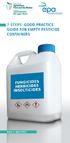 7 STEPS: GOOD PRACTICE GUIDE FOR EMPTY PESTICIDE CONTAINERS Issue 1: April 2012 This Good Practice Guide provides simple guidance for the safe and environmentally friendly recovery of empty plant protection
Plastic sorting. - An evaluation of the methods used in today s recycling business - 1 -
 Plastic sorting - An evaluation of the methods used in today s recycling business - 1 - Contents Abstract Project description Plastic waste sorting, an introduction Waste composition Polyethylene Terepthalate
1. Injection Molding (Thermoplastics)
 1. Injection Molding (Thermoplastics) l Molding: Injection (thermoplastics) INJECTION MOLDING of thermoplastics is the equivalent of pressure die casting of metals. Molten polymer is injected under high
Fiber Recycling in the United States
 Fiber Recycling in the United States Youjiang Wang School of Materials Science & Engineering, Georgia Institute of Technology Atlanta, Georgia 30332-0295 USA Abstract Due to the growth in world population
How To Do A Complete Life Cycle Analysis Of Packaging
 INTRODUCES A Time for Clarity WHY COMPLETE LCAs MATTER Climate change is one of the greatest challenges of our time. In responding to the imperative to reduce greenhouse gases, O-I feels a strong sense
PET Recycling. Nicholas Robusto Maggie Ifarraguerri Nathaniel Lawton Isabel Hefner
 PET Recycling Nicholas Robusto Maggie Ifarraguerri Nathaniel Lawton Isabel Hefner OBJECTIVES Hydrolyze a sample of Polyethylene Terephthalate (PET) obtained from used soda bottles, and synthesize a dimer
UniSort NIR Technologies
 The first near infra-red (NIR) sorting systems were used to process recyclable materials in the early 1990s. Until then, recyclable materials were only collected sporadically, and sorted more or less by
TECHNICAL SHEET RELATED TO DRAWN PRODUCTS OBTAINED BY A RECOVERY PROCESS OF ECO LIFE SRL ECOLOGICAL DRAWN PRODUCTS
 TECHNICAL SHEET RELATED TO DRAWN PRODUCTS OBTAINED BY A RECOVERY PROCESS OF ECO LIFE SRL ECOLOGICAL DRAWN PRODUCTS deriving from post-consuming waste sorting of solid urban waste TECNICAL PRODUCT SHEET
How to implement a Recycling Policy and begin the journey towards Zero Waste
 How to implement a Recycling Policy and begin the journey towards Zero Waste CONTENTS: Objective and Timeline Gain Management Support Selecting a Recycling Coordinator Research Select Recyclers Set up
Post-Consumer Plastic Waste Management in European Countries 2012 - EU 27 + 2 Countries -
 Final Report (October 2013) Post-Consumer Plastic Waste Management in European Countries 2012 - EU 27 + 2 Countries - PlasticsEurope Av. E. Van Nieuwenhuyse 4/3 B-1160 Bruxelles CONSULTIC MARKETING & INDUSTRIEBERATUNG
Westlake Group Of Companies Presentation to UBS Grass Roots Chemical Conference February 11, 2004. James Y. Chao, Vice Chairman
 Westlake Group Of Companies Presentation to UBS Grass Roots Chemical Conference February 11, 2004 James Y. Chao, Vice Chairman Westlake Group and Affiliates WESTLAKE CHEMICAL OLEFINS POLYETHYLENE STYRENE
Policy measures for the prevention and minimization of hazardous wastes
 WASTE AND WASTE MANAGEMENT PROGRESS AND ACHEIVEMENTS Policy measures for the prevention and minimization of hazardous wastes 1. At the international level, Mongolia joined The Basel Convention on the Control
Your partners in PET RECYCLING!
 Your partners in PET RECYCLING! 1 REPET PRODUCTS REPET, Inc. is proud to offer to the market its core product top quality hot washed clear PET flakes (polyethylene terephthalate) packaged in 2,500 lbs.
Flake to Plaque Bleeding Label Test PET- B- 01
 Flake to Plaque Bleeding Label Test PET- B- 01 APR recognizes that packaging innovation drives the growth of bottles available for recycling and growth of supply of bottles is essential to the well being
Presenter: Michael Buono, Director of Program Development Environmental Service Management Group, Inc.
 Presenter: Michael Buono, Director of Program Development Environmental Service Management Group, Inc. Exceptional Environmental Performance Series Case Study of High Performance LEED Project Recycling
Life Cycle Inventory Packaging Options for Shipping Soft Goods in E-Commerce and Catalog Sales
 Packaging Waste Reduction Life Cycle Inventory Packaging Options for Shipping Soft Goods in E-Commerce and Catalog Sales Businesses, individuals, and governments shipping non-breakable items via a common
WASTE AND RECYCLING COLLECTION POLICY
 WASTE AND RECYCLING COLLECTION POLICY for Hambleton September 2015 Contents Introduction...1 Assisted Collections...2 Extra Waste...3 Putting Out Receptacles for Emptying...4 Containers (refuse, recycling
PET-Bottle-to-Bottle-Recycling Key Success Factors 6 Years Experience in Switzerland
 PET-Bottle-to-Bottle-Recycling Key Success Factors 6 Years Experience in Switzerland Patrik Geisselhardt, Raymond Schelker, Roland Tischer REDILO GmbH, Untere Rainstrasse 20, CH-6340 Baar Tel. +41 43 311
HAMILTON COUNTY SOLID WASTE MANAGEMENT FACILITIES. Solid Waste Transfer Station Refuse Disposal & Recycling Site Rules and Regulations
 HAMILTON COUNTY SOLID WASTE MANAGEMENT FACILITIES Solid Waste Transfer Station Refuse Disposal & Recycling Site Rules and Regulations HAMILTON COUNTY MANAGEMENT FACILITIES Lake Pleasant Transfer Station
DEPARTMENT OF ENVIRONMENTAL PROTECTION BUREAU OF WATER SUPPLY MANAGEMENT. Principles for Ground Water Pollution Prevention and Remediation
 DEPARTMENT OF ENVIRONMENTAL PROTECTION BUREAU OF WATER SUPPLY MANAGEMENT DOCUMENT NUMBER: 383-0800-001 EFFECTIVE DATE: December 1, 1996 TITLE: AUTHORITY: POLICY: Principles for Ground Water Pollution Prevention
RESOURCE USE & THE SUPPLY CHAIN
 RESOURCE USE & THE SUPPLY CHAIN as part of the Energy Efficiency Information Grants Program Energy efficiency is one aspect of broader resource efficiency, which is the efficient use and re-use of all
Technical Bulletin 1301. Talc in Plastics
 Technical Bulletin 131 Talc in Plastics Contents Introduction Benefits of Talc in Polypropylene Compounds 1. Stiffness (E-Modulus) 2. Thermal Conductivity 3. Nucleation 4. Impact Strength 5. Deflection