
Case Study 3. Cynar Plastics to Diesel
|
|
|
- Clara Douglas
- 10 years ago
- Views:
Transcription

1 Case Study 3 Cynar Plastics to Diesel Report for ZWSA Ricardo-AEA/R/ED58135 Issue Number 1 Date 02/07/2013
2 Disclaimer: This case study has been prepared by Ricardo-AEA Ltd for the exclusive use of Zero Waste SA and the Government of South Australia. The views expressed do not necessarily reflect those of the Government of South Australia. Zero Waste SA and Ricardo-AEA Ltd accept no liability or responsibility whatsoever for any third party for any loss or damage arising from any interpretation or use of the information contained in this report, or reliance on any views expressed therein.
3 Case Study 3: Cynar Plastics to Fuel Overview Cynar Plc. utilises a pyrolysis technology to convert non-recyclable waste plastics into liquid hydrocarbon fuels. In 2011, SITA UK, one of the country s leading recycling and resource management companies signed an exclusive agreement with Cynar to build the UK s first fully operational plants to convert end of life plastic (ELP) into diesel fuel. The plant is to be located on a resource recovery park at Avonmouth and is due to become operational in July Outcomes When operational, the facility will have the capacity to process 6,000 tpa of waste plastic with an estimated output of 5.7 million litres of fuel per year. The plant will be able to process plastics wastes which are not easily recyclable, including shrink wraps, agricultural plastics and residual plastics from materials recycling facilities. Benefits The facility will result in the diversion of waste plastics from landfill while producing a fuel with the performance and quality of conventional diesel, but with a lower carbon footprint The fuel produced can be used directly as vehicle fuel without the need for further processing or adaptations to the engine SITA will benefit from lower internal transport costs to fuel their waste collection fleet Success Factors Cynar have received financial backing by SITA, to both fund design and development of the technology and to develop 10 facilities across the UK SITA assessed a number of different potential vendors before choosing to work with Cynar plc. SITA cited Cynar s employment of Foster Wheeler and constructive working attitude and synergy with SITA gave the best probability of success SITA and Cynar have worked constructively over a period of 3 years to develop a good working relationship and trust. Part of the first plant investment by SITA was to fund re-design of the plant to improve the output and reliability In addition to being a strong industrial partner, Cynar will also benefit from SITA s expertise in materials handling and in securing feedstock contracts Background Cynar Plc. ("Cynar") is a UK company established to commercialise its specialised pyrolysis and distillation technology to convert non-recyclable waste plastics into liquid hydrocarbon fuels.

4 Cynar has been developing its pyrolysis technology since 2004 and installed its first full scale plant in County Laois, Ireland in In 2011, SITA UK, one of the country s leading recycling and resource management companies and a subsidiary of French firm Suez Environment, signed an exclusive agreement with Cynar to build the UK s first fully operational plants to convert end of life plastic (ELP) into diesel fuel in a contract valued at 70m. SITA is planning to construct up to 10 plants, each with an annual throughput of 6,000 tonnes of plastic waste, producing approximately 5.7 million litres of synthetic fuel. The first facility is currently being constructed in SITA s Avonmouth Resource Recovery Park, which will also include a gasification facility capable of treating 100,000 tonnes per annum (tpa) of residual waste and an 80,000 tpa materials recycling facility (MRF). The Cynar Technology produces a synthetic fuel that is clean, low in sulphur and has a higher cetane number than generic diesel fuel. SITA UK s agreement with Cynar will help the UK as it attempts to deal with mixed waste plastic with a solution that is both environmentally efficient and energy productive. Feedstock The Plastics to Fuel facility will process 6,000 tpa of ELP. A MRF is co-located on the Resource Recovery Park and it is estimated that up to 10% of residue from the MRF (600 tpa) will be used as fuel for the Cynar plant. As a rule of thumb, approximately 950ml of oil can be recovered from 1kg of plastics such as Polyethylene (PE), polypropylene (PP) and polystyrene (PS). The facility can process commingled and miscellaneous waste plastics such as: plastic packaging scrap from material recovery/sorting facilities oil and detergent bottles off-cuts/trimming from nappy production mulch film and silage wrap mixed post-consumer plastics caps/labels/rejected bottles from bottle recycling operations commercial stretch and shrink wrap Plastics recovered from the household kerbside collection are generally an ideal feedstock for the Cynar plant. Agriculture plastic waste is suitable, such as silage film, which is mainly polyethylene-based. Pallet wrap and stretch wrap form the commercial waste stream is typically based on low and linear-low density polyethylene and makes ideal feedstock. Feedstock challenges The pyrolysis process is more suited to certain feedstock than others and this was a challenge during the development of the technology. For example, some plastics such as polyvinyl chloride (PVC), polyethylene terephthalate (PET), nylon, polyurethanes and rubbers may cause difficulties. PET contains oxygen atoms, which take part in the oxidation reactions that can turn the plastic waste into a sludge-like substance. PVC contains chloride ions than produce unwanted chemicals such as hydrochloric acid and a range of dioxins.
5 Fortunately, PVC and PET are not commonly found within mixed plastics. PET is mainly found in the form of plastic bottles and tends to be removed in the recycling, while PVC is more common to objects such as window frames, pipes and electrical insulations. Nonetheless these products can emerge within the mixed plastic waste stream. In the UK, PET constitutes 15% and PVC 3% of the mixed plastic waste stream. The system has been designed to manage low levels of these materials, up to 10%, by carefully controlling the pyrolysis temperature, driving off the oxygen and chlorine to break down the plastic waste. Additionally, pyrolysis of PVC and PET produces a poor yield of fuel when compared with other plastic such as polystyrene and low density polyethylene (LDPE). The pyrolysis process can convert approximately 90% of polystyrene and 70% of LDPE into fuels, while converting just 30% of PET and PVC into fuels. The plastic feedstock is usually cleaned and shredded into small pellets before the pyrolysis process, to remove non-plastic contaminants. This is important if the source of the plastic is not known. Contaminants in the feedstock will be in the form of paper and dirt, or could be blood, oils and grease in plastics from the meat processing industry. Some of the additives and other unwanted compounds in the plastics are driven off during the pyrolysis process in the same way as the oxygen and chlorine. Contaminants in the liquid fuel are removed by filtration or a centrifuge. Technology The facility effectively reverses the plastics production process, where hydrocarbons are used to create plastics. Instead, the process cracks the hydrocarbon chains within the plastics, to produce distilled fuels. The feedstock is chipped to approximately 15mm, producing a plastic flake material. This material is washed (to remove impurities) and dried (to remove moisture). The flakes are fed through a melt-infeed system into the chamber, so almost any shape or size of waste plastics can be handled. The system consists of a stock in-feed system, pyrolysis chambers, contactors, distillation, oil recovery line and syngas. During start up, the furnaces are supplemented with either natural gas or LPG, depending on availability. Control of the furnace heat output is modulating, rather than on/off, to maximise the consistency of the product and also as the syngas fuel is produced continuously. The pyrolysis chamber operates on a 24 hour cycle, during which plastic melt is continually fed and pyrolysed. The pyrolysis process is performed within a heated sealed chamber that has been purged of oxygen. The chamber is fed molten plastic by an extruder, and the plastic is stirred in the vessel by an agitator. Plastics in the chamber continue to be heated and pyrolysed in the absence of oxygen, producing hydrocarbon vapours. The plastic is pyrolysed at ºC, and the pyrolysis gases are condensed in a two-stage condenser to produce a low-sulphur distillate. The vapour is converted into various fractions, including raw diesel, in the distillation column and the distillates then pass into the recovery tanks. Non-plastic materials fall to the bottom of the chamber. The raw diesel is further refined in another distillation column, where it is distilled into the main three products, road diesel, kerosene and light oil. A synthetic gas is produced as a byproduct. This is manipulated and then cleaned prior to use in the furnaces that heat the

6 pyrolysis chambers, making the system a closed loop process, improving the efficiency of the process. Figure 1: Cynar Plastics to Diesel conversion process. Outputs The facility has an input capacity of 6,000 tpa of waste plastic and an output fuel capacity of about 5.7 million litres per year (yielding a conversion rate of approximately 96 %.) To give some context of the scale of recovered fuel production, the fuel used by the city of Canberra s entire waste collection fleet in one year would use less than one sixth of the fuel produced by this facility. The plant converts mixed waste plastics into diesel, kerosene, light oil and a cleaned synthetic gas. The exact recovery ratio and characteristics of the product distillate differs depending on the types of plastics received and the decomposing temperature. The outputs can be directly used as fuels, e.g. the diesel can be mixed with pump diesel (at a ratio of 70% to 30%), to be put directly into vehicles, such as those vehicles that collect the waste in the first place. Each tonne of plastic produces approximately: 700 litres of EN590 1 diesel 200 litres of light oil 100 litres of kerosene Residual char (approximately 5% of outputs) The diesel fuel produced can be directly used within SITA s waste collection vehicles, allowing them better control over their internal transport costs. The light oil fraction can be used as a raw material in the chemicals industry, including as a raw material in the manufacture of new plastic products. The kerosene can be blended with conventional fuels or used in amended engines. The char produced arises from any contamination of the feedstock. The char is classified as a non-hazardous waste. Cynar are currently investigating further uses for the char, such as for use in the manufacture of tiles or as a pigment for colouring concrete. 1 EN590 describes the physical properties that all automotive diesel fuel must meet if it is to be sold in the European Union, Croatia, Iceland, Norway and Switzerland.
7 Costs The development of the Resource Park at Avonmouth, including the Cynar facility, represents a capital investment of circa 39 million. SITA have quoted the capital costs in the Cynar facility at Avonmouth as being in the region of 7.5m. This investment is likely to have a positive effect on businesses in the local area, by offering economic opportunities to become involved as suppliers of goods and services to the development, during construction and operation. Alongside SITA UK, SUEZ ENVIRONNEMENT s venture fund Blue Orange has contributed to the financing scheme of the partnership with Cynar Plc. In order for the pyrolysis process to be commercially viable, the plastic waste needs to be obtained for free, or a gate-fee be charged. Clean, sorted plastics will have a market value depending on the type of plastic and therefore plastics reprocessors will pay a rebate for these depending on current market demand. Therefore, the Cynar process is designed to be able to process lower value, mixed plastic wastes for which there is no market for recycling. Benefits The process itself produces very low emissions, due to the capture of almost all of the output, both liquids and gases, inside the system. Plastics are heated and then pyrolysed in the absence of oxygen as opposed to being combusted. Emissions from the production facility are of the order of 10 times lower per tonne of waste treated than a WID-compliant thermal treatment facility. Cynar claim that their diesel product is cleaner than conventional diesel and of a higher quality. Tests undertaken on the synthetic diesel produced by the Cynar process have demonstrated lower engine emissions of hydrocarbons and CO 2 due the increased efficiency of the fuel. Fuels produced from clean plastic feedstock will demonstrate low sulphur levels when compared to convention fuels. Sulphur levels can be under 10 ppm compared to sulphur levels of other fuels in the region of < ppm. However, this is subject to the level of contaminants present in the fuel feedstock. Drivers have observed a positive change in their vehicles performance since opting for the End of Life Plastics fuel. This is due the higher lubricity of the synthetic diesel, reducing wear on engine components. Another benefit of the Cynar process is the range of plastics it is able to accept, and in particular those plastics which are not deemed suitable or high enough quality for recycling. Success Factors The technology has a number of factors that have contributed to its success. In the UK, local authorities are keen to find an alternative to landfill for hard to treat materials such as mixed plastics; therefore the Cynar process meets this demand. This has driven SITA s investment in to the company, and will potentially give them a competitive edge in winning municipal solid waste management contracts. The plant produces a diesel fuel perfectly suitable for using in vehicles. SITA has a further competitive edge as they will be able to control their internal transport costs by using the fuel produced in their collection fleet. Cynar needed a strong industrial partner to continue the development from their pilot plant to a larger commercial facility. SITA have been able to provide both the financing and the contracts to secure fuel feedstock. SITA provided 1.5m in design and development costs to further develop the Cynar process.
8 Lastly, the footprint of the plant is relatively small (783m 2 ) enabling it to be co-located next to SITA s existing MRF. The MRF provides a source of fuel and reduces the cost of transporting feedstock to the facility. Landfill is the least sustainable waste disposal option and, with landfill tax increasing in the UK and local authorities under increasing pressure to improve their recycling performance, finding alternative solutions to treat more difficult waste streams is a priority. The potential for investment in new and emerging renewable energy technologies must also be seen against the potential impacts of not taking action to combat climate change. The Cynar technology offers an innovative solution with clear benefits to the waste management industry.
Introduction to Waste Treatment Technologies. Contents. Household waste
 Contents Introduction to waste treatment technologies 3 Section 1: The treatment of recyclable waste 4 Bulking facilities 5 Materials Reclamation Facility (MRF) 6 Reuse and recycling centres 8 Composting
Biomass-to-Fuel-Cell Power For Renewable Distributed Power Generation
 Biomass-to-Fuel-Cell Power For Renewable Distributed Power Generation February 2013 The information contained in this document is derived from selected public sources. Ballard does not guarantee the accuracy
Assignment 8: Comparison of gasification, pyrolysis and combustion
 AALTO UNIVERSITY SCHOOL OF CHEMICAL TECHNOLOGY KE-40.4120 Introduction to biorefineries and biofuels Assignment 8: Comparison of gasification, pyrolysis and combustion Aino Siirala 309141 Assignment submitted
Nu G Medical Waste System Technology (Pyrolysis / Thermal Decomposition)
 Product Description: Nu G Medical Waste System Technology (Pyrolysis / Thermal Decomposition) The NU G System uses pyrolysis thermal decomposition to treat infectious wastes typically generated in hospitals.
Thank you for being here today
 Thank you for being here today Presenter: Rob Smoot, a senior engineer for the Solid Waste division of Parks and Environmental Services here at Metro, a licensed Chemical Engineer with over 27 years working
2007 UNITED STATES NATIONAL POST- CONSUMER PLASTICS BOTTLE RECYCLING REPORT
 2007 UNITED STATES NATIONAL POST- CONSUMER PLASTICS BOTTLE RECYCLING REPORT INTRODUCTION The 2007 edition of the United States National Post-Consumer Plastics Bottle Recycling Report is the 18 th annual
Swallow Street recycling facts and figures in partnership with Bywaters
 Regent Street Direct Swallow Street recycling facts and figures in partnership with Bywaters 2013 Swallow Street produced 76 tonnes of cardboard Mission Recycling Ltd: Paper and Cardboard Paper of all
SIX REASONS TO DRY BIOGAS To A LOW DEWPOINT BEFORE COMBUSTION IN A CHP ENGINE STEVEN SCOTT MARKET DEVELOPMENT MANAGER ALTERNATIVE ENERGIES
 SIX REASONS TO DRY BIOGAS To A LOW DEWPOINT BEFORE COMBUSTION IN A CHP ENGINE STEVEN SCOTT MARKET DEVELOPMENT MANAGER ALTERNATIVE ENERGIES Filippo Turra Product Manager Cooling Technology INTRODUCTION
Process Technology. Advanced bioethanol production and renewable energy generation from ligno-cellulosic materials, biomass waste and residues
 Process Technology Advanced bioethanol production and renewable energy generation from ligno-cellulosic materials, biomass waste and residues The INEOS Bio process technology produces carbon-neutral bioethanol
THE PRACTICAL, PROVEN PATH TO GREEN ENERGY. RTP rapid thermal processing from Envergent Technologies
 THE PRACTICAL, PROVEN PATH TO GREEN ENERGY. RTP rapid thermal processing from Envergent Technologies RTP CONVERTS BIOMASS TO PYROLYSIS OIL FAST. Less than two seconds. That s all the time it takes to convert
Integrated waste management system for the reuse of used frying oils to produce biodiesel for municipality fleet of Oeiras
 LIFE ENVIRONMENT Programme Integrated waste management system for the reuse of used frying oils to produce biodiesel for municipality fleet of Oeiras Project co-funded by the LIFE Environment programme
6 CONSIDERATION OF ALTERNATIVES
 6 CONSIDERATION OF ALTERNATIVES 6.1.1 Schedule 4 of the Town and Country Planning (Environmental Impact Assessment) (Scotland) Regulations 2011 sets out the information for inclusion in Environmental Statements
Sustainable Purchasing Guide Promotional Items
 Promotional Items Promotional Items Introduction This section provides information on currently available promotional item options that can help to move the University of Saskatchewan toward its sustainability
Landfill Gas In Ireland - The Facts
 Landfill Gas In Ireland - The Facts Almost two million tonnes of municipal solid waste (MSW) were generated in Ireland in 1998, over 90% of which was consigned to landfill. At landfill, bacteria cause
A guide to solid recovered fuel. Putting waste to good use and producing a sustainable alternative to fossil fuels
 A guide to solid recovered fuel Putting waste to good use and producing a sustainable alternative to fossil fuels SITA UK is a national recycling and resource management company. We provide recycling and
Because sustainability matters
 Because sustainability matters 1992 Mike Biddle begins work on plastics separation Richmond, CA - USA 2002 Edison Award for Innovation 2005 Our aim is to be the leading global plastics recycling company
CEFC financing first for major Western Australian waste-to-gas project
 CEFC financing first for major Western Australian waste-to-gas project Up to $50 million CEFC co-finance to convert municipal, commercial and industrial waste into energy using world-leading Australian
UNIVERSITA DEGLI STUDI DI ROMA LA SAPIENZA DIPARTIMENTO INGEGNERIA CHIMICA MATERIALI AMBIENTE
 UNIVERSITA DEGLI STUDI DI ROMA LA SAPIENZA DIPARTIMENTO INGEGNERIA CHIMICA MATERIALI AMBIENTE REPORT ON A TEST EXECUTED ON A KDV DEPOLYMERIZATION PLANT ON JAN 19TH 2012 IN THE ORION ECOSOLUTIONS DEMONSTRATION
2014 UNITED STATES NATIONAL POSTCONSUMER PLASTICS BOTTLE RECYCLING REPORT
 2014 UNITED STATES NATIONAL POSTCONSUMER PLASTICS BOTTLE RECYCLING REPORT INTRODUCTION The 2014 edition of the United States National Postconsumer Plastics Bottle Recycling Report is the 25 th annual report
From solid fuels to substitute natural gas (SNG) using TREMP
 From solid fuels to substitute natural gas (SNG) using TREMP Topsøe Recycle Energy-efficient Methanation Process Introduction Natural gas is a clean, environmentally friendly energy source and is expected
2013 UNITED STATES NATIONAL POST- CONSUMER PLASTICS BOTTLE RECYCLING REPORT
 2013 UNITED STATES NATIONAL POST- CONSUMER PLASTICS BOTTLE RECYCLING REPORT INTRODUCTION The 2013 edition of the United States National Post-Consumer Plastics Bottle Recycling Report is the 24 th annual
Resource efficiency in the UK whisky sector
 Case Study: UK Drinks Sector Resource efficiency in the UK whisky sector Reducing water, material and packaging use in the whisky sector. Resource efficiency in the UK whisky sector 2 WRAP s vision is
General Recycling Information
 General Recycling Information HOUSEHOLD RECYCLING The four main materials collected in a mixed bin collection system, usually either a blue or green bin are- PAPER FOOD AND DRINK CANS CARDBOARD PLASTIC
Post-Consumer Plastic Waste Management in European Countries 2012 - EU 27 + 2 Countries -
 Final Report (October 2013) Post-Consumer Plastic Waste Management in European Countries 2012 - EU 27 + 2 Countries - PlasticsEurope Av. E. Van Nieuwenhuyse 4/3 B-1160 Bruxelles CONSULTIC MARKETING & INDUSTRIEBERATUNG
Sustainable Plastics with Reduced Carbon Footprint & Reduced Waste
 Sustainable Plastics with Reduced Carbon Footprint & Reduced Waste Joseph P. Greene California State University, Chico Chico, CA 95929-0789 Abstract Plastic products can be made more sustainable by reducing
Plasma Arc Technology
 Engineering & Environmental Applications of Plasma Arc Technology Louis J. Circeo, Ph.D. Principal Research Scientist Director, Plasma Applications Research Program Electro-Optics, Environment and Materials
FACT SHEET. Recent Developments in Clinical Waste Treatment Technologies
 FACT SHEET Recent Developments in Clinical Waste Treatment Technologies 1. Background 1.1 The Bills Committee on Waste Disposal (Amendment) Bill 2005, at its meeting on 8 July 2005, requested the Research
Introducing the Improved MAS DRD "Waterless" Cleaning System for Plastic Film, Flakes and Fibers
 PRESS RELEASE - For Immediate Distribution Introducing the Improved MAS DRD "Waterless" Cleaning System for Plastic Film, Flakes and Fibers September 28, 2015 - The Upper Austrian plastics machinery manufacturer
PHARMACEUTICAL AND CHEMICAL WASTE MANAGEMENT
 Medicines and Medical Devices Agency of Serbia PHARMACEUTICAL AND CHEMICAL WASTE MANAGEMENT Ivana Bozic, MSc Health, Safety and Environment ISWA Beacon Conference, Novi Sad, 08 10 December 2010 458, Vojvode
Fact Sheet Technology. Bergius-Pier Process (1)
 tec Energy Technology Projects Subject: Bergius 1: 1924 1945 Rev: April 2006 Fact Sheet Technology The information included in this document is property of. Use and reproduction of this document, without
Chuck Neece Director Research and Development FUMPA BioFuels
 Chuck Neece Director Research and Development FUMPA BioFuels What is Biodiesel? Just give me the Facts! Biodiesel is Not! Just filtered grease or oil in your tank This would not be chemically changed to
Environmental Product Declaration
 Environmental Product Declaration PVDF-System According to EN 15804 Circling and distribution of purified water in a pharmaceutical plant Georg Fischer Piping Systems Ltd. Ebnatstrasse 111 CH-8201 Schaffhausen
Energy from waste. Introduction. Legal status of this guideline. What is energy from waste? Draft guideline
 Draft guideline Energy from waste Publication 1549 September 2013 Authorised and published by EPA Victoria, 200 Victoria Street, Carlton Introduction As outlined in Getting full value: the Victorian Waste
SUSTAINABLE BATTERY-RECYCLING. WE CLOSE THE LOOP.
 SUSTAINABLE BATTERY-RECYCLING. WE CLOSE THE LOOP. T E C H N O L O G I E S MEMBER OF ECOBAT TECHNOLOGIES SHAPING PERSPECTIVES The Braubach-based BERZELIUS Metall GmbH (BMB) is a foremost producer of lead
Florida Department of Environmental Protection
 Florida Department of Environmental Protection Background Mobile vehicle and equipment washing involves washing at a location where vehicles are based (such as a trucking company, warehouse, bus station,
Refinery Equipment of Texas. Mini - Refinery Feasibility Overview
 Mini - Refinery Feasibility Overview Introduction This paper is intended to provide information, answer questions, and assist the owner or project developer in making informed buying decisions. A mini-refinery
Coal-To-Gas & Coal-To-Liquids
 Located in the Energy Center at Discovery Park, Purdue University Coal-To-Gas & Coal-To-Liquids CCTR Basic Facts File #3 Brian H. Bowen, Marty W. Irwin The Energy Center at Discovery Park Purdue University
2.0 NEED FOR THE DEVELOPMENT & CONSIDERATION OF ALTERNATIVES
 2.0 NEED FOR THE DEVELOPMENT & CONSIDERATION OF ALTERNATIVES 2.1 This chapter outlines how the need for this proposed development has been established, where planning policy supports it, the alternative
THE PRODUCTION OF ELECTRICITY FROM WOOD AND OTHER SOLID BIOMASS
 THE PRODUCTION OF ELECTRICITY FROM WOOD AND OTHER SOLID BIOMASS RTP TM /ADVANCED CYCLE VS. COMBUSTION STEAM CYCLES OR WHY NOT SIMPLY COMBUST? For decades, the only commercial option available for the production
PERP/PERP ABSTRACTS 2010. PET Bottle to Bottle Recycling
 PERP/PERP ABSTRACTS 2010 PET Bottle to Bottle Recycling PERP Report Abstract March 2010 PERP Report Abstract (of PERP REPORT 08/09S9) PET Bottle to Bottle Recycling March 2010 The ChemSystems Process Evaluation/Research
Half the cost Half the carbon
 Half the cost Half the carbon the world s most efficient micro-chp What is BlueGEN? The most efficient small-scale electricity generator BlueGEN uses natural gas from the grid to generate electricity within
Energise your waste! EU legislation pushes for a reliable alternative to landfilling for residual waste. 13 th September 2011, Birmingham
 Energise your waste! EU legislation pushes for a reliable alternative to landfilling for residual waste 13 th September 2011, Birmingham Recycling & Waste Management (RWM) Exhibition Dr.ir. Johan De Greef
LOW-TEMPERATURE CATALYTIC DEPOLYMERIZATION. Power Generation from Plastic Waste, Tires and Waste Oils
 LOW-TEMPERATURE CATALYTIC DEPOLYMERIZATION Power Generation from Plastic Waste, Tires and Waste Oils Company Profile The company GB Consulting s. r. o. delivers unique technologies introducing the concept
7 STEPS: GOOD PRACTICE GUIDE FOR EMPTY PESTICIDE CONTAINERS
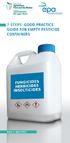 7 STEPS: GOOD PRACTICE GUIDE FOR EMPTY PESTICIDE CONTAINERS Issue 1: April 2012 This Good Practice Guide provides simple guidance for the safe and environmentally friendly recovery of empty plant protection
TABLET DETERGENTS Towards A More Sustainable Future
 TABLET DETERGENTS Towards A More Sustainable Future Unilever Supports Sustainable Development of Detergents with Tablets THE CONTRIBUTION OF TABLETS Unilever is committed to meeting the needs of customers
This fact sheet provides an overview of options for managing solid
 What Is Integrated Solid Waste Management? This fact sheet provides an overview of options for managing solid waste, identifies the important issues you should consider when planning for solid waste management,
Development of Chemical Recycling Process for Post- Consumer PET Bottles by Methanolysis in Supercritical Methanol
 Development of Chemical Recycling Process for Post- Consumer PET Bottles by Methanolysis in Supercritical Methanol Minoru Genta, Ryosuke Uehara, Fumitoshi Yano, Yuichi Kondo* Mitsubishi Heavy Industries,
Continuous flow direct water heating for potable hot water
 Continuous flow direct water heating for potable hot water An independently produced White Paper for Rinnai UK 2013 www.rinnaiuk.com In the 35 years since direct hot water systems entered the UK commercial
The. Brendan P. Sheehan, Honeywell Process Solutions, USA, and Xin Zhu, UOP, a Honeywell Company, USA, explore energy optimisation in plant processes.
 The Brendan P. Sheehan, Honeywell Process Solutions, USA, and Xin Zhu, UOP, a Honeywell Company, USA, explore energy optimisation in plant processes. The global trends and challenges driving the need for
Bio-CNG plant. Spectrum Renewable Energy Limited, Kodoli, Kolhapur
 Bio-CNG plant Spectrum Renewable Energy Limited, Kodoli, Kolhapur Spectrum Renewable Energy Private Limited (SREL) developed a large scale biogas generation and bottling project at Kodoli near Kolhapur
Test notes on practical test and demonstration initiatives
 Plastic ZERO - Public Private Cooperations for Avoiding Plastic as a Waste Test notes on practical test and demonstration initiatives City of Copenhagen City of Malmö City of Hamburg SIA Liepajas RAS Tampere
Waste a source of energy. Regional Solid Waste Management Plan Review: Engaging solutions for tomorrow. Incineration. Incineration
 Waste a source of energy Regional Solid Waste Management Plan Review: Engaging solutions for tomorrow Garbage School 301: Waste to Energy All organic materials contains energy Plant or animal based Plastics
RECOVERING RESOURCES FOR ALL. Integra North Energy Recovery Facility
 RECOVERING RESOURCES FOR ALL Integra North Energy Recovery Facility Integra North Energy Recovery Facility (ERF) was the first of its kind to be built in Hampshire and one of the leading examples of best
RECOVERING RESOURCES FOR ALL. Integra South East Energy Recovery Facility
 RECOVERING RESOURCES FOR ALL Integra South East Energy Recovery Facility Integra South East Energy Recovery Facility (ERF) is the third of its kind to be built in Hampshire and is a leading example of
Our Environmental Protection Plan RECYCLING CAPABILITIES AND ENVIRONMENTAL ACCOMPLISHMENTS
 Our Environmental Protection Plan RECYCLING CAPABILITIES AND ENVIRONMENTAL ACCOMPLISHMENTS WHO WE ARE Since day one, East Penn has made safe recycling an everyday practice. East Penn opened its doors as
Undercover storage requirements for waste/recycling depots
 Waste Information Sheet Undercover storage requirements for waste/recycling depots Update September 2010 EPA 845/10: This information sheet has been prepared for waste management and resource recovery
Degradation of polyolefine wastes into liquid fuels
 NUKLEONIKA 2006;51(Supplement 1):S89S94 PROCEEDINGS Degradation of polyolefine wastes into liquid fuels Bogdan Tymiński, Krzysztof Zwoliński, Renata Jurczyk Abstract In Poland, the consumption of polymers
March 2012. Because sustainability matters
 March 2012 Because sustainability matters Our aim is to be the leading global plastics recycling company in the production of post-consumer recycled resins recovered from highly complex resource streams,
TRIAL CHEMICAL CLEANING OF FOULED APH BASKETS
 TRIAL CHEMICAL CLEANING OF FOULED APH BASKETS Dr. Abhay Kumar Sahay, AGM(CC OS) Bijay Manjul, AGM( Operation) Kahalgaon Boiler has three inputs Steam generator 1. WATER 2. COAL 3. AIR Burner Air preheater
The London Waste and Recycling Board business plan 2015-2020. November 2014. London Waste and Recycling Board 169 Union Street London SE1 0LL
 The London Waste and Recycling Board business plan 2015 2020 November 2014 London Waste and Recycling Board 169 Union Street London SE1 0LL [email protected] www.lwarb.gov.uk 2015 2020 Business Plan Contents
Energy from digester gas. Optimised biogas utilisation
 Energy from digester gas Optimised biogas utilisation The complete solution The complete solution Our company ENER-G designs, installs and operates biogas combined heat and power (CHP) systems for a variety
The challenge of mixed plastics recycling. Luca Stramare R&D Manager COREPLA (Italy)
 The challenge of mixed plastics recycling Luca Stramare R&D Manager COREPLA (Italy) 2 Plastic packaging Protection Convenience Information Producer Transport Marketing Consumer 3 The problem begins at
How To Gasify Wood And Agriculture Biomass
 Gasification: An Old Technology for a New Use Sponsored by: Joel Tallaksen, Biomass Coordinator West Central Research & Outreach Center, University of Minnesota Fueling the Future: The Role of Woody and
RULE 1102. DRY CLEANERS USING SOLVENT OTHER THAN PERCHLOROETHYLENE
 (Adopted January 6, 1978)(Amended August 3, 1979)(Amended July 11, 1980) (Amended August 3, 1990)(Amended December 7, 1990) (Amended November 17, 2000) RULE 1102. DRY CLEANERS USING SOLVENT OTHER THAN
Biomass and waste pyrolysis. Evolution to high-quality marketable fuels
 Biomass and waste pyrolysis Evolution to high-quality marketable fuels CE Delft Independent research and consultancy since 1978 Transport, energy and resources Know-how on economics, technology and policy
Foam Recycling is Viable. A Profitable Industry in the Making
 INTOUCH is a regular publication of the Polyurethane Foam Association. It covers topics of interest to users of flexible polyurethane foam and is designed as a quick reference e for background information
SORTING PLASTICS FOR RECYCLING INTRODUCTION
 SORTING PLASTICS FOR RECYCLING INTRODUCTION Description Students use the difference in densities of polymers and flame tests as a basis for the development of a scheme to separate plastics. Goals for This
Effect of Sterilization Techniques on Polymers
 Effect of Sterilization Techniques on Polymers Contents of Presentation Introduction to Polymers Properties and Stability of Polymers Affect of Ionising Radiation and Ethylene Oxide on Polymers The need
Application of Synthetic Diesel Fuels
 Application of Synthetic Diesel Fuels Future Fuels : Issues and Opportunties 11 th Diesel Engine Emissions Reduction Conference, Chicago, August 21-25, 25 Paul Schaberg, Sasol Technology Presentation Outline
Automotive Base Oil Presentation
 Automotive Base Oil Presentation What is a Base Oil? The refined petroleum mineral or synthetic material that is produced by a refinery to a required set of specifications. A lubricant s quality can depend
The circular revolution
 The circular revolution An Imperial College London report commissioned by Veolia Leading author Dr Nick Voulvoulis Centre for Environmental Policy Six ways that the circular economy contributes to GDP
Energy efficient windows, doors and conservatories. Make a better choice
 Energy efficient windows, doors and conservatories Make a better choice A better choice for you and your home Modern double glazing doesn t just look good. It can save you money too. From styling to performance
<Insert Picture Here> JD Edwards EnterpriseOne Bulk Stock Industry & Overview
 JD Edwards EnterpriseOne Bulk Stock Industry & Overview 2 The following is intended to outline our general product direction. It is intended for information purposes only, and may
COKE PRODUCTION FOR BLAST FURNACE IRONMAKING
 COKE PRODUCTION FOR BLAST FURNACE IRONMAKING By Hardarshan S. Valia, Scientist, Ispat Inland Inc INTRODUCTION A world class blast furnace operation demands the highest quality of raw materials, operation,
Commercial scale mixed plastics recycling
 Final Report Commercial scale mixed plastics recycling A report on the technical viability of recycling mixed plastic packaging waste from domestic sources on a commercial scale in the U.K. Project code:
LCA EXPERIENCE IN THE FIELD OF RECYCLING OF PLASTICS FROM ELECTRONIC WASTE
 LCA EXPERIENCE IN THE FIELD OF RECYCLING OF PLASTICS FROM ELECTRONIC WASTE B. DeBenedetti, L. Maffia, G.L. Baldo 2 Dipartimento di Scienza dei Materiali ed Ingegneria Chimica, Politecnico di Torino, Italy
WASTE COOKING OIL TO FUEL PROGRAM HOW TO START YOUR OWN BIODIESEL FUEL PROGRAM
 WASTE COOKING OIL TO FUEL PROGRAM HOW TO START YOUR OWN BIODIESEL FUEL PROGRAM 1 Syllabus Topic 1: Biodiesel Basics/Fuel Properties Topic 2: Overview of Biodiesel Production Using Waste Oil Topic 3: Feedstock
ENVIRONMENT. Aviation. Property. Marine Services. Trading & Industrial. Beverages
 ENVIRONMENT Our ultimate goal, which we first articulated in 2010, is for our operating companies to achieve zero net impact on the environment. We call this goal Net Zero. In, we developed a preliminary
The facts on biodiesel and bioethanol
 Renewable biofuels for transport The facts on biodiesel and bioethanol BABFO BRITISH ASSOCIATION FOR BIO FUELS AND OILS RECYCLING CARBON Sustainable development is a key priority for Defra, by which we
CNG Fueling Developments and Renewable Conversion to RNG Technology and Update on a RNG Fleet
 CNG Fueling Developments and Renewable Conversion to RNG Technology and Update on a RNG Fleet NY State Chapter of SWANA, Albany. NY. June 13, 2013 Bernard Sheff, PE, Vice President Anaergia Inc. Agenda
FUEL OIL Crude Condensate Naphtha Ethane Reformate
 FUEL OIL Crude The Crude Overview gives a summary of the daily price movements of the benchmark WTI (West Texas Intermediate) and Brent futures contracts on the NYMEX and IPE exchanges, detailing any significant
AMMONIA AND UREA PRODUCTION
 AMMONIA AND UREA PRODUCTION Urea (NH 2 CONH 2 ) is of great importance to the agriculture industry as a nitrogen-rich fertiliser. In Kapuni, Petrochem manufacture ammonia and then convert the majority
Waste management and disposal:
 Waste management and disposal: A best practice business guide An ebook produced by FCC Environment 01 Waste management and disposal: a strategy for success Introduction Your guide to waste management FCC
Developments and trends shaping the future for Waste-to- Energy technology suppliers
 Developments and trends shaping the future for Waste-to- Energy technology suppliers 21 st October 2015 Copenhagen, Denmark Edmund Fleck ESWET President 2 Contents 1. About ESWET 2. Introduction 3. Modern
From Biomass. NREL Leads the Way. to Biofuels
 From Biomass NREL Leads the Way to Biofuels The Wide World of Biofuels Fuel Source Benefits Maturity Grain/Sugar Ethanol Biodiesel Corn, sorghum, and sugarcane Vegetable oils, fats, and greases Produces
CLEAN GREEN & SUSTAINABLE NS1439215
 CLEAN GREEN & SUSTAINABLE NS1439215 1 Contents 2 Introduction Strategic Alignment 1 - Energy Efficiency 2 - Water Management 3 - Fleet and Plant Management 4 - Carbon Offsets 5 - Waste Management Everything
HOW TO SELECT A LOW VOLUME (L.V ) BOILER
 HOW TO SELECT A LOW VOLUME (L.V ) BOILER FREQUENTLY ASKED QUESTIONS OR COMMENTS ON BOILERS Dear Potential Customer: Low Volume Operator Exempt boilers have been marketed in Ontario to eliminate the requirement
Use of Substitute Fuels in Large Combustion Plants (LCPs)
 Use of Substitute Fuels in Large Combustion Plants (LCPs) By Pat Swords Content of the Presentation What are substitute fuels What is the experience to date with these fuels What are the regulatory implications
Biomethane in Vehicles. October 2008
 Biomethane in Vehicles October 2008 1 Gas vehicles A gas vehicles is a vehicle fuelled buy a gaseous fuel not liquid fuel. Seems simple, but not all gasses are the same, and storage methods vary 2 Definitions
MBA Polymers. Richmond, California. Use of Recovered Plastics in the Manufacture of Automobiles, Appliances & Electronic Equipment
 MBA Polymers Richmond, California Use of Recovered Plastics in the Manufacture of Automobiles, Appliances & Electronic Equipment (Recycling of Mixed Plastics) Commercial Demonstration Reported Fall 1999
SEATTLE STEAM COMPANY FREQUENTLY ASKED QUESTIONS
 SEATTLE STEAM COMPANY FREQUENTLY ASKED QUESTIONS What products/services does Seattle Steam provide? The company provides thermal energy (heat) produced at two central heating plants in downtown Seattle.
Tutkimuksen merkitys menestyvässä liiketoiminnassa- Innovaatiosta tuotteeksi
 Tutkimuksen merkitys menestyvässä liiketoiminnassa- Innovaatiosta tuotteeksi Matti Rautanen Manager, External Networks, Power-wide R&D Tutkimuksella tulevaisuuteen- seminaari Kaukolämpöpäivät, Kuopio 29.8.2013
Plastics Converting in Europe
 Understanding the plastics industry Plastics Converting in Europe The European Plastics Converters (EuPC) is the leading EU-level Trade Association, based in Brussels, representing European Plastics Converters.
Michael Williams Gasification Technologies Council, 28 th October 2014. Smaller scale Fischer-Tropsch enables biomass-to-liquids
 Michael Williams Gasification Technologies Council, 28 th October 2014 Smaller scale Fischer-Tropsch enables biomass-to-liquids Velocys The company at the forefront of smaller scale GTL and BTL Leader
Data and Trends. Environmental protection and Safety
 Data and Trends Environmental protection and Safety 2006 EMS-GRIVORY Performance Polymers EMS-GRIVORY Extrusion Polymers EMS-GRILTECH EMS-PRIMID EMS-PATVAG EMS-SERVICES Data and Trends 2006 Protection
SULFUR RECOVERY UNIT. Thermal Oxidizer
 SULFUR RECOVERY UNIT Thermal Oxidizer BURNERS FLARES INCINERATORS PARTS & SERVICE SULFUR RECOVERY UNIT Thermal Oxidizer Tail Gas Thermal Oxidizer designed and built to GOST-R requirements. Zeeco can meet