
Basic Factory Dynamics
|
|
|
- Gabriel Jefferson
- 9 years ago
- Views:
Transcription
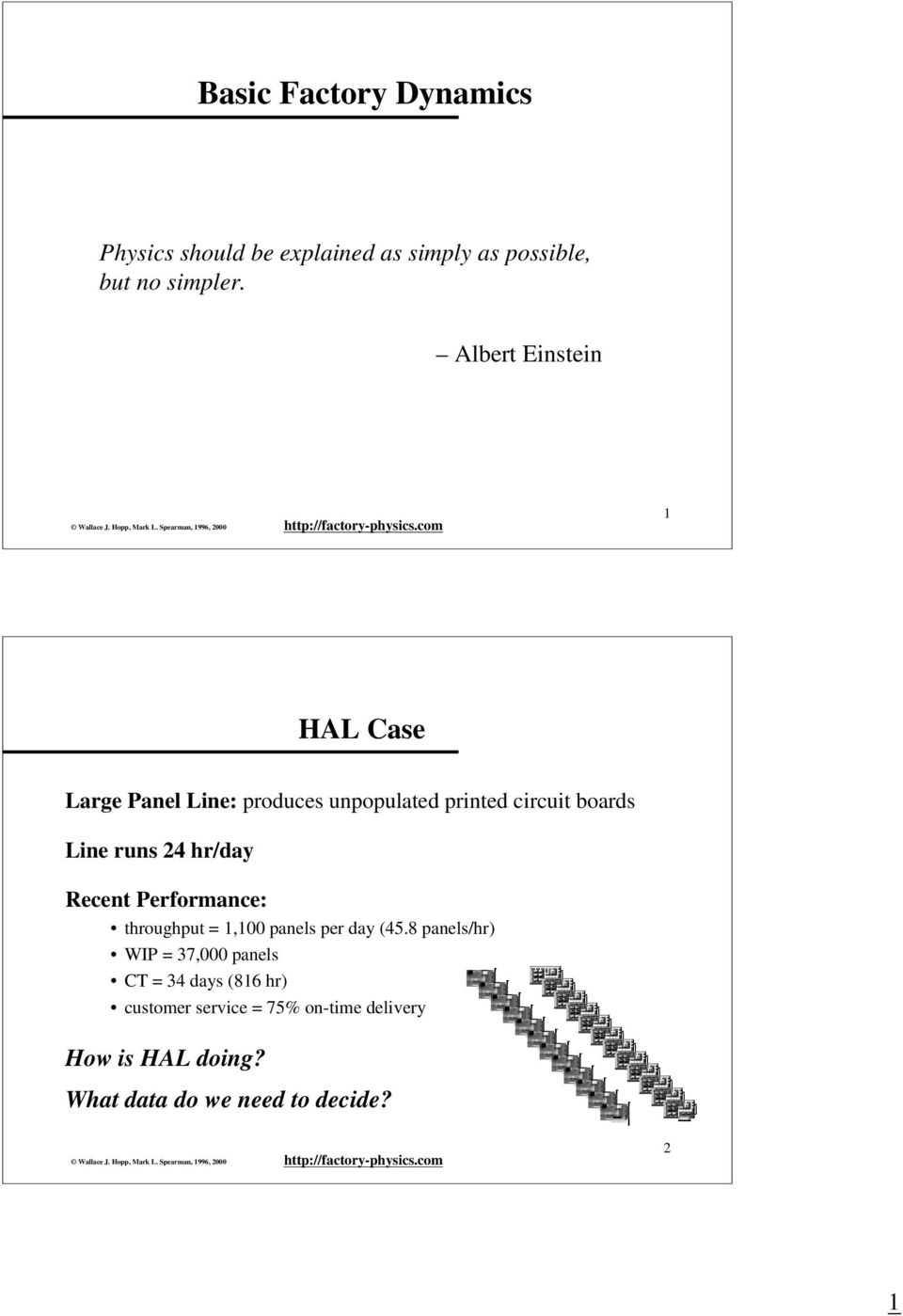
1 Basic Factory Dynamics Physics should be explained as simply as possible, but no simpler. Albert Einstein 1 HAL Case Large Panel Line: produces unpopulated printed circuit boards Line runs 24 hr/day Recent Performance: throughput = 1,1 panels per day (45.8 panels/hr) WIP = 37, panels CT = 34 days (816 hr) customer service = 75% on-time delivery How is HAL doing? What data do we need to decide? 2 1
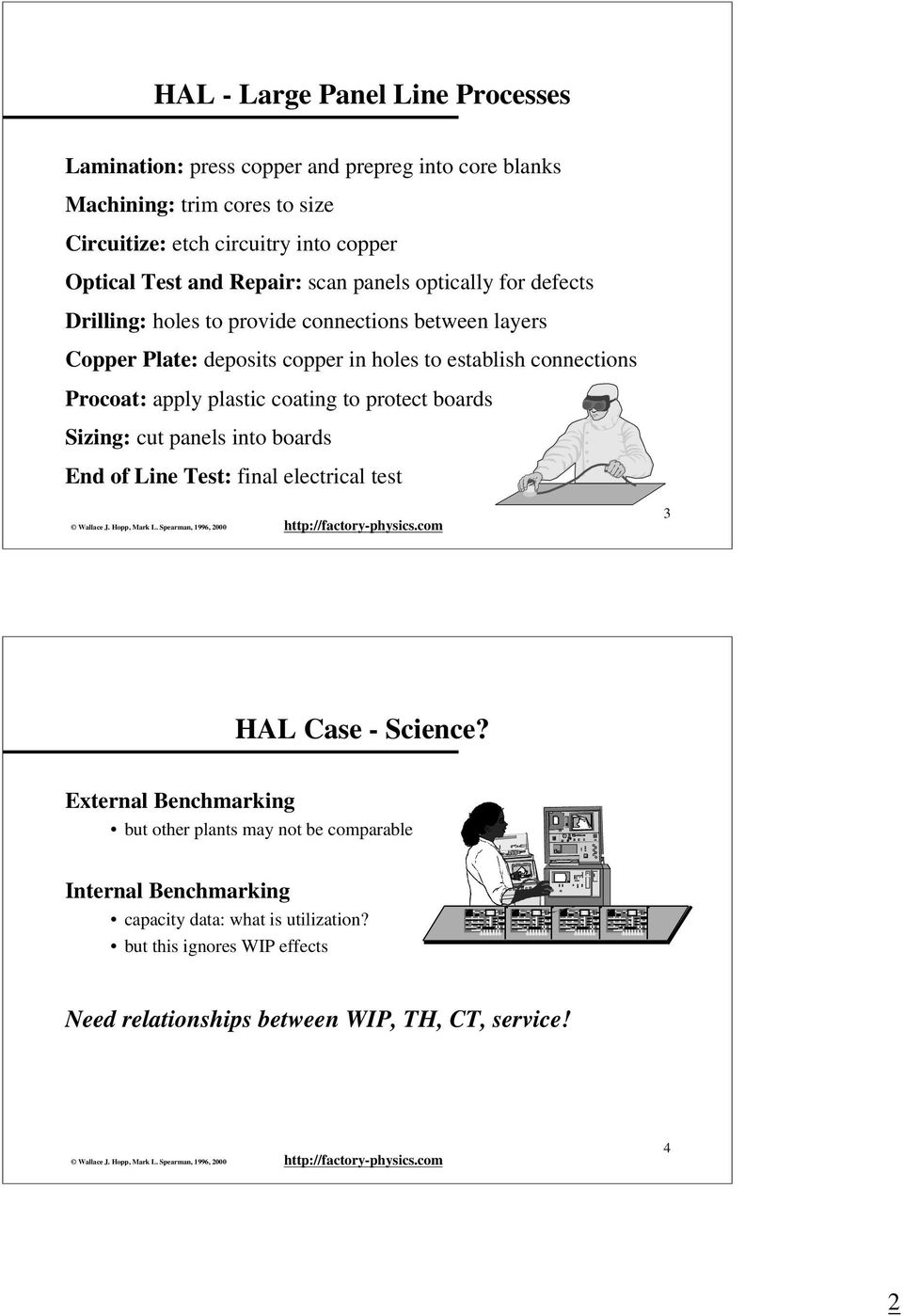
2 HAL - Large Panel Line Processes Lamination: press copper and prepreg into core blanks Machining: trim cores to size Circuitize: etch circuitry into copper Optical Test and Repair: scan panels optically for defects Drilling: holes to provide connections between layers Copper Plate: deposits copper in holes to establish connections Procoat: apply plastic coating to protect boards Sizing: cut panels into boards End of Line Test: final electrical test 3 HAL Case - Science? External Benchmarking but other plants may not be comparable Internal Benchmarking capacity data: what is utilization? but this ignores WIP effects Need relationships between WIP, TH, CT, service! 4 2
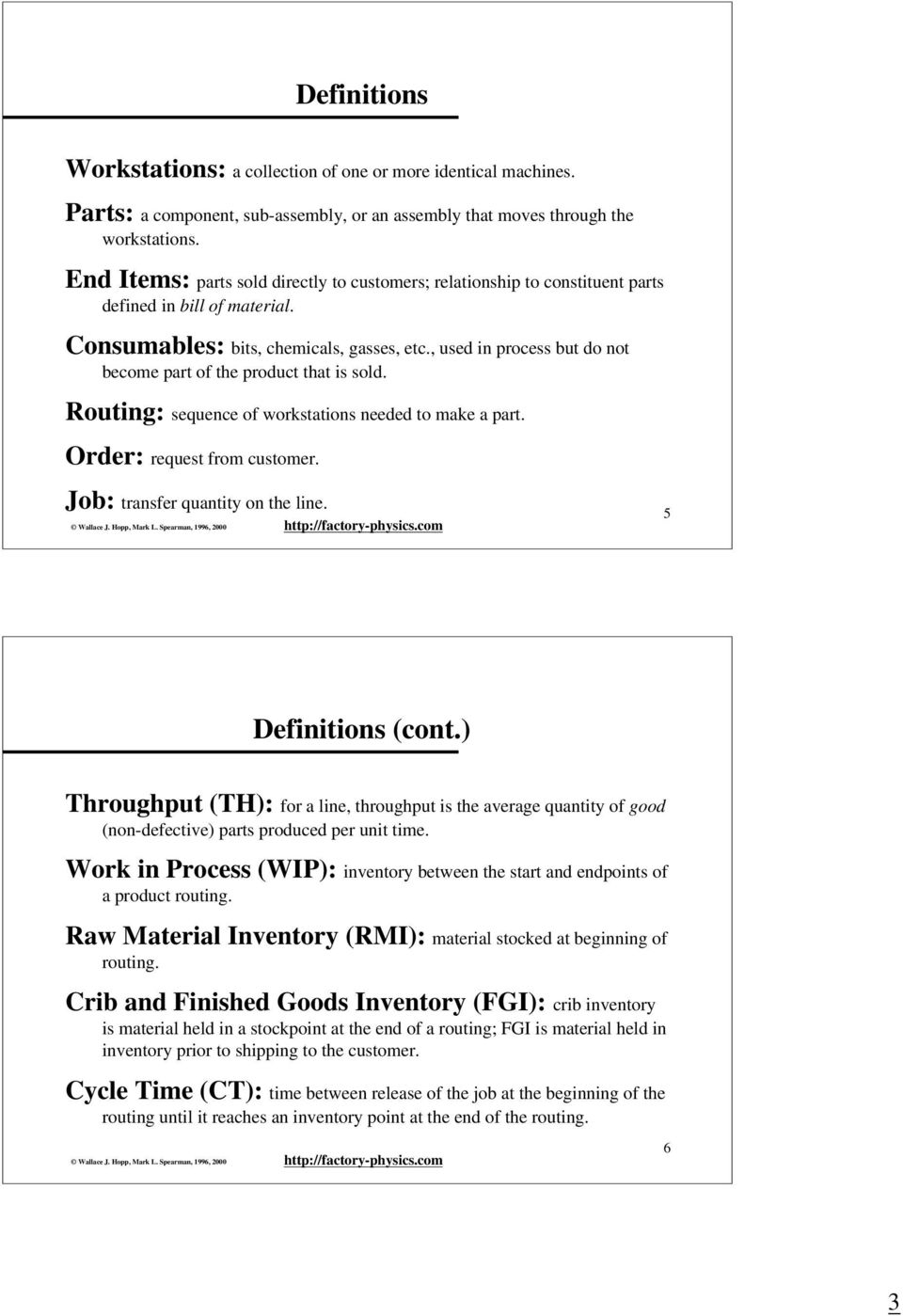
3 Definitions Workstations: a collection of one or more identical machines. Parts: a component, sub-assembly, or an assembly that moves through the workstations. End Items: parts sold directly to customers; relationship to constituent parts defined in bill of material. Consumables: bits, chemicals, gasses, etc., used in process but do not become part of the product that is sold. Routing: sequence of workstations needed to make a part. Order: request from customer. Job: transfer quantity on the line. 5 Definitions (cont.) Throughput (TH): for a line, throughput is the average quantity of good (non-defective) parts produced per unit time. Work in Process (WIP): inventory between the start and endpoints of a product routing. Raw Material Inventory (RMI): material stocked at beginning of routing. Crib and Finished Goods Inventory (FGI): crib inventory is material held in a stockpoint at the end of a routing; FGI is material held in inventory prior to shipping to the customer. Cycle Time (CT): time between release of the job at the beginning of the routing until it reaches an inventory point at the end of the routing. 6 3
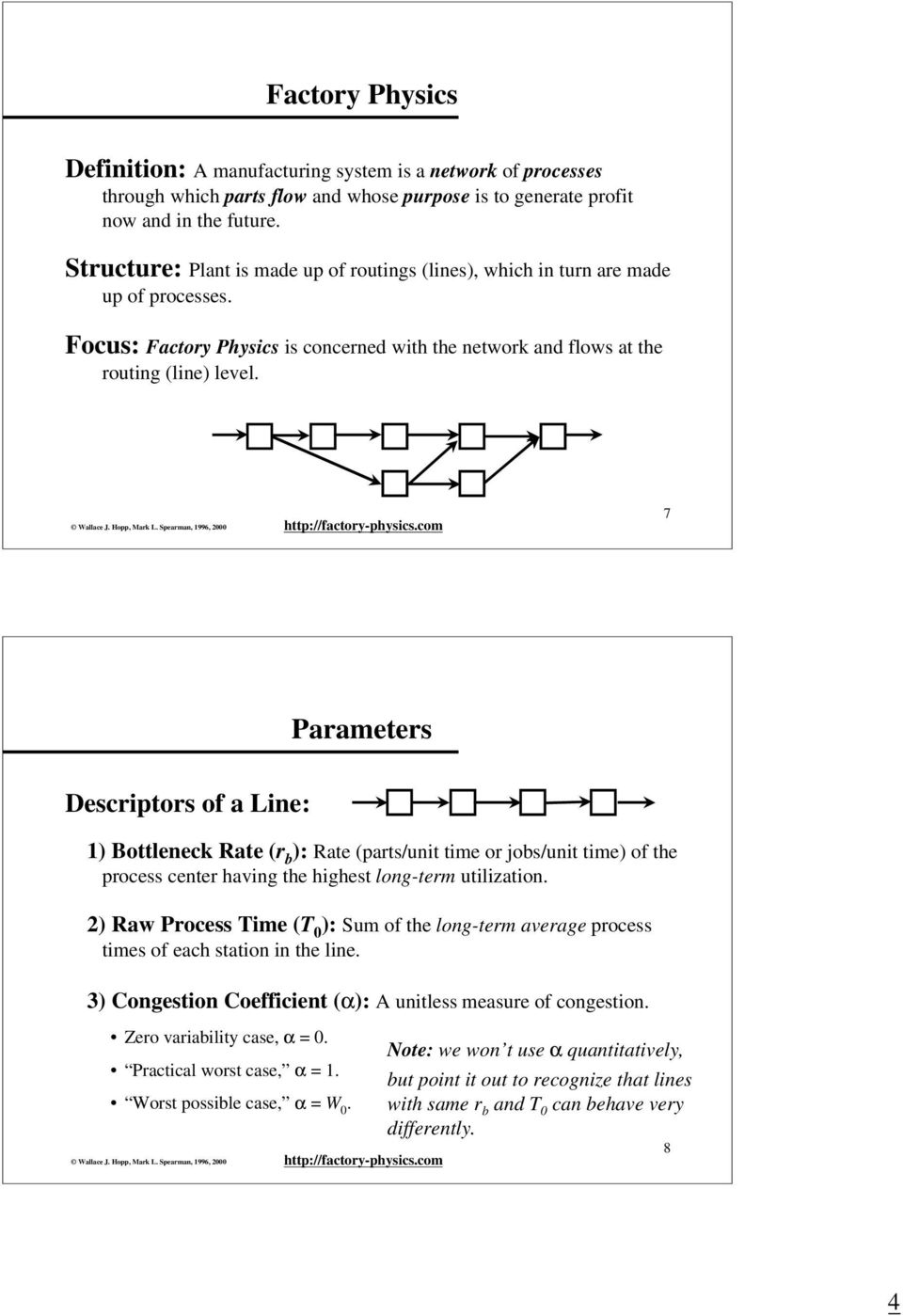
4 Factory Physics Definition: A manufacturing system is a network of processes through which parts flow and whose purpose is to generate profit now and in the future. Structure: Plant is made up of routings (lines), which in turn are made up of processes. Focus: Factory Physics is concerned with the network and flows at the routing (line) level. 7 Parameters Descriptors of a Line: 1) Bottleneck Rate (r b ): Rate (parts/unit time or jobs/unit time) of the process center having the highest long-term utilization. 2) Raw Process Time (T ): Sum of the long-term average process times of each station in the line. 3) Congestion Coefficient ( ): A unitless measure of congestion. Zero variability case, =. Practical worst case, = 1. Worst possible case, = W. Note: we won t use quantitatively, but point it out to recognize that lines with same r b and T can behave very differently. 8 4
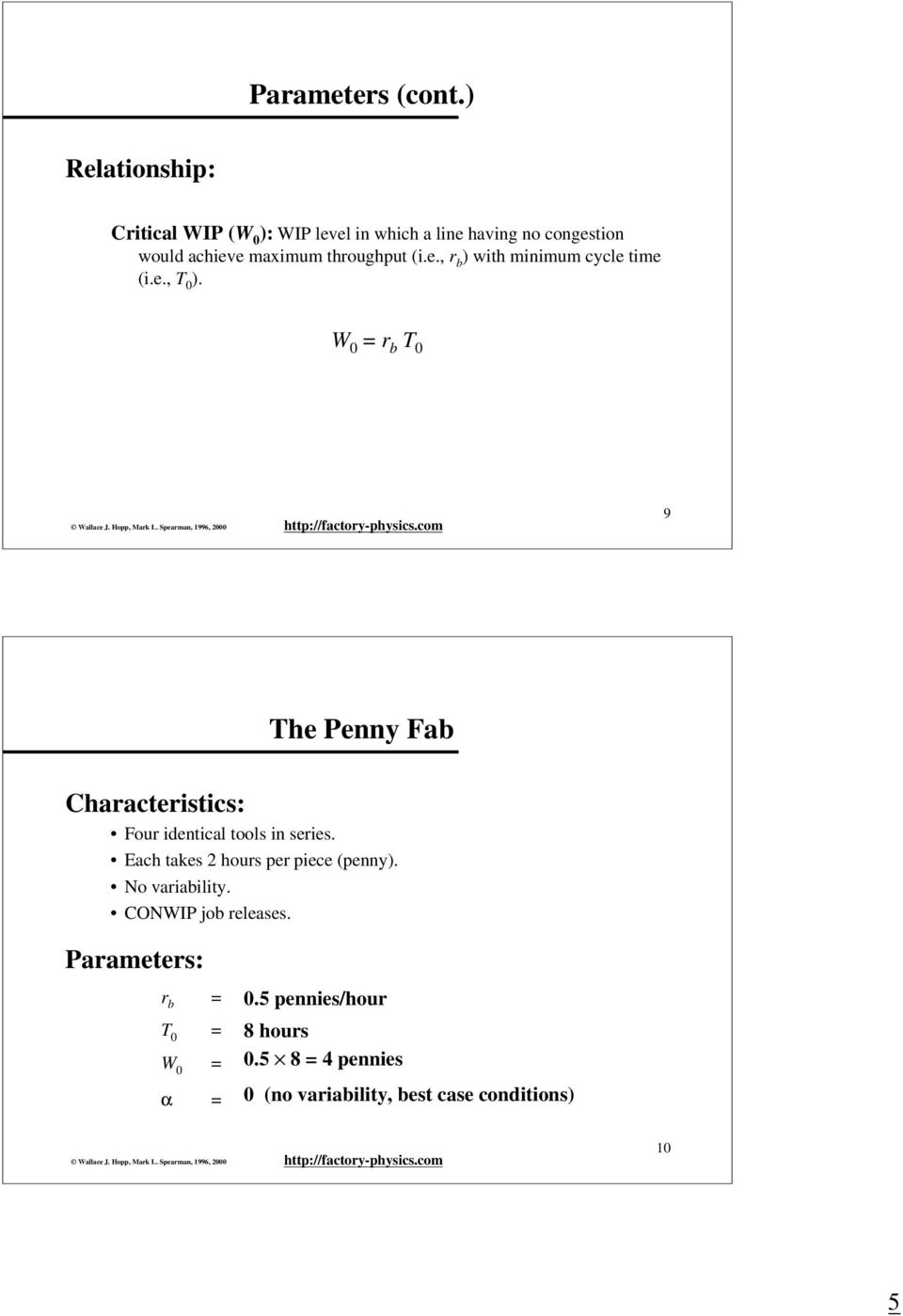
5 Parameters (cont.) Relationship: Critical WIP (W ): WIP level in which a line having no congestion would achieve maximum throughput (i.e., r b ) with minimum cycle time (i.e., T ). W = r b T 9 The Penny Fab Characteristics: Four identical tools in series. Each takes 2 hours per piece (penny). No variability. CONWIP job releases. Parameters: r b = T = W = =.5 pennies/hour 8 hours.5 8 = 4 pennies (no variability, best case conditions) 1 5
6 The Penny Fab WIP TH CT TH x CT TH vs. WIP: Best Case.5 Throughput (Jobs/hr) WIP (Jobs) 12 6
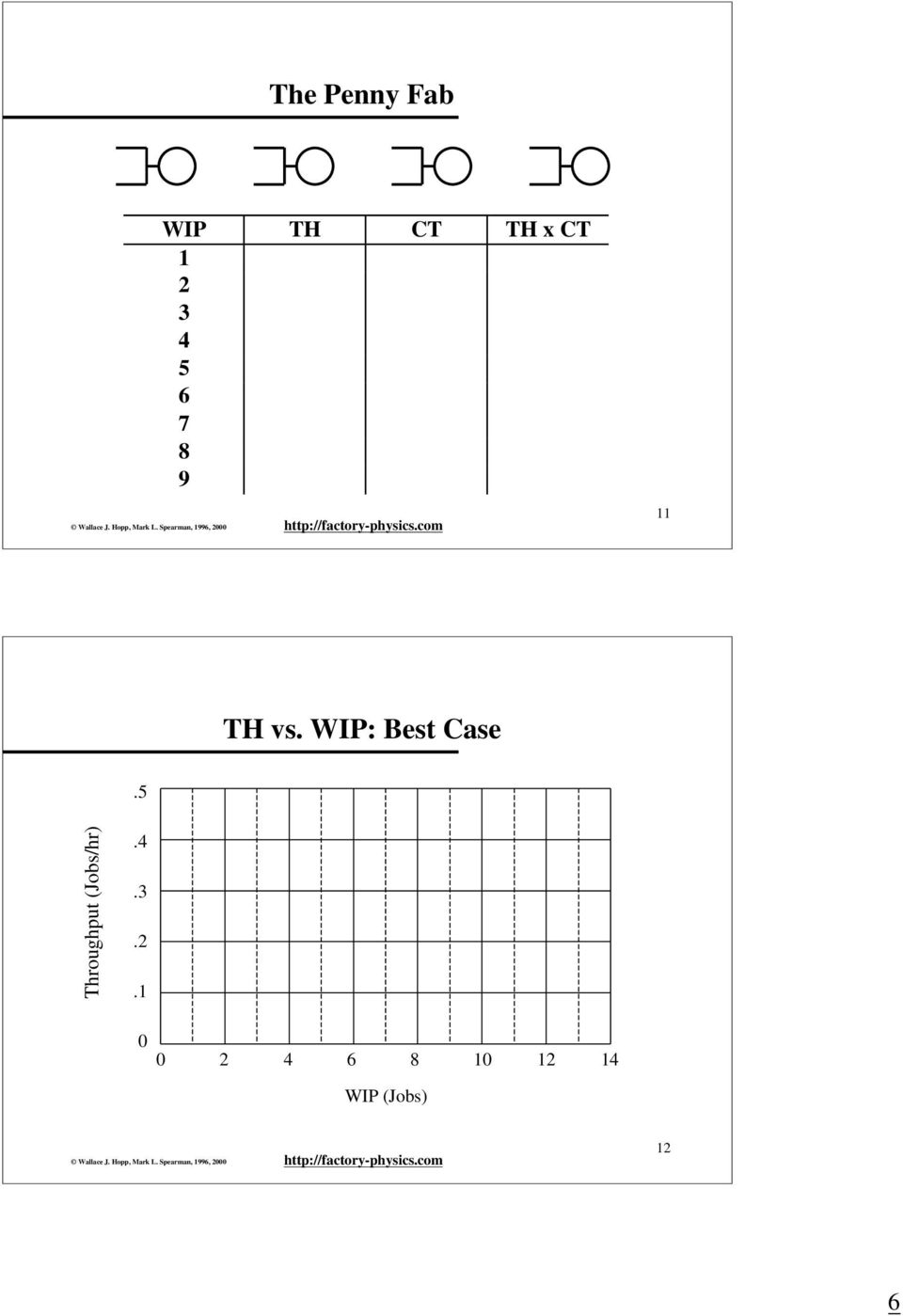
7 CT vs. WIP: Best Case 2 Cycle time (Hours) WIP (Jobs) 13 Best Case Performance Best Case Law: The minimum cycle time (CT best ) for a given WIP level, w, is given by CT best = T, w/r b, if w W otherwise. The maximum throughput (TH best ) for a given WIP level, w is given by, TH best = w / T, r b, if w W otherwise. 14 7
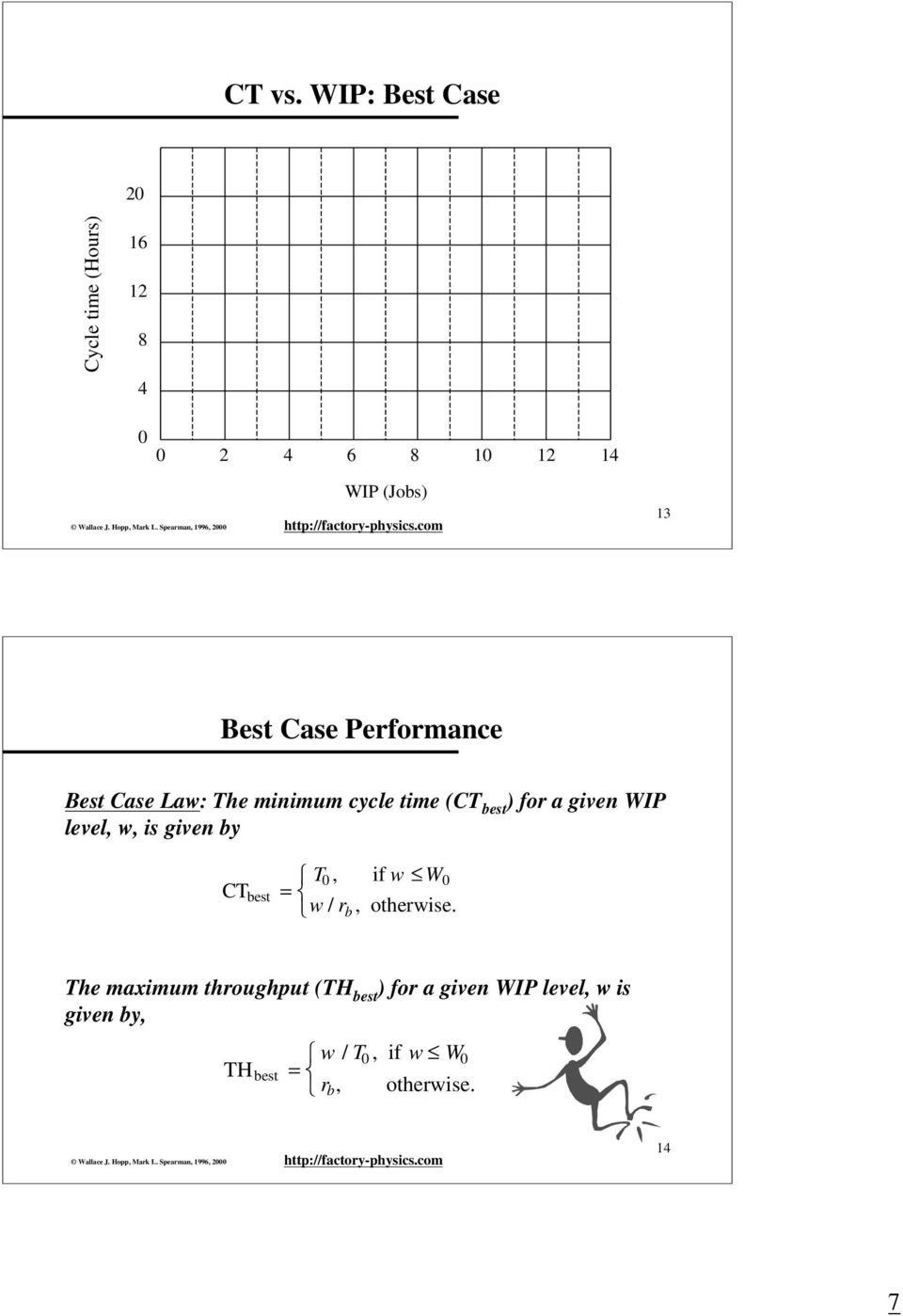
8 Best Case Performance (cont.) Example: For Penny Fab, r b =.5 and T = 8, so W =.5 8 = 4, CT best = 8, 2w, if w 4 otherwise. TH best = w /8, if w 4.5, otherwise. which are exactly the curves we plotted. 15 A Manufacturing Law Little's Law: The fundamental relation between WIP, CT, and TH over the long-term is: Examples: WIP = TH CT units = units hr hrs Checking WIP levels in cash flow analysis. Measure of cycle time (e.g., what is cycle time for an automobile?) FGI and planned inventory. 16 8

9 Penny Fab Two 2 hr 5 hr 3 hr 1 hr 17 Penny Fab Two Station Number Number of Machines Process Time Station Rate hr j/hr hr j/hr hr j/hr hr j/hr r b = T = W = 18 9

10 Worst Case Observation: The Best Case yields the minimum cycle time and maximum throughput for each WIP level. Question: What conditions would cause the maximum cycle time and minimum throughput? Experiment: set average process times same as Best Case (so r b and T unchanged) follow a marked job through system imagine marked job experiences maximum queueing 19 Worst Case Penny Fab Time = hours 2 1

11 Worst Case Penny Fab Time = 8 hours 21 Worst Case Penny Fab Time = 16 hours 22 11
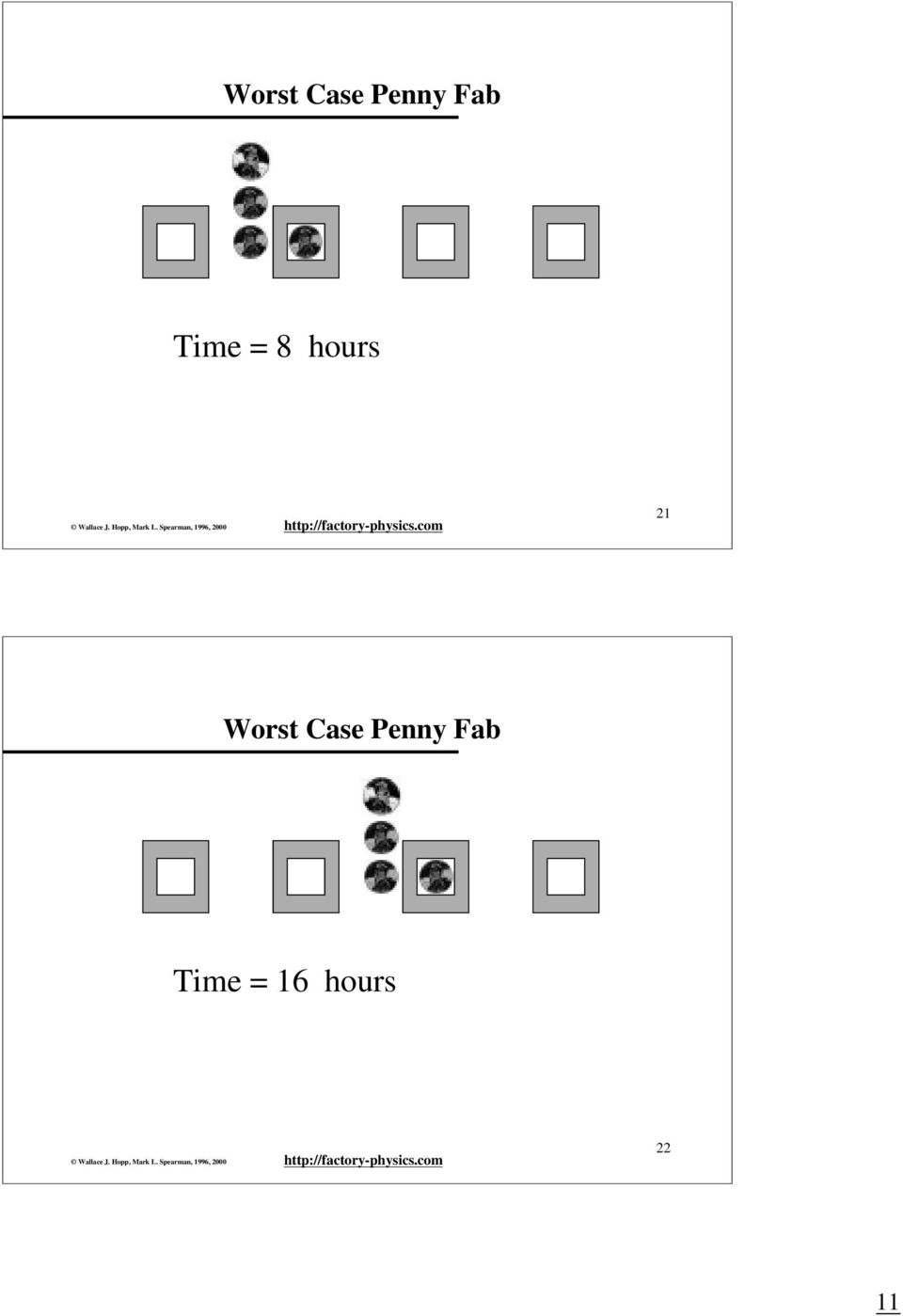
12 Worst Case Penny Fab Time = 24 hours 23 Worst Case Penny Fab Time = 32 hours Note: CT = 32 hours = 4 8 = wt TH = 4/32 = 1/8 = 1/T 24 12

13 TH vs. WIP: Worst Case r b.6.5 Best Case TH 1/T Worst Case W WIP 25 CT vs. WIP: Worst Case CT T W Worst Case WIP Best Case 26 13
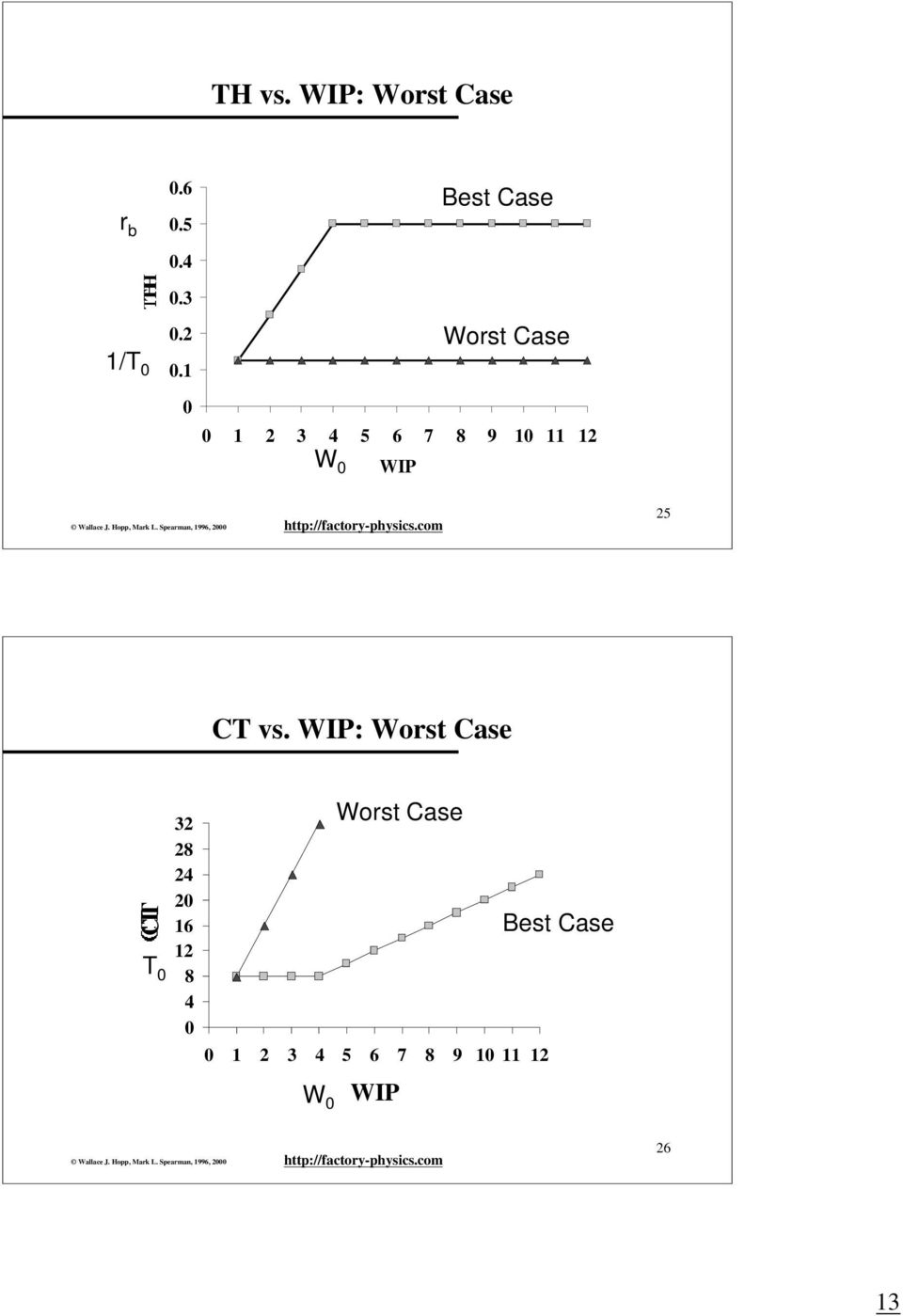
14 Worst Case Performance Worst Case Law: The worst case cycle time for a given WIP level, w, is given by, CT worst = w T The worst case throughput for a given WIP level, w, is given by, TH worst = 1 / T Randomness? None - perfectly predictable, but bad! 27 Practical Worst Case Observation: There is a BIG GAP between the Best Case and Worst Case performance. Question: Can we find an intermediate case that: divides good and bad lines, and is computable? Experiment: consider a line with a given r b and T and: single machine stations balanced lines variability such that all WIP configurations (states) are equally likely 28 14

15 PWC Example 3 jobs, 4 stations clumped up states State Vector State Vector 1 (3,,,) 11 (1,,2,) 2 (,3,,) 12 (,1,2,) 3 (,,3,) 13 (,,2,1) 4 (,,,3) 14 (1,,,2) 5 (2,1,,) 15 (,1,,2) 6 (2,,1,) 16 (,,1,2) 7 (2,,,1) 17 (1,1,1,) 8 (1,2,,) 18 (1,1,,1) 9 (,2,1,) 19 (1,,1,1) 1 (,2,,1) 2 (,1,1,1) Note: average WIP at any station is 15/2 =.75, so jobs are spread evenly between stations. spread out states 29 Practical Worst Case Let w = jobs in system, N = no. stations in line, and t = process time at all stations: CT(single) CT(line) TH = (1 + (w-1)/n) t = N [1 + (w-1)/n] t = Nt + (w-1)t = T + (w-1)/r b = WIP/CT From Little s Law = [w/(w+w -1)]r b 3 15

16 Practical Worst Case Performance Practical Worst Case Definition: The practical worst case (PWC) cycle time for a given WIP level, w, is given by, w 1 CTPWC = T + The PWC throughput for a given WIP level, w, is given by, r b TH PWC = W w rb, + w 1 where W is the critical WIP. 31 TH vs. WIP: Practical Worst Case r b TH 1/T Good Bad Best Case PWC Worst Case W WIP 32 16

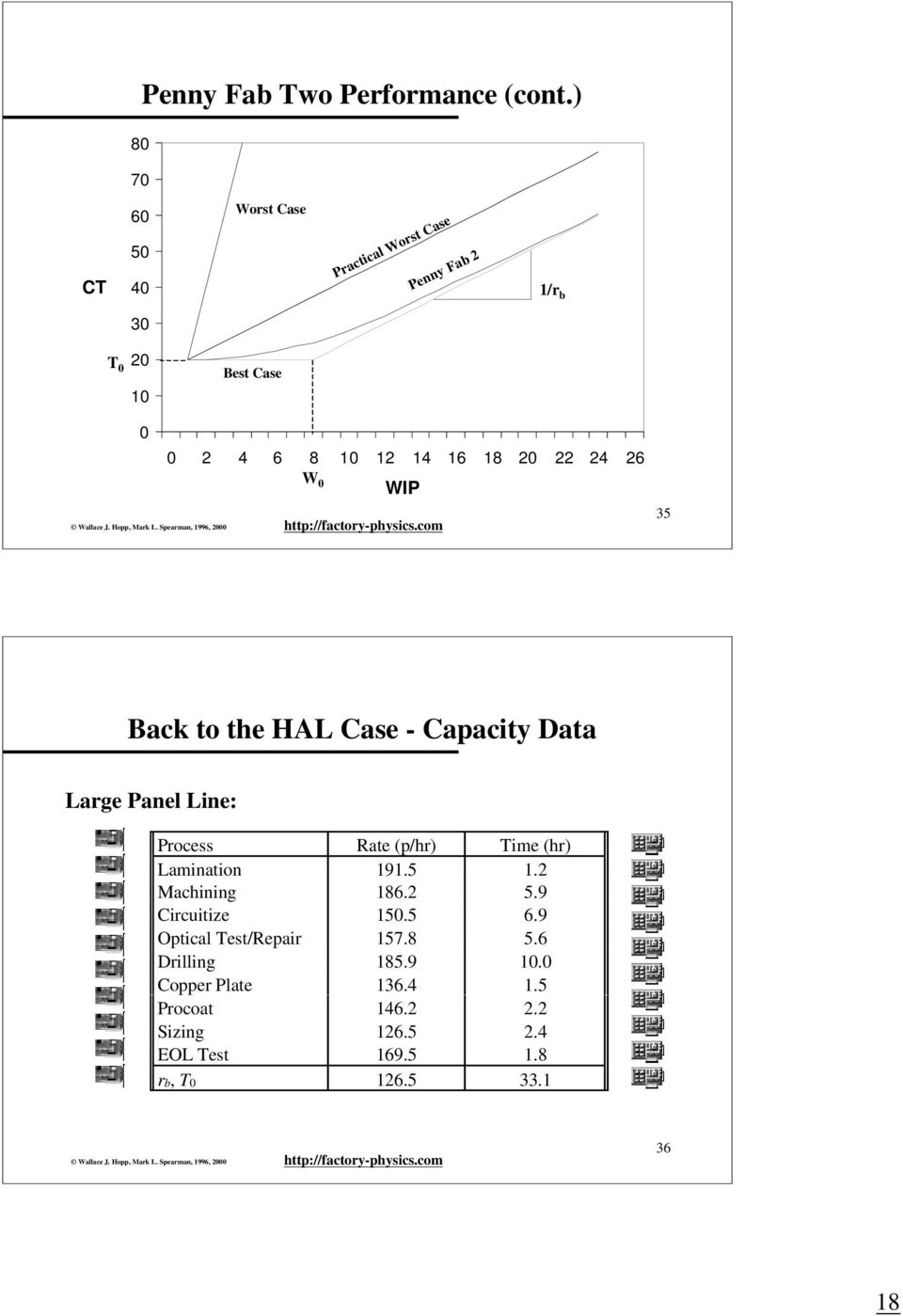
17 CT vs. WIP: Practical Worst Case CT T Bad Good W Worst Case WIP PWC Best Case 33 Penny Fab Two Performance.5 TH r b Best Case Penny Fab 2 Practical Worst Case Note: process times in PF2 have var equal to PWC. But unlike PWC, it has unbalanced line and multi machine stations. 1/T Worst Case W WIP 34 17

18 8 7 Penny Fab Two Performance (cont.) CT Worst Case Practical Worst Case Penny Fab 2 1/r b 3 T 2 1 Best Case W WIP 35 Back to the HAL Case - Capacity Data Large Panel Line: Process Rate (p/hr) Time (hr) Lamination Machining Circuitize Optical Test/Repair Drilling Copper Plate Procoat Sizing EOL Test rb, T
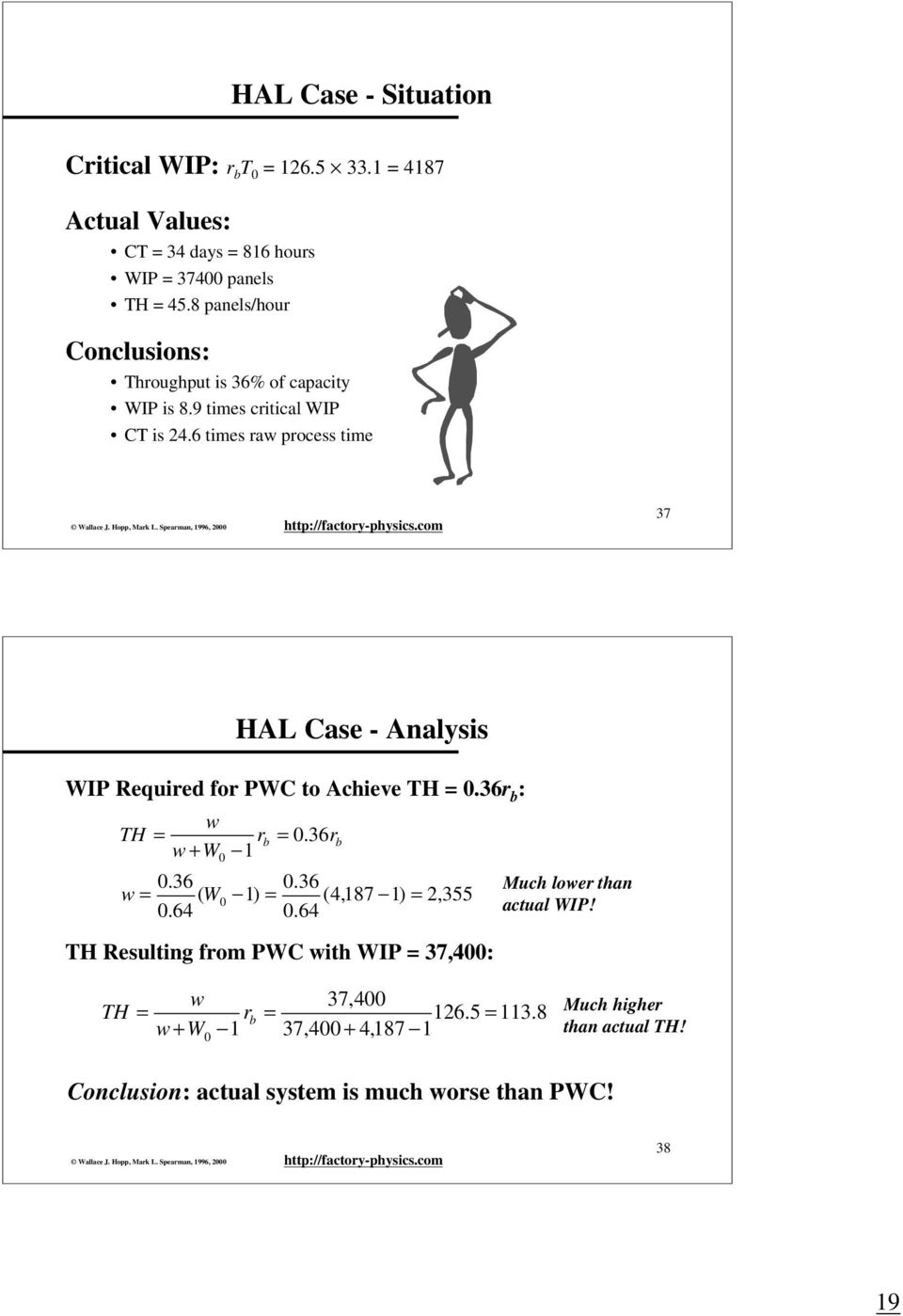
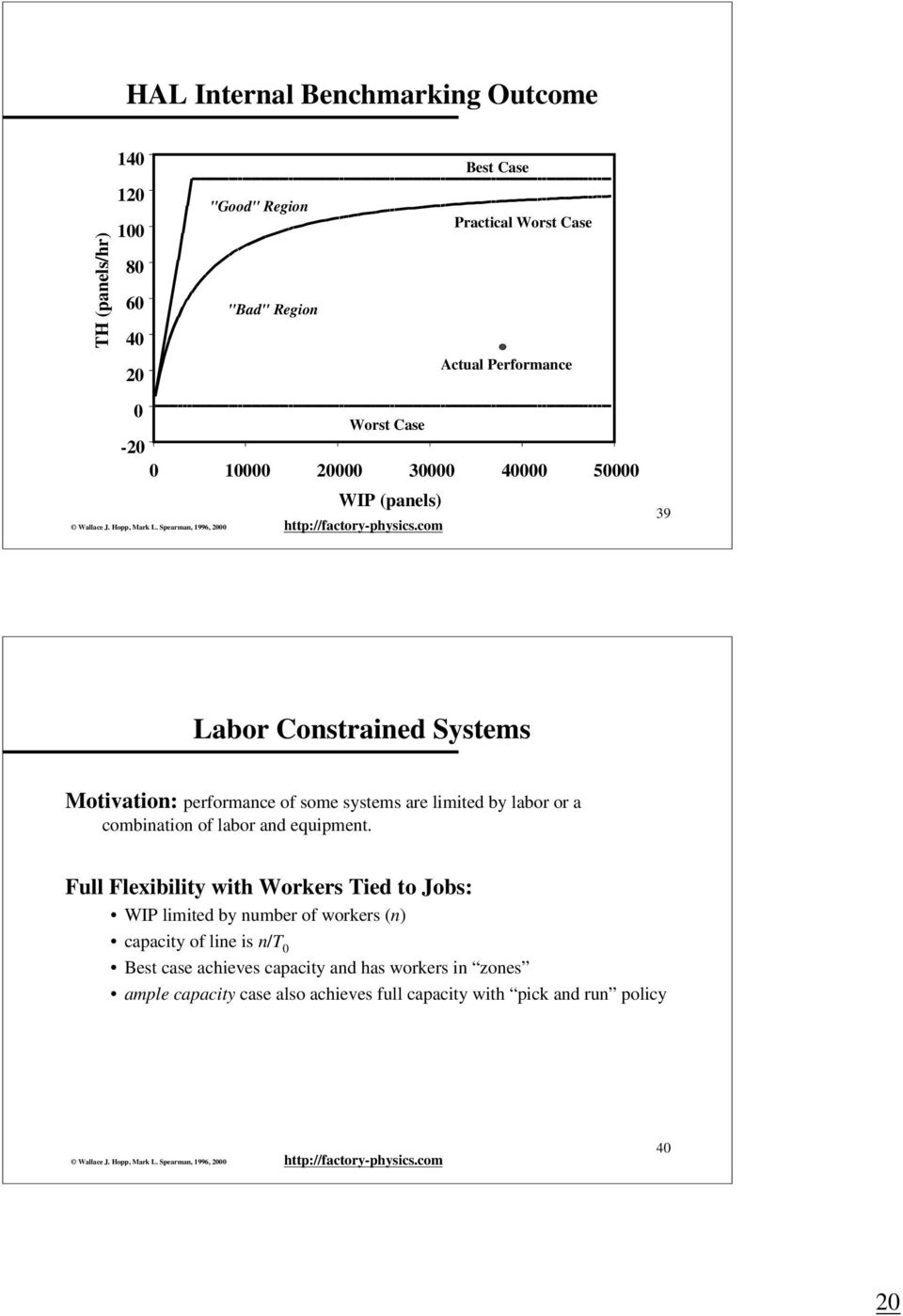
19 HAL Case - Situation Critical WIP: r b T = = 4187 Actual Values: CT = 34 days = 816 hours WIP = 374 panels TH = 45.8 panels/hour Conclusions: Throughput is 36% of capacity WIP is 8.9 times critical WIP CT is 24.6 times raw process time 37 HAL Case - Analysis WIP Required for PWC to Achieve TH =.36r b : w TH = w + W.36 w = ( W.64 r 1 b =.36r.36 1) = (4,187 1) = 2, TH Resulting from PWC with WIP = 37,4: b Much lower than actual WIP! TH w = r w + W 1 b 37,4 = = ,4 + 4,187 1 Much higher than actual TH! Conclusion: actual system is much worse than PWC! 38 19
20 HAL Internal Benchmarking Outcome TH (panels/hr) "Good" Region "Bad" Region Best Case Practical Worst Case Actual Performance Worst Case WIP (panels) 39 Labor Constrained Systems Motivation: performance of some systems are limited by labor or a combination of labor and equipment. Full Flexibility with Workers Tied to Jobs: WIP limited by number of workers (n) capacity of line is n/t Best case achieves capacity and has workers in zones ample capacity case also achieves full capacity with pick and run policy 4 2
21 Labor Constrained Systems (cont.) Full Flexibility with Workers Not Tied to Jobs: TH depends on WIP levels TH CW (n) TH(w) TH CW (w) need policy to direct workers to jobs (focus on downstream is effective) Agile Workforce Systems bucket brigades kanban with shared tasks overlapping zones many others 41 Factory Dynamics Takeaways Performance Measures: throughput WIP cycle time service Range of Cases: best case practical worst case worst case Diagnostics: simple assessment based on r b, T, actual WIP,actual TH evaluate relative to practical worst case 42 21
Push and Pull Production Systems
 Push and Pull Production Systems You say yes. I say no. You say stop. and I say go, go, go! The Beatles 1 The Key Difference Between Push and Pull Push Systems: schedule work releases based on demand.
Determining Inventory Levels in a CONWIP Controlled Job Shop
 Determining Inventory Levels in a CONWIP Controlled Job Shop Sarah M. Ryan* Senior Member, IIE Department of Industrial and Management Systems Engineering University of Nebraska-Lincoln Lincoln, NE 68588-0518
Aegis Standard Report Template Examples
 Aegis Standard Report Template Examples Contents Introduction... 3 Quality and Test Reports... 4 NPI Reports... 13 Production & WIP Tracking Reports... 18 System Administration Reports... 23 Material and
Small Lot Production. Chapter 5
 Small Lot Production Chapter 5 1 Lot Size Basics Intuition leads many to believe we should manufacture products in large lots. - Save on setup time - Save on production costs Costs associated with Lots
Work Cells and Cellular Manufacturing
 Work Cells and Cellular Manufacturing Improving the fitness of the factory 1 Cellular Manufacturing Concept of performing all of the necessary operations to make a component, subassembly, or finished product
CHAPTER 5. OVERVIEW OF THE MANUFACTURING PROCESS
 CHAPTER 5. OVERVIEW OF THE MANUFACTURING PROCESS 5.1 INTRODUCTION The manufacturing plant considered for analysis, manufactures Printed Circuit Boards (PCB), also called Printed Wiring Boards (PWB), using
Historical production of rigid PCB s
 Historical production of rigid PCB s The Printed Circuit Board (PCB) The PCB What is a Printed Circuit Board? Green plastic thing with holes!! (green plastic syndrome) Platform for components Image with
How to Build a Printed Circuit Board. Advanced Circuits Inc 2004
 How to Build a Printed Circuit Board 1 This presentation is a work in progress. As methods and processes change it will be updated accordingly. It is intended only as an introduction to the production
Wonderware MES/Operations Managing the transformation of materials into finished products in real time
 Wonderware MES/Operations Managing the transformation of materials into finished products in real time Wonderware offers a complete set of MES software functionality to digitize your industrial operations
Lamination Production. by: John Roberts / Sko Die, Inc
 Lamination Production by: John Roberts / Sko Die, Inc Presentation Mission Understand the construction for magnetic cores Chose the best methods for producing Magnetic cores are constructed From soft magnetic
MANUFACTURING EXECUTION SYSTEMS VS. ERP/MRP
 www.globalsmt.net %*(*5 "- &% *5*0/ The Global Assembly Journal for SMT and Advanced Packaging Professionals Volume 11 Number 9 September 2011 ISSN 1474-0893 MANUFACTURING EXECUTION SYSTEMS VS. ERP/MRP
PARADIGMS THAT DRIVE COSTS IN MANUFACTURING. The whole purpose of a business enterprise is pretty simple to make a profit by selling
 PARADIGMS THAT DRIVE COSTS IN MANUFACTURING The whole purpose of a business enterprise is pretty simple to make a profit by selling products or services to persons who desire those particular goods or
Material Requirements Planning (MRP)
 Material Requirements Planning (MRP) Unlike many other approaches and techniques, material requirements planning works which is its best recommendation. Joseph Orlicky, 1974 1 History Begun around 1960
The Basic Framework of Budgeting
 Master Budgeting 1 The Basic Framework of Budgeting A budget is a detailed quantitative plan for acquiring and using financial and other resources over a specified forthcoming time period. 1. The act of
Justifying Simulation. Why use simulation? Accurate Depiction of Reality. Insightful system evaluations
 Why use simulation? Accurate Depiction of Reality Anyone can perform a simple analysis manually. However, as the complexity of the analysis increases, so does the need to employ computer-based tools. While
Chapter 5: Strategic Capacity Planning for Products and Services
 Chapter 5: Strategic Capacity Planning for Products and Services Assistant Prof. Abed Schokry Operations and Productions Management First Semester 2010 / 2011 Learning Outcomes: Chapter 5 After finishing
Lean manufacturing and ERP: How to leverage ERP to get lean
 E-Book Lean manufacturing and ERP: How to leverage ERP to get lean A manufacturing firm adopting the principles of lean manufacturing can effectively leverage the company s ERP system during its transition
Factory Physics: The Key to Green Industries
 Factory Physics: The Key to Green Industries College of Engineering and Architecture - College Days 2012 EXHIBIT: Greening Industries Student Chapter Philippine Institute of Industrial Engineers (PIIE)
NETWORK BUSINESS SYSTEMS SOFTWARE SYSTEM DOCUMENTATION MANUFACTURING SYSTEM FEATURES
 NETWORK BUSINESS SYSTEMS SOFTWARE SYSTEM DOCUMENTATION MANUFACTURING SYSTEM FEATURES WORK ORDERS Standard Mfg. vs. Full Mfg./MRP Manufacturing Target date, open date, closed date You can make and buy the
BSCM Sample TEST. CPIM(Certified In Production & Inventory Management) - 1 -
 BSCM Sample TEST. 1. Which of the following demand fulfillment approaches typically provides the longest delivery time? A) Engineer-to-order. B) Make-to-order. C) Assemble-to-order. D) Make-to-stock. 2.
Computer Integrated Manufacturing CIM A T I L I M U N I V E R S I T Y
 MFGE 404 Computer Integrated Manufacturing CIM A T I L I M U N I V E R S I T Y Manufacturing Engineering Department Lecture 1 - Introduction Dr. Saleh AMAITIK Fall 2005/2006 Production Systems Production
Choosing Planning & Scheduling solutions for Metals
 Choosing Planning & Scheduling solutions for Metals White Paper The planning and scheduling of metals production presents special problems because of the complexity of the manufacturing process and the
Operational Business Intelligence in Manufacturing
 Operational Business Intelligence in Manufacturing Copyright 2007 KeyTone Technologies Inc. Page 1 SmartWIP - Intelligent Manufacturing with RFID Manufacturers are under competitive pressure to fulfill
IMPACT OF PROCESS VARIABILITY ON LEAN MANUFACTURING SYSTEMS
 IMPACT OF PROCESS VARIABILITY ON LEAN MANUFACTURING SYSTEMS Mel Adams and Bernard J. Schroer Center for Automation & Robotics University of Alabama in Huntsville Huntsville, AL 35899 [email protected]
FLEXIBLE CIRCUITS MANUFACTURING
 IPC-DVD-37 FLEXIBLE CIRCUITS MANUFACTURING Below is a copy of the narration for DVD-37. The contents of this script were developed by a review group of industry experts and were based on the best available
Lean Manufacturing and Six Sigma
 Lean Manufacturing and Six Sigma Research Questions What have we done in the past? What must we do in the future? How do we know these are the correct actions? 1 Lean Definitions Key concepts of lean:
Using Queueing Network Models to Set Lot-sizing Policies. for Printed Circuit Board Assembly Operations. Maged M. Dessouky
 Using Queueing Network Models to Set Lot-sizing Policies for Printed Circuit Board Assembly Operations Maged M. Dessouky Department of Industrial and Systems Engineering, University of Southern California,
How Leaders Improve Performance. in a Post-Lean Six Sigma World. Edward S. Pound Jeffrey H. Bell Mark L. Spearman. Mc Graw Education.
 FACTORY PHYSICS FOR MANAGERS How Leaders Improve Performance in a Post-Lean Six Sigma World Edward S. Pound Jeffrey H. Bell Mark L. Spearman Mc Graw Education Hill New York Chicago San Francisco Athens
Linear Programming Supplement E
 Linear Programming Supplement E Linear Programming Linear programming: A technique that is useful for allocating scarce resources among competing demands. Objective function: An expression in linear programming
Going Lean the ERP Way
 Going Lean the ERP Way Somnath Majumdar Abstract: Lean concepts and techniques are widely used all over the world today to eliminate waste in all processes. These are applicable for all organizations,
Absorption Costing - Overview
 Absorption Costing - Overview 1. Overview of Absorption costing and Variable Costing 2. Review how costs for Manufacturing are transferred to the product 3. Job Order Vs. Process Costing 4. Overhead Application
The Thinking Approach LEAN CONCEPTS. 2012-2013, IL Holdings, LLC All rights reserved 1
 The Thinking Approach LEAN CONCEPTS All rights reserved 1 Basic Thinking to Manage the Journey MANAGEMENT TACTICS OF A LEAN TRANSFORMATION All rights reserved 2 LEAN MANAGEMENT Two key questions What is
CHAPTER 6 AGGREGATE PLANNING AND INVENTORY MANAGEMENT 명지대학교 산업시스템공학부
 CHAPTER 6 AGGREGATE PLANNING AND INVENTORY MANAGEMENT 명지대학교 산업시스템공학부 Learning Objectives You should be able to: Describe the hierarchical operations planning process in terms of materials planning & capacity
APPLICATION OF KANBAN SYSTEM FOR MANAGING INVENTORY
 Bulletin of the Transilvania University of Braşov Vol. 3 (52) - 2010 Series I: Engineering Sciences APPLICATION OF KANBAN SYSTEM FOR MANAGING INVENTORY M. APREUTESEI 1 I.R. ARVINTE 1 E. SUCIU 2 D. MUNTEANU
Chapter 11. MRP and JIT
 Chapter 11 MRP and JIT (Material Resources Planning and Just In Time) 11.1. MRP Even if MRP can be applied among several production environments, it has been chosen here as a preferential tool for the
Auditing a Printed Circuit Board Fabrication Facility Greg Caswell
 Auditing a Printed Circuit Board Fabrication Facility Greg Caswell Introduction DfR is often requested to audit the PCB fabrication process of a customer s supplier. Understanding the process variations
Inventory Control Subject to Known Demand
 Production and Operation Managements Inventory Control Subject to Known Demand Prof. JIANG Zhibin Department of Industrial Engineering & Management Shanghai Jiao Tong University Contents Introduction Types
AGGREGATE & CAPACITY PLANNING
 7 Ir. Haery Sihombing/IP Pensyarah Fakulti Kejuruteraan Pembuatan Universiti Teknologi Malaysia Melaka AGGREGATE & CAPACITY PLANNING Aggregate Planning Determine the resource capacity needed to meet demand
Flexible production in quick motion
 No. 21 Page: 1 / 8 April 2014 Flexible production in quick motion When it comes to being competitive in the furniture industry, an optimized production line concept provides an essential foundation. Particularly
Standard Work for Optimal Inventory Management
 Standard Work for Optimal Inventory Management Putting practical science to work Presenter Edward S. Pound COO, Factory Physics Inc. 27 years in manufacturing JVC manufacturing engineering Honeywell (AlliedSignal)
Introduction to production scheduling. Industrial Management Group School of Engineering University of Seville
 Introduction to production scheduling Industrial Management Group School of Engineering University of Seville 1 Introduction to production scheduling Scheduling Production scheduling Gantt Chart Scheduling
Business Challenges. Customer retention and new customer acquisition (customer relationship management)
 Align and Optimize Workflows with Lean Dan Marino Marino Associates, LLC Strategic and tactical planning Information systems integration Customer retention and new customer acquisition (customer relationship
Value Stream Mapping
 Value Stream Mapping 1 Value Stream Mapping Definition Value Stream Mapping (VSM): Special type of flow chart that uses symbols known as "the language of Lean" to depict and improve the flow of inventory
y = a + bx Chapter 10: Horngren 13e The Dependent Variable: The cost that is being predicted The Independent Variable: The cost driver
 Chapter 10: Dt Determining ii How Costs Behave Bh Horngren 13e 1 The Linear Cost Function y = a + bx The Dependent Variable: The cost that is being predicted The Independent Variable: The cost driver The
1) Cost objects include: A) customers B) departments C) products D) All of these answers are correct.
 Preliminary Test of Cost Accounting Knowledge--Does not affect your grade! Name Mark one letter for each question response. Note that in some cases there are options like ʺD) Both A and C are correct.ʺ
Decodability QUALITY. A New Method to Ensure Bar Code Quality throughout the Distribution Channel
 Edge Determination Decode Decodability Symbol Contrast Defects Min. Edge Contrast Modulation QUALITY A New Method to Ensure Bar Code Quality throughout the Distribution Channel Camera-based systems reduce
Skateboard Assembly - Line Balance Lesson Plan (45-60 minutes)
 Overview This activity demonstrates the process of balancing an assembly line, which is designing the same amount of work content, or time, at each workstation. Work that is done to build skateboards is
Using Overall Equipment Effectiveness: the Metric and the Measures
 Using Overall Equipment Effectiveness: the Metric and the Measures The definition and use of Overall Equipment Effectiveness over the years has been widely debated. Many practitioners have found that OEE
Kellogg Graduate School of Management Northwestern University
 Kellogg Graduate School of Management Northwestern University Operations MORE SAMPLE EXAM QUESTIONS: SOLUTIONS [1] Consider the life cycle of a product from introduction to maturity to decline. What kind
How Constraint Management fits the Operations Management Philosophy
 Constraint Management Chapter 7 How Constraint Management fits the Operations Management Philosophy Operations As a Competitive Weapon Operations Strategy Project Management Process Strategy Process Analysis
Chapter 14. Printed Circuit Board
 Chapter 14 Printed Circuit Board A printed circuit board, or PCB, is used to mechanically support and electrically connect electronic components using conductive pathways, or traces, etched from copper
Lean Kitting: A Case Study
 Lean Kitting: A Case Study Ranko Vujosevic, Ph.D. Optimal Electronics Corporation Jose A. Ramirez, Larry Hausman-Cohen, and Srinivasan Venkataraman The University of Texas at Austin Department of Mechanical
Good Boards = Results
 Section 2: Printed Circuit Board Fabrication & Solderability Good Boards = Results Board fabrication is one aspect of the electronics production industry that SMT assembly engineers often know little about.
Inventory Management: Fundamental Concepts & EOQ. Chris Caplice ESD.260/15.770/1.260 Logistics Systems Oct 2006
 Inventory Management: Fundamental Concepts & EOQ Chris Caplice ESD.260/15.770/1.260 Logistics Systems Oct 2006 Agenda Wrap up of Demand Forecasting Fundamentals of Inventory Management Economic Order Quantity
Manufacturing Systems Modeling and Analysis
 Guy L. Curry Richard M. Feldman Manufacturing Systems Modeling and Analysis 4y Springer 1 Basic Probability Review 1 1.1 Basic Definitions 1 1.2 Random Variables and Distribution Functions 4 1.3 Mean and
Evolving To The Enterprise Production System (EPS)
 Collaborative Manufacturing Whitepaper Series Evolving To The Enterprise Production System (EPS) Michael McClellan President Vancouver, WA 360.833.8400 Collaboration Synergies Inc. Manufacturing Execution
Factory Modeling. The Priority Enterprise Management System. Contents
 The Priority Enterprise Management System Factory Modeling Contents Introduction...2 Parts...3 Bills of Materials and Revisions...3 Engineering Change Orders (ECO)...4 Part Routings...4 Operations...4
Process design. Process design. Process design. Operations strategy. Supply network design. Layout and flow Design. Operations management.
 Process design Source: Joe Schwarz, www.joyrides.com Process design Process design Supply network design Operations strategy Layout and flow Design Operations management Improvement Process technology
Warning: This document may be duplicated for instructional use within the institution purchasing the case. Other duplication is prohibited.
 Title: Case Study: Automobile Final Assembly Plant Date approved for distribution: October 5, 1997 Authors: and Mikell P. Groover Professor of Industrial and Manufacturing Systems Engineering Michael G.
New Concepts in Multi-Channel Order Fulfillment
 New Concepts in Multi-Channel Order Fulfillment Presented by: Dave Simpson Sponsored by: Your Logo Goes Here! 2015 MHI Copyright claimed for audiovisual works and sound recordings of seminar sessions.
MULTI-FLEX CIRCUITS AUSTRALIA. International Suppliers of PRINTED CIRCUIT BOARDS
 MULTI-FLEX CIRCUITS AUSTRALIA International Suppliers of PRINTED CIRCUIT BOARDS AUSTRALIA Multi-Flex Circuits Australia Leading suppliers of HIGH QUALITY PRINTED CIRCUIT BOARDS for every purpose OUR COMMITMENT
Job Manager for Tool and Die Shops
 Job Manager for Tool and Die Shops What makes Tool and Die Shops unique? First, most orders are for a unique Tool or Die. No two Jobs are alike. The Job is a one of a kind job, not a mass production type
Prototyping Printed Circuit Boards
 Prototyping Printed Circuit Boards From concept to prototype to production. (HBRC) PCB Design and Fabrication Agenda Introduction Why PCBs? Stage 1 Understanding the rules Stage 2 Planning the board. Stage
Work Order Management. Release 8.7.2
 Work Order Management Release 8.7.2 Legal Notices 2011 Epicor Software Corporation. All rights reserved. Unauthorized reproduction is a violation of applicable laws. Epicor and the Epicor logo are registered
15. Flexible Manufacturing Systems
 15. Flexible Manufacturing Systems 15.1 Unit Introduction 15.2 Unit Objectives 15.3 Flexible Manufacturing Systems 15.4 FMS Components 15.5 FMS Applications and Benefits 15.6 FMS Planning and Implementation
Demand, Supply, and Market Equilibrium
 3 Demand, Supply, and Market Equilibrium The price of vanilla is bouncing. A kilogram (2.2 pounds) of vanilla beans sold for $50 in 2000, but by 2003 the price had risen to $500 per kilogram. The price
Dutchess Community College ACC 204 Managerial Accounting Quiz Prep Chapter 2
 Dutchess Community College ACC 204 Managerial Accounting Quiz Prep Chapter 2 Job Order Cost Accounting Peter Rivera January 2010 Disclaimer This Quiz Prep is provided as an outline of the key concepts
Advanced Planning and Scheduling
 Taylor Scheduler Welcome! Taylor Scheduler is our advanced planning and production scheduling software. Its many features allow Taylor Scheduler to be able to handle just about any manufacturing scheduling
Map the Value Stream
 1 Map the Value Stream Objectives Create and format a value stream map Add data to a value stream map Compare a current-state value stream map and future-state value stream map 1-1 Contents Contents Examples
This can be done by simply counting pieces in the line or subtracting total number of pieces loaded to total number of pieces unloaded from the line.
 Garment industry over the years has adopted various key performance measures from different industries and invented some of their own. In the 2nd of the three article series, Mausmi Ambastha, a budding
Manufacturing Flow Management
 Manufacturing Flow Management Distribution D Distribution Authorized to Department of Defense and U.S. DoD Contractors Only Aim High Fly - Fight - Win Supply Chain Management Processes Information Flow
Antti Salonen KPP227 KPP227 1
 1 What is capacity? The maximum rate of output for a facility OR The rate at which output can be produced by an operating unit (machine, process, workstation, facility or an entire company). 2 Factors
Operations Management and the Integrated Manufacturing Facility
 March 2010 Page 1 and the Integrated Manufacturing Facility This white paper provides a summary of the business value for investing in software systems to automate manufacturing operations within the scope
Table of Contents. Planning the ERP System...1
 Table of Contents Planning the ERP System...1 Core Group Basic Training...1 Define Current Business Processes...1 Define Future Business Processes...2 Documenting the ERP Blueprint...2 ERP System Budget
Chapter 5 Supporting Facility and Process Flows
 Chapter 5 Supporting Facility and Process Flows Process View of a Hospital Process Performance Inventory Turns Process Flow Structures 1 Definition of a Business Process A process is a set of activities
User Guide QAD Manufacturing
 QAD Enterprise Applications Enterprise Edition User Guide QAD Manufacturing Product Structures Routings and Work Centers Formulas and Processes Co-products and By-products Work Orders Shop Floor Control
Implementing Automation after Making Lean Improvements
 Implementing Automation after Making Lean Improvements Frank C. Garcia, P.E., Director Business Solutions & Engineering Services Tom Lawton, President Advent Design Corporation Bristol, PA, USA December
Introduction to Manufacturing Process
 Introduction to Manufacturing Process What is Manufacturing? The English word manufacture is several centuries old. The term manufacture comes from two Latin words, manus (hand) and factus (make). As per
Conceptual Development of an Introductory Lean Manufacturing Course for Freshmen and Sophomore Level Students in Industrial Technology
 Conceptual Development of an Introductory Lean Manufacturing Course for Freshmen and Sophomore Level Students in Industrial Technology by Alister Mcleod [email protected] Department of Industrial Technology
Simulation of processes in a mining enterprise with Tecnomatix Plant Simulation
 Simulation of processes in a mining enterprise with Tecnomatix Plant Simulation Vladimir Medvedev Simulation of ore extraction on the open mountain works Page 2 Simulation objective To verify current control
Understanding Manufacturing Execution Systems (MES)
 Understanding Manufacturing Execution Systems (MES) Presented by: Shirley Schmidt Freedom Technologies 10370 Citation Dr., Suite 200 Brighton, MI 48116 Phone: 810-227-3737 www.freedomcorp.com What is a
Inventory: Independent Demand Systems
 Inventory: Independent Demand Systems Inventory is used in most manufacturing, service, wholesale, and retail activities and because it can enhance profitability and competitiveness. It is widely discussed
Case Studies on the Use of Software to Implement Lean in High-Mix Manufacturing Industries
 Case Studies on the Use of Software to Implement Lean in High-Mix Manufacturing Industries Tom Knight Founder & Chief Strategy Officer www.mesa.org 2008 North American Plant-to-Enterprise Conference September
- 1 - intelligence. showing the layout, and products moving around on the screen during simulation
 - 1 - LIST OF SYMBOLS, TERMS AND EXPRESSIONS This list of symbols, terms and expressions gives an explanation or definition of how they are used in this thesis. Most of them are defined in the references
Evolving Bar Codes. Y398 Internship. William Holmes
 Evolving Bar Codes Y398 Internship By William Holmes Table of contents Introduction: What is RFID? Types of Tags: Advantages of Tags: RFID applications Conclusion: Introduction: Bar codes have evolved
ADVANCES IN AUTOMATIC OPTICAL INSPECTION: GRAY SCALE CORRELATION vs. VECTORAL IMAGING
 ADVANCES IN AUTOMATIC OPTICAL INSPECTION: GRAY SCALE CORRELATION vs. VECTORAL IMAGING Vectoral Imaging, SPC & Closed Loop Communication: The Zero Defect SMD Assembly Line Mark J. Norris Vision Inspection
The Cost of Production
 The Cost of Production 1. Opportunity Costs 2. Economic Costs versus Accounting Costs 3. All Sorts of Different Kinds of Costs 4. Cost in the Short Run 5. Cost in the Long Run 6. Cost Minimization 7. The
Analysis Of Shoe Manufacturing Factory By Simulation Of Production Processes
 Analysis Of Shoe Manufacturing Factory By Simulation Of Production Processes Muhammed Selman ERYILMAZ a Ali Osman KUŞAKCI b Haris GAVRANOVIC c Fehim FINDIK d a Graduate of Department of Industrial Engineering,
CHAPTER 9. Cost accounting systems CONTENTS
 CHAPTER 9 Cost accounting systems CONTENTS 9.1 Job order costing and factory overhead 9.2 Job order costing 9.3 Process costing 9.4 Calculating unit costs with process costing 9.5 Cost of production reports
4.1. Chapter 4. Process design 4.1
 4.1 Chapter 4 Process design 4.1 4.2 Key operations questions In Chapter 4 Process design Slack et al. identify the following key questions: What is process design? What objectives should process design
ion Manufacturing Solution
 ion Manufacturing Solution Today with ion, while I am driving home I get to see all the information that I need, even when I am in a customer place I can take decisions looking at the information that
Chapter 14 Inventory Management
 Chapter 14 Inventory Management Overview Nature of Inventories Opposing Views of Inventories Fixed Order Quantity Systems Fixed Order Period Systems Other Inventory Models Some Realities of Inventory Planning
Introduction to Cost Accounting
 Introduction to Cost Accounting Learning Objectives By the end of this chapter, you should be able to: Define cost accounting. State the five areas in which cost accounting can assist management. List
Process Engineering and Product Engineering. Dr. P. M. Pandey
 Process Engineering and Product Engineering Dr. P. M. Pandey The Process Engineering Function Process: It is simply a method which products can be manufactured from raw materials. It could also be described
The Company. Nujay was established in 2001.
 PRESENTATION The Company Nujay was established in 2001. We provide resources, expertise and global connections to the customers, who are seeking high quality products at competitive price. We have 35 years