
UNDERSTANDING ALUMINUM ANODIC OXIDE FILM FORMATION: IMPROVING ENGINEERING PROPERTIES THROUGH MICROSTRUCTURAL MODIFICATION
|
|
|
- Harvey Cunningham
- 9 years ago
- Views:
Transcription
1 UNDERSTANDING ALUMINUM ANODIC OXIDE FILM FORMATION: IMPROVING ENGINEERING PROPERTIES THROUGH MICROSTRUCTURAL MODIFICATION Jude M. Runge, Ph.D. (CompCote International, Inc. USA)* Aaron J. Pomis (University of Illinois at Chicago USA) Abstract: Comprehensive comparative studies of various anodic oxide microstructures and their corresponding engineering properties enabled new scientific insight for the mechanism of anodic oxide formation on aluminum and aluminum alloys. The understanding of structure-chemistry relationships during anodic oxide formation led to the development of a new anodic oxide finish, a polymer-metal oxide composite, that exhibits engineering properties superior to conventional anodic oxides: Type I (Chromic Acid), Type II (conventional clear coat ) and Type III (Hard Anodized) when processed to equivalent practical thicknesses and compared in similar test applications. The results indicate the importance of understanding the anodizing process and the synergy between process, microstructure and engineering properties to bring innovation and improvement to a mature industry. Presented at the XII Ebrats Brasilian Surface Treatment Meeting and II Latin American Interfinish Sao Paulo, May 10, 2006 *Jude M. Runge, Ph.D. CompCote International, Inc. 206 North York Road, Suite C Elmhurst, Illinois, USA

2 Introduction Under typical atmospheric conditions, a native oxide or passive film naturally forms on aluminum. The native oxide layer is nonuniform, thin and noncoherent. Nevertheless, the native oxide film imparts a certain level of corrosion protection, provided the environment contains no unusual contaminants. Exfoliation, the formation of a network of oxide flakes or leaves on the aluminum surface, is an example of how corrosion of the surface can be changed through the introduction of sulfur to the environment. In fact, removing sulfur from the atmosphere can stop the exfoliation of aluminum oxide[1-3]. Anodizing aluminum is a sturdy fixture in the mind of the light metal industry. By capitalizing on the natural phenomenon of passive film formation on aluminum in a production environment, the anodization process has become synonymous with surface protection and durability of aluminum substrates. Anodizing can be viewed as the deliberate, controlled corrosion of the aluminum surface in sulfuric acid to yield a uniform, continuous protective oxide film. Its uniquely self assembling, highly ordered, columnar nanoscale structure has been extensively studied, yet the mechanism of anodic oxidation of aluminum is still not fully established. This paper discusses a mechanism for film formation based in the results of our comprehensive microstructural and chemical studies of conventional and modified Type I (Chromic Acid), Type II (conventional clear coat ) and Type III (hard anodized) anodic films. The results of these studies show that anodic finishes exhibit a microstructural and compositional gradient. Through scientific characterization of the various film features, and a clear understanding of the anodizing process parameters used to yield the various films, we developed a new formulation of a heavy metal free electrolyte utilizing an electroactive polymer additive to a sulfuric acid based electrolyte. Studies comparing the resultant composite anodic oxide to conventional Type I, II and III anodic finishes have determined the composite anodic oxide exhibits superior corrosion and abrasion resistance as well as the ability to function as a dual-phase transition layer for polymer-metal bonding [4-5]. Comparative mechanical testing by way of fatigue, friction and thread torque tests determined the composite oxide meets or exceeds the mechanical performance of components finished with conventional methods, regardless of Type. Development of a New Process Through the course of our work which was undertaken at the University of Illinois at Chicago, Saporito Finishing in Cicero, Illinois, and Bodycote Nussbaum in Kaufbeuren, Germany, to understand the mechanism of anodic oxide formation, we developed a new theory for porous oxide formation which challenges the convention that dissolution is the dominant mechanism for the porous oxide structure. Another result of this work was the development of a new anodic oxide finish that is described later in this paper. Process and Microstructure Extensive Transmission Electron Microscopy (TEM) was performed on a variety of anodized finishes, processed in various ways. Ultramicrotome sections of conventionally processed and unsealed Type I, Type II and Type III anodized films were further prepared for Transmission Electron Microscopy (TEM) by way of Precision Ion Processing (PIPs). The films were imaged and analyzed by way of TEM with Electron Energy Loss Spectroscopy (EELS).

3 Analysis results consistently show that process modifications, whether chemical (to the electrolyte) or electrical (to the electrical input) impart distinct microstructural changes to the anodic oxide compared with the microstructures of anodic oxides formed through conventional processing. By virtue of these changes and the predictable manner in which they can be achieved, we proposed The Constraint Concept of Film Formation. This theory explains how various oxide microstructural characteristics are achieved through electric field effects, and through diffusion and mass transport that occur within the anodic oxide during anodizing, and how they change through modifications to the process [6]. A summary of our theory follows: The kinetics of anodic oxide film formation are governed by (1) the thermodynamics at the surface and (2) diffusion and mass transfer across the oxide layer as it forms [7]. Surface reconstruction, the result of chemisorption, which precedes surface oxidation, begins at preferred nucleation sites on the substrate surface [8]. The thermodynamics of the surface favor only aluminum oxidation, therefore alloy additions and other contaminants can retard the reaction kinetics. Our research and analysis conclude the columnar structure of the anodic film is the result of lateral film growth following surface reconstruction during early stages of the oxide growth process, rather than selective dissolution of the oxide as reported in the past [9], [10]. As the infant oxide flakes impinge on one another, the repulsive forces of the similarly charged oxide flakes foster outward growth of the finish. Pores in the oxide finish are formed through repulsive field effects on the inside surface of the flakes, as the oxide flakes impinge and grow outward. It is apparent that mass transport of the forming hydrated aluminum oxide network across the column outer walls knits the structure together. The stability and robustness of the final structure appear to depend on this stage of the film formation because there is no ion flow that can disturb diffusion or mass transport across these interfaces, between each forming column, as in the pores. Consequently, the mechanical and chemical integrity of the finished film often is based on the integrity of the knitlines. See Figures 1 and 2. Figure 1: The Constraint Theory of Anodic Oxide Formation. A: Preferential nuclei form base of pore. B: Repulsive forces between similarly charged oxide flakes foster outward growth. C: Mass transport and diffusion across column walls form intercolumn knit lines. D: Repulsive

4 forces within each pore maintain the erect nature of the column and dynamic flow of the electrolyte. Figure 2: AFM images of anodized aluminum oxide finishes after careful removal from the aluminum substrate. (Left) surface of the aluminum substrate surface. Each dark spot is the nucleation point of the oxide during surface reconstruction. The lighter areas surrounding each nucleation point are the areas where the column walls intersected the substrate; the shaded spots are areas of impingement and deformation where the knit lines intersected the substrate. (Right) bottom surface of the anodized finish showing it as a distinct hexagonal network. Note the interstitial spaces between the network columns. Since the thermodynamics at the substrate surface favor the formation of aluminum oxide, aluminum is the only element besides oxygen reacting to form the finish. This means that other alloying elements are entrained at the substrate interface. Other atomic level defects, such as dislocations and vacancies are also left behind. In fact, these defects at the interface are transported with the oxide flakes during lateral growth of the finish. Concentrations of these defects can be seen interstitially, between oxide column bases. Inclusions, inert to the anodization process and incoherent with the base metal microstructure, can also be transported into the finish as it grows; moving with flakes as they grow outward from the substrate surface. See Figure 3. Pore wall reactivity enables adsorption of the electrolyte counter ions, additives, and seals. In situations where the additive is not electroactive, adsorption occurs after substrate consumption is complete; however, analysis has shown that electroactive counter ion adsorption occurs throughout anodic oxide formation. Reactivity/passivity of the adsorbed counter ion dictates film thickness. An adsorbed reactive counter ion facilitates charge transfer along the inside surface of the oxide flake. The charge transfer fosters the oxidation reaction such that the repulsive forces of the ions promote pore formation and outward growth of the columnar microstructure. Therefore the process parameters utilized for a typical Type II anodic finish yield a nanostructure with more columns and finer column walls up to 20 25µm thick than a Type III process, in which the parameters yield a nanostructure with fewer columns and coarser (thicker) column walls up to 50µm thick. It is clear through this comparison that the lower process temperature (with Type III, for example) reduces the initial number of oxide nucleation points during surface reconstruction and that increased current density increases both the column thickness and pore diameter. See Figures 4 and 5.

5 Figure 3: X15,000 Documentary TEM photomicrograph of an anodized aluminum substrate. Note the presence of circular inclusions (iron-chromium) which had been taken up into the Type III columnar structure during anodization. Atomic level defects in the aluminum substrate are seen to affect the finish structure at the finish-substrate interface. Figure 4: X25,000Representative TEM photomicrograph of a Type II anodized finish. Figure 5: X20,000 Representative TEM photomicrograph of a Type III anodized finish.

6 An adsorbed passive counter-ion, such as a chromate ion in a Type I anodization process, will not facilitate charge transfer along the inside surface of the oxide flake and outward growth of the oxide layer does not occur, instead, would-be columns collapse on one another. Therefore, unlike conventionally processed Type II and Type III anodic finishes that exhibit a columnar nanostructure, the Type I nanostructure is coarse and disordered. The Type I microstructure exhibits a dense, random microstructure with a heavy interfacial reaction layer. The finish is thin, on the order of 1.5 to 2µm. These features are the result of the high temperature, high current density process parameters in an electrolyte that contains passive metal ions. From an engineering perspective, the random microstructure imparts the corrosion resistance of the Type I finish; the process parameters as well as the passive nature of the chromate ion limit finish thickness which in turn preserves component tolerances and fatigue resistance. See Figure 6. Figure 6: X100,000 Representative photomicrograph of a Type I microstructure at the aluminum anodic oxide finish interface. Chemical analysis via EELS and imaging by way of diffraction contrast show conclusively that the various common finish Types are comprised primarily of disordered hydrated aluminum oxide, i.e. aluminum hydroxide. The anodic finishes, regardless of Type, are amorphous and do not exhibit any diffraction contrast necessary to identify the oxide phase as corundum, α alumina, Al 2 O 3. Furthermore, related research has disclosed the only crystalline anodic films are those formed by way of spark anodization, where the crystalline phase of alumina formed through the process was determined to be γ alumina [11]. Microstructure Modification Based upon the ideas proposed in the Constraint Concept of Film Formation [6], in order to modify an anodic finish, change must be introduced that is electroactive or charged in nature. Therefore, one can change the external electrical parameters of the anodization process, or change the electrolyte through the introduction of a supplementary counter ion. The counter ion can be active or passive, or completely inert. Active counter ions will facilitate finish growth, as with an oxalate ion. Passive counter ions will react with the pore wall but oxidize immediately as with a chromate ion, limiting finish growth. An inert additive may be a surface active agent that although soluble in the electrolyte, does not participate in the anodization reaction at all. These additions serve, through esterification or similar reaction, to buffer the heat of reaction that occurs with alloy additions, interfacial defects and contamination and help prevent finish damage due to resistance heating.

7 We selected a novel active counter ion as an electrolyte modifier. Similarities between the aluminum anodization process and the oxidative polymerization reaction for certain conjugated polymers, as well as the electroactive characteristics of these polymers when doped with protonic acids, such as sulfuric acid, indicated anodizing and electrodeposition of the polymer could be carried out simultaneously, producing fully integrated composite polymer metal oxide finishes. Therefore, electroactive polymer was added to the sulfuric acid electrolyte. Uniform, continuous composite aluminum oxide finishes have been electrochemically produced with this polymermodified electrolyte which exhibit structural modification and polymer phase inclusion in both laboratory and production environments. It will be referred to from now on as the composite anodic oxide finish. Scientific Characterization Transmission Electron Microscopy TEM analysis of the composite anodic oxide finish produced in the modified electrolyte determined it exhibits a unique hybrid microstructure. Instead of long, straight columns as Type II or Type III anodic oxides, or a dense, random microstructure as a Type I anodic oxide, the composite finish exhibits a more cellular structure. The composite microstructure still has a columnar character but the columns are without a continuous, unidirectional central pore, especially near the finish surface when the process is controlled to yield thicknesses comparable to Type II or III anodic oxides; or throughout the thickness when the process is controlled to yield thicknesses typical of a Type I finish. These results indicate adsorbed electroactive polymer additive maintains pore wall surface reactivity enough to foster outward growth of the anodic oxide finish, but that most of the modification occurs in the first stages of the oxide formation. It also indicates the modifier, which has been determined to be an aluminum salt of the sulfonated conjugated polymer additive, actually participates in the ion pump within the pores during finish formation. See Figure 7. Figure 7: Representative TEM photomicrograph of the modified structure of a composite anodized film. Note the cellular, rather than directly columnar structure.

8 High Intensity Infrared (FT-IR) Spectrographic Analysis TEM sections of a Type II unsealed anodic film and a composite film were analyzed by way of high intensity micro-fourier Transform Infrared Spectrographic analysis. The energy source for the instrument was hooked up to a synchrotron light source. The resolution of the instrument was 4 5µ. Sections of each coating were analyzed using a 4µ X 30µ aperture. Data was collected from the aluminum-anodic film interface (bottom), the film center and the top. The films measured 20-25µ thick. The trends in the infrared data collected from the bottom of the films to the top strongly indicate a shift in the formation and amount of active hydroxide and sulfate groups. The Al-O feature at approximately 750 cm -1 dominates, but shifts upward in the spectra as the sulfate peaks at 1000 to 1100 cm -1 become larger and more defined. With the development of the sulfate absorption, hydroxide absorption becomes pronounced. This makes sense, as the surface of the anodic finish regardless of Type or formulation, should exhibit more hydration. The composite finish exhibited evidence of inclusion of the electroactive modifier with absorption in the higher IR. The spectral shifts toward the higher IR were noted from the substrate, where the inorganic absorbances were most pronounced to the middle and finally the surface portions where absorption of both OH -1 and carbon-based inorganic salts were detected within the composite film. See figure nos. 8 and 9. Figure 9: IR spectrum of composite anodic film adjacent to the aluminum substrate is identical to a conventionally anodized Type II film. The low end absorbance is typical for inorganic species. Figure 10: IR spectrum of modified composite film exhibits a shift in the inorganic spectrum toward the more chemically reactive species of sulfate and hydroxide. Some organic absorbances are also present indicative of additive inclusion. A hot water sealed Type III coating was processed within argon plasma. With increased exposure time within the plasma, a residue developed on the surface of the coating. Infrared analysis of the residue determined absorption characteristics for hydrated aluminum sulfate and/or aluminite: Al 2 (SO 4 ) 18H 2 O and/or Al 2 (SO 4 )(OH) 4 7H 2 O. These results indicate consideration should be given to the stability of the oxide phases from the column wall to the pore center as well as from the substrate interface to the film surface. The portions of the film that remain in contact with the electrolyte, in addition to hydration, will also adsorb active counter ion species from the electrolyte, forming a compositional and therefore reactivity gradient across the porous structure.

9 X-ray Photoelectron Spectroscopy X-ray Photoelectron Spectroscopy (XPS) studies were performed on Type II and on two (2) groups of composite anodized samples. The composite samples were exposed to different anodizing times. One group of samples was representative of the typical exposure time of 60 minutes and the other group was representative of an extended exposure time. The samples were anodized and mechanically removed to sealed containers to prevent surface contamination through handling or by ambient air. This insured the analysis results would reflect the actual anodized surface composition from a depth of 0 to 30 Angstroms. The Type II and composite samples anodized for the typical exposure time exhibited the presence of sulfur as sulfate. Additional oxygen and aluminum was also detected. The high-level binding energy component for oxygen corresponded to H 2 O and OH -, which were consistent with the infrared data. The aluminum detected in the film surface of these samples was not metallic in nature; the low binding energy component was typical for disordered aluminum oxide. The composite sample did show chemical inclusion of the electroactive modifier. Saturated and π - conjugated carbons were noted with distinct linkages to the disordered (hydr)oxide structure as HO-C=O, O-C=O and C-OH. XPS analysis of the extended exposure samples determined strikingly different surface constituents. More of the electroactive additive was detected in the surface of these samples. No sulfur was determined. Evidence of metallic aluminum, aluminum as Al 2 O 3, and copper, as Cu 2 O was also identified. The results were important because they indicated these species were actually deposited from the electrolyte and not a function of the anodization of the substrate. Engineering Characterization Intensive comparative engineering tests of several types of anodized aluminum finishes were performed with the composite anodic oxide finish. Testing was performed to determine and compare corrosion resistance, color fastness when dyed, smoothness, abrasion and wear resistance, coefficient of friction in comparable wear systems, fatigue testing and bonding of subsequent polymer layers [4], [5]. In most cases, significant improvements were noted in the performance of the composite anodic finish over its conventional counterparts when tested at equivalent thicknesses. When testing determined the composite finish performed comparably, added benefits were noted in the form of energy savings, as the oxide formation current density was lower and process temperature ambient for the composite finish. In addition, the electrolyte is heavy-metal free, easing waste treatment costs and concerns and avoiding pollution hazards typically associated with Type I (Chromic Acid) anodization processes [12]. Conclusion By varying process parameters that impact the microstructure of the anodic oxide finish, the metal finishing industry has established three basic, yet distinct, types of anodic finishes for aluminum, each with different engineering properties and therefore applications. Numerous commercial chemical additives are currently available with corresponding engineering data which suggest the various types of anodic oxide finish can be enhanced, but no real scientific data is available to support their results. In our research and development program, enhanced understanding regarding the mechanisms of anodic oxide finish formation and the process to control them determined further changes could be made to the anodization process that could result in a new type of finish with properties that exceed the limitations of conventional finish types. With these ideas in mind, a new type of anodic oxide finish, formed with a polymer-modified electrolyte, was invented. Through comprehensive scientific characterization of the resultant composite anodic oxide finish, its structure and chemical constituents, a correlation to its superior engineering

10 characteristics, important to the application and service life in various industries, could be drawn. To date, engineering testing of the composite finish has shown superior corrosion and wear resistance to conventional Type I, II and III finishes, as well as increased dye-ability, UV stability and superior adhesion of subsequent polymer layers. Testing has been performed in the laboratory and in various field applications that demonstrate the composite finish, at comparative Type I thicknesses, does not impact the fatigue strength of the substrate. The formulation is successfully implemented in large scale production. By understanding the age-old process of anodizing aluminum, new, improved and truly different anodic finishes can be developed and brought to a market complacent with mature designs. JMR 16 March 2006 (JMJ) References: 1. Uhlig, H. H., Corrosion and Corrosion Control, Wiley, New York, Jones, D. A., Principles and Prevention of Corrosion, MacMillan Publishing Company, New York, ASM International Metals Handbook, Tenth Edition, Volume 13, Corrosion, Runge, J., Pomis, A., Continued Development in Chrome-Free Anodic Oxide Finishes for Aluminum: Evaluation of Selected Mechanical Properties, Proceedings of the AESF Aerospace/Airline Plating & Metal Finishing Forum, AESF, August, Runge, J., Pomis, A., Nussbaum, Th., Insights Regarding the Adhesion Mechanism of Supplementary Organic Coatings on Porous Anodic Films, Proceedings of the Aluminium 2002 Conference September, Runge, J., Pomis, A., Anodic Oxide Film Formation: Relating Mechanism to Composition and Structure, Proccedings of the AESF SUR/FIN 2000 Technical Conference, AESF, June Deal, B.E., Grove, A.S., Journal of Applied Physics, 36, Murr, L., Interfacial Phenomena in Metals and Alloys, Addison-Wesley Publishing Co., Von Fraunhofer, J., Basic Metal Finishing, Chemical Publishing, New York, Wernick, S., Pinner, R., Sheasby, P., The Surface Treatment and Finishing of Aluminum and Its Alloys, ASM International Finishing Publication, Ltd., Runge-Marchese, J., Nussbaum, Th., New Insights Regarding the Mechanism of Spark Anodization Processes, AESF SUR/FIN 98 Proceedings,

Anodizing Reference Guide
 Anodizing Reference Guide Type Thickness Type II Conventional coatings produced 1.8µ-25.4µ from sulfuric acid bath Type I A Conventional coatings produced 0.5µ-7.6µ (microns) from chromic acid bath Type
h e l p s y o u C O N T R O L
 contamination analysis for compound semiconductors ANALYTICAL SERVICES B u r i e d d e f e c t s, E v a n s A n a l y t i c a l g r o u p h e l p s y o u C O N T R O L C O N T A M I N A T I O N Contamination
Coating Technology: Evaporation Vs Sputtering
 Satisloh Italy S.r.l. Coating Technology: Evaporation Vs Sputtering Gianni Monaco, PhD R&D project manager, Satisloh Italy 04.04.2016 V1 The aim of this document is to provide basic technical information
Engine Bearing Materials
 Engine Bearing Materials Dr. Dmitri Kopeliovich (Research & Development Manager) The durable operation of an engine bearing is achieved if its materials combine high strength (load capacity, wear resistance,
CHAPTER 7 THE DEHYDRATION AND SWEETENING OF NATURAL GAS
 CHAPTER 7 THE DEHYDRATION AND SWEETENING OF NATURAL GAS Natural gases either from natural production or storage reservoirs contain water, which condense and form solid gas hydrates to block pipeline flow
Corrosion Inhibitors in Antifreeze Coolants
 44th International Petroleum Conference, Bratislava, Slovak Republic, September 21-22, 2009 Corrosion Inhibitors in Antifreeze Coolants Bratislava 2009. 09. 22. Bálint Szilágyi Product development engineer
LEAD CRYSTAL. User Manual. Valve-regulated lead-crystal batteries Energy storage Cells
 Engineering Production Sales LEAD CRYSTAL Valve-regulated lead-crystal batteries Energy storage Cells User Manual www.axcom-battery-technology.de [email protected] Chapter 1: 1. Introduction
Al 2 O 3, Its Different Molecular Structures, Atomic Layer Deposition, and Dielectrics
 Al 2 O 3, Its Different Molecular Structures, Atomic Layer Deposition, and Dielectrics Mark Imus Douglas Sisk, Ph.D., Mentor Marian High School RET Program University of Notre Dame Project Proposal Tunneling
Vacuum Evaporation Recap
 Sputtering Vacuum Evaporation Recap Use high temperatures at high vacuum to evaporate (eject) atoms or molecules off a material surface. Use ballistic flow to transport them to a substrate and deposit.
Lecture 12. Physical Vapor Deposition: Evaporation and Sputtering Reading: Chapter 12. ECE 6450 - Dr. Alan Doolittle
 Lecture 12 Physical Vapor Deposition: Evaporation and Sputtering Reading: Chapter 12 Evaporation and Sputtering (Metalization) Evaporation For all devices, there is a need to go from semiconductor to metal.
QUALANOD SPECIFICATIONS UPDATE SHEET Nº 9 Edition 01.07.2010 22.11.11 page 1/5 COLD SEALING PROCESS
 page 1/5 COLD SEALING PROCESS Proposal QUALITAL QUALANOD resolution: Meeting in June 2010, October 2011 Date of application: 1 January 2012 Parts of the Specifications concerned: Section 3.3.6 furthermore
2. Deposition process
 Properties of optical thin films produced by reactive low voltage ion plating (RLVIP) Antje Hallbauer Thin Film Technology Institute of Ion Physics & Applied Physics University of Innsbruck Investigations
Sn-Cu Intermetallic Grain Morphology Related to Sn Layer Thickness
 Journal of ELECTRONIC MATERIALS, Vol. 36, No. 11, 2007 DOI: 10.1007/s11664-007-0270-x Ó 2007 TMS Special Issue Paper -Cu Intermetallic Grain Morphology Related to Layer Thickness MIN-HSIEN LU 1 and KER-CHANG
Lapping and Polishing Basics
 Lapping and Polishing Basics Applications Laboratory Report 54 Lapping and Polishing 1.0: Introduction Lapping and polishing is a process by which material is precisely removed from a workpiece (or specimen)
Wire Drawing Soap Lubrication: Principles And Factors Affecting Selection
 Wire Drawing Soap Lubrication: Principles And Factors Affecting Selection 1 Wire Products 2 Rod: The Starting Material 3 The tool: Wire Drawing machines Dry Draw Bench Courtesy of Lamnea Bruk, Ljusfallshammar,
Coating Thickness and Composition Analysis by Micro-EDXRF
 Application Note: XRF Coating Thickness and Composition Analysis by Micro-EDXRF www.edax.com Coating Thickness and Composition Analysis by Micro-EDXRF Introduction: The use of coatings in the modern manufacturing
EXPERIMENT #9 CORROSION OF METALS
 EXPERIMENT #9 CORROSION OF METALS Objective The objective of this experiment is to measure the corrosion rate of two different metals and to show the effectiveness of the use of inhibitors to protect metals
A NEW FRONTIER FOR DEPOSIT STRESS MEASUREMENTS
 A NEW FRONTIER FOR DEPOSIT STRESS MEASUREMENTS By Frank H. Leaman Specialty Testing and Development Company, Inc. York, PA USA ABSTRACT Internal stress exists as an inherent force within electroplated
Nickel Free Room Temperature Seal: an innovative and ecological process
 Nickel Free Room Temperature Seal: an innovative and ecological process 2015 ANODIZING CONFERENCE San Diego, California Prepared by: Marcello Rossi Italtecno Srl Italy NICKEL FREE ROOM TEMPERATURE SEAL:
Surface Engineering Solutions Rebuild, Repair and Protect Industrial Equipment
 Surface Engineering Solutions Rebuild, Repair and Protect Industrial Equipment Whatever You Rebuild, Repair and Protect...... Find the Right Solution! Henkel's Solutions for all Surface Engineering Needs
1. PECVD in ORGANOSILICON FED PLASMAS
 F. FRACASSI Department of Chemistry, University of Bari (Italy) Plasma Solution srl SURFACE MODIFICATION OF POLYMERS AND METALS WITH LOW TEMPERATURE PLASMA OUTLINE METAL TREATMENTS 1 low pressure PECVD
Process Specification for the Anodizing of Aluminum Alloys
 Process Specification for the Anodizing of Aluminum Alloys Engineering Directorate Structural Engineering Division May 2003 National Aeronautics and Space Administration Lyndon B. Johnson Space Center
COATED CARBIDE. TiN. Al 2 O 3
 COATED CARBIDE GENERAL INFORMATION CVD = Chemical Vapour Deposition coated grades GC2015, GC2025, GC2135, GC235, GC3005, GC3015, GC3020, GC3025, GC3115, GC4015, GC4025, GC4035, S05F, and CD1810. PVD =
Performance of Carbon-PTFE Electrodes and PTFE Separators in Electrochemical Double Layer Capacitors (EDLCs)
 Performance of Carbon-PTFE Electrodes and PTFE Separators in Electrochemical Double Layer Capacitors (EDLCs) David Zuckerbrod, Robert Sassa, Marianne Szabo, Meagan Mizenko Abstract: W. L. Gore & Associates
Chapter 6 Metal Films and Filters
 Chapter 6 Metal Films and Filters 6.1 Mirrors The first films produced by vacuum deposition as we know it were aluminum films for mirrors made by John Strong in the 1930s; he coated mirrors for astronomical
AkzoNobel Aerospace Coatings. Aerowave. Series Next generation structural waterborne coatings
 AkzoNobel Aerospace Coatings Aerowave Series Next generation structural waterborne coatings Most of the internal, structural parts of an aircraft are sealed into areas of the structure that will never
Sputtered AlN Thin Films on Si and Electrodes for MEMS Resonators: Relationship Between Surface Quality Microstructure and Film Properties
 Sputtered AlN Thin Films on and Electrodes for MEMS Resonators: Relationship Between Surface Quality Microstructure and Film Properties S. Mishin, D. R. Marx and B. Sylvia, Advanced Modular Sputtering,
Development of High-Speed High-Precision Cooling Plate
 Hironori Akiba Satoshi Fukuhara Ken-ichi Bandou Hidetoshi Fukuda As the thinning of semiconductor device progresses more remarkably than before, uniformity within silicon wafer comes to be strongly required
Effect of PWB Plating on the Microstructure and Reliability of SnAgCu Solder Joints
 Effect of PWB Plating on the Microstructure and Reliability of SnAgCu Solder Joints Y. Zheng, C. Hillman, P. McCluskey CALCE Electronic Products and Systems Center A. James Clark School of Engineering
LASER CUTTING OF STAINLESS STEEL
 LASER CUTTING OF STAINLESS STEEL Laser inert gas cutting is the most applicable process type used for cutting of stainless steel. Laser oxygen cutting is also applied in cases where the cut face oxidation
Study on Wet Etching of AAO Template
 Study on Wet Etching of AAO Template Guofeng Hu, Haiming Zhang, Wenwen Di & Tingting Zhao School of Science, Tianjin Polytechnic University, Tianjin 300160, China E-mail: [email protected] Abstract The
Nauki ścisłe priorytetem społeczeństwa opartego na wiedzy Artykuły na platformę CMS
 S t r o n a 1 Author: Marta Miedźwiedziew METAL CORROSION AND PROTECTION AGAINST CORROSION Introduction The article is intended for high school students having courses in chemistry at both the basic and
A thermal cure is then applied to obtain final properties of the paint film.
 CHARACTERIZATION OF OXIDE LAYERS FORMED ON ALUMINUM ALLOYS DURING NEW PPG ELECTRODEPOSITED STRUCTURAL PAINT ECODESIGN - GRANT AGREEMENT N 267285 Dr Marion Collinet Ecole Nationale Supérieure de Chimie
Plasma Cleaner: Physics of Plasma
 Plasma Cleaner: Physics of Plasma Nature of Plasma A plasma is a partially ionized gas consisting of electrons, ions and neutral atoms or molecules The plasma electrons are at a much higher temperatures
Electroplating with Photoresist Masks
 Electroplating with Photoresist Masks Revised: 2014-01-17 Source: www.microchemicals.com/downloads/application_notes.html Electroplating - Basic Requirements on the Photoresist Electroplating with photoresist
Optical and Auger Microanalyses of Solder Adhesion Failures in Printed Circuit Boards
 Optical and Auger Microanalyses of Solder Adhesion Failures in Printed Circuit Boards K. Kumar and A. Moscaritolo The Charles Stark Draper Laboratory, Incorporated, Cambridge, Massachusetts 02139 ABSTRACT
Pulsed laser deposition of organic materials
 Pulsed laser deposition of organic materials PhD theses Gabriella Kecskeméti Department of Optics and Quantum Electronics University of Szeged Supervisor: Dr. Béla Hopp senior research fellow Department
BNG 331 Cell-Tissue Material Interactions. Biomaterial Surfaces
 BNG 331 Cell-Tissue Material Interactions Biomaterial Surfaces Course update Updated syllabus Homework 4 due today LBL 5 Friday Schedule for today: Chapter 8 Biomaterial surface characterization Surface
The chemical interactions of the template molecule are primarily dependent on the choice of polymer
 Study of the Surface Morphology of Methyl 4-nitrobenzoate Template Thin-film Molecularly Imprinted Polymers Gary Kaganas Dartmouth College and Center for Nanomaterials Research at Dartmouth, Hanover NH
Types of Epitaxy. Homoepitaxy. Heteroepitaxy
 Epitaxy Epitaxial Growth Epitaxy means the growth of a single crystal film on top of a crystalline substrate. For most thin film applications (hard and soft coatings, optical coatings, protective coatings)
EXPERIMENTAL STUDY OF STRUCTURAL ZONE MODEL FOR COMPOSITE THIN FILMS IN MAGNETIC RECORDING MEDIA APPLICATION
 EXPERIMENTAL STUDY OF STRUCTURAL ZONE MODEL FOR COMPOSITE THIN FILMS IN MAGNETIC RECORDING MEDIA APPLICATION Hua Yuan and David E. Laughlin Department of Materials Science and Engineering, Carnegie Mellon
Radiation Curable Components and Their use in Hard, Scratch Resistant Coating Applications
 Radiation Curable Components and Their use in Hard, Scratch Resistant Coating Applications William Schaeffer Steven Tyson Indu Vappala Robert Kensicki Sartomer USA, LLC 502 Thomas Jones Way Exton, PA 19343
Atomic Structure. Atoms consist of: Nucleus: Electrons Atom is electrically balanced equal electrons and protons. Protons Neutrons
 Basics of Corrosion Performance Metals Sacrificial anode manufacturer Specialize in aluminum alloy anodes All products made in the USA (Berks county, PA) ISO9001/2001 Certified Quality System Also traditional
Ultra-high Barrier Plastic. MSE5420 Flexible Electronics Martin Yan, GE Global Research
 Ultra-high Barrier Plastic MSE5420 Flexible Electronics Martin Yan, GE Global Research Outline Introduction to plastic substrate and need for barrier Barrier technologies WVTR measurement technologies
High Efficiency Black Polymer Solar Cells November 2012 Annual Report
 High Efficiency Black Polymer Solar Cells November 2012 Annual Report PI: Dr. Franky So External Collaborators: John Reynolds, Georgia Tech Industry Partner: Sestar Technologies, LLC Students: Cephas Small
Formation of solids from solutions and melts
 Formation of solids from solutions and melts Solids from a liquid phase. 1. The liquid has the same composition as the solid. Formed from the melt without any chemical transformation. Crystallization and
Surface Treatment of Titanium
 Surface Treatment of Titanium Christiane Jung KKS Ultraschall AG, Steinen SZ The Tribology of Precision Swiss Tribology Meeting SBB Centre Löwenberg in Murten, Switzerland 16. November 2007 1 Outline:
Introduction to VLSI Fabrication Technologies. Emanuele Baravelli
 Introduction to VLSI Fabrication Technologies Emanuele Baravelli 27/09/2005 Organization Materials Used in VLSI Fabrication VLSI Fabrication Technologies Overview of Fabrication Methods Device simulation
ZINCROLYTE VS DUPLEX 700
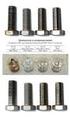 TEST REPORT Date: 03-05-2012 Reference: Duroc NV Corrosion Protection Moerelei 149 2610 Antwerp Belgium Written by: Ing. Martijn Wirken - [email protected] ZINCROLYTE VS DUPLEX 700 This document is not legally
Defects Introduction. Bonding + Structure + Defects. Properties
 Defects Introduction Bonding + Structure + Defects Properties The processing determines the defects Composition Bonding type Structure of Crystalline Processing factors Defects Microstructure Types of
WJM Technologies excellence in material joining
 Girish P. Kelkar, Ph.D. (562) 743-7576 [email protected] www.welding-consultant.com Weld Cracks An Engineer s Worst Nightmare There are a variety of physical defects such as undercut, insufficient
Improved Contact Formation for Large Area Solar Cells Using the Alternative Seed Layer (ASL) Process
 Improved Contact Formation for Large Area Solar Cells Using the Alternative Seed Layer (ASL) Process Lynne Michaelson, Krystal Munoz, Jonathan C. Wang, Y.A. Xi*, Tom Tyson, Anthony Gallegos Technic Inc.,
The atomic packing factor is defined as the ratio of sphere volume to the total unit cell volume, or APF = V S V C. = 2(sphere volume) = 2 = V C = 4R
 3.5 Show that the atomic packing factor for BCC is 0.68. The atomic packing factor is defined as the ratio of sphere volume to the total unit cell volume, or APF = V S V C Since there are two spheres associated
PTFE Slide Bearings 04/10 149
 04/10 149 1.0 GENERAL INFORMATION In a wide range of applications, PTFE Slide bearings are superior to conventional expansion plates, rollers and rocker arm type supports. They support petrochemical plant,
OPTIMIZING OF THERMAL EVAPORATION PROCESS COMPARED TO MAGNETRON SPUTTERING FOR FABRICATION OF TITANIA QUANTUM DOTS
 OPTIMIZING OF THERMAL EVAPORATION PROCESS COMPARED TO MAGNETRON SPUTTERING FOR FABRICATION OF TITANIA QUANTUM DOTS Vojtěch SVATOŠ 1, Jana DRBOHLAVOVÁ 1, Marian MÁRIK 1, Jan PEKÁREK 1, Jana CHOMOCKÁ 1,
Evaluating Surface Roughness of Si Following Selected Lapping and Polishing Processes
 Applications Laboratory Report 86 Evaluating Surface Roughness of Si Following Selected Processes Purpose polishing of samples is a common application and required for a variety of manufacturing and research
Solutions without Boundaries. PCB Surface Finishes. Todd Henninger, C.I.D. Sr. Field Applications Engineer Midwest Region
 Solutions without Boundaries PCB Surface Finishes Todd Henninger, C.I.D. Sr. Field Applications Engineer Midwest Region 1 Notice Notification of Proprietary Information: This document contains proprietary
Waterproofing System for Wastewater Tanks in Petrochemical Industries and Refineries
 Waterproofing System for Wastewater Tanks in Petrochemical Industries and Refineries Introduction Wastewater of petrochemical industries and refineries contains high amounts of emulsified aliphatic or
Good Boards = Results
 Section 2: Printed Circuit Board Fabrication & Solderability Good Boards = Results Board fabrication is one aspect of the electronics production industry that SMT assembly engineers often know little about.
TECHNICAL DATA SHEET DURO HARD CHROME PLATING PROCESS
 TECHNICAL DATA SHEET Duro hard chrome plating process is a high-speed bath which employs a special mixed soluble catalyst and has been developed to meet the modern hard chrome plating requirements. Its
Forensic Science Standards and Benchmarks
 Forensic Science Standards and Standard 1: Understands and applies principles of scientific inquiry Power : Identifies questions and concepts that guide science investigations Uses technology and mathematics
Nanoparticle Deposition on Packaging Materials by the Liquid Flame Spray
 Nanoparticle Deposition on Packaging Materials by the Liquid Flame Spray Hannu Teisala a, Mikko Tuominen a, Mikko Aromaa b, Jyrki M. Mäkelä b, Milena Stepien c, Jarkko J. Saarinen c, Martti Toivakka c
DURABILITY OF MORTAR LININGS IN DUCTILE IRON PIPES Durability of mortar linings
 DURABILITY OF MORTAR LININGS IN DUCTILE IRON PIPES Durability of mortar linings I. S. MELAND SINTEF Civil and Environmental Engineering, Cement and Concrete, Trondheim, Norway Durability of Building Materials
Problems in Welding of High Strength Aluminium Alloys
 Singapore Welding Society Newsletter, September 1999 Problems in Welding of High Strength Aluminium Alloys Wei Zhou Nanyang Technological University, Singapore E-mail: [email protected] Pure aluminium has
Nanofabrication using anodic alumina templates. IFIMUP and IN Institute of Nanoscience and Nanotechnology
 Nanofabrication using anodic alumina templates João Pedro Araújo IFIMUP and IN Institute of Nanoscience and Nanotechnology Outline Template based nanofabrication Nanoporous alumina templates Template filling
Weld Cracking. An Excerpt from The Fabricators' and Erectors' Guide to Welded Steel Construction. The James F. Lincoln Arc Welding Foundation
 Weld Cracking An Excerpt from The Fabricators' and Erectors' Guide to Welded Steel Construction The James F. Lincoln Arc Welding Foundation Weld Cracking Several types of discontinuities may occur in welds
HexWeb CR III Corrosion Resistant Specification Grade Aluminum Honeycomb
 Corrosion Resistant Specification Grade Aluminum Honeycomb Description 5052 and 5056 expanded aerospace grade aluminum honeycomb materials are available in a wide selection of cell sizes and foil gauges.
An Ammonium-free, Acid. Zinc/Nickel (12-15% Ni) Process
 An Ammonium-free, Acid Zinc/Nickel (12-15% Ni) Process Requirements of an acid zinc/nickel process Technical requirements High plating speed (current efficiency up to 90 %) High thicknesses of deposits
Corrosion of Copper in Water
 Corrosion of Copper in Water Digby D. Macdonald Center for Electrochemical Science and Technology Department of Materials Science and Engineering Pennsylvania State University 209 Steidle Bldg University
Deposition of Thin Metal Films " (on Polymer Substrates)!
 Deposition of Thin Metal Films " (on Polymer Substrates)! Shefford P. Baker! Cornell University! Department of Materials Science and Engineering! Ithaca, New York, 14853! MS&E 5420 Flexible Electronics,
FTIR and DSC of polymer films used for packaging: LLDPE, PP and PVDC
 FTIR and DS of polymer films used for packaging: LLDPE, PP and PVD John Petrovich SHAPE American High School Abstract: Polymers are compounds used in various materials. There are a plethora of methods
Phosphoric Acid Anodized Aluminum Honeycomb
 Phosphoric Acid Anodized Aluminum Honeycomb Description 02 and 06 expanded aerospace grade aluminum honeycomb materials are available in a wide selection of cell sizes and foil gauges. The HexWeb CR-PAA
DIFFUSION IN SOLIDS. Materials often heat treated to improve properties. Atomic diffusion occurs during heat treatment
 DIFFUSION IN SOLIDS WHY STUDY DIFFUSION? Materials often heat treated to improve properties Atomic diffusion occurs during heat treatment Depending on situation higher or lower diffusion rates desired
 Client ICS/Penetron International Ltd., 45 Research Way, Suite 203, East Setauket, NY 11733 Project Information of Client Subject Laboratory Testing of Penetron Waterproofing System Report No.: 95-387
Technical Paper. Corrosion Resistance of Bolt Coatings. Dmitry Zhmurkin, Ph.D. Tyco Electronics Harrisburg, PA. July 23, 2009
 Technical Paper Corrosion Resistance of Bolt Coatings Dmitry Zhmurkin, Ph.D. Tyco Electronics Harrisburg, PA July 23, 2009 Hot-Dip Galvanizing Batch hot-dip galvanizing has been the most commonly used
ENVIRONMENTAL EFFECTS ON COATINGS
 ENVIRONMENTAL EFFECTS ON COATINGS Surfaces exposed to the environment, may be damaged by elements such as water, snow, ice, heat, dirt, smog, humidity, brake dust, grime, salts, chemical attack, and acid
Lecture 9. Surface Treatment, Coating, Cleaning
 1 Lecture 9. Surface Treatment, Coating, Cleaning These processes are sometimes referred to as post-processing. They play a very important role in the appearance, function and life of the product. Broadly,
A SHORT INTRODUCTION TO CORROSION AND ITS CONTROL
 A SHORT INTRODUCTION TO CORROSION AND ITS CONTROL CORROSION OF METALS AND ITS PREVENTION WHAT IS CORROSION Corrosion is the deterioration of materials by chemical interaction with their environment. The
ENVIRONMENTALLY FRIENDLY PRE-TREATMENTS FOR ALUMINIUM ALLOYS
 C3P AND NASA TECHNICAL WORKSHOP "PARTNERING FOR SHARED SOLUTIONS TO COMMON ENVIRONMENTAL PROBLEMS" ENVIRONMENTALLY FRIENDLY PRE-TREATMENTS FOR ALUMINIUM ALLOYS Ana M. Cabral ISQ Instituto de Soldadura
Surface treatment of aluminium extrusions
 Surface treatment of aluminium extrusions Contents Anodising 2 3 Lacquering 4 Mechanical/Chemical Surface Treatment 5 Other Surface Treatments 6 Contacts and Samples 7 In its natural state, aluminium has
Ultraviolet Spectroscopy
 Ultraviolet Spectroscopy The wavelength of UV and visible light are substantially shorter than the wavelength of infrared radiation. The UV spectrum ranges from 100 to 400 nm. A UV-Vis spectrophotometer
AMBERLITE IRP64 Pharmaceutical Grade Cation Exchange Resin (Polacrilex Resin)
 AMBERLITE IRP64 Pharmaceutical Grade Cation Exchange Resin (Polacrilex Resin) Description AMBERLITE IRP64 [1] resin is an insoluble, weakly acidic, hydrogen form, cation exchange resin supplied as a dry,
and LUMINOUS CHEMICAL VAPOR DEPOSITION INTERFACE ENGINEERING HirotsuguYasuda University of Missouri-Columbia Columbia, Missouri, U.S.A.
 LUMINOUS CHEMICAL VAPOR DEPOSITION and INTERFACE ENGINEERING HirotsuguYasuda University of Missouri-Columbia Columbia, Missouri, U.S.A. MARCEL MARCEL DEKKER. NEW YORK DEKKER Contents Preface iii Part I.
Chapter 5 - Aircraft Welding
 Chapter 5 - Aircraft Welding Chapter 5 Section A Study Aid Questions Fill in the Blanks 1. There are 3 types of welding:, and, welding. 2. The oxy acetylene flame, with a temperature of Fahrenheit is produced
Optical Properties of Thin Film Molecular Mixtures
 Optical Properties of Thin Film Molecular Mixtures Donald A. Jaworske NASA Glenn Research Center 2 Brookpark Road Cleveland, OH 4435 e-maih Donald. A.J aworske((_grc.nasa.gov Dean A. Shumway Brigham Young
PHYSICAL METHODS, INSTRUMENTS AND MEASUREMENTS Vol. III - Surface Characterization - Marie-Geneviève Barthés-Labrousse
 SURFACE CHARACTERIZATION Marie-Geneviève Centre d Etudes de Chimie Métallurgique, CNRS, Vitry-sur-Seine, France Keywords: Surface Analysis, Surface imaging, Surface composition, Surface chemical analysis,
Ion Beam Sputtering: Practical Applications to Electron Microscopy
 Ion Beam Sputtering: Practical Applications to Electron Microscopy Applications Laboratory Report Introduction Electron microscope specimens, both scanning (SEM) and transmission (TEM), often require a
MSE 528 - PRECIPITATION HARDENING IN 7075 ALUMINUM ALLOY
 MSE 528 - PRECIPITATION HARDENING IN 7075 ALUMINUM ALLOY Objective To study the time and temperature variations in the hardness and electrical conductivity of Al-Zn-Mg-Cu high strength alloy on isothermal
EDEXCEL INTERNATIONAL GCSE CHEMISTRY EDEXCEL CERTIFICATE IN CHEMISTRY ANSWERS SECTION C
 EDEXCEL INTERNATIONAL GCSE CHEMISTRY EDEXCEL CERTIFICATE IN CHEMISTRY ANSWERS SECTION C Chapter 16 1. Burn sulfur in air to give sulfur dioxide. S(s) + O 2 (g) ----> SO 2 (g) Pass this with more air over
Anodes and Misc Equipment
 Anodes and Misc Equipment Application: Platinised Titanium Anodes Platinised titanium anodes are recommended for use in the following electrolytic processes:- Precious metal electroplating - e.g. Au, Pt,
UNIT 4 METAL COATING PROCESSES
 UNIT 4 METAL COATING PROCESSES Structure 4.1 Introduction Objectives 4.2 Metal and Non-metal Coatings 4.2.1 Metallic Coatings 4.2.2 Non-Metallic Coatings 4.3 Electroforming 4.4 Galvanizing 4.5 Anodizing
Paper No. 4071 APPLICATION OF EQCM TO THE STUDY OF CO2 CORROSION
 Paper No. 471 APPLICATION OF EQCM TO THE STUDY OF CO2 CORROSION Yang Yang, Bruce Brown and Srdjan Nešić Institute for Corrosion and Multiphase Technology, Department of Chemical and Biomolecular Engineering
The Limitations of Hand-held XRF Analyzers as a Quantitative Tool for Measuring Heavy Metal Pesticides on Art Objects. By Özge Gençay Üstün
 N.B. A shorter version of this article was published in the ICOM-CC Ethnographic Conservation Newsletter, Number 30, January 2009, pp. 5-8. The Limitations of Hand-held XRF Analyzers as a Quantitative
Cambridge International Examinations Cambridge International General Certificate of Secondary Education
 Cambridge International Examinations Cambridge International General Certificate of Secondary Education *0123456789* CHEMISTRY 0620/03 Paper 3 Theory (Core) For Examination from 2016 SPECIMEN PAPER 1 hour
Lecture 11. Etching Techniques Reading: Chapter 11. ECE 6450 - Dr. Alan Doolittle
 Lecture 11 Etching Techniques Reading: Chapter 11 Etching Techniques Characterized by: 1.) Etch rate (A/minute) 2.) Selectivity: S=etch rate material 1 / etch rate material 2 is said to have a selectivity
1. Photon Beam Damage and Charging at Solid Surfaces John H. Thomas III
 1. Photon Beam Damage and Charging at Solid Surfaces John H. Thomas III 1. Introduction............................. 2. Electrostatic Charging of Samples in Photoemission Experiments............................
A Study of Zinc-Nickel as an Alternate Coating to Cadmium for Electrical Connector Shells Used in Aerospace Applications
 A Study of Zinc-Nickel as an Alternate Coating to Cadmium for Electrical Connector Shells Used in Aerospace Applications By Odunayo Ogundiran A Thesis Submitted to the Graduate Faculty of Rensselaer Polytechnic
Physical & Chemical Properties. Properties
 Physical & Chemical Properties Properties Carbon black can be broadly defined as very fine particulate aggregates of carbon possessing an amorphous quasi-graphitic molecular structure. The most significant