
Agrochemical R&D hard work and money is not enough
|
|
|
- Milton Heath
- 9 years ago
- Views:
Transcription
1 Agrochemical R&D hard work and money is not enough AgrochemEx Conference CHINA October 2010

2 Agenda Introduction Innovation and creativity Discovery of the agrochemicals in use today Challenges for 21 st Century Taking up the burden of discovery Recent developments in Chinese research

3 Introduction Spectacular progress in the discovery and introduction of new agrochemicals between has now slowed, essentially because many older actives are still of value and the market entry hurdles are now much higher (especially the development costs) R (Science) and D (Technology) are separate disciplines, requiring different thinking and different resources In agrochemical R&D, there are two aspects to the science part ( R ): discovery and characterisation of leads. Discovery is the wild-card and hard to manage and predict Today s talk will concentrate upon a crucial aspect of the overall process - the discovery of new agrochemical activity

4 Fallacies about measuring innovation Money spent Throwing money at a problem rarely achieves the desired effect. No more is this true than in the field of innovation. Creative people are rarely driven by the desire to become wealthy. Therefore money cannot stimulate them to greater creativity. Reported R&D spend mainly measures the cost of D and neglects the unpredictable R Numbers of patents Often quoted, but really signifying little other than the numbers of patent lawyers active in an organisation/country Gartner s law of patents: d(p)/dt = k x (N PL ) Innovation is driven by ideas, technology by implementation of the successful ones

5 Innovation Much is spoken and written about innovation, a subject which is, however, an elusive and unpredictable phenomenon. Innovative individuals are born and can only be nurtured. They cannot be created, nor can they be readily managed. Applying the fruits of their labours can lead to triumph or disaster. Innovators present a difficult conundrum for any organisation, since (by their nature) they challenge the status quo (received wisdom) and are potentially dangerous. Most organisations are built upon the status quo, hierarchical management and more recently the dead hands of regulation and health & safety. Without innovation, no progress would have been made. Even a cursory study of the history of science and the arts will show that innovation creates conflict between the opposing ways of thinking: conventional and radical. Characteristics of creative people are listed in the next slide - to ease identification

6 Innovativeness - Creativity These two words are alternative descriptions of similar phenomena Individuals capable of being creative/innovative generally exhibit many of the following characteristics from an early age: Unselfconscious non-conformity Intense enthusiasms Enjoyment of solitude Egotistical / temperamental Tendency to day-dream Impatience with status-quo Dilettantism Manic bouts of work A few examples of innovative individuals illustrate these characteristics, which make such individuals difficult for most of us to live with

7 Types of Creativity Perceptual innovation: Art Linguistic innovation: Slang Natural philosophical innovation: Science Technological innovation: Invention Biological innovation: Evolution Religious innovation: Heresy Social innovation: Revolution Some kinds of innovation are more acceptable to society than others (thanks to Dr Ellis Gartner for providing the basis for this slide)

8 Fostering Innovation - Creativity Many individuals who are capable of inventing lose this ability through poor schooling and lack of encouragement Creation of centres of excellence for study and experimentation, where elitism is not considered a dirty word. Creatives need to exchange ideas with other like-minded individuals. Not be stuck in an ivory tower. Within an organisation, creative individual s enthusiasm should be nurtured and used to encourage others. Performance should not be judged by the usual criteria of everyday work Encouragement of interdisciplinary groups is particularly important because most good ideas appear from combining information from more than one area of study The history of mankind demonstrates that tolerance of creative people has been the exception rather than the rule. Progress has thus been erratic, with many periods of stasis imposed by the reactionary majority.

9 Creative and Innovative People

10 Discovery of the agrochemicals in use today Ultimately, the introduction of successful new activity depends upon the discovery of a safe and cost-effective way to selectively block a natural process in a target pest. Initial leads have historically been identified from observation of a possible beneficial effect, followed up by meticulous analysis of ways to augment the effect at will, using man-made solutions. Many serendipitous discoveries actually fall into the same category as those based upon developing new products from natural products, since in both cases, man is taking his cue from nature. Some discoveries have been found purely by chance, as the result of searching for an effect for a newly created chemical compound. Attractive though it is, rational design* is still in its infancy, since the natural systems being investigated have so far proved to be too complex for successful creation of an active ab initio. * Using models of how fundamental processes work as templates for the design of foreign molecules that can disrupt normal processes, allowing a desired result (plant or insect death, for example)to be obtained

11 Discovery of the agrochemicals in use today: fungicides In Europe, fungicidal treatments were in use to control bunt (Tilletia sp) in cereals as early as the mid-17th century. Following the observation that wheat grown from seed salvaged from ship-wrecks was free of bunt, the use of brine, followed by lime as a seed treatment became common long before the concept of germs causing diseases was pioneered by Koch and Pasteur in the mid 19th century The French botanist, Millardet also thought about the curious fact that roadside vines sprayed with a home-made mixture of lime and copper sulphate (meant to deter pilfering of fruit by Bordeaux students) held onto their leaves throughout the season, whereas the main crop, away from the road, lost the majority of their foliage by the time the fruit was ready to pick. Thus was borne the treatment for powdery mildew, Bordeaux Mixture. This combination of thoughtful study of observations made by many, but considered by few, continues to be the essence of scientific discovery

12 Discovery of the agrochemicals in use today: selected fungicides Fungicide Date Discovery Class Date Commercial AI launches Sulphur?? Use as a remedy for mildew had been known for as much as 2000 years Brine (aqueous salt) 1637 Useful for sterilising cereal seeds Bordeaux mixture 1882 Pierre Millardet first realised that a mixture of lime copper and copper sulphate killed powdery mildew on vines 1934 Dithiocarbamates dithiocarbamates (1955) mucidin Strobilurin A pyrrolnitrin 1940 Bromomethane, 1,2- & 1,3-dichloropropane shown to fumigate soil. Useful for killing nematodes (1961) thiram zineb maneb mancozeb Chlorinated organics for seed treatment 1940 chloranil, dichlone 1952 Phthalimides (bacterial toxin, extracted from Pseudomonas syringitabaci) captan, folpet captafol chlorthalonil morpholines dodemorph tridemorph 1964 benzimidazoles thiabendazole benomyl thiophanate methyl Musilek et al (fungal antibiotic) Anke & Steglich Extract from Pseudomonas pyrrocinia was shown to have fungicidal properties, but was too light-labile for use as an AI strobilurins kresoxim-methyl (BASF) azoxystrobin (Zeneca) Blocks glycerol synthesis 2004 fludioxonil (Scholar) Syngenta

13 Discovery of the agrochemicals in use today: herbicides The discovery of the phenoxy herbicides is credited to both British and US groups working during the 1940s. It seems that the initial leads came from natural PGRs isolated from rice seedlings suffering from bakanae disease (Giberella fujikaroi), which was causing excessive seedling growth (1928) Although scientists at Stauffer discovered the compound later to be called glyphosate, a key observation that a spilled sample of a test rubber additive killed a patch of grass, eventually led to the massively successful total herbicide. The red bottle brush plant (Callistemon citrinus) produces a secondary metabolite that offers useful herbicidal properties. In 1977, an observant researcher at Stauffer noticed this and extracted a heap of soil from under such a bush. He found that an active principle, leptospermone, had strong herbicidal activity and this lead to the development of mesotrione Prepared minds see what many, many others miss!

14 Discovery of the agrochemicals in use today: selected herbicides Herbicide Date Discovery Class Date Commercial AI launches Copper salts Late 19 th C Bordeaux Mixture was found to selectively kill Heavy metal toxin broad-leaved leaves in cereals Potassium dinitro2--?? First synthetic pesticide Phenolic 1892 cresylate Gibberellin 1926 Isolated from bakane disease (Giberella fujikaroi) Plant Growth Hormone of rice, which was causing excessive seedling growth Indole-3-acetic acid 1928 Natural growth regulator Natural auxin (plant hormone) Phenoxy herbicides Independently developed by Templeman (ICI, UK) Hormone weed-killers ,4-D, MCPA and 2,4,5-T and Jones (American Chemical Paint Company, USA) glyphosate 1970 John Franz Non-selective weed-killer 1976 (inhibits aromatic acid bio synthesis) leptospermone 1977 biologist at Stauffer noticed weed suppression under bottle-brush shrubs (AI isolated, leptospermone, was originally described in 1921 by Penfold) Callistemones (bleach weed leaves) Mesotrione (Syngenta)

15 Discovery of the agrochemicals in use today: insecticides Many important insecticides work by disrupting nerve impulses in target insects, often with poor selectivity between foes and friends. Organophosphates were originally identified as part of the war effort targeted at developing nerve gases by British and German scientists. Bayer s early lead in insecticides stems from early success with such OPs as parathion. Ryania extracts were marketed in the USA as light-stable treatments for insect pests, but were similar in toxicity to nicotine and other natural extracts. It was not until the early 2000s that research on the molecular basis of the interaction of the active ingredients of ryania with calcium channels, that some idea of its mode of action was obtained. However, the earliest ryanodine receptor lead, which led to the develop -ment of flubendiamide, was discovered by researchers at Nihon Nohyaku accidentally. Natural product leads have often been useful in the development of modern insecticides, but close attention to unusual findings is vital ingredient for success.

16 Discovery of the agrochemicals in use today: selected insecticides Insecticide Date Discovery Class Date Commercial AI launches Pyrethrum unclear Probably introduced by the Persians. Selective heptatic toxin in insects Pyrethroids 1884 Zacherlin: pyrethrum soap (US 308,172) Lime/nictotine 1763 Mixture of tobacco and lime marketed as a remedy for plant Nicotinoid lice Nicotine 1828 First extracted from the tobacco plant by Posselt & Reimann. Nicotinoid Arsenic salts 1867 First use to kill Colorado beetle on potatoes in the USA. Rotenone 1895 In French Guiana, Emmanuel Geoffroy discovered the activity of an extract from Robinia nicou, which he called nicouline. Insecticide, piscicide. Derris (extracted from the jicama vine) DDT 1873 First synthesised. No applications recorded. Chlorinated organic Organophosphates Paul Mueller first showed effectiveness as an insecticide Lange and von Krueger showed activity on human nervous system. Later IG Farben s Schrader showed neurotoxic effects in insects. However, discoveries used for war effort by Germans and British (nerve gases) before use in agriculture developed. (interects with sodium-channel) 1949 DDT (Geigy Pharmaceutical) Organo-phosphates TEPP (1938), schraden (1941), sulfotep (1944), parathion (1946) all Bayer OPs. Carbamates Choline esterase inhibitor Carbamates Neo-nicotinoids 1970 Shell early leads (eg SHI-71, nithiazine) failed in greenhouse Neo-nicotinoids 1985 Imidacloprid (Nihon-Bayer) tests Ryania 1942 A crude eextract from Brazilian shrub was marketed as a nonspecific insecticide by Penick, using Ryanex brand-name (owned by Merck & Co.) Ryanodine receptor agonists Flubendiamide (Bayer-Nihon Nohyaku) and Chlorantraniloprole (DuPont) Rynaxypyr The oxime carbamate, aldicarb, which was introduced in 1965, was apparently developed using in vitro acetyl chloline assays that helped to define and design the molecule. An exceptional example of rational design (thanks to Dr Tom Sparks for pointing this out).

17 Challenges for 21 st Century Bringing new agrochemical solutions to market has become much more expensive as public distrust of the industry has increased. The fact that some of this mistrust is irrational can neither be ignored, nor easily overcome. The issue of GMOs in Europe demonstrates this well. In Europe and the USA, many older registrations have been withdrawn because they are too expensive to maintain. This is starting to create treatment gaps, especially for minor crops. As well as new problems that emerge, resistance to diseases, insect and weed resistance continues to emerge. Not all such challenges can be met by reformulation and combinations of active ingredients. Demand for new active ingredients will continue, but where will they come from?

18 Recent history of new AIs and launches New developments (April April 2010) and launches (Dec Dec 2009) of AIs Launches New Leads Source: Ag Chem New Compound Review (Vol 28) 2010 (Agranova) Many new launches ultimately lead to failure and withdrawal. In the next slide, the numbers of launches that have stood the test of time are shown.

19 Recent history of new AIs and launches Current numbers of commercial AIs, arranged by launch dates ( ) (E) Source: Crop Protection Actives 2010 (Agranova) Since 1950, there have been an average of 5-8 sustained commercial new actives per year, except during , when the average increased to 16 per year. The most productive years to date were thus (assuming 8 years from discovery to market)

20 Taking up the burden of discovery NEW LEADS (agrochemicals) USA 13 Herbicides 10 Europe 10 Insecticides 28 Japan 19 Fungicides 16 China 12 Other 3 RoW 3 Source: Ag Chem New Compound Review (Vol 28) 2010 In the late 1990s-early 2000s Japan took over from the USA and Europe as a major source of new leads China s R&D effort emerged in the mid-2000s as a new centre for discovery Research into insecticides has become dominant, as a result of these changes

21 Recent developments in Chinese research Pesticide use in China was under-reported up to the end of the last century and the West s understanding of the region was generally poor. Since 2002, Agranova has steadily developed a better network of contacts in China and visits the country 2-3 times a year. Entries in the Ag Chem New Compound Review have reflected this catching up of the rapidly developing crop protection research effort in China. Although it is still early days and targets have a tendency to be me-toos, it is likely that China will soon become a major source of new technologies in the near future The next two slides summarise some of this activity
22 Centres of agrochemical research in China China Agricultural University, Beijing East China Normal University, Shanghai Guizhou University Hunan Research Institute of Chemical Industry (HRICI) Jiangxi Agricultural University Kunming Institute of Botany Nankai University Jiangsu Pesticide Research Institute, Nanjing Sichuan Academy of Chemical Industry Research & Design Shanghai Institute of Organic Chemistry (SIOC) Shanghai Pesticide Research Institute Shenyang Resaerch Institute of Chemical Industry (SYRICI) Zhejiang Chemical Industry Research Institute (ZCIRI)
23 Fruits of agrochemical research in China new leads pre Graph shows the numbers of new leads originating in China by year
24 Newer Chinese compounds HERBICIDES INSECTICIDES FUNGICIDES Methiopyrsulfuron (HRICI) HNPC-A2005 (Hunan RICI) Pyrimorph (China Agricultural University) HW-02 (Huazhong University) Tetramethylfluthrin (Jiangsu Yangnong Chemical) Pyrametostrobin (SYRICI) For more information, see Ag Chem New Compound Review (Vol 28) 2010
25 Summary Advances in the discovery and development of new agrochemicals has slowed in the West,following a productive twentieth century. Although GM technology will deliver benefits, the need for new chemical solutions will continue. Research on combatting pests and diseases using novel chemical solutions is likely to more successful in countries that understand the need to foster scientific innovation and in companies that learn to manage individuals with the necessary talent If Europe and the USA cannot solve their current supply shortage of young scientists, discovery will become concentrated in Asia. It matters less where new research occurs, more that its fruits are not lost.
26 Thank you Connie Ao of the CCPIA, for inviting me to make this presentation to the annual AgrochemEx conference Acknowledgements Dr Ellis Gartner - discussions and ideas about innovation. Also permission to use some of his material Dr Tom Sparks - advice and valuable corrections on the content of this talk Useful references A short history of Fungicides: Vince Morton and Theodor Staub Callisto - a very successful maize herbicide inspired by alleochemistry: Derek Cornes Ryanodine receptor agonists: Ag Chem New Compound Review (Vol 24) 2006 Golden Age of Insecticide Research: Past, Present,or Future:Casida & Quistad History of crop protection; Crop Life International (2002) Dr Rob Bryant Agranova 34 The Drive Orpington, Kent BR6 9AP United Kingdom Tel: , Fax: [email protected] Website:
Resistance to Pesticides. Rupert Knowles
 Resistance to Pesticides Rupert Knowles Farmer Choices If a farmer has a pest problem and has been advised to apply pesticides, he has many factors to think about. List 10 factors that affect the farmer
Integrated Mosquito Management. Rosmarie Kelly Public Health Entomologist Georgia Dept of Public Health
 Integrated Mosquito Management Rosmarie Kelly Public Health Entomologist Georgia Dept of Public Health Topics of discussion: Integrated pest management (IPM) History of pest management Definition of IPM
Ch. 10 - Pest Control. Outline
 Ch. 10 - Pest Control 1 Outline Pests Pesticides Types Benefits Problems Alternatives Reducing Exposure Regulating Use Organic Farming 2 16 July 2011 1 Pests and Pesticides Biological Pests - organisms
PesticiDe use trends. by JiM Wells. in california Agriculture. environmental solutions GrouP
 PesticiDe use trends in california Agriculture by JiM Wells environmental solutions GrouP summary Farmers are successfully transitioning to safer, more environmentally friendly compounds to combat pests
Garden and plant health
 The idea of a healthy garden, rather than simply pest and disease free plants, is at the heart of organic growing. The first part of this section, Keeping the garden healthy, looks at ways of maintaining
Indian Agrochemical Industry
 Indian Agrochemical Industry Introduction. India is the fourth largest producer of agrochemicals globally, after United States, Japan and China. The agrochemicals industry is a significant industry for
Tailoring solutions for a region of diversity Global Press Conference 2013
 Tailoring solutions for a region of diversity Global Press Conference 2013 Vincent Gros Senior Vice President, BASF Crop Protection Europe, CIS, Central Asia, Africa and Middle East October 2 nd, 2013
Pesticides for use on Mangoes
 Pesticides for use on Mangoes Brian Thistleton, DPIFM and Scott Spencer, Landmark Talk Outline Insecticide issues Types Registration Labels Off label use Withholding periods Problems with insecticides
Introduction to Evogene Ofer Haviv, President & CEO
 Introduction to Evogene Ofer Haviv, President & CEO July, 2016 Safe Harbor Statement This presentation contains "forward-looking statements" relating to future events, and we may from time to time make
Pest Control Products Board Nairobi, Kenya PESTICIDE REGISTRATION IN KENYA - BIOPESTICIDES. by P. N. Ngaruiya (Dr)
 Pest Control Products Board Nairobi, Kenya PESTICIDE REGISTRATION IN KENYA - BIOPESTICIDES by P. N. Ngaruiya (Dr) Introduction Pesticides, an indispensable tool in farming Chemical pesticides such as the
What s wrong with GM?
 CIIR environmental action leaflet What s wrong with GM? Why genetically modified crops are bad for people and bad for the environment Why should we care? Genetic engineering of crops is a complex and controversial
BIOS 3010: Ecology Lecture 16: Manipulating abundance: 2. Manipulating abundance: 3. Pest and weed control:
 BIOS 3010: Ecology Lecture 16: Manipulating abundance: Lecture summary: Manipulating abundance: Pest control. Pesticides:» Benefits.» Problems. Biological control. Cultural control. Integrated pest management.
POTENTIAL IMPACT OF CURRENT DRAFT PROPOSAL FOR ENDOCRINE DISRUPTION CRITERIA
 PP/13/AP/22658 - Rev.1. POTENTIAL IMPACT OF CURRENT DRAFT PROPOSAL FOR ENDOCRINE DISRUPTION CRITERIA Executive summary The latest version of the endocrine disruption criteria prepared by DG Environment
A Ros-E-IQ By Robert B. Martin Jr.
 A Ros-E-IQ By Robert B. Martin Jr. The Rose is the most beautiful flower in the environment and rose bushes have diverse uses in the green landscape. But the public's interest in rose gardening is changing.
Agchems Stellar Growth Sustainable or Not?
 Agchems Stellar Growth Sustainable or Not? The Crop Protection & Fine Chemicals Forum Gran Via Exhibition Centre, Barcelona, Chemspec Europe Dr Nigel Uttley Enigma Marketing Research 16th June 2009 Presentation
List of safe chemicals for use at community garden sites in Lee County, Florida
 Fitzroy Beckford Extension Agent http://lee.ifas.ufl.edu List of safe chemicals for use at community garden sites in Lee County, Florida Insecticides Whether the product is considered organic or non-organic,
Farming. In the Standard Grade Geography exam there are three types of farming you need to know about arable, livestock and mixed.
 Types of Farming In the Standard Grade Geography exam there are three types of farming you need to know about arable, livestock and mixed. Arable farms are ones where the main way of making money is by
PESTICIDE USE IN IRRIGATED CROPS AND ITS EFFECT ON HUMAN AND ANIMALS HEALTH AND ENVIRONMENT
 PESTICIDE USE IN IRRIGATED CROPS AND ITS EFFECT ON HUMAN AND ANIMALS HEALTH AND ENVIRONMENT Background Pest problems is more pronounced in agricultural ecosystem where the natural balance of host and pests
PROPOSAL FOR PRESENTATION TO COMMON FUND FOR COMMODITIES
 PROPOSAL FOR PRESENTATION TO COMMON FUND FOR COMMODITIES Project Title and Duration Promotion of Technologies for Management of Tea Quality and Food Safety Standards in smallholder tea production in Eastern
Integrated Pest Management
 Chapter 2 Integrated Pest Management In This Chapter Keywords After learning the information in this chapter, you will be able to: 1. Define Integrated Pest Management (IPM). 2. List and describe the 5
The use of genetically modified crops in developing countries
 The use of genetically modified crops in developing countries a guide to the Discussion Paper Introduction The Nuffield Council on Bioethics provoked vigorous debate with the publication of its Report,
GENE CLONING AND RECOMBINANT DNA TECHNOLOGY
 GENE CLONING AND RECOMBINANT DNA TECHNOLOGY What is recombinant DNA? DNA from 2 different sources (often from 2 different species) are combined together in vitro. Recombinant DNA forms the basis of cloning.
Pests and Pest Control
 Pests and Pest Control The need for pest control Philosophies of control Development of Chemical Pesticides Promises and problems of the chemical approach Some of the more commonly used icides Alternative
for Sweet Corn Joe Masabni UKREC Princeton, KY Joe Masabni
 Herbicide Recommendations for Sweet Corn UKREC Princeton, KY Preemergence Herbicides Aatrex 4L Rate: 1 2 qt / A PRE for annual grasses and broadleaves weed control Apply after planting but before weeds
Glyphosate Levels in Breakfast Foods: What is safe?
 Glyphosate Levels in Breakfast Foods: What is safe? The Alliance for Natural Health USA April 19, 2016 Glyphosate is the active ingredient in the world s most widely used herbicide, its use being largely
Integrated Pest Management
 Integrated Pest Management Andrea Veres Junior Technical Officer FAO REU [email protected] Yerevan, Armenia 2013 Why develop IPM? Agriculture was: not sustainable optimized inputs for maximum profit
What is a pest? How Insects Become Pests. How do insects become pests? Problems with Pesticides. What is most commonly used to control insect pests?
 What is a pest? How Insects Become Pests How do insects become pests? Introduction outside of native range Becomes disease vector Plant or animal (inclu. human) disease vector Host shift in native insect
5.3 Natural Pesticides
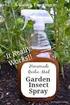 5.3 Natural Pesticides Introduction As explained in chapter 5.1, strengthening the plant is the best protection against pests and disease. Through adapted cultivation methods and with good management of
GMO Risk Assessment - EU experiences and recent developments
 A future task in good hands GMO Risk Assessment - EU experiences and recent developments Beatrix Tappeser Head, Biosafety Division, BfN, Germany ENSSER - EEA Symposium on Science & Society 'Integrity of
Can I Use this Pesticide on My Organic Farm? Brian Baker
 Brian Baker Overview Organic agriculture relies primarily on biological and cultural practices to manage pests, weeds, and diseases. However, there are circumstances where some form of direct-kill method
Pest Management - Holistic Pest Control?
 Pest Management - Holistic Pest Control? 2. Modern control tactics and the birth of IPM The action of parasites, predators, and pathogens in maintaining another organism s density at a lower average than
This material is based on work supported by the U.S. Department of Agriculture, Extension Service & the U.S. EPA
 Revised April 1992 (reformatted May 2000) A Workbook for Certified Pesticide Applicators To accompany the VHS tape "Pesticides in the Environment" Based on materials developed by: Colorado State University
Farming with future, a network approach in The Netherlands. Frank Wijnands Wageningen University and Research Centre
 Farming with future, a network approach in The Netherlands Frank Wijnands Wageningen University and Research Centre Road map Sustainable agriculture, ICP, IP NAP, SUP Dutch research: farming systems and
BARRIERS TO WIDESPREAD CONVERSION FROM CHEMICAL PEST CONTROL TO NON-CHEMICAL METHODS IN U.S. AGRICULTURE
 BARRIERS TO WIDESPREAD CONVERSION FROM CHEMICAL PEST CONTROL TO NON-CHEMICAL METHODS IN U.S. AGRICULTURE 1 Leonard Gianessi and 2 Nathan Reigner CropLife Foundation, Crop Protection Research Institute,
LIME SULPHUR INSECTICIDE MITICIDE FUNGICIDE COMMERCIAL DANGER: CORROSIVE TO EYES READ THE LABEL AND ATTACHED BOOKLET BEFORE USING
 datapak group M fungicide LIME SULPHUR INSECTICIDE MITICIDE FUNGICIDE COMMERCIAL DANGER: CORROSIVE TO EYES READ THE LABEL AND ATTACHED BOOKLET BEFORE USING REGISTRATION NO. 16465 PEST CONTROL PRODUCTS
Outline. What is IPM Principles of IPM Methods of Pest Management Economic Principles The Place of Pesticides in IPM
 Improving Control Systems in Thailand for Plant and Plants Products Intended for Export to the European Union co-funded by the European Union and Thai Department of Agriculture Preharvest Use of Pesticides
Chapter I. Historical Perspective on Crop Protection
 Chapter I Historical Perspective on Crop Protection Chapter I Historical Perspective on Crop Protection Since recorded history, the impact of pests on food crops has been important. Many practices of traditional
From known to unknown
 Risks associated with Chemical and Non-Chemical Pest Control From known to unknown Paul Leonard Nov 2009 Agenda 1. EU non-chemical pest control legislation? 2. What do we know about risks associated with
U.S. Environmental Protection Agency 1. Tom Moriarty Office of Pesticide Programs U. S. Environmental Protection Agency.
 U.S. Environmental Protection Agency 1 Tom Moriarty Office of Pesticide Programs U. S. Environmental Protection Agency. 1 U.S. Environmental Protection Agency 2 Bee Health Multiple federal reports have
The Development of Soil Survey and Soil Mapping in China
 The Development of Soil Survey and Soil Mapping in China Gan-Lin Zhang, Zi-Tong Gong State Key Laboratory of Soil and Sustainable Agriculture, Institute of Soil Science, Chinese Academy of Sciences, Nanjing
Page 1 Bayer CropScience Increase of productivity in Agriculture
 Bayer CropScience Increase of productivity in Agriculture Dr. F. Zurmühlen Frankfurt 16.7.2014 Page 1 Bayer CropScience Increase of productivity in Agriculture 114,928 employees Full year sales: 40.2 billion
Adoption of GE Crops by U.S. Farmers Increases Steadily
 Adoption of GE Crops by U.S. Farmers Increases Steadily Farmers are more likely to adopt new practices and technologies if they expect to benefit from them. Benefits are usually thought of in monetary
GUIDELINES FOR THE REGISTRATION OF BIOLOGICAL PEST CONTROL AGENTS FOOD AND AGRICULTURE ORGANIZATION OF THE UNITED NATIONS
 GUIDELINES FOR THE REGISTRATION OF BIOLOGICAL PEST CONTROL AGENTS FOOD AND AGRICULTURE ORGANIZATION OF THE UNITED NATIONS -ii- GUIDELINES ON THE REGISTRATION OF BIOLOGICAL PEST CONTROL AGENTS FOOD AND
General Technical Dossier Laminarin
 General Technical Dossier Laminarin The choice to produce better Fruits and vegetables Contents Technical dossier Laminarin 1) Plant natural defense mechanisms. 2) Laminarin: mode of action. 3) Laminarin:
Research Abstract for the CALIFORNIA LEAFY GREENS RESEARCH BOARD April 1, 2010 March 31, 2011
 Research Abstract for the CALIFORNIA LEAFY GREENS RESEARCH BOARD April 1, 2010 March 31, 2011 Project Title: Thrips Management In Lettuce Project Investigator: Eric Natwick University of California Cooperative
Cotton Situation in the World 1 M. Rafiq Chaudhry Technical Information Section
 1 Cotton Situation in the World 1 M. Rafiq Chaudhry Technical Information Section Abstract The world cotton production for the year 1996/97 is currently placed by the ICAC at about 19 million metric tons
OSU Extension Service Master Gardener Program. Organic Pest Control. Weston Miller OSU Extension Service Community and Urban Horticulture faculty
 Organic Pest Control Weston Miller OSU Extension Service Community and Urban Horticulture faculty Audience Question What does the term organic pest control mean to you? Preview of Presentation Organic
19/02/2014. Bed Bug Control in the United Kingdom. Contamination. Key UK Requirements -Why do we Need to Control Pests? Eradicate/control species that
 Bed Bug Control in the United Kingdom Richard Moseley Key UK Requirements -Why do we Need to Control Pests? Eradicate/control species that have a detrimental effect on the health of humans are the cause
FAQs: Gene drives - - What is a gene drive?
 FAQs: Gene drives - - What is a gene drive? During normal sexual reproduction, each of the two versions of a given gene has a 50 percent chance of being inherited by a particular offspring (Fig 1A). Gene
Applied Development of Delaus, a Rice Blast Control Fungicide: Delaus Prince Granule and Its Treatment into Seedling Boxes at the Sowing Stage
 Applied Development of Delaus, a Rice Blast Control Fungicide: Delaus Prince Granule and Its Treatment into Seedling Boxes at the Sowing Stage Sumitomo Chemical Co., Ltd. Agricultural Chemicals Research
How can information technology play a role in primary industries climate resilience?
 Manage Data. Harvest Information. How can information technology play a role in primary industries climate resilience? CHALLENGES FOR WORLD AGRICULTURE 9 Billion people on earth by 2040 Up to 40% of food
DuPont Altriset Termiticide Technical Bulletin
 DuPont Altriset Termiticide Technical Bulletin utstanding Performance ow there is a non-repellent termiticide that provides excellent control of termites yet has minimal impact on the environment. The
Kumulus FUNGICIDES. Active ingredient: sulphur...800 g / kg
 Reg. No. L2404; N AR 0732 Act No. 36 of 1947 A water dispersible granular fungicide and acaricide for the control of powdery mildew, various other fungal diseases as well as certain mites and thrips on
EUROPEAN COMMISSION DIRECTORATE-GENERAL FOR HEALTH AND FOOD SAFETY COMMISSION STAFF WORKING DOCUMENT 1
 EUROPEAN COMMISSION DIRECTORATE-GENERAL FOR HEALTH AND FOOD SAFETY Safety of the Food Chain Pesticides and Biocides COMMISSION STAFF WORKING DOCUMENT 1 Basic Substance Calcium hydroxide SANCO/10148/2015
Section 5.1 Food chains and food webs
 Section 5.1 Food chains and food webs The ultimate source of energy in an ecosystem comes from sunlight This energy is converted to an organic form using photosynthesis which is then passed between organisms
2015 Kentucky Soybean Variety Performance Test Nomination Form University of Kentucky
 2015 Kentucky Soybean Variety Performance Test Nomination Form University of Kentucky The Kentucky Soybean Variety Performance Tests are conducted to provide an unbiased and objective estimate of the relative
Pharmacology skills for drug discovery. Why is pharmacology important?
 skills for drug discovery Why is pharmacology important?, the science underlying the interaction between chemicals and living systems, emerged as a distinct discipline allied to medicine in the mid-19th
TOWN OF WOODSIDE RESOLUTION ADOPTING AN UPDATED INTEGRATED PEST MANAGEMENT POLICY
 TOWN OF WOODSIDE Report to Town Council Agenda Item 3 Prepared by: Kevin Bryant, Assistant Town Manager September 27, 2011 Approved by: Susan George, Town Manager SUBJECT: RESOLUTION ADOPTING AN UPDATED
Status and trends in perception of Organic vegetable and fruit production in China
 Chinese-Danish Networking Status and trends in perception of Organic vegetable and fruit production in China Yuhui Qiao Dr. Associate Professor Department of Ecology and Ecological Engineering China Agricultural
Pennino Corporation TECHNOLOGY TO IMPROVE LIFE
 Pennino Corporation TECHNOLOGY TO IMPROVE LIFE Agenda The Opportunity Highlights Corporate Profile NYU Relationship Obesity and Diabetes Graphics and Facts Next Stage of Development Efficacy and Safety
Sustainability in Agricultural Marketing:
 International Journal of scientific research and management (IJSRM) Special Issue On National Level Conference Business Growth and Social Development Pages 19-24 2014 Website: www.ijsrm.in ISSN (e): 2321-3418
FarMore Technology Seed Treatment Platform. A Novel Approach to Vegetable Crop Protection
 FarMore Technology Seed Treatment Platform A Novel Approach to Vegetable Crop Protection August 2012 FarMore Technology Commitment to the Vegetable Industry FarMore Technology is the first comprehensive
Welcome and introduction i to AU Research Centre Flakkebjerg
 Workshop AU Flakkebjerg 22.09.2012 Welcome and introduction i to AU Research Centre Flakkebjerg Head of Research Section Entomology & Plant Pathology præsen TATION Welcome networking on Systemic approaches
Life-Science Economics and Policy
 Life-Science Economics and Policy Winter Term 2011/12 Dr. Maarten J. Punt Technische Universität München - Weihenstephan [email protected] http://www.wzw.tum.de/aew/ GMO adoption by countries What is
BENEFITS OF USING IPM
 Edward J. Bechinski and William H. Bohl Potato growers who use IPM consider all available pest control tools. Alternatives to conventional pesticides are the foundation of every IPM plan. Pesticides play
Technology Intelligence: A Powerful Tool for Competitive Advantage
 Technology Intelligence: A Powerful Tool for Competitive Advantage Stephen E. Rudolph, Ernest R. Gilmont, Andrew S. Magee, and Nancy F. Smith Among the many management and planning tools that are available
COMPOST AND PLANT GROWTH EXPERIMENTS
 6y COMPOST AND PLANT GROWTH EXPERIMENTS Up to this point, we have concentrated primarily on the processes involved in converting organic wastes to compost. But, in addition to being an environmentally
Tree Integrated Pest Management. Dan Nortman Virginia Cooperative Extension, York County
 Tree Integrated Pest Management Dan Nortman Virginia Cooperative Extension, York County IPM Refresher Definition: The use of a combination of appropriate pest control tactics to reduce pest population
Precision Farming in Practice
 Knowledge grows Precision Farming in Practice Yara s N-Tester Establishes N Status Quickly and Accurately Yara N-Tester What is N-Tester? N-Tester is a hand held tool which enables quick and easy nondestructive
2015 Half Year Results Strong business performance leads to significant increase in profitability
 Syngenta International AG Media Office CH-4002 Basel Switzerland Tel: +41 61 323 2323 Fax: +41 61 323 2424 www.syngenta.com Media contacts: Paul Barrett Switzerland +41 61 323 2323 Paul Minehart USA +
"Fingerprinting" Vegetables DNA-based Marker Assisted Selection
 "Fingerprinting" Vegetables DNA-based Marker Assisted Selection Faster, Cheaper, More Reliable; These are some of the goals that vegetable breeders at seed companies and public institutions desire for
Biotech Foods Community Snapshot
 Biotech Foods Community Snapshot Introduction Lesson Introduction Biotechnology is becoming a commonly used term in today s society. Recent surveys conducted on consumer attitudes toward biotech foods,
Phone: 989.673.5300 x 304 Caro MI 48723 URL: www.tisd.k12.mi.us Email: [email protected]
 AGRI SCIENCE LANDSCAPING / TURFGRASS TECHNOLOGY SYLLABUS SCHOOL: Tuscola Technology Center Instructor: Arlon Slagh ADDRESS: 1401 Cleaver Road Phone: 989.673.5300 x 304 Caro MI 48723 URL: www.tisd.k12.mi.us
What is Integrated Pest Management?
 SLIDE 1: This is Steve Johnson, University of Maine Cooperative Extension, bringing you information on Integrated Pest Management. It is possible to receive a Maine Board of Pesticides Control recertification
Fungal Entomopathogens: An Enigmatic Pest Control Alternative
 Fungal Entomopathogens: An Enigmatic Pest Control Alternative Nicole Rusconi $ and Cerruti R 2 Hooks! $ Student Research Assistant and 1 Associate Professor and Extension Specialist, University of Maryland
DOE Office of Biological & Environmental Research: Biofuels Strategic Plan
 DOE Office of Biological & Environmental Research: Biofuels Strategic Plan I. Current Situation The vast majority of liquid transportation fuel used in the United States is derived from fossil fuels. In
AP ENVIRONMENTAL SCIENCE 2012 SCORING GUIDELINES
 AP ENVIRONMENTAL SCIENCE 2012 SCORING GUIDELINES Question 3 The active ingredients in many pesticides are chemical compounds that kill organisms such as insects, molds, and weeds. Proponents claim that
Tackling Europe s bee decline The role veterinarians can play. Federation of Veterinarians of Europe
 Tackling Europe s bee decline The role veterinarians can play Federation of Veterinarians of Europe Bees : minute animals, massive importance Bees have a lot of responsibility on their tiny striped backs.
I. RECOMMENDED PRACTICES BASED ON GOOD AGRICULTURAL PRACTICES (GAP) AND GOOD MANUFACTURING PRACTICES (GMP)
 CAC/RCP 51-2003 Page 1 of 8 CODE OF PRACTICE FOR THE PREVENTION AND REDUCTION OF MYCOTOXIN CONTAMINATION IN CEREALS, INCLUDING ANNEXES ON OCHRATOXIN A, ZEARALENONE, FUMONISINS AND TRICOTHECENES CAC/RCP
Lesson Overview. Biodiversity. Lesson Overview. 6.3 Biodiversity
 Lesson Overview 6.3 6.3 Objectives Define biodiversity and explain its value. Identify current threats to biodiversity. Describe how biodiversity can be preserved. THINK ABOUT IT From multicolored coral
Biopesticides Provide More Options Plus Customer Satisfaction for Produce Buyers and Retailers
 Biopesticide Industry Alliance Advancing Knowledge About Biopesticides Biopesticides Provide More Options Plus Customer Satisfaction for Produce Buyers and Retailers Contents Introduction... 3 Biopesticides
Integrated Pest Management Policy for City-Owned Facilities
 Page 1 of 6 ARTICLE XII Integrated Pest Management Policy for City-Owned Facilities Section 1 Background The City s National Pollutant Discharge Elimination System (NPDES) permit from the California Regional
What is Organic Food? Organic Foods. The Purpose: Organic Farming
 Organic Foods By: Kaelen Shay Trinh Tran Caroline Mockridge What is Organic Food? No preservatives No added chemicals/pesticides/fertilizers No anti-biotics or growth hormones The Purpose: Organic Farming
Public Perceptions of Labeling Genetically Modified Foods
 Public Perceptions of Labeling Genetically Modified Foods Working Paper 2013-01 William K. Hallman, Ph.D. Cara L. Cuite, Ph.D. Xenia K. Morin, Ph.D. Release date: November 1, 2013 For more information:
Ecological benefits of hemp and flax cultivation and products. 1. Background. 2. Effects on soil and crop rotations. 3.
 Ecological benefits of hemp and flax cultivation and products By Stephan Piotrowski and Michael Carus 1. Background According to Regulation (EC) Nr. 73/2009, Article 68 (1), member states may grant direct
Kai Becker Waukon Senior High Waukon, IA
 Kai Becker Waukon Senior High Waukon, IA East Timor: A Look to the Future The Democratic Republic of Timor-Leste, also known as East Timor, is a tiny island nation in Southeast Asia. East Timor has suffered
FOLPAN 50 WP (FOLPET) FUNGICIDE COMMERCIAL
 21-NOV-2008 2008-4133 GROUP M FUNGICIDE FOLPAN 50 WP (FOLPET) FUNGICIDE COMMERCIAL A wettable powder fungicide for the control of a number of fungus diseases on certain fruit, vegetable, ornamental and
PRODUCTION. 1The Surplus
 1The Surplus 2 The US economy produces an amazing number of different products: thousands of different foods, countless movies, dozens of different type cars, hundreds of entertainment products, dozens
Diverse proposals exist to include micro organisms in the group of so called biostimulants.
 Minutes of the The 6th International Symposium Plant Protection and Plant Health in Europe Micro organisms as agents between fertilization and plant protection 13 14 May 2014 Braunschweig, Germany The
SHANGHAI: TRENDS TOWARDS SPECIALISED AND CAPITAL-INTENSIVE URBAN AGRICULTURE
 SHANGHAI: TRENDS TOWARDS SPECIALISED AND CAPITAL-INTENSIVE URBAN AGRICULTURE Cai Yi-Zhong and Zhang Zhangen 1. Introduction The Chinese are famous for their highly intensive urban cropping systems and