
MCP601/1R/2/3/4. 2.7V to 6.0V Single Supply CMOS Op Amps. Features. Description. Typical Applications. Available Tools.
|
|
|
- Shanna Hodge
- 9 years ago
- Views:
Transcription
1 2.7V to 6.0V Single Supply CMOS Op Amps Features Single-Supply: 2.7V to 6.0V Rail-to-Rail Output Input Range Includes Ground Gain Bandwidth Product: 2.8 MHz (typical) Unity-Gain Stable Low Quiescent Current: 230 µa/amplifier (typical) Chip Select (CS): MCP603 only Temperature Ranges: - Industrial: -40 C to +85 C - Extended: -40 C to +125 C Available in Single, Dual, and Quad Typical Applications Portable Equipment A/D Converter Driver Photo Diode Pre-amp Analog Filters Data Acquisition Notebooks and PDAs Sensor Interface Available Tools SPICE Macro Models FilterLab Software Mindi Simulation Tool MAPS (Microchip Advanced Part Selector) Analog Demonstration and Evaluation Boards Application Notes Description The Microchip Technology Inc. MCP601/1R/2/3/4 family of low-power operational amplifiers (op amps) are offered in single (MCP601), single with Chip Select (CS) (MCP603), dual (MCP602), and quad (MCP604) configurations. These op amps utilize an advanced CMOS technology that provides low bias current, highspeed operation, high open-loop gain, and rail-to-rail output swing. This product offering operates with a single supply voltage that can be as low as 2.7V, while drawing 230 µa (typical) of quiescent current per amplifier. In addition, the common mode input voltage range goes 0.3V below ground, making these amplifiers ideal for single-supply operation. These devices are appropriate for low power, battery operated circuits due to the low quiescent current, for A/D convert driver amplifiers because of their wide bandwidth or for anti-aliasing filters by virtue of their low input bias current. The MCP601, MCP602, and MCP603 are available in standard 8-lead PDIP, SOIC, and TSSOP packages. The MCP601 and MCP601R are also available in a standard 5-lead SOT-23 package, while the MCP603 is available in a standard 6-lead SOT-23 package. The MCP604 is offered in standard 14-lead PDIP, SOIC, and TSSOP packages. The MCP601/1R/2/3/4 family is available in the Industrial and Extended temperature ranges and has a power supply range of 2.7V to 6.0V. Package Types MCP601 PDIP, SOIC, TSSOP NC V IN V IN + V SS NC V DD NC MCP601 SOT23-5 V SS V IN V DD V IN MCP602 PDIP, SOIC, TSSOP A V INA V INA + V SS V DD B V INB V INB + MCP601R SOT23-5 V DD V IN V SS V IN MCP603 PDIP, SOIC, TSSOP NC V IN V IN + V SS CS V DD NC MCP603 SOT V DD V SS 2 5 CS V IN V IN MCP604 PDIP, SOIC, TSSOP A 1 14 D V INA V INA V IND 12 V IND + V DD V INB V SS 10 V INC + V INB 6 9 V INC B 7 8 C 2007 Microchip Technology Inc. DS21314G-page 1

2 1.0 ELECTRICAL CHARACTERISTICS Absolute Maximum Ratings V DD V SS...7.0V Current at Input Pins...±2 ma Analog Inputs (V IN +, V IN )... V SS 1.0VtoV DD +1.0V All Other Inputs and Outputs... V SS 0.3V to V DD +0.3V Difference Input Voltage... V DD V SS Output Short Circuit Current...Continuous Current at Output and Supply Pins...±30 ma Storage Temperature C to +150 C Maximum Junction Temperature (T J ) C ESD Protection On All Pins (HBM; MM)... 3 kv; 200V Notice: Stresses above those listed under Absolute Maximum Ratings may cause permanent damage to the device. This is a stress rating only and functional operation of the device at those or any other conditions above those indicated in the operational listings of this specification is not implied. Exposure to maximum rating conditions for extended periods may affect device reliability. See Section Input Voltage and Current Limits. DC CHARACTERISTICS Electrical Specifications: Unless otherwise specified, T A = +25 C, V DD = +2.7V to +5.5V, V SS = GND, V CM = V DD /2, V DD /2, V L = V DD /2, and R L = kω to V L, and CS is tied low. (Refer to Figure 1-2 and Figure 1-3). Parameters Sym Min Typ Max Units Conditions Input Offset Input Offset Voltage V OS -2 ± mv Industrial Temperature V OS -3 ±1 +3 mv T A = -40 C to +85 C (Note 1) Extended Temperature V OS -4.5 ± mv T A = -40 C to +125 C (Note 1) Input Offset Temperature Drift ΔV OS /ΔT A ±2.5 µv/ C T A = -40 C to +125 C Power Supply Rejection PSRR db V DD = 2.7V to 5.5V Input Current and Impedance Input Bias Current I B 1 pa Industrial Temperature I B pa T A = +85 C (Note 1) Extended Temperature I B pa T A = +125 C (Note 1) Input Offset Current I OS ±1 pa Common Mode Input Impedance Z CM Ω pf Differential Input Impedance Z DIFF Ω pf Common Mode Common Mode Input Range V CMR V SS 0.3 V DD 1.2 V Common Mode Rejection Ratio CMRR db V DD = 5.0V, V CM = -0.3V to 3.8V Open-loop Gain DC Open-loop Gain (large signal) A OL 115 db R L = 25 kω to V L, = 0.1V to V DD 0.1V A OL db R L = 5 kω to V L, = 0.1V to V DD 0.1V Output Maximum Output Voltage Swing V OL, V OH V SS + 15 V DD 20 mv R L = 25 kω to V L, Output overdrive = 0.5V V OL, V OH V SS + 45 V DD 60 mv R L = 5 kω to V L, Output overdrive = 0.5V Linear Output Voltage Swing V SS + V DD mv R L = 25 kω to V L, A OL db V SS + V DD mv R L = 5 kω to V L, A OL 95 db Output Short Circuit Current I SC ±22 ma V DD = 5.5V I SC ±12 ma V DD = 2.7V Power Supply Supply Voltage V DD V (Note 2) Quiescent Current per Amplifier I Q µa I O = 0 Note 1: These specifications are not tested in either the SOT-23 or TSSOP packages with date codes older than YYWW = In these cases, the minimum and maximum values are by design and characterization only. 2: All parts with date codes November 2007 and later have been screened to ensure operation at V DD =6.0V. However, the other minimum and maximum specifications are measured at 1.4V and/or 5.5V. DS21314G-page Microchip Technology Inc.

3 AC CHARACTERISTICS Electrical Specifications: Unless otherwise indicated, T A = +25 C, V DD = +2.7V to +5.5V, V SS = GND, V CM = V DD /2, V DD /2, V L = V DD /2, and R L = kω to V L, C L = 50 pf, and CS is tied low. (Refer to Figure 1-2 and Figure 1-3). Parameters Sym Min Typ Max Units Conditions Frequency Response Gain Bandwidth Product GBWP 2.8 MHz Phase Margin PM 50 G = +1 V/V Step Response Slew Rate SR 2.3 V/µs G = +1 V/V Settling Time (0.01%) t settle 4.5 µs G = +1 V/V, 3.8V step Noise Input Noise Voltage E ni 7 µv P-P f = 0.1 Hz to 10 Hz Input Noise Voltage Density e ni 29 nv/ Hz f = 1 khz e ni 21 nv/ Hz f = 10 khz Input Noise Current Density i ni 0.6 fa/ Hz f = 1 khz MCP603 CHIP SELECT (CS) CHARACTERISTICS Electrical Specifications: Unless otherwise indicated, T A = +25 C, V DD = +2.7V to +5.5V, V SS = GND, V CM = V DD /2, V DD /2, V L = V DD /2, and R L = kω to V L, C L = 50 pf, and CS is tied low. (Refer to Figure 1-2 and Figure 1-3). Parameters Sym Min Typ Max Units Conditions CS Low Specifications CS Logic Threshold, Low V IL V SS 0.2 V DD V CS Input Current, Low I CSL -1.0 µa CS = 0.2V DD CS High Specifications CS Logic Threshold, High V IH 0.8 V DD V DD V CS Input Current, High I CSH µa CS = V DD Shutdown V SS current I Q_SHDN µa CS = V DD Amplifier Output Leakage in Shutdown I O_SHDN 1 na Timing CS Low to Amplifier Output Turn-on Time t ON µs CS 0.2V DD, G = +1 V/V CS High to Amplifier Output High-Z Time t OFF ns CS 0.8V DD, G = +1 V/V, No load. Hysteresis V HYST 0.4 V V DD = 5.0V CS t ON t OFF Hi-Z Output Active Hi-Z 2nA I DD (typical) 230 µa (typical) -230 µa I SS -700 na (typical) (typical) 2nA CS 700 na Current (typical) (typical) FIGURE 1-1: MCP603 Chip Select (CS) Timing Diagram Microchip Technology Inc. DS21314G-page 3

4 TEMPERATURE CHARACTERISTICS Electrical Specifications: Unless otherwise indicated, V DD = +2.7V to +5.5V and V SS = GND. Parameters Sym Min Typ Max Units Conditions Temperature Ranges Specified Temperature Range T A C Industrial temperature parts T A C Extended temperature parts Operating Temperature Range T A C Note Storage Temperature Range T A C Thermal Package Resistances Thermal Resistance, 5L-SOT23 θ JA 256 C/W Thermal Resistance, 6L-SOT23 θ JA 230 C/W Thermal Resistance, 8L-PDIP θ JA 85 C/W Thermal Resistance, 8L-SOIC θ JA 163 C/W Thermal Resistance, 8L-TSSOP θ JA 124 C/W Thermal Resistance, 14L-PDIP θ JA 70 C/W Thermal Resistance, 14L-SOIC θ JA 120 C/W Thermal Resistance, 14L-TSSOP θ JA C/W Note: The Industrial temperature parts operate over this extended range, but with reduced performance. The Extended temperature specs do not apply to Industrial temperature parts. In any case, the internal Junction temperature (T J ) must not exceed the absolute maximum specification of 150 C. 1.1 Test Circuits The test circuits used for the DC and AC tests are shown in Figure 1-2 and Figure 1-2. The bypass capacitors are laid out according to the rules discussed in Section 4.5 Supply Bypass. V IN V DD 0.1 µf 1µF R N MCP60X C L R L V DD /2 R G R F V L FIGURE 1-2: AC and DC Test Circuit for Most Non-Inverting Gain Conditions. V DD /2 V DD 0.1 µf 1µF R N MCP60X C L R L V IN R G R F V L FIGURE 1-3: AC and DC Test Circuit for Most Inverting Gain Conditions. DS21314G-page Microchip Technology Inc.

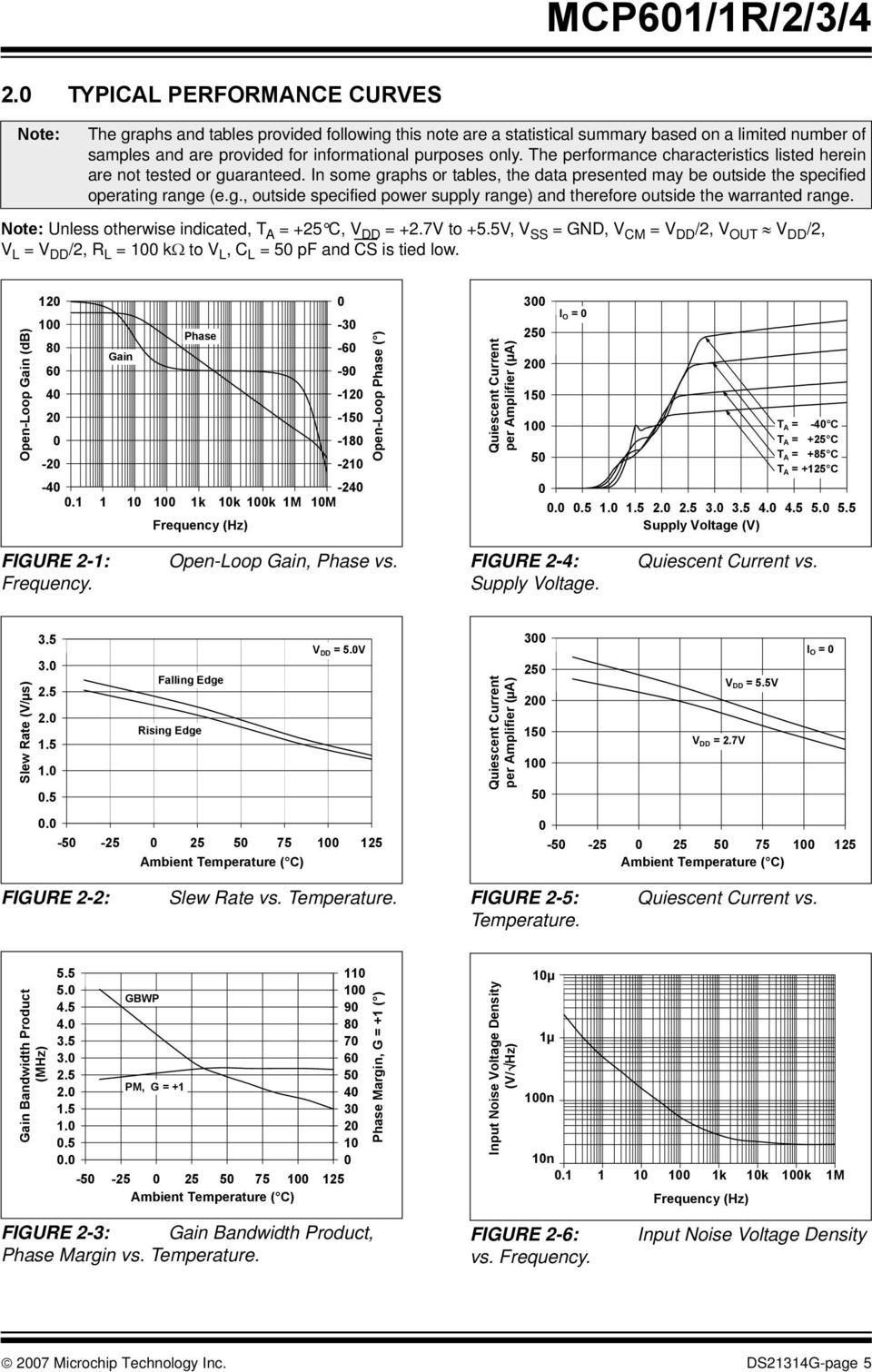
5 2.0 TYPICAL PERFORMANCE CURVES Note: The graphs and tables provided following this note are a statistical summary based on a limited number of samples and are provided for informational purposes only. The performance characteristics listed herein are not tested or guaranteed. In some graphs or tables, the data presented may be outside the specified operating range (e.g., outside specified power supply range) and therefore outside the warranted range. Note: Unless otherwise indicated, T A = +25 C, V DD = +2.7V to +5.5V, V SS = GND, V CM = V DD /2, V DD /2, V L = V DD /2, R L = kω to V L, C L = 50 pf and CS is tied low. Open-Loop Gain (db) Gain Phase E E+ 1 1.E E+ 1.E+ 1k 1.E+ 10k k 1.E+ 1.E+ 1M 10M 1.E Frequency (Hz) Open-Loop Phase ( ) Quiescent Current per Amplifier (µa) I O = 0 T A = -40 C T A = +25 C T A = +85 C T A = +125 C Supply Voltage (V) FIGURE 2-1: Frequency. Open-Loop Gain, Phase vs. FIGURE 2-4: Supply Voltage. Quiescent Current vs. Slew Rate (V/µs) Falling Edge Rising Edge V DD = 5.0V Ambient Temperature ( C) Quiescent Current per Amplifier (µa) V DD = 2.7V V DD = 5.5V I O = Ambient Temperature ( C) FIGURE 2-2: Slew Rate vs. Temperature. FIGURE 2-5: Temperature. Quiescent Current vs. Gain Bandwidth Product (MHz) GBWP PM, G = Ambient Temperature ( C) Phase Margin, G = +1 ( ) Input Noise Voltage Density (V/ Hz) 1.E+04 10µ 1.E+03 1µ 1.E+02 n 1.E+01 10n k 10k k 1M 1.E- 1.E+0 1.E+0 1.E+0 1.E+0 1.E+0 1.E+0 1.E Frequency 2 3(Hz) FIGURE 2-3: Gain Bandwidth Product, Phase Margin vs. Temperature. FIGURE 2-6: vs. Frequency. Input Noise Voltage Density 2007 Microchip Technology Inc. DS21314G-page 5
6 Note: Unless otherwise indicated, T A = +25 C, V DD = +2.7V to +5.5V, V SS = GND, V CM = V DD /2, V DD /2, V L = V DD /2, R L = kω to V L, C L = 50 pf and CS is tied low. Percentage of Occurrences 16% 14% 12% 10% 8% 6% 4% 2% 0% 1200 Samples Input Offset Voltage (mv) Percentage of Occurrences 18% 16% 14% 12% 10% 8% 6% 4% 2% 0% 1200 Samples T A = 40 to +125 C Input Offset Voltage Drift (µv/ C) FIGURE 2-7: Input Offset Voltage. FIGURE 2-10: Input Offset Voltage Drift. Input Offset Voltage (mv) V DD = 5.5V V 0.0 DD = 2.7V Ambient Temperature ( C) CMRR, PSRR (db) PSRR CMRR Ambient Temperature ( C) FIGURE 2-8: Temperature. Input Offset Voltage vs. FIGURE 2-11: Temperature. CMRR, PSRR vs. Input Offset Voltage (µv) V DD = 2.7V T A = +125 C T A = 40 C T A = +25 C T A = +85 C Input Offset Voltage (µv) V DD = 5.5V T A = +125 C T A = 40 C T A = +25 C T A = +85 C Common Mode Input Voltage (V) Common Mode Input Voltage (V) FIGURE 2-9: Input Offset Voltage vs. Common Mode Input Voltage with V DD = 2.7V. FIGURE 2-12: Input Offset Voltage vs. Common Mode Input Voltage with V DD = 5.5V. DS21314G-page Microchip Technology Inc.

7 Note: Unless otherwise indicated, T A = +25 C, V DD = +2.7V to +5.5V, V SS = GND, V CM = V DD /2, V DD /2, V L = V DD /2, R L = kω to V L, C L = 50 pf and CS is tied low. Channel-to-Channel Separation (db) No Load Input Referred 90 1.E+03 1k 1.E+04 10k 1.E+05 k 1.E+06 1M Frequency (Hz) CMRR, PSRR (db) PSRR+ 90 PSRR CMRR V DD = 5.0V k 10k k 1M 1.E+00 1.E+01 1.E+02 1.E+03 1.E+04 1.E+05 1.E+06 Frequency (Hz) FIGURE 2-13: Channel-to-Channel Separation vs. Frequency. FIGURE 2-16: Frequency. CMRR, PSRR vs. Input Bias and Offset Currents (pa) V DD = 5.5V V CM = 4.3V Ambient Temperature ( C) FIGURE 2-14: Input Bias Current, Input Offset Current vs. Ambient Temperature. I B I OS Input Bias and Offset Currents (pa) V DD = 5.5V max. V CMR 4.3V I OS, +125 C I OS, +85 C I B, +125 C I B, +85 C Common Mode Input Voltage (V) FIGURE 2-17: Input Bias Current, Input Offset Current vs. Common Mode Input Voltage. DC Open-Loop Gain (db) V DD = 5.5V 90 V DD = 2.7V 80 1.E+02 1k 1.E+03 10k 1.E+04 k 1.E+05 Load Resistance (Ω) DC Open-Loop Gain (db) R L = 25 kω Power Supply Voltage (V) FIGURE 2-15: Load Resistance. DC Open-Loop Gain vs. FIGURE 2-18: Supply Voltage. DC Open-Loop Gain vs Microchip Technology Inc. DS21314G-page 7

8 Note: Unless otherwise indicated, T A = +25 C, V DD = +2.7V to +5.5V, V SS = GND, V CM = V DD /2, V DD /2, V L = V DD /2, R L = kω to V L, C L = 50 pf and CS is tied low. Gain Bandwidth Product (MHz) V DD = 5.0V GBWP PM, G = k 10k k 1.E+02 1.E+03 1.E+04 1.E+05 Load Resistance (Ω) Phase Margin, G = +1 ( ) DC Open-Loop Gain (db) R L = 25 kω R L = 5 kω V DD = 2.7V V DD = 5.5V Ambient Temperature ( C) FIGURE 2-19: Gain Bandwidth Product, Phase Margin vs. Load Resistance. FIGURE 2-22: Temperature. DC Open-Loop Gain vs. Output Headroom (mv); V DD V OH and V OL V SS 1, V DD V OH V OL V SS Output Current Magnitude (ma) Output Headroom (mv); V DD V OH and V OL V SS V DD = 5.5V R L tied to V DD /2 V DD V OH V OL V SS R L = 5 kω R L = 25 kω Ambient Temperature ( C) FIGURE 2-20: vs. Output Current. Output Voltage Headroom FIGURE 2-23: vs. Temperature. Output Voltage Headroom Maximum Output Voltage Swing (V P-P ) 10 1 V DD = 5.5V V DD = 2.7V E+04 10k 1.E+05 k 1.E+06 1M Frequency (Hz) Output Short Circuit Current Magnitude (ma) T A = 40 C T A = +25 C T A = +85 C T A = +125 C Supply Voltage (V) FIGURE 2-21: Maximum Output Voltage Swing vs. Frequency. FIGURE 2-24: vs. Supply Voltage. Output Short-Circuit Current DS21314G-page Microchip Technology Inc.

9 Note: Unless otherwise indicated, T A = +25 C, V DD = +2.7V to +5.5V, V SS = GND, V CM = V DD /2, V DD /2, V L = V DD /2, R L = kω to V L, C L = 50 pf and CS is tied low. Output Voltage (V) V DD = 5.0V G = +1 Time (1 µs/div) Output Voltage (V) V DD = 5.0V G = 1 Time (1 µs/div) FIGURE 2-25: Pulse Response. Large Signal Non-Inverting FIGURE 2-28: Response. Large Signal Inverting Pulse Output Voltage (20 mv/div) V DD = 5.0V G = +1 Output Voltage (20 mv/div) V DD = 5.0V G = 1 Time (1 µs/div) Time (1 µs/div) FIGURE 2-26: Pulse Response. Small Signal Non-Inverting FIGURE 2-29: Response. Small Signal Inverting Pulse Output Voltage, Chip Select Voltage (V) CS Active Time (5 µs/div) V DD = 5.0V G = +1 V IN = 2.5V R L = kω to GND High-Z Quiescent Current through V SS (µa) 0 V DD = 5.5V Chip Select Voltage (V) FIGURE 2-27: (MCP603). Chip Select Timing FIGURE 2-30: Quiescent Current Through V SS vs. Chip Select Voltage (MCP603) Microchip Technology Inc. DS21314G-page 9

10 Note: Unless otherwise indicated, T A = +25 C, V DD = +2.7V to +5.5V, V SS = GND, V CM = V DD /2, V DD /2, V L = V DD /2, R L = kω to V L, C L = 50 pf and CS is tied low. Chip Select Pin Current (µa) 0.8 V DD = 5.5V Chip Select Voltage (V) Input and Output Voltages (V) V DD = +5.0V G = +2 V IN Time (5 µs/div) FIGURE 2-31: Chip Select Pin Input Current vs. Chip Select Voltage. FIGURE 2-33: The MCP601/1R/2/3/4 family of op amps shows no phase reversal under input overdrive. Internal Chip Select Switch Output Voltage (V) Amplifier On CS Hi to Low CS Low to Hi V DD = 5.0V Amplifier Hi-Z Chip Select Voltage (V) Input Current Magnitude (A) 1.E-02 10m 1.E-03 1m 1.E-04 µ 1.E-05 10µ 1.E-06 1µ 1.E-07 n 1.E-08 10n 1.E-09 1n 1.E-10 p 1.E-11 10p 1.E-12 1p +125 C +85 C +25 C -40 C Input Voltage (V) FIGURE 2-32: Internal Switch. Hysteresis of Chip Select s FIGURE 2-34: Measured Input Current vs. Input Voltage (below V SS ). DS21314G-page Microchip Technology Inc.

11 3.0 PIN DESCRIPTIONS Descriptions of the pins are listed in Table 3-1 (single op amps) and Table 3-2 (dual and quad op amps). TABLE 3-1: PDIP, SOIC, TSSOP TABLE 3-2: PIN FUNCTION TABLE FOR SINGLE OP AMPS MCP601 MCP601R MCP603 SOT-23-5 SOT-23-5 (Note 1) SOT-23-6 PDIP, SOIC, TSSOP Symbol PIN FUNCTION TABLE FOR DUAL AND QUAD OP AMPS Description Analog Output V IN Inverting Input V IN + Non-inverting Input V DD Positive Power Supply V SS Negative Power Supply 8 8 CS Chip Select 1, 5, 8 1, 5 1 NC No Internal Connection Note 1: The MCP601R is only available in the 5-pin SOT-23 package. MCP602 PDIP, SOIC, TSSOP MCP604 PDIP, SOIC, TSSOP Symbol Description 1 1 A Analog Output (op amp A) 2 2 V INA Inverting Input (op amp A) 3 3 V INA + Non-inverting Input (op amp A) 8 4 V DD Positive Power Supply 5 5 V INB + Non-inverting Input (op amp B) 6 6 V INB Inverting Input (op amp B) 7 7 B Analog Output (op amp B) 8 C Analog Output (op amp C) 9 V INC Inverting Input (op amp C) 10 V INC + Non-inverting Input (op amp C) 4 11 V SS Negative Power Supply 12 V IND + Non-inverting Input (op amp D) 13 V IND Inverting Input (op amp D) 14 D Analog Output (op amp D) 3.1 Analog Outputs The op amp output pins are low-impedance voltage sources. 3.2 Analog Inputs The op amp non-inverting and inverting inputs are highimpedance CMOS inputs with low bias currents. 3.3 Chip Select Digital Input This is a CMOS, Schmitt-triggered input that places the part into a low power mode of operation. 3.4 Power Supply Pins The positive power supply pin (V DD ) is 2.5V to 6.0V higher than the negative power supply pin (V SS ). For normal operation, the other pins are at voltages between V SS and V DD. Typically, these parts are used in a single (positive) supply configuration. In this case, V SS is connected to ground and V DD is connected to the supply. V DD will need bypass capacitors Microchip Technology Inc. DS21314G-page 11

12 4.0 APPLICATIONS INFORMATION The MCP601/1R/2/3/4 family of op amps are fabricated on Microchip s state-of-the-art CMOS process. They are unity-gain stable and suitable for a wide range of general purpose applications. V 1 D 1 D 2 V DD 4.1 Inputs R 1 MCP60X PHASE REVERSAL The MCP601/1R/2/3/4 op amp is designed to prevent phase reversal when the input pins exceed the supply voltages. Figure 2-34 shows the input voltage exceeding the supply voltage without any phase reversal INPUT VOLTAGE AND CURRENT LIMITS The ESD protection on the inputs can be depicted as shown in Figure 4-1. This structure was chosen to protect the input transistors, and to minimize input bias current (I B ). The input ESD diodes clamp the inputs when they try to go more than one diode drop below V SS. They also clamp any voltages that go too far above V DD ; their breakdown voltage is high enough to allow normal operation, and low enough to bypass quick ESD events within the specified limits. V DD V IN + V SS Bond Pad Bond Pad Bond Pad FIGURE 4-1: Structures. Input Stage Bond Pad V IN Simplified Analog Input ESD In order to prevent damage and/or improper operation of these op amps, the circuit they are in must limit the currents and voltages at the V IN + and V IN pins (see Absolute Maximum Ratings at the beginning of Section 1.0 Electrical Characteristics ). Figure 4-2 shows the recommended approach to protecting these inputs. The internal ESD diodes prevent the input pins (V IN + and V IN ) from going too far below ground, and the resistors R 1 and R 2 limit the possible current drawn out of the input pins. Diodes D 1 and D 2 prevent the input pins (V IN + and V IN ) from going too far above V DD, and dump any currents onto V DD. When implemented as shown, resistors R 1 and R 2 also limit the current through D 1 and D 2. V 2 R 2 FIGURE 4-2: Inputs. R 1 > V SS (minimum expected V 1 ) 2mA R 2 > V SS (minimum expected V 2 ) 2mA Protecting the Analog It is also possible to connect the diodes to the left of resistors R 1 and R 2. In this case, current through the diodes D 1 and D 2 needs to be limited by some other mechanism. The resistors then serve as in-rush current limiters; the DC current into the input pins (V IN + and V IN ) should be very small. A significant amount of current can flow out of the inputs when the common mode voltage (V CM ) is below ground (V SS ); see Figure Applications that are high impedance may need to limit the useable voltage range NORMAL OPERATION The Common Mode Input Voltage Range (V CMR ) includes ground in single-supply systems (V SS ), but does not include V DD. This means that the amplifier input behaves linearly as long as the Common Mode Input Voltage (V CM ) is kept within the specified V CMR limits (V SS 0.3V to V DD 1.2V at +25 C). Figure 4-3 shows a unity gain buffer. Since is the same voltage as the inverting input, must be kept below V DD 1.2V for correct operation. V IN + MCP60X R 3 FIGURE 4-3: Unity Gain Buffer has a Limited Range. DS21314G-page Microchip Technology Inc.

13 4.2 Rail-to-Rail Output There are two specifications that describe the output swing capability of the MCP601/1R/2/3/4 family of op amps. The first specification (Maximum Output Voltage Swing) defines the absolute maximum swing that can be achieved under the specified load conditions. For instance, the output voltage swings to within 15 mv of the negative rail with a 25 kω load to V DD /2. Figure 2-33 shows how the output voltage is limited when the input goes beyond the linear region of operation. The second specification that describes the output swing capability of these amplifiers is the Linear Output Voltage Swing. This specification defines the maximum output swing that can be achieved while the amplifier is still operating in its linear region. To verify linear operation in this range, the large signal (DC Open-Loop Gain (A OL )) is measured at points mv inside the supply rails. The measurement must exceed the specified gains in the specification table. 4.3 MCP603 Chip Select The MCP603 is a single amplifier with Chip Select (CS). When CS is pulled high, the supply current drops to -0.7 µa (typ.), which is pulled through the CS pin to V SS. When this happens, the amplifier output is put into a high-impedance state. Pulling CS low enables the amplifier. The CS pin has an internal 5 MΩ (typical) pull-down resistor connected to V SS, so it will go low if the CS pin is left floating. Figure 1-1 is the Chip Select timing diagram and shows the output voltage, supply currents, and CS current in response to a CS pulse. Figure 2-27 shows the measured output voltage response to a CS pulse. 4.4 Capacitive Loads Driving large capacitive loads can cause stability problems for voltage feedback op amps. As the load capacitance increases, the feedback loop s phase margin decreases and the closed-loop bandwidth is reduced. This produces gain peaking in the frequency response with overshoot and ringing in the step response. When driving large capacitive loads with these op amps (e.g., > 40 pf when G = +1), a small series resistor at the output (R ISO in Figure 4-4) improves the feedback loop s phase margin (stability) by making the output load resistive at higher frequencies. The bandwidth will be generally lower than the bandwidth with no capacitive load. FIGURE 4-4: Output resistor R ISO stabilizes large capacitive loads. Figure 4-5 gives recommended R ISO values for different capacitive loads and gains. The x-axis is the normalized load capacitance (C L /G N ) in order to make it easier to interpret the plot for arbitrary gains. G N is the circuit s noise gain. For non-inverting gains, G N and the gain are equal. For inverting gains, G N = 1 + Gain (e.g., -1 V/V gives G N = +2 V/V). Recommended R ISO (Ω) R G 1k + MCP60X R F G N = +1 G N +2 FIGURE 4-5: Recommended R ISO values for capacitive loads. Once you have selected R ISO for your circuit, doublecheck the resulting frequency response peaking and step response overshoot in your circuit. Evaluation on the bench and simulations with the MCP601/1R/2/3/4 SPICE macro model are very helpful. Modify R ISO s value until the response is reasonable. 4.5 Supply Bypass R ISO With this family of op amps, the power supply pin (V DD for single-supply) should have a local bypass capacitor (i.e., 0.01 µf to 0.1 µf) within 2 mm for good highfrequency performance. It also needs a bulk capacitor (i.e., 1 µf or larger) within mm to provide large, slow currents. This bulk capacitor can be shared with nearby analog parts. C L 10 10p p 1n 10n Normalized Load Capacitance; C L / G N (F) 2007 Microchip Technology Inc. DS21314G-page 13

14 4.6 Unused Op Amps An unused op amp in a quad package (MCP604) should be configured as shown in Figure 4-6. These circuits prevent the output from toggling and causing crosstalk. Circuits A sets the op amp at its minimum noise gain. The resistor divider produces any desired reference voltage within the output voltage range of the op amp; the op amp buffers that reference voltage. Circuit B uses the minimum number of components and operates as a comparator, but it may draw more current. V DD ¼ MCP604 (A) ¼ MCP604 (B) V DD 2. Connect the guard ring to the non-inverting input pin (V IN +) for inverting gain amplifiers and transimpedance amplifiers (converts current to voltage, such as photo detectors). This biases the guard ring to the same reference voltage as the op amp (e.g., V DD /2 or ground). 4.8 Typical Applications ANALOG FILTERS Figure 4-8 and Figure 4-9 show low-pass, secondorder, Butterworth filters with a cutoff frequency of 10 Hz. The filter in Figure 4-8 has a non-inverting gain of +1 V/V, and the filter in Figure 4-9 has an inverting gain of -1 V/V. R 1 R 2 V DD V REF C 1 47 nf G = +1 V/V f P = 10 Hz R 2 V REF = V DD R 1 + R 2 FIGURE 4-6: Unused Op Amps. V IN R 1 R kω 641 kω C 2 22 nf + MCP60X 4.7 PCB Surface Leakage In applications where low input bias current is critical, printed circuit board (PCB) surface leakage effects need to be considered. Surface leakage is caused by humidity, dust or other contamination on the board. Under low humidity conditions, a typical resistance between nearby traces is Ω. A 5V difference would cause 5 pa of current to flow. This is greater than the MCP601/1R/2/3/4 family s bias current at +25 C (1 pa, typical). The easiest way to reduce surface leakage is to use a guard ring around sensitive pins (or traces). The guard ring is biased at the same voltage as the sensitive pin. An example of this type of layout is shown in Figure 4-7. FIGURE 4-7: Guard Ring V IN V IN+ Example Guard Ring layout. 1. Connect the guard ring to the inverting input pin (V IN ) for non-inverting gain amplifiers, including unity-gain buffers. This biases the guard ring to the common mode input voltage. FIGURE 4-8: Sallen-Key Filter. V IN C 2 47 nf R kω Second-Order, Low-Pass R 1 R 3 C kω 1.00 MΩ 8.2 nf V DD /2 G = -1 V/V f P = 10 Hz FIGURE 4-9: Second-Order, Low-Pass Multiple-Feedback Filter. The MCP601/1R/2/3/4 family of op amps have low input bias current, which allows the designer to select larger resistor values and smaller capacitor values for these filters. This helps produce a compact PCB layout. These filters, and others, can be designed using Microchip s Design Aids; see Section 5.2 FilterLab Software and Section 5.3 Mindi Simulatior Tool. MCP60X + DS21314G-page Microchip Technology Inc.

15 4.8.2 INSTRUMENTATION AMPLIFIER CIRCUITS Instrumentation amplifiers have a differential input that subtracts one input voltage from another and rejects common mode signals. These amplifiers also provide a single-ended output voltage. The three-op amp instrumentation amplifier is illustrated in Figure One advantage of this approach is unitygain operation, while one disadvantage is that the common mode input range is reduced as R 2 /R G gets larger. V 1 + MCP60X R G R 2 R 2 R 3 R 4 MCP60X + R 3 R PHOTO DETECTION The MCP601/1R/2/3/4 op amps can be used to easily convert the signal from a sensor that produces an output current (such as a photo diode) into a voltage (a transimpedance amplifier). This is implemented with a single resistor (R 2 ) in the feedback loop of the amplifiers shown in Figure 4-12 and Figure The optional capacitor (C 2 ) sometimes provides stability for these circuits. A photodiode configured in the Photovoltaic mode has zero voltage potential placed across it (Figure 4-12). In this mode, the light sensitivity and linearity is maximized, making it best suited for precision applications. The key amplifier specifications for this application are: low input bias current, low noise, common mode input voltage range (including ground), and rail-to-rail output. C 2 V 2 MCP60X V REF + 2R = ( V 1 V 2 ) R4 + V REF R G R 3 Light I D1 D 1 R 2 V DD MCP60X + FIGURE 4-10: Three-Op Amp Instrumentation Amplifier. The two-op amp instrumentation amplifier is shown in Figure While its power consumption is lower than the three-op amp version, its main drawbacks are that the common mode range is reduced with higher gains and it must be configured in gains of two or higher. R 1 R G R 2 R 2 R 1 FIGURE 4-12: = I D1 R 2 Photovoltaic Mode Detector. In contrast, a photodiode that is configured in the Photoconductive mode has a reverse bias voltage across the photo-sensing element (Figure 4-13). This decreases the diode capacitance, which facilitates high-speed operation (e.g., high-speed digital communications). The design trade-off is increased diode leakage current and linearity errors. The op amp needs to have a wide Gain Bandwidth Product (GBWP). V REF V 2 V 1 - MCP60X + FIGURE 4-11: Two-Op Amp Instrumentation Amplifier. - MCP60X + R ( V 1 V 2 ) R = V REF Both instrumentation amplifiers should use a bulk bypass capacitor of at least 1 µf. The CMRR of these amplifiers will be set by both the op amp CMRR and resistor matching. R 2 R G I D1 D 1 Light V BIAS FIGURE 4-13: Detector. C 2 R 2 V DD MCP60X + = I D1 R 2 V BIAS < 0V Photoconductive Mode 2007 Microchip Technology Inc. DS21314G-page 15

16 5.0 DESIGN AIDS Microchip provides the basic design tools needed for the MCP601/1R/2/3/4 family of op amps. 5.1 SPICE Macro Model The latest SPICE macro model for the MCP601/1R/2/ 3/4 op amps is available on the Microchip web site at This model is intended to be an initial design tool that works well in the op amp s linear region of operation over the temperature range. See the model file for information on its capabilities. Bench testing is a very important part of any design and cannot be replaced with simulations. Also, simulation results using this macro model need to be validated by comparing them to the data sheet specifications and characteristic curves. 5.2 FilterLab Software Microchip s FilterLab software is an innovative software tool that simplifies analog active filter (using op amps) design. Available at no cost from the Microchip web site at the FilterLab design tool provides full schematic diagrams of the filter circuit with component values. It also outputs the filter circuit in SPICE format, which can be used with the macro model to simulate actual filter performance. 5.3 Mindi Simulatior Tool Microchip s Mindi simulator tool aids in the design of various circuits useful for active filter, amplifier and power-management applications. It is a free online simulation tool available from the Microchip web site at This interactive simulator enables designers to quickly generate circuit diagrams, simulate circuits. Circuits developed using the Mindi simulation tool can be downloaded to a personal computer or workstation. 5.5 Analog Demonstration and Evaluation Boards Microchip offers a broad spectrum of Analog Demonstration and Evaluation Boards that are designed to help you achieve faster time to market. For a complete listing of these boards and their corresponding user s guides and technical information, visit the Microchip web site at analogtools. Two of our boards that are especially useful are: P/N SOIC8EV: 8-Pin SOIC/MSOP/TSSOP/DIP Evaluation Board P/N SOIC14EV: 14-Pin SOIC/TSSOP/DIP Evaluation Board 5.6 Application Notes The following Microchip Application Notes are available on the Microchip web site at com/ appnotes and are recommended as supplemental reference resources. ADN003: Select the Right Operational Amplifier for your Filtering Circuits, DS21821 AN722: Operational Amplifier Topologies and DC Specifications, DS00722 AN723: Operational Amplifier AC Specifications and Applications, DS00723 AN884: Driving Capacitive Loads With Op Amps, DS00884 AN990: Analog Sensor Conditioning Circuits An Overview, DS00990 These application notes and others are listed in the design guide: Signal Chain Design Guide, DS MAPS (Microchip Advanced Part Selector) MAPS is a software tool that helps semiconductor professionals efficiently identify Microchip devices that fit a particular design requirement. Available at no cost from the Microchip website at maps, the MAPS is an overall selection tool for Microchip s product portfolio that includes Analog, Memory, MCUs and DSCs. Using this tool you can define a filter to sort features for a parametric search of devices and export side-by-side technical comparasion reports. Helpful links are also provided for Datasheets, Purchase, and Sampling of Microchip parts. DS21314G-page Microchip Technology Inc.

17 6.0 PACKAGING INFORMATION 6.1 Package Marking Information 5-Lead SOT-23 (MCP601 and MCP601R only) Example: XXNN Device I-Temp Code E-Temp Code MCP601 SANN SLNN MCP601R SJNN SMNN SJ25 6-Lead SOT-23 (MCP603 only) Example: XXNN Device I-Temp Code E-Temp Code MCP603 AENN AUNN AU25 Legend: XX...X Customer-specific information Y Year code (last digit of calendar year) YY Year code (last 2 digits of calendar year) WW Week code (week of January 1 is week 01 ) NNN e3 Alphanumeric traceability code Pb-free JEDEC designator for Matte Tin (Sn) * This package is Pb-free. The Pb-free JEDEC designator ( e3 ) can be found on the outer packaging for this package. Note: In the event the full Microchip part number cannot be marked on one line, it will be carried over to the next line, thus limiting the number of available characters for customer-specific information Microchip Technology Inc. DS21314G-page 17

18 Package Marking Information (Continued) 8-Lead PDIP (300 mil) Example: XXXXXXXX XXXXXNNN YYWW MCP601 I/P OR MCP601 E/P e Lead SOIC (150 mil) Example: XXXXXXXX XXXXYYWW NNN MCP601 I/SN OR MCP601E SN e Lead TSSOP Example: XXXX XYWW NNN 601 I DS21314G-page Microchip Technology Inc.

19 Package Marking Information (Continued) 14-Lead PDIP (300 mil) (MCP604) Example: XXXXXXXXXXXXXX XXXXXXXXXXXXXX YYWWNNN MCP604-I/P OR MCP604 E/P e Lead SOIC (150 mil) (MCP604) Example: XXXXXXXXXX XXXXXXXXXX YYWWNNN MCP604ISL MCP604 OR E/SL^^ e Lead TSSOP (MCP604) Example: XXXXXXXX YYWW NNN 604E Microchip Technology Inc. DS21314G-page 19

20 N b E E e e1 D A A2 c φ A1 L L1 DS21314G-page Microchip Technology Inc.

21 b N 4 E1 E PIN1IDBY LASER MARK e e1 D A A2 c φ A1 L L Microchip Technology Inc. DS21314G-page 21
22 N NOTE 1 E D E A A2 A1 L c b1 b e eb DS21314G-page Microchip Technology Inc.
23 D N e E E1 NOTE b h h α A A2 φ c A1 L L1 β 2007 Microchip Technology Inc. DS21314G-page 23
24 D N E E1 NOTE 1 b 1 2 e A A2 c φ A1 L1 L DS21314G-page Microchip Technology Inc.
25 N NOTE 1 E D E A A2 L c A1 b1 b e eb 2007 Microchip Technology Inc. DS21314G-page 25
26 D N E E1 NOTE b e h h α A A2 φ c A1 L L1 β DS21314G-page Microchip Technology Inc.
27 D N E1 E NOTE b e A A2 c φ A1 L1 L 2007 Microchip Technology Inc. DS21314G-page 27
28 NOTES: DS21314G-page Microchip Technology Inc.
29 APPENDIX A: REVISION HISTORY Revision G (December 2007) Updated Figure 2-15 and Figure Updated Table 3-1 and Table 3-2. Updated notes to Section 1.0 Electrical Characteristics. Expanded Analog Input Absolute Maximum Voltage Range (applies retroactively). Expanded operating V DD to a maximum of 6.0V. Added Figure Added Section Phase Reversal, Section Input Voltage and Current Limits, and Section Normal Operation. Corrected Section 6.0 Packaging Information. Revision F (February 2004) Undocumented changes. Revision E (September 2003) Undocumented changes. Revision D (April 2000) Undocumented changes. Revision C (July 1999) Undocumented changes. Revision B (June 1999) Undocumented changes. Revision A (March 1999) Original Release of this Document Microchip Technology Inc. DS21314G-page 29
30 NOTES: DS21314G-page Microchip Technology Inc.
31 PRODUCT IDENTIFICATION SYSTEM To order or obtain information, e.g., on pricing or delivery, refer to the factory or the listed sales office. PART NO. X /XX Device Temperature Range Package Device MCP601 Single Op Amp MCP601T Single Op Amp (Tape and Reel for SOT-23, SOIC and TSSOP) MCP601RT Single Op Amp (Tape and Reel for SOT-23-5) MCP602 Dual Op Amp MCP602T Dual Op Amp (Tape and Reel for SOIC and TSSOP) MCP603 Single Op Amp with Chip Select MCP603T Single Op Amp with Chip Select (Tape and Reel for SOT-23, SOIC and TSSOP) MCP604 Quad Op Amp MCP604T Quad Op Amp (Tape and Reel for SOIC and TSSOP) Temperature Range I = -40 C to +85 C E = -40 C to +125 C Package OT = Plastic SOT-23, 5-lead (MCP601 only) CH = Plastic SOT-23, 6-lead (MCP603 only) P = Plastic DIP (300 mil body), 8, 14 lead SN = Plastic SOIC (3.90 mm body), 8 lead SL = Plastic SOIC (3.90 mm body), 14 lead ST = Plastic TSSOP (4.4 mm body), 8, 14 lead Examples: a) MCP601-I/P: Single Op Amp, Industrial Temperature, 8 lead PDIP package. b) MCP601-E/SN: Single Op Amp, Extended Temperature, 8 lead SOIC package. c) MCP601T-E/ST: Tape and Reel, Extended Temperature, Single Op Amp, 8 lead TSSOP package d) MCP601RT-I/OT:Tape and Reel, Industrial Temperature, Single Op Amp, Rotated 5 lead SOT-23 package. e) MCP601RT-E/OT:Tape and Reel, Extended Temperature, Single Op Amp, Rotated, 5 lead SOT-23 package. a) MCP602-I/SN: Dual Op Amp, Industrial Temperature, 8 lead SOIC package. b) MCP602-E/P: Dual Op Amp, Extended Temperature, 8 lead PDIP package. c) MCP602T-E/ST: Tape and Reel, Extended Temperature, Dual Op Amp, 8 lead TSSOP package. a) MCP603-I/SN: Industrial Temperature, Single Op Amp with Chip Select, 8 lead SOIC package. b) MCP603-E/P: Extended Temperature, Single Op Amp with Chip Select, 8 lead PDIP package. c) MCP603T-E/ST: Tape and Reel, Extended Temperature, Single Op Amp with Chip Select 8 lead TSSOP package. d) MCP603T-I/SN: Tape and Reel, Industrial Temperature, Single Op Amp with Chip Select, 8 lead SOIC package. a) MCP604-I/P: Industrial Temperature, Quad Op Amp, 14 lead PDIP package. b) MCP604-E/SL: Extended Temperature, Quad Op Amp, 14 lead SOIC package. c) MCP604T-E/ST: Tape and Reel, Extended Temperature, Quad Op Amp, 14 lead TSSOP package Microchip Technology Inc. DS21314G-page 31
32 NOTES: DS21314G-page Microchip Technology Inc.
33 Note the following details of the code protection feature on Microchip devices: Microchip products meet the specification contained in their particular Microchip Data Sheet. Microchip believes that its family of products is one of the most secure families of its kind on the market today, when used in the intended manner and under normal conditions. There are dishonest and possibly illegal methods used to breach the code protection feature. All of these methods, to our knowledge, require using the Microchip products in a manner outside the operating specifications contained in Microchip s Data Sheets. Most likely, the person doing so is engaged in theft of intellectual property. Microchip is willing to work with the customer who is concerned about the integrity of their code. Neither Microchip nor any other semiconductor manufacturer can guarantee the security of their code. Code protection does not mean that we are guaranteeing the product as unbreakable. Code protection is constantly evolving. We at Microchip are committed to continuously improving the code protection features of our products. Attempts to break Microchip s code protection feature may be a violation of the Digital Millennium Copyright Act. If such acts allow unauthorized access to your software or other copyrighted work, you may have a right to sue for relief under that Act. Information contained in this publication regarding device applications and the like is provided only for your convenience and may be superseded by updates. It is your responsibility to ensure that your application meets with your specifications. MICROCHIP MAKES NO REPRESENTATIONS OR WARRANTIES OF ANY KIND WHETHER EXPRESS OR IMPLIED, WRITTEN OR ORAL, STATUTORY OR OTHERWISE, RELATED TO THE INFORMATION, INCLUDING BUT NOT LIMITED TO ITS CONDITION, QUALITY, PERFORMANCE, MERCHANTABILITY OR FITNESS FOR PURPOSE. Microchip disclaims all liability arising from this information and its use. Use of Microchip devices in life support and/or safety applications is entirely at the buyer s risk, and the buyer agrees to defend, indemnify and hold harmless Microchip from any and all damages, claims, suits, or expenses resulting from such use. No licenses are conveyed, implicitly or otherwise, under any Microchip intellectual property rights. Trademarks The Microchip name and logo, the Microchip logo, Accuron, dspic, KEELOQ, KEELOQ logo, microid, MPLAB, PIC, PICmicro, PICSTART, PRO MATE, rfpic and SmartShunt are registered trademarks of Microchip Technology Incorporated in the U.S.A. and other countries. AmpLab, FilterLab, Linear Active Thermistor, Migratable Memory, MXDEV, MXLAB, SEEVAL, SmartSensor and The Embedded Control Solutions Company are registered trademarks of Microchip Technology Incorporated in the U.S.A. Analog-for-the-Digital Age, Application Maestro, CodeGuard, dspicdem, dspicdem.net, dspicworks, dsspeak, ECAN, ECONOMONITOR, FanSense, FlexROM, fuzzylab, In-Circuit Serial Programming, ICSP, ICEPIC, Mindi, MiWi, MPASM, MPLAB Certified logo, MPLIB, MPLINK, PICkit, PICDEM, PICDEM.net, PICLAB, PICtail, PowerCal, PowerInfo, PowerMate, PowerTool, REAL ICE, rflab, Select Mode, Smart Serial, SmartTel, Total Endurance, UNI/O, WiperLock and ZENA are trademarks of Microchip Technology Incorporated in the U.S.A. and other countries. SQTP is a service mark of Microchip Technology Incorporated in the U.S.A. All other trademarks mentioned herein are property of their respective companies. 2007, Microchip Technology Incorporated, Printed in the U.S.A., All Rights Reserved. Printed on recycled paper. Microchip received ISO/TS-16949:2002 certification for its worldwide headquarters, design and wafer fabrication facilities in Chandler and Tempe, Arizona; Gresham, Oregon and design centers in California and India. The Company s quality system processes and procedures are for its PIC MCUs and dspic DSCs, KEELOQ code hopping devices, Serial EEPROMs, microperipherals, nonvolatile memory and analog products. In addition, Microchip s quality system for the design and manufacture of development systems is ISO 9001:2000 certified Microchip Technology Inc. DS21314G-page 33
34 WORLDWIDE SALES AND SERVICE AMERICAS Corporate Office 2355 West Chandler Blvd. Chandler, AZ Tel: Fax: Technical Support: Web Address: Atlanta Duluth, GA Tel: Fax: Boston Westborough, MA Tel: Fax: Chicago Itasca, IL Tel: Fax: Dallas Addison, TX Tel: Fax: Detroit Farmington Hills, MI Tel: Fax: Kokomo Kokomo, IN Tel: Fax: Los Angeles Mission Viejo, CA Tel: Fax: Santa Clara Santa Clara, CA Tel: Fax: Toronto Mississauga, Ontario, Canada Tel: Fax: ASIA/PACIFIC Asia Pacific Office Suites , 37th Floor Tower 6, The Gateway Harbour City, Kowloon Hong Kong Tel: Fax: Australia - Sydney Tel: Fax: China - Beijing Tel: Fax: China - Chengdu Tel: Fax: China - Fuzhou Tel: Fax: China - Hong Kong SAR Tel: Fax: China - Nanjing Tel: Fax: China - Qingdao Tel: Fax: China - Shanghai Tel: Fax: China - Shenyang Tel: Fax: China - Shenzhen Tel: Fax: China - Shunde Tel: Fax: China - Wuhan Tel: Fax: China - Xian Tel: Fax: ASIA/PACIFIC India - Bangalore Tel: Fax: India - New Delhi Tel: Fax: India - Pune Tel: Fax: Japan - Yokohama Tel: Fax: Korea - Daegu Tel: Fax: Korea - Seoul Tel: Fax: or Malaysia - Kuala Lumpur Tel: Fax: Malaysia - Penang Tel: Fax: Philippines - Manila Tel: Fax: Singapore Tel: Fax: Taiwan - Hsin Chu Tel: Fax: Taiwan - Kaohsiung Tel: Fax: Taiwan - Taipei Tel: Fax: Thailand - Bangkok Tel: Fax: EUROPE Austria - Wels Tel: Fax: Denmark - Copenhagen Tel: Fax: France - Paris Tel: Fax: Germany - Munich Tel: Fax: Italy - Milan Tel: Fax: Netherlands - Drunen Tel: Fax: Spain - Madrid Tel: Fax: UK - Wokingham Tel: Fax: /05/07 DS21314G-page Microchip Technology Inc.
TB3016. Using the PIC MCU CTMU for Temperature Measurement IMPLEMENTATION BASIC PRINCIPLE MEASUREMENT CIRCUIT
 Using the PIC MCU CTMU for Temperature Measurement Author: Padmaraja Yedamale Microchip Technology Inc. The Charge Time Measurement Unit (CTMU), introduced on the latest generation of PIC24F and PIC18F
450 µa, 5 MHz Rail-to-Rail Op Amp MCP6282 PDIP, SOIC, MSOP V OUTA 1 MCP6281 PDIP, SOIC, MSOP 5 V DD 2 V INA + 3 MCP6284 PDIP, SOIC, TSSOP V OUTA
 450 µa, 5 MHz Rail-to-Rail Op Amp Features Gain Bandwidth Product: 5 MHz (typical) Supply Current: I Q = 450 µa (typical) Supply Voltage: 2.2V to 6.0V Rail-to-Rail Input/Output Extended Temperature Range:
MCP606/7/8/9. 2.5V to 5.5V Micropower CMOS Op Amps. Features. Typical Applications. Package Types. Available Tools. Typical Application.
 MCP66/7/8/9 2.V to.v Micropower CMOS Op Amps Features Low Input Offset Voltage: 2 µv (max.) Rail-to-Rail Output Low Input Bias Current: 8 pa (max. at 8 C) Low Quiescent Current: 2 µa (max.) Power Supply
MCP6021/1R/2/3/4. Rail-to-Rail Input/Output, 10 MHz Op Amps. Features. Description. Applications. Package Types. Design Aids. Typical Application
 Rail-to-Rail Input/Output, 1 MHz Op Amps Features Rail-to-Rail Input/Output Wide Bandwidth: 1 MHz (typical) Low Noise: 8.7 nv/ Hz, at 1 khz (typical) Low Offset Voltage: - Industrial Temperature: ±5 µv
AN687. Precision Temperature-Sensing With RTD Circuits RTD OVERVIEW INTRODUCTION EQUATION 1:
 Precision Temperature-Sensing With RTD Circuits Author: INTRODUCTION Bonnie C. Baker Microchip Technology Inc. The most widely measured phenomena in the process control environment is temperature. Common
AN1286. Water-Resistant Capacitive Sensing INTRODUCTION THEORY OF OPERATION. Sensing Steps. Sensing Steps Description DESIGN
 Water-Resistant Capacitive Sensing AN1286 Author: INTRODUCTION Thomas Perme Steven Lin Microchip Technology Inc. This application note describes a new hardware sensing method which is resilient to water
MCP6001/1R/1U/2/4. 1 MHz, Low-Power Op Amp. Features. Description. Applications. Package Types. Design Aids. Typical Application
 1 MHz, Low-Power Op Amp Features Available in SC-70-5 and SOT-23-5 packages Gain Bandwidth Product: 1 MHz (typical) Rail-to-Rail Input/Output Supply Voltage: 1.8V to 6.0V Supply Current: I Q = 100 µa (typical)
TC1047/TC1047A. Precision Temperature-to-Voltage Converter. General Description. Applications. Block Diagram. Features.
 Precision Temperature-to-Voltage Converter Features Supply Voltage Range: - TC147: 2.7V to 4.4V - TC147A: 2.V to.v Wide Temperature Measurement Range: - -4 o C to +12 o C High Temperature Converter Accuracy:
AN1142. USB Mass Storage Class on an Embedded Host INTRODUCTION. USB Mass Storage Class. Overview
 USB Mass Storage Class on an Embedded Host Author: INTRODUCTION With the introduction of Microchip's microcontrollers with the USB OTG peripheral, microcontroller applications can easily support USB Embedded
AN1303. Software Real-Time Clock and Calendar Using PIC16F1827 DATA INTERFACE INTRODUCTION IMPLEMENTATION INTERNAL REGISTER MAP
 Software Real-Time Clock and Calendar Using PIC16F1827 Author: INTRODUCTION Cristian Toma Microchip Technology Inc. This application note describes the implementation of software Real-Time Clock and Calendar
AN1325. mtouch Metal Over Cap Technology THEORY OF OPERATION INTRODUCTION CROSS SECTION OF METAL OVER CAPACITIVE (UNPRESSED)
 mtouch Metal Over Cap Technology AN1325 Authors: INTRODUCTION Keith Curtis Dieter Peter Microchip Technology Inc. As a user interface, capacitive touch has several advantages: it is low power, low cost,
Installing and Licensing MPLAB XC C Compilers
 Installing and Licensing MPLAB XC C Compilers DS50002059G Note the following details of the code protection feature on Microchip devices: Microchip products meet the specification contained in their particular
Recommended Usage of Microchip 23X256/23X640 SPI Serial SRAM Devices RECOMMENDED CONNECTIONS FOR 23X256,23X640 SERIES DEVICES VCC 23X256/ HOLD.
 Recommended Usage of Microchip 23X256/23X640 SPI Serial SRAM Devices Author: INTRODUCTION Martin Bowman Microchip Technology Inc. This document details recommended usage of the Microchip 23X256 and 23X640
AN1156. Battery Fuel Measurement Using Delta-Sigma ADC Devices INTRODUCTION REVIEW OF BATTERY CHARGING AND DISCHARGING CHARACTERISTICS
 Battery Fuel Measurement Using Delta-Sigma ADC Devices Author: INTRODUCTION Youbok Lee, Ph.D. Microchip Technology Inc. The battery fuel status indicator is a common feature of the battery-supported handheld
AN1199. 1-Wire Communication with PIC Microcontroller INTRODUCTION. OVERVIEW OF THE 1-Wire BUS. 1-Wire Protocol. Prerequisites
 1-Wire Communication with PIC Microcontroller Author: INTRODUCTION This application note introduces the user to the 1-Wire communication protocol and describes how a 1-Wire device can be interfaced to
TC7660. Charge Pump DC-to-DC Voltage Converter. Package Types. Features. General Description. Applications. Functional Block Diagram TC7660
 Charge Pump DC-to-DC Voltage Converter Features Wide Input Voltage Range:.V to V Efficient Voltage Conversion (99.9%, typ) Excellent Power Efficiency (9%, typ) Low Power Consumption: µa (typ) @ V IN =
AN1353. Op Amp Rectifiers, Peak Detectors and Clamps INTRODUCTION BASIC RECTIFIERS. Choosing the Components. Positive Half-Wave Rectifier.
 Op Amp Rectifiers, Peak Detectors and Clamps Author: Dragos Ducu, Microchip Technology Inc. INTRODUCTION This application note covers a wide range of applications, such as halfwave rectifiers, fullwave
Push-Pull Output Sub-Microamp Comparators MCP6541R SOT-23-5 1 2 3 MCP6542 PDIP, SOIC, MSOP OUTA V INA V IN +
 Push-Pull Output Sub-Microamp Comparators Features Low Quiescent Current: 600 na/comparator (typ.) Rail-to-Rail Input: V SS - 0.3V to + 0.3V CMOS/TTL-Compatible Output Propagation Delay: 4 µs (typ., 100
MCP3004/3008. 2.7V 4-Channel/8-Channel 10-Bit A/D Converters with SPI Serial Interface. Features. Description. Applications.
 2.7V 4-Channel/8-Channel 10-Bit A/D Converters with SPI Serial Interface Features 10-bit resolution ± 1 LSB max DNL ± 1 LSB max INL 4 (MCP3004) or 8 (MCP3008) input channels Analog inputs programmable
MCP1701A. 2 µa Low-Dropout Positive Voltage Regulator. Features. General Description. Applications. Package Types
 2 µa Low-Dropout Positive Voltage Regulator Features 2.0 µa Typical Quiescent Current Input Operating Voltage Range up to 10.0V Low-Dropout Voltage (LDO): - 120 mv (typical) @ 100 ma - 380 mv (typical)
PIN CONFIGURATION FEATURES ORDERING INFORMATION ABSOLUTE MAXIMUM RATINGS. D, F, N Packages
 DESCRIPTION The µa71 is a high performance operational amplifier with high open-loop gain, internal compensation, high common mode range and exceptional temperature stability. The µa71 is short-circuit-protected
AN1332. Current Sensing Circuit Concepts and Fundamentals CURRENT SENSING RESISTOR INTRODUCTION. Description. Microchip Technology Inc.
 Current Sensing Circuit Concepts and Fundamentals Author: INTRODUCTION Yang Zhen Microchip Technology Inc. Current sensing is a fundamental requirement in a wide range of electronic applications. Typical
Features. Ordering Information. * Underbar marking may not be to scale. Part Identification
 MIC86 Teeny Ultra Low Power Op Amp General Description The MIC86 is a rail-to-rail output, input common-mode to ground, operational amplifier in Teeny SC7 packaging. The MIC86 provides 4kHz gain-bandwidth
MCP73811/2. Simple, Miniature Single-Cell, Fully Integrated Li-Ion / Li-Polymer Charge Management Controllers. Description. Features.
 Simple, Miniature Single-Cell, Fully Integrated Li-Ion / Li-Polymer Charge Management Controllers Features Complete Linear Charge Management Controller - Integrated Pass Transistor - Integrated Current
Wide Bandwidth, Fast Settling Difet OPERATIONAL AMPLIFIER
 Wide Bandwidth, Fast Settling Difet OPERATIONAL AMPLIFIER FEATURES HIGH GAIN-BANDWIDTH: 35MHz LOW INPUT NOISE: 1nV/ Hz HIGH SLEW RATE: V/µs FAST SETTLING: 24ns to.1% FET INPUT: I B = 5pA max HIGH OUTPUT
Precision, Unity-Gain Differential Amplifier AMP03
 a FEATURES High CMRR: db Typ Low Nonlinearity:.% Max Low Distortion:.% Typ Wide Bandwidth: MHz Typ Fast Slew Rate: 9.5 V/ s Typ Fast Settling (.%): s Typ Low Cost APPLICATIONS Summing Amplifiers Instrumentation
TC4423A/TC4424A/TC4425A
 3A Dual High-Speed Power MOSFET Drivers Features High Peak Output Current: 4.5A (typical) Wide Input Supply Voltage Operating Range: - 4.5V to 18V High Capacitive Load Drive Capability: - 18 pf in 12 ns
UA741. General-purpose single operational amplifier. Features. Applications. Description. N DIP8 (plastic package)
 General-purpose single operational amplifier Datasheet - production data N DIP8 (plastic package) D SO8 (plastic micropackage) Pin connections (top view) 1 - Offset null 1 2 - Inverting input 3 - Non-inverting
Universal Programming Module 2
 Universal Programming Module OVERVIEW The Universal Programming Module (UPM) is a handy, low-cost board that supports the programming of Microchip devices using MPLAB in-circuit emulators and debuggers.
TL084 TL084A - TL084B
 A B GENERAL PURPOSE JFET QUAD OPERATIONAL AMPLIFIERS WIDE COMMONMODE (UP TO V + CC ) AND DIFFERENTIAL VOLTAGE RANGE LOW INPUT BIAS AND OFFSET CURRENT OUTPUT SHORTCIRCUIT PROTECTION HIGH INPUT IMPEDANCE
MCP3204/3208. 2.7V 4-Channel/8-Channel 12-Bit A/D Converters with SPI Serial Interface. Features. Description. Applications.
 2.7V 4-Channel/8-Channel 12-Bit A/D Converters with SPI Serial Interface Features 12-bit resolution ± 1 LSB max DNL ± 1 LSB max INL (MCP3204/3208-B) ± 2 LSB max INL (MCP3204/3208-C) 4 (MCP3204) or 8 (MCP3208)
HA-5104/883. Low Noise, High Performance, Quad Operational Amplifier. Features. Description. Applications. Ordering Information. Pinout.
 HA5104/883 April 2002 Features This Circuit is Processed in Accordance to MILSTD 883 and is Fully Conformant Under the Provisions of Paragraph 1.2.1. Low Input Noise Voltage Density at 1kHz. 6nV/ Hz (Max)
MC33079. Low noise quad operational amplifier. Features. Description
 Low noise quad operational amplifier Datasheet production data Features Low voltage noise: 4.5 nv/ Hz High gain bandwidth product: 15 MHz High slew rate: 7 V/µs Low distortion: 0.002% Large output voltage
TS321 Low Power Single Operational Amplifier
 SOT-25 Pin Definition: 1. Input + 2. Ground 3. Input - 4. Output 5. Vcc General Description The TS321 brings performance and economy to low power systems. With high unity gain frequency and a guaranteed
Supertex inc. HV256. 32-Channel High Voltage Amplifier Array HV256. Features. General Description. Applications. Typical Application Circuit
 32-Channel High Voltage Amplifier Array Features 32 independent high voltage amplifiers 3V operating voltage 295V output voltage 2.2V/µs typical output slew rate Adjustable output current source limit
High Speed, Low Power Dual Op Amp AD827
 a FEATURES High Speed 50 MHz Unity Gain Stable Operation 300 V/ms Slew Rate 120 ns Settling Time Drives Unlimited Capacitive Loads Excellent Video Performance 0.04% Differential Gain @ 4.4 MHz 0.198 Differential
Designing A Li-Ion Battery Charger and Load Sharing System With Microchip s Stand-Alone Li-Ion Battery Charge Management Controller
 Designing A Li-Ion Battery Charger and Load Sharing System With Microchip s Stand-Alone Li-Ion Battery Charge Management Controller Author: INTRODUCTION Brian Chu Microchip Technology Inc. Batteries often
AP331A XX G - 7. Lead Free G : Green. Packaging (Note 2)
 Features General Description Wide supply Voltage range: 2.0V to 36V Single or dual supplies: ±1.0V to ±18V Very low supply current drain (0.4mA) independent of supply voltage Low input biasing current:
TC4421/TC4422. Functional Block Diagram. TC4421 Inverting. TC4422 Non-Inverting V DD. 300 mv Output. Input 4.7V. GND Effective. Input.
 9A High-Speed MOSFET Drivers Features High Peak Output Current: 9A Wide Input Supply Voltage Operating Range: - 4.5V to 18V High Continuous Output Current: 2A Max Fast Rise and Fall Times: - 3 ns with
PDIP, MSOP, SOIC, TSSOP
 2.7V Dual Channel 12-Bit A/D Converter with SPI Serial Interface Features 12-bit resolution ±1 LSB maximum DNL ±1 LSB maximum INL (MCP3202-B) ±2 LSB maximum INL (MCP3202-C) Analog inputs programmable as
High Common-Mode Rejection. Differential Line Receiver SSM2141. Fax: 781/461-3113 FUNCTIONAL BLOCK DIAGRAM FEATURES. High Common-Mode Rejection
 a FEATURES High Common-Mode Rejection DC: 00 db typ 60 Hz: 00 db typ 20 khz: 70 db typ 40 khz: 62 db typ Low Distortion: 0.00% typ Fast Slew Rate: 9.5 V/ s typ Wide Bandwidth: 3 MHz typ Low Cost Complements
TSV6290, TSV6290A, TSV6291, TSV6291A
 Micropower with high merit factor CMOS operational amplifiers Features Low supply voltage: 1.5 V 5.5 V Rail-to-rail input and output Low input offset voltage: 800 µv max (A version) Low power consumption:
MCP6V71/1U/2/4. 170 µa, 2 MHz Zero-Drift Op Amps. Description. Features. Package Types. Typical Applications. Design Aids.
 17 µa, 2 MHz Zero-Drift Op Amps Features High DC Precision: - V OS Drift: ±15 nv/ C (maximum, ) - V OS : ±8 µv (maximum) - A OL : 126 db (minimum, ) - PSRR: 115 db (minimum, ) - CMRR: 117 db (minimum,
www.jameco.com 1-800-831-4242
 Distributed by: www.jameco.com 1-800-831-4242 The content and copyrights of the attached material are the property of its owner. LF411 Low Offset, Low Drift JFET Input Operational Amplifier General Description
MCP3004/3008. 2.7V 4-Channel/8-Channel 10-Bit A/D Converters with SPI Serial Interface. Features. Description. Applications. Functional Block Diagram
 2.7V 4-Channel/8-Channel 1-Bit A/D Converters with SPI Serial Interface Features 1-bit resolution ± 1 LSB max DNL ± 1 LSB max INL 4 (MCP34) or 8 (MCP38) input channels Analog inputs programmable as single-ended
High-Speed, Low-Power, 3V/5V, Rail-to-Rail, Single-Supply Comparators MAX941/MAX942/ MAX944. General Description. Features. Ordering Information
 General Description The MAX941/MAX94/ are single/dual/quad highspeed comparators optimized for systems powered from a 3V or 5V supply. These devices combine high speed, low power, and rail-to-rail inputs.
LM833 LOW NOISE DUAL OPERATIONAL AMPLIFIER
 LOW NOISE DUAL OPERATIONAL AMPLIFIER LOW VOLTAGE NOISE: 4.5nV/ Hz HIGH GAIN BANDWIDTH PRODUCT: 15MHz HIGH SLEW RATE: 7V/µs LOW DISTORTION:.2% EXCELLENT FREQUENCY STABILITY ESD PROTECTION 2kV DESCRIPTION
High Speed, Low Power Monolithic Op Amp AD847
 a FEATURES Superior Performance High Unity Gain BW: MHz Low Supply Current:.3 ma High Slew Rate: 3 V/ s Excellent Video Specifications.% Differential Gain (NTSC and PAL).9 Differential Phase (NTSC and
Timers: Timer0 Tutorial (Part 1)
 Timers: Timer0 Tutorial (Part 1) 2007 Microchip Technology Inc. DS51682A Note the following details of the code protection feature on Microchip devices: Microchip products meet the specification contained
TRIPLE PLL FIELD PROG. SPREAD SPECTRUM CLOCK SYNTHESIZER. Features
 DATASHEET ICS280 Description The ICS280 field programmable spread spectrum clock synthesizer generates up to four high-quality, high-frequency clock outputs including multiple reference clocks from a low-frequency
Description. Table 1. Device summary
 2 A positive voltage regulator IC Description Datasheet - production data Features TO-220 Output current up to 2 A Output voltages of 5; 7.5; 9; 10; 12; 15; 18; 24 V Thermal protection Short circuit protection
LF442 Dual Low Power JFET Input Operational Amplifier
 LF442 Dual Low Power JFET Input Operational Amplifier General Description The LF442 dual low power operational amplifiers provide many of the same AC characteristics as the industry standard LM1458 while
Rail-to-Rail, High Output Current Amplifier AD8397
 Rail-to-Rail, High Output Current Amplifier AD8397 FEATURES Dual operational amplifier Voltage feedback Wide supply range from 3 V to 24 V Rail-to-rail output Output swing to within.5 V of supply rails
Low-Cost, Micropower, SC70/SOT23-8, Microphone Preamplifiers with Complete Shutdown
 9-9; Rev ; 4/ Low-Cost, Micropower, SC7/SOT23-8, Microphone General Description The are micropower op amps optimized for use as microphone preamplifiers. They provide the ideal combination of an optimized
LM2901. Low-power quad voltage comparator. Features. Description
 Low-power quad voltage comparator Features Wide single supply voltage range or dual supplies for all devices: +2 V to +36 V or ±1 V to ±18 V Very low supply current (1.1 ma) independent of supply voltage
Features, Value and Benefits of Digital Control for Power Supplies
 Author: INTRODUCTION Sagar Khare Microchip Technology Inc. Control of Switch Mode Power Supplies (SMPSs) has traditionally been a purely analog domain. The advent of low-cost, high-performance Digital
Single-Supply, Rail-to-Rail, Low Power, FET Input Op Amp AD820
 Single-Supply, Rail-to-Rail, Low Power, FET Input Op Amp AD82 FEATURES True single-supply operation Output swings rail-to-rail Input voltage range extends below ground Single-supply capability from 5 V
LM2902. Low-power quad operational amplifier. Features. Description
 Low-power quad operational amplifier Datasheet production data Features Wide gain bandwidth: 1.3 MHz Input common-mode voltage range includes negative rail Large voltage gain: 100 db Very low supply current
MSOP, PDIP, SOIC, TSSOP
 2.7V Dual Channel 10-Bit A/D Converter with SPI Serial Interface Features 10-bit resolution ±1 LSB max DNL ±1 LSB max INL Analog inputs programmable as single-ended or pseudo-differential pairs On-chip
AN1492. Microchip Capacitive Proximity Design Guide INTRODUCTION CAPACITIVE SENSING BASICS SENSING
 Microchip Capacitive Proximity Design Guide Author: INTRODUCTION Xiang Gao Microchip Technology Inc. Proximity detection provides a new way for users to interact with electronic devices without having
High Speed, Low Cost, Triple Op Amp ADA4861-3
 High Speed, Low Cost, Triple Op Amp ADA486-3 FEATURES High speed 73 MHz, 3 db bandwidth 625 V/μs slew rate 3 ns settling time to.5% Wide supply range: 5 V to 2 V Low power: 6 ma/amplifier. db flatness:
LF412 Low Offset Low Drift Dual JFET Input Operational Amplifier
 LF412 Low Offset Low Drift Dual JFET Input Operational Amplifier General Description These devices are low cost high speed JFET input operational amplifiers with very low input offset voltage and guaranteed
HCF4001B QUAD 2-INPUT NOR GATE
 QUAD 2-INPUT NOR GATE PROPAGATION DELAY TIME: t PD = 50ns (TYP.) at V DD = 10V C L = 50pF BUFFERED INPUTS AND OUTPUTS STANDARDIZED SYMMETRICAL OUTPUT CHARACTERISTICS QUIESCENT CURRENT SPECIFIED UP TO 20V
AN884. Driving Capacitive Loads With Op Amps INTRODUCTION LINEAR RESPONSE. Simplified Op Amp AC Model. Overview. Purpose OP AMP MODEL EQUATION 1:
 Driving Capacitive Loads With Op Amps AN884 Author: INTRODUCTION Overview Operational amplifiers (op amps) that drive large capacitive loads may produce undesired results. This application note discusses
Uninstalling Incorrect USB Device Drivers
 DEVELOPMENT SYSTEMS Uninstalling Incorrect USB Device Drivers RECOMMENDED UNINSTALL METHODS When using the Microchip development tools listed below, trouble may be experienced as a result of incorrect
SG2525A SG3525A REGULATING PULSE WIDTH MODULATORS
 SG2525A SG3525A REGULATING PULSE WIDTH MODULATORS 8 TO 35 V OPERATION 5.1 V REFERENCE TRIMMED TO ± 1 % 100 Hz TO 500 KHz OSCILLATOR RANGE SEPARATE OSCILLATOR SYNC TERMINAL ADJUSTABLE DEADTIME CONTROL INTERNAL
ICS650-44 SPREAD SPECTRUM CLOCK SYNTHESIZER. Description. Features. Block Diagram DATASHEET
 DATASHEET ICS650-44 Description The ICS650-44 is a spread spectrum clock synthesizer intended for video projector and digital TV applications. It generates three copies of an EMI optimized 50 MHz clock
MCP6V61/1U/2/4. 80 µa, 1 MHz Zero-Drift Op Amps. Features. General Description. Package Types. Typical Applications. Design Aids.
 8 µa, 1 MHz ZeroDrift Op Amps Features High DC Precision: V OS Drift: ±15 nv/ C (maximum, V DD =5.5V) V OS : ±8 µv (maximum) A OL : 125 db (minimum, V DD =5.5V) PSRR: 117 db (minimum, V DD =5.5V) CMRR:
High Voltage Current Shunt Monitor AD8212
 High Voltage Current Shunt Monitor AD822 FEATURES Adjustable gain High common-mode voltage range 7 V to 65 V typical 7 V to >500 V with external pass transistor Current output Integrated 5 V series regulator
AN1470. Manchester Decoder Using the CLC and NCO ABSTRACT INTRODUCTION MANCHESTER ENCODED DATA (AS PER G.E. THOMAS)
 Manchester Decoder Using the CLC and NCO Authors: ABSTRACT A Manchester decoder can be built using Microchip s award winning CLC (Configurable Logic Cell) blocks and NCO (Numerically Controlled Oscillator)
STLQ015. 150 ma, ultra low quiescent current linear voltage regulator. Description. Features. Application
 150 ma, ultra low quiescent current linear voltage regulator Description Datasheet - production data Features SOT23-5L Input voltage from 1.5 to 5.5 V Very low quiescent current: 1.0 µa (typ.) at no load
Description. Table 1. Device summary. Order code Temperature range Package Packaging Marking
 14-stage ripple carry binary counter/divider and oscillator Applications Automotive Industrial Computer Consumer Description Datasheet - production data Features Medium speed operation Common reset Fully
MCP73X23 Lithium Iron Phosphate (LiFePO 4 ) Battery Charger Evaluation Board User s Guide
 MCP73X23 Lithium Iron Phosphate (LiFePO 4 ) Battery Charger Evaluation Board User s Guide 2009 Microchip Technology Inc. DS51850A Note the following details of the code protection feature on Microchip
DESCRIPTIO. LT1226 Low Noise Very High Speed Operational Amplifier
 FEATRES Gain of Stable GHz Gain Bandwidth V/µs Slew Rate.6nV/ Hz Input Noise Voltage V/mV Minimum DC Gain, R L = Ω mv Maximum Input Offset Voltage ±V Minimum Output Swing into Ω ide Supply Range ±.V to
ICS514 LOCO PLL CLOCK GENERATOR. Description. Features. Block Diagram DATASHEET
 DATASHEET ICS514 Description The ICS514 LOCO TM is the most cost effective way to generate a high-quality, high-frequency clock output from a 14.31818 MHz crystal or clock input. The name LOCO stands for
TL082 Wide Bandwidth Dual JFET Input Operational Amplifier
 TL082 Wide Bandwidth Dual JFET Input Operational Amplifier General Description These devices are low cost high speed dual JFET input operational amplifiers with an internally trimmed input offset voltage
LM337. Three-terminal adjustable negative voltage regulators. Features. Description
 Three-terminal adjustable negative voltage regulators Datasheet - production data current limit, thermal overload protection and safe area protection. All overload protection circuitry remains fully functional
TL074 TL074A - TL074B
 A B LOW NOISE JFET QUAD OPERATIONAL AMPLIFIERS WIDE COMMONMODE (UP TO V + CC ) AND DIFFERENTIAL VOLTAGE RANGE LOW INPUT BIAS AND OFFSET CURRENT LOW NOISE e n = 15nV/ Hz (typ) OUTPUT SHORTCIRCUIT PROTECTION
WORKSHOP-IN-A-BOX 2: LOW POWER SOLUTIONS DEMONSTRATION BOARD
 WORKSHOP-IN-A-BOX 2: LOW POWER SOLUTIONS DEMONSTRATION BOARD 2004 Microchip Technology Inc. DS51512A Note the following details of the code protection feature on Microchip devices: Microchip products meet
Features. Modulation Frequency (khz) VDD. PLL Clock Synthesizer with Spread Spectrum Circuitry GND
 DATASHEET IDT5P50901/2/3/4 Description The IDT5P50901/2/3/4 is a family of 1.8V low power, spread spectrum clock generators capable of reducing EMI radiation from an input clock. Spread spectrum technique
LM139/LM239/LM339/LM2901/LM3302 Low Power Low Offset Voltage Quad Comparators
 Low Power Low Offset Voltage Quad Comparators General Description The LM139 series consists of four independent precision voltage comparators with an offset voltage specification as low as 2 mv max for
TDA2822 DUAL POWER AMPLIFIER SUPPLY VOLTAGE DOWN TO 3 V LOW CROSSOVER DISTORSION LOW QUIESCENT CURRENT BRIDGE OR STEREO CONFIGURATION
 TDA2822 DUAL POER AMPLIFIER SUPPLY VOLTAGE DON TO 3 V. LO CROSSOVER DISTORSION LO QUIESCENT CURRENT BRIDGE OR STEREO CONFIGURATION DESCRIPTION The TDA2822 is a monolithic integrated circuit in 12+2+2 powerdip,
AUDIO BALANCED LINE DRIVERS
 DRV DRV DRV DRV DRV AUDIO BALAED LINE DRIVERS FEATURES BALAED OUTPUT LOW DISTORTION:.% at f = khz WIDE OUTPUT SWING: Vrms into Ω HIGH CAPACITIVE LOAD DRIVE HIGH SLEW RATE: V/µs WIDE SUPPLY RANGE: ±.V to
LM118/LM218/LM318 Operational Amplifiers
 LM118/LM218/LM318 Operational Amplifiers General Description The LM118 series are precision high speed operational amplifiers designed for applications requiring wide bandwidth and high slew rate. They
ICL232. +5V Powered, Dual RS-232 Transmitter/Receiver. Description. Features. Ordering Information. Applications. Functional Diagram.
 ICL August V Powered, Dual RS Transmitter/Receiver Features Meets All RSC and V. Specifications Requires Only Single V Power Supply Onboard Voltage Doubler/Inverter Low Power Consumption Drivers ±V Output
28V, 2A Buck Constant Current Switching Regulator for White LED
 28V, 2A Buck Constant Current Switching Regulator for White LED FP7102 General Description The FP7102 is a PWM control buck converter designed to provide a simple, high efficiency solution for driving
Features INVERTING. 0.6mA NONINVERTING INVERTING. 0.6mA NONINVERTING
 MIC442/442/4428 Dual 1.A-Peak Low-Side MOSFET Driver General Description The MIC442/442/4428 family are highly-reliable dual lowside MOSFET drivers fabricated on a BiCMOS/DMOS process for low power consumption
TDA4605 CONTROL CIRCUIT FOR SWITCH MODE POWER SUPPLIES USING MOS TRANSISTORS
 CONTROL CIRCUIT FOR SWITCH MODE POWER SUPPLIES USING MOS TRANSISTORS Fold-Back Characteristic provides Overload Protection for External Diodes Burst Operation under Short-Circuit and no Load Conditions
HCF4010B HEX BUFFER/CONVERTER (NON INVERTING)
 HEX BUFFER/CONVERTER (NON INVERTING) PROPAGATION DELAY TIME: t PD = 50ns (Typ.) at V DD = 10V C L = 50pF HIGH TO LOW LEVEL LOGIC CONVERSION MULTIPLEXER: 1 TO 6 OR 6 TO 1 HIGH "SINK" AND "SOURCE" CURRENT
Low Cost Instrumentation Amplifier AD622
 Data Sheet FEATURES Easy to use Low cost solution Higher performance than two or three op amp design Unity gain with no external resistor Optional gains with one external resistor (Gain range: 2 to 000)
WHITE LED STEP-UP CONVERTER. Features
 General Description The is an inductor-based DC/DC converter designed to drive up to eight white LEDs in series for backlight. Only one feedback resistor is needed to control the LED current and obtain
Quad Low Offset, Low Power Operational Amplifier OP400
 Data Sheet FEATURES Low input offset voltage: 5 µv maximum Low offset voltage drift over 55 C to 25 C:.2 μv/ C maximum Low supply current (per amplifier): 725 µa maximum High open-loop gain: 5 V/mV minimum
Order code Temperature range Package Packaging
 ST485B ST485C Low power RS-485/RS-422 transceiver Features Low quiescent current: 300 µa Designed for RS-485 interface application - 7 V to 12 V common mode input voltage range Driver maintains high impedance
MAX14760/MAX14762/MAX14764 Above- and Below-the-Rails Low-Leakage Analog Switches
 19-652; Rev 1; 8/12 EVALUATION KIT AVAILABLE MAX1476// General Description The MAX1476// analog switches are capable of passing bipolar signals that are beyond their supply rails. These devices operate
STLM20. Ultra-low current 2.4 V precision analog temperature sensor. Features. Applications
 Ultra-low current 2.4 V precision analog temperature sensor Features Precision analog voltage output temperature sensor ±1.5 C maximum temperature accuracy at 25 C (±0.5 C typical) Ultra-low quiescent
High-Speed, 5 V, 0.1 F CMOS RS-232 Driver/Receivers ADM202/ADM203
 a FEATURES kb Transmission Rate ADM: Small (. F) Charge Pump Capacitors ADM3: No External Capacitors Required Single V Power Supply Meets EIA-3-E and V. Specifications Two Drivers and Two Receivers On-Board
ICS379. Quad PLL with VCXO Quick Turn Clock. Description. Features. Block Diagram
 Quad PLL with VCXO Quick Turn Clock Description The ICS379 QTClock TM generates up to 9 high quality, high frequency clock outputs including a reference from a low frequency pullable crystal. It is designed
SC728/SC729. 2A Low Vin, Very Low Ron Load Switch. POWER MANAGEMENT Features. Description. Applications. Typical Application Circuit SC728 / SC729
 POWER MANAGEMT Features Input Voltage Range 1.1V to 2A Continuous Output Current Ultra-Low Ron 36mΩ Automatic Output Discharge Circuit Fast Turn-on Option With No Output Discharge Circuit SC728 Extended
Quad, Rail-to-Rail, Fault-Protected, SPST Analog Switches
 19-2418; Rev ; 4/2 Quad, Rail-to-Rail, Fault-Protected, General Description The are quad, single-pole/single-throw (SPST), fault-protected analog switches. They are pin compatible with the industry-standard
Obsolete Product(s) - Obsolete Product(s)
 Vertical deflection booster for 3 App TV/monitor applications with 0 V flyback generator Features Figure. Heptawatt package Power amplifier Flyback generator Stand-by control Output current up to 3.0 App