
WORKSHOP MANUAL. FOCS Engine Series. cod
|
|
|
- Avis Chambers
- 9 years ago
- Views:
Transcription
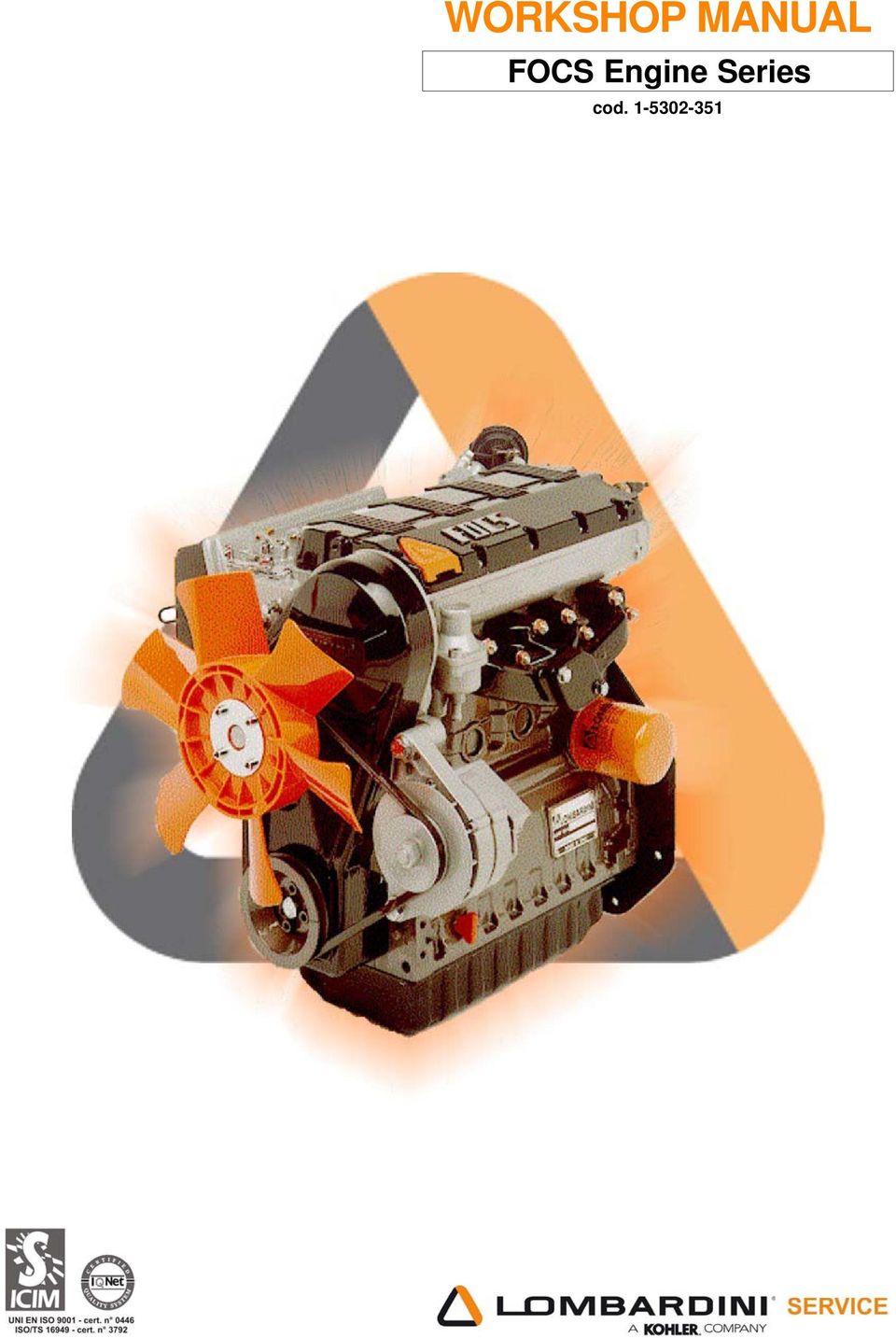
1 WORKSHOP MANUAL FOCS Engine Series cod
2

3 FOCS Engine Series PREFACE - Every attempt has been made to present within this service manual, accurate and up to date technical information. However, development on the LOMBARDINI series is continuous. Therefore, the information within this manual is subject to change without notice and without obligation. - The information contained within this service manual is the sole property of LOMBARDINI. As such, no reproduction or replication in whole or part is allowed without the express written permission of LOMBARDINI. Information presented within this manual assumes the following: 1 - The person or people performing service work on LOMBARDINI series engines is properly trained and equipped to safely and professionally perform the subject operation; 2 - The person or people performing service work on LOMBARDINI series engines possesses adequate hand and LOMBARDINI special tools to safely and professionally perform the subject service operation; 3 - The person or people performing service work on LOMBARDINI series engines has read the pertinent information regarding the subject service operations and fully understands the operation at hand. - This manual was written by the manufacturer to provide technical and operating information to authorised LOMBARDINI after-sales service centres to carry out assembly, disassembly, overhauling, replacement and tuning operations. - As well as employing good operating techniques and observing the right timing for operations, operators must read the information very carefully and comply with it scrupulously. - Time spent reading this information will help to prevent health and safety risks and financial damage. Written information is accompanied by illustrations in order to facilitate your understanding of every step of the operating phases. Manuale officina FOCS_cod _7 ed_ rev

4 - REGISTRATION OF MODIFICATIONS TO THE DOCUMENT Any modifications to this document must be registered by the drafting body, by completing the following table. Drafting body Document code Model N Edition Revision Issue date Review date Endorsed CUSE/ATLO FOCS Workshop Manual_cod _7 ed_ rev. 06

5 CHAPTER INDEX - This manual contains pertinent information regarding the repair of LOMBARDINI water-cooled, indirect injection Diesel engines type LDW /T e LDW : updated March 15 th, CHAPTER INDEX 1 GENERAL REMARKS AND SAFETY INFORMATION... Pag GENERAL SAFETY DURING OPERATING PHASES GENERAL SERVICE MANUAL NOTES... 9 GLOSSARY AND TERMINOLOGY... 9 SAFETY AND ENVIRONMENTAL IMPACT...11 SAFETY AND WARNING DECALS SAFETY REGULATIONS WARRANTY CERTIFICATE TECHNICAL INFORMATION MANUFACTURER AND ENGINE IDENTIFICATION OVERALL DIMENSION PERFORMANCE DIAGRAMS TECHINICAL SPECIFICATIONS TROUBLE SHOOTING MAINTENANCE - RECOMMENDED OIL TYPE - REFILLING ACEA Regualtions - ACEA Sequences API / MIL Sequence COOLANT FUEL SPECIFICATIONS...27 International specifications LUBRICANT PRESCRIBED LUBRICANT ROUTINE ENGINE MAINTENANCE SAE Classification DISASSEMBLY / REASSEMBLY Air filter support Air restriction switch Alternator/Cooling fan belt drive Big end bearing Camshaft journals and housings - Dimensions Camshaft lobe measurement Camshaft timing - Belt Reassembly...37 Camshaft timing - Belt Tightening and Fastening Camshaft timing - Belt tightening tool Camshaft timing pulley - Disassembly/Assembly Camshaft timing pulley - Reference marks Camshaft, disassembly Camshaft, journal and housing measurement Central main bearing caps Check the clearances between the bearings and the journal Clearances between the bearings and corresponding pins...64 CONNECTING ROD Connecting rod alignment Connecting rod with bearings and pin Connecting tod, weight Cooling fan Crankcase breather LDW Crankcase vacuum regulator valve Crankshaft axial clearance Crankshaft front and back oil seal rings...62 FOCS Workshop Manual_cod _7 ed_ rev

6 - Chapter index Crankshaft timing pulley Crankshaft, check journals and crank Crankshaft, lubrication lines Cylinder head assembly Cylinder head tightening procedure LDW /T Cylinder head tightening procedure LDW CYLINDER HEAD, removal Cylinder roughness Cylinder, class...59 CYLINDERS Driving pulley...34 Dry type air filter E.G.R. Circuit Exhaust maniflod...32 Flywheel Fuel rail Fuel tank (optional) Governor springs...40 Governor springs for Gensets Head gasket Hydraulic pump drive...65 Injection pump control rod Intake / Exhaust / Injection camshaft lobe height - LDW Intake manifold Remote air filter Journal and connecting rod pins diameters Main bearings and connecting rod big ends diameters...64 Oil bath air cleaner ( on request ) Oil pan, removal Oil pump - disassembly Oil pump - Reassembly PISTON Piston clearance Piston coolant nozzles Piston ring, Clearance between grooves Piston ring, mounting order Piston rings - End gaps Piston, assembly Piston, class Piston, disassembly and inspection Piston, weight...54 Pre-combustion chamber...51 Pre-combustion chamber ring nut removal Pre-combustion chamber, installation Pre-combustion chamber, removal Pump/injector unit - Disassembly Pump/injector unit - non-return valve Rear and forward main bearing caps RECOMMENDATIONS FOR DISASSEMBLING AND ASSEMBLING RECOMMENDATIONS FOR OVERHAULS AND TUNING...28 Return pulley Ringfeder-type rings on LDW /T Ringfeder-type rings on LDW /T Assembly Rocker arm assembly...45 Rocker arm cover...42 Rocker arm cover gasket...43 Rocker arm pivot, dismounting and remounting Shoulder half rings Shoulder half rings, oversized elements...62 Speed governor Speed governor - Limiting speed governor Speed governor - Reassembly Speed governor components...40 Stop pin rings, dismounting and remounting Third drive, components Tightening pulley Timing belt / Timing pulley arrangement Timing belt cover FOCS Workshop Manual_cod _7 ed_ rev. 06

7 Chapter index - Timing belt removal Vacuum pump and vacuum pump flange Valve / Rocker arm clearance Valve guide insertion...49 Valve guides and valve guide housings Valve recess and seat sealing width...50 Valve seats and housings - Dimensions...50 Valve springs Valve stem sealing rings - Reassembly Valve timing - Angles...39 Valve timing check Valve, specifications Valves TURBOCHARGER TURBO CHARGER Turbocharger components Turbocharger pressure testing Turbocharger west gate adjustment - Regolazione corsa asta comando valvola " Waste gate " LUBRIFICATION CIRCUIT Internal oil filter and oil sump return pipe LUBRIFICATION CIRCUIT Oil filter cartridge...70 Oil pressure check Oil pressure regulating valve...70 Oil pump Oil pump, clearance between rotors COOLANT CIRCUIT COOLANT CIRCUIT Coolant circulation pump, components Radiator and compensation, check and seal tank cap Thermostatic valve FUEL SYSTEM Closing the oilhole Fuel feeding / injection circuit Fuel filter detached from the tank (on request) Fuel lift pump...74 Fuel pump drive rod projection Injection advance control and regulation Injection advance for currently used pump/injector unit Injection advance references on timing belt protector Injection pump assembly/disassembly Injection pumps delivery balancing Injector, nozzle projection Injector, setting (old type) Injector, spark arrester Instrument connection Plunger barrel ring nut assembly/disassembly Plunger injection pump reassembly Preliminary steps to pump/injector unit delivery balancing test Pump/injector unit Pump/injector unit se.no control data Pump/injector unit, components...75 Pumping element...77 Pumping element (old-type injection pump)...77 FOCS Workshop Manual_cod _7 ed_ rev

8 - Chapter index Setting of injector according to current pump/injector unit Static injection advance regulation Static injection advance tuning TDC (Top Dead Center) references Test head B assembly Tester and special coupling for injection advance control (Old-type injection pump) ELECTRIC SYSTEM Alternator battery charger curve 12V 20A Alternator battery charger curve 12V 30A Alternator, Iskra 14V 33A Alternator, Iskra 14V 33A - Performance Curve Alternator, Marelli type AA 125 R 14V 45A Alternator, Marelli type AA 125 R 14V 45A - Performance Curve Coolant high temperature lamp sensor ELECTRIC CONTROL PANEL WITH AUTOMATIC ENGINE STOP Electric starting layout (12V) with flywheel alternator Electric starting layout (12V) with Iskra alternator 14V 33A Electric starting layout (12V) with Marelli type AA 125 R 14V 45A alternator Flywheel Alternator Oil pressure switch Pre-heating glow plug...92 Pre-heating glow plug control unit with coolant temperature sensor STARTER MOTOR - Bosch DW 12V 1,1 KW Starter motor, Bosch 12V 1,6 Kw Starter motor, Bosch DW 12V 1,1 KW - Performance Curve Starter motor, Bosch DW 12V 1,6 KW - Performance Curve Temperature sensor for control unit Voltage regulator connections SETTINGS E.G.R. calibration...97 Injection pump flow limiter and standard engine torque gearing device Pump injection delivery standard setting without dynamometric brake Pump/injector unit delivery setting with braked engine Pump/injector unit timing with speed governor Required settings (as most commonly applies)...96 Setting the idle maximum (standard) Setting the idle minimum (standard)...94 Setting the stop SPEED SETTINGS STORAGE ENGINE STORAGE (NOT INSTALLED) PREPARING THE ENGINE FOR OPERATION AFTER PROTECTIVE TREATMENT PROTECTIVE TREATMENT TORQUE SPECIFICATIONS AND USE OF SEALANT Table of tightening torques for standard screws (coarse thread) Table of tightening torques for standard screws (fine thread) Table of tightening torques for the main components SPECIAL TOOLS FOCS Workshop Manual_cod _7 ed_ rev. 06

9 GENERAL REMARKS AND SAFETY INFORMATION 1 WARRANTY CERTIFICATE - The products manufactured by Lombardini Srl are warranted to be free from conformity defects for a period of 24 months from the date of delivery to the first end user. - For engines fitted to stationary equipment, working at constant load and at constant and/or slightly variable speed within the setting limits, the warranty covers a period up to a limit of 2000 working hours, if the above mentioned period (24 months) is not expired. - If no hour-meter is fitted, 12 working hours per calendar day will be considered. - For what concerns the parts subject to wear and deterioration (injection/feeding system, electrical system, cooling system, sealing parts, non-metallic pipes, belts) warranty covers a maximum limit of 2000 working hours, if the above mentioned period (24 months) is not expired. - For correct maintenance and replacement of these parts, it is necessary to follow the instructions reported in the documentation supplied with each engine. - To ensure the engine warranty is valid, the engine installation, considering the product technical features, must be carried out by qualified personnel only. - The list of the Lombardini authorized dealers is reported in the Service booklet, supplied with each engine. - Special applications involving considerable modifications to the cooling/lubricating system (for ex.: dry oil sump), filtering system, turbo-charged models, will require special written warranty agreements. - Within the above stated periods Lombardini Srl directly or through its authorized network will repair and/or replace free of charge any own part or component that, upon examination by Lombardini or by an authorized Lombardini agent, is found to be defective in conformity, workmanship or materials. - Any other responsibility/obligation for different expenses, damages and direct/indirect losses deriving from the engine use or from both the total or partial impossibility of use, is excluded. - The repair or replacement of any component will not extend or renew the warranty period. Lombardini warranty obligations here above described will be cancelled if: - Lombardini engines are not correctly installed and as a consequence the correct functional parameters are not respected and altered. - Lombardini engines are not used according to the instructions reported in the Use and Maintenance booklet supplied with each engine. - Any seal affixed to the engine by Lombardini has been tampered with or removed. - Spare parts used are not original Lombardini. - Feeding and injection systems are damaged by unauthorized or poor quality fuel types. - Electrical system failure is due to components, connected to this system, which are not supplied or installed by Lombardini. - Engines have been disassembled, repaired or altered by any part other than an authorized Lombardini agent. - Following expiration of the above stated warranty periods and working hours, Lombardini will have no further responsibility for warranty and will consider its here above mentioned obligations for warranty complete. - Any warranty request related to a non-conformity of the product must be addressed to the Lombardini Srl service agents. GENERAL SERVICE MANUAL NOTES 1 - Use only genuine Lombardini repair parts. Failure to use genuine Lombardini parts could result in sub-standard performance and low longevity. 2 - All data presented are in metric format. That is, dimensions are presented in millimeters (mm), torque is presented in Newton-meters (Nm), weight is presented in kilograms (Kg), volume is presented in liters or cubic centimeters (cc) and pressure is presented in barometric units (bar). GLOSSARY AND TERMINOLOGY For clarity, here are the definitions of a number of terms used recurrently in the manual. - Cylinder number one: is the timing belt side piston. - Rotation direction: anticlockwise «viewed from the flywheel side of the engine». FOCS Workshop Manual_cod _7 ed_ rev

10 1 General remarks and safety information SAFETY AND WARNING DECALS - Important remarks and features of the text are highlighted using symbols, which are explained below: Danger Attention This indicates situations of grave danger which, if ignored, may seriously threaten the health and safety of individuals. Caution Warning This indicates that it is necessary to take proper precautions to prevent any risk to the health and safety of individuals and avoid financial damage. Important This indicates particularly important technical information that should not be ignored. SAFETY REGULATIONS LOMBARDINI Engines are built to supply their performances in a safe and long-lasting way. To obtain these results, it is essential for users to comply with the servicing instructions given in the relative manual along with the safety recommendations listed below. The engine has been made according to a machine manufacturer's specifications and all actions required to meet the essential safety and health safeguarding requisites have been taken, as prescribed by the current laws in merit. All uses of the engine beyond those specifically established cannot therefore be considered as conforming to the use defined by LOMBARDINI which thus declines all liability for any accidents deriving from such operations. The following indications are dedicated to the user of the machine in order to reduce or eliminate risks concerning engine operation in particular, along with the relative routine maintenance work. The user must read these instructions carefully and become familiar with the operations described. Failure to do this could lead to serious danger for his personal safety and health and that of any persons who may be in the vicinity of the machine. The engine may only be used or assembled on a machine by technicians who are adequately trained about its operation and the deriving dangers. This condition is also essential when it comes to routine and, above all, extraordinary maintenance operations which, in the latter case, must only be carried out by persons specifically trained by LOMBARDINI and who work in compliance with the existing documentation. Variations to the functional parameters of the engine, adjustments to the fuel flow rate and rotation speed, removal of seals, demounting and refitting of parts not described in the operation and maintenance manual by unauthorized personnel shall relieve LOMBARDINI from all and every liability for deriving accidents or for failure to comply with the laws in merit. On starting, make sure that the engine is as horizontal as possible, unless the machine specifications differ. In the case of manual start-ups, make sure that the relative actions can take place without the risk of hitting walls or dangerous objects, also considering the movements made by the operator. Pull-starting with a free cord (thus excluding self-winding starting only), is not permitted even in an emergency. Make sure that the machine is stable to prevent the risk of overturning. Become familiar with how to adjust the rotation speed and stop the engine. Never start the engine in a closed place or where there is insufficient ventilation. Combustion creates carbon monoxide, an odourless and highly poisonous gas. Lengthy stays in places where the engine freely exhausts this gas can lead to unconsciousness and death. The engine must not operate in places containing inflammable materials, in explosive atmospheres, where there is dust that can easily catch fire unles specific, adequate and clearly indicated precautions have been taken and have been certified for the machine. To prevent fire hazards, always keep the machine at least one meter from buildings or from other machinery. Children and animals must be kept at a due distance from operating machines in order to prevent hazards deriving from their operation. Fuel is inflammable. The tank must only be filled when the engine is off. Thoroughly dry any spilt fuel and move the fuel container away along with any rags soaked in fuel or oil. Make sure that no soundproofing panels made of porous material are soaked in fuel or oil. Make sure that the ground or floor on which the machine is standing has not soaked up any fuel or oil. Fully tighten the tank plug each time after refuelling. Do not fill the tank right to the top but leave an adequate space for the fuel to expand. Fuel vapour is highly toxic. Only refuel outdoors or in a well ventilated place. Do not smoke or use naked flames when refuelling. The engine must be started in compliance with the specific instructions in the operation manual of the engine and/or machine itself. Do not use auxiliary starting aids that were not installed on the original machine (e.g. Startpilot ). Before starting, remove any tools that were used to service the engine and/or machine. Make sure that all guards have been refitted FOCS Workshop Manual_cod _7 ed_ rev. 06

11 General remarks and safety information 1 During operation, the surface of the engine can become dangerously hot. Avoid touching the exhaust system in particular. Before proceeding with any operation on the engine, stop it and allow it to cool. Never carry out any operation whilst the engine is running. The coolant fluid circuit is under pressure. Never carry out any inspections until the engine has cooled and even in this case, only open the radiator plug or expansion chamber with the utmost caution, wearing protective garments and goggles. If there is an electric fan, do not approach the engine whilst it is still hot as the fan could also start operating when the engine is at a standstill. Only clean the coolant system when the engine is at a standstill. When cleaning the oil-cooled air filter, make sure that the old oil is disposed of in the correct way in order to safeguard the environment. The spongy filtering material in oil-cooled air filters must not be soaked in oil. The reservoir of the separator pre-filter must not be filled with oil. The oil must be drained whilst the engine is hot (oil T ~ 80 C). Particular care is required to prevent burns. Do not allow the oil to come into contact with the skin. Pay attention to the temperature of the oil filter when the filter itself is replaced. Only check, top up and change the coolant fluid when the engine is off and cold. Take care to prevent fluids containing nitrites from being mixed with others that do not contain these substances since "Nitrosamine", dangerous for the health, can form. The coolant fluid is polluting and must therefore be disposed of in the correct way to safeguard the environment. During operations that involve access to moving parts of the engine and/or removal of rotating guards, disconnect and insulate the positive wire of the battery to prevent accidental short-circuits and to stop the starter motor from being energized. Only check belt tension when the engine is off. Only use the eyebolts installed by LOMBARDINI to move the engine. These lifting points are not suitable for the entire machine; in this case, the eyebolts installed by the manufacturer should be used. GENERAL SAFETY DURING OPERATING PHASES The procedures contained in this manual have been tested and selected by the manufacturer s technical experts, and hence are to be recognised as authorised operating methods. A number of procedures must be carried out with the aid of equipment and tools that simplify and improve the timing of operations. All tools must be in good working condition so that engine components are not damaged and that operations are carried out properly and safely. It is important to wear the personal safety devices prescribed by work safety laws and also by the standards of this manual. Holes must be lined up methodically and with the aid of suitable equipment. Do not use your fingers to carry out this operation to avoid the risk of amputation. Some phases may require the assistance of more than one operator. If so, it is important to inform and train them regarding the type of activity they will be performing in order to prevent risks to the health and safety of all persons involved. Do not use flammable liquids (petrol, diesel, etc.) to degrease or wash components. Use special products. Use the oils and greases recommended by the manufacturer. Do not mix different brands or combine oils with different characteristics. Discontinue use of the engine if any irregularities arise, particularly in the case of unusual vibrations. Do not tamper with any devices to alter the level of performance guaranteed by the manufacturer. SAFETY AND ENVIRONMENTAL IMPACT Every organisation has a duty to implement procedures to identify, assess and monitor the influence of its own activities (products, services, etc.) on the environment. Procedures for identifying the extent of the impact on the environment must consider the following factors: - Liquid waste - Waste management - Soil contamination - Atmospheric emissions - Use of raw materials and natural resources - Regulations and directives regarding environmental impact In order to minimise the impact on the environment, the manufacturer now provides a number of indications to be followed by all persons handling the engine, for any reason, during its expected lifetime. - All packaging components must be disposed of in accordance with the laws of the country in which disposal is taking place. - Keep the fuel and engine control systems and the exhaust pipes in efficient working order to limit environmental and noise pollution. - When discontinuing use of the engine, select all components according to their chemical characteristics and dispose of them separately. FOCS Workshop Manual_cod _7 ed_ rev

12 2 TECHNICAL INFORMATION TROUBLE SHOOTING THE ENGINE MUST BE STOPPED IMMEDIATELY WHEN: 1) - The engine rpms suddenly increase and decrease; 2) - A sudden and unusual noise is heard; 3) - The colour of the exhaust fumes suddenly darkens; 4) - The oil pressure indicator light turns on while running. TABLE OF LIKELY ANOMALIES AND THEIR SYMPTOMS The following table contains the possible causes of some failures which may occur during operation. Always perform these simple checks before removing or replacing any part. TROUBLE POSSIBLE CAUSE Engine does not start Engine starts but stops No acceleration Non-uniform speed Black smoke White smoke Oil preassure too low Oil level increase Excessive oil consumption Oil and fuel dripping from the exhaust Engine overheats Inadequate performance High noise level Clogged fuel pipes Clogged fuel filter Air or water in the fuel circuit FUEL CIRCUIT Tank cap breather blocked Faulty fuel pump Lack of fuel Glow plug fuse burned Faulty glow plug control relay ELECTRIC SYSTEM MAINTENANCE SETTINGS REPAIRS Flat battery Unclear or mistaken cable connection Faulty starter switch Faulty starting motor Faulty glow plugs Clogged air filter Prolonged operation at idle Incomplete run-in Overloaded engine Excessive valve clearances Absence of valve clearances Incorrect speed governor leverages Speed governor spring broken or disengaged Idle low Worn out or stuck rings Worn out cylinders Worn out valve guides Bad valve seal Bearing shells of bearing cap - piston rod - rocker worn out E.G.R. valve blocked open Governor leverages not running Cylinder head gasket damaged Faulty timing system Supplementary starter spring broken or disengaged FOCS Workshop Manual_cod _7 ed_ rev. 06

13 Technical information 2 TROUBLE POSSIBLE CAUSE Engine does not start Engine starts but stops No acceleration Non-uniform speed Black smoke White smoke Oil preassure too low Oil level increase Excessive oil consumption Oil and fuel dripping from the exhaust Engine overheats Inadequate performance High noise level LUBRICATION CIRCUIT High oil level Low oil level Dirty or blocked pressure regulation valve Worn oil pump Air to the oil suction hose Faulty manometer or pressure switch Oil in sump suction hose blocked Oil in sump drainage pipe blocked Faulty spray nozzles (Turbo engines only) INJECTION Damaged injector Damaged injection pump valve Incorrectly calibrated injector Worn or damaged pumping element Incorrect injection pump delivery setting (delivery equalisation) Hardened pump/injector control rod Cracked or broken pre-combustion chamber Incorrect adjustment of the injection systems (delivery equalisation advance) Insufficient refrigerant fluid Defective fan, radiator, or radiator cap Defective thermostatic valve Loss of refrigerant fluid from the radiator, hoses, engine crankshaft or water pump. Inside of radiator or coolant lines obstructed. COOLING CIRCUIT Defective or worn water pump Alternator fan drive belt loose or torn Heat exchange surface of the radiator clogged FOCS Workshop Manual_cod _7 ed_ rev

14 2 Technical information MANUFACTURER AND ENGINE IDENTIFICATION Engine type Engine serial number Maximum operating speed Number of the customer version (form K) FOCS Workshop Manual_cod _7 ed_ rev. 06

15 Technical information 2 EC-directives certification references punched on the engine plate. Name plate for EPA rules applied on rocker-arm cap. FOCS Workshop Manual_cod _7 ed_ rev

16 2 Technical information TECHINICAL SPECIFICATIONS Cylinders Bore Stroke Displacements N mm mm Cm³ Compression rate Rpm N 80/1269/CEE-ISO 1585-DIN Maximum power NB ISO IFN - DIN 6270 NA ISO ICXN - DIN 6270 Maximum torque * Nm RPM Maximum Torque N 3 PTO 3600 Rpm Specific fuel consumption** Oil consumption *** Dry weight of engine Combustion air volume at 3600 Rpm Cooling air volume at 3600 Rpm Axial load allowed on crankshaft (both directions) Instant operation (up to 1 min) Nm g/kwh Kg/h Kg l./1' m³/mm Kg. α Max tilt Intermittent operation (up to 30 min) Permanent operation α α Combustion sequence * At NB power ** Referred to NB power *** Measured at NA power **** Depends on application At 3600 Rpm Measured at NB power ENGINE TYPE LDW ,8: LDW ,8: LDW ,8: LDW ,8: LDW 1204/T ,8: (13.4) 11.8(16.0) 17.2(23.4) 24.2(33.2) 31.0(42.0) 9.1(12.4) 10.3(14.0) 15.6(21.2) 22.0(30.0) 28.5(38.7) 8.2(11.2) 9.2(12.5) 13.7(18.6) 19.9(27.0) 25.8(35.0) / , **** / , **** / , **** / , **** / , **** LDW 502/602 LDW 903 LDW 1204 LDW 1204/T FOCS Workshop Manual_cod _7 ed_ rev. 06

17 Technical information 2 ENGINE TYPE Cylinders Bore Stroke Displacements Compression rate Rpm N 80/1269/CEE-ISO 1585-DIN Maximum power NB ISO IFN - DIN 6270 NA ISO ICXN - DIN 6270 Maximum torque * Maximum Torque N 3 PTO 3600 Rpm Specific fuel consumption** Oil consumption *** Dry weight of engine Combustion air volume at 3600 Rpm Cooling air volume at 3600 Rpm Axial load allowed on crankshaft (both directions) Instant operation (up to 1 min) Max tilt Intermittent operation (up to 30 min) Permanent operation N mm mm Cm³ Nm RPM Nm g/kwh Kg/h Kg l./1' m³/min Kg. α α α LDW LDW ,8:1 22,8: (17.0) 19.5(26.5) 11.7(16) 18(24.5) 10.7(14.5) 16.5(22.4) @ @ ,009 0, **** **** LDW ,8: (35.2) 24.5(33.3) 22.4(30.5) @ , **** * At NB power ** Referred to NB power *** Measured at NA power **** Depends on application At 3600 Rpm Measured at NB power LDW 702 LDW 1404 LDW 1003 FOCS Workshop Manual_cod _7 ed_ rev

18 2 Technical information PERFORMANCE DIAGRAMS LDW 502 LDW 602 LDW 903 N (DIN 70020) Automotive rating, intermittent operation with variable speed and variable load. NB (DIN 6270) Rating with no overload capability, continuous light duty operation with constant speed and variable load. NA (DIN 6270) Continuous rating with overload capability, continuous heavy duty with constant speed and constant load. C (NB) : Specific fuel consumption at NB power Mt : Torque at N. a : Range of application for continuous operation. In case of application outside this range please contact LOMBARDINI. The above power values refer to an engine fitted with air cleaner and standard muffler, after testing and at the environmental conditions of 20 C and 1 bar. Max. power tolerance is 5%. Power decreases by approximately 1% every 100 m di altitude and by 2% every 5 C above 25 C. Note: Consult LOMBARDINI for power, torque curves and specific consumptions at rates differing from those given above. Important Non-approval by Lombardini for any modifications releases the company from any damages incurred by the engine FOCS Workshop Manual_cod _7 ed_ rev. 06

19 Technical information 2 LDW 1204 LDW 1204/T N (DIN 70020) Automotive rating, intermittent operation with variable speed and variable load. NB (DIN 6270) Rating with no overload capability, continuous light duty operation with constant speed and variable load. NA (DIN 6270) Continuous rating with overload capability, continuous heavy duty with constant speed and constant load. C (NB) : Specific fuel consumption at NB power Mt : Torque at N. a : Range of application for continuous operation. In case of application outside this range please contact LOMBARDINI. The above power values refer to an engine fitted with air cleaner and standard muffler, after testing and at the environmental conditions of 20 C and 1 bar. Max. power tolerance is 5%. Power decreases by approximately 1% every 100 m di altitude and by 2% every 5 C above 25 C. Note: Consult LOMBARDINI for power, torque curves and specific consumptions at rates differing from those given above. Important Non-approval by Lombardini for any modifications releases the company from any damages incurred by the engine. FOCS Workshop Manual_cod _7 ed_ rev

20 2 Technical information LDW 702 LDW 1003 LDW 1404 N (DIN 70020) Automotive rating, intermittent operation with variable speed and variable load. NB (DIN 6270) Rating with no overload capability, continuous light duty operation with constant speed and variable load. NA (DIN 6270) Continuous rating with overload capability, continuous heavy duty with constant speed and constant load. C (NB) : Specific fuel consumption at NB power Mt : Torque at N. a : Range of application for continuous operation. In case of application outside this range please contact LOMBARDINI. The above power values refer to an engine fitted with air cleaner and standard muffler, after testing and at the environmental conditions of 20 C and 1 bar. Max. power tolerance is 5%. Power decreases by approximately 1% every 100 m di altitude and by 2% every 5 C above 25 C. Note: Consult LOMBARDINI for power, torque curves and specific consumptions at rates differing from those given above. Important Non-approval by Lombardini for any modifications releases the company from any damages incurred by the engine FOCS Workshop Manual_cod _7 ed_ rev. 06

21 Technical information 2 OVERALL DIMENSION LDW 502 LDW 602 LDW 903 FOCS Workshop Manual_cod _7 ed_ rev
22 2 Technical information LDW 1204 LDW 1204/T LDW FOCS Workshop Manual_cod _7 ed_ rev. 06
23 Technical information 2 LDW 1003 LDW 1003 with EGR circuit, Gear-box and CVT (Continuous Variable Transmission) LDW 1404 FOCS Workshop Manual_cod _7 ed_ rev
24 3 MAINTENANCE - RECOMMENDED OIL TYPE - REFILLING ROUTINE ENGINE MAINTENANCE Important Failure to carry out the operations described in the table may lead to technical damage to the machine and/or system. ORDINARY MAINTENANCE AFTER THE FIRST 50 WORKING HOURS Engine oil replacement. Oil filter replacement. ORDINARY MAINTENANCE OPERATION DESCRIPTION FREQUENCY x HOURS ENGINE OIL LEVEL COOLANT LEVEL AIR FILTER (DRY-TYPE) RADIATOR EXCHANGE SURFACE (***) (**) CHECK VALVE CLEARANCE ADJUSTMENT FAN / ALTERNATOR BELT STRETCH COOLING LIQUID HOSES SETTING AND INJECTORS CLEANING FUEL PIPES RUBBER INTAKE HOSE (AIR FILTER AND INTAKE MANIFOLD) INTERIOR RADIATOR CLEANING ALTERNATOR AND STARTING MOTOR ENGINE OIL OIL FILTER FUEL FILTER ALTERNATOR BELT COOLANT FILTER ELEMENT PANEL AIR FILTER (**) (*) (*) (**) (*) (*) (*) (**) (**) (***) FUEL PIPES REPLACEMENT COOLING LIQUID HOSES RUBBER INTAKE HOSE (AIR FILTER AND INTAKE MANIFOLD) TIMING BELT DRY AIR CLEANER EXTERNAL CARTRIDGE DRY AIR CLEANER INTERNAL CARTRIDGE OVERHAUL PARTIAL TOTAL (**) (**) (**) (**) ( ) (***) (***) EVERY 4000 HOURS AFTER 6 CHECKS WITH CLEANING AFTER 3 CHECKS WITH CLEANING STANDARD OIL SUMP ENHANCED OIL SUMP (*) - In case of low use: every year. (**) - In case of low use: every 2 years. (***) - The period of time that must elapse before cleaning or replacing the filter element depends on the environment in which the engine operates. The air filter must be cleaned and replaced more frequently In very dusty conditions. ( ) - Once removed, the timing belt should be replaced even if its scheduled motion period is not over FOCS Workshop Manual_cod _7 ed_ rev. 06
25 Maintenance - Recommended oil type - Refilling 3 LUBRICANT SAE Classification In the SAE classification, oils differ on the basis of their viscosity, and no other qualitative characteristic is taken into account. The first number refers to the viscosity when the engine is cold (symbol W = winter), while the second considers viscosity with the engine at régime. The criteria for choosing must consider, during winter, the lowest outside temperature to which the engine will be subject and the highest functioning temperature during summer. Single-degree oils are normally used when the running temperature varies scarcely. Multi-degree oil is less sensitive to temperature changes SAE 10W* SAE W* SAE 30* SAE 40* SAE 10W-30** SAE 10W-40** SAE 10W-60** SAE 15W-40 ** SAE 15W-40 ** SAE 20W-60 ** SAE 5W-30 *** SAE 5W-40 *** SAE 0W-30 *** SAE- Grade * Mineral base ** Semi-synthetic base *** Synthetic base International specifications They define testing performances and procedures that the lubricants need to successfully respond to in several engine testing and laboratory analysis so as to be considered qualified and in conformity to the regulations set for each lubrication kind. A.P.I : ( American Petroleum Institute ) MIL : Engine oil U.S. military specifications released for logistic reasons ACEA : European Automobile Manufacturers Association Tables shown on this page are of useful reference when buying a kind of oil. Codes are usually printed-out on the oil container and the understanding of their meaning is useful for comparing different brands and choosing the kind with the right characteristics. Usually a specification showing a following letter or number is preferable to one with a preceding letter or number. An SF oil, for instance, is more performing than a SE oil but less performing than a SG one. ACEA Regualtions - ACEA Sequences PETROL A1 =Low-viscosity, for frictions reduction A2 =Standard A3 =High performances LIGHT DUTY DIESEL ENGINES B1 =Low-viscosity, for frictions reduction B2 =Standard B3 =High performances (indirect injection) B4 =High quality (direct injection) HEAVY DUTY DIESEL ENGINES E1 =OBSOLETE E2 =Standard E3 =Heavy conditions (Euro 1 - Euro 2 engines ) E4 =Heavy conditions (Euro 1 - Euro 2 - Euro 3 engines ) E5 =High performances in heavy conditions (Euro 1 - Euro 2 - Euro 3 engines ) API / MIL Sequences DIESEL PETROL SH API CH-4 CG-4 CF-4 CF-2 CF CE CD CC CB CA SA SB SC SD SE SF SG SJ SL MIL L D / E CURRENT OBSOLETE L B / C / D / E FOCS Workshop Manual_cod _7 ed_ rev
26 3 Maintenance - Recommended oil type - Refilling PRESCRIBED LUBRICANT AGIP SINT W40 specifications API SJ/CF ACEA A3-96 B3-96 MIL - L D/E In the countries where AGIP products are not available, use oil API CF/SH for Diesel engines or oil corresponding to the military specification MIL-L-2104 C/46152 D. CHD ENGINES OIL CAPACITY LDW 502 LDW 602 LDW 702 LDW 903 LDW 1003 LDW 1204 LDW 1404 LDW 1204/T OIL VOLUME AT MAX LEVEL (OIL FILTER INCLUDED) OIL VOLUME AT MAX LEVEL (WITHOUT OIL FILTER) * With dynamic balancer Sheet STD oil sump. ENHANCED aluminium oil sump. Sheet STD oil sump. ENHANCED aluminium oil sump. Litres Litres 1,5 2,5 1,4 2,4 1,6 2,5 1,5 2,4 2,4 3,8 2,3 3,7 3,2 5,2 3,0 5,0 3,2 5,2 3,0 5,1 4,3-4,1 - Important If you are using oil of a quality lower than the prescribed one then you will have to replace it every 125 hours for the standard sump and every 150 hours for the enhanced sump. Danger Attention - The engine may be damaged if operated with insufficient lube oil. It is also dangerous to supply too much lube oil to the engine because a sudden increase in engine rpm could be caused by its combustion. - Use proper lube oil preserve your engine. Good quality or poor quality of the lubricating oil has an affect on engine performance and life. - If inferior oil is used, or if your engine oil is not changed regularly, the risk of piston seizure, piston ring sticking, and accelerated wear of the cylinder liner, bearing and other moving components increases significantly. - Always use oil with the right viscosity for the ambient temperature in which your engine is being operated. Danger Attention - The used engine oil can cause skin-cancer if kept frequently in contact for prolonged periods. - If contact with oil cannot be avoided, wash carefully your hands with water and soap as soon as possible. - Do not disperse the oil in the ambient, as it has a high pollution power FOCS Workshop Manual_cod _7 ed_ rev. 06
27 Maintenance - Recommended oil type - Refilling 3 COOLANT Danger Attention - The fluid coolant circuit is pressurized. Inspections must only be made when the engine has cooled and even in this case, the radiator or expansion chamber plug must be unscrewed with the utmost caution. - If an electric fan is installed, do not approach a hot engine since the fan itself could start up even when the engine is at a standstill. - Coolant fluid is polluting, it must therefore be disposed of in the correct way. Do not litter. The anti-freeze protection liquid (AGIP ANTIFREEZE SPEZIAL) must be used mixed with water, preferably decalcified. The freezing point of the cooling mixture depends on the product concentration in water, it is therefore recommended to use a 50% diluted mixture which guarantees a certain degree of optimal protection. As well as lowering the freezing point, the permanent liquid also raises the boiling point. Coolant refueling ENGINE TYPE LDW 502 LDW LDW LDW LDW 1204/T CAPACITY (Litres) Without radiator 0,75 0,90 1,30 1,75 For information concerning the capacity of Lombardini radiators, please contact Lombardini directly. The total volume for refilling the cooling liquid varies according to the type of engine and radiator. 1,90 FUEL SPECIFICATIONS To achieve optimum performance of the engine, use good quality fuel with certain characteristics: Cetane number (minimum 51):indicates the ignition quality. A fuel with a low cetane number may cause problems when starting from cold and have a negative effect on combustion. Viscosity (2.0/4.5 centistokes at 40 C): this is the resistance to flow and performance may decline if not within the limits. Density (0.835/0.855 Kg/litre): a low density reduces the power of the engine, and density that is too high increases performance and opacity of the exhaust Distillation (85% at 350 ): this is an indication of the mixture of different hydrocarbons in the fuel. A high ratio of light hydrocarbons may have a negative effect on combustion. Sulphur (maximum 0.05% of the weight): high sulphur content may cause engine wear. In those countries where diesel has a high sulphur content, it is advisable to lubricate the engine with a high alkaline oil or alternatively to replace the lubricating oil recommended by the manufacturer more frequently. PRESCRIBED LUBRICANT Fuel with low sulphur content Fuel with high sulphur content API CF4 - CG4 API CF - CD - CE The countries in which diesel normally has a low sulphur content are: Europe, North America and Australia. FUELS FOR LOW TEMPERATURES It is possible to run the engine at temperatures below 0 C using special winter fuels. These fuels reduce the formation of paraffin in diesel at low temperatures. If paraffin forms in the diesel, the fuel filter becomes blocked interrupting the flow of fuel. Fuel can be: - Summer up to 0 C - Winter up to -10 C - Alpine up to -20 C - Arctic up to -30 C For all fuel types, the cetane number cannot be lower than 51. AVIATION KEROSENE AND RME FUELS (BIOFUELS) The only Aviatin fuels that may be used in this engine are: JP5, JP4, JP8 and JET-A if 5% oil is added. For more information on Aviation fuels and Biofuels (RME, RSME) please contact the Lombardini applications department. FOCS Workshop Manual_cod _7 ed_ rev
28 4 DISASSEMBLY / REASSEMBLY RECOMMENDATIONS FOR DISASSEMBLING AND ASSEMBLING Important To locate specific topics, the reader should refer to the index. Besides disassembly and reassembly operations this chapter also includes checking and setting specifications, dimensions, repair and operating instructions. Always use original LOMBARDINI spare parts for proper repair operations. The operator must wash, clean and dry components and assemblies before installing them. The operator must make sure that the contact surfaces are intact, lubricate the coupling parts and protect those that are prone to oxidation. Before any intervention, the operator should lay out all equipment and tools in such a way as to enable him to carry out operations correctly and safely. For safety and convenience, you are advised to place the engine on a special rotating stand for engine overhauls. Before proceeding with operations, make sure that appropriate safety conditions are in place, in order to safeguard the operator and any persons involved. In order to fix assemblies and/or components securely, the operator must tighten the fastening parts in a criss-cross or alternating pattern. Assemblies and/or components with a specific tightening torque must initially be fastened at a level lower than the assigned value, and then subsequently tightened to the final torque. RECOMMENDATIONS FOR OVERHAULS AND TUNING Important To locate specific topics, the reader should refer to the index. Before any intervention, the operator should lay out all equipment and tools in such a way as to enable him to carry out operations correctly and safely. The operator must comply with the specific measures described in order to avoid errors that might cause damage to the engine. Before carrying out any operation, clean the assemblies and/or components thoroughly and eliminate any deposits or residual material. Wash the components with special detergent and do not use steam or hot water. Do not use flammable products (petrol, diesel, etc.) to degrease or wash components. Use special products. Dry all washed surfaces and components thoroughly with a jet of air or special cloths before reassembling them. Apply a layer of lubricant over all surfaces to protect them against oxidation. Check all components for intactness, wear and tear, seizure, cracks and/or faults to be sure that the engine is in good working condition. Some mechanical parts must be replaced en bloc, together with their coupled parts (e.g. valve guide/valve etc.) as specified in the spare parts catalogue. Danger - Attention During repair operations, when using compressed air, wear eye protection FOCS Workshop Manual_cod _7 ed_ rev. 06
29 Disassembly / Reassembly 4 Dry type air filter Danger - Attention Never clean the filtering element with highly flammable solvents Danger of explosion! Important Blow compressed air crossways over the external part and inside the cartridge at a pressure no greater than 5 atm or if necessary knock the front of the cartridge repeatedly against a flat surface. 1 Components: 1 Cover 2 Filter element 3 Support Air filter specifications: Filtration level = µm. Filtration area = 4470 cm² per LDW 502, 602, 903, 702, 1003 Filtration area = 7150 cm² per LDW 1204,1404 See page 24 for periodic maintenance details. Air restriction switch Components: 1 Reset buttione 2.25" Tab connection Note: The indicator is calibrated at mm of water column for LDW 502, 602, 702, 903, 1003, 1204, 1404; and mm of water column for LDW 1204/T. 2 3 Oil bath air cleaner ( on request ) Important Check the sealing rings regularly. Replace the sealing rings if hardening or damage is noted 1 Upper Housing 6 Oil level reference mark 2 Diaphragm Seat 7 Reservoir bowl 3 Diaphragm 8 Outer seal ring 4 Polyurethane upper element 9 Inner seal ring 5 Metal wool lower eleme 4 Note: Carefully clean the reservoir bowl and both elements with clean diesel fuel. Blow the lower element dry with compressed air. Dry the upper element by squeezing out excess diesel fuel, then drying with suitable cloths. Fill the reservoir with clean engine oil to the reference mark. See page 24 for periodic maintenance and replacement details. FOCS Workshop Manual_cod _7 ed_ rev
30 4 Disassembly / Reassembly Air filter support The support for air filter 1 incorporates the intake manifold and the accelerator control box. Remove all bolts that secure the air filter support 1 to the cylinder head. Carefully pull the air filter support from the cylinder head. Using suitable pliers, release the governor spring 2 from the air filter support assembly. Replace the gasket Intake manifold Remote air filter Unscrew the the fastening screws (1) that fix the intake duct to the intake manifold unit. - Unscrew the two fastening screws (2) of the intake manifold from the engine crankcase. - Lift the intake manifold and disengage the hook of the min/max cylinder from the same manifold (fig. 212) E.G.R. Circuit 4 1 Components: Exhaust manifold 2. E.G.R. Pipe 3. E.G.R. Valve 4. Vacuum pump 5. Three way union 6. Vacuum pump pipe 7. Thermovalve vacuum pump connection pipe 8. Vacuum valve thermovalve connection pipe 9. Vacuum valve - E.G.R. connection pipe 10. Thermovalve 11. Vacuum valve 12. ON-OFF sensor control cam 13. Intake duct FOCS Workshop Manual_cod _7 ed_ rev. 06
31 Disassembly / Reassembly 4 E.G.R. Circuit Operation The main function of the E.G.R. (Exhaust Gas Recirculation) system is the reduction in emission of NOx (nitrogen oxides), gases harmful to people and the environment, via lowering the combustion temperature. The system takes a certain quantity of exhaust gas from the exhaust manifold 1 (fig. 8) via the E.G.R. pipe (2) to the E.G.R. valve 3. This valve is opened by the vacuum (created in pipes 6, 7, 8 and 9 by vacuum pump 4; fig. 8) only when: a) thermovalve 10 placed in contact with the engine refrigerant fluid reaches a temperature of 40 C; b) the on-off sensor control cam 12 opens the vacuum valve 11 at a determined accelerator position. Once the E.G.R. valve is opened, the exhaust gas enters the intake manifold 13 via the intake flange. The same logic controls the closure of the E.G.R. valve. Disassembly: Disengage the control rod catch (1) with a screwdriver from the accelerator control rod (2) (fig. 9). - Disconnect the accelerator control rod (2) from the accelerator control lever (3) (fig. 9). - Disconnect the thermovalve vacuum pump connection pipes (7, fig. 8) and vacuum valve thermovalve connection pipe (8, fig. 8) from the thermovalve. - Unscrew the two fastening screws (5) that fix the E.G.R. pipe (6) to the E.G.R. valve (4) (figures 10, 11 and 12). - Remove the intake manifold. See "Intake manifold Remote air filter" on page 30 (Figure 7). - Unscrew the fastening screw of the E.G.R. pipe support bracket (9 fig. 10) from the engine crankcase and disengage the E.G.R. pipe from the exhaust manifold. Reassembly: When reassembling pay attention to the repositioning of the gaskets and to the precise connection of the pipes (6, 7, 8, 9, fig. 8). These pipes should be carefully fitted on the appropriate connections. Tighten the screws to specified torque, see "Table of tightening torques for the main components" on page 100. For the calibration of the E.G.R. system see "E.G.R. calibration" on page FOCS Workshop Manual_cod _7 ed_ rev
32 4 Disassembly / Reassembly Vacuum pump and vacuum pump flange 1 Unscrew the three fastening screws 1 that fix the vacuum pump to the flange and remove the vacuum pump. Unscrew the fastening screws that fix the flange to the engine crankcase and remove it Components: 1. Vacuum pump 2. Clic clamp Vacuum pump flange 4. Vacuum pump gasket- 5. Vacuum pump flange gasket 6. Three-way union for vacuum pump 7. Vacuum pump pipe 8. Screw 9. Screw 14 When reassembling, tighten the screws (8) that fix the flange to the cylinder head to the specified torque of 10 Nm, and the screws (9) that fix the vacuum pump to the flange at the specified torque of 15 Nm. Exhaust maniflod Danger - Attention Let the exhaust manifold cool before dismounting to avoid scalds and burns. When you dismount the exhaust manifold check that the inside is properly clean and free from cracks or breaks. Replace gaskets every time you remove the manifold. Tighten nuts at 25 Nm Exhaust manifold - engines with EGR Remove the E.G.R. pipe (1). Unscrew the locking nuts (2) and remove the exhaust manifold and the seal. Note: When reassembling the exhaust manifold, check that the inside is properly clean and free from cracks or breaks. Note: Replace the gasket each time the manifold is reassembled. Tighten the nuts at the prescribed torque of 25 Nm FOCS Workshop Manual_cod _7 ed_ rev. 06
33 Disassembly / Reassembly 4 Cooling fan Danger - Attention Carry out the cooling fan disassembly, only after isolating the positive battery cable to prevent accidental short-circuiting and, consequently, the activation of the starter motor. Carefully clean and check all blades. Replace the fan even if there is only a single damaged blade. See pages for cooling air flow volume. 17 Alternator/Cooling fan belt drive Danger - Attention Check the belt tension only with the engine off. Tension adjustment. Loosen screws 1 and 2. Adjust the belt tension so that a 100N force at the midpoint of the belt center (as shown) results in a 10-15mm deflection. See page 24 for periodic maintenance details Fuel tank (optional) Danger - Attention To avoid explosions or fire outbreaks, do not smoke or use naked flames during the operations. Fuel vapours are highly toxic. Only carry out the operations outdoors or in a well ventilated place. Keep your face well away from the plug to prevent harmful vapours from being inhaled. Dispose of fuel in the correct way and do not litter as it is highly polluting. 20 After disconnecting the fuel pipes unscrew the anchoring brackets' screws and remove the fuel tank. Completely empty the tank and check that no impurities are found inside. Check that cap breather hole is not clogged. FOCS Workshop Manual_cod _7 ed_ rev
34 4 Disassembly / Reassembly Flywheel Danger - Attention During dismounting be particularly careful not to let the flywheel fall, as this can be very dangerous for the operator. Use protective goggles while removing the starter ring gear. 21 Unscrew the screws that fasten it to the crankshaft. In order to replace the ring gear, it is necessary to disassemble the flywheel. Cut the ring gear in several places using a chisel and remove it. Heat the new ring gear uniformly and keep it at a temperature of 300 C for minutes. Insert the ring gear into its seat and place it carefully on the rim of the flywheel. eave to the ring gear to cool gently before reassembling the flywheel. When refitting tighten the screws at 80 Nm. Return pulley Remove the center bolt 1 and slide the pulley from the engine. Components: 1 Bolt 6 Bearing 2 Washer 7 Spacer 3 Spacer 8 Bearing 4 Pulley 9 Snap Ring 5 Snap Ring Note: On remounting thoroughly clean out the threads of screw 1 and tighten at 25 Nm Driving pulley Important To loosen or screw in screw 1 at the set torque you must always stop the crankshaft and not other parts of the engine. Locking the crankshaft: remove the engine starter and installing the fixture tool Remove the pulley, after having unscrewed central screw 1 and proceed with the four lateral screws. The central bolt 1 is left-handed. 24 When reassembling, apply some Moly-slip antiseizure compound on the screw thread and tighten at 360 Nm. Note: When pulley reference mark (A) aligns with the timing cover reference mark (B), the flywheel side piston is at TDC FOCS Workshop Manual_cod _7 ed_ rev. 06
35 Disassembly / Reassembly 4 Ringfeder-type rings on LDW /T-1404 It is possible to draw ¾ of the power from the second drive of LDW /T-1404 engines. If you want to draw the entire power it is necessary to mount the Ringfeder rings on the crankshaft handle. Components: 1 Puleggia appropriata 6 Ringfeder external ring 2 Screw M6 7 Spacer flange 3 Screw M16 x 1,5 8 Shoulder plate 4 Ringfeder internal ring 9 Crankshaft 5 Screw M8 25 Ringfeder-type rings on LDW /T Assembly Refer to figures 25 and 26. Clean and oil the parts involved in the mounting with engine oil. Insert into pulley 1, the internal ring 4 and the external ring 6, then flange 7 by tightening it temporarily with its screws. Before assembling the pulley 1 in the crankshaft taper, insert shoulder ring 8. Lock the crankshaft using tool Tighten the screws 2 at a torque of 10 Nm. Tighten the screws 3 at a torque of 360 Nm. Tighten the screws 5 uniformly in criss-cross pattern in three distinct phases: 1 phase = 15 Nm 2 phase = 35 Nm 3 phase = torque check. Timing belt cover Loosen the five screws and remove the cover. When rifitting tighten the screws at a torque of 10 Nm. Check the peripheral rubber sealing gasket and the two dustprotection rings of the two pulleys, if mounted. 27 FOCS Workshop Manual_cod _7 ed_ rev
36 4 Disassembly / Reassembly Timing belt / Timing pulley arrangement Components: 1 Camshaft pulley 2 Timing belt 3 Crankshaft pulley 4 Coolant pump pulley 5 Belt tensioner pulley 28 Timing belt removal Important When you remove the distributor belt replace it even if its prescribed operation time has not expired yet. Danger Attention Always check that the positive pole of the battery is insulated. Remove the belt tensioner 1. Remove the timing belt off the timing pulley For assembly see fig. 36. Tightening pulley Components: 1 Nut 2 Washer 3 Pulley 4 Bearing 5 Shaft/Support 6 Mounting plate 7 Tensioning lever Crankshaft timing pulley Al rimontaggio fare attenzione che la chiavetta rimanga inserita nella propria sede. Note: Reference mark 1 on the crankshaft timing pulley and reference mark 2 on the oil pump housing are timing marks. When aligned, No. 1 piston (flywheel side) is at TDC FOCS Workshop Manual_cod _7 ed_ rev. 06
37 Disassembly / Reassembly 4 Camshaft timing pulley - Disassembly/Assembly Unscrew screw 1 and remove the pulley. No extractor is needed. When refitting tighten the screw at a torque of 80 Nm. Note: Assess any wear caused by the lip of the seal ring on the pulley tang. 34 Camshaft timing pulley - Reference marks 1 Timing reference mark on cylinder head. 2 Camshaft pulley timing mark, for LDW 502 engines only 3 Camshaft pulley timing mark, for LDW 602, 702, 903, 1003, 1204, 1204/T and 1404 engines. 35 Camshaft timing - Belt Reassembly Important Remove the distributor toothed belt from its protective wrapping only when mounting it Make the connections for toothed belt fig. 33 and that of pulley fig. 34 fit together. Insert the belt as in figure 35 taking account of the direction of the arrows A impressed on it (direction of rotation). Tighten the nut 1 by hand until the belt tightener rests on surface of the crankcase. Start by mounting the camshaft pulley belt, then mount crankshaft s pulley. Do not mount driven belts. FOCS Workshop Manual_cod _7 ed_ rev
38 4 Disassembly / Reassembly Camshaft timing - Belt tightening tool Position belt preload tool over the timing belt idler adjustment ear 2. See "Camshaft timing - Belt Tightening and Fastening". 38 Camshaft timing - Belt Tightening and Fastening Insert the torque wrench in the suitable tool so that the A axis of the key fig. 39 is at 90 to the B axis of the tool in fig. 38. Tighten in clockwise direction at 20 Nm. Maintaining the belt tension, tighten nut 3 with another torque wrench at 40 Nm, after having remounted the drive pulley. Rotate the crankshaft a few times and check that the tension is as described above. 39 The check must be carried out with the appropriate Nippon Denso tension measuring instrument (halfway along the longest section of the belt), the value for a cold engine must be 15±2Kg. Valve timing check A = Intake valve B = Exhaust valve Rotate the engine in the normal direction of rotation until the No. 1 piston (flywheel side) approaches TDC- compression stroke Check the balance of intake and exhaust valves A and B placing the two micrometers testers on the valve collars FOCS Workshop Manual_cod _7 ed_ rev. 06
39 Disassembly / Reassembly 4 Valve timing - Angles The angle values are determined by turning the driving shaft clockwise. S = Piston at top dead centre I = Piston at bottom dead centre α = Intake valve open β = Intake valve closed γ = Exhaust valve open δ = Exhaust valve closed Timing angles for operating purposes (valve clearance = 0.25 mm) α = 16 before S β = 36 after I γ = 36 before I δ = 16 after S Timing angles for checking puposes (valve clearance = 2 mm) α = 21 after S β = closes in I γ = 2 after I δ = 20 before S 41 Timing angles for operating purposes - LDW 1204/T (valve clearance = 0.25 mm) α = 10 before S β = 42 after I γ = 56 before I δ = 16 after S Timing angles for checking puposes - LDW 1204/T (valve clearance = 2 mm) α = 31 after S β = 1 after I γ = 11 before I δ = 29 before S FOCS Workshop Manual_cod _7 ed_ rev
40 4 Disassembly / Reassembly SPEED GOVERNOR The weight-type mechanical governor, is driven directly by the camshaft and is housed with the cylinder head. Components: 1 Thrust washer 2 Spool 3 Flyweight assembly Note: In engines with the minimum/maximum (see fig. 49) the weights are lightened by 25% Speed governor components 1 Oil seal 2 Screw 3 Support 4 O-Ring 5 Bearing 6 Retainer 7 Screw 8 Flyweight assembly 9 Spool 10 Thrust washer 44 Governor springs Unscrew the pin that attaches it to the cylinder head. To remove it as shown in the figure it is necessary to dismount the camshaft. It could also be removed from the accelerator box side by unscrewing the torque gearing device. Before reassembling it, check value A (45 to 46 mm) and the parallelism of the two levels B that must not exceed 0.05 mm. Note: There are 5 different types of regulator springs C. These change according to the engine adjustment: standard spring for 3,600 rpm, for 3,000 rpm, for 2,400 to 2,600 rpm, for 1,800 rpm and for 1,500 rpm Governor springs for Gensets In the section view of the leverages the 4 ball bearings A are highlighted. They are mounted on engines for generator sets adjusted at 1,500 1,800 rpm and on other particular applications on request FOCS Workshop Manual_cod _7 ed_ rev. 06
41 Disassembly / Reassembly 4 Speed governor - Limiting speed governor With applications for the automotive sector the regulator spring C fig. 45 is replaced by a device (plunger barrel) that only enables a constant speed at the minimum and maximum rpm rating. Components: 49 1 Nut 2 Idle speed spring 3 Max. speed spring 4 Case 5 Register 6 Spring ring 7 Actuation rod Note: There are six maximum springs in a different colours, to distinguish them from the six respective adjustments. Red color for giri/1' No color giri/1' Black giri/1' Orange giri/1' White giri/1' Green giri/1'. Brown giri/1' Speed governor - Reassembly Caution Warning While reassembling, check the integrity of the components and check that they operate correctly. Bad operation of the speed governor can cause serious damage to the engine and to people being near to it. Remount in reverse order to Fig. 44. When inserting the bearing in the camshaft, do it so that the four blocks enter opened, so that they can receive the hose and close over it. Check the integrity of the sealing rings of the cover. 50 Tighten the three screws at a torque of 10 Nm. Note: With the speed governor mounted the camshaft axial clearance should be zero. FOCS Workshop Manual_cod _7 ed_ rev
42 4 Disassembly / Reassembly Oil pump - disassembly The FOCS oil pump is supplied as an assembly. Lombardini therefore recommends that the oil pump be handled as an assembly from a service standpoint Lombardini does not recommend that the oil pump be disassembled, then reassembled for purposes of installation on the engine except during emergency situations. Rotate the crankshaft until the crankshaft timing pulley keyway is vertical as shown. Remove the oil pump assembly retaining bolts. When the crankshaft timing pulley keyway is vertical, the oil pump drive keyway (A) will be at 3:00 o clock allowing removal of the oil pump assembly via relief (B). 51 Oil pump - Reassembly The pump rotors should be coupled on the same side, see references 2 and 3. Replace the O-ring 1. Tighten the fastening screws to the crankcase at 25 Nm and those of the plate at 10 Nm. See page 69 for technical details. 52 Rocker arm cover The engine control components are all on the cylinder head. The cover contains part of the lubrication duct of the camshaft and of the rocker arms, as well as part of the engine vent system. Components: 1 Oil preassure switch 2 Camshaft lubrification port 3 Rocker arm lubrification port 4 Oil exhaust hose from sump vent system 5 Air valve with oil decanting wire gauze Note: During remounting be careful with oil exhaust hose 4 that needs to be properly inserted into its housing on the cylinder head FOCS Workshop Manual_cod _7 ed_ rev. 06
43 Disassembly / Reassembly 4 Rocker arm cover gasket The rocker arm cover gasket A ensures the seal of the lubrication circuit for the camshaft and rocker arm shaft. Always replace it and mount it with especial care above all in zones 1 and 2 where, for greater safety, it is advisable to apply a few drops of silicon sealant. Tighten the rocker arm cover screws at a torque of 9 Nm. 55 Crankcase vacuum regulator valve Components: Gland Nut 2 Bushing 3 Body 4 Diaphragm 5 Cap / Cover 6 Clip / Lock 7 O-Ring 8 Washer 9 O-Ring 10 Valve 11 Spring 12 Tube 13 Hose The vacuum relief valve is an engine safety device. Its function is that of limiting the vacuum whenever it tends to increase. Without this, should the air filter be clogged, the oil contained in the carter may be sucked back into intake manifold causing the condition for engine runaway. 58 FOCS Workshop Manual_cod _7 ed_ rev
44 4 Disassembly / Reassembly Crankcase breather LDW 502 For LDW /T-1404 engines, the exhaust gases exit from the cylinder head cover, see Fig. 53, 54. In the LDW 502 engine the exhaust gases exit directly from the crankcase via cover 1. Remove the cover, check the integrity of the air valve and oil decanting wire gauze. 59 Valve / Rocker arm clearance Important Setting should be performed when the engine is cold. Bring each cylinder piston to top dead center on the compression stroke and set clearance A at 0,20 mm for both the intake and exhaust valves. For greater convenience, clearance check B is accepted. In this case the value is 0.15 mm Injection pump control rod Depending on the engine model, the injection pump control rod will link two, three, or four injectors to the engine governor. Screws 1 and 2 are pivoted on the delivery control lever of each pump/injector B, unscrew the screws and remove spring 3. When refitting tighten the screws 1 and 2 at a torque of 1,1 Nm and make sure that they stop on lever B of each pump/injector and not on rod A To carry out the delivery equalisation of the injection pumps see page 83. To carry out the timing of the injection pumps and speed governor see page 95 Fuel rail When removing the fuel feeding pumps A, with the rail holders B, pay attention that the sealing O-rings C remain in their seats. When refitting tighten the rail holder screws at a torque of 4 Nm FOCS Workshop Manual_cod _7 ed_ rev. 06
45 Disassembly / Reassembly 4 Pump/injector unit - non-return valve Non-return valve A immediately stops the engine whenever the stop is activated. Dimensions (mm): LDW B D E 1,0 1,85 5,25 6, 0 7,0 7, 1 LDW 1204/T B D E ,5 1,15 5,95 6, 5 7,0 7, 1 Note: If the value of B is not achieved, the two rings C are not subject to enough compression to ensure the seal; any fuel loss would contaminate the lubrication oil and consequently damage the engine, F = metal gasket. Pump/injector unit - Disassembly When the removal (but not replacement) of a unit injector is required the following procedure may be used to avoid the need for other adjustments: Rotate the engine until the unit injector cam lobe 2 forces the cam follower 1 to the highest position, then insert a suitable sized (hardened) pin into the hole 3 and rotate the engine until the cam follower 1 is at the lowest position. In this way the injection advance regulator 4 remains calibrated. 67 Note: If you dismount more than one pump/injector unit, make sure to reinstall them in the appropriate housing (with relative drive rod 5); before mounting lubricate the drive rod at its two ends with MOLYSLIP, AS COMPOUND 40 type. Rocker arm assembly Remove the nuts attaching the rocker arm assembly to the cylinder head. When refitting tighten the nuts at a torque of 40 Nm. The pin, that is hollow inside to allow lubrication, is closed at its ends by two caps. Note: The rocker arm assembly may be removed without removal of the unit injectors. 68 FOCS Workshop Manual_cod _7 ed_ rev
46 4 Disassembly / Reassembly Rocker arm pivot, dismounting and remounting To remove pivot 1 from the support 2 it's necessary to drill out pin 3 using a 4mm drill bit. On remounting insert a new pin and reinsert it in bearing surface A (0 to 1 mm). Check the rod s state of wear and tear (diam. B) and that of the rocker arm holes (diam. C). Remove the closing caps 4 at the end and carefully clean inside. Dimensions (mm): mm C-B C-B limit value A 0 1,00 B 17,989 18,000 C 18,015 18,030 0,015 0,041 0,090 Camshaft, disassembly Loosen the screws and remove the cover 1. Check gasket ring 2 for integrity. Remove the drive rod from the fuel pump. Gently remove the camshaft, slight rotations may be required to avoid binding the camshaft lobes against the camshaft bearing surface bores. Note: The lift pump drive eccentric 3 is included on the flywheel end of the camshaft and fixed with a screw. In case of replacement tighten the eccentric screw at a torque of 80 Nm Camshaft, journal and housing measurement Use an inside micrometer gauge for housing diameters and an outside micrometer gauge for journal diameters FOCS Workshop Manual_cod _7 ed_ rev. 06
47 Disassembly / Reassembly 4 Camshaft journals and housings - Dimensions (mm) A B A-B A-B limit value 37,035 37,060 36,975 37,000 0,035 0,085 0,170 Note: The camshaft journal and cylinder head camshaft bore dimensions are identical for all LDW-FOCS series engines (LDW /T-1404). 75 Camshaft lobe measurement Use an outside micrometer gauge. 76 Intake / Exhaust / Injection camshaft lobe height - LDW 903 A1 = 1st cylinder intake camshaft lobe A2 = 2nd cylinder intake camshaft lobe A3 = 3rd cylinder intake camshaft lobe I1 = 1st cylinder injection camshaft lobe I2 = 2nd cylinder injection camshaft lobe I3 = 3rd cylinder injection camshaft lobe S1 = 1st cylinder exhaust camshaft lobe S2 = 1st cylinder exhaust camshaft lobe S3 = 1st cylinder exhaust camshaft lobe 77 H = 29,598 29,650 mm (intake/exhaust camshaft lobe height) H1 = 28,948 29,000 mm (injection camshaft lobe height) For 1204/T : H (intake) = 29,438 29,490 mm, H (exhaust) = 29,778 29,830 mm. All engines in the series (except LDW 1204/T) have intake exhaust and injection cams with the same height of H and H1. If wears on the cams exceeds by 0.1 mm the minimum value given H and H1, replace the crankshaft. FOCS Workshop Manual_cod _7 ed_ rev
48 4 Disassembly / Reassembly CYLINDER HEAD, removal Important Do not remove the cylinder head when hot to avoid deformation. lf cylinder head is deformed by more than 0.10 mm, level it off by removing a maximum of 0.20 mm. For the cylinder head tightening procedure see page Valves To remove the valves it is necessary to remove the collets; place a spacer under the valve head, press strongly on the spring cap as shown in the picture. Components: 1 Valve stem 2 Valve stem seal ring 3 Spring seat 4 Spring 5 Spring cap 6 Collets Valve stem sealing rings - Reassembly To prevent deformation of the sealing ring 1 as it is inserted onto the valve guide, insert it onto tool " " 2 (after lubricating the sealing ring) and proceed as shown int the picture ensuring that gasket 1 is completely fitted Valve springs Measure free height with a gauge. Free height A = 46 mm. Note: If the free height A is less than 43,5 mm replace the spring FOCS Workshop Manual_cod _7 ed_ rev. 06
49 Disassembly / Reassembly 4 Valve, specifications Exhaust valve A Shaft and head are made of 2 different materials. 2 Welded joint 3 Chromium-plated joint 4 Portion made of:... X 45 Cr Si 8 UNI Portion made of:... X 70 Cr Mn NI N 216 UNI /T α 84 D 29,00 30, ' Intake valve B Material: X 45 Cr Si 8 UNI = Chromium-plated joint /T α 1 C 33,00 34, ' 60 45' Valve guides and valve guide housings Both intake and exhasut valve guides are identical dimensionally and are made from phosphoric gray iron with a pearlitic matrix: Dimensions (mm): A B C D E 36,4 36,6 11,045 11, ,000 11,01 8 5,80 6,20 9,75 9,85 85 Note: Valve guides are supplied in finished form, further machining is prohibited. Valve guides with outside diameter B increased by 0.5 mm. are available. Valve guide insertion Fit the guides with a punch taking account of value A in relation to the cylinder head surface. Dimensions (mm): A B C 39,5 40,0 7,005 7,020 6,960 6,990 Clearance (mm): 86 (B-C) = 0,015 0,050 (B- C) limite usura = 0,10 FOCS Workshop Manual_cod _7 ed_ rev
50 4 Disassembly / Reassembly Valve seats and housings - Dimensions LDW mm A 34,020 34, /T α α1 B 34,106 34,115 C 30,020 30, ' ' D 30,108 30,116 LDW mm A 35,220 35, α α1 B 35,306 35,315 C 31,220 31, ' ' 60 D 31,308 31,316 Press valve seats into the housings Note: Valve seatsare supplied in finished form, further machining is prohibited. Valve recess and seat sealing width Dimensions (mm): LDW /T mm D 0,5 0, 8 1, 1 S 1,6 1, 7 2, 0 LDW mm D 0,7 1, 0 1, 3 S 1, 6 2, 0 Grind valve seats with fine emery paste. After grinding check the valve recess D relative to the cylinder head surface and the seat sealing width S FOCS Workshop Manual_cod _7 ed_ rev. 06
51 Disassembly / Reassembly 4 Pre-combustion chamber Components: 1 Pre-combustion chamber 2 Pre-heating glow plug 3 Pre-combustion chamber ring nut 4 Cylinder head The pre-combustion chamber does not normally require removal or service, if service is necessary follow the procedure described below. 90 Pre-combustion chamber ring nut removal The pre-combustion chamber is fixed to the cylinder head by a ring nut, so before removing the pre-combustion chamber it is necessary to unscrew the pre-combustion chamber ring nut. Use the special tool " " 1 to romve the ring nut Pre-combustion chamber, removal Before proceeding with removing the pre-combustion chamber it is necessary to remove the pre-heating glow plug. Screw special tool " " 1 into the pre-combustion chamber. Carefully, but sharply, slide the slide hammer 2 up the special tool shaft until contact is made with end of the tool. The hammer effect of the special tool will extract the pre-combustion chamber 3. Note: There are many types of precombustion chambers for the various engines described as follows. - LDW LDW /T. - LDW Pre-combustion chamber, installation The pre-combustion chamber has a hole on the side where the preheating glow plug 2 must be inserted. When re-fitting introduce the the new pre-combustion chamber into the cylinder head so that the side hole of the pre-combustion chamber aligns with the glow-plug hole. To make sure that both the holes align appropriately use tool " " 1 inserting it into the glow-plug hole. Tighten the ring nut twice: 1st tighten at a torque of 100 Nm, 2nd tighten at a torque of 180 Nm. Chack that clearance A is 3,68 4,1 mm. FOCS Workshop Manual_cod _7 ed_ rev
52 4 Disassembly / Reassembly Oil pan, removal Danger - Attention - The used engine oil can cause skin-cancer if kept frequently in contact for prolonged periods. - If contact with oil cannot be avoided, wash carefully your hands with water and soap as soon as possible. - Do not disperse the oil in the ambient, as it has a high pollution power Remove the fixing screws. Insert a spacer 1 in the forward and rear main bearings. Detach the silicon from the main bearing rubber bulb seals. When re-mounting apply Silicone " Dow Corning 7091" as shown in the picture. Tighten the screws at a torque of 10 Nm. Before starting the engine make sure that: 1) the oil drain plug is tightened correctly 2) the engine has been refilled with the prescribed quantity of oil (see page 26). PISTON Remove the connecting rod big end cap. Remove the piston-connecting rod assembly. Note: The LDW 502 s piston is different from the LDW 602 in terms of its combustion chamber. The LDW 1204/T piston is different from that of the LDW 1204 in term of its cooling nozzle s slot bleed and an insert in the first section s hollow. The Ricardo type of combustion chamber is used for LDW engines Stop pin rings, dismounting and remounting Extract the ring inserting a pointed tool in hollow A. On remounting, insert rings with the points turned downwards inside the corners ( α = 15 ) FOCS Workshop Manual_cod _7 ed_ rev. 06
53 Disassembly / Reassembly 4 Piston, disassembly and inspection Remove the stop rings and remove the pin, see fig Remove the piston rings and clean the slot. Measure diameter Q at height A from the base of skirt (A = 9 mm). If the diameter is worn more than the 0.05 mm minimum given value, replace piston and rings. Note: The provided oversize elements are of 0.50 mm and 1.00 mm 103 Piston, class The pistons are subdivided according to their diameters into categories: A, B, C. These references, are shown on the top of the piston (see fig. 100). LDW /T Class Ø Cylinder - mm Ø Piston - mm Clearance - mm A 71,990 72,000 71,930 71,940 B 72,000 72,010 71,940 71,950 0,050 0,070 C 72,010 72,020 71,950 71,960 LDW Class Ø Cylinder - mm Ø Piston - mm Clearance - mm A 74,990 75,000 74,930 74,940 B 75,000 75,010 74,940 74,950 0,050 0,070 C 75,010 75,020 74,950 74,960 Piston supply: Pistons at the nominal diameter are only supplied in category A. Pistons oversized by 0.50 and 1.00 mm are supplied with reference to the increased level on the piston crown: Ø Ø 73 for LDW /T engines and Ø for LDW engines. FOCS Workshop Manual_cod _7 ed_ rev
54 4 Disassembly / Reassembly Piston, weight Weigh pistons when replacing them in order to avoid unbalance. Important The difference in weight should not exceed 4 g. 104 Piston rings - End gaps (mm) Place piston rings squarely into the unworn part of the lower cylinder and measure the end gap A. Piston ring A limit value 1 0,25 0,45 2 0, ,20 0, Piston ring, Clearance between grooves (mm) A 0,090 0,125 B ,085 C 0,040 0, FOCS Workshop Manual_cod _7 ed_ rev. 06
55 Disassembly / Reassembly 4 Piston ring, mounting order A = 1 ring (internal tapered and torsional) B = 2 ring (internal tapered and torsional) C = 3 Oil control ring D = Chrome-plated area E = Chrome-plated area Note: When there is writing on the surface of a piston ring, mount that surface with face upward. 108 Piston, assembly Important Before re-mounting lubrificate the piston pin, piston, cylinder and conncecting rod big end bearing. Couple the piston to the connecting rod inserting the pin, after lubricating it, just via thumb pressure. Insert the two pin stop rings and check that they are properly housed in their seats, see fig Using piston ring compression pliers, introduce the piston into the cylinder so that combustion chamber A is directly under the precombustion chamber parallel to the head. Couple the piston/connecting rod to the crankshaft. For tightening the head/connecting rod see fig Piston clearance The piston in the TDC (top dead centre) position may extend or be short of the upper surface of the cylinder. Determinare the clearance of each piston using a dial indicator to measure the difference between the two surfaces (piston crown and upper cylinder surface). To determine the piston clearance and, by consequence, which copper gaske is most suitable it is necessary to consider the A value of the piston that projects furthest. 111 FOCS Workshop Manual_cod _7 ed_ rev
56 4 Disassembly / Reassembly Head gasket Important Remove the cylinder head gasket seal from its protective covering only when you are going to mount it. The gasket thickness is identified by the number of notches located in point B. 112 Choose the appropriate gasket considering that each A value on the table corresponds to a gasket with: no hole, one hole, two holes, or for the 1404 one notch, two notches, three notches. The A value relates to figure 111. Each time you dismount the head you must replace the gasket. LDW A (mm) N of holes Piston clearance holes 1 hole holes LDW /T A (mm) N of holes Piston clearance hole 2 holes holes LDW A (mm) N of holes Piston clearance hole 2 holes holes LDW 1404 A (mm) N of notches Piston clearance notch 2 notches notches FOCS Workshop Manual_cod _7 ed_ rev. 06
57 Disassembly / Reassembly 4 Cylinder head assembly Use a torque wrench equipped with a device for angular tightening. Measure the length of each screw (normal length = mm). Replace it if it exceeds 92 mm. Proceed as follows. 113 Cylinder head tightening procedure LDW Important Once the head has been correctly tightened, it should not be retightened except if it is disassembled again. Before mounting it is advisable to lubricate stem, shank and underhead of screws with SPARTAN SAE 460 oil. A = For LDW models B = For LDW models Following the numerical order shown in the diagram, the bolts must be tightened in three phases: st phase = 50 Nm 2 nd phase = Rotate the wrench 90 in a clockwise direction. 3 rd phase = Rotate the wrench again 90 in a clockwise direction. For LDW 502 with pressure cast (aluminium) crankcase: With head H tightening bolts: 1 st phase = 60 Nm With head 8.8 tightening bolts: 1 st phase = 40 Nm 2 nd phase = Eseguire una rotazione della chiave in senso orario di rd phase = Proseguire con una rotazione della chiave in senso orario di 90. Cylinder head tightening procedure LDW /T-1404 Following the numerical order shown in the diagram, the bolts must be tightened in three phases: 1 st phase = 50 Nm 2 nd phase = Rotate the wrench 90 in a clockwise direction. 3 rd phase = Rotate the wrench again 90 in a clockwise direction. 115 FOCS Workshop Manual_cod _7 ed_ rev
58 4 Disassembly / Reassembly CONNECTING ROD Caution Warning While reassembling the big end bearings, we suggest cleaning all parts thoroughly, as well as proper greasing in order to avoid risks of seizure at the first start. Big end bearing 116 After connecting rod from crankshaft disconnection, check the following. While reassembling, be sure the two centring notches A an B are on the same side. Tighten the connecting rod big end cap screws simultaneously at a torque of 40 Nm. Note: The big end bearing is supplied both at the nominal value and undersized by 0.25 and 0.50 mm. In the LDW 502 engine with light alloy crankcase the connecting rod is aluminium type and not provided with connecting rod big end bearing and small end bush. Connecting tod, weight Weigh connecting rods when replacing them in order to avoid unbalance. Important The difference in weight should not exceed 10 g. The difference in weight of the pre-assembled connecting rod, piston and pin must not exceed 14 g Connecting rod with bearings and pin Dimensions (mm): A = 126,48 126,52 = 106,98 107,02... (for LDW 502) B = 18,015 18,025 = 20,015 20, (for LDW /T-1404) C = 40,021 40, (bearing tightened at 40 Nm) D = 17,996 18,000 = 19,996 20, (for LDW /T-1404) E = 50,900 51,100 = 54,000 55, (for LDW /T-1404) (B-D) = 0,015 0,039 (B-D) limit value = 0, Nota: When driving the small end bearing make sure both oilholes are aligned FOCS Workshop Manual_cod _7 ed_ rev. 06
59 Disassembly / Reassembly 4 Connecting rod alignment Utilizzare un calibro con piano di riscontro o un comparatore come in figura. Controllare l'allineamento degli assi utilizzando lo spinotto del pistone; lo scarto A = 0,015 mm;. limite 0,030 mm. Piccole deformazioni si possono correggere sotto una pressa agendo con sforzi graduali CYLINDERS Reset the dial gauge with a calibrated ring: check the diameter D in points 1, 2 and 3; repeat the same operation rotating the dial gauge by 90 at the same heights. Check any wear in zone X where the piston rings operate and if it is greater than the 0.05 mm max limit given adjust the cylinder to the next increased value. 72,000 mm for LDW /T engines; 75,000 mm for LDW engines Cylinder, class The pistons (A, B, C) locations are shown on the piston crown while those for the cylinders are found on the crankcase in the points shown by the arrows, see picture. Note: For LDW 502 with an aluminium crankcase, the cast iron cylinders can be adjusted normally to increase values by 0.5 and 1.0 mm. The cylinders are not to be changed. 124 Cylinder roughness Caution Warning Do not treat the cylinder s internal surfaces with an emery cloth. The angle of the crossed processing marks must be between 45 and 55. These must be uniform and distinct in both directions. Average roughness must be between 0.5 and 1 µm. The whole surface of the cylinder affected by contact with the piston rings must be rendered with the plateau method. 125 FOCS Workshop Manual_cod _7 ed_ rev
60 4 Disassembly / Reassembly Central main bearing caps The central support caps are marked with locations that can be numbers as in the diagram or dots. The same locations are given on the crankcase. Couple the caps with the same references and on the same side. In any case locate the bearing s two centring notches that are to be found on the same side. Tighten the screws simultaneously at a torque of 60 Nm. 126 Rear and forward main bearing caps Important Before the final tightening, check the coplanarity of the two levels with a ground bar On remounting the rear main bearing cap 1 replace the lateral rubber gaskets 2, keeping in mind that projections A and B of the support must be 0,5 1,0 mm; cut off any exceeding portions. Do the same with the front bearing cap. Before reintroducing the bearings in the crankcase, place between their surfaces two plates C and D mm thick - se.no Tighten the screws at a torque of 60 Nm. Note: It is advisable to apply a few drops of silicon sealant on the surface of the gasket slot 2. Check the clearances between the bearings and the journal Use the Perfect Circle Plastigage type calibrated wire A and put it at the centre of the bearing with a bit of grease. Tighten the screws at a torque of 60 Nm. Find out the clearance value checking the wire s compression with the appropriate graduated scale supplied in the same pack and available on the market. For clearance values between the journals, connecting rod pin and the relevant bearings see page FOCS Workshop Manual_cod _7 ed_ rev. 06
61 Disassembly / Reassembly 4 Piston coolant nozzles Caution Warning The piston has a recess so that during up-down movements and vice versa it cannot come into contact with the nozzle. When remounting the nozzle be careful that it is placed so that when the piston goes past it is in the centre of the recess. They are in the supercharged LDW 1204/T engine and are housed near the main bearings. Components: Washer 2 Nozzle 3 Washer 4 Joint (tighten to 12Nm) 5 Valve (opening pressure = bar) 6 Spring Characteristics (mm): A B C D α 0,80 0, Shoulder half rings So as to keep them in their seats during assembly, put a bit of grease. The half-rings must be assembled with the slots A as in the figure. Thickness of half-rings is equal to mm. They are supplied as spare parts as increased thickness 0.1 and 0.2 mm, see below. 133 Crankshaft axial clearance After tightening the main bearings measure the axial clearance A between the crankshaft flywheel side shoulder and the main bearing half rings. Ref. Clearance Limit value A mm 0,130 0,313 0, 5 B mm 23,05 23,10 23,50 If the clearance is not within the given value check value B. If need be, fit oversized half rings, see below FOCS Workshop Manual_cod _7 ed_ rev
62 4 Disassembly / Reassembly Shoulder half rings, oversized elements Dimensions (mm): C B ** A* Std 22,787 22,920 23,050 23,100 1 a 22,987 23,120 23,250 23,300 2 a 3,087 23,220 23,350 23,400 0,130 0,313 3 a 23,187 23,320 23,450 23, * A of Fig ** B of Fig Grinding B as per relevant table, you can mount the following half rings: 1 st Oversized element Half rings 1 and mm on both sides of the bearing 2 nd Oversized element Half rings 1 and mm on one side of the support and mm on the other side. 3 rd Oversized element Half rings 1 and mm on both sides of the bearing. Crankshaft front and back oil seal rings 138 Caution Warning An ambient temperature below -35 C may damage the rings. The front oil seal ring 1 inserted into the oil pump cover and the back one 2, in the flywheel side flange. If warped, hardened, or cracked, replace them. For the replacement: - Carefully clean the housing - Keep the ring immersed in engine oil for about half an hour. - Drive it into its housing with a buffer exercising a uniform pressure on the whole front surface. Be sure that the two surfaces A and B meet on the same level. - Refill the interior hollow with grease and lubricate the seal lip with thickened oil. Note: Before major engine overhaul, in case of oil leakage in the seal area of rings 3 and 4, you can remedy this by replacing the rings and pushing them about 2 mm deeper with respect to the previous ones. If the rings are black it means zones 3 and 4 of the crankshaft are tempered. In this case it is necessary to remount a ring of the same colour. If the rings are brown it means that zones 3 and 4 of the crankshaft are not tempered. In this case it is necessary to remount brown coloured rings FOCS Workshop Manual_cod _7 ed_ rev. 06
63 Disassembly / Reassembly 4 Crankshaft, lubrication lines Caution Warning During repairs, when compressed air is used it is important to wear protective goggles. A = Crankshaft LDW 502 B = Crankshaft LDW Put the crankshaft in a bath of crude oil. Remove the caps and clean lines 1 and 2 or 3 and 4 with a bit; blow with compressed air. Reposition the new caps in their seating and check the seal. 139 Note: The LDW 502 crankshaft with aluminium crankcase is not interchangeable with the cast iron crankcase, having different counterweights. Crankshaft, check journals and crank Use a micrometer for the outsides Journal and connecting rod pins diameters Dimensions (mm): LDW Ref /T Tolerance Limit value A ( mm) 47,984 48,000 47,900 B ( mm) 39, ,900 LDW Ref. Tolerance Limit value A ( mm) 50,981 51,000 50, B ( mm) 39, ,900 FOCS Workshop Manual_cod _7 ed_ rev
64 4 Disassembly / Reassembly Main bearings and connecting rod big ends diameters Dimensions (mm): LDW Ref /T Tolerance C ( mm) 48,016 47,984 48,055 D ( mm) 40,021 40,050 40,100 LDW Ref. Tolerance C ( mm) 51,023 51,059 51,098 D ( mm) 40,021 40,050 40,100 The dimensions given refer to tightened bearings. For tightening torque see figures 116 e 126. Clearances between the bearings and corresponding pins See figures Dimensions (mm): LDW Ref /T Clearance Limit value C -A ( mm) 0,022 0,074 0,200 D -B ( mm) 0,021 0,066 0, Ref. LDW Clearance Limit value C -A ( mm) 0,023 0,078 0,200 D -B ( mm) 0,021 0,066 0,130 Nota: Both for crankshaft bearings and for connecting rod big end bearings internal diameter are undersized by 0.25 and 0.50 mm FOCS Workshop Manual_cod _7 ed_ rev. 06
65 Disassembly / Reassembly 4 Hydraulic pump drive A = Third drive You can mount a 2P hydraulic pump on the third drive with Bosch flanging, or a 1 PD type one. You can draw 7 KW of power from the third drive corresponding to a 37 Nm torque at 3600 rpm (engine revolutions). Drive ratio, engine revs/pump revs = 1: Third drive, components 1 Splined sleeve 2 Toothed pinion 3 Seal ring 4 Flange for 1 PD hydraulic pump 5 Seal ring Note: Sleeve 1 also includes the fuel pump control cam and is fastened with the same standard cam screw, with a tightening torque of 80 Nm Tighten pinion 2 to the hydraulic pump at 45 Nm 146 FOCS Workshop Manual_cod _7 ed_ rev
66 5 TURBOCHARGER TURBO CHARGER Only the LDW 1204/T is supplied with the turbocharger. The LDW 1204/T is available in two versions: TD C 2.8 for 3600 r/min TD C 2.0 for 3000 r/min. 147 Turbocharger components Waste gate tube 2 Attuatore 3 Collare 4 Corpo turbina 5 Anello seeger 6 Chiocciola compressore 7 Spessore 8 Dado 9 Controdado 10 Albero con turbina 11 Segmento 12 Parafiamma 13 Cuscinetto 14 Seeger 15 Spessore 16 Segmento 17 Deflettore olio 18 Manicotto reggispinta 19 O-ring 20 Cuscinetto reggispinta 21 Anello reggispinta 22 Cuscinetto 23 Anello seeger 24 Anello seeger 25 Supporto cuscinetti Turbocharger pressure testing Install a 0-2bar pressure gauge at position A after removing the existing plug. Start the engine and operate at low idle for five minutes to allow warm-up. Increase the engine speed to 3000 r/min or 3600 r/min (depending on engine specification while applying full Nb load to the engine). See page 10 for the power output curve. 149 The gauge pressure, at full speed, full load, should be bar ( mm Hg). If the pressure setting does not reach specification, adjust the turbocharger waste gate 8 as is defined on page FOCS Workshop Manual_cod _7 ed_ rev. 06
67 Turbocharger 5 Turbocharger west gate adjustment - Regolazione corsa asta comando valvola " Waste gate " 150 Disconnect westgate tube 7 from the turbocharger compressor side. Using a T-joint connect a pressure gauge 4 (scale 0 to 2 bar) and with the compressed air network pipe complete with reducer 5. The network air supply pressure must be from 1.5 to 2 bar. Make a hole B in the pressure gauge pipe of 1.55 mm in diameter. This will help bleeding some air and stabilizing pressure in the pressure gauge. Set up a dial gauge (6) so that the feeler is rested on terminal 2. Via the pressure reducer 5 convey some air to the actuator so as terminal 2 is pushed forwards by A (A=1 mm). The pressure read in the pressure gauge must be mm Hg ( bar). If the pressure is lower than the given value proceed as follows. Unscrew locknut 1. Remove split pin 9 and disconnect rod 8, waste gate control valve. Keeping the rod steady tighten terminal 2 until you reach the calibration pressure. During the rotation of terminal 2, the rod should not undergo any torsion. FOCS Workshop Manual_cod _7 ed_ rev
68 6 LUBRIFICATION CIRCUIT Danger Attention - The engine can be damaged if allowed to operate with insufficient oil. It is also dangerous to add too much oil because its combustion may lead to a sharp increase in the rotation speed. - Use suitable oil in order to protect the engine. Nothing more than lubrication oil can influence the performances and life of an engine. - Use of an inferior quality oil or failure to regularly change the oil will increase the risk of piston seizure, will cause the piston rings to jam and will lead to rapid wear on the cylinder liner, the bearings and all other moving parts. Engine life will also be notably reduced. - The oil viscosity must suit the ambient temperature in which the engine operates. Danger Attention - Old engine oil can cause skin cancer if repeatedly left in contact with the skin and for long periods of time. Wear protective gloves to avoid touching used oil. - If contact with the oil is unavoidable, you are advised to wash your hands with soap and water as soon as possible. Dispose of old oil in the correct way as it is highly polluting. LUBRIFICATION CIRCUIT 151 Components: 1 Pressure gauge 9 Oil filler cap 2 Rocker shaft 10 Camshaft 3 Connecting rod pin 11 Oil pressure regulating valve 4 Oil filter cartridge 12 Oil pump 5 Journal 13 Crankshaft 6 Oil drain plug 14 Oil suction filter 7 Oil dipstick 15 Turbosupercharger with corresponding pipes only fitted in LDW 1204/T models. 8 Bleed FOCS Workshop Manual_cod _7 ed_ rev. 06
69 Lubrification circuit 6 Internal oil filter and oil sump return pipe Clean with petrol the internal oil filter 1 and oil sump return pipe 2, blow also some compressed air. Replace sealing rings 3 and 4. Tighten oil drain plug at a torque of 40 Nm Oil pump The oil pump mounted on LDW engines has a lower delivery rate than that mounted on LDW /T engines. Oil pump delivery test at 1000 revs per minute with an oil temperature of 120 C. Engine Delivery (l/1') Pressure (bar) , /T , 5 3 3,5 154 Delivery test at 3600 rpm with an oil temperature of 120 C. Engine Delivery (l/1') Pressure (bar) , /T , 5 4 4,5 Oil pump, clearance between rotors Measure the clearance A between teeth as in figure; the maximum value is mm. Clearance wear limit should be mm. See page 42 for assembly and disassembly. 155 FOCS Workshop Manual_cod _7 ed_ rev
70 6 Lubrification circuit Oil pressure regulating valve Components: 1 Valve 2 Spring 3 Gasket 4 Screw cap Spring length = mm Blow the valve s seating with compressed air and carefully clean all the components before remounting them. Nota: The valve begins to open at a pressure of bar. 156 Oil filter cartridge Components: 1 Gasket 2 Plate 3 Rubber element 4 Spring 5 Filtering element 6 By-pass valve 7 Spring Characteristics: 157 Maximum operating pressure:... 7 bar Maximum bursting pressure: bar Degree of filtration: µ By-pass valve calibration:... 1,5 1,7 bar Total filtration surface: cm 2 Total filtration surface for LDW 1204 engine: cm 2. Oil pressure check Once remounted fill the engine with oil, fuel and coolant. Remove the pressure switch, fit a union and connect a 10 bar pressure gauge. Start the engine and check how pressure is affected by oil temperature. Nota: With a maximum operating temperature of 120 C at 900 rpm the oil pressure must not be less than 1 bar FOCS Workshop Manual_cod _7 ed_ rev. 06
71 Lubrification circuit 6 FOCS Workshop Manual_cod _7 ed_ rev
72 7 COOLANT CIRCUIT Danger Attention - The coolant circuit is pressurised. Do not check it before the engine has cooled down and, also in that case, open the radiator cap or expansion tank plug with caution. - When there is an electric fan do not approach a hot engine because it could also come on with the engine off. - The liquid coolant is a pollutant and therefore must be disposed of with care according to environmental provisions. COOLANT CIRCUIT 159 Components: 1) Coolant filler plug 6) Circulation pump 2) Compensating tank 7) Fan 3) Thermostatic valve 8) Radiator 4) Cylinder block 9) Heat exchanger with relevant pipes. Only fitted in LDW 1204/T engine. 5) Thermostat for liquid temperature indicator FOCS Workshop Manual_cod _7 ed_ rev. 06
73 Coolant circuit 7 Radiator and compensation, check and seal tank cap. Remove the cap from compensation tank cap and check that the liquid is at the correct level. Replace the cap with a new one provided with hand air pump socket. Compress air at a pressure of 1 bar for about two minutes. Check that there are no drips in the radiator. The tank cap is supplied with a vacuum relief valve 1 and an overpressure valve 2. Overpressure valve opening pressure of 0.7 bar. 160 Coolant circulation pump, components 1 Rotor 2 Front seal gasket 3 Pump casing 4 Exhaust hole 5 Bearing 6 Pulley 7 Shaft Note: The pump for LDW /T-1404 engines is different from the one of the other series (fig. 148) due to the presence of a ring between rotor 1 and gasket Thermostatic valve 1 - Stainless steel or brass casing 2 - Wax bulb 3 - Air relief hole Characteristics: Opening temperature: C Max stroke at: C = 7 mm Liquid recycling: l/h FOCS Workshop Manual_cod _7 ed_ rev
74 8 FUEL SYSTEM Fuel feeding / injection circuit Components: 1 Fuel Tank 2 Fuel filter 3 Fuel feeding tube 4 Fuel lift pump 5 lnjection pump 6 Injector 7 Fuel rail passage rubber joint 8 Injector exhaust pipe 9 Fuel tank cap 10 Solenoid valve Note: The tank complete with filter is supplied on request. 164 Fuel filter detached from the tank (on request) 1 Air relief valve 2 Bearing 3 Cartridge 4 Rubber element 5 Filtering element Cartridge characteristics: Filtering paper:... PF 905 Filtering surface: cm 2 Degree of filtration: µ Maximum operating pressure:... 4 bar 165 See page 24 for periodic maintenance details. Fuel lift pump Components: 1 Fuel lift pump 2 Push rod 3 Seal ring The fuel pump is membrane type. It is driven by camshaft cam via a drive rod. It is equipped with an external manual fuel lever. Characteristics: With the control cam at 1500 rpm the delivery rate is 75 l/hours and the self-adjusting pressure is at 0.55 to 0.65 bar. 166 Fuel pump drive rod projection The protrusion A of drive rod 2 from the cylinder head surface is mm. The check must be carried out with cam 1 idle as in the figure. Block the two fuel pump fastening nuts simultaneously at 24 Nm. Check the length of the drive rod and if it is not the right size, replace it. Drive rod length = mm FOCS Workshop Manual_cod _7 ed_ rev. 06
75 Fuel system 8 Pump/injector unit Designed by LOMBARDINI, the pump/injector is exclusive to FOCS series engines. The injection system includes two, three, four identical pumps/ injector units, each one of which feeds a cylinder. Note: On pumps/injector units of recent construction (for serial numbers and references see the table on page 78) the pump has been modified (see fig. 174). Following to this modification and others like the elimination of cap 20 of fig. 169 the method of checking the static injection advance has changed as well, fig as that of injector setting, fig Pump/injector unit, components 1 Seeger ring A Ring nut 2 Tappet B O-ring 3 Stop plate C Nozzle 4 Plunger D Spacer 5 Spring E Pressure rod 6 Screw F Spring 7 Bearing G Spacer 8 Lever I Casing 9 Ring nut L Control spiral 10 Plunger guide O-ring M Plunger guide 11 Cylinder 12 Delivery valve 13 Gasket 14 Spring 15 Filler 16 Pin When remounting the injector tighten ring nut A at 70 Nm 17 O-ring 18 Non-return valve 19 O-ring 20 Cap screw (old type) 21 Metal gasket (new type) FOCS Workshop Manual_cod _7 ed_ rev
76 8 Fuel system Plunger barrel ring nut assembly/disassembly To disassemble ring nut 9 fig. 169, use the suitable wrench A se.no When refitting tighten it a torque of 34 Nm. 170 Injection pump assembly/disassembly Disassemble the unit following the progressive order of fig Reassemble following the same steps in reverse order. During reassembly, turn the plunger spiral L towards the non-return valve 19, as follows. 171 Plunger injection pump reassembly To be able to insert the plunger in its barrel press with a finger and at the same time slowly rotate lever 8 fig. 171 until guide M of the plunger fig. 172 enters the lever seating. Note: If by mistake the plunger is mounted with the spiral in the wrong direction the pump won t function (there is no danger that the engine runs away) FOCS Workshop Manual_cod _7 ed_ rev. 06
77 Fuel system 8 Pumping element (old-type injection pump) 1 Plunger 2 Upper plunger section 3 Plunger barrel 4 Delay notch 5 Control slot Dimensions (mm): 173 A 5, 5 B 2,00 2,03 C 1,50 1,53 D 10,00 E 9, 6 F 0, 7 Pumping element 1 Plunger 2 Upper plunger section 3 Plunger barrel 4 Delay notch 5 Control slot nominal value inlet hole diameter outlet hole diameter Aluminium crankcase /T INJECTION PUMP A B C D E F Dimensions Pump/injector unit se.no control data. 1 Delivery control lever on stop position. 2 Delivery control lever on maximum delivery position. 175 Rod stroke form max delivery position (mm) Rpm (*) mm 3 /stroke 9, , start position Injector setting pressure: bar * Rpm rating is that of the crankshaft FOCS Workshop Manual_cod _7 ed_ rev
78 8 Fuel system HIGH PREASSURE HOLE REFERENCE NUMBER LOCATING PEG OFFSET HOLES OLD TYPE INJECTOR PUMP INTERMEDIATE INJECTOR PUMP CURRENT PUMP INJECTOR 176 Lombardini injection system is being steadily implemented, seeking the best performance of its engines. For this reason the pump injector body has been modified three times in the course of its evolution. Three different pump injectors are shown in the top figure. Old type injector pump: Intermediate injector pump: Current pump injector: it is characterised by its high pressure hole is characterised by not having the high pressure hole (the hole can be there but it is only used to control the injector and injection advance) and by the locating peg between inlet and outlet holes. it is characterised by its offset inlet and outlet holes. These are also oversized, due to the absence of the high pressure hole. REFERENCE N CODE N ENGINE TYPE INJECTION ADVANCE VALUE SPECIAL TOOLS MINI CAR 1204/T MINI CAR 1204/T < 2999 g/min > 3000 g/min < 2999 g/min g/min > 3600 g/min ADVANCE INJECTOR SETTING T.D.C ADVANCE INJECTOR SETTING T.D.C ADVANCE INJECTOR SETTING T.D.C ADVANCE INJECTOR SETTING T.D.C ADVANCE / INJECTOR SETTING T.D.C ADVANCE / INJECTOR SETTING T.D.C ADVANCE / INJECTOR SETTING T.D.C ADVANCE / INJECTOR SETTING T.D.C FOCS Workshop Manual_cod _7 ed_ rev. 06
79 Fuel system 8 Injector, setting (old type) 177 Connect the injector to a hand pump after removing cap screw 20 fig By means of the tool - se.no check that the setting pressure is bar. Adjust, if necessary, by changing the spacer located under the spring. There are eleven different spare part spacers from 1 to 2 mm. When you replace the spring, the setting should be made at a pressure higher than 10 bar to compensate for adjustments in operation. Check the needle seal by slowly actuating the hand pump for 10 seconds, until you reach abt. 130 bar. If the nozzle drips, replace it. Setting of injector according to current pump/injector unit Remove the non-return valve leaving its metal gasket and fit a cap screw in its place, that is part of tooling Mount then head 1 and coupling 2. Then connect a hand pump as shown in the picture. The pressure setting must be mm bar. 178 Injector, nozzle projection To avoid excessive compression of the spark arrester A, fig. 181, check projection B of the nozzle fig B = mm. If this measure is larger put spacer 2 between ring nut 1 and copper gasket mm thick spacers are available Injector, spark arrester Every time you remove the pump/injector you must replace the spark arrester, the copper gasket, the oil O-ring, as well as the 2 fuel O-rings. Insert the spark arrester in the injector housing with surface A pointing upwards. Tighten simultaneously both nuts that fasten it to the head at 20 Nm. For engines with the injectors fixed with self-locking nuts, tighten the nuts at 23 Nm. 181 See page 24 for periodic maintenance details. FOCS Workshop Manual_cod _7 ed_ rev
80 8 Fuel system Injection advance control and regulation Dismount the rocker arm cover, see page Position the device on the head, in contact with cylinder no Mount the dial gauge on the valve controlled by tool ref Via lever 1 of the tool, open the valve until it comes into contact with the piston. - Then rotate the crankshaft until the TDC is read in the dial gauge. Then reset the hundredths. - Remove the fuel pipes. - Remove the O-ring in contact with the non-return valve and replace it with the appropriate gasket - equipment component part ref Once the check has been completed, remove the gasket and refit the O-ring. Connect tool on pump n 1. This will automatically position the control lever to the maximum delivery. The tool is provided with 3 4 couplings for connection to a tank that must be not lower than 30 cm from the pumps level. Coupling 2 is equipped with a plastic pipe with internal drip collecting wire. - Put cylinder 1 under compression and open the tank tap. Fuel diesel will start to flow out from coupling 2. - Slowly rotate the engine towards TDC 1 until the diesel fuel stops leaking out. - At this point with lever 1 (of fig. 182) move again the valve until it touches the piston and read on the dial gauge how many hundredths are missing from the previously reset value (TDC). - To convert hundredths into degrees, consult the table below. - Repeat the operation on the other cylinders. 183 α LDW 502 (mm) LDW /T (mm) LDW (mm) Injection advance for currently used pump/injector unit Engine Code Reference n Rpm * α > > /T * With aluminuim crankcase FOCS Workshop Manual_cod _7 ed_ rev. 06
81 Fuel system 8 Static injection advance tuning If the injection advance value found does not correspond to the previously described value, adjust the screw E and repeat the test. Rotating screw E by ½ turn will change the injection advance by 5. If turned clockwise, injection is advanced. In the opposite direction, injection is delayed. 184 Injection advance references on timing belt protector The method of checking injection advance is essentially the same as that described in fig. 182 with one difference: instead of using the device se.no with which you measure piston lowering with respect to the Top Dead Centre, you use references A and C on the timing belt protector and reference D located on engine pulley. When D coincides with A the piston has reached its TDC. When D coincides with C the piston is in injection advance position. 185 TDC (Top Dead Center) references D coincides with A = TDC of 1 st cylinder of all series engines, of 4 th cylinder LDW /T-1404, and of 2 nd cylinder LDW 502. E coincides with A = TDC of the 2 nd cylinder LDW F coincides with A = TDC of 2nd cylinder LDW , of 3 rd and 2 nd cylinder LDW /T G coincides with A = TDC of 3 rd cylinder LDW Note: Following the arrow s rotation direction, the combustion order for LDW is D, G, E (1 st - 3 rd - 2 nd cylinder respectively. As to LDW /T-1404 the sequence is D, F, D, F (1 st 3 rd 4 th and 2 nd cylinder). 186 Tester and special coupling for injection advance control (Oldtype injection pump) 1 Special coupling. Serial number: Injection advance tester. Serial number: Remove the cap on the pump/injector casing and in its place screw on coupling 1. On this coupling tighten the tester 2. Note: When reassembling the cap on the pump/injector unit, check its seal. 187 FOCS Workshop Manual_cod _7 ed_ rev
82 8 Fuel system Static injection advance regulation 188 Fill the tank and operate the fuel pump. Set the pump/injector delivery control rod (ref. A fig. 187) at halfstroke. Bring the piston to the top dead centre of compression. Fit a 13 mm hexagon wrench on the injection advance adjusting screw lock nut. By turning the wrench forth and back you prime the injection pump, thus enabling the tester to be drained. With the piston at its TDC, operate lever 2 fig. 188 and bring the drain valve into contact with the piston. Then reset dial gauge. Go back ¼ of a turn moving the crankshaft anticlockwise. Then turn forward again very slowly observing the fuel level inside the tester. As soon as the level changes, then stop. You reached the static injection advance. By actuating lever 2 check piston lowering with respect to the TDC that shall be between 0.89 and 1.24 mm for LDW , and between 0.73 and 1.02 for LDW 502 engine model. The table on page 80 shows both piston lowering expressed in mm, with respect to the TDC, and the corresponding rotation of the crankshaft, expressed in degrees. The static injection advance in degrees α = 11 to 13 refers to all engines for adjustments from 1500 / 3600 rpm. Preliminary steps to pump/injector unit delivery balancing test Closing the oilhole To perform this test you must remove the rocker arms cover and close hole 1 with an M 8x1.25 or M 10x1.5 screw (on latest model engines) not longer than 8 mm. Also remove the copper gasket. If the camshaft and rocker arms are dry, lubricate them with engine oil. Note: If you only want to check the nozzle it is not necessary to balance the deliveries; provided that when you dismount the rod you do not loosen adjusting screws 1 and 2 (fig. 193). 189 Test head B assembly Remove fuel pipe A and mount one test head B in its place per pump/injector. The test heads complete with pipes are supplied together with instrument ref FOCS Workshop Manual_cod _7 ed_ rev. 06
83 Fuel system 8 Instrument connection Place the instrument 1, se.no at least 20 cm above the pump/injector level. Connect pipe A (outlet from every instrument test piece) with pipe A (inlet of every pump/injector) and pipe B (return to the instrument) with pipe B (outlet from the pump/injector). Open tap 2 and 3 of each pipe and fill the instrument with diesel. Start the engine and bring it to 1500 rpm idle running. Close the fuel supply to the engine from the instrument s tank using lever 4 and after 1 minute observe the levels in the test piece. If a level goes down more than the others it is necessary to decrease the delivery of the corresponding pump (see below) and vice versa to increase the delivery if the level increases. 192 Injection pumps delivery balancing In case the balancing error read on the test pieces is greater than 2 cm³/min, then injection pumps deliveries should be adjusted. Plate 4 and rod 3 are blocked by screws 1 and 2. Loosen them. Move plate 4 rightwards with respect to rod 3 if you want to increase delivery. If moved leftwards delivery decreases. Make very small movements with the plate. Tighten screws 1 and 2 at a torque of 1,1 Nm. Note: Each time a pump/injector is replaced it is necessary to balance the deliveries. 193 FOCS Workshop Manual_cod _7 ed_ rev
84 9 ELECTRIC SYSTEM ELECTRIC CONTROL PANEL WITH AUTOMATIC ENGINE STOP (UPON REQUEST) BLACK BLUE ORANGE BLACK PURPLE RED GRAY WHITE GREEN LIGHT BLUE PINK BROWN RED FUEL SOLENOID BLUE BLACK STARTING MOTOR GLOW-PLUGS BATTERY CONNECTION POST EXCITATION TERMINAL YELLOW ALTERNATOR CONNECTOR PUSH-ON CONNECTION COOLANT TEMP. SENDING UNIT AIR FILTER RESTRICTION INDICATOR BLACK LOW FUEL LEVEL SWITCH BLACK COOLANT TEMP.THERMISTOR LOW OIL PRESSURE (FOR GLOW TIMER/ SWITCH RELAY) COOLANT HIGH TEMP. SWITCH AUXILIARY TERMINALS (+) Positive pole under key (6.3) (-) Negative pole - Earth (6.3) Signal for temp. water instrument (4.75) Signal for electric rev. counter (4.75) Oil pressure signal (4.75) Protected socket available (4.75) Protected socket available (4.75) Rear connection Jumper with 6 for alternator protection Control panel auxiliary terminals 2, 4, 5, 6, 7, 10 and 12 are also accessible from the front, under the fuse access door FOCS Workshop Manual_cod _7 ed_ rev. 06
85 Electric System 9 Alternator, Iskra 14V 33A Nominal voltage... 14V Nominal current output... 33A Maximum Rpm giri/1' Maximum peak Rpm giri/1' Voltage regulator AER 1503 Rotation (viewed at puley end): Clockwise Tighten nut 1 at a torque of Nm. 194 Alternator, Iskra 14V 33A - Performance Curve The curve was obtained at room temperature of +25 C with 13 V battery voltage. Note: The rpm shown on the table are referred to the alternator. Engine rpm/alternator rpm ratio, with driving pulley diameter 88 mm = 1: FOCS Workshop Manual_cod _7 ed_ rev
86 9 Electric System Electric starting layout (12V) with Iskra alternator 14V 33A 1 Alternator 2 Starter Motor 3 Battery 4 Glow Plugs 5 Coolant temperature thermistor 6 Glow Plug Controller / Timer 7 Key Switch 8 System Fuse, 30A for LDW ; 50 A for LDW ; 80 A for LDW /T Fuse (Accessory)- 5A 10 Fuel Solenoid Valve 11 Glow Plug Indicator Lamp 12 Coolant High Temperature Lamp 13 Coolant High Temperature Switch 14 Oil Pressure (Low) Lamp 15 Oil Pressure Switch 16 Alternator Charging Lamp 17 Air Filter High Restriction Indicator Lamp 18 Air Filter Restriction Switch 19 Low Fuel Level Lamp 20 Low Fuel Level Switch A B C D Accessory Position Off Position On Position Starting Position Note: Battery 3 not supplied by LOMBARDINI. For assembly we recommend a battery with the following characteristics, see table below. 196 Normal starting conditions Heavy-duty starting conditions (max allowed) Engine type Starter motor class (epicyclic type) Kw Capacity K20 - Ah Rapid discharge intensity (DIN Standards at -18 C) A Capacity K20 - Ah Rapid discharge intensity (DIN Standards at -18 C) A /T 1, , , , , , , , , , FOCS Workshop Manual_cod _7 ed_ rev. 06
87 Electric System 9 Alternator, Marelli type AA 125 R 14V 45A Characteristics: Nominal voltage... = 14V Nominal current output... = 45A Maximum Rpm... = giri/1' Maximum peak Rpm (for 15')... = giri/1' Bearing, Pulley End... = Z Bearing, Voltage Regulator End... = Z/C3 Voltage regulator... = RTT 119 A Rotation (viewed at puley end): Clockwise Note: Use only high temperature grease when servicing bearings 197 Tighten nut 1 at a torque of 60 Nm. Alternator, Marelli type AA 125 R 14V 45A - Performance Curve The curve was obtained at room temperature of +25 C with a costant 13 V battery voltage. P1 I η = Power Output (KW) = Current Output (Amps) = Efficiency Note: The RPM shown is that of the alternator. The value of the rpm axis must be multiplied by Alternator speed is a function of engine speed and the crankshaft pulley diameter. If the engine pulley is 88 mm, then the alternator speed ration is 1.3:1. If the engine pulley is 108 mm, then the alternator speed ratio is 1.6 : FOCS Workshop Manual_cod _7 ed_ rev
88 9 Electric System Electric starting layout (12V) with Marelli type AA 125 R 14V 45A alternator 1 Alternator 2 Starter Motor 3 Battery 4 Glow Plugs 5 Coolant temperature thermistor 6 Glow Plug Controller / Timer 7 Key Switch 8 System Fuse, 30A for LDW ; 50 A for LDW ; 80 A for LDW /T Fuse (Accessory)- 5A 10 Fuel Solenoid Valve 11 Glow Plug Indicator Lamp 12 Coolant High Temperature Lamp 14 Oil Pressure (Low) Lamp 15 Oil Pressure Switch 16 Alternator Charging Lamp 17 Diode 18 Air Filter Restriction Switch 19 Air Filter Restriction Switch 20 Low Fuel Level Lamp 21 Low Fuel Level Switch A B C D Accessory Position Off Position On Position Starting Position Note: Battery 3 not supplied by LOMBARDINI, characteristics see page 89. for battery 199 Flywheel Alternator 12V 20A with three cables at output 12V 30A with two cables at output 1 Flywheel 2 Ring gear 3 Magnet ring (Rotor) 4 Stator FOCS Workshop Manual_cod _7 ed_ rev. 06
89 Electric System 9 Alternator battery charger curve 12V 20A (three cables at output) This curve is obtained at 20 C. The statistical charging output of the flywheel alternator is +10% to - 5% of the values shown. 201 Alternator battery charger curve 12V 30A (two cables at output) This curve is obtained at 20 C. The statistical charging output of the flywheel alternator is +10% to - 5% of the values shown. 202 FOCS Workshop Manual_cod _7 ed_ rev
90 9 Electric System Electric starting layout (12V) with flywheel alternator 1 Alternator 2 Starter Motor 3 Battery 4 Glow Plugs 5 Coolant temperature thermistor 6 Glow Plug Controller / Timer 7 Key Switch 8 System Fuse, 40A 9 Fuse (Accessory)- 5A 10 Fuel Solenoid Valve 11 Glow Plug Indicator Lamp 12 Coolant High Temperature Lamp 13 Coolant High Temperature Switch 14 Oil Pressure (Low) Lamp 15 Oil Pressure Switch 16 Alternator Charging Lamp 17 Voltage regulator 18 Air Filter High Restriction Indicator Lamp 19 Air Filter Restriction Switch 20 Low Fuel Level Lamp 21 Low Fuel Level Switch A B C D Accessory Position Off Position On Position Starting Position Note: Battery 3 not supplied by LOMBARDINI. 203 Voltage regulator connections AETSA SAPRISA NICSA Cable colour DUCATI Conncetion dimensions Width Thickness ~ Yellow G 6,35 0, 8 R Red R 9,50 1, 2 + Red B 9,50 1, 2 LE Green L 4,75 0, Brown C 6,25 0, FOCS Workshop Manual_cod _7 ed_ rev. 06
91 Electric System 9 STARTER MOTOR - Bosch DW 12V 1,1 KW Rotation: Clockwise A = 17,5 19,5 mm (distance from starter mounting flange to ring gear face) Note: Please refer to your local BOSCH distributor for service parts, repair criterion and warranty service. 206 Starter motor, Bosch DW 12V 1,1 KW - Performance Curve The curve was obtained at room temperature of -20 C with a fully charged 66Ah battery. U = Starter Motor Voltag n = Armature r/min I = Absorbed Amperage P = Starter Output Power (KW) M = Starter Output Torque (Nm) 207 Starter motor, Bosch 12V 1,6 Kw Rotation: Clockwise A = 29,50 31,5 mm (distance from starter mounting flange to ring gear face) Note: Please refer to your local BOSCH distributor for service parts, repair criterion and warranty service. 208 FOCS Workshop Manual_cod _7 ed_ rev
92 9 Electric System Starter motor, Bosch DW 12V 1,6 KW - Performance Curve The curve was obtained at room temperature of -20 C with a fully charged 88 Ah battery. U = Starter Motor Voltag n = Armature r/min I = Absorbed Amperage P = Starter Output Power (KW) M = Starter Output Torque (Nm) 209 Pre-heating glow plug Characteristics: Nominal voltage... 12,5V Current absorption... 12A 14A after 5 seconds Sheath surface temperature C after 5 seconds. Components: 1 Sheath 2 Primary Heating Coil 3 Secondary Heating Coil When remounting tighten at a torque of 20 Nm Pre-heating plug control unit with coolant temperature sensor To avoid white smoke immediately following start-up post-heat for about 5 seconds, see table 212 Thermistor input Resistance (ohm) Coolant temp. C Glow-plug heat time (sec.) Pre-heat Heating stop Post-heat For electrical connections see figures FOCS Workshop Manual_cod _7 ed_ rev. 06
93 Electric System 9 Temperature sensor for control unit In engines fitted with the above-mentioned type of control unit, the introduction of the glow plugs depends on a temperature sensor that varies preheating temperature in relation to the coolant temperature. Characteristics: Temperature range C Voltage range V Temperature max C Max. tightening torque Nm Oil pressure switch (Fig. 215) Characteristics: Opening pressure: 0,15 0,45 bar (for gen-sets: 1,4 bar). Tightening torque 25 Nm. Coolant high temperature lamp sensor (Fig. 216) Characteristics: Circuit... single pole Voltage range V Max. Power Absorption... 3 W Closing temperature C Tightening torque 25 Nm. FOCS Workshop Manual_cod _7 ed_ rev
94 10 SETTINGS SPEED SETTINGS Setting the idle minimum (standard) After filling the engine with oil, fuel and coolant, start it and let it warm up for 10 minutes. Turn the screw 1 to adjust the idle speed at 850 to 900 rpm. Tighten then the locknut. Note: If you loosen screw 1 speed decreases. To the opposite direction speed increases. 217 Setting the idle maximum (standard) After setting the idle speed turn screw 2 and regulate the idle maximum at 3800 rpm. Block then the locknut. When the engine reaches its setting power, the maximum rpm will stabilise at 3600 rpm. Note: If you loosen screw 2 speed increases. To the opposite direction speed decreases. 218 Pump injection delivery standard setting without dynamometric brake This adjustment must be performed with the dynamometric braked engine. Without this the regulation is approximate. In this case proceed as follows: - Unlock the maximum flow limiter lock nut. - Fully screw in flow limiter C. - Run the engine to the maximum speed, that is 3800 rpm. - Loosen flow limiter C until the engine revs start to decrease. - Screw flow limiter C by 2.5 turns. - Tighten the lock nut. 219 Note: If the engine under maximum load emits too much smoke unscrew C. Tighten C if at this load there is no smoke and if the engine does not reach its maximum power FOCS Workshop Manual_cod _7 ed_ rev. 06
95 Settings 10 Injection pump flow limiter and engine torque gearing device Flow limiter C has the function of limiting the injection pump s maximum delivery. The same mechanism acts also as a torque gearing device. Indeed, under torque, spring N operating lever L overcomes the resistance of spring M located in the plunger barrel. The stroke H that the torque gearing device allows to be carried out by lever L, will increase the injection pump delivery and the torque will hit its maximum value Important The stroke H varies depending on which engine torque gearing device is fitted on the engine. Setting the stop Remove the rocker arms cover and completely unloosen screw B. Push rod A to the right and keep it in this position; see figure. Tighten screw B until it touches rod A. Release rod A and tighten again screw B by a turn. Tighten the lock nut. 222 Pump/injector unit timing with speed governor - Loosen the screws C of each pump/injector unit. - If it is not connected, connect spring D to rod A (with this operation the speed governor blocks are closed). - Move plates B of each pump/injector unit rightwards; see figure (with this operation the pumps/injector unit are at their maximum delivery). - Tighten screws C at 1.1 Nm. Re-balance the deliveries. Note: Spring D is the start-up fuel supplement spring: with the engine stopped pull rod A to the right by bringing the pump/ injector unit delivery to the maximum value, until the speed governor comes into operation with the engine running 223 FOCS Workshop Manual_cod _7 ed_ rev
96 10 Settings Pump/injector unit delivery setting with braked engine 1) Run the engine to the maximum speed. 2) Screw flow limiter C (see fig. 219). 3) Load the engine up to the power and number of revs required by the application s manufacturer. 4) Check that consumption is within the values allowed for in the settings table (see below). If consumption is not within the given figures, it is necessary to change the balance conditions shown to the brake, altering the load and the speed governor. Redo the consumption check on the stabilised engine. 5) Unscrew limiter C until the engine rpm start to decrease. Lock the limiter using the lock nut. 6) Completely release the brake and check the rpm at which the engine stabilises. The performance of the speed governor must meet the class required by the application s manufacturer. 7) Stop the engine. 8) Recheck the valve clearance with the engine cold. 224 Required settings (as most commonly applies) * Refers to power curve NB, see pages and after run-in. Engine Rpm Power* ( NB curve ) Kw Specific fuel consumption Time (sec) per 100 cm 3 g/kwh , , , , , , , ,22 45, /T , FOCS Workshop Manual_cod _7 ed_ rev. 06
97 Settings 10 E.G.R. calibration Mount a T-branch on vacuum valve - E.G.R. valve connection pipe (1), and connect it to a vacuum pressure gauge with 1 bar bottom scale so as to be able to read the degree of vacuum within the pipe. Note: It is also possible to use a mercury column, 1 metre long, since the maximum suction pressure exerted by the vacuum pump is 720 mmhg. Adjust the position of the accelerator lever via the regulator block, so that the internal adjusting nut (2), is about 5 mm from the end of the thread. 225 Accelerate the engine up to rpm (with valve closed: this means that the value showed on the vacuum pressure gauge or on the mercury column should be 0. In case it is different from zero, adjust the regulator block nuts to move it, in relation to the rod (3), in the direction that goes from the flywheel to the timing. With the brake at a braking curve N=constant, load the engine slowing it down to rpm. Acting on the accelerator look for the E.G.R. valve closing point (pressure of the vacuum pressure gauge or mercury gauge equal to zero). Note: Pay attention to determine the precise closing point: by slightly accelerating the engine the vacuum value in the E.G.R. operation pipe should immediately increase. Measure the engine consumption in order to calculate the mm3/ stroke value. If the calculated value is less than 18.8 mm 3 /stroke, adjust the adjusting nut making it closer to the end of the rod (3) to increase the calibration. When the required value of 18.8 mm 3 /stroke has been reached (and a power of around 7 KW) tighten the adjusting nuts. FOCS Workshop Manual_cod _7 ed_ rev
98 11 STORAGE ENGINE STORAGE (NOT INSTALLED) - If the engine is not to be used for long periods, check the storage environment, the type of packaging and make sure these conditions will allow proper maintenance. If necessary, cover the engine with protective sheeting. - Do not store the engine directly on the ground, in damp environments, in areas exposed to the elements, near sources of danger, including less visible hazards such as high-voltage power lines, etc. Caution - Warning If the engine is not to be used for more than 1 month, it is necessary to apply protective measures that are valid for 6 months (see Protective treatment ). Important If, after the first 6 months, the engine is still not to be used, it is necessary to carry out further measures to extend the protection period (see Protective treatment ). PROTECTIVE TREATMENT 1 - Check that the engine oil and coolant are up to level. 2 - Fill up with fuel containing 10% AGIP RUSTIA NT 3 - Run the engine at minimum idle speed for 15 minutes. 4 - Switch off the engine. 5 - Remove the lubrication oil. 6 - Fill the sump with protective oil: AGIP RUSTIA C. 7 - Start the engine and check for fuel and oil leaks. 8 - Bring the engine to ¾ of the maximum speed for 5-10 minutes. 9 - Switch off the engine Empty the fuel tank completely Spray SAE 10W oil on the exhaust and intake manifolds Close all openings to prevent foreign bodies from entering Thoroughly clean all external parts of the engine using suitable products Treat non-painted parts with protective products (AGIP RUSTIA 100/F) Loosen the alternator/fan belt If necessary, cover the engine with protective sheeting. Caution - Warning In countries in which AGIP products are not available, find an equivalent product. AGIP RUSTIA NT: MIL-L P10, grade 2 AGIP RUSTIA C: MIL-L-644-P9 AGIP RUSTIA 100/F: MIL-C-16173D. Important After a year of engine inactivity, the coolant loses its properties and must be replaced FOCS Workshop Manual_cod _7 ed_ rev. 06
99 Storage 11 PREPARING THE ENGINE FOR OPERATION AFTER PROTECTIVE TREATMENT After a period of inactivity and before installing and running the engine, it is necessary to carry out a few measures in order to ensure that it runs at maximum efficiency. 1 - Remove the protective sheeting. 2 - Eliminate any blockages in the exhaust and intake ducts. 3 - Use a cloth soaked in degreasing product to remove the external protective treatment. 4 - Remove the intake manifold. 5 - Inject lubrication oil (no more than 2 cm 3 ) into the valves and install the intake manifold. 6 - Adjust the alternator/fan belt tension. 7 - Turn the flywheel manually to check the movement of the mechanical parts. 8 - Refill the tank with fresh fuel. 9 - Start the engine and run at ¾ of the maximum speed for 5-10 minutes Switch off the engine Remove the protective oil to replace with engine oil Introduce new oil (see Lubricants ) up to the correct level marked on the dipstick Replace the filters (air, oil, fuel) with original spare parts Empty the cooling circuit completely and pour in the new coolant up to the correct level. Caution - Warning Over time, a number of engine components and lubricants lose their properties, even when the engine is not in use, and so it is important to consider whether they need replacing, based not only on the mileage, but also on age and wear Install the engine and make the necessary connections and unions Make sure that electrical contacts are intact and efficient Check that the engine oil and coolant are up to level Start the engine and keep at minimum speed for a few minutes Check for leaks and, if necessary, find and eliminate the cause Switch off the engine Double check that the engine oil and coolant are up to level. FOCS Workshop Manual_cod _7 ed_ rev
100 12 TORQUE SPECIFICATIONS AND USE OF SEALANT Table of tightening torques for the main components POSITION Injection pump control rod Connecting rod **** Union for the nozzle (LDW 1204/T) Glow-plugs Oil filter cartridge (M 20x1,5 union) Camshaft bearing (M 6 screws) Rocker arm cover Main bearing caps Oil pan Camshaft bearing support screw Glow-plug cable nuts Fuel lift pump nuts Belt tensioner nut External Stop control lever nut Pump/injector unit fixing nut Rocker arm assembly support nut Fuel pump cam Flywheel side oil seal ring flange Pre-combustion chamber ring nut Vacuum pump fixing screws Belt tensioner Crankcase Speed governor lever screw Driving pulley Camshaft timing pulley Oil pressure switch Oil drain plug Cylinder headù Injection pipe Flywheel Riference (figure and page n ) p p p p p p p p p p p p p p p p p p p p p p. 34 Diam. & pitch ( mm ) M 3 spec. 8x1 8x1,25 12x1,25 20X1,5 6 6x1 M 10 M 6 M 6 5x0,8 8x1,5 M 10 8x1,25 M 8 M 10 10x1,25 M 6 30x1,5 10x1, x1,5 6x1 16x1,5 sin. 10x1,25 12x1,5 12x1,5 18 TCEI 4x1,5 10x1,5 Torque ( Nm ) 1, * ** *** 4 80 Sealant Silicon * Tighten the two nuts that fasten each pump/injector unit at the same time. For engines with the injectors fixed with selflocking nuts, tighten the nuts at 23 Nm. ** Tighten these in two phases: the first phase at 100 Nm, the second phase at 180 Nm. See page 51, figures *** See page 57 **** Aluminium connecting rod with 35 Nm tightening torque FOCS Workshop Manual_cod _7 ed_ rev. 06
101 Torque specifications and use of sealant 12 Table of tightening torques for standard screws (coarse thread) Resistance class (R) Quality/ Dimensions Diameter M3 M4 M5 M6 M8 M10 M12 M14 M16 M18 M20 M22 M24 M27 M30 R>400N/mm 2 R>500N/mm 2 R>600N/mm 2 R>800N/mm 2 R>1000N/mm 2 R>1200N/mm 2 Nm 0,5 1,1 2,3 3,8 9, Nm 0,7 1, Nm 0,6 1,4 2,8 4, Nm 0,9 1,8 3,8 6, Nm 1 2,2 4,5 7, Nm 1,4 2, Nm 1,9 4,1 8, Nm 2,3 4, Table of tightening torques for standard screws (fine thread) Resistance class (R) Quality/ Dimensions Diameter M 8x1 M 10x1 M 10x1,25 M 12x1,25 M 12x1,5 M 14x1,5 M 16x1,5 M 18x1,5 M 18x2 M 20x1,5 M 20x2 M 22x1,5 M 24x2 M 27x2 M 30x2 R>400N/mm 2 R>500N/mm 2 R>600N/mm 2 R>800N/mm 2 R>1000N/mm 2 R>1200N/mm 2 Nm Nm Nm Nm Nm Nm Nm Nm FOCS Workshop Manual_cod _7 ed_ rev
102 13 SPECIAL TOOLS SPECIAL TOOLS DESCIPTION Part N. Injection pumps delivery balancing instrument Precombustion chamber extractor Injection pump static injection advance tester(old type) Sheet metal for insertion of main bearings in the crankcase Ring nut wrench for fastening pump/injector pumping element Precombustion chamber wrench Precombustion chamber adjusting rod Coupling for static injection advance control and setting of old-type injection pumps injector Device for mounting valve guide gasket, intake and exhaust side Valve lowering device for injection advance control Timing belt tightening tool Crankshaft clamping tool Tool for injection advance control and setting of injector for pump/injector unit: se.no Tool for injection advance control and setting of injector for pump/injector unit: se.no , , FOCS Workshop Manual_cod _7 ed_ rev. 06
103 Notes - FOCS Workshop Manual_cod _7 ed_ rev
104 Manuale officina FOCS_cod _7 ed_ rev. 06
105
106 FOCS Engine Series cod La Lombardini si riserva il diritto di modificare in qualunque momento i dati contenuti in questa pubblicazione. Lombardini se rèserve le droit de modifier, à n'importe quel moment, les données reportées dans cette publication. Data reported in this issue can be modified at any time by Lombardini. Lombardini vorbehält alle Rechte, diese Angabe jederzeit verändern. La Lombardini se reserva el derecho de modificar sin previo aviso los datos de esta publicación Reggio Emilia Italia - ITALY Via Cav. del Lavoro Adelmo Lombardini, 2 - Cas. Post Tel. (+39) Telex Motlom I Telegr.: Lombarmotor R.E.A Reg. Impr. RE Cod. fiscale e Partita IVA CEE Code IT [email protected] Internet:
Trouble Shooting. Pump
 Trouble Shooting Pump Trouble Possible Cause Remedy Oil leaking in the area of water pump crankshaft Worn crankshaft seal, bad bearing, grooved shaft, or failure of retainer o-ring. Excessive play on crankshaft
Adjustment Data MAZDA - 626-2.0 Comprex D - RF-CX
 Adjustment Data MAZDA - 626-2.0 Comprex D - RF-CX Engine (general) Engine code RF Capacity 1998 (cc) Idle speed 725 ± 25 Valve clearance Valve clearance Cold Inlet 0.25 (mm) Exhaust 0.35 (mm) Compression
Cooling system components, removing and installing
 Engine BHW Cooling system components, removing and installing Page 1 / 24 19-1 Cooling system components, removing and installing Warning! When doing any repair work, especially in the engine compartment,
Diesel: Troubleshooting
 Diesel: Troubleshooting Probable Cause Engine not starting Hard to start engine Runs rough at lower RPM Lack of power Diesel knock / pinking Black White Blue Low compression X X X Low fuel pressure X X
Specifications for Volkswagen Industrial Engine
 Volkswagen 1 industrial engine Specifications for Volkswagen Industrial Engine AFD 1.9 ltr. TDI diesel engine EURO 2 Volkswagen AG, Wolfsburg Volkswagen AG reserves the right to introduce amendments or
Cooling system components, removing and installing
 Volkswagen Touareg 3.2 - Cooling system components, removing and installing Page 1 / 24 19-1 Cooling system components, removing and installing Warning! Hot steam may escape when opening expansion tank.
Cooling system components, removing and installing
 Page 1 of 34 19-1 Cooling system components, removing and installing WARNING! The cooling system is pressurized when the engine is warm. When opening the expansion tank, wear gloves and other appropriate
Chapter 7 Hydraulic System Troubleshooting
 Chapter 7 Hydraulic System Troubleshooting General The following troubleshooting information is provided as a general guide to identify, locate and correct problems that may be experienced with the hydraulic
Volkswagen Jetta, Golf, GTI 1999, 2000 2.8 Liter VR6 2V Engine Mechanical, Engine Code(s): AFP 17 Engine-Lubrication (Page GR-17)
 17 Engine-Lubrication (Page GR-17) Lubrication system components, removing and installing Oil filter housing, disassembling and assembling Oil pan, removing and installing Oil pressure and oil pressure
Volkswagen Golf 5 2004-> VW Rabbit GTI 2006->
 Стр. 1 из 24 Volkswagen Golf 5 2004-> VW Rabbit GTI 2006-> 19-1 Cooling system components Warning! Hot steam may escape when opening expansion tank. Wear protective goggles and protective clothing to prevent
C-Max. Ciscomotors SIMPLIFIED MAINTENANCE MANUAL
 Ciscomotors C-Max SIMPLIFIED MAINTENANCE MANUAL All information in this publication is based on latest specification s product available at the time of approval for printing. CISCOMOTORS reserves the right
Hydraulic control unit series 0086-372-01
 Technical Product Information No. 1290 EN Hydraulic control unit series 0086-372-01 Contents Page About this Technical Product Information (TPI) 2 The ORTLINGHAUS numbering system 2 About the product 3
CDS TROUBLESHOOTING SECTION I. VACUUM. 1.0. Weak vacuum at wand. Gauge reads normal (10hg to 14hg)
 CDS TROUBLESHOOTING SECTION I. VACUUM 1.0. Weak vacuum at wand. Gauge reads normal (10hg to 14hg) 1.1. Clogged hoses or wand tube. Disconnect hoses and carefully check for an obstruction. 1.2. Excessive
Kobelco Extended Warranty Program. www.kobelco-europe.com
 Kobelco Extended Warranty Program www.kobelco-europe.com Kobelco Extended Warranty is a convenient, value added way to give your Kobelco customers added security and peace of mind. Benefits of the Kobelco
4000 Series 4008TAG2A Diesel Engine ElectropaK 947 kwm @ 1500 rpm
 The Perkins 4000 Series family of 6, 8, 12 and 16 cylinder diesel engines was designed in advance of today s uncompromising demands within the power generation industry and includes superior performance
- Service Bulletin - Pistons.
 Normal combustion: is smooth and even from the spark plug through the top of the chamber. 1 2 3 Spark occurs Combustion moves smoothly across chamber Combustion and power completed Pre-Ignition: occurs
912. The engine for construction equipment.
 912. The engine for construction equipment....... 24-82 kw at 1500-2500 min -1 These are the characteristics of the 912: Air-cooled 3-, 4-, 5-, 6-cylinder naturally aspirated in-line-engines. Direct injection.
Volkswagen New Beetle 2.0 Liter 4-cyl General, Engine (Engine Code AEG) 17 Engine-Lubrication system (Page GR-17)
 17 Engine-Lubrication system (Page GR-17) Lubrication system components, removing and installing Oil pan, removing and installing Oil pressure and oil pressure switch, checking Dynamic oil pressure warning
Engine. 204-1890 Strobe light, 110V 204-1891 Strobe light, 220V 204-458 Replacement bulb. 204-1057 Compression gauge. 204-166 Dial indicator
 The Strobe light checks the unit for: Balance of operating machinery RPM of motors, engine pulleys, fans, etc. Observe belt slippage Strobe light will stop action at speeds from 200 to 6000 RPM 204-1890
Cylinder head, removing and replacing
 15-1 Cylinder head, removing and replacing WARNING! Do not re-use any fasteners that are worn or deformed in normal use. Some fasteners are designed to be used only once, and are unreliable and may fail
DLW 8. POWER RATING 1500 rpm/50 Hz 1800 rpm/60 Hz Prime 7.5 kva, 6 kw 9.1 kva, 7.3 kw Standby 8.5 kva, 6.8 kw 10.1 kva, 8.1 kw
 DLW 8 POWER RATING 1500 rpm/50 Hz 1800 rpm/60 Hz Prime 7.5 kva, 6 kw 9.1 kva, 7.3 kw Standby 8.5 kva, 6.8 kw 10.1 kva, 8.1 kw Generator set consisting of engine and alternator mounted on a fabricated steel
System Saver 318 Air Compressor for Mack E-Tech and ASET Engines
 Maintenance Manual 31 System Saver 318 Air Compressor for Mack E-Tech and ASET Engines Revised 08-05 NON-THROUGH DRIVE THROUGH DRIVE Service Notes About This Manual This manual provides service and repair
Cooling system components, removing and installing
 Page 1 of 30 19-1 Cooling system components, removing and installing Notes: When the engine is warm the cooling system is under pressure. If necessary release pressure before commencing repair work. Secure
Rexroth Hydraulic Pump A10VO Series User Manual
 Rexroth Hydraulic Pump A10VO Series User Manual Rexroth Hydraulic pump A10VO Series User Manual Revised 5/1/2009 Page 1 of 12 Functional Purpose This pump is preferred over a fixed displacement (gear)
Cooling system components, servicing
 19-1 Cooling system components, servicing WARNING! The cooling system is pressurized when the engine is warm. When opening the expansion tank, wear gloves and other appropriate protection, cover the cap
COOLING SYSTEM Section Page
 5 COOLING SYSTEM Section Page 5.1 COOLANT PRE-HEATER... 5-3 5.2 COOLANT PUMP NON-EGR ENGINE... 5-7 5.3 COOLANT PUMP EGR ENGINE... 5-13 5.4 FRONT CONNECTOR HOUSING NON-EGR ENGINE... 5-17 5.5 FRONT CONNECTOR
Turbocharger system components, servicing
 21-1 Turbocharger system components, servicing Engine codes: AAZ, 1Z, AHU Observe rules of cleanliness Page 21-10 Turbocharger hoses and lines, connecting Page 21-11 WARNING! Do not re-use any fasteners
Fuel Injection Pump, Rotary (005-014)
 Fuel Injection Pump, Rotary View Related Topic Page 1 of 30 Fuel Injection Pump, Rotary (005-014) Table of Contents Summary General Information Preparatory Steps Remove Front Gear Train Rear Gear Train
Operating Instructions Drill rig DRU160
 Operating Instructions Drill rig DRU160 Index 000 / 001 Original operating instructions 10988825 en / 20.10.2009 Congratulations! With a Hydrostress unit from TYROLIT you have chosen a tried and tested
SunMaxx Solar Filling Station Operating Instructions
 SunMaxx Solar Filling Operating Instructions Content 1. Declaration of conformity... 2 2. Introduction... 2 3. Transportation and unpacking... 4 4. Mounting and commissioning... 5 5. End of operation...
15GAL STEEL OIL DRAIN WITH 110V PUMP
 15GAL STEEL OIL DRAIN WITH 110V PUMP OWNER S MANUAL WARNING: Read carefully and understand all ASSEMBLY AND OPERATION INSTRUCTIONS before operating. Failure to follow the safety rules and other basic safety
Draining and filling cooling system
 Page 1 of 9 Draining and filling cooling system Special tools and workshop equipment required Adapter -V.A.G 1274/8- Pipe -V.A.G 1274/10- Drip tray -V.A.G 1306- or drip tray for workshop hoist -VAS 6208-
Marine Diesel Engine VF4 VF5 VF4.140E VF4.170E VF5.220E VF5.250E. Service Manual
 Marine Diesel Engine VF4 VF5 Service Manual VF4.140E VF4.170E VF5.220E VF5.250E Copyright 2009 Vetus N.V. Schiedam Holland Reproduction of text and illustrations, in whole or in part, is strictly prohibited.
EXPERIMENT NO. 3. Aim: To study the construction and working of 4- stroke petrol / diesel engine.
 EXPERIMENT NO. 3 Aim: To study the construction and working of 4- stroke petrol / diesel engine. Theory: A machine or device which derives heat from the combustion of fuel and converts part of this energy
REMOVAL AND INSTALLATION
 303-01C-1 REMOVAL AND INSTALLATION Engine Body On Special Tool(s) Adapter For 303-D043 303-D043-02 or equivalent Special Tool(s) 303-01C-1 Turbocharger Lifting Bracket 303-1266 Wrench, Fan Clutch Nut 303-214
C18 ACERT Fire Pump Tier 3 448 bkw/600 bhp @ 1750 rpm
 CATERPILLAR ENGINE SPECIFICATIONS I-6, 4-Stroke-Cycle Diesel Bore...145.0 mm (5.71 in) Stroke...183.0 mm (7.2 in) Displacement... 18.1 L (1,104.53 in3) Aspiration...Turbocharged Aftercooled Compression
3516 Industrial Engine
 CAT ENGINE SPECIFICATIONS V-16, 4-Stroke-Cycle Diesel Bore...170.0 mm (6.69 in) Stroke...190.0 mm (7.48 in) Displacement... 69.06 L (4,214.3 in 3 ) Aspiration...Turbocharged / Aftercooled Compression Ratio...13.0:1
3620 W 11th Streetб Houston, TX 77008 Telephone: 713-635-6291 Email: [email protected] Website: www.kellogg-american.com
 Unpackaging & Handling Be sure to carefully inspect the unit before accepting the shipment. If any damage has occurred document it with the trucking company immediately. Contact your Kellogg Distributor
GENERATOR MODEL NO: FG3050 OPERATION & MAINTENANCE INSTRUCTIONS PART NO: 8857705 LS0310
 GENERATOR MODEL NO: FG3050 PART NO: 8857705 OPERATION & MAINTENANCE INSTRUCTIONS LS0310 INTRODUCTION Thank you for purchasing this CLARKE Generator. Before attempting to use this product, please read this
Engine, Drive Train, and Hydraulic Repair Indicator Quick Reference Guide
 Engine, Drive Train, and Hydraulic Repair Indicator Quick Reference Guide Planned Indicators Planned Indicators SM provide the best insight Service Meter Hours CAT Engine Repair Indicators Description
San josé OWNER S MANUAL
 San josé OWNER S MANUAL Assembling & operating manual San josé 30 mbar - PORTABLE GAS BARBECUE 1. 2. 3. Improper installation, adjustment, alteration, service or maintenance can injury or property damage.
PARTS MANUAL EH12-2 ENGINE. Model. PUB-EP5713 Rev. 7/99
 PARTS MANUAL Model EH12-2 ENGINE PUB-EP5713 Rev. 7/99 940 Lively Blvd. Wood Dale, IL 60191 Phone: 630-350-8200 Fax: 630-350-8212 e-mail: [email protected] www.robinamerica.com Copyright 1999 Robin
Oxy-Fuel Gas Welding. Given a functional oxy-fuel gas unit, instruction and demonstration of use, each student will be able to:
 I. Competencies Oxy-Fuel Gas Welding Given a functional oxy-fuel gas unit, instruction and demonstration of use, each student will be able to: A. Identify the major parts of the oxy-fuel gas unit. B. Pass
Installation Instructions for Alarm Module Kit A043F059
 Instruction Sheet 07-2013 Installation Instructions for Alarm Module Kit A043F059 1 Introduction The information contained within is based on information available at the time of going to print. In line
1013 E. The engine for agricultural equipment.
 1013 E. The engine for agricultural equipment.... -186 kw at 2300 rpm These are the characteristics of the 1013 E: Modern water-cooled 4- and 6-cylinder in-line engine Turbocharging with charge air cooling
Air cooled Diesel engines. 2.7-8.8 kw
 Air cooled Diesel engines 2.7-8.8 kw KD15 / 15 LD, the most complete family of single cylinder air cooled engines, comprises 5 models in the power range 2.7 to 8.8 kw. Particularly suited to small agricultur
Hydraulic multidisc Brake H420
 S320gb - rev 02/09 S E R V I C E Hydraulic multidisc Brake H420 A N U A L WARNER ELECTRIC EUROPE Rue Champfleur, B.P. 20095, F- 49182 St Barthélemy d Anjou Cedex Tél. +33 (0)2 41 21 24 24, Fax + 33 (0)2
32:(5#5$7,1* 4833#USP283#+] 4;33#USP293#+] 3ULPH 113 kva, 90 kw 124 kva, 99 kw 6WDQGE\ 114 kva, 91 kw 125 kva, 100 kw
![32:(5#5$7,1* 4833#USP283#+] 4;33#USP293#+] 3ULPH 113 kva, 90 kw 124 kva, 99 kw 6WDQGE\ 114 kva, 91 kw 125 kva, 100 kw](/thumbs/30/14614129.jpg "32:(5#5$7,1* 4833#USP283#+] 4;33#USP293#+] 3ULPH 113 kva, 90 kw 124 kva, 99 kw 6WDQGE\ 114 kva, 91 kw 125 kva, 100 kw") ,1'8675,$/#*(16(7 6HULHV#'9#448 32:(5#5$7,1* 4833#USP283#+] 4;33#USP293#+] 3ULPH 113 kva, 90 kw 124 kva, 99 kw 6WDQGE\ 114 kva, 91 kw 125 kva, 100 kw Generator set consisting of engine and alternator mounted
,1'8675,$/#*(16(7 6HULHV#'9#448 32:(5#5$7,1* 4833#USP283#+] 4;33#USP293#+] 3ULPH 113 kva, 90 kw 124 kva, 99 kw 6WDQGE\ 114 kva, 91 kw 125 kva, 100 kw Generator set consisting of engine and alternator mounted
11. COOLING SYSTEM 11-0 COOLING SYSTEM BET & WIN 50
 11 COOLING SYSTEM SERVICE INFORMATION------------------------------------------------ 11-1 TROUBLESHOOTING----------------------------------------------------- 11-1 RADIATOR ------------------------------------------------------------------
FIXED DISPLACEMENT HYDRAULIC VANE PUMPS BQ SERIES
 BQ FIXED DISPLACEMENT HYDRAULIC VANE PUMPS BQ SERIES Versatility, power, compactness and low running costs are the main characteristics of B&C vane pumps. All the components subject to wear are contained
HYDRAULIC LIFT TABLE CART 2200-LB.
 HYDRAULIC LIFT TABLE CART 2200-LB. OWNER S MANUAL WARNING: Read carefully and understand all MACHINE ADJUSTMENT AND OPERATION INSTRUCTIONS before operating. Failure to follow the safety rules and other
- 2 - IMPORTANT SAFETY REMINDERS
 USER MANUAL IMPORTANT SAFETY REMINDERS This appliance should only be used for domestic cleaning, as described in this user guide. Please ensure that this guide is fully understood before operating the
ENGINE FUEL FUEL FILTER... FUEL HEATER... INJECTOR... SUPPLY PUMP... COMMON RAIL... FUEL PRESSURE LIMITTER...
 FUEL FILTER............................ FUEL HEATER.......................... INJECTOR.............................. SUPPLY PUMP.......................... COMMON RAIL.......................... FUEL PRESSURE
FIXED DISPLACEMENT HYDRAULIC VANE PUMPS BQ SERIES
 BQ FIXED DISPLACEMENT HYDRAULIC VANE PUMPS BQ SERIES Versatility, power, compactness and low running costs are the main characteristics of B&C vane pumps. All the components subject to wear are contained
FLUORESCENT UV- RING LIGHT OPERATING INSTRUCTION
 FLUORESCENT UV- RING LIGHT OPERATING INSTRUCTION Caution! UV-radiation of this device is in the range of UV-A (320-400 nm). Direct exposure to eyes shall therefore be avoided. UV protection glasses shall
FIXED DISPLACEMENT HYDRAULIC VANE PUMPS BQ SERIES
 BQ FIXED DISPLACEMENT HYDRAULIC VANE PUMPS BQ SERIES Versatility, power, compactness and low running costs are the main characteristics of B&C vane pumps. All the components subject to wear are contained
Volkswagen Jetta, Golf, GTI 1999, 2000 Brake System 47 Brakes - Hydraulic Components (Page GR-47)
 47 Brakes - Hydraulic Components (Page GR-47) FS III front brake calipers, servicing Front brake caliper piston, removing and installing FN 3 front brake calipers, servicing Front caliper piston, removing
This instruction is valid for all ACD pump models shown on page 2
 Screw pumps ACD Maintenance and Service Instruction This instruction is valid for all ACD pump models shown on page 2 Contents Page List of components 2 Exploded view/ordering code 3 Service intervals
Skills Standards MEDIUM/HEAVY DUTY TRUCK: DIESEL ENGINE REPAIR TECHNICIAN OD32151 ALIGNED WITH ASE/NATEF
 Skills Standards MEDIUM/HEAVY DUTY TRUCK: DIESEL ENGINE REPAIR TECHNICIAN OD32151 ALIGNED WITH ASE/NATEF Competency-Based Education: OKLAHOMA S RECIPE FOR SUCCESS BY THE INDUSTRY FOR THE INDUSTRY Oklahoma
SLP 1.85 Ratio Offset Rocker Arms with Valve Springs, LS3
 PART #50190 SLP 1.85 Ratio Offset Rocker Arms with Valve Springs, LS3 PACKING LIST Before installation, use this check list to make sure all necessary parts have been included. ITEM QTY CHECK PART NUMBER
CYLINDER LEAKAGE CHECK (Compression)
 TELEDYNE CONTINENTAL AIRCRAFT ENGINE service bulletin M84-15 SUPERSEDES M76-18 Rev.1 Technical Portions are FAA Approved 21 December 1984 TO: SUBJECT: MODELS AFFECTED: Aircraft Manufacturers, Distributors,
SV710-SV740. SV810-SV840 Owner's Manual
 SV710-SV740 SV810-SV840 Owner's Manual IMPORTANT: Read all safety precautions and instructions carefully before operating equipment. Refer to operating instruction of equipment that this engine powers.
Electronic Diesel Control EDC 16
 Service. Self-Study Programme 304 Electronic Diesel Control EDC 16 Design and Function The new EDC 16 engine management system from Bosch has its debut in the V10-TDI- and R5-TDI-engines. Increasing demands
Cooling system components
 Page 1 / 33 19-1 Cooling system components Caution! When doing any repair work, especially in the engine compartment, pay attention to the following due to clearance issues: Route lines of all types (e.g.
26 3213.13 Diesel Engine Driven Generators Page 1 of 6
 Last Update: December 8, 2014 A. Description of System Consultant s Handbook Page 1 of 6 1. Provide a diesel engine driven electric generating unit, factory assembled, tested and certified to operate at
Single-Phase AC Synchronous Generator
 ST Series Single-Phase AC Synchronous Generator Instructions for Operation and Maintenance English to English translation by R.G. Keen, May 2004. ST Series of Single-Phase AC Synchronous Generators Description
Art.S001-S002 SOLAR MODULE WITH DELIVERY AND RETURN CONNECTIONS
 Art.S001-S002 SOLAR MODULE WITH DELIVERY AND RETURN CONNECTIONS Technical Information sheet 0001/07/Rev01 ENG FUNCTION Series S001 and S002 circulation units are applied to the primary circuit of solar
Failure to comply with the following cautions and warnings could cause equipment damage and personal injury.
 1.0 IMPORTANT RECEIVING INSTRUCTIONS Visually inspect all components for shipping damage. Shipping Damage is not covered by warranty. If shipping damage is found, notify carrier at once. The carrier is
PET-10 INSTRUCTION MANUAL PRESSURE TANK
 INSTRUCTION MANUAL PRESSURE TANK PET-10 This manual contains IMPORTANT WARNINGS and INSTRUCTIONS. Equipment in this manual is exclusively for painting purposes. Do not use for other purposes. The operator
DIESEL TRUCK MECHANIC 47.0605 GENERAL SKILLS. *A. 001 Define specific safety terms.
 DIRECTIONS Evaluate the student by checking the appropriate box to indicate the degree of Competency. The rating for each task should reflect employability readiness rather than the grades given in class.
Emission Control Systems Warranties
 2004 Chevrolet TrailBlazer - 2WD Emission Control Systems Warranties This section outlines the emission warranties that General Motors provides for your vehicle in accordance with the U.S. Federal Clean
FJ2. 2 Ton Trolley Floor Jack Assembly & Operating Instructions
 FJ2 2 Ton Trolley Floor Jack Assembly & Operating Instructions READ ALL INSTRUCTIONS AND WARNINGS BEFORE USING THIS PRODUCT. This manual provides important information on proper operation & maintenance.
INFRARED QUARTZ WALL HEATER
 INFRARED QUARTZ WALL HEATER MODEL NO: IQ2000 PART NO: 6939004 MOUNTING & OPERATION INSTRUCTIONS GC0715 INTRODUCTION Thank you for purchasing this CLARKE Infrared Wall Heater. Before attempting to use this
IMPORTANT SAFETY NOTICE
 IMPORTANT SAFETY NOTICE To: Our Valued Customers User safety is a major focus in the design of our products. Following the precautions outlined in this manual will minimize your risk of injury. ITT Goulds
BACKPACK SPRAYERS. MODEL NOS: KSP16 & KSP20 Part Nos: 3402270 & 3402275 OPERATING & MAINTENANCE INSTRUCTIONS GC04/12
 BACKPACK SPRAYERS MODEL NOS: KSP16 & KSP20 Part Nos: 3402270 & 3402275 OPERATING & MAINTENANCE INSTRUCTIONS GC04/12 INTRODUCTION Thank you for purchasing this CLARKE Sprayer, designed for use only with
STATE UNIVERSITY OF NEW YORK COLLEGE OF TECHNOLOGY CANTON, NEW YORK COURSE OUTLINE AUTO 220 INTERNAL COMBUSTION ENGINES
 STATE UNIVERSITY OF NEW YORK COLLEGE OF TECHNOLOGY CANTON, NEW YORK COURSE OUTLINE AUTO 220 INTERNAL COMBUSTION ENGINES Prepared By: BRANDON BALDWIN CANINO SCHOOL OF ENGINEERING TECHNOLOGY AUTOMOTIVE TECHNOLOGY
POSEIDON 2-29, 2-25 & 2-22 POSEIDON 2-29, 2-25 & 2-22 XT
 POSEION 2-29, 2-25 & 2-22 POSEION 2-29, 2-25 & 2-22 XT Repair Manual Index A. Safety precautions 3 B. Technical data 4 C. Structure 5-6. Service / Repair 7-23 E. Tools 24 F. Function 25-26 G. Electric
MAN - MERCEDES - BENZ
 SAYFA: 1 10100 10102 10103 355 353 06 15 355 353 03 15 346 353 08 15 AXLE GEAR AXLE GEAR AXLE (WITH BUSHING TYPE) (WITH BUSHING TYPE) (WITH BUSHING TYPE) 2521 2517-2521-2622 10104 10105 10106 308 350 00
Volkswagen New Beetle 2.0 Liter 4-cyl General, Engine (Engine Code AEG) 15 Engine- Cylinder head, Valvetrain (Page GR-15)
 15 Engine- Cylinder head, Valvetrain (Page GR-15) Cylinder head, removing and installing Compression, checking Valve train, servicing Camshaft oil seal, replacing Camshaft, removing and installing Hydraulic
Table V. Troubleshooting Checklist for Refrigeration Systems. Air or non-condensable gas in system. Inlet water warm.
 Table V Troubleshooting Checklist for Refrigeration Systems TROUBLE POSSIBLE CAUSE CORRECTIVE MEASURE High condensing pressure. Low condensing pressure. Air or non-condensable gas in system. Inlet water
SIBIR MANUAL V110 KE. English page 5 RKE - 1D 822 70 66-02
 SIBIR MANUAL RKE - 1D V110 KE English page 5 822 70 66-02 2 1 A. Flue tube E. Adapter I. Thermostat B. Flue baffle F. Burner base J. Lever arm C. Control knob G. Lamp glass D. Fuel gauge H. Lamp glass
SE-100-1, SE-200-1, SE-500-1, and SE-1000-1 AIR CHAMP PRODUCTS. User Manual SE BRAKE MODELS: (i) MTY (81) 83 54 10 18 ventas@industrialmagza.
 AIR CHAMP PRODUCTS User Manual SE BRAKE MODELS: SE-00-, SE-200-, SE-500-, and SE-000- (i) FORM NO. L-20084-E-040 In accordance with Nexen s established policy of constant product improvement, the specifications
Instruction Manual. Alfa Laval SB Membrane Sample Valve ESE02963-EN1 2015-10. www.sks-online.com www.sks-webshop.com.
 Instruction Manual Alfa Laval SB Membrane Sample Valve ESE02963-EN1 2015-10 Original manual Table of contents The information herein is correct at the time of issue but may be subject to change without
Hydraulic Trouble Shooting
 Hydraulic Trouble Shooting Hydraulic systems can be very simple, such as a hand pump pumping up a small hydraulic jack, or very complex, with several pumps, complex valving, accumulators, and many cylinders
12V Portable Diaphragm Compressor Operating and Maintenance Instructions
 12V Portable Diaphragm Compressor Operating and Maintenance Instructions (Part No. DC2) Part No. Serial Number Date Purchased Table of Contents Page Safety Messages...2 Guidelines for Product Use...2 Operation
Section 10 Maintenance Specifications
 Page 10-1 Section Contents Page General Engine Data...10-3 Fuel System Specifications...10-3 Lubricating Oil System Specifications...10-4 Cooling System Specifications...10-4 Air Intake System Specifications...10-4
Industrial Process Pump Safety Manual IMPORTANT SAFETY NOTICE
 Industrial Process Pump Safety Manual IMPORTANT SAFETY NOTICE To: Our Valued Customers User safety is a major focus in the design of our products. Following the precautions outlined in this manual will
Operating instructions
 Operating instructions Gas condensing boilers MGK-130 MGK-170 MGK-210 MGK-250 MGK-300 Wolf GmbH Postfach 1380 D-84048 Mainburg Tel. +49 8751/74-0 Fax +49 8751/741600 Internet: www.wolf-heiztechnik.de Document
The 2.0l FSI engine with 4-valve technology
 Service Training Self-study programme 322 The 2.0l FSI engine with 4-valve technology Design and function The 2.0l engine is based on the tried and tested 827/113 series. Thanks to FSI technology (Fuel
Oil and Coolant Circulating Heating System. Model - OCSM
 Oil and Coolant Circulating Heating System Model - OCSM Installation & Operation Manual 216280-000 REV 2 Identifying Your System The HOTSTART heating system is designed to heat fluids for use in marine
Voltmaster Trash Pumps Model TSP2, TSP3 and TSP4
 Model TSP2, TSP3 and TSP4 Owner s Manual July 2010 Table of Contents 1 Introduction...................................................... 1 1.1 Read before using..............................................
Operator s Manual. PUMP Model: PAC25 SAVE THIS MANUAL FOR FUTURE REFERENCE. Distributed by: Pacer Pumps
 Operator s Manual PUMP Model: PAC25 CAUTION: Before using this product, read this manual and follow all Safety Rules and Operating Instructions. SAVE THIS MANUAL FOR FUTURE REFERENCE Distributed by: Pacer
NISSAN FIGARO - STARTING PROBLEMS
 NISSAN FIGARO - STARTING PROBLEMS Just to clarify starting problems in this context assumes that the engine turns over on the starter it simply won t fire-up. If the issue is failure of the engine to turn-over
Cylinder Leak- Down Tester
 Cylinder Leak- Down Tester Item 94190 INSTRUCTIONS AND PRECAUTIONS Visit our website at: http://www.harborfreight.com When unpacking, make sure that the product is intact and undamaged. If any parts are
Table Z. Troubleshooting Chart for Air Conditioners. Cause
 Troubleshooting Chart for Air Conditioners Type of Unit Complaint Cause With open-type compressor Electric motor will not start Power failure Check circuit for power source Compressor stuck Locate cause
USER INSTRUCTIONS FOR 10 LITRE PORTABLE DEHUMIDIFIER MODEL NO. DHMD102
 USER INSTRUCTIONS FOR 10 LITRE PORTABLE DEHUMIDIFIER MODEL NO. DHMD102 THANK YOU FOR CHOOSING YOUR NEW DEHUMIDIFIER. BEFORE USING THE UNIT READ THESE INSTRUCTIONS FULLY AND RETAIN THEM FOR FUTURE REFERENCE
Why and How we Use Capacity Control
 Why and How we Use Capacity Control On refrigeration and air conditioning applications where the load may vary over a wide range, due to lighting, occupancy, product loading, ambient weather variations,
SCREAMIN' EAGLE "HEAVY BREATHER" PERFORMANCE AIR CLEANER KIT
 REV. 05-04- SCREAMIN' EAGLE "HEAVY BREATHER" PERFORMANCE AIR CLEANER KIT GENERAL Kit Numbers 95-08B, 9006-09B, 876-0A Models For model fitment information, see the P&A Retail Catalog or the Parts and Accessories
800-292-3279 916 638-0828
 800-292-3279 916 638-0828 http://easycleansystems.com/heaters/heater-parts.html VAL6 KBE5S and KBE5L Service manual KBE5S 1 2 Specifications Type VAL6 KBE5S Heat Output 111,000BTU/h Fuel Kerosene, Diesel
Model No: VS4815 1. SAFETY INSTRUCTIONS VS4800 2. INTRODUCTION & APPLICATIONS VS4815 3. CONTENTS. 2.1 Introduction. 2.
 Instructions for: Petrol Engine Twin Camshaft Setting / Locking Tool Kit - (incorporating Vanos Alignment) - BMW N42 & N46 Engines Model No: VS4800 Associated kit: Camshaft/Carrier Bracket Remover & Installer