
EXPERIMENT NO. 3. Aim: To study the construction and working of 4- stroke petrol / diesel engine.
|
|
|
- Lucy Turner
- 9 years ago
- Views:
Transcription
1 EXPERIMENT NO. 3 Aim: To study the construction and working of 4- stroke petrol / diesel engine. Theory: A machine or device which derives heat from the combustion of fuel and converts part of this energy into mechanical work is called a heat engine. Heat engines are broadly classified into internal combustion engines [I.C. engines] and external combustion engines. Petrol and diesel engines fall under the category of internal combustion engines as these are reciprocating heat engines in which fuel mixed with correct amount of air is burnt inside a cylinder. The gaseous products of combustion form the working substance which make the piston move and produce mechanical work at the engine crankshaft. In contrast, the combustion of fuel in external combustion engines (ex. Steam engines) is external. Classification of I.C. Engines: I.C. engines can be classified as follows: 1. According to the number of strokes required to complete a cycle: (i) 2 stroke engine (ii) 4 stroke engine 2. According to fuel used: (i) Petrol engine (ii) Diesel engine (iii) Gas Engine 3. According to thermodynamic cycle of operation: (i) Constant volume or Otto cycle (ii) Constant Pressure or Diesel cycle (iii) Mixed or Dual cycle 4. According to the ignition system used: (i) Spark Ignition engine (ii) Compression Ignition Engine 5. According to the number of cylinders: (i) Single cylinder engine (ii) Multi Cylinder engine 6. According to arrangement of cylinders: (i) Vertical engine (ii) Horizontal engine (iii) In line engines (iv) V engines (v) Radial engine 7. According to the cooling system: (i) Air cooled engine (ii) Water cooled engine 8. According to the speed of the engine: (i) Low Speed (below 400 rpm) (ii) Medium Speed (400 to 900 rpm) (iii) High Speed (above 900 rpm) 9. According to lubrication system: (i) Splash Lubrication (ii) Pressure Lubrication 10. According to field of application: (i) Stationary engine (ii) Mobile engine.
![Heat engines are broadly classified into internal combustion engines [I.C. engines] and external combustion engines.](/docs-images/47/20666417/images/page_1.jpg "Petrol and diesel engines fall under the category of internal combustion engines as these are reciprocating heat engines in which fuel mixed with correct amount of air is burnt inside a cylinder.")
2 Four Stroke Petrol Engine: The cycle of operation in a four stroke petrol engine is completed in two revolutions of crank shaft or four strokes of piston. Stroke is defined as the distance traveled by the piston from one of the dead centers to the other dead centre. It is also equal to two times the crank radius. Hence in a four stroke engine work is obtained only during one stroke out of the four strokes of the piston required to complete one cycle. This engine works on Otto or constant volume cycle. 1. Suction stroke: To start with the piston is at or very near T.D.C. and the inlet valve is open and exhaust valve is closed. As the piston moves from T.D.C. to B.D.C. rarefaction is formed in the cylinder which causes the charge to rush in and fill the space vacated by the piston. The charge consists of a mixture of air and petrol prepared by the carburetor. The admission of charge inside the engine cylinder continues until the inlet valve closes at B.D.C. 2. Compression stroke: Both the valves are closed and the piston moves from B.D.C. to T.D.C. The charge is compressed up to a compression ratio of 5:1 to 9:1 and pressure and temperature at the end of compression are about 6 to 12 bar and 250º C to 300º C respectively. 3. Working, Power or Expansion stroke: When the piston reaches T.D.C. position, or just at the end of compression stroke, the charge is ignited by causing an electric spark between the electrodes of a spark plug, which is located some where in the walls of cylinder head. During combustion the chemical energy of fuel is released and there is rise in temperature and pressure of gases. The temperature of gases increases to about 1800º C to 2000º C and the pressure reaches 30 to 40 bar. Up till now the volume of gases formed however remains almost constant with both valves closed. Now the combustion products expand and push the piston down the cylinder. The reciprocating piston motion is converted into rotary motion of crankshaft by a connecting rod and crank. During expansion the pressure drops due to increase in the volume of gases and absorption of heat by cylinder walls. 4. Exhaust stroke: Theoretically exhaust valve opens at the end of working stroke when the piston is at B.D.C. position. But actually exhaust valve begins to open when about 85 % of the working stroke is completed. A pressure of 4 to 5 bar at this instant forces about 60 % of the burnt gases into the exhaust manifold at high speed. The remaining burnt gases are cleared off the swept volume when the piston moves from B.D.C. to T.D.C. During this stroke the pressure in side the cylinder is slightly above the atmospheric value. Some of the burnt gases are however left in the clearance space. The exhaust valve closes shortly after the piston reaches T.D.C. The inlet valve opens slightly before the end of exhaust stroke and the cycle repeats. Four Stroke Diesel Engine: The cycle of operation in a four stroke diesel engine is completed in two revolutions of crankshaft or four strokes of piston using diesel oil as fuel. This engine works on diesel cycle. 1. Suction Stroke: Starting of engine is done by an electric motor or manually. In both cases the energy is supplied to the engine. In this stroke the inlet valve opens and the outlet valve remains closed. Piston moves from T.D.C. to B.D.C. and in this way a vacuum is created in the cylinder. This vacuum is filled by air alone and piston reaches to B.D.C. 2. Compression Stroke: Both valves are closed. This time piston moves from B.D.C. to T.D.C. Air is compressed in this stroke up to a compression ratio of 15:1 to 22:1 and a very high temperature is produced due to high pressure. The high temperature is the only cause of combustion of the fuel. The piston takes the power in this stroke from
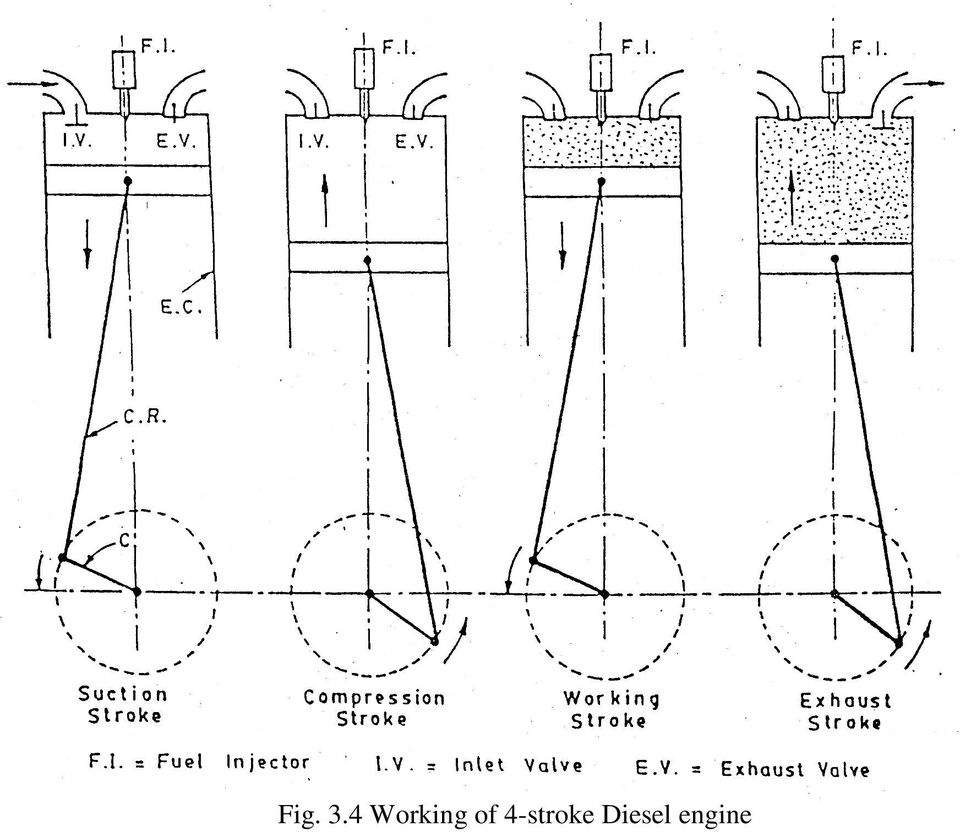
3 the flywheel. During this stroke the pressure and temperature attain a high value of 40 to 60 bar and 600º C to 700º C. 3. Working Stroke: At the end of compression stroke or when the piston reaches the T.D.C. position, a fine spray of diesel is injected in the cylinder through injector. The fuel burns by the heat of compressed air and due to its burning the power is produced. This power pushes the piston downward i.e. from T.D.C. to B.D.C. The excess energy of the piston is stored in the flywheel of the engine, which is further used for the remaining three strokes of the engine. The reciprocating motion of the piston is converted into the rotary motion of the crankshaft by connecting rod and crank. During expansion the pressure drops due to increase in volume of gases and absorption of heat by cylinder walls. 4. Exhaust Stroke: The exhaust valve begins to open when about 85% of the working stroke is completed. The force of piston coming from B.D.C. to T.D.C. forces the burnt gases into the exhaust manifold. Some of the gases are forced out due to higher pressure in the cylinder and the remaining gases are forced out by the piston. Some of the burnt gases are however left inside the clearance space. The exhaust valve closes shortly after T.D.C. The inlet valve opens slightly before the end of exhaust and in this way the cycle repeats. Comparison between petrol and diesel engine: S. No. Criteria of comparison Petrol Engine Diesel Engine 1. Working cycle Otto Cycle Diesel cycle 2. Fuel used Petrol Diesel 3. Compression Ratio 5:1 to 9:1 14:1 to 22:1 4. Fuel Supply Carburetor is there Fuel injector is there 5. Ignition Spark plug is required Heat of compressed air 6. Pressure & temperature Lesser due to lower CR Higher due to more compression ratio 7. Weight & size Lighter & Smaller Heavier & Larger 8. Initial cost Lesser More expensive 9. Running cost More Less 10. Maintenance cost Frequent but costs less Rare but costlier 11. Thermal efficiency Lesser, about 25 to 35% More, about 40 to 50% 12. Starting effort Less cranking effort More effort required due to higher CR 13. Chances of pre-ignition More chances No chances 14. Vibration & noise Less More 15. Field of application Light duty work Heavy duty work

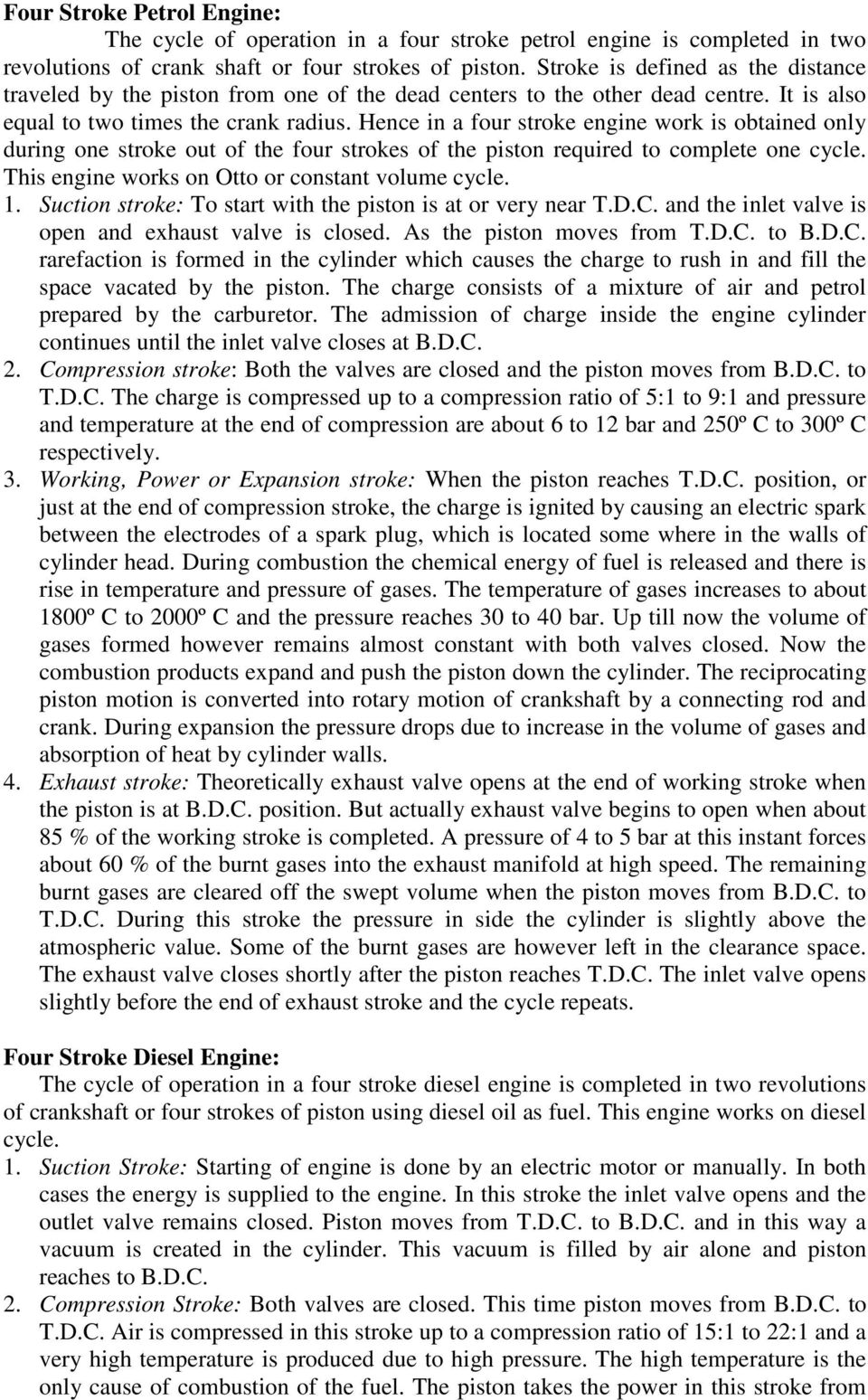
4 Fig. 3.1 Four Stroke Petrol Engine
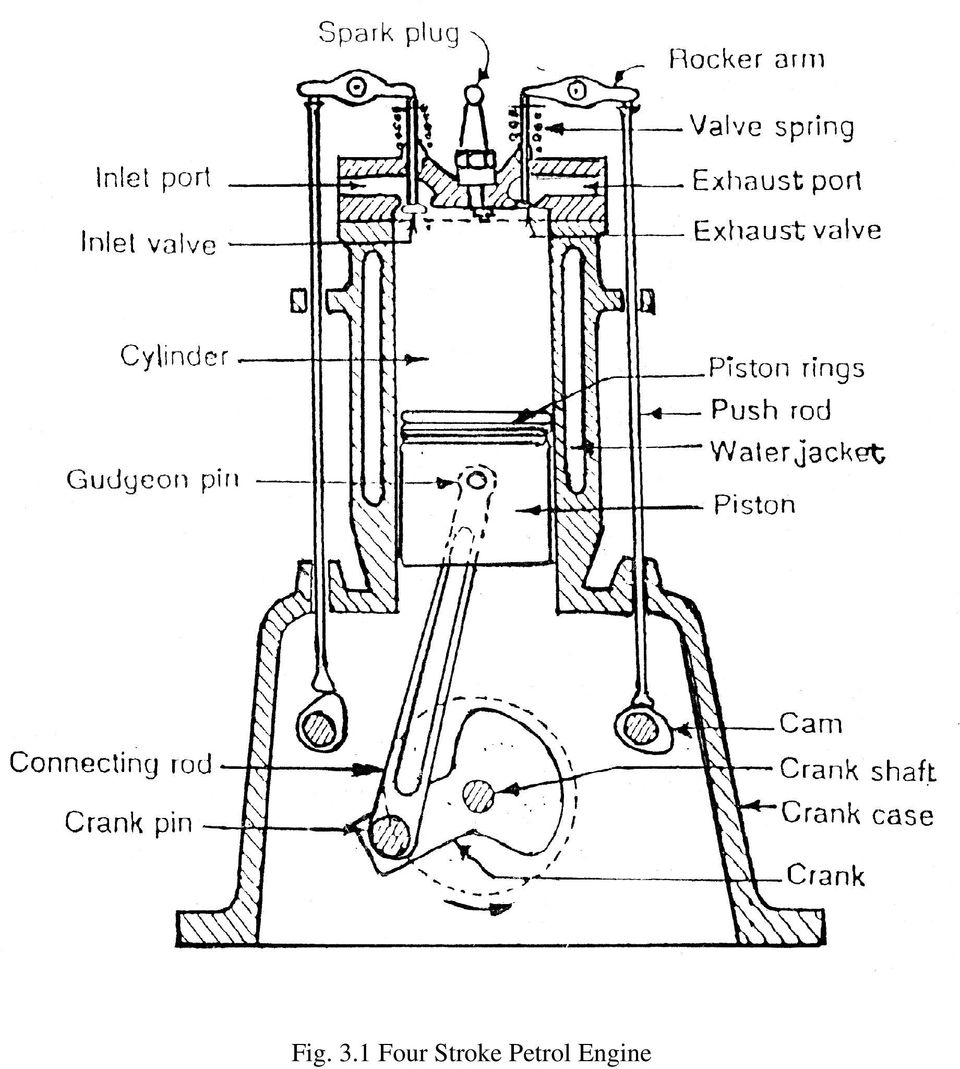
5 Fig Working of 4-stroke Petrol engine
6 Fig. 3.3 Four Stroke Diesel Engine

7 Fig. 3.4 Working of 4-stroke Diesel engine
Principles of Engine Operation
 Internal Combustion Engines ME 422 Yeditepe Üniversitesi Principles of Engine Operation Prof.Dr. Cem Soruşbay Information Prof.Dr. Cem Soruşbay İstanbul Teknik Üniversitesi Makina Fakültesi Otomotiv Laboratuvarı
INTERNAL COMBUSTION (IC) ENGINES
 INTERNAL COMBUSTION (IC) ENGINES An IC engine is one in which the heat transfer to the working fluid occurs within the engine itself, usually by the combustion of fuel with the oxygen of air. In external
UNIT 3 AUTOMOBILE ELECTRICAL SYSTEMS
 UNIT 3 AUTOMOBILE ELECTRICAL SYSTEMS Automobile Electrical Structure 3.1 Introduction Objectives 3.2 Ignition System 3.3 Requirement of an Ignition System 3.4 Types of Ignition 3.4.1 Battery or Coil Ignition
OUTCOME 2 INTERNAL COMBUSTION ENGINE PERFORMANCE. TUTORIAL No. 5 PERFORMANCE CHARACTERISTICS
 UNIT 61: ENGINEERING THERMODYNAMICS Unit code: D/601/1410 QCF level: 5 Credit value: 15 OUTCOME 2 INTERNAL COMBUSTION ENGINE PERFORMANCE TUTORIAL No. 5 PERFORMANCE CHARACTERISTICS 2 Be able to evaluate
OD1619 PRINCIPLES OF INTERNAL COMBUSTION ENGINES
 SUBCOURSE OD1619 EDITION 8 PRINCIPLES OF INTERNAL COMBUSTION ENGINES US ARMY BRADLEY FIGHTING VEHICLE SYSTEMS MECHANIC CORRESPONDENCE COURSE MOS/SKILL LEVEL: 63T30 PRINCIPLES OF INTERNAL COMBUSTION ENGINES
MCI 35.80a AUTOMOTIVE ENGINE MAINTENANCE AND REPAIR MARINE BARRACKS WASHINGTON, D.C.
 MCI 35.80a MARINE CORPS INSTITUTE AUTOMOTIVE ENGINE MAINTENANCE AND REPAIR MARINE BARRACKS WASHINGTON, D.C. UNITED STATES MARINE CORPS MARINE CORPS INSTITUTE 912 POOR STREET SE WASHINGTON, DC 20391-5680
- Service Bulletin - Pistons.
 Normal combustion: is smooth and even from the spark plug through the top of the chamber. 1 2 3 Spark occurs Combustion moves smoothly across chamber Combustion and power completed Pre-Ignition: occurs
Diesel Engine Fundamentals Course# ME406
 Diesel Engine Fundamentals Course# ME406 EZpdh.com All Rights Reserved Department of Energy Fundamentals Handbook MECHANICAL SCIENCE Module 1 Diesel Engine Fundamentals Diesel Engine Fundamentals DOE-HDBK-1018/1-93
COMBUSTION PROCESS IN CI ENGINES
 COMBUSTION PROCESS IN CI ENGINES In SI engine, uniform A: : F mixture is supplied, but in CI engine A: : F mixture is not homogeneous and fuel remains in liquid particles, therefore quantity of air supplied
CLASSIFICATION OF INTERNAL COMBUSTION ENGINES VARIOUS TYPES OF ENGINES
 CLASSIFICATION OF INTERNAL COMBUSTION ENGINES VARIOUS TYPES OF ENGINES CLASSIFICATION OF INTERNAL COMBUSTION ENGINES 1. Application 2. Basic Engine Design 3. Operating Cycle 4. Working Cycle 5. Valve/Port
Hydrogen as a fuel for internal combustion engines
 Hydrogen as a fuel for internal combustion engines Contents: Introduction External mixture formation for hydrogen operated engines Experimental engine for hydrogen in Stralsund Internal mixture formation
Marine Piston Damage By Tom Benton, Marine Surveyor
 Marine Piston Damage By Tom Benton, Marine Surveyor In the last several years I have noticed an increase in the number of outboard motors which have sustained piston damage, and several cases in V-8 inboard
B Dinesh Prabhu, Asst. Professor, P E S College Engg., Mandya, KARNATAKA 1
 Firing Order Every engine cylinder must fire once in every cycle. This requires that for a four-stroke fourcylinder engine the ignition system must fire for every 180 degrees of crank rotation. For a sixcylinder
Introductory Study of Variable Valve Actuation for Pneumatic Hybridization
 2007-01-0288 Introductory Study of Variable Valve Actuation for Pneumatic Hybridization Copyright 2007 SAE International Sasa Trajkovic, Per Tunestål and Bengt Johansson Division of Combustion Engines,
4000 Series 4008TAG2A Diesel Engine ElectropaK 947 kwm @ 1500 rpm
 The Perkins 4000 Series family of 6, 8, 12 and 16 cylinder diesel engines was designed in advance of today s uncompromising demands within the power generation industry and includes superior performance
DOE FUNDAMENTALS HANDBOOK MECHANICAL SCIENCE Volume 1 of 2
 DOE-HDBK-1018/1-93 JANUARY 1993 DOE FUNDAMENTALS HANDBOOK MECHANICAL SCIENCE Volume 1 of 2 U.S. Department of Energy Washington, D.C. 20585 FSC-6910 Distribution Statement A. Approved for public release;
Engine Heat Transfer. Engine Heat Transfer
 Engine Heat Transfer 1. Impact of heat transfer on engine operation 2. Heat transfer environment 3. Energy flow in an engine 4. Engine heat transfer Fundamentals Spark-ignition engine heat transfer Diesel
FUEL & FUEL SYSTEM PROPERTIES OF FUEL
 FUEL & FUEL SYSTEM PROPERTIES OF FUEL Fuel is a substance consumed by the engine to produce energy. The common fuels for internal combustion engines are: 1. Petrol 2. Power kerosene 3. High speed diesel
P = n M 9550 [kw] Variable Intake Manifold in VR Engines. Self-study programme 212. Principles and Description of Operation. Service.
![P = n M 9550 [kw] Variable Intake Manifold in VR Engines. Self-study programme 212. Principles and Description of Operation. Service.](/thumbs/40/21744251.jpg "P = n M 9550 [kw] Variable Intake Manifold in VR Engines. Self-study programme 212. Principles and Description of Operation. Service.") Service. Self-study programme 212 Variable Intake Manifold in VR Engines Principles and Description of Operation P = n M 9550 [kw] M [Nm] P [kw] n [min -1 ] 212_020 The output and torque of an engine have
Service. Self-study programme 212 Variable Intake Manifold in VR Engines Principles and Description of Operation P = n M 9550 [kw] M [Nm] P [kw] n [min -1 ] 212_020 The output and torque of an engine have
Engineering, Bharathiyar College of Engineering and Technology, Karaikal, Pondicherry 609 609, India
 74 The Open Fuels & Energy Science Journal, 2008, 1, 74-78 Open Access Some Comparative Performance and Emission Studies on DI Diesel Engine Fumigated with Methanol and Methyl Ethyl Ketone Using Microprocessor
UNIT 1 INTRODUCTION TO AUTOMOBILE ENGINEERING
 UNIT 1 INTRODUCTION TO AUTOMOBILE ENGINEERING Introduction to Automobile Engineering Structure 1.1 Introduction Objectives 1.2 Definition 1.3 Classification of Vehicles 1.4 Layout of an Automobile Chassis
The Ogunmuyiwa Engine Cycle
 The Ogunmuyiwa Engine Cycle Dapo Ogunmuyiwa M.Sc VDI Chairman / CEO Tel: (+49) 162 961 04 50 E-mail: [email protected] Ogunmuyiwa Motorentechnik GmbH Technologie- und Gruenderzentrum (TGZ) Am Roemerturm
Pump ED 101. Positive Displacement Pumps. Part I Reciprocating Pumps
 Pump ED 101 Positive Displacement Pumps Part I Reciprocating Pumps Joe Evans, Ph.D http://www.pumped101.com There are many pump designs that fall into the positive displacement category but, for the most
Cylinder Pressure in a Spark-Ignition Engine: A Computational Model
 J. Undergrad. Sci. 3: 141-145 (Fall 1996) Engineering Sciences Cylinder Pressure in a Spark-Ignition Engine: A Computational Model PAULINA S. KUO The project described in this article attempts to accurately
US ARMY LIGHT WHEEL VEHICLE MECHANIC MOS 63B SKILL LEVEL 3 COURSE WHEELED VEHICLE ENGINES SUBCOURSE NO. OD 1001
 US ARMY LIGHT WHEEL VEHICLE MECHANIC MOS 63B SKILL LEVEL 3 COURSE WHEELED VEHICLE ENGINES SUBCOURSE NO. OD 1001 United States Army Combined Arms Support Command Ordnance Missile and Munitions Fort Lee,
Module 5: Combustion Technology. Lecture 34: Calculation of calorific value of fuels
 1 P age Module 5: Combustion Technology Lecture 34: Calculation of calorific value of fuels 2 P age Keywords : Gross calorific value, Net calorific value, enthalpy change, bomb calorimeter 5.3 Calculation
AIR POWER GLOSSARY. Air Outlet/Hose Connection An air outlet/hose connection is a 1-1/4 NPT thread fitting where the air hose attaches.
 Absolute Pressure the gauge pressure plus the atmospheric pressure. At sea level, the gauge pressure in pounds per square inch (PSI) plus 14.7 gives the absolute pressure in pounds per square inch (PSIA).
MECHANICAL ENGINEERING EXPERIMENTATION AND LABORATORY II EXPERIMENT 490.07 ENGINE PERFORMANCE TEST
 MECHANICAL ENGINEERING EXPERIMENTATION AND LABORATORY II EXPERIMENT 490.07 ENGINE PERFORMANCE TEST 1. Objectives To determine the variation of the brake torque, brake mean effective pressure, brake power,
Pollution by 2-Stroke Engines
 Pollution by 2-Stroke Engines By Engr. Aminu Jalal National Automotive Council At The Nigerian Conference on Clean Air, Clean Fuels and Vehicles, Abuja, 2-3 May 2006 Introduction to the 2-Stroke Engine
Unit 24: Applications of Pneumatics and Hydraulics
 Unit 24: Applications of Pneumatics and Hydraulics Unit code: J/601/1496 QCF level: 4 Credit value: 15 OUTCOME 2 TUTORIAL 3 HYDRAULIC AND PNEUMATIC MOTORS The material needed for outcome 2 is very extensive
Piston Diagnosis A rough Guide
 Piston Diagnosis A rough Guide The process of examining used pistons can tell us a lot of helpful information on the condition of an engine. When engine failure does occur the piston is likely to take
A.Pannirselvam*, M.Ramajayam, V.Gurumani, S.Arulselvan and G.Karthikeyan *(Department of Mechanical Engineering, Annamalai University)
 A.Pannirselvam, M.Ramajayam, V.Gurumani, S.Arulselvan, G.Karthikeyan / International Journal of Vol. 2, Issue 2,Mar-Apr 212, pp.19-27 Experimental Studies on the Performance and Emission Characteristics
Diesel: Troubleshooting
 Diesel: Troubleshooting Probable Cause Engine not starting Hard to start engine Runs rough at lower RPM Lack of power Diesel knock / pinking Black White Blue Low compression X X X Low fuel pressure X X
Energy Savings through Electric-assist Turbocharger for Marine Diesel Engines
 36 Energy Savings through Electric-assist Turbocharger for Marine Diesel Engines KEIICHI SHIRAISHI *1 YOSHIHISA ONO *2 YUKIO YAMASHITA *3 MUSASHI SAKAMOTO *3 The extremely slow steaming of ships has become
A Practical Guide to Free Energy Devices
 A Practical Guide to Free Energy Devices Part PatE2: Last updated: 28th January 2006 Author: Patrick J. Kelly Please note that this is a re-worded excerpt from this patent. It describes one method for
Chapters 7. Performance Comparison of CI and SI Engines. Performance Comparison of CI and SI Engines con t. SI vs CI Performance Comparison
 Chapters 7 SI vs CI Performance Comparison Performance Comparison of CI and SI Engines The CI engine cycle can be carried out in either 2 or 4 strokes of the piston, with the 4-cycle CI engine being more
NISSAN FIGARO - STARTING PROBLEMS
 NISSAN FIGARO - STARTING PROBLEMS Just to clarify starting problems in this context assumes that the engine turns over on the starter it simply won t fire-up. If the issue is failure of the engine to turn-over
INTERNAL COMBUSTION RECIPROCATING PISTON ENGINES
 INTERNAL COMBUSTION RECIPROCATING PISTON ENGINES TYPES OF RECIPROCATING INTERNAL COMBUSTION PISTON ENGINES Depending on the ignition pattern: Otto cycle (spark-ignition - SI engines), Diesel cycle (auto-ignition
Engine Efficiency and Power Density: Distinguishing Limits from Limitations
 Engine Efficiency and Power Density: Distinguishing Limits from Limitations Chris F. Edwards Advanced Energy Systems Laboratory Department of Mechanical Engineering Stanford University Exergy to Engines
Section IV VACUUM PUMPS. Vacuum Pumps: Basic Operation
 VACUUM PUMPS Section IV Equipment used to generate vacuum, as noted earlier, is similar to air compressors. It's even possible to generate compressed air or vacuum with the same machine, depending on how
HCS Teknik Bobinaj Soğutma Kompresörleri Bakım, Onarım, Revizyon - How Cooling System Operates?
 The operational cycle of a standard cooling system is shown on the diagram below. There are 3 main elements in a cooling system. The compressor, evaporator and condenser. There are other equipment also
Unit 8. Conversion Systems
 Unit 8. Conversion Systems Objectives: After completing this unit the students should be able to: 1. Describe the Basic conversion systems 2. Describe main conversion kit types. 3. Describe how the CNG
912. The engine for construction equipment.
 912. The engine for construction equipment....... 24-82 kw at 1500-2500 min -1 These are the characteristics of the 912: Air-cooled 3-, 4-, 5-, 6-cylinder naturally aspirated in-line-engines. Direct injection.
ADVANCED I.C ENGINES G.PRANESH 4/23/2013 B.E (MECHANICAL ENGINEERING)
 2013 ADVANCED I.C ENGINES G.PRANESH B.E (MECHANICAL ENGINEERING) 4/23/2013 ME2041 ADVANCED I.C. ENGINES L T P C 3 0 0 3 OBJECTIVES: To update the knowledge in engine exhaust emission control and alternate
Turbo Tech 101 ( Basic )
 Turbo Tech 101 ( Basic ) How a Turbo System Works Engine power is proportional to the amount of air and fuel that can get into the cylinders. All things being equal, larger engines flow more air and as
The Second Law of Thermodynamics
 The Second aw of Thermodynamics The second law of thermodynamics asserts that processes occur in a certain direction and that the energy has quality as well as quantity. The first law places no restriction
VALACH MOTORS s.r.o. VM R7-800/R5-420 OWNER S INSTRUCTION MANUAL
 VALACH MOTORS s.r.o. VM R7-800/R5-420 OWNER S INSTRUCTION MANUAL It is of vital importance, before attempting to operate your engine, to read the general 'SAFETY INSTRUCTIONS AND WARNINGS' section on pages
Specifications for Volkswagen Industrial Engine
 Volkswagen 1 industrial engine Specifications for Volkswagen Industrial Engine AFD 1.9 ltr. TDI diesel engine EURO 2 Volkswagen AG, Wolfsburg Volkswagen AG reserves the right to introduce amendments or
1013 E. The engine for agricultural equipment.
 1013 E. The engine for agricultural equipment.... -186 kw at 2300 rpm These are the characteristics of the 1013 E: Modern water-cooled 4- and 6-cylinder in-line engine Turbocharging with charge air cooling
C18 ACERT Fire Pump Tier 3 448 bkw/600 bhp @ 1750 rpm
 CATERPILLAR ENGINE SPECIFICATIONS I-6, 4-Stroke-Cycle Diesel Bore...145.0 mm (5.71 in) Stroke...183.0 mm (7.2 in) Displacement... 18.1 L (1,104.53 in3) Aspiration...Turbocharged Aftercooled Compression
Exhaust emissions of a single cylinder diesel. engine with addition of ethanol
 www.ijaser.com 2014 by the authors Licensee IJASER- Under Creative Commons License 3.0 [email protected] Research article ISSN 2277 9442 Exhaust emissions of a single cylinder diesel engine with addition
Stirling heat engine Internal combustion engine (Otto cycle) Diesel engine Steam engine (Rankine cycle) Kitchen Refrigerator
 Lecture. Real eat Engines and refrigerators (Ch. ) Stirling heat engine Internal combustion engine (Otto cycle) Diesel engine Steam engine (Rankine cycle) Kitchen Refrigerator Carnot Cycle - is not very
54mm X 54mm BORE AND STROKE
 SECTION III TUNING 54mm X 54mm BORE AND STROKE WRITTEN BY MICHAEL SCUTT Short Stroke 54 x 54 Tuning information The following deals with building and tuning of a 54mm x 54mm Bantam motor and in particular,
Air Induction Systems
 Air Induction Systems Air Supply Requirements of Diesels All internal combustion engines need an adequate supply of air that is clean, dry, filtered, fresh, and relatively cool. Adequate Supply Diesel
Fire & Explosion Risks in Service Stations
 Fire & Explosion Risks in Service Stations Petrol Vapour Petrol gives off highly flammable vapour even at very low temperatures. Because of the flammability of petrol vapours, service stations carry a
DLW 8. POWER RATING 1500 rpm/50 Hz 1800 rpm/60 Hz Prime 7.5 kva, 6 kw 9.1 kva, 7.3 kw Standby 8.5 kva, 6.8 kw 10.1 kva, 8.1 kw
 DLW 8 POWER RATING 1500 rpm/50 Hz 1800 rpm/60 Hz Prime 7.5 kva, 6 kw 9.1 kva, 7.3 kw Standby 8.5 kva, 6.8 kw 10.1 kva, 8.1 kw Generator set consisting of engine and alternator mounted on a fabricated steel
CFD Simulation of HSDI Engine Combustion Using VECTIS
 CFD Simulation of HSDI Engine Combustion Using VECTIS G. Li, S.M. Sapsford Ricardo Consulting Engineer s Ltd., Shoreham-by-Sea, UK ABSTRACT As part of the VECTIS code validation programme, CFD simulations
CONVERGE Features, Capabilities and Applications
 CONVERGE Features, Capabilities and Applications CONVERGE CONVERGE The industry leading CFD code for complex geometries with moving boundaries. Start using CONVERGE and never make a CFD mesh again. CONVERGE
The Relation Between Gasoline Quality, Octane Number and the Environment
 MH1 The Relation Between Gasoline Quality, Octane Number and the Environment Rafat Assi National Project Manager Jordan s Second National Communications on Climate Change (www.snc.gov.jo) Presented at
Chapter23. Two important areas of application for thermodynamics POWER AND REFRIGERATION CYCLES. Objectives
 Two important areas of application for thermodynamics are power generation and refrigeration. Both power generation and refrigeration are usually accomplished by systems that operate on a thermodynamic
Oregon Fuel Injection
 Corporate Office: P.O. Box 21121, VE Pump Removal and Installation Cummins Lock Timed Applications Removal Clean the exterior of the injection pump and mounting surfaces. 1. Disconnect the fuel return
STATE UNIVERSITY OF NEW YORK COLLEGE OF TECHNOLOGY CANTON, NEW YORK COURSE OUTLINE AUTO 220 INTERNAL COMBUSTION ENGINES
 STATE UNIVERSITY OF NEW YORK COLLEGE OF TECHNOLOGY CANTON, NEW YORK COURSE OUTLINE AUTO 220 INTERNAL COMBUSTION ENGINES Prepared By: BRANDON BALDWIN CANINO SCHOOL OF ENGINEERING TECHNOLOGY AUTOMOTIVE TECHNOLOGY
DIESEL INJECTOR FAILURES AND THE CONSEQUENCES - CAUSED BY FUEL QUALITY CASE STUDIES
 DIESEL INJECTOR FAILURES AND THE CONSEQUENCES - CAUSED BY FUEL QUALITY CASE STUDIES Author: AJ von Wielligh Pr Eng BSc Eng (Mechanical) NDL Burger Pr Eng M Eng (Mechanical) PL de Vaal Pr Eng PhD (Chemical)
Trouble Shooting. Pump
 Trouble Shooting Pump Trouble Possible Cause Remedy Oil leaking in the area of water pump crankshaft Worn crankshaft seal, bad bearing, grooved shaft, or failure of retainer o-ring. Excessive play on crankshaft
Water/Methanol Injection: Frequently Asked Questions
 Water/Methanol Injection: Frequently Asked Questions Water/methanol injection is nothing new. It has been used as far back as World War II to help power German fighter planes. Yet it never seemed to catch
Adjustment Data MAZDA - 626-2.0 Comprex D - RF-CX
 Adjustment Data MAZDA - 626-2.0 Comprex D - RF-CX Engine (general) Engine code RF Capacity 1998 (cc) Idle speed 725 ± 25 Valve clearance Valve clearance Cold Inlet 0.25 (mm) Exhaust 0.35 (mm) Compression
Electronic Diesel Control EDC 16
 Service. Self-Study Programme 304 Electronic Diesel Control EDC 16 Design and Function The new EDC 16 engine management system from Bosch has its debut in the V10-TDI- and R5-TDI-engines. Increasing demands
Frequecy Comparison and Optimization of Forged Steel and Ductile Cast Iron Crankshafts
 International Journal of Engineering Science Invention ISSN (Online): 2319 6734, ISSN (Print): 2319 6726 Volume 2 Issue 11ǁ November2013 ǁ PP.38-45 Frequecy Comparison and Optimization of Forged Steel
MCE 504 AUTOMOBILE ENGINEERING (3 UNITS) PREPARED BY. BUKOLA O. BOLAJI Ph.D/PROF. P.O. AIYEDUN DEPARTMENT OF MECHANICAL ENGINEERING, UNIVERSITY OF
 MCE 504 AUTOMOBILE ENGINEERING (3 UNITS) PREPARED BY BUKOLA O. BOLAJI Ph.D/PROF. P.O. AIYEDUN DEPARTMENT OF MECHANICAL ENGINEERING, UNIVERSITY OF AGRICULTURE, ABEOKUTA OGUN STATE, NIGERIA 1 MCE 504: AUTOMOBILE
DESIGN AND DEVELOPMENT OF LINEAR MAGNETIC GENERATOR
 DESIGN AND DEVELOPMENT OF LINEAR MAGNETIC GENERATOR Manoj Gattani Research Engineer, Innovative Green Energy Technologies, Dehradun, India ABSTRACT Design and development of Linear magnetic Generator capable
Why and How we Use Capacity Control
 Why and How we Use Capacity Control On refrigeration and air conditioning applications where the load may vary over a wide range, due to lighting, occupancy, product loading, ambient weather variations,
B1BBM2K1-806 DW10ATED ENGINE ENGINE INTRODUCTION DW10 1 - DESCRIPTION. Main structure of the DW10 engine :
 of 23 http://www.christiantena.pwp.blueyonder.co.uk/motor/peugeot/hdi/b... 7/12/2005 9:27 p.m. B1BBM2K1-806 DW10ATED ENGINE ENGINE INTRODUCTION DW10 1 - DESCRIPTION Main structure of the DW10 engine :
FUNDAMENTALS OF ENGINEERING THERMODYNAMICS
 FUNDAMENTALS OF ENGINEERING THERMODYNAMICS System: Quantity of matter (constant mass) or region in space (constant volume) chosen for study. Closed system: Can exchange energy but not mass; mass is constant
The control of a free-piston engine generator. Part 1: fundamental analyses
 The control of a free-piston engine generator. Part : fundamental analyses R. Mikalsen, A.P. Roskilly Sir Joseph Swan Institute for Energy Research, Newcastle University, Newcastle upon Tyne, NE 7RU, England,
A Practical Guide to Free Energy Devices
 A Practical Guide to Free Energy Devices Part PatE21: Last updated: 15th January 2011 Author: Patrick J. Kelly This patent describes methods for altering HHO gas so that it can be used in vehicle engines
Kobelco Extended Warranty Program. www.kobelco-europe.com
 Kobelco Extended Warranty Program www.kobelco-europe.com Kobelco Extended Warranty is a convenient, value added way to give your Kobelco customers added security and peace of mind. Benefits of the Kobelco
Engine/Gearbox Combinations
 Engine/Gearbox Combinations Engine code letters ARV/ATY AME ATZ Displacement 1.0 ltr. 1.4 ltr. 1.4 ltr. Power output 37 kw/50 HP 50 kw/68 HP 50 kw/68 HP Engine management system Simos 3PB Simos 3PB Simos
Wilesco D365, D366, D367, D368, D405, D406 D407, D409 Operating Instructions
 Wilesco D365, D366, D367, D368, D405, D406 D407, D409 Operating Instructions a) Burner slide b) Cutout valve c) Funnel d) Safety valve (filter cap) e) Oil cap f) Clutch g) Sight glass h) Steam whistle
MECHANICAL LOSS REDUCTION OF A 100 W CLASS STIRLING ENGINE. Koichi HIRATA National Maritime Research Institute, Japan
 1 MECHANICAL LOSS REDUCTION OF A 100 W CLASS STIRLING ENGINE Koichi HIRATA National Maritime Research Institute, Japan E-mail: [email protected] ABSTRACT We have developed a 100 W class displacer-type
Investigation of a Single Cylinder Diesel Engine Performance under Recycling and Conditioning of Exhaust for Air Intake
 3 th International Conference on AEROSPACE SCIENCES & AVIATION TECHNOLOGY, ASAT- 3, May 6 8, 9, E-Mail: [email protected] Military Technical College, Kobry Elkobbah, Cairo, Egypt Tel : +() 459 43638, Fax:
Spherical engine/generator-unit can boost electrical car dynamics
 Spherical engine/generator-unit can boost electrical car dynamics Automobile: Cars run singely on battaries have a range of approx. 150 km. Electrical cars with "range-extender" have the same range as
How to Calculate Compression Ratio in a Single Cylinder. Lesson 9
 How to Calculate Compression Ratio in a Single Cylinder Lesson 9 Remember: Pretty Please My Dear Aunt Sally (From left to right; Parentheses; Power; Multiply; Divide; Add, Subtract) This lesson is set
Fault codes DM1. Industrial engines DC09, DC13, DC16. Marine engines DI09, DI13, DI16 INSTALLATION MANUAL. 03:10 Issue 5.0 en-gb 1
 Fault codes DM1 Industrial engines DC09, DC13, DC16 Marine engines DI09, DI13, DI16 03:10 Issue 5.0 en-gb 1 DM1...3 Abbreviations...3 Fault type identifier...3...4 03:10 Issue 5.0 en-gb 2 DM1 DM1 Fault
MODULE 1. Thermodynamics cycles can be divided into two generation categories :
 MODULE 1 1. STEAM POWER PLANT: Two important area of application of thermodynamics are power generation and refrigeration. Both power generation and refrigeration are usually accomplished by a system that
CHAPTER 3 EXPERIMENTAL SET UP
 CHAPTER 3 EXPERIMENTAL SET UP 3.1 INTRODUCTION The emission tests were conducted on an Izusu, four stroke, 4 cylinder petrol engine test-rig with hydraulic dynamometer loading system. The specifications
Internal Combustion Optical Sensor (ICOS)
 Internal Combustion Optical Sensor (ICOS) Optical Engine Indication The ICOS System In-Cylinder Optical Indication 4air/fuel ratio 4exhaust gas concentration and EGR 4gas temperature 4analysis of highly
1. Introduction Older cars and motorcycles must be in a good state of repair and properly tuned to get best performance.
 Fuel News Tuning Vehicles to Run on PETROL 1. Introduction Older cars and motorcycles must be in a good state of repair and properly tuned to get best performance. The following sections outline reasons
REMOVAL AND INSTALLATION
 303-01C-1 REMOVAL AND INSTALLATION Engine Body On Special Tool(s) Adapter For 303-D043 303-D043-02 or equivalent Special Tool(s) 303-01C-1 Turbocharger Lifting Bracket 303-1266 Wrench, Fan Clutch Nut 303-214
Lotus Service Notes Section EMR
 ENGINE MANAGEMENT SECTION EMR Sub-Section Page Diagnostic Trouble Code List EMR.1 3 Component Function EMR.2 7 Component Location EMR.3 9 Diagnostic Guide EMR.4 11 CAN Bus Diagnostics; Lotus TechCentre
Section 11 - System Diagrams
 Section 11 System Diagrams Page 11-1 Section 11 - System Diagrams Section Contents Page Overview...11-3 Flow Diagram, Fuel System...11-4 Flow Diagrams, Lubricating Oil System...11-5 Flow Diagrams, Cooling
Laws and price drive interest in LNG as marine fuel
 Laws and price drive interest in LNG as marine fuel The use of LNG as a marine fuel is one of the hottest topics in shipping. This growing interest is driven by legislation and price. By Henrique Pestana
Modern Sand Reclamation Technologies for Economy, Environment Friendliness and Energy Efficiency
 Modern Sand Reclamation Technologies for Economy, Environment Friendliness and Energy Efficiency Aniruddha Ghosh GM, The Wesman Engineering Co. Ltd, Kolkata ABSTRACT Unlike green sand, chemically-bonded
The Use of Exhaust Gas Recirculation (EGR) Systems in Stationary Natural Gas Engines. The Engine Manufacturers Association August 2004
 www.enginemanufacturers.org Two North LaSalle Street Suite 2200 Chicago, Illinois 60602 Tel: 312/827-8700 Fax: 312/827-8737 The Use of Exhaust Gas Recirculation (EGR) Systems in Stationary Natural Gas
A study into the fuel savings potential by a major rebuild of propulsion system
 A study into the fuel savings potential by a major rebuild of propulsion system Per Rønnedal Senior Manager New Design Research & Development Marine Low Speed < 1 > Agenda 1 Introduction of MAN and our
Volkswagen New Beetle 2.0 Liter 4-cyl General, Engine (Engine Code AEG) 15 Engine- Cylinder head, Valvetrain (Page GR-15)
 15 Engine- Cylinder head, Valvetrain (Page GR-15) Cylinder head, removing and installing Compression, checking Valve train, servicing Camshaft oil seal, replacing Camshaft, removing and installing Hydraulic