
Combined Close Interval Potential Surveys and Direct Current Voltage Surveys for Increased Pipeline Integrity
|
|
|
- Phyllis Webb
- 9 years ago
- Views:
Transcription
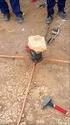
1 Combined Close Interval Potential Surveys and Direct Current Voltage Surveys for Increased Pipeline Integrity John Peter Nicholson NACE Accredited Senior Corrosion Technologist Managing Director Cathodic Technology Limited 15-1 Marconi Court Bolton, Ontario, Canada, L7E 1E2 Summary With today s electronic instrumentation, it is possible to combine close interval potential surveys (CIPS) with direct current voltage gradient surveys (DCVG) of buried and underwater pipelines for improved accuracy in assessing the level of cathodic protection combined with locating coating defects without spatial errors. Modern electronic survey instruments are capable of stamping each reading with the time, date and submetre GPS coordinates. This provides information for accurate mapping of the pipeline location, current state of the cathodic protection system, and further allows personnel to accurately locate areas requiring excavation for coating repair. This paper will show by example how combined CIPS and DCVG surveys undertaken to NACE standards are of benefit to pipeline operators in ensuring cost- and time-effective integrity management of their pipeline systems. 1 Introduction Traditionally direct assessment of external corrosion of pipelines has been undertaken as a two step process with a close interval potential survey (CIPS) undertaken to determine the level of cathodic polarization and an analogue (See Figure 1) direct current voltage gradient (DCVG) survey to determine the location of coating defects or holidays. Undertaking the CIPS and DCVG surveys separately leads to spatial errors. Figure 1 Analogue DCVG Meter Further, if the surveys are not done concurrently, errors can result due to differences in soil moisture content, the skill of the operators undertaking the survey, changes in the level of cathodic protection and the inability to accurately mark or record the location of coating defects, they must be manual staked out. (See Figure 2). Figure 2 DCVG Surveyor 1

2 2 Direct Current Voltage Gradient Surveys Figure 4 Voltage Gradients at Defect A DCVG survey locates coating defects; it does not indicate the level of cathodic polarization on a pipeline. A DCVG survey consists of applying pulsed DC current to a pipeline by synchronously interrupting the rectifiers (See Figure 3) and then measuring the voltage shift in the soil along a pipeline (See Figure 4). When a defect is present, a voltage gradient will be present in the soil. This can be measured as a voltage between two electrodes in contact with the soil (As shown in Figure 5). When undertaking a DCVG survey with a single surveyor, it is essential to take the readings moving out from the center of the defect, summing the values in order to arrive at the total voltage gradient associated with the defect. The voltage gradient measured follows Ohms Law in that the Voltage Gradient is equal to the current flow multiplied by the resistance of the electrolyte path (VG = I * R) thus the Voltage Gradient measured is influenced by the resistance of the electrolyte path, the spacing between the electrodes and the current being delivered to the coating defect. The effective distance that a defect can be measured at can be expressed mathematically as shown in Earth Resistances by G.F. Tagg. In order to make the calculation, the coating defect or holiday must be resolved as a hemispherical electrode. Figure 3 Current Interrupter Figure 5 DCVG Surveyor 2.1 Equivalent Hemisphere Associated With A Defect The equivalent hemisphere associated with a defect as expressed in Earth Resistances written by G.F. Tagg published by George Newnes Ltd. London England in 1964 is presented here. The total resistance of a hemispherical electrode is where r is the radius of the sphere. This assumes that the defect in question is of similar surface to a sphere where the length of the defect is equivalent to 2r. 2

3 The resistance at distance r 1 is found with This gives a fraction of the total resistance of Solving to x percent then The calculations provide the following results. Table 1 Distance to Remote Earth for Various Sized Defects Distance to read the % of total resistance Defect radius 95% 99% 99.5% 5mm 0.1m 0.5m 1m 50mm 1m 5m 10m 100mm 2m 10m 20m On the surface, the probes are positioned so that one electrode is on top of the pipe and the second is a distance away. Assuming that the depth is d and the probe spacing is l then the distance to read the total resistance is d r. Table 2 Probe Spacing to Read Total Voltage Gradient for Various Defect Sizes Probe spacing for DCVG at a depth of 1.5m Defect radius 95% 99% 99.5% 5mm Won t read Won t read Won t read 50mm Won t read 4.8m 9.9m 100mm 1.3m 9.9m 19.9m Note: that the deeper the pipe, the less likely DCVG will pick up small defects. It is apparent from the above calculations that a small holiday at a depth of 1.5 meters has an equivalent hemisphere that does not intersect the surface of the ground above the pipeline and will not be detected by DCVG techniques. Figure 6 shows the Equipotential lines about a defect. Figure 6 Equipotential lines at a defect Since DCVG does not measure the rectifier ON or OFF pipe-to-soil potential, practitioners have had to arrive at some method to determine the necessity of repairing the coating defect or holiday. The result is a formula described as % IR. 2.2 DCVG % IR Calculation The NACE test method TM offers a formula to determine the severity of a coating defect or holiday. Indication pipe to remote earth DCVG signal magnitudes (P/RE) are calculated using the following formula. 3

4 d x (S 1 S 2 ) Coating Fault P/RE = S (d 2 d 1 ) Where: P/RE = Pipe to remote earth DCVG signal magnitude (mv) S1 = DCVG signal amplitude to remote earth at Test Station 1 (mv) S2 = DCVG signal amplitude to remote earth at Test Station 2 (mv) d1 = Distance measurement of Test Station 1 (This is zero at the beginning of a survey.) (m) d2 = Distance measurement of Test Station 2 (m) dx = Distance measurement of indication from Test Station 1 (m) Note: The distance between any two test posts should be kept as small as possible. It is not acceptable to simply use the difference between on and off pipe-to-soil potentials at test points (S1 and S2) as the DCVG signal magnitude. All DCVG magnitude measurements must include the voltage gradient from the test station to ground as well as the sum of the voltage gradients to remote earth 2.3 % IR Calculation (Simplified Calculation) Once an indication is located, its % IR is estimated by measuring the potential difference from the indication epicenter to remote earth (OL/RE). This potential difference is then expressed as a percentage of the total calculated potential shift on the pipeline at the indication location (P/RE), as shown in the Equation below. Calculated Pipe to Remote Earth at Indication mv Over the Line to Remote Earth mv * 100 %IR(Coating Indication Severity) = Calculated Pipe to Remote Earth at Indication mv OL/RE * *100 % IR = For Example = 9.4 P/RE The indication severity is therefore 9.4%. or Each pipeline is different; the %IR at which a dig is warranted will vary with the soil resistivity and type of coating, the location, the cost and other factors. Without companion rectifier ON and Instant OFF pipe-to-soil potentials, it is difficult for the corrosion engineer to justify digs based only on the % IR without knowing the effect of the coating defect on the polarized potential of the pipeline. 3 Close Interval Potential Surveys Close interval potential surveys (CIPS) are the mainstay of cathodic protection and are usually undertaken by a surveyor walking over the pipeline measuring the rectifier ON and Instant OFF (polarized) pipe-to-soil potentials at regular intervals along the pipeline (See Figure 7). Since the indicator of the polarized potential is the instant OFF 4

5 pipe-to-soil potential, it is important that the rectifiers be interrupted synchronously preferably using the GPS system for synchronization (See Figure 3). A properly conducted CIPS survey will indicate those areas of the pipeline that meet the criterion for cathodic protection (See NACE SP Standard). Figure 7 CIPS Surveyor 4 Combined CIPS and DCVG Surveys There are several advantages to undertaking a combined CIPS and DCVG survey. Both surveys are undertaken at the same time by the same surveyors, under the same climatic and soil conditions without spatial errors. This results in more accurate survey data. Further, with modern digital survey equipment, each reading is stored along with the time, date and GPS coordinates; thus defects can easily be located if excavation is required. A further advantage can be obtained by utilizing two surveyors walking over the pipeline approximately seven metres apart (See Figure 8). The sevenmetre spacing should capture >95% of the voltage gradient associated with a coating defect or holiday larger than 50mm radius (See Table 2). This spacing has been proven in the field; typically >95% of the voltage gradient is captured within a 5 metre radius from the defect unless the defect is exceptionally large which would result in depressed polarized potentials. When two surveyors are utilized walking over top of the pipeline (as shown in Figure 8), the resultant measurement of a coating defect recorded over top of the pipeline appears as a sinusoidal waveform making for easy recognition of the defect (See Figure 9). This survey technique is explained in NACE Standard Specification SP Figure 8 Two Surveyors Figure 9 Sinusoidal Waveform at defect If the second surveyor walks to the side of the pipeline (As shown in Figure 10), then there is a sharp increase in the voltage gradient when the surveyors reach the epicenter of the defect (as shown in Figure 11). If the coating defect is large enough to affect the pipe-to-soil potentials, then a reduction in the rectifier ON and Instant OFF potentials will be apparent. 5

6 By utilizing a two-person survey crew walking over the pipeline, the pipe-to-soil potential can be measured simultaneously with the DCVG gradient; thus there is no spatial error. Further, when the surveyors walk over the pipeline a sinusoidal signal occurs at coating defects (See Figure 9). In Figure 11 the coating defect can be seen as a voltage spike with corresponding reduction in the rectifier ON and instant OFF pipe-to-soil potentials. A corrosion engineer must be cognizant of the level of polarization of pipelines under his jurisdiction. Only a rectifier-interrupted CIPS survey will reveal the level of cathodic polarization on a pipeline. Figure 10 DCVG Measurement to Side of the Pipe A DCVG survey will locate coating holidays or defects, but it can not indicate the level of cathodic polarization. A number of practitioners of DCVG surveys have tried to develop a formula that would indicate the magnitude of a coating defect. 4.1 % IR for Combined CIPS and DCVG Figure 11 Graph of Voltage Gradient at a Defect One proposed formula for calculating the % IR for combined CIPS and DCVG surveys developed by R. A. Gummow and S. Segall and R. Reid is as follows. For a combined CIPS DCVG survey the %IR can be calculated as follows: K(d,s) * G ol-d %IR = V ol + G ol-d Where: G ol-d lateral gradient shift as measured between a reference electrode installed over the line (RE1) and a reference electrode (RE2) installed at a distance (s) perpendicular to the line. V ol potential shift between the pipe and a reference electrode (RE1) installed over the line. K(d, s) function depending on the pipe depth (d) and the distance (s) between the two reference electrodes used to measure the gradient. For a pipeline 1.2 metres deep where d = 3 metres K = 1.59, for 5 metres K = 1, for 10 metres K = 0.5 6

7 5 Examples of defects located by combined CIPS and DCVG surveys The first example is of a defect on a 20-inch gas line where the coating at a joint had deteriorated (See Figure 12) resulting in a small defect that affected the pipe-to-soil potentials (As shown in Figure 13). Figure 12 Coating Defect at Joint The second example is of a weld area at a joint where coating repair had not been performed. The defect was on a 20-inch gas line coated with a threelayer polyethylene coating system. The defect was located using a combined CIPS and DCVG survey with two surveyors walking over top of the pipeline. Figure 14 shows the graphical display of the pipe-to-soil potential and the DCVG voltage gradient at the coating miss-out. Figure 14 Sinusoidal Waveform at Defect This defect was at the 3 o clock position on the pipeline where petrolatum tape was used instead of the specified shrink sleeve. By combining the CIPS and DCVG survey, the corrosion engineer can easily prioritize the repair of coating defects. Figure 13 Voltage Gradient Spike at a Figure 15 is a photograph defect of the defect taken after excavation but before cleaning of the pipeline. Although the defect was relatively large, it was not affecting the polarization of the pipeline. With the three-layer poly coating system, very little current was required for cathodic protection of the pipeline. The third example is of a three-layer polyethylene coated pipeline where third party damage had occurred in the form of a scrape of the pipeline coating by mechanical digging equipment. The graph of the combined CIPS and DCVG survey (See Figure 16) shows multiple sinusoidal 7

8 waveforms at the coating defect. A photograph of the pipeline after excavation is shown in Figure 17. Figure 15 Coating Miss-out at Joint Although the coating damage shown in Figures 15 and 17 did not affect the polarized potential of the pipeline, it was well protected from corrosion by cathodic polarization and could have been safely left unrepaired. Both of these defects were excavated as a training exercise for corrosion engineers implementing External Corrosion Direct Assessment methodology (ECDA) as described in NACE SP The sinusoidal waveform produced at a coating defect when two surveyors walk over top of the pipeline performing a CIPS and DCVG survey makes it very easy to visually recognize a coating defect even when the recorded voltage gradient is subject to electrical noise. 6 Conclusion Figure 16 Multiple Sinusoidal Waveforms Figure 17 Multiple Coating Defects In conclusion, a combined CIPS and DCVG survey provides the corrosion engineer with accurate information on the level of polarization of the pipeline and the effect of coating defects or holidays. By undertaking a CIPS and a DCVG survey at the same time, spatial errors do not occur and errors due to soil moisture and cathodic polarization as well as operator skill do not influence the survey result. A combined CIPS and DCVG survey can locate small coating defects and third party damage with each reading taken stamped with the GPS coordinates and the date and time the readings where taken. A DCVG survey does not provide any information on the level of cathodic protection, only information on the integrity of the coating. Repairing coating defects is a double edged sword. As the number of defects is reduced, the surface area of steel from which AC current can discharge is also reduced; thus the current density discharging from the pipeline at any given location is increased and could result in corrosion from DC stray current or AC current discharge. 8

9 The corrosion engineer must have sufficient information on the level of cathodic polarization on the pipelines under his jurisdiction that he can assure management that the cathodic protection systems are functioning and providing cathodic protection current to all areas of the pipeline. To reach this level of confidence, the corrosion engineer needs regular current-interrupted close interval potential surveys as they are the only method that indicates the level of cathodic polarization on the pipelines. DCVG surveys can not provide this information. References 1) World Pipelines, Stray and Telluric Correction of CIPS data February ) Peter Nicholson Corrosion 2008 Paper Is Your Pipeline Corroding 3) Peter Nicholson NACE Northern Region 2008 Is Your Pipeline Corroding 4) World Pipelines, Combined CIPS & DCVG surveys for more accurate ECDA Data November 2007 issue 5) Peter Nicholson Corrosion 2007 Paper Combined CIPS & DCVG for more accurate data correlation 6) Peter Nicholson Corrosion 2007 Stray &Telluric Correction of CIPS Data Paper ) Peter Nicholson External Corrosion Direct Assessment, Pipeline Rehabilitation & Maintenance September 2006 Istanbul Turkey 8) Gummow, Seagal, Reid Corrosion 2006 Paper Use of an Integrated CIPS/DCVG Survey in the ECDA Process 9) 23 rd. World Gas Conference Amsterdam 2006 C.P. data, CIPS & DCVG techniques: another way to predict Corrosion on Gas Pipeline. A Taberkokt, Algeria 10) Peter Nicholson External Corrosion Direct Assessment, Corcon 2004 New Delhi India 11) Peter Nicholson Pipeline Integrity, World Pipelines, March ) Peter Nicholson Stray and Telluric Current Correction of Close Interval Potential Survey Data, Eurocorr 2003 Budapest Hungary 13) R.L. Pawson: "Close Interval Potential Surveys - Planning, Execution, Results", Materials Performance, February 1998, pp ) N.G. Thompson and K.M. Lawson, PRCI PR Improved Pipe-to-Soil Potential Survey Methods, April ) Cathodic Protection, Roger Alexander 1982 Early Practitioner of DCVG 16) Tagg, G.F. Earth Resistances. George Newnes Ltd, London ) NACE International Recommended Practice SP ) NACE International Recommended Practice SP ) NACE International Standard Practice SP ) NACE International Standard Practice SP ) NACE TM Test Method Aboveground Survey Techniques for the Evaluation of Underground Pipeline Coating Condition 22) US Department of Transportation, Federal Highway Administration Publication, Corrosion Cost and Preventative Strategies in the United States Published

DCVG Training Manual Gx Version
 DCVG Training Manual Gx Version M. C. Miller Co., Inc. 11640 U.S. Highway 1, Sebastian, FL 32958 MANUAL CONTENTS Page SECTION I: INTRODUCTION. 4 SECTION II: PHYSICAL PRINCIPLES II. 1 Potential (Voltage)
reduction ore = metal oxides metal oxidation
 Cathodic Protection and Interferences René Gregoor Madrid, June 18 th and 19 th 2009 1 Cathodic protection and interferences Corrosion Cathodic protection Protection criterion ON potential measurements
Towards an Enhanced Telluric Compensation Methodology
 Towards an Enhanced Telluric Compensation Methodology Chijioke Ukiwe & Shamus M c Donnell Hunter M c Donnell Pipelines Services Inc. Presented at AUCSC 2011 by Gord Parker, C.E.T., CP2 Edmonton, Alberta,
Standard Test Method Measurement Techniques Related to Criteria for Cathodic Protection on Underground or Submerged Metallic Piping Systems
 NACE Standard TM0497-2012 Item No. 21231 Standard Test Method Measurement Techniques Related to Criteria for Cathodic Protection on Underground or Submerged Metallic Piping Systems This NACE Standard is
CATHODIC PROTECTION SYSTEM DESIGN
 CATHODIC PROTECTION SYSTEM DESIGN Presented By DENIS L ROSSI P.E. CORROSION ENGINEER New England C P Inc. Corrosion Fundamentals What is corrosion? It is defined as the degradation or deterioration of
ELECTRIC FIELD LINES AND EQUIPOTENTIAL SURFACES
 ELECTRIC FIELD LINES AND EQUIPOTENTIAL SURFACES The purpose of this lab session is to experimentally investigate the relation between electric field lines of force and equipotential surfaces in two dimensions.
Strength and Durability for Life CORROSION CONTROL. The Effect of Overhead AC Power Lines Paralleling Ductile Iron Pipelines
 Strength and Durability for Life CORROSION CONTROL The Effect of Overhead AC Power Lines Paralleling Ductile Iron Pipelines Last Revised: May 2016 Sharing of rights-of-way by AC power lines and buried
USE OF A DIGITAL SURVEY VEHICLE FOR PAVEMENT CONDITION SURVEYS AT AIRPORTS. Paul W. Wilke, P.E. Applied Research Associates, Inc.
 USE OF A DIGITAL SURVEY VEHICLE FOR PAVEMENT CONDITION SURVEYS AT AIRPORTS Paul W. Wilke, P.E. Applied Research Associates, Inc. August 11, 2014 Words: 3,280 Figures: 3 Tables: 0 Photographs: 3 ABSTRACT
Revolutionary Inspection Technology by FORCE Technology
 Revolutionary Inspection Technology by FORCE Technology The new Field Gradient Sensor (FiGS) provides the possibility to measure current density on structures and anodes. The accuracy and resolution of
Cathodic Protection Use On Tank Bottoms & Underground Piping In Power Generation Plants
 Cathodic Protection Use On Tank Bottoms & Underground Piping In Power Generation Plants PG&E Office San Francisco January 18, 2007 Craig K. Meier Corrosion Control Incorporated Corrosion process for tanks
Assessment of Soil Resistivity on Grounding of Electrical Systems: A Case Study of North-East Zone, Nigeria
 Assessment of Soil Resistivity on Grounding of Electrical Systems: A Case Study of North-East Zone, Nigeria Abstract Gabriel A. Adegboyega and Kehinde O. Odeyemi Department of Electrical and Electronic
Locating the Epicenter and Determining the Magnitude of an Earthquake
 Locating the and Determining the Magnitude of an Earthquake Locating the Measuring the S-P time interval There are hundreds of seismic data recording stations throughout the United States and the rest
Understanding Soil Resistivity Testing
 Technical Hotline: (00) -9 Technical Hotline: (00) -9 www.aemc.com www.aemc.com Understanding Testing Effects of on Ground Electrode Resistance Factors Affecting APPLICATION NOTES JULY rev.0 Understanding
12 Appendix 12 Earth Electrodes And Earth Electrode
 12 Appendix 12 Earth Electrodes And Earth Electrode Testing 12.1 Introduction This appendix provides guidance and background information an earth electrode testing and some limited information on earth
Cathodic Protection. Remote Monitoring of Cathodic Protection on a Gas Distribution Network
 Cathodic Protection Remote Monitoring of Cathodic Protection on a Gas Distribution Network Author: Martin Alderson Northern Gas Networks Issued for UKOPA members CP measurements are very labour intensive
Figure 1. Diode circuit model
 Semiconductor Devices Non-linear Devices Diodes Introduction. The diode is two terminal non linear device whose I-V characteristic besides exhibiting non-linear behavior is also polarity dependent. The
Introduction to OmniMetrix
 Introduction to OmniMetrix Who We Are OmniMetrix is the leader and pioneer in wireless remote monitoring, control and diagnostics for pipelines and critical equipment. With over 16 years of experience
REMOTE MONITORING AND CONTROL SYSTEM
 REMOTE MONITORING AND CONTROL SYSTEM The Comanche RMCS automatically monitors and controls digital and analog functions and processes associated with the oil and gas industries, which include but are not
Tecnosystem Group Srl - Pietro Fiorentini Spa
 Tecnosystem Group Srl - Pietro Fiorentini Spa C. Calvi Tecnosystem Group Srl - M.H.G. Juinen Merrem & La Porte CATHODIC PROTECTION REMOTE MONITORING A.C. Influence Analysis of field tests with a new Data
Axial and Radial Leaded Multilayer Ceramic Capacitors for Automotive Applications Class 1 and Class 2, 50 V DC, 100 V DC and 200 V DC
 Axial and Radial Leaded Multilayer Ceramic Capacitors for Automotive Applications Class 1 and Class 2, 5 V DC, 1 V DC and 2 V DC DESIGNING For more than 2 years Vitramon has supported the automotive industry
GUIDELINES FOR THE EVALUATION OF UNDERGROUND STORAGE TANK CATHODIC PROTECTION SYSTEMS
 GUIDELINES FOR THE EVALUATION OF UNDERGROUND STORAGE TANK CATHODIC PROTECTION SYSTEMS DEPARTMENT OF NATURAL RESOURCES UNDERGROUND STORAGE TANK MANAGEMENT PROGRAM 4244 INTERNATIONAL PARKWAY, SUITE 104 ATLANTA,
Corrosion Control & Cathodic Protection for Water & Wastewater Systems
 Corrosion Control & Cathodic Protection for Water & Wastewater Systems Presented By: James T Lary Corrpro Companies, Inc 1090 Enterprise Dr. Medina, OH 44256 Tel. 330-723 723-5082 (x1215) email: [email protected]
Specification for Pipe Coating Repairs Offshore
 Specification for Pipe Coating Repairs Offshore Specification for Pipe Coating Repairs Offshore 1 of 6 Table of Contents 1.0 SCOPE... 3 2.0 REFERENCE DOCUMENTS... 3 3.0 MATERIALS... 3 4.0 EQUIPMENT AND
CATHODIC PROTECTION OF REINFORCED CONCRETE STRUCTURES
 CATHODIC PROTECTION OF REINFORCED CONCRETE STRUCTURES AN OVERVIEW CLEARLY THE BEST PROTECTION FOR YOUR INVESTMENT Introduction Cathodic protection is applied to reinforced concrete structures to either
environment briefing02
 PRODUCED BY THE SAFETY, HEALTH & ENVIRONMENT GROUP OF THE ENERGY NETWORKS ASSOCIATION - JULY 2006 environment briefing02 transporting electricity Overhead Lines or Underground Cables? Introduction The
NW Natural & Pipeline Safety
 NW Natural & Pipeline Safety We Grew Up Here NW Natural is an Oregon-based utility company founded in 1859. The company purchases natural gas for its core market in western Oregon and southwestern Washington,
Coupling Effect in Substation Ground Measurements
 SERBIAN JOURNAL OF ELECTRICAL ENGINEERING Vol. 9, No. 3, October 2012, 315-324 UDK: 621.316.13.011.2 DOI: 10.2298/SJEE1203315F Coupling Effect in Substation Ground Measurements Alex Farber 1, Boris Katz
GroundRod AC Substation Earthing Tutorial
 1 GroundRod AC Substation Earthing Tutorial 1. Functions of an earthing system The two primary functions of a safe earthing system are: To ensure that a person who is in the vicinity of earthed facilities
EARTHING AND BONDING AT SECONDARY SUBSTATIONS
 DISTRIBUTION CONSTRUCTION MANUAL SECTION 4 - SUBSTATIONS ISSUE B SEPT 1996 4.4.4 EARTHING AND BONDING AT SECONDARY SUBSTATIONS 1 SCOPE This section of the Distribution Construction Manual lays down the
SOIL RESISTIVITY MEASUREMENTS
 SOIL RESISTIVITY MEASUREMENTS APPENDIX B B Soil resistivity directly affects the design of a grounding (earthing) electrode system and is the prime factor that determines the resistance to earth of a grounding
CORINVEST. CORINVEST Ltd. Ltd. Company information Products and Solutions References. Corrosion Protection Investigation Station. Koltói A. str. 3.
 LTD. Company information Products and Solutions References COMPANY INFORMATION Corinvest Limited undertakes Cathodic Protection projects for technical and underground metal structures in the oil, gas,
German Cathodic Protection REMOTE MONITORING AND CONTROL
 German Cathodic Protection REMOTE MONITORING AND CONTROL Michael Kahle / 17-19. October 2011 / 1. NACE-Jubail Industrial Forum 2011 1. Brief introduction of GCP GCP - Competence in Cathodic Corrosion Protection
ASSET MANAGEMENT STRATEGIES FOR METALLIC MUNICIPAL TRANSMISSION PIPELINES
 ASSET MANAGEMENT STRATEGIES FOR METALLIC MUNICIPAL TRANSMISSION PIPELINES Jose L. Villalobos, P.E. 1 and Carl Perry 2 Abstract: This paper presents strategies for the control of external corrosion on municipal
Specifications for Lightning Protection. ASAE Engineering Practice
 Chapter 8: Lightning Specifications for Lightning Protection ASAE safety standards are not laws. They are recommended voluntary standards used by designers, engineers, manufacturers and users of the equipment,
Understanding Delta Conversion Online "Power Regulation" - Part 2
 Application Note #40 Understanding Delta Conversion Online "Power Regulation" - Part 2 Introduction This application note is the second in a series on delta conversion theory of operation. For complete
Frequently Asked Transmission Pipeline Questions
 Frequently Asked Transmission Pipeline Questions Who is PennEast, LLC? PennEast was formed by the partnership of AGL Resources, NJR Pipeline Company, South Jersey Industries and UGI Energy Services (UGIES).
EXPERIMENT #9 CORROSION OF METALS
 EXPERIMENT #9 CORROSION OF METALS Objective The objective of this experiment is to measure the corrosion rate of two different metals and to show the effectiveness of the use of inhibitors to protect metals
www.klmtechgroup.com TABLE OF CONTENT
 Page : 1 of 13 Project Engineering Standard www.klmtechgroup.com KLM Technology #03-12 Block Aronia, Jalan Sri Perkasa 2 Taman Tampoi Utama 81200 Johor Bahru Malaysia ELECTIRAL GROUNDING TABLE OF CONTENT
Underground Storage Tanks
 Underground Storage Tanks An Informational and Guidance Document for the University Community. Please contact Yale Environmental Health and Safety for latest Regulatory Requirements. A typical UST installation
WIRELESS REMOTE MONITORING OF CATHODIC PROTECTION SYSTEMS. John Hawkyard MICorr Deputy General Manager Rawabi Corrosion Technology Co Ltd Al-Khobar
 WIRELESS REMOTE MONITORING OF CATHODIC PROTECTION SYSTEMS John Hawkyard MICorr Deputy General Manager Rawabi Corrosion Technology Co Ltd Al-Khobar INTRODUCTION Cathodic Protection is an electrochemical
The Pipelines Regulations, 2000
 PIPELINES, 2000 P-12.1 REG 1 1 The Pipelines Regulations, 2000 being Chapter P-12.1 Reg 1 (effective April 1, 2000) as amended by the Statutes of Saskatchewan, 2014, c.21. NOTE: This consolidation is not
Name: Date: Class: Finding Epicenters and Measuring Magnitudes Worksheet
 Example Answers Name: Date: Class: Finding Epicenters and Measuring Magnitudes Worksheet Objective: To use seismic data and an interactive simulation to triangulate the location and measure the magnitude
Episode 126: Capacitance and the equation C =Q/V
 Episode 126: Capacitance and the equation C =Q/V Having established that there is charge on each capacitor plate, the next stage is to establish the relationship between charge and potential difference
EXPERIMENT NUMBER 5 BASIC OSCILLOSCOPE OPERATIONS
 1 EXPERIMENT NUMBER 5 BASIC OSCILLOSCOPE OPERATIONS The oscilloscope is the most versatile and most important tool in this lab and is probably the best tool an electrical engineer uses. This outline guides
V=5 L 3 GROUNDING ELECTRODES EXPLAINED
 GROUNDING ELECTRODES EXPLAINED In the last few decades, much has been ascertained about the interaction between the grounding electrode and the earth, which is a three-dimensional electrical circuit. Ultimately,
CHECKING AND TESTING ELECTRICAL INSTALLING WORK
 CHECKING AND TESTING ELECTRICAL INSTALLING WORK Department of Consumer and Employment Protection Energy Safety Preface It is a requirement of the Electricity (Licensing) Regulations 1991 that all electrical
Cathodic Corrosion Protection of earthburried Pipelines. www.vc-austria.com
 Cathodic Corrosion Protection of earthburried Pipelines www.vc-austria.com Corrosion Problems? Conservation of Value Earthburried pipelines are usually expensive investments. In order to defend against
REALTIME MONITORING OF PIPELINES FOR THIRD-PARTY CONTACT
 REALTIME MONITORING OF PIPELINES FOR THIRD-PARTY CONTACT FINAL REPORT October 1, 2003 December 31, 2005 Principal Author Gary L. Burkhardt March 2006 DOE Cooperative Agreement DE-FC26-03NT41878 SwRI Project
Installation of Underground LP-Gas Systems
 NPGA #412-94 Installation of Underground LP-Gas Systems SCOPE This bulletin provides guidelines for the installation and inspection of underground LP-Gas systems and outlines song of the unique problems
Substation Grounding Study Specification
 Substation Grounding Study Specification Introduction A grounding study is required for name of station, a / / kv substation located in name of location and connected to the following circuits: number
CHAPTER VIII LINE PLANT SYSTEM COMMUNICATION THROUGH RE CABLE
 CHAPTER VIII LINE PLANT SYSTEM COMMUNICATION THROUGH RE CABLE 8.1 SYSTEM 8.1.1 Armoured, screened underground cables are used for control communication in electrified areas to limit induction effect. 8.2
COATING & WRAPPING OF UNDERGROUND PIPING
 CONSTRUCTION STANDARD SPECIFICATION DOCUMENT NO :SEC-PJ-000-SPC-PI-008 TOTAL PAGES : 8 Page 1 of 8 CONTENTS 1. SCOPE 2. DEFINITION 3. CODES AND STANDARDS 4. MATERIALS Page 2 of 8 1. SCOPE This specification
Paint Test Equipment. Holitech DC Holiday Tester Data Sheet
 Paint Test Equipment Holitech DC Holiday Tester Data Sheet Coating Thickness Gloss Porosity Adhesion Surface Roughness Surface Cleanliness Climatic Conditions Electrostatic Inspectors Accessories Complies
You may have seen an old railroad
 NACE INTERNATIONAL CATHODIC PROTECTION TRAINING & CERTIFICATION NEWS Fall 2013 Look Out for the Trains! By John H. Fitzgerald III, FNACE, MP Technical Editor You may have seen an old railroad crossing
Tamura Closed Loop Hall Effect Current Sensors
 Tamura Closed Loop Hall Effect Current Sensors AC, DC, & Complex Currents Galvanic Isolation Fast Response Wide Frequency Bandwidth Quality & Reliability RoHs Compliance Closed Loop Hall Effect Sensors
6/14/02 Chapter 14: Use of Electrical Test Equipment 1/20
 USE OF ELECTRICAL TEST EQUIPMENT Test equipment is necessary for determining proper set-up, adjustment, operation, and maintenance of electrical systems and control panels. The following is a general procedure
Speed, velocity and acceleration
 Chapter Speed, velocity and acceleration Figure.1 What determines the maximum height that a pole-vaulter can reach? 1 In this chapter we look at moving bodies, how their speeds can be measured and how
Dielectric Withstand Testing in a Production Environment
 Dielectric Withstand Testing in a Production Environment Performing a routine product safety test should not in itself represent a shock hazard to the operator who is conducting the test, yet anytime you
OPERATING INSTRUCTIONS
 PIPELINE INSPECTION COMPANY LTD. OPERATING INSTRUCTIONS Wet Sponge Holiday Detectors 670,673, and MSRB Wet Sponge Holiday Detectors Portable and In-Plant Detectors Table of Contents General Information.......................3
1 WATERFLUX - Comparisonon COO 2010-08-17. Rectangular Magmeter in water applications
 1 WATERFLUX - Comparisonon COO 2010-08-17 Rectangular Magmeter in water applications Jef Neven KROHNE WATERMETERS $3000 EMF Price C&I (mechanical) water meters Residential water meters $30 Water Metering
Lightning Protection Introduction
 Lightning Protection Introduction Structural lightning protection design considerations BS 6651 (Protection of structures against lightning) clearly advises strict adherence to the provision of a conventional
The earthquake source
 Global seismology: The earthquake source Reading: Fowler p111-140 and Bolt Appendix G Earthquake location Earthquake focus: Latitude, longitude, depth Earthquake epicenter: Latitude, longitude Earthquakes
Estimating AC Mitigation Requirements for Pipelines Installed in High Voltage AC Corridors: Fault Conditions
 Estimating AC Mitigation Requirements for Pipelines Installed in High Voltage AC Corridors: Fault Conditions R. D. Southey, Eng. W. Ruan, Ph.D. F. P. Dawalibi, Eng., Ph.D. S. Fortin, Ph.D. Safe Engineering
The Charging System. Section 5. Charging System. Charging System. The charging system has two essential functions:
 The Charging System Charging System The charging system has two essential functions: Generate electrical power to run the vehicle s electrical systems Generate current to recharge the vehicle s battery
APPLICATION PROCEDURES FOR PLACEMENT OF UNDERGROUND WATER AND SEWER PIPELINES IN THE VICINITY OF TRANSPORTATION FACILITIES UNDER THE
 APPLICATION PROCEDURES FOR PLACEMENT OF UNDERGROUND WATER AND SEWER PIPELINES IN THE VICINITY OF TRANSPORTATION FACILITIES UNDER THE JURISDICTION OF ALBERTA TRANSPORTATION 1.0 Application Procedures 2.0
Digital Energy ITI. Instrument Transformer Basic Technical Information and Application
 g Digital Energy ITI Instrument Transformer Basic Technical Information and Application Table of Contents DEFINITIONS AND FUNCTIONS CONSTRUCTION FEATURES MAGNETIC CIRCUITS RATING AND RATIO CURRENT TRANSFORMER
Condition Monitoring of equipment to improve quality of supply to customers by averting failures
 Condition Monitoring of equipment to improve quality of supply to customers by averting failures Author & presenter: Patrick O Halloran BTECH Manager Technology Services at City Power Johannesburg Abstract
Experiment 5. Lasers and laser mode structure
 Northeastern University, PHYS5318 Spring 2014, 1 1. Introduction Experiment 5. Lasers and laser mode structure The laser is a very important optical tool that has found widespread use in science and industry,
SERIES-PARALLEL DC CIRCUITS
 Name: Date: Course and Section: Instructor: EXPERIMENT 1 SERIES-PARALLEL DC CIRCUITS OBJECTIVES 1. Test the theoretical analysis of series-parallel networks through direct measurements. 2. Improve skills
Telemetry system for cathodic protection equipment of underground metal pipelines
 RECOMMENDATION PCRA 009 June 2010 Rev. 0 Committee for Cathodic Protection and Associated Coatings Telemetry system for cathodic protection equipment of underground metal pipelines DISCLAIMER: The present
APPLICATION NOTE ULTRASONIC CERAMIC TRANSDUCERS
 APPLICATION NOTE ULTRASONIC CERAMIC TRANSDUCERS Selection and use of Ultrasonic Ceramic Transducers The purpose of this application note is to aid the user in the selection and application of the Ultrasonic
The electrical field produces a force that acts
 Physics Equipotential Lines and Electric Fields Plotting the Electric Field MATERIALS AND RESOURCES ABOUT THIS LESSON EACH GROUP 5 alligator clip leads 2 batteries, 9 V 2 binder clips, large computer LabQuest
Tennessee Gas Association
 Environmental, Health, and Safety These courses promote sound work practices and are designed to satisfy many of the environmental, health, and safety regulations for initial and refresher employee training.
Avoiding Burning Through: Control the Inside Surface Temperature, Not the Pressure
 Originally published in the Canadian Welding Association Journal, Spring 2013, pp 30 39 Welding on In service Pipelines: Dispelling Popular Myths and Misconceptions Bill Amend Sr. Principal Engineer, Welding
MATHEMATICS FOR ENGINEERING BASIC ALGEBRA
 MATHEMATICS FOR ENGINEERING BASIC ALGEBRA TUTORIAL 3 EQUATIONS This is the one of a series of basic tutorials in mathematics aimed at beginners or anyone wanting to refresh themselves on fundamentals.
NCCER 13614 Progress Blvd., Alachua, FL 32615 Tel: (888) 622-3720 E-mail: [email protected]. Task Number Item Date(s) Recorded By
 NCCER 13614 Progress Blvd., Alachua, FL 32615 Tel: (888) 622-3720 E-mail: [email protected] PIPELINE MAINTENANCE On-the-Job Training Level One MODULE 66101-02 INTRODUCTION TO THE PIPELINE INDUSTRY This is
PIPELINE INTEGRITY SOFTWARE By Valery V. Kotov, Weatherford P&SS, Lukhovitsy, Russia
 PIPELINE INTEGRITY SOFTWARE By Valery V. Kotov, Weatherford P&SS, Lukhovitsy, Russia ABSTRACT It is now commonly accepted that In-Line Inspection is one of the most reliable methods of ensuring pipeline
Custody Transfer Measurement. with the V-Cone Flowmeter
 Custody Transfer Measurement with the V-Cone Flowmeter Stephen A. Ifft McCrometer Inc. Hemet, California, USA Abstract This paper will discuss the approval of the McCrometer V-Cone flowmeter for custody
ASMECourseCatalog. www.energyu.org www.midwestenergy.org
 ASMECourseCatalog www.energyu.org www.midwestenergy.org ASME Abnormal Operating Conditions... 6 ASME GAS01 Hazards of Natural Gas and Prevention of Accidental Ignition... 6 ASME 0001 Measure Structure-to-Electrolyte
Renewable Energy Test Station (RETS) TEST PROCEDURES FOR SOLAR TUKI
 Renewable Energy Test Station (RETS) TEST PROCEDURES FOR SOLAR TUKI March 2007 A. Test Procedures for Solar Tuki Lamp S. No. Test Parameters Technical Requirements Instruments Required Test Methods A.
PART 1 - INTRODUCTION...
 Table of Contents PART 1 - INTRODUCTION... 3 1.1 General... 3 1.2 Sensor Features... 3 1.3 Sensor Specifications (CDE-45P)... 4 Figure 1-1 CDE-45P Sensor Dimensions (standard, convertible style)... 4 PART
PRE COMMISSIONING TESTS ON EQUIPMENT AT 33/11 KV SUB STATIONS
 PRE COMMISSIONING TESTS ON EQUIPMENT AT 33/11 KV SUB STATIONS TESTS ON TRANSFORMERS 1. IR Values a) For 33/11 KV Power Transformer 2500 V megger is to be need. b) Power Transformer neutral Earthing is
RD2000: SuperC.A.T + SuperC.A.T TL SuperC.A.T S SuperC.A.T CPS T1 Transmitter User Guide
 RD000 SuperC.A.T RD000: SuperC.A.T + SuperC.A.T TL SuperC.A.T S SuperC.A.T CPS T Transmitter User Guide RD000 SuperC.A.T User Guide Functions SuperC.A.T Locator functions 4 6 On/Off Trigger. Press and
OHMIC MEASUREMENTS: THE HISTORY AND THE FACTS
 OHMIC MEASUREMENTS: THE HISTORY AND THE FACTS Glenn Albér, President Albércorp Boca Raton, FL INTRODUCTION Internal battery ohmic measurements have been a hot topic amongst battery users and battery manufacturers
Experiment 8: Undriven & Driven RLC Circuits
 Experiment 8: Undriven & Driven RLC Circuits Answer these questions on a separate sheet of paper and turn them in before the lab 1. RLC Circuits Consider the circuit at left, consisting of an AC function
Electrical Safety Tester Verification
 Ensuring Validity of Regulatory Tests Verification of electrical safety testing equipment is a procedure that is often overlooked by manufacturers. Running test verification is crucial to ensuring that
Vectors. Objectives. Assessment. Assessment. Equations. Physics terms 5/15/14. State the definition and give examples of vector and scalar variables.
 Vectors Objectives State the definition and give examples of vector and scalar variables. Analyze and describe position and movement in two dimensions using graphs and Cartesian coordinates. Organize and
When the fluid velocity is zero, called the hydrostatic condition, the pressure variation is due only to the weight of the fluid.
 Fluid Statics When the fluid velocity is zero, called the hydrostatic condition, the pressure variation is due only to the weight of the fluid. Consider a small wedge of fluid at rest of size Δx, Δz, Δs
Magnetic Fields and Their Effects
 Name Date Time to Complete h m Partner Course/ Section / Grade Magnetic Fields and Their Effects This experiment is intended to give you some hands-on experience with the effects of, and in some cases
Unit 4 Lesson 6 Measuring Earthquake Waves. Copyright Houghton Mifflin Harcourt Publishing Company
 Shake, Rattle, and Roll What happens during an earthquake? As plates of the lithosphere move, the stress on rocks at or near the edges of the plates increases. This stress causes faults to form. A fault
Supercapacitors. Advantages Power density Recycle ability Environmentally friendly Safe Light weight
 Supercapacitors Supercapacitors also called ultracapacitors and electric double layer capacitors (EDLC) are capacitors with capacitance values greater than any other capacitor type available today. Capacitance
Indicator 2: Use a variety of algebraic concepts and methods to solve equations and inequalities.
 3 rd Grade Math Learning Targets Algebra: Indicator 1: Use procedures to transform algebraic expressions. 3.A.1.1. Students are able to explain the relationship between repeated addition and multiplication.
AS COMPETITION PAPER 2007 SOLUTIONS
 AS COMPETITION PAPER 2007 Total Mark/50 SOLUTIONS Section A: Multiple Choice 1. C 2. D 3. B 4. B 5. B 6. A 7. A 8. C 1 Section B: Written Answer Question 9. A mass M is attached to the end of a horizontal
Pipeline Current Mapper
 Pipeline Current Mapper Fast locate and effective diagnosis of faults in cathodic protection systems Worldwide, concerns on protecting the environment are getting more media coverage. Utilities are rescheduling
The successful integration of 3D seismic into the mining process: Practical examples from Bowen Basin underground coal mines
 Geophysics 165 Troy Peters The successful integration of 3D seismic into the mining process: Practical examples from Bowen Basin underground coal mines This paper discusses how mine staff from a number
Bourns Resistive Products
 Bourns Resistive Products Diverse Requirements Drive Innovations to Pulse Resistors Introduction Countless circuits depend on the protection provided by one of the most fundamental types of passive components:
Minnesota Academic Standards
 A Correlation of to the Minnesota Academic Standards Grades K-6 G/M-204 Introduction This document demonstrates the high degree of success students will achieve when using Scott Foresman Addison Wesley
Chapter 24. Three-Phase Voltage Generation
 Chapter 24 Three-Phase Systems Three-Phase Voltage Generation Three-phase generators Three sets of windings and produce three ac voltages Windings are placed 120 apart Voltages are three identical sinusoidal
Q1. The graph below shows how a sinusoidal alternating voltage varies with time when connected across a resistor, R.
 Q1. The graph below shows how a sinusoidal alternating voltage varies with time when connected across a resistor, R. (a) (i) State the peak-to-peak voltage. peak-to-peak voltage...v (1) (ii) State the
DET3 Contractor Series 3-Terminal Earth/Ground Resistance Testers
 99 Washington Street Melrose, MA 02176 Phone 781-665-1400 Toll Free 1-800-517-8431 Visit us at www.testequipmentdepot.com DET3 Contractor Series 3-Terminal DET3 Contractor Series 2 and 3 point testing