
Stage 1 Higher Revision Sheet
|
|
|
- Winfred Bridges
- 9 years ago
- Views:
Transcription
1 Stage 1 Higher Revision Sheet This document attempts to sum up the contents of the Higher Tier Stage 1 Module. There are two exams, each 25 minutes long. One allows use of a calculator and the other doesn t. Together they represent 15% of the GCSE. Before you go into the exam make sure you are fully equipped with two pens, two pencils, a calculator, a ruler, a protractor and a pair of compasses. Also be sure not to panic; it is not uncommon to get stuck on a question (I ve been there!). Just continue with what you can do and return at the end to the question(s) you have found hard. If you have time check all your work, especially the first question you attempted... always an area prone to error. I am always available on [email protected] to answer any questions you may have. Please do not hesitate. J M S Standard Form, Powers, Fractions & Decimals The factors of an integer (whole number) are the integers which divide into it without remainder. For example the factors of 8 are 1, 2, 4, 8. If a number has exactly two distinct factors (itself and one) then it is prime. The first few prime numbers are therefore 2, 3, 5, 7, 11, 13, 17,... Note that one is not prime! You must be able to write any integer (whole number) as a product of its prime factors. For example 630 = The highest common factor (HCF) of two (or more) numbers is the largest number that divides into them all. The lowest common multiple (LCM) of two (or more) numbers is the smallest number into which they all divide. To find the HCF or LCM of two (or more numbers) we write the numbers out in their prime factor form (written in full with 3 2 written as 3 3 etc.). The HCF is the product of the numbers (counted once only, each) of numbers common to all of them. To find the LCM we write out one of the numbers and then multiply in the components we have not already dealt with from the other numbers. For example find the HCF and LCM of 1260, 924 and First we write in prime factor form thus: 1260 = = = So HCF = = 28 and LCM = ( ) (11) (2 7) = All numbers (both very big and very small) can be written in standard form. A number in standard form is always a number between one and ten, times ten to a power (i.e. A 10 n ). Here are a few examples... make sure you can convert either way! The power is found by how many times you move the decimal place and in which direction. 1 J.M.Stone

2 Ordinary form Standard form On your calculator the sum ( ) + ( ) can be entered as (3.2 exp 6) + (4.6 exp 5) and you should find the answer is which is in standard form. Notation: 0. 3 = and = To convert recurring decimals to fractions we follow this procedure: x = place equal to x, 100x = x = x = x = = leave only pure recurring section, move decimal place to leave same recurring bit, subtract to eliminate recurring bit, divide and simplify. Your fraction work and estimating should be fine. Read the appropriate section on pages 4 6. Remember when dealing with mixed fractions like it is usually easiest to convert to top-heavy fractions 14 3 before performing any calculations and then convert back at the end. Percentages & Ratios All percentage questions are most easily solved by making a table of percentage and amount and then cross multiplying and solving for the unknown. For example, I bought a car 3 years ago and it has since lost 41% of its value. It is now valued at What was its original value? So 59x = , therefore x = Amount Percentage x Compound interest is most easily summed up by the formula A = P (1 + r 100 )n, where P is the original amount invested, A is the total amount including new interest, r is the interest rate and n is the number of years invested. For example, I invested an amount of money 7 years ago at 4.5% compound interest and there is now in my account. How much did I invest? Put the numbers into the formula and solve; = P so P = = Ratios are usually canceled down to their lowest form in integers. For example 5 : 15 : 20 goes to 1 : 3 : 4 and 2 : 1 3 goes to 6 : 1. In question where they say 3 : 4 = x : 16 it is usually pretty obvious to see what to do. In this case x = 12 because the right hand is four times the left hand. 2 J.M.Stone

3 When dividing quantities in a ratio you sum the components of the ratio and divide into the quantity. You then multiply the original ratio by this number. For example divide 154 in the ratio 3 : 4 : = = 14 (3 14) : (4 14) : (4 14) = 42 : 56 : The other way questions can be posed are when you are told that the ratio of men : women : children at a school play is 2 : 4 : 7 and that there are 84 children then we can easily see that 24 : 48 : 84, so there are 156 people in total at the play. (They key is spotting that 7 12 = 84. i.e. you need to find the number that multiplies 7 to make 84 and multiply the whole ratio by that number.) Two quantities are in direct proportion if when one doubles, the other doubles. When one triples, the other triples etc. For example, if told that x and y are in direct proportion and that x = 3 when y = 5, what is x when y = 6? We multiply 5 by 6 5 to make 6, so x = = 3.6. Two quantities are in inverse proportion if when one doubles the other halves. (One goes up, the other comes down!) So whatever I times one variable by from one state to the other I must divide the other. Equations With simple equations we must get the x s to one side and the numbers to the other. We must do this by doing the same thing to both sides. For example: 2x + 15 = 5x 3 15 = 3x 3 subtracting 2x, 18 = 3x adding 3, x = 6 dividing by 3. When equations have denominators (e.g. q+3 5 2q 3 4 = q ) we can get rid of them by multiplying by the entire equation by the LCM of the denominators. So in this example there are 4 terms in the equation so I must make sure I multiply all 4 of them by 20. The denominators will then all cancel with what you are multiplying by. q + 3 2q 3 = q (q + 3) (2q 3) (q + 1) = (q + 3) 5(2q 3) = 10(q + 1) q q + 15 = 10q q = 23 q = When equations have the unknown in the denominator we must multiply by the denominator. For example 20 2x + 1 = 4 (2x + 1) 20 = 4 (2x + 1) 2x = 8x + 4 x = J.M.Stone

4 With quadratic equations we use the same technique as with other simpler equations; i.e. get the x 2 or the (... ) 2 to one side and the numbers to the other and then remember to take the positive and negative square roots. For example 4(x + 5) = 69 4(x + 5) 2 = 64 (x + 5) 2 = 16 x + 5 = ±4 x = 1 or x = 9. If you end up being left with x 2 = to get x = ± 16 = ± 7 4 = ± then take the square root of the top and the bottom Trial and improvement is covered on a separate handout. The only important point to make is that if you want to find a solution to 2dp (say) then you sandwich the answer between (say) x = 3.45 and x = 3.46 then you must test x = and interpret the result to give either x = 3.45 (to 2dp) or x = 3.46 (to 2dp). Basic Algebra & Powers To factorise an expression you must pull out the HCF of any coefficients and the lowest powers of any common variables. For example 6x 3 yz 10x 2 z = 2x 2 z(3xy 5). Be careful of ones like 6x 2 + 3x = 3x(2x + 1); notice the one at the end. You can always check your answers in any factorisation questions by just multiplying back out. You must be able to simplify expressions by multiplying out and collecting like terms. For example 3(2x 4) (3x 4) 3(3x + 2) = 6x 12 3x + 4 9x 6 = 6x 17. Appreciate that x 4 = x x x x and x 3 = 1 x 3 = 1 x x x. Also x0 is 1 for all x 0. Three important index laws are 1. a x a y = a x+y, 2. a x a y = a x y, 3. (a x ) y = a xy. They can be used to simplify expressions like (2x) 2 4x 2 y 2 8x 3 y 3 = 16x4 y 2 8x 3 y 3 = 2x y and 4x 2 y + 2x 3 y 2 2xy = 4x2 y 2xy + 2x3 y 2 2xy = 2x + x2 y. Recognise the difference between equations, formulae, identities and expressions. An equation has only one variable and is correct for only one value of that variable. An identity is true for all values that the variable can take. A formula is an equation with more than one variable. An expression is a collection of terms with no = sign. Below is a table of examples: Equations Identities Formulae Expressions 2x + 3 = 10 2(x + 3) = 2x + 6 E = mc 2 mx + c 1 2x + 4 = 3x 2 x + y = y + x F = ma 2 mv2 2(x + 4) = 3x 10 (x + 2) 2 = x 2 + 4x + 4 y = mx + c 2a + 4b You must be able to calculate values from a formula given values. For example, given E = 1 2 mv2, calculate E when m = 2 and v = 5. So E = 1 2 m v v = ( 5) ( 5) = 1 25 = J.M.Stone

5 Sequences & Formulae When given a sequence of numbers it is often useful to look at the difference between terms to find a pattern. For example given the triangular numbers we can see the difference has a readily identifiable pattern. Numbers Difference We can use this pattern to work out the next few terms. When there is a constant difference between the terms then the n th term (T n ) is given by So for example T n = (diff. between terms)n + (zeroth term). 5, 8, 11, 14, = T n = 3n + 2, 5, 1, 3, 7, = T n = 4n + 9, 3, 1, 1, 3, 5... = T n = 2n 5. Example 1 ; In the sequence 4, 1, 6, 11,... what is the two hundredth term? Well the formula is clearly T n = 5n 9 so the two hundredth term is T 200 = = 991. Example 2 ; In the sequence T n = 3n 7 one of the terms is 284. Which term is it? Just solve 284 = 3n = 3n 97 = n. So 284 is the 97 th term. You must be good at questions like either of these examples. You need to be able to change the subject of an equation. This we do by isolating the desired letter. For example make x the subject in z = x+y x y : z = x + y x y z(x y) = x + y zx x = y + zy x = y + zy z 1. Formulae can be manipulated to make them more useful. Given that y = ax + c and x = 2a + c we can write y in terms of a and c by substituting in: y = a(2a + c) + c = 2a 2 + ac + c. Linear & Quadratic Graphs To draw a straight line graph from an equation we can draw a table of x and y. For example draw the line y = 2x 4 we fill in the table x y We would then plot the points (0, 4), (2, 8) and ( 3, 2) and join them up with a ruler to find the line. A faster way is to look at the line in the form y = mx + c where m is the gradient and c is the y-axis intercept. So the line y = 4x 2 has intercept 2 and gradient 4. So it goes through the point (0, 2). From this we go across one to the right and up four to find our next point (and so on). 5 J.M.Stone

6 If the line is not given to you with y as the subject then you could make it the subject. For example 4x + 3y = 6 y = 6 4x. 3 Then do the xy table as above. However you could also just look at the equation 4x+3y = 6 let x = 0 to discover y = 2 and then let y = 0 to discover x = Therefore the line must go through (0, 2) and (1 1 2, 0) so we can draw the line. Know how to read from conversion graphs and real world graphs (see pages 55 & 56). Know that on distance time graphs you are often asked for speeds (=dist/time). To graph quadratic functions you need to draw a detailed table, devoting a column for each section of the equation. For example to draw y = 2x 2 2x 4 make the following table: x 2x 2 2x 4 y And then plot the points ( 3, 20), ( 2, 8),..., (3, 8) and join with a smooth curve. You should find that it is a -shaped curve crossing the x-axis at 1 and 2. If the number of x 2 s is positive (e.g. y = 2x ) then the graph will be -shaped and if the number of x 2 s is negative (e.g. y = 3x ) then the graph will be -shaped. Pythagoras & Circle Properties Pythagoras Theorems states that in a right angled triangle with sides a, b and c where c is the hypotenuse (longest length; always opposite the right angle) then a 2 + b 2 = c 2. In other words the short one squared plus the short one squared equals the long one squared. You will always know two of the sides and not know the other. Assign a letter to the unknown side and then write down an equation for the triangle. Solve for the unknown and don t forget to square root at the end! For example you might get x = 9 2 x 2 = x = 56. Pythagoras can be used to work out the length between two points in the xy-plane. For example calculate the length between ( 3, 5) and (2, 6) is = 26. Learn the properties of circles on page 60. The area of a circle is given by A = πr 2. Make sure you are using the radius in this formula and not the diameter. The circumference of a circle is given by C = 2πr (or, if you like, C = πd). The tangent to a circle and the radius at that point are always at right angles. Tangents drawn from a point to both sides of a circle are equal in length. The implies that there will exist a kite with two right angles in it. Cut it in two to form a right angled triangle. 6 J.M.Stone

7 Trigonometry In trigonometry you will always be referring to right angled triangles. (If there isn t one then you will need to construct one somehow.) There will always be two sides and one angle that you are interested in. You will know two and you will need to work out the third. Assign the unknown length or angle a letter (usually a for angle and x for length). All you need to remember is SohCahToa, which is a way of remembering that sin a = opposite hypotenuse cos a = adjacent hypotenuse tan a = opposite adjacent. The hypotenuse is fixed, and the adjacent and opposite lengths are relative to the angle you are interested in. Then write down the equation and solve for the unknown (it will always be sin, cos or tan of an angle equals a length over a length). Here are three initial equations and their solutions; make sure you can do all of them. sin a = 4 5 a = sin 1 ( 4 5 ) cos 40 = x tan 70 = 15 3 x x = 3 cos 40 x = 15 tan 70 a = 53.1 (3sf) x = 2.30 (3sf) x = 5.46 (3sf) The rule of thumb is that when the angle is unknown you will need to use the inverse function. For example if tan a = 3 7 then a = ( ) tan Bearings are always given with three digits (e.g. 004 ) and are measured clockwise from north. Make sure you read the question very carefully and draw in as many north lines as possible. These are all parallel so you can use your parallel line angle facts to help solve problems. Transformations In any transformation in this section the object is the original shape and the image is the object after transformation. A translation is a sliding movement in the xy-plane without rotation, reflection or enlargement. It is usually described by a column vector of the form ( ) movement right movement up. So the vector ( 4 3) is a translation 4 right and 3 down. To translate an object by a given column vector (e.g. ( ) 3 5 ) it is best to consider one point on the shape and move it by the vector (3 left and 5 up in this case) and then redraw the rest of the shape from that point. If you are given two shapes and it has been translated, then to describe the translation we consider the same point on both shapes and see how it has moved. We then say that the transformation is a translation and state the column vector. Rotations. Three things define a rotation; The centre of rotation. That is the point about which your shape is rotated. The direction of rotation. Either clockwise or anti-clockwise. The size of the angle through which the shape is rotated. For example 45, 90, J.M.Stone

8 Reflections. To reflect a shape in a line we must make sure that for each point on the object we go to the line at right angles and then go the same distance again to find the equivalent point on the image. An enlargement changes the size (but not the shape) of an object. The image of an enlargement is said to be similar to the object. The scale factor describes how many times larger the shape has become. For example if the scale factor is three then all the lengths on the object are three times longer in the image. There is also the centre of enlargement to consider. If you are given two similar shapes and asked to find the centre of the enlargement then you just ray trace from common points on object and image. Where these lines cross is the centre of enlargement. You must also know how to enlarge a shape with a given scale factor and centre. You take a single point on the image and work out the column vector from the centre to the point (e.g. ( 2 3) ). You then multiply the vector by the scale factor (e.g. for a scale factor of two; 2 ( ( 2 3) = 4 ( 6) ). The image point will then be 4 6) from the centre. Given that the scale factor is two, you then redraw the whole shape from that point but with all lengths twice as long. When asked to describe an enlargement you must include both the centre of enlargement and the scale factor (and also, of course, that it is an enlargement!). If there is a negative scale factor then the shape will also have been rotated and not have the same orientation, as it does with positive scale factors. In a scale drawing the scale is a ratio showing how real life relates to the scale drawing. For example 1 : tells us 1cm in the map is 25000cm on the ground. Therefore 1cm = 250m and 4cm = 1km. Mensuration You need to know the formulae for the areas of certain simple plane shapes. You may also be presented by compound shapes that are constructed by pasting together common shapes. They are summarised thus: Triangle A = 1 2bh h must be perpendicular height Parallelogram ( A = bh h must be perpendicular height Trapezium a+b ) 2 h h must be perpendicular height & a and b must be the parallel sides Circle A = πr 2 Don t confuse radius and diameter Volume and Surface Area 1 of cuboids are obvious; Volume = lbh S.A. = 2(lb + lh + hb). The volume of a prism is the (area of the extended face) (its length). It is almost always best to calculate the area of the face first (no matter how fiddly) and then multiply by the length. The surface area is then done on an ad hoc 2 basis. Be on the lookout for shapes where bits are taken away from some larger shape. For example Thin Book, Ex 10G, the tent question. The face is a 10 by 8 rectangle with two quarter circles removed. Therefore the area of the face is A = (10 8) 1 2 (π 42 ). 1 Surface Area will henceforth be referred to as S.A. 2 ad hoc = Fly by the seat of your pants. 8 J.M.Stone

9 Cylinders are prisms with circular cross section. Vol = πr 2 h and S.A. = 2πr 2 + 2πrh. In S.A. the 2πr 2 is the area of the circular top and bottom; the 2πrh is the area of the curved face. 3 When faced with a calculation in mensuration you must be careful about units. To calculate an area or volume you will need to convert all lengths to one consistent unit (e.g. mm, cm, m, km, etc.). You also need to be able to convert between units. The basic conversions you must know are: 1 kg 2.2 lb (pounds) 2.54 cm 1 inch 8 km 5 miles 4.5 litres 1 gallon 1 litre 1.75 pints 1 litre 1000 cm 3 30 cm 1 ft You must also know more complicated conversions; this is best illustrated by way of example. Convert 5.4 kg/cm 3 to lb/ft 3 (this is a very dense material!). We write 5.4 kg/cm 3 = 5.4 (1 kg) 5.4 (2.2 lb) (1 cm) 3 = ( 1 30 ft) 3 = ) 3 lb/ft 3 = 320, 760 lb/ft 3. ( 1 30 Handling Data I Scatter graphs can be used to see how two sets of data are related. If the points are almost in a line then there is a high degree of correlation between the variables. We would expect high correlation between people s times for the 100m sprint and 200m sprint (fat people are slow at both etc.) There is positive correlation if, as one variable increases, so does the other. There is negative correlation if, as one increases, the other decreases. You can usually draw the line of best fit. You can use this to estimate values from he graph. The line of best fit does not always go through the origin (0, 0). Given a frequency distribution you create a new column (the product of the first two; xf) and sum it to help you work out the mean. For example x f x f xf 0 1 Create Extra Column & Sum So the mean is x = xf f = 33/15. If you have grouped data (0 x < 5, 5 x < 10, etc.) then the best you can do is estimate the mean by using the mid-point (2.5, 7.5, etc.) and carry out the same process as above. The modal class will be the class with the highest frequency. 3 Curved Face = The bit where the sticker goes on a can of beans. 9 J.M.Stone

10 Find the median of a set of data. The median occurs at the ( n+1 2 )th data point. For example, median of 2, 3, 4 is 3, but the median of 1, 2, 3, 4 is 2.5 (the average of 2 & 3). For grouped data you can only state the class interval that contains the median (e.g. it lies in the class 15 x < 20). Read pages about time series and moving averages. The moving average will always be plotted on a new graph. Handling Data II The lower quartile is the piece of data one quarter of the way in to a set of data. The upper quartile is the piece of data three quarters of the way in. The interquartile range is defined as the upper quartile lower quartile. It is a measure of spread (how spread out the data is). The cumulative frequency is a running total of the frequencies as you go up the values. For example x f x (upper limit of) cum. freq 0 x < 5 8 Create x < Cumulative x < Frequency x < Plot the second of these tables and join it with a smooth curve to form the cumulative frequency curve. From this the median and the two quartiles can be found. Page 107. Once these values are found we can draw a box and whisker diagram. The box and whisker diagram uses five values: the minimum, the maximum, the lower quartile, the upper quartile and the median. It is good for showing spread and comparing two quantities. min. LQ med. UQ max. Histograms are usually drawn for continuous data in classes. If the classes have equal widths, then you merely plot amount against frequency. If the classes do not have equal widths then we need to create a new column for frequency density. Frequency density is defined by f.d. = frequency class width. However the f.d. may be scaled to make the numbers nicer. The relationship therefore becomes f.d. = α frequency class width where α is a scale factor that may need to be determined. Read The area of the bars are what represents the frequency, not the height. Know the difference between primary and secondary data. Primary data is collected through experiments, surveys, questionnaires etc. Secondary data is data extracted from published sources. If you have a piece of data that says a child weighs 1250 kg it s probably best to discard it. (Use common sense with unusual data.) 10 J.M.Stone

Biggar High School Mathematics Department. National 5 Learning Intentions & Success Criteria: Assessing My Progress
 Biggar High School Mathematics Department National 5 Learning Intentions & Success Criteria: Assessing My Progress Expressions & Formulae Topic Learning Intention Success Criteria I understand this Approximation
MATHS LEVEL DESCRIPTORS
 MATHS LEVEL DESCRIPTORS Number Level 3 Understand the place value of numbers up to thousands. Order numbers up to 9999. Round numbers to the nearest 10 or 100. Understand the number line below zero, and
Key Topics What will ALL students learn? What will the most able students learn?
 2013 2014 Scheme of Work Subject MATHS Year 9 Course/ Year Term 1 Key Topics What will ALL students learn? What will the most able students learn? Number Written methods of calculations Decimals Rounding
CAMI Education linked to CAPS: Mathematics
 - 1 - TOPIC 1.1 Whole numbers _CAPS curriculum TERM 1 CONTENT Mental calculations Revise: Multiplication of whole numbers to at least 12 12 Ordering and comparing whole numbers Revise prime numbers to
You must have: Ruler graduated in centimetres and millimetres, protractor, compasses, pen, HB pencil, eraser, calculator. Tracing paper may be used.
 Write your name here Surname Other names Pearson Edexcel International GCSE Mathematics A Paper 3HR Centre Number Tuesday 6 January 015 Afternoon Time: hours Candidate Number Higher Tier Paper Reference
Section 1: How will you be tested? This section will give you information about the different types of examination papers that are available.
 REVISION CHECKLIST for IGCSE Mathematics 0580 A guide for students How to use this guide This guide describes what topics and skills you need to know for your IGCSE Mathematics examination. It will help
Charlesworth School Year Group Maths Targets
 Charlesworth School Year Group Maths Targets Year One Maths Target Sheet Key Statement KS1 Maths Targets (Expected) These skills must be secure to move beyond expected. I can compare, describe and solve
General Certificate of Secondary Education January 2014. Mathematics Unit T3 (With calculator) Higher Tier [GMT31] FRIDAY 10 JANUARY, 9.15am 11.
![General Certificate of Secondary Education January 2014. Mathematics Unit T3 (With calculator) Higher Tier [GMT31] FRIDAY 10 JANUARY, 9.15am 11.](/thumbs/40/20949623.jpg "General Certificate of Secondary Education January 2014. Mathematics Unit T3 (With calculator) Higher Tier [GMT31] FRIDAY 10 JANUARY, 9.15am 11.") Centre Number 71 Candidate Number General Certificate of Secondary Education January 2014 Mathematics Unit T3 (With calculator) Higher Tier [GMT31] MV18 FRIDAY 10 JANUARY, 9.15am 11.15 am TIME 2 hours,
Centre Number 71 Candidate Number General Certificate of Secondary Education January 2014 Mathematics Unit T3 (With calculator) Higher Tier [GMT31] MV18 FRIDAY 10 JANUARY, 9.15am 11.15 am TIME 2 hours,
You must have: Ruler graduated in centimetres and millimetres, protractor, compasses, pen, HB pencil, eraser, calculator. Tracing paper may be used.
 Write your name here Surname Other names Pearson Edexcel Certificate Pearson Edexcel International GCSE Mathematics A Paper 4H Centre Number Monday 1 January 015 Afternoon Time: hours Candidate Number
of surface, 569-571, 576-577, 578-581 of triangle, 548 Associative Property of addition, 12, 331 of multiplication, 18, 433
 Absolute Value and arithmetic, 730-733 defined, 730 Acute angle, 477 Acute triangle, 497 Addend, 12 Addition associative property of, (see Commutative Property) carrying in, 11, 92 commutative property
Expression. Variable Equation Polynomial Monomial Add. Area. Volume Surface Space Length Width. Probability. Chance Random Likely Possibility Odds
 Isosceles Triangle Congruent Leg Side Expression Equation Polynomial Monomial Radical Square Root Check Times Itself Function Relation One Domain Range Area Volume Surface Space Length Width Quantitative
FOREWORD. Executive Secretary
 FOREWORD The Botswana Examinations Council is pleased to authorise the publication of the revised assessment procedures for the Junior Certificate Examination programme. According to the Revised National
The Australian Curriculum Mathematics
 The Australian Curriculum Mathematics Mathematics ACARA The Australian Curriculum Number Algebra Number place value Fractions decimals Real numbers Foundation Year Year 1 Year 2 Year 3 Year 4 Year 5 Year
In mathematics, there are four attainment targets: using and applying mathematics; number and algebra; shape, space and measures, and handling data.
 MATHEMATICS: THE LEVEL DESCRIPTIONS In mathematics, there are four attainment targets: using and applying mathematics; number and algebra; shape, space and measures, and handling data. Attainment target
Year 9 set 1 Mathematics notes, to accompany the 9H book.
 Part 1: Year 9 set 1 Mathematics notes, to accompany the 9H book. equations 1. (p.1), 1.6 (p. 44), 4.6 (p.196) sequences 3. (p.115) Pupils use the Elmwood Press Essential Maths book by David Raymer (9H
Paper Reference. Ruler graduated in centimetres and millimetres, protractor, compasses, pen, HB pencil, eraser. Tracing paper may be used.
 Centre No. Candidate No. Paper Reference 1 3 8 0 3 H Paper Reference(s) 1380/3H Edexcel GCSE Mathematics (Linear) 1380 Paper 3 (Non-Calculator) Higher Tier Monday 18 May 2009 Afternoon Time: 1 hour 45
Geometry Notes PERIMETER AND AREA
 Perimeter and Area Page 1 of 57 PERIMETER AND AREA Objectives: After completing this section, you should be able to do the following: Calculate the area of given geometric figures. Calculate the perimeter
Wednesday 15 January 2014 Morning Time: 2 hours
 Write your name here Surname Other names Pearson Edexcel Certificate Pearson Edexcel International GCSE Mathematics A Paper 4H Centre Number Wednesday 15 January 2014 Morning Time: 2 hours Candidate Number
Paper Reference. Edexcel GCSE Mathematics (Linear) 1380 Paper 3 (Non-Calculator) Monday 6 June 2011 Afternoon Time: 1 hour 45 minutes
 Centre No. Candidate No. Paper Reference 1 3 8 0 3 H Paper Reference(s) 1380/3H Edexcel GCSE Mathematics (Linear) 1380 Paper 3 (Non-Calculator) Higher Tier Monday 6 June 2011 Afternoon Time: 1 hour 45
The University of the State of New York REGENTS HIGH SCHOOL EXAMINATION INTEGRATED ALGEBRA. Thursday, August 16, 2012 8:30 to 11:30 a.m.
 INTEGRATED ALGEBRA The University of the State of New York REGENTS HIGH SCHOOL EXAMINATION INTEGRATED ALGEBRA Thursday, August 16, 2012 8:30 to 11:30 a.m., only Student Name: School Name: Print your name
How do you compare numbers? On a number line, larger numbers are to the right and smaller numbers are to the left.
 The verbal answers to all of the following questions should be memorized before completion of pre-algebra. Answers that are not memorized will hinder your ability to succeed in algebra 1. Number Basics
1MA0/4H Edexcel GCSE Mathematics (Linear) 1MA0 Practice Paper 4H (Calculator) Set A Higher Tier Time: 1 hour 45 minutes
 1MA0/4H Edexcel GCSE Mathematics (Linear) 1MA0 Practice Paper 4H (Calculator) Set A Higher Tier Time: 1 hour 45 minutes Materials required for examination Ruler graduated in centimetres and millimetres,
Revision Notes Adult Numeracy Level 2
 Revision Notes Adult Numeracy Level 2 Place Value The use of place value from earlier levels applies but is extended to all sizes of numbers. The values of columns are: Millions Hundred thousands Ten thousands
Math 0980 Chapter Objectives. Chapter 1: Introduction to Algebra: The Integers.
 Math 0980 Chapter Objectives Chapter 1: Introduction to Algebra: The Integers. 1. Identify the place value of a digit. 2. Write a number in words or digits. 3. Write positive and negative numbers used
If A is divided by B the result is 2/3. If B is divided by C the result is 4/7. What is the result if A is divided by C?
 Problem 3 If A is divided by B the result is 2/3. If B is divided by C the result is 4/7. What is the result if A is divided by C? Suggested Questions to ask students about Problem 3 The key to this question
Curriculum Overview YR 9 MATHS. SUPPORT CORE HIGHER Topics Topics Topics Powers of 10 Powers of 10 Significant figures
 Curriculum Overview YR 9 MATHS AUTUMN Thursday 28th August- Friday 19th December SUPPORT CORE HIGHER Topics Topics Topics Powers of 10 Powers of 10 Significant figures Rounding Rounding Upper and lower
SAT Subject Math Level 2 Facts & Formulas
 Numbers, Sequences, Factors Integers:..., -3, -2, -1, 0, 1, 2, 3,... Reals: integers plus fractions, decimals, and irrationals ( 2, 3, π, etc.) Order Of Operations: Arithmetic Sequences: PEMDAS (Parentheses
Numeracy Targets. I can count at least 20 objects
 Targets 1c I can read numbers up to 10 I can count up to 10 objects I can say the number names in order up to 20 I can write at least 4 numbers up to 10. When someone gives me a small number of objects
Mathematics. GCSE subject content and assessment objectives
 Mathematics GCSE subject content and assessment objectives June 2013 Contents Introduction 3 Subject content 4 Assessment objectives 11 Appendix: Mathematical formulae 12 2 Introduction GCSE subject criteria
Parallel and Perpendicular. We show a small box in one of the angles to show that the lines are perpendicular.
 CONDENSED L E S S O N. Parallel and Perpendicular In this lesson you will learn the meaning of parallel and perpendicular discover how the slopes of parallel and perpendicular lines are related use slopes
The University of the State of New York REGENTS HIGH SCHOOL EXAMINATION INTEGRATED ALGEBRA. Tuesday, January 22, 2013 9:15 a.m. to 12:15 p.m.
 INTEGRATED ALGEBRA The University of the State of New York REGENTS HIGH SCHOOL EXAMINATION INTEGRATED ALGEBRA Tuesday, January 22, 2013 9:15 a.m. to 12:15 p.m., only Student Name: School Name: The possession
Standards and progression point examples
 Mathematics Progressing towards Foundation Progression Point 0.5 At 0.5, a student progressing towards the standard at Foundation may, for example: connect number names and numerals with sets of up to
Additional Topics in Math
 Chapter Additional Topics in Math In addition to the questions in Heart of Algebra, Problem Solving and Data Analysis, and Passport to Advanced Math, the SAT Math Test includes several questions that are
Paper 1. Calculator not allowed. Mathematics test. First name. Last name. School. Remember KEY STAGE 3 TIER 6 8
 Ma KEY STAGE 3 Mathematics test TIER 6 8 Paper 1 Calculator not allowed First name Last name School 2009 Remember The test is 1 hour long. You must not use a calculator for any question in this test. You
Paper Reference. Edexcel GCSE Mathematics (Linear) 1380 Paper 4 (Calculator) Monday 5 March 2012 Afternoon Time: 1 hour 45 minutes
 Centre No. Candidate No. Paper Reference 1 3 8 0 4 H Paper Reference(s) 1380/4H Edexcel GCSE Mathematics (Linear) 1380 Paper 4 (Calculator) Higher Tier Monday 5 March 2012 Afternoon Time: 1 hour 45 minutes
Quick Reference ebook
 This file is distributed FREE OF CHARGE by the publisher Quick Reference Handbooks and the author. Quick Reference ebook Click on Contents or Index in the left panel to locate a topic. The math facts listed
Scope and Sequence KA KB 1A 1B 2A 2B 3A 3B 4A 4B 5A 5B 6A 6B
 Scope and Sequence Earlybird Kindergarten, Standards Edition Primary Mathematics, Standards Edition Copyright 2008 [SingaporeMath.com Inc.] The check mark indicates where the topic is first introduced
1MA0/3H Edexcel GCSE Mathematics (Linear) 1MA0 Practice Paper 3H (Non-Calculator) Set C Higher Tier Time: 1 hour 45 minutes
 1MA0/H Edexcel GCSE Mathematics (Linear) 1MA0 Practice Paper H (Non-Calculator) Set C Higher Tier Time: 1 hour 45 minutes Materials required for examination Ruler graduated in centimetres and millimetres,
Paper Reference. Edexcel GCSE Mathematics (Linear) 1380 Paper 4 (Calculator) Friday 10 June 2011 Morning Time: 1 hour 45 minutes
 Centre No. Candidate No. Paper Reference 1 3 8 0 4 H Paper Reference(s) 1380/4H Edexcel GCSE Mathematics (Linear) 1380 Paper 4 (Calculator) Higher Tier Friday 10 June 2011 Morning Time: 1 hour 45 minutes
You must have: Ruler graduated in centimetres and millimetres, protractor, compasses, pen, HB pencil, eraser, calculator. Tracing paper may be used.
 Write your name here Surname Other names Edexcel IGCSE Centre Number Mathematics A Paper 3H Monday 6 June 2011 Afternoon Time: 2 hours Candidate Number Higher Tier Paper Reference 4MA0/3H You must have:
You must have: Ruler graduated in centimetres and millimetres, protractor, compasses, pen, HB pencil, eraser, calculator. Tracing paper may be used.
 Write your name here Surname Other names Pearson Edexcel Certificate Pearson Edexcel International GCSE Mathematics A Paper 2F Centre Number Monday 12 January 2015 Afternoon Time: 2 hours Candidate Number
43 Perimeter and Area
 43 Perimeter and Area Perimeters of figures are encountered in real life situations. For example, one might want to know what length of fence will enclose a rectangular field. In this section we will study
SAT Subject Math Level 1 Facts & Formulas
 Numbers, Sequences, Factors Integers:..., -3, -2, -1, 0, 1, 2, 3,... Reals: integers plus fractions, decimals, and irrationals ( 2, 3, π, etc.) Order Of Operations: Aritmetic Sequences: PEMDAS (Parenteses
Trigonometric Functions and Triangles
 Trigonometric Functions and Triangles Dr. Philippe B. Laval Kennesaw STate University August 27, 2010 Abstract This handout defines the trigonometric function of angles and discusses the relationship between
Solving Simultaneous Equations and Matrices
 Solving Simultaneous Equations and Matrices The following represents a systematic investigation for the steps used to solve two simultaneous linear equations in two unknowns. The motivation for considering
16 Circles and Cylinders
 16 Circles and Cylinders 16.1 Introduction to Circles In this section we consider the circle, looking at drawing circles and at the lines that split circles into different parts. A chord joins any two
Exercise Worksheets. Copyright. 2002 Susan D. Phillips
 Exercise Worksheets Copyright 00 Susan D. Phillips Contents WHOLE NUMBERS. Adding. Subtracting. Multiplying. Dividing. Order of Operations FRACTIONS. Mixed Numbers. Prime Factorization. Least Common Multiple.
Algebra 1 2008. Academic Content Standards Grade Eight and Grade Nine Ohio. Grade Eight. Number, Number Sense and Operations Standard
 Academic Content Standards Grade Eight and Grade Nine Ohio Algebra 1 2008 Grade Eight STANDARDS Number, Number Sense and Operations Standard Number and Number Systems 1. Use scientific notation to express
Unit 2: Number, Algebra, Geometry 1 (Non-Calculator)
 Write your name here Surname Other names Edexcel GCSE Centre Number Mathematics B Unit 2: Number, Algebra, Geometry 1 (Non-Calculator) Friday 14 June 2013 Morning Time: 1 hour 15 minutes Candidate Number
www.mathsbox.org.uk ab = c a If the coefficients a,b and c are real then either α and β are real or α and β are complex conjugates
 Further Pure Summary Notes. Roots of Quadratic Equations For a quadratic equation ax + bx + c = 0 with roots α and β Sum of the roots Product of roots a + b = b a ab = c a If the coefficients a,b and c
Algebra I Vocabulary Cards
 Algebra I Vocabulary Cards Table of Contents Expressions and Operations Natural Numbers Whole Numbers Integers Rational Numbers Irrational Numbers Real Numbers Absolute Value Order of Operations Expression
You must have: Ruler graduated in centimetres and millimetres, protractor, compasses, pen, HB pencil, eraser, calculator. Tracing paper may be used.
 Write your name here Surname Other names Pearson Edexcel International GCSE Mathematics A Paper 1FR Centre Number Wednesday 14 May 2014 Morning Time: 2 hours Candidate Number Foundation Tier Paper Reference
Primary Curriculum 2014
 Primary Curriculum 2014 Suggested Key Objectives for Mathematics at Key Stages 1 and 2 Year 1 Maths Key Objectives Taken from the National Curriculum 1 Count to and across 100, forwards and backwards,
Mathematics standards
 Mathematics standards Grade 6 Summary of students performance by the end of Grade 6 Reasoning and problem solving Students represent and interpret routine and non-routine mathematical problems in a range
Common Core Unit Summary Grades 6 to 8
 Common Core Unit Summary Grades 6 to 8 Grade 8: Unit 1: Congruence and Similarity- 8G1-8G5 rotations reflections and translations,( RRT=congruence) understand congruence of 2 d figures after RRT Dilations
Paper Reference. Ruler graduated in centimetres and millimetres, protractor, compasses, pen, HB pencil, eraser, calculator. Tracing paper may be used.
 Centre No. Candidate No. Paper Reference 1 3 8 0 4 H Paper Reference(s) 1380/4H Edexcel GCSE Mathematics (Linear) 1380 Paper 4 (Calculator) Higher Tier Friday 11 June 2010 Morning Time: 1 hour 45 minutes
Grade 7 & 8 Math Circles Circles, Circles, Circles March 19/20, 2013
 Faculty of Mathematics Waterloo, Ontario N2L 3G Introduction Grade 7 & 8 Math Circles Circles, Circles, Circles March 9/20, 203 The circle is a very important shape. In fact of all shapes, the circle is
MINISTRY OF EDUCATION
 Republic of Namibia MINISTRY OF EDUCATION NAMIBIA SENIOR SECONDARY CERTIFICATE (NSSC) MATHEMATICS SYLLABUS ORDINARY LEVEL SYLLABUS CODE: 4324 GRADES 11-12 FOR IMPLEMENTATION IN 2006 FOR FIRST EXAMINATION
Friday 13 June 2014 Morning
 H Friday 13 June 2014 Morning GCSE MATHEMATICS B J567/04 Paper 4 (Higher Tier) * 3 0 5 9 4 6 2 0 7 5 * Candidates answer on the Question Paper. OCR supplied materials: None Other materials required: Geometrical
What are the place values to the left of the decimal point and their associated powers of ten?
 The verbal answers to all of the following questions should be memorized before completion of algebra. Answers that are not memorized will hinder your ability to succeed in geometry and algebra. (Everything
Thursday 28 February 2013 Afternoon
 H Thursday 28 February 2013 Afternoon GCSE MATHEMATICS B J567/03 Paper 3 (Higher Tier) *J533610313* Candidates answer on the Question Paper. OCR supplied materials: None Other materials required: Geometrical
SAT Math Facts & Formulas Review Quiz
 Test your knowledge of SAT math facts, formulas, and vocabulary with the following quiz. Some questions are more challenging, just like a few of the questions that you ll encounter on the SAT; these questions
Angles and Quadrants. Angle Relationships and Degree Measurement. Chapter 7: Trigonometry
 Chapter 7: Trigonometry Trigonometry is the study of angles and how they can be used as a means of indirect measurement, that is, the measurement of a distance where it is not practical or even possible
Paper 2. Year 9 mathematics test. Calculator allowed. Remember: First name. Last name. Class. Date
 Ma KEY STAGE 3 Year 9 mathematics test Tier 6 8 Paper 2 Calculator allowed First name Last name Class Date Please read this page, but do not open your booklet until your teacher tells you to start. Write
Numeracy and mathematics Experiences and outcomes
 Numeracy and mathematics Experiences and outcomes My learning in mathematics enables me to: develop a secure understanding of the concepts, principles and processes of mathematics and apply these in different
The GED math test gives you a page of math formulas that
 Math Smart 643 The GED Math Formulas The GED math test gives you a page of math formulas that you can use on the test, but just seeing the formulas doesn t do you any good. The important thing is understanding
TRIGONOMETRY Compound & Double angle formulae
 TRIGONOMETRY Compound & Double angle formulae In order to master this section you must first learn the formulae, even though they will be given to you on the matric formula sheet. We call these formulae
Senior Phase Grade 8 Today Planning Pack MATHEMATICS
 M780636110236 Senior Phase Grade 8 Today Planning Pack MATHEMATICS Contents: Work Schedule: Page Grade 8 2 Lesson Plans: Grade 8 4 Rubrics: Rubric 1: Recognising, classifying and representing numbers...22
Common Core State Standards for Mathematics Accelerated 7th Grade
 A Correlation of 2013 To the to the Introduction This document demonstrates how Mathematics Accelerated Grade 7, 2013, meets the. Correlation references are to the pages within the Student Edition. Meeting
Instructions. Information. Advice
 Instructions Use black ink or ball-point pen. Fill in the boxes at the top of this page with your name, centre number and candidate number. Answer all questions. Answer the questions in the spaces provided
Mark Scheme (Results) June 2011. GCSE Mathematics (1380) Paper 3H (Non-Calculator)
 Mark Scheme (Results) June 011 GCSE Mathematics (1380) Paper 3H (Non-Calculator) Edexcel is one of the leading examining and awarding bodies in the UK and throughout the world. We provide a wide range
6 EXTENDING ALGEBRA. 6.0 Introduction. 6.1 The cubic equation. Objectives
 6 EXTENDING ALGEBRA Chapter 6 Extending Algebra Objectives After studying this chapter you should understand techniques whereby equations of cubic degree and higher can be solved; be able to factorise
PERIMETER AND AREA. In this unit, we will develop and apply the formulas for the perimeter and area of various two-dimensional figures.
 PERIMETER AND AREA In this unit, we will develop and apply the formulas for the perimeter and area of various two-dimensional figures. Perimeter Perimeter The perimeter of a polygon, denoted by P, is the
Bridging Documents for Mathematics
 Bridging Documents for Mathematics 5 th /6 th Class, Primary Junior Cycle, Post-Primary Primary Post-Primary Card # Strand(s): Number, Measure Number (Strand 3) 2-5 Strand: Shape and Space Geometry and
For examination in June and November 2016. Also available for examination in March 2016 for India only.
 SYLLABUS Cambridge IGCSE Mathematics 0580 For examination in June and November 2016. Also available for examination in March 2016 for India only. This syllabus is approved for use in England, Wales and
Mathematics programmes of study: key stage 4. National curriculum in England
 Mathematics programmes of study: key stage 4 National curriculum in England July 2014 Contents Purpose of study 3 Aims 3 Information and communication technology (ICT) 4 Spoken language 4 Working mathematically
Mathematics A *P44587A0128* Pearson Edexcel GCSE P44587A. Paper 2 (Calculator) Higher Tier. Friday 7 November 2014 Morning Time: 1 hour 45 minutes
 Write your name here Surname Other names Pearson Edexcel GCSE Centre Number Mathematics A Paper 2 (Calculator) Friday 7 November 2014 Morning Time: 1 hour 45 minutes Candidate Number Higher Tier Paper
The University of the State of New York REGENTS HIGH SCHOOL EXAMINATION INTEGRATED ALGEBRA. Wednesday, June 12, 2013 1:15 to 4:15 p.m.
 INTEGRATED ALGEBRA The University of the State of New York REGENTS HIGH SCHOOL EXAMINATION INTEGRATED ALGEBRA Wednesday, June 12, 2013 1:15 to 4:15 p.m., only Student Name: School Name: The possession
Mark Scheme (Results) November 2013. Pearson Edexcel GCSE in Mathematics Linear (1MA0) Higher (Non-Calculator) Paper 1H
 Mark Scheme (Results) November 2013 Pearson Edexcel GCSE in Mathematics Linear (1MA0) Higher (Non-Calculator) Paper 1H Edexcel and BTEC Qualifications Edexcel and BTEC qualifications are awarded by Pearson,
Pre-Algebra 2008. Academic Content Standards Grade Eight Ohio. Number, Number Sense and Operations Standard. Number and Number Systems
 Academic Content Standards Grade Eight Ohio Pre-Algebra 2008 STANDARDS Number, Number Sense and Operations Standard Number and Number Systems 1. Use scientific notation to express large numbers and small
numerical place value additional topics rounding off numbers power of numbers negative numbers addition with materials fundamentals
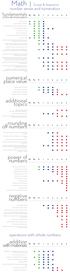 Math Scope & Sequence fundamentals number sense and numeration of the decimal system Count to 10 by units Associate number to numeral (1-10) KN 1 KN 1 KN 2 KN 2 Identify odd and even numbers/numerals and
Student Outcomes. Lesson Notes. Classwork. Exercises 1 3 (4 minutes)
 Student Outcomes Students give an informal derivation of the relationship between the circumference and area of a circle. Students know the formula for the area of a circle and use it to solve problems.
Math Review. for the Quantitative Reasoning Measure of the GRE revised General Test
 Math Review for the Quantitative Reasoning Measure of the GRE revised General Test www.ets.org Overview This Math Review will familiarize you with the mathematical skills and concepts that are important
Prentice Hall Mathematics Courses 1-3 Common Core Edition 2013
 A Correlation of Prentice Hall Mathematics Courses 1-3 Common Core Edition 2013 to the Topics & Lessons of Pearson A Correlation of Courses 1, 2 and 3, Common Core Introduction This document demonstrates
Paper Reference. Ruler graduated in centimetres and millimetres, protractor, compasses, pen, HB pencil, eraser, calculator. Tracing paper may be used.
 Centre No. Candidate No. Paper Reference 1 3 8 0 2 F Paper Reference(s) 1380/2F Edexcel GCSE Mathematics (Linear) 1380 Paper 2 (Calculator) Foundation Tier Friday 12 November 2010 Morning Time: 1 hour
ESSENTIAL REVISION QUESTIONS. MathsWatch Higher. Book
 GCSE Mathematics ESSENTIAL REVISION QUESTIONS MathsWatch Higher Book with answers to all questions www.mathswatch.com enquiries to [email protected] 1T) a) 4t + 7t b) 4t 7t c) 6y + 2w 5y d) 6y 3t e)
MATH 60 NOTEBOOK CERTIFICATIONS
 MATH 60 NOTEBOOK CERTIFICATIONS Chapter #1: Integers and Real Numbers 1.1a 1.1b 1.2 1.3 1.4 1.8 Chapter #2: Algebraic Expressions, Linear Equations, and Applications 2.1a 2.1b 2.1c 2.2 2.3a 2.3b 2.4 2.5
ModuMath Basic Math Basic Math 1.1 - Naming Whole Numbers Basic Math 1.2 - The Number Line Basic Math 1.3 - Addition of Whole Numbers, Part I
 ModuMath Basic Math Basic Math 1.1 - Naming Whole Numbers 1) Read whole numbers. 2) Write whole numbers in words. 3) Change whole numbers stated in words into decimal numeral form. 4) Write numerals in
LESSON 4 Missing Numbers in Multiplication Missing Numbers in Division LESSON 5 Order of Operations, Part 1 LESSON 6 Fractional Parts LESSON 7 Lines,
 Saxon Math 7/6 Class Description: Saxon mathematics is based on the principle of developing math skills incrementally and reviewing past skills daily. It also incorporates regular and cumulative assessments.
Thursday 8 November 2012 Afternoon
 H Thursday 8 November 2012 Afternoon GCSE MATHEMATICS B J567/04 Paper 4 (Higher Tier) *J517181112* Candidates answer on the Question Paper. OCR supplied materials: None Other materials required: Geometrical
Answer Key For The California Mathematics Standards Grade 7
 Introduction: Summary of Goals GRADE SEVEN By the end of grade seven, students are adept at manipulating numbers and equations and understand the general principles at work. Students understand and use
4. How many integers between 2004 and 4002 are perfect squares?
 5 is 0% of what number? What is the value of + 3 4 + 99 00? (alternating signs) 3 A frog is at the bottom of a well 0 feet deep It climbs up 3 feet every day, but slides back feet each night If it started
Geometry and Measurement
 The student will be able to: Geometry and Measurement 1. Demonstrate an understanding of the principles of geometry and measurement and operations using measurements Use the US system of measurement for
Vocabulary checklist. Year 7. Applying mathematics and solving problems. Numbers and the number system
 Vocabulary checklist Year 7 This list contains the key words used in the Year 7 teaching programme and supplement of examples. Some words will be familiar to pupils in Year 7 from earlier work. For definitions
Fourth Grade Math Standards and "I Can Statements"
 Fourth Grade Math Standards and "I Can Statements" Standard - CC.4.OA.1 Interpret a multiplication equation as a comparison, e.g., interpret 35 = 5 x 7 as a statement that 35 is 5 times as many as 7 and
Pythagoras Theorem. Page I can... 1... identify and label right-angled triangles. 2... explain Pythagoras Theorem. 4... calculate the hypotenuse
 Pythagoras Theorem Page I can... 1... identify and label right-angled triangles 2... eplain Pythagoras Theorem 4... calculate the hypotenuse 5... calculate a shorter side 6... determine whether a triangle
6. Vectors. 1 2009-2016 Scott Surgent ([email protected])
 6. Vectors For purposes of applications in calculus and physics, a vector has both a direction and a magnitude (length), and is usually represented as an arrow. The start of the arrow is the vector s foot,
You must have: Ruler graduated in centimetres and millimetres, protractor, compasses, pen, HB pencil, eraser, calculator. Tracing paper may be used.
 Write your name here Surname Other names Pearson Edexcel International GCSE Mathematics A Paper 1FR Centre Number Tuesday 6 January 2015 Afternoon Time: 2 hours Candidate Number Foundation Tier Paper Reference
GAP CLOSING. 2D Measurement. Intermediate / Senior Student Book
 GAP CLOSING 2D Measurement Intermediate / Senior Student Book 2-D Measurement Diagnostic...3 Areas of Parallelograms, Triangles, and Trapezoids...6 Areas of Composite Shapes...14 Circumferences and Areas