
Waste Classification. List of Waste & Determining if Waste is Hazardous or Non-hazardous. Valid from 1st June 2015
|
|
|
- Benjamin Parks
- 9 years ago
- Views:
Transcription
1 Waste Classification List of Waste & Determining if Waste is Hazardous or Non-hazardous Valid from 1st June 2015
2 ENVIRONMENTAL PROTECTION AGENCY The Environmental Protection Agency (EPA) is responsible for protecting and improving the environment as a valuable asset for the people of Ireland. We are committed to protecting people and the environment from the harmful effects of radiation and pollution. The work of the EPA can be divided into three main areas: Regulation: We implement effective regulation and environmental compliance systems to deliver good environmental outcomes and target those who don t comply. Knowledge: We provide high quality, targeted and timely environmental data, information and assessment to inform decision making at all levels. Advocacy: We work with others to advocate for a clean, productive and well protected environment and for sustainable environmental behaviour. Our Responsibilities Licensing We regulate the following activities so that they do not endanger human health or harm the environment: waste facilities (e.g. landfills, incinerators, waste transfer stations); large scale industrial activities (e.g. pharmaceutical, cement manufacturing, power plants); intensive agriculture (e.g. pigs, poultry); the contained use and controlled release of Genetically Modified Organisms (GMOs); sources of ionising radiation (e.g. x-ray and radiotherapy equipment, industrial sources); large petrol storage facilities; waste water discharges; dumping at sea activities. National Environmental Enforcement Conducting an annual programme of audits and inspections of EPA licensed facilities. Overseeing local authorities environmental protection responsibilities. Supervising the supply of drinking water by public water suppliers. Working with local authorities and other agencies to tackle environmental crime by co-ordinating a national enforcement network, targeting offenders and overseeing remediation. Enforcing Regulations such as Waste Electrical and Electronic Equipment (WEEE), Restriction of Hazardous Substances (RoHS) and substances that deplete the ozone layer. Prosecuting those who flout environmental law and damage the environment. Water Management Monitoring and reporting on the quality of rivers, lakes, transitional and coastal waters of Ireland and groundwaters; measuring water levels and river flows. National coordination and oversight of the Water Framework Directive. Monitoring and reporting on Bathing Water Quality. Monitoring, Analysing and Reporting on the Environment Monitoring air quality and implementing the EU Clean Air for Europe (CAFÉ) Directive. Independent reporting to inform decision making by national and local government (e.g. periodic reporting on the State of Ireland s Environment and Indicator Reports). Regulating Ireland s Greenhouse Gas Emissions Preparing Ireland s greenhouse gas inventories and projections. Implementing the Emissions Trading Directive, for over 100 of the largest producers of carbon dioxide in Ireland. Environmental Research and Development Funding environmental research to identify pressures, inform policy and provide solutions in the areas of climate, water and sustainability. Strategic Environmental Assessment Assessing the impact of proposed plans and programmes on the Irish environment (e.g. major development plans). Radiological Protection Monitoring radiation levels, assessing exposure of people in Ireland to ionising radiation. Assisting in developing national plans for emergencies arising from nuclear accidents. Monitoring developments abroad relating to nuclear installations and radiological safety. Providing, or overseeing the provision of, specialist radiation protection services. Guidance, Accessible Information and Education Providing advice and guidance to industry and the public on environmental and radiological protection topics. Providing timely and easily accessible environmental information to encourage public participation in environmental decision-making (e.g. My Local Environment, Radon Maps). Advising Government on matters relating to radiological safety and emergency response. Developing a National Hazardous Waste Management Plan to prevent and manage hazardous waste. Awareness Raising and Behavioural Change Generating greater environmental awareness and influencing positive behavioural change by supporting businesses, communities and householders to become more resource efficient. Promoting radon testing in homes and workplaces and encouraging remediation where necessary. Management and structure of the EPA The EPA is managed by a full time Board, consisting of a Director General and five Directors. The work is carried out across five Offices: Office of Climate, Licensing and Resource Use Office of Environmental Enforcement Office of Environmental Assessment Office of Radiological Protection Office of Communications and Corporate Services The EPA is assisted by an Advisory Committee of twelve members who meet regularly to discuss issues of concern and provide advice to the Board.

3 Waste Classification List of Waste & Determining if Waste is Hazardous or Non-hazardous VALID FROM 1 JUNE 2015 ENVIRONMENTAL PROTECTION AGENCY AN GHNÍOMHAIREACHT UM CHAOMHNÚ COMHSHAOIL P.O. BOX 3000, Johnstown Castle Estate, County Wexford, Ireland Telephone: Fax: [email protected] Website: Environmental Protection Agency 2015 Parts of this publication may be reported without further permission, provided the source is acknowledged. Published by the Environmental Protection Agency, Ireland. This document does not purport to be and should not be considered a legal interpretation of the EU and Irish legislation on which it is based. Although every effort has been made to ensure the accuracy of the material contained in this publication, completed accuracy cannot be guaranteed. Neither the Environmental Protection Agency nor the author(s) accept any responsibility whatsoever for loss or damage occasioned or claimed to have been occasioned, in part or in full, as a consequence of any person acting, or refraining from acting, as a result of a matter contained in this publication. ISBN: /15/200 PRICE: Free of charge
4

5 Contents Non Application under Waste Framework Directive Introduction 3 Appendix 1 List of Waste 5 Appendix 2 Determining if waste is hazardous or non-hazardous 37 Appendix 3 Notes included in Annex VI to Regulation (EC) No 1272/2008 as amended 53 Appendix 4 Sampling and Testing Standards 55 1

6 Waste Classification, List of Waste & Determining if Waste is Hazardous or Non-Hazardous Environmental Protection Agency Waste Classification, List of Waste & Determining if Waste is Hazardous or Non-Hazardous Non Application under Waste Framework Directive 2008 The following are excluded from the scope of this document: a) gaseous effluents emitted into the atmosphere; b) land (in situ) including unexcavated contaminated soil and buildings permanently connected with land; c) uncontaminated soil and other naturally occurring material excavated in the course of construction activities where it is certain that the material will be used for the purposes of construction in its natural state on the site from which it was excavated; d) radioactive waste, except where such material is combined with certain waste streams like WEEE; e) decommissioned explosives; f) faecal matter, if not covered by paragraph 2(b) 1, straw and other natural non-hazardous agricultural or forestry material used in farming, forestry or for the production of energy from such biomass through processes or methods which do not harm the environment or endanger human health. 1 2(b) animal by-products including processed products covered by Regulation (EC) No 1774/2002, except those which are destined for incineration, landfilling or use in a biogas or composting plant 2
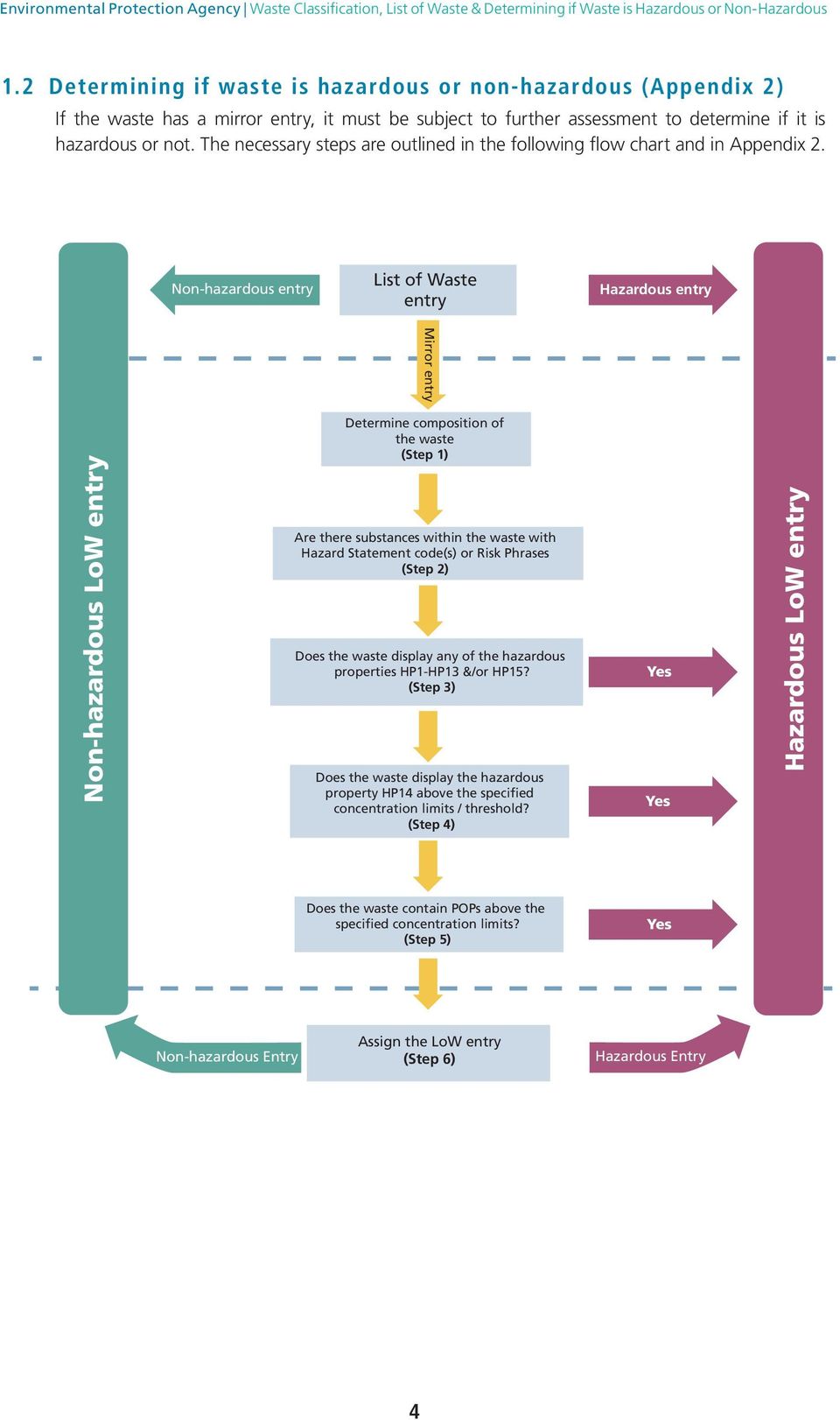
7 Environmental Protection Agency Waste Classification, List of Waste & Determining if Waste is Hazardous or Non-Hazardous 1. Introduction Correct classification is the foundation for ensuring that the collection, transportation, storage and treatment of waste is carried out in a manner that provides protection for the environment and human health and in compliance with legal requirements. From 1 June 2015, waste classification is based on: 1. Commission Decision of 18 December 2014, amending Decision 2000/532/EC on the list of waste pursuant to Directive 2008/98/EC of the European parliament and of the Council (2014/955/EEC) [referred to hereafter as The List of Waste (LoW) ]. 2. Commission Regulation (EU) No 1357/2014 of 18 December 2014, replacing Annex III to Directive 2008/98/EC of the European Parliament and of the Council on waste and repealing certain Directives. This waste classification system applies across the EU and is the basis for all national and international waste reporting obligations. This document consolidates the Decision and Regulation and provides guidance on how to follow them. This document replaces: The 2002 European Waste Catalogue and the Hazardous Waste List Hazardous Waste Classification Tool Hazardous Waste Classification Worksheet. It will be updated in the event of further amendments to the law and when the European Commission concludes its determination on hazardous property HP14 (see below). The overall system is shown in the flow chart in section 1.2 below. There are two main elements, as follows. 1.1 List of Waste (LoW) (Appendix 1) The LoW provides a harmonised list for coding all waste. The different types of waste in the list are fully defined by the six-digit entry for the waste including the respective two-digit and fourdigit chapter headings. Waste can have one of the following three entry types: Non-hazardous Hazardous (marked with an asterisk) Mirror either hazardous or non-hazardous. Without prejudice to the provisions of Article 7(3) of Directive 2008/98/EC, if a waste has a non-hazardous entry, it is non-hazardous without further assessment. If a waste has a hazardous entry, it is hazardous without further assessment. If it has a mirror entry it must be dealt with in accordance with section 1.2. Where evidence exists to show that specific waste that appears on the LoW as hazardous waste does not display any of the hazardous properties HP1 HP15 (Appendix 2, step 3.1 and step 3.2) and/or Persistent Organic Pollutant s (POPS), it may be considered as non-hazardous waste in accordance with the provisions of Article 7(3) of Directive 2008/98/EC. The Member State must notify the Commission of any such cases and shall provide the Commission with all of the necessary evidence. In light of notifications received, the list shall be reviewed in order to decide on its adaptation. 3
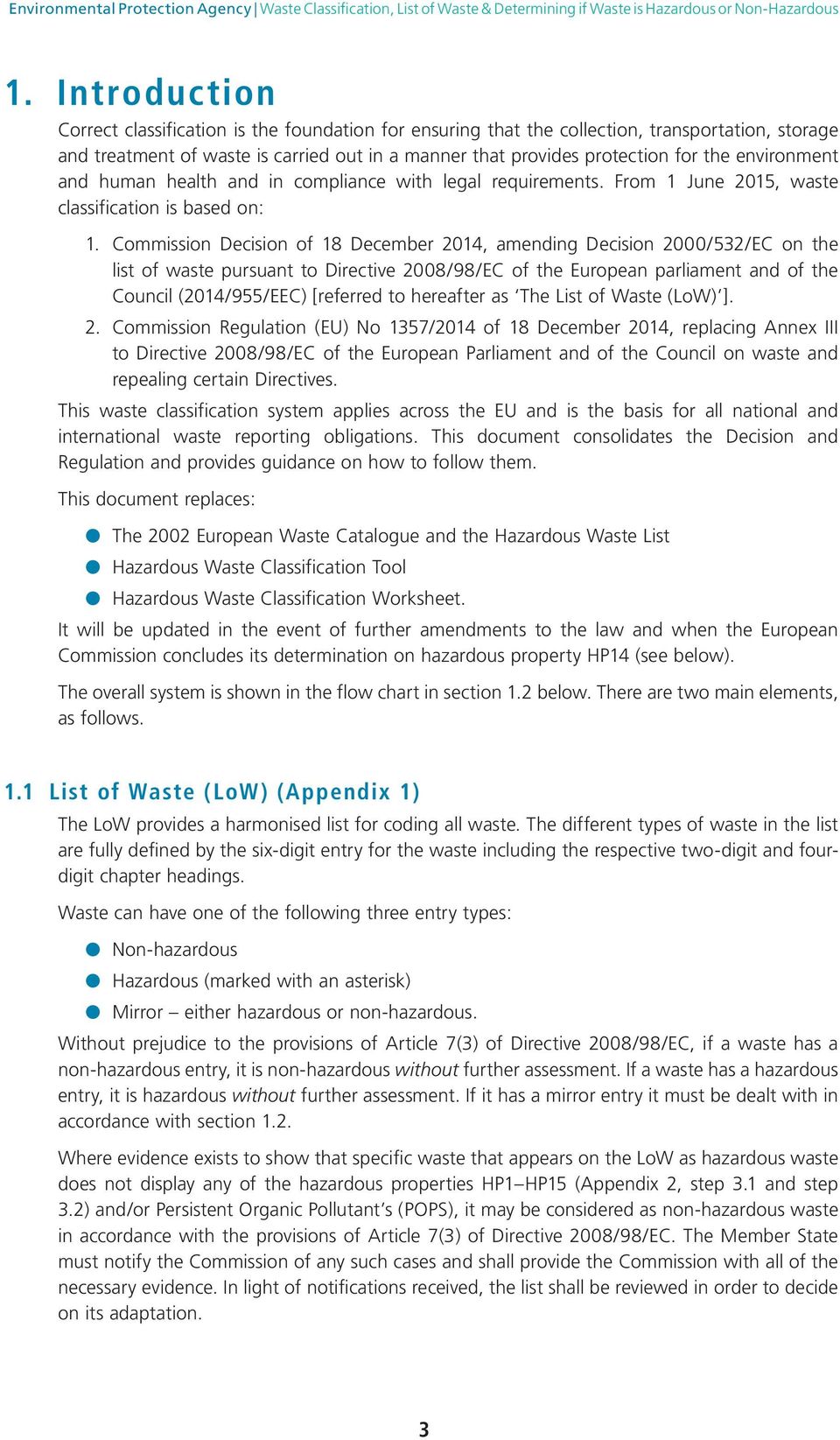
8 Environmental Protection Agency Waste Classification, List of Waste & Determining if Waste is Hazardous or Non-Hazardous 1.2 Determining if waste is hazardous or non-hazardous (Appendix 2) If the waste has a mirror entry, it must be subject to further assessment to determine if it is hazardous or not. The necessary steps are outlined in the following flow chart and in Appendix 2. Non-hazardous entry List of Waste entry Hazardous entry Mirror entry Non-hazardous LoW entry Determine composition of the waste (Step 1) Are there substances within the waste with Hazard Statement code(s) or Risk Phrases (Step 2) Does the waste display any of the hazardous properties HP1-HP13 &/or HP15? (Step 3) Does the waste display the hazardous property HP14 above the specified concentration limits / threshold? (Step 4) Yes Yes Hazardous LoW entry Does the waste contain POPs above the specified concentration limits? (Step 5) Yes Non-hazardous Entry Assign the LoW entry (Step 6) Hazardous Entry 4
9 List of Waste Environmental Protection Agency List of Waste Appendix 1 List of Waste Instruction for Using the List The different types of waste in the list are fully defined by the six-digit code for the waste and the respective two-digit and four-digit chapter headings. This implies that the following steps should be taken to identify a waste in the list: Identify the source generating the waste in Chapters 01 to 12 or 17 to 20 and identify the appropriate six-digit code of the waste (excluding codes ending with 99 in these chapters). Note : that a specific production unit may need to classify its activities in several chapters. For instance, a car manufacturer may find its wastes listed in Chapters 12 (wastes from shaping and surface treatment of metals), 11 (inorganic wastes containing metals from metal treatment and the coating of metals) and 08 (waste from the use of coatings), depending on the different process steps. Separately collected packaging waste (including mixtures of different packaging materials) shall be classified in 15 01, not in If no appropriate waste code can be found in Chapters 01 to 12 or 17 to 20, Chapters 13, 14 and 15 must be examined to identify the type of waste. If none of these waste codes apply, the waste must be identified according to Chapter 16. If the waste is not in Chapter 16 either, the 99 code (wastes not otherwise specified) must be used in the section of the list corresponding to the activity identified in the first bullet point above. 5

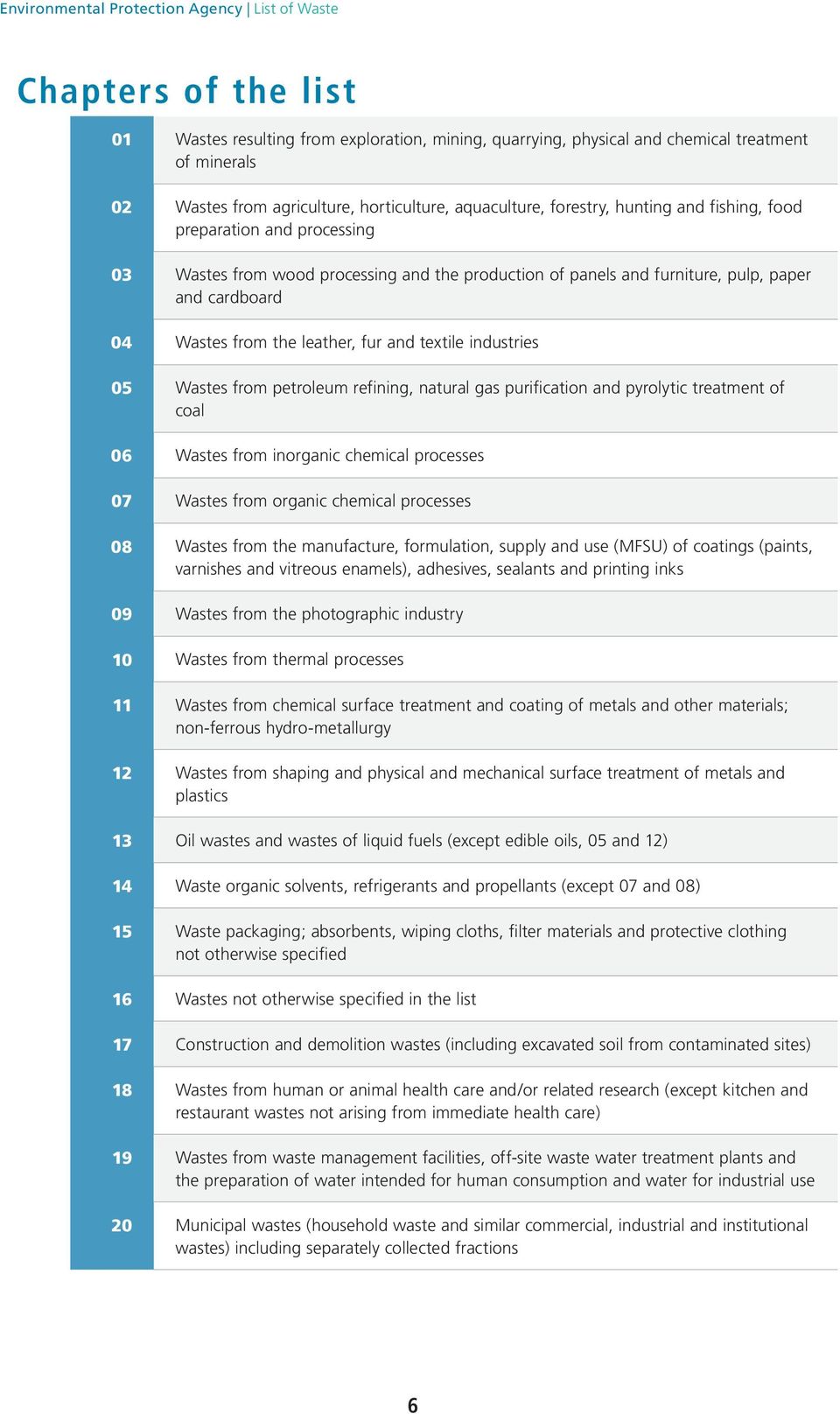
10 Environmental Protection Agency List of Waste Chapters of the list 01 Wastes resulting from exploration, mining, quarrying, physical and chemical treatment of minerals 02 Wastes from agriculture, horticulture, aquaculture, forestry, hunting and fishing, food preparation and processing 03 Wastes from wood processing and the production of panels and furniture, pulp, paper and cardboard 04 Wastes from the leather, fur and textile industries 05 Wastes from petroleum refining, natural gas purification and pyrolytic treatment of coal 06 Wastes from inorganic chemical processes 07 Wastes from organic chemical processes 08 Wastes from the manufacture, formulation, supply and use (MFSU) of coatings (paints, varnishes and vitreous enamels), adhesives, sealants and printing inks 09 Wastes from the photographic industry 10 Wastes from thermal processes 11 Wastes from chemical surface treatment and coating of metals and other materials; non-ferrous hydro-metallurgy 12 Wastes from shaping and physical and mechanical surface treatment of metals and plastics 13 Oil wastes and wastes of liquid fuels (except edible oils, 05 and 12) 14 Waste organic solvents, refrigerants and propellants (except 07 and 08) 15 Waste packaging; absorbents, wiping cloths, filter materials and protective clothing not otherwise specified 16 Wastes not otherwise specified in the list 17 Construction and demolition wastes (including excavated soil from contaminated sites) 18 Wastes from human or animal health care and/or related research (except kitchen and restaurant wastes not arising from immediate health care) 19 Wastes from waste management facilities, off-site waste water treatment plants and the preparation of water intended for human consumption and water for industrial use 20 Municipal wastes (household waste and similar commercial, industrial and institutional wastes) including separately collected fractions 6
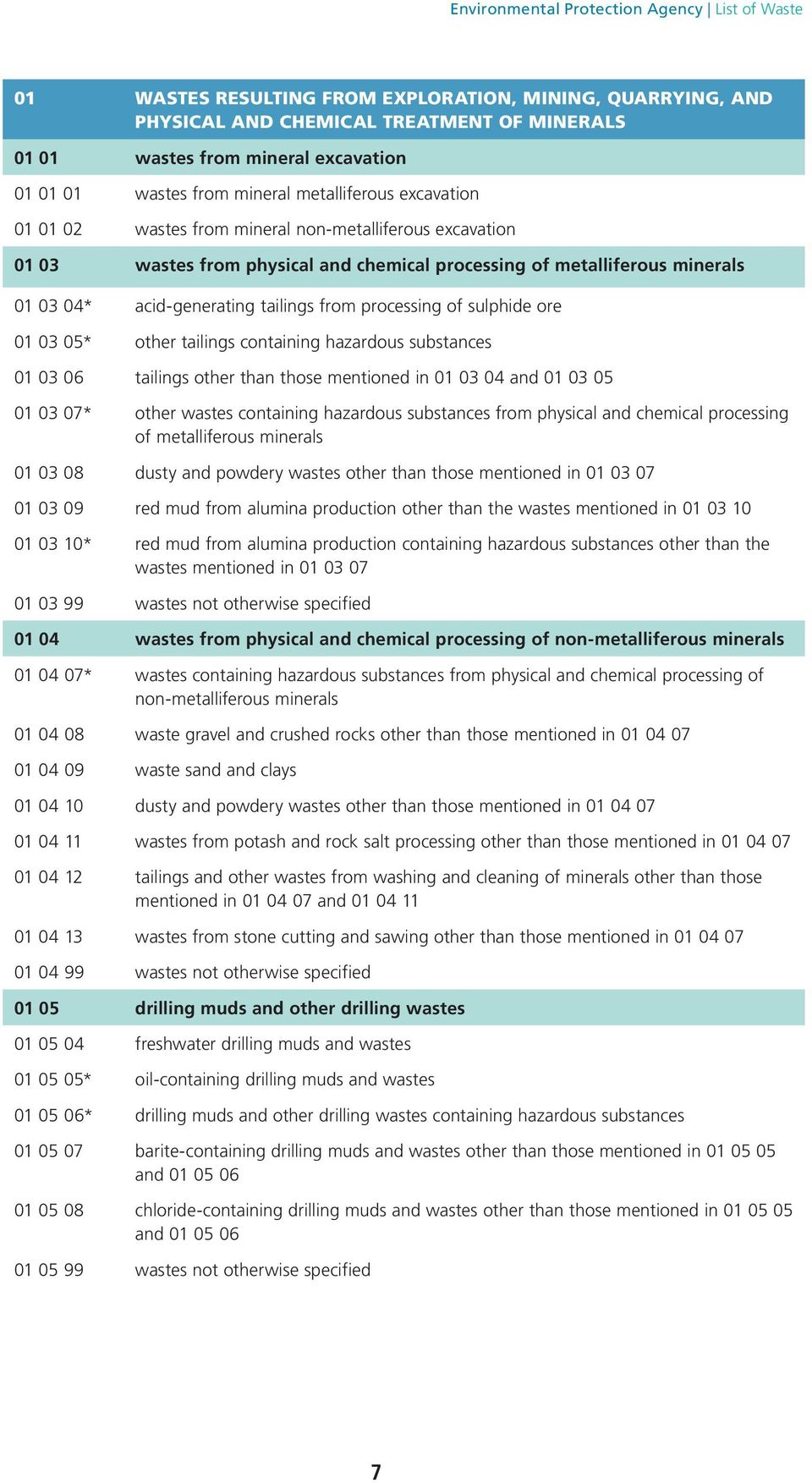
11 Environmental Protection Agency List of Waste 01 WASTES RESULTING FROM EXPLORATION, MINING, QUARRYING, AND PHYSICAL AND CHEMICAL TREATMENT OF MINERALS wastes from mineral excavation wastes from mineral metalliferous excavation wastes from mineral non-metalliferous excavation wastes from physical and chemical processing of metalliferous minerals * acid-generating tailings from processing of sulphide ore * other tailings containing hazardous substances tailings other than those mentioned in and * other wastes containing hazardous substances from physical and chemical processing of metalliferous minerals dusty and powdery wastes other than those mentioned in red mud from alumina production other than the wastes mentioned in * red mud from alumina production containing hazardous substances other than the wastes mentioned in wastes not otherwise specified wastes from physical and chemical processing of non-metalliferous minerals * wastes containing hazardous substances from physical and chemical processing of non-metalliferous minerals waste gravel and crushed rocks other than those mentioned in waste sand and clays dusty and powdery wastes other than those mentioned in wastes from potash and rock salt processing other than those mentioned in tailings and other wastes from washing and cleaning of minerals other than those mentioned in and wastes from stone cutting and sawing other than those mentioned in wastes not otherwise specified drilling muds and other drilling wastes freshwater drilling muds and wastes * oil-containing drilling muds and wastes * drilling muds and other drilling wastes containing hazardous substances barite-containing drilling muds and wastes other than those mentioned in and chloride-containing drilling muds and wastes other than those mentioned in and wastes not otherwise specified 7
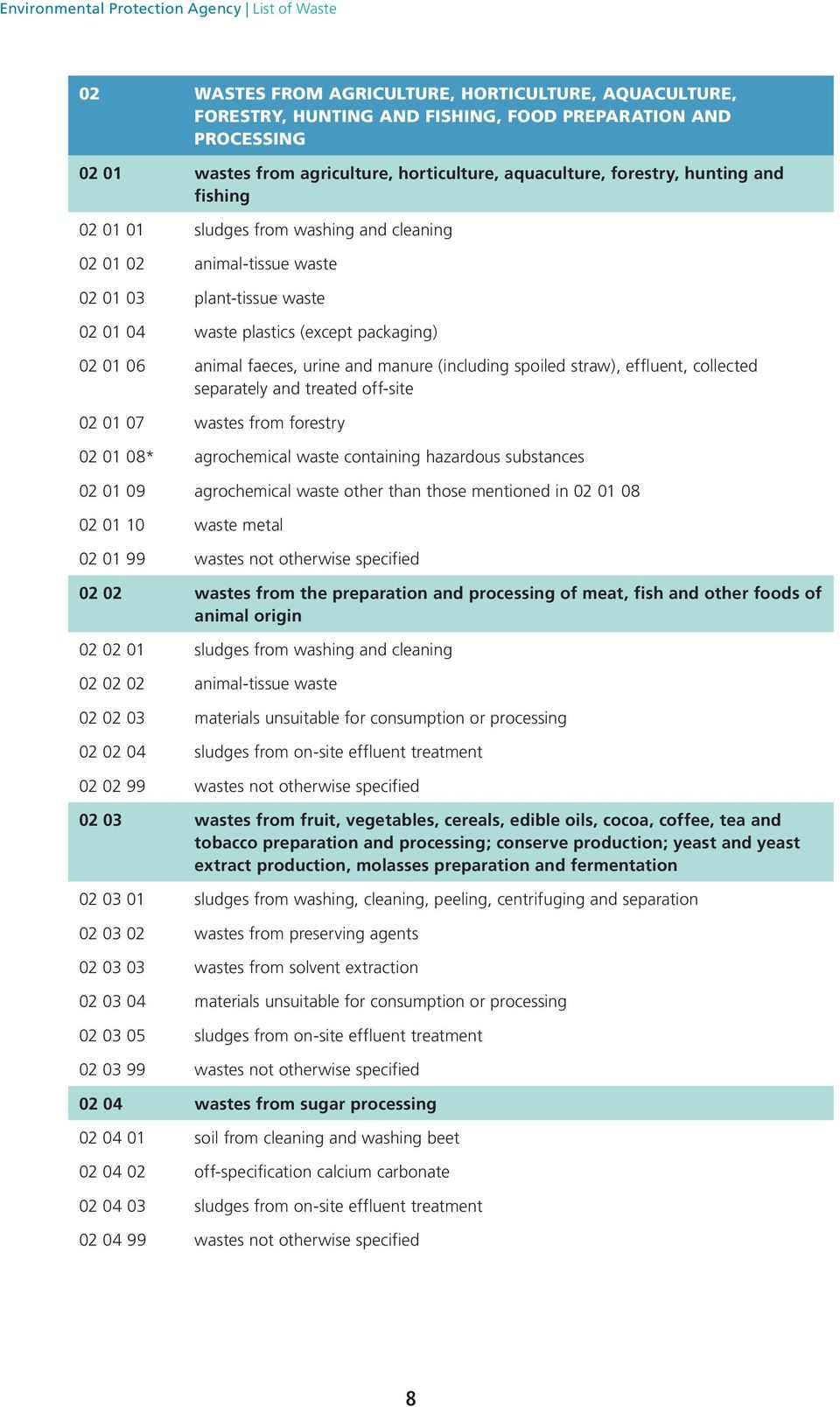
12 Environmental Protection Agency List of Waste 02 WASTES FROM AGRICULTURE, HORTICULTURE, AQUACULTURE, FORESTRY, HUNTING AND FISHING, FOOD PREPARATION AND PROCESSING wastes from agriculture, horticulture, aquaculture, forestry, hunting and fishing sludges from washing and cleaning animal-tissue waste plant-tissue waste waste plastics (except packaging) animal faeces, urine and manure (including spoiled straw), effluent, collected separately and treated off-site wastes from forestry * agrochemical waste containing hazardous substances agrochemical waste other than those mentioned in waste metal wastes not otherwise specified wastes from the preparation and processing of meat, fish and other foods of animal origin sludges from washing and cleaning animal-tissue waste materials unsuitable for consumption or processing sludges from on-site effluent treatment wastes not otherwise specified wastes from fruit, vegetables, cereals, edible oils, cocoa, coffee, tea and tobacco preparation and processing; conserve production; yeast and yeast extract production, molasses preparation and fermentation sludges from washing, cleaning, peeling, centrifuging and separation wastes from preserving agents wastes from solvent extraction materials unsuitable for consumption or processing sludges from on-site effluent treatment wastes not otherwise specified wastes from sugar processing soil from cleaning and washing beet off-specification calcium carbonate sludges from on-site effluent treatment wastes not otherwise specified 8
13 Environmental Protection Agency List of Waste wastes from the dairy products industry materials unsuitable for consumption or processing sludges from on-site effluent treatment wastes not otherwise specified wastes from the baking and confectionery industry materials unsuitable for consumption or processing wastes from preserving agents sludges from on-site effluent treatment wastes not otherwise specified wastes from the production of alcoholic and non-alcoholic beverages (except coffee, tea and cocoa) wastes from washing, cleaning and mechanical reduction of raw materials wastes from spirits distillation wastes from chemical treatment materials unsuitable for consumption or processing sludges from on-site effluent treatment wastes not otherwise specified 03 WASTES FROM WOOD PROCESSING AND THE PRODUCTION OF PANELS AND FURNITURE, PULP, PAPER AND CARDBOARD wastes from wood processing and the production of panels and furniture waste bark and cork * sawdust, shavings, cuttings, wood, particle board and veneer containing hazardous substances sawdust, shavings, cuttings, wood, particle board and veneer other than those mentioned in wastes not otherwise specified wastes from wood preservation * non-halogenated organic wood preservatives * organochlorinated wood preservatives * organometallic wood preservatives * inorganic wood preservatives * other wood preservatives containing hazardous substances wood preservatives not otherwise specified wastes from pulp, paper and cardboard production and processing waste bark and wood green liquor sludge (from recovery of cooking liquor) de-inking sludges from paper recycling mechanically separated rejects from pulping of waste paper and cardboard 9

14 Environmental Protection Agency List of Waste wastes from sorting of paper and cardboard destined for recycling lime mud waste fibre rejects, fibre-, filler- and coating-sludges from mechanical separation sludges from on-site effluent treatment other than those mentioned in wastes not otherwise specified 04 WASTES FROM THE LEATHER, FUR AND TEXTILE INDUSTRIES wastes from the leather and fur industry fleshings and lime split wastes liming waste * degreasing wastes containing solvents without a liquid phase tanning liquor containing chromium tanning liquor free of chromium sludges, in particular from on-site effluent treatment containing chromium sludges, in particular from on-site effluent treatment free of chromium waste tanned leather (blue sheetings, shavings, cuttings, buffing dust) containing chromium wastes from dressing and finishing wastes not otherwise specified wastes from the textile industry wastes from composite materials (impregnated textile, elastomer, plastomer) organic matter from natural products (for example grease, wax) * wastes from finishing containing organic solvents wastes from finishing other than those mentioned in * dyestuffs and pigments containing hazardous substances dyestuffs and pigments other than those mentioned in * sludges from on-site effluent treatment containing hazardous substances sludges from on-site effluent treatment other than those mentioned in wastes from unprocessed textile fibres wastes from processed textile fibres wastes not otherwise specified 05 WASTES FROM PETROLEUM REFINING, NATURAL GAS PURIFICATION AND PYROLYTIC TREATMENT OF COAL wastes from petroleum refining * desalter sludges * tank bottom sludges * acid alkyl sludges * oil spills 10
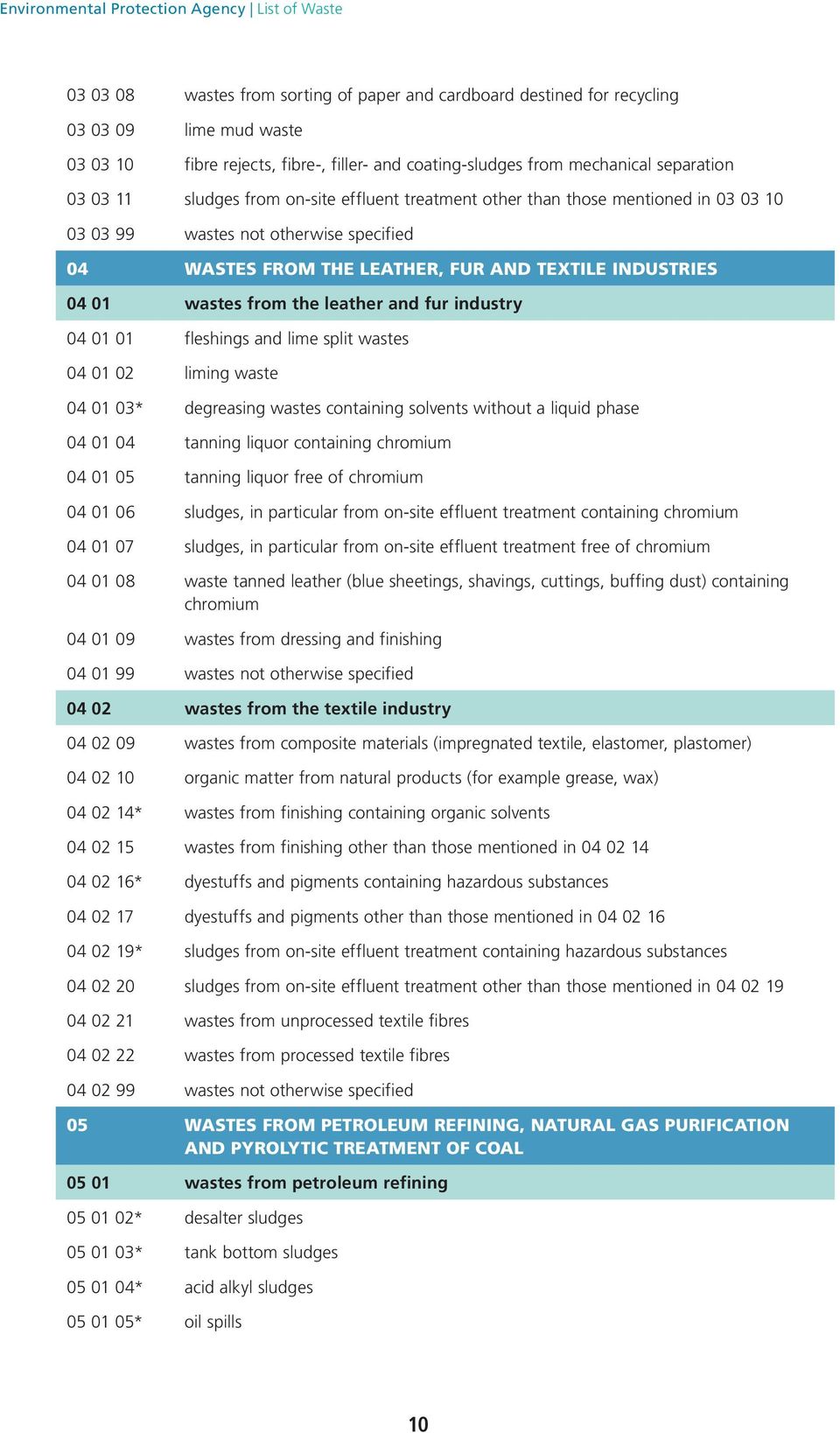
15 Environmental Protection Agency List of Waste * oily sludges from maintenance operations of the plant or equipment * acid tars * other tars * sludges from on-site effluent treatment containing hazardous substances sludges from on-site effluent treatment other than those mentioned in * wastes from cleaning of fuels with bases * oil containing acids boiler feedwater sludges wastes from cooling columns * spent filter clays sulphur-containing wastes from petroleum desulphurisation Bitumen wastes not otherwise specified wastes from the pyrolytic treatment of coal * acid tars * other tars waste from cooling columns wastes not otherwise specified wastes from natural gas purification and transportation * wastes containing mercury wastes containing sulphur wastes not otherwise specified 06 WASTES FROM INORGANIC CHEMICAL PROCESSES wastes from the manufacture, formulation, supply and use (MFSU) of acids * sulphuric acid and sulphurous acid * hydrochloric acid * hydrofluoric acid * phosphoric and phosphorous acid * nitric acid and nitrous acid * other acids wastes not otherwise specified wastes from the MFSU of bases * calcium hydroxide * ammonium hydroxide * sodium and potassium hydroxide * other bases wastes not otherwise specified 11

16 Environmental Protection Agency List of Waste wastes from the MFSU of salts and their solutions and metallic oxides * solid salts and solutions containing cyanides * solid salts and solutions containing heavy metals solid salts and solutions other than those mentioned in and * metallic oxides containing heavy metals metallic oxides other than those mentioned in wastes not otherwise specified metal-containing wastes other than those mentioned in * wastes containing arsenic * wastes containing mercury * wastes containing other heavy metals wastes not otherwise specified sludges from on-site effluent treatment * sludges from on-site effluent treatment containing hazardous substances sludges from on-site effluent treatment other than those mentioned in wastes from the MFSU of sulphur chemicals, sulphur chemical processes and desulphurisation processes * wastes containing hazardous sulphides wastes containing sulphides other than those mentioned in wastes not otherwise specified wastes from the MFSU of halogens and halogen chemical processes * wastes containing asbestos from electrolysis * activated carbon from chlorine production * barium sulphate sludge containing mercury * solutions and acids, for example contact acid wastes not otherwise specified wastes from the MFSU of silicon and silicon derivatives * waste containing hazardous chlorosilanes wastes not otherwise specified wastes from the MSFU of phosphorous chemicals and phosphorous chemical processes phosphorous slag * calcium-based reaction wastes containing or contaminated with hazardous substances calcium-based reaction wastes other than those mentioned in wastes not otherwise specified wastes from the MFSU of nitrogen chemicals, nitrogen chemical processes and fertiliser manufacture 12
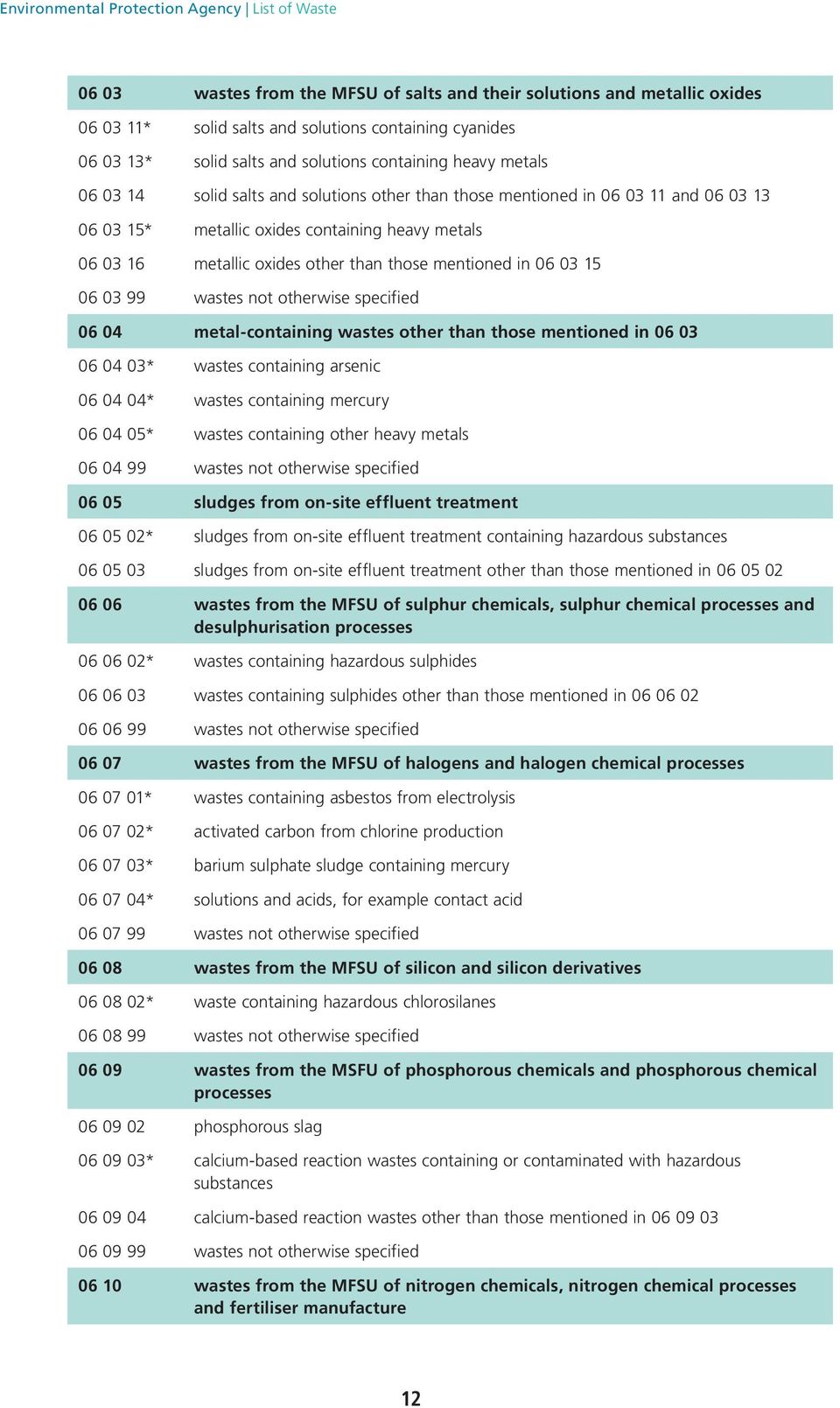
17 Environmental Protection Agency List of Waste * wastes containing hazardous substances wastes not otherwise specified wastes from the manufacture of inorganic pigments and opacificiers calcium-based reaction wastes from titanium dioxide production wastes not otherwise specified wastes from inorganic chemical processes not otherwise specified * inorganic plant protection products, wood-preserving agents and other biocides * spent activated carbon (except ) carbon black * wastes from asbestos processing * Soot wastes not otherwise specified 07 WASTES FROM ORGANIC CHEMICAL PROCESSES wastes from the manufacture, formulation, supply and use (MFSU) of basic organic chemicals * aqueous washing liquids and mother liquors * organic halogenated solvents, washing liquids and mother liquors * other organic solvents, washing liquids and mother liquors * halogenated still bottoms and reaction residues * other still bottoms and reaction residues * halogenated filter cakes and spent absorbents * other filter cakes and spent absorbents * sludges from on-site effluent treatment containing hazardous substances sludges from on-site effluent treatment other than those mentioned in wastes not otherwise specified wastes from the MFSU of plastics, synthetic rubber and man-made fibres * aqueous washing liquids and mother liquors * organic halogenated solvents, washing liquids and mother liquors * other organic solvents, washing liquids and mother liquors * halogenated still bottoms and reaction residues * other still bottoms and reaction residues * halogenated filter cakes and spent absorbents * other filter cakes and spent absorbents * sludges from on-site effluent treatment containing hazardous substances sludges from on-site effluent treatment other than those mentioned in waste plastic * wastes from additives containing hazardous substances 13

18 Environmental Protection Agency List of Waste wastes from additives other than those mentioned in * waste containing hazardous silicones waste containing silicones other than those mentioned in wastes not otherwise specified wastes from the MFSU of organic dyes and pigments (except 06 11) * aqueous washing liquids and mother liquors * organic halogenated solvents, washing liquids and mother liquors * other organic solvents, washing liquids and mother liquors * halogenated still bottoms and reaction residues * other still bottoms and reaction residues * halogenated filter cakes and spent absorbents * other filter cakes and spent absorbents * sludges from on-site effluent treatment containing hazardous substances sludges from on-site effluent treatment other than those mentioned in wastes not otherwise specified wastes from the MFSU of organic plant protection products (except and ), wood preserving agents (except 03 02) and other biocides * aqueous washing liquids and mother liquors * organic halogenated solvents, washing liquids and mother liquors * other organic solvents, washing liquids and mother liquors * halogenated still bottoms and reaction residues * other still bottoms and reaction residues * halogenated filter cakes and spent absorbents * other filter cakes and spent absorbents * sludges from on-site effluent treatment containing hazardous substances sludges from on-site effluent treatment other than those mentioned in * solid wastes containing hazardous substances wastes not otherwise specified wastes from the MFSU of pharmaceuticals * aqueous washing liquids and mother liquors * organic halogenated solvents, washing liquids and mother liquors * other organic solvents, washing liquids and mother liquors * halogenated still bottoms and reaction residues * other still bottoms and reaction residues * halogenated filter cakes and spent absorbents * other filter cakes and spent absorbents * sludges from on-site effluent treatment containing hazardous substances 14
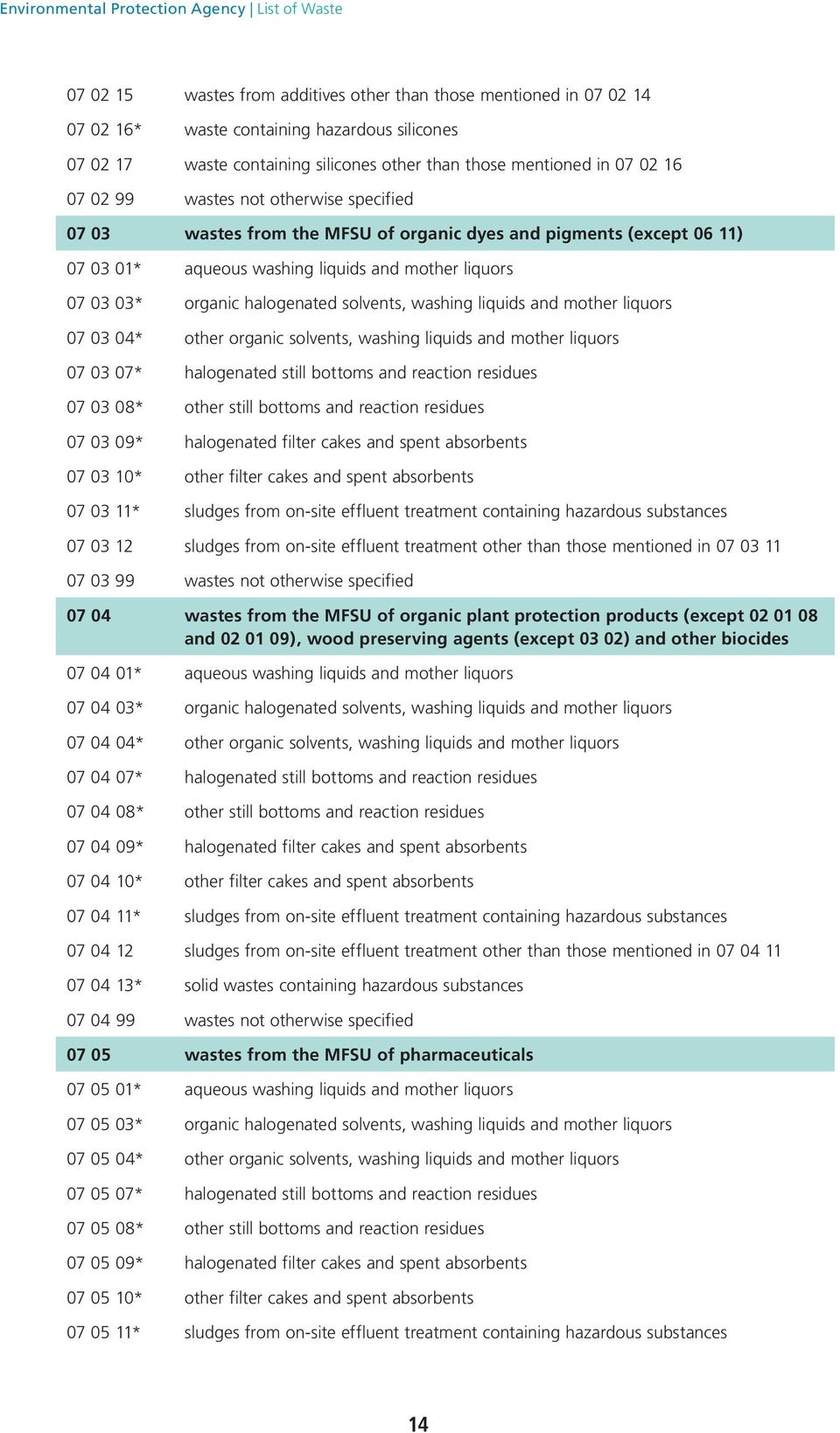
19 Environmental Protection Agency List of Waste sludges from on-site effluent treatment other than those mentioned in * solid wastes containing hazardous substances solid wastes other than those mentioned in wastes not otherwise specified wastes from the MFSU of fats, grease, soaps, detergents, disinfectants and cosmetics * aqueous washing liquids and mother liquors * organic halogenated solvents, washing liquids and mother liquors * other organic solvents, washing liquids and mother liquors * halogenated still bottoms and reaction residues * other still bottoms and reaction residues * halogenated filter cakes and spent absorbents * other filter cakes and spent absorbents * sludges from on-site effluent treatment containing hazardous substances sludges from on-site effluent treatment other than those mentioned in wastes not otherwise specified wastes from the MFSU of fine chemicals and chemical products not otherwise specified * aqueous washing liquids and mother liquors * organic halogenated solvents, washing liquids and mother liquors * other organic solvents, washing liquids and mother liquors * halogenated still bottoms and reaction residues * other still bottoms and reaction residues * halogenated filter cakes and spent absorbents * other filter cakes and spent absorbents * sludges from on-site effluent treatment containing hazardous substances sludges from on-site effluent treatment other than those mentioned in wastes not otherwise specified 08 WASTES FROM THE MANUFACTURE, FORMULATION, SUPPLY AND USE (MFSU) OF COATINGS (PAINTS, VARNISHES AND VITREOUS ENAMELS), ADHESIVES, SEALANTS AND PRINTING INKS wastes from MFSU and removal of paint and varnish * waste paint and varnish containing organic solvents or other hazardous substances waste paint and varnish other than those mentioned in * sludges from paint or varnish containing organic solvents or other hazardous substances sludges from paint or varnish other than those mentioned in

20 Environmental Protection Agency List of Waste * aqueous sludges containing paint or varnish containing organic solvents or other hazardous substances aqueous sludges containing paint or varnish other than those mentioned in * wastes from paint or varnish removal containing organic solvents or other hazardous substances wastes from paint or varnish removal other than those mentioned in * aqueous suspensions containing paint or varnish containing organic solvents or other hazardous substances aqueous suspensions containing paint or varnish other than those mentioned in * waste paint or varnish remover wastes not otherwise specified wastes from MFSU of other coatings (including ceramic materials) waste coating powders aqueous sludges containing ceramic materials aqueous suspensions containing ceramic materials wastes not otherwise specified wastes from MFSU of printing inks aqueous sludges containing ink aqueous liquid waste containing ink * waste ink containing hazardous substances waste ink other than those mentioned in * ink sludges containing hazardous substances ink sludges other than those mentioned in * waste etching solutions * waste printing toner containing hazardous substances waste printing toner other than those mentioned in * disperse oil wastes not otherwise specified wastes from MFSU of adhesives and sealants (including waterproofing products) * waste adhesives and sealants containing organic solvents or other hazardous substances waste adhesives and sealants other than those mentioned in * adhesive and sealant sludges containing organic solvents or other hazardous substances adhesive and sealant sludges other than those mentioned in * aqueous sludges containing adhesives or sealants containing organic solvents or other hazardous substances 16
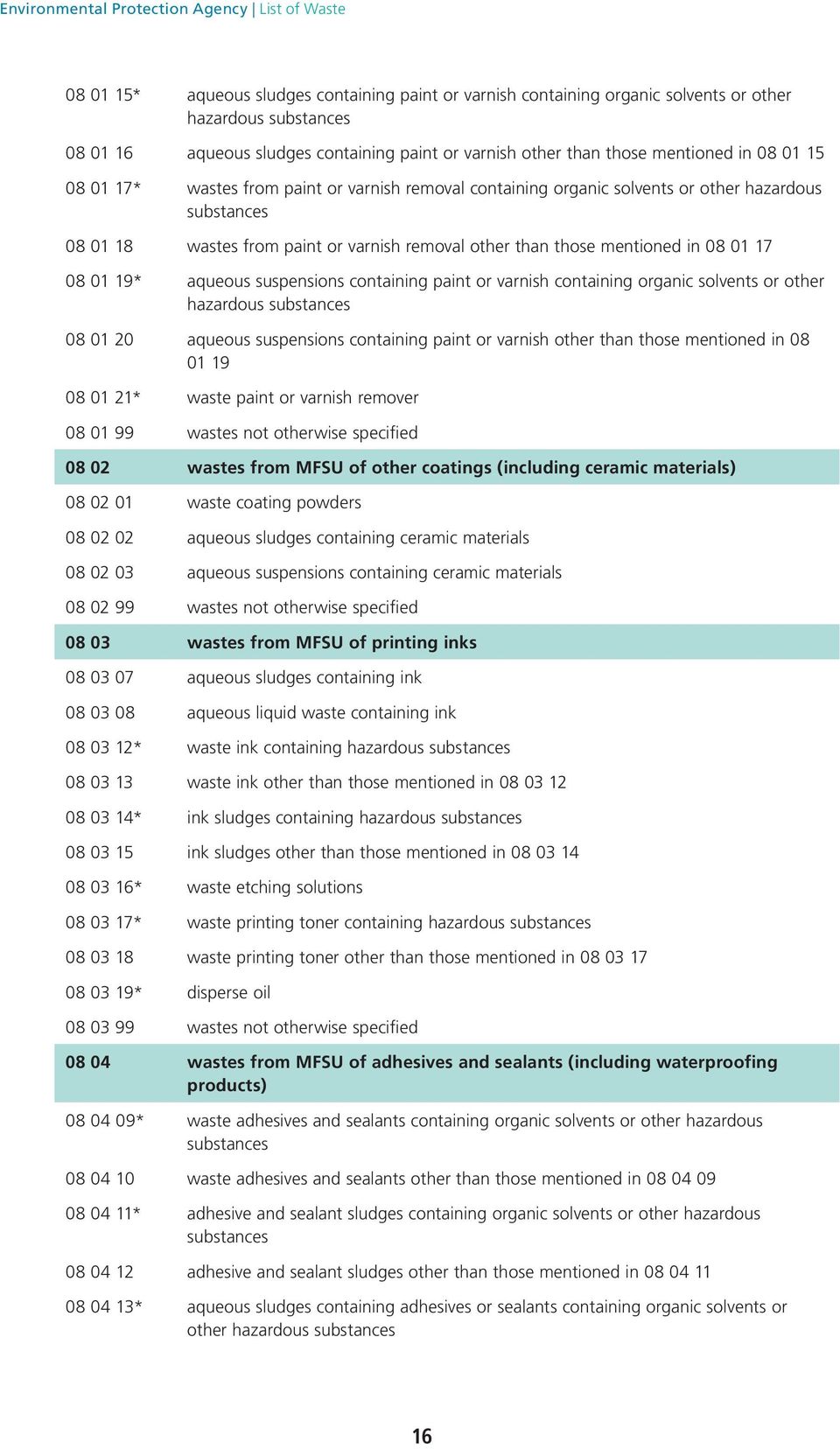
21 Environmental Protection Agency List of Waste aqueous sludges containing adhesives or sealants other than those mentioned in * aqueous liquid waste containing adhesives or sealants containing organic solvents or other hazardous substances aqueous liquid waste containing adhesives or sealants other than those mentioned in * rosin oil wastes not otherwise specified wastes not otherwise specified in * waste isocyanates 09 WASTES FROM THE PHOTOGRAPHIC INDUSTRY wastes from the photographic industry * water-based developer and activator solutions * water-based offset plate developer solutions * solvent-based developer solutions * fixer solutions * bleach solutions and bleach fixer solutions * wastes containing silver from on-site treatment of photographic wastes photographic film and paper containing silver or silver compounds photographic film and paper free of silver or silver compounds single-use cameras without batteries * single-use cameras containing batteries included in , or single-use cameras containing batteries other than those mentioned in * aqueous liquid waste from on-site reclamation of silver other than those mentioned in wastes not otherwise specified 10 WASTES FROM THERMAL PROCESSES wastes from power stations and other combustion plants (except 19) bottom ash, slag and boiler dust (excluding boiler dust mentioned in ) coal fly ash fly ash from peat and untreated wood * oil fly ash and boiler dust calcium-based reaction wastes from flue-gas desulphurisation in solid form calcium-based reaction wastes from flue-gas desulphurisation in sludge form * sulphuric acid * fly ash from emulsified hydrocarbons used as fuel * bottom ash, slag and boiler dust from co-incineration containing hazardous substances 17
22 Environmental Protection Agency List of Waste bottom ash, slag and boiler dust from co-incineration other than those mentioned in * fly ash from co-incineration containing hazardous substances fly ash from co-incineration other than those mentioned in * wastes from gas cleaning containing hazardous substances wastes from gas cleaning other than those mentioned in , and * sludges from on-site effluent treatment containing hazardous substances sludges from on-site effluent treatment other than those mentioned in * aqueous sludges from boiler cleansing containing hazardous substances aqueous sludges from boiler cleansing other than those mentioned in sands from fluidised beds wastes from fuel storage and preparation of coal-fired power plants wastes from cooling-water treatment wastes not otherwise specified wastes from the iron and steel industry wastes from the processing of slag unprocessed slag * solid wastes from gas treatment containing hazardous substances solid wastes from gas treatment other than those mentioned in mill scales * wastes from cooling-water treatment containing oil wastes from cooling-water treatment other than those mentioned in * sludges and filter cakes from gas treatment containing hazardous substances sludges and filter cakes from gas treatment other than those mentioned in other sludges and filter cakes wastes not otherwise specified wastes from aluminium thermal metallurgy anode scraps * primary production slags waste alumina * salt slags from secondary production * black drosses from secondary production * skimmings that are flammable or emit, upon contact with water, flammable gases in hazardous quantities skimmings other than those mentioned in * tar-containing wastes from anode manufacture 18
23 Environmental Protection Agency List of Waste carbon-containing wastes from anode manufacture other than those mentioned in * flue-gas dust containing hazardous substances flue-gas dust other than those mentioned in * other particulates and dust (including ball-mill dust) containing hazardous substances other particulates and dust (including ball-mill dust) other than those mentioned in * solid wastes from gas treatment containing hazardous substances solid wastes from gas treatment other than those mentioned in * sludges and filter cakes from gas treatment containing hazardous substances sludges and filter cakes from gas treatment other than those mentioned in * wastes from cooling-water treatment containing oil wastes from cooling-water treatment other than those mentioned in * wastes from treatment of salt slags and black drosses containing hazardous substances wastes from treatment of salt slags and black drosses other than those mentioned in wastes not otherwise specified wastes from lead thermal metallurgy * slags from primary and secondary production * dross and skimmings from primary and secondary production * calcium arsenate * flue-gas dust * other particulates and dust * solid wastes from gas treatment * sludges and filter cakes from gas treatment * wastes from cooling-water treatment containing oil wastes from cooling-water treatment other than those mentioned in wastes not otherwise specified wastes from zinc thermal metallurgy slags from primary and secondary production * flue-gas dust other particulates and dust * solid waste from gas treatment * sludges and filter cakes from gas treatment * wastes from cooling-water treatment containing oil wastes from cooling-water treatment other than those mentioned in
24 Environmental Protection Agency List of Waste * dross and skimmings that are flammable or emit, upon contact with water, flammable gases in hazardous quantities dross and skimmings other than those mentioned in wastes not otherwise specified wastes from copper thermal metallurgy slags from primary and secondary production dross and skimmings from primary and secondary production * flue-gas dust other particulates and dust * solid wastes from gas treatment * sludges and filter cakes from gas treatment * wastes from cooling-water treatment containing oil wastes from cooling-water treatment other than those mentioned in wastes not otherwise specified wastes from silver, gold and platinum thermal metallurgy slags from primary and secondary production dross and skimmings from primary and secondary production solid wastes from gas treatment other particulates and dust sludges and filter cakes from gas treatment * wastes from cooling-water treatment containing oil wastes from cooling-water treatment other than those mentioned in wastes not otherwise specified wastes from other non-ferrous thermal metallurgy particulates and dust * salt slag from primary and secondary production other slags * dross and skimmings that are flammable or emit, upon contact with water, flammable gases in hazardous quantities dross and skimmings other than those mentioned in * tar-containing wastes from anode manufacture carbon-containing wastes from anode manufacture other than those mentioned in anode scrap * flue-gas dust containing hazardous substances flue-gas dust other than those mentioned in * sludges and filter cakes from flue-gas treatment containing hazardous substances 20
25 Environmental Protection Agency List of Waste sludges and filter cakes from flue-gas treatment other than those mentioned in * wastes from cooling-water treatment containing oil wastes from cooling-water treatment other than those mentioned in wastes not otherwise specified wastes from casting of ferrous pieces furnace slag * casting cores and moulds which have not undergone pouring containing hazardous substances casting cores and moulds which have not undergone pouring other than those mentioned in * casting cores and moulds which have undergone pouring containing hazardous substances casting cores and moulds which have undergone pouring other than those mentioned in * flue-gas dust containing hazardous substances flue-gas dust other than those mentioned in * other particulates containing hazardous substances other particulates other than those mentioned in * waste binders containing hazardous substances waste binders other than those mentioned in * waste crack-indicating agent containing hazardous substances waste crack-indicating agent other than those mentioned in wastes not otherwise specified wastes from casting of non-ferrous pieces furnace slag * casting cores and moulds which have not undergone pouring, containing hazardous substances casting cores and moulds which have not undergone pouring, other than those mentioned in * casting cores and moulds which have undergone pouring, containing hazardous substances casting cores and moulds which have undergone pouring, other than those mentioned in * flue-gas dust containing hazardous substances flue-gas dust other than those mentioned in * other particulates containing hazardous substances other particulates other than those mentioned in * waste binders containing hazardous substances waste binders other than those mentioned in
26 Environmental Protection Agency List of Waste * waste crack-indicating agent containing hazardous substances waste crack-indicating agent other than those mentioned in wastes not otherwise specified wastes from manufacture of glass and glass products waste glass-based fibrous materials particulates and dust * waste preparation mixture before thermal processing, containing hazardous substances waste preparation mixture before thermal processing, other than those mentioned in * waste glass in small particles and glass powder containing heavy metals (for example from cathode ray tubes) waste glass other than those mentioned in * glass-polishing and -grinding sludge containing hazardous substances glass-polishing and -grinding sludge other than those mentioned in * solid wastes from flue-gas treatment containing hazardous substances solid wastes from flue-gas treatment other than those mentioned in * sludges and filter cakes from flue-gas treatment containing hazardous substances sludges and filter cakes from flue-gas treatment other than those mentioned in * solid wastes from on-site effluent treatment containing hazardous substances solid wastes from on-site effluent treatment other than those mentioned in wastes not otherwise specified wastes from manufacture of ceramic goods, bricks, tiles and construction products waste preparation mixture before thermal processing particulates and dust sludges and filter cakes from gas treatment discarded moulds waste ceramics, bricks, tiles and construction products (after thermal processing) * solid wastes from gas treatment containing hazardous substances solid wastes from gas treatment other than those mentioned in * wastes from glazing containing heavy metals wastes from glazing other than those mentioned in sludge from on-site effluent treatment wastes not otherwise specified wastes from manufacture of cement, lime and plaster and articles and products made from them waste preparation mixture before thermal processing 22
27 Environmental Protection Agency List of Waste wastes from calcination and hydration of lime particulates and dust (except and ) sludges and filter cakes from gas treatment * wastes from asbestos-cement manufacture containing asbestos wastes from asbestos-cement manufacture other than those mentioned in wastes from cement-based composite materials other than those mentioned in and * solid wastes from gas treatment containing hazardous substances solid wastes from gas treatment other than those mentioned in waste concrete and concrete sludge wastes not otherwise specified waste from crematoria * waste from gas cleaning containing mercury 11 WASTES FROM CHEMICAL SURFACE TREATMENT AND COATING OF METALS AND OTHER MATERIALS; NON-FERROUS HYDRO-METALLURGY wastes from chemical surface treatment and coating of metals and other materials (for example galvanic processes, zinc coating processes, pickling processes, etching, phosphating, alkaline degreasing, anodising) * pickling acids * acids not otherwise specified * pickling bases * phosphatising sludges * sludges and filter cakes containing hazardous substances sludges and filter cakes other than those mentioned in * aqueous rinsing liquids containing hazardous substances aqueous rinsing liquids other than those mentioned in * degreasing wastes containing hazardous substances degreasing wastes other than those mentioned in * eluate and sludges from membrane systems or ion exchange systems containing hazardous substances * saturated or spent ion exchange resins * other wastes containing hazardous substances wastes not otherwise specified wastes from non-ferrous hydrometallurgical processes * sludges from zinc hydrometallurgy (including jarosite, goethite) wastes from the production of anodes for aqueous electrolytical processes * wastes from copper hydrometallurgical processes containing hazardous substances 23
28 Environmental Protection Agency List of Waste wastes from copper hydrometallurgical processes other than those mentioned in * other wastes containing hazardous substances wastes not otherwise specified sludges and solids from tempering processes * wastes containing cyanide * other wastes wastes from hot galvanising processes hard zinc zinc ash * solid wastes from gas treatment * spent flux wastes not otherwise specified 12 WASTES FROM SHAPING AND PHYSICAL AND MECHANICAL SURFACE TREATMENT OF METALS AND PLASTICS wastes from shaping and physical and mechanical surface treatment of metals and plastics ferrous metal filings and turnings ferrous metal dust and particles non-ferrous metal filings and turnings non-ferrous metal dust and particles plastics shavings and turnings * mineral-based machining oils containing halogens (except emulsions and solutions) * mineral-based machining oils free of halogens (except emulsions and solutions) * machining emulsions and solutions containing halogens * machining emulsions and solutions free of halogens * synthetic machining oils * spent waxes and fats welding wastes * machining sludges containing hazardous substances machining sludges other than those mentioned in * waste blasting material containing hazardous substances waste blasting material other than those mentioned in * metal sludge (grinding, honing and lapping sludge) containing oil * readily biodegradable machining oil * spent grinding bodies and grinding materials containing hazardous substances spent grinding bodies and grinding materials other than those mentioned in wastes not otherwise specified 24
29 Environmental Protection Agency List of Waste wastes from water and steam degreasing processes (except 11) * aqueous washing liquids * steam degreasing wastes 13 OIL WASTES AND WASTES OF LIQUID FUELS (except edible oils, and those in chapters 05, 12 and 19) waste hydraulic oils * hydraulic oils, containing PCBs * chlorinated emulsions * non-chlorinated emulsions * mineral-based chlorinated hydraulic oils * mineral based non-chlorinated hydraulic oils * synthetic hydraulic oils * readily biodegradable hydraulic oils * other hydraulic oils waste engine, gear and lubricating oils * mineral-based chlorinated engine, gear and lubricating oils * mineral-based non-chlorinated engine, gear and lubricating oils * synthetic engine, gear and lubricating oils * readily biodegradable engine, gear and lubricating oils * other engine, gear and lubricating oils waste insulating and heat transmission oils * insulating or heat transmission oils containing PCBs * mineral-based chlorinated insulating and heat transmission oils other than those mentioned in * mineral-based non-chlorinated insulating and heat transmission oils * synthetic insulating and heat transmission oils * readily biodegradable insulating and heat transmission oils * other insulating and heat transmission oils bilge oils * bilge oils from inland navigation * bilge oils from jetty sewers * bilge oils from other navigation oil/water separator contents * solids from grit chambers and oil/water separators * sludges from oil/water separators * interceptor sludges * oil from oil/water separators 25
30 Environmental Protection Agency List of Waste * oily water from oil/water separators * mixtures of wastes from grit chambers and oil/water separators wastes of liquid fuels * fuel oil and diesel * petrol * other fuels (including mixtures) oil wastes not otherwise specified * desalter sludges or emulsions * other emulsions * wastes not otherwise specified 14 WASTE ORGANIC SOLVENTS, REFRIGERANTS AND PROPELLANTS (except 07 and 08) waste organic solvents, refrigerants and foam/aerosol propellants * chlorofluorocarbons, HCFC, HFC * other halogenated solvents and solvent mixtures * other solvents and solvent mixtures * sludges or solid wastes containing halogenated solvents * sludges or solid wastes containing other solvents 15 WASTE PACKAGING; ABSORBENTS, WIPING CLOTHS, FILTER MATERIALS AND PROTECTIVE CLOTHING NOT OTHERWISE SPECIFIED packaging (including separately collected municipal packaging waste) paper and cardboard packaging plastic packaging wooden packaging metallic packaging composite packaging mixed packaging glass packaging textile packaging * packaging containing residues of or contaminated by hazardous substances * metallic packaging containing a hazardous solid porous matrix (for example asbestos), including empty pressure containers absorbents, filter materials, wiping cloths and protective clothing * absorbents, filter materials (including oil filters not otherwise specified), wiping cloths, protective clothing contaminated by hazardous substances absorbents, filter materials, wiping cloths and protective clothing other than those mentioned in
31 Environmental Protection Agency List of Waste 16 WASTES NOT OTHERWISE SPECIFIED IN THE LIST end-of-life vehicles from different means of transport (including off-road machinery) and wastes from dismantling of end-of-life vehicles and vehicle maintenance (except 13, 14, and 16 08) end-of-life tyres * end-of-life vehicles end-of-life vehicles, containing neither liquids nor other hazardous components * oil filters * components containing mercury * components containing PCBs * explosive components (for example air bags) * brake pads containing asbestos brake pads other than those mentioned in * brake fluids * antifreeze fluids containing hazardous substances antifreeze fluids other than those mentioned in tanks for liquefied gas ferrous metal non-ferrous metal Plastic Glass * hazardous components other than those mentioned in to and and components not otherwise specified wastes not otherwise specified wastes from electrical and electronic equipment * transformers and capacitors containing PCBs * discarded equipment containing or contaminated by PCBs other than those mentioned in * discarded equipment containing chlorofluorocarbons, HCFC, HFC * discarded equipment containing free asbestos * discarded equipment containing hazardous components 1 other than those mentioned in to discarded equipment other than those mentioned in to * hazardous components removed from discarded equipment components removed from discarded equipment other than those mentioned in Hazardous components from electrical and electronic equipment may include accumulators and batteries mentioned in and marked as hazardous; mercury switches, glass from cathode ray tubes and other activated glass, etc. 27
32 Environmental Protection Agency List of Waste off-specification batches and unused products * inorganic wastes containing hazardous substances inorganic wastes other than those mentioned in * organic wastes containing hazardous substances organic wastes other than those mentioned in * metallic mercury waste explosives * waste ammunition * fireworks wastes * other waste explosives gases in pressure containers and discarded chemicals * gases in pressure containers (including halons) containing hazardous substances gases in pressure containers other than those mentioned in * laboratory chemicals, consisting of or containing hazardous substances, including mixtures of laboratory chemicals * discarded inorganic chemicals consisting of or containing hazardous substances * discarded organic chemicals consisting of or containing hazardous substances discarded chemicals other than those mentioned in , or batteries and accumulators * lead batteries * Ni-Cd batteries * mercury-containing batteries alkaline batteries (except ) other batteries and accumulators * separately collected electrolyte from batteries and accumulators wastes from transport tank, storage tank and barrel cleaning (except 05 and 13) * wastes containing oil * wastes containing other hazardous substances wastes not otherwise specified spent catalysts spent catalysts containing gold, silver, rhenium, rhodium, palladium, iridium or platinum (except ) * spent catalysts containing hazardous transition metals or hazardous transition metal compounds spent catalysts containing transition metals or transition metal compounds not otherwise specified spent fluid catalytic cracking catalysts (except ) 28
33 Environmental Protection Agency List of Waste * spent catalysts containing phosphoric acid * spent liquids used as catalysts * spent catalysts contaminated with hazardous substances oxidising substances * permanganates, for example potassium permanganate * chromates, for example potassium chromate, potassium or sodium dichromate * peroxides, for example hydrogen peroxide * oxidising substances, not otherwise specified aqueous liquid wastes destined for off-site treatment * aqueous liquid wastes containing hazardous substances aqueous liquid wastes other than those mentioned in * aqueous concentrates containing hazardous substances aqueous concentrates other than those mentioned in waste linings and refractories * carbon-based linings and refractories from metallurgical processes containing hazardous substances carbon-based linings and refractories from metallurgical processes others than those mentioned in * other linings and refractories from metallurgical processes containing hazardous substances other linings and refractories from metallurgical processes other than those mentioned in * linings and refractories from non-metallurgical processes containing hazardous substances linings and refractories from non-metallurgical processes others than those mentioned in CONSTRUCTION AND DEMOLITION WASTES (INCLUDING EXCAVATED SOIL FROM CONTAMINATED SITES) concrete, bricks, tiles and ceramics concrete bricks tiles and ceramics * mixtures of, or separate fractions of concrete, bricks, tiles and ceramics containing hazardous substances mixtures of concrete, bricks, tiles and ceramics other than those mentioned in wood, glass and plastic wood glass plastic 29
34 Environmental Protection Agency List of Waste * glass, plastic and wood containing or contaminated with hazardous substances bituminous mixtures, coal tar and tarred products * bituminous mixtures containing coal tar bituminous mixtures other than those mentioned in * coal tar and tarred products metals (including their alloys) copper, bronze, brass aluminium lead zinc iron and steel tin mixed metals * metal waste contaminated with hazardous substances * cables containing oil, coal tar and other hazardous substances cables other than those mentioned in soil (including excavated soil from contaminated sites), stones and dredging spoil * soil and stones containing hazardous substances soil and stones other than those mentioned in * dredging spoil containing hazardous substances dredging spoil other than those mentioned in * track ballast containing hazardous substances track ballast other than those mentioned in insulation materials and asbestos-containing construction materials * insulation materials containing asbestos * other insulation materials consisting of or containing hazardous substances insulation materials other than those mentioned in and * construction materials containing asbestos gypsum-based construction material * gypsum-based construction materials contaminated with hazardous substances gypsum-based construction materials other than those mentioned in other construction and demolition wastes * construction and demolition wastes containing mercury 30
35 Environmental Protection Agency List of Waste * construction and demolition wastes containing PCB (for example PCB-containing sealants, PCB-containing resin-based floorings, PCB-containing sealed glazing units, PCB-containing capacitors) * other construction and demolition wastes (including mixed wastes) containing hazardous substances mixed construction and demolition wastes other than those mentioned in , and WASTES FROM HUMAN OR ANIMAL HEALTH CARE AND/OR RELATED RESEARCH (except kitchen and restaurant wastes not arising from immediate health care) wastes from natal care, diagnosis, treatment or prevention of disease in humans sharps (except ) body parts and organs including blood bags and blood preserves (except ) * wastes whose collection and disposal is subject to special requirements in order to prevent infection wastes whose collection and disposal is not subject to special requirements in order to prevent infection (for example dressings, plaster casts, linen, disposable clothing, diapers) * chemicals consisting of or containing hazardous substances chemicals other than those mentioned in * cytotoxic and cytostatic medicines medicines other than those mentioned in * amalgam waste from dental care wastes from research, diagnosis, treatment or prevention of disease involving animals sharps (except ) * wastes whose collection and disposal is subject to special requirements in order to prevent infection wastes whose collection and disposal is not subject to special requirements in order to prevent infection * chemicals consisting of or containing hazardous substances chemicals other than those mentioned in * cytotoxic and cytostatic medicines medicines other than those mentioned in
36 Environmental Protection Agency List of Waste 19 WASTES FROM WASTE MANAGEMENT FACILITIES, OFF-SITE WASTE WATER TREATMENT PLANTS AND THE PREPARATION OF WATER INTENDED FOR HUMAN CONSUMPTION AND WATER FOR INDUSTRIAL USE wastes from incineration or pyrolysis of waste ferrous materials removed from bottom ash * filter cake from gas treatment * aqueous liquid wastes from gas treatment and other aqueous liquid wastes * solid wastes from gas treatment * spent activated carbon from flue-gas treatment * bottom ash and slag containing hazardous substances bottom ash and slag other than those mentioned in * fly ash containing hazardous substances fly ash other than those mentioned in * boiler dust containing hazardous substances boiler dust other than those mentioned in * pyrolysis wastes containing hazardous substances pyrolysis wastes other than those mentioned in sands from fluidised beds wastes not otherwise specified wastes from physico/chemical treatments of waste (including dechromatation, decyanidation, neutralisation) premixed wastes composed only of non-hazardous wastes * premixed wastes composed of at least one hazardous waste * sludges from physico/chemical treatment containing hazardous substances sludges from physico/chemical treatment other than those mentioned in * oil and concentrates from separation * liquid combustible wastes containing hazardous substances * solid combustible wastes containing hazardous substances combustible wastes other than those mentioned in and * other wastes containing hazardous substances wastes not otherwise specified stabilised/solidified wastes * wastes marked as hazardous, partly stabilised other than stabilised wastes other than those mentioned in * wastes marked as hazardous, solidified solidified wastes other than those mentioned in * partly stabilised mercury 32
37 Environmental Protection Agency List of Waste vitrified waste and wastes from vitrification vitrified waste * fly ash and other flue-gas treatment wastes * non-vitrified solid phase aqueous liquid wastes from vitrified waste tempering wastes from aerobic treatment of solid wastes non-composted fraction of municipal and similar wastes non-composted fraction of animal and vegetable waste off-specification compost wastes not otherwise specified wastes from anaerobic treatment of waste liquor from anaerobic treatment of municipal waste digestate from anaerobic treatment of municipal waste liquor from anaerobic treatment of animal and vegetable waste digestate from anaerobic treatment of animal and vegetable waste wastes not otherwise specified landfill leachate * landfill leachate containing hazardous substances landfill leachate other than those mentioned in wastes from waste water treatment plants not otherwise specified screenings waste from desanding sludges from treatment of urban waste water * saturated or spent ion exchange resins * solutions and sludges from regeneration of ion exchangers * membrane system waste containing heavy metals grease and oil mixture from oil/water separation containing only edible oil and fats * grease and oil mixture from oil/water separation other than those mentioned in * sludges containing hazardous substances from biological treatment of industrial waste water sludges from biological treatment of industrial waste water other than those mentioned in * sludges containing hazardous substances from other treatment of industrial waste water sludges from other treatment of industrial waste water other than those mentioned in wastes not otherwise specified 33
38 Environmental Protection Agency List of Waste wastes from the preparation of water intended for human consumption or water for industrial use solid waste from primary filtration and screenings sludges from water clarification sludges from decarbonation spent activated carbon saturated or spent ion exchange resins solutions and sludges from regeneration of ion exchangers wastes not otherwise specified wastes from shredding of metal-containing wastes iron and steel waste non-ferrous waste * fluff-light fraction and dust containing hazardous substances fluff-light fraction and dust other than those mentioned in * other fractions containing hazardous substances other fractions other than those mentioned in wastes from oil regeneration * spent filter clays * acid tars * aqueous liquid wastes * wastes from cleaning of fuel with bases * sludges from on-site effluent treatment containing hazardous substances sludges from on-site effluent treatment other than those mentioned in * wastes from flue-gas cleaning wastes not otherwise specified wastes from the mechanical treatment of waste (for example sorting, crushing, compacting, pelletising) not otherwise specified paper and cardboard ferrous metal non-ferrous metal plastic and rubber glass * wood containing hazardous substances wood other than that mentioned in textiles minerals (for example sand, stones) combustible waste (refuse derived fuel) * other wastes (including mixtures of materials) from mechanical treatment of waste containing hazardous substances 34
39 Environmental Protection Agency List of Waste other wastes (including mixtures of materials) from mechanical treatment of wastes other than those mentioned in wastes from soil and groundwater remediation * solid wastes from soil remediation containing hazardous substances solid wastes from soil remediation other than those mentioned in * sludges from soil remediation containing hazardous substances sludges from soil remediation other than those mentioned in * sludges from groundwater remediation containing hazardous substances sludges from groundwater remediation other than those mentioned in * aqueous liquid wastes and aqueous concentrates from groundwater remediation containing hazardous substances aqueous liquid wastes and aqueous concentrates from groundwater remediation other than those mentioned in MUNICIPAL WASTES (HOUSEHOLD WASTE AND SIMILAR COMMERCIAL, INDUSTRIAL AND INSTITUTIONAL WASTES) INCLUDING SEPARATELY COLLECTED FRACTIONS separately collected fractions (except 15 01) paper and cardboard glass biodegradable kitchen and canteen waste clothes textiles * solvents * acids * alkalines * photochemicals * pesticides * fluorescent tubes and other mercury-containing waste * discarded equipment containing chlorofluorocarbons edible oil and fat * oil and fat other than those mentioned in * paint, inks, adhesives and resins containing hazardous substances paint, inks, adhesives and resins other than those mentioned in * detergents containing hazardous substances detergents other than those mentioned in * cytotoxic and cytostatic medicines medicines other than those mentioned in * batteries and accumulators included in , or and unsorted batteries and accumulators containing these batteries 35
40 Environmental Protection Agency List of Waste batteries and accumulators other than those mentioned in * discarded electrical and electronic equipment other than those mentioned in and containing hazardous components discarded electrical and electronic equipment other than those mentioned in , and * wood containing hazardous substances wood other than that mentioned in plastics metals wastes from chimney sweeping other fractions not otherwise specified garden and park wastes (including cemetery waste) biodegradable waste soil and stones other non-biodegradable wastes other municipal wastes mixed municipal waste waste from markets street-cleaning residues septic tank sludge waste from sewage cleaning bulky waste municipal wastes not otherwise specified 2 Hazardous components from electrical and electronic equipment may include accumulators and batteries mentioned in and marked as hazardous; mercury switches, glass from cathode ray tubes and other activated glass etc. 36
41 Determining if waste is hazardous or non-hazardous Environmental Protection Agency Determining if waste is hazardous or non-hazardous Appendix 2 Determining if waste is hazardous or non-hazardous Step-Wise Assessment A full assessment should be conducted using the method and template below. This method is broken down in to the six sequential steps summarised below. All steps should be populated in full. Where a step does not apply this should be stated along with the justification. Company details and listing possible waste codes Step 1 Step 2 Step 3 Step 3.1 Step 3.2 Step 4 Step 4.1 Step 4.2 Step 5 Step 6 Waste composition details Assign Hazard statement or Risk phrase; Identify Hazardous Property/Properties associated with the assigned hazard statements Does the waste display HP1 HP13 &/or HP15? Assessment of Hazardous Properties with Concentration Limits Assessment of Hazardous Properties without Concentration Limits Does the waste display HP14 Assessment of Hazardous Property HP 14 with Concentration Limits Assessment of Hazardous Property HP 14 without Concentration Limits Assessment of Persistent Organic Pollutants List of Waste Entry Background Note down the possible List of Waste entries for the waste in question. This is based on any existing knowledge of the waste in conjunction with reviewing the LoW chapters. Step 1 Waste Composition Details Assessment is based on the concentration of the substances contained in the waste. Classifications based on knowledge of the partial composition of the waste are permitted only when all of the substances that could render the waste hazardous are identified and quantified. Such evidence must be included in the classification report. For example, in relation to contaminated soil, there may be knowledge from site history/events that the contamination is limited to certain substances and the classification could be based on the quantities of those substances in the soil. In relation to metals, chemical analysis does not always identify the specific substance but rather the individual anions and cations that it contains. The precise form of the metal that is present needs to be identified (i.e. for example with zinc, whether it is Zinc chloride, Zinc oxide or Zinc chromate). The producer must determine the actual substance that is present and what, if any hazardous property is present, and the associated hazard statement. This is done either by further analysis or by applying knowledge from the site history, process, activity, etc. that generated the waste. 37
42 Environmental Protection Agency Determining if waste is hazardous or non-hazardous Where this cannot be done, the worst case compound should be applied for each of the identified hazardous substances. Where this approach results in a hazardous classification but the waste may still be considered non-hazardous, property testing targeted at the hazardous properties which resulted in the hazardous classification could be used to assess the waste further. Otherwise the waste is classified as hazardous. Such evidence must be included in the classification report. Concentration limits do not apply to pure metal alloys in their massive form (not contaminated with hazardous substances). Those waste alloys that are considered as hazardous waste are specifically enumerated in the LoW and marked with an asterisk. The notes included in Annex VI to Regulation (EC) No 1272/ are listed in Appendix 3. These are only relevant to the hazardous waste assessment where they alter the classification of the waste/preparation to which they relate. If necessary, ensure that these are considered during the classification of the waste. They are: S Notes relating to the identification, classification and labelling of substances Notes B, D, F, J, L, M, P, Q, R, and U. S Notes relating to the classification and labelling of mixtures Notes 1, 2, 3 and 5. Sampling and testing should be conducted in accordance with finalised European Committee for Standardisation (CEN) standards and where these are not available, national standards or procedures or draft CEN standards which have reached the pren stage refer to: European Committee for Standardisation CEN website pages/default.aspx National Standards Authority of Ireland (NSAI) website See Appendix 4 for a list of the waste sampling and testing framework standards. Laboratory reports should be included in classification reports. You should clearly indicate the test methods used in column 4 of the Step 1 & 2 spreadsheet. 2 Regulation [EC] No 1272/2008 of the European Parliament and of the Council of 16 December 2008 on classification, labelling and packaging of substances and mixtures, amending and repealing Directives 67/548/EEC and 1999/45/ EC, and amending Regulation [EC] No 1907/2006. [Referred to as the Classification, Labelling and Packaging of Substances Regulation; Note there are a significant number of amendments to this regulation [Adaptations to Technical Progress] as per the Eurolex website.] 38
43 Environmental Protection Agency Determining if waste is hazardous or non-hazardous Step 2 Assign Hazard Statements 3 or Risk Phrases, and Associated Hazardous Properties Hazard Statement Codes are linked to a hazard class that relates back Hazardous Properties as laid out in Commission Regulation (EU) No 1357/2014, 4 e.g. HP1 is linked to H200, H201, via the hazard class Unst. Expl. and Expl. 1.1 etc. Once hazard statements have been identified in Step 2, this allows identification of the hazardous properties they are linked to, for consideration in all subsequent steps. The CLP database maintained by the European Chemical Agency (ECHA) contains data relating to: Harmonised substances from Table 3.1 of the CLP 5 (as amended by Adaptations to Technical Progress) and Classifications of other substances notified to the European Chemical Agency. This is available at: If the substance is not contained in the above database, the holder must determine what hazard classes or categories, if any, it could fall into. Additional sources of information include compliant Safety Data Sheets (SDSs). SDSs must be European, REACH/CLP compliant and with no significant or relevant gaps in the data, particularly hazardous properties that have not been addressed which could possibly affect the waste classification, i.e. missing data Not fully tested under the relevant hazardous property, i.e. HP14 or HP3. Step 3 Does the waste display HP1 HP13 &/or HP15? 3.1 Assessment of Hazardous Properties with Concentration Limits Concentration limits have been assigned for the hazardous properties HP4, HP5, HP6, HP7, HP8, HP10, HP11 and HP13. The waste is hazardous if the concentration limits are equalled or exceeded. All other entries in the harmonised LoW are considered non-hazardous. In some situations, the assessment is based on the sum concentration of all relevant substances 6, i.e. the assessment is additive (e.g. for HP4, HP5, HP6 and HP8). In other cases, assessment is based on comparison of the concentration of each relevant substance individually against the concentration limit (i.e. for HP5 (Asp. Tox. H304), HP 7, HP 10 and HP 11). If Step 3.1 provides a cut-off value, the substances present below the threshold specified are excluded from the assessment. 3 Hazard statements are assigned to a hazard class and category that describes the nature of a hazardous substance or mixture, including, where appropriate, the degree of hazard. This supersedes the risk phrases (R Phrases) that were used in the previous waste classification system except currently for the hazardous property HP14. 4 Of 18 December 2014, replacing Annex III to Directive 2008/98/EC of the European Parliament and of the Council on waste and repealing certain Directives. 5 Regulation [EC] No 1272/2008 of the European Parliament and of the Council of 16 December 2008 on classification, labelling and packaging of substances and mixtures, amending and repealing Directives 67/548/EEC and 1999/45/ EC, and amending Regulation [EC] No 1907/2006. [Referred to as the Classification, Labelling and Packaging of Substances Regulation. Note that there are a significant number of amendments to this regulation [Adaptations to Technical Progress] as per the Eurolex website.] 6 Relevant substances means substances with the hazardous property under consideration. 39
44 Environmental Protection Agency Determining if waste is hazardous or non-hazardous 3.2 Assessment of Hazardous Properties without Concentration Limits Concentration limits have not been assigned for hazardous properties, HP1, HP2, HP3, HP9, HP12 and HP15. If your waste has a substance with any of these hazardous properties, the waste is classified as hazardous, unless property testing is done and demonstrates that the waste is non-hazardous. Evidence in this regard should be included in the classification report. Without such testing, however, the waste remains hazardous 7. Step 4 Does the waste display HP14? Agreement on how best to assess HP14 is ongoing by the European Commission. Once a formal decision has been reached at EU level, the HP14 assessment criteria will be updated. In the interim, assessment should be completed in accordance with Step 4 using the associated risk phrases. It is necessary to work through step 4.1 to Assessment of HP 14 with Concentration Limits Concentration limits have been assigned for the risk phrase R59. If your waste has a substance with the risk phrase R59 in excess of the concentration (0.1% w/w), the waste is classified as hazardous, unless property testing is done and demonstrates that the waste is non-hazardous for HP Assessment HP 14 without Concentration Limits For risk phrases R50, R52, R53, R50 53, R51 53 and R52 53, the sum of the substances present in your waste (above the cut-off values) must be calculated. Four formulas are then used to determine the classification of the waste. If the thresholds are met or exceeded for any of the formulas the waste will be hazardous by HP14 unless property testing demonstrates that the waste is non-hazardous. If none of the thresholds are met, the waste will be non-hazardous for HP14. Step 5 Does the waste contain POPs above the specified concentration? Wastes containing persistent organic pollutants (POPs) consisting of polychlorinated dibenzop-dioxins and dibenzofurans (PCDD/PCDF), DDT (1,1,1-trichloro-2,2- bis (4-chlorophenyl) ethane), chlordane, hexachlorocyclohexanes (including lindane), dieldrin, endrin, heptachlor, hexachlorobenzene, chlordecone, aldrine, pentachlorobenzene, mirex, toxaphene hexabromobiphenyl and/or PCB exceeding the concentration limits indicated in Annex IV to Regulation (EC) No 850/2004 of the European Parliament and of the Council shall be classified as hazardous. Wastes containing other POPs (for example endosulfan, hexachlorobutadiene, polychlorinated naphthalenes, SCCPs, PFOS, the POP-BDEs and HCBD) shall be assessed for hazardous properties in accordance with the procedures described in Step 3. Step 6 List of Waste Entry After completion of Steps 1 to 5, an appropriate hazardous or non-hazardous entry from the List of Wastes shall be assigned to the waste and the entered into the table in Step 6. 7 Commission Decision of 18 December 2014 amending Decision 2000/532/EC on the list of waste pursuant to Directive 2008/98/EC of the European Parliament and of the Council [2014/955/EU]. 40
45 Environmental Protection Agency Determining if waste is hazardous or non-hazardous Assessment Template Company details Company Name Company Address Date IED, IPC or Waste Licence Number (if applicable) Contact Person Contact Number Assessment Date Assessment based on partial composition, (Yes/No) (if Yes, provide the necessary evidence) List of Waste Entries List of Waste Entry Asterisk Yes No 41
46 Environmental Protection Agency Determining if waste is hazardous or non-hazardous Steps 1 & 2 Waste Composition Details & Assigning Hazard Statement or Risk Phrase Substance Test Results Test method mg/kg % (w/w) Hazard Statement Code(s)/ Supplemental Hazard Code(s) Hazard Statement Code(s) or Risk Phrases (if HP14 Ecotoxic applies) Flashpoint (ºC) (HP3) Source of data for assigning codes Hazardous property 42
47 Environmental Protection Agency Determining if waste is hazardous or non-hazardous Step 3.1 Assessment of Hazardous Properties with Concentration Limits Note: Hazardous properties without concentration limits (HP1, 2, 3, 9, 12, 15) are required to be addressed in Step 3.2 Hazardous property Hazard Class and Category Code(s) Hazard Statement Code(s)/ Supplemental Hazard Code(s) Cut off value (% w/w) Concentration limits (% w/w) Sum of the concentrations of all substances above the cutoff value (% w/w) Maximum individual substance concentration above the cutoff value (% w/w) Greater or equal to the concentration limits (yes/no) Skin corr.1a H314 1 > 1 < 5 HP4 Irritant Skin and eye damage Eye dam. 1 H318 1 > 10 Skin irrit. 2 Eye irrit. 2 H315 1 > 20 H319 STOT SE 1 STOT RE 1 H370 N/A > 1 H372 HP 5 Specific target organ toxicity (STOT) / aspiration toxicity STOT SE 2 STOT RE 2 H371 H373 STOT SE 3 H335 N/A >10 N/A > 20 Asp. Tox. H304 N/A > 10 If yes = hazardous only where the overall kinetic viscosity (at 40oC) does not exceed 20.5 mm2/s 43
48 Environmental Protection Agency Determining if waste is hazardous or non-hazardous Hazardous property HP6 Acute toxicity Hazard Class and Category Code(s) Hazard Statement Code(s)/ Supplemental Hazard Code(s) Cut off value (% w/w) Concentration limits (% w/w) Acute Tox.1 (oral) H > 0.1 Acute Tox. 2 (oral) H > 0.25 Acute Tox. 3 (oral) H > 5 Acute Tox. 4 (oral) H302 1 > 25 Acute Tox. 1 (dermal) H > 0.25 Acute Tox. 2 (dermal) H > 2.5 Acute Tox. 3 (dermal) H > 15 Acute Tox. 4 (dermal) H312 1 > 55 Acute Tox. 1 (Inhal.) H > 0.1 Acute Tox. 2 (Inhal.) H > 0.5 Acute Tox. 3 (Inhal.) H > 3.5 Acute Tox. 4 (Inhal.) H332 1 > 22.5 Sum of the concentrations of all substances above the cutoff value (% w/w) Maximum individual substance concentration above the cutoff value (% w/w) Greater or equal to the concentration limits (yes/no) 44
49 Environmental Protection Agency Determining if waste is hazardous or non-hazardous Hazardous property HP 7 Carcinogenic HP8 Corrosive HP10 Toxic for reproduction HP 11 Mutagenic HP13 Sensitising Hazard Class and Category Code(s) Hazard Statement Code(s)/ Supplemental Hazard Code(s) Cut off value (% w/w) Concentration limits (% w/w) Carc. 1A Carc. 1 B H350 N/A > 0.1 Carc.2 H351 N/A > 1.0 Skin Corr. 1A, 1B or 1C H Repr. 1A Repr. 1B H360 N/A 0.3 Repr. 2 H361 N/A 3 Muta.1A Muta. 1B H340 N/A 0.1 Muta. 2 H341 N/A 1.0 H317 H334 N/A 10 Sum of the concentrations of all substances above the cutoff value (% w/w) Maximum individual substance concentration above the cutoff value (% w/w) Greater or equal to the concentration limits (yes/no) 45
50 Environmental Protection Agency Determining if waste is hazardous or non-hazardous Step 3.2 Assessment of Hazardous Properties without Concentration Limits Note: Hazardous properties with concentration limits (HP4, 5, 6, 7, 8, 10, 11, 13) are required to be addressed in Step 3.1 Hazardous property Hazard Class and Category Code(s) Hazard Statement Code(s)/ Supplemental Hazard Code(s) Concentration (% w/w) Property test result If present and no property testing = hazardous Unst. Expl H 200 Expl. 1.1 H 201 Expl. 1.2 H 202 HP 1 Explosive Expl. 1.3 H 203 Expl. 1.4 H 204 Self react. A H 240 Org. perox. A* Self react. B Org. perox. A* H 241 Ox. Gas 1 H270 Ox. Liq. 1 H271 HP2 Ox. Sol. 1 Oxidising Òx. Liq. 2, Ox. Liq. 3 H272 Òx. Sol. 2, Ox. Sol. 3 46
51 Environmental Protection Agency Determining if waste is hazardous or non-hazardous Hazardous property HP3 Flammable Hazard Class and Category Code(s) Hazard Statement Code(s)/ Supplemental Hazard Code(s) Flam. Gas 1 H220 Flam. Gas 2 H221 Aerosol 1 H222 Aerosol 2 H223 Flam. Liq. 1 H224 Flam. Liq. 2 H225 Flam. Liq. 3 H226 Flam. Sol. 1 / Flam. Sol. 2 H228 Self React. CD/ Self-React. EF/ H242 Org. Perox. CD/ Org. Perox. EF Pyr. Liq. 1 / Pyr. Sol. 1 H250 Self-heat. 1 H251 Self-heat.2 H252 Water-react. 1 H260 Water-react. 2 Water-react. 3 H261 Concentration (% w/w) Property test result If present and no property testing = hazardous 47
52 Environmental Protection Agency Determining if waste is hazardous or non-hazardous Hazardous property HP9 Infectious HP 12 Release of acute toxic gas HP14 Ecotoxic HP15 Waste capable of exhibiting a hazardous property listed above not directly displayed by the original waste Hazard Class and Category Code(s) Hazard Statement Code(s)/ Supplemental Hazard Code(s) Concentration (% w/w) Property test result If present and no property testing = hazardous EUH029 EUH031 EUH032 Agreement on HP 14 is ongoing by the European Commission. Once a decision is made, HP14 will be updated to reflect it. The Environmental Protection Agency will accept assessments completed in accordance with Step 4. H205 EUH001 EUH019 EUH044 48
53 Environmental Protection Agency Determining if waste is hazardous or non-hazardous Step 4.1 Assessment of Hazardous Property HP14 with Concentration Limits Risk Phrase Concentration limit (% w/w) Result (%) Greater or equal to the concentration limits (yes/ no) R Step 4.2 Assessment of Hazardous Property HP14 without Concentration Limits Sum of the concentrations of all substances above the cut-off value Risk Phrase Cut-Off Value (% w/w) Sum of the concentrations of all substances above the cut-off value (% w/w) R R52 1 R53 1 R R R
54 Environmental Protection Agency Determining if waste is hazardous or non-hazardous ( PR50-53 Step Assessment of Hazardous Property HP14 without + Concentration Limits PR51-53 PR50-53 ( 2.5 Formula* PR ) PR PR50-53 ( PR50 PR ( PR51-53 ) (PR50 PR PR52 PR ) 2.5 ) 25 (PR50 + PR ) PR ) Concentration limits (%) 1 Result (%) Greater or equal to the concentration limits (yes/ no) (PR50 (Pr52) + PR50-53) (PR50 + PR50 (Pr52) - 53) (PR53 (Pr52) + PR PR51 (Pr52) (PR PR50 PR52-53) + PR51 (PR PR52 PR50-53) (PR53 + PR51-53 PR PR52-53) PR PR52-53) 25 * PRx = total concentration in percent (%) of the substance(s) = sum of brackets 50
55 Environmental Protection Agency Determining if waste is hazardous or non-hazardous Step 5 Assessment of Persistent Organic Pollutants Note: Wastes containing other POPs (for example endosulfan, hexachlorobutadiene, polychlorinated naphthalenes, SCCPs, PFOS, the POP-BDEs and HBCD) shall be assessed for hazardous properties in accordance with the procedures described in Step 3 Concentration Limit Result and Units Greater or equal to the concentration limits (Yes/No) Polychlorinated dibenzo-pdioxins and dibenzofurans (PCDD/PCDF) DDT (1,1,1-trichloro-2,2-bis (4-chlorophenyl)ethane) Chlordane 15 μg/kg 50 mg/kg 50 mg/kg Hexachlorocyclohexanes, including lindane Dieldrin 50 mg/kg 50 mg/kg Endrin 50 mg/kg Heptachlor 50 mg/kg Hexachlorobenzene 50 mg/kg Chlordecone 50 mg/kg Aldrin 50 mg/kg Pentachlorobenzene 50 mg/kg Polychlorinated biphenyls (PCBs) Mirex 50 mg/kg 50 mg/kg Toxaphene 50 mg/kg Hexabromobiphenyl 50 mg/kg 51
56 Environmental Protection Agency Determining if waste is hazardous or non-hazardous Step 6 List of Waste Entry LoW entry Hazardous (Y/N) Description 52
57 Notes included in Annex VI to Regulation 9EC) No 1272/2008 as amended Environmental Protection Agency Notes included in Annex VI to Regulation 9EC) No 1272/2008 as amended Appendix 3 Notes included in Annex VI to Regulation (EC) No 1272/2008 as amended S Notes relating to the identification, classification and labelling of substances: Notes B, D, F, J, L, M, P, Q, R, and U. Note B: Some substances (acids, bases, etc.) are placed on the market in aqueous solutions at various concentrations and, therefore, these solutions require different classification and labelling since the hazards vary at different concentrations. In Part 3 entries with Note B have a general designation of the following type: nitric acid %. In this case the supplier must state the percentage concentration of the solution on the label. Unless otherwise stated, it is assumed that the percentage concentration is calculated on a weight/weight basis. Note D: Certain substances which are susceptible to spontaneous polymerisation or decomposition are generally placed on the market in a stabilised form. It is in this form that they are listed in Part 3. However, such substances are sometimes placed on the market in a non-stabilised form. In this case, the supplier must state on the label the name of the substance followed by the words non-stabilised. Note F: This substance may contain a stabiliser. If the stabiliser changes the hazardous properties of the substance, as indicated by the classification in Part 3, classification and labelling should be provided in accordance with the rules for classification and labelling of hazardous mixtures. Note J: The classification as a carcinogen or mutagen need not apply if it can be shown that the substance contains less than 0.1 % w/w benzene (EINECS No ). This note applies only to certain complex coal- and oil-derived substances in Part 3. Note L: The classification as a carcinogen need not apply if it can be shown that the substance contains less than 3% DMSO extract as measured by IP 346 Determination of polycyclic aromatics in unused lubricating base oils and asphaltene free petroleum fractions Dimethyl sulphoxide extraction refractive index method, Institute of Petroleum, London. This note applies only to certain complex oil-derived substances in Part 3. Note M: The classification as a carcinogen need not apply if it can be shown that the substance contains less than 0,005% w/w benzo[a]-pyrene (EINECS No ). This note applies only to certain complex coal-derived substances in Part 3. Note P: The classification as a carcinogen or mutagen need not apply if it can be shown that the substance contains less than 0.1% w/w benzene (EINECS No ). When the substance is not classified as a carcinogen at least the precautionary statements (P102-) P260-P262- P301 + P310-P331 (Table 3.1) or the S-phrases (2-) (Table 3.2) shall apply. 53
58 Environmental Protection Agency Notes included in Annex VI to Regulation 9EC) No 1272/2008 as amended This note applies only to certain complex oil-derived substances in Part 3. Note Q: The classification as a carcinogen need not apply if it can be shown that the substance fulfils one of the following conditions: a short term biopersistence test by inhalation has shown that the fibres longer than 20 μm have a weighted half-life less than 10 days; or a short term biopersistence test by intratracheal instillation has shown that the fibres longer than 20 μm have a weighted half-life less than 40 days; or an appropriate intra-peritoneal test has shown no evidence of excess carcinogenicity; or absence of relevant pathogenicity or neoplastic changes in a suitable long term inhalation test. Note R: The classification as a carcinogen need not apply to fibres with a length weighted geometric mean diameter less two standard geometric errors greater than 6 μm. Note U: When put on the market gases have to be classified as Gases under pressure, in one of the groups compressed gas, liquefied gas, refrigerated liquefied gas or dissolved gas. The group depends on the physical state in which the gas is packaged and therefore has to be assigned case by case. S Notes relating to the classification and labelling of mixtures: Notes 1, 2, 3 and 5. Note 1: The concentration stated or, in the absence of such concentrations, the generic concentrations of this Regulation (Table 3.1) or the generic concentrations of Directive 1999/45/EC (Table 3.2), are the percentages by weight of the metallic element calculated with reference to the total weight of the mixture. Note 2: The concentration of isocyanate stated is the percentage by weight of the free monomer calculated with reference to the total weight of the mixture. Note 3: The concentration stated is the percentage by weight of chromate ions dissolved in water calculated with reference to the total weight of the mixture. Note 5: The concentration limits for gaseous mixtures are expressed as volume per volume percentage. 54
59 Sampling and Testing Standards Environmental Protection Agency Sampling and Testing Standards Appendix 4 8 Sampling and Testing Standards Sampling and Testing Standards 9 Testing Programme Framework Sampling Plan Framework Sampling Plan, Statistical approaches Taking and delivering a sample I.S. EN 16457:2014 Characterisation of Waste Framework for the Preparation and Application of a Testing Programme Objectives, Planning and Report I.S. EN 14899:2006 Characterisation of Waste Sampling of Waste Materials Framework for the Preparation and Application of a Sampling Plan I.S. CEN/TR :2006 Characterisation of Waste Sampling of Waste Materials Part 1: Guidance on Selection and Application of Criteria for Sampling Under Various Conditions I.S. CEN/TR :2006 Characterisation of Waste Sampling of Waste Materials Part 5: Guidance on the Process of Defining the Sampling Plan I.S. CEN/TR :2006 Characterisation of Waste Sampling of Waste Materials Part 2: Guidance on Sampling Techniques I.S. CEN/TR :2006 Characterisation of Waste Sampling of Waste Materials Part 3: Guidance on Procedures for Sub-Sampling in the Field I.S. CEN/TR :2006 Characterisation of Waste Sampling of Waste Materials Part 4: Guidance on Procedures for Sample Packaging, Storage, Preservation, Transport and Delivery 8 This lists standards issued up to time of print; refer to CEN.eu, nsai.ie and similar sources for standards issued postpublication. 55
60
61
62
63 AN GHNÍOMHAIREACHT UM CHAOMHNÚ COMHSHAOIL Tá an Ghníomhaireacht um Chaomhnú Comhshaoil (GCC) freagrach as an gcomhshaol a chaomhnú agus a fheabhsú mar shócmhainn luachmhar do mhuintir na héireann. Táimid tiomanta do dhaoine agus don chomhshaol a chosaint ó éifeachtaí díobhálacha na radaíochta agus an truaillithe. Is féidir obair na Gníomhaireachta a roinnt ina trí phríomhréimse: Rialú: Déanaimid córais éifeachtacha rialaithe agus comhlíonta comhshaoil a chur i bhfeidhm chun torthaí maithe comhshaoil a sholáthar agus chun díriú orthu siúd nach gcloíonn leis na córais sin. Eolas: Soláthraímid sonraí, faisnéis agus measúnú comhshaoil atá ar ardchaighdeán, spriocdhírithe agus tráthúil chun bonn eolais a chur faoin gcinnteoireacht ar gach leibhéal. Tacaíocht: Bímid ag saothrú i gcomhar le grúpaí eile chun tacú le comhshaol atá glan, táirgiúil agus cosanta go maith, agus le hiompar a chuirfidh le comhshaol inbhuanaithe. Ár bhfreagrachtaí Ceadúnú Déanaimid na gníomhaíochtaí seo a leanas a rialú ionas nach ndéanann siad dochar do shláinte an phobail ná don chomhshaol: saoráidí dramhaíola (m.sh. láithreáin líonta talún, loisceoirí, stáisiúin aistrithe dramhaíola); gníomhaíochtaí tionsclaíocha ar scála mór (m.sh. déantúsaíocht cógaisíochta, déantúsaíocht stroighne, stáisiúin chumhachta); an diantalmhaíocht (m.sh. muca, éanlaith); úsáid shrianta agus scaoileadh rialaithe Orgánach Géinmhodhnaithe (OGM); foinsí radaíochta ianúcháin (m.sh. trealamh x-gha agus radaiteiripe, foinsí tionsclaíocha); áiseanna móra stórála peitril; scardadh dramhuisce; gníomhaíochtaí dumpála ar farraige. Forfheidhmiú Náisiúnta i leith Cúrsaí Comhshaoil Clár náisiúnta iniúchtaí agus cigireachtaí a dhéanamh gach bliain ar shaoráidí a bhfuil ceadúnas ón ngníomhaireacht acu. Maoirseacht a dhéanamh ar fhreagrachtaí cosanta comhshaoil na n-údarás áitiúil. Caighdeán an uisce óil, arna sholáthar ag soláthraithe uisce phoiblí, a mhaoirsiú. Obair le húdaráis áitiúla agus le gníomhaireachtaí eile chun dul i ngleic le coireanna comhshaoil trí chomhordú a dhéanamh ar líonra forfheidhmiúcháin náisiúnta, trí dhíriú ar chiontóirí, agus trí mhaoirsiú a dhéanamh ar leasúchán. Cur i bhfeidhm rialachán ar nós na Rialachán um Dhramhthrealamh Leictreach agus Leictreonach (DTLL), um Shrian ar Shubstaintí Guaiseacha agus na Rialachán um rialú ar shubstaintí a ídíonn an ciseal ózóin. An dlí a chur orthu siúd a bhriseann dlí an chomhshaoil agus a dhéanann dochar don chomhshaol. Bainistíocht Uisce Monatóireacht agus tuairisciú a dhéanamh ar cháilíocht aibhneacha, lochanna, uiscí idirchriosacha agus cósta na héireann, agus screamhuiscí; leibhéil uisce agus sruthanna aibhneacha a thomhas. Comhordú náisiúnta agus maoirsiú a dhéanamh ar an gcreat-treoir Uisce. Monatóireacht agus tuairisciú a dhéanamh ar Cháilíocht an Uisce Snámha. Monatóireacht, Anailís agus Tuairisciú ar an gcomhshaol Monatóireacht a dhéanamh ar cháilíocht an aeir agus Treoir an AE maidir le haer Glan don Eoraip (CAFÉ) a chur chun feidhme. Tuairisciú neamhspleách le cabhrú le cinnteoireacht an rialtais náisiúnta agus na n-údarás áitiúil (m.sh. tuairisciú tréimhsiúil ar staid Chomhshaol na héireann agus Tuarascálacha ar Tháscairí). Rialú Astaíochtaí na ngás Ceaptha Teasa in Éirinn Fardail agus réamh-mheastacháin na héireann maidir le gáis cheaptha teasa a ullmhú. An Treoir maidir le Trádáil Astaíochtaí a chur chun feidhme i gcomhair breis agus 100 de na táirgeoirí dé-ocsaíde carbóin is mó in Éirinn Taighde agus Forbairt Comhshaoil Taighde comhshaoil a chistiú chun brúnna a shainaithint, bonn eolais a chur faoi bheartais, agus réitigh a sholáthar i réimsí na haeráide, an uisce agus na hinbhuanaitheachta. Measúnacht Straitéiseach Timpeallachta Measúnacht a dhéanamh ar thionchar pleananna agus clár beartaithe ar an gcomhshaol in Éirinn (m.sh. mórphleananna forbartha). Cosaint Raideolaíoch Monatóireacht a dhéanamh ar leibhéil radaíochta, measúnacht a dhéanamh ar nochtadh mhuintir na héireann don radaíocht ianúcháin. Cabhrú le pleananna náisiúnta a fhorbairt le haghaidh éigeandálaí ag eascairt as taismí núicléacha. Monatóireacht a dhéanamh ar fhorbairtí thar lear a bhaineann le saoráidí núicléacha agus leis an tsábháilteacht raideolaíochta. Sainseirbhísí cosanta ar an radaíocht a sholáthar, nó maoirsiú a dhéanamh ar sholáthar na seirbhísí sin. Treoir, Faisnéis Inrochtana agus Oideachas Comhairle agus treoir a chur ar fáil d earnáil na tionsclaíochta agus don phobal maidir le hábhair a bhaineann le caomhnú an chomhshaoil agus leis an gcosaint raideolaíoch. Faisnéis thráthúil ar an gcomhshaol ar a bhfuil fáil éasca a chur ar fáil chun rannpháirtíocht an phobail a spreagadh sa chinnteoireacht i ndáil leis an gcomhshaol (m.sh. Timpeall an Tí, léarscáileanna radóin). Comhairle a chur ar fáil don Rialtas maidir le hábhair a bhaineann leis an tsábháilteacht raideolaíoch agus le cúrsaí práinnfhreagartha. Plean Náisiúnta Bainistíochta Dramhaíola Guaisí a fhorbairt chun dramhaíl ghuaiseach a chosc agus a bhainistiú. Múscailt Feasachta agus Athrú Iompraíochta Feasacht chomhshaoil níos fearr a ghiniúint agus dul i bhfeidhm ar athrú iompraíochta dearfach trí thacú le gnóthais, le pobail agus le teaghlaigh a bheith níos éifeachtúla ar acmhainní. Tástáil le haghaidh radóin a chur chun cinn i dtithe agus in ionaid oibre, agus gníomhartha leasúcháin a spreagadh nuair is gá. Bainistíocht agus struchtúr na Gníomhaireachta um Chaomhnú Comhshaoil Tá an ghníomhaíocht á bainistiú ag Bord lánaimseartha, ar a bhfuil Ard-Stiúrthóir agus cúigear Stiúrthóirí. Déantar an obair ar fud cúig cinn d Oifigí: An Oifig Aeráide, Ceadúnaithe agus Úsáide Acmhainní An Oifig Forfheidhmithe i leith cúrsaí Comhshaoil An Oifig um Measúnú Comhshaoil An Oifig um Cosaint Raideolaíoch An Oifig Cumarsáide agus Seirbhísí Corparáideacha Tá Coiste Comhairleach ag an ngníomhaireacht le cabhrú léi. Tá dáréag comhaltaí air agus tagann siad le chéile go rialta le plé a dhéanamh ar ábhair imní agus le comhairle a chur ar an mbord.
64 Headquarters PO Box 3000, Johnstown Castle Estate County Wexford, Ireland T: F: Regional Inspectorate McCumiskey House, Richview, Clonskeagh Road, Dublin 14, Ireland T: F: Regional Inspectorate Inniscarra, County Cork, Ireland T: F: Regional Inspectorate Seville Lodge, Callan Road, Kilkenny, Ireland T F Regional Inspectorate John Moore Road, Castlebar County Mayo, Ireland T F Regional Inspectorate The Glen, Monaghan, Ireland T F Regional Offices The Civic Centre Church St., Athlone Co. Westmeath, Ireland T Room 3, Raheen Conference Centre, Pearse House, Pearse Road Raheen Business Park, Limerick, Ireland T E: [email protected] W: LoCall: Printed on an environmentally friendly paper stock
EUROPEAN WASTE CATALOGUE AND HAZARDOUS WASTE LIST
 EUROPEAN WASTE CATALOGUE AND HAZARDOUS WASTE LIST VALID FROM 1 JANUARY 2002 ENVIRONMENTAL PROTECTION AGENCY An Ghníomhaireacht um Chaomhnú Comhshaoil Environmental Protection Agency Establishment The Environmental
A GUIDE TO THE HAZARDOUS WASTE REGULATIONS (INCORPORATING THE LIST OF WASTES REGULATIONS)
 A GUIDE TO THE HAZARDOUS WASTE REGULATIONS (INCORPORATING THE LIST OF WASTES REGULATIONS) WHAT IS A HAZARDOUS WASTE? HWR01 Version 2.1 - June 2005 The information in this guide is based on what we know
LIST OF ECONOMIC ACTIVITIES
 HUNGARIAN POPULATION CENSUS 2001 LIST OF ECONOMIC ACTIVITIES (CODING MANUAL) AGRICULTURE, HUNTING, FORESTRY 01 Agriculture, hunting 011 Growing of crops; market gardening; horticulture 012 Farming of animals
Use of Substitute Fuels in Large Combustion Plants (LCPs)
 Use of Substitute Fuels in Large Combustion Plants (LCPs) By Pat Swords Content of the Presentation What are substitute fuels What is the experience to date with these fuels What are the regulatory implications
Birmingham City University / Students Union Aspects and Impacts Register. Waste. Impacts description
 Birmingham City University / Students Union and Impacts Register Waste Production of non - hazardous waste Production of hazardous waste Storage of non - hazardous waste Potential for waste to be disposed
Monitoring & Recording Hazardous & Non-Hazardous Waste
 GIIRS Emerging Market Assessment Resource Guide: What s in this Guide? I. Definition: What is II. Methods for Disposal: Non-Hazardous Waste III. Methods for Storage and Disposal: Hazardous Waste IV. Additional
Chapter 3: Separating Mixtures (pg. 54 81)
 Chapter 3: Separating Mixtures (pg. 54 81) 3.2: Separating Mechanical Mixtures (PB Pg. 40 5 & TB Pg. 58 61): Name: Date: Check Your Understanding & Learning (PB pg. 40 & TB pg. 61): 1. What are four methods
HACH LANGE GmbH Willstätterstraße 11 40549 Düsseldorf
 Supervision Certificate no. 10297 The establishment meets the requirements of 11 para 4 ElektroG (WEEE) as initial treatment plant for of waste electrical and electronic equipment in accordance with Annex
Subject: Technical Letter 22 April 1977 Removal of Water Supply Contaminants -- Copper and Zinc
 STATE OF ILLINOIS Department of Registration and Education JOAN G. ANDERSON DIRECTOR. SPRINGFIELD BOARD OF NATURAL RESOURCES AND CONSERVATION JOAN G. ANDERSON CHAIRMAN BIOLOGY THOMAS PARK CHEMISTRY H.
IDENTIFYING YOUR WASTE
 United States Environmental Protection Agency EPA530-F-97-029 September 1997 http://www.epa.gov Solid Waste and Emergency Response IDENTIFYING YOUR WASTE THE STARTING POINT This brochure explains the methodology
COMMERCIAL BUSINESS LICENSE APPLICATION
 COMMUNITY DEVELOPMENT DEPARTMENT Code Administration Division 129 North Second Street, 2nd Floor Yakima, Washington 98901 (509) 575-6126 Fax (509) 576-6576 [email protected] www.buildingyakima.com COMMERCIAL
Policy on Scoping Quality/Environmental Management Systems Certification Bodies
 Policy on Scoping Quality/Environmental Management Systems Certification Bodies Purpose: The purpose of this policy is to ensure that the International Accreditation Service (IAS) applicants and accredited
F002... The following spent
 261.31 Hazardous wastes from non-specific sources. (a) The following solid wastes are listed hazardous wastes from non-specific sources unless they are excluded under 260.20 and 260.22 and listed in appendix
7. Chemical Waste Disposal Procedures
 7. Chemical Waste Disposal Procedures Substances that Can and Cannot be Disposed of via Sink Drains or in Regular Solid Refuse Containers 1. It is prohibited to pour down a sink or floor drain, or place
Official Journal of the European Communities
 L 332/91 DIRECTIVE 2000/76/EC OF THE EUROPEAN PARLIAMENT AND OF THE COUNCIL of 4 December 2000 on the incineration of waste THE EUROPEAN PARLIAMENT AND THE COUNCIL OF THE EUROPEAN UNION, waste, and 0,2
Guidance on applying the waste hierarchy to hazardous waste November 2011
 www.defra.gov.uk Guidance on applying the waste hierarchy to hazardous waste vember 2011 This guidance is produced under regulation 15(1) of the Waste (England and Wales) Regulations 2011 and any person
FLORIDA HAZARDOUS WASTE MANAGEMENT REGULATIONS THAT DIFFER FROM FEDERAL REQUIREMENTS
 FLORIDA HAZARDOUS WASTE MANAGEMENT REGULATIONS THAT DIFFER FROM FEDERAL REQUIREMENTS Chapter 1: Introduction General Notes Lead Agency: Florida Department of Environmental Protection (DEP) Division of
Physical flow accounts: principles and general concepts
 Physical flow accounts: principles and general concepts Julian Chow United Nations Statistics Division 1 st Sub-Regional Course on SEEA 23-27 September 2013 Malaysia SEEA Conceptual Framework Outside territory
Pinta EQ Environmental impact assessment MRK/ 4-5-2010 Page 1(6) 2 Description and assessment of the Production process
 Page 1(6) Pinta EQ 1 Description and assessment of the Materials used in the Product 2 Description and assessment of the Production process 3 Description and assessment of the Surface Treatment Methods
Biomass Renewable Energy from Plants and Animals
 Renewable Biomass Biomass Basics Biomass Renewable Energy from Plants and Animals Biomass is organic material made from plants and animals. Biomass contains stored energy from the sun. Plants absorb the
Acids, Bases and Salts
 Acids, Bases and Salts 2 HAPTER Tips and Tricks Acids are sour in taste and bases are bitter in taste. Indicators are chemical substances which give different colours in acidic and basic solutions. If
Employment Change Due to Carbon Pricing, 2035 Policy Scenario Vs Baseline Industry Name North American Industrial Classification System # (NAICS)
 Employment Change Due to Carbon Pricing, 2035 Policy Scenario Vs Baseline Industry Name North American Industrial Classification System # (NAICS) 2035 (Net Jobs) Construction - 23 4774 1.21% Scientific
POINT SOURCES OF POLLUTION: LOCAL EFFECTS AND IT S CONTROL Vol. I - Types, Amounts and Effects of Industrial Solid Wastes - Jinhui Li
 TYPES, AMOUNTS AND EFFECTS OF INDUSTRIAL SOLID WASTES Jinhui Li Department of Environmental Science and Engineering, Tsinghua University, Beijing, China Keywords: Solid waste, hazardous waste, industrial
Identifying Your Hazardous Waste
 Division of Materials and Waste Management August 2015 Identifying Your Hazardous Waste As a business owner, it is important to know if you generate hazardous waste. Under Ohio EPA s rules, all wastes
FlyMe Environmental impact assessment MHI/ 24-1-2007 Page 1(6) 2 Description and assessment of the Production process
 Page 1(6) Fly Me CHAIR 1 Description and assessment of the Materials used in the Product 2 Description and assessment of the Production process 3 Description and assessment of the Surface Treatment Methods
Environmental Protection Department March 2010
 CONTENTS Introduction Air Quality Objectives (sections 7 and 8) Legal Notices for Controlling Air Pollution Emissions (sections 10, 30 and 79) Control of Emission from Specified Processes (sections 12
AP ENVIRONMENTAL SCIENCE 2012 SCORING GUIDELINES
 AP ENVIRONMENTAL SCIENCE 2012 SCORING GUIDELINES Question1 Read the following article from the Fremont Gazette and answer the questions that follow. (a) Identify and describe TWO water-related environmental
Inteligencia-Economica-exportaciones-por-naics
 PrimaryNaics Main_Export_Dest 42 - Wholesale Trades 60 546 - Management, Scientific, and Technical Consulting Services 3-33 - 32 549 - Other Professional, Scientific, and Technical Services 4224 - Grocery
AP ENVIRONMENTAL SCIENCE 2007 SCORING GUIDELINES
 AP ENVIRONMENTAL SCIENCE 2007 SCORING GUIDELINES Question 1 Read the Fremont Examiner article below and answer the questions that follow. (a) Identify ONE component of the sewage that is targeted for removal
Household Hazardous Wastes
 Household Hazardous Wastes Household Hazardous Wastes (HHW) are products used in your home, workplace and places of leisure and recreation. They can be flammable, corrosive, explosive or toxic, and harmful
ENVIRONMENTAL MANAGEMENT ACCOUNTING IMPLEMENTATION GUIDELINE
 ENVIRONMENTAL MANAGEMENT ACCOUNTING IMPLEMENTATION GUIDELINE ENVIRONMENTAL MANAGEMENT ACCOUNTING IMPLEMENTATION GUIDELINE 1. Introduction This guideline follows the Implementation Rules for Company Environmental
NETL Life Cycle Inventory Data Process Documentation File
 NETL Life Cycle Inventory Data Process Documentation File Process Name: Uranium Open Pit Mining and Milling, Operations Reference Flow: 1 kg of Uranium Yellowcake (U 3 O 8 ) Brief Description: This process
Waste Management Guidance
 Waste Management Guidance 1 Contents Page 1. Introduction 3 2. Legislation 3 3. How to use this guide 4 4. Effective use of resources 4 5. Waste categories 5 6. Waste to be recycled A to Z 5 7. Non hazardous
REMI Industries for v9 Models
 1 Forestry, fishing, related activities, and other 113-115 1 Forestry and logging; Fishing, hunting, and trapping 113, 114 1 Forestry; Fishing, hunting, and trapping 1131, 1132, 114 2 Logging 1133 2 Agriculture
wheeled bin recycling service
 October 2012 for Runnymede Your guide to the new fortnightly wheeled bin recycling service Your new recycling service made easy From October 2012 your waste services will include: fortnightly recycling
THE MINISTRY OF ENVIRONMENTAL PROTECTION, PHYSICAL PLANNING AND CONSTRUCTION
 THE MINISTRY OF ENVIRONMENTAL PROTECTION, PHYSICAL PLANNING AND CONSTRUCTION 1389 Pursuant to Article 104 paragraph 1 item 4 of the Waste Act (Official Gazette 178/04, 111/06), the Minister of Environmental
Introduction to Waste Treatment Technologies. Contents. Household waste
 Contents Introduction to waste treatment technologies 3 Section 1: The treatment of recyclable waste 4 Bulking facilities 5 Materials Reclamation Facility (MRF) 6 Reuse and recycling centres 8 Composting
Hazardous Waste Procedures. Faculty of Science University of Ottawa
 Hazardous Waste Procedures University of Ottawa Contents Hazardous Materials Waste Overview:... 3 Regulations:... 3 General requirements related to packaging waste:... 4 Table 1: List of Appropriate Waste
CHAPTER 9 PERMITTING. 9.2 Scotland 102 9.2.1 Exemption 102 9.2.2 Waste management licence 102 9.2.3 PPC permit 102
 CHAPTER 9 PERMITTING 9.1 England and Wales 100 9.1.1 T24 exemption for on-farm AD 100 9.1.2 T25 exemption for off-farm AD 100 9.1.3 Standard rules environmental permits 100 9.1.4 Standard rules for on-farm
PHARMACEUTICAL AND CHEMICAL WASTE MANAGEMENT
 Medicines and Medical Devices Agency of Serbia PHARMACEUTICAL AND CHEMICAL WASTE MANAGEMENT Ivana Bozic, MSc Health, Safety and Environment ISWA Beacon Conference, Novi Sad, 08 10 December 2010 458, Vojvode
Pollution Liability Exposure: Adjustments your automotive business should consider to maintain compliance
 : Adjustments your automotive business should consider to maintain compliance Pollution sounds like such a dirty word. And as an automotive service business owner, employee or operator, you might be producing
COMMISSION IMPLEMENTING DECISION. of 30.6.2011
 EUROPEAN COMMISSION Brussels, 30.6.2011 C(2011) 4598 final COMMISSION IMPLEMENTING DECISION of 30.6.2011 on the questionnaire 2012-2014 relating to Council Directive 96/82/EC on the control of major-accident
DIN 2403 Identification of pipelines according to the fluid conveyed. Marking of pipes according to fluid transported
 DIN 2403 Identification of pipelines according to the fluid conveyed. Marking of pipes according to fluid transported 1 Field of application This standard specifies the colours for the identification of
IWR Integrated Waste Recycling. Integrated System for treatment and recycling of Municipal Solid Waste
 IWR Integrated Waste Recycling Integrated System for treatment and recycling of Municipal Solid Waste 1 1. Introduction IWR is an integrated system, realised by different Italian companies, manufacturers
EU Policy and Legislation for Waste Management
 EU Policy and Legislation for Waste Management IGI Seminar on EU s and the Geosciences May 12 th 2010 Jonathan Derham BSc,PhD,MA(Mgt),PGeo,EurGeol Presentation Overview EU Waste Policy Strategy Legislation
Waste Management Policy
 University of Sussex Waste Management Policy May 2007 1 University of Sussex Waste Management Policy Contents 1. Introduction 2. Policy Statement 3. Policy Objectives 4. Application 5. Organisation and
Waste Management. Background
 Waste Management Background Overview of current waste management In 1970, the main method of waste disposal in Iceland was open-pit burning. Over 50 burning pits were in operation, close to one pit per
Cambridge International Examinations Cambridge International General Certificate of Secondary Education
 Cambridge International Examinations Cambridge International General Certificate of Secondary Education *0123456789* CHEMISTRY 0620/03 Paper 3 Theory (Core) For Examination from 2016 SPECIMEN PAPER 1 hour
Extraction Oil and Gas, LLC. Diamond Valley Central Oil Terminal Waste Management Plan
 Extraction Oil and Gas, LLC. Diamond Valley Central Oil Terminal Waste Management Plan Scope: This Extraction Oil and Gas Waste Management Plan has been prepared to provide operations personnel at the
This fact sheet provides an overview of options for managing solid
 What Is Integrated Solid Waste Management? This fact sheet provides an overview of options for managing solid waste, identifies the important issues you should consider when planning for solid waste management,
RBS detergents for laboratories
 RBS detergents for laboratories High performance solutions For reliable and reproducible results Competence & experience RBS products are mainly intended for water-based cleaning processes of glassware
POINT SOURCES OF POLLUTION: LOCAL EFFECTS AND IT S CONTROL Vol. I - Industrial Wastewater-Types, Amounts and Effects - Hanchang SHI
 INDUSTRIAL WASTEWATER-TYPES, AMOUNTS AND EFFECTS Hanchang SHI Department of Environmental Science and Engineering, Tsinghua University, Beijing, China Keywords: Wastewater, industry, environment, pollution,
Waste that must be tracked
 Waste Tracking Fact Sheet Protecting the environment and your business Waste that must be tracked Waste tracking helps stamp out illegal dumping, prevents waste going to the wrong facility and stops unfair
Form 0.5 chair, 2805 and 2806
 Page 1(8) Form 0.5 chair, 2805 and 2806 1 Description and assessment of the Materials used in the Product 2 Description and assessment of the Production process 3 Description and assessment of the Surface
Chemistry Worksheet: Matter #1
 Chemistry Worksheet: Matter #1 1. A mixture (is/is not) a chemical combining of substances. 2. In a compound the (atoms/molecules) are (chemically/physically) combined so that the elements that make up
Hazardous Waste Treatment Solutions
 50 years experience delivering ABOUT TETRONICS Tetronics International is the global leader in the supply of Direct Current (DC) plasma arc systems for a wide range of Hazardous Waste Treatment applications.
Notice of variation with introductory note
 Notice of variation with introductory note Environmental Permitting (England & Wales) Regulations 2010 Biffa Waste Services Limited Redhill Landfill Site (North East Quadrant) Cormongers Lane Nutfield
Chemistry Unit Test Review
 SNC 2DI Chemistry Unit Test Review Note: this review sheet only covers the second half of our chemistry unit. You should use our mid-unit test review sheet to recall concepts from the first half of the
The Control of Major Accident Hazards Regulations (Northern Ireland) 2015
 STATUTORY RULES OF NORTHERN IRELAND 2015 No. 325 HEALTH AND SAFETY The Control of Major Accident Hazards Regulations (Northern Ireland) 2015 Made - - - - 26th August 2015 Coming into operation - 28th September
WASTE ASBESTOS. Asbestos is often bonded into a matrix of cement or resins. Typical bonded asbestos products include -
 Page 1 of 5 Version No. 2 Date of issue: HAZARDOUS WASTE REGULATIONS (NI) 2005 HAZARDOUS WASTE GUIDANCE DOCUMENT Introduction WASTE ASBESTOS Hazardous waste is subject to the requirements of the European
Hazardous Chemical Reactions in Art
 Hazardous Chemical Reactions in Art By Michael McCann, PhD, CIH Many art materials are inherently hazardous, including toxic solvents and many metals, corrosive and alkalis, flammable solvents and combustible
Florida Department of Environmental Protection
 Florida Department of Environmental Protection Background Mobile vehicle and equipment washing involves washing at a location where vehicles are based (such as a trucking company, warehouse, bus station,
CONSTRUCTION COSTS INDEX FOR RESIDENTIAL BUILDINGS, SLOVENIA
 CONSTRUCTION COSTS INDEX FOR RESIDENTIAL BUILDINGS, SLOVENIA METHODOLOGICAL EXPLANATIONS PURPOSE OF THE STATISTICAL SURVEY LEGAL BASIS FOR THE SURVEY OBSERVATION UNITS COVERAGE SOURCES AND METHODS OF DATA
ENVIRONMENTAL PROTECTION AGENCY
 Quality Report for statistics on generation of waste and recovery and disposal of waste in Sweden 2010, according to EU Regulation on Waste Statistics May 2012 Agreement 307 1104 SMED on the request of
Revealing the costs of air pollution from industrial facilities in Europe a summary for policymakers
 Revealing the costs of air pollution from industrial facilities in Europe a summary for policymakers A new European Environment Agency (EEA report, Revealing the costs of air pollution from industrial
Residues from aluminium dross recycling in cement
 Characterisation of Mineral Wastes, Resources and Processing technologies Integrated waste management for the production of construction material WRT 177 / WR0115 Case Study: Residues from aluminium dross
ACIDS, BASES AND SALTS
 Acids are those chemical substances which have a sour taste. Bases are those chemical substances which have a bitter taste. A salt is an ionic compound which dissociates to yield a positive ion other than
Sample Definitions for R & D, Item 10 Attachment 5 Manufacturing, and Office Uses
 **Research and Development** Suggestion from OED Research and Development in the Physical, Engineering and Life Sciences Establishments engaged in conducting research and development in the physical, engineering
ST. CLOUD TECHNICAL AND COMMUNITY COLLEGE HAZARDOUS WASTE PROCEDURE
 APPLICABILITY This procedure is applicable to all St. Cloud Technical & Community College faculty, staff and students. GENERAL Federal, state and local governments impose strict regulations concerning
Here are some hazardous wastes commonly generated by the marina industry:
 Important Note: The following text is excerpted directly from the New York State Department of Environmental Conservation s publication, Environmental Compliance, Pollution Prevention, and Self Assessment
ALL YOU NEED TO KNOW...
 ALL YOU NEED TO KNOW... What do you know about your septic tank system? For the purposes of this booklet, a septic tank system refers to any kind of on-site sewage management system including traditional
Question Bank Electrolysis
 Question Bank Electrolysis 1. (a) What do you understand by the terms (i) electrolytes (ii) non-electrolytes? (b) Arrange electrolytes and non-electrolytes from the following substances (i) sugar solution
Schedule of Accreditation issued by United Kingdom Accreditation Service 2 Pine Trees, Chertsey Lane, Staines-upon-Thames, TW18 3HR, UK
 2 Pine Trees, Chertsey Lane, Staines-upon-Thames, TW18 3HR, UK ISO/IEC 17021:2011 to provide environmental management systems certification to Unit 6, Gordano Court Gordano Gate Business Park Serbert Close
Can I Recycle Some of My Industrial or Hazardous Wastes?
 TCEQ REGULATORY GUIDANCE Waste Permits Division RG-240 August 2006 Can I Recycle Some of My Industrial or Hazardous Wastes? Purpose. The purpose of this document is to assist those who recycle industrial
4 R Guide Reduce Reuse Recycle Recover
 4 R Guide Reduce Recover 4 R Guide Skanska s Environmental Policy include a long term objective on Zero Waste Generation. This can be achieved by reducing upfront demand, reusing materials wherever possible
Handling of Specific Chemicals
 Handling of Specific Chemicals 1) ACETONITRILE 2) CARCINOGENS, MUTAGENS, TERATOGENS 3) COMBUSTIBLE LIQUIDS 4) CONTAMINATED CONTAINERS 5) CONTAMINATED EQUIPMENT 6) CORROSIVE ACIDS AND BASES 7) EXPLOSIVES
University of California, Santa Barbara Environmental Health and Safety. Hazardous Waste Minimization Plan
 University of California, Santa Barbara Environmental Health and Safety Hazardous Waste Minimization Plan 1. Introduction The University of California, Santa Barbara (UCSB) Hazardous Waste Minimization
Standard Industrial Classification for Companies and Enterprises SIC-C (1980)
 Standard Industrial Classification for Companies and Enterprises SIC-C (1980) SECTOR A - FOOD, BEVERAGE AND TOBACCO Subsector 01 - Food (Except Retailing) 011 - Fish and Other Seafood 0111 Fishing 0112
CRITERIA DOCUMENTATION VERIFICATION PRINTED PAPER (Commission Decision 2012/481/EU)
 GENERAL CRITERIA DOCUMENTATION VERIFICATION Information on the printed paper product applying for the EU Ecolabel licence Product name: Type of printed paper product: Newspapers Advertising materials Newssheets
How to use the Selection Guide
 How to use the Selection Guide 1 Select colour tab This symbol indicates additional products and filters are required in conjunction with the Reusable Respirator. 2 Select your type of WORK & HAZARD 3
Acids, Bases, and ph
 CHAPTER 9 1 SECTION Acids, Bases, and Salts Acids, Bases, and ph KEY IDEAS As you read this section, keep these questions in mind: What properties do acids have? What properties do bases have? How can
Waste and Cost Reduction Techniques for Small Parts Cleaners
 Waste and Cost Reduction Techniques for Small Parts Cleaners Edited by Ron Still Mechanical components typically need cleaning during repair and maintenance activities, and most maintenance shops use parts
CHAPTER 62-740 PETROLEUM CONTACT WATER
 CHAPTER 62-740 PETROLEUM CONTACT WATER 62-740.010 Declaration of Intent (Repealed) 62-740.020 Applicability 62-740.030 Definitions 62-740.040 General 62-740.100 Management Practices for Producers of PCW
PUBLISHED IN OFFICIAL GAZETTE OF THE REPUBLIC OF MACEDONIA NO. 6/2004 LAW ON WASTE MANAGEMENT
 PUBLISHED IN OFFICIAL GAZETTE OF THE REPUBLIC OF MACEDONIA NO. 6/2004 LAW ON WASTE MANAGEMENT Skopje, October 2004 CONTENTS OF THE LAW ON WASTE MANAGEMENT I. GENERAL PROVISIONS Article 1 Subject of regulation
Managing Floor Drains and Flammable Traps
 Managing Floor Drains and Flammable Traps Contents: Problem... 1 Solution... 2 Maintenance... 2 Waste Management Options... 2 For More Information... 4 BMP Chart... 5 This fact sheet discusses recommended
New York State Department of Environmental Conservation 625 Broadway, Albany, NY 12233 www.dec.ny.gov. Environmental Self Audit For Small Businesses
 New York State Department of Environmental Conservation 625 Broadway, Albany, NY 12233 www.dec.ny.gov Environmental Self Audit For Small Businesses Disclaimer The materials in this document are intended
Title 27A. Environment and Natural Resources Chapter 1 - Oklahoma Environmental Quality Act Article III - Jurisdiction of Environmental Agencies
 ODAFF AEMS Reference Date March 1, 2014 Title 27A. Environment and Natural Resources Chapter 1 - Oklahoma Environmental Quality Act Article III - Jurisdiction of Environmental Agencies 1-3-101. Responsibilities
Guide on the Segregation, Packaging, Labelling and Storage of Laboratory Chemical Wastes for Schools
 APPENDIX II Guide on the Segregation, Packaging, Labelling and Storage of Laboratory Chemical Wastes for Schools (Prepared by Environmental Protection Department) 1. Introduction The Waste Disposal (Chemical
Hazardous Waste Recycling. The dreaded definition of solid waste table (40 CFR 261.2) and other equally confusing regulations
 Hazardous Waste Recycling The dreaded definition of solid waste table (40 CFR 261.2) and other equally confusing regulations 1 Why is hazardous waste recycling regulation so complicated? Must look in many
CHANGE LOG: HWR06 - Classifying and coding wastes from physico-chemical treatment facilities
 Guidance HWR06 Classifying and coding wastes from physico-chemical treatment facilities CHANGE LOG: HWR06 - Classifying and coding wastes from physico-chemical treatment facilities Version Number Date
1 Description and assessment of the Materials used in the Product. 3 Description and assessment of the Surface Treatment Methods
 Kimmo Sundström page 1 of 6 James mesh back Environmental impact assessment 1 Description and assessment of the Materials used in the Product 2 Description and assessment of the Production process 3 Description
biodegradable raw materials and the products are recyclable after use.
 Paper plays a vital role in human communications and people are using more paper than ever. Papermaking is essentially based on renewable and Paper plays a vital role in human communications. Paper products
PRESENTATION 2 MAJOR ENVIRONMENTAL PROBLEMS
 UNEP GLOBAL JUDGES PROGRAMME APPLICATION OF ENVIRONMENTAL LAW BY NATIONAL COURTS AND TRIBUNALS PRESENTATION 2 MAJOR ENVIRONMENTAL PROBLEMS OUTLINE OF PRESENTATION A) Major environmental issues B) Responses
Printed Circuit Board Recycling Methods
 Printed Circuit Board Recycling Methods 1. Introduction to Printed Circuit Boards The Printed Circuit Board (PCB 1 ) manufacturing process is very complicated, involving many special chemicals and valuable
ANALYZING ENERGY. Time and Student Grouping Energy Source Analysis and Consequence Wheel: One class period. Grade Levels: 6-12
 ANALYZING ENERGY Lesson Concepts: Students will analyze the advantages and disadvantages of nine different energy sources. They will use their knowledge to predict what would happen if the world did not
This document provides a summary of some of the decisions taken by SEPA on the definition of waste.
 Page no: Page 1 of 9 1. Background This document sets out a framework of factors to be considered in establishing whether a particular substance or object is likely to fall within the scope of the definition
Permitting of Development and Infrastructure Projects in Abu Dhabi
 Table of Contents 1.0 Purpose... 4 1.1 What Is a Objection Certificate for Development and Infrastructure Projects?... 4 1.2 Why Is an NOC Required?... 4 2.0 Scope... 4 2.1 What Development and Infrastructure