
Ionic Compounds and Metals
|
|
|
- Shauna Townsend
- 9 years ago
- Views:
Transcription
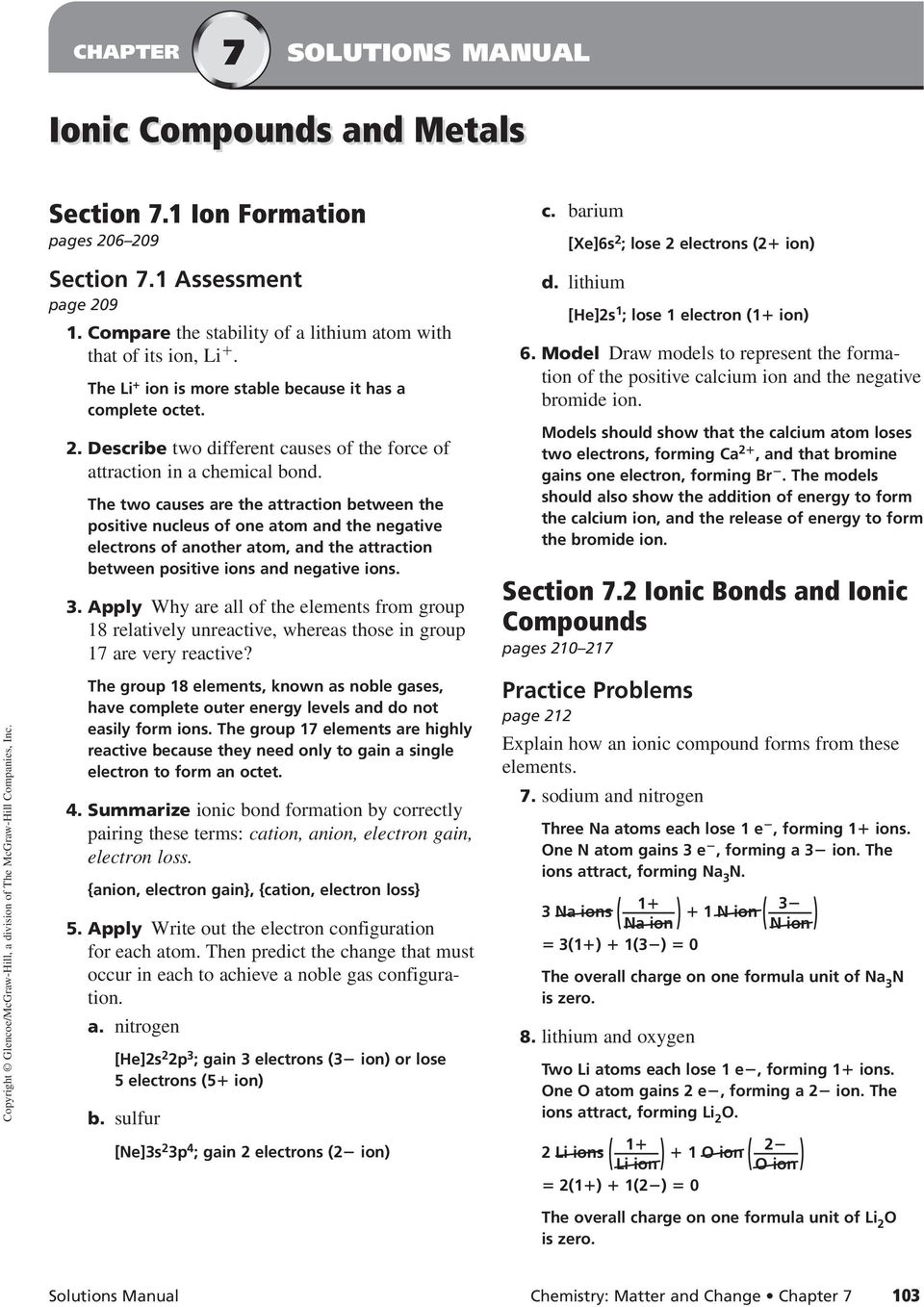
1 Ionic Compounds and Metals Section 7.1 Ion Formation pages Section 7.1 Assessment page Compare the stability of a lithium atom with that of its ion, Li. The Li + ion is more stable because it has a complete octet. 2. Describe two different causes of the force of attraction in a chemical bond. The two causes are the attraction between the positive nucleus of one atom and the negative electrons of another atom, and the attraction between positive ions and negative ions. 3. Apply Why are all of the elements from group 18 relatively unreactive, whereas those in group 17 are very reactive? The group 18 elements, known as noble gases, have complete outer energy levels and do not easily form ions. The group 17 elements are highly reactive because they need only to gain a single electron to form an octet. 4. Summarize ionic bond formation by correctly pairing these terms: cation, anion, electron gain, electron loss. {anion, electron gain}, {cation, electron loss} 5. Apply Write out the electron configuration for each atom. Then predict the change that must occur in each to achieve a noble gas configuration. a. nitrogen [He]2s 2 2p 3 ; gain 3 electrons (3 ion) or lose 5 electrons (5 ion) b. sulfur [Ne]3s 2 3p 4 ; gain 2 electrons (2 ion) c. barium [Xe]6s 2 ; lose 2 electrons (2 ion) d. lithium [He]2s 1 ; lose 1 electron (1 ion) 6. Model Draw models to represent the formation of the positive calcium ion and the negative bromide ion. Models should show that the calcium atom loses two electrons, forming Ca 2, and that bromine gains one electron, forming Br. The models should also show the addition of energy to form the calcium ion, and the release of energy to form the bromide ion. Section 7.2 Ionic Bonds and Ionic Compounds pages Practice Problems page 212 Explain how an ionic compound forms from these elements. 7. sodium and nitrogen Three Na atoms each lose 1 e, forming 1 ions. One N atom gains 3 e, forming a 3 ion. The ions attract, forming Na 3 N. 3 Na ions ( 1 _ Na ion ) 1 N ion ( 3 _ N ion ) 3(1 ) 1(3 ) 0 The overall charge on one formula unit of Na 3 N is zero. 8. lithium and oxygen Two Li atoms each lose 1 e, forming 1 ions. One O atom gains 2 e, forming a 2 ion. The ions attract, forming Li 2 O. 2 Li ions ( 1 _ Li ion ) 1 O ion ( 2 _ O ion ) 2(1 ) 1(2 ) 0 The overall charge on one formula unit of Li 2 O is zero. Solutions Manual Chemistry: Matter and Change Chapter 7 103
2 9. strontium and fluorine One Sr atom loses 2 e, forming a 2 ion. Two F atoms each gain 1 e, forming 1 ions. The ions attract, forming SrF 2. 1 Sr ion ( 2 _ Sr ion ) 2 F ions ( 1 _ F ion ) 1(2 ) 2(1 ) 0 The overall charge on one formula unit of SrF 2 is zero. 10. aluminum and sulfur Two Al atoms each lose 3 e, forming 3 ions. Three S atoms gain 2 e each, forming 2 ions. The ions attract, forming Al 2 S 3. 2 Al ions ( 3 _ Al ions ) 3 S ions ( 2 _ S ion ) 2(3 ) 3(2 ) 0 The overall charge on one formula unit of Al 2 S 3 is zero. 11. Challenge Explain how elements in the two groups shown on the periodic table at the right combine to form an ionic compound. Group 1 Group 15 Three group 1 atoms loses 1 e, forming 1 ions. One group 15 atom gains 3 e, forming a 3 ion. The ions attract, forming X 3 Y, where X represents a group 1 atom and Y represents a group 15 atom. Section 7.2 Assessment page Explain how an ionic compound made up of charged particles can be electrically neutral. The total positive charge of the cations in the compound equals the total negative charge of the anions in the compound. 13. Describe the energy change associated with ionic bond formation, and relate it to stability. Ionic bond formation is exothermic; the lowerenergy product is more stable than the original reactants. 14. Identify three physical properties of ionic compounds that are associated with ionic bonds, and relate them to bond strength. Ionic compounds exist as crystals, have high melting and boiling points, and are hard, rigid, and brittle. They are conductive when dissolved or molten but not when solid. All of these properties are due to the strength of the electrostatic attraction of oppositelycharged ions in close proximity. 15. Explain how ions form bonds and describe the structure of the resulting compound. Electrons are transferred between atoms forming ions. Electrostatic forces hold the ions together in the ionic compound. The ions are arranged in a regular repeating pattern in an ionic crystal. 16. Relate lattice energy to ionicbond strength. As lattice energy becomes more negative, the stronger is the attraction between the ions and, thus, the stronger the ionic bond. 17. Apply Use electron configurations, orbital notation, and electrondot structures to represent the formation of an ionic compound from the metal strontium and the nonmetal chlorine. Drawing should include one Sr atom losing 2 e and forming an Sr 2 ion, and two Cl atoms each gaining 1 e and forming two Cl ions. These ions attract, forming SrCl Chemistry: Matter and Change Chapter 7 Solutions Manual

3 CHAPTER 7 Electron Configuration [Kr]5s 2 [Ne]3s 2 3p 5 [Ar] + [Kr] + [Ne]3s 2 3p 5 [Ar] Sr 2Cl Sr 2+ 2Cl Orbital Notation 1s 2s 2p 3s 3p 4s 3d 4p 5s Sr e + 1s 2s 2p 3s 3p 1s e 2s 2p 3s 3p 2Cl 1s 2s 2p 3s 18. Design a concept map that shows the relationships among ionic bond strength, physical properties of ionic compounds, lattice energy, and stability. Concepts maps will vary but should correlate greater bond strength to increased stability and a more negative lattice energy, and that physical properties such as high melting and boiling points, brittleness, and conductivity are due to the strength of ionic bonds. Section 7.3 Names and Formulas for Ionic Compounds pages Practice Problems pages Write formulas for the ionic compounds formed by the following ions. 19. potassium and iodide KI 3p Sr 2+ Electrondot Structures e Cl [ Cl ] Sr + [Sr] 2+ + e Cl [ Cl ] 20. magnesium and chloride 4s 3d 4p 21. aluminum and bromide AlBr cesium and nitride Cs 3 N Challenge Write the general formula for the ionic compound formed by elements from the two groups shown on the periodic table at the right. Group 2 Group 17 The general formula is XY 2, where X represents the group 2 element and Y represents the group 17 element. Write formulas for ionic compounds composed of the following ions. 24. sodium and nitrate NaNO 3 1s 1s 2s 2p 3s 3p 2s 2p 3s 3p 2Cl MgCl 2 Solutions Manual Chemistry: Matter and Change Chapter 7 105

4 25. calcium and chlorate Ca(ClO 3 ) aluminum and carbonate Al 2 (CO 3 ) Challenge Write the formula for an ionic compound formed by ions from a group 2 element and polyatomic ions composed of only of carbon and oxygen. The polyatomic ion is carbonate (CO 3 2 ). The general formula is XCO 3, where X is the symbol of a group 2 element. Name the following compounds. 28. NaBr sodium bromide 29. CaCl 2 calcium chloride 30. KOH potassium hydroxide Section 7.3 Assessment page State the order in which the ions associated with a compound composed of potassium and bromine would be written in the chemical formula and the compound name. The cation (potassium) is stated first, followed by the anion (bromide). 35. Describe the difference between a monatomic ion and a polyatomic ion and give an example of each. Monatomic ions are oneatom ions (example, Cl ); polyatomic ions are two or more atoms grouped together having a net charge (example, ClO 3 ). 36. Apply Ion X has a charge of 2 and ion Y has a charge of 1. Write the formula unit of the compound formed from the ions. XY State the name and formula for the compound formed from Mg and Cl. magnesium chloride, MgCl Cu(NO 3 ) 2 copper(ii) nitrate 32. Ag 2 CrO 4 silver chromate 33. Challenge The ionic compound NH 4 ClO 4 is key reactant used in solid rocket boosters, such as those that power the space shuttle into orbit. Name this compound. ammonium perchlorate 38. Write the name and formula for the compound formed from sodium ions and nitrite ions. sodium nitrite, NaNO Analyze What subscripts would you most likely use if the following substances formed an ionic compound? a. an alkali metal and a halogen 1, 1 b. an alkali metal and a nonmetal from group 16 2, 1 c. an alkaline earth metal and a halogen 1, 2 d. an alkaline earth metal and a nonmetal from group 16 1, Chemistry: Matter and Change Chapter 7 Solutions Manual

5 Section 7.4 Metallic Bonds and the Properties of Metals pages Section 7.4 Assessment pages Contrast the structures of ionic compounds and metals. Ions in ionic compounds are arranged in a repeating pattern of alternating charges, whereas metals consist of fixed cations surrounded by a sea of mobile, or delocalized, electrons. 41. Explain how the conductivity of electricity and the high melting points of metals are explained by metallic bonding. Delocalized electrons can move through the solid to conduct an electric current. The number of delocalized electrons and the strength of a metallic bond determine the melting point. 42. Contrast the cause of the attraction in ionic bonds and metallic bonds. Ionic bonds are held together by the electrostatic force of attraction between ions, whereas a metallic bond is due to the attraction of metallic cations for delocalized electrons. 43. Summarize alloy types by correctly pairing these terms and phrases: substitutional, interstitial, replaced, filled in. {substitutional, replaced}, {interstitial, filled in} 44. Design an Experiment Describe an experiment that could be used to distinguish between a metallic solid and an ionic solid. Include at least two different methods for comparing the solids. Explain your reasoning. A typical student experiment might have steps similar to the following: 1. Test each solid with a conductivity tester. 2. Place the solid in water to determine if it forms a solution. 3. Test the solution with a conductivity tester to determine if it conducts an electric current. Metallic solids conduct an electric current in the solid state, whereas ionic compounds do not. Metals may react with water, but they do not dissolve in water. Solutions containing ionic compounds conduct an electric current. Metallic solids are malleable and will deform when struck with a hammer, whereas ionic compounds are brittle and will break into pieces when struck with a hammer. 45. Model Draw a model to represent the physical property of metals known as ductility, or the ability to be drawn into a wire. Base your drawing on the electron sea model shown in Figure Diagrams should show metal ions being moved into a longer, thinner form through a sea of electrons. Everyday Chemistry Writing in Chemistry Sense of Danger Our sense of taste can detect certain toxins found naturatlly in plants. Researcg other modern toxins, such as lead and antifreeze, to find out why they don t eicit a negative response from our taste buds. For more on green chemistry, visit glencoe.com. Student research should cite speculation by scientists that becsause humans and their ancestors did not often encounter elemental lead (or other modern toxins) in the natural environment, we have evolved having no natural aversion to eating the toxin. In fact, certain lead compounds found in paint (such as lead acetate) have a sweet taste. Research might also discuss how, contrary to the situation with lead, many plantproduced toxins have a bitter taste. This is likely due to the fact that humans and plants have coevolved for millions of years. 4. Use a hammer to strike the solid and record your observations. Solutions Manual Chemistry: Matter and Change Chapter 7 107

6 CHAPTER 7 Chapter 7 Assessment pages Section 7.1 Mastering Concepts 46. How do positive ions and negative ions form? An atom gains or loses electrons to achieve a stable electron configuration. 47. When do chemical bonds form? when a positive nucleus attracts electrons of another atom, or oppositely charged ions attract 48. Why are halogens and alkali metals likely to form ions? Explain your answer. Halogens need to gain only one electron to have a noble gas electron configuration. Alkali metals need to lose one. 51. The orbital notation of sulfur is shown in Figure Explain how sulfur forms its ion. Sulfur gains 2 electrons in the 3p sublevel, forming a complete octet. Mastering Problems 52. Give the number of valence electrons in an atom of each element: a. cesium 1 b. rubidium 1 c. gallium 3 d. zinc 2 C B 49. The periodic table shown in Figure 7.14 contains elements labeled A G. For each labeled element, state the number of valence electrons and identify the ion that will form. A: three valence electrons Al 3, B: two valence electrons Ba 2, C: one valence electron Rb, D: five valence electrons N 3, E: seven valence electrons I, F: eight valence electrons, no ion formed, G: six valence electrons, Se Discuss the importance of electron affinity and ionization energy in the formation of ions. high electron affinity: atom easily gains an electron; low ionization energy: atom easily loses an electron A D G E F e. strontium Explain why noble gases are not likely to form chemical bonds. They already have a full, stable outer energy level. 54. Discuss the formation of the barium ion. Ba will lose two electrons and form Ba 2, which has the stable electron configuration of Xe. 55. Explain how an anion of nitrogen forms. N gains three electrons, forming N 3, which has the stable electron configuration of Ne. 56. The more reactive an atom, the higher its potential energy. Which atom has higher potential energy, neon or fluorine? Explain. Fluorine, because it will easily gain one more electron to fill its outer energy level. 1s 2s 2p 3s 3p 108 Chemistry: Matter and Change Chapter 7 Solutions Manual

7 CHAPTER Explain how the iron atom can form both an iron 2 ion and an iron 3 ion. Iron has the electron configuration [Ar]4s 2 3d 6. To form the 2 ion the iron atom loses the 4s 2 electrons. When forming the 3 ion the iron atom loses the 4s 2 electrons and one 3d electron. 58. Predict the reactivity of each atom based on its electron configuration. a. potassium Potassium, [Ar]4s 1, is reactive. It will tend to lose one outer electron and form a 1 ion. b. fluorine Fluorine, [He]2s 2 2p 5, is reactive. It will tend to gain one more electron and form a 1 ion. c. neon Neon, 1s 2 2s 2 2p 6, will not react because it already has eight electrons in its outer energy level. 62. Explain why potassium does not bond with neon to form a compound. Neon already has an octet in its outer energy level; it is already stable. 63. Briefly discuss three physical properties of ionic solids that are linked to ionic bonds. Ionic solids exist as crystals, and have high melting and boiling points. 64. Describe an ionic crystal, and explain why ionic crystals for different compounds might vary in shape. An ionic crystal is the geometric arrangement of positive and negative ions. They vary in shape because of the size of the ions that are bonded as well as the number of each type of ion bonded together. 65. How does lattice energy change with a change in the size of an ion? As the size on an ion increases, the lattice energy decreases. 1s 2s 4s 2p 59. Discuss the formation of a 3+ scandium ion using its orbital notation, shown in Figure Scandium, [Ar]4s 2 3d 1, loses both the 4s 2 electrons and the 3d 1 electron to form the 3 ion in the stable [Ar] configuration. Section 7.2 Mastering Concepts 60. What does the term electrically neutral mean when discussing ionic compounds? 3d 3s 3p The number of electrons lost is equal to the number of electrons gained. 66. In Figure 7.14, the element labeled B is barium, and the element labeled E is iodine. Explain why the compound formed between these elements will not be BaI. C B Barium has two valence electrons and forms a 2 ion. Iodine has seven valence electrons and forms a 1 ion. To form a neutral compound one Barium ion must bond with two iodide ions. A compound with one barium ion and one iodide ion is not electrically neutral and will not form. A D G E F 61. Discuss the formation of ionic bonds. A positive ion is attracted to a negative ion and lattice energy is released. Solutions Manual Chemistry: Matter and Change Chapter 7 109
![It will tend to lose one outer electron and form a 1 ion. b. fluorine Fluorine, [He]2s 2 2p 5, is reactive. It will tend to gain one more electron and form a 1 ion. c.](/docs-images/47/20906435/images/page_7.jpg "neon Neon, 1s 2 2s 2 2p 6, will not react because it already has eight electrons in its outer energy level. 62. Explain why potassium does not bond with neon to form a compound.")
8 Mastering Problems 67. Determine the ratio of cations to anions in each. a. potassium chloride, a salt substitute 1:1 b. calcium fluoride, used in the steel industry 1:2 c. calcium oxide, used to remove sulfur dioxide from powerplant exhaust 1:1 d. strontium chloride, used in fireworks 1:2 70. Using orbital notation, diagram the formation of an ionic bond between aluminum and fluorine. 1s 2s 2p 3s 3p 1s 2s 2p Al 1s 2s 2p 1s 2s 2p 1s 2s 2p 3F 68. Look at Figure 7.14; describe the ionic compound that forms from the elements represented by C and D. 1s 2s 2p 1s 1s 2s 2p 2s 2p C B C represents the element Rb which will lose one valence electron forming a 1 ion. D represents the element nitrogen which will gain three valence electrons forming a 3 ion. It will take three rubidium ions to attract to one nitride ion forming the ionic compound Rb 3 N. 69. Discuss the formation of an ionic bond between zinc and oxygen. Zn will lose its outer 4s electrons, forming Zn 2. Oxygen will gain the two electrons forming O 2. Zn 2 attracts O 2, forming ZnO. A D G E F 71. Using electron configurations, diagram the formation of an ionic bond between barium and nitrogen. [Xe]6s 2 [Xe]6s 2 Ba [He]2s 2 2p 3 [He]2s 2 2p 3 N [Xe] [Xe] [Ne] [Ne] 3Ba 2N Ba 3 N Conductors Under certain conditions, ionic compounds conduct an electric current. Describe these conditions, and explain why ionic compounds are not always used as conductors. Ionic compounds will conduct in the molten state or dissolved in water but are nonconducting solids at room temperature. 110 Chemistry: Matter and Change Chapter 7 Solutions Manual

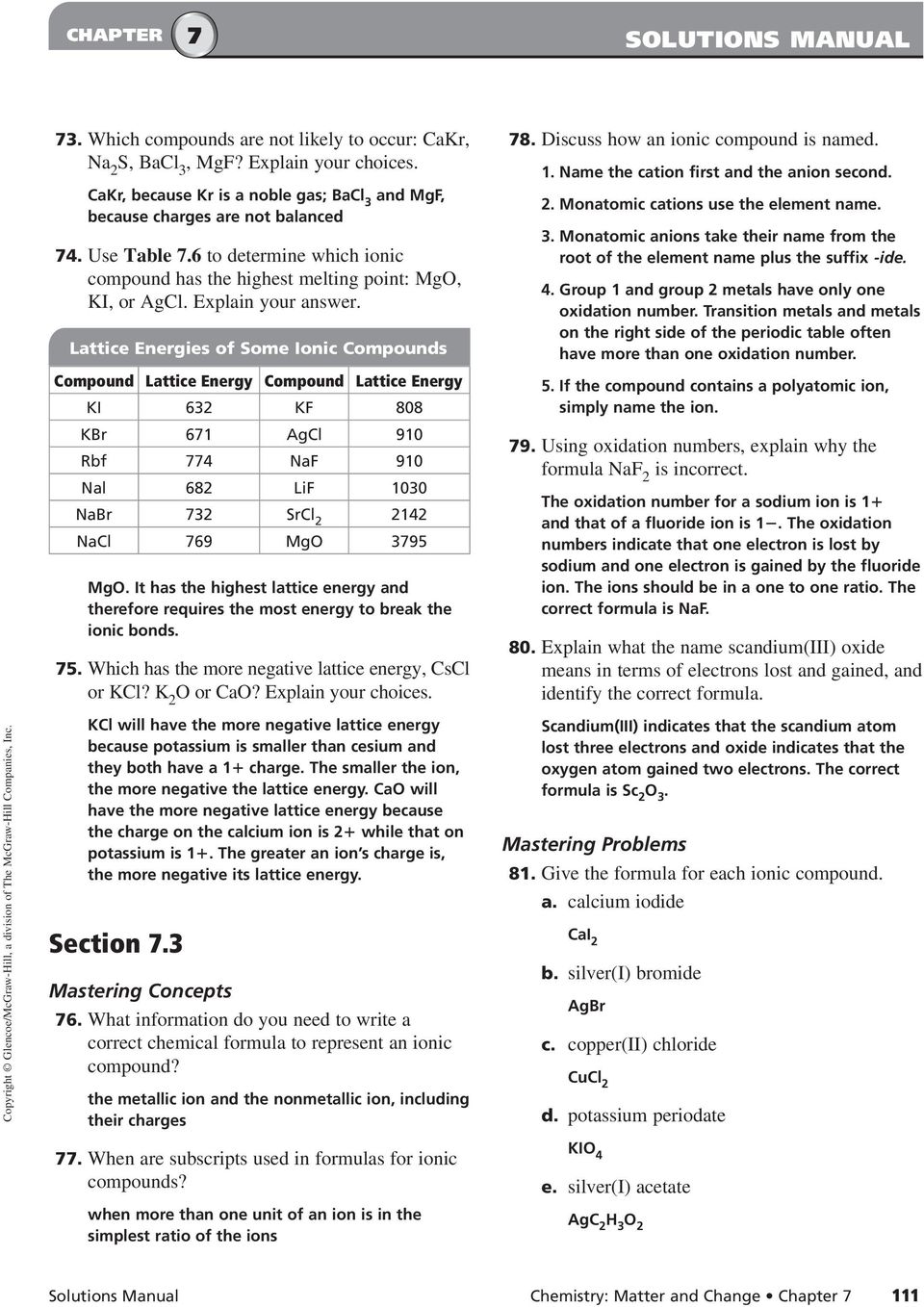
9 73. Which compounds are not likely to occur: CaKr, Na 2 S, BaCl 3, MgF? Explain your choices. CaKr, because Kr is a noble gas; BaCl 3 and MgF, because charges are not balanced 74. Use Table 7.6 to determine which ionic compound has the highest melting point: MgO, KI, or AgCl. Explain your answer. Lattice Energies of Some Ionic Compounds Compound Lattice Energy Compound Lattice Energy KI 632 KF 808 KBr 671 AgCl 910 Rbf 774 NaF 910 Nal 682 LiF 1030 NaBr 732 SrCl NaCl 769 MgO 3795 MgO. It has the highest lattice energy and therefore requires the most energy to break the ionic bonds. 75. Which has the more negative lattice energy, CsCl or KCl? K 2 O or CaO? Explain your choices. 78. Discuss how an ionic compound is named. 1. Name the cation first and the anion second. 2. Monatomic cations use the element name. 3. Monatomic anions take their name from the root of the element name plus the suffix ide. 4. Group 1 and group 2 metals have only one oxidation number. Transition metals and metals on the right side of the periodic table often have more than one oxidation number. 5. If the compound contains a polyatomic ion, simply name the ion. 79. Using oxidation numbers, explain why the formula NaF 2 is incorrect. The oxidation number for a sodium ion is 1 and that of a fluoride ion is 1. The oxidation numbers indicate that one electron is lost by sodium and one electron is gained by the fluoride ion. The ions should be in a one to one ratio. The correct formula is NaF. 80. Explain what the name scandium(iii) oxide means in terms of electrons lost and gained, and identify the correct formula. KCl will have the more negative lattice energy because potassium is smaller than cesium and they both have a 1 charge. The smaller the ion, the more negative the lattice energy. CaO will have the more negative lattice energy because the charge on the calcium ion is 2 while that on potassium is 1. The greater an ion s charge is, the more negative its lattice energy. Section 7.3 Mastering Concepts 76. What information do you need to write a correct chemical formula to represent an ionic compound? the metallic ion and the nonmetallic ion, including their charges Scandium(III) indicates that the scandium atom lost three electrons and oxide indicates that the oxygen atom gained two electrons. The correct formula is Sc 2 O 3. Mastering Problems 81. Give the formula for each ionic compound. a. calcium iodide CaI 2 b. silver(i) bromide AgBr c. copper(ii) chloride CuCl 2 d. potassium periodate 77. When are subscripts used in formulas for ionic compounds? when more than one unit of an ion is in the simplest ratio of the ions KIO 4 e. silver(i) acetate AgC 2 H 3 O 2 Solutions Manual Chemistry: Matter and Change Chapter 7 111
10 82. Name each of the following ionic compounds. a. K 2 O potassium oxide b. CaCl 2 calcium chloride c. Mg 3 N 2 magnesium nitride d. NaClO sodium hypochlorite c. BaOH 2 Ba(OH) 2 ; if a polyatomic ion needs a subscript, parentheses must be used d. Fe 2 O Fe 2 O 3 or FeO; iron forms either Fe 2 or Fe 3 List of Cations and Anions Cations Anions K SO 2 3 NH 4 I Fe 3 NO 3 e. KNO 3 potassium nitrate 83. Complete Table 7.14 by placing the symbols, formulas, and names in the blanks. Identifying Ionic Compounds Cation Anion Name Formula NH 4 SO 2 4 ammonium sulfate (NH 4 ) 2 SO 4 Pb 2 F lead(ii) fluoride PbF 2 Li Br lithium bromide LiBr Na CO 2 3 sodium carbonate Na 2 CO 3 Mg 2 PO 3 4 magnesium phosphate Mg 3 (PO 4 ) Chrome Chromium, a transition metal used in chrome plating, forms both the Cr 2 and Cr 3 ions. Write the formulas for the ionic compounds formed when each of these ions react with fluorine and oxygen ions. fluorine: CrF 2, CrF 3 ; oxygen: CrO, Cr 2 O Which are correct formulas for ionic compounds? For those that are not correct, give the correct formula and justify your answer. a. AlCl AlCl 3 ; one Al 3 ion bonds to three Cl ions b. Na 3 SO 4 Na 2 SO 4 ; two Na ions bond to SO Write the formulas for all of the ionic compounds that can be formed by combining each of the cations with each of the anions listed in Table Name each compound formed. K 2 SO 3, potassium sulfite; KI, potassium iodide; KNO 3, potassium nitrate; (NH 4 ) 2 SO 3, ammonium sulfite; NH 4 I, ammonium iodide; NH 4 NO 3, ammonium nitrate; Fe 2 (SO 3 ) 3, iron(iii) sulfite; FeI 3, iron(iii) iodide; Fe(NO 3 ) 3, iron(iii) nitrate Section 7.4 Mastering Concepts 87. Describe a metallic bond. Each positive metal ion is attracted to delocalized valence electrons. 88. Briefly explain why metallic alloys are made. Alloys have slightly different properties than those of the pure metal they are mixed from. Some alloys have increased strength and are harder than the pure metal. 89. Briefly describe how malleability and ductility of metals are explained by metallic bonding. When a force is applied to a metallic solid, the metal ions move as well as the delocalized electrons. 112 Chemistry: Matter and Change Chapter 7 Solutions Manual

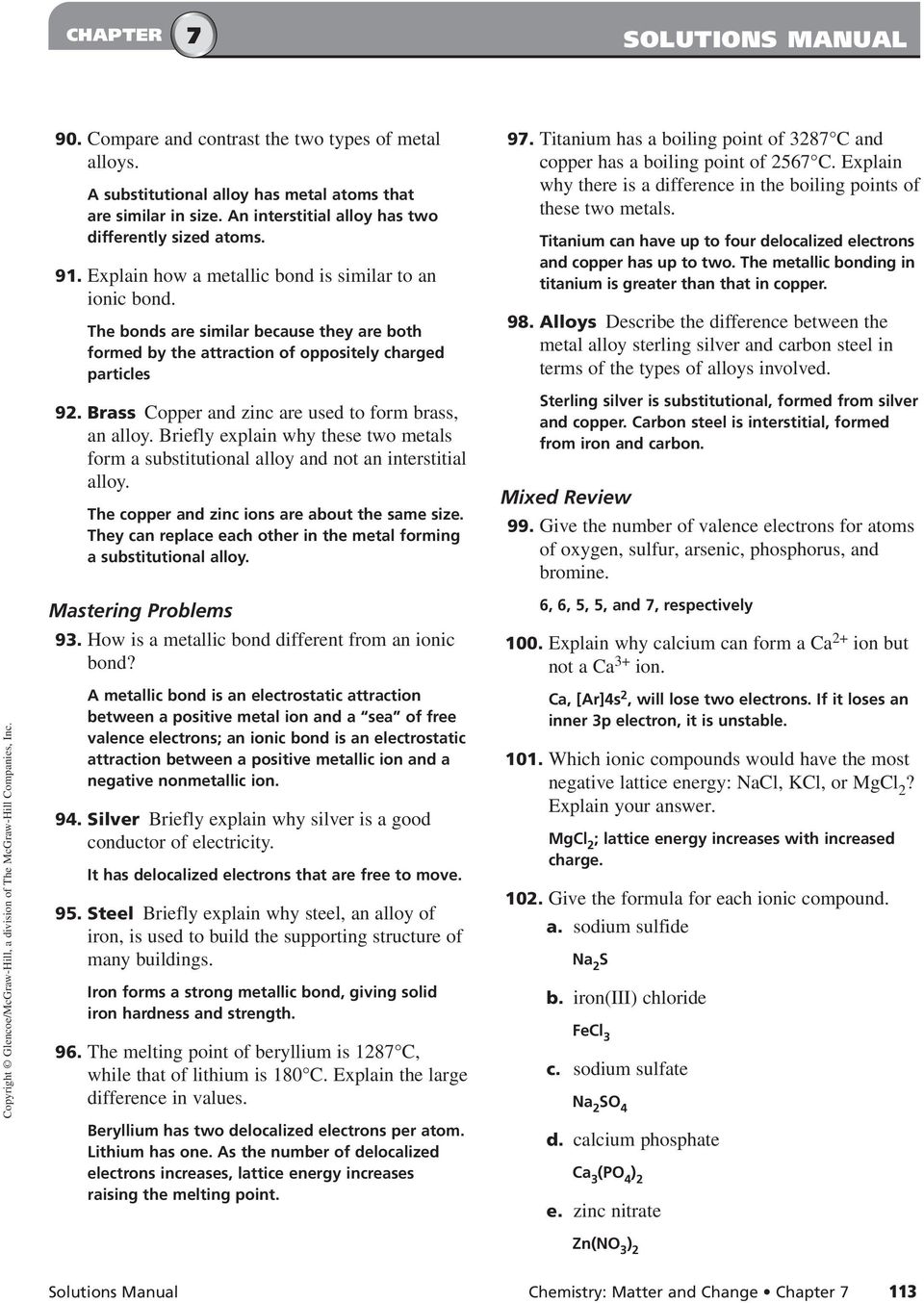
11 90. Compare and contrast the two types of metal alloys. A substitutional alloy has metal atoms that are similar in size. An interstitial alloy has two differently sized atoms. 91. Explain how a metallic bond is similar to an ionic bond. The bonds are similar because they are both formed by the attraction of oppositely charged particles 92. Brass Copper and zinc are used to form brass, an alloy. Briefly explain why these two metals form a substitutional alloy and not an interstitial alloy. The copper and zinc ions are about the same size. They can replace each other in the metal forming a substitutional alloy. 97. Titanium has a boiling point of 3287 C and copper has a boiling point of 2567 C. Explain why there is a difference in the boiling points of these two metals. Titanium can have up to four delocalized electrons and copper has up to two. The metallic bonding in titanium is greater than that in copper. 98. Alloys Describe the difference between the metal alloy sterling silver and carbon steel in terms of the types of alloys involved. Sterling silver is substitutional, formed from silver and copper. Carbon steel is interstitial, formed from iron and carbon. Mixed Review 99. Give the number of valence electrons for atoms of oxygen, sulfur, arsenic, phosphorus, and bromine. Mastering Problems 93. How is a metallic bond different from an ionic bond? A metallic bond is an electrostatic attraction between a positive metal ion and a sea of free valence electrons; an ionic bond is an electrostatic attraction between a positive metallic ion and a negative nonmetallic ion. 94. Silver Briefly explain why silver is a good conductor of electricity. It has delocalized electrons that are free to move. 95. Steel Briefly explain why steel, an alloy of iron, is used to build the supporting structure of many buildings. Iron forms a strong metallic bond, giving solid iron hardness and strength. 96. The melting point of beryllium is 1287 C, while that of lithium is 180 C. Explain the large difference in values. Beryllium has two delocalized electrons per atom. Lithium has one. As the number of delocalized electrons increases, lattice energy increases raising the melting point. 6, 6, 5, 5, and 7, respectively 100. Explain why calcium can form a Ca 2+ ion but not a Ca 3+ ion. Ca, [Ar]4s 2, will lose two electrons. If it loses an inner 3p electron, it is unstable Which ionic compounds would have the most negative lattice energy: NaCl, KCl, or MgCl 2? Explain your answer. MgCl 2 ; lattice energy increases with increased charge Give the formula for each ionic compound. a. sodium sulfide Na 2 S b. iron(iii) chloride FeCl 3 c. sodium sulfate Na 2 SO 4 d. calcium phosphate Ca 3 (PO 4 ) 2 e. zinc nitrate Zn(NO 3 ) 2 Solutions Manual Chemistry: Matter and Change Chapter 7 113
12 103. Cobalt, a transition metal, forms both the Co 2 and Co 3 ions. Write the correct formulas, and give the name for the oxides formed by the two different ions. CoO, cobalt(ii) oxide; Co 2 O 3, cobalt(iii) oxide 104. Complete Table Element, Electron, and Ion Data Element Valence Electrons Ion Formed Selenium 6 Se 2 Tin 4 Sn 2 Iodine 7 I Argon 8 none 105. Gold Briefly explain why gold can be used both in jewelry and as a conductor in electronic devices Magnesium forms both an oxide and a nitride when burned in air. Discuss the formation of magnesium oxide and magnesium nitride when magnesium atoms react with oxygen and nitrogen atoms. A Mg atom loses two valence electrons, forming Mg 2. An O atom gains two electrons, forming O 2. One magnesium ion attracts one oxygen ion, forming MgO. Three Mg atoms each lose two electrons, forming three Mg 2, while two N atoms each gain three electrons, forming two N 3. The ions attract each other, forming Mg 3 N An external force easily deforms sodium metal, while sodium chloride shatters when the same amount of force is applied. Why do these two solids behave so differently? Sodium metal contains metallic bonds. Sodium chloride is an ionic solid. Delocalized electrons allow it to conduct. It is malleable and ductile Discuss the formation of the nickel ion with a 2 oxidation number. Nickel, [Ar]3d 8 4s 2, will lose the two outer 4s electrons Compare the oxyanions sulfate and sulfite. Both oxyanions are composed of sulfur and oxygen. Sulfate SO 4 has more oxygen atoms than sulfite, SO 3. The prefix ite is used to indicate one less oxygen atom. Both ions have the same oxidation number of Using electrondot structures, diagram the formation of an ionic bond between potassium and iodine Name each ionic compound. a. CaO calcium oxide b. BaS barium sulfide c. AlPO 4 aluminum phosphate d. Ba(OH) 2 barium hydroxide e. Sr(NO3) 2 strontium nitrate Think Critically 112. Design a concept map to explain the physical properties of both ionic compounds and metallic solids. Concept maps will vary. 114 Chemistry: Matter and Change Chapter 7 Solutions Manual

13 113. Predict which solid in each pair will have the higher melting point. Explain your answers. a. NaCl or CsCl NaCl; smaller ion size b. Ag or Cu Cu; it is smaller c. Na 2 O or MgO MgO; Mg has a greater charge 114. Compare and contrast cations and anions. Cations are formed from the loss of electrons and have a positive charge. Anions are formed from the gain of electrons and have a negative charge Observe and Infer Identify the mistakes in the incorrect formulas and formula names, and design a flow chart to prevent the mistakes. a. copper acetate Identify the metal as copper(ii) or copper(i). b. Mg 2 O 2 The formula unit is not in the simplest ratio Apply Concepts Examine the ions in the beaker shown in Figure Identify two compounds that could form using the available ions, and explain why this is possible. The compounds that can be formed are: Al 2 S 3, AlN, AlF 3, Na 2 S, Na 3 N, NaF, CaS, Ca 3 N 2, and CaF 2. Students should explain about electrons transferred from the atom to form a positive ion as well as electrons gained by atoms to form negative ions. They should also discuss the attraction between positive ions and negative ions and the forming of an electrically neutral compound Apply Praseodymium is a lanthanide element that reacts with hydrochloric acid, forming praseodymium(iii) chloride. It also reacts with nitric acid, forming praseodymium(iii) nitrate. Praseodymium has the electron configuration [Xe]4f 3 6s 2. a. Examine the electron configuration, and explain how praseodymium forms a 3 ion. Praeseodymium must lose the outer 6s 2 electrons and one of the 4f electrons to form the 3 ion. c. Pb 2 O 5 Lead can have only the oxidation state of 2 or 4, not 5. d. disodium oxide Prefixes are not used in ionic compounds. e. Al 2 SO 43 If a polyatomic ion requires a subscript, use parentheses. Flow charts will vary. Al 3+ S 2 Na + N 3 Ca 2+ F b. Write the correct formulas for both compounds formed by praseodymium. The compounds formed are PrCl 3 and Pr(NO 3 ) Hypothesize Look at the locations of potassium and calcium on the periodic table. Form a hypothesis to explain why the melting point of calcium is considerably higher than the melting point of potassium. Calcium has two delocalized electrons for every one for potassium. Thus, calcium has a higher melting point Assess Explain why the term delocalized is an appropriate term for the electrons involved in metallic bonding. They are free to move; the electrons are not held to any specific atom. Solutions Manual Chemistry: Matter and Change Chapter 7 115

14 120. Apply All uncharged atoms have valence electrons. Explain why elements such as iodine and sulfur do not have metallic bonds. They gain electrons. Thus, their electrons are not delocalized Analyze Explain why lattice energy is a negative quantity. Lattice energy is the energy released when an ionic bond forms. Therefore, bonded ions have lower potential energy than separated ions. By convention, the separated state is considered the reference; therefore, the bonded state will have a negative value. Challenge Problem 122. Ionic Compounds Chrysoberyl is a transparent or translucent mineral that is sometimes opalescent. It is composed of beryllium aluminum oxide, BeAl 2 O 4. Identify the oxidation numbers of each of the ions found in this compound. Explain the formation of this ionic compound. Be, a Group 2 element, forms a 2 ion; Al, a Group 13 element, forms a 3 ion; and O, a Group 16 element, forms a 2 ion. There are two electrons lost from one atom of beryllium and six electrons lost from two atoms of aluminum. Four oxygen atoms gain a total of eight electrons. The positive ions attract the negative ions forming an electrically neutral compound. Cumulative Review 123. You are given a liquid of unknown density. The mass of a graduated cylinder containing 2.00 ml of the liquid is g. The mass of the empty graduated cylinder is g. Given this information, determine the density of the liquid. (Chapter 2) mass of the liquid g g 4.68 g _ 4.68 g 2.00 ml 2.34g/mL 124. In the laboratory, students used a balance and a graduated cylinder to collect the data shown in Table Calculate the density of the sample. If the accepted value of this sample is 7.01 g/ml, calculate the percent error. (Chapter 2) Volume and Mass Data Mass of sample Volume of water alone Volume of water sample g 39.0 ml 43.1 ml volume of sample 43.1 ml 39.0 ml 4.1 ml mass of sample g mass density volume g 4.7 g/ml 4.1 ml percent error ((4.7 g/ml) (7.01 g/ml))/ (7.01 g/ml) 33% The students calculated density is 33% too low A mercury atom drops in energy from J to J. (Chapter 5) a. What is the energy of the photon emitted by the mercury atom? E J J J b. What is the frequency of the photon emitted by the mercury atom? _ E h J J s s 1 c. What is the wavelength of the photon emitted c_ by the mercury atom? m/s s m or 578 nm 126. Which element has the greater ionization energy, chlorine or carbon? (Chapter 6) chlorine 116 Chemistry: Matter and Change Chapter 7 Solutions Manual

15 127. Compare and contrast the ways in which metals and nonmetals form ions, and explain why they are different. (Chapter 6) Metals lose electrons to form cations; nonmetals gain electrons to form anions. Both form ions to gain stability What are transition elements? (Chapter 6) the d block elements 129. Write the symbol and name of the element that fits each description. (Chapter 6) a. the secondlightest of the halogens Cl, chlorine b. the metalloid with the lowest period number 131. Growing Crystals Crystals of ionic compounds can be easily grown in the laboratory setting. Research the growth of crystals, and design an experiment to grow a crystal in the laboratory. Student answers will vary. Students should include the use of supersaturated solutions and the evaporation of water from the solution allows crystals to grow large over a period of time. DocumentBased Questions Oceans As part of an analysis of the world s oceans, scientists summarized the ionrelated data shown in Table B, boron c. the only group 16 element that is a gas at room temperature O, oxygen d. the heaviest of the noble gases Rn, radon e. the group 15 nonmetal that is a solid at room temperature P, phosphorus Additional Assessment Writing in Chemistry 130. Free Radicals Many researchers believe that free radicals are responsible for the effects of aging and cancer. Research free radicals, and write about the cause and what can be done to prevent free radicals. Student answers will vary. Students should discuss reduction and oxidation (gain and loss of electrons) in forming free radicals as well as antioxidants, Vitamin E and Vitamin C. Data from: Royal Society of Chemistry, All at sea? The chemistry of the oceans. The Twelve Most Common Ions in the Sea Ion Concentration (mg/dm 3 ) % by mass (of the total dissolved solids) Cl 19, Na 10, SO Mg Ca K CO Br BO SiO Sr F Identify the anions and cations listed in Table anions: chloride, Cl, sulfate, SO 4 2, carbonate, CO 3 2, bromide, Br, borate, BO 3 3, silicate, SiO 3 2, fluoride, F cations: sodium, Na, magnesium, Mg 2, strontium, Sr 2, calcium, Ca 2, potassium, K Solutions Manual Chemistry: Matter and Change Chapter 7 117

16 133. Create a bar graph of each ion s concentration. Explain why this is a difficult graph to draw. Concentration (mg/dm 3 ) 20,000 19,000 18,000 11,000 10, Concentration of Common Sea Ions Cl Na + SO4 2 Mg 2+ Ca 2+ K + CO3 2 Br BO3 3 SiO3 2 Sr 2+ F Sea Ion Bar charts should correspond to concentration data from Table The graph is difficult to draw because the range of the data is so great; some data are very small and some data are very large. This difficulty can be eased by using a logarithmic scale on the vertical axis Sodium chloride is not the only ionic compound that forms from sea water. Identify four other compounds that could be formed that contain the sodium ion. Write both the formula and the name for each compound. Students may identify the following compounds: sodium chloride, NaCl; sodium sulfate, Na 2 SO 4 ; sodium carbonate, Na 2 CO 3 ; sodium bromide, NaBr; sodium borate. Na 3 BO 3 ; sodium silicate, Na 2 SO 3 ; sodium fluoride, NaF. Standardized Test Practice pages Multiple Choice Use the figure below to answer Question Which description is supported by the model shown? a. Metals are shiny, reflective substances. b. Metals are excellent conductors of heat and electricity. c. Ionic compounds are malleable compounds. d. Ionic compounds are good conductors of electricity. b 2. Which is NOT true of the Sc 3 ion? a. It has the same electron configuration as Ar. b. It is a scandium ion with three positive charges. c. It is considered to be a different element than a neutral Sc atom. d. It was formed by the removal of the valence electrons of Sc. c 3. Of the salts below, which would require the most energy to break the ionic bonds? a. BaCl 2 b. LiF c. NaBr d. KI a 4. The high strength of its ionic bonds results in all of the following properties of NaCl EXCEPT a. hard crystals b. high boiling point c. high melting point d. low solubility d 5. Which is the correct formula for the compound chromium (III) sulfate? a. Cr 3 SO 4 b. Cr 2 (SO4) 3 c. Cr 3 (SO4) 2 d. Cr(SO4) 3 b 118 Chemistry: Matter and Change Chapter 7 Solutions Manual

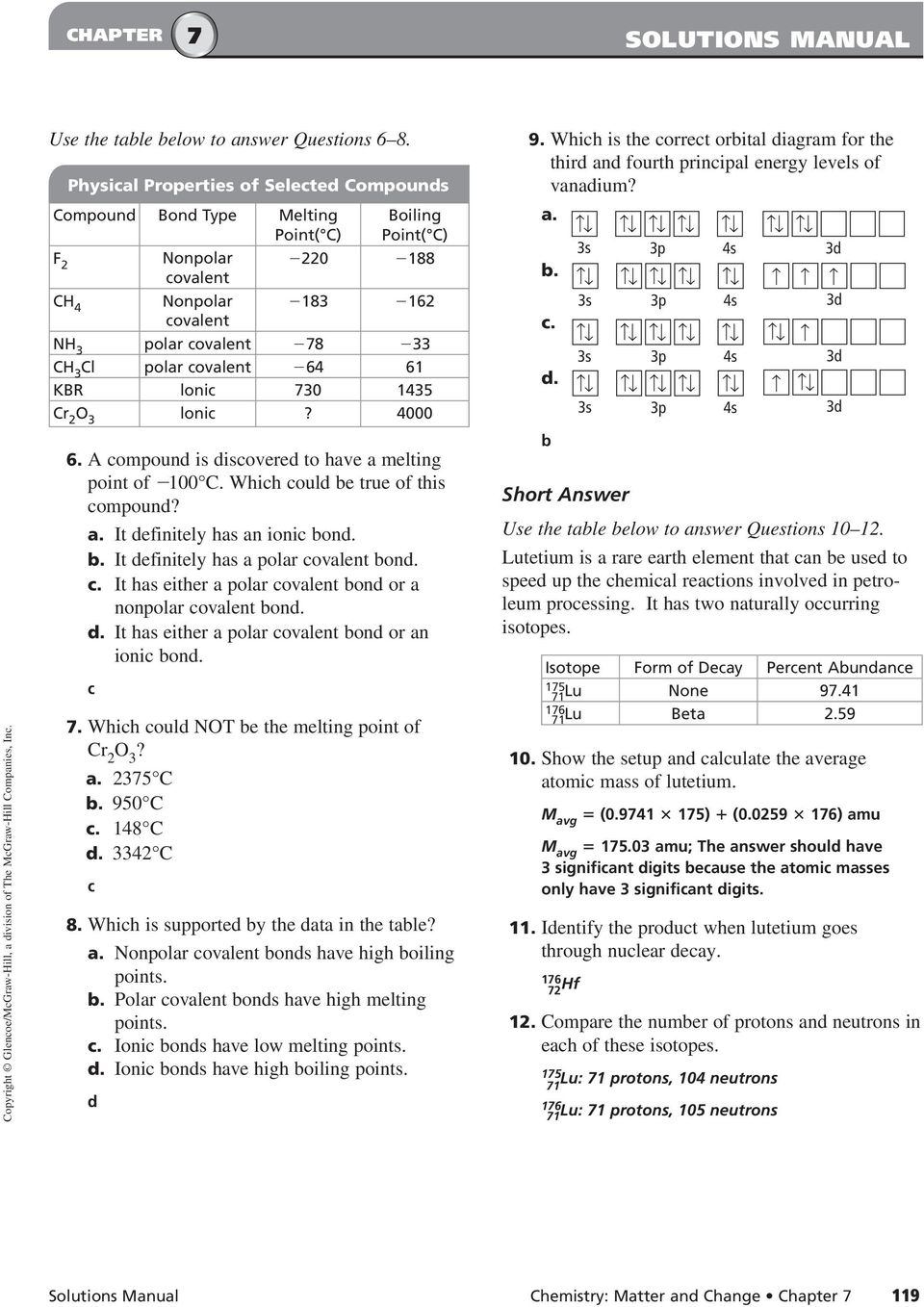
17 CHAPTER 7 Use the table below to answer Questions 6 8. Physical Properties of Selected Compounds Compound Bond Type Melting Point( C) F 2 Nonpolar 220 covalent CH 4 Nonpolar 183 covalent Boiling Point( C) NH 3 polar covalent CH 3 Cl polar covalent KBR lonic Cr 2 O 3 lonic? A compound is discovered to have a melting point of 100 C. Which could be true of this compound? a. It definitely has an ionic bond. b. It definitely has a polar covalent bond. c. It has either a polar covalent bond or a nonpolar covalent bond. d. It has either a polar covalent bond or an ionic bond. c 7. Which could NOT be the melting point of Cr 2 O 3? a C b. 950 C c. 148 C d C c 8. Which is supported by the data in the table? a. Nonpolar covalent bonds have high boiling points. b. Polar covalent bonds have high melting points. c. Ionic bonds have low melting points. d. Ionic bonds have high boiling points. d 9. Which is the correct orbital diagram for the third and fourth principal energy levels of vanadium? a. b. c. d. b 3s 3p 4s 3d 3s 3p 4s 3s 3p 4s 3s 3p 4s Short Answer Use the table below to answer Questions Lutetium is a rare earth element that can be used to speed up the chemical reactions involved in petroleum processing. It has two naturally occurring isotopes. Isotope Form of Decay Percent Abundance 175 Lu None Lu Beta Show the setup and calculate the average atomic mass of lutetium. M avg ( ) ( ) amu M avg amu; The answer should have 3 significant digits because the atomic masses only have 3 significant digits. 11. Identify the product when lutetium goes through nuclear decay Hf 12. Compare the number of protons and neutrons in each of these isotopes. 175 Lu: 71 protons, 104 neutrons Lu: 71 protons, 105 neutrons 71 3d 3d 3d Solutions Manual Chemistry: Matter and Change Chapter 7 119
18 Extended Response 13. Relate the change in atomic radius to the changes in atomic structure that occur across the periodic table. Atomic radii generally decrease across a given period because the increasing positive charge in the nucleus tends to contract the outer electron orbitals that are being filled at the same principal energy level. Atomic radii generally increase down a given group because new principal energy levels (at larger radii) are being added to the atom. Increasing positive charge in the nucleus is not sufficient to overcome this effect. Use the diagram below to answer Question pm 95 pm SAT Subject Test: Chemistry Use the diagram below to answer Question Which describes the state of matter shown? a. solid, because the particles are tightly packed against one another b. gas, because the particles are flowing past one another c. liquid, because the particles are able to move freely d. solid, because there is a regular pattern to the particles e. liquid, because the particles are flowing past one another e Sodium atom (Na) [Ne]3s 1 Sodium ion (Na + ) [Ne] 14. Relate the change in ionic radius to the changes in ion formation that occur across the periodic table. Cations are formed from their corresponding neutral atoms by releasing outer valence electrons to achieve a stable noble gas configuration. The ionic radius is smaller than the neutral atomic radius because all of the valence electrons comprising the highest principal energy level are being released. Use the list of elements below to answer Questions a. sodium b. chromium c. boron d. argon e. chlorine 16. Which has its outermost electrons in an ssublevel? a 17. Which has seven valence electrons? e 18. Which is a transition metal? c 19. Which has an electron configuration of 1s 2 2s 2 2p 6 3s 2 3p 5? e 20. Which is a noble gas? d 120 Chemistry: Matter and Change Chapter 7 Solutions Manual

Periodic Table Questions
 Periodic Table Questions 1. The elements characterized as nonmetals are located in the periodic table at the (1) far left; (2) bottom; (3) center; (4) top right. 2. An element that is a liquid at STP is
Unit 2 Periodic Behavior and Ionic Bonding
 Unit 2 Periodic Behavior and Ionic Bonding 6.1 Organizing the Elements I. The Periodic Law A. The physical and chemical properties of the elements are periodic functions of their atomic numbers B. Elements
Ionic and Metallic Bonding
 Ionic and Metallic Bonding BNDING AND INTERACTINS 71 Ions For students using the Foundation edition, assign problems 1, 3 5, 7 12, 14, 15, 18 20 Essential Understanding Ions form when atoms gain or lose
B) atomic number C) both the solid and the liquid phase D) Au C) Sn, Si, C A) metal C) O, S, Se C) In D) tin D) methane D) bismuth B) Group 2 metal
 1. The elements on the Periodic Table are arranged in order of increasing A) atomic mass B) atomic number C) molar mass D) oxidation number 2. Which list of elements consists of a metal, a metalloid, and
47374_04_p25-32.qxd 2/9/07 7:50 AM Page 25. 4 Atoms and Elements
 47374_04_p25-32.qxd 2/9/07 7:50 AM Page 25 4 Atoms and Elements 4.1 a. Cu b. Si c. K d. N e. Fe f. Ba g. Pb h. Sr 4.2 a. O b. Li c. S d. Al e. H f. Ne g. Sn h. Au 4.3 a. carbon b. chlorine c. iodine d.
Monatomic Ions. A. Monatomic Ions In order to determine the charge of monatomic ions, you can use the periodic table as a guide:
 Monatomic Ions Ions are atoms that have either lost or gained electrons. While atoms are neutral, ions are charged particles. A loss of electrons results in a positive ion or cation (pronounced cat-eye-on
Name period AP chemistry Unit 2 worksheet Practice problems
 Name period AP chemistry Unit 2 worksheet Practice problems 1. What are the SI units for a. Wavelength of light b. frequency of light c. speed of light Meter hertz (s -1 ) m s -1 (m/s) 2. T/F (correct
Find a pair of elements in the periodic table with atomic numbers less than 20 that are an exception to the original periodic law.
 Example Exercise 6.1 Periodic Law Find the two elements in the fifth row of the periodic table that violate the original periodic law proposed by Mendeleev. Mendeleev proposed that elements be arranged
Unit 3 Study Guide: Electron Configuration & The Periodic Table
 Name: Teacher s Name: Class: Block: Date: Unit 3 Study Guide: Electron Configuration & The Periodic Table 1. For each of the following elements, state whether the element is radioactive, synthetic or both.
Bonding Practice Problems
 NAME 1. When compared to H 2 S, H 2 O has a higher 8. Given the Lewis electron-dot diagram: boiling point because H 2 O contains stronger metallic bonds covalent bonds ionic bonds hydrogen bonds 2. Which
SCPS Chemistry Worksheet Periodicity A. Periodic table 1. Which are metals? Circle your answers: C, Na, F, Cs, Ba, Ni
 SCPS Chemistry Worksheet Periodicity A. Periodic table 1. Which are metals? Circle your answers: C, Na, F, Cs, Ba, Ni Which metal in the list above has the most metallic character? Explain. Cesium as the
UNIT (2) ATOMS AND ELEMENTS
 UNIT (2) ATOMS AND ELEMENTS 2.1 Elements An element is a fundamental substance that cannot be broken down by chemical means into simpler substances. Each element is represented by an abbreviation called
3. What would you predict for the intensity and binding energy for the 3p orbital for that of sulfur?
 PSI AP Chemistry Periodic Trends MC Review Name Periodic Law and the Quantum Model Use the PES spectrum of Phosphorus below to answer questions 1-3. 1. Which peak corresponds to the 1s orbital? (A) 1.06
Chapter 5 TEST: The Periodic Table name
 Chapter 5 TEST: The Periodic Table name HPS # date: Multiple Choice Identify the choice that best completes the statement or answers the question. 1. The order of elements in the periodic table is based
Electrons in Atoms & Periodic Table Chapter 13 & 14 Assignment & Problem Set
 Electrons in Atoms & Periodic Table Name Warm-Ups (Show your work for credit) Date 1. Date 2. Date 3. Date 4. Date 5. Date 6. Date 7. Date 8. Electrons in Atoms & Periodic Table 2 Study Guide: Things You
Balancing Chemical Equations Worksheet
 Balancing Chemical Equations Worksheet Student Instructions 1. Identify the reactants and products and write a word equation. 2. Write the correct chemical formula for each of the reactants and the products.
Untitled Document. 1. Which of the following best describes an atom? 4. Which statement best describes the density of an atom s nucleus?
 Name: Date: 1. Which of the following best describes an atom? A. protons and electrons grouped together in a random pattern B. protons and electrons grouped together in an alternating pattern C. a core
Sample Exercise 2.1 Illustrating the Size of an Atom
 Sample Exercise 2.1 Illustrating the Size of an Atom The diameter of a US penny is 19 mm. The diameter of a silver atom, by comparison, is only 2.88 Å. How many silver atoms could be arranged side by side
Chapter 6 Assessment. Name: Class: Date: ID: A. Multiple Choice Identify the choice that best completes the statement or answers the question.
 Name: Class: Date: ID: A Chapter 6 Assessment Multiple Choice Identify the choice that best completes the statement or answers the question. 1. When an atom loses an electron, it forms a(n) a. anion. c.
19.2 Chemical Formulas
 In the previous section, you learned how and why atoms form chemical bonds with one another. You also know that atoms combine in certain ratios with other atoms. These ratios determine the chemical formula
CHEMICAL NAMES AND FORMULAS
 9 CHEMICAL NAMES AND FORMULAS SECTION 9.1 NAMING IONS (pages 253 258) This section explains the use of the periodic table to determine the charge of an ion. It also defines polyatomic ion and gives the
TRENDS IN THE PERIODIC TABLE
 Noble gases Period alogens Alkaline earth metals Alkali metals TRENDS IN TE PERIDI TABLE Usual charge +1 + +3-3 - -1 Number of Valence e - s 1 3 4 5 6 7 Electron dot diagram X X X X X X X X X 8 Group 1
Nomenclature of Ionic Compounds
 Nomenclature of Ionic Compounds Ionic compounds are composed of ions. An ion is an atom or molecule with an electrical charge. Monatomic ions are formed from single atoms that have gained or lost electrons.
Chapter 5. Chapter 5. Naming Ionic Compounds. Objectives. Chapter 5. Chapter 5
 Objectives Name cations, anions, and ionic compounds. Write chemical formulas for ionic compounds such that an overall neutral charge is maintained. Explain how polyatomic ions and their salts are named
Chapter 7 Periodic Properties of the Elements
 Chapter 7 Periodic Properties of the Elements 1. Elements in the modern version of the periodic table are arranged in order of increasing. (a). oxidation number (b). atomic mass (c). average atomic mass
Chapter 2 Atoms, Ions, and the Periodic Table
 Chapter 2 Atoms, Ions, and the Periodic Table 2.1 (a) neutron; (b) law of conservation of mass; (c) proton; (d) main-group element; (e) relative atomic mass; (f) mass number; (g) isotope; (h) cation; (i)
neutrons are present?
 AP Chem Summer Assignment Worksheet #1 Atomic Structure 1. a) For the ion 39 K +, state how many electrons, how many protons, and how many 19 neutrons are present? b) Which of these particles has the smallest
2. John Dalton did his research work in which of the following countries? a. France b. Greece c. Russia d. England
 CHAPTER 3 1. Which combination of individual and contribution is not correct? a. Antoine Lavoisier - clarified confusion over cause of burning b. John Dalton - proposed atomic theory c. Marie Curie - discovered
EXPERIMENT 4 The Periodic Table - Atoms and Elements
 EXPERIMENT 4 The Periodic Table - Atoms and Elements INTRODUCTION Primary substances, called elements, build all the materials around you. There are more than 109 different elements known today. The elements
Chapter Outline. 3 Elements and Compounds. Elements and Atoms. Elements. Elements. Elements 9/4/2013
 3 Elements and Compounds Chapter Outline 3.1 Elements A. Distribution of Elements Foundations of College Chemistry, 14 th Ed. Morris Hein and Susan Arena Copyright This reclining Buddha in Thailand is
Chapter 4 Compounds and Their Bonds
 Chapter 4 Compounds and Their Bonds 4.1 Octet Rule and Ions Octet Rule An octet is 8 valence electrons. is associated with the stability of the noble gases. He is stable with 2 valence electrons (duet).
MODERN ATOMIC THEORY AND THE PERIODIC TABLE
 CHAPTER 10 MODERN ATOMIC THEORY AND THE PERIODIC TABLE SOLUTIONS TO REVIEW QUESTIONS 1. Wavelength is defined as the distance between consecutive peaks in a wave. It is generally symbolized by the Greek
WRITING CHEMICAL FORMULA
 WRITING CHEMICAL FORMULA For ionic compounds, the chemical formula must be worked out. You will no longer have the list of ions in the exam (like at GCSE). Instead you must learn some and work out others.
(b) Formation of calcium chloride:
 Chapter 2: Chemical Compounds and Bonding Section 2.1: Ionic Compounds, pages 22 23 1. An ionic compound combines a metal and a non-metal joined together by an ionic bond. 2. An electrostatic force holds
CHAPTER 5: MOLECULES AND COMPOUNDS
 CHAPTER 5: MOLECULES AND COMPOUNDS Problems: 1-6, 9-13, 16, 20, 31-40, 43-64, 65 (a,b,c,e), 66(a-d,f), 69(a-d,f), 70(a-e), 71-78, 81-82, 87-96 A compound will display the same properties (e.g. melting
Which substance contains positive ions immersed in a sea of mobile electrons? A) O2(s) B) Cu(s) C) CuO(s) D) SiO2(s)
 BONDING MIDTERM REVIEW 7546-1 - Page 1 1) Which substance contains positive ions immersed in a sea of mobile electrons? A) O2(s) B) Cu(s) C) CuO(s) D) SiO2(s) 2) The bond between hydrogen and oxygen in
Naming and Writing Formulas for Ionic Compounds Using IUPAC Rules
 Naming and Writing Formulas for Ionic Compounds Using IUPAC Rules There are three categories of ionic compounds that we will deal with. 1.Binary ionic o simple ions (only single charges) o multivalent
PERIODIC TABLE OF GROUPS OF ELEMENTS Elements can be classified using two different schemes.
 1 PERIODIC TABLE OF GROUPS OF ELEMENTS Elements can be classified using two different schemes. Metal Nonmetal Scheme (based on physical properties) Metals - most elements are metals - elements on left
W1 WORKSHOP ON STOICHIOMETRY
 INTRODUCTION W1 WORKSHOP ON STOICHIOMETRY These notes and exercises are designed to introduce you to the basic concepts required to understand a chemical formula or equation. Relative atomic masses of
Name period Unit 3 worksheet
 Name period Unit 3 worksheet Read chapter 8, 2.52.7 1. Explain the difference between metallic, ionic, and covalent bonding Metallic cations share a sea of electrons Ionic atoms give and take electrons
PERIODIC TABLE OF THE ELEMENTS
 PERIODIC TABLE OF THE ELEMENTS Periodic Table: an arrangement of elements in horizontal rows (Periods) and vertical columns (Groups) exhibits periodic repetition of properties First Periodic Table: discovered
CHAPTER 9. 9.1 Naming Ions. Chemical Names and Formulas. Naming Transition Metals. Ions of Transition Metals. Ions of Transition Metals
 CHAPTER 9 Chemical Names and Formulas 9.1 Naming Ions Monatomic Ions: a single atom with a positive or negative charge Cation (rules): listed first Anion (rules): ide ending Transition Metals have a varying
6.5 Periodic Variations in Element Properties
 324 Chapter 6 Electronic Structure and Periodic Properties of Elements 6.5 Periodic Variations in Element Properties By the end of this section, you will be able to: Describe and explain the observed trends
7.4. Using the Bohr Theory KNOW? Using the Bohr Theory to Describe Atoms and Ions
 7.4 Using the Bohr Theory LEARNING TIP Models such as Figures 1 to 4, on pages 218 and 219, help you visualize scientific explanations. As you examine Figures 1 to 4, look back and forth between the diagrams
Polyatomic ions can form ionic compounds just as monatomic ions.
 1 POLYATOMIC IONS We have seen that atoms can lose or gain electrons to become ions. Groups of atoms can also become ions. These groups of atoms are called polyatomic ions. Examples: O hydroxide ion NO
Name Class Date. What is ionic bonding? What happens to atoms that gain or lose electrons? What kinds of solids are formed from ionic bonds?
 CHAPTER 1 2 Ionic Bonds SECTION Chemical Bonding BEFORE YOU READ After you read this section, you should be able to answer these questions: What is ionic bonding? What happens to atoms that gain or lose
Chapter 2 Atoms, Molecules, and Ions
 Chapter 2 Atoms, Molecules, and Ions 1. Methane and ethane are both made up of carbon and hydrogen. In methane, there are 12.0 g of carbon for every 4.00 g of hydrogen, a ration of 3:1 by mass. In ethane,
CHEMICAL NAMES AND FORMULAS
 6 CEMICAL NAMES AND FORMULAS SECTION 6.1 INTRODUCTION TO CEMICAL BONDING (pages 133 137) This section explains how to distinguish between ionic and molecular compounds. It also defines cation and anion
Chemistry CP Unit 2 Atomic Structure and Electron Configuration. Learning Targets (Your exam at the end of Unit 2 will assess the following:)
 Chemistry CP Unit 2 Atomic Structure and Electron Learning Targets (Your exam at the end of Unit 2 will assess the following:) 2. Atomic Structure and Electron 2-1. Give the one main contribution to the
Nomenclature Packet. 1. Name the following ionic compounds: a. Al 2 O 3 Aluminum oxide. b. Cs 2 O Cesium oxide. c. Rb 3 N Rubidium nitride
 Nomenclature Packet Worksheet I: Binary Ionic Compounds (representative metals) metals from groups 1A, 2A, and 3A (1, 2, and 13) have constant charges as ions and do NOT get Roman Numerals in their names
Study Guide For Chapter 7
 Name: Class: Date: ID: A Study Guide For Chapter 7 Multiple Choice Identify the choice that best completes the statement or answers the question. 1. The number of atoms in a mole of any pure substance
In the box below, draw the Lewis electron-dot structure for the compound formed from magnesium and oxygen. [Include any charges or partial charges.
 Name: 1) Which molecule is nonpolar and has a symmetrical shape? A) NH3 B) H2O C) HCl D) CH4 7222-1 - Page 1 2) When ammonium chloride crystals are dissolved in water, the temperature of the water decreases.
100% ionic compounds do not exist but predominantly ionic compounds are formed when metals combine with non-metals.
 2.21 Ionic Bonding 100% ionic compounds do not exist but predominantly ionic compounds are formed when metals combine with non-metals. Forming ions Metal atoms lose electrons to form +ve ions. Non-metal
H 2 + O 2 H 2 O. - Note there is not enough hydrogen to react with oxygen - It is necessary to balance equation.
 CEMICAL REACTIONS 1 ydrogen + Oxygen Water 2 + O 2 2 O reactants product(s) reactant substance before chemical change product substance after chemical change Conservation of Mass During a chemical reaction,
Periodic Table, Valency and Formula
 Periodic Table, Valency and Formula Origins of the Periodic Table Mendelѐѐv in 1869 proposed that a relationship existed between the chemical properties of elements and their atomic masses. He noticed
A mutual electrical attraction between the nuclei and valence electrons of different atoms that binds the atoms together is called a(n)
 Chemistry I ATOMIC BONDING PRACTICE QUIZ Mr. Scott Select the best answer. 1) A mutual electrical attraction between the nuclei and valence electrons of different atoms that binds the atoms together is
Atomic Structure. Name Mass Charge Location Protons 1 +1 Nucleus Neutrons 1 0 Nucleus Electrons 1/1837-1 Orbit nucleus in outer shells
 Atomic Structure called nucleons Name Mass Charge Location Protons 1 +1 Nucleus Neutrons 1 0 Nucleus Electrons 1/1837-1 Orbit nucleus in outer shells The number of protons equals the atomic number This
The Advanced Placement Examination in Chemistry. Part I Multiple Choice Questions Part II Free Response Questions Selected Questions from1970 to 2010
 The Advanced Placement Examination in Chemistry Part I Multiple Choice Questions Part II Free Response Questions Selected Questions from1970 to 2010 Atomic Theory and Periodicity Part I 1984 1. Which of
SCH 4C1 Unit 2 Problem Set Questions taken from Frank Mustoe et all, "Chemistry 11", McGraw-Hill Ryerson, 2001
 SCH 4C1 Unit 2 Problem Set Questions taken from Frank Mustoe et all, "Chemistry 11", McGraw-Hill Ryerson, 2001 1. A small pin contains 0.0178 mol of iron. How many atoms of iron are in the pin? 2. A sample
Chemistry: The Periodic Table and Periodicity
 Chemistry: The Periodic Table and Periodicity Name: per: Date:. 1. By what property did Mendeleev arrange the elements? 2. By what property did Moseley suggest that the periodic table be arranged? 3. What
Unit 10A Stoichiometry Notes
 Unit 10A Stoichiometry Notes Stoichiometry is a big word for a process that chemist s use to calculate amounts in reactions. It makes use of the coefficient ratio set up by balanced reaction equations
Name: Block: Date: Test Review: Chapter 8 Ionic Bonding
 Name: Block: Date: Test Review: Chapter 8 Ionic Bonding Part 1: Fill-in-the-blank. Choose the word from the word bank below. Each word may be used only 1 time. electron dot structure metallic electronegativity
The Periodic Table: Periodic trends
 Unit 1 The Periodic Table: Periodic trends There are over one hundred different chemical elements. Some of these elements are familiar to you such as hydrogen, oxygen, nitrogen and carbon. Each one has
Nomenclature and the Periodic Table To name compounds and to determine molecular formulae from names a knowledge of the periodic table is helpful.
 Nomenclature and the Periodic Table To name compounds and to determine molecular formulae from names a knowledge of the periodic table is helpful. Atomic Number = number of protons Mass Number = number
Moles, Molecules, and Grams Worksheet Answer Key
 Moles, Molecules, and Grams Worksheet Answer Key 1) How many are there in 24 grams of FeF 3? 1.28 x 10 23 2) How many are there in 450 grams of Na 2 SO 4? 1.91 x 10 24 3) How many grams are there in 2.3
Elements, Atoms & Ions
 Introductory Chemistry: A Foundation FOURTH EDITION by Steven S. Zumdahl University of Illinois Elements, Atoms & Ions Chapter 4 1 2 Elements Aims: To learn about the relative abundances of the elements,
Look at a periodic table to answer the following questions:
 Look at a periodic table to answer the following questions: 1. What is the name of group 1? 2. What is the name of group 2? 3. What is the name of group 17? 4. What is the name of group 18? 5. What is
Nomenclature and Formulas of Ionic Compounds. Section I: Writing the Name from the Formula
 Purpose: Theory: Nomenclature and Formulas of Ionic Compounds 1. To become familiar with the rules of chemical nomenclature, based on the classification of compounds. 2. To write the proper name of the
Multiple Choice Identify the letter of the choice that best completes the statement or answers the question.
 Introduction to Chemistry Exam 2 Practice Problems 1 Multiple Choice Identify the letter of the choice that best completes the statement or answers the question. 1.Atoms consist principally of what three
Trends of the Periodic Table Diary
 Trends of the Periodic Table Diary Trends are patterns of behaviors that atoms on the periodic table of elements follow. Trends hold true most of the time, but there are exceptions, or blips, where the
Topic 4 National Chemistry Summary Notes. Formulae, Equations, Balancing Equations and The Mole
 Topic 4 National Chemistry Summary Notes Formulae, Equations, Balancing Equations and The Mole LI 1 The chemical formula of a covalent molecular compound tells us the number of atoms of each element present
MOLES AND MOLE CALCULATIONS
 35 MOLES ND MOLE CLCULTIONS INTRODUCTION The purpose of this section is to present some methods for calculating both how much of each reactant is used in a chemical reaction, and how much of each product
PART I: MULTIPLE CHOICE (30 multiple choice questions. Each multiple choice question is worth 2 points)
 CHEMISTRY 123-07 Midterm #1 Answer key October 14, 2010 Statistics: Average: 74 p (74%); Highest: 97 p (95%); Lowest: 33 p (33%) Number of students performing at or above average: 67 (57%) Number of students
6 Reactions in Aqueous Solutions
 6 Reactions in Aqueous Solutions Water is by far the most common medium in which chemical reactions occur naturally. It is not hard to see this: 70% of our body mass is water and about 70% of the surface
Naming Compounds Handout Key
 Naming Compounds Handout Key p. 2 Name each of the following monatomic cations: Li + = lithium ion Ag + = silver ion Cd +2 = cadmium ion Cu +2 = copper (II) ion Al +3 = aluminum ion Mg +2 = magnesium ion
Chapter 4 Chemical Reactions
 Chapter 4 Chemical Reactions I) Ions in Aqueous Solution many reactions take place in water form ions in solution aq solution = solute + solvent solute: substance being dissolved and present in lesser
7) How many electrons are in the second energy level for an atom of N? A) 5 B) 6 C) 4 D) 8
 HOMEWORK CHEM 107 Chapter 3 Compounds Putting Particles Together 3.1 Multiple-Choice 1) How many electrons are in the highest energy level of sulfur? A) 2 B) 4 C) 6 D) 8 2) An atom of phosphorous has how
Chapter 8 Atomic Electronic Configurations and Periodicity
 Chapter 8 Electron Configurations Page 1 Chapter 8 Atomic Electronic Configurations and Periodicity 8-1. Substances that are weakly attracted to a magnetic field but lose their magnetism when removed from
CHAPTER 6 Chemical Bonding
 CHAPTER 6 Chemical Bonding SECTION 1 Introduction to Chemical Bonding OBJECTIVES 1. Define Chemical bond. 2. Explain why most atoms form chemical bonds. 3. Describe ionic and covalent bonding.. 4. Explain
Experiment 5. Chemical Reactions A + X AX AX A + X A + BX AX + B AZ + BX AX + BZ
 Experiment 5 Chemical Reactions OBJECTIVES 1. To observe the various criteria that are used to indicate that a chemical reaction has occurred. 2. To convert word equations into balanced inorganic chemical
Chapter 8: Chemical Equations and Reactions
 Chapter 8: Chemical Equations and Reactions I. Describing Chemical Reactions A. A chemical reaction is the process by which one or more substances are changed into one or more different substances. A chemical
Solution. Practice Exercise. Concept Exercise
 Example Exercise 8.1 Evidence for a Reaction Which of the following is experimental evidence for a chemical reaction? (a) Pouring vinegar on baking soda gives foamy bubbles. (b) Mixing two solutions produces
Chapter 4: Structure and Properties of Ionic and Covalent Compounds
 Chapter 4: Structure and Properties of Ionic and Covalent Compounds 4.1 Chemical Bonding o Chemical Bond - the force of attraction between any two atoms in a compound. o Interactions involving valence
TOPIC 7. CHEMICAL CALCULATIONS I - atomic and formula weights.
 TOPIC 7. CHEMICAL CALCULATIONS I - atomic and formula weights. Atomic structure revisited. In Topic 2, atoms were described as ranging from the simplest atom, H, containing a single proton and usually
Sample Exercise 8.1 Magnitudes of Lattice Energies
 Sample Exercise 8.1 Magnitudes of Lattice Energies Without consulting Table 8.2, arrange the ionic compounds NaF, CsI, and CaO in order of increasing lattice energy. Analyze From the formulas for three
Chapter 16: Tests for ions and gases
 The position of hydrogen in the reactivity series Hydrogen, although not a metal, is included in the reactivity series because it, like metals, can be displaced from aqueous solution, only this time the
Chapter 5 Periodic Table. Dmitri Mendeleev: Russian Chemist credited with the discovery of the periodic table.
 Chapter 5 Periodic Table Dmitri Mendeleev: Russian Chemist credited with the discovery of the periodic table. How did he organize the elements? According to similarities in their chemical and physical
Trends of the Periodic Table Basics
 Trends of the Periodic Table Basics Trends are patterns of behaviors that atoms on the periodic table of elements follow. Trends hold true most of the time, but there are exceptions, or blips, where the
ATOMS. Multiple Choice Questions
 Chapter 3 ATOMS AND MOLECULES Multiple Choice Questions 1. Which of the following correctly represents 360 g of water? (i) 2 moles of H 2 0 (ii) 20 moles of water (iii) 6.022 10 23 molecules of water (iv)
HOMEWORK 4A. Definitions. Oxidation-Reduction Reactions. Questions
 HOMEWORK 4A Oxidation-Reduction Reactions 1. Indicate whether a reaction will occur or not in each of following. Wtiring a balcnced equation is not necessary. (a) Magnesium metal is added to hydrochloric
Exam 2 Chemistry 65 Summer 2015. Score:
 Name: Exam 2 Chemistry 65 Summer 2015 Score: Instructions: Clearly circle the one best answer 1. Valence electrons are electrons located A) in the outermost energy level of an atom. B) in the nucleus of
Chemistry Themed. Types of Reactions
 Chemistry Themed Types of Reactions 1 2 Chemistry in the Community-2015-2016 Types of Reactions Date In-Class Assignment Homework T 10/20 TEST on Reactivity of Metals and Redox None W 10/21 Late Start
Chapter 3, Elements, Atoms, Ions, and the Periodic Table
 1. Which two scientists in 1869 arranged the elements in order of increasing atomic masses to form a precursor of the modern periodic table of elements? Ans. Mendeleev and Meyer 2. Who stated that the
= 11.0 g (assuming 100 washers is exact).
 CHAPTER 8 1. 100 washers 0.110 g 1 washer 100. g 1 washer 0.110 g = 11.0 g (assuming 100 washers is exact). = 909 washers 2. The empirical formula is CFH from the structure given. The empirical formula
NET IONIC EQUATIONS. A balanced chemical equation can describe all chemical reactions, an example of such an equation is:
 NET IONIC EQUATIONS A balanced chemical equation can describe all chemical reactions, an example of such an equation is: NaCl + AgNO 3 AgCl + NaNO 3 In this case, the simple formulas of the various reactants
CHAPTER 2 ATOMS AND THE ATOMIC THEORY
 1A 1B 2A 2B A CHAPTER 2 ATOMS AND THE ATOMIC THEORY PRACTICE EXAMPLES The total mass must be the same before and after reaction. mass before reaction = 0.82 g magnesium + 2.652 g nitrogen =.04 g mass after
CHM 1311: General Chemistry 1, Fall 2004 Exam #1, September 8, 2004. Name (print) SSN
 CHM 1311: General Chemistry 1, Fall 2004 Exam #1, September 8, 2004 Name (print) SSN Pledge: I have neither given nor received aid on this exam: Signature For ALL problems: SHOW ALL WORK TO GET FULL CREDIT
David A. Katz Chemist, Educator, Science Communicator, and Consultant Department of Chemistry, Pima Community College
 WRITING CHEMICAL EQUATIONS 2004, 2002, 1989 by David A. Katz. All rights reserved. Permission for classroom used provided original copyright is included. David A. Katz Chemist, Educator, Science Communicator,
IB Chemistry 1 Mole. One atom of C-12 has a mass of 12 amu. One mole of C-12 has a mass of 12 g. Grams we can use more easily.
 The Mole Atomic mass units and atoms are not convenient units to work with. The concept of the mole was invented. This was the number of atoms of carbon-12 that were needed to make 12 g of carbon. 1 mole
Chapter 9 Practice Test - Naming and Writing Chemical Formulas
 Chapter 9 Practice Test - Naming and Writing Chemical Formulas Matching Match each itme with the correct statement below. Match each item with the correct statement below. a. monatomic ion f. cation b.