
Trailer EBS C / D System Description
|
|
|
- Dominick Booth
- 9 years ago
- Views:
Transcription
1 Trailer EBS C / D System Description 2nd Edition This publication is not subject to change procedures. New versions can be found in INFORM under Copyright WABCO 2010 Vehicle Control Systems Changes are subject to change without notice Version 002/

2 Table of contents 1 Safety instructions System Scope of application System structure Trailer EBS C Trailer EBS D Configuration Components Trailer EBS Modulator Park-release emergency valve (PREV) Trailer emergency valve EBS relay valve ABS Relay Valve Lifting axle valve (dual circuit) Lifting axle valve (single circuit) Double cut-off valve (Select Low valve) ECAS ELM TCE Pressure sensor / ABS sensor / SmartBoard Cable overview Other components Functional description Electro-pneumatic function Electrical / electronic system structure Warning signal sequences Setpoint selection and pressure control Load sensing brake control (LSV) Pressure control Anti-lock braking system (ABS) Roll Stability Support (RSS) Standstill function Emergency braking function Test mode Supply pressure monitoring Preventing automatic brake action at line tearoff Odometer Service signal Integrated Lifting axle control ILS (Integrated Load Switch) Integrated Speed Switch ISS Voltage output for vehicle level control systems Wear Indicator Additional functions of Trailer EBS D Diagnostics Setting the system parameters Startup of a trailer Troubleshooting System diagnosis Trailer EBS Modulator exchange and Installation Modulator exchange Trailer EBS C Electrical connections of the Trailer EBS Modulator Pneumatic ports Pneumatic lines and screw fittings System start-up RSS installation regulation Installation regulation quick release valve EBS system plate Certificates Trailer EBS test instruction - a tool for experts Appendix Functions / service for Trailer EBS / trailer modulator CAN line test Parameter settings for lifting axle control on a semitrailer Parameters load sensing Lifting Axle Circuit Lifting axle dual circuit Braking system diagram Trailer EBS C Braking system diagram Trailer EBS D

3 1 Safety instructions Safety instructions Trailer EBS 1 This publication describes the system structure, functions and components of the Trailer EBS generation C and D. Read this document carefully. All instructions, notes, and safety instructions must be adhered to in order to avoid personal injury and/or material loss. WABCO will only guarantee the safety, reliability and performance of its products and systems if all information provided in this document is observed. Only trained and qualified technicians are permitted to perform work on the vehicle. Always follow specifications and instructions of vehicle manufacturer. Always comply with the company's regulations for the prevention of accidents and national regulations. Wear any necessary protective clothing. Your workspace must be dry as well as sufficiently illuminated and ventilated. Risk of injury! Fire hazard! Pedal actions can cause serious injuries if persons are near the vehicle. Ensure that pedal action is prevented by means of the following measures: Switch the gearbox to "neutral" and actuate the hand brake. Use brake wedges to secure the vehicle against rolling away. Attach a clearly marked note on the steering wheel saying that work is being performed on the vehicle and that the pedal must not be applied. Do not wear a tie, bulky clothing, open hair, bracelets or watches, etc. when working on the vehicle, especially if the engine is running. Keep your hands and hair away from moving parts. Only use lamps with a ground connection. Keep flammable materials (cloth, paper, etc.) away from the exhaust system. Do not smoke at your workplace. Check the electrical lines to make sure they are properly insulated and fastened. 3

4 2 Trailer EBS System 2 System 2.1 Scope of application The system Trailer EBS is an electronically controlled braking system with load-related braking pressure control and anti-lock braking system. Trailers equipped with such braking systems may only be towed by: Motor vehicles with an extended ISO plug-in connection (7-pin; 24 volts; towing vehicles with CAN data line) Motor vehicles with ISO plug-in connection (5-pin, 24 volts; towing vehicles with no CAN data line) This must be documented by a corresponding entry in the vehicle title (in Germany under under item 33). Vehicles Braking systems Wheels and Tyres Trailer vehicles with one or more than one axle in classes O 3 and O 4 according to the framework directive 70/156/EEC, Annex II with air suspension, disc or drum brakes. Trailer EBS D (with LSV valve): additional mechanical suspension. Power braking systems with a pneumatic transmission system as per the provisions of the motor vehicle construction and use regulation or EC Guideline 71/320/EG or ECE Directive No. 13. Single and twin tyres. For each axle whose rotational speed is sensed, identical tyre dimensions and identical numbers of pole wheel teeth must be used. 4

5 System Trailer EBS System structure History of the System Version Dual release valve Relay Emergency Valve Demand pressure sensor Trailer EBS Modulator Axle load sensor Trailer EBS C2 11/2001 with integrated demand pressure sensor Trailer EBS C3 11/ /2003 conventional + RSS conventional + RSS Trailer EBS D 10/2003 Park-release emergency valve (PREV) + RSS Trailer EBS D+ 10/2003 Integrated demand pressure sensor with TEBS D Whilst with Trailer EBS C the demand pressure of the brake system and the air bellows pressure were determined by external pressure sensors, Trailer EBS D modulator has integrated pressure sensors. Control pressure Bellows pressure Diagram Trailer EBS C external pressure sensor for REV at 1st port 4 external pressure sensor for air bellow at 2nd port 4 Trailer EBS D integrated pressure sensor at port 4 integrated pressure sensor air bellow at port 5 For your information: Trailer EBS E A new Trailer EBS called generation E was introduced mid of The extended functionality includes complete control of the air suspension in a central axle trailer or semitrailer with lifting axle control. It can by operated using an ECAS remote con- 5

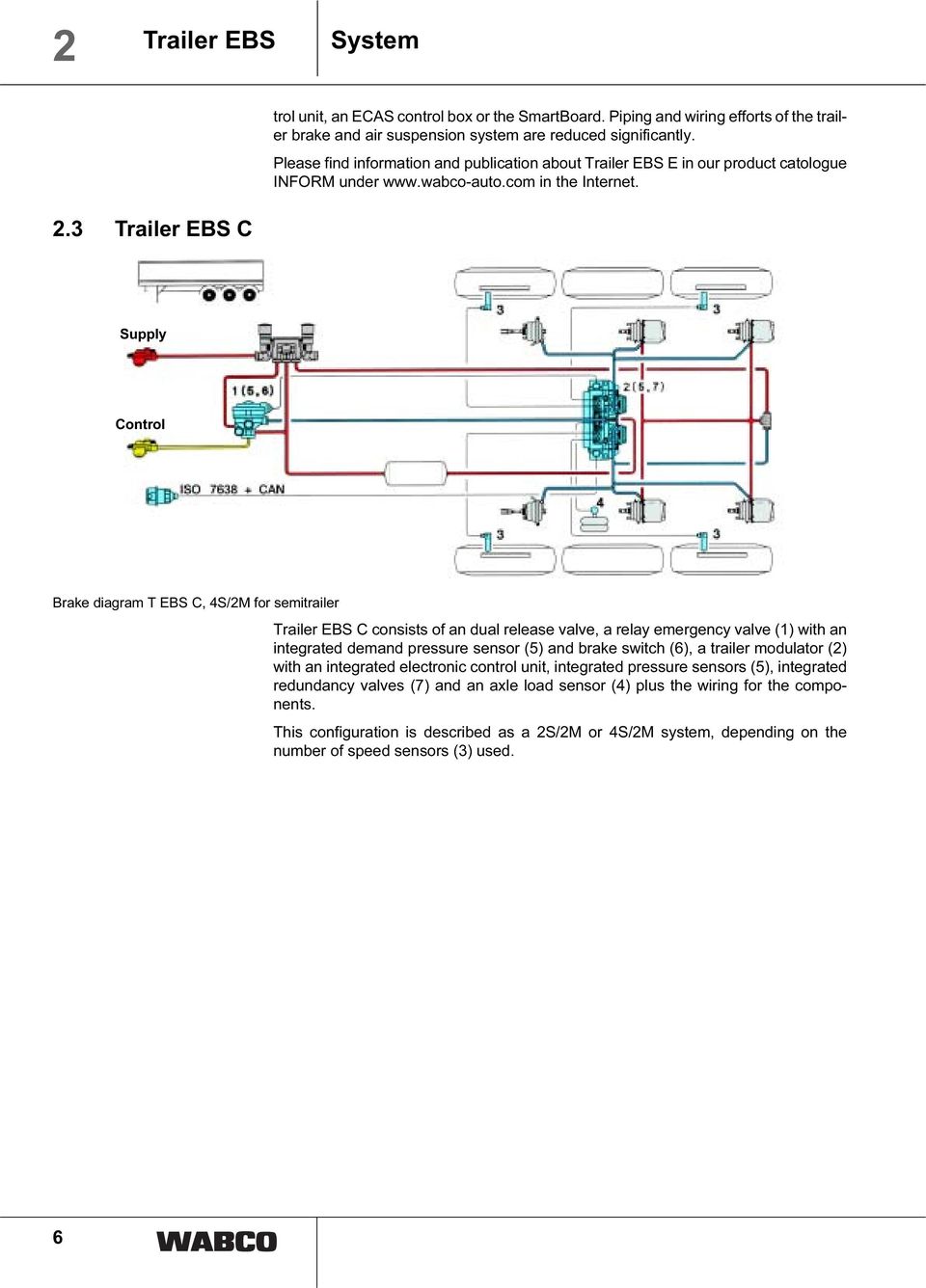
6 2 Trailer EBS System 2.3 Trailer EBS C trol unit, an ECAS control box or the SmartBoard. Piping and wiring efforts of the trailer brake and air suspension system are reduced significantly. Please find information and publication about Trailer EBS E in our product catologue INFORM under in the Internet. Supply Control Brake diagram T EBS C, 4S/2M for semitrailer Trailer EBS C consists of an dual release valve, a relay emergency valve (1) with an integrated demand pressure sensor (5) and brake switch (6), a trailer modulator (2) with an integrated electronic control unit, integrated pressure sensors (5), integrated redundancy valves (7) and an axle load sensor (4) plus the wiring for the components. This configuration is described as a 2S/2M or 4S/2M system, depending on the number of speed sensors (3) used. 6
7 System Trailer EBS 2 The addition of an EBS relay valve (8) to the 4S/2M configuration for controlling the front axle pressure in drawbar trailers or a 3rd axle in semitrailers is referred to as a 4S/3M system. Supply Control Brake diagram T EBS C, 4S/2M for drawbar trailer 2.4 Trailer EBS D The trailer EBS D generation consists of a Park Release Emergency Valve PREV (1), the EBS trailer modulator (2) - an electropneumatic control unit with an integrated electronic control unit, integrated pressure sensors and integrated redundant valves as well as the cabling and piping of the components. Brake diagram T EBS D+ with PREV, 2S/2M for semitrailer Depending on the number of speed sensors (S) and control circuits (M), this configuration is referred to as a 2S/2M or 4S/2M system. The 4S/2M configuration, with the addition of an ABS relay valve for ABS control of a 3rd axle in semitrailers, is referred to as a 4S/2M+1M system. 7

8 2 Trailer EBS System The addition of an EBS relay valve to the 4S/2M configuration for controlling the front axle pressure in drawbar trailers or a 3rd axle in semitrailers is referred to as a 4S/3M system. 2.5 Configuration Trailer EBS supports the following ABS configurations: 2S/2M, 2 speed sensors and one trailer modulator for 1- to 3-wheel semitrailers and central axle trailers with air suspension systems. 2S/2M + SLV, Extension to the configuration by a Select Low valve for controlling a steering axlesteering axle on a semitrailer. 4S/2M, 4 speed sensors and one trailer modulator for 2- to 3-wheel semitrailers and central axle trailers with air suspension systems. 4S/2M+1M, 4 speed sensors, one trailer modulator and one ABS relay valve for 2- to 4-wheel semitrailers and 2- and 3-wheel central axle trailers with air suspension systems. 4S/3M, 4 speed sensors, one trailer modulator and one EBS relay valve for 2- to 5- axle drawbar trailers and 2- and 4-axle semitrailer or 2- to 3- axle central axle trailers with air suspension systems. 2S/1M, 4S/4M and 6S/3M ABS configuration are not be supported. Axles or wheels which have had no sensors fitted can be indirectly controlled by directly controlled axles or wheels. Multi-axle assemblies require the utilisation of the adhesion to be roughly identical. IF not all wheels are sensored the axle(s) that lock(s) in general at first has to be equipped with a sensor. Multi-axle assemblies with static axle load allocation only should be equipped in such a way (brake cylinders, length of brake levers, etc.) that the wheels of all axles reach the locking limit as simultaneously as possible and that a directly controlled wheel does not indirectly control more than two wheels and on central axle trailer not more than one wheel Installation recommendation for semitrailers, central axle trailers and drawbar trailers Lifting axles 2S/2M System: Lift axles are not to be sensed. All other systems: Lift axles can be sensed with ABS sensors of axles e, f. Steering axles Constrained steering axles can be treated like rigid axles. WABCO prescribes EBS configurations 4S/3M, 4S/2M+1M or 2S/2M+SLV for vehicles with self-steering axles. If 2S/2M or 4S/2M EBS-systems are to be used in vehicles with self-steering axles, tests during the type test must establish that there are no abnormal axle vibrations 8

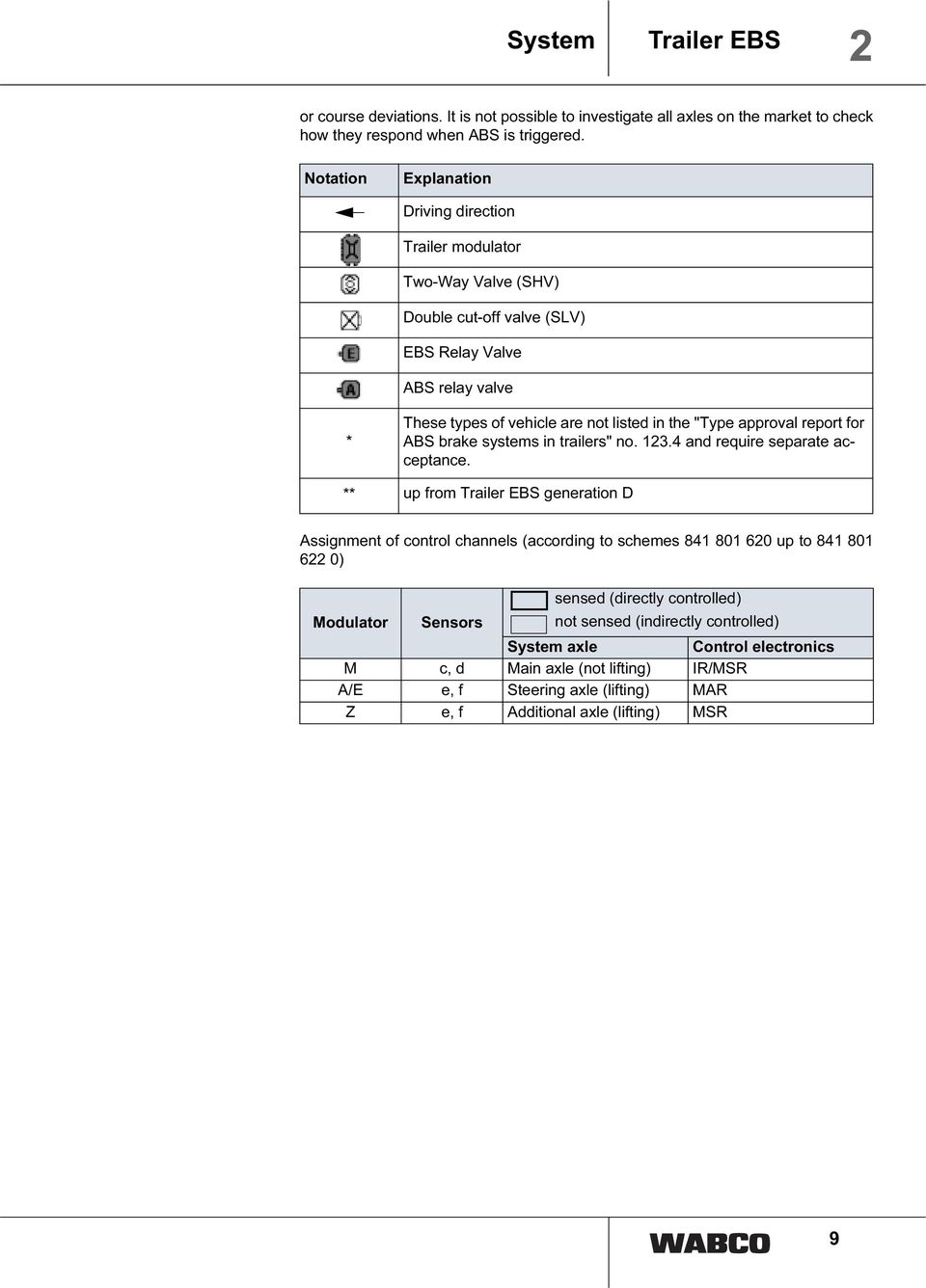
9 System Trailer EBS 2 or course deviations. It is not possible to investigate all axles on the market to check how they respond when ABS is triggered. Notation Explanation Driving direction Trailer modulator Two-Way Valve (SHV) Double cut-off valve (SLV) EBS Relay Valve ABS relay valve * These types of vehicle are not listed in the "Type approval report for ABS brake systems in trailers" no and require separate acceptance. ** up from Trailer EBS generation D Assignment of control channels (according to schemes up to ) Modulator Sensors sensed (directly controlled) not sensed (indirectly controlled) System axle Control electronics M c, d Main axle (not lifting) IR/MSR A/E e, f Steering axle (lifting) MAR Z e, f Additional axle (lifting) MSR 9
10 2 Trailer EBS System Central axle trailers and semitrailers Vehicle type 2S/1M 2S/2M 4S/2M 4S/3M 4S/2M + 1M + 2S/2M + SLV + 2S/2M + SLV 2S/2M + SLV 10

11 System Trailer EBS 2 Drawbar trailer Vehicle type 2S/2M 4S/2M 4S/3M 4S/2M + 1M ** Semi trailer and drawbar trailer (separate acceptance required) Vehicle type 2S/2M 4S/2M 4S/3M 4S/2M + 1M * * 1 11

12 2 Trailer EBS System Vehicle type 2S/2M 4S/2M 4S/3M 4S/2M + 1M * * 12 1

13 Components Trailer EBS 3 3 Components 3.1 Trailer EBS Modulator Modulator Trailer EBS C The trailer modulator is used for controlling and monitoring the electropneumatic brake system. It controls the brake cylinder pressure on both sides of one, two or three axles. The trailer modulator is installed in the electropneumatic braking system between reservoir tank or EBS trailer emergency valve (with T-EBS C) or Park release emergency valve (with T-EBS D) and brake cylinder nearby the axles on the frame (e. g. on a 3-axle trailer above the second axle). The trailer modulator has two pneumatically independent pressure control channels, each with an air admitting and an air exhausting valve, a redundant valve, a pressure sensor and a shared control ECU as well as an electrical connection for an ABS or EBS relay valve. The brake cylinder pressures on an axle can be controlled separately using this connection. The wheel speeds are recorded and evaluated by up to four speed sensors. If the wheels start to lock, the brake pressure specified for the brake cylinders is reduced by the ABS control circuit. The reservoir pressure is detected by an integrated pressure sensor. If the reservoir pressure drops below 4.5 bar, the driver is warned by the red and yellow warning lights. If an expanded ISO 7638 plug device is used, the trailer modulator communicates with the tractive unit via the electrical trailer interface according to ISO ( ). A bidirectional data interface according to ISO (KWP 2000) is provided for diagnosis of the trailer modulator. If a CAN interface is available, the vehicle s nominal delay is determined of the CAN braking signal of the towing vehicle. In other cases the nominal delay is based on the received pressure signal of the EBS trailer emergency valve. A connection for a axle load sensor can be found on the trailer modulator. The brake force is adapted depending on the vehicle load (load-dependent brake force control). Variants of the modulator Trailer EBS C (up to week 48/2001: T-EBS C2, from week 49/2001: T-EBS C3) WABCO no ABS configuration max. 4S/3M max. 4S/3M max. 4S/3M max. 4S/3M max. 4S/3M Battery charge X X to be used with TCE X X RSS X X Connection wear indicator X X X Switching output 1 / 2 X X X 1 13

14 3 Trailer EBS Components Modulator Trailer EBS D With Trailer EBS D, the setpoint deceleration of the vehicle is calculated with an integrated pressure sensor by measuring the pneumatic control pressure of the tractive unit and if a trailer interface is available the CAN setpoint. In vehicles with critical timing characteristics, it is possible to connect an additional separate brake pressure sensor as an option in order to improve the timing response. The trailer modulator has an integrated axle load sensor. In addition, a separate axle load sensor can be connected, for example so that a pressure sensor with a larger measuring range can be used with hydraulic suspension systems. The brake force is modified depending on the vehicle load (load-dependent brake force control). A second CAN interface (ISO or ISO 11898) can be used for connecting a telematic system or a second trailer modulator. Variants of the modulator Trailer EBS D standard 4S/2M Fits to semi trailers without TCE Premium 4S/3M Fits to drawbar or semi trailers without TCE. The version has an electrical connection for an external EBS or ABS relay valve. The brake cylinder pressures on an axle can be controlled separately when an EBS relay valve is connected. When an ABS relay valve is connected, the specified brake pressure can be controlled separately for an axle by the ABS control loop if a wheel is starting to lock. The RSS (roll stability support) function can be activated. When the RSS function is activated, the trailer is braked automatically if the risk of overturning is detected. When operating with ECAS/ELM, a battery can be connected for operating the trailer independently without the tractive unit. The current for charging the battery is restricted by the EBS electronic control unit in order to prevent any overload of the connected cables. The battery is charged from the tractive unit's electrical system when the power intake is higher than 24 V and no EBS/ABS brake operation is performend TCE + 4S/2M Fits to drawbar or semi trailers only in combination with TCE (no separate installation). Function Standard Premium with TCE ABS system max. 4S/2M max. 4S/3M max. 4S/3M CAN bus 24 V (ISO 7638 X X CAN bus 5 V X Brake light supply X X Switching output 1 / 2 X X Traction help X X Wear sensing X X 2nd CAN bus (IVTM etc.) X Battery charge for ECAS X RSS X X Connection external Brake pressure sensor X X Connection external Axle load sensor X X X 14 1

15 Components Trailer EBS Park-release emergency valve (PREV) In the trailer EBS D generation, the typical functions of the trailer emergency valve such as the line break function or pressure retention must be assured when the trailer is unhitched. The park-release emergency valve should preferably be used for this purpose. However, these functions can also be ensured by a conventional or an EBS trailer emergency valve. The park-release emergency valve provides the functions of emergency braking in case of a pneumatic supply line break and the double release valve function. The black actuation button (release button of the service brake system) enables the brake system to be released manually following automatic braking when the vehicle is parked up without any compressed air supply. However, there must be sufficient reservoir pressure in the tank to permit this. The red actuation button (actuation of the parking brake system) enables the parking brake to be applied or released by venting the spring-type brake actuators. When the trailer is unhitched (supply line evacuated), it is braked automatically by the service brakes and, at the same time, the non-return valve integrated in the parkrelease emergency valve is bypassed in the spring-type brake actuator circuit. If the reservoir pressure in the parked trailer drops, the spring-type brake actuators automatically take over providing the braking effort and prevent the vehicle from rolling away. All control functions are active in case of a supply line break. 3.3 Trailer emergency valve Trailer EBS C The conventional trailer emergency valve is used up from Trailer EBS C3 generation in combination with an external demand pressure sensor. Trailer EBS D Trailer EBS D generation operates with a conventional trailer emergency valve without external demand pressure sensor because it is integrated in the modulator. It is important to use a trailer emergency valve without predominance. 3.4 EBS relay valve The EBS relay valve is used in the Trailer EBS C as an actuator for modulating the brake pressures in the front axle of drawbar trailers or a 3rd axle in semitrailers. The EBS relay valve consists of a relay valve and two solenoid valves (air admitting/air exhausting valve), a redundant valve and a pressure sensor. Electrical control and monitoring is performed by the modulator Trailer EBS C. 15

16 3 Trailer EBS Components 3.5 ABS Relay Valve The ABS relay valve familiar from conventional brake systems and a double non-return valve are used in the electropneumatic brake system as an actuator for modulating the brake pressures on a steering axle of semitrailers. Electrical control and monitoring is performed by the trailer modulator. 3.6 Lifting axle valve (dual circuit) An electrical lifting axle valve can be used to control up to two lifting axles automatically via the trailer EBS relative to the current axle load. Electrical control and monitoring is performed by the trailer modulator. 3.7 Lifting axle valve (single circuit) Using a single circuit lifting axle valve, a lifting axle can be automatically controlled by the trailer EBS D depending on the current axle load. Electrical control and monitoring is performed by the trailer modulator. A traction help with residual pressure holding is possible after unscrewing the vent. To do this, a line is routed from the vent to the 3/2-way solenoid valve for residual pressure holding. To do this, cable must be connected to the IN/OUT1 connection of the Trailer EBS D modulator. The lifting axle valve vent (connection 3) is shut off by a 2- way valve, vented accordingly by the EBS D modulator and the maximum possible bellows pressure is retained. The traction help can be activated by a button (see chapter 4.16 Integrated Lifting axle control ILS (Integrated Load Switch), page 34). Lifting axle valve replaces the previous version Double cut-off valve (Select Low valve) The double cut-off valve is used in vehicles with 2S/2M + Select Low control in order to provide axle-by-axle braking (e.g. steering axle). The input pressures are the pressures output by the trailer modulator for each side. The lower pressure is then directed to the axle to be braked. 16

17 Components Trailer EBS ECAS An electronic air suspension system ECAS can be connected in series with the trailer EBS. Electrical control and monitoring is performed by the trailer modulator. If ECAS is installed, a battery can be connected to the trailer modulator ( only) by means of which ECAS can be operated without the trailer being hitched to a tractive unit. Please find information and publication about ECAS in our product catologue INFORM under in the Internet ELM An electronic air suspension module ELM can be connected in series with the trailer EBS. Electrical control and monitoring is performed by the trailer modulator. Please find information and publication about ELM in our product catologue INFORM under in the Internet TCE The trailer EBS can be expanded by a trailer central electronic unit (TCE). Electrical power supply, sensor data transmission (except for speed sensors and any external brake pressure sensor fitted) and monitoring of the trailer EBS is performed by the TCE. Please find information and publication about TCE in our product catologue INFORM under in the Internet.! If TCE is fitted, the following modulators can be used only Trailer EBS C: , Trailer EBS D: Usage of different modulators will cause an error message by TCE During startup, the trailer EBS is taken into service first, followed by the TCE Pressure sensor / The pressure sensors / replace the previous versions / Trailer EBS C Traler EBS C is using an axle load sensor (pressure sensor) to measure the bellows pressure of the air suspension system. Depending on the bellows pressure a brake force control not depending on the load is carried out. Electrical control and monitoring is performed by the trailer modulator. 17

18 3 Trailer EBS Components The axle load sensor has to measure the bellows pressure of one axle which is not lifted. At drawbar trailes, the axle load sensor must observe the bellows pressure of the axle which is controlled by the modulator (and not the axle with the 3rd modulator). Air suspension systems with a levelling valve can be connected with the axle load sensor on each air suspension bellow. By air suspension systems with two levelling valves ( side wise control of the level) the axle load sensor has to has more bellows pressure which he he gets by a twoway valve. Trailer EBS D An external brake pressure sensor for improving timing characteristics can be connected to the Trailer EBS D IN/OUT2 port (all versions except for ). This pressure sensor measures the control pressure in the brake line and transmits the measured value to the trailer modulator. Additionally, an external axle load sensor can be connected at IN/OUT1. The pressure sensor may also be used during servicing if an internal demand pressure sensor fails. When the external pressure sensor is connected, the relevant internal one is not active ABS sensor / Type S plus sensors are used as ABS sensors. ABS sensors (cable length 400 mm) or (cable length 1,000 mm) are used. Sensor sets (cable lenght 400 mm) or (cable lenght 1,000 mm) are recommended as replacement solution SmartBoard The SmartBoard is a display and control panel for trailer vehicles and combines the following functions: Display of distance driven (operates without power supply from the towing vehicle) Brake lining wear indicator (in connection with WABCO BVA) Current axle load indicator Tyre pressure indicator (in connection with WABCO IVTM) Display of diagnostics and system messages The SmartBoard functions in combination with every Trailer EBS D system with a Premium ECU of week of manufacture 51/03 or later according to the type plate or 2003 CW51 according to the Diagnostic Software. Assembly The SmartBoard is simply screwed onto the exterior of the frame and connected to the Trailer EBS D modulator via cable. The distance between the Trailer EBS D ECU and the desired point of installation determines the cable length: Cable : 3 m 18

19 Components Trailer EBS 3 Cable : 8 m The CAN 2 communication of the Trailer EBS D modulator is activated via diagnostics. The SmartBoard does not require any parameter settings. You will find further information, such as connecting the SmartBoard to an ABS sensor for independent odometer reading, in the SmartBoard system description Operating instructions for the driver are available under Both publications can be obtained from the product catalogue INFORM at Cable overview Prefabricated cables should be used for the trailer EBS, since these have mouldedon plugs and are therefore optimally protected against external influences Power supply cable Cable WABCO no. L in m cable end type for semi trailers, 24 V, 7-pin T EBS Power for drawbar trailers, 24 V, 7-pin T EBS Power Socket ISO 7638 Connector ISO for semi trailer (combined with ) (24V) Socket ISO 7638 Coupling 7-wire, mating component for for semi trailers (combined with ) (24V) Coupling 7-wire, Connector mating ISO 7638 component for (combined with or ) ,3 Coupling 7-wire, mating T EBS Power component for , for semi trailer (combined with ) (24V) ,5 Socket ISO 7638 Coupling 7-wire, mating component for

20 3 Trailer EBS Components Cable WABCO no. L in m cable end type (combined withcombined with ) T EBS Power open ends with EBS plug (24 V) 7-pin Coupling 7-wire, mating component for Supplied package: is fitted by the customer T EBS Power 7-pin open ends Solenoid cable Cable WABCO no. L in m cable end type Relay valve (drawbar trailer, 3rd modulator) T EBS Modulator ABS relay valve (3rd modulator) Socket Kostal 1 M M DIN B1-3.1-Sn/K T EBS Modulator Socket bajonet DIN B1-3.1-Sn/K Relay Emergency Valve Cable WABCO no. L in m cable end type Relay Emergency Valve , ,5 T EBS IN/OUT2 Socket bajonet DIN B2-4.1-Sn/K1 Ext. pressure sensor and Relay Emergency Valve ,5 T EBS IN/OUT2 Socket bajonet DIN B1-4.1-Sn/K1 20

21 Components Trailer EBS Sensor cable Cable WABCO no. L in m cable end type Pressure sensor T EBS ABS sensor Extension cable for ABS sensor (straight) ,8 1, Coupling socket Socket bajonet DIN B1-3.1-Sn/K1 coupling plug EBS - Wear indicator Cable WABCO no. L in m cable end type Cable from EBS modulator to brake caliper ,3 Coupling socket coupling plug Extension cable Cable Y-distributor Coupling socket coupling plug Coupling socket coupling plug Plug (electrical jumper) ,56 21
22 3 Trailer EBS Components Diagnostic cable Cable WABCO no. L in m cable end type Diagnosis and ISS or ILS / / / / 8 Diagnosis and ILS T EBS Diagnosis Diagnostic socket; 3-pin, 3 0,75 mm² / 2 T EBS Diagnosis Socket Diagnosis; socket M 27 1 Diagnosis and ILS1/ILS2 stop light supply / / / 12 T EBS Diagnosis Socket Diagnosis, 4-pin, mm², mm² Diagnosis and ECAS , T EBS Diagnosis Diagnosis and single-circuit lifting axle valve PG 11, 7-pin mm² mm² 6 with cable shells / / / 6 Diagnosis and ELM / / 6 T EBS Diagnosis T EBS Diagnosis Socket Diagnosis; socket bajonet DIN B Sn/K1 Socket Diagnosis; elbow bajonet DIN B Sn/K1 22
23 Components Trailer EBS 3 Cable WABCO no. L in m cable end type Cable for traction help button Diagnostics T EBS Diagnosis Socket Diagnosis Cable WABCO no. L in m cable end type Traction help switch type TH Coupling socket T EBS IN/OUT1 2-pin, 2 0,75 mm² Traction help switch type TH and solenoid valve / 15 Coupling socket T EBS IN/OUT1 2-pin, mm² Socket bajonet DIN B1-2.1-Sn/K Sealing plug for Trailer EBS modulator sealing plugs WABCO no. Comment with sealing for socket X1 X for sensor socket X5 X Other components Description Order number Comment Solenoid valve Pressure holding function in traction help Two-way valve Overload protection of TRISTOP cylinders Quick-release valve Overload protection of TRISTOP cylinders with quick release function Trailer release valve Releasing the front axle in drawbar trailers Double release valve Brake cylinders Reservoir Piping Releasing the brake system and applying/releasing of the TRISTOP cylinder These components broadly correspond to the components of a conventional braking system. 23
24 4 Trailer EBS Functional description 4 Functional description 4.1 Electro-pneumatic function Pneumatic redundancy This chapter describes the functions of individual subsystems, components, and their interaction. The trailer EBS is electrically connected via pin 2 of the ISO 7638 plug connection (terminal 15). The brake system can be powered via an optional stop light supply in case of failure of the electrical power supply via the ISO 7638 plug connection. A system check is performed as soon as the trailer EBS is switched on. 2 seconds after switch-on, the solenoids in the trailer modulator are switched through one after the other; this procedure can be heard as the solenoids are clicking. The system is ready for operation within 150 ms after being switched on.! The ABS function may be only available in a restricted form when the trailer EBS is switched on, since a dynamic check of the ABS sensors is not performed until after the start of the journey. The integrated redundant valves are energised for electropneumatic actuation at the start of braking. This means the pneumatic control pressure is diverted away and the reservoir pressure is applied to the intake valves of the modulators. This means pressure control is possible up to the level of the reservoir pressure. For pressure control, a setpoint is specified for the trailer modulator and this value is used as the target for the control loop, depending on the load. The supporting bellows pressure supplied to the trailer modulator via a pneumatic line is measured in order to adapt the brake forces to the various loading conditions. The setpoint for the trailer EBS is predominantly specified via the electrical trailer interface according to ISO ( ). If this interface is unavailable, the setpoint is specified by the pressure sensor integrated in the trailer modulator or, in vehicles with critical timing characteristics, by an external brake pressure sensor in the control line. The pressure is modulated by pressure control loops with pulsed relay valves. In order to adapt the brake forces to various loading conditions, the axle loads on vehicles with air suspension are measured by registering the bellows pressures. When an ECAS system is connected, the system continues to operate for 5 seconds after the trailer EBS is switched off. In the event of system faults which require part of the overall system to be switched off, the pneumatic control pressure is switched through to the opened intake valves and the closed outlet valves of the modulators. This means the braking pressure can be applied purely pneumatically, however without consideration for the axle loads (LSV). The ABS function is maintained for as long as possible. The status of the system is indicated to the driver by a warning light connected to pin 5 of the ISO 7638 plug connection (the warning light display is based on the applicable statutory regulations). 24
25 Functional description 4.2 Electrical / electronic system structure Trailer EBS 4 During normal operation, the trailer modulator is powered by fused supply cables via the ISO 7638 interface (plug X1, tl. 15 and tl. 30). As a safety function, there is provision for electrical power supply via stop light so that certain control functions can be maintained even if the electrical power supply via the ISO 7638 interface fails. The electrical data connection between the tractive unit and the trailer modulator is implemented via the trailer interface according to ISO (plug X1, pins 6 and 7). The data content is processed by the trailer modulator in accordance with its significance and function. A pressure sensor for measuring the control pressure in the trailer modulator is integrated in the Trailer EBS D modulator in order to ascertain the setpoint behind a tractive unit without EBS. In long pneumatic control lines, the speed of response can be improved by using an external brake pressure sensor (if an EBS trailer emergency valve is used, this is integrated in the device). The setpoint is monitored for plausibility. Pneumatic redundancy is implemented by means of 3/2-way solenoid valves integrated in the trailer modulator. At the start of every braking cycle, this switches off the solenoid valves and, with them, the redundant activation. The pressure in the front axle of a drawbar trailer or the 3rd axle of a semitrailer is preferably controlled using an electropneumatic EBS relay valve. A brake pressure sensor and a 3/2-way solenoid valve are integrated in the valve module. The brake pressure sensor is supplied with voltage from the trailer modulator (plug X4). The actual value is output as an analog signal. The pressure in the 3rd axle of a semitrailer (trailing/steering axle) can also be controlled using an ABS relay valve. In this case, only the pressure in the blocking range of the axle is controlled; in other respects a braking pressure is set which is pneumatically specified via port 4 of the ABS relay valve. Electrical power is supplied from the trailer modulator to all active sensors jointly via short circuit-proof outputs. A reservoir pressure sensor and two brake pressure sensors are integrated in the Trailer EBS D modulator. They are supplied with voltage from the trailer modulator. Their actual values are output as analog signals. A pressure sensor is integrated in the Trailer EBS D modulator in order to register the air suspension pressure. In this case, a pneumatic line is routed from the trailer modulator to the supporting bellows. In addition, a separate axle load sensor can be connected (to plug X5), for example so that a pressure sensor with a larger measuring range can be used with hydraulic suspension systems. Optionally, plug X5 can also be set as a switching input in the parameters, in which case it serves to activate a traction help in trailers with lifting axle(s). Limit value indicators are provided for registering the brake pad wear on the wheel brakes. Their signals are evaluated by the trailer modulator and transmitted to the tractive unit via the ISO interface. 2 switching outputs are provided for additional systems in the trailer. Their mode of function can be set in the parameters using a diagnostic tool. System faults are picked up by the trailer modulator and stored in the diagnostic memory in accordance with a specified fault table. 25
26 4 Trailer EBS Functional description ISO 7638 plug-in connection Terminal 30 Terminal 15 GND GND 15 Warning lamp CAN H CAN L Diagnosis / Switching output ports K-line +24 V testing GND Switching output GND Switching output 1 ALS Demand pressure sensor / -switch U P + - s Trailer EBS C POWER f (X9) d (X7) (X1) DIAGN. (X2) 1 (X5) 2 (X6) R.E.V (X3) c (X8) e e (X10) Modulator T EBS C MODULATOR (X4) s+ U P - s+ U W - s+ U P Wheel speed sensor H1 Axle load sensor Lining wear sensor Wheel speed sensor H2 Wheel speed sensor Z EBS relay valve ABS relay valve ISO 7638 plug-in connection Diagnosis / Switching output ports Brake pressure sensor / Telematics Trailer EBS D Terminal 30 Terminal 15 GND GND 15 Warning lamp CAN H CAN L K-line +24 V testing GND Switching output 2 Brake light Battery charge (opt.) GND Switching output 1 external Brake pressure sensor U P + - s Switching input Terminal 30 GND CAN2 H CAN2 L POWER (X1) DIAGN. (X2) IN/OUT 2 (X3) e Modulator T EBS D f (X9) d (X7) IN/OUT 11 (X5) (O) (X6) c (X8) e (X10) MODULATOR (X4) s+ - s+ U W U P Wheel speed sensor H1 Signal GND Switching output port 5 Lining wear sensor Wheel speed sensor H2 Wheel speed sensor Z EBS relay valve ABS relay valve 26
27 Functional description Trailer EBS Warning signal sequences The driver is warned about the status of the trailer EBS by a warning light which is controlled via pin 5 of the ISO 7638 interface. In parallel to this, a warning signal is output via the trailer interface according to ISO The following applies in general: The yellow (pin 5 ISO 7638) and the red (ISO 11992) warning lights are switched on if the reservoir pressure in the trailer drops below 4.5 bar. The warning lights go out again if the pressure goes back above 4.5 bar. It is possible to set 2 different warning signal sequences in the parameters. 1st possibility When the vehicle is at a standstill: The warning device lights up after "Ignition on". If no current fault is detected, the warning lamp goes out after approx. 2 seconds. If a current fault was detected, such as a sensor error, the warning device remains on. If an ABS sensor fault was saved during the last drive but this fault is no longer present, the warning device goes out after v > 7 km/h. During normal driving v > 7 km/h: The warning device lights up or remains lit if a current fault was detected. 2nd possibility The warning device lights up after "Ignition on". If no current fault was detected, the warning device goes out after approx. 2 seconds and lights up again after another 2 seconds. The warning device goes out at v 7 km/h. If a current fault was detected, e.g. sensor broken off, the warning device remains on. 4.4 Setpoint selection and pressure control The braking request issued by the driver is referred to as the setpoint. If the trailer is towed by an EBS towing vehicle with a 7-pin (ABS) plug connection according to ISO 7638, the Trailer EBS gets the nominal value from the EBS vehicle via the trailer interface (CAN). The setpoint via the CAN always takes precedence in the control loop. If no setpoint is available via the trailer interface, e.g.: if a trailer is towed by a conventionally braked tractive unit with a 5-pin (ABS) plug connection according to ISO 7638, or if the trailer interface (CAN) is interrupted in an EBS tractor/trailer combination, then a setpoint is generated by measuring the control pressure. This measurement is performed: in the trailer modulator with an optional external setpoint pressure sensor. In the C version, the setpoint pressure was monitored to check for unintentional braking by means of the switch integrated in the trailer emergency valve. This has been replaced in Trailer EBS D by a plausibility check of the sensor value. When the control pressure of 0.3 bar is exceeded, the redundant valve integrated in the trailer modulator is switched over to the reservoir pressure and EBS braking starts. During braking, the redundant valve is briefly switched back to the control pressure and checked using the integrated actual pressure sensors to establish whether pneumatic pressure is 27
28 4 Trailer EBS Functional description present there. If there is no pneumatic pressure present, EBS braking is cancelled and the system is switched over to redundant braking. Pressure sensor ISO 7638 / CAN Set value detection Lateral acceleration sensor (T EBS D) R S S LSV function Modulator ABS U P U P 4.5 Load sensing brake control (LSV) The trailer EBS includes load-dependent brake force control. This system differs between semitrailers or central axle trailers and drawbar trailers. The current loading condition is ascertained by sensors which measure the pressure in the air bellows. P zyl (bar) 8 7 beladen loaded empty leer A S p m (bar) A static control table is implemented in semitrailers, as in conventional LSV controllers. The transition function from brake pressure (p cyl ) to coupling head pressure (p m ) is divided into two areas: A Application range S Stability range 28
29 Functional description Trailer EBS 4 In the example, the brake cylinder pressure increases from 0 to 0.4 bar in the application range from p m = 0 bar to p m = 0.7 bar. At p m = 0.7 bar, the response pressure in the wheel brake is reached and therefore the vehicle can start to build up braking force from that point on. This point, being the response pressure of the entire trailer brake, can be set in the parameters within EC braking bands. As the sequence continues, the brake pressure follows a straight-line characteristic when the vehicle is laden. This line takes it through the calculated value at p m = 6.5 bar. If the vehicle is empty, the response pressure is also output at p m = 0.7 bar, after which the brake pressure is reduced according to the load. In a drawbar trailer, brake force distribution implemented as software has replaced the two LSV controllers, the adapter valve on the front axle and the pressure limiting valve on the rear axle. Brake pressure (bar) VA loaded HA 1 0 empty A V S p m (bar) The transition function is divided into three areas here: A Application range V Wear range S Stability range Brake force distribution in the drawbar trailer The response pressures of the brakes are once again output at the end of the application range. These pressures may also differ from one axle to another. The pressures are output in order to optimise wear in the partial braking range (wear range). In a drawbar trailer with type 24 cylinders on the front axle and type 20 cylinders on the rear axle, for example, the pressure at the front axle is slightly reduced and that at the rear axle is slightly increased in accordance with the configuration. This ensures that the load is distributed evenly between all wheel brakes and is more exact than the function of the adapter valve used nowadays. In the stability range, the pressures are output in such a way as to ensure the same adhesion utilisation as a function of the axle load. The rear axle load is measured on the basis of the air bellows pressure. The front axle load is calculated without using an axle load sensor, on the basis of the slip differential between the wheels which are equipped with speed sensors. 29
30 4 Trailer EBS Functional description 4.6 Pressure control 4.7 Anti-lock braking system (ABS) The parameters are calculated using the WABCO brake calculation program. The parameters are stored in the trailer modulator with the corresponding brake calculation number. The pressure control circuits take the setpoint pressures specified by the LSV function and convert them into pressures for the wheel brake cylinders. The control unit takes the actual pressures measured at the output of the relay valves integrated in the trailer modulator and compares them with the setpoint pressure specification. If there is a discrepancy, this is compensated for by actuating the inlet or exhaust solenoids. The control logic determines from the wheel rotation speed whether one or more wheels can be locked and decides whether to decrease, maintain, or increase the braking pressure on it. 2S/2M 2S/2M + SLV 4S/2M 4S/3M 4S/2M + 1M In a 2S/2M configuration, an ABS sensor and the pressure control channel of the Trailer EBS are grouped together to make one control channel. Any other wheels on one side are indirectly included in the control function. The brake forces are controlled according to the principle referred to as individual control (IC). In this case, each side of the vehicle gets the brake pressure which is possible based on the road conditions and the brake characteristic. The 2S/2M +SLV (Select Low valve) is a modification of the 2S/2M system for semitrailers with a trailing steering axle. In this case, the lower pressure in the two pressure control channels is supplied to the steering axle via the Select Low valve, which means the axle remains stable even if the wheels on either side are on parts of the carriageway with different coefficients of friction (according to ABS category Cat. A). A). In a 4S/2M configuration, two ABS sensors are arranged on each side of the vehicle. Here too, control is separate for each side. The brake pressure is the same for all wheels on each side. The two wheels on this side with sensors are controlled according to the modified side control (MSC) principle. In this case, the first wheel to lock on one side of the vehicle is the determining factor for ABS control. In contrast, the two modulators are individually controlled. The principle of individual control is used as far as both sides of the vehicle are concerned. A 4S/3M configuration is to be preferred for full trailer or semi-trailer with a follower steering axle. In this case, the rear (in drawbar trailers) or main axle(s) (in semitrailers) are individually controlled (IC) in accordance with the 2S/2M configuration described above. However, two sensors and an EBS relay valve are arranged on the steering (in drawbar trailers) or trailing axle (in semitrailers). In this case, control is axle-by-axle. The wheel on this axle which first starts to lock is the dominant one for ABS control. Control on this axle is according to the principle of modified axle control (MAC). A 4S/2M+1M configuration can be used as a lower cost alternative to a 4S/3M system in semitrailers with a trailing steering axle. There are two sensors on the trailing steering axle, whilst a Select Low valve as well as an ABS relay valve are used instead of the EBS relay valve used in the 4S/3M system. In this case, the leading axle(s) are controlled according to the IC principle and the trailing steering axle according to the MAC principle. 30
31 Functional description Trailer EBS 4 In all configurations, it is possible to connect additional wheel brake cylinders for other axles to the existing modulators in addition to the wheel brake cylinders of the ABS wheels. These wheels are indirectly controlled, however, and do not supply any information to the trailer modulator if these start to lock. Consequently no lock efficiency of these wheels can be ensured. 4.8 Roll Stability Support (RSS) RSS for semitrailers was introduced with Trailer EBS C3. A vehicle can overturn if the transverse acceleration critical for overturning is less than the adherence utilisation between the tyres and the road surface. Further definitions: The transverse acceleration critical for overturning is the limit value of the force which is allowed to act on a vehicle transversally to its driving direction before the vehicle tips over. The adherence utilisation between the tyres and the road surface is the limit value of the force which is allowed to act on a vehicle transversally to its driving direction before the vehicle slips off the carriageway. Trailers often have a relatively high centre of gravity, and so they are particularly prone to overturning when cornering at a sufficiently rapid speed. Drivers generally notice in time when the tractive unit is starting to tip, whereas they often recognise the same symptoms in the trailer too late in order to take corrective action (e.g. braking). The RSS function detects when there is a risk of the trailer overturning and applies the brakes automatically. This means the risk of overturning is reduced. The RSS function uses the known input parameters of the trailer EBS: Wheel speeds, load information and setpoint deceleration as well as an (in Trailer EBS D) additional transverse acceleration sensor integrated in the EBS modulator. RSS detects when there is a risk of overturning due to the significant reduction in load on the wheels on the inside of the bend. Test pressure activations are performed for restricted periods at low pressure if the calculated transverse acceleration critical for overturning is exceeded in the trailer. The duration and magnitude of the pressure depend on the actual transverse acceleration sequence. The risk of overturning is detected on the basis of the wheel reaction of wheels braked during a test. When a risk of overturning is detected, the trailer wheels on the outside of the bend are braked at high pressure so as to prevent the trailer from overturning. The brake pressure for the wheels on the inside of the curve is largely unchanged.! Braking operations actuated by RSS do not cause the stop light to come on, since the stop light is only allowed to be controlled from the tractive unit whereas braking conducted as part of RSS control are only performed by the trailer. RSS control is started in the unbraked or partially braked driving condition. No RSS control is triggered if the driver brakes sufficiently strongly (deceleration above the level of RSS deceleration). If the towing vehicle specifies a pneumatic or electrical brake setpoint to the trailer whilst RSS control is in effect, then RSS control is cancelled as soon as the setpoint from the towing vehicle exceeds the setpoint from RSS control. The brake pressure in the trailer is then modulated in accordance with the towing vehicle demand until the end of the braking operation. However, RSS control is not able to go beyond the laws of physics. The tractor/trailer combination can still tip over even with RSS activated providing the transverse force acting on the trailer does not diminish sufficiently quickly or continues to increase in spite of automatic brake intervention and the associated deceleration. During driving, the system compensates for up to 9 % difference in tyre circumferences as well as a modulator slant of up to 3 degrees about the longitudinal axis of the vehicle, in addition to the offset tolerance of the transverse acceleration sensor. 31
32 4 Trailer EBS Functional description The RSS function may be deactivated or respond with a delay up to the compensation level. The warning light may go out even before RSS is working optimally. Whenever trailers without any pressure in their supporting bellows are moved, RSS may be unable to detect the risk of overturning because there is no load information available. RSS is permanently switched off and the warning light is activated whenever faults are detected which mean that correct RSS function is no longer guaranteed. Trailer EBS C RSS calculates the risk of overturning using the rotational speed differentials of sensed wheels of two axles. This is the reason why RSS is realized with configurations 4S/2M, 4S/2M + 1M or 4S/3M only. Trailer EBS D The Premium variant is equipped with a lateral acceleration sensor. With this, vehicles with 2S2M and any lifting axles can be fitted. RSS supports 2S/2M, 2S/2M + SLV, 4S/2M and 4S/3M. The vehicles can also be equipped with steering axles. The RSS function has been developed further and adapts the individual transverse acceleration thresholds after only a few test braking operations. 4.9 Standstill function When the vehicle is at a standstill (v < 1.8 km/h) and the pneumatic control pressure is greater than 3.5 bar, the system changes over from electropneumatic to pneumatic pressure modulation after 5 seconds. This function is used to avoid unnecessary current consumption if the vehicle is parked up with the parking brake applied and the ignition switched on. This function is deactivated at the start of a drive Emergency braking function An emergency braking function is available so that the maximum possible braking effort can always be applied. If the driver's braking requirement corresponds to more than 90 % of the available reservoir pressure, in other words full-on braking is called for, the brake pressures are increased up to the level of the available reservoir pressure. This function is also in effect even if a bellows in the air suspension system should burst Test mode The electronic brake system must be set to test mode in order to allow the brake pressure distribution to be checked at a standstill. For test mode to be activated, the ignition must be switched on when the control line is vented (service brake system and parking brake system not applied). This switches off the standstill function and the emergency braking function. In this mode, load sensing valve can be checked depending on the coupling head pressure and the current axle load or the current bellows pressure. In drawbar trailers, the pressure is output at the steering axle in accordance with the bellows pressure of the rear axle which is controlled by the trailer modulator. Trailer EBS C It is possible to simulate the status "laden" for an unladen vehicle by unplugging the axle load sensor which in return will generate full brake pressure. 32
33 Functional description Trailer EBS 4! In this case, the warning lamp is activated! After the test has been completed, the axle load sensor must be re-connected and the actual error in the ECU is to be deleted by interruption of power supply (reset). The standstill function and the emergency braking function are re-enabled as soon as the speed of the vehicle exceeds 10 km/h. Trailer EBS D The "laden" status can be simulated in an unladen vehicle as follows: By venting the supporting bellows =>bellows pressure < 0.15 bar by disconnecting the pneumatic line from the modulator to the supporting bellows by the diagnostic software! The supporting bellows must be re-inflated at the end of the simulation, or the pneumatic connection between the modulator and the supporting bellows must be re-established. The standstill function and the emergency braking function are re-enabled as soon as the speed of the vehicle exceeds 2.5 km/h. In drawbar trailers, the brake pressure is distributed according to slip criteria at speeds above 10 km/h Supply pressure monitoring If the lifting axle(s) in vehicles with one or more lifting axle is/are to be lowered in order to check the braking forces of the unladen vehicle, this can be achieved by setting the air suspension pressure between 0.15 and 0.25 bar. This can be done by: Venting the supporting bellows (lowering using the rotary slide valve, ECAS or ELM) Connecting a pressure simulation to connection 5 of the modulator (e.g. with test valve) by PC diagnosis The brake pressures of the laden vehicle are output if the air suspension pressure is reduced below 0.15 bar. The reservoir pressure in the trailer is monitored by the EBS. If the reservoir pressure drops below 4.5 bar, the driver is warned by the red and yellow warning lights switching on. When the brake system is being charged, the warning lights do not go out until the reservoir pressure rises above 4.5 bar. A fault is stored if the reservoir pressure drops below 4.5 bar during driving Preventing automatic brake action at line tear-off! This function is available only for the Trailer EBS C-Generation in combination with trailer emergency valve with integrated pressure switch and pressure sensor. According to ECE-Regulation no. 13/09 (Addition 2) par it is permitted that automatic braking is avoided as long as the power supply drops below 4.5 bar. The driver is warned. This function is not considerd during vehicle's standstill. 33
34 4 Trailer EBS Functional description 4.14 Odometer The trailer EBS is equipped with an integrated mileage counter which measures the distance (in km) covered during operation. Two individual functions are possible: Total mileage counter Trip mileage counter The total mileage counter records the entire distance covered (in km) since initial installation of the system. This value is stored regularly and can be read out using various diagnostic units. The trip milage counter can be zeroed at any time. In this way, for example, it is possible to determine what distance has been covered between two service intervals or within a certain period of time. The trip counter can be read out and deleted using the diagnostic devices. No special calibration of the mileage counter is required. A calibration factor is calculated on the basis of the tyre tread circumferences and the number of teeth of the pole wheel from the EBS parameters. The mileage counter requires operating voltage. The mileage counter only works when there is electrical power to the trailer EBS, and is therefore not secure against tampering Service signal A service signal can be activated with the help of diagnostic units. If this function is active, a warning light is triggered and flashes 8 times when the ignition is next switched on and the vehicle is stationary after having covered a freely selectable mileage value (in km). This value can be set in the parameters using the diagnostic function. The flashing procedure repeats every time the ignition is switched on, and is intended to remind the driver that service work is due to be performed, for example. The service signal can be reset. Following this, the service interval set in the parameters starts to count down as described. This function is switched off in the supplied system Integrated Lifting axle control ILS (Integrated Load Switch) The trailer EBS can control the lifting axle(s) automatically depending on the current axle load if the vehicle is equipped with one or more lifting axles. For this purpose, one or one each of lift axle control valve must be connected to electrical switching output 1 and/or electrical switching output 2 of the trailer modulator.! The lifting axle is only allowed to be fitted with ABS sensors e and f. ABS sensors c and d are not allowed to be used on the lifting axle! 34
35 Functional description Trailer EBS Lifting axle control for trailer with 3 times 9t axle load Switching output 1 or 2 controls one lifting axle 27,0 t 27,0 t Lower lifting axle 18,0 t 16,8 t Lift lifting axle 24 V Axle load 0 V Pin 8 or pin 4 Diagnostic plug X2 0 V Axle load Switching output EBS modulator Switching output 1 or 2 controls two lifting axles 27,0 t 27,0 t Lower lifting axle 9,0 t 7,0 t Lift lifting axle 24 V Axle load 0 V Pin 8 or pin 4 Diagnostic plug X2 0 V Axle load Switching output EBS modulator 35
36 4 Trailer EBS Functional description Switching output 1 (pin 8) switches lifting axle valve 1, Switching output 2 (pin 4) switches lifting axle valve 2 27,0 t 27,0 t 16,8 t raise lifting axle 1 lower lifting axle 1 18,0 t 7,8 t raise lifting axle 1 and, if necessary lower in advance (<16.8t) lower lifting axle 2 raise lifting axle 2 9,0 t Axle load 0 V Pin 8 24 V 0 V Pin 4 0 V 0 V Axle load Switching output EBS modulator Trailer EBS C All lifting axles are raised or lowered during standstill only. They will be lowered automatically in case of switched-off power supply. It is fixed by parameter at which bellow's pressure the lifting axle is lowered. Trailer EBS D With the automatic lifting axle function, the lifting axles can optionally be lifted during driving; constrained steering is possible via CAN or using a button. Lifting axle(s) can be lifted in a speed range from 0 to 30 km/h; fixed by parameters. The bellow's pressure for lowering lifting axle(s) is fixed next to the brake parameters additionally with parameter "percentage axle load when laden". When the lifting axle is being controlled, the lifting axle valve is activated six times briefly in order to warn the operator prior to lowering or lifting. The position of the lifting axles is transmitted to the tractive unit via the tractive unit/trailer interface according to ISO ( ) where the position is displayed. If a fault is detected on the axle load sensor, the lifting axle is lowered between 5 and 30 km/h and, at speeds below 5 km/h, it is not switched. The electronic control unit detects a slip fault during driving (with lifted axle) if lifting axles (e.g. in a 4S/4M system) are equipped with ABS sensors e and f and the lifting axles were not selected on the first parameter settings screen during commissioning Integrated Speed Switch ISS The electrical switching output 1 of the trailer modulator can work as a function of the vehicle speed. The switching condition of this output changes if the vehicle drives 36
37 Functional description Trailer EBS 4 faster than or slower than a speed threshold set in the parameters. This means relay or solenoid valves, for example, can be switched on or off according to the speed. A typical application concerns the control of steering axles which should be blocked depending on the speed. The speed threshold at which the switching condition of the output changes can be set in the parameters anywhere between 4 and 120 km/h. The switching output is switched off below the speed threshold set in the parameters. The output is switched on when the threshold is reached. Once the speed drops back below the threshold, there is still a 2 km/h hysteresis before the output is switched off again. It is possible to set in the parameters whether the switching output is switched on (+24 V) or off (0 V) below the speed threshold set in the parameters. In the case of solenoid valves which are not high-endurance, the level of the switching output can be changed over for a duration of 10 s when the speed drops below the threshold set in the parameters. In the event of a fault, it has to be ensured that the equipment controlled by the switching output is set to a safe condition. For example, a steering axle should be blocked if there is an electrical power supply failure since that represents the safe condition. The vehicle manufacturer must design the equipment to be controlled so that this is guaranteed Voltage output for vehicle level control systems The trailer modulator has an electrical switching output 2 for supplying electrical power to vehicle level control systems (ELM, ECAS). The current load is limited to max. 2 A. This output is deactivated by certain system faults and/or if the voltage supply is inadequate. The trailer EBS does not provide a C3 speed signal in the form of a pulse width modulated rectangular signal. Systems which need a continuous speed signal (e.g. ECAS) get their speed information via a diagnostic line (K data line). Battery charge The trailer modulator provides an output for a battery which is required for ECAS or ELM operation without the tractive unit. If the ignition of the tractive unit is not switched on, the voltage from terminal 30 is connected through to the connected battery. The EBS electronic control unit takes over monitoring via this connection when the ignition is switched on (e.g. the EBS electronic control unit is operating). The output is only switched on under certain conditions. A connected battery is only charged if the supply voltage measured by the trailer modulator is greater than 24 volts and no braking is taking place. The charging process is switched off if the supply voltage falls below 23 volts. The charge current is limited to 3.5 A Wear Indicator The brake wear monitoring was introduced with Trailer EBS C2. It is possible to connect up to six wear indicators to the ECU in order to monitor the wear status of the disc brakes. The wear indicators (a wire integrated in the brake pad) measure the wear on both pads in a brake. All indicators are connected in series and connected to the wear input. The driver is warned using the ABS warning light shortly before the wear limit is reached. Warning step 1 The ABS warning light flashes 4 times (1 cycle) after ignition is switched on if one of the wear indicator was stripped in braked mode (> 3 brake actions). 37
38 4 Trailer EBS Functional description Warning step 2 the ABS warning light flashes 4 times 4 cycles (16 times) after ignition is switched on if one of the wear indicators is worn through. The warning is interrupted when the vehicle's speed exceeds 7 km/h. In case of system faults the ABS warning light is activated continuously! At the same time, the corresponding information is transmitted via the motor vehicle/trailer interface and can be shown on the display there. The system automatically detects new wear indicators when brake linings are replaced. All warning levels are deactivated after a time of 2 minutes (switch on the ignition for at least 2 minutes). The warning light extinguishes not earlier than the next ignition ON. TCE Trailer EBS D The wear information is ascertained from the TCE in systems with TCE. The trailer modulator is responsible for warning the driver and activating the ABS warning light. This is necessary because only an ECU can activate the ABS warning light when service information has built up. The last five brake pad changes (mileage in km and operating hour when the second warning level and the pad change occurred) are stored in the ECU and can be read out using PC diagnosis. If a SmartBoard is installed, the warning will also be displayed on the SmartBoard. The WABCO wear indicator is authorised by ADR/GGVS (hazchem road haulage legislation in Germany) Additional functions of Trailer EBS D Traction Help An integrated traction help function for semitrailers can be activated using a button or via the CAN bus of the tractive unit/trailer interface (7-pin according to ISO 11992). If a button is connected to the power supply (+24 V) or earth on the IN/OUT1 (plug X5) and the parameters are set accordingly, a traction help can be implemented on semitrailer vehicles with a lifting first axle in accordance with EC Directive 98/12. The value for the axle load when traction help is active is not allowed to exceed the maximum permitted axle load by more than a 30 % overload and must be defined by the vehicle manufacturer. The axle is lowered again when the vehicle reaches 30 km/h. Two versions can be selected: Design Traction Help (TH) Design Traction Help Plus (TH+) One lifting axle valve: The lifting axle can be lifted as a traction help providing the permitted bellows pressure set in the parameters is not exceeded after lifting. If the permitted pressure is exceeded when traction help is active, traction help is cancelled and the lifting axle is lowered. One lifting axle valve and a solenoid valve: The load is transferred off the lifting axle as a traction help, up to the level of the permitted bellows pressure set in the parameters. Then the supporting bellows of the lifting axle is shut off using the solenoid valve. The traction help (or constrained lifting) is activated if the button is pressed for between 0.1 and 5 seconds. Pressing > 5 s causes constrained lowering of the lifting axle. If the constrained lowering function alone is required, the value for the permitted bellows pressure must be set to 0 bar. The lifting axle (or traction help) can also be activated by the tractive unit via the tractive unit/trailer interface according to ISO ( ). 38
39 Functional description Trailer EBS 4 A decoupling diode must be installed in the line to the IN/OUT1 plug if there is a warning light installed in the tractive unit in parallel with the switch. Otherwise, the ECU cannot evaluate the button Operating hours meter The expired operating time is stored in the non-volatile memory and can be read out via the diagnostic port. The operating hours counter only works when there is electrical power to the Trailer EBS D, and is therefore not secure against tampering Safety circuit (emergency supply via stop light) ABS and LSV remain functional when the stop light supply is connected and there is a malfunction in the ISO 7638 plug connection (7-pin trailer socket). The vehicle remains stable when braking nd CAN bus For connecting the WABCO tyre pressure monitoring system (IVTM) or a telematics system for position tracking and reading out operating data Telematics Data from the trailer are transmitted via a radio interface in order to implement telematics services. These data can be provided by various control units or trailer systems. The data interface to the telematics control unit is implemented using a CAN bus system. Such a bus system cannot be connected to the tractive unit/trailer interface according to ISO (1998) because this is configured as a peer-to-peer connection and is exclusively intended for data exchange with electronic brake and chassis systems. For this reason, a second CAN interface (telematics port) according to ISO (5 V, multi-point, 250 kbaud) is provided in the trailer EBS Tyre pressure monitoring system IVTM An IVTM electronic control unit can be connected to the "IN/OUT2" modulator connection. This means it is possible to pass the CAN data from the IVTM ECU on to the trailer interface, and therefore through to a CAN system in the tractive unit Park-release emergency valve (PREV) PREV combines the functions of a double release valve with those of a conventional trailer emergency valve. Emergency braking, ABS and RSS remain functional if the supply line via the service brake system (BBA) is pulled off. The trailer is always automatically braked when unhitched. Even if there is a total air loss in the tank when the vehicle is parked up, the trailer will still always be prevented from rolling away because the spring-type brake actuators automatically engage in this circumstance. 39
40 5 Trailer EBS Diagnostics 5 Diagnostics 5.1 Setting the system parameters Diagnosis of Trailer EBS combines Setting the system parameters EOL (end-of-line) check on the system after parameter settings on the vehicle manufacturer's premises, functional test Fault display, fault storage Periodic tests (main/safety test SP) Access to data gathered during operation Every trailer requires a brake calculation for homologation. For WABCO brake systems, this is generally performed by WABCO. The trailer EBS can be adapted to various vehicle and system configurations by means of parameter settings.! The parameters calculated for a trailer vehicle are stored into the ECU at the vehicle manufacturer's premises. When replacing a Trailer EBS modulator, the original parameter set must be copied to the new device. 5.2 Startup of a trailer 5.3 Troubleshooting Fault significances EBS must be started up following initial installation or after a modulator is changed. If this diagnostic step is not performed, the warning light (yellow trailer warning light) controlled via pin 5 of the ISO 7638 plug connection does not go out. Braking takes place in accordance with the entered EBS parameters providing the vehicle configuration matches the parameter settings. Startup and/or parameter settings can only be enabled after entering a PIN (personal identification number) in the diagnostic program. With storage of parameters, the serial number of the diagnostic program with user identification is stored in the ECU. Any faults detected in the system are stored in the trailer modulator. A fault entry includes the following information, amongst other items: Fault location (corresponds to the component) Fault type (e.g. short circuit or discontinuity) Validity information Fault significance Fault significance is divided into three categories: Level 0:Have the malfunction rectified on the next occasion the trailer is in the workshop Level 1: Have the malfunction rectified as soon as possible Level 2: Have the malfunction rectified immediately A yellow and a red warning light signal are available for displaying faults in the trailer EBS. 40
41 Diagnostics Trailer EBS 5 The red warning light signal is generated by the trailer modulator and transmitted to the tractive unit via the tractive unit/trailer interface according to ISO It activates the red EBS warning light in the tractive unit. The red warning light signal displays faults which lead to an impairment of braking performance. The yellow warning light signal is generated via pin 5 of the 7-pin ISO 7638 connection. It controls the trailer ABS display (i.e. yellow or red trailer ABS warning light of tractive unit display) in the tractive unit. The yellow warning light signal displays faults which do not lead to an impairment of braking performance. Level 0 Level 1 Level 2 Level 0 faults are displayed using the yellow (or red) trailer ABS warning light or on the tractive unit display, but only for as long as the malfunction exists. This display goes out before the ignition is switched off when the malfunction ceases, and the switch-off responses are withdrawn. Faults of this type do not necessarily indicate faulty cabling, and should not therefore prompt an unscheduled visit to the workshop (e.g. brake chatter or temporary malfunctions in CAN communication). Level 1 faults in which the full braking effort is retained lead to a partial or total shutdown of EBS/ABS. The display is (only) on the yellow (or red) trailer EBS warning light or tractive unit display. The fault display and the switch-off measures continue in effect until the ignition is next switched off, irrespective of the actual duration of the malfunction. In accordance with EBS regulations, faults which lead or could lead to the specified braking effort not being achieved (under-braking) are indicated by the red EBS warning light and the yellow (or red) trailer ABS warning light or the tractive unit display. Level 2 is assigned to these faults. As with level 1 faults, the fault display and the switch-off measures continue in effect until the ignition is next switched off, irrespective of the actual duration of the malfunction. (Exception: Inadequate reservoir pressure, slight undervoltage.) It is not possible to differentiate between level 2 and level 1 in a conventional tractive unit, since there is only one warning light. 5.4 System diagnosis Trailer EBS WABCO offers the PC diagnosis for Trailer EBS D. For the diagnosis, you need either a PC or a laptop, a Diagnostic Interface, a connection cable to the vehicle the Diagnostic Software "TEBS D" Trailer EBS C generations could still be fully diagnosed using the WABCO diagnostic controller This is no longer possible now that the trailer EBS D generation has been introduced. 41
42 5 Trailer EBS Diagnostics Hardware PC / laptop WABCO can offer you a laptop that is resistant to impact and dirt, and is therefore suitable for workshop use. You can order the "Toughbook" from WABCO with ready installed Diagnostic Software. The Diagnostic Software will also run on all standard PCs with an operating system Microsoft Windows 2000 or higher. There are no special hardware requirements. The PC should, however, have a free USB port or a free serial port (COM interface 9-pin). Diagnostic Interface Set For establishing diagnosis with the control unit, WABCO Diagnostic Interface Set, Part No (USB) is required. The set comprises the interface and a USB connecting cable to the PC or Laptop. Older diagnostic interfaces with serial port ( ) or USB ( ) can continue to be used. Connecting cable for diagnosis Trailer EBS C: Diagnosis via ISO (KWP 2000). Diagnostic Interface Diagnostic cable Diagnostic cable (serial) / (USB) / (USB) with socket if no externally installed diagnostic socket is available Trailer EBS D: Up from mid of 2003, diagnosis is enabled according ISO ( ) and up from 2004 via CAN (ISO 7638). For diagnosis, an ISO 7638 disconnecting adapter is installed between the helix cables from the towing vehicle and ISO 7638 socket. Diagnostic Interface Diagnostic cable Connection adapter CAN Converter (serial) /030 0 (USB)
43 Diagnostics Trailer EBS Diagnostic Software There are 3 options to purchase Diagnostic Software "TEBS D" for Trailer EBS C and D: Offline as a USB-Stick version Online as a Single Download Part of a WABCO System Diagnostics Subscription For the diagnosis of multiple WABCO systems, WABCO offers you four different Diagnostic Software Subscriptions via the internet. These contain numerous diagnostic programs at a very low price. Click the link "WABCO Diagnostics" in the "Quick Access Links" box on the Internet at our homepage and afterwards on "WABCO System Diagnostics". You will find further information there and can order and download diagnostic software in your desired language. The Diagnostic Software may be used by any user for the purpose of diagnosis. If parameters are to be changed however, an authorization (PIN) is required. This PIN is obtained by completing corresponding training at the WABCO University. More information on WABCO University training courses, visit and click the "WABCO University/Training" button Diagnostic Software "TEBS D" Switch ignition on before starting the Diagnostic Software. The program opens with the start screen showing the recognized system configuration actual data of the trailer modulator: applied trailer reservoir pressure brake pressure at the yellow coupling head controlled brake actuator pressure measured bellow pressure actual voltage at pin 1 and 2 of the ISO 7638 connection status of pin 5 of the ISO 7638 connection (warning lamp) the incoming CAN setpoint (if an EBS tractive unit is hitched up) Furthermore, important ECU data, the last current malfunction present, the status of the brake pad wear sensors and the detected vehicle configuration are displayed. There is a menu bar at the top, whilst frequently used and important commands can be selected using buttons in the toolbar below the menu bar. Below you find the description of the individual menus. Diagnostics The diagnostic connection to the ECU can be started and broken off here. The "ECU RESTART" command performs a software reset of the modulator and corresponds to switching on and off with the ignition, except that the diagnostic connection is retained. This menu item also contains the print mode which can be used for printing out the startup and diagnostic memory log. 43
44 5 Trailer EBS Diagnostics System start-up During startup, it is possible to select which steps should be performed as part of the trailer EBS startup. required steps: Parameter EBS pressure test Redundancy test ABS sensor assignment Test of warning lamp control optional steps: Checking the CAN lines (a check is only necessary if the power cable plug had to be disconnected in order to install the cable) Only a completely successful startup causes the yellow or red trailer ABS warning light (or the corresponding warning on the tractive unit display) to go out. Messages The content of the diagnostic memory is displayed, in which case current faults are indicated with a red icon and non-current faults with a blue icon. There is an extensive information file as part of this menu which can be used for performing straightforward troubleshooting. Actuation Certain control functions can be performed by PC to check the system. Pressure specification: It is possible to specify the (brake) control pressure, speed and bellows pressure, and to check the EBS responses on the displayed diagram. The specification values are simulation values used in the computer. They are not suitable for checking the responses of the following systems (e.g. ECAS or ELM). Tests which are part of the startup procedure, can be performed here separately: EBS pressure test Redundancy test Warning lamp test Measurement values Certain measure and test functions can be performed by PC to check the system: ABS sensors: it is possible to check the assignment of the ABS sensors. To do this, the wheels with sensors must be rotated, then the sensor signals are evaluated and the corresponding wheels are braked. CAN line test: The assignment of CAN lines is checked. To do this, the voltages on the various lines are measured. In the PC program, select "Help" - "Contents" and choose the "CAN line test" item in the "Commands" - "Measurement values menu" section to find a description of how a CAN adapter can be made for this test (see chapter 7.2 CAN line test, page 59). Voltage supply test: The input voltage on the ECU is measured under load. To do this, the voltage is measured at pins 15 and 30 with no load and at 2 different load levels. Time response: The time response of the trailer modulator is measured. A trailer reservoir pressure of bar is required for this measurement.! This measurement does not replace the reaction time measurement of the trailer which is a requirement of ECE-R13, because the pneumatic components in the vicinity of the trailer modulator are not considered. 44
45 Diagnostics Trailer EBS 5 Axle load: The measured axle load on the axles with bellows pressure sensors is output. It is arrived at by interpolation, taking the existing bellows pressure and the parameters for unladen and laden conditions. The axle load is not output for drawbar trailers. Brake pad wear: The status ascertained for the brake pad wear indicators (sensors with abraded wire) or the total remaining pad thickness (analog sensors) is output. Brake change documentation: When parameters have been set for brake pad wear indicators, it is possible to read off here when the last 5 brake pad changes took place. Pole wheel test: A pole wheel test is performed to detect the number of teeth of the pole wheel and any tumble. The ABS sensor signals are evaluated for this purpose. For the pole wheel teeth number test, the specified number of wheel rotations must be exactly adhered to and the measurement must be stopped manually because the periods of the polewheel pulses are counted. For the tumble test, it is necessary to comply with the specified measuring time at least; after the measuring time has elapsed, the measurement is stopped automatically and the pole wheel status is evaluated and output. Driving test: In this menu item, it is possible to measure pneumatic and CAN setpoint/actual pressure values as well as the vehicle speed and braking during driving. To do this, the cable between the trailer diagnostic socket and the Diagnostic Interface must be extended. The maximum permitted length of this measuring cable is 20 m. Calibrate RSS modulator installation position: The RSS system calibrates itself automatically during the first 10 stops after it has been installed. This procedure can also be performed manually using this menu item. To do this, the vehicle must be parked on a flat, level surface and the calibration procedure started. System Parameter setting takes place over 4 screens and is used to adapt the ECU to the vehicle in accordance with the existing vehicle configuration and the existing brake calculation. Page 1 Vehicle type Number of axles ABS configuration Assignment of the axles to the ABS sensors and lifting axles Page 2 Assignment of electrical switching outputs 1 and 2 Pad wear sensing RSS (roll stability support) status Definition of the warning light function Tyre / pole wheel parameters Service interval setting Page 3 Additional lifting axle parameters (speed at which the lifting axle is lifted; percentage axle load at which the lifting axle is lowered) Assignment of the IN/OUT ports 1 and 2 (definition of traction help parameters; CAN2 assignment; external brake pressure sensor) Page 4 Enter the brake pressure control values as a function of the axle loads in accordance with the brake calculation. 45
46 5 Trailer EBS Diagnostics The most important item in this menu is the ECU parameter setting function; in addition to the test device identification (the fingerprint for the individual areas of the ECU is stored in this program item) and the possibility of storing the EEPROM contents of the ECU on a PC (the stored EEPROM contents can be used by WABCO specialists to evaluate what is happening in special problematical cases). It is possible to print out an EBS system plate. To do this, it is necessary to use a laser printer and a blank foil (WABCO no ). In the menu item "Enter brake data" brake-specific data can be typed in. The data is stored when parameters are set for the ECU. The background is as follows: If a vehicle is to undergo acceptance according to ECE R 13, the data for the brake system must be carried in the vehicle. Electronic storage is allowed ( ). Tools Service interval (i.e. activation of the warning light function to signal a service is due) Reset mileage counter Mileage counter status Options Help The main item here concerns the possibility of entering of PIN s. Any PIN may be used to start the diagnostic software. If parameters are to be changed however, the combination of user ID and PIN is required, you obtained by completing corresponding training at the WABCO University. The serial number of the Diagnostic Software is displayed above the PIN input fields. This serial number consists of the software identification and the user ID. In the "Settings" item, it is possible to make various PC-relevant settings (port, program display on the monitor and file storage, i.e. the folder from which the parameter records are loaded or into which parameter records are stored) and you can store printer settings for creating a system plate. Furthermore, it is possible to set the sequence of ABS sensor assignment during startup (side-by-side, e.g. by lifting one side of the vehicle at a time during startup, or axle-by-axle, e.g. for startup on a roller dynamometer) and the reservoir pressure for the LSV test (for a successful LSV test, this must be approx. 0.5 bar higher than the brake pressure set in the parameters when the vehicle is laden). The help section provides extensive help options for handling the program, for example possible faults and rectification procedures are described in the repair help. 46
47 Modulator exchange and Installation Trailer EBS 6 6 Modulator exchange and Installation The diagram shows a sample installation Trailer EBS D for a 3-axle semitrailer with one lifting axle. 6.1 Modulator exchange Trailer EBS C For replacement purposes, a trailer modulator of the trailer EBS C generation, i.e. one built before November 2002, must be replaced by a trailer modulator of the trailer EBS D generation. With the exchange of the modulator you may benefit from all functions of Trailer EBS D, like Roll Stability Support (RSS), wear monitoring system (BVA) and Integrated traction help. Replacement table Trailer EBS modulators Trailer EBS C Type Replacement Trailer EBS D EBS/BVA EBS/TCE EBS/BVA, battery EBS/RSS/BVA EBS/TCE/RSS Observe the instructions of the vehicle manufacturer. Parameter settings must be tranferred to the new device. You need the actual version of Diagnostic Software TEBS and the PIN for parameter setting. Connect the pneumatic control line from the trailer emergency valve to port 4 only, port 5 must be closed. Connect the cable of the trailer emergency valve to IN/OUT2 and the cable of the external axle load sensor to IN/OUT1. Set parameter according to the silver system plate at the vehicle. 47
48 6 Trailer EBS Modulator exchange and Installation Via software, set the assignments: Connector IN/OUT1 = "external axle load sensor" Connector IN/OUT2 = "external brake pressure sensor" Perform the system startup. For an overview of functions of the various generations of Trailer EBS C and D see chapter 7.1 Functions / service for Trailer EBS / trailer modulator , page 58. When replacing Trailer EBS with a modulator of the E generation you exchange all components beside ABS sensors. 6.2 Electrical connections of the Trailer EBS Modulator X3 X4 X9 X7 X3 IN/OUT2 X4 Modulator X5 X6 X1 X2 X10 X8 X1 Supply The supply connection (cap marked POWER) is assigned according to ISO (7-pin). It must always be connected. X2 Diagnosis This connection (cap marked DIAGN) is primarily used for connecting diagnostic units. In vehicles with lifting and/or steering axles, the activation valves are also connected here. The ECAS control unit is connected here with electronic air suspension. The diagnostic units are then connected to the ECAS diagnostic plug. If an ELM is fitted in the trailer, it is powered via this connection in parallel to the diagnostic connection. With Trailer EBS C you connect a EBS trailer emergency valve to this port (cap marked R.E.V.). It must always be connected. Using an EBS trailer emergency valve with Trailer EBS D, it is connected to this port (cap marked IN/OUT2). If an external brake pressure sensor is required, it is connected here. Furthermore, the telematics system which can be used as an option or a tyre pressure monitoring system (IVTM) is connected here. The modulator connection (cap marked MODULATOR) is only needed for 3M or 2M+1M systems. In 2M systems, this slot remains covered by the cap which is fitted at the factory. X5 "Axle load sensor" (T EBS C), IN/OUT1 (T EBS D) X6 "Brake lining" X7 X10 ABS sensors With Trailer EBS C you connect an axle load sensor to this port (cap marked 1). The bellow of the main axle must always be sensed. With Trailer EBS D; a switch for traction help or, when replacing a modulator C generation, the external axle load sensor for measuring the bellows pressure is connected. This connection is fitted with a cap at the factory. The brake pad wear indicators are connected to this connection (Cap marked 2). If it is not used, it must be fitted with a cap like the other unused connections for the ABS sensors. In 4S systems, all slots (caps marked c, d, e, f) must be occupied. Only slots c and d are occupied in 2S systems. The other slots are closed off by caps at the factory. 48
49 Modulator exchange and Installation Trailer EBS 6! The yellow slots familiar from VCS (YE1, YE2) and the rule of thumb "The sensors on the right in the direction of travel are connected to yellow slots" no longer apply in the trailer EBS. In a 4S/2M trailer EBS system, slots d and f must always have those sensors assigned to them which are braked via connections Pinning Trailer EBS C / D X1 Power is connected to the electrical power supply cable using the 7-pin ISO 7638 interface X2 Diagnostics is connected to the diagnostic socket and/or other in-series loads (e.g. lifting axle valve, ELM, ECAS, etc.). X3 IN/OUT2 can be connected to various loads. Coded. X4 Modulator is connected to a 3rd modulator (EBS or ABS relay valve) if required. Coded. Connector T EBS C T EBS D Pin Trailer EBS C / / Trailer EBS D Standard Trailer EBS D Premium CAN low (ISO 11992) 24 V 2 CAN high (ISO 11992) 24 V 3 warning lamp 4 GND electronic 5 GND electrovalve 6 Plus electronic 7 Plus electrovalve 1 K-line (ISO 14230) 2 Plus diagnostic tool Plus switching output 4 3 GND Subsystem Plus electrovalve 4 Plus subsystem switching output N input 6 Battery charging out Battery charging out 7 GND switching outputs GND electrovalve 8 Plus switching output 1 1 Plus demand pressure Plus switching output 3 sensor 2 GND demand pressure GND electrovalve sensor 3 Value demand pressure Analog input 0 5 V sensor 4 Demand pressure Switching input switch 5 Plus electrovalve 6 GND electrovalve 7 CAN2 high 8 CAN2 low 1 Plus brake pressure Plus switching output 3 sensor 2 GND brake pressure sensor GND electrovalve 3 AV (outlet valve) AV (outlet valve) 4 Plus redundancy valve Plus redundancy valve 5 Value brake pressure Value brake pressure 6 GND EV-AV GND EV-AV 7 EV (inlet valve) EV (inlet valve) 8 GND redundancy valve GND redundancy valve 49
50 6 Trailer EBS Modulator exchange and Installation X5 IN/OUT1 X6 Wear sensor X7 X10 ABS-Sensor Connector Pin Trailer EBS C / / Trailer EBS D Standard Plus axle load sensor Plus switching output 5 2 GND axle load sensor GND electrovalve 3 Axle load sensor value for axle c, d Multifunction input 1 Plus wear sensor 2 GND wear sensor 3 Value wear sensor 1 ABS sensor high (X7 d, X8 c, X9 f, X10 e) 2 ABS sensor low (X7 d, X8 c, X9 f, X10 e) Trailer EBS D Premium Pinning Trailer EBS C / D with TCE X1 Power X2 Diagnostics X3 IN/OUT2 Connector T EBS C T EBS D Pin Trailer EBS C with TCE / Trailer EBS D with TCE CAN low (ISO 11898) CAN low (ISO 11992) 5 V 2 CAN high (ISO 11898) CAN high (ISO 11992) 5V 3 / 4 5 GND electrovalve 6 7 Plus electrovalve 1 K-line (ISO 14230) 2 Plus diagnostic tool Plus switching output 4 3 GND Subsystem Plus electrovalve GND electrovalve 8 1 Plus demand pressure sensor Plus switching output 3 2 GND demand pressure sensor GND electrovalve 3 Value demand pressure sensor Aanalog input (0 5 V) 4 Demand pressure switch Switching input 5 Plus electrovalve 6 8 X4 Modulator is connected to a 3rd modulator (EBS or ABS relay valve) if required. Coded. X5 IN/OUT Plus brake pressure sensor Plus switching output 3 2 GND brake pressure sensor GND electrovalve 3 AV (outlet valve) 4 Plus redundancy valve 5 Value brake pressure 6 GND EV-AV 7 EV (inlet valve) 8 GND redundancy valve 1 Plus axle load sensor Plus switching output 5 2 GND axle load sensor GND electrovalve 3 Axle load sensor value for axle c, d Multifunction input 50
51 Modulator exchange and Installation Trailer EBS 6 X6 Wear sensor X7 X10 ABS-Sensor Connector Pin Trailer EBS C with TCE / Trailer EBS D with TCE ABS sensor high (X7 d, X8 c, X9 f, X10 e) 2 ABS sensor low (X7 d, X8 c, X9 f, X10 e) 6.3 Pneumatic ports Application Connection Thread Comment Trailer EBS Modulator Reservoir 1 2 M 22 1,5 Brake cylinders 2-1, 3 M Overload valve Tristop cylinder M Brake cylinders M Trailer emergency valve port M Bellow air suspension 5 1 M T EBS D only ABS relay valve Reservoir 1 1 M Brake cylinders 2 2 M 22 1,5 Two-way valve 4 2 M EBS Relay Valve Reservoir 1 1 M Brake cylinders 2 2 M 22 1,5 Trailer emergency valve 4 1 M M Trailer emergency valve Coupling head supply (red) 1 M 22x1.5 Reservoir 1-2 M Trailer EBS Modulator 2 M Coupling head brake (yellow) 4 M Park-release emergency valve up from T EBS D+ Coupling head supply (red) 1-1 M Reservoir 1-2 M Trailer EBS Modulator 2-1 M Spring-type brake actuator 2-2 M Coupling head brake (yellow) 4 M Pneumatic lines and screw fittings min. Name max. length Diameter Supply line to the modulator ,5 3 m or 18 2 Reservoir line to EBS (ABS) relay valve 12 1,5 3 m Brake line to sensed wheels wheels without sensors 9 mm 9 mm 3 m* 5 m Comment *6 m for T EBS D 4S/3M Vario 51
52 6 Trailer EBS Modulator exchange and Installation The supply lines must be selected so that the timing characteristics demanded by statutory regulations are fulfilled. Make sure that no angled screw fittings are used for connecting the supply lines to tanks and the modulator, since such fittings can significantly impair the timing characteristics. Brake cylinders and sensors on a particular side of the trailer must exclusively be connected to the side of the modulator which is facing them. 6.5 System start-up 6.6 RSS installation regulation Every trailer requires a brake calculation for homologation. For WABCO brake systems, this is generally performed by WABCO. The calculated parameters are entered when the system is first installed. EBS must be started up following initial installation or after a modulator is changed. The warning light does not go out if this diagnostic step is not performed. Braking takes place according to the entered EBS parameters. Startup and/or parameter settings can only be performed after the diagnostic function has been enabled using a PIN. The fingerprint is stored whenever changes are made to the parameters. Required end-of-line parameter setting To provide for a range of tyres, it is permitted to fit tyres up to 8 % smaller than the parameter settings. However, the setting for the number of teeth of the pole wheel must correspond to the installed pole wheel. Refer to the WABCO brake calculation for the values for the permitted tyre circumference range and the LSV data. It is not permitted to install tyres which are larger than described by the parameter settings Semitrailer RSS function Δ X [mm] Δ Y [mm] Δ α Δ β Δ ϑ deactivated ±15 active ±2000 ±300 ±15 ±3 ±3 52
53 Modulator exchange and Installation Trailer EBS Draw-bar trailer RSS function Δ X [mm] Δ Y [mm] Δ α Δ β Δ ϑ deactivated ±15 activated (T EBS D up from cw 51/2004 only) ±600 ±300 ±15 ±3 ± Application range of the RSS function Trailers in classes O 3 and O 4 according to the framework directive 70/156/EEC or according to Annex 7 of the "Consolidated Resolution on the Construction of Vehicles (R.E.3)". Semitrailers and central axle trailers with the system configurations 2S/2M, 2S/2M+SLV, 4S/2M and 4S/3M and drawbar trailers with the system configuration 4S/3M. In vehicles with an adhesion-steered steering axle, RSS is only permitted in conjunction with a 2S/2M+SLV system (steering axle control via a Select Low valve) or a 4S/3M EBS/ABS system (steering axle with MAC). Vehicle type Semitrailer Central axle trailer Drawbar trailer Axles S/2M!! 4S/2M 2S/2M+SLV 4S/2M+1M 4S/3M Lifting axle control and RSS Lifting axle control by trailer EBS Pneumatic lifting axle valve e.g or Pneumatic forced lowering of lifting axle controlled by Trailer EBS, e.g (pneumatic rotary switch) Key: permitted without restrictions! not recommended, because braking only one axle by RSS is not enough not authorised Variant does not exist 53
54 6 Trailer EBS Modulator exchange and Installation Minimum sizes for the reservoir tank in standard trailers Vehicle type Semi / central axle trailer Draw bar trailer Type brake cylinder (inch) (2 / axle) Axle 1 Axle 2 Axle 3 Minimum sizes for the air reservoir in litres For brake cylinder/tank size combinations not listed here please contact your WAB- CO partner. 6.7 Installation regulation quick release valve When fitting the quick release valve manufactured between poduction week 11/2006 and 42/2007 to the Trailer EBS modulator and the PREV; please note that ports 11 and 12 are connected as follows: Quick Release Valve CW 11/ /2007 connected to component Port 11 to Trailer EBS modulator port 21 (M ) Port 12 to Park-release emergency valve (PREV) port 22 The reason for this is an additional spring which fixes the piston into a secure position. Mixing up the ports might cause venting air at the exhaust of both LSV or EBS modulator. This would be no fault at these devices. The installation position of the quick release valve shown is ± 5 max deviation. 54
55 Modulator exchange and Installation Trailer EBS 6 This prioritised connection no longer exists in the device since week of manufacture 43/2007. This means that ports 11 and 12 are equivalent and can be interchanged. 6.8 EBS system plate After the trailer EBS system has been installed, the PC diagnostic program can be used for making an EBS system plate displaying the setup data. This EBS system plate must be affixed in a clearly visible place on the vehicle (e.g. in the area where the LSV plate is located in conventional brake systems). The blank foil for this type plate can be obtained from WABCO, order number The data must be printed out using a laser printer. 6.9 Certificates A lot of certificates are available covering the initial installation of a trailer EBS system of the D generation, replacing a trailer modulator of the TEBS D generation with an existing TEBS C generation system and retrofitting brake pad wear sensors. These significantly facilitate vehicle registration. Please find this expertise in our product catologue INFORM in the internet under Subject ABS EBS (with ECE R13, Annex 18) RSS Replacement of D version for C version by RWTÜV Replacement of D version for C version by RDW ADR/GGVS certificates ADR/GGVS certificates for EBS having lining monitoring Certificate number EB_123.5 (German), EB_123.5e (English) with Information Document ID_TEBS123.5 EB_124.1E and KBA_EB_124.1E with Information Document ID_EB_124_1 EB_134.2 (German), EB_134.2E (English) 27_123.4 (German) RDW_D_C TÜV ATC-TB
56 6 Trailer EBS Modulator exchange and Installation 6.10 Trailer EBS test instruction - a tool for experts Test Regulation What must be tested? How is the test done? Response time Power consumption by ABS - equivalent actuations Power consumption by spring-type brake actuator Start of braking of spring-type brake actuators 98/12/EC Annex III ECE R13, Annex 6 98/12/EC Annex XIV 98/12/EG Annex V, 2.4 ECE R13, Annex 8, /12/EG Annex V, 2.5 ECE R13, Annex 8, 2.5 Threshold time < 0.44 s There are no requirements for the trailer vehicle in regard of time response behaviour. After the number of equivalent actuations (n e ) from the ABS certificate ( 2.5), there must still be pressure in the cylinder for a 22.5 % braking at the last brake actuation. TEBS-D: Disc brake n e = 11 Drum brake n e = 10 VCS 1: Disc brake n e = 16 Drum brake n e = 16 Check if it is possible to release the parking brake of the unhitched trailer at least three times. This checks that the start of braking of spring-type brake actuators is not greater than the reservoir pressure after 4 complete actuations. With CTU: Initial conditions: Set LSV to laden If necessary, set the brake narrow. Fill the trailer reservoir to 8 bar Shut off the supply At the yellow coupling head with 6.5 bar, brake with the number n e In the last actuation, hold the pressure and measure the cylinder pressure Compare with the required pressure: ph at z = 22.5 % from the brake calculation page 1 Support axle(s) with spring brakes on blocks Charge the trailer to 6.5 bar reservoir pressure (7.5 bar for ECE acceptance) Unhitch the trailer autom. Release automatic braking (black button) Exhaust and admit air into the parking brake system (spring brake) three times by pressing the red button It must still be possible to turn the wheels with spring-type brake actuators. Ignition off Support axle(s) with spring brakes on blocks Shut off the supply Charge the trailer to 6.5 bar reservoir pressure (7.0 bar for ECE acceptance) Exhaust and admit air into the parking brake system (spring-type brake actuator) by pressing the red button until a wheel with a spring-type brake actuator can no longer be turned Measure the reservoir pressure Charge the trailer back up to 6.5 bar reservoir pressure (7.0 bar for ECE acceptance) Actuate fully four times via the yellow coupling head Measure the reservoir pressure The reservoir pressure at the start of braking of the spring-type brake actuators must be less than the reservoir pressure after four complete actuations. Simul ation A A 56
57 Modulator exchange and Installation Trailer EBS 6 Test Regulation What must be tested? How is the test done? Measure the brake forces on all axles of an unladen vehicle on the roller dynamometer LSV characteristic when the vehicle is stationary The controlled braking forces of all axles of an unladen vehicle are to be measured. The characteristic output by EBS for the unladen or laden vehicle is to be checked using a pressure gauge. The lifting axle is lifted and must be lowered for the test. Connect a fine pressure control valve and pressure gauge to the yellow coupling head Connect a pressure gauge to the brake cylinder test connection Supply the trailer with electrical power Slowly increase the pressure using the fine control valve and record the pressure gauge values. Simul ation B C Simulation How to simulate? C generation D generation Note A B C Laden vehicle Disconnect the axle load sensor plug Connect a test valve to connection 5 and simulate laden bellows pressure Set the unladen braking pressure to 6.5 bar in the parameters (new startup required at the end of the measurements) Lowering the lifted lifting axle(s) of the unladen vehicle. Test mode for checking the LSV characteristic. The emergency braking function and standstill function are switched off in test mode. Set an air suspension pressure between 0.15 and 0.25 bar by Exhausting the supporting bellows using the rotary slide valve Connecting a pressure simulation to the modulator's port for bellow pressure by PC diagnosis. Switch on the ignition / electrical power supply with the vehicle stationary and no pressure at the yellow coupling head. Set bellows pressure < 0.15 bar as follows Use rotary valve (ECAS...) to lower onto blocks Connect a test valve to connection 5 and simulate laden bellows pressure Set the unladen braking pressure to 6.5 bar in the parameters (new startup required at the end of the measurements) Set an air suspension pressure between 0.15 and 0.25 bar by Exhausting the supporting bellows using the rotary slide valve Connecting a pressure simulation to connection 5 of the modulator by PC diagnosis. Switch on the ignition / electrical power supply with the vehicle stationary and no pressure at the yellow coupling head. Reconnect the axle load sensor plug Test mode is switched off when the vehicle is moved at faster than 2.5 km/h. 57
SMARTBOARD DRIVER MANUAL
 SMARTBOARD DRIVER MANUAL SMARTBOAD DRIVER MANUAL INTRODUCTION Monitoring a wide range of trailer s is important for improving the performance of haulage company operations and reducing the costs of the
EBS Electronically controlled Brake system in the city bus CITARO / CITO
 Electronically controlled Brake system in the city bus CITARO / CITO System and functional description 1. Edition Copyright WABCO 2003 Vehicle Control Systems An American Standard Company 8150004073 The
Meritor WABCO Pneumatic Antilock Braking System (ABS) 42.22
 (ABS) 2.22 Troubleshooting WARNING Before testing a vehicle equipped with Automatic Traction Control (ATC) on a dynamometer, the ATC system must be disabled. See Subject 160 for instructions. Activation
Electronically Controlled Air Suspension (ECAS) for Trucks
 $2.50 Electronically Controlled Air Suspension (ECAS) for Trucks Maintenance Manual No. 36 Issued 7-99 ECAS System for 6 x 2 and 6 x 4 Vehicles with Rear Air Suspensions Service Notes Service Notes This
TRAILER BROCHURE. for MEA. 1 st Edition. Copyright WABCO 2007. Vehicle Control Systems
 TRAILER BROCHURE for MEA st Edition Copyright WABCO 2007 Vehicle Control Systems The right of amendment is reserved Version 002/06.07(en) 8500253 85 00 25 3 MEA Table of Contents Page. Introduction 5 2.
E/ECE/324/Rev.1/Add.12/Rev.7/Amend.4 E/ECE/TRANS/505/Rev.1/Add.12/Rev.7/Amend.4
 6 December 2012 Agreement Concerning the adoption of uniform technical prescriptions for wheeled vehicles, equipment and parts which can be fitted and/or be used on wheeled vehicles and the conditions
Wheel speed sensors in motor vehicles. Function, diagnosis, troubleshooting. Thermal Management. Sales Support. Our Ideas, Your Success.
 Lighting Electrics Electronics Thermal Management Sales Support Technical Service Our Ideas, Your Success. Wheel speed sensors in motor vehicles Function, diagnosis, troubleshooting. Ideas today for the
1. SYSTEM OVERVIEW. 1) Basic Theory of ABS Function 10-3 4891-01
 10-3 1. SYSTEM OVERVIEW When braking suddenly or braking on slippery roads, the vehicle keeps moving forward but the wheels are locking and not rotating. If these happen, the vehicle may lose stability
Vario Roof. Model R171. 287 HO 04 Vario Roof (CrullG) 08-17-04
 Vario Roof Model R171 287 HO 04 Vario Roof (CrullG) 08-17-04 1 Objectives At the end of this session, you will be able to: 1. Explain how roof can be operated 2. Explain operation of front and rear windows
ABS Flash Code (Blink Code) Instructions
 ABS Flash Code (Blink Code) Instructions Innovative Products of America Incorporated Tinker Street, Woodsttock, NY 8 Local: 8-6-00 Toll Free: 888-86-8 Fax: 8-6-600 www.ipatools.com [email protected] ABS
To help avoid personal injury due to poor braking. DO NOT Tap into the vehicle's brake system to operate a trailer brake system.
 489201 133 ANTIBRAKE SYSTEM GENERAL 489201 1. REPAIR INSTRUCTIONS 1) ONVEHICLE SERVICE (1) Service Precautions Brake Fluid may irritate eyes and skin. In case of contact, take the following actions: Eye
TROUBLESHOOTING ABS DIAGNOSTIC CODES L20293, Rev. 1/13
 TROUBLESHOOTING ABS DIAGNOSTIC CODES L20293, Rev. 1/13 Additional information regarding complete ABS Systems can be found in the Haldex Service Manual L30041. This manual can be found on the Haldex website
VEHICLE SPEED CONTROL SYSTEM
 PL VEHICLE SPEED CONTROL SYSTEM 8H - 1 VEHICLE SPEED CONTROL SYSTEM TABLE OF CONTENTS page DESCRIPTION AND SPEED CONTROL SYSTEM...1 SPEED CONTROL SERVO-PCM OUTPUT....2 SPEED CONTROL SWITCHES PCM INPUT...2
TEST REPORT : RDW-13R-0228
 TEST REPORT Concerning the Trailer anti-lock braking system corresponding Annex XIV corresponding the Directive of the Council 71/320/EEC as last amended by the Commission Directive 2002/78/EC and Annex
Signature and ISX CM870 Electronics
 Signature and ISX CM870 Electronics Cummins West Training Center System Description General Information The Signature and ISX CM870 engine control system is an electronically operated fuel control system
Introduction. In this Self-study Programme we will explain to you the design and function of the CAN data bus. SSP 186/01
 Introduction The requirements relating to driving safety, driving comfort, exhaust emissions and fuel economy are are becoming ever more stringent. This entails more intensive information exchange between
Class 5 to 7 Truck and Bus Hydraulic Brake System
 Class 5 to 7 Truck and Bus Hydraulic Brake System Diagnostic Guide 1st Edition * 5+0 Important Service tes The information in this publication was current at the time of printing. The information presented
MASTER CYLINDER. Section 2. Master Cylinder. Tandem Master Cylinder. Master Cylinder
 MASTER CYLINDER Master Cylinder The master cylinder converts the motion of the brake pedal into hydraulic pressure. It consists of the reservoir tank, which contains the brake fluid; and the piston and
Electronic Manual Gearbox
 Service. Self-Study Programme 221 Electronic Manual Gearbox Design and Function Taking the Lupo as the basis, Volkswagen has developed the world's first 3 L car that will also go into volume production.
ILISC515-A Shift Interlock (Manual Lift Door) 2015 Ford Transit, 3.7L and 3.5L
 An ISO 9001:2008 Registered Company ILISC515-A Shift Interlock (Manual Lift Door) 2015 Ford Transit, 3.7L and 3.5L Introduction The ILISC515-A is a microprocessor driven system for controlling wheelchair
Electronic Power Control
 Service. Self-Study Programme 210 Electronic Power Control Design and Function With the Electronic Power Control system, the throttle valve is actuated only by an electric motor. This eliminates the need
Basic manual: Contents ELECTRONICALLY CONTROLLED HYDRAULIC SYSTEMS
 TECHNICAL NOTE Edition Anglaise 77 11 205 445 JUNE 1999 Type 3239A Service 0422 Sub-section JE0 X BOSCH 5.3 ABS WITH SPEED INFORMATION FUNCTION Engine: Gearbox: XXX XXX Basic manual: N.T. 3034A This note
Rear wheel brakes, servicing. Стр. 1 из 45. Note:
 Volkswagen Touareg - Rear wheel brakes, servicing Стр. 1 из 45 46-2 Rear wheel brakes, servicing Rear brakes, FN 44 brake caliper, servicing Note: After replacing brake pads, depress brake pedal firmly
Service Manual Trucks
 Service Manual Trucks Group 36 Vehicle Electronic Control Unit (MID 144), Diagnostic Trouble Code (DTC), Guide From build date 1.2007 PV776-88951780 Foreword The descriptions and service procedures contained
Tiguan Haldex All-Wheel Drive
 Service Training Self Study Program 861803 Tiguan Haldex All-Wheel Drive Volkswagen of America, Inc. Volkswagen Academy Printed in U.S.A. Printed 3/2008 Course Number 861803 2008 Volkswagen of America,
15GAL STEEL OIL DRAIN WITH 110V PUMP
 15GAL STEEL OIL DRAIN WITH 110V PUMP OWNER S MANUAL WARNING: Read carefully and understand all ASSEMBLY AND OPERATION INSTRUCTIONS before operating. Failure to follow the safety rules and other basic safety
PUSH BUTTON START INSTALLATION MANUAL
 PUSH BUTTON START INSTALLATION MANUAL ALTHOUGH THIS PRODUCT HAS BEEN THOROUGHLY TESTED KPIERSON TECHNOLOGIES ASSUMES NO RESPONSIBILITY FOR ANY DAMAGE THAT MAY RESULT BY THE INSTALLATION OF THIS PRODUCT.
SELECTION, APPLICATION AND MAINTENANCE
 DIESEL PROTECTION SYSTEMS Automatic Diesel Engine Shut Down System for Safe Area Applications SELECTION, APPLICATION AND MAINTENANCE Series 300 Series 310 SYSTEM DESCRIPTION Suitable for attended engine
TC Series Hydraulic Brake ABS System
 TC Series Hydraulic Brake ABS System Blue Bird Corporation assumes sole responsibility for ensuring that the information provided herein is accurate to the best of its knowledge at the time of printing.
INTERACTIVE DISTANCE LEARNING ANTI-LOCK BRAKE SPECIALIST: KELSEY HAYES REAR WHEEL ANTI-LOCK BRAKING SYSTEMS (RWAL/RABS)
 INTERACTIVE DISTANCE LEARNING ANTI-LOCK BRAKE SPECIALIST: KELSEY HAYES REAR WHEEL ANTI-LOCK BRAKING SYSTEMS (RWAL/RABS) LEARNING GUIDE CARS KNOWLEDGE NETWORK 6 9120 Leslie Street Richmond Hill, ON L4B
Electronic Brake Controller Hayes Brake Controller Company ENERGIZE III P/N # 81741B or ENERGIZE XPC P/N #81745 OPERATION MANUAL
 Electronic Brake Controller Hayes Brake Controller Company ENERGIZE III P/N # 81741B or ENERGIZE XPC P/N #81745 OPERATION MANUAL ENERGIZE III is for trailers with 2 or 4 electric brakes and vehicles with
Air conditioning, electrical testing
 just a test. Air conditioning, electrical testing 01-253 Wire and component test using VAG1598 A test box Special tools and equipment VAG 1598 A test box and VAG 1598/11 adapter cable and VAG 1598/12 VAG1526
PART 2 FORKLIFT HYDRAULIC SYSTEM
 PART 2 FORKLIFT HYDRAULIC SYSTEM Chapter 1 Description and Operation Component Locations & Circuit Layouts 1 Hydraulic Pump 11 Control Valve 14 Valve Section Oil Flows 15 Anti-Cavitation Valve 22 Velocity
Table of Contents. E70 Park Distance Control (PDC)
 Table of Contents (PDC) Subject Page Introduction..................................................4 Park Distance Control...........................................4 Input/Output - Park Distance Control..............................5
Evaporative emissions system
 just a test. Evaporative emissions system 20-48 Function description of EVAP canister system Depending upon the air pressure and ambient temperature, fuel vapor will form above the level of fuel in the
INSTALLATION & SERVICE MANUAL. Display Panel
 INSTALLATION & SERVICE MANUAL Display Panel The PowerLine EMS TM is a specialized power distribution and energy management system intended to be used in recreational vehicles. The Control Module is housed
Hydraulic Power Brake (HPB) Catalog
 PB-06107 Revised 03/11 Hydraulic Power Brake (HPB) Catalog Page Accumulator 4 Diagnostic and Test Equipment 10 Electronic Control Unit (ECU) 4 HCU Accessories 6 HCU Quick Reference 3 HCU Reservior 4 Hydraulic
ABB Drives. User s Manual. Pulse Encoder Interface Module RTAC-01
 ABB Drives User s Manual Pulse Encoder Interface Module RTAC-0 Pulse Encoder Interface Module RTAC-0 User s Manual 3AFE 64486853 REV A EN EFFECTIVE:.5.00 00 ABB Oy. All Rights Reserved. Safety instructions
6-speed automatic transmission 09D
 Service. Self-Study Programme 300 6-speed automatic transmission 09D Design and function Compared to the 5-speed automatic transmission, the 09D 6-speed automatic transmission provides: a reduction in
Unit 24: Applications of Pneumatics and Hydraulics
 Unit 24: Applications of Pneumatics and Hydraulics Unit code: J/601/1496 QCF level: 4 Credit value: 15 OUTCOME 2 TUTORIAL 4 DIRECTIONAL CONTROL VALVES The material needed for outcome 2 is very extensive
Bendix ABS for Trailers
 BENDIX PARTS CATALOG CATALOG 13-TLR-1 Bendix ABS for Trailers Antilock Systems and Components Bendix EC-30 ABS Pages 13-TLR-1 to 13-TLR-13 Gen 4 and Gen 5 ABS (formerly marketed under the Eaton brand name)
instabus KNX / EIB System System E F G H
 Product name: Uninterruptible power supply (USV) 640 ma Design: REG (rail-mounted device) Article-no.: 1079 00 ETS search path: Gira Giersiepen / system components / power supply / power supply 640mA DRA
VP23, 3-way proportional pressure control valves Seat valve with μp-driven pressure control
 VP, -way proportional pressure control valves > > Port size: G/... G/ > > All-digital control electronics > > Variable pressure control > > Optional actuation via fieldbus (separate datasheet on request)
INSTRUMENT PANEL. 1995 Volvo 850 DESCRIPTION & OPERATION. 1995-96 ACCESSORIES & EQUIPMENT Volvo Instrument Panels
 INSTRUMENT PANEL 1995 Volvo 850 1995-96 ACCESSORIES & EQUIPMENT Volvo Instrument Panels 850 WARNING: When working around steering column and before performing repairs, disconnect and shield battery ground
User s Manual. Diagnostic and On-Screen Service Instructions For:
 Rev 01-04 User s Manual TOOLBOX TM SOFTWARE W H ME R I T O R A T Y O U WA B C O Diagnostic and On-Screen Service Instructions For: TOOLBOX Pneumatic ABS (D and E Versions) Trailer ABS (Easy-Stop TM and
Modular I/O System Analog and Digital Interface Modules
 OPERATING INSTRUCTIONS Modular I/O System Analog and Digital Interface Modules Installation Operation Maintenance Document Information Document ID Title: Operating Instructions Modular I/O System Part
Mini Effect Gizmo. User s Manual. RJM Music Technology, Inc.
 Mini Effect Gizmo User s Manual RJM Music Technology, Inc. Mini Effect Gizmo User s Manual Version 1.3 September 26, 2013 RJM Music Technology, Inc. 2525 Pioneer Ave #1 Vista, CA 92081 E-mail: [email protected]
Tina 2A/B Adaptor unit
 Original instructions Tina 2A/B Adaptor unit ABB Jokab Safety Varlabergsvägen 11, SE-434 39 Kungsbacka, Sweden www.abb.com/jokabsafety Read and understand this document Please read and understand this
Anti-Lock Braking System (ABS) and Anti-Slip Regulation (ASR)
 Anti-Lock Braking System (ABS) and Anti-Slip Regulation (ASR) 2nd Edition This publication is not subject to an updating service. New versions can be found in INFORM under www.wabco-auto.com Copyright
Workshop Repair Manual
 Workshop Repair Manual N.T. 2863A All types Basic manual: M.R. 302 - M.R. 307 - M.R. 311 - M.R. 312 M.R. 291 - M.R. 293 77 11 196 407 OCTOBER 1997 Edition Anglaise "The repair methods given by the manufacturer
Volkswagen Jetta, Golf, GTI 1999, 2000 Brake System 47 Brakes - Hydraulic Components (Page GR-47)
 47 Brakes - Hydraulic Components (Page GR-47) FS III front brake calipers, servicing Front brake caliper piston, removing and installing FN 3 front brake calipers, servicing Front caliper piston, removing
Original instructions Tina 3A/Aps Adaptor unit
 Original instructions Tina 3A/Aps Adaptor unit ABB Jokab Safety Varlabergsvägen 11, SE-434 39 Kungsbacka, Sweden www.abb.com/jokabsafety Read and understand this document Please read and understand this
04 13 ANTILOCK BRAKE SYSTEM
 04 13 ANTILOCK BRAKE SYSTEM ABS LOCATION INDEX............. 04 13 1 ABS SYSTEM DIAGRAM............ 04 13 2 ABS HYDRAULIC UNIT (HU)/ CONTROL MODULE (CM) SYSTEM INSPECTION............. 04 13 3 System Inspection................
Product and Applications Description. Application Programs. Example of Operation. GAMMA instabus Technical Product-Information.
 Product and Applications Description The power supply units N 125/x2 can supply DC 24 V power from an additional pair of terminals (yellowwhite). This DC 24 V output voltage can be used to power e.g. an
SUSPENSION AND STEERING OVERVIEW
 SUSPENSION SUSPENSION AND STEERING OVERVIEW The S40/V50 has a wide track and a long wheelbase for its relative size and weight. This gives the car stable and predictable driving characteristics. It also
ZAPPY 3 OWNER S MANUAL. Read this manual completely before riding your Electric ZAPPY 3.
 ZAPPY 3 OWNER S MANUAL Read this manual completely before riding your Electric ZAPPY 3. TECHNICAL INFORMATION Model No. : ZAPPY 3 Product size Type of motor Motor power Battery type Battery Charger Charging
Troubleshooting Guide for Jacks Down LED Lights
 Troubleshooting Guide for Jacks Down LED Lights Equalizer Systems Auto-Level systems manufactured after 2005 feature a pressure switch system that monitors the retracted state of leveling jacks and any
TOYOTA ELECTRONIC CONTROL TRANSMISSION
 Electronic Control Transmission (ECT) The Electronic Control Transmission is an automatic transmission which uses modern electronic control technologies to control the transmission. The transmission itself,
TIG INVERTER INSTRUCTION MANUAL
 TIG INVERTER INSTRUCTION MANUAL Contents Warning General Description Block Diagram Main Parameters Circuit Diagram Installation and Operation Caution Maintenance Spare Parts List Troubleshooting 3 4 4
Introduction to Electronic Signals
 Introduction to Electronic Signals Oscilloscope An oscilloscope displays voltage changes over time. Use an oscilloscope to view analog and digital signals when required during circuit diagnosis. Fig. 6-01
TOYOTA ELECTRONIC TRANSMISSION CHECKS & DIAGNOSIS
 Checks and Adjustments The transmission requires regular maintenance intervals if it is to continue to operate without failure. As we discussed in previous sections, transmission fluid loses certain properties
Meritor WABCO Hydraulic Power Brake (HPB) System Bleeding Procedures
 Issued 03-10 Technical Bulletin Meritor WABCO Hydraulic Power Brake (HPB) System Bleeding Procedures Issued 1 Technical 03-10 Bulletin Hazard Alert Messages Read and observe all Warning and Caution hazard
Adaptive Cruise Control System Overview
 5th Meeting of the U.S. Software System Safety Working Group April 12th-14th 2005 @ Anaheim, California USA 1 Introduction Adaptive Cruise System Overview Adaptive Cruise () is an automotive feature that
ECO Tronic EBS. Trailer Manager
 Operator s Manual Trailer Manager Version 1.3 BPW THE QUALITY FACTOR ECO Tronic EBS. Trailer Manager Operator s Manual Version 1.3 BPW Operator s Manual Contents Page 1 Introduction 3 1.1 Safety information
Servo Motors (SensorDAQ only) Evaluation copy. Vernier Digital Control Unit (DCU) LabQuest or LabPro power supply
 Servo Motors (SensorDAQ only) Project 7 Servos are small, relatively inexpensive motors known for their ability to provide a large torque or turning force. They draw current proportional to the mechanical
DMX2PWM 9 Channel Dimmer Setup Manual
 DMX2PWM 9 Channel Dimmer Setup Manual www.ecue.de DMX2PWM 9ch Dimmer - Setup Manual e:cue control GmbH An OSRAM Company Rev. 1.3_01/2010 DMX2PWM 9ch Dimmer - Setup Manual Table of Contents 1. Device Overview....................................4
Purpose of the System... 3. Components...5
 Table of Contents Subject Page Purpose of the System... 3 Components...5 Integrated Control unit/hydraulic unit with CAN Interface... 6 Brake Pressure Sensor...6 Brake Light Switch...6 Charge pump...7
SYSTEM 4C. C R H Electronics Design
 SYSTEM 4C C R H Electronics Design SYSTEM 4C All in one modular 4 axis CNC drive board By C R Harding Specifications Main PCB & Input PCB Available with up to 4 Axis X, Y, Z, A outputs. Independent 25
The Black Box Push Button Control Box
 Roll Rite, LLC and its entire staff would like to not only Thank You but congratulate you on your purchase of one of what we feel to be the finest line of tarping systems in the industry. The Black Box
SmartTrac Stability Control Systems
 Innovation That Delivers SmartTrac Stability Control Systems safety SmartTrac brings stability to your vehicles and your bottom line. Meritor WABCO is a recognized pioneer in delivering advanced stability
SYSTEM 45. C R H Electronics Design
 SYSTEM 45 C R H Electronics Design SYSTEM 45 All in one modular 4 axis CNC drive board By C R Harding Specifications Main PCB & Input PCB Available with up to 4 Axis X, Y, Z, & A outputs. Independent 25
Technical overview of the Carrera 4 AWD and Traction control system (PDAS) and all 964s ABS system. By Adrian Streather
 Technical overview of the Carrera 4 AWD and Traction control system (PDAS) and all 964s ABS system. By Adrian Streather The following information is a brief overview of the more complex 964 systems. Hopefully
Fault codes DM1. Industrial engines DC09, DC13, DC16. Marine engines DI09, DI13, DI16 INSTALLATION MANUAL. 03:10 Issue 5.0 en-gb 1
 Fault codes DM1 Industrial engines DC09, DC13, DC16 Marine engines DI09, DI13, DI16 03:10 Issue 5.0 en-gb 1 DM1...3 Abbreviations...3 Fault type identifier...3...4 03:10 Issue 5.0 en-gb 2 DM1 DM1 Fault
Note: This information obtained from internet sources and not verified- use at your own risk!!!!
 Cummins Engine Diagnostic Fault Codes for 2003 and later engines (generally for 2004 and later Alpines; see page 13 for earlier engine diagnostic codes): Note: This information obtained from internet sources
HERZ-Thermal Actuators
 HERZ-Thermal Actuators Data Sheet 7708-7990, Issue 1011 Dimensions in mm 1 7710 00 1 7710 01 1 7711 18 1 7710 80 1 7710 81 1 7711 80 1 7711 81 1 7990 00 1 7980 00 1 7708 11 1 7708 10 1 7708 23 1 7709 01
Emergency Response Guide
 Emergency Response Guide Honda Fuel Cell Vehicle Prepared for Fire Service, Law Enforcement, Emergency Medical, and Professional Towing Personnel by American Honda Motor Co., Inc. Contents Key Components...2
TECHNICAL BULLETIN. Meritor WABCO Cab Leveling Valves and Chassis Leveling Valves. How the Cab Leveling and Chassis Leveling Valves Work
 Revised 02-00 TECHNICAL BULLETIN Meritor WABCO Cab Leveling Valves and Chassis Leveling Valves This technical bulletin covers both cab and chassis leveling valves manufactured by Meritor WABCO. While the
ELECTRIC BICYCLE USER MANUAL
 ELECTRIC BICYCLE USER MANUAL 1 Main Technical Parameters and Specification Weight: 23 kg Wheel size: 20 Maximum speed: 25 km/h E BIKE URBAN Range: Up to 45km (with pedal assist) Type: lithium Voltage:
R02GA. July 31, 2002. Dear Blue Bird Owner:
 R02GA July 31, 2002 Dear Blue Bird Owner: This notice is sent to you in accordance with the requirements of the National Traffic and Motor Vehicle Safety Act. Blue Bird Body Company has determined that
The Aftertreatment System Technician's Guide has been revised.
 NUMBER: 2 ATS 07 S.M. REF.: Listed in Table 1 ENGINE: ATS DATE: April 2007 SUBJECT: UPDATES TO AFTERTREATMENT SYSTEM TROUBLESHOOTING PUBLICATION: 7SE63 The Aftertreatment System Technician's Guide has
CHASSIS - 4WD SYSTEM. Realizes stable start-off and acceleration performance
 CH-66 CHASSIS - 4WD SYSTEM 4WD SYSTEM DESCRIPTION The 4WD system of the 06 RAV4 uses an active torque control 4WD system. It is a compact, lightweight, and high performance 4WD system that optimally controls
Transporter Current Flow Diagram No. 80 / 1
 Transporter Current Flow Diagram No. 80 / 1 2.5 l/65 kw direct injection turbo diesel, engine code AJT From May 1999 2.5 l/75 kw direct injection turbo diesel, engine codes ACV, AUF 2.5 l/111 kw direct
NC-12 Modbus Application
 NC-12 Modbus Application NC-12 1 Table of Contents 1 Table of Contents... 2 2 Glossary... 3 SCADA...3 3 NC-12 Modbus in general... 3 4 Entire system... 4 4.1 PFC to PC connection alternatives...4 4.1.1
SVC400P/SVC800P. 4/8 Camera Live Tracking Vehicle DVR Installation Manual. Version 1.0
 SVC400P/SVC800P 4/8 Camera Live Tracking Vehicle DVR Installation Manual Version 1.0 1. MAIN FEATURES... 2 2. PRODUCT OVERVIEW... 2 3. DIMENSIONS... 4 4. PACKAGE CONTENTS... 5 5. MOUNTING AND ENVORNMENTAL
INSTRUCTIONS FOR THE INSTALLATION AND OPERATION OF ACTIVATOR II
 INSTRUCTIONS FOR THE INSTALLATION AND OPERATION OF ACTIVATOR II ELECTRONIC TRAILER BRAKE CONTROL 5500 FOR 2, 4, 6 & 8 BRAKE SYSTEMS IMPORTANT: READ AND FOLLOW THESE INSTRUCTIONS CAREFULLY. KEEP THESE INSTRUCTIONS
How To Use A Power Supply On A Powerline 2.2 (Ai)
 KNX/EIB Product documentation Issue: 05.08.2010 629x1220 Push button sensor 3 comfort 1-gang Push button sensor 3 comfort 2-gang (1+1) Push button sensor 3 comfort 3-gang Push button sensor 3 comfort 4-gang
430 Power/Electronics Replacement
 Replacing the main board WARNING Before proceeding, turn off the main power switch and unplug the power cord. Caution Make sure you are properly grounded with an ESD strap before continuing. The main printed
E/ECE/324/Rev.1/Add.12/Rev.8 E/ECE/TRANS/505/Rev.1/Add.12/Rev.8
 3 March 2014 Agreement Concerning the Adoption of Uniform Technical Prescriptions for Wheeled Vehicles, Equipment and Parts which can be Fitted and/or be Used on Wheeled Vehicles and the Conditions for
PART 8: FIELD WIRING. n WARNING NOTICE. Boiler Manual
 PART 8: FIELD WIRING A. INSTALLATION MUST COMPLY WITH: 1. National Electrical Code and any other national, state, provincial or local codes or regulations. 2. In Canada, CSA C22.1 Canadian Electrical Code
Fire suppression system for engine compartments USER MANUAL
 Fire suppression system for engine compartments USER MANUAL Contractor s machinery/vehicles, tooling machines and special machines Edition 2011-3 Hydro pneumatic activation Mechanical activation Electrical
POWER STEERING GROUP 37A 37A-1 CONTENTS GENERAL INFORMATION... 37A-2 ELECTRICAL POWER STEERING.. 37A-5 STEERING WHEEL... 37A-3
 37A-1 GROUP 37A CONTENTS GENERAL INFORMATION........ 37A-2 STEERING WHEEL.............. 37A-3 STEERING SHAFT AND COLUMN.. 37A-4.. 37A-5 GENERAL INFORMATION............. 37A-5 STEERING GEAR....................
A Review of Antilock Braking and Traction Control Systems
 A Review of Antilock Braking and Traction Control Systems 4 4.1 BRAKING SYSTEM FUNDAMENTALS, FOUNDATION BRAKES THERE ARE TWO USUAL FORCE INPUTS to a motor vehicle: engine torque to provide acceleration
Volkswagen Jetta, Golf, GTI 1999, 2000 Brake System 46 Brakes - Mechanical Components (Page GR-46)
 46 Brakes - Mechanical Components (Page GR-46) Front brakes Brake pads, removing and installing Brake pads, removing and installing FN 3 brake caliper, servicing FS III brake caliper, servicing Rear wheel
ABS. L20555 Rev 6/09. Your ABS Superstore
 ABS L20555 Rev 6/09 Your ABS Superstore ABS All Makes. All Models We re the Stop for ABS All-Makes Trailer ABS Replacement Kits Symbol Key 2S/M Multi-Axle 2S/M Multi-Axle 2S/M Tandem Dolly 2S/M Single-Axle
BL BOSCH 5.3 ABS. System Description of BL ABS
 System Description of BL ABS BL ABS Specification System - BOSCH ABS 5.3-4Sensor 4Channel - BRAKE Line : X Split - ABS with EBD Control Hydro-Electronic Control Unit (HECU ) - Hydraulic Modulator : Size(84
Proximity Switches RS (Reed Switch)
 Proximity Switches RS (Reed Switch) General Pneumatic systems can often be combined with electric control circuits. The position of the piston in the cylinder can then be sensed by means of a proximity
User s Manual Before using the inverter, you need to read and save the safety instructions.
 User s Manual Before using the inverter, you need to read and save the safety instructions. STI SERIES (STI200, STI300, STI500, STI700, STI1000) Power Frequency Pure Sine Wave Inverter The information
Electro-Pneumatic Bus Door Control Mechanism
 Electro-Pneumatic Bus Door Control Mechanism Application and Feature 1. Pneumatic Door Mechanism actuates the open/close movements of bus door through two double acting cylinders and two linkages with
BRAKE SYSTEMS 101. Energy Conversion Management. Presented by Paul S. Gritt
 Energy Conversion Management Presented by Paul S. Gritt Topics To Be Presented The Basic Concepts Hydraulic layouts Component functions Brake Balance Stopping Distance and Fade Formula SAE vs. Mini Baja
Steering unit. Table of contents. Features RE 11872/05.06. Type LAGL. Frame sizes 500 to 1000 Component series 1X Maximum flow 80 l/min
 Steering unit RE 11872/05.06 /10 Type LAGL Frame sizes 500 to 1000 Component series 1X Maximum flow 80 l/min H7375 Table of contents Contents Page Features 1 Ordering code 2 Function, section 3 Device