
REPORT ITU-R M Rep. ITU-R M (2007)
|
|
|
- Gillian Chandler
- 9 years ago
- Views:
Transcription
1 Rep. ITU-R M REPORT ITU-R M.2109 Sharing studies between IMT-Advanced systems and geostationary satellite networks in the fixed-satellite service in the and MHz frequency bands (2007) Executive summary This Report provides a summary of the sharing studies between IMT-Advanced systems and geostationary satellite networks in the fixed-satellite service (FSS) in the and MHz frequency bands. It was conducted by ITU-R in the framework of Agenda item 1.4 of WRC-07, in accordance with resolves 5 to Resolution 228 (Rev.WRC-03), as these bands were identified as candidate bands for future development of IMT-2000 and IMT-Advanced systems, as described in the Report ITU-R M The bands MHz and MHz are allocated worldwide on a primary basis to the FSS. This Report presents the results of the sharing studies performed between geostationary satellite networks in the FSS and IMT-Advanced systems. The following areas are covered in this Report: Regulatory information. Frequency usage by satellite services in these bands, provided on a global and regional basis. FSS space and earth station deployments. Considerations on potential identification of the MHz and MHz bands for IMT-Advanced. Parameters of the systems considered in this Report. Sharing studies (methodologies and results) between the two services from two aspects: Interferences from IMT-Advanced transmitters to receiving FSS earth stations (in-band and adjacent band, and overdrive of the FSS receivers). Interferences from transmitting FSS space stations to IMT-Advanced receivers. Results from one measurement study on interference from IMT-Advanced transmitter into one television receive only (TVRO) earth station. Mitigation techniques and spectrum management techniques to improve the sharing possibilities. Sensitivity analysis with respect to certain parameters to show the effect of their variation on the sharing situation between both systems. The main conclusions are provided in 11. Table of abbreviations: 3GPP 3rd generation partnership project ACLR Adjacent channel leakage power ratio ACS Adjacent channel selectivity

2 2 Rep. ITU-R M.2109 ATPC BER C/N CDMA DOE EIRP FEC FSS GSO IMT ITU LNA LNB LoS MIFR MIMO NLoS OFDM OFDMA OOB PSD PSK SDMA TDMA TT&C TVRO UMTS UWB VSAT WMO Automatic transmit power control Bit error rate Carrier-to-noise power ratio Code division multiple access Direction of earth station Effective isotropic radiated power Forward error correction Fixed-satellite service Geostationary satellite orbit International Mobile Telecommunications International Telecommunication Union Low noise amplifier Low noise block downconverter Line-of-sight Master International Frequency Register Multiple input multiple output Non line of sight Orthogonal frequency division multiplexing Orthogonal frequency division multiple access Out of band Power spectrum density Phase shift keying Space division multiple access Time division multiple access Tracking, telemetry and command Television receive only Universal mobile telecommunications System Ultra-wideband Very small aperture terminal World Meteorological Organization 1 Introduction During the preparatory work for WRC-07 performed within ITU-R, in accordance with Resolution 228 (Rev.WRC-03), the frequency bands MHz and MHz have been considered as two of the candidate bands for the future development of the terrestrial component of IMT-2000 and IMT-Advanced systems with the understanding that the use of these bands will be limited to the terrestrial component of IMT-Advanced.
3 Rep. ITU-R M Scope of the report As the bands MHz and MHz are allocated worldwide on a primary basis to the FSS, this Report presents the results of the sharing studies performed between the FSS networks using the geostationary satellite orbit (GSO) and IMT-Advanced systems. The sharing studies have been performed based on: the current band usage by GSO-FSS and the associated generalized characteristics, which could evolve during the period while IMT-Advanced is being further developed and implemented; assumptions on the future characteristics of IMT-Advanced. 3 Regulatory information 3.1 Table of the frequency allocations Table 1 lists the various allocations contained in Article 5 of the Radio Regulations (RR) (Edition of 2004) together with their respective status in the frequency range MHz, as well as in the frequency range MHz. TABLE 1 Table of frequency allocations in the bands MHz and MHz Region 1 Region 2 Region FIXED FIXED-SATELLITE (space-to-earth) Mobile Radiolocation FIXED FIXED-SATELLITE (space-to-earth) Amateur Mobile Radiolocation FIXED FIXED-SATELLITE (space-to-earth) Mobile FIXED FIXED-SATELLITE (space-to-earth) MOBILE except aeronautical mobile Radiolocation FIXED FIXED-SATELLITE (space-to-earth) MOBILE except aeronautical mobile FIXED FIXED-SATELLITE (space-to-earth) MOBILE

4 4 Rep. ITU-R M.2109 Note Footnote indicates, inter-alia, that the use of the band MHz (space-to-earth) by the FSS shall be in accordance with the provisions of RR Appendix 30B. 3.2 International considerations between FSS earth stations and IMT-Advanced stations International protection of FSS earth stations and their coordination are governed by RR Nos 9.17 and 9.18 and is applicable only to specific FSS earth stations (those whose geographical coordinates are known). The thresholds/conditions to be used to trigger coordination are those specified in RR Appendix 5, together with the calculation method (contained in RR Appendix 7). This coordination procedure is a regulatory concept. It is up to each administration to decide which stations within its own territory it wishes to protect in accordance with the RR. For Example, if an administration wishes to ensure the protection of the receiving FSS earth station located in its territory from the transmitting terrestrial station located in the adjacent countries and within the coordination area of the earth station, a set of specific earth stations located at the edge of the territory should be registered to the ITU through the coordination and notification procedure under the provisions of RR Articles 9 and 11. Particularly, as specified in RR No 9.6, an administration intending to bring into use terrestrial services, whose territory falls within the coordination contours of the earth stations under the coordination or notification procedure or notified under RR Articles 9 and 11, shall effect coordination with other administrations having these earth stations. The Radio Regulations do not provide any criteria or procedures for all kinds of required coordination under RR Article 9, such as between GSO FSS networks and between FSS and terrestrial network, for how this bilateral coordination is to take place. Annex C gives examples of coordination contours at some locations. 3.3 National considerations between FSS earth stations and IMT-Advanced stations In countries where FSS earth stations are deployed, national arrangements are likely to be required within national borders, by administrations willing also to deploy terrestrial systems in these bands. 4 FSS space stations and earth stations deployment 1 in the MHz and MHz bands 4.1 Band MHz There is extensive utilization by the FSS of the frequency band MHz in all ITU Regions of the world (except certain countries in Europe and in Asia) and of the frequency band MHz in ITU Region 1 (except parts of Europe) and Region 3 (except some countries of Asia). The low atmospheric absorption in these bands enables highly reliable space-to-earth communication links with wide service coverage, particularly in, but not limited to, geographical areas with severe rain fade conditions. The wide coverage enables services to be provided to developing countries, to sparsely populated areas and over large distances. The MHz band has been used by the FSS for over 40 years. The technology is mature and offers equipment at low cost. This, together with the wide coverage, has lead to satellites in this band being an important part of the telecommunications infrastructure in many developing countries. 1 Additional band usage information on the FSS in the MHz and MHz bands is summarized in Table 1 of Report ITU-R M.2079.
5 Rep. ITU-R M Satellite services in this band currently include very small aperture terminal (VSAT) networks, internet services, point-to-point links, satellite news gathering, TV and data broadcasting to satellite master antenna television (SMATV) and direct-to-home (DTH) receivers, feeder links for the mobile satellite service. Due to their wide coverage characteristics, satellites operating in this band have been extensively used for disaster relief operations. The use of the band MHz by FSS includes governmental uses and international commitments within the WMO. WMO usages of the band, which are essential for civil aviation and weather, water, climate and environmental alerts, are currently using only a few channels in the MHz band. The MHz band is also utilized for tracking, telemetry and command (TT&C) purposes, under the FSS allocation, by a majority of FSS satellites operating in this band. Furthermore, there are additional satellites with service links operating in other frequency bands which have their TT&C in the MHz band. At the time of development of this Report, there were approximately 160 geostationary satellites operating in the band MHz, comprising a total capacity exceeding two thousand 36 MHz transponders. The location and coverage areas of most of these satellites are provided in Table A2 of Annex A of this Report. With regard to FSS earth stations receiving transmissions from FSS space networks, according to the ITU earth station database, there are more than registered earth stations operating with geostationary satellites in the MHz band. However, it should be noted that the majority of the FSS earth stations are not required to be notified to the ITU under the national regulations, and for each satellite system their characteristics are recorded in the Master International Frequency Register (MIFR) database under the Typical earth station category. In some rare cases, an FSS network filing with the ITU may contain few Specific earth stations filed in association with the satellite network. Moreover, in many countries, the local administration does not individually license/register receive only earth stations or VSAT terminals and their number, location or detailed operating characteristics are not known. Also, even transmit stations are for the most part not registered with the ITU because their location does not raise interference issues with other countries. FSS earth stations are deployed, in varying degrees, all around the world in the band MHz. Some examples of such deployment are provided below. One major satellite operator has more than registered earth stations, in its data base, deployed across the globe operating in the MHz band. The location of these earth stations is shown in Fig. A4 through A6 of Annex A of this Report. The operating earth stations shown in these figures do not include all FSS earth stations dedicated to signal reception such as television receive-only (TVRO) terminals. In Brazil, in the band MHz, there are more than nationally registered earth stations pointing to one of the Brazilian satellites in and nationally registered earth stations pointing to one of the non-brazilian satellites that cover the country plus an equal number of earth stations in the MHz band (see Fig. A7 of Annex A). There are also an estimated 20 million TVRO terminals deployed across the country. A provider of television programming in the USA provides programming via satellite directly to the general public in areas that are outside the coverage area of its terrestrial television stations. As of December 2005, there were approximately receive-only earth stations that received programming from that provider in that country. Members of one Broadcasting Association utilize more than earth stations in North America to reach over 66 million cable television households.

6 6 Rep. ITU-R M.2109 In the Russian Federation, there are approximately nationally registered earth stations that receive transmissions in the MHz band (see Figs. A4, A5 and A6 of Annex A). This figure does not include TVRO earth stations that are deployed across the country. In France and Korea (Republic of), there is a limited number per country, twenty or less, of nationally registered FSS earth stations on their territories. In Finland and Sweden, there is a limited number per country, less than 5, of nationally registered FSS earth stations. Different earth stations, depending on the application and traffic requirement may access different amounts of spectrum. For example, in Sweden, a particular earth station only uses a total of 2 MHz spectrum. In other countries such as the United Kingdom, some earth station locations use a large number of antennas to communicate with different satellites and may therefore use the whole allocated band. An earth station antenna may also receive several carriers at different frequencies and may also switch between different receive frequencies (e.g. TVRO). 4.2 Band MHz The band MHz is part of the FSS Plan, specified in RR Appendix 30B, and is therefore intended to preserve orbit/spectrum resources for future use, in particular for countries that may not have the possibility to implement satellite systems in unplanned bands in the short- and mid-terms. 5 Considerations on potential identification of the MHz and MHz bands for IMT-Advanced This section provides some information about the main reasons why these bands are of interest for use by IMT-Advanced systems. The size of these bands would accommodate IMT-Advanced systems which are envisaged with large bandwidth and would provide significant capacity, according to the ITU-R spectrum requirement estimations (see Report ITU-R M.2078). The use of these bands may facilitate the convergence between cellular and broadband wireless access systems already deployed in the lower part of the band MHz in some countries. In some administrations, FSS is not deployed in the sub-band MHz. These frequency bands allow use of smaller antenna size for terminals and base stations, which is a favorable feature to implement multiple-antenna techniques enabling high spectrum efficiency. 6 FSS Parameters including the interference criteria The parameters listed in 6.1 provide key FSS parameters to be used in calculation of interference into FSS receive earth stations. Section 6.2 provides the interference criteria for FSS and 6.3 addresses the apportionment of the interference for the FSS receivers.

7 Rep. ITU-R M System parameters TABLE 2 Typical downlink FSS parameters in the 4 GHz band Parameter Typical value Range of operating frequencies MHz, MHz Earth station off-axis gain towards the Elevation local horizon (dbi) (1) Angle (2) >85 Off-axis gain Antenna reference pattern Recommendation ITU-R S.465 (up to 85 ) Range of emission bandwidths 40 khz 72 MHz Receiving system noise temperature 100 K Earth station deployment All regions, in all locations (rural, semi-urban, urban) (3) (1) (2) (3) The values were derived by assuming a local horizon at 0 of elevation. 5 is considered as the minimum operational elevation angle. FSS antennas in this band may be deployed in a variety of environments. Smaller antennas (1.8 m-3.8 m) are commonly deployed on the roofs of buildings or on the ground in urban, semi-urban or rural locations, whereas larger antennas are typically mounted on the ground and deployed in semi-urban or rural locations. In order to conduct the simulations, the additional parameters were considered: Antenna diameter: 2.4 m and 11m (feeder link). Antenna height: 30 m (urban case) and 3m (rural case). NOTE 1 This set of parameters is representative of most of the earth stations deployed. 6.2 FSS interference criteria Two interference criteria were identified for use when assessing the interference from IMT-Advanced to FSS Long-term interference criterion Based on the Recommendation ITU-R S.1432, two cases have been considered, depending on the type of the scenarios studied: In-band sharing studies: I/N = 12.2 db ( T/T = 6%) corresponding to the total interference from other systems having co-primary status, for 100% of the worst month or I/N = 10 db ( T/T = 10%) corresponding to the aggregate interference from co-primary allocation for 20% of any month (Note: for typical BER-vs C/N characteristics of PSK/FEC demodulators, the two criterion are effectively the same i.e. if one is met the other will be met). Adjacent band sharing studies: I/N = 20 db ( T/T = 1%) corresponding to the aggregate interference from all other sources of interference, for 100 % of the time. where N is the clear-sky satellite system noise as described in Recommendation ITU-R S Suitable apportionment of this criterion must be considered (see 6.3).
8 8 Rep. ITU-R M Short-term interference criterion The ITU-R reference for this criterion is Recommendation ITU-R SF This criterion also appears in Annex 7 (see both text and Table 8b) of RR Appendix 7: I/N = 1.3 db which may be exceed by up to % time (single entry) It is noted that: the criterion above is also used to define a coordination area as defined in Annex 7 of RR Appendix 7, in conjunction with the methodology (e.g. propagation model) and other parameters described therein. Recommendation ITU-R SF.1006 recommends the methods that may be used for assessing interference potential between earth stations and the specific stations in the fixed service within the coordination area Guidance to use the two interference criteria The interference potential into a FSS earth station should be evaluated taking into account both long-term and short-term interference criteria. Studies have shown that for all types of terrain and paths, the separation distances calculated using the short-term criterion are significantly different from those calculated using the long-term. It was noted by ITU-R that the propagation model described the Recommendation ITU-R P.452 should not be applied with a smooth earth terrain, but should use a representative terrain profile. However, some studies have considered that the terrain profile associated with a smooth earth model is representative of areas such as coastal and flat inland plain regions. It should be noted that it is not representative of areas that have different characteristics and the use of such a model may result in the overestimation of the interference into a receiving FSS earth station. 6.3 Apportionment of the interference As shown in 8.1.4, two cases regarding the apportionment of the interference were investigated based on the following two assumptions. In one case, 100% of the interference to the FSS was allocated to IMT-Advanced systems, which corresponded to the case where both IMT-Advanced and the fixed service systems were assumed to be not deployed in the same band, in the same geographical area. In the other case, 50% (I/N = 15.2 db) apportionment of the allowable interference IMT-Advanced was evaluated, i.e., splitting the 6% allowance for other systems having a co-primary status equally between two such systems, which corresponded to the case when the FSS would share this band with the fixed service as well as IMT-Advanced systems. Similarly, in the case of interference from other sources, including spurious emission and out-ofband (OoB) emissions from adjacent bands, it may be necessary to apportion the allotted increase in noise due to such sources of interference between various other sources of interference. No guidance has been provided by ITU-R regarding the apportionment of interference from the various other sources. 7 IMT-Advanced parameters including the interference criterion The following values have been used to conduct the sharing studies presented in this Report.
9 Rep. ITU-R M In-band parameters This paragraph contains the IMT-Advanced parameters assumed for the comparison of the different studies, which represent one possible scenario of an IMT-Advance deployment. Parameter EIRP density range: macro base station scaled to 1 MHz bandwidth EIRP density range: micro base station scaled to 1 MHz bandwidth TABLE 3 IMT-Advanced base station parameters Maximum EIRP (1) (Transmitter output power + antenna gain feeder loss) (1) (2) Antenna type (Tx/Rx) (the gain is assumed to be flat within one sector) Receiver thermal noise (including noise figure) Protection criterion (I/N) interference to individual base station Protection criterion (I/N) vs satellite systems Value Value considered in the simulations 39 to 46 dbm/mhz 46 dbm/mhz 15 to 22 dbm/mhz 22 dbm/mhz 59 dbm (macro base station) 35 dbm (micro base station) Sectored for macrocell omni for microcell 109 dbm/mhz 6 db or 10 db (2) 10 db EIRP range of values assume range of frequency bandwidth between 20 and 100 MHz. This value has to be used when assessing compatibility between a non primary allocated system and a primary allocated system (e.g. between UWB and IMT-Advanced). TABLE 4 IMT-Advanced mobile station parameters Parameter Value Value to be considered in the simulations (1) (2) Maximum Tx PSD range output power (1) 4 to 11 dbm/mhz 7.5 (2) dbm/mhz Maximum EIRP 24 dbm Receiver thermal noise (dbm/mhz) (Including noise figure) 109 to 105 dbm/mhz Protection criterion (I/N) With reference signal bandwidth between 20 and 100 MHz. 6 db A median value is selected considering the effect of automatic transmit power control (ATPC).

10 10 Rep. ITU-R M.2109 TABLE 5 IMT-Advanced network parameters (1) (2) (3) Parameter Value Macro cell antenna gain 20 dbi Micro cell antenna gain 5 dbi Macro cell feeder loss 4 db Micro cell feeder loss 0 db Antenna pattern for vertical sharing Rec. ITU-R F.1336 (1) Mobile station antenna gain 0 dbi Base station Antenna downtilt (Micro) 0 degree Base station Antenna downtilt (Macro) 2 degrees Base station antenna height (Micro) 5 m Base station antenna height (Macro) 30 m Mobile station antenna height (mobile station) 1.5 m Intersite distance (Micro) Intersite distance (Macro) Intersite distance (Macro) for urban case Active users density (Dense Urban/Macro) Active users density (Dense Urban/Micro) Active users density (Suburban/Macro) Active users density (Suburban /Micro) 600 m 5 km 1,5 km 18/km² 115/km² 15/km² 19/km² Frequency reuse pattern 1 (2) and 6 (3) Recommendation ITU-R F.1336 has generally been used in the studies. However, STUDY 2 of this report has used the Recommendation ITU-R F (see 8.2.2). The same frequency is used by all sectors. Except STUDY 6 in 8.1.2, all the other studies have only applied Out-of-band parameters The following values were assumed to define the spectrum mask, valid for the bandwidths between 20 MHz and 100 MHz: TABLE 6 IMT-Advanced out-of-band parameters Offset ACLR limit 1 st adjacent channel 45 db 2 nd adjacent channel 50 db 3 rd adjacent channel and above 66 db

11 Rep. ITU-R M Regarding the spurious emissions, the document 3GPP TS , which is referred to in Recommendation ITU-R M.1457, specifies the data relating to the bandwidth of 5 MHz. The Table 6.9E in the document gives the absolute level of 30 dbm/mhz after the 2 nd adjacent channel (i.e., above MHz). For a base station transmitting a level of 43 dbm/5 MHz (i.e., 36 dbm/mhz), this leads to a relative value of 66 db. Some studies have been based on the spurious emission limits prescribed in RR Appendix 3. In accordance with Appendix 3 of the RR, it is assumed that the IMT-Advanced transmitters would be specified such that its spurious emission at frequency separation of 2.5 x (necessary bandwidth) from the center frequency of the IMT-Advanced carrier, measured in bandwidth of 1 MHz, would be attenuated by log(p) db or 70 dbc, whichever is less stringent, below the transmitter power level P (W). The OoB domain emission masks contained in Annex 10 of the Recommendation ITU-R SM.1541 does not present a suitable model that may be applicable to IMT-Advanced systems. As a result, the impact of OoB emission of IMT-Advanced transmitters into FSS receivers has not been evaluated in these studies. 8 Sharing study results This paragraph provides a summary of the methodologies and assumptions incorporated by the various sharing studies and their respective results. Additionally, a number of possible mitigation techniques that may be taken into consideration to improve the sharing between FSS and IMT-Advanced systems are described in Interference from IMT-Advanced systems to FSS receiving earth stations The studies presented in this Report have considered one or more of the following interference mechanisms: In-band interference where IMT-Advanced and FSS operate at the same frequency. Interference from unwanted emissions of IMT-Advanced stations (OoB and spurious emissions) operating in one portion of the MHz band into FSS receivers operating in another portion of this band. Overdrive and non-linear operation of FSS receive low noise block (LNB) due to the power levels of IMT-Advanced emissions within the receive band of these, driving them outside their dynamic range. There are some differences in the calculation methodologies, parameters and assumptions used in the different studies. Therefore: A description of the methodologies are given in the The assumptions and methodologies associated with each sharing study are summarized in Tables of and These tables also indicate the extent to which each sharing study employed the common FSS and IMT-Advanced parameters that are specified in Tables 2 through 5. The studies examined single entry and/or aggregate interference effects. A number of these studies were non-site specific (also called generic) while others were site specific and employed terrain information specific to that site and its surrounding area. The results of the generic and site specific sharing studies are summarized in the tables in and , respectively.
12 12 Rep. ITU-R M Methodologies used in the simulations This paragraph provides additional information regarding the assumptions and methodologies incorporated by the various sharing studies. The information provided herein is meant to complement that which is contained in and The STUDY 3 analyses the single-entry interference cases only, for both short-term and long-term criteria. The analyses are based on the propagation models described in ITU-R P.452. Due to the generic nature of the analysis, for the long-term protection cases, the propagation is calculated over a smooth earth surface, utilizing the propagation model described in 4.3 of ITU-R P.452. Building losses and clutter effects have been assumed to represent suburban environment in these analyses. In the case of short-term propagation, the ducting mode of propagation model described in 4.5 of ITU-R P.452 has been utilized. In order to simplify the model, rain scatter and tropospheric scatter were not considered. This study presents the results of analyses on impact of interference into FSS receivers from spurious emission from IMT-Advanced equipment based on the prescribed guidelines of RR Appendix 3 and the propagation models described in ITU-R P.452. The STUDY 4 considered the following assumptions: Single-entry In order to generally evaluate the interference from the IMT-Advanced systems on application cases using the specific terrain profile information, in each trial of the simulation, the location of the base station of the IMT-Advanced systems is randomly changed in the area of 1 km-radius with the resolution of 50 m 50 m, and then the interference into the FSS earth station is computed. By the sufficient number of trials, the possibility of sharing between IMT-Advanced and FSS systems is statistically evaluated. Aggregate In the case of the aggregated interference from the multiple IMT-Advanced base stations is evaluated, it assumed a 10-cell hexagonal deployment with specified inter-site distance scenario. The simulation methodology is the same as that of single-entry case, except that the aggregated interference from the multiple IMT-Advanced base stations is taken into account. The STUDY 7 considered the following assumptions: Single Entry For each environment, results are expressed in terms of separation distance between IMT-Advanced base station and FSS earth station to meet the long term protection criterion. These separation distances are assessed regarding the FSS earth station elevation angle and additionally azimuth between earth station and single base station. Aggregate case (without terrain data model) For the aggregate case, the effect of all the IMT-Advanced base station is taken into account i.e. a certain number of base station equi-spaced have been uniformly located on a circle around the FSS earth station. Thus radius is the result of the required separation distance meeting the interference criterion. The number of IMT-Advanced base station is assessed according to the separation distance and the base station intersite distance range as following:

13 Rep. ITU-R M FIGURE 1 d intersite BS d protection ES The number aggregate base station assessed is as following: Number of aggregate base station = (2*pi* d protection) /d intersite Aggregate IMT-Advanced base station case (with terrain data model) Based on the consideration of a cellular network modeling and base station intersite distance, this aggregate case modeling takes into account the effect of all the IMT-Advanced base station whose interference contribution is significant is considered in the calculation. These base station are uniformly (equi-spaced) located on rings around the FSS earth station. The total sum of the interference takes into account the interference of all base station up to the farthest ring of potential interference contributors. The radius of the closest ring is the required separation distance resulting from the calculation of the total sum of the interference contribution.

14 14 Rep. ITU-R M.2109 FIGURE 2 Aggregate base stations scenario earth station The radius of the i th ring is: D(i)= Dprotection + ( i-1)* Dintersite The number N(i) of IMT-Advanced base station located on the i th ring is assessed according to the corresponding distance D(i) and the base station intersite distance range as following: N(i) = pi / (arc sin (Dintersite/ (2*D(i)))) Aggregate mobile station contribution This study assumes a random distribution of agreed number of user density of mobile stations within each cell whose base station is interfering into the FSS earth station. The distance D mobile station of the closest mobile station is defined as following: D mobile station = D protection D intersite /2 Study 9 investigated overdrive of LNB s and interference from unwanted emissions. It was expected that these phenomena will occur at smaller distances than in-band interference. It was therefore assumed that such interference from IMT-Advanced transmitters beyond the horizon are most unlikely. The calculations therefore have not taken trans-horizon propagation into account and are based on LoS calculations.

15 Rep. ITU-R M It is understood that multipath and focusing effects may significantly increase the received signal levels for short periods of time and increase the required separation distance. However, in these calculations, these effects have not been taken into account. This study also only calculated required separation distances with respect to single entry interference contributions from IMT-Advanced stations and did not consider the aggregation of several IMT-Advanced base stations and/or user terminals. Detailed description of the methodology, assumptions, calculations and results of STUDY 9 can be found in Annex E. For LNB overdrive calculations, some additional parameters which have not yet been specified in Tables 3 to 5 are required. Amongst these are input levels that will make the LNB exhibit non-linear behaviour. For this purpose, the LNB 1 db compression point was assumed to correspond to a level of 50 dbm at the LNB input and that the LNB would start to show non-linear behaviour at an input level about 10 db below this level (i.e. 60 dbm). For estimation of the total received satellite power, 36 MHz satellite transponders in the full 800 MHz bandwidth, each with an EIRP of 41 dbw was assumed for this study. In STUDY 10, the aggregate interferences have been calculated with the following assumptions: Base Station Case 42 cells distributed (static distribution) within a radius of 3 km from the FSS receive station. Six-cell reuse for TDMA / single cell reuse for CDMA. Simulation assumed FSS earth station located amongst macro cells. Result was a measure of the exceedence of the required I/N protection requirement for the FSS. Mobile Station Case Monte Carlo simulation, mobile stations randomly distributed within a circular area of 2.95 km about the FSS receive station. Simulation assumed FSS earth station located amongst a population of mobile IMT-Advanced stations. Result was a measure of the exceedence of the required I/N protection requirement for the FSS The goal of the STUDY 11 is to consider the combined exclusion zone for multiple earth stations deployed in the same region. The study considers 9 existing and operational earth station receiving in the band MHz. Aggregation over 100 MHz is based on anticipated IMT-Advanced network bandwidth. For each earth station the interference from single macro base station is evaluated for short-term and long-term interference criteria taking into account terrain, actual frequency, azimuth, elevation angle and antenna height. Other parameters have been taken from 6 and 7 of this Report. Two extreme cases have been considered with one 100 MHz channel and with five 20 MHz channels corresponding to 39 dbm/mhz and 46 dbm/mhz EIRP accordingly. All other possible channel bandwidths and channel arrangements will be enclosed within these two cases. During analysis macro base station has been moved from one position to another within 5 km grid, for each position short-term and long-term interference and I/N have been calculated for each earth station. Square area with approximately 5 km sides is treated as an exclusion zone if macro base station positioned in the centre of such area creates interference in earth station receiver leading to I/N higher than criterion. For long-term interference I/N is allowed to be higher than 10 db only for 20% of time, for short-term interference I/N could exceed 1.3 db only for % of time. As a result aggregated exclusion zones have been drawn based on the worst value of interference among all earth station for each point of the grid. Additional information on this study could be found in Annex B.

16 16 Rep. ITU-R M Compliance with the common parameters STUDY 1 STUDY 2 STUDY 3 STUDY 4 STUDY 5 STUDY 6 STUDY 7 STUDY 8 STUDY 9 STUDY 10 STUDY 11 Compliance with the common set of IMT-Advanced parameters shown in Tables 3 to 5 Fully compliant N.A Fully Compliant Except the OoB parameters of IMT, which are based on Appendix 3 of the RR Fully compliant with additional cases Chosen parameters Frequency: 3.9 GHz Additional parameters: Antenna height: 20m (rural) Antenna tilt: 7 Fully compliant, except for adjacent band analysis: the spectrum mask for OoB emissions of orthogonal frequency division multiplexing (OFDMA). Since no mask for this case was addressed, the spectrum with filtration having roll-off factor of 0.2, theoretical mask, was used Frequency reuse pattern of 1 (CDMA) and 6 (TDMA) Fully Compliant OFDMA cases consider a transmitted power reduced by 5 to 7 db compared to the maximum value of the range expressed in Table 3 Fully compliant, except assuming base station antenna height (Micro, dense urban of Beijing) to be 20 m, not 5 m Fully compliant except for unwanted emissions (see and Annex E for mask for unwanted emission and additional parameters not specified in Tables 3 to 5) Fully compliant Fully compliant

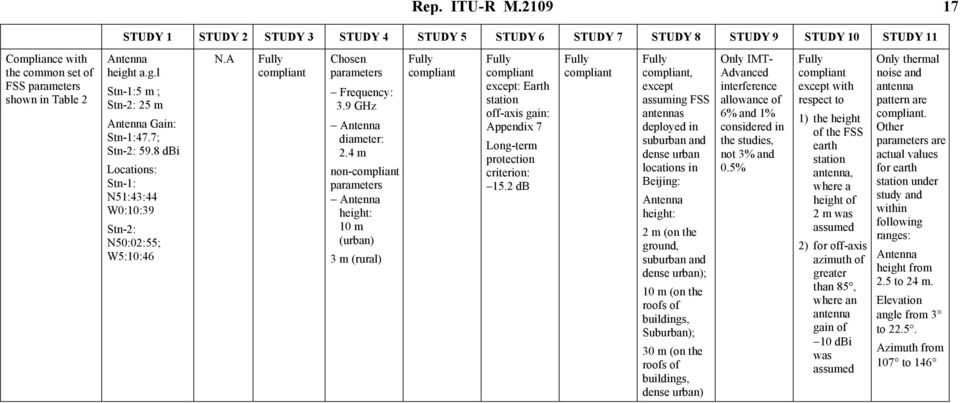
17 Rep. ITU-R M STUDY 1 STUDY 2 STUDY 3 STUDY 4 STUDY 5 STUDY 6 STUDY 7 STUDY 8 STUDY 9 STUDY 10 STUDY 11 Compliance with the common set of FSS parameters shown in Table 2 Antenna height a.g.l Stn-1:5 m ; Stn-2: 25 m Antenna Gain: Stn-1:47.7; Stn-2: 59.8 dbi Locations: Stn-1: N51:43:44 W0:10:39 Stn-2: N50:02:55; W5:10:46 N.A Fully compliant Chosen parameters Frequency: 3.9 GHz Antenna diameter: 2.4 m non-compliant parameters Antenna height: 10 m (urban) 3 m (rural) Fully compliant Fully compliant except: Earth station off-axis gain: Appendix 7 Long-term protection criterion: 15.2 db Fully compliant Fully compliant, except assuming FSS antennas deployed in suburban and dense urban locations in Beijing: Antenna height: 2 m (on the ground, suburban and dense urban); 10 m (on the roofs of buildings, Suburban); 30 m (on the roofs of buildings, dense urban) Only IMT- Advanced interference allowance of 6% and 1% considered in the studies, not 3% and 0.5% Fully compliant except with respect to 1) the height of the FSS earth station antenna, where a height of 2 m was assumed 2) for off-axis azimuth of greater than 85, where an antenna gain of 10 dbi was assumed Only thermal noise and antenna pattern are compliant. Other parameters are actual values for earth station under study and within following ranges: Antenna height from 2.5 to 24 m. Elevation angle from 3 to Azimuth from 107 to 146
18 18 Rep. ITU-R M Propagation assumptions STUDY 1 STUDY 2 STUDY 3 STUDY 4 STUDY 5 STUDY 6 STUDY 7 STUDY 8 STUDY 9 STUDY 10 STUDY 11 Use of the Recommendation ITU-R P.452 Yes. Delta N: 45 Long term p = 20% Short term p = % N.A Diffraction and ducting models used Path type: LoS with sub-path diffraction/transhorizon 100 m 100 m clutter data for clutter loss (uniform average height of each clutter category) Yes Long term p = 20% Long-term: smoothearth, diffraction mode Shortterm: smoothearth, diffraction/ troposcatter/ ducting modes Yes. Long term p = 20% Diffraction over a spherical path Path type: LoS without sub-path diffraction, multipath or focusing effects. Only longterm propagation conditions. All propagation modes included, except hydrometeor scatter Yes. Delta N:45 Long term p = 20% Short term p = % Use of a terrain data model Terrain data specific to UK region is considered N.A Clutter losses in accordance with suburban settings given in Table 6 of Rec. ITU-R P.452 Used with 50 m 50 m resolution and smoothed to 500 m 500 m resolution by filtering Used with 1 m 10 m resolution real terrain data (Seoul Korea) with artificial object (buildings) None. (Estimated 15 db clutter losses added for aggregate base station case; 30 db clutter/ shielding for aggregate mobile station case) Both generic and application cases studied Clutter losses in accordance with suburban and dense urban settings given in Rec. ITU-R P.452 No (Non-specific earth station location) Global terrain data base Terrain data specific to Kaliningrad region (Russian exclave) is considered

19 Rep. ITU-R M Results The following paragraph contains three types of study results: co-channel interferences, adjacent band interferences and saturation of the low noise amplifier (LNA) of a receiving FSS earth station. The studies have been derived for typical FSS earth station cases (generic study) as well as for specific FSS earth station cases (application case) for the three interference scenarios. For each of the three scenarios, geographical separations between the IMT-Advanced station and the FSS earth station would be required. For these three types of study results, distances are provided. They represent the required distances to meet the interference criteria. When performing the calculations whose results are given below, it was advised by the ITU-R that Recommendation ITU-R P is the appropriate propagation model for predicting interference between terrestrial stations in the frequency range from about 700 MHz up to above 6 GHz when the distance between the transmitter and receiver is longer than 1 km. Recommendation ITU-R P could be used for short paths up to about 1 kilometre, while Recommendation ITU-R P can be used for frequencies from 30 to MHz and for time percentages down to 1% Typical FSS earth station case (Generic study) Generic studies are based on a flat terrain model. NOTE 1 In the case of calculations using short-term criterion, distances derived using a flat earth model are provided to assess the maximum range of distances (see 6.2.2) and should not be applied by default to define an exclusion zone around an earth station, as it is not representative of all areas around the world. 2 Recommendation ITU-R P.1411 Propagation data and prediction methods for the planning of short-range outdoor radiocommunication systems and radio local area networks in the frequency range 300 MHz to 100 GHz

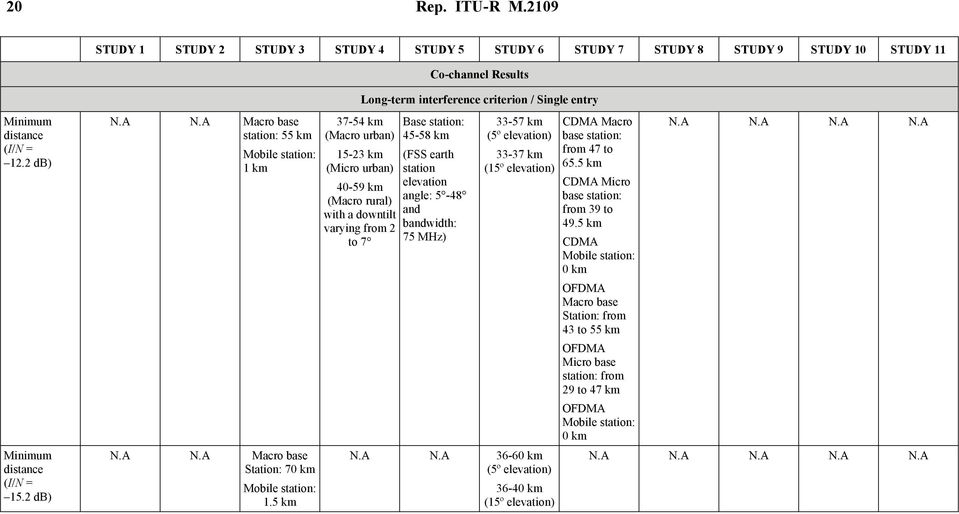
20 20 Rep. ITU-R M.2109 STUDY 1 STUDY 2 STUDY 3 STUDY 4 STUDY 5 STUDY 6 STUDY 7 STUDY 8 STUDY 9 STUDY 10 STUDY 11 Co-channel Results Long-term interference criterion / Single entry Minimum distance (I/N = 12.2 db) Minimum distance (I/N = 15.2 db) N.A N.A Macro base station: 55 km Mobile station: 1 km N.A N.A Macro base Station: 70 km Mobile station: 1.5 km km (Macro urban) km (Micro urban) km (Macro rural) with a downtilt varying from 2 to 7 Base station: km (FSS earth station elevation angle: 5-48 and bandwidth: 75 MHz) km (5º elevation) km (15º elevation) N.A N.A km (5º elevation) km (15º elevation) CDMA Macro base station: from 47 to 65.5 km CDMA Micro base station: from 39 to 49.5 km CDMA Mobile station: 0 km OFDMA Macro base Station: from 43 to 55 km OFDMA Micro base station: from 29 to 47 km OFDMA Mobile station: 0 km N.A N.A N.A N.A N.A N.A N.A N.A N.A
21 Rep. ITU-R M STUDY 1 STUDY 2 STUDY 3 STUDY 4 STUDY 5 STUDY 6 STUDY 7 STUDY 8 STUDY 9 STUDY 10 STUDY 11 Long-term interference criterion / aggregate case Minimum distance (I/N = 12.2 db) N.A N.A N.A N.A Base stations: km (FSS earth station elevation angle: 5-48 and bandwidth: 75 MHz) mobile stations: km (base station numbers : 10) I/N exceedence (same geographical area) Macro base station: db Mobile station: db CDMA Macro base station: from 56 to 87 km CDMA Micro base station: from 49 to 58 km CDMA Mobile station: 0 km OFDMA Macro base station: from 51 to 61 km OFDMA Micro base station: from 46 to 53 km OFDMA Mobile station: 0 km N.A N.A N.A N.A Minimum distance (I/N = 15.2 db) N.A N.A N.A N.A NA I/N exceedence (same geographical area) Macro base station: db Mobile station: db N.A N.A N.A N.A N.A
22 22 Rep. ITU-R M.2109 STUDY 1 STUDY 2 STUDY 3 STUDY 4 STUDY 5 STUDY 6 STUDY 7 STUDY 8 STUDY 9 STUDY 10 STUDY 11 Short-term interference criterion Minimum distance N.A N.A Macro base station: 140 km Mobile station: 1.5 km N.A km (5º elevation, considering all propagation modes) km (15º elevation considering all propagation modes) km (5º elevation, considering troposcatter/ diffraction propagation modes only) km (15º elevation, considering troposcatter/ diffraction propagation modes only) N.A N.A N.A N.A N.A
23 Rep. ITU-R M STUDY 1 STUDY 2 STUDY 3 STUDY 4 STUDY 5 STUDY 6 STUDY 7 STUDY 8 STUDY 9 STUDY 10 STUDY 11 Adjacent band Results Long-term interference criterion / Single entry Minimum distance (I/N = 20 db) N.A N.A Macro base station: 18 to 25 km Mobile station: 300 to 450 m N.A CDMA Case from 10 to 34 km OFDMA Case from 0.07 to 19 km N.A CDMA Macro base station: from 10 to 42.5 km CDMA Micro base station: from 2 to 14 km OFDMA Macro base station: from 5 to 29 km OFDMA Micro base station: from 2.4 to 8.7 km N.A Macro base station: from 49.5 to 80.5 km Micro base station: from 39.5 to 51 km User terminal: from 25 km to 32.5 km N.A N.A Long-term interference criterion / aggregate case Minimum distance (I/N = 20 db) N.A N.A N.A N.A CDMA Macro base station: from 15 to 37 km OFDMA Macro base station: from 0.35 to 21 km N.A CDMA Macro base station: from 27 to 45.5 km CDMA Micro base station: from 11 to 35 km OFDMA Macro base station: from 15 to 41 km OFDMA Micro Base station: from 4 to 8.5 km N.A N.A
24 24 Rep. ITU-R M db compression STUDY 1 STUDY 2 STUDY 3 STUDY 4 STUDY 5 STUDY 6 STUDY 7 STUDY 8 STUDY 9 STUDY 10 STUDY 11 Saturation of LNA/LNB Results Long-term criterion/single entry Mobile station N.A N.A N.A N.A N.A N.A N.A N.A 170 m N.A N.A Micro cell base station Macro cell base station Non-linear operation N.A N.A N.A N.A N.A N.A N.A N.A 600 m N.A N.A N.A N.A N.A N.A N.A N.A N.A N.A 9.5 km N.A N.A Mobile station N.A N.A N.A N.A N.A N.A N.A N.A 550 m N.A N.A Micro cell base station Macro cell base station N.A N.A N.A N.A N.A N.A N.A N.A 1.95 km N.A N.A N.A N.A N.A N.A N.A N.A N.A N.A 30.5 km N.A N.A
25 Rep. ITU-R M Specific FSS earth station case (Application case) 3 STUDY 1 STUDY 2 STUDY 3 STUDY 4 STUDY 5 STUDY 6 STUDY 7 STUDY 8 STUDY 9 STUDY 10 STUDY 11 Co-channel Results Long-term interference criterion / Single entry Minimum distance (I/N = 12.2 db). Stn-1: base station-1: 90 (km) base station-2: 40 (km) mobile station- 1: 30 (km) Stn-2 base station- 1:110 (km) base station-2: 50 (km) mobile station- 1: 20 (km) Note: It is assumed that there are two co-frequency interferers and an interference criterion of I/N = -13 db is applied with respect to each IMT- Advanced station. N.A N.A km (Macro urban) 8-14 km (Micro urban) km (Macro rural). Urban macro (see , Fig. 5) 20 (FSS): 1-50 km. N.A CDMA Macro base station: from 22.8 to 29 km OFDMA Macro base station: from 4 to 23 km Mobile station: 0 km km 61 km (on the roofs of buildings, macro, suburban); 23.2 km 38.5 km (on the ground, macro, suburban); 33.9 km 49.6 km (on the roofs of buildings, micro, dense urban); 5.3 km 18.4 km (on the ground, micro, dense urban). N.A I/N 10 db for all but 20% of time Contours plotted around earth stations in four types of terrain flat, moderately hilly, very hilly and offshore. Macro base station with zero tilt 40 km average minimum distance. Macro base station with 120 sector and 2 tilt 35 km average minimum distance. For single earth station and I/N = 10 db distance varies from 30 to 100 km depending on earth station configuration and azimuth. Multiple earth station deployment causes the spread of exclusion zone compared to any single earth station. 3 Application case refers to the use of a specific terrain profile considered in all the contributions except STUDY 7 that contains results relating to a multicarrier scheme (IMT-Advanced) with a flat terrain profil.
26 26 Rep. ITU-R M.2109 STUDY 1 STUDY 2 STUDY 3 STUDY 4 STUDY 5 STUDY 6 STUDY 7 STUDY 8 STUDY 9 STUDY 10 STUDY 11 Minimum distance (I/N = 15.2 db) N.A N.A N.A N.A N.A N.A N.A N.A N.A N.A N.A Long-term interference criteria / Aggregate case Minimum distance (I/N = 12.2 db) Minimum Distance (I/N = 15.2 db) Minimum distance N.A N.A N.A km (Macro urban) km (Micro urban) km (Macro rural) N.A N.A N.A N.A N.A N.A N.A N.A N.A N.A N.A N.A N.A N.A N.A N.A N.A N.A Stn-1: base station-1: 270 (km) base station-2: 90 (km) mobile station- 1: 30 (km) Stn-2 base station- 1:280 (km) base station-2: 80 (km) mobile station- 1: 20 (km) N.A N.A 21 to 128 km for macro urban 8 to 17 km for micro urban 28 to 107 km for macro rural Short-term interference criterion N.A N.A N.A N.A N.A Macro base station with zero tilt > 150 km average minimum distance. Macro base station with 120 sector and 2 tilt > 125 km average minimum distance. For single earth station and I/N = 1.3 db distance varies from 50 to 400 km depending on earth station configuration and azimuth, and IMT- Advanced deployment. Multiple earth station deployment causes the spread of exclusion zone compared to any single earth station.
27 Rep. ITU-R M Techniques to improve the sharing This section covers the techniques that would improve the sharing between IMT-Advanced and FSS. The use of these techniques result either in co-frequency operation of both systems or adjacent band operation of both systems. The feasibility and practicability of implementing these techniques have not been studied in the various FSS deployment scenarios. Furthermore, some of the techniques listed in this section would need to be further studied. Techniques implying the use, by IMT-Advanced base stations, of frequencies different from those used by the FSS earth stations would need to ensure not causing unacceptable interference to FSS receiving earth station (including unwanted emissions and LNA overdrive) Possible mitigation techniques The mitigation techniques described in this section would only apply to the situation where the location of the FSS receive earth station, subject to interference (further referenced as victim FSS earth station), is known. All of them have been studied with respect to one victim FSS earth station only Sector disabling The aim of this technique is to reduce, in the direction of the victim FSS earth station, the transmitting output power of base stations that are located at a distance smaller than the separation distance. Generally, base stations utilize tri-sectorial antennas. Accordingly, one way to reduce the transmitting output power level could be to disable the antenna sector that points towards the FSS earth station, noting that such an area would be covered through the use of other frequency bands by IMT-Advanced systems. As shown in the following figures, when compared with normal full active sector mode, the application of this mitigation technique has shown that the separation distance ranges are reduced by between 0 and 49% in generic studies (without terrain horizon profile) and between 0 and 83% for one specific site (with terrain horizon profile) depending on the access mode (see table of 8.1.2, STUDY 7) and on the elevation angle of FSS earth station. These results are valid for base stations employing CDMA as well as OFDMA access modes.
28 28 Rep. ITU-R M.2109 FIGURE 3 Protection distance reduction [%] 60% Reduction of the protection distances in generic cases 50% 40% 30% 20% Aggregate CDMA micro BS Aggregate CDMA macro BS Aggregate OFDMA micro BS Aggregate OFDMA macro BS 10% 0% FSS Earth station elevation angle [ ] FIGURE 4 Reduction of the protection distances on one application case Protection distance reduction [%] 90% 80% 70% 60% 50% 40% Aggregate OFDMA macro BS Aggregate CDMA macro BS 30% 20% 10% 0% FSS Earth station elevation angle[ ] Multiple input, multiple output (MIMO) In order to improve sharing between IMT-Advanced and FSS, an interference mitigation technology known as MIMO space division multiple access (SDMA) can be utilized.
29 Rep. ITU-R M By using this technique, a gain reduction in the base station transmit antenna diagram is generated towards the interfered FSS earth station. By using the MIMO technique, the minimum separation distance is 35 m in case of an IMT-Advanced base station and single FSS receiving earth station under the assumption of 0 o direction of earth station (DOE) estimation error which implies that null beam to the FSS receiving earth station is formulated perfectly. In the case of an IMT-Advanced base station and 3 FSS receiving earth stations, the minimum separation distance increases up to 3.5 km under the same assumptions. Other results have shown that under the assumption of 8 DOE estimation error, the minimum separation distances is 22 km, but this still reduces the minimum separation distance by approximately 50% in the considered case. As for the sector disabling technique, this approach would require the use of other frequencies to cover the area where the base transmit antenna gain is reduced. Some detailed information about this mitigation technique is provided in Annex D Site shielding In Recommendation ITU-R SF.1486, interference attenuation effect, in a range about 30 db, due to the site shielding isolation obtained by providing physical or natural shielding at the FSS earth stations is described. If such shielding isolation is taken into account, the required separation distance to protect FSS earth station receivers from IMT-Advanced transmitters can be reduced. However, the required distance separation between IMT-Advanced transmitter and a FSS receiving earth station using site shielding has to be evaluated on a site-by-site basis and is dependent on characteristics and location of each site. The possibility of applying site shielding may not be guaranteed for all sites Antenna donwtilting A possible mitigation technique to improve sharing is antenna downtilting at the IMT-Advanced base stations. In the deployment scenarios envisaged in IMT-Advanced systems, the cell size will be reduced to support high-speed transmissions assuming a limitation of transmission power. The deployment based on the small cell size is also indispensable for IMT-Advanced systems in order to achieve high frequency efficiency. Since the degree of antenna downtilting will be increased in the case of small cell size in order to avoid inter-cell interference in IMT-Advanced systems using the frequency reuse, this will also result in the reduction of interference from an IMT-Advanced base station to FSS earth stations and the reduction of the required minimum distance. STUDY 4 shows that, for one specific site in urban macro environment, the required separation distance is decreased by approximately 30% and 50% for the long-term and short-term interference criteria, respectively, when the antenna-downtilt at IMT-Advanced transmitter is changed from 2 to 7. However, the impact of this technique may vary for different locations and results may be different at other locations. By increasing the downtilt of the base station antenna, there is a potential: for an increase of the number of IMT-Advanced base stations required to provide service in a given area; for a decrease of transmission power per IMT-Advanced base station. Accordingly, when computing aggregate interference into an FSS receives station, these two elements would have to be taken into account.
30 30 Rep. ITU-R M Spectrum management techniques In areas where all the frequency resources are not fully utilized by the FSS earth station, it may be possible to introduce IMT-Advanced services. The following spectrum management techniques may be of interest to administrations wishing to introduce new services in specific geographical areas Dynamic spectrum allocation The distribution of radio resources could either be static or dynamic depending on the local situation in a given area. For spectrum efficiency, the most favorable method would be to use the dynamic method. Local arrangements may be made to facilitate usage of both systems. In areas where not all the frequency resources are fully utilized, it may be possible to introduce additional services either of the same type or other types or a mix. The IMT-Advanced systems need then to be informed whether the FSS bands can be utilized or not. In the case when an earth station changes its frequency of operation, the IMT-advanced system may also have to change its frequency in the surrounding area. A way for the administration to provide such information to the IMT-Advanced systems may be to have a data base where all relevant information of the current services or stations, such as FSS earth stations, using the radio resources in the area. The data base would need to be up to date and would include information such as central carrier frequency, channel bandwidth etc Usage of beacon Broadcasting beacon or a network of beacons, or control information co-located with the FSS earth station (respectively IMT-Advanced base station) provide dynamic and active information on its spectrum usage to the IMT-Advanced system (respectively FSS earth station) to allow optimum usage of the unused spectrum to eliminate the inter-system interference Proposed methodology to be utilized with mitigation techniques Interference area ratio methodology This section describes a new methodology to be utilized in assessing the level of coordination difficulty on the basis of the actual terrain profile between two services for a specific site. This methodology may be used to assess the effectiveness of mitigation techniques based on the use of directional antennas, which takes into account the actual shielding effect by terrain profile and clutter losses associated with the artificial objects. In order to quantitatively evaluate this shielding effect, the methodology called interference area ratio, is employed in some studies, where its definition is shown in Fig. 5. When applying the interference area ratio of x%, we exclude the x% of area that has the larger separation distance over d + d. Then, the required separation distance becomes d + d. When x > 0%, the additional mitigation technique is adopted in order to protect the FSS earth stations located in the x% of the area. A possible mitigation technique is to employ directional-beam antenna, such as sectorized- or adaptive-beamforming antenna at an IMT- Advanced transmitter. The details of the methodology interference area ratio can be found in Annex F.
31 Rep. ITU-R M FIGURE 5 Definition of interference area ratio Location of IMT-Advanced transmitter Interfered area is non-uniformly distributed due to shielding effect by terrain profile and clutter losses Discrete point for calculation Interfered area due to IMT-Advanced transmitter Calculation area between d and d + d Interfered area between d and d + d Interference area ratio = Area of Area of Distance d d Figure 6 shows the required minimum distance as a function of the interference area ratio. As shown in this figure, according to increase in the interference area ratio value, the required minimum separation distance can be reduced. FIGURE 6 Required minimum distance as a function of interference area ratio (urban area, macro-cell, single-entry)
32 32 Rep. ITU-R M.2109 In Table 7, the required minimum distance is summarized for an assumed interference area ratio of 10%, as an example. For the comparison, the required minimum distance is also shown in the case of the interference area ratio of 0%, which is equivalent to the separation distance without considering the interference area ratio. As shown in this table, by introducing the measure interference area ratio associated with the mitigation technique using the directional beam antenna, the required minimum distance is reduced by about 5% to 60% depending on the scenarios in IMT-Advanced systems. Environment TABLE 7 Required minimum distance for interference area ratio of 10% (urban area, single-entry, FSS earth station elevation angle = 5 ) IMT-Advanced base station antenna downtilt (degrees) Interference area ratio = 10% (km) (Reference) Without considering interference area ratio (km) Macro Macro Micro Micro Interference from FSS transmitting space station to IMT-Advanced systems A number of sharing studies examined the impact of FSS interference upon IMT-Advanced receive stations. The assumptions and methodologies associated with each sharing study are summarized in tables of and These tables also indicate the extent to which each sharing study employed the common FSS and IMT-Advance parameters that are specified in Tables 2 through 5 of this Report as well as the operational FSS scenarios recommended by the ITU-R (see 8.2.1). The results of the studies are contained in the table in It should be noted that only STUDIES 2, 3, 6 and 7 have provided some results for the Methodologies used in the simulation Two scenarios were considered: SCENARIO 1 was based on one GSO satellite every 10 of longitude transmitting a maximum EIRP of 11 dbw per 4 khz at all elevation angles of 0-90, with all such satellites operating co-frequency and with overlapping areas of coverage. SCENARIO 2 was based on one GSO satellite every 4 of longitude transmitting an EIRP compliant to the RR Article 21 (11.3 dbw per 4 khz at the 0-5 elevation angles, { (δ 5)} dbw per 4 khz for δ between 5-25 and 20.1 dbw per 4 khz at the elevation angles), with all such satellites operating co-frequency and with overlapping areas of coverage (δ is the elevation angle). These scenarios may not be representative of the current satellite deployments but could be representative of future satellite deployments.
33 Rep. ITU-R M Compliance with the common parameters STUDY 2 STUDY 3 STUDY 6 STUDY 7 Compliance with the common set of IMT-Advanced parameters as shown in Tables 3 to 5 Compliance with the common set of FSS parameters as shown in Table 2 Fully compliant. (Use of Rec. ITU-R F ) Fully Compliant Fully Compliant Fully Compliant Fully Compliant. Fully Compliant. Fully Compliant. Fully Compliant Compliance with the methodology of STUDY 2 STUDY 3 STUDY 6 STUDY 7 Compliance with the proposed FSS scenarios Compliant to SCENARIOS 1 and 2 Compliant to SCENARIO 2 Supplementary Scenario Space station orbital separation: 10 Maximum space station space-to- Earth PFD: db(w/4 khz) depending on angle of arrival Compliant to SCENARIO 1 Scenario db(w/4 khz) for all angles of arrival Results (co-channel only) I/N for the Macro-cell base station STUDY 2 STUDY 3 STUDY 6 STUDY 7 SCENARIO 1 Typical antenna: from 15.6 to 14.4 db Improved antenna: from 16.4 to 14.8 db db, for the 4 latitudes considered SCENARIO Supplementary Scenario db Scenario 2 No Exceedence SCENARIO 1 From to 14.9 db, for the 4 latitudes considered
34 34 Rep. ITU-R M.2109 STUDY 2 STUDY 3 STUDY 6 STUDY 7 I/N for the Micro-cell base station I/N for the mobile station SCENARIO 2 Typical antenna: from 11.3 to 9.9 db Improved antenna: from 13.6 to 12.2 db (4 latitudes have been considered) SCENARIO 1 from 10.8 to 7.4 db, for the 4 latitudes considered SCENARIO 2 from 2.4 to 0.9 db, for the 4 latitudes considered SCENARIO 1 from 14.4 to 13.3 db, for the 4 latitudes considered SCENARIO 2 from 4.9 to 0.99 db, for the 4 latitudes considered N.A N.A SCENARIO 1 from 7.2 to 6.2 db, for the 4 latitudes considered SCENARIO Supplementary Scenario db Scenario 1 No Exceedence SCENARIO 1 from 14.6 to 13.3 db, for the 4 latitudes considered 9 Results from one measurement study on interference from IMT-Advanced transmitter into one TVRO earth station As shown in 4, in the MHz band, TVRO is one of the FSS applications that is implemented in some parts of the world. Annex G of this report provides the results of a set of measurements carried out regarding the impact of interference into a commercial TVRO terminal using two different types of LNBs in the MHz band, where interference is caused by an assumed IMT-Advanced transmitter. The IMT-Advanced transmitter used in this experiment was set to transmit a carrier with an EIRP density of 35 dbm/mhz, which is 11 db lower than a macro base station defined maximum EIRP density and 13 db higher than a micro base station defined maximum EIRP density. This experiment was performed at an arbitrary chosen location in Japan. The EIRP of the satellite chosen for the measurement is about 39 dbw per transponder at this location. The satellite transponder chosen for the co-channel measurement contains two carriers with a bandwidth of approximately 5 MHz each. It is not common to assign only two 5 MHz carriers in a 36 MHz wide transponder. The adjacent-channel measurements were done using a different transponder containing five 5 MHz wide carriers. This represents a more typical transponder utilization.
35 Rep. ITU-R M Summary of the measurement is given as follows: 1) When the distance between an IMT-Advanced transmitter and a TVRO terminal was in the range of 345 to 5,420 m comprising different 26 locations, no influence on the quality of the received TV picture was observed at 25 and 26 locations in the case of the co-channel and adjacent interference scenarios, respectively, with FEC coding rate of 3/4. 2) TV channel employing FEC coding rate of 3/4 was more robust against the increase in the co-channel interference power level by approximately 2 db compared to that of 7/8 in maintaining the same quality of the received TV picture. 3) The influence on the quality of the received TV picture for adjacent-channel interference scenario was smaller compared to that for co-channel scenario. In order to maintain the same quality of the received TV picture, approximately 14 db more power of an IMT- Advanced transmitter was permitted in the adjacent-channel interference scenario compared to the co-channel interference scenario. This test was conducted for one arbitrarily chosen location in Japan. Moreover, only one specific satellite with the transmissions characteristics of the selected TV carriers was used in the test. The test reflects one snapshot of one case and does not take into account short-term effects, aggregation or other applications or modulation/error correction schemes. Therefore results with regard to potential interference from IMT-Advanced into TVRO or other applications cannot by default be extended to other cases. 10 Sensitivity analysis Although the common simulation parameters for IMT-Advanced systems are summarized in 6 and 7, in actual deployment scenarios some of the parameters will be within a range of values. In the following analyses, the influence of variation of several parameters of IMT-Advanced and FSS systems are analyzed and the impact on the required separation distance is investigated Interference from IMT-Advanced systems to FSS receive earth stations Influence of the IMT-Advanced base station antenna downtilt Figures 7 and 8 show the influence of the antenna downtilt angle of the IMT-Advanced base station on the minimum required separation distance with respect to a generic and a specific FSS receiving earth station, respectively. As shown in these figures, as the antenna downtilt is increased, the required minimum distance is decreased due to the reduced interference from IMT-Advanced base station.
36 36 Rep. ITU-R M.2109 FIGURE 7 Influence of down-tilt of IMT-Advanced base station transmitters Generic study, Urban, Macro-cell FIGURE 8 Influence of down-tilt of IMT-Advanced base station transmitters Specific study using terrain data, Urban, Macro-cell (Kyobashi) CDF Urban tilt IMT 2 _FSS 33 (Macro urban 30m ) 0.3 Urban tilt IMT 4 _FSS 33 (Macro urban 30m ) 0.2 Urban tilt IMT 6 _FSS 33 (Macro urban 30m ) 0.1 Urban tilt IMT 8 _FSS 33 (Macro urban 30m ) Great-circle distance [km] Influence of the IMT-Advanced base station antenna height Figures 9 and 10 show the influence of the IMT-Advanced base station transmitting antenna height on the minimum required separation distance with respect to a generic and a specific FSS receiving earth station, respectively. This figure indicates that the lower antenna height brings about the reduction of the required minimum distance in urban environment, since the large shielding effect can be observed due to the clutter loss associated with the artificial objects, such as tall buildings. Meanwhile, in a rural environment, the lower antenna height is not always effective to reduce the
37 Rep. ITU-R M required minimum distance, since the large clutter loss is not expected due to the lower average building height in this environment. FIGURE 9 Influence of antenna-height of IMT-Advanced base station transmitters Generic study, Macro-cell FIGURE 10 Influence of antenna-height of IMT-Advanced base station transmitters Specific study, Macro-cell (urban: Kyobashi, rural: Kumagaya) CDF Urban tilt IMT 2 _FSS 33 (Macro urban 30m ) Urban tilt IMT 2 _FSS 33 (Macro urban 20m ) 0.3 Urban tilt IMT 2 _FSS 33 (Macro urban 10m ) 0.2 Urban tilt IMT 2 _FSS 33 (Macro rural 10m ) Great-circle distance [km] Influence of the IMT-Advanced base station EIRP The sharing studies have been based on the maximum value of the macro and micro base stations EIRP, shown in Table 3. When deploying an IMT-Advanced network, the maximum EIRP for IMT-Advanced base station can vary from 59 to 35 dbm according to the type of the base station. The variation of this maximum EIRP would influence the sharing leading to the reduction of the size of the required separation distance between IMT-Advanced base station and FSS earth station. This is a static setting and the reduction of the distance can be derived deterministically.
38 38 Rep. ITU-R M.2109 Additionally, IMT-Advanced systems will implement the dynamic downlink power control (in CDMA and OFDMA networks). This feature will have the effect of reducing the EIRP of base stations, depending on the load of the cells, the distribution of the mobile stations within a cell and the time. It should be noted that: For a single IMT-Advanced base station to FSS earth station path, this would have no impact on the required distance separation between the IMT-Advanced transmitting base station and the FSS earth station given that the required distance separation would be based on the IMT-Advanced base station s maximum EIRP level. For the aggregate case, experience to date shows that it is unlikely that all the IMT- Advanced base stations transmit at the maximum EIRP at the same time. Consequently, the use of the downlink power control could result in reducing the required distance separation. However, the statistical and temporal impact of the downlink power control has not been quantified Influence of the IMT-Advanced base station maximum EIRP The maximum EIRP of an IMT-Advanced base station can vary from 59 to 35 dbm for the 20 MHz minimum bandwidth, according to the Table 3 of this Report. E.i.r.p. below the maximum level of 59 dbm could reduce the required distance separation between the IMT-Advanced transmitting base station and the FSS earth station. Figure 11 shows the impact on the required distance between an FSS earth station and an IMT-Advanced base station, taking into account the different types of aggregate base stations with a maximum EIRP value between 35 dbm and 56 dbm. The variation of the base stations deployment density and antenna type has been taken into account accordingly 4. FIGURE 11 Protection distance reduction) versus earth station antenna elevation angles a function of EIRP Protection distance reduction[%] 45,00% 40,00% 35,00% 30,00% 25,00% 20,00% 15,00% 10,00% 5,00% 0,00% Elevation angle [ ] EIRP=56 dbm EIRP=53 dbm EIRP=38 dbm EIRP=35 dbm 4 The number of the aggregate base stations is determined according to the methodology defined in the and the cell size values defined in the Table 3.
39 Rep. ITU-R M NOTE 1 The baseline protection distance is obtained with an EIRP of 59 dbm IMT-Advanced down link power control analysis Considering experience to date on terrestrial mobile networks, IMT-Advanced base stations will not always transmit at their maximum EIRP. Downlink power control is a key feature of an IMT- Advanced radio network, which has the effect to adjust the transmit power to the minimum necessary value so as to not waste power as well as to limit intra-system interference. Its use will also have the effect of reducing the inter-system interference. Depending on the cell coverage and capacity, the maximum value of an IMT-Advanced base station power will be only transmitted when the cell is 100% loaded, as follows: FIGURE 12 DL Power depending on effective load DL Tx Carrier Power 100% 90% 80% 70% 60% 50% 40% 30% 20% 10% 0% 0% 10% 20% 30% 40% 50% 60% 70% 80% 90% 100 % DL effective load CCH = 26,7% CCH = 20,4% NOTE 1 CCH are the common channels. Down link power control reflects the expected operational IMT-Advanced deployment conditions. The impact of the dynamic downlink power control, on the compatibility between IMT-Advanced and FSS has not been quantified, and would have to take into account: the statistical distribution of the mobile stations in a cell (geographical and time distributions), the fact that the base station power varies temporally. However, its use has the effect of reducing the required distance separation between a FSS earth station and an IMT-Advanced base station Influence of the IMT-Advanced spurious emissions The Table 8 provides the minimum required separation distances, as determined in STUDY 3, to protect FSS receive earth stations from the interference by the spurious emissions generated by a single IMT-advanced transmitter. The study assumed various levels of IMT-Advanced transmitter spurious emissions, with the reference being the level stipulated in RR Appendix 3. Distances are also given on the basis of assumed improved spurious levels by 10, 40 and 50 db.
40 40 Rep. ITU-R M.2109 The analyses were based on the propagation models described in ITU-R P Due to the generic nature of the analysis, for the long-term protection cases, the propagation was calculated over a smooth earth surface, utilizing the propagation model described in 4.3 of ITU-R P The models in ITU-R P can include the effects of building losses and clutter where the topography of surrounding obstacles etc. is known. However, due to lack of information for these parameters, the building losses and clutter effects have been assumed to represent suburban environment in these analyses. TABLE 8 Percentage Increase of FSS system noise 1.0% 0.5% 1.0% 0.5% Additional reduction of IMT-Advanced transmitter spurious emission level (db) IMT-Advanced macro base station 18 km 25 km 5 km 7.5 km IMT-Advanced mobile station 300 m 450 m 100 m 140 m Percentage Increase of FSS system noise 1.0% 0.5% 1.0% 0.5% Additional reduction of IMT-Advanced transmitter spurious emission level (db) IMT-Advanced macro base station 115 m 150 m 35 m 50 m NOTE The results corresponding to 0,5% are only given as an example, since no guidance was provided by ITU-R on the apportionment for the interference from other sources. The results of this study showed that operation of IMT-Advanced systems and the FSS in adjacent bands in the 4 GHz frequency range would be very difficult and may not be feasible in the same geographical area if the IMT-Advanced transmitter spurious emission is defined in accordance with the limits specified in RR Appendix 3. Additional information on this study can be found in Annex H Influence of FSS earth station elevation angle and losses from local clutter on adjacent band separation distances From STUDY 9, it was noted that the required separation distances will depend significantly on the elevation angle of the FSS earth station. Also, if the propagation is attenuated by local clutter that blocks direct line-of-sight, this will have a significant impact on the received interference. To ascertain the impact of elevation angle and clutter loss, STUDY 9 also calculated the required separation distance (both with respect to overdrive of LNA s and unwanted emissions) as a function of the elevation angle, assuming two values for clutter loss; 0 db and 20 db. From the results of the study, it can be noted that: An elevation angle of 20 will reduce the separation distance to 17.7% compared to that of 5. An elevation angle of 45 will reduce the separation distance to 6.4% compared to that of db clutter loss will reduce the separation distance to 10% compared to that of 0 db.
41 Rep. ITU-R M Interference from FSS transmitting space station to IMT-Advanced systems Influence of the antenna downtilt and the latitude of a base station This section provides I/N ranges according to the FSS networks parameters scenario and the IMT-Advanced downtilt parameter chosen. Range of I/N (db), as a function of the downtilt (from 0 to 2 ) and latitude of the IMT-Advanced base station. TABLE 9 FSS network scenario Typical antenna Macro-cell base station Improved antenna Micro-cell base station Scenario 1 From 14.4 to 7.0 From 14.8 to 7.1 From 7.9 to 7.4 Scenario 2 From 9.9 to 5.5 From 12.2 to 6.2 From 0.3 to 0.9 NOTES: 1 See for a description of FSS network scenarios 1 and 2. 2 These results have been assessed using the approved draft new Recommendation ITU-R F , i.e., Rec. ITU-R F It has to be noted that typical values for the antenna downtilt are as follows: a) Macro base station IMT-Advanced (height = 30 m): between 2 and 20. b) Micro base station IMT-Advanced (height = 5 m): between 0 and Conclusions Sharing studies have been performed to assess the technical feasibility of deploying IMT-Advanced systems in the MHz and MHz bands, that are utilized by FSS (amongst other services). To provide protection of the FSS receive earth stations, some separation distance relative to the stations of the mobile terrestrial network is required. The magnitude of this separation distance depends on the parameters of the networks and the deployment of the two services. The magnitudes of these required separation distances to protect the FSS receive earth stations have been studied, taking account of the need to meet both short-term and long-term interference criteria requirements, with respect to the three following interference mechanisms: 1. In-band, co-channel operations The minimum required separation distances from IMT-Advanced base stations, when using the long-term interference criterion derived in the studies to date, are at least in the tens of kilometres. The minimum separation distances associated with short-term interference criterion, generally, but not in all cases, exceed one hundred kilometres in the considered cases with similar assumptions as the ones used for the long-term.
42 42 Rep. ITU-R M Adjacent band operations Concerning interference from unwanted emissions arising from out-of-band and spurious domains of IMT-Advanced base station transmitters and falling within the band used by the FSS receiver, the minimum required separation distances, when using the long-term interference criterion derived in the studies to date, are up to tens of kilometres (with no guard band) and decreasing as the guard band increases. 3. Overdrive of the FSS receiver One study has shown that emissions from one IMT-Advanced station can overdrive the FSS receiver LNA, or bring it into non-linear operation, if the separation distance is less than some kilometres or some hundreds metres with respect to base stations and user terminals respectively. An administration intending to bring into use IMT-Advanced systems, whose territory falls within the coordination contours of the earth stations under the coordination or notification procedure or notified under the Articles 9 and 11, shall effect coordination with other administrations having these earth stations. Although the studies have differences in assumptions and methodologies, they all show that sharing between IMT-Advanced and an FSS earth station is not feasible within the area delineated by the minimum required separation distances for each azimuth to protect that specific FSS earth station, as explained above. Therefore, sharing is feasible only when the receiving earth station is specific under the condition that the required permissible interference level (which can be translated into appropriate transmission parameters for the IMT-Advanced stations such as maximum power or minimum separation distance between the stations concerned taking into account propagation environment) within individual administrations is observed, and any coordination agreements that may have been reached between the concerned administrations are observed. If FSS is deployed in a ubiquitous manner and/or with no individual licensing of earth stations, sharing is not feasible in the same geographical area since no minimum separation distance can be guaranteed. The effect of use of terrain information, including clutter losses, on the reduction of the separation distance has been studied. Studies have also shown that the use of local terrain information, including clutter losses, will reduce the separation distance. The degree of this reduction will depend on the specific circumstances. However, the reliability of local terrain information has not been proven for all countries. Site shielding for FSS earth stations, where possible, would mitigate interference from IMT- Advanced systems. Other mitigation techniques for IMT-Advanced systems, such as narrow-beam transmission based on sectorized- or adaptive-beamforming antenna, sector disabling and antenna down-tilting will reduce the required minimum separation distance where they are effective. Some of these mitigation techniques could increase the deployment density of IMT-Advanced base stations in a given area. The impact of this increase in the number of IMT-Advanced cells as well as the reduction of the transmission power per IMT-Advanced base station should be taken into consideration when computing the aggregate interference. The deployment scenarios of FSS earth stations and IMT-Advanced systems may be taken into account to take the full advantage of the mitigation techniques. The impact of the various mitigation techniques and spectrum management techniques on operation of the existing and /or planned FSS receive stations has not been fully studied. According to the available studies, the effectiveness of the above-mentioned mitigation techniques is dependent on their application to individual site situations and can be applied only when the specific location of the FSS earth stations are known. Further studies would be necessary to
43 Rep. ITU-R M determine the circumstances which would permit the effective use of such techniques, on a case-bycase basis. With respect to interference from FSS into IMT-Advanced, studies have provided a range of margins relative to the required I/N criterion (from 9 to 11 db) depending on the assumptions (particularly the type of IMT-Advanced base station considered and the FSS space station EIRP density). As a result, the IMT-Advanced base and mobile stations may experience interference from emissions of authorized satellite networks. Annex A Examples of interference exclusion plots for FSS earth stations 1 Summary of a study on the impact of the FSS protection requirements Using the receive characteristics and protection criteria of 4/6 GHz FSS earth stations, and the transmit characteristics for IMT-advanced macro base stations given in 6 of the main Report, protection contours were plotted for four different types of terrain found in Europe, with the earth station antenna axis at 20 elevation in each case. Each IMT-Advanced base station antenna was assumed to have 120 sector beams with 2 down-tilt. The following table gives the earth station locations selected, and the corresponding satellite longitudes. Type of terrain TABLE A1 Location of FSS earth station Latitude ( N) Longitude ( E) Country Longitude of satellite at 20 elevation ( E) Flat The Netherlands 44.7 Moderately hilly Southern England 39.8 Very hilly Switzerland Off-shore Latvia 50.9 The propagation losses were computed using the methods in Recommendation ITU-R P.452 with a terrain database, and for each type of terrain separate contours were plotted to meet single-entry the long-term criterion I/N not to exceed 10 db for more than 20% of the time, and the single-entry short-term criterion I/N not to exceed 1.3 db for more than % of the time. For the Southern England example these plots are given in Figs. A1 and A2. Protection contours were also plotted for locations within 13 capital cities in Europe. Thus it was shown that, although terrain causes some irregularity in contour shapes, for the majority of earth stations the long-term protection zones encompass areas of similar order to that of a circle of 35 km in radius, and the short-term protection zones encompass areas greater than that of a 125 km circle. These findings were combined with information supplied by three major satellite operators (Intelsat, Inmarsat and SES New Skies), on the locations of the 4/6 GHz earth stations in Europe indicated in their data-bases as receiving from their satellites, and C-band receiving earth stations recorded in the MIFR as of August Figure A3 gives an indication of the interference areas in which long term interference criterion might not be met.
44 44 Rep. ITU-R M.2109 From this study it can be observed that that sharing between IMT-Advanced base stations and the specific sites as indicated in the table above may be difficult. FIGURE A1 Example of zone for long-term interference protection* in moderately hilly area 35 km radius circle FSS earth station Protection contour * I/N not to exceed db for more than 20% of the time. FIGURE A2 Example of zone for short-term interference protection* in moderately hilly area 125 km radius circle FSS earth station Protection contour * I/N not to exceed -1.3 db for more than % of the time.
45 Rep. ITU-R M FIGURE A3 Earth stations (except TVROs) in Europe operating to satellites within MHz Non-EU countries Circles of 35 km radius around earth stations
46 46 Rep. ITU-R M Locations of FSS earth stations Figures A4, A5 and A6 show the locations of some earth stations registered with several satellite operators receiving authorised transmissions from the operating satellites of one FSS operator in the MHz, MHz and MHz bands respectively. Also Fig. A7 provides information regarding the use of MHz band by the FSS in Brazil. The earth stations shown in these figures do not include unregistered earth stations such as TVRO terminals FIGURE A4 Locations of earth stations registered with several satellite operators and receiving in the MHz band Denotes a site that may include one or more stations.
47 Rep. ITU-R M FIGURE A5 Locations of earth stations registered with several satellite operators and receiving in the MHz band Denotes a site that may include one or more stations.
48 48 Rep. ITU-R M.2109 FIGURE A6 Locations of earth stations registered with several satellite operators and receiving in the MHz band Denotes a site that may include one or more stations.
49 Rep. ITU-R M FIGURE A7 FSS earth stations in Brazil (sites using MHz)
50 50 Rep. ITU-R M Locations and areas of coverage of 4/6 GHz FSS satellites The longitudes and service areas of many, but not all, of the FSS satellites providing down-links in the MHz band are given in Table A2. Satellite Name TABLE A2 Some space stations operating in the MHz band Orbital location (EL) Service area NSS East Asia /Australia / Western United States AMC North America AMC North America AMC North America Galaxy North America AMC North America Intelsat Americas North America Galaxy North America Galaxy North America Galaxy North America Galaxy 10R North America Intelsat Americas North America Anik F North America SATMEX North America Solidaridad North America SATMEX North America Anik F North America Anik F North America Anik F1R South America AMC North America AMC North America AMC North America Galaxy North America INMARSAT Global Intelsat Americas North America Galaxy 3C 95.0 North America Intelsat Americas North America BRASILSAT B Brazil Galaxy North America Intelsat Americas North America AMC North America
51 Rep. ITU-R M Satellite Name Orbital location (EL) AMC North America BRASILSAT B Brazil AMC North America SATCOM-C North America Galaxy 4R 76.8 North America Galaxy North America AMC North America BRASILSAT B Brazil Service area Venesat South America (under construction) BRASILSAT B Brazil AMAZONAS 61.0 North America / South America PAS North America / South America / Europe INTELSAT North America / South America / Europe IS Global IS Global INMARSAT 4 F Global IS Global PAS-1R 45.0 Global PAS-3R 43.0 North America / South America/Africa/Europe NSS North America / South America / Europe INTELSAT North America / South America / Europe / Africa INTELSAT North America / South America / Europe / Africa INTELSAT North America / South America / Europe / Africa INTELSAT North America / South America / Europe / Africa NSS North America / South America / Europe / Africa INTELSAT North America / South America / Europe / Africa INTELSAT North America / South America / Europe / Africa INMARSAT 3 F Global GORIZONT 14.4 Beam 1: Global Beam 2: Northern Hemisphere EXPRESS A Europe / North Africa / Middle East / East United States EXPRESS A Europe / North Africa / Middle East / East United States GORIZONT 10.0 ATLANTIC BIRD Beam 1: Global (Assumed) Beam 2: Northern Hemisphere (Assumed) Europe / Africa / Eastern United States / Northeast South America / Western Russia / Middle East GORIZONT 3.0 Beam 1: Global (Assumed) Beam 2: Northern Hemisphere (Assumed) INTELSAT Global
52 52 Rep. ITU-R M.2109 Satellite Name Orbital location (EL) INMARSAT 3 F Global PAS Europe/Africa/Middle East Service area INTELSAT Africa / Europe / India / East Asia PAKSAT Pakistan EXPRESS AM Russia / Europe / Middle East RADUGA 44.7 Assumed to be Russia RADUGA 48.4 Assumed to be Russia YAMAL Europe / Asia IS Global IS Global INSAT-3E 55.0 India (frequency plan is unknown) GORIZONT 58.0 Beam 1: Global (Assumed) Beam 2: Northern Hemisphere (Assumed) INTELSAT Africa / Europe / Asia / India / Australia INTELSAT Africa / Europe / Asia / India / Australia INTELSAT Africa / Europe / Asia / India / Australia INMARSAT 4 F Global INMARSAT Global INTELSAT Africa / Europe / Asia / India / Australia IS Global PAS Africa / Europe / India / Asia RADUGA 68.8 Assumed to be Russia RADUGA 70.0 Assumed to be Russia PAS Africa/Europe/Asia EDUSAT 74.0 Assumed to be Russia INSAT 3C 74.0 India ABS 75.0 Central Asia TELSTAR Africa / Europe / Asia / Australia THAICOM India / China / Indochina EXPRESS AM Russia / China / India / East Asia INSAT 3B 83.0 India INSAT 2E 83.0 India RADUGA 84.6 Assumed to be Russia IS Global ST India / China / Indochina YAMAL Russia YAMAL Russia / Middle East / Northern China ASIASAT East Asia / Australia / India / Indochina / Indonesia
53 Rep. ITU-R M Satellite Name Orbital location (EL) EXPRESS Russia (Assumed) Service area EXPRESS A China / Russia / Middle East / India / Japan ASIASAT 3S Asia / Australia / India TELKOM Indonesia / Indochina TELSTAR India / East Asia / Indochina / Australia and New Zealand INMARSAT Global SINOSAT China / Indochina / Indonesia / Philippines GORIZONT Beam 1: Global (Assumed) Beam 2: Northern Hemisphere (Assumed) PALAPA C East Asia / Indonesia TELKOM Indonesia / Indochina ASIASAT India / China / Indochina /Indonesia / Philippines / Australia RADUGA Assumed to be Russia GORIZONT Beam 1: Global (Assumed) Beam 2: Northern Hemisphere (Assumed) APSTAR 1A India / East Asia / Indochina APSTAR India / East Asia / Indochina / Australia and New Zealand TELSTAR India / East Asia / Indochina / Australia and New Zealand EXPRESS AM Beam 1: Northeast Asia Beam 2: Steerable Global APSTAR East Asia / Indochina / Indonesia INMARSAT 2 F Global GORIZONT Beam 1: Global Beam 2: East Asia AGILA India / East Asia / Indochina INTELSAT East Asia / Australia/ India GORIZONT Beam 1: Global (Assumed) Beam 2: Northern Hemisphere (Assumed) PAS South East Asia/Australia/Indonesian region island PAS East Asia/ Australia/Indonesian region/western U.S. INTELSAT East Asia / Australia/ India INMARSAT 3 F Global IS Global
54 54 Rep. ITU-R M.2109 Annex B Shape of protection zone for FSS earth station in a real environment Figure B1 shows an example of the interference power level from the IMT-Advanced base station on the FSS earth station considering the shielding effect by terrain profile and clutter losses associated with artificial objects. In this figure, the deployment of IMT-Advanced base station is based on micro-cell using the antenna downtilt of seven degrees. The gradation of the colors white to red represents the lower to greater interference power from the IMT-Advanced base station. FIGURE B1 Example of interference power level from the IMT-Advanced base station on FSS earth station considering terrain profile and clutter losses (Micro-cell deployment, antenna downtilt = 7 ) 50km Below the case of multiple earth stations deployment is presented associated with the Study 11. For each channel arrangement exclusion zones for two earth stations are shown to highlight possible differences in the exclusion zones. And as a result the exclusion zone combined from nine considered earth stations is shown for two channel arrangement cases. In both cases even with dominating earth stations providing major area of exclusion zone other stations could extend it. The effect is more significant as more azimuth diversity exists corresponding to different satellites. As shown in the figures, the interference power level is highly dependent on the locations over the 360 of area owing to the different degree of shielding effect by terrain profile and clutter losses. These figures indicate that the required protection zones for FSS earth station will not be represented by the area of a circle. It should be also noted that the size of required protection distance depends on the deployment scenarios of IMT-Advanced systems, such as inter-site distance (i.e., micro- or macro- cell), antenna height, degree of antenna downtilt.
55 Rep. ITU-R M FIGURE B2 Example of interference power level from the IMT-Advanced base station on FSS earth station considering terrain profile and without clutter losses (Macro-cell deployment, antenna downtilt = 2, 100 MHz channel arrangement)
56 56 Rep. ITU-R M.2109 FIGURE B3 Example of interference power level from the IMT-Advanced base station on FSS earth station considering terrain profile and without clutter losses (Macro-cell deployment, antenna downtilt = 2, five 20 MHz channels arrangement)
57 Rep. ITU-R M Annex C Examples of coordination contours The figures below provide examples of coordination contours taken from the ITU Master Register for some earth stations around the world. These contours have been derived using the ITU-R Appendix 7 methodology and criteria. The example earth stations are: EARTH STATION INFORMATION NAME LONGITUDE LATITUDE SATELLITE NAME 1 SI RACHA E N INTELSAT5 INDOC1 SATELLITE INFORMATION 2 AGARTALA 91 E N INSAT-1B LONGITUDE (NOMINAL) It should be noted that RR Appendix 7 states (see 1.1 of RR Appendix 7) that the coordination area is not an exclusion zone within which the sharing of frequencies between the earth station and terrestrial stations or other earth stations is prohibited, but a means for determining the area within which more detailed calculations need to be performed. In most cases a more detailed analysis will show that sharing within the coordination area is possible since the procedure for the determination of the coordination area is based on unfavourable assumptions with regard to the interference potential.
58 58 Rep. ITU-R M.2109 FIGURE 1a FIGURE 1b Annex D Sharing studies considering MIMO SDMA mitigation technique In order to improve sharing conditions between IMT-Advanced and FSS, an interference mitigation technology such as MIMO SDMA can be utilized (see Report ITU-R M.2074 Radio aspects for the terrestrial component of IMT-2000 and systems beyond IMT-2000 and Report ITU-R M.2038 Technology trends). With such MIMO SDMA, IMT-Advanced base station can mitigate interference to a FSS earth station by generating null to the direction of the FSS earth station. The MIMO SDMA technique [Cheol Mun et al., 2005] which is enabled by the pre-coded multiple transmit antennas utilizes the additional degrees of freedom in a spatial domain. As such, by adjusting the coefficient of each antenna, the MIMO SDMA technique can form the desired radiation pattern which consists of main lobe and nulls. This contribution presents a method to calculate the interference at the FSS earth station based on the MIMO SDMA technique as described earlier when the IMT-Advanced base station uses a MIMO SDMA technique and shows improvement in sharing condition between IMT-Advanced base station and FSS earth station.
59 Rep. ITU-R M With the assumptions of co-channel frequency sharing condition and free space channel environment, the interference power from an IMT-Advanced base station to a FSS earth station can be reduced smaller than the maximum permissible interference level while the distance between IMT-Advanced base station and FSS earth station is more than 35 m. In case of an IMT-Advanced base station and 3 FSS receiving earth stations, the minimum separation distance increases up to 3.5 km under the same assumptions. Moreover, up to 22 of estimation error in the direction of earth station (DOE), the minimum separation distance is reduced further by a MIMO SDMA and at the DOE estimation error of 8, the minimum separation distance can be reduced by at least 50% compared to the separation distance without any interference mitigation scheme of 44 km. This sharing study results indicate that the high possibility of the sharing between the IMT-Advanced and multiple FSS systems. System modelling and interference mitigation techniques The basic concept of the mitigation scheme is to form nulls in the spatial domain to the direction of the victim FSS earth station. For convenience, DOE denotes the direction angles of the victim FSS earth station in this contribution. To enable the MIMO SDMA technology, the IMT-Advance base station has to obtain DOE information and perform null steering. DOE information can be obtained by adopting a popular spatial spectrum estimation direction finding method or from the database including information about the direction from the interfering IMT-Advanced base station to the victim FSS earth station. It is assumed that the IMT-Advanced base station is already aware of DOE information for the FSS earth station. Fig. D1 shows the interference scenario of IMT-Advanced base station with proposed interference mitigation technique, where IMT-Advanced base station constructs nulls at DOE θ 1, θ 2, and θ 3. Fig. D2 illustrates the IMT-Advanced base station null-steering beamformer structures for suppressing the interference toward FSS earth stations. FIGURE D1 Interference scenario of IMT-Advanced base station with interference mitigation technique
60 60 Rep. ITU-R M.2109 FIGURE D2 IMT-Advanced base station incorporating the interference mitigation technique based on null- steering for MIMO downlinks with uniform linear array A linear array of N T isotropic antenna elements with uniform spacing is considered. The data signals x k, k = 1, L, NT from the beam selector are direct multiplied by a set of weights ( m) ( m) ( m) U = { w 1, w 2, L, w NT } to form a null at known DOE. w m = [ w 1, w2, L, wn ] is the m-th weight T vector in row vector and is given by the following set of equations: w w m m a a ( θd ) = 1 ( θ ) = 0; i = 1,2, L, N 1 i where a(θ) is the array propagation vector at an angle θ with respect to the array broadside and is defined by: T a ( θ) d j2π sin θ = 1 e λ L e j2π ( N 1) T d sin θ λ T We can solve for the weight vector so that: where: = 1 W m A 1 0 M 0 [ a( θ ) a( θ ) a( θ ) a( θ )] A = L d 1 2 N T 1 Let us consider scenario where the spatial location of the desired user is at 0 o with respect to the array broadside. There are multiple FSS earth stations at -50 o, -20 o, and 40 o. IMT-Advanced base station is equipped with four antennas with half wavelength spacing between the antennas. Fig. D3 shows four mutually orthogonal overlapped beams generated by null-steering vectors
61 Rep. ITU-R M W m, m = 0, L, 3. W0 of four null-steering vectors constructs nulls at DOE -50 o, -20 o, and 40 o as shown in Fig. D4 and thus is only used for IMT-Advance downlink service with the mitigation of interference to FSS earth station. Fig. D5 and D6 depict the IMT-Advanced base station radiation pattern regardless of whether the proposed algorithm is applied. The results confirm that, with the help of the proposed method, very little IMT-Advanced base station power is radiated to the FSS earth station. FIGURE D3 Four mutually orthogonal overlapped beams generated by null-steering vectors m=0 m=1 m=2 m=3 Gain [db] Angle [deg] FIGURE D4 Single beam was selected from four overlapped beams, where constructed three nulls at DOE -50 o, -20 o, and 40 o 15 m= Gain [db] Angle [deg]
62 62 Rep. ITU-R M.2109 FIGURE D5 IMT-Advanced base station radiation patterns (Nt = 4, Nes = 3) 25 w/o interference mitigation w/ interference mitigation 15 Gain [db] Horizontal angle [Deg] FIGURE D6 IMT-Advanced base station radiation patterns (Nt = 8, Nes = 6) 30 w/ interference mitigation w/o interference mitigation 10 Gain [db] Horizontal angle [Deg] Results analysis The interference received by the victim FSS earth station is depicted with various separation distances between single FSS earth station and IMT-Advanced base station in the Fig. D7. Nt and Nes denote the number of transmit antennas and FSS earth stations, respectively. The Fig. 7a) shows that the interference received by the victim FSS earth station almost approaches to the maximum permissible interference level, I max without any interference mitigation schemes when the separation distance between the FSS earth station and IMT-Advanced base station is longer than 44 km. However, by using the MIMO SDMA, smaller windows are required to find the interference power that meets I max, thus the interference becomes smaller than the maximum permissible interference power by the mitigation scheme at the separation distance of more than 35 m as shown in the Fig. 7b). Although the ideal case such that null beam to the FSS earth station can be formulated perfectly is assumed in the analysis, the results implies that the separation distance between IMT-Advanced and FSS earth station can be greatly reduced with the MIMO SDMA technique so that these two systems can co-exist in the same frequency with appropriate separation distance.
63 Rep. ITU-R M In addition, the imperfection in DOE estimation causes degradation in the improvement of the separation distance. The impact of the DOE estimation error to the gain of the interference mitigation technique is presented in the Fig. D8 and also in the Table D1. It is clear that the increase in the DOE estimation error causes the increase in the minimum separation distance between IMT-Advanced base station and FSS earth station. Even so, up to 22 of the DOE estimation error, the minimum separation distance with the MIMO SDMA can be still shorter than that without the interference mitigation scheme and at the DOE estimation error of 8, the minimum separation distance can be half of the minimum distance without any interference mitigation schemes. It should be noted that the performance degradation of IMT-Advanced systems is expected when many users are around the direction of null beam of an IMT-Advanced base station. Table D2 presents the required minimum distances for multiple FSS earth stations when proposed mitigation technique is employed. It is observed that, using the mitigation scheme, the minimum separation distances can be reduced less than 3.5 km. Our results indicate that the proposed mitigation scheme is highly efficient in terms of reducing simultaneously the required distances between single IMT-Advance base station and multiple earth stations. FIGURE D7 Interference power comparison of the proposed interference mitigation algorithm for the co-channel case (Nt = 4, Nes = 1) Interference power [dbw/72mhz] I MAX = dbw/72mhz w interference mitigation I MAX w/o interference mitigation Distance [km] a)
64 64 Rep. ITU-R M.2109 Interference power[dbw/72mhz] I MAX = dbw/72mhz with interference mitigation I MAX Distance [km] b) FIGURE D8 Minimum separation difstance versus direction of earth station estimation error (Nt = 4, Nes = 1) Minimum separation distance [km] Drection of earth station estimation error [deg] TABLE D1 Minimum required separation distance for different (Nt = 4, Nes = 1) Simulation environments Minimum separation distance (km) DOE estimation error: With interference mitigation DOE estimation error: 4 12 techniques DOE estimation error: 8 22 Without interference mitigation techniques 50
65 Rep. ITU-R M TABLE D2 Required minimum distance a) Nt = 4, Nes = 3 Minimum separation distance (km) 5 FSS earth station elevation angle 48 FSS earth station elevation angle Victim earth station 1 (DOE: 0 o ) Victim earth station 2 (DOE: 0 o ) Victim earth station 3 (DOE: 40 o ) b) Nt = 8, Nes = 6 Minimum separation distance (km) 5 FSS earth station elevation angle 48 FSS earth station elevation angle Victim earth station 1 (DOE: -60 o ) Victim earth station 2 (DOE: -45 o ) Victim earth station 3 (DOE: -10 o ) Victim earth station 4 (DOE: 40 o ) Victim earth station 5 (DOE: 50 o ) Victim earth station 6 (DOE: 55 o ) References CHEOL MUN, et al. [15 December 2005] Space Division Multiplexing/Space Division Multiple Access Unitary Precoded MIMO. Proc. Of Wireless world research forum(wwrf). Annex E Assumptions and main results of Study 9 1 Assumptions 1.1 Line-of-sight In line with equation (6) (and (5)) of Recommendation ITU-R P for the effective radius of the earth and taking 60 as a representative annual average N, the line-of-sight distance for the agreed antenna heights is calculated as follows:
66 66 Rep. ITU-R M.2109 FSS antenna height (m) Urban 30 TABLE E1 Line-of-sight distance (km) Base station macro Base station micro User terminal IMT-Advanced station height (m) Rural It can be seen that the depending on the types of IMT-Advanced and FSS stations, the line-of-sight distance will range from 50 to 13 km. Using other values of N will change the line-of-sight distance, but not significantly. 1.2 Far-field Close to the antenna, the radiation pattern of an antenna will be characterized by the near-field pattern. As the distances to the antenna increases, the far-field pattern will form. Using the customary assumption for far-field conditions (a point source giving a phase variation of 22.5º over the aperture of the antenna, i.e., d = 2D 2 /λ, where D is the antenna diameter), the minimum distance to be in the far-field is shown in Fig. E1 (f = 3.8 GHz). FIGURE E1 Required distance from antenna to have far-field conditions (2*(D^2)/lambda) Far field distance (km) Antenna diameter (m) All calculations in this text are based upon the assumption of far-field antenna patterns of the FSS receive antenna. It can be seen that the required distance to be in the far-field ranges from some few hundred metres for small antennas to some few kilometres for large antennas. If the distance between the IMT-Advanced station and the FSS receive antenna is smaller than this, the assumed far-field antenna pattern may not give correct calculated interference levels.
67 Rep. ITU-R M Losses from local clutter In cases where the direct line-of-sight is blocked by local obstructions, the propagation loss will increase. In the sensitivity analyses in this text, the impact of cases with such clutter losses have been addressed according to 4.6 of Recommendation ITU-R P , using the two extreme cases; rural areas and dense urban areas. The calculated clutter losses for the different paths are shown in Table E2. It may be seen that the FSS receive antenna in many cases will stand up above the local clutter and no clutter loss will be encountered. The IMT-Advanced antennas will however in many cases be below the local clutter and clutter losses can occur. In the sensitivity analyses, clutter losses of 0 db and 20 db have been used as the two extreme cases. It may be noted that clutter losses in excess of about 3 db is not predicted with respect to the base stations for this kind of rural terrain since the base stations will stand up above the local clutter. However, other types of rural surroundings, e.g. forests, could give higher losses and 20 db has therefore been used as the upper extreme in all cases. Dense urban TABLE E Rural FSS antenna height (m) Macro base station IMT-Advanced antenna height (m) Micro base station IMT-Advanced antenna height (m) User term IMT-Advanced antenna height (m) Height of local clutter (m) (Rec. 452, Table 6) Nominal distance from local clutter (km) (Rec. 452, Table 6) Clutter loss FSS antenna (db) Clutter loss IMT-Advanced Macro base station antenna (db) Clutter loss IMT-Advanced Micro base station antenna (db) Clutter loss IMT-Advanced user terminal (db) 1.4 Unwanted emissions by IMT-Advanced equipment The 3GPP TS V7.5.0 ( ) standard for band VII (2.5 GHz) was used for determination of the expected levels of unwanted emissions from IMT-Advanced in MHz. This standard specifies the acceptable spurious emission levels outside the 2 nd adjacent channel (Table 6.9E) and the acceptable out-of-band emission levels in the band of the 1 st and 2 nd adjacent channels (Tables 6.3, 6.5 and 6.6 Macro cell base station, Micro cell base station and User terminal respectively). This 3GPP standard is based upon a 5 MHz channel bandwidth and specifies acceptable emission levels in different bandwidths for different off frequencies. Normalized to the channel bandwidth and emission levels per Hz, the requirements are as shown in Fig. E2.
68 68 Rep. ITU-R M.2109 FIGURE E2 Out-of-band and spurious emission masks EIRP density (dbm/hz) Macro cell base station Micro cell base station User terminal RR Appendix Frequency off channel centre frequency (normalized to channel bandwidth) 1 st adjacent channel 2 nd adjacent channel It may be noted that in the spurious domain, the expected emission levels are the same for all types of stations. 2 Results The total received RF power from one single IMT-Advanced station and the noise increase ( T/T) due to unwanted emissions 50, 100 and 250 MHz off the edge of the last channels from one single IMT-Advanced station were calculated as a function of distance between the FSS receiver and the IMT-Advanced transmitter. The results are presented in the Figs. E3 and E4.
69 Rep. ITU-R M FIGURE E3 Overdrive of LNB Earth station received power level One signle macro cell base station Received power (dbm) One single micro cell base station One single user terminal -50 dbm (1 db compression point) dbm (non-linear operation) Distance to BWA terminal (km)
70 70 Rep. ITU-R M.2109 FIGURE E4 Unwanted emissions Noise increase due to unwanted emissions from a single BWA station 50 MHz outside edge of channel bandwidth (3GPP TS V7.5.0 ( ) applied for 100 MHz channel bandwidth at 3.8 GHz) dt/t (%) Distance (km) Macro cell base station Micro cell base station User terminal Noise increase due to unwanted emissions from a single BWA station 100 MHz outside edge of channel bandwidth (3GPP TS V7.5.0 ( ) applied for 100 MHz channel bandwidth at 3.8 GHz) dt/t (%) Distance (km) Macro cell base station Micro cell base station User terminal Noise increase due to unwanted emissions from a single BWA station 250 MHz outside edge of channel bandwidth (3GPP TS V7.5.0 ( ) applied for 100 MHz channel bandwidth at 3.8 GHz) dt/t (%) Distance (km) Macro cell base station Micro cell base station User terminal RR Appendix 3
71 Rep. ITU-R M Annex F Methodology Interference Area Ratio to be utilized with mitigation technique Figure F1 shows the conceptual figure which indicates that the interference power level from an IMT-Advanced transmitter is non-uniformly decreased over the 360-degree area due to the shielding effect by terrain profile and clutter losses which may be observed in a real environment. Due to the feature of non-uniformly distributed interference power level over the 360-degree area, the required minimum separation distance can be reduced by using the additional mitigation technique based on directional-beam antenna. FIGURE F1 Shielding effect by terrain profile and clutter losses Location of IMT-Advanced transmitter Area where interference power level from IMT-Advanced transmitter exceeds the protection criteria for FSS earth station receiver (i.e., sharing is not possible) Area where interference power level from IMT-Advanced transmitter does not exceed the protection criteria for FSS earth station receiver (i.e., sharing is possible) Interference power level is non-uniformly decreased due to shielding effect In order to quantitatively evaluate this shileding effect, some studies use the methodology called interference area ratio. Figure F2 shows a conceptual figure to explain the definition of interference area ratio, where an IMT-Advanced transmitter is located at the center of the calculation area. When using the interference area ratio, at each grid of the calculation area, we calculate the interference power level caused by the IMT-Advanced transmitter and decide whether its interference power level exceeds the protection criteria of the FSS earth station based on Recommendation ITU-R SF If the interference power level exceeds the protection criteria, this grid is judged as the interfered area. Consequently, the interference area ratio as a function of distance, d, from the interferer, i.e., IMT-Advanced transmitter, is defined as the portion of the interfered area between the distance of d and d + d from the interferer divided by the ring-shaped area between the distance of d and d + d from the interferer. It should be noted that the analyses using the interference area ratio are also applicable to the aggregated interference case from multiple IMT-Advanced transmitters.
72 72 Rep. ITU-R M.2109 FIGURE F2 Definition of interference area ratio Location of IMT-Advanced transmitter Interfered area is non-uniformly distributed due to shielding effect by terrain profile and clutter losses Discrete point for calculation Interfered area due to IMT-Advanced transmitter Calculation area between d and d + d Interfered area between d and d + d Interference area ratio = Area of Area of Distance d d When we derive the required separation distance for the interference area ratio of x%, we exclude the x% of area that has the larger separation distance over d + d. Then, the required separation distance becomes d + d. It should be noted that the additional mitigation technique based on directional-beam antenna, such as the sectorized-antenna and adaptive-beamforming antenna at the IMT-Advanced transmitters, is adopted in order to protect the FSS earth stations located in the x% of the area. Figure F3 shows an example employing sectorized-antenna as a mitigation technique. In this example, the transmission signal from the sector No. 6 of the IMT-Advanced transmitter No. 1 facing to the front direction of an FSS earth station antenna is stopped using a sectorized-antenna, while other base station No. 2, which is not facing to the front direction of an FSS earth station antenna, provides the services. It should be noted that the sectorized-antenna has been already implemented in the current cellular mobile communication technologies. Furthermore, the adaptivebeamforming has been also implemented in some cellular mobile communication systems. Therefore, these mitigation techniques can be applied to the IMT-Advanced systems. FIGURE F3 Mitigation technique by utilizing sectorization IMT-Advanced transmitter #1 Sector #1 IMT-Advanced transmitter #2 #6 #2 #3 #5 FSS earth station receiver #4
73 Rep. ITU-R M Annex G Experimental evaluation on robustness against potential interference to TVRO terminal from IMT-Advanced transmitter in the MHz band 1 Introduction Among a variety of application deployed FSS earth stations in the MHz band, TVRO is one of the applications in some parts of the world, although whether to protect these TVRO earth stations from the interference caused by other stations within the own territory is a matter of each administration. Thus, it would be useful to provide the information on the robustness of TVRO terminals against potential interference from other systems in a real environment. The following sections provide a study on the robustness against interference to a TVRO terminal in the MHz band, where the interference is caused by an IMT-Advanced transmitter, based on the field experiment performed in one country. 2 Specification of a TVRO terminal A commercial TVRO terminal which is typically available is used in the experiment. Tables G1 to G3 summarize the overall specifications of the TVRO terminal, TVRO antenna and LNB, respectively. As shown in Table G3, two types of LNBs having the different specifications are employed in the experiment. TABLE G1 Specification of TVRO terminal System capabilities LNB tuner input Demodulator Video decoder Teletext MPEG audio Fully DVB compliant Connector IEC female Frequency range 950 MHz to MHz Signal level 65 dbm to 25 dbm LNB supply 14/ 18 V, Max 400 ma LNB switch control 22 KHz, 0/ 12 V DISEqC Ver 1 2 and Ver 1.0 compatible Frontend QPSK Symbol rate 2 Msps to 45 Msps SCPC and MCPC capable Spectral inversion Auto conversion MPEG 2 Main Main level Data rate Up to 15M bits/s Resolution 720 x 576, 720 x 480 Video format NTSC, PAL Aspect ratio 4:3, 16:9 DVB compliant MPEG 1 layer 1 and 2 Type Mono, Dual mono, Stereo, Joint stereo Sampling rate 32,441 and 48 khz
74 74 Rep. ITU-R M.2109 Antenna size Operating frequency Midband gain TABLE G2 Specification of TVRO terminal antenna 3 db beamwidth 2.1 Antenna noise temperature Feed interface Cross-polarization First sidelobe Insertion loss VSWR 2.4 m (96 in.) to MHz 37.5 dbi (±0.2 db) 20 elevation 33K 30 elevation 31K CPR 229F >30 db (on axis) 20 db typical 0.2 db Max 1.3:1 Max TABLE G3 Specification of LNB LNB (Type A) LNB (Type B) Input frequency to MHz to MHz Output frequency 950 to MHz 950 to MHz Noise figure 17 K to K(Max) Gain 65 db typical 60 db(min) to 72 db(max) variation 6 db(p-p) Gain flatness ±1.5 db Max ±1 db/ 36 MHz Image rejection db RF band pass filter Yes Output VSWR 2.0:1 Typical, 75 ohm 1 db compression point +10 dbm Min 3 dbm 3 rd order intercept point +20 dbm Min L0 frequency MHz MHz L0 frequency stability Phase noise ±500 khz Typical 40 C to +60 C 73 1 khz khz khz ±500 khz(25 C) ±1.5 MHz ( 30 C to 60 C) 70 1 khz khz khz DC feed +16 to +28 VDC +12 to +20 VDC Current 210 ma Max 150 ma Max Operating temperature 40 C to +60 C 30 C to 60 C Input interface Flange, WR 229G Flange, CPR-229G Output interface 75 Ohm, Type F Female Gold plated 75 ohm Type F Female
75 Rep. ITU-R M Specification of an IMT-Advanced transmitter Concrete specification of IMT-Advanced radio air-interference would be standardized after WRC-07 and is not available at the time of approval of this Report. Thus, in the experiment, the implemented transmitter having the specification shown in Table G4 is assumed to model a future envisaged IMT-Advanced transmitter. TABLE G4 Specification of an IMT-Advanced transmitter used in experiment Center frequency 3.9 GHz Frequency bandwidth 100 MHz Polarization Vertical Transmit power 40 dbm/100 MHz Antenna gain 15 dbi Antenna 3 db width 60 Antenna height 2.8 m Modulation OFDM PAPR 12 db 4 Evaluation methodologies 4.1 Scenarios In the experimental evaluation, three TV channels having the different frequency ranges and coding rate of forward error correction (FEC) code are selected, which are summarized in Table G5. By employing these TV channels, the scenarios of co-channel and adjacent-channel interference on a TVRO terminal from an IMT-Advanced transmitter are investigated as shown in Fig. G1. Channel name TABLE G5 Parameters of TV channels used in experiment Center frequency Intermediate frequency Polarization Symbol rate Coding rate Channel bandwidth TV channel A MHz MHz Vertical / MHz TV channel B MHz MHz Vertical / MHz TV channel C MHz MHz Vertical /4 6 MHz
76 76 Rep. ITU-R M.2109 FIGURE G1 Frequency ranges of TV channels and interference signal from IMT-Advanced transmitter 3,834MHz Channel C 3,895MHz Channel B 3,904MHz Channel A IMT-Advanced Signal 3,900MHz 3,875MHz 3,925MHz In the experiment, the following two test scenarios are set up for the evaluation. Static test scenario In this scenario, the TVRO terminal receives the radio signal of TV channels from the satellite through the TVRO antenna, while the interference signal from the IMT-Advanced transmitter is given to the LNB input via the cable connection as shown in Figure G2. In this scenario, the interference signal power level does not have temporal fluctuation, but is in static condition. FIGURE G2 Configuration of static test scenario TV monitor transducer coupler transducer divider DVB receiver Wanted signal LNB Step attenuator 75ohm-50ohm Spectrum analyzer IMT-Advanced TRANSMITTER Antenna (2.4m) Dynamic test scenario In this scenario, the TVRO terminal receives both the radio signal of TV channels from the satellite and the interference signal of the IMT-Advanced transmitter through the TVRO antenna as shown in Fig. G3. The power level of interfering signal is dynamically changed due to distance-dependent propagation loss, slow shadow-fading and fast fading phenomena caused in a real environment.
77 Rep. ITU-R M FIGURE G3 Configuration of dynamic test scenario TV monitor transducer transducer coupler divider DVB receiver Wanted signal LNB Correlation receiver unwanted signal 75ohm-50ohm Antenna (2.4m) 4.2 Evaluation criterion used in experiment Although the employed TVRO terminal has a function to output the quality level in percentage, the technical details of this measure are not available. Meanwhile, subjective assessment methods are used to establish the performance of television systems using measurements that more directly anticipate the reactions of those who might view the systems tested. In Recommendation ITU-R BT and ITU-T Recommendation P.800, there are similar subjective assessments so called Mean Opinion Score (MOS), which uses five-grade quality scale with Excellent (5), Good (4), Fair (3), Poor (2) and Bad (1). The numbers in the bracket represent the quality scale. This five-grade quality scale seems to be linear scale and it may be applicable for analogue and digital coding systems without bit-rate reduction. Therefore, in the experiment, the MOS quality grade having the quality grade of the received TV picture shown in Table G6 is employed. Quality grade of received TV picture TABLE G6 Definition of MOS quality grade in experiment 5 No influence Conditions 4 Flickering or mosaic appeared once in a minute 3 Flickering or mosaic appeared once in twenty seconds 2 Flickering or mosaic appeared once in a second 1 No picture Figure G4 shows the relationship between two measures, the quality level in percentage output from the TVRO terminal and the MOS quality grade, obtained by the experiment using the static test scenario. As shown in this figure, there is correlation between these two measures. Therefore, the following results are evaluated based on the MOS quality grade as an evaluation criterion.
78 78 Rep. ITU-R M.2109 FIGURE G4 Relationship between quality level output from TVRO terminal and MOS quality grade poor MOS Quality Grade co-channel FEC=7/8 (Type A) co-channel FEC=3/4 (Type A) Adjacent-channel FEC=3/4 (Type A) co-channel FEC=7/8 (Type B) co-channel FEC=3/4 (Type B) Adjacent-channel FEC=3/4 (Type B) 5 Excellent Quality Level in TV receiver [%] 5 Experimental results 5.1 Static test scenario In this test scenario, the TVRO terminal with the antenna diameter of 2.4 m was placed at the location of E / N The experiment was conducted under the conditions as shown in Table G7. TVRO antenna location Antenna height (a.m.s.l) Weather TABLE G7 Test location of static test scenario Yokosuka, E / N m Shower In the experiment, the measured LNB input channel power level, (C+N), was approximately 94.1 dbm/5 MHz using the LNB of Type A. In this case, the corresponding (C+N)/N value becomes approximately 17.5 db assuming the noise temperature of 100 K. Figures G5a) and b) show the quality of TV picture measured by the MOS quality grade as a function of the (C+N)/(I+N) for LNB Type A and Type B, respectively, where (C+N), N, and I represent the LNB input channel power level, thermal-noise power level, and interference power level from an IMT-Advanced transmitter, respectively. In this figure, the interference power level form an IMT-Advanced transmitter, I, is changed in the horizontal axis. As shown in the figure, the quality of TV picture is degraded in accordance with the increase in the interference power level. However, in order to maintain the same quality of TV picture, the FEC coding rate of 3/4 has more robustness against the interference power level by approximately 2 db compared to that of 7/8.
79 Rep. ITU-R M It should be noted that, according to the information on the TV channels provided by one satellite operator, among the fifty-seven TV channels, two, two, forty-seven, three, and five TV channels employ the FEC coding rate of 1/2, 2/3, 3/4, 5/6 and 7/8, respectively. Thus, in this case, approximately 80% of fifty-seven TV channels employ the FEC coding rate of 3/4. Furthermore, when the co-channel and adjacent-channel interference scenarios are compared, the adjacent-channel interference scenario is more robust against the increase in the interference power level by approximately 14 db, as shown in these figures. FIGURE G5 Quality of TV picture measured by MOS quality grade as a function of (C +N)/(I +N) a) LNB Type A Poor MOS Quality Grade co-channel FEC=7/8 (Type A) co-channel FEC=3/4 (Type A) Adjacent-channel FEC=3/4 (Type A) 5 Excellent (C+N)/(I+N) [db] b) LNB Type B Poor MOS Quality Grade co-channel FEC=7/8 (Type B) co-channel FEC=3/4 (Type B) Adjacent-channel FEC=3/4 (Type B) 5 6 Excellent (C+N)/(I+N) [db]
80 80 Rep. ITU-R M.2109 Table G8 summarizes the required (C+N)/(I+N) level in order to maintain the MOS quality grade of 5, i.e., no influence on TV picture. Furthermore, the corresponding I/N level is derived through the calculation. According to this table, in terms of I/N value, the margin of approximately 25 db and 42 db is observed for co-channel and adjacent-channel interference scenarios, respectively, compared to I/N = 12.2 db corresponding to the aggregate interference from other systems having co-primary status for 100% of the time described in Recommendation ITU-R S Channel type, Coding rate TABLE G8 Required (C+N)/(I+N) to maintain MOS quality grade of 5 Required (C + N)/(I + N) I/N LNB Type A LNB Type B LNB Type A LNB Type B Co-channel, FEC = 7/8 4.5 db 5.5 db 13 db 12 db Co-channel, FEC = 3/4 1.5 db 2.5 db 16 db 15 db Adjacent-channel, FEC = 3/ db 12.5 db 29 db 30 db 5.2 Dynamic test scenario In this test scenario, the TVRO terminal with the antenna diameter of 2.4 m was placed at the rural location of E / N as shown in Table G9. The experiment was conducted under the weather condition of clear-sky. TABLE G9 Test location of dynamic test scenario TVRO antenna location Topographical statistics Antenna height (a.m.s.l) Antenna direction Weather Ibaraki, E / N mean 83 m / standard deviation 109 m 56 m 33.7 (elev.) / (hor) Clear-sky In the experiment, different 26 locations were selected in order to place the IMT-Advanced transmitter as an interferer, where each location of the IMT-Advanced transmitter is shown in Fig. G6. Furthermore, the location of the TVRO terminal is shown at the center of this figure, where the direction of the arrow indicates the antenna-direction of TVRO terminal to receive the signal from satellite. By changing the location of the IMT-Advanced transmitter, point-to-point interference measurement between the IMT-Advanced transmitter and TVRO terminal is conducted at each location. In the measurement, averaged interference power level, its standard deviation value and delay-spread are recorded in every one second during five minutes. The interference power level to be used for the calculation of I/N is derived by the averaged value over five minutes.
81 Rep. ITU-R M FIGURE G6 Location of TVRO terminal and IMT-Advanced transmitter in dynamic test scenario Altitude (a.m.s.l) [m] TVRO antenna TVRO(interfered) location and direction IMT(interfering) location Table G10 summarizes the quality of TV picture measured by the MOS quality grade obtained by the measurement conducted at each location. As shown in the table, among 26 locations, the MOS quality grade of 5, i.e., no influence on the received TV quality, is observed at 25 and 24 locations in the case of co-channel interference scenarios with FEC coding rate of 3/4 and 7/8, respectively. Furthermore, in the case of adjacent-channel interference scenario, no influence on the received TV picture is observed at all the locations.
82 82 Rep. ITU-R M.2109 Location of IMT-Advanced transmitter TABLE G10 MOS quality grade at respective locations Co-channel, FEC = 7/8 MOS quality grade Co-channel, FEC = 3/4 Adjacent-channel, FEC = 3/ Figure G8 summarizes the relationship of the (C+N)/(I+N) value and distance between the TVRO terminal and IMT-Advanced transmitter. In the figure, the required (C+N)/(I+N) levels to maintain the MOS quality grade of 5 that are obtained by the static test scenario are also depicted in the case of FEC coding rate of 3/4 and 7/8, respectively. Furthermore, the required (C+N)/(I+N) level which corresponds to I/N = 12.2 db is shown for reference.
83 Rep. ITU-R M FIGURE G8 Relationship of (C +N)/(I +N) value and distance between the TVRO terminal and IMT-Advanced transmitter (C+N)/(I+N) [db] Distance from TVRO [m] Equivalent to I/N=-12.2dB FEC=7/8 Limit FEC=3/4 Limit Finally, in Fig. G9, the experimental results and the results which are simulated by the required protection criteria and propagation model by Recommendation ITU-R P.452 are compared. In Fig. 9a) and b), the gradation color indicates the area where the received interference power level at TVRO terminal exceeds the required protection criteria, when assuming I/N = 12.2 db (from ITU-R Recommendation for FSS systems carrying digital traffic) and +12 db (from the experiment), respectively. In the figure, the white color indicates the area where the received interference power level at TVRO terminal does not exceed the protection criteria. The interference power level is calculated by assuming the propagation model shown in Recommendation ITU-R P.452 using the terrain data model and the additional clutter losses due to artificial objects. Furthermore, the location of the IMT-Advanced transmitter in the experiment is also shown in these figures, where the quality of the TV picture is damaged by the IMT-Advanced transmitter placed at the location 5 and 14 in the case of co-channel interference scenario with FEC coding rate of 7/8. As shown in Fig. 9a) assuming the criterion of I/N = 12.2 db, most of locations of IMT-Advanced transmitter are expected to impact the quality of the TV picture in this area, however, this is not the case in the experiment in a real environment. Meanwhile, as shown in Fig. 9b) assuming the criterion of I/N = +12 db, the location of the IMT-Advanced transmitter which is expected to impact the quality of TV picture is more accurately approximated compared with the area shown in Fig. 9a).
84 84 Rep. ITU-R M.2109 FIGURE 9 Comparison between experimental results and simulation results based on Recommendation ITU-R P.452 propagation model a) I /N = 12.2 db Excess level [db] 14 5 TVRO Interfering IMT Non-Interfering IMT b) I /N = +12 db Excess level [db] 14 5 TVRO Interfering IMT Non-Interfering IMT 6 Summary of study The study on the robustness against interference to a TVRO terminal in the MHz band, where the interference is caused by an IMT-Advanced transmitter, based on the field experiment performed in one country is summarized as follows: a) When the distance between an IMT-Advanced transmitter and a TVRO terminal is ranged from 345 to 5,420 m comprising different 26 locations, no influence on the quality of the received TV picture is observed at 25 and 26 locations in the case of the co-channel and adjacent interference scenarios, respectively, with FEC coding rate of 3/4.
85 Rep. ITU-R M b) TV channel employing FEC coding rate of 3/4 has more robustness against the increase in the co-channel interference power level by approximately 2 db compared to that of 7/8 in order to maintain the same quality of the received TV picture. c) The influence on the quality of the received TV picture for adjacent-channel interference scenario is smaller compared to that for co-channel scenario. In order to maintain the same quality of the received TV picture, approximately 14 db more power of an IMT-Advanced transmitter is permitted in the adjacent-channel interference scenario compared to the cochannel interference scenario. Annex H Adjacent band operations: Impact of the spurious emission of a Single IMT-Advanced transmitter into FSS receivers In accordance with RR Appendix 3, it is assumed that the IMT-Advanced transmitters would be specified such that its spurious emission at frequency separation of 2.5x (Necessary Bandwidth) from the center frequency of the IMT-Advanced carrier, measured in bandwidth of 1 MHz, would be attenuated by log(p) db or 70 dbc, whichever is less stringent, below the transmitter power level P, where P is in watts. The analyses presented here are based on the propagation models described in ITU-R P Due to the generic nature of the analysis, for the long-term protection cases, the propagation is calculated over a smooth earth surface, utilizing the propagation model described in 4.3 of ITU-R P The models in ITU-R P can include the effects of building losses and clutter where the topography of surrounding obstacles etc. is known. However, due to lack of information for these parameters, the building losses and clutter effects has been assumed to represent suburban environment in these analyses. Furthermore, Recommendation ITU-R S.1432 contains the apportionment of the allowable error performance degradation to the FSS systems due to interference. This Recommendation states that for all sources of long-term interference that is neither from FSS systems, nor from systems having co-primary status, the allotted portion of the aggregate interference budget is 1%. This has been expressed in other forums as a required protection criterion of I/N = -20 db (i.e. T/T 1%). The unwanted emissions interference contribution from an adjacent band would be considered as one of these other sources of interference. The analysis is based on: Case A: The IMT-Advanced transmitter spurious emission limit of -43 dbw/mhz per RR Appendix 3. For IMT-Advanced carrier bandwidths of 20 and 100 MHz, the above spurious emission limit must be met at frequency separation of 40 and 200 MHz away from the edge of the IMT-Advanced allocated band, respectively. In other words, these values represent the necessary frequency separation between these services for the computed separation distances. The FSS receiver antenna receives IMT-Advanced transmitter spurious emission at its 10º off-axis gain.
86 86 Rep. ITU-R M.2109 The analysis is based on the impact of a single IMT-Advanced transmitter. Figures H1 and H2 depict the required minimum separation distance for a Single IMT-Advanced transmitter from FSS receivers operating in an adjacent band to the IMT-Advanced system. The minimum separation distance resulting in T/T increase of 1%, are 18 km and 300 m for IMT- Advanced Macro base station and mobile station, respectively. It should be noted that if the entire allowable 1% noise increase is used up by the spurious emission interference from a single IMT- Advanced transmitter, there would be no further allowances for any other sources of interference (in practice, there are many other sources of interference that their operation would compound and contribute to this 1% noise increase). Depending on the number of IMT-Advanced carriers and simultaneous IMT-Advanced transmissions, the required minimum separation distance due to aggregate impact of the spurious emission interference would be even larger. The markers in the figures point to the required minimum separation distances in relation to the T/T increases of 1% and 0.5%. FIGURE H1 Case A: Required minimum separation distance versus FSS earth station receiver T/T due to spurious emission interference from a single IMT-Advanced macro base station transmitter (assuming LoS with diffraction path loss model) 1.4% 1.2% 1.0% Delta T/T 0.8% 0.6% 0.4% 0.2% 0.0% Distance (km)
87 Rep. ITU-R M FIGURE H2 Case A: Required minimum separation distance versus FSS earth station receiver T/T due to spurious emission interference from a single IMT-Advanced mobile station transmitter (assuming LoS with diffraction path loss model) 3.0% 2.5% 2.0% Delta T/T 1.5% 1.0% 0.5% 0.0% Distance (km) Case B: The IMT-Advanced transmitter spurious emission limit of -43 dbw/mhz per RR Appendix 3. Assumed 10 db additional reduction of IMT-Advanced transmitted spurious emission due to implementation of special band-edge filters, additional blocking losses, other mitigation techniques or a combination of them. For IMT-Advanced carrier bandwidths of 20 and 100 MHz, the above spurious emission limit must be met at frequency separation of 40 and 200 MHz away from the edge of the IMT-Advanced allocated band, respectively. In other words, these values represent the necessary frequency separation between these services for the computed separation distances. The FSS receiver antenna receives IMT-Advanced transmitter spurious emission at its 10º off-axis gain. The analysis is based on the impact of a single IMT-Advanced transmitter. Figures H3 and H4 depict the required minimum separation distance for a single IMT-Advanced transmitter from FSS receivers operating in an adjacent band to the IMT-Advanced system. The minimum separation distance resulting in T/T increase of 1.0% assuming an additional 10 db reduction of IMT-Advanced transmitted spurious emission, are 5 km and 100 m for IMT-Advanced Macro base station and mobile station, respectively. Depending on the number of IMT-Advanced carriers and simultaneous IMT-Advanced transmissions, the required minimum separation distance due to aggregate impact of the spurious emission interference would be even larger.
88 88 Rep. ITU-R M.2109 FIGURE H3 Case B: Required minimum separation distance versus FSS earth station receiver T/T due to spurious emission interference from a single IMT-Advanced macro base station transmitter, where spurious level is reduced by an additional 10 db (assuming LoS with diffraction path loss model) 2.5% 2.0% Delta T/T 1.5% 1.0% 0.5% 0.0% Distance (km) FIGURE H4 Case B: Required minimum separation distance versus FSS earth station receiver T/T due to spurious emission interference from a single IMT-Advanced mobile station transmitter, where spurious level is reduced by an additional 10 db (assuming LoS with diffraction path loss model) 4.5% 4.0% 3.5% 3.0% Delta T/T 2.5% 2.0% 1.5% 1.0% 0.5% 0.0% Distance (km)
89 Rep. ITU-R M Case C: The IMT-Advanced transmitter spurious emission limit of -43 dbw/mhz per RR Appendix 3. Assumed 40 db and 50 db additional reduction of IMT-Advanced transmitted spurious emission due to implementation of special band-edge filters, additional blocking losses, other mitigation techniques or a combination of them. For IMT-Advanced carrier bandwidths of 20 and 100 MHz, the above spurious emission limit must be met at frequency separation of 40 and 200 MHz away from the edge of the IMT-Advanced allocated band, respectively. In other words, these values represent the necessary frequency separation between these services for the computed separation distances. The FSS receiver antenna receives IMT-Advanced transmitter spurious emission at its 10º off-axis gain. The analysis is based on the impact of a single IMT-Advanced transmitter. Figures H5 and H6 depict the required minimum separation distance for a single IMT-Advanced transmitter from FSS receivers operating in an adjacent band to the IMT-Advanced system assuming the IMT-Advanced transmitter spurious emission level is reduced by an additional amount of 40 db and 50 db. The minimum separation distance resulting in T/T increase of 1.0% would be in the range of 115 m to 35 m for IMT-Advanced macro base station. It should be noted that depending on the number of IMT-Advanced carriers and simultaneous IMT-Advanced transmissions, the required minimum separation distance due to aggregate impact of the spurious emission interference would increase accordingly. FIGURE H5 Case C: Required minimum separation distance versus FSS earth station receiver T/T due to spurious emission interference from a single IMT-Advanced macro base station transmitter, where spurious level is reduced by an additional 40 db (assuming LoS with diffraction path loss model) 1.4% 1.2% 1.0% Delta T/T 0.8% 0.6% 0.4% 0.2% 0.0% Distance (km)
90 90 Rep. ITU-R M.2109 FIGURE H6 Case C: Required minimum separation distance versus FSS earth station receiver T/T due to spurious emission interference from a single IMT-Advanced macro base station transmitter, where spurious level is reduced by an additional 50 db (assuming LoS with diffraction path loss model) 1.6% 1.4% Delta T/T 1.2% 1.0% 0.8% 0.6% 0.4% 0.2% 0.0% Distance (km) Table H1 depicts a summary of the derived required minimum separation distances to protect FSS earth stations receiver assuming Single-entry interference from IMT-Advanced transmitters operating in the adjacent band. The assumed values of 1.0%, 0.5% noise increase allotment and the 10 db, 40 db and 50 db additional spurious emission levels reduction values are arbitrarily chosen and are used for illustration purposes. TABLE H1 The minimum required separation distances to protect FSS receivers from single-entry interference of IMT-Advanced transmitter spurious emission operating in the adjacent band a) Percentage increase of FSS system noise 1.0% 0.5% 1.0% 0.5% The assumed additional reduction of IMT- Advanced transmitter spurious emission level (db) IMT-Advanced macro base station 18 km 25 km 5 km 7.5 km IMT-Advanced mobile station 300 m 450 m 100 m 140 m b) Percentage increase of FSS system noise 1.0% 0.5% 1.0% 0.5% The assumed additional reduction of IMT- Advanced transmitter spurious emission level (db) IMT-Advanced macro base station 115 m 150 m 35 m 50 m
91 Rep. ITU-R M The results of this study show that operation of IMT-Advanced systems and the FSS in adjacent bands in the 4 GHz frequency range is very difficult and may not be feasible in the same geographical area if the IMT-Advanced transmitter spurious emission is defined in accordance with the limits specified in RR Appendix 3. As depicted in Table H1a), large separation distances would be required to satisfy the long-term protection criterion of an FSS receiver from the spurious emission of a single IMT-Advanced transmission in the adjacent band at a given frequency separation. For example, the required minimum separation distance from FSS earth stations would be 18 km for the case of transmission from only one IMT-Advanced base station transmitter, assuming that the entire allowable FSS system noise increase due to other services is allocated to IMT-Advanced equipment spurious emission. Even if the IMT-Advanced spurious emission was reduced by an additional 10 db from the specified limits of RR Appendix 3, the required minimum separation distance from FSS earth stations would be 5 km for the case of transmission from only one IMT-Advanced base station transmitter, assuming that the entire allowable FSS system noise increase due to other services is allocated to IMT-Advanced systems. Depending on the number of IMT-Advanced carriers and simultaneous IMT-Advanced transmissions, aggregate interference from IMT-Advanced transmitters are expected to result in even larger required minimum separation distances from FSS earth stations. However, as depicted in Table H1b), if the IMT-Advanced transmitter spurious emission level is reduced by an additional 40 to 50 db from the specified limits in RR Appendix 3, then the required separation distances due to interference from a single IMT-Advanced transmitter become very small and it would facilitate the operation of IMT-Advanced and FSS systems in adjacent bands in the 4 GHz frequency range. The exact value of the required additional reduction of the spurious emission level would depend on the expected aggregate interference from IMT-Advanced devices. Additional information on the IMT-Advanced network design (e.g., cell size, mobile unit distribution, access schemes, protocols, etc.) is required to be able to assess the expected aggregate interference from IMT-Advanced networks into FSS receivers operating in adjacent frequency bands.
Characteristics of terrestrial IMT-Advanced systems for frequency sharing/ interference analyses
 Report ITU-R M.2292-0 (12/2013) Characteristics of terrestrial IMT-Advanced systems for frequency sharing/ interference analyses M Series Mobile, radiodetermination, amateur and related satellite services
The Importance of the Global C-band Allocation for Satellite Communications Services
 FOUNTAIN COURT, 2 VICTORIA SQ., ST ALBANS HERTFORDSHIRE, AL1 3TF, ENGLAND TELEPHONE:+1 202 390 1885 EMAIL: [email protected] WEBSITE: www.gvf.org The Importance of the Global C-band Allocation for
RECOMMENDATION ITU-R S.524-5. (Questions ITU-R 48/4 and ITU-R 70/4)
 Rec. ITU-R S.524-5 1 RECOMMENDATION ITU-R S.524-5 MAXIMUM PERMISSIBLE LEVELS OF OFF-AXIS e.i.r.p. DENSITY FROM EARTH STATIONS IN THE FIXED-SATELLITE SERVICE TRANSMITTING IN THE 6 AND 14 GHz FREQUENCY BANDS
COMPATIBILITY AND SHARING ANALYSIS BETWEEN DVB T AND RADIO MICROPHONES IN BANDS IV AND V
 European Radiocommunications Committee (ERC) within the European Conference of Postal and Telecommunications Administrations (CEPT) COMPATIBILITY AND SHARING ANALYSIS BETWEEN DVB T AND RADIO MICROPHONES
COMPATIBILITY STUDY FOR UMTS OPERATING WITHIN THE GSM 900 AND GSM 1800 FREQUENCY BANDS
 Electronic Communications Committee (ECC) within the European Conference of Postal and Telecommunications Administrations (CEPT) COMPATIBILITY STUDY FOR UMTS OPERATING WITHIN THE GSM 900 AND GSM 1800 FREQUENCY
SHARING BETWEEN TERRESTRIAL FLIGHT TELEPHONE SYSTEM (TFTS) AND RADIO ASTRONOMY IN THE 1.6 GHz BAND. Paris, May 1992
 European Radiocommunications Committee (ERC) within the European Conference of Postal and Telecommunications Administrations (CEPT) SHARING BETWEEN TERRESTRIAL FLIGHT TELEPHONE SYSTEM (TFTS) AND RADIO
PROTECTION OF THE BROADCASTING SERVICE FROM BROADCASTING SATELLITE SERVICE TRANSMISSIONS IN THE BAND 620 790 MHz
 Electronic Communications Committee (ECC) within the European Conference of Postal and Telecommunications Administrations (CEPT) PROTECTION OF THE BROADCASTING SERVICE FROM BROADCASTING SATELLITE SERVICE
PART 5D TECHNICAL AND OPERATING CHARACTERISTICS OF MOBILE-SATELLITE SERVICES RECOMMENDATION ITU-R M.1188
 Rec. ITU-R M.1188 1 PART 5D TECHNICAL AND OPERATING CHARACTERISTICS OF MOBILE-SATELLITE SERVICES Rec. ITU-R M.1188 RECOMMENDATION ITU-R M.1188 IMPACT OF PROPAGATION ON THE DESIGN OF NON-GSO MOBILE-SATELLITE
EE4367 Telecom. Switching & Transmission. Prof. Murat Torlak
 Path Loss Radio Wave Propagation The wireless radio channel puts fundamental limitations to the performance of wireless communications systems Radio channels are extremely random, and are not easily analyzed
UNITED STATES OF AMERICA DRAFT PROPOSALS FOR THE WORK OF THE CONFERENCE
 UNITED STATES OF AMERICA DRAFT PROPOSALS FOR THE WORK OF THE CONFERENCE Agenda Item 10: to recommend to the Council, items for inclusion in the agenda for the next WRC, and to give its views on the preliminary
White Paper: Microcells A Solution to the Data Traffic Growth in 3G Networks?
 White Paper: Microcells A Solution to the Data Traffic Growth in 3G Networks? By Peter Gould, Consulting Services Director, Multiple Access Communications Limited www.macltd.com May 2010 Microcells were
Position Paper on Interference in C-band by Terrestrial Wireless Applications to Satellite Applications
 Position Paper on Interference in C-band by Terrestrial Wireless Applications to Satellite Applications Adopted by International Associations of the Satellite Communications Industry Position Statement:
DVB-T and Wireless Microphone Exclusion Area Computation Through Interference Analysis
 SE43(11)Info 12 DVB-T and Wireless Microphone Exclusion Area Computation Through Interference Analysis Rogério Dionísio Instituto de Telecomunicações - Portugal 11th SE43 meeting, 19 September 2011 Page
Deployment of UMTS in 900 MHz band
 FORUM WHITE PAPER Deployment of in MHz band 1. Introduction IMT-2000/ service was launched in the core band (1920-1980 MHz/2110-2170 MHz) during the year 2001, and by mid-2006 there are more than 75 million
Electronic Communications Committee (ECC) within the Conference of Postal and Telecommunications Administrations (CEPT)
 Page 1 Electronic Communications Committee (ECC) within the Conference of Postal and Telecommunications Administrations (CEPT) ECC RECOMMENDATION (05)08 (replacing recommendations T/R 20-08 and 22-07)
1 Introduction. 2 Demand for BSS services. Rep. ITU-R BO.2016 1 REPORT ITU-R BO.2016. BSS SYSTEMS FOR THE 40.5-42.5 GHz BAND (Question ITU-R 220/11)
 Rep. ITU-R BO.2016 1 REPORT ITU-R BO.2016 BSS SYSTEMS FOR THE 40.5-42.5 GHz BAND (Question ITU-R 220/11) Rep. ITU-R BO.2016 (1997) 1 Introduction The purpose of this Report is to provide a preliminary
RECOMMENDATION ITU-R P.1546-1. Method for point-to-area predictions for terrestrial services in the frequency range 30 MHz to 3 000 MHz
 Rec. ITU-R P.546- RECOMMENDATION ITU-R P.546- Method for point-to-area predictions for terrestrial services in the frequency range 30 MHz to 3 000 MHz (200-2003) The ITU Radiocommunication Assembly, considering
STANDARDS TO ACCESS AND OPERATE SATELLITE SERVICES
 STANDARDS TO ACCESS AND OPERATE SATELLITE SERVICES INDEX I. Scope... 3 II. Bandwidth and Power Standards... 3 A. Bandwidth (BW) Allocation and Measurement... 3 1. Bandwidth of a digital carrier per customer....
BR Workshop on the efficient use of the spectrum/orbit resource (Geneva, 6 May 2009)
 BR Workshop on the efficient use of the spectrum/orbit resource (Geneva, 6 May 2009) Spectrum inefficiencies resulting from the claimed use of steerable beams, multiple beams or large coverage area beams
Field Test Report WiMAX Frequency Sharing with FSS Earth Stations February 2008
 Field Test Report WiMAX Frequency Sharing with FSS Earth Stations February 2008 Report compiled by: Robert Ames, SUIRG, Inc. Adam Edwards, SES-NewSkies/SUIRG Kenneth Carrigan, US Navy NSWC, Dahlgren 2007
Antennas & Propagation. CS 6710 Spring 2010 Rajmohan Rajaraman
 Antennas & Propagation CS 6710 Spring 2010 Rajmohan Rajaraman Introduction An antenna is an electrical conductor or system of conductors o Transmission - radiates electromagnetic energy into space o Reception
ETSI EN 302 774 V1.2.1 (2012-02)
 EN 302 774 V1.2.1 (2012-02) Harmonized European Standard Broadband Wireless Access Systems (BWA) in the 3 400 MHz to 3 800 MHz frequency band; Base Stations; Harmonized EN covering the essential requirements
Radio-frequency channel arrangements for high-capacity fixed wireless systems operating in the lower 6 GHz (5 925 to 6 425 MHz) band
 Recommendation ITU-R F.383-9 (02/2013) Radio-frequency channel arrangements for high-capacity fixed wireless systems operating in the lower 6 GHz (5 925 to 6 425 MHz) band F Series Fixed service ii Rec.
Radio-frequency channel arrangements for fixed wireless system operating in the 10.0-10.68 GHz band
 Recommendation ITU-R F.747-1 (03/2012) Radio-frequency channel arrangements for fixed wireless system operating in the 10.0-10.68 GHz band F Series Fixed service ii Rec. ITU-R F.747-1 Foreword The role
ENTERPRISE. Functionality chart
 ENTERPRISE Functionality chart Cellular Expert Enterprise module features Tasks Network data management Site, sector, construction, customer, repeater management: Add Edit Move Copy Delete Site re-use
RECOMMENDATION ITU-R SM.1792. Measuring sideband emissions of T-DAB and DVB-T transmitters for monitoring purposes
 Rec. ITU-R SM.1792 1 RECOMMENDATION ITU-R SM.1792 Measuring sideband emissions of T-DAB and DVB-T transmitters for monitoring purposes (2007) Scope This Recommendation provides guidance to measurement
Radio-frequency channel arrangements for fixed wireless systems operating in the 7 110-7 900 MHz band
 Recommendation ITU-R F.385-10 (03/2012) Radio-frequency channel arrangements for fixed wireless systems operating in the 7 110-7 900 MHz band F Series Fixed service ii Rec. ITU-R F.385-10 Foreword The
GHANA NATIONAL FREQUENCY ALLOCATION TABLE 2013
 GHANA NATIONAL FREQUENCY ALLOCATION TABLE 2013 Table of Contents INTRODUCTION... 3 TERMS AND DEFINITIONS... 4 STRUCTURE OF THE NATIONAL TABLE OF FREQUENCY ALLOCATIONS... 10 TABLE OF FREQUENCY ALLOCATION...
REPORT ITU-R SM.2092 *
 Rep. ITU-R SM.2092 1 REPORT ITU-R SM.2092 * Studies related to the impact of active services allocated in adjacent or nearby bands on Earth exploration-satellite service (passive) TABLE OF CONTENTS (2007)
Interference from future mobile network services in frequency band 790 862 MHz to digital TV in frequencies below 790 MHz.
 2009-02-05 Interference from future mobile network services in frequency band 790 862 MHz to digital TV in frequencies below 790 MHz. TABLE OF CONTENTS 1 SUMMARY...3 2 BACKGROUND /INTRODUCTION...3 3 APPROACH,
International Civil Aviation Organization
 CNS/MET SG/16 IP/30 (Rev.) Agenda Item 7 (3) 23/07/12 International Civil Aviation Organization SIXTEENTH MEETING OF THE COMMNICATIONS/NAVIGATION/SRVEILLANCE AND METEOROLOGY SB-GROP (CNS/MET SG/16) OF
COMPATIBILITY BETWEEN CERTAIN RADIOCOMMUNICATIONS SYSTEMS OPERATING IN ADJACENT BANDS EVALUATION OF DECT / GSM 1800 COMPATIBILITY
 European Radiocommunications Committee (ERC) within the European Conference of Postal and Telecommunications Administrations (CEPT) COMPATIBILITY BETWEEN CERTAIN RADIOCOMMUNICATIONS SYSTEMS OPERATING IN
How To Write A National Radio Plan
 NATIONAL FREQUENCY PLAN IN THE KINGDOM OF SAUDI ARABIA CONTENTS ARTICLE 1: TERMS ARTICLE:2 STRUCTURE OF THE NATIONAL FREQUENCY PLAN 1. Description of the National Table 2 Categories of Services 3 Spectrum
Understanding Range for RF Devices
 Understanding Range for RF Devices October 2012 White Paper Understanding how environmental factors can affect range is one of the key aspects to deploying a radio frequency (RF) solution. This paper will
Inter-Cell Interference Coordination (ICIC) Technology
 Inter-Cell Interference Coordination (ICIC) Technology Dai Kimura Hiroyuki Seki Long Term Evolution (LTE) is a promising standard for next-generation cellular systems targeted to have a peak downlink bit
Below we provide general comments on the use of the C-band and, more specifically, on the UKE proposals.
 24 April 2013 UKE Consultation about the tender for the reservation of radio frequencies from the band 3600-3800 MHz in Lower Silesia & Lublin, for point to multipoint networks (Projekty dokumentacji przetargowych
Report for GSMA on the Coexistence of ISDB-T and LTE W1306L4205. Access Networks Lead Engineer. Issue Date 15 th January 2014
 Coexistence of Proposal Author: Appointment: Paul Grant Access Networks Lead Engineer Approved: Appointment: Nick Kirkman Technical Director Issue Date 15 th January 2014 Advanced Topographic Development
GSM frequency planning
 GSM frequency planning Band : 890-915 and 935-960 MHz Channel spacing: 200 khz (but signal bandwidth = 400 khz) Absolute Radio Frequency Channel Number (ARFCN) lower band: upper band: F l (n) = 890.2 +
Evolution of Satellite Communication Systems
 Mathieu DERVIN Brussels, 6th May 2015 Brussels, May 2015 Agenda I. From Sputnik to wideband satellite services: The key technological evolutions II. Increase the satellite system capacity: A global system
FREQUENCY ASSIGNMENT REQUIREMENTS FOR THE LAND MOBILE SERVICE
 RALI : LM 8 DATE OF EFFECT : 23/09/2015 Radiocommunications Assignment and Licensing Instruction FREQUENCY ASSIGNMENT REQUIREMENTS FOR THE LAND MOBILE SERVICE AUSTRALIAN COMMUNICATIONS AND MEDIA AUTHORITY
General Survey of Radio Frequency Bands 30 MHz to 3 GHz
 General Survey of Radio Frequency Bands 30 MHz to 3 GHz Version 2.0 September 23, 2010 Prepared by: Shared Spectrum Company 1595 Spring Hill Road Suite 110 Vienna, VA 22182-2228 703-761-2818 Fax: 703-761-2817
ECC/DEC/(04)08 ELECTRONIC COMMUNICATIONS COMMITTEE
 ELECTRONIC COMMUNICATIONS COMMITTEE ECC Decision of 09 July 2004 on the harmonised use of the 5 GHz frequency bands for the implementation of Wireless Access Systems including Radio Local Area Networks
Location management Need Frequency Location updating
 Lecture-16 Mobility Management Location management Need Frequency Location updating Fig 3.10 Location management in cellular network Mobility Management Paging messages Different paging schemes Transmission
RECOMMENDATION ITU-R F.1113. (Question ITU-R 157/9) b) that systems using this mode of propagation are already in service for burst data transmission,
 Rec. ITU-R F.1113 1 RECOMMENDATION ITU-R F.1113 RADIO SYSTEMS EMPLOYING METEOR-BURST PROPAGATION (Question ITU-R 157/9) (1994) Rec. ITU-R F.1113 The ITU Radiocommunication Assembly, considering a) that
Evaluation of Co-existence interference between CDMA 1900MHz & WCDMA 2100MHz
 Evaluation of Co-existence interference between CDMA 1900MHz & 2100MHz October 2007 Detailed interference analysis report prepared by AUSPI for co-existence of CDMA/EVDO & GSM/ in 1900MHz frequency band
1 Lecture Notes 1 Interference Limited System, Cellular. Systems Introduction, Power and Path Loss
 ECE 5325/6325: Wireless Communication Systems Lecture Notes, Spring 2015 1 Lecture Notes 1 Interference Limited System, Cellular Systems Introduction, Power and Path Loss Reading: Mol 1, 2, 3.3, Patwari
Spectrum occupancy measurement and evaluation
 Recommendation ITU-R SM.1880-1 (08/2015) Spectrum occupancy measurement and evaluation SM Series Spectrum management ii Rec. ITU-R SM.1880-1 Foreword The role of the Radiocommunication Sector is to ensure
Measuring ACLR Performance in LTE Transmitters. Application Note
 Measuring ACLR Performance in LTE Transmitters Application Note Introduction As wireless service providers push for more bandwidth to deliver IP services to more users, LTE has emerged as a next-generation
An Introduction to Microwave Radio Link Design
 An Introduction to Microwave Radio Link Design Table of Contents 1 Introduction... 3 2 Radio Link Engineering main steps... 3 2.1 Make Path profile... 3 2.2 Calculate Free Space Loss (FSL)... 4 2.3 Calculate
An Algorithm for Automatic Base Station Placement in Cellular Network Deployment
 An Algorithm for Automatic Base Station Placement in Cellular Network Deployment István Törős and Péter Fazekas High Speed Networks Laboratory Dept. of Telecommunications, Budapest University of Technology
AN1200.04. Application Note: FCC Regulations for ISM Band Devices: 902-928 MHz. FCC Regulations for ISM Band Devices: 902-928 MHz
 AN1200.04 Application Note: FCC Regulations for ISM Band Devices: Copyright Semtech 2006 1 of 15 www.semtech.com 1 Table of Contents 1 Table of Contents...2 1.1 Index of Figures...2 1.2 Index of Tables...2
DVB-SH. Radio Network Planning Tool. (Release 4.2)
 DVB-SH Radio Network Planning Tool (Release 4.2) by AWE Communications GmbH. All rights reserved 1 1 Introduction 1.1 Overview Digital Video Broadcasting Satellite to Handheld (DVB-SH) aims to provide
Avaya WLAN 9100 External Antennas for use with the WAO-9122 Access Point
 Avaya WLAN 9100 External Antennas for use with the WAO-9122 Access Point Overview To optimize the overall performance of a WLAN in an outdoor deployment it is important to understand how to maximize coverage
Unwanted emissions in the spurious domain
 Recommendation ITU-R SM.329-10 (02/2003) Unwanted emissions in the spurious domain SM Series Spectrum management ii Rec. ITU-R SM.329-10 Foreword The role of the Radiocommunication Sector is to ensure
Dynamic Frequency Selection (DFS) and the 5GHz Unlicensed Band
 Dynamic Frequency Selection (DFS) and the 5GHz Unlicensed Band by Mark Briggs, Principal Engineer, Elliott Laboratories- An NTS Company Note: This article combines the content from several papers released
Application Note AN-00126
 Considerations for Operation within the 902-928MHz Band Application Note AN-00126 Introduction This application note is designed to give the reader a basic understanding of the legal and technical considerations
Chapter 4 Solution to Problems
 Chapter 4 Solution to Problems Question #1. A C-band earth station has an antenna with a transmit gain of 54 db. The transmitter output power is set to 100 W at a frequency of 6.100 GHz. The signal is
Isolation between antennas of IMT base stations in the land mobile service
 Report ITU-R M.44 (11/011) Isolation between antennas of IMT base stations in the land mobile service M Series Mobile, radiodetermination, amateur and related satellite services ii Rep. ITU-R M.44 Foreword
MIMO Antenna Systems in WinProp
 MIMO Antenna Systems in WinProp AWE Communications GmbH Otto-Lilienthal-Str. 36 D-71034 Böblingen [email protected] Issue Date Changes V1.0 Nov. 2010 First version of document V2.0 Feb. 2011
System Design in Wireless Communication. Ali Khawaja
 System Design in Wireless Communication Ali Khawaja University of Texas at Dallas December 6, 1999 1 Abstract This paper deals with the micro and macro aspects of a wireless system design. With the growing
Satellite Communication Systems. mgr inż. Krzysztof Włostowski Instytut Telekomunikacji PW [email protected]
 Satellite Communication Systems mgr inż. Krzysztof Włostowski Instytut Telekomunikacji PW [email protected] Satellite Communication Satellite Communication combines the missile and microwave technologies
Technical Challenges and Performance of Satellite Communications on-the-move Systems
 Technical Challenges and Performance of Satellite Communications on-the-move Systems Vijitha Weerackody and Enrique G. Cuevas atellite communications on-the-move (SOTM) terminals have become an essential
Spectrum sharing, door radar & mobiel breedband
 AND/OR ITS SUPPLIERS. THIS INFORMATION CARRIER CONTAINS PROPRIETARY INFORMATION WHICH SHALL NOT BE USED, REPRODUCED OR DISCLOSED TO THIRD PARTIES WITHOUT PRIOR WRITTEN AUTHORIZATION BY AND/OR ITS SUPPLIERS,
Small-Cell Wireless Backhauling
 Small-Cell Wireless Backhauling A Non-Line-of-Sight Approach for Point-to-Point Microwave Links M. Coldrey*, H. Koorapaty**, J.-E. Berg***, Z. Ghebretensaé***, J. Hansryd****, A. Derneryd*, S. Falahati***
Propagation Channel Emulator ECP_V3
 Navigation simulators Propagation Channel Emulator ECP_V3 1 Product Description The ECP (Propagation Channel Emulator V3) synthesizes the principal phenomena of propagation occurring on RF signal links
Antenna Deployment Technical Brief
 ProCurve Networking Antenna Deployment Technical Brief Introduction... 2 Antenna types... 2 Omni directional antennas... 2 Directional antennas... 2 Diversity antennas... 3 High gain directional antennas...
EBU Positions on WRC-12 Agenda items related to broadcasting
 Technical Report 012 EBU Positions on WRC-12 Agenda items related to broadcasting Version 2.0 Geneva December 2011 2 Contents 1. Introduction... 5 1.1 The WRC-12...5 1.2 How the EBU prepares the WRC-12...6
Frequency tolerance of transmitters
 Recommendation ITU-R SM.1045-1 (07/1997) of transmitters SM Series Spectrum management ii Rec. ITU-R SM.1045-1 Foreword The role of the Radiocommunication Sector is to ensure the rational, equitable, efficient
Radio Network Planning Tools Basics, Practical Examples & Demonstration on NGN Network Planning Part I
 Radio Network Planning Tools Basics, Practical Examples & Demonstration on NGN Network Planning Part I Roland Götz LS telcom AG Regional Seminar on evolving network infrastructures to NGN and related Planning
A. Jraifi, R. A. Laamara, A. Belhaj, and E. H. Saidi Lab/UFR-groupe Canal Propagation Radio PHE, Faculté des Sciences, Rabat, Morocco
 Progress In Electromagnetics Research C, Vol. 12, 15 25, 2010 A PROPOSAL SOLUTION FOR INTERFERENCE INTER-OPERATORS A. Jraifi, R. A. Laamara, A. Belhaj, and E. H. Saidi Lab/UFR-groupe Canal Propagation
Simulation and Performance Evaluation of co-existing GSM and UMTS systems Master Thesis
 DEPARTMENT OF TECHNOLOGY AND BUILT ENVIRONMENT Simulation and Performance Evaluation of co-existing GSM and UMTS systems Master Thesis Author: Laura Cutillas Sánchez January 2010 Master s Program in Electronics/Telecommunications
1 Multi-channel frequency division multiplex frequency modulation (FDM-FM) emissions
 Rec. ITU-R SM.853-1 1 RECOMMENDATION ITU-R SM.853-1 NECESSARY BANDWIDTH (Question ITU-R 77/1) Rec. ITU-R SM.853-1 (1992-1997) The ITU Radiocommunication Assembly, considering a) that the concept of necessary
Downlink Performance of WiMAX Broadband from High Altitude Platform and Terrestrial Deployments sharing a common 3.5GHz band
 Downlink Performance of WiMAX Broadband from igh Altitude Platform and Terrestrial Deployments sharing a common 3.5Gz band Z. Yang, D. Grace, P. D. Mitchell Communications Research Group, Department of
(Draft) RSPG Opinion on Common Policy Objectives for WRC-15 1
 EUROPEAN COMMISSION Directorate-General for Communications Networks, Content and Technology Electronic Communications Networks and Services Radio Spectrum Policy Group RSPG Secretariat Brussels, 12 November
BASICS OF C & Ku BAND TRANSMISSIONS & LNBs
 Page 1 of 6 BASICS OF C & Ku BAND TRANSMISSIONS & LNBs A satellite broadcasts a few watts of microwave signals from the geostationary orbit 36,000 kilometers above the earth. The transmissions are also
Satellite Basics. Benefits of Satellite
 Satellite Basics Benefits of Satellite People need access to enterprise-class, high-speed voice, video and data applications wherever they happen to be. Satellite connectivity has the power to drive communications
Strategic Review of Satellite and Space Science use of Spectrum. Satellite workshop 3 July 2015
 Strategic Review of Satellite and Space Science use of Spectrum Satellite workshop 3 July 2015 Agenda 09:30 10:00 Arrival and refreshments 10:00 10:30 Introduction 10:30 12:00 Stakeholder presentations
Introduction to RF Engineering. Andrew CLEGG
 Introduction to RF Engineering Andrew CLEGG 1 Comparing the Lingo Radio Astronomers Speak a Unique Vernacular We are receiving interference from your transmitter at a level of 10 janskys What the ^#$&
Nokia Siemens Networks LTE 1800 MHz Introducing LTE with maximum reuse of GSM assets
 Nokia Siemens Networks LTE 1800 MHz Introducing LTE with maximum reuse of GSM assets White paper Table of contents 1. Overview... 3 2. 1800 MHz spectrum... 3 3. Traffic Migration... 5 4. Deploying LTE-GSM
Analysis of radio wave propagation in Lagos environs
 AMERICAN JOURNAL OF SCIENTIFIC AND INDUSTRIAL RESEARCH 2011, Science Huβ, http://www.scihub.org/ajsir ISSN: 2153-649X doi:10.5251/ajsir.2011.2.3.438.455 Analysis of radio wave propagation in Lagos environs
102 26-m Antenna Subnet Telecommunications Interfaces
 DSMS Telecommunications Link Design Handbook 26-m Antenna Subnet Telecommunications Interfaces Effective November 30, 2000 Document Owner: Approved by: Released by: [Signature on file in TMOD Library]
NATIONAL TABLE OF FREQUENCY ALLOCATIONS
 State Commission on Radio Frequencies of the Republic of Moldova NATIONAL TABLE OF FREQUENCY ALLOCATIONS Adopted by Decision of the State Commission on Radio Frequencies of the Republic of Moldova no.
II. Radio equipment which transmits only under the control of electronic communications networks
 LIST of radio equipment using frequency bands harmonised throughout the EU and electronic communications terminal equipment I. Electronic communications terminal equipment intended for connection to the
LTE UE RF measurements An introduction and overview
 An introduction and overview February 2010 Andreas Roessler [email protected] Technology Manager North America Rohde & Schwarz, Germany Guenter Pfeifer [email protected]
CIVIL AVIATION REQUIREMENTS SECTION 9 AIR SPACE AND AIR TRAFFIC MANAGEMENT SERIES 'D' PART VI
 GOVERNMENT OF INDIA OFFICE OF DIRECTOR GENERAL OF CIVIL AVIATION TECHNICAL CENTRE, OPP SAFDARJANG AIRPORT, NEW DELHI CIVIL AVIATION REQUIREMENTS SECTION 9 AIR SPACE AND AIR TRAFFIC MANAGEMENT SERIES 'D'
COMMUNICATIONS AND MULTIMEDIA ACT 1998 CLASS ASSIGNMENTS NO. 1 OF 2015
 COMMUNICATIONS AND MULTIMEDIA ACT 1998 CLASS ASSIGNMENTS NO. 1 OF 2015 IN exercise of the powers conferred by section 169 of the Communications and Multimedia Act 1998 [Act 588], the Commission issues
Interpreting the Information Element C/I
 Prepared Date Rev Document no pproved File/reference 1(17) 2000-04-11 Interpreting the Information Element C/I This document primarily addresses users of TEMS Investigation. 2(17) 1 Introduction Why is
Module 5. Broadcast Communication Networks. Version 2 CSE IIT, Kharagpur
 Module 5 Broadcast Communication Networks Lesson 9 Cellular Telephone Networks Specific Instructional Objectives At the end of this lesson, the student will be able to: Explain the operation of Cellular
Improved satellite detection of AIS
 Report ITU-R M.2169 (12/2009) Improved satellite detection of AIS M Series Mobile, radiodetermination, amateur and related satellites services ii Rep. ITU-R M.2169 Foreword The role of the Radiocommunication
REPORT ITU-R M.2045. Rep. ITU-R M.2045 1 (2004)
 Rep. ITU-R M.2045 1 REPORT ITU-R M.2045 Mitigating techniques to address coexistence between IMT-2000 time division duplex and frequency division duplex radio interface technologies within the frequency
REPORT ITU-R BO.2029. Broadcasting-satellite service earth station antenna pattern measurements and related analyses
 Rep. ITU-R BO.229 1 REPORT ITU-R BO.229 Broadcasting-satellite service earth station antenna pattern measurements and related analyses (Question ITU-R 93/11) (22) 1 Introduction Recommendation ITU-R BO.1443
Rec. ITU-R F.699-5 1 RECOMMENDATION ITU-R F.699-5 *
 Rec. ITU-R F.699-5 1 RECOMMENATION ITU-R F.699-5 * REFERENCE RAIATION PATTERNS FOR LINE-OF-SIGHT RAIO-RELAY SYSTEM ANTENNAS FOR USE IN COORINATION STUIES AN INTERFERENCE ASSESSMENT IN THE FREQUENCY RANGE
COMMUNICATIONS AND MULTIMEDIA ACT 1998 NOTIFICATION OF ISSUANCE OF CLASS ASSIGNMENTS
 COMMUNICATIONS AND MULTIMEDIA ACT 1998 NOTIFICATION OF ISSUANCE OF CLASS ASSIGNMENTS IN exercise of the powers conferred by section 169 of the Communications and Multimedia Act 1998 [Act 588], the Commission
National Technical University of Athens School of Electrical and Computer Engineering
 the simulation and analysis of OFDMA subcarrier allocation techniques in multicellular environments. the performance evaluation of simple algorithms compared to a more sophisticated and computationally
Dimensioning, configuration and deployment of Radio Access Networks. part 5: HSPA and LTE HSDPA. Shared Channel Transmission
 HSDPA Dimensioning, configuration and deployment of Radio Access Networks. part 5: HSPA and LTE Enhanced Support for Downlink Packet Data Higher Capacity Higher Peak data rates Lower round trip delay Part
DVB-T BER MEASUREMENTS IN THE PRESENCE OF ADJACENT CHANNEL AND CO-CHANNEL ANALOGUE TELEVISION INTERFERENCE
 DVB-T MEASUREMENTS IN THE PRESENCE OF ADJACENT CHANNEL AND CO-CHANNEL ANALOGUE TELEVISION INTERFERENCE M. Mª Vélez ([email protected]), P. Angueira, D. de la Vega, A. Arrinda, J. L. Ordiales UNIVERSITY