
Workshop Manual. Engine 2(0) TAMD61A, TAMD62A, TAMD63L-A, TAMD63P-A TAMD71A, TAMD71B, TAMD72A, TAMD72P-A, TAMD72WJ-A
|
|
|
- Felix Tyler
- 9 years ago
- Views:
Transcription
1 Workshop Manual Engine D 2(0) TAMD6A, TAMD62A, TAMD63L-A, TAMD63P-A TAMD7A, TAMD7B, TAMD72A, TAMD72P-A, TAMD72WJ-A

2

3 Group 2 Engine body Marine engines TAMD6A TAMD62A TAMD63L-A TAMD63P-A TAMD7A TAMD7B TAMD72A TAMD72P-A TAMD72WJ-A Contents General instructions... 2 Special tools... 9 Other special equipment... 2 Design and function Engine, generally... 3 Design differences, engine versions... 4 Identification signs... 5 Location of type approval plates... 5 Component description Repair instructions General Engine jig attachment... 3 Condition test, engine Compression test Cylinder head, renovation Cylinder head, removal Cylinder head, stripping/assembly Cylinder head, leakage test Cylinder head, inspection Valve guides, inspection Valve guides, replacement Cylinder head, planing Cylinder head, milling the seal groove Valve seat, replacement Valve seat, grinding Valves, grinding Rocker mechanism, renovation Checking the valve springs Cylinder head, assembly Copper injector sleeve, replacement Cleaning seat for copper sleeve Copper sleeve, assembly Valves, adjustment Cylinder block, renovation Piston and con rod, removal Piston and con rod, inspection Piston removal, gudgeon pin boss replacement Piston, assembly Piston ring inspection and fit Piston ring assembly Cylinder liner, inspection and measurement Cylinder liner, disassembly Cylinder liner, honing Cylinder liner position, renovation Cylinder liner, assembly Piston assembly... 6 Timing gears, disassembly Timing gears, assembly Sealant application, timing gear lid Seal ring, polygon hub, replacement Polygon hub, assembly Camshaft, wear check Camshaft, disassembly Inspection of valve lifters and camshaft Camshaft, measurement Camshaft bearing, replacement Camshaft, assembly... 7 Crankcase, disassembly... 7 Inspection, crankshaft and bearings Crankshaft, renovation Cylinder block, inspection Cylinder block, planing Crankshaft, assembly Big end bearings, replacement Main bearings, replacement Flywheel, replacement Gear ring, replacement... 8 Flywheel, indication Flywheel housing, indication Crankshaft seal, rear, replacement Flange seal, flywheel housing, replacement... 83

4 Safety information Introduction This Workshop Manual contains technical data, descriptions and repair instructions for Volvo Penta products or product versions contained in the contents list. Ensure that the correct workshop literature is being used. Read the safety information and the Workshop Manual General Information and Repair Instructions carefully before starting work. Important In this book and on the engine you will find the following special warning symbols. WARNING! If these instructions are not followed there is a danger of personal injury, extensive damage to the product or serious mechanical malfunction. IMPORTANT! Used to draw your attention to something that can cause damage, product malfunction or damage to property. NOTE! Used to draw your attention to important information that will facilitate work or operations. Below is a summary of the risks and safety precautions you should always observe or carry out when operating or servicing the engine. Immobilize the engine by turning off the power supply to the engine at the main switch (-switches) and lock it (them) in the OFF position before starting work. Set up a warning notice at the engine control point or helm. Generally, all servicing should be carried out with the engine switched off. Some work (carrying out certain adjustments for example) requires the engine to be running. Approaching a running engine is dangerous. Loose clothing or long hair can fasten in rotating parts and cause serious personal injury. If working in proximity to a running engine, careless movements or a dropped tool can result in personal injury. Avoid burns. Take precautions to avoid hot surfaces (exhausts, turbochargers, charge air pipes and starter elements etc.) and liquids in supply lines and hoses when the engine is running or has been turned off immediately prior to starting work on it. Reinstall all protective parts removed during service operations before starting the engine. Check that the warning or information decals on the product are always clearly visible. Replace decals that have been damaged or painted over. Engine with turbocharger: Never start the engine without installing the air cleaner (ACL). The rotating compressor in the turbocharger can cause serious personal injury. Foreign objects entering the intake ducts can also cause mechanical damage. Never use start spray or similar to start the engine. The starter element may cause an explosion in the inlet manifold. Danger of personal injury. Avoid opening the filler cap for engine coolant system (freshwater cooled engines) when the engine is still hot. Steam or hot coolant can spray out. Open the coolant filler cap carefully and slowly to release pressure before removing the cap completely. Take great care if a cock, plug or engine coolant line must be removed from a hot engine. It is difficult to anticipate in which direction steam or hot coolant can spray out. Hot oil can cause burns. Avoid skin contact with hot oil. Ensure that the lubrication system is not under pressure before commencing work on it. Never start or operate the engine with the oil filler cap removed, otherwise oil could be ejected. Stop the engine and close the sea cock before carrying out operations on the engine cooling system. Start the engine only in a well-ventilated area. If operating the engine in an enclosed space, ensure that exhaust gases and crankcase ventilation emissions are extracted from the working area. Always use protective goggles where there is a danger of pieces of metal, sparks from grinding, acid or other chemicals being thrown into your eyes. Your eyes are very sensitive, injury can lead to loss of sight! 2

5 Safety information Avoid skin contact with oil. Long-term or repeated contact with oil can remove the natural oils from your skin. The result can be irritation, dry skin, eczema and other skin problems. Used oil is more dangerous to health than new oil. Use protective gloves and avoid oil soaked clothes and rags. Wash regularly, especially before meals. Use the correct barrier cream to prevent dry skin and to make cleaning your skin easier. Never expose the batteries to a naked flame or electric sparks. Never smoke in proximity to the batteries. The batteries give off hydrogen gas during charging which when mixed with air can form an explosive gas - oxyhydrogen. This gas is easily ignited and highly volatile. Incorrect connection of the battery can cause a spark which is sufficient to cause an explosion with resulting damage. Most chemicals used in products (engine and transmission oils, glycol, petrol and diesel oil) and workshop chemicals (solvents and paints) are hazardous to health Read the instructions on the product packaging carefully! Always follow safety instructions (using breathing apparatus, protective goggles and gloves for example). Ensure that other personnel are not unwittingly exposed to hazardous substances (by breathing them in for example). Ensure that ventilation is good. Handle used and excess chemicals according to instructions. Be extremely careful when tracing leaks in the fuel system and testing fuel injection nozzles. Use protective goggles! The jet ejected from a fuel injection nozzle is under very high pressure, it can penetrate body tissue and cause serious injury There is a danger of blood poisoning. Do not disturb battery connections when starting the engine (spark risk) and do not lean over batteries. Never mix up the positive and negative battery terminals when installing. Incorrect installation can result in serious damage to electrical equipment. Refer to wiring diagrams. Always use protective goggles when charging and handling batteries. The battery electrolyte contains extremely corrosive sulfuric acid. If this comes into contact with the skin, wash immediately with soap and plenty of water. If battery acid comes into contact with the eyes, immediately flush with copious amounts of water and obtain medical assistance. Turn off the engine and turn off power at main switch(es) before carrying out work on the electrical system. All fuels and many chemicals are inflammable. Ensure that a naked flame or sparks cannot ignite fuel or chemicals. Combined with air in certain ratios, petrol, some solvents and hydrogen from batteries are easily inflammable and explosive. Smoking is prohibited! Ensure that ventilation is good and that the necessary safety precautions have been taken before carrying out welding or grinding work. Always have a fire extinguisher to hand in the workplace. Store oil and fuel-soaked rags and fuel and oil filters safely. In certain conditions oil-soaked rags can spontaneously ignite. Used fuel and oil filters are environmentally dangerous waste and must be deposited at an approved site for destruction together with used lubricating oil, contaminated fuel, paint remnants, solvent, degreasing agents and waste from washing parts. Clutch adjustments must be carried out with the engine turned off. Use the lifting eyes mounted on the engine/reverse gear when lifting the drive unit. Always check that lifting equipment is in good condition and has sufficient load capacity to lift the engine (engine weight including reverse gear and any extra equipment installed). To ensure safe handling and to avoid damaging engine components on top of the engine, use a lifting beam to raise the engine. All chains and cables should run parallel to each other and as perpendicular as possible in relation to the top of the engine. If extra equipment is installed on the engine altering its center of gravity, a special lifting device is required to achieve the correct balance for safe handling. Never carry out work on an engine suspended on a hoist. 3
6 Safety information Never remove heavy components alone, even where secure lifting equipment such as secured blocks are being used. Even where lifting equipment is being used it is best to carry out the work with two people; one to operate the lifting equipment and the other to ensure that components are not trapped and damaged when being lifted. When working on-board ensure that there is sufficient space to remove components without danger of injury or damage. Components in the electrical system, ignition system (gasoline engines) and fuel system on Volvo Penta products are designed and constructed to minimize the risk of fire and explosion. The engine must not be run in areas where there are explosive materials. Always use fuels recommended by Volvo Penta. Refer to the Instruction Book. The use of lower quality fuels can damage the engine. On a diesel engine poor quality fuel can cause the control rod to seize and the engine to overrev with the resulting risk of damage to the engine and personal injury. Poor fuel quality can also lead to higher maintenance costs. WARNING! The engine has pretensioned delivery lines. These pipes must under no circumstances be bent. Damaged pipes should be replaced. Observe the following rules when cleaning with high-pressure water jets: Never direct the water jet at seals, rubber hoses or electrical components. Never use a high pressure jet when washing the engine. 4

7 General information About the service manual This workshop manual contains technical data, descriptions and repair instructions for the standard versions of engine units TAMD6A, TAMD62A, TAMD63L-A, TAMD63P-A, TAMD7A, TAMD7B, TAMD72A, TAMD72P-A, TAMD72WJ-A. The workshop manual can show the tasks carried out on any of the engines noted above. This means that the illustrations and photographs may not coincide in some cases with other engines. The repair methods are essentially similar, however. If this is not the case, it will be noted. Important differences are noted separately. Engine designations and engine serial numbers are noted on the type approval sign (please refer to page 5). In all correspondence about an engine, the engine designation and serial number must always be given. The workshop manual has primarily been prepared for Volvo Penta s service workshops and their qualified personnel. It is therefore assumed that people who make use of the book have basic knowledge of marine propulsion systems and can carry out tasks of a mechanical/electrical nature which are associated with the trade. Volvo Penta continually improves its products, which means that we reserve the right to make changes. All information contained in this manual is based on product data which were available at the time the manual was sent to press. Any major changes made to the product or service methods after this time are notified in the form of service bulletins. Spare parts Spare parts for electrical systems and fuel systems are subject to various national safety requirements, e.g. US Coast Guard Safety Regulations. Volvo Penta spare parts meet these requirements. No compensation in respect of Volvo Penta guarantees will be given for any kind of damage or injury caused by the use of non-original Volvo Penta spare parts on the product in question. Certified engines On engines which are certified in accordance with national and regional regulations (e.g. Bodensee), the manufacturer guarantees that the requirements are met by both new engines and engines in service. The product must be equivalent to the sample which was approved during certification. In order for Volvo Penta, as a manufacturer, to guarantee that engines in service meet the stated environmental requirements, the following requirements for service and spare parts must be met: l l l l l l The service intervals and service tasks recommended by Volvo Penta must be observed. Only Volvo Penta original parts, intended for the certified version of the engine, may be used. Service work related to the ignition system, ignition settings and fuel injection system (petrol (gasoline)) must always be carried out by an authorised Volvo Penta workshop. The engine must not be changed or modified in any way, with the exception of the accessories and service kits developed by Volvo Penta for the engine. Installation changes on exhaust pipes and air inlet pipes for the engine bay (ventilation ducts) must not be done without consultation, since this can affect exhaust emissions. No seals may be changed by unauthorised personnel. IMPORTANT! When spare parts are required, use Volvo Penta original spares. The use of non-original spare parts means that Volvo Penta is no longer responsible for ensuring that the engine corresponds with the certified sample. No compensation in respect of Volvo Penta guarantees will be given for any kind of damage or injury caused by the use of non-original Volvo Penta spare parts on the product in question. 5

8 The work methods described in the Workshop Manual are applicable for a workshop environment. The engine is therefore removed from the boat and mounted in an engine block. Renovation work which does not require removal of the engine is conducted in situ with the same work methods, unless otherwise stated. The warning symbols used in the Workshop Manual (see Information on Safety for implication) NOTE! WARNING! IMPORTANT! These are in no way comprehensive, since we obviously cannot foresee everything, in that service work is conducted under the most various conditions. We can therefore only point out the risks which we consider can arise as a result of incorrect handling during work in a well-equipped workshop with work methods and tools which are proven by us. In the Workshop Manual all the work procedures for which there are special Volvo Penta tools are conducted with these. The special tools are specially produced to facilitate the most safe and rational work method possible. It is therefore the responsibility of persons using other tools or another work method than that which we recommend to ensure that no risk of personal injury, material damage or malfunction can occur. In some cases there may be special safety instructions and user instructions for the tools and chemicals named in the Workshop Manual. These instructions shall always be followed and there are no special instructions for this in the Workshop Manual. By means of taking certain elementary procedures and using a modicum of common sense, most risk factors can be prevented. A clean workplace and a clean engine eliminate many risks both of personal injury and malfunction. Especially during work on the fuel system, lubrication system, induction system, turbo, bearing unions and sealing unions, it is of the greatest importance that dirt or foreign particles do not get in, since this can result in malfunctioning or shorten the repair servicelife. Our joint responsibility Each engine consists of a large number of interactive systems and components. The deviation of a component from the technical specification can dramatically increase the environmental impact from an otherwise first-rate engine. It is therefore of extreme importance to maintain the given wear tolerances, that systems capable of adjustment receive the correct setting, and that Volvo Penta Genuine Parts are used for the engine. The time intervals in the engine s maintenance schedule must be followed. Certain systems, e.g. components in the fuel system, may require special competence and special test equipment. Certain components are sealed at the factory for environmental reasons. Work on sealed components must not be conducted unless authorisation for such work is held. Remember that most chemical products, incorrectly used, are hazardous to the environment. Volvo Penta recommends the use of biologically decomposing degreasing agents for all cleaning of engine components, unless otherwise stated in the Workshop Manual. When working on board a boat pay special attention to make sure that oils and washing residue are handled correctly for destruction, and do not unintentionally end up in the nature, e.g. in the bilgewater. Tightening torques Tightening torque for vital unions, which should be tightened with dynamometric wrenches, is listed in Specifications: Tightening torque and indicated in the manual s work descriptions. All torque indications are applicable for cleaned threads, screw heads and mating surfaces. The torque indications refer to lightly oiled or dry threads. If lubricants, locking liquids or sealants are required for the screw union, the type is indicated in the work description and in Tightening torques. General tightening torque as per the table below is applicable for unions where special torque indications are not given. The torque indication is a standard value and the union does not require tightening with a dynamometric wrench. Size Tightening torques Nm lbf.ft M M M M M M

9 Safety information Angular tightening torque For angular tightening torque the screw union is tightened with a given torque, thereafter further tightening with a predetermined angle. Example: at 90 angular tightening the union is tightened and an additional /4 turn is made in a work procedure after the given tightening torque has been reached. Lock nuts Dismantled lock nuts shall not be reused but replaced with new items, since the locking properties diminish or are lost with repeated use. For lock nuts with plastic inserts, e.g. Nylock, the tightening torque given in the table shall be reduced if the Nylock nut has the same nut height as a standard full-metal hexagonal nut. The tightening torque is reduced by 25% for screw size 8 mm or larger. For Nylock nuts with higher nut heights, where the full-metal thread is equally high as a standard hexagonal nut, the tightening torque as per the table are applicable. Strength classes Screws and nuts are divided into different strength classes; affiliation is indicated by the marking on the screw head. A higher number on the marking represents a stronger material, e.g. a screw marked 0-9 has a higher strength than a screw marked 8-8. It is therefore important when dismantling screw unions that the screws are refitted in their original places. For replacement of screws see the Parts Catalogue to ensure that the correct version is obtained. Sealants A number of different sealants and locking liquids are used on the engine. The properties of the mediums differ, and they are intended for different union strengths, temperature ranges, resistance to oils and other chemicals, and for the different materials and column sizes in the engine. In order to conduct satisfactory service work it is therefore important that the correct type of sealant and locking liquids are used for the unions where such are required. In the Workshop Manual we have indicated in respective chapters the agents which are used in our engine production. During service work the same agent, or agent with similar properties but of other manufacture, shall be used. When using sealants and locking liquids it is important that the surfaces are free from oil, grease, paint and anti-rust agent, and that they are dry. Always follow the instructions of the manufacturer concerning application temperature, hardening time and other instructions for the product. Two different basic types of agents are used on the engine, and these are characterised by: RTV-agent (Room temperature vulcanising). Most often used with gaskets, e.g. sealing of gasket joints or applied on gaskets. RTV-agent is fully visible when the part has been dismantled: old RTV-agent must be removed before the union is sealed again. The following RTV-agents are named in the Workshop Manual: Loctite 574, Volvo Penta , Permatex. No. 3, Volvo Penta , Permatex No. 77. Old sealant is removed in each case with denatured spirit. Anaerobic agents. These agents harden on the absence of air. The agent is used when two solid parts, e.g. cast components, are fitted together without gasket. A common application is also to secure and seal plugs, threads on pin bolts, taps, oil pressure relays, etc. Hardened anaerobic agents are transparent and therefore they are coloured to make them visible. Hardened anaerobic agents are very resistant to solvents and old agent cannot be removed. Careful degreasing is conducted prior to refitting, and new sealant is applied. The following anaerobic agents are named in the Workshop Manual: Loctite 572 (white), Loctite 24 (blue). NOTE! Loctite is a registered trade-mark for Loctite Corporation, Permatex is a registered trade-mark for Permatex Corporation. 7
10 Safety information Safety rules for fluorocarbon rubber Fluorocarbon rubber is a common material in seal rings for shafts, and in O-rings, for example. When fluorocarbon rubber is subjected to high temperatures (above 300 C), hydrofluoric acid can be formed, which is highly corrosive. Skin contact can give severe chemical burns. Splashes in your eyes can give severe chemical burns. If you breathe in the fumes, your lungs can be permanently damaged. WARNING! Be very careful when working on engines which have been exposed to high temperatures, e.g. overheating during a seizure or fire. Seals must never be cut with an oxyacetylene torch, or be burned up afterwards in an uncontrolled manner. l Always use gloves made of chloroprene rubber (gloves for handling chemicals) and protective goggles. l Handle the removed seal in the same way as corrosive acid. All residue, including ash, can be highly corrosive. Never use compressed air to blow anything clean. l Put the remains in a plastic box which is sealed and provided with a warning label. Wash the gloves under running water before removing them. The following seals are probably made from fluorocarbon rubber: Seal rings for the crankshaft, camshaft, intermediate shafts. O-rings irrespective of where they are installed. O- rings for cylinder liner sealing are almost always made from fluorocarbon rubber. Note that seals which have not been subjected to high temperature can be handled normally. 8

11 Special tools In all cases where it is practical, tools have had their part number punched on, but not the last figure. The last figure (after the dash) is a check sum figure Tool for installing crankshaft gear Installation tool for polygon hub Plug brush for cleaning the seat and base of the injector nozzle sleeve Drift for removing valve guides, 7(x) series Drift for removing valve guides, 6(x) series Standard shaft, 8x200 mm Drift for removing and installing rocker arm bushes, 6(x) series Standard shaft, 25x200 mm Drift for removal/installing gudgeon pins. Also used to remove the coolant pump Extractor plate for lining extractor, 7(x) series Holder for dial gauge, for checking lining height above block plane Drift for removal/installing con rod bush, 7(x) series Extractor for polygon hub on crankshaft Extractor for crankshaft gear Drift for removing valve guides, 7(x) series Drift for removal/installing con rod bush, 6(x) series Drift for removal/installing rocker bush, 7(x) series Extractor for timing gear wheels Extractor plate for lining extractor, 6(x) series Mandrel for valve guide installation, 6(x) series Support leg (2 no.) for Counterhold (2 no.) for

12 Special tools Impact hammer. Used with or Mandrel for installing copper sleeves Extractor for the steel ring above the copper sleeve Mandrel for installing copper sleeves and steel rings, 7(x) series Mandrel for installing copper sleeves and steel rings, 6(x) series Adapter (lid). Used with Tool for installing the rear crankcase seal Injector extractor Cylinder liner extractor. Used with and or End cutter for cleaning the bed for the copper cylinder (stage ) End cutter for cleaning the bed for the copper cylinder (stage 2) Extractor for copper cylinder Pressure test equipment Tool for checking camshaft wear. Used with Cutting tool for opening up sealant grooves in cylinder head, 6(x) series* Cutting tool for opening up sealant grooves in cylinder head, 7(x) series* Press tool (2 required). Used for measuring lining collar height above block plane * Repair kit containing a cutter for cutting tools and
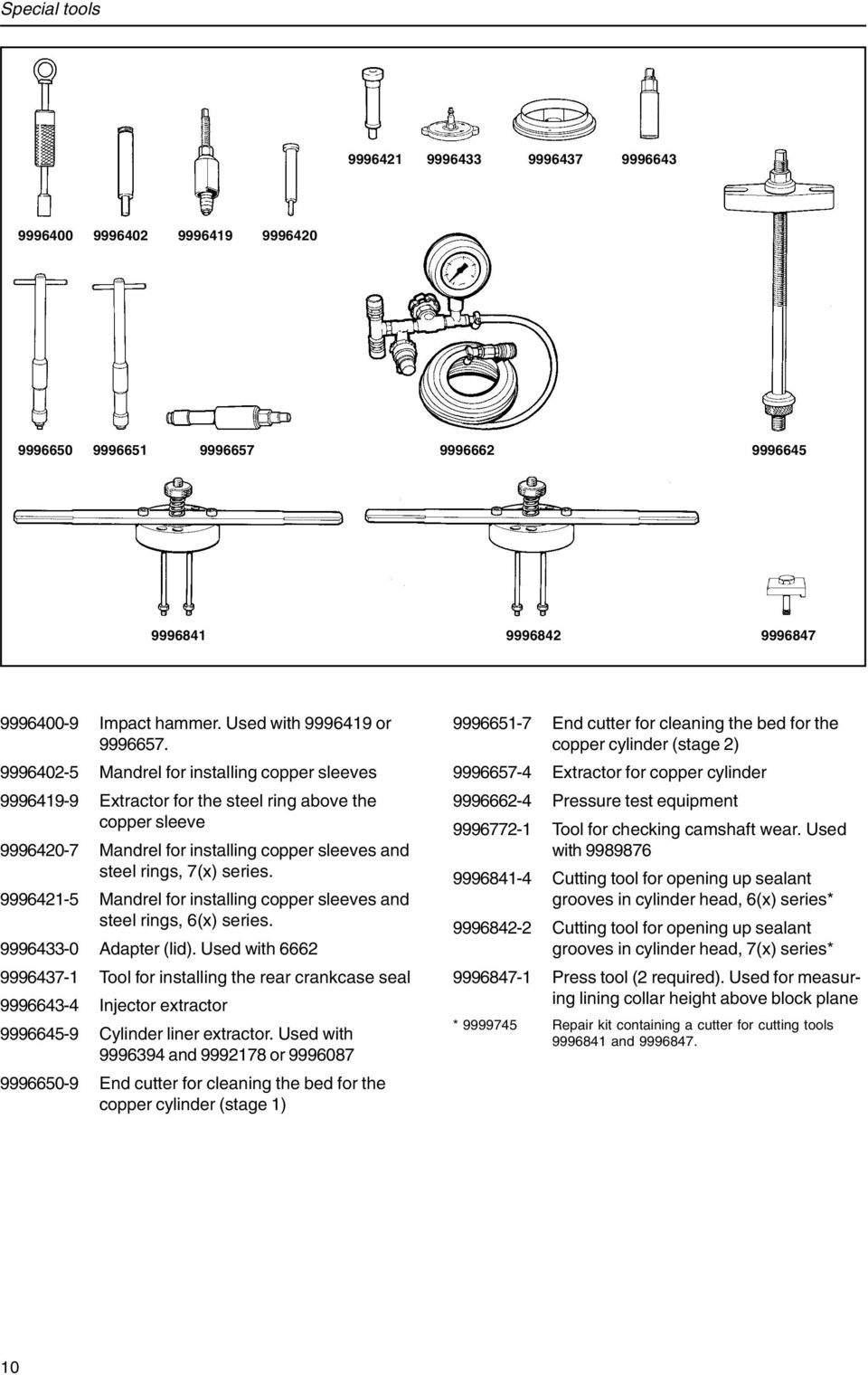
13 Special tools Connection washer for pressure testing the cylinder block Mandrel for installing the front crankshaft seal Tool for installing the copper sleeve and steel ring, 7(x) series. Used together with and Underlay for extracting the copper sleeve and steel ring. Used together with and Jig for cylinder block Adapter for measuring compression pressure Tool for installing the copper sleeve and steel ring, 6(x) series. Used together with and Tool for lifting camshaft in and out Seal plate (2 required) for pressure testing the cylinder block, 6(x) series Seal plate (2 required) for pressure testing the cylinder block, 7(x) series Cutter for renovating liner seat, 7(x) series ) As above, but for 6(x) series 2) ) Cutter for cutting tool ) Cutter for cutting tool
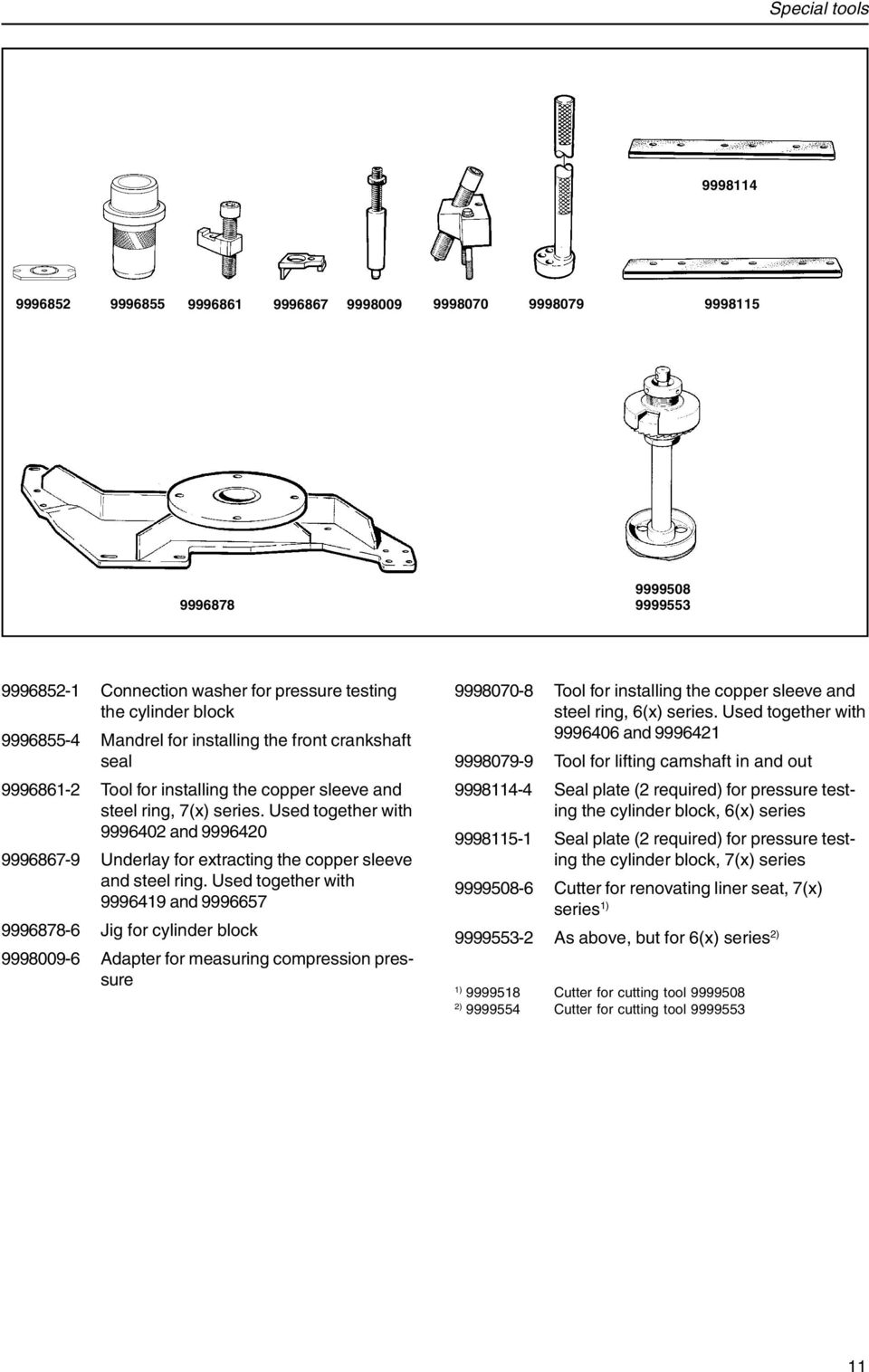
14 Other special equipment Other special equipment Piston ring compressor Compression gauge Dial gauge 0 20 mm Magnetic stand 2

15 Design and function Engine, general The engines are straight 6-cylinder, 4-stroke diesel engines with overhead valves. They have direct fuel injection and turbocharging. The engines have wet, replaceable cylinder liners and two separate cylinder blocks, each of which contains three cylinders. The cylinder blocks are mutually interchangeable. Engine lubrication is by means of a pressure lubrication system containing an efficient oil pump which pumps out oil to two galleries in the cylinder block. Oil is pumped out via the lubrication filter to the lubrication points in the engine and via a piston cooling valve to the oil cooler and pistons. The piston cooling valve opens when the oil pressure has reached a certain level, and oil is squirted into a duct underneath the piston crown. The jet of oil is then led via a cooling loop in the upper part of the piston. In the oil cooler, the heat is transferred from the oil to the cooling system of the engine. The oil is cleaned by means of a full flow oil filter. The cooling system is divided up into a fresh water system and a sea water system. The fresh water system is thermostatically controlled and cools the cylinder block and cylinder head. The sea water cools the fresh water via a heat exchanger. Some engines can be equipped with a -circuit or 2-circuit hull cooling system as follows: TAMD63 -circuit system TAMD7 -circuit or 2-circuit system TAMD72 2-circuit system The engine version with hull cooling does not have a heat exchanger. The turbo compressor supplies fresh air under pressure to the engine, which gives a large surplus of air. This allows the amount of fuel injected to be increased, and this gives increased engine power. The engines are provided with sea water cooled aftercoolers, which lowers the temperature of the induction air after turbocharging. This reduces the volume of the air and more air (oxygen) can be supplied to the engine. The additional air allows a further increase in the amount of fuel injected, which increases engine power. Since the induction air is cooled, the combustion and exhaust temperatures are kept at a suitable level, despite the higher power output. Intercooling also gives lower exhaust emissions, since combustion becomes more complete thanks to the greater oxygen content of the induction air. The turbine housing of the turbocharger is fresh water cooled, the rest of the turbocharger is cooled by the engine oil. TAMD63-P and TAMD72 have turbochargers with wastegates for greater low speed power. All engines apart from TAMD63-P and TAMD72P-A, WJ-A have an electric starting heater to facilitate starting and reduce exhaust smoke during starting in cold weather. In order to further reduce exhaust emissions, the TAMD6, TAMD62 and TAMD7 engines have a bypass valve for induction air. At low loading, the passage through the aftercooler is shut off and the air which has been heated by the turbocompressor is led directly (through the starting heater) into the induction manifold. On the TAMD63 and TAMD72, which have higher compression ratios, other combustion chambers and modified injection systems, this equipment is not needed The TAMD72P-A(EDC) is equipped with EDC (Electronic Diesel Control), a system which electronically controls the regulator in the engine s injection pump. This system offers a reduction in exhaust emissions. In the EDC system, the centrifugal regulator in the injection pump is replaced by an electromagnetic actuator. The actuator in the regulator is operated by a control unit which obtains information from a number of sensors located on the engine and controls. The control unit then calculates the amount of fuel to be injected for every loading case, on the basis of this information. Note. On the TAMD72P-A, the EDC system controls the starting sequence so as to reduce the exhaust emissions to an even lower level. In order to increase the combustion temperature before starting, the start motor cranks the engine 4 turns before fuel is injected. 3

16 Design and function Design differences, engine versions This workshop manual applies to all engines of the 6(x) series; TAMD6A, TAMD62A, TAMD63L-A and TAMD63P-A, and from the 7(x) series; TAMD7A, TAMD7B, TAMD72A, TAMD72P-A and TAMD72WJ-A. The most important differences are: TAMD6A TAMD62A TAMD62A has: l Higher power l Pistons with modified profiles l Injection pump with changed settings l Different oil change intervals l New external design TAMD62A TAMD63P-A TAMD63P-A has: l Completely new marinisation, installation volume reduced by about 30% l Higher power l Low rotation cylinder head with new valve seats for both inlet and exhaust valves. l Increased valve clearance (inlet and exhaust) l Pistons with modified combustion chambers l New piston rings l Higher compression l Injection pump with RQV regulator and changed settings l Reinforced pump coupling l 5-hole injector nozzles with higher opening pressure l Reinforced (preloaded) supply pipes l Turbine optimised for high torque, integrated wastegate l Washable air filter l Lubrication system with by-pass oil filter l New oil filter bracket with horizontally located oil filter l Larger oil cooler (same as on TAMD72) l New galvanized sheet metal sump (rubber insulated from cylinder block for lower engine noise) l New heat exchanger with integrated expansion tank l New aftercooler. Modified water flow, incoming water passes aftercooler before heat exchanger l New belt driven coolant pump l l l l New sea water pump Stop function with solenoid valve New electrical system with sealed connectors and cables run in flexible hoses. Junction boxes, monitors and sensors have rubber mountings (vibration reducing) New alternator (engines with 24V electrical systems) TAMD63P-A TAMD63L-A TAMD63L-A has: l Lower power rating l Injection pump with changed settings l New injector with changed opening pressure and other hole design l Turbocharger with wastegate valve TAMD7A TAMD7B TAMD7B has: l Higher power l New cylinder liners, pistons and piston rings. The upper piston ring is of the Keystone type. l Injection pump with changed settings l Injectors with higher opening pressure l New stop solenoid TAMD7B TAMD72A TAMD72A has: l Higher power l Modified cylinder heads with new valve seats (inlet and exhaust valves). l Changed valve clearance (inlet and exhaust) l New upper piston rings (higher) of the Keystone type. l New pistons with higher compression ratio and suited to the new piston rings. l Larger oil cooler l Different oil change intervals l New injection pump with higher injection pressure and changed settings. l Reinforced pump coupling l New centrifugal regulator l New injectors with changed injection pressure l Reinforced supply pipes l New turbocharger with separate wastegate l Electric starting heater and by-pass valve are extra equipment (not normally needed because of the higher compression) l New external styling 4

17 Design and function TAMD72A TAMD72WJ-A TAMD72WJ-A is a TAMD72A which has been modified for use with a water jet unit. TAMD72WJ-A has: l New injection pump with changed settings. l Different turbo without wastegate l Oil pipes to suit the new turbo l New induction manifold l Higher power TAMD72A TAMD72P-A(EDC) l New injection pump with electronic regulator. The regulator contains an actuator which acts on the injector pump control rod and thus affects the injected fuel quantity (power output) l l l l l l l Electronic box (EDC) added, located beside the rear fuel filter Stop solenoid deleted (the engine is stopped by the EDC system) New turbocharger with integrated wastegate valve New rubber mounted junction box located by exhaust pipe Sensor and monitor for engine oil pressure separately installed and rubber mounted Reinforced insulation on engine cables (convoluted PA66 plastic hose) with moisture-proof connectors New alternator with zener diodes, 24V/60A or 2V/60A. Location of type approval plates. Engine designation 2. Engine serial number 3. Engine product number 4. Reverse gear designation 5. Reverse gear serial number 6. Reverse gear product number 7. Engine designation and product number 8. Serial number/short block number 5

18 Design and function Engine presentation TAMD6A Junction box with circuit breakers 2 Coolant filler cap 3 Fuel filter 4 Oil filler cap (also at front edge of engine) 5 Injection pump 6 Stop solenoid 7 Turbocharger 8 Oil cooler, reverse gear 9 Reverse gear, MPM IRM 220A 0 Dipstick (alternative location) Oil cooler, engine 2 Smoke limiter 3 Circulation pump 4 Alternator Turbocharger 2 Air filter 3 Relay for electric starting heater 4 By-pass valve (directs air flow through aftercooler) 5 Expansion tank 6 Coolant filler cap 7 Lubrication oil filter 8 Sea water pump 9 Heat exchanger 0 Aftercooler Start motor 2 Dipstick, reverse gear, MPM IRM 220A 3 Oil filler cap, reverse gear 6

19 Design and function TAMD62A Air filter 2 By-pass valve (directs air flow through aftercooler) 3 Filter for crankcase breather 4 Aftercooler 5 Heat exchanger 6 Expansion tank 7 Sea water pump 8 Lubrication oil filter (alt. location at left-hand rear of engine as extra equipment) 9 Flexible engine mountings (extra equipment) 0 Sump Dipstick 2 Start motor 3 Reverse gear, MPM IRM 220A- 4 Dipstick, reverse gear 7

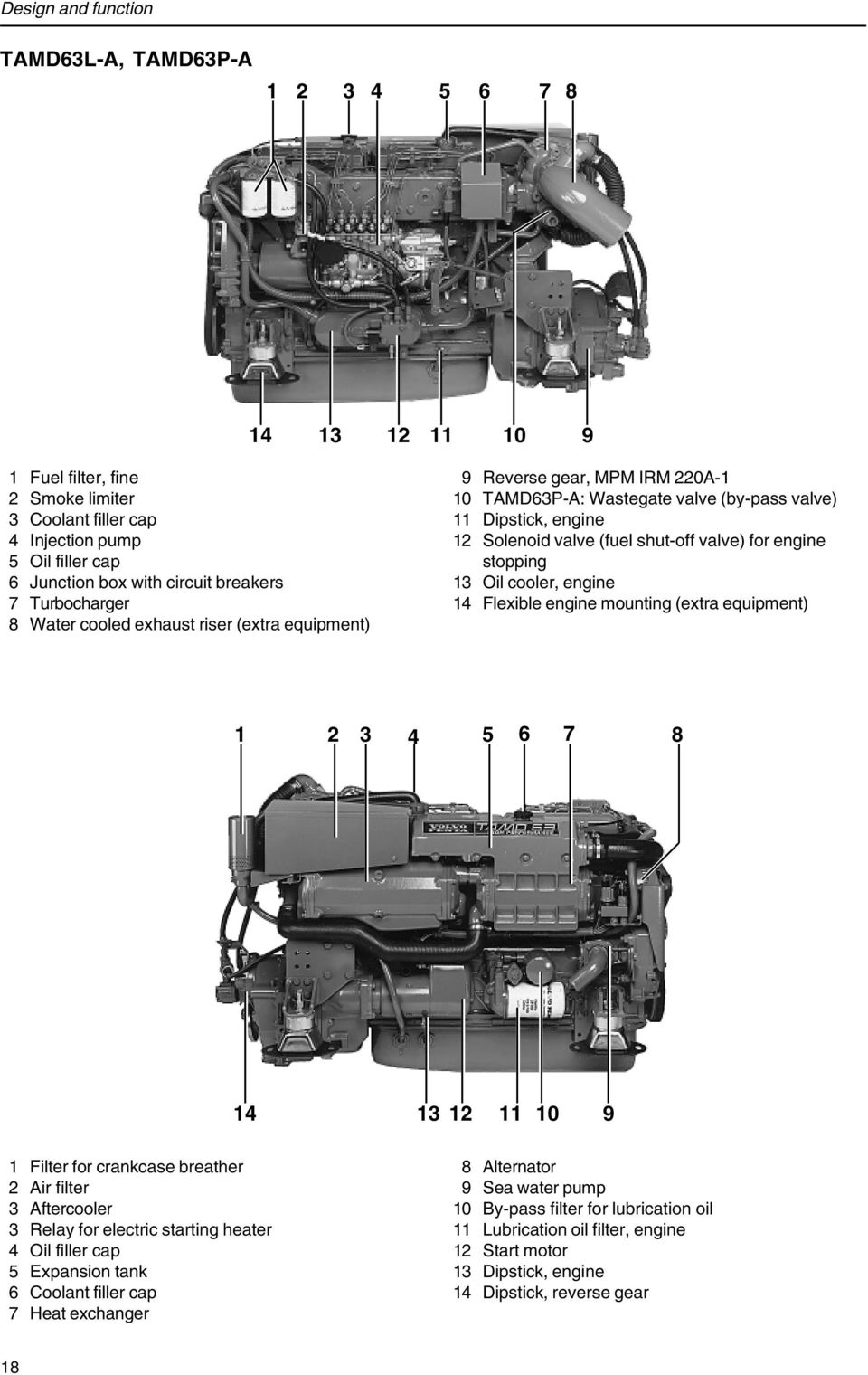
20 Design and function TAMD63L-A, TAMD63P-A Fuel filter, fine 2 Smoke limiter 3 Coolant filler cap 4 Injection pump 5 Oil filler cap 6 Junction box with circuit breakers 7 Turbocharger 8 Water cooled exhaust riser (extra equipment) 9 Reverse gear, MPM IRM 220A- 0 TAMD63P-A: Wastegate valve (by-pass valve) Dipstick, engine 2 Solenoid valve (fuel shut-off valve) for engine stopping 3 Oil cooler, engine 4 Flexible engine mounting (extra equipment) Filter for crankcase breather 2 Air filter 3 Aftercooler 3 Relay for electric starting heater 4 Oil filler cap 5 Expansion tank 6 Coolant filler cap 7 Heat exchanger 8 Alternator 9 Sea water pump 0 By-pass filter for lubrication oil Lubrication oil filter, engine 2 Start motor 3 Dipstick, engine 4 Dipstick, reverse gear 8
21 Design and function TAMD7A Junction box with circuit breakers 2 Coolant filler cap 3 Fuel filter 4 Oil filler cap (also at front edge of engine) 5 Injection pump 6 Stop solenoid Turbocharger 8 Oil cooler, reverse gear 9 Reverse gear, TD MG507 0 Oil cooler, engine Smoke limiter 2 Circulation pump Turbocharger 2 Air filter 3 Relay for electric starting heater 4 By-pass valve (directs air flow through aftercooler) 5 Expansion tank 6 Coolant filler cap 7 Lubrication oil filter 8 Sea water pump Heat exchanger 0 Dipstick Aftercooler 2 Start motor 3 Dipstick, reverse gear, TD MG507 4 Oil pump 7 9
22 Design and function TAMD7B Junction box with circuit breakers 2 Coolant filler cap 3 Fuel filter 4 Oil filler cap 5 Injection pump 6 Stop solenoid 7 Turbocharger 8 Oil cooler, reverse gear 9 Reverse gear, TD MG507A 0 Dipstick (alternative location) Oil cooler, engine 2 Smoke limiter 3 Circulation pump 4 Alternator 20
23 Design and function TAMD72A Junction box with circuit breakers 2 Coolant filler cap 3 Fuel filter 4 Oil filler cap 5 Injection pump 6 Stop solenoid 7 Wastegate valve (by-pass valve) 8 Turbocharger 9 Water cooled exhaust riser (extra equipment) 0 Reverse gear, TD MG506SC Oil cooler, reverse gear 2 Dipstick (alternative location) 3 Oil cooler, engine 4 Smoke limiter 5 Circulation pump 6 Alternator Air filter 2 Filter for crankcase breather 3 Aftercooler 4 Heat exchanger 5 Expansion tank 6 Sea water pump 7 Lubrication oil filter (alt. location at left-hand rear of engine as extra equipment) 8 Sump 9 Dipstick 0 Start motor Dipstick, reverse gear, TD MG507A- 2
24 Design and function TAMD72WJ-A Junction box with circuit breakers 2 Coolant filler cap 3 Fuel filter, fine 4 Smoke limiter 5 Injection pump 6 Oil filler cap 7 Turbocharger 8 Water cooled exhaust riser (extra equipment) 9 Stop solenoid 0 Alt. dipstick location Oil cooler, engine 2 Circulation pump 3 Alternator 22
25 Design and function TAMD72P-A (EDC) Coolant filler cap 2 Fuel filter, fine 3 Control unit (EDC) 4 Oil filler cap 5 Injection pump 6 Junction box with circuit breakers 7 Turbocharger 8 Water cooled exhaust riser (extra equipment) 9 Reverse gear, TD MG507-0 Oil cooler, reverse gear Wastegate valve (by-pass valve) 2 Alt. dipstick location 3 Oil cooler, engine 4 Circulation pump 5 Alternator Air filter 2 Filter for crankcase breather 3 Aftercooler 4 Heat exchanger 5 Expansion tank 6 Sea water pump 7 Lubrication oil filter, engine (alt. location at lefthand rear of engine as extra equipment) 8 Sump 9 Dipstick 0 Start motor Dipstick, reverse gear, TD MG507-23
26 Design and function Component description Cylinder heads The engine has two (identical) cylinder heads, each of which covers three cylinders. The cylinder heads are screwed to the cylinder block by 20 screws per head (M). The cylinder head material is a special cast iron alloy. The cylinder head gasket is solid sheet steel. The cylinder head plane has lands, formed by two concentric wide grooves, recessed in the plane of the cylinder head, centred on the cylinder liner collars. These grooves determine the size of the sealing surface so that the requisite sealing pressure is obtained without the tightening torque needing to be so high that there is a risk of deformation of the liner shelf in the cylinder block. In addition, there is a groove for the flame edge of the cylinder liner. The fastening screws for the cylinder head are tightened by means of a combination of torque and angle tightening Cylinder head sealing Cylinder head 3 Cylinder liner 2 Cylinder block 4 Cylinder head gasket Valve mechanism The valves are made from chrome nickel steel, the valve stems are chrome plated. The exhaust valves for TAMD7/72 and the inlet valves for TAMD63 (from Autumn 995) have valve heads made from Nimonic 80. The exhaust valves on other engines of the 6(x) series have Stellite coated sealing surfaces. The valves are operated by rockers on a rocker bridge. The engine has two rocker bridges, one for each cylinder head. The rockers are operated by the camshaft, via push rods and valve lifters. Depending on the design of the cylinder head (valve seat location), there are two different valve heights on the 6(x) series. The illustration and table show the difference between the location of the valves (valve height above cylinder head plane). The valve seats made from special steel are interchangeable. Valve seats with standard dimensions and overdimensions are available as spare parts. The overdimension seat has a 0.2 mm greater overall diameter and is used if the cylinder head needs the valve seat locations to be milled out. A B TAMD TAMD Valve location A = Inlet B = Exhaust 24
27 Design and function Cylinder block The cylinder block is cast in one piece and is made of special cast iron alloy. The tension forces in the cylinder head screws, caused by combustion pressures, are transmitted by stiffened sections in the interior walls of the cylinder block to the main bearings. The camshaft bearings are broached to the correct dimension after assembly. Cylinder block Cylinder liners The cylinder liners are of the wet type and are replaceable. They are made from centrifugal cast iron. The cylinder liners have a so-called Flame edge, please refer to pos. 4. The flame edge, which fits a groove in the cylinder head, reduces the stress on the cylinder head gasket. Four rubber O-rings are used to seal the cylinder liner. The three lower rings are located in turned grooves in the cylinder block. These rings are made of different materials. The lowest seal ring (violet) is made from fluorocarbon rubber (FPM), whereas the two upper rings in the lower liner seal are identical and are made of ethylene-propylene rubber (EPDM). Note. There have been two previous versions of the seal kit. In the first version, the two lower seal rings were identical and were made of fluorocarbon rubber (black with a green or yellow spot), whereas the upper seal ring in the lower cylinder liner was made of ethylene-propylene rubber (EPDM), and was marked with two white paint spots. In another design, all the lower seal rings were identical and were made of fluorocarbon rubber (marked with a green or yellow spot). Cylinder liner Cylinder head 3 Cylinder liner 2 Cylinder block 4 Flame edge WARNING! Special safety rules apply to fluorocarbon rubber which has been exposed to high temperature. Please refer to page 8. 25
28 Design and function Pistons The pistons are made of light metal alloy. The top compression ring, which transmits the majority of the heat which is transferred via the pistons, is located in a ring carrier made of high alloy special cast iron, which is cast in to the piston. This gives the piston ring groove long service life despite the heat loading. The piston ring grooves for the other pistons are machined directly into the piston. The pistons also have a circular space inside the upper part of the piston, through which the oil for piston cooling passes. On the pistons for the 6(x) series, there is an expansion area in the gudgeon pin hole ( side relief ), which reduces the stresses on the piston during the combustion process. The same advantages are achieved on the 7 and 72 engines by means of a trapezoid con rod end. The combustion chamber is entirely contained within the piston crown. Pistons and cylinder liners are only stocked as complete sets for spare part purposes. Piston rings 6(x) series Each piston has two compression rings and one oil scraper ring. On the TAMD6, TAMD62 and TAMD63, the top compression ring is of the Keystone type (trapezoid) The ring has a molybdenum coating and must be installed with the TOP marking upwards. The second compression ring (chrome plated), which is slightly conical and has a turned internal chamfer, must be installed with the TOP marking upwards. The oil scraper ring (chrome plated) may be installed either way up. The ring has two scraper edges which are pressed against the cylinder wall, both by the spring force of the ring itself and by an expansion spring located inside the scraper ring. The opening in the expansion springs should be located diametrically opposite to the gap in the oil rings*. Piston design A Combustion chamber diameter* B Combustion chamber depth* C Ring carrier Piston ring profiles TAMD 6, TAMD62 TAMD 63 * TAMD63: The white paint spot on the spring should be visible through the outer ring gap. Gudgeon pin hole with side relief 26
29 Design and function TAMD7 Each piston has three compression rings (early version), or two compression rings (later version)* and one oil scraper ring. The upper compression ring on the early version is chrome plated and has a turned internal chamfer, and on the later version it is molybdenum coated and must be fitted with the TOP marking** uppermost. The TAMD7B has a top ring of the Keystone type. The second ring, and on the early versions, the third ring as well, are slightly conical and have to be installed with the TOP marking** upwards. On the early versions, the rings are coated with Ferrox. (Ferrox attracts oil and thus has a lubricating effect.) The second compression ring also has three Ferrox filled grooves, and the third compression ring has a turned internal chamfer. On the later version, the second compression ring is chromed and has an internal chamfer, the third compression ring has been abolished. The oil scraper ring is of the same type as on the 6(x) series. TAMD 7 Early version TAMD 7B Piston ring profiles TAMD 7 Later version TAMD 72 * The pistons on the later version still have 4 piston ring grooves, but the third groove is empty. ** TOP, TOPCX TOPCF or a machined mark (-). TAMD72 Each piston has two compression rings and an oil scraper ring. The upper compression ring is of the Keystone type and is unique to the 72 series (different height), and is installed with the TOPCD marking upwards. The other rings are similar to the TAMD7B. 27
30 Design and function Timing gear The timing gear consists of cylindrical gear wheels with spiral cut teeth. The injection pump and camshaft are driven from the crankshaft gear via an idler gear. The engine oil pump is also driven from the crankshaft gear via an idler gear. In addition to the camshaft, the camshaft gear also drives the gear for the sea water pump (the sea water pump on the TAMD63 is driven by a Poly-Vee belt). If a servo pump is fitted (extra equipment), this is also driven from the camshaft gear. Three different surface treatments have been used on the gear wheels; case hardening, hardening & tempering and nitrocarburising. Please refer to the instructions about nitrocarburised gears on page 6 before replacing any gear wheels. Timing gear Sea water pump drive 2 Camshaft gear 3 Idler 4 Injection pump drive 5 Coolant pump drive 6 Crankshaft drive 7 Idler for oil pump 8 Oil pump drive Crankshaft The crankshaft is supported on seven main bearings. The thrust bearings consist of thrust washers on the centre main bearing. The crankshaft is statically and dynamically balanced. At the front, the crankshaft has a so-called polygon profile, and the rear there is a flange to which the flywheel is screwed. The crankshaft is nitrocarburised. On condition that the shaft does not need to be re-aligned, it can be ground down to the 2nd underdimension before it needs to be nitrocarburised again. Crankshaft with con rods and pistons Big and small end bearings The big and small end bearings consist of indium plated, lead bronze lined steel shells. The bearings are precision made and are entirely ready for installation. Five under-dimensions can be obtained as spare parts. The thrust washers for axial location of the crankshaft are available in three overdimensions. 28
31 Design and function Con rods The con rods have an I section, and are drilled for pressure lubrication of the gudgeon pins. Since the con rods have obliquely split big ends, they can be pulled up through the cylinder bores during engine renovation. The gudgeon pin bushes are made of steel and have a bronze alloy lining. On the 7 and 72 series, the con rods have trapezoid small ends, to give a larger effective bearing area against the gudgeon pin. Con rods with trapezoid small end (7 and 72 series). Camshaft The camshaft is drop forged and induction hardened, the cams are profile ground. The camshaft runs in seven bearings. End float is determined by the camshaft gear wheel, the shoulder on the foremost camshaft bearing journal and the thrust washer screwed to the front surface of the cylinder block. Flywheel The flywheel is screwed to a flange on the rear of the crankshaft. It is statically balanced and fully machined. The flywheel ring gear is shrunk onto the flywheel. Torsional damper The torsional damper consists of a hermetically sealed housing containing a steel flywheel bob of rectangular section. The flywheel bob (damping ring) rotates on a central bushing and is surrounded on all sides by a viscous fluid (silicone compound). Torsional damper Crankshaft 6 Housing 2 Hub 7 Lid 3 Fluid space 8 Timing gear housing 4 Bushing 9 Seal ring 5 Flywheel bob 29
32 General Before every major service task, a condition test should be carried out if possible, to determine the general condition of the engine and to find any cooperating fault causes. It is necessary to operate the engine during a condition test, so this should be done before the engine or any engine components are removed. Please refer to condition test, engine, on page 32. Measures before renovation in the boat Turn off the battery isolator 2 Clean the outside of the engine NOTE! Make sure that washing residue is taken care of for destruction, and is not inadvertently dumped into the environment. Please refer to the warning text in item as well. 3 Work on the cooling system: Shut off the sea cocks and drain the coolant from the sea water and fresh water systems. WARNING! Make sure that all sea cocks are securely shut and that water can not get in when you disassemble any components in the cooling system. Measures before renovation outside the boat 4 Lift the boat up onto land 5 Turn off the battery isolator, remove the battery connections from the start motor. 6 Remove the connector between the engine cables instrument panel 7 Remove the sea water connections/hull cooler connections. 8 Remove the exhaust pipe 9 Shut off the fuel cocks. Remove the fuel pipes. 0 Remove the throttle and gear shift cables Undo the propeller shaft from the reverse gear. Undo the engine pads from the bed and lift the engine out. Measures after lifting out the engine 2 Clean the engine WARNING! When you are clean the engine with a high pressure washer. Be very careful when cleaning, to avoid water entry into the engine. When the high pressure function is engaged, the water jet must never be aimed at seals, e.g. shaft seals, joints with gaskets, rubber hoses or electrical components. 3 Drain the engine oil off. 4 Remove the reverse gear (if necessary). 30
33 Engine stand attachment Jig no is used to attach the engine to the engine stand. The jig is screwed to the right-hand side of the engine, as in the illustration below. NOTE! It is important that the note about the numbers and dimensions of screws is observed, for safe attachment of the engine. Screws required: 6(x) series 7(x) series 3 no. M8x30 mm M8x30 mm 2 no. M0x30 mm M0x30 mm 2 no. M2x40 mm Before the engine jig can be fitted, and the engine attached to the engine stand, the following components must be removed from the engine: TAMD6/62 Heat exchanger, aftercooler, start motor, oil filter bracket, front engine mounting and rear hatch for valve lifter. TAMD63 Heat exchanger, aftercooler, start motor, oil filter bracket, front engine mounting, rear hatch for valve lifter, air filter and expansion tank TAMD7/72 Heat exchanger, aftercooler, start motor, oil filter bracket, rear hatch for valve lifter and oil filter housing. M8x30 mm 4 M0x30 mm [6(x) series] 2 M0x30 mm [6(x) series] 5 M2x40 3 M8x30 mm 3
34 Condition test, engine Compression test Special tool A compression test is done in order to assess the condition of the engine in a simple and reliable manner, this indicates the sealing ability of the piston rings and valves. l Warm the engine up and stop it. l Remove all the injectors and test each of the cylinders in turn. WARNING! Observe the greatest possible cleanliness, to avoid getting dirt into the fuel system. Plug the connections where injectors and fuel pipes have been disconnected. The compression pressure should be read off att normal start motor speed. A deviation of 0% below the data given on page 6 in the Technical data manual can be approved. Low compression pressure in all cylinders indicates worn cylinder liners and piston rings. If you find one cylinder whose values lie below the others, this could be caused by either poorly sealing valves, broken cylinder rings or a cylinder head gasket which does not seal properly. Cylinder head, renovation Cylinder head, removal Special tool nos , * TAMD6/62/63, TAMD 7/72 Remove both battery cables 2 Close the sea cocks and drain the water in the fresh water and sea water systems. If the engine has a hull cooling system, close the valves for this system and drain the engine. Applies to TAMD6/62, TAMD 7/72 3 Remove the shield over the heat exchanger and aftercooler. Remove the filter. 4 Remove the pipe between the sea water pump and the heat exchanger, and between the aftercooler and reverse gear oil cooler. 5 Remove the lid on the heat exchanger (rear heat exchanger on the TAMD7 and TAMD72). Remove the connecting pipe to the aftercooler (or to the front heat exchanger on the TAMD7 and TAMD72). Release the breather pipe (plastic) from the expansion tank. 6 Remove the coolant pipes between the heat exchanger and the coolant pump, and between the heat exchanger and thermostat housing. Remove the heat exchanger. Insert adaptor no into the injector hole and attach it with the fastening brace and nut for the injector. Fit a compression gauge to the adaptor and do the compression test. 7 Remove the connection pipe between the aftercooler and the induction manifold and between the aftercooler and the by-pass valve. Remove the aftercooler. 8 Remove the connection pipe between the starting heater and the induction manifold. Hang up the bracket with the starting element relay. 32
35 9 Free the plastic pipe for the smoke limiter from the front edge of the induction manifold. Remove the induction manifold. Applies to TAMD63 0 Undo the alternator bracket and lift the generator away with its bracket, plus the oil pressure sensor and oil pressure monitor with bracket. 9 If the engine has a stop solenoid, remove it and hang it up. Applies to all engines 20 Shut off the fuel taps. Remove the fuel pipe leading to the fine filter, the supply pipes and the fuel leakage pipes. Remove the fuel filters. Install protective covers. Remove the clamps for the cable harness at the lower edge of the heat exchanger and the intercooler. 2 Remove the cooling water hoses to and from the heat exchanger and the aftercooler. 2 Remove the coolant pipe between the oil cooler and the thermostat housing lid. Undo the flange for the coolant pipe by the front edge of the exhaust manifold. Undo the electrical connections to the temperature sensor. 22 Remove the thermostat housing and the connection pipe. 3 Remove the vent pipe at the front of the heat exchanger and the pressure hose for the smoke limiter Remove the screw behind the heat exchanger. 5 Remove the 5 remaining screws which hold the heat exchanger and lift it away from the engine. 6 Remove the air filter housing, the air supply pipe and the hose between the turbocharger and the aftercooler. 7 Remove all screws holding the induction manifold. Remove the injectors* Remove the yoke and turn the injector forwards and backwards with a spanner (PU-5), at the same time as you pull it out. If the injector has stuck, use extractor no This avoids the risk of pulling the copper sleeve out at the same time. * If you are very careful to avoid damaging the injector nozzle tips, the cylinder head can be removed with the injectors in place. 8 Undo both the screws behind the aftercooler a few turns and lift the aftercooler off. 33
36 24 Free the exhaust pipe from the turbocharger. Remove the coolant pipe between the turbo and the cylinder block. Remove the oil pipes for the turbocharger. Install protective covers. Cylinder head disassembly/ assembly Special tool: Remove the turbocharger and exhaust manifold. Cover the turbo inlet and outlet with clean paper or use some other method, to prevent dirt and other foreign matter from entering the turbocharger. 26 Remove the valve covers. Undo the rocker bearing screws, remove the rocker mechanism and pushrods. NOTE! Mark the push rods or put them in a stand, in the correct order. 27 Remove the cylinder head screws and lift the cylinder head off. Remove the cylinder head gaskets, rubber seals and their guides from the cylinder block. 28 Clean the cylinder head and cylinder block mating faces. 29 Install two press tools to retain the cylinder liners ). ) Necessary if work is going to be done where the crankshaft is turned with the cylinder head detached. The cylinder liners then have to be retained by press tool no per cylinder liner. Cylinder heads in the 6(x) and 7(x) series have twin valve springs (an inner and an outer spring). Disassembly The cylinder head core plugs should not be removed unless damage makes this necessary. The valves and valve springs must be re-installed in their original locations if they are to be re-used. Use marked stands or small component boxes to ensure correct location. Remove the valve springs and valve by means of a valve spring compressor. Remove oil seals, collets, collars and valves. The oil seals (protective ring above the collets) should always be scrapped and replaced by new ones. 34
37 2 Clean all components, be especially careful with the oil and coolant galleries. Remove any remaining soot and contamination from the cylinder head mating surfaces. Clean the sealing grooves with a suitable scraper (shaped to conform with the contours of the grooves). NOTE! Never pass a rotating steel brush or other tool across the sealing grooves. The lands would then be broken down and ruined. Assembly 3 Clean the core plugs if they have been removed. Clean the core plug seats. Use Permatex No. 3 or Volvo Penta sealant. Install the plug by means of a mandrel or sleeve. 4 Oil the valve stems and install the valves in their guides. Connect the proof testing equipment to the compressed air mains and set the pressure gauge to 00 kpa ( kp/cm 2 ), using the reduction valve. NOTE! The reduction valve knob can be locked with a lock ring which is moved along the spindle. 2 Then close the shut-off tap. During 2 minutes, the pressure on the pressure gauge must not fall, for the proof testing equipment to be regarded as being reliable. NOTE! Observe the markings, to ensure that the valves go back to their original locations. 3 5 Install the valve spring(s) and valve collar, and press the spring(s) together with the valve spring compressor. Install the collets and a new valve stem seal. Cylinder head, leakage check Special tools: , (x) series (2 no.), 7(x) series (2 no.) WARNING! Before using proof testing equipment no , it must be checked. Always observe the applicable safety instructions. Attach air connection plate , using two M0 screws and seal plates (6x series) or (7x series), using twelve M0x20 mm screws and nuts. 35
38 4 7 Check that the knob on the reduction valve of the proof testing equipment is screwed out. 5 Connect the hose from the proof testing equipment to the air connection plate. 6 Screw in the reduction valve knob to give a pressure of 50 kpa (0.5 kp/cm 2 ) on the pressure gauge. Maintain this pressure for min. 8 Then raise the pressure to 50 kpa (.5 kp/cm 2 ). Lock the reduction valve knob with the lock ring and shut the tap off. Check after one or two minutes whether the pressure has fallen and if any air bubbles come out of the water bath. If there is any air leakage from the copper sleeves for the injectors, this should be attended to in accordance with Copper sleeves for injectors, replacement and Cleaning seats for copper sleeves on pages 46 to 48. Lower the cylinder head into a bath of water at 70 C and open the tap. 36
39 Cylinder head, inspection Warpage The warpage of the cylinder head must not exceed 0.03 mm. The check is made with a feeler gauge and steel ruler, whose sides has been shaved to an accuracy corresponding to DIN 874/Normal. If the cylinder head is found to be warped more than the permitted value, the cylinder head must be planed or replaced. If leakage has been found, or if the cylinder head has blow-by lines, measurement is unnecessary, since a cylinder head in this condition will have to be planed or replaced anyway. NOTE! The cylinder head on the TAMD63 must not be planed, it should always be replaced if damaged. Check that the seal grooves which are centrally above the cylinder liners are undamaged. For sealing grooves, please refer to Cylinder head, milling the seal grooves on pages Cracks When renovating engines with a large number of operation hours, heat cracks may be found between the valve seats and the injector hole when the cylinder head is inspected. The cylinder head does not need to be replaced because of heat cracks. The crack starts by the copper sleeve for the injector and grows towards the valve seat location. The reason for the crack can be that the attachment yoke is too done up too tightly, i.e. the wrong torque has been used. Cracks of this type have not been known to cause gas or coolant leakage, since the crack has not grown through the base of the cylinder head. When leakage has been found, it has been found to be caused by contamination or damage to the copper sleeve seat. Please refer to Cleaning the seat for the copper sleeve on pages 49 and
40 Valve guides, inspection Special tools: and Put the cylinder head on a flat surface and put new valves in the guides. The valve spindles should rest on the flat surface. If necessary, remove the injector fastening studs to get good contact. Valve guides, replacement Special tools: 6(x) series: , , 7(x) series: , Press out the valve guides with mandrel (x) series, or (x) series. Place dial gauge , with magnetic stand , so that the tip of the dial gauge rests upon the edge of the valve head. Move the valve sideways in the direction of the inlet and exhaust ports. Read the values on the dial gauge. 2 Oil the new valve guides and press them in with mandrel , 6(x) series, or (x) series. The mandrel gives the guides the correct height (23 mm and 22 mm respectively) above the spring plane of the cylinder head. Wear tolerances Inlet valve, max. clearance... Exhaust valve, max. clearance mm 0.38 mm If these values are exceeded, change the valve guides. 3 Broach the valve guides up if necessary. 38
41 Cylinder head, planing Special tools: , The warpage on the cylinder head must not exceed 0.03 mm. If the warpage exceeds this value, or if blow-by lines occur, the cylinder head must be planed or replaced. Please refer to the Technical Data section of the workshop manual for the minimum height of the cylinder head. Surface finish after planing must not exceed.6 RA. NOTE! The cylinder head on the TAMD63 must not be planed, it should always be replaced by a new one. After planing, new seal lands and flame edges must be milled. Cylinder head, milling the seal groove Special tools: and , 6(x) series; , 7(x) series Milling tool , , Nut 5 Spindle 2 Turning handle 6 Cutting head 3 Guide plate 7 Bit holder 4 Attachment screw Permitted distance (A) between the cylinder head plane and valve head: Inlet valve... Exhaust valve... * TAMD72A: 0 ± 0.2 mm 6(x) series 7(x) series mm mm* 0.7. mm.0.4 mm* If the permitted distance (A) is not met after planing, the valve seats must be milled out. When new grooves are milled, the cylinder head must be planed so as to completely remove the old grooves. The height of the cylinder head, plus the distance between the plane of the valve heads and the cylinder head plan must not fall below the values given in the specifications section. The grooving tool is centred with the flame edge groove bit, and not with the guide plate as on other grooving tools. This is the reason why the guide plate attachment screws have wide clearance in the valve guides. 39
42 2 Setting the cutters Set up the cutter head in a vice, with the bits facing upwards. 4 The grooving tool has five bits. Three of them (Marked A-A*-B) are intended to work the flame edge groove. These should be adjusted to 2.8 mm +0., 0.2 mm. Attach the dial gauge (998976) in holder and put this on the ring-shaped land on the cutting tool. Zero the dial gauge against the land. 3 5 The remaining bits (marked C-D) are intended to work the sealing plane, and should be adjusted to ±0.02 mm. Slide the holder and dial gauge sideways so that the gauge tip rests on the highest point of one of the cutters, and read off the dial gauge. Adjusting the bit 6 Sealing grooves in cylinder head. Undo lock screw A with a 4 mm Allen key, and turn adjustment screw B a few turns with a 5 mm Allen key. 40
43 7 Press down the bit holder and tighten the lock screw enough to press against the holder. 8 Put the dial gauge tip on the highest point of the bit and turn the adjustment screw upwards until the correct value of bit height is obtained. Tighten the lock screw. NOTE! Check that the upper edge of the bit holder is on the same plane as the cutter head. If it is not, the dial gauge has turned one rotation too many. 9 Set all bits to the specified depth, as in items 2 and 3. Changing the bit set * 2 Install the bit holders in the cutter head, in accordance with the letters, and with the grooves aligned towards the lock screws. Adjust the bit height as instructed. Milling the grooves 3 Set the cylinder head up in a vice. 4 WARNING! Use protective jaw pads to avoid damaging any sealing surfaces. Make sure that the cylinder head plane is completely clean. 0 Unscrew the lock screw a few turns and turn the adjustment screw upwards so that the bit holder can be removed from the cutter head. Put the guide plate of the tool on the cylinder head, but do not tighten the nuts for the attachment screws. 5 The bit holders are marked with a letter (A, A*, B, C or D), and the corresponding letter is punched on the cutter head, where the bits are to be installed. NOTE! The two socket cap screws in the bit holder must not be touched. * , repair kit for cutting tool and Carefully put the cutting head on the guide plate, using rotating movements, so that the tool is centred on the flame edge groove. NOTE! Do not tighten the nuts for the attachment screws too hard, this could pull the valve guides into the cylinder head. 4
44 6 Valve seat, replacement Special tools: , Install the spring and nut. Tighten the nut loosely. 7 Turn the tool clockwise, using even movements, and without pressing. The cutters are fed automatically. Turn the tool until the cutter bits stop cutting. Remove the nut and lift off the cutting head. 8 Clean the cylinder head carefully. Then check the depth of the grooves by putting the cutting head back, without the spring and nut, and turn it a few times under hand pressure. If the tool cuts, the grooves do not have the correct depth. This check must always be done since swarf can get under the collar of the cutting head. The burrs left by the edges of the grooves should be left in place. If these burrs are broken off, the edges could be damaged, which would impair the sealing properties of the grooves. NOTE! The first time the grooving tool is used, after the bits have been adjusted, the finished groove must be checked with a dial gauge. During this check, any burrs on the edge of the grooves must be carefully removed, so that the dial gauge holder seats correctly against the cylinder head. The valve seat should be replaced when distance (A), measured with a new valve, exceeds TAMD6/62 TAMD63 TAMD7/72 Inlet....5 mm.0 mm 3.0 mm Exhaust....5 mm.0 mm 2.0 mm 2 The old valve seat should be removed by grinding two notches in the seat, and then splitting it with a cold chisel. As an alternative, an old valve can be tack welded in several places, and the old seat can then be driven out. Grind down the head of the scrapped valve so it can be pushed down below the edge of the seat. Weld with a MIG/MAG welder, cover the area round the weld to avoid getting weld spatter stuck anywhere. WARNING! Be careful not to do any damage to the cylinder head. 42
45 3 Clean the valve seat location carefully, and check that there are no cracks. Measure the diameter of the valve seat location. Use the measurement to determine whether a STD or OD dimension seat should be used. Do any machining on the valve seat location. Cool the new valve seat down in carbon dioxide snow to 60 to 70 C, and possibly heat the cylinder head by hosing it with hot water or other means. Press the valve seat in with a mandrel. NOTE! Align the new valve seat correctly, with the valve chamfer outwards! You must do the work quickly, so as to maintain the greatest possible temperature difference. Machine the seat to the correct angle and width. Mill or grind the valve seats. A new valve seat must be ground down so that the distance between the cylinder head plane and the valve head (A), measured with a new valve, is: TAMD6/62 TAMD63 TAMD7/72 *Inlet mm mm mm Exhaust mm mm.0.4 mm A used valve seat (wear tolerance) may be ground down so that the distance between the cylinder head plane and the valve head (A), measured with a new valve, is max.: TAMD6/62 TAMD63 TAMD7/72 Inlet....5 mm.0 mm 3.0 mm Exhaust....5 mm.0 mm 2.0 mm If the distances are greater, the seats should be replaced. Check the seat angle with a plug gauge for valve seats, once the valve seat mating surface has been coated with a thin layer of marking dye. * To give acceptable renovation service life and economy, the seat should be replaced when 0.2 mm remains to the maximum wear tolerance, once the valve seat has been ground. Valve seat, grinding Before grinding, the valve guides must be checked and replaced if the wear limits have been exceeded. When the valve seats are ground, only remove just enough material to give the correct shape and a good mating surface. Valve and valve seat 43
46 Valves, grinding (does not apply to engines with Nimonic valves)* * Note. Nimonic valves must not be ground. Valve sealing angles: Inlet: 29.5 Exhaust: 44.5 Rocker mechanism, renovation Special tools: 6(x) series , 7(x) series Check the valves before grinding them. Cracks and damage to the valve head or bent valve stems always mean that the valve must be replaced. Grind the sealing surface as little as possible, just enough to make it clean all the way round. If the valve head edge is less than.2 mm wide after grinding on the 6(x) series, or 2.0 mm (inlet) and.0 mm (exhaust) on the 7(x) series, the valve must be replaced. Always grind the mating surface in with grinding paste (even on new valves and seats), and check mating with indicator dye. If there is any lack of sealing, regrind the seat but not the valve. Then grind the valve in with grinding paste and do a new check with indicator dye. Check the distance (A) between the plane of the cylinder head and the valve head, as in item under the method for Valve seat, replacement on page 42. Remove the circlips from the rocker shaft and remove the rockers, bearing journals and springs. 2 Clean the components. Be especially careful with the oil duct in the bearing journals, and the oil holes in the rocker shaft and rockers. 3 Check the wear on the rocker shaft and the sealing of the top hat plugs in the ends of the shaft. Also check that the spherical part of the rocker arm is not deformed or worn. The threads on the adjustment screws and locknuts must be undamaged. The hexagon on the locknut must also be in good condition. The spherical bearing surface of the rocker arm, which is in contact with the valve/valve cap must not be unevenly worn or pitted. If there is minor wear, this can be evened off by a grinder. If the rocker shaft hole is worn oval, the rocker must be replaced. 44
47 4 7 Press out the rocker bushing with mandrel no for the 6(x) series, or for the 7(x) series. Oil the rocker shaft and install all the components. Note that the rockers on the 6(x) series are installed in opposing pairs. On the 7(x) series, all the rockers are identical and the location on the shaft is thus arbitrary. Make sure that the circlips on the rocker shaft ends have seated securely in their grooves. 5 Turn the mandrel over and press in a new bushing. NOTE! Make sure that the oil hole in the bushing is centred on the oil duct in the rocker arm. 6 Machine broach the bushing to give an accurately adjusted running fit on the shaft mm for the 6(x) series, or mm for the 7(x) series. Remove all swarf. 45
48 Checking the valve springs Cylinder head, assembly Special tools: , Clean the mating planes of the cylinder head and cylinder block. Remove any rust or carbon from screw holes and from the threads for the cylinder head fastening holes. Clean the holes with a tap (M x.5). Remove all loosened dirt with a vacuum cleaner or compressed air. 2 Check the lining heights. Please refer to the values noted in Technical Data in the workshop manual. The difference in height between the linings under one and the same cylinder head must not exceed 0.02 mm. For measurement and adjustment, please refer to Cylinder liner position, renovation on page 59. Check the valve spring lengths, unloaded and when loaded by a spring tester. The springs must maintain the values noted in Technical Data in the workshop manual. 3 Dip the cylinder head screws (including the screw heads) in rust proofer, part no , and allow them to run off on a piece of netting. The screws should have stopped dripping when installed (oil could otherwise be forced up and be regarded as leakage). WARNING! The screws are phosphated and must not be cleaned with a steel brush. If the cylinder head is painted, the contact surfaces for the cylinder head screws must be free of paint. The clamping force in the threaded fasteners could otherwise be very poor. 4 Install the seal rings and put the cylinder head gaskets in place. Put the two rear cylinder head screws in the cylinder blocks and install the cylinder blocks. 46
49 5 Torque the cylinder head screws in the numbered sequence in the tightening schedule, four times. st tightening: 30 Nm (3 kpm) 2nd tightening: 6(x) series: 85 Nm (8.5 kpm) 7(x) series: 90 Nm (9 kpm) 3rd tightening: 6(x) series: 85 Nm (8.5 kpm) 7(x) series: 90 Nm (9 kpm) 4th tightening: Angle tighten the screws 60 in numbered order, as follows: Mark up the screw head positions with chalk marks on the screws and cylinder head. Do not use a centre punch or scriber, since this could cause confusion later on. Mark up a 5 mm socket, put the socket as in the illustration above, i.e. with the sleeve marking displaced one spanner flat anti-clockwise from the chalk mark. Then carry out the angle tightening by turning until the sleeve marking coincides with the chalk mark on the top of the cylinder head. Once all screws have been tightened 60, tightening is completed. No subsequent torquing is necessary. 6 Install the push rods and rocker mechanism. Tightening torque: For the 6 series with steel bearing caps, use 65 Nm (6.5 kpm) Later versions of the 6 series, and all engines in the 62 and 63 series should have a torque of 50 Nm (5.0 kpm). The 7 and 72 series engines should have 65 Nm (6.5 kpm). * The steel bearing cap has been replaced by an aluminium bearing cap as a spare part. 7 Adjust the valve clearance and install the valve covers, as in the instructions on page
50 Copper sleeve for injectors 5 Special tools, 6(x) series: , , , , , , , , , , (x) series: , , , , , , , , The copper sleeve can be changed with the cylinder head either installed or detached. The seat for the copper sleeve must never be cleaned up with a cutting tool, with the cylinder head still installed on the engine. The seat may be cleaned with a nylon brush with the cylinder head still installed on the engine. Measures to be taken with the cylinder head installed Drain the coolant (fresh water system). 2 Clean round the injectors. Remove the fuel leakage pipe and fuel supply pipes. Plug the connections. Remove the valve covers. Pull out the steel ring above the copper sleeve. Use extractor no together with underlay NOTE! To avoid damaging the extractor spindle during extraction, the spindle must be kept stationary and tightening must be done with the nut. It is the nut which must do the work. The tool can be supplemented by impact hammer Pull the copper sleeve out with extractor no NOTE! Do not undo the individual pipes. Remove all the pipes as a package, i.e. all the pipes which are clamped together. IMPORTANT! No fuel pipe must be bent or deformed, since cracks may occur which would lead to failure. 3 Remove the injector retaining yoke, where the copper sleeve is to be replaced, and the dust cover over the injector. 4 First press the extractor sleeve to the base of the copper sleeve. Hold the extractor still and turn the spindle anti-clockwise until the tool grasps the copper sleeve firmly. Turn the injector with a 5 mm open-ended spanner, and pull it upwards at the same time. If the injector is stuck, it must be removed with puller no
51 7 Cleaning the seat for the copper sleeve Method with a plug brush (installed or detached cylinder head) Special tool It is very important that all kinds of deposits on the mating surface in the cylinder head, of the copper sleeve are removed before a new copper sleeve is installed. When the extractor has grasped the copper sleeve firmly, insert underlay and thread the extractor sleeve over the spindle. Pull out the copper sleeve by screwing the nut down at the same time as you hold the spindle still. The tool can be supplemented by impact hammer if necessary. IMPORTANT! For TAMD63, cleaning with a plug brush is the only permitted method. Injector and copper sleeve O-ring 4 Steel ring 2 Copper sleeve 5 Protective ring 3 Seal ring 6 Yoke Install plug brush in an electric drill with adjustable speed. The maximum speed for the plug brush is 000 rpm. Insert the plug brush into the injector hole and clean the seat. Blow clean with compressed air. 8 Check that the O-ring has come up with the copper sleeve, and that the lower sealing plane is clean. If the sealing plane is damaged or covered in carbon, it can either be cleaned with a plug brush (nylon brush) or with a cutter. Please refer to methods and 2 under Cleaning the seat for the copper sleeve on this page and overleaf. Remove the upper seal ring (3). Clean the upper and lower guides in the cylinder head. 49
52 Method 2 with a cutter (detached cylinder head) Special tool: , Cleaning up with a cutter is done in two stages. NOTE! Only use a cutter if absolutely necessary, since the location of the injector in the cylinder head is changed each time the seat is re-cut. The cutter must not be used on the TAMD63, method must be used instead. Copper sleeve, assembly Special tools, 6(x) series: , , (x) series: , , Injector and copper sleeve IMPORTANT! The cutter must only be used when the cylinder head is detached, because of the risk of getting swarf into the engine. O-ring 4 Steel ring 2 Copper sleeve 5 Protection ring 3 Seal ring 6 Yoke It is important that the steel ring and copper sleeve are changed at the same time, to give the correct clearance between the ring and the sleeve. The O-ring and the upper seal ring should always be replaced by new ones. First clean up with cutter no until the cutter bottoms on the top sealing plane of the seat, and stops cutting. The cutter cuts on the surfaces indicated by arrows, please refer to the illustration. Coat the upper seal ring (3) with Vaseline or soapy water and put it in the cylinder head. 2 Install a new O-ring around the lower guide for the 2 Then continue to clean up with cutter , until the cutter bottoms against the cone and stops cutting. The cutter cuts on the surfaces indicated by arrows, please refer to the illustration. copper cylinder. Put a new steel ring and copper sleeve on mandrel no (6x series) or (7x series). Guide the mandrel down into the cylinder head. Check the seal surfaces. If necessary, repeat the cleaning process. Also check that the upper seal seat is clean. Blow the cylinder head clean of swarf. 50
53 6x-series 6x-series 7x-series 7x-series 3 (6x series): Remove the two fastening screws for the cylinder head (one on each side of the copper sleeve). Screw down press tool no (7x series): Screw down press tool with the injector attachment screws. 4 Screw down the press tool screw against the mandrel, and press the steel ring and copper sleeve down by torquing to 58 Nm (5.8 kpm) with a torque wrench. Remove the press tool and mandrel. Clearance between the copper sleeve and steel ring. 5 Install mandrel and then re-install the press tool ( or ). Press the copper sleeve down by torquing the press tool to 58 Nm (5.8 kpm) with a torque wrench. NOTE! The steel ring and copper sleeve must be pressed down in two operations to obtain the correct press force on the copper sleeve, and the correct clearance between the ring and sleeve. The clearance should be mm, please refer to pos (A) on the illustration above. (6x series) and (7x series). 5
54 6 Remove the press tool and mandrel. (6x series): Install the cylinder head screws and torque them. Please refer to Cylinder head, installation on pages 46 and Inlet Exhaust Valve location and cylinder numbering Valve clearance, Inlet Exhaust TAMD6, TAMD62, mm 0.55 mm TAMD7 (0.057 ) (0.027 ) TAMD63, TAMD72, mm 0.65 mm TAMD73, TAMD74 (0.097 ) ( ) Install the injectors with dust covers and yokes. Tightening torque is 50 Nm (5.0 kpm/37 lbf.ft). Install the valve covers and oil leakage pipes. 8 Install the delivery pipes. Check that they have not been skewed and tighten the nuts. Tightening torque is 5 25 Nm ( kpm/ 8 lbf.ft). Remove the valve covers. When the valve clearance is checked, the engine must only be cranked in its normal direction of rotation. Cranking is done by turning the polygon hub on the crankshaft nose with a 2 mm ratchet spanner. Firing sequence Cylinder whose rockers tip Fill up with coolant. Do a leakage check. 2 Crank the engine in its normal direction of rotation until the No. piston is at TDC after the compression stroke. This will cause the valves for cylinder No. 6 to tip. 3 Crank the engine a third of a stroke in the correct direction of rotation, and check the valve clearance for piston No. 5. At the same time, the valves for cylinder No. 2 will tip. Check the valve clearance for the other cylinders in the firing sequence. Valves, adjustment NOTE! The clearance must never be checked when the engine is running, it must be done with the engine stationary, cold or at operating temperature. 4 Clean the valve covers, replace damaged gaskets. Tightening torque for nuts for the valve cover is 24 Nm (2.4 kpm/8 lbf.ft). Test the engine and check that no oil leakage occurs. 52
55 Cylinder block, renovation Piston and connecting rod, removal (Cylinder head and sump removed) Special tool: Turn the engine round until the relevant piston is at BDC. Remove the big end bearing cap with the lower bearing shell. 4 Please refer to Cylinder head, removal on pages 32 and 33 for the method of removing the cylinder head. Carefully tap the con rod and piston up until the piston rings come free of the cylinder liner. Lift off the piston together with the con rod. Install retainers for the cylinder liners, before removing the pistons. If a cylinder liner should slide up during piston removal, the cylinder liner must also be removed since there is a major risk that contamination will fall down between the lining and the block, and cause leakage. 5 Remove the piston rings with piston ring pliers. Please refer to page 54 for inspection of the piston rings. 2 Remove the piston cooling nozzle. IMPORTANT! The piston cooling nozzle must always be removed even if the work could theoretically be done with the nozzle in place. There is a considerable risk that you could knock and bend the nozzle, which would cause an engine failure. The lock nuts must not be re-used. 53
56 Piston and con. rod, inspection Removal of piston, small end bush replacement Special tools: 99980, , (7x series), (6x series) Before the small end bush is replaced, the con rod must be checked for cracking, straightness and twist. A cracked, bent or twisted con rod must be scrapped. Checking piston wear Check the pistons for cracks, damaged piston ring dowels and worn piston ring grooves. If the piston has deep grooves on the skirt surface, the piston (liner kit) must be scrapped. Likewise, if the piston has one or several cracks in the gudgeon pin hole or in the base of the combustion chamber. Cracks on the edge of the piston crown around the combustion chamber are generally of no consequence. Carry out a crack test by means of the chalk dust test. If any kind of damage has occurred, the injection equipment must be checked as well. Check the wear on the gudgeon pin. There must not be any noticeable slack. The gudgeon should have a light interference fit in the piston when cold, max mm. NOTE! The cylinder liner wear must be checked before piston rings, small end bushings etc. are replaced. Please refer to Cylinder liner, inspection and measurement on page 57. Remove the gudgeon pin retaining circlips and press the gudgeon pin out with mandrel Use a new gudgeon pin and measure the con rod in a jig. The gudgeon pin may have the following tolerances: A. Straightness: Max mm per 00 mm length. B. Twist: Max. 0. mm per 00 mm length. 54
57 3 Piston assembly Special tool: Press the old bush out, using mandrel no (6x series) or (7x series). and shaft no Heat the con rod up to about 00 C. Install one circlip on the piston. Heat the piston up to about 00 C. 5 2 Press in the new bush, using the same tool as was used for extracting the old one. Make sure that the oil hole in the new bush coincides with the oil duct in the con rod. Draw a guide line on the bushing hole and the con rod with a felt tip pen. Check after pressing the new bush in, that the oil duct is open. Oil the piston, gudgeon pin and small end bush with engine oil. 6 After pressing, the bush for the 6(x) series should be broached 7(x) series should be bored When the correct fit is achieved, an oiled gudgeon pin should slowly slide down through the bush under its own weight (at room temperature). Finish off by checking the con rod in the jig again, to ensure that the oil hole is correctly aligned. 3 Place the piston and con rod so that both the front marks are aligned in the same direction. 55
58 4 During measurement, the ring should be pressed down below the Bottom Turning point using a piston. Replace the piston rings if the gap is.5 mm or greater. In general, piston rings should be replaced if there is any noticeable wear (within the wear tolerances) in the cylinders, since the piston rings do not normally end up in the same positions as they had before removal. Check the piston ring gap on new piston rings as well. Please refer to Technical Data in the Workshop Manual for measurements for each engine variant. Note. New cylinder liners are supplied complete with pistons and piston rings. Press the gudgeon pin in carefully with mandrel no and install the second circlip. NOTE! It should be possible to press the gudgeon pin in easily, it must not be driven in with a hammer. Inspection and fit of piston rings Checking the piston ring gap Piston rings, assembly Install the piston rings on the piston by means of piston ring pliers. The oil scraper ring must be installed first, and can be installed either way up. The expansion spring gap should be located on the opposite side to the oil scraper ring gap.* The compression rings are marked; (the TOP, TOPCD TOPCX or machined mark) should be at the top. For a further description of the various versions and installation locations, please refer to the Piston ring heading on pages 26 and 27. * White paint marks on the spring should be visible through the ring gap. Check the wear surfaces and sides. Black spots on the surface indicate poor contact, and mean that the piston ring must be replaced. Oil consumption also has a considerable bearing on when piston rings should be replaced. Check the piston ring gap (please refer to the illustration above). 56
59 Cylinder liner, inspection and measurement Inspection The cylinder liner should be carefully cleaned before inspection and measurement. The cylinder liner must be removed from the cylinder block to permit accurate crack checking. 3 If the wear is greater than mm, the cylinder liner with pistons and piston rings should be replaced. NOTE! The piston and cylinder liner are only supplied as a complete set as spare parts. The pistons and cylinder liners are classified and marked with a letter, C, D or E. This means that a piston marked E must only be installed with a liner marked E. IMPORTANT! The position and number of the cylinder liner must be marked with a felt tip pen before the liner is removed. NOTE! Routine removal of the cylinder liner should not be done unless measurement or other checks indicate that replacement, honing or careful crack checking is necessary. The Magnaflux method can be used for crack checking. Measurement Measure the wear on the cylinder liner with a cylinder indicator. To get the most accurate wear measurement possible, the cylinder indicator should first be set with a gauge ring or micrometer. Use the original diameter of the cylinder liner as the starting value. Cylinder liner, removal Special tools, 6(x) series: , (2 no.), (2 no.), (x) series: , (2 no.), (2 no.), Measure the upper and lower turning points in the cylinder liner, and at several points along the height of the liner. At each measurement point, the measurement must be done in the transverse and lengthwise directions of the engine. Mark up the cylinder liner (cylinder and installation location) if it is to be re-used. Assemble the extractor with extractor plate (6x series) or (7x series). Pull out the cylinder liner. Remove the seal rings. 57
60 Cylinder liner, honing Clean the removed cylinder liner from sooty edges. Honing pattern on cylinder liner bore Set the liner up in a vice. Use a heavy electric drill which can be operated at low speed, rpm. Use a Flex-Hone tool with no. 80 grit. It is important that the cylinder liner should retain its original honing pattern, for good lubrication and sealing. The liner should therefore be honed if it has surface scratches because of a ring seizure or dirt, or has bright spots (polishing). Honing with the cylinder liner in place is not recommended, because of the risk of getting contamination into the oil ducts and the difficulty of doing the measurements correctly. The cylinder liners have a honing pattern (see illustration), whose angles are carefully calculated to give the optimum service life. When the bores are honed in conjunction with piston ring replacement, the original pattern should be followed to safeguard lubrication. The honing scratches must be applied regularly and cut evenly in both directions and over the entire cylinder. NOTE! You must maintain the correct speed on the honing tool to get the correct pattern. NOTE! Do not use a honing tool with grinding stones, since these machine the entire surface of the bore. Lubricate the bore with thin engine oil before and during honing. After honing, it is very important that the cylinder liner is carefully cleaned. Use hot water, a brush and detergent (never paraffin or diesel oil). Dry the liner with paper or a lint-free cloth. Oil the cylinder liner with thin engine oil after drying. Flex-Hone is a registered trade mark of the Brush Research Manufacturing Co. Inc. 58
61 Cylinder liner seat, renovation Special tools: , , (2 No.), (7x series), (7x series), (6x series), (6x series) A damaged cylinder liner seat is repaired by milling the lining shelf. Check the mating face of the upper lining seat with marking dye if there is any doubt about the extent of the damage. The material which is removed during milling should be compensated by spacers which are available in thicknesses of.2 mm (only 7x series), 0.20 mm, 0.30 mm and 0.50 mm. NOTE! If spacers are to be used, the lining seats will have to be machined slightly, even if the seats are undamaged, this is because the fillet radius has to be removed to allow the spacers to seat correctly. Clean the upper and lower lining seats and estimate the extent of the damage. The upper seat must be absolutely clean from carbon deposits. Clean the mating surfaces with a brush and cleaning fluid. Scraping tools must not be used in any circumstances. Blow dry with compressed air. Calculate the thickness of spacers needed, on the basis of the measurements you have made. Try to use the thinnest possible spacer, preferably only one should be used. The correct height above the block plane should be mm. 2 Remove the liner and roughen up the surface of the lining seat with an emery cloth. 3 Screw milling tool no (6x series) or (7x series) to the cylinder block. Make sure that the feed sleeve does not press on the cutter. Install the cylinder liner without sealing rings, and press it down with holder (2 No.). Measure the height of the liner above the plane of the block at four different locations, using a dial gauge and measurement jig Screw down the feed sleeve so that it presses the cutter lightly. Use a T handle (not a ratchet handle) to turn the cutter. The cutter should be turned with an even movement, at the same time as the feed sleeve is turned. When the correct height has been reached, stop feeding and turn the cutter a few turns. Remove the milling tool and clean the liner seat carefully. Check the mating surface of the lining seat very carefully, and the height of the step edge at regular intervals. NOTE! Mark the position of the liner against the cylinder block with a felt tip marker pen, so that it comes back to the same position again. 59
62 Cylinder liner, installation Special tools: , , , (2 No.), Remove the old seal rings from the cylinder block and make sure that the sealing surfaces are carefully cleaned. Use cleaning fluid and a brass brush. NOTE! Scraping tools must not be used. 5 Put any spacers required on the cylinder liner seat. Lubricate the new seal ring and install it beneath the liner collar. 6 2 If the cylinder liner has not been renovated, install the cylinder liner without sealing rings and screw it down with two press tools no Press the cylinder liner down carefully. Use mandrel no together with handle Use press tool no , 2 No. to keep the cylinder liner in place. Measure the height of the liner and estimate the thickness of spacers required as in item of the method described in Cylinder liner seat, renovation on page Lubricate the seal rings to be installed in the cylinder block with the lubricant provided in the seal ring package. Install the rings in the grooves in accordance with the installation instruction provided on the package. 60
63 Piston assembly Special tool: Oil the piston with engine oil. 2 NOTE! The cylinder liner press tool must be removed temporarily when tool no is used. When the piston is in place, the press tool must be put back again. 5 Check that the bearing shells are correctly aligned in the con rod. Install the cap in accordance with the marking, and install the screws. 6 Make sure that the press tool is in place, and turn the crankshaft until the piston comes to its lowest position. Torque the screws to 90 ±0 Nm (9 ±.0 kpm). Make sure that the piston ring openings point in different directions on the piston. 7 Install the piston cooling nozzle. 3 Oil the big end bearing shells and the gudgeon pin with engine oil. Install the bearing shells and check that they are correctly aligned in relation to the con rod and cap. 4 Install the piston and con rod in each cylinder, with the arrow and Front marking pointing forwards. Use tool no to guide the piston rings down into the cylinder liner. 6
64 Timing gear, disassembly Special tools: , , l l Remove the shield plates above the heat exchanger and remove the aftercooler. Remove the two plastic pipes from the expansion tank. Remove the lid at the front of the thermostat housing and the connection pipe to the coolant pump. l Remove the coolant pump. l Turn the engine round in its normal direction of rotation until the no. piston is at TDC after the compression stroke (0 on the flywheel). TAMD63 l Remove the belt tensioner, free the alternator and hang it up. l Remove the alternator bracket. Timing gear Crankshaft gear 5 Injection pump drive gear 2 Idler gear 6 Coolant pump drive gear* 3 Oil pump drive gear 7 Timing gear 4 Idler gear 8 Sea water pump drive gear * Not installed on TAMD63. l Remove the circulation pump drive gear (4 screws). NOTE. The work noted under preparatory work does not need to be done if a complete renovation is going to be done (removal of all shafts and gears), it only needs to be done if work is only going to be done on part of the timing gear. Preparatory work TAMD6, TAMD62, TAMD7, TAMD72 l Free the oil filter and bracket, and hang it up. Alternatively, the pipes between the engine and oil filter can be removed. Remove the filter and bracket. Avoid spilling oil. l Remove the oil filling pipe at the front of the engine. Remove the connection pipe to the coolant pump. Remove the sea water pump and connection pipes. IMPORTANT! Never turn the crankshaft or camshaft when the timing gears have been removed and the cylinder head is still in place. The pistons and valves can come into contact with each other and be damaged. Remove the crankcase pulley, if one is fitted, plus the torsional damper, which is screwed to the polygon hub. IMPORTANT! The torsional damper must not be subjected to impacts. The damper characteristics can be completely changed if the shape of the fluid chamber is changed by dents. l Remove the alternator and drive belts. Remove the alternator brackets, the expansion tank and the connection pipe to the thermostat housing. l Remove the electrical junction box from the expansion tank and hang it up. 62
65 2 5 Remove the idler gear (pos 4)* together with the bearing pin and thrust washer. 6 Remove the polygon hub centre screw, remove the washer and pull the hub off with tool no Remove the timing gear cover. Remove the camshaft gear (pos 7)* with extractor no Use the same procedure as for the injector pump drive wheel (pos 5)*. 4 8 Remove the crankshaft gear (pos )* with extractor no Check that all the markings (centre punch dots) on the gears coincide. Adjust if necessary by turning the crankshaft round. * Please refer to the overview of the timing gears on page
66 Inspecting the timing gears Clean the gear wheels and other components in the timing gear, and inspect them carefully. Replace any gear wheels which are heavily worn or damaged. During assembly, all clearances must be checked. Max. permitted gear flank clearance is 0.7 mm. Check the radial clearance and end float of the idler wheel. End float mm Radial clearance mm Clean the timing gear cover and the mating surface of the cover on the engine (timing cover) Nitrocarburised timing gear wheels Since some of the timing gear wheels are more heavily loaded in some engine versions than in other versions, the timing gear wheels on these engines are made to withstand heavier loading, by nitrocarburising them. WARNING! Nitrocarburised gears must not be installed in contact with quenched and tempered gears. Always observe the spare part catalogue when replacing gears. If you are not sure about the grade of a gear, nitrocarburised gears can be recognised by the following signs: l l Nitrocarburised gears have a matte grey to yellow/grey colour. The gears are marked with white oil-resistant paint or have an N or NITRO punched on them. 64
67 Timing gear, assembly Special tools: , IMPORTANT! All gear wheels in the timing gear which are important for timing are marked with a centre punch mark on the relevant gear tooth or tooth gap. Also, please note the instructions for installing nitrocarburised gears on page 64. Tightening torque for timing gear. 2 Check that the camshaft drive gear dowel is installed. Install the camshaft drive gear. Tightening torque is 70 Nm (7 kpm) Tightening torque for timing gears ±9 Nm (9 ±0.9 Nm) 70 ± 7 Nm (7 ± 0.7 Nm) 33 ±4 Nm (3.3 ±0.4 Nm) 70 ±7 Nm (7 ±0.7 Nm) 33 ±4 Nm (3.3 ±0.4 Nm) Set the crankshaft up with the no. piston at TDC (crankshaft key straight up). Install the idler gear in accordance with the markings. The thrust washer is positioned as in illustration (A). 4 Check that the dowel is installed in the injector pump shaft (not TAMD63, TAMD72) and install the pump gear. Check that the markings on the gears coincide. Note. The injection pump drive gear on the TAMD63 and TAMD72 does not have markings against the idler gear. Check that the crankshaft key is installed and is correctly seated in the groove. Install the crankshaft gear with tool no NOTE! Make sure that the teeth are correctly engaged in the oil pump drive gear. 5 Check that there are no marks of seizure on the camshaft nose and the polygon hub. Polish off any marks with emery cloth. Remove the old seal ring for the polygon hub. Clean the seal ring mating surface. Please refer to item 2 of Seal ring, polygon hub on page 66 for instructions about installing the seal ring. 65
68 Application of sealant, timing gear cover Seal ring, polygon hub, replacement (With polygon hub removed) Special tool: Remove the old seal ring by means of a screwdriver. Clean the seal ring mating surface in the lid. Note. On early model engines, the seal consists of an inner rubber ring and an outer felt ring. These have been replaced as spare parts by a rubber seal which is used on late model engines, i.e. rubber seal is installed. 2 Apply an even, 2 mm wide string of sealant on the timing gear cover. Use sealant no NOTE! The timing gear cover must then be installed and screwed down within 20 minutes. Install a new seal ring on mandrel Oil in the seal ring and tap it in until the mandrel bottoms. 66
69 Polygon hub, installation Special tool: Camshaft, wear check Special tools: , Preparatory work l Remove the valve covers. Remove the screws holding the rocker shaft bearing caps and remove the rocker mechanism. Lift the push rods out. Mark the push rods so that they end up in the same place during re-assembly. Valve location and cylinder numbering Lubricate the crankshaft nose with molybdenum disulphide compound. Install the centring section of mandrel no (A) on the crankshaft nose. Heat up the polygon hub to about 00 C. Drive the hub quickly onto the crankshaft nose (B) until it is about 5 mm from the plane of the gear wheel. Remove the tool. Install the washer and centre screw. Torque the screw to 200 Nm (20 kpm). Leave the hub to cool and torque the screw to 260 Nm (26 kpm). Inlet valve Exhaust valve Front of engine m l 2 Install the torsional damper and crankshaft pulley. Torque the screws to 90 Nm (9 kpm). Install tool no with two M0x20 screws beside the front valve lifter (cylinder exhaust valve). Install the dial gauge on the tool. 67
70 2 4 Install the push rods in the correct order, install the rocker support bridges and torque the screws. Tightening torque: for the 6 series with steel bearing caps*, torque to 65 Nm (6.5 kpm). Later models of the 6 series and all engines in the 62 and 63 series have aluminium bearing caps. Tightening torque is 50 Nm (5.0 kpm). On the 7 and 72 series, the torque used is 65 Nm (6.5 kpm). Valve adjustment, please refer to page 52. * The steel bearing cap has been replaced by an aluminium bearing cap as a spare part. A Adjust the length of the push rod in the tool, so as to give a pre-load on the exhaust valve lifter. Crank the engine until the push rod of the tool is at its lowest position (A). Check that the push rod has pre-load and zero the dial gauge. Turn the flywheel round until the push rod of the tool is at its highest position (B). Read off the value on the dial gauge. Note the value. B Camshaft, removal Special tool: Preparatory work Remove the components which cover the valve lifter access hatch, as in items 9 in the Cylinder head, removal method on pages 32 and 33. Remove the timing gear as in items 6 in the Timing gear, removal method on page Move the measurement tool push rod over to the inlet valve lifter and do the same measurement. Move the tool and measure the lift height of each cylinder in turn. None of the values may be less than the minimum lift height values given in the table below. Remove the valve covers. 2 2 Camshaft lift in mm Min lift height in mm m inlet l exhaust m inlet l exhaust 6(x) series (x) series Remove the rocker support bridges () and con rods (2). NOTE! Mark the con rods or put them in a stand so that they go back in the same places on re-assembly. Lift heights, camshaft 68
71 3 Inspection of valve lifters and camshaft 3 Remove the valve lifter access hatches (3). NOTE! The centre hatch does not need to be removed. Inspection of valve lifters 4 4 Remove the valve lifters (4) and mark them so that they go back in the same places when put back. Use a steel rule to check that the surface of the valve lifter in contact with the camshaft is spherical (convex). It may even be flat, but it must absolutely not be concave. If there is visible light showing through the lifting surface between the ruler and the valve lifter, the lifter must be replaced. NOTE! If the valve lifter is worn right across the valve lifter, the lifter must be scrapped. The ditch shows that the valve lifter has not rotated. On the other hand, a dark line at the outside of the valve lifter shows that the surface has not been worn down. Investigate the reason why the valve lifter has not rotated before installing a new valve lifter. 5 A B 5 Minor pitting damage on valve lifter (A), camshaft (B). Remove the camshaft flange (5). 6 Install tool no on the camshaft and pull it out carefully. Check the valve lifters for pitting damage. Pitting damage can occur for various reasons. The damage is caused by small particles of metal which come away from the hardened surface. Valve lifters and camshafts with minor pitting damage can be re-installed. 69
72 It has been found that the damage only gets worse in very rare cases. Check the camshaft bearing surface and cam profiles for wear. The cams can be worn obliquely in the lengthwise direction, for example. This can be adjusted in milder cases by stoning the cam profile. Replace the camshaft if there is any other damage or wear. When the camshaft is replaced, all the valve lifters must be replaced at the same time. Camshaft bearing, replacement The bearings are pressed into their locations and must be bored after pressing in. This means that the camshaft can only be replaced in conjunction with a total overhaul of the engine. Camshaft measurement Oil holes in bearings Check when you press the bearings in, that the oil holes are centred on the corresponding oil duct in the block. The front camshaft bearing should be installed with the groove aligned forwards. Camshaft measurement Measure the camshaft bearing surface with a micrometer. The maximum wear and ovality is 0.07 mm. The straightness of the shaft is checked by indication. The maximum run-out in relation to the end bearings is 0.04 mm. Measure the lift height (cam height) with a calliper gauge, as in the illustration above. Lift height C = A B (The lift height can also be measured by the Camshaft wear check method on page 67. Please refer to Technical Data for the measurements of the camshaft and camshaft bearings. Also, please refer to the table on page 68 for the lift height. 70
73 Camshaft installation Oil the camshaft bearing surfaces and cam profiles. Carefully slide the camshaft into place, so as to avoid damaging the bearings. Use tool no Install the camshaft flange. Torque the screws to 65 Nm (6.5 kpm). 3 Install the timing gears in accordance with items 5 in the Timing gear, assembly method on page 65. Install the timing cover and polygon hub in accordance with the Application of sealant, timing gear cover and Polygon hub, installation methods on pages 66 and Install the valve lifter inspection hatches with new gaskets. Tightening torque is 24 Nm (2.4 kpm). NOTE! Put the oil guide plate on the rear hatch. 7 Install the crankcase breather pipe. 8 Adjust the valve clearance in accordance with the instruction on page Install the valve covers. 4 Oil the valve lifters and guides in the engine block with engine oil and put the valve lifters back to their original locations in the block. NOTE! If the camshaft is new, new valve lifters must also be installed. Coat the surface of the valve lifters in contact with the cam profiles with molybdenum disulphide compound. 5 Put the push rods back in their original positions and install the rocker mechanism. Tightening torque: for the 6 series with steel bearing caps*, the torque is 65 Nm (6.5 kpm). Late model versions of the 6 series and all engines in the 62 and 63 series have aluminium bearing caps. These should be torqued to 50 Nm (5.0 kpm). The 7 and 72 series should be torqued to 65 Nm (6.5 kpm). * The steel bearing cap has been replaced by an aluminium bearing cap as a spare part. Crankshaft removal (Engine lifted out) Drain or pump out the engine oil. 2 Remove the sump. Remove the oil pump suction and supply pipes plus the baffle. 3 Remove the crankshaft pulley, torsional damper, polygon hub and timing gear cover. Please refer to Timing gear removal on page Remove the reverse gear, the flywheel and the flywheel housing. 5 Remove the main bearing and big end bearing caps. (The oil pump is removed together with the front main bearing cap). 7
74 6 2 Assess any surface damage. The following applies to nitrocarburised shafts: Features which would be classed as dirt scratches on an induction hardened crankshaft may be normal surface finish on a nitrocarburised crankshaft in some cases, as on a new crankshaft. On a used crankshaft, this is emphasized very clearly, because of the extremely smooth bearing surface. After a long period of operation, very small particles may loosen from the surface layer (spalling). This phenomenon can be confused with dirt scratches, but differs since the marks do not go round the entire bearing journal, and they have uneven edges. These defects do not need to lead to re-grinding the crankshaft. In general, a light buffing with emery cloth and new bearing shells is sufficient. Carefully lift the crankshaft out with lifting strops and a block and tackle. Inspection, crankshaft and bearings The crankshaft is nitrocarburised. A nitrocarburised shaft has greater fatigue resistance and wear resistance than an induction hardened shaft. The crankshaft must be inspected very carefully to avoid unnecessary renovation. Check the main bearing shells and big end bearing shells. Change worn bearing shells or those where the lead bronze lining is delaminated. After removal, clean the all the oil ducts in crankshaft carefully as in the instruction, to find out whether the crankshaft needs to be renovated. 3 Measure the runout of the crankshaft. Put the crankshaft on a pair of V-blocks, which are placed beneath main bearing journals nos. and 7. Alternately, the crankshaft can be set up between a pair of centres. Measurement should be done on the fourth main bearing journal. The following values apply to the measured values (total dial gauge indication): l <0.2 mm: no action unless wear or surface damage indicates re-grinding. l mm: True the crankshaft carefully. Be careful to avoid over-bending. NOTE! Do not true more than absolutely necessary. l >0.7 mm: scrap the crankshaft since there is a damage that cracking will occur during trueing. 4 Do a crack check in accordance with the instruction below. Measure wear and ovality with a micrometer. The greatest permitted ovality on main and big end bearings journals is 0.08 mm, max. taper 0.05 mm. Grind the crankshaft to a suitable underdimension if these values are exceeded. 72
75 Crack checking Seizure damage can cause overheating cracks which can only be discovered with special equipment. Any cracks and notches are most reliably found by magnetic powder testing such as Magnaglo, i.e. fluorescent powder which is observed in ultra-violet light. Please refer to the instructions provided by the manufacturers of the equipment. After such a test, the crankshaft must be de-fluxed. Cracks of the following types and locations mean that the crankshaft has to be replaced. C. Cracks longer than 5 mm adjacent to oil duct holes. Cracks which are shorter than 5 mm can be ground off. A. Lengthways cracks in bearing journals and fillets. D. Cracks longer than 5 mm adjacent to the marked area. Single cracks shorter than 0 mm can be accepted. B. Crosswise cracks within the marked area. 73
76 Crankshaft, renovation In general, both re-grinding and trueing reduce the fatigue resistance. So do not re-grind bearing journals (nitrocarburised in particular) unless there are strong reasons for doing so. E.g. measurement faults (wear, ovality, taper) or so serious surface damage that buffing is not sufficient. If the crankshaft does not need to be re-aligned before it is re-ground, it can be ground down to the second under-dimension before it has to be nitrocarburised again. If the crankshaft has such large runout that it has to be re-aligned before grinding, it should be nitrocarburised again after grinding. Work order for renovation l True the crankshaft NOTE! Only true the crankshaft if it is really necessary, please refer to Inspection, crankshaft and bearings on page 72. l l l Do a crack test, please refer to Crack checking on page 73. Re-grind the crankshaft if necessary, please refer to the next section, and do a new crack test. Re-do the nitrocarburisation if the crankshaft has been trued or if it has been ground to the 3rd underdimension or more. Nitrocarburisation can be done with gas or salt, the experience and methods of every heat treatment craftsman are applicable. Grinding the crankshaft It is essential for a satisfactory result from grinding, that the correct method has been used. The following grinding data are recommended. Grinding wheel: Naxos 33A60 M6VK or 33A46 M6VK or Norton 33A60 M5VK or 23A46 M5VK. Diameter: New disk Ø 36"-42" ( mm). (The disk can be used down to Ø 720 mm.) Peripheral speed: Grinding wheel m/s Crankshaft... max m/s Cooling: 3% oil emulsion (soluble). It is important that cooling is generous, preferably with oil supply from both above and below. The stone should be sharpened with a single stone diamond. Peripheral feed rate mm/revolution Side feed mm/revolution Depth of cut...max mm The following two stages are only applicable if the crankshaft has been nitrocarburised. l Check the runout of the crankshaft again. l Do a new crack test. Finish off renovation by: l l Buffing the crankshaft carefully after any grinding or repeated nitrocarburisation. Clean the crankshaft carefully from any grinding residue and other contamination. Rinse and clean the oil ducts. Crankshaft radii 74
77 The surface finish (profile depth) of bearing surfaces and fillets is 2 mm, medium surface deviation 5 mm. This surface finish is achieved by buffing. Buffing is done in the opposite direction of rotation to grinding. l Grinding must be done in a crankcase grinding machine to an underdimension specified in the Technical Data in the workshop manual. l l It is very important that the fillet radii have the correct dimensions: R = mm (6x series) R = mm (7x series) And that they have the correct shape and surface finish. Measure the radius with a radius template. The shape must correspond with the Crankcase radii on page 74. Grinding steps and sharp edges must not occur, since these could cause the crankshaft to break. Special attention must be given to grinding the centre main bearing journal, because of the width of the locating bearing A in the Crankshaft radii illustration on page 74. For dimensions, please refer to Technical Data in the workshop manual. For piston cooling, a plug* (C) must be installed underneath the engine block in addition to the requisite nozzles, centred on the 5:th main bearing, plus a plug (D) on the left-hand side of the engine above the rear connection on the block for the flat oil cooler. * Note. The plug on early model TAMD6 and TAMD7 (By-pass valve on TAMD62, TAMD72 and late model versions of TAMD6 and TAMD7). NOTE! Round off sharp edges which might have occurred by the oil duct holes when the bearing journals were ground. Use a grinding bob or emery cloth. l Clean the shaft carefully from grinding residue and other contamination. Flush and clean the oil ducts. Cylinder block seen from the rear A Distribution duct lubrication B Distribution duct piston cooling C, D Duct for oil for piston cooling Cylinder block, inspection Clean the cylinder block carefully and check the bearing journals, con rods and bearing caps for damage. Check that all oil ways are free from deposits and that the block does not have any cracks. Small cracks can be repaired by welding when hot. If welding is done to the upper plane, the block must be planed. If there are any major defects, the block must be replaced. To permit secure cleaning of the lengthwise oil ways, spare part cylinder blocks are supplied without top hat plugs. NOTE! It is important that the plugs (part no ) are installed once cleaning has been carried out. Distribution ducts (A) and (B) must always be plugged at the front and rear of the engine. Planing the cylinder block If it is necessary to plane the cylinder block, this can be done as long as the minimum dimensions noted under Wear tolerances in Technical Data in the workshop manual are considered. The upper cylinder block plane on the TAMD63 and TAMD72 must not be planed since the distance between the cylinder crowns and valve heads could be too small. The injector nozzle tips would also come too close. NOTE! After the upper block plane has been ground, the piston height above the cylinder block plane must be checked. Max height: 0.55 mm (6 series) or 0.70 mm (7 series). 75
78 Crankshaft, assembly 6 Place the bearing shells in their places. Make sure that bearing shells of the correct dimensions are installed and that they are correctly seated in their places. 2 Lubricate the bearing surfaces with engine oil. 3 Check the crankshaft ducts and bearing surfaces. Lubricate the crankshaft journals with engine oil and carefully lift the crankshaft into place, using two lifting strops. NOTE! Make sure that the marking on the crankshaft gear and on the idler gear coincide. 4 Move over or install a new crankshaft gear when the crankshaft is replaced. Check that the key and key slot are not damaged. 7 Install thrust washers for the centre main bearing (thrust bearing). Thanks to the fixing cutouts, the thrust washers can only be installed one way round. 5 8 Install the main bearing caps and note the markings carefully. The markings indicate the bearing cap positions. 9 Oil and install the main bearing cap screws. Torque the screws to 50±0 Nm (5±.0 kpm). Check the end float of the crankshaft. Maximum end float is 0.4 mm. Set up the timing gear so that the markings on the camshaft drive gear, injector drive gear and idler gear coincide. NOTE! The injector pump drive gear on the TAMD63 and TAMD72 does not have markings. 0 Install the oil pump and oil pipes. Install the flywheel housing. Please refer to items 2 and 3 in the Flange seal and flywheel housing method on page
79 2 Install a new rear crankshaft seal. Please refer to items 2 and 3 in the Crankshaft seal, rear method on page Clean the mating surface of the flywheel against the crankshaft flange and install the flywheel. Torque the screws to 90 ±0 Nm (9 ±.0 kpm). Big end bearing replacement (Crankshaft not removed) Preparatory work l Drain or pump out the engine oil. l Remove the sump. l Remove the supply and suction pipes for the oil pump, plus the baffle. l Remove the injectors, to make it easier to crank the engine. 4 Install the timing gear cover with a new string of sealant. Please refer to the Application of sealant, timing gear cover method on page Install the polygon hub, torsional damper and crankcase pulley. Please refer to the Polygon hub, installation method on page 67. Turn the crankshaft round until the bearing caps for cylinders and 6 come into the positions where the screws can be removed. 2 Remove the bearing caps for con rods and 6. NOTE! Make sure that you do not mix up bearing caps nos. and 6. 3 Remove the bearing shells and clean the bearing locations in the con rods and bearing caps. 6 Install the big end bearing caps, be careful with the markings. The markings specify the location of each bearing cap. 4 Check the bearing journals and bearing shells for damage. If the bearing shells have seized, the reason must be investigated before new bearing shells are installed. 7 Torque the bearing cap screws to 90 ±0 Nm (9 ±.0 kpm). 8 Install the sump and tighten the screws. Please refer to the tightening sequence for each engine in Technical Data in the workshop manual, under the Tightening torque heading. 5 Check measure the bearing journals with a micrometer which covers the range of mm. Max permitted ovality 0.08 mm Max permitted taper 0.05 mm. If any values exceed the permitted limits, the crankshaft must be removed and repaired. NOTE! Check Technical Data in the workshop manual to see whether the crankshaft journals have standard or underdimensions. 9 Check the injector settings and adjust if necessary. 77
80 6 Main bearings, replacement (Crankshaft not removed) Preparatory work l Drain or pump out the engine oil. l Remove the sump. l Remove the supply and suction pipes for the oil pump, plus the baffle. l Remove the injectors, to make it easier to crank the engine. Install new bearing shells. Make sure that the guide pin on the bearing shell is correctly located in the cutouts in the con rod and bearing cap, and that the oil holes in the con rods and bearing shells line up. NOTE! Check Specifications in the workshop manual to ensure that the bearing shells have the correct dimension. Remove the main bearing cap screws for the front main bearing cap (the front main bearing cap is undone together with the oil pump). 2 7 Oil the bearing shells and bearing journals with engine oil. Install the bearing caps in accordance with the markings and torque the screws to 90 ±0 Nm (9 ±.0 kpm). 8 Turn the crankshaft until con rods nos. 2 and 5 come into position, and repeat items Turn the crankshaft until con rods nos. 3 and 4 come into position, and repeat items 2 7. After you have changed all the big end bearing shells, turn the crankcase and check that no bearings run stiff. Turn the crankshaft until the oil hole is free. Put a pin in the oil supply hole. The pin should be of such a length that it just pulls the upper bearing shell round when the crankshaft is turned. The bearing shell has a heel pressed out which engages in a cutout in the bearing seat in the crankcase. This heel means that the crankshaft must be rotated in the direction of rotation of the engine (clockwise) when the bearing shell is rolled out. 78
81 3 Clean and check the bearing seat, bearing cap, bearing journal and bearing shells for damage. If the bearing shells have seized, the reason must be investigated before new bearing shells are installed. If wear is heavy, or if you suspect that ovality could be excessive, the crankshaft must be removed for measurement if you do not have access to crankshaft measuring equipment. 7 Change the other main bearing shells, one at a time, in the same way as the first one. After you have changed each main bearing, check that the crankshaft turns easily, by cranking the shaft. 8 4 Check that you have obtained the correct bearing dimension when you replace the bearing shells. NOTE! If you are at all uncertain, check Specifications in the workshop manual to see the overdimensions which can occur. 5 Oil the bearing journals and the new bearing shells. 6 The thrust bearing for the crankshaft is located in milled grooves in the centre main bearing position. Check the end float of the crankshaft and replace the thrust washers if the end float is excessive or if the washers are damaged. Thrust washers are available in a large number of overdimensions, please refer to Technical data in the workshop manual. The end float must not exceed 0.40 mm. NOTE! When selecting thrust washers, make sure that the end float is at least 0.6 mm. The upper bearing shell is installed by turning the crankcase the opposite way to the normal direction of rotation, with the pin in the hole. Check that the pressed out heel in the bearing shell engages correctly in the cutout in the bearing seat. Remove the pin from the oil hole and install the cap with a new bearing shell. Torque the screws to 50 ±0 Nm (5 ±.0 kpm). 79
82 9 Flywheel, replacement Use a narrow wood or plastic pin to remove the thrust washers. Remove the screws and lift the flywheel away. 0 When all the main bearing caps have been torqued, check the crankshaft end float. The end float, measured with a dial gauge, must be mm. Flywheel, inspection Check the flywheel for cracks and other damage. Also check that the gear ring is not worn or damaged. Replace the flywheel and gear ring as necessary. Install the oil pump and injectors. 2 Clean the mating surface of the crankshaft flange against the flywheel. 3 Clean the mating surface of the flywheel against the crankshaft flange. 4 Check that the flywheel location dowel in the crankshaft is in place and is undamaged. 5 Lift the flywheel into place and install the screws. 6 Torque the flywheel screws to 90 ±0 Nm (9 ±.0 kpm). 80
83 Gear ring, replacement 4 (Flywheel removed) Drill 2 holes in the gap between two teeth on the gear ring. Split the gear ring across the drilled holes, using a hammer and cold chisel. 2 Brush the mating surface of the flywheel with a wire brush. 3 Put the heated gear ring on the flywheel and tap it into place with a soft punch and hammer. Allow the gear ring to air cool. 5 Clean the mating surfaces on the flywheel and crankshaft. Check the location dowel in the crankshaft flange and the rear crankshaft seal. Replace if necessary. Install the flywheel. Tightening torque is 90 ±0 Nm (9 ±.0 kpm). Heat up the new gear ring in an oven, or with a welding torch, to max C. WARNING. If you use a welding torch, take great care to ensure that the gear ring is evenly heated, and not spot heated, which would cause annealing. To check the heating process, polish the gear ring bright at several places before heating it. Stop heating when these surfaces become blued. 8
84 Flywheel, indication Special tools: , Read off the value, and move the dial gauge with base round to the opposite side of the flywheel. The value of these measurements must not exceed 0.5 mm. 2 Place a dial indicator with its tip on the flywheel. 2 Zero the dial gauge. Turn the flywheel round and read off the greatest value. The measured value must not exceed 0.5 mm, at a measurement radius of 50 mm. If the flywheel is more skewed, remove the flywheel and check whether there is dirt or unevenness between the flywheel and the crankshaft flange. Flywheel housing, indication Special tools: , Put the magnetic base of the dial gauge on the flywheel, and put the tip of the dial gauge on the inner edge of the flywheel housing (see illustration). Pull the flywheel round and read off the indication. Centring of the inner edge of the flywheel housing, relative to the flywheel, must be within 0.25 mm. If any of the values should exceed 0.25 mm, the location of the flywheel housing against the engine block should be checked. Put the magnetic base of the dial gauge on the flywheel, and put the tip of the dial gauge on the outer edge of the flywheel housing (see illustration). 82
85 Crankshaft seal, rear, replacement (Flywheel removed) Special tools: , Flange seal, flywheel housing, replacement (Flywheel removed) Remove the four rear screws from the sump, and the screws which hold the flywheel housing to the cylinder block (0 no.) Tap the flywheel housing loose, using a plastic faced hammer, by tapping alternately on the right and left hand sides. Tap in one side of the oil seal with a narrow punch. The other side will then be pressed out and the oil seal can be extracted by means of a wire hook (illustration), or poked out with a small screwdriver. 2 Clean the mating surface in the flywheel housing and on the crankshaft. Oil in the inner edge of the new oil seal with engine oil. Put some sealant, such as Permatex No. 3 on the outside of the oil seal. 3 2 Clean the mating surfaces of the flywheel housing and cylinder block Apply an even string (Ø 2 mm) of sealant, Volvo Penta no to the mating surface of the flywheel housing. Install the flywheel housing within 20 minutes after applying the sealant. Tap the oil seal in carefully, using mandrel no and shaft Install the flywheel. Tightening torque is 90 ±0 Nm (9 ±.0 kpm). 3 Install and torque the flywheel housing screws to 40 Nm (4 kpm). Install and torque the sump screws to 24 Nm (2.4 kpm). 83
86 References to Service Bulletins Group No. Date Concerning
87 Report form Do you have any complaints or other comments about this manual. Please make a copy of this page, write your comments down and send them to us. The address is at the bottom. We would prefer you to write in English or Swedish. From: Refers to publication:... Publication No.:... Date of issue:... Proposal/motivation: Date:... Signed:... AB Volvo Penta Technical Information Dept SE Göteborg Sweden
88 English
Workshop Manual. Fuel System 2(0) TAMD61A, TAMD62A, TAMD63L-A, TAMD63P-A TAMD71A, TAMD71B, TAMD72A, TAMD72P-A, TAMD72WJ-A
 Workshop Manual Fuel System D 2(0) TAMD61A, TAMD62A, TAMD63L-A, TAMD63P-A TAMD71A, TAMD71B, TAMD72A, TAMD72P-A, TAMD72WJ-A Group 23 Fuel System Marine engines TAMD61A TAMD62A TAMD63P-A TAMD63L-A TAMD71A
Workshop Manual. Lubrication System TAMD61A, TAMD62A, TAMD63P-A TAMD63L-A, TAMD71A, TAMD71B TAMD72A, TAMD72WJ-A, TAMD72P-A 2(0)
 Workshop Manual Lubrication System D 2(0) TAMD61A, TAMD62A, TAMD63P-A TAMD63L-A, TAMD71A, TAMD71B TAMD72A, TAMD72WJ-A, TAMD72P-A Group 22 Lubrication Systems Marine Engines TAMD61A TAMD62A TAMD63P-A TAMD63L-A
Volkswagen Jetta, Golf, GTI 1999, 2000 2.8 Liter VR6 2V Engine Mechanical, Engine Code(s): AFP 17 Engine-Lubrication (Page GR-17)
 17 Engine-Lubrication (Page GR-17) Lubrication system components, removing and installing Oil filter housing, disassembling and assembling Oil pan, removing and installing Oil pressure and oil pressure
Turbocharger system components, servicing
 21-1 Turbocharger system components, servicing Engine codes: AAZ, 1Z, AHU Observe rules of cleanliness Page 21-10 Turbocharger hoses and lines, connecting Page 21-11 WARNING! Do not re-use any fasteners
Workshop manual 2(0) MS2, MS2B-A, MS2B-L, MS2A-D MS2A-E, MS2L-D, MS2L-E, MS2V 120S, 120S-B, 120S-C, 120S-D, 120S-E
 Workshop manual A 2(0) MS2, MS2B-A, MS2B-L, MS2A-D MS2A-E, MS2L-D, MS2L-E, MS2V 120S, 120S-B, 120S-C, 120S-D, 120S-E Reverse gear MS2, MS2B-A, MS2B-L, MS2A-D MS2A-E, MS2L-D, MS2L-E, MS2V Sailboat drive
REMOVAL AND INSTALLATION
 303-01C-1 REMOVAL AND INSTALLATION Engine Body On Special Tool(s) Adapter For 303-D043 303-D043-02 or equivalent Special Tool(s) 303-01C-1 Turbocharger Lifting Bracket 303-1266 Wrench, Fan Clutch Nut 303-214
SLP 1.85 Ratio Offset Rocker Arms with Valve Springs, LS3
 PART #50190 SLP 1.85 Ratio Offset Rocker Arms with Valve Springs, LS3 PACKING LIST Before installation, use this check list to make sure all necessary parts have been included. ITEM QTY CHECK PART NUMBER
Kobelco Extended Warranty Program. www.kobelco-europe.com
 Kobelco Extended Warranty Program www.kobelco-europe.com Kobelco Extended Warranty is a convenient, value added way to give your Kobelco customers added security and peace of mind. Benefits of the Kobelco
Volkswagen Golf 5 2004-> VW Rabbit GTI 2006->
 Стр. 1 из 24 Volkswagen Golf 5 2004-> VW Rabbit GTI 2006-> 19-1 Cooling system components Warning! Hot steam may escape when opening expansion tank. Wear protective goggles and protective clothing to prevent
Cylinder head, removing and replacing
 15-1 Cylinder head, removing and replacing WARNING! Do not re-use any fasteners that are worn or deformed in normal use. Some fasteners are designed to be used only once, and are unreliable and may fail
- Service Bulletin - Pistons.
 Normal combustion: is smooth and even from the spark plug through the top of the chamber. 1 2 3 Spark occurs Combustion moves smoothly across chamber Combustion and power completed Pre-Ignition: occurs
Volkswagen New Beetle 2.0 Liter 4-cyl General, Engine (Engine Code AEG) 17 Engine-Lubrication system (Page GR-17)
 17 Engine-Lubrication system (Page GR-17) Lubrication system components, removing and installing Oil pan, removing and installing Oil pressure and oil pressure switch, checking Dynamic oil pressure warning
1 5 05-12 5 05-12. Additions, Revisions, or Updates
 5 05-12 1 5 05-12 SUBJECT DATE Cylinder Head May 2012 Additions, Revisions, or Updates Publication Number / Title Platform Section Title Change DDC-SVC-MAN-0023 EPA04 MBE 4000 Cylinder Head Additional
Volkswagen Jetta, Golf, GTI 1999, 2000 Brake System 47 Brakes - Hydraulic Components (Page GR-47)
 47 Brakes - Hydraulic Components (Page GR-47) FS III front brake calipers, servicing Front brake caliper piston, removing and installing FN 3 front brake calipers, servicing Front caliper piston, removing
Cooling system components, removing and installing
 Engine BHW Cooling system components, removing and installing Page 1 / 24 19-1 Cooling system components, removing and installing Warning! When doing any repair work, especially in the engine compartment,
Front axle components, overview
 just a test. Front axle components, overview 40-1 General Information Load bearing components and parts of the suspension must not be welded or straightened. Vehicles without drive axle must not be moved,
Skills Standards MEDIUM/HEAVY DUTY TRUCK: DIESEL ENGINE REPAIR TECHNICIAN OD32151 ALIGNED WITH ASE/NATEF
 Skills Standards MEDIUM/HEAVY DUTY TRUCK: DIESEL ENGINE REPAIR TECHNICIAN OD32151 ALIGNED WITH ASE/NATEF Competency-Based Education: OKLAHOMA S RECIPE FOR SUCCESS BY THE INDUSTRY FOR THE INDUSTRY Oklahoma
This instruction is valid for all ACD pump models shown on page 2
 Screw pumps ACD Maintenance and Service Instruction This instruction is valid for all ACD pump models shown on page 2 Contents Page List of components 2 Exploded view/ordering code 3 Service intervals
Engine. 204-1890 Strobe light, 110V 204-1891 Strobe light, 220V 204-458 Replacement bulb. 204-1057 Compression gauge. 204-166 Dial indicator
 The Strobe light checks the unit for: Balance of operating machinery RPM of motors, engine pulleys, fans, etc. Observe belt slippage Strobe light will stop action at speeds from 200 to 6000 RPM 204-1890
COOLING SYSTEM Section Page
 5 COOLING SYSTEM Section Page 5.1 COOLANT PRE-HEATER... 5-3 5.2 COOLANT PUMP NON-EGR ENGINE... 5-7 5.3 COOLANT PUMP EGR ENGINE... 5-13 5.4 FRONT CONNECTOR HOUSING NON-EGR ENGINE... 5-17 5.5 FRONT CONNECTOR
ENGINE FUEL FUEL FILTER... FUEL HEATER... INJECTOR... SUPPLY PUMP... COMMON RAIL... FUEL PRESSURE LIMITTER...
 FUEL FILTER............................ FUEL HEATER.......................... INJECTOR.............................. SUPPLY PUMP.......................... COMMON RAIL.......................... FUEL PRESSURE
Fuel Injection Pump, Rotary (005-014)
 Fuel Injection Pump, Rotary View Related Topic Page 1 of 30 Fuel Injection Pump, Rotary (005-014) Table of Contents Summary General Information Preparatory Steps Remove Front Gear Train Rear Gear Train
Cooling system components, removing and installing
 Page 1 of 34 19-1 Cooling system components, removing and installing WARNING! The cooling system is pressurized when the engine is warm. When opening the expansion tank, wear gloves and other appropriate
Cooling system components, removing and installing
 Volkswagen Touareg 3.2 - Cooling system components, removing and installing Page 1 / 24 19-1 Cooling system components, removing and installing Warning! Hot steam may escape when opening expansion tank.
Engine, disassembling and assembling
 13-1 Engine, disassembling and assembling Note: Replace the oil cooler and thoroughly clean the oil passages if you find metal shavings or larger quantities of small metal particles in the engine oil,
Slide the new steering column shaft through the steering column from the driver compartment.
 Slide the new steering column shaft through the steering column from the driver compartment. Push the column shaft through the steering column until the machined end is out past the column lower bushing.
Marine Diesel Engine VF4 VF5 VF4.140E VF4.170E VF5.220E VF5.250E. Service Manual
 Marine Diesel Engine VF4 VF5 Service Manual VF4.140E VF4.170E VF5.220E VF5.250E Copyright 2009 Vetus N.V. Schiedam Holland Reproduction of text and illustrations, in whole or in part, is strictly prohibited.
SELECTION, APPLICATION AND MAINTENANCE
 DIESEL PROTECTION SYSTEMS Automatic Diesel Engine Shut Down System for Safe Area Applications SELECTION, APPLICATION AND MAINTENANCE Series 300 Series 310 SYSTEM DESCRIPTION Suitable for attended engine
1.8 CRANKSHAFT OIL SEALS
 SERIES 60 SERVICE MANUAL 1.8 CRANKSHAFT OIL SEALS An oil seal is fitted between each end of the crankshaft and the bores of the flywheel housing and gear case cover to retain the lubricating oil in the
Trouble Shooting. Pump
 Trouble Shooting Pump Trouble Possible Cause Remedy Oil leaking in the area of water pump crankshaft Worn crankshaft seal, bad bearing, grooved shaft, or failure of retainer o-ring. Excessive play on crankshaft
1/29/2008 DR50. Baja Motorsports Inc. P.O. Box 61150 Phoenix, AZ 85082 Toll Free: 888-863-2252 PART NUMBERS PRICES ARE SUBJECT TO CHANGE 1 of 45
 DR50 Toll Free: 888-863-2252 PART NUMBERS PRICES ARE SUBJECT TO CHANGE 1 of 45 CYLINDER & CYLINDER HEAD Part UPC Number Description Baja Description 1 DR50-001 842645074424 CYLINDER 1 1 2 DR50-002 842645074431
*Specify Oversize When Ordering
 Cylinder Block Deck Cracks On Caterpillar 3208 Engines and Caterpillar explain how to inspect the Caterpillar 3208 engines for block cracks. Part No. Location Insert OD Size Depth Tapered ID 3906854 Intake
Model No: VS4815 1. SAFETY INSTRUCTIONS VS4800 2. INTRODUCTION & APPLICATIONS VS4815 3. CONTENTS. 2.1 Introduction. 2.
 Instructions for: Petrol Engine Twin Camshaft Setting / Locking Tool Kit - (incorporating Vanos Alignment) - BMW N42 & N46 Engines Model No: VS4800 Associated kit: Camshaft/Carrier Bracket Remover & Installer
PET. Illustration 001-00. Pos Part Number Description Remark Qty Model. - 356 72 106 jack 1. - 356 72 108 operating rod 1. - 356 72 103 tool bag 1
 Model 959 0 0 00-00 7 6:56.0.00 tool and accessories tool - 7 06 jack - 7 0 operating rod - 7 03 tool bag - 7 0 spark plug wrench - 0 A ring wrench 36 MM - - tyre pressure gauge L 709 0-999 57 05 0 rim
Cooling system components, removing and installing
 Page 1 of 30 19-1 Cooling system components, removing and installing Notes: When the engine is warm the cooling system is under pressure. If necessary release pressure before commencing repair work. Secure
How To Fix A Car With A Carbide Engine
 Section 12 Adjustment, Repair, and Replacement Page 12-1 Section 12 Adjustment, Repair and Replacement Section Contents Page Overview...12-5 Belts Belt Guard Removal/Installation...12-7 Belt Removal/Installation...12-11
MAN - MERCEDES - BENZ
 SAYFA: 1 10100 10102 10103 355 353 06 15 355 353 03 15 346 353 08 15 AXLE GEAR AXLE GEAR AXLE (WITH BUSHING TYPE) (WITH BUSHING TYPE) (WITH BUSHING TYPE) 2521 2517-2521-2622 10104 10105 10106 308 350 00
M A N U A L 13-10-05
 Documentation The following information sheets illustrate the description below: 12-WW01-4G-E Sectional view of the lance with main dimensions 12-W101-6G-E Sectional view of the head of the lance with
POSEIDON 2-29, 2-25 & 2-22 POSEIDON 2-29, 2-25 & 2-22 XT
 POSEION 2-29, 2-25 & 2-22 POSEION 2-29, 2-25 & 2-22 XT Repair Manual Index A. Safety precautions 3 B. Technical data 4 C. Structure 5-6. Service / Repair 7-23 E. Tools 24 F. Function 25-26 G. Electric
This is the civilian transfer case with the cooling loop only found in the driven gear half of the front case.
 INTRODUCTION The Transfer case used in the AMG Hummer is a New Venture Gear, model 242. This case has been in use for the H-1/Hummer since the early 1990 s. There have been modifications to the internal
Cooling system components
 Page 1 / 33 19-1 Cooling system components Caution! When doing any repair work, especially in the engine compartment, pay attention to the following due to clearance issues: Route lines of all types (e.g.
DR90. Baja Motorsports Inc. P.O. Box 61150 Phoenix, AZ 85082 Toll Free: 888-863-2252 PART NUMBERS AND PRICES ARE SUBJECT TO CHANGE 1 of 51
 DR90 Toll Free: 888-863-2252 PART NUMBERS AND PRICES ARE SUBJECT TO CHANGE 1 of 51 CYLINDER & CYLINDER HEAD 1 DR90-001 842645048166 CYLINDER 1 1 2 DR90-002 842645048173 GASKET, CYLINDER 1 1 3 DR90-003
Diesel: Troubleshooting
 Diesel: Troubleshooting Probable Cause Engine not starting Hard to start engine Runs rough at lower RPM Lack of power Diesel knock / pinking Black White Blue Low compression X X X Low fuel pressure X X
SunMaxx Solar Filling Station Operating Instructions
 SunMaxx Solar Filling Operating Instructions Content 1. Declaration of conformity... 2 2. Introduction... 2 3. Transportation and unpacking... 4 4. Mounting and commissioning... 5 5. End of operation...
Piston Diagnosis A rough Guide
 Piston Diagnosis A rough Guide The process of examining used pistons can tell us a lot of helpful information on the condition of an engine. When engine failure does occur the piston is likely to take
4000 Series 4008TAG2A Diesel Engine ElectropaK 947 kwm @ 1500 rpm
 The Perkins 4000 Series family of 6, 8, 12 and 16 cylinder diesel engines was designed in advance of today s uncompromising demands within the power generation industry and includes superior performance
System Saver 318 Air Compressor for Mack E-Tech and ASET Engines
 Maintenance Manual 31 System Saver 318 Air Compressor for Mack E-Tech and ASET Engines Revised 08-05 NON-THROUGH DRIVE THROUGH DRIVE Service Notes About This Manual This manual provides service and repair
1/29/2008 DR125 / DR150. Baja Motorsports Inc. P.O. Box 61150 Phoenix, AZ 85082 Toll Free: 888-863-2252 PARTS AND PRICES ARE SUBJECT TO CHANGE 1 of 55
 DR125 / DR150 Toll Free: 888-863-2252 PARTS AND PRICES ARE SUBJECT TO CHANGE 1 of 55 CYLINDER HEAD ASSY. 1 125-001 883099006937 CYLINDER HEAD COVER 1 1 2 125-002 883099006944 BOLT M6X28 2 3 3 125-003 883099006951
WORKSHOP MANUAL 50CC ENGINE HORIZONTAL LIQUID-COOLED CYLINDER
 Sales division Technical network leadership WORKSHOP MANUAL 50CC ENGINE HORIZONTAL LIQUID-COOLED CYLINDER Sales division Technical network leadership TABLE OF CONTENTS TABLE OF CONTENTS TABLE OF CONTENTS...
Section 7 Adjustment, Repair and Replacement
 Section 7 Adjustment, Repair, and Replacement Page 7-1 Section 7 Adjustment, Repair and Replacement Section Contents Page Overview...7-5 Belts Belt Guard Removal/Installation...7-7 Belt Removal/Installation...7-11
EM 58. 19. REMOVE NO. 2 MANIFOLD STAY (a) Remove the bolt, nut and stay.
 57 ROVAL 1. DISCHARGE FUEL SYST PRESSURE (See page FU-9) 2. DISCONNECT CABLE FROM NEGATIVE BATTERY TERMINAL CAUTION: Wait at least 90 seconds after disconnecting the cable from the negative (-) battery
DR50 Hensim Dirt Runner 49cc Dirt Bike (VIN PREFIX LLCH or LUAH)
 Page 1 of 21 Product Information Baja Web > Product Information > Parts Lists > DIRTBIKE > DR50 Hensim Dirt Runner 49cc Dirt Bike (VIN PREFIX LLCH or LUAH) DR50 Hensim Dirt Runner 49cc Dirt Bike (VIN PREFIX
DR90. Baja Motorsports Inc. P.O. Box 61150 Phoenix, AZ 85082 Toll Free: 888-863-2252 PART NUMBERS AND PRICES ARE SUBJECT TO CHANGE 1 of 51
 DR90 Toll Free: 888-863-2252 PART NUMBERS AND PRICES ARE SUBJECT TO CHANGE 1 of 51 CYLINDER & CYLINDER HEAD Part UPC Number Description Baja Description 1 DR90-001 842645048166 CYLINDER 1 1 2 DR90-002
BR150 Pmi Baja Reaction 150cc Go Kart (VIN PREFIX L4VM)
 Page 1 of 21 Product Information Baja Web > Product Information > Parts Lists > GOKART > BR150 Pmi Baja Reaction 150cc Go Kart (VIN PREFIX L4VM) BR150 Pmi Baja Reaction 150cc Go Kart (VIN PREFIX L4VM)
13. REAR WHEEL/BRAKE/SUSPENSION
 13. REAR WHEEL/BRAKE/SUSPENSION 13 3.5~4.5kg-m 8.0~10.0kg-m 0.8~1.2kg-m 3.0~4.0kg-m 2.4~3.0kg-m 3.5~4.5kg-m 6.0~8.0kg-m 13-0 13. REAR WHEEL/BRAKE/SUSPENSION 13 REAR WHEEL/BRAKE/SUSPENSION SERVICE INFORMATION...
Oxy-Fuel Gas Welding. Given a functional oxy-fuel gas unit, instruction and demonstration of use, each student will be able to:
 I. Competencies Oxy-Fuel Gas Welding Given a functional oxy-fuel gas unit, instruction and demonstration of use, each student will be able to: A. Identify the major parts of the oxy-fuel gas unit. B. Pass
P7100 PUMP INSTALLATION INSTRUCTIONS Diesel Care & Performance Inc
 P7100 PUMP INSTALLATION INSTRUCTIONS Diesel Care & Performance Inc Installation Timing Pin Location CAUTION: Before installing the injection pump, be sure that number 1 cylinder is at the Top Dead Center
CONTINUED COVERAGE FOR YOUR NEW, USED, OR CERTIFIED PRE-OWNED BMW.
 BMW EXTENDED SERVICE CONTRACTS FEEL THE RUSH OF ASSURANCE. CONTINUED COVERAGE FOR YOUR NEW, USED, OR CERTIFIED PRE-OWNED BMW. Whether your original 4-year/50,000-mile BMW Warranty is coming to an end,
Constantemp Double Wall Low pressure steam-water Heater F-340LDW,F-640LDW, F-940LDW and F-1240LDW
 Installation, Operating and Maintenance Instructions 90/4.5.5 Rev. 0 Constantemp Double Wall Low pressure steam-water Heater F-340LDW,F-640LDW, F-940LDW and F-1240LDW Table of Contents SECTION I... 2 INSTALLATION...
Volkswagen New Beetle 2.0 Liter 4-cyl General, Engine (Engine Code AEG) 15 Engine- Cylinder head, Valvetrain (Page GR-15)
 15 Engine- Cylinder head, Valvetrain (Page GR-15) Cylinder head, removing and installing Compression, checking Valve train, servicing Camshaft oil seal, replacing Camshaft, removing and installing Hydraulic
DR125 and DR150 Hensim Dirt Runner 125cc and 150cc Dirt Bike (VIN PREFIX LLCH or LUAH)
 Parts Lists - DR125 and DR150 Hensim Dirt Runner 125cc and 150cc Dirt Bike (VIN PR... Page 1 of 25 Product Information Baja Web > Product Information > Parts Lists > DIRTBIKE > DR125 and DR150 Hensim Dirt
Instruction Manual. Alfa Laval SB Membrane Sample Valve ESE02963-EN1 2015-10. www.sks-online.com www.sks-webshop.com.
 Instruction Manual Alfa Laval SB Membrane Sample Valve ESE02963-EN1 2015-10 Original manual Table of contents The information herein is correct at the time of issue but may be subject to change without
Hydraulic control unit series 0086-372-01
 Technical Product Information No. 1290 EN Hydraulic control unit series 0086-372-01 Contents Page About this Technical Product Information (TPI) 2 The ORTLINGHAUS numbering system 2 About the product 3
1/29/2008 DR70. Baja Motorsports Inc. P.O. Box 61150 Phoenix, AZ 85082 Toll Free: 888-863-2252 PART NUMBERS PRICES ARE SUBJECT TO CHANGE 1 of 43
 DR70 Toll Free: 888-863-2252 PART NUMBERS PRICES ARE SUBJECT TO CHANGE 1 of 43 CYLINDER & CYLINDER HEAD 1 DR70-001 883099044472 CYLINDER 1 1 2 DR70-002 883099044489 GASKET, CYLINDER 1 1 3 DR70-003 883099044496
B1BBM2K1-806 DW10ATED ENGINE ENGINE INTRODUCTION DW10 1 - DESCRIPTION. Main structure of the DW10 engine :
 of 23 http://www.christiantena.pwp.blueyonder.co.uk/motor/peugeot/hdi/b... 7/12/2005 9:27 p.m. B1BBM2K1-806 DW10ATED ENGINE ENGINE INTRODUCTION DW10 1 - DESCRIPTION Main structure of the DW10 engine :
FJ2. 2 Ton Trolley Floor Jack Assembly & Operating Instructions
 FJ2 2 Ton Trolley Floor Jack Assembly & Operating Instructions READ ALL INSTRUCTIONS AND WARNINGS BEFORE USING THIS PRODUCT. This manual provides important information on proper operation & maintenance.
Service Parts. John Deere TO4039D 4039TL CD4039DF CD4039TF 4045DF 4045TF. Engine. Engine Models:
 Service s Engine Engine Models: John Deere TO4039D 4039TL CD4039DF CD4039TF 4045DF 4045TF Generator Models: 20--40ROZJ/REOZJ 20--40DSJ/DSEJ 50/60ROZJ serial nos. 257821 and above 50/60REOZJ/REOZJB 50/60DSJ/DSEJ/DSEJB
2003 ACCORD - Automatic Transmission Removal
 2003 ACCORD - Automatic Transmission Removal Special Tools Required Engine support hanger, A and Reds AAR-T-12566 Engine hanger balancer bar VSB02C000019 Front subframe adapter VSB02C000016 These special
MAINTENANCE OF WHEELMOVE IRRIGATION SYSTEMS
 MAINTENANCE OF WHEELMOVE IRRIGATION SYSTEMS F. Richard Beard, Agricultural Equipment, Structures and Electricity Robert W. Hill, Biological & Irrigation Engineering Boyd Kitchen, Uintah County Extension
SCREAMIN' EAGLE "HEAVY BREATHER" PERFORMANCE AIR CLEANER KIT
 REV. 05-04- SCREAMIN' EAGLE "HEAVY BREATHER" PERFORMANCE AIR CLEANER KIT GENERAL Kit Numbers 95-08B, 9006-09B, 876-0A Models For model fitment information, see the P&A Retail Catalog or the Parts and Accessories
Rebuild Instructions for 70001 and 70010 Transmission
 Rebuild Instructions for 70001 and 70010 Transmission Brinn, Incorporated 1615 Tech Drive Bay City, MI 48706 Telephone 989.686.8920 Fax 989.686.6520 www.brinninc.com Notice Read all instructions before
11. COOLING SYSTEM 11-0 COOLING SYSTEM BET & WIN 50
 11 COOLING SYSTEM SERVICE INFORMATION------------------------------------------------ 11-1 TROUBLESHOOTING----------------------------------------------------- 11-1 RADIATOR ------------------------------------------------------------------
3620 W 11th Streetб Houston, TX 77008 Telephone: 713-635-6291 Email: [email protected] Website: www.kellogg-american.com
 Unpackaging & Handling Be sure to carefully inspect the unit before accepting the shipment. If any damage has occurred document it with the trucking company immediately. Contact your Kellogg Distributor
Engine, Drive Train, and Hydraulic Repair Indicator Quick Reference Guide
 Engine, Drive Train, and Hydraulic Repair Indicator Quick Reference Guide Planned Indicators Planned Indicators SM provide the best insight Service Meter Hours CAT Engine Repair Indicators Description
Service Kits For Compressors
 Product Catalogue Service Kits For Compressors Note: This Catalogue covers the Rationalised Service Kits designed to be used on the range of Knorr-Bremse compressors manufactured in its Lisieux, France
V47 Series Temperature Actuated Modulating Water Valves
 V47 Series Temperature Actuated Modulating Water Valves Master Catalog 125 Valves, Miscellaneous (Other Than Gas) Section V Product Bulletin V47 Issue Date 0286 Application The V47 modulating valves regulate
ENGINE COOLING SYSTEM
 ENGINE COOLING SYSTEM 1988 Toyota Celica 1987-88 TOYOTA Engine Cooling Systems Celica DESCRIPTION The basic liquid cooling system consists of a radiator, water pump, thermostat, cooling fan, pressure cap,
Drive shaft, servicing
 Volkswagen Passat B6 - Drive shaft, servicing Стр. 1 из 41 40-7 Drive shaft, servicing Drive shafts, overview I - Assembly overview: Drive axle with CV joint VL100 40-7, Drive axle with CV joint VL100,
Workshop Manual MD6A, MD7A. A Engine unit 2 (0) AB Volvo Penta Customer Support Dept. 42200 SE-405 08 Gothenburg Sweden
 Workshop Manual A Engine unit 2 (0) MD6A, MD7A AB Volvo Penta Customer Support Dept. 42200 SE-405 08 Gothenburg Sweden Workshop Manual Marine diesel engines MD6A, MD7A Contents Safety Precautions 2 General
Assembly overview - fuel tank
 Assembly overview - fuel tank vw-wi://rl/n.en-gb.k02589829.wi::33090894.xml?xsl=3 Page 1 of 2 Assembly overview - fuel tank 1 - Fuel tank 2 - Sleeve When removing, support using engine and gearbox jack
TABLE OF CONTENTS. iii
 TABLE OF CONTENTS GENERAL INFORMATION 1 PERIODIC MAINTENANCE AND TUNE-UP PROCEDURES 5 ENGINE 9 LUBRICATION SYSTEM 24 FUEL SUPPLY SYSTEM 28 TRANSMISSION COMPONENTS 33 ELECTRICAL STARTING SYSTEM 36 BELT
STATE UNIVERSITY OF NEW YORK COLLEGE OF TECHNOLOGY CANTON, NEW YORK COURSE OUTLINE AUTO 220 INTERNAL COMBUSTION ENGINES
 STATE UNIVERSITY OF NEW YORK COLLEGE OF TECHNOLOGY CANTON, NEW YORK COURSE OUTLINE AUTO 220 INTERNAL COMBUSTION ENGINES Prepared By: BRANDON BALDWIN CANINO SCHOOL OF ENGINEERING TECHNOLOGY AUTOMOTIVE TECHNOLOGY
STORAGE, INSTALLATION AND MAINTENANCE PROCEDURES
 GATE VALVE O.S. & Y 1.0 Periodic Inspections 1.1 The valve stem packing should be inspected at least monthly. If the stem packing shows signs of leakage, simply tighten the adjusting nuts to compress the
SCREAMIN' EAGLE PRO TWIN CAM 110 (1800 CC) BOLT-ON CON- VERSION KIT
 -J0 REV. 0-0-0 SCREAMIN' EAGLE PRO TWIN CAM 0 (00 CC) BOLT-ON CON- VERSION KIT GENERAL Kit Number 000 Models For model fitment information, see the P&A Retail Catalog or the Parts and Accessories section
This kit may void factory warranty please check with manufacturer.
 Mfg Company TM Thank you for purchasing a Sinister Manufacturing Company EGR delete kit. Precision manufactured using aircraft quality 304 stainless steel and billet aluminum; this EGR kit is designed
World Bridge Replacement Parts for EMD 567 and 645 Diesel Engines
 40000927-WB REPAIR KIT, WATER PUMP 40005124-WB MAIN & ROD BEARING KIT, 16 CYLINDER 40005125-WB MAIN & ROD BEARING KIT, 20 CYLINDER 40006129-WB PISTON, 645E HTG AND TIN PLATED 40006130-WB PISTON, 645 E3
Owner s Manual. Models: 2S5P & 3S5P OPERATION AND MAINTENANCE OF SELF-PRIMING CENTRIFUGAL TRASH PUMPS PEDESTAL DRIVE
 Owner s Manual Models: 2S5P & 3S5P OPERATION AND MAINTENANCE OF SELF-PRIMING CENTRIFUGAL TRASH PUMPS PEDESTAL DRIVE WARNING!! Installation & Operating Instructions Self-Priming Centrifugal Pump DO NOT
CDS TROUBLESHOOTING SECTION I. VACUUM. 1.0. Weak vacuum at wand. Gauge reads normal (10hg to 14hg)
 CDS TROUBLESHOOTING SECTION I. VACUUM 1.0. Weak vacuum at wand. Gauge reads normal (10hg to 14hg) 1.1. Clogged hoses or wand tube. Disconnect hoses and carefully check for an obstruction. 1.2. Excessive
MERCEDES FIRST EDITION - 2013
 FIRST EDITION - 2013 CONTENTS Accessories... 1 Hydraulic Jacks Air Intake... 2 Air Filter Charger Charging System Intake Charger Hose Intake Manifold Intake Pipe Air Filter Intercooler Charger Aircondition...
C18 ACERT Fire Pump Tier 3 448 bkw/600 bhp @ 1750 rpm
 CATERPILLAR ENGINE SPECIFICATIONS I-6, 4-Stroke-Cycle Diesel Bore...145.0 mm (5.71 in) Stroke...183.0 mm (7.2 in) Displacement... 18.1 L (1,104.53 in3) Aspiration...Turbocharged Aftercooled Compression
Front brakes (FN- 3), servicing
 j a t Front brakes (FN- 3), servicing 46-1 Front brakes, servicing Note: Install complete repair kit. After replacing brake pads and before moving vehicle, depress brake pedal several times firmly to properly
10 TON HYDRAULIC PRESS
 10 TON HYDRAULIC PRESS Model Nos. CSA10F and CSA10B OPERATING & MAINTENANCE INSTRUCTIONS 0200 SPARE PARTS and SERVICING Please contact your nearest dealer, or CLARKE International, on one of the following
Adjustment Data MAZDA - 626-2.0 Comprex D - RF-CX
 Adjustment Data MAZDA - 626-2.0 Comprex D - RF-CX Engine (general) Engine code RF Capacity 1998 (cc) Idle speed 725 ± 25 Valve clearance Valve clearance Cold Inlet 0.25 (mm) Exhaust 0.35 (mm) Compression
MINI EXTENDED SERVICE CONTRACTS
 MINI EXTENDED SERVICE CONTRACTS LESS WORRY, MORE WEEEE! CONTINUING COVERAGE FOR YOUR NEW, USED, OR CERTIFIED PRE-OWNED MINI. Whether your odometer is ticking toward the end of your original 4-year/50,000-mile
PREVENTION MAINTENANCE CHECKLIST FOR TRACTORS, TRUCKS, AND AUTOMOBILES
 PREVENTION MAINTENANCE CHECKLIST FOR TRACTORS, TRUCKS, AND AUTOMOBILES Farm Machinery Fact Sheet FM-21 By Dr. Von H. Jarrett, Extension Agricultural Engineer Systematic sequence for inspection GASOLINE
Rexroth Hydraulic Pump A10VO Series User Manual
 Rexroth Hydraulic Pump A10VO Series User Manual Rexroth Hydraulic pump A10VO Series User Manual Revised 5/1/2009 Page 1 of 12 Functional Purpose This pump is preferred over a fixed displacement (gear)
REPAIR INSTRUCTIONS UNDER BODY CYLINDER (UM, UL)
 Table of contents 1. Introduction... 3 1.1. Scope of use... 3 1.2. General remarks... 3 1.3. Contact Hyva... 3 1.4. Precautions... 4 1.5. Spare parts... 4 1.5.1. Prior to use... 4 1.6. Recycling and Reuse
PBX Series Quick Fit Connector Bimetallic Steam Traps
 6262100/6 IM-P626-01 ST Issue 6 PBX Series Quick Fit Connector Bimetallic Steam Traps Installation and Maintenance Instructions 1. Safety information 2. General product information 3. Installation 4. Commissioning
PARTS MANUAL EH12-2 ENGINE. Model. PUB-EP5713 Rev. 7/99
 PARTS MANUAL Model EH12-2 ENGINE PUB-EP5713 Rev. 7/99 940 Lively Blvd. Wood Dale, IL 60191 Phone: 630-350-8200 Fax: 630-350-8212 e-mail: [email protected] www.robinamerica.com Copyright 1999 Robin
Section 6 Brake Drum Failure Analysis. Brake Drum Wear Conditions. What is Normal Wear? What is Deep or Excessive Wear? WARNING. Deep, Uniform Wear
 Section Brake Drum 6 Failure Analysis WARNING To prevent serious eye injury, always wear safe eye protection when you perform vehicle maintenance or service. Figure 6.1 ASBESTOS AND NON-ASBESTOS FIBERS