
ALL INDIA COUNCIL FOR TECHNICAL EDUCATION APPROVAL PROCESS HANDBOOK. Technical Education in Blended Learning Mode (TE-BLM) ( )
|
|
|
- Allen Marshall
- 9 years ago
- Views:
Transcription
1 ALL INDIA COUNCIL FOR TECHNICAL EDUCATION APPROVAL PROCESS HANDBOOK Technical Education in Blended Learning Mode (TE-BLM) ( )
2 FOREWORD FOREWORD The aim of any country s higher education system is sustainable development and achieving higher growth rates. It is enabled through creation, transmission and dissemination of knowledge. The All dia Council for Technical Education (AICTE) has been in existence since November 1945 as a national level Apex Advisory Body with its mission of developing and promoting quality technical education in the country in a coordinated and integrated manner. The Council s constant endeavor is to encourage a meaningful association between the technical education system and research and development activities in a concerted effort aimed at nation-building. Technical education at all levels in the country is witnessing a consistent growth pattern marked by the setting up of new stitutions and the improvement of the existing ones in tune with the quality assurance norms set by the accreditation agencies. The Council believes in providing a proper impetus to stitutions in generating competent engineers, pharmacists, managers, architects and scientists and encourages them to think beyond the curriculum while imparting training for the advancement of knowledge. The Council has put in place several initiatives in the last three years to bring about changes in the Approval Process by introducing greater transparency and accountability through the e- governance. The emphasis this year is to put in place simplified procedures and greater ease in the approval process. Access to Quality and Education to All will be the slogans for the year to give more impetus to quality in technical education and to be the best in the world. view of this policy, AICTE is now facilitating technical education through Blended Learning Mode (TE-BLM) to enable the working professional to enhance their knowledge and skill base. The role of AICTE as a regulator will be further geared up to weed out the stitutions not fulfilling the norms and standards. This manual is an attempt to provide comprehensive information on the fair and rational system of administration as well as other necessary information on the processes and stitutions under the aegis of the AICTE. The emphasis on e-governance to ensure transparency, accountability, implementing a tech-savvy approach to enable faster processing and clearly defining the infrastructural norms in stitutions are just a few pointers towards AICTE s efforts at fostering a technical education system which is on par with the best stitutions in the world. keeping with these objectives, AICTE would strive to be a true facilitator and enabler in addition to fulfilling the regulatory provisions. We hope this attempt of ours will prove endearing enough to all the stake holders. All who have meditated on the art of governing mankind have been convinced that the fate of empires depend on the education of youth. Aristotle Dr. S. S. Mantha Chairman, AICTE Approval Process Hand Book ( ), AICTE Page 2
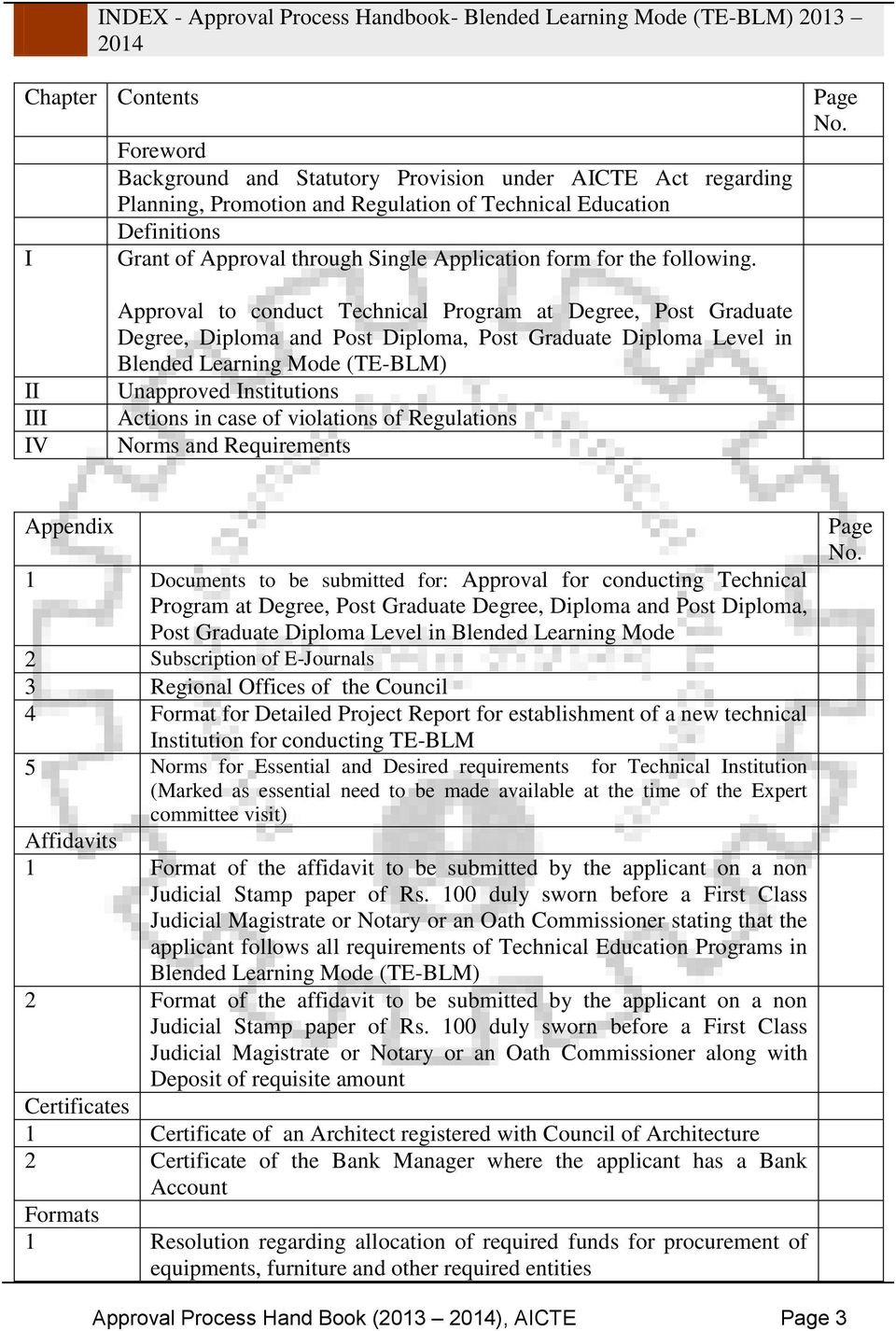
3 INDEX - Approval Process Handbook- Blended Learning Mode (TE-BLM) Chapter Contents I Foreword Background and Statutory Provision under AICTE Act regarding Planning, Promotion and Regulation of Technical Education Definitions Grant of Approval through Single Application form for the following. Page No. II III IV Approval to conduct Technical Program at Degree, Post Graduate Degree, Diploma and Post Diploma, Post Graduate Diploma Level in Blended Learning Mode (TE-BLM) Unapproved stitutions Actions in case of violations of Regulations Norms and Requirements Appendix 1 Documents to be submitted for: Approval for conducting Technical Program at Degree, Post Graduate Degree, Diploma and Post Diploma, Post Graduate Diploma Level in Blended Learning Mode 2 Subscription of E-Journals 3 Regional Offices of the Council 4 Format for Detailed Project Report for establishment of a new technical stitution for conducting TE-BLM 5 Norms for Essential and Desired requirements for Technical stitution (Marked as essential need to be made available at the time of the Expert committee visit) Affidavits 1 Format of the affidavit to be submitted by the applicant on a non Judicial Stamp paper of Rs. 100 duly sworn before a First Class Judicial Magistrate or Notary or an Oath Commissioner stating that the applicant follows all requirements of Technical Education Programs in Blended Learning Mode (TE-BLM) 2 Format of the affidavit to be submitted by the applicant on a non Judicial Stamp paper of Rs. 100 duly sworn before a First Class Judicial Magistrate or Notary or an Oath Commissioner along with Deposit of requisite amount Certificates 1 Certificate of an Architect registered with Council of Architecture 2 Certificate of the Bank Manager where the applicant has a Bank Account Formats 1 Resolution regarding allocation of required funds for procurement of equipments, furniture and other required entities Page No. Approval Process Hand Book ( ), AICTE Page 3
4 1 Background and Statutory Provision under AICTE Act regarding Planning, Promotion and Regulation of Technical Education 1.1 Background The beginning of formal Technical Education in dia can be dated back to the mid 19th century. The major policy initiatives in the pre-independence period included appointment of the dian Universities Commission in 1902, issue of the dian Education policy resolution in 1904 and the Governor General s policy statement of 1913 stressing the importance of Technical Education, the establishment of II Sc. in Bangalore, stitution for Sugar, Textile and Leather Technology in Kanpur, N.C.E. in Bengal in 1905 and dustrial schools in several provinces. Significant developments include: Constitution of the Technical Education Committee of the Central Advisory Board of Education (CABE) of 1943; Preparation of the Sergeant Report of 1944; and Formation of the All dia Council for Technical Education (AICTE) in 1945 by the Government of dia. The AICTE was set up in November 1945 based on the recommendations of CABE to stimulate, coordinate and control the provisions of educational facilities and industrial development of the post war period. At that time, mandate of AICTE basically covered only programs in Engineering and Technology. The growth of industries in the Country, just after independence, also demanded the need for qualified professionals in other fields, such as Business Management, Architecture, Hotel Management, Pharmacy etc. Although the diverse elements of Management such as Commerce, Economics, Finance, Psychology and dustrial Sociology were being taught for a long time, the need for Management Education in a formal way was felt in dia only in the fifties. The Government of dia decided in 1954 to set up a Board of Management Studies under AICTE to formulate standards and promote Management Education. Other major initiatives taken in Management Education include: setting up of the Administrative Staff College of dia at Hyderabad in the late fifties, National Productivity Council and dian stitution of Management in the early sixties. Architecture was covered under the Architects Act, Subsequently, for better coordination of the Professional Courses, Architecture Education was also placed under the purview of AICTE. Hotel Management Education had a st beginning with short programs in Nutrition and Food Science, which started in the late fifties. The National Council of Hotel Management and Catering Technology were set up in 1982, to which all the stitutions of Hotel Management run by the Government are affiliated. Education in other professional fields such as, Pharmacy, Applied Arts & Crafts has also undergone similar developments during the post-independence period. Programs for Technical Education, during the first three Five Year Plans, were devoted toexpansion of Technical Education to meet the growing demand for technical personnel at Diploma, Degree and Post- Graduate Levels. From the fourth Five Year Plan onwards, the emphasis was shifted to the Approval Process Hand Book ( ), AICTE Page 4

5 improvement of quality and standard of Technical Education. This was done through implementation of the Quality Improvement Program consisting of three major components that provided for M.E. / M. Tech and Ph. D Programs, Establishment of Curriculum Design and Development Cells, and Short Term Training Programs. Meanwhile, expansion of stitutions and intake remained at a low level in the Government, Private-aided and University sectors. The policy shift during eighties towards involvement of Private and Voluntary Organizations in the setting up of Technical and Management stitutions on self-financing basis ushered in an era of unprecedented expansion of the Technical Education System, a trend which has continued during successive Five Year Plans. It was in this context that AICTE was given statutory powers by the AICTE Act of Parliament in 1987, with a view to ensure the proper planning and coordinated development of Technical Education System throughout the Country. Technical Education in this context includes fields of Engineering and Technology, Architecture, Town Planning, Management, Pharmacy and Applied Arts & Crafts. 1.2 Growth of Technical Education The growth of Technical Education before independence in the Country has been very slow. The number of Engineering Colleges and Polytechnics (including Pharmacy and Architecture stitutions) in 1947 was 44 and 43 respectively with an intake capacity of 3200 and 3400 respectively. Due to efforts and initiatives taken during successive Five Year Plans and particularly due to policy changes in the eighties to allow participation of Private and Voluntary Organizations in the setting up of Technical stitutions on self-financing basis, the growth of Technical Education has been phenomenal. 1.3 The AICTE Act, 1987 The AICTE Act, 1987 was passed by the Parliament, to provide for the establishment of the All dia Council for Technical Education (AICTE) with a view to ensure proper planning and coordinated development of the Technical Education System throughout the Country, qualitative improvement of such education in relation to planned quantitative growth and the regulation and proper maintenance of norms and standards in the Technical Education System and for matters connected therewith. 1.4 Important Provisions of the AICTE Act on Approval Process Clause 10(g) Clause 10(i) Clause 10(k) Evolve suitable performance appraisal system for Technical stitutions and Universities imparting Technical Education, incorporating Norms and Mechanisms for enforcing accountability. Lay down norms and standards for course curriculum, physical and instructional facilities, staff patterns, staff qualifications, quality instructions, assessment and examination. Grant approval for starting new Technical stitutions and for introduction of new Courses or Programs in consultation with the Agencies concerned. Approval Process Hand Book ( ), AICTE Page 5

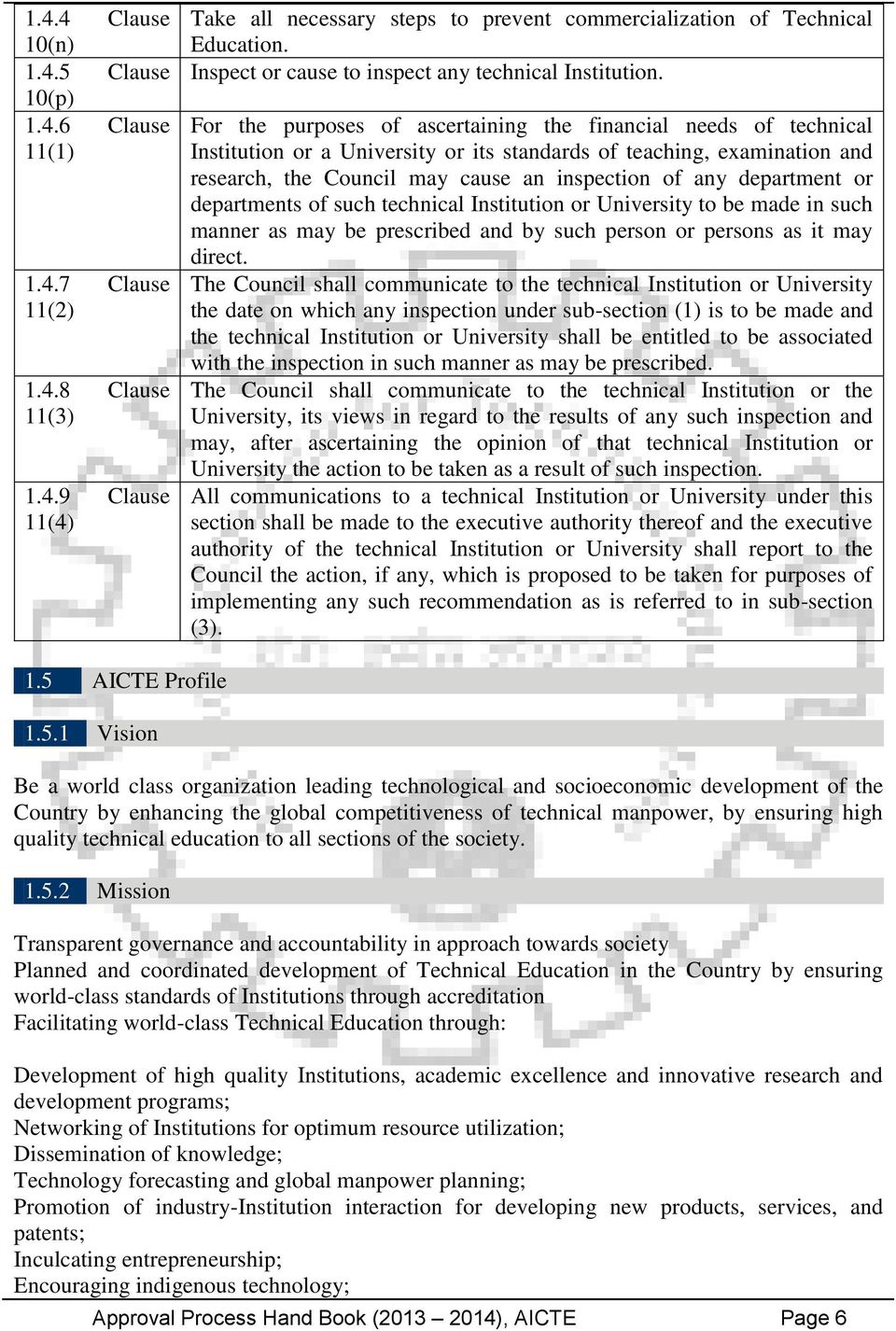
6 1.4.4 Clause 10(n) Clause 10(p) Clause 11(1) Clause 11(2) Clause 11(3) Clause 11(4) Take all necessary steps to prevent commercialization of Technical Education. spect or cause to inspect any technical stitution. For the purposes of ascertaining the financial needs of technical stitution or a University or its standards of teaching, examination and research, the Council may cause an inspection of any department or departments of such technical stitution or University to be made in such manner as may be prescribed and by such person or persons as it may direct. The Council shall communicate to the technical stitution or University the date on which any inspection under sub-section (1) is to be made and the technical stitution or University shall be entitled to be associated with the inspection in such manner as may be prescribed. The Council shall communicate to the technical stitution or the University, its views in regard to the results of any such inspection and may, after ascertaining the opinion of that technical stitution or University the action to be taken as a result of such inspection. All communications to a technical stitution or University under this section shall be made to the executive authority thereof and the executive authority of the technical stitution or University shall report to the Council the action, if any, which is proposed to be taken for purposes of implementing any such recommendation as is referred to in sub-section (3). 1.5 AICTE Profile Vision Be a world class organization leading technological and socioeconomic development of the Country by enhancing the global competitiveness of technical manpower, by ensuring high quality technical education to all sections of the society Mission Transparent governance and accountability in approach towards society Planned and coordinated development of Technical Education in the Country by ensuring world-class standards of stitutions through accreditation Facilitating world-class Technical Education through: Development of high quality stitutions, academic excellence and innovative research and development programs; Networking of stitutions for optimum resource utilization; Dissemination of knowledge; Technology forecasting and global manpower planning; Promotion of industry-stitution interaction for developing new products, services, and patents; culcating entrepreneurship; Encouraging indigenous technology; Approval Process Hand Book ( ), AICTE Page 6
7 Focusing on non-formal education; Providing affordable education to all Making dian Technical Education globally acceptable A vision of a forward-looking organization that has an efficient, flexible and empowered manpower, sensitive to stakeholder s expectations Objectives Promotion of Quality in Technical Education Planning and Coordinated Development of Technical Education System Provide regulations and maintenance of Norms and Standards Responsibilities Promotion of Quality in Technical Education Policy Directions Review of Norms and Standards Assessment of Manpower requirement Liaison with Central Government, State Governments, Universities and other Statutory Bodies Others as provided in the Act.5.5 Major Functions Approval of Diploma / Degree / Post Graduate Degree / Post Graduation / Post Diploma / Post Graduate Diploma Level programs through both conventional and blended learning in Technical stitutions Approval of variation / increase in intake, additional programs in technical stitutions Quality Assurance through Accreditation Participation in the process of granting Deemed University status by MHRD Approval for Foreign Collaborations / Twinning Programs Promotion of dustry-stitution teraction Development of Model Curricula through All dia Boards of Studies Research Promotion Schemes (RPS) National Coordinated Project (NCP) National Facilities in Engineering & Technology with dustrial Collaboration (NAFETIC) Modernization and Removal of Obsolescence (MODROBS) Entrepreneurship Development Cell (EDC) dustry stitute Partnership Cell (IIPC) Travel Grant (TG) Seminar Grant (SG) Faculty Development Program (FDP) Emeritus Fellowship (EF) Career Award for Young Teachers (CAYT) Visiting Professorship (VP) AICTE-INAE Distinguished visiting Professorship (DVP) National Doctoral Fellowship (NDF) Research Park (RP) novation Promotion Scheme (IPS) Post Graduate Grants and GATE Scholarship Approval Process Hand Book ( ), AICTE Page 7

8 AICTE INAE TRF (Teacher Research Fellowship) AICTE INAE TG (Travel Grant to Students) Winter and Summer Schools for the Faculty Finishing Schools for the Students dian National Digital Library in Engineering Sciences and Technology (INDEST) Quality Improvement Program (QIP) NITTR Training Programs for Faculty Networking of Technical stitutions Assessment of National Technical Manpower Promotion of Autonomy in Technical stitutions Connecting Technical stitutions through EDUSAT Network-Live transmission of M.E. / M. Tech programs Steps for Stopping Commercialization of Technical Education Definitions: Approval Process Hand Book 1 Definitions 1.1 Architect means an Architect registered with the Council of Architecture established under the Architect Act Autonomous stitution, means an stitution, to which autonomy is granted and is designated to be so by the Statutes of affiliating University / Board. 1.3 Bandwidth Contention means the contention ratio, ratio of the potential maximum demand to the actual bandwidth. 1.4 Build Operate Transfer (BOT) means a project financing, wherein a private entity receives a concession from the public sector to finance, design, construct, and operate a facility stated in the concession contract. 1.5 Co-Ed stitute means the stitute admitting male and female students. 1.6 Commission means University Grants Commission established under section 4 of the University Grants Commission Act, Compliance Report shall mean the report submitted by Technical stitution complying with requirements as set in this Approval Process handbook, Prevention and prohibition of ragging, in the Format prescribed by AICTE from time to time. 1.8 Deemed University means an stitution declared as deemed to be University under section 3 of the University Grants Commission Act, Foreign Student means, the student who possesses a foreign passport Fresher means a student who has been admitted to an stitution and who is undergoing his/her first year of study in such stitution Metro City means a Metropolitan area as declared by Ministry of Urban Development, New Delhi or concerned State Government authority Minority Educational stitution or Minority stitution means a college or stitution established or maintained by a person or group of persons belonging to a minority, recognized as such by the concerned State Government/UT Administration NBA means National Board of Accreditation set up by AICTE, under Society Registration Act NBA Web-Portal means a web site as defined by NBA pdf file means document in Portable Document Format. Approval Process Hand Book ( ), AICTE Page 8

9 1.16 Prescribed means as prescribed under these Regulations Public Private Partnership (PPP) means a partnership based on a contract or concession agreement, between a Government or statutory entity on the one side and a private sector enterprise on the other side Shift means spell of time in which educational activities of the technical stitution are conducted Single Shift working means where, educational activities of the technical stitution are generally conducted between 9 am to 5 pm State Level Fee Committee means a Committee notified by the concerned State Government / UT Administration for regulation of fee to be charged by the technical stitutions 1.21 Technical Campus means a campus which offers education in one or more technical programs approved by the Council Two Shift working means where, educational activities of the technical stitution are conducted in two spells of time i.e., 1 st shift, generally, between 7 am to 3 pm and 2 nd shift, generally, between 1 pm to 9 pm University Department means a department established and maintained by the University University shall means a University defined under clause (f) of Section 2 of the University Grants Commission Act, Government Aided stitution means technical stitution that meets 50% or more of its recurring expenditure out of the grant received from Government or Government organizations Government stitution means technical stitution established and / or maintained by the Government Private-Self Financing stitution means an stitution started by a Society/Trust/Company and does not received grant/fund from Central and/or State Government and/or Union Territory Administration for meeting its recurring expenditure Second Shift means shift generally from 1pm to 9pm in which educational activities of the technical stitution are conducted Programs means activities of delivering education and instructions to students through traditional setting of classroom and laboratories which require full time presence of students at the stitute Part Time Programs means activities conducted in evening time i.e pm to 9.30 pm (six days a week) wherever First / general shift working exits and are meant only for working professionals or professionals with at least two years of work experience Blended Learning Mode (TE-BLM) means activities of delivering part of classroom learning through distance Mode and Laboratory, Practical and workshop etc through conventional where presence of students at the stitute and giving examination is essential and are meant only for working professionals with certain minimum work experience. Chapter I Grant of Approval through Single Application form for the following. Approval Process Hand Book ( ), AICTE Page 9

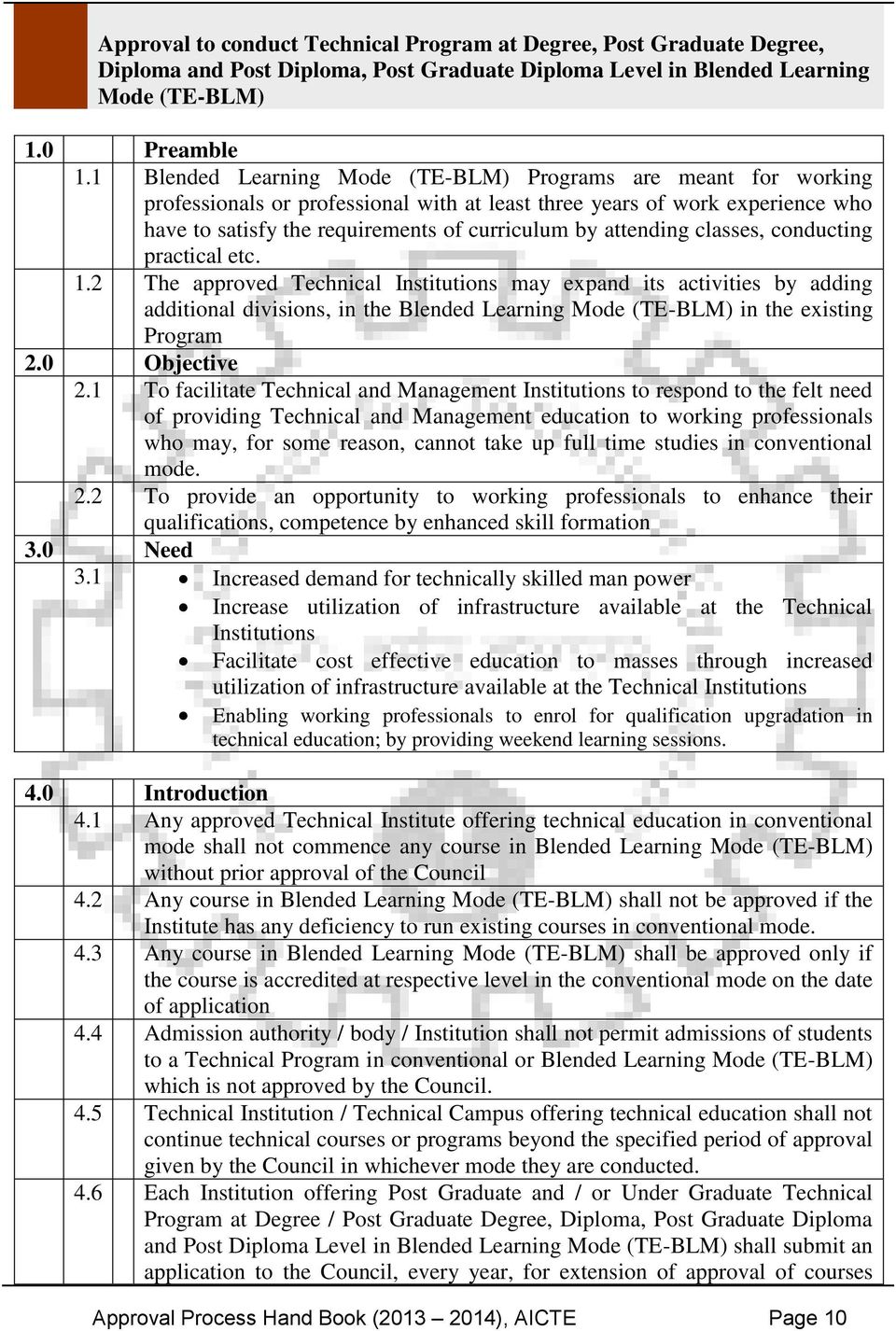
10 Approval to conduct Technical Program at Degree, Post Graduate Degree, Diploma and Post Diploma, Post Graduate Diploma Level in Blended Learning Mode (TE-BLM) 1.0 Preamble 1.1 Blended Learning Mode (TE-BLM) Programs are meant for working professionals or professional with at least three years of work experience who have to satisfy the requirements of curriculum by attending classes, conducting practical etc. 1.2 The approved Technical stitutions may expand its activities by adding additional divisions, in the Blended Learning Mode (TE-BLM) in the existing Program 2.0 Objective 2.1 To facilitate Technical and Management stitutions to respond to the felt need of providing Technical and Management education to working professionals who may, for some reason, cannot take up full time studies in conventional. 2.2 To provide an opportunity to working professionals to enhance their qualifications, competence by enhanced skill formation 3.0 Need 3.1 creased demand for technically skilled man power crease utilization of infrastructure available at the Technical stitutions Facilitate cost effective education to masses through increased utilization of infrastructure available at the Technical stitutions Enabling working professionals to enrol for qualification upgradation in technical education; by providing weekend learning sessions. 4.0 troduction 4.1 Any approved Technical stitute offering technical education in conventional shall not commence any course in Blended Learning Mode (TE-BLM) without prior approval of the Council 4.2 Any course in Blended Learning Mode (TE-BLM) shall not be approved if the stitute has any deficiency to run existing courses in conventional. 4.3 Any course in Blended Learning Mode (TE-BLM) shall be approved only if the course is accredited at respective level in the conventional on the date of application 4.4 Admission authority / body / stitution shall not permit admissions of students to a Technical Program in conventional or Blended Learning Mode (TE-BLM) which is not approved by the Council. 4.5 Technical stitution / Technical Campus offering technical education shall not continue technical courses or programs beyond the specified period of approval given by the Council in whichever they are conducted. 4.6 Each stitution offering Post Graduate and / or Under Graduate Technical Program at Degree / Post Graduate Degree, Diploma, Post Graduate Diploma and Post Diploma Level in Blended Learning Mode (TE-BLM) shall submit an application to the Council, every year, for extension of approval of courses Approval Process Hand Book ( ), AICTE Page 10
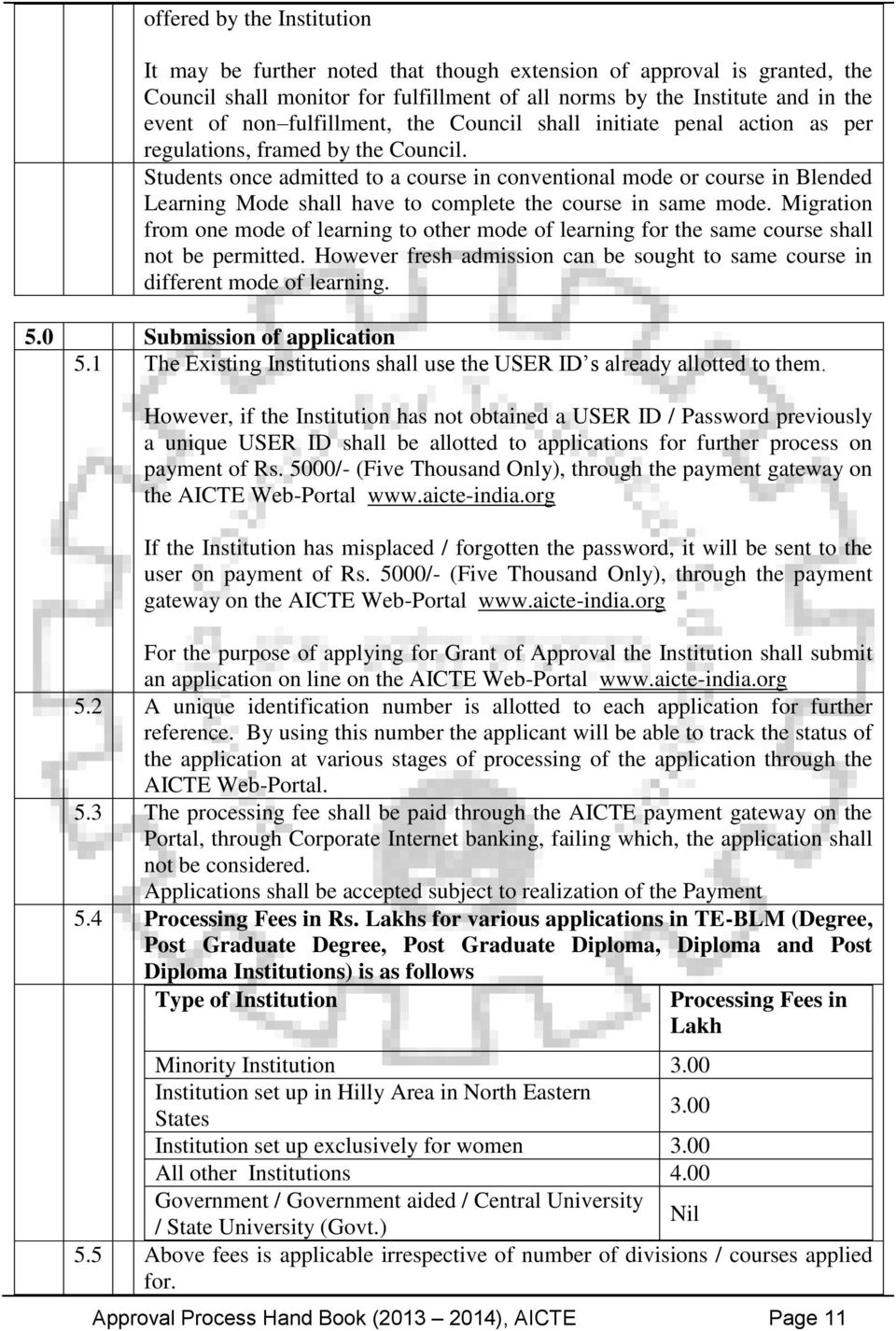
11 offered by the stitution It may be further noted that though extension of approval is granted, the Council shall monitor for fulfillment of all norms by the stitute and in the event of non fulfillment, the Council shall initiate penal action as per regulations, framed by the Council. Students once admitted to a course in conventional or course in Blended Learning Mode shall have to complete the course in same. Migration from one of learning to other of learning for the same course shall not be permitted. However fresh admission can be sought to same course in different of learning. 5.0 Submission of application 5.1 The Existing stitutions shall use the USER ID s already allotted to them. However, if the stitution has not obtained a USER ID / Password previously a unique USER ID shall be allotted to applications for further process on payment of Rs. 5000/- (Five Thousand Only), through the payment gateway on the AICTE Web-Portal If the stitution has misplaced / forgotten the password, it will be sent to the user on payment of Rs. 5000/- (Five Thousand Only), through the payment gateway on the AICTE Web-Portal For the purpose of applying for Grant of Approval the stitution shall submit an application on line on the AICTE Web-Portal A unique identification number is allotted to each application for further reference. By using this number the applicant will be able to track the status of the application at various stages of processing of the application through the AICTE Web-Portal. 5.3 The processing fee shall be paid through the AICTE payment gateway on the Portal, through Corporate ternet banking, failing which, the application shall not be considered. Applications shall be accepted subject to realization of the Payment 5.4 Processing Fees in Rs. Lakhs for various applications in TE-BLM (Degree, Post Graduate Degree, Post Graduate Diploma, Diploma and Post Diploma stitutions) is as follows Type of stitution Processing Fees in Lakh Minority stitution 3.00 stitution set up in Hilly Area in North Eastern States 3.00 stitution set up exclusively for women 3.00 All other stitutions 4.00 Government / Government aided / Central University / State University (Govt.) Nil 5.5 Above fees is applicable irrespective of number of divisions / courses applied for. Approval Process Hand Book ( ), AICTE Page 11
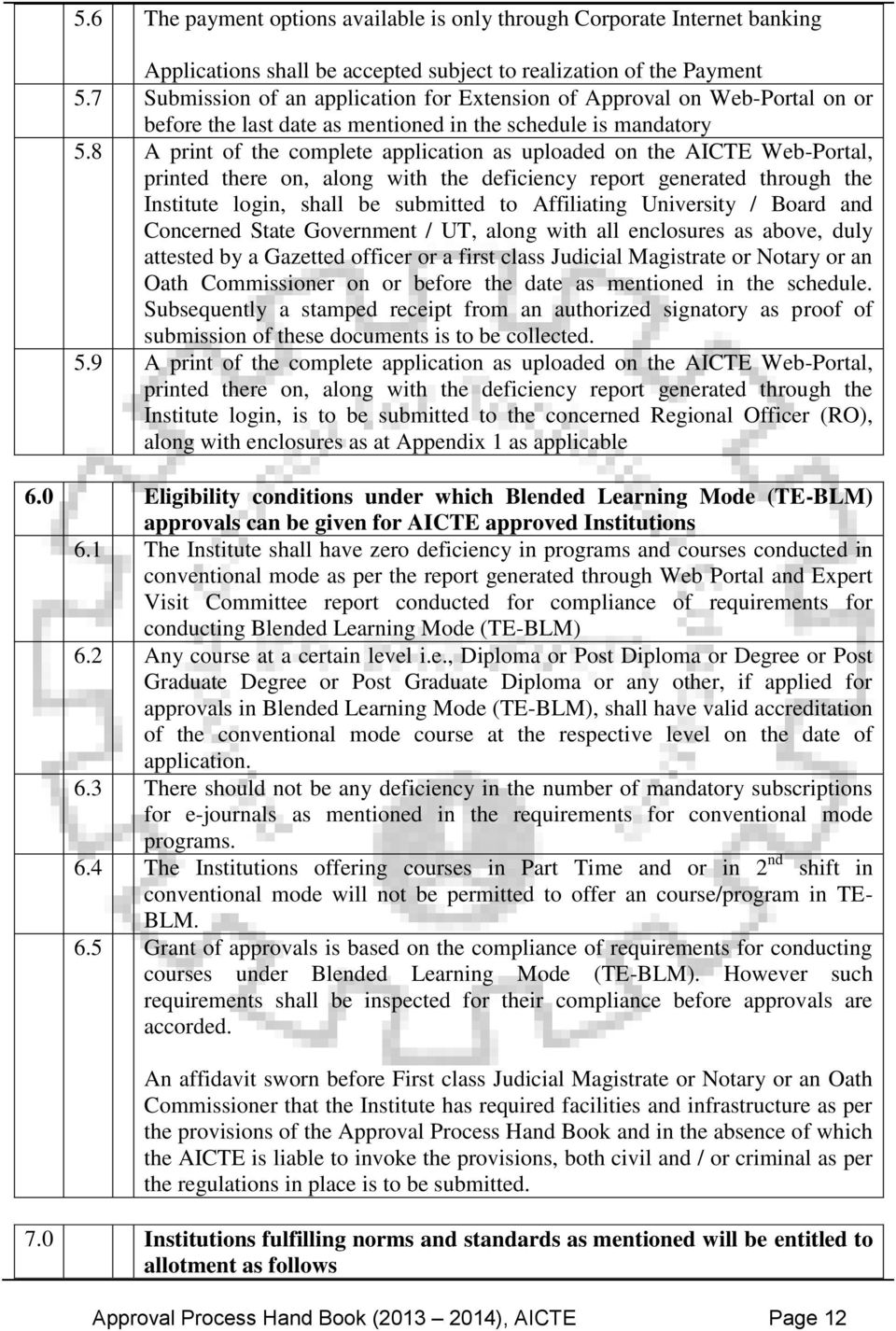
12 5.6 The payment options available is only through Corporate ternet banking Applications shall be accepted subject to realization of the Payment 5.7 Submission of an application for Extension of Approval on Web-Portal on or before the last date as mentioned in the schedule is mandatory 5.8 A print of the complete application as uploaded on the AICTE Web-Portal, printed there on, along with the deficiency report generated through the stitute login, shall be submitted to Affiliating University / Board and Concerned State Government / UT, along with all enclosures as above, duly attested by a Gazetted officer or a first class Judicial Magistrate or Notary or an Oath Commissioner on or before the date as mentioned in the schedule. Subsequently a stamped receipt from an authorized signatory as proof of submission of these documents is to be collected. 5.9 A print of the complete application as uploaded on the AICTE Web-Portal, printed there on, along with the deficiency report generated through the stitute login, is to be submitted to the concerned Regional Officer (RO), along with enclosures as at Appendix 1 as applicable 6.0 Eligibility conditions under which Blended Learning Mode (TE-BLM) approvals can be given for AICTE approved stitutions 6.1 The stitute shall have zero deficiency in programs and courses conducted in conventional as per the report generated through Web Portal and Expert Visit Committee report conducted for compliance of requirements for conducting Blended Learning Mode (TE-BLM) 6.2 Any course at a certain level i.e., Diploma or Post Diploma or Degree or Post Graduate Degree or Post Graduate Diploma or any other, if applied for approvals in Blended Learning Mode (TE-BLM), shall have valid accreditation of the conventional course at the respective level on the date of application. 6.3 There should not be any deficiency in the number of mandatory subscriptions for e-journals as mentioned in the requirements for conventional programs. 6.4 The stitutions offering courses in Part Time and or in 2 nd shift in conventional will not be permitted to offer an course/program in TE- BLM. 6.5 Grant of approvals is based on the compliance of requirements for conducting courses under Blended Learning Mode (TE-BLM). However such requirements shall be inspected for their compliance before approvals are accorded. An affidavit sworn before First class Judicial Magistrate or Notary or an Oath Commissioner that the stitute has required facilities and infrastructure as per the provisions of the Approval Process Hand Book and in the absence of which the AICTE is liable to invoke the provisions, both civil and / or criminal as per the regulations in place is to be submitted. 7.0 stitutions fulfilling norms and standards as mentioned will be entitled to allotment as follows Approval Process Hand Book ( ), AICTE Page 12
13 7.1 All AICTE approved existing Technical stitutions shall be eligible for a maximum one Division per accredited course at respective level within the definition of Division / Program / level at clause 2.11 of the (Grant of approvals for Technical stitutions, Regulations, 2012). 7.2 Section 2(g) of AICTE act 1987, reads Technical Education as Programs of education, research and training in engineering, technology, architecture, town planning, management, pharmacy and applied arts and crafts and such other program or areas as the central government may, in consultation with the council, by notification in the official gazette, declare Based on the above section the following is defined. However, approval processes for Blended Learning Mode (TE-BLM) in Pharmacy and Architecture will be defined later. Existing Professional Societies & registered bodies, who follow the norms, rules and regulations as per this Approval Process Handbook shall be eligible for conducting courses with the approved intake as specified (subject to approval of concerned University) as below: Level Programs No. of take / Divisions division Diploma Engineering, Technology, Management, Applied Arts & Crafts, Hotel Management and Catering Technology (HMCT) Post Diploma / Engineering, Technology, Advanced Diploma Management, Applied Arts & Crafts, Hotel Management and Catering Technology (HMCT) Degree Engineering, Technology, Management, Applied Arts & Crafts, Hotel Management and Catering Technology (HMCT) Post Graduate Engineering, Technology, Degree Applied Arts & Crafts except MCA, Hotel Management and Catering Technology (HMCT) Management PG Management MCA PG MCA No stitute shall be eligible for any supernumerary seats in Blended Learning Mode (TE-BLM) 7.3 Any stitution / Society / Trust / Section 25 company or a member belonging to these if charge-sheeted, shall not be considered for approval of courses under ODL unless they are acquitted. 7.4 No approval shall be granted for conduct of courses under Blended Learning Mode (TE-BLM) to stitutions where a FIR / CBI / CVC / any other investigation agency / Anti Ragging / Punitive action initiated by AICTE for any violation in the norms and standards where enquiries are pending. Approval Process Hand Book ( ), AICTE Page 13

14 8.0 Evaluation of application by Regional Officer 8.1 The Regional Officer shall ensure that the hard copy of the application submitted by the stitute is in order and shall upload appropriate information on the portal. Applications complete in all respect and in order shall only be processed. 8.2 Regional officer shall verify the documents submitted along with the printed application and enable appropriate flag on portal for: 1. Documents are in order, and form an Expert Visit Committee through portal in case of AICTE approved stitutes 2. Conducting Scrutiny of the application by Scrutiny committee, in case of, non AICTE approved stitutes 8.3 The Expert Committee to verify the Physical and frastructural facilities available for the Blended Learning Mode (TE-BLM) education of the applicant stitute shall be constituted by the Regional Officer, by selection of members using automated selection process provided on the AICTE Web-Portal. However, if any member of expert Committee is unable to attend the scheduled visit or refuses or is incapacitated to take part in such scheduled visit, then Regional Officer with prior or post-facto approval of the Chairman Regional Committee may opt to choose any other expert from approved panel of the experts. 8.4 Concerned Regional Officer or an Officer of the Council will assist the committee and make necessary arrangements for conduct of the Expert Committee Visit. However, the concerned regional officer shall not be part of the committee. 9 Evaluation of application by Scrutiny Committee 9.1 The application shall be evaluated by a Scrutiny Committee constituted by the Regional Officer by selecting members using automated selection process provided on the AICTE Web-Portal. 9.2 Concerned Regional Officer or an Officer of the Council will assist the committee and place relevant records and documents before the committee and make necessary arrangements for conduct of the meetings, however, RO or the officer concerned will not be a part of the committee 9.3 The Scrutiny Committee will invite all applicants for presentation of their respective proposals. Applicants are advised to adhere to given Scrutiny schedule and not to remain absent for Scrutiny. If the applicant remains absent for a scrutiny, then in no circumstances what so ever, their applications proposal shall be taken up for a scrutiny. Applicants shall produce original documents along with attested copies at the time of scrutiny 9.4 Based on the recommendations of the Scrutiny Committee, the deficiencies, if Approval Process Hand Book ( ), AICTE Page 14

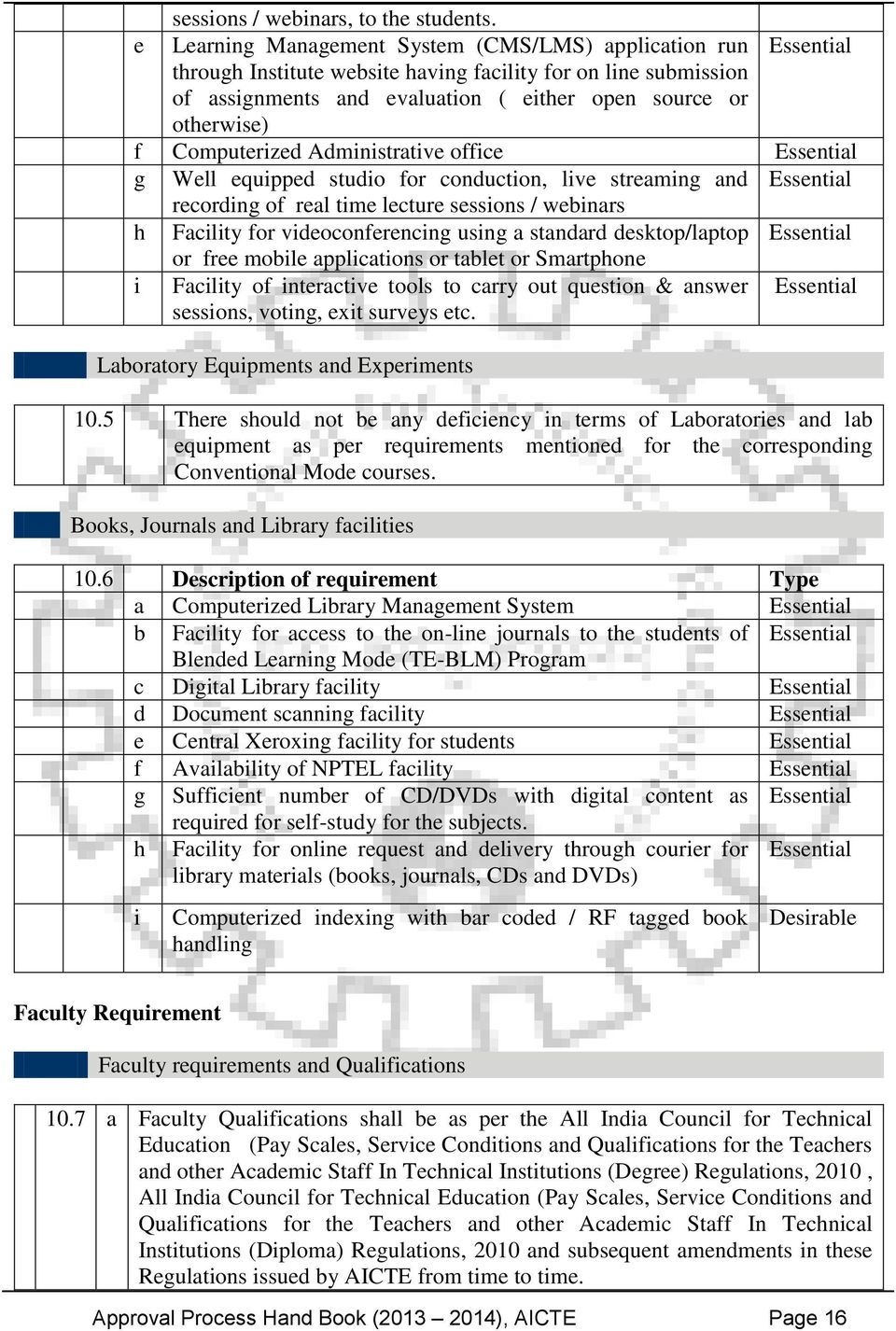
15 any, shall be communicated to the applicant Society / Trust / A company established under Section 25 of Companies Act 1956, through web portal. 9.5 Applicants who are communicated deficiencies or remain absent at the scrutiny shall be eligible for an appeal by way of re-scrutiny, which will be provided to them on the date and time scheduled by AICTE. 9.6 The Scrutiny Committee during re-scrutiny shall verify only the deficiencies pointed out by the Scrutiny Committee as per the norms and standards. 9.7 Applications which are found to be in order in all respects by the Scrutiny Committee or Re-Scrutiny Committee will be processed further. 9.8 The attested copies of original documents shall be retained by the committee. These shall be scanned & uploaded to the Web-Portal along with the report of the committee. This scanning and uploading will be done by the Regional office of the council. 9.9 The Regional officer shall ensure and certify that all the fields of all scrutiny reports are filled completely and are in order All applicants recommended for Expert Committee Visit by the Scrutiny Committee, or Re-Scrutiny Committee shall be communicated the date of Expert Committee Visit through Web Portal Evaluation of application filed by AICTE approved institutions through Expert Committee Visit 10.1 There should not be any deficiency as per requirements mentioned for Conventional Mode courses Expert Visit Committee shall verify only the requirements of conducting course/s in Blended Learning Mode (TE-BLM) An Expert Committee shall visit the premises of the AICTE approved stitution to verify the readiness of availability of the following Norms for Books, Journals, Library facilities, Computer, Software, ternet, Printers and Laboratory Equipments for conducting courses in Blended Learning Mode (TE-BLM) 10.4 Requirements for conducting courses in Blended Learning Type Mode (TE-BLM) a Computer Centre with minimum 40 Computers having latest Essential configuration. (existing computer centre can also be shared for additional requirements as per need of the students in Blended Learning Mode (TE-BLM) b Minimum 10 Mbps, 1:1 ternet connectivity Essential c Wi- Fi facility Essential d HD quality Video streaming facility (including equipments such as video camera/s, streaming server/s, application software, network and communication accessories etc.) with exclusive minimum bandwidth of 4 Mbps, for streaming of real time or DVD/ CD based offline-on-demand lecture Essential Approval Process Hand Book ( ), AICTE Page 15

16 sessions / webinars, to the students. e Learning Management System (CMS/LMS) application run Essential through stitute website having facility for on line submission of assignments and evaluation ( either open source or otherwise) f Computerized Administrative office Essential g Well equipped studio for conduction, live streaming and Essential recording of real time lecture sessions / webinars h Facility for videoconferencing using a standard desktop/laptop Essential or free mobile applications or tablet or Smartphone i Facility of interactive tools to carry out question & answer sessions, voting, exit surveys etc. Essential Laboratory Equipments and Experiments 10.5 There should not be any deficiency in terms of Laboratories and lab equipment as per requirements mentioned for the corresponding Conventional Mode courses. Books, Journals and Library facilities 10.6 Description of requirement Type a Computerized Library Management System Essential b Facility for access to the on-line journals to the students of Essential Blended Learning Mode (TE-BLM) Program c Digital Library facility Essential d Document scanning facility Essential e Central Xeroxing facility for students Essential f Availability of NPTEL facility Essential g Sufficient number of CD/DVDs with digital content as Essential required for self-study for the subjects. h Facility for online request and delivery through courier for library materials (books, journals, CDs and DVDs) Essential i Computerized indexing with bar coded / RF tagged book handling Desirable Faculty Requirement Faculty requirements and Qualifications 10.7 a Faculty Qualifications shall be as per the All dia Council for Technical Education (Pay Scales, Service Conditions and Qualifications for the Teachers and other Academic Staff Technical stitutions (Degree) Regulations, 2010, All dia Council for Technical Education (Pay Scales, Service Conditions and Qualifications for the Teachers and other Academic Staff Technical stitutions (Diploma) Regulations, 2010 and subsequent amendments in these Regulations issued by AICTE from time to time. Approval Process Hand Book ( ), AICTE Page 16
17 b At least two Professors / Associate Professors / Assistant Professors per division of intake shall be appointed on full time basis. One amongst these will be designated and working as the Dean / Coordinator. c Additional faculty shall be appointed as required. Subscription of E-Journals 10.8 a There should not be any deficiency in the number of Mandatory subscriptions for e-journals as mentioned in the requirements for Conventional programs. b It is essential that all such e-journals shall be accessible to the students (under graduate and post-graduate) of courses in Blended Learning Mode (TE-BLM) from their residence or workplace Evaluation of application filed by non AICTE approved institutions by Expert Committee 11.1 An Expert Committee shall visit the premises of the proposed stitution to verify the readiness of availability the requirements as mentioned in clause 10.0 and sub clause 11.8, 11.9, Expert committee shall also verify documents in original as in Appendix 1 and Video as in Appendix 1 with respect to actual infrastructure visited 11.3 Expert Committee shall verify actual availability of equipments, computers, software, internet, printers, book titles, book volumes, subscription of National & ternational E-Journals required for conducting courses under TE-BLM. Mere presentation of purchase orders / payment records for subscription etc. without actual availability shall not be considered 11.4 The applicant will arrange for, Video recording with date and time of the entire proceedings of the Expert Committee visit, which will form part of the Expert Committee report. ternet ready Laptop / desktop, scanner and printer The Expert Committee shall Submit to the RO, Its report in the prescribed Format of the visit. Attested Copies of all documents as in Appendix 1 Video recording of Expert Committee visit. Attendance sheet duly signed / digitally authenticated by, the expert Committee members, and representatives of applicant Society/Trust present during the visit 11.6 The Regional officer shall ensure and certify that all the fields of all Expert Visit Committee reports are filled completely and are in order The scanning and uploading of the relevant documents will be done by the concerned Regional office of the council. addition to the above, the Expert Committee shall also inspect and submit a report on the requirements as mentioned below Approval Process Hand Book ( ), AICTE Page 17
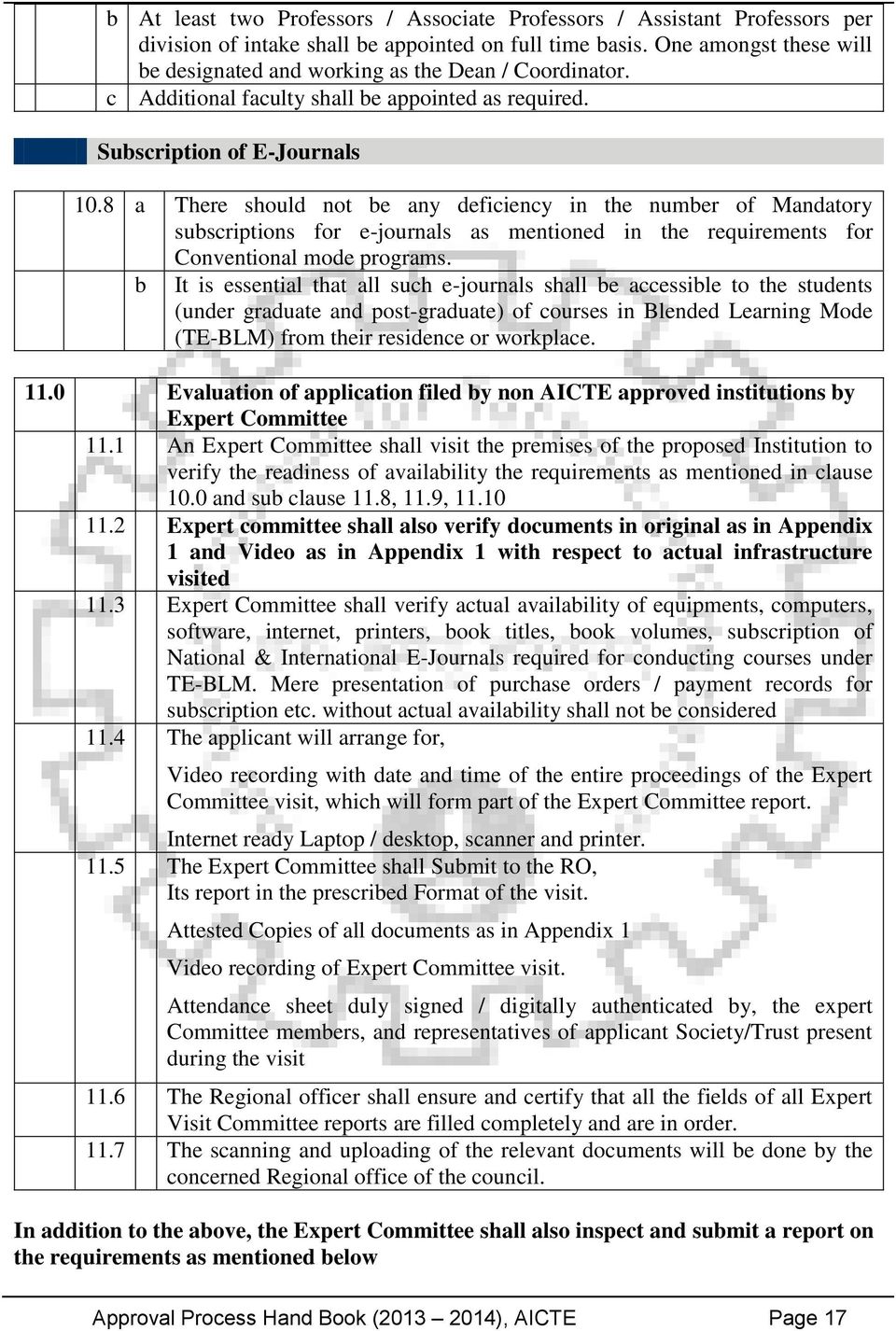
18 11.8 Computers, Software, ternet and Printers exclusive for TE-BLM Number of PCs to students ratio (Min 20 PCs) Legal System Legal Application Software* LAN & ternet Mail Server & Client Engineering / Technology Pharmacy Architecture & Town Planning Applied Arts & Crafts Dip 1:6 UG 1:4 PG 1:2 Dip 1:6 UG 1:6 PG 1:6 Dip 1:6 UG 1:5 PG 1:5 Dip 1:5 UG 1:5 PG 1: All Desired All Desired All Desired All Desired HMCT Dip 1: All Desired UG 1:6 Management PG 1: All Desired MCA PG 1: All Desired 11.8 a Utilization of Open Source Software may be encouraged b c d e f Secured Wi Fi facility Purchase of most recent hardware is desired. Library, Administrative offices and Faculty members shall be provided with exclusive computing facilities along with LAN and ternet. This shall be considered as over and above the requirement meant for PCs to students Adequate number of software licenses is required # Central Xeroxing facility for students is preferred 11.9 Laboratory Equipments and Experiments 11.9 a The laboratories shall have equipments as appropriate for experiments as stated / suitable for the requirements of the affiliating University / Board s curriculum. It is desired that number of experiment set up be so arranged that maximum four students shall work on one set Books, Journals and Library facilities exclusive for TE_BLM Approval Process Hand Book ( ), AICTE Page 18
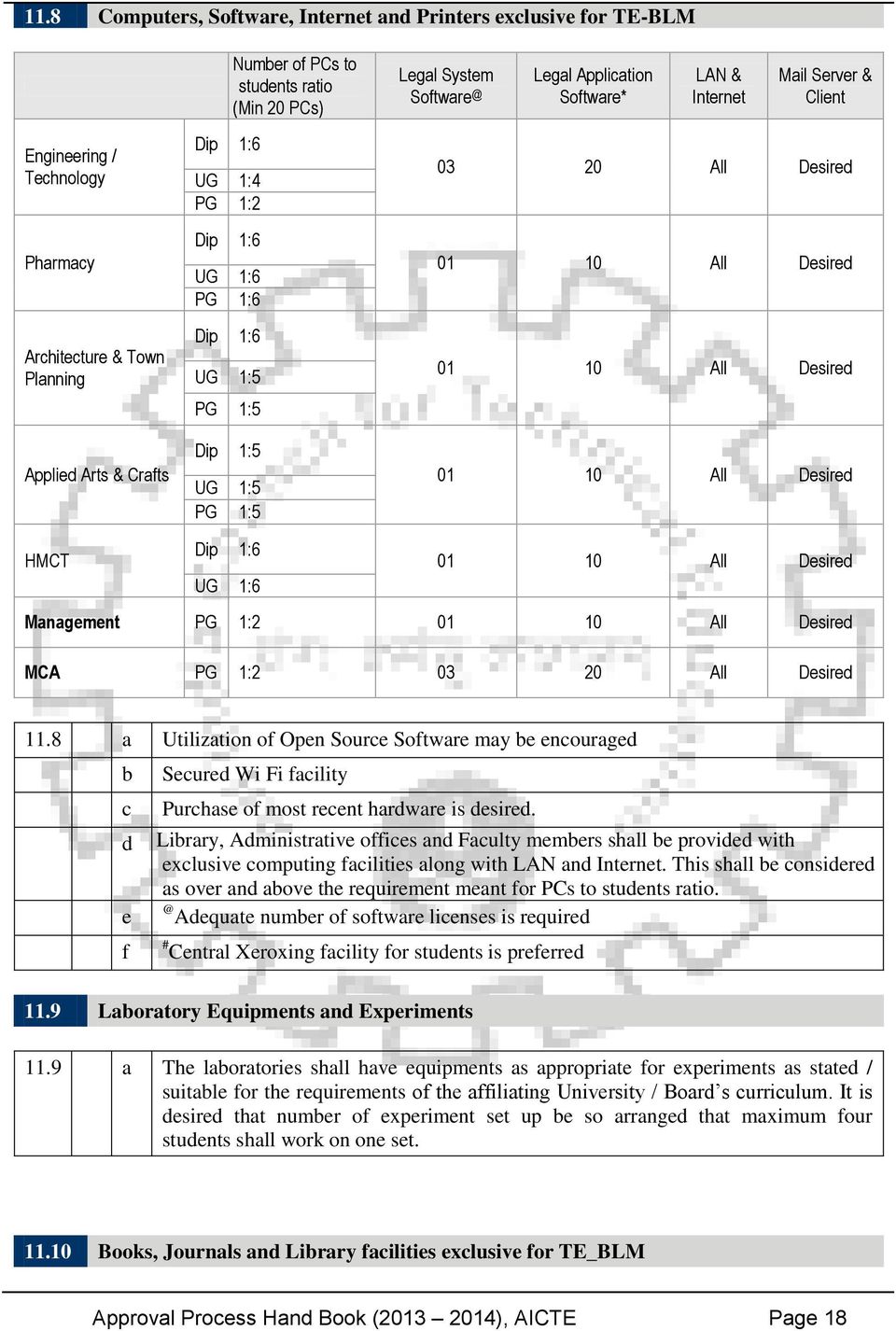
19 Half the number as required for UG course in the same Program Half the number as required for UG course in the same Program Half the number as required for UG course in the same Program - 15 % (Max 150) 25 % (Max 100) Desirable As per Appendix 2 15 % (Max 150) Titles Volumes National Journals ternational Journals E Journals Reading Room seating Program Total number of Divisions Number % of total students Engineering / Technology(UG) Pharmacy(UG) Architecture & Town Planning (UG) Applied Arts & Crafts(UG) HMCT MBA / PGDM / MCA (PG) Engineering / Technology/ Pharmacy / Architecture & Town Planning / Applied Arts & Crafts (PG) Diploma in Engineering / Tech / Pharmacy / Architecture & Town Planning Applied Arts & Crafts, HMCT B B B B B B B B 50 per course xB 250 per course - division xB xB xB xB xB xB xB xB xB xB As Required 100 6xB 6xB 6xB 6xB 6xB 12xB 5xB - B=Number of divisions at 1 st year (shift 1+2) + Number of 2 nd year direct divisions (shift 1+2) 1 Book titles and volumes required at the time of starting new stitution. 2 Requirements of Book titles and volumes in stitutions started before 1950 shall be calculated considering starting year as Yearly increment. 4 Component for additional division / course. 5 Hard Copy ternational Journals is desirable to procure. However subscription to E-Journals and National Journals as per Appendix-2 is essential. 6 Journals and Books may also include subjects of Science & Humanities. 7 Digital Library facility with multimedia facility is essential. 8 Reprographic facility in the library is essential. 9 Document scanning facility in the library is essential. Approval Process Hand Book ( ), AICTE Page 19

20 10 Document printing facility in the library is essential. 11 Library books/non books classification as per standard classification methods is essential. 12 Availability of NPTEL facility at the library is essential. 13 Computerized indexing with bar coded / RF tagged book handling is desired Norms for Space requirement for Technical stitution under TE-BLM Level Diploma Post / Advanced Diploma Degree Post Graduate Degree Management PG MCA PG Programs Engineering, Technology, Management, Applied Arts & Crafts, Hotel Management and Catering Technology (HMCT) Engineering, Technology, Management, Applied Arts & Crafts, Hotel Management and Catering Technology (HMCT) Engineering, Technology, Management, Applied Arts & Crafts, Hotel Management and Catering Technology (HMCT) Engineering Technology, Applied Arts & Crafts except MCA, Hotel Management and Catering Technology (HMCT) Management MCA Requirements a stitute shall have no deficiency as per requirements of Conventional program. b Number of Class rooms of 66 sqm each to be provided shall be half the number of divisions approved along with projecting media equipment and ICT enabled learning. c Additional ICT enabled Reading room area of at least 200 sqm with a seating capacity of 60 shall be provided with complete infrastructure for access to online journals and to view / listen to the digital content specifically developed for the program. d The promoter society / trust / A company established under Section 25 of Companies Act 1956, of a new technical Education stitution shall have the land as required and prescribed in its lawful possession with clear title in the name of the promoter society / trust / A company established under Section 25 of Companies Act 1956, on or before the date of submission of application. Provided that it shall be open for the promoter society / trust / A company established under Section 25 of Companies Act 1956, proposed stitution to mortgage the building only after the receipt of letter of approval, only for raising the recourses for the purpose of development of the Technical Education stitute situated in the same building. e Building and built up area under consideration shall be on one plot having no obstacles like river, canals, rail tracks, highways, or any other such entity hampering continuity of land. f Building plan of the stitution shall be prepared by an Architect registered with Council of Architecture and approved by the Competent Authority as designated by concerned State Government / UT. Approval Process Hand Book ( ), AICTE Page 20

21 The fund position of the applicant (Self financed stitutions, Private Universities) in the form of FDRs in the name of Society / Trust in Nationalised Bank or Scheduled Commercial Banks recognised by Reserve Bank of dia shall be as under on the date of Scrutiny. Program proposed (Degree, Post Graduate Degree, Diploma and Post Diploma ) a Engineering & Technology 100 b Hotel Management & Catering Technology Total minimum funds required, Rupees in Lakhs as proof of operational expenses (at the time of Scrutiny) in the form of FDR in the name of Society / Trust 50 c Applied Arts & Crafts 50 d MCA 50 e Management The applicants shall not use name the technical stitution in such a way that the abbreviated form of the name of the technical stitution becomes IIM or IIT or II Sc or NIT or AICTE or UGC or MHRD or GOI. The applicant shall also not use the word(s) Government, dia, dian, National, All dia, All dia council, Commission anywhere in the name of the technical stitution and other names as prohibited under the Emblems And Names (Prevention of Improper Use) Act, Provided that the restrictions mentioned above shall not be applicable, if the technical stitution is established by Government of dia or its name is approved by the Government of dia Name of the Technical stitute for which approval is accorded by the Council shall not be changed without the approval of the Council. The Council may permit the change of name as per laid down procedures as given in this handbook 13 Evaluation of application by Regional Committee 13.1 The reports of Expert Visiting Committee will be made available to the Regional Committee / Regional subcommittee comprising of at least three members of the Regional Committee. Regional Committee / Regional subcommittee will consider these reports along with views of concerned State Government / UT and affiliating University / Board, if any, and recommend the application for further processing Applicants, whose applications are recommended for further processing after the decision of the Executive Committee, shall be informed for submission of a Money Deposit along with an affidavit 2. The Regional officer shall ensure and certify that all the fields of Regional Committee / Regional subcommittee, report are filled completely and are in order Applicants shall deposit the prescribed amount of Money in AICTE s bank account for an amount as applicable to the category of the stitutions indicated in table 13.4 below (Government, Government Aided stitutions Approval Process Hand Book ( ), AICTE Page 21
22 and University Departments (Government) are exempted) 13.4 Money deposit for Non AICTE Approved stitutions: Per Program Under Graduate Post Graduate Degree and Post Graduate Diploma Engineering, Technology, Management, Applied Arts & Crafts, Hotel Management and Catering Technology, MCA Minority / Women / Hilly Area in North Eastern States Others Minority / Women / Hilly Area in North Eastern States Rs. Lakhs Others Diploma and Post Diploma Minority / Women / Hilly Area in North Eastern States Approval Process Hand Book ( ), AICTE Page 22 Others The amount deposited by the stitution shall remain with the Council for 10 years which may be extended as per the regulations. The interest accrued on this deposited amount shall be credited to the Council The Principle amount shall be returned to the Society / Trust / A company established under Section 25 of Companies Act 1956, on expiry of the term. However, the term of the deposited amount could be extended for a further period as may be decided on case to case basis and / or forfeited in case of any violation of norms, conditions, and requirements and / or nonperformance by the stitution and / or complaints against the stitution Regional Officer concerned, while forwarding the recommendations of the Regional Committee / Regional subcommittee for further process of issuance of LOA or otherwise to AICTE headquarters, for placing before the Executive Committee shall verify that the processes and parameters prescribed under these regulations and approval process hand book are followed by the Scrutiny Committee and the Regional Committee / Regional subcommittee 13.8 The bureau concerned at AICTE headquarters shall also verify that the processes and parameters prescribed under these regulations and approval process hand book are followed. The concerned officer in Approval Bureau shall ensure and certify that all the fields of all the reports are filled completely and are in order Views of State Government and affiliating University 14.1 The State Government / UT and the affiliating University / Board will
23 forward to the concerned Regional Office of the Council, their views on the applications received, with valid reasons or otherwise within a period of 15 days from the date of receipt of applications The views of the State Government / UT and the affiliating University / Board will be taken into account by the Regional Committee / Regional subcommittee while taking the decision whether the application is to be processed further or not. the absence of receipt of views from the State Government / UT and / or the affiliating University / Board, the Council will proceed for completion of approval process. Professional bodies and societies shall obtain affiliation from the affiliating University before starting the course in TE-BLM Grant of approval 15.1 The recommendations of the Regional Committee / Regional subcommittee for further process of issuance of LOA or otherwise shall be placed before the Executive Committee of AICTE. Executive Committee after considering the recommendations of the Regional Committee / Regional subcommittee, shall take a final decision at its meeting on grant of approval or otherwise. Further based on the decision of the Executive Committee, Letter of Approval or Letter of Rejection shall be issued by the Member Secretary or an officer authorized by him. Validity of the letter of approval, if issued, shall be for two academic years from date of issue of letter of approval for obtaining affiliation with respective University and fulfilling State Government requirements for admissions in the current session. If the stitution fails to admit the students in the current academic session due to non-affiliation by the University or non-fulfillment of State Government requirements, the approval of AICTE shall stand withdrawn and the stitution shall have to apply on line on AICTE web portal for seeking fresh approval in the next academic session Appointment of Dean / Coordinator and teaching staff for courses in Blended Learning Mode (TE-BLM) 16.1 stitutions granted Letter of Approval for starting courses in Blended Learning Mode (TE-BLM) shall comply with appointment of exclusive teaching staff and Dean / Coordinator for course/s in Blended Learning Mode (TE-BLM) as the case may be, as per policy regarding minimum qualifications pay scale etc., and other technical supporting staff & administrative staff as per the schedule prescribed in the approval process hand book. stitutions shall appoint teaching staff / Dean / Co-ordinator and other supporting staff strictly in accordance with the methods and procedures of Approval Process Hand Book ( ), AICTE Page 23
24 the concerned affiliating University, State Governments and Hon ble Court directions if any, and as applicable in the case of selection procedures and selection committees. The information about these appointments of staff in the prescribed format shall also be uploaded on the Web-Portal of AICTE. no circumstances unless the appointment of all teaching and other staff is in place, the stitutes shall start the approved Technical Course/s in distance. 17 Appeal Procedure Procedure for submission of appeal and evaluation by the Standing Appeal Committee for applications rejected at Executive Committee The stitution, if aggrieved by the decision of AICTE taken on their application seeking approval of starting Blended Learning Mode (TE-BLM) shall be given only one opportunity of an appeal on the date and time scheduled by AICTE The Appeal of the stitution will be considered by the Standing Appeal Committee and for the purpose of consideration of the Appeal, the Standing Appeal Committee may devise its own procedure. The appeal schedule shall be notified on the web Portal The report of the Standing Appeal Committee shall be communicated by uploading on the web-portal. The report of the Standing Appeal Committee shall be placed before the Council whose decision shall be final Applicants are advised to adhere to given Standing Appeal Committee schedule and not to remain absent for Appeal. If the applicant remains absent for Appeal, then in no circumstances what so ever, their applications / proposal shall be taken up by the Standing Appeal Committee and such stitutions if they so desire may apply afresh for the next academic session. Such stitutions remaining absent for any reason whatsoever shall not be entitled for any further appeal An officer of the Council shall place the records before the Standing Appeal Committee. A representative of the stitute shall be invited to place the point of view of the stitute before the Standing Appeal Committee for consideration The Standing Appeal Committee at its discretion may recommend Expert Visit for verification of the claims made by the applicant Society or Trust or A company established under Section 25 of Companies Act 1956 or may reject the appeal. The concern officer in Approval Bureau shall ensure and certify that all the Approval Process Hand Book ( ), AICTE Page 24
25 fields of all the reports are filled completely and are in order Applications which are found to be in order in all respects by the Expert Visit Committee will be processed further 17.8 The report of the Expert Visit Committee as applicable shall be placed along with the observations of the Approval Bureau, before the Standing Appeal Committee for review on the date and time scheduled by AICTE. The report of the Standing Appeal Committee shall be placed before the Council whose decision shall be final. The concern officer in Approval Bureau shall ensure and certify that all the fields of all the reports are filled completely and are in order The decision of the Council shall be communicated to the applicant in form of Letter of Approval or Letter of Rejection or in the form of an appropriate communication The letter of rejection shall be issued by the Member Secretary or an officer authorised by him, AICTE case of rejection of the proposal, it shall be open for the applicant to make a fresh application next year as stated in this handbook 18.0 Eligibility of the Candidate 18.1 Eligibility for admissions to any course at any level in Blended Learning Mode (TE-BLM) shall be subject to 1. Acquiring minimum qualification same as Conventional 2. Work experience in relevant area and 3. Passing the eligibility test for admissions conducted centrally by the agency authorised by the Council Jurisdiction of the admissions The jurisdiction of conducting course in Blended Learning Mode (TE-BLM) shall be the jurisdiction of the affiliating University/ Board for conducting courses in conventional. University will restrict admission to programs in blended learning to those candidates who have either permanent residence in the area of its jurisdiction or candidates who have been posted for their work in the area of its jurisdiction at the time of admission. Level Programs Entry level Qualifications to be obtained in Xth & Diploma Degree National XIIth entrance std Test (BLM - NET) Work Experience in Years in relevant area Approval Process Hand Book ( ), AICTE Page 25
26 Diploma Engineering, Technology, Management, Applied Arts & Crafts, Hotel Management and Catering Technology (HMCT) regular No 02 Post / Advanced Diploma Engineering, Technology, Management, Applied Arts & Crafts, Hotel Management and Catering Technology (HMCT) regular distance in distance regular - No 03 Yes Degree Engineering, Technology, Management, Applied Arts & Crafts, Hotel Management and Catering Technology (HMCT) regular distance in distance regular - Yes 03 - No Post Graduate Degree Engineering Technology, Applied Arts & Crafts except MCA, Hotel Management and Catering Technology (HMCT) regular distance regular in distance regular regular regular distance regular No 03 Yes No Management PG Management regular distance in distance regular regular distance No 03 Yes Approval Process Hand Book ( ), AICTE Page 26
27 regular distance MCA PG MCA regular distance regular distance regular in distance in distance regular regular in distance regular regular regular distance regular regular No No No 03 Yes No No 19.0 Duration of the course in Blended Learning Mode (TE-BLM) Program 19.1 Duration of the program shall be flexible and as per rules and curriculum of the affiliating University / Board. However, total duration in terms of years/months/hrs/credits cannot be less than the corresponding duration for the program offered in Conventional Academic Structure The syllabus (course work) shall be the same as that used for a Full Time conventional program and as prescribed by the affiliating University/ Board Certificate awarded a The qualifying degree / diploma certificate issued by the concerned University / Board should clearly mention that the qualification has been obtained in Blended Learning Mode (TE-BLM) 19.4 Fees & Admissions a The concerned State Government / UT shall notify the tuition and other fees for candidates to be admitted to Blended Learning Mode (TE-BLM) or the stitutions will have to get approval for the fees from the State level Fees Committee set up by the State Government. b Admissions to these seats shall be done on merit basis through Centralized Admission process Time Schedule for processing of applications 20.1 AICTE shall notify through a public notice published in the leading news papers and through the AICTE Web-Portal regarding cut off dates for various purposes including receipt of applications and processing thereof from time to time if so necessitated. The time schedule mentioned in the public notice shall be final and binding. Approval Process Hand Book ( ), AICTE Page 27
28 The last date of submission of application form shall mean submission of application on Portal and generation of paying slip not later than the last date as mentioned in the time schedule for this purpose and as notified in the public notice published in the leading news papers and through the AICTE Web-Portal. Chapter II 1 Unapproved stitutions 1.1 No stitution shall offer Technical program or course in any without approval of the Council. Provided further that any stitution offering Technical Program without approval of the Council, shall be termed as unapproved if a It is started without prior approval by the Council b It is working in temporary location / at location not approved by the Council c It is declared as Unapproved by the Council 2 The Council shall maintain a list of un approved stitutions based on the information received by the Council and shall also inform the general public about the same from time to time Provided further that any Technical stitution, which has already started without following AICTE approval procedure, wishes to submit an application / proposal shall be considered as new Technical stitution. For such purpose, they shall apply as per the provisions in this Approval Process Handbook. Its legal date of starting will be from the date of issue of the Letter of Approval. Students, who are admitted prior to approval by the Council, will not have any right for re-admission and will have to fulfill all the requirements for admission as prescribed by the competent admission authority. 3 The stitutions conducting courses / Programs in technical education, in temporary location or at location not approved by the Council, shall be liable for action for closure and other appropriate action as per Regulations against defaulting Societies / Trusts / Companies/ associated dividuals as the case may be. 4 a The Council shall inform respective State Governments UT administration to initiate appropriate penal, civil and / or criminal action against such defaulting stitutions / Societies / Trusts / Companies / Associated dividuals as the case may be. b case if such stitutions make a representation then hearing may be given to these stitutions and decision shall be taken as per the provisions in this Approval Process Handbook. Approval Process Hand Book ( ), AICTE Page 28
29 Chapter III 1 Action in case of violation of Regulations 1.1 An stitution running any Program / Course in Technical Education in any in violation of Regulations, shall be liable to appropriate initiation of Penal Civil action including withdrawal of approval, if any, and / or criminal action by the Council against defaulting Societies / Trusts / Companies / Associated dividuals and / or the stitution, as the case may be. 1.2 Provided that, if any Technical stitution contravenes any of the provisions of concerned regulations, the council after making such inquiry as it may consider appropriate and after giving Technical stitution concerned, an opportunity of being heard, under appropriate regulations, withdraw approval to the concerned Technical stitution / Program / Course. Provide further that in case of such a withdrawal, the operations of the said Technical stitution / Program / Course shall not be started again before completion of two academic years from the date of such a withdrawal. Provided further that, the students admitted to the stitute whose approval has been withdrawal, shall be redistributed to other stitutions in the jurisdiction of the affiliating University by the competent authority of the respective State Governments. 2 Non submission / complete submission of application for approval The Technical stitutions shall submit the application for approval in the prescribed format along with the enclosures to the concerned Regional Office of AICTE each year for approval by the Council, even in cases where the approval to the Program / Course was granted for more than one year. The last date for receipt of such application with or without Late Fee shall be as mentioned in the schedule. Non submission / incomplete submission of application for approval shall invite appropriate penal action against the stitution. The stitution shall be liable to the following punitive action from any one or more of the following by the council. No admission status in one / more courses for one academic year in Conventional and or Blended Learning Mode (TE-BLM) Withdrawal of approval for Program / course in any. Withdrawal of approval of the stitution. 3 Excess admissions 3.1 Excess admissions over the sanctioned intake shall not be allowed under any circumstances. case any excess admission is reported to / noted by the Council, appropriate penal action will be initiated against the stitution. The stitution shall be liable to following punitive action from any one or more of the following by the council. Excess admission fee amounting five times the total fees collected per student shall be levied against each excess admission. Approval Process Hand Book ( ), AICTE Page 29
30 No admission status in one / more courses for one academic year in Conventional / Blended Learning Mode (TE-BLM) Withdrawal of approval for Program / course in any. Withdrawal of approval of the stitution. 3.2 Amount in respect of Excess admission fee shall be remitted to Member Secretary, AICTE as per instructions issued by the council. 4 Non fulfillment of requirement of qualified Principal / Director/Dean 4.1 stitutions not having qualified Principal / Director/Dean for period, more than 18 months shall be liable to following punitive action by the council. No admission status for one academic year 5 Non fulfillment in Faculty: Student ratio, not adhering to pay scales and/or qualifications prescribed for teaching staff 5.1 stitutions not maintaining appointing prescribed Faculty, not adhering to Pay scales, or qualifications prescribed for teaching staff for more than 18 months, shall be liable to following punitive action by the council from any one or more of the following. No admission status in respective courses in Blended Learning Mode (TE-BLM) for one academic year Withdrawal of approval in the respective course in Blended Learning Mode (TE- BLM) Withdrawal of approval of the stitution 6 Non fulfillment in Computer, Software, ternet, Printers, Laboratory Equipments, Books, Journals, Library facilities requirements 6.1 stitutions not maintaining prescribed Computer, Software, ternet, Printers, Laboratory Equipments and Books, Journals, Library facilities shall be liable to following punitive action from any one or more of the following by the council. No admission status in respective courses in Blended Learning Mode (TE-BLM) for one academic year Withdrawal of approval in the respective course in Blended Learning Mode (TE- BLM) Withdrawal of approval of the stitution 7 Refund cases stitutions not following guidelines issued by the Council regarding refund of fees on cancellations of admissions or delaying refunds shall be liable to following punitive action from any one or more of the following by the council. Fine for non compliance of refund of fees levied against each case shall be twice the total fees collected per student. No admission status in one / more courses in any Mode for one academic year Withdrawal of approval for Program / Course in any Mode 8 Amount in respect of Fine for non compliance of refund of fees shall be remitted to Member Secretary, AICTE as per instructions of the council. Approval Process Hand Book ( ), AICTE Page 30
31 9 Procedure for restoration against punitive actions 9.1 Applicant makes an application for restoration on the Web Portal along with the application for extension of approval of the next academic year. 9.2 The restoration is subject to Expert visit 9.3 The expert Visit Committee shall verify all the requirements as per the approval process hand book. 9.4 Expert Visit Committee report shall be placed before Standing Complaint Committee. 9.5 Recommendations of the Standing Complaint Committee shall be placed before Executive Committee for necessary Approval/ratification. 9.6 The stitute may appeal as per the procedure of appeal in Chapter I if the status quo on punitive action is maintained. Chapter IV 1 Norms & Requirements 1.1 Duration and Entry Level Qualifications for the Technical Programs Refer to APH in force 1.2 Approved Nomenclature of Courses Refer to APH in force 1.3 Grievance Redressal Refer to APH in force 1.4 Structure of various Committees Refer to APH in force 1.5 Cut off dates and Academic Calendar Refer to APH in force 1.6 Abbreviations Refer to APH in force 1.7 Documents to be submitted for: Approval for conducting Appendix 1 Technical Program at Degree, Post Graduate Degree, Diploma and Post Diploma, Post Graduate Diploma Level in Blended Learning Mode 1.8 Subscription of E-Journals Appendix Regional Offices of the Council Appendix Format for Detailed Project Report for establishment of a Appendix 4 new technical stitution for conducting TE-BLM 1.10 Norms for Essential and Desired requirements for Technical stitution (Marked as essential need to be made available at the time of the Expert committee visit) Appendix Appendix 1 1 Documents to be submitted for Approval Process Hand Book ( ), AICTE Page 31
32 Approval for conducting Technical Program at Degree, Post Graduate Degree, Diploma and Post Diploma, Post Graduate Diploma Level in Blended Learning Mode (TE-BLM) For non AICTE approved stitutions Applicant shall submit following supporting documents duly attested by a gazetted officer or a first class Judicial Magistrate or Notary or an Oath Commissioner and other necessary information to the Regional Office Supporting documents other than affidavits shall be made on the applicant s letterheads and duly authenticated by the authorized signatory of applicant or by the head of the stitution Documents to be submitted along with the application to the Regional Office 1 Building plan of the stitution should have been prepared by an Architect registered with Council of Architecture and approved by the Competent Authority as designated by concerned State Government / UT 2 An affidavit 1, in a Format as prescribed on the Web-Portal, on a Non-Judicial Stamp Paper of Rs. 100/-, duly sworn before a First Class Judicial Magistrate or Notary or an Oath Commissioner 3 Resolution by the applicant orgnisation in a Format 1 as prescribed on the Web-Portal 4 Certificate 1 issued by an architect regarding approved building plans 5 Certificate 2 issued by an bank manager regarding financial status of applicant 7 A print of the complete application as uploaded to the AICTE Web-Portal, printed there on. 8 A receipt with official seal from the authorized signatory of the State Government as proof of submission of these documents. 9 A receipt with official seal from the authorized signatory of the affiliating University as proof of submission of these documents 10 Detailed Project Report (DPR) attached as a.pdf file. 11 Registration document of the Society / Trust / A company established under Section 25 of Companies Act 1956 / PPP / BOT indicating its members, objectives and Memorandum of Associations and Rules, duly attested / certified by the concerned Authority 12 Details of Board of Governors of the stitute 13 Provided that in the case of a company established under Section 25 of Companies Approval Process Hand Book ( ), AICTE Page 32
33 Act 1956, the MOA and Rules must contain a provision that the objective of the company is not profit making and any surplus earning shall be used exclusively for the purpose of development of Technical stitute. 15 Resolution by the applicant orgnisation, pertaining to starting the Technical stitute or adding new program and allocation of land / building / funds to proposed activities in the Format 1 prescribed on the Web-Portal 16 Documents showing ownership in the name of the applicant in the form of Registered Sale Deed / Irrevocable Gift Deed (Registered) / Irrevocable Lease (for a minimum period of 30 years) by the concerned authority or any other documents issued by the concerned competent authority establishing the ownership and possession of the land in the name of the applicant. case, the land documents are in vernacular language, notarized English translation of the documents shall be produced. 17 Land Use Certificate permitting the land to be used for educational purpose, from the Competent Authority along with Topo sketch / Village Map indicating land Survey Numbers and a copy of road map showing location of the proposed site of the stitution. 18 Land Conversion Certificate permitting the land to be used for educational purpose to establish a college, from the Competent Authority along with Topo sketch / Village Map indicating land Survey Numbers and a copy of road map showing location of the proposed site of the stitution 19 Khasra plan (Master plan) to show that the land is contiguous issued by the Competent Authority. 21 Proof of working capital (funds) as stated in clause 12.1, in the form of either Fixed Deposits in the Bank or latest Bank Statement of Accounts maintained by the applicant organization in a Nationalised Bank or Scheduled Commercial Bank recognised by Reserve Bank of dia, along with a certificate issued by the Branch Manager of the Bank 22 Audited statement of accounts of the applicant organization for last three years, as may be applicable 23 Site Plan, Building Plan of proposed Technical stitute prepared by a an Architect registered with Council for Architecture (COA) and duly approved by the Competent Plan Sanctioning Authority of the concerned State / UT administration 24 Floor plans, sections and elevations of all proposed/existing buildings exclusively intended for use for the proposed stitute at the permanent site with a table clearly Approval Process Hand Book ( ), AICTE Page 33
34 mentioning all rooms, with carpet area of each in sq. m., as specified in structional, Administrative and Amenities requirements certified by the Architect registered with the Council of Architecture. Safety and hygiene precautions ensured during partial occupation, if any, certified by the Architect registered with the Council of Architecture. 26 Syllabus copy of affiliating University / Board related to the courses applied for 27 Certificate regarding Minority Status, if applicable at the time of application. Any claim thereafter shall not be entertained 1.2 Documents to be submitted at the time of Expert Committee Applicant shall present following supporting documents in original along with one copy, duly attested by a gazetted officer or a first class Judicial Magistrate or Notary or an Oath Commissioner and other necessary information to the Visiting Expert Committee 1 Copy of the advertisement in at least one National Daily, for recruitment of Principal / Director/Dean and faculty members 2 Stock Register of dead stock items including laboratory equipment, computers, system & application software, printers, office equipments and other dead stock items. 3 Proof of provision of ternet bandwidth in Mbps and contention ratio 4 List giving titles of books and volumes of each purchased for Library 5 Copy of voice / Cash Memo for equipments and Library Books 6 Copy of voice / Cash Memo for equipments and Library Books 7 Details of subscription of E-Journals as per Appendix 2 10 Sanction of electrical load by electric supply provider company 11 Details of provision of backup power supply 12 A certificate by an architect giving details of sewage disposal system, barrier free environment and toilets created for physically challenged and all weather approach road. 13 Details and proof of telephone connections available at the proposed Technical stitute 14 Details and proof about medical facility and counseling arrangements 15 Details of reprographic facility available for students 16 Details of all other educational stitutions run by the same society or management or by any other management to which the Chairman of the applicant Society is a Approval Process Hand Book ( ), AICTE Page 34
35 member. 17 Video recording with date and time of the entire proceedings of the Expert Committee Visit, which will form part of the Expert Committee report. This will include the video of the visit with date and time of shooting, a walk through video with date and time of shooting of all infrastructural facilities created indicating the complete physical infrastructure / facilities, highlighting Front & Back side of the entire stitute building/s ternal portion of the classrooms, tutorial rooms, laboratories, workshop, drawing hall, computer centre, library, reading room, seminar hall and all other rooms, as mentioned in program-wise structional area requirements, ternal portion of the principal s room, Board room, main office, departmental offices, faculty cabins / seating arrangement and all other rooms as mentioned in Administrative area requirements, ternal portion of toilet facilities, boys and girls common rooms, cafeteria and all other rooms as mentioned in Amenities area requirements, circulation area details highlighting entrance lobby, passages, escalators, staircases and other common areas. 1.3 Documents to be submitted after the issuance of LOA 1 stitutions granted Letter of Approval for conduct of Blended Learning Mode (TE-BLM) shall comply with appointment of teaching staff and Principal/Director/Dean/Coordinator as the case may be, as per policy regarding minimum qualifications pay scale etc, norms prescribed by the Council and other technical supporting staff & administrative staff. 2 stitutions other than minority stitutions shall appoint teaching staff / Principal / Director/Dean and other technical supporting staff and administrative staff strictly in accordance with the methods and procedures of the concerned affiliating University particularly in case of selection procedures and selection committees. 3 The information about these appointments of staff in the prescribed Format shall be submitted to the concerned Regional Office. 4 no circumstances unless the appointment of all teaching and other staff is in place, the stitutes shall start the approved Technical Courses. 5 Faculty and non teaching staff data shall be entered as per the prescribed Format For AICTE approved stitutions Applicant shall submit following supporting documents duly attested by a gazetted officer or a first class Judicial Magistrate or Notary or an Oath Commissioner and other necessary information to the Regional Office Approval Process Hand Book ( ), AICTE Page 35
36 Supporting documents other than affidavits shall be made on the applicant s letterheads and duly authenticated by the authorized signatory of applicant or by the head of the stitution Documents to be submitted along with the application to the Regional Office 1 Building plan of the stitution should have been prepared by an Architect registered with Council of Architecture and approved by the Competent Authority as designated by concerned State Government / UT 2 An affidavit 1, in a Format as prescribed on the Web-Portal, on a Non-Judicial Stamp Paper of Rs. 100/-, duly sworn before a First Class Judicial Magistrate or Notary or an Oath Commissioner 3 Resolution by the applicant orgnisation in a Format 1 as prescribed on the Web- Portal 4 Certificate 1 issued by an architect regarding approved building plans 7 A print of the complete application as uploaded to the AICTE Web-Portal, printed there on. 8 A receipt with official seal from the authorized signatory of the State Government as proof of submission of these documents. 9 A receipt with official seal from the authorized signatory of the affiliating University as proof of submission of these documents 15 Resolution by the applicant orgnization, pertaining to conduct Blended Learning Mode (TE-BLM) and allocation of land / building / funds to proposed activities in the Format 1 prescribed on the Web-Portal 16 The Letter of Approval, initially given by the AICTE, at the time of establishment of the stitution approved by the AICTE; 17 All subsequent Letter of Extension of Approval and/or letters indicating Variation in take. 18 All accreditation letters 19 Resolution by the applicant orgnisation, pertaining to starting additional courses / divisions in existing program and allocation of land / building / funds to proposed activities in the Format 1 prescribed on the Web-Portal. 20 Building plans approved by competent authority mentioning additional carpet area fulfillment for additional intake applied. 21 Certificate from an architect registered with Council of architecture regarding Approval Process Hand Book ( ), AICTE Page 36
37 additional built up area of the building and carpet area of each room. 2.2 Documents to be submitted at the time of Expert Committee Applicant shall present following TE-BLM related supporting documents in original along with one copy, duly attested by a gazetted officer or a first class Judicial Magistrate or Notary or an Oath Commissioner and other necessary information to the Visiting Expert Committee 1 Copy of the advertisement in at least one National Daily, for recruitment of Principal / Director/Dean and faculty members 2 Stock Register of dead stock items including laboratory equipment, computers, system & application software, printers, office equipments and other dead stock items. 3 Proof of provision of ternet bandwidth in Mbps and contention ratio 4 List giving titles of books and volumes of each purchased for Library 5 Copy of voice / Cash Memo for equipments and Library Books 6 Copy of voice / Cash Memo for equipments and Library Books 7 Details of subscription of E-Journals as per Appendix 2 16 Details of all other educational stitutions run by the same society or management or by any other management to which the Chairman of the applicant Society is a member. 17 Video recording with date and time of the entire proceedings of the Expert Committee Visit, which will form part of the Expert Committee report. This will include the video of the visit with date and time of shooting, a walk through video with date and time of shooting of all infrastructural facilities created indicating the complete physical infrastructure / facilities, highlighting Front & Back side of the entire stitute building/s ternal portion of the classrooms, tutorial rooms, laboratories, workshop, drawing hall, computer centre, library, reading room, seminar hall and all other rooms, as mentioned in program-wise structional area requirements, ternal portion of the principal s room, Board room, main office, departmental offices, faculty cabins / seating arrangement and all other rooms as mentioned in Administrative area requirements, ternal portion of toilet facilities, boys and girls common rooms, cafeteria and all other rooms as mentioned in Amenities area requirements, circulation area details highlighting entrance lobby, passages, escalators, staircases and other common areas. 2.3 Documents to be submitted after the issuance of LOA Approval Process Hand Book ( ), AICTE Page 37
38 1 stitutions granted Letter of Approval for conduct of Blended Learning Mode (TE-BLM) shall comply with appointment of teaching staff and Principal/Director as the case may be, as per policy regarding minimum qualifications pay scale etc, norms prescribed by the Council and other technical supporting staff & administrative staff. 2 stitutions other than minority stitutions shall appoint teaching staff / Principal / Director/Dean and other technical supporting staff and administrative staff strictly in accordance with the methods and procedures of the concerned affiliating University particularly in case of selection procedures and selection committees. 3 The information about these appointments of staff in the prescribed Format shall be submitted to the concerned Regional Office. 4 no circumstances unless the appointment of all teaching and other staff is in place, the stitutes shall start the approved Technical Courses. 5 Faculty and non teaching staff data shall be entered as per the prescribed Format. Appendix Subscription of E-Journals S. No A. Mandatory subscription of e-journal packages for all engineering institutions conducting UG/PG courses: Publisher Subject Areas 1. a IEEE Computer Engineering + Computer Science + Electrical and Electronics Engineering + Telecommunications and related disciplines 2. a Springer Electrical and Electronics and Computer Science Engineering OR a Wiley-Blackwell Computer Science + Data System+ Telecommunication and related Discipline 3. a ASME Mechanical Engineering a Springer a Wiley-Blackwell OR Mechanical Engineering OR Mechanical, Electrical and Electronics Engineering 4. a ASCE Civil Engineering OR a Wiley-Blackwell Civil Engineering 5. a McGraw Hill General Engineering and Reference 6. a J-GATE J-GATE Engineering and Technology (JET) Approval Process Hand Book ( ), AICTE Page 38
39 7. a ELSEVIER 8. a ASTM DIGITAL LIBRARY (DL) ONLINE VERSION Engineering + Computer Science (Electrical + Electronics + Mechanical + Civil and Structural + Aerospece + Biomedical + dustrial and Manufacturing + Ocean Engineering + Computational Mechanics and Safety Risk, Reliability and Quality + Computer Network and Communications, Artificial telligence, Computer Science, Computational Theory and Mathematics, Computer Graphics and Computer Aided Design, formation Systems, Control and System Engineering and Software Online dictionary of Engineering Science and Technology Electrical & Electronics Engineering Mechanical Engineering, Civil, Metallurgical, Petroleum, strumentation Note: 1. stitutions having only 1 st and 2 nd year UG students and institutions being established need to subscribe to IEEE, J-GATE and ASTM digital library packages only (at S.No.1, 6 and 8 above) 2. All institutions other than Note point no. 1 above shall subscribe to all the packages from S. No. 1 to 8 given above. 3. stitutions not offering Civil Engineering courses need not subscribe to Civil Engineering package (at S. No. 4). 4. stitutions not offering Mechanical Engineering courses need not subscribe to Mechanical Engineering package (at S No. 3). 5. stitutions who have already subscribed to IEL online, need not subscribe to IEEE-ASPP package, until the subscription of the same is valid. 6. Package at S No. 1 is also mandatory for institutes running MCA. B. Mandatory subscription of e-journals for all institutions conducting programme in management: S. Publisher Subject Areas No 1 a J-Gate Management sciences 2 a Gale Cengage Business and company resource centre + Gale business insight global Learning b RMIT formit business collection b Emerald OR 3 a EBSCO Management 4 a ProQuest Management Emerald Management first database Note: 1. S. No 1 is compulsory 2. From S No. 2/3/4 institutes can opt for any one along with S No.1 C. Mandatory subscription of e-journals for all pharmacy institutions conducting undergraduate / post graduate programme: S. No Publisher Subject Areas 1 BENTHAM Pharmacy Approval Process Hand Book ( ), AICTE Page 39
40 2 ELSEVIER Pharmacy D. Mandatory subscription of e-journals for all architecture institutions conducting undergraduate /post graduate programme: S. No Publisher Subject Areas 1 EBSCO Architecture 2 Gale Cengage Learning Architecture E. Mandatory subscription of e-journals for all hotel management institutions conducting undergraduate / post graduate programme: S. No Publisher Subject Areas 1. EBSCO Hotel Management 2. Gale Cengage Learning Hotel Management Note: 1. stitutions running UG courses should subscribe to package at S No.1 only 2. stitutions running PG courses should subscribe to both the packages F. Mandatory subscription of e-journals for all institutions conducting the following specialized postgraduate courses S. No Publisher Subject Areas 1 ELSEVIER Bio Technology 2 Nature publishing group 3 ELSEVIER Environmental Engineering 4 Gale Cengage Learning 5 ELSEVIER Chemical Engineering. Nano Technology Geo Technology Note: 1. An institutions running programme/course in Engineering and Management should subscribe for Engineering as well as Management package. Similarly if the institution is running Management, Architecture, Pharmacy and Engineering then the institution should subscribe to all the packages of relevant discipline/s. G. Optional package for institutions imparting post graduate engineering courses ISO JTC 1collection: standards on formation Technology S. No Publisher Subject Areas 1 ISO ISO JTC 1 formation Technology, Electronics and Telecommunications Approval Process Hand Book ( ), AICTE Page 40
41 2.0 Appendix Regional Offices of the Council 2.1 Region Eastern Northern North-West Regional Offices STD Telephone & FAX College of Leather Technology, Campus, Block LB, Sector III, Salt Lake City, Kolkata Government Polytechnic Campus, Adjoining Directorate of Technical Education, Vikas Nagar, Kanpur NWRO, Plot No.1, 5 th Floor, DTE Punjab Building, Sector 36 A, Chandigarh Central Tagore Hostel 2, Shamla Hills Bhopal Western South-West Southern dustrial Assurance Building 2 nd Floor, Nariman Road Mumbai Health Centre Building Bangalore University Campus Bangalore Shastri Bhawan 26, Haddows Road, Nungambakkam, (F) (F) (F) (F) (F) (F) (F) Jurisdiction Andaman & Nicobar, Sikkim, Orissa, Jharkhand, West Bengal Bihar, Uttar Pradesh, Uttarakhand Chandigarh, Haryana, Jammu & Kashmir, Delhi, Punjab, Rajasthan, Himachal Pradesh Madhya Pradesh, Gujarat & Chattisgarh Goa, Maharashtra, Daman & Diu, Dadra and Nagar Haveli Karnataka Tamil Nadu, Puducherry Approval Process Hand Book ( ), AICTE Page 41
42 South Central Guwahati Camp Office Thiruvananthapuram Camp Office Chennai First Floor, J N Technological University (JNTU) Campus, Masab Tank, Hyderabad AICTE Camp Office, Department of Electronics Science, Guwahati University, Gopinath Bordoloi Nagar, Guwahati, , Assam Business Administration Building, CET Campus, College of Engineering, PO Thiruvananthapuram (F) (F) Andhra Pradesh Assam, Manipur, Nagaland, Mizoram, Tripura, Meghalaya, Arunachal Pradesh Kerala, Lakhshadweep Appendix 4 Format for Detailed Project Report (DPR) for establishment of a new Technical stitution for conducting TE-BLM 11.1 PREAMBLE a b c This Chapter is expected to cover the genesis of the proposal with respect to the background of the technical education and industry scenario of the State where the proposed stitution is being located and the credentials of the Consultants, if any, engaged by the promoters for preparation of the DPR troduction Background of the Consultants Technical Education & dustry Scenario 11.2 THE PROMOTING BODY This Chapter is expected to cover the status of the Promoting Body, its legal standing with respect to registration formalities, nature of the Body viz. Charitable Trust, Family Trust, Co-operative Society, Public Society etc., its activities since its inception with specific emphasis on its Social, Charitable, Educational activities along with a list of major activities undertaken to date, its mission and vision. Approval Process Hand Book ( ), AICTE Page 42
43 a b c d e f troduction to its Genesis including its Registration Status Details of its Promoters including their Background Activities of the Promoting Body including a listing of major educational Promotion activities undertaken by it in the past Mission of the Promoting Body Vision of the Promoting Body 11.3 OBJECTIVES AND SCOPE OF THE PROPOSED INSTITUTION This Chapter is expected to cover the goal of the proposed stitution, Scope and Justification of its establishment in the light of the prevailing technical education and industry scenario in the State, Availability of students for admission, particularly the number of students passing the qualifying examination viz.+2 Science in First Class and the number of seats already available in the particular course (B. E. / B. Pharm / B. Arch. / BHMCT / MBA / MCA etc.) in the State, and the genesis of the proposal with respect to the technical manpower requirement of the State, if available a b c d e f Objectives of the stitution General and Technical Education Scenario of the State Status at Entry Level Status of Technical Level manpower dustrial Scenario of the State Scope of the College vis-à-vis the dustrial Scenario and Educational Facilities already available in the State ACADEMIC PROGRAMS This Chapter is expected to cover the basic Academic Philosophy of the stitution and to list the identified Programs, targets, and various facilities a b c d e f g h i j k Basic Academic Philosophy of the stitution Types of Programs Identified Programs Phase-wise troduction of Programs & take Target Date for Start of Academic Programs Central Computing facility Central library Central Workshop Central strumentation Facility Affiliating Body Scholarships 11.5 case of PGDM Programs, comprehensive details in respect of admission procedure, Program structure, curriculum outline and contents, evaluation system etc. should necessarily be submitted. PGDM Programs shall be regulated as per Hon ble Supreme courts directions Approval Process Hand Book ( ), AICTE Page 43
44 11.6 SALIENT FEATURES OF ACADEMIC DIVISIONS This Chapter is expected to give phase-wise details of the Academic Programs / Divisions that the Proposed stitution desires to setup in consonance with its Academic Philosophy including the Objectives, Areas of Focus, Detailed Analysis of Requirements of Faculty, Building Space, Equipment, etc. for each Academic Division a b Classification of Academic Divisions i.e. Departments, Centres, Schools, Central Academic Facilities Details of each Academic Department / Centre, like: Academic Objectives Areas of Focus Academic Program Faculty Requirement & Phase-wise Recruitment Requirement of Laboratories, Space and Equipment (cost) Requirement of other Space like Class Rooms, Faculty Rooms, Departmental Office 11.7 QUALITY AND HUMAN RESOURCE DEVELOPMENT This Chapter is expected to cover the Human Resource Developmental aspects of the proposed stitution including the Policies of the Management to promote excellence among Faculty & Staff, Strategies to attract and retain bright faculty and methodologies towards quality management and fostering of academic excellence a b c d e f Academic Values Recruitment, Strategies for Attracting and Retention of Faculty Personnel for Excellence, Promotional Avenues, Career Ladder Policies for Teaching and Non-teaching Staff Development Permanent and Contract Services for Teaching, Non-teaching and other support Personnel Total Quality Management Overall Teaching and Non-teaching Staff Requirements 11.8 LINKAGES IN TECHNICAL EDUCATION This Chapter is expected to elaborate the external linkages envisaged along with the strategies for promotion of R&D, Partnership with dustry, etc. for the wholesome growth of students as well as for contribution of the stitutions to Society at large a b c d e f troduction Linkages with dustry Linkages with the Community Linkages with other Technical stitutions in the region Linkages with stitutions of excellence such as the IITs and IISc., Bangalore Linkages Abroad Linkages with R&D Laboratories 11.9 GOVERNANCE, ACADEMIC and ADMINISTRATIVE MANAGEMENT Approval Process Hand Book ( ), AICTE Page 44
45 a b c d e This Chapter is expected to cover the basic Philosophy of Governance and Administrative Management including the structure of its Board of Governors (BOG), the organizational chart for operational management along with responsibilities vested at various levels of Administrative hierarchy. It is expected that a well thought out method of stitutional Governance and Administration will be the key to its growth and success Philosophy of Governance Board of Governors Organizational Structure & Chart for day-to-day Operations & Management Role and Responsibilities of Key Senior Positions Methods / Style of Administration / Management CONCEPTUAL MASTER PLAN FOR MAIN CAMPUS DEVELOPMENT This Chapter is expected to cover the details of the Master Plan for Campus Development starting from the selection of site to the proposed land use pattern and the Phase-wise construction of various facilities / utilities to the level of landscaping. stitutional aspects of development is expected to be taken up in consonance with the Master plan keeping in view various aspects of convenience, safety and utility of the facilities a b c d e f g The Site Proposed Land Use Pattern Design Concept Buildings and Facilities in the Campus External Services Construction Systems and Materials Landscape Proposal REQUIREMENT OF STAFF, SPACE and EQUIPMENT AND THEIR COST This Chapter is expected to make a consolidated estimate of Phase-wise requirements of the staff, building, equipment and their cost, along with strategies for the mobilization of funds required a b c d e f g troduction Faculty Requirements Non-teaching Staff Requirements Building Requirements: Area and Costs Estimated Cost of Equipment Phase-wise Financial Requirements Strategies for Financial Mobilization ACTION PLAN FOR IMPLEMENTATION This Chapter is expected to cover the Activity Chart from the conceptual stage to final implementation, indicating a time-activity Chart for various activities, its constraints and implementation Strategy including financial out lay Approval Process Hand Book ( ), AICTE Page 45
46 a b c d Activity Chart Constraints Financial Outlay Strategy for Implementation EXECUTIVE SUMMARY OF THE DETAILED PROJECT REPORT This Chapter is expected to present a Summary of the DPR as per the following Format for ready reference a b c d e f Details about the Promoting Body Name and Address of the Promoting Body Date of Registration / Establishment of the Promoting Body Nature of the Promoting Body: Activities of the Promoting Body since inception Constitution of the Promoting Body Faculty Data Name Academic Qualification Nature of Association with the Promoting Body Experience in Academic stitutions (in Years) Technical Non Technical Promotional Management Organisational Proposed stitution a b c d Details about the Proposed stitution Development Plan for the Proposed stitution Vision of the Promoting Body Mission of the Promoting Body a Give a bar chart indicating mobilization of funds for the proposed project at the time of establishment & for next 10 years at intervals of five years. b c d Give a bar chart indicating the recruitment of faculty (separately for Lecturer, Assistant Professor, Professor) for the proposed project at the time of establishment & for next 10 years at intervals of five years Give a bar chart indicating creation of built up area (separately for structional, Administrative and Amenities) for the proposed project at the time of establishment & for next 10 years at intervals of five years. Give a bar chart indicating investment on equipment and machinery for the proposed project at the time of establishment & for next 10 years at intervals of five years Total Project cost (at the time of establishment and next five years) Approval Process Hand Book ( ), AICTE Page 46
47 Courses / take Proposed (I) Built up area / vestment to be made (Sqmt / Rs.) (II) vestment on Furniture & Accessories (Rs. Lakhs) (III) vestment on Equipment / Machinery (Rs. Lakhs) (IV) Projected expenditure on Salary of Staff per annum (Rs. Lakhs) (V) vestment on Library (Rs. Lakhs) (VI) Total Project Cost (I to VI) and Preoperative Exp.) (Rs. in Lakhs) Year Details for mobilization / source of funds (capital & recurring) (At the time of establishment and next five years) (Rs. in Lacs) Year From Applicant Donations Grants from Government Fees Loan Others Recruitment of faculty (At the time of establishment and next five years) Recruitment Year Professor Asst. Professor Lecturer Total Recruitment of non-teaching staff (at the time of establishment and next five years) Year Recruitment Total Technical Administrative Proposed structure of governing body Sr. Trust / Society Representative Academic Background dustry Rep. Others Technical Non Technical Proposed structure of governing body Approval Process Hand Book ( ), AICTE Page 47
48 11.23 dustry Linkages (at the time of establishment, and next five years) DECLARATION I / We, on behalf of... hereby confirm that this Detailed Project Report has been prepared for its proposed Technical stitution under the name and style of.. It is hereby confirmed that all the information furnished above is true to the best of my / our knowledge and belief and if any information is found to be false, the proposal may be rejected. (Authorized Signatory of the applicant) Place: Name Date: Designation Appendix 5 Norms for Essential and Desired requirements for Technical stitution (Marked as essential need to be made available at the time of the Expert committee visit) 1. Stand Alone Language Laboratory The Language Laboratory is used for language tutorials. These are attended by students who voluntarily opt for Remedial English classes. Lessons and exercises are recorded on a weekly basis so that the students are exposed to a variety of listening and speaking drills. This especially benefits students who are deficient in English and also aims at confidence-building for interviews and competitive examinations. The Language Laboratory sessions also include word games, quizzes, extemporary speaking, debates, skits etc. Approval Process Hand Book ( ), AICTE Page 48 Desirable 2. Potable Water supply and outlets for drinking water at strategic locations Essential 3. Electric Supply Essential 4. Backup Electric Supply Desirable 5. Sewage Disposal Essential 6. Telephone and FAX Essential 7. Vehicle Parking Essential 8. stitution web site with Mandatory Disclosure Essential 9. Barrier Free Built Environment for disabled and elderly persons including availability of specially designed toilets for ladies and gents separately. Refer guidelines and space standards for Barrier Free Built Environment for disabled and elderly persons by CPWD, Ministry of Urban Affairs & Employment, dia. Essential 10. Safety provisions including fire and other calamities Essential 11. General surance provided for assets against fire, burglary and other calamities Essential 12. Road suitable for use by Motor vehicle- Motorised Road Essential 13. General Notice Board and Departmental Notice Boards Essential 14. First aid, Medical and Counseling Facilities Essential 15. Public announcement system at strategic locations for general announcements/paging and announcements in emergency. Desirable 16. Enterprise Resource Planning (ERP) Software for Student-stitution-Parent interaction Desirable 17. Transport Desirable 18. Post, Banking Facility / ATM Desirable
49 19. CCTV Security System Desirable 20. LCD (or similar) projectors in classrooms Essential 21. Group surance to be provided for the employees Desirable 22. surance for students Desirable 23. Staff Quarters Desirable 24. Establishment of Grievance Redressal Committee and Appointment of OMBUDSMAN in the stitute Essential 25. Display of Courses and approved take in the stitute at the entrance of the stitute. Desirable AFFIDAVIT 1 Format of affidavit to be submitted by the applicant on a non-judicial stamp paper of Rs.100/- duly sworn before a First Class Judicial Magistrate or Notary or an Oath Commissioner /We, I <name>, Chairman,<name of the Trust/Society>,son of..., aged. years and, resident of., <name>, Secretary, <name of the Trust/Society>,son of..., aged. years and, resident of., <name>, Principal / Director, <name of the Trust/Society>,son of....., aged..... years and, resident of., in connection with our application dated made to AICTE for, (retain items in the list below as applicable) 1. Setting up new Technical stitution offering Technical Program at Degree / Post Graduate Degree /Post Graduate Diploma / Diploma / Post Diploma Level in Blended Learning Mode (TE-BLM) 2. Starting course/s at Diploma, Degree, Post Diploma, Post Graduate Diploma, Post Graduate level in TE-Blended Learning Mode in existing program. Hereby solemnly affirm and declare as under: That I am <designation>, <applicant stitution>. That the declaration, information and documents pertain to one location with building and infrastructure therein where the approval is sought. That the information given by <name/s>in the application made to AICTE is true and complete. Nothing is false and nothing material has been concealed. Approval Process Hand Book ( ), AICTE Page 49
50 That if any of the information is found to be false, incomplete, misleading and / or that the<name/s>fail/s to disclose all the information and / or suppress any information and / or misrepresent the information, I/we shall be liable to be prosecuted by the Council. That the Council shall also be free to take any action including withdrawal of approval and / or any other action as deemed necessary against the <name/s>and others as the case may be and / or the individuals associated with the Society / trust / A company established under Section 25 of Companies Act 1956, and/or the stitution. That the facts stated in this affidavit are true to my / our knowledge. No part of the same is false and nothing material has been concealed there from. (Name, Designation and Address of the Executants) (seal) VERIFICATION DEPONENT I, the above named deponent do hereby verify that the facts stated in the above affidavit are true to my knowledge. No part of the same is false and nothing material has been concealed there from. Verified at <name of the place> on this the <date>. (Name, Designation and Address of the Executants) (seal) AFFIDAVIT 2 DEPONENT Format of affidavit to be submitted by the applicant on a non-judicial stamp paper of Rs.100/ duly sworn before a First Class Judicial Magistrate or Notary or an Oath Commissioner along with deposit of requisite amount I/We,<name>, Chairman,<name of the Trust/Society>, / Secretary,<name of the Trust/Society>,son of.., aged, resident of., do hereby solemnly affirm, state and undertake to comply with the following in connection with my / our application <application number> to AICTE for establishment of stitution <name and address of proposed stitution>, That in accordance with the norms, procedures and conditions prescribed by the AICTE, an amount of Rs. shall be required to be deposited by the <name of the Trust/Society> in AICTE s account, for a period of 10 years. Approval Process Hand Book ( ), AICTE Page 50
51 That the interest accrued on the deposit shall be retained by AICTE. That the AICTE in its discretion may extend the term of the deposit for a further period and / or forfeit the amount for violation of norms, conditions and requirements prescribed by the AICTE and / or non-performance by the stitution and / or closure of the stitution due to withdrawal of AICTE approval or for any other reason. an event of forfeiture, the proceeds of the fixed deposit shall be utilized for meeting the expenditure towards refunds to the students and others. That all remaining requirements as mentioned under the regulations and the approval process hand book, applicable <name and address of proposed stitution>will be complied within one month from the date of issuance of the approval letter. That the building land measuring. sqm, in which <name of the proposed stitution>is located was not mortgaged for any purpose to any stitution on the date of filing the application and that status is continuing till date and will continue till the date of issuance of the letter of approval. the event of non-compliance by the <name of the Trust/Society>and / or<name of the proposed stitution>with regard to guidelines, norms and conditions prescribed, as also in the event of violation of any of the undertaking mentioned herein, the AICTE shall be free to take appropriate action including withdrawal of its approval without consideration of any related issues and that all liabilities arising out of such withdrawal shall solely be that of the (Society / stitute / College). That the facts stated in this affidavit are true to my / our knowledge. No part of the same is false and nothing material has been concealed there from. Name of the authorized person executing the undertaking along with his / her official position) with (SEAL) VERIFICATION I, the above named deponent do hereby verify that the facts stated in the above affidavit are true to my knowledge. No part of the same is false and nothing material has been concealed there from. Verified at <name of the place> on this the <date>. (Name, Designation and Address of the Executants) (seal) CERTIFICATE 1 TO BE PRODUCED ON LETTERHEAD OF ARCHITECT REGISTERED WITH COUNCIL FOR ARCHITECTURE DEPONENT The copies of approved site plan & building plans in respect of application submitted by <name & address of the applicant> who is an applicant for establishment of new technical Approval Process Hand Book ( ), AICTE Page 51
52 stitution under TE-BLM <name of the stitutions> at <address> were provided to me by <name & address of the applicant>for verification regarding their authenticity and appropriateness. Details of Site Plan & Building Plans Plans approved by Approval Number Date of Approval I hereby certify that: The competent authority for approving the site plan and building plans of an educational stitute at the proposed site mentioned above is.. I have verified the above-mentioned site plan & building plans from the office of <Competent Authority>. The above-mentioned site plan & building plans have/have not been approved by the competent authority. The above-mentioned site plan & building plans are /are not authentic. Construction of building has been completed in all respects as per the approved building plan and Occupancy certificate from appropriate authority has been issued. Signature of the Architect Name of the Archite ct Registr ation No Date : Seal Pla ce : CERTIFICATE 2 TO BE PRODUCED ON THE BANK LETTERHEAD DULY SIGNED BY THE BANK MANAGER OF THE BRANCH WHERE THE APPLICANT HAS BANK ACCOUNT The copies documents pertaining to the funds position i.e. the bank statement and/or Fixed Deposit Receipts in respect of application submitted by <Name & address of the applicant> who is an applicant for establishment of new technical stitution under TE-BLM<Name of the stitution> at <address>) were provided to me by <name & address of the applicant>for verification regarding their authenticity and appropriateness. A. Bank Statement Approval Process Hand Book ( ), AICTE Page 52
53 Name of the Account Holder Account Number Name & Address of the Bank It is certified that, 1. I verified the above-mentioned bank account from <name & address of bank>. 2. The above-mentioned bank account is in the name of The above-mentioned bank account is /is not authentic. 4. The balance in the above-mentioned bank account as on today, i.e. <dd/mm/yyyy> is Rs... B. Fixed Deposits Sr. No. FDR Number Date of Deposit Date of Maturity Amount Name & Address of Bank Total Amount It is certified that, 1. I have verified the above-mentioned FDRs from our Branch / Bank. 2. The above-mentioned FDRs are / are not in the name of the applicant under reference mentioned above. 3. The above-mentioned FDRs are / are not authentic. Signature of the BANK MANAGER Name of the BANK MANA GER Date Plac e: Seal FORMAT 1 That the Trust / Society vide its executive meeting held on.at. vide item no.. have resolved that,<name of the trust / society>shall allocate required funds for creation of additional carpet and built up area in <name of the stitution>at<address>,as required for <additional Program> / <additional course> / <additional intake in course> in <name of the stitution>,and shall allocate required funds for procurement of equipments, furniture and other required entities for smooth functioning of the same. Approval Process Hand Book ( ), AICTE Page 53
54 (Signature and name of Chairman / Secretary, Trust / Society), (Designation), (Name of the organization) Approval Process Hand Book ( ), AICTE Page 54
55 ALL INDIA COUNCIL FOR TECHNICAL EDUCATION APPROVAL PROCESS HANDBOOK Technical Education in Blended Learning Mode (TE-BLM) ( ) Approval Process Hand Book ( ), AICTE Page 55
56 ALL INDIA COUNCIL FOR TECHNICAL EDUCATION APPROVAL PROCESS HANDBOOK Technical Education in Blended Learning Mode (TE-BLM) ( )
57 FOREWORD FOREWORD The aim of any country s higher education system is sustainable development and achieving higher growth rates. It is enabled through creation, transmission and dissemination of knowledge. The All dia Council for Technical Education (AICTE) has been in existence since November 1945 as a national level Apex Advisory Body with its mission of developing and promoting quality technical education in the country in a coordinated and integrated manner. The Council s constant endeavor is to encourage a meaningful association between the technical education system and research and development activities in a concerted effort aimed at nation-building. Technical education at all levels in the country is witnessing a consistent growth pattern marked by the setting up of new stitutions and the improvement of the existing ones in tune with the quality assurance norms set by the accreditation agencies. The Council believes in providing a proper impetus to stitutions in generating competent engineers, pharmacists, managers, architects and scientists and encourages them to think beyond the curriculum while imparting training for the advancement of knowledge. The Council has put in place several initiatives in the last three years to bring about changes in the Approval Process by introducing greater transparency and accountability through the e- governance. The emphasis this year is to put in place simplified procedures and greater ease in the approval process. Access to Quality and Education to All will be the slogans for the year to give more impetus to quality in technical education and to be the best in the world. view of this policy, AICTE is now facilitating technical education through Blended Learning Mode (TE-BLM) to enable the working professional to enhance their knowledge and skill base. The role of AICTE as a regulator will be further geared up to weed out the stitutions not fulfilling the norms and standards. This manual is an attempt to provide comprehensive information on the fair and rational system of administration as well as other necessary information on the processes and stitutions under the aegis of the AICTE. The emphasis on e-governance to ensure transparency, accountability, implementing a tech-savvy approach to enable faster processing and clearly defining the infrastructural norms in stitutions are just a few pointers towards AICTE s efforts at fostering a technical education system which is on par with the best stitutions in the world. keeping with these objectives, AICTE would strive to be a true facilitator and enabler in addition to fulfilling the regulatory provisions. We hope this attempt of ours will prove endearing enough to all the stake holders. All who have meditated on the art of governing mankind have been convinced that the fate of empires depend on the education of youth. Aristotle Dr. S. S. Mantha Chairman, AICTE
58 INDEX - Approval Process Handbook- Blended Learning Mode (TE-BLM) Chapter Contents I Foreword Background and Statutory Provision under AICTE Act regarding Planning, Promotion and Regulation of Technical Education Definitions Grant of Approval through Single Application form for the following. Page No. II III IV Approval to conduct Technical Program at Degree, Post Graduate Degree, Diploma and Post Diploma, Post Graduate Diploma Level in Blended Learning Mode (TE-BLM) Unapproved stitutions Actions in case of violations of Regulations Norms and Requirements Appendix 1 Documents to be submitted for: Approval for conducting Technical Program at Degree, Post Graduate Degree, Diploma and Post Diploma, Post Graduate Diploma Level in Blended Learning Mode 2 Subscription of E-Journals 3 Regional Offices of the Council 4 Format for Detailed Project Report for establishment of a new technical stitution for conducting TE-BLM 5 Norms for Essential and Desired requirements for Technical stitution (Marked as essential need to be made available at the time of the Expert committee visit) Affidavits 1 Format of the affidavit to be submitted by the applicant on a non Judicial Stamp paper of Rs. 100 duly sworn before a First Class Judicial Magistrate or Notary or an Oath Commissioner stating that the applicant follows all requirements of Technical Education Programs in Blended Learning Mode (TE-BLM) 2 Format of the affidavit to be submitted by the applicant on a non Judicial Stamp paper of Rs. 100 duly sworn before a First Class Judicial Magistrate or Notary or an Oath Commissioner along with Deposit of requisite amount Certificates 1 Certificate of an Architect registered with Council of Architecture 2 Certificate of the Bank Manager where the applicant has a Bank Account Formats 1 Resolution regarding allocation of required funds for procurement of equipments, furniture and other required entities Page No. Approval Process Hand Book ( ), AICTE Page 3
59 1 Background and Statutory Provision under AICTE Act regarding Planning, Promotion and Regulation of Technical Education 1.1 Background The beginning of formal Technical Education in dia can be dated back to the mid 19th century. The major policy initiatives in the pre-independence period included appointment of the dian Universities Commission in 1902, issue of the dian Education policy resolution in 1904 and the Governor General s policy statement of 1913 stressing the importance of Technical Education, the establishment of II Sc. in Bangalore, stitution for Sugar, Textile and Leather Technology in Kanpur, N.C.E. in Bengal in 1905 and dustrial schools in several provinces. Significant developments include: Constitution of the Technical Education Committee of the Central Advisory Board of Education (CABE) of 1943; Preparation of the Sergeant Report of 1944; and Formation of the All dia Council for Technical Education (AICTE) in 1945 by the Government of dia. The AICTE was set up in November 1945 based on the recommendations of CABE to stimulate, coordinate and control the provisions of educational facilities and industrial development of the post war period. At that time, mandate of AICTE basically covered only programs in Engineering and Technology. The growth of industries in the Country, just after independence, also demanded the need for qualified professionals in other fields, such as Business Management, Architecture, Hotel Management, Pharmacy etc. Although the diverse elements of Management such as Commerce, Economics, Finance, Psychology and dustrial Sociology were being taught for a long time, the need for Management Education in a formal way was felt in dia only in the fifties. The Government of dia decided in 1954 to set up a Board of Management Studies under AICTE to formulate standards and promote Management Education. Other major initiatives taken in Management Education include: setting up of the Administrative Staff College of dia at Hyderabad in the late fifties, National Productivity Council and dian stitution of Management in the early sixties. Architecture was covered under the Architects Act, Subsequently, for better coordination of the Professional Courses, Architecture Education was also placed under the purview of AICTE. Hotel Management Education had a st beginning with short programs in Nutrition and Food Science, which started in the late fifties. The National Council of Hotel Management and Catering Technology were set up in 1982, to which all the stitutions of Hotel Management run by the Government are affiliated. Education in other professional fields such as, Pharmacy, Applied Arts & Crafts has also undergone similar developments during the post-independence period. Programs for Technical Education, during the first three Five Year Plans, were devoted toexpansion of Technical Education to meet the growing demand for technical personnel at Diploma, Degree and Post- Graduate Levels. From the fourth Five Year Plan onwards, the emphasis was shifted to the Approval Process Hand Book ( ), AICTE Page 4
60 improvement of quality and standard of Technical Education. This was done through implementation of the Quality Improvement Program consisting of three major components that provided for M.E. / M. Tech and Ph. D Programs, Establishment of Curriculum Design and Development Cells, and Short Term Training Programs. Meanwhile, expansion of stitutions and intake remained at a low level in the Government, Private-aided and University sectors. The policy shift during eighties towards involvement of Private and Voluntary Organizations in the setting up of Technical and Management stitutions on self-financing basis ushered in an era of unprecedented expansion of the Technical Education System, a trend which has continued during successive Five Year Plans. It was in this context that AICTE was given statutory powers by the AICTE Act of Parliament in 1987, with a view to ensure the proper planning and coordinated development of Technical Education System throughout the Country. Technical Education in this context includes fields of Engineering and Technology, Architecture, Town Planning, Management, Pharmacy and Applied Arts & Crafts. 1.2 Growth of Technical Education The growth of Technical Education before independence in the Country has been very slow. The number of Engineering Colleges and Polytechnics (including Pharmacy and Architecture stitutions) in 1947 was 44 and 43 respectively with an intake capacity of 3200 and 3400 respectively. Due to efforts and initiatives taken during successive Five Year Plans and particularly due to policy changes in the eighties to allow participation of Private and Voluntary Organizations in the setting up of Technical stitutions on self-financing basis, the growth of Technical Education has been phenomenal. 1.3 The AICTE Act, 1987 The AICTE Act, 1987 was passed by the Parliament, to provide for the establishment of the All dia Council for Technical Education (AICTE) with a view to ensure proper planning and coordinated development of the Technical Education System throughout the Country, qualitative improvement of such education in relation to planned quantitative growth and the regulation and proper maintenance of norms and standards in the Technical Education System and for matters connected therewith. 1.4 Important Provisions of the AICTE Act on Approval Process Clause 10(g) Clause 10(i) Clause 10(k) Evolve suitable performance appraisal system for Technical stitutions and Universities imparting Technical Education, incorporating Norms and Mechanisms for enforcing accountability. Lay down norms and standards for course curriculum, physical and instructional facilities, staff patterns, staff qualifications, quality instructions, assessment and examination. Grant approval for starting new Technical stitutions and for introduction of new Courses or Programs in consultation with the Agencies concerned. Approval Process Hand Book ( ), AICTE Page 5
61 1.4.4 Clause 10(n) Clause 10(p) Clause 11(1) Clause 11(2) Clause 11(3) Clause 11(4) Take all necessary steps to prevent commercialization of Technical Education. spect or cause to inspect any technical stitution. For the purposes of ascertaining the financial needs of technical stitution or a University or its standards of teaching, examination and research, the Council may cause an inspection of any department or departments of such technical stitution or University to be made in such manner as may be prescribed and by such person or persons as it may direct. The Council shall communicate to the technical stitution or University the date on which any inspection under sub-section (1) is to be made and the technical stitution or University shall be entitled to be associated with the inspection in such manner as may be prescribed. The Council shall communicate to the technical stitution or the University, its views in regard to the results of any such inspection and may, after ascertaining the opinion of that technical stitution or University the action to be taken as a result of such inspection. All communications to a technical stitution or University under this section shall be made to the executive authority thereof and the executive authority of the technical stitution or University shall report to the Council the action, if any, which is proposed to be taken for purposes of implementing any such recommendation as is referred to in sub-section (3). 1.5 AICTE Profile Vision Be a world class organization leading technological and socioeconomic development of the Country by enhancing the global competitiveness of technical manpower, by ensuring high quality technical education to all sections of the society Mission Transparent governance and accountability in approach towards society Planned and coordinated development of Technical Education in the Country by ensuring world-class standards of stitutions through accreditation Facilitating world-class Technical Education through: Development of high quality stitutions, academic excellence and innovative research and development programs; Networking of stitutions for optimum resource utilization; Dissemination of knowledge; Technology forecasting and global manpower planning; Promotion of industry-stitution interaction for developing new products, services, and patents; culcating entrepreneurship; Encouraging indigenous technology; Approval Process Hand Book ( ), AICTE Page 6
62 Focusing on non-formal education; Providing affordable education to all Making dian Technical Education globally acceptable A vision of a forward-looking organization that has an efficient, flexible and empowered manpower, sensitive to stakeholder s expectations Objectives Promotion of Quality in Technical Education Planning and Coordinated Development of Technical Education System Provide regulations and maintenance of Norms and Standards Responsibilities Promotion of Quality in Technical Education Policy Directions Review of Norms and Standards Assessment of Manpower requirement Liaison with Central Government, State Governments, Universities and other Statutory Bodies Others as provided in the Act.5.5 Major Functions Approval of Diploma / Degree / Post Graduate Degree / Post Graduation / Post Diploma / Post Graduate Diploma Level programs through both conventional and blended learning in Technical stitutions Approval of variation / increase in intake, additional programs in technical stitutions Quality Assurance through Accreditation Participation in the process of granting Deemed University status by MHRD Approval for Foreign Collaborations / Twinning Programs Promotion of dustry-stitution teraction Development of Model Curricula through All dia Boards of Studies Research Promotion Schemes (RPS) National Coordinated Project (NCP) National Facilities in Engineering & Technology with dustrial Collaboration (NAFETIC) Modernization and Removal of Obsolescence (MODROBS) Entrepreneurship Development Cell (EDC) dustry stitute Partnership Cell (IIPC) Travel Grant (TG) Seminar Grant (SG) Faculty Development Program (FDP) Emeritus Fellowship (EF) Career Award for Young Teachers (CAYT) Visiting Professorship (VP) AICTE-INAE Distinguished visiting Professorship (DVP) National Doctoral Fellowship (NDF) Research Park (RP) novation Promotion Scheme (IPS) Post Graduate Grants and GATE Scholarship Approval Process Hand Book ( ), AICTE Page 7
63 AICTE INAE TRF (Teacher Research Fellowship) AICTE INAE TG (Travel Grant to Students) Winter and Summer Schools for the Faculty Finishing Schools for the Students dian National Digital Library in Engineering Sciences and Technology (INDEST) Quality Improvement Program (QIP) NITTR Training Programs for Faculty Networking of Technical stitutions Assessment of National Technical Manpower Promotion of Autonomy in Technical stitutions Connecting Technical stitutions through EDUSAT Network-Live transmission of M.E. / M. Tech programs Steps for Stopping Commercialization of Technical Education Definitions: Approval Process Hand Book 1 Definitions 1.1 Architect means an Architect registered with the Council of Architecture established under the Architect Act Autonomous stitution, means an stitution, to which autonomy is granted and is designated to be so by the Statutes of affiliating University / Board. 1.3 Bandwidth Contention means the contention ratio, ratio of the potential maximum demand to the actual bandwidth. 1.4 Build Operate Transfer (BOT) means a project financing, wherein a private entity receives a concession from the public sector to finance, design, construct, and operate a facility stated in the concession contract. 1.5 Co-Ed stitute means the stitute admitting male and female students. 1.6 Commission means University Grants Commission established under section 4 of the University Grants Commission Act, Compliance Report shall mean the report submitted by Technical stitution complying with requirements as set in this Approval Process handbook, Prevention and prohibition of ragging, in the Format prescribed by AICTE from time to time. 1.8 Deemed University means an stitution declared as deemed to be University under section 3 of the University Grants Commission Act, Foreign Student means, the student who possesses a foreign passport Fresher means a student who has been admitted to an stitution and who is undergoing his/her first year of study in such stitution Metro City means a Metropolitan area as declared by Ministry of Urban Development, New Delhi or concerned State Government authority Minority Educational stitution or Minority stitution means a college or stitution established or maintained by a person or group of persons belonging to a minority, recognized as such by the concerned State Government/UT Administration NBA means National Board of Accreditation set up by AICTE, under Society Registration Act NBA Web-Portal means a web site as defined by NBA pdf file means document in Portable Document Format. Approval Process Hand Book ( ), AICTE Page 8
64 1.16 Prescribed means as prescribed under these Regulations Public Private Partnership (PPP) means a partnership based on a contract or concession agreement, between a Government or statutory entity on the one side and a private sector enterprise on the other side Shift means spell of time in which educational activities of the technical stitution are conducted Single Shift working means where, educational activities of the technical stitution are generally conducted between 9 am to 5 pm State Level Fee Committee means a Committee notified by the concerned State Government / UT Administration for regulation of fee to be charged by the technical stitutions 1.21 Technical Campus means a campus which offers education in one or more technical programs approved by the Council Two Shift working means where, educational activities of the technical stitution are conducted in two spells of time i.e., 1 st shift, generally, between 7 am to 3 pm and 2 nd shift, generally, between 1 pm to 9 pm University Department means a department established and maintained by the University University shall means a University defined under clause (f) of Section 2 of the University Grants Commission Act, Government Aided stitution means technical stitution that meets 50% or more of its recurring expenditure out of the grant received from Government or Government organizations Government stitution means technical stitution established and / or maintained by the Government Private-Self Financing stitution means an stitution started by a Society/Trust/Company and does not received grant/fund from Central and/or State Government and/or Union Territory Administration for meeting its recurring expenditure Second Shift means shift generally from 1pm to 9pm in which educational activities of the technical stitution are conducted Programs means activities of delivering education and instructions to students through traditional setting of classroom and laboratories which require full time presence of students at the stitute Part Time Programs means activities conducted in evening time i.e pm to 9.30 pm (six days a week) wherever First / general shift working exits and are meant only for working professionals or professionals with at least two years of work experience Blended Learning Mode (TE-BLM) means activities of delivering part of classroom learning through distance Mode and Laboratory, Practical and workshop etc through conventional where presence of students at the stitute and giving examination is essential and are meant only for working professionals with certain minimum work experience. Chapter I Grant of Approval through Single Application form for the following. Approval Process Hand Book ( ), AICTE Page 9
65 Approval to conduct Technical Program at Degree, Post Graduate Degree, Diploma and Post Diploma, Post Graduate Diploma Level in Blended Learning Mode (TE-BLM) 1.0 Preamble 1.1 Blended Learning Mode (TE-BLM) Programs are meant for working professionals or professional with at least three years of work experience who have to satisfy the requirements of curriculum by attending classes, conducting practical etc. 1.2 The approved Technical stitutions may expand its activities by adding additional divisions, in the Blended Learning Mode (TE-BLM) in the existing Program 2.0 Objective 2.1 To facilitate Technical and Management stitutions to respond to the felt need of providing Technical and Management education to working professionals who may, for some reason, cannot take up full time studies in conventional. 2.2 To provide an opportunity to working professionals to enhance their qualifications, competence by enhanced skill formation 3.0 Need 3.1 creased demand for technically skilled man power crease utilization of infrastructure available at the Technical stitutions Facilitate cost effective education to masses through increased utilization of infrastructure available at the Technical stitutions Enabling working professionals to enrol for qualification upgradation in technical education; by providing weekend learning sessions. 4.0 troduction 4.1 Any approved Technical stitute offering technical education in conventional shall not commence any course in Blended Learning Mode (TE-BLM) without prior approval of the Council 4.2 Any course in Blended Learning Mode (TE-BLM) shall not be approved if the stitute has any deficiency to run existing courses in conventional. 4.3 Any course in Blended Learning Mode (TE-BLM) shall be approved only if the course is accredited at respective level in the conventional on the date of application 4.4 Admission authority / body / stitution shall not permit admissions of students to a Technical Program in conventional or Blended Learning Mode (TE-BLM) which is not approved by the Council. 4.5 Technical stitution / Technical Campus offering technical education shall not continue technical courses or programs beyond the specified period of approval given by the Council in whichever they are conducted. 4.6 Each stitution offering Post Graduate and / or Under Graduate Technical Program at Degree / Post Graduate Degree, Diploma, Post Graduate Diploma and Post Diploma Level in Blended Learning Mode (TE-BLM) shall submit an application to the Council, every year, for extension of approval of courses Approval Process Hand Book ( ), AICTE Page 10
66 offered by the stitution It may be further noted that though extension of approval is granted, the Council shall monitor for fulfillment of all norms by the stitute and in the event of non fulfillment, the Council shall initiate penal action as per regulations, framed by the Council. Students once admitted to a course in conventional or course in Blended Learning Mode shall have to complete the course in same. Migration from one of learning to other of learning for the same course shall not be permitted. However fresh admission can be sought to same course in different of learning. 5.0 Submission of application 5.1 The Existing stitutions shall use the USER ID s already allotted to them. However, if the stitution has not obtained a USER ID / Password previously a unique USER ID shall be allotted to applications for further process on payment of Rs. 5000/- (Five Thousand Only), through the payment gateway on the AICTE Web-Portal If the stitution has misplaced / forgotten the password, it will be sent to the user on payment of Rs. 5000/- (Five Thousand Only), through the payment gateway on the AICTE Web-Portal For the purpose of applying for Grant of Approval the stitution shall submit an application on line on the AICTE Web-Portal A unique identification number is allotted to each application for further reference. By using this number the applicant will be able to track the status of the application at various stages of processing of the application through the AICTE Web-Portal. 5.3 The processing fee shall be paid through the AICTE payment gateway on the Portal, through Corporate ternet banking, failing which, the application shall not be considered. Applications shall be accepted subject to realization of the Payment 5.4 Processing Fees in Rs. Lakhs for various applications in TE-BLM (Degree, Post Graduate Degree, Post Graduate Diploma, Diploma and Post Diploma stitutions) is as follows Type of stitution Processing Fees in Lakh Minority stitution 3.00 stitution set up in Hilly Area in North Eastern States 3.00 stitution set up exclusively for women 3.00 All other stitutions 4.00 Government / Government aided / Central University / State University (Govt.) Nil 5.5 Above fees is applicable irrespective of number of divisions / courses applied for. Approval Process Hand Book ( ), AICTE Page 11
67 5.6 The payment options available is only through Corporate ternet banking Applications shall be accepted subject to realization of the Payment 5.7 Submission of an application for Extension of Approval on Web-Portal on or before the last date as mentioned in the schedule is mandatory 5.8 A print of the complete application as uploaded on the AICTE Web-Portal, printed there on, along with the deficiency report generated through the stitute login, shall be submitted to Affiliating University / Board and Concerned State Government / UT, along with all enclosures as above, duly attested by a Gazetted officer or a first class Judicial Magistrate or Notary or an Oath Commissioner on or before the date as mentioned in the schedule. Subsequently a stamped receipt from an authorized signatory as proof of submission of these documents is to be collected. 5.9 A print of the complete application as uploaded on the AICTE Web-Portal, printed there on, along with the deficiency report generated through the stitute login, is to be submitted to the concerned Regional Officer (RO), along with enclosures as at Appendix 1 as applicable 6.0 Eligibility conditions under which Blended Learning Mode (TE-BLM) approvals can be given for AICTE approved stitutions 6.1 The stitute shall have zero deficiency in programs and courses conducted in conventional as per the report generated through Web Portal and Expert Visit Committee report conducted for compliance of requirements for conducting Blended Learning Mode (TE-BLM) 6.2 Any course at a certain level i.e., Diploma or Post Diploma or Degree or Post Graduate Degree or Post Graduate Diploma or any other, if applied for approvals in Blended Learning Mode (TE-BLM), shall have valid accreditation of the conventional course at the respective level on the date of application. 6.3 There should not be any deficiency in the number of mandatory subscriptions for e-journals as mentioned in the requirements for conventional programs. 6.4 The stitutions offering courses in Part Time and or in 2 nd shift in conventional will not be permitted to offer an course/program in TE- BLM. 6.5 Grant of approvals is based on the compliance of requirements for conducting courses under Blended Learning Mode (TE-BLM). However such requirements shall be inspected for their compliance before approvals are accorded. An affidavit sworn before First class Judicial Magistrate or Notary or an Oath Commissioner that the stitute has required facilities and infrastructure as per the provisions of the Approval Process Hand Book and in the absence of which the AICTE is liable to invoke the provisions, both civil and / or criminal as per the regulations in place is to be submitted. 7.0 stitutions fulfilling norms and standards as mentioned will be entitled to allotment as follows Approval Process Hand Book ( ), AICTE Page 12
68 7.1 All AICTE approved existing Technical stitutions shall be eligible for a maximum one Division per accredited course at respective level within the definition of Division / Program / level at clause 2.11 of the (Grant of approvals for Technical stitutions, Regulations, 2012). 7.2 Section 2(g) of AICTE act 1987, reads Technical Education as Programs of education, research and training in engineering, technology, architecture, town planning, management, pharmacy and applied arts and crafts and such other program or areas as the central government may, in consultation with the council, by notification in the official gazette, declare Based on the above section the following is defined. However, approval processes for Blended Learning Mode (TE-BLM) in Pharmacy and Architecture will be defined later. Existing Professional Societies & registered bodies, who follow the norms, rules and regulations as per this Approval Process Handbook shall be eligible for conducting courses with the approved intake as specified (subject to approval of concerned University) as below: Level Programs No. of take / Divisions division Diploma Engineering, Technology, Management, Applied Arts & Crafts, Hotel Management and Catering Technology (HMCT) Post Diploma / Engineering, Technology, Advanced Diploma Management, Applied Arts & Crafts, Hotel Management and Catering Technology (HMCT) Degree Engineering, Technology, Management, Applied Arts & Crafts, Hotel Management and Catering Technology (HMCT) Post Graduate Engineering, Technology, Degree Applied Arts & Crafts except MCA, Hotel Management and Catering Technology (HMCT) Management PG Management MCA PG MCA No stitute shall be eligible for any supernumerary seats in Blended Learning Mode (TE-BLM) 7.3 Any stitution / Society / Trust / Section 25 company or a member belonging to these if charge-sheeted, shall not be considered for approval of courses under ODL unless they are acquitted. 7.4 No approval shall be granted for conduct of courses under Blended Learning Mode (TE-BLM) to stitutions where a FIR / CBI / CVC / any other investigation agency / Anti Ragging / Punitive action initiated by AICTE for any violation in the norms and standards where enquiries are pending. Approval Process Hand Book ( ), AICTE Page 13
69 8.0 Evaluation of application by Regional Officer 8.1 The Regional Officer shall ensure that the hard copy of the application submitted by the stitute is in order and shall upload appropriate information on the portal. Applications complete in all respect and in order shall only be processed. 8.2 Regional officer shall verify the documents submitted along with the printed application and enable appropriate flag on portal for: 1. Documents are in order, and form an Expert Visit Committee through portal in case of AICTE approved stitutes 2. Conducting Scrutiny of the application by Scrutiny committee, in case of, non AICTE approved stitutes 8.3 The Expert Committee to verify the Physical and frastructural facilities available for the Blended Learning Mode (TE-BLM) education of the applicant stitute shall be constituted by the Regional Officer, by selection of members using automated selection process provided on the AICTE Web-Portal. However, if any member of expert Committee is unable to attend the scheduled visit or refuses or is incapacitated to take part in such scheduled visit, then Regional Officer with prior or post-facto approval of the Chairman Regional Committee may opt to choose any other expert from approved panel of the experts. 8.4 Concerned Regional Officer or an Officer of the Council will assist the committee and make necessary arrangements for conduct of the Expert Committee Visit. However, the concerned regional officer shall not be part of the committee. 9 Evaluation of application by Scrutiny Committee 9.1 The application shall be evaluated by a Scrutiny Committee constituted by the Regional Officer by selecting members using automated selection process provided on the AICTE Web-Portal. 9.2 Concerned Regional Officer or an Officer of the Council will assist the committee and place relevant records and documents before the committee and make necessary arrangements for conduct of the meetings, however, RO or the officer concerned will not be a part of the committee 9.3 The Scrutiny Committee will invite all applicants for presentation of their respective proposals. Applicants are advised to adhere to given Scrutiny schedule and not to remain absent for Scrutiny. If the applicant remains absent for a scrutiny, then in no circumstances what so ever, their applications proposal shall be taken up for a scrutiny. Applicants shall produce original documents along with attested copies at the time of scrutiny 9.4 Based on the recommendations of the Scrutiny Committee, the deficiencies, if Approval Process Hand Book ( ), AICTE Page 14
70 any, shall be communicated to the applicant Society / Trust / A company established under Section 25 of Companies Act 1956, through web portal. 9.5 Applicants who are communicated deficiencies or remain absent at the scrutiny shall be eligible for an appeal by way of re-scrutiny, which will be provided to them on the date and time scheduled by AICTE. 9.6 The Scrutiny Committee during re-scrutiny shall verify only the deficiencies pointed out by the Scrutiny Committee as per the norms and standards. 9.7 Applications which are found to be in order in all respects by the Scrutiny Committee or Re-Scrutiny Committee will be processed further. 9.8 The attested copies of original documents shall be retained by the committee. These shall be scanned & uploaded to the Web-Portal along with the report of the committee. This scanning and uploading will be done by the Regional office of the council. 9.9 The Regional officer shall ensure and certify that all the fields of all scrutiny reports are filled completely and are in order All applicants recommended for Expert Committee Visit by the Scrutiny Committee, or Re-Scrutiny Committee shall be communicated the date of Expert Committee Visit through Web Portal Evaluation of application filed by AICTE approved institutions through Expert Committee Visit 10.1 There should not be any deficiency as per requirements mentioned for Conventional Mode courses Expert Visit Committee shall verify only the requirements of conducting course/s in Blended Learning Mode (TE-BLM) An Expert Committee shall visit the premises of the AICTE approved stitution to verify the readiness of availability of the following Norms for Books, Journals, Library facilities, Computer, Software, ternet, Printers and Laboratory Equipments for conducting courses in Blended Learning Mode (TE-BLM) 10.4 Requirements for conducting courses in Blended Learning Type Mode (TE-BLM) a Computer Centre with minimum 40 Computers having latest Essential configuration. (existing computer centre can also be shared for additional requirements as per need of the students in Blended Learning Mode (TE-BLM) b Minimum 10 Mbps, 1:1 ternet connectivity Essential c Wi- Fi facility Essential d HD quality Video streaming facility (including equipments such as video camera/s, streaming server/s, application software, network and communication accessories etc.) with exclusive minimum bandwidth of 4 Mbps, for streaming of real time or DVD/ CD based offline-on-demand lecture Essential Approval Process Hand Book ( ), AICTE Page 15
71 sessions / webinars, to the students. e Learning Management System (CMS/LMS) application run Essential through stitute website having facility for on line submission of assignments and evaluation ( either open source or otherwise) f Computerized Administrative office Essential g Well equipped studio for conduction, live streaming and Essential recording of real time lecture sessions / webinars h Facility for videoconferencing using a standard desktop/laptop Essential or free mobile applications or tablet or Smartphone i Facility of interactive tools to carry out question & answer sessions, voting, exit surveys etc. Essential Laboratory Equipments and Experiments 10.5 There should not be any deficiency in terms of Laboratories and lab equipment as per requirements mentioned for the corresponding Conventional Mode courses. Books, Journals and Library facilities 10.6 Description of requirement Type a Computerized Library Management System Essential b Facility for access to the on-line journals to the students of Essential Blended Learning Mode (TE-BLM) Program c Digital Library facility Essential d Document scanning facility Essential e Central Xeroxing facility for students Essential f Availability of NPTEL facility Essential g Sufficient number of CD/DVDs with digital content as Essential required for self-study for the subjects. h Facility for online request and delivery through courier for library materials (books, journals, CDs and DVDs) Essential i Computerized indexing with bar coded / RF tagged book handling Desirable Faculty Requirement Faculty requirements and Qualifications 10.7 a Faculty Qualifications shall be as per the All dia Council for Technical Education (Pay Scales, Service Conditions and Qualifications for the Teachers and other Academic Staff Technical stitutions (Degree) Regulations, 2010, All dia Council for Technical Education (Pay Scales, Service Conditions and Qualifications for the Teachers and other Academic Staff Technical stitutions (Diploma) Regulations, 2010 and subsequent amendments in these Regulations issued by AICTE from time to time. Approval Process Hand Book ( ), AICTE Page 16
72 b At least two Professors / Associate Professors / Assistant Professors per division of intake shall be appointed on full time basis. One amongst these will be designated and working as the Dean / Coordinator. c Additional faculty shall be appointed as required. Subscription of E-Journals 10.8 a There should not be any deficiency in the number of Mandatory subscriptions for e-journals as mentioned in the requirements for Conventional programs. b It is essential that all such e-journals shall be accessible to the students (under graduate and post-graduate) of courses in Blended Learning Mode (TE-BLM) from their residence or workplace Evaluation of application filed by non AICTE approved institutions by Expert Committee 11.1 An Expert Committee shall visit the premises of the proposed stitution to verify the readiness of availability the requirements as mentioned in clause 10.0 and sub clause 11.8, 11.9, Expert committee shall also verify documents in original as in Appendix 1 and Video as in Appendix 1 with respect to actual infrastructure visited 11.3 Expert Committee shall verify actual availability of equipments, computers, software, internet, printers, book titles, book volumes, subscription of National & ternational E-Journals required for conducting courses under TE-BLM. Mere presentation of purchase orders / payment records for subscription etc. without actual availability shall not be considered 11.4 The applicant will arrange for, Video recording with date and time of the entire proceedings of the Expert Committee visit, which will form part of the Expert Committee report. ternet ready Laptop / desktop, scanner and printer The Expert Committee shall Submit to the RO, Its report in the prescribed Format of the visit. Attested Copies of all documents as in Appendix 1 Video recording of Expert Committee visit. Attendance sheet duly signed / digitally authenticated by, the expert Committee members, and representatives of applicant Society/Trust present during the visit 11.6 The Regional officer shall ensure and certify that all the fields of all Expert Visit Committee reports are filled completely and are in order The scanning and uploading of the relevant documents will be done by the concerned Regional office of the council. addition to the above, the Expert Committee shall also inspect and submit a report on the requirements as mentioned below Approval Process Hand Book ( ), AICTE Page 17
73 11.8 Computers, Software, ternet and Printers exclusive for TE-BLM Number of PCs to students ratio (Min 20 PCs) Legal System Legal Application Software* LAN & ternet Mail Server & Client Engineering / Technology Pharmacy Architecture & Town Planning Applied Arts & Crafts Dip 1:6 UG 1:4 PG 1:2 Dip 1:6 UG 1:6 PG 1:6 Dip 1:6 UG 1:5 PG 1:5 Dip 1:5 UG 1:5 PG 1: All Desired All Desired All Desired All Desired HMCT Dip 1: All Desired UG 1:6 Management PG 1: All Desired MCA PG 1: All Desired 11.8 a Utilization of Open Source Software may be encouraged b c d e f Secured Wi Fi facility Purchase of most recent hardware is desired. Library, Administrative offices and Faculty members shall be provided with exclusive computing facilities along with LAN and ternet. This shall be considered as over and above the requirement meant for PCs to students Adequate number of software licenses is required # Central Xeroxing facility for students is preferred 11.9 Laboratory Equipments and Experiments 11.9 a The laboratories shall have equipments as appropriate for experiments as stated / suitable for the requirements of the affiliating University / Board s curriculum. It is desired that number of experiment set up be so arranged that maximum four students shall work on one set Books, Journals and Library facilities exclusive for TE_BLM Approval Process Hand Book ( ), AICTE Page 18
74 Half the number as required for UG course in the same Program Half the number as required for UG course in the same Program Half the number as required for UG course in the same Program - 15 % (Max 150) 25 % (Max 100) Desirable As per Appendix 2 15 % (Max 150) Titles Volumes National Journals ternational Journals E Journals Reading Room seating Program Total number of Divisions Number % of total students Engineering / Technology(UG) Pharmacy(UG) Architecture & Town Planning (UG) Applied Arts & Crafts(UG) HMCT MBA / PGDM / MCA (PG) Engineering / Technology/ Pharmacy / Architecture & Town Planning / Applied Arts & Crafts (PG) Diploma in Engineering / Tech / Pharmacy / Architecture & Town Planning Applied Arts & Crafts, HMCT B B B B B B B B 50 per course xB 250 per course - division xB xB xB xB xB xB xB xB xB xB As Required 100 6xB 6xB 6xB 6xB 6xB 12xB 5xB - B=Number of divisions at 1 st year (shift 1+2) + Number of 2 nd year direct divisions (shift 1+2) 1 Book titles and volumes required at the time of starting new stitution. 2 Requirements of Book titles and volumes in stitutions started before 1950 shall be calculated considering starting year as Yearly increment. 4 Component for additional division / course. 5 Hard Copy ternational Journals is desirable to procure. However subscription to E-Journals and National Journals as per Appendix-2 is essential. 6 Journals and Books may also include subjects of Science & Humanities. 7 Digital Library facility with multimedia facility is essential. 8 Reprographic facility in the library is essential. 9 Document scanning facility in the library is essential. Approval Process Hand Book ( ), AICTE Page 19
75 10 Document printing facility in the library is essential. 11 Library books/non books classification as per standard classification methods is essential. 12 Availability of NPTEL facility at the library is essential. 13 Computerized indexing with bar coded / RF tagged book handling is desired Norms for Space requirement for Technical stitution under TE-BLM Level Diploma Post / Advanced Diploma Degree Post Graduate Degree Management PG MCA PG Programs Engineering, Technology, Management, Applied Arts & Crafts, Hotel Management and Catering Technology (HMCT) Engineering, Technology, Management, Applied Arts & Crafts, Hotel Management and Catering Technology (HMCT) Engineering, Technology, Management, Applied Arts & Crafts, Hotel Management and Catering Technology (HMCT) Engineering Technology, Applied Arts & Crafts except MCA, Hotel Management and Catering Technology (HMCT) Management MCA Requirements a stitute shall have no deficiency as per requirements of Conventional program. b Number of Class rooms of 66 sqm each to be provided shall be half the number of divisions approved along with projecting media equipment and ICT enabled learning. c Additional ICT enabled Reading room area of at least 200 sqm with a seating capacity of 60 shall be provided with complete infrastructure for access to online journals and to view / listen to the digital content specifically developed for the program. d The promoter society / trust / A company established under Section 25 of Companies Act 1956, of a new technical Education stitution shall have the land as required and prescribed in its lawful possession with clear title in the name of the promoter society / trust / A company established under Section 25 of Companies Act 1956, on or before the date of submission of application. Provided that it shall be open for the promoter society / trust / A company established under Section 25 of Companies Act 1956, proposed stitution to mortgage the building only after the receipt of letter of approval, only for raising the recourses for the purpose of development of the Technical Education stitute situated in the same building. e Building and built up area under consideration shall be on one plot having no obstacles like river, canals, rail tracks, highways, or any other such entity hampering continuity of land. f Building plan of the stitution shall be prepared by an Architect registered with Council of Architecture and approved by the Competent Authority as designated by concerned State Government / UT. Approval Process Hand Book ( ), AICTE Page 20
76 The fund position of the applicant (Self financed stitutions, Private Universities) in the form of FDRs in the name of Society / Trust in Nationalised Bank or Scheduled Commercial Banks recognised by Reserve Bank of dia shall be as under on the date of Scrutiny. Program proposed (Degree, Post Graduate Degree, Diploma and Post Diploma ) a Engineering & Technology 100 b Hotel Management & Catering Technology Total minimum funds required, Rupees in Lakhs as proof of operational expenses (at the time of Scrutiny) in the form of FDR in the name of Society / Trust 50 c Applied Arts & Crafts 50 d MCA 50 e Management The applicants shall not use name the technical stitution in such a way that the abbreviated form of the name of the technical stitution becomes IIM or IIT or II Sc or NIT or AICTE or UGC or MHRD or GOI. The applicant shall also not use the word(s) Government, dia, dian, National, All dia, All dia council, Commission anywhere in the name of the technical stitution and other names as prohibited under the Emblems And Names (Prevention of Improper Use) Act, Provided that the restrictions mentioned above shall not be applicable, if the technical stitution is established by Government of dia or its name is approved by the Government of dia Name of the Technical stitute for which approval is accorded by the Council shall not be changed without the approval of the Council. The Council may permit the change of name as per laid down procedures as given in this handbook 13 Evaluation of application by Regional Committee 13.1 The reports of Expert Visiting Committee will be made available to the Regional Committee / Regional subcommittee comprising of at least three members of the Regional Committee. Regional Committee / Regional subcommittee will consider these reports along with views of concerned State Government / UT and affiliating University / Board, if any, and recommend the application for further processing Applicants, whose applications are recommended for further processing after the decision of the Executive Committee, shall be informed for submission of a Money Deposit along with an affidavit 2. The Regional officer shall ensure and certify that all the fields of Regional Committee / Regional subcommittee, report are filled completely and are in order Applicants shall deposit the prescribed amount of Money in AICTE s bank account for an amount as applicable to the category of the stitutions indicated in table 13.4 below (Government, Government Aided stitutions Approval Process Hand Book ( ), AICTE Page 21
77 and University Departments (Government) are exempted) 13.4 Money deposit for Non AICTE Approved stitutions: Per Program Under Graduate Post Graduate Degree and Post Graduate Diploma Engineering, Technology, Management, Applied Arts & Crafts, Hotel Management and Catering Technology, MCA Minority / Women / Hilly Area in North Eastern States Others Minority / Women / Hilly Area in North Eastern States Rs. Lakhs Others Diploma and Post Diploma Minority / Women / Hilly Area in North Eastern States Approval Process Hand Book ( ), AICTE Page 22 Others The amount deposited by the stitution shall remain with the Council for 10 years which may be extended as per the regulations. The interest accrued on this deposited amount shall be credited to the Council The Principle amount shall be returned to the Society / Trust / A company established under Section 25 of Companies Act 1956, on expiry of the term. However, the term of the deposited amount could be extended for a further period as may be decided on case to case basis and / or forfeited in case of any violation of norms, conditions, and requirements and / or nonperformance by the stitution and / or complaints against the stitution Regional Officer concerned, while forwarding the recommendations of the Regional Committee / Regional subcommittee for further process of issuance of LOA or otherwise to AICTE headquarters, for placing before the Executive Committee shall verify that the processes and parameters prescribed under these regulations and approval process hand book are followed by the Scrutiny Committee and the Regional Committee / Regional subcommittee 13.8 The bureau concerned at AICTE headquarters shall also verify that the processes and parameters prescribed under these regulations and approval process hand book are followed. The concerned officer in Approval Bureau shall ensure and certify that all the fields of all the reports are filled completely and are in order Views of State Government and affiliating University 14.1 The State Government / UT and the affiliating University / Board will
78 forward to the concerned Regional Office of the Council, their views on the applications received, with valid reasons or otherwise within a period of 15 days from the date of receipt of applications The views of the State Government / UT and the affiliating University / Board will be taken into account by the Regional Committee / Regional subcommittee while taking the decision whether the application is to be processed further or not. the absence of receipt of views from the State Government / UT and / or the affiliating University / Board, the Council will proceed for completion of approval process. Professional bodies and societies shall obtain affiliation from the affiliating University before starting the course in TE-BLM Grant of approval 15.1 The recommendations of the Regional Committee / Regional subcommittee for further process of issuance of LOA or otherwise shall be placed before the Executive Committee of AICTE. Executive Committee after considering the recommendations of the Regional Committee / Regional subcommittee, shall take a final decision at its meeting on grant of approval or otherwise. Further based on the decision of the Executive Committee, Letter of Approval or Letter of Rejection shall be issued by the Member Secretary or an officer authorized by him. Validity of the letter of approval, if issued, shall be for two academic years from date of issue of letter of approval for obtaining affiliation with respective University and fulfilling State Government requirements for admissions in the current session. If the stitution fails to admit the students in the current academic session due to non-affiliation by the University or non-fulfillment of State Government requirements, the approval of AICTE shall stand withdrawn and the stitution shall have to apply on line on AICTE web portal for seeking fresh approval in the next academic session Appointment of Dean / Coordinator and teaching staff for courses in Blended Learning Mode (TE-BLM) 16.1 stitutions granted Letter of Approval for starting courses in Blended Learning Mode (TE-BLM) shall comply with appointment of exclusive teaching staff and Dean / Coordinator for course/s in Blended Learning Mode (TE-BLM) as the case may be, as per policy regarding minimum qualifications pay scale etc., and other technical supporting staff & administrative staff as per the schedule prescribed in the approval process hand book. stitutions shall appoint teaching staff / Dean / Co-ordinator and other supporting staff strictly in accordance with the methods and procedures of Approval Process Hand Book ( ), AICTE Page 23
79 the concerned affiliating University, State Governments and Hon ble Court directions if any, and as applicable in the case of selection procedures and selection committees. The information about these appointments of staff in the prescribed format shall also be uploaded on the Web-Portal of AICTE. no circumstances unless the appointment of all teaching and other staff is in place, the stitutes shall start the approved Technical Course/s in distance. 17 Appeal Procedure Procedure for submission of appeal and evaluation by the Standing Appeal Committee for applications rejected at Executive Committee The stitution, if aggrieved by the decision of AICTE taken on their application seeking approval of starting Blended Learning Mode (TE-BLM) shall be given only one opportunity of an appeal on the date and time scheduled by AICTE The Appeal of the stitution will be considered by the Standing Appeal Committee and for the purpose of consideration of the Appeal, the Standing Appeal Committee may devise its own procedure. The appeal schedule shall be notified on the web Portal The report of the Standing Appeal Committee shall be communicated by uploading on the web-portal. The report of the Standing Appeal Committee shall be placed before the Council whose decision shall be final Applicants are advised to adhere to given Standing Appeal Committee schedule and not to remain absent for Appeal. If the applicant remains absent for Appeal, then in no circumstances what so ever, their applications / proposal shall be taken up by the Standing Appeal Committee and such stitutions if they so desire may apply afresh for the next academic session. Such stitutions remaining absent for any reason whatsoever shall not be entitled for any further appeal An officer of the Council shall place the records before the Standing Appeal Committee. A representative of the stitute shall be invited to place the point of view of the stitute before the Standing Appeal Committee for consideration The Standing Appeal Committee at its discretion may recommend Expert Visit for verification of the claims made by the applicant Society or Trust or A company established under Section 25 of Companies Act 1956 or may reject the appeal. The concern officer in Approval Bureau shall ensure and certify that all the Approval Process Hand Book ( ), AICTE Page 24
80 fields of all the reports are filled completely and are in order Applications which are found to be in order in all respects by the Expert Visit Committee will be processed further 17.8 The report of the Expert Visit Committee as applicable shall be placed along with the observations of the Approval Bureau, before the Standing Appeal Committee for review on the date and time scheduled by AICTE. The report of the Standing Appeal Committee shall be placed before the Council whose decision shall be final. The concern officer in Approval Bureau shall ensure and certify that all the fields of all the reports are filled completely and are in order The decision of the Council shall be communicated to the applicant in form of Letter of Approval or Letter of Rejection or in the form of an appropriate communication The letter of rejection shall be issued by the Member Secretary or an officer authorised by him, AICTE case of rejection of the proposal, it shall be open for the applicant to make a fresh application next year as stated in this handbook 18.0 Eligibility of the Candidate 18.1 Eligibility for admissions to any course at any level in Blended Learning Mode (TE-BLM) shall be subject to 1. Acquiring minimum qualification same as Conventional 2. Work experience in relevant area and 3. Passing the eligibility test for admissions conducted centrally by the agency authorised by the Council Jurisdiction of the admissions The jurisdiction of conducting course in Blended Learning Mode (TE-BLM) shall be the jurisdiction of the affiliating University/ Board for conducting courses in conventional. University will restrict admission to programs in blended learning to those candidates who have either permanent residence in the area of its jurisdiction or candidates who have been posted for their work in the area of its jurisdiction at the time of admission. Level Programs Entry level Qualifications to be obtained in Xth & Diploma Degree National XIIth entrance std Test (BLM - NET) Work Experience in Years in relevant area Approval Process Hand Book ( ), AICTE Page 25
81 Diploma Engineering, Technology, Management, Applied Arts & Crafts, Hotel Management and Catering Technology (HMCT) regular No 02 Post / Advanced Diploma Engineering, Technology, Management, Applied Arts & Crafts, Hotel Management and Catering Technology (HMCT) regular distance in distance regular - No 03 Yes Degree Engineering, Technology, Management, Applied Arts & Crafts, Hotel Management and Catering Technology (HMCT) regular distance in distance regular - Yes 03 - No Post Graduate Degree Engineering Technology, Applied Arts & Crafts except MCA, Hotel Management and Catering Technology (HMCT) regular distance regular in distance regular regular regular distance regular No 03 Yes No Management PG Management regular distance in distance regular regular distance No 03 Yes Approval Process Hand Book ( ), AICTE Page 26
82 regular distance MCA PG MCA regular distance regular distance regular in distance in distance regular regular in distance regular regular regular distance regular regular No No No 03 Yes No No 19.0 Duration of the course in Blended Learning Mode (TE-BLM) Program 19.1 Duration of the program shall be flexible and as per rules and curriculum of the affiliating University / Board. However, total duration in terms of years/months/hrs/credits cannot be less than the corresponding duration for the program offered in Conventional Academic Structure The syllabus (course work) shall be the same as that used for a Full Time conventional program and as prescribed by the affiliating University/ Board Certificate awarded a The qualifying degree / diploma certificate issued by the concerned University / Board should clearly mention that the qualification has been obtained in Blended Learning Mode (TE-BLM) 19.4 Fees & Admissions a The concerned State Government / UT shall notify the tuition and other fees for candidates to be admitted to Blended Learning Mode (TE-BLM) or the stitutions will have to get approval for the fees from the State level Fees Committee set up by the State Government. b Admissions to these seats shall be done on merit basis through Centralized Admission process Time Schedule for processing of applications 20.1 AICTE shall notify through a public notice published in the leading news papers and through the AICTE Web-Portal regarding cut off dates for various purposes including receipt of applications and processing thereof from time to time if so necessitated. The time schedule mentioned in the public notice shall be final and binding. Approval Process Hand Book ( ), AICTE Page 27
83 The last date of submission of application form shall mean submission of application on Portal and generation of paying slip not later than the last date as mentioned in the time schedule for this purpose and as notified in the public notice published in the leading news papers and through the AICTE Web-Portal. Chapter II 1 Unapproved stitutions 1.1 No stitution shall offer Technical program or course in any without approval of the Council. Provided further that any stitution offering Technical Program without approval of the Council, shall be termed as unapproved if a It is started without prior approval by the Council b It is working in temporary location / at location not approved by the Council c It is declared as Unapproved by the Council 2 The Council shall maintain a list of un approved stitutions based on the information received by the Council and shall also inform the general public about the same from time to time Provided further that any Technical stitution, which has already started without following AICTE approval procedure, wishes to submit an application / proposal shall be considered as new Technical stitution. For such purpose, they shall apply as per the provisions in this Approval Process Handbook. Its legal date of starting will be from the date of issue of the Letter of Approval. Students, who are admitted prior to approval by the Council, will not have any right for re-admission and will have to fulfill all the requirements for admission as prescribed by the competent admission authority. 3 The stitutions conducting courses / Programs in technical education, in temporary location or at location not approved by the Council, shall be liable for action for closure and other appropriate action as per Regulations against defaulting Societies / Trusts / Companies/ associated dividuals as the case may be. 4 a The Council shall inform respective State Governments UT administration to initiate appropriate penal, civil and / or criminal action against such defaulting stitutions / Societies / Trusts / Companies / Associated dividuals as the case may be. b case if such stitutions make a representation then hearing may be given to these stitutions and decision shall be taken as per the provisions in this Approval Process Handbook. Approval Process Hand Book ( ), AICTE Page 28
84 Chapter III 1 Action in case of violation of Regulations 1.1 An stitution running any Program / Course in Technical Education in any in violation of Regulations, shall be liable to appropriate initiation of Penal Civil action including withdrawal of approval, if any, and / or criminal action by the Council against defaulting Societies / Trusts / Companies / Associated dividuals and / or the stitution, as the case may be. 1.2 Provided that, if any Technical stitution contravenes any of the provisions of concerned regulations, the council after making such inquiry as it may consider appropriate and after giving Technical stitution concerned, an opportunity of being heard, under appropriate regulations, withdraw approval to the concerned Technical stitution / Program / Course. Provide further that in case of such a withdrawal, the operations of the said Technical stitution / Program / Course shall not be started again before completion of two academic years from the date of such a withdrawal. Provided further that, the students admitted to the stitute whose approval has been withdrawal, shall be redistributed to other stitutions in the jurisdiction of the affiliating University by the competent authority of the respective State Governments. 2 Non submission / complete submission of application for approval The Technical stitutions shall submit the application for approval in the prescribed format along with the enclosures to the concerned Regional Office of AICTE each year for approval by the Council, even in cases where the approval to the Program / Course was granted for more than one year. The last date for receipt of such application with or without Late Fee shall be as mentioned in the schedule. Non submission / incomplete submission of application for approval shall invite appropriate penal action against the stitution. The stitution shall be liable to the following punitive action from any one or more of the following by the council. No admission status in one / more courses for one academic year in Conventional and or Blended Learning Mode (TE-BLM) Withdrawal of approval for Program / course in any. Withdrawal of approval of the stitution. 3 Excess admissions 3.1 Excess admissions over the sanctioned intake shall not be allowed under any circumstances. case any excess admission is reported to / noted by the Council, appropriate penal action will be initiated against the stitution. The stitution shall be liable to following punitive action from any one or more of the following by the council. Excess admission fee amounting five times the total fees collected per student shall be levied against each excess admission. Approval Process Hand Book ( ), AICTE Page 29
85 No admission status in one / more courses for one academic year in Conventional / Blended Learning Mode (TE-BLM) Withdrawal of approval for Program / course in any. Withdrawal of approval of the stitution. 3.2 Amount in respect of Excess admission fee shall be remitted to Member Secretary, AICTE as per instructions issued by the council. 4 Non fulfillment of requirement of qualified Principal / Director/Dean 4.1 stitutions not having qualified Principal / Director/Dean for period, more than 18 months shall be liable to following punitive action by the council. No admission status for one academic year 5 Non fulfillment in Faculty: Student ratio, not adhering to pay scales and/or qualifications prescribed for teaching staff 5.1 stitutions not maintaining appointing prescribed Faculty, not adhering to Pay scales, or qualifications prescribed for teaching staff for more than 18 months, shall be liable to following punitive action by the council from any one or more of the following. No admission status in respective courses in Blended Learning Mode (TE-BLM) for one academic year Withdrawal of approval in the respective course in Blended Learning Mode (TE- BLM) Withdrawal of approval of the stitution 6 Non fulfillment in Computer, Software, ternet, Printers, Laboratory Equipments, Books, Journals, Library facilities requirements 6.1 stitutions not maintaining prescribed Computer, Software, ternet, Printers, Laboratory Equipments and Books, Journals, Library facilities shall be liable to following punitive action from any one or more of the following by the council. No admission status in respective courses in Blended Learning Mode (TE-BLM) for one academic year Withdrawal of approval in the respective course in Blended Learning Mode (TE- BLM) Withdrawal of approval of the stitution 7 Refund cases stitutions not following guidelines issued by the Council regarding refund of fees on cancellations of admissions or delaying refunds shall be liable to following punitive action from any one or more of the following by the council. Fine for non compliance of refund of fees levied against each case shall be twice the total fees collected per student. No admission status in one / more courses in any Mode for one academic year Withdrawal of approval for Program / Course in any Mode 8 Amount in respect of Fine for non compliance of refund of fees shall be remitted to Member Secretary, AICTE as per instructions of the council. Approval Process Hand Book ( ), AICTE Page 30
86 9 Procedure for restoration against punitive actions 9.1 Applicant makes an application for restoration on the Web Portal along with the application for extension of approval of the next academic year. 9.2 The restoration is subject to Expert visit 9.3 The expert Visit Committee shall verify all the requirements as per the approval process hand book. 9.4 Expert Visit Committee report shall be placed before Standing Complaint Committee. 9.5 Recommendations of the Standing Complaint Committee shall be placed before Executive Committee for necessary Approval/ratification. 9.6 The stitute may appeal as per the procedure of appeal in Chapter I if the status quo on punitive action is maintained. Chapter IV 1 Norms & Requirements 1.1 Duration and Entry Level Qualifications for the Technical Programs Refer to APH in force 1.2 Approved Nomenclature of Courses Refer to APH in force 1.3 Grievance Redressal Refer to APH in force 1.4 Structure of various Committees Refer to APH in force 1.5 Cut off dates and Academic Calendar Refer to APH in force 1.6 Abbreviations Refer to APH in force 1.7 Documents to be submitted for: Approval for conducting Appendix 1 Technical Program at Degree, Post Graduate Degree, Diploma and Post Diploma, Post Graduate Diploma Level in Blended Learning Mode 1.8 Subscription of E-Journals Appendix Regional Offices of the Council Appendix Format for Detailed Project Report for establishment of a Appendix 4 new technical stitution for conducting TE-BLM 1.10 Norms for Essential and Desired requirements for Technical stitution (Marked as essential need to be made available at the time of the Expert committee visit) Appendix Appendix 1 1 Documents to be submitted for Approval Process Hand Book ( ), AICTE Page 31
87 Approval for conducting Technical Program at Degree, Post Graduate Degree, Diploma and Post Diploma, Post Graduate Diploma Level in Blended Learning Mode (TE-BLM) For non AICTE approved stitutions Applicant shall submit following supporting documents duly attested by a gazetted officer or a first class Judicial Magistrate or Notary or an Oath Commissioner and other necessary information to the Regional Office Supporting documents other than affidavits shall be made on the applicant s letterheads and duly authenticated by the authorized signatory of applicant or by the head of the stitution Documents to be submitted along with the application to the Regional Office 1 Building plan of the stitution should have been prepared by an Architect registered with Council of Architecture and approved by the Competent Authority as designated by concerned State Government / UT 2 An affidavit 1, in a Format as prescribed on the Web-Portal, on a Non-Judicial Stamp Paper of Rs. 100/-, duly sworn before a First Class Judicial Magistrate or Notary or an Oath Commissioner 3 Resolution by the applicant orgnisation in a Format 1 as prescribed on the Web-Portal 4 Certificate 1 issued by an architect regarding approved building plans 5 Certificate 2 issued by an bank manager regarding financial status of applicant 7 A print of the complete application as uploaded to the AICTE Web-Portal, printed there on. 8 A receipt with official seal from the authorized signatory of the State Government as proof of submission of these documents. 9 A receipt with official seal from the authorized signatory of the affiliating University as proof of submission of these documents 10 Detailed Project Report (DPR) attached as a.pdf file. 11 Registration document of the Society / Trust / A company established under Section 25 of Companies Act 1956 / PPP / BOT indicating its members, objectives and Memorandum of Associations and Rules, duly attested / certified by the concerned Authority 12 Details of Board of Governors of the stitute 13 Provided that in the case of a company established under Section 25 of Companies Approval Process Hand Book ( ), AICTE Page 32
88 Act 1956, the MOA and Rules must contain a provision that the objective of the company is not profit making and any surplus earning shall be used exclusively for the purpose of development of Technical stitute. 15 Resolution by the applicant orgnisation, pertaining to starting the Technical stitute or adding new program and allocation of land / building / funds to proposed activities in the Format 1 prescribed on the Web-Portal 16 Documents showing ownership in the name of the applicant in the form of Registered Sale Deed / Irrevocable Gift Deed (Registered) / Irrevocable Lease (for a minimum period of 30 years) by the concerned authority or any other documents issued by the concerned competent authority establishing the ownership and possession of the land in the name of the applicant. case, the land documents are in vernacular language, notarized English translation of the documents shall be produced. 17 Land Use Certificate permitting the land to be used for educational purpose, from the Competent Authority along with Topo sketch / Village Map indicating land Survey Numbers and a copy of road map showing location of the proposed site of the stitution. 18 Land Conversion Certificate permitting the land to be used for educational purpose to establish a college, from the Competent Authority along with Topo sketch / Village Map indicating land Survey Numbers and a copy of road map showing location of the proposed site of the stitution 19 Khasra plan (Master plan) to show that the land is contiguous issued by the Competent Authority. 21 Proof of working capital (funds) as stated in clause 12.1, in the form of either Fixed Deposits in the Bank or latest Bank Statement of Accounts maintained by the applicant organization in a Nationalised Bank or Scheduled Commercial Bank recognised by Reserve Bank of dia, along with a certificate issued by the Branch Manager of the Bank 22 Audited statement of accounts of the applicant organization for last three years, as may be applicable 23 Site Plan, Building Plan of proposed Technical stitute prepared by a an Architect registered with Council for Architecture (COA) and duly approved by the Competent Plan Sanctioning Authority of the concerned State / UT administration 24 Floor plans, sections and elevations of all proposed/existing buildings exclusively intended for use for the proposed stitute at the permanent site with a table clearly Approval Process Hand Book ( ), AICTE Page 33
89 mentioning all rooms, with carpet area of each in sq. m., as specified in structional, Administrative and Amenities requirements certified by the Architect registered with the Council of Architecture. Safety and hygiene precautions ensured during partial occupation, if any, certified by the Architect registered with the Council of Architecture. 26 Syllabus copy of affiliating University / Board related to the courses applied for 27 Certificate regarding Minority Status, if applicable at the time of application. Any claim thereafter shall not be entertained 1.2 Documents to be submitted at the time of Expert Committee Applicant shall present following supporting documents in original along with one copy, duly attested by a gazetted officer or a first class Judicial Magistrate or Notary or an Oath Commissioner and other necessary information to the Visiting Expert Committee 1 Copy of the advertisement in at least one National Daily, for recruitment of Principal / Director/Dean and faculty members 2 Stock Register of dead stock items including laboratory equipment, computers, system & application software, printers, office equipments and other dead stock items. 3 Proof of provision of ternet bandwidth in Mbps and contention ratio 4 List giving titles of books and volumes of each purchased for Library 5 Copy of voice / Cash Memo for equipments and Library Books 6 Copy of voice / Cash Memo for equipments and Library Books 7 Details of subscription of E-Journals as per Appendix 2 10 Sanction of electrical load by electric supply provider company 11 Details of provision of backup power supply 12 A certificate by an architect giving details of sewage disposal system, barrier free environment and toilets created for physically challenged and all weather approach road. 13 Details and proof of telephone connections available at the proposed Technical stitute 14 Details and proof about medical facility and counseling arrangements 15 Details of reprographic facility available for students 16 Details of all other educational stitutions run by the same society or management or by any other management to which the Chairman of the applicant Society is a Approval Process Hand Book ( ), AICTE Page 34
90 member. 17 Video recording with date and time of the entire proceedings of the Expert Committee Visit, which will form part of the Expert Committee report. This will include the video of the visit with date and time of shooting, a walk through video with date and time of shooting of all infrastructural facilities created indicating the complete physical infrastructure / facilities, highlighting Front & Back side of the entire stitute building/s ternal portion of the classrooms, tutorial rooms, laboratories, workshop, drawing hall, computer centre, library, reading room, seminar hall and all other rooms, as mentioned in program-wise structional area requirements, ternal portion of the principal s room, Board room, main office, departmental offices, faculty cabins / seating arrangement and all other rooms as mentioned in Administrative area requirements, ternal portion of toilet facilities, boys and girls common rooms, cafeteria and all other rooms as mentioned in Amenities area requirements, circulation area details highlighting entrance lobby, passages, escalators, staircases and other common areas. 1.3 Documents to be submitted after the issuance of LOA 1 stitutions granted Letter of Approval for conduct of Blended Learning Mode (TE-BLM) shall comply with appointment of teaching staff and Principal/Director/Dean/Coordinator as the case may be, as per policy regarding minimum qualifications pay scale etc, norms prescribed by the Council and other technical supporting staff & administrative staff. 2 stitutions other than minority stitutions shall appoint teaching staff / Principal / Director/Dean and other technical supporting staff and administrative staff strictly in accordance with the methods and procedures of the concerned affiliating University particularly in case of selection procedures and selection committees. 3 The information about these appointments of staff in the prescribed Format shall be submitted to the concerned Regional Office. 4 no circumstances unless the appointment of all teaching and other staff is in place, the stitutes shall start the approved Technical Courses. 5 Faculty and non teaching staff data shall be entered as per the prescribed Format For AICTE approved stitutions Applicant shall submit following supporting documents duly attested by a gazetted officer or a first class Judicial Magistrate or Notary or an Oath Commissioner and other necessary information to the Regional Office Approval Process Hand Book ( ), AICTE Page 35
91 Supporting documents other than affidavits shall be made on the applicant s letterheads and duly authenticated by the authorized signatory of applicant or by the head of the stitution Documents to be submitted along with the application to the Regional Office 1 Building plan of the stitution should have been prepared by an Architect registered with Council of Architecture and approved by the Competent Authority as designated by concerned State Government / UT 2 An affidavit 1, in a Format as prescribed on the Web-Portal, on a Non-Judicial Stamp Paper of Rs. 100/-, duly sworn before a First Class Judicial Magistrate or Notary or an Oath Commissioner 3 Resolution by the applicant orgnisation in a Format 1 as prescribed on the Web- Portal 4 Certificate 1 issued by an architect regarding approved building plans 7 A print of the complete application as uploaded to the AICTE Web-Portal, printed there on. 8 A receipt with official seal from the authorized signatory of the State Government as proof of submission of these documents. 9 A receipt with official seal from the authorized signatory of the affiliating University as proof of submission of these documents 15 Resolution by the applicant orgnization, pertaining to conduct Blended Learning Mode (TE-BLM) and allocation of land / building / funds to proposed activities in the Format 1 prescribed on the Web-Portal 16 The Letter of Approval, initially given by the AICTE, at the time of establishment of the stitution approved by the AICTE; 17 All subsequent Letter of Extension of Approval and/or letters indicating Variation in take. 18 All accreditation letters 19 Resolution by the applicant orgnisation, pertaining to starting additional courses / divisions in existing program and allocation of land / building / funds to proposed activities in the Format 1 prescribed on the Web-Portal. 20 Building plans approved by competent authority mentioning additional carpet area fulfillment for additional intake applied. 21 Certificate from an architect registered with Council of architecture regarding Approval Process Hand Book ( ), AICTE Page 36
92 additional built up area of the building and carpet area of each room. 2.2 Documents to be submitted at the time of Expert Committee Applicant shall present following TE-BLM related supporting documents in original along with one copy, duly attested by a gazetted officer or a first class Judicial Magistrate or Notary or an Oath Commissioner and other necessary information to the Visiting Expert Committee 1 Copy of the advertisement in at least one National Daily, for recruitment of Principal / Director/Dean and faculty members 2 Stock Register of dead stock items including laboratory equipment, computers, system & application software, printers, office equipments and other dead stock items. 3 Proof of provision of ternet bandwidth in Mbps and contention ratio 4 List giving titles of books and volumes of each purchased for Library 5 Copy of voice / Cash Memo for equipments and Library Books 6 Copy of voice / Cash Memo for equipments and Library Books 7 Details of subscription of E-Journals as per Appendix 2 16 Details of all other educational stitutions run by the same society or management or by any other management to which the Chairman of the applicant Society is a member. 17 Video recording with date and time of the entire proceedings of the Expert Committee Visit, which will form part of the Expert Committee report. This will include the video of the visit with date and time of shooting, a walk through video with date and time of shooting of all infrastructural facilities created indicating the complete physical infrastructure / facilities, highlighting Front & Back side of the entire stitute building/s ternal portion of the classrooms, tutorial rooms, laboratories, workshop, drawing hall, computer centre, library, reading room, seminar hall and all other rooms, as mentioned in program-wise structional area requirements, ternal portion of the principal s room, Board room, main office, departmental offices, faculty cabins / seating arrangement and all other rooms as mentioned in Administrative area requirements, ternal portion of toilet facilities, boys and girls common rooms, cafeteria and all other rooms as mentioned in Amenities area requirements, circulation area details highlighting entrance lobby, passages, escalators, staircases and other common areas. 2.3 Documents to be submitted after the issuance of LOA Approval Process Hand Book ( ), AICTE Page 37
93 1 stitutions granted Letter of Approval for conduct of Blended Learning Mode (TE-BLM) shall comply with appointment of teaching staff and Principal/Director as the case may be, as per policy regarding minimum qualifications pay scale etc, norms prescribed by the Council and other technical supporting staff & administrative staff. 2 stitutions other than minority stitutions shall appoint teaching staff / Principal / Director/Dean and other technical supporting staff and administrative staff strictly in accordance with the methods and procedures of the concerned affiliating University particularly in case of selection procedures and selection committees. 3 The information about these appointments of staff in the prescribed Format shall be submitted to the concerned Regional Office. 4 no circumstances unless the appointment of all teaching and other staff is in place, the stitutes shall start the approved Technical Courses. 5 Faculty and non teaching staff data shall be entered as per the prescribed Format. Appendix Subscription of E-Journals S. No A. Mandatory subscription of e-journal packages for all engineering institutions conducting UG/PG courses: Publisher Subject Areas 1. a IEEE Computer Engineering + Computer Science + Electrical and Electronics Engineering + Telecommunications and related disciplines 2. a Springer Electrical and Electronics and Computer Science Engineering OR a Wiley-Blackwell Computer Science + Data System+ Telecommunication and related Discipline 3. a ASME Mechanical Engineering a Springer a Wiley-Blackwell OR Mechanical Engineering OR Mechanical, Electrical and Electronics Engineering 4. a ASCE Civil Engineering OR a Wiley-Blackwell Civil Engineering 5. a McGraw Hill General Engineering and Reference 6. a J-GATE J-GATE Engineering and Technology (JET) Approval Process Hand Book ( ), AICTE Page 38
94 7. a ELSEVIER 8. a ASTM DIGITAL LIBRARY (DL) ONLINE VERSION Engineering + Computer Science (Electrical + Electronics + Mechanical + Civil and Structural + Aerospece + Biomedical + dustrial and Manufacturing + Ocean Engineering + Computational Mechanics and Safety Risk, Reliability and Quality + Computer Network and Communications, Artificial telligence, Computer Science, Computational Theory and Mathematics, Computer Graphics and Computer Aided Design, formation Systems, Control and System Engineering and Software Online dictionary of Engineering Science and Technology Electrical & Electronics Engineering Mechanical Engineering, Civil, Metallurgical, Petroleum, strumentation Note: 1. stitutions having only 1 st and 2 nd year UG students and institutions being established need to subscribe to IEEE, J-GATE and ASTM digital library packages only (at S.No.1, 6 and 8 above) 2. All institutions other than Note point no. 1 above shall subscribe to all the packages from S. No. 1 to 8 given above. 3. stitutions not offering Civil Engineering courses need not subscribe to Civil Engineering package (at S. No. 4). 4. stitutions not offering Mechanical Engineering courses need not subscribe to Mechanical Engineering package (at S No. 3). 5. stitutions who have already subscribed to IEL online, need not subscribe to IEEE-ASPP package, until the subscription of the same is valid. 6. Package at S No. 1 is also mandatory for institutes running MCA. B. Mandatory subscription of e-journals for all institutions conducting programme in management: S. Publisher Subject Areas No 1 a J-Gate Management sciences 2 a Gale Cengage Business and company resource centre + Gale business insight global Learning b RMIT formit business collection b Emerald OR 3 a EBSCO Management 4 a ProQuest Management Emerald Management first database Note: 1. S. No 1 is compulsory 2. From S No. 2/3/4 institutes can opt for any one along with S No.1 C. Mandatory subscription of e-journals for all pharmacy institutions conducting undergraduate / post graduate programme: S. No Publisher Subject Areas 1 BENTHAM Pharmacy Approval Process Hand Book ( ), AICTE Page 39
95 2 ELSEVIER Pharmacy D. Mandatory subscription of e-journals for all architecture institutions conducting undergraduate /post graduate programme: S. No Publisher Subject Areas 1 EBSCO Architecture 2 Gale Cengage Learning Architecture E. Mandatory subscription of e-journals for all hotel management institutions conducting undergraduate / post graduate programme: S. No Publisher Subject Areas 1. EBSCO Hotel Management 2. Gale Cengage Learning Hotel Management Note: 1. stitutions running UG courses should subscribe to package at S No.1 only 2. stitutions running PG courses should subscribe to both the packages F. Mandatory subscription of e-journals for all institutions conducting the following specialized postgraduate courses S. No Publisher Subject Areas 1 ELSEVIER Bio Technology 2 Nature publishing group 3 ELSEVIER Environmental Engineering 4 Gale Cengage Learning 5 ELSEVIER Chemical Engineering. Nano Technology Geo Technology Note: 1. An institutions running programme/course in Engineering and Management should subscribe for Engineering as well as Management package. Similarly if the institution is running Management, Architecture, Pharmacy and Engineering then the institution should subscribe to all the packages of relevant discipline/s. G. Optional package for institutions imparting post graduate engineering courses ISO JTC 1collection: standards on formation Technology S. No Publisher Subject Areas 1 ISO ISO JTC 1 formation Technology, Electronics and Telecommunications Approval Process Hand Book ( ), AICTE Page 40
96 2.0 Appendix Regional Offices of the Council 2.1 Region Eastern Northern North-West Regional Offices STD Telephone & FAX College of Leather Technology, Campus, Block LB, Sector III, Salt Lake City, Kolkata Government Polytechnic Campus, Adjoining Directorate of Technical Education, Vikas Nagar, Kanpur NWRO, Plot No.1, 5 th Floor, DTE Punjab Building, Sector 36 A, Chandigarh Central Tagore Hostel 2, Shamla Hills Bhopal Western South-West Southern dustrial Assurance Building 2 nd Floor, Nariman Road Mumbai Health Centre Building Bangalore University Campus Bangalore Shastri Bhawan 26, Haddows Road, Nungambakkam, (F) (F) (F) (F) (F) (F) (F) Jurisdiction Andaman & Nicobar, Sikkim, Orissa, Jharkhand, West Bengal Bihar, Uttar Pradesh, Uttarakhand Chandigarh, Haryana, Jammu & Kashmir, Delhi, Punjab, Rajasthan, Himachal Pradesh Madhya Pradesh, Gujarat & Chattisgarh Goa, Maharashtra, Daman & Diu, Dadra and Nagar Haveli Karnataka Tamil Nadu, Puducherry Approval Process Hand Book ( ), AICTE Page 41
97 South Central Guwahati Camp Office Thiruvananthapuram Camp Office Chennai First Floor, J N Technological University (JNTU) Campus, Masab Tank, Hyderabad AICTE Camp Office, Department of Electronics Science, Guwahati University, Gopinath Bordoloi Nagar, Guwahati, , Assam Business Administration Building, CET Campus, College of Engineering, PO Thiruvananthapuram (F) (F) Andhra Pradesh Assam, Manipur, Nagaland, Mizoram, Tripura, Meghalaya, Arunachal Pradesh Kerala, Lakhshadweep Appendix 4 Format for Detailed Project Report (DPR) for establishment of a new Technical stitution for conducting TE-BLM 11.1 PREAMBLE a b c This Chapter is expected to cover the genesis of the proposal with respect to the background of the technical education and industry scenario of the State where the proposed stitution is being located and the credentials of the Consultants, if any, engaged by the promoters for preparation of the DPR troduction Background of the Consultants Technical Education & dustry Scenario 11.2 THE PROMOTING BODY This Chapter is expected to cover the status of the Promoting Body, its legal standing with respect to registration formalities, nature of the Body viz. Charitable Trust, Family Trust, Co-operative Society, Public Society etc., its activities since its inception with specific emphasis on its Social, Charitable, Educational activities along with a list of major activities undertaken to date, its mission and vision. Approval Process Hand Book ( ), AICTE Page 42
98 a b c d e f troduction to its Genesis including its Registration Status Details of its Promoters including their Background Activities of the Promoting Body including a listing of major educational Promotion activities undertaken by it in the past Mission of the Promoting Body Vision of the Promoting Body 11.3 OBJECTIVES AND SCOPE OF THE PROPOSED INSTITUTION This Chapter is expected to cover the goal of the proposed stitution, Scope and Justification of its establishment in the light of the prevailing technical education and industry scenario in the State, Availability of students for admission, particularly the number of students passing the qualifying examination viz.+2 Science in First Class and the number of seats already available in the particular course (B. E. / B. Pharm / B. Arch. / BHMCT / MBA / MCA etc.) in the State, and the genesis of the proposal with respect to the technical manpower requirement of the State, if available a b c d e f Objectives of the stitution General and Technical Education Scenario of the State Status at Entry Level Status of Technical Level manpower dustrial Scenario of the State Scope of the College vis-à-vis the dustrial Scenario and Educational Facilities already available in the State ACADEMIC PROGRAMS This Chapter is expected to cover the basic Academic Philosophy of the stitution and to list the identified Programs, targets, and various facilities a b c d e f g h i j k Basic Academic Philosophy of the stitution Types of Programs Identified Programs Phase-wise troduction of Programs & take Target Date for Start of Academic Programs Central Computing facility Central library Central Workshop Central strumentation Facility Affiliating Body Scholarships 11.5 case of PGDM Programs, comprehensive details in respect of admission procedure, Program structure, curriculum outline and contents, evaluation system etc. should necessarily be submitted. PGDM Programs shall be regulated as per Hon ble Supreme courts directions Approval Process Hand Book ( ), AICTE Page 43
99 11.6 SALIENT FEATURES OF ACADEMIC DIVISIONS This Chapter is expected to give phase-wise details of the Academic Programs / Divisions that the Proposed stitution desires to setup in consonance with its Academic Philosophy including the Objectives, Areas of Focus, Detailed Analysis of Requirements of Faculty, Building Space, Equipment, etc. for each Academic Division a b Classification of Academic Divisions i.e. Departments, Centres, Schools, Central Academic Facilities Details of each Academic Department / Centre, like: Academic Objectives Areas of Focus Academic Program Faculty Requirement & Phase-wise Recruitment Requirement of Laboratories, Space and Equipment (cost) Requirement of other Space like Class Rooms, Faculty Rooms, Departmental Office 11.7 QUALITY AND HUMAN RESOURCE DEVELOPMENT This Chapter is expected to cover the Human Resource Developmental aspects of the proposed stitution including the Policies of the Management to promote excellence among Faculty & Staff, Strategies to attract and retain bright faculty and methodologies towards quality management and fostering of academic excellence a b c d e f Academic Values Recruitment, Strategies for Attracting and Retention of Faculty Personnel for Excellence, Promotional Avenues, Career Ladder Policies for Teaching and Non-teaching Staff Development Permanent and Contract Services for Teaching, Non-teaching and other support Personnel Total Quality Management Overall Teaching and Non-teaching Staff Requirements 11.8 LINKAGES IN TECHNICAL EDUCATION This Chapter is expected to elaborate the external linkages envisaged along with the strategies for promotion of R&D, Partnership with dustry, etc. for the wholesome growth of students as well as for contribution of the stitutions to Society at large a b c d e f troduction Linkages with dustry Linkages with the Community Linkages with other Technical stitutions in the region Linkages with stitutions of excellence such as the IITs and IISc., Bangalore Linkages Abroad Linkages with R&D Laboratories 11.9 GOVERNANCE, ACADEMIC and ADMINISTRATIVE MANAGEMENT Approval Process Hand Book ( ), AICTE Page 44
100 a b c d e This Chapter is expected to cover the basic Philosophy of Governance and Administrative Management including the structure of its Board of Governors (BOG), the organizational chart for operational management along with responsibilities vested at various levels of Administrative hierarchy. It is expected that a well thought out method of stitutional Governance and Administration will be the key to its growth and success Philosophy of Governance Board of Governors Organizational Structure & Chart for day-to-day Operations & Management Role and Responsibilities of Key Senior Positions Methods / Style of Administration / Management CONCEPTUAL MASTER PLAN FOR MAIN CAMPUS DEVELOPMENT This Chapter is expected to cover the details of the Master Plan for Campus Development starting from the selection of site to the proposed land use pattern and the Phase-wise construction of various facilities / utilities to the level of landscaping. stitutional aspects of development is expected to be taken up in consonance with the Master plan keeping in view various aspects of convenience, safety and utility of the facilities a b c d e f g The Site Proposed Land Use Pattern Design Concept Buildings and Facilities in the Campus External Services Construction Systems and Materials Landscape Proposal REQUIREMENT OF STAFF, SPACE and EQUIPMENT AND THEIR COST This Chapter is expected to make a consolidated estimate of Phase-wise requirements of the staff, building, equipment and their cost, along with strategies for the mobilization of funds required a b c d e f g troduction Faculty Requirements Non-teaching Staff Requirements Building Requirements: Area and Costs Estimated Cost of Equipment Phase-wise Financial Requirements Strategies for Financial Mobilization ACTION PLAN FOR IMPLEMENTATION This Chapter is expected to cover the Activity Chart from the conceptual stage to final implementation, indicating a time-activity Chart for various activities, its constraints and implementation Strategy including financial out lay Approval Process Hand Book ( ), AICTE Page 45
101 a b c d Activity Chart Constraints Financial Outlay Strategy for Implementation EXECUTIVE SUMMARY OF THE DETAILED PROJECT REPORT This Chapter is expected to present a Summary of the DPR as per the following Format for ready reference a b c d e f Details about the Promoting Body Name and Address of the Promoting Body Date of Registration / Establishment of the Promoting Body Nature of the Promoting Body: Activities of the Promoting Body since inception Constitution of the Promoting Body Faculty Data Name Academic Qualification Nature of Association with the Promoting Body Experience in Academic stitutions (in Years) Technical Non Technical Promotional Management Organisational Proposed stitution a b c d Details about the Proposed stitution Development Plan for the Proposed stitution Vision of the Promoting Body Mission of the Promoting Body a Give a bar chart indicating mobilization of funds for the proposed project at the time of establishment & for next 10 years at intervals of five years. b c d Give a bar chart indicating the recruitment of faculty (separately for Lecturer, Assistant Professor, Professor) for the proposed project at the time of establishment & for next 10 years at intervals of five years Give a bar chart indicating creation of built up area (separately for structional, Administrative and Amenities) for the proposed project at the time of establishment & for next 10 years at intervals of five years. Give a bar chart indicating investment on equipment and machinery for the proposed project at the time of establishment & for next 10 years at intervals of five years Total Project cost (at the time of establishment and next five years) Approval Process Hand Book ( ), AICTE Page 46
102 Courses / take Proposed (I) Built up area / vestment to be made (Sqmt / Rs.) (II) vestment on Furniture & Accessories (Rs. Lakhs) (III) vestment on Equipment / Machinery (Rs. Lakhs) (IV) Projected expenditure on Salary of Staff per annum (Rs. Lakhs) (V) vestment on Library (Rs. Lakhs) (VI) Total Project Cost (I to VI) and Preoperative Exp.) (Rs. in Lakhs) Year Details for mobilization / source of funds (capital & recurring) (At the time of establishment and next five years) (Rs. in Lacs) Year From Applicant Donations Grants from Government Fees Loan Others Recruitment of faculty (At the time of establishment and next five years) Recruitment Year Professor Asst. Professor Lecturer Total Recruitment of non-teaching staff (at the time of establishment and next five years) Year Recruitment Total Technical Administrative Proposed structure of governing body Sr. Trust / Society Representative Academic Background dustry Rep. Others Technical Non Technical Proposed structure of governing body Approval Process Hand Book ( ), AICTE Page 47
103 11.23 dustry Linkages (at the time of establishment, and next five years) DECLARATION I / We, on behalf of... hereby confirm that this Detailed Project Report has been prepared for its proposed Technical stitution under the name and style of.. It is hereby confirmed that all the information furnished above is true to the best of my / our knowledge and belief and if any information is found to be false, the proposal may be rejected. (Authorized Signatory of the applicant) Place: Name Date: Designation Appendix 5 Norms for Essential and Desired requirements for Technical stitution (Marked as essential need to be made available at the time of the Expert committee visit) 1. Stand Alone Language Laboratory The Language Laboratory is used for language tutorials. These are attended by students who voluntarily opt for Remedial English classes. Lessons and exercises are recorded on a weekly basis so that the students are exposed to a variety of listening and speaking drills. This especially benefits students who are deficient in English and also aims at confidence-building for interviews and competitive examinations. The Language Laboratory sessions also include word games, quizzes, extemporary speaking, debates, skits etc. Approval Process Hand Book ( ), AICTE Page 48 Desirable 2. Potable Water supply and outlets for drinking water at strategic locations Essential 3. Electric Supply Essential 4. Backup Electric Supply Desirable 5. Sewage Disposal Essential 6. Telephone and FAX Essential 7. Vehicle Parking Essential 8. stitution web site with Mandatory Disclosure Essential 9. Barrier Free Built Environment for disabled and elderly persons including availability of specially designed toilets for ladies and gents separately. Refer guidelines and space standards for Barrier Free Built Environment for disabled and elderly persons by CPWD, Ministry of Urban Affairs & Employment, dia. Essential 10. Safety provisions including fire and other calamities Essential 11. General surance provided for assets against fire, burglary and other calamities Essential 12. Road suitable for use by Motor vehicle- Motorised Road Essential 13. General Notice Board and Departmental Notice Boards Essential 14. First aid, Medical and Counseling Facilities Essential 15. Public announcement system at strategic locations for general announcements/paging and announcements in emergency. Desirable 16. Enterprise Resource Planning (ERP) Software for Student-stitution-Parent interaction Desirable 17. Transport Desirable 18. Post, Banking Facility / ATM Desirable
104 19. CCTV Security System Desirable 20. LCD (or similar) projectors in classrooms Essential 21. Group surance to be provided for the employees Desirable 22. surance for students Desirable 23. Staff Quarters Desirable 24. Establishment of Grievance Redressal Committee and Appointment of OMBUDSMAN in the stitute Essential 25. Display of Courses and approved take in the stitute at the entrance of the stitute. Desirable AFFIDAVIT 1 Format of affidavit to be submitted by the applicant on a non-judicial stamp paper of Rs.100/- duly sworn before a First Class Judicial Magistrate or Notary or an Oath Commissioner /We, I <name>, Chairman,<name of the Trust/Society>,son of..., aged. years and, resident of., <name>, Secretary, <name of the Trust/Society>,son of..., aged. years and, resident of., <name>, Principal / Director, <name of the Trust/Society>,son of....., aged..... years and, resident of., in connection with our application dated made to AICTE for, (retain items in the list below as applicable) 1. Setting up new Technical stitution offering Technical Program at Degree / Post Graduate Degree /Post Graduate Diploma / Diploma / Post Diploma Level in Blended Learning Mode (TE-BLM) 2. Starting course/s at Diploma, Degree, Post Diploma, Post Graduate Diploma, Post Graduate level in TE-Blended Learning Mode in existing program. Hereby solemnly affirm and declare as under: That I am <designation>, <applicant stitution>. That the declaration, information and documents pertain to one location with building and infrastructure therein where the approval is sought. That the information given by <name/s>in the application made to AICTE is true and complete. Nothing is false and nothing material has been concealed. Approval Process Hand Book ( ), AICTE Page 49
105 That if any of the information is found to be false, incomplete, misleading and / or that the<name/s>fail/s to disclose all the information and / or suppress any information and / or misrepresent the information, I/we shall be liable to be prosecuted by the Council. That the Council shall also be free to take any action including withdrawal of approval and / or any other action as deemed necessary against the <name/s>and others as the case may be and / or the individuals associated with the Society / trust / A company established under Section 25 of Companies Act 1956, and/or the stitution. That the facts stated in this affidavit are true to my / our knowledge. No part of the same is false and nothing material has been concealed there from. (Name, Designation and Address of the Executants) (seal) VERIFICATION DEPONENT I, the above named deponent do hereby verify that the facts stated in the above affidavit are true to my knowledge. No part of the same is false and nothing material has been concealed there from. Verified at <name of the place> on this the <date>. (Name, Designation and Address of the Executants) (seal) AFFIDAVIT 2 DEPONENT Format of affidavit to be submitted by the applicant on a non-judicial stamp paper of Rs.100/ duly sworn before a First Class Judicial Magistrate or Notary or an Oath Commissioner along with deposit of requisite amount I/We,<name>, Chairman,<name of the Trust/Society>, / Secretary,<name of the Trust/Society>,son of.., aged, resident of., do hereby solemnly affirm, state and undertake to comply with the following in connection with my / our application <application number> to AICTE for establishment of stitution <name and address of proposed stitution>, That in accordance with the norms, procedures and conditions prescribed by the AICTE, an amount of Rs. shall be required to be deposited by the <name of the Trust/Society> in AICTE s account, for a period of 10 years. Approval Process Hand Book ( ), AICTE Page 50
106 That the interest accrued on the deposit shall be retained by AICTE. That the AICTE in its discretion may extend the term of the deposit for a further period and / or forfeit the amount for violation of norms, conditions and requirements prescribed by the AICTE and / or non-performance by the stitution and / or closure of the stitution due to withdrawal of AICTE approval or for any other reason. an event of forfeiture, the proceeds of the fixed deposit shall be utilized for meeting the expenditure towards refunds to the students and others. That all remaining requirements as mentioned under the regulations and the approval process hand book, applicable <name and address of proposed stitution>will be complied within one month from the date of issuance of the approval letter. That the building land measuring. sqm, in which <name of the proposed stitution>is located was not mortgaged for any purpose to any stitution on the date of filing the application and that status is continuing till date and will continue till the date of issuance of the letter of approval. the event of non-compliance by the <name of the Trust/Society>and / or<name of the proposed stitution>with regard to guidelines, norms and conditions prescribed, as also in the event of violation of any of the undertaking mentioned herein, the AICTE shall be free to take appropriate action including withdrawal of its approval without consideration of any related issues and that all liabilities arising out of such withdrawal shall solely be that of the (Society / stitute / College). That the facts stated in this affidavit are true to my / our knowledge. No part of the same is false and nothing material has been concealed there from. Name of the authorized person executing the undertaking along with his / her official position) with (SEAL) VERIFICATION I, the above named deponent do hereby verify that the facts stated in the above affidavit are true to my knowledge. No part of the same is false and nothing material has been concealed there from. Verified at <name of the place> on this the <date>. (Name, Designation and Address of the Executants) (seal) CERTIFICATE 1 TO BE PRODUCED ON LETTERHEAD OF ARCHITECT REGISTERED WITH COUNCIL FOR ARCHITECTURE DEPONENT The copies of approved site plan & building plans in respect of application submitted by <name & address of the applicant> who is an applicant for establishment of new technical Approval Process Hand Book ( ), AICTE Page 51
107 stitution under TE-BLM <name of the stitutions> at <address> were provided to me by <name & address of the applicant>for verification regarding their authenticity and appropriateness. Details of Site Plan & Building Plans Plans approved by Approval Number Date of Approval I hereby certify that: The competent authority for approving the site plan and building plans of an educational stitute at the proposed site mentioned above is.. I have verified the above-mentioned site plan & building plans from the office of <Competent Authority>. The above-mentioned site plan & building plans have/have not been approved by the competent authority. The above-mentioned site plan & building plans are /are not authentic. Construction of building has been completed in all respects as per the approved building plan and Occupancy certificate from appropriate authority has been issued. Signature of the Architect Name of the Archite ct Registr ation No Date : Seal Pla ce : CERTIFICATE 2 TO BE PRODUCED ON THE BANK LETTERHEAD DULY SIGNED BY THE BANK MANAGER OF THE BRANCH WHERE THE APPLICANT HAS BANK ACCOUNT The copies documents pertaining to the funds position i.e. the bank statement and/or Fixed Deposit Receipts in respect of application submitted by <Name & address of the applicant> who is an applicant for establishment of new technical stitution under TE-BLM<Name of the stitution> at <address>) were provided to me by <name & address of the applicant>for verification regarding their authenticity and appropriateness. A. Bank Statement Approval Process Hand Book ( ), AICTE Page 52
108 Name of the Account Holder Account Number Name & Address of the Bank It is certified that, 1. I verified the above-mentioned bank account from <name & address of bank>. 2. The above-mentioned bank account is in the name of The above-mentioned bank account is /is not authentic. 4. The balance in the above-mentioned bank account as on today, i.e. <dd/mm/yyyy> is Rs... B. Fixed Deposits Sr. No. FDR Number Date of Deposit Date of Maturity Amount Name & Address of Bank Total Amount It is certified that, 1. I have verified the above-mentioned FDRs from our Branch / Bank. 2. The above-mentioned FDRs are / are not in the name of the applicant under reference mentioned above. 3. The above-mentioned FDRs are / are not authentic. Signature of the BANK MANAGER Name of the BANK MANA GER Date Plac e: Seal FORMAT 1 That the Trust / Society vide its executive meeting held on.at. vide item no.. have resolved that,<name of the trust / society>shall allocate required funds for creation of additional carpet and built up area in <name of the stitution>at<address>,as required for <additional Program> / <additional course> / <additional intake in course> in <name of the stitution>,and shall allocate required funds for procurement of equipments, furniture and other required entities for smooth functioning of the same. Approval Process Hand Book ( ), AICTE Page 53
109 (Signature and name of Chairman / Secretary, Trust / Society), (Designation), (Name of the organization) Approval Process Hand Book ( ), AICTE Page 54
110 ALL INDIA COUNCIL FOR TECHNICAL EDUCATION APPROVAL PROCESS HANDBOOK Technical Education in Blended Learning Mode (TE-BLM) ( ) FOREWORD Approval Process Hand Book ( ), AICTE Page 55
111 The aim of any country s higher education system is sustainable development and achieving higher growth rates. It is enabled through creation, transmission and dissemination of knowledge. The All dia Council for Technical Education (AICTE) has been in existence since November 1945 as a national level Apex Advisory Body with its mission of developing and promoting quality technical education in the country in a coordinated and integrated manner. The Council s constant endeavor is to encourage a meaningful association between the technical education system and research and development activities in a concerted effort aimed at nation-building. Technical education at all levels in the country is witnessing a consistent growth pattern marked by the setting up of new stitutions and the improvement of the existing ones in tune with the quality assurance norms set by the accreditation agencies. The Council believes in providing a proper impetus to stitutions in generating competent engineers, pharmacists, managers, architects and scientists and encourages them to think beyond the curriculum while imparting training for the advancement of knowledge. The Council has put in place several initiatives in the last three years to bring about changes in the Approval Process by introducing greater transparency and accountability through the e- governance. The emphasis this year is to put in place simplified procedures and greater ease in the approval process. Access to Quality and Education to All will be the slogans for the year to give more impetus to quality in technical education and to be the best in the world. view of this policy, AICTE is now facilitating technical education through Blended Learning Mode (TE-BLM) to enable the working professional to enhance their knowledge and skill base. The role of AICTE as a regulator will be further geared up to weed out the stitutions not fulfilling the norms and standards. This manual is an attempt to provide comprehensive information on the fair and rational system of administration as well as other necessary information on the processes and stitutions under the aegis of the AICTE. The emphasis on e-governance to ensure transparency, accountability, implementing a tech-savvy approach to enable faster processing and clearly defining the infrastructural norms in stitutions are just a few pointers towards AICTE s efforts at fostering a technical education system which is on par with the best stitutions in the world. keeping with these objectives, AICTE would strive to be a true facilitator and enabler in addition to fulfilling the regulatory provisions. We hope this attempt of ours will prove endearing enough to all the stake holders. All who have meditated on the art of governing mankind have been convinced that the fate of empires depend on the education of youth. Aristotle Dr. S. S. Mantha Chairman, AICTE Approval Process Hand Book- Blended Learning Method of Open & Distance Learning (ODL) Mode: Page 2
112 INDEX - Approval Process Handbook- Blended Learning Mode (TE-BLM) Chapter Contents I Foreword Background and Statutory Provision under AICTE Act regarding Planning, Promotion and Regulation of Technical Education Definitions Grant of Approval through Single Application form for the following. Page No. II III IV Approval to conduct Technical Program at Degree, Post Graduate Degree, Diploma and Post Diploma, Post Graduate Diploma Level in Blended Learning Mode (TE-BLM) Unapproved stitutions Actions in case of violations of Regulations Norms and Requirements Appendix 1 Documents to be submitted for: Approval for conducting Technical Program at Degree, Post Graduate Degree, Diploma and Post Diploma, Post Graduate Diploma Level in Blended Learning Mode 2 Subscription of E-Journals 3 Regional Offices of the Council 4 Format for Detailed Project Report for establishment of a new technical stitution for conducting TE-BLM 5 Norms for Essential and Desired requirements for Technical stitution (Marked as essential need to be made available at the time of the Expert committee visit) Affidavits 1 Format of the affidavit to be submitted by the applicant on a non Judicial Stamp paper of Rs. 100 duly sworn before a First Class Judicial Magistrate or Notary or an Oath Commissioner stating that the applicant follows all requirements of Technical Education Programs in Blended Learning Mode (TE-BLM) 2 Format of the affidavit to be submitted by the applicant on a non Judicial Stamp paper of Rs. 100 duly sworn before a First Class Judicial Magistrate or Notary or an Oath Commissioner along with Deposit of requisite amount Certificates 1 Certificate of an Architect registered with Council of Architecture Page No. Approval Process Hand Book- Blended Learning Method of Open & Distance Learning (ODL) Mode: Page 3
113 2 Certificate of the Bank Manager where the applicant has a Bank Account Formats 1 Resolution regarding allocation of required funds for procurement of equipments, furniture and other required entities Approval Process Hand Book- Blended Learning Method of Open & Distance Learning (ODL) Mode: Page 4
114 1 Background and Statutory Provision under AICTE Act regarding Planning, Promotion and Regulation of Technical Education 1.1 Background The beginning of formal Technical Education in dia can be dated back to the mid 19th century. The major policy initiatives in the pre-independence period included appointment of the dian Universities Commission in 1902, issue of the dian Education policy resolution in 1904 and the Governor General s policy statement of 1913 stressing the importance of Technical Education, the establishment of II Sc. in Bangalore, stitution for Sugar, Textile and Leather Technology in Kanpur, N.C.E. in Bengal in 1905 and dustrial schools in several provinces. Significant developments include: Constitution of the Technical Education Committee of the Central Advisory Board of Education (CABE) of 1943; Preparation of the Sergeant Report of 1944; and Formation of the All dia Council for Technical Education (AICTE) in 1945 by the Government of dia. The AICTE was set up in November 1945 based on the recommendations of CABE to stimulate, coordinate and control the provisions of educational facilities and industrial development of the post war period. At that time, mandate of AICTE basically covered only programs in Engineering and Technology. The growth of industries in the Country, just after independence, also demanded the need for qualified professionals in other fields, such as Business Management, Architecture, Hotel Management, Pharmacy etc. Although the diverse elements of Management such as Commerce, Economics, Finance, Psychology and dustrial Sociology were being taught for a long time, the need for Management Education in a formal way was felt in dia only in the fifties. The Government of dia decided in 1954 to set up a Board of Management Studies under AICTE to formulate standards and promote Management Education. Other major initiatives taken in Management Education include: setting up of the Administrative Staff College of dia at Hyderabad in the late fifties, National Productivity Council and dian stitution of Management in the early sixties. Architecture was covered under the Architects Act, Subsequently, for better coordination of the Professional Courses, Architecture Education was also placed under the purview of AICTE. Hotel Management Education had a st beginning with short programs in Nutrition and Food Science, which started in the late fifties. The National Council of Hotel Management and Catering Technology were set up in 1982, to which all the stitutions of Hotel Management run by the Government are affiliated. Education in other professional fields such as, Pharmacy, Applied Arts & Crafts has also undergone similar developments during the post-independence period. Programs for Approval Process Hand Book- Blended Learning Method of Open & Distance Learning (ODL) Mode: Page 5
115 Technical Education, during the first three Five Year Plans, were devoted toexpansion of Technical Education to meet the growing demand for technical personnel at Diploma, Degree and Post-Graduate Levels. From the fourth Five Year Plan onwards, the emphasis was shifted to the improvement of quality and standard of Technical Education. This was done through implementation of the Quality Improvement Program consisting of three major components that provided for M.E. / M. Tech and Ph. D Programs, Establishment of Curriculum Design and Development Cells, and Short Term Training Programs. Meanwhile, expansion of stitutions and intake remained at a low level in the Government, Private-aided and University sectors. The policy shift during eighties towards involvement of Private and Voluntary Organizations in the setting up of Technical and Management stitutions on self-financing basis ushered in an era of unprecedented expansion of the Technical Education System, a trend which has continued during successive Five Year Plans. It was in this context that AICTE was given statutory powers by the AICTE Act of Parliament in 1987, with a view to ensure the proper planning and coordinated development of Technical Education System throughout the Country. Technical Education in this context includes fields of Engineering and Technology, Architecture, Town Planning, Management, Pharmacy and Applied Arts & Crafts. 1.2 Growth of Technical Education The growth of Technical Education before independence in the Country has been very slow. The number of Engineering Colleges and Polytechnics (including Pharmacy and Architecture stitutions) in 1947 was 44 and 43 respectively with an intake capacity of 3200 and 3400 respectively. Due to efforts and initiatives taken during successive Five Year Plans and particularly due to policy changes in the eighties to allow participation of Private and Voluntary Organizations in the setting up of Technical stitutions on self-financing basis, the growth of Technical Education has been phenomenal. 1.3 The AICTE Act, 1987 The AICTE Act, 1987 was passed by the Parliament, to provide for the establishment of the All dia Council for Technical Education (AICTE) with a view to ensure proper planning and coordinated development of the Technical Education System throughout the Country, qualitative improvement of such education in relation to planned quantitative growth and the regulation and proper maintenance of norms and standards in the Technical Education System and for matters connected therewith. 1.4 Important Provisions of the AICTE Act on Approval Process Clause 10(g) Evolve suitable performance appraisal system for Technical stitutions and Universities imparting Technical Education, incorporating Norms and Approval Process Hand Book- Blended Learning Method of Open & Distance Learning (ODL) Mode: Page 6
116 1.4.2 Clause 10(i) Clause 10(k) Clause 10(n) Clause 10(p) Clause 11(1) Clause 11(2) Clause 11(3) Clause 11(4) Mechanisms for enforcing accountability. Lay down norms and standards for course curriculum, physical and instructional facilities, staff patterns, staff qualifications, quality instructions, assessment and examination. Grant approval for starting new Technical stitutions and for introduction of new Courses or Programs in consultation with the Agencies concerned. Take all necessary steps to prevent commercialization of Technical Education. spect or cause to inspect any technical stitution. For the purposes of ascertaining the financial needs of technical stitution or a University or its standards of teaching, examination and research, the Council may cause an inspection of any department or departments of such technical stitution or University to be made in such manner as may be prescribed and by such person or persons as it may direct. The Council shall communicate to the technical stitution or University the date on which any inspection under sub-section (1) is to be made and the technical stitution or University shall be entitled to be associated with the inspection in such manner as may be prescribed. The Council shall communicate to the technical stitution or the University, its views in regard to the results of any such inspection and may, after ascertaining the opinion of that technical stitution or University the action to be taken as a result of such inspection. All communications to a technical stitution or University under this section shall be made to the executive authority thereof and the executive authority of the technical stitution or University shall report to the Council the action, if any, which is proposed to be taken for purposes of implementing any such recommendation as is referred to in sub-section (3). Approval Process Hand Book- Blended Learning Method of Open & Distance Learning (ODL) Mode: Page 7
117 1.5 AICTE Profile Vision Be a world class organization leading technological and socioeconomic development of the Country by enhancing the global competitiveness of technical manpower, by ensuring high quality technical education to all sections of the society Mission Transparent governance and accountability in approach towards society Planned and coordinated development of Technical Education in the Country by ensuring world-class standards of stitutions through accreditation Facilitating world-class Technical Education through: Development of high quality stitutions, academic excellence and innovative research and development programs; Networking of stitutions for optimum resource utilization; Dissemination of knowledge; Technology forecasting and global manpower planning; Promotion of industry-stitution interaction for developing new products, services, and patents; culcating entrepreneurship; Encouraging indigenous technology; Focusing on non-formal education; Providing affordable education to all Making dian Technical Education globally acceptable A vision of a forward-looking organization that has an efficient, flexible and empowered manpower, sensitive to stakeholder s expectations Objectives Promotion of Quality in Technical Education Planning and Coordinated Development of Technical Education System Provide regulations and maintenance of Norms and Standards Responsibilities Promotion of Quality in Technical Education Policy Directions Review of Norms and Standards Assessment of Manpower requirement Liaison with Central Government, State Governments, Universities and other Statutory Bodies Others as provided in the Act Approval Process Hand Book- Blended Learning Method of Open & Distance Learning (ODL) Mode: Page 8
118 .5.5 Major Functions Approval of Diploma / Degree / Post Graduate Degree / Post Graduation / Post Diploma / Post Graduate Diploma Level programs through both conventional and blended learning in Technical stitutions Approval of variation / increase in intake, additional programs in technical stitutions Quality Assurance through Accreditation Participation in the process of granting Deemed University status by MHRD Approval for Foreign Collaborations / Twinning Programs Promotion of dustry-stitution teraction Development of Model Curricula through All dia Boards of Studies Research Promotion Schemes (RPS) National Coordinated Project (NCP) National Facilities in Engineering & Technology with dustrial Collaboration (NAFETIC) Modernization and Removal of Obsolescence (MODROBS) Entrepreneurship Development Cell (EDC) dustry stitute Partnership Cell (IIPC) Travel Grant (TG) Seminar Grant (SG) Faculty Development Program (FDP) Emeritus Fellowship (EF) Career Award for Young Teachers (CAYT) Visiting Professorship (VP) AICTE-INAE Distinguished visiting Professorship (DVP) National Doctoral Fellowship (NDF) Research Park (RP) novation Promotion Scheme (IPS) Post Graduate Grants and GATE Scholarship AICTE INAE TRF (Teacher Research Fellowship) AICTE INAE TG (Travel Grant to Students) Winter and Summer Schools for the Faculty Finishing Schools for the Students dian National Digital Library in Engineering Sciences and Technology (INDEST) Quality Improvement Program (QIP) NITTR Training Programs for Faculty Networking of Technical stitutions Assessment of National Technical Manpower Promotion of Autonomy in Technical stitutions Connecting Technical stitutions through EDUSAT Network-Live transmission of M.E. / M. Tech programs Steps for Stopping Commercialization of Technical Education Approval Process Hand Book- Blended Learning Method of Open & Distance Learning (ODL) Mode: Page 9
119 Definitions: Approval Process Hand Book 1 Definitions 1.1 Architect means an Architect registered with the Council of Architecture established under the Architect Act Autonomous stitution, means an stitution, to which autonomy is granted and is designated to be so by the Statutes of affiliating University / Board. 1.3 Bandwidth Contention means the contention ratio, ratio of the potential maximum demand to the actual bandwidth. 1.4 Build Operate Transfer (BOT) means a project financing, wherein a private entity receives a concession from the public sector to finance, design, construct, and operate a facility stated in the concession contract. 1.5 Co-Ed stitute means the stitute admitting male and female students. 1.6 Commission means University Grants Commission established under section 4 of the University Grants Commission Act, Compliance Report shall mean the report submitted by Technical stitution complying with requirements as set in this Approval Process handbook, Prevention and prohibition of ragging, in the Format prescribed by AICTE from time to time. 1.8 Deemed University means an stitution declared as deemed to be University under section 3 of the University Grants Commission Act, Foreign Student means, the student who possesses a foreign passport Fresher means a student who has been admitted to an stitution and who is undergoing his/her first year of study in such stitution Metro City means a Metropolitan area as declared by Ministry of Urban Development, New Delhi or concerned State Government authority Minority Educational stitution or Minority stitution means a college or stitution established or maintained by a person or group of persons belonging to a minority, recognized as such by the concerned State Government/UT Administration NBA means National Board of Accreditation set up by AICTE, under Society Registration Act NBA Web-Portal means a web site as defined by NBA pdf file means document in Portable Document Format Prescribed means as prescribed under these Regulations Public Private Partnership (PPP) means a partnership based on a contract or concession agreement, between a Government or statutory entity on the one side and a private sector enterprise on the other side Shift means spell of time in which educational activities of the technical stitution are conducted Single Shift working means where, educational activities of the technical stitution are generally conducted between 9 am to 5 pm State Level Fee Committee means a Committee notified by the concerned State Government / UT Administration for regulation of fee to be charged by the Approval Process Hand Book- Blended Learning Method of Open & Distance Learning (ODL) Mode: Page 10
120 technical stitutions 1.21 Technical Campus means a campus which offers education in one or more technical programs approved by the Council Two Shift working means where, educational activities of the technical stitution are conducted in two spells of time i.e., 1 st shift, generally, between 7 am to 3 pm and 2 nd shift, generally, between 1 pm to 9 pm University Department means a department established and maintained by the University University shall means a University defined under clause (f) of Section 2 of the University Grants Commission Act, Government Aided stitution means technical stitution that meets 50% or more of its recurring expenditure out of the grant received from Government or Government organizations Government stitution means technical stitution established and / or maintained by the Government Private-Self Financing stitution means an stitution started by a Society/Trust/Company and does not received grant/fund from Central and/or State Government and/or Union Territory Administration for meeting its recurring expenditure Second Shift means shift generally from 1pm to 9pm in which educational activities of the technical stitution are conducted Programs means activities of delivering education and instructions to students through traditional setting of classroom and laboratories which require full time presence of students at the stitute Part Time Programs means activities conducted in evening time i.e pm to 9.30 pm (six days a week) wherever First / general shift working exits and are meant only for working professionals or professionals with at least two years of work experience Blended Learning Mode (TE-BLM) means activities of delivering part of classroom learning through distance Mode and Laboratory, Practical and workshop etc through conventional where presence of students at the stitute and giving examination is essential and are meant only for working professionals with certain minimum work experience. Approval Process Hand Book- Blended Learning Method of Open & Distance Learning (ODL) Mode: Page 11
121 Chapter I Grant of Approval through Single Application form for the following. Approval to conduct Technical Program at Degree, Post Graduate Degree, Diploma and Post Diploma, Post Graduate Diploma Level in Blended Learning Mode (TE-BLM) 1.0 Preamble 1.1 Blended Learning Mode (TE-BLM) Programs are meant for working professionals or professional with at least three years of work experience who have to satisfy the requirements of curriculum by attending classes, conducting practical etc. 1.2 The approved Technical stitutions may expand its activities by adding additional divisions, in the Blended Learning Mode (TE-BLM) in the existing Program 2.0 Objective 2.1 To facilitate Technical and Management stitutions to respond to the felt need of providing Technical and Management education to working professionals who may, for some reason, cannot take up full time studies in conventional. 2.2 To provide an opportunity to working professionals to enhance their qualifications, competence by enhanced skill formation 3.0 Need 3.1 creased demand for technically skilled man power crease utilization of infrastructure available at the Technical stitutions Facilitate cost effective education to masses through increased utilization of infrastructure available at the Technical stitutions Enabling working professionals to enrol for qualification upgradation in technical education; by providing weekend learning sessions. 4.0 troduction 4.1 Any approved Technical stitute offering technical education in conventional shall not commence any course in Blended Learning Mode (TE-BLM) without prior approval of the Council 4.2 Any course in Blended Learning Mode (TE-BLM) shall not be approved if the stitute has any deficiency to run existing courses in conventional. 4.3 Any course in Blended Learning Mode (TE-BLM) shall be approved only if the course is accredited at respective level in the conventional on the date of application 4.4 Admission authority / body / stitution shall not permit admissions of students to a Technical Program in conventional or Blended Learning Mode (TE-BLM) which is not approved by the Council. Approval Process Hand Book- Blended Learning Method of Open & Distance Learning (ODL) Mode: Page 12
122 4.5 Technical stitution / Technical Campus offering technical education shall not continue technical courses or programs beyond the specified period of approval given by the Council in whichever they are conducted. 4.6 Each stitution offering Post Graduate and / or Under Graduate Technical Program at Degree / Post Graduate Degree, Diploma, Post Graduate Diploma and Post Diploma Level in Blended Learning Mode (TE-BLM) shall submit an application to the Council, every year, for extension of approval of courses offered by the stitution It may be further noted that though extension of approval is granted, the Council shall monitor for fulfillment of all norms by the stitute and in the event of non fulfillment, the Council shall initiate penal action as per regulations, framed by the Council. Students once admitted to a course in conventional or course in Blended Learning Mode shall have to complete the course in same. Migration from one of learning to other of learning for the same course shall not be permitted. However fresh admission can be sought to same course in different of learning. 5.0 Submission of application 5.1 The Existing stitutions shall use the USER ID s already allotted to them. However, if the stitution has not obtained a USER ID / Password previously a unique USER ID shall be allotted to applications for further process on payment of Rs. 5000/- (Five Thousand Only), through the payment gateway on the AICTE Web-Portal If the stitution has misplaced / forgotten the password, it will be sent to the user on payment of Rs. 5000/- (Five Thousand Only), through the payment gateway on the AICTE Web-Portal For the purpose of applying for Grant of Approval the stitution shall submit an application on line on the AICTE Web-Portal A unique identification number is allotted to each application for further reference. By using this number the applicant will be able to track the status of the application at various stages of processing of the application through the AICTE Web-Portal. 5.3 The processing fee shall be paid through the AICTE payment gateway on the Portal, through Corporate ternet banking, failing which, the application shall not be considered. Applications shall be accepted subject to realization of the Payment 5.4 Processing Fees in Rs. Lakhs for various applications in TE-BLM (Degree, Post Graduate Degree, Post Graduate Diploma, Diploma and Post Diploma stitutions) is as follows Approval Process Hand Book- Blended Learning Method of Open & Distance Learning (ODL) Mode: Page 13
123 Type of stitution Processing Fees in Lakh Minority stitution 3.00 stitution set up in Hilly Area in North Eastern States 3.00 stitution set up exclusively for women 3.00 All other stitutions 4.00 Government / Government aided / Central University / State University (Govt.) Nil 5.5 Above fees is applicable irrespective of number of divisions / courses applied for. 5.6 The payment options available is only through Corporate ternet banking Applications shall be accepted subject to realization of the Payment 5.7 Submission of an application for Extension of Approval on Web-Portal on or before the last date as mentioned in the schedule is mandatory 5.8 A print of the complete application as uploaded on the AICTE Web-Portal, printed there on, along with the deficiency report generated through the stitute login, shall be submitted to Affiliating University / Board and Concerned State Government / UT, along with all enclosures as above, duly attested by a Gazetted officer or a first class Judicial Magistrate or Notary or an Oath Commissioner on or before the date as mentioned in the schedule. Subsequently a stamped receipt from an authorized signatory as proof of submission of these documents is to be collected. 5.9 A print of the complete application as uploaded on the AICTE Web-Portal, printed there on, along with the deficiency report generated through the stitute login, is to be submitted to the concerned Regional Officer (RO), along with enclosures as at Appendix 1 as applicable 6.0 Eligibility conditions under which Blended Learning Mode (TE-BLM) approvals can be given for AICTE approved stitutions 6.1 The stitute shall have zero deficiency in programs and courses conducted in conventional as per the report generated through Web Portal and Expert Visit Committee report conducted for compliance of requirements for conducting Blended Learning Mode (TE-BLM) 6.2 Any course at a certain level i.e., Diploma or Post Diploma or Degree or Post Graduate Degree or Post Graduate Diploma or any other, if applied for approvals in Blended Learning Mode (TE-BLM), shall have valid accreditation of the conventional course at the respective level on the date of application. 6.3 There should not be any deficiency in the number of mandatory subscriptions for e-journals as mentioned in the requirements for conventional programs. 6.4 The stitutions offering courses in Part Time and or in 2 nd shift in conventional Approval Process Hand Book- Blended Learning Method of Open & Distance Learning (ODL) Mode: Page 14
124 will not be permitted to offer an course/program in TE-BLM. 6.5 Grant of approvals is based on the compliance of requirements for conducting courses under Blended Learning Mode (TE-BLM). However such requirements shall be inspected for their compliance before approvals are accorded. An affidavit sworn before First class Judicial Magistrate or Notary or an Oath Commissioner that the stitute has required facilities and infrastructure as per the provisions of the Approval Process Hand Book and in the absence of which the AICTE is liable to invoke the provisions, both civil and / or criminal as per the regulations in place is to be submitted. 7.0 stitutions fulfilling norms and standards as mentioned will be entitled to allotment as follows 7.1 All AICTE approved existing Technical stitutions shall be eligible for a maximum one Division per accredited course at respective level within the definition of Division / Program / level at clause 2.11 of the (Grant of approvals for Technical stitutions, Regulations, 2012). 7.2 Section 2(g) of AICTE act 1987, reads Technical Education as Programs of education, research and training in engineering, technology, architecture, town planning, management, pharmacy and applied arts and crafts and such other program or areas as the central government may, in consultation with the council, by notification in the official gazette, declare Based on the above section the following is defined. However, approval processes for Blended Learning Mode (TE-BLM) in Pharmacy and Architecture will be defined later. Existing Professional Societies & registered bodies, who follow the norms, rules and regulations as per this Approval Process Handbook shall be eligible for conducting courses with the approved intake as specified (subject to approval of concerned University) as below: Level Programs No. of take / Divisions division Diploma Engineering, Technology, Management, Applied Arts & Crafts, Hotel Management and Catering Technology (HMCT) Post Diploma / Engineering, Technology, Advanced Diploma Management, Applied Arts & Crafts, Hotel Management and Catering Technology (HMCT) Degree Engineering, Technology, Management, Applied Arts & Approval Process Hand Book- Blended Learning Method of Open & Distance Learning (ODL) Mode: Page 15
125 Crafts, Hotel Management and Catering Technology (HMCT) Post Graduate Engineering, Technology, Degree Applied Arts & Crafts except MCA, Hotel Management and Catering Technology (HMCT) Management PG Management MCA PG MCA No stitute shall be eligible for any supernumerary seats in Blended Learning Mode (TE-BLM) 7.3 Any stitution / Society / Trust / Section 25 company or a member belonging to these if charge-sheeted, shall not be considered for approval of courses under ODL unless they are acquitted. 7.4 No approval shall be granted for conduct of courses under Blended Learning Mode (TE-BLM) to stitutions where a FIR / CBI / CVC / any other investigation agency / Anti Ragging / Punitive action initiated by AICTE for any violation in the norms and standards where enquiries are pending. 8.0 Evaluation of application by Regional Officer 8.1 The Regional Officer shall ensure that the hard copy of the application submitted by the stitute is in order and shall upload appropriate information on the portal. Applications complete in all respect and in order shall only be processed. 8.2 Regional officer shall verify the documents submitted along with the printed application and enable appropriate flag on portal for: 3. Documents are in order, and form an Expert Visit Committee through portal in case of AICTE approved stitutes 4. Conducting Scrutiny of the application by Scrutiny committee, in case of, non AICTE approved stitutes 8.3 The Expert Committee to verify the Physical and frastructural facilities available for the Blended Learning Mode (TE-BLM) education of the applicant stitute shall be constituted by the Regional Officer, by selection of members using automated selection process provided on the AICTE Web-Portal. However, if any member of expert Committee is unable to attend the scheduled visit or refuses or is incapacitated to take part in such scheduled visit, then Regional Officer with prior or post-facto approval of the Chairman Regional Committee may opt to choose any other expert from approved panel of the experts. 8.4 Concerned Regional Officer or an Officer of the Council will assist the committee and make necessary arrangements for conduct of the Expert Committee Visit. However, the concerned regional officer shall not be part of Approval Process Hand Book- Blended Learning Method of Open & Distance Learning (ODL) Mode: Page 16
126 the committee. 9 Evaluation of application by Scrutiny Committee 9.1 The application shall be evaluated by a Scrutiny Committee constituted by the Regional Officer by selecting members using automated selection process provided on the AICTE Web-Portal. 9.2 Concerned Regional Officer or an Officer of the Council will assist the committee and place relevant records and documents before the committee and make necessary arrangements for conduct of the meetings, however, RO or the officer concerned will not be a part of the committee 9.3 The Scrutiny Committee will invite all applicants for presentation of their respective proposals. Applicants are advised to adhere to given Scrutiny schedule and not to remain absent for Scrutiny. If the applicant remains absent for a scrutiny, then in no circumstances what so ever, their applications proposal shall be taken up for a scrutiny. Applicants shall produce original documents along with attested copies at the time of scrutiny 9.4 Based on the recommendations of the Scrutiny Committee, the deficiencies, if any, shall be communicated to the applicant Society / Trust / A company established under Section 25 of Companies Act 1956, through web portal. 9.5 Applicants who are communicated deficiencies or remain absent at the scrutiny shall be eligible for an appeal by way of re-scrutiny, which will be provided to them on the date and time scheduled by AICTE. 9.6 The Scrutiny Committee during re-scrutiny shall verify only the deficiencies pointed out by the Scrutiny Committee as per the norms and standards. 9.7 Applications which are found to be in order in all respects by the Scrutiny Committee or Re-Scrutiny Committee will be processed further. 9.8 The attested copies of original documents shall be retained by the committee. These shall be scanned & uploaded to the Web-Portal along with the report of the committee. This scanning and uploading will be done by the Regional office of the council. 9.9 The Regional officer shall ensure and certify that all the fields of all scrutiny reports are filled completely and are in order All applicants recommended for Expert Committee Visit by the Scrutiny Committee, or Re-Scrutiny Committee shall be communicated the date of Expert Committee Visit through Web Portal. Approval Process Hand Book- Blended Learning Method of Open & Distance Learning (ODL) Mode: Page 17
127 10.0 Evaluation of application filed by AICTE approved institutions through Expert Committee Visit 10.1 There should not be any deficiency as per requirements mentioned for Conventional Mode courses Expert Visit Committee shall verify only the requirements of conducting course/s in Blended Learning Mode (TE-BLM) An Expert Committee shall visit the premises of the AICTE approved stitution to verify the readiness of availability of the following Norms for Books, Journals, Library facilities, Computer, Software, ternet, Printers and Laboratory Equipments for conducting courses in Blended Learning Mode (TE-BLM) 10.4 Requirements for conducting courses in Blended Learning Type Mode (TE-BLM) a Computer Centre with minimum 40 Computers having latest Essential configuration. (existing computer centre can also be shared for additional requirements as per need of the students in Blended Learning Mode (TE-BLM) b Minimum 10 Mbps, 1:1 ternet connectivity Essential c Wi- Fi facility Essential d HD quality Video streaming facility (including equipments Essential such as video camera/s, streaming server/s, application software, network and communication accessories etc.) with exclusive minimum bandwidth of 4 Mbps, for streaming of real time or DVD/ CD based offline-on-demand lecture sessions / webinars, to the students. e Learning Management System (CMS/LMS) application run Essential through stitute website having facility for on line submission of assignments and evaluation ( either open source or otherwise) f Computerized Administrative office Essential g Well equipped studio for conduction, live streaming and Essential recording of real time lecture sessions / webinars h Facility for videoconferencing using a standard desktop/laptop Essential or free mobile applications or tablet or Smartphone i Facility of interactive tools to carry out question & answer sessions, voting, exit surveys etc. Essential Laboratory Equipments and Experiments 10.5 There should not be any deficiency in terms of Laboratories and lab equipment as per requirements mentioned for the corresponding Approval Process Hand Book- Blended Learning Method of Open & Distance Learning (ODL) Mode: Page 18
128 Conventional Mode courses. Books, Journals and Library facilities 10.6 Description of requirement Type a Computerized Library Management System Essential b Facility for access to the on-line journals to the students of Essential Blended Learning Mode (TE-BLM) Program c Digital Library facility Essential d Document scanning facility Essential e Central Xeroxing facility for students Essential f Availability of NPTEL facility Essential g Sufficient number of CD/DVDs with digital content as required Essential for self-study for the subjects. h Facility for online request and delivery through courier for library materials (books, journals, CDs and DVDs) Essential i Computerized indexing with bar coded / RF tagged book handling Desirable Faculty Requirement Faculty requirements and Qualifications 10.7 a Faculty Qualifications shall be as per the All dia Council for Technical Education (Pay Scales, Service Conditions and Qualifications for the Teachers and other Academic Staff Technical stitutions (Degree) Regulations, 2010, All dia Council for Technical Education (Pay Scales, Service Conditions and Qualifications for the Teachers and other Academic Staff Technical stitutions (Diploma) Regulations, 2010 and subsequent amendments in these Regulations issued by AICTE from time to time. b At least two Professors / Associate Professors / Assistant Professors per division of intake shall be appointed on full time basis. One amongst these will be designated and working as the Dean / Coordinator. c Additional faculty shall be appointed as required. Subscription of E-Journals 10.8 a There should not be any deficiency in the number of Mandatory subscriptions for e-journals as mentioned in the requirements for Conventional programs. b It is essential that all such e-journals shall be accessible to the students (under graduate and post-graduate) of courses in Blended Learning Mode (TE-BLM) from their residence or workplace. Approval Process Hand Book- Blended Learning Method of Open & Distance Learning (ODL) Mode: Page 19
129 11.0 Evaluation of application filed by non AICTE approved institutions by Expert Committee 11.1 An Expert Committee shall visit the premises of the proposed stitution to verify the readiness of availability the requirements as mentioned in clause 10.0 and sub clause 11.8, 11.9, Expert committee shall also verify documents in original as in Appendix 1 and Video as in Appendix 1 with respect to actual infrastructure visited 11.3 Expert Committee shall verify actual availability of equipments, computers, software, internet, printers, book titles, book volumes, subscription of National & ternational E-Journals required for conducting courses under TE-BLM. Mere presentation of purchase orders / payment records for subscription etc. without actual availability shall not be considered 11.4 The applicant will arrange for, Video recording with date and time of the entire proceedings of the Expert Committee visit, which will form part of the Expert Committee report. ternet ready Laptop / desktop, scanner and printer The Expert Committee shall Submit to the RO, Its report in the prescribed Format of the visit. Attested Copies of all documents as in Appendix 1 Video recording of Expert Committee visit. Attendance sheet duly signed / digitally authenticated by, the expert Committee members, and representatives of applicant Society/Trust present during the visit 11.6 The Regional officer shall ensure and certify that all the fields of all Expert Visit Committee reports are filled completely and are in order The scanning and uploading of the relevant documents will be done by the concerned Regional office of the council. addition to the above, the Expert Committee shall also inspect and submit a report on the requirements as mentioned below 11.8 Computers, Software, ternet and Printers exclusive for TE-BLM Number of PCs to students ratio (Min 20 PCs) Legal System Legal Application Software* LAN & ternet Mail Server & Client Engineering / Technology Dip 1:6 UG 1:4 PG 1: All Desired Pharmacy Dip 1: All Desired Approval Process Hand Book- Blended Learning Method of Open & Distance Learning (ODL) Mode: Page 20
130 Architecture & Town Planning Applied Arts & Crafts UG 1:6 PG 1:6 Dip 1:6 UG 1:5 PG 1:5 Dip 1:5 UG 1:5 PG 1: All Desired All Desired HMCT Dip 1: All Desired UG 1:6 Management PG 1: All Desired MCA PG 1: All Desired 11.8 a Utilization of Open Source Software may be encouraged b c d e f Secured Wi Fi facility Purchase of most recent hardware is desired. Library, Administrative offices and Faculty members shall be provided with exclusive computing facilities along with LAN and ternet. This shall be considered as over and above the requirement meant for PCs to students Adequate number of software licenses is required # Central Xeroxing facility for students is preferred 11.9 Laboratory Equipments and Experiments 11.9 a The laboratories shall have equipments as appropriate for experiments as stated / suitable for the requirements of the affiliating University / Board s curriculum. It is desired that number of experiment set up be so arranged that maximum four students shall work on one set. Approval Process Hand Book- Blended Learning Method of Open & Distance Learning (ODL) Mode: Page 21
131 Half the number as required for UG course in the same Program Half the number as required for UG course in the same Program Half the number as required for UG course in the same Program - 15 % (Max 150) 25 % (Max 100) Desirable As per Appendix 2 15 % (Max 150) Titles Volumes National Journals ternational Journals E Journals Reading Room seating Books, Journals and Library facilities exclusive for TE_BLM Program Total number of Divisions Number % of total students Engineering / Technology(UG) Pharmacy(UG) Architecture & Town Planning (UG) Applied Arts & Crafts(UG) HMCT MBA / PGDM / MCA (PG) Engineering / Technology/ Pharmacy / Architecture & Town Planning / Applied Arts & Crafts (PG) Diploma in Engineering / Tech / Pharmacy / Architecture & Town Planning Applied Arts & Crafts, HMCT B B B B B B B B xB 250 per 50 per course course - division xB xB xB xB xB xB xB xB xB xB As Required 100 6xB 6xB 6xB 6xB 6xB 12xB 5xB - Approval Process Hand Book- Blended Learning Method of Open & Distance Learning (ODL) Mode: Page 22
132 B=Number of divisions at 1 st year (shift 1+2) + Number of 2 nd year direct divisions (shift 1+2) 1 Book titles and volumes required at the time of starting new stitution. 2 Requirements of Book titles and volumes in stitutions started before 1950 shall be calculated considering starting year as Yearly increment. 4 Component for additional division / course. 5 Hard Copy ternational Journals is desirable to procure. However subscription to E-Journals and National Journals as per Appendix-2 is essential. 6 Journals and Books may also include subjects of Science & Humanities. 7 Digital Library facility with multimedia facility is essential. 8 Reprographic facility in the library is essential. 9 Document scanning facility in the library is essential. 10 Document printing facility in the library is essential. 11 Library books/non books classification as per standard classification methods is essential. 12 Availability of NPTEL facility at the library is essential. 13 Computerized indexing with bar coded / RF tagged book handling is desired Norms for Space requirement for Technical stitution under TE-BLM Level Diploma Post / Advanced Diploma Degree Post Graduate Degree Management PG MCA PG Programs Engineering, Technology, Management, Applied Arts & Crafts, Hotel Management and Catering Technology (HMCT) Engineering, Technology, Management, Applied Arts & Crafts, Hotel Management and Catering Technology (HMCT) Engineering, Technology, Management, Applied Arts & Crafts, Hotel Management and Catering Technology (HMCT) Engineering Technology, Applied Arts & Crafts except MCA, Hotel Management and Catering Technology (HMCT) Management MCA Requirements a stitute shall have no deficiency as per requirements of Conventional program. b Number of Class rooms of 66 sqm each to be provided shall be half the number of divisions approved along with projecting media equipment and ICT enabled learning. c Additional ICT enabled Reading room area of at least 200 sqm with a seating capacity of 60 shall be provided with complete infrastructure for access to online journals and to view / listen to the digital content specifically developed for the program. Approval Process Hand Book- Blended Learning Method of Open & Distance Learning (ODL) Mode: Page 23
133 d The promoter society / trust / A company established under Section 25 of Companies Act 1956, of a new technical Education stitution shall have the land as required and prescribed in its lawful possession with clear title in the name of the promoter society / trust / A company established under Section 25 of Companies Act 1956, on or before the date of submission of application. Provided that it shall be open for the promoter society / trust / A company established under Section 25 of Companies Act 1956, proposed stitution to mortgage the building only after the receipt of letter of approval, only for raising the recourses for the purpose of development of the Technical Education stitute situated in the same building. e Building and built up area under consideration shall be on one plot having no obstacles like river, canals, rail tracks, highways, or any other such entity hampering continuity of land. f Building plan of the stitution shall be prepared by an Architect registered with Council of Architecture and approved by the Competent Authority as designated by concerned State Government / UT The fund position of the applicant (Self financed stitutions, Private Universities) in the form of FDRs in the name of Society / Trust in Nationalised Bank or Scheduled Commercial Banks recognised by Reserve Bank of dia shall be as under on the date of Scrutiny. Program proposed (Degree, Post Graduate Degree, Diploma and Post Diploma ) a Engineering & Technology 100 b Hotel Management & Catering Technology Total minimum funds required, Rupees in Lakhs as proof of operational expenses (at the time of Scrutiny) in the form of FDR in the name of Society / Trust 50 c Applied Arts & Crafts 50 d MCA 50 e Management The applicants shall not use name the technical stitution in such a way that the abbreviated form of the name of the technical stitution becomes IIM or IIT or II Sc or NIT or AICTE or UGC or MHRD or GOI. The applicant shall also not use the word(s) Government, dia, dian, National, All dia, All dia council, Commission anywhere in the name of the technical stitution and other names as prohibited under the Emblems And Names (Prevention of Improper Use) Act, Provided that the restrictions mentioned above shall not be applicable, if the technical stitution is established by Government of dia or its name is approved by the Government of dia. Approval Process Hand Book- Blended Learning Method of Open & Distance Learning (ODL) Mode: Page 24
134 12.3 Name of the Technical stitute for which approval is accorded by the Council shall not be changed without the approval of the Council. The Council may permit the change of name as per laid down procedures as given in this handbook 13 Evaluation of application by Regional Committee 13.1 The reports of Expert Visiting Committee will be made available to the Regional Committee / Regional subcommittee comprising of at least three members of the Regional Committee. Regional Committee / Regional subcommittee will consider these reports along with views of concerned State Government / UT and affiliating University / Board, if any, and recommend the application for further processing Applicants, whose applications are recommended for further processing after the decision of the Executive Committee, shall be informed for submission of a Money Deposit along with an affidavit 2. The Regional officer shall ensure and certify that all the fields of Regional Committee / Regional subcommittee, report are filled completely and are in order Applicants shall deposit the prescribed amount of Money in AICTE s bank account for an amount as applicable to the category of the stitutions indicated in table 13.4 below (Government, Government Aided stitutions and University Departments (Government) are exempted) 13.4 Money deposit for Non AICTE Approved stitutions: Per Program Under Graduate Post Graduate Degree and Post Graduate Diploma Diploma and Post Diploma Engineeri ng, Technolo gy, Manage ment, Applied Arts & Crafts, Hotel Manage ment and Catering Technolo Minorit y / Women / Hilly Area in North Eastern States Others Minorit y / Women / Hilly Area in North Eastern States Others Minorit y / Women / Hilly Area in North Eastern States Others Approval Process Hand Book- Blended Learning Method of Open & Distance Learning (ODL) Mode: Page 25
135 gy, MCA Rs. Lakhs The amount deposited by the stitution shall remain with the Council for 10 years which may be extended as per the regulations. The interest accrued on this deposited amount shall be credited to the Council The Principle amount shall be returned to the Society / Trust / A company established under Section 25 of Companies Act 1956, on expiry of the term. However, the term of the deposited amount could be extended for a further period as may be decided on case to case basis and / or forfeited in case of any violation of norms, conditions, and requirements and / or nonperformance by the stitution and / or complaints against the stitution Regional Officer concerned, while forwarding the recommendations of the Regional Committee / Regional subcommittee for further process of issuance of LOA or otherwise to AICTE headquarters, for placing before the Executive Committee shall verify that the processes and parameters prescribed under these regulations and approval process hand book are followed by the Scrutiny Committee and the Regional Committee / Regional subcommittee 13.8 The bureau concerned at AICTE headquarters shall also verify that the processes and parameters prescribed under these regulations and approval process hand book are followed. The concerned officer in Approval Bureau shall ensure and certify that all the fields of all the reports are filled completely and are in order Views of State Government and affiliating University 14.1 The State Government / UT and the affiliating University / Board will forward to the concerned Regional Office of the Council, their views on the applications received, with valid reasons or otherwise within a period of 15 days from the date of receipt of applications The views of the State Government / UT and the affiliating University / Board will be taken into account by the Regional Committee / Regional subcommittee while taking the decision whether the application is to be processed further or not. the absence of receipt of views from the State Government / UT and / or the affiliating University / Board, the Council will proceed for completion of approval process. Professional bodies and societies shall obtain affiliation from the affiliating Approval Process Hand Book- Blended Learning Method of Open & Distance Learning (ODL) Mode: Page 26
136 University before starting the course in TE-BLM Grant of approval 15.1 The recommendations of the Regional Committee / Regional subcommittee for further process of issuance of LOA or otherwise shall be placed before the Executive Committee of AICTE. Executive Committee after considering the recommendations of the Regional Committee / Regional subcommittee, shall take a final decision at its meeting on grant of approval or otherwise. Further based on the decision of the Executive Committee, Letter of Approval or Letter of Rejection shall be issued by the Member Secretary or an officer authorized by him. Validity of the letter of approval, if issued, shall be for two academic years from date of issue of letter of approval for obtaining affiliation with respective University and fulfilling State Government requirements for admissions in the current session. If the stitution fails to admit the students in the current academic session due to non-affiliation by the University or non-fulfillment of State Government requirements, the approval of AICTE shall stand withdrawn and the stitution shall have to apply on line on AICTE web portal for seeking fresh approval in the next academic session Appointment of Dean / Coordinator and teaching staff for courses in Blended Learning Mode (TE-BLM) 16.1 stitutions granted Letter of Approval for starting courses in Blended Learning Mode (TE-BLM) shall comply with appointment of exclusive teaching staff and Dean / Coordinator for course/s in Blended Learning Mode (TE-BLM) as the case may be, as per policy regarding minimum qualifications pay scale etc., and other technical supporting staff & administrative staff as per the schedule prescribed in the approval process hand book. stitutions shall appoint teaching staff / Dean / Co-ordinator and other supporting staff strictly in accordance with the methods and procedures of the concerned affiliating University, State Governments and Hon ble Court directions if any, and as applicable in the case of selection procedures and selection committees. The information about these appointments of staff in the prescribed format shall also be uploaded on the Web-Portal of AICTE. no circumstances unless the appointment of all teaching and other staff is Approval Process Hand Book- Blended Learning Method of Open & Distance Learning (ODL) Mode: Page 27
137 in place, the stitutes shall start the approved Technical Course/s in distance. 17 Appeal Procedure Procedure for submission of appeal and evaluation by the Standing Appeal Committee for applications rejected at Executive Committee The stitution, if aggrieved by the decision of AICTE taken on their application seeking approval of starting Blended Learning Mode (TE-BLM) shall be given only one opportunity of an appeal on the date and time scheduled by AICTE The Appeal of the stitution will be considered by the Standing Appeal Committee and for the purpose of consideration of the Appeal, the Standing Appeal Committee may devise its own procedure. The appeal schedule shall be notified on the web Portal The report of the Standing Appeal Committee shall be communicated by uploading on the web-portal. The report of the Standing Appeal Committee shall be placed before the Council whose decision shall be final Applicants are advised to adhere to given Standing Appeal Committee schedule and not to remain absent for Appeal. If the applicant remains absent for Appeal, then in no circumstances what so ever, their applications / proposal shall be taken up by the Standing Appeal Committee and such stitutions if they so desire may apply afresh for the next academic session. Such stitutions remaining absent for any reason whatsoever shall not be entitled for any further appeal An officer of the Council shall place the records before the Standing Appeal Committee. A representative of the stitute shall be invited to place the point of view of the stitute before the Standing Appeal Committee for consideration The Standing Appeal Committee at its discretion may recommend Expert Visit for verification of the claims made by the applicant Society or Trust or A company established under Section 25 of Companies Act 1956 or may reject the appeal. The concern officer in Approval Bureau shall ensure and certify that all the fields of all the reports are filled completely and are in order Applications which are found to be in order in all respects by the Expert Visit Committee will be processed further Approval Process Hand Book- Blended Learning Method of Open & Distance Learning (ODL) Mode: Page 28
138 17.8 The report of the Expert Visit Committee as applicable shall be placed along with the observations of the Approval Bureau, before the Standing Appeal Committee for review on the date and time scheduled by AICTE. The report of the Standing Appeal Committee shall be placed before the Council whose decision shall be final. The concern officer in Approval Bureau shall ensure and certify that all the fields of all the reports are filled completely and are in order The decision of the Council shall be communicated to the applicant in form of Letter of Approval or Letter of Rejection or in the form of an appropriate communication The letter of rejection shall be issued by the Member Secretary or an officer authorised by him, AICTE case of rejection of the proposal, it shall be open for the applicant to make a fresh application next year as stated in this handbook 18.0 Eligibility of the Candidate 18.1 Eligibility for admissions to any course at any level in Blended Learning Mode (TE-BLM) shall be subject to 4. Acquiring minimum qualification same as Conventional 5. Work experience in relevant area and 6. Passing the eligibility test for admissions conducted centrally by the agency authorised by the Council Jurisdiction of the admissions The jurisdiction of conducting course in Blended Learning Mode (TE-BLM) shall be the jurisdiction of the affiliating University/ Board for conducting courses in conventional. University will restrict admission to programs in blended learning to those candidates who have either permanent residence in the area of its jurisdiction or candidates who have been posted for their work in the area of its jurisdiction at the time of admission. Level Programs Entry level Qualifications to be obtained in Xth & Diploma Degree National XIIth entrance std Test (BLM - NET) Work Experience in Years in relevant area Approval Process Hand Book- Blended Learning Method of Open & Distance Learning (ODL) Mode: Page 29
139 Diploma Engineering, Technology, Management, Applied Arts & Crafts, Hotel Management and Catering Technology (HMCT) regular No 02 Post / Advanced Diploma Engineering, Technology, Management, Applied Arts & Crafts, Hotel Management and Catering Technology (HMCT) regular distance in distance regular - No 03 Yes Degree Engineering, Technology, Management, Applied Arts & Crafts, Hotel Management and Catering Technology (HMCT) regular distance in distance regular - Yes 03 - No Post Graduate Degree Engineering Technology, Applied Arts & Crafts except MCA, Hotel Management and Catering Technology (HMCT) regular distance regular in distance regular regular regular distance regular No 03 Yes No Management PG Management regular in distance regular No 03 Approval Process Hand Book- Blended Learning Method of Open & Distance Learning (ODL) Mode: Page 30
140 distance regular regular distance MCA PG MCA regular distance regular distance regular in distance in distance regular regular in distance distance regular regular regular distance regular regular Yes No No No 03 Yes No No 19.0 Duration of the course in Blended Learning Mode (TE-BLM) Program 19.1 Duration of the program shall be flexible and as per rules and curriculum of the affiliating University / Board. However, total duration in terms of years/months/hrs/credits cannot be less than the corresponding duration for the program offered in Conventional Academic Structure The syllabus (course work) shall be the same as that used for a Full Time conventional program and as prescribed by the affiliating University/ Board Certificate awarded a The qualifying degree / diploma certificate issued by the concerned University / Board should clearly mention that the qualification has been obtained in Blended Learning Mode (TE-BLM) 19.4 Fees & Admissions a The concerned State Government / UT shall notify the tuition and other fees for candidates to be admitted to Blended Learning Mode (TE-BLM) or the stitutions will have to get approval for the fees from the State level Fees Committee set up by the State Government. b Admissions to these seats shall be done on merit basis through Centralized Approval Process Hand Book- Blended Learning Method of Open & Distance Learning (ODL) Mode: Page 31
141 Admission process Time Schedule for processing of applications 20.1 AICTE shall notify through a public notice published in the leading news papers and through the AICTE Web-Portal regarding cut off dates for various purposes including receipt of applications and processing thereof from time to time if so necessitated. The time schedule mentioned in the public notice shall be final and binding. The last date of submission of application form shall mean submission of application on Portal and generation of paying slip not later than the last date as mentioned in the time schedule for this purpose and as notified in the public notice published in the leading news papers and through the AICTE Web-Portal. Approval Process Hand Book- Blended Learning Method of Open & Distance Learning (ODL) Mode: Page 32
142 Chapter II 1 Unapproved stitutions 1.1 No stitution shall offer Technical program or course in any without approval of the Council. Provided further that any stitution offering Technical Program without approval of the Council, shall be termed as unapproved if a It is started without prior approval by the Council b It is working in temporary location / at location not approved by the Council c It is declared as Unapproved by the Council 2 The Council shall maintain a list of un approved stitutions based on the information received by the Council and shall also inform the general public about the same from time to time Provided further that any Technical stitution, which has already started without following AICTE approval procedure, wishes to submit an application / proposal shall be considered as new Technical stitution. For such purpose, they shall apply as per the provisions in this Approval Process Handbook. Its legal date of starting will be from the date of issue of the Letter of Approval. Students, who are admitted prior to approval by the Council, will not have any right for re-admission and will have to fulfill all the requirements for admission as prescribed by the competent admission authority. 3 The stitutions conducting courses / Programs in technical education, in temporary location or at location not approved by the Council, shall be liable for action for closure and other appropriate action as per Regulations against defaulting Societies / Trusts / Companies/ associated dividuals as the case may be. 4 a The Council shall inform respective State Governments UT administration to initiate appropriate penal, civil and / or criminal action against such defaulting stitutions / Societies / Trusts / Companies / Associated dividuals as the case may be. b case if such stitutions make a representation then hearing may be given to these stitutions and decision shall be taken as per the provisions in this Approval Process Handbook. Approval Process Hand Book- Blended Learning Method of Open & Distance Learning (ODL) Mode: Page 33
143 Chapter III 1 Action in case of violation of Regulations 1.1 An stitution running any Program / Course in Technical Education in any in violation of Regulations, shall be liable to appropriate initiation of Penal Civil action including withdrawal of approval, if any, and / or criminal action by the Council against defaulting Societies / Trusts / Companies / Associated dividuals and / or the stitution, as the case may be. 1.2 Provided that, if any Technical stitution contravenes any of the provisions of concerned regulations, the council after making such inquiry as it may consider appropriate and after giving Technical stitution concerned, an opportunity of being heard, under appropriate regulations, withdraw approval to the concerned Technical stitution / Program / Course. Provide further that in case of such a withdrawal, the operations of the said Technical stitution / Program / Course shall not be started again before completion of two academic years from the date of such a withdrawal. Provided further that, the students admitted to the stitute whose approval has been withdrawal, shall be redistributed to other stitutions in the jurisdiction of the affiliating University by the competent authority of the respective State Governments. 2 Non submission / complete submission of application for approval The Technical stitutions shall submit the application for approval in the prescribed format along with the enclosures to the concerned Regional Office of AICTE each year for approval by the Council, even in cases where the approval to the Program / Course was granted for more than one year. The last date for receipt of such application with or without Late Fee shall be as mentioned in the schedule. Non submission / incomplete submission of application for approval shall invite appropriate penal action against the stitution. The stitution shall be liable to the following punitive action from any one or more of the following by the council. No admission status in one / more courses for one academic year in Conventional and or Blended Learning Mode (TE-BLM) Withdrawal of approval for Program / course in any. Withdrawal of approval of the stitution. 3 Excess admissions 3.1 Excess admissions over the sanctioned intake shall not be allowed under any circumstances. case any excess admission is reported to / noted by the Council, appropriate penal action will be initiated against the stitution. The stitution shall be liable to following punitive action from any one or more of the following Approval Process Hand Book- Blended Learning Method of Open & Distance Learning (ODL) Mode: Page 34
144 by the council. Excess admission fee amounting five times the total fees collected per student shall be levied against each excess admission. No admission status in one / more courses for one academic year in Conventional / Blended Learning Mode (TE-BLM) Withdrawal of approval for Program / course in any. Withdrawal of approval of the stitution. 3.2 Amount in respect of Excess admission fee shall be remitted to Member Secretary, AICTE as per instructions issued by the council. 4 Non fulfillment of requirement of qualified Principal / Director/Dean 4.1 stitutions not having qualified Principal / Director/Dean for period, more than 18 months shall be liable to following punitive action by the council. No admission status for one academic year 5 Non fulfillment in Faculty: Student ratio, not adhering to pay scales and/or qualifications prescribed for teaching staff 5.1 stitutions not maintaining appointing prescribed Faculty, not adhering to Pay scales, or qualifications prescribed for teaching staff for more than 18 months, shall be liable to following punitive action by the council from any one or more of the following. No admission status in respective courses in Blended Learning Mode (TE-BLM) for one academic year Withdrawal of approval in the respective course in Blended Learning Mode (TE- BLM) Withdrawal of approval of the stitution 6 Non fulfillment in Computer, Software, ternet, Printers, Laboratory Equipments, Books, Journals, Library facilities requirements 6.1 stitutions not maintaining prescribed Computer, Software, ternet, Printers, Laboratory Equipments and Books, Journals, Library facilities shall be liable to following punitive action from any one or more of the following by the council. No admission status in respective courses in Blended Learning Mode (TE-BLM) for one academic year Withdrawal of approval in the respective course in Blended Learning Mode (TE- BLM) Withdrawal of approval of the stitution 7 Refund cases stitutions not following guidelines issued by the Council regarding refund of fees on cancellations of admissions or delaying refunds shall be liable to following punitive action from any one or more of the following by the council. Approval Process Hand Book- Blended Learning Method of Open & Distance Learning (ODL) Mode: Page 35
145 Fine for non compliance of refund of fees levied against each case shall be twice the total fees collected per student. No admission status in one / more courses in any Mode for one academic year Withdrawal of approval for Program / Course in any Mode 8 Amount in respect of Fine for non compliance of refund of fees shall be remitted to Member Secretary, AICTE as per instructions of the council. 9 Procedure for restoration against punitive actions 9.1 Applicant makes an application for restoration on the Web Portal along with the application for extension of approval of the next academic year. 9.2 The restoration is subject to Expert visit 9.3 The expert Visit Committee shall verify all the requirements as per the approval process hand book. 9.4 Expert Visit Committee report shall be placed before Standing Complaint Committee. 9.5 Recommendations of the Standing Complaint Committee shall be placed before Executive Committee for necessary Approval/ratification. 9.6 The stitute may appeal as per the procedure of appeal in Chapter I if the status quo on punitive action is maintained. Approval Process Hand Book- Blended Learning Method of Open & Distance Learning (ODL) Mode: Page 36
146 Chapter IV 1 Norms & Requirements 1.1 Duration and Entry Level Qualifications for the Technical Programs Refer to APH in force 1.2 Approved Nomenclature of Courses Refer to APH in force 1.3 Grievance Redressal Refer to APH in force 1.4 Structure of various Committees Refer to APH in force 1.5 Cut off dates and Academic Calendar Refer to APH in force 1.6 Abbreviations Refer to APH in force 1.7 Documents to be submitted for: Approval for conducting Appendix 1 Technical Program at Degree, Post Graduate Degree, Diploma and Post Diploma, Post Graduate Diploma Level in Blended Learning Mode 1.8 Subscription of E-Journals Appendix Regional Offices of the Council Appendix Format for Detailed Project Report for establishment of a new Appendix 4 technical stitution for conducting TE-BLM 1.10 Norms for Essential and Desired requirements for Technical stitution (Marked as essential need to be made available at the time of the Expert committee visit) Appendix 5 Approval Process Hand Book- Blended Learning Method of Open & Distance Learning (ODL) Mode: Page 37
147 1.0 Appendix 1 1 Documents to be submitted for Approval for conducting Technical Program at Degree, Post Graduate Degree, Diploma and Post Diploma, Post Graduate Diploma Level in Blended Learning Mode (TE-BLM) For non AICTE approved stitutions Applicant shall submit following supporting documents duly attested by a gazetted officer or a first class Judicial Magistrate or Notary or an Oath Commissioner and other necessary information to the Regional Office Supporting documents other than affidavits shall be made on the applicant s letterheads and duly authenticated by the authorized signatory of applicant or by the head of the stitution Documents to be submitted along with the application to the Regional Office 1 Building plan of the stitution should have been prepared by an Architect registered with Council of Architecture and approved by the Competent Authority as designated by concerned State Government / UT 2 An affidavit 1, in a Format as prescribed on the Web-Portal, on a Non-Judicial Stamp Paper of Rs. 100/-, duly sworn before a First Class Judicial Magistrate or Notary or an Oath Commissioner 3 Resolution by the applicant orgnisation in a Format 1 as prescribed on the Web-Portal 4 Certificate 1 issued by an architect regarding approved building plans 5 Certificate 2 issued by an bank manager regarding financial status of applicant 7 A print of the complete application as uploaded to the AICTE Web-Portal, printed there on. 8 A receipt with official seal from the authorized signatory of the State Government as proof of submission of these documents. 9 A receipt with official seal from the authorized signatory of the affiliating University as proof of submission of these documents 10 Detailed Project Report (DPR) attached as a.pdf file. Approval Process Hand Book- Blended Learning Method of Open & Distance Learning (ODL) Mode: Page 38
148 11 Registration document of the Society / Trust / A company established under Section 25 of Companies Act 1956 / PPP / BOT indicating its members, objectives and Memorandum of Associations and Rules, duly attested / certified by the concerned Authority 12 Details of Board of Governors of the stitute 13 Provided that in the case of a company established under Section 25 of Companies Act 1956, the MOA and Rules must contain a provision that the objective of the company is not profit making and any surplus earning shall be used exclusively for the purpose of development of Technical stitute. 15 Resolution by the applicant orgnisation, pertaining to starting the Technical stitute or adding new program and allocation of land / building / funds to proposed activities in the Format 1 prescribed on the Web-Portal 16 Documents showing ownership in the name of the applicant in the form of Registered Sale Deed / Irrevocable Gift Deed (Registered) / Irrevocable Lease (for a minimum period of 30 years) by the concerned authority or any other documents issued by the concerned competent authority establishing the ownership and possession of the land in the name of the applicant. case, the land documents are in vernacular language, notarized English translation of the documents shall be produced. 17 Land Use Certificate permitting the land to be used for educational purpose, from the Competent Authority along with Topo sketch / Village Map indicating land Survey Numbers and a copy of road map showing location of the proposed site of the stitution. 18 Land Conversion Certificate permitting the land to be used for educational purpose to establish a college, from the Competent Authority along with Topo sketch / Village Map indicating land Survey Numbers and a copy of road map showing location of the proposed site of the stitution 19 Khasra plan (Master plan) to show that the land is contiguous issued by the Competent Authority. 21 Proof of working capital (funds) as stated in clause 12.1, in the form of either Fixed Deposits in the Bank or latest Bank Statement of Accounts maintained by the applicant organization in a Nationalised Bank or Scheduled Commercial Bank recognised by Reserve Bank of dia, along with a certificate issued by the Branch Approval Process Hand Book- Blended Learning Method of Open & Distance Learning (ODL) Mode: Page 39
149 Manager of the Bank 22 Audited statement of accounts of the applicant organization for last three years, as may be applicable 23 Site Plan, Building Plan of proposed Technical stitute prepared by a an Architect registered with Council for Architecture (COA) and duly approved by the Competent Plan Sanctioning Authority of the concerned State / UT administration 24 Floor plans, sections and elevations of all proposed/existing buildings exclusively intended for use for the proposed stitute at the permanent site with a table clearly mentioning all rooms, with carpet area of each in sq. m., as specified in structional, Administrative and Amenities requirements certified by the Architect registered with the Council of Architecture. Safety and hygiene precautions ensured during partial occupation, if any, certified by the Architect registered with the Council of Architecture. 26 Syllabus copy of affiliating University / Board related to the courses applied for 27 Certificate regarding Minority Status, if applicable at the time of application. Any claim thereafter shall not be entertained 1.2 Documents to be submitted at the time of Expert Committee Applicant shall present following supporting documents in original along with one copy, duly attested by a gazetted officer or a first class Judicial Magistrate or Notary or an Oath Commissioner and other necessary information to the Visiting Expert Committee 1 Copy of the advertisement in at least one National Daily, for recruitment of Principal / Director/Dean and faculty members 2 Stock Register of dead stock items including laboratory equipment, computers, system & application software, printers, office equipments and other dead stock items. 3 Proof of provision of ternet bandwidth in Mbps and contention ratio 4 List giving titles of books and volumes of each purchased for Library 5 Copy of voice / Cash Memo for equipments and Library Books 6 Copy of voice / Cash Memo for equipments and Library Books 7 Details of subscription of E-Journals as per Appendix 2 Approval Process Hand Book- Blended Learning Method of Open & Distance Learning (ODL) Mode: Page 40
150 10 Sanction of electrical load by electric supply provider company 11 Details of provision of backup power supply 12 A certificate by an architect giving details of sewage disposal system, barrier free environment and toilets created for physically challenged and all weather approach road. 13 Details and proof of telephone connections available at the proposed Technical stitute 14 Details and proof about medical facility and counseling arrangements 15 Details of reprographic facility available for students 16 Details of all other educational stitutions run by the same society or management or by any other management to which the Chairman of the applicant Society is a member. 17 Video recording with date and time of the entire proceedings of the Expert Committee Visit, which will form part of the Expert Committee report. This will include the video of the visit with date and time of shooting, a walk through video with date and time of shooting of all infrastructural facilities created indicating the complete physical infrastructure / facilities, highlighting Front & Back side of the entire stitute building/s ternal portion of the classrooms, tutorial rooms, laboratories, workshop, drawing hall, computer centre, library, reading room, seminar hall and all other rooms, as mentioned in program-wise structional area requirements, ternal portion of the principal s room, Board room, main office, departmental offices, faculty cabins / seating arrangement and all other rooms as mentioned in Administrative area requirements, ternal portion of toilet facilities, boys and girls common rooms, cafeteria and all other rooms as mentioned in Amenities area requirements, circulation area details highlighting entrance lobby, passages, escalators, staircases and other common areas. 1.3 Documents to be submitted after the issuance of LOA 1 stitutions granted Letter of Approval for conduct of Blended Learning Mode (TE-BLM) shall comply with appointment of teaching staff and Principal/Director/Dean/Coordinator as the case may be, as per policy regarding minimum qualifications pay scale etc, norms prescribed by the Council and other Approval Process Hand Book- Blended Learning Method of Open & Distance Learning (ODL) Mode: Page 41
151 technical supporting staff & administrative staff. 2 stitutions other than minority stitutions shall appoint teaching staff / Principal / Director/Dean and other technical supporting staff and administrative staff strictly in accordance with the methods and procedures of the concerned affiliating University particularly in case of selection procedures and selection committees. 3 The information about these appointments of staff in the prescribed Format shall be submitted to the concerned Regional Office. 4 no circumstances unless the appointment of all teaching and other staff is in place, the stitutes shall start the approved Technical Courses. 5 Faculty and non teaching staff data shall be entered as per the prescribed Format For AICTE approved stitutions Applicant shall submit following supporting documents duly attested by a gazetted officer or a first class Judicial Magistrate or Notary or an Oath Commissioner and other necessary information to the Regional Office Supporting documents other than affidavits shall be made on the applicant s letterheads and duly authenticated by the authorized signatory of applicant or by the head of the stitution Documents to be submitted along with the application to the Regional Office 1 Building plan of the stitution should have been prepared by an Architect registered with Council of Architecture and approved by the Competent Authority as designated by concerned State Government / UT 2 An affidavit 1, in a Format as prescribed on the Web-Portal, on a Non-Judicial Stamp Paper of Rs. 100/-, duly sworn before a First Class Judicial Magistrate or Notary or an Oath Commissioner 3 Resolution by the applicant orgnisation in a Format 1 as prescribed on the Web- Portal 4 Certificate 1 issued by an architect regarding approved building plans 7 A print of the complete application as uploaded to the AICTE Web-Portal, printed there on. 8 A receipt with official seal from the authorized signatory of the State Government as Approval Process Hand Book- Blended Learning Method of Open & Distance Learning (ODL) Mode: Page 42
152 proof of submission of these documents. 9 A receipt with official seal from the authorized signatory of the affiliating University as proof of submission of these documents 15 Resolution by the applicant orgnization, pertaining to conduct Blended Learning Mode (TE-BLM) and allocation of land / building / funds to proposed activities in the Format 1 prescribed on the Web-Portal 16 The Letter of Approval, initially given by the AICTE, at the time of establishment of the stitution approved by the AICTE; 17 All subsequent Letter of Extension of Approval and/or letters indicating Variation in take. 18 All accreditation letters 19 Resolution by the applicant orgnisation, pertaining to starting additional courses / divisions in existing program and allocation of land / building / funds to proposed activities in the Format 1 prescribed on the Web-Portal. 20 Building plans approved by competent authority mentioning additional carpet area fulfillment for additional intake applied. 21 Certificate from an architect registered with Council of architecture regarding additional built up area of the building and carpet area of each room. 2.2 Documents to be submitted at the time of Expert Committee Applicant shall present following TE-BLM related supporting documents in original along with one copy, duly attested by a gazetted officer or a first class Judicial Magistrate or Notary or an Oath Commissioner and other necessary information to the Visiting Expert Committee 1 Copy of the advertisement in at least one National Daily, for recruitment of Principal / Director/Dean and faculty members 2 Stock Register of dead stock items including laboratory equipment, computers, system & application software, printers, office equipments and other dead stock items. 3 Proof of provision of ternet bandwidth in Mbps and contention ratio 4 List giving titles of books and volumes of each purchased for Library 5 Copy of voice / Cash Memo for equipments and Library Books Approval Process Hand Book- Blended Learning Method of Open & Distance Learning (ODL) Mode: Page 43
153 6 Copy of voice / Cash Memo for equipments and Library Books 7 Details of subscription of E-Journals as per Appendix 2 16 Details of all other educational stitutions run by the same society or management or by any other management to which the Chairman of the applicant Society is a member. 17 Video recording with date and time of the entire proceedings of the Expert Committee Visit, which will form part of the Expert Committee report. This will include the video of the visit with date and time of shooting, a walk through video with date and time of shooting of all infrastructural facilities created indicating the complete physical infrastructure / facilities, highlighting Front & Back side of the entire stitute building/s ternal portion of the classrooms, tutorial rooms, laboratories, workshop, drawing hall, computer centre, library, reading room, seminar hall and all other rooms, as mentioned in program-wise structional area requirements, ternal portion of the principal s room, Board room, main office, departmental offices, faculty cabins / seating arrangement and all other rooms as mentioned in Administrative area requirements, ternal portion of toilet facilities, boys and girls common rooms, cafeteria and all other rooms as mentioned in Amenities area requirements, circulation area details highlighting entrance lobby, passages, escalators, staircases and other common areas. 2.3 Documents to be submitted after the issuance of LOA 1 stitutions granted Letter of Approval for conduct of Blended Learning Mode (TE-BLM) shall comply with appointment of teaching staff and Principal/Director as the case may be, as per policy regarding minimum qualifications pay scale etc, norms prescribed by the Council and other technical supporting staff & administrative staff. 2 stitutions other than minority stitutions shall appoint teaching staff / Principal / Director/Dean and other technical supporting staff and administrative staff strictly in accordance with the methods and procedures of the concerned affiliating University particularly in case of selection procedures and selection committees. 3 The information about these appointments of staff in the prescribed Format shall be submitted to the concerned Regional Office. Approval Process Hand Book- Blended Learning Method of Open & Distance Learning (ODL) Mode: Page 44
154 4 no circumstances unless the appointment of all teaching and other staff is in place, the stitutes shall start the approved Technical Courses. 5 Faculty and non teaching staff data shall be entered as per the prescribed Format. Approval Process Hand Book- Blended Learning Method of Open & Distance Learning (ODL) Mode: Page 45
155 Appendix Subscription of E-Journals S. No H. Mandatory subscription of e-journal packages for all engineering institutions conducting UG/PG courses: Publisher Subject Areas 1. a IEEE Computer Engineering + Computer Science + Electrical and Electronics Engineering + Telecommunications and related disciplines 2. a Springer Electrical and Electronics and Computer Science Engineering OR a Wiley-Blackwell Computer Science + Data System+ Telecommunication and related Discipline 3. a ASME Mechanical Engineering a Springer a Wiley-Blackwell OR Mechanical Engineering OR Mechanical, Electrical and Electronics Engineering 4. a ASCE Civil Engineering OR a Wiley-Blackwell Civil Engineering 5. a McGraw Hill General Engineering and Reference 6. a J-GATE J-GATE Engineering and Technology (JET) 7. a ELSEVIER Engineering + Computer Science (Electrical + Electronics + Mechanical + Civil and Structural + Aerospece + Biomedical + dustrial and Manufacturing + Ocean Engineering + Computational Mechanics and Safety Risk, Reliability and Quality + Computer Network and Communications, Artificial telligence, Computer Science, Computational Theory and Mathematics, Computer Graphics and Computer Aided Design, formation Systems, Control and System Engineering and Software 8. a ASTM DIGITAL LIBRARY (DL) ONLINE VERSION Online dictionary of Engineering Science and Technology Electrical & Electronics Engineering Mechanical Engineering, Civil, Metallurgical, Petroleum, strumentation Note: 7. stitutions having only 1 st and 2 nd year UG students and institutions being established need to subscribe to IEEE, J-GATE and ASTM digital library packages only (at S.No.1, 6 and 8 above) 8. All institutions other than Note point no. 1 above shall subscribe to all the packages from S. No. 1 to 8 given above. Approval Process Hand Book- Blended Learning Method of Open & Distance Learning (ODL) Mode: Page 46
156 9. stitutions not offering Civil Engineering courses need not subscribe to Civil Engineering package (at S. No. 4). 10. stitutions not offering Mechanical Engineering courses need not subscribe to Mechanical Engineering package (at S No. 3). 11. stitutions who have already subscribed to IEL online, need not subscribe to IEEE-ASPP package, until the subscription of the same is valid. 12. Package at S No. 1 is also mandatory for institutes running MCA. I. Mandatory subscription of e-journals for all institutions conducting programme in management: S. Publisher Subject Areas No 1 a J-Gate Management sciences 2 a Gale Cengage Business and company resource centre + Gale business insight global Learning b RMIT formit business collection b Emerald OR 3 a EBSCO Management 4 a ProQuest Management Emerald Management first database Note: 3. S. No 1 is compulsory 4. From S No. 2/3/4 institutes can opt for any one along with S No.1 J. Mandatory subscription of e-journals for all pharmacy institutions conducting undergraduate / post graduate programme: S. No Publisher Subject Areas 1 BENTHAM Pharmacy 2 ELSEVIER Pharmacy K. Mandatory subscription of e-journals for all architecture institutions conducting undergraduate /post graduate programme: S. No Publisher Subject Areas 1 EBSCO Architecture 2 Gale Cengage Learning Architecture Approval Process Hand Book- Blended Learning Method of Open & Distance Learning (ODL) Mode: Page 47
157 L. Mandatory subscription of e-journals for all hotel management institutions conducting undergraduate / post graduate programme: S. No Publisher Subject Areas 1. EBSCO Hotel Management 2. Gale Cengage Learning Hotel Management Note: 3. stitutions running UG courses should subscribe to package at S No.1 only 4. stitutions running PG courses should subscribe to both the packages M. Mandatory subscription of e-journals for all institutions conducting the following specialized postgraduate courses S. No Publisher Subject Areas 1 ELSEVIER Bio Technology 2 Nature publishing group 3 ELSEVIER Environmental Engineering 4 Gale Cengage Learning 5 ELSEVIER Chemical Engineering. Nano Technology Geo Technology Note: 2. An institutions running programme/course in Engineering and Management should subscribe for Engineering as well as Management package. Similarly if the institution is running Management, Architecture, Pharmacy and Engineering then the institution should subscribe to all the packages of relevant discipline/s. N. Optional package for institutions imparting post graduate engineering courses ISO JTC 1collection: standards on formation Technology S. No Publisher Subject Areas 1 ISO ISO JTC 1 formation Technology, Electronics and Telecommunications Approval Process Hand Book- Blended Learning Method of Open & Distance Learning (ODL) Mode: Page 48
158 2.0 Appendix Regional Offices of the Council 2.1 Region Eastern Northern North- West Central Western South- West Southern South Central Regional Offices College of Leather Technology, Campus, Block LB, Sector III, Salt Lake City, Kolkata Government Polytechnic Campus, Adjoining Directorate of Technical Education, Vikas Nagar, Kanpur NWRO, Plot No.1, 5 th Floor, DTE Punjab Building, Sector 36 A, Chandigarh Tagore Hostel 2, Shamla Hills Bhopal dustrial Assurance Building 2 nd Floor, Nariman Road Mumbai Health Centre Building Bangalore University Campus Bangalore Shastri Bhawan 26, Haddows Road, Nungambakkam, Chennai First Floor, J N Technological University (JNTU) Campus, Masab Tank, ST Telephone D & FAX (F ) (F ) (F) (F) (F) (F) (F) (F ) Jurisdiction Andaman & Nicobar, Sikkim, Orissa, Jharkhand, West Bengal Bihar, Uttar Pradesh, Uttarakhand Chandigarh, Haryana, Jammu & Kashmir, Delhi, Punjab, Rajasthan, Himachal Pradesh Madhya Pradesh, Gujarat & Chattisgarh Goa, Maharashtra, Daman & Diu, Dadra and Nagar Haveli Karnataka Tamil Nadu, Puducherry Andhra Pradesh Approval Process Hand Book- Blended Learning Method of Open & Distance Learning (ODL) Mode: Page 49
159 Guwahati Camp Office Thiruvana nthapura m Camp Office Hyderabad (F ) AICTE Camp Office, 036 Department of Electronics 1 Science, Guwahati University, Gopinath Bordoloi Nagar, Guwahati, , Assam Business Administration Building, CET Campus, College of Engineering, PO Thiruvananthapuram Assam, Manipur, Nagaland, Mizoram, Tripura, Meghalaya, Arunachal Pradesh Kerala, Lakhshadweep Approval Process Hand Book- Blended Learning Method of Open & Distance Learning (ODL) Mode: Page 50
160 Appendix 4 Format for Detailed Project Report (DPR) for establishment of a new Technical stitution for conducting TE-BLM 11.1 PREAMBLE a b c This Chapter is expected to cover the genesis of the proposal with respect to the background of the technical education and industry scenario of the State where the proposed stitution is being located and the credentials of the Consultants, if any, engaged by the promoters for preparation of the DPR troduction Background of the Consultants Technical Education & dustry Scenario 11.2 THE PROMOTING BODY This Chapter is expected to cover the status of the Promoting Body, its legal standing with respect to registration formalities, nature of the Body viz. Charitable Trust, Family Trust, Co-operative Society, Public Society etc., its activities since its inception with specific emphasis on its Social, Charitable, Educational activities along with a list of major activities undertaken to date, its mission and vision. a b c d e f troduction to its Genesis including its Registration Status Details of its Promoters including their Background Activities of the Promoting Body including a listing of major educational Promotion activities undertaken by it in the past Mission of the Promoting Body Vision of the Promoting Body 11.3 OBJECTIVES AND SCOPE OF THE PROPOSED INSTITUTION This Chapter is expected to cover the goal of the proposed stitution, Scope and Justification of its establishment in the light of the prevailing technical education and industry scenario in the State, Availability of students for admission, particularly the number of students passing the qualifying examination viz.+2 Science in First Class and the number of seats already available in the particular course (B. E. / B. Pharm / B. Arch. / BHMCT / MBA / MCA etc.) in the State, and the genesis of the proposal with respect to the technical manpower requirement of the State, if available a b c Objectives of the stitution General and Technical Education Scenario of the State Status at Entry Level Approval Process Hand Book- Blended Learning Method of Open & Distance Learning (ODL) Mode: Page 51
161 d e f Status of Technical Level manpower dustrial Scenario of the State Scope of the College vis-à-vis the dustrial Scenario and Educational Facilities already available in the State ACADEMIC PROGRAMS This Chapter is expected to cover the basic Academic Philosophy of the stitution and to list the identified Programs, targets, and various facilities a b c d e f g h i j k Basic Academic Philosophy of the stitution Types of Programs Identified Programs Phase-wise troduction of Programs & take Target Date for Start of Academic Programs Central Computing facility Central library Central Workshop Central strumentation Facility Affiliating Body Scholarships 11.5 case of PGDM Programs, comprehensive details in respect of admission procedure, Program structure, curriculum outline and contents, evaluation system etc. should necessarily be submitted. PGDM Programs shall be regulated as per Hon ble Supreme courts directions 11.6 SALIENT FEATURES OF ACADEMIC DIVISIONS This Chapter is expected to give phase-wise details of the Academic Programs / Divisions that the Proposed stitution desires to setup in consonance with its Academic Philosophy including the Objectives, Areas of Focus, Detailed Analysis of Requirements of Faculty, Building Space, Equipment, etc. for each Academic Division a Classification of Academic Divisions i.e. Departments, Centres, Schools, Central Academic Facilities Approval Process Hand Book- Blended Learning Method of Open & Distance Learning (ODL) Mode: Page 52
162 b Details of each Academic Department / Centre, like: Academic Objectives Areas of Focus Academic Program Faculty Requirement & Phase-wise Recruitment Requirement of Laboratories, Space and Equipment (cost) Requirement of other Space like Class Rooms, Faculty Rooms, Departmental Office 11.7 QUALITY AND HUMAN RESOURCE DEVELOPMENT This Chapter is expected to cover the Human Resource Developmental aspects of the proposed stitution including the Policies of the Management to promote excellence among Faculty & Staff, Strategies to attract and retain bright faculty and methodologies towards quality management and fostering of academic excellence a b c d e f Academic Values Recruitment, Strategies for Attracting and Retention of Faculty Personnel for Excellence, Promotional Avenues, Career Ladder Policies for Teaching and Non-teaching Staff Development Permanent and Contract Services for Teaching, Non-teaching and other support Personnel Total Quality Management Overall Teaching and Non-teaching Staff Requirements 11.8 LINKAGES IN TECHNICAL EDUCATION This Chapter is expected to elaborate the external linkages envisaged along with the strategies for promotion of R&D, Partnership with dustry, etc. for the wholesome growth of students as well as for contribution of the stitutions to Society at large a b c d e f troduction Linkages with dustry Linkages with the Community Linkages with other Technical stitutions in the region Linkages with stitutions of excellence such as the IITs and IISc., Bangalore Linkages Abroad Linkages with R&D Laboratories 11.9 GOVERNANCE, ACADEMIC and ADMINISTRATIVE MANAGEMENT This Chapter is expected to cover the basic Philosophy of Governance and Administrative Management including the structure of its Board of Governors (BOG), the organizational chart for operational management along with responsibilities vested at various levels of Administrative hierarchy. It is Approval Process Hand Book- Blended Learning Method of Open & Distance Learning (ODL) Mode: Page 53
163 a b c d e expected that a well thought out method of stitutional Governance and Administration will be the key to its growth and success Philosophy of Governance Board of Governors Organizational Structure & Chart for day-to-day Operations & Management Role and Responsibilities of Key Senior Positions Methods / Style of Administration / Management CONCEPTUAL MASTER PLAN FOR MAIN CAMPUS DEVELOPMENT This Chapter is expected to cover the details of the Master Plan for Campus Development starting from the selection of site to the proposed land use pattern and the Phase-wise construction of various facilities / utilities to the level of landscaping. stitutional aspects of development is expected to be taken up in consonance with the Master plan keeping in view various aspects of convenience, safety and utility of the facilities a b c d e f g The Site Proposed Land Use Pattern Design Concept Buildings and Facilities in the Campus External Services Construction Systems and Materials Landscape Proposal REQUIREMENT OF STAFF, SPACE and EQUIPMENT AND THEIR COST This Chapter is expected to make a consolidated estimate of Phase-wise requirements of the staff, building, equipment and their cost, along with strategies for the mobilization of funds required a b c d e f g troduction Faculty Requirements Non-teaching Staff Requirements Building Requirements: Area and Costs Estimated Cost of Equipment Phase-wise Financial Requirements Strategies for Financial Mobilization ACTION PLAN FOR IMPLEMENTATION This Chapter is expected to cover the Activity Chart from the conceptual stage to final implementation, indicating a time-activity Chart for various activities, its constraints and implementation Strategy including financial out Approval Process Hand Book- Blended Learning Method of Open & Distance Learning (ODL) Mode: Page 54
164 a b c d lay Activity Chart Constraints Financial Outlay Strategy for Implementation EXECUTIVE SUMMARY OF THE DETAILED PROJECT REPORT This Chapter is expected to present a Summary of the DPR as per the following Format for ready reference a b c d e f Details about the Promoting Body Name and Address of the Promoting Body Date of Registration / Establishment of the Promoting Body Nature of the Promoting Body: Activities of the Promoting Body since inception Constitution of the Promoting Body Faculty Data Name Academic Qualification Nature of Association with the Promoting Body Experience in Academic stitutions (in Years) Technical Non Technical Promotional Management Organisational Proposed stitution a b c d Details about the Proposed stitution Development Plan for the Proposed stitution Vision of the Promoting Body Mission of the Promoting Body a Give a bar chart indicating mobilization of funds for the proposed project at the time of establishment & for next 10 years at intervals of five years. b c d Give a bar chart indicating the recruitment of faculty (separately for Lecturer, Assistant Professor, Professor) for the proposed project at the time of establishment & for next 10 years at intervals of five years Give a bar chart indicating creation of built up area (separately for structional, Administrative and Amenities) for the proposed project at the time of establishment & for next 10 years at intervals of five years. Give a bar chart indicating investment on equipment and machinery for the proposed project at the time of establishment & for next 10 years at intervals of five years. Approval Process Hand Book- Blended Learning Method of Open & Distance Learning (ODL) Mode: Page 55
165 Courses / take Proposed (I) Built up area / vestment to be made (Sqmt / Rs.) (II) vestment on Furniture & Accessories (Rs. Lakhs) (III) vestment on Equipment / Machinery (Rs. Lakhs) (IV) Projected expenditure on Salary of Staff per annum (Rs. Lakhs) (V) vestment on Library (Rs. Lakhs) (VI) Total Project Cost (I to VI) and Preoperative Exp.) (Rs. in Lakhs) Total Project cost (at the time of establishment and next five years) Year Details for mobilization / source of funds (capital & recurring) (At the time of establishment and next five years) (Rs. in Lacs) Year From Applicant Donations Grants from Government Fees Loan Others Recruitment of faculty (At the time of establishment and next five years) Recruitment Year Professor Asst. Professor Lecturer Total Recruitment of non-teaching staff (at the time of establishment and next five years) Year Recruitment Total Technical Administrative Proposed structure of governing body Sr. Trust / Society Representative Academic Background Technical Non Technical dustry Rep. Others Approval Process Hand Book- Blended Learning Method of Open & Distance Learning (ODL) Mode: Page 56
166 11.22 Proposed structure of governing body dustry Linkages (at the time of establishment, and next five years) DECLARATION I / We, on behalf of... hereby confirm that this Detailed Project Report has been prepared for its proposed Technical stitution under the name and style of.. It is hereby confirmed that all the information furnished above is true to the best of my / our knowledge and belief and if any information is found to be false, the proposal may be rejected. (Authorized Signatory of the applicant) Place: Name Date: Designation Approval Process Hand Book- Blended Learning Method of Open & Distance Learning (ODL) Mode: Page 57
167 Appendix 5 Norms for Essential and Desired requirements for Technical stitution (Marked as essential need to be made available at the time of the Expert committee visit) 26. Stand Alone Language Laboratory The Language Laboratory is used for language tutorials. These are attended by students who voluntarily opt for Remedial English classes. Lessons and exercises are recorded on a weekly basis so that the students are exposed to a variety of listening and speaking drills. This especially benefits students who are deficient in English and also aims at confidence-building for interviews and competitive examinations. The Language Laboratory sessions also include word games, quizzes, extemporary speaking, debates, skits etc. Desirable 27. Potable Water supply and outlets for drinking water at strategic locations Essential 28. Electric Supply Essential 29. Backup Electric Supply Desirable 30. Sewage Disposal Essential 31. Telephone and FAX Essential 32. Vehicle Parking Essential 33. stitution web site with Mandatory Disclosure Essential 34. Barrier Free Built Environment for disabled and elderly persons including availability of specially designed toilets for ladies and gents separately. Refer guidelines and space standards for Barrier Free Built Environment for disabled and elderly persons by CPWD, Ministry of Urban Affairs & Employment, dia. Essential 35. Safety provisions including fire and other calamities Essential 36. General surance provided for assets against fire, burglary and other calamities Essential 37. Road suitable for use by Motor vehicle- Motorised Road Essential 38. General Notice Board and Departmental Notice Boards Essential 39. First aid, Medical and Counseling Facilities Essential 40. Public announcement system at strategic locations for general announcements/paging and announcements in emergency. Desirable 41. Enterprise Resource Planning (ERP) Software for Student-stitution-Parent interaction Desirable 42. Transport Desirable 43. Post, Banking Facility / ATM Desirable 44. CCTV Security System Desirable 45. LCD (or similar) projectors in classrooms Essential 46. Group surance to be provided for the employees Desirable 47. surance for students Desirable 48. Staff Quarters Desirable 49. Establishment of Grievance Redressal Committee and Appointment of OMBUDSMAN in the stitute Essential 50. Display of Courses and approved take in the stitute at the entrance of the stitute. Desirable Approval Process Hand Book- Blended Learning Method of Open & Distance Learning (ODL) Mode: Page 58
168 AFFIDAVIT 1 Format of affidavit to be submitted by the applicant on a non-judicial stamp paper of Rs.100/- duly sworn before a First Class Judicial Magistrate or Notary or an Oath Commissioner /We, I <name>, Chairman,<name of the Trust/Society>,son of..., aged. years and, resident of., <name>, Secretary, <name of the Trust/Society>,son of..., aged. years and, resident of., <name>, Principal / Director, <name of the Trust/Society>,son of....., aged..... years and, resident of., in connection with our application dated made to AICTE for, (retain items in the list below as applicable) 3. Setting up new Technical stitution offering Technical Program at Degree / Post Graduate Degree /Post Graduate Diploma / Diploma / Post Diploma Level in Blended Learning Mode (TE-BLM) 4. Starting course/s at Diploma, Degree, Post Diploma, Post Graduate Diploma, Post Graduate level in TE-Blended Learning Mode in existing program. Hereby solemnly affirm and declare as under: That I am <designation>, <applicant stitution>. That the declaration, information and documents pertain to one location with building and infrastructure therein where the approval is sought. That the information given by <name/s>in the application made to AICTE is true and complete. Nothing is false and nothing material has been concealed. That if any of the information is found to be false, incomplete, misleading and / or that the<name/s>fail/s to disclose all the information and / or suppress any information and / or misrepresent the information, I/we shall be liable to be prosecuted by the Council. Approval Process Hand Book- Blended Learning Method of Open & Distance Learning (ODL) Mode: Page 59
169 That the Council shall also be free to take any action including withdrawal of approval and / or any other action as deemed necessary against the <name/s>and others as the case may be and / or the individuals associated with the Society / trust / A company established under Section 25 of Companies Act 1956, and/or the stitution. That the facts stated in this affidavit are true to my / our knowledge. No part of the same is false and nothing material has been concealed there from. (Name, Designation and Address of the Executants) (seal) VERIFICATION DEPONENT I, the above named deponent do hereby verify that the facts stated in the above affidavit are true to my knowledge. No part of the same is false and nothing material has been concealed there from. Verified at <name of the place> on this the <date>. (Name, Designation and Address of the Executants) (seal) DEPONENT Approval Process Hand Book- Blended Learning Method of Open & Distance Learning (ODL) Mode: Page 60
170 AFFIDAVIT 2 Format of affidavit to be submitted by the applicant on a non-judicial stamp paper of Rs.100/ duly sworn before a First Class Judicial Magistrate or Notary or an Oath Commissioner along with deposit of requisite amount I/We,<name>, Chairman,<name of the Trust/Society>, / Secretary,<name of the Trust/Society>,son of.., aged, resident of., do hereby solemnly affirm, state and undertake to comply with the following in connection with my / our application <application number> to AICTE for establishment of stitution <name and address of proposed stitution>, That in accordance with the norms, procedures and conditions prescribed by the AICTE, an amount of Rs. shall be required to be deposited by the <name of the Trust/Society> in AICTE s account, for a period of 10 years. That the interest accrued on the deposit shall be retained by AICTE. That the AICTE in its discretion may extend the term of the deposit for a further period and / or forfeit the amount for violation of norms, conditions and requirements prescribed by the AICTE and / or non-performance by the stitution and / or closure of the stitution due to withdrawal of AICTE approval or for any other reason. an event of forfeiture, the proceeds of the fixed deposit shall be utilized for meeting the expenditure towards refunds to the students and others. That all remaining requirements as mentioned under the regulations and the approval process hand book, applicable <name and address of proposed stitution>will be complied within one month from the date of issuance of the approval letter. That the building land measuring. sqm, in which <name of the proposed stitution>is located was not mortgaged for any purpose to any stitution on the date of filing the application and that status is continuing till date and will continue till the date of issuance of the letter of approval. the event of non-compliance by the <name of the Trust/Society>and / or<name of the proposed stitution>with regard to guidelines, norms and conditions prescribed, as also in the event of violation of any of the undertaking mentioned herein, the AICTE shall be free to take appropriate action including withdrawal of its approval without consideration of any related issues and that all liabilities arising out of such withdrawal shall solely be that of the (Society / stitute / College). That the facts stated in this affidavit are true to my / our knowledge. No part of the same is false and nothing material has been concealed there from. Approval Process Hand Book- Blended Learning Method of Open & Distance Learning (ODL) Mode: Page 61
171 Name of the authorized person executing the undertaking along with his / her official position) with (SEAL) VERIFICATION I, the above named deponent do hereby verify that the facts stated in the above affidavit are true to my knowledge. No part of the same is false and nothing material has been concealed there from. Verified at <name of the place> on this the <date>. (Name, Designation and Address of the Executants) (seal) DEPONENT Approval Process Hand Book- Blended Learning Method of Open & Distance Learning (ODL) Mode: Page 62
172 CERTIFICATE 1 TO BE PRODUCED ON LETTERHEAD OF ARCHITECT REGISTERED WITH COUNCIL FOR ARCHITECTURE The copies of approved site plan & building plans in respect of application submitted by <name & address of the applicant> who is an applicant for establishment of new technical stitution under TE-BLM <name of the stitutions> at <address> were provided to me by <name & address of the applicant>for verification regarding their authenticity and appropriateness. Details of Site Plan & Building Plans Plans approved by Approval Number Date of Approval I hereby certify that: The competent authority for approving the site plan and building plans of an educational stitute at the proposed site mentioned above is.. I have verified the above-mentioned site plan & building plans from the office of <Competent Authority>. The above-mentioned site plan & building plans have/have not been approved by the competent authority. The above-mentioned site plan & building plans are /are not authentic. Construction of building has been completed in all respects as per the approved building plan and Occupancy certificate from appropriate authority has been issued. Signature of the Architect Name of the Architect Registration No Date : Seal Place : Approval Process Hand Book- Blended Learning Method of Open & Distance Learning (ODL) Mode: Page 63
173 CERTIFICATE 2 TO BE PRODUCED ON THE BANK LETTERHEAD DULY SIGNED BY THE BANK MANAGER OF THE BRANCH WHERE THE APPLICANT HAS BANK ACCOUNT The copies documents pertaining to the funds position i.e. the bank statement and/or Fixed Deposit Receipts in respect of application submitted by <Name & address of the applicant> who is an applicant for establishment of new technical stitution under TE-BLM<Name of the stitution> at <address>) were provided to me by <name & address of the applicant>for verification regarding their authenticity and appropriateness. A. Bank Statement Name of the Account Holder Account Number Name & Address of the Bank It is certified that, 5. I verified the above-mentioned bank account from <name & address of bank>. 6. The above-mentioned bank account is in the name of The above-mentioned bank account is /is not authentic. 8. The balance in the above-mentioned bank account as on today, i.e. <dd/mm/yyyy> is Rs... B. Fixed Deposits Sr. No. FDR Number Date of Deposit Date of Maturity Amount Name & Address of Bank Total Amount It is certified that, 4. I have verified the above-mentioned FDRs from our Branch / Bank. 5. The above-mentioned FDRs are / are not in the name of the applicant under reference mentioned above. 6. The above-mentioned FDRs are / are not authentic. Signature of the BANK MANAGER Seal Name of the BANK MANAGER Date Place: Approval Process Hand Book- Blended Learning Method of Open & Distance Learning (ODL) Mode: Page 64
174 FORMAT 1 That the Trust / Society vide its executive meeting held on.at. vide item no.. have resolved that,<name of the trust / society>shall allocate required funds for creation of additional carpet and built up area in <name of the stitution>at<address>,as required for <additional Program> / <additional course> / <additional intake in course> in <name of the stitution>,and shall allocate required funds for procurement of equipments, furniture and other required entities for smooth functioning of the same. (Signature and name of Chairman / Secretary, Trust / Society), (Designation), (Name of the organization) Approval Process Hand Book- Blended Learning Method of Open & Distance Learning (ODL) Mode: Page 65
ALL INDIA COUNCIL FOR TECHNICAL EDUCATION APPROVAL PROCESS HANDBOOK (2011 2012)
 ALL INDIA COUNCIL FOR TECHNICAL EDUCATION APPROVAL PROCESS HANDBOOK (2011 2012) FOREWORD The All India Council for Technical Education (AICTE), set-up in November 1945 as a national level Apex Advisory
To be published in the Gazette of India Part III, Sector 4 (Extraordinary)
 To be published in the Gazette of India Part III, Sector 4 (Extraordinary) UNIVERSITY GRANTS COMMISSION NEW DELHI 110002 UGC [AFFILIATION OF COLLEGES OFFERING TECHNICAL EDUCATION BY UNIVERSITIES] REGULATIONS,
Annexure-I. Procedure for Grant of AICTE Approval for starting
 Annexure-I Procedure for Grant of AICTE Approval for starting Dual Degree course in Management & Integrated courses in Engineering/Tech/Pharmacy/Architecture/HMCT and Management 1.0 Introduction 1.1 Admission
ALL INDIA COUNCIL FOR TECHNICAL EDUCATION APPROVAL PROCESS HANDBOOK (2012 2013)
 ALL INDIA COUNCIL FOR TECHNICAL EDUCATION APPROVAL PROCESS HANDBOOK (2012 2013) FOREWORD The aim of any country s higher education system is sustainable development and achieving higher growth rates. It
FOREWORD. Dr. S. S. Mantha. Acting Chairman, AICTE
 FOREWORD The (AICTE), set-up in November 1945 as a national level Apex Advisory Body, is marching ahead with its mission of developing and promoting qualitative technical education in the country in a
ALL INDIA COUNCIL FOR TECHNICAL EDUCATION APPROVAL PROCESS HANDBOOK (Vocational Education and Community College Course(s) and SKP under NVEQF) (2013
 ALL INDIA COUNCIL FOR TECHNICAL EDUCATION APPROVAL PROCESS HANDBOOK (Vocational Education and Community College Course(s) and SKP under NVEQF) (2013 2014) FOREWORD The aim of any country s higher education
Annexure: I Norms and Requirements
 Annexure: I Norms and Requirements Appendix 3 Norms for Intake & Courses / Divisions in the Technical s 3.3 Post Graduate Degree and Post Graduate Diploma Level Intake per division without foreign collaboration
ALL INDIA COUNCIL FOR TECHNICAL EDUCATION APPROVAL PROCESS HANDBOOK (2015 2016)
 ALL INDIA COUNCIL FOR TECHNICAL EDUCATION APPROVAL PROCESS HANDBOOK (2015 2016) FOREWORD The aim of any country s higher education system is sustainable development and achieving higher growth rates. It
MODEL GUIDELINES FOR THE ESTABLISHMENT AND INCORPORATION OF PRIVATE UNIVERSITIES FROM SYMBIOSIS
 MODEL GUIDELINES FOR THE ESTABLISHMENT AND INCORPORATION OF PRIVATE UNIVERSITIES A. SPONSORING BODY FROM SYMBIOSIS (1) The proposal for the establishment of Private University shall be submitted by a Sponsoring
UNIVERSITY GRANTS COMMISSION NEW DELHI
 UNIVERSITY GRANTS COMMISSION NEW DELHI UGC (ESTABLISHMENT OF AND MAINTENANCE OF STANDARDS IN PRIVATE UNIVERSITIES) REGULATIONS, 2003 Background (i) Setting up of private universities through State Acts
FACULTY NORMS MINIMUM QUALIFICATION AND EXPERIENCE PRESCRIBED FOR TEACHING POST IN TECHNICAL INSTITUTIONS
 17 FACULTY NMS MINIMUM QUALIFICATION AND EXPERIENCE PRESCRIBED F TEACHING POST IN TECHNICAL INSTITUTIONS 17.1 ENGINEERING AND TECHNOLOGY Faculty Cadre Ratio = 1 : 2 : 6 Teacher student ratio = 1 : 15 1.
ALL INDIA COUNCIL FOR TECHNICAL EDUCATION NEW DELHI
 ALL INDIA COUNCIL FOR TECHNICAL EDUCATION NEW DELHI October 11, 2002 Minutes of the 42nd meeting of the Executive Committee held on 11 th October, 2002 at 10.30 AM in the Executive Committee Room of All
RULES REGARDING SELECTION COMMITTEE, SELECTION PROCEDURE AND ELIGIBILITY CRITERIA / QUALIFICATIONS AND EQUIVALENCE
 APPENDIX A RULES REGARDING SELECTION COMMITTEE, SELECTION PROCEDURE AND ELIGIBILITY CRITERIA / QUALIFICATIONS AND EQUIVALENCE FOR TEACHING POSTS IN THE DISCIPLINES, COMING UNDER THE PURVIEW OF ALL INDIA
AQIS GUIDELINES AND PROCESS HANDBOOK
 [Type the document title] 2013 ALL INDIA COUNCIL FOR TECHNICAL EDUCATION AQIS GUIDELINES AND PROCESS HANDBOOK 2013-14 Research Promotion Scheme (RPS), Nationally Coordinated Project (NCP), National Facilities
DIRECTOR. Copy to : Deans & HODs Associate Deans Chairman centers Registrar AR (Establishment) In charge Institute web site
 Maulana Azad National Institute of Technology (Established by MHRD, Government of India) BHOPAL - 462003 (Madhya Pradesh) F.No.11/10(1)/405 Date: 25.08.2015 CIRCULAR REVISED Applications are invited from
MINIMUM STANDARDS OF ARCHITECTURAL EDUCATION GUIDELINES FOR POST-GRADUATE PROGRAMME 2006
 MINIMUM STANDARDS OF ARCHITECTURAL EDUCATION GUIDELINES FOR POST-GRADUATE PROGRAMME 2006 1. Short title 1.1 These guidelines may be called the Council of Architecture ( Minimum Standards of Architectural
B.Ed. Spl. Ed. (Disability Specialization & Inclusive Education) ODL April 2015
 NORMS & REGULATIONS FOR BACHELOR OF EDUCATION SPECIAL EDUCATION (DISABILITY SPECIALIZATION & INCLUSIVE EDUCATION) THROUGH OPEN AND DISTANCE LEARNING SYSTEM B.Ed. Spl. Ed. (Disability Specialization & Inclusive
NOTIFICATION, S.O. ---------- F.No:37-3/Legal/2010 New Delhi, the January 22, 2010
 ALL INDIA COUNCIL FOR TECHNICAL EDUCATION (PAY SCALES, SERVICE CONDITIONS AND QUALIFICATIONS FOR THE TEACHERS AND OTHER ACADEMIC STAFF IN TECHNICAL INSTITUTIONS(DIPLOMA) REGULATIONS 2010 NOTIFICATION,
CHETANA COLLEGE OF SPECIAL EDUCATION
 Serial No. : APPLICATION FORM AND PROSPECTUS MASTER IN EDUCATION SPECIAL EDUCATION (MENTAL RETARDATION) (One Academic Year P.G. Course) Recognized by : Rehabilitation Council of India, New Delhi and W.
1 BACKGROUND. 1.1 Polytechnic Education An Overview
 CENTRAL FINANCIAL ASSISTANCE TO STATE GOVERNMENTS FOR SETTING UP OF NEW POLYTECHNICS IN UNSERVED & UNDERSERVED DISTRICTS UNDER THE SCHEME OF SUB-MISSION ON POLYTECHNICS UNDER COORDINATED ACTION FOR SKILL
NORMS AND STANDARDS FOR DISTANCE MODE PROGRAMMES IN SPECIAL EDUCATION FOR UNIVERSITIES / INSTITUTIONS / COLLEGES
 NORMS AND STANDARDS FOR DISTANCE MODE PROGRAMMES IN SPECIAL EDUCATION FOR UNIVERSITIES / INSTITUTIONS / COLLEGES 2010 REHABILITATION COUNCIL OF INDIA (MINISTRY OF SOCIAL JUSTICE & EMPOWERMENT, GOVT. OF
GOVERNMENT OF ANDHRA PRADESH ABSTRACT
 GOVERNMENT OF ANDHRA PRADESH ABSTRACT Medical Education B.Sc. (Nursing) Colleges Regulation for grant of permission to Private Colleges Rules Issued. ----------------------------------------------------------------------------------------------------------
This is issued with the approval of the Competent Authority.
 Prof.B.G.Naresh Kumar ALL INDIA COUNCIL FOR TECHNICAL EDUCATION ADVISOR-II (A Statutory Body of Govt. of India by Parliament Act (52), 1987) F.No.FD/PSSC/Clarif./2003/1 Date : 10.9.2003 To, Secretaries
NOTIFICATION, S.O. ---------- F.No:37-3/Legal/2010 New Delhi, the January 22, 2010
 ALL INDIA COUNCIL FOR TECHNICAL EDUCATION (PAY SCALES, SERVICE CONDITIONS AND QUALIFICATIONS FOR THE TEACHERS AND OTHER ACADEMIC STAFF IN TECHNICAL INSTITUTIONS (DIGREE) REGULATIONS 2010 NOTIFICATION,
CERTIFICATE PROGRAMS IN LOGISTICS / SUPPLY CHAIN MANAGEMENT PROSPECTUS
 CERTIFICATE PROGRAMS IN LOGISTICS / SUPPLY CHAIN MANAGEMENT PROSPECTUS 1 ABOUT CII INSTITUTE OF LOGISTICS CII Institute of Logistics (CIL) has been established by the Confederation of Indian Industry as
THE MASTER OF TECHNOLOGY COURSE IN ENGINEERING (Full Time / Part Time)
 THE MASTER OF TECHNOLOGY COURSE IN ENGINEERING (Full Time / Part Time) OM 1 OM 1.1 OM 2 OM 2.1 OM 2.2 OM 2.3 OM 2.4 OM. 2.5 TITLE OF THE COURSE The Course shall be called Master of Technology Course, abbreviated
FURTHER EDUCATION IN INDIA
 FURTHER EDUCATION IN INDIA 1. Types of Colleges State governments control their own school systems, with some assistance from the central government. In most states, at the age of 16, students who want
AICTE Norms for Establishment of New Technical Institutions
 AICTE Norms for Establishment of New Technical Institutions 13.1 AICTE Norms for the Establishment of New Technical Institutions (FOR FIRST YEAR TO START WITH) 13.2 Intake (MBA/MCA and Under-Graduate degree
GUIDELINES ON RESEARCH PROGRAMMES AT VTU (Based on Regulations (Amended) Governing the Degree of Doctor of Philosophy (Ph.D.
 GUIDELINES ON RESEARCH PROGRAMMES AT VTU (Based on Regulations (Amended) Governing the Degree of Doctor of Philosophy (Ph.D.)-2011) HANDBOOK ON REGISTRATION *DOCTOR OF PHILOSOPHY (Ph.D.) *MASTER OF SCIENCE
CENTRE FOR INTERNATIONAL AFFAIRS
 Office Reference No. CENTRE FOR INTERNATIONAL AFFAIRS ANNA UNIVERSITY : : CHENNAI - 600 025, INDIA APPLICATION FOR ADMISSION TO RESEARCH PROGRAMMES UNDER FOREIGN NATIONALS CATEGORY Ph.D. M.S. (By Research)
2. (A) ADMISSION MODALITY FOR MBA #
 2. (A) ADMISSION MODALITY FOR MBA # 1. Modality for admission to Master of Business Administration (MBA) Courses, under Gujarat Professional Technical Educational Colleges or Institutions (Regulation of
ALL INDIA COUNCIL FOR TECHNICAL EDUCATION
 ALL INDIA COUNCIL FOR TECHNICAL EDUCATION 1 ALL INDIA COUNCIL FOR TECHNICAL EDUCATION Performance Appraisal System for Maintenance of Standards of Technical Entities of Universities (declared under various
THE UNIVERSITY OF BURDWAN
 THE UNIVERSITY OF BURDWAN ADMISSION NOTICE FOR Ph.D. COURSE WORK PROGRAMME: 2015-16 No. FC/PG (Arts)/Ph.D./ Course Work /2015-16/100 Date: 18.09.2015 Applications in prescribed form, downloadable from
NORMS AND STANDARDS FOR LIBRARY PRESCRIBED BY REGULATORY BODIES OF PROFESSIONAL EDUCATION IN INDIA: A STUDY
 NORMS AND STANDARDS FOR LIBRARY PRESCRIBED BY REGULATORY BODIES OF PROFESSIONAL EDUCATION IN INDIA: A STUDY G. Rathinasabapathy Deputy Librarian Tamil Nadu Veterinary and Animal Sciences University Chennai
FACULTY NORMS MINIMUM QUALIFICATION AND EXPERIENCE PRESCRIBED FOR TEACHING POST IN TECHNICAL INSTITUTIONS
 FACULTY NMS MINIMUM QUALIFICATION EXPERIENCE PRESCRIBED F TEACHING POST IN TECHNICAL INSTITUTIONS 1. ENGINEERING TECHNOLOGY Faculty Cadre Ratio = 1 : 2 : 6 Teacher student ratio = 1 : 15 SR. No. CADRE
CHETANA COLLEGE OF SPECIAL EDUCATION
 CHETANA COLLEGE OF SPECIAL EDUCATION 1. Introduction Jewels International has established Chetana College of Special Education. The main objective of the college is to undertake manpower development and
FACULTY NORMS - PRESCRIBED BY AICTE FOR VARIOUS PROGRAMMES (Engineering & Technology, Architecture, Planning, Pharmacy, MBA & MCA)
 FACULTY NORMS - PRESCRIBED BY AICTE FOR VARIOUS PROGRAMMES (Engineering & Technology, Architecture, Planning, Pharmacy, MBA & MCA) All India Council for Technical Education, New Delhi vide Notification
THE TAMIL NADU Dr. M.G.R. MEDICAL UNIVERSITY CHENNAI
 THE TAMIL NADU Dr. M.G.R. MEDICAL UNIVERSITY CHENNAI AFFILIATION OF NURSING COLLEGE STATUTES B.Sc.(Nursing) / Post Basic B.Sc.(Nursing) / M.Sc. (Nursing) ASSENT OF THE CHANCELLOR These statutes have received
Advertisement ADMISSION UNDER QUALITY IMPROVEMENT PROGRAMME POLYTECHNIC SCHEME
 Advertisement NATIONAL INSTITUTE OF TECHNICAL TEACHERS TRAINING AND RESEARCH SECTOR-26, CHANDIGARH-160 019 (Ministry of Human Resource Development, Govt. of India) Advertisement No. NITTTR/AcademicCell/2015/1
S.N.D.T. Women s University 1, Nathibai Thackersey Road Mumbai 400020
 S.N.D.T. Women s University 1, Nathibai Thackersey Road Mumbai 400020 Advertisement No. 03 of 2011 LAST DATE FOR SUBMISSION OF DULY FILLED APPLICATIONS 24 TH NOVEMBER 2011 DETAILS ABOUT THE TEACHING &
NATIONAL INSTITUTE OF HEALTH & FAMILY WELFARE BABA GANG NATH MARG, MUNIRKA, NEW DELHI-110067. VACANCY NOTICE
 NATIONAL INSTITUTE OF HEALTH & FAMILY WELFARE BABA GANG NATH MARG, MUNIRKA, NEW DELHI-110067. VACANCY NOTICE National Institute of Health and Family Welfare, an autonomous Institute under the Ministry
Government of India Ministry of Tribal Affairs
 Government of India Ministry of Tribal Affairs Guidelines for the Central Sector Scholarship Scheme of National Fellowship and Scholarship for Higher Education of ST Students. 1. Background: 1.1 At present
SREENIDHI INSTITUTE OF SCIENCE & TECHNOLOGY, GHATKESAR, HYDERABAD
 SREENIDHI INSTITUTE OF SCIENCE & TECHNOLOGY, GHATKESAR, HYDERABAD SECTION ONE: Unique context, mission, size and shape Sreenidhi Institute of Science & Technology (SNIST) was established by Sree Educational
ABSTRACT. G.O.(Ms) No.111 DATED: 25.05.2010.
 ABSTRACT Revised Pay Scales, 2010 Government and Government Aided Polytechnic Colleges Revision of Scales of Pay and Allowances etc to the teachers and equivalent cadres in Government and Government Aided
MAHARASHTRA NURSING COUNCIL GUIDELINES FOR CONTINUING NURSING EDUCATION CREDIT POINT.
 MAHARASHTRA NURSING COUNCIL GUIDELINES FOR CONTINUING NURSING EDUCATION CREDIT POINT. Sr. No. SUBJECT PAGE NO. 1. INTRODUCTION AND PREAMBLE 3 2. ACCREDITATION OF ASSOCIATIONS 4 3. DURATION OF CONTINUING
ADMISSION OF FOREIGN/N.R.I. CANDIDATES UNDER SUPERNUMERARY SEATS/ICCR
 ADMISSION OF FOREIGN/N.R.I. CANDIDATES UNDER SUPERNUMERARY SEATS/ICCR SPONSORED APPLICANTS Jamia Millia Islamia offers admission to ICCR sponsored and Foreign/NRI candidates in various programs except
B.E./ B.TECH. (PART TIME) PROGRAMMES
 ANNA UNIVERSITY : : CHENNAI - 600 025 REGULATIONS 2013 CREDIT SYSTEM UNIVERSITY DEPARTMENTS B.E./ B.TECH. (PART TIME) PROGRAMMES This Regulation is applicable to the students admitted to all B.E. / B.Tech.
NORMS FOR FACULTY RECRUITMENT
 NMS F FACULTY RECRUITMENT General Instructions for all programs : 1) Walk-in interviews are not allowed. 2) GTU will depute more than one V. C. nominee in case of more than 30 candidates in a day. 3) Only
MIER COLLEGE OF EDUCATION (AUTONOMOUS)
 MIER COLLEGE OF EDUCATION (AUTONOMOUS) College with Potential for Excellence Status by the UGC Recognized by the Govt. of J&K & Permanently Affiliated to the University of Jammu ISO 9001:2008 Certified
www.nagpuruniversity.org The candidates fulfilling one of the following conditions shall be
 M.Phil./Ph.D. Degree Regulation-2009) (UGC (Minimum Standards and Procedure for Award of dated 1 st June, 2009 Ph.D. Entrance Test (PET F.1-1/2002/(PS)/Exemp., www.nagpuruniversity.org The candidates fulfilling
FACILITIES FOR DIFFERENTLY ABLED PERSONS. facilitate Teacher Preparation in Special Education (TEPSE) and
 FACILITIES FOR DIFFERENTLY ABLED PERSONS A. Teacher Preparation in Special Education (TEPSE) B. Higher Education for Persons with Special Needs (HEPSN) C. Visually handicapped Teachers INTRODUCTION The
1 Librarian 1 PB 4: Rs. 37400-67000 + AGP 10000 2 Medical Officer 1 PB 3: Rs. 15600-39100 + GP 5400 + NPA as per rules 3 Executive Engineer
 NATIONAL INSTITUTE OF TECHNOLOGY KARNATAKA, SURATHKAL (Under the Ministry of HRD, Govt. of India) P.O. SRINIVASNAGAR, MANGALOE-575 025 Ph: 0824-2474000-2474023 Fax: 91-824-2474033 Website: http://www.nitk.ac.in
Students Application Form Professional Diploma (Logistics & Shipping)
 Students Application Form Terms & Conditions Name:... 01 Indian Institute of Logistics is an institution Offering Professional Diploma (Logistics & Shipping). Affix Passport Size Photograph here 02 For
Post Graduate Diploma Programme in Sustainable Rural Development
 Post Graduate Diploma Programme in Sustainable Rural Development Distance Education Cell National Institute of Rural Development Ministry of Rural Development, Government of India Rajendranagar, Hyderabd
The Midwives Council of Hong Kong. Handbook for Accreditation of Midwives Education Programs/ Training Institutes for Midwives Registration
 The Midwives Council of Hong Kong Handbook for Accreditation of Midwives Education Programs/ Training Institutes for Midwives Registration January 2012 Revised in November 2013 Contents Page I Preamble
QUALITY ASSURANCE POLICY
 QUALITY ASSURANCE POLICY ACADEMIC DEVELOPMENT & QUALITY ASSURANCE OFFICE ALPHA UNIVERSITY COLLEGE 1. BACKGROUND The Strategic Plan of 2003-2005 E.C of Alpha University s defines the direction Alpha University
Information Brochure: Admission to Super Specialty courses under the Management Quota for the Academic year 2015-16
 Information Brochure: Admission to Super Specialty courses under the Management Quota for the Academic year 2015-16 Narayana Medical College, Nellore Rules and Regulations for Super Specialty Programs
NEW POLICY ON DISTANCE LEARNING IN HIGHER EDUCATION SECTOR
 NEW POLICY ON DISTANCE LEARNING IN HIGHER EDUCATION SECTOR BACKGROUND In terms of Entry 66 of List 1 of the Seventh Schedule to the Constitution of India, Parliament is competent to make laws for the coordination
THE ELECTRONIC SERVICE DELIVERY BILL, 2011
 THE ELECTRONIC SERVICE DELIVERY BILL, 2011 A BILL to provide for delivery of public services by the Government to all persons by electronic mode to enhance transparency, efficiency, accountability, accessibility
Department of Public Administration (MPA)
 Department of Public Administration (MPA) Criterion 1: Program Mission, Objectives and Outcomes VISION, MISSION, OBJECTIVES AND OUTCOMES VISSION Professional degrees need to be market oriented meaning
Revised Management Programs Admission Handout - 2016
 Revised Management Programs Admission Handout - 2016 INTRODUCTION 1.1 This booklet gives information about the Admission Procedure and criteria for the following full time MBA - Mumbai & Bengaluru / Hyderabad
GOVERNMENT OF ANDHRA PRADESH ABSTRACT
 GOVERNMENT OF ANDHRA PRADESH ABSTRACT Training in General Nursing Private Schools of Nursing Policy on regulation of grant of permission to the private Schools of Nursing and other matters connected therewith
INDUSTRIAL TRAINING DEPARTMENT, HARYANA
 INDUSTRIAL TRAINING DEPARTMENT, HARYANA 30- BAYS BUILDING, SECTOR -17, CHANDIGARH EXPRESSION OF INTEREST TO CONDUCT ONLINE ADMISSION FOR SESSION 2016 IN ALL GOVT. & PVT. ITIs Introduction: The Department
THE DEGREE OF DOCTOR OF PHILOSOPHY (Ph.D.) In the Faculty of Business Administration (With effect from. 30-06-2006)
 PBA 1 PBA 1.1 PBA 1.2 PBA 2 THE DEGREE OF DOCTOR OF PHILOSOPHY (Ph.D.) In the Faculty of Business Administration (With effect from. 30-06-2006) SHORT TITLE AND COMMENCEMENT These Regulations shall be called
Expression of Interest Document for Coaching for IIT - JEE during 2015-16. Free Training Scheme for the Candidates Belonging To Scheduled Tribe
 TAMIL NADU ADI DRAVIDAR HOUSING AND DEVELOPMENTCORPORATION LIMITED (TAHDCO) No.31, 2 nd LANE, CENOTAPH ROAD, TEYNAMPET, CHENNAI 600 018. Expression of Interest Document for Coaching for IIT - JEE during
Regulations for the Degree of Doctor of Philosophy (PhD)
 Regulations for the Degree of Doctor of Philosophy (PhD) (August 2013) Centre for Research Christ University Bangalore 560 029 [email protected] www.christuniversity.in 1. Preamble Christ University,
12 LB BLOCK, SALT LAKE CITY, KOLKATA 700098, INDIA
 Ph.D. REGULATIONS 2012 [Adopted under the WB National University of Juridical Sciences Act 1999 and following the guidelines of the University Grants Commission (Minimum Standards and Procedure for award
GOVERNMENT OF KERALA ABSTRACT
 GOVERNMENT OF KERALA ABSTRACT UGC Scheme - Revision of Scale of pay of teachers in Universities, Affiliated colleges, teachers in Law Colleges and Engineering Colleges and Kerala Agricultural University
Procedures for Licensing and Accreditation of Private Higher Education Institutions in the State of Qatar
 Supreme Education Council Higher Education Institute Procedures for Licensing and Accreditation of Private Higher Education Institutions in the State of Qatar Doha April 2011 Procedures for Licensing and
PROCEDURE FOR APPLYING ONLINE FOR INDIAN CITIZENSHIP
 PROCEDURE FOR APPLYING ONLINE FOR INDIAN CITIZENSHIP 1. Introduction to Indian Citizenship: The Constitution of India provides a single citizenship for the entire country. The Citizenship Act enacted by
REGULATIONS RELATING TO Ph.D. PROGRAMME
 REGULATIONS RELATING TO Ph.D. PROGRAMME 1. GENERAL 1.1 The Institute provides facilities for research leading to the Degree of Doctor of Philosophy (Ph.D.). 1.2 The award of the Ph.D. degree is made on
ANNA UNIVERSITY, CHENNAI DEGREE OF BACHELOR OF SCIENCE / BACHELOR OF COMPUTER APPLICATIONS CREDIT SYSTEM AFFILIATED COLLEGES REGULATIONS 2010
 ANNA UNIVERSITY, CHENNAI DEGREE OF BACHELOR OF SCIENCE / BACHELOR OF COMPUTER APPLICATIONS CREDIT SYSTEM AFFILIATED COLLEGES REGULATIONS 2010 (Common to all Bachelor of Science (B.Sc.) and Bachelor of
THE DEGREE OF BACHELOR OF ENGINEERING / TECHNOLOGY (With effect from 2006-2007)
 THE DEGREE OF BACHELOR OF ENGINEERING / TECHNOLOGY (With effect from 2006-2007) OB 1 TITLE AND DURATION OF THE COURSE OB 1.1 The course shall be called the degree course in Bachelor of Engineering / Technology
GUYANA No. of 2011 REGULATIONS. Made Under. CREDIT REPORTING ACT (Cap. 84:01)
 GUYANA No. of 2011 REGULATIONS Made Under CREDIT REPORTING ACT (Cap. 84:01) IN THE EXERCISE OF THE POWERS CONFERRED UPON THE BANK BY SECTION 33 OF THE CREDIT REPORTING ACT, THE BANK MAKES THE FOLLOWING
Central University of Rajasthan Programme of Study and Eligibility Requirements for Foreign nationals seeking admission
 Central University of Rajasthan Programme of Study and Eligibility Requirements for Foreign nationals seeking admission Applications of Foreign Nationals nominated by the Govt. of India under scholarship
Bio-Technology / Computer science/ Spatial Information Technology
 1. Categories of Ph.Ds offered 1 The University offers Ph.D (minimum duration is 3 years) programmes in the following categories of disciplines Mathematics / Physical Sciences / English o Ph.D (Full time
Research & Development Centre. Part-Time Ph.D. for Executives (Administration) (Category-B)
 BHARATHIAR UNIVERSITY :: COIMBATORE 641 046 Research & Development Centre Regulation for the Part-Time Ph.D. for Executives (Administration) (Category-B) 2013 BHARATHIAR UNIVERSITY :: COIMBATORE 641 046
TENDERS INVITED FOR DESIGN, DEVELOPMENT, HOSTING AND MAINTENANCE OF WEBSITE FOR HINDU COLLEGE (University of Delhi)
 NIT no: TD-4/15 TENDERS INVITED FOR DESIGN, DEVELOPMENT, HOSTING AND MAINTENANCE OF WEBSITE FOR HINDU COLLEGE (University of Delhi) Proposals are invited from agencies/companies having expertise in web
Indira Gandhi National Tribal University, Amarkantak
 Indira Gandhi National Tribal University, Amarkantak (A Central University) Lalpur, Pondki, Amarkntak-484887 (M.P.) TERMS AND CONDITIONS ALONGWITH QUALIFICATIONS AND GUIDELINES OF THE ROLLING ADVERTISEMENT
STATUTE OF THE POLISH ACCREDITATION COMMITTEE
 Annex to Resolution No. 1/2015 of the Polish Accreditation Committee of 23 February 2015 STATUTE OF THE POLISH ACCREDITATION COMMITTEE 1. 1. The Polish Accreditation Committee, hereafter referred to as
Frequently Asked Questions Based on Examinations and Continuous and Comprehensive Evaluation (CCE) 2013-14
 Frequently Asked Questions Based on Examinations and Continuous and Comprehensive Evaluation (CCE) 2013-14 S. Query No. 1 Has the Board fixed any age criteria to appear in class X examination? 2 What is
REGULATIONS FOR MASTER s DEGREE IN BUSINESS ADMINISTRATION (MBA)
 REGULATIONS FOR MASTER s DEGREE IN BUSINESS ADMINISTRATION (MBA) General The University shall undertake and supervise the instructions and award Master s Degree in Business Administration. 1. Duration
Regulations Governing THE DEGREE OF BACHELOR OF ENGINEERING / TECHNOLOGY TITLE AND DURATION OF THE COURSE
 Regulations Governing THE DEGREE OF BACHELOR OF ENGINEERING / TECHNOLOGY OB 1 OB 1.1 OB 1.2 OB 1.3 OB 1.4 OB 2 OB 2.1 OB 2.2 TITLE AND DURATION OF THE COURSE The course shall be called the degree course
DELHI ELECTRICITY REGULATORY COMMISSION
 DELHI ELECTRICITY REGULATORY COMMISSION DELHI ELECTRICITY REGULATORY COMMISSION (RENEWABLE PURCHASE OBLIGATION AND RENEWABLE ENERGY CERTIFICATE FRAMEWORK IMPLEMENTATION) REGULATIONS, 2011 No. Dated:. NOTIFICATION
Guidelines for Persons with Disabilities Scheme in Universities XII Plan (2012-2017)
 Guidelines for Persons with Disabilities Scheme in Universities XII Plan (2012-2017) University Grants Commission Bahadurshah Zafar Marg New Delhi 110 002 UGC Website: www.ugc.ac.in INTRODUCTION The Persons
University School of Studies (USS) and Approved Research Centres (ARC).
 1 Page GURU GOBIND SINGH INDRAPRASTHA UNIVERSITY DWARKA CAMPUS, SEC-16-C, NEW DELHI- 110 078 WEBSITE: http://www.ipu.ac.in OFFICE OF THE DIRECTOR (RESEARCH & CONSULTANCY) Ph. # 011-25302123 email Id: [email protected]
Action Plan Developed by. Association of Accounting Technicians of Sri Lanka (AAT Sri Lanka) BACKGROUND NOTE ON ACTION PLANS
 BACKGROUND NOTE ON ACTION PLANS Action Plans are developed by IFAC members and associates to address policy matters identified through their responses to the IFAC Compliance Self-Assessment questionnaire.
ABSTRACT HIGHER EDUCATION (C2) DEPARTMENT. G.O.Ms.No. 95 DATED: 5.5.2010 Chithirai - 22 Thiruvalluvar Aandu 2041. READ:-
 ABSTRACT Revised Pay Scale, 2010 Technical Universities, Government and Government Aided Engineering Colleges Revision of Scales of Pay and Allowances etc to the teachers and equivalent cadres in Technical
PROSPECTUS. (One Year Post Diploma Course in Industrial Safety) Batch : 2014-2015 GOVERNMENT OF INDIA, MINISTRY OF LABOUR & EMPLOYMENT
 PROSPECTUS (One Year Post Diploma Course in Industrial Safety) Batch : 2014-2015 GOVERNMENT OF INDIA, MINISTRY OF LABOUR & EMPLOYMENT REGIONAL LABOUR INSTITUTE Directorate General Factory Advice Service
THE INSTITUTE OF COST ACCOUNTANTS OF INDIA
 THE INSTITUTE OF COST ACCOUNTANTS OF INDIA GUIDELINES FOR MANDATORY TRAINING FOR ALL MEMBERS OF THE INSTITUTE UNDER CONTINUING EDUCATION PROGRAMME (with effect from 1st April,2013) 1. INTRODUCTION 1.1
ANNA UNIVERSITY, CHENNAI AFFILIATED COLLEGES REGULATIONS 2009 CREDIT SYSTEM POST-GRADUATE PROGRAMMES
 ANNA UNIVERSITY, CHENNAI AFFILIATED COLLEGES REGULATIONS 2009 CREDIT SYSTEM POST-GRADUATE PROGRAMMES The following Regulations are applicable to all Engineering Colleges affiliated to Anna University,
U. P. TECHNICAL UNIVERSITY Ordinances for Bachelor of Technology Programmes [Approved by Academic Council in its meeting dated 6 th Nov.
 U. P. TECHNICAL UNIVERSITY Ordinances for Bachelor of Technology Programmes [Approved by Academic Council in its meeting dated 6 th Nov. 2004 and by 1. Admission Executive Council in its meeting dated
REGULATION OF THE DOCTORAL PROGRAM IN INDUSTRIAL ENGINEERING AND MANAGEMENT 1 Faculdade de Engenharia da Universidade do Porto
 REGULATION OF THE DOCTORAL PROGRAM IN INDUSTRIAL ENGINEERING AND MANAGEMENT 1 REGULATION OF THE CYCLE OF STUDIES WHICH LEADS TO THE DEGREE OF DOCTOR OF INDUSTRIAL ENGINEERING AND MANAGEMENT THE ENGLISH
I. Admission to the M.Phil Programmes, 2015-2016
 1 SREE SANKARACHARYA UNIVERSITY OF SANSKRIT, KALADY NOTIFICATION No.Acd.A1/ 12164/SSUS/2015 Date: 06.10.2015 Applications in the prescribed format are invited through Online Registration from eligible
CSIR-CENTRE FOR CELLULAR AND MOLECULAR BIOLOGY Habsiguda, Hyderabad - 500 007, Telangana, India
 CSIR-CENTRE FOR CELLULAR AND MOLECULAR BIOLOGY Habsiguda, Hyderabad - 500 007, Telangana, India Advertisement No. 7/2015 Date of commencement of online application: 03.11.2015 from 10:00 AM The last date
Bachelor of Business Administration (NQF 7) (3 Years) CHE (HEQF) Accredited Qualification SAQA ID: 88921
 Bachelor of Business Administration (NQF 7) (3 Years) CHE (HEQF) Accredited Qualification SAQA ID: 88921 1. 1. Bachelor of Business Administration (NQF 7) (3 Years) The PC Training & Business College (Pty)
Affiliation Automation and Monitoring System Central Board of Secondary Education
 Affiliation Automation and Monitoring System Central Board of Secondary Education IC Letter for-:sl-02662-1617 Phone: 011-22520242 (Technical Query) E-Mail: [email protected] Phone: 011-22528257 (General
PRESIDENCY COLLEGE. Admission For: MBA (BU) o MBA (BhU) o MCA o MFA o MIB o MCOM o. Application No. PG: 2014:0001
 Application No. PG: 2014:0001 GAIN MORE KNOWLEDGE REACH GREATER HEIGHTS PRESIDENCY COLLEGE BANGALORE NAAC accredited A Grade Affiliated to Bangalore University & Approved by AICTE, New Delhi 33/2C & 33/2D,
University of Malta. Finance Office. University Fees Policy Guidelines
 University of Malta Finance Office University Fees Policy Guidelines Approved Financial Management Committee Date of Publication 24 th March 2015 1 1 Scope 1.1. This policy relates to all fees and charges