
Aespire User s Reference Manual Part 2. Setup, Cleaning and Sterilization, Maintenance and Troubleshooting
|
|
|
- Jade Paul
- 9 years ago
- Views:
Transcription
1 Aespire 7900 User s Reference Manual Part 2 Setup, Cleaning and Sterilization, Maintenance and Troubleshooting

2 User Responsibility This Product will perform in conformity with the description thereof contained in this User s Reference manual and accompanying labels and/or inserts, when assembled, operated, maintained, and repaired in accordance with the instructions provided. This Product must be checked periodically. A defective Product should not be used. Parts that are broken, missing, plainly worn, distorted, or contaminated should be replaced immediately. Should repair or replacement become necessary, Datex-Ohmeda recommends that a telephonic or written request for service advice be made to the nearest Datex-Ohmeda Customer Service Center. This Product or any of its parts should not be repaired other than in accordance with written instructions provided by Datex-Ohmeda and by Datex-Ohmeda trained personnel. The Product must not be altered without the prior written approval of Datex-Ohmeda. The user of this Product shall have the sole responsibility for any malfunction which results from improper use, faulty maintenance, improper repair, damage, or alteration by anyone other than Datex-Ohmeda. w CAUTION U.S. Federal law restricts this device to sale by or on the order of a licensed medical practitioner. Outside the U.S.A., check local laws for any restriction that may apply. Datex-Ohmeda products have unit serial numbers with coded logic which indicates a product group code, the year of manufacture, and a sequential unit number for identification. AAA F This alpha character indicates the year of product manufacture and when the serial number was assigned; D = 2000, E = 2001, F = 2002, etc. I and O are not used. S/5 Aespire, Link-25, Disposable Multi Absorber, Reusable Multi Absorber, SmartVent, Tec 6 Plus, and Tec 7are registered trademarks of Datex-Ohmeda Inc. Other brand names or product names used in this manual are trademarks or registered trademarks of their respective holders.
3 Table of Contents 1 Setup and Connections 2 Cleaning and Sterilization Symbols used in the manual or on the equipment v Canister setup When to change the absorbent Removing a canister Reusable Multi Absorber canister filling Pneumatic and electrical connections How to install gas cylinders (high pressure leak test) Pin indexed cylinder yokes DIN cylinder connections Installation notes How to attach equipment to the top shelf Breathing system cleanable parts Special requirements How to clean and disinfect the flow sensors CIDEX sterilization Procedure Remove the breathing system bag hose Remove the breathing system Disassemble the breathing system Disassemble the Bellows assembly Assemble the Bellows assembly Bellows assembly tests Assemble the breathing system Install the breathing system Remove the AGSS receiver Remove the AGSS receiver filter Absorber canister i
4 S/5 Aespire 3 User Maintenance 4 Alarms and Troubleshooting 5 Parts 6 Specifications and Theory of Operation Mechanical cleaning in washer or washer-disinfector Manual cleaning High level disinfection Repair policy Maintenance summary and schedule User maintenance Datex-Ohmeda approved service Breathing system maintenance O 2 sensor replacement O 2 sensor calibration % O 2 sensor calibration % O 2 sensor calibration Flow sensor zeroing How to prevent water build-up About alarms Alphabetical list Breathing system problems (no alarm) Electrical problems (power failure, etc.) Pneumatic problems Alarm settings range and default values Flow sensor module Breathing circuit module Bellows Absorber canister Exhalation valve assembly AGSS Test tools and system parts System pneumatic circuits Gas supplies ii

5 O 2 flow Air and N 2 O Mixed gas System specifications Pneumatic Flow Electrical power Power cord Battery information Electromagnetic compatibility Guidance and manufacturer's declaration - electromagnetic emissions Recommended separation distances Figure 6-2 legend Physical specifications System Casters Drawers Ventilator display Environmental requirements Temperature Humidity Altitude Breathing system specifications General Gas scavenging Ventilator theory Modes Minimum monitoring Ventilation operating specifications Ventilator accuracy data Delivery accuracy Monitoring accuracy Suction regulators (optional) Venturi suction regulator iii
6 S/5 Aespire Warranty Continuous suction regulator Auxiliary O 2 flowmeter (optional) iv

7 Symbols used in the manual or on the equipment w WARNINGS and w CAUTIONS tell you about dangerous conditions that can occur if you do not follow all instructions in this manual. Read and follow all warnings and cautions. WARNINGS tell about a condition that can cause injury to the operator or the patient. CAUTIONS tell about a condition that can cause damage to the equipment. A Note provides additional information to clarify a statement in text. An Important statement is similar to a Note, but provides a comment of greater emphasis. Other symbols replace words on the equipment or in Datex-Ohmeda manuals. No one device or manual uses all of the symbols. These symbols include: ø On (power) Í Not autoclavable O Off (power) m Type B equipment o Standby q Standby or preparatory state for part of the equipment µ Type BF equipment H Type CF equipment p ON only for part of the equipment w Caution, ISO œ OFF only for part of the equipment ww Attention, refer to product instructions, IEC Direct current This way is up. N N Alternating current x Protective earth ground y Earth ground π Dangerous Voltage Input Output r Frame or chassis ground REF Stock Number å Alarm silence button SN Serial Number Y Equipotential R Bag position/ manual ventilation t Variability Read top of float v
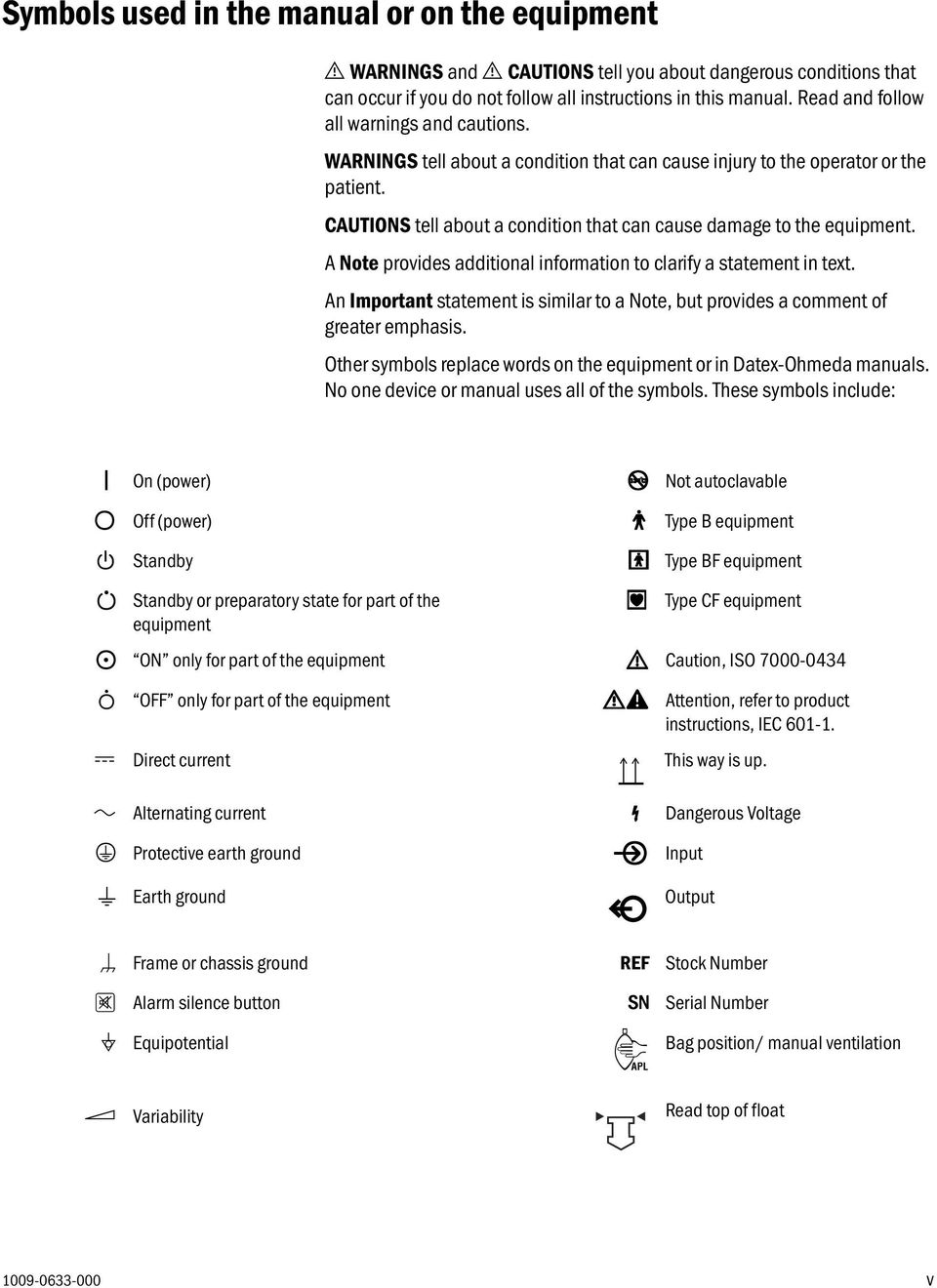
8 Aespire 7900 T Variability in steps Vacuum inlet + Plus, positive polarity Suction bottle outlet P - Minus, negative polarity O 2 + O 2 Flush button Lamp, lighting, illumination Cylinder N ˆ Movement in one direction Movement in two directions Isolation transformer Low pressure leak test z Lock Z Unlock 134 C Autoclavable uopen drain (remove liquid) r Mechanical ventilation Close drain U Q Expiratory flow Alarm silence touch key q Inspiratory flow Menu touch key t O 2 sensor connection Alarm silence touch key (Tec 6) Volume alarms On/Off touch key End case touch key vi

9 Table of Contents XXXX Systems with this mark agree with the European Council Directive (93/42/EEC) for Medical Devices when they are used as specified in their Operation and Maintenance Manuals. The xxxx is the certification number of the Notified Body used by Datex-Ohmeda s Quality Systems. European Union Representative vii

10 Aespire 7900 viii

11 1 Setup and Connections In this section Canister setup Pneumatic and electrical connections How to install gas cylinders (high pressure leak test) Installation notes How to attach equipment to the top shelf

12 Aespire 7900 Important Important Important Datex-Ohmeda strongly recommends that you use O 2 monitoring with this equipment. Refer to local standards for mandatory monitoring. European Standard EN 740 and International Standard IEC /ISO require exhaled volume monitoring, O 2 monitoring (in accordance with EN 12342, or ISO 7767) and CO 2 monitoring (in accordance with EN 864 or ISO 9918) be used with this equipment. European Standard EN 740 and International Standard IEC /ISO also require anesthetic agent monitoring (in accordance with ISO 11196) be used when anesthetic vaporizers are in use. wwarning Always make sure that the pipeline supply hoses and the breathing circuit components are not toxic and will not: Cause an allergic reaction in the patient. React with the anesthetic gases or agent to produce dangerous by-products. w w w w To prevent incorrect values or equipment malfunction, use only Datex-Ohmeda cables, hoses and tubing. Desiccated absorbers can be hazardous in the presence of anesthetic agents. Adequate precautions should be taken to ensure that soda lime in absorbers does not become desiccated. Turn off all gases when finished using the system. This system operates correctly at the electrical interference levels of IEC Higher levels can cause nuisance alarms that may stop mechanical ventilation. To help prevent false alarms from devices with high-intensity electrical fields: Keep the electrosurgical leads away from the breathing system and the flow and oxygen sensors. Do not put the electrosurgical leads on any part of the anesthesia system. w To protect the patient when electrosurgical equipment is used:
13 1 Setup and Connections Monitor the correct operation of all life support and monitoring equipment. Keep backup manual ventilation available in case the electrosurgical equipment prevents safe use of the ventilator. Do not use conductive masks or hoses. Canister setup wwarning w w w w w w w Obey applicable safety precautions: Do not use the absorber with chloroform or trichloroethylene. The Disposable Multi Absorber is a sealed unit which should not be opened or refilled. Avoid skin or eye contact with the contents of the absorber. In the event of skin or eye contact, immediately rinse the affected area with water and seek medical assistance. Do not change the absorber during ventilation. Inspect absorbent color at the end of a case. During non-use, absorbent can go back to the original color. Refer to the absorbent labeling for more information about color changes. Desiccated (dehydrated) absorbent material may produce dangerous reactions when exposed to inhalation anesthetics. For systems with dual absorbent canisters, the carbon dioxide absorbent material in both canisters shall be changed at least weekly, preferably every Monday morning. For single canister systems the absorbent material shall be changed every day, preferably at the start of the day
14 Aespire 7900 w w w w Carbon dioxide absorbent material shall be changed whenever users cannot assure the degree of hydration of the absorbent. Such conditions may include finding a machine with fresh gas that has been flowing for an unknown period of time, or using a machine that is used infrequently. All fresh gas flows shall be terminated when the machine is NOT in use. (User manuals describe how to achieve null flows). Users are advised to consider the use of low-flow techniques when the machine is in use and whenever clinically appropriate to maintain hydration of the absorbent material. Always perform a breathing system leak test in the Bag Mode after opening the absorber. The absorber canister is available in two versions: Disposable Multi Absorber and Reusable Multi Absorber. Both are removed and installed on the breathing system in the same way. Each canister holds 800 g of loose absorbent. Datex-Ohmeda recommends Medisorb absorbent. Both absorber versions should only be used with air, oxygen, nitrous oxide, halothane, enflurane, isoflurane, desflurane and sevoflurane. When to change the absorbent A gradual color change of the soda lime in the canister indicates absorption of carbon dioxide. The color change of the soda lime is only a rough indicator. Use carbon dioxide monitoring to determine when to change the canister. Discard the absorbent when it has changed color. If left standing for several hours, soda lime may regain its original color giving a misleading indication of activity. Read the canister instructions completely before using the product

15 1 Setup and Connections Removing a canister The absorber canister is available in two versions: Reusable Multi Absorber and Disposable Multi Absorber. Both are removed and installed on the breathing system in the same way Disposable Multi Absorber canister 2. System canister release latch 3. System canister support pin 4. Canister handle 5. Absorbent 6. Reusable Multi Absorber canister 7. Water reservoir Figure 1-1 Canister

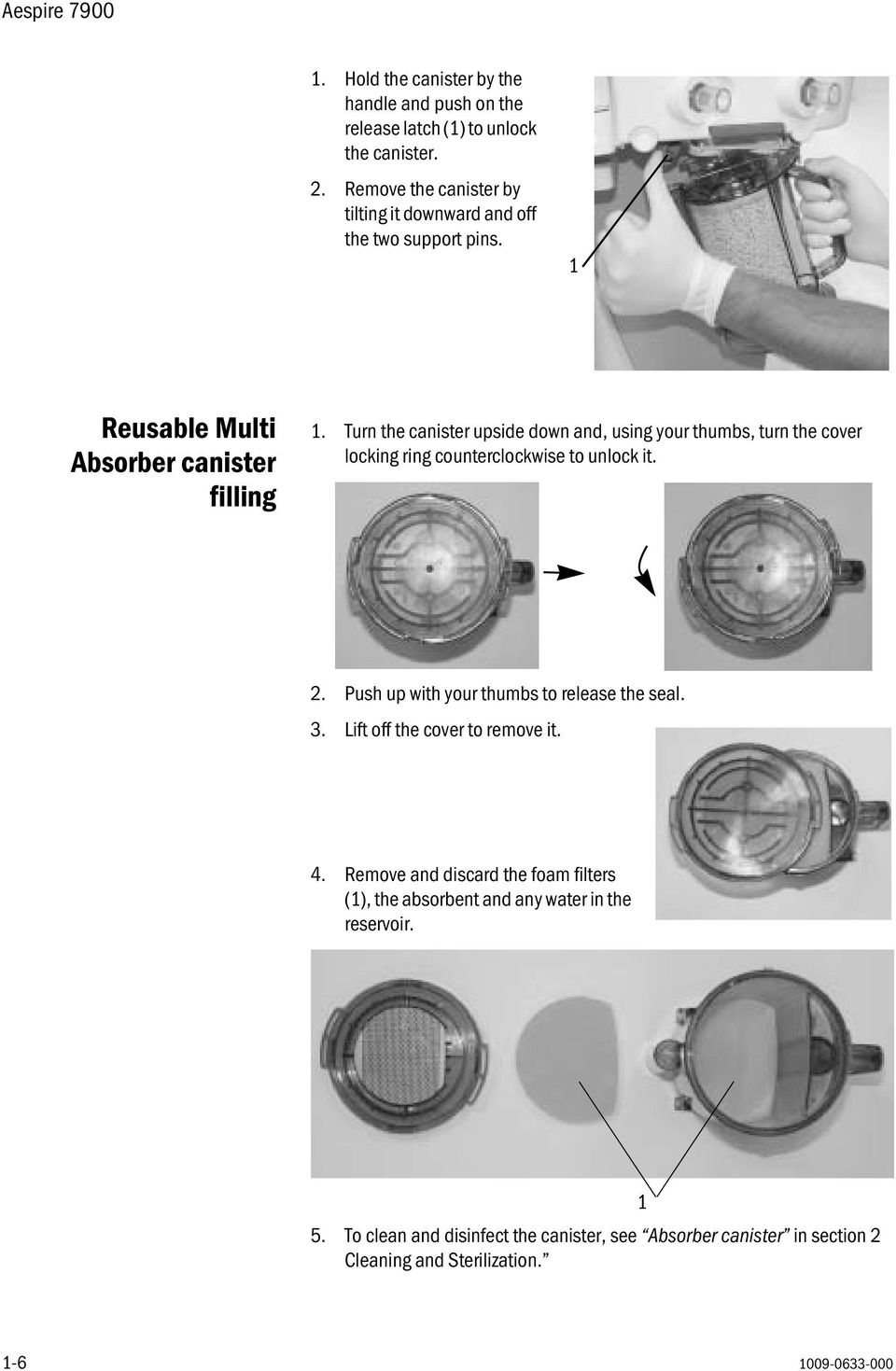
16 Aespire Hold the canister by the handle and push on the release latch (1) to unlock the canister. 2. Remove the canister by tilting it downward and off the two support pins. 1 Reusable Multi Absorber canister filling 1. Turn the canister upside down and, using your thumbs, turn the cover locking ring counterclockwise to unlock it. 2. Push up with your thumbs to release the seal. 3. Lift off the cover to remove it. 4. Remove and discard the foam filters (1), the absorbent and any water in the reservoir To clean and disinfect the canister, see Absorber canister in section 2 Cleaning and Sterilization
17 1 Setup and Connections wwarning The filters must be in place to prevent dust and particles from entering the breathing circuit. 6. When dry, place a new filter in the bottom of the canister, pour soda lime into the canister and place a new filter over the soda lime before closing and locking the cover. Wipe off any soda lime dust. Align the cover slots with the canister locking tabs and press the cover down into place. Turn the cover locking ring clockwise to lock the cover in place. Ensure cover is properly sealed to prevent leaks and spillage. Alignment of the arrows helps to indicate correct assembly. 7. When replacing the canister, make sure it is resting on both support pins before latching it into place. Pneumatic and electrical connections wwarning Equipment connected to the electrical outlets can increase the leakage current. Regularly test the leakage current. An optional isolation transformer kit is available to reduce total leakage current. wcaution Mains inlet Use only medical grade gas supplies. Other types of gas supplies may contain water, oil, or other contaminants. Arrow shows the mains power inlet and cord. Outlets Labels show outlet voltage ratings and circuit breaker amp ratings

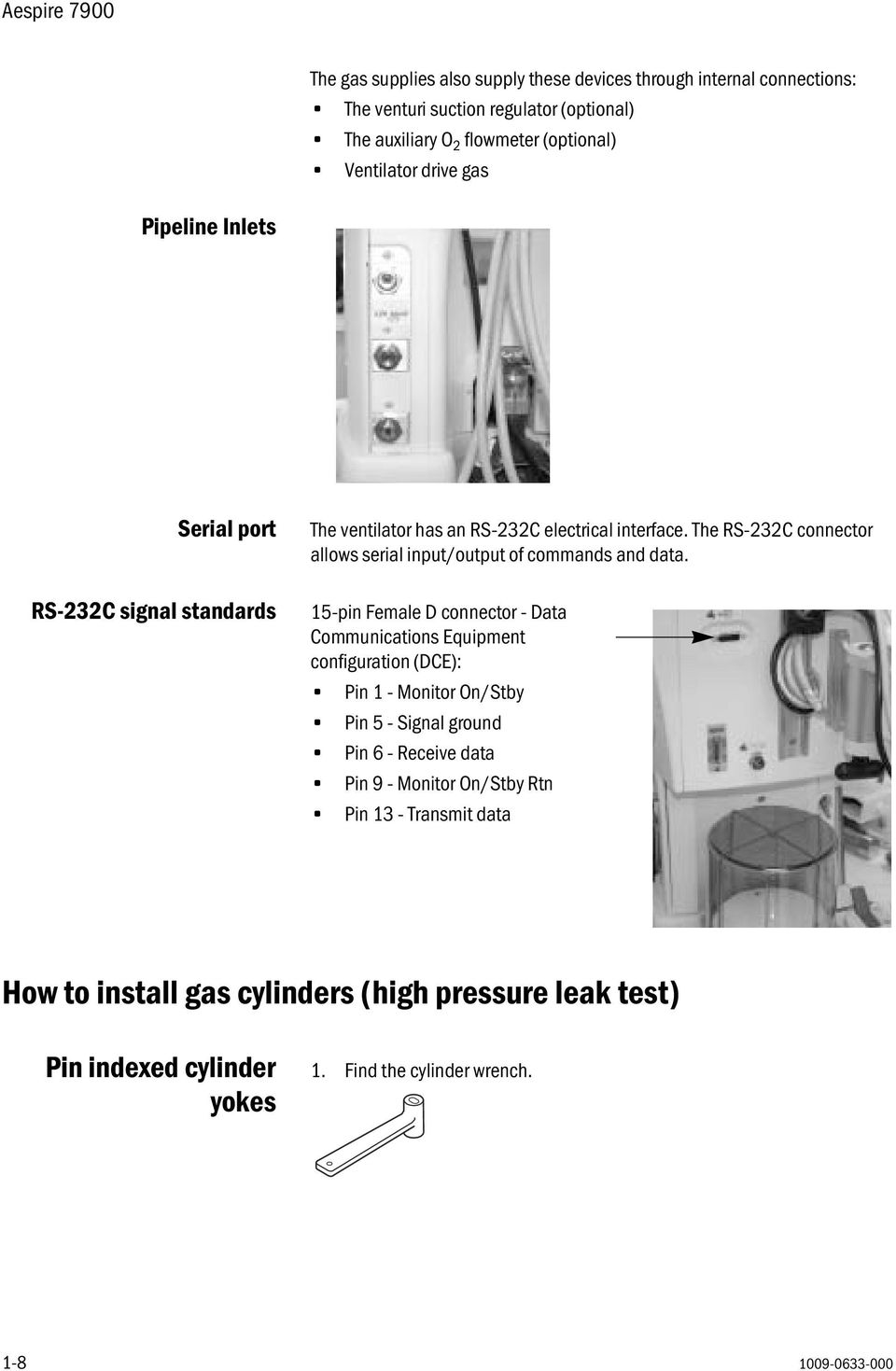
18 Aespire 7900 The gas supplies also supply these devices through internal connections: The venturi suction regulator (optional) The auxiliary O 2 flowmeter (optional) Ventilator drive gas Pipeline Inlets Serial port RS-232C signal standards The ventilator has an RS-232C electrical interface. The RS-232C connector allows serial input/output of commands and data. 15-pin Female D connector - Data Communications Equipment configuration (DCE): Pin 1 - Monitor On/Stby Pin 5 - Signal ground Pin 6 - Receive data Pin 9 - Monitor On/Stby Rtn Pin 13 - Transmit data How to install gas cylinders (high pressure leak test) Pin indexed cylinder yokes 1. Find the cylinder wrench
19 1 Setup and Connections 2. Close the cylinder valve on the cylinder to be replaced. 3. Fully loosen the tee handle. 4. Open the cylinder yoke. 5. Remove the used cylinder and the used gasket. 6. Remove the cap from the cylinder valve on the new cylinder. 7. Point the cylinder outlet away from all items that can be damaged by a release of high pressure gas. 8. Quickly open and close the cylinder valve. This removes dirt from the cylinder outlet. wwarning No gasket or more than one gasket can cause a leak. 9. Install a new gasket. 10. Align the cylinder post with the index pins. 11. Close the yoke gate and tighten the tee handle. 12. Install a cylinder plug and gasket in all empty cylinder yokes. 13. Do a high pressure leak test: Disconnect pipeline supplies

20 Aespire 7900 Turn off the auxiliary O 2 flowmeter and venturi suction. Set the system switch to Standby. Open the cylinder. Record the cylinder pressure. Close the cylinder. If the air or oxygen cylinder pressure decreases more than 5000 kpa (100 psi) in one minute, there is a significant leak. For N 2 O cylinders, a pressure decrease of 690 kpa (100 psi) in one minute represents a significant leak. To repair a leak: Install a new cylinder gasket and tighten the tee handle. Do this step again. If the leak continues, do not use the system. wcaution Do not leave gas cylinder valves open if the pipeline supply is in use. Cylinder supplies could be depleted, leaving an insufficient reserve supply in case of pipeline failure. DIN cylinder connections 1. Close the cylinder valve on the cylinder to be replaced. 2. Loosen the adapter and remove the cylinder. 3. Remove the cap from the cylinder valve on the new cylinder. 4. Point the cylinder outlet away from all items that can be damaged by a release of high pressure gas. 5. Quickly open and close the cylinder valve. This removes dirt from the cylinder outlet. 6. Install the cylinder. 7. Do a high pressure leak test: Disconnect pipeline supplies. Turn OFF the auxiliary flowmeter and the venturi suction. Set the system switch to Standby. Open the cylinder. Record the cylinder pressure. Close the cylinder

21 1 Setup and Connections If the cylinder pressure decreases more than 5000 kpa (725 psi) for O 2 and air in one minute, there is a significant leak. For N 2 O cylinders, a pressure decrease of 690 kpa (100 psi) in one minute represents a significant leak. To repair a leak: Install a new cylinder gasket and tighten the adapter. Do this step again. If the leak continues, do not use the system. wwarning Do not leave gas cylinder valves open if the pipeline supply is in use. Cylinder supplies could be depleted, leaving an insufficient reserve supply in case of pipeline failure. Installation notes When the system is installed, the Datex-Ohmeda representative will check the following settings and change them if necessary. wwarning These settings can only be changed by qualified personnel. Language. Automatic calculation of V E alarm limits during mechanical ventilation. Altitude. Ventilator drive gas. User Select Defaults
22 Aespire 7900 How to attach equipment to the top shelf wwarning The top shelf has a weight limit of 34 kg (75 lb). Place the equipment between the straps. Fold the straps over each other and fully tighten and fasten them with the hook and loop surfaces. wwarning If you do not fully tighten the strap, equipment can fall off the shelf
23 2 Cleaning and Sterilization In this section Breathing system cleanable parts Special requirements How to clean and disinfect the flow sensors Remove the breathing system bag hose Remove the breathing system Disassemble the breathing system Disassemble the Bellows assembly Assemble the Bellows assembly Bellows assembly tests Assemble the breathing system Install the breathing system Remove the AGSS receiver Remove the AGSS receiver filter Absorber canister
24 Aespire 7900 wwarning Obey applicable safety precautions: Read the material safety data sheet for each cleaning agent. Read the operation and maintenance manual for all sterilization equipment. Wear gloves and safety glasses. A damaged O 2 sensor can leak and cause burns (contains potassium hydroxide). Do not breathe the fumes. wcaution To help prevent damage: Refer to the manufacturer s data if you have questions about a cleaning agent. Do not use organic, halogenated, or petroleum based solvents, anesthetic agents, glass cleaners, acetone, or other harsh cleaning agents. Do not use abrasive cleaning agents (such as steel wool, silver polish or cleaner). Keep all liquids away from electronic parts. Do not permit liquid to go into the equipment housings. Do not soak synthetic rubber parts for more than 15 minutes. Swelling or faster aging can occur. Only autoclave parts marked 134 C. Cleaning solutions must have a ph of 7.0 to
25 2 Cleaning and Sterilization Breathing system cleanable parts Bellows assembly 2. APL Valve Ramp 3. APL Diaphragm 4. Breathing circuit module (O 2 sensor not autoclavable) 5. Absorber canister (reusable only) 6. Flow sensor cover 7. Flow Sensor Module (plastic flow sensors not autoclavable) 8. Exhalation Valve assembly Figure 2-1 Autoclavable assemblies 6 Parts marked 134 C are autoclavable or washable by hand or machine (mild detergent ph <10.5). Rinse and dry completely. All parts except the O 2 sensor and disposable flow sensors can be washed. If the flow sensors are plastic, refer to the How to clean and disinfect the flow sensors procedure. If metal, they can be autoclaved at 134 C
26 Aespire 7900 Special requirements To clean the circuit O 2 sensor, wipe it with a damp cloth. Do not put the sensor in liquid. To clean/disinfect metal or plastic flow sensors, use the flow sensor cleaning procedures. Do not get the connectors wet. Disassemble the bellows assembly before you wash it. If not, it will take a very long time to dry. Hang the bellows upside down (extended) to dry. If not, the convolutions can stick together. Assemble the bellows assembly before you autoclave. Autoclave the bellows assembly upside down. wwarning Do not use talc, zinc stearate, calcium carbonate, corn starch or equivalent materials to prevent tackiness. These materials can go into the patient s lungs and airways and cause irritation or injury. wcaution Do not put the circuit O 2 sensor or flow sensor connector in liquid. w Do not autoclave the circuit O 2 sensor or the plastic flow sensors. w Do not clean the interior surfaces of the flow sensors. Use a damp cloth on external surfaces only. Inspect all parts for deterioration. Replace them if necessary. The Preoperative Tests section in Part 1 of the User Reference Manual tells you how to test the system for correct operation. How to clean and disinfect the flow sensors wcaution Do not autoclave plastic flow sensors. w Do not use high pressure gas or brushes to clean the flow sensors. w Do not use cleaning solvents that are not approved for use with polycarbonates (e.g. CIDEX Plus). CIDEX sterilization Both Datex-Ohmeda and the manufacturer of CIDEX (Johnson & Johnson) have tested this procedure. CIDEX must be 14 day mixture, with activator vial (REF reorder #2245)
27 2 Cleaning and Sterilization One liter of this solution cleans four (4) flow sensors. Procedure 1. Pull the latch to unlock the flow sensor module from the breathing system. 2. Pull the flow sensor module from the breathing system. 3. Remove the flow sensors from the module. Completely loosen the thumbscrew (1). Pull off the flow sensor cover (3) from the flow sensor holder (2). Remove the flow sensor connectors (4) from the flow sensor holder. Pull the flow sensors (5) from the flow sensor holder
28 Aespire Submerge the flow sensor and tubes in activated CIDEX solution. Keep the connector dry. 5. Keep the solution in the tubes for the sterilization period. 6. Submerge the flow sensor and tubes in distilled water. Again, do not get the connector wet. 7. Rinse as indicated in CIDEX instructions. 8. Do steps 6 and 7 again to remove all CIDEX. 9. COMPLETELY dry the flow sensor and the tubes before you use the sensor. Use a dry syringe or connect vacuum or pressure to remove all liquid from the sensor (sensor, tubes, and connector): wcaution Dry for > 1 min with these precautions: Maximum flow 10 L/min Maximum pressure ±100 cmh 2 O 10. Reverse steps 2 and 3 to reassemble the flow sensor module. Be sure to align the flow sensor tubes with the grooves in the flow sensor holder. 11. Before you use the system, complete the Preoperative Tests in section 4 of the User Reference Manual, Part 1. Remove the breathing system bag hose 1. Disconnect the bag hose (1) from the bag hose connector (2). Also remove the hose 1 from the clip (3) If bag arm option is present, remove the bag port elbow from the bag arm support. Push down on the release latch and slide the bag port elbow out of the holder
29 2 Cleaning and Sterilization Remove the breathing system 1. Hold the canister (2) by the handle and push on the release latch (1) to unlock the canister. 2. Remove the canister by tilting it downward and off the two support pins Push the release button (3) and gently pull the latch handle (4) to release the breathing system Lightly grasp the rear handle (5) to support the breathing system. Slide the breathing system away from the workstation pulling with the latch handle
30 Aespire 7900 Disassemble the breathing system The breathing system assembly can be disassembled for cleaning, sterilization and part replacement. 1. Remove the breathing system and place on a flat surface. 2. Pull the latch to unlock the flow sensor module from the breathing system. 3. Pull the flow sensor module from the breathing system. 4. Unscrew the sensor counterclockwise and remove it. To remove the sensor cable from the breathing system, press on the connector button (1) while pulling the connector out
31 2 Cleaning and Sterilization 5. Remove the flow sensors from the module: Completely loosen the thumbscrew (1). Pull off the cover (2) from the Flow Sensor Holder (3). Remove the flow sensor connectors (4) from the Flow Sensor Holder. Pull the flow sensors (5) from the Flow Sensor Holder Rotate the breathing circuit module at the point shown by the dotted line After rotating, separate the two sections by pulling them apart
32 Aespire On the manifold assembly, remove the check valves circuit lens (1) by squeezing the latches (2) together and pulling up on the lens Press at (2) to unlock the ramp (1). Rotate the ramp and remove the tabs from the slots (3) to remove the ramp Lift the diaphragm to remove it
33 2 Cleaning and Sterilization 11. Turn over the bellows base assembly, grasp the bellows boot with three fingers in the openings at the points shown and pull straight away to remove it
34 Aespire With the breathing system removed, the exhalation valve assembly can be removed for cleaning if desired. Loosen the two thumbscrews indicated and lift the assembly off. Disassemble the Bellows assembly The bellows assembly can be disassembled for cleaning, sterilization, and part replacement. 1. Turn the housing counter-clockwise and lift. 2. Remove the bottom edge of the bellows from the rim
35 2 Cleaning and Sterilization 3. Push the latch toward the center and remove the rim. 4. Remove the pressure-relief valve. wwarning Do not disassemble the pressure relief valve. This can damage the seat or diaphragm and cause injury to the patient. 5. Push the latch toward the center and remove the locking tabs. 6. Remove the seal
36 Aespire 7900 Assemble the Bellows assembly 1. Install the seal. Verify the arrow on the seal points up. 2. Push the latch toward the center and attach the locking tabs. 3. Install the pressure-relief valve. 4. Push the latch toward the center and install the rim. Verify you hear a double-click when you install the rim
37 2 Cleaning and Sterilization 5. Attach the bottom edge of the bellows to the rim. Verify only the bottom ring of the bellows is fitted over the rim. 6. Lower the housing and turn it clockwise to lock. Verify you cannot lift off of the housing. 7. In the above steps, if you see a dust-like powder on the bellows housing or on the bellows, apply a thin layer of KRYTOX lubricant to the ribs of the bellows housing. Make sure the lubricant is applied smoothly and there are no lumps. 8. Perform the Bellows assembly tests before completing the assembly of the breathing system. Bellows assembly tests wwarning Objects in the breathing system can stop gas flow to the patient. This can cause injury or death: Do not use a test plug that is small enough to fall into the breathing system. Make sure that there are no test plugs or other objects caught in the breathing system. w The bellows assembly test does not replace the preoperative tests. Always complete the tests in the section Preoperative tests before you use the system with a patient
38 Aespire 7900 This test makes sure that all components are correctly assembled. It is not an alternative to a complete system checkout. If the bellows assembly operates correctly, complete the assembly of the breathing system. If there is a problem, disassemble the bellows assembly. Look for and replace damaged parts. 1. Hold the bellows assembly vertical and close the ports (1 and 2) Invert the bellows assembly. The bellows must not fall within one minute. If it does: The ports are not tightly sealed. The bellows is incorrectly installed. The seal inside the bellows is not correctly installed (with its groove pointed up). Parts are damaged
39 2 Cleaning and Sterilization 3. Remove the plugs from the ports. Permit the bellows to fully extend. 4. Close port Hold the bellows assembly upright. The bellows must not fall past the guide line within one minute. If it does: The port is not tightly sealed. The bellows or the pressure relief valve is not correctly installed. Parts are damaged
40 Aespire 7900 Assemble the breathing system 6. If the result for all the bellows assembly tests was passed, complete the assembly of the breathing system. 1. Replace the exhalation valve assembly as shown. Tighten the two thumbscrews. 2. Turn over the bellows base assembly. Replace the boot. Be sure to insert it correctly into the ports as shown by the arrows. Then, press on the center of the boot (arrow) to snap it into place on the bellows base assembly
41 2 Cleaning and Sterilization 3. Replace the diaphragm. 4. Insert the ramp tabs (1) into the slots (2). Rotate the ramp until it locks at (3) On the manifold assembly, press the check valves circuit lens (1) down onto the latches (2) to lock the lens
42 Aespire Insert the breathing circuit module into the bellows assembly aligned as shown. 7. Rotate the breathing circuit module at the point shown by the dotted line to attach it to the bellows assembly. 8. Make sure the o-ring (3) is on the O 2 sensor. Replace the sensor (1) by screwing it in clockwise. Replace the O 2 sensor cable connector (2) Attach the flow sensors to the module: Insert the flow sensors (1) into the flow sensor holder. Note the groove locations. Attach the flow sensor connectors (2) to the flow sensor holder. Attach the cover (4) to the flow sensor holder (3). Tighten the thumbscrew (5) to fasten the cover
43 2 Cleaning and Sterilization Attach the flow sensor module to the breathing system. 11. Push the latch (1) to lock the flow sensor module onto the breathing system
44 Aespire This is assembled breathing system. Install the breathing system 1. Locate guide pin openings 1 and Align opening 1 onto the guide pin 1, then align opening 2 onto guide pin
45 2 Cleaning and Sterilization 3. Holding the rear handle (1) and the latch handle (2) as shown, slide the breathing system onto the guide pins Use the grip under the latch handle to push the breathing system in fully until it latches firmly. 5. Install the absorber canister and bag hose. 6. Before you use the system, complete the Preoperative Tests in section 4 of the User Reference Manual, Part 1. Remove the AGSS receiver The AGSS receiver may be removed for cleaning and sterilization. 1. On the back of the system, loosen the two thumbscrews (1) to release the system side panel (2)
46 Aespire Slide the side panel out by removing its tabs from their slots (1) Loosen the thumbscrew and remove the reservoir (2). It is not autoclavable Loosen the thumbscrew (1) and lower the receiver to remove it Replace the filter as necessary. (See following steps.) 6. Do these steps in the opposite order to replace the receiver and the side panel. 7. Before you use the system, complete the Preoperative Tests in section 4 of the User Reference Manual, Part 1. Remove the AGSS receiver filter The AGSS receiver may be autoclaved. To autoclave AGSS receivers which have a filter, the filter must be removed because it is not autoclavable
47 2 Cleaning and Sterilization 1. Pull the flexible gasket (1) from the receiver Pull the filter (1) out of its holder (2) Do these steps in the opposite order to replace the filter and gasket after autoclaving the receiver and gasket. Be sure the gasket is firmly pressed into place at all points. 4. Before you use the system, complete the Preoperative Tests in section 4 of the User Reference Manual, Part 1. Absorber canister The absorber canister is available in two versions: Disposable Multi Absorber and Reusable Multi Absorber. Both are removed and installed on the breathing system in the same way. Refer to Removing a canister in section 1 Setup and Connections. Only the Reusable Multi Absorber canister may be cleaned. wcaution The filters must be in place to prevent dust and particles from entering the breathing circuit
48 Aespire 7900 Mechanical cleaning in washer or washerdisinfector 1. Place the canister without filters and the lid in the washer or washerdisinfector and clean them with a decontaminating program. 2. Dry the canister and the lid in a warming closet, maximum 80 C (176 F) or at room temperature. 3. If the washer or washer-disinfector is not used for disinfection of equipment, Datex-Ohmeda recommends that a further high level disinfection is conducted. 4. When dry, place a new filter in the bottom of the canister, pour soda lime into the canister and place a new filter over the soda lime before closing and locking the cover. Wipe off any soda lime dust. 5. Align the cover slots with the canister locking tabs, and press the cover down into place. Turn the cover locking ring clockwise to lock the cover in place. Ensure cover is properly sealed to prevent leaks and spillage. Alignment of arrows helps to indicate correct assembly. Manual cleaning 1. Flush the canister and the lid with fresh running water. 2. Clean the canister and lid under total immersion in a sink with water and cleaning agent for at least 3 minutes. The water temperature should be approximately 40 C (104 F). 3. Flush the canister and lid with fresh running water. 4. When dry, place a new filter in the bottom of the canister, pour soda lime into the canister and place a new filter over the soda lime before closing and locking the cover. Wipe off any soda lime dust. 5. Align the cover slots with the canister locking tabs, and press the cover down into place. Turn the cover locking ring clockwise to lock the cover in place. Ensure cover is properly sealed to prevent leaks and spillage. Alignment of arrows helps to indicate correct assembly. 6. Datex-Ohmeda recommends that manual cleaning is always followed by a high level disinfection. High level disinfection 1. Always clean the canister before high level disinfection. 2. The canister can be steam autoclaved. Maximum recommended temperature is 134 C (273 F). 3. When dry, place a new filter in the bottom of the canister, pour soda lime into the canister and place a new filter over the soda lime before closing and locking the cover. Wipe off any soda lime dust. 4. Align the cover slots with the canister locking tabs, and press the cover down into place. Turn the cover locking ring clockwise to lock the cover in place. Ensure cover is properly sealed to prevent leaks and spillage. Alignment of arrows helps to indicate correct assembly
49 3 User Maintenance wwarning To help prevent fires: Only use lubricants approved for anesthesia or O 2 equipment, such as Krytox. Do not use lubricants that contain oil or grease. They burn or explode in high O 2 concentrations. All covers used on the system must be made from antistatic (conductive) materials. Static electricity can cause fires. wwarning wwarning Obey infection control and safety procedures. Used equipment may contain blood and body fluids. Movable part and removable components may present a pinch or a crush hazard. Use care when moving or replacing system parts and components. In this section Repair policy Maintenance summary and schedule Breathing system maintenance O 2 sensor replacement O 2 sensor calibration Flow sensor zeroing How to prevent water build-up
50 Aespire 7900 Repair policy Do not use malfunctioning equipment. Make all necessary repairs or have the equipment serviced by an authorized Datex-Ohmeda service representative. After repair, test the equipment to ensure that it is functioning properly, in accordance with the manufacturer s published specifications. To ensure full reliability, have all repairs and service done by an authorized Datex-Ohmeda service representative. If this cannot be done, replacement and maintenance of those parts listed in this manual may be undertaken by a competent, trained individual having experience in the repair of devices of this nature. wcaution No repair should ever be attempted by anyone not having experience in the repair of devices of this nature. Replace damaged parts with components manufactured or sold by Datex- Ohmeda. Then test the unit to ascertain that it complies with the manufacturer s published specifications. Contact your local Datex-Ohmeda Field Service Representative for service assistance. In all cases, other than where Datex-Ohmeda s warranty is applicable, repairs will be made at Datex-Ohmeda s current list price for the replacement part(s) plus a reasonable labor charge. Maintenance summary and schedule These schedules are the minimum frequency based on typical usage of 2000 hours per year. You should service the equipment more frequently if you use it more than the typical yearly usage. User maintenance Minimum Frequency Maintenance Daily Clean the external surfaces. 21% O 2 calibration (circuit O 2 sensor). Weekly Flow sensor zeroing. Two weeks Drain the vaporizers and discard the agent. This is not necessary for Tec 6 vaporizers
51 3 User Maintenance Minimum Frequency Maintenance Monthly 100% O 2 calibration (circuit O 2 sensor). Put Krytox (or a lubricant approved for use with 100% O 2 ) on all tee handle threads. During cleaning and setup Inspect the parts for damage. Replace or repair as necessary. Annually Replace the external o-rings on the vaporizer ports. As necessary Install new cylinder gaskets on cylinder yokes. Empty the water reservoir and replace the absorbent in the canister. Empty the overflow trap on the optional suction regulator. Replace the circuit O 2 sensor. (Under typical use the sensor meets specifications for 1 year.) Replace the disposable flow sensors (plastic). (Under typical use the sensor meets specifications for a miminum of 3 months.) Replace the autoclavable flow sensors (metal). (Under typical use the sensor meets specifications for a minimum of 1 year.) Replace the receiver filter (active gas scavenging only). Datex-Ohmeda approved service Minimum Frequency Planned Maintenance 12 months Have a qualified service person complete the scheduled service maintenance checks, tests, calibrations and parts replacement as defined in the service manual. Note: This is the minimum level of maintenance recommended by Datex-Ohmeda. Local regulations may contain additional maintenance requirements. Datex-Ohmeda advocates compliance with local regulations which meet or exceed this minimum level of maintenance
52 Aespire 7900 Breathing system maintenance When cleaning the breathing system, replace any parts that are visibly cracked, chipped, distorted or worn. Refer to the appropriate section for reassembly and tests. O 2 sensor replacement wwarning Handle and dispose of sensors according to your biohazard policies. Do not incinerate. 1. Pull the latch (1) to unlock the flow sensor module from the breathing system Pull the flow sensor module from the breathing system. 3. Remove the O 2 sensor cable connector (2) from the O 2 sensor (1) and unscrew the sensor counterclockwise. Don t lose the sensor o-ring
53 3 User Maintenance 4. Make sure the o-ring (1) is on the sensor. Install the replacement O 2 sensor. Reconnect the O 2 sensor cable Replace the flow sensor module on the system and press the latch (1) in to secure the module. 1 O 2 sensor calibration wwarning w w 21% O 2 sensor calibration Do not perform calibration while unit is connected to a patient. The O 2 sensor must be calibrated at the same environment pressure at which it will be used to monitor oxygen delivery in the patient circuit. Operation at pressures other than the pressures present during calibration may result in readings outside of the stated monitoring accuracy. This procedure takes three minutes or less. You must do the 21% O 2 calibration before the 100% O 2 calibration. During O 2 calibration the screen replaces O 2 data with
54 Aespire 7900 Step 1 Push the Menu key to see the main menu. Step 2 Turn the knob to select the Calibration screen. Step 3 Push the knob to show the next screen. Step 4 Turn and push the knob to select O 2 Sensor Cal. Step 5 Select 21% then push the knob
55 3 User Maintenance Step 6 Complete the steps shown on the screen. To remove the O 2 sensor from the circuit: Pull the latch (1) to unlock the flow sensor module from the breathing system. 1 Pull the flow sensor module (2) from the breathing system. 2 Remove the O 2 sensor (3) and leave it exposed to room air
56 Aespire 7900 Step 7 Select Start Cal and push the knob to start calibration. The screen shows Calibrating during the procedure. After a successful calibration, the screen shows Complete and a flashing Reinstall Sensor. After installing the sensor, you can continue to 100% calibration (step 11) or exit to the normal screen (step 7). An unsuccessful calibration shows Failure. If the calibration fails: Do the calibration again. If it still fails, do a 100% O 2 sensor calibration (step 11). If 100% O 2 sensor calibration passes, calibrate at 21% again. After repeated failures, replace the O 2 sensor and re-calibrate at 21%. Step 8 To exit, select Go to Cal Menu and push the knob. You can also press the menu key to exit to the normal screen. Select Go to Main Menu and push the knob. Go to Main Menu Step 9 Select Exit to Normal Screen and push the knob. Exit to Normal Screen Step 10 If you are not doing the 100% calibration which follows, do a breathing circuit leak test before using the system
57 3 User Maintenance 100% O 2 sensor calibration This procedure takes three minutes or less. You must complete the 21% calibration before you can select the 100% calibration. wwarning Do not perform calibration while unit is connected to a patient. Step 11 Turn then push the knob to select O 2 Sensor Cal. Step 12 Select 100% then push the knob. Step 13 With the O 2 sensor in the circuit, fill the circuit with 100% O 2 : Push the flush button. Then flow 100% O 2 at 5 L/min. (Circuit should be open.) Step 14 Select Start Cal. Then push the knob to start calibration
58 Aespire 7900 The screen shows Calibrating..., followed by the result: Complete or Failure. If the calibration fails, do it again or decrease the airway pressure. Then try again. After repeated failures replace the O 2 sensor and re-calibrate at 21%. Continue with steps 14 through 16 to exit to a normal screen. Step 15 To exit, select Go to Cal Menu and push the knob. You can also press the menu key to exit to the normal screen Go to Cal Menu Step 16 Select Go to Main Menu and push the knob. Go to Main Menu Step 17 Select Exit to Normal Screen and push the knob. Exit to Normal Screen Step 18 Do a breathing circuit leak test before using the system
59 3 User Maintenance Flow sensor zeroing wwarning Do not perform calibration while unit is connected to a patient. The system automatically corrects for zero offset when you unplug the flow sensor connectors with power on. You must stop mechanical ventilation before you calibrate the flow sensors. Note: Properly performing the O 2 cell zeroing will also zero the flow sensor. Step 1 Pull the latch (1) to unlock the flow sensor module from the breathing system. 1 Step 2 Pull the flow sensor module from the breathing system. Step 3 When zeroing is complete, the screen shows, No Insp flow sensor and No Exp flow sensor. No Insp Flow Sensor No Exp Flow Sensor Step 4 Install the flow sensor module. Step 5 Do a breathing circuit leak test before using the system. Refer to Breathing system tests in section 4 Preoperative Tests of the User Reference Manual, Part
60 Aespire 7900 How to prevent water build-up Why is water buildup a problem? How much water is acceptable? Pooled water in the flow sensor or water in the sensing lines causes false alarms. Small beads of water or a foggy appearance in the flow sensors is OK. Where does the water come from? Water comes from exhaled gas and a chemical reaction between CO 2 and the absorbent in the absorber. At lower fresh gas flows more water builds up because less gas is scavenged and: More CO 2 stays in the absorber to react and produce water, More moist, exhaled gas stays in the absorber. Solutions: Empty the water reservoir in the canister when changing the soda lime. Ensure that water condensing in the breathing circuit tubes is kept lower than the flow sensors and is not allowed to drain into the flow sensors. Water condensation in the breathing circuit tubing can be eased using a Heat & Moisture Exchange (HME) filter at the airway connection
61 4 Alarms and Troubleshooting wcaution No repair should ever be attempted by anyone not having experience in the repair of devices of this nature. In this section About alarms Alphabetical list Breathing system problems (no alarm) Electrical problems (power failure, etc.) Pneumatic problems Alarm settings range and default values
62 Aespire 7900 About alarms wwarning If an alarm occurs, safeguard the patient first, before troubleshooting or repair procedures. Two areas on the screen show alarms. The area at the top of the display shows most alarms. If there are more than 4 alarms at the same time, the lower priority alarms cycle every two seconds. During severe malfunctions that prevent mechanical ventilation and/or monitoring, the area under the waveform shows minimum system messages. During normal operation, this area shows instructions (push the knob, etc.). Alarms AB Alarm priority depends on the level of danger to the patient. High priority alarms require immediate attention. Priority Alarm tone Alarm silence Note High Medium 10 tones, 10 second pause, repeat 3 tones, 25 second pause, repeat 120 seconds or cannot be silenced 120 seconds --- Low Single tone Tone does not repeat --- Reverse video 4-2
63 4 Alarms and Troubleshooting Alarm messages have three general causes. Malfunctions: Some malfunctions cause reduced function (for example, no PEEP). Others prevent mechanical ventilation (Minimum shutdown). Patient monitoring: These are high and low limit settings that you adjust. Informational: Control settings or system conditions can change operation. For example, if the audible circuit leak alarm is Off, the screen shows Circuit Leak Audio Off as a low priority alarm
64 Aespire 7900 Alphabetical list The instructions in this section tell you what you can do: During a case to protect the patient After the case to repair a problem This table does not include operator instructions. There are two special types of alarms: Minimum monitoring alarms stop mechanical ventilation. Minimum shutdown alarms stop mechanical ventilation and monitoring. Message Priority Cause Action/Concerns Repair +15V Analog Out-of- Range Min. shutdown (High) Ventilator malfunction. Ventilate manually. Monitoring is not reliable. Contact a qualified service representative. -15V Analog Out-of- Range Min. shutdown (High) Ventilator malfunction. Ventilate manually. Monitoring is not reliable. Contact a qualified service representative. 12 Hour Test Low System in use for more than 12 hours without a power-up self test. To do the test, move the system switch from Standby to On. Not necessary, informational. A/D Converter Failure Min. shutdown (High) Ventilator malfunction. Ventilate manually. Monitoring is not reliable. Contact a qualified service representative. Absorber panel open Medium The top panel is not completely closed. Push the breathing system into the frame and ensure it latches Adjust Low Ve Limit Medium The audible circuit leak alarm is Off (Alarm menu) but the low VE alarm is not set. Increase the low VE alarm limit VE alarm is Off in SIMV or PSVPro modes. Apnea Alarm Standby Low Normal condition after End Case, power-up, or ACGO change from On to Off Monitoring resumes after first breath (mechanical) or 2 breaths within 30 seconds (nonmechanical) Apnea Alarm Off Low The cardiac bypass option is selected (alarm limit menu). Apnea alarms are normally turned off when this option is selected
65 4 Alarms and Troubleshooting Message Priority Cause Action/Concerns Repair Aux Gas Outlet On Medium (low after acknowledged) The outlet selection switch is set to the auxiliary common gas outlet. Connect the patient circuit to the auxiliary outlet. For mechanical ventilation or manual ventilation with monitoring, select the breathing system Backup Mode Active Low SIMV-PC + PSV mode entered. Spontaneous breath rate fell below the set breath rate Battery Charger Fail Low The current in the battery charging circuit is too high. The system is operational, but may fail later depending on what caused this alarm. Contact a qualified service representative. Battery Charging Low The battery is not fully charged. If power fails, the total backup time will be less than 30 minutes. Leave the system plugged in to charge the battery Battery Current High Low Battery current > 6 amps for 10 seconds. Battery Failure High Low Battery voltage > 16 V for 10 seconds. The system continues to operate, but may fail. The system continues to operate, but may fail. Contact a qualified service representative. Contact a qualified service representative. Battery Failure Low Low The battery voltage is too low (<7 V) to supply the system if power fails. The battery does not have enough charge to power the equipment if power fails. Leave the system plugged in to charge the battery. If the battery does not charge in 24 hours, contact a service representative. Cal Flow Sensors Low The last flow sensor calibration failed. Calibrate the flow sensors. Look for water in the flow sensor tubes. Dry if necessary. Contact a qualified service representative. Calibrate O 2 Sensor Low O 2 %>110% Does the sensor measure 21% O 2 in room air? Calibrate O 2 sensor. Cannot Drive Bellows Low The internal manifold pressure is higher than Paw + tolerance. Fill the bellows if empty Cardiac Bypass Low The alarm limit settings are set for a patient on cardiac bypass. Apnea alarms are off. Use the alarm limits menu to change this setting
66 Aespire 7900 Message Priority Cause Action/Concerns Repair Check Flow Sensors Medium (low after acknowledged) No flow or negative flow on inspiratory sensor during inspiration in a circle system or negative flow on expiratory sensor in expiration (for 6 breaths in a row). Are the flow sensors correctly installed? Water build-up in the flow sensor tubes? Is a flow sensor tube cracked or broken? Inspect one way valves (breathing circuit module). Replace flow sensor module. Check the condition of the flow sensor and its tubing. Circuit Leak Audio Off Low Control setting on the Alarm limit menu. This message tells you that the audio alarm for circuit leaks was turned off Connect O 2 Sensor Low The O 2 sensor is not connected to the cable. Connect the sensor. Contact a qualified service representative to replace the cable. CPU Failure Minimum shutdown (High) Ventilator malfunction. Ventilate manually. Monitoring is not reliable. Contact a qualified service representative. CPU Internal Error Minimum shutdown (High) Ventilator malfunction. Ventilate manually. Monitoring is not reliable. Contact a qualified service representative. Display Voltage Out- Of-Range Minimum shutdown (High) Ventilator malfunction. Ventilate manually. Monitoring is not reliable. Contact a qualified service representative. Exp Flow Sensor Fail Low The system cannot read the calibration data stored in the sensor. Operation continues with default values. Replace the flow sensor Exp Reverse Flow Medium (low after acknowledged) Flow through the expiratory sensor during inspiration (for 6 breaths in a row). Look at the check valves. Water build-up in the flow sensor tubes? Is a flow sensor tube cracked or broken? Replace the expiratory check valve. Check the condition of the flow sensor. Flow Valve (DAC) Failure Flow Valve (current) Failure Minimum monitoring (Medium) Ventilator malfunction. Ventilate manually. Monitoring is still available. Contact a qualified service representative. Gas Inlet Valve Failure Minimum Ventilator malfunction. Ventilate manually. Monitoring is shutdown (High) a still available. Contact a qualified service representative. Hardware Watchdog Failure Minimum shutdown (High) Ventilator malfunction. Ventilate manually. Monitoring is not reliable. Contact a qualified service representative. 4-6
67 4 Alarms and Troubleshooting Message Priority Cause Action/Concerns Repair High O 2 Medium O 2 % > alarm high limit setting. High Paw High Paw is greater than Plimit. The ventilator cycles to expiration. High Ve Medium The minute volume is greater than the set high limit. This alarm is suspended for 9 breaths or one minute after you change the ventilator settings. High Vte Medium VTE is greater than high alarm limit. This alarm is suspended for 9 breaths after you change the ventilator settings. Is the limit set correctly? What is the O 2 flow? Did you just push Flush? Does the sensor see 21% O 2 in room air? Are Plimit and other controls set correctly? Look for blockages. Check the patient connection. Check patient for spontaneous breathing. Adjust control settings. Check patient for spontaneous breathing. Check ventilator and alarm settings. Calibrate O 2 sensor. Replace O 2 sensor. Calibrate the flow sensors. Replace the receiver filter Insp Flow Sensor Fail Low The system cannot read the calibration data stored in the sensor. Operation continues with default values. Replace the flow sensor Inspiration Stopped High Drive gas safety switch activated (high internal pressure) Adjust controls. Check systems for blockages Insp Reverse Flow Medium (low after acknowledged) Flow through the inspiratory sensor during expiration (for 6 breaths in a row). Look at the check valves. Water build-up in the flow sensor tubes? Is a flow sensor tube cracked or broken? Replace the inspiratory check valve. Check the condition of the flow sensor. Internal Ventilator Clock Too Fast Minimum shutdown (High) Ventilator malfunction. Ventilate manually. Monitoring is not reliable. Contact a qualified service representative. Internal Ventilator Clock Too Slow Minimum shutdown (High) Ventilator malfunction. Ventilate manually. Monitoring is not reliable. Contact a qualified service representative. Invalid Circuit Module Low Ventilator malfunction. Ventilate manually; monitoring is not reliable. Contact a qualified service representative
68 Aespire 7900 Message Priority Cause Action/Concerns Repair Limit Task Light Use Low The system is running on battery power. Turn off the light to save power. Turn off the light to extend battery backup Loss of Backup Audio Medium (low after acknowledged) The audio alarm will not sound for a CPU failure. Monitor system operation. Contact a qualified service representative. Low Battery Voltage Medium Voltage is <11.65V while using battery power. Low Drive Gas Pres Medium The ventilator did not detect a rise in internal pressure when the flow valve opened. Manually ventilate the patient to save power. Manually ventilate the patient. Make sure power is connected and circuit breakers are closed. Contact a qualified service representative. Make sure that the appropriate gas supplies (O 2 or Air) are connected and pressurized. Low O 2 High O 2 % < alarm low limit setting Is the limit set correctly? Is the O 2 flow sufficient? Does the sensor see 21% O 2 in room air? Low Paw Medium Paw does not rise at least 4 cm from the lowest pressure measured during the last 20 seconds. Are circuit connections OK? Look at the Paw gauge on the absorber. Calibrate O 2 sensor. Replace O 2 sensor. As sensors wear out, the measured % O 2 decreases. Look for circuit disconnection. Low Ve Medium Exhaled minute volume <low limit alarm setting. This alarm is suspended for 9 breaths or one minute after you change the ventilator settings. Check patient condition. Check tubing connections. Check alarm settings Low Vte Medium Exhaled tidal volume <low limit alarm setting. This alarm is suspended for 9 breaths after you change the ventilator settings. Check patient condition. Check tubing connections. Check alarm settings Manifold Pressure Sensor Failure Minimum monitoring (Medium) Ventilator malfunction. Ventilate manually. Contact a qualified service representative. 4-8
69 4 Alarms and Troubleshooting Message Priority Cause Action/Concerns Repair Memory (EEPROM) Fail The system cannot access some stored values. Default settings are used. Ventilation is still possible but service is necessary. Contact a qualified service representative. Memory (flash) Failure Minimum shutdown (High) Ventilator malfunction. Ventilate manually. Monitoring is not reliable. Contact a qualified service representative. Memory (RAM) Failure Minimum shutdown (High) Ventilator malfunction. Ventilate manually. Monitoring is not reliable. Contact a qualified service representative. Memory (Redundant Storage) Fail Minimum monitoring (Medium) Ventilator malfunction. Ventilate manually. Monitoring is still available. Contact a qualified service representative. Memory (video) Failure Minimum shutdown (High) Ventilator malfunction. Ventilate manually. Monitoring is not reliable. Contact a qualified service representative. Monitoring Only Medium A severe malfunction prevents mechanical ventilation. Other alarms may also occur. Ventilate manually. Cycle system power (On- Standby-On). If the alarm clears, restart mechanical ventilation. Contact a qualified service representative. No Circuit Module Low Ventilator malfunction. Ventilate manually. Optical sensors look for tabs on the back of the module. Is the module assembled? are the sensors dirty? No CO 2 Absorption Medium (low after acknowledged) The absorber canister is open (out of the circuit) but the bypass mechanism prevents a leak (optional feature). User setting. Reinstall the absorber canister to remove CO 2 from exhaled gas No Exp Flow Sensor No Insp Flow Sensor Medium (low after acknowledged) Electrical signals show the flow sensor is not connected. Connect the flow sensors. Make sure the flow sensor module is on all the way No message, only specific shutdown message High A severe malfunction prevents mechanical ventilation and monitoring. Other alarms may also occur. Ventilate manually. Use a standalone monitor. Cycle system power (On- Standby-On). If the alarm clears, restart mechanical ventilation. Contact a qualified service representative No O 2 Pressure High (cannot be silenced) The O 2 supply has failed. Air flow will continue. Ventilate manually if necessary. Connect a pipeline supply or install an O 2 cylinder
70 Aespire 7900 Message Priority Cause Action/Concerns Repair O 2 Flush Failure Low The pressure switch that detects flush flow has seen a very long flush ( 30 seconds). This alarm occurs if you hold down the Flush button for more than 30 seconds. If the alarm occurs when flush is not in use, contact a qualified service representative. O 2 Sensor out of circuit Low Ventilator malfunction. Ventilate manually. Contact a qualified service representative. On Battery - Power OK? Medium (low after acknowledged) The mains supply is not connected or has failed and the system is using battery power. Ventilate manually to save power. At full charge, the battery permits approx. 30 minutes of mechanical ventilation. Make sure power is connected and circuit breakers are closed. Patient Circuit Leak? Medium Exhaled volume <50% of inspired volume for at least 30 seconds (mechanical ventilation). Paw < -10 cmh 2 O High Subatmospheric pressure (<-10 cmh 2 O). PEEP Not Achieved Low Pmin does not reach within ±2 cmh 2 O of PEEP by the end of mechanical expiration for 6 consecutive breaths. Check breathing circuit and flow sensor connections. Check patient condition, spontaneous activity? Increase fresh gas flow. Look for high flow through gas scavenging. Check tubing connections. Rate and/or I:E ratio may prevent ventilator from reaching desired PEEP level Calibrate the flow sensors. b With active scavenging, check the negative relief valve on the receiver Positive SIB Vref Outof- Range Minimum shutdown (High) Ventilator malfunction. Ventilate manually. Monitoring is not reliable. Contact a qualified service representative. Pres Mode Not Avail Medium (Pressure, PSVPro and SIMV modes) Manifold pressure not tracking airway pressure, or manifold pressure -15 cmh 2 O. Pressure control mode and PEEP are not available. Switch to Volume mode or ventilate manually. Contact a qualified service representative. Low (Volume mode) Check patient for spontaneous breathing. Check ventilator settings. Pres/Vol Mon Inactive Medium Outlet selection switch is set to auxiliary gas outlet. Connect the patient circuit to the auxiliary gas outlet or set the switch to the circle breathing system
71 4 Alarms and Troubleshooting Message Priority Cause Action/Concerns Repair Pressure Limit Switch Failure Minimum monitoring (Medium) A pressure safety switch activated at a Paw <90 cmh 2 O and Pmanifold <80 cm H 2 O. Ventilate manually. Monitoring is still available. Extreme control combinations may cause this alarm. Check control settings. Contact a qualified service representative. Replace O 2 Sensor Low O 2 % < 5% Makes sure patient receives O 2. Does the sensor see 21% O 2 in room air? Use different monitor. Calibrate O 2 sensor. Replace O 2 sensor. Select Gas Outlet Medium Fresh gas may not flow to the patient. Auxiliary gas outlet is On, but flow sensors have seen 3 breaths in patient circuit during the last 30 seconds. Select the circle breathing system or connect the patient circuit to the auxiliary outlet. Note: the bag arm will not ventilate a patient at the auxiliary outlet. Service Calibration Low Internal calibrations are necessary for maximum accuracy. The system is operational. Operation continues with default values. Contact a qualified service representative. Software Error Minimum shutdown (High) Ventilator malfunction. Ventilate manually. Monitoring is not reliable. Contact a qualified service representative. Software Watchdog Failure Minimum shutdown (High) Ventilator malfunction. Ventilate manually. Monitoring is not reliable. Contact a qualified service representative. Sustained Airway Pressure Minimum shutdown (High) Paw > 100 cmh 2 O for 10 seconds. Check tubing for kinks, blockages, disconnects. Calibrate the flow sensors. Sustained Paw High Paw > sustained pressure limit for 15 seconds c. Check tubing for kinks, blockages, disconnects. Calibrate the flow sensors. System Leak? Medium Delivered volumes do not match set volumes. Look for leaks in the breathing system. Compare set to delivered volumes. Calibrate the flow sensors. Drain water buildup from the breathing system. Vaux_ref Out-of- Range Minimum shutdown (High) Ventilator malfunction. Ventilate manually. Monitoring is not reliable. Contact a qualified service representative. Vext_ref Out-of- Range Minimum shutdown (High) Ventilator malfunction. Ventilate manually. Monitoring is not reliable. Contact a qualified service representative
72 Aespire 7900 Message Priority Cause Action/Concerns Repair Volume Apnea Medium No mechanical breaths or spontaneous breaths >20 ml in last 30 seconds. Check patient. Bag as needed. Check for disconnects. If the patient is on a heart lung machine, select Cardiac Bypass on the main menu Vol Apnea > 2 min High No mechanical breaths or spontaneous breaths >20 ml in last 120 seconds. See above Vt Not Achieved Low Tidal volume measured by inspiratory flow sensor < set value 6 breaths in a row after the first minute of mechanical ventilation. Adjust controls to supply adequate tidal volumes. Check I:E; Plimit; and volume settings. Possible leak. Vte > Insp Vt Medium Expired volume > inspired volume for 6 breaths with a circle breathing system. Check patient condition a. When power is first turned on. b. Flow sensors are also used to measure pressures. c. The sustained pressure threshold is calculated from the pressure limit setting. When mechanical ventilation is on, the sustained limit is calculated as follows: for pressure limits < 30 cmh 2 O, the sustained pressure limit is 6 cmh 2 O; for Plimit between 30 and 60 cmh 2 O, the sustained limit is 20% of the pressure limit (Plimit); for pressure limits > 60 cmh 2 O, the sustained pressure limit is 12 cmh 2 O. If both PEEP and mechanical ventilation are on, the sustained pressure limit increases by PEEP - 2 cmh 2 O (the compensated weight of the bellows). When mechanical ventilation is off, the sustained pressure limit is calculated as follows: for pressure limits 60 cmh 2 O, the sustained pressure limit is 50% of the pressure limit (Plimit); for pressure limits > 60 cmh 2 O, the sustained pressure limit is 30 cmh 2 O. 4-12
73 4 Alarms and Troubleshooting Breathing system problems (no alarm) Symptom Problem Solution(s) Gas scavenging flow is too low. Suction supply problem. Use a different suction supply. The bellows fills when the Bag/Vent switch is set to Bag or the bag fills when the switch is set to Vent. The ventilator does not read the position of the Bag/Vent switch. Use manual ventilation, if necessary. Filter blockage. Active systems have a flow indicator to show this. Leak through Bag/Vent switch. Ventilator or absorber malfunction. Replace the filter. Refer to Remove the AGSS receiver filter in section 2, Cleaning and Strerilization. Ask a qualified service representative to repair the system. Ventilate manually. Ask a qualified service representative to repair the system. APL valve does not operate correctly. APL valve problem Replace APL Valve seal and diaphragm - Refer to User Maintenance
74 Aespire 7900 Electrical problems (power failure, etc.) wwarning If a circuit breaker opens frequently, do not use the system. Have a qualified service representative repair the system. Symptom Problem Solution Mains indicator is not ON. One electrical outlet does not have power. The electrical power cable is not connected. The inlet circuit breaker (toggle switch) is open. The power cable is damaged. The electrical socket the power cable connects to has no power. An internal fuse is open. The outlet circuit breaker is open. Connect the power cable. Close the circuit breaker (Figure 4-1). Replace the power cable. Use a different electrical socket. Have a qualified service representative repair the system. Close the circuit breaker. A circuit breaker opens frequently. Equipment connected to the outlet(s) (figure 4-1) uses more current than the circuit breaker rating. Use a different power supply for some of the equipment. Tec 6 Plus vaporizer has no power. The ventilator does not correctly identify the breathing circuit module. The equipment connected to the outlet has a short. Not plugged into outlet. Ventilator malfunction. Do not use the equipment until it is repaired. Connect power cable. Ask a qualified service representative to repair the system. 4-14
75 4 Alarms and Troubleshooting Inlet Circuit Breaker* 2. Mains Indicator 3. Outlet CIrcuit Breakers* 4. Open (No power) 5. Closed (OK) * Labels show ratings. Figure 4-1 Circuit breakers and the mains indicator
76 Aespire 7900 Pneumatic problems Symptom Problem Solution High-pressure leak test fails. Low-pressure leak test fails with a vaporizer on. Low-pressure leak with a vaporizer OFF. Controls are not set correctly. Incorrect cylinder connection (cylinder yokes). Incorrect cylinder connection (DIN connection.) The vaporizer is not correctly installed. The vaporizer filler is loose (fill port type vaporizer). Vaporizer port o-rings (external) are damaged or not installed. A vaporizer malfunction (the leak stops if you use a different vaporizer in the same position). A port valve malfunction (the leak continues if you use a different vaporizer in the same manifold position). Anesthesia machine problem. Set the system switch to Standby and the auxiliary flowmeter to OFF. Make sure that there is only one cylinder gasket, the gasket is in good condition, and the T- handle is tight. Make sure the nut is tight. Correctly install the vaporizer. Tighten the filler. Install new o-rings. Send the vaporizer to a Datex-Ohmeda Service Center for repair. Have an qualified service person repair the vaporizer manifold. Contact a qualified service representative. wcaution No repair should ever be attempted by anyone not having experience in the repair of devices of this nature. 4-16
77 4 Alarms and Troubleshooting Alarm settings range and default values Setting Range Increment Default Low O % 1% 21% High O 2 ) 21-99%, Off 1% Off Low VE Off, L/min 0.1 L/min 2.0 L High VE , off L/min 0.5 L/min 10.0 L Low VTE Off, ml 5 ml if <20 ml, 20 otherwise Off High VTE ml, off 20 ml 1000 ml Circuit leak Audio on or Audio off n/a Audio on Cardiac bypass No or In Progress n/a No
78 Aespire
79 5 Parts In this section This section lists user-replaceable parts only. For other components, refer to the Technical Reference manual. Flow sensor module Breathing circuit module Bellows Absorber canister Exhalation valve assembly AGSS Test tools and system parts
80 Aespire 7900 Flow sensor module AB Item Description Stock number Flow sensor module (does not include flow sensors) Flow sensor cover Flow sensor cuff Flow sensor, disposable (plastic) Flow sensor, autoclavable (metal)
81 5 Parts Breathing circuit module AB Item Description Stock number Breathing circuit module (does not include O 2 cell, O-ring, or cable) 1 Check valves circuit lens Check valve assembly O-ring for O 2 cell O 2 cell Cable, O 2 cell Plug (without O 2 sensing) O-ring for plug
82 Aespire 7900 Bellows AB Item Description Stock number 1 Bellows housing Bellows Rim Pressure relief valve assembly Latch, rim Manifold, bellows base Bellows base with latch Seal, base Diaphragm, APL Poppet, APL valve Cage, APL
83 5 Parts Absorber canister AB Item Description Stock number 1 Multi absorber, reusable (includes 40 pack of foam) (does not include absorbent) 2 Cover assembly, CO 2 canister Foam, CO 2 canister (pack of 40) O-ring Canister, CO 2, with handle Multi absorber, disposable, white to violet, (pack of 6) Multi absorber, disposable, pink to white, (pack of 6)
84 Aespire 7900 Exhalation valve assembly AB Description Stock number Exhalation valve assembly
85 5 Parts AGSS Description Common Stock number Cap 3.18 barb silicone Connector, inlet 30 mm male to 19 mm male M Connector, inlet 30 mm male to 30 mm male M O-ring for connector, ID O-ring for receiver, 22 ID O-ring for thumbscrews, 4.47 ID Reservoir scavenger Seal, down tube scavenger Seal, receiver scavenger Thumbscrew M6 X Thumbscrew, M6 X Valve, unidirectional (complete assembly) Passive AGSS Adapter, outlet 30 mm female to 19 mm male (pack of 5) Exhaust hose Plug assembly 30 mm ISO Screw, shoulder 4 dia X 4 L M3 X 0.5 sst Active AGSS, adjustable flow Bag with 30 mm male connector Plug assembly 30 mm ISO Active AGSS, high flow Filter, 225 micrometer nylon screen AGSS Seal, filter scavenger Active AGSS, low flow Filter, 225 micrometer nylon screen AGSS Seal, filter scavenger
86 Aespire 7900 Test tools and system parts Description Stock number Cylinder gasket (pin indexed cylinders only) Cylinder wrench (DIN 477 and high-pressure hose) Cylinder wrench for pin-indexed cylinder DIN O 2 plug (cylinder connection) Handle for yoke tee Krytox Negative low pressure leak test device Positive low pressure leak test device (BSI) Positive low pressure leak test device (ISO) Positive pressure leak test adapter Ring, sealing gasket (for DIN 477 and O 2 high-pressure hose) Ring, sealing gasket (for N 2 O high-pressure hose) Test lung Test plug Touch-up paint, Neutral Gray N7 (Medium Dark), 18 ml Touch-up paint, Neutral Gray N8 (Medium), 18 ml Touch-up paint, Neutral Gray N9 (Light), 18 ml Vaporizer port o-rings, external (6 pack) Yoke plug
87 6 Specifications and Theory of Operation Note: All specifications are nominal and subject to change without notice. In this section System pneumatic circuits System specifications Electrical power Electromagnetic compatibility Physical specifications Environmental requirements Breathing system specifications Ventilator theory Ventilation operating specifications Ventilator accuracy data Suction regulators (optional) Auxiliary O 2 flowmeter (optional)
88 Aespire 7900 System pneumatic circuits P 3 P 3 P P P P 9 3 P P P DPL P P P S Figure 6-1 Pneumatic circuit diagram
89 6 Specifications and Theory of Operation Figure 6-1 legend 1. Auxiliary O 2, 0-10 LPM (optional) 2. O 2 flush 3. Gauge 4. O 2 P-Line psi relief 6. Venturi 7. Vent drive 8. Air P-line (optional) psi relief 10. Air cylinder (optional) 11. N 2 O pipeline (optional) psi relief 13. N 2 O cylinder (optional) 14. O 2 cylinder (optional) L/min flow 16. System switch 17. NC 18. NO psi 20. O 2 supply switch Link Flowmeter module (dual tubes optional) 27. Atmosphere 28. Free breathing check valve 29. Vaporizer 30. Mechanical overpressure valve (110 cm H 2 O) 31. Drive gas check valve 32. Inspiratory flow control valve 33. Gas inlet valve LPM 35. Vent to ambient 36. Balance regulator 37. Link Air (optional) 39. Selectatec manifold 40. Vaporizer psi pressure relief valve 42. Popoff valve 43. Exhalation valve (2.0 cm H 2 O bias) cm H 2 O LPM drive gas, 0-10 LPM patient and fresh gas, 0-20 LPM total typical flow ml reservoir 47. Negative pressure relief valve 48. Control bleed to ambient approximately 1.0 L/min at 0.29 kpa (3.0 cm H 2 O) if continuous (rate dependent 49. Absorber psi O 2 flush switch 51. NO 52. NC 53. ACGO selector valve 54. O 2 sensor 55. ACGO 56. Airway pressure gauge 57. APL valve 0-70 cm H 2 O 58. Bag 59. Expiratory flow sensor 60. (Optional) 61. To scavenging 62. Gas monitor 63. Patient 64. Inspiratory flow sensor Manifold pressure transducer 67. Drive pressure limit switch 68. Expiratory flow transducer 69. Inspiratory flow transducer 70. Paw transducer 71. Enhanced sensor interface board
90 Aespire 7900 Gas supplies Gas goes into the system through a pipeline or cylinder connection. All connections have indexed fittings, filters, and check (one-way) valves. Gauges show the cylinder and pipeline pressures. A regulator decreases the cylinder pressures to the appropriate system pressure. A pressure relief valve helps protect the system from high pressures. To help prevent problems with the gas supplies: Install yoke plugs on all empty cylinder connections. When a pipeline supply is connected, keep the cylinder valve closed. wwarning Do not leave gas cylinder valves open if the pipeline supply is in use. Cylinder supplies could be depleted, leaving an insufficient reserve supply in case of pipeline failure. O 2 flow Pipeline or regulated cylinder pressure supplies O 2 directly to the ventilator (O 2 Ventilator). The flush valve supplies high flows of O 2 to the fresh gas outlet when you push the flush button. The flush switch uses pressure changes to monitor the position of the flush valve. A message on the ventilator tells you when Flush is ON. When the system switch is ON, O 2 flows to the rest of the system and there is a minimum flow through the O 2 flowmeter. A secondary regulator supplies a constant O 2 pressure to the flow control valve. An electrical switch monitors the O 2 supply pressure. If the pressure is too low, an alarm appears on the ventilator. Air and N 2 O A balance regulator controls the flow of N 2 O to the flow control valve. Oxygen pressure at a control port adjusts the output of the regulator. This stops flow during an O 2 supply failure and ensures that the hypoxic gas pressures decrease with the O 2 supply pressure. Changes in O 2 pressure do not affect Air. A chain linkage on the N 2 O and O 2 flow controls helps keep the O 2 concentration higher than approximately 21% at the fresh gas outlet. Pipeline or regulated cylinder pressure directly supply Air to the ventilator (Air Ventilators). When the system switch is ON, air flows to the rest of the system. Because there is no balance regulator, air flow continues at the set rate during an O 2 supply failure
91 6 Specifications and Theory of Operation Mixed gas The mixed gas goes from the flowmeter outlet through the vaporizer that is ON, to the fresh gas outlet, and into the breathing system. A pressure relief valve sets the maximum outlet pressure. System specifications Pneumatic Gas supplies Pipeline gases O 2, Air, N 2 O Cylinder gases O 2, N 2 O, Air (maximum: 2 cylinders of each gas); 1 cylinder max. on pendant model; 3rd cylinder is N 2 O only Cylinder connections Pin indexed (all gases); nut and gland DIN 477 (O 2, N 2 O, Air); large cylinder kit available for O 2 and N 2 O Primary regulator output pressure Pressure relief valve Pipeline connections (filtered) Pressure displays Pipeline inlet pressure Pin indexed: The primary regulator is set to pressure less than 345 kpa (50 psi). DIN-477: The primary regulator is set to pressure less than 414 kpa (60 psi) Approximately 758 kpa (110 psi) DISS-Male; DISS-Female; AS 4059 (Australian); S (French Air Liquide); BSPP 3/8 (Scandinavian) or NIST (ISO 5359). All fittings available for O 2, Air, and N 2 O Color coded gauges kpa (41-87 psi) ACGO Port relief wcaution Flow Valve limits fresh gas pressure to 35 kpa (5.5 psi) at the flush flow. All gases supplied to the system must be medical grade. Flow rates: Minimum O 2 flow: 25 to 75 ml/min. Gas Scale (two flow tubes) O 2 N 2 O L/min 1-15 L/min L/min 1-10 L/min Note: The link system sets the nominal O 2 flow 25% of the total O 2 and N 2 O flow
92 Aespire 7900 Gas Air Scale (two flow tubes) L/min 1-15 L/min Accuracy: At 20 C with gas supply pressures at 345 kpa (50 psi) and an outlet pressure of kpa (absolute) (14.7 psi) flowmeter accuracy agrees with VDE 3513 Part 3, Accuracy Class 2.5 or better. Different breathing circuit pressures, barometric pressures or temperatures change the accuracy. With some conditions, these changes can be larger than the tolerances. Flush flow: L/min. O 2 supply failure alarm and shutoff: O 2 Pressure: O 2 supply failure alarm: N 2 O shutoff: 193 to 221 kpa (28 to 32 psi) 3.5 kpa (0.5 psi) IEC Clasification Electrical power The S/5 Aespire is classified as follows. Class I Equipment Type B Equipment Ordinary Equipment Not for use with flammable anesthetics Continuous operation Steam autoclavable or disinfectable per recommendations (see section 2 Cleaning and Sterilization. Supply voltage: or Vac ± 10% at 50 or 60 Hz. Inlet Circuit Breakers: Vac Vac 15A 8A Outlet Circuit Breakers: Vac Vac Japan (3) 2A (1) 3A (3) 1A (1) 2A (2) 2A (1) 4A System leakage current limit - do not exceed: UL and CSA rated systems (USA and Canada): <300 µamps for the system and all systems connected to electrical outlets. IEC rated systems (Not USA and Canada): <500 µamps for the system and all systems connected to electrical outlets
93 6 Specifications and Theory of Operation Note Products connected to the electrical outlets may increase the leakage current above these limits. wwarning The connection of equipment to the auxiliary mains electrical outlet(s) may increase the patient leakage currents to values exceeding the allowable limits in the event of a defective earth conductor. Resistance to ground: <0.2 Ω Power cord Length: Voltage rating: Current capacity: Type: 5 meters 90 to 264 Vac 10 A for Vac 15 A for Vac Three conductor power supply cord (medical grade where required). wwarning Battery information Use the battery if the integrity of the protective earth conductor is in doubt. The system is not a portable unit; a sealed lead acid battery supplies battery backup. Batteries are used as backup power in case of a power failure. Thus, the battery is in a float charge state most of the time. Batteries meet the following: 1. Capacity to operate for 90 minutes under typical operating conditions; 30 minutes under extreme conditions. 2. Unit functions to specifications through the transition to battery power. 3. Long float charge life. 4. Battery pack has an auto-resettable thermal fuse. 5. Battery terminals and connecting wires are protected against short circuits. Only Datex-Ohmeda service representatives are to replace the battery. Contact a Datex-Ohmeda service representative to disconnect the battery if the equipment is not likely to be used for some time. Batteries must be disposed of in accordance with applicable regulatory requirements in effect at the time and place of disposal
94 Aespire 7900 Electromagnetic compatibility Changes or modifications to this equipment not expressly approved by Datex- Ohmeda could cause EMC issues with this or other equipment. Contact Datex- Ohmeda for assistance. This device is designed and tested to comply with applicable regulations regarding EMC as follows. wwarning Use of portable phones or other radio frequency (RF) emitting equipment near the system may cause unexpected or adverse operation. Monitor operation when RF emitters are in the vicinity. Use of other electrical equipment on or near this system may cause interference. Verify normal operation of equipment in your configuration before use on patients. The system provides connections for items such as printers, visual displays and hospital information networks. When these items (non-medical equipment) are combined with the S/5 Aespire, these precautions must be followed: Don t place items not approved to IEC closer than 1.5 m to the patient. All items (medical electrical equipment or non-medical electrical equipment) connected to the S/5 Aespire by a signal input/signal output cable must be supplied from an AC power source which uses a separating transformer (in accordance with IEC 60989) or be provided with an additional protective earth conductor. If a portable multiple socket outlet assembly is used as an AC power source, it must comply with IEC The assembly must not be placed on the floor. Using more than one portable multiple socket outlet assembly is not recommended. Do not connect non-medical electrical equipment directly to the AC outlet at the wall instead of an AC power source which uses a separating transformer. Doing so may increase enclosure leakage current above levels allowed by IEC in normal conditions and under single-fault conditions. This may cause an unsafe electrical shock to the patient or operator. The S/5 Aespire provides multiple AC outlet sockets for connecting only other medical electrical equipment. Do not connect non-medical electrical equipment to these sockets. Doing so may increase enclosure leakage current above levels allowed by IEC in normal conditions and under single-fault conditions. This may cause an unsafe electrical shock to the patient or operator. After connecting anything to these outlets, conduct a complete system leakage current test (according to IEC )
95 6 Specifications and Theory of Operation wwarning Guidance and manufacturer's declaration - electromagnetic emissions An operator of the medical electrical system must not touch nonmedical electrical equipment and the patient simultaneously. This may cause an unsafe electrical shock to the patient. The system is suitable for use in the specified electromagnetic environment. The customer and/or the user of the system should assure that it is used in an electromagnetic environment as described below. Emissions test Compliance Electromagnetic environment guidance RF emissions CISPR 11 RF emissions CISPR 11 Harmonic emissions IEC Class A Voltage fluctuations/ flicker emissions IEC Group 1 Class B Class A Complies The system uses RF energy only for its internal function. Therefore, its RF emissions are very low and are not likely to cause any interference in nearby electronic equipment. The system is suitable for use in all establishments, including domestic establishments and those directly connected to the public low-voltage power supply network that supplies buildings used for domestic purposes. Immunity test IEC test level Compliance level Electromagnetic environment guidance Electrostatic discharge (ESD) IEC Electrical fast transient/burst IEC ± 6 kv contact ± 8 kv air ± 6 kv contact ± 8 kv air Floors should be wood, concrete, or ceramic tile. If floors are covered with synthetic material, the relative humidity should be at least 30 %. ± 2 kv for power supply lines ±1 kv for input/output lines ± 2 kv for power supply lines ±1 kv for input/output lines Mains power quality should be that of a typical commercial and/or hospital environment. Surge IEC ± 1 kv differential mode ±2 kv common mode ± 1 kv differential mode ±2 kv common mode Mains power quality should be that of a typical commercial and/or hospital environment. Voltage dips, short interruptions and voltage variations on power supply input lines IEC < 5 % UT (> 95% dip in U T ) for 0,5 cycle 40 % U T (60% dip in U T ) for 5 cycles 70 % U T (30% dip in U T ) for 25 cycles < 5% U T (> 95 % dip in U T ) for 5 sec < 5 % UT (> 95% dip in U T ) for 0,5 cycle 40 % U T (60% dip in U T ) for 5 cycles 70 % U T (30% dip in U T ) for 25 cycles < 5 % U T (> 95% dip in U T ) for 5 sec Mains power quality should be that of a typical commercial and/or hospital environment. If the user of the system requires continued operation during power mains interruptions, it is recommended that the system be powered from an uninterruptible power supply or a battery
96 Aespire 7900 Immunity test IEC test level Compliance level Electromagnetic environment guidance Power frequency (50/60 Hz) magnetic field IEC A/m 3 A/m 3 A/m If display distortion or other abnormalities occur, it may be necessary to position the S/5 Aespire Anaesthetic System further from sources of power frequency magnetic fields or to install magnetic shielding. The power frequency magnetic field should be measured in the intended installation location to assure that it is sufficiently low. Note: U T is the AC mains voltage before application of the test level
97 6 Specifications and Theory of Operation Immunity test IEC Test Level Compliance level Electromagnetic environment guidance Portable and mobile RF communications equipment should be used no closer to any part of the system, including cables, than the recommended separation distance calculated from the equation appropriate for the frequency of the transmitter. Recommended separation distance Conducted RF IEC Radiated RF IEC Vrms 150 khz to 80 MHz outside ISM bands 10 Vrms 150 khz to 80 MHz in ISM bands 3 Vrms (V1) D=3.5 P 10 Vrms (V2) D=12 P 10 V/m 10 V/m (E1) D=1.2 P 80 mhz to 800 mhz 80 MHz to 2,5 GHz D=3.5 P 800 mhz to 2.5 GHz Where P is the maximum output power rating of the transmitter in watts (W) according to the transmitter manufacturer and D is the recommended separation distance in meters (m). Field strengths from fixed RF transmitters, as determined by an electromagnetic site survey, should be less than the compliance level in each frequency range. The ISM (industrial, scientific and medical) bands between 150 khz and 80 MHz are 6,765 MHz to 6,795 MHz; 13,553 MHz to 13,567 MHz; 26,957 MHz to 27,283 MHz; and 40,66 MHz to 40,70 MHz. The compliance levels in the ISM frequency bands between 150 khz and 80 MHz and in the frequency range 80 MHz to 2,5 GHz are intended to decrease the likelihood that a portable communications device could cause interference if it is inadvertently brought into patient areas. For this reason, an additional factor of 10/3 is used in calculating the recommended separation distance for transmitters in these frequency ranges. Field strengths from fixed transmitters, such as base stations for radio (cellular/cordless) telephones and land mobile radios, amateur radio, AM and FM radio broadcast, and TV broadcast cannot be predicted theoretically with accuracy. To assess the electromagnetic environment due to fixed RF transmitters, an electromagnetic site survey should be considered. If the measured field strength in the location in which the system is used exceeds the applicable RF compliance level above, the system should be observed to verify normal operation. If abnormal performance is observed, additional measures may be necessary, such as reorienting or relocating the system. Over the frequency range 150 khz to 80 MHz, field strengths should be less than 1 V/m. Note: These guidelines may not apply in all situations. Electromagnetic propagation is affected by absorption and reflection from structures, objects, and people
98 Aespire 7900 Recommended separation distances Between portable and mobile RF communications equipment and the system The system is intended for use in the electromagnetic environment in which radiated RF disturbances are controlled. The customer or the user of the system can help prevent electromagnetic interference by maintaining a minimum distance between portable and mobile RF communications equipment (transmitters) and the system as recommended below, according to the maximum power of the communications equipment. Separation distance in meters (m) according to frequency of the transmitter Rated maximum output power of transmitter W 150 khz to 80 MHz Outside ISM bands 150 khz to 80 MHz In ISM bands 80 MHz to 800 MHz 800 MHz to 2,5 GHz D = 35, P D V1 12 = P D V2 = P D = E P E1 0, , For transmitters rated at a maximum output power not listed above, the recommended separation distance D in meters (m) can be determined using the equation applicable to the frequency of the transmitter, where P is the maximum output power rating of the transmitter in watts (W) according to the transmitter manufacturer. Note 1: At 80 MHz to 800 MHz the separation distance for the higher frequency range applies. Note 2: The ISM (Industrial, Scientific and Medical) bands between 150 khz and 80 MHz are 6,765 MHz to 6,795 MHz; 13,553 MHz to 13,567 MHz; 26,957 MHz to 27,283 MHz; and 40,66 MHz to 40,70 MHz. Note 3: An additional factor of 10/3 is used in calculating the recommended separation distance for transmitters in the ISM frequency bands between 150 khz and 80 MHz and in the frequency range 80 MHz to 2,5 GHz to decrease the likelihood that mobile/portable communications equipment could cause interference if it is inadvertently brought into patient areas. Note 4: These guidelines may not apply in all situations. Electromagnetic propagation is affected by absorption and reflection from structures, objects, and people
99 6 Specifications and Theory of Operation Figure 6-2 Electrical block diagram
100 Aespire 7900 Figure 6-2 legend 1. Inside Anesthesia System 2. Power cord 3. AC inlet with breaker and line filter 4. Isolation transformer 5. Inrush board 6. Fuses 7. Line filter 8. Outlet box 9. Universal power supply 10. Battery, 12 V 11. Integrated CPU board 12. On/Standby switch 13. O 2 supply switch 14. Task light switch 15. Task light 16. RS232 port 17. Ventilator display module 18. Display connector board 19. EL display 20. Keyboard membrane switch 21. ComWheel 22. Ventilator engine board 23. Gas inlet valve 24. Flow control valve 25. Breathing system 26. Bag/Ventilator switch 27. ABS on switch 28. Canister switch (optional) 29. CO 2 bypass switch (optional) 30. Bulkhead connector 31. Expiratory flow sensor 32. Inspiratory flow sensor 33. O 2 sensor 34. Enhanced sensor interface board 35. ACGO select 36. O 2 flush switch
101 6 Specifications and Theory of Operation Physical specifications wcaution wcaution All specifications are approximate values and can change without notice. Do not subject the S/5 Aespire to excessive shock and vibration. Do not place excessive weight on flat surfaces or drawers. System Height Width Depth Weight Top shelf weight limit 136 cm (53.5 in) 72.5 cm (28.5 in) 73.5 cm (28.9 in) 136 kg (300 lb) 35 kg (75 lb) Casters 13 cm (5 in) with brakes on the front casters Ventilator display Drawers 23 cm H x 33 cm W x 27 cm D (9 in H x 13 in W x 10.6 in D) Environmental requirements Temperature 146 x 73 mm EL display (480 x 240 pixel) Operation: 10 to 40 C Oxygen cell operates to specifications at 10 to 40 C Storage: -25 to 65 C Oxygen cell storage is -5 to 50 C, 10 to 95% Rh, 500 to 800 mm Hg Humidity Operation: Storage: 15 to 95% Rh, non-condensing 10 to 95% Rh, non-condensing Altitude Operation: Storage: 500 to 800 mm Hg (3565 to -440 meters) 375 to 800 mm Hg (5860 to -440 meters)
102 Aespire 7900 Breathing system specifications General Volume Absorbent Connections System leakage System compliance Breathing system resistance (in bag mode) 4600 ml including bellows 950 ml canister Auxiliary Common Gas Outlet: ISO 5356 type connector on the front of the system (Standard 22 mm OD or 15 mm ID conical friction fit connectors) These values are for continuous pressure and are higher than those expected during mechanical ventilation. 300 ml/min total at 3 kpa (0.4 psi); 75 ml/min for all connectors and two part tubes and 225 ml/ min for all other breathing system assemblies Volume of gas lost due to internal compliance (bag mode only) 1.82 ml/cm H 2 O Y piece or T piece adds 0.15 kpa (.02 psi) expiratory resistance at 1 L/sec. To maintain compliance with standards, choose a patient circuit with low resistance to flow Inspiratory Expiratory Figure 6-3 Breathing System Resistance: 1 = Pressure drop (cm H 2 O) vs. 2 = Flowrate (L/min) Pressure required to open inspiratory or expiratory valves: Dry: 0.49 cm H 2 O; Moist: 0.91 cm H 2 O
103 6 Specifications and Theory of Operation Pressure generated by a wet unidirectional valve: 0.81 cm H 2 O Breathing system leakage (average during use): Pressure Bag Mode (ml/min) Vent Mode (ml/min) 30 cm H 2 O cm H 2 O N/A cm H 2 O N/A 163 APL Valve: Approximately 0 to 70 cm H 2 O Pressure Flow Data (APL Valve Completely Open): Flow (L/min) Flow (L/sec) APL Pressure cm H 2 O System volume: Vent. side: 2730 ml ; bag side: 1215 ml Gas scavenging Passive scavenging: Positive pressure relief: 10 cm H 2 O Negative pressure relief: 0.3 cm H 2 O Outlet connector: 30 mm male taper ISO Active scavenging: Particle filter at the outlet has a pore size of 225 microns. All flow data uses a new filter. Disposal System Type Outlet Connector * Flow Range Pressure Low flow, high vacuum DISS EVAC 36 ±4 300 mmhg (12 inhg) 300 mmhg Minimum vacuum High flow BS SLPM 1.6 kpa at 75 SLPM Venturi/Ejector ain. hose barb SLPM n/a Adjustable flow Needle valve connector Up to 30 SLPM n/a * Other market-specific connectors may be available
104 Aespire 7900 Ventilator theory General The ventilator pneumatics are at the rear of the breathing system. A precision valve controls gas flow to the patient. During inspiration, this gas flow closes the exhalation valve and pushes the bellows down. During expiration, a small flow pressurizes the exhalation diaphragm to supply PEEP pressure. Volume and pressure measurements come from flow sensors in the flow sensor module. Two tubes from each sensor connect to a transducer that measures the pressure change across the sensor, which changes with the flow. A third transducer measures airway pressures at the inspiratory flow sensor. Volume monitoring uses the expiratory flow sensor. The ventilator uses the other sensor to adjust its output for changes in fresh gas flow, small leaks, and gas compression upstream of the breathing circuit. There is no adjustment for compression in the patient circuit. If necessary, add the compression loss to the tidal volume setting (volume control mode). The average volume changes from compression in the breathing circuit is small (0.5 to 1.25 ml/cmh 2 O). For better precision: When the fresh gas mixture includes Heliox, use the Heliox mode (Ventilation setup menu). Heliox, used on some ANSI Models of the Aestiva, changes the data collected by the flow sensors. When Heliox mode is selected, the ventilator adjusts the flow sensor data to correct for these changes. A small quantity of gas bleeds through a resistor to help keep the pressure on the exhalation valve constant. At high airway pressures, this can cause a slight hiss during inspiration. wwarning Do not try to silence the pneumatic resistor. If it is blocked, the ventilator can malfunction and cause patient injury. w Always connect the expiratory flow sensor. If it is not connected, the patient disconnect alarm cannot operate correctly
105 6 Specifications and Theory of Operation Modes The system has four modes of mechanical ventilation: Volume control mode Pressure control mode Synchronized intermittent volume (SIMV) mode (optional) Pressure support ventilation (PSVPro) mode (optional) Use the main menu to set the mode. Figure 6-4 Ventilation Setup Menu Volume control mode AB AB Figure 6-5 Volume control diagram Volume Control supplies a set tidal volume. The ventilator calculates a flow based on the set tidal volume and the length of the inspiratory time (T I) to deliver that tidal volume. It then adjusts that output by measuring delivered volumes at the inspiratory flow sensor. Since the ventilator adjusts output, it can compensate for breathing system compliance, fresh gas flow, and moderate breathing system leaks. A typical volume controlled pressure waveform increases throughout the entire inspiratory period, and rapidly decreases at the start of expiration. An optional inspiratory pause is available to improve gas distribution. Volume control mode settings VT (tidal volume) Rate I:E Plimit PEEP
106 Aespire 7900 Pressure control mode AB Figure 6-6 Pressure control diagram Pressure control supplies a constant set pressure during inspiration. The ventilator calculates the inspiratory time from the frequency and I:E ratio settings. A high initial flow pressurizes the circuit to the set inspiratory pressure. The flow then decreases to maintain the set pressure (Pinspired). Pressure sensors in the ventilator measure patient airway pressure. The ventilator automatically adjusts the flow to maintain the set inspiratory pressure. Pressure control mode settings Pinspired (control pressure) Rate I:E Plimit (pressure limit) PEEP SIMV mode P aw P support PEEP 1 T I 2 Time Mandatory SIMV breath Spontaneous pressure supported breath Figure 6-7 SIMV diagram Synchronized Intermittent Mandatory Ventilation (SIMV) is a mode in which periodic volume breaths are delivered to the patient at preset intervals (timetriggered). Between the machine delivered breaths, the patient can breathe spontaneously at the rate, tidal volume and timing that the patient desires
107 6 Specifications and Theory of Operation At the specified time interval, the ventilator will wait for the next inspiratory effort from the patient. The sensitivity of this effort is adjusted using the flow trigger level. When the ventilator senses the beginning of inspiration it synchronously delivers a volume breath using the set tidal volume, and inspiratory time that is set on the ventilator. If the patient fails to make an inspiratory effort during the trigger window time interval, the ventilator will deliver a machine breath to the patient. The ventilator will always deliver the specific number of breaths per minute that the clinician has set. In SIMV, the spontaneous breaths can be pressure supported to assist the patient in overcoming the resistance of the patient circuit and the artificial airway. When the Psupport level is set, the ventilator will deliver the pressure support level to the patient during inspiration. PEEP can also be used in combination with this mode. SIMV mode settings VT Rate Tinspired Psupport PEEP PSVPro mode P aw PEEP T I Time Figure 6-8 PSVPro diagram PSVPro is pressure supported ventilation with apnea backup. PSVPro is a spontaneous mode of ventilation that provides a constant pressure once the ventilator senses that the patient has made an inspiratory effort. The ventilator identifies an inspiratory effort using a flow trigger that is user adjustable. In this mode, the user sets the Pressure Support (Psupport) and PEEP levels. The patient establishes the frequency, inspiratory flow and inspiratory time. The tidal volume is determined by the pressure, lung characteristics and patient effort. PSVPro uses an inspiration termination level that establishes when the ventilator will stop the pressure supported breath and cycle to the expiratory phase. The inspiration termination level is user adjustable from 5% - 50%. This parameter sets the percent of the peak inspiratory flow that the ventilator uses to end the inspiratory phase of the breath and to cycle into the expiratory phase. If the inspiration termination is set to 30% then the ventilator will stop inspiration when the flow decelerates to a level equal to 30% of the measured peak inspiratory flow. The lower the setting the longer the inspiratory time and conversely, the higher the setting the shorter the inspiratory phase
108 Aespire 7900 An apnea backup mode is provided in the event the patient stops breathing. When setting the backup mode the user adjusts the inspiratory pressure (Pinsp), respiratory rate and the inspiratory time (Tinsp). As long as the patient triggers the ventilator within the set apnea delay time, the patient will get pressure-supported breaths and the ventilator will not deliver machine breaths. The apnea delay time can be set from 10 to 30 seconds with the default set at 30 seconds. If the patient stops triggering the ventilator for the set apnea delay period, an audible alarm activates and the ventilator automatically switches to the backup mode. The backup mode is an SIMV (Pressure Control) + PSV mode. Once in this mode the ventilator will begin delivering machine Pressure Control breaths at the inspiratory pressure level, inspiratory time and rate that the user has set. If, during this mode, the patient takes spontaneous breaths in between the machine breaths, the patient will receive pressure supported breaths. P aw P support PEEP PSVPro mode settings Pinspired Rate Tinspired Psupport PEEP 1 T I Time 1. Mandatory pressure control breath 2. Spontaneous pressure supported breath Figure 6-9 SIMV-PC + PSV backup mode 2 When the ventilator switches to the backup mode the alarm text "Backup Mode Active" will be displayed and will remain in the low priority message site until PSVPro is re-instated or until another mode is selected. To re-activate the PSVPro mode the user must go into the Ventilation Mode menu and re-select PSVPro. Upon selecting PSVPro the ventilator will immediately begin providing pressure supported breaths to the patient using the established settings. Minimum monitoring Shows data No mechanical ventilation Monitoring Only alarm message Minimum System Failure and specific failure message The software goes to minimum monitoring when a non-recoverable error occurs in boot-up or normal operations
109 6 Specifications and Theory of Operation Volume control settings V T (tidal volume) Rate I:E P limit PEEP Limited inspired pressure mode Pressure mode settings Selecting Pressure mode generates a pressure plateau linked to the P inspired setting. While observing the monitored P max value, the user adjusts P inspired until P max is reached. The ventilator delivers a constant 30 L/m (inspiration) during this mode. P insp, Rate and I:E settings are used to create the breathing profile. PEEP is available and is additive. P insp (control pressure) Rate I:E P limit (pressure limit) PEEP Minimum Monitoring Shows data. No mechanical ventilation. Monitoring Only alarm message. Ventilate Manually and specific failure message. The software goes to minimum monitoring when a non-recoverable error occurs in boot-up or normal operations. Ventilation operating specifications Pneumatics Gas source: Anesthesia system Gas composition: Medical Air or O 2 Nominal supply pressure: Pressure range at inlet: Flow valve range: 350 kpa (51 psi) 240 to 700 kpa (35 to 102 psi) 1 to 120 L/min at 240 kpa (35 psi)
110 Aespire 7900 Fresh gas compensation Flow compensation range: Gas composition: 200 ml/min to 15 L/min O 2, N 2 O, Air, Anesthetic Agents Pressure Patient airway pressure range: Patient airway display range: High pressure alarm set range: Sustained pressure alarm range: -20 to +120 cm H 2 O -20 to +120 cm H 2 O 12 to 100cm H 2 O, 1 cm increment 6 to 30 cm H 2 O, 1 cm increment Volume Tidal volume display range: Setting range: Minute volume: Breath rate: Volume sensor type: 5 to 9999 ml, 1 ml resolution 20 to 1500 ml 0.0 to 99.9 liters 4 to 100 bpm (breaths per minute), 1 bpm resolution Variable flow orifice
111 6 Specifications and Theory of Operation Oxygen Display range: 5 to 110% O 2 Display resolution: Sensor type: 1% increments Galvanic fuel cell Measurement range: 0 to 100% O 2 Measurement accuracy: ± 3% of full scale Cell response time: 35 seconds, 10-90% Response time of cell and adapter as measured using the test method described in ISO 7767 ( ), clause 50.9 Low O 2 alarm range: 18% to 100% High O 2 alarm setting: 21% to 100% Note: Low O 2 limit may not be set above the high O 2 limit, nor may the high O 2 limit be set below the low O 2 limit. Expected cell life: Four months of shelf life (23 C room air) and one year of normal operation O 2 monitor theory of operation The O 2 monitor measures and displays O 2 concentration in the patient circuit. The O 2 sensor assembly contains an oxygen sensor that produces a voltage proportional to the oxygen partial pressure (concentration) at its detecting surface. The O 2 sensor is an electrochemical device (galvanic cell). Oxygen diffuses through a membrane into the device and oxidizes a base metal electrode. This oxidation produces an electrical current proportional to the partial pressure of the oxygen at the electrode s sensing surface. The base metal electrode gradually wears out from the oxidation process. The voltage from the sensor cartridge is affected by the temperature of the monitored gas mixture. A thermistor in the sensor s housing automatically compensates for temperature changes in the sensor. The O 2 monitor uses signal processing and analyzing circuitry to convert the sensor signal into a corresponding % oxygen value. The system displays this value and compares it to saved alarm limits. If the value falls outside the limits, the monitor produces the appropriate alarms
112 Aespire 7900 Ventilator accuracy data Delivery accuracy The following accuracy data are based on patient conditions and settings described in ASTM F1101. The ventilator is assumed to be operating in volume mode, with 100 percent oxygen in the breathing system; or, it is connected to an anesthesia gas analyzer. If the ventilator is operating without being connected to an anesthesia gas analyzer, additional errors may occur which are described in the Gas composition related errors (both modes) chart which is provided on the next page. The minimum detectable breath size is 5.0 ml. Volume control >210 ml tidal volume: Better than ±7% of set V T (100% O 2 ) 60 to 210 ml tidal volume: Better than ±15 ml Pressure mode <60 ml tidal volume: Better than ±10 ml Inspiratory pressure: ±2.0 cm H 2 0 (repeatability only) (100% O 2 ) PEEP: ±1.5 cm H 2 O: greater of ±10% or ±3 cm H 2 O, whichever is greater Monitoring accuracy Volume control >210 ml tidal volume: Better than ±9% of V T (100% O 2 ) 60 to 210 ml tidal volume: Better than ±18 ml <60 ml tidal volume: Better than ±10 ml Pressure mode Better than: ±2.0 cm H 2 0 or ±5% of reading whichever is greater Measured values are taken at ambient temperature and pressure, and are not corrected when displayed
113 6 Specifications and Theory of Operation Gas composition related errors % O > +10% 20 % N 2 O > ± 5% > -10% 80 Note Gas composition errors may be in addition to the above normalized accuracy. When adding errors, positive errors can have the effect of nulling out negative errors. Note Use of anesthetic agent could affect the errors by approximately -0.95%/% volume agent. When subjected to gas mixtures containing the following concentrations of gases, the oxygen monitor has been tested to be within ±5% of the actual gas concentration. Gas mixtures other than the ones listed below may result in an accuracy of the oxygen monitor outside of the ±5% V/V. Gas: At concentration: Carbon dioxide 5% Nitrous oxide 80% Halothane 4% Enflurane 5% Isoflurane 5% Sevoflurane 5% Desflurane 15%
114 Aespire 7900 Suction regulators (optional) Venturi suction regulator Continuous suction regulator Supply: Air or O 2 from system gas supply Drive gas consumption: 75 L/min Maximum Vacuum: 57 mm Hg with pipeline drive gas at 345 kpa (50 psi) Minimum flow: 20 L/min Accuracy: ±5% of full scale Supply: External vacuum Vacuum levels: mm Hg and full line vacuum Maximum flow: >20 L/min Accuracy: ±5% of full scale Auxiliary O 2 flowmeter (optional) Supply: O 2 from system gas supply Flow rates: 0-10 L/min Accuracy: ±5% of full scale; not pressure compensated
115 Index A Alarm priority 4-2 apnea backup mode 6-22 assembled breathing system 2-22 autoclavable 2-3 B backup power 6-7 bag hose 2-6 bag port 2-6 C Calibration screen 3-6 chain linkage 6-4 CIDEX sterilization 2-4 cleaning the breathing system 3-4 color change of the soda lime 1-4 cylinder valve 1-9, 1-10 D Data Communications Equipment 1-8 display distortion 6-10 Disposable Multi Absorber 2-25 E electrical equipment 6-8 Electrical outlets 1-7 electromagnetic environment 6-9 electromagnetic interference 6-12 F filters 1-6 flow sensor module 3-4 flush valve 6-4 H high level disinfection 2-26 high pressure gas 1-9 K Krytox 3-3, 2-15 L leakage current 1-7 M Malfunctions 4-3 mechanical ventilation 6-19 medical grade gas supplies 1-7 Medisorb 1-4 modifications to this equipment 6-8 O O 2 sensor 6-25 O 2 sensor cable connector 3-4 P patient leakage currents 6-7 Patient monitoring 4-3 pressure measurements 6-18 protect the patient 4-4 R repair a leak 1-11 repair a problem 4-4 Reusable Multi Absorber 2-25 RS-232C signal standards 1-8 T test plug 2-15 transformer kit 1-7 types of alarms 4-4 V Volume monitoring 6-18 W washable by hand or machine 2-3 water in the sensing lines I-1
116 Aespire 7900 I
117 Warranty This Product is sold by Datex-Ohmeda under the warranties set forth in the following paragraphs. Such warranties are extended only with respect to the purchase of this Product directly from Datex-Ohmeda or Datex-Ohmeda s Authorized Dealers as new merchandise and are extended to the Buyer thereof, other than for the purpose of resale. For a period of twelve (12) months from the date of original delivery to Buyer or to Buyer s order, but in no event for a period of more than two years from the date of original delivery by Datex-Ohmeda to a Datex-Ohmeda Authorized Dealer, this Product, other than its expendable parts, is warranted against functional defects in materials and workmanship and to conform to the description of the Product contained in this User s Reference manual and accompanying labels and/or inserts, provided that the same is properly operated under the conditions of normal use, that regular periodic maintenance and service is performed and that replacements and repairs are made in accordance with the instructions provided. This same warranty is made for a period of thirty (30) days with respect to expendable parts. The foregoing warranties shall not apply if the Product has been repaired other than by Datex-Ohmeda or in accordance with written instructions provided by Datex-Ohmeda, or altered by anyone other than Datex-Ohmeda, or if the Product has been subject to abuse, misuse, negligence, or accident. Datex-Ohmeda s sole and exclusive obligation and Buyer s sole and exclusive remedy under the above warranties is limited to repairing or replacing, free of charge, at Datex-Ohmeda s option, a Product, which is telephonically reported to the nearest Datex-Ohmeda Customer Service Center and which, if so advised by Datex-Ohmeda, is thereafter returned with a statement of the observed deficiency, not later than seven (7) days after the expiration date of the applicable warranty, to the Datex-Ohmeda Customer Service and Distribution Center during normal business hours, transportation charges prepaid, and which, upon Datex-Ohmeda s examination, is found not to conform with above warranties. Datex-Ohmeda shall not be otherwise liable for any damages including but not limited to incidental damages, consequential damages, or special damages. There are no express or implied warranties which extend beyond the warranties hereinabove set forth. Datex-Ohmeda makes no warranty of merchantability or fitness for a particular purpose with respect to the product or parts thereof. CONFIDENTIAL - NOT FOR RELEASE
118 Aespire 7900 User s Reference Manual, English Part A Printed in USA Datex-Ohmeda, Inc. All rights reserved
Understanding Anesthetic Delivery Systems Dean Knoll, CVT, VTS (Anes.) Anesthesia Technician Supervisor University of Wisconsin Madison, WI May 2003
 Understanding Anesthetic Delivery Systems Dean Knoll, CVT, VTS (Anes.) Anesthesia Technician Supervisor University of Wisconsin Madison, WI May 2003 Knowing the functions of the anesthetic delivery system
National- Spencer Inc.
 9-27-2010 National- Spencer Inc. 19.2V HEAVY DUTY GREASE GUN PRODUCT SPECIFICATION Charger Input Power 110 VAC Battery Output Power 19.2V Battery Capacity 1500 MAH Battery Pack Charge Time 1 Hour Maximum
HAIR CLIPPER. Model No. HC5150 HC5150 2. 3.
 All technical modifications reserved. 09/08. TSC 08.0634 HAIR CLIPPER 2. 3. 1. Model No. HC5150 4. 10/UK/HC5150 Version 03/10 Part No. T22-29458 REMINGTON is a Registered Trade Mark of Spectrum Brands,
USER INSTRUCTIONS FOR 10 LITRE PORTABLE DEHUMIDIFIER MODEL NO. DHMD102
 USER INSTRUCTIONS FOR 10 LITRE PORTABLE DEHUMIDIFIER MODEL NO. DHMD102 THANK YOU FOR CHOOSING YOUR NEW DEHUMIDIFIER. BEFORE USING THE UNIT READ THESE INSTRUCTIONS FULLY AND RETAIN THEM FOR FUTURE REFERENCE
Installation Instructions 4508 4508S
 SYMPHONY Spread Lavatory Faucet with Speed Connect Drain Congratulations on purchasing your American Standard faucet with Speed Connect drain, a feature found only on American Standard faucets. Speed Connect
Electric Kettle. Model: SK-1717 INSTRUCTIONS MANUAL
 Electric Kettle Model: SK-1717 INSTRUCTIONS MANUAL Thank you for your purchase. Please read this Instruction Manual thoroughly before use and keep in a safe place for future reference. READ ALL INSTRUCTIONS
IMPORTANT SAFETY RULES TO FOLLOW
 WARNING FLOOR & CARPET CLEANER Any piece of equipment can be dangerous if not operated properly. YOU are responsible for the safe operation of this equipment. The operator must carefully read and follow
el-720 Carbon Dioxide Gas Leak Detector User s Guide
 el-720 Carbon Dioxide Gas Leak Detector User s Guide Congratulations on the purchase of the AccuTools el-720 Carbon Dioxide Gas Leak Detector, the most technologically advanced instrument of its kind.
5800 Temperature Sensor Cable Assembly
 5800 Temperature Sensor Cable Assembly Removal and Replacement Instruction Sheet #60-4702-070 Revision D, January 14, 2013 Overview The 5800 has two refrigeration temperature sensors, one attached to the
MODEL G300 BRAKE BLEEDER
 MODEL G300 BRAKE BLEEDER Installation, Operation & Repair Parts Information Branick Industries, Inc. 4245 Main Avenue P.O. Box 1937 Fargo, North Dakota 58103 REV060616 P/N: 81-0035G 1 THIS PAGE INTENTIONALLY
SALTER AIRE Plus COMPRESSOR Model 8350 / 8352 / 8353. Instruction Manual. Page 1 of 9
 SALTER AIRE Plus COMPRESSOR Model 8350 / 8352 / 8353 Instruction Manual Page 1 of 9 TABLE OF CONTENTS Introduction...3 Important Safeguards..3 System Components...5 Setup and Operation...5 Setup...5 Operation....6
SunMaxx Solar Filling Station Operating Instructions
 SunMaxx Solar Filling Operating Instructions Content 1. Declaration of conformity... 2 2. Introduction... 2 3. Transportation and unpacking... 4 4. Mounting and commissioning... 5 5. End of operation...
Operating Instructions & Maintenance Guidelines for Precision Vaporizers
 Operating Instructions & Maintenance Guidelines for Precision Vaporizers This page intentionally blank. Examination and Preparation for Use We want you to be completely satisfied with your vaporizer. Please
15GAL STEEL OIL DRAIN WITH 110V PUMP
 15GAL STEEL OIL DRAIN WITH 110V PUMP OWNER S MANUAL WARNING: Read carefully and understand all ASSEMBLY AND OPERATION INSTRUCTIONS before operating. Failure to follow the safety rules and other basic safety
ROTARY TUMBLER INSTRUCTIONS AND PARTS LIST
 ROTARY TUMBLER INSTRUCTIONS AND PARTS LIST Model 3-1.5B Model 45C Model 33B LORTONE 12130 Cyrus Way Mukilteo, WA 98275 (425) 493-1600 SETTING UP YOUR MACHINE For 45C Unit Only (33B & 3-1.5B already assembled)
San josé OWNER S MANUAL
 San josé OWNER S MANUAL Assembling & operating manual San josé 30 mbar - PORTABLE GAS BARBECUE 1. 2. 3. Improper installation, adjustment, alteration, service or maintenance can injury or property damage.
CARING FOR YOUR WATER HEATER
 http://waterheatertimer.org/troubleshoot-rheem-tankless-water-heater.html Water Heater Inspections CARING FOR YOUR WATER HEATER Venting System (Direct Vent Only) The venting system should be inspected
Druck PV 62x pneumatic/hydraulic pressure stations
 GE Sensing & Inspection Technologies Druck PV 6x pneumatic/hydraulic pressure stations safety and quick reference guide - K08 A. PV 6: Pneumatic pressure station (Figure A.) -90 mbar to 0 bar (-3. to 300
430 Power/Electronics Replacement
 Replacing the main board WARNING Before proceeding, turn off the main power switch and unplug the power cord. Caution Make sure you are properly grounded with an ESD strap before continuing. The main printed
MAINTENANCE & TROUBLESHOOTING
 MAINTENANCE & TROUBLESHOOTING This section describes how to: clean the lens clean the fan intake filter replace the projection lamp replace the batteries in the remote control use the Kensington lock feature
Instruction Manual. Image of SP-3015 & SP-3815. Important Safeguards. Automatic Dispensing Hot Water Pot with Reboil Function
 Important Safeguards READ ALL INSTRUCTIONS BEFORE USE. Instruction Manual Automatic Dispensing Hot Water Pot with Reboil Function Image of SP-3015 & SP-3815 SP-3015: 3.0L SP-3815: 3.8L SP-3017: 3.0L (Stainless
Safety, Operation and Maintenance Manual with Parts List
 Safety, Operation and Maintenance Manual with Parts List 20-Gallon Wet/Dry Vac Important Information and Safety Instructions PLEASE READ BEFORE USE! # 961130020 9/10-Rev 1 20-Gallon Wet/Dray Vac TABLE
MAINTENANCE & TROUBLESHOOTING
 MAINTENANCE & TROUBLESHOOTING This section describes how to: clean the lens replace the projection lamp replace the batteries in the remote use the security lock feature troubleshoot the projector Cleaning
Polaris 9300 & 9400 Series Robotic Cleaner
 Polaris 9300 & 9400 Series Robotic Cleaner Zodiac Pool Systems, Inc. 1-800-822-7933 www.zodiacpoolsystems.com Regional Extension Instructor ext. Sales Representatives ext. ext. Service Manager ext. ext.
Digital Photo Picture Frame. Operation Manual
 Digital Photo Picture Frame Operation Manual 20070309 CONGRATULATIONS on your purchase of a Polaroid 7 LCD Digital Photo Picture Frame. Please read carefully and follow all warnings and instructions in
Installation Instructions 6028.801
 DAZZLE Installation Instructions 08.80 Spread Lavatory Faucet with Speed Connect Drain* Congratulations on purchasing your American Standard faucet with Speed Connect drain, a feature found only on American
CHROME FRONT BRAKE MASTER CYLINDER KIT
 -J075 REV. 009-0-0 CHROME FRONT BRAKE MASTER CYLINDER KIT GENERAL Kit Number 5-99D, 5-99D Models These Chrome Master Cylinder Kits are designed to replace the original equipment front brake master cylinder
ROTARY TUMBLER INSTRUCTIONS AND PARTS LIST
 ROTARY TUMBLER INSTRUCTIONS AND PARTS LIST Model QT66 Model QT12 Model QT6 LORTONE 12130 Cyrus Way Mukilteo, WA 98275 (425) 493-1600 SETTING UP YOUR MACHINE Install The Barrel Guide: Using the machine
SBC90. Abrasive Blast Cabinet Assembly & Operating Instructions
 SBC90 Abrasive Blast Cabinet Assembly & Operating Instructions READ ALL INSTRUCTIONS AND WARNINGS BEFORE USING THIS PRODUCT. SAVE THESE INSTRUCTIONS FOR FUTURE REFERENCE. This manual provides important
Dehumidifier Users manual. For Models: DH45S DH65S
 Dehumidifier Users manual For Models: DH45S DH65S 950-0062-revD Jan. 9 2007 FORWARD The appearance of the units that you purchase might be slightly different from the ones described in the Manual, but
Compressed Gas Cylinder Program
 Department of Environmental Health & Safety Procedures Compressed Gas Cylinder Program March 2010 Compressed Gas Cylinder Program Page 1 of 8 Table of Contents I. Introduction II. III. IV. Policy Scope
NÜVE SANAYİ MALZEMELERİ İMALAT VE TİCARET A.Ş. OT 020 BENCH TOP STEAM STERILIZER USER S MANUAL
 NÜVE SANAYİ MALZEMELERİ İMALAT VE TİCARET A.Ş. OT 020 BENCH TOP STEAM STERILIZER USER S MANUAL NÜVE SANAYİ MALZEMELERİ İMALAT VE TİCARET A.Ş. Esenboğa Yolu 22 km Akyurt - ANKARA / TURKEY Tel : (00 90 312)
Instruction Manual. Alfa Laval SB Membrane Sample Valve ESE02963-EN1 2015-10. www.sks-online.com www.sks-webshop.com.
 Instruction Manual Alfa Laval SB Membrane Sample Valve ESE02963-EN1 2015-10 Original manual Table of contents The information herein is correct at the time of issue but may be subject to change without
Instruction Manual. www.aromaco.com AWK-115S
 Hot H2O X-Press Electric Water Kettle Instruction Manual www.aromaco.com AWK-115S Congratulations on your purchase of the Aroma Hot H20 X-Press Kettle. This handy appliance provides more speed and convenience
Hydraulic Air Riveter. Operation Manual RC197 RC198. Recommend for mass production line industrial area. Page 1
 Hydraulic Air Riveter Recommend for mass production line industrial area Operation Manual RC197 RC198 Page 1 CONTENTS 1 Important Safety Rules 2 Tool Specification 2.1 Nomenclature 2.2 Technical Data 3
Back Pack Sprayer. Operator's Manual MODELS MS - 40 MS - 50
 Back Pack Sprayer Operator's Manual MODELS MS - 40 MS - 50 WARNING DANGER Read rules for safe operation and all instructions carefully. ECHO provides this Operator's Manual which must be read and understood
Ultrasonic support removal tank
 Ultrasonic support removal tank User guide and safety manual See inside for use and safety information. The Ultrasonic support removal tank automatically removes PLA support material from a printed ABS
Overview PARTS LIST. B. Lever mounting base C. Flush handle assembly D. Grey/Blue float stop E. Grey float (Full Flush) F. Flush valve washer
 Overview READ ENTIRE INSTRUCTIONS BEFORE STARTING INSTALLATION PARTS LIST A. Flush valve B. Lever mounting base C. Flush handle assembly D. Grey/Blue float stop E. Grey float (Full Flush) F. Flush valve
APM HDC-4000 O PTICAL FIBER P OLISHING M ACHINE
 Domaille Engineering LLC APM HDC-4000 O PTICAL FIBER P OLISHING M ACHINE USER S GUIDE Domaille Engineering, LLC 7100 Dresser Drive NE Rochester, MN 55906 Phone 507.281.0275 Fax 507.281.5694 www.domailleengineering.com
Bench Autoclave. Standard Operating Procedure. For Installation, Use and Maintenance
 Bench Autoclave Standard Operating Procedure For Installation, Use and Maintenance 1. Introduction This SOP is intended for use with the following model, in a laboratory context: Type: Nuve Bench Top Steam
Veterinary Clinics and Hospitals
 Anesthetic Gases: Guidelines for Workplace Exposure Veterinary Clinics and Hospitals Inhalation anesthesia in veterinary hospitals is practiced in a manner similar to that in human hospitals. Generally,
4.3-inch Back-Up Camera
 TM 4.-inch Back-Up Camera Model No.: PKC0BU4 Owner s Manual and Warranty Information Read these instructions completely before using this product. Retain this Owner s Manual for future reference. INTRODUCTION
Your safety and the safety of others are very important.
 NATURAL GAS TO PROPANE CONVERSION KIT 090 INSTALLATION INSTRUCTIONS FOR ALTITUDES 0 -,00 FT. ONLY PROPANE CONVERSION KIT SAFETY... INSTALLATION REQUIREMENTS... Tools and Parts... LP Gas Requirements...
NewAir AC-10000E, AC-10000H Portable Air Conditioner Owner s Manual PLEASE READ AND SAVE THESE INSTRUCTIONS
 NewAir AC-10000E, AC-10000H Portable Air Conditioner Owner s Manual PLEASE READ AND SAVE THESE INSTRUCTIONS BEFORE USE GENERAL SAFETY INSTRUCTIONS: ALWAYS OPERATE THE UNIT IN AN UPRIGHT POSITION AND PLACE
W850. Maintenance Guide
 W850 Maintenance Guide August 2011 www.lexmark.com Contents...3 Cleaning the exterior of the printer...3 Storing supplies...3 Conserving supplies...3 Checking the status of supplies...4 Checking the status
orlando OWNER S MANUAL
 orlando OWNER S MANUAL 2 Assembling & operating manual Orlando 30 mbar - PORTABLE GAS BARBECUE 1. 2. 3. Improper installation, adjustment, alteration, service or maintenance can injury or property damage.
758 Heavy-duty Ratchet Guy Wire Cutter
 INSTRUCTION MANUAL 758 Heavy-duty Ratchet Guy Wire Cutter Read and understand all of the instructions and safety information in this manual before operating or servicing this tool. Register this product
Operator Quick Guide EC SENSOR
 Operator Quick Guide EC SENSOR Revision G - 24/04/2008 General Information About This Guide The information in this guide has been carefully checked and is believed to be accurate. However, Hach Ultra
Portable Evaporative Air Cooler. OWNER S MANUAL Read and save these instructions before use. Model: CL30XC
 Portable Evaporative Air Cooler OWNER S MANUAL Read and save these instructions before use Model: CL30XC Power rating: 250 Watts Voltage rating: 230 Volt, 50Hz Made in P.R.C. QUICK START GUIDE Fill with
Air-Oxygen Blender. Service Manual. Model No. PM5200 Series PM5300 Series (shown)
 Service Manual Model No. PM5200 Series PM5300 Series (shown) SAVE THESE INSTRUCTIONS 300 Held Drive Tel: (+001) 610-262-6090 Northampton, PA 18067 USA Fax: (+001) 610-262-6080 www.precisionmedical.com
Express5800/120Ed. Rack Mount Kit Installation Procedures PN: 455-01607-001
 Express5800/120Ed Rack Mount Kit Installation Procedures PN: 455-01607-001 Proprietary Notice and Liability Disclaimer The information disclosed in this document, including all designs and related materials,
Refrigerant Charging Unit ICOGD. 020AH1000 Operating Manual. FR.8.2.4-09 İ-COLD 12.03.2014 Rev. 00
 E Refrigerant Charging Unit ICOGD 020AH1000 Operating Manual FR.8.2.4-09 İ-COLD 12.03.2014 Rev. 00 Contents Technical Specifications... 20 Safety... 21 A/C System... 22 Components... 23 Control Panel...
INSTALLATION & OPERATING INSTRUCTIONS
 INSTALLATION & OPERATING INSTRUCTIONS WARNING RISK OF ELECTRIC SHOCK. CONNECT ONLY TO A CIRCUIT PROTECTED BY A GROUND-FAULT CIRCUIT-INTERRUPTER. THE UNIT SHOULD BE INSTALLED BY A QUALIFIED SERVICE REPRESENTATIVE.
FLUSHOMETER - TANK SYSTEM
 Owner s Service Manual 501-A Series FLUSHOMETER - TANK SYSTEM 501-A Series FLUSHMATE 501-A SERIES (D) (E) (C) 2 3 (B) 1 4 (F) (A) 6 5 List of Components for 501-A Series*: 1. Lower Supply Group w/hose
Compaq Presario Desktop Products. Upgrading and Servicing Guide
 Compaq Presario Desktop Products Upgrading and Servicing Guide The information in this document is subject to change without notice. Hewlett-Packard Company makes no warranty of any kind with regard to
Float and Thermostatic Traps Series H, C and X
 Hoffman Specialty Installation & Maintenance Instructions HS-(E) and Thermostatic Traps Series H, C and X Series C & NPT Series C NPT Series X NPT Series C NPT Series H Ratings Maximum Max. Operating NPT
OWNER S MANUAL Table Tennis Table Patent Pending
 OWNER S MANUAL Table Tennis Table Patent Pending Be sure to write your model number and serial number here for future reference. You can find these numbers printed on the bottom of the table. MODEL # T8179
HP SATA/SAS hard drive and Solid State Drive installation
 HP SATA/SAS hard drive and Solid State Drive installation This document describes how to install Serial ATA (SATA) and Serial Attached SCSI (SAS) hard drives or Solid State Drives (SSD) in an internal
Trillium 40 Axis Spring Tensioner Wire Replacement Instructions
 Trillium 40 Axis Spring Tensioner Wire Replacement Instructions 1 Overview The objective is to replace the broken axis spring tensioner wire. This requires the following tasks: 1. Remove the seismometer
SOLAR PV SYSTEM MAINTENANCE GUIDE
 SOLAR PV SYSTEM MAINTENANCE GUIDE GUYANA HINTERLANDS STAND-ALONE SOLAR PV INSTALLATIONS IMPROVING HEALTH FACILITY INFRASTRUCTURE (IHFI) GUYANA CONTRACT NO. EPP-I-00-03-00008-00, TASK ORDER 07 APRIL 2013
Dissolved Oxygen Sensors
 Instruction Sheet PN 51A-HxDO/rev.F June 2008 Models Hx438 and Gx448 Dissolved Oxygen Sensors For additional information, please refer to the Instruction Manuals CD shipped with this product, or visit
Aespire View. User s Reference Manual. Software Revision 6.X
 Aespire View User s Reference Manual Software Revision 6.X Datex-Ohmeda, Inc., a General Electric Company, doing business as GE Healthcare. User Responsibility This Product will perform in conformity with
SCREAMIN' EAGLE "HEAVY BREATHER" PERFORMANCE AIR CLEANER KIT
 REV. 05-04- SCREAMIN' EAGLE "HEAVY BREATHER" PERFORMANCE AIR CLEANER KIT GENERAL Kit Numbers 95-08B, 9006-09B, 876-0A Models For model fitment information, see the P&A Retail Catalog or the Parts and Accessories
CappController Pipette Controller. Operation Manual Version: 1.2. www.capp.dk
 CappController Pipette Controller Operation Manual Version: 1.2 www.capp.dk skal vises her. Table of Content 1. Safety Precautions... 1 2. General Description... 2 3. Getting Started... 4 3.1. Recharging
ENGINE FUEL FUEL FILTER... FUEL HEATER... INJECTOR... SUPPLY PUMP... COMMON RAIL... FUEL PRESSURE LIMITTER...
 FUEL FILTER............................ FUEL HEATER.......................... INJECTOR.............................. SUPPLY PUMP.......................... COMMON RAIL.......................... FUEL PRESSURE
Ultraviolet Germicidal Lamps Owner s Manual MODELS 1910 & 1930
 Ultraviolet Germicidal Lamps Owner s Manual MODELS 1910 & 1930 WARNING Ultraviolet light is harmful to eyes and skin. Never look at light produced by this lamp. Unplug lamp before servicing. Electrical
MICA HEATER INSTRUCTION MANUAL Model No: UHM-786 230V 50Hz 2200W
 MICA HEATER INSTRUCTION MANUAL Model No: UHM-786 230V 50Hz 2200W Safety Precautions To reduce the risk of personal injury or damage to property, basic safety precautions must be observed including the
Dive Rite 200 & 300 Bar Isolator Manifold Service Manual
 Dive Rite 200 & 300 Bar Isolator Manifold Service Manual Principal Photography and Text by Pete Nawrocky Copyright 2003 Lamartek Inc. D/B/A Dive Rite 0 Warning This manual is only to be used as a guide
Please read and keep these instructions. Run water through your machine before first use
 47070 Rev 1 24/3/05 2:23 PM Page 1 12 cup filter coffee maker Please read and keep these instructions getting the best from your new coffee maker Safety first Caution must be used when handling hot water,
FJ2. 2 Ton Trolley Floor Jack Assembly & Operating Instructions
 FJ2 2 Ton Trolley Floor Jack Assembly & Operating Instructions READ ALL INSTRUCTIONS AND WARNINGS BEFORE USING THIS PRODUCT. This manual provides important information on proper operation & maintenance.
- 2 - IMPORTANT SAFETY REMINDERS
 USER MANUAL IMPORTANT SAFETY REMINDERS This appliance should only be used for domestic cleaning, as described in this user guide. Please ensure that this guide is fully understood before operating the
The Storm 20-Gallon Wet/Dry Vac
 Mercury Floor Machines, Inc. New Equipment Warranty Limited Warranty Mercury Floor Machines, Inc. warrants new equipment against defects in material and workmanship under normal use and service to the
CAR SEAT/ STROLLER INSTRUCTION MANUAL
 CAR SEAT/ STROLLER INSTRUCTION MANUAL English PM-0624AB 3/98 Do not use this 4-in-1 System until you read and understand these instructions! IMPORTANT INFORMATION Thank you for selecting this 4-in-1 System
DANGER DANGER. General Information. Safety Is Your Responsibility. Ordering Parts. Contact Information
 Safety Safety Is Your Responsibility DANGER To avoid personal injury or death, carefully read and understand all instructions pertaining to the Anthony Liftgates product. Do not attempt to install, operate,
INSTALLATION INSTRUCTIONS Fan Coil Replacement Coil Kit EBX & EBXX
 Fan Coil Replacement Coil Kit EBX & EBXX These instructions must be read and understood completely before attempting installation. These instructions covers the installation of replacement coil kit into
Ozone Generator Manual
 ENMET Corporation PO Box 979 Ann Arbor, MI 48106-0979 Ozone Generator Manual 80003-118 MCN-282, 05/14/04 Table of Contents 1.0 INTRODUCTION... 1 1.1 Unpack...1 1.2 Check Order...1 1.3 Serial Numbers...1
Waters Corporation. Waters 2690/5 USER & TROUBLESHOOTING GUIDE
 Waters Corporation Waters 2690/5 USER & TROUBLESHOOTING GUIDE Contents 2690/5 Theory Setup procedures. Troubleshooting the 2690/5 User maintenance of the 2690/5 Spare Parts 2 2690/5 Theory 2690/5 Solvent
Vacuum Hair Clipper. 10,000 prize draw. Register online for HC6550. EXTRA year guarantee FREE rewards gallery
 Vacuum Hair Clipper HC6550 Register online for 10,000 prize draw EXTRA year guarantee FREE rewards gallery Visit www.remington.co.uk/productregister You must register within 28 days of purchase. Thank
Tech. Services: (800) 477-8326 Fax: (800) 765-8326 Order Entry: (800) 541-1418 Fax: (800) 288-7031 Internet Address: http://www.powerteam.
 ORIGINAL INSTRUCTIONS Form No.102842 5 SPX Hydraulic Technologies 5885 11th Street Rockford, IL 61109-3699 USA Tech. Services: (800) 477-8326 Fax: (800) 765-8326 Order Entry: (800) 541-1418 Fax: (800)
MODEL T200-F18 MODEL T125-F18 Finish Nailers
 P MODEL T200-F18 MODEL T125-F18 Finish Nailers IMPORTANT! DO NOT DESTROY It is the customer s responsibility to have all operators and service personnel read and understand this manual. OPERATING MANUAL
USER INSTRUCTIONS FOR GET PORTABLE 12k BTU AIR CONDITIONER MODEL No. GPACU12HR
 USER INSTRUCTIONS FOR GET PORTABLE 12k BTU AIR CONDITIONER MODEL No. GPACU12HR CONTENTS Introduction Safety Notes Identification of parts Installation instructions Operation instructions Maintenance Troubleshooting
Pet hair clipper. Model 96822. Diagrams within this manual may not be drawn proportionally.
 Pet hair clipper Model 96822 Cleaning And Operation Instructions Diagrams within this manual may not be drawn proportionally. Due to continuing improvements, actual product may differ slightly from the
StorTrends 3400 Hardware Guide for Onsite Support
 StorTrends 3400 Hardware Guide for Onsite Support MAN-3400-SS 11/21/2012 Copyright 1985-2012 American Megatrends, Inc. All rights reserved. American Megatrends, Inc. 5555 Oakbrook Parkway, Building 200
20 GALLON WET DRY VACUUM
 20 Gallon Wet & Dry Vacuum 110" Water Lift Vac Motor 24" Front Mount Squeegee Assembly 50' Cord Special Tip Pour Feature Warranty Contractor Tool Kit Includes: Wet p/u Tool, Dry p/u Tool, Crevice Tool,
1000-LB. TRAILER JACK OWNER S MANUAL
 1000-LB. TRAILER JACK OWNER S MANUAL WARNING: Read carefully and understand all INSTRUCTIONS before operating. Failure to follow the safety rules and other basic safety precautions may result in serious
RI-215A Operator s Manual. Part Number: 71-0045RK Revision 0 Released: 10/3/05
 RI-215A Operator s Manual Part Number: 71-0045RK Revision 0 Released: 10/3/05 Warranty RKI Instruments, Inc., warrants gas alarm equipment sold by us to be free from defects in materials and workmanship,
SECTION G2: CABLE PROCESSOR MODULE MAINTENANCE
 SECTION G2: CABLE PROCESSOR MODULE MAINTENANCE Cable Processor Module overview WARNING! When tipping the Cable Processor Module back, (after removing the toggle arm pin), use extreme caution not to drop
FASCINATION 700 HVLP TANNING PRO SYSTEM USER MANUAL
 FASCINATION 700 HVLP TANNING PRO SYSTEM USER MANUAL Congratulations on choosing the Fascination 700 HVLP Tanning Pro System! Your system includes the following items: 1 Fascination 700 HVLP Tanning Pro
NESCAFÉ Solution 8/60 Beverage System. Operations Manual
 NESCAFÉ Solution 8/60 Beverage System Operations Manual 1 INDEX & WARNINGS INDEX Warnings SECTION: 1 INDEX & WARNINGS SECTION: 2 BASIC PARTS OF THE MACHINE SECTION: 3 LOADING PRODUCTS SECTION: 4 DISPENSING
PET-10 INSTRUCTION MANUAL PRESSURE TANK
 INSTRUCTION MANUAL PRESSURE TANK PET-10 This manual contains IMPORTANT WARNINGS and INSTRUCTIONS. Equipment in this manual is exclusively for painting purposes. Do not use for other purposes. The operator
SERVICE GUIDE. Gateway Notebook
 SERVICE GUIDE Gateway Notebook Contents Replacing Gateway Notebook Components...................................1 Identifying the notebook model......................................... 2 Identifying
SHOT BLAST CABINET MODEL NO: CSB20B
 SHOT BLAST CABINET MODEL NO: CSB20B PART NO: 7640110 USER INSTRUCTIONS GC0216 INTRODUCTION Thank you for purchasing this CLARKE Shot Blast Cabinet which is designed for professional workshop use. Before
Volkswagen Jetta, Golf, GTI 1999, 2000 Brake System 47 Brakes - Hydraulic Components (Page GR-47)
 47 Brakes - Hydraulic Components (Page GR-47) FS III front brake calipers, servicing Front brake caliper piston, removing and installing FN 3 front brake calipers, servicing Front caliper piston, removing
Power Supply Guide Version 1.0 for D-Show
 Power Supply Guide Version 1.0 for D-Show Digidesign 2001 Junipero Serra Boulevard Daly City, CA 94014-3886 USA tel: 650 731 6300 fax: 650 731 6399 Technical Support (USA) tel: 650 731 6100 fax: 650 731
EasyNote TJ Series. Disassembly Manual
 EasyNote TJ Series Disassembly Manual CHAPTER3 Replacing notebook components Preventing static electricity discharge Preparing the work space Required tools Preparing the notebook Adding or replacing memory
Volkswagen New Beetle 2.0 Liter 4-cyl General, Engine (Engine Code AEG) 17 Engine-Lubrication system (Page GR-17)
 17 Engine-Lubrication system (Page GR-17) Lubrication system components, removing and installing Oil pan, removing and installing Oil pressure and oil pressure switch, checking Dynamic oil pressure warning
BACKPACK SPRAYERS. MODEL NOS: KSP16 & KSP20 Part Nos: 3402270 & 3402275 OPERATING & MAINTENANCE INSTRUCTIONS GC04/12
 BACKPACK SPRAYERS MODEL NOS: KSP16 & KSP20 Part Nos: 3402270 & 3402275 OPERATING & MAINTENANCE INSTRUCTIONS GC04/12 INTRODUCTION Thank you for purchasing this CLARKE Sprayer, designed for use only with
English. Symbols used to mark instructions...3. Congratulations...5 Getting the best results...5. Warnings...6 Operating Procedure...
 2 Contents Components Attachments Guidance Installation Operation Maintenance Service Technical Troubleshooting Symbols used to mark instructions...3 Included Attachments...4 Congratulations...5 Getting
tire inflator with pressure gauge
 tire inflator with pressure gauge Model 95583 Assembly And Operation Instructions Due to continuing improvements, actual product may differ slightly from the product described herein. 3491 Mission Oaks
ReadyKart Mobile Processing Station Instructions for Use
 GE Healthcare Instructions 28-9606-47 AB ReadyKart Mobile Processing Station Instructions for Use Contents ReadyToProcess 1 Introduction... 1 2 General Description... 2 3 Description of Components... 4