
PayPass - M/Chip Requirements. 5 December 2011
|
|
|
- Tyrone Smith
- 9 years ago
- Views:
Transcription
1 PayPass - M/Chip Requirements 5 December 2011

2 Notices Proprietary Rights The information contained in this document is proprietary and confidential to MasterCard International Incorporated, one or more of its affiliated entities (collectively MasterCard ), or both. This material may not be duplicated, published, or disclosed, in whole or in part, without the prior written permission of MasterCard. Trademarks Trademark notices and symbols used in this document reflect the registration status of MasterCard trademarks in the United States. Please consult with the Customer Operations Services team or the MasterCard Law Department for registration status of particular product, program, or service names outside the United States. All third-party product and service names are trademarks or registered trademarks of their respective owners. Billing Information Available Online Translation Address For printed documents, MasterCard will bill principal members. Please refer to the appropriate MasterCard Consolidated Billing System (MCBS) document for billing-related information. MasterCard provides details about the standards used for this document including times expressed, language use, excerpted text, and contact information on the Member Publications Support page available on MasterCard OnLine. Go to Member Publications Support for centralized information. A translation of any MasterCard manual, bulletin, release, or other MasterCard document into a language other than English is intended solely as a convenience to MasterCard members and other customers. MasterCard provides any translated document to its members and other customers AS IS and makes no representations or warranties of any kind with respect to the translated document, including, but not limited to, its accuracy or reliability. In no event shall MasterCard be liable for any damages resulting from members and other customers reliance on any translated document. The English version of any MasterCard document will take precedence over any translated version in any legal proceeding. MasterCard Worldwide Chaussée de Tervuren, 198A B-1410 Waterloo, Belgium [email protected] 5 December 2011 PayPass - M/Chip Requirements

3 Table of Contents Chapter 1 Using This Manual... 1-i Purpose Scope Audience Overview Language Use Requirements and Best Practices Terminology Reference Information Conventions Chapter 2 PayPass Introduction... 2-i Introduction Participation PayPass Operating Modes PayPass Cards PayPass Transaction Types PayPass Acceptance PayPass Transaction Flow Other Transaction Types and Environments Chapter 3 Issuer Requirements... 3-i General Requirements Card Requirements Card Delivery Issuer Host Requirements Clearing Requirements Chargeback and Exception Processing Chapter 4 Acquirer Requirements... 4-i General Requirements Terminals Offline Card Authentication PayPass - M/Chip Requirements 5 December 2011 i
4 Table of Contents Cardholder Verification Terminal Risk Management Terminal Action Codes (TACs) Authorization Responses Receipts Subsequent Contact Transactions Terminated Transactions Cardholder Activated Terminals Automated Teller Machines Acquirer Network Requirements Authorization Requirements Clearing Requirements Exception Processing On-behalf Services Chapter 5 Data Requirements... 5-i Terminal Action Codes Offline Only Terminals Payment Scheme Specific Data Objects Application Capabilities Information Appendix A Abbreviations... A-i Abbreviations...A-1 ii 5 December 2011 PayPass - M/Chip Requirements
5 Chapter 1 Using This Manual This chapter provides information on the purpose, overview, reference information, and conventions used. Purpose Scope Audience Overview Language Use Requirements and Best Practices Terminology Reference Information Conventions PayPass - M/Chip Requirements 5 December i

6

7 Using This Manual Purpose Purpose This document provides the MasterCard requirements and best practices for issuers and acquirers when using contactless chip technology with their MasterCard M/Chip TM products. It contains the requirements relating to MasterCard, Debit MasterCard and Maestro PayPass TM card programs, and the requirements for performing contactless payment transactions at attended Point of Sale (POS) terminals, ATMs and Cardholder Activated Terminals (CAT). This document does not provide an introduction to PayPass or explanation as to how PayPass works, nor does it duplicate or reproduce existing standards such as EMV or the existing MasterCard requirements for other technologies. The purpose of the manual is to: Define the PayPass requirements that MasterCard has established for use with MasterCard brands Propose recommendations that constitute best practices for PayPass implementations Define when and how the functions must be used as a requirement or should be used as a best practice Scope This document does not discuss general brand rules or requirements, except to explain how certain rules are implemented in PayPass. In general, the brand rules continue to apply to PayPass transactions except when modified for PayPass and as explained in this document. For example, chargeback rights are the same for PayPass except in connection with the chargeback protection limits described here. For full details of the rules and requirements for specific card brands, refer to the relevant brand-specific documentation on MasterCard OnLine (see the Reference Information below). These requirements have been written for PayPass - M/Chip so also cover the PayPass - Mag Stripe requirements. PayPass - M/Chip Requirements 5 December

8 Using This Manual Audience This document does not introduce new technical requirements that are not already included in the existing card and reader specifications. The following products, services, or environments are not in the scope of this document because they are already addressed in other dedicated documents: Card Application Specifications (for example, PayPass - M/Chip Flex, PayPass - M/Chip 4) Terminal and reader specifications Contact card interface and transactions (for example, M/Chip Requirements) Personalization Data Data Storage applications used with PayPass Transit specific PayPass implementations MasterCard Cash Audience This document is intended for use by MasterCard customers and product vendors involved in PayPass implementation projects who already have a general understanding of how the contactless chip product works. The target audience includes: Staff working on PayPass - M/Chip implementation projects Operations staff who need to understand the impact of PayPass on their activities Overview This document supports issuers and acquirers implementing PayPass - M/Chip. It details the requirements and best practices for effective deployment of PayPass solutions December 2011 PayPass - M/Chip Requirements

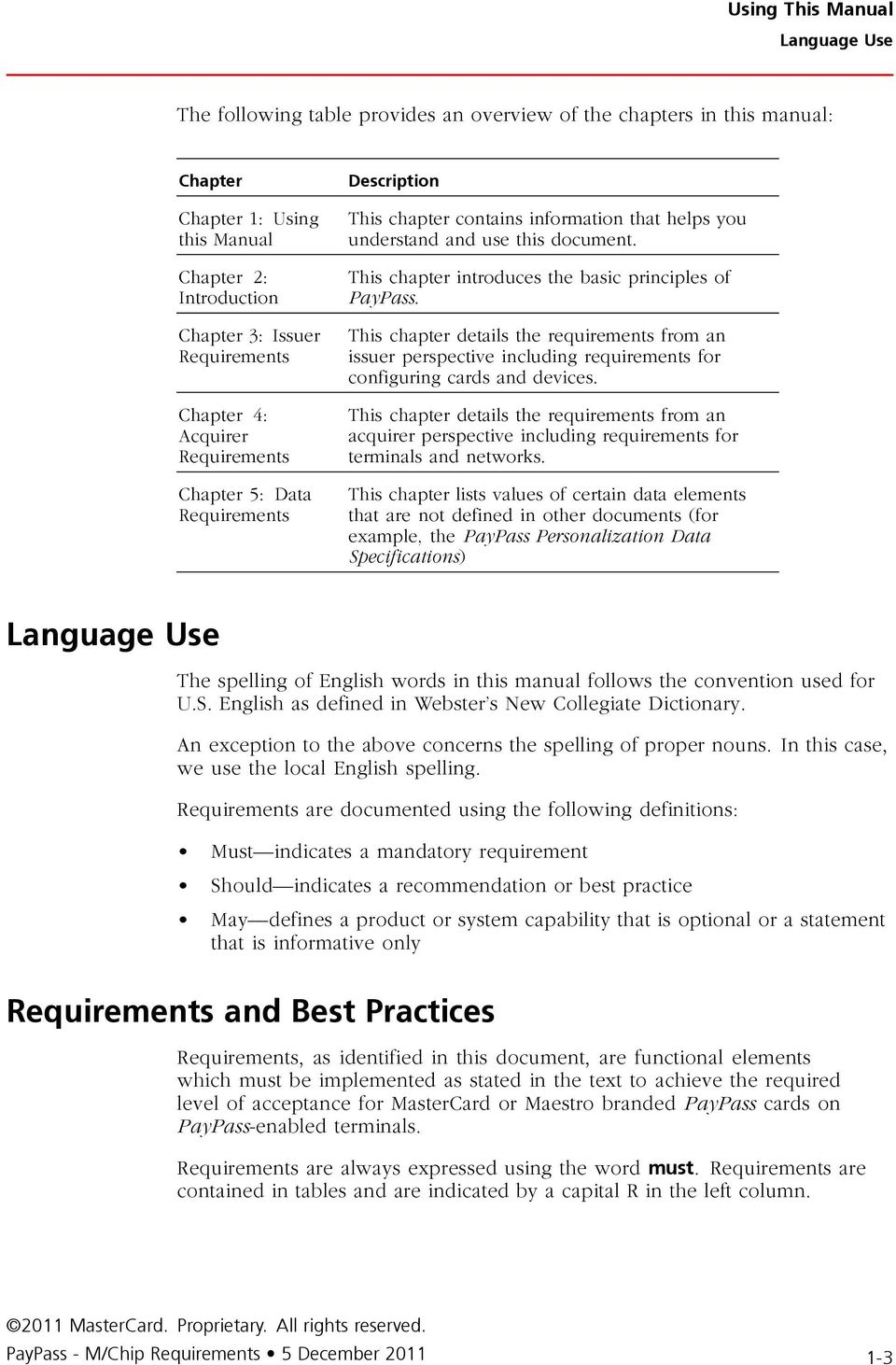
9 Using This Manual Language Use The following table provides an overview of the chapters in this manual: Chapter Chapter 1: Using this Manual Chapter 2: Introduction Chapter 3: Issuer Requirements Chapter 4: Acquirer Requirements Chapter 5: Data Requirements Description This chapter contains information that helps you understand and use this document. This chapter introduces the basic principles of PayPass. This chapter details the requirements from an issuer perspective including requirements for configuring cards and devices. This chapter details the requirements from an acquirer perspective including requirements for terminals and networks. This chapter lists values of certain data elements that are not defined in other documents (for example, the PayPass Personalization Data Specifications) Language Use The spelling of English words in this manual follows the convention used for U.S. English as defined in Webster s New Collegiate Dictionary. An exception to the above concerns the spelling of proper nouns. In this case, we use the local English spelling. Requirements are documented using the following definitions: Must indicates a mandatory requirement Should indicates a recommendation or best practice May defines a product or system capability that is optional or a statement that is informative only Requirements and Best Practices Requirements, as identified in this document, are functional elements which must be implemented as stated in the text to achieve the required level of acceptance for MasterCard or Maestro branded PayPass cards on PayPass-enabled terminals. Requirements are always expressed using the word must. Requirements are contained in tables and are indicated by a capital R in the left column. PayPass - M/Chip Requirements 5 December
10 Using This Manual Terminology Best practices are MasterCard recommendations for the best ways to implement different options. If customers choose not to follow them, their PayPass implementation will still work but may not be as effective or efficient as it could be. Best practices are written using the word should. Best practices are formatted in the same way as requirements but are preceded by the letters BP. Requirements and best practices include an indication of whether they apply to all products or just to the MasterCard or Maestro brand. R All Requirement applies to all PayPass cards or terminals. R MC Requirement applies to MasterCard branded PayPass cards or terminals. R MS Requirement applies to Maestro branded PayPass cards or terminals. Terminology PayPass Cards and Devices PayPass devices can be issued in form factors other than that of a traditional payment card, for example: mobile phones, key fobs, watches. Throughout this document a reference to PayPass cards includes other devices unless specifically excluded. A dual interface card refers to a chip card that can perform both contact and PayPass transactions. PayPass Terminals and Readers Functionality for the acceptance of PayPass cards may be provided by the PayPass reader or by the accompanying POS terminal. Throughout this document a reference to a PayPass terminal includes both the reader and terminal functionality and unless specifically stated does not imply the function should be in a specific part of the terminal system. Hard/Soft Limit Implementations Soft limit refers to implementations where transactions over a given value require cardholder verification. Hard limit refers to implementations where a maximum transaction amount is set and cardholder verification is never required below this limit. The configuration of PayPass - M/Chip limits results in one of these implementation types within a region or market December 2011 PayPass - M/Chip Requirements

11 Using This Manual Reference Information Magnetic Stripe Grade Issuers Magnetic stripe grade issuers receive additional information produced during a chip transaction, but do not process it. If the magnetic stripe grade issuer uses the Chip Conversion service, the issuer does not receive the additional information. Reference Information The following references are used in, or are relevant to, this document. The latest version applies unless a publication date is explicitly stated. Chargeback Guide M/Chip Card Personalization Standard Profiles (Including PayPass) M/Chip Requirements Maestro Global Rules Maestro PayPass Branding Standards MasterCard PayPass Branding Standards MasterCard Rules PayPass - Mag Stripe Acquirer Implementation Requirements PayPass On-behalf Services Guide PayPass Personalization Data Specification PayPass Vendor Product Approval Process Guide (Cards and Devices) PayPass Vendor Product Approval Process Guide (Terminals) PayPass on Mobile Requirements Document PayPass M/Chip Issuer Guide PayPass Mag Stripe Issuer Implementation Requirements Conventions A generic reference to PayPass includes all applicable products. The terms MasterCard PayPass or Maestro PayPass is used to identify specific product requirements. A reference to the MasterCard product or MasterCard brand includes MasterCard and Debit MasterCard unless specifically addressed. MasterCard brands refers to MasterCard and Maestro products. Values expressed in hexadecimal form ('0' to '9' and 'A' to 'F') are enclosed in single quotes. For example, a hexadecimal value of ABCD is indicated as 'ABCD'. PayPass - M/Chip Requirements 5 December

12 Using This Manual Conventions Values expressed in binary form are followed by a lower case b. For example, 1001b EMV Card commands are indicated in bold capitals, for example, GENERATE AC. Specific byte/bit references within a data object are included in square brackets. For example, [1][3] means the third bit of the first byte of the given data object December 2011 PayPass - M/Chip Requirements

13 Chapter 2 PayPass Introduction This chapter provides information on PayPass participation, transaction types, and transaction flows. Introduction Participation PayPass Operating Modes PayPass Cards PayPass Transaction Types PayPass Acceptance PayPass Transaction Flow Other Transaction Types and Environments PayPass - M/Chip Requirements 5 December i

14

15 PayPass Introduction Introduction Introduction PayPass is the proximity payments program from MasterCard Worldwide. It allows cardholders to make payments without having to hand over, dip or swipe a payment card. To make a payment, the cardholder simply taps their PayPass card onto a PayPass terminal. The details are read from the card over a contactless interface using radio frequency communications and a payment transaction is performed over the existing MasterCard payment networks and infrastructure. Primary characteristics of PayPass transactions are speed and convenience for merchants and cardholders. PayPass is supported on the MasterCard and Maestro brands. It is not supported on the Cirrus brand. The PayPass contactless functionality can be used at any merchant location that has PayPass terminals and accepts the underlying payment brand. The merchant segments where PayPass is expected to be most attractive include those environments with high transaction volumes and where fast transaction times are important. Participation To issue PayPass cards or acquire PayPass transactions customers must enroll in the PayPass program. Vendors are required to obtain a license agreement before developing and selling PayPass cards and devices. All cards, devices and readers used for performing PayPass transactions must have been approved and licensed by MasterCard. Customers must only purchase and deploy cards and terminals from properly licensed vendors. Detailed information about the type approval process can be found in the PayPass Vendor Product Approval Process Guide (Cards and Devices) and the PayPass Vendor Product Approval Process Guide (Terminals) documents. Issuers and acquirers must start a project with the relevant MasterCard project team in order to define and complete various certification steps that are required. This can include Network Interface Validation for issuers or Terminal Integration Process for acquirers. Questions about the enrollment or license process should be directed to [email protected]. PayPass - M/Chip Requirements 5 December

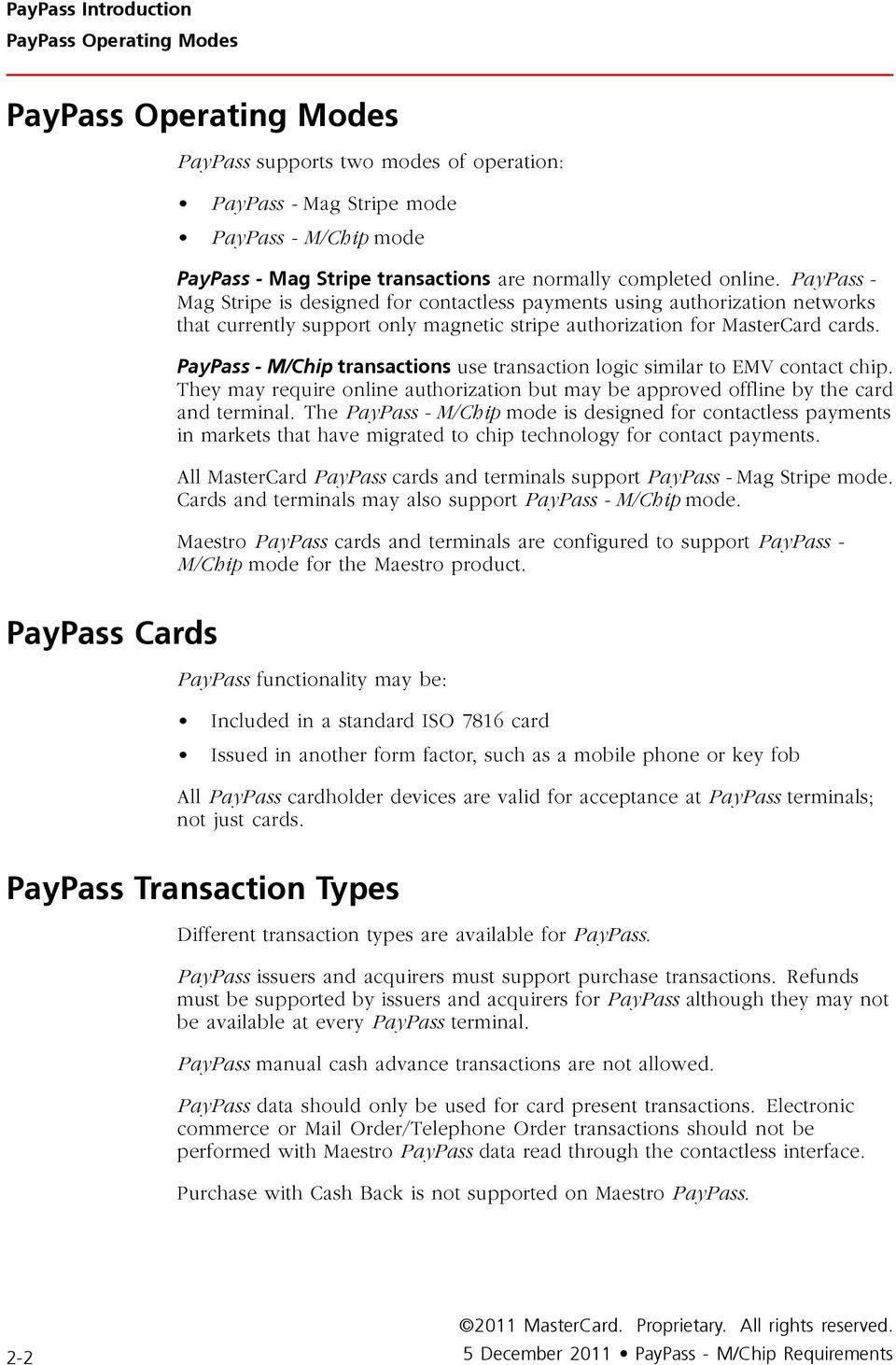
16 PayPass Introduction PayPass Operating Modes PayPass Operating Modes PayPass supports two modes of operation: PayPass - Mag Stripe mode PayPass - M/Chip mode PayPass - Mag Stripe transactions are normally completed online. PayPass - Mag Stripe is designed for contactless payments using authorization networks that currently support only magnetic stripe authorization for MasterCard cards. PayPass - M/Chip transactions use transaction logic similar to EMV contact chip. They may require online authorization but may be approved offline by the card and terminal. The PayPass - M/Chip mode is designed for contactless payments in markets that have migrated to chip technology for contact payments. All MasterCard PayPass cards and terminals support PayPass - Mag Stripe mode. Cards and terminals may also support PayPass - M/Chip mode. Maestro PayPass cards and terminals are configured to support PayPass - M/Chip mode for the Maestro product. PayPass Cards PayPass functionality may be: Included in a standard ISO 7816 card Issued in another form factor, such as a mobile phone or key fob All PayPass cardholder devices are valid for acceptance at PayPass terminals; not just cards. PayPass Transaction Types Different transaction types are available for PayPass. PayPass issuers and acquirers must support purchase transactions. Refunds must be supported by issuers and acquirers for PayPass although they may not be available at every PayPass terminal. PayPass manual cash advance transactions are not allowed. PayPass data should only be used for card present transactions. Electronic commerce or Mail Order/Telephone Order transactions should not be performed with Maestro PayPass data read through the contactless interface. Purchase with Cash Back is not supported on Maestro PayPass December 2011 PayPass - M/Chip Requirements
17 PayPass Introduction PayPass Acceptance The PayPass interface may be used for MasterCard Purchase with Cash Back transactions based on the existing product rules. Cardholder verification is always required for Purchase with Cash Back transactions. MasterCard PayPass must not be used for Unique Transactions, as defined in the MasterCard Rules. Maestro PayPass must not be used for Special Transactions, as defined in the Maestro rules. PayPass Acceptance PayPass cards may be accepted at attended POS terminals and at CAT terminals. PayPass cards may be used at ATMs. MasterCard defines several types of cardholder activated terminals (CATs). PayPass may be used at CAT Level 1, 2, 3 and 4. Refer to the Chargeback Guide for full definitions. As CAT Level 1 terminals require PIN based cardholder verification, only PayPass cards that support online PIN or On Device Cardholder Verification may be used at these terminals. Card Checking PayPass transactions are carried out by the cardholder; therefore, the card does not need to be given to the merchant. Since the PayPass card may remain in the hands of the cardholder, the merchant is exempt from the visual inspection requirement to determine if the PayPass card is valid. The card only needs to be given to the merchant after the contactless interaction is complete if signature verification is to be performed. Transaction Amount The transaction amount is usually known before the PayPass transaction is initiated to ensure fast processing of PayPass transactions. The amount should be displayed to the cardholder. If the transaction amount exceeds the maximum amount for PayPass transactions, for the product or terminal, the terminal or merchant should prompt the cardholder to use a different technology to complete the transaction (for example a contact chip transaction). This ensures cardholders are not denied service when they have a valid MasterCard product for the transaction. Limits For MasterCard PayPass, a Chargeback Protection Amount is published in the Chargeback Guide. Transactions equal to or less than this limit do not need cardholder verification. A receipt does not need to be routinely issued for these transactions. PayPass - M/Chip Requirements 5 December

18 PayPass Introduction PayPass Transaction Flow In some specific markets, a maximum transaction amount may be published for MasterCard PayPass. For Maestro PayPass, a Ceiling Limit is published in the Maestro Global Rules. Transactions are not allowed above this limit, except in certain markets specified by MasterCard where transactions are permitted with online PIN verification. In these situations, the published ceiling limit effectively becomes the chargeback protection amount. Markets in which Maestro PayPass transactions are not allowed above the ceiling limit are referred to as hard limit markets. Markets in which Maestro PayPass transactions are allowed above the ceiling limit with online PIN verification are referred to as soft limit markets. The term chargeback protection amount is used generically in later sections to refer to both the MasterCard chargeback protection amount and the Maestro limit above which cardholder verification is required. Floor limits for PayPass are as for contact chip (for PayPass - M/Chip) or magnetic stripe (for PayPass - Mag Stripe) transactions. The floor limit may vary per market. Fallback If the contactless technology fails the transaction may be completed by any other technology available. A subsequent transaction is not considered a technical fallback transaction. PayPass Transaction Flow Several steps are involved in the PayPass transaction. Technology Selection The cardholder decides whether to use PayPass or an alternative interface on the card. PayPass technology is used for the transaction when the PayPass card is presented by the cardholder to the PayPass reader. If the card application selected and the terminal supports PayPass - M/Chip mode, then it is automatically used by the terminal to complete the transaction. Otherwise, PayPass - Mag Stripe mode is used. Application Selection If the cardholder has chosen to pay by PayPass, the terminal attempts to find an application via the contactless interface to complete the transaction. When the terminal detects more than one application that it supports on the PayPass card, the terminal automatically selects the application with the highest priority set by the issuer. Interactive cardholder selection or confirmation is not supported for PayPass to improve the transaction speed December 2011 PayPass - M/Chip Requirements

19 PayPass Introduction PayPass Transaction Flow If there are no available applications, given any relevant transaction limits, then the PayPass transaction cannot proceed. For MasterCard products, the same Application Identifiers (AID) are used for PayPass transactions as for contact chip transactions. There are no PayPass specific AIDs. Card Authentication For all PayPass transactions the card being used is authenticated. For PayPass - M/Chip transactions the card can be authenticated: Offline by the terminal OR Online by the issuer All offline approved Maestro PayPass transactions must be authenticated using CDA. All offline MasterCard PayPass - M/Chip transactions must be authenticated by the terminal using either: CDA OR SDA 1 CDA is strongly recommended for MasterCard PayPass - M/Chip transactions and the use of SDA is being phased out. All PayPass - M/Chip terminals support CDA. PayPass does not support DDA. For online PayPass - M/Chip transactions the issuer should perform online authentication by verifying the ARQC received in the online authorization. For PayPass - Mag Stripe transactions, the transactions are authorized online by the issuer. The PayPass card produces a unique password, referred to as Dynamic CVC3, for each transaction. The value is placed by the terminal in issuer defined positions within the existing track data fields; therefore, no extra data needs to be transmitted. The issuer should perform online authentication by verifying the Dynamic CVC3 received in the online authorization. If PayPass - Mag Stripe profile transactions are not authorized by the issuer, then the merchant may be liable for any disputed transactions. Offline-only terminals may decline transactions with PayPass - Mag Stripe cards. 1. SDA authenticates the card, but not the transaction data. New PayPass cards cannot be issued supporting SDA. New PayPass terminals do not support SDA. PayPass - M/Chip Requirements 5 December

20 PayPass Introduction PayPass Transaction Flow Cardholder Verification PayPass transactions for amounts less than or equal to the chargeback protection amount do not require cardholder verification. For transaction amounts above the chargeback protection amount, cardholder verification is required or the acquirer may be liable for disputed transactions. For MasterCard PayPass, acceptable cardholder verification methods are: Online PIN Signature On Device Cardholder Verification For Maestro PayPass, acceptable cardholder verification methods are: Online PIN On Device Cardholder Verification PayPass does not support offline PIN. For PayPass - Mag Stripe transactions, the CVM is determined by the terminal. This can be done in a similar way to swiped magnetic stripe transactions, based on the methods supported by the terminal. The terminal is not required to follow issuer instructions contained in the Service Code encoded in the magnetic stripe data. The device notifies the terminal if On Device Cardholder Verification is supported, in which case this method is used if supported by the terminal and cardholder verification is required. For PayPass - M/Chip transactions, the CVM is determined by the PayPass reader application in the terminal, based on the CVM List or other information contained in the card. The actual CVM is completed after the interaction with the card is complete, except for On Device Cardholder Verification which is completed before the interaction begins. Card Risk Management The card risk management performed is at the discretion of the issuer. Online Authorization PayPass - M/Chip transactions may be authorized offline by the PayPass card or the card may request online authorization by the issuer. PayPass - Mag Stripe transactions are usually authorized online by the issuer. If PayPass - Mag Stripe transactions are not authorized online, then the acquirer may be liable for any disputed transactions. If online PIN has been identified as the cardholder verification method for the transaction, the PIN is verified as part of the online authorization request December 2011 PayPass - M/Chip Requirements
21 PayPass Introduction Other Transaction Types and Environments End of Transaction A PayPass - M/Chip terminal ends the interaction with the card once the results of the first GENERATE AC command are received by the terminal. A PayPass - Mag Stripe terminal ends the interaction with the card once the results of the COMPUTE CRYPTOGRAPHIC CHECKSUM command are received by the terminal. This is not the end of the PayPass transaction. The PayPass terminal completes the transaction based on: An offline approval or decline response from the card for PayPass - M/Chip transactions. OR An online authorization response (approve or decline) when requested When the printing of a receipt is supported by the point of sale, for PayPass transactions less than or equal to the chargeback protection amount, a receipt must be available if requested by the cardholder. A receipt must be provided for transactions above the chargeback protection amount if the terminal is capable of producing a receipt. Neither issuer authentication nor script processing is completed during a PayPass - M/Chip transaction. Other Transaction Types and Environments There are additional transaction types and environments in which PayPass cards may or may not be used. Purchase with Cash Back Purchase with Cash Back is not supported on Maestro PayPass. The PayPass interface may be used for MasterCard Purchase with Cash Back transactions as per the existing product rules. Cardholder verification is always required for Purchase with Cash Back transactions. Unique and Special Transactions MasterCard PayPass must not be used for Unique Transactions, as defined in the MasterCard Rules. Maestro PayPass must not be used for Special Transactions, as defined in the Maestro rules. Cardholder Activated Terminals MasterCard defines several types of cardholder activated terminals (CATs). PayPass may be used at CAT Level 1, 2, 3 and 4 terminals (see the Chargeback Guide for full definitions). PayPass - M/Chip Requirements 5 December
22 PayPass Introduction Other Transaction Types and Environments As CAT Level 1 terminals require PIN based cardholder verification, only PayPass cards that support online PIN or On Device Cardholder Verification may be used at these terminals December 2011 PayPass - M/Chip Requirements
23 Chapter 3 Issuer Requirements This chapter includes information on requirements for the issuer. General Requirements Card Requirements Card Delivery Issuer Host Requirements Clearing Requirements Chargeback and Exception Processing PayPass - M/Chip Requirements 5 December i
24
25 Issuer Requirements General Requirements General Requirements PayPass Enrollment For issuers wishing to participate in the PayPass program, completion of the PayPass Program Enrollment Form is mandatory. Once enrolled, issuers receive access to the relevant technical documents. R ALL All customers who wish to issue PayPass must enroll in the PayPass program. Card Requirements Various requirements and best practices exist for the PayPass card. Approvals and Testing All PayPass cards issued are required by MasterCard to have MasterCard vendor product approval. It is the issuer s responsibility to confirm all products have received this approval. A full PayPass card Letter of Approval is only granted to a card when it has successfully completed all of the following: Interface and Application Testing Compliance Assessment and Security Testing Card Quality Management When ordering cards from a card manufacturer, the issuer must ensure that the card manufacturer has a current PayPass Letter of Approval for the product being purchased. The Letter of Approval is valid for the duration of the time the cards are held in stock prior to being issued. All PayPass products must have a valid PayPass Letter of Approval at the time the product is issued. R ALL Issuers must ensure that all PayPass cards are covered by a valid Letter of Approval at the time they are issued. Branding, Appearance and Physical Requirements For the brand standards and design elements required for PayPass cards, please refer to the MasterCard PayPass Branding Standards and the Maestro PayPass Branding Standards. Issuers must obtain approval from MasterCard Card Design Management for their PayPass card design, even if a similar design has already been approved for use on a non-paypass card. PayPass cards look similar to standard cards, with the exception of the PayPass logo. MasterCard recommends the logo be placed on the front of the card. PayPass - M/Chip Requirements 5 December
26 Issuer Requirements Card Requirements R ALL Cards must comply with the PayPass branding requirements. PayPass Cards If PayPass - M/Chip is implemented on an ISO 7816 compliant plastic card then the card must support both magnetic stripe and an EMV contact chip. R ALL PayPass - M/Chip Cards must be hybrid cards supporting both magnetic stripe and contact chip. A MasterCard PayPass card that supports chip on the contact interface normally also supports PayPass - M/Chip. BP MC A chip capable MasterCard branded PayPass card should support PayPass - M/Chip. Non-card Devices PayPass functionality can be present in form factors other than traditional payment cards. Examples of different forms are: Mobile phones Key fobs Watches All PayPass non-card devices conduct PayPass transactions in the same way as PayPass cards. They may support special functionality, such as On Device Cardholder Verification. When PayPass - M/Chip cards use offline risk management features, an interaction with the card is required to manage the offline risk management counters. This cannot be performed in a normal PayPass payment transaction since response data from the issuer is not returned to the card. This interaction may be achieved: By performing a transaction through the contact interface of a hybrid card By over-the-air messages, for example to a mobile phone Through the contactless interface in a special terminal designed for this purpose, if supported by the cardholder device. PayPass cards which support offline transactions, including all Maestro cards, must be able to support the management of the offline risk management counters. PayPass - M/Chip non-card devices that cannot support the management of the offline risk management counters must be configured as online only. All PayPass non-card device programs must be approved by MasterCard December 2011 PayPass - M/Chip Requirements
27 Issuer Requirements Card Requirements The MasterCard PayPass device given to the cardholder must be linked to a MasterCard card account assigned to that same cardholder accessed by a standard MasterCard card. This card does not have to be a PayPass card. The expiration date of the PayPass device must not be later than the card that it is linked to. If the MasterCard card is cancelled, the issuer must simultaneously cancel the companion PayPass device. It is not necessary for the PayPass device to display an account number. Devices other than mobile phones should accommodate a signature panel where possible. Those devices that cannot accommodate a signature panel should contain a customization area or unique identification number. A minimal space on small form factors is sufficient to provide cardholders with an opportunity to customize the device with their initials or another mark to identify it as belonging to them. R ALL All PayPass non-card device programs must be approved in advance by MasterCard. R MC A MasterCard branded PayPass device must be linked to an account with a standard MasterCard card. This card does not need to support PayPass. R MC The expiration date of the PayPass device must not be later than the card to which it is linked. R MC The PayPass device must be cancelled if the linked MasterCard card is cancelled. BP MC The PayPass device, other than a mobile phone, should accommodate a signature panel. R ALL PayPass - M/Chip non-card devices that do not provide a mechanism to reset offline risk management counters must be configured as online only. R MS Maestro PayPass must only be supported on a dual interface card or other device that supports over-the-air communication to manage the offline risk management counters. PayPass - M/Chip Requirements 5 December
28 Issuer Requirements Card Requirements Card Application PayPass - M/Chip must be implemented using approved applications. Examples are: PayPass - M/Chip 4 M/Chip Advance PayPass - M/Chip Flex Mobile MasterCard PayPass M/Chip 4 R ALL All PayPass - M/Chip cards must use approved applications. Support of PayPass - M/Chip and PayPass - Mag Stripe A PayPass card using the MasterCard brand: Must support PayPass - Mag Stripe transactions May support PayPass - M/Chip transactions R MC A MasterCard PayPass card must support PayPass - Mag Stripe transactions. A PayPass card using the Maestro brand: Must support PayPass - M/Chip transactions Must not support PayPass - Mag Stripe transactions for Maestro R MS A Maestro PayPass card must support PayPass - M/Chip transactions. R MS A Maestro PayPass card must not support PayPass - Mag Stripe transactions. PayPass technology may not currently be used on MasterCard Fleet or MultiCard products as data positions required by PayPass are already used in the product personalization requirements of these products. R MC MasterCard Fleet or MultiCard products including PayPass must not be issued. Online and Offline Capability PayPass - Mag Stripe transactions are normally authorized online. The card has no input into the decision to seek authorization December 2011 PayPass - M/Chip Requirements
29 Issuer Requirements Card Requirements In PayPass - M/Chip cards the transaction counters and decision making capability of the chip are used to control risk. To support fast transactions, it is recommended that PayPass - M/Chip cards be configured to support offline transaction approval. Maestro PayPass cards must not be configured as online only. As some terminals operate exclusively online, PayPass - M/Chip cards should be configured to support online transaction approval. To meet special market requirements MasterCard may approve cards that are exclusively online or exclusively offline; however, issuers should be aware that these cards do not work in some terminals. R MS Maestro PayPass cards must not be configured as online only. BP ALL PayPass - M/Chip cards should be configured to support offline transaction approval. They should not be configured to be exclusively online. BP ALL PayPass - M/Chip cards should be configured to support online transaction approval. They should not be configured to be exclusively offline. Service Codes A value for the service code may be found several times on a PayPass - M/Chip card. For example: on the magnetic stripe of the card in both Track 1 and Track 2 Track 1 Data (tag '56') and Track 2 Data (tag '9F6B') accessed via the PayPass interface Track 2 Equivalent Data (tag '57') accessed via the PayPass interface Track 2 Equivalent Data (tag '57') accessed via the contact interface Although not recommended, PayPass issuers may choose to use service code values in the PayPass application differently than the magnetic stripe of the same card. It is recommended that cards be personalized to use the same service code appropriate for the product each time the service code is used. If the issuer does use a different service code value on the PayPass interface, the value may be acted on by some terminals. In particular, terminals that process the service code may reject international cards that have a service code value starting with '5' (National use only). BP ALL Issuers should use the value of the service code appropriate for the product each time the service code is used. PayPass - M/Chip Requirements 5 December
30 Issuer Requirements Card Requirements Purchase with Cash Back Maestro cards must not support Purchase with Cash Back on the PayPass interface. Debit MasterCard cards may support Purchase with Cash Back on the PayPass interface. Purchase with Cash Back on the PayPass interface is only supported for MasterCard credit cards in European markets. Purchase with Cash Back transactions always require cardholder verification, regardless of the amount. R MS Maestro cards must not be configured to support Purchase with Cash Back through the PayPass interface. R MC MasterCard credit cards issued outside the Europe region must not be configured to support Purchase with Cash Back through the PayPass interface. Application Selection PayPass terminals normally perform application selection using the PPSE on the card. All PayPass cards must contain a PPSE. Issuers must use the Application Priority Indicator to show the preferred sequence of choice of all PayPass applications on the card. Issuers must set a priority for each application. Cardholder confirmation must not be requested. The AID value used for PayPass is the same AID used for the contact interface. There are no specific AIDs for PayPass. Supported AIDs are: MasterCard A Maestro A Identification of PayPass cards use the product AID without any extension, as shown above. PIX extensions may be used by issuers and are considered as a successful match by the terminal when partial AID matching is supported. However, it is recommended not to use PIX extensions, as some legacy PayPass terminals do not support partial AID matching. If the same account is accessed by the contact and contactless interface, the AID used on each interface might be different; the contact AID may contain a PIX extension, but the contactless AID excludes this PIX extension. The Application Label (tag '50') must be present in a PayPass card. This may appear on any receipts December 2011 PayPass - M/Chip Requirements
31 Issuer Requirements Card Requirements The Application Label on a MasterCard card must be MasterCard, MASTERCARD, Debit MasterCard or DEBIT MASTERCARD. The Application Label on a Maestro card must be Maestro or MAESTRO. Issuers may personalize the Application Preferred Name (tag '9F12') and Issuer Code Table Index (tag '9F11'). The Application Preferred Name may be used on receipts instead of the Application Label if the terminal supports the code table indicated. R ALL All PayPass cards must contain a PPSE. R ALL Issuers must set a unique value for the Application Priority Indicator in each PayPass application on the card. R ALL Issuers must not set the Cardholder Confirmation bit in the Application Priority Indicator. R ALL Issuers must use the appropriate Application Label. BP ALL PIX extensions should not be used in the AID for PayPass. Card Authentication MasterCard requires the use of Dynamic CVC3 by all PayPass - Mag Stripe cards. This includes PayPass - M/Chip cards that perform PayPass - Mag Stripe transactions. For PayPass - M/Chip online transactions the ARQC should be validated to prevent counterfeit fraud. For MasterCard PayPass - M/Chip: Cards issued in the Europe region must support CDA and must not support SDA Cards issued outside of the Europe region that do not support CDA must operate as online only. Cards must not support SDA MasterCard recommends that the issuer support CDA. All Maestro PayPass cards must support CDA and must not support SDA for Maestro PayPass - M/Chip. PayPass does not support DDA as this requires the PayPass card to be in communication with the terminal for a longer period than other offline CAM options. R MS Maestro PayPass - M/Chip cards must support CDA and must not support SDA. R MC New MasterCard PayPass - M/Chip cards must not support SDA. PayPass - M/Chip Requirements 5 December
32 Issuer Requirements Card Requirements R MC New MasterCard PayPass - M/Chip cards issued in the Europe region must support CDA. R MC New MasterCard PayPass - M/Chip cards issued outside of the Europe region must support CDA or be configured as online only and not support any offline CAM. BP MC Issuers outside the Europe region are strongly recommended to use CDA on MasterCard PayPass - M/Chip cards. R ALL PayPass - M/Chip cards must not support DDA on the PayPass interface. R MC MasterCard PayPass - M/Chip cards must use a Dynamic CVC3 for PayPass - Mag Stripe transactions. BP ALL Issuers are strongly recommended to validate the ARQC for online PayPass - M/Chip transactions. The payment system public keys for PayPass - M/Chip have the same values and expiry dates, as those used for MasterCard contact transactions. It is recommended to use the same Issuer Key pair for transactions on the contact and contactless interface of a PayPass - M/Chip card; therefore, the same Issuer Public Key certificate may be used. It is recommended to use the same ICC Key pair for transactions on the contact and contactless interface of a PayPass - M/Chip card. The ICC Public Key Certificate cannot be shared between the contact and contactless interface even if the same keys are used since some of the data elements signed in the certificate are different. BP ALL Issuers should use the same Issuer and ICC Public Keys across both the contact and contactless interface. Cardholder Verification A signature or PIN is not required for a PayPass transaction less than or equal to the chargeback protection amount. In this situation, no setting of the Service Code for PayPass - Mag Stripe, or CVM List for PayPass - M/Chip, requires the acquirer to obtain cardholder verification. For transactions greater than the chargeback protection amount, cardholder verification is normally requested. If transactions are completed with no cardholder verification above the chargeback protection amount then the acquirer may be liable for disputed transactions. For PayPass - Mag Stripe transactions, the cardholder verification method is determined by the terminal in a similar manner to swiped magnetic stripe transactions. The terminal is not required to refer to the Service Code, which appears in multiple data elements. If the device supports On Device Cardholder Verification, this is communicated to the terminal as part of the transaction December 2011 PayPass - M/Chip Requirements
33 Issuer Requirements Card Requirements For PayPass - M/Chip transactions, the CVM is determined by the PayPass reader application in the terminal based on the terminal capabilities and CVM List or other data in the card. MasterCard PayPass - M/Chip cards: Must support signature Must support online PIN Must support No CVM May support On Device Cardholder Verification The issuer may elect for either signature or online PIN to be preferred and personalize the CVM List accordingly. On Device Cardholder Verification is performed above the chargeback protection amount if supported by the device and the terminal. Maestro PayPass cards: Must support No CVM Must not support signature, online PIN, or On Device Cardholder Verification If issued in a soft limit market, Maestro PayPass - M/Chip cards: Must support No CVM and online PIN Must not support signature May support On Device Cardholder Verification Offline PIN is not supported for PayPass - M/Chip transactions. Offline PIN may be supported on the same card but only for contact EMV transactions. Issuers must not include offline PIN options in the CVM List read through the PayPass interface. R MS Maestro PayPass - M/Chip cards must support No CVM for PayPass transactions. R MS Maestro PayPass cards issued in soft limit markets must support online PIN for PayPass transactions. R MC MasterCard PayPass - M/Chip cards must support No CVM, online PIN and signature. R All PayPass - M/Chip cards must not support either offline plain text PIN or offline enciphered PIN in the CVM List read through the PayPass interface. PayPass - M/Chip Requirements 5 December
34 Issuer Requirements Card Requirements Magnetic Stripe Based PVV It may not be possible or easy to change some of the data on a PayPass card. Any existing magnetic stripe processes that rely on rewriting data to the magnetic stripe after the card has been issued needs to be evaluated. In particular this may affect magnetic stripe based PVV solutions for online PIN verification if PIN change is supported. BP ALL Magnetic stripe based PVV methods should not be used for online PIN verification if PIN change is supported. Managing the Contactless Controls The issuer should manage the offline counters and parameters for the contactless interface during the authorization response to a contact chip transaction. They cannot be managed during a PayPass transaction as the Issuer Authentication Data from the authorization response is never delivered to the card. The PayPass - M/Chip application may trigger an online authorization request at the next contact transaction to enable management of the offline counters. Personalization Requirements The PayPass personalization requirements are detailed in the PayPass Personalization Data Specifications and the M/Chip Card Personalization Standard Profiles (including PayPass). MasterCard requires that the personalization of each card configuration be approved using the CPV service before cards are issued. MasterCard prohibits encoding the cardholder name in the data read through the contactless interface to prevent unauthorized disclosure. It is recommended to use a space character followed by the surname separator / in the Track 1 Data. Third Party Data may be used by a terminal for proprietary processing. Issuers that intend to participate in a scheme utilizing this data object must request a Unique Identifier from MasterCard. R ALL CPV must be successfully completed for all PayPass cards issued. R ALL The name of the cardholder must not be readable over the PayPass interface. R ALL If Third Party Data is included in the PayPass card, and is intended to be used to carry proprietary data, then the issuer must contact MasterCard at [email protected] to obtain the Unique Identifier. BP ALL Issuers should use / for the cardholder name in the data read through the PayPass interface. BP ALL The PayPass card should be personalized with Third Party Data containing the Device Type December 2011 PayPass - M/Chip Requirements
35 Issuer Requirements Card Requirements Data objects may be personalized in the card organized in the pre-defined file structure detailed in the PayPass Personalization Data Specifications to allow efficient data capture by the PayPass terminal resulting in a faster transaction. R ALL If data objects are not organized according to the rules specified for the pre-defined file structure, then the pre-defined values for the AFL must not be used. PayPass M/Chip Personalization Requirements Some data elements are unique for the contactless interface and some are shared with the contact interface. For PayPass the issuer may operate in full chip grade, semi-grade or magnetic stripe grade on the contact profile. Chip grade issuers, semi-grade issuers and magnetic stripe grade issuers that have the capability to distinguish between chip-read and magnetic stripe-read transactions must use a different value for Chip CVC on the contactless interface to the CVC1 encoded on the magnetic stripe. This prevents compromised PayPass data being used to fraudulently create valid counterfeit magnetic stripe cards. Maestro cards that do not have a CVC1 encoded on the magnetic stripe do not need to include a Chip CVC. However to protect against the risk of counterfeiting, it should not be possible to reproduce the Track 2 on the magnetic stripe from the PayPass data in the chip. This means that some aspect of the magnetic stripe data should be unique to the stripe, unpredictable and validated during the authorization. R ALL Chip grade issuers, semi-grade issuers and magnetic stripe grade issuers that have the capability to distinguish between chip-read and magnetic stripe-read transactions must support a Chip CVC in Track 2 Equivalent Data on the contactless interface that is different to the CVC1 if present. R ALL The genuine CVC1, as found on the physical magnetic stripe, must not appear in any data element that can be read through the contactless interface (except as allowed above). BP MS Issuers of Maestro PayPass cards that do not have a Chip CVC in Track 2 Equivalent Data should ensure that the Track 2 data found on the magnetic stripe cannot be reproduced from the PayPass data on the chip. Some aspect of the magnetic stripe data should be unique to the magnetic stripe, unpredictable and validated during the authorization. Issuers may choose to use an Application PAN on the contactless interface which is different to the PAN present on the magnetic stripe or that appears on the face of the card. To protect critical data used in the transaction, if the card supports offline card authentication then the data elements shown in the table below must be stored in records that are signed. PayPass - M/Chip Requirements 5 December
36 Issuer Requirements Card Requirements Data Element Application Currency Code 1 Application Expiration Date Application Effective Date 2 Application PAN Sequence Number Application Primary Account Number Application Usage Control CDOL1 CDOL2 CVM List Issuer Action Code - Default Issuer Action Code - Denial Issuer Action Code - Online Issuer Country Code SDA Tag List Tag '9F42' 5F24 5F25 5F34 5A 9F07 8C 8D 8E 9F0D 9F0E 9F0F 5F28 9F4A R ALL The data elements shown in the table above, if present, must all be stored in records that are signed. PayPass - Mag Stripe Personalization Requirements The first and only record of the file in SFI 1 must include the data objects necessary to perform the PayPass -Mag Stripe transactions. The last digit of both Track 1 and Track 2 must not be used by the issuer as this is used by the terminal to indicate the number of digits of the unpredictable number (nun). The positions where the PayPass reader stores the ATC, UN, and CVC3 in the discretionary data in Track 1 Data and Track 2 Data, should be filled with zeroes. This is a requirement if PayPass On Behalf CVC validation services are used. 1. If present and the CVM List contains condition code value of 06, 07, 08, or If present December 2011 PayPass - M/Chip Requirements
37 Issuer Requirements Issuer Host Requirements R MC Record 1 of SFI 1 must contain the data to perform a PayPass - Mag Stripe transaction. Record 1 must be the only record included in SFI 1. R MC The last digit of both Track 1 and Track 2 must not be used by the issuer. R MC Placeholders for dynamic data which is inserted by the terminal in either Track 1 or Track 2 must be zero filled if PayPass-on behalf CVC validation services are used. Card Delivery PayPass data can be read by any reader that can power the contactless chip and send the correct commands. Therefore, it is feasible that card data could be captured while the card is in transit to the cardholder. Issuers should consider appropriate control methods to reduce the risks and impact of card or data interception. This might be by using a special envelope to shield card reading or by disabling the contactless interface until the card has been activated by the cardholder. BP ALL Issuers should disable the contactless interface until the card has been activated by the cardholder. Issuer Host Requirements Issuer host must meet requirements to accommodate authorization messages and decisions. Authorization Messages PayPass issuers must ensure host systems are capable of correctly receiving and processing authorization messages containing specific values for the data element (DE) 22 (POS Entry Mode) and DE 61 (POS Data) that identify PayPass transactions. DE 22 (POS Entry Mode), subelement 1, value 07 is used for a PayPass - M/Chip transaction. A value of 91 is used for a PayPass - Mag Stripe transaction even if performed at a PayPass - M/Chip terminal. DE 61 (POS Data), subelement 11, value 3 is used for any PayPass transaction at a PayPass - M/Chip terminal, the terminal may also be PayPass - Mag Stripe capable, and a value of 4 is used for any PayPass transaction at a PayPass - Mag Stripe only terminal. R ALL Issuers must support on their network interface and host system PayPass transactions as described above. PayPass - M/Chip Requirements 5 December
38 Issuer Requirements Issuer Host Requirements Authorization Decisions Authorization requests are approved against the account balance or open to buy position in the usual way. In addition, issuers should check the authenticity of the PayPass card by validating the Dynamic CVC3 or ARQC received. The issuer should take into account that the TVR included in the authorization request of a PayPass - M/Chip transaction does not always reflect the real outcome of the terminal tests performed. An example of this is when card authentication may have been completed after the GENERATE AC command was issued to the card or after the TVR was signed. BP ALL Issuers should always perform online CAM by checking that the ARQC contained in a PayPass - M/Chip online authorization request is correct. R ALL An authorization or clearing request may legitimately contain a TC in DE 55. Issuers must not routinely decline transactions in this situation. R ALL The transaction amount and the transaction date may be different in DE 55 when compared other fields in the authorization message. The issuer must not routinely decline transactions in this situation. R MC Issuers must always perform online CAM by checking that the CVC3 contained in a PayPass - Mag Stripe online authorization request is correct. BP MC Issuers should monitor the ATC to help detect fraud. BP MC Issuers must be able to process PayPass Mag Stripe transactions if either Track 1 Data or Track 2 Data is present in the authorization message. Authorization Responses A referral response must not be given to a PayPass authorization request. Since the consumer remains in control of the PayPass card throughout the transaction, the opportunity for merchants to pick up these cards is limited. Issuers should not use a capture card authorization response to PayPass transactions. For PayPass - M/Chip authorization responses, the issuer should not generate Issuer Authentication Data, because the PayPass terminal is not able to pass it to the PayPass card. For PayPass - M/Chip authorization responses, the issuer should not include issuer scripts because the PayPass terminal is not able to pass them to the PayPass card. R ALL Issuers must not use a referral 01 authorization response code. BP ALL Issuers should not use a capture card 04 authorization response code December 2011 PayPass - M/Chip Requirements
39 Issuer Requirements Clearing Requirements BP ALL PayPass - M/Chip issuers should not generate Issuer Authentication Data for authorization responses. BP ALL PayPass - M/Chip issuers should not send scripts with authorization responses. R ALL Issuers that use a PAN mapping service must return the genuine PAN in the authorization response message, even if an alternative PAN was used in the authorization request. Refunds MasterCard PayPass issuers must be able to support the processing of a refund transaction initiated via the PayPass contactless interface. R MC Issuers must be able to process refunds initiated via the contactless interface. Clearing Requirements PayPass transactions are identified in clearing messages. Clearing Messages PayPass issuers must ensure host systems are capable of correctly receiving and processing existing subfields within the clearing message containing specific values of the data input capability and the data input profile, DE 22 (POS Entry Code). DE 22, subfield 1 identifies the terminal capabilities and must contain: the value of M for a transaction at a PayPass - M/Chip terminal. Tthe terminal may also be PayPass - Mag Stripe capable. the value of A for a transaction at a PayPass - Mag Stripe terminal. DE 22, subfield 7 identifies the card data input profile for this transaction and must contain: the value M for a PayPass - M/Chip transaction. the value A for a PayPass - Mag Stripe transaction. R ALL Issuers must support PayPass transactions as described above on their clearing interface and host system. PayPass - M/Chip Requirements 5 December
40 Issuer Requirements Chargeback and Exception Processing Chargeback and Exception Processing Issuers may not make a retrieval request for a transaction identified as a PayPass transaction that is less than the chargeback protection amount, except in certain transit situations. No new chargeback reason codes have been introduced to support PayPass. Updates to the existing reason codes are documented in the Chargeback Guide or in the Maestro Global Product Rules December 2011 PayPass - M/Chip Requirements
41 Chapter 4 Acquirer Requirements This chapter includes information on requirements for the acquirer. General Requirements Terminals Offline Card Authentication Cardholder Verification Terminal Risk Management Terminal Action Codes (TACs) Authorization Responses Receipts Subsequent Contact Transactions Terminated Transactions Cardholder Activated Terminals Automated Teller Machines Acquirer Network Requirements Authorization Requirements Clearing Requirements Exception Processing On-behalf Services PayPass - M/Chip Requirements 5 December i
42
43 Acquirer Requirements General Requirements General Requirements Overall general requirements for acquirers and merchants include PayPass enrollment and acceptance. PayPass Enrollment Acquirers implementing PayPass acceptance must enroll in the MasterCard PayPass program. Acquirers must be enrolled and receive approval from MasterCard to acquire PayPass transactions. Program enrollment allows acquirers access to all required specifications and to receive MasterCard related services and products. R ALL Members that want to acquire PayPass transactions must enroll in the PayPass program. PayPass Acceptance PayPass acceptance means that all cardholder devices are valid for acceptance at terminals, not just PayPass cards. A PayPass terminal that accepts MasterCard: Must accept PayPass - Mag Stripe transactions May support PayPass - M/Chip transactions A PayPass terminal that accepts Maestro: Must not accept Maestro in PayPass - Mag Stripe mode. The terminal may support PayPass - Mag Stripe for MasterCard. Must support PayPass - M/Chip transactions PayPass - M/Chip must be used if supported by the card and terminal. Attempted PayPass - M/Chip transactions must not fallback to PayPass - Mag Stripe. Terminals cannot change processing mode during a transaction once it is determined. R MC A MasterCard PayPass terminal must support PayPass - Mag Stripe. R MS A Maestro PayPass terminal must support PayPass - M/Chip. R MS A Maestro PayPass terminal must not support PayPass Mag Stripe. PayPass - Mag Stripe merchant locations normally also support magnetic stripe contact acceptance. PayPass - M/Chip enabled merchant locations normally also support contact EMV and magnetic stripe acceptance. If the terminal supports contact chip technology, then products supported for PayPass must also be supported for contact chip transactions. PayPass - M/Chip Requirements 5 December
44 Acquirer Requirements Terminals A terminal that supports magnetic stripe and EMV chip contact transactions (hybrid terminal) that also supports PayPass should support PayPass - M/Chip. BP ALL A hybrid terminal that also supports PayPass should support PayPass - M/Chip. BP ALL A PayPass terminal should also support contact transactions. R ALL A hybrid terminal must support on the chip contact interface every product supported on the contactless interface. Locations that accept contactless only transactions are permitted in agreement with MasterCard and are used for specific merchant category codes on an individual country basis. An updated list of countries and merchant categories that are allowed to accept PayPass only is maintained in the Chargeback Guide following notification in a Europe Region Operations Bulletin. Terminals Acquirers and merchants must only use approved PayPass terminals. Approvals and Testing Products which are not PayPass approved need to obtain approval before deployment. Subsequent changes to terminal software could affect compliance with PayPass Terminal Vendor testing and must be discussed with MasterCard. R ALL Acquirers must only deploy terminals that have successfully completed the MasterCard PayPass vendor product approval process. Approvals are only given to properly licensed vendors. Terminal Branding PayPass terminals must meet the MasterCard branding requirements. PayPass terminals use common interfaces to provide a consistent consumer and merchant experience. Please see the PayPass - Mag Stripe Acquirer Implementation Requirements and PayPass - M/Chip Acquirer Implementation Requirements. In order to give the cardholder clear information as to where to tap the PayPass device on the PayPass terminal, acquirers must use the PayPass landing zone. The landing zone must indicate with the contactless identifier where the cardholder has to tap or hold the MasterCard PayPass card. If space permits, MasterCard PayPass and other scheme branding may also be placed on the landing zone as long as branding rules are maintained and the contactless symbol is not obscured in any way. If space on the landing zone does not allow room for scheme branding, then it should be placed elsewhere at the point of interaction. It should not distract the customer from identifying the contactless symbol and the landing zone December 2011 PayPass - M/Chip Requirements
45 Acquirer Requirements Terminals R ALL PayPass terminals must meet the MasterCard PayPass branding standards. Terminal Design and Ergonomics Merchants should consider that the placement of the PayPass reader is particularly important to the cardholder using the reader. The PayPass reader contains the antenna and needs to be conveniently placed and visible. PayPass readers may be integrated within a payment terminal or be stand-alone devices. MasterCard recommends that where appropriate, the PayPass reader is included in a PIN Entry/contact card acceptance device keeping the terminal footprint on the merchant site to a minimum. If a merchant uses a separate Electronic Cash Register (ECR) and PayPass POS terminal, the payment amount generated by the ECR should be made automatically available to the PayPass terminal when a cardholder chooses to pay with PayPass. This integration eliminates the need for dual-amount entry by the clerk which is a key time-saver and also reduces the risk of error. When the interaction with the card is successfully completed, the reader provides a visible and audible indication of a successful PayPass interaction to the cardholder. The visible and audio cues confirm the card can be removed, but not that transaction is approved or completed. BP ALL The PayPass reader should be included in the PIN Entry Device to minimize the terminal footprint. BP ALL The payment amount should be made automatically available to the PayPass terminal by the electronic cash register. The amount should not have to be entered manually. R ALL The terminal must use visual and audible cues to the cardholder that the PayPass interaction has been successful and is complete. PayPass acceptance devices must be designed to avoid accidental capture of MasterCard PayPass payment account information when a consumer intends to transact using the card s magnetic stripe or contact chip, where present. PayPass readers must be designed to prevent the introduction of foreign objects which may degrade unit performance or be used to capture PayPass payment application data from a PayPass card or device. PayPass - M/Chip Requirements 5 December
46 Acquirer Requirements Terminals Consideration should be given that in some retail environments: The terminal may be subjected to physical abuse by consumers. It is recommended that it be constructed from durable materials and have the facility to be securely attached to a counter or mounting location. The terminal may be located in a position where liquid spillage may occur. It is recommended for such environments that the terminal be sealed to prevent liquids from causing damage to the internal components. Visual Card Checks There is no need to complete visual card checks for PayPass transactions. Therefore, the merchant does not have to: Check any visual security features, such as the presence of a MasterCard hologram Visually check the valid date and the expiration date on the face of the card Manually check Warning Bulletins Compare the four-digit truncated account number imprinted in the signature panel with the last four digits of the embossed account number on the face of the card Compare the embossed account number on the face of the card with the number displayed or printed from the POS terminal Compare any photograph on the card with the person presenting the card Check that the card is signed (This does not mean that a signature is not required to complete the transaction) Any automation of the above visual checks by the POS system, such as Swipe and Verify checks, must be capable of being overridden or disabled for the acceptance of PayPass transactions. Transaction Types Payment PayPass acquirers must support payment transactions. R ALL PayPass acquirers must support payment transactions. Purchase with Cash Back Terminals may support cash back for MasterCard PayPass, according to the product rules. Cardholder verification and online authorization are always required for Purchase with Cash Back transactions. Terminals must not support cash back for Maestro PayPass transactions December 2011 PayPass - M/Chip Requirements
47 Acquirer Requirements Terminals R MS Purchase with Cash Back transactions must not be completed with Maestro PayPass. R MC Cardholder verification and online authorization must always be performed for Purchase with Cash Back transactions. Refunds Acquirers must be able to process refund transactions initiated via the PayPass interface. A refund must be to the same account as the original transaction. Cardholder verification is not required for refunds. Authorization is not required for refunds. Merchant support for PayPass refunds is recommended at a minimum of one PayPass enabled terminal in a merchant location. For PayPass - M/Chip transactions, refunds over the contactless interface must be performed by reading the Track 2 details and then requesting an AAC. The refund is then cleared in the normal way. This prevents card risk management counters from being adversely impacted. For PayPass - Mag Stripe transactions, refunds over the contactless interface must be performed by reading Track 2 details via the contactless interface and clearing the refund transaction in the normal way. R ALL Acquirers must be able to support refunds via the contactless interface. R ALL If PayPass M/Chip refunds over the contactless interface are supported by the merchant, the transaction must be terminated by requesting an AAC from the card, if supported by the PayPass reader application. R ALL If PayPass Mag Stripe refunds over the contactless interface are supported by a merchant, the transaction must be performed by reading Track 2 details from the card. BP ALL If refunds are supported by a merchant, they should be available for PayPass transactions via the contactless interface. Dynamic Currency Conversion Dynamic Currency Conversion is not supported for PayPass transactions. Gratuities If gratuities are to be included in the PayPass transaction then the cardholder should be offered the opportunity to add the gratuity amount before the PayPass transaction commences. PayPass - M/Chip Requirements 5 December
48 Acquirer Requirements Terminals Online and Offline Capability The terminal is normally online capable unless it is a CAT Level 3 terminal that is offline only. Other exceptions may be allowed by MasterCard such as Maestro acceptance on a bus. Since some PayPass - M/Chip cards may be configured to work as offline only, MasterCard recommends that terminals not be online only. BP ALL PayPass terminals should be online capable unless CAT Level 3 terminals or other exceptions approved by MasterCard. BP ALL PayPass terminals should not be online only for PayPass - M/Chip. PayPass Limits In the technical specifications, three limits are used by terminals in processing PayPass transactions. The same limit may have different values for different products. The limits must be configurable for each AID accepted at the terminal. The Terminal Contactless Transaction Limit is a maximum transaction amount above which a contactless transaction must not be performed. Transactions less than or equal to the Terminal CVM Required Limit do not require cardholder verification and, unless specifically requested by the cardholder, do not require a printed receipt. This means the facility to produce receipts must be available unless some special circumstances apply. For PayPass transactions above the Terminal CVM Required Limit, normal cardholder verification and receipt printing procedures apply. The Terminal Contactless Floor Limit is a transaction amount above which online issuer authorization is required. 1 Terminal Contactless Transaction Limit When more than one PayPass application is identified on a card, an application for which the Terminal Contactless Transaction Limit is exceeded must not be used to complete a transaction. The transaction may be performed if other applications are identified permitting the transaction amount or if the terminal should prompt for a contact transaction to be performed. There is no maximum transaction amount for MasterCard PayPass set in the MasterCard rules. There is no maximum transaction amount for Maestro PayPass set in soft limit markets. BP ALL Terminals should prompt cardholders and/or merchants to use an alternative technology to perform the transaction if the Terminal Contactless Transaction Limit is exceeded for all PayPass applications on the card. 1. Acquirers shold be aware that the transaction limits discussed here are managed and supported differently in the different version of the PayPass M/Chip reader December 2011 PayPass - M/Chip Requirements
49 Acquirer Requirements Terminals Terminal CVM Required Limit Transactions less than or equal to the Terminal CVM Required Limit do not require cardholder verification. Transactions greater than the Terminal CVM Required Limit require cardholder verification if the acquirer wants to avoid potential chargeback liability. If a merchant accepts these transactions with no cardholder verification, then the merchant may be liable for disputed transactions. For MasterCard PayPass, the limits published in the Chargeback Guide are defined as chargeback protection amounts. These amounts are equivalent to the Terminal CVM Required Limit. For Maestro PayPass - M/Chip, the terminal must support only No CVM as the CVM method for transactions less than or equal to the Terminal CVM Required Limit. Terminals in markets that allow Maestro PayPass transactions above the Terminal CVM Required Limit must not support No CVM for Maestro above this limit. Otherwise, cards from hard limit markets, which do not support online PIN in the CVM List (PayPass), would be accepted for transactions above the ceiling limit with no cardholder verification. R MS A Maestro PayPass - M/Chip terminal must support No CVM as the CVM method for transactions less than or equal to the Terminal CVM Required Limit. R MS Terminals in markets that allow Maestro PayPass transactions above the Terminal CVM Required Limit must not support No CVM for Maestro above this limit. Terminal Contactless Floor Limit For PayPass - M/Chip transactions less than or equal to the Terminal Contactless Floor Limit may be authorized offline. Transactions greater than this limit should be authorized online by the issuer to provide the acquirer protection against authorization related chargebacks. Online issuer authorization may be required for transactions less than or equal to this limit, if this is the outcome of the terminal and card risk management. For PayPass - Mag Stripe transactions, online issuer authorization is normally obtained for all transactions. Generally, there are no special floor limits applicable to PayPass transactions. The same limits apply for contact transactions. In certain markets, PayPass specific floor limits have been defined, refer to the Quick Reference Booklet to view details of all current floor limits. However, terminal implementations should be able to maintain and use this limit independently for each interface. BP ALL Transactions greater than the Terminal Contactless Floor Limit should be authorized online by the issuer. PayPass - M/Chip Requirements 5 December
50 Acquirer Requirements Terminals Maestro PayPass Limits For Maestro PayPass, in any market, one of the following criteria would apply: The Terminal Contactless Transaction Limit and Terminal CVM Required Limit have the same value. Collectively they are referred to as the ceiling limit and their value is defined in the Maestro Global Rules. All Maestro PayPass transactions are completed with no cardholder verification. This is defined as a hard limit market. There is no maximum transaction amount. Transactions may be completed above the Terminal CVM Required Limit. A merchant must obtain cardholder verification to protect against chargebacks. This is defined as a soft limit market. Details of the exception markets which allow transactions above the ceiling limit are announced in the applicable Europe Region Operations Bulletin. PayPass Mode Selection The cardholder decides whether to use PayPass or an alternative interface on the card. The terminal does not drive this decision. If the cardholder chooses to use PayPass, and both the card and terminal support PayPass - M/Chip, then this mode must be used to complete the transaction. R ALL PayPass - M/Chip must be used if both the card and terminal support it. Data Usage PayPass acquirers must only use data read from the contactless interface for PayPass transactions. Data obtained from the contactless interface must not be used for another transaction type. R ALL Data read from the PayPass interface may only be used for PayPass transactions. Track Data Consistency For PayPass - Mag Stripe transactions, some POS systems collect Track 1 data, truncate it, and process it as Track 2. PayPass Track 1 and Track 2 data may be different. For this reason, merchants and acquirers must make sure that Track 1 data is processed as Track 1 and Track 2 data is processed as Track 2. If data from one track is presented as the other, this may cause the transaction to be rejected by the card issuer as the Dynamic CVC3 cannot verify correctly. Track 2 Equivalent Data is mandatory for PayPass - M/Chip transactions. It must be transmitted to the issuer in every authorization message December 2011 PayPass - M/Chip Requirements
51 Acquirer Requirements Terminals R ALL Merchants and acquirers must make sure that Track 1 Data is processed as Track 1 and Track 2 Data is processed as Track 2. R ALL Track 2 Equivalent Data must be used in the authorization request for PayPass - M/Chip transactions. Service Codes MasterCard PayPass issuers may choose to use service code values in the PayPass data different from those typically used for magnetic stripe cards. A service code read during the PayPass transaction that indicates the presence of a chip card does not mean that the terminal must prompt for a contact transaction. A service code read during the PayPass transaction indicating that PIN is required does not mean that PIN is required for a PayPass transaction below the chargeback protection amount. R ALL Terminals must not prompt for a contact transaction just because the service code read during the PayPass transaction indicates a chip is present on the card. R ALL Terminals must not prompt for PIN for transactions less than or equal to the chargeback protection amount just because the service code read during the PayPass transaction indicates that a PIN is required. Cardholder Name PayPass cards must not include the cardholder name in the data read through the contactless interface. POS systems that normally obtain and make use of the cardholder name from Track 1 data obtained from a magnetic stripe read must be able to accommodate this difference. R ALL Terminals that process Track 1 data must be able to handle the data without a fully populated cardholder name. Application Selection Terminals must maintain an independent list of AIDs accepted by the terminal for PayPass, compared to the contact interface. The highest priority available payment application is selected automatically by the PayPass terminal. PayPass terminals must support application selection without cardholder assistance as defined in EMV Book 1, Section 12.4, Step 5. If priorities have not been set in the card, then the first available application must be selected. Cardholder confirmation must not be supported by the terminal for PayPass transactions. PayPass - M/Chip Requirements 5 December
52 Acquirer Requirements Offline Card Authentication R ALL Terminals must support application selection without cardholder assistance. R ALL Terminals must not support cardholder confirmation. The AID value used for PayPass is the same AID used for the contact interface. There are no specific AIDs for PayPass. Supported AIDs are: MasterCard A Maestro A An application on the card can be selected by the terminal if the ADF is identical to, or begins with, an AID supported by the terminal. PIX extensions may be used by issuers but identification of PayPass cards uses the product AID irrespective of any extension. Terminals must support partial name matching for application selection. R ALL Terminals must support partial name matching during application selection. Offline Card Authentication For PayPass - M/Chip: Online only PayPass terminals do not need to support offline card authentication methods (CAM). Offline capable PayPass - M/Chip terminals must support offline CAM. R ALL All offline capable PayPass - M/Chip terminals must support CDA. PayPass does not support DDA. The payment system public keys for PayPass - M/Chip are the same values and may be shared with those used for MasterCard contact transactions. Terminals must contain all current keys and must be able to store up to six CA Public Keys per RID. The terminal must associate each key with the following key-related information that is used with the key. Certification Authority Public Key Check Sum (if required) Certification Authority Public Key Exponent Certification Authority Public Key Index Certification Authority Public Key Modulus December 2011 PayPass - M/Chip Requirements
53 Acquirer Requirements Cardholder Verification MasterCard test public keys must not be held in operational terminals. R ALL All offline capable M/Chip terminals must hold all the active and current MasterCard public keys. R ALL Terminals must only accept keys that the terminal can authenticate as originating from the genuine acquirer. R ALL Acquirers must be able to verify that all the appropriate keys are loaded into all terminals that generate transactions which they acquire. R ALL Terminals must not hold test public keys which might be used for live transactions. Cardholder Verification Cardholder verification is not required for a PayPass transaction less than or equal to the chargeback protection amount. To enjoy chargeback protection, the PayPass transaction must be properly identified in authorization and clearing records. For transactions greater than the chargeback protection amount, a CVM is required. If transactions are completed without cardholder verification and are above the chargeback protection amount, then the acquirer may be liable for disputed transactions. Maestro terminals in soft limit markets that accept transactions above the ceiling limit with cardholder verification must not accept transactions above the ceiling limit with no cardholder verification. For PayPass - M/Chip transactions, the reader must complete CVM Processing for all transaction amounts, both above and below the Terminal CVM Required Limit. The CVM is determined by the CVM list or other data supplied by the card and the CVM capabilities indicated by the PayPass reader application of the terminal. The CVM capabilities may be different above and below the Terminal CVM Required Limit. MasterCard recommends to process PayPass transactions: Without cardholder verification if less than or equal to the chargeback protection amount With cardholder verification if above the chargeback protection amount For MasterCard PayPass, if an attended terminal supports transactions greater than the chargeback protection amount, then the terminal: Must support signature May support online PIN May support On Device Cardholder Verification PayPass - M/Chip Requirements 5 December
54 Acquirer Requirements Cardholder Verification For Maestro PayPass in soft limit markets, attended terminals that support transactions above the ceiling limit: Must support online PIN Should support On Device Cardholder Verification PayPass terminals must not permit PIN Entry Bypass. PayPass terminals must not support offline PIN on the PayPass interface. Purchase with Cash Back transactions must be completed with cardholder verification, regardless of the amount. ATM transactions must be verified by online PIN. BP ALL PayPass - M/Chip terminals, except CAT Level 1 terminals, should not request cardholder verification for transactions less than or equal to the chargeback protection amount. BP MC All MasterCard PayPass - M/Chip terminals should not support No CVM for transactions greater than the chargeback protection amount. R MC MasterCard PayPass terminals must support signature for transactions greater than the chargeback protection amount. BP MC MasterCard PayPass terminals that support transactions greater than the chargeback protection amount should support online PIN. BP MC MasterCard PayPass terminals should support On Device Cardholder Verification for transactions greater than the chargeback protection amount. R MS Maestro PayPass terminals must support No CVM for transactions less than or equal to the ceiling limit. R MS Maestro PayPass terminals must not support No CVM for transactions greater than the ceiling limit. R MS Maestro PayPass terminals in soft limit markets that support transactions greater than the ceiling limit must support online PIN. BP MS Maestro PayPass terminals in soft limit markets should support On Device Cardholder Verification for transactions greater than the ceiling limit. R ALL PayPass terminals must not perform PIN Entry Bypass. R MC MasterCard PayPass Purchase with Cash Back transactions require cardholder verification, regardless of the amount. R ALL ATM transactions must be verified by online PIN. For PayPass - M/Chip transactions, the CVM used is identified before Terminal Action Analysis. It is determined by the terminal based on the methods supported by the PayPass reader application in the terminal and the CVM List (PayPass) and other data personalized in the chip application December 2011 PayPass - M/Chip Requirements
55 Acquirer Requirements Cardholder Verification The use of No CVM must be positively identified by the EMV process. It does not mean skip CVM processing. CAT Level 1 terminals must support and use online PIN for all PayPass transactions. CAT Level 2 and CAT Level 3 terminals must use No CVM for all PayPass transactions. R ALL CAT Level 1 terminals must support online PIN. R ALL CAT Level 2 and CAT Level 3 terminals must support only No CVM for PayPass transactions. When online PIN is used to verify the cardholder, if the authorization is declined by the issuer because the PIN is incorrect, the transaction should be restarted and the cardholder prompted to re-enter their PIN. BP ALL If an online authorization is declined by the issuer because of an incorrect PIN, then a new PayPass transaction should be started. Offline PIN is not supported for PayPass - M/Chip transactions. Offline PIN may be supported at the same terminal but only for contact EMV transactions. Terminals must ensure that offline PIN is never selected as the CVM for a PayPass transaction. R ALL Terminals must not request offline PIN for PayPass transactions. For PayPass - Mag Stripe transactions, the CVM is determined by the terminal. If the online PIN is incorrect, a new transaction should be started and the cardholder prompted to retry PIN entry. If a signature is required for cardholder verification, this may be captured on a receipt or electronically. When the PayPass cardholder device does not carry the customer signature and signature verification is required, the signature must be verified against either the companion card or some form of formal identification. Formal identification must include a specimen signature and be confirmed as belonging to the same cardholder. If this is not available, the PayPass transaction must be cancelled or completed with no cardholder verification at the acquirer s risk. PayPass - M/Chip Requirements 5 December
56 Acquirer Requirements Terminal Risk Management Terminal Risk Management Exception File Checking by the terminal is optional for PayPass transactions. It may be done after the communication with the card is finished. The current terminal application version number for PayPass is '0002'. PayPass terminals may perform a cumulative floor limit check by adding the last transaction in the terminal log file, if present and if performed by the same card, to the current transaction amount and comparing the total with the Terminal Contactless Floor Limit. Neither Velocity Checking by the terminal nor Random Transaction Selection is performed for PayPass transactions. R ALL The terminal application version number for PayPass - M/Chip must be set to '0002'. Terminal Action Codes (TACs) The mandatory TACs used for PayPass transactions are given in the following chapter. The TACs are different depending on the terminal capabilities. If the terminal supports contact transactions the terminal must maintain the PayPass TACs independently. Authorization Responses If a response to an authorization is not received, transactions are approved at the acquirer s risk. For PayPass - M/Chip there is no second terminal or card risk management possible, as there is for contact transactions. Referrals or Call Me issuer responses are not required to be supported by acquirers for PayPass. Referral responses may be declined by the acquirer or merchant. Retaining the card at an attended terminal is optional as it may be impractical for an attendant to retain a card that is not initially handed over to the merchant during payment December 2011 PayPass - M/Chip Requirements
57 Acquirer Requirements Receipts Receipts For transactions less than or equal to the Terminal CVM Required Limit, a PayPass merchant, card acceptor, must make a receipt available if requested by the cardholder. Receipts may be offered at the end of a transaction, rather than the cardholder or merchant needing to confirm if they would like a receipt before continuing. Above the Terminal CVM Required Limit, a receipt must always be provided if the terminal has that capability. Any receipt should specifically identify PayPass transactions. The input method should be shown as Contactless, CONTACTLESS, PayPass or RF for PayPass transactions. R ALL A receipt must be available for transactions less than the chargeback protection amount on cardholder request. R ALL A receipt must be provided for transactions above the chargeback protection amount if the terminal supports receipt printing. BP ALL Terminals should not routinely produce receipts for transactions less than the chargeback protection amount. Subsequent Contact Transactions If a PayPass - M/Chip transaction does not successfully complete for any reason other than a communication error, then the PayPass terminal should prompt for a contact transaction to be performed. It should not be assumed that the same card will be declined when used in contact profile. If a PayPass transaction fails, then a new transaction may be attempted using a different card read method supported by both the card and the terminal in the order of preference of: Contact EMV Magnetic stripe (swipe) These transactions are authorized according to the current payment product rules for the technology. There are no changes to network messages to identify these transactions as having previously been attempted using the PayPass interface. There are no PayPass technical fallback transactions. BP ALL PayPass terminals should prompt for a contact transaction when a PayPass transaction is declined by the card, terminal, or issuer, or if it fails to complete for any other reason other than a communication error. PayPass - M/Chip Requirements 5 December
58 Acquirer Requirements Terminated Transactions Terminated Transactions A terminal may allow a merchant to cancel a transaction: For a PayPass - M/Chip transaction, before the GENERATE AC command is issued OR Before the terminal has requested an online authorization The terminal should monitor the number of aborted transactions. If the frequency is high it is likely that a fraudster is trying to get a specific value of the Unpredictable Number. The terminal should take appropriate measures to reduce the risks of an attack, introducing wait times after three aborted transactions. BP ALL The terminal should take appropriate measures to reduce the risks of an attack using aborted transactions. Cardholder Activated Terminals For PayPass transactions at Cardholder Activated Terminals: For CAT Level 1 terminals the Terminal CVM Required Limit is zero, that is, CVM is always required for a CAT Level 1 transaction. The CVM is always online PIN as offline PIN is not supported for PayPass and signature is not possible at an unattended terminal For CAT Level 2 and Level 4 terminals the Terminal CVM Required Limit should be set to the chargeback protection amount For CAT Level 3 terminals, it is recommended that the Terminal CVM Required Limit and Terminal Contactless Transaction Limit be set to the maximum allowed transaction value for these devices indicated in the Chargeback Guide Unattended terminals may operate at different levels according to the value of the transaction. For example, it is possible to operate as a CAT Level 2 terminal allowing No CVM, up to the chargeback protection amount and to operate as a CAT Level 1 terminal requiring online PIN above the chargeback protection amount December 2011 PayPass - M/Chip Requirements
59 Acquirer Requirements Automated Teller Machines Automated Teller Machines PayPass terminals may be deployed to provide contactless interface functionality for ATMs. The overall transaction flow and user interface is determined by the ATM, and is not considered in this document. The integration of the PayPass terminal in the ATM implies certain constraints in its configuration in order to ensure the necessary behavior. For PayPass - Mag Stripe, terminals can be used in ATMs without any special configuration or modification. For PayPass - M/Chip, the terminal must always request an ARQC from the card. This online-only behavior is ensured by setting the Terminal Contactless Floor Limit to zero. Since all transactions are performed online, offline card authentication is not necessary. The terminal capabilities can therefore be configured not to support SDA or CDA. The standard cardholder verification method used in ATM transactions is online PIN. The Terminal Capabilities - CVM Required must indicate support for only online PIN. It must not indicate support for any other CVM. Support for other CVMs such as On Device Cardholder Verification must be deactivated. In addition, Terminal CVM Required Limit must be set to zero to ensure the terminal capabilities are taken into consideration at every transaction. R ALL For use with ATM, the Terminal Contactless Floor Limit in the PayPass M/Chip terminal must be set to zero. BP ALL For use with ATM, the Terminal Capabilities in the PayPass M/Chip terminal should be configured not to support any form of offline CAM. R ALL For use with ATM, the Terminal Capabilities CVM Required in the PayPass M/Chip terminal must be configured to support only online PIN as a CVM. Support for all other forms of CVM must be de-activated. R ALL For use with ATM, the Terminal CVM Required Limit in the PayPass M/Chip terminal must be set to zero. PayPass - M/Chip Requirements 5 December
60 Acquirer Requirements Acquirer Network Requirements Acquirer Network Requirements Acquirers and merchants must support changes to transaction messages, intervening systems and networks indicating that a PayPass transaction has occurred. Data Elements Acquirer databases must also identify the terminal as being PayPass capable. This impacts DE 61 and DE 22 in authorization messages and DE 22 in clearing messages. Other data elements contain the same data values as for existing transactions. PayPass transactions from PayPass - M/Chip terminals are either: PayPass - M/Chip transactions with the same data elements as current chip transactions OR PayPass - Mag Stripe transactions with the same data elements as current magnetic stripe transactions PayPass transactions from PayPass - Mag Stripe terminals are always PayPass - Mag Stripe transactions with the same data elements as current magnetic stripe transactions. Acquirers who deploy PayPass - M/Chip terminals must be Full Grade acquirers. Partial Grade acquirers must migrate to Full Grade chip acquiring and carry all of the minimum data set required. Full Grade acquirers provide DE 55 in the authorization request messages. For PayPass - M/Chip transactions, it is not required to deliver issuer authorization response chip data, including Issuer Scripts, to the terminal in the authorization response. If the data is returned to the terminal then the terminal does not process the data. The terminal is not required to retain the data. Authorization Performance The benefits of MasterCard PayPass are maximized when used with high-speed authorization lines. Authorization Responses Referrals are not required to be supported by acquirers for Paypass transactions. Any referral response received may be treated as a decline. Service Codes MasterCard PayPass issuers may choose to use service code values in the PayPass application different from those typically used for magnetic stripe cards. For this reason acquirers need to ensure that all processing systems support all service codes December 2011 PayPass - M/Chip Requirements
61 Acquirer Requirements Authorization Requirements Authorization Requirements Specific values in existing subfields within the authorization message specify the terminal capability, DE 61, and the profile of operation, DE 22. Authorization Messages PayPass transactions require new values in these data elements in authorization messages: DE 22, subelement 1, value of 07 is used for a contactless M/Chip transaction and a value of 91 is used for a contactless magnetic stripe transaction, even if performed at a PayPass - M/Chip terminal. DE 61, subelement 11, value of 3 is used for any transaction at a contactless M/Chip terminal, the terminal may also be contactless magnetic stripe capable, and a value of 4 is used for any transaction at a contactless magnetic stripe terminal. Terminals and other parts of the acquirer system must be able to determine when transaction data has been obtained using the PayPass interface in order to properly process and identify the transaction to the issuer. Acquirers should capture the Device Type indicator where present on a PayPass device and send this to the issuer in DE 48, subelement 23. The Device Type indicator may be included in the Third Party Data. Acquirers must support full-grade EMV for all PayPass - M/Chip implementations. Partial grade acquiring is not permitted. For PayPass - M/Chip transactions, DE 55 is mandatory in authorization messages. Requirements for acquirer generated reversals for online authorizations are for current processing. R ALL Acquirers must process on their network interface and host system PayPass transactions as described above. R ALL Acquirers must be full grade. BP ALL Acquirers should include the Device Type indicator, where present, in the authorization message. Clearing Requirements Clearing Messages Specific values in existing subfields within the clearing message specify the data input capability and the data input profile, DE 22. PayPass transactions require new values in these subfields. DE 22, subfield 1 identifies the terminal capabilities and must contain: PayPass - M/Chip Requirements 5 December
62 Acquirer Requirements Exception Processing the value of M for a transaction at a PayPass - M/Chip terminal, the terminal may also be PayPass Mag-Stripe capable the value of A for a transaction at a PayPass Mag-Stripe terminal DE 22, subfield 7 identifies the card data input profile for this transaction and must contain: the value of M for a PayPass - M/Chip transaction the value of A for a PayPass - Mag Stripe transaction For PayPass - M/Chip transactions, DE 55 is mandatory in clearing. No aggregation or truncation of PayPass transactions is permitted, except in certain transit situations. R ALL Acquirers must process on their clearing interface and host system PayPass transactions as described above. Exception Processing Acquirers do not need to fulfill a retrieval request for a transaction identified as a PayPass transaction that is equal to or less than the chargeback protection amount, except in certain transit situations. No new chargeback reason codes have been introduced to support PayPass. Updates to the existing reason codes are documented in the Chargeback Guide or in the Maestro Global Product Rules. A properly identified PayPass transaction, that is less than or equal to the applicable chargeback protection amount, is protected against chargebacks using the following message reason codes. Message Reason Code Description 4801 Requested Transaction Data Not Received 4802 Requested/Required Information Illegible or Missing 4837 No Cardholder Authorization For message reason code No Cardholder Authorization the transaction must be properly authorized, offline by a chip or online by the issuer, for protection against chargeback December 2011 PayPass - M/Chip Requirements
63 Acquirer Requirements On-behalf Services On-behalf Services MasterCard offers the PayPass Mapping Service an optional service that helps issuers process different PayPass account numbers by translating them into primary account numbers that can be processed with minimal impact. R ALL Acquirer host systems must be able to process PayPass transactions that make use of the MasterCard PayPass Mapping Service. Refer to the PayPass On-behalf Services Guide for more information. PayPass - M/Chip Requirements 5 December
64
65 Chapter 5 Data Requirements This chapter defines data requirements for PayPass. Terminal Action Codes Offline Only Terminals Payment Scheme Specific Data Objects Third Party Data Application Capabilities Information PayPass - M/Chip Requirements 5 December i
66
67 Data Requirements Terminal Action Codes Terminal Action Codes Chip terminals must use the TAC settings defined in this document for PayPass transactions. As PayPass terminals never perform the 2nd GENERATE AC command, the IAC - Default and TAC - Default is never applicable at online capable terminals. For PayPass transactions, if an online authorization is incomplete, then the transaction is declined. The IAC - Default and TAC - Default are used at offline only terminals. Required and recommended values of IACs are provided in the PayPass - M/Chip Personalization Data Specifications manual. MasterCard and Maestro PayPass Terminal Action Codes for Online Capable Terminals Byte/Bit Meaning Denial Online Default Byte 1 8 Offline Data Authentication was not performed Offline SDA failed ICC data missing ICC on Hot Card File Offline DDA failed Combined DDA/AC Generation failed RFU Byte 2 8 ICC & Terminal have different App Version Numbers Expired application Application not yet effective Service not allowed for card product New Card RFU Byte 3 8 Cardholder verification failed (see exception below) Unrecognized CVM PIN try limit exceeded PayPass - M/Chip Requirements 5 December
68 Data Requirements Terminal Action Codes 5 PIN req but PIN pad not present/not working 4 PIN req, PIN pad present but PIN not entered Online PIN entered RFU Byte 4 8 Transaction exceeds floor limit LCOL exceeded UCOL exceeded Randomly selected for online processing 4 Merchant forced transaction online RFU Byte 5 8 Default TDOL used Issuer Authentication Unsuccessful 6 Script failed before final cryptogram 5 Script failed after final cryptogram RFU Terminal Action Code - Denial: Terminal Action Code - Online: FC509C8800 Terminal Action Code - Default: FC509C8800 For MasterCard PayPass on online capable terminals that do not support online PIN verification, the settings in the following table must be used. Byte/Bit Meaning Denial Online Default Byte 3 6 PIN try limit exceeded Byte 3 5 Byte 3 4 PIN req but PIN pad not present/not working PIN req, PIN pad present but PIN not entered Byte 3 3 Online PIN entered December 2011 PayPass - M/Chip Requirements
69 Data Requirements Offline Only Terminals Terminal Action Code - Denial: Terminal Action Code - Online: FC Terminal Action Code - Default: FC In Maestro PayPass soft limit implementations the following setting must be used : Byte/Bit Meaning Denial Online Default Byte 3 8 Cardholder verification failed Terminal Action Code - Denial: Terminal Action Code - Online: FC500C8800 Terminal Action Code - Default: FC500C8800 Offline Only Terminals MasterCard and Maestro PayPass Terminal Action Codes for Offline Only Terminals Byte/Bit Meaning Denial Online Default Byte 1 8 Offline Data Authentication was not performed Offline SDA failed ICC data missing ICC on Hot Card File Offline DDA failed Combined DDA/AC Generation failed RFU Byte 2 8 ICC & Terminal have different App Version Nos Expired application Application not yet effective Service not allowed for card product New Card RFU Byte 3 8 Cardholder verification failed PayPass - M/Chip Requirements 5 December
70 Data Requirements Offline Only Terminals 7 Unrecognized CVM PIN try limit exceeded PIN req but PIN pad not present/not working 4 PIN req, PIN pad present but PIN not entered Online PIN entered RFU Byte 4 8 Transaction exceeds floor limit LCOL exceeded UCOL exceeded Randomly selected for online processing Merchant forced transaction online RFU Byte 5 8 Default TDOL used Issuer Authentication Unsuccessful Script failed before final cryptogram Script failed after final cryptogram RFU Terminal Action Code - Denial: FC Terminal Action Code - Online: Terminal Action Code - Default: December 2011 PayPass - M/Chip Requirements
71 Data Requirements Payment Scheme Specific Data Objects Payment Scheme Specific Data Objects This section lists MasterCard defined data objects used between the card and the terminal for PayPass transactions. Third Party Data Tag '9F6E' Length 5 32 Format Descriptions b The Third Party Data contains proprietary information from a third party and is coded as shown below. If present in the PayPass Card, the Third Party Data is returned in a file read using the READ RECORD command or in the File Control Information Template. The Device Type subfield is present when the most significant bit of byte 1 of the Unique Identifier is set to 0b. In this case, the maximum length of the Proprietary Data field is 26 bytes. Third Party Data may be used to communicate the device type to the terminal, even when there is no Unique ID or Proprietary Data being used. In this case a static, default value of '0000' for the Unique ID is used. Third Party Data Format Data Field Length Format Country Code 2 Country Code according to [ISO ] Unique Identifier 2 b (value assigned by MasterCard) Device Type 0 or 2 b Proprietary Data 1 28 b Device Types are assigned as follows: Device Type Device Value Card 0 Mobile phone or smart phone 1 Key fob 2 Watch 3 Mobile tag 4 PayPass - M/Chip Requirements 5 December
72 Data Requirements Payment Scheme Specific Data Objects Wristband 5 Mobile phone case or sleeve 6 RFU Application Capabilities Information Tag '9F5D' Length 3 Format Descriptions b The Application Capabilities Information is an optional data object included in the File Control Information Template of the PayPass Card. It lists a number of card features beyond regular payment and is coded as defined below. Byte Bit Description Byte 1 b8-5 b4-1 Version number 0000: VERSION 0 Other values: RFU Data Storage Version Number 0000: DATA STORAGE NOT SUPPORTED 0001: VERSION : VERSION 2 Other values: RFU Byte 2 b8-3 RFU b2 b1 Support for balance reading CDA Indicator 0: CDA SUPPORTED AS IN EMV 1: CDA SUPPORTED OVER TC, ARQC AND AAC December 2011 PayPass - M/Chip Requirements
73 Data Requirements Payment Scheme Specific Data Objects Byte 3 b8-1 SDS Scheme Indicator : Undefined SDS configuration : All 10 tags 32 bytes : All 10 tags 48 bytes : All 10 tags 64 bytes : All 10 tags 96 bytes : All 10 tags 128 bytes : All 10 tags 160 bytes : All 10 tags 192 bytes : All SDS tags 32 bytes except '9F78' which is 64 bytes Other values: RFU PayPass - M/Chip Requirements 5 December
74
75 Appendix A Abbreviations Provides a listing of abbreviations used throughout the manual. Abbreviations...A-1 PayPass - M/Chip Requirements 5 December 2011 A-i
76
77 Abbreviations Abbreviations Abbreviations Abbreviation AAC ADF AFL AID ARQC ATC ATM CA CAM CAT CDA CDOL CPV CVC CVC1 CVC3 CVM DDA DE EMV IAC ICC ISO nun PIN PIX POS PPSE Description Application Authentication Cryptogram Application Definition File Application File Locator Application Identifier Authorization Request Cryptogram Application Transaction Counter Automated Teller Machine Certification Authority Card Authentication Method Cardholder Activated Terminal Combined DDA/AC Generation Card Risk Management Data Object List Card Personalization Validation Card Verification Code Card Verification Code (used for magnetic stripe transactions) Card Verification Code (used for PayPass) Cardholder Verification Method Dynamic Data Authentication Data Element Europay MasterCard Visa Issuer Action Code Integrated Circuit Card International Organization for Standardization Number of digits of the Unpredictable Number Personal Identification Number Proprietary Application Identifier Point of Sale Proximity Payment System Environment PayPass - M/Chip Requirements 5 December 2011 A-1
78 Abbreviations Abbreviations PVV RFU RID SDA SDS SFI TAC TC TVR UN PIN Verification Value Reserved for Future Use Registered Application Provider Identifier Static Data Authentication Standalone Data Storage Short File Identifier Terminal Action Codes Transaction Cryptogram Terminal Verification Results Unpredictable Number A-2 5 December 2011 PayPass - M/Chip Requirements
PayPass M/Chip Requirements. 10 April 2014
 PayPass M/Chip Requirements 10 April 2014 Notices Following are policies pertaining to proprietary rights, trademarks, translations, and details about the availability of additional information online.
MasterCard PayPass. M/Chip, Acquirer Implementation Requirements. v.1-a4 6/06
 MasterCard PayPass M/Chip, Acquirer Implementation Requirements v.1-a4 6/06 TABLE OF CONTENTS 1 USING THESE REQUIREMENTS...4 1.1 Purpose...4 1.2 Scope...4 1.3 Audience...5 1.4 Overview...5 1.5 Language
JCB Terminal Requirements
 Version 1.0 April, 2008 2008 JCB International Co., Ltd. All rights reserved. All rights regarding this documentation are reserved by JCB Co., Ltd. ( JCB ). This documentation contains confidential and
M/Chip Functional Architecture for Debit and Credit
 M/Chip Functional Architecture for Debit and Credit Christian Delporte, Vice President, Chip Centre of Excellence, New Products Engineering Suggested routing: Authorization, Chargeback, Chip Technology,
Fundamentals of EMV. Guy Berg Senior Managing Consultant MasterCard Advisors [email protected] 914.325.8111
 Fundamentals of EMV Guy Berg Senior Managing Consultant MasterCard Advisors [email protected] 914.325.8111 EMV Fundamentals Transaction Processing Comparison Magnetic Stripe vs. EMV Transaction Security
Information about this New Guide
 Information about this New Guide New Guide This PayPass POS Host/Payment Software Implementation Guide, dated September 2007, is an entirely new guide. Contents This guide helps point-of-sale (POS) host/payment
A Guide to EMV. Version 1.0 May 2011. Copyright 2011 EMVCo, LLC. All rights reserved.
 A Guide to EMV Version 1.0 May 2011 Objective Provide an overview of the EMV specifications and processes What is EMV? Why EMV? Position EMV in the context of the wider payments industry Define the role
MasterCard Contactless Reader v3.0. INTRODUCTION TO MASTERCARD CONTACTLESS READER v3.0
 MasterCard Contactless Reader v3.0 INTRODUCTION TO MASTERCARD CONTACTLESS READER v3.0 Introduction to MasterCard Contactless Reader v3.0 Contents 1. Introduction...2 2. Background...3 2.1 Reader Applications...3
Mobile MasterCard PayPass UI Application Requirements. February 2013 - Version 1.4
 Mobile MasterCard PayPass UI Application Requirements February 2013 - Version 1.4 Proprietary Rights The information contained in this document is proprietary and confidential to MasterCard International
Requirements for an EMVCo Common Contactless Application (CCA)
 Requirements for an EMVCo 20.01.2009 CIR Technical Working Group Table of Contents 1 Introduction...1 2 Common Contactless Application Business Requirements...2 3 Card Requirements...3 4 Terminal Requirements...4
Payment Card Industry (PCI) Data Security Standard. PCI DSS Applicability in an EMV Environment A Guidance Document Version 1
 Payment Card Industry (PCI) Data Security Standard PCI DSS Applicability in an EMV Environment A Guidance Document Version 1 Release date: 5 October 2010 Table of Contents 1 Executive Summary... 3 1.1
UPCOMING SCHEME CHANGES
 UPCOMING SCHEME CHANGES MERCHANTS/PARTNERS/ISO COPY Payvision Ref: Payvision-Upcoming Scheme Changes (v1.0)-march 2016 1 Rights of use: COMPLYING WITH ALL APPLICABLE COPYRIGHT LAWS IS THE RESPONSABILITY
Visa Recommended Practices for EMV Chip Implementation in the U.S.
 CHIP ADVISORY #20, UPDATED JULY 11, 2012 Visa Recommended Practices for EMV Chip Implementation in the U.S. Summary As issuers, acquirers, merchants, processors and vendors plan and begin programs to adopt
EMV : Frequently Asked Questions for Merchants
 EMV : Frequently Asked Questions for Merchants The information in this document is offered on an as is basis, without warranty of any kind, either expressed, implied or statutory, including but not limited
Acquirer Device Validation Toolkit (ADVT)
 Acquirer Device Validation Toolkit (ADVT) Frequently Asked Questions (FAQs) Version: 2.0 January 2007 This document provides users of Visa s Acquirer Device Validation Toolkit (ADVT) with answers to some
Guidelines for Code of Conduct for the Credit and Debit Card Industry in Canada
 Guidelines for Code of Conduct for the Credit and Debit Card Industry in Canada 29 October 2015 GCOCC Guidelines for Code of Conduct for the Credit and Debit Card Industry in Canada 1 Purpose... 4 2 Audience...
MasterCard. PayPass Mag Stripe, Acquirer Implementation Requirements
 MasterCard PayPass Mag Stripe, Acquirer Implementation Requirements TABLE OF CONTENTS 1 PURPOSE OF THESE REQUIREMENTS...2 1.1 Scope of These Requirements...2 1.2 Effect of These Requirements...2 1.3 Guidance
MasterCard. Terminal Implementation Requirements. PayPass
 MasterCard Terminal Implementation Requirements PayPass TABLE OF CONTENTS 1 PURPOSE OF THESE REQUIREMENTS... 3 1.1 Scope of These Requirements... 3 1.2 Useful information and Getting Help... 4 1.3 Effect
A Guide to EMV Version 1.0 May 2011
 Table of Contents TABLE OF CONTENTS... 2 LIST OF FIGURES... 4 1 INTRODUCTION... 5 1.1 Purpose... 5 1.2 References... 5 2 BACKGROUND... 6 2.1 What is EMV... 6 2.2 Why EMV... 7 3 THE HISTORY OF EMV... 8
U.S. EMV Debit Implementation Guidelines for POS Acquirers
 U.S. EMV Debit Implementation Version 1.0 August 15, 2014 About Debit Network Alliance Debit Network Alliance LLC (DNA) is a Delaware limited liability company owned by ten U.S. Debit Networks, and open
American Express Contactless Payments
 PRODUCT CAPABILITY GUIDE American Express Contactless Payments American Express Contactless Payments Help Enable Increased Convenience For Card Members At The Point Of Sale American Express contactless
EMV Frequently Asked Questions for Merchants May, 2014
 EMV Frequently Asked Questions for Merchants May, 2014 Copyright 2014 Vantiv All rights reserved. Disclaimer The information in this document is offered on an as is basis, without warranty of any kind,
The Canadian Migration to EMV. Prepared By:
 The Canadian Migration to EMV Prepared By: December 1993 Everyone But The USA Is Migrating The international schemes decided Smart Cards are the way forward Europay, MasterCard & Visa International Produced
Using Your Terminal for UnionPay Cards (05/15)
 Using Your Terminal for UnionPay Cards (05/15) Contents IMPORTANT: READ FIRST... 2 UnionPay overview... 3 How to identify UnionPay cards... 4 Card entry and card verification methods... 5 Processing UnionPay
Security Rules and Procedures Merchant Edition. 5 February 2015
 Security Rules and Procedures Merchant Edition 5 February 2015 Notices Notices Proprietary Rights The information contained in this document is proprietary and confidential to MasterCard International
What Merchants Need to Know About EMV
 Effective November 1, 2014 1. What is EMV? EMV is the global standard for card present payment processing technology and it s coming to the U.S. EMV uses an embedded chip in the card that holds all the
Mobile MasterCard PayPass Testing and Approval Guide. December 2009 - Version 2.0
 Mobile MasterCard PayPass Testing and Approval Guide December 2009 - Version 2.0 Proprietary Rights Trademarks The information contained in this document is proprietary and confidential to MasterCard International
EMV and Restaurants: What you need to know. Mike English. October 2014. Executive Director, Product Development Heartland Payment Systems
 October 2014 EMV and Restaurants: What you need to know Mike English Executive Director, Product Development Heartland Payment Systems 2014 Heartland Payment Systems, Inc. All trademarks, service marks
EMVCo Letter of Approval - Contact Terminal Level 2
 February 14, 2014 Marat Serpokrylov Closed joint stock company - CENTER OF FINANCIAL TECHNOLOGIES 35, Koltsovo Koltsovo, vosibirsk Region 630559 Russia Re: EMV Application Kernel: Approval Number(s): EMVCo
Transaction Processing Rules
 Transaction Processing Rules 21 January 2016 TPR Notices Notices Proprietary Rights The information contained in this document is proprietary and confidential to MasterCard International Incorporated,
implementing American Express EMV acceptance on a Terminal
 implementing American Express EMV acceptance on a Terminal EMV tools A MERICAN E XPRESS I ntegrated Circuit Card P ayment S pecification The policies, procedures, and rules in this manual are subject to
EMV: A to Z (Terms and Definitions)
 EMV: A to Z (Terms and Definitions) First Data participates in many industry forums, including the EMV Migration Forum (EMF). The EMF is a cross-industry body focused on supporting an alignment of the
How To Protect A Smart Card From Being Hacked
 Chip Terms Explained A Guide to Smart Card Terminology Contents 1 AAC Application Authentication Cryptogram AID Application Identifier Applet ARQC Authorization Request Cryptogram ARPC Authorization Response
EMV and Small Merchants:
 September 2014 EMV and Small Merchants: What you need to know Mike English Executive Director, Product Development Heartland Payment Systems 2014 Heartland Payment Systems, Inc. All trademarks, service
Payments Transformation - EMV comes to the US
 Accenture Payment Services Payments Transformation - EMV comes to the US In 1993 Visa, MasterCard and Europay (EMV) came together and formed EMVCo 1 to tackle the global challenge of combatting fraudulent
Security Rules and Procedures Merchant Edition
 Security Rules and Procedures Merchant Edition 31 March 2016 SPME Contents Contents Chapter 1: Customer Obligations... 7 1.1 Compliance with the Standards...8 1.2 Conflict with Law...8 1.3 The Security
EMV FAQs. Contact us at: [email protected]. Visit us online: VancoPayments.com
 EMV FAQs Contact us at: [email protected] Visit us online: VancoPayments.com What are the benefits of EMV cards to merchants and consumers? What is EMV? The acronym EMV stands for an organization formed
Converge. Chip and PIN (EMV) Transaction Processing Addendum. Revision Date: February 2016
 Converge Chip and PIN (EMV) Transaction Processing Addendum Revision Date: February 2016 Two Concourse Parkway, Suite 800, Atlanta, GA 30328 Elavon Incorporated 2016. All Rights Reserved Copyright Copyright
FUTURE PROOF TERMINAL QUICK REFERENCE GUIDE. Review this Quick Reference Guide to. learn how to run a sale, settle your batch
 QUICK REFERENCE GUIDE FUTURE PROOF TERMINAL Review this Quick Reference Guide to learn how to run a sale, settle your batch and troubleshoot terminal responses. INDUSTRY Retail and Restaurant APPLICATION
Mitigating Fraud Risk Through Card Data Verification
 Risk Management Best Practices 11 September 2014 Mitigating Fraud Risk Through Card Data Verification AP, Canada, CEMEA, LAC, U.S. Issuers, Processors With a number of cardholder payment options (e.g.,
Transaction Processing Rules. 11 December 2014
 Transaction Processing Rules 11 December 2014 Notices Notices Proprietary Rights The information contained in this document is proprietary and confidential to MasterCard International Incorporated, one
EMV in Hotels Observations and Considerations
 EMV in Hotels Observations and Considerations Just in: EMV in the Mail Customer Education: Credit Card companies have already started customer training for the new smart cards. 1 Questions to be Answered
ipayu TM Prepaid MasterCard FREQUENTLY ASKED QUESTIONS
 ipayu TM Prepaid MasterCard FREQUENTLY ASKED QUESTIONS What is the ipayu Prepaid The ipayu Prepaid MasterCard provides parents with a convenient, safe way to send money to their students. Students can
Dates VISA MasterCard Discover American Express. support EMV. International ATM liability shift 2
 Network Updates Summer 2013 We are committed to working closely with you on achieving your business goals. As a part of this commitment, we carefully monitor Network changes and summarize them for your
Frequently asked questions - Visa paywave
 Frequently asked questions - Visa paywave What is Visa paywave? Visa paywave is a new contactless method of payment - the latest evolution in Visa payments. It is a simple, secure and quick payment method
Card Sales & Refunds Quick Guide VeriFone Vx520
 Card s & Refunds Quick Guide VeriFone Vx520 1. Chip & PIN s 2. Contactless (Where active) 3. Card Not Present (CNP) s 4. Refund Process 5. Receipts For full details, also refer to your main Vx520 User
EMV DEBIT ROUTING VERIFONE.COM
 EMV Debit Routing Overview Complying with the EMVCo requirements, card network requirements and meeting the Durbin Amendment debit routing regulation (Regulation II), while managing debit card processing
EPC020-08 12.12.2013 SEPA CARDS STANDARDISATION (SCS) "VOLUME" BOOK 2
 EPC020-08 12.12.2013 (Vol Ref. 7.2.1.00) SEPA CARDS STANDARDISATION (SCS) "VOLUE" BOOK 2 FUNCTIONAL REQUIREENTS PART OF THE APPROVED VERSION OF SCS VOLUE V7.0 Payments and Withdrawals with Cards in SEPA
EMV and Chip Cards Key Information On What This Is, How It Works and What It Means
 EMV and Chip Cards Key Information On What This Is, How It Works and What It Means Document Purpose This document is intended to provide information about the concepts behind and the processes involved
EMVCo Letter of Approval - Contact Terminal Level 2
 May 18, 2015 Richard Pohl Triton Systems of Delaware, LLC 21405 B Street Long Beach MS 39560 USA Re: EMV Application Kernel: Approval Number(s): EMVCo Letter of Approval - Contact Terminal Level 2 Triton
MASTERCARD SECURECODE ISSUER BEST PRACTICES
 MASTERCARD SECURECODE ISSUER BEST PRACTICES Minimize Abandonment in Authorization and Maximize Fraud Reduction with an Optimal Implementation of SecureCode Best Practices The explosive growth of e-commerce
What Issuers Need to Know Top 25 Questions on EMV Chip Cards and Personalization
 Frequently Asked Questions What Issuers Need to Know Top 25 Questions on EMV Chip Cards and Personalization Issuers across the United States are beginning to embark in the planning and execution phase
BNZ Advantage Credit Card Terms and Conditions.
 BNZ Advantage Credit Card Terms and Conditions. 1 May 2015 This document contains the terms and conditions that apply to BNZ Advantage credit card accounts operated by you, including the terms and conditions
EMV 96 Integrated Circuit Card Terminal Specification for Payment Systems
 EMV 96 Integrated Circuit Card Terminal Specification for Payment Systems Version 3.0 June 30, 1996 1996 Europay International S.A., MasterCard International Incorporated, and Visa International Service
FAQ Credit Card (PIN & PAY)
 FAQ Credit Card (PIN & PAY) Communication 1. When would communication go out to customers on the implementation? We are in the midst of preparing notification/letter to Cardhoder on the implementation
When checking the status of the Cardholder's Card (card status check) a so-called "zero value authorisation" shall always be used.
 REGULATIONS FOR SALES PAID BY CARD REMOTE TRADING (Card Not Present) (May 2015) These regulations, the "Remote Trading Regulations", apply to sales paid by Card in Remote Trading. "Remote Trading" refers
How to connect your D200 using Bluetooth. How to connect your D200 using GPRS (SIM Card)
 D200 En User Guide Content 3 Introduction 3 Scope 3 Related Documentation 4 Internet Connectivity 4 Using D200 with Mobile Phone 5 Using D200 with wireless (Wi-Fi) router 6 Using D200 with GPRS (requires
Re: EMVCo Letter of Approval - Contact Terminal Level 2
 April 07, 2014 Michael Li Wizarpos International Co., Ltd. Suite B904, Hi-Tech King World, 666 East Beijing Road Shanghai 200001 People's Republic of China Re: EMVCo Letter of Approval - Contact Terminal
THE FIVE Ws OF EMV BY DAVE EWALD GLOBAL EMV CONSULTANT AND MANAGER DATACARD GROUP
 THE FIVE Ws OF EMV BY DAVE EWALD GLOBAL EMV CONSULTANT AND MANAGER DATACARD GROUP WHERE IS THE U.S. PAYMENT CARD INDUSTRY NOW? WHERE IS IT GOING? Today, payment and identification cards of all types (credit
The EMV Readiness. Collis America. Guy Berg President, Collis America [email protected] +1 651 925 5411
 The EMV Readiness Collis America Guy Berg President, Collis America [email protected] +1 651 925 5411 1 Collis Solutions & Markets Finance Consultancy Card Payments SEPA Financial Risk Mgmt Test Tools
Chargeback Reason Code List - U.S.
 AL Airline Transaction Dispute AP Automatic Payment AW Altered Amount CA Cash Advance Dispute CD Credit Posted as Card Sale CR Cancelled Reservation This chargeback occurs because of a dispute on an Airline
ACQUIRER OR ACQUIRING BANK A financial institution (often a bank) where a merchant has an account to process transactions and card payments
 A TO Z JARGON BUSTER A ACQUIRER OR ACQUIRING BANK A financial institution (often a bank) where a merchant has an account to process transactions and card payments ATM Automated Teller Machine. Unattended,
FREQUENTLY ASKED QUESTIONS
 FREQUENTLY ASKED QUESTIONS 1. What is the YES BANK MasterCard SecureCode? The MasterCard SecureCode is a service offered by YES BANK in partnership with MasterCard. This authentication is basically a password
Clark Brands Payment Methods Manual. First Data Locations
 Clark Brands Payment Methods Manual First Data Locations Table of Contents Introduction... 3 Valid Card Types... 3 Authorization Numbers, Merchant ID Numbers and Request for Copy Fax Numbers... 4 Other
Transaction Processing Rules. 13 December 2013
 Transaction Processing Rules 13 December 2013 Notices Following are policies pertaining to proprietary rights, trademarks, translations, and details about the availability of additional information online.
Card Payments Roadmap in the United States: How Will EMV Impact the Future Payments Infrastructure?
 Card Payments Roadmap in the United States: How Will EMV Impact the Future Payments Infrastructure? A Smart Card Alliance Payments Council White Paper Publication Date: September 2012 Publication Number:
PROTECT YOUR BUSINESS FROM LOSSES WHILE ACCEPTING CREDIT CARDS
 PROTECT YOUR BUSINESS FROM LOSSES WHILE ACCEPTING CREDIT CARDS TABLE OF CONTENTS Introduction...1 Preventing Fraud in a Card-Present Environment...2 How to Reduce Chargebacks in a Card-Present Environment...4
Mobile Near-Field Communications (NFC) Payments
 Mobile Near-Field Communications (NFC) Payments OCTOBER 2013 GENERAL INFORMATION American Express continues to develop its infrastructure and capabilities to support growing market interest in mobile payments
Introductions 1 min 4
 1 2 1 Minute 3 Introductions 1 min 4 5 2 Minutes Briefly Introduce the topics for discussion. We will have time for Q and A following the webinar. 6 Randy - EMV History / Chip Cards /Terminals 5 Minutes
Public Key Infrastructure (PKI)
 Public Key Infrastructure (PKI) Exchange Procedures for MasterCard Business Partners 23 April 2015 Notices Following are policies pertaining to proprietary rights, trademarks, translations, and details
GLOBAL MOBILE PAYMENT TRANSACTION VALUE IS PREDICTED TO REACH USD 721 BILLION BY 2017. 1. MasterCard M/Chip Mobile Solution
 INTRODUCING M/Chip Mobile SIMPLIFYING THE DEPLOYMENT OF SECURE ELEMENT MOBILE PAYMENTS OCTOBER 2015 GLOBAL MOBILE PAYMENT TRANSACTION VALUE IS PREDICTED TO REACH USD 721 BILLION BY 2017. 1 Research into
Chip Card (EMV ) CAL-Card FAQs
 U.S. Bank Chip Card (EMV ) CAL-Card FAQs Below are answers to some frequently asked questions about the migration to U.S. Bank chipenabled CAL-Cards. This guide can help ensure that you are prepared for
EMVCo Letter of Approval - Terminal Level 2
 April 06, 2011 Lorraine LEPINE France Telecom Direction Publiphonie (FT/OPF/MHGP/DMP/PUB) Orange Village, 1 avenue Nelson Mandela 94745 ARCUEIL France Re: EMV Application Kernel: Approval Number(s): EMVCo
Guideline on Debit or Credit Cards Usage
 CMSGu2012-04 Mauritian Computer Emergency Response Team CERT-MU SECURITY GUIDELINE 2011-02 Enhancing Cyber Security in Mauritius Guideline on Debit or Credit Cards Usage National Computer Board Mauritius
HOW TO OPTIMIZE THE CONSUMER CONTACTLESS EXPERIENCE? THE PERFECT TAP
 HOW TO OPTIMIZE THE CONSUMER CONTACTLESS EXPERIENCE? THE PERFECT TAP CONTACTLESS PAYMENTS COULD BE 50-60% FASTER THAN PAYING WITH CASH.* By accepting contactless payments, merchants open the door to the
U.S. Bank. U.S. Bank Chip Card FAQs for Program Administrators. In this guide you will find: Explaining Chip Card Technology (EMV)
 U.S. Bank U.S. Bank Chip Card FAQs for Program Administrators Here are some frequently asked questions Program Administrators have about the replacement of U.S. Bank commercial cards with new chip-enabled
Technical Specifications on Bankcard. Interoperability. (Version 2.1) Part I Transaction Processing
 Technical Specifications on Bankcard Interoperability (Version 2.1) Part I Transaction Processing October 2011 THIS PAGE INTENTIONALLY LEFT BLANK. Table of Contents Using this Document... 1 1 Application
Your Reference Guide to EMV Integration: Understanding the Liability Shift
 Your Reference Guide to EMV Integration: Understanding the Liability Shift UNDERSTANDING EMV EMVCo was formed in February 1999 by Europay, MasterCard and Visa to establish and maintain global interoperability
American Express Data Security Operating Policy United States
 American Express Data Security Operating Policy United States As a leader in consumer protection, American Express has a long-standing commitment to protect Cardmember Information, ensuring that it is
Merchant Account Glossary of Terms
 Merchant Account Glossary of Terms From offshore merchant accounts to the truth behind free merchant accounts, get answers to some of the most common and frequently asked questions. If you cannot find
MasterCard SecureCode
 MasterCard SecureCode Merchant Implementation Guide 17 June 2014 Notices Following are policies pertaining to proprietary rights, trademarks, translations, and details about the availability of additional
Debit MasterCard. Conditions of Use. These are the conditions of use that apply to your Rabobank Debit MasterCard. You must read and retain them.
 Debit MasterCard Conditions of Use These are the conditions of use that apply to your Rabobank Debit MasterCard. You must read and retain them. May 2013 Contents 1. Signing your card... 3 2. Ownership
NATIONAL BANK s MasterCard SecureCode / Verified by VISA Service - Questions and Answers
 Learn more about MasterCard SecureCode / Verified by VISA service of NATIONAL BANK. You can use the links below to jump to specific topics, or scroll down the page to read the full list of questions and
Chip & PIN is definitely broken. Credit Card skimming and PIN harvesting in an EMV world
 Chip & PIN is definitely broken Credit Card skimming and PIN harvesting in an EMV world Andrea Barisani Daniele Bianco Adam Laurie Zac Franken
Integrated EFTPOS User Guide
 business Integrated EFTPOS User Guide www.bendigobank.com.au Table of contents Keypad layout....3 Debit card purchase...4 Credit and charge card purchase...5 Processing a tip (restaurants only)...6 Pre-authorisation
Merchant Best Practices & Guidelines
 National Bank of Abu Dhabi Merchant Best Practices & Guidelines Merchant Advice Version 1.0 January 24, 2016 Table of Content 1. Guidelines to reduce Merchant Risks... 3 1.1 Card Present Transactions...
A multi-layered approach to payment card security.
 A multi-layered approach to payment card security. CARD-NOT-PRESENT 1 A recent research study revealed that Visa cards are the most widely used payment method at Canadian websites, on the phone, or through
T s And C s. On 28 May 2015, Kiwibank will be changing its Credit Card Terms and Conditions. View the new Credit Card Terms and Conditions here
 On 28 May 2015, Kiwibank will be changing its Credit Card Terms and Conditions. View the new Credit Card Terms and Conditions here T s And C s. Credit card terms Effective April and 2012 conditions Effective
What is EMV? What is different?
 U.S. consumers are receiving new debit and credit cards with embedded chip technology that better stores and protects cardholder information. These new chip cards are part of the new card standard, Europay,
EMV Chip and PIN. Improving the Security of Federal Financial Transactions. Ian W. Macoy, AAP August 17, 2015
 EMV Chip and PIN Improving the Security of Federal Financial Transactions Ian W. Macoy, AAP August 17, 2015 Agenda 1. Executive Order 13681 2. What Is EMV? 3. Federal Agency Payment Card Acceptance Environment
Risk Mitigation in Travel. New Trends to Reduce Fraud and Increase Revenue
 Risk Mitigation in Travel New Trends to Reduce Fraud and Increase Revenue wherever people pay What We Are Going to Discuss Today 3D Secure: Turning a conversion killer into a revenue creator. Transaction
EMV FOR U.S. ACQUIRERS: SEVEN GUIDING PRINCIPLES FOR EMV READINESS
 EMV FOR U.S. ACQUIRERS: SEVEN GUIDING PRINCIPLES FOR EMV READINESS BY PHILLIP MILLER, GUY BERG, JEFF STROUD, AND STEVEN PAESE Acquirer EMV 1 enablement is a critical first step to full chip migration in
THE ROAD TO U.S. EMV MIGRATION Information and Strategies to Help Your Institution Make the Change
 THE ROAD TO U.S. EMV MIGRATION Information and Strategies to Help Your Institution Make the Change Advancements in technological capabilities, along with increasing levels of counterfeit fraud, led the
Retrieval & Chargeback Best Practices
 Retrieval & Chargeback Best Practices A Merchant User s Guide to Help Manage Disputes Version Three November, 2010 www.firstdata.com THIS PAGE INTENTIONALLY LEFT BLANK. Developed by: First Data Payment
Merchant Guide to the Visa Address Verification Service
 Merchant Guide to the Visa Address Verification Service Merchant Guide to the Visa Address Verification Service TABLE OF CONTENTS Table of Contents Merchant Guide to the Visa Address Verification Service