
INSTRUCTION MANUAL. 254 cm 154 cm 3429 sq cm kg
|
|
|
- Randolf Wilkerson
- 9 years ago
- Views:
Transcription
1 TM INSTRUCTION MANUAL 100" Wingspan 90% pre-built Covered in Cub yellow WorldTex fabric covering Includes Scale detailing instructions Cub yellow fiberglass cowl included IMAA legal All hardware included Specifications: Wingspan: " Length: " Wing Area: sq. in Weight (Approx.): lbs. Recommended Engines: 2-Cycle: Cycle: Gas: Zenoah G23cc 254 cm 154 cm 3429 sq cm kg

2 Table of Contents Introduction Warning Additional Required Equipment Kit Contents Section 1. Assembling the Wing Section 2. Installing the Aileron Servos Section 3. Installing the Aileron Linkages Section 4. Bolting the Wing to the Fuselage Section 5. Installing the Horizontal and Vertical Stabilizers Section 6. Installing the Rudder and Elevator Control Horns Section 7. Mounting and Hinging the Elevators Section 8. Hinging the Rudder and Mounting the Tail Wheel Assembly Section 9. Installing the Main Landing Gear and Wheels Section 10. Installing the Engine (Glow) Section 11. Installing the Engine (Gasoline) Section 12. Assembling and Installing the Fuel Tank (Glow and Gas Versions) Section 13. Installing the Radio System Section 14. Assembling and Installing the Rudder, Elevator and Throttle Linkages Section 15. Installing the Wing Struts Section 16. Installing the Windshield,Side Windows and Cabin Overhead Window Section 17. Attaching the Cowling Section 18. Control Throw Recommendations Section 19. Balancing the Hangar 9 1/4" Scale J-3 Cub Section 20. Detailing the J-3 Cub Pre-Flight at the Field AMA Safety Code View Drawing of J-3 Cub Templates for side and inverted mounting of 2-4 Cycle engines Pushrod Exit template Cowling templates Sky Window template Interior Floor templates Wing Letter/Number Size template

3 Introduction Thank you for your purchase of the Hangar 9 1/4 Scale Piper J-3 Cub. This kit will provide you with a scale model of the original Piper J-3 Cub. We believe the design is perfect for R/C and makes a beautiful model that will be easy to fly. Few would argue that the Piper Cub was one of the most popular light aircraft ever produced. Mass sales and acknowledged safety made the Cub almost synonymous with American light aircraft. The Full Scale J-3 Cub is powered by a Continental, Franklin or Lycoming 65 hp engine. Top speed is approximately 87 mph and cruise is in the area of 73 mph. The J-3 Cub service ceiling is around 12,000 feet, with an approximate range of 220 miles at cruise. The Piper J-3 Cub is 22' " long, has a 35' " wingspan, and measures 6' 6" in height. A military version, with some minor changes, was designated the L-4 by the U.S. Army Air Corps. The L-4 saw service during World War II. If you encounter difficulty in any construction sequence, please feel free to contact one of our technicians. We stand ready to provide any assistance we can concerning the construction of your J-3 Cub. You can contact us at: Horizon Hobby, Inc Fieldstone Road Champaign, IL (877) Warning An R/C aircraft is not a toy! If misused, it can cause serious bodily harm and damage to property. Fly only in open areas, preferably AMA (Academy of Model Aeronautics) approved flying sites. Follow all instructions included with your radio and engine. 3

4 Additional Required Equipment Radio Equipment 4 Channel minumum 5 Servos (JRPS531 or equivalent) Standard mAh receiver battery pack "Y" Harness or servo extension Recommended JR Systems JR 400EX JR 421 EX JR XP652 JR XP783/388 JR XP8103 JR 10X JR PCM10SX Engine Requirements cycle engines cycle engines 23cc gasoline engine Recommended Recommended Recommended 2-Cycle Engine 4-Cycle Engine Gasoline Engine MDS 1.48 Saito Zenoah G-23 Moki 1.35 WEBRA

5 Parts Needed (not included in the kit) Aileron extension (2) (JRPA101, 18, Gold) Y harness (1)(JRPA133) (Needed to connect aileron servos to one channel (Aileron) of the receiver) Propeller (Refer to propeller recommendations listed in your engine s operating instructions) Foam for cushioning tank Fuel tubing (12")(Gas or glow, depending on your choice of engine) Fuel filler Shut-off switch for gasoline engine operation (ZEN20000) Note: This is an important safety item for all gasoline powered engine installations. Tools and Supplies Needed (not included in kit) Adhesives Thin CA (cyanoacrylate) glue Thick CA (cyanoacrylate) glue CA remover/debonder 6-minute Epoxy 30-minute Epoxy Blue Locktite Canopy glue Tools Drill Drill bits; 1/16", 1/8, 5/32", 1/4", 3/8 Medium Phillips screwdriver Z-bend pliers Pliers (needle nose) Small round file Hobby knife with #11 blade Mixing sticks Epoxy brushes 90-degree triangle Medium sandpaper Masking tape Straight edge Measuring device (e.g., ruler, tape measure) Scissors Paper towels Wax paper Rubbing alcohol Felt-tipped pen/pencil T-pins Moto-tool with cut-off wheel Other Equipment Items Radio packing foam Antenna tube Scale detail supplies per Greg Hahn included in instructions 5

6 Kit Contents Note: Photo of product may vary slightly from contents in the box. Large Parts Left wing panel with aileron (HAN1551) Right wing panel with aileron (HAN1551) Fuselage (HAN1553) Vertical stabilizer (fin) and rudder (HAN1552) Wing struts (HAN1556) Fiberglass painted cowl (HAN1554) Horizontal stabilizer and elevator (HAN1552) Small Parts Windshield/Sidewindows (HAN1555) Wing Joiner (HAN1559) Landing gear (HAN1557) Wheels (DUB425TLC) Engine mount (glow) (HAN2033) Servo Tray Engine mount (Zenoah G-23) Wood pushrods 4-40 pushrod linkages Fuel Tank Floor Landing Gear Support Wire & Shock Absorbers (HAN1557) Fuel tank w/gas option (stopper/tubing) Decals Tail wheel and hardware (HAN1558) Metal Clevis Control horns Control linkage hardware Non-conductive Nylon Throttle Pushrod (HAN1459) Sky Window Engine Valve Covers Main axles 6

7 Section 1: Assembling the Wing Parts Needed Right wing panel with aileron and hinges Left wing panel with aileron and hinges Tools and Adhesives Needed Instant thin CA glue CA remover/debonder Paper towels T-pins (one for each hinge) Note: The control surfaces, which include the ailerons, elevator and rudder, come with the hinges installed, but the hinges are not glued in place. It s imperative that you use a high-quality, thin CA glue to properly adhere the hinges and control surfaces in place. Step 4. Slide each hinge into the wing panel until the T-pin is snug against the wing. This procedure is suggested to ensure each hinge is positioned so an equal portion of the hinge is in each (i.e., half in the wing and half in the aileron). Step 1. The wing is made up of a left and right panel with the ailerons temporarily mounted in place. You will glue them in place in later steps in this section. Note that each aileron is controlled by its own servo. You will need two servos when you begin Section 2. Step 2. Carefully remove one of the wing panels from its protective plastic. Remove the aileron from the wing panel. Note the position of the hinges. The J-3 Cub comes with, four highquality hinges in each wing panel. Step 3. Remove each hinge (4) from the wing panel and insert a T-pin near the center of the hinge as shown below. Step 5. Slide the aileron onto the wing until there s only a slight gap (1/32"). The hinge is now centered on the wing panel and aileron. Remove the T-pins and snug the aileron against the wing panel, so the aileron is free to move and does not bind. 7

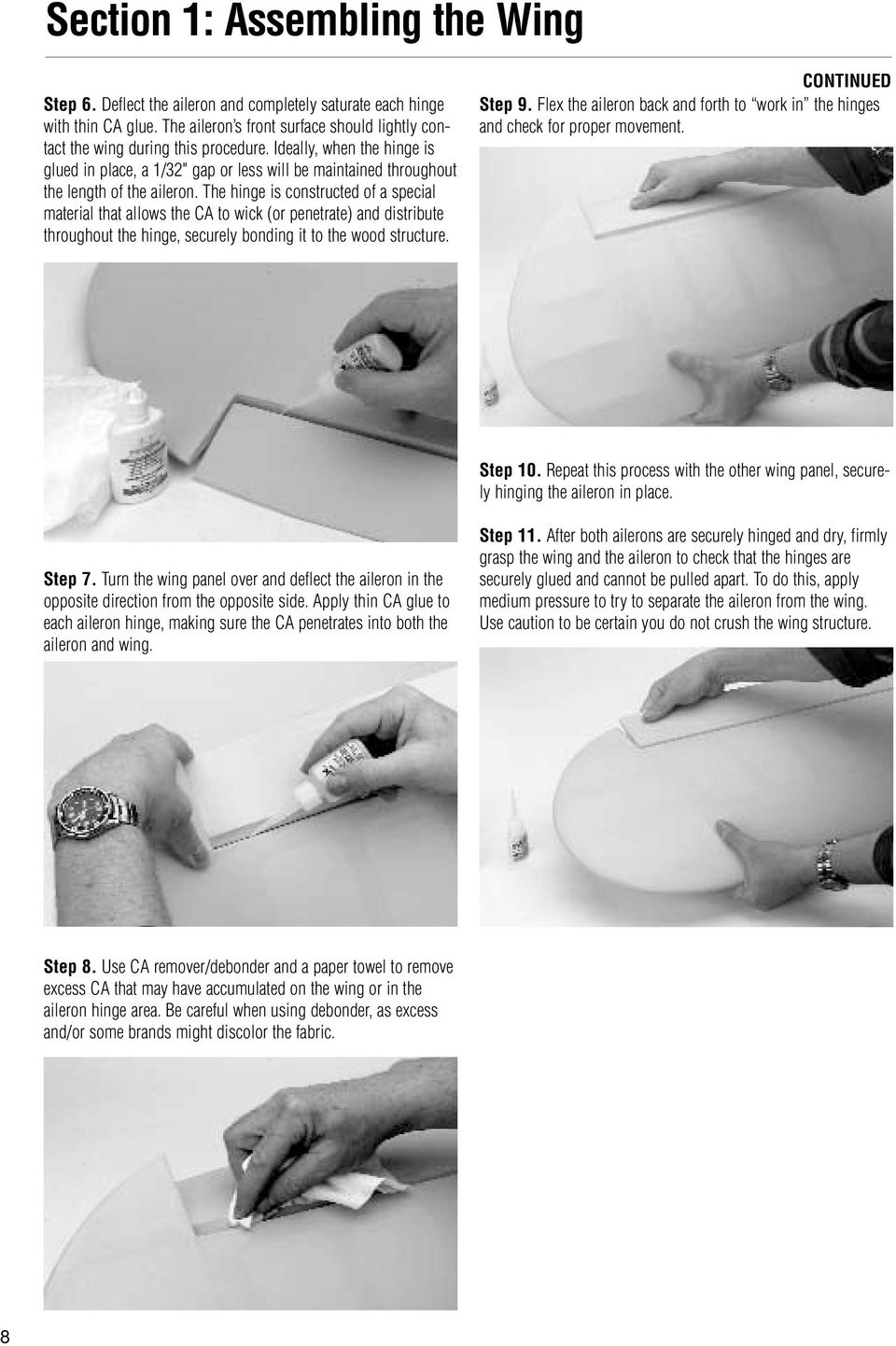
8 Section 1: Assembling the Wing Step 6. Deflect the aileron and completely saturate each hinge with thin CA glue. The aileron s front surface should lightly contact the wing during this procedure. Ideally, when the hinge is glued in place, a 1/32" gap or less will be maintained throughout the length of the aileron. The hinge is constructed of a special material that allows the CA to wick (or penetrate) and distribute throughout the hinge, securely bonding it to the wood structure. CONTINUED Step 9. Flex the aileron back and forth to work in the hinges and check for proper movement. Step 10. Repeat this process with the other wing panel, securely hinging the aileron in place. Step 7. Turn the wing panel over and deflect the aileron in the opposite direction from the opposite side. Apply thin CA glue to each aileron hinge, making sure the CA penetrates into both the aileron and wing. Step 11. After both ailerons are securely hinged and dry, firmly grasp the wing and the aileron to check that the hinges are securely glued and cannot be pulled apart. To do this, apply medium pressure to try to separate the aileron from the wing. Use caution to be certain you do not crush the wing structure. Step 8. Use CA remover/debonder and a paper towel to remove excess CA that may have accumulated on the wing or in the aileron hinge area. Be careful when using debonder, as excess and/or some brands might discolor the fabric. 8
9 Section 2: Installing the Aileron Servos Parts Needed Right/left wing panels Standard size servos with mounting hardware (2). Note: JRS 531 servos (or equivalent) are recommended. Servo extension (18 ) (2) Wood servo blocks (4) Tools and Adhesives Needed Hobby knife with #11 blade 6-minute epoxy Medium Phillips screwdriver Rubbing alcohol Drill Paper towels Drill bit: 1/16 Epoxy brush Felt-tipped pen or pencil Masking tape String (24 ) with a small weight on end Step 1. Locate the servo opening in the bottom of one of each of the wing halves. Use a sharp knife to trim away the covering over the openings. Use care not to cut away too much covering. Step 3. Trial fit the wood servo blocks into the servo opening. You will mount these with epoxy after you have made sure they fit and that the servo will fit into the space. Some material will have to be removed inside the servo opening to make room for the servo lead at two locations. Make sure there is room for the servo lead to go into the round hole made for it to pass into the wing. Second, you will need to trim the area of the wood servo block so the servo wire exiting from the servo case is not crimped as it passes around or under the servo to the servo lead exit. Step 2. Install the recommended servo hardware supplied with your radio system onto the servos you will use for the Cub (grommets and eyelets). Install a servo extension lead to each of the aileron servos as well (an 18 extension is recommended). Secure the connectors with either masking tape or a commercially available connector that prevents the servo lead connectors from becoming disconnected. Hint: It s always a good idea to tape or secure the servo connectors and servo extension together to prevent the wires from becoming unplugged while inside the wing. 9

10 Section 2: Installing the Aileron Servos Step 4. Once you re satisfied with the fit of the aileron servo in the aileron servo bay, proceed to epoxy the wood servo mounts into the aileron servo area. Mix up approximately 1/2 ounce of 6-minute epoxy, apply to the wood servo mounts and install into the aileron servo bay. Allow the epoxy to cure before proceeding with the next step. CONTINUED Step 6. Once the epoxy has cured, you can begin to mount the servo into the wing. You will want to first run the servo lead and servo lead extension through the wing and out the wing root. Step 7. We recommend using a piece (24") of the string (provided) with a nut from the hardware bag attached to one end. Drop the nut through the opening in the wing root and let it slide through the wing, exiting at the aileron servo bay area. Once you have run the string through, you can remove the nut and tie the string to one end of the servo extension lead. Fish the servo leads back through the wing by pulling the string out. Secure the servo lead with a piece of masking tape to prevent it from falling back into the wing. Step 5. While the epoxy is curing, mount the servo arm onto the servo after you have trimmed three of the arms off as shown. 10

11 Section 2: Installing the Aileron Servos Step 8. Trial fit the servo into the aileron servo bay. You will have to make sure the servo lead wire is not crimped. Note the orientation of the servo and servo arm. The servo arm used to control the aileron linkage is pointing to the wingtip. The servo in the other wing half should be positioned so the servo arm also points outward to the wing tip. Note also the servo is mounted so the servo arm is positioned closer to the leading edge of the wing. CONTINUED Step10. Using a 1/16" drill bit, drill the servo screw locations previously marked in Step 4. Once the pilot holes are drilled, mount the servo using the screws provided in you radio system. Note: The supplied 4-40 threaded linkages are of a specified length, so make sure the servos are orientated correctly. Step 9. With the servo in place, mark the location of the servo screws, and then remove the servo. Step 11. Repeat the procedure for the other servo in the other wing panel. 11

12 Section 3: Installing the Aileron Linkages Parts Needed Wing panels (right and left) Short (3-3/4") threaded rod (both ends) (2) Clevis (4) 4/40 nuts (4) Clevis locks (4) Control horn (1 for each wing panel) Plastic plate (2) 2mm screws (4) Tools and Adhesives Needed Medium Phillips screwdriver Drill Drill bit: 1/16" Felt-tipped pen or pencil Thin CA glue (optional) Step 1. Locate a 4/40 x 3 3/4" threaded rod, two 4-40 clevis, two clevis locks and two nuts. You will also need a control horn, plastic plate and two 2mm screws to mount the control horn to the aileron control surface. Step 3. Before mounting the linkages, it s a good idea to center the wing servos electrically. Connect them to the receiver (if using a y harness use the aileron channel only). Note: If you are using separate channels for the ailerons, check to make sure you connect to the appropriate channels (refer to radio operating instructions for diagram). Turn on your transmitter, then the receiver. Once the servos have moved to their electrical center, you can position each aileron servo arm so that it will be approximately 90 degrees to the linkage when attached. Next, turn off the receiver, then the transmitter. Step 2. Thread a 4-40 nut and clevis on each end of one of the threaded rods. Step 4. To establish the length of the linkage required, trial fit the control horn and linkage to the servo arm. Adjustments to length are made by screwing one or both clevis in or out. Be sure to securely tighten the 4-40 nuts against the clevis to prevent the clevis from backing out. The control horn should be positioned so the holes that the clevis connects to are over the centerline of the hinge line of the control surface. Note: For normal applications, the clevis is connected to that portion of the servo arm that points to the wing tip (see below). 12

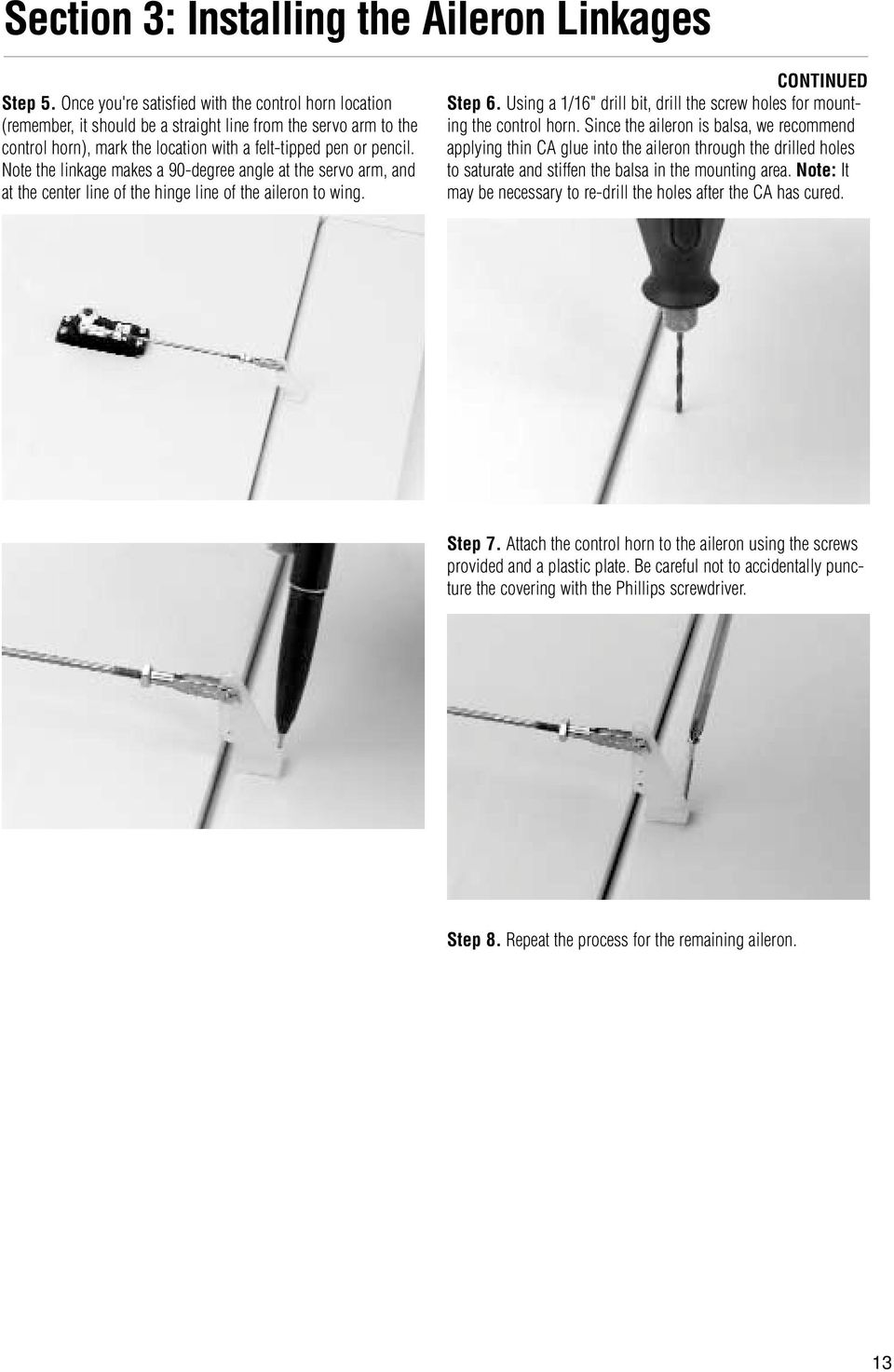
13 Section 3: Installing the Aileron Linkages Step 5. Once you're satisfied with the control horn location (remember, it should be a straight line from the servo arm to the control horn), mark the location with a felt-tipped pen or pencil. Note the linkage makes a 90-degree angle at the servo arm, and at the center line of the hinge line of the aileron to wing. CONTINUED Step 6. Using a 1/16" drill bit, drill the screw holes for mounting the control horn. Since the aileron is balsa, we recommend applying thin CA glue into the aileron through the drilled holes to saturate and stiffen the balsa in the mounting area. Note: It may be necessary to re-drill the holes after the CA has cured. Step 7. Attach the control horn to the aileron using the screws provided and a plastic plate. Be careful not to accidentally puncture the covering with the Phillips screwdriver. Step 8. Repeat the process for the remaining aileron. 13
14 Section 4: Bolting the Wing to the Fuselage Parts Needed Left and right wing panels Fuselage Aluminum wing brace 24 1 /2" long Aluminum wing brace 16" long Aluminum wing brace screws (2 large w/washers and 2 small w/washers ) Wing attachment bolts/washers (2 each) Tools and Adhesives Needed Allen wrench (provided in kit) Medium Phillips screwdriver Threadlock Step 1. Locate the two aluminum wing braces, the wing brace hardware, and the wing attachment bolts from the hardware bag. Step 3. Attach the 16" aluminum wing brace to the area behind the forward brace using the screws provided. Remember to apply Threadlock to the screws first. Step 2. Attach the 24 1 /2" long aluminum wing brace to the forward portion of the cabin area using the hardware provided. You may need to carefully trim the covering away from the opening. The blind nuts are already installed. Use a drop of Threadlock applied to the threads before installing the screws. Step 4. Slide both wing panels on the wing braces and attach the left and right wing panels using the two wing bolts/washers provided. This is a temporary installation to help in the alignment of the horizontal and vertical stabilizers in the next section. Note: The wing struts will be installed in Section 15. WARNING The wing struts MUST be installed before flight. They are functional, providing the support necessary for the wing to withstand normal flight loads. Do not fly the aircraft without the wing struts installed! 14

15 Section 5: Installing the Horizontal and Vertical Stabilizer Parts Needed Tools and Adhesives Needed Fuselage w/wing temporially mounted Horizontal stabilizer Vertical stabilizer Hobby knife with #11 blade Felt-tipped pen 30-minute epoxy Rubbing alcohol Masking tape 90-degree triangle Ruler Pencil Paper towels Mixing stick Epoxy brush Step 1. On the rear of the fuselage, slots are pre-cut in the wood structure for the horizontal stabilizer and the vertical stabilizer. Use a hobby knife to trim away the covering, using caution to not cut into the balsawood. Step 3. Slide the horizontal stabilizer carefully into the slot provided in the fuselage. You may have to trim the opening to allow the horizontal stabilizer to be inserted. By noting the centerline you marked, position the horizontal stabilizer so that it s centered in the fuselage opening where the vertical stabilizer will go. Step 4. Mark the center of the rear of the fuselage (where the rudder will be placed). Position the horizontal stabilizer so it s center line mark is in line with the fuselage rear mark. Use the ruler to make sure the horizontal stabilizer projects an equal amount on either side of the fuselage at that point (see below). Also check that the stabilizer is level with the wing by sighting it from the rear of the fuselage. Step 2. Remove the elevators from the horizontal stabilizer, taking care not to lose any of the CA hinges. The Elevators will be attached in Section 7. Use a straightedge of locate the center line of the horizontal stabilizer. This line will serve as a reference point when the horizontal stabilizer is mounted to the fuselage. 15

16 Section 5: Installing the Horizontal and Vertical Stabilizer Step 5. With the fuselage resting on a flat surface, align the horizontal stabilizer by measuring from fixed points on the wing to the outside of the trailing edge tip of the horizontal stabilizer. Make sure the trailing edge of the horizontal stabilizer stays on its center mark. CONTINUED Step 7. When you re satisfied with the alignment of the horizontal stabilizer with the wing, carefully mark the position with a pencil at the junction where the horizontal stabilizer meets the fuselage. The pencil should leave a slight indentation in the covering. Mark both the top and bottom of the horizontal stabilizer. Step 6. Adjust the horizontal stabilizer until you have an equal distance on both the right and left side of the fuselage and that the horizontal stabilizer is positioned correctly (not tilted) with reference to the wing. Refer to the illustration below. Step 8. Trial fit the vertical stabilizer in place on the fuselage, after removing the rudder and hinges. Set these aside for now, as the rudder will be attached later in Section 8. Make sure the vertical stabilizer is inserted completely. Some trimming to the bottom of the vertical stabilizer may be required. Correct Incorrect Note: The back of the vertical stabilizer needs to be aligned with the back of the fuselage. 16

17 Section 5: Installing the Horizontal and Vertical Stabilizer Step 9. Carefully check the vertical stabilizer to make sure it s aligned 90 degrees to the horizontal stabilizer. A 90-degree triangle is helpful in this step. Hint: When installing the vertical stabilizer, use the rudder to check for proper stabilizer height. It may be necessary to cut off a small amount from the bottom of the vertical stabilizer to get the rudder to drop down to the proper position so the rudder and fuselage align. CONTINUED Step 11. When you re satisfied with the alignment, carefully mark the position of the vertical stabilizer to fuselage with a pencil at the junction where the vertical stabilizer meets the fuselage. The pencil should make a light indentation in the covering. Step 12. Remove the horizontal and vertical stabilizers from the fuselage. Using a sharp hobby knife and a straight edge, carefully cut the covering at approximately 1/16" inside the lines you drew, on both sides of the horizontal and vertical stabilizer Note: Some covering may already be removed. If necessary, remove any excess. CAUTION It is very important that you do Not press hard enough to cut into the wood structure, as doing so could weaken the horizontal stabilizer. Step 10. Double check the horizontal and vertical stabilizer alignment. It may be necessary to slightly trim balsa wood on the fuselage or tail parts with a sharp hobby knife to achieve exact alignment. 17

18 Section 5: Installing the Horizontal and Vertical Stabilizer Step 13. Mix up approximately 1/2 ounce (minimum) of 30-minute epoxy to attach the horizontal stabilizer to the fuselage. Slide the horizontal stabilizer back into the fuselage. Epoxy will have to be worked into the fuselage opening by sliding the horizontal stabilizer back and forth (approximately 1/8"-1/4") and applying epoxy to the top and bottom surfaces. Use an epoxy brush to apply the epoxy. Some can be inserted through the top vertical stabilizer slot, but use care not to overdo, as the vertical stabilizer will have to be installed also. CONTINUED Step 15. Mix up 1/2 ounce of 30-minute epoxy and apply to the vertical stabilizer where the fuselage contacts it. Also, apply epoxy to the base of the vertical stabilizer where it mounts to the fuselage and horizontal stabilizer. Insert the vertical stabilizer into the fuselage and wipe away any excess epoxy with a paper towel and rubbing alcohol. Step 16. Check the alignment of the vertical stabilizer to the horizontal stabilizer and wing by sighting from the rear of the aircraft. Use masking tape to hold the vertical stabilizer in place while the epoxy cures. Allow the epoxy to cure completely. Correct Step 14. Check the alignment of the horizontal stabilizer by referring to the marks made previously, and measuring the wing to horizontal stabilizer as done in Step 5 and Step 6. Clean excess epoxy away from the horizontal stabilizer/fuselage junction with rubbing alcohol and a paper towel. Use masking tape to hold the horizontal stabilizer in place while epoxying the vertical stabilizer in place in the next step. Step 17. The right and left wing panels may be removed at this time to ease the construction process. 18

19 Section 6: Installing the Elevator and Rudder Control Horns Parts Needed Control horns (3) Control horn back plates (3) Control horn screws (12) Fuselage with horizontal and vertical stabilizers attached Elevators (2) Rudder Tools and Adhesives Needed Thin CA glue CA debonder Drill Drill bit: 1/16", 3/32" Felt-tipped pen/pencil Medium Phillips screwdriver Ruler Step 1. Locate the two elevator halves. Make sure the hinges are still installed. You will also need two nylon control horns, two backplates and four screws. Step 3. Locate one nylon horn. Trial fit the horn on the right elevator with the horn positioned so the holes that the clevis will go into are aligned with the hinge line of the elevator (the forward edge that will fit against the horizontal stabilizer). Step 2. For illustration purposes, we will describe installing the control horn on the bottom of the right elevator first. Measure 1/2" back from the hinge line of the elevator and 1/2" from the edge of the elevator that is closest to the fuselage. Make a mark with a felt-tipped pen. Do the same for the other elevator. Step 4. Line up the inside edge of the horn with the mark you made in Step 2. Mark the screw holes with a felt-tipped pen or pencil. 19

20 Section 6: Installing the Elevator and Rudder Control Horns Step 5. Using a 1/16" drill bit, drill two pilot holes for the horn. After the holes are drilled, you will want to put a drop of CA glue in each hole to help strengthen the balsa. You will have to redrill the holes after the CA has cured. CONTINUED Step 9. Trial fit the rudder control horn centered on your mark and make sure the portion of the horn with the holes is centered over the hinge line of the rudder. If not, adjust as necessary. It's important the rudder control horn be centered on the hinge line of the vertical stabilizer/rudder. Step 6. Mount the control horn using the two screws. Carefully screw in the screws and engage the plastic plate on the other side. We recommend covering the area around the horn with masking tape to prevent damage to the covering in case the screwdriver slips. Step 10. When you're satisfied, mark the two screw holes with a felt-tipped pen or pencil. The horn location should not interfere with the movement of the elevators up or down. Step 7. Repeat the process in Steps 2 6 for the left elevator. Once the control horns are mounted on the elevators, they can be removed while the rudder control horn is being installed. The elevators will be permanently hinged later. Step 8. Locate the remaining control horn and associated hardware. The top of the rudder control horn is located " up from the bottom of the rudder. Measure and mark the left side of the rudder (as the pilot is sitting in the cockpit). This is the side the rudder linkage will be attached. Step 11. Drill the holes using the same procedure in Step 5. Use caution when drilling so the covering is not damaged. Step 12. Carefully mount the rudder control horn using the same method as previously described. 20

21 Section 7: Mounting and Hinging the Elevators Parts Needed Tools and Adhesives Needed Fuselage w/vertical and horizontal stabilizer attached Elevator halves (left and right) Thin CA glue CA debonder Paper towels T-pins Step 1. Locate the two elevator halves. There are three hinges in each elevator half. Trial fit into their proper position. Use the T-pins to make sure the hinges are installed so that half is in each surface. Step 3. After the hinges are dry, check to be sure they are securely in place by trying to pull the elevator from the horizontal stabilizer. Use care not to crush the structure. Flex the elevator half up and down to work in the hinges. Step 2. Start with the left (as the pilot sits in the cockpit) elevator properly aligned, apply thin CA glue to the hinges on both sides. Wipe away any excess CA with CA debonder and a paper towel. Step 4. Repeat the previous procedure for the other elevator half. 21
22 Section 8: Hinging the Rudder and Mounting the Tail Wheel Assembly Parts Needed Tools and Adhesives Needed Fuselage Rudder Tail wheel assembly w/tail wheel Phillips Screwdriver Allen wrench (provided) 6-minute epoxy Rubbing alcohol Felt-tipped pen or pencil Thin CA glue CA debonder T-pins Epoxy brush Paper towels Step 1. Locate the tail wheel assembly. The tail wheel assembly can be installed after the rudder is hinged to the vertical stabilizer, however you may wish to mount some of the tail wheel assembly parts prior to hinging the rudder. Step 3. With a sharp hobby knife, cut the slot for the third hinge in the rear of the fuselage. Trial fit the rudder to the fuselage/vertical stabilizer to make sure the rudder is aligned properly (up/down) to the fuselage and vertical stabilizer. There should be no binding of the rudder movement. Step 2. Three hinges are used to mount the rudder to the vertical stabilizer. The slot for the lower hinge (the one going into the rear of the fuselage) has not been cut out. Trial fit the rudder (with the three hinges attached) and mark the location of where the slot will have to be cut in the rear of the fuselage Step 4. Remove the rudder from the vertical stabilizer. The main frame of the tail wheel assembly (that which attaches to the rear of the fuselage) can be trial fitted to the fuselage. Mark the screw locations with a felt-tipped pen or pencil. 22
23 Section 8: Hinging the Rudder and Mounting the Tail Wheel Assembly Step 5. Trial fit the T-shaped arm to the rudder. Mark the screw locations with a felt-tipped pen or pencil. CONTINUED Step 6. Use a 1/16" drill to make pilot holes for the screws to mount the tail wheel assembly Step 8. Install the rudder onto the vertical stabilizer. Make sure the rudder is aligned properly. Use thin CA to hinge the rudder to the vertical stabilizer. Follow the same procedures to hinge the rudder as you did in Section 7. Allow the CA to cure completely. Wipe away any excess CA with a paper towel. Step 9. Flex the rudder back and forth to work in the hinges. Make sure the hinges are secure by trying to pull the rudder from the vertical stabilizer. Use care not to crush the structure. Step 10. Attach the springs to the main tail wheel assembly and the T-shaped piece on the rudder. Step 7. Once the pilot holes have been drilled, mount the aluminum tail wheel pieces to the fuselage. We suggest mixing up 1/4 ounce of 30-minute epoxy and applying it to the holes first before mounting the tail wheel pieces to the fuselage. Do the same for the T-shaped arm mounted to the rudder. Allow the epoxy to cure before installing the tail wheel wire, wheel collars, and tail wheel to the aircraft. 23
24 Section 9: Installing the Main Landing Gear and Wheels Parts Needed Pre-painted aluminum landing gear Wheels (2) Landing gear bolts (4) Blind nuts (4) Axels w/lock nuts (2) Wheel collar w/screw (2) Nylon wheel spacer (4) Shock absorbing wires (2) Nuts (4) Black shock absorbers (2 pr) Tools and Adhesives Needed Small Phillips screwdriver Moto-tool with carbide cutting disc Threadlock Hobby knife with #11 blade Round file Drill Drill bit: 5/32" Step 1. Attach the axles to the aluminum landing gear using the lock nuts provided. Slide on two nylon spacers, then the wheel. Use the wheel collar to hold the wheel on the axle. Note: You can use a Moto-tool to cut the extra length off the axle. Be very careful not to get the axle too hot during the cutting process. Take it slowly. Remember to cut the axle in such a manner that the Cub wheel hub will mount to the wheel without binding on to the axle. Note: It s always a good idea to use Threadlock on the wheel collar set screws to keep them from coming loose. Step 2. Locate the five hole indentations in the bottom of the fuselage directly underneath the landing gear block installed in the fuselage. Use a sharp hobby knife to carefully remove the covering over the pre-drilled holes. 24
25 Section 9: Installing the Main Landing Gear and Wheels Step 3. Trial fit the aluminum landing gear onto the fuselage, positioning it over the pre-drilled holes. Use the aluminum landing gear as a guide. If the holes do not line up exactly, mark and drill or file the holes so the landing gear can be bolted to the fuselage. CONTINUED Step 5. Locate the two wires that will be used to make up the shock-absorbing system found on the J-3 Cub. These wires are threaded on each end. Insert one nut on each wire end, then insert the wires into the holes provided on the aluminum landing gear. Retain with a nut on the other side. Step 4. Bolt the landing gear to the fuselage with the included hardware. Insert a bolt through the aluminum landing gear and secure it with a blind nut inside the fuselage. Note: Be sure to use Threadlock on the bolt/nuts. Note: Use Threadlock to keep the nuts and bolts from coming loose. Step 6. The round black shocks (cut in half to allow mounting to the wire) can be epoxied to the shock-absorbing wires at a later time. Refer to the 3-view for the position. Allow the epoxy to cure completely. 25
26 Section 10: Installing the Engine (Glow) Parts Needed Tools and Adhesives Needed Fuselage Metal motor mount Mounting hardware Engine Phillips screwdriver Small round file 6- or 12-minute epoxy Epoxy brush Rubbing alcohol Paper towels Drill Drill bit: 1/4" Step 1. Mix up approximately 1/2 ounce of 6- or 12-minute epoxy with some rubbing alcohol (approximately 1/4 ounce) and brush it on the firewall area to seal it from fuel. Allow the epoxy to cure completely. Step 3. Before you mount the metal motor mounts, you will have to decide if the engine is to be mounted inverted (what we recommend), or side mounted. Refer to the templates located in the back of the manual for the mounting hole locations for the metal motor mount in both the side and inverted position. Step 4. Mark the location of the mounting holes for the metal motor mount using the template for either the side or the inverted motor position. Also mark the 7/8" diameter opening for the fuel lines at this time. Step 2. Locate the two metal motor mounts and associated hardware (four blind nuts, four 1" screws, four " screws, 12 washers, and eight nuts). The larger screws will be used to mount the metal motor mount to the firewall. The three flathead screws shown in the photo below are used to mount to the plywood motor mount for the Zenoah G-23 gasoline engine in Section
27 Section 10: Installing the Engine (Glow) Step 5. Use a drill with a 1/4" drill bit to drill out the holes in the firewall for mounting the metal motor mount. You will need to file out the openings slightly when installing the blind nuts so they will project far enough into the rear of the firewall. Trial fit the engine to the metal motor mount (without the muffler), then place it on the firewall to see how everything fits. The 7/8" diameter opening for the fuel lines can be made at this time. CONTINUED To mount the blind nuts inside the fuselage behind the firewall, use a piece of music wire to guide the blind nut into position, then use a screw to tighten the blind nut into the plywood firewall. You can also reach inside the fuselage if your hand is not too large. Step 7. Secure the metal motor mount to the firewall by installing the screws into the blind nuts. Do not tighten completely until you trial fit the engine on the metal motor mount once more to make sure they are positioned at the proper width. When you are satisfied with the fit, securely tighten the screws of the metal motor mount to the firewall. It would be a good idea to also apply Threadlock to the threads of the screws before they are tightened down, as a means of preventing loosening of the screws due to vibration. Step 6. Remove the engine from the metal motor mount before attempting to secure the metal motor mount to the firewall. Mount the metal motor mount on the firewall using the hardware provided. Do not tighten the screws until you are satisfied with the location and fit. Note: It will be necessary to install the blind nuts through the fuselage onto the back of the firewall. Step 8. With the engine mounted, mark the location of the throttle pushrod exit on the firewall. Make sure the mark is directly in-line with the throttle arm. Remove the engine and drill a 1/4" hole in the firewall. Step 9. Important: The drawing below shows the distance of the engine placements prior to the trial fitting of the cowl. Fuselage 5 3 /4" 27
28 Section 11: Installing the Engine (Gasoline) Parts Needed Fuselage Plywood motor mount Mounting hardware: 4mm x 30mm machine screws (4) 4mm washers (4), 4mm nuts (4), blind nuts (4) Flat head screws (4) Engine Shut-off ( kill ) switch and hardware (ZEN 20000) Required, but not included in kit. Tools and Adhesives Needed Phillips screwdriver Small round file Drill Drill bit 6-8mm 6-minute epoxy Rubbing alcohol Paper towels Felt-tipped pen or pencil Note: Installation of the Zenoah G-23 Gasoline engine is not difficult, however, there are two things that are important to keep in mind. First, a shut-off or kill switch is a requirement for safety reasons. Please refer to your Zenoah Engine Operating Instructions for the details on how to install a shut-off switch. Second, the G-23 is heavier than most glow engines and requires weight to be added to the tail of the aircraft to balance properly. Be sure to read Section 19 and make sure the aircraft is correctly balanced prior to attempting to fly it. Step 1. We will use a mixture of 6-minute epoxy and rubbing alcohol to seal the firewall area and the 1/4 plywood motor mount. Mix up approximately 1 ounce of 6-minute epoxy and 1/2 ounce of rubbing alcohol. Mix thoroughly and brush it on the entire firewall area and the plywood motor mount to seal them from fuel. Allow the epoxy to cure completely. Caution: Do not get epoxy into any of the pre-drilled holes. Step 2. Cut out the template found at the back of this manual and mark where the throttle and fuel line holes are located. Also mark where the round Phillips head screws are located. Refer to the illustration below for their relative location. Round Phillips Head Throttle Linkage Fuel Flat Head Screws Round Phillips Head Flat Head Screws Front (not to scale) Flat Head Screws Round Phillips Head Round Phillips Head Step 3. Trial fit the plywood motor mount onto the firewall. Hold the plywood motor mount flush with the top and sides of the fuselage. Make sure the motor mount holes line up with where the round Phillips head machine screws will be installed. 28
29 Section 11: Installing the Engine (Gasoline) Step 4. To mount the blind nuts inside the fuselage behind the firewall, use a piece of music wire to guide the blind nut into position, then use a screw to tighten the blind nut into the plywood firewall. You can also reach inside the fuselage if your hand is not too large. CONTINUED When mounted, the plywood motor mount and engine should fit flush against the firewall. Step 7. Once the plywood motor mount has been attached to the G-23, proceed with mounting the motor and motor mount to the firewall using the four machine screws and four washers. Note: Instructions on the throttle servo/linkage installation will be covered in Section 14, Assembling and Installing the Rudder, Elevator and Throttle Linkages. Step 5. With the screws temporarialy holding the plywood motor mount in place, drill out the throttle and fuel line openings using a 1/4 drill bit. It will be easier to drill out these holes now than to wait until after the motor has been mounted to the plywood motor mount. After the holes have been drilled, remove the plywood motor mount. Step 6. The plywood motor mount replaces the metal one on the G-23 motor and is used to mount the motor to the firewall. Remove the metal motor plate from the G-23 and replace it with the plywood motor mount, using the flat head screws provided. Note: The holes on the back side of the plywood motor mount are counter sunk for the flat head screws. The bolt pattern of the counter sunk holes matches the screw locations on the G-23 engine. 29
30 Section 12: Assembling and Installing the Fuel Tank (Glow and Gas Versions) Parts Needed Plywood fuel tank floor Fuselage Brass tube, long (vent) Brass tube, long (fuel) Clunk (fuel pickup) Fuel pickup tubing, glow (clear) Fuel pickup tubing, gas (black) Fuel tank Plastic cap (2) Rubber stopper, glow (black) Rubber stopper, gas (red) 3mm screw Fuel tubing, gas (not supplied, DUB544/AER1073) Foam to wrap around tank (optional) Rubber bands (2)(provided) Tools and Adhesives Needed Hobby knife with #11 blade Medium screwdriver (standard) 30-minute epoxy Rubbing alcohol Epoxy brush Paper towels Note: Dubro tank and fittings shown. Actual tank and parts may vary, but assembly will be the same. Step 2. Locate the appropriate stopper, red for gasoline and black for glow. Insert one long brass tube into one of the open holes in the stopper so an equal amount of tubing extends from each side. This will be the fuel tank pickup tube that provides fuel to the engine. Step 1. Locate the tank parts. Decide if you will make up a glow or gas fuel tank. Note: If you install a Zenoah G-23 Gasoline engine, use the red (gas) stopper and the black (gas) tubing. Do not use the black (glow) stopper or clear (glow) fuel tubing with a gasoline-powered engine as they are not compatible with gasoline operation. Step 3. Slide the smaller of the two plastic caps over the brass tube on one side of the stopper so the small peg faces away from the stopper and toward the inside of the fuel tank. The larger cap is placed on the other side of the rubber stopper so the raised center faces away from the rubber stopper. 30
31 Section 12: Assembling and Installing the Fuel Tank (Glow and Gas Versions) Step 4. Locate the other long brass tube and bend one end using your fingers as shown below. This tube will be the fuel tank vent tube. CONTINUED Step 7. Locate the fuel tubing (clear for glow engines or black for gas engines). This tubing will be used for the fuel pickup inside the fuel tank. Insert the clunk into one end of the fuel tubing. Step 5. Slide the bent tube into the caps and the other open hole of the stopper as shown below. Step 8. Install the open end of the fuel tubing onto the fuel pickup brass tubing. Step 6. Note the orientation of the tubes and plastic caps. Make sure the vent tube is positioned correctly as shown. Step 9. Insert the 3mm screw into the center hole of the larger plastic cap and tighten it until it just begins to thread into the black cap on the other side of the rubber stopper. 31
32 Section 12: Assembling and Installing the Fuel Tank (Glow and Gas Versions) Step 10. Carefully insert the assembly into the fuel tank. Note the position of the vent tube it must be at the top portion of the fuel tank to function properly. Also, it may be necessary to shorten the length of the fuel pickup tubing so the clunk does not rub against the back of the tank. Test by turning the tank upside down. The clunk should be free to drop down toward the top of the tank, which is not the bottom of the tank. Try positioning the tank in nose down, rolls and other positions making sure the clunk is free to move and does not bind when the tank is in any position. CONTINUED Suggestion: We mounted the Zenoah G-23 engine inverted, and the throttle linkage exited the firewall at the right hand side of the firewall (as if you were in the cockpit). Drill a hole for the fuel line approximately 3/8" below the opening for the throttle linkage. The hole for the vent line can be drilled 3/4" below the motor, centered on the firewall. We recommend the holes for the fuel line be drilled after the wood motor mount is in position and that the fuel tank be installed after the gasoline engine is mounted. In this way, you can best determine the location of the fuel/vent and throttle openings, drill the holes, and then install the fuel tank. The illustration below of the firewall will help in locating the throttle linkage and the fuel line openings. Round Phillips Head Throttle Linkage Flat Front Round Phillips Head Step 11. Tighten the 3mm screw carefully do not over-tighten. This allows the rubber stopper to form a seal by being slightly compressed, and thus seals the fuel tank opening. Fuel Flat Round Phillips Head Flat Round Phillips Head Step 13. Before mounting the fuel tank into the fuselage, you will need to install the plywood fuel tank floor. Note the shape of the floor helps orient which is the front and rear. Note also the slots cut in the plywood allow for the use of rubber bands to hold the tank in position. Step 12. To help in remembering which vent is which, we suggest you mark one tube with a V on some masking tape and attach to the appropriate vent. Once the tank is mounted inside the fuselage, it will be difficult to determine which tube is which. Note: The fuel and vent line for the gasoline engine will be located in two places: One near the throttle linkage position and the other directly below the normal opening for the 2-4 stroke engine fuel line opening in the firewall. Note: We recommend the tank floor not be installed until after the motor mount has been installed. It will be much easier to install the motor mount blind nuts before the fuel tank floor is installed. 32
33 Section 12: Assembling and Installing the Fuel Tank (Glow and Gas Versions) Step 14. Trial fit the tank floor into the fuselage forward area. Some trimming may be required. You will want to mount the floor so the tank fuel is centered as close to being in line with the engine carburetor as possible. This is especially important for those opting for the glow type of engine installation. Hint: Wrap foam around tank, rubber band in place and trial fit in place on the fuel tank floor to determine where centerline of tank is. Then, make adjustments up/down of floor placement. Mark location with a felt-tipped pen. Once you're satisfied with floor location, proceed with epoxying the floor into place. CONTINUED Step 16. Install the fuel tubing on to the two fuel tank tubes and feed through the holes in the firewall. Be sure to mark the appropriate vents now, for once the tank is in the aircraft it will be difficult to determine which is which. Hint: It is sometimes helpful to use long (6") pieces of music wire to help guide the fuel tubing through the holes in the firewall. Refer to photo below. Note: You can wait to install the fuel tank after you position and install the throttle linkage as you will be drilling a hole through the firewall. Step 15. Mix up 1 ounce of 30-minute epoxy and apply to the plywood tank floor edges that will contact the fuselage sides and firewall. Install floor into fuselage forward area. Allow the epoxy to cure completely. Step 17. Foam around the fuel tank and in the fuel tank compartment can be used to provide some vibration dampening and help support the fuel tank (foam is not provided). Hint: Do not use any foam until after the throttle linkage has been installed. Step 18. Use rubber bands (provided) to secure the fuel tank to the plywood fuel tank floor. 33
34 Section 13: Installing the Radio System Parts Needed 4-channel radio system with 3 servos and hardware (not included) Fuselage Radio packing foam (not provided) Antenna tube (not provided Delux Switch (JRPA001) or JR Charge Switch (JRPA004)(optional) Tools and Adhesives Needed Medium sandpaper Drill 1/16" drill bit Phillips screwdriver Hobby knife with #11 blade Felt-tipped pen or pencil Masking tape Step 1. Locate the plywood servo tray. Trial fit it into the fuselage area as shown. There are notches in the tray to help in the alignment. You may have to trim the servo tray slightly to obtain a good fit. Use some sandpaper to trim any excess wood to obtain a good fit. Step 4. Locate three servos and install the grommets and eyelets in all three per the instructions included with the radio. Place the servos in the servo tray in the fuselage as shown, noting the position of the servo arms. Use a felt tipped pen or pencil and mark the twelve servo mounting hole positions. Step 2. Once you're satisfied with the fit, mix up 1/4 oz of 6- Minute epoxy, apply to the front and rear edges of the tray that fit into the formers and install the servo tray into the fuselage. Step 5. After trial fitting the servos into the servo tray, we suggest the servo leads be identified by using some masking tape with the appropriate letter to designate which servo it is, e.g. T = throttle, E = elevator, and R = rudder. Step 6. Remove the servos and use a drill with a 1/16" drill bit to drill the 12 pilot holes for the servo mounting screws. Step 7. Screw the servos in place using the 12 servo mounting screws included with the servos. Step 3. Allow the epoxy to cure before installing the servos. >photo showing screwing in the servos 34
35 Section 13: Installing the Radio System Step 8. Use radio packing foam (not included, available at your local hobby shop) when you install the receiver and battery. CONTINUED Step 10. Use radio packing foam to install the receiver and battery. With a sharp hobby knife, cut a solid layer of foam the size of the compartment that is in front of the servo tray (directly over the landing gear blind nuts). Cut out another layer of foam that is the same size, only this time cut out an open area in the center to accept the receiver battery. Place another solid layer of foam on top. Cut an open area in the next layer of foam to accept the receiver. Top off with a final layer of foam that holds everything in place. Step 9. Attach the servo leads to the receiver prior to installing the receiver in the radio packing foam. Route the antenna back through the fuselage using an antenna tube (not included) or route it outside the fuselage back to the fuselage rear along the bottom of the aircraft. You can also run it out the top to the vertical stabilizer where it can be attached using a small rubber band and a small t-pin to hold the antenna wire on the tail. Step 11. Place the pre-cut foam layers with the battery and receiver in place in the front compartment of the fuselage. Route the antenna back through the fuselage using an antenna tube (not included) or route it outside the fuselage to the vertical stabilizer. Hint: We used a wood dowel (not included) cut to fit between the fuselage sides just on top of the protective foam and spot CA to the fuselage sides to hold the receiver and battery in place. 35
36 Section 13: Installing the Radio System Step 12. The switch can be installed on the right side of the fuselage (the pilots right side as he/she sits in the cockpit) if the engine installed is the Zenoah G-23 gasoline engine. If mounting a 2- or 4-stroke engine, you want the switch located on the side opposite from the muffler, normally on the left side of the aircraft. CONTINUED Step 14. Using a 1/16" drill bit, drill two mounting holes for the switch as marked. Use your hobby knife to carefully cut out the opening for the switch between the screw holes. Step 13. Use the switch plate as a template and mark the opening and screw holes of the switch on the fuselage side. Step 15. Reposition the switch plate as shown below and place the switch inside the fuselage. Using the two screws supplied with the switch, attach the switch to the fuselage. Plug in the switch to the receiver/receiver battery. Be sure it is off as you proceed with the construction sequence. 36
37 Section 14: Assembling and Installing the Rudder, Elevator and Throttle Linkages Parts Needed Fuselage 12" threaded 4-40 rods (3) 6" threaded 4-40 rods (2) Wood pushrods (23 3/4 ) (2) Heat shrink tubing Clevis (5) 4/40 nuts (5) Clevis clips (5) Tools and Adhesives Needed Felt-tipped pen/pencil 6-minute epoxy Hobby knife Heat gun Masking tape Ruler Drill Drill bit: 1/8" Standard pliers Note: Before assembling the pushrods, locate the heat shrink tubing and cut into five equal length pieces. Step 1. The rudder and elevator pushrods are made up of the parts shown below. Locate the heat shrink tubing and cut it into five equal sections with a sharp hobby knife or scissors. Step 3. Cut out the pushrod exits for the rudder (one on the left side of fuselage) and elevator (one on each side of the fuselage) using a sharp hobby knife. Use care not to cut too large of an opening. Step 2. The pushrod exits for the elevator and rudder will have to be cut out of the tail section of the aircraft. Locate the template in the back of the manual. Cut it out and use it to locate and mark the approximate position for the pushrod exits. Position the template and mark the location of the rudder and elevator pushrod exits using a felt-tipped pen or pencil. Step 4. To make up the rudder pushrod, locate one of the 12" threaded rods, one of the 6 threaded rods, one of the wooden pushrods (23-3/4"), two clevises, (2) 4-40 nuts and two clevis clips, and two pieces of heat shrink tubing. Step 5. Using either a pencil or a felt-tipped pen, make a mark 1 1 /2" from each end of the hardwood pushrod. 37
38 Section 14: Assembling and Installing the Rudder, Elevator and Throttle Linkages Step 6. To determine the approximate length of the pushrod, temporarily tape (using masking tape) the long (12") threaded rod to one end of the wooden pushrod. Thread a clevis on the threaded end approximately 10 turns. Repeat the process with the short (6") threaded rod and attach a clevis to the threaded end of the rod. Make sure the metal rod is clear of the tape near the marks made on the wood pushrod, as you will be marking the rod once the length is determined. CONTINUED Step 9. Mark the non-threaded end of the rods where the bend will be made in reference to the marks made on the wood pushrod (the 1 1 /2" mark made in step 5). Step 10. Disassemble the pushrod. Remove the clevis and tape. Step 11. Drill a 1/8" hole through the hardwood pushrod at each marked end, from step 21. Step 7. With the rods temporarily attached and each with a clevis installed, position the assembled pushrod along the outside of the fuselage, lining it up with the control horn on the rudder and the servo arm of the rudder servo in the fuselage. This will give you an approximate length of the pushrod. Step 8. Adjust the rods on the wood pushrod to allow for a 90-degree bend to be made in the non-threaded portion of the metal rod that will be attached to the wood pushrod. 38
39 Section 14: Assembling and Installing the Rudder, Elevator and Throttle Linkages Step 12. Locate the marked 12" threaded rod and, using pliers or similar tool, make a 90-degree bend at the mark you made which should be at the opposite end of the threaded portion of the rod. The bent section should be trimmed so it s 1/8" to 3/16" long to fit into the holes of the wood pushrod without the end extending out of the hole on the other side. Repeat the procedure for the short (6") threaded rod. CONTINUED Step 14. Trial fit the long threaded rod onto the wood pushrod. When you are satisfied with the fit, mix up approximately 1/4 oz. of 6-minute epoxy and apply to the hole and groove. Insert the rod into the hole and groove. Wrap the area where the rod contacts the wood with included heavy nylon string. Step 13. Cut a 1/8 groove from the hole to the end of the wood pushrod to help secure the rod into the wood pushrod when the epoxy glue is applied. Round out the holes in the groove so the rod fits flush against the wood pushrod. Step 15. Before the epoxy is cured, slide a piece of heat shrink tubing over the wood pushrod and threaded rod. Use a heat gun to shrink the tubing in place. Groove for Wire Wood Pushrod For the rudder pushrod wires, install them on the opposite sides of the wooden dowel, so they are not "in-line" with each other. Step 16. Repeat the process to attach the 6 threaded rod to the wood pushrod. Allow the epoxy to cure completely before proceeding to the next step. Rudder Pushrod 39
40 Section 14: Assembling and Installing the Rudder, Elevator and Throttle Linkages Step 17. Insert the rudder pushrod assembly, long (12") threaded rod first into the fuselage so the threaded rod exits the rudder pushrod hole. Screw on a nut and then a clevis (approximately 10 turns). Fasten the clevis to the rudder control horn. Attach the clevis clip to keep the clevis from opening accidentally in flight. CONTINUED Step 19. You can adjust the clevis at either end or both in or out to make adjustments to the rudder control surface to make it centered (in neutral or 0 degrees deflection) with the transmitter stick and trim centered. Step 20. The elevator pushrod is made similar to the rudder pushrod with the exception being the use of two 12" 4-40 rods. Step 21. Begin by marking the wood pushrod as follows: on one end (for the 6" rod) mark 1 1 /2" from the end of the rod, on the other end, make a mark 2" from the end and another mark 3" from the end. Step 18. Center the rudder servo and position the servo control arm so it is 90 degrees to the pushrod linkage. Attach the rudder pushrod clevis to the rudder servo arm. 40
41 Section 14: Assembling and Installing the Rudder, Elevator and Throttle Linkages Step 22. Use a 1/8" drill bit to drill a hole 1 1 /2" from the end of pushrod. Turn the wood rod so that the hole you just drilled is not in line to the two holes drilled for the elevator rods. The rods for the elevator halves will be on opposite sides of the pushrod. Refer to drawing. CONTINUED Step 25. Mark the non-threaded parts of the rods where the bends will be made in reference to the holes drilled in the wood pushrod (the 1 1 /2", 2" and 3" locations made in Step 21). Top View 1-1/2" Elevator Pushrod Step 23. To determine the length of the elevator pushrod, temporarily tape the 6" at the 1 1 /2" mark on the wooden rod. Place the 12" at the 2" and 3" marks using masking tape. Thread a clevis to the threaded end of the rods approximately 10 turns. Make sure the metal rods are clear of tape at the marked locations on the wooden rod, as you will be marking the rods once the approximate pushrod length is determined. Step 26. Use needle-nose pliers or a similar tool to make a 90-degree bend at the opposite end of the treaded rods (6" and the two 12" rods) as marked in Step 25. Trim so the rods are 1/8" to 3/16" long to fit into the holes of the wood pushrod without the ends extending out of the hole on the other side of the wooden rod. Step 24. Adjust the length of the rods on the wooden pushrod if necessary, to allow for a 90-degree bend to be made in the non-threaded portion of the rod that will be attached to the wood pushrod. 41
42 Section 14: Assembling and Installing the Rudder, Elevator and Throttle Linkages Step 27. Trial fit each threaded rod onto the wood pushrod. When you're satisfied with the fit, mix up approximately 1 /4 ounce of 6-minute epoxy and apply to the hole and grove, then insert the rod. Wrap the area where the rod contacts the wood with included nylon string. CONTINUED Step 30. Insert the elevator pushrod assembly, the long 12 threaded rod first, into the fuselage so the threaded rod exits the elevator pushrod exit holes. Screw on a nut and clevis (approximately 10 turns). Fasten the clevis to the elevator pushrod control horns. Remember to attach the clip for the clevis. Step 28. Before the epoxy is cured, slide a piece of heat shrink tubing over the wood pushrod and threaded rod. Use a heat gun to shrink the tubing in place. Step 29. Repeat the process to attach the other two threaded rods to the wood pushrod. Allow the epoxy to cure completely before proceeding to the next step. Step 31. Center the elevator servo and position the servo control arm so it is 90 degrees to the pushrod linkage (the 6 rod end). Attach the elevator pushrod clevis to the elevator servo arm. 42
43 Section 14: Assembling and Installing the Rudder, Elevator and Throttle Linkages Step 32. You can adjust the clevis at either end or both, in or out, to make adjustments to the rudder control surface to make it centered (in neutral or 0 degrees) when the transmitter stick and trim switch are centered. Be sure to tighten all nuts securely against the metal clevis. Step 33. The elevator pushrod is adjusted in the same manner as the rudder pushrod, with the exception being the elevators are split and will require separate adjustments of each clevis (in/out) to position each elevator at neutral or 0 degrees. Make sure each elevator half is at 0 degrees. If the elevator surfaces are not the same, it will be difficult to trim out the aircraft in flight. CONTINUED Step 34. It s necessary to cut the included nylon pushrod to the correct length. Remove the inner tube from the larger outer tube of the nylon pushrod. Temporarily install the outer tube into the fusealge through the throttle opening drilled in the firewall in previous sections. You will need to mark the fuselage formers where the tube will be routed into the fuselage. Make sure the outer tubing of the throttle pushrod is flush with the face of the firewall. Installing the Throttle Linkage (Glow and Gasoline) Parts Needed Nylon pushrod (inner and outer tube) 1" threaded rod 2" Z-bend rod Clevis Tools and Adhesives Needed Thick CA glue CA debonder 6-minute epoxy(alternate) Rubbing alcohol(alternate) Paper towels Felt-tipped pen or pencil Z-bend pliers Hobby knife Razor saw (optional) Step 35. With the throttle servo arm installed and centered on your throttle servo, measure 1 5 /16" in front of the servo arm and place a mark on the outer tube. Remove the outer tube and cut it off with your hobby knife or a razor saw at the mark you made. 2 Rod with Z-bend Outer Tube 1 Threaded Rod Inner Tube Inserts into Servo Arm Clevis Connects to Throttle Arm Note: It s necessary to use a non-conductive pushrod for the throttle linkage when operating a gasoline engine. A nonconductive pushrod will prevent radio interference noise from the spark plug transmitting through the pushrod and causing radio interference. The included pushrod system can be used with either gasoline or glow engines. 43
44 Section 14: Assembling and Installing the Rudder, Elevator and Throttle Linkages Step 36. It s best if you secure the outer tube to the side of the fuselage to keep it from sliding. Install the outer tube back into the fuselage. Make sure the end is flush with the face of the firewall. To make sure that the outer tube is aligned with the servo arm, install the inner tube into the outer tube through the firewall until it meets the servo arm. Be sure the inner tube is in-line with the servo arm. Mark the inside of the fuselage at the fuselage formers where the outer tube will be glued. CONTINUED Step 38. Take the 1" threaded rod and thread it onto one end of the inner tube. Screw the 2-56 clevis 7 to 10 turns onto the 1" threaded rod. The clevis will be attached to the throttle arm. Slide the inner tube into the outer tube from the firewall end. Note: Use a small piece of fuel tubing to keep the clevis from accidently opening in flight. Step 37. Remove the inner tube and use a small amount of 6-minute epoxy or thick CA to secure the outer tube to the fuselage doubler. Hint: It is helpful to roughen the tube with sandpaper before applying the glue to make sure it adheres well. Be careful not to get any glue in the opening of the outer tube. Let the epoxy or CA thoroughly cure before proceeding with the next step. Step 39. Take the 2" rod and make a Z-bend at the unthreaded end of the rod. The threaded end will have to screw into the inner rod so DO NOT make the Z-bend at the threaded end. Insert the Z-bend end of the rod into the throttle servo arm. It will be easier to insert the Z-bend if you remove the throttle arm from the servo. Turn on your radio system and center the throttle servo arm. Also be sure that your throttle trim on your transmitter is centered. With the inner tube installed, attach the clevis to your engine s throttle arm. Be sure the throttle barrel is in the 1/2 open/closed position. 44
45 Section 14: Assembling and Installing the Rudder, Elevator and Throttle Linkages Step 40. Hold the inner tube next to the Z-bend rod that s attached to your servo arm. From the threaded end of the rod, measure back 5/8" and mark the inner tube. Cut the inner tube off at this mark. CONTINUED Step 41. Thread the Z-bend rod into the inner tube and mount the servo arm to the servo. Make sure the servo arm is at a 90-degree angle to the throttle pushrod. Center your transmitter s throttle stick and trim and mechanically adjust the linkage of the throttle arm of your engine to be 1/2 open/closed. This will be close enough to adjust the throttle electronically with your transmitter if you have a computer radio. If you do not have a computer radio, you will need to make your adjustments mechanically to achieve a high and low throttle in accordance with your transmitter stick. Screw the clevis in or out at the throttle linkage to adjust this. 45
46 Section 15: Installing the Wing Struts Parts Needed Right/left wing panels Pre-covered right and left wing struts Wing strut hardware package Tools and Adhesives Needed Threadlock Phillips screwdriver WARNING The wing struts MUST be installed before flight. They are functional, providing the support necessary for the wing to withstand various flight maneuvers. Do Not fly the aircraft without the wing struts installed! Step 4. On each wing panel, locate the four mounting points, two pair parallel to each other near the servo opening for the aileron servo. If you look carefully at the covering you will see the square hardpoints with the hole, through the covering. Open the holes using a sharp hobby knife. Step 1. Locate the two pre-covered wing struts, braces and associated hardware package of screws, nuts and clamps. Step 2. The mounting points for the wing struts are located in the wings and the bottom of the fuselage, aft of the landing gear. These mounting points already have the blind nuts installed. However, the covering material will have to be carefully trimmed away using a sharp hobby knife. Step 5. We suggest mounting the two braces to each wing strut first, using the hardware provided. Do not tighten the nuts down completely yet as you will want to be able to make minor adjustments when the strut is attached to the fuselage and wing. Step 3. Start with the fuselage and locate the four mounting points located aft of the landing gear on the fuselage bottom (two on either side of the fuselage). Use a sharp hobby knife and trim out the opening. 46
47 Section 15: Installing the Wing Struts Step 6. After the two wing struts are assembled, mount each wing strut to its wing panel, noting the orientation of the part of the strut that will mount to the fuselage. CONTINUED Step 8. Slide each wing panel onto the aluminum wing braces and thread the servo leads into the fuselage. Use the large wing bolt/washer, to tighten the wing to the fuselage. Slip the wing strut piece that attaches to the fuselage over each pair of holes in the fuselage and attach with the bolts and washers provided. Step 7. Apply Threadlock to the threads of the wing strut screws that attach the wing braces to the wing strut. Tighten down the screws and nuts. After the Locktite has cured, check the security of the wing struts where they are attached to the wings. Step 9. Check all nuts and screws to make sure they are secure before attempting a flight. Step 10. Remove the wings from the fuselage before attempting to start Section
48 Section 16: Installing the Windshield, Side Windows and Cabin Overhead Window Parts Needed Windshield, windows and cabin overhead window (10 pieces total) Wood front windshield brace (2-prepainted) Wood screws (4) Machine screws w/washers (4) Fuselage Tools and Adhesives Needed Phillips screwdriver Scissors Masking tape Canopy glue (e.g., R/C 56 or Pacer Formula 560) Thin CA glue CA debonder Paper towel Drill 1/16" drill bit Step 1. Trim the front windshield on the cut line etched in the windshield with scissors. Do the same to the pre-painted cabin overhead window. Note: the lip on the cabin overhead window will fit snugly against the fuselage sides. The fore and aft portion are trimmed so the cabin overhead window fits snug against the top of the cabin. Step 2. The side windows will have to be cut apart. Trial fit each window to the fuselage to see how much area to trim. You want to have enough material so the side window will mount to the fuselage securely. Step 3. When you are satisfied with the fit, run a small bead of canopy glue around the side windows. Tape in place and allow the glue to dry. Step 4. Trial fit the front windshield again to make sure it will fit properly. Before installing the front windshield, you can mount the front wood dowel windshield braces. Mark the center of the front cabin former lightly with a pencil. The wood windshield braces will be positioned from the edge of the instrument panel on the fuselage to approximately 1/4 either side of the center mark you made on the front cabin former (refer to 3-view). Use thin CA to mount the braces. If you plan on installing an instrument panel, you may want to do so at this time, then mount the wood windshield braces. 48
49 Section 16: Installing the Windshield, Side Windows and Cabin Overhead Window Step 5. After you are satisfied with the fit of the windshield, run a bead of canopy glue around the windshield and mount to the fuselage. Hold in place with masking tape until the glue dries. CONTINUED Step 7. The cabin overhead window is held in place by four screws with washers. The blind nuts are already installed in the fuselage top. Locate the overhead window template in the last part of the manual. Cut out the template and attach it to the fuselage using masking tape to hold it in position. Trial fit the cabin overhead window template in place. Look carefully and you will see the four screw locations through the template. Mark the location with a pencil. Transfer the template marking to the plastic overhead window. Note: The screw locations on the template are approximate, confirm before transfering to the plastic overhead window. Step 6. After the glue is cured, use wood screws to secure the front windshield to the fuselage, two on either side. Step 8. Use a 1/16" drill bit and drill the four holes as marked. Mount the cabin overhead window to the fuselage using the screws and washers provided. To mount the wing, you will have to remove the cabin overhead window to gain access to the interior of the fuselage. 49
50 Section 17: Attaching the Cowling Parts Needed Fiberglass cowl Fuselage Sheet metal screws (4) Tools and Adhesives Needed Moto-tool with sanding drum or carbide cutterr Phillips screwdriver Drill Drill bit: 1/16" Masking tape Felt-tipped pen Ruler Step 1. Use a Moto-tool to grind out the cooling openings in the front of the cowl as marked. Step 2. Mount your engine. Note those areas that will have to be trimmed out, such as the needle valve openings, cylinder head, external fill openings, etc. Note: Be sure to set the engine prop hub 5-3/4" from the firewall. Step 3. We suggest making templates of the cylinder head opening, needle valve location, etc, in order to determine what areas to remove from the cowl so the engine will be enclosed. Sample cylinder head templates for the inverted Saito 150, side mounted MDS 1.48 and Zenoah G-23 are provided at the back of the manual. This is done though the use of a template with the opening cut out, a strip of heavy paper or light cardboard to help position the template, and masking tape to hold the template in place with the motor mounted. When the cowl is mounted (the motor being removed before the cowl is positioned), the template is flipped back into position and the opening is traced onto the cowl with a felt-tipped pen or pencil. 50
51 Section 17: Attaching the Cowling Step 4. Before marking the openings, be sure the cowl is position on the fuselage with sufficient material to allow it to be mounted to the fuselage using four screws provided. Mark the screw locations, two on either side of the cowl, as shown below. CONTINUED Step 6. After the cowl is mounted, proceed with marking the openings for the engine cylinder head, needle valve, etc. through the use of the templates. Note: The Saito 1.50 can use the supplied muffler, which will require some trimming of the firewall (see below) or a flex pipe to divert exhaust gas from the engine. The MDS 1.48 can use the Pitts style muffler, as used by the Webra 120. For the Zenoah G-23, a template for the engine and muffler will have to be used to cut out portions of the cowl. Step 5. After you have marked the mounting hole position for attaching the cowl to the fuselage, drill the holes using a 1/8 drill bit. 51
52 Section 17: Attaching the Cowling Step 7. After the openings have been marked on the cowl, remove the cowl from the fuselage and proceed to rout out the openings marked using a moto-tool. CONTINUED Step 8. Remount your engine and install the cowl, attaching it to the fuselage using the screws provided. Note: On some engines where the carburetor is not easily accessible, a fueling valve can be used. Dubro s DUB334 is an excellent choice and should be available at your local hobby shop. 52
53 Section 18: Control Throw Recommendations The following control throw recommendations offer positive response and are a good place to begin setting up the aircraft for flight. After you have become more familiar with the flight characteristics of the J-3 Cub, adjust the control throws to meet your flying style. Aileron Elevator Rudder 1 1 /4"up, 1" down 1 1 /8" up, 1 1 /8" down 2" Right, 2" Left 53
54 Section 19: Balancing the Hangar 9 1/4" Scale J-3 Cub An extremely Important step in preparing an aircraft for flight is ensuring it is properly balanced. Do not neglect this step. The recommended Center of Gravity (C.G.) location for the first flight of the J-3 Cub is 4 5 /8 to 5 behind the leading edge of the wing. If necessary, add weight to either the nose or the tail until the correct balance is achieved. Stick-on weights are available at your local hobby shop and work well for this purpose. 54
55 Section 20: Scale Detailing the J-3 Cub Parts Needed 24x12x1/8" lite plywood (1) MID5530 3/4x1/4x16" bass wood (1) MID4069 3/8x1" hardwood dowel MID 1x3/8x4 balsa (1) MID threaded rod (4) DUB solder clevis (4) DUB threaded clevis (4) DUB109 Nickel plate strap (1) DUB202 Steel straps (6) DUB bolts/lock-nuts (5) DUB x3/8-self tapping wood screws (21) DUB525 Hangar 9 1/4" Scale pilot HAN8275 Instrument panel HAN184 Roll yellow 3M pool tape (1) - 1/16x12" music wire (1) K&S504 Paint List 1. Chrome Yellow TES Flat Black TES Insignia Red TES Flat Light Gray TES1730 Tools and Adhesives Needed Hobby knife with #11 Blade Zonah Saw or Jig Saw (optional) Medium Phillips Screwdriver Medium sandpaper Tin Snip or sheet metal cutters Paint brush Paint Thinner Drill Drill Bit: 1/16", 3/8" Thin CA glue CA debonder 6-minute Epoxy Rubbing Alcohol Paper towels Scale detailing your Cub will have little affect on the flight characteristics. The following sequence of construction steps is merely a recommendation. Step 1. Complete the initial construction of your Cub to the ready to fly status. We strongly recommend test flight and control adjustment prior to detailing the Cub. Step 2. Begin the detailing process with the interior detail. Locate the paper template of the interior cover (floor) in the last part of this manual. Cut out and mark the outline on a piece of 24"x12"x1/8" lite plywood. Step 3. Once you have the interior cover cut out, trial fit it to the interior. Trim as necessary and sand with medium sandpaper. Step 4. Paint the interior cover(s), interior formers and walls flat black (Testors TES1749). Step 5. Glue (2) 3/4" x 1/4" hardwood rails on to the side of the interior formers, 1/8" below the windows. Put one one each side of the fuselage to support the interior cover. Use a band saw or jig saw to cut out the lite plywood interior cover. Note these are 3 pieces that make up the interior cover floor. 55
56 Section 20: Scale Detailing the J-3 Cub Step 6. Use a piece of 1"x3/8"x4" balsa to make the front seat back. Paint the seat back flat black and mount to the interior cover. Attach seat back in location as per the template for the interior cover. Step 9. Mount the instrument panel to front bulkhead. Install the wood dowel windshield braces at this point if you have not done so. See text in Section 16, Step 4 for placement of the braces. Step 7. Use the 2 x 3/8" self tapping wood screws to install the interior cover(s). Step 10. The main struts will need to be modified slightly to create a more scale look. Begin by cutting the bolt tabs from supplied inter-plane strut mounts, leaving only an "L" shaped bracket. Hint: A tin snip works great for this. The "C" clamp portion of the hardware will not be used. Step 8. Finish and paint the pilot figure(s). Place the pilot(s) on interior covers in appropriate positions (single pilot goes in rear seat). Step 11. Drill through the bracket and the wood strut and attach the two together with a 2-56 bolt and lock nut (both sides). Do this for the three remaining brackets. 56
57 Section 20: Scale Detailing the J-3 Cub Step 12. Paint all bare aluminum fittings and bolt heads with chrome yellow Testors paint (TES1708). Step 15. Use 2-56 rods threaded on one end for each of the tail wires. Each tail wire will be constructed by attaching a 2-56 threaded clevis on one end and a 2-56 solder clevis on the other. Thread on the threaded clevis at least 10 turns and attach to one of the steel straps. Trial fit the wire to determine the length of the wire. Be sure to include length of the solder clevis as part of your measurement. When you are satisfied with the length, cut the rod and solder the solder link onto the wire to form the tail wire. Repeat the construction process for each wire. Step 13. The tail wire supports are constructed by first drilling bolt holes for the tab attachment fittings in the appropriate positions on horizontal and vertical stabilizer(s). Step 14. The six (6) steel landing gear straps are bent 25 degrees and will be used for the support wire attachments. Note there are two steel straps on either side of the vertical stabilizer and two on each horizontal stabilizer half (four total). Bolt together with a 2-56 bolt and lock nut. Step 16. Mount the wires to the tail and adjust each threaded clevis so that the wire is snug WITHOUT undue side pressure. Once satisfied with the fit, set with a drop of "CA" glue on the threads. Step 17. Paint only the tabs with chrome yellow, the wires and clevis stay natural. Step 18. Paint the tailwheel bracket and spring, Flat Black (TES1749). Step 19. The gas cap can be detailed by use a 3/8" x 1" hardwood dowel. Round one end and drill a 1/16" hole in the center top. Step 20. Glue a 1/16" wire with 90-degree bend 1/8" on one end into the hole. 57
58 Section 20: Scale Detailing the J-3 Cub Step 21. Drill a 3/8" hole in the top center of the cowl sheeting just forward of windscreen. Step 22. Paint the lower end flat black (TES1749) and the upper (round) end with the wire, flat red (TES1705). Glue in the gas cap using CA glue. CONTINUED Step 25. Wing numbers: The wing numbers can be made from black vinyl sheets or black UltraCote Plus. Normal "N" numbers are 6 digits including the N prefix. Use your personal number. Place in the center of the top right and bottom of the left of the wing panel, as viewed from the pilot seat. Refer to the 3-view for approximate placement, and to the number size template in the back of the manual. Step 23. Paint the engine portion of the cowling flat black and attach the provided black cooling jackets, one on each side, using the 2x3/8" self tapping wood screws. Step 24. Paint the square valve covers flat light gray. 58
59 Pre-Flight at the Field Range Test Your Radio Step 1. Before each flying session, be sure to range check your radio. This is accomplished by turning on your transmitter with the antenna collapsed. Turn on the receiver in your airplane. With your airplane on the ground, you should be able to walk 30 paces ( approximately 100 feet) away from your airplane and still have complete control of all functions. If not, don t attempt to fly! Have your radio equipment checked out by the manufacturer. Step 2. Double check that all controls (aileron, elevator, rudder and throttle) move in the correct direction. Adjusting the Engine Step 1. Completely read the instructions included with your engine and follow the recommended break-in procedure. Step 2. At the field, adjust the engine to a slightly rich setting at full throttle and adjust the idle and low speed needle so that a consistent idle is achieved. Step 3. Before you fly, be sure that your engine reliably idles, transitions and runs at all throttle settings. Only when this is achieved should any plane be considered ready for flight. Step 3. Be sure that your batteries are fully charged, per the instructions included with your radio. 59
60 AMA Safety Code Official AMA National Model Aircraft Safety Code Effective January 1, 1999 Model flying MUST be in accordance with this Code in order for AMA Liability Protection to Apply General 1. I will not fly my model aircraft in sanctioned events, air shows, or model flying demonstrations until it has been proven airworthy by having been previously, successfully flight tested. 2. I will not fly my model higher than approximately 400 feet within three miles of an airport without notifying the airport operator. I will give right-of-way and avoid flying in the proximity of full-scale aircraft. Where necessary, an observer shall be utilized to supervise flying to avoid having models fly in the proximity of full-scale aircraft. 3. Where established, I will abide by the safety rules for the flying site I use, and I will not willfully and deliberately fly my models in a careless, reckless and/or dangerous manner. 4. At all flying sites a straight or curved line(s) must be established in front of which all flying takes place with the other side for spectators. Only personnel involved with flying the aircraft are allowed in front of the flight line. Flying over the spectator side of the line is prohibited, unless beyond the control of the pilot(s). In any case, the maximum permissible takeoff weight of the mode is 55 pounds. 5. At air shows or model flying demonstrations, a single straight line must be established; one side of which is for flying, with the other side for spectators. Only those persons accredited by the contest director or other appropriate official as necessary for flight operations or as having duties or functions relating to the conduct of the show or demonstration are to be permitted on the flying side of the line. The only exceptions which may be permitted to the single straight line requirements, under special circumstances involving consideration of side conditions and model size, weight, speed, and power, must be jointly approved by the AMA President and the Executive Director. 6. Under all circumstances, if my model weights over 20 pounds, I will fly it in accordance with paragraph 5 of this AMA Safety Code. 7. I will not fly my model unless it is identified with my name and address or AMA number, on or in the model. Note: this does not apply to models flown indoors. 8. I will not operate models with metal-bladed propellers or with gaseous boosts, in which gases other than air enter their internal combustion engine(s); nor will I operate models with extremely hazardous fuels such as those containing tetranitromethane or hydrazine. 9. I will not operate models with pyrotechnics (any device that explodes, burns, or propels a projectile of any kind) including, but not limited to, rockets, explosive bombs dropped from models, smoke bombs, all explosive gases (such as hydrogen-filled balloons), ground mounted devices launching a projectile. The only exceptions permitted are rockets flown in accordance with the National Model Rocketry Safety Code or those permanently attached (as per JATO use); also those items authorized for Air Show Team use as defined by AST Advisory committee (document available from AMA HQ). In any case, models using rocket motors as primary means of propulsion are limited to a maximum weight of 3.3 pounds and a G-series motor. Note: A model aircraft is defined as an aircraft with or without an engine, not able to carry a human being. 10. I will not operate any turbo jet engine (axial or centrifugal flow) unless I have obtained a special waiver for such specific operations from the AMA President and Executive Director and I will abide by any restriction(s) imposed for such operation by them. (Note: This does not apply to ducted fan models using piston engines or electric motors.) 11. I will not consume alcoholic beverages prior to, nor during, participation in any model operations. Radio Control 1. I will have completed a successful radio equipment ground range check before the first flight of a new or repaired model. 2. I will not fly my model aircraft in the presence of spectators until I become a qualified flier, unless assisted by an experienced helper. 3. I will perform my initial turn after takeoff away from the pit or spectator areas, and I will not thereafter fly over pit or spectator areas, unless beyond by control. 4. I will operate my model using only radio control frequencies currently allowed by the Federal Communications Commission. (Only properly licensed Amateurs are authorized to operate equipment on Amateur Band frequencies.) 5. I will not knowingly operate an R/C system within three miles of a preexisting model club-flying site without a frequency sharing agreement with that club. 6. I will not fly my model aircraft in any racing competition, which allows models over 20 pounds unless that competition event is AMA sanctioned. (For the purpose of this paragraph, competition is defined as any situation where a winner is determined.) 7. Every racing event requires that all officials, callers, and contestants must properly wear helmets, which are OSHA, DOT, ANSL, SNELL, NOCSAE or comparable standard while on the racecourse. In addition, all officials occupying safety cages must wear protective eye-wear. 60
61 Full Scale Cub 3-View 61
62 62 Full Scale Cub 3-View
63 Side Mounted Engine Stroke Stroke 63
64 Inverted Mounted Engine Throttle Stroke Stroke 64
65 Gas Engine Mounting Plate Round Head Flat Head Screw Round Head Flat Head Screw Round Head Flat Head Screw Round Head Pushrod Exits Elevator Exit (Right and Left Side) Aft end of fuselage Front Rudder Exit (Left Side Only) 65
66 Cowling Templates Right Side of Carb on Zenoah G-23 Left Side of Muffler, Zenoah G-23 Bottom Opening for Zenoah G-23 66
67 Top Seam Right Side Cowl Screw Hole Template Template for Saito inverted Front 67
68 Sky Window Template (2 pieces) A Attach front section of template on next page. Match "A" to "A". 68
69 Sky Window Template (2 pieces) A Front Cowl Screw Hole Location 11/16" 11/16" back from edge of lip Right Side 3 1/8" up from first saw hole for cowl 1/4" Back 1 1/4" 1/4" back and 1 1/4" up from bottom of cowls 69
70 Interior Floor Template Diagram (For reference only, not to scale.) Front Front Interior Floor Note screw location. Lip 1 Front Seat Location 2 Pilot Location Front Rear Interior Floor 3 Back Upright Interior Floor Template 4 Front Front Interior Floor 1 70
71 Lip Front Seat Location Pilot Location 2 71
72 Front Rear Interior Floor 3 Glue Joint 4 Side View 3 Rear Upright 4 72
73 Wing Letter/Number Size Template 3-3/4" 3/4" 5-1/2" 73
74 74
75 75
76 2000 Horizon Hobby, Inc. Distributed Exclusively by Horizon Hobby, Inc. TM
77 3-View Drawing of J-3 Cub 77
WE GET PEOPLE FLYING INSTRUCTION MANUAL
 TM WE GET PEOPLE FLYING INSTRUCTION MANUAL 90% prebuilt Great sport scale appearance Factory installed retracts Precovered in genuine UltraCote Prepainted fiberglass cowl Specifications Wingspan:... 65.5
MS:158 ASSEMBLY MANUAL. Graphics and specifications may change without notice.
 MS:158 ASSEMBLY MANUAL Graphics and specifications may change without notice. Specifications: Wing span ------------------------------70.9in (180cm). Wing area -----------------644.8sq.in (41.6sq dm).
COMPLETE KIT PARTS LIST
 Your kit contains the following parts. Please check your kit for any missing or damaged parts before starting construction. Wood Bag: COMPLETE KIT PARTS LIST 1 LC-504-01 3/32"x4"x24" Laser Cut Balsa Sheet
INSTRUCTION MANUAL. 90% Pre-Built Build as Tail dragger or Tricycle Landing Gear System All Hardware Included
 90% Pre-Built Build as Tail dragger or Tricycle Landing Gear System All Hardware Included INSTRUCTION MANUAL Specifications for.40 Wingspan: 52-3/4" Length: 48" Wing Area: 593 sq. in. Weight (Approx):
Technical data. Assembly: Introduction. Before starting construction. Equipment needed. Glider or Electro Glider?
 Palio pro S2084 Technical data Wing span: Lenght: Weight: Wing area: Wing loading: El. Motor/ no. of cells: Controls: Introduction 2150 mm 1150 mm 1120 g 1860 g 42 dm2 27 g/dm2 44 g/dm2 600 / 7-8 cells
1/5 PIPER J-3 CUB. Before commencing assembly,please read these instructions thoroughly. Wing Span:84. 0 in / 2130 mm
 INSTRUCTION MANUAL Before commencing assembly,please read these instructions thoroughly. 1/5 PIPER J-3 CUB 1/5 PIPER J-3 CUB Wing Span:8. 0 in / 130 mm Wing Area:968 sq in / 6. 5 sq dm Flying Weight:8.
Toledo Special 40 Assembly Manual
 Toledo Special 40 Assembly Manual Specifications Wingspan:... 69.5 in (1765.3mm) Length:... 50.8 in (1290.75mm) Wing Area:...702.8 sq in (45.3 sq dm) Weight:... 5.5 6.25 lb (2.49 2.83 kg) Radio:...4-channel
TopSky DLG Installation Manual
 TopSky DLG Installation Manual Attention: Because after the compound materials solidify, there will be ammonia iris on the surface, which affect the bonding strength afterwards. Please polish with sandpaper
Sundowner 36 ARF Assembly Manual
 Sundowner 36 ARF Assembly Manual Notice All instructions, warranties and other collateral documents are subject to change at the sole discretion of Horizon Hobby, Inc. For up-to-date product literature,
P-51 Mustang 60 ARF Assembly Manual
 P-51 Mustang 60 ARF Assembly Manual Specifications Wingspan: 65 in (1653mm) Length: 57 in (1448mm) Wing Area: 743 sq in (47.9 sq dm) Weight: 9.25 10.0 lb (4.2 4.5 kg) Wing Loading: 29 31 oz per sq ft Radio:
FREEBIRD THE ORIGINAL D.I.Y. ORNITHOPTER! Tools and Glue. Required Materials
 Do not try to make your ornithopter using "household materials". If you want it to fly, you have to build it right. FREEBIRD THE ORIGINAL D.I.Y. ORNITHOPTER! Wingspan: 16 inches Weight: 1/4 ounce The Ornithopter
P-51D Mustang Sport 40 ARF Assembly Manual
 P-51D Mustang Sport 40 ARF Assembly Manual Specifications Wingspan:... 58.25 in (1480mm) Length:... 50.4 in (1281mm) Wing Area:...626 sq in (40.39 sq dm) Weight:... 6.5 7 lb (2.9 3.2 kg) Radio:...4- to
Sopwith Camel 60 ARF
 Sopwith Camel 60 ARF Assembly manual Specifications Wingspan... 61 in (1551mm) Wing Area... 1236 sq in (79.7 sq dm) Length... 41.3 in (1050mm) Weight... 7.25 8.75 lb (3.3kg 4.0kg) Table of Contents Contents
Micro. Pitts Special for the RFFS-100 by Chris O Riley
 Micro Pitts Special for the RFFS-100 by Chris O Riley F1 F2 F3 F4 1 2 3 4 All wood 1/32 inch sheet unless otherwise stated. F1 F2 F3 F4 Small balsa blocks for LG reinforcement Small balsa blocks for LG
Specifications. *Specifications are subject to change without notice.*
 INSTRUCTION MANUAL Extra 300 EP (0) 50W Motor System Requires : -channel radio w/ mini servos, Outrunner Motor KM37810, w/ Propeller Adaptor HW3010, 0A Brushless ESC with 11x8E proepller, cells 1.8V 300mAh
Mini Edge 540 3D. Assembly Manual
 Mini Edge 540 3D Assembly Manual 2 Table of Contents Introduction...2 Specifications...2 Contents of Kit/Parts Layout...3 Required Electronics & Accessories...4 Recommended High Performance Motor Setup*...4
P-40B Warhawk 50 ARF Assembly Manual
 P-40B Warhawk 50 ARF Assembly Manual NOTICE All instructions, warranties and other collateral documents are subject to change at the sole discretion of Horizon Hobby, Inc. For up-to-date product literature,
DeNight Special 50 ARF Assembly Manual
 DeNight Special 50 ARF Assembly Manual Specifications Wingspan... 58.5 in (1486mm) Length... 45.4 in (1153 mm) Wing Area... 626 sq in (40.4sq dm) Weight... 6 1/4 7 lb (2.8 3.2 kg) Radio... 4-channel w/4
Introduction. Table of Contents. Specifications
 Assembly Manual Table of Contents Introduction...2 Table of Contents...2 Warning...3 Additional Required Equipment...3 Additional Tools and Adhesives...3 Contents of Kit/Parts Layout...4 Warranty Information...5
SebArt professional line
 SebArt professional line New Sukhoi 29S 50E ARF ASSEMBLY MANUAL The new Sukhoi 29S 50E ARF was designed by Italy aerobatic pilot, Sebastiano Silvestri and the design is based on of his new Tournament Of
Assembly and Operating Manual Nano warbirds FW 190 Specification: *Length: 18 1/2"(470mm) *Wing Span: 21 7/10"(550mm)
 Assembly and Operating Manual Nano warbirds FW 190 Specification: *Length: 18 1/2"(470mm) *Wing Span: 21 7/10"(550mm) *Flying Weight: 6 1/2 oz (185g) Dear customer, Congratulations on your choice of a
Super Stunts 60. Specifications. * Specifications are subject to change without notice.*
 A L M O S T- R E A D Y- T O - F LY INSTRUCTION MANUAL Super Stunts 60 0.60-0.75 cu. in. displacement 2-stroke Requires : 4- channel radio w / Specifications 5 standard servos Wing Span Wing Area Flying
Katana EP. Specifications. 301 sq in / 19.4 sq dm. * Specifications are subject to change without notice.*
 INSTRUCTION MANUAL Katana EP Outrunner Motor Requires: -channel radio w/ micro servos, 0A Brushless ESC, 3 cells.v 00mAh Li-Po battery & charger. Wing Span Wing Area Flying Weight Fuselage Length HIGH
60 Sbach 342 Electric Aerobatic Aircraft
 60 Sbach 342 Electric Aerobatic Aircraft Specifications: Wing Span: 60 inches Length: 58 inches Power: Hacker A50-14S (or equivalent) Battery: 3800 5-cell LiPo ESC: 60-70 amp Flying Weight: 4.75-5.25 lbs
Gripper Kit for the Boe-Bot Robot (#28202)
 599 Menlo Drive, Suite 100 Rocklin, California 95765, USA Office: (916) 624-8333 Fax: (916) 624-8003 General: [email protected] Technical: [email protected] Web Site: www.parallax.com Educational: www.stampsinclass.com
Assembly Manual For. Dolphine Jet. Wingspan: 88 in Wingarea: 1479.8 sp in Length: 78.8 in Engine: 50CC. www.pilot-rc.com
 Assembly Manual For Dolphine Jet Wingspan: 88 in Wingarea: 1479.8 sp in Length: 78.8 in Engine: 50CC www.pilot-rc.com INTRODUCTION Thank you for purchasing our Dolphin Jet. we strive to achieve the real
How To Build A Roc Plane
 SebArt professional line AngelS EVO 50E ARF ASSEMBLY MANUAL The new AngelS EVO 50E ARF, was designed by the 10 times F3A Italian Champion Sebastiano Silvestri, it is the replica of his 2 meter size F3A
Build and Fly the Fokker D- 8
 Details are carefully carried out. Note movable controls The high wing gives it unusual stability Build and Fly the Fokker D- 8 Complete Data From Which You Can Build a Successful Model of a Famous German
Focke-Wulf Fw 190 INSTRUCTION MANUAL SAFETY PRECAUTIONS. Specification:
 Focke-Wulf Fw 90 Specification: Length :9 mm(57") Wing Span :00 mm(70.9") Wing Area :5. sq. dm.0 sq. ft Wing Loading :0. g/sq. dm.7 oz/sq. ft Flying Weight :5. kg(. lbs) Radio :ch& servos Engine :0 -cycle
PRODUCT MANUAL SPECIFICATIONS SAFETY PRECAUTIONS. 1460mm/57.48in 1112mm/43.78in 27.74dm²/429.96in² 1600g/56.50oz 57.68g/dm²
 SPECIFICATIONS SAFETY PRECAUTIONS PRODUCT MANUAL Wing span: Length: Wing area: Flying weight: Wing loading: 1460mm/57.48in 1112mm/43.78in 27.74dm²/429.96in² 1600g/56.50oz 57.68g/dm² This electric R/C model
PT-19 ARF. Assembly Manual. Specifications
 PT-19 ARF Assembly Manual Specifications Wingspan: 45 in (1440mm) Length: 36 in (910mm) Wing Area: 310 sq in (19.9 sq dm) Weight w/o Battery: 22 24 oz (680 740 g) Weight w/battery: 27 29 oz (820 880 g)
DL50 Discus Launch Glider
 DL50 Discus Launch Glider DL50 Specifications Length: 39 in. (99 cm.) Wingspan: 50in. (127 cm.) Wing Area: 275in 2 (1774 cm 2 ) Weight: 8oz. (227 g.) Revision History Date Revision Notes/Comments 6/12/2004
Junkers Ju 88 Manual Version 1.2 13 March 2008
 Junkers Ju 88 Manual Version 1.2 13 March 2008 Specifications Wingspan: 49.75 inches Area: 339 square inches Length: 36.12 inches Power: 2x BP21 Brushless 2x Speed-400 Copyright 2007 Thomas A. Jacoby and
Assembly Manual For. 30cc 88 Skywolf. www.pilot-rc.com. Note: some photos on the manual is not from Skywolf. But the installation way is the same.
 Assembly Manual For 30cc 88 Skywolf Wingspan: 88 in www.pilot-rc.com Wingarea: 1479.8 sp in Length: 78.8 in Engine: 50CC Note: some photos on the manual is not from Skywolf. But the installation way is
Build Your Own Solar Car Teach build learn renewable Energy! Page 1 of 1
 Solar Car Teach build learn renewable Energy! Page 1 of 1 Background Not only is the sun a source of heat and light, it s a source of electricity too! Solar cells, also called photovoltaic cells, are used
Extra 260 ASSEMBLY MANUAL. Specifications
 Extra 260 ASSEMBLY MANUAL Specifications Wingspan:... 78.25 in (198.8 cm) Length:... 71.25 in (181 cm) Wing Area:... 1134 sq in (73.1 sq dm) Weight:... 12 15.5 lb (5.44 7.0 kg) Radio:... 4-channel w/6
SebArt professional line AngelS 30E ARF
 SebArt professional line AngelS 30E ARF ASSEMBLY MANUAL The new AngelS 30E ARF, was designed by the 10 times F3A Italian Champion Sebastiano Silvestri, it is the replica of his 2 meter size F3A competition
RETRACTABLE LANDING GEAR
 HUGHES H-1 RETRACTABLE LANDING GEAR INSTALLATION INSTRUCTIONS Congratulations on your decision to add retractable landing gear to your RC model of the Hughes H-1. Though originally conceived simply for
STEADYfast Stabilizer Installation Notes Fifth Wheel and Travel Trailers 11/23/13
 STEADYfast Stabilizer Installation Notes Fifth Wheel and Travel Trailers 11/23/13 (See Supplemental Instructions for trailers with heavy duty round footplates and/or Power Leveling Systems) PHONE SUPPORT
Manual LOGO 400 SE. www.mikado-heli.de
 Manual www.mikado-heli.de LOGO 400 SE Mikado Model Helicopters GmbH Friedrich-Klausing-Straße 2 14469 Potsdam Germany Phone +49 (0)331 23749-0 Fax +49 (0)331 23749-11 www.mikado-heli.de Mikado Model Helicopters
harbor cub Electric Remote Control Airplane Model 92906 assembly & Operating Instructions
 harbor cub Electric Remote Control Airplane Model 92906 assembly & Operating Instructions IMPORTANT: If damage is caused due to a crash, your warranty is void. Visit our website at: http://www.harborfreight.com
Skywalker X8. Assembly manual January 2013
 Skywalker X8 Assembly manual January 2013 This Manual Was Created by Ray Grauberger www.raygrauberger.com Technical Data This is the X-8 FPV wing from Skywalker Technology. The BIG FPV wing! The X-8 has
DIY CABINET REFACING INSTALLATION GUIDE
 DIY CABINET REFACING INSTALLATION GUIDE CABINET REFACING INSTALLATION Are you ready to reface your outdated cabinets? This guide will show you how to install your new Facelifters Cabinet Refacing Products
INSTRUCTION MANUAL. Black Angel. www.copterx.com. Features. Kit Helicopter. Copyright 2009 KY MODEL Company Limited.
 INSTRUCTION MANUAL Features - Carbon fiber main blade, tail blade, fly paddle, tail fin for extra weight saving and durability. - CNC machined high grade aluminum rotor head and tail gear box to ensure
Navico-Northstar 2kW JRC Radar Package, Scanner Cable Removal and Replacement
 Navico-Northstar 2kW JRC Radar Package, Scanner Cable Removal and Replacement This work instruction describes the methods and means for which to remove and reinstall optional scanner cable configurations
www.cornholesupplies.com
 www.cornholesupplies.com How To Build Regulation Cornhole Boards Home of the Original Cornhole Bags and Boards Supply List: 1-4' X 8' Piece of Plywood (pre sanded) 4-2" X 4" X 8' Studs (2 by 4s make sure
MGB Chrome Bumper Conversion
 MGB Chrome Bumper Conversion Installation Instructions For 1974 1/2-1980 MGB This kit requires cutting, welding, and painting. Professional installation recommended. Note: Every MGB body is slightly different
Piper J-3 Cub Assembly manual
 Piper J-3 Cub Assembly manual Specifications Wingspan... 106 in (2692.5mm) Wing Area... 1630 sq in (10.52 sq dm) Length... 68 in (1727mm) Weight... 14.5 16.5 lb (6.6 kg 7.5 kg) Engine....1.00 1.80 Four-Stroke...
40% EXTRA 330L ARF Manual
 40% EXTRA 330L ARF Manual Please read through the entire manual first. It contains important instructions and warnings concerning the finishing of the model. WARRANTY AND PRODUCT DISCLAIMER Radiowave Hobby
Tango 40 ARF Assembly manual
 Tango 40 ARF Assembly manual Specifications Wingspan... 48.2 in (1225mm) Wing Area... 747 sq in (48.2 sq dm) Length... 49.4 in (1255mm) Weight... 5.5 6.5 lb (2.5 kg 2.95 kg) Engine....56.82 Four-Stroke....40.52
BUILDING INSTRUCTION SAL-DLG MINI-FIREWORKS. MINI-Fireworks building instruction May 2015. www.pcm.at 1
 Wingspan [mm]: 950 Aspect ratio: 7,7 Wing area [dm2]: 11,7 Wing loading [g/dm²] : 12-13 Takeoff weight [g]: 155 (Mini-S), 165 (Mini-Q) Airfoil: AG03 mod 3-side-view version with ailerons BUILDING INSTRUCTION
BUILDINGA 1/10 SCALE FLATBED TRAILER
 VOLUME 1, ISSUE 1 BUILDINGA 1/10 SCALE FLATBED TRAILER BUILT, DESIGNED & WRITTEN BY NATHAN MYERS MATERIALS: FEATURES: While the design was kept simple to allow anyone to be able to build their own trailer,
Assembly Manual For. Wingspan: 88 in Wingarea: 1479.8 sp in Length: 78.8 in Engine: 50CC
 Assembly Manual For 50cc aerobatic plane Wingspan: 88 in Wingarea: 1479.8 sp in Length: 78.8 in Engine: 50CC www.pilot-rc.com INTRODUCTION Thank you for purchasing our new 50cc aerobatic plane. we strive
Use blue thread lock on all bolts and blind nuts! Assembly Manual for Yak 54 -by Pilot RC
 Assembly Manual for Yak 54 -by Pilot RC 1. Inventory the parts in your kit and familiarize yourself with the assembly manual before starting on this project. If this is your first aerobatic model, get
BUILT-IN DISHWASHER INSTALLATION INSTRUCTIONS
 BUILT-IN DISHWASHER INSTALLATION INSTRUCTIONS PLEASE READ COMPLETE INSTRUCTIONS BEFORE YOU BEGIN LEAVE INSTALLATION INSTRUCTIONS AND USER'S GUIDE WITH OWNER ALL ELECTRIC WIRING AND PLUMBING MUST BE DONE
Table of Contents. www.hunterfan.com. What to Expect with. Preparation. Tools Needed. Wiring. Hanging the Fan. Blades. Motor Housing.
 www.hunterfan.com Table of Contents What to Expect with Your Installation 30 inches Hanging the Fan Wiring 8 Maintenance, Operation & Cleaning Light Kit 13??? 14 1 9 Troubleshooting 11 5 Blades Motor Housing
758 Heavy-duty Ratchet Guy Wire Cutter
 INSTRUCTION MANUAL 758 Heavy-duty Ratchet Guy Wire Cutter Read and understand all of the instructions and safety information in this manual before operating or servicing this tool. Register this product
O P E R A T I N G I N S T R U C T I O N S
 O P E R A T I N G I N S T R U C T I O N S CAUTION The Phase 3 Models Fantom is designed for intermediate to advanced pilots. It's not intended for beginners. It is not a trainer! Specifications AND Features:
How to Build a Poker Table
 How to Build a Poker Table www.pokertablematerials.com 10-Person Poker Table- 96 x 48 These are step by step instructions for building a poker table. The table will measure 48" x 96" and have a 4" wide
SPRITE and BIGFOOT DESKTOP CNC MACHINE KIT ASSEMBLY INSTRUCTIONS
 SPRITE and BIGFOOT DESKTOP CNC MACHINE KIT ASSEMBLY INSTRUCTIONS README FIRST: Thank you for purchasing your MyDIYCNC Desktop CNC Machine Kit. We hope this versatile and innovative machine brings you many
How to Build Your Own CornHole Game
 How to Build Your Own CornHole Game DIMENSIONS Here is a diagram with the basic measurements for the Cornhole board game. SUPPLIES 1/2 thick sheet of plywood one 4 x4 or two 2 x4 s 8 long 2 4 s (4) 4 1/2
LIFT-505. BMF Lift Kit. Yamaha Drive Gas or Electric. Installation Instructions
 LIFT-505 BMF Lift Kit Yamaha Drive Gas or Electric Installation Instructions Contents of LIFT-505 Yamaha Drive BMF Lift Kit: a (1 ea.) BMF A-Arm Assembly b (1 ea.) Driver Side Shock Tower c (1 ea.) Passenger
INSTALLATION INSTRUCTIONS
 INSTALLATION INSTRUCTIONS Accessory Application Publications No. AII23628 2003 PILOT Issue Date MAY 2002 PARTS LIST Security System Kit (sold separately): P/N 08E51-S84-100 2 Remote controls Attachment
Brief introduction----------------------------------------------------------------------------03
 A-1 skyraider Brief introduction----------------------------------------------------------------------------03 Specification----------------------------------------------------------------------------------03
INSTALLATION INSTRUCTIONS for Bifold Doors (JII103)
 Thank you for selecting JELD-WEN products. Attached are JELD-WEN s recommended installation instructions for premium composite, hollow and solid core molded Bifold Doors. Bifolds are designed for fast
LU6X-130 Instructions and Parts List (including LU6X Basic) Operating Instructions
 LORTONE LU6X-130 Item # 061-092 LU6X Basic Item # 061-090 LU6X-130 Instructions and Parts List (including LU6X Basic) Operating Instructions Introduction The LU6X is one the most versatile pieces of equipment
Go-kart for little race-drivers
 Go-kart for little race-drivers Drill and drive. Go-kart What it lacks in speed, it more than makes up for in fun: the go-kart will excite little race-drivers. 1 Introduction It s only a go-kart, but it
Assembly Manual For 100cc aerob 100cc aero a b ti t c pl p ane www. www pi p l i ot o --rc.com rc.com
 Assembly Manual For 100cc aerobatic plane www.pilot-rc.com INTRODUCTION Thank you for purchasing our new 100cc aerobatic plane. we strive to achieve a good quality quick build ARF aircraft. It requires
Guidelines for Earthquake Bracing of Residential Water Heaters
 Guidelines for Earthquake Bracing of Residential Water Heaters Department of General Services Division of the State Architect 1102 Q Street, Suite 5100 Sacramento, CA 95814 Phone: (916) 324-7099 Fax: (916)
SCION tc 2005-2008 COIL OVER SUSPENSION Preparation
 SCION tc 2005-2008 COIL OVER SUSPENSION Preparation Part Number: PTR11-21070 NOTE: Part number of this accessory may not be the same as the part number shown. Kit Contents: Item # Quantity Reqd. Description
INSTALLATION INSTRUCTIONS FOR G205 AND G207 STICK GRIPS
 1341 Distribution Way STe 15, Vista, A 92081 USA Ph 760.599.4720 Fx 760.599.4383 INSTALLATION INSTRUTIONS FOR G205 AND G207 STIK GRIPS G205 G207 Warning: Installation and use of Ray Allen ompany products
KITCHENS. Tip PAGE 1 FITTING YOUR KITCHEN GUIDE. How to mark out a kitchen. Tools required for installing a kitchen STEP ONE STEP TWO STEP THREE
 FITTING YOUR KITCHEN GUIDE How to mark out a kitchen PAGE 1 Before starting on the installation, measure 870mm from the lowest point of the floor and mark a datum line around the room to indicate where
Modular Locomotive System Instruction Manual for HBK8 George Body Kit
 Modular Locomotive System Instruction Manual for HBK8 George Body Kit Roundhouse Engineering Co. Ltd. Units 6-10 Churchill Business Park. Churchill Road, Wheatley. Doncaster. DN1 2TF. England. Tel. 01302
Build a Junior Solar Sprint Model Car Kit Materials: 1 PITSCO Ray Catcher Sprint Kit or Solar Made Junior Solar Sprint Kit 1 White Sheet of Plastic
 Build a Junior Solar Sprint Model Car Kit Materials: 1 PITSCO Ray Catcher Sprint Kit or Solar Made Junior Solar Sprint Kit 1 White Sheet of Plastic Coated Paper 2 Balsa Sheets (10-1/2 x4 x3/16 ) 2 Alligator
Installation Instructions
 Installation Instructions READ BEFORE INSTALLING UNIT For Low Profile Window Air Conditioner INSTALLATION WARNINGS AND CAUTION Carefully read the installation manual before beginning. Follow each step
50cc Edge 540T ARF. Instruction Manual. Copyright 2009 Extreme Flight RC
 50cc Edge 540T ARF Instruction Manual Copyright 2009 Extreme Flight RC 1 Please take a few moments to read this instruction manual before beginning assembly. We have outlined a fast, clear and easy method
2&3 SECTION LOFT LADDER
 TWIST CATCH ASSEMBLY A4 A2 A1 A3 A7 A6 A5 2&3 SECTION LOFT LADDER Images feature the 3 section loft ladder, but the same instructions apply to both 2 & 3 section ladders Installation and Operating Instructions
FRONT BUMPER INSTALLATION INSTRUCTIONS 2007-2011 DODGE / MERCEDES SPRINTER
 Aluminess Products Inc 9402 Wheatlands Ct. #A Santee, CA 92071 619-449-9930 FRONT BUMPER INSTALLATION INSTRUCTIONS 2007-2011 DODGE / MERCEDES SPRINTER Please read before beginning Stainless steel hardware
74 EDGE 540T ARF. Instruction Manual. Copyright 2014 Extreme Flight RC
 74 EDGE 540T ARF Instruction Manual Copyright 2014 Extreme Flight RC 1 Please take a few moments to read this instruction manual before beginning assembly. We have outlined a fast, clear and easy method
Children s Furniture Projects
 This is an excerpt from the book Children s Furniture Projects by Jeff Miller Copyright 2002 by The Taunton Press www.taunton.com CHILD S ROCKER KIDS ARE ALWAYS IN MOTION. It s not easy to get them even
BUILDING INSTRUCTION ERWIN XL slope ERWIN XL ultralight - ERWIN XL ultralight Elektro. Erwin XL building Instruction October 2012. www.pcm.
 Wing span [mm]: 3000 Aspect ratio: 14,67 Wing area [dm2]: 61,33 Wing loading: Erwin XL slope: 45,6-70,1 Erwin XL ultralight: 20,4 Erwin XL ultralight Elektro: 23,6-24,5 Weight [g]: Erwin XL slope: 2800-4300
Instruction Manual Specification:
 Instruction Manual Specification: Wingspan: 1855mm (73 ) Length: 1970mm (77.5 ) Weight: 7.5-9Kg (Approx.) Radio: 6+ Channel (Required) Turbine: 50-100N (5-10Kg) (Recommended) Introduction Congratulations
Trillium 40 Axis Spring Tensioner Wire Replacement Instructions
 Trillium 40 Axis Spring Tensioner Wire Replacement Instructions 1 Overview The objective is to replace the broken axis spring tensioner wire. This requires the following tasks: 1. Remove the seismometer
Gravity Racing Challenge STEM Team Competition Open Class High School Division Car Assembly Plans And Rules
 Gravity Racing Challenge STEM Team Competition Open Class High School Division Car Assembly Plans And Rules 1 Table Of Contents Introduction...Page 3 Floorboard...Page 4 Step One Steering Stop Installation...Page
Gear PEPSI CAN STOVE INSTRUCTIONS
 Gear PEPSI CAN STOVE INSTRUCTIONS [NOTE: Updated Instructions are now available. The new stove is less likely to develop flame leaks and the fuel/air mixture is improved. Instructions for a simmer ring
Time needed: ~3h for lid replacement only. Add 1h for operation harness in lid and ~2h more for installing drive unit and cable harness in trunk.
 DIY for replacing trunk lid and/or retrofitting electrical operation of trunk lid. This document is meant to be a support and give advice on the procedure but I will take no responsibility for any damage
Figure 2 The fan and shroud also needs to be removed for access to the four a/c compressor bolts and removal of the compressor from the top.
 Here are some pictures to show what s required when replacing the A/C compressor, expansion valve and receiver/drier on a 2001 Volvo V70. Even if you don t replace these A/C parts these pictures can help
Service Guide. Gateway M275
 Service Guide Gateway M275 Contents Replacing Gateway M275 Components.................................... 1 Identifying the convertible tablet PC model...................................... 2 Identifying
Guidelines for Earthquake Bracing Residential Water Heaters
 Guidelines for Earthquake Bracing Residential Water Heaters Department of General Services Division of the State Architect In accordance with the Health and Safety Code Section 19215, the Division of the
CHAPTER 65 TAIL ROTOR DRIVE SYSTEM. Section Title Page
 CHAPTER 65 TAIL ROTOR DRIVE SYSTEM Section Title Page 65-00 Description........................................ 65.1 65-10 Tail Rotor Drive Fan Shaft.............................. 65.1 65-20 Tail Rotor
majestic install ation guide barcelona three sided enclosure 24mm surface mounted wall channels and underframe to base
 majestic install ation guide barcelona three sided enclosure 24mm surface mounted wall channels and underframe to base These Instructions are for a left and right handed unit. The diagrams show a left
INSTRUCTION MANUAL TOOLS NEEDED FOR ASSEMBLY: OPTIONAL FINISHING MATERIALS: Champaign, Illinois (217) 398-8970 E-mail: partssupport@hobbico.
 INSTRUCTION MANUAL Thank you for purchasing the Hobbico Ultra-Tote! You have purchased one of the finest values available in field support equipment. We think you will be impressed with the design and
KEYPAD LOCK RETROFIT KIT
 KEYPAD LOCK RETROFIT KIT INSTRUCTIONS FOR ASSEMBLY IMPORTANT READ & SAVE THESE INSTRUCTIONS Tools Required for Assembly 5/32 hex (Allen) wrench #2 Phillips screwdriver Isopropyl alcohol or alcohol wipes
WARNING! REQUIRED TOOLS & SUPPLIES: HIGH VOLTAGE
 INSTRUCTIONS Product: GEM Electric Motorcars Models: All Subject: Instructions for installing Stereo Accessory Estimated Completion Time:.75 Hours Parts: See Page # 7 REQUIRED TOOLS & SUPPLIES: (1) 3/8
ADDING AN ELECTRIC AUXILIARY FAN TO RADIATOR STACK ON 03 ALPINE COACH
 ADDING AN ELECTRIC AUXILIARY FAN TO RADIATOR STACK ON 03 ALPINE COACH The original design of the 03 Alpine Coaches (and perhaps other years as well) did not include any kind of engine fan engage mechanism
http://waterheatertimer.org/troubleshoot-rheem-tankless-water-heater.html
 http://waterheatertimer.org/troubleshoot-rheem-tankless-water-heater.html TECHNICAL SERVICE DEPARTMENT Removal, Cleaning, & Reinstallation of the Burner Assembly For models 74 & GT199 Required tools -
INSTRUCTIONS THOROUGHLY BEFORE BEGINNING***************
 Bill of Materials: RAC0012 Green Wing Aerodynamic Skirt Kit Item Part Number Description Quantity 1 RMC0218 Gen 2 Trailer Skirt Roadside 1 2 RMC0219 Gen 2 Trailer Skirt Curbside 1 3 RMC0041 Trailer Skirt
AstroSystems Digital Setting Circles for Zhumell, GSO, Apertura and Astro-Tech
 AstroSystems Digital Setting Circles for Zhumell, GSO, Apertura and Astro-Tech Components 1 Sky Commander Digital Setting Circle Computer 2 Encoders 10,000 step 1 Sky Commander Digital Setting Circle Manual
TOYOTA Tundra 2007 - BACK-UP CAMERA SYSTEM Preparation
 Preparation Part Number(s): PT233-34070, PT923-35070-11, PT923-35070-43 NOTE: Part number of this accessory may not be the same as part number shown. Back Up Monitor Kit Contents PT923-35070-11 / PT923-35070-43