
Chapter 3 Chemical Compounds
|
|
|
- Blake Hodge
- 9 years ago
- Views:
Transcription
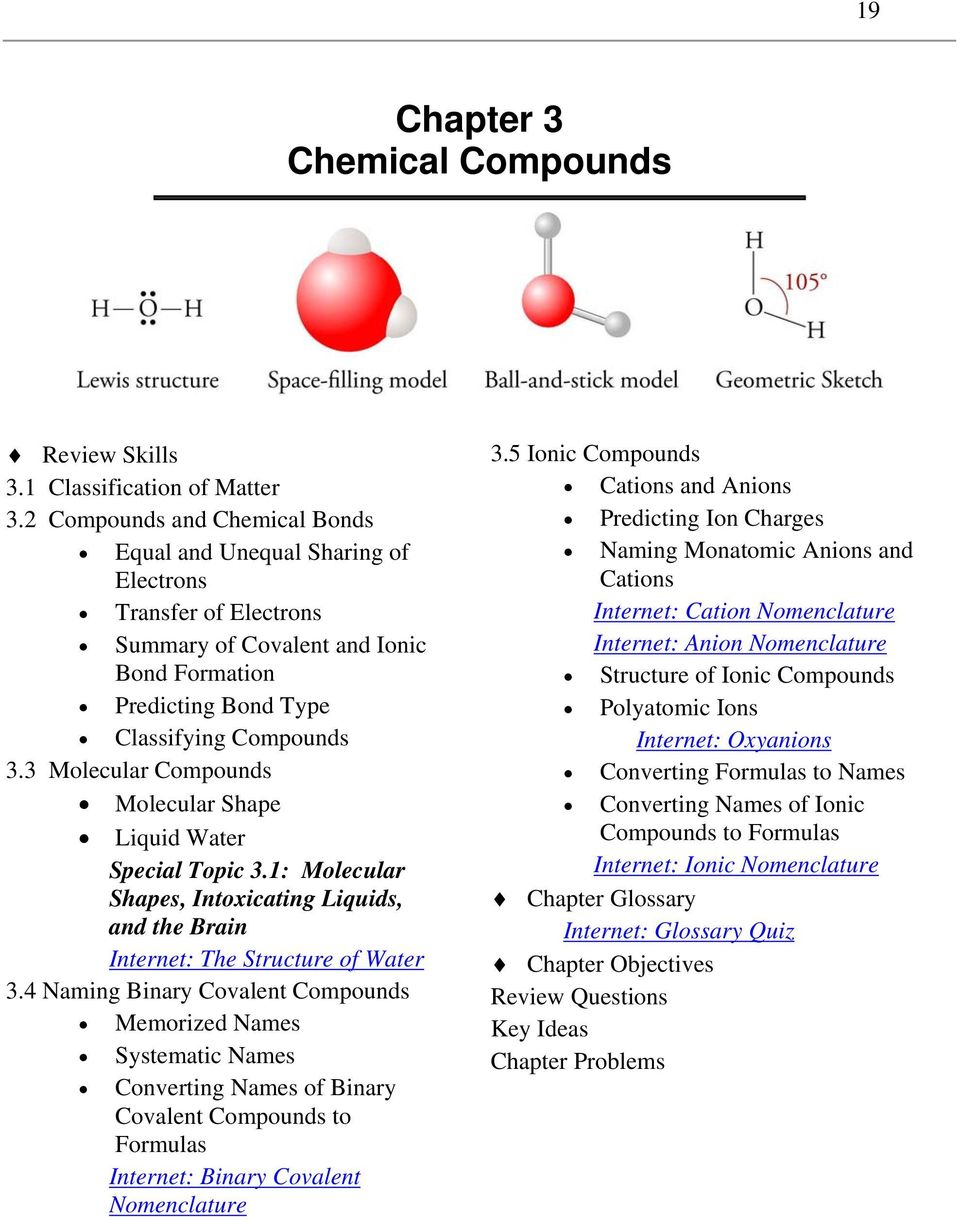
1 19 Chapter 3 Chemical Compounds Review Skills 3.1 Classification of Matter 3.2 Compounds and Chemical Bonds Equal and Unequal Sharing of Electrons Transfer of Electrons Summary of Covalent and Ionic Bond Formation Predicting Bond Type Classifying Compounds 3.3 Molecular Compounds Molecular Shape Liquid Water Special Topic 3.1: Molecular Shapes, Intoxicating Liquids, and the Brain Internet: The Structure of Water 3.4 Naming Binary Covalent Compounds Memorized Names Systematic Names Converting Names of Binary Covalent Compounds to Formulas Internet: Binary Covalent Nomenclature 3.5 Ionic Compounds Cations and Anions Predicting Ion Charges Naming Monatomic Anions and Cations Internet: Cation Nomenclature Internet: Anion Nomenclature Structure of Ionic Compounds Polyatomic Ions Internet: Oxyanions Converting Formulas to Names Converting Names of Ionic Compounds to Formulas Internet: Ionic Nomenclature Chapter Glossary Internet: Glossary Quiz Chapter Objectives Review Questions Key Ideas Chapter Problems
2 20 Study Guide for An Introduction to Chemistry Section Goals and Introductions The Review Skills section for this chapter is very important. Because students are so busy, it s always a battle to keep up, but if you don t keep up in chemistry, you re in real trouble. For this reason, the Review Skills section at the beginning of each chapter tells you what you really need to know (or be able to do) from earlier chapters to understand the chapter you are about to read. They are very important; don t just skip over them. Section 3.1 Classification of Matter Goal: To show how forms of matter can be classified as elements, compounds, and mixtures. This section begins the process of teaching you how to classify matter into the categories of element, compound, and mixture. The distinctions among these categories will become increasingly clear as you study this chapter and Chapter 4. This section also describes how compounds are represented by chemical formulas. Section 3.2 Compounds and Chemical Bonds Goals To show how atoms of different elements form links (chemical bonds) between them and to introduce three types of chemical bonding: nonpolar covalent, polar covalent, and ionic. To show how you can predict whether a pair of atoms will form a covalent bond or an ionic bond. To show how you can predict whether a chemical formula for a compound represents an ionic compound or a molecular compound. We can now take what you have learned about elements in Chapter 2 and expand on it to explain the formation of chemical bonds and chemical compounds. Be sure that you understand the similarities and differences among nonpolar covalent bonds, covalent bonds, and ionic bonds. The most important skills to develop from studying this section are (1) the ability to predict whether atoms of two elements would be expected to form an ionic bond or a covalent bond and (2) the ability to predict whether a chemical formula for a compound represents an ionic compound or a molecular compound. The ability to make these predictions is extremely important for many of the tasks in this chapter and in the chapters that follow. Section 3.3 Molecular Compounds Goals To explain the bonding patterns of the nonmetallic elements. To introduce the concept of molecules, to show how they form, to show how they are described, and to show how the atoms in some molecules are arranged in space. To describe the structure of liquid water. This section begins to describe the formation of molecules, which are collections of atoms held together by covalent bonds. You will find that much of what is introduced here is explained in much more detail in Chapter 12. From this section, you want to gain some understanding of why atoms of the nonmetallic elements form the covalent bonds that they do. Knowing the most common bonding patterns of these atoms (Table 3.1) will help you to predict how nonmetallic atoms combine to form molecules and will help you to draw Lewis

3 Chapter 3 Chemical Compounds 21 structures that represent these molecules. You will learn how the Lewis structures can be used to predict the geometric arrangement of atoms in molecules. It is very important that you know the structure of each water molecule and how this affects the nature of liquid water. To understand the process of forming water solutions described in Chapter 4, you need to have a good mental image of the structure of liquid water. The following animation on our Web site will help: Internet: The Structure of Water Section 3.4 Naming Binary Covalent Compounds Goal: To show how to convert between names and formulas for binary covalent compounds. This section begins the process of describing how to convert between names and formulas for compounds. How important this is depends on whether or not you are going to take more chemistry classes. For example, if you are going on to take general college chemistry, it s very important that you master this skill. It s much less important if the course for which you are using this text is the last chemistry course you plan to take. Be sure to ask your instructor how much weight will be given to this topic on your exams. There is a tutorial on our Web site that provides practice converting between names and formulas for binary covalent compounds: Internet: Binary Covalent Nomenclature Section 3.5 Ionic Compounds Goals To show why some atoms gain or lose electrons to form charged particles called ions. To show how the charges on ions can be predicted. To describe the structure of ionic solids. To describe polyatomic ions, which are charged collections of atoms held together by covalent bonds. This section is an important one. It provides more detailed information about ions than that found in Chapter 2, including how to predict their charges, how to convert between their names and symbols, and how they combine to form ionic compounds. Our Web site provides a tutorial that provides practice converting between names and formulas for monatomic ions: Internet: Cation Nomenclature Internet: Anion Nomenclature All of this information is used extensively in the rest of the book. The section also includes a description of the structure of ionic solids. Polyatomic ions (charged collections of atoms held together by covalent bonds) are also described. Your instructor may want to expand on the list of polyatomic ions that you are expected to know. The text assumes that you can convert between the names and symbols for those that are found in Table 3.6. The following section on our Web site gives you a more complete description of polyatomic ions. Internet: Oxyanions The conversion between names and formulas for ionic compounds is described. Be sure to ask your instructor how much weight will be given to this topic on your exams. Our Web site has a tutorial that provides practice converting between names and formulas for ionic compounds: Internet: Ionic Nomenclature

4 22 Study Guide for An Introduction to Chemistry Chapter 3 Map Chapter Checklist Read the Review Skills section. If there is any skill mentioned that you have not yet mastered, review the material on that topic before reading this chapter. Read the chapter quickly before the lecture that describes it. Attend class meetings, take notes, and participate in class discussions. Work the Chapter Exercises, perhaps using the Chapter Examples as guides. Study the Chapter Glossary and test yourself on our Web site: Internet: Glossary Quiz Study all of the Chapter Objectives. You might want to write a description of how you will meet each objective. (Although it is best to master all of the objectives, the following

5 Chapter 3 Chemical Compounds 23 objectives are especially important because they pertain to skills that you will need while studying other chapters of this text: 3, 4, 8, 9, 13-16, 21-28, 30, 31, 34, 35, and 37.) Reread Sample Study Sheet 3.1: Classification of Matter and decide whether you will use it or some variation on it to complete the task it describes. Memorize the following. (Be sure to check with your instructor to determine how much you are expected to know of the following.) The usual numbers of covalent bonds and lone pairs for the nonmetallic elements. Group 4A Group 5A Group 6A Group 7A 4 valence electrons 5 valence electrons 6 valence electrons 7 valence electrons 4 bonds No lone pairs 3 bonds 1 lone pair 2 bonds 2 lone pairs 1 bond 3 lone pairs carbon C nitrogen- N oxygen O fluorine F phosphorus P sulfur S chlorine Cl selenium Se bromine Br iodine I Names and formulas of some binary covalent compounds. Name Formula Name Formula water H 2 O methane CH 4 ammonia NH 3 ethane C 2 H 6 propane C 3 H 8

6 24 Study Guide for An Introduction to Chemistry Prefixes Number of atoms Prefix Number of atoms Prefix 1 mon(o)- 6 hex(a)- 2 di- 7 hept(a)- 3 tri- 8 oct(a)- 4 tetr(a)- 9 non(a)- 5 pent(a)- 10 dec(a)- Roots of nonmetallic elements Element Root Element Root Element Root Element Root C carb- N nitr- O ox- F fluor- P phosph- S sulf- Cl chlor- As arsen- Se selen- Br brom- I iod- Charges on monatomic ions Names and formulas for polyatomic ions Ion Name Ion Name Ion Name NH 4 + ammonium PO 4 3 phosphate SO 4 2 sulfate OH hydroxide NO 3 nitrate C 2 H 3 O 2 acetate CO 3 2 carbonate

7 Chapter 3 Chemical Compounds 25 To get a review of the most important topics in the chapter, fill in the blanks in the Key Ideas section. Work all of the selected problems at the end of the chapter, and check your answers with the solutions provided in this chapter of the study guide. Ask for help if you need it. Web Resources Internet: The Structure of Water Internet: Binary Covalent Nomenclature Internet: Cation Nomenclature Internet: Anion Nomenclature Internet: Oxyanions Internet: Ionic Nomenclature Internet: Glossary Quiz Exercises Key Exercise Classification of Matter: The label on a container of double-acting baking powder tells us that it contains cornstarch, bicarbonate of soda (also called sodium hydrogen carbonate, NaHCO 3 ), sodium aluminum sulfate, and acid phosphate of calcium (which chemists call calcium dihydrogen phosphate, Ca(H 2 PO 4 ) 2 ). Classify each of the following as a pure substance or a mixture. If it is a pure substance, is it an element or a compound? (Objs 3 & 4) a. calcium element b. calcium dihydrogen phosphate compound c. double-acting baking powder mixture Exercise Classifying Compounds: Classify each of the following substances as either a molecular compound or an ionic compound. (Obj 9) a. formaldehyde, CH 2 O (used in embalming fluids) all nonmetal atoms - molecular b. magnesium chloride, MgCl 2 (used in fireproofing wood and in paper manufacturing) metal-nonmetal - ionic

8 26 Study Guide for An Introduction to Chemistry Exercise Drawing Lewis Structures from Formulas: Draw a Lewis structure for each of the following formulas: (Obj 14) a. nitrogen triiodide, NI 3 (explodes at the slightest touch) Nitrogen atoms usually have three covalent bonds and one lone pair, and iodine atoms usually have one covalent bond and three lone pairs. b. hexachloroethane, C 2 Cl 6 (used to make explosives) Carbon atoms usually have four covalent bonds and no lone pairs, and chlorine atoms usually have one covalent bond and three lone pairs. c. hydrogen peroxide, H 2 O 2 (a common antiseptic) Hydrogen atoms always have one covalent bond and no lone pairs, and oxygen atoms usually have two covalent bonds and two lone pairs. d. ethylene (or ethene), C 2 H 4 (used to make polyethylene) Carbon atoms form four bonds with no lone pairs, and hydrogen atoms form one bond with no lone pairs. To achieve these bonding patterns, there must be a double bond between the carbon atoms. Exercise Naming Binary Covalent Compounds: Write names that correspond to the following formulas: (Obj 21) a. P 2 O 5 diphosphorus pentoxide b. PCl 3 phosphorus trichloride c. CO carbon monoxide d. H 2 S dihydrogen monosulfide or hydrogen sulfide e. NH 3 ammonia Exercise Writing Formulas for Binary Covalent Compounds: Write formulas that correspond to the following names: (Obj 21) a. disulfur decafluoride S 2 F 10 b. nitrogen trifluoride NF 3 c. propane C 3 H 8 d. hydrogen chloride HCl

9 Chapter 3 Chemical Compounds 27 Exercise Naming Monatomic Ions: Write names that correspond to the following formulas for monatomic ions: (Obj 24) a. Mg 2 magnesium ion c. Sn tin(ii) ion b. F fluoride ion Exercise Formulas for Monatomic Ions: Write formulas that correspond to the following names for monatomic ions: (Obj 24) a. bromide ion Br c. gold(i) ion Au b. aluminum ion Al 3 Exercise Naming Ionic Compounds: Write the names that correspond to the following formulas: (Obj 30) a. LiCl lithium chloride b. Cr 2 (SO 4 ) 3 chromium(iii) sulfate c. NH 4 HCO 3 ammonium hydrogen carbonate Exercise Formulas for Ionic Compounds: Write the formulas that correspond to the following names: (Obj 30) a. aluminum oxide Al 2 O 3 b. cobalt(iii) fluoride CoF 3 c. iron(ii) sulfate FeSO 4 d. ammonium hydrogen phosphate (NH 4 ) 2 HPO 4 e. potassium bicarbonate KHCO 3 Review Questions Key Write in each blank the word or words that best complete each sentence. 1. An atom or group of atoms that has lost or gained one or more electrons to create a charged particle is called a(n) ion. 2. An atom or collection of atoms with an overall positive charge is a(n) cation. 3. An atom or collection of atoms with an overall negative charge is a(n) anion. 4. A(n) covalent bond is a link between atoms that results from the sharing of two electrons. 5. A(n) molecule is an uncharged collection of atoms held together with covalent bonds. 6. A molecule such as H 2, which is composed of two atoms, is called diatomic. 7. Describe the particle nature of solids, liquids, and gases. Your description should include the motion of the particles and the attractions between the particles. See Figures 2.1, 2.2, and 2.4 in the textbook. 8. Describe the nuclear model of the atom. Protons and neutrons are in a tiny core of the atom called the nucleus, which has a diameter about 1/100,000 the diameter of the atom. The position and motion of the electrons are uncertain, but they generate a negative charge that is felt in the space that surrounds the nucleus.

10 28 Study Guide for An Introduction to Chemistry 9. Describe the hydrogen molecule, H 2. Your description should include the nature of the link between the hydrogen atoms and a sketch that shows the two electrons in the molecule. The hydrogen atoms are held together by a covalent bond formed due to the sharing of two electrons. See the image of H 2 in Figure 2.13 in the textbook. 10. Complete the following table. Element name Element symbol Group number on periodic table Metal, nonmetal, or metalloid? lithium Li 1 or 1A metal carbon C 14 or 4A nonmetal chlorine Cl 17 or 7A nonmetal oxygen O 16 or 6A nonmetal copper Cu 11 or 1B metal calcium Ca 2 or 2A metal scandium Sc 3 or 3B metal 11. Write the name of the group to which each of the following belongs. a. chlorine halogens b. xenon noble gases c. sodium alkali metals d. magnesium alkaline earth metals Key Ideas Answers 12. A compound is a substance that contains two or more elements, the atoms of those elements always combining in the same whole-number ratio. 14. A chemical formula is a concise written description of the components of a chemical compound. It identifies the elements in the compound by their symbols and indicates the relative number of atoms of each element with subscripts. 16. Mixtures are samples of matter that contain two or more pure substances and have variable composition. 18. Because particles with opposite charges attract each other, there is an attraction between cations and anions. This attraction is called an ionic bond. 20. The atom in a chemical bond that attracts electrons more strongly acquires a negative charge, and the other atom acquires a positive charge. If the electron transfer is significant but not enough to form ions, the atoms acquire partial negative and partial positive charges. The bond in this situation is called a polar covalent bond. 22. When a metallic atom bonds to a nonmetallic atom, the bond is usually ionic. 24. The noble gases (group 8A) have an octet of electrons (except for helium, which has only two electrons total), and they are so stable that they rarely form chemical bonds with other atoms.

11 Chapter 3 Chemical Compounds The sum of the numbers of covalent bonds and lone pairs for the most common bonding patterns of the atoms of nitrogen, phosphorus, oxygen, sulfur, selenium, and the halogens is four. 28. Lewis structures are useful for showing how the atoms in a molecule are connected by covalent bonds, but they do not always give a clear description of how the atoms are arranged in space. 30. A space-filling model provides the most accurate representation of the electron-charge clouds for the atoms in CH As in other liquids, the attractions between water molecules are strong enough to keep them the same average distance apart but weak enough to allow each molecule to be constantly breaking the attractions that momentarily connect it to some molecules and forming new attractions to other molecules. 34. You can recognize binary covalent compounds from their formulas, which contain symbols for only two nonmetallic elements. 36. Nonmetallic atoms form anions to get the same number of electrons as the nearest noble gas. 38. When atoms gain electrons and form anions, they get larger. When atoms lose electrons and form cations, they get significantly smaller. 40. It is common for hydrogen atoms to be transferred from one ion or molecule to another ion or molecule. When this happens, the hydrogen atom is usually transferred without its electron, as H +. Problems Key Section 3.1 Classification of Matter 42. Classify each of the following as a pure substance or a mixture. If it is a pure substance, is it an element or a compound? Explain your answer. (Objs 3 & 4) a. apple juice mixture variable composition b. potassium (A serving of one brand of apple juice provides 6% of the recommended daily allowance of potassium.) element and pure substance The symbol K is on the periodic table of the elements. All elements are pure substances. c. ascorbic acid (vitamin C), C 6 H 8 O 6, in apple juice The formula shows the constant composition, so ascorbic acid is a pure substance. The three element symbols in the formula indicate a compound.

12 30 Study Guide for An Introduction to Chemistry 44. Write the chemical formula for each of the following compounds. List the symbols for the elements in the order that the elements are mentioned in the description. a. a compound with molecules that consist of two nitrogen atoms and three oxygen atoms. N 2 O 3 b. a compound with molecules that consist of one sulfur atom and four fluorine atoms. SF 4 c. a compound that contains one aluminum atom for every three chlorine atoms. AlCl 3 d. a compound that contains two lithium atoms and one carbon atom for every three oxygen atoms. Li 2 CO 3 Section 3.2 Chemical Compounds and Chemical Bonds 46. Hydrogen bromide, HBr, is used to make pharmaceuticals that require bromine in their structure. Each hydrogen bromide molecule has one hydrogen atom bonded to one bromine atom by a polar covalent bond. The bromine atom attracts electrons more than does the hydrogen atom. Draw a rough sketch of the electron-cloud that represents the electrons involved in the bond. (Obj 5) 48. Atoms of potassium and fluorine form ions and ionic bonds in a very similar way to atoms of sodium and chlorine. Each atom of one of these elements loses one electron, and each atom of the other element gains one electron. Describe the process that leads to the formation of the ionic bond between potassium and fluorine atoms in potassium fluoride. Your answer should include mention of the charges that form on the atoms. (Obj 6) The metallic potassium atoms lose one electron and form +1 cations, and the nonmetallic fluorine atoms gain one electron and form 1 anions. K K + + e 19p/19e 19p/18e F + e F 9p/9e 9p/10e The ionic bonds are the attractions between K + cations and F anions. 50. Explain how a nonpolar covalent bond, a polar covalent bond, and an ionic bond differ. Your description should include rough sketches of the electron clouds that represent the electrons involved in the formation of each bond. (Obj 7) See Figure 3.6 in the textbook.

13 Chapter 3 Chemical Compounds Would you expect the bonds between the following atoms to be ionic or covalent bonds? (Obj 8) a. N O covalent nonmetal-nonmetal b. Al-Cl ionic metal-nonmetal 54. Classify each of the following as either a molecular compound or an ionic compound. (Obj 9) a. acetone, CH 3 COCH 3 (a common paint solvent) all nonmetallic atoms - molecular b. sodium sulfide, Na 2 S (used in sheep dips) metal-nonmetal - ionic Section 3.3 Molecular Compounds 56. How many valence electrons does each atom of the following elements have? (Obj 10) a. Cl 7 (in group 7A) b. C 4 (in group 4A) 58. Draw electron-dot symbols for each of the following elements and use them to explain why each element has the bonding pattern listed in Table 3.1 in the textbook. (Obj 11) Each of the following answers is based on the assumption that nonmetallic atoms tend to form covalent bonds in order to get an octet (8) of electrons around each atom, like the very stable noble gases (other than helium). Covalent bonds (represented by lines in Lewis structures) and lone pairs each contribute two electrons to the octet. a. oxygen b. fluorine c. carbon If oxygen atoms form two covalent bonds, they will have an octet of electrons around them. Water is an example: If fluorine atoms form one covalent bond, they will have an octet of electrons around them. Hydrogen fluoride, HF, is an example: If carbon atoms form four covalent bonds, they will have an octet of electrons around them. Methane, CH 4, is an example: d. phosphorus If phosphorus atoms form three covalent bonds, they will have an octet of electrons around them. Phosphorus trichloride, PCl 3, is an example:

14 32 Study Guide for An Introduction to Chemistry 60. The following Lewis structure is for CFC-12, which is one of the ozone-depleting chemicals that has been used as an aerosol can propellant and as a refrigerant. Describe the information given in this Lewis structure. (Obj 12) The molecule contains a carbon atom, two chlorine atoms, and two fluorine atoms. There are two covalent C Cl bonds and two covalent C F bonds. The Cl and F atoms have three lone pairs each. 62. Write the most common number of covalent bonds and lone pairs for atoms of each of the following nonmetallic elements. (Obj 13) a. H 1 bond, no lone pairs b. Iodine 1 bond, 3 lone pairs c. sulfur 2 bonds, 2 lone pairs d. N 3 bonds, 1 lone pair 64. Draw a Lewis structure for each of the following formulas. (Obj 16) a. oxygen difluoride, OF 2 (an unstable, colorless gas) Oxygen atoms usually have two covalent bonds and two lone pairs, and fluorine atoms have one covalent bond and three lone pairs. b. bromoform, CHBr 3 (used as a sedative) Carbon atoms usually have four covalent bonds and no lone pairs, hydrogen atoms always have one covalent bond and no lone pairs, and bromine atoms usually have one covalent bond and three lone pairs. The hydrogen atom can be put in any of the four positions. c. phosphorus triiodide, PI 3 (used to make organic compounds) Phosphorus atoms usually have three covalent bonds and one lone pair, and iodine atoms usually have one covalent bond and three lone pairs. The lone pair can be placed in any one of the four positions around the phosphorus atom. 66. Draw Lewis structures for the following compounds by adding any necessary lines and dots to the skeletons given. (Obj 16) a. hydrogen cyanide, HCN (used to manufacture dyes and pesticides)

15 Chapter 3 Chemical Compounds 33 b. dichloroethene, C 2 Cl 4 (used to make perfumes) 68. Write two different names for each of the following alcohols. (Objs 14 & 15) a. methanol and methyl alcohol b. ethanol and ethyl alcohol c. 2-propanol and isopropyl alcohol 70. Compare and contrast the information given in the Lewis structure, the space-filling model, the ball-and-stick model, and the geometric sketch of a methane molecule, CH 4. (Objs 19 & 20) See Figure 3.10 in the textbook. The Lewis structure shows the four covalent bonds between the carbon atoms and the hydrogen atoms. The space-filling model provides the most accurate representation of the electron-charge clouds for the atoms in CH 4. The ball-and-stick model emphasizes the molecule s correct molecular shape and shows the covalent bonds more clearly. Each ball represents an atom, and each stick represents a covalent bond between two atoms. The geometric sketch shows the three-dimensional tetrahedral structures with a two-dimensional drawing. Picture the hydrogen atoms connected to the central carbon atom with solid lines as being in the same plane as the carbon atom. The hydrogen atom connected to the central carbon with a solid wedge comes out of the plane toward you. The hydrogen atom connected to the carbon atom by a dashed wedge is located back behind the plane of the page. 72. Compare and contrast the information given in the Lewis structure, the space-filling model, the ball-and-stick model, and the geometric sketch of a water molecule, H 2 O. (Objs 19 & 20) See Figure 3.12 in the textbook. The Lewis structure shows the two O H covalent bonds and the two lone pairs on the oxygen atom. The space-filling model provides the most accurate representation of the electron-charge clouds for the atoms and the bonding electrons. The ball-and-stick model emphasizes the molecule s correct molecular shape and shows the covalent bonds more clearly. The geometric sketch shows the structure with a two-dimensional drawing.

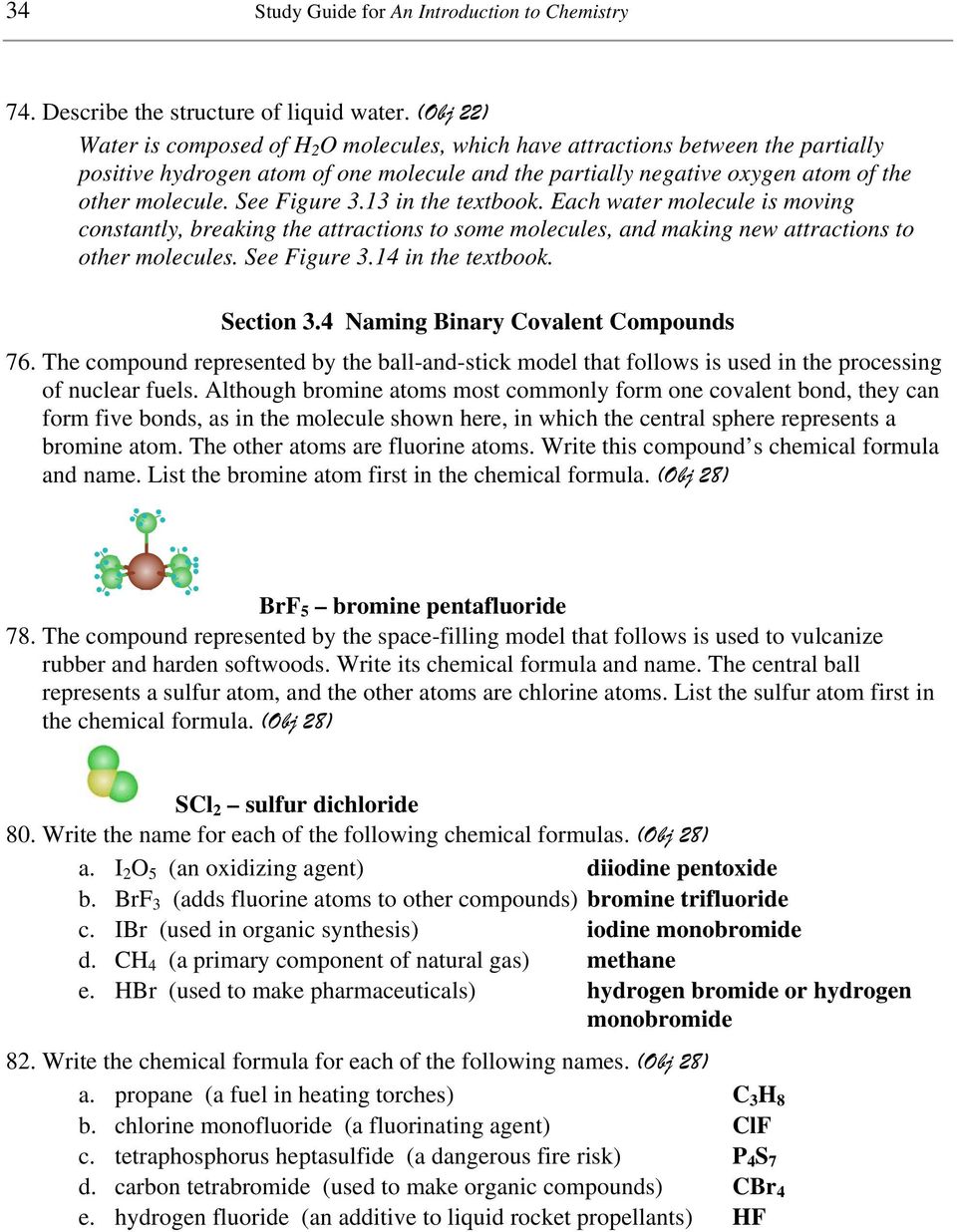
16 34 Study Guide for An Introduction to Chemistry 74. Describe the structure of liquid water. (Obj 22) Water is composed of H 2 O molecules, which have attractions between the partially positive hydrogen atom of one molecule and the partially negative oxygen atom of the other molecule. See Figure 3.13 in the textbook. Each water molecule is moving constantly, breaking the attractions to some molecules, and making new attractions to other molecules. See Figure 3.14 in the textbook. Section 3.4 Naming Binary Covalent Compounds 76. The compound represented by the ball-and-stick model that follows is used in the processing of nuclear fuels. Although bromine atoms most commonly form one covalent bond, they can form five bonds, as in the molecule shown here, in which the central sphere represents a bromine atom. The other atoms are fluorine atoms. Write this compound s chemical formula and name. List the bromine atom first in the chemical formula. (Obj 28) BrF 5 bromine pentafluoride 78. The compound represented by the space-filling model that follows is used to vulcanize rubber and harden softwoods. Write its chemical formula and name. The central ball represents a sulfur atom, and the other atoms are chlorine atoms. List the sulfur atom first in the chemical formula. (Obj 28) SCl 2 sulfur dichloride 80. Write the name for each of the following chemical formulas. (Obj 28) a. I 2 O 5 (an oxidizing agent) diiodine pentoxide b. BrF 3 (adds fluorine atoms to other compounds) bromine trifluoride c. IBr (used in organic synthesis) iodine monobromide d. CH 4 (a primary component of natural gas) methane e. HBr (used to make pharmaceuticals) hydrogen bromide or hydrogen monobromide 82. Write the chemical formula for each of the following names. (Obj 28) a. propane (a fuel in heating torches) C 3 H 8 b. chlorine monofluoride (a fluorinating agent) ClF c. tetraphosphorus heptasulfide (a dangerous fire risk) P 4 S 7 d. carbon tetrabromide (used to make organic compounds) CBr 4 e. hydrogen fluoride (an additive to liquid rocket propellants) HF
17 Chapter 3 Chemical Compounds 35 Section 3.5 Ionic Compounds 84. Explain why metals usually combine with nonmetals to form ionic bonds. (Obj 29) Because metallic atoms hold some of their electrons relatively loosely, they tend to lose electrons and form cations. Because nonmetallic atoms attract electrons more strongly than metallic atoms, they tend to gain electrons and form anions. Thus, when a metallic atom and a nonmetallic atom combine, the nonmetallic atom often pulls one or more electrons far enough away from the metallic atom to form ions and an ionic bond. 85. How may protons and electrons do each of the following ions have? a. Be 2 4 protons and 2 electrons b. S 2 16 protons and 18 electrons 87. Write the name for each of these monatomic ions. (Obj 31) a. Ca 2 calcium ion b. Li lithium ion c. Cr 2 chromium(ii) ion d. F fluoride ion 89. Write the formula for each of these monatomic ions. (Objs 30 & 31) a. magnesium ion Mg 2 b. sodium ion Na c. sulfide ion S 2 d. iron(iii) ion Fe 3 e. Ag silver ion or silver(i) ion f. Sc 3 scandium ion g. P 3 phosphide ion h. Pb 2 lead(ii) ion e. scandium ion Sc 3 f. nitride ion N 3 g. manganese(iii) ion Mn 3 h. zinc ion Zn Silver bromide, AgBr, is the compound on black and white film that causes the color change when the film is exposed to light. It has a structure similar structure to that of sodium chloride. What are the particles that form the basic structure of silver bromide? What type of attraction holds these particles together? Draw a rough sketch of the structure of solid silver bromide. (Obj 32) The metallic silver atoms form cations, and the nonmetallic bromine atoms form anions. The anions and cations alternate in the ionic solid with each cation surrounded by six anions and each anion surrounded by six cations. See Figure 3.18 in the textbook, picturing Ag + ions in the place of the Na + ions and Br in the place of the Cl ions. 93. Write the name for each of these polyatomic ions. (Objs 34 & 35) a. NH 4 ammonium c. HSO 4 hydrogen sulfate b. C 2 H 3 O 2 acetate 95. Write the formula for each of these polyatomic ions. (Objs 34-36) a. ammonium NH 4 c. hydrogen sulfate ion HSO 4 b. bicarbonate ion HCO Write the name for each of these chemical formulas. (Obj 37) a. Na 2 O (a dehydrating agent) sodium oxide b. Ni 2 O 3 (in storage batteries) nickel(iii) oxide c. Pb(NO 3 ) 2 (in matches and explosives) lead(ii) nitrate d. Ba(OH) 2 (an analytical reagent) barium hydroxide e. KHCO 3 (in baking powder and fire-extinguishing agents) potassium hydrogen carbonate

18 36 Study Guide for An Introduction to Chemistry 98. Write the chemical formula for each of the following names. (Obj 37) a. potassium sulfide (a depilatory) K 2 S b. zinc phosphide (a rodenticide) Zn 3 P 2 c. nickel(ii) chloride (used in nickel electroplating) NiCl 2 d. magnesium dihydrogen phosphate (used in fireproofing wood) Mg(H 2 PO 4 ) 2 e. lithium bicarbonate (in mineral waters) LiHCO The ionic compounds CuF 2, NH 4 Cl, CdO, and HgSO 4 are all used to make batteries. Write the name for each of these compounds. (Obj 37) copper(ii) fluoride (CuF 2 ), ammonium chloride (NH 4 Cl), cadmium oxide (CdO), and mercury(ii) sulfate (HgSO 4 ) 102. The ionic compounds copper(ii) chloride, lithium nitrate, and cadmium sulfide are all used to make fireworks. Write the chemical formulas for these compounds. (Obj 37) copper(ii) chloride (CuCl 2 ), lithium nitrate (LiNO 3 ), and cadmium sulfide (CdS)

Chapter 5 Chemical Compounds
 Chapter 5 59 Chapter 5 Chemical Compounds Review Skills 5.1 Classification of Matter 5.2 Compounds and Chemical Bonds Equal and Unequal Sharing of Electrons Transfer of Electrons Summary of Covalent and
Exercise 3.5 - Naming Binary Covalent Compounds:
 Chapter Exercise Key 1 Chapter Exercise Key Exercise.1 Classifying Compounds: Classify each of the following substances as either a molecular compound or an ionic compound. a. formaldehyde, CH 2 O (used
Nomenclature of Ionic Compounds
 Nomenclature of Ionic Compounds Ionic compounds are composed of ions. An ion is an atom or molecule with an electrical charge. Monatomic ions are formed from single atoms that have gained or lost electrons.
CHEMICAL NAMES AND FORMULAS
 9 CHEMICAL NAMES AND FORMULAS SECTION 9.1 NAMING IONS (pages 253 258) This section explains the use of the periodic table to determine the charge of an ion. It also defines polyatomic ion and gives the
Sample Exercise 2.1 Illustrating the Size of an Atom
 Sample Exercise 2.1 Illustrating the Size of an Atom The diameter of a US penny is 19 mm. The diameter of a silver atom, by comparison, is only 2.88 Å. How many silver atoms could be arranged side by side
CHEMICAL NAMES AND FORMULAS
 6 CEMICAL NAMES AND FORMULAS SECTION 6.1 INTRODUCTION TO CEMICAL BONDING (pages 133 137) This section explains how to distinguish between ionic and molecular compounds. It also defines cation and anion
Monatomic Ions. A. Monatomic Ions In order to determine the charge of monatomic ions, you can use the periodic table as a guide:
 Monatomic Ions Ions are atoms that have either lost or gained electrons. While atoms are neutral, ions are charged particles. A loss of electrons results in a positive ion or cation (pronounced cat-eye-on
19.2 Chemical Formulas
 In the previous section, you learned how and why atoms form chemical bonds with one another. You also know that atoms combine in certain ratios with other atoms. These ratios determine the chemical formula
PERIODIC TABLE OF THE ELEMENTS
 PERIODIC TABLE OF THE ELEMENTS Periodic Table: an arrangement of elements in horizontal rows (Periods) and vertical columns (Groups) exhibits periodic repetition of properties First Periodic Table: discovered
Elements and Compounds. Chemical Bonds compounds are made of atoms held together by chemical bonds bonds are forces of attraction between atoms
 Elements and Compounds elements combine together to make an almost limitless number of compounds the properties of the compound are totally different from the constituent elements Tro, Chemistry: A Molecular
CHAPTER 5: MOLECULES AND COMPOUNDS
 CHAPTER 5: MOLECULES AND COMPOUNDS Problems: 1-6, 9-13, 16, 20, 31-40, 43-64, 65 (a,b,c,e), 66(a-d,f), 69(a-d,f), 70(a-e), 71-78, 81-82, 87-96 A compound will display the same properties (e.g. melting
Chapter 4 Compounds and Their Bonds
 Chapter 4 Compounds and Their Bonds 4.1 Octet Rule and Ions Octet Rule An octet is 8 valence electrons. is associated with the stability of the noble gases. He is stable with 2 valence electrons (duet).
Chapter 6 Assessment. Name: Class: Date: ID: A. Multiple Choice Identify the choice that best completes the statement or answers the question.
 Name: Class: Date: ID: A Chapter 6 Assessment Multiple Choice Identify the choice that best completes the statement or answers the question. 1. When an atom loses an electron, it forms a(n) a. anion. c.
B) atomic number C) both the solid and the liquid phase D) Au C) Sn, Si, C A) metal C) O, S, Se C) In D) tin D) methane D) bismuth B) Group 2 metal
 1. The elements on the Periodic Table are arranged in order of increasing A) atomic mass B) atomic number C) molar mass D) oxidation number 2. Which list of elements consists of a metal, a metalloid, and
Chapter 4: Structure and Properties of Ionic and Covalent Compounds
 Chapter 4: Structure and Properties of Ionic and Covalent Compounds 4.1 Chemical Bonding o Chemical Bond - the force of attraction between any two atoms in a compound. o Interactions involving valence
Name: Block: Date: Test Review: Chapter 8 Ionic Bonding
 Name: Block: Date: Test Review: Chapter 8 Ionic Bonding Part 1: Fill-in-the-blank. Choose the word from the word bank below. Each word may be used only 1 time. electron dot structure metallic electronegativity
Naming Compounds. There are three steps involved in naming ionic compounds- naming the cation, naming the anion, and naming the entire compound.
 Naming Compounds Naming compounds is an important part of chemistry. Most compounds fall in to one of three categories ionic compounds, molecular compounds, or acids. Part One: Naming Ionic Compounds Identifying
CHAPTER 9. 9.1 Naming Ions. Chemical Names and Formulas. Naming Transition Metals. Ions of Transition Metals. Ions of Transition Metals
 CHAPTER 9 Chemical Names and Formulas 9.1 Naming Ions Monatomic Ions: a single atom with a positive or negative charge Cation (rules): listed first Anion (rules): ide ending Transition Metals have a varying
Polyatomic ions can form ionic compounds just as monatomic ions.
 1 POLYATOMIC IONS We have seen that atoms can lose or gain electrons to become ions. Groups of atoms can also become ions. These groups of atoms are called polyatomic ions. Examples: O hydroxide ion NO
WRITING CHEMICAL FORMULA
 WRITING CHEMICAL FORMULA For ionic compounds, the chemical formula must be worked out. You will no longer have the list of ions in the exam (like at GCSE). Instead you must learn some and work out others.
Chapter 5. Chapter 5. Naming Ionic Compounds. Objectives. Chapter 5. Chapter 5
 Objectives Name cations, anions, and ionic compounds. Write chemical formulas for ionic compounds such that an overall neutral charge is maintained. Explain how polyatomic ions and their salts are named
Chapter 9 Practice Test - Naming and Writing Chemical Formulas
 Chapter 9 Practice Test - Naming and Writing Chemical Formulas Matching Match each itme with the correct statement below. Match each item with the correct statement below. a. monatomic ion f. cation b.
(b) Formation of calcium chloride:
 Chapter 2: Chemical Compounds and Bonding Section 2.1: Ionic Compounds, pages 22 23 1. An ionic compound combines a metal and a non-metal joined together by an ionic bond. 2. An electrostatic force holds
Naming Ionic Compounds
 Naming Ionic Compounds I. Naming Ions A. Cations (+ions) 1. Element name followed by "ion" (when in Group IA, IIA, Al 3+, Ga 3+, Zn 2+, Cd 2+, Ag +, Ni 2+ ). Na + sodium ion, K + potassium ion, Al 3+ aluminum
Balancing Chemical Equations Worksheet
 Balancing Chemical Equations Worksheet Student Instructions 1. Identify the reactants and products and write a word equation. 2. Write the correct chemical formula for each of the reactants and the products.
Periodic Table Questions
 Periodic Table Questions 1. The elements characterized as nonmetals are located in the periodic table at the (1) far left; (2) bottom; (3) center; (4) top right. 2. An element that is a liquid at STP is
Naming Compounds Handout Key
 Naming Compounds Handout Key p. 2 Name each of the following monatomic cations: Li + = lithium ion Ag + = silver ion Cd +2 = cadmium ion Cu +2 = copper (II) ion Al +3 = aluminum ion Mg +2 = magnesium ion
Ionic and Covalent Bonds
 Ionic and Covalent Bonds Ionic Bonds Transfer of Electrons When metals bond with nonmetals, electrons are from the metal to the nonmetal The becomes a cation and the becomes an anion. The between the cation
Chemistry Diagnostic Questions
 Chemistry Diagnostic Questions Answer these 40 multiple choice questions and then check your answers, located at the end of this document. If you correctly answered less than 25 questions, you need to
Topic 4 National Chemistry Summary Notes. Formulae, Equations, Balancing Equations and The Mole
 Topic 4 National Chemistry Summary Notes Formulae, Equations, Balancing Equations and The Mole LI 1 The chemical formula of a covalent molecular compound tells us the number of atoms of each element present
Nomenclature and Formulas of Ionic Compounds. Section I: Writing the Name from the Formula
 Purpose: Theory: Nomenclature and Formulas of Ionic Compounds 1. To become familiar with the rules of chemical nomenclature, based on the classification of compounds. 2. To write the proper name of the
Chapter 2 Atoms, Molecules, and Ions
 Chapter 2 Atoms, Molecules, and Ions 1. Methane and ethane are both made up of carbon and hydrogen. In methane, there are 12.0 g of carbon for every 4.00 g of hydrogen, a ration of 3:1 by mass. In ethane,
In the box below, draw the Lewis electron-dot structure for the compound formed from magnesium and oxygen. [Include any charges or partial charges.
 Name: 1) Which molecule is nonpolar and has a symmetrical shape? A) NH3 B) H2O C) HCl D) CH4 7222-1 - Page 1 2) When ammonium chloride crystals are dissolved in water, the temperature of the water decreases.
Ionic and Metallic Bonding
 Ionic and Metallic Bonding BNDING AND INTERACTINS 71 Ions For students using the Foundation edition, assign problems 1, 3 5, 7 12, 14, 15, 18 20 Essential Understanding Ions form when atoms gain or lose
Bonding Practice Problems
 NAME 1. When compared to H 2 S, H 2 O has a higher 8. Given the Lewis electron-dot diagram: boiling point because H 2 O contains stronger metallic bonds covalent bonds ionic bonds hydrogen bonds 2. Which
Electrons in Atoms & Periodic Table Chapter 13 & 14 Assignment & Problem Set
 Electrons in Atoms & Periodic Table Name Warm-Ups (Show your work for credit) Date 1. Date 2. Date 3. Date 4. Date 5. Date 6. Date 7. Date 8. Electrons in Atoms & Periodic Table 2 Study Guide: Things You
47374_04_p25-32.qxd 2/9/07 7:50 AM Page 25. 4 Atoms and Elements
 47374_04_p25-32.qxd 2/9/07 7:50 AM Page 25 4 Atoms and Elements 4.1 a. Cu b. Si c. K d. N e. Fe f. Ba g. Pb h. Sr 4.2 a. O b. Li c. S d. Al e. H f. Ne g. Sn h. Au 4.3 a. carbon b. chlorine c. iodine d.
SCH 4C1 Unit 2 Problem Set Questions taken from Frank Mustoe et all, "Chemistry 11", McGraw-Hill Ryerson, 2001
 SCH 4C1 Unit 2 Problem Set Questions taken from Frank Mustoe et all, "Chemistry 11", McGraw-Hill Ryerson, 2001 1. A small pin contains 0.0178 mol of iron. How many atoms of iron are in the pin? 2. A sample
Sample Exercise 8.1 Magnitudes of Lattice Energies
 Sample Exercise 8.1 Magnitudes of Lattice Energies Without consulting Table 8.2, arrange the ionic compounds NaF, CsI, and CaO in order of increasing lattice energy. Analyze From the formulas for three
Start: 26e Used: 6e Step 4. Place the remaining valence electrons as lone pairs on the surrounding and central atoms.
 Section 4.1: Types of Chemical Bonds Tutorial 1 Practice, page 200 1. (a) Lewis structure for NBr 3 : Step 1. The central atom for nitrogen tribromide is bromine. 1 N atom: 1(5e ) = 5e 3 Br atoms: 3(7e
Nomenclature and the Periodic Table To name compounds and to determine molecular formulae from names a knowledge of the periodic table is helpful.
 Nomenclature and the Periodic Table To name compounds and to determine molecular formulae from names a knowledge of the periodic table is helpful. Atomic Number = number of protons Mass Number = number
Periodic Table, Valency and Formula
 Periodic Table, Valency and Formula Origins of the Periodic Table Mendelѐѐv in 1869 proposed that a relationship existed between the chemical properties of elements and their atomic masses. He noticed
Exam 2 Chemistry 65 Summer 2015. Score:
 Name: Exam 2 Chemistry 65 Summer 2015 Score: Instructions: Clearly circle the one best answer 1. Valence electrons are electrons located A) in the outermost energy level of an atom. B) in the nucleus of
Sample Exercise 8.1 Magnitudes of Lattice Energies
 Sample Exercise 8.1 Magnitudes of Lattice Energies Without consulting Table 8.2, arrange the following ionic compounds in order of increasing lattice energy: NaF, CsI, and CaO. Analyze: From the formulas
Molecules, Compounds, and Chemical Equations (Chapter 3)
 Molecules, Compounds, and Chemical Equations (Chapter 3) Chemical Compounds 1. Classification of Elements and Compounds Types of Pure Substances (Figure 3.4) Elements -- made up of only one type of atom
Questions on Chapter 8 Basic Concepts of Chemical Bonding
 Questions on Chapter 8 Basic Concepts of Chemical Bonding Circle the Correct Answer: 1) Which ion below has a noble gas electron configuration? A) Li 2+ B) Be 2+ C) B2+ D) C2+ E) N 2-2) Of the ions below,
Name period Unit 3 worksheet
 Name period Unit 3 worksheet Read chapter 8, 2.52.7 1. Explain the difference between metallic, ionic, and covalent bonding Metallic cations share a sea of electrons Ionic atoms give and take electrons
Decomposition. Composition
 Decomposition 1. Solid ammonium carbonate is heated. 2. Solid calcium carbonate is heated. 3. Solid calcium sulfite is heated in a vacuum. Composition 1. Barium oxide is added to distilled water. 2. Phosphorus
CHEMISTRY BONDING REVIEW
 Answer the following questions. CHEMISTRY BONDING REVIEW 1. What are the three kinds of bonds which can form between atoms? The three types of Bonds are Covalent, Ionic and Metallic. Name Date Block 2.
Unit 2 Periodic Behavior and Ionic Bonding
 Unit 2 Periodic Behavior and Ionic Bonding 6.1 Organizing the Elements I. The Periodic Law A. The physical and chemical properties of the elements are periodic functions of their atomic numbers B. Elements
CHEMICAL NOMENCLATURE
 CHEMICAL NOMENCLATURE Chemical nomenclature The process of giving unambiguous chemical formulas or chemical names to elements and compounds Introduction Chemistry is the study of matter (elements and compounds)
Tutorial 2 FORMULAS, PERCENTAGE COMPOSITION, AND THE MOLE
 T-6 Tutorial 2 FORMULAS, PERCENTAGE COMPOSITION, AND THE MOLE FORMULAS: A chemical formula shows the elemental composition of a substance: the chemical symbols show what elements are present and the numerical
List the 3 main types of subatomic particles and indicate the mass and electrical charge of each.
 Basic Chemistry Why do we study chemistry in a biology course? All living organisms are composed of chemicals. To understand life, we must understand the structure, function, and properties of the chemicals
Molecular Models in Biology
 Molecular Models in Biology Objectives: After this lab a student will be able to: 1) Understand the properties of atoms that give rise to bonds. 2) Understand how and why atoms form ions. 3) Model covalent,
Chapter 3. Molecules, Compounds and Chemical Equations
 3. Molecules, Compounds and Chemical Equations Stoichiometry Mole concept and Avogadro s Number Determining Chemical Formulas Name Compound Balancing Chemical Reactions Yields Solutions and Stoichiometry
Multiple Choice Identify the letter of the choice that best completes the statement or answers the question.
 Introduction to Chemistry Exam 2 Practice Problems 1 Multiple Choice Identify the letter of the choice that best completes the statement or answers the question. 1.Atoms consist principally of what three
Naming and Writing Formulas for Ionic Compounds Using IUPAC Rules
 Naming and Writing Formulas for Ionic Compounds Using IUPAC Rules There are three categories of ionic compounds that we will deal with. 1.Binary ionic o simple ions (only single charges) o multivalent
7) How many electrons are in the second energy level for an atom of N? A) 5 B) 6 C) 4 D) 8
 HOMEWORK CHEM 107 Chapter 3 Compounds Putting Particles Together 3.1 Multiple-Choice 1) How many electrons are in the highest energy level of sulfur? A) 2 B) 4 C) 6 D) 8 2) An atom of phosphorous has how
Chapter 2 Atoms, Ions, and the Periodic Table
 Chapter 2 Atoms, Ions, and the Periodic Table 2.1 (a) neutron; (b) law of conservation of mass; (c) proton; (d) main-group element; (e) relative atomic mass; (f) mass number; (g) isotope; (h) cation; (i)
Chemistry Themed. Types of Reactions
 Chemistry Themed Types of Reactions 1 2 Chemistry in the Community-2015-2016 Types of Reactions Date In-Class Assignment Homework T 10/20 TEST on Reactivity of Metals and Redox None W 10/21 Late Start
Study Guide For Chapter 7
 Name: Class: Date: ID: A Study Guide For Chapter 7 Multiple Choice Identify the choice that best completes the statement or answers the question. 1. The number of atoms in a mole of any pure substance
CHEM 150 Exam 1 KEY Name Multiple Choice
 CEM 150 Exam 1 KEY Name Multiple Choice Identify the letter of the choice that best completes the statement or answers the question. _B 1. Which of the following is synonymous with "fact"? a. a hypothesis
SCPS Chemistry Worksheet Periodicity A. Periodic table 1. Which are metals? Circle your answers: C, Na, F, Cs, Ba, Ni
 SCPS Chemistry Worksheet Periodicity A. Periodic table 1. Which are metals? Circle your answers: C, Na, F, Cs, Ba, Ni Which metal in the list above has the most metallic character? Explain. Cesium as the
Experiment 5. Chemical Reactions A + X AX AX A + X A + BX AX + B AZ + BX AX + BZ
 Experiment 5 Chemical Reactions OBJECTIVES 1. To observe the various criteria that are used to indicate that a chemical reaction has occurred. 2. To convert word equations into balanced inorganic chemical
UNIT (2) ATOMS AND ELEMENTS
 UNIT (2) ATOMS AND ELEMENTS 2.1 Elements An element is a fundamental substance that cannot be broken down by chemical means into simpler substances. Each element is represented by an abbreviation called
Rules for Naming and Writing Compounds
 Rules for Naming and Writing Compounds I. Ionic Bonds bonding between a metal and nonmetal or the bond between a positive ion and a negative ion forming a binary compound. end in the suffix "ide" Or bonding
6 Reactions in Aqueous Solutions
 6 Reactions in Aqueous Solutions Water is by far the most common medium in which chemical reactions occur naturally. It is not hard to see this: 70% of our body mass is water and about 70% of the surface
Which substance contains positive ions immersed in a sea of mobile electrons? A) O2(s) B) Cu(s) C) CuO(s) D) SiO2(s)
 BONDING MIDTERM REVIEW 7546-1 - Page 1 1) Which substance contains positive ions immersed in a sea of mobile electrons? A) O2(s) B) Cu(s) C) CuO(s) D) SiO2(s) 2) The bond between hydrogen and oxygen in
NAMING QUIZ 3 - Part A Name: 1. Zinc (II) Nitrate. 5. Silver (I) carbonate. 6. Aluminum acetate. 8. Iron (III) hydroxide
 NAMING QUIZ 3 - Part A Name: Write the formulas for the following compounds: 1. Zinc (II) Nitrate 2. Manganese (IV) sulfide 3. Barium permanganate 4. Sulfuric acid 5. Silver (I) carbonate 6. Aluminum acetate
Laboratory 11: Molecular Compounds and Lewis Structures
 Introduction Laboratory 11: Molecular Compounds and Lewis Structures Molecular compounds are formed by sharing electrons between non-metal atoms. A useful theory for understanding the formation of molecular
W1 WORKSHOP ON STOICHIOMETRY
 INTRODUCTION W1 WORKSHOP ON STOICHIOMETRY These notes and exercises are designed to introduce you to the basic concepts required to understand a chemical formula or equation. Relative atomic masses of
Chapter 4: Nonionic Compounds and Their Nomenclature
 50 Chapter 4: Nonionic Compounds and Their Nomenclature A nonionic compound is a substance composed of atoms held together by chemical bonding forces, called covalent bonds. Covalent bonds are formed by
Moles, Molecules, and Grams Worksheet Answer Key
 Moles, Molecules, and Grams Worksheet Answer Key 1) How many are there in 24 grams of FeF 3? 1.28 x 10 23 2) How many are there in 450 grams of Na 2 SO 4? 1.91 x 10 24 3) How many grams are there in 2.3
Nomenclature Packet. 1. Name the following ionic compounds: a. Al 2 O 3 Aluminum oxide. b. Cs 2 O Cesium oxide. c. Rb 3 N Rubidium nitride
 Nomenclature Packet Worksheet I: Binary Ionic Compounds (representative metals) metals from groups 1A, 2A, and 3A (1, 2, and 13) have constant charges as ions and do NOT get Roman Numerals in their names
neutrons are present?
 AP Chem Summer Assignment Worksheet #1 Atomic Structure 1. a) For the ion 39 K +, state how many electrons, how many protons, and how many 19 neutrons are present? b) Which of these particles has the smallest
Chemistry Post-Enrolment Worksheet
 Name: Chemistry Post-Enrolment Worksheet The purpose of this worksheet is to get you to recap some of the fundamental concepts that you studied at GCSE and introduce some of the concepts that will be part
19.1 Bonding and Molecules
 Most of the matter around you and inside of you is in the form of compounds. For example, your body is about 80 percent water. You learned in the last unit that water, H 2 O, is made up of hydrogen and
A mutual electrical attraction between the nuclei and valence electrons of different atoms that binds the atoms together is called a(n)
 Chemistry I ATOMIC BONDING PRACTICE QUIZ Mr. Scott Select the best answer. 1) A mutual electrical attraction between the nuclei and valence electrons of different atoms that binds the atoms together is
TOPIC 7. CHEMICAL CALCULATIONS I - atomic and formula weights.
 TOPIC 7. CHEMICAL CALCULATIONS I - atomic and formula weights. Atomic structure revisited. In Topic 2, atoms were described as ranging from the simplest atom, H, containing a single proton and usually
7.4. Using the Bohr Theory KNOW? Using the Bohr Theory to Describe Atoms and Ions
 7.4 Using the Bohr Theory LEARNING TIP Models such as Figures 1 to 4, on pages 218 and 219, help you visualize scientific explanations. As you examine Figures 1 to 4, look back and forth between the diagrams
A PREVIEW & SUMMMARY of the 3 main types of bond:
 Chemical Bonding Part 1 Covalent Bonding Types of Chemical Bonds Covalent Bonds Single Polar Double NonPolar Triple Ionic Bonds Metallic Bonds Other Bonds InterMolecular orces first A PREVIEW & SUMMMARY
Writing and Balancing Chemical Equations
 Name Writing and Balancing Chemical Equations Period When a substance undergoes a chemical reaction, chemical bonds are broken and new bonds are formed. This results in one or more new substances, often
Solution. Practice Exercise. Concept Exercise
 Example Exercise 8.1 Evidence for a Reaction Which of the following is experimental evidence for a chemical reaction? (a) Pouring vinegar on baking soda gives foamy bubbles. (b) Mixing two solutions produces
Chapter 16: Tests for ions and gases
 The position of hydrogen in the reactivity series Hydrogen, although not a metal, is included in the reactivity series because it, like metals, can be displaced from aqueous solution, only this time the
Untitled Document. 1. Which of the following best describes an atom? 4. Which statement best describes the density of an atom s nucleus?
 Name: Date: 1. Which of the following best describes an atom? A. protons and electrons grouped together in a random pattern B. protons and electrons grouped together in an alternating pattern C. a core
5. Structure, Geometry, and Polarity of Molecules
 5. Structure, Geometry, and Polarity of Molecules What you will accomplish in this experiment This experiment will give you an opportunity to draw Lewis structures of covalent compounds, then use those
ATOMS. Multiple Choice Questions
 Chapter 3 ATOMS AND MOLECULES Multiple Choice Questions 1. Which of the following correctly represents 360 g of water? (i) 2 moles of H 2 0 (ii) 20 moles of water (iii) 6.022 10 23 molecules of water (iv)
Chemical Equations and Chemical Reactions. Chapter 8.1
 Chemical Equations and Chemical Reactions Chapter 8.1 Objectives List observations that suggest that a chemical reaction has taken place List the requirements for a correctly written chemical equation.
Chapter 5 TEST: The Periodic Table name
 Chapter 5 TEST: The Periodic Table name HPS # date: Multiple Choice Identify the choice that best completes the statement or answers the question. 1. The order of elements in the periodic table is based
Chapter 2 The Chemical Context of Life
 Chapter 2 The Chemical Context of Life Multiple-Choice Questions 1) About 25 of the 92 natural elements are known to be essential to life. Which four of these 25 elements make up approximately 96% of living
Name Class Date. What is ionic bonding? What happens to atoms that gain or lose electrons? What kinds of solids are formed from ionic bonds?
 CHAPTER 1 2 Ionic Bonds SECTION Chemical Bonding BEFORE YOU READ After you read this section, you should be able to answer these questions: What is ionic bonding? What happens to atoms that gain or lose
MOLECULAR MASS AND FORMULA MASS
 1 MOLECULAR MASS AND FORMULA MASS Molecular mass = sum of the atomic weights of all atoms in the molecule. Formula mass = sum of the atomic weights of all atoms in the formula unit. 2 MOLECULAR MASS AND
Chapter 6 Notes Science 10 Name:
 6.1 Types of Chemical Reactions a) Synthesis (A + B AB) Synthesis reactions are also known as reactions. When this occurs two or more reactants (usually elements) join to form a. A + B AB, where A and
Name period AP chemistry Unit 2 worksheet Practice problems
 Name period AP chemistry Unit 2 worksheet Practice problems 1. What are the SI units for a. Wavelength of light b. frequency of light c. speed of light Meter hertz (s -1 ) m s -1 (m/s) 2. T/F (correct
Trends of the Periodic Table Diary
 Trends of the Periodic Table Diary Trends are patterns of behaviors that atoms on the periodic table of elements follow. Trends hold true most of the time, but there are exceptions, or blips, where the
CHAPTER 12: CHEMICAL BONDING
 CHAPTER 12: CHEMICAL BONDING Active Learning Questions: 3-9, 11-19, 21-22 End-of-Chapter Problems: 1-36, 41-59, 60(a,b), 61(b,d), 62(a,b), 64-77, 79-89, 92-101, 106-109, 112, 115-119 An American chemist
Unit 9 Stoichiometry Notes (The Mole Continues)
 Unit 9 Stoichiometry Notes (The Mole Continues) is a big word for a process that chemist s use to calculate amounts in reactions. It makes use of the coefficient ratio set up by balanced reaction equations
Chapter 1 The Atomic Nature of Matter
 Chapter 1 The Atomic Nature of Matter 6. Substances that cannot be decomposed into two or more simpler substances by chemical means are called a. pure substances. b. compounds. c. molecules. d. elements.
2. Which one of the ions below possesses a noble gas configuration? A) Fe 3+ B) Sn 2+ C) Ni 2+ D) Ti 4+ E) Cr 3+
 Chapter 9 Tro 1. Bromine tends to form simple ions which have the electronic configuration of a noble gas. What is the electronic configuration of the noble gas which the bromide ion mimics? A) 1s 2 2s
Atomic Structure. Name Mass Charge Location Protons 1 +1 Nucleus Neutrons 1 0 Nucleus Electrons 1/1837-1 Orbit nucleus in outer shells
 Atomic Structure called nucleons Name Mass Charge Location Protons 1 +1 Nucleus Neutrons 1 0 Nucleus Electrons 1/1837-1 Orbit nucleus in outer shells The number of protons equals the atomic number This