
The Early History of Pi
|
|
|
- Daniella Andrews
- 9 years ago
- Views:
Transcription
1

2 The Early History of Pi Egypt In 856 a Scotsman by the name of Henry Rhind purchased a papyrus in Egypt. A copy dating to,650 B.C., it consisted of a collection of mathematics problems prepared for a typical mathematics student of the day. Problems of algebra, linear systems, mensuration, and mathematical amusements were assembled. There was no formal theory, just the enumerated problems. In one problem we find the statement:. A square of side 8 has the area of a circle of diameter 9. From this statement, the student was expected to compute the area of any circle. Fortunately, the concept of proportion was well understood and thus by scaling any circular area was easily determined. Effectively, using the fact that the true area of a circle of diameter 9 is / π r 2 = π (4. 5) and the area of a square of side 8 is 64, we easily see that the effective value for π is π or Most modern histories give this value to be 3 6.

3 From the Bible: Also he made a molten sea of ten cubits from brim to brim, round in compass, and five cubits the height thereof; and a line of thirty cubits did compass it round about. Old Testament, Kings 7:23 Babylon The Baylonians enjoyed a sophisticated society. Located in the Mesopotamian River Valley, they created large monuments to their gods and kings while engaging in commerce throughout the Mediterranian. To do this they required some considerable mathematical skills. Excellent records of their whole society, including their mathematics has been preserved in the tens of thousands of clay tablets. Mathematically... For example, they seemed to be well aware of the Pythagorean theorem a thousand years before Pythagoras. They developed a method of square root extraction equivalent to Newton s method. Generally, they used the approximation π =3. However, at Susa (about miles from Babylon) a new set of tablets were unearthed in 936. These tablet were on whole concerned with the ratios of areas and perimeters of regular polygons to their respective side lengths. For example, we find The ratio of the perimeter of a regular inscribed hexagon to the circumference of the circle in sexagesimal numbers is 0; 57, 36 = Thecorrectvalueofthisratiois 6 2π and this gives an effective value of π to be. 3 8 Greece The Greeks, living in an open society free of political and other social restraints, were the first to develop the axiomatic method and rigor in their mathematics.

4 Three problems vexed (and blessed) their mathematical development: How to square the circle. How to double the cube. How to trisect an angle. What they didn t know is that the first problem depends on the very nature of π. What they didn t know was that these problems would require more than two millenia to solve. In Euclid s Elements, BookXII,Proposition2,wefind the following result. (It s proof is based on the Eudoxus Method of Exhaustion, the Greek version of taking limits, without formally defining them.) The ratio of the areas of two circles is as the ratio of the squares upon their diameters. From this we know that the Greek mathematicians were well aware that there must be a mathematical model equivalent to the one we know as A = π r 2 Archimedes The greatest mathematician of antiquity, Archimedes ( B.C.), proved two fundamental relations about the perimeters and areas of inscribed and circumscribed regular polygons. With respect to a circle of radius r, let b = an inscribed hexagon with perimeter p and area a B = an circumscribed hexagon with perimeter P and area A Further, let b 2...b n denote the regular inscribed n polygons, similarly, B 2...B n for the circumscribed polygons. The following formulae give the relations between the perimeters and areas of these 6 2 n polygons. P n+ = 2p np n p n + P n p n+ = p p n P n+ a n+ = p a n A n A n+ = 2a n+a n a n+ + A n

5 Using n-gonsupto96sideshederives < π < 3 7 Following Archemedes, Apollonius ( B.C.), in his book, now lost, on rapid calculation techniques, Quick Delivery, approximatesπ as π 3.46 Noinformationonhowhederiveditisknown. Apolloniusisconsideredone of the last great mathematicians of antiquity. His book, On Conics, didfor conics what Euclid did for plane geometry. The great astronomer and the father of trigonometry Claudius Ptolemy (00-78 A.D.) gives π = although his method of derivation is unknown. His book, commonly known as Almagest, was studied and considered the source of trigonometry up to the time of Copernicus (fl. 500) Rome The Romans were warriors, engineers, authors, and rulers. They were not mathematicians. Even with all the Greek mathematics available, they computed circular areas using proportion and the statement A wheel of diameter 4 feet has a perimeter of 2 2 feet. This gives the approximation π 3 8 China Generally, the Chinese, even before 00 B.C., used π 3. They also used the alternative approximation, π By the 5 th century more accurate approximations were known. Tsu Ch ung-chih gives two sets of approximations inexact 22 7 He also shows accurate = < π <

6 Note that to eleven decimal places π = Results of this accuracy were not achieved in the West until the 5 th century. Hindu The best approximation to π was given in about 500 A.D. by Āryabhata using the following description Of course this gives Add 4 to 00, multiply by 8, and add 62,000. The result is approximately the circumference of a circle of which the diameter is 20,000. (00+4)8+62, , 000 = =3.46 Yet, the Hindu approximation to π was usually 0. Arabic In 833 A.D., the great arab mathematician Al-Khwārizmī, the father of algebra, uses two approximations for π: 3 7 and π = 62, , 000 =3.46 In about 436 Al-Kashi gives 2π , sixteen decimal places, which is prodigiously accurate for the time.

7 The Modern History of Pi France The French mathematician Francois Vieta ( ), the first mathematician to us symbolic notation for knowns (consonants) and unknowns (vowels) discovered the firstdirectformulafor the calculation of π. π 2 = q r s q r q 2 This is easily derived beginning with an inscribed square, and successively doubling the number of sides, getting next the octagon, the 6-gon,... Using the notation a n for the area of the inscribed n-gon, apply the formula a 2n = a n sec π n recursively, beginning with n = 4 (the square). Calculating thusly, Vieta obtained ten places accuracy. Germany Ludolph van Ceulen (540-60) computed π accurate to 20 places. Later, he computed π to 3 places. So proud was he of this accomplishment that he had the digits engraved on his tombstone. At this time π is sometimes called Ludolph s constant. (It is not yet called π.) The known accuracy of π now exceeds any computational need. England. A number of mathematical developments come from England. The first approximation to π came from the clergyman, cryptographer and mathematician John Wallis (66-703). Using a complicated interpolation-like argument based on the quadratures of the functions ( + x) n,n=0,..., he produced 2 π = From this Lord William Brouncker (620?-684), the first president of the Royal Society, discovered the formula 4 π =

8 James Gregory ( ) derived the well known (to us) formula Z x 0 dt x3 =arctanx = x +t2 3 + x5 5 x7 7 +, now called Gregory s formula. Evaluating at x =,we get π 4 = This series was used by Abraham Sharp (65-742) under instructions from Edmund Halley ( ) (of comet fame) to calculate π to 72 places. (Note the convergence is very slow. How many terms are required for 0 72 accuracy?) John Machin (680-75), a professor of astronomy at Gresham College in London obtained 00 places of accuracy for the computation of π using Gregory s formula π 4 = 4 arctan 5 arctan 239 Even Issac Newton in calculated π from the formula π = = ( ) Z 4 p +24 x x2 dx 0 Said Newton: I am ashamed to tell you to how many figures I carried these computations, having not other business at the time. In 874, Machin s formula was used by William Shanks (82-882) to achieve 707 places of accuracy for π. Because the series is alternating and almost geometric, the convergence is very, very fast. Only about 50 terms are required to achieve this accuracy. Germany. Perhaps the greatest mathematician that ever lived, Leonhard Euler ( ), was born in Basel and studied under James Bernoulli. He eventually found a position at St. Petersburg, originally to serve on the faculty of medicine and physiology. In 730, due in part to the death of his colleague and friend, Nicolas Bernoulli, he found himself in the chair of natural philosophy not medicine. His contributions to mathematics have been well documented and are prodigious.

9 He also contributed to the derivation of formulas with π. In 779 he determined the formula π =20arctan 7 8arctan 3 79 from which the computation of π can be made using Gregory s formula. However, Euler derived a different formula for the arc tangent as well. He also derived the formulas π 2 6 = X n 2 n= π 4 90 = X n 4 n= π = X n 6 n= π 8 9, 450 = X n 8 n= π 0 93, 955 = X n 0. = as well as formulas for the sum of the remaining reciprocal (even) integers up to to order 26. Euler coined the modern symbol for pi, π, after John Wallis who first used π δ for pi. In 80 he also used the modern symbols for e and i =. n= Euler proved the most important relation in all of mathematics:. e iπ +=0

10 TheNatureofPi Johann Lambert ( ) was born in the Alsace region, the son of a poor tailor. Managing to teach himself elementary mathematics and pursue his mathematical studies while a tutor for a Swiss family, he eventually was able to enjoy the company of the day s greatest mathematicians including Lagrange and Euler. In 76 he proved that if x is rational (and non-zero), then neither e x nor tan x can be rational. He proves this using a continued fraction expansion of e given by Euler in 737. Note. At this time there were so many circle squarers that in 775 the Paris Academy passed a resolution that no more solutions on the quadrature ofthecircleshouldbeexaminedbyitsofficials. This resolution applied as well to angle trisections and the doubling of the cube. The conviction was growing that the solution of squaring the circle was impossible. It can be shown that by using a straight edge and compass, the only magnitudes that can be constructed from whole magnitudes are numbers involving square roots, square roots of square roots, etc. For example, 2, q 3+ 4, r 5+ q 6+ 7, etc. Such numbers are also among the solutions of all polynomial equations with rational coefficients. The set of all solutions, real and complex, of polynomial equations with rational coefficients are called the algebraic numbers. All other numbers are called transcendental. Transcendental numbers were discovered by Joseph Liouville ( ) in 844 with the number ! ! In 873, Charles Hermite (822-90) proved that e was transcendental by showing that it cannot be the solution of a polynomial equation with rational coefficients. Finally, in 882, C.L.F. Lindemann ( ) proved that π is transcendental by showing that if a, b, c,... and m, n, r,... are algebraic numbers the the equation ae m + be n + ce r + =0

11 has no rational solutions. Thus the equation e ix +=0 cannot subsist if x is algebraic. Using Euler s celebrated formula e iπ +=0 it follows that π is not algebraic. The circle cannot be squared!

12 Bill No. 246, 897. State of Indiana Be it enacted by the General Assembly of the State of Indiana: It has been found that the circular area is to the quadrant of the circumference, as the area of an equilateral rectangle is to the square on one side. In further proof of the value of the author s (E.J.Goodman, M.D.) proposed contribution to education, and offered as a gift to the State of Indiana, is the fact of his solutions of the trisection of the angle, duplication of the cube and quadrature of the circle having been already accepted as contributions to science by the American Mathematical Monthly, the leading exponent of mathematical thought in this country. Passes three readings, Indiana House, 897. (via Committee on Swamp Lands) Passes first reading, Indiana Senate, 897. (via Committee on Temperance) The case is perfectly simple. If we pass this bill which establishes a new and correct value of π, the author offer our state without cost the use of this discovery and its free publication in our school textbooks, while everyone else must pay him a royalty. Professor C.A. Waldo of Purdue intercedes and the bill is tabled. What we do know!? π is irrational. Lambert (76)? π is transcendental Lindemann (882)? π + 2 log 2 is transcendental Baker (966)? Several billion digits behave regularly. Sophisticated Computations (or what can be done with really fast computers) Besides the computations already mentioned Machin-like formulae have produced? 2037 Digits Eniac (949) (von Neumann, et.al.)?,000,000 Digits CDC 7600 (973) (Guilloud and Bouyer)? 7,000,000 Digits Symbolics 3670 (985), (Gosper)? 29,000,000 Digits Cray-2 (986), (Bailey)? -4 Billion Digits (Chudnovskys)? 5 Billion Digits Hitachi s (997) (Kanada) India In 94 the Indian mathematician Srinivasa Ramanujan proved the following representation of π. /π = X n=0 (4n)![ n] (n!) n.

13 Canada Even better formulas have been more recently developed. For example, in 987, Peter and Jonathan Borwein of the University of Waterloo, formulated a Ramanujan-like formula given below: With a = and we have b = π =2 X ( ) n (6n)![a + bn] (n!) 4 (3n)![5280( )] [3n+3/2] n=0 This formula delivers an impressive 25 digits of accuracy for each value of n computed. Compute to 99 terms and you will obtain π to 2,500 digits!!! Iterative Formulas are available also. From the Borweins we also have y 0 = 2 α 0 =6 4 2 y n+ = ( y4 n) 4 +( y 4 n) 4 α n =(+y n+ ) 4 α n 2 2n+3 y n+ ( + y n+ + y 2 n+) It follows that π as n. α n With n at 5 you are guaranteed over 2 billion places of accuracy for π.
![6 + 07578229802750 π =2 X ( ) n (6n)![a + bn] (n!) 4 (3n)![5280(236674 + 30303 6)] [3n+3/2] n=0 This formula delivers an impressive 25 digits of accuracy for each value of n computed.](/docs-images/47/20717225/images/page_13.jpg "Compute to 99 terms and you will obtain π to 2,500 digits!!! Iterative Formulas are available also.")
14 The Current Record. 20th September 999 Japan The current record is held by Dr. Yasumasa KANADA of the Computer Centre, University of Tokyo Dear folks, Our latest record was established as the followings; Declared record: 206,58,430,000 decimal digits Two independent calculation based on two different algorithms generated 206, 58, 430, 208(= ) decimal digits of pi and comparison of two generated sequences matched up to 206,58,430,63 decimal digits, e.g., 45 decimal digits difference. Then we are declaring 206,58,430,000 decimal digits as the new world record. Optimized Main program run: Job start : 8th September 999 9:00:52 (JST) Job end : 20th September :2:56 (JST) Elapsed time : 37:2:04 Main memory : 865 GB (= GB * 28) Algorithm : Gauss-Legendre algorithm Optimized Verification program run: Job start : 26th June 999 0:22:50 (JST) Job end : 27th June :30:40 (JST) Elapsed time : 46:07:0 Main memory : 87 GB (= GB * 28) Algorithm : Borwein s 4-th order convergent algorithm Some of interesting digits sequences of pi: : from 53,27,68,704-th of pi : from 48,425,64,592-th of pi : from 26,852,899,245-th of pi : from 4,952,536,6-th of pi : from 99,972,955,57-th of pi : from 02,08,85,77-th of pi : from 7,257,652,369-th of pi : from 49,589,34,822-th of pi : from 97,954,994,289-th of pi : from 23,040,860,473-th of pi : from 33,60,569,485-th of pi : from 50,339,6,883-th of pi : from 83,859,550,237-th of pi : from 42,32,758,803-th of pi : from 57,402,068,394-th of pi : from 83,358,97,954-th of pi : from 89,634,825,550-th of pi : from 37,803,268,208-th of pi

15 : from 52,752,20,245-th of pi : from 45,,908,393-th of pi Frequency distribution for pi up to 200,000,000,000 decimal places: 0 : ; 3 : ; 6 : ; 9 : : ; 4 : ; 7 : : ; 5 : ; 8 : ; Chi square = 8.0 Programs are consisted of two sets of routines, e.g. calculation routines and message passing routines. Calculation routines were written by Dr. Daisuke TAKAHASHI, a Research Associate at our Centre and rather speed sensitive message passing routines were written by myself. Calculation routines used were more optimized than these used for the 5.5 billion record establishment. For establishing this new record, high speed message passing routines were seriously used for both of programs, e.g. main program and verification program. CPU used was HITACHI SR8000 at the Information Technology Center, Computer Centre Division (old Computer Centre,) University of Tokyo. Full of the total CPU, e.g. 28PE s (theoretical peak processing speed for the single PE is eight billion floating operations per second. One trillion floating point operations per second for all PE s), were definitely used as single job and parallel processing for both of programs run. URL: Yasumasa KANADA Computer Centre, University of Tokyo Bunkyo-ku Yayoi 2--6 Tokyo 3 Japan Fax : (office) [email protected]

16 Is that it? I believe so!

Squaring the Circle. A Case Study in the History of Mathematics Part II
 Squaring the Circle A Case Study in the History of Mathematics Part II π It is lost in the mists of pre-history who first realized that the ratio of the circumference of a circle to its diameter is a constant.
Archimedes Determination of Circular Area
 Archimedes Determination of Circular Area presentation by Austin Cornett, Erin Loos, Ben Schadler MA 330 - History of Mathematics Archimedes of Syracuse! Born 287 B.C. at Syracuse! Father was an astronomer!
4.2 Euclid s Classification of Pythagorean Triples
 178 4. Number Theory: Fermat s Last Theorem Exercise 4.7: A primitive Pythagorean triple is one in which any two of the three numbers are relatively prime. Show that every multiple of a Pythagorean triple
Discovery of Pi: Day 1
 Discovery of Pi: Day 1 75 min Minds On Action! Consolidate Debrief Reflection Math Learning Goals Make sense of the relationships between radius, diameter, and circumference of circles. Use of variety
Math 0980 Chapter Objectives. Chapter 1: Introduction to Algebra: The Integers.
 Math 0980 Chapter Objectives Chapter 1: Introduction to Algebra: The Integers. 1. Identify the place value of a digit. 2. Write a number in words or digits. 3. Write positive and negative numbers used
Continued Fractions. Darren C. Collins
 Continued Fractions Darren C Collins Abstract In this paper, we discuss continued fractions First, we discuss the definition and notation Second, we discuss the development of the subject throughout history
WORK SCHEDULE: MATHEMATICS 2007
 , K WORK SCHEDULE: MATHEMATICS 00 GRADE MODULE TERM... LO NUMBERS, OPERATIONS AND RELATIONSHIPS able to recognise, represent numbers and their relationships, and to count, estimate, calculate and check
CAMI Education linked to CAPS: Mathematics
 - 1 - TOPIC 1.1 Whole numbers _CAPS curriculum TERM 1 CONTENT Mental calculations Revise: Multiplication of whole numbers to at least 12 12 Ordering and comparing whole numbers Revise prime numbers to
Stanford Math Circle: Sunday, May 9, 2010 Square-Triangular Numbers, Pell s Equation, and Continued Fractions
 Stanford Math Circle: Sunday, May 9, 00 Square-Triangular Numbers, Pell s Equation, and Continued Fractions Recall that triangular numbers are numbers of the form T m = numbers that can be arranged in
NEW MEXICO Grade 6 MATHEMATICS STANDARDS
 PROCESS STANDARDS To help New Mexico students achieve the Content Standards enumerated below, teachers are encouraged to base instruction on the following Process Standards: Problem Solving Build new mathematical
Math Placement Test Study Guide. 2. The test consists entirely of multiple choice questions, each with five choices.
 Math Placement Test Study Guide General Characteristics of the Test 1. All items are to be completed by all students. The items are roughly ordered from elementary to advanced. The expectation is that
Grade 7/8 Math Circles February 10/11, 2015 Pi
 Faculty of Mathematics Waterloo, Ontario N2L 3G1 Centre for Education in Mathematics and Computing The Best Tasting Number Grade 7/8 Math Circles February 10/11, 2015 Pi Today, we re going to talk about
THE AREA AND CIRCUMFERENCE OF A CIRCLE
 THE AREA AND CIRCUMFERENCE OF A CIRCLE MITCH RUDOMINER In grade school we were all given the formulas for the area and circumference of a circle: A = πr and C =πr where π 3.14159. Most likely these formulas
How do you compare numbers? On a number line, larger numbers are to the right and smaller numbers are to the left.
 The verbal answers to all of the following questions should be memorized before completion of pre-algebra. Answers that are not memorized will hinder your ability to succeed in algebra 1. Number Basics
INTERESTING PROOFS FOR THE CIRCUMFERENCE AND AREA OF A CIRCLE
 INTERESTING PROOFS FOR THE CIRCUMFERENCE AND AREA OF A CIRCLE ABSTRACT:- Vignesh Palani University of Minnesota - Twin cities e-mail address - [email protected] In this brief work, the existing formulae
In mathematics, there are four attainment targets: using and applying mathematics; number and algebra; shape, space and measures, and handling data.
 MATHEMATICS: THE LEVEL DESCRIPTIONS In mathematics, there are four attainment targets: using and applying mathematics; number and algebra; shape, space and measures, and handling data. Attainment target
Higher Education Math Placement
 Higher Education Math Placement Placement Assessment Problem Types 1. Whole Numbers, Fractions, and Decimals 1.1 Operations with Whole Numbers Addition with carry Subtraction with borrowing Multiplication
Quick Reference ebook
 This file is distributed FREE OF CHARGE by the publisher Quick Reference Handbooks and the author. Quick Reference ebook Click on Contents or Index in the left panel to locate a topic. The math facts listed
Postulate 17 The area of a square is the square of the length of a. Postulate 18 If two figures are congruent, then they have the same.
 Chapter 11: Areas of Plane Figures (page 422) 11-1: Areas of Rectangles (page 423) Rectangle Rectangular Region Area is measured in units. Postulate 17 The area of a square is the square of the length
Charlesworth School Year Group Maths Targets
 Charlesworth School Year Group Maths Targets Year One Maths Target Sheet Key Statement KS1 Maths Targets (Expected) These skills must be secure to move beyond expected. I can compare, describe and solve
Common Core Unit Summary Grades 6 to 8
 Common Core Unit Summary Grades 6 to 8 Grade 8: Unit 1: Congruence and Similarity- 8G1-8G5 rotations reflections and translations,( RRT=congruence) understand congruence of 2 d figures after RRT Dilations
1.2 Chord Tables of Hipparchus and Ptolemy (Copyright: Bryan Dorner all rights reserved)
 1.2 Chord Tables of Hipparchus and Ptolemy (Copyright: Bryan Dorner all rights reserved) Hipparchus: The birth of trigonometry occurred in the chord tables of Hipparchus (c 190-120 BCE) who was born shortly
The program also provides supplemental modules on topics in geometry and probability and statistics.
 Algebra 1 Course Overview Students develop algebraic fluency by learning the skills needed to solve equations and perform important manipulations with numbers, variables, equations, and inequalities. Students
Number Sense and Operations
 Number Sense and Operations representing as they: 6.N.1 6.N.2 6.N.3 6.N.4 6.N.5 6.N.6 6.N.7 6.N.8 6.N.9 6.N.10 6.N.11 6.N.12 6.N.13. 6.N.14 6.N.15 Demonstrate an understanding of positive integer exponents
Trigonometric Functions and Equations
 Contents Trigonometric Functions and Equations Lesson 1 Reasoning with Trigonometric Functions Investigations 1 Proving Trigonometric Identities... 271 2 Sum and Difference Identities... 276 3 Extending
of surface, 569-571, 576-577, 578-581 of triangle, 548 Associative Property of addition, 12, 331 of multiplication, 18, 433
 Absolute Value and arithmetic, 730-733 defined, 730 Acute angle, 477 Acute triangle, 497 Addend, 12 Addition associative property of, (see Commutative Property) carrying in, 11, 92 commutative property
Geometry and Measurement
 The student will be able to: Geometry and Measurement 1. Demonstrate an understanding of the principles of geometry and measurement and operations using measurements Use the US system of measurement for
Thnkwell s Homeschool Precalculus Course Lesson Plan: 36 weeks
 Thnkwell s Homeschool Precalculus Course Lesson Plan: 36 weeks Welcome to Thinkwell s Homeschool Precalculus! We re thrilled that you ve decided to make us part of your homeschool curriculum. This lesson
Problem of the Month: Circular Reasoning
 Problem of the Month: Circular Reasoning The Problems of the Month (POM) are used in a variety of ways to promote problem solving and to foster the first standard of mathematical practice from the Common
Lies My Calculator and Computer Told Me
 Lies My Calculator and Computer Told Me 2 LIES MY CALCULATOR AND COMPUTER TOLD ME Lies My Calculator and Computer Told Me See Section.4 for a discussion of graphing calculators and computers with graphing
MATH 132: CALCULUS II SYLLABUS
 MATH 32: CALCULUS II SYLLABUS Prerequisites: Successful completion of Math 3 (or its equivalent elsewhere). Math 27 is normally not a sufficient prerequisite for Math 32. Required Text: Calculus: Early
Illinois State Standards Alignments Grades Three through Eleven
 Illinois State Standards Alignments Grades Three through Eleven Trademark of Renaissance Learning, Inc., and its subsidiaries, registered, common law, or pending registration in the United States and other
Continued Fractions and the Euclidean Algorithm
 Continued Fractions and the Euclidean Algorithm Lecture notes prepared for MATH 326, Spring 997 Department of Mathematics and Statistics University at Albany William F Hammond Table of Contents Introduction
Mu Alpha Theta National Convention: Denver, 2001 History of Mathematics Topic Test Open Division
 1. What ancient Chinese counting device is still frequently used today in place of a calculator? (A) stylus (B) Tower of Hanoi (C) abacus (D) compass 2. Archimedes requested that his tombstone commemorate
Grade 7 & 8 Math Circles Circles, Circles, Circles March 19/20, 2013
 Faculty of Mathematics Waterloo, Ontario N2L 3G Introduction Grade 7 & 8 Math Circles Circles, Circles, Circles March 9/20, 203 The circle is a very important shape. In fact of all shapes, the circle is
ModuMath Basic Math Basic Math 1.1 - Naming Whole Numbers Basic Math 1.2 - The Number Line Basic Math 1.3 - Addition of Whole Numbers, Part I
 ModuMath Basic Math Basic Math 1.1 - Naming Whole Numbers 1) Read whole numbers. 2) Write whole numbers in words. 3) Change whole numbers stated in words into decimal numeral form. 4) Write numerals in
CSU Fresno Problem Solving Session. Geometry, 17 March 2012
 CSU Fresno Problem Solving Session Problem Solving Sessions website: http://zimmer.csufresno.edu/ mnogin/mfd-prep.html Math Field Day date: Saturday, April 21, 2012 Math Field Day website: http://www.csufresno.edu/math/news
PERIMETER AND AREA. In this unit, we will develop and apply the formulas for the perimeter and area of various two-dimensional figures.
 PERIMETER AND AREA In this unit, we will develop and apply the formulas for the perimeter and area of various two-dimensional figures. Perimeter Perimeter The perimeter of a polygon, denoted by P, is the
numerical place value additional topics rounding off numbers power of numbers negative numbers addition with materials fundamentals
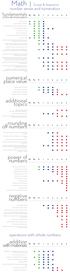 Math Scope & Sequence fundamentals number sense and numeration of the decimal system Count to 10 by units Associate number to numeral (1-10) KN 1 KN 1 KN 2 KN 2 Identify odd and even numbers/numerals and
Prentice Hall Mathematics: Course 1 2008 Correlated to: Arizona Academic Standards for Mathematics (Grades 6)
 PO 1. Express fractions as ratios, comparing two whole numbers (e.g., ¾ is equivalent to 3:4 and 3 to 4). Strand 1: Number Sense and Operations Every student should understand and use all concepts and
Scope and Sequence KA KB 1A 1B 2A 2B 3A 3B 4A 4B 5A 5B 6A 6B
 Scope and Sequence Earlybird Kindergarten, Standards Edition Primary Mathematics, Standards Edition Copyright 2008 [SingaporeMath.com Inc.] The check mark indicates where the topic is first introduced
Biggar High School Mathematics Department. National 5 Learning Intentions & Success Criteria: Assessing My Progress
 Biggar High School Mathematics Department National 5 Learning Intentions & Success Criteria: Assessing My Progress Expressions & Formulae Topic Learning Intention Success Criteria I understand this Approximation
LESSON 4 Missing Numbers in Multiplication Missing Numbers in Division LESSON 5 Order of Operations, Part 1 LESSON 6 Fractional Parts LESSON 7 Lines,
 Saxon Math 7/6 Class Description: Saxon mathematics is based on the principle of developing math skills incrementally and reviewing past skills daily. It also incorporates regular and cumulative assessments.
Algebra 1 Course Title
 Algebra 1 Course Title Course- wide 1. What patterns and methods are being used? Course- wide 1. Students will be adept at solving and graphing linear and quadratic equations 2. Students will be adept
Finding Pi with Archimedes s Exhaustion Method
 mathematical explorations classroom-ready activities Finding Pi with Archimedes s Exhaustion Method salessandra King Studying historical puzzles can give students a perspective on the usefulness of math
Current Standard: Mathematical Concepts and Applications Shape, Space, and Measurement- Primary
 Shape, Space, and Measurement- Primary A student shall apply concepts of shape, space, and measurement to solve problems involving two- and three-dimensional shapes by demonstrating an understanding of:
Algebra Geometry Glossary. 90 angle
 lgebra Geometry Glossary 1) acute angle an angle less than 90 acute angle 90 angle 2) acute triangle a triangle where all angles are less than 90 3) adjacent angles angles that share a common leg Example:
Math Review. for the Quantitative Reasoning Measure of the GRE revised General Test
 Math Review for the Quantitative Reasoning Measure of the GRE revised General Test www.ets.org Overview This Math Review will familiarize you with the mathematical skills and concepts that are important
13. Write the decimal approximation of 9,000,001 9,000,000, rounded to three significant
 æ If 3 + 4 = x, then x = 2 gold bar is a rectangular solid measuring 2 3 4 It is melted down, and three equal cubes are constructed from this gold What is the length of a side of each cube? 3 What is the
GRADES 7, 8, AND 9 BIG IDEAS
 Table 1: Strand A: BIG IDEAS: MATH: NUMBER Introduce perfect squares, square roots, and all applications Introduce rational numbers (positive and negative) Introduce the meaning of negative exponents for
6 EXTENDING ALGEBRA. 6.0 Introduction. 6.1 The cubic equation. Objectives
 6 EXTENDING ALGEBRA Chapter 6 Extending Algebra Objectives After studying this chapter you should understand techniques whereby equations of cubic degree and higher can be solved; be able to factorise
Essential Mathematics for Computer Graphics fast
 John Vince Essential Mathematics for Computer Graphics fast Springer Contents 1. MATHEMATICS 1 Is mathematics difficult? 3 Who should read this book? 4 Aims and objectives of this book 4 Assumptions made
Section 7.2 Area. The Area of Rectangles and Triangles
 Section 7. Area The Area of Rectangles and Triangles We encounter two dimensional objects all the time. We see objects that take on the shapes similar to squares, rectangle, trapezoids, triangles, and
Prentice Hall Connected Mathematics 2, 7th Grade Units 2009
 Prentice Hall Connected Mathematics 2, 7th Grade Units 2009 Grade 7 C O R R E L A T E D T O from March 2009 Grade 7 Problem Solving Build new mathematical knowledge through problem solving. Solve problems
MATH 0110 Developmental Math Skills Review, 1 Credit, 3 hours lab
 MATH 0110 Developmental Math Skills Review, 1 Credit, 3 hours lab MATH 0110 is established to accommodate students desiring non-course based remediation in developmental mathematics. This structure will
4. How many integers between 2004 and 4002 are perfect squares?
 5 is 0% of what number? What is the value of + 3 4 + 99 00? (alternating signs) 3 A frog is at the bottom of a well 0 feet deep It climbs up 3 feet every day, but slides back feet each night If it started
Geometry Final Exam Review Worksheet
 Geometry Final xam Review Worksheet (1) Find the area of an equilateral triangle if each side is 8. (2) Given the figure to the right, is tangent at, sides as marked, find the values of x, y, and z please.
Algebra 1 2008. Academic Content Standards Grade Eight and Grade Nine Ohio. Grade Eight. Number, Number Sense and Operations Standard
 Academic Content Standards Grade Eight and Grade Nine Ohio Algebra 1 2008 Grade Eight STANDARDS Number, Number Sense and Operations Standard Number and Number Systems 1. Use scientific notation to express
Advanced GMAT Math Questions
 Advanced GMAT Math Questions Version Quantitative Fractions and Ratios 1. The current ratio of boys to girls at a certain school is to 5. If 1 additional boys were added to the school, the new ratio of
2006 Geometry Form A Page 1
 2006 Geometry Form Page 1 1. he hypotenuse of a right triangle is 12" long, and one of the acute angles measures 30 degrees. he length of the shorter leg must be: () 4 3 inches () 6 3 inches () 5 inches
MTH124: Honors Algebra I
 MTH124: Honors Algebra I This course prepares students for more advanced courses while they develop algebraic fluency, learn the skills needed to solve equations, and perform manipulations with numbers,
Derive 5: The Easiest... Just Got Better!
 Liverpool John Moores University, 1-15 July 000 Derive 5: The Easiest... Just Got Better! Michel Beaudin École de Technologie Supérieure, Canada Email; [email protected] 1. Introduction Engineering
Florida Math 0018. Correlation of the ALEKS course Florida Math 0018 to the Florida Mathematics Competencies - Lower
 Florida Math 0018 Correlation of the ALEKS course Florida Math 0018 to the Florida Mathematics Competencies - Lower Whole Numbers MDECL1: Perform operations on whole numbers (with applications, including
Academic Support Services Supplemental Learning Materials - Math
 Academic Support Services Supplemental Learning Materials - Math Algebra and trigonometry Basic math Calculator help Charts and graphs Coordinate planes Decimals Exponents General math sites Graphing Integers
New York State Student Learning Objective: Regents Geometry
 New York State Student Learning Objective: Regents Geometry All SLOs MUST include the following basic components: Population These are the students assigned to the course section(s) in this SLO all students
Common Core State Standards for Mathematics Accelerated 7th Grade
 A Correlation of 2013 To the to the Introduction This document demonstrates how Mathematics Accelerated Grade 7, 2013, meets the. Correlation references are to the pages within the Student Edition. Meeting
Algebra and Geometry Review (61 topics, no due date)
 Course Name: Math 112 Credit Exam LA Tech University Course Code: ALEKS Course: Trigonometry Instructor: Course Dates: Course Content: 159 topics Algebra and Geometry Review (61 topics, no due date) Properties
Academic Standards for Mathematics
 Academic Standards for Grades Pre K High School Pennsylvania Department of Education INTRODUCTION The Pennsylvania Core Standards in in grades PreK 5 lay a solid foundation in whole numbers, addition,
MISS. INDUCTION SEQUENCES and SERIES. J J O'Connor MT1002 2009/10
 MISS MATHEMATICAL INDUCTION SEQUENCES and SERIES J J O'Connor MT002 2009/0 Contents This booklet contains eleven lectures on the topics: Mathematical Induction 2 Sequences 9 Series 3 Power Series 22 Taylor
Prentice Hall: Middle School Math, Course 1 2002 Correlated to: New York Mathematics Learning Standards (Intermediate)
 New York Mathematics Learning Standards (Intermediate) Mathematical Reasoning Key Idea: Students use MATHEMATICAL REASONING to analyze mathematical situations, make conjectures, gather evidence, and construct
43 Perimeter and Area
 43 Perimeter and Area Perimeters of figures are encountered in real life situations. For example, one might want to know what length of fence will enclose a rectangular field. In this section we will study
Section 1: How will you be tested? This section will give you information about the different types of examination papers that are available.
 REVISION CHECKLIST for IGCSE Mathematics 0580 A guide for students How to use this guide This guide describes what topics and skills you need to know for your IGCSE Mathematics examination. It will help
Sequence of Mathematics Courses
 Sequence of ematics Courses Where do I begin? Associates Degree and Non-transferable Courses (For math course below pre-algebra, see the Learning Skills section of the catalog) MATH M09 PRE-ALGEBRA 3 UNITS
MATHS LEVEL DESCRIPTORS
 MATHS LEVEL DESCRIPTORS Number Level 3 Understand the place value of numbers up to thousands. Order numbers up to 9999. Round numbers to the nearest 10 or 100. Understand the number line below zero, and
Sample Test Questions
 mathematics College Algebra Geometry Trigonometry Sample Test Questions A Guide for Students and Parents act.org/compass Note to Students Welcome to the ACT Compass Sample Mathematics Test! You are about
What are the place values to the left of the decimal point and their associated powers of ten?
 The verbal answers to all of the following questions should be memorized before completion of algebra. Answers that are not memorized will hinder your ability to succeed in geometry and algebra. (Everything
Functional Math II. Information CourseTitle. Types of Instruction
 Functional Math II Course Outcome Summary Riverdale School District Information CourseTitle Functional Math II Credits 0 Contact Hours 135 Instructional Area Middle School Instructional Level 8th Grade
Glencoe. correlated to SOUTH CAROLINA MATH CURRICULUM STANDARDS GRADE 6 3-3, 5-8 8-4, 8-7 1-6, 4-9
 Glencoe correlated to SOUTH CAROLINA MATH CURRICULUM STANDARDS GRADE 6 STANDARDS 6-8 Number and Operations (NO) Standard I. Understand numbers, ways of representing numbers, relationships among numbers,
Geometry Enduring Understandings Students will understand 1. that all circles are similar.
 High School - Circles Essential Questions: 1. Why are geometry and geometric figures relevant and important? 2. How can geometric ideas be communicated using a variety of representations? ******(i.e maps,
Assessment Anchors and Eligible Content
 M07.A-N The Number System M07.A-N.1 M07.A-N.1.1 DESCRIPTOR Assessment Anchors and Eligible Content Aligned to the Grade 7 Pennsylvania Core Standards Reporting Category Apply and extend previous understandings
Exponential Notation and the Order of Operations
 1.7 Exponential Notation and the Order of Operations 1.7 OBJECTIVES 1. Use exponent notation 2. Evaluate expressions containing powers of whole numbers 3. Know the order of operations 4. Evaluate expressions
Friday, January 29, 2016 9:15 a.m. to 12:15 p.m., only
 ALGEBRA /TRIGONOMETRY The University of the State of New York REGENTS HIGH SCHOOL EXAMINATION ALGEBRA /TRIGONOMETRY Friday, January 9, 016 9:15 a.m. to 1:15 p.m., only Student Name: School Name: The possession
Curriculum Map by Block Geometry Mapping for Math Block Testing 2007-2008. August 20 to August 24 Review concepts from previous grades.
 Curriculum Map by Geometry Mapping for Math Testing 2007-2008 Pre- s 1 August 20 to August 24 Review concepts from previous grades. August 27 to September 28 (Assessment to be completed by September 28)
with functions, expressions and equations which follow in units 3 and 4.
 Grade 8 Overview View unit yearlong overview here The unit design was created in line with the areas of focus for grade 8 Mathematics as identified by the Common Core State Standards and the PARCC Model
FOREWORD. Executive Secretary
 FOREWORD The Botswana Examinations Council is pleased to authorise the publication of the revised assessment procedures for the Junior Certificate Examination programme. According to the Revised National
MATH 095, College Prep Mathematics: Unit Coverage Pre-algebra topics (arithmetic skills) offered through BSE (Basic Skills Education)
 MATH 095, College Prep Mathematics: Unit Coverage Pre-algebra topics (arithmetic skills) offered through BSE (Basic Skills Education) Accurately add, subtract, multiply, and divide whole numbers, integers,
Tennessee Mathematics Standards 2009-2010 Implementation. Grade Six Mathematics. Standard 1 Mathematical Processes
 Tennessee Mathematics Standards 2009-2010 Implementation Grade Six Mathematics Standard 1 Mathematical Processes GLE 0606.1.1 Use mathematical language, symbols, and definitions while developing mathematical
Big Ideas in Mathematics
 Big Ideas in Mathematics which are important to all mathematics learning. (Adapted from the NCTM Curriculum Focal Points, 2006) The Mathematics Big Ideas are organized using the PA Mathematics Standards
GEOMETRY COMMON CORE STANDARDS
 1st Nine Weeks Experiment with transformations in the plane G-CO.1 Know precise definitions of angle, circle, perpendicular line, parallel line, and line segment, based on the undefined notions of point,
Algebraic and Transcendental Numbers
 Pondicherry University July 2000 Algebraic and Transcendental Numbers Stéphane Fischler This text is meant to be an introduction to algebraic and transcendental numbers. For a detailed (though elementary)
South Carolina College- and Career-Ready (SCCCR) Pre-Calculus
 South Carolina College- and Career-Ready (SCCCR) Pre-Calculus Key Concepts Arithmetic with Polynomials and Rational Expressions PC.AAPR.2 PC.AAPR.3 PC.AAPR.4 PC.AAPR.5 PC.AAPR.6 PC.AAPR.7 Standards Know
Everyday Mathematics CCSS EDITION CCSS EDITION. Content Strand: Number and Numeration
 CCSS EDITION Overview of -6 Grade-Level Goals CCSS EDITION Content Strand: Number and Numeration Program Goal: Understand the Meanings, Uses, and Representations of Numbers Content Thread: Rote Counting
Mathematics. GCSE subject content and assessment objectives
 Mathematics GCSE subject content and assessment objectives June 2013 Contents Introduction 3 Subject content 4 Assessment objectives 11 Appendix: Mathematical formulae 12 2 Introduction GCSE subject criteria
SECTION 1-6 Quadratic Equations and Applications
 58 Equations and Inequalities Supply the reasons in the proofs for the theorems stated in Problems 65 and 66. 65. Theorem: The complex numbers are commutative under addition. Proof: Let a bi and c di be
ALGEBRA 2/TRIGONOMETRY
 ALGEBRA /TRIGONOMETRY The University of the State of New York REGENTS HIGH SCHOOL EXAMINATION ALGEBRA /TRIGONOMETRY Thursday, January 9, 015 9:15 a.m to 1:15 p.m., only Student Name: School Name: The possession
Objectives After completing this section, you should be able to:
 Chapter 5 Section 1 Lesson Angle Measure Objectives After completing this section, you should be able to: Use the most common conventions to position and measure angles on the plane. Demonstrate an understanding
Mathematics. Programme of study for key stage 3 and attainment targets (This is an extract from The National Curriculum 2007)
 Mathematics Programme of study for key stage 3 and attainment targets (This is an extract from The National Curriculum 2007) Crown copyright 2007 Qualifications and Curriculum Authority 2007 Curriculum
Everyday Mathematics GOALS
 Copyright Wright Group/McGraw-Hill GOALS The following tables list the Grade-Level Goals organized by Content Strand and Program Goal. Content Strand: NUMBER AND NUMERATION Program Goal: Understand the