
White Paper on Harnesses in the Challenge Course Industry
|
|
|
- Camron McDonald
- 9 years ago
- Views:
Transcription
1 White Paper on Harnesses in the Challenge Course Industry Introduction The regulation of the challenge course field including ziplines is a recent phenomenon. The myriad of aerial adventure environments that currently exist are unlike typical amusement rides with regard to participant engagement. Challenge courses attempt to bring the outcomes and experiences of rock climbing and mountaineering to built environments. Much of the equipment and many of the techniques have been adopted from those recreational activities. These particular recreational activity standards have been referenced in the ACCT standard as they are consistent with the types of harnesses which are commonly used in the challenge course industry. Despite the quality assurance criteria such as performance and testing that are achieved by requiring adherence to widely recognized harness standards, there exists a great deal of confusion about the varying requirements for harnesses used aerial adventure environments. Harnesses A harness is an arrangement of straps and fittings designed to connect a body to another object. The primary benefit of a harness is its ability to distribute forces across larger sections of the body than is possible with a direct connection point. Harnesses for humans differ considerably based on their style (full body, seat, chest) and connection points (dorsal, sternal, waist, shoulder). This diversity reflects the variety of activities in which harnesses are used. For example, a parachute harness is a full body with shoulder connections. In contrast, most cavers wear a seat harness with a waist connection. As this brief example demonstrates, there are significant differences among harnesses no single best harness exists. Instead, a suitable harness reflects the particular circumstances of the activity. ANSI Z359.1 outlines the safety requirements for Personal Fall Arrest Systems, Subsystems and Components including harnesses. Fall Arrest describes a specific situation whereby a worker on an elevated platform may be subject to a fall. Under the standard, a maximum fall distance of 6 ft. free fall with an additional 3.5 ft. stopping distance is allowable. There is no expectation of the worker recovering or engaging in self-rescue in fact, the worker is not to come into contact with any objects during or after the fall. The requirements of this standard specifically exclude the construction industry, window cleaning belts, and sports related activities.

2 While there is currently no performance standard that specifically mentions challenge courses, zip lines, or other aerial adventure parks in its scope of purpose, the ACCT standards require adherence to other widely recognized harness standards including ANSI Z , ASTM F , EN , and NFPA to verify compliance with quality assurance criteria such as performance and testing. The key characteristics of these harness standards are summarized in the appendices. The ANSI Z359.1 standard does not envision the harness being used either suspension or positioning outside the circumstances of an unintentional fall. This is in direct contrast to the manner in which harnesses are used in aerial adventure environments where the harness is intended to support the participant s body during climbing, resting, or falling (ASTM 1773). This fundamental difference of intent and the requirements that flow from it makes ANSI Z359.1 an inappropriate standard for the zip line industry where the key criteria include: their design for climbing and suspension; their ability to fit a range of participant sizes, specifically individuals who are outside the limited weight range; their capacity for the expected load; their compatibility with facility design; and proven track record in aerial adventure environments. Designed for climbing & suspension ANSI Z359.1 does not include a waist connection and has only allowed a sternal connection since the 2007 edition. The lack of a frontal waist connection is problematic since this connection point is what allows individuals to maintain a comfortable sitting position, climb, or take other positive action to regain their position on the structure (Seddon, 2002). In addition, with a waist connection point patrons are able to reach their connection point, transfer between safety systems as necessary, and adjust the length of their lanyards to an optimal length -- tasks which are not possible with a dorsal connection. Rescuers using sit harnesses are able to more easily reach their subject and maintain the subject in a position of comfort and support. The ability to perform these climbing-related tasks explains why a sit harness with a waist connection (worn with or without a chest harness) is the predominant type of harness used in challenge courses, zip lines, and canopy tours. Both ASTM F which covers rescue, safety, and sport activities and EN which covers harnesses used in mountaineering and climbing include frontal waist connections. Ability to fit a range of participant sizes ANSI Z359.1 standards cover users in the range of lb ( kg). This limited range needlessly eliminates large numbers of participants (and workers) whose weights put them outside this range. In contrast, EN has standards for full body with waist connection, child s full body (for individuals under 40 kg or 90 lb), sit, or sit/chest combination. Similarly, ASTM 1772 standards also cover full body with waist connection, sit, or sit/chest combinations. The variety of harness styles offered in these two

3 standards makes it easy for operators to properly equip participants in a wide range of shapes and sizes. Capacity for the expected load ANSI Z359.1 allows workers to take an 8 kn force into their dorsal attachment and a 4 kn force into their sternal attachment. These allowable maximums produce a dorsal safety factor of 2.75 and a sternal safety factor of 4. Given that aerial adventure environments including zip lines limit participants potential fall distance, the corresponding forces on participants are low. As such, it is highly likely that a safety factor between 2.75 and 4 would achieved using harnesses meeting ASTM 1772 and EN with the added benefit that a waist attachment (with or without a chest harness) directs this force into a suitable location on the body. Seddon (2002) indicates that a frontal attachment is both acceptable when the potential fall distance is short (2 ft or less) and might be preferable in situations where the harness is used for suspension. In the event of a slip or short fall, sit harnesses with a waist connection distribute the impact force across individuals thighs and buttocks and exert less pressure on the area of the inner thighs and groin than full body harnesses with dorsal connection. A chest harness that is worn in conjunction with a seat harness provides the participant with additional upright stability. It is clear to us that the ASTM 1772 and EN harness standards provide an equivalent level of safety in aerial adventure environments as in the applications for which they were originally written. Compatible with facility design Managing the height of falls and enabling participants to safely and effectively interact with the aerial adventure environment depends on the location of connection points. Since waist connections (with or without a chest harness) predominate in the challenge course industry, most aerial adventure environments have been designed and built assuming the use of a primary waist attachment point. Given that ANSI Z359.1 does not allow for a waist attachment, a number of perverse operating and design issues will be created by limiting harnesses to those that meet ANSI Z For example, lanyard lengths will need to be altered connecting the same length lanyards to a sternal location rather than a waist connection will likely position participants below the objects they are meant to climb or land on. It may also put the top connections out of the reach of participants and staff creating transfer problems. Shortening the lanyards, however, may put participants in close proximity of connections, such as carabiners or snaps, which were designed to be further away. In eliminating harness standards such as ASTM 1772 and EN with a waist connection, hazards may, in fact, increase.

4 Proven track record in aerial adventure environments The test methods outlined in the various standards are designed to produce reproducible results in a laboratory setting and provide a basis for comparing products. They are not able to simulation real-life settings and as a result, caution should be taken when choosing a standard on the basis of its testing. For example, all of the harness standards use a rigid test torso when humans are essentially pliable. How well a harness stays on a rigid test torso may not be indicative of well that same harness will stay on a moving, squishy human wearing clothing. In their statistical analysis of the severity of injuries to rock climbers based on harness type, Hohlrieder, Lutz, Schubert, and Eschertzhuber (2007) found that rock climbers using a sit harness were afforded an equivalent level of safety to rock climbers using a full body harness or combination of seat and chest harness. Harnesses certified to EN and ASTM 1772 have a proven track record in the challenge course environment. Conclusion The dependence on equipment for managing the risks of engaging in activities at height has understandably led to a concern about its strength, performance, and durability. Manufacturers, professional associations, and government bodies devote much effort to testing and approving equipment meant to protect people at height. The myriad of standards in existence reflects the disparate tasks that are performed at height. As the appendices indicate, the variance among harness standards is primarily one of scope, not the degree of safety afforded to the user. Section of ANSI Z359.1 acknowledges that the standard does not address sportsrelated activities. In contrast, EN and ASTM F1772 specifically address climbing and sport activities. The waist connection outlined in these standards has proven track record in aerial adventure environments and has been recognized by regulators in other jurisdictions (for example TSSA 2009). The UK has recognized the uniqueness of aerial adventure environments when the UK Health and Safety Executive (HSE) created the Work at Height Amendment for persons instructing climbing and caving. This approach recognized the unique nature of the environment in which these professionals work, and the role of professional organizations in developing standards that promote safety. With regard to injuries, the HSE established that the use of long-established recreational climbing techniques provides an equivalent level of safety to that of industrial rope access. We are encouraged by many aspects of the proposed Cal OSHA regulations and voice our support for regulations that enable operators to provide an equivalent level of safety based on applicable performance criteria. For the reasons stated above, we contend that the ASTM 1772 and EN harness standards are preferable to ANSI

5 Z359.1 and should be recognized as providing for a superior level of safety and application in aerial adventure environments, including zip lines. Background on the Association for Challenge Course Technology The Association for Challenge Course Technology (ACCT) grew out of a series of symposia held by challenge course builders and was incorporated in The first Standards were published in The ACCT has grown to become the world s largest American National Standards Institute (ANSI) Accredited Standards Developer focused specifically and solely on the Challenge Course and Canopy/Zip Line Tour Industry. The ACCT is comprised of more than 2600 members and continues to bring together key stakeholders to address, update and improve challenge course and canopy/zip line tour standards and practices. The Annual ACCT Conference educates hundreds of industry professionals through more than 100 workshops and interactive sessions. Background on the Zip Line Industry In the past several years, zip lines have become the most visible component of the wider challenge course industry. A zip line consists of a pulley riding on an inclined cable. Once a person steps off an elevated platform, gravity takes over and transports him or her to the end. In addition to being a standalone structure, a zip line may be used to dismount from a high ropes course or adventure park facility, may be arranged in a series so that patrons can progress from zip line to zip line without returning to the ground (i.e. a zip line tour), or may be part of a canopy tour that includes bridges, rappels, and climbs. A zip line is one of many types of aerial adventure environments.

6 References ANSI/ASSE Z Safety requirements for Personal Fall Arrest Systems, Subsystems, and Components. American National Standards Institute. Des Plaines, IL: Author. Association for Challenge Course (2012). ACCT Challenge Course Standards (8th ed.). Deerfield, IL: Author. ASTM Standard F (2013). Standard Specification for harnesses for rescue, safety, and sport activities. West Conshohocken, PA: Author. ASTM Standard F (2004). Standard Terminology related to Climbing and Mountaineering Equipment and Practices. West Conshohocken, PA: Author. BS EN12277:2007 (2007). Mountaineering equipment- harnesses- safety requirements and test methods. European Committee for Standardization. Brussels, Belgium: Author. Health and Safety Executive. (2007). Falls from height: Guidance on the application of the work at height amendment regulations 2005 to persons instructing climbing and caving. Norwich, UK: Author. Hohlrieder, M., Lutz, M., Schubert, H, Eschertzhuber, S. (2007). Pattern of injury after rock-climbing falls is not determined by harness type. Journal of Wilderness and Emergency Medicine, 18, NFPA (2012) Standard on life safety rope and equipment for emergency services. National Fire Protection Association. Quincy, MA: Author Seddon, P. (2002). Harness suspension: Review and evaluation of existing information. Contract research report 451/2002. Norwich, UK: Health and Safety Executive. Technical Standards & Safety Authority. (2009). Amusement devices code adoption document amendment -- zip lines (Reference number AD-530/09). Toronto, ON: Queen s Printer for Ontario.

7 APPENDICES Table A: Harness Classifications Chart Standard Full Body Full Body Small Sit Harness Chest Harness Harness ANSI Z Yes N/A NO NO For users between lbs ( kg) ASTM Yes No Yes Yes EN Type A Type B Type C Type D For users up to 40 kg (90 lbs) NFPA Class III N/A/ Class II N/A

8 Table B: Testing Requirements Standard ANSI Z ASTM F1772 EN NFPA Harness Type Full Body Full Body Connection Location Upright Static Tests Head Down Belt Test Dorsal 22.2kN n/a 25 mm Sternal only 16 kn?? 25 mm Frontal (waist or sternal) 16 kn 10 kn 10 kn 20mm Drop Test 100 kg 1 meter drop Drop 1 meter drop Sit Harness Waist 16 kn 10 kn Chest with Sit harness Full Body Waist & chest 20 mm Frontal (waist or sternal) 15 kn 10 kn 20 mm Small Body Sternal 10 kn 7 kn 20 mm Sit Harness Frontal 15 kn 10 kn 20 mm Chest with Sit Harness Waist & chest n/a 10kN 20 mm Sit Harness Waist 16 kn Not 11 kn 25mm 136 kg 1 meter drop Full Body Harness Frontal (waist or sternal) 16 kn 10 kn 11 kn 25mm 136 kg 1 meter drop

It should be noted that this revised standard does not address the construction industry, window cleaning belts, and sports-related activities.
 ANSI Z359 OVERVIEW INTRODUCTION ANSI Z359.1 was introduced in 1992 when standards for common fall protection equipment and methods in the workplace did not exist. That year 600 work-related falls resulted
Fall Protection. Solutions for Safety at Heights. Risk Assessment. Hierarchy of fall protection options. Supplementary Administration Controls
 Solutions for Safety at Heights Risk Assessment Consult AS/NZS 1891.4 HIERARCHY OF CONTROLS, these are; IDENTIFY all potential fall hazards. ELIMINATE the need to access the potential hazard area. SUBSTITUTION
Introduction to Fall Protection
 Introduction to Fall Protection with John Evinger CRSP (204)228-8277 INSERT YOUR LOGO HERE Expected results of the day Today I will provide you with information to make you realize that you don t have
RESCUE PLAN FALL PROTECTION PROGRAM
 RESCUE PLAN IMPORTANT: This document is intended to provide guidance only for developing site-specific rescue plans for working at heights. GLOBAL LEADER IN FALL PROTECTION RESCUE PLAN This document is
Fall Protection and Fall Prevention. San José State University Environmental Health and Safety Facilities Development & Operations
 Fall Protection and Fall Prevention San José State University Environmental Health and Safety Facilities Development & Operations Learning Objectives To understand the hazards of falls To understand when
Understanding the ANSI Z359 Fall Protection Code
 Understanding the ANSI Z359 Fall Protection Code Understanding the ANSI Z359 Fall Protection Code Purpose of Document This document provides a basic understanding of the ANSI Z359 Fall Protection Code
Frequently Asked Questions
 ANSI Z359 Fall Protection Code (New Standards Effective November 16, 2009) ANSI Z359.6-2009 ANSI Z359.12-2009 ANSI Z359.13-2009 Frequently Asked Questions Q: What is ANSI? A: ANSI is an acronym for the
D-Ring. Fixed Arm. 1.2 LIMITATIONS: The following application limitations must be recognized and considered before using this product:
 Instructions for the following series products: Parapet Wall Anchor (model number: 8523178) User Instruction Manual for Parapet Wall Anchor This manual is intended to meet the Manufacturer s Instructions
Fall Protection Program
 Fall Protection Program Policy: It is the policy of our company to provide fall protection for employees exposed to fall hazards greater than 7 ½ feet. Fall hazards include but, are not limited to; work
Super Slider ADJUSTABLE FROM 3.5-12 Model #HD26229
 Super Slider ADJUSTABLE FROM 3.5-12 Model #HD26229 IMPORTANT!!! ALL PERSONS USING THIS EQUIPMENT MUST READ AND UNDERSTAND ALL INSTRUCTIONS. FAILURE TO DO SO MAY RESULT IN SERIOUS INJURY OR DEATH. USERS
Fall Protection Rescue
 Page 1 of 8 I. INTRODUCTION This paper provides an overview of the present state-of-the art in fall protection rescue. Decades of experience in protecting workers exposed to fall hazards has resulted in
Names and Contact Numbers of Competent Rescuers Assigned to Job (Please print)
 Emergency Plan For Rescue from Heights Department of Facilities Management Occupational Health and Safety Shop Performing Work Date Work Order No. Job Location Job Description Height of work platform /
VERTICAL / FIXED BEAM CLAMP I-BEAM ANCHOR ADJUSTABLE FROM 4-14 Model # HD26249
 VERTICAL / FIXED BEAM CLAMP I-BEAM ANCHOR ADJUSTABLE FROM 4-14 Model # HD26249 IMPORTANT!!! ALL PERSONS USING THIS EQUIPMENT MUST READ AND UNDERSTAND ALL INSTRUCTIONS. FAILURE TO DO SO MAY RESULT IN SERIOUS
Sample Fall Rescue Plan for Bridge Work
 This document is intended to provide guidance for developing fall rescue plans for bridge contractors. The Occupational Safety and Health Administration s (OSHA) regulation 29 CFR 1926.502(d)(20) states:
Fall Protection Susan Harwood Grant Training Program 2013 Fall Arrest. OSHA Susan Harwood Training - AGC
 Fall Protection Susan Harwood Grant Training Program 2013 Fall Arrest Learning Objectives Identify the components of a proper personal fall arrest system (PFAS) Understand how to calculate total fall distance
Horizontal Lifeline. SideWalk Rope. User Instructions. 3M Occupational Health and Environmental Safety. Fall Protection Equipment
 3M Occupational Health and Environmental Safety Fall Protection Equipment SideWalk Rope Horizontal Lifeline User Instructions User Instructions for the 3M TM Side Walk 2-Man Rope Horizontal Lifeline System.
Fall Hazards 1/3/2014. Introduction
 Fall Hazards Introduction Fall hazards exist at most construction worksites exposing workers to dangerous work environments on a daily basis. A fall hazard is anything that may cause a person to lose his
FALL PROTECTION PROGRAM
 FALL PROTECTION PROGRAM Page 2 of 15 Table of Contents Applicability... 3 Overview... 3 Definitions... 3 Responsibilities... 5 Risk Assessment... 6 Risk Management... 7 Roof Access Procedure 10 Rescue
Guide to Fall Protection Regulations
 Guide to Fall Protection Regulations Produced by: Workers Compensation Board of PEI PO Box 757 Charlottetown PE C1A 7L7 902-368-5697 or 1-800-237-5049 website: www.wcb.pe.ca Revised June 2013 Guide to
User Instruction Manual Vertical Lifelines and Vertical Lifeline Subsystems
 Instructions for the following series products: User Instruction Manual Vertical Lifelines and Vertical Lifeline Subsystems Vertical Lifelines Vertical Lifeline Subsystems (See back pages for specific
WORKING AT HEIGHT & ITS WOES
 WORKING AT HEIGHT & ITS WOES Capital Safety EMEA HOW FAR WILL A PERSON FALL IN...? TIME seconds DISTANCE metres 1 4.9 2 19.6 3 44.1 4 78.4 ABSOLUTELY ZERO MARGIN FOR ERROR! 2FT?!? 6FT?!? 50FT?!?! COMMON
WEEKLY SAFETY MEETING
 Safety Meeting Contents Meeting Notice Leaders Guide Employee Handout Employee Quiz Meeting Sign-In Sheet Employee Puzzle PRIOR TO THE WEEKLY MEETING: - Post the meeting notice by the timeclock - Read
A New Era for an Old Standard A Review of Changes to ANSI Z359.1-1992(R1999)
 Capital Safety - USA 3833 SALA Way Red Wing, MN 55066-5005 Ph: 651-388-8282 Fax: 651-388-5065 A New Era for an Old Standard A Review of Changes to ANSI Z359.1-1992(R1999) I. Introduction A new era is in
Safe Operating Procedure
 Safe Operating Procedure (Revised 5/14) PERSONAL FALL ARREST SYSTEMS Introduction In 2011, falls to a lower level were the second leading cause of occupational fatalities across all industries, claiming
the smarter rescue plan.
 Self-Rescue Introducing the smarter rescue plan. DBI-SALA Self-Rescue Free yourself. When you re suspended after a fall, every second matters. When the clock starts ticking, you need a rescue plan you
Product Name: Beamer 2000
 Product Name: Beamer 2000 Part #: 00101; 00103 Instruction Manual Do not throw away these instructions! Read and understand these instructions before using equipment! Introduction 1 Applicable Safety Standards
Fall Protection Guidelines
 OCT 2015 1 of 6 Fall Protection Guidelines 1.0 PURPOSE To establish the requirements and procedures to protect employees and other persons conducting work from hazards associated with falling from one
Elkhorn Construction, Inc. Safety Manual Title: Fall Protection Policy Effective Date: 03-01-2000
 1. General Requirements (OSHA References: OSHA 29 CFR 1926.503) 1.1 Elkhorn Construction, Inc. employee-owners and subcontractors are required to use fall protection equipment or systems when an assessment
IMPORTANT! KEEP INSTRUCTIONS FOR FUTURE USE.
 Flip Front2Back Carrier Owners Manual Instructions IMPORTANT! KEEP INSTRUCTIONS FOR FUTURE USE. Read all instructions before assembling and using your carrier. Failure to follow each instruction can result
WORK AT HEIGHT UNIT 4
 WORK AT HEIGHT UNIT 4 WHAT IS WORKING AT HEIGHT? The Working At Height Regulations 2005 define working at height as:- Any work above or below ground level where a fall would result in personal injury.
Rehabilitation Aids Sling Range
 Product Guide Silvalea has designed a selection of rehabilitation aids, stand aid or stand slings which address anatomy pressure points/suitability (male/female) as well as consider activity, such as rehabilitation
Latchways Personal Rescue Device (PRD)
 Product brochure Latchways Personal Rescue Device (PRD) Integrated harness system for self rescue R20 Latchways plc Latchways is the world leader in the development of fall protection systems based on
FALL PROTECTION PROGRAM RESCUE PLAN
 GLOBAL LEADER IN FALL PROTECTION Capital Safety 95 Derby Street Silverwater, NSW 2128 Tel: 02 8753 7600 Fax: 02 8753 7603 FALL PROTECTION PROGRAM RESCUE PLAN IMPORTANT: This document is intended to provide
Fall Protection Equipment
 Fall Protection Equipment Quick Tips #130 Introduction Before you can begin a fall protection program, you must identify the potential fall hazards in your workplace. Any time a worker is at a height of
Instructions for the following series products:
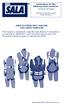 Instructions for the following series products: Full Body Harnesses (See back pages for specific model numbers.) User Instruction Manual Full Body Harness This manual is intended to meet the Manufacturer
Working at Heights and Fall Protection
 Standard Operating Procedures Working at Heights and Fall Protection Last Modified: JAN 2013 1 of 6 Working at Heights and Fall Protection I Purpose Serious accidents can result from falls. All employees
CHAPTER 10. FALL PROTECTION PROGRAM
 CHAPTER 10. FALL PROTECTION PROGRAM 1000 GENERAL. This chapter establishes policy for developing fall protection programs to protect all Federal Aviation Administration (FAA) personnel working at elevated
Fall Protection Safety Program
 Fall Protection Safety Program ENVIRONMENTAL HEALTH & SAFETY pg. 1 Table of Contents A. Introduction... 3 B. Scope... 3 C. Responsibilities... 3 1. Department... 3 2. Environmental Health & Safety (EHS)...
fall arrest. Contact your distributor or Guardian about policies regarding replacement of Guardian components involved in a fall.
 Guardian Fall Protection Kent, WA 800-466-6385 www.guardianfall.com GENERAL SYSTEM SELECTION CRITERIA: Selection of fall protection shall be made by a Competent Person. All fall protection equipment shall
ELECTRICAL SAFETY & ARC FLASH Handbook
 Electricity Forum Handbooks Electrical Safety and Arc Flash Handbook Series ELECTRICAL SAFETY & ARC FLASH Handbook Volume 10 Reprinted by permission of the publisher, Hurst Communications, from the Electrical
Route-setting and Maintenance Fall Protection Management
 Route-setting and Maintenance Fall Protection Management Note: this plan is based on Alberta workplace regulations as of October, 2010. Not all jurisdictions have similar standards. Canadian Mountain and
PLEASE NOTE. For more information concerning the history of these regulations, please see the Table of Regulations.
 PLEASE NOTE This document, prepared by the Legislative Counsel Office, is an office consolidation of this regulation, current to June 9, 2012. It is intended for information and reference purposes only.
CODE OF PRACTICE FOR FALL PROTECTION/WORK AT HEIGHT
 CODE OF PRACTICE FOR FALL PROTECTION/WORK AT HEIGHT Section: Date of Issue: November 29, 2007 Issued By: Environmental Health &Safety Part: Revision #: -- Revision Date: August 11, 2009 Pages: 63 Revised
Contents. 1. What types of car restraints are available? 3. 2. Buying a car child seat- checklist 5. 3. Tips for fitting car seats 6
 Child Car Safety Contents 1. What types of car restraints are available? 3 2. Buying a car child seat- checklist 5 3. Tips for fitting car seats 6 4. How to use car seats 6 5. Legislation for child safety
Fall Protection Guideline
 EVERYONE'S RESPONSIBILITY Fall Protection Guideline July 2008 Fall Protection Guideline Workplace Safety & Health Division 200 401 York Avenue Winnipeg, Manitoba R3C 0P8 July 2008 The Province of Manitoba
Fall Protection System: A system put in place to protect workers from falling. (i.e. installation of guardrails, fall arrest, fall restraint, etc.
 SWP (6) FALL PROTECTION PROGRAM The following information on Fall Protection has been based around the BC OHS Regulations, standards, policies and guidelines. Prior to starting work outside of BC, the
Lanyards. Self Retracting. User Instructions. 3M Occupational Health and Environmental Safety. Fall Protection Equipment
 3M Occupational Health and Environmental Safety Fall Protection Equipment Self Retracting User Instructions Lanyards User Instructions for 3M TM Self Retracting Lanyards Important: Keep these User Instructions
SAFETY. Created by: Capt. Rick Miller ALOFT!
 SAFETY Created by: Capt. Rick Miller ALOFT! Safety Aloft Overview 1. The 1997 ASTA/ISTA Safety Forum 2. The Two Surveys: 97 & 13 3. Incidents/Accidents while Aloft 4. Regulations: What our vessels/organizations
Gotcha! rescue. Stranded in an aerial work platform
 Gotcha! Following on from last month s article on harnesses and lanyards, Ed Darwin looks at points to consider when rescuing those trapped at height and stresses the need for contingency planning. When
WORKING DRAFT OF COMMITTEE MEETING OUTPUT CONTENT NOT FINAL SUBJECT TO REVISION PRIOR TO LETTER BALLOT AND PUBLICATION OF SECOND DRAFT REPORT
 WORKING DRAFT OF COMMITTEE MEETING OUTPUT Standard on Life Safety Rope and Equipment for Emergency Services NFPA 1983 January 5-6, 2016; Subject to Revision Not for Publication WORKING DRAFT OF COMMITTEE
PERSONAL FALL PROTECTION EQUIPMENT USE AND SELECTION GUIDE
 PERSONAL FALL PROTECTION EQUIPMENT USE AND SELECTION GUIDE FOREWORD A comprehensive fall protection program prevents injuries, saves lives and makes good business sense. In almost every industry, there
COURSE INFORMATION SHEET
 Course ID: HGT - WRKHT COURSE OVERVIEW WORKING AT HEIGHTS Working at Heights is an approved Ontario Ministry of Labour (MOL) program (Approved Training Program ID # WAH56789). This program was designed
NZQA registered unit standard 23229 version 4 Page 1 of 6
 Page 1 of 6 Title Use safety harness system when working at height Level 3 Credits 4 Purpose People credited with this unit standard are able to: demonstrate knowledge of the hazards associated with wearing
Temporary Horizontal Lifeline System Manual Standard Duty - E8 Model: HLLA38030 and HLLA38060
 P.O. Box 3026 Sherwood Park Alberta T8H 2T1 Phone: (780) 464-7139 Fax: (780) 464-7652 e-mail: inquiries@ safetydirect.ca Web site: www.safetydirect.ca Temporary Horizontal Lifeline System Manual Standard
EMPLOYEE FALL PROTECTION
 EMPLOYEE FALL PROTECTION You can fall from any height and be seriously injured or killed. In the construction industry, as well as any other industry, when falls from heights happen, they are usually very
What is ANSI? 9/16/2007 1
 What is ANSI? ANSI is an acronym for the American National Standards Institute a private, nonprofit organization that oversees the development of voluntary consensus standards in the United States. ANSI
Introduction to Fall Protection. The University of Tennessee Office of Environmental Health & Safety
 Introduction to Fall Protection The University of Tennessee Office of Environmental Health & Safety What is Fall Protection? Fall protection is the backup system planned for a worker who could loose his
ELEVATED WORK POLICY
 ELEVATED WORK POLICY 1.0 BACKGROUND The purpose of this program is to prevent accidents and injuries to workers from falls and to provide employees with the information for the safe use of fall protection
Health and Safety Resources Caution to Users
 Health and Safety Resources Caution to Users Many of the resources in this archive were originally prepared by WSN s predecessor organizations for use by industry clients. While much of the information
SURVIVING THE FALL: The Proper Use Of Your Personal Fall Arrest System
 SURVIVING THE FALL: The Proper Use Of Your Personal Fall Arrest System This easy-to-use Leader s Guide is provided to assist in conducting a successful presentation. Featured are: INTRODUCTION: A brief
WORKING AT HEIGHTS. Introduction. Risk Assessment
 WORKING AT HEIGHTS Introduction This guideline makes reference to the provisions regarding working at heights in the Regulation for Industrial Establishments (Reg. 851) and the Regulation for Construction
FALL PROTECTION AND RESCUE PLANNING ALL PROOF THE QUICK GUIDE H A R T CHECKMATE L I F T I N G & S A F E T Y HEIGHT AND RESCUE TRAINING
 FALL PROTECTION AND RESCUE PLANNING ALL PROOF THE QUICK GUIDE introduction Health and safety whilst working at height is a huge priority for local and international enforcing authorities. Every year in
SG19:10 NASC. A Guide to Formulating a Rescue Plan. NOTE: Scaffolders who need to use a harness should never work alone. 1 of 8 1.
 SG19:10 A Guide to Formulating a Rescue Plan 1. INTRODUCTION The legal requirement for rescue is specified in the Work at Height Regulations 2005 and require every employer in selecting work equipment
Working at Heights Training Program Standard. Ministry of Labour
 Working at Heights Training Program Standard Ministry of Labour Queen s Printer for Ontario ISBN 978-1-4606-3268-0 (PDF) ISBN 978-1-4606-3267-3 (HTML) December 2014 1 Acknowledgements The members of the
Working at Height Risk of suspension trauma and rescue plan
 Working at Height Risk of suspension trauma and rescue plan Risk of suspension trauma and rescue plan page 1 V1 November 2010 1: Working at height Loading and unloading of trucks for Ineos O&P downstream
Caboose Too Rear Seat Instruction Manual 0090X & 0091X Series
 Caboose Too Rear Seat Instruction Manual 0090X & 0091X Series Joovy 2919 Canton Street Dallas, TX 75226 (877) 456-5049 Fax: (214) 761-1774 Email: [email protected] Web Site: www.joovy.com ! WARNING
Instruction and Safe Use Manual
 Instruction and Safe Use Manual Hunter Safety System harness with lineman s climbing strap and suspension relief/deer drag WARNING! Read, watch, understand and follow all written and DVD instructions prior
FALL PROTECTION HAZARD SURVEY
 SAMPLE FALL PROTECTION HAZARD SURVEY Job Description COMPANY City, State I N C. S Y S T E M S Table Of Contents 1.0 Introduction 1 2.0 Legislation 2 3.0 Hazard Ranking System 3.1 General 3 3.2 Relative
Section 14. Forklift Safety Contents 14.1 Operator Safety
 Section 14. Forklift Safety Contents 14.1 Operator Safety... 14-1 14.2 Inspection and Maintenance... 14-2 14.3 Handling the Load... 14-3 14.4 Fueling Liquefied Petroleum (LP) Gas Forklifts... 14-3 14.5
Society of Professional Rope Access Technicians 994 Old Eagle School Road, Suite 1019 Wayne, PA 19087-1866 www.sprat.org
 SAFE PRACTICES FOR ROPE ACCESS WORK Society of Professional Rope Access Technicians 994 Old Eagle School Road, Suite 1019 Wayne, PA 19087-1866 www.sprat.org 2012 Society of Professional Rope Access Technicians
CENTER FOR EFFECTIVE PARENTING
 CENTER FOR EFFECTIVE PARENTING CHILD SAFETY SEATS * Car crashes are the leading traumarelated cause of spinal cord injury, epilepsy, and mental retardation for children in the U.S. * It's the law. All
CAR SEAT/ STROLLER INSTRUCTION MANUAL
 CAR SEAT/ STROLLER INSTRUCTION MANUAL English PM-0624AB 3/98 Do not use this 4-in-1 System until you read and understand these instructions! IMPORTANT INFORMATION Thank you for selecting this 4-in-1 System
Working at Height Rescue Plan Risk Assessment - Method Statement
 Company Logo Company Name Working at Height Rescue Plan Risk Assessment - Method Statement Document...Revision... Site Address:.. Rescue Plan Ref. No:...... Location/area:. JOB TASK: Reference No.: Work
Figure 1-5000335. Figure 2 - Applications
 User Instruction Manual 5000335 Rope Grab This manual is intended to meet the Manufacturer's Instructions as required by ANSI Z359.1, and should be used as part of an employee training program as required
CHAPTER 2 GENERAL SAFETY REQUIREMENTS
 Bridge Inspection Handbook 2-1 2.1 INTRODUCTION CHAPTER 2 GENERAL SAFETY REQUIREMENTS Safety is everyone's business. As an employer, MassDOT is obligated to promote job safety and furnish safe tools, equipment,
Working at a height of two metres or more while carrying out general work activities or construction works
 1. Working at Heights 2. Scope / Description of Job Working at a height of two metres or more while carrying out general work activities or construction works 3. Critical Safety Issues A fall from any
Good Practice Guide. The Selection of Access Methods to Install and Dismantle Safety Netting
 Good Practice Guide The Selection of Access Methods to Install and Dismantle Safety Netting FASET is the trade association for the safety net rigging and temporary safety systems industry. This document
GE Wind Turbine Climbing Rules and Rescue from Height
 GE Wind Turbine Climbing Rules and Rescue from Height Wind Turbine Climbing Rules This material has been prepared from our GE Wind Turbine Climbing Rules and procedure. Image Place Holder Image Place Holder
What Heavy climbers need to know. Page 1 of 7
 What Heavy climbers need to know. Page 1 of 7 Ever taken a fall that jolted your belayer for a short ride towards that first clip? Or perhaps you ve seen a piece or two of that maybe it will hold gear
3M Fall Protection Fall Protection Catalog
 3M Fall Protection Fall Protection Catalog The power to protect your world. SM CONTENTS INTRODUCTION... 2 FALL PROTECTION TRAINING... 5 FUNDAMENTALS OF FALL PROTECTION... 6 FULL BODY HARNESSES... 8 Falls
Please read this manual before flying with BIX for the first time.
 Please read this manual before flying with BIX for the first time. THANK YOU! We would like to thank you for having chosen one of our products, and we invite you to read this important document, the User
BEACH VOLLEYBALL TRAINING PROGRAM
 2008 ELITE PERFORMANCE ATHLETE CONDITIONING BEACH VOLLEYBALL TRAINING PROGRAM Team BC 2008 Steve Van Schubert, CAT(C), CSCS Training Schedule General Outline Phase 1 2 Weeks Phase 2 3 Weeks Phase 3 3 Weeks
Analysis of Impact Force Equations
 Analysis of Impact Force Equations Prepared for the International Technical Rescue Symposium, November 2002 By Chuck Weber Abstract This paper compares the actual impact forces measured during controlled
119877 Child in Car Safety Leaflet 1/8/07 8:54 am Page 1 Child In Car Safety
 Child In Car Safety Child In Car Safety Purchasing and fitting appropriate child car restraints is vital but complicated Following the advice in this leaflet will help you to protect the children travelling
OSHA 1910.66 Remove impacted systems and components. Inspect systems prior to use.
 Q: When do I remove my harness from service? A: ANSI (American National Standards Institute) A10.32-2004 states the service life of fall protection equipment manufactured of synthetic fiber shall be 5
LASER SAFETY MANUAL UNIVERSITY OF KENTUCKY POLICIES AND PROCEDURES FOR LASER USERS REVISED EDITION 2012 ISSUED BY
 LASER SAFETY MANUAL UNIVERSITY OF KENTUCKY POLICIES AND PROCEDURES FOR LASER USERS REVISED EDITION 2012 ISSUED BY UNIVERSITY OF KENTUCKY RADIATION SAFETY OFFICE TABLE OF CONTENTS POLICY AND PURPOSE 2 LASER
The Work At Height Safety Association
 The Work At Height Safety Association Technical Guidance Note 5 Guidance on rescue during work at height A series of informative notes for all industries involved with work at height or rescue. The information
Head Start Bus Monitor Training
 Head Start Bus Monitor Training The bus monitor works with the driver to ensure all Head Start children are safe and comfortable on the bus. Bus monitors encourage and direct the Head Start child to be
Product Overview. Restraint systems. Flooring systems. Seating systems. Solar systems
 Product Overview Seating systems Solar systems Wheelchair tie-downs This brochure includes a selection of products from the Unwin range. For the full product range, please consult our website or product
Car Safety for Children with Down Syndrome
 Car Safety for Children with Down Syndrome Children with Down syndrome may have special needs that can affect how they travel. This tip sheet answers some questions you may have about transporting your
Washington Industrial Safety & Health Division (WISHA) Fall Protection: Responding to Emergencies: F417-208-000
 R E S P O N D I N G T O E M E R G E N C I E S Fall Protection: Responding to Emergencies: F417-208-000 Washington Industrial Safety & Health Division (WISHA) Materials contained in this publication are
Fall Protection and Prevention Training Construction & Safety Professionals
 FALL PREVENTION & PROTECTION Fall Protection and Prevention Training Construction & Safety Professionals INTRODUCTION Falls are the leading cause of work related injuries and fatalities Approximately 3
ISC/Singing Tree Rope Wrench (STRW)
 ISC/Singing Tree Rope Wrench (STRW) System Recommendation June 2014 Background The ISC Rope Wrench is a device that allows DRT (double rope techniques) to be performed whilst using a single rope. This
Total Access. Stage 2 IFI accredited equipment. ceptional
 Total Access Stage 2 IFI accredited equipment ceptional Features and Benefits Raised iconography on main console controls Colour contrasted belt and deck Laser cut numbers for easy seat positioning Colour