
Swahili. Information provided by: National African Language Resource Center (NALRC)
|
|
|
- Ronald Dorsey
- 9 years ago
- Views:
Transcription
1 Swahili Information provided by: National African Language Resource Center (NALRC) A). Why study Swahili? Swahili (or Kiswahili as it is called when one is speaking the language) is the most important and widely studied indigenous language of Africa, the National and official language of Kenya and Tanzania. It is spoken as a native language on the East coast of Africa and the islands adjacent to the coast from Southern Somalia in the north down through the Kenyan and Tanzanian coasts. It is also a Lingua franca of the African Continent spoken as a second language by millions of people mainly in Kenya, Tanzania, Uganda, and East Zaire. There are also speakers in Mozambique, Rwanda, Burundi, Zambia, Malawi, Southern Arabian countries such as Yemen and Oman, as well as other parts of the world. It is aired in radio broadcasts such as the British Broadcast Corporation, Voice of America, and Deutsche Welle. It is heard in songs of famous singers such as Miriam Makeba and in popular films like the Lion King. African-Americans refer to their annual cultural festival as Kwanzaa, which is derived from the Swahili word kwanza or first. Swahili is taught in academic institutions from Japan in the East to Mexico in the west. It can be used to fulfill language requirements. The study of Swahili also provides interesting issues regarding language policies and language planning. Whatever the area of research one is in, be it linguistics, anthropology, geography, archaeology, or even sociology, knowledge of Swahili and its many varieties is essential if one is working in the East African region. There are many benefits of knowing the Swahili language, including the fact that it serves as a good vehicle to accessing Swahili culture. Swahili has a long written tradition and remarkable history. Finally, knowing Swahili enhances the credibility of researchers interested in East Africa.

2 B). Who speaks Swahili? People and History Over 50 million people in eastern and central African speak Swahili. It is widely used in Kenya, Tanzania and Uganda. A little over one million people speak it as their first language. Most others speak Swahili fluently as a second, third or fourth language. Those who speak it as a first language are found along the coast of east Africa stretching from southern Somalia to the border between Tanzania and Mozambique. There are also many native Swahili speakers on the Indian Ocean islands of Unguja and Pemba (which together make up Zanzibar), Lamu, the Comoro Islands and the northwestern part of Madagascar. Many Swahili speakers like to refer to themselves in terms of where they come from. So Swahili speakers from Unguja, for example, will refer to themselves as Waunguja or Wazanzibari, those from Kenya as Wakenya and those from Tanzania as Watanzania. The East African coast was visited by Arabs and Persians as early as the second century A.D. These visitors settled in Africa and married local people. Many local people modified and adopted the visitors traditions. On the island of Unguja, for example, the traditional New Year, Mwaka Kogwa, is celebrated during the month of June. This celebration is similar to the Persian New Year of Neiruz. Later visits by Arabs to the area also introduced the Islamic religion, and today many Swahili speakers throughout East Africa are Muslim. Travelers from Portugal, Germany, England and various Asian countries also went to East Africa. Each group left its mark on both the culture and the language. Lame as a center of Swahili Language and Cultures, would be a place of interest to students. C). Language and Culture Swahili is a Bantu language of the Niger-Congo family and has a typical, complicated Bantu structure. For example, Swahili utilizes over 13 noun classes, the equivalence of a romance language having 13 genders. Three full noun classes are devoted to different aspects of space and time. Swahili represents an African World view quite different from that of a European language. Nouns are grouped into different classes according to their meaning. Human beings, for example, belong to one class: mtu person /watu people. Trees, on the other hand, belong to another class: mti tree /miti trees. Diminutive and augmentative meanings are also expressed using the noun class system. The following forms of the word ndege bird indicate different sizes: ndege (regular size bird); kidege (small bird); dege (big bird).

3 The word Kiswahili is a general term for many varieties of the language spoken along the East African coast. It comes from the Arabic word sahel, meaning coast. Kiis a prefix referring to language. In some varieties of Swahili, the language prefix appears as chi-, as in Chimiini, which is spoken in Somalia, or shi-, as in Shingazija, a variant spoken on the Ngazija island of Comoro. Swahili language has been influences by a variety of other language, including Arabic, Portuguese and German. There are many Swahili words with foreign origins, including the following: sita six (Arabic), saba seven (Arabic), shule school (German), bendera flag (Portuguese), kitabu book (Arabic) and pesa money (Hindi). All Swahili speakers share a unique way of expressing time, day or night. Sunrise or sunset are the two focal points used to tell time. The first hour of the day, therefore, comes after sunrise, not after midnight, and the first hour of the night comes after sunset. Also unique to Swahili speakers is the way they communicate with each other indirectly by use of the popular language, also known as leso. This multi-purpose cloth usually has a caption that conveys a proverbial message to its target audience. Lamu is an ancient Swahili city-state in the Indian Ocean off the north coast of Kenya. It is the main town to the traditional swahilini--the original crucible of Swahili culture. In December 2001, UNESCO granted World heritage status to Lamu s Old town citing the fact that the old town had retained its traditional functions for over 1000 years. About NALRC 4231 Humanities Building 455 N. Park Street University of Wisconsin-Madison Madison, WI Phone: (608) Fax: (608) [email protected]

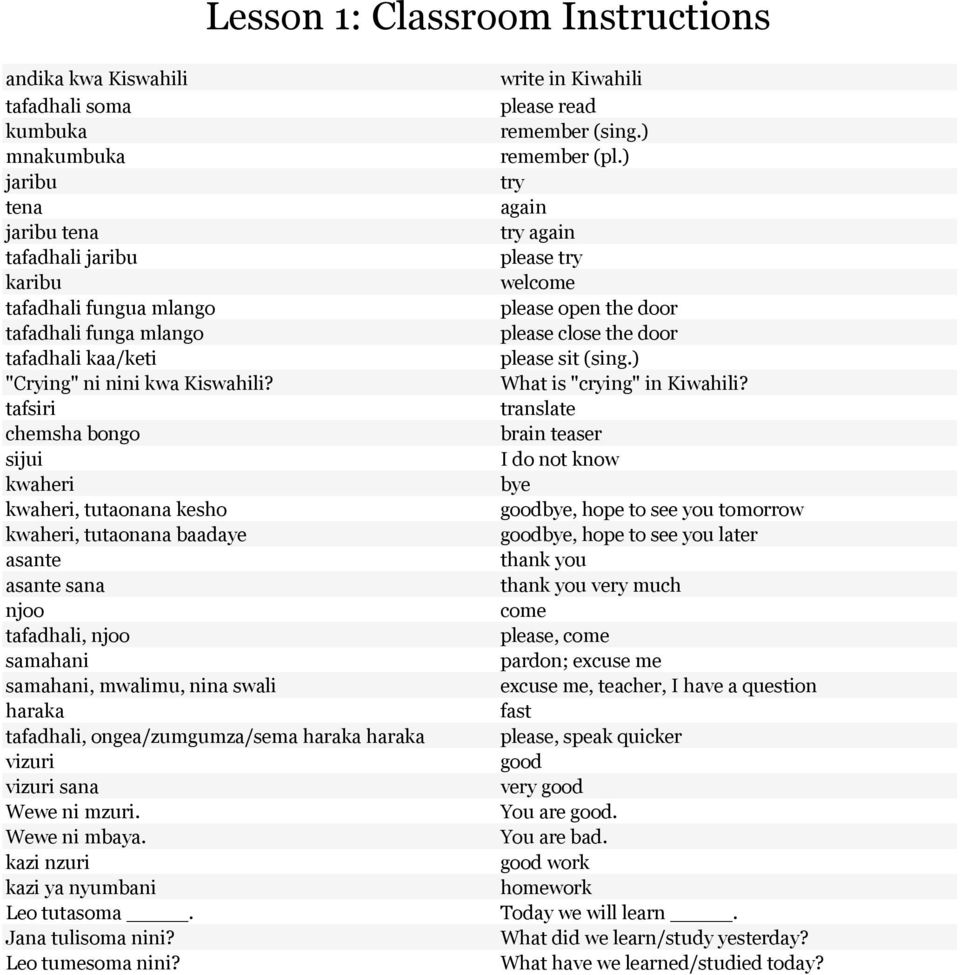
4 Lesson 1: Classroom Instructions Classroom Instructions [maagizo ya darasani] rudia repeat mwalimu teacher profesa professor mwanafunzi student jibu answer; respond uliza ask unaelewa? do you understand? mnaelewa? do you all understand? ndiyo yes la; hapana no swali question mna swali? does anyone have a question? mwalimu, nina swali teacher, I have a question sielewi I do not understand sikiliza listen (s. command) sikilizeni listen (pl. command) simama stand tafadhali, simama please, stand keti; kaa sit tafadhali, keti/kaa please, sit down kusanya collect karatasi paper tafadhali, kusanya karatasi please, collect the papers leta bring tafadhali, leta karatasi please, bring the papers enda go tafadhali, enda please, go tazama look funga kitabu close the book fungua kitabu open the book tafadhali please tafadhali rudia please repeat tafadhali, fungua kitabu please, open the book tafadhali, nyamaza please, be quiet (sing.) tafadhali, nyamazeni please, be quiet (pl.) tafadhali, ongea/zungumza/sema katika Kiingereza please, speak in English tafadhali, jibu katika/kwa Kiswahili please, respond in Kiwahili tafadhali, ongea/zungumza/sema katika Kiswahili please, speak in Kiwahili polepole slowly tafadhali, ongea/zungumza/sema polepole please, speak slowly taja mention tamka pronounce soma read; study andika write

5 Lesson 1: Classroom Instructions andika kwa Kiswahili tafadhali soma kumbuka mnakumbuka jaribu tena jaribu tena tafadhali jaribu karibu tafadhali fungua mlango tafadhali funga mlango tafadhali kaa/keti "Crying" ni nini kwa Kiswahili? tafsiri chemsha bongo sijui kwaheri kwaheri, tutaonana kesho kwaheri, tutaonana baadaye asante asante sana njoo tafadhali, njoo samahani samahani, mwalimu, nina swali haraka tafadhali, ongea/zumgumza/sema haraka haraka vizuri vizuri sana Wewe ni mzuri. Wewe ni mbaya. kazi nzuri kazi ya nyumbani Leo tutasoma. Jana tulisoma nini? Leo tumesoma nini? write in Kiwahili please read remember (sing.) remember (pl.) try again try again please try welcome please open the door please close the door please sit (sing.) What is "crying" in Kiwahili? translate brain teaser I do not know bye goodbye, hope to see you tomorrow goodbye, hope to see you later thank you thank you very much come please, come pardon; excuse me excuse me, teacher, I have a question fast please, speak quicker good very good You are good. You are bad. good work homework Today we will learn. What did we learn/study yesterday? What have we learned/studied today?
6 Lesson 2a: Greetings Greetings [maamkio; salamu] There are at least five ways of greeting in Kiswahili: A). Habari gani? B). Hujambo? C). U hali gani? D). Shikamoo. E). Mambo? / Vipi? A). Habari gani? Example 1 Two people greeting each other Person A: Habari gani? Person B: Nzuri! Sentensi: a). Nzuri / njema / salama / safi / sawa / poa. [Good / nice / peaceful / clean / fine / cool.] b). Nzuri / njema / salama / safi / sawa / poa sana... [Very good / nice / peaceful / clean / fine / cool.] c). Nzuri / njema / salama / safi / sawa / poa tu... [Just good / nice / peaceful / clean / fine / just cool.] B). Hujambo? Example 1 Two people greeting each other Example 2 Teacher greeting students Person A: Hujambo? Teacher: Hamjambo? Person B: Sijambo! Students: Hatujambo! Sentensi: Hujambo? [Any issue(s)? / How are you doing?] Sijambo! [No issue(s)! / I am okay/fine!] Hamjambo? [Any issue(s)? / How are you doing?] Hatujambo! [No issue(s)! / We are okay/fine!]
![.. [Very good / nice / peaceful / clean / fine / cool.] c). Nzuri / njema / salama / safi / sawa / poa tu... [Just good / nice / peaceful / clean / fine / just cool.] B). Hujambo?](/docs-images/43/20678469/images/page_6.jpg "Example 1 Two people greeting each other Example 2 Teacher greeting students Person A: Hujambo? Teacher: Hamjambo? Person B: Sijambo! Students: Hatujambo! Sentensi: Hujambo? [Any issue(s)?")
7 C). U hali gani? Example 1 Two people greeting each other Example 2 One person greeting many people Person A: U hali gani? Person A: M hali gani? Person B: Njema. Persons B, C, & D: Salama. Sentensi: 1. U hali gani? / M hali gani? What s your condition? / How are you?] a). Nzuri / njema / salama / safi / sawa / poa. [Good / nice / peaceful / clean / fine / cool.] b). Nzuri / njema / salama / safi / sawa / poa sana... [Very good / nice / peaceful / clean / fine / cool.] c). Nzuri / njema / salama / safi / sawa / poa tu... [Just good / nice / peaceful / clean / fine / just cool.] D.) Shikamoo. Example 1 A youth greeting an elder person Youth: Shikamoo. Elder Person: Marahaba. Sentensi: Shikamoo. Marahaba. [I touch your feet.] [I am delighted.] E). Vipi? / Mambo? Example 1 A youth greeting another youth Youth A: Vipi? Youth B: Poa. Sentensi: Vipi? / Mambo? Poa / Safi / Sawa. [What s up?] [Cool / Clean / Fine.] Example 2 A youth greeting another youth Youth A: Mambo? Youth B: Safi.
![Nzuri / njema / salama / safi / sawa / poa sana... [Very good / nice / peaceful / clean / fine / cool.] c). Nzuri / njema / salama / safi / sawa / poa tu.](/docs-images/43/20678469/images/page_7.jpg ".. [Just good / nice / peaceful / clean / fine / just cool.] D.) Shikamoo. Example 1 A youth greeting an elder person Youth: Shikamoo. Elder Person: Marahaba. Sentensi: Shikamoo. Marahaba. [I touch your feet.")
8 Additional Vocabulary Mifano: [Requests permission to enter a 1. Hodi! house.] 2. Karibu! [Welcome!] 3. Karibu ndani! [Welcome inside!] 4. Asante. [Thank you.] 5. Asante sana. [Thank you very much.] 6. Kwaheri. [Be blessed. / Goodbye.] 7. Tutaonana baadaye. 8. Habari za asubuhi/ mchana/jioni/usiku? 9. Habari za mama/baba/kaka/dada/ ndugu/mjomba comrade/uncle] 10.Habari za nyumbani/shuleni/chuoni/ masomo/amerika [We will see each other later.] [How is the news of the morning/afternoon/evening/night?] [How is the news of mother/father/brother/sister/ [How is the news at home/at school/at college/ studies/america]
![Habari za mama/baba/kaka/dada/ ndugu/mjomba comrade/uncle] 10.Habari za nyumbani/shuleni/chuoni/ masomo/amerika [We will see each other later.](/docs-images/43/20678469/images/page_8.jpg "] [How is the news of the morning/afternoon/evening/night?")
9 Lesson 2b: Other Forms of Greetings Greetings Mifano: Waambaje? [How are you doing?] Salaamaleikum. [Peace be upon you.] Upo? [Are you there?] Lala salama. [Sleep peacefully.] Tuonane kesho. [See you tomorrow.] Ndoto njema. [Dream well.] Lala unono. [Sleep comfortably.] Usiku mwema. [Good night.] Usingizi mwema. [Sleep well.] Habari za kutwa? [How was your day?] Jioni njema. [Good Evening] Uende salama [Go with peace.] Sina la kuamba. [I have nothing to say.] Aleikumsalaam. [And also with you.] Nipo. [I am here.] Nawe pia. [And you also.] Inshallah. [God willing.] Za mafanikio. [Of success.] Nawe pia. [And you also.] Wa buraha. [With tranquility.] Wa buraha. [With tranquility.] Njema/Nzuri. [Good.] Salama! [Peaceful!] Tuonane inshallah! [We will see each. other God willing]
![[Good Evening] Uende salama [Go with peace.] Sina la kuamba. [I have nothing to say.] Aleikumsalaam. [And also with you.] Nipo. [I am here.] Nawe pia. [And you also.] Inshallah. [God willing.](/docs-images/43/20678469/images/page_9.jpg "] Za mafanikio. [Of success.] Nawe pia. [And you also.] Wa buraha. [With tranquility.] Wa buraha. [With tranquility.] Njema/Nzuri. [Good.] Salama! [Peaceful!] Tuonane inshallah! [We will see each.")
10 Respectful Terms Mifano: Lesson 2c: Respectful Terms That Accompany Greetings Salamu, Adabu, Heshima, Tafsida [Peace, Politeness, Honorable, Civil] Samahani [Excuse me] Niwie radhi [My apologies/pardon me] Tafadhali [Please] Pole [Sorry] Makiwa [Term used to express condolences] Asante [Thank you] Heko/Hongera [Congratulations] Shukrani [Thanks] Inshallah [God willing] Binti [Daughter of] Bin [Son of] Bi/Biti [Miss/Ms.] Bibi [Mrs.] Bwana [Mr./Sir] Marehemu [The late] Bimdogo [Little miss / young lady] Bwanamdogo [Little sir / young man ] Bimkubwa [Middle aged/ elderly woman] Bwanamkubwa [Middle aged / elderly man]] Hayati [Distinguished deceased person] Ustadh [Distinguished scholar] Guru [Spiritual leader / expert/innovative person]
![willing] Binti [Daughter of] Bin [Son of] Bi/Biti [Miss/Ms.] Bibi [Mrs.] Bwana [Mr.](/docs-images/43/20678469/images/page_10.jpg "/Sir] Marehemu [The late] Bimdogo [Little miss / young lady] Bwanamdogo [Little sir / young man ] Bimkubwa [Middle aged/ elderly woman] Bwanamkubwa [Middle aged / elderly man]] Hayati")
11 Lesson 3: Classroom Vocabulary Classroom Vocabulary [msamiati wa darasani] A). Vocabulary mlango / milango dirisha / madirisha taa / taa ubao / mbao kompyuta / kompyuta kiti / viti meza / meza kalamu / kalamu penseli / penseli mkoba / mikoba mfuko / mifuko kitabu / vitabu daftari / madaftari kabati / makabati rula / rula ufutio / futio wino / wino ukuta / kuta sakafu / sakafu dari / dari paa / paa simu / simu karatasi / karatasi jaa / jaa chaki / chaki zulia / mazulia swichi swichi ya feni swichi ya taa [door/ doors] [window / windows] [light / lights] [board / boards] [computer / computers] [chair / chairs] [table / tables] [pen / pens] [pencil / pencils] [bag for books / bags for books] [bag of books / bags of books] [book / books] [notebook / notebooks] [cupboard / cupboards] [ruler / rulers] [eraser / erasers] [ink / inks] [wall / walls] [floor / floors] [ceiling / ceilings] [roof / roofs] [telephone / telephones] [paper / papers] [litter bin / litter bins] [chalk / chalks] [carpet / carpets] [switch] [fan switch] [light switch]

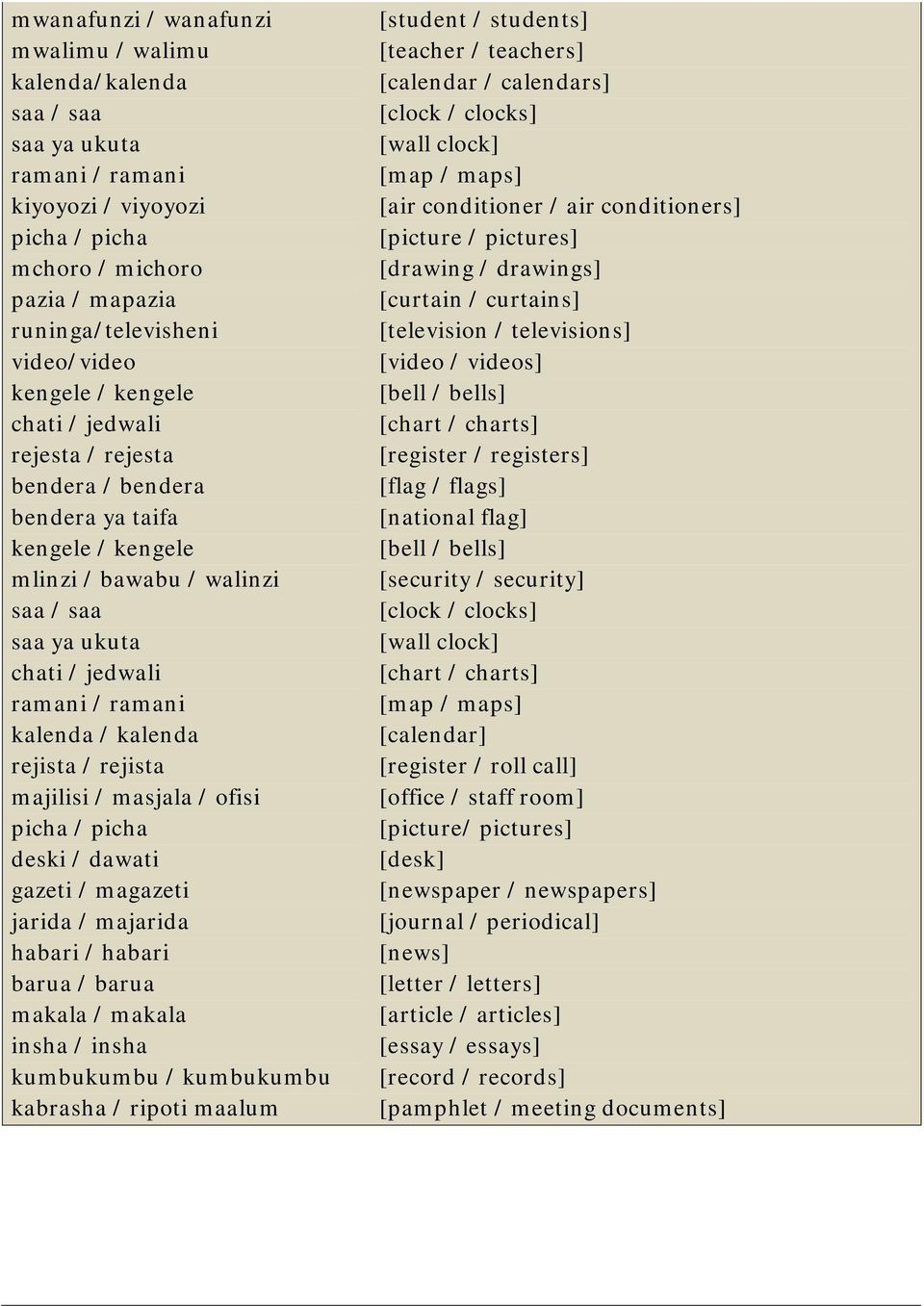
12 mwanafunzi / wanafunzi mwalimu / walimu kalenda/kalenda saa / saa saa ya ukuta ramani / ramani kiyoyozi / viyoyozi picha / picha mchoro / michoro pazia / mapazia runinga/televisheni video/video kengele / kengele chati / jedwali rejesta / rejesta bendera / bendera bendera ya taifa kengele / kengele mlinzi / bawabu / walinzi saa / saa saa ya ukuta chati / jedwali ramani / ramani kalenda / kalenda rejista / rejista majilisi / masjala / ofisi picha / picha deski / dawati gazeti / magazeti jarida / majarida habari / habari barua / barua makala / makala insha / insha kumbukumbu / kumbukumbu kabrasha / ripoti maalum [student / students] [teacher / teachers] [calendar / calendars] [clock / clocks] [wall clock] [map / maps] [air conditioner / air conditioners] [picture / pictures] [drawing / drawings] [curtain / curtains] [television / televisions] [video / videos] [bell / bells] [chart / charts] [register / registers] [flag / flags] [national flag] [bell / bells] [security / security] [clock / clocks] [wall clock] [chart / charts] [map / maps] [calendar] [register / roll call] [office / staff room] [picture/ pictures] [desk] [newspaper / newspapers] [journal / periodical] [news] [letter / letters] [article / articles] [essay / essays] [record / records] [pamphlet / meeting documents]
13 Question Formation Mifano: 1. Darasa hili lina vitu gani? [What things does this classroom have?] Darasa hili lina meza, mkoba, chaki, ubao [This classroom has a table, backpack, chalk, board ] 2. Hii ni nini? [What is this?] Hii ni meza. [This is a table.] 3. Huu ni nini? [What is this? (referring to wall)] Huu ni ukuta. [This is a wall.] 4. (Wewe) Hupendi mapambo gani? [Which decorations don t you like?] (Mimi) Sipendi. [I don t like.]
![Hii ni nini? [What is this?] Hii ni meza. [This is a table.] 3. Huu ni nini? [What is this? (referring to wall)] Huu ni ukuta.](/docs-images/43/20678469/images/page_13.jpg "[This is a wall.] 4. (Wewe) Hupendi mapambo gani? [Which decorations don t you like?] (Mimi) Sipendi.")
14 Lesson 4: Personal Pronouns Personal Pronouns [viwakilishi nafsi] There are three personal pronouns in Swahili: A). First person pronoun B). Second person pronoun C). Third person pronoun Each personal pronoun has a singular and a plural form. A). First Person Pronoun Umoja [singular] Wingi [plural] Mimi [I/Me] Sisi [We/Us] Represented by NI- Represented by TU- Sentensi: Mimi ninaitwa Jeremy. [I am called Jeremy. / My name is Jeremy.] Sisi tunaitwa Jeremy. [We are called Jeremy. / Our names are Jeremy.] B). Second Person Pronoun Umoja [singular] Wingi [plural] Wewe [You] Nyinyi/Ninyi [You (pl.)] Represented by U- Represented by M- Sentensi: Wewe unaitwa Jeremy. [You are called Jeremy. / Your name is Jeremy.] Nyinyi/Ninyi mnaitwa Jeremy. [You (pl.) are called Jeremy. / Your names are Jeremy.] C). Third Person Pronoun Umoja [singular] Wingi [plural] Yeye [He/She, Her/Him] Wao [They/Them] Represented by A- Represented by WA-
![First Person Pronoun Umoja [singular] Wingi [plural] Mimi [I/Me] Sisi [We/Us] Represented by NI- Represented by TU- Sentensi: Mimi ninaitwa Jeremy. [I am called Jeremy. / My name is Jeremy.](/docs-images/43/20678469/images/page_14.jpg "] Sisi tunaitwa Jeremy. [We are called Jeremy. / Our names are Jeremy.] B). Second Person Pronoun Umoja [singular] Wingi [plural] Wewe [You] Nyinyi/Ninyi [You (pl.")
15 Sentensi: Yeye anaitwa Jeremy. Wao wanaitwa Jeremy. [He is called Jeremy. / His name is Jeremy.] [They are called Jeremy. / Their names are Jeremy.] 1 st Person: Mimi Sisi 2 nd Person: Wewe Nyinyi/Ninyi 3 rd Person: Yeye Wao Muhtasari [Summary] Nafsi [Personal Pronoun] [I/Me] [We/Us] [You] [You (pl.)] [He/She, Her/Him] [They/Them] Kiwakilishi [Marker] NI- TU- U- M- A- WA- ita itwa Ninaitwa. Nani? Na wewe je? Zingatia [Note] [call] [be called] [I am called. / My name is.] [Who?/What is his/her name?] [And what about you?] Mifano: 1. Wewe unaitwa nani? [What is your name?] Mimi ninaitwa Jeremy. 2. Nyinyi mnaitwa nani? [What are your names?] Sisi tunaitwa Jeremy. Question Formation [I am called Jeremy / My name is Jeremy.] [We are called Jeremy/ Our names are Jeremy.]
![)] [He/She, Her/Him] [They/Them] Kiwakilishi [Marker] NI- TU- U- M- A- WA- ita itwa Ninaitwa. Nani? Na wewe je? Zingatia [Note] [call] [be called] [I am called. / My name is.] [Who?](/docs-images/43/20678469/images/page_15.jpg "/What is his/her name?] [And what about you?] Mifano: 1. Wewe unaitwa nani? [What is your name?] Mimi ninaitwa Jeremy. 2. Nyinyi mnaitwa nani? [What are your names?] Sisi tunaitwa Jeremy.")
16 3. Yeye anaitwa nani? [What is he/she called? / What is his/her name?] Yeye anaitwa Jeremy. [He is called Jeremy / His name is Jeremy.] 4. Wao wanaitwa nani? [What are they called? / What are their names?] Wao wanaitwa Jeremy. [They are called / Their names are Jeremy.] 5. Mimi ninaitwa John. [I am called John] Na wewe je? [And what about you?] Mimi ninaitwa Andrew. [I am called Andrew.]
![/ What are their names?] Wao wanaitwa Jeremy. [They are called / Their names are Jeremy.] 5.](/docs-images/43/20678469/images/page_16.jpg "Mimi ninaitwa John. [I am called John] Na wewe je? [And what about you?] Mimi ninaitwa Andrew.")
17 Lesson 5: Possessive Pronouns Possessive Pronouns [vivumishi vimilikishi] There are three possessive pronouns in Swahili: A). First person possessive B). Second person possessive C). Third person possessive Each possessive pronoun has a singular and a plural form. A). First Person Possessive Umoja [singular] Wingi [plural] ANGU [my] ETU [our] Mifano: Mwalimu wangu [My teacher] Mwalimu wetu [Our teacher] Walimu wangu [My teachers] Walimu wetu [Our teachers] B). Second Person Possessive Umoja [singular] Wingi [plural] AKO [your] ENU [your (pl.)] Mifano: Kalamu yako [Your pen] Kalamu yenu [Your (pl.) pen] Kalamu zako [Your pens] Kalamu zenu [Your (pl.) pens] C). Third Person Possessive Umoja [singular] Wingi [plural] AKE [his/her] AO [their] Mifano: Jina lake [His/her name] Jina lao [Their name] Majina yake [His/her names] Majina yao [Their names]
![First Person Possessive Umoja [singular] Wingi [plural] ANGU [my] ETU [our] Mifano: Mwalimu wangu [My teacher] Mwalimu wetu [Our teacher] Walimu wangu [My teachers] Walimu wetu [Our teachers] B).](/docs-images/43/20678469/images/page_17.jpg "Second Person Possessive Umoja [singular] Wingi [plural] AKO [your] ENU [your (pl.)] Mifano: Kalamu yako [Your pen] Kalamu yenu [Your (pl.) pen] Kalamu zako [Your pens] Kalamu zenu [Your (pl.")
18 Muhtasari [Summary] 1 st Person Singular: 1 st Person Plural: ANGU [My] ETU [Our] 2 nd Person Singular: 2 nd Person Plural: AKO [Your] ENU [Your (pl.)] 3 rd Person Singular: 3 rd Person Plural: AKE [His/Her] AO [Their] -angu -ako -ake jina langu lako lake nani? ni [my] [your] [his/her] [name] [my] [your] [his/her] [Who? What is his/her name?] [is] Zingatia [Note] Mifano: 1. Jina langu ni nani? [What is my name?] Jina lako ni Peter. 2. Jina lako ni nani? [What is your name?] Jina langu ni Darnell. 3. Jina lake ni nani? [What is his/her name?] Jina lake ni Don. Question Formation [Your name is Peter.] [My name is Darnell.] [His/her name is Don.] 4. Jina lako ni nani mama/mwalimu? [What is your name, mom/teacher?]
![What is his/her name?] [is] Zingatia [Note] Mifano: 1. Jina langu ni nani? [What is my name?] Jina lako ni Peter. 2. Jina lako ni nani? [What is your name?] Jina langu ni Darnell.](/docs-images/43/20678469/images/page_18.jpg "3. Jina lake ni nani? [What is his/her name?] Jina lake ni Don. Question Formation [Your name is Peter.] [My name is Darnell.] [His/her name is Don.] 4.")
19 Lesson 6: School Subjects School Subjects [masomo] A). School Subjects afya ja jamii akiolojia; elimu kale anthropolojia bayolojia biashara botania dini elimu elimu ya kompyuta elimu ya maktaba; ukutubi elimu ya mazingira elimu ya mawasiliano elimu ya siasa elimu ya usimamizi wa fedha falsafa fasihi fizikia hisabati; hesabu historia isimu (ya lugha) jiografia jiolojia kemia Kihispania lishe lugha masomo ya Kiafrika masomo ya maendeleo masomo ya wanawake matibabu ya watoto meteorolojia mipango ya miji [community health] [archeology] [anthropology] [biology] [business] [botany] [religion] [education] [computer science] [library science/studies] [environmental science] [communication studies] [political science] [finance] [philosophy] [literature] [physics] [math] [history] [linguistics] [geography] [geology] [chemistry] [Spanish] [nutrition] [language] [African studies] [development studies] [women s studies] [pediatrics] [meteorology] [urban planning]
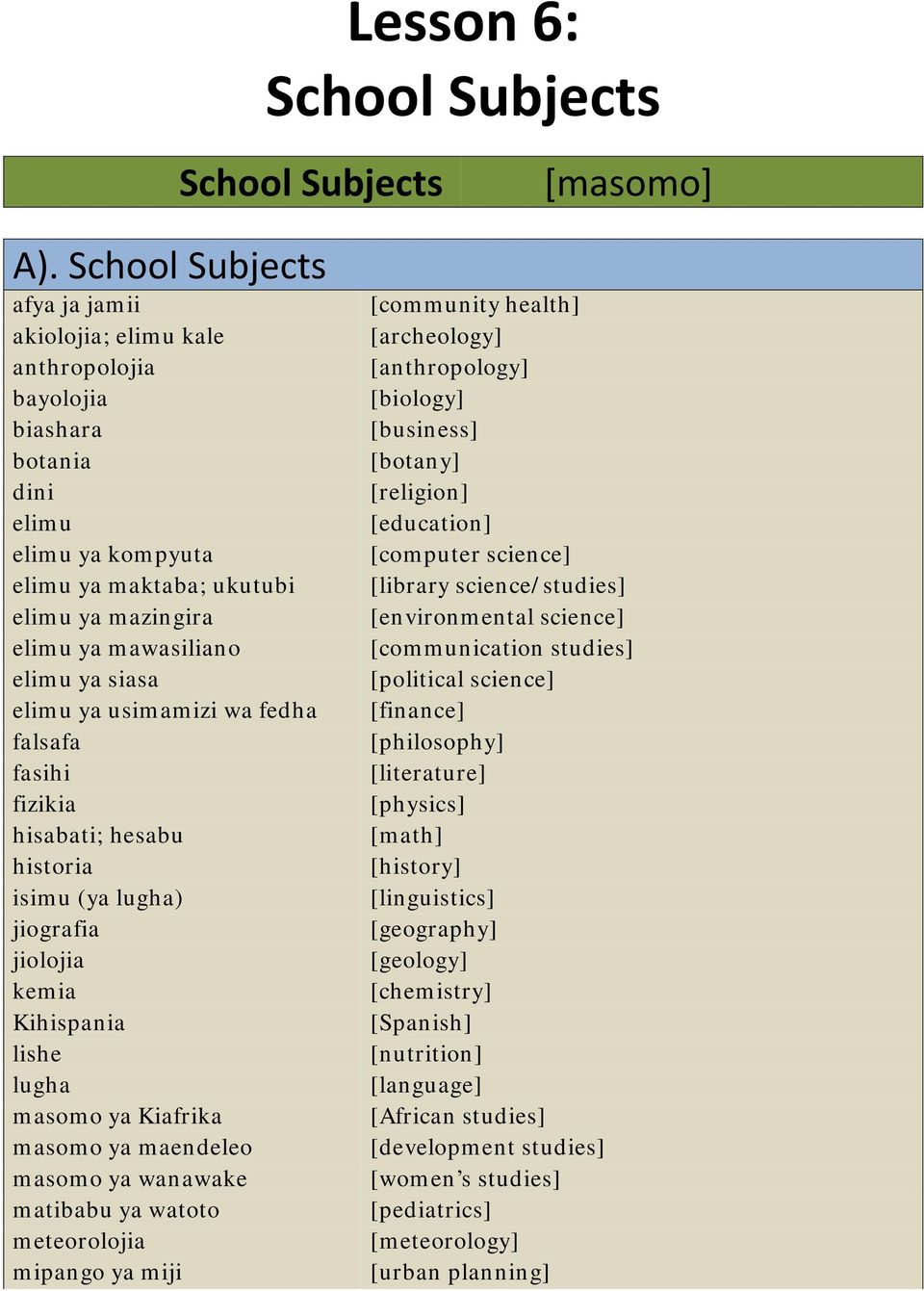
20 muziki saikolojia sanaa sanaa za maonyesho sayansi sayansi kimu sayansi ya jamii sayansi ya mimea sheria sosholojia uandishi uchumi uganga; udaktari uhandisi unesi uongozi; manejimenti upasuaji usanifu majengo utangazaji [music] [psychology] [fine arts] [theater arts] [science] [home economics] [social science] [plant science] [law] [sociology] [journalism] [economics] [medicine] [engineering] [nursing] [management] [surgery] [architecture] [advertising] Zingatia [Note] Some academic subjects are expressed by using elimu or masomo. However, school subjects that are not listed with elimu or masomo could optionally be expressed by using the following structure: elimu ya biashara, elimu ya dini, masomo ya dini, elimu ya uhandisi, etc. soma [study] Gani? [What?/which?] katika [at/within] Nini? [What?] chuo kikuu [university] Wapi? [Where?]
![[engineering] [nursing] [management] [surgery] [architecture] [advertising] Zingatia [Note] Some academic subjects are expressed by using elimu or masomo.](/docs-images/43/20678469/images/page_20.jpg "However, school subjects that are not listed with elimu or masomo could optionally be expressed by using the following structure: elimu ya biashara, elimu ya dini, masomo ya dini, elimu ya uhandisi,")
21 Question Formation Mifano: 1. Wewe unasoma masomo gani? [What subjects do you study? / What do you study?] Mimi ninasoma historia. [I study history.] 2. Wewe unasoma nini? [What do you study?] Mimi ninasoma historia na kemia. 3. Wewe unasoma wapi? [Where do you study?] Mimi ninasoma katika chuo kikuu cha Kansas. [I study history and chemistry.] [I study at the University of Kansas.] How to introduce yourself and what you study: Jina langu ni Sheila/Ninaitwa Sheila. Ninasoma historia katika chuo kikuu cha Kansas. Na wewe je? [My name is Sheila/I m called Sheila. I study history at the University of Kansas. What about you?]
22 Lesson 7a: Continents Continents [Mabara] A). Continents Mfano: Bara la Afrika / Bara Afrika Bara la Ulaya / Bara Uropa Bara Amerika Kusini Bara Amerika Kaskazini Bara Asia / Hindi Bara Australia Bara Antakitika [African continent] [European continent] [South American continent] [North American continent] [Asian continent] [Australian continent] [Antarctica]
23 Lesson 7b: Countries Countries [nchi] Countries take three different forms: U prefix Some change completely Some do not change at all A). Countries Marekani; Amerika Uingereza Mashariki ya kati Misri Uchina Italia; Italiano Uswidi Uswisi Ufaransa Uhispania; Uhispaniola Ureno Ujapani Ujerumani Uturuki Somalia; Usomali Urusi Ugiriki Uyahudi; Israeli; Israili Uholanzi Ubeljiji India Korea Kenya Tanzania Uganda [USA] [England] [Middle East] [Egypt] [China] [Italy] [Sweden] [Switzerland] [France] [Spain] [Portugal] [Japan] [Germany] [Turkey] [Somalia] [Russia] [Greece] [Israel] [Netherlands; Holland] [Belgium] [India] [Korea] [Kenya] [Tanzania] [Uganda]
24 Msumbuji Ushelisheli Udachi Bukini Kongo Serikali ya Demokrasia ya Congo Mifano Zaidi: Ulaya; Uropa Ufini; Finland Uajemi Palestina Uyunani Uyorodani Uhabashi Norwei Meksiko Kanada Israili Lesutu Afrika ya kusini; Afrika Kusini Poland Ukraine Romania Iraq Burundi Rwanda Botswana Malawi Nigeria Senegal toka nchi gani? [come from] [country] [which?; what?] [Mozambique] [Seychelles] [Netherlands] [Madagascar] [Congo] [Democratic Republic of Congo] [Europe] [Finland] [Iran; Persia] [Palestine] [Palestine before 1948] [Jordan] [Ethiopia] [Norway] [Mexico] [Canada] [Israel] [Lesotho] [South Africa] [Poland] [Ukraine] [Romania] [Iraq] [Burundi] [Rwanda] [Botswana] [Malawi] [Nigeria] [Senegal] Zingatia [note]
25 Question Formation Mifano: 1. (Wewe) Unatoka nchi gani? [Which country do you come from?] a. (Mimi) Ninatoka nchi ya Marekani/Amerika. [I come from America/U.S.A.] b. (Mimi) Ninatoka Tanzania / nchi ya Tanzania. [I come from Tanzania] c. (Mimi) Ninatoka Kenya / nchi ya Kenya. [I come from Kenya]
26 Lesson 7c: Nationality Nationality [uraia] To refer to people s nationalities, the prefix M is used for singular and WA for plural. A). Nationality Mmarekani; Mwamerika Mwiingereza Mmisri Mchina Mwitalia; Mtaliano Mswidi Mswisi Mfaransa Mhispania Mreno Mjapani Mjerumani Mturuki Msomali; Msomalia Mrusi Mgiriki Mholanzi Mbeljiji Mhindi Mkorea Mkenya Mtanzania Mganda Mmsumbuji Mzungu Mwafrika Mfini Mwajemi Myahudi Myorodani [American person] [English/British person] [Egyptian person] [Chinese person] [Italian person] [Swedish person] [Swiss person] [French person] [Spanish person] [Portuguese person] [Japanese person] [German person] [Turkish person] [Somali person] [Russian person] [Greek person] [Dutch person] [Belgian person] [Indian person] [Korean person] [Kenyan person] [Tanzanian person] [Ugandan person] [Mozambican person] [Caucasian person] [African person] [Finnish person] [Iranian person] [Palestinian person] [Jordanian person]
27 Mhabashi Mnorwei Mmeksikana Mkanada Mwisraeli Msutu Mwafrika Kusini Mpoland Mkraine Mromania Miraq Mrundi Mrwanda Mbotswana Mmalawi Mnigeria Msenegal Mshelisheli Mdachi Mbukini Mkongo [Ethiopian person] [Norwegian person] [Mexican person] [Canadian] [Israeli person] [Mosotho (Lesotho) person] [South African person] [Polish person] [Ukrainian person] [Romanian person] [Iraqi person] [Burundian person] [Rwandan person] [Motswana (Botswana) person] [Malawian person] [Nigerian person] [Senegalese person] [Seychellois (Seychelles) person] [Dutch person] [Malagasy (Madagascar) person] [Congolese person] uraia mraia wako gani? kwa hivyo [nationality] [a national] [yours] [which?; what?] [therefore] Zingatia [note]
28 Question Formation Mfano: 1. Uraia wako ni gani? [What is your nationality?] a). Mimi ninatoka nchi ya Marekani, kwa hivyo mimi ni Mmarekani. [I come from the U.S.A., so I am American.] b). Mimi ninatoka nchi ya Kenya, kwa hivyo mimi ni Mkenya [I come from Kenya, so I am Kenyan.] c). Mimi ninatoka Kanada, kwa hivyo mimi ni Mkanada. [I come from Canada, so I am Canadian.] d). Mimi ninatoka Afrika, kwa hivyo mimi ni Mwafrika. [I come from Africa, so I am African.]
29 Lesson 7d: Languages Languages [lugha] All languages take the prefix Ki. Mifano: Kiswahili Kiingereza Kifaransa A). Languages [Kiswahili] [English] [French] Kiingereza; Kizungu; Kimombo Kiarabu Kichina Kiitaliano; Kiitalia Kiswidi Kiswisi Kifaransa Kihispania; Kihispaniola Kireno Kijapani Kijerumani Kituruki Kisomali Kirusi Kigiriki Kilatini Kiyahudi Kiholanzi; Kidachi Kihindi Kikorea Kiswahili Kiganda Kihausa Kikongo Kinywarwanda Kiyoruba Kizulu Kiwolof [English] [Arabic] [Chinese] [Italian] [Swedish] [Swiss] [French] [Spanish] [Portuguese] [Japanese] [German] [Turkish] [Somali] [Russian] [Greek] [Latin] [Hebrew] [Dutch] [Hindi] [Korean] [Swahili] [Luganda (Uganda)] [Hausa (Nigeria/Niger)] [Congolese (Congo)] [Rwandese (Rwanda)] [Yoruba (Nigeria)] [Zulu (South Africa] [Wolof (Senegal/Gambia)]
30 Kibamana Kilingala Kiafrikana Kishona Kiajemi [Bamana (Ivory Coast)] [Lingala (Democratic Rep. of Congo)] [Afrikaans (South Africa)] [Shona (Zimbabwe)] [Persian] lugha gani? na kingi kidogo sana sema / ongea / zungumza Zingatia [note] [language] [which?; what?] [and] [a lot] [a little] [a lot; very much] [speak] Question Formation Mifano: 1. (Wewe) Unasema/Unaongea/Unazungumza lugha gani? [What language(s) do you speak?] a). (Mimi) Ninasema/Ninaongea/Ninazungumza Kiingereza. [I speak English.] b). (Mimi) Ninasema/Ninaongea/Ninazungumza Kiingereza na Kiswahili. [I speak English and Kiswahili.] c). (Mimi) Ninasema/Ninaongea/Ninazungumza Kiingereza, Kiswahili, na Kichina. [I speak English, Kiswahili, and Chinese.] d). (Mimi) Ninasema/Ninaongea/Ninazungumza Kiingereza kingi na Kiswahili kidogo. [I speak a lot of English and a little Kiswahili.] e). (Mimi) Ninasema/Ninaongea/Ninazungumza Kiingereza sana. [I speak English a lot.]
31 Lesson 8: Locations Locations [kutoka na kukaa/kuishi] How to talk about location and introduce yourself in detail: Name Country, State, City Current residence School Languages you speak A). Locations bara nchi jimbo jiji wilaya mji kijiji kitongoji mtaa kisiwa tarafa kata kiunga mkoa [continent] [country] [state] [big city] [district; county] [city] [village] [small village; hamlet] [neighborhood] [island] [division] [ward] [suburb; outskirt] [province] toka kaa/ishi barabara karibu na lakini kwa sasa katika [come from] [live; reside] [street; road] [near] [but] [for now] [at; within] Zingatia [Note]
32 Question Formation Mifano: 1. Wewe unatoka wapi? [Where do you come from?] Mimi ninatoka jimbo la Kansas, mji wa Lawrence. [I come from the state of Kansas, city of Lawrence.] 2. Wewe unakaa/unaishi wapi? [Where do you live?] Mimi ninakaa/ninaishi mji wa Lawrence. [I live in the city of Lawrence.] Sentence Formation Mifano: 1. Your name Jina langu ni / Mimi ninaitwa. [My name is / I am called.] 2. Where you come from and Where you live now Mimi ninatoka nchi ya, [I come from the country of, jimbo la, mji wa, the state of, the city of, lakini kwa sasa but for now mimi ninaishi/ninakaa mtaa wa, I live in the neighborhood of, karibu na, barabara ya. near, street/avenue of.] 3. What you study and Where Ninasoma katika chuo kikuu cha. 4. What languages you speak Ninazungumza. Ninasema/Ninaongea Kiingereza kingi na Kiswahili kidogo. [I study at the University of.] [I speak.] [I speak a lot of English and a little Kiswahili.]
33 How to introduce yourself in detail: [Jitambulishe kwa undani:] Jina langu ni Tyrone/Ninaitwa Tyrone. Mimi ninatoka nchi ya Amerika, jimbo la Kansas, mji wa Kansas City, lakini kwa sasa mimi ninaishi/ninakaa mtaa wa Lawrence, karibu na McDonald s, barabara ya 23rd. Ninasoma mawasiliano katika chuo kikuu cha Kansas. Ninasema Kiingereza kingi na Kiswahili kidogo. [My name is Tyrone/I am called Tyrone. I come from America, the state of Kansas, city of Kansas City, but now I live/stay/reside in Lawrence, near McDonald s on 23 rd Street. I study communication at the University of Kansas. I speak a lot of English and a little Kiswahili.]
34 Lesson 9: Swahili Noun Classes Noun Classes [ngeli za Kiswahili] Nouns in Kiswahili are grouped into various noun classes because of two main reasons: 1. their characteristics as a noun 2. Kiswahili s vowel harmony There are 9 noun classes in Kiswahili. Each noun class has both a singular and a plural form, to make 18 total. M WA [A WA] KI VI [KI VI] M MI [U I] JI MA [LI YA] N N [I ZI] U U U U [U ZI] [U U] KU KU [KU KU] PA PA [PA PA] MU MU [MU MU]
35 Lesson 9a: Noun Classes M WA M WA [A WA] KI VI [KI VI] M MI [U I] JI MA [LI YA] N N [I ZI] U U U U [U ZI] [U U] KU KU [KU KU] PA PA [PA PA] MU MU [MU MU] M WA [A WA] This noun class has the following nouns: A). nouns of people that start with M in singular and WA in plural B). other nouns of people C). wanyama [animals] D). ndege [birds] E). wadudu [insects] F). samaki [fish]
36 A). Nouns of people that start with M in singular and WA in plural mtoto/watoto [child/children] mgeni/wageni mfaransa/wafaransa mjomba/wajomba mke/wake mkulima/wakulima mpishi/wapishi msichana/wasichana mtu/watu mume/waume mvulana/wavulana mzee/wazee mzungu/wazungu mjerumani/wajerumani mwanamume/wanaume mwanamke/wanawake mwalimu/walimu mwanafunzi/wanafunzi mwafrika/waafrika mpwa / wapwa [visitor/visitors] [French person/french people] [uncle/uncle] [wife/wives] [farmer/farmers] [cook/cooks] [girl/girls] [person/people] [husband/husbands] [boy/boys] [elder/elders] [white person /white people] [German person/german people] [man/men] [woman/women] [teacher/teachers] B). Other nouns of people baba/baba [father/fathers] babu/babu dada/dada kaka/kaka mama/mama nyanya/nyanya rafiki/rafiki shangazi/shangazi kipofu/vipofu kiziwi/viziwi kijana / vijana amu / amu mwamu / mwamu [student/students] [African person/african people] [niece / nieces / nephew / nephews] [grandfather/grandfathers] [sister/sisters] [brother/brothers] [mother/mothers] [grandmother/grandmothers] [friend/friends] [aunt/aunts] [blind person/blind people] [deaf person/deaf people] [youth / youths] [uncle / uncles (paternal)] [sister-in-law/brother-in-law/sister-in-laws/brother-in-laws]
37 C). Wanyama [animals] mbwa/mbwa [dog/dogs] paka/paka ng ombe/ng ombe simba/simba ndovu/ndovu kifaru / vifaru mbewha / mbweha dubu / dubu duma / duma chui / chui kondoo / kondoo punda milia / punda milia panya / panya [cat/cats] [cow/cows] [lion/lions] [elephant/elephants] [rhinoceros / rhinoceroses] [fox / foxes / jackal / jackals] [bear / bears] [cheetah / cheetahs] [leopard / leopards] [sheep / sheep] [zebra / zebras] [rat / rats] D). Ndege [birds] kuku/kuku kasuku/kasuku tai/tai bata mzinga/bata mzinga mwewe / mwewe kunguru / kunguru kipanga / vipanga dudumizi / dudumizi mbuni / mbuni kurumbiza / kurumbiza bata / bata shakwe / shakwe sigi / sigi pugi / pugi njiwa / njiwa kanga / kanga koho / koho korongo / korongo kitaroharo / vitaroharo furukombe / furukombe mnandi / minandi kengewa / kengewa mbayuwayu /mbayuwayu [hen / hens] [parrot / parrots] [eagle / eagles] [turkey / turkeys] [kite / kites] [crow / crows] [hawk / hawks] [coucal / coucals] [ostrich / ostriches] [robin / robins] [duck / ducks] [gull / gulls] [small, brown, shortailed bird(s)] [dove / doves] [pigeon / pigeons] [guinea fowl / guinea fowls] [osprey / ospreys] [stork / storks / crane /cranes ] [shikra / shikras] [African fish eagle / African fish eagles] [cormorant / cormorants] [African kite / African kites] [swallow / swallows]
38 batabukini / batabukini batamwitu / batamwitu [Madagascar turkey / Madagascar turkeys] [wild turkey / wild turkey] E). Wadudu [insects] nyuki/nyuki [bee/bees] mbu/mbu nzi/nzi nyigu/nyigu duduvule/maduduvule buibui/buibui kunguni/kunguni mbung o/mbung o kiroboto/viroboto kupe / kupe vunjajungu/vunjajungu mchwa/mchwa kumbikumbi/kumbikumbi nyenze/nyenze chawa/chawa nzige/nzige kipepeo/vipepeo nondo/nondo sisimizi/sisimizi nge/nge [mosquito/mosquitoes] [fly/flies] [wasp/wasps] [carpenter bee / carpenter bees] [spider / spiders] [bedbug / bedbugs] [tsetse fly / tsetse flies] [flea / fleas] [tick / ticks] [praying mantis / praying mantises] [termite / termites] [flying ant / flying ants] [cricket / crickets] [louse / lice] [locust / locusts] [butterfly / butterflies] [moth / moths] [small black ant / small black ants] [scorpion / scorpions] F). Samaki [fish] ngege/ngege papa/papa nyangumi/nyangumi dagaa/dagaa ngisi/ngisi mkunga/mikunga kamongo/kamongo pomboo/pomboo pweza / pweza kambare / kambare nguru / nguru changu / changu chuchunge / chuchunge sangara / sangara [tilapia/tilapia] [shark/sharks] [whale/whales] [sardine/sardines] [cuttlefish/cuttlefish] [eel/eels] [gilled lungfish / gilled lungfish] [dolphin / dolphins] [squid / squids] [catfish / catfish] [kingfish / kingfish] [snapper / snappers] [swordfish / swordfish] [Nile perch / Nile perch]
39 pono / pono [parrot fish / parrot fish] Zingatia [Note] When using a verb, this noun class uses A- in singular and WA- in plural for sentence formation. Sentence Formation Mifano: 1. Mwanafunzi anasoma. [The student is reading.] Wanafunzi wanasoma. [The students are reading.] 2. Mwalimu anaimba. [The teacher is singing.] Walimu wanaimba. [The teachers are singing.] 3. Rafiki alikuja nyumbani. [The friend came home.] Rafiki walikuja nyumbani. [The friends came home.] 4. Mama anapika kuku. [The mother is cooking chicken.] Mama wanapika kuku. [The mothers are cooking chicken.]
40 Lesson 9b: Noun Classes KI VI M WA [A WA] KI VI [KI VI] M MI [U I] JI MA [LI YA] N N [I ZI] U U U U [U ZI] [U U] KU KU [KU KU] PA PA [PA PA] MU MU [MU MU] KI VI [KI VI] This noun class has the following nouns: A). nouns that take KI in singular and VI in plural B). nouns that take CH in singular and VY in plural C). body parts [sehemu za mwili] D). names of languages [majina ya lugha] E). Diminutives [hali ya udogo] F). words that take KI in both singular and plural G). words that take VI in both singular and plural
41 A). Nouns that take KI in singular and VI in plural kiti/viti [chair/chairs] kitabu/vitabu kiatu/viatu kisu/visu kikombe/vikombe kilima/vilima kisiwa/visiwa kiazi/viazi kitunguu/vitunguu kitu/vitu kitanda/vitanda kioo/vyoo kiberiti/viberiti [book/books] [shoe/shoes] [knife/knives] [cup/cups] [hill/hills] [island/islands] [potato/potatoes] [onion/onions] [thing/things] [bed/beds] [mirror/mirrors] [match/matches] B). Nouns that take CH in singular and VY in plural chuo/vyuo choo/vyoo chakula/vyakula chumba/vyumba cheti/vyeti chama/vyama chuma/vyuma chombo/vyombo cheo/vyeo chama/vyama chengo/vyengo [school/schools; college/colleges] [restroom/restrooms] [food/foods] [room/rooms] [certificate/certificates] [party/parties; association/associations] [iron/irons] [container/containers; utensil/utensils] [rank/ranks] [society/club/group/association] [house / houses] C). Body Parts [sehemu za mwili] kichwa/vichwa kiuno/viuno kifua/vifua kidole/vidole kisogo / visogo kitovu /vitovu [head/heads] [waist/waists] [chest/chests] [finger/fingers] [back part of the head] [navel / navels]
42 kiwiko / viwiko kisigino / visigino kibofu / vibofu [ankle / ankles; wrist / wrists]] [heel / heels] [bladder / bladders] D). Names of Languages [majina ya lugha] Kiarabu Kifaransa Kiingereza Kichina Kijapani Kijerumani Kireno [Arabic] [French] [English] [Chinese] [Japanese] [German] [Portuguese] E). Diminutives [Hali ya udogo] kitoto / vitoto kijibwa / vijibwa kibuzi / vibuzi kilima / vilima kijitanda / vijitanda kivulana / vivulana kisichana / visichana kijiatu/vijiatu kijitu/vijitu kisitu/visitu kijumba/vijumba kiguu/viguu [a little child / little children] [a little dog / little dogs] [a small goat / small goats] [hill / hills] [a small bed / small beds] [a small boy / small boys] [a small girl / small girls] [a small shoe/ small shoes] [a small giant/small giant] [a small forest/small forests] [a small house/small houses] [a small leg/ small legs] Zingatia [Note] When using a verb, this noun class uses KI- in singular and VI- in plural for sentence formation. Sentence Formation Mifano: 1. Kichwa kinauma. [The head is hurting.] Vichwa vinauma. [The heads are hurting.]
43 2. Kiti kilivunjwa. [The chair was broken.] Viti vilivunjwa. [The chairs were broken.] 3. Chuo kimefungwa. [The school has been closed.] Vyuo vimefungwa. [The schools have been closed.] 4. Chakula kitapikwa. [The food will be cooked.] Vyakula vitapikwa. [The foods will be cooked.] F). words that take KI in both singular and plural kiu / kiu [thirst] kiasi / kiasi kimya / kimya [moderate / modicum] [quiet] Sentence Formation Mifano: 1. Kimya chake kilinitisha. [His quietness scared me.] 2. Kiu changu kimepungua. [My thirst has waned / reduced.] G). words that take VI in both singular and plural vita / vita [war / wars] vifijo / vifijo vitimbi / vitimbi [ululation] [drama] Sentence Formation Mifano: 1. Vita viko katika nchi ya Iraq. [There is war in Iraq] 2. Kuna vifijo katika Kansas There are ululations at the Union. Kansas Union. 3. Juma ana vitimbi vingi Juma has a lot of drama in his maishani. life.
44 Lesson 9c: Noun Classes M MI M WA [A WA] KI VI [KI VI] M MI [U I] JI MA [LI YA] N N [I ZI] U U U U [U ZI] [U U] KU KU [KU KU] PA PA [PA PA] MU MU [MU MU] M MI [U I] This noun class has the following nouns: A). majina ya miti [names of trees] B). majina ya mimea [names of plants] C). sehemu za mwili [body parts] D). nouns that take M in singular and MI in plural E). radicals that start with a vowel: i. nouns that take MW in singular and MI in plural ii. particular cases: singular prefix MU F). nouns that take MI in both singular and plural
45 A). Majina ya miti [names of trees] mti/miti mnazi/minazi mchungwa/michungwa mwembe/miembe mtofaa/mitofaa mpapai/mipapai mndimu/mindimu mpera/mipera mgomba/migomba [tree/trees] [coconut tree/coconut trees] [orange tree/orange trees] [mango tree/mango trees] [apple tree/apple trees] [papaya tree/papaya trees] [lime tree/lime trees] [guava tree/guava trees] [banana tree/banana trees] B). Majina ya mimea [names of plants] mmea/mimea [plant/plants] C). Sehemu za mwili [body parts] mdomo/midomo mkono/mikono mguu/miguu mfupa/mifupa mgongo/migongo moyo/mioyo mwili/miili mfupa / mifupa [mouth/mouths] [hand/hands] [leg/legs] [bone/bones] [back/backs] [heart/hearts] [body/bodies] [bone / bones] D). Nouns that take M in singular and MI in plural mfano/mifano mji/miji mkoba/mikoba mfuko/mifuko mlango/milango mtihani/mitihani mjarabu/mijarabu mlima/milima mpira/mipira mkate/mikate mto/mito [example/examples] [city/cities] [bag/bags] [bag/bags] [door/doors] [exam/exams] [test/tests] [mountain/mountains] [ball/balls] [bread/breads] [river/rivers]
46 mchezo/michezo moto/mioto mskiti/misikiti msitu/misitu mswaki/miswaki mto/mito [game/games] [fire/fires] [mosque/mosques] [forest/forests] [toothbrush/toothbrushes] [river/rivers, pillow/pillows] E). Radicals that start with a vowel: i. nouns that take MW- in singular and MI- in plural mwaka/miaka mwavuli/miavuli mwezi/miezi mwiba/miiba mwisho/miisho ii. [year/years] [umbrella/umbrellas] [month/months] [thorn/thorns] [end/ ends] particular cases: singular prefix MU- muhindi/mihindi muhogo/mihogo muwa/miwa [corn] [cassava/cassavas] [sugarcane] Zingatia [Note] When using a verb, this noun class uses U- in singular and I- in plural for sentence formation. Sentence Formation Mifano: 1. Mti ulianguka. [The tree fell.] Miti ilianguka. [The trees fell.] 2. Mkono unauma. [The hand hurts.] Mikono inauma. [The hands hurt.] 3. Mkoba umeoshwa. [The bag has been washed.] Mikoba imeoshwa. [The bags have been washed.]
47 D). Nouns that take MI in singular and plural mizani / mizani miwani / miwani miraa / miraa [weight / weights] [glass / glasses; syllable / syllables] [Khat (a stimulant plant)] Sentence Formation Mifano: 1. Miwani imeanguka. [The glass has fallen.] Miwani imeanguka. [The glasses have fallen.] 2. Miraa imefika. [The khat has arrived.] Miraa imefika. [The khat has arrived.]
48 Lesson 9d: Noun Classes JI MA M WA [A WA] KI VI [KI VI] M MI [U I] JI MA [LI YA] N N [I ZI] U U U U [U ZI] [U U] KU KU [KU KU] PA PA [PA PA] MU MU [MU MU] JI MA [LI YA] Nouns in this class can start with any letter in their singular form but their plural forms must take MA. This noun class has the following nouns: A). manufactured products, natural or built places, abstract or concrete concepts B). sehemu za mwili [parts of the body] C). matunda na vitu vya kawaida [fruits and natural objects] D). majina ya vitu ambavyo havihesabiki [These nouns exist only in the plural form and are things which cannot be counted. They take MA in both singular and plural form] E). majina ya ukubwa [augmentatives] F). majina ya vitu visiyobadilika katika umoja na wingi [Nouns that do not change in plural or singular forms. In sentence formation they take LI in both singular and plural forms.]
49 A). Manufactured products, natural or built places, abstract or concrete concepts Manufactured products: blanketi/mablanketi dirisha/madirisha gari/magari gazeti/magazeti godoro/magodoro sanduku/masanduku jiko/meko dawati/madawati [blanket/blankets] [window/windows] [car/cars] [newspaper/newspapers] [mattress/mattresses] [box/boxes] [gas cooker/gas cookers] [desk/desks] Natural or Built places: baraza/mabaraza [veranda/verandas] daraja/madaraja [bridge/bridges] duka/maduka [shop/shops] shamba/mashamba [farm/farms] soko/masoko [market/markets] ziwa/maziwa [lake/lakes] jimbo/majimbo [state/states] Abstract or Concrete concepts: jina/majina [name/names] kosa/makosa [mistake/mistakes] neno/maneno [word/words] jambo/mambo [issue/issues] jiwe/mawe [stone/stones] somo/masomo [subject/subjects; lesson/lessons] wazo/mawazo [thought/thoughts] jibu/majibu [answer/answers] swali/maswali [question/questions] jukumu/majukumu [responsibility/responsibilities] juma/majuma [week/weeks]
50 B). Sehemu za mwili [parts of the body] jicho/macho [eye/eyes] jino/meno bega/mabega goti/magoti sikio/masikio tumbo/matumbo paja/mapaja [tooth/teeth] [shoulder/shoulders] [knee/knees] [ear/ears] [stomach/bowels] [thigh/thighs] C). Matunda na vitu vya kawaida [fruits and natural objects] Fruits: chungwa/machungwa embe/maembe limau/malimau nanasi/mananasi papai/mapapai dafu/madafu tofaa/matofaa tunda / matunda [orange/oranges] [mango/mangoes] [lemon/lemons] [pineapple/pineapples] [pawpaw/pawpaws] [coconut/coconuts (with milk)] [apple/apples] [fruit / fruits] Natural Objects: jani/majani yai/mayai rinda/marinda [leaf/leaves] [egg/eggs] [dress/dresses] D). Majina ya vitu ambavyo havihesabiki [nouns of things that cannot be counted, which exist only in the plural form] maji/maji [water] mafuta/mafuta maharagwe/maharagwe mahindi/mahindi mali/mali [oil] [beans] [corn] [wealth]
51 maafa/maafa matata/matata mazingira/mazingira makala/makala maskani/maskani mate/mate marashi/marashi mazungumzo/mazungumzo maadili/maadili maarifa/maarifa mamlaka/mamlaka mahaba/mahaba malazi/malazi [misfortune] [problems] [environment] [articles] [residence] [saliva] [cologne] [conversation] [morality] [knowledge] [power/authority] [love] [beddings] E). majina ya ukubwa [augmentatives] lango/malango [big door/big doors] toto/matoto jibwa/majibwa gombe/magombe jitu/majitu dizi/madizi guu/maguu fupa/mafupa jike/majike nguo/guo nguruwe/guruwe ndovu/dovu ndege/dege ndizi/dizi njia/jia mbuzi/buzi mlima/lima mkoba/koba mkono/kono chumba/jumba uso/juso kichwa/jichwa kisu/jisu kiatu/jiatu kikombe/jikombe kidole/jidole [big child/ big children] [big dog/ big dogs] [big cow/ big cows] [giant/giants] [big banana/ big bananas] [big leg/ big legs] [big bone/ big bones] [big woman/ big women] [big cloth/ big clothes] [big pig/big pigs] [big elephant/ big elephants] [big bird/ big birds] [big banana/ big bananas] [big road/ big roads] [big goat/ big goats] [big mountain/ big mountains] [big bag/ big bags] [big hand/ big hands] [big room/ big rooms] [big face/ big faces] [big head/ big heads] [big knife/ big knives] [big shoe/ big shoes] [big cup/ big cups] [big finger/ big fingers]
52 mwana/jana [big child/ big children] F). majina ya vitu visiyobadilika katika umoja na wingi [Nouns that do not change in plural or singular forms. In sentence formation this class takes LI- in both singular and plural.] giza/giza [darkness] jua/jua joto/joto jasho/jasho gubu/gubu gugumo/gugumo lepe/lepe [sun] [heat/warmth] [sweat] [commotion] [body odor] [drowsiness] Zingatia [Note] When using a verb, this noun class uses LI- in singular and YA- in plural for sentence formation. Sentence Formation Mifano: 1. Chungwa limenunuliwa. [The orange has been bought.] Machungwa yamenunuliwa. [The oranges have been bought.] 2. Gari limefika. [The car has arrived.] Magari yamefika. [The cars have arrived.] 3. Jicho linauma. [The eye hurts.] Macho yanauma. [The eyes hurt.] 4. Maji yamemwangika. [The water has been poured.] Maji yamemwangika. 5. Mazingira yanapendeza. Mazingira yanapendeza. 6. Mafuta yatanunuliwa kesho. Mafuta yatanunuliwa kesho. [The water has been poured.] [The environment is attractive.] [The environment is attractive.] [Oil will be bought tomorrow.] [Oil will be bought tomorrow.]
53 7. Goti langu limeumia. Magoti yangu yameumia. 8. Toto langu linalala. Matoto yangu yanalala. 9. Giza limeingia. Giza limeingia. 10.Jua limetua. Jua limetua. 11.Jasho linatoka. Jasho linatoka. [My knee has been hurt.] [My knees have been hurt.] [My child is sleeping.] [My children are sleeping.] [Darkness has set in.] [Darkness has set in.] [The sun has set.] [The sun has set.] [The sweat is coming out.] [The sweat is coming out.]
54 Lesson 9e: Noun Classes N N M WA [A WA] KI VI [KI VI] M MI [U I] JI MA [LI YA] N N [I ZI] U U U U [U ZI] [U U] KU KU [KU KU] PA PA [PA PA] MU MU [MU MU] N N [I ZI] This noun class is the broadest noun class and has the following nouns: A). Manufactured products, natural or built places, abstract or concrete concepts B). Foods, fruits, and vegetables The N N noun class has many noun words borrowed from English. It contains some nouns which start with the prefix N although several nouns in this class do not. These nouns are written identically in singular and plural forms.
55 A). Manufactured products, natural or built places, abstract or concrete concepts Manufactured objects: barua/barua chupa/chupa dawa/dawa kalamu/kalamu karatasi/karatasi ngoma/ngoma sabuni/sabuni sahani/sahani sufuria/sufuria suruali/suruali chaki/chaki dola/dola kompyuta/kompyuta nguo/nguo soksi/soksi shilingi/shilingi meza/meza taa/taa senti/senti nyumba/nyumba sakafu/sakafu karata/karata shule/shule kofia/kofia redio/redio hospitali/hospitali picha/picha pesa/pesa motokaa/motokaa sufuria/sufuria [letter/letters] [bottle/bottles] [drug/drugs; medicine/medicines] [pen/pens] [paper/papers] [drum/drums] [soap/soaps] [plate/plates] [pan/pans] [trouser/trousers] [chalk/chalk] [dollar/dollars] [computer/computers] [cloth/cloths] [sock/socks] [shilling/shillings] [table/tables] [light/lights] [cent/cents] [house/houses] [floor/floors] [card/cards] [school/schools] [hat/hats] [radio/radios] [hospital/hospitals] [picture/pictures] [money] [car/car] [cooking pot/cooking pots] Nature: ardhi/ardhi bahari/bahari baridi/baridi [earth; ground] [sea] [cold]
56 barafu/barafu hewa/hewa nuru/nuru mvua/mvua njia/njia bandari/bandari barabara/barabara nchi/nchi damu/damu siku/siku [ice] [air; atmosphere] [light] [rain] [way] [harbor] [road] [country] [blood] [day/days] Abstract concepts: ajali/ajali bahati/bahati furaha/furaha hasara/hasara hatari/hatari huzuni/huzuni nguvu/nguvu shida/shida thamani/thamani dakika/dakika sifa/sifa ndoto/ndoto shughuli/shughuli huruma/huruma harufu/harufu [accident/accidents] [luck/lucks] [joy/joys] [loss/losses] [danger/dangers] [sadness] [strength/strengths] [problem/problems] [value/values] [minute/minutes] [praise/praises; reputation/reputations] [dream/dreams] [business/businesses] [mercy/mercies] [smell/smells] B). Foods, fruits, and vegetables chai/chai [tea/teas] chumvi/chumvi kahawa/kahawa mboga/mboga nazi/nazi ndizi/ndizi nyama/nyama pilipili/pilipili siagi/siagi [salt/salts] [coffee/coffees] [vegetable/vegetables] [coconut/coconuts] [banana/bananas] [meat/meats] [pepper/peppers] [butter; margarine]
57 sukari/sukari njugu/njugu [sugar/sugars] [peanut/peanuts] Zingatia [Note] When using a verb, this noun class uses I- in singular and ZI- in plural for sentence formation. Sentence Formation Mifano: 1. Kalamu imeanguka. [The pen has fallen.] Kalamu zimeanguka. [The pens have fallen.] 2. Njia imefungwa. [The way has been closed.] Njia zimefungwa. [The ways have been closed.] 3. Sahani ilipotea. [The plate got lost.] Sahani zilipotea. [The plates got lost.]
58 Lesson 9f: Noun Classes U U M WA [A WA] KI VI [KI VI] M MI [U I] JI MA [LI YA] N N [I ZI] U U U U [U ZI] [U U] KU KU [KU KU] PA PA [PA PA] MU MU [MU MU] U U [U ZI] U U [U U] This noun class has the following nouns: A). concrete nouns with various plurals B). uncountable nouns, with no plural form C). nouns that are mostly formed from adjectives, nominals, or verbal roots D). names of countries
59 A). Concrete nouns with various plurals U - NY: uso/nyuso uzi/nyuzi ua/nyua ufa/nyufa uma/nyuma [face/faces] [thread/threads] [courtyard/courtyards] [crack/cracks] [fork/forks] U - ND: ulimi/ndimi udevu/ndevu [tongue/tongues] [beard/beards] U - MB: ubao/mbao ubavu/mbavu ubawa/mbawa [board/boards] [rib/ribs] [wing/wings] U - Ø: unywele/nywele ufunguo/funguo ukuta/kuta upande/pande uvumbi/vumbi upanga/panga upepo/pepo [one hair/hair] [key/keys] [wall/walls] [side/sides] [grain of dust/dust] [machete/machetes] [wind/winds] W - NY: wakati/nyakati wembe/nyembe wimbo/nyimbo [time/times] [razor blade/razor blades] [song/songs] B). Uncountable nouns, with no plural form Nouns in this category remain the same in both singular and plural sentence formation when using a verb(s). udongo/udongo ugali/ugali uji/uji [soil; ground] [corn paste] [porridge]
60 ulimwengu/ulimwengu umeme/umeme umri/umri unga/unga usingizi/usingizi uwongo/uwongo ubwabwa/ubwabwa uyoga/uyoga ufuta/ufuta ukungu/ukungu ulimbi/ulimbi ushuru/ushuru UKIMWI/UKIMWI uboho/uboho usaha/usaha [world] [electricity] [age] [flour] [sleep] [a lie] [rice gruel porridge] [mushroom/mushrooms] [sesame seed/sesame seeds] [fog/mist/dampness] [glue/glues] [tax/taxes] [AIDS] [brain/bone marrow] [pus] C). Nouns that are mostly formed from adjectives, nominals, or verbal roots Nouns in this category remain the same in both singular and plural sentence formation when using a verb(s). Nominal roots: jamaa - ujamaa kijana - ujana mzee - uzee maskini - umaskini mchawi - uchawi mfalme - ufalme mtoto - utoto NOUN - NOUN [group of people - community] [young person - young age] [old person - old age] [poor person - poverty] [witch - witchcraft] [king - kingdom] [child - childhood] Verbal roots: kuiba - uwizi kukosa - ukosefu kupenda - upendo kuweza - uwezo kusahau - usahaulifu VERB - NOUN [to steal - theft] [to miss - deficiency] [to love - love] [to be able - capacity] [to forget - forgetfulness]
61 Mifano zaidi ulafi uhodari ubaya umoja uchoyo ubora wizi ufundi wema urafiki [greediness] [smartness] [badness] [unity] [meanness] [goodness] [theft] [expertise] [kindness] [friendship] D). Names of countries Ufaransa Uganda Uingereza Ujerumani Ureno Urusi [France] [Uganda] [England] [Germany] [Portugal] [Russia] Zingatia [Note] When using a verb, this noun class uses U- in singular and ZI- in plural for sentence formation. However, uncountable nouns and nouns that are formed from adjectival, nominal, or verbal roots only use U-. Sentence Formation Mifano: 1. Ulimi unauma. [The tongue hurts.] Ndimi zinauma. [The tongues hurt.] 2. Ufunguo umepotea. [The key has been lost.] Funguo zimepotea. [The keys have been lost.] 3. Ubavu umevunjika. [The rib has broken.] Mbavu zimevunjika. [The ribs have broken.] 4. Ugali umepikwa. [The cornmeal has been cooked.] Ugali umepikwa. [The cornmeal has been cooked.]
62 5. Upendo wao umesifika. [Their love has been praised.] Upendo wao umesifika. [Their love has been praised.]
63 Lesson 10: Family Family [jamaa; familia] A). Family babu babu mkubwa; babumkuu nyanya; bibi nyanyamkuu; bibimkuu; nyanya mkubwa mzazi baba baba mkubwa; babamkuu baba mdogo baba wa kambo mama mama mkubwa; mamamkuu mama mdogo mama wa kambo mke; bibi mume mtoto/mwana kaka dada ndugu mzee Mjomba; ami shangazi; mbiomba mpwa binamu binti bin mvulana [grandfather] [elder grandfather] [grandmother] [elder grandmother] [parent] [father] [elder uncle (father's elder brother)] [younger uncle (father's younger brother)] [stepfather] [mother] [elder auntie (mother's elder sister)] [younger auntie (mother's younger sister)] [stepmother] [wife] [husband] [child] [elder brother; male sibling] [elder sister; female sibling] [brother; sister; citizen; comrade; friend; fellow tribesman; conational] [elder] [uncle in general (usually paternal uncle)] [maternal aunt] [nephew] [cousin] [daughter of] [son of] [boy]
64 msichana kijana familia mkwe mama mkwe; mavyaa baba mkwe; bavyaa mkaza; mkaza mwana shemeji; mwamu wifi mwanamke mwanamume kifungua mimba kitinda mimba; kifunga mimba mjukuu kitukuu kinying inya kilembwe kilembwekeza kitojo ami mwanyumba wakewenza [girl] [youth; young man; teenager] [family] [an in-law] [mother-in-law] [father-in-law] [daughter-in-law] [sister-in-law; brother-in-law; relative by marriage] [sister-in-law (brother's wife or husband's sister)] [woman] [man] [first born child] [last born child] [grandchild] [great grandchild (2 nd generation)] [great, great grandchild (3 rd generation)] [great, great, great grandchild (4 th generation)] [great, great, great, great grandchild (5 th generation)] [great, great, great, great, great grandchild (6 th gen.)] [paternal uncle] [different men who have married blood sisters call each other mwanyumba] [co-wives] mkubwa; mkuu mdogo na nina sina yangu lakini pekee tu penda ngapi [bigger/elder/older] [smaller/younger/little] [have] [I have] [I do not have] [my] [but] [only] [only/just] [like] [how many] Zingatia [Note]
65 Question Formation Mifano: 1. Una kaka? [Do you have a brother?] a). Ndiyo, nina kaka. [Yes, I have a brother.] b). La, sina kaka. [No, I do not have a brother.] c). La, sina kaka lakini nina dada. [No, I do not have a brother but I have a sister.] 2. Kaka yako anaitwa nani? Yeye anaitwa nani? [What is your brother s name?] [What is his name?] Kaka yangu anaitwa John. / Yeye anaitwa John. [My brother s name is John. / His name is John.] Additional Questions 3. Kaka yako anasoma nini? [What does your brother study?] Kaka yangu anasoma siasa. (Yeye) Anasoma elimu ya siasa. [My brother studies political science.] [He studies political science.] 4. Anaishi wapi? [Where does he live?] Anaishi katika jimbo la New York. [He lives in New York.] 5. Kaka yako anaishi wapi? Kaka yangu anaishi katika jimbo la Where does your brother live? [My brother lives in New York.] New York. 6. Ana miaka mingapi? [How old is he?] Ana miaka ishirini na minane. [He is 28 years old.] 7. Kaka yako ana miaka [How old is your brother?] mingapi? Kaka yangu ana miaka ishirini na [My brother is 28 years old.] minane. 8. Anapenda chakula gani? [What food does he like?] Anapenda mchicha na jibini. [He likes spinach and cheese.] 9. Kaka yako anasema lugha gani? [What language does your brother speak?] Kaka yangu anasema. [My brother speaks.]
66 10. Kaka yako anasoma wapi? [Where does your brother study/go to school?] Kaka yangu anasoma. [My brother studies at.] 11. Kaka yako anapenda [What food does your brother chakula gani? like?] Anapenda. [He likes.] 12. Una kaka/dada wangapi? [How many brothers/sisters do you have? a). Nina kaka moja na dada [I have one brother and two wawili/watatu/wane/watano/ sita. sisters/three sister/ four sisters/five sisters/ six sisters.] b). Mimi ni mtoto wa pekee. c). Mimi ni kifungua mimba na kifunga mimba. d). Sina kaka, sina dada. [I am an only child.] [I am the first and last born.] [I have no brother or sister.]
67 Lesson 11: The Verb NA NA [have] The verb have is constructed when a subject prefix is added to NA. A). The Verb NA in Present Tense B). The Verb NA in Past Tense C). The Verb NA in Future Tense A). The Verb NA in Present Tense Subject Prefix Subject Prefix + -NA Meaning 1 st Person: MIMI SISI 2 nd Person: WEWE NYINYI 3 rd Person: YEYE WAO NI- TU- U- M- A- WA- Nina Tuna Una Mna Ana Wana Sentence Formation Mifano: 1. Mimi nina kalamu. [I have a pen.] Sisi tuna kalamu. [We have pens.] 2. Wewe una karatasi. [You have paper.] Nyinyi mna karatasi. [You (pl.) have paper.] 3. Yeye ana rula. [He/She has a ruler.] Wao wana rula. [They have rulers.] 4. Mimi nina kitabu. [I have a book.] Sisi tuna vitabu. [We have a book.] 5. Wewe una rafiki. [You have a friend.] Nyinyi mna rafiki. [You (pl) have friends.] I have We have You have You (pl.) have He/She has They have
68 B). The Verb NA in Past Tense Subject Prefix Subject Prefix + 1 st Person: MIMI SISI 2 nd Person: WEWE NYINYI 3 rd Person: YEYE WAO NI- TU- U- M- A- WA- -LIKUWA NA Nilikuwa na Tulikuwa na Ulikuwa na Mlikuwa na Alikuwa na Walikuwa na Meaning I had We had You had You (pl.) had He/She had They had Sentence Formation Mifano: 1. Mimi nilikuwa na gari. [I had a car.] Sisi tulikuwa na magari. [We had cars.] 2. Wewe ulikuwa na daftari. [You had a notebook.] Nyinyi mlikuwa na madaftari. [You (pl.) had notebooks.] 3. Yeye alikuwa na kazi ya nyumbani. [He/She had homework.] Wao walikuwa na kazi ya nyumbani. [They had homework.] 4. Mimi nilikuwa na kitabu [I had a book.] Sisi tulikuwa na vitabu. [We had books.] 5. Wewe ulikuwa na rafiki. [You had a friend.] Nyinyi mlikuwa na rafiki. [You (pl.) had friends.]
69 C). The Verb NA in Future Tense Subject Prefix Subject Prefix + 1 st Person: MIMI SISI 2 nd Person: WEWE NYINYI 3 rd Person: YEYE WAO NI- TU- U- M- A- WA- -TAKUWA NA Nitakuwa na Tutakuwa na Utakuwa na Mtakuwa na Atakuwa na Watakuwa na Meaning I will have We will have You will have You (pl.) will have He/She will have They will have Sentence Formation Mifano: 1. Mimi nitakuwa na kazi. [I will have work.] Sisi tutakuwa na kazi. [We will have work.] 2. Wewe utakuwa na msaada. [You will have help/assistance.] Nyinyi mtakuwa na msaada. [You (pl.) will have help/assistance.] 3. Yeye atakuwa na mbwa. [He/She will have a dog.] Wao watakuwa na mbwa. [They will have dogs.] 4. Mimi nitakuwa na kitabu. [I will have a book.] Sisi tutakuwa na vitabu. [We will have books.] 5. Wewe utakuwa na rafiki. [You will have a friend.] Nyinyi mtakuwa na rafiki. [You (pl) will have friends.]
70 Lesson 12a: Various Personalities Various Personalities [watu mbalimbali] A). Various Personalities daktari daktari wa meno daktari wa macho nesi mkunga dereva kipofu kibogoyo mjamzito chongo mwendawazimu; kichaa kiguru kibyongo kiziwi bubu mwizi jambazi dobi hakimu kadhi wakili; mwanasheria mshtakiwa mtetezi shahidi / mashahidi karani kinyozi mfanyibiashara mchongaji mfinyanzi mchungaji mjane mfugaji [doctor] [dentist] [optician; eye specialist] [nurse] [midwife; nurse] [driver] [blind person] [toothless person] [pregnant woman] [a squint] [mad person] [disabled person (leg)] [hunchback] [deaf person] [dumb person] [thief] [robber] [launder] [judge] [Islamic judge] [lawyer] [accused person] [defendant] [witness / witnesses] [clerk] [barber] [businessman] [sculptor] [potter] [shepherd] [widow] [livestock farmer]
71 mhunzi mjenzi mkalimani mkulima mnajimu mpishi mshairi mtafiti mvuvi mwaguzi mwalimu mhadhiri ustadh; ustadhi profesa padre; kasisi sheha mpelelezi; jasusi ofisa wa polisi; askari; polisi mekanika nahodha nahodha wa meli mwashi rubani seremala sonara mchimba madini tabibu mchuuzi mfanyakazi; mtumishi mhandisi mhariri tarishi; mjumbe sogora msajili msusi msasi mlanguzi mlanguzi wa madawa mshenga naibu baharia utingo; tanboi [blacksmith] [construction worker] [interpreter] [farmer] [astrologist] [cook] [poet] [researcher] [fisherman] [dream interpreter] [teacher] [lecturer; instructor] [professor] [professor] [clergy] [imam (Islamic leader)] [spy; detective; investigator] [police officer] [mechanic] [sea captain] [ship crewman] [mason] [pilot] [carpenter] [jeweler] [miner] [healer; physician] [retailer] [worker] [engineer] [editor] [postman; messenger] [drummer] [registrar] [hairbraider; beautician] [hunter] [smuggler] [drug dealer] [matchmaker] [deputy; assistant; acting officer] [sailor] [luggage manager]
72 mbunge diwani topasi saisi rais; raisi gavana mwakilishi waziri waziri wa afya meya mfalme malkia mganga maskini; fukara mwadhini jumbe mpagazi; mchukuzi; hamali kiranja mshona viatu dalali jemadari uledi liwali mwenyekiti katibu wa chama mwanachama mwekahazina nokoa yaya kuli somo mhasibu mtemakuni mpigaramli mtumishi mkutubi shaibu ajuza kikongwe; mzee kingori mtanashati mume; mwanamume; janadume [MP; Senator] [council person] [janitor] [one who takes care of horses] [president] [governor] [representative; congress person] [minister; cabinet secretary] [Minister/Secretary of Health] [mayor] [king] [queen] [healer; physician] [poor person] [muezzin] [village elder; chief; headman] [carrier; porter] [student leader] [cobbler] [auctioneer] [commander in chief; chief of staff] [cabin boy] [administrative official; headman] [chairman; chairperson] [secretary of the association] [member] [treasurer] [farm manager] [nanny] [dockworker] [confidante; intimate friend] [accountant] [firewood fetcher] [fortune teller] [servant; waiter; worker; laborer] [librarian] [old man] [old woman] [old person] [young man] [teenage boy] [man]
73 mwari mwanamwali mke; mwanamke; janajike tajiri; mkwasi mchawi mkuu wa chuo; rais wa chuo mwenyekiti idara mkuu wa kitivo ofisa wa chuo mpakaji rangi muuzaji mwongo; mlaghai mjinga mnafiki mfitini msaliti [young woman] [teenage girl] [woman] [rich person] [witch] [university president] [head of department] [dean] [university official] [painter] [salesperson] [liar] [stupid] [pretender; liar] [inciter] [traitor] B). Personalities that begin with mwana Zingatia: mwana [child]. mwanamuziki [musician] mwanasayansi [scientist] mwanaanga [astronaut] mwanahewa mwanahisabati [mathematician] mwanahesabu mwanamitindo [fashion designer] mwanamichezo [sportsman/sportswoman] mwanasanaa [artist] mwanamaji [marine] mwanajeshi [soldier] mwanaisimu [linguist] mwanahistoria [historian] mwanahewa [air force] mwanaanga mwanabayolojia [biologist] mwanaanthropolojia [anthropologist] mwanasheria [lawyer] mwanasiasa [politician]
74 fanya sijui si sina kazi taka inategemea gani ungependa ungetaka [do] [I do not know] [is not] [I do not have] [work/employment] [want] [it depends] [which] [you would like] [you would want] Zingatia [note]
75 Question Formation Mifano: 1. Baba/Mama/Kaka yako anafanya kazi gani? [What work does your dad/mom/brother do?] a). Yeye ni. [He/She is.] b). Sijui. [I do not know.] c). Yeye anafanya kazi ya [He/She does work of.]. d). Anafanya kazi mbalimbali/ [He/She does various work/jobs.] tofauti tofauti. e). Anafanya kazi za aina mbalimbali/ tofauti tofauti. f). Hana kazi. g). Sijui anafanya kazi ya aina gani. 2. Unafanya kazi gani? [What work do you do?] a). Mimi ni. b). Ninafanya kazi ya. c). Sina kazi. d). Sifanyi kazi. e). Sifanyi kazi yoyote. 3. Unapenda kazi gani? [What work do you like?] [He/She does various types of jobs/work.] [He/She does not have work.] [I do not know what type of work he/she does.] [I am.] [I do work of.] [I do not have work.] [I do not work.] [I do not do any work.] a). Ninapenda. [I like.] b). Ninapenda kazi ya. [I like.] 4. Hupendi kazi gani? [What work don t you like?] a). Sipendi. [I don t like.] b). Sipendi kazi ya. [I don t like the work of.] 5. Unafanya kazi wapi? [Where do you work?] a). Ninafanya kazi [I work at the
76 mkahawani/maktabani/ restaurant/library/ dukani/baani/ katika duka la shop(store)/bar/bookstore/dormitory.] vitabu/bwenini. 6. Je, unapenda kufanya kazi mkahawani? [Do you like working at the restaurant?] a). Ndiyo. b). La/ Kwa nini? Sipendi kuosha sahani, vikombe, na zulia. [Yes.] [No.] [Why?] [I don t like cleaning plates, cups, and carpets.] 7. Je, kuna kazi nyingi mkhawani? [Is there a lot of work at the restaurant?] a). Inategemea. [It depends.] b). Inategemea watu, kazi, saa, siku. c. Inategemea aina ya kazi. [It depends on the people, work, time, day...] [It depends on the kind of work/job] 8. Unataka/Ungependa kufanya kazi gani baada ya shule? [What kind of work do you want/would you like to do after school?] a). Ningetaka/Ningependa kufanya kazi ya udaktari. b). Ningetaka/Ningependa kuwa daktari. [I would want/like to work in a medical profession.] [I would want/like to be a doctor.]
77 Lesson 12b: Various Professions Various Professions [kazi mbalimbali] Names of professions are formed with the prefix U A). Various Professions udaktari [medicine ] unesi [nursing] udereva [driving] ujenzi [construction] ukulima [farming] upishi [cooking] utafiti [research] uvuvi [fishing] ualimu [teaching] uprofesa [professorship] upadre; uhubiri [preaching] upelelezi [spying] umekanika [auto mechanics] uhandisi [engineering] ukutubi [librarianship] uaskari [policing] urubani [piloting] uandishi [journalism] useremala [carpentry] uakili [law] ususi [cosmetology] uhasibu uhakimu ukarani upishi uchuuzi unahodha ufugaji udobi ubunge upolisi [accounting] [law] [clerical work] [catering] [salesmanship] [sailing] [livestock farming] [laundry] [politics] [security]
78 ugavana ushairi ufinyazi uchongaji uhariri usasi utumishi uanajeshi uchoraji [governorship] [poetry] [pottery] [sculpting] [editing] [hunting] [waiter] [military officer/officer] [art work] fanya sijui si sina [do] [I do not know] [is not] [I do not have] Zingatia [note]
79 Question Formation Mifano: 1. Baba/Mama/Kaka yako anafanya kazi gani? [What work does your dad/mom/brother do?] a). Yeye ni. [He/She is.] b). Sijui. [I do not know.] c). Yeye anafanya kazi ya [He/She does work of.]. d). Hana kazi. e). Sijui anafanya kazi ya aina gani. 2. Unafanya kazi gani? [What work do you do?] a). Mimi ni. b). Ninafanya kazi ya. c). Sina kazi. d). Sifanyi kazi. e). Sifanyi kazi yoyote. [He/She does not have work.] [I do not know what type of work he/she does.] [I am.] [I do work of.] [I do not have work.] [I do not work.] [I do not do any work.]
80 Lesson 13: Tenses Tenses [wakati/nyakati] There are five major tenses in Swahili: A). Present [wakati uliopo] B). Present Perfect [wakati uliopo hali timilifu] C). Past [wakati uliopita] D). Future [wakati ujao] E). Habitual [wakati wa mazoea] A). Present [wakati uliopo] The present tense uses -NA- Sentensi: 1. Mimi ninasoma Kiswahili. [I am studying/reading Kiswahili.] 2. Sisi tunasoma Kiswahili. [We are studying/reading Kiswahili.] B). Present Perfect [wakati uliopo hali timilifu] The present perfect tense uses -ME- Sentensi: 1. Mimi nimesoma Kiswahili. [I have read/studied Kiswahili.] 2. Sisi tumesoma Kiswahili. [We have read/studied Kiswahili.] C). Past [wakati uliopita] The past tense uses -LI- Sentensi: 1. Mimi nilisoma Kiswahili. [I read/studied Kiswahili.] 2. Sisi tulisoma Kiswahili. [We read/ studied Kiswahili.]
81 D). Future [wakati ujao] The future tense uses -TA- Sentensi: 1. Mimi nitasoma Kiswahili. [I will read/study Kiswahili.] 2. Sisi tutasoma Kiswahili. [We will read/study Kiswahili.] E). Habitual [wakati wa mazoea] The habitual tense uses HU- If your intention is to express an idea that happens on a regular basis, use the habitual tense which is represented by the HU- prefix on the verb. Sentensi: 1. Mimi huoga kila asubuhi. [I shower every morning.] 2. Mimi hupiga mswaki kila asubuhi. [I brush my teeth every morning.] 3. Mimi hula kiamsha kinywa/ chakula cha asubuhi. [I eat breakfast.] 4. Mimi huenda darasani saa tatu asubuhi. [I go to class at 9am.] 5. Mimi hula chakula cha mchana saa sita mchana. [I eat lunch at noon.] 6. Mimi huenda nyumbani saa kumi jioni. [I go home at 4pm.] 7. Mimi hucheza jioni. [I play in the evening.] 8. Mimi hula chakula cha jioni saa moja usiku. [I eat dinner at 7pm.] 9. Mimi husoma saa moja na nusu usiku. [I study at 7:30pm.]
82 10. Mimi hulala saa nne usiku. [I go to sleep at 10pm.] 11. Wanafunzi husoma Kiswahili kila siku. [Students read/study Kiswahili every day.] 12. Yeye huzungumza sana. [He/She talks a lot.] 13. Mwalimu hufundisha saa tatu asubuhi. [The teacher teaches at 9am.] 14. Yeye huimba kila saa. [He/She sings every hour.] 15. Yeye huenda baani kila Ijumaa. [He/She goes to the bar every Friday.]
83 Lesson 14a: Numbers and Counting Numbers and Counting [nambari na hesabu] A). Numbers B). The order in which the numbers are stated C). How numbers and noun class [ngeli] go together D). Questions with numbers (age, siblings, house, year, phone) A). Numbers 0-9 sifuri moja mbili tatu nne tano sita saba nane tisa kumi (0) kumi [zero] [one] [two] [three] [four] [five] [six] [seven] [eight] [nine] [ten] kumi na moja [11] kumi na mbili [12] kumi na tatu [13] kumi na nne [14] kumi na tano [15] kumi na sita [16] kumi na saba [17] kumi na nane [18] kumi na tisa [19] ishirini [20]
84 thelathini [30] arobaini [40] hamsini [50] sitini [60] sabini [70] themanini [80] tisini [90] mia (00) mia; mia moja [100] mia mbili [200] mia tatu [300] mia nne [400] mia tano [500] mia sita [600] mia saba [700] mia nane [800] mia tisa [900] elfu (000) elfu; elfu moja [1,000] elfu mbili [2,000] elfu tatu [3,000] elfu nne [4,000] elfu tano [5,000] elfu sita [6,000] elfu saba [7,000] elfu nane [8,000] elfu tisa [9,000] laki moja; elfu mia moja [100,000] laki mbili; elfu mia mbili [200,000] laki tatu; elfu mia tatu [300,000] laki nne; elfu mia nne [400,000] laki tano; elfu mia tano [500,000] laki sita; elfu mia sita [600,000] laki saba; elfu mia saba [700,000] laki nane; elfu mia nane [800,000] laki tisa; elfu mia tisa [900,000] milioni (000,000) milioni; milioni moja [1,000,000]
85 milioni mbili [2,000,000] milioni tatu [3,000,000] milioni nne [4,000,000] milioni tano [5,000,000] milioni sita [6,000,000] milioni saba [7,000,000] milioni nane [8,000,000] milioni tisa [9,000,000] bilioni (000,000,000) bilioni; bilioni moja [1,000,000,000] bilioni mbili [2,000,000,000] bilioni tatu [3,000,000,000] bilioni nne [4,000,000,000] bilioni tano [5,000,000,000] bilioni sita [6,000,000,000] bilioni saba [7,000,000,000] bilioni nane [8,000,000,000] bilioni tisa [9,000,000,000] B). The order in which the numbers are stated thelathini na moja [31] mia tatu na kumi [310] mia tatu, kumi na saba [317] elfu tatu, mia tatu kumi na saba [3,317] elfu mia tatu, mia tatu kumi na saba milioni tatu, elfu mia tatu thelathini na tatu, mia tatu kumi na saba [300,317] [3,333, 317]
86 C). How numbers and noun class go together [numbers and noun agreements] Noun class is marked on numbers as in the examples below. When stating numbers, always start with the noun. Swahili numbers do take noun agreements except: 6, 7, 9, 10 and all the multiples. When stating numbers always start with the noun. Mifano: 1. mwanafunzi mmoja [one student] 2. wanafunzi wawili [two students] 3. wanafunzi watatu [three students] 4. wanafunzi wanne [four students] 5. wanafunzi watano [five students] 6. wanafunzi sita [six students] 7. wanafunzi saba [seven students] 8.wanafunzi wanane [eight students] 9. wanafunzi tisa [nine students] 10. wanafunzi kumi [ten students] 11. wanafunzi kumi na mmoja [eleven students] 12. wanafunzi kumi na wawili [twelve students]
87 Numbers and their agreements in various noun classes NOUN CLASS M WA KI VI M MI JI MA N N U ZI U U KU KU PA PA MU MU NOUN MOJA MBILI TATU NNE TANO SITA SABA NANE TISA KUMI Mtoto Watoto Kisu Visu Mguu Miguu Jina Majina Nyumba Nyumba Ukuta Kuta Uji Uji Kuimba Kuimba Pahali Pahali Shuleni Shuleni Mmoja Kimoja Mmoja Moja Moja Mmoja Pamoja Wawili Viwili Miwili Mawili Mbili Mbili Pawili Watatu Vitatu Mitatu Matatu Tatu Tatu Patatu Wanne Vinne Minne Matano Nne Nne Panne Watano Vitano Mitano Matano Tano Tano Patano Sita Sita Sita Sita Sita Sita Sita Saba Saba Saba Saba Saba Saba Saba Wanane Vinane Minane Manane Manane Nane Nane Tisa ---- Tisa ---- Tisa ---- Tisa ---- Tisa ---- Tisa Tisa Kumi Kumi Kumi Kumi Kumi Kumi Kumi Mifano: 1. mwanafunzi mmoja [one student] 2. wanafunzi wawili [two students] 3. wanafunzi sita [six students] 4. wanafunzi ishirini na watatu [twenty three students] 5. wanafunzi thelathini [thirty students] 6. kiti kimoja [one chair] 7. viti viwili [two chairs] 8. viti sita [six chairs] 9. viti ishirini na vitatu [twenty three chairs] 10. viti thelathini [students] 11. mti mmoja [one tree] 12. miti miwili 13. miti sita 14. miti ishirini na mitatu 15. miti thelathini [two trees] [six trees] [twenty three trees] [thirty trees]
88 Mifano zaidi: 1. walimu kumi na mmoja 2. viti kumi na moja 3. nyumba ishirini na mbili 4. macho matano 5. madarasa manane 6. rafiki kumi na watatu 7. pahali tisa 8. Nilinunua kalamu nne. 9. Nina paka wawili. 10.Nina dola/shilingi tano. 11. Nina gari moja. 12. Nina madarasa sita/saba/ manane/tisa/kumi/etc. 13. Nilinunua viatu viwili. 14. Nina miaka mitano. 15. Nina miaka kumi na minane/kumi na tisa/ ishirini/ ishirini na mmoja/ ishirini na miwili/ ishirini na mitatu. 16. Nina miaka mia moja na mmoja [one student] [eleven chairs] [twenty two houses] [five eyes] [eight classes] [thirteen friends] [nine places] [I bought four pens.] [I have two cats.] [I have five dollars/shillings.] [I have one car.] [I have six/seven/eight/nine/ten classes.] [I bought two shoes.] [I am five years old.] [I am eighteen/nineteen/twenty/twenty one/ twenty two/ twenty three years old.] [I am one hundred and one years old.] mwaka/miaka -ngapi? Mingapi? nambari gani ni huu wangapi? simu nambari ya simu mwaka mwaka jana mwaka kesho/ujao mwaka huu/huu mwaka Zingatia [Note] [year/years] [how many?] [how many?] [number] [what?] [is] [this] [how many?] [telephone] [telephone number] [year] [last year] [next year] [this year]
89 Question Formation Mifano: I. STATING NUMBERS OF SIBLINGS: 1. Una kaka wangapi? [How many brothers do you have?] a). Nina kaka mmoja na dada mmoja. b). Nina kaka mmoja na dada wawili. c). Sina kaka lakini nina dada sita. d). Sina kaka. e). Sina dada. II. STATING YOUR AGE: 1. Una miaka mingapi? [I have one brother and one sister.] [I have one brother and two sisters.] [I don t have brothers but I have six sisters.] [I have no brother.] [I have no sister.] [How old are you/how many years do you have?] a). Nina miaka kumi na miwili. [I am 12 years old.] b). Nina miaka saba. [I am 7 years old.] III. STATING YOUR HOUSE NUMBER: 1. Nambari yako ya nyumba ni gani? [What is your house number?] a). Nambari yangu ya nyumba ni. [The number of my house is.] b). Nambari yangu ni. c). Ni barabara ya. IV. STATING YOUR TELEPHONE NUMBER 1. Nambari yako ya simu ni gani? [What is your telephone number?] a). Nambari yangu ya simu ni. b). Nambari yangu ni. c). Ni. [My number is.] [It is the street of.] [My telephone number is.] [My number is.] [It is.]
90 V. STATING THE YEAR: 1. Huu ni mwaka gani? [Which year is this?] a). Huu ni mwaka wa elfu mbili kumi na moja. [This year is 2011.] b). Ni mwaka wa elfu mbili na kumi na moja. [It is the year 2011.] c). Ni elfu mbili na kumi na moja. / Ni [It is 2011.] 2. Mwaka jana ulikuwa gani? [Which year was last year?] a). Mwaka jana ulikuwa elfu mbili na kumi. [Last year was 2010.] b). Ulikuwa elfu mbili na tisa. / Ulikuwa [It was 2010.] 3. Mwaka ujao/kesho utakuwa gani? [Which year will next year be?] a). Mwaka ujao utakuwa elfu mbili na kumi na mbili. b). Utakuwa elfu mbili na kumi na mbili. / Utakuwa [Next year will be 2012.] [It will be 2012.]
91 Lesson 14b: Fractions Fractions [akisami] Fractions nusu theluthi / thuluthi robo humusi sudusi / sudusu subui thumuni tusui ushuri robo tatu thuluthi mbili humusi nne subui mbili thumuni tatu sudusi tano tusui nane ushuri tisa subui sita ushuri tatu thumuni mbili [half] [a third] [a quarter] [a fifth] [a sixth] [a seventh] [an eighth] [a ninth] [a tenth] [three quarters] [two thirds] [four fifths] [two sevenths] [three eighths] [five sixths] [eight ninths] [nine tenths] [six sevenths] [three tenths] [two eighths] asilimia Zingatia [Note] [percentage]
92 Sentence Formation Mifano: 1. Darasa la Kiswahili lina wanafunzi thuluthi mbili leo. [The Kiswahili class has two thirds of the students today.] 2. Nitalipa ushuri tatu wa mshahara wangu wote. [I will pay three tenths of my whole salary.] 3. Wanafunzi robo tatu wa KU ni wanawake. [Three quarters of the KU students are women.] 4. Nusu ya idadi ya watu Marekani ni maskini. [Half of the American population is poor.] 5. Nimekula humusi moja ya ndizi. [I have eaten a fifth of the banana.]
93 Lesson 15: Days of the Week Days of the Week [siku za juma/wiki] The days of the week follow the Muslim weekly pattern of worship, where Saturday is considered the first day of the week. Since Friday is the main day of worship, it is regarded as the last day of the week. Jumamosi [day one, Saturday] Jumapili [day two, Sunday] Followed by: Jumatatu [day three, Monday] Jumanne [day four, Tuesday] Jumatano [day five, Wednesday] And finally: Alhamisi [day six, Thursday] Ijumaa [day seven, last day of the week, Friday] A). Vocabulary siku juma; wiki Jumatatu Jumanne Jumatano Alhamisi Ijumaa Jumamosi Jumapili [day] [week] [Monday] [Tuesday] [Wednesday] [Thursday] [Friday] [Saturday] [Sunday]
94 juzi jana leo kesho kesho kutwa mtondo mtondogoo kitondo kitondo jogoo majuzi juzijuzi kitojo kijomba siku fanya Zingatia [note] [day before yesterday] [yesterday] [today] [tomorrow] [day after tomorrow] [three days away] [four days away] [five days away] [six days away] [three days ago] [four days ago] [five days ago] [six days ago] [day] [do] Mifano: 1. Leo ni siku gani? [What day is today?] a). Leo ni siku ya Jumatatu. b). Leo ni Jumatatu. c). Ni Jumatatu. Question Formation [Today is (the day of) Monday.] [Today is Monday.] [It s Monday.] 2. Jana ilikuwa siku gani? [What day was yesterday?] a). Jana ilikuwa Jumapili. b). Ilikuwa Jumapili. 3. Kesho itakuwa siku gani? [What day will it be tomorrow?] a). Itakuwa Jumanne. b). Kesho ni Jumanne. c). Ni Jumanne. [Yesterday was Sunday.] [It was Sunday.] [It will be Tuesday.] [Tomorrow is Tuesday.] [It s Tuesday.]
95 4. Ulifanya nini jana / Jana ulifanya nini? [What did you do yesterday?] Nilikula, nililala na nilisoma jana. / Jana nilikula, nililala na nilisoma. [I ate, I slept and I studied yesterday. / Yesterday I ate, I slept and I studied.] 5. Utafanya nini kesho? [What will you do tomorrow?] Kesho nitaenda darasani na kazini. [Tomorrow I will go to class and work.] 6. Utafanya nini kesho asubuhi/mchana/jioni/usiku? [What will you do tomorrow morning/afternoon/evening/night? Kesho nitaenda dukani. [Tomorrow I will go to the store.] 7. Ulifanya nini jana jioni / Jana jioni ulifanya nini? [What did you do yesterday evening?] Nilikula, nililala na nilisoma jana jioni / [I ate, I slept and I studied Jana jioni nilikula, nililala na nilisoma. yesterday evening. / Yesterday evening I ate, I slept and I studied.] 8. Umefanya nini leo? [What did you do today?] Leo nimefanya kazi ya nyumbani na kusoma. [Today I did homework and studied.] 9. Umefanya nini leo asubuhi/mchana/jioni/usiku? [What did you do this morning/afternoon/evening/night?] Nimefanya. [I did.] 10. Habari za leo? [How is today? / What is the news of today?] Nzuri/ njema/ salama/ sawa/ safi/ poa. [Good/ nice/ peaceful/ fine/ clean/ cool]
96 11. Habari za jana? [What s the news of yesterday?] Nzuri/ njema/ salama/ sawa/ safi/ poa [Good/ nice/ peaceful/ fine/ clean/ cool]
97 Mwezi/Miezi A). Months Lesson 16: Months of the Year Months of the Year [miezi ya mwaka] [Month(s)] Januari mwezi wa kwanza (first) January Februari mwezi wa pili February Machi mwezi wa tatu March Aprili mwezi wa nne April Mei mwezi wa tano May Juni mwezi wa sita June Julai mwezi wa saba July Agosti mwezi wa nane August Septemba mwezi wa tisa September Oktoba mwezi wa kumi October Novemba mwezi wa kumi na moja November Desemba mwezi wa kumi na mbili December tarehe mwezi/miezi mwaka/miaka zaliwa lini [date] [month(s)] [year(s)] [to be born] [when] Zingatia [note] Question Formation Mfano: 1. Ulizaliwa lini? [When were you born?] Nilizaliwa tarehe mbili, mwezi wa tisa, mwaka wa elfu moja mia tisa themanini na tano. [I was born September 2, 1985.]
98 Lesson 17: Time Time [saa] Most languages of Eastern Africa tell the time of the day by referring to 12 hours of day time and 12 hours of night time: 7:00 am is referred to as saa moja asubuhi to mean that it is the first hour of the day. 7:00 pm is called saa moja usiku to indicate that it is the first hour of the night. A). Times of Day saa moja [first hour] 7:00 am / pm saa mbili [second hour] 8:00 am / pm saa tatu [third hour] 9:00 am / pm saa nne [fourth hour] 10:00 am / pm saa tano [fifth hour] 11:00 am / pm saa sita [sixth hour] 12:00 am / pm saa saba [seventh hour] 1:00 am / pm saa nane [eighth hour] 2:00 am / pm saa tisa [ninth hour] 3:00 am / pm saa kumi [tenth hour] 4:00 am / pm saa kumi na moja [eleventh hour] 5:00 am / pm saa kumi na mbili [twelfth hour] 6:00 am / pm B). Vocabulary asubuhi mchana adhuhuri alasiri jioni/machweo/machwa/ magharibi mafungia ngombe usiku usiku mchanga usiku mkuu/usiku wa manane [morning] [afternoon] [midday] [late afternoon/early evening] [evening] [between evening and 11 pm] [night] [between 7 pm and 11 pm] [between midnight and 3 am]
99 majogoo machweo/mawio/ mapambazuko alfajiri mafungulia ngombe [between 3 am and 4 am] [early morning, pre-dawn] [dawn] [between 8 am and 11 am] C). How to state time Kwa Kiingereza Kwa Kiswahili 7 am saa moja asubuhi 8 am saa mbili asubuhi 9 am saa tatu asubuhi 10 am saa nne asubuhi 11 am saa tano asubuhi 12 pm saa sita mchana 1 pm saa saba mchana 2 pm saa nane mchana 3 pm saa tisa mchana 4 pm saa kumi jioni 5 pm saa kumi na moja jioni 6 pm saa kumi na mbili jioni 7 pm saa moja usiku 8 pm saa mbili usiku 9 pm saa tatu usiku 10 pm saa nne usiku 11 pm saa tano usiku 12 am saa sita usiku 1 am saa saba usiku 2 am saa nane usiku 3 am saa tisa usiku 4 am saa kumi alfajiri 5 am saa kumi na moja alfajiri 6 am saa kumi na mbili alfajiri D). Other important vocabularies of time a). saa [hour] saa sita mchana/ saa sita kamili mchana [12:00 pm] b). dakika [minutes] saa kumi na dakika kumi jioni [4:10 pm] c). sekunde [seconds] saa tano na nusu na sekunde [11:30:25 am] ishirini na tano asubuhi
100 d). nusu [half] saa nne na nusu asubuhi [10:30 am] e). kamili [exact] saa tisa kamili usiku/ [3:00 am sharp] saa tisa usiku f). robo [quarter after] saa sita na robo mchana/ [12:15 pm] saa sita na dakika kumi na tano mchana g). kasororobo [quarter to] saa nne kasororobo asubuhi/ saa nne na dakika arobaini na tano asubuhi [9:45 am] saa ngapi? Saa ngapi? sasa [time] [what?] [What time?] [now] Zingatia [Note] Question Formation Mifano: 1. Ni saa ngapi sasa / sasa ni saa ngapi? [What is the time now?] a). Sasa ni saa mbili asubuhi. [Now it is 8:00 am.] b). Ni saa mbili asubuhi. [It is 8:00 am.] 2. Ni saa ngapi? [What is the time?] Ni saa tatu usiku. 3. Utaenda nyumbani saa ngapi? [What time are you going home?] a). Nitaenda nyumbani saa nane mchana. b). Nitaenda saa nane mchana. [It is 9:00 pm.] [I will go home at 2:00 pm.] [I will go at 2:00 pm.] 4. Utakula chakula cha asubuhi/mchana/usiku saa ngapi? [What time will you eat breakfast/lunch/dinner?] a). Nitakula chakula cha mchana saa saba [I will eat lunch at 1:00 pm.] mchana. b). Nitakula saa saba mchana. [I will eat at 1:00 pm.]
101 5. Ulilala saa ngapi jana? [What time did you sleep yesterday?] a). Jana nililala saa tano usiku. b). Nililala saa tano usiku. [Yesterday I slept at 11:00 pm.] [I slept at 11:00 pm.] 6. Utaenda karamuni/filamuni/kansas City/Michigan saa ngapi? [What time are you going to the party/movie/kansas City/Michigan?] a). Nitaenda karamuni/filamuni/kansas [I will go to the party/movie/kansas City/Michigan saa sita usiku. City/Michigan at midnight.] b). Nitaenda saa sita usiku. [I will go at 12:00 am.] 7. Utacheza saa ngapi? [What time will you play?] Nitacheza saa. 8. Utaimba saa ngapi? [What time will you sing?] Nitaimba. [I will play at.] [I will sing at.] 9. Utamaliza kazi ya nyumbani saa ngapi? [What time will you finish doing homework?] a). Nitamaliza kazi ya nyumbani saa. [I finish doing homework at.] b). Nitamaliza. [I will finish at.] 10. Utafundisha Kiswahili saa ngapi? [What time will you teach Kiswahili?] a). Nitafundisha Kiswahili. [I will teach Kiswahili at.] b). Nitafundisha. [I will teach at.]
102 11. Utapika kuku/pizza saa ngapi? [What time will you cook chicken/pizza?] a). Nitapika kuku/pizza saa. [I will cook chicken/pizza at.] b). Nitapika. [I will cook at.] 12. Utafika darasani saa ngapi? [What time will you reach class?] a). Nitafika darasani saa. b). Nitafika saa. 13. Utasafisha nyumba saa ngapi? [What time will you clean the house?] Nitasafisha nyumba saa. Nitasafisha. [I will reach class at.] [It will arrive at.] [I will clean the house at.] [I will clean at.
103 Lesson 18: Courses, Schedule, Routine Courses, Schedule, Routine [kosi, ratiba, shughuli za kila siku] A). Vocabulary kosi ratiba ratiba ya kila siku desturi; shughuli desturi/shughuli za kila siku robo semesta muhula hadi/mpaka [course] [schedule] [daily schedule] [routine] [daily routine] [quarter] [semester] [term] [until] B). Daily Schedule [ratiba ya kila siku] [7:00 am - 8:00 am] Saa moja asubuhi hadi/mpaka saa mbili asubuhi: Huamka, hunawa uso, huoga na hula chakula cha asubuhi au hunywa kahawa. [I wake up, wash my face, shower, and eat breakfast or drink coffee.] [8:00 am - 12:00 pm] Saa mbili asubuhi hadi/mpaka saa sita mchana: Huenda darasani, na husoma darasani. [I go to class, and I study in class.] [12:00 pm - 1:00 pm] Saa sita mchana hadi/mpaka saa saba mchana: Hula chakula cha mchana na hulala kidogo. [I eat lunch and sleep a little.]
104 [2:00 pm - 4:00 pm] Saa nane mchana hadi/mpaka saa kumi mchana: Huenda/hurudi darasani tena. [I go/return to class again.] [5:00 pm - 7:00 pm] Saa kumi na moja jioni hadi/mpaka saa moja usiku: Hucheza, hukimbia, hufanya mazoezi, na huenda kazini. [I play, run, work out, and go to work.] [7:00 pm - 8:00 pm] Saa moja usiku hadi/mpaka saa mbili usiku: Hula chakula cha jioni na huenda kwenye filamu. [I eat dinner and go to a movie.] [8:00 am - 9:00 pm] Saa mbili usiku hadi/mpaka saa tatu usiku: Hufanya kazi ya nyumbani na huenda mkutanoni. [I do homework and go to a meeting.] [9:00 pm - 12:00 am] Saa tatu usiku hadi/mpaka saa sita usiku: Husoma historia/kiswahili, hufanya marudio na pia hupiga nguo pasi. [I study history/kiswahili, I do a review and iron clothes.] [12:00 am - 6:00 am] Saa sita usiku hadi/mpaka saa kumi na mbili alfajiri: Hupumzika nyumbani mwangu na hulala hadi/mpaka asubuhi. [I rest at my house and sleep until morning.]
105 Question Formation Mifano: 1. Wewe hufanya nini kila siku? [What do you do every day?] a). Mimi hufanya mambo mengi kila [I do a lot of things every day, for siku kwa mfano:. example:.] b). Mimi huenda filamuni. [I go to a movie.] c). Mimi huenda mkutanoni. [I go to a meeting.] d). Mimi huenda michezoni. [I go to games.] 2. Ratiba yako ni gani semesta hii? [What is your schedule this semester?] a). Semesta hii ratiba yangu ni: [This semester my schedule is:] b). Ratiba yangu semesta hii ni: [My schedule this semester is:] 3. Unafanya kosi gani semesta hii?; Semesta hii unafanya kosi gani? [What courses are you taking this semester?] a). Semesta hii ninafanya kosi nyingi kwa mfano/kama/kama vile Kiswahili b). Ninafanya kosi nyingi kwa mfano/ kama/kama vile Kiswahili [This semester I am taking many courses for example/like/such as Kiswahili...] [I am taking many courses for example/like/such as Kiswahili...] 4. Unasoma nini semesta hii/semesta hii unasoma nini? [What are you studying this semester?] a). Semesta hii ninasoma Kiswahili, [This semester I am studying historia Kiswahili, history.] b). Semesta hii nina kazi nyingi sana. [This semester I have a lot of work] c). Semesta hii nina kazi kidogo. [This semester I have little work.] d). Sisomi masomo yoyote. [I am not taking any studies.] 5. Mimi ninapenda/sipendi semesta hii kwa sababu... [I like/don t like this semester because...]
106 Lesson 19: Household Chores and Daily Activities Household Chores and Daily Activities [shughuli za kila siku] A). Household Chores fua nguo [wash clothes] kamua nguo kausha nguo osha uso nawa mikono osha/ogesha mtoto pakua chakula pasa nguo piga pasi pika chakula safisha chumba tandika kitanda piga deki panguza meza panga nguo piga huva chemsha chai/chakula oga bafuni fua nguo kamua nguo [rinse clothes] [dry clothes] [wash the face] [clean the hands] [wash the child] [serve the food] [iron clothes] [iron] [cook food] [clean the room] [make the bed] [mop the house] [dust the table] [arrange clothes] [vacuum clean] [boil tea/food] [take a shower in the bathroom] [wash clothes] [rinse clothes]
107 B). Daily Activities kuamka kunawa uso kuoga bafuni kula/kupata chakula cha asubuhi, kula/kupata staftahi, kula/kupata kiamshakinywa kula/kupata chakula cha mchana, kula/kupata maankuli kula/kupata chakula cha jioni/usiku kupiga mswaki kwenda darasani kusoma historia kulala kwenda michezoni kukimbia kufanya mazoezi kwenda kazini kwenda filamuni kwenda maktabani kwenda dukani kwenda sokoni kufanya kazi ya nyumbani kwenda mkutanoni kwenda kanisani kwenda karamuni kustarehe / kupumzika nyumbani kuona televisheni kufanya marudio kwenda mkahawani kupiga chapa kupiga picha kupiga simu [to wake up] [to wash the face] [to take a shower] [to eat breakfast] [to eat lunch] [to eat dinner] [to brush the teeth] [to go to class] [to study history] [to sleep] [to go play sports] [to run] [to do exercises] [to go to work] [to go to a movie] [to go to the library] [to go to the stores] [to go to the market] [to do homework] [to go to a meeting] [to go to church] [to go to a party] [to rest at home] [to watch television] [to do review] [to go to a restaurant] [to type] [to take a picture] [to make a call]
108 Sentence Formation Mifano: 1. Mama yako anapika chakula kizuri. [Your mother is cooking good food.] 2. Kabla ya kula, tafadhali nawa/osha/safisha mikono. [Before eating, please wash/clean your hands.] 3. Yeye hufua nguo kila wikendi/saa. [He/She washes clothes every weekend/time.] 4. Nitatandika kitanda baada ya kuamka. [I will make the bed after I wake up.] 5. Mama huoga/huogesha mtoto bafuni. [The mother washes the child in the bathtub.] 6. Jana nilienda filamuni/karamuni/maktabani/ dukani/sokoni. [Yesterday I went to a movie/party/library/store/market.] 7. Rafiki yangu na mimi tutasoma historia. [My friend and I will study history.] 8. Mimi hupata staftahi/hula chakula cha asubuhi katika mkahawa kila asubuhi. [I get breakfast at a café each morning.] 9. Baba yangu anapenda kuona televisheni. [My father likes to watch television.] 10. Mimi hupiga mswaki kabla ya kulala. [I brush my teeth before sleeping.] 11. Nitaenda dukani baada ya darasa. [I will go to the store after class.] 12. Nitaenda mkahawani kabla ya kwenda maktabani. [I will go to the restaurant before going to the library.] 13. Nitatandika kitanda baada ya kuamka. [I will spread the bed after waking up.]
109 Lesson 20: Foods Foods [vyakula] A). Foods Chakula / vyakula mboga / mboga dengu / dengu jibini / jibini kabeji / kabeji; kabichi kiazi / viazi maharagwe / mandondo maharagwe / mandondo mahindi mahindi ya kuchoma mbaazi / mbaazi mchele wali mchicha / michicha mchuzi / michuzi muhogo / mihogo nyama / nyama nyama ya kondoo nyama ya kuku nyama ya mbuzi nyama ya ng'ombe nyama ya nguruwe nyama ya kuchoma kuku samaki pilipili pilipili hoho pilipili manga [food / foods] [vegetable / vegetables] [mung bean / lentils] [cheese / cheeses] [cabbage / cabbages] [potato / potatoes] [bean / beans] [maize / corn] [roasted maize / corn] [pea / peas] [uncooked rice] [cooked rice] [spinach / spinaches] [soup / soups] [cassava / cassavas] [meat / meats] [mutton] [chicken meat] [goat meat] [beef] [pork] [roasted/grilled meat] [chicken] [fish] [pepper] [chili pepper] [black pepper]
110 pilipili saumu pilipili kichaa siagi sukuma wiki unga unga wa mahindi unga wa ngano yai / mayai vitafunio; karanga mkate / mikate mandazi / mandazi sandwichi kimanda chapati / chapati ugali / sima njugu / njugu karoti / karoti choroko njegere bamia kisamvu figo/figo maini / maini matumbo / matumbo mbatata biringani / biringanya mabiringani saladi brokoli pasta pizza pipi chokoleti isikirimu keki mgando mchanganyiko supu uyoga uji [pepper garlic] [hot pepper] [butter] [collard greens] [flour] [corn flour] [wheat flour] [egg / eggs] [snacks] [bread / breads] [bun / buns] [sandwich] [toast] [Indian flat bread] [stiff cornmeal porridge] [groundnut / peanuts] [carrot / carrots] [green peas] [pigeon peas] [okra] [cassava leaves] [kidney / kidneys] [liver / livers] [intestine / intestines / tripe] [Irish potatoes] [eggplant / eggplants] [salad] [broccoli] [pasta] [pizza] [candy] [chocolate] [ice cream] [cake] [yoghurt] [mixture] [soup] [mushroom] [porridge]
111 muhogo / mihogo viazi vikuu kaimati / kaimati pilau / pilau sambusa / sambusa kande / pure ndizi / matoke ndizi / matoke kibanzi / vibanzi / chipsi borohoa / kihembe borohoa / vihembe [cassava / cassavas] [sweet potatoes] [fritter / fritters] [pilaf / pilafs] [samosa / samosas] [dish of mixed corn and beans] [banana / plantain / bananas / plantains] [french fries] [thick broth of cooked beans] B). Spices [Viungo] kiungo / viungo Bizari Kitunguu kitunguu saumu / vitunguu saumu nyanya mafuta chumvi sukari pilipili iliki mdalasini tangawizi magadi lavani giligilani mgiligilani /dhania karafuu / karafuu [spice / spices] [curry powder] [onion] [garlic / garlics] [tomatoes] [oil] [salt] [sugar] [pepper] [cardamom] [cinnamon] [ginger] [baking soda / bicarbonate of soda] [vanilla] [coriander seed] [cilantro] [clove / cloves] na pia lakini [and] [also; too] [but] Zingatia [Note]
112 Question Formation Mifano: 1. Wewe unapenda kula chakula gani? [What food do you like to eat?] a). Mimi ninapenda kula. [I like to eat.] b). Mimi sipendi. [I do not like.] 2. Wewe unapenda chakula gani? [What food do you like?] a). Mimi ninapenda. [I like.] b). Mimi sipendi. [I do not like.] 3. Wewe unapenda kununua chakula gani? [What food do you like to buy?] a). Mimi ninapenda kununua. [I like to buy.] b). Mimi sipendi. [I do not like.] 4. Wewe unapenda kupika chakula gani? [What food do you like to cook?] a). Mimi ninapenda kupika. [I like to cook.] b). Mimi sipendi kupika. [I do not like to cook.] 5. Wewe hupendi chakula gani? [What food don t you like?]
113 Lesson 21: Fruits Fruits [Matunda] A). Fruits tunda / matunda chungwa / machungwa embe / maembe limao / malimao; limau / malimau nanasi / mananasi ndimu / ndimu ndizi / ndizi ovakado / ovakado / parachichi/maparachichi papai / mapapai pera / mapera zabibu / mizabibu tofaa / matofaa / tufaha / matufaha tikiti maji / tikiti maji chenza / machenza zambarau / zambarau nazi / nazi kuyu / makuyu nyanya / nyanya peya / peya boga / maboga tende / tende muwa / miwa fenesi / mafenesi matunda ya karakara [fruit / fruits] [orange / oranges] [mango / mangoes] [lemon / lemons] [pineapple / pineapples] [lime / limes] [banana / bananas] [avocado / avocados] [papaya / papaya] [guava / guava] [grape / grapes] [apple / apples] [watermelon / watermelons] [tangerine / tangerines] [plum / plums] [coconut / coconuts] [fig / figs] [tomato / tomatoes] [pear / pears] [pumpkin / pumpkins] [date / dates] [sugarcane / sugarcanes] [jack fruit / jack fruits] [passion fruit]
114 stroberi tomoko / matomoko topetope / matopetope stafeli / stafeli zeituni /zeituni balungi / mabalungi danzi / madanzi ukwaju / kwaju kwakwa / kwakwa tunguja / tunguja mgogwe / magogwe pilipili / pilipili tende / tende [strawberry] [custard apple / custard apples] [olive / olives] [grapefruit / grapefruits] [tamarind fruit / tamarind fruits] [natal orange (Strychnos spinosa )] [cherry tomato] [tamarillo / tree tomatoes] [pepper / pepper] [date / dates] tunda / matunda penda kula kununua hapendi hupendi Zingatia [Note] [fruit / fruits] [like] [eat] [to buy] [he/she does not like] [you don t like] Question Formation Mifano: 1. Unapenda matunda gani? [What fruits do you like?] a). Ninapenda machungwa na maembe. b). Sipendi matunda. c). Kwa nini? Kwa sababu... d). Sipendi matunda yoyote. [I like oranges and mangoes.] [I do not like fruits.] [Why? Because ] [I do not like any fruits.] 2. Unapenda kununua matunda gani? [What fruits do you like to buy?] a). Ninapenda kununua ndizi. [I like to buy bananas.] b). Sipendi kununua matunda. [I do not like to buy fruits.] c). Sipendi kununua matunda yoyote. [I do not like to buy any fruits.]
115 3. Unapenda kula matunda gani? [What fruits do you like to eat?] a). Ninapenda kula nazi. [I like to eat coconut.] b). Sipendi kula matunda. [I do not like to eat fruits.] c). Sipendi kula matunda yoyote. [I do not like to eat any fruits.] 4. Wewe hupendi matunda gani? [What fruits don t you like?] Mimi sipendi. [I don t like.] 5. Yeye hapendi matunda gani? [What fruits does he/she not like?] Yeye hapendi? [He/She does not like.]
116 A). Drinks kinywaji / vinywaji chai kahawa pombe maji jusi maji ya zabibu maji ya ukwaju maji ya chenza maji ya limao/limau maji ya machungwa maji ya maembe maji ya mapera maji ya ndimu maji ya matofaa maji ya mananasi maji ya nazi maji ya matunda ya karakara maziwa soda mvinyo; divai spiriti wiski vodka jin rum tembo chang aa mnazi ulanzi muwa / boha kangara Lesson 22: Drinks Drinks [vinywaji] [drink / drinks] [tea] [coffee] [alcohol] [water] [juice; fruit juice] [grape juice] [tamarind juice] [tangerine juice] [lemonade] [orange juice] [mango juice] [guava juice] [lime juice] [apple juice] [pineapple juice] [coconut juice] [passion fruit juice] [milk] [soda] [wine] [spirits] [whiskey] [vodka] [gin] [rum] [palm wine] [illicit liquor] [coconut wine] [bamboo wine] [traditional sugarcane rum] [maize and honey wine]
117 chai ya maziwa kikombe cha chai/kahawa glasi ya mvinyo/maziwa/jusi mlevi pombe kali baa chupa glasi mkebe pakiti penda kinywaji / vinywaji kunywa chochote vyote sipendi hapendi hupendi lakini barafu Zingatia [Note] [milk tea] [cup of tea/coffee] [glass of wine/milk/juice] [drunkard] [hard alcohol] [bar] [bottle] [glass] [tin/can] [packet] [like] [drink / drinks] [to drink] [any] [all] [I do not like] [he/she does not like] [you do not like] [but] [ice] Question Formation Mifano: 1. Unapenda kinywaji gani? [What kind of drink do you like?] a). Ninapenda. [I like.] b). Ninapenda chai na kahawa. [I like tea and coffee.] c). Ninapenda chai, kahawa na maji. [I like tea, coffee, and water.] d). Ninapenda chai lakini sipendi [I like tea but I do not like alcohol.] pombe. e). Sipendi kinywaji chochote. [I do not like any drink.]
118 2. Unapenda kunywa nini? [What do you like to drink?] a). Ninapenda kunywa. b). Ninapenda kunywa chai na kahawa. c). Ninapenda kunywa chai, kahawa na maji. d). Ninapenda kunywa chai lakini sipendi kunywa pombe. e). Sipendi kunywa chochote. [I like to drink.] [I like to drink tea and coffee.] [I like to drink tea, coffee, and water.] [I like to drink tea, but I do not like drinking alcohol.] [I do not like to drink anything.] 3. Rafiki/kaka/mama yako anapenda kunywa nini? [What does your friend/brother/mother like to drink?] a). Rafiki/kaka/mama yangu [My friend/brother/mother likes to anapenda kunywa. drink.] b). Anapenda kunywa. [He/She likes to drink.] c). Hapendi kunywa. [He/She does not like to drink.] d). Hapendi kunywa chochote. [He/She does not like to drink anything.] 4. Unapenda kunywa pombe gani? [What alcohol do you like to drink?] a). Ninapenda kunywa divai. [I like to drink wine.] b). Ninapenda kunywa divai na bia. [I like to drink wine and beer.] c). Ninapenda kunywa divai lakini [I like to drink wine, but I do not like sipendi kunywa bia. to drink beer.] d). Sipendi kunywa pombe yoyote. [I do not like to drink any alcohol.] 5a. Unapenda pombe / mvinyo / divai / gani? [What alcohol / wine do you like?] a). Ninapenda. [I like.]
119 5 b. Unapenda pombe ya aina gani? [What kind of alcohol do you like?] a). Ninapenda. [I like.] b). Ninapenda kunywa chai na [I like to drink tea and coffee.] kahawa. c). Ninapenda kunywa chai, kahawa [I like to drink tea, coffee, and water.] na maji. d). Ninapenda kunywa chai lakini [I like to drink tea, but I do not like sipendi kunywa pombe. drinking alcohol.] e). Sipendi kunywa chochote. [I do not like to drink anything.] 6. Hupendi pombe / mvinyo / divai gani? [What alcohol / wine do you not like?] a). Sipendi. [I do not like.] 7. Unapenda kununua kinywaji / vinywaji gani? [What drink / drinks do you like to buy?] a). Ninapenda kununua. [I like to buy.] 8. Unapenda kununua aina gani ya vinywaji? [What kind of drinks do you like to buy?] a). Ninapenda kununua. [I like buying.]
120 Lesson 23: Buying and Selling Buying and Selling [ununuzi na uuzaji] A). Buying and Selling bei ghali rahisi bei nafuu haipungui hakuna faida/maslahi ninataka shilingi dola mwuzaji mteja Twende! pesa, hela Ghali sana! Bei ghali! punguza kidogo ongeza kidogo bei rahisi sana! Jamani, Mungu wangu! Hapana! Tafadhali punguza bei! Haiwezekani! Acha bwana/mama! [price] [expensive] [cheap] [fair price] [does not reduce] [there is no profit] [I want] [shillings] [dollars] [shopkeeper] [customer] [Let's go!] [money] [Too expensive!] [The price is too high!] [reduce a little] [add a little more] [very cheap price!] [Oh my god!] [No! Please reduce the price!] [Utterly impossible!] [Stop it, don't be ridiculous, sir/madam!] leta nipe nunua ninataka punguza mteja haipungui [bring] [give me] [buy] [I want] [reduce/lower] [customer] [does not reduce/lower] Zingatia [Note]
121 Mazungumzo [dialogue] Talking with a friend and going to do shopping of various items. Halima: Hujambo Halima? Anna: Sijambo. Habari za asubuhi? Halima: Salama tu, nyumbani hawajambo? Anna: Hawajambo. Halima: Leo, unakwenda sokoni kununua nini? Anna: Ninakwenda kununua vitu vingi leo. Nitanunua matunda mbalimbali kama maembe, mapapai, na machungwa. Wewe utanunua nini? Halima: Mimi nitanunua vinywaji vichache sana kama: soda, pombe, maji ya machungwa, na divai. Pia nitanunua vifaa vya shule. Anna: Haya, twende dukani sasa! *At the shop/store* Mwuzaji : Karibu! Karibu! Anna na Halima: Asante. Mwuzaji: Habari za mchana? Anna na Halima: Salama sana. Anna: Daftari hili bei gani? Mwuzaji: Shilingi ishirini. Anna: Na kitabu bei gani? Mwuzaji: Shilingi kumi na tisa. Anna: Vipi, bei haipungui? Bei ghali sana! Mwuzaji: Haipungui. Bei ni rahisi sana/hakuna maslahi/faida. Anna: Ninataka madaftari saba. Mwuzaji: Vipi, hutaki kitabu? Anna: Hapana. Leo sina pesa nyingi/sina pesa za kutosha. Mwuzaji: Asante. Anna: Kalamu bei gani? Mwuzaji: Shilingi kumi. Anna: Na rula bei gani? Mwuzaji: Shilingi ishirini na tano.
122 Anna: Vipi, bei haipungui? Bei ghali sana. Mwuzaji: Haipungui. Bei ni rahisi/hakuna maslahi/faida. Anna: Nipe kalamu tatu na rula nne. Mwuzaji: Sawa. Na wewe je? Halima: (You can continue the same dialogue with Halima buying fruits, drinks, spices, foods, school items, etc.). Anna na Halima: Kwaheri. Mwuzaji: Kwaheri. Tutaonana baadaye.
123 Lesson 24: Adjectives Adjectives [vivumishi vya sifa] Adjectives are formed by attaching the noun class marker to an adjectival stem. Adjectives have various properties: Word origin (e.g. Bantu, Arabic) Borrowed adjectives which do not have prefixes (i.e. non Bantu) Verbal adjectives In English, adjectives come before the noun, but in Kiswahili adjectives follow the noun that they describe. A). Adjectives in Various Noun Classes The adjectives below are introduced without any prefix, so that you may recognize them from their roots. Adjectives adopt the prefix that agrees with the noun they qualify. The agreement of the prefixes is identical to the class prefixes of the nouns with which they agree. Mifano: 1. -zuri [good, nice, beautiful] 2. -baya [bad] 3. -dogo [small, little] 4. -kubwa [big] 5. -ingi [a lot, many] 6. -chache [a few, some] 7. -refu [tall] 8. -fupi [short] 9. -zee [old] 10. -pya [new] 11. -changa [young] 12. -haba [few] 13. -tele [plenty]
124 Bi). Adjective Formation NGELI [noun class] JINA [noun] ZURI [good] BAYA [bad] DOGO [small] KUBWA [big] M WA msichana wasichana mzuri wazuri mbaya wabaya mdogo wadogo mkubwa wakubwa KI VI kiti viti kizuri vizuri kibaya vibaya kidogo vidogo kikubwa vikubwa M MI mkono mikono mzuri mizuri mbaya mibaya mdogo midogo mkubwa mikubwa JI MA gazeti magazeti zuri mazuri baya mabaya dogo madogo kubwa makubwa N N ndizi ndizi nzuri nzuri mbaya mbaya ndogo ndogo kubwa kubwa U U U U uzi nyuzi uji uji mzuri nzuri mzuri mzuri mbaya mbaya mbaya mbaya mdogo ndogo mdogo mdogo mkubwa kubwa mkubwa mkubwa KU KU kufa kufa kuzuri kuzuri kubaya kubaya kudogo kudogo kukubwa kukubwa PA PA pahali pahali pazuri pazuri pabaya pabaya padogo padogo pakubwa pakubwa MU MU darasani darasani mzuri mzuri mbaya mbaya mdogo mdogo mkubwa mkubwa Bii). More Adjective Formation NGELI [noun class] JINA [noun] INGI [many] CHACHE [few] REFU [tall] FUPI [short] M WA msichana wasichana wengi wachache mrefu warefu mfupi wafupi KI VI kiti viti vingi vichache kirefu virefu kifupi vifupi M MI mkono mikono mingi michache mrefu mirefu mfupi mifupi JI MA gazeti magazeti mengi machache refu marefu fupi mafupi
125 N N U U U U KU KU PA PA MU MU ndizi ndizi nyingi chache uzi nyuzi nyingi chache uji mwingi uji mwingi kufa kwingi kuchache kufa kwingi kuchache pahali pengi pachache pahali pengi pachache darasani darasani mwingi mwingi mchache mchache ndefu ndefu mrefu ndefu mrefu mrefu kurefu kurefu parefu parefu mrefu mrefu fupi fupi mfupi fupi mfupi mfupi kufupi kufupi pafupi pafupi mfupi mfupi C). Adjectives with Bantu origin -anana [gentle/kindly] -ke [female] -baya [bad] -kubwa [big] -bichi [unripe] -kuu [great] -bivu [ripe] -kuukuu [old] -bovu [bad] -moja [one] -chache [few] -nene [big] -choyo [stingy/mean] -nono [fat] -dogo [small] -ororo [soft] -ekundu [red] -ovu [evil] -ema [fine] -pana [wide] -embamba [thin/slender] -pya [new] -epesi [light] -refu [tall] -erevu [clever] -tamu [sweet] -eupe [white] -tupu [empty] -eusi [black] -ume [male] -fupi [short] -vivu [weak] -geni [new] -zee [old] -gumu [hard] -zima [whole] -kali [fierce] -zito [heavy] -kavu [dry] -zuri [good] -katili [mean]
126 D). Adjectives with non Bantu origin These borrowed adjectives do not have prefixes bora safi nadhifu dhalili duni rahisi ghali baridi hodari tele kamili haba muhimu shujaa stadi bingwa [suitable] [clean] [clean/smart] [weak/feable] [insignificant person/lowly] [cheap] [expensive/exorbitant] [cold] [skilled] [abundant] [exact] [rare] [important] [brave] [steadfast] [winner/victor] E). Verbal Adjectives -angavu [bright] -vumilivu -changamfu -tulivu -tukufu -dhaifu -takatifu -nyamavu -kunjufu -potovu [persevering] [happy] [calm] [excellency] [weak] [holy] [silent] [pure (heart)] [wayward] Sentence Formation Mifano: 1. Mtoto mzuri mdogo amelala. [The good, small child has slept.] Watoto wazuri wadogo wamelala. [The good, small children have slept.]
127 2. Mzigo mdogo ni mzuri. [Small luggage is good.] Mizigo midogo ni mizuri. [Small luggage bags are good.] 3. Chakula bora kimepikwa. [The good food has been cooked.] Vyakula bora vimepikwa. [The suitable foods have been cooked.] Mifano zaidi: a). chakula kizuri b). mwanafunzi mbaya c). mlima mdogo d). bahari kubwa e). watu wengi f). matofaa machache g). mchezaji mrefu h). viti vifupi [good food] [bad student] [small mountain] [big ocean] [a lot/many people] [few apples] [tall athlete] [short chairs]
128 Lesson 25: Clothes Clothes [nguo] A). Clothes nguo / nguo; mavazi / mavazi kitambaa / vitambaa kofia / kofia rinda / marinda kamisi / kamisi gaguro / gaguro chupi / chupi / kocho suruali / suruali suruali ndefu kaptula / suruali fupi sidiria / sidiria / kanchiri koti / makoti fulana / tisheti sweta / sweta buibui / buibui kanga kitenge / vitenge mshipi / mishipi patipati; malapa blauzi / blauzi shati / mashati soksi / soksi suti / suti kabuti / makabuti tai / tai miwani [cloth / clothes] [headscarf / headscarves; handkerchief / handkerchiefs; piece of cloth / pieces of cloth] [cap / caps; hat / hats] [dress / dresses] [long petticoat / long petticoats] [short petticoat / short petticoats] [underpants] [pants / pants] [long pants; trousers] [short pants; shorts] [brassiere / brassieres] [coat / coats; jacket / jackets; blazer / blazers] [T-shirt / T-shirts] [sweater / sweaters] [veil worn by Muslim women / veils] [cotton cloth with four borders] [printed cloth / printed cloths] [belt / belts] [slippers] [blouse / blouses] [shirt / shirts] [sock / socks] [suit / suits] [long coat / long coats] [tie / ties] [glasses]
129 shuka / shuka kikoi / vikoi kiatu / viatu kichana / vichana kilemba / vilemba koti la kuogea koti la mvua sketi / sketi shumizi / shumizi kizibau / vizibau / vesti jinsi; jini utandio glovu buti ovaroli / bwelasuti / surupwenye barghashia / bulibuli shali / shali kaniki [bed sheet / bed sheets] [loin cloth / loin cloths] [shoe / shoes] [comb / combs] [turban / turbans] [bathrobe] [raincoat] [skirt / skirts] [slip / slips] [vest / under-shirts] [jeans] [scarf] [glove] [boot] [overalls] [white embroidered Islamic hat] [shawl / shawls] [a dress used by women while working or mourning] nguo; mavazi mavazi ya kiume mavazi ya kike gani vaa [clothes] [men's clothing] [women's clothing] [what] [wear] Zingatia [note]
130 Question Formation Mifano: 1. (Wewe) Umevaa nguo gani? [What clothes are you wearing?] (Mimi) Nimevaa tisheti na jinsi/jini. [I am wearing a T-shirt and jeans.] 2. (Yeye) Amevaa nguo gani? [What clothes is he/she wearing?] (Yeye) Amevaa sweta, koti, na [He/She is wearing a sweater, a coat, suruali ndefu. and trousers/pants.] 3. (Wewe) Unapenda kuvaa nguo gani? [What clothes do you like to wear?] (Mimi) Ninapenda kuvaa. [I like to wear.] 4. (Wewe) Hupendi kuvaa nguo gani? [What don t you like to wear?] (Mimi) Sipendi kuvaa. [I don t like to wear.]
131 Lesson 26a: Colors Colors [rangi] A). Colors eupe eusi ekundu samawati; samawi / bluu rangi ya kibichi/manjani (kijani) rangi ya machungwa rangi ya kijivujivu (majivu) rangi ya maji ya kunde/kahawia rangi ya kahawa rangi ya manjano / njano rangi ya zambarau rangi ya shaba rangi ya fedha rangi ya dhahabu / zari rangi ya almasi rangi ya urujuani rangi ya bluu rangi ya hudhurungi rangi ya waridi rangi ya giza rangi ya mwangaza mchanganyiko wa hudhurungi na nyeupe angirangi rangi ya samli (maziwa/kisamli) rangi ya bluu giza rangi ya bluu mwangaza rangi ya manjani giza rangi manjani mwangaza rangi ya nili [white] [black] [red] [sky blue] [green (color of leaves)] [orange] [gray] [brown (coffee)] [yellow (color of turmeric)] [purple (tropical fruit)] [bronze] [silver] [gold] [diamond] [violet] [blue] [mustard] [pink (color of roses)] [dark color] [light color] [roan] [multi-colored] [white] [dark blue] [light blue] [dark green] [light green] [dark blue]
132 B). Colors of the Rainbow nyekundu rangi ya machungwa rangi ya manjano / njano rangi ya kibichi/majani (kijani) samawati / samawi nili rangi ya urujuani [red] [orange] [yellow] [green] [blue] [indigo] [violet] rangi vaa nguo [color] [wear] [cloth] Zingatia [note] Question Formation Mifano: 1. (Wewe) Umevaa nguo za rangi gani? [What are the colors of the clothes you have on?] a). (Mimi) Nimevaa nguo za rangi nyeusi na kijani. [I am wearing clothes of the colors black and green.] b). (Mimi) Nimevaa nguo za rangi nyeusi, nyekundu, na kahawia. [I am wearing clothes of the colors black, red, and brown.] 2. (Wewe) Unapenda rangi gani? [What colors do you like?] (Mimi) Ninapenda rangi za kahawia, zambarau, kijivu, na nyeupe. [I like brown, purple, grey, and white colors.] 3. Rangi za upinde wa mvua ni gani? [What are the colors of the rainbow?] Rangi za upinde wa mvua ni. [The colors of the rainbow are.]
133 Lesson 26b: Colors and Noun Agreements Colors and Noun Agreements Only three colors exhibit agreement with the noun; white, black, and red. All other colors do not follow this pattern as the following examples show: 1). Rangi ya kijani 2). Rangi ya manjano 3). Rangi ya bluu 4). Rangi ya kahawia 5). Rangi ya zambarau
134 Colors and their agreements in various noun classes NGELI NOUN [ JINA ] RANGI [NOUN CLASS] EUPE EUSI EKUNDU M Mvulana Mweupe Mweusi Mwekundu WA Wavulana Weupe Weusi Wekundu KI Kiatu Cheupe Cheusi Chekundu VI Viatu Vyeupe Vyeusi Vyekundu M Mpira Mweupe Mweusi Mwekundu MI Mipira Mieupe Mieusi Miekundu JI Gari Jeupe Jeusi Jekundu MA Magari Meupe Meusi Mekundu N Nyumba Nyeupe Nyeusi Nyekundu N Nyumba Nyeupe Nyeusi Nyekundu U Ukuta Mweupe Mweusi Mwekundu ZI Kuta Nyeupe Nyeusi Nyekundu U Uzi Mweupe Mweusi Mwekundu U Nyuzi Nyeupe Nyeusi Nyekundu KU Kuimba Kweupe Kweusi Kwekundu KU Kuimba Kweupe Kweusi Kwekundu PA Pahali Peupe Peusi Pekundu PA Pahali Peupe Peusi Pekundu MU Maktabani Mweupe Mweusi Mwekundu MU Maktabani Mweupe Mweusi Mwekundu
135 Mifano: 1). Nguo nyeupe imenunuliwa. [The red cloth has been bought.] Nguo nyeupe zimenunuliwa [The red cloths have been bought.] 2).Mtoto mweupe analala kitandani. [The Caucasian child is sleeping in bed.] Watoto weupe wanalala kitandani. [The Caucasian children are sleeping in bed.] 3).Kiti cha babu ni cheupe. [Grandfather s chair is white.] Viti vya babu ni vyeupe. [Grandfather s chairs are white.] 4).Gari la Derrick ni jekundu. [Derrick s car is red.] Magari ya Derrick ni mekundu. [Derrick s cars are red.] 5).Mpira wa Mike ni mweusi. [Mike s ball is black.] Mipira ya Mike ni mieusi. [Mike s balls are black.] 6).Rangi ya mbingu ni bluu / [The color of the sky is blue.] samawati/samawi. Rangi za mbingu ni bluu / [The colors of the sky are blue.] samawati/samawi. 7).Rangi ya maziwa ni nyeupe. [The color of milk is white.] Rangi za maziwa ni nyeupe. [The colors of milk are white.] 8).Rangi ya damu ni nyekundu. [The color of blood is red.] Rangi za damu ni nyekundu [The colors of blood are red.] 9).Rangi ya theluji ni nyeupe. [The color of snow is white.] Rangi za theluji ni nyeupe. [The colors of snow are white.]
136 Lesson 27: Decorations Decorations [mapambo] A). Vocabulary pambo / mapambo miwani kipuli / vipuli / herini / herini / bali kipini / vipini mkufu / mikufu kikuba / vikuba kishaufu /vishaufu/ kikero / kikero hazama / hazama kikuku / vikuku bangili / bangili ushanga / shanga udodi / udodi / nyerere / nyerere kibeti / vibeti begi / mabegi marashi / marashi hina / hina kidani / vidani ubani pete / pete saa ya mkono mshipi / mishipi chanjo / chanjo / nembo/ nembo chale / chale furungu / furungu ngeu / ngeu wanja / nyanja njuga / njuga ndonya / ndonya [decoration / decorations] [glasses] [earring / earrings] [decoration for the ear / decorations for the ears] [ornamental chain / ornamental chains; necklace / necklaces] [decoration for the mouth / decorations for the mouth] [decoration for the arm / decorations for the arm] [bangle / bangles] [bead / beads] [decoration for the leg / decorations for the leg] [wallet / wallets; purse / purses] [bag / bags; handbag / handbags] [cologne / colognes; perfume / perfumes] [hand/leg decoration / hand/leg decorations] [necklace / necklaces] [incense] [ring / rings] [wristwatch] [belt / belts] [tattoo / tattoos] [incision on the body / scarification] [anklet / anklet] [red ochre] [eyeliner] [ankle bells] [upper lip plug]
137 vaa mapambo [wear] [decorations] Zingatia [note] Question Formation Mifano: 1. (Wewe) Umevaa mapambo gani? [What decorations are you wearing?] (Mimi) Nimevaa. [I am wearing.] 2. (Wewe) Unapenda mapambo gani? [What decorations do you like?] (Mimi) Ninapenda. [I like.] 3. (Wewe) Unapenda kuvaa mapambo gani? [What decorations do you like to wear?] (Mimi) Ninapenda kuvaa. [I like wearing.] 4. (Wewe) Hupendi kuvaa mapambo gani? [What decorations do you not like wearing?] (Mimi) Sipendi kuvaa. [I don t like wearing.] 5. (Wewe) Unapenda kuvaa mapambo ya aina gani? [What types of decorations do you like wearing?] (Mimi) Ninapenda kuvaa. [I like wearing.]
138 Lesson 28: Proverbs Proverbs [methali] 1. Pole pole ndio mwendo. Slow, slow is the way to go. 2. Haraka haraka haina baraka. Hurry, Hurry has no blessings. / More haste, less speed. 3. Mtu ni watu. A person is people. 4. Tisa karibu na kumi. Nine is near ten. 5. Baba wa kambo si baba. A step-father is not the father. 6. Akili ni mali. Intelligence is wealth. 7. Haba na haba hujaza kibaba. Little by little fills the container. 8. Hasira hasara. Anger is loss. 9. Mtoto wa nyoka ni nyoka. The child of a snake is a snake. 10. Adui mpende. Love your enemy. 11. Dawa ya moto ni moto. The cure for fire is fire. / Fight fire with fire. 12. Nyumba nzuri si mlango. A good house is not determined by its door. 13. Kuuliza si ujinga. Asking is not ignorance. Mifano zaidi: 14. Asiyesikia la Mkuu huvunjika guu. One who does not listen to the elders breaks his leg. 15. Bidii haiondoi amri ya Mungu. Effort does not remove God s directive. 16. Chovya chovya humaliza buyu la asali. 17. Furaha/ujanja wa nyani huishia jangwani. Dipping a finger to taste repeatedly depletes a jar full of honey. The happiness/tricks of a monkey end in the desert. 18. Mchovya hachovyi mara moja. The dipper does not dip once. 19. Mgema akisifiwa tembo hulitia maji. If the winetapper is praised, he puts water in the wine.
139 20. Mtaka cha mvunguni sharti ainame. One who wants something under (the bed) must bend over. 21. Mungwana ni kitendo. A good person is (so viewed) by their actions. 22. Polepole za kombe zilimfikisha mbali. Slow slow of the tortoise made him reach far. 23. Subira huvuta heri. Patience begets blessedness. 24. Ukiona vyaelea jua vimeundwa. When you see them afloat, know they have been made. 25. Ukistaajabu vya Musa utaona vya When you are astonished by the story of Firauni. Moses, you will learn about pharaoh. 26. Damu ni nzito kuliko maji. Blood is thicker than water. 27. Mungu si Athumani. God is not Athumani. / God does not choose favorites. 28. Uislamu si kilemba cheupe. Islam is not a white turban. 29. Kaa nao ujuwe tafsiri zao. Stay with them to know their translations/interpretations. 30. Vyote ving aavyo usifikiri ni All that glitters is not gold. dhahabu. 31. Kuishi kwingi ni kuona mengi. The longer a person lives on earth, the more he sees; The older the person, the more the experience; There is wisdom in age. 32. Akili ni nywele kila mtu ana zake. Brains are like hair: each person has his/her own. 33. Mtegemea cha ndugu hufa yungali maskini. He who relies on his brother s property dies poor. 34. Mstahimilivu hula mbivu. The patient person eats that which is ripe. 35. Maskini akipata matako hulia bwata. When a poor man becomes rich his buttocks jiggle.
140 36. Kilicho na mwanzo kina mwisho; Hakuna yasiyokuwa na mwisho. 37. Ukitaka kula nguruwe chagua aliyenona. 38. Ukitaja nyoka shika fimbo mkononi. Everything that has a beginning must have an end. If you want to eat pork, slaughter a fat one. If you mention a snake, hold a club in your hand.
141 Lesson 29a: Body Parts Body Parts [sehemu za mwili] A). Sehemu za mwili za nje [External body parts] kichwa / vichwa [head / heads] jicho / macho pua / mapua mdomo / midomo kidevu / videvu kidakatonge / vidakatonge kifua / vifua kwapa / kwapa tumbo / matumbo kitovu / vitovu mkono / mikono nyonga / nyonga kidole / vidole paja / mapaja goti / magoti muundi / miundi kifundo cha mguu / vifundo vya mguu unyayo / nyayo kisigino / visigino tako / matako; kalio / makalio kiuno / viuno kisugudi / visugudi mgongo / migongo bega / mabega shingo / mashingo ndewe / ndewe sikio / masikio [eye / eyes] [nose / noses] [mouth / mouths] [chin / chins] [Adam's apple / Adam's apples] [chest / chests] [armpit / armpits] [stomach / stomachs] [navel / navels] [hand(arm) / hands(arms)] [wrist / wrists] [digit / digits (i.e. finger, toe)] [thigh / thighs] [knee / knees] [shin / shins] [ankle / ankles] [sole / soles (of the foot)] [heel / heels] [butt / butts; bottom / bottoms] [waist / waists] [elbow / elbows] [back / backs] [shoulder / shoulders] [neck / necks] [earlobe / earlobes] [ear / ears]
142 kisogo / visogo unywele / nywele utosi uso / nyuso mboni ya jicho / mboni za macho kigubiko cha jicho / vigubiko vya macho usi wa jicho / nyusi za macho tundu la pua / matundu ya mapua jino / meno ulimi / ndimi shavu / mashavu ndevu / ndevu koo / koo titi / matiti vidole vya mkono vidole vya mguu ukucha / kucha ngozi / ngozi malaika / malaika mbeleni / mbeleni vunjika mkono kuanguka chini kujigonga chini kugongwa na gari [back of head] [a hair / hair] [crown of the head / center part of the head] [face / faces] [eyeball / eyeballs] [eyelid / eyelids] [eyebrow / eyebrows] [nostril / nostrils] [tooth / teeth] [tongue / tongues] [cheek / cheeks] [beard / beards] [throat / throats] [breast / breasts] [fingers] [toes] [nail / nails] [skin / skins] [a body hair / body hair] [private part / private parts] Idiomatic Expressions [break the hand] [to fall (down)] [to knock yourself down] [to be hit/knocked down by a car]
143 Lesson 29b: Internal Body Parts B). Sehemu za mwili za ndani [Internal body parts] ubongo / bongo chango / chango ulimi / ndimi utumbo / tumbo moyo / mioyo figo / figo kibofu / vibofu ubavu / mbavu pafu / mapafu ini / maini nyongo wengu / mawengu tumbo / matumbo mshipa / mishipa damu kongosho / kongosho musuli / misuli ufizi / fizi kilimi / vilimi mfupa / mifupa koromeo / makoromeo / koo / zoloto / dundumio / kongomeo [brain / brains] [small intestine] [tongue / tongues] [large intestines / guts] [heart / hearts] [kidney / kidneys] [bladder / bladders] [rib / ribs] [lung / lungs] [liver / livers] [bile] [spleen / spleens] [stomach / stomachs] [vein / veins] [blood] [pancreas] [muscle / muscles] [gum / gums] [uvula / uvulas] [bone / bones] [larynx / throat / esophagus / gullet / air passage]
144 uma umwa mwili maumivu sehemu inauma Zingatia [note] [hurt] [to be hurt] [body] [pain] [part] [one that hurts / pains] Question Formation Mifano: 1. Ni sehemu gani inauma mwilini? [Which part of the body is hurting?] a). Ni sehemu ya mguu. [It is the leg part.] b). Ni mguu. [It is the leg.] c). Ninasikia maumivu mguuni. [I am feeling pain in the leg.] d). Ninaumwa mguuni. [I am hurt in the leg.] e). Mguu wangu unauma. [My leg is hurting.] 2. Ni sehemu gani ya mwili inauma? [Which part of the body is hurting?] a). Ni sehemu ya kichwa. [It is the head part.] b). Ni kichwa. [It is the head.] 3. Unasikia maumivu katika sehemu gani ya mwili? [Which part of the body are you feeling pain?] Ninasikia maumivu katika [I am feeling pain in the head.] kichwa(ni).
145 Lesson 29c: Parts of the Head Parts of the head [sehemu za kichwa] utosi / utosi [crown / crowns] paji / mapaji sikio / sikio ndewe / ndewe sharafa / masharafa mianzi ya pua kinywa / vinywa udevu / ndevu kionjamchuzi mdomo / midomo masharubu shavu / mashavu pua / mapua taya / taya jicho / macho unywele / nywele [forehead / foreheads] [ear / ears] [earlobe / earlobes] [sideburn / sideburns] [nostrils] [mouth / mouths] [beard / beards] [goatee] [mouth / mouths] [moustache] [cheek / cheeks] [nose / noses] [jaw / jaws] [eye / eyes] [a hair / hairs]
146 Lesson 30: Diseases Diseases [magonjwa] A). Diseases afkani donda glakoma homa homa ya manjano homa ya matumbo kansa / saratani kaswende / sekeneke kichaa / wazimu kichocho kidonda kifafa kifuakikuu kikohozi kipindupindu tumbo la kuhara kisonono kisukari kuendesha; kuhara kutapika mafua malale malaria mzio surua / ukambi tibakemikali umanyeto utapio mlo [heart disease] [ulcers] [glaucoma] [fever] [yellow fever] [typhoid] [cancer] [syphilis] [insanity] [bilharzia] [wound (noun)] [epilepsy] [tuberculosis] [cough] [cholera] [dysentery] [gonorrhea] [diabetes] [diarrhea] [vomiting] [cold] [sleeping sickness] [malaria] [allergies] [measles] [chemotherapy] [hysteria]] [kwashiorkor]
147 UKIMWI (upungufu wa kinga mwilini) pepopunda tekekuwanga ukoma ugonjwa wa kupooza ndui kidoletumbo [AIDS] [tetanus] [chicken pox] [leprosy] [paralysis] [smallpox] [appendicitis] ugonjwa wa kuambukiza [infectious disease] funga choo maradhi najisi zimia; zirai kiungulia kifaduro kiharusi baridi yabisi kuumika perema kupooza matege ngiri chango lukemia anemia goita / rovu matende mba / choa ndui tezi busha upele sotoka kimeta riahi mbulanga pumu shinikizodamu vidonda tumbo / alsasi [constipation] [diseases] [rape] [fainting] [heartburn] [whooping cough] [polio] [rheumatism] [cupping; bloodletting] [mumps] [paralysis] [bow-legged / bandy-legged] [hernia] [intestinal worms] [leukemia] [anemia] [goiter] [elephantiasis] [dandruff / skin disease] [smallpox] [tumor] [elephantiasis of the scrotum] [scabies] [rinderpest] [anthrax] [bloating] [skin disease causing discoloration] [asthma] [hypertension] [stomach ulcers]
148 B). Extra Vocabulary maumivu [pain; hurt] kufa / kufariki sindano [to die] tembe / dawa / vidonge [pill] kupima kukinga / kuzuia daktari / mganga daktari wa meno / tabibumeno/ mhazigimeno daktari wa macho pata kitanda tibiwa pata nafuu /pona tibu ugonjwa gani Usijali. Usijali utapona. Kwa nini? kwa sababu neli bilauri / glasi hospitali zahanati / kliniki mkunga nesi / mwaguzi kipimadamu kipimajoto koleo uyoka / eksirei plasta bendeji chandarua / vyandarua maabara vitanda machela magodoro mito [needle; syringe] [to measure / to examine] [to prevent] [doctor] [dentist] [optician] [be admitted] [be treated] [get better] [treat] [illness / sickness /disease] [which / what] [Do not worry.] [Do not worry, you will recover / get well.] [Why?] [because] [tube / pipe] [glass] [hospital] [clinic / dispensary] [midwife] [nurse] [sphygmomanometer] [thermometer] [scalpel] [x-ray] [plaster / cast] [bandage] [net] [laboratories] [beds] [stretcher] [mattress] [pillows]
149 Kwenda kwa daktari. Kwenda hospitali. Kunywa dawa. Kuona daktari. kupata dawa kuumwa na tumbo/ kichwa/mguu furaha huzuni Nina furaha/huzuni. choka Nimechoka. kulia pole sana Mimi ni mgonjwa. Zingatia [note] [Go to the doctor.] [Go to the hospital.] [Drink/Take medicine.] [See the doctor.] [to get medicine] [to be hurt in the stomach/ head/leg] [happy] [sad] [I am happy/sad.] [tired] [I am tired.] [to cry] [very sorry] [I am sick.] Question Formation Mifano: 1. Unaumwa na ugonjwa gani? [What disease are you suffering from?] a). Ninaumwa na malaria. [I am suffering from malaria.] b). Nina malaria. [I have malaria.] 2. Una ugonjwa gani? [What disease do you have?] a). Ninaumwa na mafua. b). Nina mafua. [I am suffering from a cold.] [I have a cold.] 3. Hupendi ugonjwa gani? [What disease don t you like?] (Mimi) Sipendi mafua. [I don t like the cold.] 4. Hupendi ugonjwa wa aina gani? [What type/ kind of disease don t you like?] (Mimi) Sipendi homa. [I don t like fever.]
150 Lesson 31: Subject and Object Prefixes Subject and Object Prefixes A). Subject Prefixes and Noun Classes B). Subject Prefixes and Personal Pronouns C). Object Prefixes and Noun Classes D). Object Prefixes and Personal Pronouns A). Subject Prefixes and Noun Classes NGELI [noun class] JINA [noun] Subject Prefix Verb with Subject Prefix M mtu a alipendeza WA watu wa walipendeza KI kiti ki kilipendeza VI viti vi vilipendeza M mti u ulipendeza MI miti i ilipendeza JI tunda li lilipendeza MA matunda ya yalipendeza N nyumba i ilipendeza N nyumba zi zilipendeza U ukuta u ulipendeza U kuta zi zilipendeza U urembo u ulipendeza U urembo u ulipendeza KU kupika ku kulipendeza KU kupika ku kulipendeza PA pahali pa palipendeza PA pahali pa palipendeza MU darasani m mlipendeza MU darasani m mlipendeza
151 B). Subject Prefixes and Personal Pronouns 1 st Person: Mimi Sisi 2 nd Person: Wewe Nyinyi 3 rd Person: Yeye Wao Subject Prefix Ni- Tu- U- M- A- Wa- C). Object Prefixes and Noun Classes NGELI [noun class] JINA [noun] Object Prefix Subject Prefix + Verb Nilipenda Tulipenda Ulipenda Mlipenda Alipenda Walipenda Verb with Object Prefix M mtu a nimemwona WA watu wa nimewaona KI kiti ki nimekiona VI viti vi nimeviona M mti u nimeuona MI miti i nimeiona JI tunda li nimeliona MA matunda ya nimeyaona N nyumba i nimeiona N nyumba zi nimeziona U ukuta u nimeuona U kuta zi nimeziona U urembo u nimeuona U urembo u nimeuona KU kupika ku nimekuona KU kupika ku nimekuona PA pahali pa nimepaona PA pahali pa nimepaona MU darasani * * Never used as MU darasani * an object prefix *
152 D). Object Prefixes and Personal Pronouns 1 st Person: Mimi Sisi 2 nd Person: Wewe Nyinyi 3 rd Person: Yeye Wao Object Prefix -ni- -tu- -ku- -wa- -m(w)- -wa- Object Prefix + Verb Ameniona Ametuona Amekuona Amewaona Amemwona Amewaona Zingatia [Note] The object prefix must be included when the object of the verb is an animate object (i.e. human animals, insects, etc.). When the object of the verb is inanimate, we can have both the object prefix and the object noun or just one of them. Sentence Formation Mifano: 1. Kiti kilichonunuliwa na mama kilipendeza. [The chair that was bought by mom was very attractive.] Viti vilivyonunuliwa na mama vilipendeza sana. [The chairs that were bought by mom were very attractive.] 2. Pahali pa Zak palipendeza. [Zak s place is attractive.] Pahali pa Zak palipendeza. [Zak s place is attractive.] 3. Nimemwona mgeni wa kaka yangu. [I have seen my brother s guest.] Nimewaona wageni wa kaka yangu. [I have seen my brother s guests.]
153 Lesson 32: Interrogative Words Interrogative Words [vivumishi viulizi] There are various interrogative words in Kiswahili. In Swahili, these interrogative words are generally at the end, but they may also appear at the beginning or middle of a sentence. A). lini [when] used to ask questions that inquire about the time when an act takes place appears where the answer is placed Sentensi: 1. Yeye huzungumza lini? [When does he/she speak?] Yeye huzungumza asubuhi. [He/She speaks in the morning.] 2. Wanafunzi hulala lini? [When do students sleep?] Wanafunzi hulala usiku. [Students sleep at night.] 3. Utaimba lini? [When will you sing?] Nitaimba Ijumaa. [I will sing on Friday.] 4. Utasoma Kiswahili lini? [When will you study Kiswahili?] Nitasoma Kiswahili kesho. [I will study Kiswahili tomorrow.] 5. Utaenda nyumbani lini? [When will you go home?] Nitaenda nyumbani saa mbili usiku. [I will go home at 8pm.] B). ngapi [how many] used only with plural nouns answer to the question must be provided in numerical form the noun marker is attached to the question word -ngapi works like an adjective, so it is placed after the noun and agrees in class with it
154 Mifano: NGELI [noun class] M WA KI VI M MI JI MA N N U U U U KU KU PA PA MU MU JINA [noun] simba simba kikombe vikombe mlima milima zulia mazulia nguo nguo ukuta kuta uzuri uzuri kucheza kucheza pahali pahali sandukuni sandukuni KIULIZI NGAPI [Question word NGAPI] wangapi vingapi mingapi mangapi ngapi ngapi pangapi Sentensi: 1. Umenunua vitabu vingapi? [How many books have you bought?] Nimenunua vitabu vitano. [I bought five books.] 2. Ana kaka wangapi? [How many brothers does he/she have?] Ana kaka sita. [He/She has six brothers.] 3. Una miaka mingapi? [How old are you?] Nina miaka ishirini na minne. [I am 24 years old.] 4. Ana kaka wangapi? [How many brothers does he/she have?] Ana kaka sita. [He/She has six brothers.]
155 5. Mna kalamu ngapi? [How many pens do you (pl) have?] Tuna kalamu kumi. [We have ten pens.] C). pi [which one(s)] question words where and which are expressed by attaching -pi -pi takes both singular and plural forms and varies according to the noun class works like a pronoun. It can be used by itself or after a noun which it agrees taking a pronominal prefix of agreement Mifano: NGELI [noun class] M WA KI VI M MI JI MA N N U ZI U U KU KU PA PA MU MU JINA [noun] mtu watu kichwa vichwa mkono mikono jani majani nyota nyota ukuta kuta ulevi ulevi kusoma kusoma pahali pahali mfukoni mfukoni KIASHIRIA [demonstrative] huyu hawa hiki hivi huu hii hili haya hii hizi huu hizi huu huu huku huku hapa hapa humu humu KIULIZI PI [question word PI] yupi wapi kipi vipi upi ipi lipi yapi ipi zipi upi zipi upi upi kupi kupi papi papi mpi mpi
156 Sentensi: 1. Ni mtoto yupi analala? [Which child is sleeping?] 2. Unapenda matunda yapi? [Which fruits do you like?] 3. Utanunua nyumba ipi? [Which house will you buy?] 4. Ni mti upi ulianguka? [Which tree fell?} 5. Ni kiti kipi kilianguka? [Which chair fell?] 6. Ni chakula kipi kilipikwa? [Which food was cooked?] D). nani [who] nani is only used to inquire about people Sentensi: 1. Mtoto huyu ni nani? [Who is this child?] 2. Jina lako ni nani? [What is your name?] 3. Nani anataka kitabu? [Who wants the book?] 4. Ni nani alikula chakula? [Who ate the food?] 5. Kaka yako anaitwa nani? [What is your brother s name?] 6. Yeye anaitwa nani? [What is his/her name?] 7. Unaitwa nani? [What is your name?] E). wapi [where] wapi is used to inquire about places Sentensi: 1. Wewe unaishi wapi? [Where do you live?] 2. Wewe unatoka wapi? [Where do you come from?] 3. Brian amekwenda wapi? [Where has Brian gone to?] 4. Wewe unaenda wapi sasa? [Where are you going now?] F). nini [what] used to inquire about things that are being done or will be done Sentensi: 1. Wewe unakula nini? [What are you eating?] 2. Wewe unaandika nini? [What are you writing?] 3. Hii ni nini? [What is this?] 4. Wewe umeleta nini? [What have you brought?] 5. Utafanya nini baada ya darasa? [What will you do after class?] 6. Wewe unataka nini? [What do you want?]
157 G). gani [which / what sort / what kind] used to inquire about specific things its meaning varies depending on the context Sentensi: 1. Wewe unatoka nchi gani? [Which country do you come from?] 2. Wewe unasoma kitabu gani? [Which book are you reading?] 3. Wewe unapenda chakula gani? [What kind of food do you like?] 4. Mananasi bei gani? [What is the price of the pineapples?] 5. Unasoma masomo gani? [What subjects are you studying?] 6. Unapenda kinywaji gani? [What drink do you like?] H). je [how] usually affixed to the verb, meaning what or how Sentensi: 1. Je, unakwenda maktabani? [Are you going to the library?] 2. Wewe uliendaje shuleni leo? [How did you go to school today?] 3. Je, utasoma Kiswahili jioni? [Are you going to study Kiswahili in the evening?] 4. Je, unatoka Missouri? [Do you come from Missouri?] I). na wewe je [how about you] used to inquire about the other person Sentensi: 1. Ninakwenda hotelini. Na wewe je? [I am going to the restaurant. How about you?] 2. Ninasoma historia. Na wewe je? [I study history. How about you?] J). kwa nini [why] seeks reason for doing something Sentensi: 1. Kwa nini unasoma Kiswahili? [Why are you studying Kiswahili?] 2. Kwa nini unapenda pombe? [Why do you like alcohol?] 3. Kwa nini unataka kazi? [Why do you want a job?] 4. Kwa nini ulienda maktabani [Why did you go to the library after school?] baada ya darasa? 5. Kwa nini unapenda pombe? [Why do you like alcohol?]
158 K). mbona [why] seeks reason for doing something Sentensi: 1. Mbona unasoma Kiswahili? [Why are you studying Kiswahili?] 2. Mbona unapenda pombe? [Why do you like alcohol?] 3. Mbona unataka kazi? [Why do you want a job?] 4. Mbona ulienda maktabani [Why did you go to the library after school?] baada ya darasa? 5. Mbona ulikula chakula? [Why did you eat food?] L). kwa sababu gani [for what reason] inquires about the reason for doing things Sentensi: 1. Kwa sababu gani unakula kila siku? [For what reason do you eat every day? / Why do you eat every day?] 2. Unapenda mama yako kwa sababu gani? 3. Kwa sababu gani unasoma Kiswahili? 4. Unapenda matunda kwa sababu gani? 5. Kwa sababu gani unaenda Kansas City? [For what reason do you like your mother?] [For what reason are you studying Kiswahili?] [For what reason do you like fruits?] [For what reason are you going to Kansas City?]
159 Lesson 33: Weather Weather [hali ya hewa; hali ya anga] A). Weather baridi joto wingu / mawingu mvua rasharasha; manyunyumanyunyu upepo / pepo umeme radi ngurumo za radi dhoruba kimbunga / vimbunga; tufani theluji barafu umande ukungu unyefu; mvuke chepechepe; nyevu halijoto halijoto chini halijoto kali / halijoto juu vipimo / viwango vya joto vipimo / viwango vya baridi nyota upinde wa mvua/lindi mawimbi kasi chamchelea sayari jua mwezi [cold] [warm] [cloud / clouds] [rain] [light drizzle] [wind / winds] [lightning] [thunder] [thunderstorm] [storm] [heavy storm / heavy storms (e.g. hurricane)] [snow] [ice] [dew] [fog] [humidity] [moist] [temperature] [low temperature] [high temperature] [measures / levels of warm temperatures] [measures / levels of cool temperatures] [stars] [rainbow] [air waves / gusts] [whirlwind / tornado / circling winds] [planet] [sun] [moon]
160 B). Msamiati zaidi wa hali ya hewa / hali ya anga Istiwai / Ikweta [equator] Tropiki ya Kansa Tropiki ya Kaprikoni Grinwichi / ustiwai longitudo / mistari ya longitudo latitudo / mistari ya latitudo kupatwa kwa jua kupatwa kwa mwezi C. Sayari [Planets] [Tropic of Cancer] [Tropic of Capricorn] [Greenwich Meridian] [longitude / longitude lines] [latitude / latitude lines] [solar eclipse] [lunar eclipse] i. Sayari za Ndani [Inner Solar System Planets] Zaibaki / Zebaki [Mercury] Zuhura Dunia / Ulimwengu Mirihi / Masi [Venus] [Earth] [Mars] ii. Sayari za Nje [Outer Solar System Planets] Jupita [Jupiter] Zohali / Satuni Kausi / Uranasi Neptuni / Saratani Pluto / Utaridi [Saturn] [Uranus] [Neptune] [Pluto] Maelezo: 1). Sayari zilizo karibu zaidi na Dunia ni Zuhura na Mirihi. 2). Sayari kubwa kuliko zote ni mshatarii. 3). Sayari iliyo mbali zaidi ni Pluto / Utaridi. 4). Sayari iliyo na uhai na viumbe wenye uhai na ni (mbali na Dunia / ulimwengu) ni Mirihi / Masi. 5). Sisi wanadamu / watu tunaishi katika sayari iitwayo Dunia. 6). Sayari moto, kubwa na joto ni Jua. 7). Sayari inayozunguka Dunia huitwa mwezi.
161 D. Kuna [There is] Swahili expresses weather conditions as nouns and not as adjectives like English. Avoid using English structures when expressing such conditions. Mifano: 1. Kuna baridi. [There is cold. (It is cold.)] 2. Kuna joto. [There is heat. (It is hot.)] 3. Kuna mvua. [There is rain. (It is raining.)] 4. Hakuna baridi. [There is no cold. (It is not cold.)] 5. Hakuna joto. [There is no heat. (It is not hot.)] 6. Hakuna mvua. [There is no rain. (It is not raining.)] kuna hali ya anga / hali ya hewa namna gani Zingatia [Note] [There is...] [weather conditions] [how is (it)] Question Formation Mifano: 1. Hali ya anga namna gani leo? [How is the weather condition today?] a). Leo kuna joto jingi / sana. [Today there is a lot of heat/warmth. / It is very hot/warm.] b). Kuna joto jingi / sana. [There is a lot of heat/warmth. / It is very hot/warm.] 2. Habari za hali ya anga leo? [How is the weather condition today?] a). Leo kuna baridi. [Today there is cold. / Today it is cold.] b). Kuna baridi. [There is cold. / It is cold.] c). Kuna baridi kidogo. [There is a little cold. / It is a little cold.] d). Kuna baridi nyingi / sana. [There is a little cold. / It is a little cold.]
162 3. Habari za hali ya anga jana? [How was the weather condition yesterday?] a). Jana kulikuwa na baridi [Yesterday there was a lot of cold. / sana/kali. Yesterday was very cold] b). Jana ilikuwa baridi sana/kali. [Yesterday was very cold.] c). Kulikuwa na baridi sana/kali. [There was a lot of cold.] 4. Habari za hali ya anga kesho? [How will the weather condition be tomorrow?] a). Kesho kutakuwa na mvua [Tomorrow there will be a lot of rain.] nyingi. b). Kutakuwa na mvua nyingi. [There will be a lot of rain.] c). Kutakuwa na mvua kidogo. [There will be a little rain.] 5. Wewe unapenda hali ya anga gani? [What kind of weather do you like?] Mimi ninapenda wakati wa [I like cold weather.] baridi. 6. Wewe hupendi hali ya anga gani? [What weather don't you like?] Sipendi theluji. [I do not like snow.] 7. Kaka / Dada / Mama / Baba yako hapendi hali gani ya anga? [What weather does your brother / sister / mother / father dislike?] Yeye hapendi. [He / She does not like.]
163 bahari / bahari ziwa / maziwa kisiwa / visiwa pwani / pwani bara / bara mto / mito mlima / milima mbingu / mbingu mti / miti nyasi / nyasi ua / maua tawi / matawi jani / majani mchanga udongo msitu / misitu; mwitu / mitu chaka / chaka jangwa / majangwa bonde / bonde bandari / bandari bonde la ufa eneo / maeneo hifadhi / hifadhi ghuba / maghuba kilindi / vilindi mbuga / mbuga mkondo / mikondo mlango wa bahari / milango ya bahari mrima / mirima msitu wa mvua / misitu ya mvua Lesson 34a: Environment Environment [mazingira] [ocean / sea / oceans / seas] [lake / lakes] [island / islands] [coast / coasts] [inland / inlands/ continent] [river / rivers] [mountain / mountains] [sky / skies] [tree / trees] [grass / grasses] [flower / flowers] [branch / branches] [leaf / leaves] [sand] [soil] [forest / forests] [thicket / thickets] [desert / deserts] [valley / valleys] [harbor / harbors] [rift valley] [expanse / expanses] [conservation / conservations] [bay / bays] [deep channel / deep channels] [steppe / steppes; reserve / reserves] [current / currents] [strait / straits] [coastland / coastlands] [rain forest / rain forests]
164 mwambao wa pwani / miambao ya pwani nyika / nyika pwani ya mchanga ufuko / fuko ufukwe / fukwe ukanda wa mbuga ukingo / kingo uwanda wa juu mmea / mimea jumba / majumba / jengo / majengo chemchemi / chemchemi dimbwi / madimbwi kisima / visima bwawa / mabwawa lambo / malambo kiwanja / viwanja njia / njia barabara / barabara shamba / mashamba [coastline / coastlines] [bare wilderness / bare wildernesses] [strand] [shore / shores] [beach / beaches] [grassland] [bank / banks] [upper plateau] [plant / plants] [building / buildings] [fountain / fountains] [pool / pools] [well / wells] [swimming pool / swimming pools] [pond / water catchments] [field / fields] [path / roads] [highway / way / roads] [farm / farms] Bahari Hindi Bahari Atlantiki Bahari Pasifiki Bahari Aktiki Bahari ya Mediterani Bahari ya Sham Bahari Nyeusi Bahari [ocean / sea] [Indian Ocean] [Atlantic Ocean] [Pacific Ocean] [Arctic Ocean] [Mediterranean Sea] [Red Sea] [Black Sea] Bahari ya Karebian [Caribbean Sea ] ina mazingira [has] [environment] Zingatia [Note]
165 Question Formation Mifano: 1. Nchi yako ina mazingira gani? [What environment does your country have?] a). Nchi yangu ina bahari nyingi, maziwa machache, miti mingi, milima midogo, mchanga mwingi na fukwe chache. [My country has many oceans, a few lakes, many trees, small mountains, a lot of sand and a few beaches.] b). Ina bahari nyingi, maziwa machache, miti mingi na milima midogo. [It has many oceans, a few lakes, many trees and small mountains.] 2. Jimbo lako lina mazingira gani? [What environment does your state have?] a). Jimbo langu lina bahari nyingi, maziwa machache, miti mingi, milima midogo, mchanga mwingi na fukwe chache. [My state has many oceans, a few lakes, many trees, small mountains, a lot of sand and a few beaches.] b). Lina bahari nyingi, maziwa machache, miti mingi, milima midogo, mchanga mwingi na fukwe chache. [It has many oceans, a few lakes, many trees, small mountains, a lot of sand and a few beaches.] 3. Mji wako una mazingira gani? [What environment does your city have?] a). Mji wangu una bahari nyingi, maziwa machache, miti mingi, milima midogo, mchanga mwingi na fukwe chache. [My city has many oceans, a few lakes, many trees, small mountains, a lot of sand and a few beaches.] b). Una bahari nyingi, maziwa machache, miti mingi, milima midogo, mchanga mwingi na fukwe chache. [It has many oceans, a few lakes, many trees, small mountains, a lot of sand and a few beaches.]
166 4. Mtaa wako una mazingira gani? [What environment does your neighborhood have?] a). Mtaa wangu una bahari nyingi, maziwa machache, miti mingi, milima midogo, mchanga mwingi na fukwe chache. [My neighborhood has many oceans, a few lakes, many trees, small mountains, a lot of sand and a few beaches.] b). Una bahari nyingi, maziwa machache, miti mingi, milima midogo, mchanga mwingi na fukwe chache. [It has many oceans, a few lakes, many trees, small mountains, a lot of sand and a few beaches.] 5. Nyumba yako ina mazingira gani? [What environment does your house have?] a). Nyumba yangu ina bahari nyingi, maziwa machache, miti mingi, milima midogo, mchanga mwingi na fukwe chache. [My house has many oceans, a few lakes, many trees, small mountains, a lot of sand and a few beaches.] b). Ina bahari nyingi, maziwa machache, miti mingi, milima midogo, mchanga mwingi na fukwe chache. [It has many oceans, a few lakes, many trees, small mountains, a lot of sand and a few beaches.] 6. Unapenda mazingira gani? [Which environment do you like?] Ninapenda bahari, maziwa, miti na milima. [I like oceans, lakes, trees and mountains.] 7. (Wewe) Hupendi mazingira gani? [Which environment do you dislike?] Sipendi mito, pwani na majangwa. [I do not like rivers, coasts, and deserts.]
167 8. Familia yako inapenda mazingira gani? [Which environment does your family like?] a). Inategemea kila mtu. [It depends on each person.] b). Sijui. [I do not know.]
168 Lesson 34b: Natural Resources Natural Resource(s) [Maliasili] mto / mito [river / rivers] ziwa / maziwa bahari / bahari msitu / misitu ardhi / ardhi mlima / milima madini / madini wanyama pori mifugo chemchemi nyuni / nyuni / ndege viumbe hewani tunda / matunda sayari / sayari wanyama majini [lake / lakes] [island / islands] [coast / coasts] [land / soil] [mountain / mountains] [mineral / minerals] [wild animals] [livestock] [fountain] [bird / birds] [creatures of flight] [fruit / fruits] [planet / planet] [sea animals] dhahabu almasi shaba chuma lulu ulanga yakuti johari zumaride zinki feleji magadi makaa ya mawe chumvi absesto jasi Minerals [gold] [Madini] [diamond] [bronze] [iron] [pearl] [mica] [ruby] [jewel] [emerald] [zinc] [steel] [soda ash] [coal ore] [salt] [asbestos] [gypsum / French chalk]
169 risasi mangamizi bati feruzi chokaa itale / matale tanzanaiti zebaka / zebaki fedha [lead] [magnet] [corrugated iron sheet / white hard metal] [turquoise] [chalk] [granite] [tanzanite] [mercury] [silver]
170 Lesson 35: Seasons Seasons [nyakati; majira; misimu] A). Seasons vuli; maanguko; mvua chache ; mchoo kipupwe; baridi kali; baridi sana masika; mvua nyingi kiangazi; joto [fall; autumn] [winter] [spring] [summer] Question Formation Mifano: 1. Huu ni wakati/msimu/majira gani? [Which season is this?] a). Huu ni wakati wa/ msimu wa/ majira ya kipupwe. [This is the winter season.] b). Huu ni kipupwe. [This is winter.] c). Ni kupupwe. [It is winter.] 2. Wewe unapenda wakati/majira/msimu gani? [Which season do you like?] a). Ninapenda wakati wa/ majira ya/ msimu wa vuli/masika/kipupwe. [I like the fall/spring/winter season.] b). Ninapenda vuli. [I like fall.]
171 3. Wewe hufanya nini wakati/majira/msimu wa joto? [What do you do in the summer?] a). Mimi hucheza/huimba/hulala/husoma/husafiri/huenda filamuni/hupumzika wakati/majira/msimu wa kiangazi. [I play/sing/sleep/read/travel/go to movies/ rest in the summer.] b). Mimi hucheza/huimba/hulala/ husoma/husafiri. [I play/sing/sleep/read/travel.] c). Mimi hupanda maua/hutembelea marafiki na familia. [I plant flowers and go on walks with friends and family.] d). Mimi hupumzika na husoma katika shule ya kiangazi/joto. [I rest and I study in summer school.] 4. Wewe hupendi wakati/majira/msimu gani? [Which season do you dislike?] Mimi sipendi kipupwe. [I dislike winter.] 5. Kaka/Mama/Baba/Dada/Rafiki yako hapendi wakati/majira/msimu gani? [Which season does your brother/mother/father/sister/friend dislike?] Kaka/Mama/Baba/Dada/Rafiki yangu hapendi vuli. [My brother/mother/father/sister/friend dislikes fall.] B). Types of wind [Aina za pepo] kusi kaskazi matlai yahom [south monsoon wind] [north east monsoon wind] [easterly wind/ morning wind] [westerly wind]
172 Mazungumzo [dialogue] Maria: Hali ya hewa/anga Afrika ya Mashariki namna gani? (Hali ya hewa/anga Marekani namna gani?) Juma: Wakati wa kiangazi kuna joto sana/jingi. Maria: Na masika je? Juma: Majira ya/ Wakati wa/ Msimu wa masika kuna mvua nyingi, radi, upepo, theluji, barafu, dhoruba na umande mwingi. Maria: Je, unapenda majira ya/ wakati wa/ msimu wa kipupwe? Juma: Hapana/La sipendi majira ya/ wakati wa/ msimu wa kipupwe. Maria: Wewe unapenda msimu gani? Juma: Mimi ninapenda majira ya/ wakati wa/ msimu wa kiangazi/joto. Maria: Wewe hufanya nini majira ya/ wakati wa/ msimu wa kiangazi/joto? Juma: Mimi hucheza/ huimba/ hulala/ husoma/ husafiri/ hupanda maua/ hutembelea marafiki na familia/ hupumzika na husoma katika shule ya kiangazi.
173 Lesson 36: Housing and Accommodation Parts of the House [sehemu za nyumba] A). Parts of the House SEBULE/BARAZA: kochi / makochi / sofa televisheni / televisheni runinga rafu ya vitabu zulia / mazulia taa / taa meza / meza paa / mapaa chupa ya maua dirisha / madirisha picha / picha pazia / mapazia feni / feni / panka swichi / swichi ukuta / kuta swichi ya feni swichi ya taa kinanda / vinanda redio / redio / rungoya kaseti / kaseti kanda za video saa / saa saa ya ukuta benchi / benchi mchoro / michoro sanamu / sanamu simu tambaa / simu ya mkono video / video kimemeshi / dikoda kalenda / kalenda LIVING ROOM: [couch / couches] [TV / TVs] [bookshelf] [carpet / carpets] [light / lights] [table / tables] [roof / roofs] [flower vase] [window / windows] [picture / pictures] [curtain / curtains; blind / blinds] [fan / fans] [switch / switches] [wall / walls] [switch for the (ceiling) fan] [light switch] [record player / record players; stereo / stereos] [radio, radios] [cassette / cassettes; CD / CDs] [videotape] [watch / clocks] [wall clock] [bench / benches] [artwork / artworks] [sculpture / sculptures] [cell phone] [video / videos] [satellite decoder] [calendar / calendars]
174 kiyoyozi / viyoyozi busati / mabusati mkeka / mikeka CHUMBA CHA KULA CHAKULA / CHUMBA CHA MAANKULI meza / meza kiti / viti kabati / makabati kitambaa / vitambaa JIKONI: sahani / sahani kisu / visu uma / nyuma kikombe / vikombe bakuli / bakuli ubao / mbao kijiko / vijiko chupa / chupa glasi / glasi / bilauri matunda vinywaji vyakula friji / friji jiko / meko joko/majoko matunda kama vinywaji kama vyakula kama sufuria / sufuria kikaango / vikaango kabati la vyombo / makabati ya vyombo maikrowevu jaa / jaa kiungo / viungo muiko / miiko seredani / seredani buli / mabuli [air conditioner / air conditioners] [mat / mats] DINING ROOM: [table / tables] [chair / chairs] [cupboard / cupboards] [napkin / napkins] KITCHEN: [plate / plates] [knife / knives] [fork / forks] [cup / cups] [bowl / bowls] [cutting board / cutting boards] [spoon / spoons] [bottle / bottles] [glass / glasses] [fruits] [drinks] [foods] [refrigerator / refrigerators] [stove / stoves] [oven / ovens] [fruits like ] [drinks like ] [foods like ] [pot / pots] [frying pan / frying pans] [cupboard / cupboards] [microwave] [litter bin / litter bins] [spice / spices] [wooden spoon / wooden spoons] [charcoal stove / stoves] [teapot / teapots]
175 birika / mabirika jiko la kuni / mafiga majiko ya kuni chano / machano mbuzi / mbuzi sinia / masinia chungu jiko la stima / umeme jiko la makaa jiko la gesi stova / stova jiko la mvuke jiko la tambi jiko la kawi/sola ukuni / kuni sufuria / sufuria upawa / pawa kifumbu / vifumbu kinu / vinu mchi / michi uteo / teo mashizi majivu ukoko / koko dohani / dohani kikaango / vikaango susu / susu ufu / ufu moto / moto CHUMBA CHA KULALA: kitanda / vitanda godoro / magodoro foronya / maforonya shuka / shuka blanketi / mablanketi mto / mito kabati la nguo kompyuta / kompyuta / [kettle / water tank / tub / bath] [charcoal stove] [round wooden tray] [coconut grater / coconut graters] [platter] [earthen cooking pot / open pot] [electric cooker / stove] [charcoal stove / cooker] [gas cooker / stove] [stove / cooker] [steam stove] [wick stove / cooker] [solar cooker / stove] [firewood] [metal pot(s) / pan(s)] [shallow ladle/ shallow ladles] [straw strainer / straw strainers] [mortar / processing machine] [pestle / pestles] [winnowing basket] [soot] [ashes] [hard crust at bottom of pot] [chimney / flue / smoke stack / narrow basket used to carry fruits] [frying pan / frying pans] [round pad places under a pot to support and raise it up from the ground] [grated coconut] [fire / fires] BEDROOM: [bed / beds] [mattress / mattresses] [foam pad / foam pads] [bed sheet / bed sheets] [blanket / blankets] [pillow / pillows] [wardrobe] [computer / computers]
176 tarakilishi /tarakilishi kitabu / vitabu meza / meza nguo / nguo kizingiti cha viatu deski / dawati chumba cha wageni MSALANI: bafu / mabafu choo / vyoo mfereji / mifereji sinki / sinki / bomba bafu la kuogea / mabafu ya kuogea kioo / vyoo karatasi la choo / msalani taulo /taulo marashi / marashi wembe / nyembe mkasi / mikasi Mifano zaidi ya vitu katika sehemu mbalimbali za nyumba orofa / orofa sehemu ya juu ya nyumba sehemu ya chini ya nyumba kipandio / vipandio nje ndani bustani / mabustani sakafu / sakafu simu / simu kitabu / vitabu daftari / madaftari kalamu / kalamu [book / books] [table / tables] [cloth / cloths] [shoe rack] [desk / desks] [guest room] BATHROOM: [bathroom / bathrooms] [toilet / toilets] [faucet / faucets] [sink / sinks] [bathtub / bathtubs] [mirror / mirrors] [toilet paper] [towel / towels] [perfume / perfumes] [razor blade / razor blades] [scissor / scissors] More examples of things in various parts of the house: [floor / floors (storey)] [upstairs] [downstairs] [staircase / staircases] [outside] [inside] [flower bed / flower beds] [floor / floors] [telephone / telephones] [book / books] [notebook / notebooks] [pen / pens]
177 Zingatia [Note] ina kuna ishi; kaa ndani ya Katika / kwenye / ndani ya pia kitu / vitu vingi mbalimbali tofauti tofauti kama kama vile sehemu nyumba chumba/ vyumba vichache Ninaishi katika/ kwenye/ ndani ya nyumba(ni). Question Formation [has] [there is; there are] [live; stay] [in; inside; within] [in; inside; within] [also] [thing / things] [many] [different/various] [different/various] [like] [such as] [part] [house] [room/rooms] [few] [I live inside the house.] Mifano: 1. Unaishi/unakaa wapi? [Where do you live?] Ninaishi/ninakaa mtaa wa, karibu na, barabara ya. [I live/stay in the neighborhood of, near, street of.] 2. Nyumba yako ina nini/vitu gani? [What things are in your house? / What things does your house have?] a). Ndani ya nyumba yangu kuna vyumba vingi/mbalimbali/tofauti tofauti/vichache, kama/kama vile na. [In my house there are many/various/ different /a few rooms, like/such as and.] b). Katika nyumba yangu kuna vyumba vingi/ mbalimbali/ tofauti tofauti/ vichache, kama/kama vile, na. [In my house there are many/various/different/a few rooms, like/such as, and.]
178 c). Chumba cha kulala/chumba cha kula chakula kina/kuna. [The bedroom/dining room has/there is.] d). Sebuleni/ barazani/jikoni kuna. [In the living room/kitchen there are.] e). Sebule/baraza pia ina/kuna. [The living room also has/there is.] f). Chumba cha kulala kina/kuna vitu vingi/vichache/vidogo/mbalimbali/tofauti tofauti kama/kama vile. Pia kuna. [The dining room has/there are a lot of/a few/a little/various/different things like/such as. Also there are.] g). Ndani ya chumba cha kulala kuna vitu vingi/mbalimbali/tofauti tofauti vichache/vidogo, kama/kama vile, na. [In the bedroom there are many/various/different/a few/little things, like/such as, and.]
179 Describing One s House Mimi ninapenda nyumba yangu sana. Ninapenda kupika chakula kama/kama vile jikoni mwangu. Pia ninapenda kulala, kucheza, kupumzika, kusafisha, kuona televisheni na kusoma katika chumba changu/nyumba yangu. Nyumba yangu ni nzuri sana. [I like my house a lot. I like to cook food like/such as in my kitchen. Also I like to sleep, play, rest, clean, watch television and read in my room/my house. My house is very good.] Katika baraza ninapenda kupumzika, kuona televisheni, kusoma na kuzungumza na rafiki. Katika jikoni ninapenda kupika na kula vyakula kama. Pia ninapenda kunywa vinywaji kama na kula matunda kama. Katika chumba cha kulala ninapenda: kulala, kusoma, kupumzika na kusikiliza muziki. Katika msala ninapenda: kuoga bafuni, kusafisha uso, kunawa mikono, kupiga mswaki, etc. Katika chumba cha kula ninapenda kula chakula kama, kula matunda kama, kunywa vinywaji kama.
180 Lesson 37: Places Places [mahali / pahali] A). Places darasa maktaba nyumba duka soko kanisa msikiti hekalu hospitali zahanati duka la dawa duka la vitabu chuo; skuli; shule chuo kikuu chumba cha mazoezi chumba cha burudani jengo ukumbi / kumbi chumba cha kula/maankuli; ukumbi wa kula/maankuli kituo cha basi kituo cha treni stesheni ya basi stesheni ya treni mkahawa hoteli baa kilabu ofisi posta uwanja wa ndege msala / choo [classroom] [library] [house / home] [store / shop] [market] [church] [mosque] [temple] [hospital] [dispensary / health center] [pharmacy] [bookstore] [school / college] [university] [gym] [recreation center] [building] [hall / halls] [dining hall] [bus stop] [train stop] [bus station] [train station] [restaurant] [hotel] [bar] [club] [office] [post office] [airport] [restroom]
181 kaburi bwawa mahakama bweni gereza kisiwa kiwanda bahari ziwa mto boma bunge bohari gofu machinjoni machungani dungu chemichemi bandari forodha zizi ulingo / jukwaa upenu ghala roshani handaki kizimba rasi joko mimbari bangwa duka la viatu darasani nyumbani [graveyard] [swimming pool] [court] [dorm] [prison] [island] [factory] [ocean] [lake] [river] [homestead / enclosure / compound / household] [parliament] [store / warehouse / stockroom] [ruins] [slaughterhouse] [grazing fields] [watchtower / tribune] [fountain] [harbor / port] [customs section] [pen / paddock / fold / stable / cowshed] [platform / podium / rostrum / stand / stage] [appendage to a house / overhang of a roof / corridor] [granary] [balcony] [trench / ditch] [dock / witness stand] [cape] [furnace / kiln] [pulpit] [unfinished construction/building under construction] [shoe store] [inside the classroom] [inside the house]
182 B). Schools [Shule / Skuli] shule / shule shule ya chekechea / shule ya watoto shule ya nasari shule ya msingi shule ya sekondari / shule ya upili shule ya kutwa / shule ya mchana shule ya bweni shule ya mseto / mchanganyiko shule ya wavulana / shule ya vijana shule ya wasichana shule ya/za serikali shule ya/za kibinafsi shule ya/za kimataifa [school / schools] [kindergarten] [preschool / nursery school] [primary school / elementary school] [secondary school / high school] [day school] [boarding school] [mixed / coeducational school] [boys school] [girls school] [government school] [private school] [international school] enda toka rudi kaa; ishi baada ya kabla ya wapi? sasa [go] [come from] [come back] [live; reside; stay] [after] [before] [where?] [now] Zingatia [note]
183 Question Formation Mifano: 1. Wewe unatoka wapi sasa? [Where are you coming from now?] Ninatoka maktabani. [I am coming from the library.] 2. Wewe unatoka wapi? [Where are you coming from?] Ninatoka maktabani. [I am coming from the library.] 3. Wewe unaenda wapi sasa? [Where are you going now?] Ninaenda nyumbani. [I am going home.] 4. Wewe unaenda wapi? [Where are you going?] Ninaenda nyumbani. [I am going home.] 5. Wewe utaenda wapi baada ya darasa? [Where are you going after class?] a). Nitaenda nyumbani. [I will go home.] b). Nitaenda nyumbani baada [I will go home after class.] ya darasa. c). Sijui. [I don t know.] 6. Wewe utaenda wapi kabla ya darasa? [Where are you going before class?] a). Nitaenda hospitalini. [I will go to the hospital.] b). Nitaenda hospitalini kabla [I will go to the hospital before class.] ya darasa. c). Sijui. [I don't know.]
184 7. Wewe unafanya kazi wapi? [Where do you work?] Ninafanya kazi mkahawani. [I work in a restaurant.] 8. Wewe unaishi wapi? [Where do you live?] Mimi ninaishi. 9. Wewe hula wapi? [Where do you eat?] Mimi hula. 10. Wewe huomba wapi? [Where do you pray?] Mimi huomba. 11. Wewe huoga wapi? [Where do you shower?] Mimi huoga. 12. Wewe husoma wapi? [Where do you study?] Mimi husoma. [I live in.] [I am eat at.] [I pray at.] [I take a shower at.] [I study at.] 13. Wewe hununua chakula wapi? [Where do you buy food?] a). Mimi hununua chakula [I buy food at.]. 14. Wewe hununua vinywaji wapi? [Where do buy drinks?] Mimi hununua vinywaji. [I buy drinks at.]
185 15. Wewe hunywa pombe wapi? [Where do you drink alcohol?] Mimi hunywa pombe. [I drink alcohol at.] 16. Ukiwa mgonjwa wewe huenda wapi? [Where do you go when you are sick?] Mimi nikiwa mgonjwa huenda [When I am sick I go to.]. 17. Wewe hupumzika wapi? [Where do you rest?] Mimi hupumzika. [I rest at.] 18. Wewe hulala wapi? [Where do you sleep?] Mimi hulala. [I sleep at.] 19. Wewe hununua dawa wapi? [Where do you buy drugs?] a). Mimi hununua dawa. [I buy drugs at.] 20. Wewe hununua vitabu wapi? a). Mimi hununua vitabu. [I will buy books at.] 21. Wewe hucheza wapi? [Where do you play?] Mimi hucheza. [I play at.] 22. Wewe hupanda basi wapi? [Where do you board the bus?] Mimi hupanda basi. [I board the bus at.]
186 Lesson 38: Transport Mechanisms Transport Mechanisms [vyombo vya kusafiri] A). Transport Mechanisms motokaa; gari treni; gari la moshi; garimoshi ndege baiskeli meli boti jahazi; ngalawa; mtumbwi; dau; mashua lori toroli rukwama; mkokoteni pikipiki miguu matatu; daladala basi teksi helikopta trekta pantoni chelezo sitima manowari; nyambizi matwana tuktuku bodaboda skii parachuti jeti tingatinga kifaru kiberenge [car; motorcar; vehicle] [train] [airplane] [bicycle] [ship] [boat] [small boat] [truck; lorry] [wheelbarrow] [pull cart] [motorcycle; motorbike] [legs] [van; minivan; minibus] [bus] [taxi] [helicopter] [tractor] [ferry boat] [grindstone] [steamship] [submarine] [passenger lorry] [tuk tuk] [bicycle taxi; motorcycle taxi] [skis] [parachute] [jet] [bulldozer] [military tank] [trolley; railway handcar]
187 kreni; wenchi rishko wanyama kama farasi, punda, ngamia, na ng ombe Extra Vocabulary: uwanja wa ndege wasafiri; abiria tiketi kituo cha basi kituo cha treni stesheni ya basi stesheni ya treni safari safiri mzigo; mizigo sehemu ya mizigo sehemu ya tiketi vipandio chumba cha abiria; chumba cha wa safiri wasaidizi wa ndege; wahudumu wa ndege [winch] [pushcart] [animals like horse, donkey, camel, and cow] [airport] [passengers] [ticket] [bus stop] [train stop] [bus station] [train station] [journey; trip] [travel; go on a safari/journey] [luggage] [baggage claim] [ticket counter] [staircase] [passenger lounge; passenger station] [airline crew] B). Names of those involved in Transport Mechanisms dereva [driver] nahodha [captain (of a ship/boat)] rubani [pilot] tanboi ["turnboy"] kondakta; utingo [conductor (of a train)]
188 kuenda; kwenda kusafiri kwa kutoka mpaka; hadi kutumia mbali ni mbali ni mbali kidogo si mbali si mbali sana karibu ni karibu ni karibu kidogo si karibu si karibu sana kila siku Ulisafirije? Uliendaje? kutembea nje njia gani? kushoto kulia tumia enda safiri Je? sehemu Zingatia [note] [to go] [to travel] [by] [from] [to; til] [to use] [far] [it is far] [it is a little far] [it is not far] [it is not very far] [near] [it is near] [it is a little near] [it is not near] [it is not very near] [daily; every day] [How did you travel?] [How did you go?] [to walk] [outside] [which way?; which means (of transport)?] [left] [right] [use] [go] [travel] [how?] [part]
189 Question Formation Mifano: 1. Uliendaje/Ulikwendaje shuleni/chuoni leo? [How did you go to school today?] Nilienda (shuleni) kwa basi. [I went (to school) by bus.] 2. Ulisafirije shuleni/chuoni leo? [How did you travel to school today?] Nilisafiri (shuleni) kwa basi. [I traveled (to school) by bus.] 3. Ulitumia nini kwenda shuleni/chuoni leo? [What means did you use to go to school today?] Nilienda shuleni kwa basi, [I went to school by bus, not by car.] sikwenda kwa gari. 4. (Wewe) Hutumia nini kwenda shuleni? [What do you use to go to school?] a). (Mimi) Hutumia basi. [I usually take the bus.] b). Huenda shuleni kwa basi, siendi [I usually go to school by bus, not by kwa gari. car.] 5. Unaenda shuleni kwa njia gani? [By which means are you going to school?] Ninaenda kwa miguu. [I am going by foot.] 6. (Wewe) Hutumia nini kwenda shuleni kila siku? [What do you use to go to school every day?] Mimi hutumia. [I usually use.] 7.(Wewe)Huendaje / Husafirije shuleni/chuoni kila siku? [What means do you usually use to go to school/college daily?] Mimi hutumia. [I usually use.]
190 Lesson 39: Conditional Markers NGE and NGALI Conditional Markers [wakati tegemezi] A). The Conditional Marker NGE NGE is a prefix that is used in verbs to express a condition that can still be realized. NGE expressions have two parts: the condition the consequence Mfano: the condition: U nge wa ona, [If you were to see them,] the consequence: u nge wa penda. [you would like them.] Sentensi: 1. Tungewakuta wangekula maembe. [If we were to find them, they would eat mangoes.] 2. Ningekaa Florida ningekula machungwa. [If I were to live in Florida, I would eat oranges.] 3. Ningeishi Chicago ningeona theluji. [If I were to live in Chicago, I would see snow.] 4. Ningesoma Kiswahili ningeenda Kenya. [If I were to study Kiswahili, I would go to Kenya.] 5. Ungeona televisheni ungelala mapema. [If you were to watch television, you would go to sleep early.] 6. Ningecheza ningechoka. [If I were to play, I would be tired.] 7. Ningeishi Kentucky ningekula Kentucky Fried Chicken. [If I were to live in Kentucky, I would eat Kentucky Fried Chicken.]
191 B). The Regret Marker NGALI NGALI is a prefix that is used in verbs to express a condition that can no longer be realized (too late). NGALI expressions have two parts: the event or act no longer possible the result too late to come true Mfano: event no longer possible: U ngali wa ona [If you had seen them,] result too late to come true: u ngali wa penda. [you would have liked them.] Sentensi: 1. Tungaliwakuta wangalikula maembe. [If we had found them, they would have eaten mangoes.] 2. Ningalikaa Florida ningalikula machungwa. [If I had lived in Florida, I would have eaten oranges.] 3. Ningaliishi Chicago ningaliona theluji. [If I had lived in Chicago, I would have seen snow.] 4. Ningalisoma Kiswahili ningalienda Kenya. [If I had studied Kiswahili, I would have gone to Kenya.] 5. Ungaliona televisheni ungalilala mapema. [If you had watched television, you would have gone to sleep early.] 6. Ningalicheza ningalichoka. [If I had played/danced, I would have been tired.] 7. Ningaliishi Kentucky ningalikula Kentucky Fried Chicken. [If I had lived in Kentucky, I would have eaten Kentucky Fried Chicken.] Zingatia [Note] Both -NGE- and -NGALI- forms are used interchangeably for both the events/acts that can still be realized and those that are no longer possible.
192 NEGATION OF NGE AND NGALI The negation of NGE and NGALI is done by inserting SI A). The Negation of -NGE- 1. U si nge wa ona u si nge wa penda. [If you were not to see them, you would not like them.] 2. Nisingekaa Florida nisingekula machungwa. [If I were not to live in Florida, I would not eat oranges.] 3. Nisingeishi Chicago nisingeona theluji. [If I were not to live in Chicago, I would not see snow.] 4. Nisingesoma Kiswahili nisingeenda Kenya. [If I were not to study Kiswahili, I would not go to Kenya.] 5. Usingeona televisheni usingelala mapema. [If you were not to watch television, you would not go to sleep early.] 6. Nisingecheza nisingechoka. [If I were not to play, I would not be tired.] 7. Nisingeishi Kentucky nisingekula Kentucky Fried Chicken. [If I were not to live in Kentucky, I would not eat Kentucky Fried Chicken.] B). The Negation of -NGALI- 1. U si ngali mw ona u si ngali m penda. [Had you not seen him/her, you would not have liked him/her.] 2. Nisingalikaa Florida nisingalikula machungwa. [If I had not lived in Florida, I would not have eaten oranges.] 3. Nisingaliishi Chicago nisingaliona theluji. [If I had not lived in Chicago, I would not have seen snow.] 4. Nisingalisoma Kiswahili nisingalienda Kenya. [If I had not studied Kiswahili, I would not have gone to Kenya.] 5. Unsingaliona televisheni usingalilala mapema. [If I had not watched television, I would not have gone to sleep early.] 6. Nisingalicheza nisingalichoka. [If I had not played, I would not have been tired.] 7. Nisingaliishi Kentucky nisingalikula Kentucky Fried Chicken. [If I had not lived in Kentucky, I would not have eaten Kentucky Fried Chicken.]
193 Lesson 40: Locatives: KU KU, PA PA, MU MU Locatives [mahali] Location is expressed by the following: A). KU KU (general location) B). PA PA (specific location) C). MU MU (inside) Location can be expressed in various ways: D). Locatives and Noun Classes E). Locatives and Personal Pronouns A). KU KU (KO KO) This class is characterized by the class prefix -KU-. It indicates a movement from one place to another or an indefinite/general position. This class does not comprise any noun, but is attested by two grammatical categories: 1. demonstratives (e.g. huku, huko and kule) 2. infinitives (e.g. kula, kusoma, kuishi, kufa, kuimba, kulala, kucheza, kufunga, etc.) This class uses the connective KWA. Sentensi: 1. Huku kunapendeza. [This side is good.] 2. Huko kunavutia. [That side is attractive.] 3. Kule kumeharibika. [Over there is destroyed.] 4. Kufa kunaogofya. [Death is scary.] 5. Kutembea kunachosha. [Walking is tiring.] 6. Kusoma kunafaidi. [Studying is beneficial.]
194 B). PA PA (PO PO) This class is characterized by the class prefix -PA-. It indicates a definite/specific position. This class has only one noun: mahali (or mahala or pahali), a word which means: a place. This class is especially present in the class agreements which it involves, often even in the absence of the noun "mahali". It is is attested by the demonstratives hapa, hapo, and pale. This class uses the connective PA. Sentensi: 1. Hapa panapendeza. [Here is likeable.] 2. Hapo panavutia. [There is attractive.] 3. Pale pameharibika. [Over there is destroyed.] C). MU MU (MO MO) This class is characterized by the class prefix -M- or -MW-. It indicates a position inside a place. It is attested by the demonstratives humu, humo, mle (mule). This class uses the connective MWA. Sentensi: 1. Humu ni mzuri. [This (inside) area is good.] 2. Humo ni mbaya. [That (inside) area is bad.] 3. Mle ni mkubwa. [That (inside) area over there is big.]
195 D). Locatives and Noun Classes NGELI [noun class] JINA [noun] KIASHIRIA [demonstrative] LOCATIVES KO PO MO M WA mtu watu huyu hawa yuko wako yupo wapo yumo wamo KI VI kichwa vichwa hiki hivi kiko viko kipo vipo kimo vimo M MI mkono mikono huu hii uko iko upo ipo umo imo JI MA jani majani hili haya liko yako lipo yapo limo yamo N N nyota nyota hii hizi iko ziko ipo zipo imo zimo U ZI U U ukuta kuta ulevi ulevi huu hizi huu huu uko ziko uko uko upo zipo upo upo umo zimo umo umo KU KU kusoma kusoma huku huku kuko kuko kupo kupo kumo kumo PA PA pahali pahali hapa hapa pako pako papo papo pamo pamo MU MU mfukoni mfukoni humu humu * * * * mumo mumo
196 E). Locatives and Personal Pronouns KO PO MO Mimi niko nipo nimo Sisi tuko tupo tumo Wewe uko upo umo Ninyi mko mpo mumo Yeye yuko yupo yumo Wao wako wapo wamo Sentensi: 1. Mimi niko nyumbani. [I am at home.] 2. Sisi tupo garini. [We are in the car.] 3. Wewe uko wapi? [Where are you?] 4. Nyinyi mumo maktabani? [Are you (pl.) in the library?] 5. Yeye yupo bwenini. [She is in the dorm.] 6. Wao wako nyumbani. [They are at home.]
197 A). Vocabulary Lesson 41: Compass Compass [dira] dira [compass] mashariki / matlai [east] magharibi [west] kaskazini / utosi wa dira / [north] shimali kusini / suheli [south] kaskazini mashariki [northeast] kaskazini magharibi [northwest] kusini mashariki [southeast] kusini magharibi [southwest] mashariki ya kati [middle east] Afrika ya mashariki [East Africa] Afrika ya magharibi [West Africa] Afrika ya kaskazini [North Africa] Afrika ya kusini; Afrika kusini [South Africa] Afrika ya kati [Central Africa] pwani [coast] magharibi ya kati [Midwest] pwani ya magharibi [West Coast] pwani ya mashariki [East Coast] majimbo ya kusini [Southern states] B). Other Directional Vocabulary kucha / kupambazuka / mawio / mashariki kuchwa / kutwa / machweo / machwa / magharibi [sunrise] [sunset]
198 sehemu kati; katikati kushoto kulia [part; side] [middle; center] [left] [right] Zingatia [note] Question Formation Mifano: 1. Unatoka sehemu gani Marekani? [Which part of the U.S. do you come from?] (Mimi) Ninatoka sehemu ya magharibi ya kati. [I come from the midwest part.] (Mimi) Ninatoka magharibi ya kati. [I come from the midwest.] 2. Unaishi sehemu gani (ya) Kansas? [In which part of Kansas do you live?] (Mimi) Ninaishi sehemu ya mashariki. [I live on the east side.] Ninaishi mashariki. [I live in the east.] 3. Unatoka sehemu gani Kenya? [From which part of Kenya do you come?] (Mimi) Ninatoka sehemu ya kusini. [I come from the southern part.] Ninatoka kusini. [I come from the south.] 4. Unakaa / Unaishi sehemu gani ya Afrika? [In which part of Africa do you stay / live?] (Mimi) Ninakaa sehemu ya Afrika ya mashariki. [I live in East Africa.] Ninakaa Afrika ya Mashariki. [I stay in East Africa.]
199 Lesson 42: Demonstratives Demonstratives [vivumishi viashiria] There are three kinds of demonstratives in Kiswahili: Near [karibu] Far [mbali] Farther [mbali zaidi] A). Demonstratives NGELI JINA karibu M WA KI VI M MI JI MA N N U ZI U U KU KU PA PA MU MU mzee wazee kisima visima mkono mikono gari magari saa saa wakati nyakati ulevi ulevi kusoma kusoma pahali pahali shambani shambani [near] huyu hawa hiki hivi huu hii hili haya hii hizi huu hizi huu huu huku huku hapa hapa humu humu mbali [far] huyo hao hicho hivyo huo hiyo hilo hayo hiyo hizo huo hizo huo huo huko huko hapo hapo humo humo mbali zaidi [farther] yule wale kile vile ule ile lile yale ile zile ule zile ule ule kule kule pale pale mle mle
200 Mifano: 1. M WA Mwanafunzi huyu ni mbaya. Mwanafunzi huyo ni mbaya. Mwanafunzi yule ni mbaya. Sentence Formation [This student is bad.] [That student is bad.] [That student over there is bad.] Wanafunzi hawa ni wabaya. Wanafunzi hao ni wabaya. Wanafunzi wale ni wabaya. 2. KI VI Kiti hiki ni kizuri. Kiti hicho ni kizuri. Kiti kile ni kizuri. Viti hivi ni vizuri. Viti hivyo ni vizuri. Viti vile ni vizuri. 3. M MI Mkono huu ni mrefu. Mkono huo ni mrefu. Mkono ule ni mrefu. Mikono hii ni mirefu. Mikono hiyo ni mirefu. Mikono ile ni mirefu. [These students are bad.] [Those students are bad.] [Those students over there are bad.] [This chair is good.] [That chair is good.] [That chair over there is good.] [These chairs are good.] [Those chairs are good.] [Those chairs over there are good.] [This arm is long.] [That arm is long.] [That arm over there is long.] [These arms are long.] [Those arms are long.] [Those arms over there are long.]
201 4. JI MA Gari hili ni dogo. Gari hilo ni dogo. Gari lile ni dogo. Magari haya ni madogo. Magari hayo ni madogo. Magari yale ni madogo. 5. N N Kalamu hii ni mbaya. Kalamu hiyo ni mbaya. Kalamu ile ni mbaya. Kalamu hizi ni mbaya. Kalamu hizo ni mbaya. Kalamu zile ni mbaya. 6. U U/U ZI Unywele huu ni mrefu. Unywele huo ni mrefu. Unywele ule ni mrefu. Nywele hizi ni ndefu. Nywele hizo ni ndefu. Nywele zile ni ndefu. Uji huu ni mwingi. Uji huo ni mwingi. Uji ule ni mwingi. [This car is small.] [That car is small.] [That car over there is small.] [These cars are small.] [Those cars are small.] [Those cars over there are small.] [This pen is bad.] [That pen is bad.] [Those pens over there are bad.] [These pens are bad.] [Those pens are bad.] [Those pens over there are bad.] [This hair (sg.) is long.] [That hair (sg.) is long.] [That hair over there is long.] [This hair (pl.) is long.] [That hair (pl.) is long.] [That hair (pl.) over there is long.] [This porridge is a lot.] [That porridge is a lot.] [That porridge over there is a lot.]
202 7. KU KU Kuimba huku ni kwingi. Kuimba huko ni kwingi. Kuimba kule ni kwingi. 8. PA PA Pahali hapa ni pakubwa. Pahali hapo ni pakubwa. Pahali pale ni pakubwa. 9. MU MU Nyumbani humu ni mdogo. Nyumbani humo ni mdogo. Nyumbani mle ni mdogo. [This singing is a lot.] [That singing is a lot.] [That singing over there is a lot.] [This place is big.] [That place is big.] [That place over there is big.] [This inside part of the house is small.] [That inside part of the house is small.] [That inside part of the house over there is small.] Sentence Formation Mifano: 1. Chakula hiki ni kizuri. [This food is good.] 2. Tunda hili ni dogo. [This fruit is small.] 3. Nyumba hii ni kubwa. [This house is big.] 4. Rafiki huyu ni mzuri. [This friend is good.] 5. Vinywaji hivi ni virefu. [These drinks are tall.] 6. Unywele huu ni mrefu. [This hair is long.] 7. Kucheza huku ni kubaya. [This way/manner of playing is bad.]
203 8. Darasani humu ni mdogo. [Inside this classroom is small.] 9. Wanafunzi hawa ni walevi. [These students are drunkards.] 10. Kiatu hiki ni kifupi. [This shoe is short.] 11.Vyuo hivi ni vikubwa. [These colleges are big.]
204 Lesson 43: Commands Commands [amri] A). Commands using regular verbs (which generally end in A) when indicating a single recipient will take the normal verb form, but commands indicating multiple recipients take the ENI suffix, which is added after removing the final vowel A. (Mfano: Soma! Someni!) B). Commands using borrowed verbs (which in most cases do not end with A) add the suffix NI to the verb regardless of the number of recipients. (Mfano: Jaribu! Jaribuni!) C). In Kiswahili, imperatives or commands are expressed in two ways: 1) the direct, simple imperative; and 2) the polite imperative. D). Commands may take object markers to indicate the recipient of a command Zingatia [note]: No tense is usually indicated in Kiswahili commands. A). Commands using Regular Kiswahili verbs When stating plural forms of commands with regular verbs, -A is removed and -ENI is added Umoja [singular] Wingi [plural] Meaning Fanya! Fanyeni! Do! Funga! Fungeni! Close! Fungua! Fungueni! Open! Kamata! Kamateni! Catch! Ngoja! Ngojeni! Wait! Cheza! Chezeni! Play! Ona! Oneni! Observe! Imba! Imbeni! Sing! Safisha! / Osha! Safisheni! Osheni! Clean!
205 Sikia! Sikieni! Hear! Soma! Someni! Read! / Learn! Penda! Pendeni! Like! Cheka! Chekeni! Smile! / Laugh! Lia! Lieni! Cry! Pika! Pikeni! Cook! Keti/Kaa! Ketini/Kaeni! Sit/live/stay! Simama! Simameni! Stand! Nyamaza! Nyamazeni! Be quiet! Andika! Andikeni! Write! Ondoka! Ondokeni! Leave! Kunywa! Kunyweni! Drink! Kula! Kuleni! Eat! Sema! Semeni! Say! / Speak! Zungumza! Zungumzeni! Say! / Speak! Nenda/Enda! Nendeni/Endeni! Go! Kimbia! Kimbieni! Run! Ruka! Rukeni! Jump! Lala! Laleni! Sleep! Leta! Leteni! Bring! Peleka! Pelekeni! Take! Angalia! Angalieni! Look! / Watch! Ambia! Ambieni! Tell! Anza! Anzeni! Start! Maliza! Malizeni! Finish! Fika! Fikeni! Arrive! Ingia! Ingieni! Enter! Soma kitabu! Someni kitabu! Read a book! Piga simu! Pigeni simu! Make a phone call! Fungua kitabu! Funga kitabu! Enda! Fundisha! / Funza! Toka! Tembea! Ongea! Angalia! Tazama! Sahau! Anguka! Funza! Osha! Fungueni kitabu! Fungeni kitabu! Endeni! Fundisheni! / Funzeni! Tokeni! Tembeeni! Ongeeni! Angalieni! Tazameni! Sahauni! Angukeni! Funzeni! Osheni! Open the book! Close the book! Go! Teach! Leave! Walk! Speak! / Talk! Look! / Watch! Look! / Examine! Forget! Fall! Teach! Clean!
206 B). Commands using Irregular (borrowed) verbs When stating plural forms of commands with irregular verbs, the suffix -NI is added Whereas most Kiswahili verbs will end with -A, some borrowed verbs (e.g. from Arabic) do not follow that rule. In this case, the stem of such verbs is used to construct the singular form of the imperative, while the plural suffix -NI is added to the stem of the verb without modifying the final vowel -E, -I, -O, or -U. Umoja [singular] Wingi [plural] Meaning Karibu! Karibuni! Welcome! Rudi! Rudini! Come back! Jaribu! Jaribuni! Try! Haribu! Haribuni! Destroy! / Spoil! Jibu! Jibuni! Answer! Nipe! Nipeni! Give me! Niambie! Niambieni! Tell me! Njoo! Njooni! Come! Njoo hapa! Njooni hapa! Come here! Sahau! Sahauni Forget! C). The Polite Imperative Instructions can also be given in a form of suggestion, in which case the verb takes a different form. Umoja [singular] Wingi [plural] Meaning Usome kitabu! Msome kitabu! You (should) read a book! Upige simu! Mpige simu! You (should) call! Ujaribu! Mjaribu! You (should) try! Urudi! Mrudi! You (should) come back! Usamehe! Msamehe! You (should) forgive! D). Commands with Object Markers Umoja [singular] Wingi [plural] Nipe! Give me! Nipeni! (You all) give me! Mpe! Give him/her! Mpeni! (You all) give him/her! Tupe! Give us! Tupeni! (You all) give us! Wape! Give them! Wapeni! (You all) give them!
207 Sentence Formation Mifano: 1. Tafadhali leta vitabu! [Please bring the books!] 2. Tafadhali leteni vitabu! [(You all) Please bring the books!] 3. Tafadhali enda nyumbani. [Please go home!] 4. Tafadhali endeni nyumbani. [(You all) Please go home!] 5. Tafadhali kaa / keti! [Please stay / sit!] 6. Tafadhali ketini! [(You all) Please sit!] 7. Tafadhali kula! [Please eat!] 8. Tafadhali kuleni! [(You all) Please eat!] 9. Tafadhali nyamaza! [Please be quiet!] 10. Tafadhali nyamazeni! [(You all) Please be quiet!] 11. Tafadhali kunywa maji / pombe / jusi! [Please drink water / alcohol / juice!] 12. Tafadhali kunyweni maji / pombe / jusi! [(You all) Please drink water / alcohol / juice!] 13. Tafadhali njoo hapa! Please come here! 14. Tafadhali njooni hapa! [(You all) Please come here!] 15. Tafadhali zungumza polepole! [Please speak slowly!] 16. Tafadhali zungumzeni polepole! [(You all) Please speak slowly!]
208 17. Tafadhali zungumza haraka haraka! [Please speak fast!] 18. Tafadhali zungumzeni haraka haraka! [(You all) Please speak fast!] 19. Tafadhali enda dukani / sokoni! [Please go to the store / market!] 20. Tafadhali endeni dukani / sokoni! [(You all) Please go to the store / market!] 21. Tafadhali enda chumba cha mazoezi / kanisani / maktabani! [Please go to the gym / church / library!] 22. Tafadhali endeni chumba cha mazoezi / kanisani / maktabani! [(You all) Please go to the gym / church / library!]
209 A). Prepositions kabla ya baada ya nje ya ndani ya juu ya chini ya baina ya kati ya mbele ya nyuma ya karibu na mbali na kando ya mpaka; hadi kisha tangu; toka katika miongoni mwa toka; kutoka katikati ya usoni pa ukingoni mwa mvunguni mwa pembeni mwa ubavuni pa machoni pa kisogoni pa Lesson 44: Prepositions Prepositions [vihusishi] [before] [after] [outside of] [inside; in] [on top of; about] [under; below] [between] [between; in the middle of; among] [in front of] [behind] [near; close] [far from; far] [beside; along] [until; til] [then; and then] [from; since] [in; inside; on] [among] [from] [in between] [in the face of; in front of ] [at the edge / bank of] [under; beneath] [in the corner of] [at the side of; beside] [in front of/ near] [behind, at the back]
210 Sentence Formation Mifano: 1. kabla ya [before] a). Nitaenda maktabani kabla ya kuenda mkahawani. [I will go to the library before going to the restaurant.] b). Kabla ya kuimba nitakunywa chai. [Before singing, I will drink tea.] 2. baada ya [after] a). Baada ya darasa nitasoma. [After class I will study.] b). Mimi hustarehe baada ya kusafiri. [I rest after traveling.] 3. nje ya [outside of] a). Niko nje ya nyumba. [I am outside of the house.] b). Ninapenda kula nje ya mkahawa. [I like to eat outside of the restaurant.] 4. ndani ya [inside; in] a). Chakula kiko ndani ya friji. [Food is in the fridge.] b). Mimi huandika sana ndani ya darasa la Kiswahili. [I write a lot in Swahili class.] 5. juu ya [on top of; about] a). Unasema juu ya nini? [What are you talking about?] b). Miti ilianguka juu ya nyumba. [Trees fell on the houses.]
211 6. chini ya [under; below] a). Viatu vyangu viko chini ya koti langu. [My shoes are under my coat.] b). Ninapenda kulala chini ya miti. [I like to sleep under the trees.] 7. baina ya [between; in between] a). Ninasoma kitabu baina ya Jake na Bill. [I am reading a book between Jake and Bill.] b). Baina ya madarasa mimi husoma sana. [In between classes I study a lot.] 8. kati ya [between; in the middle of; among] a). Peter anakaa kati ya Mike na John. [Peter is sitting between Mike and John.] b). Mimi hukunywa bia kati ya Ijumaa na Jumapili. [I drink beer between Friday and Sunday.] 9. mbele ya [in front of] a). Mwalimu ako mbele ya wanafunzi. [The teacher is in front of the students.] b). Vitabu vipo mbele ya dirisha. [The books are in front of the window.] 10. nyuma ya [behind] a). Ua uko nyuma ya nyumba. [The yard is behind the house.] b). Paka analala nyuma ya kochi. [The cat is sleeping behind the couch.] 11. karibu na [near; close] a). Ninaishi karibu na McDonald s. [I live near McDonald s.] b). Nitakula karibu na rafiki zangu. [I will eat near my friends.]
212 12. mbali na [far from; far] a). Nitasafiri mbali na Amerika. [I will travel far from America.] b). Nyumba yako iko mbali na pwani. [Your house is far from the coast.] 13. kando ya [beside; along] a). Samantha alilala kando ya mbwa. [Samantha slept beside the dog.] b). Mti uko kando ya ziwa. [The tree is along the lake.] 14. mpaka; hadi [until; til] a). Nitasoma kutoka saa nne hadi saa tano asubuhi. [I will study from 10am until 11am.] b). Nilikimbia tangu saa nane hadi saa tisa mchana nilikimbia. [I ran from 2pm until 3pm.] 15. kisha [then; and then] a). Ninaenda sokoni kisha nitarudi nyumbani. [I am going to the market and then I will return home.] b). Nilikimbia kisha nilioga bafuni. [I ran and then I showered.] 16. tangu; toka [from; since] a). Nilisoma Kiswahili tangu saa mbili hadi saa tano asubuhi. [I studied Kiswahili from 8am until 11am.] b). Yeye atakaa hotelini toka Jumanne mpaka Ijumaa. [He will stay at the hotel from Tuesday until Friday.] 17. katika [in; inside; on] a). Tunazungumza katika Kiswahili. [We are speaking in Kiswahili.] b). Ninakaa katika nyumba hii. [I live in this house.]
213 18. miongoni mwa [among] a). Anakaa miongoni mwa watoto wengi. [He/She is sitting among many children.] b). Mtoto anaimba minogoni mwa wazee. [The child is singing among the elders.] 19. toka; kutoka [from] a). Yeye anatoka Kenya. [He comes from Kenya.] b). Alichukua peremende kutoka kwa mtoto. [He took the candy from the child.] 20. katikati ya [in between] a). Ninaishi katikati ya Lawrence na Wichita. [I live in between Lawrence and Wichita.] b). Kuna watoto katikati ya wazee. [There are children in between the elderly people.] 21. usoni pa [in the face of; in front of ] a). Anaishi usoni pa duka. [He/She lives in front the store.] b). Amesimama usoni pa baba. [He/She is standing in front of the father.] 22. ukingoni mwa [at the edge / bank of] a). Kuna wavuvi ukingoni mwa ziwa. [There are fishermen at the edge / bank of the lake.] b). Tunaishi ukingoni mwa mto. [We live at the edge / bank of the river.] 23. mvunguni mwa [under; beneath] a). Kuna chakula mvunguni mwa kitanda. [There is food under the bed.] b). Kuna kitabu mvunguni mwa kitanda. [There is a book under the bed.]
214 24. pembeni mwa [in the corner of] a). Ameweka vitabu pembeni mwa darasa. [She put books in the corner of the class.] b). Anakaa pembeni mwa darasa. [He/She is sitting in the corner of the class.] 25. ubavuni pa [at the side of; beside] a). Mtoto amekaa ubavuni pa mama. [The child is sitting at the mother s side.] b). Nilikaa ubavuni pa Padre kanisani. [I sat at the side of / beside the priest at church.] 26. machoni pa [in front of/ near] a). Mwalimu anasimama machoni pa wanafunzi. [The teacher is standing in front of the students.] b). Televisheni iko machoni pa sebule. [The television is in the front of the sitting / living room.] 27. kisogoni pa [behind, at the back] a). Wanafunzi wanaishi kisongoni pa duka. [The students live behind the store.] b). Nimeweka gari langu kisogoni pa nyumba. [I have put my car behind / at the back of the house.]
215 Lesson 45: Possessive Pronouns Possessive Pronouns [vivumishi vimilikishi] There are three possessive pronouns in Swahili: First person possessive (e.g. my, our) Second person possessive (e.g. your) Third person possessive (e.g. his/her, their) Each possessive pronoun has a singular and a plural form. This pronoun must agree with the noun class it represents: 1. All nouns that start with M WA take the W prefix, and those that do not change in singular and plural form in the same class. (e.g. samaki, ndege, simba, paka, etc) Mifano: mwalimu wangu, mwanafunzi wangu, watoto wangu, walimu wangu. 2. All professions take the W prefix. Mifano: nesi wangu, daktari wangu. 3. Most family names will take a Y prefix for singular, and Z prefix for plural. Mifano: kaka yangu/kaka zangu, dada yangu/dada zangu, mama yangu/mama zangu, shangazi yangu/shangazi zangu, rafiki yangu/ rafiki zangu. Muhtasari [Summary] 1 st Person Singular: 1 st Person Plural: ANGU [My] ETU [Our] 2 nd Person Singular: 2 nd Person Plural: AKO [Your] ENU [Your (pl.)] 3 rd Person Singular: 3 rd Person Plural: AKE [His/Her] AO [Their]
216 A). Possessive Pronouns First Person: 1. Umoja [singular] 2. Wingi [plural] ANGU [my] ETU [our] Mifano: Mwalimu wangu [My teacher] Mwalimu wetu [Our teacher] Walimu wangu [My teachers] Walimu wetu [Our teachers] Second Person: 1. Umoja [singular] 2. Wingi [plural] AKO [your] ENU [your (pl.)] Mifano: Kalamu yako [Your pen] Kalamu yenu [Your (pl.) pen] Kalamu zako [Your pens] Kalamu zenu [Your (pl.) pens] Third Person: 1. Umoja [singular] 2. Wingi [plural] AKE [his/her] AO [their] Mifano: Jina lake [His/her name] Jina lao [Their name] Majina yake [His/her names] Majina yao [Their names] -angu -ako -ake jina langu lako lake Nani? ni [my] [your] [his/her] [name] [my] [your] [his/her] [Who?] [is] Zingatia [Note]
217 Mifano: 1. Jina langu ni nani? [What is my name?] Jina lako ni Peter. Question Formation [Your name is Peter.] 2. Jina lako ni nani? [What is your name?] Jina langu ni Darnell. 3. Jina lake ni nani? [What is his/her name?] Jina lake ni Darnell. [My name is Darnell.] [His/her name is Darnell.] 4. Jina lako ni nani mama/mwalimu? [What is your name, mom/teacher?] Jina langu ni Joan. [My name is Joan.]
218 B). Possessive Pronouns with the Noun Classes NGELI [noun class] M Wa KI VI M MI JI MA N N U U U U KU KU PA PA MU MU JINA [noun] mtoto watoto kitabu vitabu mti miti gari magari kalamu kalamu ufunguo funguo ugonjwa ugonjwa kula kula pahali pahali shimoni shimoni Mifano: 1. Mgeni wangu amefika Wageni wetu wamefika. First Person (singular/plural) wangu/wetu yangu / zangu wangu/wetu changu/chetu vyangu/vyetu wangu/wetu yangu/yetu langu/letu yangu/yetu yangu/yetu zangu/zetu wangu/wetu zangu/zetu wangu/wetu wangu/wetu kwangu/kwetu kwangu/kwetu pangu/petu pangu/petu mwangu/mwetu mwangu/mwetu Second Person (singular/plural) wako/wenu wako/wenu chako/chenu vyako/vyenu wako/wenu yako/yenu lako/lenu yako/yenu yako/yenu zako/zenu wako/wenu zako/zenu wako/wenu wako/wenu kwako/kwenu kwako/kwenu pako/penu pako/penu mwako/mwenu mwako/mwenu Sentence Formation [My guest has arrived.] [Our guests have arrived.] Third Person (singular/plural) wake/wao wake/wao chake/chao vyake/vyao wake/wao yake/yao lake/lao yake/yao yake/yao zake/zao wake/wao zake/zao wake/wao wake/wao kwake/kwao kwake/kwao pake/pao pake/pao mwake/mwao mwake/mwao 2. Mgeni wako amefika. Wageni wenu wamefika. 3. Mgeni wake amefika. Wageni wao wamefika. [Your guest has arrived.] [Your (pl.) guests have arrived.] [His/Her guest has arrived.] [Their guests have arrived.]
219 Mifano zaidi: 4. Gari langu limeharibika. Magari yetu yameharibika. 5. Gari lako limeharibika. Magari yenu yameharibika. 6. Gari lake limeharibika. Magari yao yameharibika 7. Nyumba yangu iko mjini. Nyumba zangu ziko mjini. Nyumba yetu iko mjini. Nyumba zetu ziko mjini. 8. Nyumba yako iko mjini. Nyumba zako ziko mjini. Nyumba yenu iko mjini. Nyumba zenu ziko mjini. 9. Nyumba yake iko mjini. Nyumba zake ziko mjini. Nyumba yao iko mjini. Nyumba zao ziko mjini. [My car has broken down.] [Our cars have broken down.] [Your car has broken down.] [Your (pl.) cars have broken down.] [His/Her car has broken down.] [Their cars have broken down.] [My house is in the city.] [My houses are in the city.] [Our house is in the city.] [Our houses are in the city.] [Your house is in the city.] [Your houses are in the city.] [Your (pl.) house is in the city.] [Your (pl.) houses are in the city.] [His/Her house is in the city.] [His/Her houses are in the city.] [Their house is in the city.] [Their houses are in the city.]
220 Lesson 46: Reversives Reversives [vinyume] The opposite of any given noun refers to its other side. It is different from negation. There are three ways of showing the opposite of a given word: 1. Utanzu wa pindu [direct antonyms] 2. Utanzu wa kufanyua au kulinyambua neno [reversed meaning of a given verb] 3. Utanzu wa jinsia [gender masculine/feminine] A). Utanzu wa pindu [direct antonyms] 1. moto [hot] baridi [cold] 2. refu [tall] fupi [short] 3. keti [sit] simama [stand] 4. njoo [come here] nenda [go] 5. amani [peace] vita [war] 6. elimu / akili [education] ujinga [ignorance] 7. bara [mainland] bahari [ocean] 8. haba / chache [few; scarce] tele; nyingi [plenty; many] 9. mkwasi / tajiri [rich man] mkata [pauper; poor man] 10. baraka [blessings] laana [curse] 11. ndoa [marriage] talaka [divorce] 12. unyama [brutality] utu [humanity; kindness] 13. uhuru [freedom] utumwa [slavery] 14. ardhi [earth] mbingu [heaven] 15. jumla [wholesale] rejareja [retail] 16. juu [up] chini [down] 17. lala [sleep] amka [wake up] 18. kale / zamani [past] sasa [present; now] 19. sahau [forget] kumbuka [remember]
221 20. konda 21. baada ya 22. mbele ya 23. juu ya 24. karibu na 25. jana 26. usiku 27. ndani ya 28. baya 29. kubwa 30. shari 31. mwema 32. bora 33. mwangaza 34. shibe 35. utii 36. panda 37. vuna 38. lazima 39. hodari 40. butu 41. uza 42. kufa 43. zaa 44. kemea 45. sifu [become thin] [after] [in front of] [on top of] [near] [yesterday] [night] [inside of] [bad] [big] [rough] [good] [superior] [light] [satisfaction] [respect] [climb] [harvest] [mandatory] [diligent] [blunt] [sell] [die] [give birth] [reprimand] [praise] nenepa kabla ya nyuma ya chini ya mbali na leo mchana nje ya zuri dogo shwari mwovu duni giza njaa ukaidi/uasi shuka panda hiari goigoi makali nunua fufuka avya shangilia kashifu [grow fat] [before] [behind of] [under] [far] [today] [day] [outside of] [good] [small] [smooth] [evil] [inferior] [darkness] [hungry] [disrespect] [alight] [plant] [optional] [lazy] [sharp] [buy] [resurrect] [abort] [praise] [reprimand] B). Utanzu wa kufanya au kulinyambua neon [reversed meaning of a given verb] For verbs which can be reversed in meaning, Kiswahili uses the vowels U or O to derive an opposite meaning. When the root vowel of the verb is a, e, i, or u, then the reverse marker is the vowel U. When the root vowel is o, then the reverse marker is O. Reversives imply reversal of an action, and they are one form of opposites in Kiswahili. Logically not all verbs have reversive forms, and indeed, Kiswahili has very few. Simple Verb Reverse Meaning fuma [weave] fumua [unweave] choma [poke in] chomoa [pluck out] fukia [fill in] fukua [dig out (something buried)]
222 chana [comb] chanua [comb out] tega [trap] tegua [release] funga [close] fungua [open] umba [give form] umbua [take away the form] zika [bury] zikua [exhume] ziba [cork; plug] zibua [uncork; unplug] tata [tangle] tatua [disentangle] tasa [perplex] tasua [explain] vaa [wear] vua [undress] kunja [fold] kunjua [unfold] shona [sew] shonoa [undo sewing] kosa [make a mistake] kosoa [correct] topea [be inhibited] topoa [get out of a difficulty] tenda [do an act] tendua [undo the act] ficha [hide] fichua [reveal] ganda [stiffen; freeze; fasten] gandua [unstiffen; defrost; unfasten] kaza [tighten] kazua [loosen] jenga [construct] jengua [demolish] fumba [shut (eyes)] fumbua [open (eyes)] pinda [bend] pindua [reverse; capsize] zinda [be firm] zindua [remove something set firmly] zima [repress] zimua [reduce the intensity] panga [arrange] pangua [disarrange] waza [think] wazua [rethink] anika [spread] anua [gather] bana [fasten] banua [unfasten] kucha [sunset] kuchwa [sunrise] inama [bend] inuka [straighten] ita [call] itikia [respond] Sentensi: 1. Ninafunga mlango. [I am closing the door.] Ninafungua mlango. [I am opening the door.] 2. Mama anapanga nguo. [Mother is arranging the clothes.] Mama anapangua nguo. [Mother is disarranging the clothes.] 3. Michael amefunika chakula. [Michael has covered the food.] Michael amefunua chakula. [Michael has uncovered the food.] 4. Kaka yake anavaa shati. [His/Her brother is putting on a shirt.] Kaka yake anavua shati. [His/Her brother is taking off a shirt.]
223 Special note: There is a group of verbs which have identical meanings to their reversed representation: 1. kama/kamua [squeeze/wring wet clothes; act of milking a cow] Ali alikamua chungwa. [Ali squeezed juice out of an orange.] 2. nyaka/nyankua [grab; snatch] Waghana walinyankua uhuru. 3. ganga/gangua [treat] Daktari aliganga jeraha la mtoto. [Ghanaians attained (their) independence.] [The doctor treated the child s wound.] C). Utanzu wa jinsia [gender masculine/feminine] 1. Adam [Adam] Hawa [Eve] 2. kaka [brother] dada [sister] 3. baba [father] mama [mother] 4. babu [grandfather] nyanya [grandmother] 5. bin [son of] binti [daughter of] 6. bwana [sir; Mr.] bibi [Mrs.; Miss; Ms.] 7. mume [male] mke [female] 8. mvulana [boy] msichana [girl] 9. bwanaharusi [groom] biharusi [bride] 10. Amin [male name] Amina [female name] 11. Saidi [male name] Saida [female name] 12. mjomba [maternal uncle] shangazi [paternal aunt] 13. baba wa kambo [step-father] mama wa kambo [step-mother] 14. baba mkubwa [uncle older than your father] mama mkubwa [aunt older than your mother] 15. baba mdogo [uncle younger than your father] mama mdogo [aunt younger than your mother] 16. shemeji [sister-in-law; wifi [sister-in-law] brother-in-law] 17. baba mkwe 18.mtwana 19.mwanamke 20. koo 21. mbarika/ mtamba 22. mjakazi 23.mrembo [father-in-law] [butler] [woman] [hen] [cow] [maid] [beautiful] mama mkwe yaya mwanamume jogoo fahali mtwana mtanashati [mother-in-law] [maid] [man] [rooster] [bull] [butler] [handsome]
224 24.ajuza 25.mavyaa 26.malkia 27.bintimfalme 28.pakajike 29.mwanamwali 30.mtawa [old woman] [mother-in-law] [queen] [princess] [female cat] [spinster] [nun] shaibu bavyaa mfalme mwanamfalme shume mseja walii [old man] [father-in-law] [king] [prince] [male cat] [bachelor] [monk] Sentensi zaidi: 1. Kaka ya Juma ni mrefu. [Juma s brother is tall.] Kaka ya Juma ni mfupi. [Juma s brother is tall.] 2. Wanafunzi wameketi darasani. [The students have sat in class.] Wanafunzi wamesimama [The students have stood in class.] darasani. 3. Nina nguo nyingi. [I have many clothes.] Nina nguo chache. [I have few clothes.] 4. Kuna chakula chini ya meza. [There is food under the table.] Kuna chakula juu ya meza. [There is food on top of the table.] 5. Yeye alizaliwa zamani. [He/She was born a long time ago.] Yeye alizaliwa sasa. [He/she was born just now.] 6. Ninakumbuka Kiswahili. [I remember Kiswahili.] Nimesahau Kiswahili. [I have forgotten Kiswahili.] 7. Tutaonana kabla ya darasa. [We will see each other before class.] Tutaonana baada ya darasa. [We will see each other after class.] 8. Baba ataenda sokoni na kaka. Mama ataenda sokoni na [Father will go to the market with brother.] [Mother will go to the market with sister.] dada. 9. Huyu ni baba mdogo. [This is the uncle. (father s younger brother)] Huyu ni mama mdogo. [This is the aunt. (mother s younger sister)]
225 Lesson 47: Sports Sports [michezo] A). Sports besiboli domino hoki / mpira wa magongo kamari kandanda / kipute / kambumbu karata kuinua vyuma mbio matembezi kuruka kuruka maji kuruka viunzi mbio za masafa marefu; mbio ndefu masafa mafupi; mbio fupi kurusha mkuki kurusha mawe mchezo wa vikapu mpira wa wavu; voliboli netiboli tenisi kriketi soka dondi / ngumi / masumbwi / makonde karate miereka mpira wa mikono [baseball] [dominoes] [hockey] [gambling] [soccer (international football)] [cards (e.g. poker)] [weightlifting] [races] [walking] [jumping] [steeplechase] [decathlon] [marathon] [short races] [javelin] [shot-put] [basketball] [volleyball] [netball] [tennis] [cricket] [football (American)] [boxing] [karate] [wrestling] [handball]
226 raga gofu sarakasi kwata riadha jugwe judo tiara / kishada geli kodwa kibe / kibemasa sataranji bao nage [rugby] [golf] [circus] [drill] [athletics / any sports] [tug of war] [judo] [kite] [children s stick game] [small stones used to play mancala] [hide and seek] [chess] [a traditional mancala game] [Jenga with 7 blocks on each level] B). Extra Vocabulary kunyoosha viungo shindano / mashindano kushindana kushinda kushindwa kucheza kukimbia firimbi mpira / mipira wavu / nyavu mazoezi uwanja / nyanja nyasi mstari / mistari muda; wakati; saa goli chumba cha mazoezi shabiki / mashabiki refa / marefa goli; bao timu / timu [physical exercise] [competition / competitions] [to compete] [to win] [to lose] [to play] [to run] [whistle] [ball / balls] [net / nets] [exercises] [field / fields] [grass] [line / lines] [time] [goal post] [gym] [fan / fans] [referee / referees] [score] [team / teams]
227 C). Athletes mchezaji / wachezaji mshindani / washindani mshindi / washindi mwanadondi / wanadondi mrukaji / warukaji mwanariadha / wanariadha mwanakandanda / wanakandanda mlinda lango / walinda lango; golikipa / magolikipa chumba cha mazoezi mchezo / michezo kufanya mazoezi uwanja wa michezo yote yoyoyte [player / players] [competitor / competitors] [winner / winners] [boxer / boxers] [jumper / jumpers] [athlete / athletes] [soccer player / soccer players] [goal keeper / goal keepers] Zingatia [Note] [gym] [game/sport] [to do a work out] [field/sports ground] [all] [any] Question and Sentence Formation Mifano: 1. (Wewe) Unapenda michezo gani? [Which sports do you like?] a). Ninapenda hoki na raga. b). Ninapenda michezo yote. c). Ninapenda mchezo wa vikapu. [I like hockey and rugby.] [I like all sports.] [I like basketball.] 2. (Wewe) Hupendi michezo gani? [Which sports do you not like?] a). Sipendi karate, voliboli, na [I don t like karate, volleyball, and dondi. boxing.] b). Sipendi michezo yoyote. [I don t like any sports.] 3. Ninaenda chumba cha mazoezi. [I am going to the gym.]
228 4. Ninaenda kufanya mazoezi. [I am going to work out.] 5. Chuo kikuu cha Kansas ni kizuri katika mchezo wa vikapu. [The University of Kansas is good in basketball.] 6.Ninaenda kuona mchezo wa vikapu katika Allen Fieldhouse. [I am going to watch basketball at Allen Fieldhouse.] 7. Leo nitaona mechi / mchezo wa vikapu baina / kati ya chuo kikuu cha Kansas (KU) na chuo kikuu cha Missouri (MU). [Today I will watch the basketball game between KU and MU.] 8. Leo kuna mechi / mchezo wa vikapu baina / kati ya chuo kikuu cha Kansas na Missouri. [Today there is a basketball match between KU and MU.] 9. Jana kulikuwa na mechi / mchezo wa vikapu baina / kati ya chuo kikuu cha Kansas na Missouri. [Yesterday there was a basketball game between KU and MU.] 10. Kesho kutakuwa na mechi / mchezo wa vikapu baina / kati ya chuo kikuu cha Kansas na Missouri. [Tomorrow there will be a game between KU and MU.] 11. Ninatoka kufanya mazoezi. [I am coming from doing a workout.]
229 12. Ninatoka kufanya mazoezi katika chumba cha mazoezi. [I coming from doing a workout in the gym.] 13. Max ni mchezaji mzuri wa mchezo wa vikapu. [Max is a good basketball player.] 14. Drake anapenda mchezo wa vikapu. [Drake likes basketball.] 15. Brooke hapendi dondi. [Brooke does not like boxing.] 16. Timu ya KU ilishinda mechi / mchezo jana. [The KU team won the game yesterday.] 17. Timu ya KU ni nzuri katika mchezo wa vikapu. [The KU team is good at basketball.] 18. Unapenda wachezaji gani wa timu ya KU? [Which player do you like on the KU team?]
230 Lesson 48: Tenses There are five major tenses in Swahili: Present [wakati uliopo] Tenses [nyakati] Present Perfect [wakati uliopo hali timilifu] Past [wakati uliopita] Future [wakati ujao] Habitual [wakati wa mazoea] A). Present [wakati uliopo] The present tense uses -NA- Sentensi: 1. Mimi ninasoma Kiswahili. [I am studying/reading Kiswahili.] 2. Sisi tunasoma Kiswahili. [We are studying/reading Kiswahili.] B). Present Perfect [wakati uliopo hali timilifu] The present perfect tense uses -ME- Sentensi: 1. Mimi nimesoma Kiswahili. [I have read/studied Kiswahili.] 2. Sisi tumesoma Kiswahili. [We have read/studied Kiswahili.] C). Past [wakati uliopita] The past tense uses -LI- Sentensi: 1. Mimi nilisoma Kiswahili. [I read/studied Kiswahili.] 2. Sisi tulisoma Kiswahili. [We read/ studied Kiswahili.]
231 D). Future [wakati ujao] The future tense uses -TA- Sentensi: 1. Mimi nitasoma Kiswahili. [I will read/study Kiswahili.] 2. Sisi tutasoma Kiswahili. [We will read/study Kiswahili.] E). Habitual [wakati wa mazoea] The habitual tense uses HU- If your intention is to express an idea that happens on a regular basis, use the habitual tense which is represented by the HU- prefix on the verb. Sentensi: 1. Mimi huoga kila asubuhi. [I shower every morning.] 2. Mimi hupiga mswaki kila asubuhi. [I brush my teeth every morning.] 3. Mimi hula kiamsha kinywa. [I eat breakfast.] 4. Mimi huenda darasani saa tatu asubuhi. [I go to class at 9am.] 5. Mimi hula chakula cha mchana saa sita mchana. [I eat lunch at noon.] 6. Mimi huenda nyumbani saa kumi jioni. [I go home at 4pm.] 7. Mimi hucheza jioni. [I play in the evening.] 8. Mimi hula chakula cha jioni saa moja usiku. [I eat dinner at 7pm.] 9. Mimi husoma saa tatu na nusu usiku. [I study at 7:30pm.]
232 10. Mimi hulala saa nne usiku. [I go to sleep at 10pm.] 11. Wanafunzi husoma Kiswahili kila siku. [Students read/study Kiswahili every day.] 12. Yeye huzungumza sana. [He/She talks a lot.] 13. Mwalimu hufundisha saa tatu asubuhi. [The teacher teaches at 9am.] F). Conditional [ wakati tegemezi; NGE na NGALI ] In Kiswahili, conditional tenses are represented by -NGE- and NGALI- NGE is a prefix that is used in verbs to express a condition that can still be realized. NGE expressions have two parts: the condition the consequence Mfano: the condition: U nge wa ona, [If you were to see them,] the consequence: u nge wa penda. [you would like them.] Sentensi: 1. Tungewakuta wangekula maembe. [If we were to find them, they would eat mangoes.] 2. Ningekaa Florida ningekula machungwa. [If I were to live in Florida, I would eat oranges.] 3. Ningeishi Chicago ningeona theluji. [If I were to live in Chicago, I would see snow.] 4. Ningesoma Kiswahili ningeenda Kenya. [If I were to study Kiswahili, I would go to Kenya.] 5. Ungeona televisheni ungelala mapema. [If you were to watch television, you would go to sleep early.] 6. Ningecheza ningechoka. [If I were to play, I would be tired.]
233 7. Ningeishi Kentucky ningekula Kentucky Fried Chicken. [If I were to live in Kentucky, I would eat Kentucky Fried Chicken.] The Regret Marker NGALI NGALI is a prefix that is used in verbs to express a condition that can no longer be realized (too late). NGALI expressions have two parts: the event or act no longer possible the result too late to come true Mfano: event no longer possible: U ngali wa ona [If you had seen them,] result too late to come true: u ngali wa penda. [you would have liked them.] Sentensi: 1. Tungaliwakuta wangalikula maembe. [If we had found them, they would have eaten mangoes.] 2. Ningalikaa Florida ningalikula machungwa. [If I had lived in Florida, I would have eaten oranges.] 3. Ningaliishi Chicago ningaliona theluji. [If I had lived in Chicago, I would have seen snow.] 4. Ningalisoma Kiswahili ningalienda Kenya. [If I had studied Kiswahili, I would have gone to Kenya.] 5. Ungaliona televisheni ungalilala mapema. [If you had watched television, you would have gone to sleep early.] 6. Ningalicheza ningalichoka. [If I had played/danced, I would have been tired.] 7. Ningaliishi Kentucky ningalikula Kentucky Fried Chicken. [If I had lived in Kentucky, I would have eaten Kentucky Fried Chicken.] Zingatia [Note] Both -NGE- and -NGALI- forms are used interchangeably for both the events/acts that can still be realized and those that are no longer possible, and although -NGE- is supposed to be used in the present and -NGALIin the past, the line between the two is blurred and both can still be used interchangeably.
234 Lesson 49: Negation Negation [vikanushi] A). Negation within Personal Pronouns [vikanushi vya nafsi] B). Negation with the Tenses [vikanushi vya nyakati] C). Negation within Noun Classes [vikanushi vya ngeli] A). Negation within Personal Pronouns Pronoun Pronoun Negation Example Marker Marker Sentence Negation Meaning Mimi NI SI- Ninaimba Siimbi I am not singing. Sisi TU HATU- Tunaimba Hatuimbi We are not singing. Wewe U HU- Unaimba Huimbi You are not singing. Ninyi M HAM- Mnaimba Hamimbi You (pl.) are not singing. Yeye A HA- Anaimba Haimbi He/She is not singing. Wao WA HAWA- Wanaimba Hawaimbi They are not singing. B). Negation with the Tenses i. Present [wakati uliopo] In 1 st Person singular, NI changes to SI For all forms, the tense marker NA is deleted and the final vowel A changes to I Sentensi: 1. Ninasoma Kiswahili. [I am studying/reading Kiswahili.] Sisomi Kiswahili. [I am not studying/reading Kiswahili.] 2. Tunasoma Kiswahili. [We are studying/reading Kiswahili.] Hatusomi Kiswahili. [We are not studying/reading Kiswahili.]
235 ii. Present Perfect [wakati uliopo hali timilifu] In 1 st Person singular, NI changes to SI For all forms, the tense marker ME changes to JA and the final vowel does not change Sentensi: 1. Nimesoma Kiswahili. [I have read/studied Kiswahili.] Sijasoma Kiswahili. [I have not read/studied Kiswahili.] 2. Tumesoma Kiswahili. [We have read/studied Kiswahili.] Hatujasoma Kiswahili. [We have not read/studied Kiswahili.] iii. Past [wakati uliopita] In 1 st Person singular, NI changes to SI For all forms, the tense marker LI changes to KU and the final vowel does not change Sentensi: 1. Nilisoma Kiswahili. [I read/studied Kiswahili.] Sikusoma Kiswahili. [I did not read/study Kiswahili.] 2. Tulisoma Kiswahili. [We read/ studied Kiswahili.] Hatukusoma Kiswahili. [We did not read/study Kiswahili.] iv. Future [wakati ujao] In 1 st Person singular, NI changes to SI For all forms, the tense marker does not change Sentensi: 1. Nitasoma Kiswahili. [I will read/study Kiswahili.] Sitasoma Kiswahili. [I will not ready/study Kiswahili.] 2. Tutasoma Kiswahili. [We will read/study Kiswahili.] Hatutasoma Kiswahili. [We will not read/study Kiswahili.] 3. Atasoma Kiswahili. [He/She will read/study Kiswahili.] Hatasoma Kiswahili. [He/She will not read/study Kiswahili.] 4. Watasoma Kiswahili. [They will read/study Kiswahili.] Hawatasoma Kiswahili [They will not read/study Kiswahili.]
236 Sentensi zaidi: 5. Waliimba nyimbo. [They sang songs.] Hawakuimba nyimbo. [They did not sing songs.] 6. Ninaenda Kansas City. Siendi Kansas City. 7. Utaenda Missouri kesho. Hutaenda Missouri kesho. 8. Tulicheza mchezo wa vikapu jana. Hatukucheza mchezo wa vikapu jana. 9. Amependa pombe sana. Hapendi pombe sana. 10. Wataona televisheni kabla ya kulala. Hatawaona televisheni kabla ya kulala. [I am going to Kansas City.] [I am not going to Kansas City.] [You will go to Missouri tomorrow.] [You will not go to Missouri tomorrow.] [We played basketball yesterday.] [We did not play basketball yesterday.] [He/She likes alcohol a lot.] [He/She does not like alcohol a lot.] [The will watch television before sleeping.] [They will not watch television before sleeping.] v. Habitual [wakati wa mazoea] Negate the verb as if it were in present tense Precede the verb with the word huwa Sentensi: 1. Mimi huenda kazini saa mbili asubuhi kila siku. [I go to work at 8am every day.] Mimi huwa siendi kazini saa mbili asubuhi kila siku. [I do not usually go to work at 8am every day.] 2. Yeye huendesha gari la baba yake. [He/She drives his/her father s car.] Yeye huwa haendeshi gari la baba yake. [He/She does not usually drive his/her father s car.] 3. Watoto hupanda basi la shule. [The children usually board the school bus.] Watoto huwa hawapandi basi la shule. [The children do not usually board the school bus.]
237 4. Mimi huosha nguo kila asubuhi. [I usually wash clothes every morning.] Mimi huwa sioshi nguo kila asubuhi. [I usually do not wash clothes every morning.] 5. Yeye hukunywa/hunywa kahawa/chai jioni. [He/She drinks coffee/tea in the evening.] Yeye huwa hanywi kahawa/chai jioni. [He/She does not usually drink coffee in the evening.] 6. Wanafunzi husoma Kiswahili saa tatu asubuhi. [The students usually study Kiswahili at nine in the morning.] Wanafunzi huwa hawasomi Kiswahili saa tatu asubuhi. [The students do not usually study Kiswahili at nine in the morning.] vi. Conditional Markers [hali tegemezi] NGE na NGALI The negation of NGE and NGALI is done by inserting SI Mifano: 1. Tungewakuta wangekula maembe. [If we were to find them, they would eat mangoes.] Tusingewakuta, wasingekula maembe. [If we were not to find them, they would not have eaten mangoes.] 2. Ningekaa Florida ningekula machungwa. [If I were to live in Florida, I would eat oranges.] Nisingekaa Florida nisingekula machungwa. [If I were not to live in Florida, I would not eat oranges.] 3. Ningeishi Kansas ningeona theluji. [If I were to live in Kansas, I would see snow.] Nisingeishi Kansas nisingeona theluji. [If I were not to live in Kansas, I would not see snow.] 4. Ningesoma Kiswahili ningeenda Kenya. [If I were to study Kiswahili, I would go to Kenya.] Nisingesoma Kiswahili nisingeenda Kenya. [If I were not to study Kiswahili, I would not go to Kenya.]
238 5. Ungeona televisheni ungelala mapema. [If you were to watch television, you would go to sleep early.] Usingeona televisheni usingelala mapema. [If you were not to watch television, you would not go to sleep early.] 6. Ningecheza ningechoka. [If I were to play, I would be tired.] Nisingecheza nisingechoka. [If I were not to play, I would not be tired.] 7. Ningeishi Kentucky ningekula Kentucky Fried Chicken. [If I were to live in Kentucky, I would eat Kentucky Fried Chicken.] Nisingeishi Kentucky nisingekula Kentucky Fried Chicken. [If I were not to live in Kentucky, I would not eat Kentucky Fried Chicken.] Mifano: 1. Tungaliwakuta wangalikula maembe. [If we had found them, they would have eaten mangoes.] Tusingaliwakuta wasingalikula maembe. [If we had not found them, they would not have eaten mangoes.] 2. Ningalikaa Florida ningalikula machungwa. [If I had lived in Florida, I would have eaten oranges.] Nisingalikaa Florida nisingalikula machungwa. [If I had not lived in Florida, I would not have eaten oranges.] 3. Ningaliishi Kansas ningaliona theluji. [If I had lived in Kansas, I would have seen snow.] Nisingaliishi Kansas nisingaliona theluji. [If I had not lived in Kansas, I would not have seen snow.] 4. Ningalisoma Kiswahili ningalienda Kenya. [If I had studied Kiswahili, I would have gone to Kenya.] Nisingalisoma Kiswahili nisingalienda Kenya. [If I had not studied Kiswahili, I would not have gone to Kenya.] 5. Ungaliona televisheni ungalilala mapema. [If you had watched television, you would have gone to sleep early.] Usingaliona televisheni usingalilala mapema. [If you had not watched television, you would not have gone to sleep early.]
239 6. Ningalicheza ningalichoka. [If I had played/danced, I would have been tired.] Nisingalicheza nisingalichoka. [If I had not played/danced, I would not have been tired.] 7. Ningaliishi Kentucky ningalikula Kentucky Fried Chicken. [If I had lived in Kentucky, I would have eaten Kentucky Fried Chicken.] Nisingaliishi Kentucky nisingalikula Kentucky Fried Chicken. [If I had not lived in Kentucky, I would not have eaten Kentucky Fried Chicken.]
240 C). Negation within Noun Classes NGELI Verb Negation Example Prefix Marker Sentence Negation M A ha- Mtoto analala. Mtoto halali. WA WA hawa- Watoto wanalala. Watoto hawalali. KI KI haki- Kiti kilianguka. Kiti hakikuanguka. VI VI havi- Viti vilianguka. Viti havikuanguka. M U hau- Mguu unauma. Mguu haumi. MI I hai- Miguu inauma. Miguu haiumi. JI LI hali- Tunda limefika. Tunda halijafika. MA YA haya- Matunda yamefika. Matunda hayajafika. N I hai- Saa ilifika. Saa haikufika. N ZI hazi- Saa zilifika. Saa hazikufika. U U hau- Ukuta utavutia. Ukuta hautavutia. U ZI hazi- Kuta zitavutia. Kuta hazitavutia. U U hau- Ugali umeanguka. Ugali haujaanguka. U U hau- Ugali umeanguka. Ugali haujaanguka. KU KO haku- Kula kunatisha. Kula hakutishi. KU KO haku- Kula kunatisha. Kula hakutishi. PA PO hapa- Pahali panafaa. Pahali hapafai. PA PO hapa- Pahali panafaa. Pahali hapafai. MU MO ham- Darasani mnatisha. Darasani hamtishi. MU MO ham- Darasani mnatisha. Darasani hamtishi. [noun class] Muhtasari [Summary] kiwakilishi wakati [tense marker] kikanushi [negation] Present: -NA- - Present Perfect: -ME- -JA- Past: -LI- -KU- Future: -TA- -TA- Habitual: HU- HUWA
241 Sentensi zaidi: 1. Chuo kimefungwa. [The college is closed.] Chuo hakijafungwa. [The college is not closed.] Vyuo vimefungwa. [The colleges are closed.] Vyuo havijafungwa 2. Gari liliondoka jana. Gari halikuondoka jana. Magari yaliondoka jana. Magari hayakuondoka jana. 3. Nyumba inasafishwa na mama. Nyumba haisafishwi na mama. Nyumba zinasafishwa na mama. Nyumba hazisafishwi na mama. 4. Kunywa pombe nyingi kunatisha. Kunywa pombe nyingi hakutishi. 5. Tutaona mchezo wa vikapu Jumamosi. Hatutaona mchezo wa vikapu Jumamosi. 6. Alisafiri hadi Kanada jana. Hakusafiri hadi Kanada jana. 7. Wanaomba kanisani sasa. Hawaombi kanisani sasa. 8. Ningalienda Kansas City, ningalicheza sana. Nisingalienda Kansas City, nisingalicheza sana. 9. Ningalikula chakula, ningalifurahi. Nisingalikula chakula, nisingalifurahi. [The colleges are not closed.] [The car left yesterday.] [The car did not leave yesterday.] [The cars left yesterday] [The cars did not leave yesterday] [The house is being cleaned by mother.] [The house is not being cleaned by mother] [The houses are being cleaned by mother] [The houses are not being cleaned by mother] [Drinking too much alcohol is scary.] [Drinking too much alcohol is not scary.] [We will see the basketball game on Saturday.] [We will not see the basketball game on Saturday.] [He travelled to Canada yesterday.] [He did not travel to Canada yesterday.] [They are praying in the church now.] [They are not praying in the church now.] [If I had gone to Kansas City, I would have played a lot.] [If I had not gone to Kansas City, I would not have played a lot.] [If I would have eaten, I would have been happy.] [If I had not eaten, I would not have been happy.]
242 10. Tungesoma sana, tungepita mtihani. Tusingesoma sana tusingepita mtihani. 11. Tungalilala kidogo, tungalipumzika. Tusingalilala kidogo, tusingalipumzika. [If we had studied a lot, we would have passed the exam.] [If we had not studied a lot, we would not have passed the exam.] [If we had slept a little, we would have rested.] [If we had not slept a little, we would not have rested.]
243 bata bata mzinga farasi jogoo kondoo mwanakondoo kuku mbuzi mwanambuzi mbwa ng'ombe ndama ngamia nguruwe paka punda kasuku njiwa nyumbu/baghala ndege kanga Lesson 50a: Domestic Animals Domestic Animals [wanyama wa nyumbani] [duck] [turkey] [horse] [rooster] [sheep] [lamb] [chicken] [goat] [kid] [dog] [cattle/cow] [calf] [camel] [pig] [cat] [donkey] [parrot] [pigeon] [mule] [bird] [guinea fowl] fuga wanyama wa nyumbani mnyama pendwa Zingatia [Note] [keep, rear, raise] [domestic animals] [favorite animal]
244 Question Formation Mifano: 1. Unapenda wanyama gani wa nyumbani? [Which domestic animals do you like?] Ninapenda ngamia, paka, na farasi. [I like camels, cats, and horses.] 2. Wewe hupendi wanyama gani? [Which animals do you dislike?] Sipendi nguruwe na kasuku. [I do not like pigs and parrots.] 3. Je, (wewe) unafuga wanyama gani wa nyumbani? [What domestic animals do you raise at home?] Ninafuga mbwa na paka. [I am raising dogs and cats.] 4. Mnyama pendwa wako wa nyumbani ni gani? [What is your favorite domestic animal?] Mnyama pendwa wangu wa [My favorite domestic animal is a cat nyumbani ni paka au mbwa. or a dog.]
245 Lesson 50b: Wild Animals and Tourist Attractions chui chura duma fisi gwagu kasuku kiboko kima; tumbili kinyonga; lumbwi kobe kongoni korongo kichakuro mbwa chotara mjusi mwewe ndovu; tembo ngiri nguchiro nguruwe mwitu nyani nyati; mbogo nyoka paa punda milia simba simbamarara sokwe sokwe mtu; chipanzi sungura swala Wild Animals and Tourist Attractions [leopard] [frog] [cheetah] [hyena] [wild cat] [parrot] [hippo] [monkey] [chameleon] [tortoise] [hartebeest] [flamingo] [squirrel] [mongrel] [lizard] [kite] [elephant] [wild boar] [mongoose] [wild pig] [baboon] [buffalo] [snake] [deer] [zebra] [lion] [lioness] [gorilla] [chimpanzee] [hare; rabbit] [gazelle] [wanyama wa porini na vivutio vya watalii]
246 tai twiga mbweha nungunungu mamba; ngwena mbuni tandala pimbi fuko kifaru; pea kulungu komba buku mhanga pofu ngawa dubu tohe kenge pongo mbwa mwitu chui mwenye milia panya popo pomboo sili swala pala choroa bundi ndege mbango guruguru wibari mbega kuro ngedere kakakuona [eagle] [giraffe] [fox; jackal] [porcupine] [crocodile] [ostrich] [greater kudu] [hyrax] [mole] [rhinoceros] [antelope] [bush baby] [giant rat] [ant bear] [eland (largest of the antelopes)] [(African) civet cat] [bear] [wild goat] [lizard (monitor)] [bushbuck] [wild dog] [tiger] [rat] [bat] [dolphin] [guinea pig] [impala] [orynx] [owl] [bird] [warthog] [large burrowing lizard] [hyrax; rock rabbit] [colobus monkey] [waterbuck; caribou] [small black monkey] [pangolin]
247 B). Tourist Attractions [vivutio vya watalii] maporomoko daraja / madaraja mbuga za wanyama hoteli milima mito watu na utamaduni misitu ndege maziwa bahari mazingira visiwa miji ya pwani wanywama wa kuvutia fukwe fuo maua mchanga majangwa mabonde hifadhi mirima miambao ya pwani mimea majumba/majengo ya zamani ya kihistoria chemchemi ardhi/udongo madini wanyama wa majini C). Sea Animals [wanyama wa majini] mamba / ngwena konokono samaki chura kiboko taa kaa [waterfalls] [bridge / bridges] [game reserves; game parks] [hotels] [mountains] [rivers] [people and cultures] [forests] [birds] [lakes] [oceans] [environment] [islands] [coastal cities] [attractive animals] [beaches] [shores] [flowers] [sand] [deserts] [valleys] [conservations] [coastlands] [coastlines] [plants] [old historical buildings] [fountains] [soil] [minerals] [sea animals] [crocodile] [snail] [fish] [frog] [hippopotamus] [large flat fish] [crab]
248 sangara papa pomboo kasa pweza mkunga kamba chuchunge ningu nyangumi nguva dagaa Hutembelea pesa za kigeni biashara mnyama pendwa kivutio / vivutio mtalii / watalii pori porini [Nile perch] [shark] [dolphins] [sea-turtle] [octopus] [eel] [shrimp / prawn / crayfish] [sword fish] [spiked freshwater fish] [whale] [mermaid] [sardine] Zingatia [Note] [They always visit] [foreign currency] [business] [favorite pet] [attraction / attractions] [tourist / tourists] [wild] [wilderness] Question Formation Mifano: 1. Unapenda wanyama gani wa porini? [Which wild animals do you like?] Ninapenda kima, bundi, simba, na mjusi. [I like monkeys, owls, lions, and lizards.] 2. Hupendi wanyama gani wa porini? [Which wild animals do you dislike?] Sipendi vifaru, buku, nyati, na punda milia. [I dislike rhinoceroses, giant rats, buffalo, and zebras.]
249 3. Kuna vivutio gani vya watalii nchini Marekani? [What attractions are there in America?] Kuna. [There are.] 4. Afrika ya Mashariki ina vivutio gani vya watalii? [What tourist attractions does East Africa have?] Afrika ya Mashariki ina. [East Africa has.]
250 Lesson 51: The Connective A of Association Connective A [kivumishi A unganifu] The English possessive case "'s", which is often equivalent to "of" when it marks possession, is translated into Kiswahili by a particle whose root is A. The connective particle A agrees in class with the noun of the thing (or person) possessed. A). Connective A B). Connective A and Noun Classes C). Word Order D). Possessive Pronouns A). Connective A One way of expressing a relationship between two things is using the A of association. In the greeting habari za leo the associative za of is used. Habari za leo? [How is today s news?/how is today?] The noun habari can be associated with all kinds of nouns, and so the habari greeting is used to inquire about anything: Habari za jana? [How was yesterday s news?/how was yesterday?] Habari za asubuhi? [How is the morning news?/how is your morning?] Habari za kazi? [How is work s news?/how is work?] One associative: Habari za masomo? Habari za baba? Habari za Tanzania? Habari za Kiswahili? Habari za California? jimbo la Kansas mji wa Lawrence [How are your studies?] [How is your father?] [How is Tanzania?] [How is Kiswahili?] [How is California?] [the state of Kansas] [the city of Lawrence]
251 chuo kikuu cha Kansas nchi ya Amerika [The University of Kansas] [the country of America] Two associatives: Habari za masomo ya historia? Habari za mwanafunzi wa Kiswahili? Habari za mwalimu wa Kiswahili? [How are your history studies?] [How is the Kiswahili student?] [How is the Kiswahili teacher?] B). Connective A and Noun Classes NGELI CONNECTIVE A SENTENCE TRANSLATION M WA wa wa mwana wa baba wana wa baba Father s child Father s children KI VI cha vya kiti cha baba viti vya baba Father s chair Father s chairs M MI wa ya mti wa baba miti ya baba Father s tree Father s trees JI MA la ya gari la baba magari ya baba Father s car Father s cars N N ya za nyumba ya baba nyumba za baba Father s house Father s houses U ZI U U wa za wa wa ubao wa baba mbao za baba ugali wa baba ugali wa baba Father s board Father s boards Father s cornmeal Father s cornmeal KU KU kwa kwa kulala kwa baba kulala kwa baba Father s sleep Father s sleep PA PA pa pa pahali/mahali pa baba pahali/mahali pa baba Father s place Father s place MU MU mwa mwa nyumbani mwa baba nyumbani mwa baba Father s house Father s house
252 C). Word Order When ownership or possession is conveyed by the word "of" in an English sentence, the word order is exactly the same in Kiswahili. The only difference is that an adjective must follow the noun it qualifies. Mifano: a). mtoto mdogo wa mama [small child of the mother / mother s small child] b). mikono mikubwa ya mtoto mdogo [large hands of the small child / small child s large hands] c). viatu vichafu vya watoto [dirty shoes of the children / children s dirty shoes] d). gari jipya la baba [new car of the father / father s new car] D). Possessive Pronouns Remember also that the same prefix is used for all possessive pronouns: Umoja (singular) Wingi (plural) 1 st Person darasa langu [my class] darasa letu [our class] 2 nd Person darasa lako [your class] darasa lenu [your (pl.) class] 3 rd Person darasa lake [his/her class] darasa lao [their class] Sentence Formation Mifano: 1. Mbwa wa mjomba ni huyu. [Uncle s dog is this one.] Mbwa wa wajomba ni hawa. [Uncle s dogs are these ones.] 2. Kiko cha babu kimeanguka. [Grandfather s pipe has fallen.] Viko vya babu vimeanguka. [Grandfather s pipes have fallen.] 3. Maji ya mto ni machafu. [The river s water is dirty.] Maji ya mito ni machafu. [The rivers water is dirty.] 4. Shambani mwa mzee ni mzuri. [The elder s land is good.] Shambani mwa wazee ni mzuri. [The elders land is good.]
253 MIFANO ZAIDI: 5. mtoto wa mwalimu [teacher s child] watoto wa walimu [teachers children] 6. mkono wa kaka [brother s arm] mikono ya kaka [brother s arms] 7. jina la mgeni [guest s name] majina ya wageni [guest s names] 8. kitabu cha Kiswahili [Kiswahili book] vitabu vya Kiswahili [Kiswahili books] 9. kalamu ya John [John s pen] kalamu za John [John s pens] 10. ufunguo wa gari [car key] funguo za gari [car keys] 11. mfuko wa mwalimu [teacher s bookbag] mifuko ya mwalimu [teacher s bookbags] 12. nyumba ya mwalimu [teacher s house] nyumba za mwalimu [teacher s houses] 13. televisheni ya kaka [brother s television] televisheni za kaka [brother s televisions] 14. gari la Mike [Mike s car] magari ya Mike [Mike s cars] 15. darasa la Kiswahili [Kiswahili class] madarasa ya Kiswahili [Kiswahili classes]
254 Lesson 52: States of Being States of Being [hali] A). States of Being aibu [shame; shyness] wasiwasi [nervousness; bumbuazi [stupefaction] restlessness] duwaa [state of stupor] zubaa [state of stupor] bung'aa [state of bewilderment] ucheshi [entertainment] furaha/raha [happiness] mizaha [comedy; jokes] huzuni [sadness] hoihoi [jubilation] kiherehere [naughty] shangwe na nderemo [jubilation] kimya [quiet] shangwe na vigelegele [jubilation] mageuzi [upheaval] vifijo na nderemo [jubilation] mahangaiko [restlessness] shangwe na hoihoi [jubilation] majonzi [mourning] kelele [noise] mapinduzi mshangao mshtuko msisimko nyamavu shaka shangaa shangwe shtuka shwari sikitiko taharuki takatifu tulivu uchungu usununu wahaka jeuri / tundu / tukutu shauri bidii [overthrow; coup] [startlement] [astonishment] [excitement] [quiet] [doubt] [(be) astonished] [be startled [jubilation] [calm] [regret] [excitement] [holy] [calm] [pain] [moodiness] [restlessness] [mischievous, stubborn, rude] [advice] [determination] mizaha hoihoi shangwe na nderemo shangwe na vigelegele vifijo na nderemo shangwe na hoihoi kelele hoi / choka kuwa mjamzito pumzika kizunguzungu kuwa mjamzito fitini adabu fidhuli makini [comedy; jokes] [jubilation] [jubilation] [jubilation] [jubilation] [jubilation] [noise] [exhausted] [be expectant] [rest] [dizziness] [be expectant] [cause discord, make mischief] [good manners, behavior] [audacious, rude, arrogant, insulting] [keenness, attentiveness, calm]
255 dhihaka shughuli hekima wazimu / kichaa upumbavu / ujinga usingizi choyo huruma kero / kera fedheha haya baridi joto wivu taabu / shida kisunzi kuumika fitina [mockery, ridicule, joke, teasing] [activities] [wisdom] [madness] [stupidity] [sleep] [mean, tight-fisted, selfish, egoistic] [considerate, merciful, compassionate, kindness] [annoyance, to annoy] [disgrace, shame, scandal] [shame, modesty, disgrace, humility] [cold] [warm, hot] [jealousy, envy] [trouble, difficulties] [nose bleed] [bloodletting, clupping] [mischief, intrigue, enmity] imara msamaha samehe ruhusa amri ahadi sahaulifu salamu hukumu idhini ghadhabu inda [firm, solid, robust, stable, strong, unshakable, rigid] [forgive, pardon] [to forgive, to pardon] [permission] [order, command, directive] [promise, pledge, commitment] [forgetful, inattentive, absent-minded] [greetings, salutations, pass] [pass sentence, judge, decide, adjudicate] [permit, give consent, assent] [rage, fume, wrath, fury, anger] [meanness] MIFANO ZAIDI: kuchafuka kuchoka kuwa na huzuni/nina huzuni kuwa na furaha; kufurahi; nina furaha kuwa na mizaha/ucheshi ana mizaha kukasirika kunenepa kukonda kuoa kuolewa kuoza kushangaa kuwa mgonjwa/ kuugua/ nina ugonjwa [to get dirty] [to get tired] [to be sad/i am sad] [to be happy] [I am happy] [to be jolly/funny] [he/she is funny] [to be angry] [to be fat/plump] [to be slim/thin] [to marry (man)] [to be married] [to be rotten] [to be surprised] [to fall sick; to be sick; I am sick]
256 kuumwa kuzeeka kulia kuwa na kiu/ nina kiu kuwa na njaa/ nina njaa kucheka kusikitika kuharakisha kuchelewa kulala kushiba kujaa kuvaa kuogopa kupiga kofi kupiga makofi kupiga domo kupiga miayo kupiga kelele kuvuta pumzi kuvunjika mguu / mkono kusikia maumivu kufa / kufariki kuishi kupona kupata nafuu kuzirai kuhema / kutweta kupumua kukohoa kupiga chafya kucheua kutapika kuendesha / kuhara kuganda kuterezeka kuanguka kusimama kujigonga / kujigota kujiangusha kubiringika kujiviringisha kujikokota kujinyanua kugongwa [to be sick] [to get old] [to cry] [to be thirsty; I am thirsty] [to be hungry; I am hungry] [to smile; to laugh] [to regret] [to speed up] [to be late] [to sleep] [to be satisfied] [to be full (of something)] [to put on] [to fear] [to slap] [to clap] [to chat] [to yawn] [to make noise] [take a breath] [to break a leg / hand] [forgive, pardon] [to die] [to live] [to get well] [to recover, to get better, to improve] [to faint] [to pant] [to breathe] [to cough] [to sneeze] [to belch] [to vomit] [to have diarrhea / loose stool] [to freeze] [to sprain] [to fall] [to stand] [to hurt, knock oneself] [to knock oneself down, fall] [to roll] [to swing oneself] [to walk/move slowly] [to lift oneself up after a fall] [to be knocked]
257 kuwasha kujeruhiwa kuugua kunywa / kumeza tembe /dawa kupewa/ kupata dawa kupata chanjo kupima kupata kitanda kutibiwa kutibu kukinga kwenda choo kidogo / mkojo /kuchepuka kwenda choo kikubwa kwenda hospitali kwenda kwa daktari kuumwa na tumbo / kichwa/ mguu [itch] [to be injured] [to burn] [to take medicine] [to get medicine] [to get vaccinated] [to examine] [to be admitted] [to be treated] [to treat] [to prevent] [to urinate] [to defecate] [to go to the hospital] [to go to the hospital] [to have a stomach ache, headache, leg pains] Mifano: 1. Kwa nini una huzuni? [Why are you sad?] a). Kwa sababu mimi ni mgonjwa. b). Mimi ni mgonjwa. Question Formation [Because I am sick.] [I am sick.] 2. Kwa nini una furaha? [Why are you happy?] a). Kwa sababu nimenunua gari jipya. b). Nimenunua gari jipya. c). Kwa sababu nina dola nyingi. [Because I have bought a new car.] [I have bought a new car.] [Because I have lots of dollars.] 3. Kwa nini una majonzi leo? [Why are you miserable / sad / mourning today?] a). Kwa sababu nimeanguka [Because I have failed my exam/test.] mtihani/mjarabu wangu. b). Nimeanguka mtihani/mjarabu [I have failed my test.] wangu.
258 4. Kwa nini darasa ni kimya leo? [Why is the class quiet today?] a). Kwa sababu mwalimu anafundisha. b). Mwalimu anafundisha. [Because the teacher is teaching.] [The teacher is teaching.] 5. Kwa nini una wasiwasi? [Why are you nervous?] a). Kwa sababu sioni funguo za gari langu. b). Sioni funguo za gari langu. [Because I do not see my car keys.] [I do not see my car keys.] 6. Kwa nini darasa lina kelele leo? [Why is the class noisy today?] Kwa sababu mwalimu hajafika. [Because the teacher has not arrived.] 7. Kwa nini umechoka leo? [Why are you tired today?] Kwa sababu nimefanya kazi nyingi ya nyumbani. 8. Kwa nini unapumzika? [Why are you resting?] Kwa sababu sina kazi nyingi. [Because I have done a lot of homework.] [Because I do not have a lot of work.]
259 Sentence Formation Mifano: 1. Nina furaha leo. [I am happy today.] 2. Anna alikuwa na wasiwasi darasani / Anna ana wasiwasi darasani. [Anna was nervous in class/ Anna is nervous in class.] 3. Wanafunzi walikaa darasani kimya. [The students sat quietly in the classroom.] 4. Ninaogopa kuanguka mtihani. / Ninaogopa baba na mama yangu. [I fear failing the test. / I am afraid of my mother and father.] 5. Nina majonzi leo, kwa sababu rafiki yangu ni mgonjwa. [I am sad / miserable today because my friend is sick.] 6. Nimeshangaa kumwona mama yangu darasani leo. [I am astonished / surprised to see my mother in class today.] 7. Darasa /somo la Kiswahili ni shwari sana. [The Kiswahili lesson is good/cool.] 8. Jessica ni mcheshi sana. [Jessica is very entertaining / jolly.]
260 Lesson 53: Terms of Endearment Terms of Endearment [msamiati wa mapenzi] A). Terms of Endearment bembeleza [cajole; persuade] busu dawa ya mapenzi heba hidaya kasuku mdogo kidege kipenzi kupenda kujipenda mahabubu malaika mapenzi mhibu mndani mpendwa mpenzi msiri rafiki mshikaji kipusa; mrembo; mtoto [kiss] [love potion] [glamour] [love token] [lovebird] [little bird] [dear one] [to love; to like] [to love yourself] [beloved] [angel] [love; loving; well wishes] [dear one] [sweetheart] [beloved] [love; lover; boyfriend/girlfriend] [intimate friend] [friend] [lover] [beautiful] mtanashati; mlibwende [handsome] ua la waridi kujipenda kujipamba/kujirembesha/ kujishaua kujipodoa mchumba kuchumbiana arusi [girlfriend; rose (flower)] [to like/love oneself] [to make oneself look good / decorate oneself] [to beautify oneself (esp. women)] [fiancée] [courting] [wedding]
261 kuheshimu kuenzi kuiga [to respect] [to admire / respect / honor] [to copy / emulate] B). Extra Vocabulary mwanaharamu [lovechild; bastard; illegitimate child] pendeka pendo tongoza mahaba / mapenzi rehema simanzi ubembe ugonjwa wa mahaba uhusiano wa kimapenzi ushawishi uzinzi / uasherati macho ya nje kiruka njia/kahaba / malaya/mzinzi/ nduma kuwili kimada nyumba ndogo / nyumba ya kando / mpango wa kando hanithi / msenge/ shoga/ mbasha mhisani [loveable] [love; affection] [seduce] [love affair] [loving kindness] [lovesick; lovelorn] [glamour] [love sickness] [love affair] [seduction] [prostitution/ fornication/ adultery] [adulterous] [prostitute] [concubine] [mistress / partner] [gay person] [benefactor] kupenda [to like; to love] Zingatia [note]
262 Sentence Formation Mifano: 1. Ninakupenda. [I like/love you.] 2. Ninakupenda sana. [I like/love you very much.] 3. Huyu ni mpenzi (kidege/malaika/msiri/kipenzi/mndani) wangu. [This is my girlfriend/boyfriend.] 4. Lisa ni mrembo sana. [Lisa is very beautiful.] 5. Wewe ni mrembo sana. [You are very beautiful.] 6. Brian ni mtanashati. [Brian is handsome.] 7. Michael anatongoza msichana. [Michael is seducing a girl.] 8. Melissa ni mpenzi wa Brian. [Melissa is Brian's girlfriend.] 9. Leo na Maria wana uhusiano wa kimapenzi. [Leo and Maria have a love affair.] 10. Ninakupenda malaika wangu. [I love you, my angel.] 11. Nitakubusu jioni. [I will kiss you in the evening.] 12. Royel anambusu Joan. [Royel is kissing Joan.] 13. Ninampenda mpenzi wangu. [I love my lover.] 14. Huyu ni rafiki yangu. [This is my friend.]
263 Lesson 54: Reduplication Reduplication of Verbs [kurudiarudia vitenzi] When the verb stem is repeated consecutively, the process is called reduplication. The purpose of reduplication in Kiswahili is to emphasize the given information, idea, or act. When information, an idea, or act is emphasized in Kiswahili, it denotes that the act is being done: repeatedly in small ways/proportions slowly in a fast way Zingatia [Note] The meaning of the act depends on the context and the manner in which the act is being done. A). Reduplicated Verbs soma [read] somasoma [read a little, repeatedly] piga [hit] pigapiga [hit repeatedly, slowly] kula [eat] kulakula [eat halfheartedly, slowly, repeatedly] tupa [throw] tupatupa [throw repeatedly, slowly] sema zungumza ongea [speak] [speak] [speak] semasema zungumzazungumza ongeaongea [speak repeatedly, slowly, a little] [speak repeatedly, slowly, a little] [speak repeatedly, slowly, a little] anguka [fall] angukaanguka [fall repeatedly, slowly] haraka [fast] harakaharaka [walk fast, speak fast, eat fast] pole [slow] polepole [walk slowly, speak slowly, talk slowly] cheza [play] chezacheza [play repeatedly, slowly] ruka [jump] rukaruka [jump repeatedly, slowly] ona [see, watch] onaona [watch repeatedly, slowly] fanya [do] fanyafanya [do repeatedly, slowly] tembea [walk] tembeatembea [walk slowly, roam]
264 lia [cry] lialia [cry repeatedly, slowly, complain] andika [write] andikaandika [write repeatedly, slowly] busu [kiss] busubusu [kiss repeatedly, slowly] gonga [hit] gongagonga [hit repeatedly, slowly] shika [hold] shikashika [hold repeatedly, slowly] kata [cut] katakata [cut repeatedly, cut slowly] omba [pray] ombaomba [pray repeatedly, slowly] imba [sing] imbaimba [sing repeatedly, slowly] lala [sleep] lalalala [sleep little, repeatedly] cheka [laugh] chekacheka [laugh repeatedly, slowly] pika [cook] pikapika [cook repeatedly, slowly] penda [like] pendapenda [like repeatedly] funza [teach] funzafunza [teach repeatedly, slowly] fundisha maliza safisha osha [teach] [end] [clean] [clean] fundishafundisha malizamaliza safishasafisha oshaosha [teach repeatedly, slowly] [end repeatedly, slowly] [clean repeatedly, slowly] [clean repeatedly, slowly] jaribu [try] jaribujaribu [try repeatedly, slowly] kimbia [run] kimbiakimbia [run a little, repeatedly] angalia [look, watch] angaliaangalia [watch repeatedly, slowly] anza [start] anzaanza [start repeatedly, slowly] sahau [forget] sahausahau [forget a little, repeatedly] chukua [take] chukuachukua [take a little, repeatedly] omba enda keti kaa toka ondoka fika ingia leta peleka lipa panga eleza tafuta vaa [beg/pray] [go] [sit] [stay] [come from/get out] [leave] [arrive] [enter] [bring] [take] [pay] [arrange] [explain] [search] [wear/put on] ombaomba endaenda ketiketi kaakaa tokatoka ondokaondoka fikafika ingiaingia letaleta pelekapeleka lipalipa pangapanga elezaeleza tafutatafuta vaavaa [beg/pray repeatedly] [go repeatedly, slowly] [sit repeatedly, slowly] [stay repeatedly, slowly] [come from/get out repeatedly, slowly] [leave repeatedly, slowly] [arrive repeatedly, slowly] [enter repeatedly, slowly] [bring repeatedly, slowly] [take repeatedly, slowly] [pay repeatedly, slowly] [arrange repeatedly, slowly] [explain repeatedly, slowly] [search repeatedly, slowly] [wear/put on repeatedly, slowly]
265 choka agiza potea poteza chukua fikiri taka beba pita pumzika shinda shindwa tumia ngoja bomoka chafuka gawa jaa kutana pokea tengeneza tisha toa uza nunua vunja weza geuka mwaga badili badilika ficha toboa jenga panda [tired] [order] [lost] [lose] [take] [think] [want] [carry] [pass a place or exam] [rest] [win] [lose] [use] [wait] [collapse] [become dirty] [divide] [be full] [meet] [receive] [make] [scare] [subtract, reduce, remove] [sell] [buy] [break] [be able] [turn] [pour] [change] [become changed] [hide] [open / make a hole] [build] [climb / board] chokachoka agizaagiza poteapotea potezapoteza chukuachukua fikirifikiri takataka bebabeba pitapita pumzikapumzika shindashinda shindwashindwa tumiatumia ngojangoja bomokabomoka chafukachafuka gawagawa jaajaa kutanakutana pokeapokea tengenezatengeneza tishatisha toatoa uzauza nunuanunua vunjavunja wezaweza geukageuka mwagamwaga badilibadili badilikabadilika fichaficha toboatoboa jengajenga pandapanda [tired repeatedly, slowly] [order repeatedly, slowly] [lost repeatedly, slowly] [lose repeatedly, slowly] [take repeatedly, slowly] [think repeatedly, slowly] [want repeatedly, slowly] [carry repeatedly, slowly] [pass a place or exam repeatedly, slowly] [rest repeatedly, slowly] [win repeatedly, slowly] [lose repeatedly, slowly] [use repeatedly, slowly] [wait repeatedly, slowly] [collapse repeatedly, slowly] [become dirty repeatedly, slowly] [divide repeatedly, slowly] [be full repeatedly, slowly] [meet repeatedly, slowly] [receive repeatedly, slowly] [make repeatedly, slowly] [scare repeatedly, slowly] [subtract, reduce, remove repeatedly, slowly] [sell repeatedly, slowly] [buy repeatedly, slowly] [break repeatedly, slowly] [be able repeatedly, slowly] [turn repeatedly, slowly] [pour repeatedly, slowly] [change repeatedly, slowly] [become changed repeatedly, slowly] [hide repeatedly, slowly] [open / make a hole repeatedly, slowly] [build repeatedly, slowly] [climb / board repeatedly, slowly]
266 endesha amua pata ita jua saidia iba gusa sali andaa [to drive] [decide] [get] [call] [know] [help] [steal] [touch] [pray] [prepare] endeshaendesha amuaamua patapata itaita juajua saidiasaidia ibaiba gusagusa salisali andaaandaa [to drive repeatedly, slowly] [decide repeatedly, slowly] [get repeatedly, slowly] [call repeatedly, slowly] [know repeatedly, slowly] [help repeatedly, slowly] [steal repeatedly, slowly] [touch repeatedly, slowly] [pray repeatedly, slowly] [prepare repeatedly, slowly] Sentence Formation Mifano: 1. Mimi ninasomasoma kitabu. [I am reading a book bit by bit.] 2. Yeye anakulakula chakula. [He/She is eating food slowly/bit by bit.] 3. Wao wanaimbaimba nyimbo. [They are singing a song over and over/slowly.] 4. Wanawake wanazungumza harakaharaka. [Women are speaking fast.] 5. Yeye alifanyafanya kazi yake. [He/She did his/her work repeatedly/slowly.] Nouns can also be reduplicated. Zingatia [Note] B). Reduplicated Nouns mjini [city] mjini mjini msitu [forest] msitu msitu kitanda [bed] kitanda kitanda nyumbani [home] nyumbani nyumbani nguo maji magari moto vitabu [cloth] [water] [cars] [fire] [books] nguo nguo maji maji magari magari moto moto vitabu vitabu
267 chai kisu [tea] [knife] chai chai kisu kisu Mifano: 1.Kaeni mjini mjini. [You should stay in the city.] 2.Tuliona misitu misitu. [We saw forests.] 3.Mambo ya nyumbani nyumbani [Matters of home] 4.Alivaa nguo nguo. [He/She wore clothes.] 5.Ardhi ilikuwa na maji maji. [The ground had water.] 6.Kuna magari magari njiani. [There are cars on the road.] Sentence Formation
268 Lesson 55: Subjunctive Subjunctive Subjunctives are a polite form of the verb used in giving suggestions, giving directions and directives, and asking for things. A). Subjunctive B). Uses of the Subjunctive C). Words that trigger the Subjunctive D). Negating the Subjunctive E). Negation Uses A). Subjunctive In Kiswahili, changing the final -A into -E in a verb will form the subjunctive. Mifano: 1. Afadhali ulale sasa. [It is better if you sleep now.] 2. Ni vizuri/muhimu mtoto apige mswaki. [It is good/important that the child brushes his/her teeth.] Zingatia [Note] Verb stems ending in vowels other than -A (e.g. -fikiri [think]) do not change when forming subjunctive. Verb Subjunctive Meaning fikiri nifikiri [I should think] safiri nisafiri [I should travel] fuzu mfuzu [you (pl.) should graduate] shukuru tushukuru [we should be grateful/thankful]
269 B). Uses of the Subjunctive 1. Making suggestions Astarehe. Usamehe. [He/She should relax/be comfortable.] [You should forgive.] 2. As the second part of two commands (to the same person) Fungua kitabu usome. Chukua kalamu na uandike barua. [Open the book and read it.] [Take a pen and write a letter.] 3. Giving indirect commands (for you to do to another) Mfundishe Kiswahili. Mwamkie mtoto. [Teach her/him Kiswahili.] [Greet the child.] 4. Giving direct commands (for someone to do to another) Tuwafundishe Kimaasai. Uwashukuru wazee. Wakisome kitabu. [Let s teach them the Maasai language.] [You should thank the elders.] [They should read the book.] C). Words that trigger the Subjunctive There are a number of words that require a subjunctive form to follow them: words which indicate obligation or compulsion. 1. lazima [must] Lazima uandike barua. [You must write a letter.] 2. ili [so that] Soma ili uelewe. [Read so that you may understand.] 3. sharti [compels, Ukitaka cha mvunguni sharti uiname. behooves] [If you want to reach for something under the bed, you should/it compels you to stoop for it.] 4. bidi [requires, Itakubidi ujifunze Kiswahili. compels] [It compels you to study Kiswahili.]
270 D). Negation of the Subjunctive To negate the subjunctive verb in Kiswahili, -SI- is inserted. Mifano: 1. Nionje Ni-si-onj-e 2. Wacheze. Wasicheze. 3. Tule. Tusile. 4. Achukue Asichukue 5. Mzungumze. Msizungumze. 6. Tufundishe. Tusifundishe. [I should taste] [I should not taste] [They should play.] [They should not play.] [We should eat.] [We should not eat.] [He/She should take] [He/She should not take] [You (pl.) should speak.] [You (pl.) should not speak.] [We should teach.] [We should not teach.] E). Negation Uses 1. As the second part of two commands for the person spoken to a). Usipike chakula ule. [You should not cook the food and eat.] b). Msichukue karatasi mtunge mashairi. [You (pl.) should not take the papers and compose poems.] 2. Indirect commands (telling someone not to do something) a). Tusiwafundishe Kimaasai. [We should not teach them the Maasai language.] b). Usiwashukuru wazee. [You should not thank the elders.] c). Wasikisome kitabu. [They should not read the book.]
271 Lesson 56: Business: Shopping, Buying and Selling Business: Shopping, Buying and Selling [biashara: ununuzi, upigaji bei na uuzaji] A). Business Vocabulary akaunti akiba bei ghali rahisi bei ghali bei rahisi benki bidhaa faida hasara mali mshahara; ujira mwajiriwa mwajiri; tajiri uza noti dola pesa shilingi senti tajiri maskini saa za kazi bei ya rejareja bei ya jumla [account] [savings] [cost; price] [expensive] [cheap] [expensive price] [cheap price] [bank] [goods] [gain; profit] [loss] [wealth] [salary] [employee] [employer] [sell] [notes] [dollars] [money] [shillings] [cents] [rich] [poor] [business hours] [retail price] [wholesale price]
272 MIFANO ZAIDI: hazina hisa hundi maafikiano malipo mapatano mazao mkopo mnada dalali; mnadi taflisi muflisi rasimali malighafi ujira pesa taslimu bwanyenye mwinyi akaunti ya akiba akaunti ya amana akaunti ya hundi bidhaa muhimu haki halali hali ya uchumi hawala za serikali kuhodhi bidhaa mahitaji ya biashara mapatano ya biashara mpango wa biashara mwenye hisa pigania bei soko la hisa [treasure] [shares] [draft; check; money order] [agreement] [pay (noun)] [agreement] [produce (noun)] [loan] [stock exchange] [stockbroker] [bankruptcy] [bankrupt] [natural resources] [raw materials] [wage] [cash] [capitalist] [lord] [savings account] [deposit account] [checking account] [essential commodities] [square deal] [economic state] [treasury bills] [stockpiling] [business stock] [transaction] [business plan] [stockholder] [bargain (verb)] [stock exchange] B). Buying and Selling Vocabulary bei ghali rahisi bei nafuu haipungui hakuna faida/maslahi [price] [expensive] [cheap] [fair price] [does not reduce] [there is no profit]
273 ninataka shilingi dola mwuzaji mteja Twende! Twende dukani! pesa, hela Ghali sana! Bei ghali! punguza kidogo ongeza kidogo bei rahisi sana! Jamani, Mungu wangu! Hapana! Tafadhali punguza bei! Haiwezekani! Acha bwana/mama! kedi pesa taslimu noti cheki Utatumia cheki au kedi? Kedi ina pesa. Kedi haina pesa. akaunti Akaunti ina pesa. Akaunti haina pesa. piga bei kupiga bei Tafadhali punguza kidogo. Tafadhali ongeza kidogo. Bei haipungui. soko duka chete / gulio magenge / vibanda / vioski kichinjio bucha vitalu / chanja karo [I want] [shillings] [dollars] [shopkeeper] [customer] [Let's go!] [Let s go to the store!] [money] [Too expensive!] [The price is too high!] [reduce a little] [add a little more] [very cheap price!] [Oh my god!] [No! Please reduce the price!] [Utterly impossible!] [Stop it, don't be ridiculous, sir/madam!] [card] [cash money] [note] [a check] [Will you use a check or a card?] [The card has money.] [The card does not have money.] [account] [The account has money] [The account does not have money] [bargain] [to bargain] [Please reduce a little.] [Please add a little.] [The price is not reducing/coming down.] [market] [store] [market day] [kiosks] [slaughter house] [butchery] [racks / stalls] [washbasin / sink / septic tank]
274 C). International Currencies [Pesa za Kimataifa] Pesa [Currency] Taifa [Nationality] Dola [Dollar] Marekani / Kanada [U.S.A / Canada] Pauni [Pound] Uingereza / Misri / Siria [Britain / Egypt / Syria] Mak [Mark] Ujerumani [Germany] Franki / [Franc] Ufaransa / Uswizi / Ubeljiji [France / Switzerland / Belgium] Faranga Lira [Lira] Italia [Italy] Yeni [Yen] Ujapani [Japan] Krona [Króna] Uswidi/ Norwei [Sweden / Norway] Schiling [Schilling] Austria [Austria] Marka [Marka] Ufini [Finland] Peseta [Peseta] Uhispania [Spain] Rupia [Rupee] Bara Hindi [India] Rand [Rand] Afrika Kusini [South Africa] Shilingi [Shilling] Kenya / Uganda / [Kenya / Uganda / Tanzania] Tanzania Birr [Birr] Uhabeshi [Ethiopia] Kwacha [Kwacha] Zambia [Zambia] Dinari [Dinar] Aljeria / Libya / Tunisia [Algeria / Libya / Tunisia] Ougiya [Oguiya] Mauritania [Mauritania] Dirham [Dirham] Mauritania [Mauritania] Riale [Rial] Omani / Saudia [Oman / Saudi Arabia] Sedi [Cedi] Ghana [Ghana] Naira [Naira] Nigeria [Nigeria] Yuro [Euro] Bara Ulaya [European Continent]
275 leta nipe nunua uza ninataka punguza mteja haipungui vingi mbalimbali lipa mwuzaji [bring] [give me] [buy] [sell] [I want] [reduce; lower] [customer] [does not reduce/lower] [a lot] [various] [pay] [shopkeeper] Zingatia [Note] Mazungumzo [dialogue]kupiga bei [bargaining] Talking with a friend and going shopping for various items. Halima: Hujambo Halima? Anna: Sijambo. Habari za asubuhi? Halima: Salama tu, nyumbani hawajambo? Anna: Hawajambo. Halima: Leo, unakwenda duka la vitabu / duka la dawa / duka la viatu / dukani / sokoni kununua nini? Anna: Ninakwenda kununua vitu / vichache / vidogo / vingi leo. Nitanunua matunda / vyakula / vinywaji mbalimbali kama maembe, mapapai, na machungwa. Wewe utanunua nini? Halima: Mimi nitanunua vinywaji vichache vingi / vidogo / sana kama: soda, pombe, maji ya machungwa, na divai. Pia nitanunua vifaa vya shule. Anna: Haya, twende dukani sasa! Mwuzaji : Karibu! Karibu! Anna na Halima: Asante. *At the shop/store* [dukani] Mwuzaji: Habari za asubuhi / mchana / jioni / kutwa / Habari gani / Shikamoo?] Anna na Halima: Salama sana. Anna: Daftari hili bei gani / Daftari bei gani?
276 Mwuzaji: Shilingi ishirini. Anna: Na kitabu bei gani / Kitabu bei gani? Mwuzaji: Shilingi kumi na tisa. Anna: Vipi, bei haipungui? Bei ghali sana! Tafadhali punguza! Mwuzaji: Bei haipungui. Bei ni rahisi sana/hakuna maslahi/faida. Tafadhali ongeza kidogo. Anna: Ninataka / Nipe madaftari saba. Mwuzaji: Vipi, hutaki kitabu? Anna: Hapana. Leo sina pesa nyingi/sina pesa za kutosha/nyingi. Nina pesa kidogo sana. Mimi ni maskini. Mwuzaji: Hapana / La! Wewe ni tajiri. Una mali nyingi. Tafadhali ongeza bei. Anna: Kalamu bei gani? Mwuzaji: Shilingi kumi Anna: Na rula bei gani? / Rula bei gani? Mwuzaji: Shilingi ishirini na tano Anna: Jamani mungu wangu! Acha bwana / mama. Haiwezekani / Vipi, bei haipungui? Bei ghali sana. Mwuzaji: Bei haipungui. Bei ni rahisi/hakuna maslahi/faida Anna: Nipe / Ninataka kalamu tatu na rula nne. Mwuzaji: Sawa. Tafadhali leta pesa? Anna: Sawa! Mwuzaji: Utalipaje? Utatumia kedi / cheki / au pesa taslimu? Anna:Nitatumia pesa taslimu. Akaunti yangu haina pesa. Mwuzaji:Sawa. Hamna shida. Tafadhali leta kedi. Anna: Ndiyo hii. Mwuzaji: Asante sana. Kwaheri, wewe ni mteja mzuri. Rudi tena. Tutaonana wiki kesho. Anna: Kwaheri. Mwuzaji: Kwaheri. Tutaonana baadaye. Inshallah. Anna: (You can continue the same dialogue with Anna buying fruits, drinks, spices, and foods by substituting them with the school items above).
277 A). Comparatives Lesson 57: Comparatives Comparatives [vilinganishi] 1. KULIKO [THAN; MORE THAN] a). Juma ni mrefu kuliko Anna. [Juma is taller than Anna.] b). Amerika ni nchi kubwa kuliko Tanzania. c). Ninapenda historia kuliko Kiswahili. [America is a bigger country than Tanzania.] [I like history more than Kiswahili.] 2. ZAIDI YA [MORE THAN] a). Ninapenda chai zaidi ya kahawa. b). Ninacheza tenisi zaidi ya besiboli. 3. KUZIDI [MORE THAN] a). Ninapenda chakula kuzidi pombe. b). Ninacheza Jazz kuzidi Reggae. 4. ZAIDI [VERY] a). Mtoto huyu ni mbaya zaidi. b). Msichana huyu ni mzuri zaidi. [I like tea more than coffee.] [I play tennis more than baseball.] [I like food more than alcohol.] [I dance Jazz more than Reggae.] [This child is very bad.] [This girl is very good.] 5. KUPITA KIASI [EXTREMELY] a). Brian ni mgonjwa kupita kiasi. [Brain is exremely sick.] b). Stephanie ni mfupi kupita kiasi. c). Umeweka sukari nyingi kwa chai kupita kiasi. [Stephanie is extremely short.] [You have put extremely too much sugar in the tea.]
278 6. KUSHINDA [BETTER THAN] a). Tofaa la April ni zuri kushinda la Emily. b). Heather in mzuri kwa Kiswahili kushinda mwalimu. [April s apple is better than Emily s.] [Heather is better at Kiswahili than the teacher.] 7. KAMA; SAWASAWA NA; MFANO WA; MITHILI YA; KI [LIKE] a). Charles ana pesa nyingi kama njugu. b). Charles ana pesa nyingi sawasawa na/mfano wa njugu. [Charles has a lot of money like peanuts.] [Charles has a lot of money like peanuts.] 8. SANA [VERY] a). Chai hii ni nzuri sana. b). Gari la Anna ni ndogo sana. [This tea is very good.] [Anna s car is very small.] 9. TU [ONLY; JUST; SO, SO] a). Ni nzuri tu. b). Nina pesa kidogo tu. 10. TOFAUTI [DIFFERENT] a).gari langu ni tofauti na lako. b). Nyumba hii ni tofauti na ya kaka yangu. [It is just fine; It is so, so.] [I have just a little money.] [My car is different than yours.] [This house is different from my brother s.] 11. FANANA NA [LOOK LIKE; ALIKE] a). Juma anafanana na baba yake. [Juma looks like his father.] b). Nguo ya Anna inafanana na ya Jeni. [Anna s clothes look like Jeni s.] 12. FANANA KAMA [LOOK ALIKE; ALIKE] a). Juma anafanana kama baba yake. [Juma looks like his father.] b). Nguo ya Anna inafanana kama ya Jeni. [Anna s clothes look like Jeni s.]
279 13. MBALI NA [APART FROM; ASIDE FROM] a). Mbali na kuwa mnene, Andrew ni mzembe sana. b). Mbali na kuchoka jana, sikuweza kulala. [Apart from being fat, Andrew is very lazy.] [Apart from being tired yesterday, I was not able to sleep.] 14. SHABIHI [RESEMBLE; LOOK LIKE] a). Kathy anamshabihi mama yake. [Kathy resembles her mother.] b). Daniel anamshabihi kaka yake. [Daniel looks like his brother.] 15. ONEKANA [LOOK LIKE] a). Inaonekana kama kutanyesha kesho. b). Inaonekana kama tutasoma Kiswahili sana semesta hii. [It looks like it will rain tomorrow.] [It looks like we will study a lot of Kiswahili this semester.] 16. MSHABAHA [LOOK-A LIKE; RESEMBLANCE] a). Kristi ni mshabaha wa nyanya yake. b).televisheni hii ni mshabaha wa yangu. [Kristi is a look-alike of her grandmother.] [This television is a resemblance of mine.] 17. ZIDI [EXCEED; BECOME TOO MUCH; INCREASE MORE] a). Tabia ya mtoto huyu imezidi. b). Vita kati ya Libya na Amerika vimezidi. 18. PITA [SURPASS: INCREASE MORE] a). Tabia ya mtoto huyu imepita kiasi. b). Kuiba kwa Robert kumepita kiasi. [This child s behavior is exceedingly bad.] [The war between Libya and America has become too much.] [The child s behavior has become too much.] [Robert s stealing has become too much.]
280 19. SAMPULI [KIND; TYPE; EXAMPLE; SAMPLE] a). Wavulana sampuli hii ni wabaya sana. b). Ninapenda vitabu vya sampuli hii ya fasihi. 20. WAMOJA [ONE] a). Mbuzi na kondoo ni wamoja. b). Familia ya Peter na Seth ni wamoja. 21. MAMOJA [ONE; ALIKE; SAME] a). Matunda ya mama na baba ni mamoja. b). Magari ya Toyota na Honda ni mamoja. 22. VIMOJA [ONE; ALIKE; THE SAME] a). Viti vya mkahawani na viti vya baani ni vimoja. [These types of boys are very bad.] [I like these kinds/types of literature books.] [The goats and sheep are one.] [The families of Peter and Seth are one.] [Mother and Father s fruits are one.] [Toyota and Honda cars are the same/alike/one.] [The restaurant s and the bar s chairs are the same / alike.] b). Vyuo katika jimbo la Kansas na katika jimbo la Missouri are the same/ alike/one. [Colleges/Universities in the state of Kansas and in the state of Missouri are the same/ alike/ one.]
281 Lesson 58: Passive Verbs Passive Verbs [mnyambuliko wa vitenzi] A). Forming Passive Verbs When a Swahili verb stem has W suffixed to it, an active verb becomes a passive one. Active Verbs Passive Verbs 1. ita [call] itwa [be called] 2. sema [say/speak] semwa [be said/spoken] 3. zungumza [speak] zungumzwa [be spoken] 4. onya [warn] onywa [be warned] 5. cheza [play] chezwa [be played] 6. gawanya [divide] gawanywa [be divided] 7. pika [cook] pikwa [be cooked] 8. soma [read] somwa [be read] 9. penda [like] pendwa [be liked] 10. ona [see] onwa [be seen] 11. tazama [look/watch/ examine] tazamwa [be looked at/be watched/ be examined] 12. piga [hit] pigwa [be beaten] 13. kula [eat] kulwa [be eaten] 14. tupa [know] tupwa [be known] 15. ruka [jump] rukwa [be jumped] 16. fanya [do] fanywa [be done] 17. andika [write] andikwa [be written] 18. gonga [hit] gongwa [be beaten] 19. shika [hold] shikwa [be held] 20. omba [ask/beg/pray] ombwa [be asked/be begged/ be prayed for] 21. cheka [laugh] chekwa [be laughed at]
282 22. funza [teach] funzwa [be taught] 23. fundisha [teach] fundishwa [be taught] 24. maliza [finish] malizwa [be finished] 25. safisha [clean] safishwa [be cleaned] 26. osha [clean] oshwa [be cleaned] 27. anza [start] anzwa [be started] 28. toka [come from/ get out] tokwa [be coming from/ be getting out] 29. fika [arrive] fikwa [be arrived] 30. leta [bring] letwa [be brought] 31. peleka [see] pelekwa [be seen] 32. lipa [pay] lipwa [be paid] 33. panga [arrange] pangwa [be arranged] 34. eleza [explain] elezwa [be explained] 35. tafuta [search] tafutwa [be sought] 36. agiza [order] agizwa [be ordered] 37. poteza [lose] potezwa [be lost] 38. taka [want] takwa [be wanted] 39. beba [carry] bebwa [be carried] 40. pita [pass a place/exam] pitwa [be passing a place/exam] 41. shinda [win] shindwa [be won] 42. ngoja [wait] ngojwa [be waiting] 43. tengeneza [make] Tengenezwa [be made] 44. tisha [scare] tishwa [be scared] 45. uza [sell] uzwa [be sold] 46. vunja [break] vunjwa [be broken] 47. weza [be able] wezwa [be enabled] 48. mwaga [pour] mwagwa [be poured] 49. ficha [hide] fichwa [be hidden] 50. jenga [build] jengwa [be built] 51. panda [climb/board] pandwa [be climbed/ boarded] 52.pata [get] patwa [be got]
283 Sentences with Active verbs: 1. Ali atamwita mtoto. [Ali will call the child.] 2. Watanzania wanasema Kiswahili. [Tanzanian people speak Kiswahili.] 3. Wanigeria wanazungumza Kihausa. [Nigerians speak Hausa.] 4. Rajabu amesoma hadithi. [Rajabu has read a story.] 5. Mwalimu alicheza gita. [The teacher played the guitar.] 6. Ali atapika chakula. [Ali will cook the food.] Sentences with Passive verbs: 1. Mtoto ataitwa na Ali. [The child will be called by Ali.] 2. Kiswahili kinasemwa na Watanzania. [Kiswahili is spoken by Tanzanians.] 3. Kihausa kinazungumzwa na Wanigeria. [Hausa is spoken by Nigerians.] 4. Hadithi imesomwa na Rajabu. [The story has been read by Rajabu.] 5. Gita ilichezwa na mwalimu. [The guitar was played by the teacher.] 6. Chakula kitapikwa na Ali. [Food will be cooked by Ali.] B). Other Ways of Forming Passive Verbs If the stem of the verb has one of the vowels [A, I, or U], then the passive form will use the suffix LIW. If the stem of the verb has one of the vowels [O or E], then the passive form will be LEW. Active Verbs Passive Verbs 1. nunua [buy] nunuliwa [be bought] 2. pakua [serve] pakuliwa [be served] 3. vua [remove] vuliwa [be removed] 4. andaa [prepare] andaliwa [be prepared] 5. vaa [put on] valiwa [be put on] 6. kimbia [run] kimbiliwa [be run] 7. toa [pull out] tolewa [be pulled out] 8. okoa [save] okolewa [be saved] 9. lea [raise (a child)] lelewa [be raised] 10. oa [marry] olewa [be married] 11. kaa [sit] kaliwa [be seated]
284 12. ingia [enter] ingiliwa [be entered] 13. potea [be lost] potelewa [be lost] 14. chukua [take] chukuliwa [be taken] 15. tumia [use] tumiwa [be used] 16. pokea [receive] pokelewa [be recieved] 17. toboa [open/make a hole] tobolewa [be opened/ be made a hole] 18. amua [decide] amuliwa [be decided] Sentences with Active verbs: 1. Mama atanunua matunda. [Mother will buy fruits.] 2. Juma alioa Maria. [Juma married Maria.] 3. Mama ameandaa chakula. [Mother has prepared food.] Sentences with Passive verbs: 1. Matunda yatanunuliwa na mama. [The fruits will be bought by mother.] 2. Maria aliolewa na Juma. [Maria was married to Juma.] 3. Chakula kimeandaliwa na mama. [The food has been prepared by mother.] C). Borrowed Verbs in Passive Form Most, but not all, borrowed verbs will IWA in their passive forms. Active Verbs Passive Verbs 1. rudi [punish] rudiwa [be punished] 2. jaribu [try] jaribiwa [be tried] 3. karibu [close] karibiwa [be closer] 4. fikiri [think] fikiriwa [be thought of] 5. keti [sit] ketiwa [be sat on]
285 Lesson 59: Relative AMBA and O of Reference Relative ambaand O of Reference [kirejeshi ambana kirejeshi O ] To construct a relative clause ( that, which, who ), use AMBA A). Relative AMBA and the Noun Classes B). Relative AMBA and Personal Pronouns To construct a relative clause with an infix, use O C). O of Reference A). Relative AMBA and the Noun Classes NGELI [noun class] M WA KI VI M MI JI MA N N U ZI U U KU KU PA PA MU MU JINA [noun] mtu watu kiti viti mkono mikono jani majani nyota nyota ukuta kuta ulevi ulevi kusoma kusoma pahali pahali mfukoni mfukoni Relative AMBAambaye ambao ambacho ambavyo ambao ambayo ambalo ambayo ambayo ambazo ambao ambazo ambao ambao ambako ambako ambapo ambapo ambamo ambamo KIREJESHI [relative pronoun] ye o cho vyo o yo lo yo yo zo o zo o o ko ko po po mo mo
286 Mifano: 1. watu ambao [the people who/that] 2. kiti ambacho [the chair which/that] 3. viti ambavyo [the chairs which/that] 4. mti ambao [the tree which/that] 5. miti ambayo [the trees which/that] 6. kupika ambako [the cooking which/that] Sentensi: 1. Mtu ambaye alikufa ni huyu. [The person who died is this one.] 2. Watu ambao walikufa ni hawa. [The people who died are these ones.] 3. Kiti ambacho kiliuzwa ni changu. [The chair that was sold is mine.] 4. Viti ambavyo viliuzwa ni vyangu. [The chairs that were sold are mine.] B). Relative AMBA and Personal Pronouns Personal Pronoun Relative AMBAmimi ambaye sisi ambao wewe ambaye ninyi ambao yeye ambaye wao ambao Sentensi: 1. Ni mimi ambaye nilisoma kitabu. It is I who studied the book. Ni mimi niliyesoma kitabu. It is I who studied the book. 2. Ni sisi ambao tulisoma kitabu. It is we who studied the book. Ni sisi tuliosoma kitabu. It is we who studied the book. 3. Ni wewe ambaye ulisoma kitabu. It is you who studied the book. Ni wewe uliyesoma kitabu. It is you who studied the book. 4. Ni ninyi ambao mlisoma kitabu. It is you (pl.) who studied the book. Ni ninyi mliosoma kitabu. It is you (pl.) who studied the book.
287 5. Ni yeye ambaye alisoma kitabu. It is he/she who studied the book. Ni yeye aliyesoma kitabu. It is he/she who studied the book. 6. Ni wao ambao walisoma kitabu. It is they who studied the book. Ni wao waliosoma kitabu. It is they who studied the book. C). O of Reference NGELI [noun class] M WA KI VI M MI JI MA N N U ZI U U KU KU PA PA MU MU JINA [noun] mtu watu kiti viti mkono mikono jani majani nyota nyota ukuta kuta ulevi ulevi kusoma kusoma pahali pahali mfukoni mfukoni KIREJESHI [relative pronoun] ye o cho vyo o yo lo yo yo zo o zo o o ko ko po po mo mo O of REFERENCE anayecheza wanaocheza kinachocheza vinavyocheza unaoumwa inayoumwa linalokatwa yanayokatwa inayopendeza zinazopendeza unaoharibiwa zinazoharibiwa unaosaidia unaosaidia kunakoendeleza kunakoendeleza panapochezewa panapochezewa mnamoonwa mnamoonwa
288 Lesson 60: Quantifiers OTE and O OTE OTE [all, entire, whole] The usage of OTE varies from one noun class to another. A). OTE NGELI [noun class] M WA KI VI M MI JI MA N N U U U U KU KU PA PA MU MU JINA [noun] msichana wasichana kijiko vijiko mkoba mikoba jina majina nguo nguo ufunguo funguo uzuri uzuri kuimba kuimba pahali/mahali pahali/mahali sokoni sokoni Quantifier OTE wote chote vyote wote yote lote yote yote zote wote zote wote wote kwote/kote kwote/kote pote pote mwote/mote mwote/mote Meaning all girls entire/whole spoon all spoons entire/whole bag all bags entire/whole name all names entire/whole cloth all cloths entire/whole key all keys all goodness all goodness all of the singing all of the singing entire/whole place entire/whole place whole/entire market area whole/entire market area
289 Sentence Formation Sentensi: 1. Kiazi chote kimeoza. [The entire potato is rotten.] Viazi vyote vimeoza. [All the potatoes are rotten.] 2. Gazeti lote limepotea. [The entire newspaper is lost.] Magazeti yote yamepotea. [All the newspapers are lost.] 3. Marashi yote yananukia. [All the perfume smells good.] Marashi yote yananukia. [All the perfume smells good.] 4. Nyumba yote imeanguka. [The entire house has fallen.] Nyumba zote zimeanguka. [All the houses have fallen.] 5. Chakula chote kimepikwa. [All the food has been cooked.] Vyakula vyote vimepikwa. [All the foods have been cooked.] 6. Ninapenda wanyama wote. [I like all animals.] 7. Ninapenda pombe yote. [I like the entire alcohol.] Ninapenda pombe zote. [I like all/all types of alcohol.] 8. Tulinunua nguo zote dukani. 9. Gari langu lote limeharibika. 10. Rafiki zangu wote ni wazuri. [We bought all the clothes at the store.] [My whole/entire car has been destroyed.] [All my friends are good.]
290 11. Tulienda mkahawani na familia yote. 12. Tumerudi / tumerejea na familia yote. [We went to the restaurant with the entire/whole/all of the family.] [We have returned/come back with the entire/ whole/all of the family.] O OTE [any] The usage of O OTE varies from one noun class to another. B). O OTE NGELI [noun class] M WA KI VI M MI JI MA N N U U U U KU KU PA PA MU MU JINA [noun] kasuku kasuku kiazi viazi mmea mimea jina majina nguo nguo uso nyuso urafiki urafiki kulala kulala pahali/mahali pahali/mahali ofisini ofisini Quantifier OTE wote chote vyote wote yote lote yote yote zote wote zote wote wote kwote/kote kwote/kote pote pote mwote/mote mwote/mote Quantifier O OTE yeyote wowote chochote vyovyote wowote yoyote lolote yoyote yoyote zozote wowote zozote wowote wowote kwokwote/kokote kwokwote/kokote popote popote mwomwote/momote mwomwote/momote Meaning any parrot any parrots any potato any potatoes any plant any plants any name any names any cloth any clothes any face any faces any friendship any friendships any sleeping any sleeping any place any places any office any offices
291 Sentence Formation Sentensi: 1. Nipe kiazi chochote. [Give me any potato.] Tupe viazi vyovyote. [Give us any potatoes.] 2. Mwanafunzi atanunua gazeti lolote. [The student will buy any newspaper.] Wanafunzi watanunua magazeti yoyote. [The students will buy any newspapers.] 3. Marashi yoyote yatafaa. [Any perfume will do.] 4. Nyumba yoyote itajengwa. [Any house will be built.] Nyumba zozote zitajengwa. [Any houses will be built.] 5. Chakula chochote kitaliwa na wageni. [Any food will be eaten by guests.] Vyakula vyovyote vitaliwa na wageni. [Any foods will be eaten by guests.] 6. Ninapenda mchezo wowote. [I like any sport.] Ninapenda michezo yoyote. [I like any sports.] 7. Sipendi chakula chochote. [I don t like any food.] Sipendi vyakula vyovyote. [I don t like any foods.] 8. Ninapenda pahali popote. [I like any place.] 9. Nitaenda pahali popote wakati wa likizo. [I will go to any place during the holiday.] 10. Ninataka kuishi pahali popote Marekani. [I want to live in any place in America.]
292 11. Nitaishi pahali popote Marekani. [I will live in any place in America.] 12. Nitafanya kazi pahali / mahali popote Marekani baada ya shule. [I will work in any place in America after school.] 13. Mwanafunzi yeyote atafanya mtihani. [Any student will do the exam.] Wanafunzi wowote watafanya mtihani. [Any students will do the exam.]
293 Lesson 61: Conjunctions Conjunctions [viunganishi] A). Conjunctions ama au badala ya bali basi bila ijapo ila ili; ili kwamba ingawa juu ya hayo kama kama kwamba; kana kwamba kisha kusudi kwa kwa ajili ya kwa hiyo; kwa hivyo; kwa vile kwa kuwa kwa maana ya kwa sababu (ya); kwani kwamba; kuwa lakini; walakini na pamoja (na) pamoja na hayo; juu ya hayo; zaidi ya hayo; juu ya hivyo tena wala yaani pia [or; not] [or] [instead of] [but rather; on the contrary] [then; well; so; that's all] [without] [even if] [except] [so as; so that; in order to] [although; even though] [moreover] [if; around; like] [as if] [and then; moreover] [to; in order to] [for; to; by; with] [because of] [so; because of that; in sequence] [because] [because] [because] [that] [but; however] [and; with] [with; together with] [moreover] [again; moreover] [either; neither] [that is to say] [also]
294 Sentence Formation Mifano: 1. ama [or; not] a). Utanunua ndizi ama viazi. [You will buy bananas or potatoes.] b). Unataka kucheza ama kupumzika? [Do you want to play or rest?] 2. au [or] a). Leta mkate mweusi au mweupe. [Bring black or white bread.] b). Nunua shati jekundu au jeupe. [Buy the red or the white shirt.] 3. badala ya [instead of] a). Alikwenda Michigan badala ya kwenda Maryland. [He/She went to Michigan instead of going to Maryland.] b). Anaona televisheni badala ya kucheza. [He/She is watching television instead of playing.] 4. bali [but rather; on the contrary] a). Kusema Kiswahili si vigumu, bali ni rahisi. [Speaking Kiswahili is not difficult, but rather it is easy.] b). Bei ya ndege si ghali, bali ni rahisi. [The price of the airplane is not expensive, on the contrary it is cheap.] 5. basi [then; well; so; that s all] a). Nilitaka sana kuona wanyama, basi nilifika hapa. [I really wanted to see the animals, so I arrived here.] b). Nilitaka sana kula pizza, basi nilienda mkahawani. [I really wanted to eat pizza, so I went to the restaurant.]
295 6. bila [without] a). Basi lilifika bila mama. [The bus arrived without mother.] b). Alikwenda Tanzania bila kuona Tanga. [He/She went to Tanzania without seeing Tanga.] 7. ijapo [even if] a). Ijapo nitakufa, sitakubali uwongo. [Even if I die, I will not accept lies.] b). Ijapo mimi ni maskini siwezi kulala njaa. [Even if I am a poor person, I cannot sleep hungry.] 8. ila [except] a). Wanafunzi hawa ni wazuri, ila ni huyu. [These students are good, except this one.] b). Watu wote wamefika ila mwalimu. [Everyone has arrived except the teacher.] c). Kila mtu amelala ila baba. [Each person has slept except the father.] 9. ili; ili kwamba [so as; so that; in order to] a). Ninapika ili nile. [I am cooking in order to eat.] b). Ninakwenda baharini ili ninunue samaki. [I am going to the ocean in order to buy fish.] 10. ingawa [although; even though] a). Amefika kazini ingawa mtoto wake ni mgonjwa. [He has arrived at work even though his child is sick.] b). Anapenda familia yake ingawa yeye ni maskini. [He likes his family even though he/she is poor.]
296 11. juu ya hayo [moreover] a). Chakula ni haba, juu ya hayo ni ghali mno. [Food is scarce, moreover it is very expensive.] b). Mwalimu ni mzuri, juu ya hayo ni mpole. [The teacher is good, moreover he is gentle.] 12. kama [if; around; like] a). Ninahitaji televisheni kama hii. [I need a television like this one.] b). Utakaa Florida kwa muda gani? - Kama miezi mitatu. [You will live in Florida for how long? - Around three months.] 13. kama kwamba; kana kwamba [as if] a). Alicheza pamoja na simba kana kwamba ni paka. [She played together with the lion as if it were a cat.] b). Alilia kana kwamba ni mtoto. [She cried as if she were a child.] 14. kisha [moreover] a). Mwanafunzi huyu hasomi shuleni, kisha hajui kuandika. [This student does not read in school, moreover he does not know how to write.] b). Nesi huyu ni mfupi kisha ni mwembamba. [This nurse is short, moreover he/she is thin.] 15. kusudi [to; in order to] a). Amejenga nyumba kubwa kusudi kufanya hoteli. [He/She has built the big house in order to make a hotel.] b). Amefanya utafiti kusudi ya kupata digrii. [He/She has done the research in order to get the degree.]
297 16. kwa [for; to; by; with] a). Anafanya kazi kwa Bwana Manji. (For) [He/She works for Mr. Manji.] b). Kata nanasi kwa kisu! (With) [Cut the pineapple with a knife!] c). Mimi huenda chuoni kwa miguu. (By) [I go to school by foot.] d). Nitakula wali kwa mchuzi. (With) [I will eat rice with soup.] 17. kwa ajili ya [because of] a). Kwa ajili ya kula chakula kidogo sikulala usiku. [Because of eating a little food, I did not sleep at night.] b). Tulisoma sana jana kwa ajili ya mtihani. [We studied a lot yesterday because of the exam.] 18. kwa hiyo; kwa hivyo; kwa vile [so; because of that; in consequence] a). Sikwenda darasani, kwa hivyo sikufanya mtihani. [I did not go to class, so I did not do the exam.] b). Sikupata habari kwa hivyo sikwenda filamuni. [I did not get news, so I did not go to the film.] 19. kwa kuwa [because] a). Hatukulala kwa kuwa mvua ilinyesha sana. [We did not sleep because the rain fell heavily.] b). Hatukucheza kwa kuwa gari liliharibika. [We did not play because the car was wrecked.] 20. kwa maana ya [because] a). Hatukula kwa maana ya ukosefu wa chakula. [We did not eat because of a lack of food.] b). Hatukulala kwa maana ya karamu. [We did not sleep because of the party.]
298 21. kwa sababu ; kwani [because] a). Nilienda jikoni kwa sababu nilitaka kula chakula. [I went to the kitchen because I wanted to eat food.] b). Nilienda darasani kwa sababu nilitaka kusoma Kiswahili. [I went to class because I wanted to study Kiswahili.] 22. kwamba; kuwa [that] a). Ninaona kwamba / kuwa mnyama huyu ni mkali. [I see that this animal is fierce.] b). Mwanafunzi anasema kwamba / kuwa daftari lake limepotea. [The student is saying that his/her notebook is lost.] 23. lakini; walakini [but; however] a). Ninapenda tenisi lakini sipendi kucheza hoki. [I like tennis, but I do not like to play hockey.] b). Ruth anacheka lakini Tom analia. [Ruth is laughing, but Tom is crying.] 24. na [and; with] a). Nitanunua kalamu na daftari dukani. [I will buy pens and a notebook at the store.] b). Ninapenda kunywa chai na kahawa. [I like to drink tea and coffee.] 25. pamoja (na) [with; together with] a). Rafiki yangu amekuja pamoja na watoto wake. [My friend has come with her children.] b). Nilienda dukani pamoja na mama yangu. [I went to the store together with my mother.]
299 26. pamoja na hayo; juu ya hayo; zaidi ya hayo [moreover; besides] a). Hana tiketi ya ndege, zaidi ya hayo hana fedha. [He/She does not have a plane ticket; moreover he/she does not have the money.] b). Hana mke, zaidi ya hayo hana watoto. [He/She does not have a wife; moreover he/she does not have children.] 27. tena [again; morever] a). Sijui mtoto huyu, tena sijamwona. [I do not know this child, moreoever I have not seem him/her.] b). Tafadhali rudia tena. [Please repeat again.] 28. wala [either; neither; nor] a). Hakuna mchele wala unga. [There is no uncooked rice nor flour.] b). Sikuwaona wanafunzi, wala mwalimu wao. [I did not see the students, nor their teacher.] 29. yaani [that is to say] a). Huyu ni mjomba yaani kaka wa mama. [This is the uncle, that is to say mother s brother.] b). Huyu ni profesa wangu yaani mwalimu wangu. [This is my professor that is to say my teacher.] c). Huyu ni baba wa mama yangu, yaani babu yangu. [This is the father of my mother, that is to say my grandfather.] 30. pia [also] a). Niliimba nyimbo na pia nilicheza sana. [I sang songs and I also played a lot.] b). Nilikula chakula kingi na pia nilikunywa pombe sana. [I ate a lot of food and I also drank a lot of alcohol.
300 31. ijapokuwa [even though; although] a). Nitaenda shuleni ijapokuwa mimi ni mgonjwa. [I will go to school even though I am sick.] b). Nitapumzika sana ijapokuwa nina kazi nyingi ya nyumbani. [I will rest a lot even though I have a lot of homework.] 32. licha ya [besides; apart from; in addition] a). Licha ya kuanguka mitihani wake, John huwa haendi darasani. [Besides failing his exams, John does not go to class.] b). Licha ya kufika mapema, hakuweza kumwona mfalme. [Besides arriving early, he was not able to see the king.] 33. mradi; alimradi [provided] a).atapita mitihani yake mradi / alimradi asome kwa bidii. [He/She will pass his/her exams, provided he/she works hard.] b). Ataenda kazini mradi anunue gari. [He/She will go to work provided he/she buys a car.] 34. isipokuwa [except; except for; if it weren t for] a). Ningeenda Las Vegas isipokuwa sina pesa. [I would have gone to Las Vegas, except I don t have money.] b). Ningepika chakula leo, isipokuwa nina wageni. [I would have cooked food today, except I have visitors.] 35. laiti [if only I knew; if I had known] a). Laiti ningejua yeye ni mbaya, nisingeenda kwa nyumba yake. [Had I known he/she was bad, I would not have gone to his/her house.] b). Laiti ningejua kuwa kupata digrii ni kazi nyingi, nisingeenda chuo kikuu. [Had I known that getting a degree is hard work, I would not have gone to university.]
301 36. ilhali [whereas] a). Anasema mimi ni mbaya, ilhali yeye ana kichaa kuliko mimi. [He/She claims/says I am bad, whereas he/she is more crazy than me.] b). Anasema mwalimu hajui kufundisha, ilhali yeye huwa husomi baada ya shule. [He/She claims/says the teacher does not know how to teach, whereas he/she does not study after school.] 37. fauka ya [apart from that; besides] a). Anapenda kuimba, fauka ya hayo ni mchezeji mzuri. [He/She likes singing, besides that he/she is a good dancer.] b). Hapendi kuenda mkahawani, fauka ya hayo hapendi kula sana. [He/She does not like to go to the restaurant, besides that he/she does not like eating.] 38. lau [if only] a). Nitaenda filamuni lau utanunua tiketi. [I will go to the movie if only you buy the ticket.] b). Nitalala hotelini lau bei ikiwa nafuu. [I will sleep at the hotel if only the price is fair.] 39. chambilecho [as said / written by] a). Chambilecho kaka yangu, mambo gani ya ajabu / kichaa dunia hii ya leo; kila kitu ni sawa. [As written / said by my brother, there are no crazy things in today s world; everything is the same.] 40. kwa mujibu [according] a). Kwa mujibu alivyonieleza mimi, yule si mtoto wake ni mtoto wa mke wake. [According to the way he/she explained to me, that is not his child, it is his wife s child.] b). Kwa mujibu alivyoomba, yeye ni mtu ambaye anapenda Mungu sana. [According to the way he/she prayed, he/she is a person who loves God alot.]
302 41. seuze; sembuse [let alone; much less; to say nothing of] a). Nilimpiga Mike Tyson, seuze wewe. [I beat Mike Tyson, let alone you.] b). Nimesafiri pahali pengi duniani, seuze Marekani. [I have travelled to many places in the world, let alone America.] 42. kwa niaba ya [on behalf of] a). Nenda / enda huko karamuni kwa niaba yangu. [Go to the party on my behalf.] b). Nitaenda mkutanoni kwa niaba ya meneja. [I will go to the meeting on behalf of the manager.] 43. aghlabu; aghalabu [usually; more often; as a rule] a). Aghalabu mvua huanza mwezi wa Machi, lakini safari hii, ninaona imechelewa. [It usually rains in March, but this time I see it is late.] b). Aghalabu mimi hulala usiku kila saa nne. [I usually sleep at 10 pm at night.] 44. minghairi [except; without] a). Hatuwezi kufanya kazi ya nyumbani, minghairi ya kungoja jibu la mwalimu. [We cannot do the homework, except to wait for the teacher s response.] b). Hawezi kuuza nyumba, minghairi ya kungoja wanunuzi. [He/She cannot sell the house, except to wait for the customers.] 45. bila ya [without] a). Tuliondoka bila ya kaka yangu. [We left without my brother.] b). Nilikunywa chai bila ya maziwa. [I drank tea without milk.]
303 46. baada ya [after] a).tulienda mkahawani baada ya darasa. [We went to the restaurant after class.] b). Nililala baada ya chakula cha jioni. [I slept after dinner.] 47. kabla ya [before] a). Nilizungumza na mwalimu kabla ya darasa. I talked to the teacher before class. b). Nilifika darasani kabla ya John. [I arrived to class before John.] 48. ikiwa [if] a). Ikiwa nitaenda Uchina, nitakula chakula cha kichina. [If I go to China, I will eat Chinese food.] b). Ikiwa nitapita mtihani, nitapata digrii yangu. [If I will pass the exam, I will get my degree.] 49. mintarafu [concerning; with regard to] a). Kwa mintarafu ya habari tulizopata leo, baba amefika leo. [According to the news we received today, my father arrived today. b). Kwa mintarafu ya habari tulizoona leo kwenye televisheni, kuna njaa nyingi nchini Sudan. [According to the news we watched today on television, there is a lot of famine in Sudan.] 50. kwa ajili ya [because of; in order to] a). Nimefika hapa kwa ajili ya kumwona malkia. I have arrived here in order to see the queen. b). Ninasoma kwa ajili ya mitihani. [I am studying because of the examinations.]
304 Lesson 62: Letter Writing Letter Writing [kuandika barua] Just like in English, in Kiswahili we have two forms of letter writing: A). Friendly letter B). Formal/Official letter A). Friendly Letter [barua ya kirafiki/kindugu/kimapenzi] Key parts of a friendly letter: [sehemu kuu za barua ya kirafiki/kidugu/kimapenzi]: 1. jina la anayeandika [name of the sender] 2. anwani ya mwandikaji [address of the sender] Watu wengi huko Afrika ya Mashariki hupokea barua zao kutoka ofisini, kanisani, au posta. Watu wachache sana hupokea barua nyumbani. Kwa hivyo anuani nyingi hutumia sanduku la posta, yaani S.L.P. 3. tarehe [date] Kumbuka kwamba watu huandika siku kwanza, halafu mwezi, halafu mwaka. Hawaandiki kama hapa Marekani (mwezi siku mwaka). 4. jina la anayeandikiwa [name of the receiver] 5. salamu; maamkio [greetings] Kwa kawaida watu huanza kwa kumtaja mtu wa kusoma barua hiyo: Ndugu: brother, sister, relative, closer than just a friend. Mpendwa mama, Mama Mpendwa, Mama: Dear mother. Mpendwa Baba, Baba mpendwa, Dada, Rafiki, Mwalimu, Yohana, n.k. Mpenzi Anna, Juma hutumika kwa wapenzi, au bwana na bibi. Watu hupenda kueleza kwanza habari za afya, za jamaa, za nyumbani, n.k. kabla ya kueleza mambo mengine.
305 6. sehemu kuu [body] Sehemu kuu ya barua hueleza sababu za kuandika barua na habari muhimu za barua hiyo. Watu wengi hupenda kuanza sehemu kuu ya barua kwa kuandika: Sababu/nia ya kuandika barua hii ni The purpose of this letter is. Si lazima kuanza hivyo. Unaweza kuanza tu sehemu hii moja kwa moja. 7. hitimisho; tamati [conclusion] Kuna njia nyingi za kumaliza/kukamilisha barua, kwa mfano: i. Wasalaam ii. Ni mimi,.. iii. Kakako,. iv. Kakako mpendwa,. v. Wako,. vi. Akupendaye vii. Anayekukumbuka viii. Rafiki wa kufa na kupona 8. saini; sahihi [signature] Sahihi au saini au jina lako. B). Formal/Official Letter Key parts of a formal/official letter: 1. jina la anayeandika [name of the sender] 2. anwani ya mwandikaji [address of the sender] 3. tarehe [date] 4. jina la anayeandikiwa [name of the receiver] 5. salamu; maamkio [greetings] 6. sehemu kuu [body] 7. hitimisho; tamati [conclusion] 8. saini; sahihi [signature]
306 Mfano 1 [Example 1] Mfano wa barua ya kirafiki/kindugu/kimapenzi [example of a friendly letter] Shule ya Sekondari ya Nakawale, Nakawale-Mkongo, S.L.P. 682, ARUSHA Tanzania Ndugu, Hujambo? Mimi sijambo. Bila shaka unafikiri. Ni nani ameniandikia barua kutoka Tanzania? Jina langu ni Kamwale. Mwalimu Peter Ojiambo alinipa anuani yako. Alisema kwamba unataka rafiki wa kalamu. Mimi hupenda sana kuandika barua. Kwa hivyo, nimekuandikia barua hii ili kuanza urafiki wa kalamu na wewe. Mimi ni mwanafunzi katika shule hii. Ninasoma mwaka wa nne sasa. Ninapenda sana masomo kama historia, kemia, Kiingereza na sayansi. Shule yetu ni ndogo sana. Nitafanya mtihani wa mwisho mwezi wa kumi na moja. Ninafikiri nitaweza kupata nafasi katika Chuo Kikuu na kusoma masomo juu ya wanyama. Ninataka kuwa daktari wa wanyama. Mwalimu Ojiambo aliniambia kwamba unataka kutembelea Tanzania mwaka ujao. Kama utatembelea sehemu hizi, pengine tutaweza kuonana. Tutaweza kutembelea mbuga la wanyama la Mikumi kuona wanyama. Kuna wanyama wengi sana. Kama unataka msaada wa mipango ya safari ninaweza kukusaidia. Kaka yangu anafanya kazi na Tour Operators. Yeye anajua sana juu ya safari hapa nchini. Nitaandika zaidi nitakapopata barua yako. Wasalaam, Kamwali Kapili
307 Mfano 2 [Example 2] Mfano wa barua ya kirafiki/kindugu/kimapenzi [example of a friendly letter] Shule ya Sekondari ya Nakawale, Nakawale-Mkongo, S.L.P 682, ARUSHA Tanzania Julai 29, 2010 Mpendwa Stella, Hujambo? Mimi sijambo. Natumaini/Natumai uko salama na unaendelea vizuri/vyema na masomo yako. Mimi huku sina neno. Kila kitu ni shwari na masomo yanaendelea vizuri. Hali ya anga huku ni safi sana, kuna mvua chache, baridi ndogo, upepo kiasi na joto la kati. Habari za hali ya anga Urbana-Champaign? Baada ya salamu ningependa kuchukua nafasi/fursa hii kukueleza/kukufahamisha kuwa/kwamba nitasafiri Marekani tarehe kumi, mwezi wa kumi, mwaka huu. Nitatumia ndege ya shirika la Delta. Nitafurahi kukutana na nawe/na wewe na kuweza kupiga gumzo kuhusu maisha ya Marekani. Sina mengi. Tutaongea sana mwezi wa kumi nikifika Marekani. Wasalimu/Wasalimie baba, mama na ndugu wote. Ni mimi, Kamwali/Rafiki/Rafiki yako/rafiki mpendwa, Kamwali
308 Mfano 3 [Example 3] Jinsi ya kuandika e-meli/barua pepe [How to write an ] Hamjambo, Habari za leo? Ninatumaini/ninatumai kuwa wote mko salama. Mimi niko salama na kila kitu ni safi na shwari. Ningependa kuwalika kwenye sherehe/karamu ya siku ya kuzaliwa kwangu. Sherehe itafanyika siku ya Jumamosi, tarehe mbili, mwezi wa nane/agosti, mwaka wa elfu mbili na kumi. Sherehe itaanza saa kumi na mbili jioni na itaendelea hadi saa nne usiku. Mimi ninaishi mji wa Urbana, mtaa wa Green, karibu na Wal-Mart. Nambari ya nyumba yangu ni mia sita na tano na nambari yangu ya simu ni mbili, moja, saba, tatu, nne, nne, sifuri, tano, nane, nane. Una uhuru wa kuleta vyakula vyovyote na vinywaji vyovyote kwenye karamu. Njoo wote tusherekee. Kutakuwa na muziki motomoto, vyakula vizuri na vinywaji vingi. Tutaonana Jumamosi. Asante/Kwaheri, Terry
309 Lesson 63: Modifiers INGI and INGINE A). INGI [many; a lot] The noun class marker is attached to INGI to form the word for [many, a lot]. Since INGI can only refer to plural things, noun classes denoting singular cannot be used. NGELI [noun class] M WA KI VI M MI JI MA N N U U U U KU KU PA PA MU MU JINA [noun] msichana wasichana kijiko vijiko mkoba mikoba jina majina nguo nguo ufunguo funguo uzuri uzuri kuimba kuimba pahali pahali sokoni sokoni Modifier INGI wengi vingi mingi mengi nyingi nyingi mwingi mwingi kwingi kwingi pengi pengi mwingi mwingi
310 Sentensi: 1. Vitabu vingi vimenunuliwa. [Many books have been bought.] 2. Miti mingi itapandwa kesho. [Many trees will be planted tomorrow.] 3. Pahali pengi pameharibika. [A lot of places have been damaged.] 4. Nina rafiki wengi. [I have many friends.] 5. Nilinunua kalamu nyingi. [I bought many pens.] 6. Nina vitabu vingi vya Kiswahili. [I have many Kiswahili books.] 7. Nimepoteza madaftari mengi. [I have lost many notebooks.] 8. Wanafunzi wengi katika darasa la Kiswahili ni wazuri. [Many students in Kiswahili class are good.] 9. Wanafunzi wengi wa KU ni walevi. [Many KU students are drunkards.] 10. Nyumba nyingi katika Lawrence ni za zamani. [Many houses in Lawrence are old.]
311 B). INGINE [other; another] As in the case of INGI, the noun class marker is attached to INGINE [another, other]. NGELI [noun class] M WA KI VI M MI JI MA N N U U U U KU KU PA PA MU MU JINA [noun] msichana wasichana kiatu viatu mkono mikono gazeti magazeti saa saa ukuta kuta uzuri uzuri kupika kupika pahali pahali nyumbani nyumbani Modifier INGINE mwengine wengine kingine vingine mwingine mingine jingine mengine nyingine nyingine mwingine nyingine mwingine mwingine kwingine kwingine pengine pengine mwingine mwingine Sentensi: 1. Fatuma ameleta kiatu kingine. [Fatuma has brought another shoe.] Fatuma ameleta viatu vingine. [Fatuma has brought other shoes.] 2. Gari jingine limeharibika. [Another car has been destroyed.] Magari mengine yameharibika. [Other cars have been destroyed.] 3. John amenunua nyumba nyingine. John amenunua nyumba zingine. [John has bought another house.] [John has bought other houses.]
312 4. Nitatafuta rafiki mwengine. [I am searching for another friend.] 5. Tumenunua gari jingine. [We bought another car / vehicle.] 6. Tumenunua nyumba nyingine. [We bought another house.] 7. Nimepoteza simu nyingine. [I have lost another phone.] 8. Tutaenda pahali pengine baada ya darasa la Kiswahili. 9. Tutaenda mkahawa mwingine baada ya karamu. 10. Tutaona filamuni nyingine leo usiku. 11. Mama yangu amenunua nguo nyingine. [We will go to another place after Kiswahili class.] [We will go to another restaurant after the party.] [We will see another film tonight.] [My mother has bought another cloth.] 12. Nitakula vyakula vingine kesho. [I will eat other foods tomorrow.] 13. Nitasafisha nguo zingine kesho. [I will clean other clothes tomorrow.] 14. Ninataka kula chakula kingine. [I would like to eat another food.] 15. Ninataka kula tunda jingine. [I would like to eat another fruit.]
313 Lesson 64: Relative Marker PO Relative Marker PO [ PO ya wakati] The time adverb marker PO [when] goes into the verb in the same way as an object marker. When used in a sentence, PO refers specifically to time. A). Forming Sentences with Relative Marker PO 1. Mark anacheza kamari. Yeye hufurahi. Mark anapocheza kamari, yeye hufurahi. [When Mark gambles, he is happy.] 2. Tulicheza nje. Niliumia. Tulipocheza nje, niliumia. [When we played outside, I hurt myself.] 3. Tutasoma habari. Tutacheka sana. Tutakaposoma habari, tutacheka sana. [When we will read the news, we will laugh a lot.] 4. Uliuliza swali. Nilijibu. Ulipouliza swali, nilijibu. [When you asked a question, I answered.] 5. Mvua ilinyesha / ilianguka. Nilikwenda nyumbani. Mvua iliponyesha, nilikwenda nyumbani. [When it rained, I went home.] 6. Mwalimu alipika chakula. Sikula. Mwalimu alipopika chakula, sikula. [When the teacher cooked food, I did not eat.]
314 7. Mgeni aliingia darasani. Wanafunzi walisimama. Mgeni alipoingia darasani, wanafunzi walisimama. [When the guest entered the classroom, the students stood up.] 8. Nilifanya kosa. Mama yangu alikasirika. Nilipofanya kosa, mama yangu alikasirika. [When I made a mistake, my mother was irritated / annoyed.] 9. Niliamka asubuhi. Nilikunywa kikombe cha kahawa. Nilipoamka asubuhi, nilikunywa kikombe cha kahawa. [When I woke up in the morning, I drank a cup of coffee.] 10. Nitasafiri Michigan. Nitaona maziwa mengi. Nitakaposafiri Michigan, nitaona maziwa mengi [When I travel to Michigan, I will see a lot of milk.] B). Another Way of Forming Sentences with Relative Marker PO You can also combine the sentences in reverse order. Mifano: 1. Mark anacheza kamari. Yeye hufurahi. Mark hufurahi, anapocheza kamari. [Mark is usually happy when he gambles.] 2. Tulicheza nje. Niliumia. Niliumia, tulipocheza nje. [I hurt myself when we played outside.] 3. Tutasoma habari. Tutacheka sana. Tutacheka sana, tutakaposoma habari. [We will laugh a lot when we will read the news.]
315 4. Uliuliza swali. Nilijibu. Nilijibu, ulipouliza swali. [I answered when you asked a question.] 5. Mvua ilinyesha / ilianguka. Nilikwenda nyumbani. Nilikwenda nyumbani, mvua iliponyesha. [I went home when it rained.] 6. Mwalimu alipika chakula. Sikula. Sikula, mwalimu alipopika chakula. [I did not eat when the teacher cooked food.] 7. Mgeni aliingia darasani. Wanafunzi walisimama. Wanafunzi walisimama, mgeni alipoingia darasani. [The students stood up when the guest entered the classroom.] 8. Nilifanya kosa. Mama yangu alikasirika. Mama yangu alikasirika, nilipofanya kosa. [My mother became irritated when I made a mistake.] 9. Niliamka asubuhi. Nilikunywa kikombe cha kahawa. Nilikunywa kikombe cha kahawa, nilipoamka asubuhi. [I drank a cup of coffee when I woke up in the morning.] 10. Nitasafiri Michigan. Nitaona maziwa mengi. Nitaona maziwa mengi, nitakaposafiri Michigan. [I will see a lot of milk when I travel to Michigan.]
316 Mifano zaidi: 1. Nilienda mkahawani nilinunua chakula. Nilipoenda mkahawani, nilinunua chakula. 2. Nitaenda sokoni. Nitanunua matunda mengi. Nitakapoenda sokoni, nitanunua matunda mengi. 3. Anaenda baani. Hukunywa / Hunywa pombe nyingi. Anapoenda baari, yeye hunywa pombe nyingi. 4. Alienda maktabani. Alisoma sana. Alipoenda maktabani, alisoma sana. 5. Wanafunzi walifanya kazi ya nyumbani. Walichoka sana. Wanafunzi walipofanya kazi ya nyumbani, walichoka sana.
317 Lesson 65: Musical Instruments Musical Instruments [Ala za Muziki] tari [small drum] kayamba [rattle] marimba [marimba / xylophone / finger piano / vibraphone / stringed gourd instrument] baragumu [clarion / trumpet] firimbi [whistle] zumari [three piece, double reed, wind instrument] tarumbeta [trumpet] njuga [ankle bells] ngoma [drum] kinanda [organ / harmonium] cherewa [coconut maracas] msondo [large, long drum] gitaa [guitar] zeze [banjo] piano [piano] udi [lute] gambusi [mandolin] fidla [fiddle / violin] chapuo nai maruwasi dafu upata parapanda buruji kinubi harimuni / kodiani [small, two-headed drum] [type of flute] [type of drum] [daf / tambourine] [gong] [trumpet / last trump] [bugle] [Nubian harp / lyre / banjo] [accordion]
318 Question Formation Mifano: 1. Wewe unapenda ala gani za muziki? [What musical instruments do you like?] a). Mimi ninapenda. [I like.] b). Mimi sipendi. [I do not like.] 2. Wewe hupendi ala gani za muziki? [What musical instruments don t you like?] b). Mimi sipendi. [I do not like.] 3. Wewe unapenda kucheza ala gani ya muziki? [What musical instrument do you like to play?] a). Mimi ninapenda kucheza. [I like to play.] b). Mimi sipendi kucheza. [I do not like to play.]
Lesson 9: Swahili Noun Classes
 Lesson 9: Swahili Noun Classes Noun Classes [ngeli za Kiswahili] Nouns in Kiswahili are grouped into various noun classes because of two main reasons: 1. their characteristics as a noun 2. Kiswahili s
Lesson 9: Swahili Noun Classes
 Lesson 9: Swahili Noun Classes Noun Classes [ngeli za Kiswahili] Nouns in Kiswahili are grouped into various noun classes because of two main reasons: 1. their characteristics as a noun 2. Kiswahili s
Lesson 56: Business: [biashara: ununuzi, upigaji bei na uuzaji] Business: Shopping, Buying and Selling. A). Business Vocabulary.
![Lesson 56: Business: [biashara: ununuzi, upigaji bei na uuzaji] Business: Shopping, Buying and Selling. A). Business Vocabulary.](/thumbs/28/12738361.jpg "Lesson 56: Business: [biashara: ununuzi, upigaji bei na uuzaji] Business: Shopping, Buying and Selling. A). Business Vocabulary.") Lesson 56: Business: Shopping, Buying and Selling Business: Shopping, Buying and Selling [biashara: ununuzi, upigaji bei na uuzaji] A). Business Vocabulary akaunti akiba bei ghali rahisi bei ghali bei
Lesson 56: Business: Shopping, Buying and Selling Business: Shopping, Buying and Selling [biashara: ununuzi, upigaji bei na uuzaji] A). Business Vocabulary akaunti akiba bei ghali rahisi bei ghali bei
Lesson 14a: Numbers and Counting
 Lesson 14a: Numbers and Counting Numbers and Counting [nambari na hesabu] A). Numbers B). The order in which the numbers are stated C). How numbers and noun class [ngeli] go together D). Questions with
Fry Phrases Set 1. TeacherHelpForParents.com help for all areas of your child s education
 Set 1 The people Write it down By the water Who will make it? You and I What will they do? He called me. We had their dog. What did they say? When would you go? No way A number of people One or two How
Table 1: TSQM Version 1.4 Available Translations
 Quintiles, Inc. 1 Tables 1, 2, & 3 below list the existing and available translations for the TSQM v1.4, TSQM vii, TSQM v9. If Quintiles does not have a translation that your Company needs, the Company
89% 96% 94% 100% 54% Williams 93% financial aid at Williams. completion statistics $44,753 76% class of 2013 average four-year debt: $12,749
 financial aid at Average - $, financial aid is comprehensive, covering books, health insurance, study abroad costs, travel, and personal expenses % % % % cost met by average % of with demonstrated need
Lesson 43: Commands. D). Commands may take object markers to indicate the recipient of a command
 Lesson 43: Commands Commands [amri] A). Commands using regular verbs (which generally end in A) when indicating a single recipient will take the normal verb form, but commands indicating multiple recipients
PUSD High Frequency Word List
 PUSD High Frequency Word List For Reading and Spelling Grades K-5 High Frequency or instant words are important because: 1. You can t read a sentence or a paragraph without knowing at least the most common.
CONSUMERS' ACTIVITIES WITH MOBILE PHONES IN STORES
 CONSUMERS' ACTIVITIES WITH MOBILE PHONES IN STORES Global GfK survey February 2015 1 Global GfK survey: Consumers activities with mobile phones in stores 1. Methodology 2. Global results 3. Country results
Bangladesh Visa fees for foreign nationals
 Bangladesh Visa fees for foreign nationals No. All fees in US $ 1. Afghanistan 5.00 5.00 10.00 2. Albania 2.00 2.00 3.00 3. Algeria 1.00 1.00 2.00 4. Angola 11.00 11.00 22.00 5. Argentina 21.00 21.00 42.00
Exercise 1: Read the countries and nationalities.
 PUTTING ENGLISH TO WORK 1: UNIT 4 SPECIAL OCCASIONS In this unit you will learn: THESE LIFE SKILLS Make/Accept invitations Make a list Talk about countries of origin Nationalities Can you come to the party?
Dividends Tax: Summary of withholding tax rates per South African Double Taxation Agreements currently in force Version: 2 Updated: 2012-05-22
 Dividends Tax: Summary of withholding tax rates per South African Double Taxation Agreements currently in force Version: 2 Updated: 2012-05-22 Note: A summary of the rates and the relevant provisions relating
Contact Centers Worldwide
 A Contact Centers Worldwide Country Tel.no. Supported lang. Contact Center Albania Algeria 852 665 00 +46 10 71 66160 Angola 89900 +34 91 339 2121 (Port) and Portuguese +34 913394044 +34 913394023 (Por)
GED Language Arts, Writing Lesson 1: Noun Overview Worksheet
 CLN Televised Courses Nina Beegle, Instructor Lesson 1: Noun Overview Worksheet NOUNS: DEFINITION A NOUN can be a person, a place, a thing, or an idea. EXAMPLES: man, children, store, a dream There are
Chapter 4A: World Opinion on Terrorism
 1 Pew Global Attitudes Project, Spring 2007 Now I m going to read you a list of things that may be problems in our country. As I read each one, please tell me if you think it is a very big problem, a moderately
Fry s Sight Word Phrases
 The people Write it down By the water Who will make it? You and I What will they do? He called me. We had their dog. What did they say? When would you go? No way A number of people One or two How long
SEIZING THE OPPORTUNITY IN INTERNATIONAL MARKETS
 WHITE PAPER SEIZING THE OPPORTUNITY IN INTERNATIONAL MARKETS A practical guide to choosing the right s and languages 2014 Lionbridge INTRODUCTION If your app for Windows Phone is doing well at home, now
KISWAHILI Pam Inoti - [email protected]
 KISWAHILI Pam Inoti - [email protected] Kiswahili is a national and official language in Kenya, Tanzania and Uganda. It is also spoken in Rwanda, Burundi, Congo (DRC), Somalia, Comoros Islands (including
Programs in Scotland and Ireland
 : Griffith College Dublin : National University of : Waterford Institute of : Dublin Internships Program : Waterford Program : Dublin Internships- Culture- Semester Short Term Acting Arts and Performing
Sample only Oxford University Press ANZ
 Word level: the parts of speech Nouns A noun is the name of a person, place, thing or idea. Australia is a noun. Fun is a noun. There are many kinds of nouns. The four main ones are: common nouns, proper
California Treasures High-Frequency Words Scope and Sequence K-3
 California Treasures High-Frequency Words Scope and Sequence K-3 Words were selected using the following established frequency lists: (1) Dolch 220 (2) Fry 100 (3) American Heritage Top 150 Words in English
Bachelor of Science Degree Requirements for Students Fulfilling the REVISED General Education Curriculum
 General College Requirements Bachelor of Science Degree Requirements for Students Fulfilling the REVISED General Education Curriculum Note: see the Middle Childhood Education (MCE) curriculum sheet for
UNHCR, United Nations High Commissioner for Refugees
 Belgium 22 Jul 1953 r 08 Apr 1969 a Belize 27 Jun 1990 a 27 Jun 1990 a Benin 04 Apr 1962 s 06 Jul 1970 a Bolivia 09 Feb 1982 a 09 Feb 1982 a Bosnia and Herzegovina 01 Sep 1993 s 01 Sep 1993 s Botswana
A Region by Any Other Name...
 A Region by Any Other Name.... Janet Hall Bethany Public Schools, Bethany, Oklahoma [email protected] OVERVIEW: It is often true that a place may be categorized as belonging to more than one region,
Williams PROFILE: CLASS OF 2015
 Williams PROFILE: CLASS OF 2015 The Class of 2015 is one of the brightest and most diverse classes ever to attend Williams College. We base this statement upon not only the very high grades, average class
Today, it is spoken in some offices. He's going to study English hard. and talk with a lot of people in the future.
 Good. How are you? You re welcome. How are you? Oh, no. You mustn t help him. OK. I ll ask him. Why did you finish the report? You can t buy a dictionary. No, thank you. How are you? It s cloudy. How are
*a specific person, place, thing, or idea *any person, place, thing, or idea
 Always capitalize 1.The first word in every sentence 2. The pronoun I 3. Proper nouns Proper Nouns Common Nouns *a specific person, place, thing, or idea *any person, place, thing, or idea Voorhees Middle
International Business Certificate (IBC) / General Education crossovers
 International Business Certificate (IBC) / General Education crossovers **This is only a guide. Refer to ISIS for the most up-to-date information on courses and to verify General Education categories.
Bachelor s and Master s Degree Programs. Switzerland s widest range of courses
 Bachelor s and Master s Degree Programs Switzerland s widest range of courses Bachelor: Fields of Study Bachelor s Degree Programs require completion of 180 ECTS. For most of the Bachelor s Degree Programs
DESCRIBING A PERSON. 1-Text. 2- Unfamiliar words. 3- Reading Comprehension. 4-Key answers. 5- Four Friends. 6-Remember.
 DESCRIBING A PERSON 1-Text 2- Unfamiliar words 3- Reading Comprehension 4-Key answers 5- Four Friends 6-Remember 7-Key answers 1 1-Text Michael Douglas / Star / Cinema / Celebrity. Michael Douglas Michael
DEFINITION OF THE CHILD: THE INTERNATIONAL/REGIONAL LEGAL FRAMEWORK. The African Charter on the Rights and Welfare of the Child, 1990
 DEFINITION OF THE CHILD: THE INTERNATIONAL/REGIONAL LEGAL FRAMEWORK Article 2: Definition of a Child The African Charter on the Rights and Welfare of the Child, 1990 For tile purposes of this Charter.
Brandeis University. International Student & Scholar Statistics
 1 Brandeis University International Student & Scholar Statistics 2014 2 TABLE OF CONTENTS OVERVIEW OF INTERNATIONAL STUDENT & SCHOLAR POPULATION 3 DETAILED INFORMATION ON INTERNATIONAL STUDENT POPULATION
UCLA s WASC Exhibit 7.1 Inventory of Educational Effectiveness Indicators for Graduate Programs
 Aerospace Engineering (Mechanical & Aerospace Engineering) Yes 2007-08 Engineering Yes Coursework and Oral Preliminary Exam African Studies Yes 2004-05 Afro-American Studies Yes 2001-02 American Indian
Geography at GISSV: An Introduction to the Curriculum
 Geography at GISSV: An Introduction to the Curriculum Classes Geography is taught for two hours per week in Grades 5-9. The only exception is in Grade 8, where class is taught for one hour per week for
Apparel Design and Merchandising (bulletin.sfsu.edu/colleges/health-social-sciences/consumer-family-studies-dietetics): Bachelor s Degree
 1 Academic Programs A (p. 1) B (p. 1) C (p. 2) D (p. 3) E (p. 3) F (p. 4) G (p. 4) H (p. 5) I (p. 5) J (p. 5) K (p. 5) L (p. 5) M (p. 6) N (p. 6) O (p. 6) P (p. 6) R (p. 7) S (p. 7) T (p. 8) U (p. 8) V
Open a shop and wait all customers come to spend their money. This is not today's trade. It doesn't work.
 VENI VIDI VICI The motto of a Business Explorer Open a shop and wait all customers come to spend their money. This is not today's trade. It doesn't work. There are so many market trying to reach to the
Chart 1: Zambia's Major Trading Partners (Exports + Imports) Q4 2008 - Q4 2009. Switzernd RSA Congo DR China UAE Kuwait UK Zimbabwe India Egypt Other
 Bank of Zambia us $ Million 1. INTRODUCTION This report shows Zambia s direction of merchandise trade for the fourth quarter of 2009 compared with the corresponding quarter in 2008. Revised 1 statistics,
GCE/GCSE subjects recognised for NUI matriculation purposes
 Subjects listed below are recognised for the purpose of NUI matriculation. See NUI Matriculation Regulations pp.11 and 14. Unless otherwise indicated only one subject from each group may be presented.
Objective: God is all Powerful! Bible Memory Verse: Matthew 19:26b With man this is impossible, but with God all things are THEME OVERVIEW
 Jesus the Magnificent Scripture: Luke 8:40-56 and Luke 18:35-43 Objective: God is all Powerful! Bible Memory Verse: Matthew 19:26b With man this is impossible, but with God all things are possible. THEME
Proforma Cost for international UN Volunteers for UN Partner Agencies for 2016. International UN Volunteers (12 months)
 Proforma Cost for international UN Volunteers for UN Partner Agencies for 2016 Country Of Assignment International UN Volunteers (12 months) International UN Youth Volunteers (12 months) University Volunteers
General Education Requirements for the Bachelor of Science Degree Semester Curriculum
 General College Requirements General Education Requirements for the Bachelor of Science Degree Semester Curriculum Summer Term 2012 The following degree requirements apply if you began your career as a
YES/NO. Is Finland part of Southern Europe? YES NO YES YES/NO. Is Spain part of Western Europe? YES NO YES YES/NO. Is Sweden part of Northern Europe?
 Is Denmark part of Northern Europe? Is Finland part of Southern Europe? Is Germany part of Western Europe? YES NO YES Is France part of Western Europe? Is Spain part of Western Europe? Is Austria part
Bachelor of Business Administration (BBA) Degree Completion Program
 Bachelor of Business Administration (BBA) Degree Completion Program Note that the intended audience for the BBA degree completion program is the graduate of an AA or AS with a liberal arts and/or science
Global Education Office University of New Mexico MSC06 3850, Mesa Vista Hall, Rm. 2120 Tel. 505 277 4032, Fax 505 277 1867, geo@unm.
 Global Education Office University of New Mexico MSC06 3850, Mesa Vista Hall, Rm. 220 Tel. 505 277 4032, Fax 505 277 867, [email protected] Report on International Students, Scholars and Study Abroad Programs
Jesus Invites Me! Affirmation. I am welcome in the flock! Word: INVITATION
 Jesus Invites Me! Word: INVITATION Come, you that are blessed by my Father, inherit the kingdom prepared for you from the foundation of the world. Affirmation I am welcome in the flock! (Matthew 25:34b)
Tapescript. B Listen and write the words. C Help the baby spider. Draw a red line. D Help the baby frog. Listen and draw a green line.
 Unit 1 Hello! Topics animals, colours, numbers Functions following instructions, spelling and writing Grammar questions (What s? What are? What colour?), demonstratives (this/these), imperatives Vocabulary
Module: Culturally Competent Care
 Module: Culturally Competent Care Objectives: After completion of the module, students will be able to: Define and/or describe culture, diversity, cultural competence, and cultural diversity Identify steps
12. Choose You This Day
 RWS #106, Our Mighty God... 12. Choose You This Day Joshua 23-24 Joshua was a good example. He put God first in his life. When Joshua died at the age of 110, he was called the servant of the Lord (Joshua
DSV Air & Sea, Inc. Aerospace Sector. DSV Air & Sea, Inc. Aerospace
 DSV Air & Sea, Inc. Aerospace Sector DSV Air & Sea, Inc. Aerospace Introduction to DSV DSV is a global supplier of transport and logistics services. We have offices in more than 70 countries and an international
God is Eternal Lesson 1
 Preschool Curriculum (4K / 5K) August 15 th & 16 th, 2009 God is Eternal Lesson 1 Divine Attribute: Heart Response: God is Eternal Be Amazed Memory Verse: Jesus Christ is the same yesterday, today and
FRAX Release Notes. 07.03.16 Release (FRAX v3.10)
 FRAX Release Notes 07.03.16 Release (FRAX v3.10) Now models available for 58 countries (63 models) o New country added Kuwait Now available in 32 languages o New languages added since v3.9 Bengali and
FDI performance and potential rankings. Astrit Sulstarova Division on Investment and Enterprise UNCTAD
 FDI performance and potential rankings Astrit Sulstarova Division on Investment and Enterprise UNCTAD FDI perfomance index The Inward FDI Performance Index ranks countries by the FDI they receive relative
EMEA BENEFITS BENCHMARKING OFFERING
 EMEA BENEFITS BENCHMARKING OFFERING COVERED COUNTRIES SWEDEN FINLAND NORWAY ESTONIA R U S S I A DENMARK LITHUANIA LATVIA IRELAND PORTUGAL U. K. NETHERLANDS POLAND BELARUS GERMANY BELGIUM CZECH REP. UKRAINE
Bachelor of Arts Degree Requirements for Students Fulfilling the REVISED General Education Curriculum
 Spanish Theatre Women s, Gender and Sexuality Studies World Literatures Bachelor of Arts Degree Requirements for Students Fulfilling the REVISED General Education Curriculum (also applies to Bachelor of
Moses and Pharaoh (The Ten Plagues)
 Moses and Pharaoh (The Ten Plagues) Teacher Pep Talk: Stubborn Pharaoh was stubborn. In fact, he was SO stubborn that, after he hardened his heart so many times, God finally hardened it for him. God had
AFRICAN KINGDOMS. Ghana. Around AD 800 the rulers of many farming villages united to create the kingdom of Ghana.
 AFRICAN KINGDOMS In Africa, towns soon became part of an important trade network. Gold and salt were the most important products traded. People needed salt in their diets to prevent dehydration. There
College of Arts and Sciences. General Education Requirements for the Bachelor of Arts Degree Semester Curriculum
 Natural and Mathematical Sciences BA Majors 2 College of Arts and Sciences General Education Requirements for the Bachelor of Arts Degree Semester Curriculum (also applies to Bachelor of Arts in Journalism)
Nombre: Today is Monday. Yesterday was. Tomorrow will be. Today is Friday. Yesterday was. Tomorrow will be. Today is Wednesday.
 Nombre: Days of the week. Read and write. Today is Monday. Yesterday was Tomorrow will be. Today is Friday. Yesterday was Tomorrow will be. Today is Wednesday. Yesterday was Tomorrow will be. Today is
Consolidated International Banking Statistics in Japan
 Total (Transfer Consolidated cross-border claims in all currencies and local claims in non-local currencies Up to and including one year Maturities Over one year up to two years Over two years Public Sector
CHRISTIAN STEWARDSHIP FOR YOUNG PEOPLE Curriculum Outline. Lesson 1 Lesson 2 Lesson 3 Lesson 4 The Beginning Elias Helps a A Poor Jars of Oil
 CHRISTIAN STEWARDSHIP FOR YOUNG PEOPLE Curriculum Outline Session Title* Scripture Reference** Learning Objective*** Bible Verse To Remember Activities Lesson 1 Lesson 2 Lesson 3 Lesson 4 The Beginning
LIBRARY OF CONGRESS CLASSIFICATION OUTLINE CLASS L - EDUCATION. (Click each subclass for details)
 LIBRARY OF CONGRESS CLASSIFICATION OUTLINE CLASS L - EDUCATION (Click each subclass for details) Subclass L Subclass LA Subclass LB Subclass LC Subclass LD Subclass LE Subclass LF Subclass LG Subclass
Phonics. High Frequency Words P.008. Objective The student will read high frequency words.
 P.008 Jumping Words Objective The student will read high frequency words. Materials High frequency words (P.HFW.005 - P.HFW.064) Choose target words. Checkerboard and checkers (Activity Master P.008.AM1a
Fast Phrases. - Timed - PHRASES WITH FRY INSTANT WORDS
 Fast Phrases - Timed - PHRASES WITH FRY INSTANT WORDS Fry Instant Words are high-frequency words that occur in reading. By practicing reading these phrases containing these words, students can improve
General Education Curriculum (GEC) Course List
 General Education Curriculum (GEC) Course List Autumn Quarter 2008 IMPORTANT: If you are looking at a paper copy, it may be OUT OF DATE. Check the web artsandsciences.osu.edu/students/gec.cfm for the most
List of tables. I. World Trade Developments
 List of tables I. World Trade Developments 1. Overview Table I.1 Growth in the volume of world merchandise exports and production, 2010-2014 39 Table I.2 Growth in the volume of world merchandise trade
Expressive Objective: Realize the importance of using polite expressions in showing respect when communicating with others
 QUARTER 4 - WEEK 1 Theme: My School and Friends TARGET SKILLS : At the end of the lesson the students should be able to: Expressive Objective: Realize the importance of using polite expressions in showing
Johnson County Community College Transfer Program to the University of Kansas School of Nursing RN to B.S. in Nursing 2015-2016 Catalog
 Johnson County Community College Transfer Program to the University of Kansas School of Nursing RN to B.S. in Nursing 2015-2016 Catalog Contact: Jill R. Weishaubt, Undergraduate Programs Consultant Phone:
skills mismatches & finding the right talent incl. quarterly mobility, confidence & job satisfaction
 skills mismatches & finding the right talent incl. quarterly mobility, confidence & job satisfaction Randstad Workmonitor Global Press Report wave 3-2012 Randstad Holding nv September 2012 content Chapter
Americans, Europeans, Middle Easterners Focus on ISIS as Greatest Danger
 NUMBERS, FACTS AND TRENDS SHAPING THE WORLD FOR RELEASE JULY 14, 2015 Climate Change Seen as Top Global Threat Americans, Europeans, Middle Easterners Focus on ISIS as Greatest Danger BY Jill Carle FOR
States Parties to the 1951 Convention relating to the Status of Refugees and the 1967 Protocol
 States Parties to the 1951 Convention relating to the Status of Refugees and the 1967 Protocol Date of entry into force: 22 April 1954 (Convention) 4 October 1967 (Protocol) As of 1 October 2008 Total
Bachelor of Science Degree Requirements for Students Fulfilling the REVISED General Education Curriculum
 Goal Bachelor of Science Degree Requirements for Students Fulfilling the REVISED General Education Curriculum The following lists semester courses. For quarter courses, use the approved quarter version;
Shabbat - The Jewish Holy Day
 Shabbat - The Jewish Holy Day In the Jewish calendar most of the days of the week do not have names, they are simply known as the First Day (Sunday), the Second Day, and so on. The seventh day (Saturday)
Chapter 18 Introduction to. A f r i c a
 Chapter 18 Introduction to A f r i c a Ch. 18:1 Landforms & Resources 1. Africa s shape & landforms are the result of its location in the southern part of the ancient supercontinent of. Pangaea Over thousands
First Grade Spelling Words
 First Grade Spelling Words The Hat 1. at 2. hat 3. cat 4. can 5. cap 6. tap 7. map 8. mad 9. a 10. the I tap the can. Sam and the Bag 1. am 2. ham 3. had 4. bad 5. bag 6. rag 7. cap 8. mad 9. up 10. go
General Education Requirements for the Bachelor of Science Degree Semester Curriculum
 Goal General Education Requirements for the Bachelor of Science Degree Semester Curriculum Summer Term 2015 The following degree requirements apply if you began your career as a regularly enrolled college
The International Business Etiquette Internet Sourcebook
 The International Business Etiquette Internet Sourcebook Agriculture and Agri-Food Canada B.C. Regional Office 420 4321 Still Creek Drive Burnaby, B.C. V5C 6S7 Telephone: 604-666-6344 Fax: 604-666-7235
List of Higher School Certificate Board Developed Courses
 List of Higher School Certificate Board Developed Courses ACE 6002 Last Updated: 27 February 2013 Subjects Courses Extension Courses Aboriginal Studies Aboriginal Studies Agriculture Agriculture Ancient
158. Library Services to Multicultural Populations
 Date submitted: 29/05/2009 Join us for a journey through Islamic Art Kirsten Leth Nielsen Head of The Multilingual Library Oslo, Norway [email protected] Meeting: 158. Library Services
Chapter 3 - Growing with Verbs. A verb that helps another verb is called a helping verb. It comes before the main verb to tell about the action.
 120 Chapter 3 - Growing with Verbs 3.12 Helping Verbs A verb that helps another verb is called a helping verb. It comes before the main verb to tell about the action. John will ride his scooter. She has
Simple Present Tense. Simple Present Tense in the Negative. Grammar Practice Worksheets
 Simple Present Tense Choose the correct verb from the list below to complete the following sentences. Use the correct form of the simple present tense. fix stand speak drink eat do wear have wash make
Eduheal Foundation. Class - 3 & 4
 1 Contents 1. Noun... 3 2. Pronoun... 7 3. Verbs...14 4. Antonyms...21 5. Synonyms... 23 6. Odd One Out... 25 7. Analogies... 26 8. Conjunctions... 29 9. Tenses... 30 10. Articles... 39 11. Prepositions...
How To Calculate The Lorenz Curve
 FACT SHEET 1. Overview 1.1 Developed by an Italian statistician Corrado in the 1910s, is commonly used to indicate income inequality in a society. is a number which has a value between zero and one. As
Tha h nk n sg s iving g Praye y r
 Thanksgiving Prayer The People Today we have gathered and we see that the cycles of life continue. We have been given the duty to live in balance and harmony with each other and all living things. So now,
Parable of The Prodigal Son
 Parable of The Prodigal Son Teacher Pep Talk: Children need to know that they are loved unconditionally. In fact, we all need to know it! In the Parable of the Prodigal Son, Jesus assures us that God will
General Education Requirements
 General Education Requirements The Board of Trustees of the State University of New York has mandated that students in baccalaureate degrees, as a condition of graduation, complete an academically rigorous
Rhode Island College
 Rhode Island College M.Ed. In TESL Program Language Group Specific Informational Reports Produced by Graduate Students in the M.Ed. In TESL Program In the Feinstein School of Education and Human Development
2014 HIGHER SCHOOL CERTIFICATE EXAMINATION TIMETABLE Monday 13 October to Wednesday 5 November
 2014 HIGHER SCHOOL CERTIFICATE EXINATION TIMETABLE Monday 13 October to Wednesday 5 November Important information for students The following pages list information about all the written examinations for
Exhibitor Product Groups
 About the Event The first and only solar energy fair of Turkey, Solarex Istanbul allows Turkey take steps on the way to be a hub in solar energy generation. This year, the fair, which opened its doors
Girl Meets Boy. And suddenly there he was, this tall, quiet boy in a blue and white shirt... I'll always remember the first time I saw him.
 Girl Meets Boy And suddenly there he was, this tall, quiet boy in a blue and white shirt... I'll always remember the first time I saw him. Donna is on a boat. She is going to Spain with her family for
List A: Economics course options (all students must take at least 1 course from this list)
 MASTERS PROGRAM IN INTERNATIONAL AND AREA STUDIES SUGGESTED COURSES Note that the below are suggested courses. For other possible courses, please check with the Graduate Assistant and the Chair of the
Past Simple Negatives & Wh- Questions
 Past Simple Negatives & Wh- Questions Past Simple Positive Statements [Subject + Past Simple] [1] I bought a new shirt. [2] He walked to school today. [3] They went to Japan. [4] We studied in the library.
Global AML Resource Map Over 2000 AML professionals
 www.pwc.co.uk Global AML Resource Map Over 2000 AML professionals January 2016 Global AML Resources: Europe France Italy Jersey / Guernsey 8 Ireland 1 Portugal 7 Luxembourg 5 United Kingdom 1 50 11 Spain
Nombre: Today is Monday. Yesterday was. Tomorrow will be. Today is Friday. Yesterday was. Tomorrow will be. Today is Wednesday.
 Nombre: Days of the week. Read and complete. Today is Monday. Yesterday was Tomorrow will be. Today is Friday. Yesterday was Tomorrow will be. Today is Wednesday. Yesterday was Tomorrow will be. Today
1. Find a partner or a small team of three or four classmates to work on this lesson.
 Culture Inspiration for this lesson came from ESL Special Collection found at: http://www.literacynet.org/esl/tta5.html. Within that website, there is Building Bridges: A Peace Corps Guide to Cross-Cultural
THE EARLIEST KINGDOMS IN SOUTHERN AFRICA
 THE EARLIEST KINGDOMS IN SOUTHERN AFRICA Mapungubwe Read the following story of Mapungubwe: Arab traders were looking for gold. Chinese traders wanted ivory. Both ivory and gold were available on the plateau
USAC Foreign Language Instruction Guide
 USAC Foreign Language Instruction Guide unr.edu/study-abroad Afrikaans Arabic Basque Chinese Czech French Gaelic German Hebrew Hindi Italian Japanese Kannada Korean Portuguese Sanskrit Thai...and more!
GESE Initial steps. Guide for teachers, Grades 1 3. GESE Grade 1 Introduction
 GESE Initial steps Guide for teachers, Grades 1 3 GESE Grade 1 Introduction cover photos: left and right Martin Dalton, middle Speak! Learning Centre Contents Contents What is Trinity College London?...3