
HIGH-RISE BUILDING FIRES
|
|
|
- Virgil Jennings
- 10 years ago
- Views:
Transcription
1 HIGH-RISE BUILDING FIRES John R. Hall, Jr. September 2013 National Fire Protection Association Fire Analysis and Research Division

2 HIGH-RISE BUILDING FIRES John R. Hall, Jr. September 2013 National Fire Protection Association Fire Analysis and Research Division
3 Abstract In , there were an average of 15,400 reported structure fires in high-rise buildings per year and associated losses of 46 civilian deaths, 530 civilian injuries, and $219 million in direct property damage per year. Four property classes account for half of high-rise fires: apartment buildings, hotels, office buildings, and facilities that care for the sick. Automatic fire protection equipment and fire-resistive construction are more common in high-rise buildings that have fires than in other buildings of the same property use that have fires. The risks of fire, fire death, and direct property damage due to fire tend to be lower in high-rise buildings than in shorter buildings of the same property use. Keywords: fire statistics, high-rise, apartments, care of sick, office, hotel, fire protection, hospital, clinic, doctor s office Acknowledgements The National Fire Protection Association thanks all the fire departments and state fire authorities who participate in the National Fire Incident Reporting System (NFIRS) and the annual NFPA fire experience survey. These firefighters are the original sources of the detailed data that make this analysis possible. Their contributions allow us to estimate the size of the fire problem. We are also grateful to the U.S. Fire Administration for its work in developing, coordinating, and maintaining NFIRS. For more information about the National Fire Protection Association, visit or call To learn more about the One-Stop Data Shop go to or call Copies of this report are available from: National Fire Protection Association One-Stop Data Shop 1 Batterymarch Park Quincy, MA [email protected] phone: NFPA No. USS30 Copyright 2013, National Fire Protection Association, Quincy, MA
4 Executive Summary In , an estimated 15,400 reported high-rise structure fires per year resulted in associated losses of 46 civilian deaths, 530 civilian injuries, and $219 million in direct property damage per year. An estimated 3% of all reported structure fires were in high-rise buildings. The trends in high-rise fires and associated losses (inflation-adjusted for property damage) are clearly down, but the sharp post-1998 reduction appears to be mostly due to the change to NFIRS Version 5.0, which is shifting estimates to lower levels that also appear to be more accurate. Four property classes account for half of high-rise fires: apartments, hotels, offices, and facilities that care for the sick. In , in these four property classes combined, there were 7,700 reported high-rise structure fires per year and associated losses of 27 civilian deaths, 370 civilian injuries, and $92 million in direct property damage per year. The property damage average is inflated by the influence of one 2008 hotel fire, whose $100 million loss projected to nearly $40 million a year in the analysis. This report emphasizes these four property classes. Some other property uses such as stores and restaurants may represent only a single floor in a tall building primarily devoted to other uses. Some property uses such as grain elevators and factories can be as tall as a high-rise building but without a large number of separate floors or stories. For these reasons, the four property use groups listed above define most of the buildings we think of as high-rise buildings, and their fires come closest to defining what we think of as the high-rise building fire problem. By most measures of loss, the risks of fire and of associated fire loss are lower in highrise buildings than in other buildings of the same property loss. This statement applies to risk of fire, civilian fire deaths, civilian fire injuries, and direct property damage due to fire, relative to housing units, for apartments, and risk of fire for hotels, offices, and facilities that care for the sick. The usage of wet pipe sprinklers and fire detection equipment is higher in high-rise buildings than in other buildings, for each property use group. Even so, considering the extensive requirements in NFPA 101, Life Safety Code, for fire and life safety features in both new and existing high-rise buildings, the findings in this report suggest that there are still major gaps, particularly in adoption and enforcement of the provisions requiring retrofit of automatic sprinkler systems and other life safety systems in existing high-rise buildings. NFPA 1, Fire Code, has sprinkler retrofit requirements. This has implications for public officials and ordinary citizens in any city. Public officials should make sure that the latest editions of NFPA 1, Fire Code, and NFPA 101, Life Safety Code, are in place and that the codes they have are supported by effective code enforcement provisions, including plan review and inspection processes, High-Rise Building Fires, 9/13 i NFPA Fire Analysis & Research, Quincy, MA
5 both for new construction and for continued supervision of code compliance in existing buildings. The public can take responsibility for their own safety by insisting that their public officials take these steps. As in so many areas of fire safety, we know what to do, but we still need to do it. The trend had been toward a smaller share of fires being reported each year as occurring in buildings with fire-resistive construction, both for high-rise and other buildings, with the decline being most dramatic in facilities that care for the sick. This statistical decline could reflect any or all of the following: (a) a shift in construction between the two types permitted by codes, from Type I (442 or 332) construction, which is coded as fire-resistive, to Type II (222) construction, which is coded as protected non-combustible; (b) a shift to acceptable alternative designs using more sprinklers and less fire-resistive construction; or (c) enough success in containing fires that a rising fraction never are reported to fire departments, because the fires are caught and controlled so early by occupants. Most high-rise building fires begin on floors no higher than the 6 th story. The fraction of high-rise fires that began on the 7 th floor or higher was 37% for apartments, 28% for hotels and motels, 19% for facilities that care for the sick, and 36% for office buildings. The risk of a fire start is greater on the lower floors for apartments, hotels and motels, and facilities that care for the sick, but greater on the upper floors for office buildings. High-rise apartments have a slightly larger share of their fires originating in means of egress than do their shorter counterparts (3% vs. 2%). The same is true of hotels (6% vs. 4%) but not of facilities that care for the sick (both 4%). In offices (3% vs. 6%), the differences in percentages are in the opposite direction, which means that high-rise buildings in those properties have a smaller share of their fires originating in means of egress. In all four property classes, the differences are so small that one can say there is no evidence that high-rise buildings have a bigger problem with fires starting in means of egress. High-Rise Building Fires, 9/13 ii NFPA Fire Analysis & Research, Quincy, MA

6 Table of Contents Page Executive Summary Table of Contents List of Tables and Figures U.S. High-Rise Building Fires Fact Sheet i iii iv v What is a High-Rise? 1 High-Rise Building Fires 2 Is There More or Less Fire-Related Risk in a High-Rise Building? 14 Fire Protection in High-Rise Buildings 17 Other Patterns of High-Rise Building Fires 25 Appendix A How National Estimates Statistics Are Calculated 35 Appendix B Reasons Why High-Rise Share of Building Fires Appears to 41 Decline More Rapidly Under NFIRS Version 5.0 Appendix C Deadliest High-Rise Building Fires in History 43 High-Rise Building Fires, 9/13 iii NFPA Fire Analysis & Research, Quincy, MA
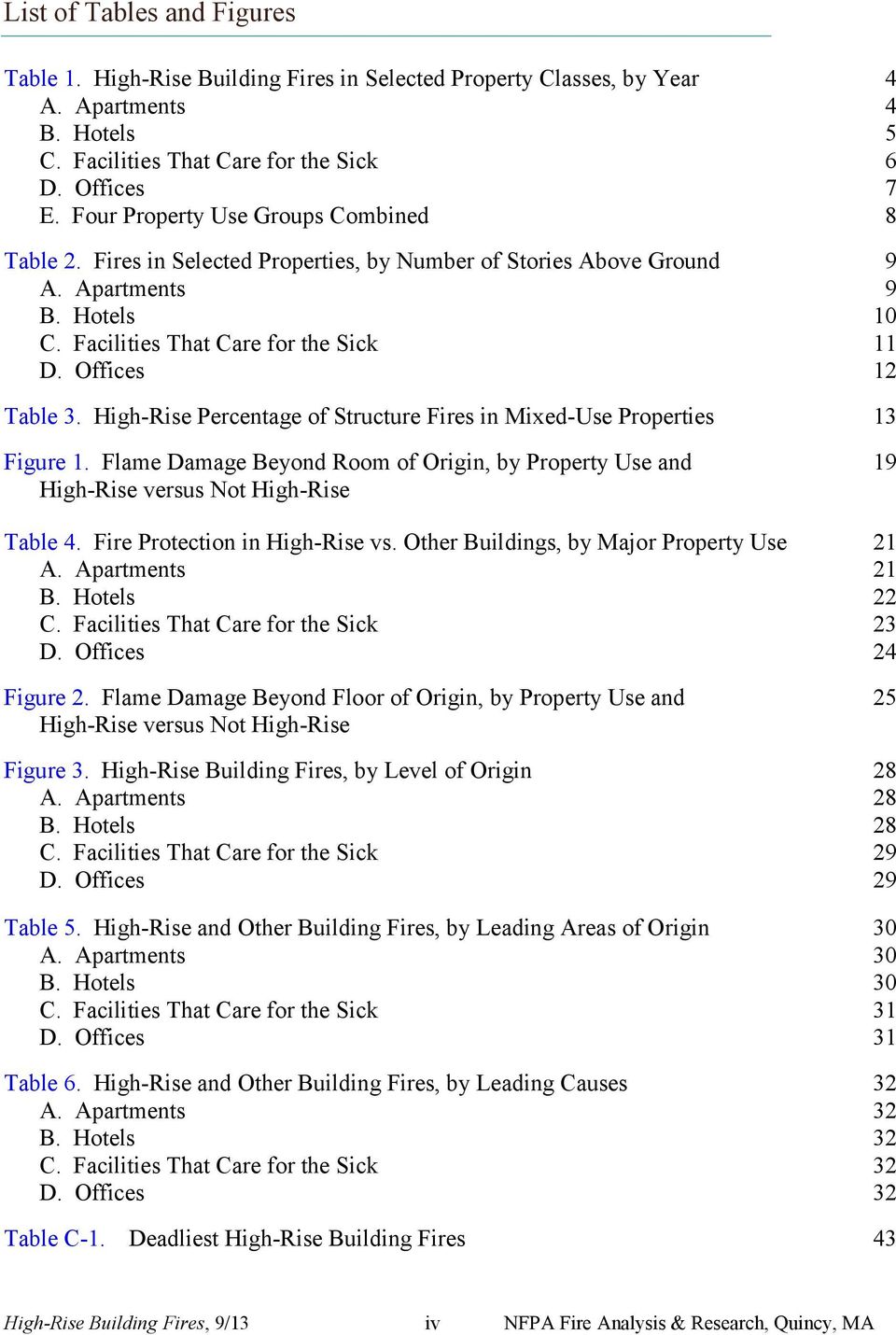
7 List of Tables and Figures Table 1. High-Rise Building Fires in Selected Property Classes, by Year 4 A. Apartments 4 B. Hotels 5 C. Facilities That Care for the Sick 6 D. Offices 7 E. Four Property Use Groups Combined 8 Table 2. Fires in Selected Properties, by Number of Stories Above Ground 9 A. Apartments 9 B. Hotels 10 C. Facilities That Care for the Sick 11 D. Offices 12 Table 3. High-Rise Percentage of Structure Fires in Mixed-Use Properties 13 Figure 1. Flame Damage Beyond Room of Origin, by Property Use and 19 High-Rise versus Not High-Rise Table 4. Fire Protection in High-Rise vs. Other Buildings, by Major Property Use 21 A. Apartments 21 B. Hotels 22 C. Facilities That Care for the Sick 23 D. Offices 24 Figure 2. Flame Damage Beyond Floor of Origin, by Property Use and 25 High-Rise versus Not High-Rise Figure 3. High-Rise Building Fires, by Level of Origin 28 A. Apartments 28 B. Hotels 28 C. Facilities That Care for the Sick 29 D. Offices 29 Table 5. High-Rise and Other Building Fires, by Leading Areas of Origin 30 A. Apartments 30 B. Hotels 30 C. Facilities That Care for the Sick 31 D. Offices 31 Table 6. High-Rise and Other Building Fires, by Leading Causes 32 A. Apartments 32 B. Hotels 32 C. Facilities That Care for the Sick 32 D. Offices 32 Table C-1. Deadliest High-Rise Building Fires 43 High-Rise Building Fires, 9/13 iv NFPA Fire Analysis & Research, Quincy, MA
8 National Fire Protection Association Fire Analysis & Research U.S. High-Rise Building Fires Fact Sheet In , U.S. fire departments responded to an average of 15,400 structure fires in high-rise buildings. 1 These fires caused an annual average of 46 civilian fire deaths 530 civilian fire injuries $219 million in direct property damage Four property use groups account for half of high-rise fires: Apartments (45% of all high-rise fires) Hotels (3% of high-rise fires) Facilities that care for the sick (1% of high-rise fires) Offices (2% of high-rise fires) The rest were mostly property uses found in mixed-use residential or office buildings (such as restaurants, stores, and parking garages) or probable miscodes of properties that cannot be high-rise (such as dwellings and sheds) By most measures, the risks of fire and of associated losses are lower in high-rise buildings than in other buildings of the same property use. A major reason why risks are lower is probably the much greater use of fire protection systems and features 2 in high-rise buildings as compared to shorter buildings. High-rise buildings have lower percentages of fires with flame damage beyond room of origin, providing further evidence of impact from fire protection systems and features : Apartments (6% of high-rise fires vs. 10% in shorter buildings) Hotels (6% of high-rise fires vs. 10% in shorter buildings) Facilities that care for the sick (5% of high-rise fires vs. 8% in shorter buildings) Offices (14% of high-rise fires vs. 21% in shorter buildings) Care of sick facilities Presence of Fire-Resistive Construction in Fires, Apartments Hotels Offices 6% 12% 10% 22% 33% 32% 50% 48% High rise Not high rise 0% 20% 40% 60% Care of sick facilities Presence of Wet-Pipe Sprinklers in Fires Excluding Partial Systems and Buildings Under Construction, Apartments Hotels Offices 17% 30% 47% High-rise Not high-rise 64% 50% 51% 65% 63% 0% 20% 40% 60% 80% 1 High rise is defined here as 7 stories above grade. This is roughly consistent with the Life Safety Code definition of high rise as 75 feet (23 meters) in height, measured from the lowest level of fire department vehicle access to the floor of the highest occupiable story. 2 Construction type of building involved in fire is not reported after High-Rise Building Fires, 9/13 v NFPA Fire Analysis and Research, Quincy, MA

9 What is a High-Rise? Paragraph of NFPA 101, Life Safety Code, 2012 edition, defines a high-rise building as a building more than 75 feet (23 meters) in height, measured from the lowest level of fire department vehicle access to the floor of the highest occupiable story. A height of 75 feet translates into roughly seven stories. The number of stories was first captured in U.S. national fire incident coding in Version 4.0 of the National Fire Incident Reporting System (NFIRS). This version was in widespread use by Version 5.0, introduced in 1999, provides separate coding for the total number of stories and the number of stories above and below ground. In keeping with the definition in NFPA 101, Life Safety Code, a height above ground of seven or more stories is used to define high-rise from 1999 on. Prior to 1999, the National Fire Incident Reporting System (NFIRS) coded building height in ranges, including four that may be considered high-rise: 7-12 stories, stories, stories, and 50 stories or more. NFPA and other analysts have long used lists of particularly memorable incidents to study the high-rise fire problem, but these and other available special data bases are heavily weighted toward larger and more severe incidents. They should be viewed as illustrative but not representative. The Council on Tall Buildings and Urban Habitat was created in 1969 in part to disseminate information on tall building technology. Visit their website at for more information on their resources. Also, for more information on high-rise fires and fire safety visit High-Rise Building Fires, 9/13 1 NFPA Fire Analysis & Research, Quincy, MA

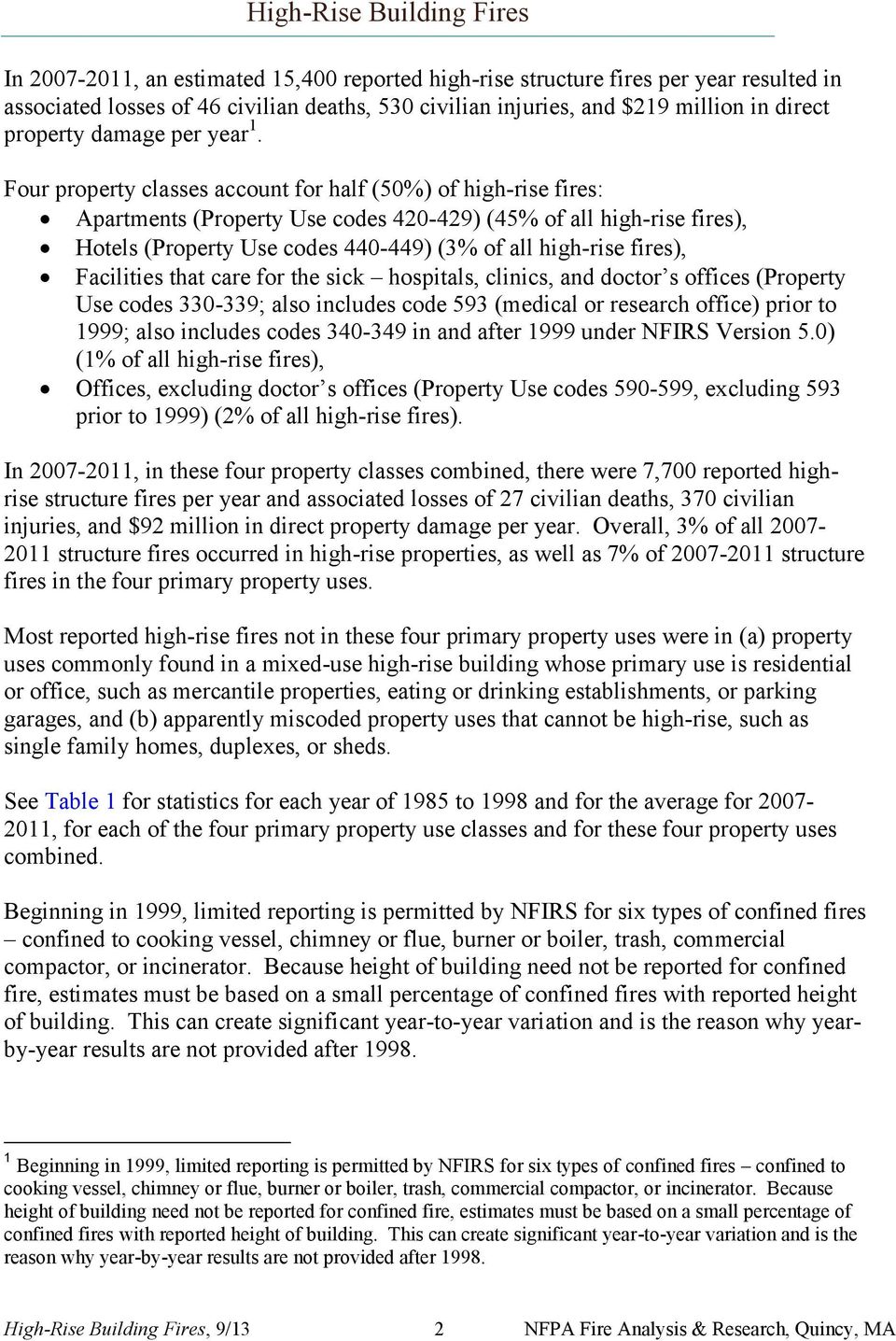
10 High-Rise Building Fires In , an estimated 15,400 reported high-rise structure fires per year resulted in associated losses of 46 civilian deaths, 530 civilian injuries, and $219 million in direct property damage per year 1. Four property classes account for half (50%) of high-rise fires: Apartments (Property Use codes ) (45% of all high-rise fires), Hotels (Property Use codes ) (3% of all high-rise fires), Facilities that care for the sick hospitals, clinics, and doctor s offices (Property Use codes ; also includes code 593 (medical or research office) prior to 1999; also includes codes in and after 1999 under NFIRS Version 5.0) (1% of all high-rise fires), Offices, excluding doctor s offices (Property Use codes , excluding 593 prior to 1999) (2% of all high-rise fires). In , in these four property classes combined, there were 7,700 reported highrise structure fires per year and associated losses of 27 civilian deaths, 370 civilian injuries, and $92 million in direct property damage per year. Overall, 3% of all structure fires occurred in high-rise properties, as well as 7% of structure fires in the four primary property uses. Most reported high-rise fires not in these four primary property uses were in (a) property uses commonly found in a mixed-use high-rise building whose primary use is residential or office, such as mercantile properties, eating or drinking establishments, or parking garages, and (b) apparently miscoded property uses that cannot be high-rise, such as single family homes, duplexes, or sheds. See Table 1 for statistics for each year of 1985 to 1998 and for the average for , for each of the four primary property use classes and for these four property uses combined. Beginning in 1999, limited reporting is permitted by NFIRS for six types of confined fires confined to cooking vessel, chimney or flue, burner or boiler, trash, commercial compactor, or incinerator. Because height of building need not be reported for confined fire, estimates must be based on a small percentage of confined fires with reported height of building. This can create significant year-to-year variation and is the reason why yearby-year results are not provided after Beginning in 1999, limited reporting is permitted by NFIRS for six types of confined fires confined to cooking vessel, chimney or flue, burner or boiler, trash, commercial compactor, or incinerator. Because height of building need not be reported for confined fire, estimates must be based on a small percentage of confined fires with reported height of building. This can create significant year-to-year variation and is the reason why year-by-year results are not provided after High-Rise Building Fires, 9/13 2 NFPA Fire Analysis & Research, Quincy, MA
11 This report emphasizes the four primary property classes. Some property uses such as grain elevators and factories can be as tall as a high-rise building but without a large number of separate floors or stories. For these reasons, the four property use groups listed above define most of the buildings we think of as high-rise buildings, and their fires come closest to defining what we think of as the high-rise building fire problem. The calculations for Table 1 were done so as to proportionally allocate fires with height of structure unreported, with the allocation done separately for the four property classes and the four measures of loss incidents, deaths, injuries, and property damage. Fires with number of stories above ground reported as zero nearly always also report stories below ground as unknown or zero. This suggests a zero value nearly always means unknown height, and so zeros are treated as unknowns. See Appendix A for more details on statistical methods. These statistics generally show a declining fire problem from 1985 to After 1998, fires and losses declined more rapidly for apartments, hotels, and facilities that care for the sick. For various technical reasons (discussed more in Appendix B) it is likely that the new numbers are more accurate than the old numbers in a direction that reduces the estimates which would mean the more rapid decline may not be real. It is worth noting, in Table 1, that most high-rise building fires and associated losses occur in apartment buildings. This may seem surprising, but it shouldn't. Homes dominate the U.S. fire problem so completely that it is always a good bet that any newly examined fire problem, unless it is one that cannot occur in homes, will have its largest share in homes. Table 2 provides more detail, indicating structure fires by number of stories, for each of the four property classes. Table 3 shows how the percentage of structure fires that are in high-rise buildings varies for a range of mixed-use properties, from a high of 8% in medical use properties to a low of 0% in military use properties. High-Rise Building Fires, 9/13 3 NFPA Fire Analysis & Research, Quincy, MA

12 Table 1. High-Rise Building Fires in Selected Property Classes, by Year A. Apartments Year Fire Civilian Deaths Direct Property Damage (in Millions) What Percentage of All Fires Civilian Injuries As Reported 2011 Dollars Were High-Rise? , $15 $32 10% , $21 $44 9% , $22 $43 8% , $48 $91 9% , $30 $55 10% , $22 $39 9% , $129* $212* 9% , $19 $31 9% , $41 $63 9% , $36 $55 9% , $31 $45 8% , $33 $48 10% , $30 $42 10% , $23 $31 9% , $39 $40 7% average *Property damage figures for apartments in 1991 are inflated by problems in handling the Oakland wildfire in the estimates. Note: Analysis of fires is done separately for fires reported as confined fires confined to fuel burner or boiler, cooking vessel, chimney or flue, trash, incinerator, or commercial compactor. These are fires reported to U.S. municipal fire departments and so exclude fires reported only to Federal or state agencies or industrial fire brigades. Estimates include proportional share of fires with unknown building height (until 1998) or number of stories above ground coded as unknown, blank or zero (from 1999 on). Fires are rounded to the nearest hundred, civilian deaths to the nearest one, civilian injuries are rounded to the nearest ten, and direct property damage to the nearest million dollars. Property damage has been adjusted for inflation, using the Consumer Price Index, to 2011 dollars. Estimates of deaths, injuries, or property damage can be significantly affected by the inclusion or exclusion of one unusually serious fire. Source: NFIRS and NFPA survey. High-Rise Building Fires, 9/13 4 NFPA Fire Analysis & Research, Quincy, MA

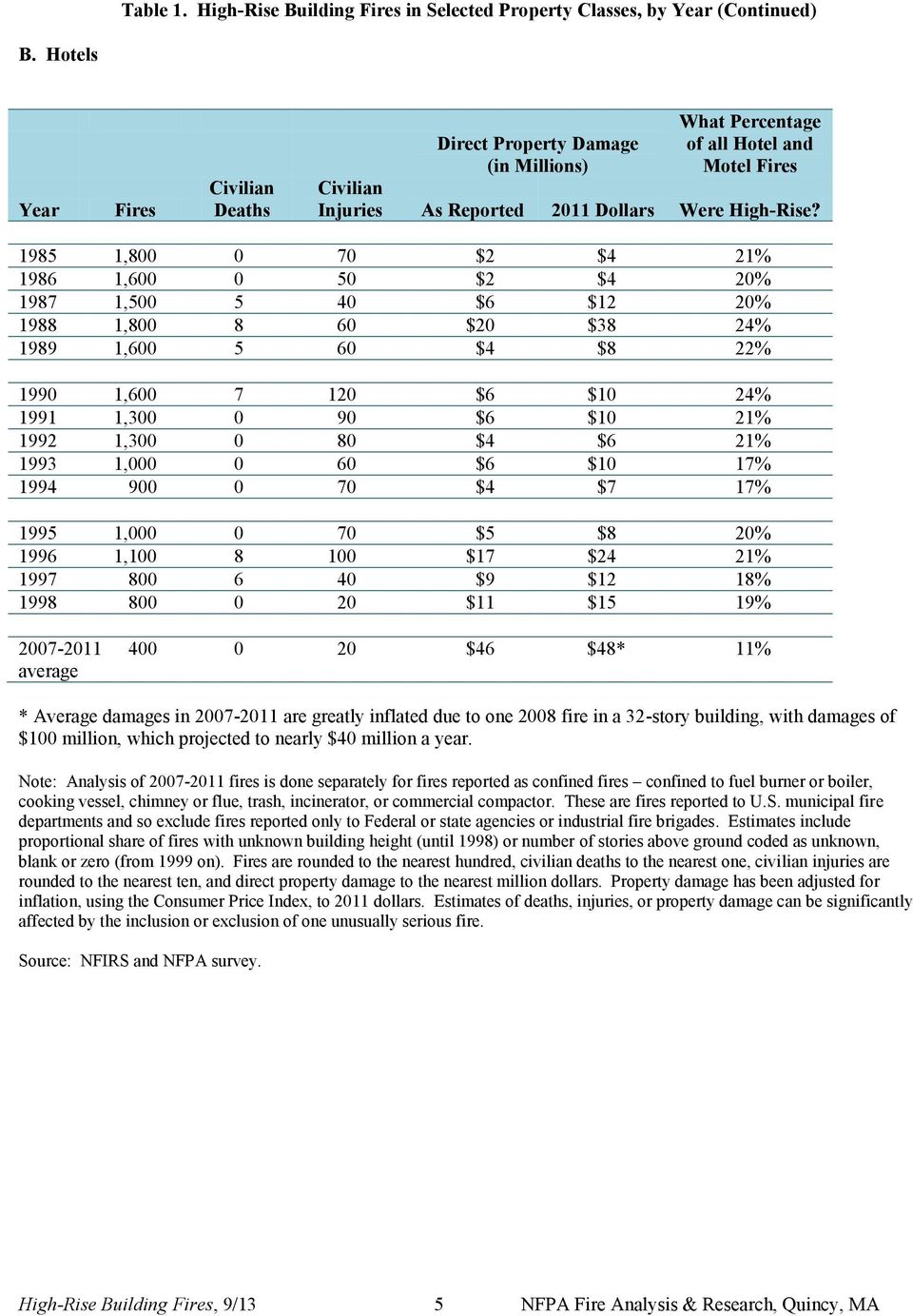
13 Table 1. High-Rise Building Fires in Selected Property Classes, by Year (Continued) B. Hotels Year Fires Civilian Deaths Direct Property Damage (in Millions) What Percentage of all Hotel and Motel Fires Civilian Injuries As Reported 2011 Dollars Were High-Rise? , $2 $4 21% , $2 $4 20% , $6 $12 20% , $20 $38 24% , $4 $8 22% , $6 $10 24% , $6 $10 21% , $4 $6 21% , $6 $10 17% $4 $7 17% , $5 $8 20% , $17 $24 21% $9 $12 18% $11 $15 19% $46 $48* 11% average * Average damages in are greatly inflated due to one 2008 fire in a 32-story building, with damages of $100 million, which projected to nearly $40 million a year. Note: Analysis of fires is done separately for fires reported as confined fires confined to fuel burner or boiler, cooking vessel, chimney or flue, trash, incinerator, or commercial compactor. These are fires reported to U.S. municipal fire departments and so exclude fires reported only to Federal or state agencies or industrial fire brigades. Estimates include proportional share of fires with unknown building height (until 1998) or number of stories above ground coded as unknown, blank or zero (from 1999 on). Fires are rounded to the nearest hundred, civilian deaths to the nearest one, civilian injuries are rounded to the nearest ten, and direct property damage to the nearest million dollars. Property damage has been adjusted for inflation, using the Consumer Price Index, to 2011 dollars. Estimates of deaths, injuries, or property damage can be significantly affected by the inclusion or exclusion of one unusually serious fire. Source: NFIRS and NFPA survey. High-Rise Building Fires, 9/13 5 NFPA Fire Analysis & Research, Quincy, MA
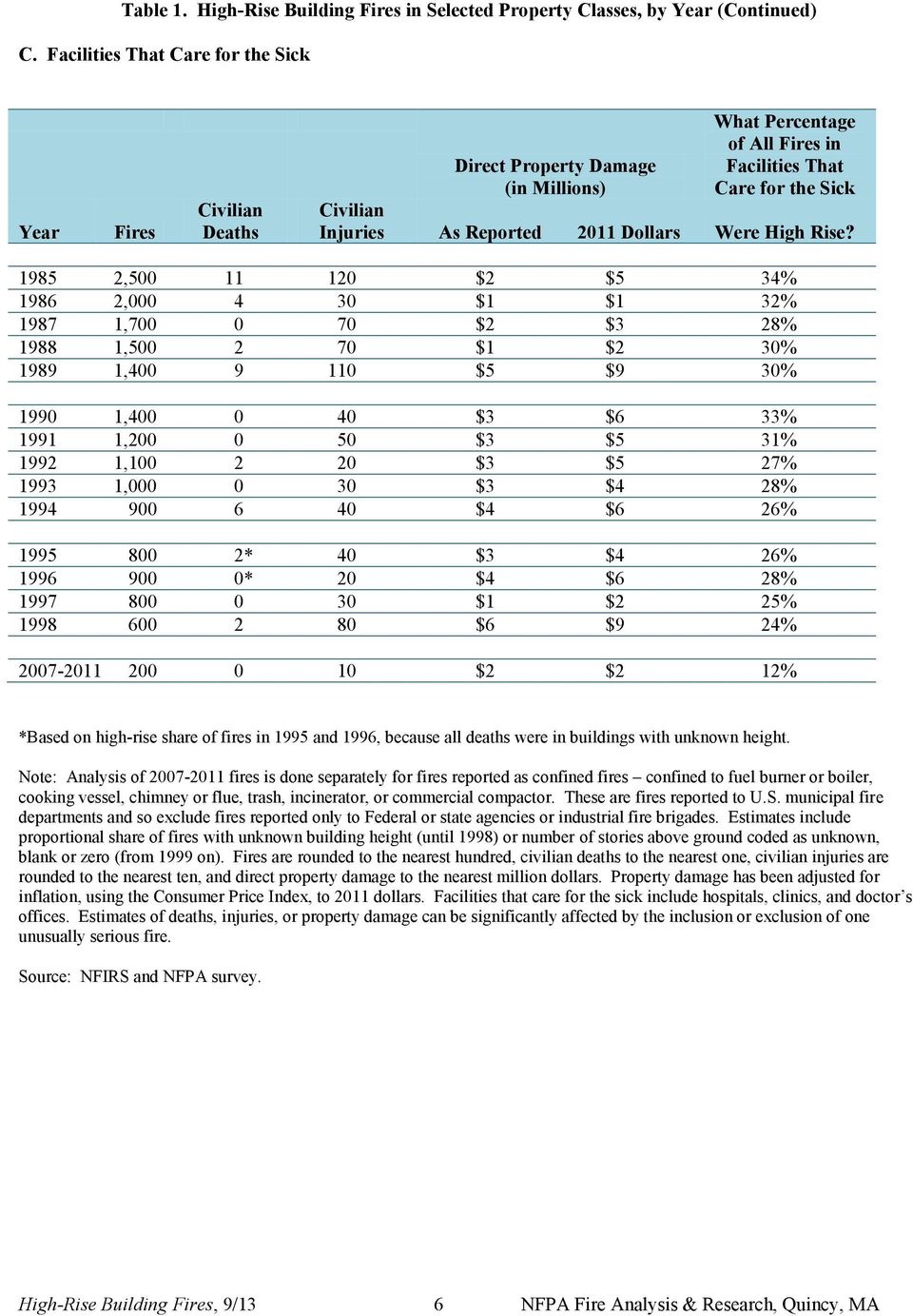
14 Table 1. High-Rise Building Fires in Selected Property Classes, by Year (Continued) C. Facilities That Care for the Sick Year Fires Civilian Deaths Direct Property Damage (in Millions) What Percentage of All Fires in Facilities That Care for the Sick Civilian Injuries As Reported 2011 Dollars Were High Rise? , $2 $5 34% , $1 $1 32% , $2 $3 28% , $1 $2 30% , $5 $9 30% , $3 $6 33% , $3 $5 31% , $3 $5 27% , $3 $4 28% $4 $6 26% * 40 $3 $4 26% * 20 $4 $6 28% $1 $2 25% $6 $9 24% $2 $2 12% *Based on high-rise share of fires in 1995 and 1996, because all deaths were in buildings with unknown height. Note: Analysis of fires is done separately for fires reported as confined fires confined to fuel burner or boiler, cooking vessel, chimney or flue, trash, incinerator, or commercial compactor. These are fires reported to U.S. municipal fire departments and so exclude fires reported only to Federal or state agencies or industrial fire brigades. Estimates include proportional share of fires with unknown building height (until 1998) or number of stories above ground coded as unknown, blank or zero (from 1999 on). Fires are rounded to the nearest hundred, civilian deaths to the nearest one, civilian injuries are rounded to the nearest ten, and direct property damage to the nearest million dollars. Property damage has been adjusted for inflation, using the Consumer Price Index, to 2011 dollars. Facilities that care for the sick include hospitals, clinics, and doctor s offices. Estimates of deaths, injuries, or property damage can be significantly affected by the inclusion or exclusion of one unusually serious fire. Source: NFIRS and NFPA survey. High-Rise Building Fires, 9/13 6 NFPA Fire Analysis & Research, Quincy, MA
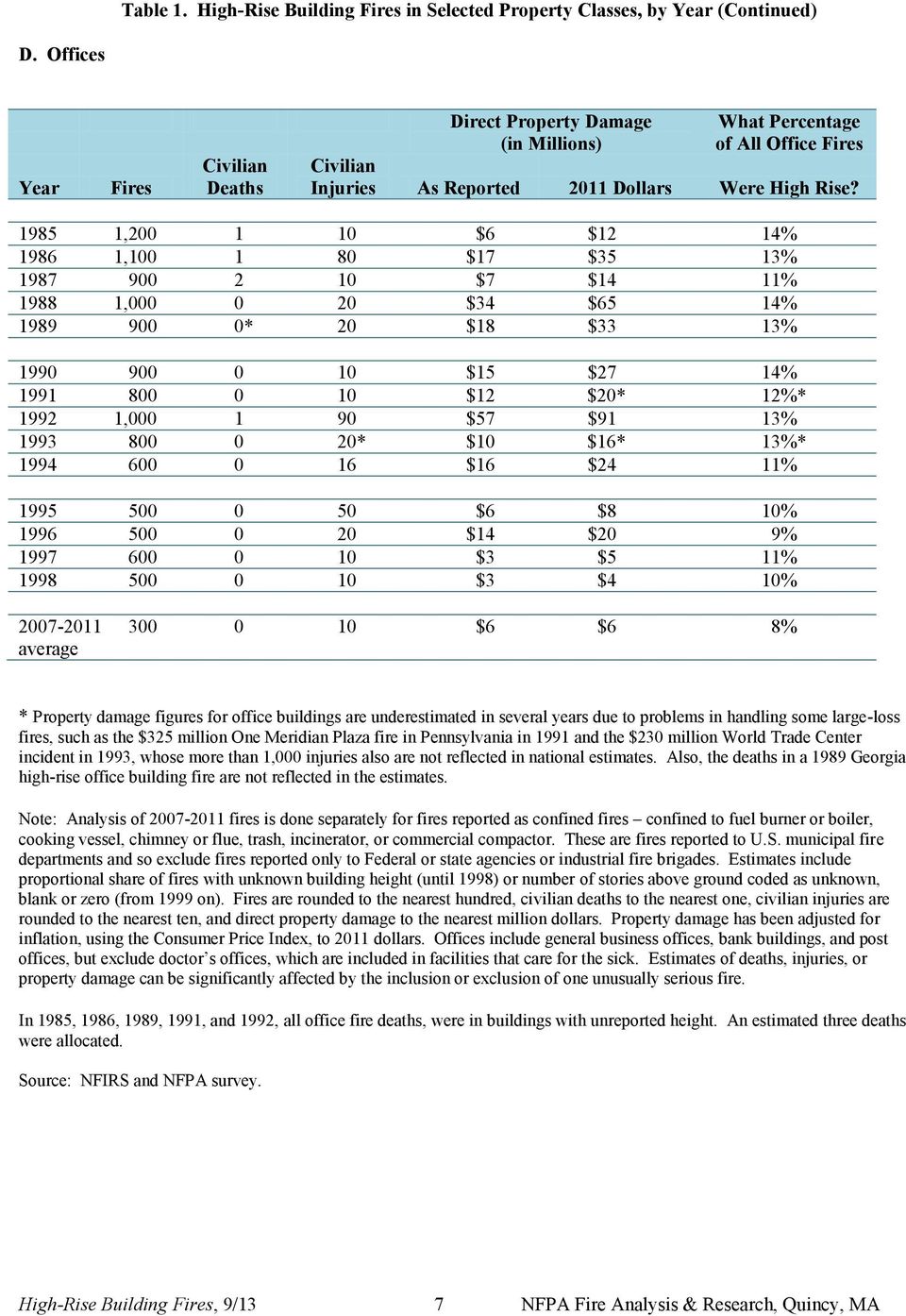
15 Table 1. High-Rise Building Fires in Selected Property Classes, by Year (Continued) D. Offices Year Fires Civilian Deaths Direct Property Damage (in Millions) What Percentage of All Office Fires Civilian Injuries As Reported 2011 Dollars Were High Rise? , $6 $12 14% , $17 $35 13% $7 $14 11% , $34 $65 14% * 20 $18 $33 13% $15 $27 14% $12 $20* 12%* , $57 $91 13% * $10 $16* 13%* $16 $24 11% $6 $8 10% $14 $20 9% $3 $5 11% $3 $4 10% $6 $6 8% average * Property damage figures for office buildings are underestimated in several years due to problems in handling some large-loss fires, such as the $325 million One Meridian Plaza fire in Pennsylvania in 1991 and the $230 million World Trade Center incident in 1993, whose more than 1,000 injuries also are not reflected in national estimates. Also, the deaths in a 1989 Georgia high-rise office building fire are not reflected in the estimates. Note: Analysis of fires is done separately for fires reported as confined fires confined to fuel burner or boiler, cooking vessel, chimney or flue, trash, incinerator, or commercial compactor. These are fires reported to U.S. municipal fire departments and so exclude fires reported only to Federal or state agencies or industrial fire brigades. Estimates include proportional share of fires with unknown building height (until 1998) or number of stories above ground coded as unknown, blank or zero (from 1999 on). Fires are rounded to the nearest hundred, civilian deaths to the nearest one, civilian injuries are rounded to the nearest ten, and direct property damage to the nearest million dollars. Property damage has been adjusted for inflation, using the Consumer Price Index, to 2011 dollars. Offices include general business offices, bank buildings, and post offices, but exclude doctor s offices, which are included in facilities that care for the sick. Estimates of deaths, injuries, or property damage can be significantly affected by the inclusion or exclusion of one unusually serious fire. In 1985, 1986, 1989, 1991, and 1992, all office fire deaths, were in buildings with unreported height. An estimated three deaths were allocated. Source: NFIRS and NFPA survey. High-Rise Building Fires, 9/13 7 NFPA Fire Analysis & Research, Quincy, MA
16 Table 1. High-Rise Building Fires in Selected Property Classes, by Year (Continued) E. Four Property Use Groups Combined Year Fires Civilian Deaths Direct Property Damage (in Millions) Civilian Injuries As Reported 2011 Dollars , $25 $ , $41 $ , $36 $ , $104 $ , $58 $ , $47 $ , $150* $248* , $83 $ , * $60* $93* , $60 $ , $44 $ , $69 $ , $43 $ , $42 $ , $92* $96* average * Average damages in are greatly inflated due to one 2008 fire in a 32-story hotel, with damages of $100 million, which projected to nearly $40 million per year. Property damage figures for apartments in 1991 are inflated by problems in handling the Oakland wildfire in the estimates. Property damage figures for office buildings are underestimated in several years due to problems in handling some large-loss fires, such as the $325 million One Meridian Plaza fire in Pennsylvania in 1991 and the $230 million World Trade Center incident in 1993, whose more than 1,000 injuries also are not properly reflected in national estimates. Note: Analysis of fires is done separately for fires reported as confined fires confined to fuel burner or boiler, cooking vessel, chimney or flue, trash, incinerator, or commercial compactor. These are fires reported to U.S. municipal fire departments and so exclude fires reported only to Federal or state agencies or industrial fire brigades. Estimates include proportional share of fires with unknown building height (until 1998) or number of stories above ground coded as unknown, blank or zero (from 1999 on). Fires are rounded to the nearest hundred, civilian deaths to the nearest one, civilian injuries are rounded to the nearest ten, and direct property damage to the nearest million dollars. Property damage has been adjusted for inflation, using the Consumer Price Index, to 2011 dollars. Estimates of deaths, injuries, or property damage can be significantly affected by the inclusion or exclusion of one unusually serious fire. Source: NFIRS and NFPA survey. High-Rise Building Fires, 9/13 8 NFPA Fire Analysis & Research, Quincy, MA

17 A. Apartments Table 2. Fires in Selected Properties, by Number of Stories Above Ground Annual Average of Structure Fires Reported to U.S. Fire Departments Fires Civilian Deaths Civilian Injuries Direct Property Damage (in Millions) 1 story 17,650 (17%) 65 (16%) 471 (11%) $130 (10%) 2 stories 43,400 (42%) 201 (49%) 1,866 (44%) $613 (49%) 3 stories 26,090 (25%) 79 (19%) 1,110 (26%) $359 (29%) 4 stories 5,660 (5%) 16 (4%) 235 (5%) $80 (6%) 5 stories 2,290 (2%) 13 (3%) 98 (2%) $19 (2%) 6 stories 1,960 (2%) 8 (2%) 144 (3%) $9 (1%) Total not high-rise (1-6 stories) 97,040 (93%) 409 (93%) 3,915 (92%) $1,248 (97%) 7 stories 1,250 (1%) 7 (2%) 48 (1%) $5 (0%) 8 stories 940 (1%) 1 (0%) 30 (1%) $2 (0%) 9 stories 630 (1%) 2 (0%) 19 (0%) $2 (0%) 10 stories 1,270 (1%) 3 (1%) 35 (1%) $2 (0%) 11 stories 570 (1%) 1 (0%) 21 (0%) $1 (0%) 12 stories 840 (1%) 2 (1%) 23 (1%) $2 (0%) 13 or more stories 1,350 (1%) 11 (3%) 160 (4%) $24 (2%) Total high-rise (7 or more stories) 6,850 (7%) 27 (7%)336 (8%) $39 (3%) Note: These are fires reported to U.S. municipal fire departments and so exclude fires reported only to Federal or state agencies or industrial fire brigades. Estimates include proportional shares of fire with number of stories above ground coded as unknown, blank or zero. Fires are rounded to the nearest ten, civilian deaths and injuries to the nearest one, and direct property damage to the nearest million dollars without adjustment for inflation. Estimates of deaths, injuries, or property damage can be significantly affected by the inclusion or exclusion of one unusually serious fire. Source: NFIRS and NFPA survey. High-Rise Building Fires, 9/13 9 NFPA Fire Analysis & Research, Quincy, MA

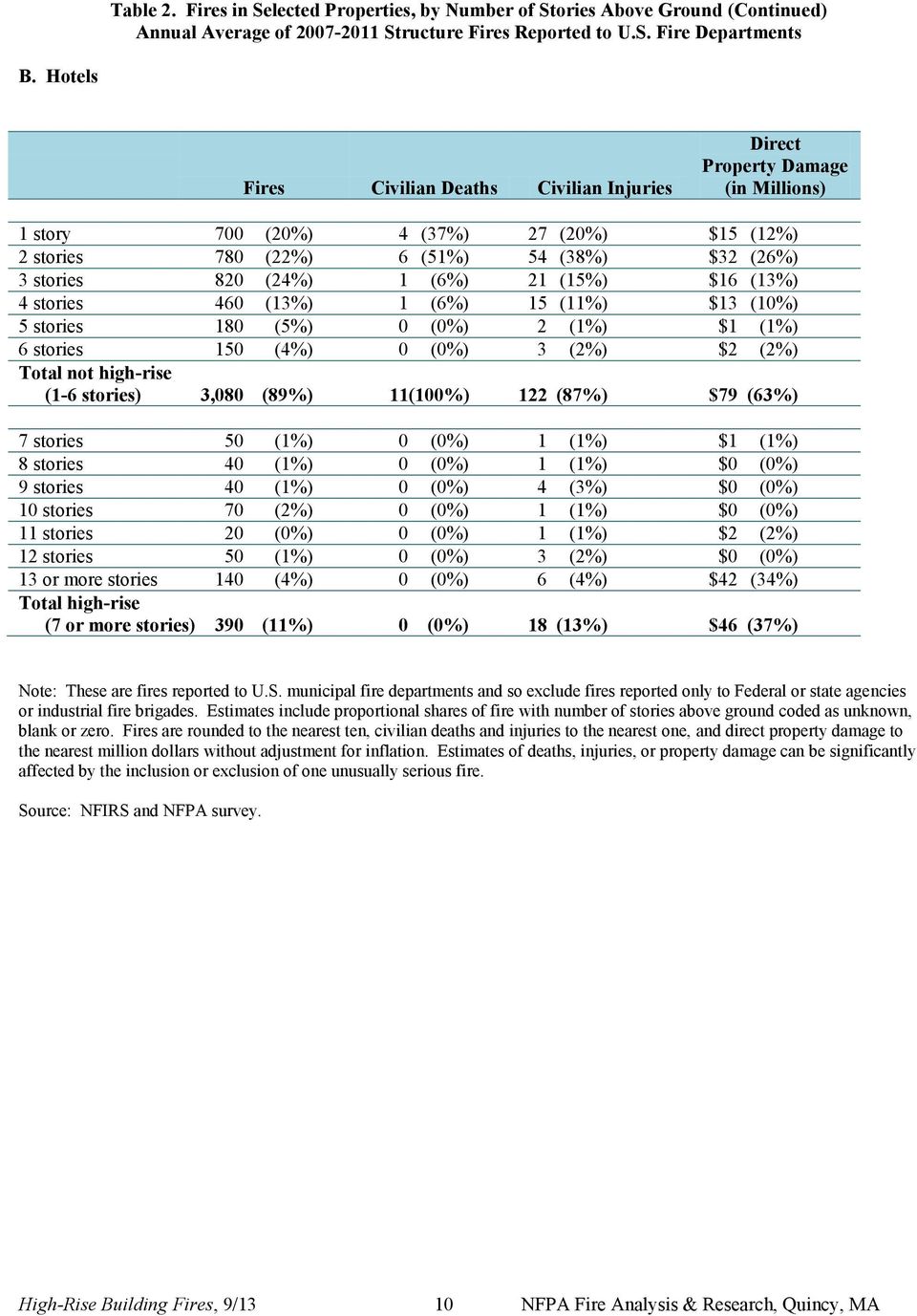
18 Table 2. Fires in Selected Properties, by Number of Stories Above Ground (Continued) Annual Average of Structure Fires Reported to U.S. Fire Departments B. Hotels Fires Civilian Deaths Civilian Injuries Direct Property Damage (in Millions) 1 story 700 (20%) 4 (37%) 27 (20%) $15 (12%) 2 stories 780 (22%) 6 (51%) 54 (38%) $32 (26%) 3 stories 820 (24%) 1 (6%) 21 (15%) $16 (13%) 4 stories 460 (13%) 1 (6%) 15 (11%) $13 (10%) 5 stories 180 (5%) 0 (0%) 2 (1%) $1 (1%) 6 stories 150 (4%) 0 (0%) 3 (2%) $2 (2%) Total not high-rise (1-6 stories) 3,080 (89%) 11(100%) 122 (87%) $79 (63%) 7 stories 50 (1%) 0 (0%) 1 (1%) $1 (1%) 8 stories 40 (1%) 0 (0%) 1 (1%) $0 (0%) 9 stories 40 (1%) 0 (0%) 4 (3%) $0 (0%) 10 stories 70 (2%) 0 (0%) 1 (1%) $0 (0%) 11 stories 20 (0%) 0 (0%) 1 (1%) $2 (2%) 12 stories 50 (1%) 0 (0%) 3 (2%) $0 (0%) 13 or more stories 140 (4%) 0 (0%) 6 (4%) $42 (34%) Total high-rise (7 or more stories) 390 (11%) 0 (0%) 18 (13%) $46 (37%) Note: These are fires reported to U.S. municipal fire departments and so exclude fires reported only to Federal or state agencies or industrial fire brigades. Estimates include proportional shares of fire with number of stories above ground coded as unknown, blank or zero. Fires are rounded to the nearest ten, civilian deaths and injuries to the nearest one, and direct property damage to the nearest million dollars without adjustment for inflation. Estimates of deaths, injuries, or property damage can be significantly affected by the inclusion or exclusion of one unusually serious fire. Source: NFIRS and NFPA survey. High-Rise Building Fires, 9/13 10 NFPA Fire Analysis & Research, Quincy, MA
19 Table 2. Fires in Selected Properties, by Number of Stories Above Ground (Continued) Annual Average of Structure Fires Reported to U.S. Fire Departments C. Facilities That Care for the Sick Fires Civilian Deaths Civilian Injuries Direct Property Damage (in Millions) 1 story 710 (36%) 0 (0%) 5 (16%) $16 (45%) 2 stories 350 (18%) 0 (0%) 5 (18%) $8 (23%) 3 stories 210 (11%) 0 (0%) 5 (19%) $6 (17%) 4 stories 170 (9%) 0 (0%) 0 (1%) $2 (6%) 5 stories 140 (7%) 0 (100%) 3 (11%) $1 (3%) 6 stories 140 (7%) 0 (0%) 2 (7%) $0 (1%) Total not high-rise (1-6 stories) 1,730 (88%) 0(100%) 21 (72%) $32 (94%) 7 stories 60 (3%) 0 (0%) 1 (2%) $1 (3%) 8 stories 80 (4%) 0 (0%) 2 (8%) $0 (1%) 9 stories 30 (1%) 0 (0%) 4 (13%) $0 (0%) 10 stories 20 (1%) 0 (0%) 0 (0%) $0 (0%) 11 stories 10 (1%) 0 (0%) 0 (0%) $0 (0%) 12 stories 10 (0%) 0 (0%) 0 (0%) $0 (1%) 13 or more stories 20 (1%) 0 (0%) 2 (5%) $1 (1%) Total high-rise (7 or more stories) 230 (12%) 0 (0%) 8 (28%) $2 (6%) Note: These are fires reported to U.S. municipal fire departments and so exclude fires reported only to Federal or state agencies or industrial fire brigades. Estimates include proportional shares of fire with number of stories above ground coded as unknown, blank or zero. Fires are rounded to the nearest ten, civilian deaths and injuries to the nearest one, and direct property damage to the nearest million dollars without adjustment for inflation. Facilities that care for the sick include hospitals, clinics, and doctor s offices. Estimates of deaths, injuries, or property damage can be significantly affected by the inclusion or exclusion of one unusually serious fire. Source: NFIRS and NFPA survey. High-Rise Building Fires, 9/13 11 NFPA Fire Analysis & Research, Quincy, MA

20 Table 2. Fires in Selected Properties, by Number of Stories Above Ground (Continued) Annual Average of Structure Fires Reported to U.S. Fire Departments D. Offices Fires Civilian Deaths Civilian Injuries Direct Property Damage (in Millions) 1 story 1,580 (49%) 0 (5%) 16 (36%) $47 (42%) 2 stories 760 (24%) 1 (32%) 8 (18%) $35 (31%) 3 stories 330 (10%) 1 (25%) 10 (22%) $9 (8%) 4 stories 170 (5%) 0 (12%) 2 (4%) $5 (5%) 5 stories 80 (2%) 0 (0%) 0 (0%) $8 (7%) 6 stories 50 (2%) 1 (26%) 1 (3%) $2 (2%) Total not high-rise (1-6 stories) 2,970 (92%) 4 (100%) 37 (84%) $106 (95%) 7 stories 40 (1%) 0 (0%) 0 (0%) $0 (0%) 8 stories 20 (1%) 0 (0%) 0 (0%) $0 (0%) 9 stories 20 (1%) 0 (0%) 0 (0%) $0 (0%) 10 stories 20 (1%) 0 (0%) 0 (0%) $0 (0%) 11 stories 10 (0%) 0 (0%) 0 (0%) $0 (0%) 12 stories 40 (1%) 0 (0%) 1 (3%) $0 (0%) 13 or more stories 100 (3%) 0 (0%) 6 (13%) $5 (5%) Total high-rise (7 or more stories) 250 (8%) 0 (0%) 7 (16%) $6 (5%) Note: These are fires reported to U.S. municipal fire departments and so exclude fires reported only to Federal or state agencies or industrial fire brigades. Estimates include proportional shares of fire with number of stories above ground coded as unknown, blank or zero. Fires are rounded to the nearest ten, civilian deaths and injuries to the nearest one, and direct property damage to the nearest million dollars without adjustment for inflation. Offices include general business offices, bank buildings, and post offices, but exclude doctor s offices, which are included in facilities that care for the sick. Estimates of deaths, injuries, or property damage can be significantly affected by the inclusion or exclusion of one unusually serious fire. Source: NFIRS and NFPA survey. High-Rise Building Fires, 9/13 12 NFPA Fire Analysis & Research, Quincy, MA

21 Table 3. High-Rise Percentage of Structure Fires in Mixed-Use Properties Percentage of Structure Fires Reported to U.S. Fire Departments (Including Fires Reported as Confined Fires) Mixed Use Status Percentage of Fires in High-Rise Properties Medical use 8% Office use 7% Business and residential 7% Unclassified mixed-use status 5% Assembly use 5% Residential use 4% Industrial use 3% Educational use 3% Not mixed use 2% Row of stores (mercantile properties) 2% Enclosed mall 1% Farm use 1% Military use 0% Unknown mixed-use status 3% All structures 3% Note: Mixed use refers to buildings with more than one property use, such as a building with stores and restaurants on some floors, apartment units on other floors, and hotel rooms on still other floors. These are fires reported to U.S. municipal fire departments and so exclude fires reported only to Federal or state agencies or industrial fire brigades. Estimates include proportional shares of fire with number of stories above ground coded as unknown, blank or zero. Source: NFIRS and NFPA survey. High-Rise Building Fires, 9/13 13 NFPA Fire Analysis & Research, Quincy, MA
22 Is There More or Less Fire-Related Risk in a High-Rise Building? By most measures of loss, the risks of fire and of associated fire loss are lower in highrise buildings than in other buildings of the same property uses. For apartments, this statement applies to risk of fire, civilian fire deaths, civilian fire injuries, and direct property damage due to fire, relative to housing units. It also applies to risk of fire for hotels, offices, and facilities that care for the sick. Statistics on the U.S. building inventory by height of building are scarce and not ideally suited to calculations of relative fire risk, but some analysis is possible. The best data is on apartment buildings. Statistics are published on U.S. housing units in every odd-numbered year. In , an average of 9% of occupied year-round housing units in apartment buildings (defined as buildings with 3 or more housing units) were in high-rise buildings. 2 Risk can be calculated as fires (or fire loss) per million housing units (or per million buildings, per million occupants, or per billion square feet). Risk is therefore a ratio of a measure of fire loss to a measure of units of exposure, where exposure refers to people, space, or value exposed to potential harm if fire occurs. Suppose high-rise risk is expressed as follows: [loss in high-rise buildings]/[units of exposure of high-rise buildings] = [(high-rise % of loss) x (total loss)]/ [(high-rise % of exposure units) x (total exposure units)]. Non-high-rise risk would be defined comparably. Then a comparison measure for highrise vs. non-high-rise risk could be expressed as follows: [high-rise risk]/[non-high-rise risk] = [(high-rise % of loss)/(high-rise % of exposure units)]/ [(non-high-rise % of loss)/(non-high-rise % of exposure units)] = [(high-rise % of loss)/(high-rise % of exposure units)]/ [(100% - high-rise % of loss)/(100% - high-rise % of exposure units)]. Because both risk measures include total loss divided by total exposure in their formulas, you can cancel those terms and compare ratios of percentages only. And because the high-rise and non-high-rise percentages add to 100%, you need only the high-rise percentages of loss and exposure to make the comparison. 2 Analysis based on data from the 2007, 2009 and 2011 editions of the American Housing Survey and the American Community Survey, both published by the U.S. Census Bureau.. High-Rise Building Fires, 9/13 14 NFPA Fire Analysis & Research, Quincy, MA
23 Now suppose that for high-rise buildings the percentage of fire loss is less than the percentage of exposure. If the high-rise percentage of fire loss is less than the high-rise percentage of exposure, then the high-rise risk is lower than the non-high-rise risk. 3 In , 7% of apartment fires were in high-rise buildings. (See Table 2A.) Because 7% is lower than 9%, the risk of fire in a high-rise apartment building is lower than in an apartment building that is not a high-rise. Also in , high-rise buildings accounted for 7% of civilian deaths in apartment fires, 8% of civilian injuries in apartment fires, and 3% of direct property damage in apartment fires. (See Table 2A.) For all these loss measures, the risk is lower in a highrise apartment than in other apartments. For the other three property classes, other data must be used, and it is necessary to measure exposure by square feet rather than number of buildings or housing units. The U.S. Energy Information Administration published figures on floor space for properties with defined ranges of square feet of floor space. 4 (The latest available is from Data from the 2007 survey did not support valid estimates and was not published, and the first survey since 2007 began data collection only a few months ago.) Breakdowns are available by defined ranges of number of stories or by principal economic activity in the building, but not by both simultaneously. An estimate can be made of the percent of exposure (floor space) occurring in high-rise buildings for a particular property use by taking the sum over the various floor-space ranges of: (fraction of that property use s total floor space occurring in buildings with floor space in the defined range) times (combining all types of property uses, fraction of total floor space in buildings with a defined range of floor space occurring in high-rise buildings). Because the defined ranges of number of stories do not include a break at seven stories (the minimum for a high-rise), three estimates are useful. The lower bound is for buildings with ten or more stories, and the upper bound is for buildings with four or more stories. The middle estimate is based on assuming that buildings of various heights have comparable footprints, so that their total floor space is proportional to their number of stories. If that is true, then the 7-9 story share of floor space in buildings with 4-9 stories will be (7+8+9)/( ) or 62%. These crude formulas produce the following estimates for the high-rise share of exposure (floor space): For lodging properties, the estimate is 17-57%, with a middle estimate of 41%. (These numbers may be depressed by the inclusion of lodging properties other than hotels and motels. The former tend to be smaller.) For office buildings, the estimate is 25-46%, with a middle estimate of 38%. For health care properties, the estimate is 18-55%, with a middle estimate of 41%. 3 In that case the risk-related ratio will be less than one (e.g., if the high-rise percentage of fire loss were 7% and the high-rise percentage of exposure were 8%, a higher number, then 7%/8% is less than one). Moreover, the corresponding percentages for low-rise buildings will be 100% minus the high-rise percentages (because every building has to be high-rise or low-rise and cannot be both). The low-rise ratio will be greater than one if the high-rise ratio is less than one (e.g., 93%/92% is more than one). 4 See the 2003 Commercial Buildings Energy Consumption Survey, Energy Information Administration website, High-Rise Building Fires, 9/13 15 NFPA Fire Analysis & Research, Quincy, MA
24 These compare to high-rise shares of reported structure fires of 11% for hotels and motels, 8% for office buildings and 12% for facilities that care for the sick. (See Tables 2B to 2D.) The combination of all these statistics is sufficient to indicate that the high-rise share of fires is lower, indicating lower risk, than the high-rise share of square footage in use, for hotels, offices, and facilities that care for the sick. For direct property damage, the high-rise share was 37% for hotels, 6% for facilities that care for the sick, and 5% for offices. (See Tables 2B to 2D.) Except for hotels, these are all well below the corresponding ranges for high-rise share of square footage, indicating a clearly lower risk of property damage in high-rise buildings compared to other buildings, for offices and facilities that care for the sick. The hotel percentage is distorted by the effect of a single 2008 fire in a 32-story hotel with $100 million in loss. Without that fire, the high-rise percentage for property damage in hotels would be well under 10%. High-Rise Building Fires, 9/13 16 NFPA Fire Analysis & Research, Quincy, MA
25 Fire Protection in High-Rise Buildings NFPA 101, Life Safety Code has for decades had provisions for existing as well as new high-rise buildings. Where NFPA 101, Life Safety Code, is adopted into law or otherwise followed in practice, these required practices should be in place. In NFPA 101, Life Safety Code, 2012 edition, section 11.8 contains requirements potentially applicable to a high-rise building. The chapter for a particular occupancy determines whether all or some of the section 11.8 requirements are required for that occupancy and determines whether the requirements are for new or existing buildings. Among the section 11.8 requirements are an approved supervised automatic sprinkler system; a Class I standpipe system; a fire alarm system with an approved emergency voice/alarm communication system; two-way telephone service for fire department use; emergency lighting; standby power; and an emergency command center. Existing high-rise hotels must be protected throughout by an approved supervised automatic sprinkler system. Existing high-rise health care occupancies must be Type I (442 or 332) or Type II (222) construction (as must existing health care occupancies 4-6 stories in height). (See NFPA 220, Standard on Types of Building Construction, for more details on the different types of construction.) This corresponds to the fire resistive construction type category previously used in NFIRS as well as a subpart of the protected noncombustible category. A provision added to the code in 2009 and modified in the 2012 edition requires existing high-rise hospitals to be protected with automatic sprinklers within a nine-year period. Since 2006, the code has required all nursing homes, regardless of height, to be protected with automatic sprinklers. The defined construction types can be briefly summarized by these major characteristics: Fire resistive Concrete or fire-resistant-covered steel construction rated for 2 hours; Heavy timber Construction where any exposed wood load-bearing members has no dimension less than 2 inches; Protected non-combustible Concrete or fire-resistant-covered steel construction rated for 1 hours; Unprotected non-combustible Exposed steel construction without fire-resistant covering; Protected ordinary Masonry load-bearing walls with columns, wood floors, and roof decks all protected by fire-resistive coating rated for 1 hour; Unprotected ordinary Masonry load-bearing walls with exposed columns, wood floors, and roof decks without fire-resistive coating; Protected wood frame Wood frame construction with wall and ceiling surfaces protected by fire-resistive covering, such as gypsum board; and Unprotected wood frame Wood frame construction without fire-resistive covering. High-Rise Building Fires, 9/13 17 NFPA Fire Analysis & Research, Quincy, MA
26 Existing high-rise apartment buildings are required to have an approved supervised automatic sprinkler system, installed throughout, with two exceptions. One is if every living unit has exterior exit access in accordance with section 7.5.3; the other is if the building has an "approved, engineered life safety system" in accordance with section The latter exception for an engineered life safety system, (see section (2)) is also the only exception to the requirement for a complete, approved, supervised automatic sprinkler system in existing high-rise office buildings. NFPA 1, Fire Code, requires sprinkler retrofitting in all high-rise buildings. Changes in fire incident coding, effective in 1999, have affected the comparability of statistics from before and after this year. Since 1999, NFIRS (the national fire incident data base) has included an option to report fires as confined fires, in which case very little detail is required. This change encourages the reporting of very small fires, but introduces a high degree of uncertainty in the analysis of detailed characteristics of those fires. Table 4 provides statistics on percentage of fires with fire protection present for three types of fire protection for three groups of years ( , , and ): Automatic extinguishing equipment. In , partial systems and equipment other than wet-pipe sprinklers can be identified and have been excluded. This refinement of the statistics is partly to mostly responsible for the drops in fires reported with equipment present. Fire detection equipment. Fire resistive construction. Type of construction is no longer collected and is not available for Some conclusions can be seen in Table 4. The usage of wet pipe sprinklers is much greater in high-rise buildings than in other buildings, for each property use group. This is less true for facilities that care for the sick, where the usage of automatic extinguishing equipment has always been greater for buildings that are or are not high-rise. For hotels, the gap has become smaller, in part because of much greater reported sprinkler usage in low-rise buildings. The usage of fire detection equipment is greater in high-rise buildings than in other buildings, for each property use group, although usage is so high in apartment buildings, hotels, and facilities that care for the sick, regardless of height, that the gaps for those property use groups are all small. For fire-resistive construction, the trend had been toward a smaller share of fires being reported each year as occurring in buildings with fire-resistive construction, both for high-rise and other buildings, with the decline being most dramatic in facilities that care for the sick. This statistical decline could reflect any or all of the following: (a) a shift in construction between the two types permitted by 5 Height of building was first recorded in 1985, but participation in reporting on this new data element was low until These year groupings are roughly 10 years apart. High-Rise Building Fires, 9/13 18 NFPA Fire Analysis & Research, Quincy, MA
27 codes, from Type I (442 or 332) construction, which is coded as fire-resistive, to Type II (222) construction, which is coded as protected non-combustible; (b) a shift to acceptable alternative designs using more sprinklers and less fire-resistive construction; or (c) enough success in containing fires that a rising fraction never are reported to fire departments, because the fires are caught and controlled so early by occupants. The greater usage of fire protection systems and features is the most likely explanation of the lower statistical risk of property damage in high-rise buildings compared to other buildings, as noted in the previous section. The greater usage of fire protection systems and features also is the most likely explanation of the lower statistical risk of fire death in high-rise apartments compared to other apartments, as noted in the previous section. In the other property uses, there are not enough deaths per year for a stable analysis of differences between high-rise and other buildings. The value of these fire protection systems and features can also be seen in the differences in final extent of flame damage. See Figure 1. Figure 1. Flame Damage Beyond Room of Origin, by Property Use and High-Rise versus Not High-Rise Percentage of Structure Fires Reported to U.S. Fire Departments Apartments Hotels and motels 6% 6% 10% 10% High-Rise Not High Rise Care of sick 5% 8% Offices 14% 21% Note: These are fires reported to U.S. municipal fire departments and so exclude fires reported only to Federal or state agencies or industrial fire brigades. High-rise means seven or more stories in height. Source: NFIRS and NFPA survey. 0% 10% 20% 30% Buildings under construction or major renovation may not have all fire protection features and systems in place and operational. NFPA has records of at least one large loss that started in a high-rise building under construction and then spread on many floors to an adjacent occupied high-rise building. For this reason, it may be useful to know how often high-rise building fires involve properties under construction or major renovation. High-Rise Building Fires, 9/13 19 NFPA Fire Analysis & Research, Quincy, MA
28 In , buildings under construction or major renovation accounted for: 1% of fires in high-rise apartments (compared to 1% of fires in apartments that were not high-rise); 3% of fires in high-rise hotels (compared to 2% of fires in hotels that were not high-rise); and 2% of fires in high-rise facilities that care for the sick (compared to 4% of fires in such facilities that were not high-rise); 3% of fires in high-rise offices (compared to 3% of fires in offices that were not high-rise). High-Rise Building Fires, 9/13 20 NFPA Fire Analysis & Research, Quincy, MA
29 Table 4. Fire Protection in High-Rise vs. Other Buildings, by Major Property Use A. Apartments 1. Automatic Extinguishing Equipment Year of Fire High-Rise Buildings Buildings That Are Not High-Rise All Buildings : Equipment present 23% 3% 5% : Equipment present 32% 5% 7% : Wet-pipe sprinklers 47% 17% 19% present, excluding partial systems and buildings under construction 2. Fire Detection Equipment Year of Fire High-Rise Buildings Buildings That Are Not High-Rise All Buildings : Equipment present 69% 58% 59% : Equipment present 85% 76% 77% : Equipment present 90% 86% 86% 3. Fire Resistive Construction Year of Fire High-Rise Buildings Buildings That Are Not High-Rise All Buildings : Construction is fire resistive 57% 7% 12% :Construction is fire resistive 50% 6% 10% Note: These are fires reported to U.S. municipal fire departments and so exclude fires reported only to Federal or state agencies or industrial fire brigades. High-rise means seven or more stories in height. Prior to 1999, fires with unknown structure height are not allocated before calculating percentages, and statistics for all buildings are based only on structures of known height. These statistics may differ from statistics based on calculations that include structures of unknown height. Source: NFIRS and NFPA survey. High-Rise Building Fires, 9/13 21 NFPA Fire Analysis & Research, Quincy, MA
30 Table 4. Fire Protection in High-Rise vs. Other Buildings, by Major Property Use (Continued) B. Hotels 1. Automatic Extinguishing Equipment Year of Fire High-Rise Buildings Buildings That Are Not High-Rise All Buildings : Equipment present 62% 18% 28% : Equipment present 72% 26% 35% :Wet pipe sprinklers present, excluding partial systems and buildings under construction 64% 50% 52% 2. Fire Detection Equipment Year of Fire High-Rise Buildings Buildings That Are Not High-Rise All Buildings : Equipment present 84% 65% 69% : Equipment present 89% 76% 79% : Equipment present 92% 88% 88% 3. Fire Resistive Construction Year of Fire High-Rise Buildings Buildings That Are Not High-Rise All Buildings : Construction is fire resistive 57% 14% 23% : Construction is fire resistive 48% 12% 19% Note: These are fires reported to U.S. municipal fire departments and so exclude fires reported only to Federal or state agencies or industrial fire brigades. High-rise means seven or more stories in height. Prior to 1999, fires with unknown structure height are not allocated before calculating percentages, and statistics for all buildings are based only on structures of known height. These statistics may differ from statistics based on calculations that include structures of unknown height. Source: NFIRS and NFPA survey. High-Rise Building Fires, 9/13 22 NFPA Fire Analysis & Research, Quincy, MA
31 C. Facilities That Care for the Sick 1. Automatic Extinguishing Equipment Table 4. Fire Protection in High-Rise vs. Other Buildings, by Major Property Use (Continued) Year of Fire High-Rise Buildings Buildings That Are Not High-Rise All Buildings : Equipment present 62% 51% 54% : Equipment present 76% 57% 62% : Wet pipe sprinklers present, excluding partial systems and buildings under construction 65% 51% 54% 2. Fire Detection Equipment Year of Fire High-Rise Buildings Buildings That Are Not High-Rise All Buildings : Equipment present 89% 76% 80% : Equipment present 94% 82% 85% : Equipment present 91% 87% 87% 3. Fire Resistive Construction Year of Fire High-Rise Buildings Buildings That Are Not High-Rise All Buildings : Construction is fire resistive 39% 30% 33% : Construction is fire resistive 33% 22% 26% Note: These are fires reported to U.S. municipal fire departments and so exclude fires reported only to Federal or state agencies or industrial fire brigades. High-rise means seven or more stories in height. Prior to 1999, fires with unknown structure height are not allocated before calculating percentages, and statistics for all buildings are based only on structures of known height. These statistics may differ from statistics based on calculations that include structures of unknown height. Facilities that care for the sick include hospitals, clinics, and doctor s offices. Source: NFIRS and NFPA survey. High-Rise Building Fires, 9/13 23 NFPA Fire Analysis & Research, Quincy, MA
32 Table 4. Fire Protection in High-Rise vs. Other Buildings, by Major Property Use (Continued) D. Offices 1. Automatic Extinguishing Equipment Year of Fire High-Rise Buildings Buildings That Are Not High-Rise All Buildings : Equipment present 47% 17% 21% : Equipment present 61% 21% 25% : Wet pipe sprinklers present, excluding partial systems and buildings under construction 63% 30% 33% 2. Fire Detection Equipment Year of Fire High-Rise Buildings Buildings That Are Not High-Rise All Buildings : Equipment present 69% 33% 37% : Equipment present 79% 48% 51% : Equipment present 85% 67% 68% 3. Fire Resistive Construction Year of Fire High-Rise Buildings Buildings That Are Not High-Rise All Buildings : Construction is fire resistive 36% 14% 18% : Construction is fire resistive 32% 10% 13% Note: These are fires reported to U.S. municipal fire departments and so exclude fires reported only to Federal or state agencies or industrial fire brigades. High-rise means seven or more stories in height. Prior to 1999, fires with unknown structure height are not allocated before calculating percentages, and statistics for all buildings are based only on structures of known height. These statistics may differ from statistics based on calculations that include structures of unknown height. Offices include general business offices, bank buildings, and post offices, but exclude doctor s offices, which are included in facilities that care for the sick. Source: NFIRS and NFPA survey. High-Rise Building Fires, 9/13 24 NFPA Fire Analysis & Research, Quincy, MA
33 Other Patterns of High-Rise Building Fires Figure 2 shows that flame damage beyond the floor of origin is rare in high-rise buildings. These are the fires that are most likely to extend into the stairways, although many of these fires begin outside the building or in ducts, shafts, or concealed spaces, where spread to another floor can easily follow a path that does not involve or affect the stairway. Figure 2. Flame Damage Beyond Floor of Origin, by Property Use and High-Rise versus Not High-Rise Percentage of Structure Fires Reported to U.S. Fire Departments Apartments 3% 7% High-Rise Hotels 4% 7% Not High-Rise Care of sick 3% 6% Offices 10% 16% 0% 5% 10% 15% 20% When a high-rise fire fatally injures people who were not on the floor of origin when the fire began, there is usually some type of failure to maintain protection of stairways or elevators. Here are some examples: Elevator travels to fire-involved floor and opens. This problem has been largely eliminated by elevator redesign and prominent display of warnings against elevator use during a fire. An older example of a fire where five people died under these conditions is documented in Laurence D. Watrous, Fatal hotel fire: New Orleans, Fire Journal, January 1972, pp Door to exit stairs is blocked open and allows smoke or fire to enter. An example with multiple fatalities is documented in Mike Isner, Smoking fire kills four in New York high-rise, Fire Journal, September/October 1988, pp Substandard or other inadequate or non-compliant enclosure of stairs allows smoke into stairways. This problem is particularly well illustrated in Richard Best and David P. Demers, Fire at the MGM Grand, Fire Journal, January 1982, pp High-Rise Building Fires, 9/13 25 NFPA Fire Analysis & Research, Quincy, MA
34 To view a list of NFPA investigations of high-rise building fires, visit They provide case-study evidence of the potential hazard in high-rise buildings that do not provide adequate fire protection. Just because a fire occurs in a high-rise building, that does not mean the fire began at or above the 7 th floor. Figure 3 shows that most high-rise building fires begin on floors no higher than the 6 th story. The fraction of high-rise fires that began on the 7 th floor or higher was 37% for apartments, 28% for hotels and motels, 19% for facilities that care for the sick, and 36% for office buildings. These results are due in part to the fact that a large percentage of floors in high-rise buildings are located below the 7 th floor. For example, for a 7-story building (and ignoring floors below grade), only 1/7 of the floors are at or above the 7 th floor. Using Tables 2A to 2D, we can calculate that 37-46% of the floors in high-rise apartments are 7 th floor or higher (where the range reflects the fact that we do not show statistics for different building heights when the building is at least 13 stories tall). Similar statistics for other property uses are 34-35% for hotels and motels, 26-27% for facilities that care for the sick, and 34-35% for offices. For apartments, hotels, and facilities that care for the sick, the percentage of floors that are 7 th floor or higher in high-rise buildings with reported fires is as great as or greater than the percentage of those same fires starting on the 7 th floor or higher. In other words, the risk of a fire starting is as great as or greater on the lower floors. For offices, the fraction of floors in high-rise buildings with reported fires is slightly lower than the percentage of those same fires starting on the 7 th floor or higher. Therefore, the risk of a fire start is slightly higher in the upper floors for office buildings. One special concern with high-rise building fires could be fires originating in a means of egress. Means of egress include the following areas of origin: Hallway or corridor Interior stairway Exterior stairway Entrance way or lobby Escalator Unclassified means of egress Table 5 shows that high-rise apartments have a slightly larger share of their fires originating in means of egress than do their shorter counterparts (3% vs. 2%). The same is true of hotels (6% vs. 4%) but not of facilities that care for the sick (both 4%). In offices (3% vs. 6%), the differences are in the opposite direction; high-rise buildings in these properties have a smaller share of their fires originating in means of egress. In all four property classes, the differences are so small that one can say there is no evidence that high-rise buildings have a bigger problem than shorter buildings with fires starting in means of egress. High-Rise Building Fires, 9/13 26 NFPA Fire Analysis & Research, Quincy, MA
35 Table 6 shows differences between the cause profiles of high-rise and other buildings, by property use. Some differences could reflect differences in activity correlated with building height. For example, shorter hotels and motels might be less likely to have restaurants or room service and so more likely to have in-room cooking, either approved (in-room ranges and microwave ovens, which are found in some suite-type rooms) or unapproved (guests hot plates). Many shorter facilities that care for the sick are medical office buildings that are less likely to have patients checked in for overnight stays and so may have less cooking activity. Cooking equipment accounts for a larger share of fires in shorter hotels and motels, paralleling what may be differences in degree of cooking activity, but not in taller facilities that care for the sick. Another element in surviving a high-rise building fire is the ability of occupants to escape effectively. A 2007 survey study by NuStats for the Fire Protection Research Foundation found that levels of knowledge and preparedness related to escape readiness were quite different for residents of commercial high-rise buildings (presumably offices) compared to residential high-rise buildings (presumably apartments). 6 The following are two examples: Fire drills are much more common among residents of high-rise commercial buildings (83% had participated in a drill within the last year) than in residential buildings (19%). Flashlights are much more commonly in the possession of residents of high-rise residential buildings (76%) than in commercial buildings (30%). 6 Mia Zmud, Public Perceptions of High-Rise Building Safety and Emergency Evacuation Procedures Research Project Final Report, Fire Protection Research Foundation, July High-Rise Building Fires, 9/13 27 NFPA Fire Analysis & Research, Quincy, MA
36 Figure 3. High-Rise Building Fires, by Level of Fire Origin Percentage of Structure Fires Reported to U.S. Fire Departments A. Apartments Grade to 1st floor, 16% Below grade, 2% 7th or higher floor, 37% 2nd to 6th floor, 45% Grade to 1st floor, 36% B. Hotels Below grade, 7% 7th or higher floor, 26% Note: These are fires reported to U.S. municipal fire departments and so exclude fires reported only to Federal or state agencies or industrial fire brigades. High-rise means seven or more stories in height. Includes proportional share of fires with level of fire origin or height of building unknown. There are six types of confined fires confined to fuel burner or boiler, chimney or flue, cooking vessel, trash, incinerator or commercial compactor which are analyzed separately. Fires coded as confined do not require reporting of most details, including building height. Source: NFIRS and NFPA survey. 2nd to 6th floor, 30% High-Rise Building Fires, 9/13 28 NFPA Fire Analysis & Research, Quincy, MA
37 Figure 3. High-Rise Building Fires, by Level of Fire Origin (Continued) Percentage of Structure Fires Reported to U.S. Fire Departments C. Facilities That Care for the Sick Grade to 1st floor, 38% Below grade, 8% 7th or higher floor, 19% 2nd to 6th floor, 35% D. Offices Grade to 1st floor, 29% Below grade, 8% 7th or higher floor, 36% 2nd to 6th floor, 27% Note: These are fires reported to U.S. municipal fire departments and so exclude fires reported only to Federal or state agencies or industrial fire brigades. High-rise means seven or more stories in height. Includes proportional share of fires with level of fire origin or height of building unknown. There are six types of confined fires confined to fuel burner or boiler, chimney or flue, cooking vessel, trash, incinerator or commercial compactor which are analyzed separately. Fires coded as confined do not require reporting of most details, including building height. Source: NFIRS and NFPA survey. High-Rise Building Fires, 9/13 29 NFPA Fire Analysis & Research, Quincy, MA
38 A. Apartments Table 5. High-Rise and Other Building Fires, by Leading Areas of Origin Annual Average of Structure Fires Reported to U.S. Fire Departments High-Rise Non High-Rise Area of Origin Fires Area of Origin Fires Kitchen 4,980 (73%) Kitchen 67,810 (70%) Bedroom 330 (5%) Bedroom 4,790 (5%) Trash room or area 260 (4%) ALL MEANS OF EGRESS 2,370 (2%) ALL MEANS OF EGRESS 250 (4%) Exterior stairway 600 (1%) Hallway or corridor 80 (1%) Interior stairway 470 (0%) Interior stairway 70 (1%) Unclassified means of egress 440 (0%) Unclassified means of egress 40 (1%) Entrance way or lobby 430 (0%) Entrance way or lobby 30 (0%) Hallway or corridor 420 (0%) Exterior stairway 20 (0%) Escalator 10 (0%) Living room, family room or den 230 (3%) Living room, family room, or den 2,360 (2%) Exterior balcony or unenclosed 1,930 (2%) porch Laundry room 1,850 (2%) Bathroom 1,730 (2%) B. Hotels and Motels High-Rise Non High-Rise Area of Origin Fires Area of Origin Fires Kitchen 113 (29%) Kitchen 1,228 (40%) Bedroom (including guest room) 54 (14%) Bedroom (including guest room) 414 (13%) Laundry room or area 31 (8%) Laundry room or area 222 (7%) ALL MEANS OF EGRESS 22 (6%) Bathroom or cloak room 130 (4%) Entrance way or lobby 7 (2%) ALL MEANS OF EGRESS 126 (4%) Hallway or corridor 5 (1%) Hallway or corridor 38 (1%) Unclassified means of egress 4 (1%) Exterior stairway 33 (1%) Interior stairway 3 (1%) Entrance way or lobby 26 (1%) Exterior stairway 2 (0%) Unclassified means of egress 19 (1%) Bathroom or cloak room 18 (5%) Interior stairway 10 (0%) Trash room or area 14 (4%) High-Rise Building Fires, 9/13 30 NFPA Fire Analysis & Research, Quincy, MA
39 Table 5. High-Rise and Other Building Fires, by Leading Areas of Origin (Continued) Annual Average of Structure Fires Reported to U.S. Fire Departments C. Facilities That Care for the Sick High-Rise Non High-Rise Area of Origin Fires Area of Origin Percent of Fires Kitchen 93 (40%) Kitchen 639 (37%) Bathroom or locker room 11 (5%) Office 104 (6%) Bedroom (including patient room) 11 (5%) Bathroom or locker room 103 (6%) ALL MEANS OF EGRESS 9 (4%) ALL MEANS OF EGRESS 62 (4%) Unclassified means of egress 5 (2%) Hallway or corridor 20 (1%) Hallway 3 (1%) Entrance way or lobby 18 (1%) Unclassified function room 9 (4%) Exterior stairway 9 (1%) Laundry room or area 9 (4%) Interior stairway 8 (0%) Office 8 (4%) Unclassified means of egress 5 (0%) Unclassified service or equipment 8 (4%) Escalator 1 (0%) area Heating equipment room or area 58 (3%) Machinery room or area 8 (4%) Bedroom (including patient room) 52 (3%) Laundry room 49 (3%) Exterior roof surface 47 (3%) Unclassified area of origin 44 (3%) D. Offices High-Rise Non High-Rise Area of Origin Fires Area of Origin Percent of Fires Kitchen 58 (23%) Kitchen 682 (23%) Office 33 (13%) Office 424 (14%) Machinery room or area 21 (8%) ALL MEANS OF EGRESS 172 (6%) Unclassified service or equipment 13 (5%) Entrance way or lobby 68 (2%) area Hallway or corridor 29 (1%) ALL MEANS OF EGRESS 13 (5%) Unclassified means of egress 26 (1%) Entrance way or lobby 5 (2%) Interior stairway 24 (1%) Hallway or corridor 2 (1%) Exterior stairway 21 (1%) Unclassified means of egress 2 (1%) Escalator 4 (0%) Interior stairway 2 (1%) Bathroom 143 (5%) Exterior stairway 2 (1%) Heating equipment room or area 114 (4%) Exterior wall surface 109 (4%) Exterior roof surface 90 (3%) Unclassified outdoor area 83 (3%) Attic or ceiling/roof assembly or 80 (3%) concealed space Note: These are fires reported to U.S. municipal fire departments and so exclude fires reported only to Federal or state agencies or industrial fire brigades. High-rise means seven or more stories in height. Includes proportional share of fires with level of fire origin or height of building unknown. There are six types of confined fires confined to fuel burner or boiler, chimney or flue, cooking vessel, trash, incinerator or commercial compactor, which are analyzed separately. Fires coded as confined do not require reporting of most details, including building height. Fires are rounded to nearest ten for apartments and nearest one for all other tables. Fires with unknown area of origin are proportionally allocated. Source: NFIRS and NFPA survey. High-Rise Building Fires, 9/13 31 NFPA Fire Analysis & Research, Quincy, MA
40 A. Apartments Table 6. High-Rise and Other Building Fires, by Leading Causes Annual Average of Structure Fires Reported to U.S. Fire Departments High-Rise Non High-Rise Cause Fires Cause Fires Cooking equipment 4,200 (61%) Cooking equipment 55,580 (57%) Heating equipment 880 (13%) Heating equipment 14,870 (15%) Smoking materials 430 (6%) Smoking materials 5,260 (5%) Intentional 260 (4%) Intentional 5,170 (5%) Exposure to other fire 240 (4%) Exposure to other fire 4,540 (5%) B. Hotels High-Rise Non High-Rise Area of Origin Fires Area of Origin Fires Cooking equipment 127 (33%) Cooking equipment 1,257 (41%) Clothes dryer or washer 47 (12%) Heating equipment 424 (14%) Electrical distribution or 39 (10%) Clothes dryer or washer 311 (10%) lighting equipment Intentional 232 (8%) Heating equipment 34 (9%) Smoking materials 217 (7%) Smoking materials 33 (9%) Air conditioning or fan 169 (5%) Air conditioning or fan 26 (7%) Electrical distribution or 158 (5%) lighting equipment C. Facilities That Care for the Sick High-Rise Non High-Rise Area of Origin Fires Area of Origin Fires Cooking equipment 103 (45%) Cooking equipment 908 (52%) Intentional 25 (11%) Intentional 172 (10%) Electrical distribution or 23 (10%) Clothes dryer or washer 128 (7%) lighting equipment Electrical distribution or 124 (7%) Air conditioning or fan 12 (5%) lighting equipment Heating equipment 113 (7%) D. Offices High-Rise Non High-Rise Area of Origin Fires Area of Origin Fires Cooking equipment 82 (33%) Cooking equipment 797 (27%) Electrical distribution or 34 (13%) Electrical distribution or 379 (13%) lighting equipment lighting equipment Air conditioning or fan 16 (6%) Intentional 287 (10%) Intentional 13 (5%) Heating equipment 278 (9%) Smoking materials 12 (5%) Air conditioning or fan 265 (9%) Smoking materials 254 (9%) Note: These are fires reported to U.S. municipal fire departments and so exclude fires reported only to Federal or state agencies or industrial fire brigades. High-rise means seven or more stories in height. Includes proportional share of fires with level of fire origin or height of building unknown. There are six types of confined fires confined to fuel burner or boiler, chimney or flue, cooking vessel, trash, incinerator or commercial compactor which are analyzed separately. Fires coded as confined do not require reporting of most details, including building height. Fires with unknown heat source, cause of ignition, or equipment involved in ignition have been proportionally allocated. Source: NFIRS and NFPA survey. High-Rise Building Fires, 9/13 32 NFPA Fire Analysis & Research, Quincy, MA
41 Appendix A. How National Estimates Statistics Are Calculated The statistics in this analysis are estimates derived from the U.S. Fire Administration s (USFA s) National Fire Incident Reporting System (NFIRS) and the National Fire Protection Association s (NFPA s) annual survey of U.S. fire departments. NFIRS is a voluntary system by which participating fire departments report detailed factors about the fires to which they respond. Roughly two-thirds of U.S. fire departments participate, although not all of these departments provide data every year. Fires reported to federal or state fire departments or industrial fire brigades are not included in these estimates. NFIRS provides the most detailed incident information of any national database not limited to large fires. NFIRS is the only database capable of addressing national patterns for fires of all sizes by specific property use and specific fire cause. NFIRS also captures information on the extent of flame spread, and automatic detection and suppression equipment. For more information about NFIRS visit Copies of the paper forms may be downloaded from NFIRS has a wide variety of data elements and code choices. The NFIRS database contains coded information. Many code choices describe several conditions. These cannot be broken down further. For example, area of origin code 83 captures fires starting in vehicle engine areas, running gear areas or wheel areas. It is impossible to tell the portion of each from the coded data. Methodology may change slightly from year to year. NFPA is continually examining its methodology to provide the best possible answers to specific questions, methodological and definitional changes can occur. Earlier editions of the same report may have used different methodologies to produce the same analysis, meaning that the estimates are not directly comparable from year to year. NFPA s fire department experience survey provides estimates of the big picture. Each year, NFPA conducts an annual survey of fire departments which enables us to capture a summary of fire department experience on a larger scale. Surveys are sent to all municipal departments protecting populations of 50,000 or more and a random sample, stratified by community size, of the smaller departments. Typically, a total of roughly 3,000 surveys are returned, representing about one of every ten U.S. municipal fire departments and about one third of the U.S. population. The survey is stratified by size of population protected to reduce the uncertainty of the final estimate. Small rural communities have fewer people protected per department and are less likely to respond to the survey. A larger number must be surveyed to obtain an adequate sample of those departments. (NFPA also makes follow-up calls to a sample of the smaller fire departments that do not respond, to High-Rise Building Fires, 9/13 33 NFPA Fire Analysis and Research, Quincy, MA
42 confirm that those that did respond are truly representative of fire departments their size.) On the other hand, large city departments are so few in number and protect such a large proportion of the total U.S. population that it makes sense to survey all of them. Most respond, resulting in excellent precision for their part of the final estimate. The survey includes the following information: (1) the total number of fire incidents, civilian deaths, and civilian injuries, and the total estimated property damage (in dollars), for each of the major property use classes defined in NFIRS; (2) the number of on-duty firefighter injuries, by type of duty and nature of illness; 3) the number and nature of non-fire incidents; and (4) information on the type of community protected (e.g., county versus township versus city) and the size of the population protected, which is used in the statistical formula for projecting national totals from sample results. The results of the survey are published in the annual report Fire Loss in the United States. To download a free copy of the report, visit Fire Loss in the U.S Projecting NFIRS to National Estimates As noted, NFIRS is a voluntary system. Different states and jurisdictions have different reporting requirements and practices. Participation rates in NFIRS are not necessarily uniform across regions and community sizes, both factors correlated with frequency and severity of fires. This means NFIRS may be susceptible to systematic biases. No one at present can quantify the size of these deviations from the ideal, representative sample, so no one can say with confidence that they are or are not serious problems. But there is enough reason for concern so that a second database -- the NFPA survey -- is needed to project NFIRS to national estimates and to project different parts of NFIRS separately. This multiple calibration approach makes use of the annual NFPA survey where its statistical design advantages are strongest. Scaling ratios are obtained by comparing NFPA s projected totals of residential structure fires, non-residential structure fires, vehicle fires, and outside and other fires, and associated civilian deaths, civilian injuries, and direct property damage with comparable totals in NFIRS. Estimates of specific fire problems and circumstances are obtained by multiplying the NFIRS data by the scaling ratios. Reports for incidents in which mutual aid was given are excluded from NFPA s analyses. Analysts at the NFPA, the USFA and the Consumer Product Safety Commission developed the specific basic analytical rules used for this procedure. The National Estimates Approach to U.S. Fire Statistics, by John R. Hall, Jr. and Beatrice Harwood, provides a more detailed explanation of national estimates. A copy of the article is available online at or through NFPA's One-Stop Data Shop. Version 5.0 of NFIRS, first introduced in 1999, used a different coding structure for many data elements, added some property use codes, and dropped others. The essentials of the approach described by Hall and Harwood are still used, but some modifications have been necessary to accommodate the changes in NFIRS 5.0. High-Rise Building Fires, 9/13 34 NFPA Fire Analysis & Research, Quincy, MA
43 Figure A.1 shows the percentage of fires originally collected in the NFIRS 5.0 system. Each year s release version of NFIRS data also includes data collected in older versions of NFIRS that were converted to NFIRS 5.0 codes. 100% 80% 60% Figure A.1. Fires Originally Collected in NFIRS 5.0 by Year 94% 94% 97% 99% 100% 88% 79% 65% 48% 40% 20% 7% 21% 0% From 1999 data on, analyses are based on scaling ratios using only data originally collected in NFIRS 5.0: NFPA survey projections NFIRS totals (Version 5.0) For 1999 to 2001, the same rules may be applied, but estimates for these years in this form will be less reliable due to the smaller amount of data originally collected in NFIRS 5.0; they should be viewed with extreme caution. NFIRS 5.0 introduced six categories of confined structure fires, including: cooking fires confined to the cooking vessel, confined chimney or flue fires, confined incinerator fire, confined fuel burner or boiler fire or delayed ignition, confined commercial compactor fire, and trash or rubbish fires in a structure with no flame damage to the structure or its contents. Although causal and other detailed information is typically not required for these incidents, it is provided in some cases. Some analyses, particularly those that examine cooking equipment, heating equipment, fires caused by smoking materials, and fires started by playing with fire, may examine the confined fires in greater detail. Because the confined fire incident types describe certain scenarios, the distribution of unknown data differs from that of all fires. Consequently, allocation of unknowns must be done separately. Some analyses of structure fires show only non-confined fires. In these tables, percentages shown are of non-confined structure fires rather than all structure fires. This High-Rise Building Fires, 9/13 35 NFPA Fire Analysis & Research, Quincy, MA
44 approach has the advantage of showing the frequency of specific factors in fire causes, but the disadvantage of possibly overstating the percentage of factors that are seldom seen in the confined fire incident types and of understating the factors specifically associated with the confined fire incident types. Other analyses include entries for confined fire incident types in the causal tables and show percentages based on total structure fires. In these cases, the confined fire incident type is treated as a general causal factor. For most fields other than Property Use and Incident Type, NFPA allocates unknown data proportionally among known data. This approach assumes that if the missing data were known, it would be distributed in the same manner as the known data. NFPA makes additional adjustments to several fields. Casualty and loss projections can be heavily influenced by the inclusion or exclusion of unusually serious fire. In the formulas that follow, the term all fires refers to all fires in NFIRS on the dimension studied. The percentages of fires with known or unknown data are provided for non-confined fires and associated losses, and for confined fires only. Cause of Ignition: This field is used chiefly to identify intentional fires. Unintentional in this field is a specific entry and does not include other fires that were not intentionally set: failure of equipment or heat source, act of nature, or other (unclassified). The last should be used for exposures but has been used for other situations as well. Fires that were coded as under investigation and those that were coded as undetermined after investigation were treated as unknown. Factor Contributing to Ignition: In this field, the code none is treated as an unknown and allocated proportionally. For Human Factor Contributing to Ignition, NFPA enters a code for not reported when no factors are recorded. Not reported is treated as an unknown, but the code none is treated as a known code and not allocated. Multiple entries are allowed in both of these fields. Percentages are calculated on the total number of fires, not entries, resulting in sums greater than 100%. Although Factor Contributing to Ignition is only required when the cause of ignition was coded as: 2) unintentional, 3) failure of equipment or heat source; or 4) act of nature, data is often present when not required. Consequently, any fire in which no factor contributing to ignition was entered was treated as unknown. In some analyses, all entries in the category of mechanical failure, malfunction (factor contributing to ignition 20-29) are combined and shown as one entry, mechanical failure or malfunction. This category includes: 21. Automatic control failure; 22. Manual control failure; 23. Leak or break. Includes leaks or breaks from containers or pipes. Excludes operational deficiencies and spill mishaps; 25. Worn out; 26. Backfire. Excludes fires originating as a result of hot catalytic converters; 27. Improper fuel used; Includes the use of gasoline in a kerosene heater and the like; and 20. Mechanical failure or malfunction, other. High-Rise Building Fires, 9/13 36 NFPA Fire Analysis & Research, Quincy, MA
45 Entries in electrical failure, malfunction (factor contributing to ignition 30-39) may also be combined into one entry, electrical failure or malfunction. This category includes: 31. Water-caused short circuit arc; 32. Short-circuit arc from mechanical damage; 33. Short-circuit arc from defective or worn insulation; 34. Unspecified short circuit arc; 35. Arc from faulty contact or broken connector, including broken power lines and loose connections; 36. Arc or spark from operating equipment, switch, or electric fence; 37. Fluorescent light ballast; and 30. Electrical failure or malfunction, other. Heat Source. In NFIRS 5.0, one grouping of codes encompasses various types of open flames and smoking materials. In the past, these had been two separate groupings. A new code was added to NFIRS 5.0, which is code 60: Heat from open flame or smoking material, other. NFPA treats this code as a partial unknown and allocates it proportionally across the codes in the range, shown below. 61. Cigarette; 62. Pipe or cigar; 63. Heat from undetermined smoking material; 64. Match; 65. Lighter: cigarette lighter, cigar lighter; 66. Candle; 67 Warning or road flare, fuse; 68. Backfire from internal combustion engine. Excludes flames and sparks from an exhaust system, (11); and 69. Flame/torch used for lighting. Includes gas light and gas-/liquid-fueled lantern. In addition to the conventional allocation of missing and undetermined fires, NFPA multiplies fires with codes in the range by All fires in range All fires in range The downside of this approach is that heat sources that are truly a different type of open flame or smoking material are erroneously assigned to other categories. The grouping smoking materials includes codes (cigarettes, pipes or cigars, and heat from undetermined smoking material, with a proportional share of the code 60s and true unknown data. Equipment Involved in Ignition (EII). NFIRS 5.0 originally defined EII as the piece of equipment that provided the principal heat source to cause ignition if the equipment malfunctioned or was used improperly. In 2006, the definition was modified to the piece of equipment that provided the principal heat source to cause ignition. However, much of the data predates the change. Individuals who have already been trained with the older definition may not change their practices. To compensate, NFPA treats fires in which EII = NNN and heat source is not in the range of as an additional unknown. High-Rise Building Fires, 9/13 37 NFPA Fire Analysis & Research, Quincy, MA
46 To allocate unknown data for EII, the known data is multiplied by All fires (All fires blank undetermined [fires in which EII =NNN and heat source <>40-99]) In addition, the partially unclassified codes for broad equipment groupings (i.e., code heating, ventilation, and air conditioning, other; code electrical distribution, lighting and power transfer, other; etc.) were allocated proportionally across the individual code choices in their respective broad groupings (heating, ventilation, and air conditioning; electrical distribution, lighting and power transfer, other; etc.). Equipment that is totally unclassified is not allocated further. This approach has the same downside as the allocation of heat source 60 described above. Equipment that is truly different is erroneously assigned to other categories. In some analyses, various types of equipment are grouped together. Code Grouping Central heat EII Code NFIRS definitions 132 Furnace or central heating unit 133 Boiler (power, process or heating) Fixed or portable space heater 131 Furnace, local heating unit, built-in 123 Fireplace with insert or stove 124 Heating stove 141 Heater, excluding catalytic and oilfilled 142 Catalytic heater 143 Oil-filled heater Fireplace or chimney 120 Fireplace or chimney 121 Fireplace, masonry 122 Fireplace, factory-built 125 Chimney connector or vent connector 126 Chimney brick, stone or masonry 127 Chimney-metal, including stovepipe or flue Fixed wiring and related equipment 210 Unclassified electrical wiring 211 Electrical power or utility line 212 Electrical service supply wires from utility 213 Electric meter or meter box 214 Wiring from meter box to circuit breaker 215 Panel board, switch board or circuit breaker board 216 Electrical branch circuit 217 Outlet or receptacle 218 Wall switch 219 Ground fault interrupter High-Rise Building Fires, 9/13 38 NFPA Fire Analysis & Research, Quincy, MA
47 Transformers and power supplies 221 Distribution-type transformer 222 Overcurrent, disconnect equipment 223 Low-voltage transformer 224 Generator 225 Inverter 226 Uninterrupted power supply (UPS) 227 Surge protector 228 Battery charger or rectifier 229 Battery (all types) Lamp, bulb or lighting 230 Unclassified lamp or lighting 231 Lamp-tabletop, floor or desk 232 Lantern or flashlight 233 Incandescent lighting fixture 234 Fluorescent light fixture or ballast 235 Halogen light fixture or lamp 236 Sodium or mercury vapor light fixture or lamp 237 Work or trouble light 238 Light bulb 241 Nightlight 242 Decorative lights line voltage 243 Decorative or landscape lighting low voltage 244 Sign Cord or plug 260 Unclassified cord or plug 261 Power cord or plug, detachable from appliance 262 Power cord or plug- permanently attached 263 Extension cord Torch, burner or soldering iron 331 Welding torch 332 Cutting torch 333 Burner, including Bunsen burners 334 Soldering equipment Portable cooking or warming equipment 631 Coffee maker or teapot 632 Food warmer or hot plate 633 Kettle 634 Popcorn popper 635 Pressure cooker or canner 636 Slow cooker 637 Toaster, toaster oven, counter-top broiler 638 Waffle iron, griddle 639 Wok, frying pan, skillet 641 Breadmaking machine High-Rise Building Fires, 9/13 39 NFPA Fire Analysis & Research, Quincy, MA
48 Equipment was not analyzed separately for confined fires. Instead, each confined fire incident type was listed with the equipment or as other known equipment. Item First Ignited. In most analyses, mattress and pillows (item first ignited 31) and bedding, blankets, sheets, and comforters (item first ignited 32) are combined and shown as mattresses and bedding. In many analyses, wearing apparel not on a person (code 34) and wearing apparel on a person (code 35) are combined and shown as clothing. In some analyses, flammable and combustible liquids and gases, piping and filters (item first ignited 60-69) are combined and shown together. Area of Origin. Two areas of origin: bedroom for more than five people (code 21) and bedroom for less than five people (code 22) are combined and shown as simply bedroom. Chimney is no longer a valid area of origin code for non-confined fires. Rounding and percentages. The data shown are estimates and generally rounded. An entry of zero may be a true zero or it may mean that the value rounds to zero. Percentages are calculated from unrounded values. It is quite possible to have a percentage entry of up to 100% even if the rounded number entry is zero. The same rounded value may account for a slightly different percentage share. Because percentages are expressed in integers and not carried out to several decimal places, percentages that appear identical may be associated with slightly different values. High-Rise Building Fires, 9/13 40 NFPA Fire Analysis & Research, Quincy, MA
49 Appendix B Reasons Why High-Rise Share of Building Fires Appears to Decline More Rapidly Under NFIRS 5.0 After 1998, fires and losses in high-rise buildings declined more rapidly than would have been expected from the historic trend, for apartments, hotels, and facilities that care for the sick. These accelerated declines may not be real but may be associated with changes associated with or occurring at the same time as the change to NFIRS Version 5.0. In some recent years, fewer large cities participated in NFIRS. These communities account for a disproportionately large share of high-rises. This could be a significant factor in the observed decline in estimated high-rise fires. NFIRS Version 5.0 permitted high-rise to be defined, more appropriately, by floors above ground rather than total floors. Some of the changes in the percentage of buildings that are high-rise can be explained by this change in how high-rise buildings are identified. Specifically, a building with seven or more total stories but fewer than seven stories above ground would have been counted as high-rise before 1999 (because the old NFIRS coding did not distinguish stories above ground from stories below ground) but as not high-rise after Structure height is not required, and typically is not captured, for fires reported as confined fires, which are fires confined to fuel burner or boiler, cooking vessel, chimney or flue, trash, incinerator, or commercial compactor. This will increase the share of fires with unknown structure height but would not affect the high-rise estimates, which include allocation of unknowns, unless confined fires are unusually likely or unlikely in high-rise structures. Another change appears likely to account for much of the decline. In NFIRS Version 4.1, height of building is coded by ranges, with codes 4-7 corresponding to high-rise (7 or more stories) and codes 1-3 corresponding to shorter buildings. In such a system, if the height of the building is incorrectly entered as the code, then a 4- to 6-story building will be incorrectly recorded as high-rise. Such an error is not possible in NFIRS Version 5.0. As evidence that this may be a significant problem for 1998 and earlier data, consider the three years before 1999 that show unusual spikes in estimated direct property damage 1991, 1995, and These spikes are driven by six individual large-loss incidents. One of the six had its loss amount entered incorrectly, one was a tall manufacturing plant (equivalent to 18 stories), three were 5-story buildings coded incorrectly, and the sixth also had questions about its height. The error potential in NFIRS Version 5.0 arises if the building s height is recorded in the left of the three-digit field. For example, a 1-story building could be recorded as 100 stories and a 25-story building could be recorded as 250 stories. Such errors would show up as 100, 200, 300, 400, 400, 500, or 600-story buildings. Very few such buildings are recorded. High-Rise Building Fires, 9/13 41 NFPA Fire Analysis & Research, Quincy, MA
50 Most of these factors mean that the new numbers are more accurate than the older numbers in a direction that would reduce the estimates which means any apparent larger decline is not real. The exception is declining large-city participation, which would mean that the old numbers were more accurate. However, the factors other than declining large-city participation are enough to explain all the unusually large declines. High-Rise Building Fires, 9/13 42 NFPA Fire Analysis & Research, Quincy, MA
51 Appendix C Deadliest High-Rise Building Fires in History Table C-1 lists the deadliest high-rise building fires in world history. Table C-1. Deadliest High-Rise Building Fires Incident Civilian and Firefighter Deaths Height in Stories Floor of Origin 1. Office complex (2 towers) New York, September , (tower 1) (tower 2) 2.Office Brazil, February Office Oklahoma, April Outside 4. Hotel South Korea, December Clothing manufacture New York, March Hotel Georgia, December Department store Japan, May Department store Japan, November Unknown 9. Hotel Puerto Rico, December Hotel Thailand, July Hotel Nevada, November Hotel Illinois, June Apartment building China, November Outside 14.Office Hong Kong, November Basement 15. Hotel South Korea, January Hotel Japan, February Hotel Arizona, December A. Office Brazil, February Unknown 18B. Plastic manufacturing plant Texas, October Unknown 20. Hotel Florida, December Source: NFPA incident records. High-Rise Building Fires, 9/13 43 NFPA Fire Analysis & Research, Quincy, MA
Structure Fires in Laboratories. Marty Ahrens Fire Analysis and Research Division National Fire Protection Association
 Structure Fires in Laboratories Marty Ahrens Fire Analysis and Research Division National Fire Protection Association February 2016 National Fire Protection Association, 1 Batterymarch Park, Quincy, MA
FIRES IN HEALTH CARE FACILITIES
 FIRES IN HEALTH CARE FACILITIES Marty Ahrens November 2012 (Revised April 2013) National Fire Protection Association Fire Analysis and Research Division FIRES IN HEALTH CARE FACILITIES Marty Ahrens November
New Ontario Building Code Requirements for Mid-rise Wood Frame Buildings
 New Ontario Building Code Requirements for Mid-rise Wood Frame Buildings Note: This information addresses complex issues in a summary fashion. Consideration should be given to the official version of the
HOME FIRES INVOLVING HEATING EQUIPMENT
 HOME FIRES INVOLVING HEATING EQUIPMENT John R. Hall, Jr. October 2013 National Fire Protection Association Fire Analysis and Research Division HOME FIRES INVOLVING HEATING EQUIPMENT John R. Hall, Jr. October
A Few Facts at the Household Level
 A Few Facts at the Household Level Fire Analysis and Research Division July 2009 National Fire Protection Association Fire Analysis and Research Division For more information about the National Fire Protection
Design Options (Tradeoffs) Allowed by the 2012 Building Codes for Properties with Sprinkler Systems. April 2013
 Design Options (Tradeoffs) Allowed by the 2012 Building Codes for Properties with Sprinkler Systems April 2013 The National Multi Housing Council and the National Apartment Association (NMHC/NAA) have
Home ELECTRICAL FIRES
 Home ELECTRICAL FIRES John R. Hall, Jr. April 2013 National Fire Protection Association Fire Analysis and Research Division Home ELECTRICAL FIRES John R. Hall, Jr. April 2013 National Fire Protection Association
Smoke Alarms in U.S. Home Fires
 Smoke Alarms in U.S. Home Fires September 2015 Marty Ahrens September 2015 National Fire Protection Association Abstract Smoke alarms provide a critical early warning of fire, allowing additional time
Ch. 58 DIVISION D-O 34 CHAPTER 58. DIVISION D-O ORDINARY COMMERCIAL, INDUSTRIAL, OFFICE OCCUPANCY GROUP CONSTRUCTION TYPE MAXIMUM STORY HEIGHT
 Ch. 58 DIVISION D-O 34 CHAPTER 58. DIVISION D-O ORDINARY COMMERCIAL, INDUSTRIAL, OFFICE Sec. 58.1. Division D-O occupancies. 58.2. Separation and mixed occupancy. OCCUPANCY GROUP CONSTRUCTION TYPE MAXIMUM
Building Code Clarifications - 7. Fire Resistance
 Building Code Clarifications - 7. Fire Resistance 7.1 (15-12-030) Use of combustibles in Type III construction roof assemblies Code Section (15-12-030) Use of Combustibles was revised on May 17, 2000,
Smoke Alarms in U.S. Home Fires
 Smoke Alarms in U.S. Home Fires Marty Ahrens September 2011 National Fire Protection Association Fire Analysis and Research Division Smoke Alarms in U.S. Home Fires Marty Ahrens September 2011 National
Excerpts from the Canadian National Building Code (NBC)
 Excerpts from the Canadian National Building Code (NBC) Reproduced here with Permission of the Copyright Owner, the National Research Council of Canada, Institute for Research in Construction. For more
MAJOR 2015 MN RESIDENTIAL CODE CHANGES Effective Date: January 24 th, 2015
 MAJOR 2015 MN RESIDENTIAL CODE CHANGES Effective Date: January 24 th, 2015 **Disclaimer: This document is to serve as informational purposes only. This is not a code book or a final interpretation of the
Fire Loss in the United States During 2014
 Fire Loss in the United States During 2014 September 2015 Hylton J.G. Haynes September 2015 National Fire Protection Association Abstract U.S. fire departments responded to an estimated 1,298,000 fires
US FIRE DEPARTMENT PROFILE 2013
 US FIRE DEPARTMENT PROFILE 2013 Hylton J. G. Haynes Gary P. Stein November 2014 National Fire Protection Association Fire Analysis and Research Division US FIRE DEPARTMENT PROFILE 2013 Hylton J. G. Haynes
In 1980, the National Fire Protection Association (NFPA)
 Topical Fire Report Series Volume 10, Issue 4 / January 2010 Hotel and Motel Fires These topical reports are designed to explore facets of the U.S. fire problem as depicted through data collected in the
FIRE LOSS STATISTICAL CONSIDERATIONS IN RELATING FAILURE AND BUILDING DAMAGE TO THE BUILDING CODE OBJECTIVES
 FIRE LOSS STATISTICAL CONSIDERATIONS IN RELATING FAILURE AND BUILDING DAMAGE TO THE BUILDING CODE OBJECTIVES P.L. Senez*, K.D. Calder, Hsing H (Isabella) Li Sereca Fire Consulting Ltd., Canada INTRODUCTION
THE TOTAL COST OF FIRE IN THE UNITED STATES
 THE TOTAL COST OF FIRE IN THE UNITED STATES John R. Hall, Jr. March 2014 National Fire Protection Association Fire Analysis and Research Division THE TOTAL COST OF FIRE IN THE UNITED STATES John R. Hall,
Medical Facility Fires
 Topical Fire Report Series Volume 9, Issue 4 / May 2009 Medical Facility Fires These short topical reports are designed to explore facets of the U.S. fire problem as depicted through data collected in
M E M O R A N D U M. To: Partnership for Safer Buildings Date: 21 March 2003
 M E M O R A N D U M To: Partnership for Safer Buildings Date: 21 March 2003 From: Codes Assessment Subcommittee Walter Smittle III, Chairman Re: Building Code Fire Safety Concerns: NFPA 5000, Building
Building Codes Update: The 2009 International Fire Code and the Apartment Industry
 ! Building Codes Update: The 2009 International Fire Code and the Apartment Industry Apartment operators and developers should be aware of organizational changes in the 2009 edition of the International
St. John s University
 St. John s University Fire Safety Plan Founder s Village Townhouses Page 1 St. John s University Fire Safety Plan Part 1-Building Information Section Founder s Village Townhouses 8000 Utopia Parkway Jamaica
Attic Fires in Residential Buildings
 Topical Fire report SerieS Volume 11, Issue 6 / January 2011 Attic Fires in Residential Buildings These topical reports are designed to explore facets of the U.S. fire problem as depicted through data
CHAPTER 9 FIRE PROTECTION SYSTEMS
 CHAPTER 9 FIRE PROTECTION SYSTEMS SECTION 901 GENERAL 901.1 Scope. Provisions of this chapter shall govern the application, design, installation, testing and maintenance of automatic sprinklers, standpipes
HOME CHRISTMAS TREE AND HOLIDAY LIGHT FIRES. John R. Hall, Jr. November 2013
 HOME CHRISTMAS TREE AND HOLIDAY LIGHT FIRES John R. Hall, Jr. November 2013 HOME CHRISTMAS TREE AND HOLIDAY LIGHT FIRES John R. Hall, Jr. November 2013 Abstract NFPA estimates that Christmas trees, both
General Safety & Health Standards Published by the Division of Building Safety In Cooperation with the Idaho Industrial Commission
 General Safety & Health Standards Published by the Division of Building Safety In Cooperation with the Idaho Industrial Commission Local Fire Alarm 064. FIRE ALARM SYSTEMS 01. Scope 02. Definitions 03.
Indiana Building Rehabilitation Standard
 Rule 8. Indiana Building Rehabilitation Standard 675 IAC 12-8-1 Definitions Sec. 1. The following definitions apply throughout this rule: (1) "Building code" means the Indiana Building Code under 675 IAC
Fire Sprinklers Save Lives and Money The Economics of Retrofit
 Fire Sprinklers Save Lives and Money The Economics of Retrofit by Kenneth E. Isman, P.E. Vice President of Engineering National Fire Sprinkler Association Fire sprinkler systems have been required for
We hope these Frequently Asked Questions will be of use both to municipal officials and fire inspectors.
 September 14, 2012 Dear AMM Member: Please see the attached Fire Code Frequently Asked Questions. This document was compiled by the Office of the Fire Commissioner at the AMM s request to help clarify
MINNESOTA STATE DEPARTMENT OF PUBLIC SAFETY
 MINNESOTA STATE DEPARTMENT OF PUBLIC SAFETY State Fire Marshal Division 444 Cedar Street, Suite 145, St. Paul, Minnesota 55101-5145 Phone: 651/201-7200 FAX: 651/215-0525 TTY: 651/282/6555 Internet: http://www.fire.state.mn.us
Table of Contents. I Introduction 2. II Definitions & Area Calculation 2. III Room Numbering 7. IV Appendix A 9
 Table of Contents I Introduction 2 II Definitions & Area Calculation 2 III Room Numbering 7 IV Appendix A 9 I. Introduction A. Purposes The purposes of this document are to: B. Benefits 1. Clarify and
Upper Southampton Township Department of Licenses and Inspections 939 Street Rd. Southampton, Pa. 18966 Phone: 215-322-9700 Fax: 215-322-5842
 Upper Southampton Township Department of Licenses and Inspections 939 Street Rd. Southampton, Pa. 18966 Phone: 215-322-9700 Fax: 215-322-5842 APPLICATION for ZONING and BUILDING PERMIT APPLICATION INSTRUCTIONS:
BUILDING INSPECTORS INSPECTION FORM FOR CHILD CARE CENTERS
 DCD-0304 Identification # Rev. 9/08 County Date of Inspection NAME OF OPERATION BUILDING INSPECTORS INSPECTION FORM FOR CHILD CARE CENTERS ADDRESS TELEPHONE: CITY STATE ZIP BUILDING INSPECTORS CERTIFICATE
Overview of Hotel Fire Safety Requirements
 Overview of Hotel Fire Safety Requirements in the Fire Code Susan Clarke, P.Eng. Office of the Fire Marshal - January 10, 2012 1 Agenda Regulation History - Hotels Fire Code Overview (Parts 1 to 8) Defined
OCFRD TENT STANDARD 6000. This Standard operates under the authority of Orange County, Florida Ordinance and State Statutes.
 1. Authority Orange County Fire Rescue Department Tents & Membrane Structures Office of The Fire Marshall - 109 E. Church Street, Lower Level - Orlando, Florida 32801-3319 Phone: 407-836-0004 Fax: 407-836-8310
LIFE SAFETY UPDATE. FULL SPRINKLERING OF ALL NURSING FACILITIES ADDITIONAL CLARIFICATIONS Prepared by Eric Rosenbaum, P.E. Hughes Associates, Inc.
 LIFE SAFETY UPDATE FULL SPRINKLERING OF ALL NURSING FACILITIES ADDITIONAL CLARIFICATIONS Prepared by Eric Rosenbaum, P.E. Hughes Associates, Inc. The purpose of this update is as follows: Remind all state
City of Bettendorf Fire Alarm System Requirements
 City of Bettendorf Fire Alarm System Requirements Section 907 of the 2009 Edition of the International Fire Code (IFC) and Section 10-7-3 of the Municipal Code provide fire alarm requirements. IFC Section
Errata has been identified as follows:
 2009 IFC Performing Commercial Fire Inspections Inventory Number: 1424S09 Second Printing; July 2014 Changes HAVE been made- Third Printing: September 2014 Errata has been identified as follows: 1. Page
FIRE-RESISTANCE-RATED CONSTRUCTION
 CHAPTER 7 FIRE-RESISTANCE-RATED CONSTRUCTION SECTION 70 GENERAL 70. Scope. The provisions of this chapter shall govern the materials and assemblies used for structural fire resistance and fire-resistance-rated
Health Chapter 420-5-22 ALABAMA STATE BOARD OF HEALTH ALABAMA DEPARTMENT OF PUBLIC HEALTH ADMINISTRATIVE CODE
 Health Chapter 420-5-22 ALABAMA STATE BOARD OF HEALTH ALABAMA DEPARTMENT OF PUBLIC HEALTH ADMINISTRATIVE CODE CHAPTER 420-5-22 SUBMISSION OF PLANS AND SPECIFICATIONS FOR HEALTH CARE FACILITIES TABLE OF
APPLICATION FOR NEW CONSTRUCTION
 CITY OF ELKINS 401 DAVIS AVE ELKINS WV 26241 Date Pd: Receipt #: Session #: PHIL ISNER BLDG INSPECTOR / CODE ENFORCEMENT OFFICER 304-636-1414 Ext 1431 APP. DATE APPLICATION FOR NEW CONSTRUCTION APPLICANT
FIRE-RESISTANCE-RATED CONSTRUCTION
 CHAPTER 7 FIRE-RESISTANCE-RATED CONSTRUCTION SECTION 70 GENERAL 70. Scope. The provisions of this chapter shall govern the materials and assemblies used for structural fire resistance and fire-resistance-rated
Code Requirements for Existing Buildings
 Code Requirements for Existing Buildings Kevin S. Hastings, P.E., LEED AP R. W. Sullivan, Inc. 529 Main St., Suite 203 Charlestown, MA (617) 523-8227 www.rwsullivan.com R.W. Sullivan Engineering (RWS)
2007 ICC FINAL ACTION AGENDA
 907.2.1.1 System initiation in Group A occupancies with an occupant load of 1,000 or more. Activation of the fire alarm in Group A occupancies with an occupant load of 1,000 or more shall initiate a signal
Wood use in Type I and II (noncombustible) construction
 Wood use in Type I and II (noncombustible) construction D.G. Bueche Hoover Treated Wood Products, Thomson, Georgia, USA ABSTRACT: As with many products, the building code regulates the use of wood in construction.
Current as of 11/10/08 1 of 1
 BEST PRACTICES STANDARDS FOR SCHOOLS UNDER CONSTRUCTION OR BEING PLANNED FOR CONSTRUCTION I. Site Layout A. School buildings shall be provided with a securable perimeter. A securable perimeter means that
REGULATIONS for INSTALLATION, MAINTENANCE, and TESTING APPLICATION PACKET
 REGULATIONS for INSTALLATION, MAINTENANCE, and TESTING FIRE SUPPRESSION SYSTEMS APPLICATION PACKET CITY OF NAPERVILLE 400 S. EAGLE STREET NAPERVILLE, Il 60540 PHONE: 630.420.6070 FAX: 630.420.6657 Fire
WHAT YOU NEED TO KNOW ABOUT INSURING A HOME WITH FIRE SPRINKLERS
 WHAT YOU NEED TO KNOW ABOUT INSURING A HOME WITH FIRE SPRINKLERS A GUIDE FOR PROPERTY & CASUALTY INSURANCE PROFESSIONALS HomeFireSprinkler.org FIRE THE LARGEST SINGLE CAUSE OF PROPERTY LOSS Fire is the
A&E PRACTICE BUSINESS OFFICE PACKAGE APPLICATION
 A&E PRACTICE BUSINESS OFFICE PACKAGE APPLICATION Section 1. General Information 1. a. Applicant: b. Federal ID #: c. Primary Mailing Address: Address City State Zip d. Pho #: e. # Offices: # f. Founded:
The University of Texas at San Antonio Environmental Health, Safety and Risk Management
 The University of Texas at San Antonio Environmental Health, Safety and Risk Management TO: FROM: UTSA Campus Community John DeLaHunt, MBA, ARM Risk & Life Safety Manager University Fire Marshal J. Brian
A study of the nature of fire risks in tall buildings
 A study of the nature of fire risks in tall buildings David Charters and Carl Sherwood BRE Global 12 th March 2013 Part of the BRE Trust Overview 1. Introduction 2. Challenges of tall buildings 3. Analysis
Roland Garcia Pearland Fire Department
 Roland Garcia Pearland Fire Department NFPA13D Texas Legislation Conflicting Views - Fire Service and Home Builders Incentives offered in the ICC Detect and control residential fires Prevent injury and
REVIEW ON FIRE REGULATIONS FOR NEW HIGH-RISE COMMERCIAL BUILDINGS IN HONG KONG AND A BRIEF COMPARISON WITH THOSE IN OVERSEAS
 , Volume 3, Number 1, p.25-51, 2001 REVIEW ON FIRE REGULATIONS FOR NEW HIGH-RISE COMMERCIAL BUILDINGS IN HONG KONG AND A BRIEF COMPARISON WITH THOSE IN OVERSEAS W.Y. Hung and W.K. Chow Department of Building
Schedule B to By-law 33-2009
 Amended by By-law 8-2016 Note: This consolidation is prepared for convenience only. For accurate reference the original by-laws should be reviewed. Floor Area Calculation Floor area shall: Schedule B to
Ontario Association of Fire Chiefs Position Paper Residential Fire Sprinklers
 Ontario Association of Fire Chiefs Position Paper Residential Fire Sprinklers The Ontario Association of Fire Chiefs (OAFC) supports changes to the Ontario Building Code to require that all new residential
PROJECT SUMMARY. Scope of work details: (If phased construction, please see plan submittal guidelines.)
 APPENDIX B BUILDING CODE SUMMARY FOR ALL COMMERCIAL FIRE RESTORATION PROJECTS (EXCEPT 1 AND 2-FAMILY DWELLINGS AND TOWNHOUSES) (Reproduce the following data on the building plans sheet 1 or 2) Name of
Schedule B to By-law 33-2009 Part A Fees Payable for Permits
 Floor Area Calculation Floor area shall: Part A Fees Payable for Permits (Effective January 1, 2015) a) be calculated by measuring to the outer face of exterior walls and to the centre of party walls or
NC Rehab Code Case Study Cheerwine Building January 17, 2002; rev 4/12/02
 NC Rehab Code Case Study Cheerwine Building January 17, 2002; rev 4/12/02 PART A: Project Data and Classification 1. Project name & location Renovation of the Cheerwine Building, 322 East Council St.,
COMMERCIAL COOKING HOODS, VENTILATION & FIRE SUPPRESSION SYSTEM GUIDELINES AND PROCEDURES
 COMMERCIAL COOKING HOODS, VENTILATION & FIRE SUPPRESSION SYSTEM GUIDELINES AND PROCEDURES These guidelines are to be used for ALL commercial cooking hoods, ventilation systems and related fire suppression
Page 4 of 17. Committee Input NFPA 101 Coordinate Smoke detector versus smoke alarm terminology.
 Page 1 of 17 Page 2 of 17 Committee Input NFPA 101 Coordinate Smoke detector versus smoke alarm terminology. CODE PARAGRAPH WITH SUGGESTED CHANGES: 6.4.6.1.2 Residents should be rated as response probable
U.S. FIRE SERVICE FATALITIES IN STRUCTURE FIRES, 1977-2009
 U.S. FIRE SERVICE FATALITIES IN STRUCTURE FIRES, 1977-2009 Rita F. Fahy, Ph.D. June 2010 National Fire Protection Association Fire Analysis and Research Division For more information about the National
HCD DSA OSHPD 1 2 1/AC AC SS SS/CC 1 2 3 4 2013 CALIFORNIA BUILDING CODE 199
 CALIFORNIA BUILDING CODE MATRIX ADOPTION TABLE CHAPTER 7 FIRE AND SMOKE PROTECTION FEATURES (Matrix Adoption Tables are non-regulatory, intended only as an aid to the user. See Chapter for state agency
Maximum Floor Area and Maximum Development Area
 TOWN OF LOS ALTOS HILLS 26379 Fremont Road Los Altos Hills, CA 94022 Phone: (650) 941-7222 www.losaltoshills.ca.gov Maximum Floor Area and Maximum Development Area Revised-7/31/13 INSTRUCTIONS FOR WORKSHEET
Educational. Educational-Existing 1/28/2014. OCCUPANT LOADS [no change] Application. Application
![Educational. Educational-Existing 1/28/2014. OCCUPANT LOADS [no change] Application. Application](/thumbs/24/2939000.jpg "Educational. Educational-Existing 1/28/2014. OCCUPANT LOADS [no change] Application. Application") February 2014 Code Requirements and Inspections in Educational Occupancies Presented By: Barry W. Rickert Douglas M. Schanne Fire Marshal Training Program Supervisor Office of Education & Data Management
February 2014 Code Requirements and Inspections in Educational Occupancies Presented By: Barry W. Rickert Douglas M. Schanne Fire Marshal Training Program Supervisor Office of Education & Data Management
- 5 - Table1. Maximum Compartment Volumes
 - 5 - Part II - SPECIFIC REQUIREMENTS 5. Compartmentation 5.1 Every building should be divided into compartments by walls and floors to inhibit the spread of fire. 5.2 Compartment walls, compartment floors,
SCHEDULE A BY-LAW B-6 CLASSES OF PERMITS AND FEES
 1. CALCULATION OF PERMIT FEES SCHEDULE A BY-LAW B-6 CLASSES OF PERMITS AND FEES Permit fees shall be calculated based on the formula given below, unless otherwise specified in this schedule: Permit Fee
LOSS COSTS PUBLICATIONS FOR THE STATE OF WASHINGTON
 FOR THE STATE OF WASHINGTON LOSS COSTS PUBLICATION FORMAT MANUAL OF RULES AND INSTRUCTIONS http://www.wsrb.com Copyright Explanation: The material contained in this manual is copyrighted by Washington
MINNESOTA HEALTH CARE ENGINEERS IN ASSISTED LIVING FACILITIES
 MINNESOTA HEALTH CARE ENGINEERS FIRE/LIFE SAFETY IN ASSISTED LIVING FACILITIES September 13, 2012 MINNESOTA HEALTH CARE ENGINEERS FIRE/LIFE SAFETY IN ASSISTED LIVING FACILITIES WELCOME Exits Restrooms
CHILD CARE CENTER INFORMATION SHEET
 CHILD CARE CENTER INFORMATION SHEET SECTION 1 INTRODUCTION This fire safety information sheet is based on the 2007 Minnesota State Fire Code (MSFC) and the 2007 Minnesota State Building Code (MSBC). It
4 Installation Requirements
 4 Installation Requirements 9 4.1 Code Reference The authority having jurisdiction should be referenced to determine what law, ordinance or code shall apply in the use of flexible duct. Ducts conforming
Required Certification Documentation. Contractor's installation certification for range hood fire suppression systems.
 OFFICE OF UNIVERSIT BUILDING OFFICIAL PROJECT/CONSTRUCTION MAGER: Sample Manager Required Aboveground only Required Certification Documentation Contractor s material and test certifications for both above
FIRE AND SMOKE PROTECTION FEATURES
 CHAPTER 7 FIRE AND SMOKE PROTECTION FEATURES SECTION 70 GENERAL 70. Scope. The provisions of this chapter shall govern the materials, systems and assemblies used for structural fire resistance and fire-resistance-rated
Schedule A. Residential and Seasonal Dwellings. for estimating value of construction in the Township of North Kawartha
 Schedule A Classification of buildings used for estimating value of construction in the Township of North Kawartha Estimated cost of Construction per square foot Residential and Seasonal Dwellings Single
Healthcare Engineering. Code Summary Report
 American Society for Healthcare Engineering Code Summary Report CODE SUMMARY HEALTH CARE NEW BUILDINGS This code summary is based on the following codes: 2000 Edition NFPA 101, The Life Safety Code (LSC),
Vacant Residential Building Fires
 Topical Fire report SerieS Volume 11, Issue 3 / August 2010 Vacant Residential These topical reports are designed to explore facets of the U.S. fire problem as depicted through data collected in the U.S.
Fire-Retardant-Treated (FRT) Plywood
 T e c h n i c a l n o t e Fire-Retardant-Treated (FRT) Plywood Number K320 January 2009 Introduction Codes assure fire safety by controlling such things as size and design of the structure and flame-spread
REQUIREMENTS FOR SUBMITTING PLANS FOR NEW CONSTRUCTION
 RESIDENTIAL: REQUIREMENTS FOR SUBMITTING PLANS FOR NEW CONSTRUCTION 2 COMPLETE SETS OF PRINTS WITH ENGINEERS STAMP ON FOUNDATION PLAN INCLUDING ELECTRICAL, PLUMBING, ETC. SITE PLAN SHOWING HOUSE LOCATION
FIRE AND SMOKE PROTECTION FEATURES
 CHAPTER 7 FIRE AND SMOKE PROTECTION FEATURES SECTION 70 GENERAL 70. Scope. The provisions of this chapter shall govern the materials, systems and assemblies used for structural fire resistance and fire-resistance-rated
High-Rise Fire Safety: Problems & Solutions
 High-Rise Fire Safety: Problems & Solutions a Report by The Chicago High-Rise Safety Commission February 1999 HIGH-RISE FIRE SAFETY: PROBLEMS AND SOLUTIONS ARTICLE I. INTRODUCTION On December 14, 1996,
Fire Alarm Systems Requirements by Occupancy Type
 WALT WHITE Fire Chief 5770 Freeport Blvd., Suite 200 Sacramento, CA 95822-3516 Ph: (916) 808-1300 Fax: (916) 808-1629 www.sacfire.org Fire Alarm Systems Requirements by Occupancy Type 2013 California Building
Site Development Information Worksheet for single family residential development
 Site Development Information Worksheet for single family residential development Project description: Address: Owner Name: Phone No. Date Signature & phone number of Individual who Completed this Worksheet
Highway Vehicle Fires
 Topical Fire Report Series Volume 9, Issue 1 / September 2008 Highway Vehicle Fires These short topical reports are designed to explore facets of the U.S. fire problem as depicted through data collected
Section 9 Major Urban Fire
 Section 9 Major Urban Fire Table of Contents WHY MAJOR URBAN FIRES ARE A THREAT...9-2 HAZARD PROFILE...9-3 HISTORY OF MAJOR URBAN FIRES...9-4 POTENTIAL DAMAGES AND LOSSES...9-5 MAJOR URBAN FIRE MITIGATION
City of Riverside Building & Safety Division Phone: (951) 826-5697 www.riversideca.gov
 City of Riverside Building & Safety Division Phone: (951) 826-5697 www.riversideca.gov BUILDING CODE REQUIREMENTS FOR CHILD DAY CARE The purpose of this document is to provide the user with a basic level
MINIMUM STANDARDS FOR HIGH-RISE BUILDINGS
 CHAPTER 93 MINIMUM STANDARDS FOR HIGH-RISE BUILDINGS Note: Chapter 93 is entirely Seattle amendments to the International Fire Code and is not underlined. Point of Information The requirements of this
Underwriting Guidelines for Condominium Pac and Condominium Pac Plus
 UNDERWRITING GUIDELINES FOR CONDOMINIUMS SEGMENT Local exceptions to these underwriting guidelines may apply. Please consult with your underwriter or sales executive for details and to discuss risks which
Daycare Center Fires
 U.S. Fire Administration TOPICAL FIRE RESEARCH SERIES Volume 2, Issue 15 November 2001 (Rev. March 2002) Daycare Center Fires FINDINGS S An estimated 325 fires occur in daycare centers/facilities each
IGNITION-RESISTANT CONSTRUCTION: THE WHY BEHIND THE WHAT
 IGNITION-RESISTANT CONSTRUCTION: THE WHY BEHIND THE WHAT WHAT IS THE RATIONALE BEHIND THE REQUIREMENTS FOR IGNITION RESISTANT CONSTRUCTION? The wildfires of 2003 and 2007 were the largest in California
BUILDING PERMIT SPECIFICATIONS
 BUILDING PERMIT SPECIFICATIONS The below noted requirements are based upon La Plata County Building Code. These specifications are not intended as a complete set of requirements, but are intended to provide
FIRE SAFETY REQUIREMENTS
 FIRE SAFETY REQUIREMENTS 156.200 GENERALLY. A. Scope. The provisions of this chapter shall govern the minimum conditions and standards for fire safety relating to structures and exterior premises, including
6. GIVE FULL DETAILS OF TYPE OF WORK, OPERATIONS AND ATTACH BROCHURES IF APPLICABLE:
 MARINE GENERAL LIABILITY INSURANCE APPLICATION When filling out this application, all questions must be answered or completed. If a question is not applicable to the operations of the company, please state