
Security System. User s Guide
|
|
|
- Nickolas Short
- 10 years ago
- Views:
Transcription
1 Security System User s Guide 1
2 2
3 Table of Contents Introduction... 7 About This Users Guide... 7 Using the Command Center... 9 Command Center Function Keys... 9 COMMAND... 9 ENT/YES... 9 ESC/MENU... 9 PREV (Previous) NEXT Security System Basics What is a Point? Controlled Points Perimeter Points Interior Points Hour Points Fire Points Non-Fire Points Custom Display View Faulted or Bypassed Points Automatically Scroll Points Manually Scroll Points Warning Displays and Tones Command Center Quiets Priority of Events Alarms Fire Alarms Burglary Alarms Trouble Event ents Fire Trouble Events Special Fire Trouble Display Non-Fire Trouble Events Special System Trouble Display Cleared Events Entry Delay Tone and Display Exit Delay Tone and Display Keystroke Checking Tones Silencing an Alarm How Your System Reports Alarms System Commands and Functions Arming/Disarming Turning the System On (Arming) Turning the System Off (Disarming)
4 Turning the System On (Arming) With a Duress Passcode Turning the System On (Arming) With Doors or Windows Open NOT BYPASSABLE TOO MANY BYPASSD TOO MANY FAULTED NOT AUTHORIZED MASTER ARM? Turn the Entire System On With Delays Using Master Arm MASTER ARM INST? Turn the Entire System On Without Delays. 31 Using Master Arm Inst PERIMETR INST? Turn On the Perimeter With No Delays Using Perimetr Inst PERIMETR DELAY Y? Turn On the Perimeter With Delays Using Perimetr Delay Silence the Trouble Sounder & Clear ar Trouble Display Using COMMAND VIEW MEMORY? View Event Memory Using View Memory WALK TEST? Walk Test Using Walk Test RESET SENSORS? Reset Sensors Using Reset Sensors WATCH MODE? Watch Mode Entering Watch Mode Exiting Watch Mode PERIMETR PAR ART T? Partially Turn On the Perimeter Using Perimetr Part Special Alerts Using COMMAND Using COMMAND Security System Limitations Fir ire e Safety ty and Evacua acuation Standard Displays SYSTEM COMMAND DISARM NOW EXIT NOW
5 NO AUTHORITY NOT AUTHORIZED PERIMETR DELAY PERIMETR INSTANT FIRST DISARM System Trouble Displays CALL FOR SERVICE SERVC PANEL SERVC PARAM SERVC AC FAIL SERVC BATT LOW SERVC BATT MSING SERVC COMM FAIL SERVC KEYPAD SERVC PH LINE #1 (OR 2) SERVC PRINTER SERVC PT BUS # ALARM SILENCED FIRE BYPASS HOUR BYPASS Security ity System Glossar sary Maintenance and Service How to Clean the Command Center
6 6
7 Introduction Security systems help to secure life, property, and investments against fire, theft, and bodily harm. The control center is an advanced digital device that offers a variety of features not available with other systems. Its highly visible, back-lit display and built-in sounder alert you to a number of system events. Stylish design and ease-of-use make it ideal for property protection. Your security company can program the system to meet your individual needs. Your property is given its own English language description that appears in the display. may require you to enter your personal passcode. Throughout this guide the # symbol refers to a variable numerical quantity, such as the number of points to test or exit delay time. Messages that appear in the display appear in this guide in CAPITAL, BOLD AND ITALIC. Keys that are pressed on the keypad appear in CAPITAL AND BOLD. About This Users Guide This users guide covers basic system commands, such as turning the system on and off. It is designed to be an everyday type of reference for system users. The functions described in this guide are programmed by your security company. Some of them may not be included in your system. Some of the functions covered 7
8 8
9 Using the Command Center The security system provides quick access to functions by pressing the COMMAND bar and one or two additional keys. Another way to access functions is through the Command Menu. Access the Command Menu by pressing the MENU key. Pressing the PREV or NEXT key allows you to scroll up or down through the list of functions programmed by your security company. Pressing the ENT key initiates the function displayed. To exit the Command Menu, press the ESC key. Use the Command Menu to locate functions you don t use often or that don t have a command number. Command Center er Function Keys The command center has five function keys. These keys are used to control the system. COMMAND Use the COMMAND bar in combination with one or two numeric keys to perform a function. ENT/YES The ENT (Enter)/YES key has two functions. The first is to complete the entry of your passcode at the command center. Whenever a function requires that you enter your passcode, first press the digits of the code and then press the ENT key. The system does not recognize your passcode until you press ENT. The second function of the ENT/YES key is to select the menu item displayed. Some menu items require your personal passcode be entered before starting the function. Remember to press ENT after entering your passcode. ESC/MENU The ESC (Escape)/MENU key has two functions. First, the ESC/MENU key is used to enter the Command Menu. Press this key when at idle text to go to the first item in the menu. Second, pressing ESC returns to the idle display. 9
10 PREV (Previous) When viewing a list, pressing the PREV key takes you back to the previously shown item. NEXT Press the NEXT key to pass over the present item in a menu or list. 10
11 Security System Basics What is a Point? A point is a detection device, or group of devices connected to the security system. Points display individually with custom text. The text can describe a single door, motion sensor, smoke detector, or an area such as UPSTAIRS or GARAGE. There are two basic types of points, controlled and 24-hour. Controlled Points Controlled points respond to alarm conditions depending upon whether the system is turned on (armed) or turned off (disarmed). Controlled points are programmed to respond instantly to alarm conditions or to provide a delay for you to reach the command center and disarm the system. The words A1 # ALARMS appear before the point text when there is an alarm. There are two types of controlled points, perimeter points and interior points. Perimeter Points These points usually include all exterior doors and windows of the building. Interior Points These points usually include interior forms of burglary detection devices, such as carpet mats, motion sensors, or inside doors, for example. 11
12 24-Hour Points 24-hour points are always on, even when the burglary system is disarmed (turned off). There are two types of 24-hour points, fire points and non-fire points. Fire Points Fire points exclusively monitor fire detection devices. They are always armed and cannot be disarmed. Fire points can be clearly distinguished from other nonfire points. When there is a fire alarm, the text identifying the point as a fire point is displayed; pressing the PREV key causes the summary display, such as A1 # FIRE ALARM to appear in the display and pressing NEXT displays any other points in alarm. Fire alarms have a unique audible warning signal. Non-Fire Points Non-fire points are always armed and cannot be disarmed. 12
13 Custom Display At an idle state means that the system is not currently performing a function entered by a user and there are no active alarms. There are three idle states: Turned on (Armed) Turned off (Disarmed) with no points faulted (doors or windows open) in the area Turned off with faulted points (doors or windows open) in the area This guide uses the default idle state displays for examples of these idle states. Your security company may program custom text for the idle displays in your system. The custom text and the default text for the three system idle displays follow. Custom Displays Default Text / Function AREA_IS IS ON Indicates the area is turned on (armed) and ready to detect intruders. AREA _ IS OFF Indicates the area is turned off (disarmed). 24-hour points remain armed. AREA _ NOT READY Indicates that the area is turned off, but not ready to arm. Perimeter and/or interior points are faulted (doors or windows open). 13
14 14
15 Vie iew Fault aulted or Bypasse sed Point oints To properly arm the system, all the doors and windows in the system must be in the normal (not faulted) condition. Viewing the faulted points helps you find faulted points and correct them so proper arming is possible. The command center offers two ways of displaying faulted and bypassed point information. The first causes the faulted or bypassed point information to scroll automatically through the display. The second allows you to manually scroll through each individual point description. To automatically scroll faulted or bypassed points: 1. Ensure the display shows idle text. 2. Press any number key. If there are faulted points, AREA 1 ## FAULT (## = total number of faulted points) is displayed first. This display is followed by the point text descriptions of the faulted points. If there are bypassed points, AREA 1 ## BYPAS (## = total number of bypassed points) is displayed, followed by the point text descriptions of the bypassed points. These displays scroll at the rate of 2 seconds each. If there are no faulted or bypassed points, the displays do not appear. Instead, the display shows NO FAULTS/BYPAS. 3. The display returns to idle text after scrolling through the faulted and bypassed point information. Press ESC to stop the display from scrolling. To manually scroll faulted or bypassed points: 1. Ensure the display shows idle text. 2. Press the NEXT key repeatedly to display the faulted and bypassed point information. If there are no faulted or bypassed points the display shows NO FAULTS/BYPAS. 3. Return to idle text at any time by pressing ESC. 15
16 War arning Displays s and Tone ones The command center emits one of several distinct tones and displays custom text to alert you to system events. Additional bells or sirens may also be connected to the system. Bells or sirens mounted on the exterior of the premises alert neighbors to emergencies and provide an audible guide for police and fire fighters. Command Center Quiets for Keystr trok okes Pressing any key on the keypad lights the keys and quiets any warning tones. If another key is not pressed within 20 seconds, the keypad lights go out and the warning tones resume. Priority of Events If more than one event occurs, the system sorts them into one of four groups. The groups (highest priority first) are: Fire Alarms, Burglary Alarms, Fire Troubles, and Non-Fire Troubles. The group with the highest priority scrolls first. Descriptions of the tones and displays for each group and instructions for silencing the tones are included in the descriptions that follow. 16
17 Alarms Fir ire Alarms ms Fire alarms are the highest priority events. When a fire point activates, the control center emits a pulsating high-pitched fire tone. Evacuate all occupants and investigate for smoke or fire. Ensure that all occupants know the difference between the burglary tone and the fire tone. The tone sounds for the time set by your security company. The display shows the point text of the first point that went into fire alarm. Press the NEXT key to manually display additional points (if any) that went into alarm. Events scroll from the oldest to the newest. Silencing Fire Alarms Entering a personal passcode with the proper authority level silences a fire alarm and disarms the system if it is armed. The system now displays ALARM SILENCED and then the number of points in alarm (A1 A1 ## FIRE ALARM) and the custom text of all the points in alarm, in the order of occurrence. The system can be programmed so that some fire alarms cannot be silenced until the fire event clears. Entering COMMAND 4 clears the scrolling point text from the display. The ALARM SILENCED message continues to scroll as a reminder that it is still possible to view the text of the points in alarm by using the View Memory function. See VIEW MEMORY? (COMMAND 40) for more information. To clear the event memory and remove the ALARM SILENCED message from the display, enter a valid passcode and press the ESC key, or re-arm the area. If a fire trouble still exists, the display shows FIRE TROUBLE. To remove this display, the fire point(s) must be returned to normal. If you wish to review cleared events, use COMMAND
18 Burglar glary y Alarms ms Burglary alarms are the second priority. When a burglary point activates while the system is armed, the command center emits a steady high-pitched burglary tone. The tone sounds for the time set by your security company. The keypad display shows the number of burglary points activated (A1 A1 ## ALARMS) and then custom text for each activated point. Press NEXT to manually scroll the list if you wish. Events scroll from the oldest to the newest. display. The ALARM SILENCED message continues to scroll as a reminder that it is still possible to view the text of the points in alarm by using the View Memory function. See VIEW MEMORY? (COMMAND 4 0) for more information. To clear the event memory and remove the ALARM SILENCED message from the display, enter a valid passcode and press the ESC key, or re-arm the area. Silencing Burglar glary y Alarms ms Entering a personal passcode with the proper authority level silences a burglary alarm and disarms the system if it is armed. The system now displays ALARM SILENCED and then the number of points in alarm (A1 A1 ## ALARMS) and the custom text of all the points in alarm, in the order of occurrence. Entering COMMAND 4 clears the scrolling point text from the 18
19 Trouble Event ents Fir ire Trouble Event ents When a fire trouble occurs, the command center emits three warble tones, then a pause (repeatedly). The system displays the number of fire points with troubles (A1 A1 ## FIRE TRBLE) and then custom text for each point. Silencing Fire Troubles Entering a personal passcode with the proper authority level silences a fire trouble and disarms the panel if it is armed. To clear the scrolling trouble message from the display, enter COMMAND 4. To review the cleared troubles, enter COMMAND 4 0. Special Fire Trouble Display If you silence the command center or clear a trouble for a Fire Point from the display and the fire point remains in trouble, FIRE TROUBLE appears in the keypad s display. FIRE TROUBLE remains in the display until the condition causing the trouble is cleared. Note: Some fire points, when tripped, display FIRE TROUBLE for a preset amount of time. If no other fire activity is detected, this condition automatically clears. If the condition remains or another fire detector is tripped, a fire alarm occurs. Viewing Fire Troubles After a passcode is entered, the text of the fire point in trouble continues to scroll through the display. Press NEXT to scroll displays manually. Events scroll from oldest to newest. Non-F on-fir ire e Trouble Event ents When a trouble event such as an AC failure occurs, the command center can be programmed to emit three warble tones, then a pause (repeatedly). 19
20 If the system is armed, the display shows the number of non-fire trouble (A1 ## TROUBLES ) and then custom text for each activated point. Silencing Non-Fire Trouble Events Entering a personal passcode with the proper authority level silences a trouble and disarms the panel if it is armed. If you wish to clear the scrolling trouble message from the display, enter COMMAND 4. If you wish to review these cleared troubles, use COMMAND 40. Viewing Non-Fire Trouble Events After a passcode is entered, the text of the activated points continues to scroll through the display. Press NEXT to scroll displays manually. Events scroll from oldest to newest. Use COMMAND 4 to clear messages from the display. Special System em Trouble Display SERVC AC FAIL and SERVC BATT LOW are examples of system trouble displays. These displays appear on all keypads in the system. All system trouble displays begin with SERVC. See Standard Displays for a description of each system trouble display. Entering your passcode or a COMMAND 4 silences a system trouble tone, but the SERVC display does not clear until the faulted condition is corrected. Cleared Events Are Not Lost If you clear the alarms and troubles from the display, you can still view all the events that occurred since thelast time the system was armed by using COMMAND 40 (View Event Memory). Entry Delay Tone and Display When you enter an armed system through a point programmed for entry delay, the command center emits a repeating tweedle tone and displays DISARM NOW as a reminder to turn off the security system. Failure to turn off the security system before the entry delay time expires may sound the burglary tone and could result in an alarm report being sent to the security company. 20
21 Exit Delay Tone and Display After the system is armed, the command center emits a repeating beep tone, displays EXIT NOW, and counts down the exit delay time. Keystroke Checking Tones Keystroke Checking Tones Valid Entry The command center sounds a muted beep tone when an appropriate key for the function or entry desired is pressed, indicating the keystroke was accepted. Invalid Entry A flat buzz tone sounds when you press a key that doesn t have a function to execute or when the keypad has no information to display. Silencing an Alarm The audible alarm sounds for a specific period of time before it automatically shuts off. To silence the siren before the time expires, simply enter your personal passcode and press ENT. To SILENCE an alarm: Enter your passcode and press ENT. How w the System em Repor eports s Alarms ms The security system can be programmed to automatically disconnect the telephones when sending reports to the security company. Once the report is completed, the security system returns the telephones to normal operation (check with your security company). The system makes repeated attempts to send reports to the security company. In the event the security system fails to communicate, the command center buzzes and the keypad displays SERVC COMM FAIL. Notify your security company of the communications failure. Note: If the telephone service is interrupted, the security system cannot send reports to the security company unless an alternate means of transmitting the reports exists. 21
22 22
23 System Commands and Functions COMMAND DISABLED appears in the display for a few moments before the display returns to idle text. If the function is available in the system but your passcode is not authorized to perform the function, then NOT AUTHORIZED displays on the Command Center. Press the COMMAND bar and then the one or two digits shown in the table below to perform the function. Command CMD 1 CMD 1 1 CMD 2 CMD 3 CMD 4 CMD 4 0 CMD 4 4 CMD 4 7 CMD 6 CMD 7 CMD 8 CMD 9 Function Master Arm Master Arm Instant Perimeter Instant Perimeter Delay Silence the Trouble Sounder & Clear Trouble Displays View Memory Walk Test Reset Sensors Watch Mode Special Alert Perimeter Partial Special Alert 23
24 24
25 Arming/Disarming 6 Tur urning the System em On (Arming) The security system can be turned on (armed) in many different ways, depending on the arming command used. The basic arming command arms the entire system. The simplest way to arm the entire system is to enter your passcode or COMMAND 1. There are several other arming commands to turn the system on. These are described later in this guide. To Arm the Security System: 1. Enter your passcode and press ENT. 2. The command center briefly displays ARMING, and the exit delay tone begins. After exit delay time expires, the display changes to idle armed text. Tur urning the System em Off (Disarming) The security system is turned off by entering your personal passcode. When the system is turned on, you must enter through a designated entry door to prevent an instant alarm condition. Opening the door starts entry delay time and the Command Center emits a pulsing beep tone to remind you to turn the system off. Enter your passcode before the delay time expires and the system turns off. If you enter through the wrong door or fail to disarm before the entry delay time expires, you cause an alarm. If this happens, silence the alarm (by entering your personal passcode and pressing ENT) and call your security company to notify them that it is not an emergency situation. 25
26 To Turn the Security System Off (Disarm): 1. Enter your personal passcode and press ENT. 2. You must press the ENT key within 8 seconds of entering your passcode, or the passcode entry is invalid. The display returns to idle disarmed text. Tur urning the System em On (Arming) With a Duress Passcode Your passcode may have a special duress feature that is simply your personal passcode with its last digit increased by 1 or 2. If an intruder demands that you arm or disarm the security system, you can use your duress passcode. The duress passcode arms or disarms the system and sends an alarm report to the security company. There is no alarm tone or visual indication at the premises that the report is sent. Check with your security company before attempting to use this feature. Tur urning the System On (Arming) With Doors or Windows Open If a protected door or window is open, you may have the option of force arming with that point faulted. Faulted points (opened doors or windows) that are force armed are not included in the system. The remaining points arm normally. Force armed points either return to normal operation after you turn off your system or return to normal when the door or window is closed. The system may not offer force arming or it may be restricted to specific points. Contact your security company for more information. 1. Use your passcode or an arming function to start the arming process. 2. The display shows CHK AREA X. 3. Press NEXT repeatedly to scroll through the point text for each faulted point. FORCE ARM displays after the text for the last faulted point. Press the COMMAND bar to display FORCE ARM before reaching the text for the last point. 26
27 4. One of the messages below may display in place of FORCE ARM. NOT BYPASSABLE Indicates the system is programmed not to arm with particular points faulted (doors or windows open). NOT AUTHORIZED The passcode entered does not have the authority to force arm. 5. Press ENT with FORCE ARM displayed to arm the system with the faulted points removed from service. 1 TOO MANY BYPASSD Indicates that the system s number of allowable bypassed points is reached. The system s maximum number of bypassed and/or force armed points is set by your security company. Verify what number this is. TOO MANY FAULTED Indicates that more than the number of allowable points are faulted. Bypassed points are counted as faulted. The system s maximum number of bypassed and/or force armed points is set by your security company. Verify what number this is. 27
28 28
29 MASTER ARM? COMMAND 1 Tur urn n the Entire e System em On Wit ith Delays Using Master Arm: 1. The display shows disarmed idle text. 2. Press the COMMAND bar. The display shows SYSTEM COMMAND. 3. Press the 1 key. 11 Description Use this function to turn on the entire system, both perimeter and interior. When you turn the system on, the display shows how many seconds of exit delay time remain to exit the protected area. Leave before the exit delay time expires. Leaving after exit delay expires causes entry delay to start. It may also cause an alarm on an interior device. Enter your personal passcode to disarm the system. This function can be used by cleaning or service personnel, or others to turn on the system when they leave. Note: If you prefer, you may use the Command Menu in place of steps 2 and 3 to initiate this function. Press the MENU key to enter the Command Menu, then press NEXT repeatedly until you reach the MASTER ARM? prompt. Press ENT. MASTER ARM ALL? displays. Press ENT. 4. The display shows ARMING for two seconds, then displays EXIT NOW # (# = exit delay time remaining). After the exit delay time expires, the display changes to idle armed text. 5. To disarm the security system, enter your personal passcode and press ENT. 29
30 30
31 MASTER ARM INST? COMMAND 1 1 Tur urn n the Entire e System em On Without Delays Using Master Arm Inst: 1. The display shows idle disarmed text. 2. Press the COMMAND bar. The display shows SYSTEM COMMAND. 3. Press the 1 key. Now press the 1 key again. Description Use this function to turn on the entire system, both perimeter and interior without delays. When entering COMMAND 11, remember that the second 1 must be pressed within 2 seconds after pressing the first 1. Note: If you prefer, you may use the Command Menu in place of steps 2 and 3 to initiate this function. Press the MENU key to enter the Command Menu, then press NEXT repeatedly until you reach the MASTER ARM INST? prompt. Press ENT. 4. The display shows ALL SECURE. 5. To disarm the security system, enter your personal passcode and press ENT. 31
32 32
33 PERIMETR INST? COMMAND 2 Tur urn n On the Per erime imeter er Wit ith h No Delays Description Use this function to turn on only the perimeter of the building, leaving the interior of the building disarmed. This function allows no exit or entry delay time through the perimeter, including the designated exit delay door. This function is useful in residential systems, providing the security of an armed perimeter while allowing residents to move freely throughout the interior of the premises. It is also useful in commercial systems when working before or after business hours to arm the perimeter. Remember, there are no entry or exit delays when COMMAND 2 is used. The system must be disarmed (turned off) to enter or exit the premises. Using Perimetr Inst: 1. Interior points are not armed with this command and may remain faulted while arming with COMMAND Press the COMMAND bar. The display shows SYSTEM COMMAND. 3. Press the 2 key. Note: If you prefer, you may use the Command Menu in place of steps 2 and 3 to initiate this function. Press the MENU key to enter the Command Menu, then press NEXT repeatedly until you reach the PERIMETR INST? prompt. Press ENT. 4. The display shows PERIMETR INSTANT. After arming the perimeter without delays, you cannot enter or exit the premises without disarming the system. Opening a perimeter door before disarming generates an alarm. If this happens, silence the alarm by turning the system off and 33
34 PERIMETR INST? continued call the security company to notify them that it is not an emergency situation. 5. To disarm the security system, enter your personal passcode and press ENT. 34
35 PERIMETR DELAY? COMMAND 3 Tur urn n On the Per erime imeter er Wit ith Delays Description In residential systems, this function allows you to arm only the perimeter and exit through a door programmed for exit delay. The interior of the building remains disarmed. People or pets are free to move throughout the interior of the premises. This function is also useful in commercial systems when working before or after business hours to arm the perimeter. Other system users can enter through doors programmed for entry delay, which starts the entry delay sounder and countdown. Using Perimetr Delay: 1. Interior points are not armed with this command and may remain faulted while arming with COMMAND Press the COMMAND bar. The display shows SYSTEM COMMAND. 3. Press the 3 key. Note: The Command Menu may be used in place of steps 2 and 3 to initiate this function. Press the MENU key to enter the Command Menu, then press NEXT repeatedly until the PERIMETR DELAY? prompt is reached. Press ENT. 4. The display shows EXIT NOW # (# = exit delay time remaining). After the exit delay expires, PERIMETR DELAYED is displayed. 5. To disarm the security system, enter your personal passcode and press ENT. 35
36 36
37 Silence the Trouble Sounder & Clear Trouble Display COMMAND 4 Description Use COMMAND 4 to silence the trouble sounder during system events. This command also clears system messages from the display. The ALARM SILENCED display may continue to scroll to remind you that cleared events can be seen with the View Memory function (see View Memory? COMMAND 40). Using COMMAND 4: 1. Press the COMMAND bar. The display shows SYSTEM COMMAND. 2. Press the 4 key. The Command Center sounder is silenced. 37
38 38
39 VIEW MEMORY? COMMAND 4 0 Vie iew w Event Memory Description Your system stores events that occurred since the last time memory was cleared. Use COMMAND 40 to view Event Memory. Event Memory allows you or a service technician to review events after they are cleared from the keypad s display. ALARM SILENCED may scroll to remind you that events are stored in Event Memory. Each time you turn the system on, the Event Memory is erased and the ALARM SILENCED message is cleared. Using Vie iew w Memory: 1. Ensure the display shows idle disarmed text. 2. Press the COMMAND bar. The display shows SYSTEM COMMAND. 3. Press the 4 key, followed by the 0 key. Note: If you prefer, you may use the Command Menu in place of steps 2 and 3 to initiate this function. Press the MENU key to enter the Command Menu, then press NEXT repeatedly until you reach the VIEW MEMORY? prompt. Press ENT. 4. The system displays event summary lines and point text in this order: fire alarm summary line, point text for each fire alarm event; alarm summary line, point text for each alarm event; fire trouble summary line, point text for each fire trouble event; trouble summary line, and point text for each trouble event. Press NEXT to scroll through the events. If there are no events to view, NO EVENTS displays. 5. Return to idle text at any time by pressing ESC. 39
40 40
41 WALK TEST T? COMMAND 4 4 Walk alk Test Description Use this function to test command centers, detection devices, and sounders (both interior and exterior) to be certain they function properly. You can review untested points at the command center to help pinpoint any problems. You cannot arm the system while in the walk test mode, and no alarm reports are sent to the security company unless a 24-hour point is activated (such as fire or panic). Beginning the walk test activates the burglary bell and sounds the burglary bell at the command center for 2 seconds. The AC is disabled for 4 minutes in order to test the system s battery power. If the battery cannot maintain the system for the 4 minute period, the command center becomes unresponsive. If this happens, contact your security company. At the end of the 4 minute period, AC is returned to the system and the panel restores. To test individual detection devices, simply activate sensors and open protected doors and windows one-at-a-time. As each detection device is faulted, the Command Center emits a brief tone and the display indicates for 60 seconds that the point has been tested. This verifies that each detection device is working properly. Using Walk alk Test: 1. Ensure the display shows idle disarmed text. 2. Press the COMMAND bar. The display shows SYSTEM COMMAND. 3. Press the 4 key, followed by the 4 key. Note: The Command Menu may be used in place of steps 2 and 3 to initiate this function. Press the MENU key to enter the Command Menu, then press NEXT repeatedly until the WALK TEST? prompt is reached. Press ENT. 41
42 WALK TEST? continued 4. The burglary bell sounds for 2 seconds. When the display panel shows ## PTS TO TEST you can begin. Test each point by first opening and then closing the door or window. Check the display after testing each point. For interior points, walking past the device once is sufficient. If any point does not test correctly, contact the security company for service. 6. When all points are tested, 0 PTS TO TEST is displayed. Press ESC. The display momentarily shows ALL PTS TESTED before returning to idle text. 5. During the Walk Test you may want to see the points that remain untested. When point text is displayed, press ESC. The display shows ## PTS TO TEST. Press the ESC key. VIEW UNTESTED? is displayed. Press ENT. The display shows ## PTS UNTESTED. Press NEXT to see a list of the points that are untested. Move through this list by pressing the NEXT key. To resume the Walk Test, press ESC. # PTS UNTESTED is displayed. Press ESC. ## PTS TO TEST is displayed. Resume testing points. To end the Walk Test, press ESC twice. 42
43 RESET SENSORS? COMMAND 4 7 Reset Sensors Description Detection devices, such as smoke detectors and shock sensors, must be reset after being activated. This function momentarily removes power from these sensors to reset them. It also clears point information from the display, leaving the ALARM SILENCED message in the display as a reminder that the View Memory function can be used to view the cleared point information. Entering a valid passcode and then pressing the ESC key clears the ALARM SILENCED message and the event memory. Arming the system also clears the display and the event memory. Using Reset Sensors: 1. Ensure that the display is at idle disarmed text. 2. Press the COMMAND bar. The display shows SYSTEM COMMAND. 3. Press the 4 key followed by the 7 key. Note: If you prefer, you may use the Command Menu in place of steps 2 and 3 to initiate this function. Press the MENU key to enter the Command Menu, then press NEXT repeatedly until you reach the RESET SENSORS? prompt. Press ENT. 4. The display shows SENSORS RESETING for approximately 3 seconds and then goes blank before returning to idle disarmed text. If you enter this function and the detector or sensor resets momentarily, but then returns to a faulted condition, the conditions causing the activation may still be present or the detector may be faulty. Check to be certain that there is no smoke, fire, or other danger present. If you can t reset the detector or sensor contact your security company. 43
44 44
45 WATCH MODE? COMMAND 6 Watch Mode Description Watch mode can be used with the security system disarmed to monitor select points. Each time points are faulted (door or window is opened), the command center chimes once and displays the point text for 60 seconds. No alarms are generated by this mode except 24-hour alarms (fire, panic, etc.). When the command center s keypad lighting is on, the command center does not chime. The keys light for 20 seconds whenever you strike a key. Use this function in residential systems to monitor entries or exits in your home. In commercial systems it can serve as a door chime to alert you when a customer or delivery person enters your business. Note: Contact your security company to find out which points are watch points and if the system automatically turns the Watch Mode on whenever you disarm. Entering Watch Mode: 1. Ensure the display is at disarmed idle text. 2. Press the COMMAND bar. The display shows SYSTEM COMMAND. 3. Press the 6 key. Note: The Command Menu can be used in place of steps 2 and 3 to initiate this function. Press the MENU key to enter the Command Menu, then press NEXT repeatedly until the WATCH MODE? prompt is reached. Press ENT. 4. The display briefly shows WATCH IS NOW ON before returning to idle disarmed text. 45
46 Exiting Watch Mode: 1. Ensure the keypad is at disarmed idle text. 2. Press the COMMAND bar. The display shows SYSTEM COMMAND. 3. Press the 6 key. Note: The Command Menu may be used in place of steps 2 and 3 to initiate this function. Press the MENU key to enter the Command Menu, then press NEXT repeatedly until the WATCH MODE? prompt is reached. Press ENT. 4. The display briefly shows WATCH IS NOW OFF before returning to idle disarmed text. 46
47 PERIMETR PAR ART? COMMAND 8 Par artiall tially y Tur urn n On the Per erime imeter er Description This function is used to turn on the perimeter of the building while selected portions of the perimeter remain turned off. Perimeter points that are not secure (faulted) when this function is entered are automatically bypassed and are not included in the system. This function does not turn on the interior of the building. Entry/exit delays are provided with this arming command. allows you to keep the rest of the building perimeter armed. Using Per erime imetr tr Par art: 1. Ensure that the display shows disarmed idle text. Before using this function, decide which points are to be left turned off. Fault the points (doors and windows) by leaving them open. The points must remain open until after the exit delay time expires. 2. Press the COMMAND bar. The display shows SYSTEM COMMAND. 3. Press the 8 key. Use this function in residential systems to turn on the front of your house while the interior and the rear perimeter doors are left turned off, giving you freedom of movement between the house and patio. In commercial systems, when you need access to large overhead doors to receive deliveries, using this function Note: The Command Menu may be used in place of steps 2 and 3 to initiate this function. Press the MENU key to enter the Command Menu, then press NEXT repeatedly until the PERIMETR PART? prompt is reached. Press ENT. 47
48 PERIMETR PART? continued 4. The display shows EXIT NOW #. When exit delay time expires and the system turns on, the display shortens to PERIMETR PARTIAL. 5. When performing a COMMAND 8 and no points are faulted or if the points return to normal before the exit delay time expires, the system is turned on as in COMMAND To disarm, enter your personal passcode and press ENT. Special Alerts 48
49 Special Alerts COMMAND 7 and COMMAND 9 Description Commands 7 and 9 can be programmed to respond to several situations that may need immediate attention. These commands may also be used to send a silent alarm to the security company without sounding an alarm signal on the premises. Check with your security company for available options. 49
50 Using COMMAND 7: 1. Press the COMMAND bar. The display shows SYSTEM COMMAND. 2. Press the 7 key. The COMMAND 7 special alert is programmed to: notify the alarm company ring a bell on the premises display at the command center Description: Using COMMAND 9: 1. Press the COMMAND bar. The display shows SYSTEM COMMAND. 2. Press the 9 key. The COMMAND 9 special alert is programmed to: notify the alarm company ring a bell on the premises display at the command center Description: 50
51 Security System Limit imitations tions Not even the most advanced security system can guarantee protection against burglary, fire, or environmental threats. All security systems are subject to possible compromise or failure-to-warn for a variety of reasons including, but not limited to, the following: If sirens or horns are placed outside the hearing range of people in remote areas of the building or in areas that are frequently closed off, they do not provide the intended protection. If intruders gain access through unprotected points of entry, the system does not detect their entrance. If intruders have the technical means of bypassing, jamming, or disconnecting all or part of the system, they will not be detected. If the AC power supply is OFF and the back-up battery is either missing or dead, sensors do not detect intrusion. Smoke detectors cannot detect smoke in chimneys, walls, or roofs, or smoke blocked by a closed door. They may not detect smoke or fire on a level of the building different from the one they are located on. Smoke detectors may not be able to warn in time about fires started by explosions, improper storage of flammables, overloaded electrical circuits, or other types of hazardous conditions. If phone lines are out of service, reports from the security system to the security company cannot be sent. Telephone lines are vulnerable to compromise by several means. Inadequate maintenance and failure to test are the most common causes of alarm failure. Testing the system once a week is strongly recommended to ensure all system components are working properly. Although having a security system may make you eligible for reduced insurance premiums, the system is no substitute for insurance. Warning devices cannot compensate you for loss of life or property. 51
52 52
53 Fir ire Safety and Evacua acuation Residential fire is a leading cause of accidental death. Most fire related deaths occur at night when occupants suffocate in their sleep from smoke and toxic gases, rather than from burns. To help reduce this risk, the following program should be implemented. 1. Minimize fire hazards. Smoking in bed, cleaning with flammable liquids such as gasoline, leaving children home alone, and using unsafe holiday decorations are some of the common causes of household fire. 2. Install a fire alarm system. The primary purpose of this system is to protect lives by giving the earliest possible warning of danger. 3. A smoke detector (indicated in the figures by an inverted s in a circle) should be provided to detect smoke in each sleeping area in a home. 4. Practice an escape plan. Because there can be very little time between detection of a fire and the time it becomes deadly, it is important that every member of the family understand how to quickly evacuate according to the plan. TV Room Bedroom Bedroom DR K BR Living Room BR Bedroom Bedroom 53
54 Fire Safety and Evacuation continued Plan both primary and alternate escape routes. Since stairwells and hallways can be blocked during a fire, exiting through a bedroom window must be a part of the escape plan. If the sleeping area is above the ground floor, install a means of safe descent outside the building if one does not already exist. All family members should plan to meet at a location away from the house (such as a neighbor s house) so everyone can be accounted for. If it is determined that the alarm was accidentally sounded, the bell should be silenced, the detectors reset, and the security company notified immediately that there is no emergency situation. Dining Room Kitchen Bedroom Bedroom Living Room Fire Bedroom 54
55 Standard Displays The command center uses standard and custom displays to show the status of the security system. Many standard displays are described here. The system may not use all of them. Descriptions of custom text follow. SYSTEM COMMAND Displays when you press the COMMAND bar. The system is waiting for you to enter a one or two digit number to complete the command. DISARM NOW When the system is turned on, entering through a delay door starts entry delay time. The command center emits a tweedle tone and displays DISARM NOW. You must turn off the system before entry delay time expires to avoid creating an alarm event. EXIT NOW Arming the system starts exit delay time. The command center emits a repeating beep tone and displays EXIT NOW. NO AUTHORITY The system does not recognize the passcode entered. NOT AUTHORIZED The passcode entered does not have the authority to Force Arm. PERIMETR DELAY Indicates that the perimeter is armed (turned on) with entry/exit delay time. (See Turning the System On With Delays.) PERIMETR INSTANT Indicates that the perimeter is armed (turned on) without entry/exit delay time. (See Turning the System On Without Delays.) FIRST DISARM Indicates that the function requested can only be performed when the area is disarmed. Disarm the area to perform the function. 55
56 56
57 System Trouble Displays If you see any of the system trouble displays shown below, contact your security company to determine whether repairs are needed. CALL FOR SERVICE Call your security company. The security system may have failed. SERVC PANEL Indicates a problem with the panel. The panel is not operating. Call your security company for service. SERVC PARAM Indicates a problem with the panel. The panel may not be operating properly. Call your security company for service. SERVC AC FAIL Indicates that AC power to the security system is interrupted. Check the plug-in transformer and circuit breaker. Entering COMMAND 4 silences the trouble buzz. The display clears when AC power returns. SERVC BATT LOW Indicates the security system s battery is low, or temporarily draining faster than the system can charge it. If this display remains or appears frequently, call your security company for service. SERVC BATT MSING Indicates the security system s battery is disconnected or shorted. SERVC COMM FAIL The security system makes repeated attempts to communicate with the security company. In the event the security system fails to communicate, the command center buzzes and displays SERVC COMM FAIL. Notify your security company of the communication trouble. SERVC KEYPAD Indicates that a keypad, other than the one displaying the message, is in a trouble condition. Notify your security company. 57
58 SERVC PH LINE #1 (or 2) Indicates telephone line trouble. Call the phone company from another phone to report telephone trouble. This message may not appear in some systems. SERVC PRINTER Indicates that a local printer is in a trouble condition. Check to be sure the printer is powered on, the paper is correctly is inserted, and the printer is selected. Contact your security company if you have questions or the display doesn t clear. This display indicates that fire points are bypassed. 24 HOUR BYPASS This display indicates that 24-hour points are bypassed. SERVC PT BUS # Displays when a problem occurrs with one of the panel s circuits. Call your security company. ALARM SILENCED This message is added to the scrolling alarm display when alarm sounders are silenced. Enter a valid passcode and press ESC, or arm the system to clear this message. FIRE BYPASS 58
59 Security System Glossar sary Area - A group of detection devices connected to the security system. Arm - To turn the controlled points (burglar detection devices) on. When an area is armed and a controlled point trips, an alarm occurs or entry delay begins. When an area is disarmed, faulting controlled points does not generate alarms. Authority Level - The security company or security representative assigns an authority level to your passcode. The authority level determines what command center functions you can execute. Bypass - Selectively remove points from the security system. A point may be bypassed in order to arm the perimeter with a window open. Central Station - A facility where trained personnel monitor security systems 24 hours a day. Security systems can be programmed to contact the central station during alarm conditions, enabling central station personnel to dispatch the proper authorities. Closing Report - A report the system can be programmed to send to the central station indicating that an area is armed. Opening and closing reports are commonly used by commercial accounts. Command Menu - A list of functions programmed by the security company. They can perform most command center functions with only two or three keystrokes on the keypad. 59
60 Entry Delay - A programmed delay of system alarm response allowing an individual to enter an armed area through the correct point and disarm the area. If not disarmed before the delay time expires, the system begins an alarm response which may include reports to the central station. Exit Delay - A programmed delay of system alarm response allowing exit after arming an area. Failure to exit before the delay time expires, causes entry delay to begin. The system must then be disarmed. If not disarmed before the delay time expires, the system begins an alarm response which may include reports to the central station. Faulted Point - A point that is not normal (a door or window is open). Force Arm - To turn on (arm) the security system even though one or more points are faulted. Force arming bypasses the faulted points. Idle Text - The security system displays idle text at keypads when it is not performing a user requested function. Idle text shows the arming status of the system. Master Arm - To turn on (arm) both interior points and perimeter points. Menu - A list of functions executed from a command center. Opening Report - A report the system can be programmed to send to the central station indicating that an area is disarmed. Opening and closing reports are commonly used by commercial accounts. Perimeter Arm - An arming command that arms only the perimeter points. 60
61 Point - A detection device, or group of devices connected to the security system. Points display individually at the command centerwith custom text. The text can describe a single door, motion sensor, smoke detector, or an area such as UPSTAIRS or GARAGE. Relay - The system may have relays programmed to provide control of devices such as premises lighting or entry gates. The security company programs relays for automatic control and/or control from the command center. Trouble - A service condition that needs to be corrected, such as a broken wire. 61
62 62
63 Maintenance and Service This security system requires very little maintenance, however, test the system weekly to ensure it is working properly. A test schedule and maintenance program can be arranged. If a change in operation is noticed during normal use or testing, call for service as soon as possible. Do not attempt to repair the control panel, command centers, or detectors yourself. How to Clean the Command Center If the keypad gets dirty, apply a household glass cleaner to a clean cloth or paper towel and wipe the surface. Do not spray any liquid directly onto the command center. It may leak inside the case and damage electrical circuits. YOUR ALARM COMPANY IS CALL BEFORE TEST 63
64 F.01U /11 64
65 Security System Owner s Manual
66
67 What You Need to Know Before using this manual, you should become familiar with the Security System User s Guide. The User s Guide provides step by step instructions for using command center functions. It also gives definitions of the command center displays and the security system s memory logger event descriptions. Individual users learn the basic steps needed to operate the security system from the Security System User s Guide. How to Use This Manual Use this manual to perform advanced system functions like add and delete user passcodes, reassign authority levels to user passcodes and operate or change programmed scheduled events (Skeds) from the command centers. As you make changes to the system, update the information contained in the tables in this guide to provide an accurate account of the programmed information. Your Custom Display At an idle state means that the system is not currently performing a function entered by a user. There are three idle states the system may be in: Turned on (Armed) Turned off (Disarmed) with no points faulted (doors or windows open) in the area Turned off with faulted points (doors or windows open) in the area. This guide uses the default idle state displays for examples of these idle states. Your security company may have programmed custom text for the idle displays. The User s Guide describes the idle displays in your panel.
68
69 Introduction This document supplements the Security System User s Guide. It presents a number of advanced commands for system administrators and others who perform security system management functions. Refer to the Security System User s Guide for the basics of system operation, including basic system commands and definitions of terms. Basic Commands (User s Guide) CMD 1 (MASTER ARM) CMD 11 (MASTER ARM INSTANT) CMD 2 (PERIMETER INSTANT) CMD 3 (PERIMETER DELAY) CMD 4 (SILENCE TROUBLE SOUNDER) CMD 4 0 (VIEW MEMORY) CMD 4 4 (WALK TEST) CMD 4 7 (RESET SENSORS) CMD 6 (WATCH MODE) CMD 7 (SPECIAL ALERT) CMD 8 (PERIMETER PARTIAL) CMD 9 (SPECIAL ALERT) Advanced Commands CMD 0 (BYPASS A POINT) CMD 00 (UNBYPASS A POINT) CMD 41 (TEST REPORT) CMD 42 (STATUS REPORT) CMD 43 (REMOTE PROGRAM) CMD 45 (CHANGE TIME/DATE) CMD 49 (CHANGE DISPLAY) CMD 50 (MOVE TO AREA) CMD 51 (EXTEND CLOSING) CMD 52 (CHANGE SKED) CMD 53 (DELETE PASSCODE) CMD 54 (CHANGE RELAY) CMD 55 (CHANGE PASSCODE) CMD 56 (ADD PASSCODE) CMD 58 (FIRE TEST) PRINT LOG VIEW LOG VIEW POINT STATUS
70
71 Terms Used in This Manual Listed below are some of the terms you ll see throughout this manual. Each term is covered in greater detail later in this manual and in the Security System User s Guide. Account Area One or more areas reporting under a particular account number. A group of detection devices connected to your security system. Arm and Disarm To switch your burglar detection devices on and off. When the burglar detection device is armed and is tripped, an alarm may be set off. When the burglar detection devices are disarmed, the security system will not detect intruders. Your security system is always on to provide 24-hour fire detection and police alert (optional). Authority Levels Levels of access authority assigned to passcodes. Command Center Arming station used to operate your security system. Command Center Scope Panel Determines which areas a particular command center can access. The main control unit which is locked in a steel enclosure. It sends data to and receives inputs from the command centers. Relays Optional dry contact outputs that respond to system events. Skeds Programmed functions your security system automatically performs. User Passcodes A three to six digit number entered at a command center to access the system.
72
73 Advanced Commands
74
75 BYPASS A POINT? Description Bypass points that you do not want included in the system. Points that are not included in the system do not detect intruders and cannot send any reports. You can bypass points when an area is disarmed. Bypassing a point reduces the level of security and should be used with discretion. Points remain bypassed until you unbypass them or some points may return when the area is disarmed. See Unbypassing a Point (COMMAND 00). You could use COMMAND 0 to leave a window open over night without initiating an alarm. Also see Turning the System On With Doors or Windows Open in the Security System User s Guide. Using Bypass a Point 1. Ensure your command center is at disarmed idle text. 2. Press the [COMMAND] bar. The display shows SYSTEM COMMAND. 3. Press the [0] key. Note: If you prefer, you may use the Command Menu in place of steps 2 and 3 to initiate this function. Press the [MENU] key to enter the Command Menu, then press [NEXT] repeatedly until you reach the BYPASS A POINT? prompt. Press [ENT]. 4. The display shows ENTER PT NUM. If you know the point number you wish to bypass, enter the number and press [ENT]. A description of the point type is displayed, such as POINT (where ## = the point number = point type). Press [ENT] again. If you don t know the number of the point you wish to bypass, you can view the list of devices that can be bypassed by pressing the [NEXT] key without entering any digits when ENTER PT NUM is displayed. Continuously pressing [NEXT] scrolls through these devices. When the point text of the point you wish to bypass appears, press [ENT]. 5. One of the following messages displays: PT ## BYPASSED indicates the point was successfully bypassed. ALREADY BYPASSED indicates that the point has already been bypassed. NOT BYPASSABLE indicates the system is programmed not to allow that point to be bypassed. INVALID POINT indicates that the device is not assigned to the area that you are in. NO POINTS indicates that there are no points remaining to be bypassed. 6. You can return to idle text by pressing [ESC]. 7. If the bypassed point is a 24-hour point, the message 24 HOUR BYPASS begins scrolling in the display. If the bypassed point is a fire point, the message FIRE BYPASS scrolls in the display. 0
76
77 UNBYPASS A POINT? Description Unbypassing a point is a way to return a bypassed point to the security system so that it can once again respond to trouble and alarm conditions. Using Unbypass a Point: 1. Ensure your command center is at disarmed idle text. 2. Press the [COMMAND] bar. The display shows SYSTEM COMMAND. 3. Press the [0] key, then press the [0] key again. Note: If you prefer, you may use the Command Menu in place of steps 2 and 3 to initiate this function. Press the [MENU ]key to enter the Command Menu, then press [NEXT] repeatedly until you reach the UNBYPASS A POINT? prompt. Press [ENT]. 4. The display shows ENTER PT NUM. If you know the point number you wish to unbypass, enter the number and press [ENT]. A description of the point type is displayed, such as POINT (where ## = the point number = point type). Press [ENT] again. If you don t know the number of the point you wish to unbypass, you can view the list of devices that can be unbypassed by pressing the [NEXT] key without entering any digits when ENTER PT NUM is displayed. Continuously pressing [NEXT] scrolls through these devices. When the point text of the point you wish to unbypass appears, press [ENT]. 5. One of the following messages displays: PT ## UNBYPASSED indicates the point is unbypassed. PT NOT BYPASSED indicates that the point had not been bypassed. INVALID POINT indicates that the device is not assigned to the area that you are in. 24-HOUR-FAULTED indicates that the device is a 24-HOUR-DEVICE and is currently faulted, and must be returned to normal prior to unbypassing. FIRST DISARM indicates the area is currently armed and needs to be disarmed prior to unbypassing the point. NO POINTS indicates that there are no points remaining to be unbypassed. 7. To confirm that the point is back in the system, press a number key at idle disarmed text and view the scrolling list of currently faulted and bypassed points. 8. If the point now displays as faulted it will not completely return to the system until the door or window is shut. 9. If the unbypassed point was the last bypassed 24-hour or fire point, the messages 24 HOUR BYPASS or FIRE BYPASS will automatically clear. 00
78
79 SEND REPORT? Description This function tests the communication link between your security system and your security company. It is an important part of maintaining a high level of security for your property. Two types of test reports may be sent. The first type of report is a simple test report COMMAND 41. The second type of report is a status report COMMAND 42. This status report indicates the current condition of your system. Using Send Report: 1. Always call your security company before sending a test report. 2. Ensure your command center is at idle text. 3. Press the [COMMAND] bar. The display shows SYSTEM COMMAND. 4. Press the [4] key, then press the [1] key. Note: If you prefer, you may use the Command Menu in place of steps 3 and 4 to initiate this function. Press the [MENU] key to enter the Command Menu, then press [NEXT] repeatedly until you reach the SENT REPORT? prompt. Press [ENT]. 5. TEST REPORT? displays. If you wish to send a test report, press [ENT]. If you wish to send a status report, press [NEXT] to display STATUS REPORT?. Press [ENT]. 6. The command center displays SENDING REPORT until the report is transmitted to the security company. When the transmission is complete the command center displays REPORT SENT for 5 seconds and then returns to idle text. 7. If [ESC] is entered the display will return to idle text. If the test (or status) report doesn t successfully transmit to the central station, the command center will display COMM FAIL after numerous unsuccessful attempts. 41 & 42
80
81 REMOTE PROGRAM? Description Your security company can remotely program your security system using the telephone line your panel is connected to. Typical remote programming functions include: changing personal 7, passcodes, changing entry/exit delays, resetting the system clock/calendar, and adding/deleting system arming commands. Your security company may ask you to follow the steps below to begin a remote programming session. The time it takes to program the panel is dependent on the number of changes made to the program. You ll notice that two sets of procedures are presented. Which one you use will depend upon whether your system has a pre-programmed telephone number in its memory. My system has a phone number. My system does not have a phone number. For systems without a phone number: 1. Ensure your security system is at idle text. 2. Call this phone number:. This number is designated for the Remote Account Manager. You must make the call using the telephone located at. 3. Identify yourself and your premises (account number, name, address, etc.) and advise the operator of the services you wish to have performed. 4. When the operator directs you, enter COMMAND 43 at your command center. Press the [COMMAND] bar. The display shows SYSTEM COMMAND. Now press the [4 ]key, then press the [3] key. Do not hang up the telephone. Note: If you prefer, you may use the Command Menu in place of steps 3 and 4 to initiate this function. Press the [MENU] key to enter the Command Menu, then press [NEXT] repeatedly until you reach the REMOTE PROGRAM? prompt. Press [ENT]. 5. The display shows RAM CONNECTING. 6. The security system will now disconnect telephones sharing its telephone line during the remote programming session. Hang up the telephone now. 7. The display changes to SYSTEM PROGRAM. 8. At the conclusion of the programming session your system sends a report to the security company and then returns your telephone to normal service and your display to idle text. For systems with a phone number: 1. Ensure your security system is at idle text. 2. Call this phone number:. This number is designated for the Remote Account Manager. 3. Identify yourself and your premises (account number, name, address, etc.) and advise the operator of the services you wish to have performed. 43
82 4. When the operator directs you, enter COMMAND 43 at your command center. Press the [COMMAND] bar. The display shows SYSTEM COMMAND. Now press the [4 ] key, then press the [3] key. Do not hang up the telephone. Note: If you prefer, you may use the Command Menu in place of steps 3 and 4 to initiate this function. Press the [MENU] key to enter the Command Menu, then press [NEXT] repeatedly until you reach the REMOTE PROGRAM? prompt. Press [ENT]. 5. The display shows CALL RAM? Note: The central station may direct you to press [NEXT]. When you do this, ANSWER NOW displays. Press [ENT] and the system will behave as described in steps 5-8 above. If you want your system to call the RAM, press [ENT] when the display shows CALL RAM? The display shows CALLING RAM momentarily as the panel dials the RAM phone number in its memory. The display changes to SYSTEM PROGRAM when it has connected to RAM. 6. At the conclusion of the programming session your system sends a report to the security company and then returns your telephone to normal service and your display to idle text.
83 Change Time/Date Note: The time and date in your system must be correct for scheduled events to occur at the correct times. Check the time at least once a month to ensure accuracy. Use this function to set both the time and date. The system uses a 12-hour AM/PM format. 1. Ensure that your command center is at idle text. 2. Press the [COMMAND] bar. The display shows SYSTEM COMMAND. 3. Press the [4] key, followed by the [5] key. If you prefer, you may use the Command Menu in place of steps 2 and 3 to initiate this function. Press the [MENU] key to enter the Command Menu, then press [NEXT] repeatedly until you reach the CHG TIME/DATE? prompt. Press [ENT]. 4. The display shows ENT TIME. Enter the correct time and press [ENT]. 5. AM? displays. If you wish to choose AM, press [ENT]. If you wish to choose PM, press [NEXT ]to display PM?. Press [ENT]. 6. The display shows ENT DATE. Enter the correct date and press [ENT]. 7. The new time and date appear in the display. 8. To return to idle text, press [ESC]. 45
84
85 Change Display This function presents three options. One is to dim the display, one to brighten the display, and one to continuously show the time and date in the display. Bright/Dim You can change your command center s display to make it bright or dim. When the display is dim, the tones are softer than those when the display is bright. Use this option for command centers in bedrooms where a brighter display and louder tones could interfere with sleep. If you dim the command center display and an alarm or trouble condition arises, the display automatically brightens and the volume increases. The display returns to dim lighting when you clear the alarm or trouble condition. Continuous Time/Date Use this function to replace the disarmed idle text with a continuous time and date display. Use this function to prevent passersby from knowing the status of your system. Any time your command center has an event to display, the time and date display are automatically removed. To return the time and date display, you must perform this function again. 1. Ensure that your command center is at idle text. 2. Press the [COMMAND] bar. The display shows SYSTEM COMMAND. 3. Press the [4] key, followed by the [9] key. Note: If you prefer, you may use the Command Menu in place of steps 2 and 3 to initiate this function. Press the [MENU] key to enter the Command Menu, then press [NEXT] repeatedly until you reach the CHG DISPLAY? prompt. Press [ENT]. 4. The display shows BRIGHT DISPLAY?. Press [ENT] to brighten the display. 5. If you wish to dim the display or continuously show the date and time, press [NEXT]. 6. The display shows DIM DISPLAY?. Press [ENT] to dim the display. 7. If you wish to continuously show the time and date, press [NEXT]. Note: If your system is turned on (armed), you cannot display the time. 8. TIME DISPLAY? displays. Press [ENT] to continuously show the date and time. 9. Pressing [ESC] with the time and date showing returns the display to idle text. 49
86
87 Extend Closing Your system may be programmed to expect you to arm within a scheduled closing window, which is a duration of time that is programmed by your alarm company. Your system may also be programmed to automatically arm at the end of the window. COMMAND 51 lets you extend the scheduled closing window time either prior to the closing window time or during the closing window time. Use this function when you expect to stay past the scheduled end of the closing window. The length of time prior to the start of the closing window in which you are allowed to extend the closing window is set by your alarm company. AREA X INACTIVE displays during the time when the command center won t allow the window to be extended. At the beginning of the closing window, the command center beeps and displays PLEASE CLOSE NOW to remind you to arm your system. It remains in the display until you arm, the close window ends, or you extend closing. Alarm or trouble messages replace this message in the event of an alarm or trouble condition. If the alarm or trouble condition clears before the end of the close window PLEASE CLOSE NOW returns to the command center display. Pressing the [ESC] key will silence the beep and clear the message for 10 minutes. If you have not armed or extended closing, the PLEASE CLOSE NOW and beep will reappear after 10 minutes. The length of time for the closing window is set by your alarm company. To extend the window, enter the new time at which you would like the reminder tone to begin. This time will be the new beginning of the closing window. The time length of the closing window is programmed by your security company and remains fixed. When you hear the warning you can: Leave before the end of the closing window by pressing [ESC] to silence the signal, arming the system, and leaving. Stay past the scheduled end of the closing window, by using COMMAND 51 to extend the closing window. Note: The amount of time available to close is not effected by extending the closing window. For example, if your closing window starts at 4:00 p.m. and stops at 4:30 p.m. and you extend closing to 5:00 p.m., the closing window will now be between 5:00 and 5:30 p.m. 1. Ensure that your command center is at disarmed idle text. 2. Press the [COMMAND] bar. The display shows SYSTEM COMMAND. 3. Press the [5] key, followed by the [1] key. Note: If you prefer, you may use the Command Menu in place of steps 2 and 3 to initiate this function. Press the [MENU] key to enter the Command Menu, then press [NEXT] repeatedly until you reach the EXTEND CLOSING? prompt. Press [ENT]. 4. The display shows CLOSE BY ##:## (##:## = scheduled start of the closing window). Enter the time you want the window to start and press [ENT]. Note: The window time cannot be extended across the midnight boundary. 51
88 5. AM? displays. If you wish to choose AM, press [ENT]. If you wish to choose PM, press [NEXT] to display PM? Press [ENT]. 6. The new close by time displays. Press [ENT] to confirm and set the new time. The time is shown momentarily before the display returns to idle text.
89 CHG SKEDS? Description A Sked is a function programmed to be performed automatically at a scheduled time by your security system. You can change the scheduled time for some functions, disable the Sked and thus prevent it from automatically happening or restart a previously disabled Sked. Contact your security representative to determine what Skeds may be programmed for your system. Using Chg Skeds: Note: To change a Sked s time, enable a Sked, or disable a Sked, follow the procedure below to first select the Sked from a list of Skeds programmed for your system. 1. Ensure your command center is at idle text. 2. Press the [COMMAND] bar. The display shows SYSTEM COMMAND. 3. Press the [5] key, then press the [2] key. If you prefer, you may use the Command Menu in place of steps 2 and 3 to initiate this function. Press the [MENU] key to enter the Command Menu, then press [NEXT] repeatedly until you reach the CHG SKEDS? prompt. Press [ENT]. 4. The number of the first Sked programmed into your system is displayed, plus either its time or an indication that it is disabled. Press [NEXT] to scroll through the list of Sked numbers to find the one you wish to change. When an X appears in the Sked display, it is an indication that Except on Holidays is enabled, S ## X ##:##AM. When an * appears in the Sked display, it is an indication that the Sked has or will happen today, S ## * X ##:##AM. To change the state of the displayed Sked from enabled or disabled: 1. With the selected Sked displayed, press [ENT]. 2. If the Sked is currently enabled, DISABLE? is displayed. Press [ENT]. The Sked displays showing it is disabled. 3. If the Sked is currently disabled, ENABLE? is displayed. Press [ENT]. The display shows XOH ON? You can toggle between this display and XOH OFF? by pressing [NEXT]. To enable the Sked on holidays, press [ENT] with XOH OFF? displayed. To disable the Sked on holidays, press [ENT] with XOH ON? displayed. Enter the desired time and press [ENT]. AM? displays. To choose AM, press [ENT]. To choose PM, press [NEXT] to display PM?, then press [ENT]. The display shows the Sked with its new time. 4. Press [ESC] to return to idle text. 52
90
91 DEL PASSCODES? Description Use this function to delete a personal passcode from your system without assistance from your security company. You need to know the user number for the passcode you want to delete. The two digit user numbers identify users in reports transmitted from your system. Using Del Passcodes: 1. Ensure your command center is at idle text. 2. Press the [COMMAND] bar. The display shows SYSTEM COMMAND. 3. Press the [5] key, then press the [3] key. Note: If you prefer, you may use the Command Menu in place of steps 2 and 3 to initiate this function. Press the [MENU] key to enter the Command Menu, then press [NEXT] repeatedly until you reach the DEL PASSCODES? prompt. Press [ENT]. 4. The command center displays ENTER USER NUM. Enter the two-digit user number, not the passcode. Press [ENT]. If you enter a user number not programmed into the system, NOT IN USE displays. Check the user number and enter again. 5. DELETE USER ##? displays. Press [ENT] to delete the passcode for this user. 6. The command center briefly displays PASSCODE DELETED and then returns to idle disarmed text. 53
92
93 CHG RELAYS? Description Your security company programs relays for automatic control and/or control from your command center of devices such as premises lighting or entry gates. Contact them for further information regarding the use of relays in your security system. Using COMMAND 54: 1. Ensure your command center is at idle text. 2. Press the [COMMAND] bar. The display shows SYSTEM COMMAND. 3. Press the [5] key, then press the [4] key. Note: If you prefer, you may use the Command Menu in place of steps 2 and 3 to initiate this function. Press the [MENU] key to enter the Command Menu, then press [NEXT] repeatedly until you reach the CHG RELAYS? prompt. Press [ENT]. 4. When ENTER RELAY displays enter the relay number of the relay you wish to operate, and press [ENT]. 5. If the relay is currently off, the display shows RELAY X ON?. If you want to turn this relay turned on, press [ENT]. If you want it to remain off, press [NEXT]. The display shows RELAY X IS OFF. Press [ENT]. If the relay is currently on, the display shows RELAY X OFF?. If you want to turn this relay turned off, press [ENT]. If you want it to remain on, press [NEXT]. The display shows RELAY X IS ON. Press [ENT]. 6. The display shows ENTER RELAY. If you wish to change another relay, enter its number and press [ENT]. 7. You can return to idle text by pressing [ESC]. 54
94
95 CHG PASSCODES? Description Use this function to change your personal passcode without assistance from the security company. Using Chg Passcodes Before you begin: Choose a new passcode three to six digits long. If you choose a passcode with the same digit in consecutive order (for example 33 in ), take care when entering it. To avoid conflicting with other passcodes and duress codes, your system does not let you change to passcodes that are within plus or minus 2 of an existing passcode. For example, if 1234 were an existing code, your system would not let you change your code to 1232, 1233, 1235, or Ensure your command center is at idle text. 2. Press the [COMMAND] bar. The display shows SYSTEM COMMAND. 3. Press the [5] key, then press the [5] key. Note: If you prefer, you may use the Command Menu in place of steps 2 and 3 to initiate this function. Press the [MENU] key to enter the Command Menu, then press [NEXT] repeatedly until you reach the CHG PASSCODES? prompt. Press [ENT]. 4. The command center displays ENTER PASSCODE. Enter your current passcode. Press [ENT]. 5. ENTER NEW CODE displays. Enter your new passcode and press [ENT]. If the passcode is already in use, your command center emits a buzz indicating that the passcode is invalid. Choose another passcode. 6. ENTER NEW AGAIN is displayed. Enter your new passcode again. 7. Press [ENT] again. If you do not reenter the same new passcode, the display shows NOT CHANGED and returns to idle text. 8. The command center briefly displays PASSCODE CHANGED and then returns to 55 idle disarmed text.
96
97 ADD PASSCODES? Description Use this function to add a passcode to your system without assistance from your security company. You need to know which user numbers are available, the authority level you want to assign to the new passcode and the areas in which it will be valid before you add it. The two digit user numbers identify users in reports transmitted from your system. The authority level determines what system functions the passcode can access. The area number identifies which parts of your security system the passcode will have access to. Contact your security company if you don t know what user numbers, authority levels, or areas are available. See the Appendix for further information on adding passcodes. Using COMMAND 56: Before you begin: Do not try to add passcodes without knowing the available user numbers. These are two digit numbers, not to be confused with passcodes, that identify users at your security company. Choose a new passcode three to six digits long. If you choose a passcode with the same digit in consecutive order (for example 33 in ), take care when entering it. To avoid conflicting with other passcodes and duress codes, your system does not let you change to passcodes that are within plus or minus 2 of an existing passcode. For example, if 1234 were an existing code, your system would not let you change your code to 1232, 1233, 1235, or Choose an authority level for each area. Leaving the authority level for an area blank by pressing [ENT] without making an entry, denies the passcode access to that area. 1. Ensure your command center is at idle text. 2. Press the [COMMAND] bar. The display shows SYSTEM COMMAND. 3. Press the [5] key, then press the [6] key. Note: If you prefer, you may use the Command Menu in place of steps 2 and 3 to initiate this function. Press the [MENU] key to enter the Command Menu, then press [NEXT] repeatedly until you reach the ADD PASSCODES? prompt. Press [ENT]. 4. The command center displays ENTER USER NUM. Enter the two-digit user number (not the passcode). Press [ENT]. If you enter a user number already in use, USER IN USE displays. Choose another user number and try again. 5. ENTER NEW CODE displays. Enter the new passcode and press [ENT]. If the passcode is already in use, the command center displays PASSCODE IN USE. Choose another passcode. If the passcode is not in use, the command center displays USER (## = user = new passcode). 6. If the information is correct, press [ENT]. If the information is incorrect, press [ESC]. 56
98 7. VALID AREA1? displays. Press [YES] if you want the passcode to be valid in area 1. Press [NEXT] if not. Enter the authority level for this passcode in area 1. You may assign an authority level of 1 to 15. Press [ENT]. Press [NEXT] if you don t want this passcode to have authority in area 1. VALID AREA 2? displays. Press [YES] if you want the passcode to be valid in area 2. Enter an authority level for this area and press [ENT]. Press [NEXT] if you don t want the passcode to have any authority in this area. Repeat this procedure for areas 3 to The command center briefly displays PASSCODE ADDED and then returns to idle text.
99 FIRE TEST? Description Use this function to test fire points and other 24-hour points to be certain they function properly. You can review both the tested and untested points at your command center to help pinpoint any problems. Upon initiation, the fire test will test the fire bell pattern on the bell output and ring the command center fire bell for 2 seconds. The AC will be disabled for 4 minutes in order to test the system s battery power. If the battery cannot maintain the system for the 4 minute period, the command center will appear to go dead. If this happens, contact your security company. At the end of the 4 minute period, AC is returned to the system and the panel restores. A message will be sent to your security company upon initiation and completion of the Fire Test. During the Fire Test, no 24-hour alarms will be sent to your security company. If there is no activity on the system for 20 minutes, the system will automatically exit from the Fire Test. Using COMMAND 58: 1. Ensure your command center is at disarmed idle text. 2. Press the [COMMAND] bar. The display shows SYSTEM COMMAND. 3. Press the [5] key, then press the [8] key. Note: If you prefer, you may use the Command Menu in place of steps 2 and 3 to initiate this function. Press the [MENU] key to enter the Command Menu, then press [NEXT] repeatedly until you reach the FIRE TEST? prompt. Press [ENT]. 4. The display shows ## PTS TO TEST. 5. One-at-a-time, activate the detection devices to fault each point. 6. As you fault each point, your command center will display the point text for 60 seconds and ring the fire sounders for 2 seconds. This verifies that the detection device is working properly. Your system automatically resets smoke detectors. When a resettable point (such as a smoke detector) is faulted, the display shows SENSOR RESETTING for 5 seconds. During this time power is removed from smoke power relays. Faulting a point more than once does not increment the test count. However, the command center emits a brief tone and displays the point text each time you fault the point allowing you to test multiple devices assigned to one point. 7. When all 24-hour points have been tested, 0 PTS TO TEST is displayed. Press [ESC]. The display momentarily shows ALL PTS TESTED before returning to idle text. 8. During the Fire Test you may want to see the points that remain untested. When point text is displayed, press [ESC]. The display shows ## PTS TO TEST. Press the [ESC] key. VIEW UNTESTED? is displayed. Press [ENT]. ## PTS UNTESTED is displayed. Press [NEXT] to see a list of the points that have not yet been tested. Move through this list by pressing the NEXT key. To resume the Fire Test, press [ESC]. ## PTS UNTESTED is displayed. Press [ESC]. ## PTS TO TEST is displayed. Resume testing points. To end the Fire Test, press [ESC] twice. 58
100
101 VIEW LOG? Description Use this function to review events in your system at your command center. Reviewing past events may help you identify problems. Viewing events does not require any additional equipment since the information is displayed at your command center. Events are stored in the panel s memory in order of occurrence and tagged with the date and time. Using View Log: 1. Ensure your command center is at idle text. 2. Press [9] and then [9] again and then [ENT]. 3. VIEW LOG? displays. Press [ENT]. Note: If you prefer, you may use the Command Menu in place of steps 2 and 3 to initiate this function. Press the [MENU] key to enter the Command Menu, then press [NEXT] repeatedly until you reach the VIEW LOG? prompt. Press [ENT]. 4. ENTER START DATE displays. To view part of the log, enter the date (month and day, MMDD) at which you wish to start the review. Press [ENT]. To view the entire log from the newest event, press [ENT] without entering a start date. The date and time of the event will display. Press [NEXT] to view the description of the prior event, or press [PREV] to view the description of the prior event. Press [PREV] again to view the date and time of the previous event. Continue to press [PREV] to view event descriptions and the date and time of each event. Note: When using the [NEXT] key to view the log, the date and time of the event are displayed first, followed by the description of the event. An event description may take up 2 displays. 5. Continue pressing [NEXT] to view the rest of the log. When you reach the end of the log, END OF LOG displays. 6. Press [ESC] to return to idle text.
102
103 PRINT LOG? Description The Print Log function lets you print the events stored in your security system s log. You can choose to print the entire log or set a start date and print the events recorded from that date up to today. Your system must include a printer interface and a printer to perform this function. Using Print Log 1. Ensure your command center is at idle text. 2. Press [9] and then [9] again and then [ENT]. Note: If you prefer, you may use the Command Menu in place of steps 2 and 3 to initiate this function. Press the [MENU] key to enter the Command Menu, then press [NEXT] repeatedly until you reach the PRINT LOG? prompt. Press [ENT]. 3. VIEW LOG? displays. Press [NEXT] until PRINT LOG? scrolls into the display. 4. Press [ENT]. 5. ENTER START DATE displays. To print part of the log, enter the date (month and day, MMDD) at which you wish to start the review. Press [ENT]. To print the entire log, press [ENT] without entering a start date. 6. PRINTING EVENTS displays during printing. Each event appears in a line that includes the date and time, area and type of event. See your printer interface user s guide for more information.
104
105 Log Event Definitions AC FAIL: AC power to the panel interrupted. AC RSTOR: AC power to the panel restored. ALARM: Alarm at point in area specified. AUTO: Event Modifier for BYPASS event. Indicates 4 alarms or troubles in one clock hour caused automatic (swinger) bypass. BAD CALL: System tried to call Remote Account Manager and failed. BATT LOW: Panel battery is below 11.7 VDC. BATT MISS: Panel battery disconnected or discharged. BATT RSTOR: Panel battery recharged. BUS RSTOR: Data Expansion Loop for off-board points restored. BUS TRBLE: Data Expansion Loop for off-board points faulted. BYPASS: Point bypassed. An event modifier showing how the point was bypassed follows this event in the log. CANCEL: User canceled an alarm from the area specified. CKSUM FAIL: Panel programming corrupted. Call for service. CLOSE: User armed area. An event modifier showing the previous armed state follows this event in the log. If a close window is in effect, a second event modifier shows if the arming (close) was outside of the close window. CODE CHG: Passcode changed for user number shown. CODE DEL: Passcode deleted for user number shown. CODE TMPR: User made six failed attempts to enter a passcode at a command center. COMMAND: Event modifier for BYPASS, RELAY SET, and RELY RESET events. Indicates function initiated from a command center. COMM FAIL: Panel could not communicate using phone line reported. COMM RSTOR: The communication problem with the phone line indicated resolved. DATE CHG: User changed panel s date and/or time. DURESS: User initiated from command center special alarm in the area specified. EARLY: Event modifier for arming (close) and disarming (open) events. Indicates the open or close event occurred before the beginning of an open or close window. EXTRA PT: Incorrectly programmed point connected to system. F PERM DLY: User force armed area specified with delay. An event modifier showing the previous armed state follows this event in the log. If a close window is in effect, a second event modifier shows if the arming (close) was outside of the close window. F PERM INS: User force armed area perimeter with no delay time. An event modifier showing the previous armed state follows this event in the log. If a close window is in effect, a second event modifier shows if the arming (close) was outside of the close window. FAIL CLOSE: Area not armed before end of close window. FAIL OPEN: Area not disarmed before end of open window.
106 FIRE ALARM: Fire alarm at point in area specified. FIRE END: Fire Walk Test ended. FIRE RSTOR: Fire alarm at point specified restored. FIRE TRBLE: Trouble condition at point specified. FIRE START: Fire Walk Test started. FORCE ARMD: Beginning of force arm report. Indicates area was force armed, bypass armed, or force/bypass armed. This event followed by events showing the points force armed and/or bypassed, and by a FORCE CLSE event showing the end of the forced armed report. FORCE CLSE: Indicates end of forced armed report. Followed by an event modifier showing the previous armed state. FORCE PT: Event modifier showing user force armed with point specified faulted. LATE: Event modifier for arming (close) and disarming (open) events. Indicates the open or close event occurred after the end of an open or close window. LOG FULL: Panel log is full. New event overwrite oldest event. LOG THRES: Panel log reached programmed threshold (Log % Full). MISS ALARM: Point in area specified missing. Area armed. MISS FIRE: Fire point specified missing. MISS TRBLE: Point in area specified missing. Area disarmed. NEW TIME: Event modifier for XTN event. Shows the new time for end of close window. OPEN: User disarmed area. An event modifier showing the previous armed state follows this event in the log. If an open window is in effect, a second event modifier shows if the disarming (open) was outside of the open window. PARAM CHG: Panel programming changed. PERM DLY: User armed the perimeter of the specified area with entry delay time. An event modifier showing the previous armed state follows this event in the log. If a close window is in effect, a second event modifier shows if the arming (close) was outside of the close window. PERM INS: User armed the perimeter of the specified area with no delay time. An event modifier showing the previous armed state follows this event in the log. If a close window is in effect, a second event modifier shows if the arming (close) was outside of the close window. PHONE FAIL: Panel detected phone line specified as faulted. PHONERSTOR: Phone line specified detected as restored from faulted condition. PROG: Event modifier for BYPASS, RELAY SET, and RELY RESET events. Indicates function initiated from local programmer. PROG BAD: Attempt to access panel with a local programmer failed. PROG OK: Panel successfully programmed by a local programmer. PT CLOSE: User armed point specified. PT OPEN: User disarmed point specified. PT STATUS: Status report for point specified. PT TESTED: This point walk tested.
107 PREV STATE: Event modifier for arming and disarming events. Shows the previous arming state of the area. The number before PREV STATE in the command center display defines the previous state as follows: 1 = Area previously master armed. 2 = Area previously perimeter instant armed. 3 = Area previously perimeter delay armed. 4 = Area previously disarmed. PWR RESET: Power was reset at specified time. RAM FAIL: RAM programming session terminated abnormally or RAM using incorrect passcode and/or lock code. RAM OK RAM: programming session terminated normally. REBOOT: Panel reset. RELAY SET: Relay set (activated). An event modifier showing how the relay was set follows this event in the log. RELY RESET: Relay reset (deactivated). An event modifier showing how the relay was reset follows this event in the log. REMO: Event modifier for BYPASS, RELAY SET, and RELY RESET events. Indicates function initiated from RAM (Remote Account Manager). REMO RESET: Panel reset from RAM (Remote Account Manager). RESTORAL: Restoral at device in area specified. SDI FAIL: SDI device specified is not working. 1-8 supervised command centers, 017, 018, 019 = printers. SDI RSTOR: The problem with SDI device specified resolved. SENSOR: Event modifier for SENS RESET event. Shows the relay number activated for reset. SENS RESET: User reset area sensor in area specified. An event modifier showing the relay number activated for reset follows this event. SKD CHG: User changed time for Sked specified to be executed. SKD XEQ: Sked executed. SKED: Event modifier for BYPASS, RELAY SET, and RELY RESET events. Indicates function initiated by a SKED (scheduled event). STAT RPT: Status report sent. TEST RPT: Test report sent. TIME CHG: User changed panel s time. TROUBLE: Trouble condition at point specified. USER CMD 7: User initiated special alarm in the area specified. USER CMD 9: User initiated special alarm in the area specified. WALK END: Walk test in area specified completed. WALK STRT: Walk test initiated in specified area. WATCH: Area placed in watch mode.
108 WATCHDOG: Panel s normal CPU operation interrupted and restarted. Call for service if event occurs regularly or frequently. XTN CLOSE: User extended area s close window. An event modifier showing the new time the close window ends follows this event in the log.
109 Working With Multiple Areas From a Single Command Center
110
111 Working with Multiple Areas from a Single Command Center Each of the functions described in the preceding section on Advanced Commands is presented as though your system includes only one area. If your system includes more than one area, it can be set up one of two ways by the installing company: (1) Each command center will only have access to the local area to which it is assigned, or (2) Each command center may access either some or all areas beyond the one to which it is assigned. This factor is referred to hereafter as command center scope. If your command center allows access to areas other than the local area (that is to say, has scope in other areas), then the command center will limit your access to those areas within the command center scope and for which your personal passcode has authority. Given that you have access to areas beyond the local area, the means of accessing the various system functions depends upon the specific function. For some functions, the command center allows you to select the area (or point) in which to perform the function. These selectable functions are: DISARM?, BYPASS A POINT?,UNBYPASS A POINT? and MASTER ARM AREA?. Another group of functions may automatically work in all areas in which you have passcode authority and which are within the scope of the command center. These are: Turning On Multiple Areas with a Passcode, Turning Off Multiple Areas with a Passcode, DISARM ALL?, MASTER ARM ALL?, VIEW MEMORY?, WALK TEST?, RESET SENSORS?, ADD PASSCODES?, FIRE TEST?, VIEW POINT STATUS? and VIEW AREA STATUS?. Some functions may be area-specific. To perform these functions, you may first use the MOVE TO AREA? function (COMMAND 50) to gain access to the desired area. Once in the desired area you can perform the functions you wish. Area-specific functions include: PERIMETR INST?, PERIMETR DELAY?, PERIMETR PART?, EXTEND CLOSING?, WATCH MODE?, COMMAND 7?, COMMAND 9? and CHG DISPLAY?. A last group of functions don t relate to specific areas and are thus system-wide. These are: SEND REPORT?, REMOTE PROG?, CHG TIME/DATE?, CHG SKEDS?, DEL PASSCODES?, CHG RELAYS?, CHG PASSCODES?, PRINT LOG? and VIEW LOG?.
112
113 View Area Status Use this function when you need to know the status (whether armed or disarmed) of areas other than the one you re in. 1. Ensure that your command center is at idle text. 2. Press the [ESC]/[MENU] keys to enter the command menu. Press [NEXT] until the VIEW AREA STATUS function is displayed. 3. Press [ENT]. The first display shows the status of the first area within your command center s scope. 4. Press [NEXT] to see the status of each of the areas within your command center s scope. 5. Press [ESC] to return to your current area s idle text. View Point Status Note: Use this function to identify the number or location of each point in an area, and to show the current condition of any point you select. This function is useful as an aid in servicing the system. 1. Ensure that your command center is at idle text. 2. Press the [ESC]/[MENU] keys to enter the command menu. Press [NEXT] until the VIEW PT STATUS function is displayed. 3. Press [ENT]. The display shows AREA X ## (where X ## = the area number and the number of points to view). 4. Press [ENT]. The display shows PT ## XXXXX (where XXXXX = the type of point). Press [ENT] again to see the current condition of the point. The display will show one of the following: PT###-SHORT-HW which indicates that a hard wire (HW) point is shorted. PT###-OPEN-HW which indicates that a HW point is open. PT###-NORML-HW which indicates that a HW point is normal. PT###-MISNG-HW which indicates that a HW point is missing. 5. Continue to press [ENT] to see the type and condition of each point in the area. You will notice that the text for COMMAND 7 and COMMAND 9 is followed by a MISNG condition on Points 72 and 136. Points 72 and 136 serve dual purposes. They are used for COMMAND 7 and COMMAND 9, and they are also used to supervise the data expansion bus. When you see that Points 72 and 136 are missing, do not be alarmed. When these points are missing, the point bus is normal. 6. Press [ESC] to return to your current area s idle text.
114
115 Move to Area With this function you can perform tasks in an area other than the one you re in without having to physically go to that area. Your access to other areas is limited by the scope of the command center and your authority level. For example, if your passcode gives you authority to all 8 areas, but the command center you re working with is limited in scope to areas 1 and 2, then you will only be able to move to either area 1 or area 2. Upon moving to another area, the range of tasks you may perform depends upon the command center you re working with. Once you ve performed a task (such as Turning the Area On), the command center reverts back to its programmed area after 10 seconds. Thus only one task can be performed in another area at a time. 1. Ensure that your command center is at idle text. 2. Press the [COMMAND] bar. The display shows SYSTEM COMMAND. 3. Press the [5] key, followed by the [0] key. The display shows ENTER AREA. Enter the area number you wish to move to. Press [ENT]. 4. AREA X MOVE displays briefly, and then the text of the area you ve moved to is displayed. You are now able to perform tasks in this area. The number of areas to which you can move will be limited by the scope of the command center. If you try to move to an area for which the command center does not have scope, NO AUTHORITY is displayed. 5. When you have completed all tasks in the area you ve moved to, simply allow the command center to time-out and revert to the area from which you started or enter the Move to Area function again.
116
117 Turning the System On Turning On Multiple Areas with a Passcode You can use your personal passcode to turn on both perimeter and interior points in all areas where your passcode has authority. If there are areas already turned on, this function turns on all areas that are off without changing the status of the areas that are already on. 1. Enter your passcode and press [ENT]. 2. The command center displays ARMING , indicating that all areas are being turned on. The actual number of areas you may turn on is limited by command center scope and/or your authority level. For example, if you have authority to arm all 8 areas but the scope of the command center you re using is limited to areas 1, 2, and 5, then you will only be able to turn on areas 1, 2, and If a point is faulted (door or window open for example), CHK AREA # displays. Try one of the following: Close doors and/or windows and repeat step 1. Bypass the faulted points (if your system and authority level allow) and repeat step 1. Force arm the areas with faulted points, if your system and authority level allow. Remember that points that are force armed are not protected. 4. After arming your system, leave the building through a door programmed with exit delay time. Your command center emits an intermittent beep tone and counts down the exit delay in the display. If you open a door after exit delay time expires, entry delay time begins. Turn the system off to avoid an alarm event. Turning On Multiple Areas with Master Arm All You can use this Command Menu function to turn on both perimeter and interior points in all areas where your passcode has authority. If there are areas already turned on, this function turns on all areas that are off without changing the status of the areas that are already on. This function works the same as entering your passcode to arm, but allows the Master Arm All feature to be included in the Command Menu. 1. Press the [ESC]/[MENU] keys to enter the Command Menu. 2. Press the [NEXT] key until the MASTER ARM? function is displayed. 3. Press [ENT]. The display shows MASTER ARM ALL? 4. Press [ENT]. The command center displays ARMING , indicating that all areas are being turned on. The actual number of areas you may turn on is limited by command center scope and/or your authority level. For example, if you have authority to arm all 8 areas but the scope of the command center you re using is limited to areas 1, 2, and 5, then you will only be able to turn on areas 1, 2, and If a point is faulted (door or window open for example), CHK AREA # displays. Try one of the following: Close doors and/or windows and repeat step 1. Bypass the faulted points (if your system and authority level allow) and repeat step 1. Force arm the areas with faulted points, if your system and authority level allow. Remember that points that are force armed are not protected.
118 6. After arming your system, leave the building through a door programmed with exit delay time. Your command center emits an intermittent beep tone and counts down the exit delay in the display. If you open a door after exit delay time expires, entry delay time begins. Turn the system off to avoid an alarm event. Turning On Selected Areas You can use this Command Menu function to turn on both perimeter and interior points in some or all of the areas where your passcode has authority. If there are areas already turned on, this function turns on all areas that are off without changing the status of the areas that are already on. 1. Press the [ESC]/[MENU] keys to enter the Command Menu. 2. Press the [NEXT] key until the MASTER ARM? function is displayed. Press [ENT]. 3. The display shows MASTER ARM ALL? Press [NEXT]. The display shows ARM AREA X?, which is the first area you have authority to arm. 4. Pressing the [NEXT] key allows you to scroll any other areas you have the authority to arm into the display. 5. When the display shows the area you wish to arm, press [ENT]. 6. Your system may require a passcode before allowing you to access this function. ENTER PASSCODE appears in the display. Enter your passcode and press [ENT]. 7. After turning on other areas, the command center s display returns to the disarmed idle text for the area you are in. If you wish to turn on that area enter your personal passcode and press [ENT]. Faulted Points in Other Areas If there is a faulted point in an area you select (other than the one you are in), CHK AREA appears for 3 seconds and then the display returns to the area disarmed idle text. Try one of the following: Clear faulted points (close doors and/or windows) and return to step 1. Bypass faulted points (if your system and/or authority allows) and return to step 1. Force arm (if your system and/or authority allows). See Turning the System On With Doors or Windows Open in the Security System User s Guide.
119 Turn the Entire System On Without Delays You can use this Command Menu function to turn on the entire system, both perimeter and interior, without delays. You may use this function in all of the areas or some of the areas where your passcode has authority. If there are areas already turned on, this function turns on all areas that are off without changing the status of the areas that are already on. 1. Press the [ESC]/[MENU] keys to enter the Command Menu. 2. Press the [NEXT] key until the MASTER ARM INST? function is displayed. Press [ENT]. Your system may require a passcode before allowing you to access this function. ENTER PASSCODE appears in the display. Enter your passcode and press [ENT]. 3. The display shows ARM INSTANT ALL? Press [ENT]. The command center displays the armed idle text for the area you are in. The actual number of areas you may turn on is limited by command center scope and/or your authority level. For example, if you have authority to arm all 8 areas but the scope of the command center you re using is limited to areas 1, 2, and 5, then you will only be able to turn on areas 1, 2, and To arm selected areas instantly, press [NEXT] at the MASTER ARM INST? prompt. Continue to press [NEXT] until you find the area you wish to arm. Press [ENT].
120
121 Turning the System Off Turning Off Multiple Areas with a Passcode This function is useful for turning off multiple areas with a few keystrokes. It is quicker than disarming several areas independently. Your passcode must have the proper authority level for each area. When an area is turned on (armed), you must enter a door programmed for entry delay time. Opening the door, starts the entry delay time. Failing to turn the system off before the entry delay time expires or entering through a door not programmed for entry delay time, causes an alarm. If this happens, silence the alarm by entering your personal passcode and pressing [ENT]. Call your security company to let them know that it is not an emergency situation. Turning Off Multiple Areas with Disarm All This function turns off multiple areas with a few keystrokes. It is quicker than disarming several areas independently. Your passcode must have the proper authority level for each area. This function works the same as entering your passcode to disarm, but allows the Disarm All feature to be included in the Command Menu. When an area is turned on (armed), you must enter a door programmed for entry delay time. Opening the door, starts the entry delay time. Failing to turn the system off before the entry delay time expires or entering through a door not programmed for entry delay time, causes an alarm. If this happens, silence the alarm by entering your personal passcode and pressing [ENT]. Call your security company to let them know that it is not an emergency situation. 1. Press the [ESC]/[MENU] keys to enter the Command Menu. 2. Press the [NEXT] key until the DISARM? function is displayed. Press [ENT]. Your system may require a passcode before allowing you to execute the Disarm All function. ENTER PASSCODE appears in the display. Enter your passcode and press [ENT]. 3. DISARM ALL? is displayed. Press [ENT] to disarm all areas. The command center displays DISARM , indicating that all areas are being turned off. The actual number of areas you may turn off is limited by command center scope and/or your authority level. For example, if you have authority to disarm all 8 areas but the scope of the command center you re using is limited to areas 1, 2, and 5, then you will only be able to turn off areas 1, 2, and 5.
122 Turning Off Selected Areas If your passcode has the proper authority level this function allows you to turn off areas other than the one you are in. 1. With idle text displayed, press the [ESC]/[MENU] keys. Press [NEXT] until the DISARM? function is displayed. 2. Press [ENT]. Your system may require a passcode before allowing you to access this function. ENTER PASSCODE appears in the display. Enter your passcode and press [ENT]. 3. The display shows DISARM ALL? Press [NEXT]. 4. The display shows DISARM AREA X? If you want to disarm this area, press [ENT]. 5. Pressing the [NEXT] key scrolls the remaining areas you have the authority to turn off into the display. When the display shows an area you wish to turn off, press [ENT]. 6. After turning off other areas, the command center s display returns to the idle text for the area you are in.
123 Appendix
124
125 Supplementary Information for Adding Passcodes Use the information contained in this Supplement to help you add user passcodes. User Authority Levels Your security company uses the information contained on this page to establish authority levels for system users. For each of the 1-15 authority levels, each command center function is either enabled (E), disabled (blank), or Passcode enabled (P). A function that is enabled (E) is available to all users. A function that is passcode enabled (P) is only available to users assigned an authority level that includes that function. If you do not want a particular command included in a given authority level, leave it blank. If you are having trouble understanding the concept of authority levels, try this simple exercise. Refer to the column titled E/P on the next page. Notice that your security technician has marked some of the cells in this column with the letter E, others the letter P, while others are left blank. An E indicates that this function is enabled for all authority levels. A P indicates that the function is passcode protected. Look across the same row, and notice that some of the cells in the authority level area have the letter E. For each authority level in which an E appears, this function is enabled (with a passcode required). A blank cell in the E/P column means that this function is unavailable for any authority level. Under the heading Authority Level, you ll see columns 1-15, representing the 15 authority levels. Now look at the column labeled 1. Following down this column, you ll see that some cells are blank while some contain the letter E, which stands for enabled. Wherever there is an E, it means that that function is available to users with an authority level of 1. User Access Windows Use the information on this page to describe access windows for users. An access window is a period of time that is defined in which a user has access to the security system. If the user attempts to use the system during a time period that falls outside the assigned access window, access will be denied. Passcode Worksheet The passcode worksheet presents the information discussed above onto one page, and also includes the user s ID number, assigned passcode, and his or her name. Think of the passcode worksheet as the page that puts it all together. An important piece of information included in the passcode worksheet is the listing of areas to which the user has access, along with the authority level assignment for each of those areas.
126
127 User Interface Cmd Center Function Authority Levels Blank = Disabled / E = Enabled / P = Passcode Blank = Disabled / E = Enable # Functions Command E/P Disarm 2 Master Arm CMD 1 3 Mstr Arm Inst CMD 11 4 Perim Inst CMD 2 E 5 Perim Delay CMD 3 6 Watch Mode CMD 6 7 Perim Partial CMD 8 E 8 View Area Stat E 9 View Event Mem CMD 40 E 10 View Pt Status E 11 Walk Test CMD 44 E 12 Fire Test CMD 58 E 13 Send Report CMD 41/42 14 Not Used E 15 Chg Display CMD 49 E 16 Chg Time/Date CMD 45 E 17 Chg Passcode CMD Add Passcode CMD 56 E 19 Del Passcode CMD 53 E 20 Extend Close CMD 51 E 21 View Log E 22 Print Log E 23 User Cmd 7 CMD 7 E 24 User Cmd 9 CMD9 25 Bypass a Pt CMD 0 E 26 Unbypass a Pt CMD 00 E 27 Reset Sensors CMD 47 E 28 Relay Control CMD 54 E 29 Remote Program CMD 43 E 30 Move to Area CMD50 31 Not Used E 32 Display Rev CMD 59 E 33* Service Walk E 34 Default Text CMD 57 E 35 Change Skeds CMD 52 Force Arm P Area O/C P Restricted O/C P Perimeter O/C P Send Duress P Passcode Arm P Passcode Disarm P
128
129 User Access Windows Sked # User Window # Day of Week Access Window Start Stop Xept Holidy Holiday 50 1 S M T W T F S _ : : _ Yes / No S M T W T F S _ : : _ Yes / No S M T W T F S _ : : _ Yes / No S M T W T F S _ : : _ Yes / No S M T W T F S _ : : _ Yes / No S M T W T F S _ : : _ Yes / No S M T W T F S _ : : _ Yes / No S M T W T F S _ : : _ Yes / No S M T W T F S _ : : _ Yes / No S M T W T F S _ : : _ Yes / No S M T W T F S _ : : _ Yes / No S M T W T F S _ : : _ Yes / No S M T W T F S _ : : _ Yes / No S M T W T F S _ : : _ Yes / No S M T W T F S _ : : _ Yes / No DOW Only Yes Yes No No DOW Except Holiday Yes Yes Yes Yes DOW Plus Holiday Yes Yes No Yes Holiday Only No Yes No Yes All windows start at midnight. User access windows are not available on some control models.
130
131 Passcode Worksheet User Flag Duress Selections: 1 or 2 User Passcode User Window Area Authority User Name Service Passcode B01 30 B02 31 B03 32 B04 33 B05 34 B06 35 B07 36 B08 37 C01 38 C02 39 C03 40 C04 41 C05 42 C06 43 C07 44 C08 45 D01 46 D02 47 D03 48 D04 49 User windows are not available on some control models.
132
133 Passcode Worksheet Cont. User Flag User Passcode User Window Area Authority D05 50 D06 51 D07 52 D08 53 E01 54 E02 55 E03 56 E04 57 E05 58 E06 59 E07 60 E08 61 F01 62 F02 63 F03 64 F04 65 F05 66 F06 67 F07 68 F User Name User numbers are not available on some control models.
134
135
136 C 11/02 D9112B
Security System User s Guide
 Security System User s Guide Table of Contents Introduction Command Center Function Keys Security System Basics Your Custom Display View Faulted or Bypassed Points Warning Displays and Tones Fire Alarms
Security System. User's Guide. Keypad
 Security System EN User's Guide Keypad Security System User's Guide This system includes a telephone line seizure feature. The system can be programmed to communicate with a central monitoring station
D1260/D1260B. Keypad. National Security Systems Inc (800)457-1999. Owner's Manual
 D1260/D1260B EN Owner's Manual Keypad National Security Systems Inc (800)457-1999 D1260/D1260B Owner's Manual This system includes a telephone line seizure feature. The system may be programmed to communicate
User s Guide. Security Systems D220
 User s Guide Security Systems D220 Table of Contents About This User s Guide... 3 Introduction... 3 Security System Basics... 4 Controlled Points... 5 24-Hour Points... 6 Keypad Keys... 6 Keypad Lights...
User s Guide. Security Systems
 User s Guide Security Systems National Security Systems Inc (800)457-1999 2 Table of Contents About This Users Guide... 4 Introduction... 4 Security System Basics... 5 Controlled Points... 6 24-Hour Points...
User s Guide. Security Systems
 User s Guide Security Systems 2 Table of Contents About This Users Guide... 4 Introduction... 4 Security System Basics... 5 Controlled Points... 6 24-Hour Points... 7 Keypad Keys... 7 Keypad Tones... 8
National Security Systems Inc (800)457-1999. Security System User's Guide
 National Security Systems Inc (800)457-1999 Security System User's Guide Security System Glossary As security system technology has evolved, a special jargon has developed. Some terms widely used within
Security System Owner s Manual
 Security System Owner s Manual National Security Systems Inc (800)457-1999 What You Need to Know Before using this manual, you should become familiar with the Security System User s Guide. The User s
Security System User's Guide
 Security System User's Guide Security System Glossary As security system technology has evolved, a special jargon has developed. Some terms widely used within the industry are these: Arm and Disarm Your
Fire System. User's Guide
 Fire System EN User's Guide Fire System User s Guide Important Information Important Information Telephone Line Seizure: Might prevent you from using your telephone to send or receive calls. This control
Maintenance and Service. The Alpha II Command Center YOUR ALARM COMPANY IS CALL BEFORE TEST
 The Alpha II Command Center Your security system helps to secure life, property and investments against fire, theft and bodily harm. The Alpha II Command Center is an advanced digital arming station that
www.ealarm.com.my P/N 5-051-371-00 Rev D
 System 236 System 236i P/N 5-051-371-00 Rev D Thank you for purchasing this C&K alarm system Your system is one of the most powerful and advanced alarm systems on the market today, designed to provide
Security System. User Guide for the LED Command Center
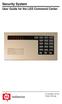 Security System User Guide for the LED Command Center MY SECURITY COMPANY IS: CALL BEFORE TEST: THIS SECURITY SYSTEM IS CONNECTED TO TELEPHONE NUMBER: THE SECURITY CONTROL PANEL IS CONNECTED TO THE PHONE
616, 626, 636 & 646 Keypads
 616, 626, 636 & 646 Keypads User s Manual TABLE OF CONTENTS 1.0 BASIC OPERATION...2 2.0 ACCESS CODES...4 3.0 ARMING & DISARMING...6 4.0 PANIC ZONES...13 5.0 KEY ACCESS PROGRAMMING.14 6.0 ADDITIONAL FEATURES...15
FIRST ALERT INSTRUCTION MANUAL FOR FA 270 KEYPADS SECURITY SYSTEM
 FIRST ALERT INSTRUCTION MANUAL FOR FA 270 KEYPADS SECURITY SYSTEM Page 0 Table of Contents Introduction 1 System Basics.. 1 Burglary Protection.. 1 Fire Protection.. 1 Security Codes. 1 Zones and Partitions
SECURITY SYSTEM NOTES. Security System Configuration
 Installing / Service Company: For Service Call: SECURITY SYSTEM NOTES Security System Configuration Master Code: Auxiliary Code(s) 2 3 4 5 6 "Quick Arm" Digit: Exit Delay Time Auxiliary Exit Delay Time
SECURITY SYSTEM NOTES
 SECURITY SYSTEM NOTES Installing/Service Company For Service Call Central Station Duress Code FUNCTION CODES Function Code Controls Function EMERGENCY ACTIVATION KEYS (check if enabled) Fire Auxiliary
Using your LED Plus keypad
 Using your LED Plus keypad System 238 System 2316 System 238i System 2316i Part Number 5-051-372-00 Rev B Thank you for purchasing this C&K alarm system Your system is one of the most powerful and advanced
SECURITY SYSTEM NOTES SPECIAL CODES. Security System Configuration
 Installing / Service Company: SECURITY SYSTEM NOTES For Service Call: Master Code SPECIAL CODES Duress Code Security System Configuration Auxiliary Code(s) Quick Arm" Digit: 2 9 3 10 4 11 5 12 6 13 7 14
SECURITY SYSTEM NOTES
 SECURITY SYSTEM NOTES Installing/Service Company For Service Call Central Station Duress Code FUNCTION CODES Function Code Controls Function This system is is not partitioned. EMERGENCY ACTIVATION KEYS
SPECIAL CODES AUXILIARY CODES SYSTEM NOTES
 Installing/Service Company Monitoring Center SPECIAL CODES Master Code Duress Code AUXILIARY CODES "Quick Arm" " Chime" 08 02 09 03 10 04 11 05 12 06 13 07 14 SYSTEM NOTES Exit Delay Time Entry Delay Time
NetworX NX-6V2. LED Keypad User Manual
 NetworX NX-6V2 LED Keypad User Manual POWER Light is on when AC power is present; flashes to indicate a low battery condition. ARMED Light is on when armed; off when disarmed; flashes to indicate a previous
USER INSTRUCTIONS CONTENTS
 CONTENTS Full Set [1]...2 Part Set [2]...2 Night Set [3]...3 Unsetting...3 Unsetting after or during an alarm...3 Testing the system [5]...3 Isolating zones [6]...4 Reprogramming codes [8]...4 Chime facility
IDS. Users Guide to Keypad Functions S E C U R I T Y MANUAL NO. 700-171-01B ISSUED AUG 2002 VERSION 1.18
 INHEP DIGITAL IDS S E C U R I T Y Users Guide to Keypad Functions MANUAL NO. 700-171-01B ISSUED AUG 2002 VERSION 1.18 Summary of Operation A rm/ disarm [#] + [USER CODE] Quick Quick Quick Away Arm Stay
Users Guide to Keypad Functions
 Users Guide to Keypad Functions MANUAL NO. 700-175-01J ISSUED JAN 2002 VERSION 1.41 Summary of Operation A rm/ disarm [#] + [USER CODE] Quick Quick Quick Panic Fire Medical Away Arm Stay Arm Stay Arm &
HILLS Series LED Code Pad User Manual
 HILLS Series LED Code Pad User Manual Not all features may be available on your system Check with your installer to find out which features are programmed Page 2 TABLE OF CONTENTS Code Pad Diagrams...2
POWER POWER ABC DEF GHI JKL ABC DEF GHI JKL COMMAND YZ COMMAND POWER ABC DEF GHI JKL COMMAND YZ USER'S GUIDE
 POWER POWER POWER ABC DEF GHI JKL ABC DEF GHI JKL MNO PQR STU VWX MNO PQR STU VWX YZ COMMAND YZ COMMAND ABC DEF GHI JKL MNO PQR STU VWX COMMAND YZ USER'S GUIDE Security Command User's Guide for 9XR Command
User Guide for the DS7060 Control/Communicator
 DS7060 User Guide Copyright 1996-97 Detection Systems, Inc. User Guide for the DS7060 Control/Communicator Copyright 1996-97 Detection Systems, Inc. Detection Systems, Inc., 130 Perinton Parkway, Fairport,
SECURITY SYSTEM NOTES SPECIAL CODES AUXILIARY ARM / DISARM CODES ENTRY / EXIT DELAY TIMES ZONE DESCRIPTIONS
 SECURITY SYSTEM NOTES Installing/Service Company For Service Call SPECIAL CODES Master Code Duress Code "Quick Arm" Digit "Chime" Digit "Entry-Guard" Digit AUXILIARY ARM / DISARM CODES 02 12 22 03 13 23
NetworX Series. NX- 4/8 Code Pad. User Manual (Australian Version)
 NetworX Series NX- 4/8 Code Pad User Manual (Australian Version) Table Of Contents Code Pad Diagram... Inside Front Glossary of Terms...2 Understanding the Code Pad lights...3 Code Pad Tones...4 Fully
HILLS Series LED Code Pad User Manual
 HILLS Series LED Code Pad User Manual Not all features may be available on your system Check with your installer to find out which features are programmed Page 2 TABLE OF CONTENTS Code Pad Diagrams...2
VISTA-128FBP VISTA-250FBP Commercial Fire and Burglary Partitioned Security Systems with Scheduling
 VISTA-128FBP VISTA-250FBP Commercial Fire and Burglary Partitioned Security Systems with Scheduling User Guide K0377V2 7/09 Rev. C 2 TABLE OF CONTENTS SYSTEM OVERVIEW... 5 General... 5 A Partitioned System...
Destiny 4100. Destiny 4100. Owners Manual
 Destiny 4100 Destiny 4100 Owners Manual TABLE OF CONTENTS INTRODUCTION Control Panel...3 Detection Devices...3 Telephone Keypads...3 GLOSSARY... 4-5 LOCAL PHONE ACCESS Using Your Telephones As Keypads...6
XR6/XR10 User s Guide
 XR6/XR10 User s Guide Silencing an Alarm All/Perimeter and Home/Away Systems 1. While the alarm bell or siren is sounding, enter your user code. The keypad displays DISARM SILENCE. 2. Press the SELECT
Understanding the Code Pad lights...4. Code Pad tones...5. Fully arming the system On MODE...6. Fully arming the system - Quick Arm MODE...
 TABLE OF CONTENTS...Glossary of terms...2...code Pad Diagram...3 Understanding the Code Pad lights...4 Code Pad tones...5 Fully arming the system On MODE...6 Fully arming the system - Quick Arm MODE...6
SECURITY SYSTEM NOTES. EMERGENCY ACTIVATION KEYS (check if enabled) PROGRAMMED FUNCTIONS
 SECURITY SYSTEM NOTES Installing/Service Company For Service Call Installation Date / / Central Station Duress Code EMERGENCY ACTIVATION KEYS (check if enabled) Fire Auxiliary Emergency Police PROGRAMMED
INSTRUCTION MANUAL PC255O
 INSTRUCTION MANUAL PC255O Canadian Department of Communications Notice NOTICE: The Canadian Department of Communications label identifies certified equipment. This certification means that the equipment
GC2 Panel User Guide
 GC2 Panel User Guide ENGLISH (International) WIRELESS SECURITY SYSTEM WARNING: OWNER S I NSTRUCTION NOTICE Not to be removed by anyone except occupant THIS PAGE INTENTIONALLY LEFT BLANK CONTENTS System
Changes or modifications not expressly approved by Interactive Technologies, Inc. can void the user s authority to operate the equipment.
 0 FCC Notices FCC Part 15 Information to the User Changes or modifications not expressly approved by Interactive Technologies, Inc. can void the user s authority to operate the equipment. FCC Part 15 Class
USER S MANUAL. SMDC-16 Digital Control Communicator and SMPC-32 Personal Control
 SMDC-16 USER S MANUAL SMDC-16 Digital Control Communicator and SMPC-32 Personal Control Table of Contents General Descriptions Page Description of Your Alarm System 3 Description of Keypads 3 Keypad Maintenance
Using Your. Security System With Icon Keypad S5020, S5021, S5022
 Using Your Security System With Icon Keypad S5020, S5021, S5022 Contents 1 Overview Your Security System... 1 How Your Security System Works... 2 Your System's Programming... 3 Getting Used to Your System...
INSTRUCTION MANUAL PC5OO WITH PC5OORK KEYPAD
 INSTRUCTION MANUAL PC5OO WITH PC5OORK KEYPAD TABLE OF CONTENTS SYSTEM INFORMATION 2 INTRODUCTION 3 Test Your System Regularly...3 Important Notice...3 Glossary...3 BASIC OPERATION 4 Arming Your System...4
Intruder alarm system Operating Instructions
 New remote keypad Intruder alarm system Operating Instructions 0 2 3 4 5 6 7 8 9 CHIME OMIT RESET PROG SET Power Power 0 2 3 5 6 7 8 Chime Omit Prog 4 9 Set AccentaG3 mini Servicing organisation details
Solution 16 plus. User Guide Security System
 Solution 16 plus EN Security System Copyright Notice Unless otherwise indicated, this publication is the copyright of Bosch Security Systems Pty Ltd ( Bosch ). All rights are reserved.you may download
CONTENTS 4. HOW TO UNSET THE PANEL...7
 Pi-8 USER MANUAL CONTENTS 1. THE KEYPAD AND ITS OPERATION...3 1.1 DESCRIPTION OF THE KEYPAD LEDS... 3 1.1.1 READY LED (RED)...3 1.1.2 TAMPER LED (RED)...3 1.1.3 POWER LED (GREEN)...3 1.1.4 CIRCUIT LEDs
INSTRUCTION MANUAL LCD-6OO SECURITY STATION
 INSTRUCTION MANUAL 1993 Digital Security Controls Ltd. 1645 Flint Road, Downsview, Ontario, Canada M3J 2J6 Printed in Canada 29000144 R1 LCD-6OO SECURITY STATION Table of Contents Introduction 1 About
Using your Alpha Plus keypad With your
 Using your Alpha Plus keypad With your q q q System 236 System 238 System 2316 q q q System 236i System 238i System 2316i Part Number 5-051-373-00 Rev B Thank you for purchasing this C&K alarm system Your
TABLE OF CONTENTS HOW TO AVOID FALSE ALARMS... 2
 TABLE OF CONTENTS HOW TO AVOID FALSE ALARMS... 2 THE BRINK S HOME SECURITY SYSTEM Equipment in the Standard Systems... 3 Optional Equipment... 4 Optional Features... 5 Description of the Keypad... 6 OPERATING
3 6HFXULW\6\VWHP 8VHU*XLGH K4333 9/99 AWAY BYPASS STAY ALARM FIRE ARMED OFF AWAY STAY READY MAX TEST BYPASS INSTANT CODE CHIME
 ARMED READY OFF AWAY STAY MAX TEST BYPASS INSTANT CODE CHIME READY ARMED READY NIGHT NO AC PHONE TEST NOT READY CHIME BAT CHECK INSTANT CANCELED OFF AWAY STAY MAX TEST BYPASS INSTANT CODE CHIME READY 3
SCORPION Z16040C Alarm Controller User Instructions
 SCORPION Z16040C Alarm Controller User Instructions Thank you for choosing to purchase this micron security alarm controller. Micron product is manufactured to exacting quality standards. We understand
tattletale User Guide Consumer unit version 2.48 1 P a g e
 tattletale User Guide Consumer unit version 2.48 1 P a g e Contents Basic 1... 4 Base Unit Features... 4 Initial Setup... 4 Arming... 5 Disarming... 5 Quiet Button... 5 Settings... 5 Settings 2... 6 Quick
Accenta/Optima. User Guide. Servicing Organisation (Installer) name: Telephone Number: Date of Installation: Account Number: Honeywell Security
 Accenta/Optima User Guide ZONE 1 2 3 4 5 6 7 8 9 Chime Omit Prog PA 0 1 2 3 4 5 6 7 8 9 CHIME OMIT RESET PROG SET Accenta + TA PA DAY POWER PA! " # $ % & 0 1 2 3 5 6 7 8 Chime Omit Reset Prog 4 9 Set PA
SECURITY SYSTEM NOTES SPECIAL CODES ENTRY / EXIT DELAY TIMES ARM / DISARM CODES
 SECURITY SYSTEM NOTES Installing/Service Company For Service Call SPECIAL CODES "Chime" Digit 1 "Partial Arm" Digit 2 "Quick Arm" Digit 3 ENTRY / EXIT DELAY TIMES Exit Delay Time Entry Delay Time Secondary
MANUAL. FA142C Security System. N7229 1V2 Rev B 4/99
 USER'S MANUAL FA142C Security System N7229 1V2 Rev B 4/99 SYSTEM OVERVIEW...3 General...3 Keypads...3 Zones...3 Burglary Protection...4 Fire Protection...4 Alarms...4 Memory of Alarm...4 Phone Access &
FA701 Series. User s Guide. K6249-2V2 5/09 Rev. A
 FA701 Series TouchCenter Keypads User s Guide K6249-2V2 5/09 Rev. A Table of Contents ABOUT THE TOUCHCENTER... 5 Introduction... 5 2 The TouchCenter Interface... 5 Navigating through the TouchCenter...
User's Manual VIA-30PSE, VISTA-10SE. N7229V2 Rev B. 1/97
 Security System User's Manual VIA-30PSE, VISTA-10SE N7229V2 Rev B. 1/97 SYSTEM OVERVIEW...3 General...3 Zones...3 Burglary Protection...3 Chime Feature...3 Alarms...4 Fire Protection...4 Memory of Alarm...4
Wireless Security System
 Wireless Security System 2GIG-CNTRL2 (2GIG-CP2) User s Guide WARNING: Owner s Instruction Notice Not to be removed by anyone except occupant The Go!Control Security System Congratulations on your ownership
Your Ademco. Fir&Burglar Alarm System. LogiCenter INTRODUCTION: 1. _- ALARM DEVICE MANUFACTURING CO.
 Your Ademco LogiCenter Fir&Burglar Alarm System i INTRODUCTION: Your LogiCenter is designed to alert you in the event of either a forced entry into a protected area or signal an alarm if a fire alarm condition
USER GUIDE SERIES 4250 AUDIO ALARM CONFIRMATION SYSTEM CONTROL UNIT
 USER GUIDE SERIES 4250 AUDIO ALARM CONFIRMATION SYSTEM CONTROL UNIT CONTENTS Page INTRODUCTION... 2 Security conditions... 3 Full Set (Fully armed)... 3 Part Set (Partially armed)... 3 Unset (Disarmed)...
User's Manual 5120XM N8031 6/96
 Fire and Burglary System User's Manual 5120XM N8031 6/96 SYSTEM OVERVIEW...3 General...3 Zones...3 Fire & Emergency Protection...3 Burglary Protection...4 Alarms...4 Memory of Alarm...4 ABOUT THE KEYPADS...5
How To Use A Keypad On A Iphone Or Ipad (Awn) With A Security System On A Powerline (Apl) With An Alarm System On It (Aldeen) And A Power Button On It
 WARNING This manual contains information on limitations regarding product use and function and information on the limitations as to liability of the manufacturer. The entire manual should be carefully
DESTINY OWNER S MANUAL
 DESTINY OWNER S MANUAL DESTINY You have made a wise decision to protect your family and property with the DESTINY Security System. The DESTINY has been designed to provide you with a maximum level of security
642 LCD Keypad User Manual
 642 LCD Keypad User Manual TABLE OF CONTENTS Introduction...3 Legend... 3 Basic Operation...5 Keypad Indicator Lights... 5 Visual Feedback... 5 Auditory Feedback... 6 Info List... 7 Access Codes...8 User
IDS X-Series User Manual 700-398-01D Issued July 2012
 1 2 Contents 1. Introduction to the IDS X-Series Panels... 7 2. Before Operating Your Alarm System... 7 3. Understanding the Keypad LEDs... 8 3.1 Viewing Data on an LED Keypad... 12 3.1.1 LED Status Indicators...
SECURITY SYSTEM NOTES AREA LISTINGS SPECIAL CODES ENTRY / EXIT DELAY TIMES ARM / DISARM CODES ZONE DESCRIPTIONS
 SECURITY SYSTEM NOTES Installing/Service Company For Service Call Area 1 Area 2 Area 3 AREA LISTINGS SPECIAL CODES "Quick Arm" Digit "Partial Arm" Digit "Chime" Digit ENTRY / EXIT DELAY TIMES Exit Delay
S I E R R A PRODUCT INFORMATION GUIDE FOR HOME SECURITY. SIERRA Page 1
 S I E R R A PRODUCT INFORMATION GUIDE FOR HOME SECURITY SIERRA Page 1 C O N T E N T S USING YOUR SIERRA SYSTEM: Turning On/Off Home Arming Instant Home Arming Quick Exit Mode Chime Mode SPECIAL FUNCTIONS:
Power864. User s Guide. Now classified in accordance with ANSI/SIA CP-01-2000 (SIA-FAR)
 WARNING This manual contains information on limitations regarding product use and function and information on the limitations as to liability of the manufacturer. The entire manual should be carefully
SCORPION. micron security products
 SCORPION 4120 6020 & 8020 USER INSTRUCTIONS Thank you for purchasing a Quality Micron Security Alarm Controller. Micron product is manufactured to exacting quality standards. We understand the importance
First Alert N8600 2/97
 USER'S MANUAL FA145C Security System First Alert N8600 2/97 SYSTEM OVERVIEW... 3 General... 3 Zones... 3 Burglary Protection... 3 Chime Feature... 3 Alarms... 4 Fire Protection... 4 Memory of Alarm...
5HDG\*XDUG5 6HFXULW\6\VWHP 8VHU*XLGH K5481-1 8/00 OFF AWAY STAY AUX
 5HDG\*XDUG5 6HFXULW\6\VWHP OFF AWAY STAY AUX 8VHU*XLGH K5481-1 8/00 7$%/(2)&217(176 SYSTEM OVERVIEW...3 Features...3 General Operation...4 Quick View of System Functions...6 About the Master Keypad...7
SECURITY & MONITORING QUICK GUIDE
 SECURITY & MONITORING QUICK GUIDE Now that you have your security system installed, use it regularly. Regular usage will increase your comfort with operating the system and reduce the likelihood of false
HARDWIRED CONTROL PANELS
 USER GUIDE 9651 HARDWIRED CONTROL PANELS Contents 1. Introduction...3 The Alarm System...3 The Keypad...3 About This Guide...5 2. Everyday Operation...6 How Do I Know if the System is Working?...6 Setting
MONITOR ISM / AFx Multi-Tenant Security System User Guide V1.3
 MONITOR ISM / AFx Multi-Tenant Security System User Guide V.3 Multi-Tenant Security System User Guide Welcome New Users! There are two types of suite security keypads. Follow the instructions in the proceeding
HUNTER-PRO 32 Ver. 3.8 Intruder Alarm System RXN-9/416 User Guide
 HUNTER-PRO 32 Ver. 3.8 Intruder Alarm System RXN-9/416 User Guide PIMA Electronic Systems Ltd. 5 Hatzoref Street, Holon 58856, Israel +972-3-5587722 +972-3-5500442 [email protected] http://www.pima-alarms.com
GE Concord 4 Quick User Guide
 GE Concord 4 Quick User Guide GE Concord 4 Quick User Guide Page 1 Before Calling Is the keypad beeping? Press *. This will silence the beeping and let you know where the trouble is. Is there a flashing
XT30/XT50 U S E R G U I D E
 XT30/XT50 USER GUIDE Silencing an Alarm When the alarm bell or siren is sounding, enter your user code or present your card to a keypad or reader during the Status List display. All/Perimeter or Home/Sleep/Away
VISTA-50P VISTA-50PUL
 S e c u r i t y S y s t e m User's Manual VISTA-50P VISTA-50PUL N5943-6 7/95 TABLE OF CONTENTS SYSTEM OVERVIEW... 3 A Partitioned System... 3 Zones... 3 Fire Protection... 4 Burglary Protection... 4 Alarms...
Security System. User's Manual VISTA-20BAY. N7527-4 03/98 File No: S1632 SINCE 1946
 Security System User's Manual VISTA-20BAY SINCE 1946 N7527-4 03/98 File No: S1632 TABLE OF CONTENTS System Overview...4 General Information...4 Zones...4 Burglary Protection...4 Security Codes...5 Fire
2 4PI175 issue 1_6/01. How to unset system in alarm. Programs 1, 2 and 3. Access codes. How to operate Personal Attack
 Access codes Contents Unset system indications - - - - - - - - - - - System indication - - - - - - - - - - - - Access codes - - - - - - - - - - - - - - - - How to operate Personal - - - - - - How to unset
astec Integrated Alarm System USER GUIDE
 astec Integrated Alarm System USER GUIDE 020008599 CONTENTS Full Set, Part Set and Disarm 3 Instant Full Set 3 Part Set with exit time 4 Bell Test 4 Bypassing zones 4 Switch Lights on/off 4 Bypass (24
Enhanced. Commercial Burglary Partitioned Security System with Scheduling. User Guide. K4970-1V3 4/09 Rev. B FA560 3 STAY 2 AWAY 1 OFF 5 TEST 9 CHIME
 BS/ESC N/Y SHIFT ARMED READY A D S SPACE R B E T C F X ENTER ARMED READY MAX INSTANT READY R BYPASS FA1660C Enhanced Commercial Burglary Partitioned Security System with Scheduling 4 1 5 FA560 6 7 8 9
NetworX Series. NX-148E LCD Keypad. User Manual
 NetworX Series NX-148E LCD Keypad User Manual TABLE OF CONTENTS I. GLOSSARY OF TERMS... 3 II. UNDERSTANDING THE LIGHTS... 4 III. KEYPAD FUNCTIONS... 5 ARMING YOUR SYSTEM IN THE AWAY MODE... 5 MAKING YOUR
Lynx Plus Series Security System
 Lynx Plus Series Security System User Guide ARMED READY ESCAPE ADD OFF AWAY RECORD LIGHTS ON 1 2 3 VOLUME TEST PLAY 4 5 6 BYPASS 7 8 9 STAY DELETE AUX SELECT LIGHTS OFF 0 CODE CHIME STATUS NO DELAY FUNCTION
How To Set A Timer On A Gg System
 ZONE ZONE 2 ZONE ZONE ZONE 5 ZONE 6 ZONE 7 ZONE Power PA XR2/ XR2+ Intruder alarm system Operating Instructions ZONE ZONE 2 ZONE ZONE ZONE 5 ZONE 6 ZONE 7 ZONE 0 2 5 6 7 9 Omit Prog Remote LED keypad 0
Wireless Security System
 Wireless Security System 2GIG-CP2 User s Guide WARNING: Owner s Instruction Notice Not to be removed by anyone except occupant The Go!Control Security System Congratulations on your ownership of a Go!Control
8VHU V*XLGH 6HFXULW\6\VWHPV (QWUHSUHQHXU(1 6HFXULW\0DQDJHU(1. Meets ADT Security Services Triple Standards Requirements:
 6DIHZDWFK3UR Š (1 (QWUHSUHQHXU(1 6HFXULW\0DQDJHU(1 6HFXULW\6\VWHPV 8VHU V*XLGH Meets ADT Security Services Triple Standards Requirements: C US LISTED Standards for Security and Fire Standard for False
INSTRUCTION MANUAL DSC 1550
 INSTRUCTION MANUAL DSC 1550 A WORD ABOUT YOUR SYSTEM The PC1550 Security System has been designed to give you the greatest possible flexibility and convenience. Read this manual carefully and become familiar
TABLE OF CONTENTS HOW TO AVOID FALSE ALARMS... 1
 TABLE OF CONTENTS HOW TO AVOID FALSE ALARMS... 1 THE BRINK S HOME SECURITY SYSTEM Equipment in the Standard Systems... 2 Optional Equipment... 3 Description of the Keypad... 5 OPERATING THE BRINK S SYSTEM
Using Your. Security System. With LED Keypad S5030, S5031, S5032
 Using Your Security System With LED Keypad S5030, S5031, S5032 Contents 1 Overview Your Security System... 1 How Your Security System Works... 2 Your System's Programming... 3 Getting Used to Your System...
Security System Owner s Manual
 Security System Owner s Manual Interactive Technologies Inc. 2266 North 2nd Street North St. Paul, MN 55109 FCC Notices FCC Part 15 Information to the User Changes or modifications not expressly approved
XR1. Intruder alarm system Operating Instructions. Unset system indications. Set System indication
 h m mi R s t P o S t A XR EP 9 XR G panel with built-in keypad 2 5 6 7 Power A tack 0 2 5 6 7 9 Intruder alarm system Operating Instructions These operating instructions cover the following intruder system:
6HFXULW\6\VWHPV 8VHU V*XLGH K5309-1V1 8/01
 9,67$39,67$3&1 9,67$39,67$3&1 6HFXULW\6\VWHPV 8VHU V*XLGH K5309-1V1 8/01 1 IMPORTANT! PROPER INTRUSION PROTECTION For proper intrusion coverage, sensors should be located at every possible point of entry
Silencing an Alarm Note: Area Systems What to do when a trouble tone is sounding
 Silencing an Alarm When the alarm bell or siren is sounding, enter your user code or present your card to a keypad or reader during the Status List display. IS THIS A FALSE ALARM? YES NO or CANCEL VERIFY
XT30/XT50. User s Guide
 XT30/XT50 User s Guide Silencing an Alarm When the alarm bell or siren is sounding, enter your user code or present your card to a keypad or reader during the Status List display. All/Perimeter or Home/Sleep/Away
GUIDE GETTING STARTED IMPORTANT SUPPORT RESOURCES
 IMPORTANT SUPPORT RESOURCES Subscriber Portal Go to https://portal.coxhomelife.com to log in to your account and manage your system features online. Online Support Go to www.cox.com/homelifesupport to
USER'S MANUAL. N7527-1V2 Rev B 4/99
 USER'S MANUAL FA162C Security System N7527-1V2 Rev B 4/99 2 SYSTEM OVERVIEW... 4 General... 4 A Partitioned System... 4 Zones... 4 Burglary Protection... 5 Security Codes... 5 Fire Protection... 6 Alarms...
LYNX Touch L5210 Series Security System
 LYNX Touch L5210 Series Security System User Guide 800-19975 12/14 Rev. A LYNX Touch L5210 Series Your Honeywell security system is designed for use with devices manufactured or approved by Honeywell for