
A Tool for Generating Relational Database Schema from EER Diagram
|
|
|
- Winfred Jordan
- 9 years ago
- Views:
Transcription
1 A Tool for Generating Relational Schema from EER Diagram Lisa Simasatitkul and Taratip Suwannasart Abstract design is an important activity in software development. EER diagram is one of diagrams, which is used in database design because EER diagram is a graphical representation and easy to understand between users and developers. Relational database constraints are important since database designers should consider when they design database. These constraints help database designers design database that meet, all user requirements. However, database designers cannot identify the constraints in the EER diagram. If database designers use the diagram without specifying constraints and transform it into relational database schema, the relational database schema may not meet all data requirements of users. This paper proposes a tool for generating database schema from EER diagram, written in XML format. The goals of this tool are transforming an EER diagram to relational database schema and allowing database designers specify relational database constraints in relation. The results of this tool are relational database schema with constraints according to user requirements, database schema, and data dictionary. Index Terms EER diagram, Relational database constraints, EER to relational mapping I. INTRODUCTION ECENTLY, database applications have become Rwidespread in several enterprises, banks, universities, and hospitals. These database applications help them collect and access their data easily and correctly. Therefore, each application should be designed to meet all user requirements. The first step of database design is to collect and analyze user requirements. The second step is conceptual design that database designers need to define entities, attributes, relationships, and relational database constraints. The third step is logical design and the result of this step is relational database schema. The last step is physical database design. Entity relationship (ER) diagram has become a popular diagram for database design because it is a graphical representation and easy to understand between database designers and users. ER diagram [1] consists of entities, attributes, and relationships. Extended Entity Relationship (EER) diagram [2] has all ER diagram concepts and has concepts of superclasses, subclasses, specializations, and Manuscript received December 03, 2011; revised January 09, Lisa Simasatitkul is with Department of Computer Engineering, Faculty of Engineering, Chulalongkorn University, Bangkok Thailand ( [email protected]) Taratip Suwannasart is with Department of Computer Engineering, Faculty of Engineering, Chulalongkorn University, Bangkok Thailand ( [email protected]) generalizations. This diagram is developed to support complex software applications. However, database designers cannot specify constraints in ER and EER diagram, so they have to specify these constraints in relational tables later. The aim of this paper is to present a tool for generating relational database schema from EER diagram, written in XML format. This tool allows database designers to identify relational database constraints in any relation. Such constraints are entity integrity constraint, domain constraint, and referential integrity constraint. The rest of this paper is divided into seven sections. Section 1 is introduction. Section 2 is related work. Section 3 describes EER to relational mapping and relational database constraints. Section 4 shows architecture of our tool. Section 5 is the features of our tool. Case studies are shown in Section 6. The last section, we conclude our work. II. RELATED WORK A. ERDraw: An XML-based ER- diagram Drawing and Translation Tool This paper [3] presents an XML-based ER diagram drawing and translation tool, named ERDraw. The tool supports drawing ER diagrams and translating an ER diagram to relational database schema automatically. This paper focuses only on binary relationship types, but does not concern about specialization relationships. Therefore, the tool developed from this work cannot transform EER diagram to relational database schema. B. A Java based Parser Software for Converting XML Documents to the ER Model and Relational s This paper [4] presents a tool for converting XML documents and their data to an ER model and a relational database schema respectively. The tool also creates relational database schema in Access database. However, the tool does not support EER diagram, so it cannot convert EER diagram into relational database schema. III. BACKGROUND A. EER to Relational Mapping There are nine steps of mapping an EER diagram to relational, proposed by Elmasri and Navathe [2] as follows: Step 1 Mapping of Regular Entity. A relation is created for each regular entity and all the simple attributes of an entity is created. The primary key of relation is derived from key attribute of the entity.
2 Step 2 Mapping of Weak Entity. A relation is created for each weak entity and all the simple attributes of an entity is created. The primary key of relation is the combination of owners' primary key and the weak entity's partial key. The foreign key of relation is primary key of owner relation. Step 3 Mapping of Binary 1: 1 Relationship Types. Relations corresponding to the entity types that participating in 1:1 relationship are identified. Then, any relation with a foreign key is chosen. A foreign key of relation is a primary key of the other relation. Step 4 Mapping of Binary 1: N Relationship Types. Two relations are identified for each binary 1:N relationship. A foreign key of the relation at N-side contains the primary key of the relation at 1-side. Step 5 Mapping of Binary M: N Relationship Types. A new relation is created for each binary M: N relationship type. The primary keys and foreign keys of the new relation are the primary of each relation that corresponding to the entity types participated in M: N relationship. Step 6 Mapping of N-ary Relationship Types. A new relation is created for each n-ary relationship type. The primary keys and foreign keys of the new relation are the primary key of each relation that corresponding to the entity types participated in n-ary relationship. Step 7 Mapping of Multivalued attribute. A new relation is created for each multivalued attribute. The primary key of the new relation is the combination of the multivalued attribute that corresponding to multivalued attribute in the entity and a new attribute of the new relation. Step 8 Mapping of Specialization types. In this step, a relation is created for each superclass and all the simple attributes of superclass are created. The primary key of superclass relation is derived from primary key of superclass. Next, a relation is created for each subclass and all the simple attributes of subclass are also created. The primary key of subclass relation is derived from primary key of superclass. Step 9 Mapping of Union types. There are 2 cases in this step. The first case, superclasses have the different primary keys. A relation is created for each superclass and subclass. All the simple attributes of superclass and subclass are created. The primary key of superclass relation is derived from primary key of superclass. Then, a new attribute is created for primary key of subclass relation. The second case, superclasses has the same primary key. A relation is created for each superclass and subclass; all the simple attributes of superclass and subclass are also created. The primary key of superclass relation and subclass is derived from primary key of superclass relation. B. Relational Constraints Relational database constraints [5], [6] are constraints that database designers should specify at relational database. These constraints guarantee that data is correct and not redundancy. Relational database constraints consist of entity integrity constraint, domain constraint, and referential integrity constraint. Entity integrity constraint specifies that a primary key should be in every table; the key must be a unique value and cannot be value. Domain constraint considers association of possible value in every attribute. Possible constraints of "attributes" domain are data type, range of data, not, unique, and default value. Referential integrity constraint considers a foreign key attributes in a table. Values of a foreign key attributes are the same as the values of the primary key attributes of the parent relation. This tool focuses of the delete options and update options that are "on delete no action", "on delete cascade", "on delete set ", on delete set default", "on delete restrict", "on update no action", "on update cascade", "on update set ", "on update set default" and "on update restrict". IV. ARCHITECTURE OF OUR TOOL This paper we present a tool for generating a relational database schema from EER diagram, which is developed by Java language (JDK 6.0). This tool generates data dictionary and database schema, written in SQL script. The overall of architecture of the tool is shown in Fig. 1. This tool is composed of modules as follows: designer A Tool for Generating Relational Schema EER Diagram (.*xml) Edit Constraints Relation Update relation Import XML File EER Mapping Create Data Dictionary (*.xml) Relations of tool Relations Data dictionary Fig. 1. An architecture of a tool Create Schema Target database A. Importing XML File The process of this module receives an EER diagram from database designers. The EER diagram written in XML should contain entities, attributes, and primary keys. B. EER Mapping XML file is separated into regular entities, weak entities, superclasses, subclasses, attributes, binary relationship types, specializations, unions, and primary keys. In this module, we use DOM (Document Object Model) to separate for each element. At first, we separate specialization relationship type, union type, regular entity, weak entity,

3 attribute, primary key and multivalued attribute respectively. The second step, the EER diagram written in XML, is converted into relations based on Elmasri and Navathe concept [2]. Relations are recorded into the database of our tool. Moreover, if there are any data type specified in the EER diagram, they are also recorded into the database as well. The results of this module are relations consisting of their name, attributes, primary keys, and foreign keys. C. Editing Constraints This module allows database designers to edit relational database constraints. The tool retrieves relations from database. designers are able to specify relational database constraints for any relation. These constraints follow requirements specification. The constraints are then recorded in the database of our tool. The constraints are entity integrity constraint, domain constraint and referential integrity constraint. In addition, database designers can add comments of attributes and relations in this step. Then, the comments are recorded in the database of our tool. Fig. 3. The main screen B. EER Mapping EER diagram written in XML is converted into relation automatically. C. Editing Constraints designers can specify domain constraint for each attribute as show in Fig. 4. Moreover, database designers can specify referential integrity constraint for each foreign key as show in Fig. 5. D. Creating Data Dictionary This module generates data dictionary for created relational database schema using itext library. The data dictionary consists of all relation names, attributes of the relations, data type of each attribute, primary keys, foreign keys, entity integrity constraint, domain constraint, and referential integrity constraint. E. Creating Schema This module generates SQL script (*.sql). The script can be used by both MySQL database and Oracle database. All relations, which are mapped from EER, are retrieved from the database of our tool to create relational database schema in SQL script. An example of SQL script is shown in Fig. 2. create table Person( id integer not unique, varchar(20) not, name varchar(20) not, primary key(id, name)); Fig. 2. An example of SQL script. V. FEATURES OF OUR TOOL This section we present features of our tool. The features of a tool for generating a relational database schema from EER diagram are as follows: A. Importing XML File After the tool receive XML file from database designers, the tool transforms EER into relation as shown in Fig. 3. There are two parts in this screen. The part number 1 shows all of relation names that are retrieved from the database of our tool. For each relation, database designers can select to see relation details. Each attribute of the relations in the part number 2 shows data type, not value, unique, and default value. Fig. 4. The screen of specifying domain constraint

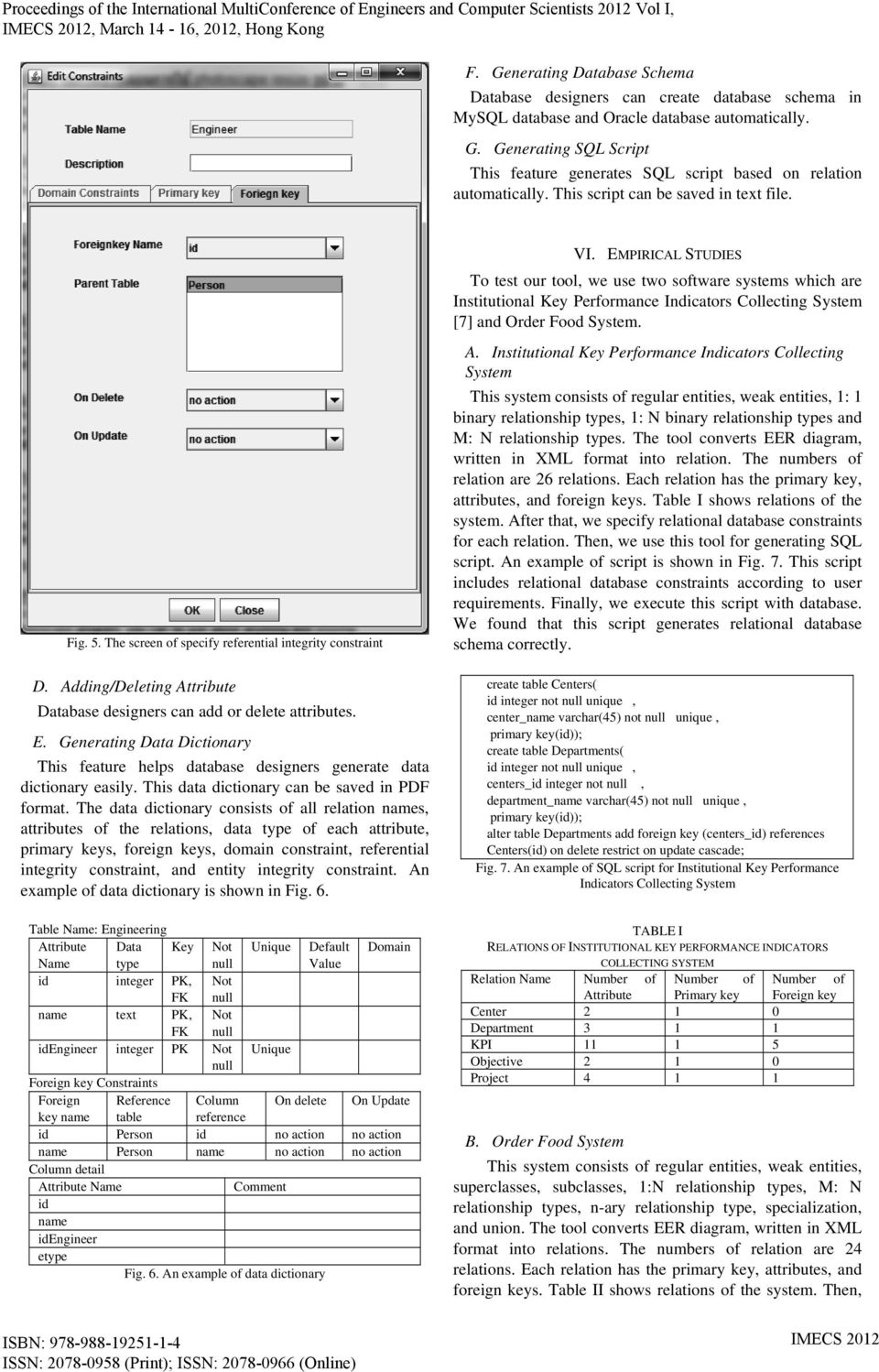
4 F. Generating Schema designers can create database schema in MySQL database and Oracle database automatically. G. Generating SQL Script This feature generates SQL script based on relation automatically. This script can be saved in text file. Fig. 5. The screen of specify referential integrity constraint D. Adding/Deleting Attribute designers can add or delete attributes. E. Generating Data Dictionary This feature helps database designers generate data dictionary easily. This data dictionary can be saved in PDF format. The data dictionary consists of all relation names, attributes of the relations, data type of each attribute, primary keys, foreign keys, domain constraint, referential integrity constraint, and entity integrity constraint. An example of data dictionary is shown in Fig. 6. Table Name: Engineering Attribute Data Key Not Unique Default Domain Name type Value id integer PK, FK Not name text PK, FK Not idengineer integer PK Not Unique Foreign key Constraints Foreign Reference Column On delete On Update key name table reference id Person id no action no action name Person name no action no action Column detail Attribute Name Comment id name idengineer etype Fig. 6. An example of data dictionary VI. EMPIRICAL STUDIES To test our tool, we use two software systems which are Institutional Key Performance Indicators Collecting System [7] and Order Food System. A. Institutional Key Performance Indicators Collecting System This system consists of regular entities, weak entities, 1: 1 binary relationship types, 1: N binary relationship types and M: N relationship types. The tool converts EER diagram, written in XML format into relation. The numbers of relation are 26 relations. Each relation has the primary key, attributes, and foreign keys. Table I shows relations of the system. After that, we specify relational database constraints for each relation. Then, we use this tool for generating SQL script. An example of script is shown in Fig. 7. This script includes relational database constraints according to user requirements. Finally, we execute this script with database. We found that this script generates relational database schema correctly. create table Centers( center_name varchar(45) not unique, create table Departments( centers_id integer not, department_name varchar(45) not unique, alter table Departments add foreign key (centers_id) references Centers(id) on delete restrict on update cascade; Fig. 7. An example of SQL script for Institutional Key Performance Indicators Collecting System TABLE I RELATIONS OF INSTITUTIONAL KEY PERFORMANCE INDICATORS COLLECTING SYSTEM Relation Name Number of Number of Number of Attribute Primary key Foreign key Center Department KPI Objective Project B. Order Food System This system consists of regular entities, weak entities, superclasses, subclasses, 1:N relationship types, M: N relationship types, n-ary relationship type, specialization, and union. The tool converts EER diagram, written in XML format into relations. The numbers of relation are 24 relations. Each relation has the primary key, attributes, and foreign keys. Table II shows relations of the system. Then,
5 we use this tool generates SQL script. An example of script is shown in Fig. 8. TABLE II RELATIONS OF ORDER FOOD SYSTEM Relation Name Number of Number of Number of Attribute Primary key Foreign key Employee Menu Customer create table Customer( name varchar(50), create table Employee( address varchar(500) not, branch_id integer, varchar(50) not, name varchar(50) not, salary float not, create table Menu( menutype_id integer, name varchar(50) not, price float not, Fig. 8. An example of SQL script for Order Food System VII. CONCLUSION This paper presents a tool for generating relational database schema from EER diagram, written in XML format. The process of this tool receives EER diagram, written in XML format. Next, transforms it into relation. In this step, database designers can specify relational database constraints. Then the tool generates relational database schema. The results of this tool are relational database schema with constraints according to user requirements, database schema, and data dictionary. The advantages of this tool are database schema with constraints. In the future, we will develop this tool can generate test cases of relational database constraints. In addition, we will develop reverse engineering process for this tool. The tool will receive SQL script from database designers extract it into relation, attributes, and relationship. [7] K. Tulayanisaka, "Institutional Key Performance Indicators Collecting System," Master's project, Department of Computer Engineering, Faculty of Engineering, Chulalongkorn University, Lisa Simasatitkul received B.Sc. degree in Information Technology at the King Mongkut's Institute of Technology Ladkrabang in She is a master student in the Department of Computer Engineering, faculty of Computer Engineering at Chulalongkorn University. Her research interests are software engineering. Taratip Suwannasart received Ph.D. degree in computer science at the Illinois Institute of Technology in She is working as an association professor in the Department of Computer Engineering, faculty of Computer Engineering at Chulalongkorn University. Her research interests are software engineering especially software testing and software quality assurance. REFERENCES [1] P. Chen, "The Entity-Relationship Model: Toward a Unified a View of Data," ACM Transactions on Systems, vol. 1, pp. 9-36, [2] R. Elmasri and S. B. Navathe, Fundamentals of Systems (5th Edition). Boston, MA, USA: Addison-Wesley Longman Publishing Co., Inc., [3] S. Xu, Y. Li, and S. Lu, "ERDraw: An XML-Based ER Diagram Drawing and Translation Tool," [4] S. Bagui and D. Walker, "A Java Based Parser Software for Converting XML Documents to the ER Model and Relational s," in SWWS, 2006, pp [5] P. Tongrak and T. Suwannasart, "A Tool for Generating Test Cases From Relational Constraints Testing," in Computer Science and Information Technology, ICCSIT 2009, 2nd IEEE International Conference on, Aug 2009, pp [6] N. Sharma and et al., Fundamentals (1st Edition). Canada: IBM Corporation 2010.

IT2305 Database Systems I (Compulsory)
 Database Systems I (Compulsory) INTRODUCTION This is one of the 4 modules designed for Semester 2 of Bachelor of Information Technology Degree program. CREDITS: 04 LEARNING OUTCOMES On completion of this
IT2304: Database Systems 1 (DBS 1)
 : Database Systems 1 (DBS 1) (Compulsory) 1. OUTLINE OF SYLLABUS Topic Minimum number of hours Introduction to DBMS 07 Relational Data Model 03 Data manipulation using Relational Algebra 06 Data manipulation
DATABASE DESIGN. - Developing database and information systems is performed using a development lifecycle, which consists of a series of steps.
 DATABASE DESIGN - The ability to design databases and associated applications is critical to the success of the modern enterprise. - Database design requires understanding both the operational and business
AVOIDANCE OF CYCLICAL REFERENCE OF FOREIGN KEYS IN DATA MODELING USING THE ENTITY-RELATIONSHIP MODEL
 AVOIDANCE OF CYCLICAL REFERENCE OF FOREIGN KEYS IN DATA MODELING USING THE ENTITY-RELATIONSHIP MODEL Ben B. Kim, Seattle University, [email protected] ABSTRACT The entity-relationship (ER model is clearly
Chapter 7 Data Modeling Using the Entity- Relationship (ER) Model
 Chapter 7 Data Modeling Using the Entity- Relationship (ER) Model Copyright 2011 Pearson Education, Inc. Publishing as Pearson Addison-Wesley Chapter 7 Outline Using High-Level Conceptual Data Models for
Bridge from Entity Relationship modeling to creating SQL databases, tables, & relations
 1 Topics for this week: 1. Good Design 2. Functional Dependencies 3. Normalization Readings for this week: 1. E&N, Ch. 10.1-10.6; 12.2 2. Quickstart, Ch. 3 3. Complete the tutorial at http://sqlcourse2.com/
An Automated Testing Tool Using UI Structure
 , March 12-14, 2014, Hong Kong An Automated Testing Tool Using UI Structure Nutharat Harnvorawong, Taratip Suwannasart, Member, IAENG Abstract Testers usually run a new version of software against existing
Fundamentals of Database Design
 Fundamentals of Database Design Zornitsa Zaharieva CERN Data Management Section - Controls Group Accelerators and Beams Department /AB-CO-DM/ 23-FEB-2005 Contents : Introduction to Databases : Main Database
Fundamentals of Database System
 Fundamentals of Database System Chapter 4 Normalization Fundamentals of Database Systems (Chapter 4) Page 1 Introduction To Normalization In general, the goal of a relational database design is to generate
www.gr8ambitionz.com
 Data Base Management Systems (DBMS) Study Material (Objective Type questions with Answers) Shared by Akhil Arora Powered by www. your A to Z competitive exam guide Database Objective type questions Q.1
Database Design Methodology
 Database Design Methodology Three phases Database Design Methodology Logical database Physical database Constructing a model of the information used in an enterprise on a specific data model but independent
Oracle FLEXCUBE Universal Banking 12.0
 Oracle FLEXCUBE Universal Banking 12.0 Data Model Getting Started Release 1.0 May 2012 Oracle Part Number E51527-01 FCUBS-FD08-01-01-Data Model getting started 1 Contents 1 Preface... 3 1.1 Audience...
The Relational Model. Why Study the Relational Model? Relational Database: Definitions
 The Relational Model Database Management Systems, R. Ramakrishnan and J. Gehrke 1 Why Study the Relational Model? Most widely used model. Vendors: IBM, Microsoft, Oracle, Sybase, etc. Legacy systems in
Toad Data Modeler - Features Matrix
 Toad Data Modeler - Features Matrix Functionality Commercial Trial Freeware Notes General Features Physical Model (database specific) Universal Model (generic physical model) Logical Model (support for
Database Design. Marta Jakubowska-Sobczak IT/ADC based on slides prepared by Paula Figueiredo, IT/DB
 Marta Jakubowska-Sobczak IT/ADC based on slides prepared by Paula Figueiredo, IT/DB Outline Database concepts Conceptual Design Logical Design Communicating with the RDBMS 2 Some concepts Database: an
CSC 742 Database Management Systems
 CSC 742 Database Management Systems Topic #4: Data Modeling Spring 2002 CSC 742: DBMS by Dr. Peng Ning 1 Phases of Database Design Requirement Collection/Analysis Functional Requirements Functional Analysis
Databases and BigData
 Eduardo Cunha de Almeida [email protected] Outline of the course Introduction Database Systems (E. Almeida) Distributed Hash Tables and P2P (C. Cassagnes) NewSQL (D. Kim and J. Meira) NoSQL (D. Kim)
International Journal of Management and Sustainability
 International Journal of Management and Sustainability Special Issue: Economic, Finance and Management outlooks journal homepage: http://pakinsight.com/?ic=journal&journal=11 AN ARCHITECTURE FOR PERSONAL
Relational Schema Design
 Relational Schema Design Using ER Methodology to Design Relational Database Schemas The Development Process Collect requirements. Analyze the requirements. Conceptually design the data (e.g., draw an ER
Chapter 1: Introduction. Database Management System (DBMS) University Database Example
 This image cannot currently be displayed. Chapter 1: Introduction Database System Concepts, 6 th Ed. See www.db-book.com for conditions on re-use Database Management System (DBMS) DBMS contains information
Proceedings of the International MultiConference of Engineers and Computer Scientists 2013 Vol I, IMECS 2013, March 13-15, 2013, Hong Kong
 , March 13-15, 2013, Hong Kong Risk Assessment for Relational Database Schema-based Constraint Using Machine Diagram Kanjana Eiamsaard 1, Nakornthip Prompoon 2 Abstract Information is a critical asset
Conceptual Design Using the Entity-Relationship (ER) Model
 Conceptual Design Using the Entity-Relationship (ER) Model Module 5, Lectures 1 and 2 Database Management Systems, R. Ramakrishnan 1 Overview of Database Design Conceptual design: (ER Model is used at
Relational Database Basics Review
 Relational Database Basics Review IT 4153 Advanced Database J.G. Zheng Spring 2012 Overview Database approach Database system Relational model Database development 2 File Processing Approaches Based on
Doing database design with MySQL
 Doing database design with MySQL Jerzy Letkowski Western New England University ABSTRACT Most of the database textbooks, targeting database design and implementation for information systems curricula support
COMP 378 Database Systems Notes for Chapter 7 of Database System Concepts Database Design and the Entity-Relationship Model
 COMP 378 Database Systems Notes for Chapter 7 of Database System Concepts Database Design and the Entity-Relationship Model The entity-relationship (E-R) model is a a data model in which information stored
Relational Database Concepts
 Relational Database Concepts IBM Information Management Cloud Computing Center of Competence IBM Canada Labs 1 2011 IBM Corporation Agenda Overview Information and Data Models The relational model Entity-Relationship
International Journal of Engineering Technology, Management and Applied Sciences. www.ijetmas.com November 2014, Volume 2 Issue 6, ISSN 2349-4476
 ERP SYSYTEM Nitika Jain 1 Niriksha 2 1 Student, RKGITW 2 Student, RKGITW Uttar Pradesh Tech. University Uttar Pradesh Tech. University Ghaziabad, U.P., India Ghaziabad, U.P., India ABSTRACT Student ERP
Databases Model the Real World. The Entity- Relationship Model. Conceptual Design. Steps in Database Design. ER Model Basics. ER Model Basics (Contd.
 The Entity- Relationship Model R &G - Chapter 2 A relationship, I think, is like a shark, you know? It has to constantly move forward or it dies. And I think what we got on our hands is a dead shark. Woody
2. Conceptual Modeling using the Entity-Relationship Model
 ECS-165A WQ 11 15 Contents 2. Conceptual Modeling using the Entity-Relationship Model Basic concepts: entities and entity types, attributes and keys, relationships and relationship types Entity-Relationship
Lecture 6. SQL, Logical DB Design
 Lecture 6 SQL, Logical DB Design Relational Query Languages A major strength of the relational model: supports simple, powerful querying of data. Queries can be written intuitively, and the DBMS is responsible
An Experimental Comparison of ER and UML Class Diagrams
 Vol.8, No.2 (205), pp.279-288 http://dx.doi.org/0.4257/ijhit.205.8.2.26 An Experimental Comparison of ER and UML Class Diagrams Ahmad Al- Shamailh Mutah University, Jordan [email protected] Abstract
Rose Data Modeler (logical)
 Rose Data Modeler (logical) Rational Rose uses a data modeler to model the conceptual, logical, and physical database models, but also to generate DDLs commands, such as creating tables following UML methodology.
What is a database? COSC 304 Introduction to Database Systems. Database Introduction. Example Problem. Databases in the Real-World
 COSC 304 Introduction to Systems Introduction Dr. Ramon Lawrence University of British Columbia Okanagan [email protected] What is a database? A database is a collection of logically related data for
LiTH, Tekniska högskolan vid Linköpings universitet 1(7) IDA, Institutionen för datavetenskap Juha Takkinen 2007-05-24
 LiTH, Tekniska högskolan vid Linköpings universitet 1(7) IDA, Institutionen för datavetenskap Juha Takkinen 2007-05-24 1. A database schema is a. the state of the db b. a description of the db using a
Data Modeling. Database Systems: The Complete Book Ch. 4.1-4.5, 7.1-7.4
 Data Modeling Database Systems: The Complete Book Ch. 4.1-4.5, 7.1-7.4 Data Modeling Schema: The structure of the data Structured Data: Relational, XML-DTD, etc Unstructured Data: CSV, JSON But where does
Chapter 2: Entity-Relationship Model. Entity Sets. " Example: specific person, company, event, plant
 Chapter 2: Entity-Relationship Model! Entity Sets! Relationship Sets! Design Issues! Mapping Constraints! Keys! E-R Diagram! Extended E-R Features! Design of an E-R Database Schema! Reduction of an E-R
Database Design Overview. Conceptual Design ER Model. Entities and Entity Sets. Entity Set Representation. Keys
 Database Design Overview Conceptual Design. The Entity-Relationship (ER) Model CS430/630 Lecture 12 Conceptual design The Entity-Relationship (ER) Model, UML High-level, close to human thinking Semantic
The Entity-Relationship Model
 The Entity-Relationship Model 221 After completing this chapter, you should be able to explain the three phases of database design, Why are multiple phases useful? evaluate the significance of the Entity-Relationship
not necessarily strictly sequential feedback loops exist, i.e. may need to revisit earlier stages during a later stage
 Database Design Process there are six stages in the design of a database: 1. requirement analysis 2. conceptual database design 3. choice of the DBMS 4. data model mapping 5. physical design 6. implementation
Outline. Data Modeling. Conceptual Design. ER Model Basics: Entities. ER Model Basics: Relationships. Ternary Relationships. Yanlei Diao UMass Amherst
 Outline Data Modeling Yanlei Diao UMass Amherst v Conceptual Design: ER Model v Relational Model v Logical Design: from ER to Relational Slides Courtesy of R. Ramakrishnan and J. Gehrke 1 2 Conceptual
The Relational Model. Why Study the Relational Model? Relational Database: Definitions. Chapter 3
 The Relational Model Chapter 3 Database Management Systems 3ed, R. Ramakrishnan and J. Gehrke 1 Why Study the Relational Model? Most widely used model. Vendors: IBM, Informix, Microsoft, Oracle, Sybase,
THE ENTITY- RELATIONSHIP (ER) MODEL CHAPTER 7 (6/E) CHAPTER 3 (5/E)
 THE ENTITY- RELATIONSHIP (ER) MODEL CHAPTER 7 (6/E) CHAPTER 3 (5/E) 2 LECTURE OUTLINE Using High-Level, Conceptual Data Models for Database Design Entity-Relationship (ER) model Popular high-level conceptual
A Framework for Data Migration between Various Types of Relational Database Management Systems
 A Framework for Data Migration between Various Types of Relational Database Management Systems Ahlam Mohammad Al Balushi Sultanate of Oman, International Maritime College Oman ABSTRACT Data Migration is
Data Modeling Basics
 Information Technology Standard Commonwealth of Pennsylvania Governor's Office of Administration/Office for Information Technology STD Number: STD-INF003B STD Title: Data Modeling Basics Issued by: Deputy
The Relational Model. Ramakrishnan&Gehrke, Chapter 3 CS4320 1
 The Relational Model Ramakrishnan&Gehrke, Chapter 3 CS4320 1 Why Study the Relational Model? Most widely used model. Vendors: IBM, Informix, Microsoft, Oracle, Sybase, etc. Legacy systems in older models
TIM 50 - Business Information Systems
 TIM 50 - Business Information Systems Lecture 15 UC Santa Cruz March 1, 2015 The Database Approach to Data Management Database: Collection of related files containing records on people, places, or things.
14 Databases. Source: Foundations of Computer Science Cengage Learning. Objectives After studying this chapter, the student should be able to:
 14 Databases 14.1 Source: Foundations of Computer Science Cengage Learning Objectives After studying this chapter, the student should be able to: Define a database and a database management system (DBMS)
DATABASE MANAGEMENT SYSTEMS. Question Bank:
 DATABASE MANAGEMENT SYSTEMS Question Bank: UNIT 1 1. Define Database? 2. What is a DBMS? 3. What is the need for database systems? 4. Define tupule? 5. What are the responsibilities of DBA? 6. Define schema?
In This Lecture. SQL Data Definition SQL SQL. Notes. Non-Procedural Programming. Database Systems Lecture 5 Natasha Alechina
 This Lecture Database Systems Lecture 5 Natasha Alechina The language, the relational model, and E/R diagrams CREATE TABLE Columns Primary Keys Foreign Keys For more information Connolly and Begg chapter
City University of Hong Kong. Information on a Course offered by Department of Computer Science with effect from Semester A in 2014 / 2015
 City University of Hong Kong Information on a Course offered by Department of Computer Science with effect from Semester A in 2014 / 2015 Part I Course Title: Database Systems Course Code: CS3402 Course
DBMS Questions. 3.) For which two constraints are indexes created when the constraint is added?
 DBMS Questions 1.) Which type of file is part of the Oracle database? A.) B.) C.) D.) Control file Password file Parameter files Archived log files 2.) Which statements are use to UNLOCK the user? A.)
Data Dictionary and Normalization
 Data Dictionary and Normalization Priya Janakiraman About Technowave, Inc. Technowave is a strategic and technical consulting group focused on bringing processes and technology into line with organizational
PHP FRAMEWORK FOR DATABASE MANAGEMENT BASED ON MVC PATTERN
 PHP FRAMEWORK FOR DATABASE MANAGEMENT BASED ON MVC PATTERN Chanchai Supaartagorn Department of Mathematics Statistics and Computer, Faculty of Science, Ubon Ratchathani University, Thailand [email protected]
Unit 2.1. Data Analysis 1 - V2.0 1. Data Analysis 1. Dr Gordon Russell, Copyright @ Napier University
 Data Analysis 1 Unit 2.1 Data Analysis 1 - V2.0 1 Entity Relationship Modelling Overview Database Analysis Life Cycle Components of an Entity Relationship Diagram What is a relationship? Entities, attributes,
A Rational Software Whitepaper
 The UML and Data Modeling A Rational Software Whitepaper Table of Contents Introduction...1 The UML Data Modeling Profile...1 Database...1 Schema...2 Table...2 Key...3 Index...4 Relationship...5 Column...6
Modeling Web Applications Using Java And XML Related Technologies
 Modeling Web Applications Using Java And XML Related Technologies Sam Chung Computing & Stware Systems Institute Technology University Washington Tacoma Tacoma, WA 98402. USA [email protected] Yun-Sik
Information Systems 2. 1. Modelling Information Systems I: Databases
 Information Systems 2 Information Systems 2 1. Modelling Information Systems I: Databases Lars Schmidt-Thieme Information Systems and Machine Learning Lab (ISMLL) Institute for Business Economics and Information
Relational Databases. Christopher Simpkins [email protected]
 Relational Databases Christopher Simpkins [email protected] Relational Databases A relational database is a collection of data stored in one or more tables A relational database management system
Lecture 12: Entity Relationship Modelling
 Lecture 12: Entity Relationship Modelling The Entity-Relationship Model Entities Relationships Attributes Constraining the instances Cardinalities Identifiers Generalization 2004-5 Steve Easterbrook. This
Database Design. Adrienne Watt. Port Moody
 Database Design Database Design Adrienne Watt Port Moody Except for third party materials and otherwise stated, content on this site is made available under a Creative Commons Attribution 2.5 Canada License.
SQL Server. 2012 for developers. murach's TRAINING & REFERENCE. Bryan Syverson. Mike Murach & Associates, Inc. Joel Murach
 TRAINING & REFERENCE murach's SQL Server 2012 for developers Bryan Syverson Joel Murach Mike Murach & Associates, Inc. 4340 N. Knoll Ave. Fresno, CA 93722 www.murach.com [email protected] Expanded
EECS 647: Introduction to Database Systems
 EECS 647: Introduction to Database Systems Instructor: Luke Huan Spring 2013 Administrative Take home background survey is due this coming Friday The grader of this course is Ms. Xiaoli Li and her email
Designing a Database Schema
 Week 10: Database Design Database Design From an ER Schema to a Relational One Restructuring an ER schema Performance Analysis Analysis of Redundancies, Removing Generalizations Translation into a Relational
Oracle Database 10g Express
 Oracle Database 10g Express This tutorial prepares the Oracle Database 10g Express Edition Developer to perform common development and administrative tasks of Oracle Database 10g Express Edition. Objectives
II. PREVIOUS RELATED WORK
 An extended rule framework for web forms: adding to metadata with custom rules to control appearance Atia M. Albhbah and Mick J. Ridley Abstract This paper proposes the use of rules that involve code to
Information Management
 Information Management Dr Marilyn Rose McGee-Lennon [email protected] What is Information Management about Aim: to understand the ways in which databases contribute to the management of large amounts
Lesson 8: Introduction to Databases E-R Data Modeling
 Lesson 8: Introduction to Databases E-R Data Modeling Contents Introduction to Databases Abstraction, Schemas, and Views Data Models Database Management System (DBMS) Components Entity Relationship Data
Data Analysis 1. SET08104 Database Systems. Copyright @ Napier University
 Data Analysis 1 SET08104 Database Systems Copyright @ Napier University Entity Relationship Modelling Overview Database Analysis Life Cycle Components of an Entity Relationship Diagram What is a relationship?
Lecture Notes INFORMATION RESOURCES
 Vilnius Gediminas Technical University Jelena Mamčenko Lecture Notes on INFORMATION RESOURCES Part I Introduction to Dta Modeling and MSAccess Code FMITB02004 Course title Information Resourses Course
Relational model. Relational model - practice. Relational Database Definitions 9/27/11. Relational model. Relational Database: Terminology
 COS 597A: Principles of Database and Information Systems elational model elational model A formal (mathematical) model to represent objects (data/information), relationships between objects Constraints
A Framework for Developing the Web-based Data Integration Tool for Web-Oriented Data Warehousing
 A Framework for Developing the Web-based Integration Tool for Web-Oriented Warehousing PATRAVADEE VONGSUMEDH School of Science and Technology Bangkok University Rama IV road, Klong-Toey, BKK, 10110, THAILAND
COMHAIRLE NÁISIÚNTA NA NATIONAL COUNCIL FOR VOCATIONAL AWARDS PILOT. Consultative Draft Module Descriptor. Relational Database
 COMHAIRLE NÁISIÚNTA NA gcáilíochtaí GAIRMOIDEACHAIS NATIONAL COUNCIL FOR VOCATIONAL AWARDS PILOT Consultative Draft Module Descriptor Relational Database Level 3 C30147 December 1998 1 Title Relational
Physical Design. Meeting the needs of the users is the gold standard against which we measure our success in creating a database.
 Physical Design Physical Database Design (Defined): Process of producing a description of the implementation of the database on secondary storage; it describes the base relations, file organizations, and
Review: Participation Constraints
 Review: Participation Constraints Does every department have a manager? If so, this is a participation constraint: the participation of Departments in Manages is said to be total (vs. partial). Every did
5.5 Copyright 2011 Pearson Education, Inc. publishing as Prentice Hall. Figure 5-2
 Class Announcements TIM 50 - Business Information Systems Lecture 15 Database Assignment 2 posted Due Tuesday 5/26 UC Santa Cruz May 19, 2015 Database: Collection of related files containing records on
Grocery Store Project
 Grocery Store Project CMPS 342 Christian Trahan Brandon Jones Page 2 of 88 DATABASE SYSTEMS PROJECT Table of Contents Phase I: Fact-Finding, Information Gathering and Conceptual Database Design 1.1 Fact
CSE 132A. Database Systems Principles
 CSE 132A Database Systems Principles Prof. Victor Vianu 1 Data Management An evolving, expanding field: Classical stand-alone databases (Oracle, DB2, SQL Server) Computer science is becoming data-centric:
Entity-Relationship Model
 UNIT -2 Entity-Relationship Model Introduction to ER Model ER model is represents real world situations using concepts, which are commonly used by people. It allows defining a representation of the real
Course 20464: Developing Microsoft SQL Server Databases
 Course 20464: Developing Microsoft SQL Server Databases Type:Course Audience(s):IT Professionals Technology:Microsoft SQL Server Level:300 This Revision:C Delivery method: Instructor-led (classroom) Length:5
IV. The (Extended) Entity-Relationship Model
 IV. The (Extended) Entity-Relationship Model The Extended Entity-Relationship (EER) Model Entities, Relationships and Attributes Cardinalities, Identifiers and Generalization Documentation of EER Diagrams
Developing Model of Idea Generating Process for Graphic Design in Thailand
 Developing Model of Idea Generating Process for Graphic Design in Thailand Thawatchai Kansrirat Ph.D. Candidate, Learning Innovation in Technology Program Faculty of Industrial Education and Technology
Introduction This document s purpose is to define Microsoft SQL server database design standards.
 Introduction This document s purpose is to define Microsoft SQL server database design standards. The database being developed or changed should be depicted in an ERD (Entity Relationship Diagram). The
Chapter 1: Introduction
 Chapter 1: Introduction Database System Concepts, 5th Ed. See www.db book.com for conditions on re use Chapter 1: Introduction Purpose of Database Systems View of Data Database Languages Relational Databases
æ A collection of interrelated and persistent data èusually referred to as the database èdbèè.
 CMPT-354-Han-95.3 Lecture Notes September 10, 1995 Chapter 1 Introduction 1.0 Database Management Systems 1. A database management system èdbmsè, or simply a database system èdbsè, consists of æ A collection
SQL Data Definition. Database Systems Lecture 5 Natasha Alechina
 Database Systems Lecture 5 Natasha Alechina In This Lecture SQL The SQL language SQL, the relational model, and E/R diagrams CREATE TABLE Columns Primary Keys Foreign Keys For more information Connolly
Developing Microsoft SQL Server Databases 20464C; 5 Days
 Developing Microsoft SQL Server Databases 20464C; 5 Days Lincoln Land Community College Capital City Training Center 130 West Mason Springfield, IL 62702 217-782-7436 www.llcc.edu/cctc Course Description
Databases What the Specification Says
 Databases What the Specification Says Describe flat files and relational databases, explaining the differences between them; Design a simple relational database to the third normal form (3NF), using entityrelationship
1 File Processing Systems
 COMP 378 Database Systems Notes for Chapter 1 of Database System Concepts Introduction A database management system (DBMS) is a collection of data and an integrated set of programs that access that data.
Umbrello UML Modeller Handbook
 2 Contents 1 Introduction 7 2 UML Basics 8 2.1 About UML......................................... 8 2.2 UML Elements........................................ 9 2.2.1 Use Case Diagram.................................
GUJARAT TECHNOLOGICAL UNIVERSITY, AHMEDABAD, GUJARAT. COURSE CURRICULUM COURSE TITLE: DATABASE MANAGEMENT (Code: 3341605 ) Information Technology
 GUJARAT TECHNOLOGICAL UNIVERSITY, AHMEDABAD, GUJARAT COURSE CURRICULUM COURSE TITLE: DATABASE MANAGEMENT (Code: 3341605 ) Diploma Programme in which this course is offered Information Technology Semester
Database Design Process. Databases - Entity-Relationship Modelling. Requirements Analysis. Database Design
 Process Databases - Entity-Relationship Modelling Ramakrishnan & Gehrke identify six main steps in designing a database Requirements Analysis Conceptual Design Logical Design Schema Refinement Physical
Chapter 8 The Enhanced Entity- Relationship (EER) Model
 Chapter 8 The Enhanced Entity- Relationship (EER) Model Copyright 2011 Pearson Education, Inc. Publishing as Pearson Addison-Wesley Chapter 8 Outline Subclasses, Superclasses, and Inheritance Specialization
Regression Testing of Web Services Using Parsing and Test case Prioritization Approach
 Regression Testing of Web Services Using Parsing and Test case Prioritization Approach Shaveta Sehgal Desh Bhagat University,Mandi Gobindgarh Abstract- Web services are the basic building blocks for every
Chapter 3. Data Modeling Using the Entity-Relationship (ER) Model
 Chapter 3 Data Modeling Using the Entity-Relationship (ER) Model Chapter Outline Overview of Database Design Process Example Database Application (COMPANY) ER Model Concepts Entities and Attributes Entity