
Research project on minimum payments for road transport contractor drivers. KPMG detailed guidance material. April 2015
|
|
|
- Tyler Harris
- 9 years ago
- Views:
Transcription
1 Research project on minimum payments for road transport contractor drivers KPMG detailed guidance material

2 Contents 1 Introduction Objectives Scope Approach to modelling Structure of this document 6 2 Cost model structure 7 3 Minimum payments Separate per hour and per kilometre rates Single hourly rate Presentation of minimum payments 10 4 Vehicle and trailer classification system Principles for selection of vehicle classes and trailer types Vehicle classes and trailer types Comparison of vehicle and trailer classification systems 14 5 Representative vehicles and trailers Principles for selection of representative vehicles and trailers Representative vehicles and trailers 17 6 Cost components Principles for selecting cost components Selection of cost components 20 7 Global assumptions Annual hours worked Annual kilometres travelled 33 8 Calculating cost model payments Labour and on-costs Finance Fuel & Oil Registration & Insurance Tyres Maintenance and repairs Administration Other 61 9 Adjustment of data inputs References A affiliated with KPMG International Cooperative ( KPMG International ), a Swiss entity. All rights reserved. i

3 Important Notice If you are a party other than the Road Safety Remuneration Tribunal (RSRT), KPMG: owes you no duty (whether in contract or in tort or under statute or otherwise) with respect to or in connection with the attached report or any part thereof; and will have no liability to you for any loss or damage suffered or costs incurred by you or any other person arising out of or in connection with the provision to you of the attached report or any part thereof, however the loss or damage is caused, including, but not limited to, as a result of negligence. If you are a party other than RSRT and you choose to rely upon the attached report or any part thereof, you do so entirely at your own risk. Inherent Limitations This report has been prepared as outlined under our engagement letter ( Services ). The services provided in connection with this engagement comprise an advisory engagement, which is not subject to assurance or other standards issued by the Australian Auditing and Assurance Standards Board and, consequently no opinions or conclusions intended to convey assurance have been expressed. No warranty of completeness, accuracy or reliability is given in relation to the statements and representations made by, and the information and documentation provided by, the Fair Work Commission s management, personnel and stakeholders consulted as part of the process. KPMG does not make any statement in this report as to whether any forecasts or projections included in this report will be achieved, or whether the assumptions and data underlying any prospective economic forecasts or projections are accurate, complete or reasonable. KPMG does not warrant or guarantee the achievement of any such forecasts or projections. Any economic projections or forecasts in this report rely on economic inputs that are subject to unavoidable statistical variation. They also rely on economic parameters that are subject to unavoidable statistical variation. While all care has been taken to account for statistical variation, care should be taken whenever considering or using this information. There will usually be differences between forecast or projected and actual results, because events and circumstances frequently do not occur as expected or predicted, and those differences may be material. Any estimates or projections will only take into account information available to KPMG up to the date of this report and so findings may be affected by new information. Events may have occurred since this report was prepared, which may impact on it and its findings. KPMG have indicated within this report the sources of the information provided. We have not sought to independently verify those sources unless otherwise noted within the report. KPMG is under no obligation in any circumstance to update this report, in either oral or written form, for events occurring after the report has been issued in final form. The findings in this report have been formed on the above basis. affiliated with KPMG International Cooperative ( KPMG International ), a Swiss entity. All rights reserved. ii

4 Third Party Reliance This report is solely for the purpose set out in the Scope section and for the RSRT s information, and, with the exception of publication by the RSRT, is not to be used for any other purpose without KPMG s prior written consent. This report has been prepared at the request of the RSRT in accordance with the terms of KPMG s contract dated 17 October Other than our responsibility to the RSRT, neither KPMG nor any member or employee of KPMG undertakes responsibility arising in any way from reliance placed by a third party on this report. Any reliance placed is that party s sole responsibility. This report may be made available on the RSRT website. Third parties who access the report are not a party to KPMG s contract with the RSRT and, accordingly, may not place reliance on this report. KPMG shall not be liable for any losses, claims, expenses, actions, demands, damages, liabilities or any other proceedings arising out of any reliance by a third party on the report. Any publication of this report (other than by the RSRT) requires the prior written approval of KPMG, and is to be a complete and unaltered version of the report and accompanied only by such other materials as KPMG may agree. Responsibility for the security of any electronic distribution of this report remains the responsibility of the RSRT, and KPMG accepts no liability if the report is or has been altered in any way by any person. affiliated with KPMG International Cooperative ( KPMG International ), a Swiss entity. All rights reserved. iii

5 1 Introduction This guidance material relates to a road transport contractor driver cost model ( model ) created by KPMG for the Road Safety Remuneration Tribunal (RSRT). The RSRT is an independent national tribunal that has functions relating to the road transport industry, established by the Road Safety Remuneration Act 2012 (Cth). The RSRT in December 2013 made the Road Transport and Distribution and Long Distance Operations Road Safety Remuneration Order 2014 (Remuneration Order) providing various entitlements for covered road transport drivers. 1 It did not set minimum rates of remuneration for drivers covered by the Remuneration Order, but foreshadowed consideration of this issue in the future. 2 The purpose of this guidance material is to outline the methodologies, assumptions and sources used to prepare the model of road transport contractor driver costs. The cost model and produced minimum payments are purely a research project conducted by KPMG and should not be taken to represent the views or a decision of the RSRT. 1.1 Objectives 1.2 Scope The primary objective of the modelling approach is to create a product that applies a consistent treatment to producing minimum payments and is accessible for all participants in the road transport sector. The model seeks to include representative operating costs for road transport contractor drivers in accordance with the objectives outlined above. The model includes the following features: 1 Covers two types of road transport operations; Distribution and Long Distance operations, as follows: - Distribution: the provision of a road transport service wholly or substantially in relation to goods, wares, merchandise, material or anything whatsoever destined for sale or hire by a supermarket chain (RSRT, 2013a). - Long Distance: any interstate operation, or any return journey where the distance travelled exceeds 500 kilometres and the operation involves a vehicle moving 1 RSRTFB, Road Transport and Distribution and Long Distance Operations Road Safety Remuneration Order 2014, 17 December 2013 (PR350280). 2 The RSRT foreshadowed a conference of interested persons in respect of rates of payment for road transport drivers and associated issues, and these are ongoing: [2013] RSRTFB 7 at [ ]; [2013] RSRTFB 3 at [49]. affiliated with KPMG International Cooperative ( KPMG International ), a Swiss entity. All rights reserved. 4

6 livestock or materials, whether in a raw or manufactured state, from a principal point of commencement to a principal point of destination. An area within a radius of 32 kilometres from the GPO of a capital city will be deemed to be the capital city (RSRT, 2013b). 2 Considers a range of vehicle types relevant to Distribution and Long Distance operations as outlined above. 3 Provides for more than one method of payment, including Per hour standing and per kilometre running rates and Single hourly rates, defined as follows: - Per hour and per kilometre rates: a road transport contractor driver to receive an hourly rate in addition to a per kilometre rate. - Single hourly rates: a road transport contractor driver to receive an hourly rate regardless of distance driven. 1.3 Approach to modelling The cost model is set out in a spreadsheet (published on the RSRT website with this document) which contains estimates of fixed and variable operating costs incurred by road in the course of their operations. The model contains inputs and calculations that are used to estimate operating costs for a number of vehicle classes and trailer types. The model aggregates the cost component estimates for each representative vehicle and trailer to generate the minimum payments. The payments calculated by the model seek to afford road cost recovery for operating costs included in the model. The payments are disaggregated by the following components: 3 cost of labour costs of owning and operating the vehicle costs of owning and towing a trailer (where the trailer is owned by the contractor driver) costs of towing a trailer (where the trailer is provided by the hirer of the contractor driver) 4 cost of operations in the Northern Territory, Tasmania and regional Western Australia. 3 As the objective of the model is to provide cost recovery for road, it does not include a component for a margin of profit or return on capital investment. See Section In circumstances where the trailer is provided by the hirer of the contractor driver, the payments for this component only cover costs related to towing the trailer (e.g. additional fuel costs) and not costs incurred through ownership of the trailer (e.g. finance costs). 5 affiliated with KPMG International Cooperative ( KPMG International ), a Swiss entity. All rights reserved.

7 The vehicle classes and trailer types used in the model are outlined in section 4.2. The representative vehicles and trailers chosen to represent each classification group are outlined in section 5.2. The cost components are outlined in section 6.2. The methodologies, assumptions and sources that underpin the calculation of each cost component are outlined throughout section 8. The minimum payments produced by the cost model are set out in a separate document, titled Research project on minimum payments for road KPMG guidance material on cost model outputs, published on the RSRT website with this document. 1.4 Structure of this document The remainder of this guidance material is structured as follows: Section 2. Cost model structure Section 3. Minimum payments Section 4. Vehicle and trailer classification system Section 5. Representative vehicles and trailers Section 6. Cost components Section 7. Global assumptions Section 8. Calculating cost model payments Section 9. Adjustment of data inputs Section 10. References affiliated with KPMG International Cooperative ( KPMG International ), a Swiss entity. All rights reserved. 6

8 2 Cost model structure The model aggregates estimates for a range of costs (labour and non-labour) incurred by road in the course of their operations. The operating costs faced by drivers vary by a number of factors including: the type of vehicle used the configuration of the vehicle used the service delivery type the state/territory of operation the route and operating conditions, among other factors. Accordingly, the model produces tables of minimum payments that account for the varied operating structures of road. The model is contained in the spreadsheet published on the RSRT website with this document. The structure of the model in the spreadsheet is shown in Figure 1. affiliated with KPMG International Cooperative ( KPMG International ), a Swiss entity. All rights reserved. 7

9 Figure 1: Cost model structure affiliated with KPMG International Cooperative ( KPMG International ), a Swiss entity. All rights reserved. 8

10 3 Minimum payments The minimum payments generated by the model allow for full compensation of all costs identified in this document. Two alternative methods of payments have been allowed for: per hour standing and per kilometre running rates a single hourly rate. It is assumed that in all instances, the hirer is required to reimburse the road transport contractor driver for out of pocket expenses directly related to their work, including any applicable road tolls. Section 7 of this document outlines the cost model s global assumptions for annual hours worked and annual kilometres travelled. The annual hours worked assumption is used to convert annual fixed cost estimates into an hourly payment. Note, the use of this assumption means if a road transport contractor driver works more hours than assumed, they will be over compensated for fixed costs incurred. Conversely, if the driver works fewer hours than assumed, they will be under compensated for fixed costs. The annual kilometres travelled assumption is only used in the calculation of the Single hourly rate method of payment. 5 The single hourly rate method is the same as the per hour standing and per kilometre running rate method, however all per kilometre costs are converted into hourly costs. 6 The use of the annual kilometres travelled assumption for the calculation of the Single hourly rate method of payment means if a road transport contractor driver drives further than the assumed travel distance, they will be over compensated for their variable costs. Conversely, the driver will be under compensated for variable costs if they travel fewer kilometres than is assumed. Due to the wide variation between road annual kilometres travelled, separate per hour and per kilometre rates will generally be more representative of road transport contract driver costs. 3.1 Separate per hour and per kilometre rates This method of payment ensures road are compensated for all fixed (per hour) and variable (per kilometre) costs that they incur. 5 The presentation of the minimum payments allows for two methods of payment. These methods of payment are the per hour and per kilometre rates and the single hourly rates. These terms are defined in Section 1.2 of this document. 6 This assumption does not impact the standing per hour component as this is already an hourly payment. 9 affiliated with KPMG International Cooperative ( KPMG International ), a Swiss entity. All rights reserved.

11 Per hour standing and per kilometre running rates are to be applied simultaneously in calculating the minimum payment that would apply to a given road transport contractor driver. For example, for a 10 hour trip of 1,000 kilometres, a road transport contractor driver would receive the per hour standing rate x 10 and the per kilometre running rate x 1, Single hourly rate This method of payment ensures road are compensated for all (per hour) and variable (per kilometre) costs that they incur in a single hourly payment. This is the same as the per hour standing and per kilometre running method, however all variable (per kilometre) costs are converted into hourly costs using the annual kilometres travelled global assumption outlined in Section Presentation of minimum payments The minimum payments produced by the cost model are set out in a separate document, titled Research project on minimum payments for road KPMG guidance material on cost model outputs, published on the RSRT website with this document. The cost model outputs document provides two options for determining minimum rate payments using the cost model: a simplified four-step guide for determining minimum payments for road transport contractor drivers (worked examples are also provided); and/or schedules setting out the full range of minimum payments produced by the cost model. As outlined above, the cost model provides for two methods of payment: per hour standing and per kilometre running rates and single hourly rates. Separate versions of the KPMG guidance material on cost model outputs document are published on the RSRT website respectively incorporating the per hour standing and per kilometre running method of payment and the single hourly rate method of payment. 10

12 4 Vehicle and trailer classification system This section describes the vehicle and trailer classification system adopted for cost modelling purposes. The vehicle and trailer classification system supports the modelling process by providing a simplified categorisation of the broad range of vehicles and trailers used by road. The model generates annual operating cost estimates for each vehicle class and trailer type, which are then used as the basis for the minimum payments. Ten distinct categories make up the vehicle classification system. Each of these seeks to be representative of a set of vehicles with similar operating costs, on average. The vehicle classification system was also designed to be simple to maintain accessibility to the minimum payments. The principles that guided the selection of vehicle and trailer classification categories are outlined below. 4.1 Principles for selection of vehicle classes and trailer types In selecting vehicle classes and trailer types, the following principles were applied. The vehicle and trailer classification system should be: Flexible allowing for any combination of truck and trailer (including allowing for separate ownership of trailers). Unambiguous ensuring that each vehicle and trailer fits clearly into one and only one class. Representative ensuring that each class is constructed in a way that is representative of vehicle and trailer operating costs for all typical vehicles and trailers that fall into that class or type. Compatible ensuring that the classes are compatible with classifications of significant cost items, including the classification set out in relevant wage setting instruments applying to employee road transport drivers. Simple the system should conform to all of the above principles with the fewest possible number of classes and types. 4.2 Vehicle classes and trailer types The vehicle and trailer classification system was chosen by reviewing a range of existing heavy vehicle and trailer classification systems, and replicating the features of those systems that were most suitable for adoption in the model. The reviewed vehicle and trailer classification systems represent the primary heavy vehicle and trailer classification systems in use in Australia. They include: 11

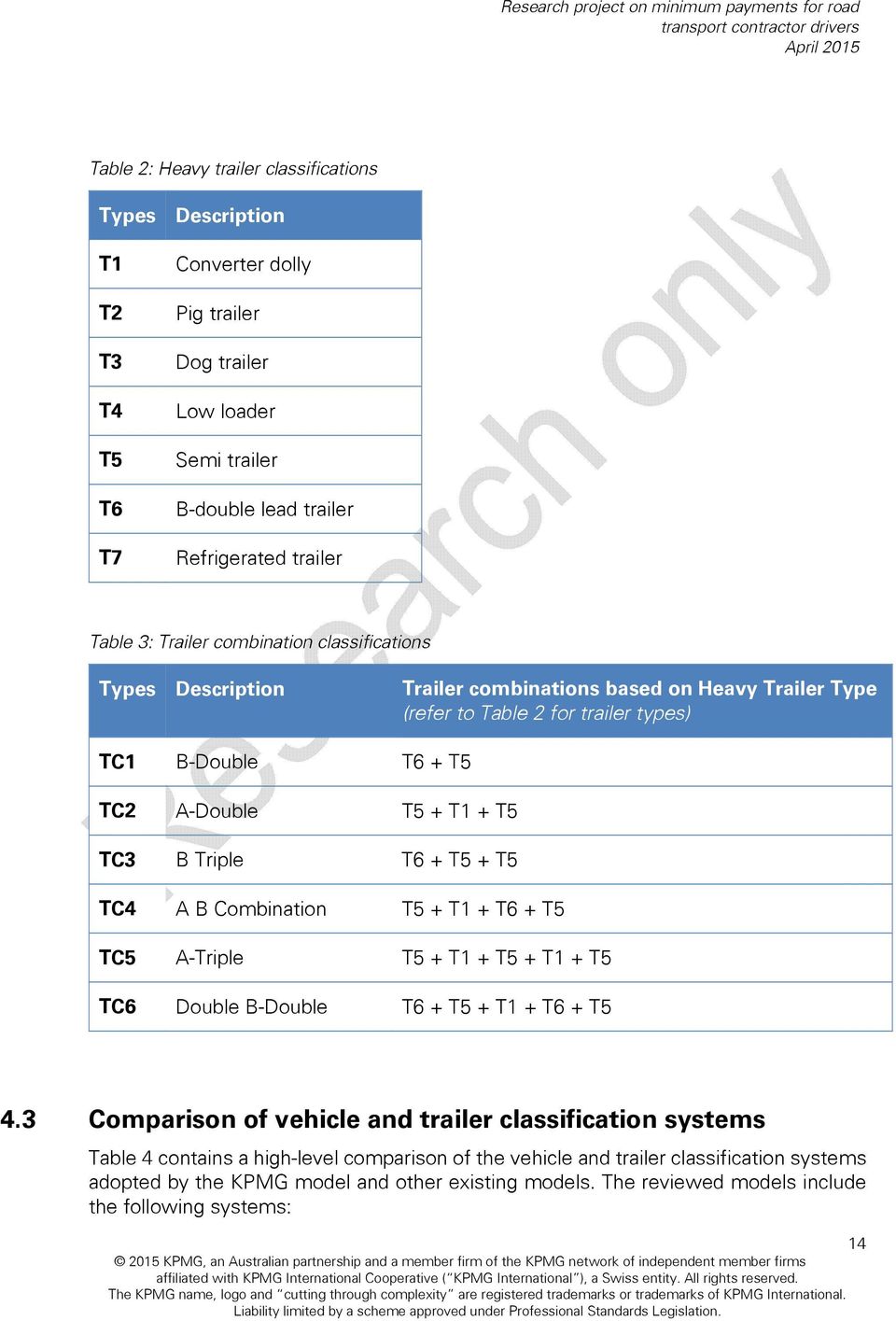
13 New South Wales Industrial Relations Commission Transport Industry - General Carriers Contract Determination (NSW IRC, 2014) Fair Work Commission Award Categories for Transport Workers under the Road Transport and Distribution Award 2010 (FWC, 2010a) and Road Transport (Long Distance Operations) Award 2010, (FWC, 2010b). Victorian Government Rates and Cost Schedules for Owner-drivers (VIC DTF, 2014) Australian Bureau of Statistics Motor Vehicle Census (ABS, 2014a) National Transport Commission Charges for heavy vehicles (NTC, 2014) The results of the analysis suggested the classification systems used by the New South Wales Industrial Relations Commission under the Transport Industry - General Carriers Contract Determination and the Fair Work Commission in the determination of award rates under the Road Transport and Distribution Award 2010 and Road Transport (Long Distance Operations) Award 2010 were the most suitable for the purpose and objectives of the model. The resultant classification system for the model adopts features of both the New South Wales Industrial Relations Commission and Fair Work Commission (modern award) classification systems. The classification system is: sufficiently flexible to allow for any feasible combination of rigid vehicle / prime mover trailer combination in the model calculations; unambiguous in that only one criteria is used to distinguish between vehicle classes and trailer types (one criteria for each of rigid vehicles, prime movers and trailers); representative in that the gradations between classes and types are sufficiently fine that operating costs within a class or type will be similar to each other; compatible with Fair Work Commission award rates for heavy vehicle road transport operators; and simple, avoiding an overly complicated system of classifications. The following tables outline the classification sections, titles and descriptions adopted in the model. Table 1 outlines the name and description of the vehicle classification categories. The classification system for heavy trailers and trailer combinations are shown in Table 2 and Table 3 respectively. 12

14 Table 1: Vehicle classification system Class Description LCV C1 C2 C3 C4 C5 C6 C7 C8 C9 Rigid vehicle up to and including 3.5 tonnes gross vehicle mass (GVM) Rigid vehicle exceeding 3.5 tonnes, but not exceeding 4.5 tonnes gross vehicle mass (GVM) Rigid vehicle exceeding 4.5 tonnes, but not exceeding 9.0 tonnes gross vehicle mass (GVM) Rigid vehicle exceeding 9.0 tonnes, but not exceeding 13.9 tonnes gross vehicle mass (GVM) Rigid vehicle exceeding 13.9 tonnes, but not exceeding 16.0 tonnes gross vehicle mass (GVM) Rigid vehicle exceeding 16.0 tonnes, but not exceeding 20.0 tonnes gross vehicle mass (GVM) Rigid vehicle exceeding 20.0 tonnes gross vehicle mass (GVM) Prime mover with 2 axles ( single axle prime mover ) Prime mover with 3 axles ( bogie axle prime mover ) Prime mover with 4 axles or more 13

15 Table 2: Heavy trailer classifications Types Description T1 T2 T3 T4 T5 T6 T7 Converter dolly Pig trailer Dog trailer Low loader Semi trailer B-double lead trailer Refrigerated trailer Table 3: Trailer combination classifications Types Description Trailer combinations based on Heavy Trailer Type (refer to Table 2 for trailer types) TC1 B-Double T6 + T5 TC2 A-Double T5 + T1 + T5 TC3 B Triple T6 + T5 + T5 TC4 A B Combination T5 + T1 + T6 + T5 TC5 A-Triple T5 + T1 + T5 + T1 + T5 TC6 Double B-Double T6 + T5 + T1 + T6 + T5 4.3 Comparison of vehicle and trailer classification systems Table 4 contains a high-level comparison of the vehicle and trailer classification systems adopted by the KPMG model and other existing models. The reviewed models include the following systems: 14
16 New South Wales Industrial Relations Commission Transport Industry General Carriers Contact Determination (NSW IRC, 2014) Victorian Government Rates and Cost Schedules for Owner-drivers (VIC DTF, 2014) Western Australian Government Owner-driver (Contracts and Disputes) Act 2007 (WA DOT, 2014) Table 4: Representative Vehicle Existing Model Comparison Model KPMG NSW Government WA Government VIC Government Number of vehicle classes 10 vehicle classes 7 vehicle classes 7 vehicle classes Treatment of combination vehicles Rigid vehicle classes Additional daily and hourly allowances are prescribed for supplying or towing various trailers. Grouped by GVM (7 classes) Additional daily and hourly allowances are prescribed for supplying or towing various trailers. Grouped by carrying capacity (5 classes) No system is defined - user inputs vehicle and trailer variables into model Only one combination vehicle is considered (semi-trailer) Grouped by approximate GVM with no strictly defined boundaries (5 classes) Prime-mover vehicle classes Grouped by number of axles (3 classes) Prime movers grouped by number of axles (2 classes) Only considers 3 axle prime movers, with or without a semi-trailer (2 classes) 15

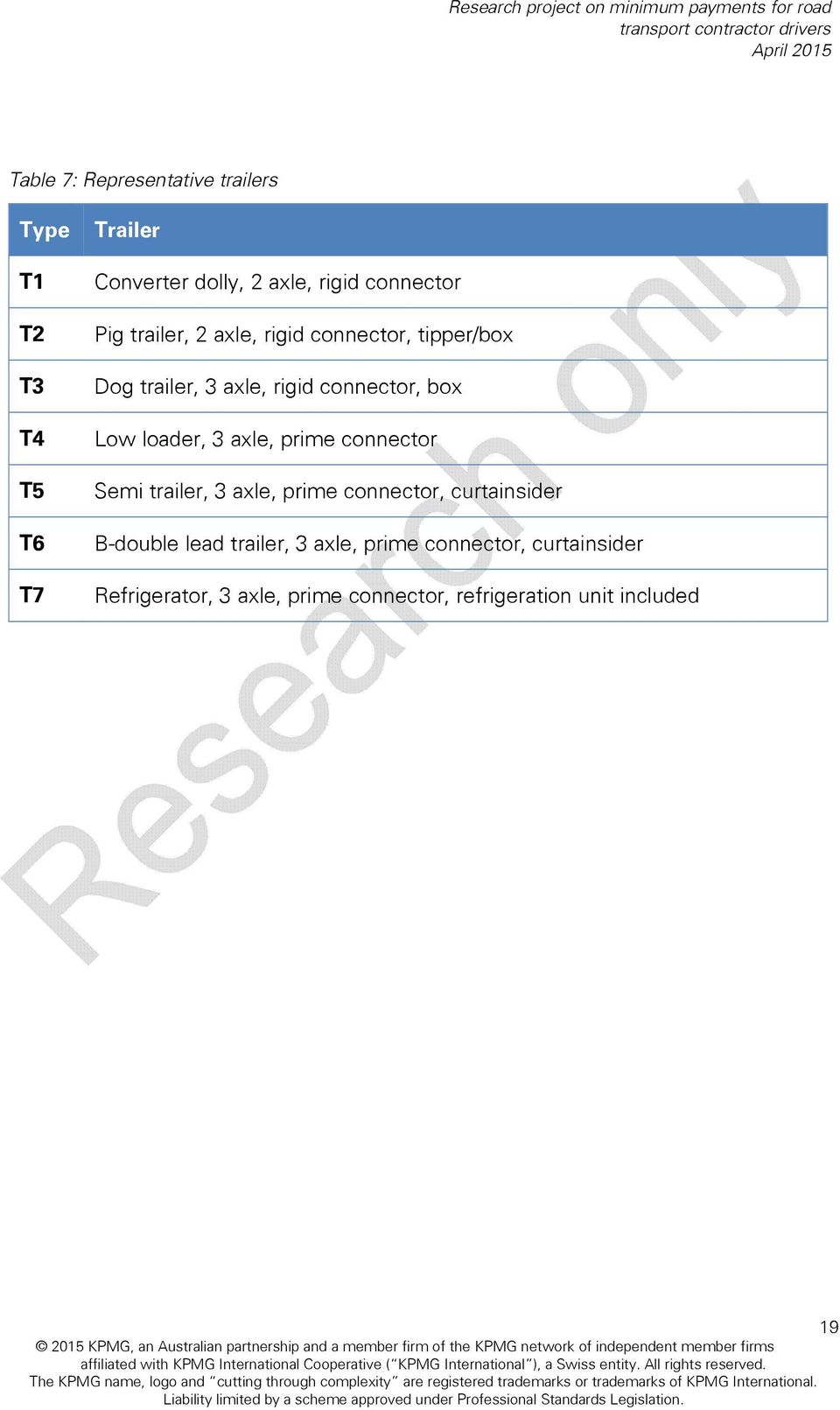
17 5 Representative vehicles and trailers This section describes the representative vehicles and trailers chosen for each vehicle class and trailer type defined in the preceding section. An existing vehicle and trailer was selected to represent each vehicle class and trailer type and serve as the basis of cost estimation. This approach supports the accurate estimation and allocation of costs to each vehicle class and trailer type. The existing vehicle and trailer that is most representative of the vehicle class and trailer type was chosen for inclusion in the model. Characteristics of each selected existing vehicles and trailers are used as data inputs into the model. The data collected about each vehicle and trailer includes capital cost, fuel tank size and number of tyres. These features were used to calculate estimates for finance, fuel and tyre costs for each vehicle class and trailer type. The approach to selecting representative vehicles and trailers is outlined below including the selected representative vehicles and trailers. The results of a high-level comparison of the features of vehicle and trailer classification systems adopted by the KPMG model against other heavy vehicle cost models is also included in this section. 5.1 Principles for selection of representative vehicles and trailers Representative vehicles were selected on the basis of the following principles: Popularity Popularity of the vehicle s make in Australia within its class according to the Australian Bureau of Statistics (ABS) Motor Vehicle Census 2014 (ABS, 2014a). Capital value Purchase price of the vehicle and the rate of capital value depreciation being similar to other popular vehicles in its class according to Glass s guide (Glass, 2014) and private listings. Weight Gross Vehicle Mass (GVM) being close to the middle of the defined GVM range (classes C1 through to C5 only). Table 5 outlines the methodology used to select representative vehicles. 16

18 Table 5: Representative Vehicle Selection Methodology Overview Principle Popularity Capital value Weight Shortlist methodology The Census of Motor Vehicles (ABS, 2014a) was examined to short list the five most popular makes and models within each class. The new and used capital value of all shortlisted vehicles were obtained using Glass s Guide (Glass, 2014), private listings, and quotes from heavy vehicle dealers. This information was used to select vehicles with medium representative capital value for its particular classification group. The specifications of shortlisted rigid vehicles (Class 1-6) were obtained from manufacturers websites to compare GVM and select vehicles with a representative weight for their class. 5.2 Representative vehicles and trailers Representative vehicles were chosen based on the principles outlined in the preceding section. A group of five vehicles were shortlisted for each vehicle classification group on the basis of popularity. An analysis was then undertaken on the popularity, capital value and weight of the vehicle. The vehicle that was most representative of each particular vehicle class was chosen. The selected representative vehicles are shown in Table 6. 17

19 Table 6: Representative vehicles Class Vehicle LCV C1 C2 C3 C4 C5 C6 C7 C8 C9 Toyota Hilux Mercedes Benz Sprinter 310 CDI Isuzu NPR 300 Medium with curtainsider body Isuzu FSD 700 with curtainsider body Isuzu FTR 900 with curtainsider body Isuzu FVR 1000 Medium with curtainsider body Iveco Distributor with curtainsider body Iveco Stralis ATi 450 4x2 prime mover Kenworth T409 6x4 prime mover Kenworth T409 8x4 prime mover The model calculations draw on the same vehicles for determining costs for road under Distribution and Long Distance operations. However, it is assumed that trucks used for Long Distance operations are fitted with sleeper cabins, allowing the model to reflect the additional associated cost. Representative trailers were also selected by consulting the Census of Motor Vehicles and private listings to shortlist the most popular types of trailer. The selected representative trailers are shown in Table 7. 18

20 Table 7: Representative trailers Type T1 T2 T3 T4 T5 T6 T7 Trailer Converter dolly, 2 axle, rigid connector Pig trailer, 2 axle, rigid connector, tipper/box Dog trailer, 3 axle, rigid connector, box Low loader, 3 axle, prime connector Semi trailer, 3 axle, prime connector, curtainsider B-double lead trailer, 3 axle, prime connector, curtainsider Refrigerator, 3 axle, prime connector, refrigeration unit included 19
21 6 Cost components This section outlines the principles for the selection of the modelled cost components. The results of a high-level comparison of the treatment of cost components in the KPMG model against other heavy vehicle cost models is also included in this section. 6.1 Principles for selecting cost components Cost items seek to be representative of operating costs incurred by road transport contractor drivers, but not necessarily comprehensive. Only items that are significant with respect to operating cost and necessary for performing standard road transport contractor driver services are included in the model s calculations. These guiding principles for the selection of cost components were adopted to ensure the development of a robust model that was not unnecessarily complex. 6.2 Selection of cost components Cost components were chosen based on the principles outlined in the preceding section. The selection of cost components involved an analysis of heavy vehicle operating cost models including: New South Wales Industrial Relations Commission - Transport Industry General Carriers Contact Determination (NSW IRC, 2014) Western Australian Government - Owner-driver (Contracts and Disputes) Act 2007 (WA DOT, 2014) Victorian Government - Rates and cost schedules for owner-drivers (VIC DTF, 2014) Overall, the approach to cost components adopted by the KPMG model largely reflects those in other models. Some differences exist, particularly in regard to the less significant cost components. The most significant cost component categories such as fuel, finance and labour costs include similar or identical cost components across all existing models. The cost categories adopted in the model are outlined in Table 8 alongside a description of components in each category. 20
22 Table 8: Cost components Cost component 1 Labour and on-costs Description Costs of labour, casual loading, allowances and superannuation. 2 Finance Costs of financing vehicles and trailers. 3 Fuel & Oil Costs of diesel fuel, engine oil and AdBlue 7. 4 Registration & Insurance Costs of registering and insuring vehicles and trailers. 5 Tyres Costs of replacing tyres as they wear out. 6 Maintenance 7 Administration 8 Other Costs of maintenance and repairs for vehicles and trailers. Costs of administration tasks, including accounting, mobile phone and a laptop for business use. Other costs including telematics, accreditation, training courses, vehicle washing and ASIC fees. A summary of the cost components adopted by other models and how it compares with the KPMG model is located in Table 9. 7 AdBlue is a diesel exhaust fluid used to reduce NOx concentration in diesel exhaust fumes. It is applicable to all heavy vehicles (classes 1 to 9) but not to LCVs. 21
23 Table 9: High-level results of analysis of cost components Cost category Notes on approaches adopted in existing models KPMG approach Finance This cost category refers to costs incurred in purchasing vehicles and trailers. Approaches adopted in existing models generally refer to loan arrangements with common cost components including repayment (typically as an annual payment) and depreciation costs. The loan inputs include loan features such as deposit percentage, interest rate, residual percentage, loan term and repayment frequency. Depreciation and return on capital invested are also included, in accordance with approaches applied in the Transport Industry - General Carriers Contract Determination and other models. Fuel and Oil Straightforward and consistent components used across various models calculations are based on most recent listed cost of diesel and some measure of vehicle fuel consumption. KPMG approach is similar to the approach adopted in most models. Cost components relate to fuel and oil consumption. The model will also include costs associated with AdBlue consumption. Maintenance Common cost components used across most existing models (with some minor variations across the combinations of service, repair and/or maintenance costs that are included). KPMG approach treats maintenance as a variable cost component that is incurred on a per kilometre travelled basis. Tyres Common features across components include cost of tyre and replacement frequency. The subcomponents and methods of calculating tyre costs vary across models. KPMG approach includes costs related to new tyre replacement and tyre retreads. The sub-components include number of tyres and retreads per tyre by vehicle type, new tyre and retread tyre costs, tread depth and unit tread cost and tread wear rates for distribution and long distance operations. affiliated with KPMG International Cooperative ( KPMG International ), a Swiss entity. All rights reserved. 22
24 Registration and Insurance Administration Classification of insurances vary across models. Most models specify comprehensive and public liability insurance. Some models include personal insurances such as income (accident/sickness) and workers compensation insurance. Less common inclusions include trailer-in-control insurance and marine (load) insurance. Inclusions in this category are not as clear as others. The Victorian Government model s definition of administration costs is: includes maintenance of records, preparation of tax returns, mobile phone charges, consumer price index, and sundry business expenses. Most models include at least one category for general administration costs, accounting or consultant fees and mobile phone costs. KPMG approach includes cost components for both registration and insurance. Registration costs are calculated based on an average annual registration cost for all Australian jurisdictions. Insurances that are necessary for undertaking standard contractor operations were included. These include comprehensive, liability, sickness and accident, goods in transit / marine transit and trailer in control insurances. These are deemed necessary on the basis of the minimum requirements needed to operate while minimising risks to personal safety and business security. In addition, KPMG analysis of existing cost models and correspondence with heavy vehicle operators concluded that it was reasonable to reflect the cost of the selected insurance products. The KPMG approach reflects the approaches adopted in the Victorian Government model. KPMG approach includes three administration components; mobile phone costs, accounting costs, and other office expenses such as laptop costs. These costs were all deemed necessary for standard contractor operations. They each also were significant enough to warrant inclusion. Inclusion of administrative overheads as major cost categories aligns with the approach adopted in all existing models. Accounting fees are included in all existing models in some form. Laptop and/or office related fees are included in most models also. affiliated with KPMG International Cooperative ( KPMG International ), a Swiss entity. All rights reserved. 23
25 Other Labour and oncosts This cost component includes costs that were not commonly identified by more than one model, or less significant costs that are not easily placed in the other categories. Components in this category include truck washing costs, telematics operations, vehicle garaging, work-wear and the attainment of various permits and accreditations. All models reference awards applicable to heavy vehicle road transport operators. KPMG approach looks to include cost components that are both necessary for standard operations and significant in size. These costs apply to a majority of contractor drivers and are required to undertake operations to an appropriate standard. On this basis, cost components included in the model are driver licensing costs and costs associated with obtaining various vehicle accreditations (which are mandatory in the case of WA) which are commonplace in other jurisdictions. Training costs associated with obtaining these accreditations are also included where appropriate. Common costs such as payment of ASIC fees, vehicle washing costs and purchase and installation of telematics equipment are also included. Costs that aren t included in the KPMG model but were presented elsewhere include workwear and PPE on the basis that these costs were not necessary for undertaking services, depot costs given these are not necessarily incurred by contractor drivers, and other subscriptions and miscellaneous given most of these are not significant in size. Note, the KPMG model includes costs associated with obtaining Bluecard registration given this is commonplace among contractor drivers. KPMG approach draws labour costs from the Road Transport and Distribution Award 2010 and Road Transport (Long Distance Operations) Award Source: (NSW IRC, 2014); (VIC DTF, 2014); (WA DOT, 2014); KPMG analysis affiliated with KPMG International Cooperative ( KPMG International ), a Swiss entity. All rights reserved. 24
26 A more detailed overview of the key differences between the cost components of the existing heavy vehicle operating models is provided in Table 10. Table 10: Comparison of existing model approach to cost components Model / Cost Component KPMG NSW Government WA Government VIC Government Minimum hourly award rates Rates drawn from relevant NSW Wages and superannuation listed Same as KPMG with casual loading, allowances Award, except superannuation is as line items in worksheet Labour and on-costs (where applicable) and selffunded super contribution separated from the prescribed rates (see schedule 4, clause 6). Includes balloon finance costs Includes lease costs for a four No methodology offered. Line Includes lease costs for a four for a 5 year chattel mortgage year term with a 20% residual items for calculation of loan costs year loan with a 25% residual loan with a 30% residual at a (interest rate unknown) for 70% and depreciation (but not return at a 7% interest rate. 7.6% interest rate with no of the vehicle s capital value. on capital) are included. Depreciation and return on Finance deposit. Return on capital is calculated on the owner- Depreciation and return on capital are calculated on owner-operator Vehicle capital value is a user capital are not considered (assumes 0% owner-operator operator s equity in the vehicle, equity in the vehicle of 30% of input. equity in the vehicle). currently assumed to be 0%. 8 the vehicle s capital value. Depreciation is calculated Vehicle capital values are based on the capital value of defined as the average retail 8 Return on capital invested is the market return on funding invested toward vehicle purchase. The assumption of 0% return on equity capital invested reflects the finance arrangement used in the model (chattel mortgage with no deposit). affiliated with KPMG International Cooperative ( KPMG International ), a Swiss entity. All rights reserved. 25
27 Model / Cost Component KPMG NSW Government WA Government VIC Government the vehicle using a straight line depreciation method. 9 The effective life of the vehicle used for depreciation calculations is sourced from guidance provided by the Australian Taxation Office (ATO). Vehicle capital values are sourced from Glass guide for four year old vehicles. The source of vehicle capital values is not available. value of a 4 year old [representative] vehicle. Fuel & Oil Price of diesel in all capital and non-metropolitan areas from the Australian Institute of Petroleum (12 month average). Includes fuel and engine oil but not Adblue. The sources of prices and consumption rates are not available. No methodology is offered. Line items for Fuel and Oil are included. Only considers fuel consumption, not oil or Adblue. Suggests fuel consumption rates for various vehicles and uses the spot price of diesel at the time of publication. 9 The calculation of depreciation reflects ATO guidance. The ATO approach is based on useful economic life and is therefore an economic measure of the actual life value of the asset at the end of the year. This may or may not equate to the balloon payment under any financial arrangements for purchase of vehicle and/or trailer. Balloon payments can in some instances be seen as a measure of residual value and on this basis may be used for calculating depreciation. The balloon payment is a financial metric that often reflects the value of the asset at the end of loan term. The buyer (as mortgagee) can choose various levels of residual (e.g %) of total loan value, which may or may not accurately reflect actual life value of the vehicle or trailer. Consequently, ATO s approach to estimating depreciation is the preferred given a) it more appropriately reflects the annual use value (i.e. opportunity cost of owning the asset), b) allows for consistency in application and c) ease of use. 26 affiliated with KPMG International Cooperative ( KPMG International ), a Swiss entity. All rights reserved.
28 Model / Cost Component KPMG NSW Government WA Government VIC Government Price of oil and consumption rates for diesel and oil are calculated using the 2015 National Guidelines for Transport System Management. Registration & insurance Adblue consumption assumed to be 5% of diesel consumption with prices sourced directly from dealers. Cost of registration is an average of all registration fees, levies and mandatory services New South Wales includes registration costs (including compulsory third party insurance) for all representative vehicles in and the following insurances: all jurisdictions. Comprehensive The following insurances were included: Public liability Sickness and accident Comprehensive Liability Income protection Line items for vehicle registration and the following insurances: General (comprehensive) Public liability Sickness and accident Includes registration, permits and TAC charges for Victoria and the following insurances: Comprehensive Marine (goods-in-transit) Sickness and accident Public liability Workers compensation affiliated with KPMG International Cooperative ( KPMG International ), a Swiss entity. All rights reserved. 27
29 Model / Cost Component KPMG NSW Government WA Government VIC Government Marine (goods-in-transit) Trailer-in-control Tyres Tyre prices and consumption rates calculated using the 2015 National Guidelines for Transport System Management based on tread wear and unit tyre costs and retreads. The sources of prices and consumption rates are not available. No methodology offered. Includes a single line item for tyres. Tyre prices and consumption rates specified but no source is provided. Maintenance, service and repairs Maintenance and repair costs (cents per kilometre) are calculated using the 2015 National Guidelines for Transport System Management based on representative vehicles. Assumes 10% of total costs (1/9 of all other costs). Includes line items for Repairs and Services. Specifies a cents per kilometre rate but no source is provided. Administration Mobile phone, accounting fees and laptop Mobile phone, accounting fees Line items are included for a large number of administrative overheads. Assumes $2500 per annum for all vehicles classes for mobile phone, accounting fees and other costs affiliated with KPMG International Cooperative ( KPMG International ), a Swiss entity. All rights reserved. 28
30 Model / Cost Component KPMG NSW Government WA Government VIC Government Other Driver license, heavy vehicle accreditation, fatigue management, blue card, ASIC fee, washing cost, and telematics. Not included. Many line items are included. Included in Administration. Draws from publicly available Documentation on sources was or subscription sources not available. including Fair Work Commission (labour), Australian Institute of Petroleum (fuel) Sources of and the National Guidelines for costs Transport System Management 2015 (fuel consumption, oil, tyres, maintenance and repairs), Glass guide (vehicle capital values). Source: (NSW IRC, 2014); (WA DOT, 2014); (VIC DTF, 2014); KPMG analysis Only provides a worksheet template for individual owneroperators. Does not specify values or sources. Is intended as a rough guide for individual owner-operators. Specifies some values but sources are not generally available. affiliated with KPMG International Cooperative ( KPMG International ), a Swiss entity. All rights reserved. 29
31 6.2.1 Contribution of cost components to total costs In order to illustrate the relative importance of each cost component, Figure 2 provides illustrative results from the KPMG model developed for this work that show the relative contribution of each operating cost component for selected vehicle and trailer classifications. These results will vary marginally according to the model settings, including the user s choice of award rate grade and service delivery type (Distribution or Long Distance operations). By way of example, the results below represent the operating costs faced by road on Distribution operations along the eastern seaboard of Australia. The chart illustrates the relative importance of the labour and fuel and oil cost components. Combined, these cost components make up the majority of costs incurred by road. Other significant costs include finance and registration and insurance costs. Other costs such as tyres, maintenance, business administration and licensing costs make up less than 20 per cent of the total cost incurred by road operating most heavy vehicles. 30
32 Figure 2: Proportion of total operating cost by cost component and representative vehicle and trailer classification 31
33 7 Global assumptions This section describes the two major global assumptions and how they affect the outcomes for minimum payments. The annual hours worked assumption is used to convert annual fixed cost estimates into an hourly payment. The annual kilometres travelled assumption is only used in the calculation of the Single hourly rate method of payment. 10 The single hourly rate method is the same as the per hour standing and per kilometre running rate method, however all per kilometre costs are converted into hourly costs using the global assumptions. This annual kilometres travelled assumption does not impact the standing per hour component as this is already an hourly payment. 7.1 Annual hours worked It is assumed that 2,170 hours per year are worked by road for both Distribution and Long Distance operations. This value is the product of assumptions about the number of weeks worked per year and the number of hours worked per week, as shown below. Assumption Source 48 weeks worked per year (with four weeks annual leave) (Fair Work Act, 2009) hours worked per week (average hours worked per week for a full-time adult truck driver on individual arrangements). Employee Earnings and Hours (ABS, 2012a) 12 All fixed costs are assumed to be recovered evenly over the hours worked in the year. The cost components that are recovered as fixed costs on an hourly basis include: 2. Finance 10 The presentation of the minimum payments allows for two methods of payment. These methods of payment are the per hour and per kilometre rates and the single hourly rates. These terms are defined in Section 1.2 of this document. 11 Full time Australian employees are entitled to four weeks annual leave per year as set out in Division 6 of the Fair Work Act 2009 (Cth). 12 Table 1 FULL-TIME NON-MANAGERIAL ADULT EMPLOYEES, Average weekly cash earnings and hours paid for Occupation by Method of setting pay. Average weekly hours paid for, 7331 Truck drivers, individual arrangements. 32
34 4. Registration & Insurance 7. Administration 8. Other. Any increase in the assumed annual hours worked would result in a decrease in the hourly rate, and vice versa. 7.2 Annual kilometres travelled The Survey of Motor Vehicle Use (ABS, 2012b) records annual kilometres by vehicle class, using the two categories of Rigid trucks and Articulated trucks. It has been assumed that rigid trucks represent Distribution operations and articulated trucks represent Long Distance operations for the purpose of the annual kilometres travelled assumption. This reflects an underlying assumption that in practice, Distribution operations are often undertaken by rigid trucks (C1 through C6 in Table 1) and Long Distance operations are often undertaken using articulated trucks, such as prime movers (C7 through C9 in Table 1) with trailers or combinations of trailers. It should be noted that annual kilometres travelled varies widely according to the precise nature of operations and individual circumstances of each road transport contractor driver. The assumptions and sources for annual kilometres travelled are shown below. Assumption Source 35,000 kilometres per year for Distribution operations (ABS, 2012b) ,000 kilometres per year for Long Distance operations (ABS, 2012b) 14 The annual kilometres travelled assumption is only used in the calculation of the Single hourly rate method of payment. 15 This assumption does not affect the calculation of the per hour standing and per kilometre running rates. The cost components that are recovered as variable costs on a per kilometre basis that would be affected by the annual kilometres travelled assumption include: 13 Table 12 Average kilometres travelled, Year of manufacture by type of vehicle by state/territory registration, 2007 and after, Rigid trucks, Australia, Average kilometres travelled (approximate value). 14 Table 12 Average kilometres travelled, Year of manufacture by type of vehicle by state/territory registration, 2007 and after, Articulated trucks, Australia, Average kilometres travelled (approximate value). 15 The presentation of the minimum payments allow for two methods of payment. These methods of payment are the per hour and per kilometre rates and the single hourly rates. These terms are defined in Section 1.2 of this document. 33
35 3. Fuel and Oil 5. Tyres 6. Maintenance The use of the annual kilometres travelled assumption for the calculation of the Single hourly rate method of payment means if a road transport contractor driver drives further than the assumed travel distance, they will be over compensated for their variable costs. Conversely, the driver will be under compensated for variable costs if they travel fewer kilometres than is assumed. Due to the wide variation between road annual kilometres travelled, separate per hour standing and per kilometre running rates will generally be more representative of road transport contractor driver costs. 34
36 8 Calculating cost model payments The minimum payments produced by the cost model are designed to compensate a driver for each of the cost components according to the calculations described in this section. This section describes each of the cost components in detail and includes the following descriptions. 1 Definition 2 Assumptions 3 Inputs and sources 4 Calculation method All cost components contribute to the recommended minimum payments produced by the cost model. Note: a number of assumptions were applied in undertaking the cost component calculations. These assumptions were adopted in order to avoid unnecessary complexity and support the calculation of annual cost estimates. 35
37 8.1 Labour and on-costs Definition This cost component accounts for the labour of road. Inclusions Minimum hourly/per kilometre rates Casual loading Industry disability allowance (long distance operations only) Overtime allowance (long distance operations only) Superannuation (only applies to ordinary time earnings for long distance labour calculations) Exclusions None Assumptions The following assumption was made in the calculation of labour and on-cost estimates. Note, that no further penalty rates or allowances were included beyond those noted in this chapter (see section above). It is assumed that the hirer is not required to make superannuation contributions on the contractor s behalf as labour does not typically account for the majority of the contract value (ATO, 2014b). The rates therefore allow for self-funded superannuation Selection of inputs and sources KPMG sourced minimum rates of weekly and hourly remuneration for Distribution and Long Distance driving from the Road Transport and Distribution Award 2010 (FWC, 2010a), and Road Transport (Long Distance Operations) Award 2010, (FWC, 2010b). The documents used incorporate all amendments up to and including 12 November The rates of remuneration, casual loadings, overtime allowance (for long distance) and superannuation contributions stipulated in the awards and other legislation were included in the model. 36
38 8.1.4 Inputs and sources The inputs and source documents used to determine labour and on-costs in the model are outlined below. Input Minimum hourly rates with 25% casual loading (Distribution operations). Minimum hourly or per kilometre rates 17 with 15% casual loading (Long Distance operations), inclusive of industry disability allowance and overtime allowance. Schedule of agreed distances and driving hours (Long Distance operations). Source (FWC, 2010a) 16 (FWC, 2010b) (FWC, 2010b) 18 (FWC, 2010b) Super guarantee charge percentage (9.50%). (ATO, 2014b) 16 Casual (25% casual loading in modern award applies for ordinary hours), All employees other than oil distribution workers. 17 The Road Transport (Long Distance Operations) Award 2010 provides for employees to receive payment on either a per hour or per kilometre basis. The cost model provides for selection of either of these options. For simplicity, and in recognition of common practice, the per kilometre rate method of payment for labour rates has been used to calculate rates in the schedules of minimum payments. The KPMG cost model will calculate either hourly or per kilometre rate at the users discretion. 18 Casual, per kilometre driving method and hourly driving method. 37
39 8.1.5 Calculation method The calculation methods are described below: Distribution operations: Hourly rate (dollars per hour) 19 = (Minimum hourly rate with 25% casual loading TWG ) x (SGC x 38 / HRS) Where: TWG = Transport Worker Grade as defined in the Distribution award (RSRT, 2013a) (affects the minimum hourly rate) SGC = Super guarantee charge percentage (9.50%) HRS = Hours worked per week (as defined in Section 7.1) WKS = Weeks worked per year (as defined in Section 7.1) The per hour superannuation component for distribution operations is listed below for each transport worker grade. Note, these rates reflect current model variable settings and assumptions. Any change in the variables listed in the formula above will impact the value of the per hour rates. Table 11: Per hour superannuation payment by Transport Worker Grade for distribution operations Transport Worker Grade 1 $ $ $ $ $ $ $ $ $ $2.10 Superannuation ($ per hour) 19 Part 5 of the Road Transport and Distribution Award 2010 provides for ordinary hours of work of an average 38 hours per week.superannuation is adjusted to account for assumed hours worked per week. 38
40 Long distance operations: If ((Minimum hourly rate with 15% casual loading TWG ) x HRS x WKS) < ((Minimum per kilometre rate with 15% casual loading TWG ) x AKT LD ) Then use this equation: Hourly rate (dollars per hour) 20 = (Minimum hourly rate with 15% casual loading TWG ) x (SGC x 38 / HRS) Otherwise, use this equation: Running rate (dollars per kilometre) 21 = (Minimum per kilometre rate with 15% casual loading TWG ) x (SGC x 38 / HRS) Where: TWG = Transport Worker Grade as defined in the Long Distance Award (affects the minimum hourly rate) SGC = Super guarantee charge percentage (9.50%) HRS = Hours worked per week (see Section 7.1) WKS = Weeks worked per year (see Section 7.1) AKT LD = Annual kilometres travelled, Long Distance operations (see Section 7.2) The per hour superannuation component for long distance operations is listed below for each transport worker grade. Note, these rates reflect current model variable settings and assumptions. Any change in the variables listed in the formula above will impact the value of the per hour rates. 20 Part 5 of the Road Transport (Long Distance Operations) Award 2010 provides for ordinary hours of work of an average 38 hours per week. Superannuation is only applied in respect to ordinary time earnings for long distance drivers. Ordinary time earnings is determined in reference to the relevant award documentation. The calculation of superannuation for long distance operations is consistent with guidance provided by the ATO at with reference to ruling SGR 2009/2 Superannuation guarantee: meaning of the terms ordinary time earnings and salary or wages. 21 Ibid 39
41 Table 12: Per hour superannuation payment by Transport Worker Grade for long distance operations Transport Worker Grade Superannuation ($ per hour) 1 $ $ $ $ $ $ $ $
42 8.2 Finance Definition This cost component includes costs associated with financing a vehicle or a trailer. Inclusions Loan costs Depreciation costs Return on capital invested Exclusions Administrative fees Assumptions The following assumptions were made in order to support the calculation of Finance costs. These include simplifying assumptions regarding the type of financial product used to procure vehicles and trailers and assumptions for each feature of the loan arrangement. The finance cost calculations aim to reflect the most commonly applied financial arrangements for heavy vehicle purchases. Heavy vehicle financing industry representatives indicated that a chattel mortgage was the most commonly used financing technique for heavy vehicles 22. Accordingly, the finance calculations contain variables that reflect typical arrangements under this financial product. The assumptions are based on verbal and written advice collected from heavy vehicle finance organisations and major financial institutions 23. Further detail regarding the selection of inputs and values of the loan variables are provided below. Finance costs are fixed costs that are evenly divided over annual hours worked (see Section 7.1). The vehicle is financed using a balloon financing technique. This means that the loan does not fully amortise over the loan term, leaving a residual value at the end of the term. Monthly loan repayments are assumed. A straight line depreciation method is applied as defined by the ATO. 22 Discussion members included representatives from specialised vehicle financing organisations such as Stratton Finance, and major financial institutions including the major banks. 23 Ibid 41
43 A return on capital on the road transport contractor driver s initial deposit is allowed for at the market rate of return. The age since manufacture of the representative vehicle is a required assumption. The vehicle age since manufacture is set to four years, which is in alignment with assumptions adopted in other existing models. This assumption affects the capital value at time of purchase (and therefore the size of the loan required) Selection of inputs and sources The model s finance cost component inputs consist of loan variables, capital values (market prices), and inputs for the calculation of depreciation. Loan inputs The loan inputs reflect the features of a chattel mortgage, a commonly used financing method for the purchase of heavy vehicles and related equipment. The included loan components are those offered as a part of most loan arrangements. The model loan features include term length, interest rate, deposit requirements and residual percentage. The information on typical loan features were collected from major financial institutions and specialist heavy vehicle financers. Administrative fees were not included given the large variability in level of fees across loan providers and low value relative to other loan costs. The loan inputs represent the rates typically used for loans for the purchase of heavy vehicles and equipment. Loan features such as deposit percentage, residual and loan term were based on the expert knowledge of lenders in the market. Interest rates were sourced by quotes for vehicles with different capital values and ages from financial institutions. Where interest rate quotes were unavailable, KPMG sought interest rate ranges. Collecting typical rates was difficult given the variability in rates provided by financial institutions and the difficulties in collecting reliable and accurate information. Market rates typically vary significantly from one loan to the next; affected by aspects such as the background of the borrower, vehicle or equipment features, and the lending policies of different financial institutions. Reliable and accurate information on rates are difficult to collect given banks do not publish demographic information on their loans or typical rates offered to market. The levels for the loan term length, repayment frequency, and balloon and deposit percentages were all determined based on the most common response received. The interest rates were based on indicative rates for heavy vehicle finance and business equipment loans from ANZ bank for the month of October, These rates are those provided by ANZ bank to brokers as an indication of the rates they can provide for a particular time period. Given these rates were an indication of the typical rates ANZ 42
44 was able to provide, they served as a stronger indication than interest rate ranges. Also, these rates were sufficiently similar to quotes received from other financial institutions. Capital Values Market values for each of the representative vehicles and trailers were collected to allow for the calculation of finance costs for owners of different vehicle and trailer types. These values were sourced for vehicles of different ages. Capital values were sourced from Glass s Guide wherever possible. Glass s information service is a leading supplier of automotive business intelligence, collecting and reporting detailed demographic information on a wide range of vehicles. This was the most comprehensive and reliable source of information available for vehicle prices. Where information was limited on Glass s, quotes were sourced from vehicle dealers. Market prices for vehicles of different ages were also sourced from Glass s guide wherever possible. Most of these values were calculated using the rate of depreciation for each vehicle provided in the information sheet for each vehicle in Glass s guide. Capital values were also collected for vehicles where the manufacturer provided the option for the addition of a sleeper cabin. These values were then used in the model to indicate vehicles in Long Distance operations and allow finance values to reflect the difference in prices based on the operating model of the driver. Trailer capital values were only collected at the recommended retail price. This is because second-hand capital values were difficult to cite authoritatively. Availability of market prices for trailers was less limited than those available for vehicles. In addition, these prices varied more than vehicles. Therefore, it was assumed, for the purpose of calculating finance costs for owners of trailers that they were purchased as new at the recommended retail price. Depreciation inputs Depreciation is calculated using the straight line, Prime Cost, depreciation method. This method depreciates the value of a vehicle or trailer at a constant rate over its effective life. In effect, the model calculations depreciate the value of the vehicle to its residual value over the loan term, then calculating the annual cost of this process. This approach is in accordance with guidance provided by the ATO and reflects the approach undertaken by Austroads in their calculations of vehicle depreciation. The calculation of depreciation reflects ATO guidance. The ATO approach is based on useful economic life and is therefore an economic measure of the actual life value of the asset at the end of the year. This may or may not equate to the balloon payment under any financial arrangements for purchase of vehicle and/or trailer. Balloon payments can in some instances be seen as a measure of residual value and on this basis may be used for calculating depreciation. The balloon payment is a financial metric that often reflects the value of the asset at the end of loan term. The buyer (as mortgagee) can choose various levels of residual (e.g %) of total loan value, which may or may not 43
45 accurately reflect actual life value of the vehicle or trailer. Consequently, ATO s approach to estimating depreciation is the preferred approach given the following factors: the approach more appropriately reflects the annual use value (i.e. opportunity cost of owning the asset) the approach allows for consistency in application the approach allows for depreciation to be calculated simply in the cost model. Return on capital invested Return on capital invested is the market return on equity funding invested toward vehicle purchase. The rate of return is the market rate of return, which is calculated based on a risk free rate and a rate of return on privately invested capital in the transport industry. The return on capital is calculated on the loan deposit. Given that this deposit value is set at 0% (see table in section below), the model calculates no return to capital. The functionality has been included in the model to account for return on capital were any changes to the deposit percentage made in future Inputs and sources The inputs and source documents used to determine finance costs in the model are outlined below. Input Capital value of representative vehicles and trailers at time of purchase (considering age since manufacture) Stamp duty on vehicle purchases (3% of value) 25 Loan term (5 years) Deposit (percentage of the purchase price) (0%) 26 Source (Glass, 2014) 24 Private listings Various state government websites Quotes and verbal advice from major financial institutions and heavy vehicle financiers Quotes and verbal advice from major financial 24 A paid subscription is required for access to Glass s guide. Dealer quotes and private listings were also used to supplement Glass s guide. 25 Stamp duty varies by state, but all are around 3% 26 This percentage reflects the finance method (chattel mortgage) and assumed deposit value (nil). 44
46 institutions and heavy vehicle financiers Residual/balloon (percentage of the purchase price) (30%) Interest rate on loan (7.6% p.a.) Market rate of return on equity (11.3% p.a.) 27 Quotes and verbal advice from major financial institutions and heavy vehicle financiers Quotes from major financial institutions Bloomberg data, KPMG analysis Effective life of vehicle/trailer, varies by type (ATO, 2014a) Calculation method Finance costs are divided into loan costs (assuming a standard amortising loan with constant repayments), return on capital and depreciation costs. Loan costs: Standing (hourly) rate = (r x A) / (1 (1+r) -N ) / (HRS x WKS) Where: A = Loan amount (capital value of vehicle/trailer less deposit) r = Rate of interest (compounded) N = Number of payments per annum (12) HRS = Hours worked per week (see Section 7.1) WKS = Weeks worked per year (see Section 7.1) 27 The rate of return is the market rate of return, which is calculated based on a risk free rate and a rate of return on privately invested capital in the transport industry. 28 TR 2014/4 Effective lives (Asset Categories) Table B as at 1 July 2014 section M 45
47 Return on capital: Standing (hourly) rate = (K x (1 + M) LT ) / LT / (HRS x WKS) Where: K = capital invested (deposit percentage times capital value of vehicle/trailer) M = Market rate of return LT = Loan term, years HRS = Hours worked per week (see Section 7.1) WKS = Weeks worked per year (see Section 7.1) Depreciation costs: Standing (hourly) rate = (CVP x EFL) / LT) / (HRS x WKS) Where: CVP = Capital value of vehicle/trailer at time of purchase EFL = Effective life of vehicle/trailer LT = Loan term, years HRS = Hours worked per week (see Section 7.1) WKS = Weeks worked per year (see Section 7.1) 46
48 8.3 Fuel & Oil Definition This cost component accounts for the cost of fuel, engine oil and AdBlue. Inclusions Fuel costs Engine oil costs AdBlue costs Exclusions None Assumptions The following assumptions were made to support the calculation of fuel and oil costs. These are generally simplifying assumptions required to calculate standard fuel costs for the range of vehicle and trailer combinations that make up the model. The approach to calculating fuel consumption draws on coefficients from the Transport and Infrastructure Council (NGTSM, 2014). 29 Fuel consumption is dependent on average speed and driving conditions. The age or year of manufacture of the vehicle does not impact on the rate of fuel consumption. Consumption rates are general for a vehicle class rather than specific to each representative vehicle. For vehicle/trailer combinations, additional fuel consumption is applicable due to the extra mass being hauled (whether or not the trailer is owned by the contractor). AdBlue applies to all heavy vehicles (classes 1 to 9) but not to LCVs Selection of inputs and sources The selection of fuel and oil inputs reflected approaches adopted by other existing cost models and the available methodologies for calculating these costs. KPMG compared the sources of fuel related costs in existing cost models and found these consistently incorporated the costs associated with both diesel petrol and engine oil. The models were less consistent with the treatment of AdBlue, with only a few including this component. 29 See section 5.4.2, Model structure and coefficients of TIC document 47
49 The model includes both diesel and engine oil costs in accordance with the other existing models. AdBlue is also included to reflect requirements for its use by heavy vehicle operators. Although AdBlue is not used universally, current legislation requires heavy vehicle operators to apply an emission control solution in their vehicles (Standards Australia, 2013). As a result, it has been considered a reasonable inclusion in the model. The model includes supplementary rates for Northern Territory, Tasmania and regional Western Australia take into account the higher price of fuel in these areas. Regional Western Australia is defined as all areas outside the Greater Capital City Statistical Area (GCCSA) of Perth as defined under the Australian Standard Geographical Classifications (ASGC) Inputs and sources The inputs and source documents used to determine fuel and oil costs in the model are outlined below. Input Source Average speed, Distribution operations (km/h) Various (see Table 11 below)) Average speed, Long Distance operations (km/h) Fuel consumption equation and coefficients (Fair Work Ombudsman, 2014b) 31 Transport and Infrastructure Council (NGTSM, 2014) 32 Fuel price, varies by location (c/l) (AIP, 2014) 33 Engine oil consumption (km/l) (Austroads, 2005) 3435 Engine oil price (c/l) (NGTSM, 2014) ASGC definitions can be found f the Australian Bureau of Statistics (ABS) website at GS). 31 Calculated from schedule of agreed distances and driving hours, varies by operation location 32 See section 5.4.2, Model structure and coefficients of TIC document 33 The Australian Institute of Petroleum (AIP) provided annual average diesel retail prices for the financial year for both metropolitan and regional areas in each state and territory 34 Table 18, varies by speed 35 The Austroads vehicle categories used to allocate costs to the various representative vehicles are outlined in the Combinations and Matches section of the Lookup tables worksheet in the model. 36 Table 2.3, Market price, Diesel 48
50 AdBlue consumption (5% of diesel fuel consumption) (km/l) (BlueSkyEco, 2014) 37 AdBlue price, varies by location (c/l) Various Calculation method Fuel, engine oil and AdBlue costs are each calculated using the below formula: Running rate (dollars per kilometre) = Price (dollars per litre) / Consumption rate (kilometres per litre) Engine oil prices are assumed to be constant across Australia. Fuel and AdBlue prices are assumed to vary across various Australian locations. For fuel prices on Long Distance operations, the number and location of refuelling stops required on each route for each representative vehicle (dependent on the rate of fuel consumption and the size of the fuel tank) is calculated, allowing the variability in fuel prices along a route to be directly taken into account. AdBlue refuelling is assumed to only be required in the origin city due to the low consumption rate. In the case of engine oil and AdBlue, the consumption rates are direct inputs into the model. For fuel, the consumption rate is calculated separately for each vehicle/trailer combination input by the user. The equation is described below: Distribution operations: Consumption rate (kilometres per litre) = 100 / (A + B / V) Where: A, B = model coefficients for a given vehicle type (NGTSM, 2014) 39 V = average speed in the area of operations 37 The FAQ states that: The rate of AdBlue usage is approximately 5% by volume to the rate of diesel consumption 38 Prices were obtained directly from service stations in each area on 11 th and 12 th December Table 5.13, Stop-start 49
51 The average speeds in the areas of operation used to calculate the consumption rate are outlined in Table 13. Table 13: Assumed average speed by area of operation (Distribution operations) Area of operations Avg. speed (km/h) Source Sydney 30.3 Sydney daily average network-wide speed, calculated from Bureau of Transport Statistics Household Travel Survey (July 2013 release) Melbourne 41.8 Melbourne daily average network-wide speed, personal correspondence with the Department of Transport, Planning and Local Infrastructure Brisbane 51.9 Brisbane (2021) daily average network-wide speed, personal correspondence with the Department of Transport and Main Roads Adelaide 43.5 Source: Personal correspondence with a consultant using Adelaide s MASTEM model Perth 52.0 Perth daily average network-wide speed, personal correspondence with Main Roads Western Australia Other 50.0 KPMG assumption Long Distance operations: Consumption rate (kilometres per litre) = 100 / (C 0 + C 1 x V + C 2 x V 2 ) Where: C 0, C 1, C 2 = model coefficients for a given vehicle type (NGTSM, 2014) 40 V = average speed on the relevant route (Fair Work Ombudsman, 2014b) Table 5.13, Free-flow 41 Calculated from schedule of agreed distances derived by KPMG between Australian capital cities and driving hours (divide distance by hours). 50
52 8.4 Registration & Insurance Definition This cost component accounts for the cost of registering and insuring any vehicles or trailers that are owned by the road transport contractor driver. Inclusions Registration and duty Exclusions None Comprehensive insurance Liability insurance Sickness and accident/income insurance Goods-in-transit / Marine transit insurance Trailer-in-control insurance Assumptions The following assumption applies to the registration and insurance cost calculations in the model. All types of insurance listed are required by all road and are purchased on an annual (rather than per job) basis Selection of inputs and sources Registration and vehicle duty are mandatory costs imposed by state and territory governments. Registration costs vary by vehicle class or trailer type. Registration costs in the model account for the average cost of registering each of the representative vehicles and trailers in Australia. The average cost is derived from estimates of the cost of registration for each Australian jurisdiction. The treatment of insurance costs varied across existing cost models. These reflect the differing risk profiles of Distribution and Long Distance operations as well as the capital costs of different vehicle makes, models and cargoes. KPMG analysis of existing cost models and correspondence with heavy vehicle operators concluded that it was reasonable to reflect the cost of the following insurance products: Comprehensive insurance, Liability insurance, Sickness and accident/income insurance, Goods-in-transit insurance and Trailer-in-control insurance. 51
53 Given the significant variation in cost between operational distances and vehicle make and model, a unique quote for each class of vehicle was obtained. Quotes were sourced from heavy vehicle dealers, insurance brokers and retail insurance companies where appropriate. Insurance rates were broken down by Distribution and Long Distance operations to reflect the unique risk profile of each activity. The heavy vehicle operator was assumed to be a 50 year old, non-smoker, male owner-operator based in a Melbourne suburb Inputs and sources The inputs and source documents used to determine registration and insurance costs in the model are outlined below. Input Vehicle and trailer registration costs for each representative vehicle and trailer Insurance costs for each representative vehicle and trailer for: Source Various state government websites Various 42 Comprehensive insurance Liability insurance Sickness and accident/income insurance Goods-in-transit / Marine transit insurance Trailer-in-control insurance Calculation method The equation for calculating registration and insurance costs is shown below: Standing rate (dollars per hour) = (Sum of annual registration and insurance costs) / (HRS x WKS) Where: HRS = Hours worked per week (as defined in Section 7.1) WKS = Weeks worked per year (as defined in Section 7.1) 42 Quotes were obtained from numerous commercial brokers. 52
54 Insurance type Comprehensive insurance Liability insurance Sickness and accident/income insurance Goods-in-transit insurance Trailer-in-control insurance Australian Prudential Regulation Authority (APRA) category Commercial motor vehicle Public and product liability Public and product liability Public and product liability Commercial motor vehicle 53
55 8.5 Tyres Definition This cost component accounts for the cost of replacing tyres as they wear out. It applies separately to both vehicles and trailers. Inclusions Tyre replacement Tyre retreading Exclusions Cost of punctures Assumptions The following assumptions apply to the calculation of tyre costs. The approach to calculating tyre costs was sourced from the latest version of the National Guidelines for Transport System Management in Australia (NGTSM) (NGTSM, 2014). In the case where one or more trailers are owned by the road transport contractor driver, tyre costs for trailers are included and shown separately from vehicle tyre costs. If the trailer is not owned by the contractor, only vehicle tyre costs are considered. The age or time of manufacture of the tyre does not impact the rate of tyre tread wear Selection of inputs and sources KPMG sourced tyre market prices for both new tyres and retreads from the latest version of the NGTSM and updated these July 2014 prices using the ABS CPI for Spare parts & accessories (ABS, 2014b) 43. The approach assumed a straight, flat road and applied appropriate adjustments for road roughness and traffic congestion relative to the average speed and type of vehicle as specified in the Austroads report. The Austroads NIMPAC approach was adopted, with representative vehicles, trailers and trailer combinations all mapped within the model to appropriate Austroads designations. 43 Series ID A R 54
56 8.5.4 Inputs and sources The inputs and source documents used to determine tyre related costs in the model are outlined below. Input Source Market price for new tyres ($ per tyre) (PN) (NGTSM, 2014) 44 Market price for retreads ($ per tyre) (PR) (NGTSM, 2014) 45 Number of tyres per vehicle (NT) (NGTSM, 2014) 46 Equations, inputs and coefficients for tyre tread wear (Austroads, 2005) 47, Calculation method Running rate (cents per kilometre) = UTC x TTW / 1000 Where: UTC 49 = unit tread cost (cents per 0.001mm) (equation below) TTW = tyre tread wear (0.001mm per 1000km) (equation below) 44 Table 2.4, Market price ($ per new tyre). ATC vehicle types are mapped to the vehicle classification system used for this work. 45 Table 2.5, Resource price ($ per retreaded tyre). Multiplied by 1.1 to determine market price. 46 Table 2.4, Number of tyres (for combination vehicles). For rigid vehicles or vehicles with a single trailer, the number of tyres for the representative vehicles and trailers are used. 47 The Austroads vehicle categories used to allocate costs to the various representative vehicles are outlined in the Combinations and Matches section of the Lookup tables worksheet in the model. 48 Equations 11, 12 and 13 with input values from Tables 14, 20 and 23. Assume a straight, flat road. 49 See next page for UTC and TTW calculations 55
57 UTC = NT x 100 x (P N + P R x NR) / (TD N + TD R x NR) Where: NT = number of tyres owned by contractor 50 TD = tread depth (in 0.001mm) for new tyres (N) and retreads (R) (Austroads, 2005) 51 P = Market price for new tyres (N) and retreads (R) (NGTSM, 2014) 52 NR = number of retreads per tyre TTW = K + (1+ Adjustment factor) x (WC1 x V 2 + WC2 x V) Where: K, WC1, WC2 = coefficients that vary by vehicle type (Austroads, 2005) 53 Adjustment factor = sum of adjustment factors for gradient, curve, road roughness and traffic congestion (Austroads, 2005) 54 V = average speed on the relevant route or in the relevant area 50 The number of tyres on the vehicle minus the number of tyres not owned by the contractor 51 Table Tables 2.4 and Table Tables 14 and 23. Assume gradient and curve factors are zero. 56
58 8.6 Maintenance and repairs Definition This cost component accounts for the cost of maintenance and repairs. It applies separately to both vehicles and trailers. Inclusions Maintenance (scheduled) costs Repair (unscheduled) costs Exclusions Crash repair costs Assumptions In the case where one or more trailers are owned by the road transport contractor driver, maintenance and repair costs for trailers are included and shown separately from vehicle maintenance and repair costs. If the trailer is not owned by the road transport contractor driver, only vehicle maintenance and repair costs are considered. The age or time of manufacture of the vehicle does not impact on maintenance costs Selection of inputs and sources KPMG sourced quotes for maintenance contracts from heavy vehicle dealers and the head offices of major heavy vehicle manufacturers. The contracts were compared to establish the mean price and what the price of a reasonable level of maintenance would be for each representative vehicle. This process resulted in cost estimates with large variations across the representative vehicle group. This reflected the wide variety in pricing models applied by dealers and manufacturers. Maintenance often varied based on specific details such as the intended use of the vehicle and was often customised to the needs of the customer. For use in the model, KPMG sourced maintenance and repair cost estimates for heavy vehicles from the latest version of the NGTSM (NGTSM, 2014). Drawing on this research provided a more robust approach that resulted in less variable model outputs. The model outputs are presented in terms of cost per kilometre travelled for each of the Austroads vehicle categories. 57
59 8.6.4 Inputs and sources The inputs and source documents used to determine maintenance and repair costs in the model are outlined below. Input Source Maintenance and repair costs (cents per km) based on PPI (NGTSM, 2014) Calculation method Running rate (cents per kilometre) = MRC Where: MRC = maintenance and repair costs (cents per kilometre) (NGTSM, 2014) Table 2.6, based on PPI method. ATC vehicle types are mapped to the vehicle classification system used for this work. 58
60 8.7 Administration Definition This cost component accounts for the cost of administrative tasks required for running a small business. Inclusions Accounting costs Mobile phone costs A laptop for business use Exclusions None Assumptions An accountant is used to lodge monthly Business Activity Statements (BAS) and to annually to lodge a tax return. A Telstra mobile phone plan is required for appropriate coverage. A laptop is required for business use Selection of inputs and sources There is no benchmark of the requisite administrative items and services necessary to operate a heavy vehicle business. The decision was made to include within the model the following administrative costs: Accounting services to lodge annual tax statements, prepare quarterly activity statements and undertake one hour of book keeping annually; A smart phone and service plan with nation-wide coverage; and, A mid-range laptop. Price estimates for a laptop were obtained by searching the catalogues of 15 Laptops at major outlets (e.g. Harvey Norman). Prices ranged from close to $700 to $1,200. The chosen price to include in the model was $900 for a 15 Laptop. It was assumed that road require comprehensive Australia wide coverage to operate effectively. Therefore, only Telstra phone plans were considered. 59
61 8.7.4 Inputs and sources The inputs and source documents used to determine administration costs in the model are outlined below. Input Annual accounting cost ($667) Annual mobile phone cost ($1,140) 56 Annual laptop cost (assuming a three year effective life) ($300 per annum) Source Quote from H&R Block Quote from Telstra Quote from Harvey Norman Calculation method The equation for calculating administration costs is shown below: Standing rate (dollars per hour) = (Sum of annual administration costs) / (HRS x WKS) Where: HRS = Hours worked per week (as defined in Section 7) WKS = Weeks worked per year (as defined in Section 7) 56 This value of the mobile phone cost input reflects the annual cost of maintaining a mobile phone plan. 60
62 8.8 Other Definition This cost component accounts for all other appropriate costs that are not considered in other categories. Inclusions Driver license fees Heavy vehicle accreditation (fees and time spent) Bluecard training (fees and time spent) Annual ASIC fees Vehicle washing cost Telematics equipment Exclusions Workwear/PPE Initial ASIC registration fees Assumptions A number of simplifying assumptions were made in order to calculate the range of included costs. Time spent on training courses is reimbursed at award rates, including superannuation. Basic fatigue management and maintenance management heavy vehicle accreditation is obtained. Vehicle washing is required fortnightly Selection of inputs and sources A range of costs were not captured by the major cost components of the model, and were subsequently incorporated under an other category. They include such costs as heavy vehicle accreditation, training courses, vehicle washing and ASIC fees, outlined in detail below: 61
63 Table 14: Other costs comparison Sources KPMG Australian average calculated using the following state driver licensing registration cost estimates. Driver s license fee (years valid for) ACT: $167 (5) NSW: $170 (5) NT: $162 (10) QLD: $154 (5) SA: $434 (10) Tas: $134 (5) Vic: $281 (10) WA: $197 / $358 (5) NHVR accreditation, maintenance management and mass management training $42 each per year $42 x 3 = $126 Fatigue man. training $143 Blue Card registration $55 (3 yearly) Vehicle washing 26 washes x $80 Annual ASIC fees $243 Telematics $865 Source: KPMG analysis The inclusion of telematics equipment reflects the wide adoption of this technology within the road transport industry. Telematics equipment is used to collect and transmit real time data on performance and operations. The amount included for training costs is premised on the assumption that road will obtain some training in addition to that subject to reimbursement under clause 11 of the Remuneration Order RSRTFB, Road Transport and Distribution and Long Distance Operations Road Safety Remuneration Order 2014, 17 December 2013 (PR350280). 62
64 8.8.4 Inputs and sources The inputs and source documents used to determine other costs in the model are outlined below. Input Driver license fees and renewal frequencies Heavy vehicle accreditation fees and renewal frequencies, compliance system and audit costs and time spent in training Bluecard fees and time spent in training Source Various state government websites National Heavy Vehicle Regulator (NHVR) and Main Roads Western Australia websites Quotes from registered Bluecard training providers Annual ASIC fees ($243) (ASIC, 2014) 58 Vehicle washing cost ($80) and frequency (fortnightly) Telematics cost ($3,790 for installation) and effective life (8 years) (approximately $474 per annum) Quote from My Truck Wash Express Quote from Isuzu dealer Calculation method The equation for calculating administration costs is shown below: Standing rate (dollars per hour) = (Sum of other annual costs) / (HRS x WKS) Where: HRS = Hours worked per week (as defined in Section 7.1) WKS = Weeks worked per year (as defined in Section 7.1) 58 Annual review fees. A proprietary company (except a special purpose company), item
65 9 Adjustment of data inputs To ensure the model outputs remain reflective of operating costs of road transport contractor drivers, the input data used in the model should be adjusted over time to account for inflation and other price fluctuations. All the data inputs that require adjustment are located in the Input data worksheet of the cost model spreadsheet. This approach reflects the need to capture the variability in the fluctuations of different data items over time, while also maintaining a level of simplicity. An appropriate adjustment metric has been identified and assigned to the more significant cost items such as fuel and finance. Other cost components have been linked to the consumer price index to maintain simplicity in the process of data input adjustment over time. There are four categories of data that require adjustment, as outlined below. Data Input Description Adjustment Metric Diesel Fuel pump prices by regional area Australian Institute of Petroleum Annual Retail Price Data Index Finance interest rates Transport worker grade hourly rates All other data items, including, vehicle capital values, price of diesel engine oil, Adblue price, registration and insurance costs and tyre prices, administrative costs and all other costs. Reserve Bank of Australia lending rates for small business Updates to the award rates, as determined by the Fair Work Commission Consumer Price Index All groups - Australia The user of the model is able to update the adjustment metrics as they change over time. The model contains functionality that updates the data inputs as the metrics change. 64
66 ABCD DRAFT FOR DISCUSSION PURPOSES Research project on Minimum remuneration for road February References ABS. (2012a). Australian Bureau of Statistics Employee Earnings and Hours, Australia, May ABS. (2012b). Australian Bureau of Statistics Survey of Motor Vehicle Use, Australia, 12 months ended 30 June ABS. (2014a). Australian Bureau of Statistics Motor Vehicle Census, Australia, 31 Jan ABS. (2014b). Australian Bureau of Statistics Consumer Price Index, Australia, Sep AIP. (2014). Australian Institute of Petroleum. Average annual diesel retail price by location, created for KPMG on request. ASIC. (2014). Australian Securities and Investments Commission. Fees for commonly lodged documents. ATO. (2014a). Australian Taxation Office. TR 2014/4 - Income tax: effective life of depreciating assets (applicable from 1 July 2014). ATO. (2014b). Australian Taxation Office. Austroads. (2005). AP-R264/05. Harmonisation of Non-Urban Road User Cost Models. BlueSkyEco. (2014). Frequently Asked Questions. Retrieved from on 18/11/2014. Fair Work Act. (2009). Fair Work Act. Fair Work Act C2014C Fair Work Ombudsman. (2014a). PAY GUIDE for the Road Transport and Distribution Award 2010 [MA000038]. Published 04 September Fair Work Ombudsman. (2014b). PAY GUIDE for the Road Transport (Long Distance Operations) Award 2010 [MA000039]. Published 14 August FWC. (2010a). Fair Work Commission. Road Transport and Distribution Award 2010 [MA000038]. FWC. (2010b). Fair Work Commission. Road Transport (Long Distance Operations) Award Glass. (2014). Glass's Guide. NGTSM. (2014) National Guidelines for Transport System Management in Australia. Road Parameter Values NSW IRC. (2014). NSW Government Industrial Relations Commission. Transport Industry - General Carriers Contract Determination 235 IG 1611 as varied to December _0105.pdf. NTC. (2014). National Transport Commission. Heavy Vehicle Charges. RSRT. (2013a). Road Safety Remuneration Tribunal. RSRTFB, Road Transport and Distribution and Long Distance Operations Road Safety Remuneration Order 2014, 17 December 2013 (PR350280), cl. 4.1(a). affiliated with KPMG International Cooperative ( KPMG International ), a Swiss entity. All rights reserved. A
67 ABCD DRAFT FOR DISCUSSION PURPOSES Research project on Minimum remuneration for road February 2015 RSRT. (2013b). Road Safety Remuneration Tribunal. Road Transport and Distribution and Long Distance Operations Road Safety Remuneration Order 2014, 17 December 2013 (PR350280), cl. 4.1(b). Standards Australia. (2013). Vehicle Standard (Australian Design Rule 80/03 Emission Control for Heavy Vehicles) 2006 Amendment 2. VIC DTF. (2014). Victorian Department of Treasury and Finance. Rates and costs schedules for owner drivers Economy-publications/Transport/Rates-and-costs-schedules-for-owner-drivers. WA DOT. (2014). Western Australian Department of Transport. Owner-drivers forms and worksheets affiliated with KPMG International Cooperative ( KPMG International ), a Swiss entity. All rights reserved. B
TRANSPORT INDUSTRY COUNCIL
 TRANSPORT INDUSTRY COUNCIL Rates and Costs Schedule 2015-2016 1 Tonne Van Courier/Messenger RATES AND COSTS SCHEDULE 2015-2016 1 Tonne Van Courier/Messenger 1 Published by Industrial Relations Victoria
BEFORE THE ROAD SAFETY REMUNERATION TRIBUNAL SUBMISSION TO THE THIRD ANNUAL WORK PROGRAM FROM THE TRANSPORT WORKERS UNION OF AUSTRALIA:
 BEFORE THE ROAD SAFETY REMUNERATION TRIBUNAL SUBMISSION TO THE THIRD ANNUAL WORK PROGRAM FROM THE TRANSPORT WORKERS UNION OF AUSTRALIA: PAYMENTS AND ASSOCIATED ISSUES FOR CONTRACTOR DRIVERS COVERED BY
Frequently Asked Questions Owner-Drivers Act and Code of Conduct
 Frequently Asked Questions Owner-Drivers Act and Code of Conduct Do I have to regularly drive a truck to be classified as an owner-driver? Do I have to use a written contract? Can a contract contain a
FATIGUE MANAGEMENT MODULE STANDARDS
 FATIGUE MANAGEMENT MODULE STANDARDS January 2010 Main Roads Western Australia makes this material available on the understanding that users exercise their own skill and care with respect to its use. Before
Employment Policies, Procedures & Guidance CONTRACT HIRE (CAR LEASING) SCHEME
 CONTRACT HIRE (CAR LEASING) SCHEME 1. Introduction GUIDANCE NOTES The following details describe the conditions for providing a contract hire car to employees of the Council. Under the scheme, the Council
Company Income Tax and Other Taxes
 Company Income Tax and Other Taxes Company Taxation Arrangements The company tax rate (also known as the corporate) is 30%. The treatment of business expenditure for the mining and petroleum industries
Contact us. Hoa Bui T: + 61 (02) 9335 8938 E: [email protected]. Briallen Cummings T: + 61 (02) 9335 7940 E: [email protected]. www.kpmg.com.
 Contact us Hoa Bui T: + 61 (02) 9335 8938 E: [email protected] Briallen Cummings T: + 61 (02) 9335 7940 E: [email protected] www.kpmg.com.au No reliance This report should not be regarded as suitable
A Guide For Preparing The Financial Information Component Of An Asset Management Plan. Licensing, Monitoring and Customer Protection Division
 A Guide For Preparing The Financial Information Component Of An Asset Management Plan Licensing, Monitoring and Customer Protection Division July 2006 Contents 1 Important Notice 2 2 Scope and purpose
Road Traffic (Heavy Vehicle Speeding Compliance) Regulations 2009
 Historical version: 1.2.2010 to 31.7.2011 South Australia Road Traffic (Heavy Vehicle Speeding Compliance) Regulations 2009 under the Road Traffic Act 1961 Contents Part 1 Preliminary 1 Short title 2 Commencement
Guidelines for Providing Cars April 2013
 April 2013 Introduction: The provision of cars for private use is a common practice amongst councils either as a private benefit in a senior staff contract of employment or as part of a leaseback arrangement
Occupational Health and Safety Amendment (Long Distance Truck Driver Fatigue) Regulation 2005
 New South Wales Occupational Health and Safety Amendment (Long Distance Truck Driver under the Occupational Health and Safety Act 2000 Her Excellency the Governor, with the advice of the Executive Council,
Salary Sacrifice (Novated Vehicles) Guideline
 Salary Sacrifice (Novated Vehicles) Guideline Policy Hierarchy link This guideline is linked to the Fleet Management Policy Responsible Officer Manager, Campus Services, Ext: 53978 Contact Officer Manager,
Alienation of personal services income
 Special e-bulletin Welcome to our Middleton Partners e Bulletin covering items that may be of interest. Please read and contact our office if further information or clarification is required. Alienation
Australian Pine Log Price Index
 Australian Pine Log Price Index Updated to June 28 : ADVISORY This page has been intentionally left blank. Advisory This report contains 39 pages HVP8 Jan - Jun (Public Version) 26 KPMG, an Australian
AUGUST 2013 INFORMATION BULLETIN. Livestock transport
 AUGUST 2013 INFORMATION BULLETIN Livestock transport Introduction This information bulletin provides information that is relevant to operators and drivers involved in the transport of livestock. It details
Derbyshire Healthcare NHS Foundation Trust. Lease Car Scheme
 Derbyshire Healthcare NHS Foundation Trust Lease Car Scheme October 2012-1 - 1. INTRODUCTION Derbyshire Healthcare Foundation Trust has agreed to introduce a Lease Car Scheme which enables employees who
Service Delivery and Performance Commission Page 9
 Service Delivery and Performance Commission Page 9 2 Industry Overview 2.1 Introduction This chapter provides an overview of the Australian Automotive Industry, including market characteristics and an
INTERNAL AUDIT SERVICES Glenorchy City Council Internal audit report of Derwent Entertainment Centre financial business and operating systems
 INTERNAL AUDIT SERVICES Internal audit report of Derwent Entertainment Centre financial business and operating systems ADVISORY Contents Executive summary...2 Internal audit findings...4 Summary of other
SOUTH AUSTRALIA. RevenueSA. Stamp Duties Circular No. 242 STAMP DUTIES ACT 1923 RENTAL BUSINESS PROVISIONS
 SOUTH AUSTRALIA RevenueSA Stamp Duties Circular No. 242 STAMP DUTIES ACT 1923 RENTAL BUSINESS PROVISIONS This Circular is a general guide to the rental duty provisions (sections 31B to 31M) of the Stamp
Your guide to CompleteLease
 Your guide to 1300 888 875 8.30am 5pm (EST) Monday Friday [email protected] www.toyotafleetmanagement.com.au Toyota Fleet Management is a division of Toyota Finance Australia Limited ABN 48 002
AUSTRALIAN CAPITAL TERRITORY ( ACT ) COMMUNITY SECTOR PORTABLE LONG SERVICE LEAVE SCHEME ( The Scheme ) EFFECTIVE FROM 1 JULY 2010 1
 AUSTRALIAN CAPITAL TERRITORY ( ACT ) COMMUNITY SECTOR PORTABLE LONG SERVICE LEAVE SCHEME ( The Scheme ) EFFECTIVE FROM 1 JULY 2010 1 Introduction The Scheme will commence on 1 July 2010 and will provide
Insuring your business
 Insuring your business A guide for business operators in South Australia www.statedevelopment.sa.gov.au/smallbusiness Table of Contents 01 Overview... 3 02 Principals of insurance... 4 03 Types of insurance...
BMT Tax Depreciation Pty Ltd - Terms of Engagement
 BMT Tax Depreciation Pty Ltd - Terms of Engagement 1.0 Definitions and Interpretation 1.1 In this document, unless the context indicates a contrary intention: Agreement means these Terms of Engagement
GUIDE TO SALARY PACKAGING A CAR
 GUIDE TO SALARY PACKAGING A CAR TABLE OF CONTENTS INTRODUCTION 3 WHY SALARY PACKAGING A CAR WITH PAYWISE 3 HOW SALARY PACKAGING A CAR WORKS 4 EMPLOYMENT TERMINATION 6 EARLY TERMINATION 6 GET STARTED 6
 Novated lease guide Contents 1.0 Introduction 1.0 Introduction 1 1.1 What is novated leasing? 2 1.2 How does novated leasing work? 3 1.3 Benefits of a novated lease 4 1.4 Novated lease vehicle packaging
COAG National Legal Profession Reform Discussion Paper: Professional Indemnity Insurance
 COAG National Legal Profession Reform Discussion Paper: Professional Indemnity Insurance Introduction Professional indemnity insurance is insurance that:... indemnifies professional people accountants,
SALARY PACKAGING MOTOR VEHICLES GUIDE TO EMPLOYEES
 SALARY PACKAGING MOTOR VEHICLES GUIDE TO EMPLOYEES 1. Introduction Categories of Arrangements. 2. Benefits of Vehicle Leasing. 3. Lease Contract Conditions. 4. Understanding the Commitment. 5. Safety Nets.
heavy motor Product Profile
 heavy motor Product Profile Heavy Motor Product Profile Lumley Insurance Heavy Motor provides insurance protection via market leading wordings, risk management and claims service, delivering holistic risk
Commercial Finance Products 1302a (Forms part of Finance Products Module TFAL_1302
 Commercial Finance Products 1302a (Forms part of Finance Products Module TFAL_1302 Introduction The purpose of this module is to provide you with comprehensive information about the following Toyota Financial
Review of PIRSA s Cost Recovery Policy and practices, including their application to the Fisheries and Aquaculture Industries Primary Industries and
 Review of PIRSA s Cost Recovery Policy and practices, including their application to the Fisheries and Aquaculture Industries Primary Industries and Regions SA 29 July 2015 Contents Executive Summary...
ATSB RESEARCH AND ANALYSIS REPORT ROAD SAFETY. Characteristics of Fatal Road Crashes During National Holiday Periods
 ATSB RESEARCH AND ANALYSIS REPORT ROAD SAFETY Characteristics of Fatal Road Crashes During National Holiday Periods July 2006 ATSB RESEARCH AND ANALYSIS REPORT ROAD SAFETY Characteristics of Fatal Road
2 COMMENCEMENT DATE 5 3 DEFINITIONS 5 4 MATERIALITY 8. 5 DOCUMENTATION 9 5.1 Requirement for a Report 9 5.2 Content of a Report 9
 PROFESSIONAL STANDARD 300 VALUATIONS OF GENERAL INSURANCE CLAIMS INDEX 1 INTRODUCTION 3 1.1 Application 3 1.2 Classification 3 1.3 Background 3 1.4 Purpose 4 1.5 Previous versions 4 1.6 Legislation and
Transportation Insurance
 Transportation Insurance Proposal form Completing the Proposal form 1. This application must be completed in full including all required attachments. 2. If more space is needed to answer a question, please
SAMPLE TRUCK REGISTRATION QUOTES
 SAMPLE TRUCK REGISTRATION QUOTES NTC -National Transport Comission Page 1 of3 AboutNTC Contact us News Submissions Careers Publications Current projects login Search Road~ Bu~&coach Rail lntcrmodal Topic~
CROSS BORDER GUIDE CROSS BORDER ARRANGEMENTS FOR WORKERS COMPENSATION AUGUST 2007. WorkCover. Watching out for you.
 CROSS BORDER GUIDE CROSS BORDER ARRANGEMENTS FOR WORKERS COMPENSATION AUGUST 2007 WorkCover. Watching out for you. CONTENTS CONTENTS... 1 1 INTRODUCTION... 2 2 EMPLOYERS OBLIGATIONS... 3 2.1 Requirement
Fleet Selection Detailed Guide
 Fleet Selection Detailed Guide Version Control No Date Comment 1 December 2009 Original version 2 May 2010 Minor word changes Fleet Selection Detailed Guide Page 1 of 8 THE FLEET DECISION Introduction
Statutory Financial Reporting Policy
 Statutory Financial Reporting Policy Reference Number: 3.15 12/270185 Type: Council Category: Corporate Services Relevant Community Plan Outcome: Demonstrate effective leadership with strong community
Overview - State Tax Review Discussion Paper
 Overview - State Tax Review Discussion Paper FEBRUARY 2015 WWW.YOURSAY.SA.GOV.AU Why Are We Reviewing Our State Tax System? South Australia is already a great place to live and we value that as a community.
National Disability Insurance Scheme (NDIS): Funding the Unfunded Commitment
 National Disability Insurance Scheme (NDIS): Funding the Unfunded Commitment prepared for the Insurance Council of Australia April 2012 NDIS is currently a $6.5 billion per annum unfunded commitment this
COMMONWEALTH CONSTRUCTION INDUCTION TRAINING CARDS. Guidance material
 COMMONWEALTH CONSTRUCTION INDUCTION TRAINING CARDS Guidance material CONTENTS INTRODUCTION 3 WHAT IS GENERAL CONSTRUCTION INDUCTION TRAINING? 3 WHO CAN PROVIDE GENERAL CONSTRUCTION INDUCTION TRAINING?
Extended Warranty Insurance Policy
 Extended Warranty Insurance Policy Product Disclosure Statement and Policy Wording Prepared 27 th March 2012 The AVEA Insurance Limited (ABN 18 009 129 793), AFS Licence No. 238279 1. Introduction This
ALL AMERICAN TRUCKING CO. LLC Carrier Sign on Checklist
 ALL AMERICAN TRUCKING CO. LLC Carrier Sign on Checklist Carrier Name: Signed Transportation Agreement between ALL AMERICAN TRUCKING CO. LLC and Carrier Copy of Carrier s PUCO Operating Authority Signed
BERKLEY INSURANCE AUSTRALIA IMPORTANT NOTICES: PLEASE READ THE FOLLOWING INFORMATION BEFORE COMPLETING THIS PROPOSAL
 Fleet Motor Insurance Proposal BERKLEY INSURANCE AUSTRALIA IMPORTANT NOTICES: PLEASE READ THE FOLLOWING INFORMATION BEFORE COMPLETING THIS PROPOSAL A. Your Duty of Disclosure Before you enter into a contract
Terms of Business and Important Information We Must Disclose to You
 1. Terms of Business ( Terms ) In these Terms references to we or us are to the firm whose details are set out in the covering letter that accompanies these Terms. We recommend that for your own benefit
Monash University. Novated Lease Vehicle Policy
 Novated Lease Vehicle Policy Please note: changes and modifications to this policy and its attachments may occur from time to time without prior notice. It is encouraged that you review the policy on the
INTRODUCING MAXXIA MYCAR A GUIDE TO NOVATED LEASING AND SALARY PACKAGING THE CAR YOU WANT
 INTRODUCING MAXXIA MYCAR A GUIDE TO NOVATED LEASING AND SALARY PACKAGING THE CAR YOU WANT X Communication Plan (0909) Maxxia Pty Ltd Have you thought about buying a car and wondered if a novated lease
Definitions. Broker means Veda Advantage Information Systems and Solutions Limited;
 Definitions Authorised Purposes means: (a) dealings with interests in land authorised by Law; or (b) a purpose directly related to such dealing provided that the purpose is not contrary to any Law; or
I loved reading the terms & conditions! said no one, ever. term deposit terms + conditions
 I loved reading the terms & conditions! said no one, ever term deposit terms + conditions index. Part a - general terms and conditions. 2 1 Purpose of this booklet. 2 2 Meaning of words used. 2 3 Opening
Retail Operating Costs A REPORT PREPARED FOR THE ECONOMIC REGULATION AUTHORITY OF WESTERN AUSTRALIA. March 2012
 Retail Operating Costs A REPORT PREPARED FOR THE ECONOMIC REGULATION AUTHORITY OF WESTERN AUSTRALIA March 2012 Frontier Economics Pty. Ltd., Australia. i Frontier Economics March 2012 Public Retail Operating
Payroll tax Administration
 Page 1 Agenda Where are wages taxable Thresholds and rates Liable and exempt wages Contractors and employment agents Grouping provisions What s new across the States/Territories Page 2 Payroll tax Administration
Long Term Financial Planning
 Long Term Financial Planning Framework and Guidelines Long Term Financial Planning Framework and Guidelines for Western Australian Local Governments p1. Contents Foreword 4 1. Introduction 7 2. Purpose
Operating Goods Vehicles in Abu Dhabi
 Operating Goods Vehicles in Abu Dhabi A Guide to Applying for a Department of Transport No Objection Certificate for Road Freight Transport Commercial Licences www.freight2030.ae This publication entitled
Preamble A. Where services are performed wholly in one jurisdiction section 11(1)(a) Ruling B. Where services are performed in more than
 Revenue Rulings Nexus Provisions Payroll Tax Act 2007 Revenue Ruling Ruling history Ruling no. Status Current Issue date May 2011 Replaces - Dates of effect From 1 July 2009 To - Preamble The nexus provisions
Telstra Corporation Limited ABN 33 051 775 556 Standard Terms and Conditions of Purchase Order
 Telstra Corporation Limited ABN 33 051 775 556 Standard Terms and Conditions of Purchase Order APPLICATION These Terms and Conditions apply to the Purchase Order unless the Purchase Order refers to a formal
MULTI-STATE WORKERS COMPENSATION GUIDANCE MATERIAL
 AUSTRALIAN CAPITAL TERRITORY When is a travel injury covered under Workers? Workers are covered for journeys arising out of or in the course of their employment, including: Between home and work Between
Company Car Tax and Related Certain Personal Income Tax Issues 2014.
 Company Car Tax and Related Certain Personal Income Tax Issues 2014. The tax liability relating to company cars is regulated in Chapter IV. of Act LXXXII of 1991 on the Motor Vehicle Tax (hereinafter:
Extended Warranty Insurance
 Extended Warranty Insurance Product Disclosure Statement and Policy Wording Effective 1 January 2012. Issued and Underwritten by The Hollard Insurance Company Pty Ltd ABN 78 090 584 473 AFS Licence No.
Standard Terms of Engagement. and. Terms of Business
 Standard Terms of Engagement and Terms of Business Contents 1. Standard Terms of Engagement of Keirs Carr... 4 1.1 Accounting Services... 4 Accounting Services... 4 Compilation of Financial Statements...
EMPLOYEE VEHICLE LEASE AGREEMENT STANDARD TERMS
 EMPLOYEE VEHICLE LEASE AGREEMENT STANDARD TERMS This document sets out the terms and conditions upon which we agree to lease a vehicle and provide vehicle management services to you. It is important that
[ 16-310] DEDUCTIBLE MOTOR VEHICLE EXPENSES
![[ 16-310] DEDUCTIBLE MOTOR VEHICLE EXPENSES](/thumbs/26/8014538.jpg "[ 16-310] DEDUCTIBLE MOTOR VEHICLE EXPENSES") Premium Master Tax Guide 1 [ 16-310] DEDUCTIBLE MOTOR VEHICLE EXPENSES Motor vehicle expenses incurred in the course of deriving assessable income or in carrying on business are allowable deductions (ITAA97
Premium Master Tax Guide 1 [ 16-310] DEDUCTIBLE MOTOR VEHICLE EXPENSES Motor vehicle expenses incurred in the course of deriving assessable income or in carrying on business are allowable deductions (ITAA97
TRAVEL BY AUSTRALIANS
 TRAVEL BY AUSTRALIANS Quarterly results of the National Visitor Survey JUNE 2013 TRAVEL BY AUSTRALIANS Travel by Australians June 2013 Quarterly Results of the National Visitor Survey Image: Sailing,
WORKCOVER QUEENSLAND AMENDMENT BILL 2002
 1 WORKCOVER QUEENSLAND AMENDMENT BILL 2002 EXPLANATORY NOTES GENERAL OUTLINE Objectives of the legislation To provide for miscellaneous amendments to the WorkCover Queensland Act 1996. Reason for the Bill
Employer Indemnity Policy. Western Australia Workers Compensation and Injury Management Act 1981
 Employer Indemnity Policy Western Australia Workers Compensation and Injury Management Act 1981 Table of contents page Introduction 2 Definitions 2 Workers Compensation Insurance 4 Common Law Insurance
ONYX BUSINESS AUTO POLICY COVERAGE
 ONYX BUSINESS AUTO POLICY COVERAGE Various provisions in this policy restrict overage Read the entire policy carefully to determine rights, duties and what is and is not covered. Throughout this policy
MULTI-STATE WORKERS COMPENSATION GUIDANCE MATERIAL
 Topic : State : Premium 1. How To Apply For A New Worker s Compensation Policy AUSTRALIAN CAPITAL TERRITORY When is a new Workers Compensation policy required? Under s.147 of the Workers Compensation Act
Application for a WorkCover Insurance Policy: Instructions for completing the form
 Application for a WorkCover Insurance Policy: Instructions for completing the form Victorian WorkCover Authority APPLYING FOR WORKPLACE INJURY INSURANCE IN VICTORIA WHAT IS WORKCOVER? WorkCover is a compulsory
9. Unforeseen Delay 9.1 neither party shall be responsible for any losses resulting in the fulfilment of any of the terms of the
 STANDARD TERMS AND CONDITIONS OF BUSINESS 1. Definitions 1.1 In the context of these standard terms and conditions of business:- 1.1.1 'the seller' means Entwistle and Joynt Limited of 62 Darlington Street
There may be other deductions you can claim that are not included in this guide.
 Claiming work-related expenses may 1. Guide This guide will help you work out what work-related expenses you can claim a tax deduction for and the conditions you must meet before you can claim your expenses.
A GUIDE TO CROSS-BORDER WORKERS COMPENSATION ARRANGEMENTS
 A GUIDE TO CROSS-BORDER WORKERS COMPENSATION ARRANGEMENTS July 2007 A Guide to Cross Border Workers Compensation Arrangements Page 1 PURPOSE OF THIS GUIDE The purpose of this document is to provide guidance
Recommended for review. Understanding Business Insurance. Understanding Investment Concepts
 Recommended for review o Understanding Business Insurance Understanding Investment Concepts Page 1 Understanding Business Insurance Version 1.0 Preparation Date: 1 st July 2009 This document has been published
How to Forecast Your Revenue and Sales A Step by Step Guide to Revenue and Sales Forecasting in a Small Business
 How to Forecast Your Revenue and Sales A Step by Step Guide to Revenue and Sales Forecasting in a Small Business By BizMove Management Training Institute Other free books by BizMove that may interest you:
Vehicle & Equipment Finance
 Vehicle & Equipment Finance Vehicle & Equipment Finance There are a number of different ways to finance the purchase of vehicles and equipment in your business including lease, chattel mortgage and commercial
PART 387. Minimum Levels of Financial Responsibility for Motor Carriers. (Interstate and Intrastate Commerce)
 PART 387 Minimum Levels of Financial Responsibility for Motor Carriers (Interstate and Intrastate Commerce) 27 Part 387 Minimum Levels of Financial Responsibility for Motor Carriers (Interstate and Intrastate
Photo: James Horan Courtesy Destination New South Wales. Blue Mountains Tourism Industry Profile. Issue 1: 2014/15
 Photo: James Horan Courtesy Destination New South Wales Blue Mountains Tourism Industry Profile Issue 1: 2014/15 1 BELL MT TOMAH MT WILSON MT IRVINE BILPIN BERAMBING MEGALONG VALLEY MT VICTORIA BLACKHEATH
FINANCE POLICY POLICY NO F.6 SIGNIFICANT ACCOUNTING POLICIES. FILE NUMBER FIN 2 ADOPTION DATE 13 June 2002
 POLICY NO F.6 POLICY SUBJECT FILE NUMBER FIN 2 ADOPTION DATE 13 June 2002 Shire of Toodyay Policy Manual FINANCE POLICY SIGNIFICANT ACCOUNTING POLICIES LAST REVIEW 22 July 2014 (Council Resolution No 201/07/14)
WORKCOVER in TASMANIA
 WORKCOVER in TASMANIA WWOOF Australia has been looking into the need for Hosts to have WorkCover Insurance in Tasmania; this information is current as at May 2007. WorkCover Insurance in Tasmania gives
Master Services Terms & Conditions
 1. Application 1.1 These Master Services Terms & Conditions ( Agreement ) are between URL Networks Pty Ltd (ACN 122 756 138) ( URL Networks ) and you for the provision of certain Services. 1.2 The Agreement
Reduce your fleet costs in nine simple steps
 Reduce your fleet costs in nine simple steps 75% of fleets expect their costs to rise in 2010. 1 Running a cost efficient fleet is therefore more important than ever in order to keep your expenditure under
Stockland "North Lakes Hot Lot" promotion Terms and Conditions
 Stockland "North Lakes Hot Lot" promotion Terms and Conditions PART A THE PROMOTION 1. In these Terms and Conditions and all advertisements relating to the Stockland North Lakes Hot Lot promotion (Promotion),
(INDIVIDUALS ONLY) IndContPkge Version: 1.7 Updated: 18 Jul. 03
 INDEPENDENT CONTRACTOR PACKAGE (INDIVIDUALS ONLY) IndContPkge Version: 1.7 Updated: 18 Jul. 03 Contents Preface 2 Checklist 3 Helpful Hints 4 Frequently Asked Questions 5 Agreement with an Independent
Basic Rules of Accounting the Expenses of the Operation of Vehicles in the Personal Income Tax and Corporate Income Tax System 2015.
 Basic Rules of Accounting the Expenses of the Operation of Vehicles in the Personal Income Tax and Corporate Income Tax System 2015. The Act on Personal Income Tax 1 defines the expenses associated with
ROYAL MALAYSIAN CUSTOMS GOODS AND SERVICES TAX GUIDE ON VALUERS, APPRAISERS AND ESTATE AGENTS
 ROYAL MALAYSIAN CUSTOMS GOODS AND SERVICES TAX GUIDE ON VALUERS, APPRAISERS AND ESTATE AGENTS CONTENTS INTRODUCTION... 1 Overview of Goods and Services Tax (GST)... 1 GST AND VALUERS, APPRAISERS AND ESTATE
TERMS & CONDITIONS CONTRACTOR SERVICES
 TERMS & CONDITIONS CONTRACTOR SERVICES JPeak Electrical Contracting ATF JPeak Electrical Contracting Trust ABN 11 700 262 900 JPeak Electrical Contracting ATF JPeak Electrical Contracting Trust ABN: 11
Craicncampers. The Hirer must comply, and is liable for ensuring that the named Driver(s) comply with the following obligations:
 Craicncampers Terms and Conditions The following are the General Terms & Conditions of Hire between the hirer and Finnian O Connor & Thomas Rafferty trading as Craicncampers. Note that these terms & conditions
Keeping records and calculating eligible litres
 Guide for fuel tax credit claimants Keeping records and calculating eligible litres Outlines the records you need to keep and how to calculate your eligible litres when you claim fuel tax credits. NAT
The Motor Vehicle. Guide
 The Motor Vehicle Guide Claiming Motor Vehicle Expenses This guide is designed to explain the deductibility of motor vehicle expenses for employees and self employed persons. It specifically relates to
www.superstaff.co.nz PO Box 11766 Ellerslie 1542 Auckland 0800 787379 TERMS OF BUSINESS
 The Engagement of Temporary Employees TERMS OF BUSINESS 1. You ( the Client ) are deemed to have accepted the Terms of Business by engaging a Temporary Employee ( Temporary ) introduced to the Client by
Pricing, Cost Structures, and Profitability in the Australian Vegetable Industry
 Pricing, Cost Structures, and Profitability in the Australian Vegetable Industry This paper examines some key financial aspects of the Australian vegetable industry as it relates to pricing and costs of