
Chapter Four. Accounting for Governmental Operating Activities Illustrative Transactions and Financial Statements
|
|
|
- Jerome Goodman
- 9 years ago
- Views:
Transcription
1 Chapter Four Accounting for Governmental Operating Activities Illustrative Transactions and Financial Statements Learning Objectives After studying this chapter, you should be able to: 1. Analyze typical operating transactions for governmental activities and prepare appropriate journal entries at both the government-wide and fund levels. 2. Prepare adjusting entries at year-end and a pre-closing trial balance. 3. Prepare closing journal entries and year-end General Fund financial statements. 4. Account for interfund and intra- and inter-activity transactions. 5. Account for transactions of a permanent fund. 6. Distinguish between exchange and nonexchange transactions, and define the classifications used for nonexchange transactions. In Chapter 3, the use of general ledger budgetary control accounts (Estimated Revenues, Estimated Other Financing Sources, Appropriations, Estimated Other Financing Uses, and Encumbrances) and related operating statement accounts (Revenues, Other Financing Sources, Expenditures, and Other Financing Uses) was discussed and illustrated. The necessity for subsidiary ledgers, or equivalent computer files or ledgers, supporting the budgetary control accounts and related operating statement accounts was also discussed. In this chapter, common transactions and events, as well as related recognition and measurement issues, arising from the operating activities of a hypothetical local government, the Town of Brighton, are discussed, and appropriate accounting entries and financial statements are illustrated. 111
2 112 Part One State and Local Governments ILLUSTRATIVE CASE The Town of Brighton s partial government-wide statement of net assets, showing only the governmental activities, and its General Fund balance sheet, both at the end of the 2010 fiscal year, are presented in Illustration 4 1. Because this chapter focuses on governmental operating activities, only the financial information for the Governmental Activities column is presented at this time. The Town of Brighton does have business-type activities, but those activities are discussed in Chapter 7 of the text. Although the Town has no discretely presented component units, the column is shown in the statement of net assets simply to illustrate the recommended financial statement format. Measurement Focus and Basis of Accounting As discussed at several points in the earlier chapters, the government-wide statement of net assets reports financial position using the economic resources measurement focus and the accrual basis of accounting in short, using accounting principles similar to those used by business entities. In contrast, the General Fund balance sheet reports financial position using the current financial resources measurement focus and the modified accrual basis of accounting. Although both of these statements represent financial position at the same point in time, even a casual comparison reveals significant differences. Perhaps the most striking difference between the two statements is that the statement of net assets reports both capital assets and long-term liabilities, whereas the General Fund balance sheet reports only current financial resources and current liabilities to be paid from current financial resources. Current financial resources include cash and items (such as marketable securities and receivables) expected to be converted into cash in the current period or soon enough thereafter to pay current period obligations. Prepaid items and inventories of supplies, if material, are also included in current financial resources. Another major difference is that the information reported in the Governmental Activities column of the statement of net assets includes financial information for all governmental activities, not just for the General Fund. For example, the Town of Brighton also has debt service funds whose cash and receivables are combined with those of the General Fund in the Assets section of the statement of net assets. The investments reported in the statement of net assets belong to the debt service funds. In fact, it will be noted that $77,884 of net assets are restricted for purposes of paying debt service (principal and interest) on long-term debt. (Note: The debt service funds are discussed in Chapter 6.) There are some other less important but still noteworthy differences. One such difference involves format. The Town s statement of net assets is in the GASB-recommended net assets format (that is, assets minus liabilities equals net assets) rather than the traditional balance sheet format (assets equals liabilities plus fund equity). This is not a necessary condition, however, as GASB Statement No. 34 permits governments the option of preparing a government-wide balance sheet rather than a statement of net assets, if they prefer. An alert reader may have noted that the statement of net assets reports financial information in a more condensed manner than does the General Fund balance sheet. The primary reason for reporting more aggregated financial information is that the government-wide financial statements, along with the required management s discussion and analysis (MD&A), are intended to provide a broad overview of the
3 Chapter 4 Accounting for Governmental Operating Activities Illustrative Transactions and Financial Statements 113 ILLUSTRATION 4 1 Assets TOWN OF BRIGHTON Statement of Net Assets December 31, 2010 Primary Government Cash $ 257,500 (Omitted Investments 40,384 intentionally) Receivables (net) 619,900 Inventory of supplies 61,500 Capital assets (net) 19,330,018 Total Assets 20,309,302 Liabilities Vouchers payable 320,000 Accrued interest payable 37,500 Due to federal government 90,000 Bonds payable 1,500,000 Total Liabilities 1,947,500 Net Assets Invested in capital assets, net of related debt 17,830,018 Restricted for: Debt service 77,884 Unrestricted 453,900 Total Net Assets $18,361,802 Governmental Business-Type Component Activities Activities Total Units (None) TOWN OF BRIGHTON General Fund Balance Sheet December 31, 2010 Assets Cash $220,000 Taxes receivable delinquent $660,000 Less: Estimated uncollectible delinquent taxes 50, ,000 Interest and penalties receivable on taxes 13,200 Less: Estimated uncollectible interest and penalties 3,300 9,900 Inventory of supplies 61,500 Total Assets $901,400 Liabilities and Fund Balances Liabilities: Vouchers payable $320,000 Due to federal government 90,000 Total Liabilities 410,000 Fund Balances: Reserved for inventory of supplies $ 61,500 Reserved for encumbrances ,000 Fund balance 302,900 Total Fund Balances 491,400 Total Liabilities and Fund Balances $901,400
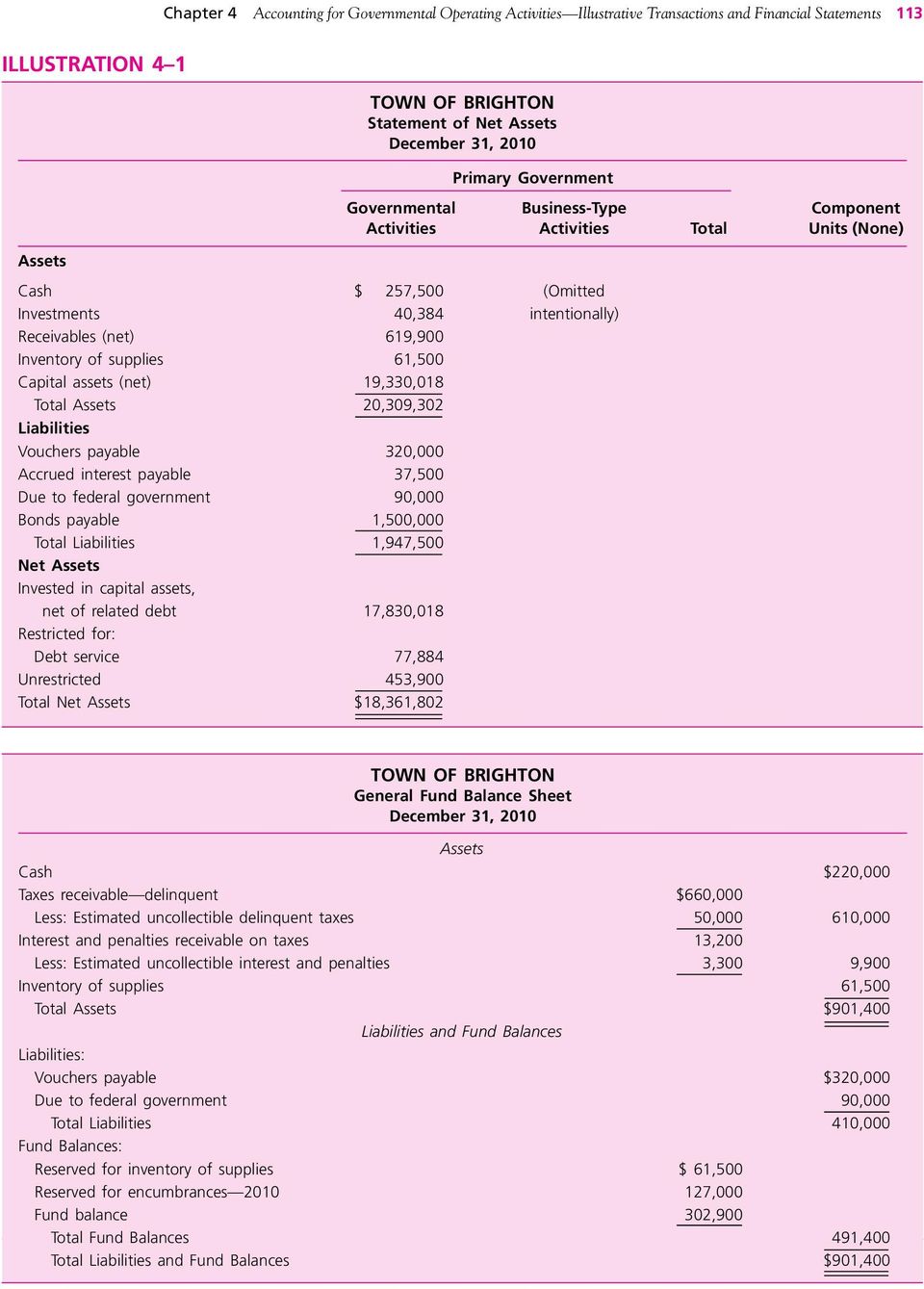
4 114 Part One State and Local Governments government s financial position. Additional detail is provided in the notes to the financial statements (not provided in this chapter for sake of brevity), as well as in the fund financial statements. In the case of the Town of Brighton, the $453,900 reported for unrestricted net assets in the government-wide statement of net assets is only $37,500 less than the $491,400 reported as the total fund balances of the General Fund. In practice, these amounts may be markedly different, as many governments will have financial information for other governmental fund types that will be reported as part of the governmental activities unrestricted net assets. At any rate, neither the net assets at the government-wide level nor the fund balances (equity) at the fund level are analogous to the stockholders equity of an investor-owned entity. Residents have no legal claim on any net assets or fund equity of the government. A few final points should be noted about the General Fund balance sheet before discussing illustrative budgetary and operating transactions. Fund equity, usually captioned as Fund Balances as shown in Illustration 4 1, is the arithmetic difference between the total financial resources and the total liabilities of the General Fund. The Town of Brighton s General Fund balance sheet illustrates that at December 31, 2010, a portion of fund balances is reserved because the $61,500 inventory of supplies included in the fund s assets cannot be spent or used to pay current liabilities. In addition, some purchase orders issued in fiscal year 2010 were not filled by the end of that year. The estimated $127,000 liability that will arise when these goods or services are received in early 2011 represents a prior budgetary claim on available financial resources, as shown by the line item Reserved for encumbrances 2010 on the General Fund balance sheet presented in Illustration 4 1. The portion of fund balances that is not reserved is shown as a fund balance of $302,900 on the balance sheet. In practice, this item is usually referred to as unreserved fund balance. 1 DUAL-TRACK ACCOUNTING APPROACH Although thousands of governments have adopted the GASBS 34 reporting model, most have continued to use traditional fund accounting software systems. These systems record transactions that occur during the year in the appropriate governmental funds, but they are unable to directly provide account balances on the accrual basis needed for the government-wide financial statements. To compensate for this deficiency, most governments manually convert their fund-based financial information to the accrual basis by preparing spreadsheets, as illustrated in Chapter 9. Most municipal accounting software vendors have helped simplify this approach by developing report generators that selectively aggregate data needed for the governmentwide statements. Nevertheless, the authors believe that the reclassification approach 1 As explained in Chapter 3, Footnote 8, a GASB exposure draft on fund balance reporting proposes to eliminate the reserved and unreserved classifications of fund balance. If the final statement adopts the proposed classification scheme, portions of amounts reported now in the unreserved fund balance classification could be reported in the future as restricted, limited, assigned, or unassigned fund balances, depending on the nature of constraints that may exist on how the fund balances can be spent. When the GASB issues the final statement, the authors will provide an update bulletin explaining how the new standard affects various parts of the text.
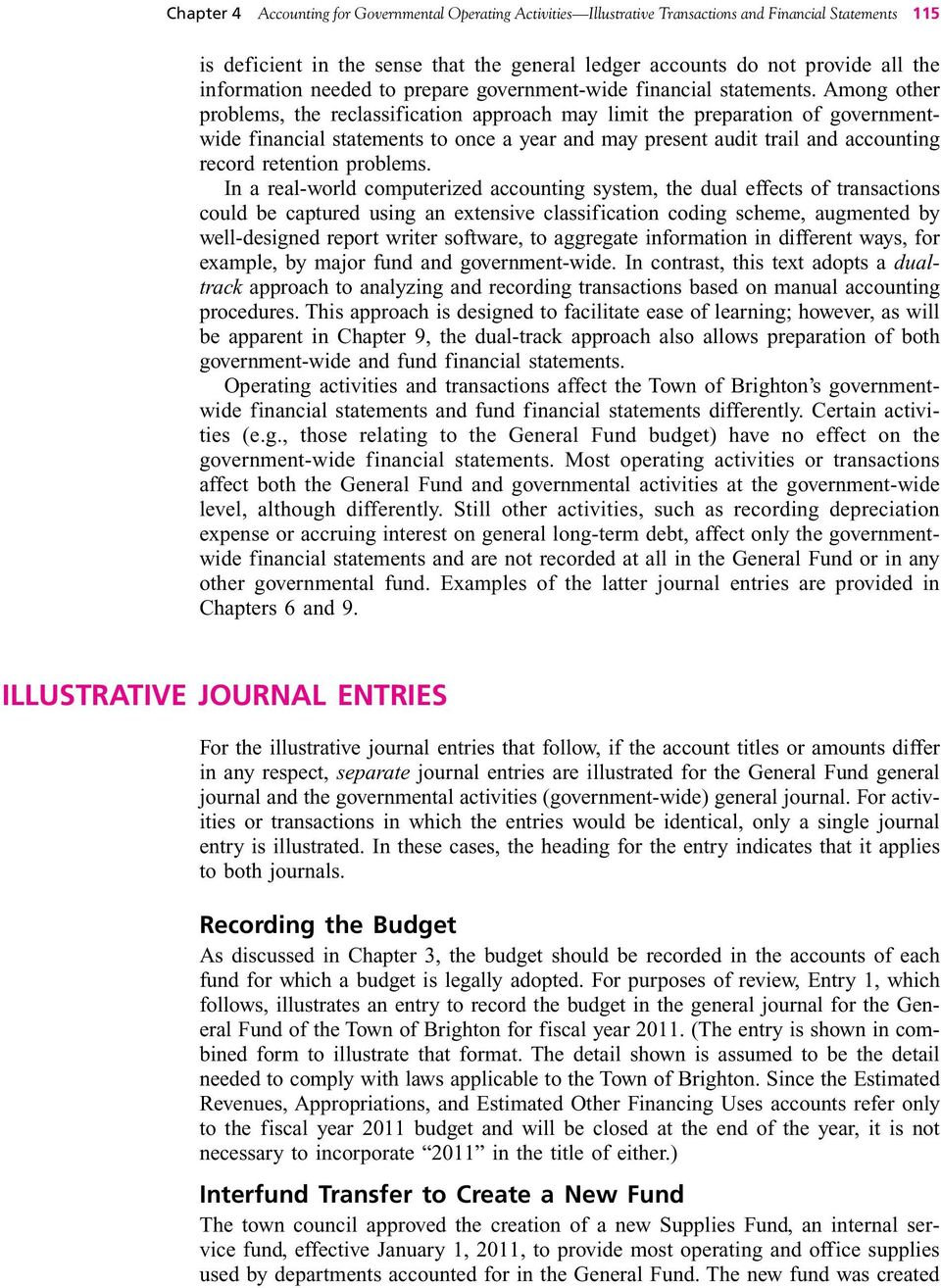
5 Chapter 4 Accounting for Governmental Operating Activities Illustrative Transactions and Financial Statements 115 is deficient in the sense that the general ledger accounts do not provide all the information needed to prepare government-wide financial statements. Among other problems, the reclassification approach may limit the preparation of governmentwide financial statements to once a year and may present audit trail and accounting record retention problems. In a real-world computerized accounting system, the dual effects of transactions could be captured using an extensive classification coding scheme, augmented by well-designed report writer software, to aggregate information in different ways, for example, by major fund and government-wide. In contrast, this text adopts a dualtrack approach to analyzing and recording transactions based on manual accounting procedures. This approach is designed to facilitate ease of learning; however, as will be apparent in Chapter 9, the dual-track approach also allows preparation of both government-wide and fund financial statements. Operating activities and transactions affect the Town of Brighton s governmentwide financial statements and fund financial statements differently. Certain activities (e.g., those relating to the General Fund budget) have no effect on the government-wide financial statements. Most operating activities or transactions affect both the General Fund and governmental activities at the government-wide level, although differently. Still other activities, such as recording depreciation expense or accruing interest on general long-term debt, affect only the governmentwide financial statements and are not recorded at all in the General Fund or in any other governmental fund. Examples of the latter journal entries are provided in Chapters 6 and 9. ILLUSTRATIVE JOURNAL ENTRIES For the illustrative journal entries that follow, if the account titles or amounts differ in any respect, separate journal entries are illustrated for the General Fund general journal and the governmental activities (government-wide) general journal. For activities or transactions in which the entries would be identical, only a single journal entry is illustrated. In these cases, the heading for the entry indicates that it applies to both journals. Recording the Budget As discussed in Chapter 3, the budget should be recorded in the accounts of each fund for which a budget is legally adopted. For purposes of review, Entry 1, which follows, illustrates an entry to record the budget in the general journal for the General Fund of the Town of Brighton for fiscal year (The entry is shown in combined form to illustrate that format. The detail shown is assumed to be the detail needed to comply with laws applicable to the Town of Brighton. Since the Estimated Revenues, Appropriations, and Estimated Other Financing Uses accounts refer only to the fiscal year 2011 budget and will be closed at the end of the year, it is not necessary to incorporate 2011 in the title of either.) Interfund Transfer to Create a New Fund The town council approved the creation of a new Supplies Fund, an internal service fund, effective January 1, 2011, to provide most operating and office supplies used by departments accounted for in the General Fund. The new fund was created
6 116 Part One State and Local Governments General Ledger Subsidiary Ledger Debits Credits Debits Credits General Fund: 1. Estimated Revenues ,986,000 Budgetary Fund Balance ,500 Appropriations ,180,000 Estimated Other Financing Uses ,500 Estimated Revenues Ledger: Property Taxes ,600,000 Interest and Penalties on Delinquent Taxes ,000 Sales Taxes ,000 Licenses and Permits ,000 Fines and Forfeits ,000 Intergovernmental Revenue ,000 Charges for Services ,000 Miscellaneous Revenues ,000 Appropriations Ledger: General Government ,000 Public Safety ,240,000 Public Works ,090,000 Health and Welfare ,000 Parks and Recreation ,000 Miscellaneous Appropriations ,000 Estimated Other Financing Uses Ledger: General Government ,500 by transferring the current inventory of supplies and $30,000 in cash from the General Fund, general government function. Appropriate journal entries are provided in Chapter 7 to create the new internal service fund. The effect on the General Fund is reflected in Entries 2 and 2a below. The transfer has no effect on governmental activities at the government-wide level since financial information for both the General Fund and the new Supplies Fund is reported in the Governmental Activities column. General Fund: 2. Other Financing Uses Interfund Transfers Out ,500 Inventory of Supplies ,500 Cash ,000 Other Financing Uses Ledger: General Government ,500 General Fund: 2a. Reserve for Inventory of Supplies ,500 Fund Balance ,500

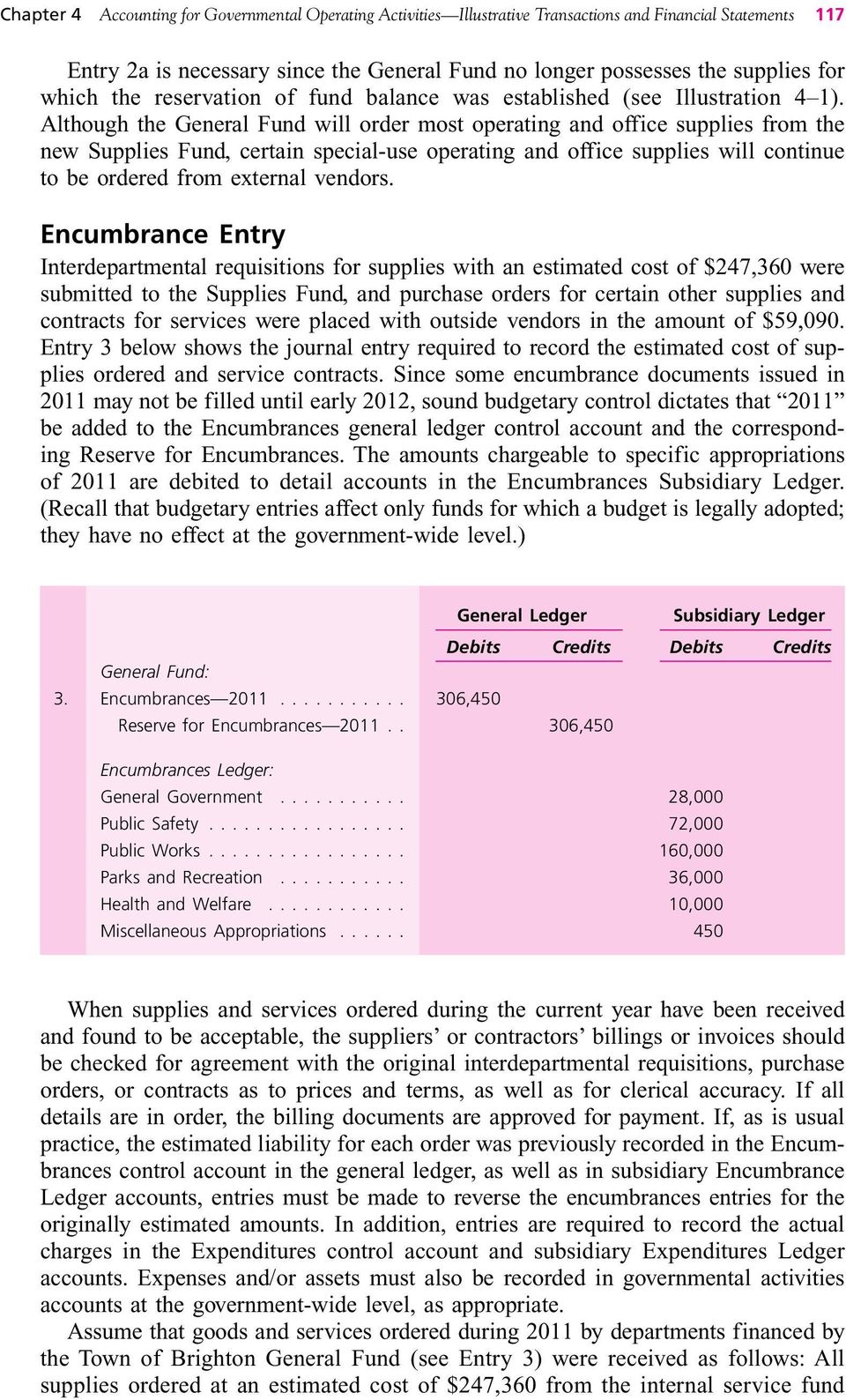
7 Chapter 4 Accounting for Governmental Operating Activities Illustrative Transactions and Financial Statements 117 Entry 2a is necessary since the General Fund no longer possesses the supplies for which the reservation of fund balance was established (see Illustration 4 1). Although the General Fund will order most operating and office supplies from the new Supplies Fund, certain special-use operating and office supplies will continue to be ordered from external vendors. Encumbrance Entry Interdepartmental requisitions for supplies with an estimated cost of $247,360 were submitted to the Supplies Fund, and purchase orders for certain other supplies and contracts for services were placed with outside vendors in the amount of $59,090. Entry 3 below shows the journal entry required to record the estimated cost of supplies ordered and service contracts. Since some encumbrance documents issued in 2011 may not be filled until early 2012, sound budgetary control dictates that 2011 be added to the Encumbrances general ledger control account and the corresponding Reserve for Encumbrances. The amounts chargeable to specific appropriations of 2011 are debited to detail accounts in the Encumbrances Subsidiary Ledger. (Recall that budgetary entries affect only funds for which a budget is legally adopted; they have no effect at the government-wide level.) General Ledger Subsidiary Ledger Debits Credits Debits Credits General Fund: 3. Encumbrances ,450 Reserve for Encumbrances ,450 Encumbrances Ledger: General Government ,000 Public Safety ,000 Public Works ,000 Parks and Recreation ,000 Health and Welfare ,000 Miscellaneous Appropriations When supplies and services ordered during the current year have been received and found to be acceptable, the suppliers or contractors billings or invoices should be checked for agreement with the original interdepartmental requisitions, purchase orders, or contracts as to prices and terms, as well as for clerical accuracy. If all details are in order, the billing documents are approved for payment. If, as is usual practice, the estimated liability for each order was previously recorded in the Encumbrances control account in the general ledger, as well as in subsidiary Encumbrance Ledger accounts, entries must be made to reverse the encumbrances entries for the originally estimated amounts. In addition, entries are required to record the actual charges in the Expenditures control account and subsidiary Expenditures Ledger accounts. Expenses and/or assets must also be recorded in governmental activities accounts at the government-wide level, as appropriate. Assume that goods and services ordered during 2011 by departments financed by the Town of Brighton General Fund (see Entry 3) were received as follows: All supplies ordered at an estimated cost of $247,360 from the internal service fund
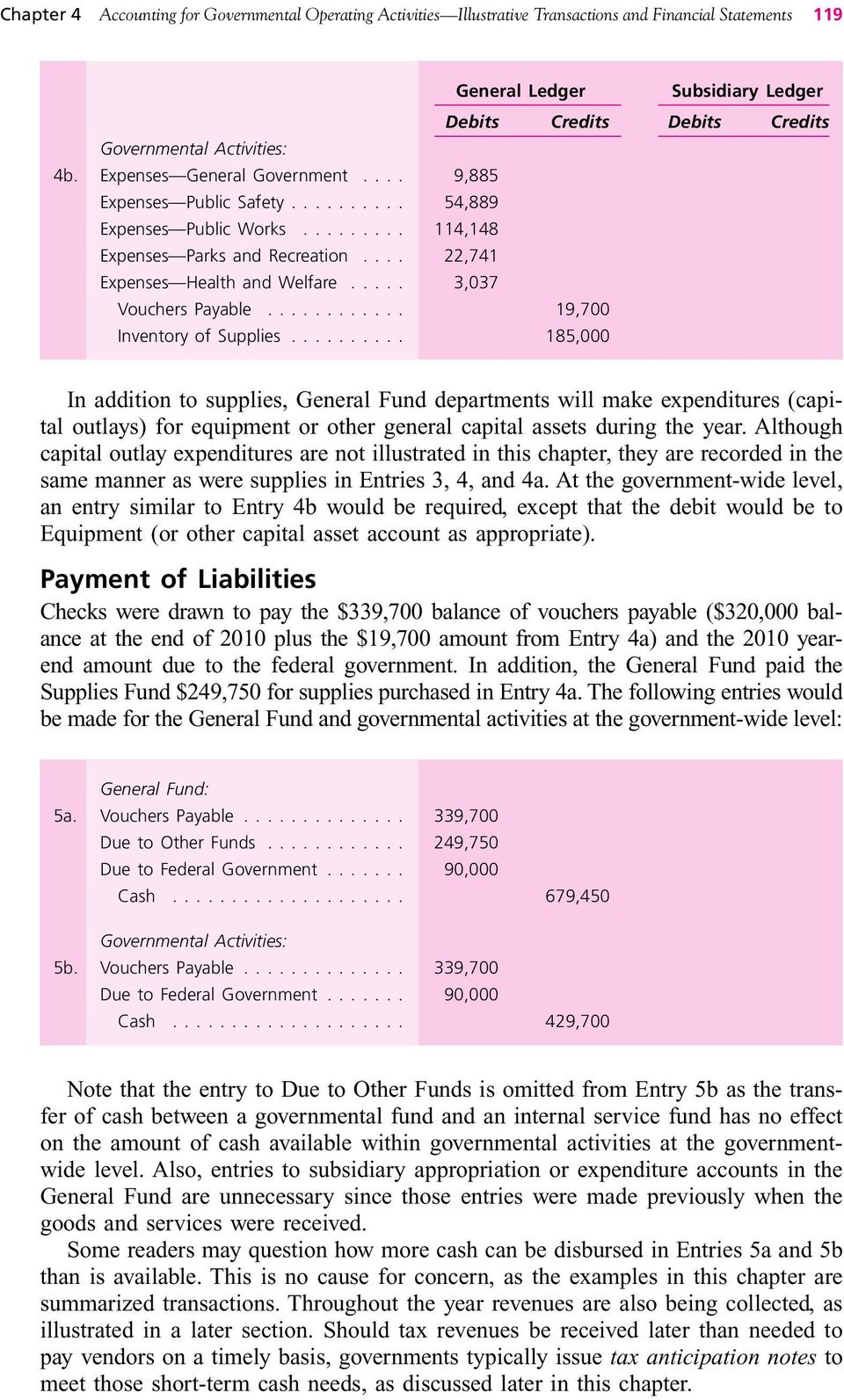
8 118 Part One State and Local Governments (Supplies Fund) were received at an actual cost of $249,750; however, only a portion of the supplies and contracts with outside vendors were filled or completed during the year at an actual cost of $19,700, for which the estimated cost had been $22,415. For purposes of illustration, the appropriations assumed to be affected are shown in Entries 4 and 4a for the General Fund. General Fund: 4. Reserve for Encumbrances ,775 General Ledger Encumbrances ,775 Subsidiary Ledger Debits Credits Debits Credits Encumbrances Ledger: General Government ,250 Public Safety ,000 Public Works ,900 Parks and Recreation ,000 Health and Welfare ,175 Miscellaneous Appropriations a. Expenditures ,450 Due to Other Funds ,750 Vouchers Payable ,700 Expenditures Ledger: General Government ,300 Public Safety ,000 Public Works ,600 Parks and Recreation ,000 Health and Welfare ,100 Miscellaneous Appropriations Although the Town of Brighton records the purchase of supplies from the Supplies Fund at the amount billed, the expenses recorded in the governmental activities accounts at the government-wide level should be the cost of the goods to the Supplies Fund. In other words, the cost to the government as a whole is what the internal service fund paid for the goods to external parties, and does not include the markup charged to departments by the Supplies Fund. As shown in Chapter 7, Entries 5a and b, the cost of the $249,750 of supplies issued to the General Fund was $185,000, so the markup is 35 percent on cost. Accordingly, the total direct expenses recorded at the government-wide level (see Entry 4b) is the $185,000 cost of supplies purchased from the Supplies Fund plus the $19,700 of goods and services purchased from external vendors, or a total of $204,700, distributed to functions based on assumed purchase patterns. It is the town s policy to include miscellaneous expenses as part of the General Government function at the government-wide level. (Note that the account credited at the government-wide level for the supplies purchased from the Supplies Fund is Inventory of Supplies since $185,000 represents supplies issued that are no longer in the Supplies Fund s inventory and thus are no longer in inventory from a government-wide perspective, assuming that substantially all supplies purchased by General Fund departments will be consumed during the year. Immaterial amounts of year-end inventory in the General Fund should be ignored.)

9 Chapter 4 Accounting for Governmental Operating Activities Illustrative Transactions and Financial Statements 119 General Ledger Subsidiary Ledger Debits Credits Debits Credits Governmental Activities: 4b. Expenses General Government.... 9,885 Expenses Public Safety ,889 Expenses Public Works ,148 Expenses Parks and Recreation ,741 Expenses Health and Welfare ,037 Vouchers Payable ,700 Inventory of Supplies ,000 In addition to supplies, General Fund departments will make expenditures (capital outlays) for equipment or other general capital assets during the year. Although capital outlay expenditures are not illustrated in this chapter, they are recorded in the same manner as were supplies in Entries 3, 4, and 4a. At the government-wide level, an entry similar to Entry 4b would be required, except that the debit would be to Equipment (or other capital asset account as appropriate). Payment of Liabilities Checks were drawn to pay the $339,700 balance of vouchers payable ($320,000 balance at the end of 2010 plus the $19,700 amount from Entry 4a) and the 2010 yearend amount due to the federal government. In addition, the General Fund paid the Supplies Fund $249,750 for supplies purchased in Entry 4a. The following entries would be made for the General Fund and governmental activities at the government-wide level: General Fund: 5a. Vouchers Payable ,700 Due to Other Funds ,750 Due to Federal Government ,000 Cash ,450 Governmental Activities: 5b. Vouchers Payable ,700 Due to Federal Government ,000 Cash ,700 Note that the entry to Due to Other Funds is omitted from Entry 5b as the transfer of cash between a governmental fund and an internal service fund has no effect on the amount of cash available within governmental activities at the governmentwide level. Also, entries to subsidiary appropriation or expenditure accounts in the General Fund are unnecessary since those entries were made previously when the goods and services were received. Some readers may question how more cash can be disbursed in Entries 5a and 5b than is available. This is no cause for concern, as the examples in this chapter are summarized transactions. Throughout the year revenues are also being collected, as illustrated in a later section. Should tax revenues be received later than needed to pay vendors on a timely basis, governments typically issue tax anticipation notes to meet those short-term cash needs, as discussed later in this chapter.
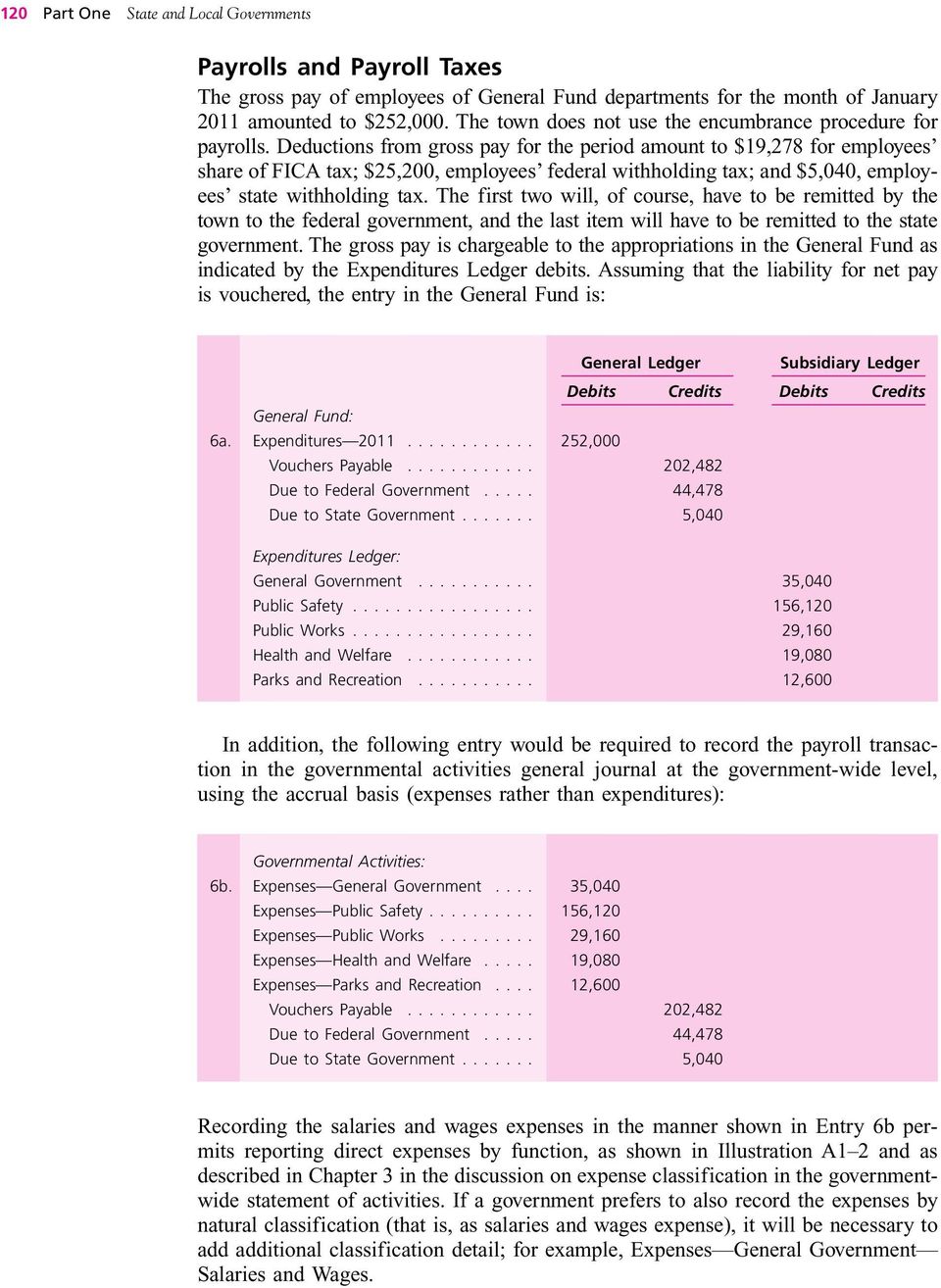
10 120 Part One State and Local Governments Payrolls and Payroll Taxes The gross pay of employees of General Fund departments for the month of January 2011 amounted to $252,000. The town does not use the encumbrance procedure for payrolls. Deductions from gross pay for the period amount to $19,278 for employees share of FICA tax; $25,200, employees federal withholding tax; and $5,040, employees state withholding tax. The first two will, of course, have to be remitted by the town to the federal government, and the last item will have to be remitted to the state government. The gross pay is chargeable to the appropriations in the General Fund as indicated by the Expenditures Ledger debits. Assuming that the liability for net pay is vouchered, the entry in the General Fund is: General Ledger Subsidiary Ledger Debits Credits Debits Credits General Fund: 6a. Expenditures ,000 Vouchers Payable ,482 Due to Federal Government ,478 Due to State Government ,040 Expenditures Ledger: General Government ,040 Public Safety ,120 Public Works ,160 Health and Welfare ,080 Parks and Recreation ,600 In addition, the following entry would be required to record the payroll transaction in the governmental activities general journal at the government-wide level, using the accrual basis (expenses rather than expenditures): Governmental Activities: 6b. Expenses General Government ,040 Expenses Public Safety ,120 Expenses Public Works ,160 Expenses Health and Welfare ,080 Expenses Parks and Recreation ,600 Vouchers Payable ,482 Due to Federal Government ,478 Due to State Government ,040 Recording the salaries and wages expenses in the manner shown in Entry 6b permits reporting direct expenses by function, as shown in Illustration A1 2 and as described in Chapter 3 in the discussion on expense classification in the governmentwide statement of activities. If a government prefers to also record the expenses by natural classification (that is, as salaries and wages expense), it will be necessary to add additional classification detail; for example, Expenses General Government Salaries and Wages.
11 Chapter 4 Accounting for Governmental Operating Activities Illustrative Transactions and Financial Statements 121 Payment of the vouchers for the net pay results in the following entry in both the General Fund and governmental activities journals: General Ledger Subsidiary Ledger Debits Credits Debits Credits General Fund and Governmental Activities: 7. Vouchers Payable ,482 Cash ,482 Inasmuch as the town is liable for the employer s share of FICA taxes ($19,278), it is necessary that the town s liability be recorded, as shown in Entry 8a. General Fund: 8a. Expenditures ,278 Due to Federal Government ,278 Expenditures Ledger: General Government ,681 Public Safety ,943 Public Works ,230 Health and Welfare ,460 Parks and Recreation Entry 8b is also required to record the payroll expense on the accrual basis at the government-wide level. Governmental Activities: 8b. Expenses General Government ,681 Expenses Public Safety ,943 Expenses Public Works ,230 Expenses Health and Welfare ,460 Expenses Parks and Recreation Due to Federal Government ,278 Revenues Recognized as Received in Cash Revenues from sources such as licenses and permits, fines and forfeits, charges for services, and certain other sources are often not measurable until received in cash. However, under the modified accrual basis of accounting, if such revenues are measurable in advance of collection and available for current period expenditure, they should be accrued by recording a debit to a receivable and a credit to Revenues. During fiscal year 2011, the Town of Brighton has collected revenues in cash from the sources shown in Entry 9a.
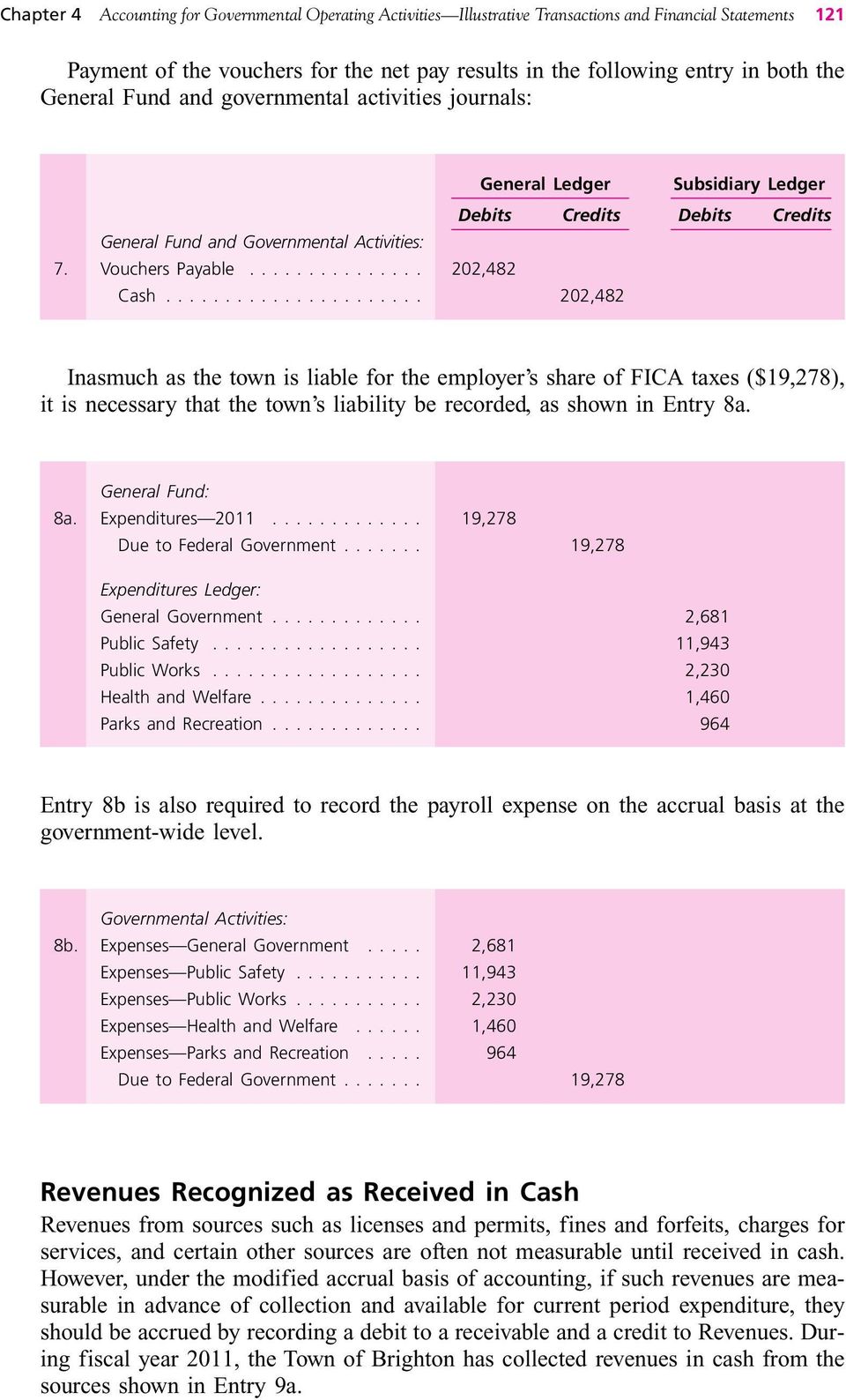
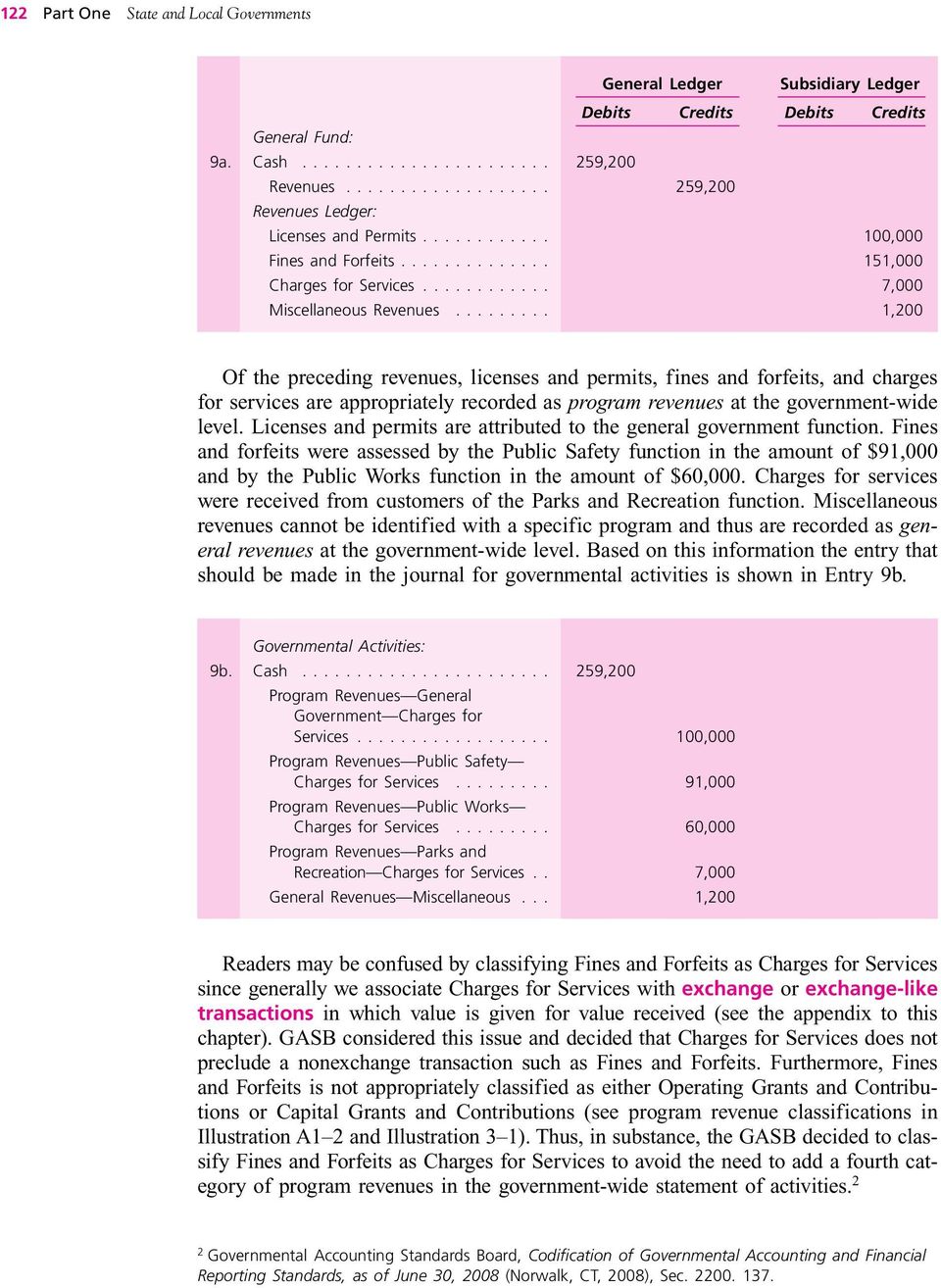
12 122 Part One State and Local Governments General Ledger Subsidiary Ledger Debits Credits Debits Credits General Fund: 9a. Cash ,200 Revenues ,200 Revenues Ledger: Licenses and Permits ,000 Fines and Forfeits ,000 Charges for Services ,000 Miscellaneous Revenues ,200 Of the preceding revenues, licenses and permits, fines and forfeits, and charges for services are appropriately recorded as program revenues at the government-wide level. Licenses and permits are attributed to the general government function. Fines and forfeits were assessed by the Public Safety function in the amount of $91,000 and by the Public Works function in the amount of $60,000. Charges for services were received from customers of the Parks and Recreation function. Miscellaneous revenues cannot be identified with a specific program and thus are recorded as general revenues at the government-wide level. Based on this information the entry that should be made in the journal for governmental activities is shown in Entry 9b. Governmental Activities: 9b. Cash ,200 Program Revenues General Government Charges for Services ,000 Program Revenues Public Safety Charges for Services ,000 Program Revenues Public Works Charges for Services ,000 Program Revenues Parks and Recreation Charges for Services.. 7,000 General Revenues Miscellaneous... 1,200 Readers may be confused by classifying Fines and Forfeits as Charges for Services since generally we associate Charges for Services with exchange or exchange-like transactions in which value is given for value received (see the appendix to this chapter). GASB considered this issue and decided that Charges for Services does not preclude a nonexchange transaction such as Fines and Forfeits. Furthermore, Fines and Forfeits is not appropriately classified as either Operating Grants and Contributions or Capital Grants and Contributions (see program revenue classifications in Illustration A1 2 and Illustration 3 1). Thus, in substance, the GASB decided to classify Fines and Forfeits as Charges for Services to avoid the need to add a fourth category of program revenues in the government-wide statement of activities. 2 2 Governmental Accounting Standards Board, Codification of Governmental Accounting and Financial Reporting Standards, as of June 30, 2008 (Norwalk, CT, 2008), Sec
13 Chapter 4 Accounting for Governmental Operating Activities Illustrative Transactions and Financial Statements 123 ACCOUNTING FOR PROPERTY TAXES Entry 1 of this chapter shows that the estimated revenue for fiscal year 2011 from property taxes levied for the Town of Brighton General Fund is $2,600,000. If records of property tax collections in recent years, adjusted for any expected changes in tax collection policy and changes in local economic conditions, indicate that approximately 4 percent of the gross tax levy will never be collected, the gross tax levy must be large enough so that the collectible portion of the levy, 96 percent, equals the needed revenue from this source, $2,600,000. Therefore, the gross levy of property taxes for the General Fund of the Town of Brighton must be $2,708,333 ($2,600, ). In an actual situation, property situated in the Town of Brighton also would be taxed for other funds of that town; for various funds of other general purpose governments, such as the county in which the property in the Town of Brighton is located; the various funds of special purpose governments that have the right to tax the same property, such as one or more independent school districts or a hospital district; and perhaps the state in which the town is located. Recording Property Tax Levy The gross property tax levies for each fund of the Town of Brighton, and for each other general purpose and special purpose government, must be aggregated, and the aggregate levy for that unit divided by the assessed valuation of property within the geographical limits of that government, in order to determine the tax rate applicable to property within each jurisdiction. In many states, a county official prepares bills for all taxes levied on property within the county; the same official, or another, acts as collector of all property taxes levied for the county and all governments within the county. Although the billing and collecting functions may be centralized, the taxes levied for each fund must be recorded as an asset of that fund. If the accounts are to be kept in conformity with generally accepted accounting principles, the portion of the taxes expected to be collectible (0.96 of the total levy, in this example) must be recorded as revenues of that fund, and the portion expected to be uncollectible (0.04 of the total levy), must be recorded in a contra-asset account, as illustrated by Entries 10a and 10b. General Ledger Subsidiary Ledger Debits Credits Debits Credits General Fund: 10a. Taxes Receivable Current ,708,333 Estimated Uncollectible Current Taxes ,333 Revenues ,600,000 Revenues Ledger: Property Taxes ,600,000 Governmental Activities: 10b. Taxes Receivable Current ,708,333 Estimated Uncollectible Current Taxes ,333 General Revenues Property Taxes.. 2,600,000
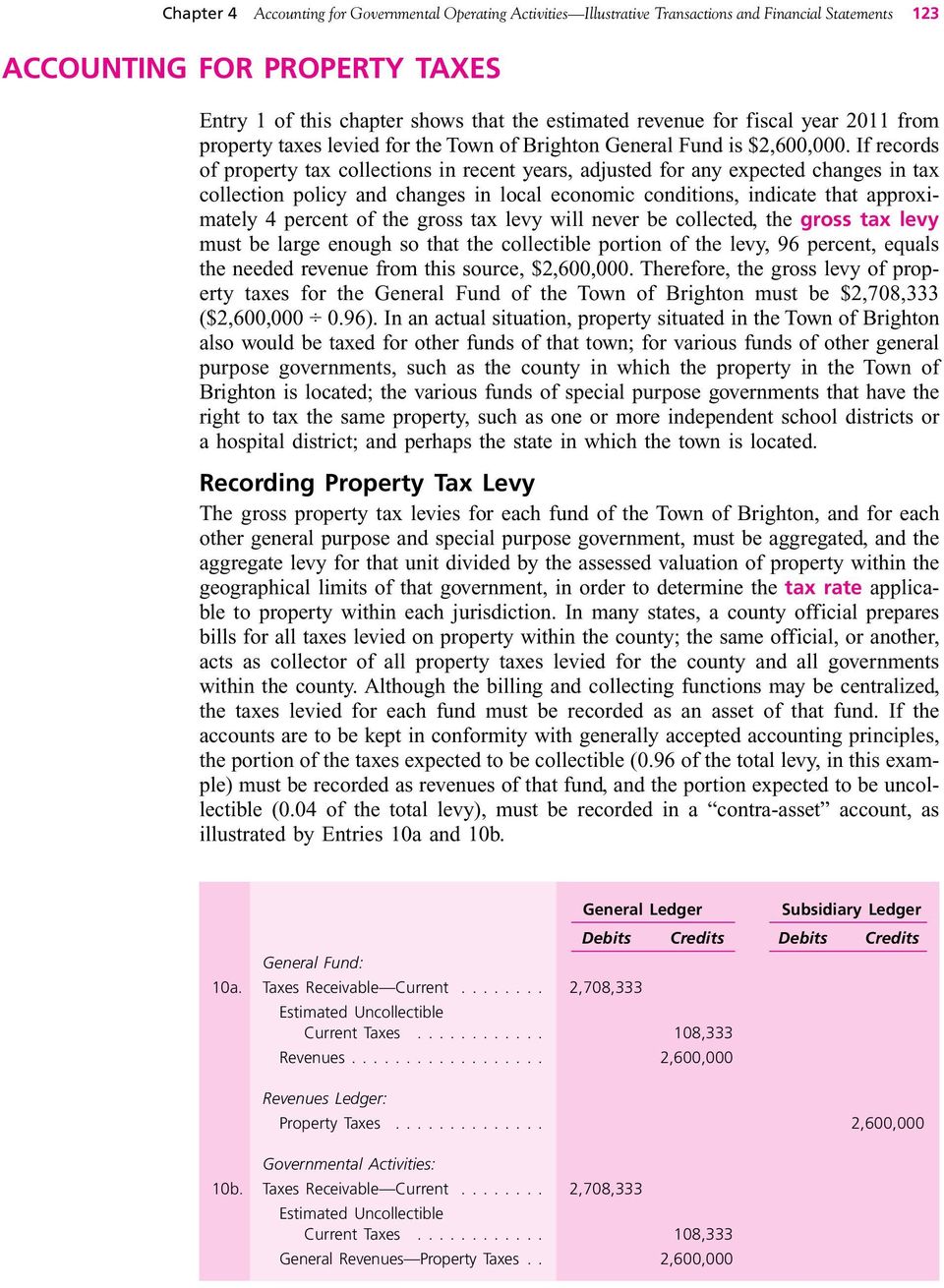
14 124 Part One State and Local Governments As Entry 10a shows, since in the General Fund the general ledger control account, Revenues, is credited, an entry must also be made in the Revenues Subsidiary Ledger. Taxes Receivable Current is also a control account, just as is the Accounts Receivable account of a business entity; each is supported by a subsidiary ledger that shows how much is owed by each taxpayer or customer. Ordinarily, the subsidiary ledger supporting the real property taxes receivable control is organized by parcels of property according to their legal descriptions, since unpaid taxes are liens against the property regardless of changes in ownership. Because of its conceptual similarity to accounting for business receivables, taxes receivable subsidiary ledger accounting is not illustrated in this text. Property tax revenue is an example of a nonexchange revenue one in which the government receives value without directly giving equal value in exchange. More specifically, it is classified under GASB standards as an imposed nonexchange revenue. For imposed nonexchange revenues, a receivable should be debited when there is an enforceable claim, as in the case of a property tax levy, and a revenue should be credited in the year for which the tax was levied. The $2,600,000 credit to Revenues in Entry 10a indicates that the Town of Brighton expects to collect that amount during 2011 or within 60 days after the end of fiscal year If the town expected to collect a portion of the $2,600,000 later than 60 days after fiscal yearend, it should credit that portion to Deferred Revenues (a current liability account) and reclassify it to Revenues in the period in which the deferred revenues are collected. Note, however, that even if a portion of revenues is deferred in the General Fund because of the availability criterion, the full $2,600,000 is recognized as General Revenues Property Taxes in the governmental activities journal at the government-wide level. This is so because availability to finance current expenditures is not a revenue recognition criterion under the accrual basis used at the governmentwide level. Collection of Current Taxes Collections of property taxes levied in 2011 for the General Fund of the Town of Brighton amount to $2,042,033. Since the revenue was recognized at the time of the levy (see Entry 10a), the following entry is made in both the General Fund and governmental activities journal. General Ledger Subsidiary Ledger Debits Credits Debits Credits General Fund and Governmental Activities: 11. Cash ,042,033 Taxes Receivable Current ,042,033 Reclassification of Current Property Taxes Assuming that all property taxes levied by the Town of Brighton in 2011 were legally due before the end of the year, any balance of taxes receivable at year-end is properly classified as delinquent taxes rather than current. The related allowance for estimated uncollectible taxes should also be reclassified as contra to the Taxes 3 GASB Codification, Sec. P
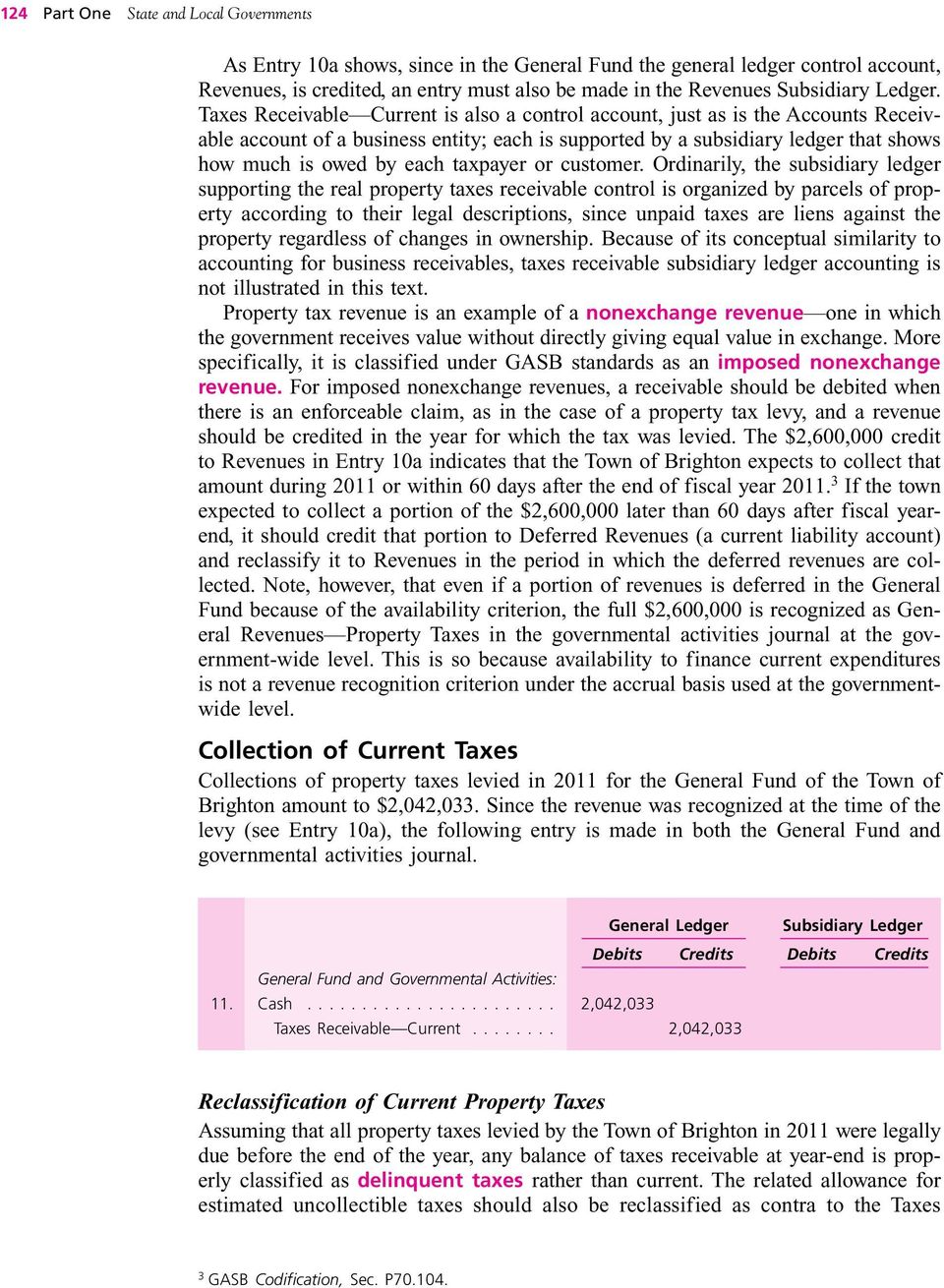
15 Chapter 4 Accounting for Governmental Operating Activities Illustrative Transactions and Financial Statements 125 Receivable Delinquent account. The entry to accomplish the reclassification, using amounts assumed to exist in the accounts at year-end, is: General Ledger Subsidiary Ledger Debits Credits Debits Credits General Fund and Governmental Activities: 12. Taxes Receivable Delinquent ,300 Estimated Uncollectible Current Taxes ,333 Taxes Receivable Current ,300 Estimated Uncollectible Delinquent Taxes 108,333 Accrual of Interest and Penalties on Delinquent Taxes Delinquent taxes are subject to interest and penalties as discussed previously. If the amount of interest and penalties earned in 2011 by the General Fund of the Town of Brighton but not yet recognized is $13,320, and it is expected that only $10,800 of that can be collected, the following entries are necessary: General Funds: 13a. Interest and Penalties Receivable on Taxes ,320 Estimated Uncollectible Interest and Penalties ,520 Revenues ,800 Revenues Ledger: Interest and Penalties on Delinquent Taxes ,800 Governmental Activities: 13b. Interest and Penalties Receivable on Taxes. 13,320 Estimated Uncollectible Interest and Penalties ,520 General Revenues Interest and Penalties on Delinquent Taxes ,800 Collection of Delinquent Taxes Delinquent taxes are subject to interest and penalties that must be paid at the time the tax bill is paid. It is possible for a government to record the amount of penalties at the time the taxes become delinquent. Interest may be computed and recorded periodically to keep the account on the accrual basis; it must also be computed and recorded for the period from the date of last recording to the date when a taxpayer pays delinquent taxes. Assume that taxpayers of the Town of Brighton have paid delinquent taxes totaling $440,000, on which interest and penalties of $8,800 had been recorded as receivable at the end of Also, assume that additional interest of $600 was paid for the period from the first day of 2011 to the dates on which the delinquent taxes were paid. Since it is common for the cashier receiving the collections to be permitted to originate source documents that result in credits only to Taxes Receivable Current, Taxes Receivable Delinquent, or Interest and Penalties Receivable on Taxes, the $600 interest earned in 2011 should be recorded in a separate entry, as shown in Entries 14a and b.
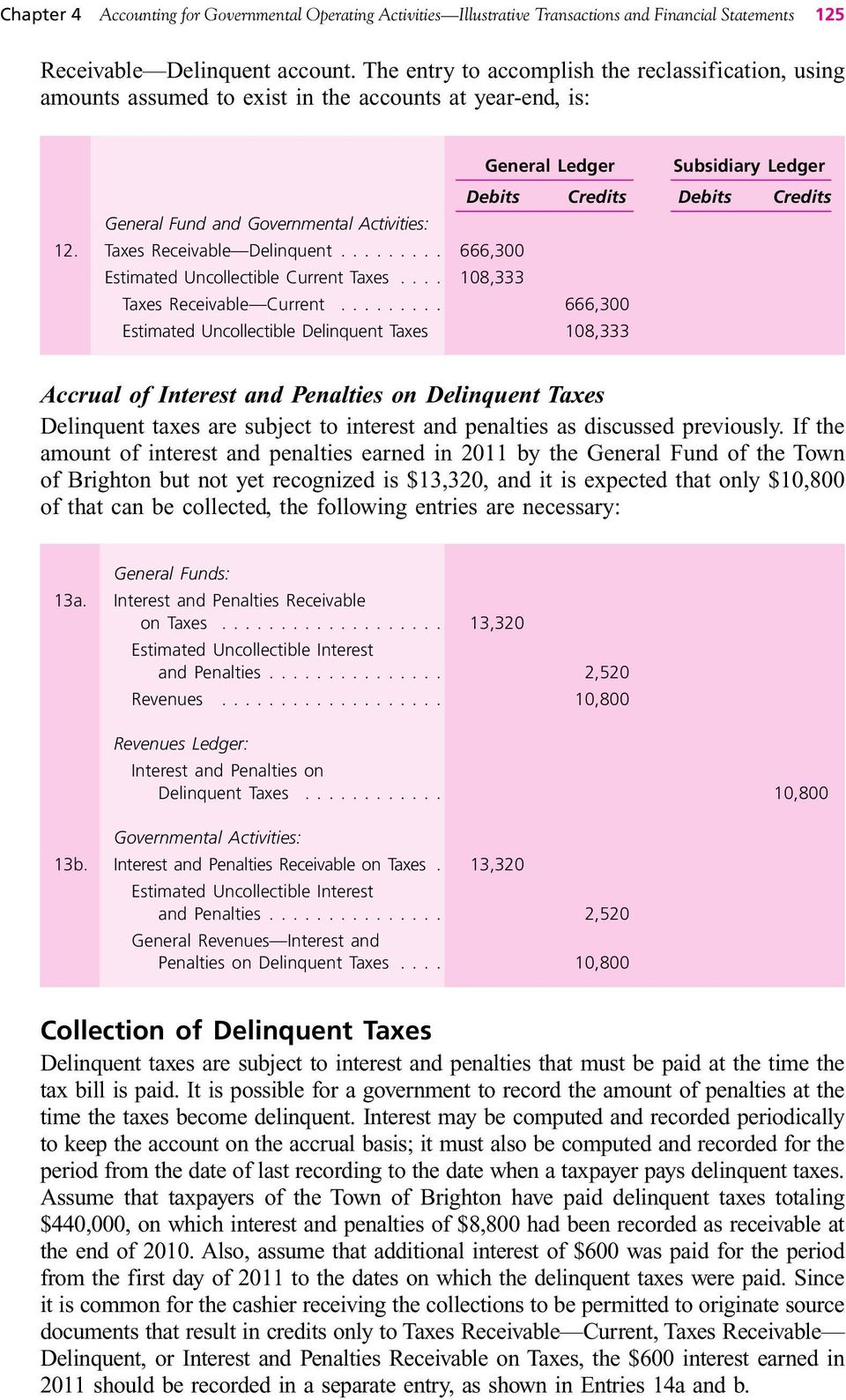
16 126 Part One State and Local Governments General Funds: 14a. Interest and Penalties Receivable on Taxes General Ledger Revenues Revenues Ledger: Subsidiary Ledger Debits Credits Debits Credits Interest and Penalties on Delinquent Taxes The corresponding entry at the government-wide level is: Governmental Activities: 14b. Interest and Penalties Receivable on Taxes General Revenues Interest and Penalties on Delinquent Taxes Collection of the delinquent taxes as well as interest and penalties thereon is summarized in Entry 15, which is the entry that should be made in both the General Fund and governmental activities journals. Note that these collections during 2011 are from the delinquent taxes receivable reported on the 2010 General Fund balance sheet and the Governmental Activities column of the government-wide statement of net assets (see Illustration 4 1). General Fund and Governmental Activities: 15. Cash ,400 Taxes Receivable Delinquent ,000 Interest and Penalties Receivable on Taxes ,400 Write-off of Uncollectible Delinquent Taxes Just as officers of profit-seeking entities should review aged schedules of receivables periodically to determine the adequacy of allowance accounts and authorize the write-off of items judged uncollectible, so should officers of a government review aged trial balances of taxes receivable and other receivables. Although the levy of property taxes creates a lien against the underlying property in the amount of the tax, accumulated taxes may exceed the market value of the property, or, in the case of personal property, the property may have been removed from the jurisdiction of the government. When delinquent taxes are deemed uncollectible, the related interest and penalties must also be written off. If the treasurer of the Town of Brighton receives approval to write off delinquent taxes totaling $26,300 and related interest
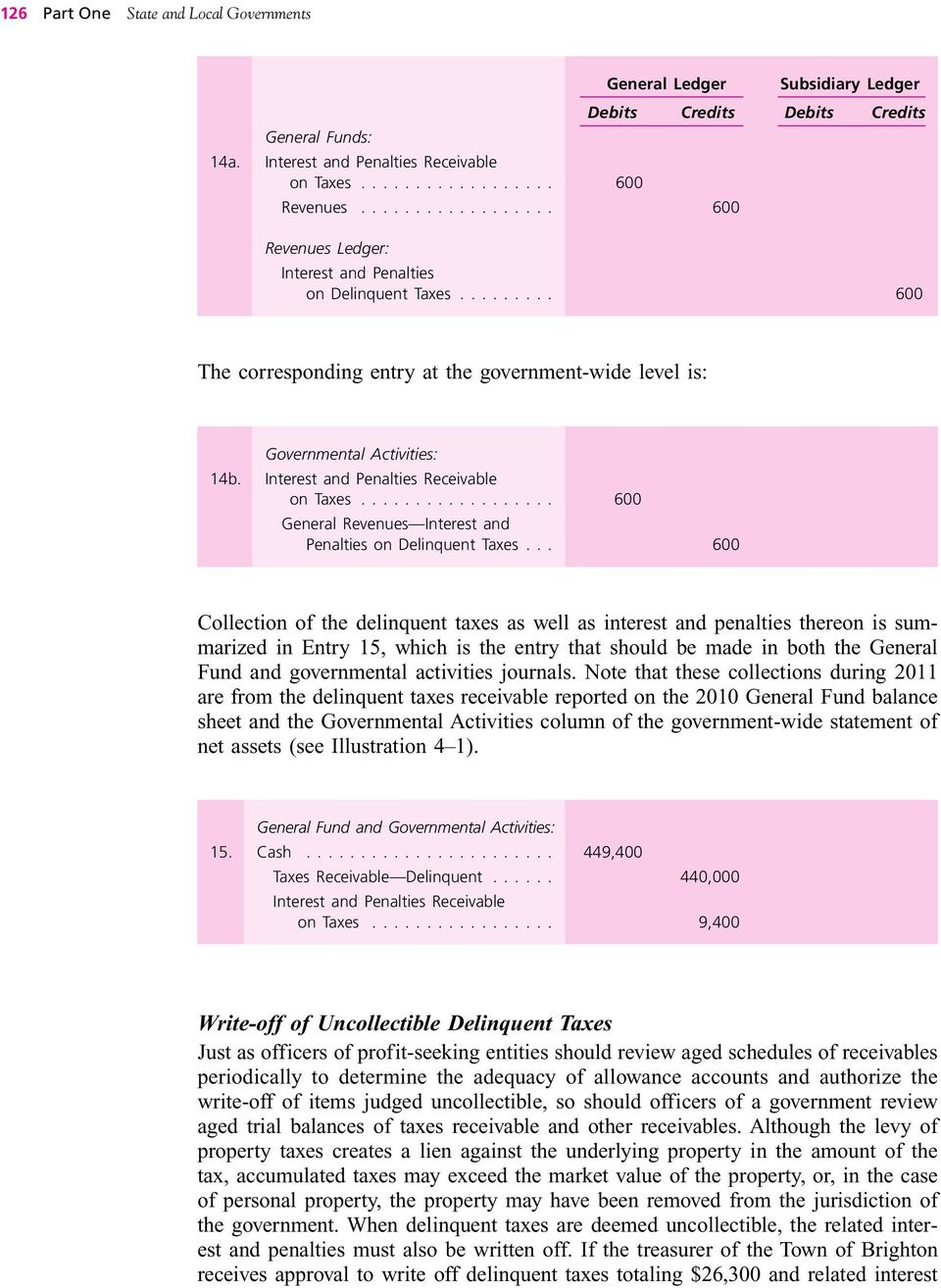
17 Chapter 4 Accounting for Governmental Operating Activities Illustrative Transactions and Financial Statements 127 and penalties of $1,315, the entry for both the General Fund and governmental activities would be: General Fund and Governmental Activities: 16. Estimated Uncollectible Delinquent Taxes ,300 Estimated Uncollectible Interest and Penalties ,315 General Ledger Taxes Receivable Delinquent ,300 Interest and Penalties Receivable on Taxes ,315 Subsidiary Ledger Debits Credits Debits Credits When delinquent taxes are written off, the tax bills are retained in the files in case it becomes possible to collect the amounts in the future. If collections of written-off taxes are made, it is highly desirable to return the tax bills to general ledger control by making an entry that is the reverse of the write-off entry, so that the procedures described in connection with Entries 14 and 15 can be followed. Tax Anticipation Notes Payable In the December 31, 2010, Statement of Net Assets and General Fund Balance Sheet of the Town of Brighton, two items, Vouchers Payable and Due to Federal Government, are current liabilities. Assuming there was a need to pay these in full within 30 days after the date of the balance sheet, the town treasurer would need to do some cash forecasting because the balance of Cash in the General Fund is not large enough to pay the $410,000 debt. In addition to this immediate problem, the treasurer, and most governmental treasurers, faces the problem that cash disbursements during a fiscal year tend to be approximately level month by month, whereas cash receipts from major revenue sources are concentrated in just a few months. For example, property tax collections may be concentrated in two separate months, such as May and November, when the installments are due. Receipts from the state or federal government of revenues collected by superior jurisdictions for distribution to a local government are also often concentrated in one or two months of the year. Knowing these relationships, the treasurer of the Town of Brighton may, for example, forecast the need to disburse approximately one-fourth of the budgeted appropriations, or $1,045,000 (one-fourth of $4,180,000), during the first three months of fiscal year 2011, before major items of revenue are received. This amount plus current liabilities at the beginning of the year, $410,000, plus a $30,000 interfund transfer to create the new Supplies Fund, equals $1,485,000 expected cash disbursements in the period for which the forecast is made. The town s experience suggests that a conservative forecast of collections of delinquent taxes and interest and penalties thereon during the forecast period will amount to $425,000. Furthermore, assume the treasurer s review of the items in the Estimated Revenues budget indicates that at least $140,000 will be collected in the forecast period. Therefore, total cash available to meet the estimated $1,485,000 of disbursements is $785,000 ($220,000 cash as of the beginning of the period, plus the $425,000 and $140,000 items just described), leaving a deficiency of $700,000 to be met by borrowing. Determination of the $700,000 required tax anticipation note financing is summarized in Illustration 4 2.
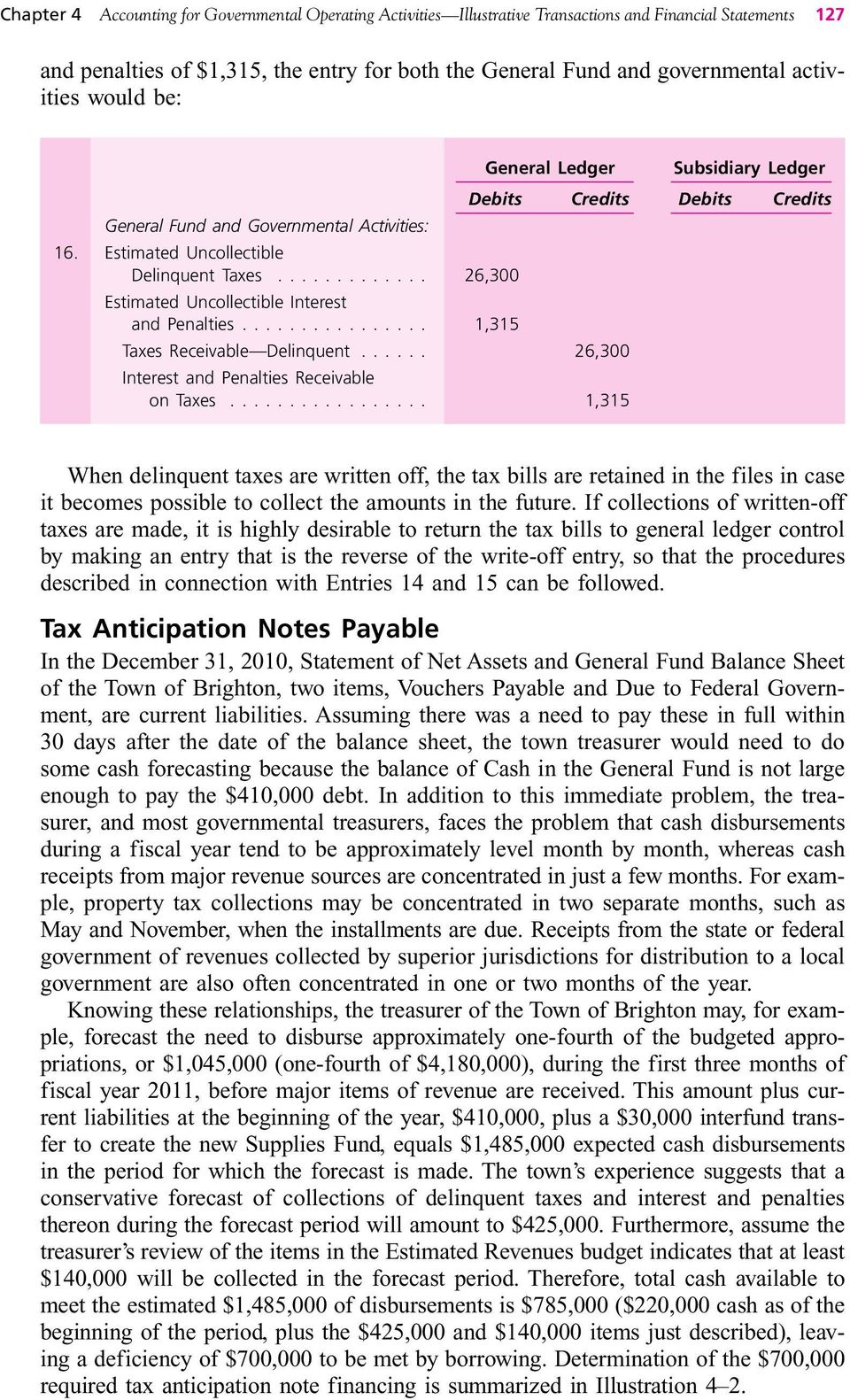
18 128 Part One State and Local Governments ILLUSTRATION 4-2 Determination of Required Tax Anticipation Note Financing, January 1 through March 31, 2011 Estimated Expenditure Requirements: Budgeted expenditures (25% of $4,180,000), $1,045,000 Current liabilities payable 440,000 $1,485,000 Estimated Resources Available: Cash available at January 1, ,000 Collections of delinquent taxes, interest, and penalties 425,000 Collection of budgeted FY 2011 revenues 140, ,000 Estimated Amount of Required Tax $ 700,000 Anticipation Note Financing The taxing power of the government is ample security for short-term debt; local banks customarily meet the working capital needs of a government by accepting a tax anticipation note from the government. Additional discussion of cash budgeting is provided in Chapter 13. If the amount of $700,000 is borrowed at this time, the necessary entries in both the General Fund and governmental activities are: General Ledger Subsidiary Ledger Debits Credits Debits Credits General Fund and Governmental Activities: 17. Cash ,000 Tax Anticipation Notes Payable ,000 Repayment of Tax Anticipation Notes As tax collections begin to exceed current disbursements, it becomes possible for the Town of Brighton to repay the local bank for the money borrowed on tax anticipation notes. Just as borrowing the money did not involve the recognition of revenue, the repayment of the principal extinguishes the debt of the General Fund and is not an expenditure. Payment of interest, however, must be recognized as the expenditure of an appropriation because it requires a reduction in the fund balance of the fund. Assuming the interest is $13,500, and the amount is properly chargeable to Miscellaneous Appropriations, the entry is: General Fund: 18a. Tax Anticipation Notes Payable ,000 Expenditures ,500 Cash ,500 Expenditures Ledger: Miscellaneous Appropriations ,500 Procedures of some governments would require the interest expenditures to have been recorded as an encumbrance against Miscellaneous Appropriations at the time the notes were issued, and the liability for the principal and interest to have been vouchered before payment. Even if these procedures were followed by the Town of Brighton, the net result of all entries is achieved by Entry 18a.
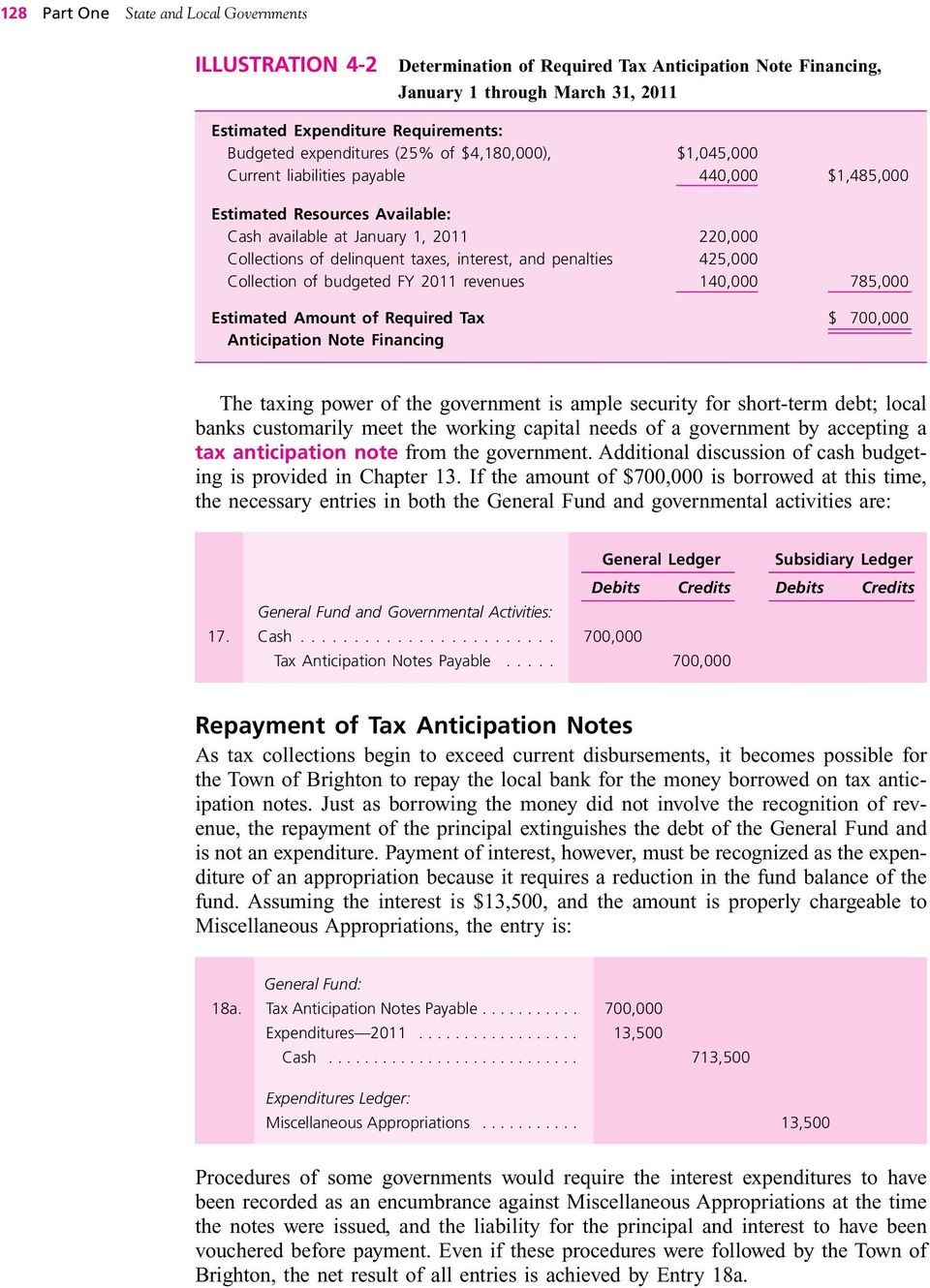
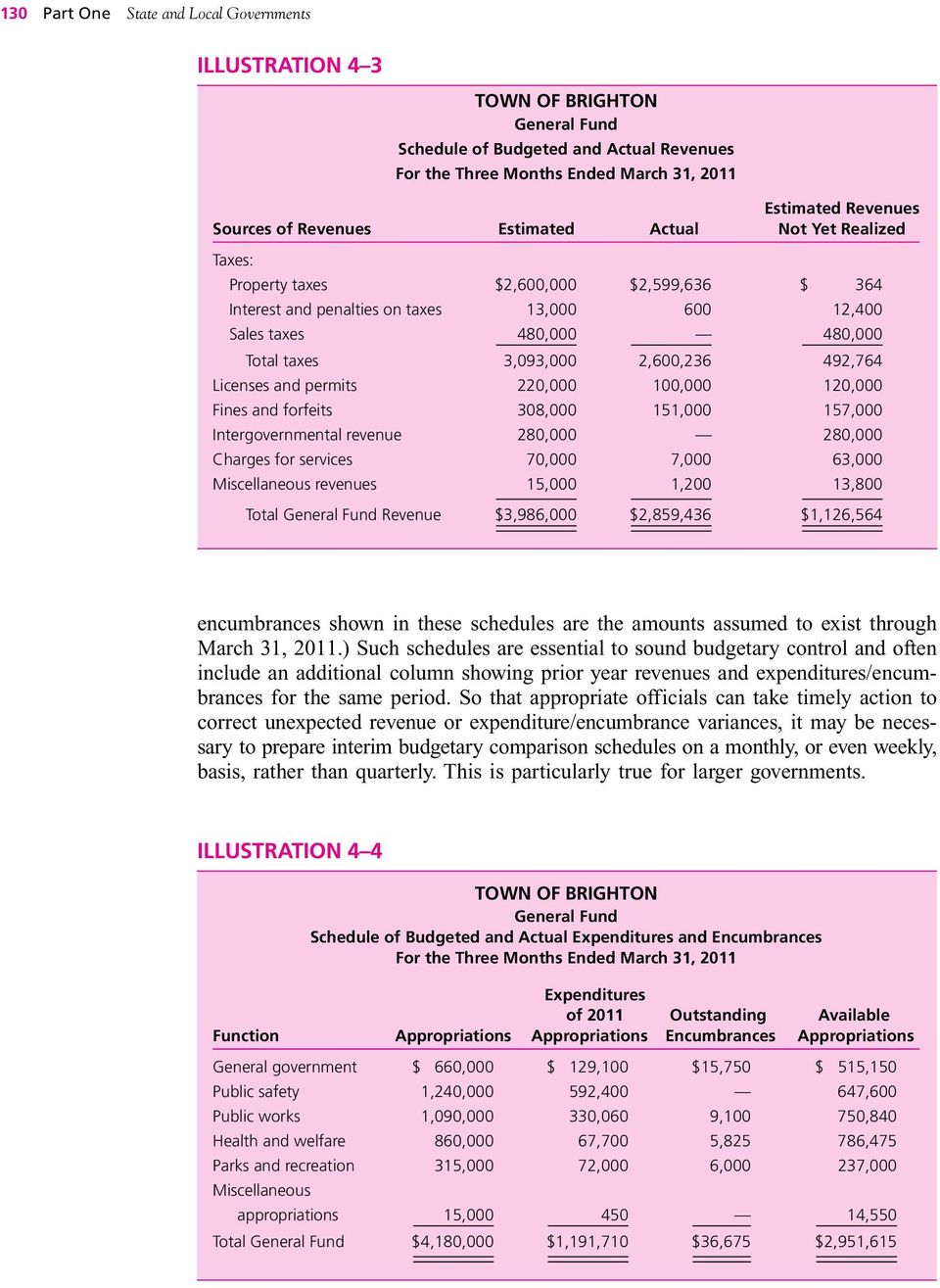
19 Chapter 4 Accounting for Governmental Operating Activities Illustrative Transactions and Financial Statements 129 A similar entry, shown as Entry 18b, is made at the government-wide level except that an expense rather than expenditure is recorded for the interest charged on the note. This expense is deemed to be an indirect expense that benefits no single function. General Ledger Subsidiary Ledger Debits Credits Debits Credits Governmental Activities: 18b. Tax Anticipation Notes Payable ,000 Expenses Interest on Tax Anticipation Notes.. 13,500 Cash ,500 Other Taxes In addition to property taxes, many state and local governments receive sales and use taxes, income taxes, motor fuel taxes, and various other kinds of taxes, including those on businesses. These taxes, like property taxes, are nonexchange transactions in which one party (taxpayers in this case) does not receive (give) value proportionate to the value given (received). However, these taxes derive their valuation from underlying exchange transactions, such as selling goods, earning wages and salaries, and purchasing fuel. Thus, the GASB refers to taxes such as sales and income taxes as derived tax revenues. Generally, derived tax revenues should be recognized in the period in which the underlying exchange has occurred. In practice, collections of sales and income taxes may not occur in the same period in which the underlying sales or earning transactions occurred. For example, local governments often experience delays in collecting sales taxes because in most states these taxes are collected by state governments. Moreover, businesses may only be required to file a sales tax return and remit taxes on a monthly basis. Income taxes are subject to even less frequent filings and collections. Consequently, at the end of a fiscal period, governments generally will need to estimate the amount of sales or income taxes that have accrued but have not yet been reported. Such entries will require a debit to a taxes receivable account and a credit to the Revenues control account and the appropriate Revenues Subsidiary Ledger accounts. INTERIM FINANCIAL REPORTING Unlike publicly traded corporations, state and local governments usually are not required to provide quarterly or other interim financial statements to external parties. Although there is no requirement for external interim reporting, all state and local governments should prepare interim financial schedules for the internal use of administrators and legislators. The frequency and nature of interim reports are at the discretion of each government. At a minimum, quarterly budgetary comparison schedules should be prepared showing actual revenues to date compared with budgeted revenues and actual expenditures and outstanding encumbrances to date compared with appropriations. Schedules such as these for the Town of Brighton, prepared as of the end of the first quarter of the 2011 fiscal year, are presented as Illustrations 4 3 and 4 4. (Note: The amounts of revenues, expenditures, and
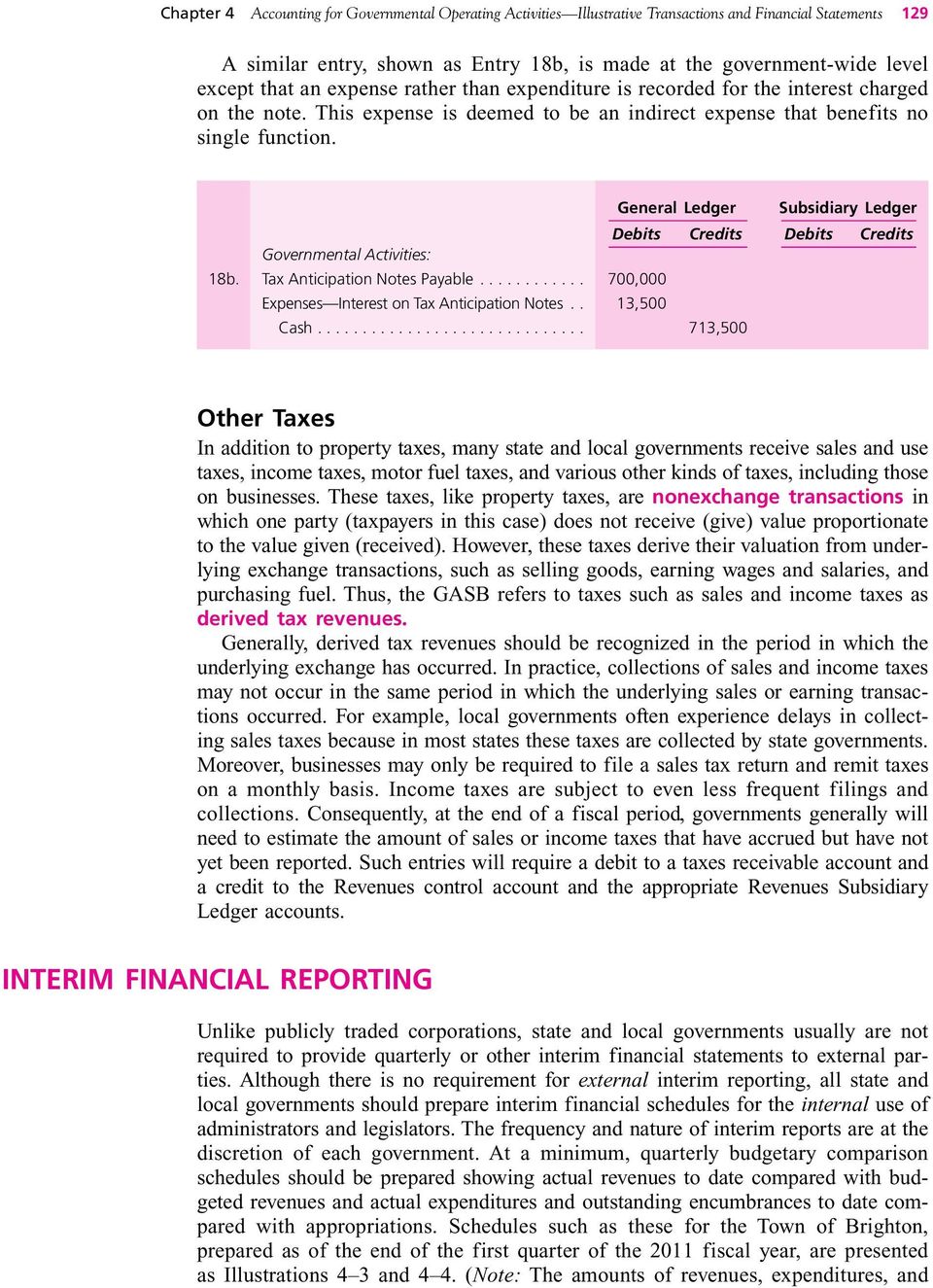
20 130 Part One State and Local Governments ILLUSTRATION 4 3 TOWN OF BRIGHTON General Fund Schedule of Budgeted and Actual Revenues For the Three Months Ended March 31, 2011 Estimated Revenues Sources of Revenues Estimated Actual Not Yet Realized Taxes: Property taxes $2,600,000 $2,599,636 $ 364 Interest and penalties on taxes 13, ,400 Sales taxes 480, ,000 Total taxes 3,093,000 2,600, ,764 Licenses and permits 220, , ,000 Fines and forfeits 308, , ,000 Intergovernmental revenue 280, ,000 Charges for services 70,000 7,000 63,000 Miscellaneous revenues 15,000 1,200 13,800 Total General Fund Revenue $3,986,000 $2,859,436 $1,126,564 encumbrances shown in these schedules are the amounts assumed to exist through March 31, 2011.) Such schedules are essential to sound budgetary control and often include an additional column showing prior year revenues and expenditures/encumbrances for the same period. So that appropriate officials can take timely action to correct unexpected revenue or expenditure/encumbrance variances, it may be necessary to prepare interim budgetary comparison schedules on a monthly, or even weekly, basis, rather than quarterly. This is particularly true for larger governments. ILLUSTRATION 4 4 TOWN OF BRIGHTON General Fund Schedule of Budgeted and Actual Expenditures and Encumbrances For the Three Months Ended March 31, 2011 Expenditures of 2011 Outstanding Available Function Appropriations Appropriations Encumbrances Appropriations General government $ 660,000 $ 129,100 $15,750 $ 515,150 Public safety 1,240, , ,600 Public works 1,090, ,060 9, ,840 Health and welfare 860,000 67,700 5, ,475 Parks and recreation 315,000 72,000 6, ,000 Miscellaneous appropriations 15, ,550 Total General Fund $4,180,000 $1,191,710 $36,675 $2,951,615
21 Chapter 4 Accounting for Governmental Operating Activities Illustrative Transactions and Financial Statements 131 SPECIAL TOPICS This section of the chapter presents several special topics that result in additional journal entries, either in the General Fund or governmental activities journals, or both. Many additional transactions are assumed to have occurred during 2011, the recording of which would have been redundant of the transactions already illustrated. Correction of Errors No problems arise in the collection of current taxes if they are collected as billed; the collections are debited to Cash and credited to Taxes Receivable Current. Sometimes, even in a well-designed and well-operated system, errors occur and must be corrected. If, for example, the assessed valuation of a parcel of property were legally reduced but the tax bill erroneously issued at the higher valuation, the following correcting entry would be made when the error was discovered, assuming the corrected bill to be $364 smaller than the original bill. (The error also caused a slight overstatement of the credit to Estimated Uncollectible Current Taxes in Entry 10, but the error in that account is not considered material and, for that reason, does not require correction.) General Ledger Subsidiary Ledger Debits Credits Debits Credits General Fund: 19. Revenues Taxes Receivable Current Revenues Ledger: Property Taxes An entry similar to Entry 19 would also be made at the government-wide level to correct the overstatement of General Revenues and Taxes Receivable Current. Postaudit may disclose errors in the recording of expenditures during the current year or during a prior year. If the error occurred during the current year, the Expenditures account and the proper Expenditures subsidiary account should be debited or credited as needed to correct the error. If it occurred in a prior year, however, the Expenditures account in error would have been closed to Fund Balance at the end of the prior year, so the correcting entry should be made to the Fund Balance account. Technically, overpayment errors of prior periods should also result in corrections to Fund Balance. However, as a practical matter, collections from suppliers of prior years overpayments may be budgeted as Miscellaneous Revenues and recorded as credits to the Revenues account. Receipt of Goods Ordered in Prior Year As noted earlier in this chapter under the heading Measurement Focus and Basis of Accounting, purchase orders and other commitment documents issued in 2010 and not filled or canceled by the end of that year total $127,000. This amount is designated as Reserved for Encumbrances 2010 in the December 31, 2010, General Fund Balance Sheet of the Town of Brighton. As stated previously, budgetary accounting has no effect on the government-wide financial statements; thus, no encumbrance is recorded at the government-wide level when goods or services are ordered or a contract is signed. When the goods on order at the end of fiscal year 2010 are received in 2011, their actual cost is considered an expenditure of the 2010 appropriations to the extent of the amount
22 132 Part One State and Local Governments encumbered in 2010; any additional amount must be charged to the 2011 appropriations. The Appropriations account for 2010, however, was closed at the end of that year, as were the other budgetary accounts for that year. Although other procedures may be used, the authors prefer to reestablish the Encumbrances account at the beginning of fiscal year 2011, as shown in Entry 20, assuming that the goods were ordered by the Parks and Recreation function. 4 When goods or services ordered in 2010 are received in 2011, it is convenient to debit the Expenditures 2010 account when the liability account is credited and eliminate the encumbrance in the normal manner. At year-end, the Expenditures 2010 account is closed to Fund Balance, along with Expenditures 2011 and all other operating statement accounts. General Ledger Subsidiary Ledger Debits Credits Debits Credits General Fund: 20. Encumbrances ,000 Fund Balance ,000 Encumbrances Ledger: Parks and Recreation ,000 Assuming that all goods and services for which encumbrances were outstanding at the end of 2010 were received in 2011 at a total invoice cost of $127,250, Entries 21 and 21a are necessary in the General Fund, and Entry 21b is made in the governmental activities journal. Notice that only the estimated amount, $127,000, is charged to Expenditures 2010 since this was the amount of the encumbrance against the 2010 appropriation; the difference between the amount encumbered in 2010 and the amount approved for payment in 2011 must be charged against the 2011 appropriation for Parks and Recreation. General Fund: 21. Reserve for Encumbrances ,000 Encumbrances ,000 Encumbrances Ledger: Parks and Recreation ,000 21a. Expenditures ,000 Expenditures Vouchers Payable ,250 Expenditures Ledger: Parks and Recreation ,000 Parks and Recreation Governmental Activities: 21b. Expenses Parks and Recreation ,250 Vouchers Payable ,250 4 State laws vary considerably regarding the treatment of appropriations and encumbrances at yearend. In some states, appropriations do not lapse at year-end. In many others, appropriations lapse and goods encumbered at year-end require a new appropriation in the next year s budget or must be charged to the next year s normal appropriation. Discussion of the methods of accounting for the various alternative laws and practices is beyond the scope of this text.
23 Chapter 4 Accounting for Governmental Operating Activities Illustrative Transactions and Financial Statements 133 Revision of the General Fund Budget Comparisons of budgeted and actual revenues, by sources, comparisons of departmental or program appropriations with expenditures and encumbrances, and interpretation of information that was not available at the time the budgets were originally adopted could indicate the desirability or necessity of legally amending the budget during the fiscal year. For example, the schedule of budgeted and actual revenues for the three months ended March 31, 2011 (Illustration 4 3), shows that more than 70 percent of the revenues budgeted for the General Fund of the Town of Brighton for 2011 have already been realized because revenue from property taxes was accrued when billed, whereas revenues from all other sources were recognized when collected during the three-month period for which entries are illustrated. Consequently, administrators of the town must review the information shown in Illustration 4 3 and determine whether the budget that was legally approved before the beginning of 2011 appears realistic or whether changes should be made in the Revenues budget in light of current information about local economic conditions; possible changes in state or federal laws relating to grants, entitlements, or shared revenues; or other changes relating to license and permit fees, fines, forfeits, and charges for services. Similarly, revenue collection procedures and revenue recognition policies should be reviewed to determine whether changes should be made in the remaining months of the year. Assume that the Town of Brighton s General Fund revenues budget for 2011 has been reviewed as described and that the budget is legally amended to reflect that revenues from Charges for Services are expected to be $5,000 more than originally budgeted, and that Miscellaneous Revenues are expected to be $10,000 more than originally budgeted; revenues from other sources are not expected to be materially different from the original 2011 budget. Entry 22 records the amendment of the Revenues budget, as well as the amendment of the appropriations budget, as will be discussed. General Ledger Subsidiary Ledger Debits Credits Debits Credits General Fund: 22. Estimated Revenues ,000 Budgetary Fund Balance ,000 Appropriations ,000 Estimated Revenues Ledger: Charges for Services ,000 Miscellaneous Revenues ,000 Appropriations Ledger: Public Works ,000 Public Safety ,000 Information shown in Illustration 4 4 should be reviewed by administrators of the Town of Brighton to determine whether the appropriations legally approved before the beginning of 2011 appear realistic in light of expenditures of the 2011 budget incurred in the first three months of 2011 and encumbrances outstanding on March 31 of that year. Illustration 4 4 shows that total cumulative expenditures and outstanding encumbrances exceed 29 percent of the total appropriations for 2011, which can be related to the fact that as of March 31, the year is almost 25 percent over. By function, however, cumulative expenditures and outstanding encumbrances range
24 134 Part One State and Local Governments from 3 percent of the Miscellaneous appropriation to almost 48 percent of the Public Safety appropriation. Therefore, each appropriation should be reviewed carefully using whatever detail is available in light of current information about expenditures needed to accomplish planned services during the remainder of Assume that the Town of Brighton s General Fund appropriations for 2011 have been reviewed and are legally amended to reflect a $50,000 decrease in the appropriation for Public Works and an $80,000 increase in the appropriation for Public Safety. Entry 22 reflects the legal amendment of appropriations for 2011, as well as the amendment of the revenues budget. Note the net increase in Appropriations of $30,000 is more than the net increase in Estimated Revenues of $15,000, requiring a decrease in Budgetary Fund Balance. Comparisons of budget and actual should be made periodically during each fiscal year. In the Town of Brighton case, it is assumed that comparisons subsequent to the ones illustrated disclosed no further need to amend either the revenues budget or the appropriations budget for Internal Exchange Transactions Water utilities ordinarily provide fire hydrants and water service for fire protection at a flat annual charge. A governmentally owned water utility accounted for by an enterprise fund should be expected to support the cost of its operations by user charges. Fire protection is logically budgeted as an activity of the Fire Department, a General Fund department. Assuming the amount charged by the water utility to the General Fund for hydrants and water service is $30,000, and the fire department budget is a part of the Public Safety category in the Town of Brighton example, the General Fund should record its liability as: General Ledger Subsidiary Ledger Debits Credits Debits Credits General Fund: 23a. Expenditures ,000 Due to Other Funds ,000 Expenditures Ledger: Public Safety ,000 The corresponding entry to record the inter-activities transaction (between the governmental activities and business-type activities) at the government-wide level is given as Entry 23b. Governmental Activities: 23b. Expenses Public Works ,000 Internal Balances ,000 Governmental utility property is not assessed for property tax purposes, but it is common for governmental utilities to make an annual payment in lieu of taxes (PILOT) contribution to the General Fund in recognition of the fact the utility does receive police and fire protection and other services. In fact, an amount in lieu of taxes is often billed to the utility s customers; the aggregate amount so collected is simply passed on to the General Fund.
25 Chapter 4 Accounting for Governmental Operating Activities Illustrative Transactions and Financial Statements 135 If the water utility of the Town of Brighton agrees to contribute $25,000 to the General Fund in lieu of taxes and that amount fairly represents the value of services received from the general government, the required journal entries for the General Fund and governmental activities are: General Fund: 24a. Due from Other Funds ,000 General Ledger Revenues ,000 Revenues Ledger: Subsidiary Ledger Debits Credits Debits Credits Miscellaneous Revenues ,000 Governmental Activities: 24b. Internal Balances ,000 General Revenues Payments in Lieu of Taxes ,000 Internal exchange transactions of the nature illustrated in Entries 23 and 24, and earlier in this chapter by the purchase of supplies by General Fund departments from the Supplies Fund (an internal service fund), affect both the fund and government-wide financial statements. Though the GASB refers to these transactions as interfund services provided and used, the authors believe that internal exchange transactions is a more precise term. Internal exchange transactions better captures the fact that these are reciprocal exchange transactions, but they occur internally between funds and activities rather than between the government and an external entity or person. The funds that participate in internal exchange transactions should recognize revenues and expenditures or expenses, as appropriate, as if the transaction involved each fund and an external entity. Other types of internal transactions between funds, between governmental and business-type activities, and between the primary government and its discretely presented component units are discussed in a later section of this chapter. Adjusting Entries Inventories of Supplies If a government is large enough to have sizeable inventories of consumable supplies that are used by a number of departments, it is generally recommended that the purchasing, warehousing, and distribution functions be centralized and managed by an internal service fund. This was the motivation for the Town of Brighton to create its Supplies Fund at the beginning of this year, as discussed earlier in this chapter. As is typical of small cities and towns, the town previously determined its inventories at year-end by taking a physical count of supplies on hand; for example, by periodic inventory procedures. Since establishing the Supplies Fund, the town maintains these inventories on a perpetual basis, but it will take a physical count at year-end to confirm inventory balances and adjust the inventory accounts accordingly. Governments that account for their supplies within the General Fund can use either the purchases method or the consumption method. Using the purchases method, expenditures for supplies equals the total amount purchased for the year, even if the amount of supplies consumed is less than or greater than the amount purchased. Thus, the purchases method is consistent with the modified accrual basis of
26 136 Part One State and Local Governments accounting used by the General Fund and other governmental funds. The purchases method is generally associated with a periodic inventory system, so the balance of the Inventory of Supplies account is increased or decreased as necessary at year-end to agree with the valuation based on a physical count. In addition, a Reserve for Inventory of Supplies account, having a credit balance equal in amount to the balance of the inventory account, is required to indicate that the inventory reported on the balance sheet is not available for spending. The consumption method is consistent with the accrual basis of accounting, as resources (i.e., supplies) consumed in providing services is the essence of an expense. Thus, GASB standards require the use of the consumption method for governmentwide and proprietary fund reporting. Using this method, the General Fund recognizes expenditures equal to the amount of supplies consumed during the year rather than the amount purchased. Accordingly, budgetary appropriations for supplies are based on estimated consumption rather than estimated purchases. When using the consumption method, reporting of a reservation of fund balance is optional, though recommended. 5 To illustrate and contrast the purchases and consumption methods, assume the following information for supplies purchases and usage of a certain city for its 2011 fiscal year. Balance of inventory, January 1, 2011 $ 55,000 Purchases during ,000 Supplies available for use 315,000 Less: Balance of inventory, December 31, ,000 Supplies consumed during 2011 $250,000 Purchases Method Under the purchases method, the summary entry in the General Fund to record supplies purchased during the year, assuming all supplies are purchased from external vendors and all invoices have been paid, is (encumbrance entries and subsidiary detail omitted for simplicity): General Ledger Subsidiary Ledger Debits Credits Debits Credits General Fund: Expenditures ,000 Cash ,000 At year-end, a physical inventory revealed that $65,000 of inventory remained on hand. The entry to record the $10,000 increase in inventory from the beginning balance and the corresponding reservation of fund balance is given as: General Fund: Inventory of Supplies ,000 Reserve for Inventory of Supplies ,000 5 American Institute of Certified Public Accountants, Audit and Accounting Guide, State and Local Governments (New York: 2008), par
27 Chapter 4 Accounting for Governmental Operating Activities Illustrative Transactions and Financial Statements 137 Consumption Method Generally, the consumption method is used with a perpetual inventory system; however, because the purchases method is commonly used for General Fund accounting, many governments must convert their purchases information to the consumption basis for governmental activities at the government-wide level. Accordingly, the following examples show consumption method journal entries using periodic inventory control procedures, omitting subsidiary detail for simplicity. If the city uses a periodic inventory system, but reports inventories under the consumption method in both the General Fund and governmental activities, the following entries are required. To record purchases of supplies for the year, assuming that for budgetary control purposes the city records expenditures for each purchase of supplies (encumbrance entries and subsidiary detail omitted for simplicity): General Ledger Subsidiary Ledger Debits Credits Debits Credits General Fund: Expenditures ,000 Cash ,000 At year-end, the city s General Fund adjusting entries will be: General Fund: Inventory of Supplies ,000 Expenditures ,000 Fund Balance ,000 Reserve for Inventory of Supplies ,000 The appropriate year-end adjusting entry at the government-wide level depends upon the way inventories are recorded during the year. If purchases during the year are debited to Inventory of Supplies, then the adjusting entry will require a debit to expenses and credit to the inventory account. If, on the other hand, the city records expenses at the government-wide level during the year as purchases are made, the adjusting entry will require a debit to inventory and a credit to expenses for the $10,000 increase in inventory that occurred in Assuming purchases are recorded initially as expenses, the entries that would be required for governmental activities at the government-wide level are illustrated as follows. To record purchases during the year: Governmental Activities: Expenses (function or program detail omitted) ,000 Cash ,000 The required governmental activities adjusting entry is: Governmental Activities: Inventory of Supplies ,000 Expenses (function or program detail omitted) ,000
28 138 Part One State and Local Governments (Note: Reservation of fund balance for inventory and other reasons applies only to governmental funds that are subject to legal budgetary control. Thus, this entry is not made at the government-wide level.) In all of these examples, the entries in the General Fund are somewhat more complex because of the need to adjust the Reserve for Inventory of Supplies account at the fund level. One can expect that the GASBS 34 requirement to report inventories using the consumption method at the government-wide level may lead to increased use of this method for the General Fund as well. Pre-Closing Trial Balance Assume that all illustrated journal entries for the transactions and events pertaining to the Town of Brighton s 2011 fiscal year have been posted to the general and subsidiary ledgers. In addition, a number of other transactions and events were journalized and posted during the year but were not shown in this chapter because they were similar to those that were illustrated. As a result of all transactions and events recorded for the year (both those that were illustrated and those that were not), the balances of all balance sheet, operating statement, and budgetary accounts before closing entries are presented in the following trial balance. TOWN OF BRIGHTON General Fund Pre-Closing Trial Balance as of December 31, 2011 Debits Credits Cash $ 145,800 Taxes Receivable Delinquent 701,813 Estimated Uncollectible Delinquent Taxes $ 123,513 Interest and Penalties Receivable on Taxes 13,191 Estimated Uncollectible Interest and Taxes 3,091 Due from Other Funds 25,000 Estimated Revenues 4,001,000 Revenues 4,015,000 Vouchers Payable 405,800 Due to Federal Government 126,520 Due to State Government 39,740 Due to Other Funds 30,000 Appropriations 4,210,000 Estimated Other Financing Uses 91,500 Expenditures ,000 Expenditures ,130,760 Other Financing Uses Interfund Transfers Out 91,500 Encumbrances ,240 Reserve for Encumbrances ,240 Budgetary Fund Balance 300,500 Fund Balance 491,400 $9,606,804 $9,606,804 Closing Entries At fiscal year-end, all temporary accounts, both budgetary and operating, must be closed to the appropriate fund balance account. Budgetary accounts are closed by simply reversing the original budgetary entry (or entries) made at the beginning of
29 Chapter 4 Accounting for Governmental Operating Activities Illustrative Transactions and Financial Statements 139 the fiscal year, as well as any amended budget entries made during the year. Although many governments follow a more complex process for closing the Encumbrances account, we simply close any remaining balance in the Encumbrances account to the general ledger Fund Balance account. 6 In effect, this closes the Encumbrances account while leaving a balance in the Reserve for Encumbrances balance sheet account equal to the amount of undelivered goods and services. Legislators, managers, and other financial statement users understand that the amount reported as fund balance reserved for goods and services to be delivered in the following year is already committed and therefore not available for budgetary appropriation. Closing the operating accounts increases the balance of the general ledger Fund Balance account by the excess of revenues and other financial resources over expenditures and other financing uses. If there is an operating deficit (revenues and other financing sources are less than expenditures and other financing uses), then fund balance is decreased. Entries 25a, b, and c illustrate the entries needed to close the budgetary and operating accounts, using account balances shown in the Pre-Closing Trial Balance. Entries 25a, b, and c illustrate closing entries for the operating and budgetary control accounts of the General Fund but not for the detailed subsidiary ledger accounts. In a manual accounting system, such as that illustrated in this chapter, closing the General Fund: 25a. Appropriations ,210,000 Estimated Other Financing Uses ,500 General Ledger Estimated Revenues ,001,000 Budgetary Fund Balance ,500 25b. Revenues ,015,000 Fund Balance ,260 Expenditures ,130,760 Expenditures ,000 Other Financing Uses Interfund Transfers Out ,500 25c. Fund Balance ,240 Encumbrances ,240 Subsidiary Ledger Debits Credits Debits Credits 6 In practice, governments often use a formal account title such as Budgetary Fund Balance Reserved for Encumbrances for the credit portion of encumbrance entries recorded during the year. At year-end, the amount of outstanding encumbrances is closed by debiting Budgetary Fund Balance Reserved for Encumbrances and crediting Encumbrances. This approach requires an additional entry to record a reservation of the general ledger Fund Balance for the amount of outstanding encumbrances, assuming that outstanding purchase orders and contracts are to be honored in the following year and will not require a new appropriation. For the additional entry, Unreserved Fund Balance is debited and Fund Balance Reserved for Encumbrances, or a similarly titled account, is credited for the amount of encumbrances outstanding. For simplicity, we use the shortened account title Reserve for Encumbrances (see Entries 3 and 4), which is understood to represent a reservation of the general ledger Fund Balance. This approach also simplifies the closing entries since closing the Encumbrances account to Fund Balance as shown in Entry 25c leaves a balance equal to encumbrances outstanding in the Reserve for Encumbrances account.
30 140 Part One State and Local Governments subsidiary ledger accounts is generally unnecessary because new subsidiary ledger accounts are prepared for each fiscal year. In a computerized accounting system, closing entries may be required for detail operating and budgetary accounts, depending on the account structure employed. Year-end Financial Statements As discussed in earlier chapters, the General Fund of every government is considered a major fund. Accordingly, all governmental fund financial statements will include a separate column for the General Fund financial information, as well as for all other major governmental funds, as shown in Illustrations A1 3 and A1 5 for the City and County of Denver and Illustrations 9 6 and 9 7 for the hypothetical Town of Brighton. For internal management purposes, a government may find it useful to prepare additional financial statements for the General Fund that are more detailed than the governmental fund statements. Such financial statements prepared for the Town of Brighton s General Fund are shown in Illustrations 4 5 and 4 6. The Town of Brighton s General Fund balance sheet includes two major sections, Assets and Liabilities and Fund Balances. Total assets should always equal total liabilities and fund balances. Note that the $25,000 receivable from the Water Utility Fund (see Entry 24a) is offset against the $30,000 payable to that fund (see Entry 23a), so that only the $5,000 net amount payable to the Water Utility Fund is reported as Due to other funds in the Liabilities section of the balance sheet in Illustration 4 5. It is not acceptable, however, to offset receivables or payables from one fund against those of a different fund. ILLUSTRATION 4 5 TOWN OF BRIGHTON General Fund Balance Sheet As of December 31, 2011 Assets Cash $145,800 Taxes receivable delinquent $701,813 Less: Estimated uncollectible delinquent taxes 123, ,300 Interest and penalties receivable on taxes 13,191 Less: Estimated uncollectible interest and penalties 3,091 10,100 Total Assets $734,200 Liabilities: Liabilities and Fund Balances Vouchers payable $405,800 Due to federal government 126,520 Due to state government 39,740 Due to other funds 5,000 Total Liabilities $577,060 Fund Balances: Reserved for encumbrances ,240 Fund balance 86,900 Total Fund Balances 157,140 Total Liabilities and Fund Balances $734,200
31 Chapter 4 Accounting for Governmental Operating Activities Illustrative Transactions and Financial Statements 141 ILLUSTRATION 4 6 TOWN OF BRIGHTON General Fund Statement of Revenues, Expenditures, and Changes in Fund Balance For the Year Ended December 31, 2011 Revenues: Property taxes $2,599,636 Interest and penalties on delinquent taxes 11,400 Sales taxes 485,000 Licenses and permits 213,200 Fines and forfeits 310,800 Intergovernmental revenue 284,100 Charges for services 82,464 Miscellaneous revenues 28,400 Total Revenues $4,015,000 Expenditures: 2011: General government 649,400 Public safety 1,305,435 Public works 1,018,900 Health and welfare 850,325 Parks and recreation 292,500 Miscellaneous appropriations 14,200 Expenditures ,130, : Parks and recreation 127,000 Total Expenditures 4,257,760 Excess of Expenditures over Revenues (242,760) Other Financing Sources (Uses): Interfund transfers in 0 Interfund transfers out (91,500) Total Other Financing Sources (91,500) Change (Decrease) in Fund Balances (334,260) Fund Balances, January 1, ,400 Fund Balances, December 31, 2011 $ 157,140 A second financial statement should be presented for the General Fund, a statement of revenues, expenditures, and changes in fund balance (see Illustration 4 6). Illustration 4 6 presents the actual revenues and actual expenditures that resulted from transactions illustrated in this chapter and other transactions not illustrated because they were similar in nature. Note that the General Fund of the Town of Brighton reports the financial outflow resulting from the interfund transfer out as an Other Financing Use. The Other Financing Sources (Uses) section in Illustration 4 6 shows a common means of disclosure of nonrevenue financial inflows and nonexpenditure financial outflows. Information shown as Illustration 4 6 would be presented in the General Fund column of the Statement of Revenues, Expenditures, and Changes in Fund Balances Governmental Funds (see Illustration A1 5).
32 142 Part One State and Local Governments ILLUSTRATION 4 7 Revenues: Taxes: TOWN OF BRIGHTON General Fund Schedule of Revenues, Expenditures, and Changes in Fund Balance Budget and Actual (Non-GAAP Presentation) For the Year Ended December 31, 2011 Budgeted Amounts Variance with Actual Amounts Final Budget Original Final Budgetary Basis Over (Under) Property taxes $2,600,000 $2,600,000 $2,599,636 $ (364) Interest and penalties on taxes 13,000 13,000 11,400 (1,600) Sales taxes 480, , ,000 5,000 Total taxes 3,093,000 3,093,000 3,096,036 3,036 Licenses and permits 220, , ,200 (6,800) Fines and forfeits 308, , ,800 2,800 Intergovernmental revenue 280, , ,100 4,100 Charges for services 70,000 75,000 82,464 7,464 Miscellaneous revenues 15,000 25,000 28,400 3,400 Total Revenues 3,986,000 4,001,000 4,015,000 14,000 Expenditures and Encumbrances: General government 660, , ,850 (1,150) Public safety 1,240,000 1,320,000 1,318,500 (1,500) Public works 1,090,000 1,040,000 1,038,300 (1,700) Health and welfare 860, , ,650 (1,350) Parks and recreation 315, , ,500 (2,500) Miscellaneous appropriations 15,000 15,000 14,200 (800) Total Expenditures 4,180,000 4,210,000 4,201,000 (9,000) Excess of Expenditures over Revenues (194,000) (209,000) (186,000) 23,000 Other Financing Sources (Uses) (91,500) (91,500) (91,500) 0 Decrease in Reserve for Encumbrances (56,760) (56,760) Decrease in Fund Balance for year (285,500) (300,500) (334,260) (33,760) Fund Balances, January 1, , , ,400 0 Fund Balances, December 31, 2011 $ 205,900 $ 190,900 $ 157,140 $(33,760) GASBS 34 requires a budgetary comparison schedule, as shown previously in Illustration 3 5, or, alternatively, a statement of revenues, expenditures, and changes in fund balance budget and actual for the General Fund, as well as for each major special revenue fund for which a budget is legally adopted. Illustration 4 7 presents a budgetary comparison schedule for the Town of Brighton General Fund. Note that columns must be provided for both the legally adopted budget amounts and the final amended amounts. The amounts in the Revenues section of the Actual column in Illustration 4 7 present the same information as shown in the Revenues section of Illustration 4 6 because in the Town of Brighton example, the General Fund revenues budget is on a
33 Chapter 4 Accounting for Governmental Operating Activities Illustrative Transactions and Financial Statements 143 GAAP basis, the same as actual revenues. However, the amounts in the Expenditures section of the Actual column of the budgetary comparison schedule (Illustration 4 7) differ from the expenditures shown in Illustration 4 6 because, under GAAP, expenditures chargeable to 2010 appropriations of $127,000 and expenditures of the 2011 appropriations of $4,130,760 are reported in Illustration 4 6. Also, in the GAAP operating statement, Illustration 4 6, encumbrances are not reported in the Expenditures section of the statement. In contrast, GASB standards require the amounts in the Actual column of Illustration 4 7 to conform with budgetary practices; therefore, in that statement, encumbrances outstanding at the end of fiscal 2011 are added to 2011 expenditures because both are uses of the 2011 appropriation authority. Note that expenditures for 2010 are excluded from the budget and actual schedule because that schedule relates only to the 2011 budget. GASB standards require differences between the amounts reported in the two statements (Illustrations 4 6 and 4 7) to be reconciled in a separate schedule or in the notes to the required supplementary information. For example, the notes to the budgetary comparison schedule for the Town of Brighton might include the following reconciliation of General Fund Expenditures reported in the two operating statements illustrated: Expenditures for 2011, budgetary basis $4,201,000 Less: Reserve for encumbrances as of December 31, 2011 (70,240) Expenditures for 2011, GAAP basis $4,130,760 SPECIAL REVENUE FUNDS The presentation of Reserve for Encumbrances in Illustrations 4 5, 4 6, and 4 7 and in the illustrative reconciliation is based on the assumption that amounts encumbered at year-end do not need to be appropriated for the following year. The amounts shown in Illustration 4 7 in the Expenditures section in the Variance with Final Budget column, however, disclose the portion of each appropriation for 2011 that was neither expended nor encumbered during that year; those amounts, totaling $9,000, are said to lapse, that is, become unavailable for expenditure or encumbrance, in the year following As noted in Chapters 2 and 3, special revenue funds are needed when legal or policy considerations require separate funds to be created for current operating purposes other than those served by proprietary or fiduciary funds. An example of a special revenue fund created to demonstrate legal compliance is a Street Fund, which is largely financed by a local government s share of the motor fuel tax levied by the state to be used only for maintenance and construction of streets, roads, and bridges. A second example of a special revenue fund is a Library Operating Fund created to account for a special tax levy or a decision of the governing board to create a separate fund to account for an activity that differs from other governmental activities. A third example is a fund to account for grants received from a higher jurisdiction, such as a federal Community Development Block Grant. Grant accounting is discussed briefly in the following paragraph. A final example is a trust fund in which both the investment principal and the investment earnings are available to support a government program or the citizenry. A common example of the latter is a gift received under a trust agreement that can be used only to purchase works of art for public buildings.
34 144 Part One State and Local Governments Accounting for Operating Grants Grants received by a local government from the state or federal government or received by a state from the federal government are often restricted for specified operating purposes. Consequently, a special revenue fund is frequently used to account for the revenues of such grants. A number of grants provide that the grantor will pay the grantee on a reimbursement basis. In such instances, GASB standards require that the grant revenue not be recognized until the expenditure has taken place. 7 As an example of appropriate accounting procedures, assume that a local government has been awarded a state grant to finance a fine arts program, but the state will provide reimbursement only after the grantee has made expenditures related to the fine arts program. This is an example of a voluntary nonexchange transaction in which an eligibility requirement (incurrence of allowable costs) must be met before the local government can recognize an asset and revenue. Assuming that the grantee government creates a special revenue fund to account for the fine arts program and has incurred qualifying expenditures, or expense at the government-wide level, the required entries in both the special revenue fund and the governmental activities journals would be: Debits Credits Special Revenue Fund and Governmental Activities: Expenditures (or Expense) ,000 Vouchers Payable (or Cash) ,000 Cash ,000 Revenues ,000 The latter entry, of course, records the reimbursement, which presumably would be a short time after the expenditures were incurred. If the grant provided instead that a specified amount would be available for the current accounting period, regardless of whether qualifying expenditures were incurred, there would be no eligibility requirement (except that the grantee be an authorized recipient). In this case, it would be appropriate for the special revenue fund to recognize an asset (Due from Federal [or State] Government) and Revenues upon notification by the state grantor agency. If the grant imposes a time requirement, such as specifying that the amount is intended for a future accounting period, a liability account, Deferred Revenues, would be credited upon notification of the grant rather than Revenues. In the period for which the grant is intended, an entry would be made in the special revenue fund and governmental activities journals to debit Deferred Revenues and credit Revenues. Financial Reporting Special revenue fund accounting and financial reporting are essentially the same as for the General Fund, as described earlier in this chapter. In addition to amounts for the General Fund, amounts for major special revenue funds would be included in the balance sheet and statement of revenues, expenditures, and changes in fund balances prepared for the governmental funds. A budgetary comparison schedule is 7 GASB Codification, Sec. N5O.112. See the appendix to this chapter for a more detailed discussion of revenue and expense/expenditure recognition for both exchange and nonexchange transactions.
35 Chapter 4 Accounting for Governmental Operating Activities Illustrative Transactions and Financial Statements 145 INTERFUND ACTIVITY also provided as required supplementary information for each major special revenue fund for which a budget is legally adopted. Elsewhere in the financial section of the government s comprehensive annual financial report (CAFR), a combining balance sheet and combining operating statement should be provided for all nonmajor governmental funds, including nonmajor special revenue funds. An example of a combining statement of revenues, expenditures, and changes in fund balances for nonmajor governmental funds is presented in Illustration 4 8 for the City of Sioux City, Iowa. Reciprocal Interfund Activity Internal exchange transactions those involving the sales and purchases of goods and services in a reciprocal exchange transaction between two funds were discussed earlier in this chapter. These transactions are termed interfund services provided and used in GASBS 34. Other interfund transactions are discussed in this section. Interfund Loans Interfund loans are sometimes made from one fund to another with the intent that the amount be repaid. If the loan must be repaid during the current year or soon thereafter, the lending fund should record a current receivable, and the borrowing fund should record a current liability. This is illustrated by the following journal entries, assuming that the General Fund makes a short-term loan in the amount of $100,000 to the Central Stores Fund, an internal service fund. General Ledger Subsidiary Ledger Debits Credits Debits Credits General Fund: Interfund Loans Receivable Current ,000 Cash ,000 Internal Service Fund: Cash ,000 Interfund Loans Payable Current ,000 If this interfund loan did not require repayment for more than one year, the word Noncurrent would be used rather than Current to signify the noncurrent nature of the loan. 8 As shown in the following entries, Noncurrent is added to each of the interfund loan receivable/payable accounts to indicate that the loan is not payable during the current year or soon thereafter. 8 Governments also use the accounts Due to (from) Other Funds and Advances from (to) Other Funds to record current and noncurrent interfund loans, respectively. The authors prefer to reserve the use of Due to (from) Other Funds for operating transactions only; that is, interfund transfers and internal exchange transactions. Although used for decades, the term Advances is somewhat vague.
36 146 ILLUSTRATION 4 8 CITY OF SIOUX CITY, IOWA Combining Statement of Revenues, Expenditures and Changes in Fund Balances Governmental Nonmajor Funds for the Year Ended June 30, 2007 Permanent Special Revenue Funds Fund Total Storm Younkers Convention Governmental Emergency Water Community Main Self-Impr. Center/ Transit Cemetery Nonmajor Revenues Fund Drainage Road Use Development Housing Street District Auditorium Operations Trust Funds Taxes $ 528,056 $ $ $ $ $187,702 $ $ $ $ $ 715,758 Special assessments 14,203 14,203 Intergovernmental revenue 7,222,597 3,574,335 4,757,152 1,695,763 17,249,847 Revenue from use of property 3,011,096 50,974 72,397 3,134,467 Charges for services 1,270,128 4,884 1,115, ,618 3,230,396 Interest 9, ,376 24, ,074 Miscellaneous 48,480 61,757 64, ,657 29,427 17, ,722 Total Revenue 528,056 1,293,657 7,275,961 3,848,468 4,822, ,702 4,523,891 2,615,782 89,805 25,185,487 Expenditures Current Public works 91,890 7,741,877 3,388,565 11,222,332 Culture and recreation 7,039,061 7,039,061 Community and economic development 3,325,241 5,028, ,000 8,639,115 General government 1,163 1,163 Total Expenditures 93,053 7,741,877 3,325,241 5,028, ,000 7,039,061 3,388,565 26,901,671 Excess (Deficiency) of Revenues Over Expenditures 528,058 1,200,604 (465,916) 523,227 (206,729) (97,298) (2,515,170) (772,783) 89,805 (1,716,204) Other Financing Sources (Uses) Transfers in 1,500, ,899 96,633 2,222,092 1,302,285 5,279,909 Transfers out (527,691) (926,571) (27,852) (36,960) (450,545) (1,969,619) Total Other Financing Sources (Uses) 972,309 (926,571) 131,047 (36,960) 96,633 2,222, ,740 3,310,290 Net Change in Fund Balance 1,500, ,033 (334,869) 486,267 (206,729) (665) (293,078) 78,957 89,805 1,594,086 Fund Balance (Deficit) Beginning of Year 2,703,978 1,067,446 1,328,922 6,784,957 1,427,155 99,343 (1,587) (1,132,753) 185, ,105 13,301,418 Fund Balance (Deficit) End of Year $4,204,343 $1,341,479 $ 994,053 $7,271,224 $1,220,426 $ 98,678 $(1,587) $(1,425,831) $ 264,809 $927,910 $14,895,504
37 Chapter 4 Accounting for Governmental Operating Activities Illustrative Transactions and Financial Statements 147 General Ledger Subsidiary Ledger Debits Credits Debits Credits General Fund: Interfund Loans Receivable Noncurrent ,000 Cash ,000 Internal Service Fund: Cash ,000 Interfund Loans Payable Noncurrent ,000 Because the noncurrent interfund loan receivable represents assets that are not available for the current year s appropriation in the General Fund, the Fund Balance account should be reserved for this amount, as was done for encumbered amounts and ending inventories of supplies. General Fund: Fund Balance ,000 Reserve for Noncurrent Interfund Loans Receivable ,000 An interesting question is whether the illustrated interfund loans require journal entries at the government-wide level. The answer is no since GASBS 34 requires that most internal service fund amounts be reported in the Governmental Activities column of the government-wide financial statements. Interfund receivables and payables between two funds that are both included in governmental activities have no effect on the amounts reported in the government-wide statement of net assets. Nonreciprocal Interfund Activity Interfund Transfers The former reporting model identified two types of interfund transfers: operating transfers and residual equity transfers, which were reported in two different ways in governmental fund operating statements. Under GASBS 34, both types of transfers are described simply as interfund transfers and reported in the same manner as other financing sources by the receiving fund and as other financing uses by the transferring fund. Some interfund transfers are periodic, routine transfers. For example, state laws may require that taxes be levied by a General Fund or a special revenue fund to finance an expenditure to be made from another fund (such as a debt service fund). Since the general rule is that revenues should be recorded as such only once, the transferor records the transfer of tax revenue to the expending fund as an Other Financing Use Interfund Transfer Out, and the transferee records it as an Other Financing Source Interfund Transfer In. Other interfund transfers, those formerly called residual equity transfers, are nonroutine transactions often made to establish or liquidate a fund, such as the Town of Brighton example (Entries 2 and 2a earlier in this chapter) in which the General Fund transferred cash and inventory to create a supplies internal service fund. The creation of a fund by transfer of assets and/or resources from an existing fund to a new fund, or transfers of residual balances of discontinued funds to another fund, results in the recognition of an other financing source rather than a revenue by the new fund and an other financing use rather than an expenditure by the transferor fund.
38 148 Part One State and Local Governments Reimbursements Internal exchange transactions for interfund services provided and used, described earlier in this chapter, represent the only form of interfund transactions that result in the recognition of revenue by the receiving fund. In certain instances, one fund may record as an expenditure an item that should have been recorded as an expenditure by another fund. Often this is the result of an accounting error. When the second fund reimburses the first fund, the first fund should recognize the reimbursement as a reduction of its Expenditures account, not as an item of revenue. The second fund should debit Expenditures and credit Cash, as should have been done when the transaction initially occurred. Reimbursements are not reported in the financial statements except for reporting expenditures/expenses in the correct fund. Intra- versus Inter-Activity Transactions (Government-wide Level) In all the preceding examples, if the interfund transaction occurs between two governmental funds (or between a governmental fund and an internal service fund) or between two enterprise funds, that is, an intra-activity transaction, then neither the Governmental Activities column nor the Business-type Activities column is affected at the government-wide level. Interfund loans or transfers between a governmental fund (or internal service fund) and an enterprise fund results in an inter-activity transaction. These transactions are reported as Internal Balances on the government-wide statement of net assets (see Illustration A1 1) and Transfers in the statement of activities (see Illustration A1 2). Except for internal exchange transactions between governmental funds and internal service funds, for which any element of profit or loss is eliminated prior to preparing the government-wide financial statements, other internal exchange transactions should be reported as revenues and expenses in the statement of activity. Intra-Entity Transactions Intra-entity transactions are exchange or nonexchange transactions between the primary government and its blended or discretely presented component units. Transactions between the primary government and blended component units follow the same standards as for reciprocal and nonreciprocal interfund activity discussed in preceding paragraphs. Transactions between the primary government and discretely presented component units are treated as if the component units are external entities, and thus should be reported as revenues and expenses in the statement of activities. Amounts receivable and payable resulting from these transactions should be reported on a separate line in the statement of net assets. PERMANENT FUNDS Governments often receive contributions under trust agreements in which the principal amount is not expendable but earnings are expendable. Most of these trusts are established to benefit a government program or function, or the citizenry, rather than an external individual, organization, or government. Trusts of the first type are called public-purpose trusts; trusts of the second type are called privatepurpose trusts.
39 Chapter 4 Accounting for Governmental Operating Activities Illustrative Transactions and Financial Statements 149 The GASBS 34 model requires that public-purpose trusts for which the earnings are expendable for a specified purpose but the principal amount is not expendable (also referred to as endowments) be accounted for in a governmental fund called a permanent fund. Public-purpose trusts for which both principal and earnings thereon can be expended for a specified purpose are accounted for in a special revenue fund, again a governmental fund type. Accounting issues involving privatepurpose trusts are discussed in Chapter 8. Budgetary Accounts Budgetary accounts generally should not be needed for permanent funds because transactions of the fund result in changes in the fund principal only incidentally; by definition, the principal cannot be appropriated or expended. However, public-purpose expendable trust funds may be required by law to use the appropriation procedure to ensure adequate budgetary control over the expenditure of fund assets since they are accounted for in special revenue funds. If the appropriation procedure is required, the use of the other budgetary accounts discussed earlier in this chapter is also recommended. The following paragraphs illustrate a public-purpose nonexpendable trust that is accounted for as a permanent fund. Illustrative Case As an illustration of the nature of accounting for permanent fund trust principal and expendable trust revenue, assume on November 1, 2010, Wilma Wexner died, having made a valid will that provided for the gift of marketable securities to the City of Concordia to be held as a nonexpendable trust. For purposes of income distribution, the net income from the securities is to be computed on the accrual basis but does not include increases or decreases in the fair value of investments. Income, so measured, is to be transferred to the City s Library Operating Fund, a special revenue fund. Accounting for the Library Operating Fund is not illustrated here because it would be very similar to General Fund accounting already covered in depth in this chapter. For the sake of brevity, corresponding entries in the general journal for governmental activities at the government-wide level are also omitted. The gift was accepted by the City of Concordia, which established the Library Endowment Fund (a permanent fund) to account for operation of the trust. The following securities were received by the Library Endowment Fund: Interest Fair Value Rate per Maturity Face as of Year Date Value 11/1/10 Bonds of AB Company 6% 1/1/15 $640,000 $652,000 Fair Value Number as of of Shares 11/1/10 Stocks: M Company, common 5,400 $282,000 S Company, common 22, ,000 Total $496,000
40 150 Part One State and Local Governments Journal Entries Permanent Fund The Library Endowment Fund s receipt of the securities is properly recorded at the fair value of the securities as of the date of the gift because this is the amount for which the trustees are responsible. Although the face value of the bonds will be received at maturity (if the bonds are held until maturity), GASB standards require that investments in bonds maturing more than one year from receipt be reported at fair value. 9 Thus the entry in the Library Endowment Fund to record the receipt of the securities at initiation of the trust on November 1, 2010, is: Permanent Fund: Debits 1. Investment in Bonds ,000 Investment in Stocks ,000 Accrued Interest Receivable ,800 Credits Revenues Contributions for Endowment ,160,800 [Interest accrued on the bonds of Company AB ($640,000 6% 4/12 $12,800), assuming semiannual interest was last received on July 1, 2010] As of January 1, 2011, semiannual interest of $19,200 is received on the AB Company bonds, of which only one-third of the total corresponding to the two months of interest earned since the endowment was created can be transferred to the Library Operating Fund. The entry for the receipt of bond interest on January 1, 2011, and the revenue earned for transfer to the Library Operating Fund is: Permanent Fund: 2. Cash ,200 Accrued Interest Receivable ,800 Revenues Bond Interest ,400 Dividends on stock do not accrue. They become a receivable only when declared by the corporation issuing the stock. Ordinarily the receivable is not recorded because it is followed in a reasonably short time by issuance of a dividend check. Assuming dividends on the stock held by the Library Endowment Fund were received early in January 2011 in the amount of $9,800, Entry 3 is appropriate: Permanent Fund: 3. Cash ,800 Revenues Dividends ,800 9 GASB Codification, Sec. I
41 Chapter 4 Accounting for Governmental Operating Activities Illustrative Transactions and Financial Statements 151 As the bond interest and dividends on stock were received in cash, the Library Endowment Fund has sufficient cash to pay the amount to be transferred to the Library Operating Fund for interest and dividends earned since the endowment was created. Assuming that cash is transferred as of January 3, 2011, Entry 4 is: Debits Credits Permanent Fund: 4. Other Financing Uses Interfund Transfers Out ,200 Cash ,200 On the advice of an investment manager, 1,800 shares of M Company stock were sold for $99,000; this amount and cash of $7,000 were invested in 4,000 shares of LH Company common stock. The M Company stock sold was one-third of the number of shares received when the trust was established; therefore, the shares sold had a carrying value of one-third of $282,000, or $94,000. The difference between the stock s carrying value and the proceeds at the time of sale is considered in this trust to belong to the corpus and does not give rise to a gain or loss that adjusts the net income to be transferred to the Library Operating Fund. Therefore, the sale of M Company stock and the purchase of LH Company stock should be recorded in the Library Endowment Fund as shown in Entries 5a and b: Permanent Fund: 5a. Cash ,000 Investment in Stocks ,000 Revenues Change in Fair Value of Investments ,000 5b. Investment in Stocks ,000 Cash ,000 Assuming there were no further purchases or sales of stock and that dividends received on April 1, 2011, amounted to $10,800, Entry 6a is necessary, as well as Entry 6b, to make the required interfund transfer to the Library Operating Fund. Permanent Fund: 6a. Cash ,800 Revenues Dividends ,800 6b. Other Financing Uses Interfund Transfers Out ,800 Cash ,800 Interest accrued on June 30, 2011, amounted to $19,200, the same amount received early in January The fair value of the Library Endowment Fund investments as of June 30, 2011, the last day of the City of Concordia s fiscal year, is given below.
42 152 Part One State and Local Governments Fair Value Fair Value Change in as of 11/1/10 as of 6/30/11 Fair Value Bonds of AB Company $652,000 $674,000 $22,000 Stocks No. of Shares M Company 3,600 $188,000 $194,400 $ 6,400 S Company 22, , ,600 6,600 LH Company 4, ,000* 104,500 (1,500) Total $508,000 $519,500 $11,500 *As of date of transaction 5 for LH Company. Entry 7a records the accrual of interest earned for transfer to the Library Operating Fund. Entry 7b records the adjusting entry to record the change in fair value of investments at the end of the fiscal year, compared with the prior fair value recorded for the investments. Entry 7c records the liability to the Library Operating Fund. Debits Credits Permanent Fund: 7a. Accrued Interest Receivable ,200 Revenues Bond Interest ,200 7b. Investment in Bonds ,000 Investment in Stocks ,500 Revenues Change in Fair Value of Investments ,500 7c. Other Financing Uses Interfund Transfers Out ,200 Due to Library Operating Fund ,200 The closing entry at the end of the fiscal year, June 30, 2011, is shown in Entry 8. Permanent Fund: 8. Revenues Contributions for Endowment ,160,800 Revenues Bond Interest ,600 Revenues Dividends ,600 Revenues Change in Fair Value of Investments ,500 Other Financing Uses Interfund Transfers Out ,200 Fund Balance Reserved for Endowment ,199,300 In Entry 8, one can see that $46,200, the total interest earned on bonds and dividends received on investments in stocks, was transferred during the year to the Library Operating Fund; the net change (increase) in fair value of investments, $38,500, and the original contribution are added to the Fund Balance. If the net increase in the value of investments were permitted under the trust agreement to be used for library operating purposes, the entire $84,700 (sum of earnings and increase in fair value) would have been transferred out, and the addition to Fund Balance would have been just the $1,168,300 original contribution.
43 Chapter 4 Accounting for Governmental Operating Activities Illustrative Transactions and Financial Statements 153 At year-end, financial statements for the Library Endowment Fund would be presented in essentially the same formats as the General Fund balance sheet and General Fund statement of revenues, expenditures, and changes in fund balance shown in Illustrations 4 5 and 4 6. If the Library Endowment Fund meets the criteria for a major fund, its balance sheet and operating statement information will be included as a column in the balance sheet governmental funds and statement of revenues, expenditures, and changes in fund balances governmental funds, examples of which are presented in Illustrations A1 3 and A1 5 in Chapter 1. If the fund is determined to be a nonmajor fund, it would be reported in the combining balance sheet and operating statement presented in the CAFR for the nonmajor governmental funds (see Illustration 4 8 for an example of the latter type of financial statement). As indicated previously, entries in the Library Operating Fund are omitted for the sake of brevity since accounting for special revenue funds is similar to that for the General Fund. Thus, at the beginning of the 2011 fiscal year (July 1, 2010) a budgetary entry would have been recorded; that entry would have been amended on November 1, 2010, the date the Library Endowment Fund was created, to reflect the Estimated Other Financing Sources (interfund transfers in) expected from the endowment and to authorize expenditures of all or a portion of those resources in the Library Operating Fund. Each time Other Financing Uses Interfund Transfers Out are recorded in the Library Endowment Fund, Other Financing Sources Interfund Transfers In would be recorded in the same amount in the Library Operating Fund. Chapters 3 and 4 have focused on operating activities that are recorded in the General Fund, special revenue funds, permanent funds, and in governmental activities at the government-wide level. Chapter 5 discusses accounting for general capital assets and capital projects funds, while general long-term debt and debt service funds are discussed in Chapter 6. Appendix Concepts and Rules for Recognition of Revenues and Expenses (or Expenditures) EXCHANGE TRANSACTIONS Current GASB standards provide guidance for the accounting recognition of revenues and expenses on the accrual basis in the government-wide financial statements and revenues and expenditures on the modified accrual basis in the governmental fund financial statements. 10 Recognition rules for exchange transactions and exchange-like transactions, those in which each party receives value essentially equal to the value given, are generally straightforward; for operating transactions, the party selling goods or services recognizes an asset (for example, a receivable or cash) and a revenue when the transaction occurs and the revenue has been earned. The party purchasing goods or services recognizes an expense or expenditure and liability (or reduction in cash). As discussed in Chapter 2, under the modified accrual basis of accounting, if a governmental fund provides goods or services to another party or fund, it should recognize an asset (receivable or cash) and 10 GASB Codification Secs and N5O.
44 154 Part One State and Local Governments a revenue if the assets (financial resources) are deemed measurable and available. If a governmental fund receives goods or services from another party or fund, it should recognize expenditures (not expense) when the fund liability has been incurred. In most cases, exchange transactions of governmental funds result in measurable and available assets being received or a fund liability being incurred when the transaction occurs, and thus result in immediate recognition of revenues and expenditures. For example, the General Fund should recognize a revenue immediately when a citizen is charged a fee for a building permit and an expenditure when a purchase order for supplies has been filled. NONEXCHANGE TRANSACTIONS Nonexchange transactions are defined as external events in which a government gives or receives value without directly receiving or giving equal value in exchange. 11 Accounting for nonexchange transactions raises a number of conceptual issues. Two key concepts that affect a resource recipient s recognition of revenues (or a resource provider s recognition of expenses/expenditures) are time requirements and purpose restrictions. 12 Time requirements relate either to the period when resources are required to be used or to when use may begin. Thus, time requirements determine the timing of revenue or expense (expenditure) recognition that is, whether these elements should be recognized (recorded in the accounts) in the current period or deferred to a future period. Purpose restrictions refer to specifications by resource providers of the purpose or purposes for which resources are required to be used. For example, a grant may specify that resources can be used only to provide transportation for senior citizens. The timing of revenue recognition is unaffected by purpose restrictions. Rather, the purpose restrictions should be clearly reported as restrictions of net assets in the government-wide statement of net assets or as reservations of fund balance in the governmental funds balance sheet (see Illustrations A1 1 and A1 3 in Chapter 1 for examples). For certain classes of nonexchange transactions, discussed later in this section, revenue and expense recognition may be delayed until program eligibility requirements are met. Eligibility requirements may include, in addition to time requirements, specified characteristics that program recipients must possess or reimbursement provisions and contingencies tied to required actions by the recipient. GASB standards provide the example of state-provided reimbursements to school districts for special education. To meet the specified eligibility requirements, (1) the recipient must be a school district, (2) the applicable school year must have started, and (3) the district must have incurred allowable costs. Only when all three conditions are met can a school district record a revenue and the state record an expense. The school district records an asset and deferred revenue if the resources have been received in advance of meeting eligibility requirements. Otherwise, the school district does not record an asset nor does the state record a liability to provide the resources until all the eligibility requirements have been met. 13 Nonexchange transactions are subdivided into four classes: (1) derived tax revenues (e.g., income and sales taxes), (2) imposed nonexchange revenues (e.g., property taxes and fines and penalties), (3) government-mandated nonexchange transactions (e.g., certain education, social welfare, and transportation services mandated and funded by a higher level of government), and (4) voluntary nonexchange transactions (e.g., grants and entitlements from higher levels of government and certain private donations) GASB Codification, Sec. N Ibid., par Ibid., par Example Ibid., par. 104.
45 Chapter 4 Accounting for Governmental Operating Activities Illustrative Transactions and Financial Statements 155 RECOGNITION OF NONEXCHANGE TRANSACTIONS Illustration A4 1 provides a summary of the recognition criteria applicable to each class of nonexchange transactions, both for the accrual basis of accounting and for modified accrual. Assets and revenues in the derived tax revenues category are generally recognized in the period in which the underlying exchange occurs; the period in which income is earned for income taxes and when sales have occurred for sales taxes. For imposed nonexchange revenues, an asset (receivable or cash) is recognized when there is an enforceable legal claim or when cash is received, whichever is first. Revenues should be recognized in the period in which the resources are required to be used or the first period when their use is permitted. For property taxes, revenues usually are recognized in the period for which the taxes are levied. In governmental funds, the additional criterion of availability for use must be met. Current standards, as interpreted, define available in the context of property taxes as meaning collected within the current period ILLUSTRATION A4 1 Class Summary Chart Classes and Timing of Recognition of Nonexchange Transactions Recognition Derived tax revenues Examples: sales taxes, personal and corporate income taxes, motor fuel taxes, and similar taxes on earnings or consumption Imposed nonexchange revenues Examples: property taxes, most fines and forfeitures Government-mandated nonexchange transactions Examples: federal government mandates on state and local governments Voluntary nonexchange transactions Examples: certain grants and entitlements, most donations Assets* Period when underlying exchange has occurred or when resources are received, whichever is first. Revenues Period when underlying exchange has occurred. (Report advance receipts as deferred revenues.) When modified accrual accounting is used, resources also should be available. Assets* Period when an enforceable legal claim has arisen or when resources are received. whichever is first. Revenues Period when resources are required to be used or first period that use is permitted (for example, for property taxes, the period for which levied). When modified accrual accounting is used, resources also should be available. (For property taxes, apply NCGA Interpretation 3, as amended.) Assets* and Liabilities Period when all eligibility requirements have been met or (for asset recognition) when resources are received, whichever is first. Revenues and expenses or expenditures Period when all eligibility requirements have been met. (Report advance receipts or payments for use in the following period as deferred revenues or advances, respectively. However, when a provider precludes the sale, disbursement, or consumption of resources for a specified number of years, until a specified event has occurred, or permanently [for example, permanent and term endowments], report revenues and expenses or expenditures when the resources are, respectively, received or paid and report resulting net assets, equity, or fund balance as restricted.) When modified accrual accounting is used for revenue recognition, resources also should be available. *If there are purpose restrictions, report restricted net assets (or equity or fund balance) or, for governmental funds, a reservation of fund balance. Source: GASB Statement No. 33 (Norwalk, CT, 1998), Appendix C.
46 156 Part One State and Local Governments or expected to be collected soon enough thereafter to be used to pay liabilities of the current period. 15 Soon enough thereafter means not later than 60 days after the end of the current period. 16 A common set of recognition rules applies to the remaining two classes of nonexchange transactions: government-mandated and voluntary nonexchange. An asset (a receivable or cash) is recognized when all eligibility requirements have been met or when cash is received, whichever occurs first. For example, although cash has not been received from a grantor, when a program recipient meets matching requirements imposed by the grantor agency in order to become eligible for a social services grant, a receivable (Due from [Grantor]) would be recorded. Revenues should be recognized only when all eligibility criteria have been met. If cash is received in the period prior to intended use (that is, there is a time restriction) or before eligibility requirements have been met, deferred revenues should be reported rather than revenues. In the period when the time restriction expires, the account Deferred Revenues will be debited and Revenues will be credited. It should be apparent that a particular nonexchange transaction may lead to recognition of revenues in one period in the government-wide statement of activities, but be reported as deferred revenues in a governmental fund because it is deemed not to be available to pay current period obligations. Key Terms Consumption method, 136 Delinquent taxes, 124 Derived tax revenues, 129 Eligibility requirements, 144 Exchange transaction, 122 Exchange-like transaction, 122 Government-mandated nonexchange transactions, 154 Gross tax levy, 123 Imposed nonexchange revenue, 124 Inter-activity transactions, 148 Interfund loans, 145 Interfund transfers, 147 Internal exchange transactions, 135 Intra-activity transactions, 148 Intra-entity transactions, 148 Nonexchange revenue, 124 Nonexchange transactions, 129 Permanent fund, 149 Private-purpose trusts, 148 Public-purpose trusts, 148 Purchases method, 135 Purpose restrictions, 154 Tax anticipation note, 128 Tax rate, 123 Time requirements, 144 Voluntary nonexchange transactions, 144 Selected References American Institute of Certified Public Accountants. Audit and Accounting Guide. State and Local Governments. Revised. New York, Governmental Accounting Standards Board. Codification of Governmental Accounting and Financial Reporting Standards, as of June 30, Norwalk, CT, GASB, Codification, Sec. P Ibid.
47 Chapter 4 Accounting for Governmental Operating Activities Illustrative Transactions and Financial Statements 157 Questions Cases 4 1. Explain why some transactions for governmental activities at the governmentwide level are reported differently than transactions for the General Fund. Give some examples of transactions that would be recorded in the general journals of (a) only the General Fund, (b) only governmental activities at the government-wide level, and (c) both In what ways does the government-wide statement of net assets differ from the balance sheet for governmental funds? 4 3. How does the use of encumbrance procedures improve budgetary control over expenditures? 4 4. If the General Fund of a certain city needs $6,720,000 of revenue from property taxes to finance estimated expenditures of the next fiscal year and historical experience indicates that 4 percent of the gross levy will not be collected, what should be the amount of the gross levy for property taxes? Show all computations in good form Actual revenues and expenditures reported on a budget and actual comparison schedule should be prepared on the same basis as budgeted revenues and expenditures, even if a cash basis is used. Do you agree with this statement? Why or why not? 4 6. Explain why expenses reported on the government-wide statement of activities for supplies used in conducting governmental activities may differ in amounts from expenditures for the same supplies reported on the statement of revenues, expenditures, and changes in fund balances for governmental funds Explain the primary differences between ad valorem taxes, such as property taxes, and other taxes that generate derived tax revenues, such as sales and income taxes. How does accounting differ between these classes of taxes? 4 8. If interim financial reporting to external parties is not required, why should a government bother to prepare interim financial statements and schedules? Give some examples of interim financial statements or schedules that a government should consider for internal management use How does a permanent fund differ from public-purpose trusts that are reported in special revenue funds? How does it differ from private-purpose trust funds? Name the four classes of nonexchange transactions defined by GASB standards and explain the revenue and expenditure/expense recognition rules applicable to each class. 4 1 Analyzing Results of Operations. Using either a city s own Web site or the GASBS 34 link of the GASB s Web site, download either the city s entire comprehensive annual financial report (CAFR) or, if possible, just the portion of the CAFR that contains the basic financial statements. Print a copy of the government-wide statement of activities and a copy of the statement of revenues, expenditures, and changes in fund balances governmental funds, along with the reconciliation between these two statements, and respond to the requirements below. The city manager is concerned that some recently elected members of the city council will get a mixed message since the change in net assets reported for governmental activities is noticeably different from the change in fund balances reported on the governmental funds statement of revenues, expenditures, and
48 158 Part One State and Local Governments changes in fund balances. The city manager has requested that you, in your role as finance director, explain to the city council in clear, easy-to-understand terms for which purposes each operating statement is intended and how and why the operating results differ. Required a. Examine the two operating statements in detail, paying particular attention to the lines on which changes in net assets and changes in fund balances are reported and develop a list of reasons why the two numbers are not the same. b. Prepare a succinct and understandable explanation of the results of operations of this government from the perspective of each operating statement, in terms that a non-accountant council member would be able to understand. 4 2 Policy Issues Relating to Property Taxes. Property owners in Trevor City were shocked when they recently received notice that assessed valuations on their homes had increased by an average 35 percent, based on a triennial reassessment by the County Board of Equalization. Like many homeowners in the city, you have often complained about the high property taxes in Trevor City, and now you are outraged that your taxes will apparently increase another 35 percent in the coming year. After stewing all weekend about the unreasonable increase in assessed valuation, you decide to visit the county tax assessor on Monday to find out why your assessed valuation has increased so rapidly. When you finally reach the counter, the customer service representative explains that reassessment considers such factors as actual property sales in particular neighborhoods, trends in building costs, and home improvements. He also explains that heavy demand for both new and previously owned homes has skyrocketed in the Trevor City area in recent years. Moreover, you learn that the reassessment on your home is only average, with some being higher and some lower. Although this information calms you down somewhat, you ask: But how can we possibly afford a 35 percent increase in our taxes next year? The representative explains that actual tax rates are set by each jurisdiction having taxing authority over particular properties (in your case, these are the county government, Trevor City, the Trevor City Independent School District, the Trevor City Library, and the Trevor City Redevelopment Authority), so he cannot say how much property taxes will actually increase. Required a. When you have regained your composure, prepare a brief written analysis objectively evaluating the probability that your property taxes will actually increase by 35 percent next year. In doing so, consider factors that you feel may mitigate against such a large increase. What would have to happen to the tax rates for your taxes to remain at their current level or increase only slightly? b. Put yourself in the position of the city manager of Trevor City. Does she view the rapid growth in property values as a windfall for the city? What are the potential economic and political risks involved with a hot real estate market such as Trevor City is experiencing? 4 3 Reporting Internal Service Fund Financial Information at the Governmentwide Level. During the current fiscal year, the City of Manchester created a Printing and Sign Fund (an internal service fund) to provide custom printing and
49 Chapter 4 Accounting for Governmental Operating Activities Illustrative Transactions and Financial Statements 159 signage for city departments, predominantly those financed by the General Fund. As this is the city s first internal service fund, finance officials are uncertain how to account for the activities of the Printing and Sign Fund at the government-wide level. After much discussion, they have approached you, the audit manager, with the following questions: 1. In governmental activities at the government-wide level, should expenses for printing and signage within the various functions be the amount billed to departments or the Printing and Sign Fund s cost to provide the printing and signage service? Please explain. 2. What about the Printing and Sign Fund s operating revenues from billings to departments? Should these revenues be reported as program revenues, specifically, as charges for services of the functions receiving the services? Why or why not? 3. The Printing and Sign Fund obtains about 10 percent of its revenues from the City Electric, Sewage, and Water Fund, an enterprise fund. Should the financial information related to these transactions be reported in the Business-type Activities column of the government-wide financial statements, rather than the Governmental Activities column? Please explain in detail. Required a. Evaluate these questions and provide the city s finance director with a written response to each question. b. How would your response to question 3 differ if the Printing and Sign Fund provided 60 percent of its total services to the enterprise fund? 4 4 Reporting Multipurpose Grant Transactions in the Funds and Governmentwide Financial Statements of Local Government Recipients. In this case, local governments receive reimbursements from the state government s Department of Social Services Teen Assistance Program for expenditures incurred in conducting an array of locally administered programs that benefit troubled teens. The state program provides reimbursement up to a maximum amount based on grant applications submitted annually by each local government and provides notification of the amounts approved prior to the grant year. Each local government determines which kinds of teen programs and what mix of services are most appropriate for its community. Reimbursements are made only after services have been provided and documented claims for reimbursements have been submitted to the state. GASB standards relevant to this grant state: Multipurpose grants (those that provide financing from more than one program) should be reported as program revenue if the amounts restricted to each program are specifically identified in the grant award or grant agreement. Multipurpose grants that do not provide for specific identification of the programs and amounts should be reported as general revenues. Required a. In which fiscal year(s) should the grant be reported on the fund and governmentwide financial statements of the local governments receiving the grant reimbursements? Please explain your answer. b. How should the grant be reported on the fund and government-wide financial statements? Please explain your answer.
50 160 Part One State and Local Governments Exercises and Problems 4 1 Examine the CAFR. Utilizing the comprehensive annual financial report obtained for Exercise 1 1, follow these instructions. a. Governmental Activities, Government-wide Level. Answer the following questions. (1) Are governmental activities reported in a separate column from business-type activities in the two government-wide financial statements? (2) Are assets and liabilities reported either in the relative order of their liquidity or on a classified basis on the statement of net assets? (3) Is information on expenses for governmental activities presented at least at the functional level of detail? (4) Are program revenues segregated into (a) charges for services, (b) operating grants and contributions, and (c) capital grants and contributions on the statement of activities? b. General Fund. Answer the following questions. (1) What statements and schedules pertaining to the General Fund are presented? (2) In what respects (headings, arrangements, items included, etc.) do they seem similar to the year-end statements illustrated or described in the text? (3) In what respects do they differ? (4) What purpose is each statement and schedule intended to serve? (5) How well, in your reasoned opinion, does each statement and schedule accomplish its intended purpose? (6) Are any noncurrent or nonliquid assets included in the General Fund balance sheet? If so, are they offset by Reserve accounts in the Fund Equity section? (7) Are any noncurrent liabilities included in the General Fund balance sheet? If so, describe them. (8) Are revenue classifications sufficiently detailed to be meaningful? (9) Has the government refrained from reporting expenses rather than expenditures? c. Special Revenue Funds. Answer the following questions. (1) What statements and schedules pertaining to the special revenue funds are presented? (2) Are these only combining statements, or are there also statements for individual special revenue funds? (3) Are expenditures classified by character (i.e., current, intergovernmental, capital outlay, and debt service)? (4) Are current expenditures further categorized at least by function? d. Examine Again. Refer to part b. Answer each question again, now from the perspective of the special revenue funds. Review your answers to Exercises 1 1, 2 1, and 3 1 in light of your study of Chapter 4. If you now believe your earlier answers were not entirely correct, change them to conform with your present understanding of GASB financial reporting standards. 4 2 Multiple Choice. Choose the best answer. 1. When equipment was purchased with General Fund resources, which of the following accounts would have been debited in the General Fund? a. Expenditures. b. Equipment. c. Encumbrances. d. No entry should be made in the General Fund. 2. The City of Marshall uses the purchases method for recording its inventory of supplies in the General Fund. Rather than using a perpetual inventory system, inventories are updated at year-end based on a physical count. Physical inventories were $85,000 and $75,000 at December 31, 2010 and 2011, respectively. The adjusting journal entry on December 31, 2011, will include a: a. Debit to Inventory of Supplies for $75,000. b. Debit to Expenditures for $10,000.
51 Chapter 4 Accounting for Governmental Operating Activities Illustrative Transactions and Financial Statements 161 c. Credit to Inventory of Supplies for $10,000. d. Credit to Expenditures for $10, Goods for which a purchase order had been placed at an estimated cost of $1,000 were received at an actual cost of $985. The journal entry in the General Fund to record the receipt of the goods will include a: a. Debit to Reserve for Encumbrances for $1,000. b. Credit to Vouchers Payable for $985. c. Debit to Expenditures for $985. d. All of the above are correct. 4. The City of Fenton levied $3,000,000 of General Fund property taxes for the fiscal year ending December 31, 2011, with an estimated uncollectible amount of $200,000. During 2011 and January and February of 2012, $2,500,000 of the levy is expected to be collected; however, $300,000 of the levy is not expected to be collected until after February The amount of property tax revenues to be recognized in FY 2011 is: a. $3,000,000 in governmental activities at the government-wide level and $2,800,000 in the General Fund. b. $2,800,000 in governmental activities at the government-wide level and $2,500,000 in the General Fund. c. $2,500,000 in governmental activities at the government-wide level and $2,800,000 in the General Fund. d. $2,500,000 in governmental activities at the government-wide level and $2,500,000 in the General Fund. 5. Which of the following items would be reported as a program revenue on the government-wide statement of activities? a. Sales taxes. b. Interest and penalties on taxes. c. Unrestricted federal grants. d. Fines and forfeits. 6. Internal exchange transactions in which a governmental fund receives goods or services from an enterprise fund are: a. Reported as expenditures by the governmental fund and as revenues by the enterprise fund. b. Reported as interfund transfers out by the governmental fund and as interfund transfers in by the internal service fund. c. Reported as expenses by governmental funds and as revenues by the enterprise fund. d. Either a or b, depending on local policy. 7. Which of the following revenues would be classified as an imposed nonexchange revenue? a. Sales taxes. b. Federal and state grants. c. Property taxes. d. Income taxes. 8. Which of the following transactions is reported on the government-wide financial statements? a. An interfund loan from the General Fund to a special revenue fund.
52 162 Part One State and Local Governments b. Equipment used by the General Fund is transferred to an internal service fund that predominantly serves departments that are engaged in governmental activities. c. The City Airport Fund, an enterprise fund, transfers a portion of boarding fees charged to passengers to the General Fund. d. An interfund transfer is made between the General Fund and the Debt Service Fund. 9. A special revenue fund that administers a program funded by a reimbursementtype (expenditure-driven) federal grant should recognize revenue: a. When notified of grant approval. b. When qualifying expenditures have been made. c. When cash is received. d. When the special revenue fund has paid for all of the services it has provided. 10. A city received a $1,000,000 cash contribution under a trust agreement in which investment earnings (but not the principal amount) can be used to maintain the city cemetery. This contribution should be recorded in a (an): a. Fiduciary fund. b. Permanent fund. c. Special revenue fund. d. Internal service fund. 4 3 Calculating Required Tax Anticipation Financing and Recording Issuance of Tax Anticipation Notes. The City of Perrin collects its annual property taxes late in its fiscal year. Consequently, each year it must finance part of its operating budget using tax anticipation notes. The notes are repaid upon collection of property taxes. On April 1, 2011, the City estimated that it will require $2,470,000 to finance governmental activities for the remainder of the 2011 fiscal year. On that date, it had $740,000 of cash on hand and $830,000 of current liabilities. Collections for the remainder of FY 2011 from revenues other than current property taxes and from delinquent property taxes, including interest and penalties, were estimated at $1,100,000. Required a. Calculate the estimated amount of tax anticipation financing that will be required for the remainder of FY Show work in good form. b. Assume that on April 2, 2011, the City of Perrin borrowed the amount calculated in part a by signing tax anticipation notes bearing 5 percent per annum to a local bank. Record the issuance of the tax anticipation notes in the general journals of the General Fund and governmental activities at the government-wide level. c. By October 1, 2011, the City had collected a sufficient amount of current property taxes to repay the tax anticipation notes with interest. Record the repayment of the tax anticipation notes and interest in the general journals of the General Fund and governmental activities at the government-wide level. 4 4 Property Tax Calculations and Journal Entries. The Village of Darby s budget calls for property tax revenues for the fiscal year ending December 31, 2011, of $2,660,000. Village records indicate that, on average, 2 percent of taxes levied
53 Chapter 4 Accounting for Governmental Operating Activities Illustrative Transactions and Financial Statements 163 are not collected. The county tax assessor has assessed the value of taxable property located in the village at $135,714,300. Required a. Calculate to the nearest penny what tax rate per $100 of assessed valuation is required to generate a tax levy that will produce the required amount of revenue for the year. b. Record the tax levy for 2011 in the General Fund. (Ignore subsidiary detail and entries at the government-wide level.) c. By December 31, 2011, $2,540,000 of the current property tax levy had been collected. Record the amounts collected and reclassify the uncollected amount as delinquent. Interest and penalties of 6 percent were immediately due on the delinquent taxes, but the finance director estimates that 10 percent will not be collectible. Record the interest and penalties receivable. (Round all amounts to the nearest dollar.) 4 5 Adjusting Entries for Inventory of Supplies. The Village of Baxter uses the purchases method of accounting for its inventories of supplies in the General Fund. GASB standards, however, require that the consumption method be used for the government-wide financial statements. Because its computer system is very limited, the Village uses a periodic inventory system, adjusting inventory balances based on a physical inventory of supplies at year-end. When supplies are received during the year, the Village records expenditures and expenses in the general journals of the General Fund and governmental activities, respectively. The Village s inventory records showed the following information for the fiscal year ending December 31, 2011: Balance of inventory, December 31, 2010 $140,000 Purchases of inventory during ,000 Balance of inventory, December 31, ,000 Required a. Provide the required adjusting entries at the end of 2011, assuming that the December 31, 2011, balance of Inventory of Supplies has been confirmed by physical count. Make entries in the general journals of both the General Fund (omitting subsidiary detail) and governmental activities at the governmentwide level. b. Assume that the General Fund uses the consumption method for reporting inventories of supplies rather than the purchases method. Make the required adjusting entries for the General Fund and governmental activities at the government-wide level. 4 6 Special Revenue Fund, Voluntary Nonexchange Transactions. The City of Eldon applied for a competitive grant from the state government for park improvements such as upgrading hiking trails and bike paths. On May 1, 2011, the City was notified that it had been awarded a grant of $200,000 for the program, to be received in two installments on July 1, 2011, and July 1, The grant stipulates that $100,000 is for use in each of the city s fiscal years ending June 30, 2012, and June 30, Any amounts not expended during FY 2012 can be carried over for use in FY During FY 2012, the city expended $90,000 for park improvements from grant resources.
54 164 Part One State and Local Governments Required For the special revenue fund, provide the appropriate journal entries, if any, that would be made for the following: 1. May 1, 2011, notification of grant approval. 2. July 1, 2011, receipt of first installment of the grant. 3. During FY 2011 to record expenditures under the grant. 4. July 1, Closing Journal Entries. At the end of a fiscal year, budgetary and operating statement control accounts in the general ledger of the General Fund of Dade City had the following balances: Appropriations, $6,224,000; Estimated Other Financing Uses, $2,776,000; Estimated Revenues, $7,997,000; Encumbrances, $0; Expenditures, $6,192,000; Other Financing Uses, $2,770,000; and Revenues, $7,980,000. Appropriations included the authorization to order a certain item at a cost not to exceed $65,000; this was not ordered during the year because it will not be available until late in the following year. Required Show in general journal form the entry needed to close all of the preceding accounts that should be closed as of the end of the fiscal year. 4 8 Interfund and Interactivity Transactions. The following transactions affected various funds and activities of the City of Atwater. 1. The Fire Department, a governmental activity, purchased $100,000 of water from the Water Utility Fund, a business-type activity. 2. The Municipal Golf Course, an enterprise fund, reimbursed the General Fund $1,000 for office supplies that the General Fund had purchased on its behalf and that were used in the course of the fiscal year. 3. The General Fund made a long-term loan in the amount of $50,000 to the Central Stores Fund, an internal service fund that services city departments. 4. The General Fund paid its annual contribution of $80,000 to the debt service fund for interest and principal on general obligation bonds due during the year. 5. The $5,000 balance in the capital projects fund at the completion of construction of a new City Hall was transferred to the General Fund. Required a. Make the required journal entries in the general journal of the General Fund and any other fund(s) affected by the interfund transactions described. Also make entries in the governmental activities journal for any transaction(s) affecting a governmental fund. Do not make entries in the subsidiary ledgers. b. Why is it unnecessary to make entries in a business-type activities journal for any transaction(s) affecting proprietary funds? Are internal service funds any different? 4 9 Transactions and Budgetary Comparison Schedule. The following transactions occurred during the 2011 fiscal year for the City of Fayette. For budgetary purposes, the city reports encumbrances in the Expenditures section of its budgetary comparison schedule for the General Fund but excludes expenditures chargeable to a prior year s appropriation.
55 Chapter 4 Accounting for Governmental Operating Activities Illustrative Transactions and Financial Statements The budget prepared for the fiscal year 2011 was as follows: Estimated Revenues: Taxes $1,943,000 Licenses and permits 372,000 Intergovernmental revenue 397,000 Miscellaneous revenues 62,000 Total estimated revenues 2,774,000 Appropriations: General government 471,000 Public safety 886,000 Public works 650,000 Health and welfare 600,000 Miscellaneous appropriations 86,000 Total appropriations 2,693,000 Budgeted increase in fund balance $ 81, Encumbrances issued against the appropriations during the year were as follows: General government $ 58,000 Public safety 250,000 Public works 392,000 Health and welfare 160,000 Miscellaneous appropriations 71,000 Total $931, The current year s tax levy of $2,005,000 was recorded; uncollectibles were estimated as $65, Tax collections from prior years levies totaled $132,000; collections of the current year s levy totaled $1,459, Personnel costs during the year were charged to the following appropriations in the amounts indicated. Encumbrances were not recorded for personnel costs. Since no liabilities currently exist for withholdings, you may ignore any FICA or federal or state income tax withholdings. (Note: Expenditures charged to Miscellaneous Appropriations should be treated as General Government expenses in the governmental activities general journal at the government-wide level.) General government $ 411,000 Public safety 635,000 Public works 254,000 Health and welfare 439,000 Miscellaneous appropriations 11,100 Credit to Vouchers Payable $1,750, Invoices for all items ordered during the prior year were received and approved for payment in the amount of $14,470. Encumbrances had been recorded in the prior year for these items in the amount of $14,000. The amount chargeable to each year s appropriations should be charged to the Public Safety appropriation. 7. Invoices were received and approved for payment for items ordered in documents recorded as encumbrances in Transaction (2) of this problem. The following appropriations were affected.
56 166 Part One State and Local Governments Actual Liability Estimated Liability General government $ 52,700 $ 52,200 Public safety 236, ,900 Public works 360, ,000 Health and safety 130, ,100 Miscellaneous appropriations 71,000 71,000 $850,500 $851, Revenue other than taxes collected during the year consisted of licenses and permits, $373,000; intergovernmental revenue, $400,000; and $66,000 of miscellaneous revenues. For purposes of accounting for these revenues at the government-wide level, the intergovernmental revenues were operating grants and contributions for the Public Safety function. Miscellaneous revenues are not identifiable with any function and therefore are recorded as General Revenues at the government-wide level. 9. Payments on Vouchers Payable totaled $2,505,000. Additional information follows: The General Fund Fund Balance account had a credit balance of $82,900 as of December 31, 2010; no entries have been made in the Fund Balance account during Required a. Record the preceding transactions in general journal form for fiscal year 2011 in both the General Fund and governmental activities general journals. b. Prepare a budgetary comparison schedule for the General Fund of the City of Fayette for the fiscal year ending December 31, 2011, as shown in Illustration 4 7. Do not prepare a government-wide statement of activities since other governmental funds would affect that statement Operating Transactions, Special Topics, and Financial Statements. The City of Ashland s General Fund had the following post-closing trial balance at April 30, 2010, the end of its fiscal year: Debits Credits Cash $ 97,000 Taxes Receivable Delinquent 583,000 Estimated Uncollectible Delinquent Taxes $189,000 Interest and Penalties Receivable 26,280 Estimated Uncollectible Interest and Penalties 11,160 Inventory of Supplies 16,100 Vouchers Payable 148,500 Due to Federal Government 59,490 Reserve for Inventory of Supplies 16,100 Fund Balance 298,130 $722,380 $722,380 During the year ended April 30, 2011, the following transactions, in summary form, with subsidiary ledger detail omitted, occurred: 1. The budget for FY 2011 provided for General Fund estimated revenues totaling $3,140,000 and appropriations totaling $3,100, The city council authorized temporary borrowing of $300,000 in the form of a 120-day tax anticipation note. The loan was obtained from a local bank at a discount of 6 percent per annum (debit Expenditures for discount).
57 Chapter 4 Accounting for Governmental Operating Activities Illustrative Transactions and Financial Statements The property tax levy for FY 2011 was recorded. Net assessed valuation of taxable property for the year was $43,000,000, and the tax rate was $5 per $100. It was estimated that 4 percent of the levy would be uncollectible. 4. Purchase orders and contracts were issued to vendors and others in the amount of $2,059, The County Board of Review discovered unassessed properties with a total taxable value of $500,000. The owners of these properties were charged with taxes at the city s General Fund rate of $5 per $100 assessed value. (You need not adjust the Estimated Uncollectible Current Taxes account.) 6. $1,961,000 of current taxes, $383,270 of delinquent taxes, and $20,570 of interest and penalties were collected. 7. Additional interest and penalties on delinquent taxes were accrued in the amount of $38,430, of which 30 percent was estimated to be uncollectible. 8. Because of a change in state law, the city was notified that it will receive $80,000 less in intergovernmental revenues than was budgeted. 9. Total payroll during the year was $819,490. Of that amount, $62,690 was withheld for employees FICA tax liability, $103,710 for employees federal income tax liability, and $34,400 for state taxes; the balance was paid to employees in cash. 10. The employer s FICA tax liability was recorded for $62, Revenues from sources other than taxes were collected in the amount of $946, Amounts due the federal government as of April 30, 2011, and amounts due for FICA taxes, and state and federal withholding taxes during the year were vouchered. 13. Purchase orders and contracts encumbered in the amount of $1,988,040 were filled at a net cost of $1,987,570, which was vouchered. 14. Vouchers payable totaling $2,301,660 were paid after deducting a credit for purchases discount of $8,030 (credit Expenditures). 15. The tax anticipation note of $300,000 was repaid. 16. All unpaid current year s property taxes became delinquent. The balances of the current tax receivables and related uncollectibles were transferred to delinquent accounts. 17. A physical inventory of materials and supplies at April 30, 2011, showed a total of $19,100. Inventory is recorded using the purchases method in the General Fund; the consumption method is used at the government-wide level. Required a. Record in general journal form the effect of the above transactions on the General Fund and governmental activities for the year ended April 30, Do not record subsidiary ledger debits and credits. b. Record in general journal form entries to close the budgetary and operating statement accounts. c. Prepare a General Fund balance sheet as of April 30, d. Prepare a statement of revenues, expenditures, and changes in fund balance for the year ended April 30, Do not prepare the government-wide financial statements Permanent Fund and Related Special Revenue Fund Transactions. Annabelle Benton, great-granddaughter of the founder of the Town of Benton, made a cash contribution in the amount of $500,000 to be held as an endowment. To account
58 168 Part One State and Local Governments for this endowment, the town has created the Alex Benton Park Endowment Fund. Under terms of the agreement, the town must invest and conserve the principal amount of the contribution in perpetuity. Earnings, measured on the accrual basis, must be used to maintain Alex Benton Park in an attractive manner. All changes in fair value are treated as adjustments of fund balance of the permanent fund and do not affect earnings. Earnings are transferred periodically to the Alex Benton Park Maintenance Fund, a special revenue fund. Information pertaining to transactions of the endowment and special revenue funds for the fiscal year ended June 30, 2011, follows: 1. The contribution of $500,000 was received and recorded on December 31, On December 31, 2010, bonds having a face value of $400,000 were purchased for $406,300, plus three months of accrued interest of $6,000. A certificate of deposit with a face and fair value of $70,000 was also purchased on this date. The bonds mature on October 1, 2019 (105 months from date of purchase), and pay interest of 6 percent per annum semiannually on April 1 and October 1. The certificate of deposit pays interest of 4 percent per annum payable on March 31, June 30, September 30, and December On January 2, 2011, the town council approved a budget for the Alex Benton Park Maintenance Fund, which included estimated revenues of $13,400 and appropriations of $13, On March 31, 2011, interest on the certificate of deposit was received by the endowment fund and transferred to the Alex Benton Park Maintenance Fund. 5. The April 1, 2011, bond interest was received by the endowment fund and transferred to the Alex Benton Park Maintenance Fund. 6. On June 30, 2011, interest on the certificate of deposit was received and transferred to the Alex Benton Park Maintenance Fund. 7. For the year ended June 30, 2011, maintenance expenditures from the Alex Benton Park Maintenance Fund amounted to $2,700 for materials and contractual services and $10,150 for wages and salaries. All expenditures were paid in cash except for $430 of vouchers payable as of June 30, Inventories of materials and supplies are deemed immaterial in amount. 8. On June 30, 2011, bonds with face value of $100,000 were sold for $102,000 plus accrued interest of $1,500. On the same date, 2,000 shares of ABC Corporation s stock were purchased at $52 per share. Required a. Prepare in general journal form the entries required in the Alex Benton Park Endowment Fund to record the transactions occurring during the fiscal year ending June 30, 2011, including all appropriate adjusting and closing entries. (Note: Ignore related entries in the governmental activities journal at the government-wide level.) b. Prepare in general journal form the entries required in the Alex Benton Park Maintenance Fund to record Transactions 1 8. c. Prepare the following financial statements: (1) A balance sheet for both the Alex Benton Park Endowment Fund and the Alex Benton Park Maintenance Fund as of June 30, (2) A statement of revenues, expenditures, and changes in fund balance for both the Alex Benton Park Endowment Fund and the Alex Benton Park Maintenance Fund for the year ended June 30, 2011.
Accounting for Governmental Operating Activities Illustrative Transactions and Financial Statements
 Chapter 4 Accounting for Governmental Operating Activities Illustrative Transactions and Financial Statements McGraw-Hill/Irwin Copyright 2010 by The McGraw-Hill Companies, Inc. All rights reserved. 4-2
Chapter 4 Accounting for Governmental Operating Activities. Student Learning Outcomes. Student Learning Outcomes
 Chapter 4 Accounting for Governmental Operating Activities Dr. Chula King The University of West Florida Student Learning Outcomes Recognize typical operating transactions for the governmental activities
Chapter Three. Governmental Operating Statement Accounts; Budgetary Accounting
 Chapter Three Governmental Operating Statement Accounts; Budgetary Accounting Learning Objectives After studying this chapter, you should be able to: 1. Explain how operating revenues and expenses related
Governmental Operating Statement Accounts; Budgetary Accounting
 Chapter Governmental Operating Statement Accounts; Budgetary Accounting 3 McGraw-Hill/Irwin Copyright 2010 by The McGraw-Hill Companies, Inc. All rights reserved. 3-2 Learning Objectives After studying
TOWNSHIP OF ROLLAND ISABELLA COUNTY, MICHIGAN AUDITED FINANCIAL STATEMENTS. Fiscal Year Ended March 31, 2010
 ISABELLA COUNTY, MICHIGAN AUDITED FINANCIAL STATEMENTS Fiscal Year Ended TABLE OF CONTENTS Independent Auditor s Report.. 1 FINANCIAL STATEMENTS Government Wide Statement of Net Assets. 2 Government Wide
GASB #34 Model: Government-Wide FS. GASB #34 Model: Fund Financial Statements
 Topic 11 Governmental Accounting Fund Structure Fund Accounting : Measurement Focus Fund Accounting : Basis of Accounting Governmental Fund Accounting - JE GASB #34 Model: Government-Wide FS GASB #34 Model:
TWELVE OAKS SPECIAL DISTRICT FINANCIAL STATEMENTS AND INDEPENDENT AUDITORS REPORT SEPTEMBER 30, 2014
 TWELVE OAKS SPECIAL DISTRICT FINANCIAL STATEMENTS AND INDEPENDENT AUDITORS REPORT SEPTEMBER 30, 2014 TABLE OF CONTENTS PAGE FINANCIAL SECTION Independent Auditors Report 1-3 Management s Discussion and
The following document was not prepared by the Office of the State Auditor, but was prepared by and submitted to the Office of the State Auditor by a
 The following document was not prepared by the Office of the State Auditor, but was prepared by and submitted to the Office of the State Auditor by a private CPA firm. The document was placed on this web
TOPIC ACCOUNTING PRINCIPLES SUB-SECTION 03.00.00 SUB-SECTION INDEX REVISION NUMBER 99-004
 Page 1 of 1 TOPIC ACCOUNTING PRINCIPLES SUB-SECTION 03.00.00 SECTION ISSUANCE DATE JUNE 30, 1999 SUB-SECTION INDEX REVISION NUMBER 99-004 03 Accounting Principles 10 Organization Structure of State Government
Statewide Accounting Policy & Procedure
 Statewide Accounting Policy & Procedure Accounting Manual Reference: Section: Revenues & Receivables Sub-section: Revenues, Receivables, Unearned Revenues and Unavailable Revenues - General Effective Date:
Chapter Seven. Accounting for the Business-type Activities of State and Local Governments
 Chapter Seven Accounting for the Business-type Activities of State and Local Governments Learning Objectives After studying this chapter, you should be able to: 1. Distinguish between the purposes of internal
The following document was not prepared by the Office of the State Auditor, but was prepared by and submitted to the Office of the State Auditor by a
 The following document was not prepared by the Office of the State Auditor, but was prepared by and submitted to the Office of the State Auditor by a private CPA firm. The document was placed on this web
A Assets and Other Debits: Code and Definitions 2-A-1. B Liabilities and Other Credits: Code and Definitions 2-B-1
 Section: Chapter Contents Date: June 006 Section Page A Assets and Other Debits: Code and Definitions -A-1 B Liabilities and Other Credits: Code and Definitions -B-1 NOTE 1: In order to maintain uniformity
TABLE OF CONTENTS CHAPTER 9
 TABLE OF CONTENTS CHAPTER 9 Purpose...1 Balance Sheet Accounts...1 Assets...1 Cash...1 Accounts Receivable...2 Accounts Receivable Allowances...4 Loans and Notes Receivable...4 Loans and Notes Allowances...5
GREENUP COUNTY SCHOOL DISTRICT FINANCIAL STATEMENTS AND SUPPLEMENTAL INFORMATION
 FINANCIAL STATEMENTS AND SUPPLEMENTAL INFORMATION TABLE OF CONTENTS Page Independent Auditors' Report 1 Management s Discussion and Analysis 4 Basic Financial Statements: Statement of Net Position 8 Statement
Introductory Governmental Accounting Part I. For State and Local Governments
 Introductory Governmental Accounting Part I For State and Local Governments FINANCIAL MANAGEMENT CERTIFICATE TRAINING PROGRAM INTRODUCTORY GOVERNMENTAL ACCOUNTING PART I COURSE OBJECTIVES Upon completion
Chapter Eighteen. Governmental Entities: Other Governmental Funds and Account Groups OTHER GOVERNMENTAL FUNDS. Scope of Chapter
 Chapter Eighteen Governmental Entities: Other Governmental Funds and Account Groups Scope of Chapter This chapter presents a discussion and illustration of accounting and reporting for a governmental entity
Appendix C: Examples of Common Accounting and Bookkeeping Procedures
 Appendix C: Examples of Common Accounting and Bookkeeping Procedures In this Appendix the use of the term monthly means on a regular cycle, based on the needs of your district. Some of the sample accounting
Chapter 5 Recognizing Expenditures in Governmental Funds. Chapter 5 Granof-5e 1
 Chapter 5 Recognizing Expenditures in Governmental Funds Chapter 5 Granof-5e 1 Thought to Ponder: Chapter 5 The same prudence which in private life would forbid our paying our own money for unexplained
Homer Township Midland County, Michigan. Financial Statements
 Homer Township Midland County, Michigan ================================ Financial Statements TOWNSHIP OFFICIALS OFFICERS Barbara Radosa, Supervisor Ken Schlafley, Clerk Albert Tew, Treasurer TRUSTEES
The General Fund and Special Revenue Funds. Chapter 3
 The General Fund and Special Revenue Funds Chapter 3 Learning Objectives Discuss similarities & differences between GF and SRFs Explain MFBA used for these funds Understand and prepare budgetary entries
Chapter 3. Governmental Operating Statement Accounts; Budgetary Accounting
 Chapter 3 Governmental Operating Statement Accounts; Budgetary Accounting 1 Definitions! General Fund (GF) " General Administration " Traditional Services! Special Revenue Fund (SRF) " Revenue used for
ASPIRE CHARTER ACADEMY, INC. A Charter School and Component Unit of the District School Board of Orange County, Florida
 Financial Statements with Independent Auditors Reports Thereon June 30, 2015 CONTENTS Page Management s Discussion and Analysis 1 6 Report of Independent Auditors on Basic Financial Statements and Supplementary
CHAPTER XII DOUBLE ENTRY ACCOUNTING SYSTEM
 12-1 CHAPTER XII DOUBLE ENTRY ACCOUNTING SYSTEM SECTION A - ACCOUNTING BASIS The accounting basis for recording transactions will vary according to the purpose for which each fund is established. Generally,
Enterprise Funds: A Best Practice
 Enterprise Funds: A Best Practice Purpose Introduction This guide will help you understand: The definition of Enterprise Fund. Why enterprise funds are important to your utility. How to implement enterprise
CITY OF COLEMAN, TEXAS FINANCIAL STATEMENTS AND INDEPENDENT AUDITOR'S REPORT SEPTEMBER 30, 2014
 CITY OF COLEMAN, TEXAS FINANCIAL STATEMENTS AND INDEPENDENT AUDITOR'S REPORT SEPTEMBER 30, 2014 Becky Roberts, CPA 104 Pine Street, Suite 610 Abilene, Texas 79601 325-665-5239 [email protected]
CHAPTER II GENERAL LEDGER ACCOUNTS
 CHAPTER II GENERAL LEDGER ACCOUNTS A general ledger is basic to an accounting system. The General Ledger of a fund is a summary record containing the balance of assets, liabilities, deferred revenues,
Glossary of Accounting Terms
 Glossary of Accounting Terms Account - Something to which transactions are assigned. Accounts in MYOB are in one of eight categories: Asset Liability Equity Income Cost of sales Expense Other income Other
CHAPTER 7 General Journal Entries
 CHAPTER 7 Journal Entries Table of Contents Section Page INTRODUCTION 1 1 GENERAL FUND JOURNAL ENTRIES 2 1 Opening Entry... 1 Budget Entries... 2 Budget Entries Modifications... 2 Revenues Property Tax...
TOWN OF MANCHESTER, MARYLAND. FINANCIAL STATEMENTS June 30, 2015
 FINANCIAL STATEMENTS TABLE OF CONTENTS PAGE INDEPENDENT AUDITORS REPORT... 1 MANAGEMENT S DISCUSSION AND ANALYSIS... 3 FINANCIAL STATEMENTS... 13 Government wide Financial Statements Statement of Net Position...14
Texas Department of Assistive and Rehabilitative Services (538) - Unaudited
 Note 1: Summary of Significant Accounting Policies Entity The Texas Department of Assistive and Rehabilitative Services ( DARS ) is an agency of the State of Texas and its financial records comply with
CITY OF DES MOINES, IOWA BALANCE SHEET GOVERNMENTAL FUNDS June 30, 2013
 CITY OF DES MOINES, IOWA BALANCE SHEET GOVERNMENTAL FUNDS June 30, 2013 ASSETS DEBT TAX GENERAL SERVICE INCREMENT Cash and investments $ 13,823,153 $ 577,744 $ --- Taxes receivable 57,403,960 30,488,253
CHAPTER 7 General Journal Entries
 CHAPTER 7 Journal Entries Table of Contents Section - Page INTRODUCTION 1-1 GENERAL FUND JOURNAL ENTRIES 2-1 Opening Entry...2-1 Budget Entries...2-2 Budget Entries Modifications...2-2 Revenues Property
The Work Sheet and the Closing Process
 C H A P T E R 4 The Work Sheet and the Closing Process A systematic approach is essential for efficient and accurate processing of large amounts of information. Whether work sheets are on paper or computerized,
EASTLAND FAIRFIELD CAREER & TECHNICAL SCHOOLS FRANKLIN COUNTY SINGLE AUDIT
 EASTLAND FAIRFIELD CAREER & TECHNICAL SCHOOLS FRANKLIN COUNTY SINGLE AUDIT FOR THE YEAR ENDED JUNE 30, 2014 EASTLAND-FAIRFIELD CAREER AND TECHNICAL SCHOOLS FRANKLIN COUNTY TABLE OF CONTENTS TITLE PAGE
Publication No. 140 Revised July 2015. Sample Financial Statements. for a Charter School. in North Carolina
 Publication No. 140 Revised July 2015 Sample Financial Statements for a Charter School in North Carolina State and Local Government Finance Division North Carolina Department of State Treasurer 35-H-1
BOYNTON VILLAGE COMMUNITY DEVELOPMENT DISTRICT
 BOYNTON VILLAGE COMMUNITY DEVELOPMENT DISTRICT BASIC FINANCIAL STATEMENTS BASIC FINANCIAL STATEMENTS TABLE OF CONTENTS PAGES BASIC FINANCIAL STATEMENTS Independent Auditors' Report 1-2 Management's Discussion
AUDIT REPORT of DUBOIS AREA SCHOOL DISTRICT. DuBois, Pennsylvania A.U.N. 1-06-17-200-3. For The Year Ended June 30, 2013
 AUDIT REPORT of DUBOIS AREA SCHOOL DISTRICT DuBois, Pennsylvania A.U.N. 1-06-17-200-3 For The Year Ended June 30, 2013-1 - TABLE OF CONTENTS Page Number Independent Auditor's Report 4 Management's Discussion
Uniform Massachusetts Accounting System
 Uniform Massachusetts Accounting System July, 2014 Massachusetts Department of Revenue Division of Local Services Amy A. Pitter, Commissioner Robert G. Nunes, Deputy Commissioner & Director of Municipal
CITY OF ARCADIA, FLORIDA ANNUAL FINANCIAL REPORT. For the Fiscal Year Ended September 30, 2015
 ANNUAL FINANCIAL REPORT For the Fiscal Year Ended September 30, 2015 ANNUAL FINANCIAL REPORT FOR THE FISCAL YEAR ENDED SEPTEMBER 30, 2015 TABLE OF CONTENTS Page INDEPENDENT AUDITOR'S REPORT... 1 MANAGEMENT'S
CHECKLIST FOR YEAR-END CLOSING ENTRIES
 DEPARTMENT OF ADMINISTRATION LOCAL GOVERNMENT SERVICES CHECKLIST FOR YEAR-END CLOSING ENTRIES Don t run from year-end entries Conquer them! Here s some simple steps.. PRESENTED BY: MAGDA NELSON & DARLA
Hammock Bay Community Development District
 Hammock Bay Community Development District FINANCIAL STATEMENTS September 30, 2015 Table of Contents September 30, 2015 REPORT Independent Auditors' Report 1 FINANCIAL STATEMENTS Management s Discussion
CITY OF SCOTTSDALE MUNICIPAL PROPERTY CORPORATION (A COMPONENT UNIT OF THE CITY OF SCOTTSDALE, ARIZONA) ANNUAL FINANCIAL REPORT
 CITY OF SCOTTSDALE MUNICIPAL PROPERTY CORPORATION (A COMPONENT UNIT OF THE CITY OF SCOTTSDALE, ARIZONA) ANNUAL FINANCIAL REPORT FISCAL YEAR ENDED JUNE 30, 2015 CITY OF SCOTTSDALE MUNICIPAL PROPERTY CORPORATION
Chapter 7 Cash and Receivables
 Chapter 7 Cash and Receivables QUESTIONS FOR REVIEW OF KEY TOPICS Question 7-1 Cash equivalents usually include negotiable instruments as well as highly liquid investments that have a maturity date no
Chapter 07 - Accounts and Notes Receivable. Chapter Outline
 Chapter 07 - Accounts and Receivable I. Accounts Receivable A receivable is an amount due from another party. Accounts Receivable are amounts due from customers for credit sales. A. Recognizing Accounts
Study Guide - Final Exam Accounting I
 Study Guide - Final Exam Accounting I True/False Indicate whether the sentence or statement is true or false. 1. Entries in a sales journal affect account balances in both the accounts receivable ledger
ANNUAL FINANCIAL REPORT
 ANNUAL FINANCIAL REPORT CITY OF PALMDALE, CALIFORNIA HOUSING AUTHORITY For the Fiscal Year Ended June 30, 2011 THIS PAGE LEFT BLANK INTENTIONALLY ANNUAL FINANCIAL REPORT JUNE 30, 2011 TABLE OF CONTENTS
AUDITING PROCEDURES REPORT Issued under P.A. 2 of 1968, as amended. Filing is mandatory.
 Michigan Dept. of Treasury, Local Audit & Finance Division 496 (3-98), Formerly L-3147 AUDITING PROCEDURES REPORT Issued under P.A. 2 of 1968, as amended. Filing is mandatory. Local Government Type: City
The Statement of Cash Flows
 CHAPTER The Statement of Cash Flows OBJECTIVES After careful study of this chapter, you will be able to: 1. Define operating, investing, and financing activities. 2. Know the categories of inflows and
Capital Projects Funds. Chapter 7
 Capital Projects Funds Chapter 7 Learning Objectives Understand nature of and when to use CPFs Understand typical CPF financing sources, how many CPFs are required, and life cycle of CPF Determine costs
Keystone Central School District
 Financial Statements and Supplementary Information Table of Contents Page Independent Auditors' Report Management's Discussion and Analysis 1 3 Basic Financial Statements Government-Wide Financial Statements
How To Calculate A Trial Balance For A Company
 THE BASIC MODEL The accounting information system is designed to collect and organize data into information that is useful for stakeholders. The Accounting Equation The basic accounting equation is what
NORTHERN MICHIGAN LAW ENFORCEMENT TRAINING GROUP AUDITED FINANCIAL STATEMENTS YEAR ENDED DECEMBER 31, 2009
 NORTHERN MICHIGAN LAW ENFORCEMENT TRAINING GROUP AUDITED FINANCIAL STATEMENTS YEAR ENDED DECEMBER 31, 2009 NORTHERN MICHIGAN LAW ENFORCEMENT TRAINING GROUP TABLE OF CONTENTS Independent Auditor s Report...
TOWN OF HARRISBURG NORTH CAROLINA TABLE OF CONTENTS June 30, 2006. Independent Auditor's Report 1-2. Management s Discussion and Analysis 3-12
 TOWN OF HARRISBURG NORTH CAROLINA TABLE OF CONTENTS June 30, 2006 Exhibit Page FINANCIAL SECTION: Independent Auditor's Report 1-2 Management s Discussion and Analysis 3-12 Basis Financial Statements:
SAMPLE CONSTRUCTION COMPANY. FINANCIAL STATEMENT AND SUPPLENTARY INFORMANTION For the Year Ended December 31, 2011
 FINANCIAL STATEMENT AND SUPPLENTARY INFORMANTION For the Year Ended December 31, 2011 The financial statement, prepared by an independent Certified Public Accountant, is essential for bonding purposes.
10-1. Auditing Business Process. Objectives Understand the Auditing of the Enteties Business. Process
 10-1 Auditing Business Process Auditing Business Process Objectives Understand the Auditing of the Enteties Business Process Identify the types of transactions in different Business Process Asses Control
State of Minnesota Office of the State Auditor
 State of Minnesota Office of the State Auditor Rebecca Otto State Auditor Reporting and Publishing Requirements City Financial Statements For Cities Under 2,500 in Population Reporting on the Cash Basis
Accounting for Health Care Organizations. Chapter 13
 Accounting for Health Care Organizations Chapter 13 Learning Objectives Account for unique hospital revenue sources Prepare journal entries for hospital transactions Prepare government hospital financial
CITY OF PLENTYWOOD, MONTANA FINANCIAL STATEMENTS YEAR ENDED JUNE 30, 2014
 CITY OF PLENTYWOOD, MONTANA FINANCIAL STATEMENTS YEAR ENDED JUNE 30, 2014 CITY OF PLENTYWOOD, MONTANA TABLE OF CONTENTS JUNE 30, 2014 Page ORGANIZATION CITY COUNCIL AND OFFICIALS 1 MANAGEMENT S DISCUSSION
How To Account For Construction In Progress
 Statewide Accounting Policy & Procedure Accounting Manual Reference: Section: Capital Assets Sub-section: Construction in Progress Effective Date: 07/01/2011 Revision Date: 06/30/2011 Index: Policy Summary
FORT MYERS BEACH MOSQUITO CONTROL DISTRICT. September 30, 2014 BASIC FINANCIAL STATEMENTS, TOGETHER WITH REPORTS OF INDEPENDENT AUDITORS
 FORT MYERS BEACH MOSQUITO CONTROL DISTRICT September 30, 2014 BASIC FINANCIAL STATEMENTS, TOGETHER WITH REPORTS OF INDEPENDENT AUDITORS TABLE OF CONTENTS Report of the Independent Auditors 1-2 Management's
How To Account For Money In The European System Of Accounting
 80.20.10 80.20 Generally Accepted Accounting Principles 80.20.10 July 1, 2001 This state adopts Generally Accepted Accounting Principles (GAAP) Generally accepted accounting principles (GAAP) are uniform
STACEY E. PICKERING STATE AUDITOR
 , MISSISSIPPI Audited Financial Statements and Special Reports For the Year Ended September 30, 2013 STACEY E. PICKERING STATE AUDITOR William R. Doss, CPA Director, Financial and Compliance Audit Division
Borough of Baldwin. Primary Government Financial Statements and Required Supplementary Information
 Borough of Baldwin Primary Government Financial Statements and Required Supplementary Information Year Ended December 31, 2015 with Independent Auditor s Report TABLE OF CONTENTS Independent Auditor's
FLORIDA HIGH SCHOOL FOR ACCELERATED LEARNING - WEST PALM BEACH CAMPUS, INC. d/b/a QUANTUM HIGH SCHOOL
 LEARNING - WEST PALM BEACH CAMPUS, INC. Financial Statements with Independent Auditors Reports Thereon June 30, 2015 CONTENTS Page Management s Discussion and Analysis 1 6 Report of Independent Auditors
JACKSON-MADISON COUNTY COMMUNITY ECONOMIC DEVELOPMENT COMMISSION (Jackson Convention & Visitors Bureau) FINANCIAL STATEMENTS.
 COMMUNITY ECONOMIC DEVELOPMENT COMMISSION (Jackson Convention & Visitors Bureau) FINANCIAL STATEMENTS June 30, 2015 COMMUNITY ECONOMIC DEVELOPMENT COMMISSION TABLE OF CONTENTS June 30, 2015 Page Roster
Basic Accounting. Course Objective. General Budgetary Terms 12/8/2015. Presented by: Local Government Services
 Basic Accounting Presented by: Local Government Services Course Objective To give an overview of the different requirements, processes, transactions, and forms relating to your job as clerk General Budgetary
Independent Auditor s Report and Financial Statements. Polson Public School District No. 23 Lake County Polson, Montana June 30, 2014
 Independent Auditor s Report and Financial Statements Polson Public School District No. 23 Lake County Polson, Montana June 30, 2014 TABLE OF CONTENTS POLSON PUBLIC SCHOOL DISTRICT NO. 23 June 30, 2014
Accounting for Colleges & Universities. Chapter 17
 Accounting for Colleges & Universities Chapter 17 Learning Objectives Understand why most government C&Us choose to report as business-type only special purpose governments Explain unique aspects of C&U
GRANT RECEIVABLES. A grant expenditure is incurred. A grant revenue is recorded when the check is received. (consider recording a receivable)
 FALL ASBO 2011 BALANCE SHEET ACCOUNTS GRANT RECEIVABLES EXPENDITURE A grant expenditure is incurred. REVENUE A grant revenue is recorded when the check is received. (consider recording a receivable) There
Governmental Accounting Standards Series
 NO. 171-A JUNE 1999 Governmental Accounting Standards Series Statement No. 34 of the Governmental Accounting Standards Board Basic Financial Statements and Management s Discussion and Analysis for State
REVIEW OF YEAR-END CLOSING PROCEDURES
 REVIEW OF YEAR-END CLOSING PROCEDURES 2014 Municipal Clerk s Institute Presented by; Magda Nelson, Lead Fiscal Accounting Officer LOCAL GOVERNMENT SERVICES BUREAU Procedures We Will Review Perform closing
CITY PLACE COMMUNITY DEVELOPMENT DISTRICT CITY OF WEST PALM BEACH, FLORIDA FINANCIAL REPORT FOR THE FISCAL YEAR ENDED SEPTEMBER 30, 2015
 CITY PLACE COMMUNITY DEVELOPMENT DISTRICT CITY OF WEST PALM BEACH, FLORIDA FINANCIAL REPORT FOR THE FISCAL YEAR ENDED SEPTEMBER 30, 2015 CITY PLACE COMMUNITY DEVELOPMENT DISTRICT CITY OF WEST PALM BEACH,
85.54 Receivables. 85.54.10 July 1, 2012. About receivables. 85.54.15 July 1, 2009. Taxes receivable 85.54.10
 85.54.10 85.54 Receivables 85.54.10 July 1, 2012 85.54.10.a 85.54.10.b 85.54.10.c About receivables Receivables are defined as the amounts to be collected from private individuals, businesses, agencies,
How To Understand The Financial Position Of The County Of Hillsborough, New Hampshire
 COUNTY OF HILLSBOROUGH, NEW HAMPSHIRE Financial Statements and Independent Auditor's Report COUNTY OF HILLSBOROUGH, NEW HAMPSHIRE FINANCIAL STATEMENTS TABLE OF CONTENTS INDEPENDENT AUDITOR'S REPORT MANAGEMENT'S
Preparing cash budgets
 3 Preparing cash budgets this chapter covers... In this chapter we will examine in detail how a cash budget is prepared. This is an important part of your studies, and you will need to be able to prepare
A contractor s chart of accounts is the heart of the accounting system. Of particular importance is the cost of sales section (beginning in the 41000
 CHART OF ACCOUNTS A contractor s chart of accounts is the heart of the accounting system. Of particular importance is the cost of sales section (beginning in the 41000 series and ending in 43000). This
LAKEWOOD RANCH STEWARDSHIP DISTRICT AUDITED FINANCIAL STATEMENTS. FOR THE FISCAL YEAR ENDED September 30, 2013
 AUDITED FINANCIAL STATEMENTS FOR THE FISCAL YEAR ENDED September 30, 2013 FOR THE FISCAL YEAR ENDED September 30, 2013 TABLE OF CONTENTS PAGE INDEPENDENT AUDITOR S REPORT 1 2 MANAGEMENT S DISCUSSION AND
Oakland Unified School District. Annual Financial Report
 Oakland Unified School District Annual Financial Report June 30, 2015 TABLE OF CONTENTS JUNE 30, 2015 FINANCIAL SECTION Independent Auditor's Report 2 Management's Discussion and Analysis 5 Basic Financial
CHAPTER 1 Principles of Accounting
 CHAPTER 1 Principles of Accounting Table of Contents Page PRINCIPLES OF ACCOUNTING 1 Accounting and Reporting Capabilities...2 GAAP Basis Financial Statements...3 Unqualified GAAP...3 Other Comprehensive
Bailey, Hodshire & Company, P.C.
 Bailey, Hodshire & Company, P.C. CERTIFIED PUBLIC ACCOUNTANTS 479 E. CHICAGO STREET PHONE: (517) 849-2410 P.O. BOX 215 FAX: (517) 849-2493 JONESVILLE, MI 49250 E-MAIL: [email protected] INDEPENDENT
Warren Consolidated Schools. Financial Report with Supplemental Information June 30, 2014
 Financial Report with Supplemental Information Contents Independent Auditor's Report 1-3 Management's Discussion and Analysis 4-12 Basic Financial Statements Government-wide Financial Statements: Statement
HOSPITALS: WORKING CAPITAL ADVANCES. Contents. I. Introduction 1. II. Source of Working Capital Advances 1. III. Maximum Line of Credit 1
 ACCOUNTING MANUAL HOSPITALS: WORKING CAPITAL HOSPITALS: WORKING CAPITAL ADVANCES Contents Page I. Introduction 1 II. Source of Working Capital Advances 1 III. Maximum Line of Credit 1 IV. Interest on Working
AUDITORS REPORT AND FINANCIAL STATEMENTS
 A Public Broadcasting Entity Operated by Humboldt State University AUDITORS REPORT AND FINANCIAL STATEMENTS Years Ended June 30, 2015 and 2014 TABLE OF CONTENTS INDEPENDENT AUDITORS REPORT ON FINANCIAL