
Oakland Unified School District. Annual Financial Report
|
|
|
- Jasper May
- 9 years ago
- Views:
Transcription
1 Oakland Unified School District Annual Financial Report June 30, 2015

2 TABLE OF CONTENTS JUNE 30, 2015 FINANCIAL SECTION Independent Auditor's Report 2 Management's Discussion and Analysis 5 Basic Financial Statements Government-Wide Financial Statements Statement of Net Position 15 Statement of Activities 16 Fund Financial Statements Governmental Funds - Balance Sheet 17 Reconciliation of the Governmental Funds Balance Sheet to the Statement of Net Position 18 Governmental Funds - Statement of Revenues, Expenditures, and Changes in Fund Balances 19 Reconciliation of the Governmental Funds Statement of Revenues, Expenditures, and Changes in Fund Balances to the Statement of Activities 20 Proprietary Fund - Self Insurance - Statement of Net Position 21 Proprietary Fund - Self Insurance - Statement of Revenues, Expenses, and Changes in Fund Net Position 22 Proprietary Fund - Self Insurance - Statement of Cash Flows 23 Fiduciary Fund - Statement of Net Position 24 Notes to Financial Statements 25 REQUIRED SUPPLEMENTARY INFORMATION General Fund - Budgetary Comparison Schedule 61 Schedule of the District s Proportionate Share of the Net Pension Liability 62 Schedule of the District s Contributions 63 SUPPLEMENTARY INFORMATION Local Education Agency Organization Structure 65 Schedule of Average Daily Attendance 66 Schedule of Instructional Time 67 Schedule of Charter Schools 68 Reconciliation of Annual Financial and Budget Report with Audited Financial Statements 69 Schedule of Expenditures of Federal Awards 70 Schedule of Financial Trends and Analysis 72 Combining Statements Nonmajor Governmental Funds Combining Balance Sheet 73 Combining Statement of Revenues, Expenditures, and Changes in Fund Balances 75 Note to Supplementary Information 77 INDEPENDENT AUDITOR'S REPORTS Report on Internal Control Over Financial Reporting and on Compliance and Other Matters Based on an Audit of Financial Statements Performed in Accordance with Government Auditing Standards 80 Report on Compliance for Each Major Program and on Internal Control Over Compliance Required by OMB Circular A Report on State Compliance 85

3 TABLE OF CONTENTS JUNE 30, 2015 SCHEDULE OF FINDINGS AND QUESTIONED COSTS Summary of Auditor's Results 89 Financial Statement Findings 90 Federal Award Findings and Questioned Costs 96 State Award Findings and Questioned Costs 107 Summary Schedule of Prior Audit Findings 118

4 FINANCIAL SECTION 1

5 INDEPENDENT AUDITOR S REPORT Governing Board Oakland Unified School District Oakland, California Report on the Financial Statements We have audited the accompanying financial statements of the governmental activities, each major fund, and the aggregate remaining fund information of the Oakland Unified School District (the District) as of and for the year ended June 30, 2015, and the related notes to the financial statements, which collectively comprise the District's basic financial statements, as listed in the table of contents. Management s Responsibility for the Financial Statements Management is responsible for the preparation and fair presentation of these financial statements in accordance with accounting principles generally accepted in the United States of America; this includes the design, implementation, and maintenance of internal control relevant to the preparation and fair presentation of financial statements that are free from material misstatement, whether due to fraud or error. Auditor s Responsibility Our responsibility is to express opinions on these financial statements based on our audit. We conducted our audit in accordance with auditing standards generally accepted in the United States of America and the standards applicable to financial audits contained in Government Auditing Standards, issued by the Comptroller General of the United States; and the Guide for Annual Audits of K-12 Local Education Agencies and State Compliance Reporting, issued by the California Education Audit Appeals Panel as regulations. Those standards require that we plan and perform the audit to obtain reasonable assurance about whether the financial statements are free from material misstatement. An audit involves performing procedures to obtain audit evidence about the amounts and disclosures in the financial statements. The procedures selected depend on the auditor s judgment, including the assessment of the risks of material misstatement of the financial statements, whether due to fraud or error. In making those risk assessments, the auditor considers internal control relevant to the entity s preparation and fair presentation of the financial statements in order to design audit procedures that are appropriate in the circumstances, but not for the purpose of expressing an opinion on the effectiveness of the entity s internal control. Accordingly, we express no such opinion. An audit also includes evaluating the appropriateness of accounting policies used and the reasonableness of significant accounting estimates made by management, as well as evaluating the overall presentation of the financial statements. We believe that the audit evidence we have obtained is sufficient and appropriate to provide a basis for our audit opinions. 2

6 Basis for Qualified Opinion The accompanying financial statements do not include the fiduciary fund, (the Associated Student Body Fund) as of and for the year ended June 30, Presentation of such statements is required in order to comply with accounting principles generally accepted in the United States of America. Qualified Opinions In our opinion, except for the omission of the fiduciary financial statement, the financial statements referred to above present fairly, in all material respects, the respective financial position of the governmental activities, each major fund, and the aggregate remaining fund information of the District, as of June 30, 2015, and the respective changes in financial position and, where applicable, cash flows thereof for the year then ended in accordance with accounting principles generally accepted in the United States of America. Emphasis of Matter - Change in Accounting Principles As discussed in Note 1 and Note 17 to the financial statements, the District adopted GASB Statement No. 68, Accounting and Financial Reporting for Pensions and GASB Statement No. 71, Pension Transition for Contributions Made Subsequent to the Measurement Date, as of July 1, Our opinion is not modified with respect to this matter. Other Matters Required Supplementary Information Accounting principles generally accepted in the United States of America require that the management s discussion and analysis, and other information as listed in the table of contents, be presented to supplement the basic financial statements. Such information, although not a part of the basic financial statements, is required by the Governmental Accounting Standards Board, who considers it to be an essential part of financial reporting for placing the basic financial statements in an appropriate operational, economic, or historical context. We have applied certain limited procedures to the required supplementary information in accordance with auditing standards generally accepted in the United States of America, which consisted of inquiries of management about the methods of preparing the information and comparing the information for consistency with management s responses to our inquiries, the basic financial statements, and other knowledge we obtained during our audit of the basic financial statements. We do not express an opinion or provide any assurance on the information because the limited procedures do not provide us with sufficient evidence to express an opinion or provide any assurance. Other Information Our audit was conducted for the purpose of forming opinions on the financial statements that collectively comprise the District's basic financial statements. The accompanying supplementary information, as listed in the table of contents, including the Schedule of Expenditures of Federal Awards, as required by Office of Management and Budget Circular A-133, Audits of States, Local Governments, and Non-Profit Organizations, is presented for purposes of additional analysis and is not a required part of the basic financial statements. The accompanying supplementary information, as listed in the table of contents, is the responsibility of management and was derived from and relates directly to the underlying accounting and other records used to prepare the basic financial statements. Such information has been subjected to the auditing procedures applied in the audit of the basic financial statements and certain additional procedures, including comparing and reconciling such information directly to the underlying accounting and other records used to prepare the basic financial statements or to the basic financial statements themselves, and other additional procedures in accordance with auditing standards generally accepted in the United States of America. In our opinion, the accompanying supplementary information is fairly stated, in all material respects, in relation to the basic financial statements as a whole. 3

7 Other Reporting Required by Government Auditing Standards In accordance with Government Auditing Standards, we have also issued our report dated June 30, 2016, on our consideration of the District's internal control over financial reporting and on our tests of its compliance with certain provisions of laws, regulations, contracts, and grant agreements and other matters. The purpose of that report is to describe the scope of our testing of internal control over financial reporting and compliance and the results of that testing, and not to provide an opinion on internal control over financial reporting or on compliance. That report is an integral part of an audit performed in accordance with Government Auditing Standards in considering the District's internal control over financial reporting and compliance. Palo Alto, California June 30,

8 MANAGEMENT'S DISCUSSION AND ANALYSIS JUNE 30, 2015 This section of the Oakland Unified School District's (the District) annual financial report presents our discussion and analysis of the District's financial performance during the fiscal year that ended on June 30, Please read it in conjunction with the District's financial statements, which immediately follow this section. OVERVIEW OF THE FINANCIAL STATEMENTS The Financial Statements The financial statements presented herein include all of the activities of the District as prescribed by Governmental Accounting Standards Board (GASB) Statement No. 34. The Government-wide Financial Statements present the financial picture of the District from the economic resources measurement focus using the accrual basis of accounting. These statements include all assets of the District (including capital assets), as well as all liabilities (including long-term obligations). Additionally, certain eliminations have been made as prescribed by the statement in regards to interfund activity, payables, and receivables. The Fund Financial Statements include statements for each of the three categories of activities: governmental, proprietary, and fiduciary. The Governmental Activities are prepared using the current financial resources measurement focus and modified accrual basis of accounting. The Fiduciary Activities are prepared using the economic resources measurement focus and the accrual basis of accounting. Reconciliation of the Fund Financial Statements to the Government-wide Financial Statements is provided to explain the differences created by the integrated approach. The primary unit of the government is the Oakland Unified School District. REPORTING THE DISTRICT AS A WHOLE The Statement of Net Position and the Statement of Activities The statement of net position and the statement of activities report information about the District as a whole and about its activities. These statements include all assets and liabilities of the District using the accrual basis of accounting, which is similar to the accounting used by most private-sector companies. All of the current year's revenues and expenses are taken into account regardless of when cash is received or paid. These two statements report the District's net position and changes in them. Net position is the difference between assets and deferred outflows of resources, and liabilities and deferred inflows of resources, which is one way to measure the District's financial health, or financial position. Over time, increases or decreases in the District's net position will serve as a useful indicator of whether the financial position of the District is improving or deteriorating. Other factors to consider are changes in the District's property tax base and the condition of the District's facilities. 5
9 MANAGEMENT'S DISCUSSION AND ANALYSIS JUNE 30, 2015 The relationship between revenues and expenses is the District's operating results. Since the governing board's responsibility is to provide services to our students and not to generate profit as commercial entities do, one must consider other factors when evaluating the overall health of the District. The quality of the education and the safety of our schools will likely be an important component in this evaluation. In the Statement of Net Position and the Statement of Activities, we report the District activities as follows: Governmental Activities - The District reports all of its services in this category. This includes the education of kindergarten through grade twelve students, adult education students, the operation of child development centers, and the on-going effort to improve and maintain buildings and sites. Property taxes, state income taxes, user fees, interest income, federal, state, and local grants, as well as general obligation bonds, finance these activities. REPORTING THE DISTRICT'S MOST SIGNIFICANT FUNDS Fund Financial Statements The fund financial statements provide detailed information about the most significant funds - not the District as a whole. Some funds are required to be established by state law and by bond covenants. However, management establishes many other funds to help it control and manage money for particular purposes or to show that it is meeting legal responsibilities for using certain taxes, grants, and other money that it receives from the U.S. Department of Education. Governmental Funds - Most of the District's basic services are reported in governmental funds, which focus on how money flows into and out of those funds and the balances left at year-end that are available for spending. These funds are reported using an accounting method called modified accrual accounting, which measures cash and all other financial assets that can readily be converted to cash. The governmental fund statements provide a detailed short-term view of the District's general government operations and the basic services it provides. Governmental fund information helps determine whether there are more or fewer financial resources that can be spent in the near future to finance the District's programs. The differences of results in the governmental fund financial statements to those in the government-wide financial statements are explained in a reconciliation following each governmental fund financial statement. Proprietary Funds - When the District charges users for the services it provides, whether to outside customers or to other departments within the District, these services are generally reported in proprietary funds. Proprietary funds are reported in the same way that all activities are reported in the Statement of Net Position and the Statement of Revenues, Expenses, and Changes in Fund Net Position. We use an internal service fund (a component of proprietary funds) to report activities that provide supplies and services for the District's other programs and activities, the only such fund is the District's Self-Insurance Fund. The internal service fund is reported with governmental activities in the government-wide financial statements. 6
10 MANAGEMENT'S DISCUSSION AND ANALYSIS JUNE 30, 2015 THE DISTRICT AS A TRUSTEE Reporting the District s Fiduciary Responsibilities The District is the trustee, or fiduciary, for funds held on behalf of others, such as funds resulting from Payroll related activities. The District does not report on Associated Student Body (ASB) funds and they are not included in our reporting of the fiduciary funds. The District's fiduciary activities are reported in a separate Statement of Net Assets and Liabilities. We exclude these activities from the District s other financial statements because the District cannot use these assets to finance its operations. The District is responsible for ensuring that the assets reported in these funds are used for their intended purposes. FINANCIAL HIGHLIGHTS Total ending fund balance for the District s general fund as of June 30, 2015, was $29.14 million. The General Fund's fund balance increased approximately $1.77 million. The District s general fund ending available reserves were $9.1 million, which exceeds the state recommended reserves of 2% (approximately $8.9 million). The District s board requires a 3% reserve. The board temporarily reduced the reserve of 3% to 2% so that an assigned reserve for audit findings could be established. The District incurred capitalized facilities and construction costs of $51.8 million. 7

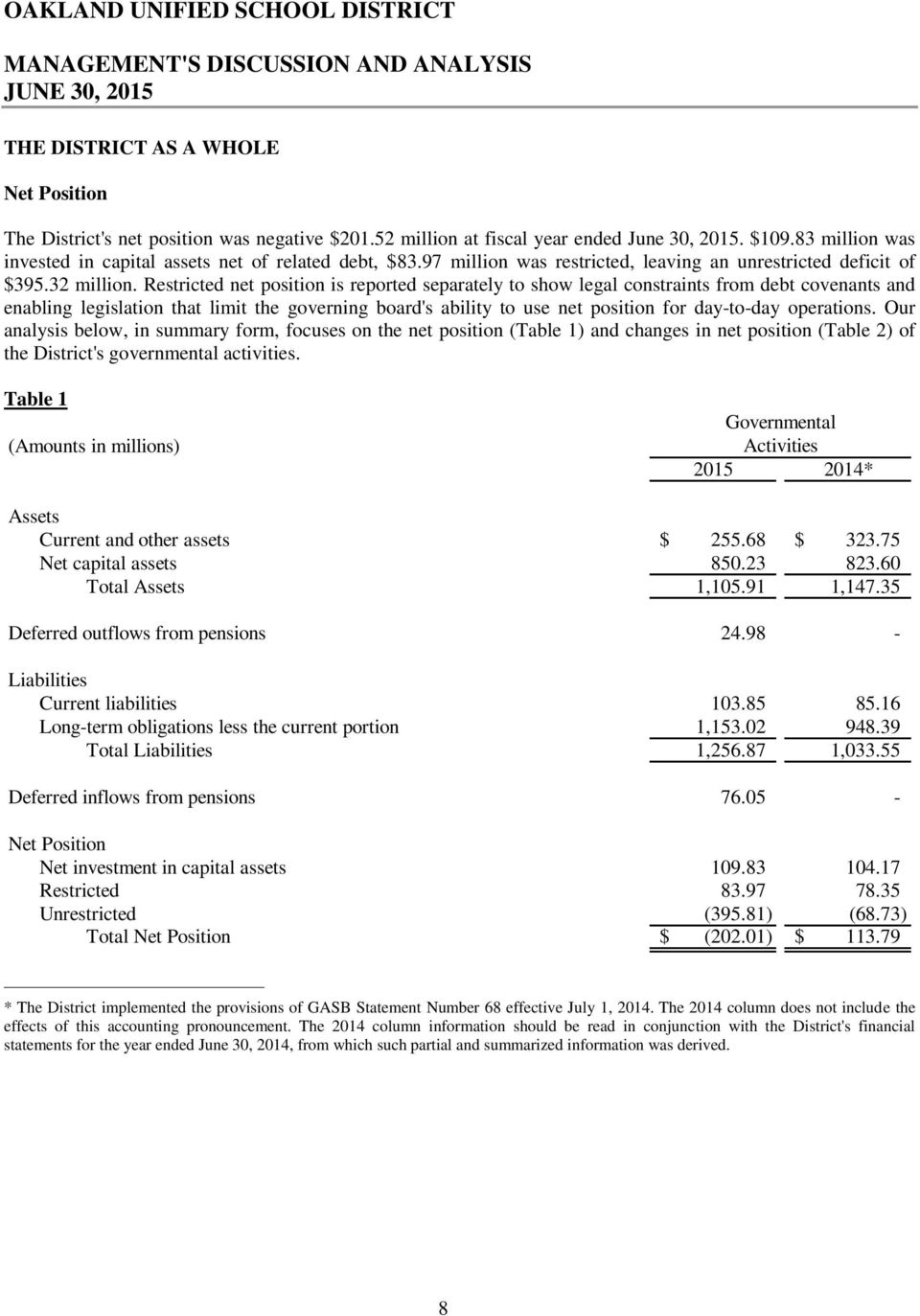
11 MANAGEMENT'S DISCUSSION AND ANALYSIS JUNE 30, 2015 THE DISTRICT AS A WHOLE Net Position The District's net position was negative $ million at fiscal year ended June 30, $ million was invested in capital assets net of related debt, $83.97 million was restricted, leaving an unrestricted deficit of $ million. Restricted net position is reported separately to show legal constraints from debt covenants and enabling legislation that limit the governing board's ability to use net position for day-to-day operations. Our analysis below, in summary form, focuses on the net position (Table 1) and changes in net position (Table 2) of the District's governmental activities. Table 1 (Amounts in millions) Governmental Activities * Assets Current and other assets $ $ Net capital assets Total Assets 1, , Deferred outflows from pensions Liabilities Current liabilities Long-term obligations less the current portion 1, Total Liabilities 1, , Deferred inflows from pensions Net Position Net investment in capital assets Restricted Unrestricted (395.81) (68.73) Total Net Position $ (202.01) $ * The District implemented the provisions of GASB Statement Number 68 effective July 1, The 2014 column does not include the effects of this accounting pronouncement. The 2014 column information should be read in conjunction with the District's financial statements for the year ended June 30, 2014, from which such partial and summarized information was derived. 8
12 MANAGEMENT'S DISCUSSION AND ANALYSIS JUNE 30, 2015 The negative $ million in net position represents the accumulated results of all past years' operations. Unrestricted net position the part of net position that can be used to finance day-to-day operations without constraints established by debt covenants, enabling legislation, or other legal requirements, remains in a deficit position. It should be noted that the unrestricted deficit includes long-term liabilities such as the state emergency apportionment loan of $49.54 million, compensated absences of $10.27 million, the IBNR reserve for workers compensation and claims of $42.05 million, general obligation bonds of $ million, and the net pension liability of $ million. The general obligation bond liability is not expected to require the use of District General Fund resources because a separate tax collection is levied for this purpose. The remaining long-term liabilities will be paid by the District; however, the cash outflow will occur over a period of many years. Changes in Net Position The results of this year's operations for the District as a whole are reported in the Statement of Activities on page 15. Table 2 takes the information from the Statement, rounds off the numbers, and rearranges them slightly so you can see our total revenues for the year. Table 2 (Amounts in millions) Governmental Activities * Revenues Program revenues: Charges for services $ 0.27 $ 0.68 Operating grants and contributions General revenues: Federal and State aid not restricted Taxes Other general revenues Total Revenues Expenses Instruction Instruction-related Student support services Administration Maintenance and operations Interest on long-term obligations Other Total Expenses Change in Net Position $ $ (1.40) * The District implemented the provisions of GASB Statement Number 68 effective July 1, The 2014 column does not include the effects of this accounting pronouncement. The 2014 column information should be read in conjunction with the District's financial statements for the year ended June 30, 2014, from which such partial and summarized information was derived. 9
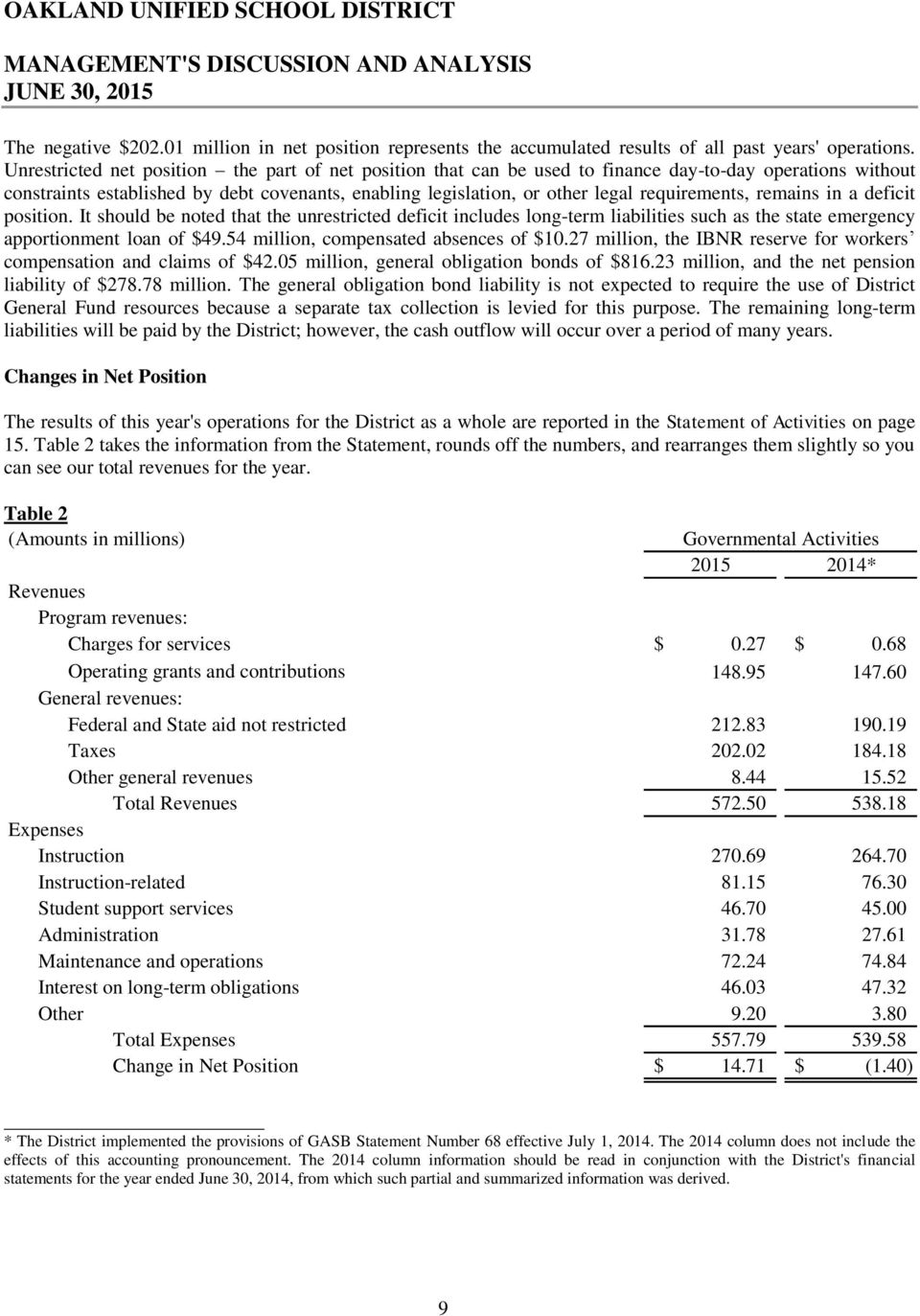
13 MANAGEMENT'S DISCUSSION AND ANALYSIS JUNE 30, 2015 Governmental Activities As reported in the Statement of Activities on page 15, the cost of all of our governmental activities this year was $ million. However, the amount that our taxpayers ultimately financed for these activities through local taxes was $ million because the cost was paid by other governments and organizations who subsidized certain programs with grants and contributions in the amount of $149.0 million. We paid for the remaining "public benefit" portion of our governmental activities with $ million in federal and state funds, and $8.44 million with other revenues, like interest and general entitlements. In Table 3, we have presented the net cost of each of the District's largest functions. As discussed earlier, net cost shows the financial burden that was placed on the District's taxpayers by each of these functions. Providing this information allows our citizens to consider the cost of each function in comparison to the benefits they believe are provided by that function. Table 3 Net Cost of Services * Instruction $ $ School administration Pupil services Administration Maintenance and operations Interest on long term debt Other (4.85) (15.70) Total $ $ * The District implemented the provisions of GASB Statement Number 68 effective July 1, The 2014 column does not include the effects of this accounting pronouncement. The 2014 column information should be read in conjunction with the District's financial statements for the year ended June 30, 2014, from which such partial and summarized information was derived. 10

14 MANAGEMENT'S DISCUSSION AND ANALYSIS JUNE 30, 2015 THE DISTRICT'S FUNDS As the District completed this year, our governmental funds reported a combined fund balance of $ million, which is a decrease of $44.78 million from last year (Table 4). The decrease is primarily due to the expenditures of $60.99 million in the capital outlay funds. Table 4 (Amounts in millions) July 1, 2014 Revenues Expenditures June 30, 2015 General $ $ $ $ Building Bond interest and redemption Adult education Cafeteria Capital facilities Child development County school facilities Deferred maintenance Special reserve, capital Total $ $ $ $ General Fund Budgetary Highlights Over the course of the year, the District revises its budget as it attempts to deal with unexpected changes in revenues and expenditures. A schedule showing the District's original and final budget amounts compared with amounts actually paid and received is provided in our annual report on page 60. CAPITAL ASSET AND DEBT ADMINISTRATION Capital Assets At June 30, 2015, the District had $ million in a broad range of capital assets (net of depreciation), including land, buildings, furniture, and equipment. This amount represents a net increase of $26.63 million or 3.23%, from last year (Table 5). Table 5 (Amounts in millions) Governmental Activities Land and construction in progress $ $ Buildings and improvements Equipment Total $ $

15 MANAGEMENT'S DISCUSSION AND ANALYSIS JUNE 30, 2015 Long-Term Obligations At the end of this year, the District had $ million in bonds outstanding versus $ million last year, a decrease of $26.45 million or 3.14%. Total long-term debt consisted of: Table 6 (Amounts in millions) Governmental Activities Claims liability $ $ Emergency apportionment loan General obligation bonds (financed with property taxes) Aggregate net pension liability Other Total $ 1, $ 1, We present more detailed information regarding our long-term obligations in Note 9 of the financial statements. 12

16 MANAGEMENT'S DISCUSSION AND ANALYSIS JUNE 30, 2015 ECONOMIC FACTORS Local Control Funding Formula - California s passage of the Local Control Funding Formula ( LCFF ) provides more stability and predictability of State funding to the District. LCFF distributes resources to school Districts through a base funding grant per unit of daily attendance ( ADA ), with additional supplemental funding to certain Districts beginning in fiscal year LCFF will be implemented over eight years. Because of the District s high concentration of English language learners, students from low-income families and foster youth, the District anticipates an increase of approximately $8.2 million in State funding in , $30.6 million in , and $38.2 million in (per LCFF Calculator June 2015). Parcel Tax - November 2014 Election - On November 4, 2014, the voters of Oakland passed a parcel tax known as Oakland Unified School District College and Career Readiness for All Fund. The proceeds from the parcel tax will be used to provide Oakland high school students with real-world work and learning opportunities; prepare students for admission to the University of California and other four-year colleges; expand mentoring, tutoring, counseling, support services, and transition to job training programs, among other programs. The parcel tax is a $120 per parcel tax on real estate owned in Oakland, with an exemption for low-income homeowners and senior homeowners. The parcel tax will provide additional funding of $12 million annually Damage - On January 7, 2013, a substantial water leak occurred on the top floor of the District's Paul Robeson Administration Building, located at nd Avenue, causing excessive flooding on all four floors and significant damage to the entire structure. As a result of this water damage, the Paul Robeson Administration Building was vacated and staff relocated to leased space at the Trans Pacific Center, 1000 Broadway. The lease payments for 1000 Broadway are covered by the insurance settlement through December 2015, and other resources after that until the new Education Center is built. General Obligation Bonds - In August 2015, the District issued $180 million in general obligation bonds at interest rates of 1% and 5%. The District also issued refunding general obligation bonds to refinance prior bond issues. The refunding bonds have a 5% interest rate and resulted in overall debt service savings of $26 million. Retroactive Pay Increase - On June 8, 2016 the Governing Board approved a 3% salary increase for unrepresented, confidential and employment contract employees effective July 1,

17 MANAGEMENT'S DISCUSSION AND ANALYSIS JUNE 30, 2015 CONTACTING THE DISTRICT'S FINANCIAL MANAGEMENT This financial report is designed to provide our citizens, taxpayers, students, and investors and creditors with a general overview of the District's finances and to show the District's accountability for the money it receives. If you have questions about this report or need any additional financial information, please contact: Or visit our website at: Vernon Hal Senior Business Officer Oakland Unified School District 1000 Broadway, Suite 680 Oakland, CA

18 STATEMENT OF NET POSITION JUNE 30, 2015 Governmental Activities ASSETS Deposits and investments $ 210,194,337 Receivables 45,489,302 Prepaid items 12,850 Capital assets, net of accumulated depreciation 850,228,740 Total Assets 1,105,925,229 DEFERRED OUTFLOWS FROM PENSION ACTIVITIES Deferred outflow from pension activities 24,984,515 LIABILITIES Current liabilities Accounts payable 40,048,371 Interest payable 18,806,573 Unearned revenue 1,157,345 Claims liability 5,907,000 Emergency apportionment loan 5,104,642 General obligation bonds and premiums 32,829,529 Total current liabilities 103,853,460 Noncurrent liabilities Claims liability less the current portion 36,139,657 Emergency apportionment loan less the current poriton 44,433,868 General obligation bonds and premiums less the current portion 783,401,783 Compensated absences 10,265,745 Aggregate net pension liability 278,778,496 Total noncurrent liabilities 1,153,019,549 Total Liabilities 1,256,873,009 DEFEREED INFLOWS FROM PENSION ACTIVITIES Deferred inflow from pension activities 76,050,008 NET POSITION Net investment in capital assets 109,828,180 Restricted Debt service 59,863,403 Capital projects 10,877,630 Educational programs 13,230,540 Unrestricted (395,813,026) Total Net Position $ (202,013,273) The accompanying notes are an integral part of these financial statements. 15

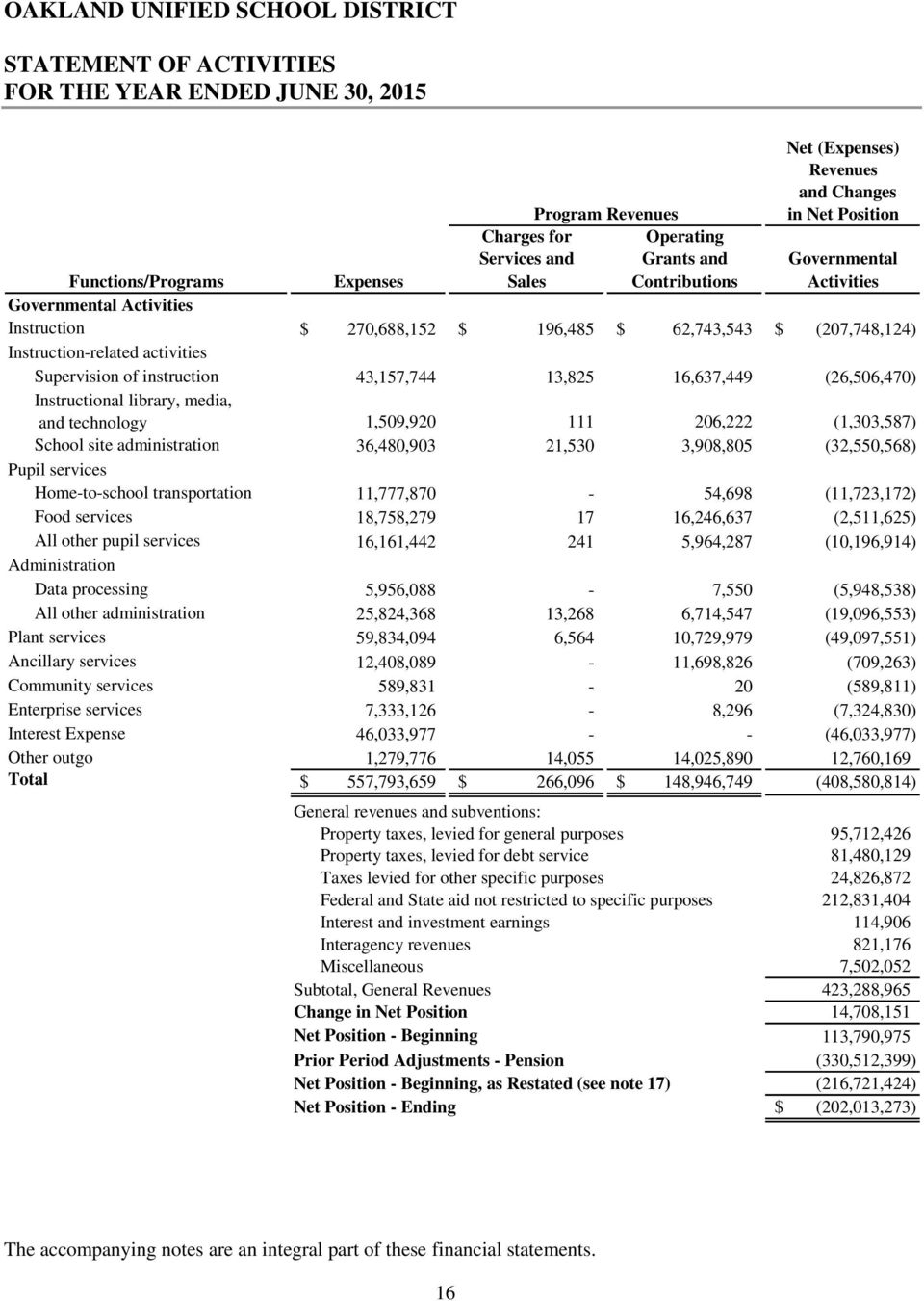
19 STATEMENT OF ACTIVITIES FOR THE YEAR ENDED JUNE 30, 2015 Net (Expenses) Revenues and Changes Program Revenues in Net Position Charges for Operating Services and Grants and Governmental Functions/Programs Expenses Sales Contributions Activities Governmental Activities Instruction $ 270,688,152 $ 196,485 $ 62,743,543 $ (207,748,124) Instruction-related activities Supervision of instruction 43,157,744 13,825 16,637,449 (26,506,470) Instructional library, media, and technology 1,509, ,222 (1,303,587) School site administration 36,480,903 21,530 3,908,805 (32,550,568) Pupil services Home-to-school transportation 11,777,870-54,698 (11,723,172) Food services 18,758, ,246,637 (2,511,625) All other pupil services 16,161, ,964,287 (10,196,914) Administration Data processing 5,956,088-7,550 (5,948,538) All other administration 25,824,368 13,268 6,714,547 (19,096,553) Plant services 59,834,094 6,564 10,729,979 (49,097,551) Ancillary services 12,408,089-11,698,826 (709,263) Community services 589, (589,811) Enterprise services 7,333,126-8,296 (7,324,830) Interest Expense 46,033, (46,033,977) Other outgo 1,279,776 14,055 14,025,890 12,760,169 Total $ 557,793,659 $ 266,096 $ 148,946,749 (408,580,814) General revenues and subventions: Property taxes, levied for general purposes 95,712,426 Property taxes, levied for debt service 81,480,129 Taxes levied for other specific purposes 24,826,872 Federal and State aid not restricted to specific purposes 212,831,404 Interest and investment earnings 114,906 Interagency revenues 821,176 Miscellaneous 7,502,052 Subtotal, General Revenues 423,288,965 Change in Net Position 14,708,151 Net Position - Beginning 113,790,975 Prior Period Adjustments - Pension (330,512,399) Net Position - Beginning, as Restated (see note 17) (216,721,424) Net Position - Ending $ (202,013,273) The accompanying notes are an integral part of these financial statements. 16
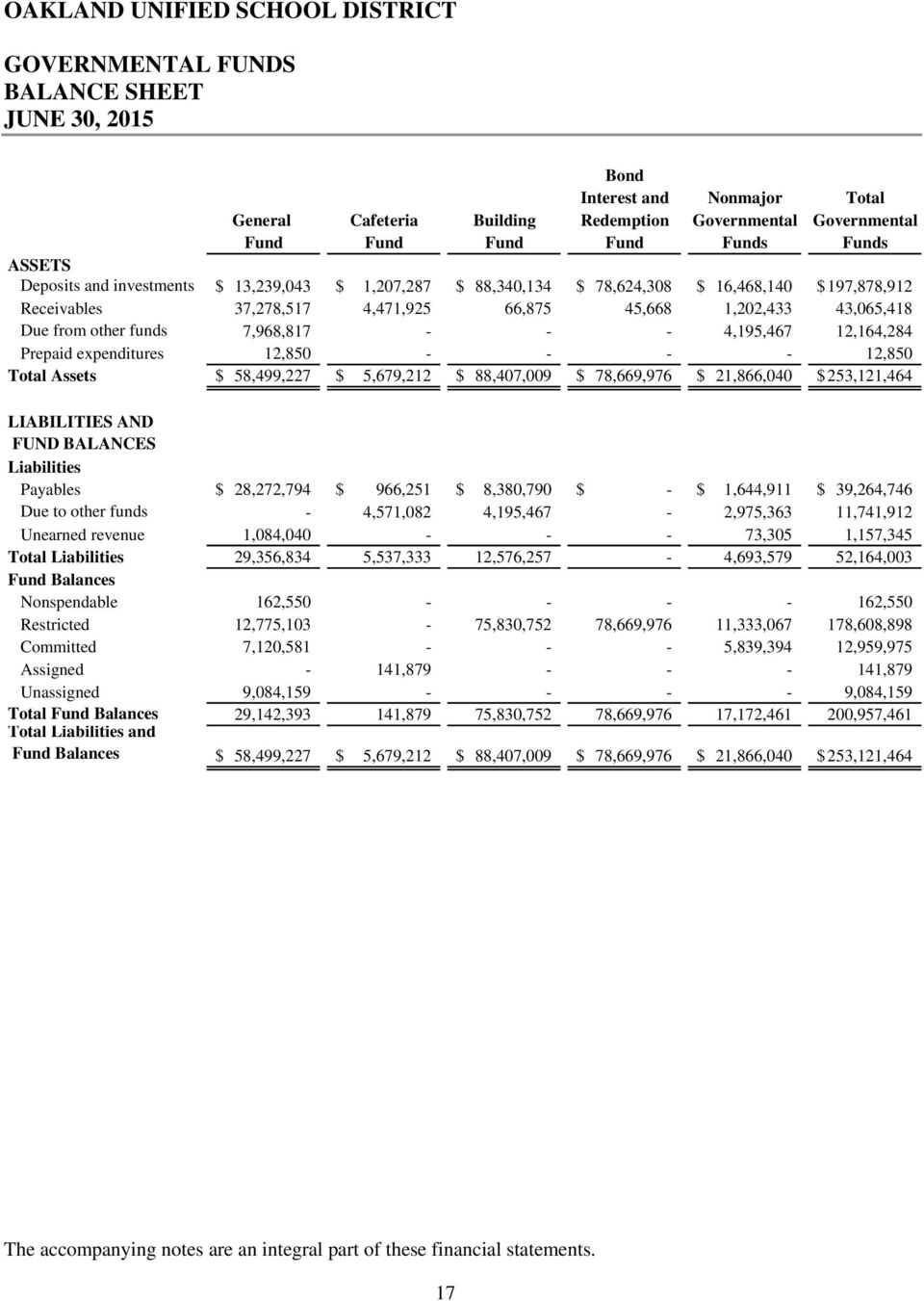
20 GOVERNMENTAL FUNDS BALANCE SHEET JUNE 30, 2015 Bond Interest and Nonmajor Total General Cafeteria Building Redemption Governmental Governmental Fund Fund Fund Fund Funds Funds ASSETS Deposits and investments $ 13,239,043 $ 1,207,287 $ 88,340,134 $ 78,624,308 $ 16,468,140 $ 197,878,912 Receivables 37,278,517 4,471,925 66,875 45,668 1,202,433 43,065,418 Due from other funds 7,968, ,195,467 12,164,284 Prepaid expenditures 12, ,850 Total Assets $ 58,499,227 $ 5,679,212 $ 88,407,009 $ 78,669,976 $ 21,866,040 $ 253,121,464 LIABILITIES AND FUND BALANCES Liabilities Payables $ 28,272,794 $ 966,251 $ 8,380,790 $ - $ 1,644,911 $ 39,264,746 Due to other funds - 4,571,082 4,195,467-2,975,363 11,741,912 Unearned revenue 1,084, ,305 1,157,345 Total Liabilities 29,356,834 5,537,333 12,576,257-4,693,579 52,164,003 Fund Balances Nonspendable 162, ,550 Restricted 12,775,103-75,830,752 78,669,976 11,333, ,608,898 Committed 7,120, ,839,394 12,959,975 Assigned - 141, ,879 Unassigned 9,084, ,084,159 Total Fund Balances 29,142, ,879 75,830,752 78,669,976 17,172, ,957,461 Total Liabilities and Fund Balances $ 58,499,227 $ 5,679,212 $ 88,407,009 $ 78,669,976 $ 21,866,040 $ 253,121,464 The accompanying notes are an integral part of these financial statements. 17
21 RECONCILIATION OF THE GOVERNMENTAL FUNDS BALANCE SHEET TO THE STATEMENT OF NET POSITION FOR THE YEAR ENDED JUNE 30, 2015 Amounts reported for governmental activities in the statement of net position are different than amounts reported in the governmental funds balance sheet because of the following items: Total Fund Balance - Governmental Funds $ 200,957,461 Capital assets used in governmental activities are not financial resources and, therefore, are not reported as assets in governmental funds. The cost of capital assets is $ 1,176,951,777 Accumulated depreciation is (326,723,037) Net capital assets 850,228,740 In governmental funds, unmatured interest on long-term obligations is recognized in the period when it is due. In the government-wide financial statements, unmatured interest on long-term obligations is recognized when it is incurred. (18,806,573) An internal service fund is used by the District's management to charge the costs of the workers' compensation and dental insurance programs to the individual funds. The assets and liabilities of the internal service fund are included in the statement of net position. (29,219,902) Long-term obligations, including bonds payable, are not due and payable in the current period and, therefore, are not reported as liabilities in the governmental financial statements. Long-term obligations at year-end consist of the following: General obligation bonds (net of bond premiums of $5,226,312) 816,231,312 Emergency apportionment loan 49,538,510 Compensated absences 10,265,745 Net pension liability and related deferrals 329,137,432 Total long-term obligations (1,205,172,999) Net Position - Governmental Activities $ (202,013,273) The accompanying notes are an integral part of these financial statements. 18
22 GOVERNMENTAL FUNDS STATEMENT OF REVENUES, EXPENDITURES, AND CHANGES IN FUND BALANCES FOR THE YEAR ENDED JUNE 30, 2015 Bond Interest Nonmajor Total General Cafeteria Building and Redemption Governmental Governmental Fund Fund Fund Fund Funds Funds REVENUES Local control funding formula $ 296,107,658 $ - $ - $ - $ 1,000,000 $ 297,107,658 Federal sources 43,726,879 16,148,504-3,261,084 1,464,687 64,601,154 Other state sources 57,701,799 1,152, ,310 9,642,491 69,155,496 Other local sources 46,466, , ,218 80,978,994 8,505, ,064,408 Total Revenues 444,002,637 18,033, ,218 84,898,388 20,612, ,928,716 EXPENDITURES Current Instruction 246,157, ,083, ,240,581 Instruction-related activities Supervision of instruction 39,978, ,166 40,854,211 Instructional library, media and technology 1,429, ,429,328 School site administration 33,216, ,317,101 34,533,744 Pupil services Home-to-school transportation 11,149, ,149,228 Food services 183,751 17,573, ,757,061 All other pupil services 15,294, ,763 15,298,829 Administration Data processing 5,638, ,638,184 All other administration 22,663, , ,292 24,410,852 Plant services 46,089, ,489,989 50,579,824 Facility acquisition/construction 546,080-53,274,290-4,329,844 58,150,214 Ancillary services 11,745, ,745,810 Community services 558, ,349 Other outgo 1,279, ,279,776 Debt service Principal 5,015, ,675,000-36,690,467 Interest and other 964, ,906,287-46,870,959 Total Expenditures 441,960,164 18,566,222 53,274,290 77,581,287 21,855, ,237,417 Excess (Deficiency) of Revenues Over Expenditures 2,042,473 (533,192) (52,892,072) 7,317,101 (1,243,011) (45,308,701) Other Financing Sources (Uses) Transfers in 542, , ,776 1,349,221 Transfers out (806,946) (806,946) Net Financing Sources (Uses) (264,671) 539, , ,275 CHANGE IN FUND BALANCE 1,777,802 5,978 (52,892,072) 7,317,101 (975,235) (44,766,426) Fund Balance - Beginning 27,364, , ,722,824 71,352,875 18,147, ,723,887 Fund Balance - Ending $ 29,142,393 $ 141,879 $ 75,830,752 $ 78,669,976 $ 17,172,461 $ 200,957,461 The accompanying notes are an integral part of these financial statements. 19
23 RECONCILIATION OF THE GOVERNMENTAL FUNDS STATEMENT OF REVENUES, EXPENDITURES, AND CHANGES IN FUND BALANCES TO THE STATEMENT OF ACTIVITIES FOR THE YEAR ENDED JUNE 30, 2015 Amounts reported for governmental activities in the statement of activities are different than amounts reported on the governmental funds statement of revenues, expenditures, and changes in fund balances because of the following items: Total Net Change in Fund Balances - Governmental Funds $ (44,766,426) Governmental funds report capital outlays as expenditures. However, in the statement of activities the cost of those assets are allocated over their estimated useful lives and reported as depreciation expense. This is the amount by which capital outlays exceeds depreciation in the period: Capital outlays $ 51,757,947 Depreciation expense (25,114,424) 26,643,523 In the statement of activities, the loss on the disposal of capital assets is reported, whereas in the governmental funds, the transaction has no impact. Thus, the change in net position differs from the change in fund balance by the capital asset disposal. (10,099) In the statement of activities, certain operating expenses, such as compensated absences, are measured by the amounts earned during the year. In the governmental funds, however, expenditures for these items are measured by the amount of financial resources used - the amounts actually paid. (1,096,233) Payment of principal on long-term obligations is an expenditure in the governmental funds, but it reduces long-term obligations in the statement of net position and does not affect the statement of activities. 36,690,467 Amortization of bond premiums are an expense in the statement of activities, but does not impact the governmental funds. 244,529 Interest on long-term obligations is recorded as an expenditure in the funds when it is due; however, in the statement of activities, interest expense is recognized as the interest accrues, regardless of when it is due. 592,453 In the governmental funds, pension expenditures are based on employer contributions made to pension plans during the year. However, in the statement of activities, pension expense is the net effect of all changes in the deferred outflows, deferred inflows and net pension liability during the year. 641,949 An internal service fund is used by the District's management to charge the costs of the self-insurance programs to the individual funds. The net revenue of the internal service fund is reported with governmental activities. (4,232,012) Change in Net Position of Governmental Activities $ 14,708,151 The accompanying notes are an integral part of these financial statements. 20
24 PROPRIETARY FUND - SELF INSURANCE STATEMENT OF NET POSITION JUNE 30, 2015 Governmental Activities - Internal Service Fund ASSETS Current assets Deposits and investments $ 12,315,425 Receivables 2,423,884 Total current assets 14,739,309 DEFERRED OUTFLOWS Deferred outflows from pension activities 97,906 LIABILITIES Current liabilities Accounts payable, vendor 783,625 Due to General Fund 422,372 Claim liabilities 5,907,000 Total current liabilities 7,112,997 Noncurrent Liabilities Claim liabilities 36,139,657 Net pension liability 566,590 Total noncurrent liabilities 36,706,247 Total liabilities 43,819,244 DEFERRED INFLOWS Deferred inflows from pension activities 237,873 NET POSITION Unrestricted deficit (29,219,902) Total Net Position $ (29,219,902) The accompanying notes are an integral part of these financial statements. 21
25 PROPRIETARY FUND - SELF INSURANCE STATEMENT OF REVENUES, EXPENSES, AND CHANGES IN FUND NET POSITION FOR THE YEAR ENDED JUNE 30, 2015 Governmental Activities - Internal Service Fund OPERATING REVENUES In-district premiums $ 19,868,501 Other local revenue 2,508,658 Total Operating Revenues 22,377,159 OPERATING EXPENSES Payroll costs 1,020,375 Claims expense 25,076,503 Total Operating Expenses 26,096,878 Operating Loss (3,719,719) NONOPERATING REVENUES (EXPENSES) Interest income 29,982 Transfers out (542,275) Total Nonoperating Expense (512,293) Change in Net Position (4,232,012) Net Position - Beginning (24,254,872) Prior Period Adjustment - Pension (733,018) Net Position - Beginning, as Restated (24,987,890) Net Position - Ending $ (29,219,902) The accompanying notes are an integral part of these financial statements. 22
26 PROPRIETARY FUND - SELF INSURANCE STATEMENT OF CASH FLOWS FOR THE YEAR ENDED JUNE 30, 2015 Governmental Activities - Internal Service Fund CASH FLOWS FROM OPERATING ACTIVITIES Cash receipts from premiums $ 19,868,501 Other operating cash receipts 129,909 Cash payments for insurance claims (19,322,122) Cash payments to employees for services (1,046,836) Cash payments for interfund transfers out (119,903) Net cash provided by operating activities (490,451) CASH FLOWS FROM INVESTING ACTIVITIES Interest on investments 29,982 Net cash provided by investing activities 29,982 Net increase in cash and cash equivalents (460,469) Cash and Cash Equivalents - Beginning 12,775,894 Cash and Cash Equivalents - Ending $ 12,315,425 RECONCILIATION OF OPERATING LOSS TO NET CASH USED IN OPERATING ACTIVITIES Operating loss $ (3,719,719) Changes in assets and liabilities: Change in accounts receivables (2,378,749) Interfund transactions (119,903) Change in accounts payables 225,929 Change in claims liability 5,528,452 Change in pension liability and related deferred inflows and outflows (26,461) NET CASH USED IN OPERATING ACTIVITIES $ (490,451) The accompanying notes are an integral part of these financial statements. 23
27 FIDUCIARY FUND STATEMENT OF NET POSITION JUNE 30, 2015 Payroll Revolving Agency Fund ASSETS Deposits and investments $ 16,623,599 Receivables 238,585 Total Assets $ 16,862,184 LIABILITIES Accounts payable $ 12,550,784 Due to OUSD General Fund 4,311,400 Total Liabilities $ 16,862,184 The accompanying notes are an integral part of these financial statements. 24
28 NOTES TO FINANCIAL STATEMENTS JUNE 30, 2015 NOTE 1 - SUMMARY OF SIGNIFICANT ACCOUNTING POLICIES Financial Reporting Entity The Oakland Unified School District (the District) was organized in 1855 under the laws of the State of California and unified in The District operates under a locally elected seven-member Board form of government and provides educational services to grades K-12 as mandated by the State and Federal agencies. During the school year, the District operated 50 K-5 elementary schools, 4 K-8 elementary schools, 13 middle schools, 3 grades 6-12 schools, 6 grades 9-12 high schools, 9 alternative schools, and 30 early childhood education centers. A reporting entity is comprised of the primary government, component units, and other organizations that are included to ensure the financial statements are not misleading. The primary government of the District consists of all funds, departments, boards, and agencies that are not legally separate from the District. For Oakland Unified School District, this includes general operations, food service, and student related activities of the District. The District has approved various student body organizations to operate at its schools. However, fiduciary fund assets and liabilities for these student body organizations are excluded from these financial statements. Basis of Presentation - Fund Accounting The accounting system is organized and operated on a fund basis. A fund is defined as a fiscal and accounting entity with a self-balancing set of accounts, which are segregated for the purpose of carrying on specific activities or attaining certain objectives in accordance with special regulations, restrictions, or limitations. The District's funds are grouped into three broad fund categories: governmental, proprietary, and fiduciary. Governmental Funds Governmental funds are those through which most governmental functions typically are financed. Governmental fund reporting focuses on the sources, uses, and balances of current financial resources. Expendable assets are assigned to the various governmental funds according to the purposes for which they may or must be used. Current liabilities are assigned to the fund from which they will be paid. The difference between governmental fund assets and liabilities is reported as fund balance. The following are the District's major and nonmajor governmental funds: Major Governmental Funds General Fund The General Fund is the chief operating fund for all districts. It is used to account for the ordinary operations of the District. All transactions, except those accounted for in another fund, are accounted for in this fund. Cafeteria Fund The Cafeteria Fund is used to account separately for federal, state, and local resources to operate the food service program (Education Code Sections ) and is used only for those expenditures authorized by the governing board as necessary for the operation of the District's food service program (Education Code Sections and 38100). Building Fund The Building Fund is a capital projects fund that exists primarily to account separately for proceeds from the sale of bonds (Education Code Section 15146) and may not be used for any purposes other than those for which the bonds were authorized. 25
29 NOTES TO FINANCIAL STATEMENTS JUNE 30, 2015 Bond Interest and Redemption Fund The Bond Interest and Redemption Fund is a debt service fund used for the repayment of bonds issued for a district (Education Code Sections ). Nonmajor Governmental Funds Special Revenue Funds The Special Revenue funds are used to account for the proceeds from specific revenue sources (other than trusts, major capital projects, or debt service) that are restricted or committed to expenditures for specified purposes and that compose a substantial portion of the inflows of the fund. Additional resources that are restricted, committed, or assigned to the purpose of the fund may also be reported in the fund. Adult Education Fund The Adult Education Fund is used to account separately for federal, state, and local revenues for adult education programs and is to be expended for adult education purposes only. Child Development Fund The Child Development Fund is used to account separately for federal, state, and local revenues to operate child development programs and is to be used only for expenditures for the operation of child development programs. Deferred Maintenance Fund The Deferred Maintenance Fund is used to account separately for state apportionments and the District's contributions for deferred maintenance purposes (Education Code Sections ) and for items of maintenance approved by the State Allocation Board. Debt Service Funds The Debt Service funds are used to account for the accumulation of restricted, committed, or assigned resources for the payment of principal and interest on general long-term debt. Debt Service Fund This fund is used for the accumulation of resources for and the retirement of principal and interest on long-term debt. Capital Projects Funds The Capital Projects funds are used to account for financial resources that are restricted, committed, or assigned to the acquisition or construction of major capital facilities and other capital assets (other than those financed by proprietary funds and trust funds). Capital Facilities Fund The Capital Facilities Fund is used primarily to account separately for monies received from fees levied on developers or other agencies as a condition of approving a development (Education Code Sections ). Expenditures are restricted to the purposes specified in Government Code Sections or to the items specified in agreements with the developer (Government Code Section 66006). County School Facilities Fund The Fund is established pursuant to Education Code Section to receive apportionments from the 1998 State School Facilities Fund (Proposition la), the 2002 State School Facilities Fund (Proposition 47), the 2004 State School Facilities Fund (Proposition 55), or the 2006 State Schools Facilities Fund (Proposition 1D) authorized by the State Allocation Board for new school facility construction, modernization projects, and facility hardship grants, as provided in the Leroy F. Greene School Facilities Act of 1998 (Education Code Section et seq.). 26
30 NOTES TO FINANCIAL STATEMENTS JUNE 30, 2015 Special Reserve Fund for Capital Outlay Projects The Special Reserve Fund for Capital Outlay Projects exists primarily to provide for the accumulation of General Fund monies for capital outlay purposes (Education Code Section 42840). Proprietary Funds Proprietary funds are used to account for activities that are more business-like than government-like in nature. Business-type activities include those for which a fee is charged to external users or to other organizational units of the local education agency, normally on a full cost-recovery basis. Proprietary funds are generally intended to be self-supporting and are classified as enterprise or internal service. Internal Service Fund Internal Service funds may be used to account for goods or services provided to other funds of the District on a cost-reimbursement basis. The District operates a workers' compensation program and a dental program that are accounted for in an internal service fund. Fiduciary Funds Fiduciary funds are used to account for assets held in trustee or agent capacity for others that cannot be used to support the District's own programs. Agency funds are custodial in nature (assets equal liabilities) and do not involve measurement of results of operations. Such funds have no equity accounts since all assets are due to individuals or entities at some future time. The District's agency fund exists primarily to account separately for amounts collected from employees for federal taxes, state taxes, and other payroll related items. Basis of Accounting - Measurement Focus Government-Wide Financial Statements The government-wide financial statements are prepared using the economic resources measurement focus and the accrual basis of accounting. This is the same approach used in the preparation of the proprietary fund financial statements, but differs from the manner in which governmental fund financial statements are prepared. The government-wide statement of activities presents a comparison between expenses, both direct and indirect, for each governmental function, and excludes fiduciary activity. Direct expenses are those that are specifically associated with a service, program, or department and are, therefore, clearly identifiable to a particular function. The District does not allocate indirect expenses to functions in the Statement of Activities, except for depreciation. Program revenues include charges paid by the recipients of the goods or services offered by the programs, and grants and contributions that are restricted to meeting the operational or capital requirements of a particular program. Revenues that are not classified as program revenues are presented as general revenues. The comparison of program revenues and expenses identifies the extent to which each program is self-financing or draws from the general revenues of the District. Eliminations have been made to minimize the double counting of internal activities. Net position should be reported as restricted when constraints placed on net asset use are either externally imposed by creditors (such as through debt covenants), grantors, contributors, or laws or regulations of other governments or imposed by law through constitutional provisions or enabling legislation. The net position restricted for other activities result from special revenue funds and the restrictions on their net asset use. Fund Financial Statements Fund financial statements report detailed information about the District. The focus of governmental and proprietary fund financial statements is on major funds rather than reporting funds by type. Each major fund is presented in a separate column. Nonmajor funds are aggregated and presented in a single column. The internal service fund is presented in a single column on the face of the proprietary fund statements. 27
31 NOTES TO FINANCIAL STATEMENTS JUNE 30, 2015 Governmental Funds All governmental funds are accounted for using the flow of current financial resources measurement focus and the modified accrual basis of accounting. With this measurement focus, only current assets and current liabilities generally are included on the balance sheet. The statement of revenues, expenditures, and changes in fund balances reports on the sources (revenues and other financing sources) and uses (expenditures and other financing uses) of current financial resources. This approach differs from the manner in which the governmental activities of the government-wide financial statements are prepared. Governmental fund financial statements, therefore, include reconciliations with brief explanations to better identify the relationship between the government-wide financial statements, prepared using the economic resources measurement focus and the accrual basis of accounting, and the governmental fund financial statements, prepared using the flow of current financial resources measurement focus and the modified accrual basis of accounting. Proprietary Funds Proprietary funds are accounted for using the flow of economic resources measurement focus and the accrual basis of accounting. All assets and all liabilities associated with the operation of this fund are included in the statement of net position. The Statement of Changes in Fund Net Position presents increases (revenues) and decreases (expenses) in net total assets. The statement of cash flows provides information about how the District finances and meets the cash flow needs of its proprietary fund. Fiduciary Funds Fiduciary funds are accounted for using the flow of economic resources measurement focus and the accrual basis of accounting. Fiduciary funds are excluded from the government-wide financial statements because they do not represent resources of the District. Revenues - Exchange and Non-Exchange Transactions Revenue resulting from exchange transactions, in which each party gives and receives essentially equal value, is recorded on the accrual basis when the exchange takes place. On a modified accrual basis, revenue is recorded in the fiscal year in which the resources are measurable and become available. Available means that the resources will be collected within the current fiscal year, or are expected to be collected soon enough thereafter to be used to pay liabilities of the current fiscal year. Generally, available is defined as collectible within 45 or 60 days. However, to achieve comparability of reporting among California districts, and so as not to distort normal revenue patterns with specific respect to reimbursement grants and corrections to state-aid apportionments, the California Department of Education has defined available for districts as collectible within one year. The following revenue sources are considered to be both measurable and available at fiscal year-end: State apportionments, interest, certain grants, and other local sources. Non-exchange transactions, in which the District receives value without directly giving equal value in return, include property taxes, certain grants, entitlements, and donations. Revenue from property taxes is recognized in the fiscal year in which the taxes are received. Revenue from certain grants, entitlements, and donations is recognized in the fiscal year in which all eligibility requirements have been satisfied. Eligibility requirements include time and purpose restrictions. On a modified accrual basis, revenue from non-exchange transactions must also be available before it can be recognized. Unearned Revenue Unearned revenue arises when potential revenue does not meet both the "measurable" and "available" criteria for recognition in the current period or when resources are received by the District prior to the incurrence of qualifying expenditures. In subsequent periods, when both revenue recognition criteria are met, or when the District has a legal claim to the resources, the liability is removed from the balance sheet and revenue is recognized. 28
32 NOTES TO FINANCIAL STATEMENTS JUNE 30, 2015 Expenses/Expenditures On the accrual basis of accounting, expenses are recognized at the time they are incurred. The measurement focus of governmental fund accounting is on decreases in net financial resources (expenditures) rather than expenses. Expenditures are generally recognized in the accounting period in which the related fund liability is incurred, due and payable. Principal and interest on long-term obligations, which has not matured, are recognized when paid in the governmental funds as expenditures. Allocations of costs, such as depreciation and amortization, are not recognized in the governmental funds but are recognized in the entity-wide statements. Cash and Cash Equivalents The District's cash and cash equivalents are considered to be cash on hand, demand deposits, and short-term investments with original maturities of three months or less from the date of acquisition. Cash equivalents also include cash with county treasury balances for purposes of the statement of cash flows. Investments Investments held at June 30, 2015, are stated at fair value. Fair value is estimated based on quoted market prices at year-end. All investments not required to be reported at fair value are stated at cost or amortized cost. Fair values of investments in county and state investment pools are determined by the program sponsor. Restricted Assets Restricted assets arise when restrictions on their use change the normal understanding of the availability of the asset. Such constraints are either imposed by creditors, contributors, grantors, or laws of other governments or imposed by enabling legislation. Prepaid Expenditures Prepaid expenditures (expenses) represent amounts paid in advance of receiving goods or services. The District has the option of reporting an expenditure in governmental funds for prepaid items either when purchased or during the benefiting period. The District has chosen to report the expenditures when paid. Capital Assets and Depreciation The accounting and reporting treatment applied to the capital assets associated with a fund are determined by its measurement focus. Capital assets are long-lived assets of the District. The District maintains a capitalization threshold of $5,000. The District does not possess any infrastructure. Improvements are capitalized; the costs of normal maintenance and repairs that do not add to the value of the asset or materially extend an asset's life are not capitalized, but are expensed as incurred. When purchased, such assets are recorded as expenditures in the governmental funds and capitalized in the government-wide Statement of Net Position. The valuation basis for capital assets is historical cost, or where historical cost is not available, estimated historical cost based on replacement cost. Donated capital assets are capitalized at estimated fair market value on the date donated. Depreciation is computed using the straight-line method. Estimated useful lives of the various classes of depreciable capital assets are as follows: buildings, 25 to 50 years; building improvements, 20 years; equipment, 5 to 20 years. 29
33 NOTES TO FINANCIAL STATEMENTS JUNE 30, 2015 Interfund Balances On fund financial statements, receivables and payables resulting from short-term interfund loans are classified as interfund receivables/payables. These amounts are eliminated in the governmental column of the statement of net position, except for the net residual amounts due between governmental and business-type activities, which are presented as internal balances. Compensated Absences Compensated absences are accrued as a liability as the benefits are earned. The entire compensated absence liability is reported on the government-wide statement of net position. For governmental funds, the current portion of unpaid compensated absences is recognized upon the occurrence of relevant events such as employee resignations and retirements that occur prior to year-end that have not yet been paid with expendable available financial resources. These amounts are reported in the fund from which the employees who have accumulated leave are paid. Sick leave is accumulated without limit for each employee at the rate of one day for each month worked. Leave with pay is provided when employees are absent for health reasons; however, the employees do not gain a vested right to accumulated sick leave. Employees are never paid for any sick leave balance at termination of employment or any other time. Therefore, the value of accumulated sick leave is not recognized as a liability in the District's financial statements. However, credit for unused sick leave is applicable to all classified school members. At retirement, each member will receive.004 year of service credit for each day of unused sick leave. Credit for unused sick leave is applicable to all certificated employees and is determined by dividing the number of unused sick days by the number of base service days required to complete the last school year, if employed full-time. Accrued Liabilities and Long-Term Obligations All payables, accrued liabilities, and long-term obligations are reported in the government-wide and proprietary fund financial statements. In general, governmental fund payables and accrued liabilities that, once incurred, are paid in a timely manner and in full from current financial resources are reported as obligations of the governmental funds. However, claims and judgments, compensated absences, special termination benefits, and contractually required pension contributions that will be paid from governmental funds are reported as a liability in the governmental fund financial statements only to the extent that they are due for payment during the current year. Bonds, capital leases, and other long-term obligations are recognized as liabilities in the governmental fund financial statements when due. Deferred Outflows/Inflows of Resources In addition to assets, the statement of financial position also reports deferred outflows of resources. This separate financial statement element represents a consumption of net position that applies to a future period and so will not be recognized as an expense or expenditure until then. The District reports deferred outflows of resources related to pensions. 30
34 NOTES TO FINANCIAL STATEMENTS JUNE 30, 2015 In addition to liabilities, the statement of financial position reports a separate section for deferred inflows of resources. This separate financial statement element represents an acquisition of net position that applies to a future period and so will not be recognized as revenue until then. The District reports deferred inflows of resources for the difference between actual and expected rate of return on investments specific to the net pension liability. Pensions For purposes of measuring the net pension liability and deferred outflows/inflows of resources related to pensions, and pension expense, information about the fiduciary net position of the California State Teachers Retirement System (CalSTRS) and the California Public Employees' Retirement System (CalPERS) plan for schools (Plans) and additions to/deductions from the Plans' fiduciary net position have been determined on the same basis as they are reported by CalSTRS and CalPERS. For this purpose, benefit payments (including refunds of employee contributions) are recognized when due and payable in accordance with the benefit terms. Member contributions are recognized in the period in which they are earned. Investments are reported at fair value. Fund Balances - Governmental Funds As of June 30, 2015, fund balances of the governmental funds are classified as follows: Nonspendable - amounts that cannot be spent either because they are in non-spendable form or because they are legally or contractually required to be maintained intact. Restricted - amounts that can be spent only for specific purposes because of constitutional provisions or enabling legislation or because of constraints that are externally imposed by creditors, grantors, contributors, or the laws or regulations of other governments. Committed - amounts that can be used only for specific purposes determined by a formal action of the governing board. The governing board is the highest level of decision-making authority for the District. Commitments may be established, modified, or rescinded only through resolutions or other action as approved by the governing board. Assigned - amounts that do not meet the criteria to be classified as restricted or committed but that are intended to be used for specific purposes. Under the District's adopted policy, only the governing board or chief business officer/assistant superintendent of business services may assign amounts for specific purposes. Unassigned - all other spendable amounts. Spending Order Policy When an expenditure is incurred for purposes for which both restricted and unrestricted fund balance is available, the District considers restricted funds to have been spent first. When an expenditure is incurred for which committed, assigned, or unassigned fund balances are available, the District considers amounts to have been spent first out of committed funds, then assigned funds, and finally unassigned funds, as needed, unless the governing board has provided otherwise in its commitment or assignment actions. 31
35 NOTES TO FINANCIAL STATEMENTS JUNE 30, 2015 Minimum Fund Balance Policy In fiscal year , the governing board adopted a minimum fund balance policy for the General Fund in order to protect the district against revenue shortfalls or unpredicted one-time expenditures. The policy requires a Reserve for Economic Uncertainties consisting of unassigned amounts equal to no less than three percent of General Fund expenditures and other financing uses. Net Position Net position represents the difference between assets and liabilities. Net position-net of investment in capital assets consists of capital assets, net of accumulated depreciation, reduced by the outstanding balances of any borrowings used for the acquisition, construction, or improvement of those assets. Net position is reported as restricted when there are limitations imposed on their use either through the enabling legislation adopted by the District or through external restrictions imposed by creditors, grantors, or laws or regulations of other governments. The District first applies restricted resources when an expense is incurred for purposes for which both restricted and unrestricted net position is available. Self-Insurance Obligation The Self-Insurance Fund is used to account for the District's self-insurance obligation related to workers' compensation and dental claims. Funding of the self-insurance obligation is based on estimates of the amounts needed to pay prior and current year claims. The District is self-insured for workers compensation up to $500,000 per occurrence. The general fund is charged premiums by the self-insurance fund, which is accounted for as an internal service fund. The District participates in joint power agreements which provide excess liability and excess workers compensation coverage to the District. The District also participates in a joint powers agreement for its property insurance coverage. In the government-wide financial statements, the internal service fund activity is eliminated to avoid doubling of revenues and expenditures. Operating Revenues and Expenses Operating revenues are those revenues that are generated directly from the primary activity of the proprietary funds. For the District, these revenues are in-district premiums to pay for insurance premiums. Operating expenses are necessary costs incurred to provide the good or service that is the primary activity of the fund. All revenues and expenses not meeting this definition are reported as nonoperating revenues and expenses. Interfund Activity Transfers between governmental and business-type activities in the government-wide financial statements are reported in the same manner as general revenues. Exchange transactions between funds are reported as revenues in the seller funds and as expenditures/expenses in the purchaser funds. Flows of cash or goods from one fund to another without a requirement for repayment are reported as interfund transfers. Interfund transfers are reported as other financing sources/uses in governmental funds and after non-operating revenues/expenses in proprietary funds. Repayments from funds responsible for particular expenditures/expenses to the funds that initially paid for them are not presented in the financial statements. Interfund transfers are eliminated in the governmental and business-type activities columns of the Statement of Activities, except for the net residual amounts transferred between governmental and business-type activities. 32
36 NOTES TO FINANCIAL STATEMENTS JUNE 30, 2015 Estimates The preparation of the financial statements in conformity with accounting principles generally accepted in the United States of America requires management to make estimates and assumptions that affect the amounts reported in the financial statements and accompanying notes. Actual results may differ from those estimates. Budgetary Data The budgetary process is prescribed by provisions of the California Education Code and requires the governing board to hold a public hearing and adopt an operating budget no later than July 1 of each year. The District governing board satisfied these requirements. The adopted budget is subject to amendment throughout the year to give consideration to unanticipated revenue and expenditures primarily resulting from events unknown at the time of budget adoption with the legal restriction that expenditures cannot exceed appropriations by major object account. The amounts reported as the original budgeted amounts in the budgetary statements reflect the amounts when the original appropriations were adopted. The amounts reported as the final budgeted amounts in the budgetary statements reflect the amounts after all budget amendments have been accounted for. For budget purposes, on behalf payments have not been included as revenue and expenditures as required under generally accepted accounting principles. Property Tax Secured property taxes attach as an enforceable lien on property as of January 1. Taxes are payable in two installments on November 1 and February 1 and become delinquent on December 10 and April 10, respectively. Unsecured property taxes are payable in one installment on or before August 31. The County of Alameda bills and collects the taxes on behalf of the District. Local property tax revenues are recorded when received. Change in Accounting Principles In June 2012, the GASB issued Statement No. 68, Accounting and Financial Reporting for Pensions an amendment of GASB Statement No. 27. The primary objective of this Statement is to improve accounting and financial reporting by state and local governments for pensions. It also improves information provided by state and local governmental employers about financial support for pensions that is provided by other entities. This Statement results from a comprehensive review of the effectiveness of existing standards of accounting and financial reporting for pensions with regard to providing decision-useful information, supporting assessments of accountability and inter-period equity, and creating additional transparency. The District has implemented the provisions of this Statement for the year ended June 30, In November 2013, the GASB issued Statement No. 71, Pension Transition for Contributions Made Subsequent to the Measurement Date An Amendment of GASB Statement No. 68. The objective of this Statement is to address an issue regarding application of the transition provisions of Statement No. 68, Accounting and Financial Reporting for Pensions. The issue relates to amounts associated with contributions, if any, made by a state or local government employer or nonemployer contributing entity to a defined benefit pension plan after the measurement date of the government's beginning net pension liability. The District has implemented the Provisions of this Statement for the year ended June 30,
37 NOTES TO FINANCIAL STATEMENTS JUNE 30, 2015 As the result of implementing GASB Statement No. 68 and GASB Statement No. 71, the District has restated the beginning net position in the government wide statement of net position, effectively decreasing net position as of July 1, 2014, by $330,512,399. The decrease results from recognizing the net pension liability, net of related deferred outflows of resources. New Accounting Pronouncements In February 2015, the GASB issued Statement No. 72, Fair Value Measurement and Application. This Statement addresses accounting and financial reporting issues related to fair value measurements. The definition of fair value is the price that would be received to sell an asset or paid to transfer a liability in an orderly transaction between market participants at the measurement date. This Statement provides guidance for determining a fair value measurement for financial reporting purposes. This Statement also provides guidance for applying fair value to certain investments and disclosures related to all fair value measurements. The requirements of this Statement are effective for financial statements for periods beginning after June 15, In June 2015, the GASB issued Statement No. 73, Accounting and Financial Reporting for Pensions and Related Assets That Are Not within the Scope of GASB Statement No. 68, and Amendments to Certain Provisions of GASB Statements No. 67 and No. 68. The objective of this Statement is to improve the usefulness of information about pensions included in the general purpose external financial reports of state and local governments for making decisions and assessing accountability. This Statement results from a comprehensive review of the effectiveness of existing standards of accounting and financial reporting for all postemployment benefits with regard to providing decision-useful information, supporting assessments of accountability and inter-period equity, and creating additional transparency. The requirements of this Statement are effective for financial statements for periods beginning after June 15, In June 2015, the GASB issued Statement No. 76, The Hierarchy of Generally Accepted Accounting Principles for State and Local Governments. The objective of this Statement is to identify in the context of the current governmental financial reporting environment the hierarchy of generally accepted accounting principles (GAAP). The "GAAP hierarchy" consists of the sources of accounting principles used to prepare financial statements of state and local governmental entities in conformity with GAAP and the framework for selecting those principles. This Statement reduces the GAAP hierarchy to two categories of authoritative GAAP and addresses the use of authoritative and non-authoritative literature in the event that the accounting treatment for a transaction or other event is not specified within a source of authoritative GAAP. The requirements of this Statement are effective for financial statements for periods beginning after June 15, Earlier implementation is permitted. 34
38 NOTES TO FINANCIAL STATEMENTS JUNE 30, 2015 NOTE 2 - DEPOSITS AND INVESTMENTS Summary of Deposits and Investments Deposits and investments as of June 30, 2015, are classified in the accompanying financial statements as follows: Governmental funds $ 197,878,912 Self-insurance fund 12,315,425 Fiduciary funds 16,623,599 Total deposits and investments $ 226,817,936 Deposits and investments as of June 30, 2015, consist of the following: Cash on hand and in banks $ 589,312 Cash in revolving 150,000 Cash awaiting deposit 15,859 Investments with the County Treasurer 226,062,765 Total deposits and investments $ 226,817,936 Policies and Practices The District is authorized under California Government Code to make direct investments in local agency bonds, notes, or warrants within the State; U.S. Treasury instruments; registered state warrants or treasury notes; securities of the U.S. government, or its agencies; bankers acceptances; commercial paper; certificates of deposit placed with commercial banks and/or savings and loan companies; repurchase or reverse repurchase agreements; medium term corporate notes; shares of beneficial interest issued by diversified management companies, certificates of participation, obligations with first priority security; and collateralized mortgage obligations. Investment in County Treasury - The District is considered to be an involuntary participant in an external investment pool as the District is required to deposit all receipts and collections of monies with their county treasurer (Education Code Section 41001). The fair value of the District's investment in the pool is reported in the accounting financial statements at amounts based upon the District's pro-rata share of the fair value provided by the county treasurer for the entire portfolio (in relation to the amortized cost of that portfolio). The balance available for withdrawal is based on the accounting records maintained by the county treasurer, which is recorded on the amortized cost basis. 35
39 NOTES TO FINANCIAL STATEMENTS JUNE 30, 2015 General Authorizations Limitations as they relate to interest rate risk, credit risk, and concentration of credit risk are indicated in the schedules below: Maximum Maximum Maximum Authorized Remaining Percentage Investment Investment Type Maturity of Portfolio in One Issuer Local Agency Bonds, Notes, Warrants 5 years None None Registered State Bonds, Notes, Warrants 5 years None None U.S. Treasury Obligations 5 years None None U.S. Agency Securities 5 years None None Banker's Acceptance 180 days 40% 30% Commercial Paper 270 days 25% 10% Negotiable Certificates of Deposit 5 years 30% None Repurchase Agreements 1 year None None Reverse Repurchase Agreements 92 days 20% of base None Medium-Term Corporate Notes 5 years 30% None Mutual Funds N/A 20% 10% Money Market Mutual Funds N/A 20% 10% Mortgage Pass-Through Securities 5 years 20% None County Pooled Investment Funds N/A None None Local Agency Investment Fund (LAIF) N/A None None Joint Powers Authority Pools N/A None None Interest Rate Risk Interest rate risk is the risk that changes in market interest rates will adversely affect the fair value of an investment. Generally, the longer the maturity of an investment, the greater the sensitivity of its fair value to changes in market interest rates. The District manages its exposure to interest rate risk by investing substantially all of its cash and investments in the county pool. Credit Risk Credit risk is the risk that an issuer of an investment will not fulfill its obligation to the holder of the investment. This is measured by the assignment of a rating by a nationally recognized statistical rating organization. The District's investments in the county pool are not rated as of June 30, Concentration of Credit Risk The investment policy of the District contains no limitations on the amount that can be invested in any one issuer beyond the amount stipulated by the California government code. 36
40 NOTES TO FINANCIAL STATEMENTS JUNE 30, 2015 Custodial Credit Risk - Deposits This is the risk that in the event of a bank failure, the District's deposits may not be returned to it. The District does not have a policy for custodial credit risk for deposits. However, the California government code requires that a financial institution secure deposits made by state or local governmental units by pledging securities in an undivided collateral pool held by a depository regulated under state law (unless so waived by the governmental unit). The market value of the pledged securities in the collateral pool must equal at least 110 percent of the total amount deposited by the public agency. California law also allows financial institutions to secure public deposits by pledging first trust deed mortgage notes having a value of 150 percent of the secured public deposits and letters of credit issued by the Federal Home Loan Bank of San Francisco having a value of 105 percent of the secured deposits. As of June 30, 2015, the District believes it is not exposed to any significant custodial credit risk. NOTE 3 - RECEIVABLES Governmental fund receivables at June 30, 2015, consisted of intergovernmental grants, entitlements, interest and other local sources. All receivables are considered collectible in full. Bond Interest Nonmajor Total General Cafeteria Building Redemption Governmental Governmental Proprietary Fund Fund Fund Fund Funds Funds Fund Federal Government Categorical aid $ 14,832,666 $ 3,963,796 $ - $ - $ 451,912 $ 19,248,374 $ - State Government Apportionment 1,048, ,048,731 - Categorical aid 2,737, , ,333 3,150,335 - Lottery 3,425, ,425,258 - Interest 21, ,668 9,406 76,821 7,264 Other local sources 10,902, ,640 66, ,782 11,804,499 2,416,620 Payroll revolving 4,311, ,311,400 - Total Receivables $ 37,278,517 $ 4,471,925 $ 66,875 $ 45,668 $ 1,202,433 $ 43,065,418 $ 2,423,884 37
41 NOTES TO FINANCIAL STATEMENTS JUNE 30, 2015 NOTE 4 - CAPITAL ASSETS Capital asset activity for the fiscal year ended June 30, 2015, was as follows: Governmental Activities Capital assets not being depreciated Land 17,701,767 Balance Balance July 1, 2014 Additions Deductions June 30, 2015 $ $ - $ - $ 17,701,767 Construction in process 107,563,641 47,931,704 32,116, ,379,082 Total capital assets not being depreciated 125,265,408 47,931,704 32,116, ,080,849 Capital assets being depreciated Buildings 919,353,491 34,758, ,111,974 Land improvements 65,726, ,308-66,652,897 Equipment 14,876, ,715 28,381 15,106,057 Total capital assets being depreciated 999,956,803 35,942,506 28,381 1,035,870,928 Less accumulated depreciation Buildings 259,926,807 21,794, ,720,907 Building improvements 29,219,575 2,715,551-31,935,126 Equipment 12,480, ,773 18,282 13,067,004 Total accumulated depreciation 301,626,895 25,114,424 18, ,723,037 Governmental activities, net capital assets $ 823,595,316 $ 58,759,786 $ 32,126,362 $ 850,228,740 38
42 NOTES TO FINANCIAL STATEMENTS JUNE 30, 2015 Depreciation expense was charged as a direct expense to governmental functions as follows: Governmental Activities Instruction $ 13,159,905 Supervision of instruction 2,098,227 Instructional library media and technology 73,409 School administration 1,773,615 Pupil transportation 572,612 Food services 911,983 Other pupil services 785,731 Ancillary services 603,252 Community services 28,676 Enterprise 982,174 Other general administration 1,237,546 Data processing services 289,571 Plant maintenance and operations 2,597,723 Total depreciation expense, governmental activities $ 25,114,424 NOTE 5 - INTERFUND TRANSACTIONS Interfund Receivables/Payables (Due To/Due From) Interfund receivable and payable balances arise from interfund transactions and are recorded by all funds affected in the period in which transactions are executed. Interfund receivable and payable balances at June 30, 2015, between major and nonmajor governmental funds, and internal service funds are as follows: Due To Nonmajor General Governmental Due From Fund Funds Total Cafeteria Fund $ 4,571,082 $ - $ 4,571,082 Building Fund - 4,195,467 4,195,467 Nonmajor governmental funds 2,975,363-2,975,363 Proprietary funds 422, ,372 Total interfund receivable and payables $ 7,968,817 $ 4,195,467 $ 12,164,284 The balances resulted from the time lag between the date that (1) interfund goods and services are provided or reimbursable expenditures occur, (2) transaction are recorded in the accounting system, and (3) payments between funds are made. 39
43 NOTES TO FINANCIAL STATEMENTS JUNE 30, 2015 Operating Transfers Interfund transfers are used to (1) move revenues from the fund that statute or budget requires to collect them to the fund that statute or budget requires to expend them, (2) move receipts restricted to debt service from the funds collecting the receipts to the debt service fund as debt service payments become due, and (3) use unrestricted revenues collected in the General Fund to finance various programs accounted for in other funds in accordance with budgetary authorizations. Interfund transfers for the year ended June 30, 2015, consisted of the following: Transfer To Nonmajor General Cafeteria Governmental Transfer From Fund Fund Funds Total General Fund $ - $ 539,170 $ 267,776 $ 806,946 Internal service fund 542, ,275 Total interfund transfers $ 542,275 $ 539,170 $ 267,776 $ 1,349,221 The General Fund transferred to the Child Development Fund to support operations. The Cafeteria Fund transferred its share of the state loan payments to the General Fund pursuant to the multi-year fiscal recovery plan. The Self-Insurance fund transferred to the General Fund for reimbursement of insurance claims expense. $ $ 267, , ,275 1,349,221 40
44 NOTES TO FINANCIAL STATEMENTS JUNE 30, 2015 NOTE 6 - ACCOUNTS PAYABLE Governmental fund accounts payable at June 30, 2015, consisted of the following: Nonmajor Total General Cafeteria Building Governmental Governmental Fund Fund Fund Funds Funds Vendor payables $ 17,607,300 $ 766,593 $ 8,331,035 $ 1,309,074 $ 28,014,002 State apportionment 589, ,063 Salaries and benefits 7,981, ,658 49, ,837 8,566,778 Other significant payables 2,094, ,094,903 Total accounts payable $ 28,272,794 $ 966,251 $ 8,380,790 $ 1,644,911 $ 39,264,746 NOTE 7 - UNEARNED REVENUE Unearned revenue at June 30, 2015, consists of the following: Nonmajor General Governmental Fund Funds Federal financial assistance $ 611,418 $ - State categorical aid 432,622 73,305 Other local 40,000 - Total unearned revenue $ 1,084,040 $ 73,305 NOTE 8 - REVENUE ANTICIPATION LOANS As of July 1, 2014, the District had outstanding revenue anticipation notes in the amount of $20,000,000, which matured on October 1, The notes were issued to supplement cash flows. Changes in the outstanding liabilities for the revenue anticipation notes are as follows: Outstanding Outstanding Issue Date Rate Maturity Date July 1, 2014 Additions Payments June 30, 2015 March 26, % October 1, 2014 $ 20,000,000 $ - $ 20,000,000 $ - 41
45 NOTES TO FINANCIAL STATEMENTS JUNE 30, 2015 NOTE 9 - LONG-TERM OBLIGATIONS Summary The changes in the District's long-term obligations during the year consisted of the following: July 1, 2014 Additions Deductions June 30, 2015 Current Portion General obligation bonds $ 842,680,000 $ - $ 31,675,000 $ 811,005,000 $ 32,585,000 General obligation bond premiums 5,470, ,529 5,226, ,529 Emergency apportionment loan 54,553,977-5,015,467 49,538,510 5,104,642 Compensated absence, net 9,169,512 1,096,233-10,265,745 - Claims liability 36,518,205 11,428,452 5,900,000 42,046,657 5,907,000 Aggregate net pension liability 351,302,464-72,523, ,778,496 - Total long-term obligations $ 1,299,694,999 $ 12,524,685 $ 115,358,964 $ 1,196,860,720 $ 43,841,171 Payments on the general obligation bonds are made by the Bond Interest and Redemption Fund with property tax revenues which are used solely to repay the principal and interest due on these obligations. Payments on the Emergency Apportionment Loan will be made by the General Fund. The accrued vacation will be paid by the fund for which the employee worked. The claims liability will be paid by the self-insurance fund. The net pension liability will be paid by the fund for which the employee worked. 42
46 NOTES TO FINANCIAL STATEMENTS JUNE 30, 2015 Bonded Debt The outstanding general obligation bonded debt is as follows: Bond Issuance Issue Date Maturity Date Interest Rate Original Issuance Election of Series 2002 Mar-02 Aug % $ 100,000,000 Election of Series 2005 Aug-05 Aug % 141,000,000 Election of Series 2006 Nov-06 Aug % 130,000, Refunding Jul-07 Aug % 199,240,000 Election of Series 2009 A Jul-09 Aug % 87,885,000 Election of Series 2009 B Jul-09 Aug % 70,795,000 Election of Series 2009 C Jul-09 Aug % 26,320,000 Election of Series 2012 A Mar-12 Aug % 31,040,000 Election of Series 2012 B Mar-12 Aug % 23,960,000 Election of Series 2013 Sep-13 Aug % 120,000,000 $ 930,240,000 Bond Issuance June 30, 2014 Issued Redeemed June 30, 2015 Election of Series 2002 $ 88,855,000 $ - $ 2,235,000 $ 86,620,000 Election of Series ,040,000-6,580, ,460,000 Election of Series ,135,000-1,415, ,720, Refunding 165,470,000-8,755, ,715,000 Election of Series 2009 A 87,885, ,000 87,400,000 Election of Series 2009 B 70,795, ,795,000 Election of Series 2009 C 26,320, ,320,000 Election of Series 2012 A 30,220, ,000 29,815,000 Election of Series 2012 B 23,960, ,960,000 Election of Series ,000,000-11,800, ,200,000 $ 842,680,000 $ - $ 31,675,000 $ 811,005,000 43
47 NOTES TO FINANCIAL STATEMENTS JUNE 30, 2015 Debt Service Requirements to Maturity The general obligation bonds mature through 2039 as follows: Interest to Fiscal Year Principal Maturity Total 2016 $ 32,585,000 $ 44,421,857 $ 77,006, ,445,000 43,044,394 69,489, ,330,000 41,638,957 70,968, ,285,000 40,214,152 70,499, ,610,000 38,708,666 72,318, ,860, ,027, ,887, ,025,000 99,769, ,794, ,095,000 42,145, ,240, ,770,000 4,872,025 39,642,025 Total $ 811,005,000 $ 518,842,017 $ 1,329,847,017 State of California Emergency Apportionment Loan On January 3, 2003, Senate Bill 39, Chapter 14, Statutes of 2003, was enacted. This legislation provided an emergency apportionment loan to the District of $100,000,000. The California Department of Education authorized the State Administrator to use these funds to offset the cost of audit findings, technology enhancements and the associated loan payment of the drawdown. The legislation requires the District repay the loan, including interest at a rate of 1.778%, which is the rate earned by the State s Pooled Money Investment Account on the effective date of Senate Bill 39. The bill provides that the loan be repaid over a 20-year period. Repayment of the loan commenced in and matures through 2026 as follows: Interest to Fiscal Year Principal Maturity Total 2016 $ 5,104,642 $ 880,795 $ 5,985, ,195, ,034 5,985, ,287, ,660 5,985, ,381, ,643 5,985, ,477, ,955 5,985, ,033,110 1,113,006 22,146, ,058,302 36,598 2,094,900 Total $ 49,538,510 $ 4,629,691 $ 54,168,201 44
48 NOTES TO FINANCIAL STATEMENTS JUNE 30, 2015 NOTE 10 - FUND BALANCES Fund balances are composed of the following elements: Bond Interest and Nonmajor Total General Cafeteria Building Redemption Governmental Governmental Fund Fund Fund Fund Funds Funds Nonspendable Revolving cash $ 150,000 $ - $ - $ - $ - $ 150,000 Prepaid expenditures 12, ,550 Total Nonspendable 162, ,550 Restricted Educational programs 12,775, ,775,103 Child development ,222 2,222 Capital projects ,830,752-10,877,630 86,708,382 Adult education , ,215 Debt services ,669,976-78,669,976 Total Restricted 12,775,103-75,830,752 78,669,976 11,333, ,608,898 Committed Early retirement 895, ,259 Employee compensation 1,077, ,077,503 Audit findings 5,147, ,147,819 Child development ,139 8,139 Deferred Maintenance ,883,392 1,883,392 Capital projects ,826,540 3,826,540 Adult education , ,323 Total Committed 7,120, ,839,394 12,959,975 Assigned Child nutrition - 141, ,879 Total Assigned - 141, ,879 Unassigned Reserve for economic uncertainties 8,850, ,850,591 Remaining unassigned 233, ,568 Total Unassigned 9,084, ,084,159 Total Fund Balance $ 29,142,393 $ 141,879 $ 75,830,752 $ 78,669,976 $ 17,172,461 $ 200,957,461 45
49 NOTES TO FINANCIAL STATEMENTS JUNE 30, 2015 Reconciliation to the Statement of Net Position The following is a reconciliation of the unassigned fund balance on the governmental funds balance sheet with the unrestricted deficit in the statement of net position: Unassigned fund balance per the governmental funds balance sheet $ 9,084,159 Add Nonspendable fund balance 162,550 Committed balance of the General Fund 7,120,581 Assigned balance of the Cafeteria Fund 141,879 Committed balance of the Adult Education Fund 121,323 Committed balance of the Child Development Fund 8,139 Committed balance of the Deferred Maintenance Fund 1,883,392 Committed balance of the Capital Facilities Fund 3,345,615 Committed balance of the County School Facilities Fund 65,556 Committed balance of the Special Reserve for Capital Outlay Fund 415,369 Deduct Compensated absences (10,265,745) Emergency apportionment loan (49,538,510) Deficit self-insurance reserve (29,219,902) Net pension liability included in the deficit self-insurance reserve 706,557 Aggregate net pension liability (278,778,496) Net deferred inflows and outflows of resources related to pensions (51,065,493) Unrestricted deficit per the statement of net position $ (395,813,026) NOTE 11 - LEASE REVENUES Lease agreements have been entered into with various lessees for terms that exceed one year. None of the agreements contain purchase options. All of the agreements contain a termination clause providing for cancellation after a specified number of days written notice to lessors, but is unlikely that the District will cancel any of the agreements prior to their expiration date. The future minimum lease payments expected to be received under these agreements are as follows: Year Ending Lease June 30, Revenue 2016 $ 415, , , , ,000 Thereafter 1,710,000 Total $ 2,615,667 46
50 NOTES TO FINANCIAL STATEMENTS JUNE 30, 2015 Lease agreement between the District and Chabot Space & Science Center Joint Powers Authority The Chabot Space & Science Center Joint Powers Authority (Chabot JPA) is a joint powers authority, organized in 1989 pursuant to a Joint Powers Agreement between the City of Oakland, the Oakland Unified School District, and the East Bay Regional Park District. The Chabot JPA was formed pursuant to the Government Code of the State of California, commencing with Section The 23 member Chabot JPA Board of Directors provides oversight to the general operations and governance of the Chabot Space & Science Center, giving its approval to all major expenditures, appointments, and strategic decisions. On July 1, 1999, the District issued Certificates of Participation to provide a loan of $10,265,000 to Chabot, of which in the fall of 2010 $8,327,681 was still outstanding. The certificates have been paid off in full by the District though the loan has not. To reduce the burden on the Chabot JPA, the District agreed to restructure the loan payment and on November 9, 2010, the District entered into a new agreement with the Chabot JPA. The restructured loan agreement was a lease lease-back of the Chabot Space and Science Center Facility, under the following terms: The District agreed to lease the Facility from Chabot for $1 and, the District leased it back to Chabot for $450,000 annually in quarterly payments of One Hundred Twelve Thousand, Five Hundred Dollars ($112,500). The lease term is forty (40) years, commencing retroactively on October 1, 2009 (Commencement Date) and expiring on September 30, The lease payments made by Chabot are used by the District to repay the remaining principal due on the original loan (plus an additional amount to cover up front costs); interest; and an administrative fee to the District. The leased property is located at Skyline Blvd., Oakland, California 94610, and under this agreement, District students have priority use. Chabot entered into the above agreement in exchange for the cancellation of the original loan agreement. The District has no assets to report, either before or after the Lease Agreement. The District has the legal right to lease the property from Chabot and to lease it back to Chabot, but the assets remain on the books of Chabot. Because the District leases the facility from Chabot, it is not recorded as an asset on the District s balance sheet. To determine an appropriate annual lease amount, the District and Chabot acknowledged that the lease payments would be applied to (1) repayment of the outstanding balance of the original loan, (2) interest accrued on the unpaid principal during the term of the new lease, and (3) certain transaction costs. This arrangement was designed to ensure that the District would be fully repaid and would receive interest on the amount of the loan that had not yet been repaid. This calculation is what links the original loan and principal to the new lease. But the legal instrument is now a lease, with fixed quarterly lease payments due from Chabot. To encourage the use of the facility for educational purposes, the agreement also allows for the District to receive certain discounts for the use of the facility. These discounts and other in kind contributions are valued, per the lease agreement, and can be used to reduce the total amount due on the lease. If the original Principal is fully repaid, along with current interest and administrative fees, the lease will terminate. In November 2013, the Chabot JPA advised the District it was unable to make its scheduled payments. As a result, the District entered into a two-year Forbearance Agreement. Under the terms of the Forbearance Agreement, OUSD will temporarily forbear from exercising its rights under the Lease-Leaseback Agreements and 1) Chabot will make payments to the District as follows: during the fiscal year, a payment of $150,000 toward the indebtedness; and a payment of $200,000 during the fiscal year toward the indebtedness; 2) subject to approval by the Oakland City Council, the partial payment, payable in the and fiscal years will be made by the City of Oakland, for the benefit of Chabot. 47
51 NOTES TO FINANCIAL STATEMENTS JUNE 30, 2015 Chabot made one $50,000 payment to the District under the forbearance agreement. No payments have been made by the City of Oakland on behalf of Chabot under the forbearance agreement. The forbearance agreement expires on June 30, The District, the City of Oakland and Chabot are currently engaged in active negotiations to decide on how to proceed. The District is reviewing all of its rights under the Joint Powers Agreement. NOTE 12 - RISK MANAGEMENT Property and Liability The District is exposed to various risks of loss related to torts; theft of, damage to, and destruction of assets; errors and omissions; injuries to employees and natural disasters. During the year, the District contracted with Northern California ReLiEF for property and liability insurance coverage. Northern California ReLiEF liability and property insurance coverage maintains a self-insurance retention of $250,000 per occurrence, with $30,000,000 and $250,000,000 limits of excess coverage, respectively purchases from various insurance carriers. The District pays an annual contribution of $1,605,808 to Northern California ReLiEF for its excess property and liability coverage. Settled claims have not exceeded this commercial coverage in any of the past three years. There has not been a significant reduction in coverage from the prior year. Workers' Compensation The District is permissibly self-insured for workers' compensation, and maintains a $500,000 per occurrence selfinsurance retention. Above that level, the District purchases excess insurance to the statutory maximums for an annual combined premium of $699,500. Settled claims have not exceeded this commercial coverage in any of the past three years. There has not been a significant reduction in coverage from the prior year. Claims Liabilities The District records an estimated liability for indemnity torts and other claims against the District. Claims liabilities are based on estimates of the ultimate cost of reported claims (including future claim adjustment expenses) and an estimate for claims incurred, but not reported based on historical experience. Unpaid Claims Liabilities The fund establishes a liability for both reported and unreported events, which includes estimates of both future payments of losses and related claim adjustment expenses. The following represent the changes in approximate aggregate liabilities for the District from July 1, 2013, to June 30, 2015 (in thousands): Self-Insurance Liability Balance, July 1, 2013 $ 37,356 Claims and changes in estimates 16,216 Claims payments (17,054) Liability Balance, June 30, ,518 Claims and changes in estimates 30,605 Claims payments (25,077) Liability Balance, June 30, 2015 $ 42,047 Assets available to pay claims at June 30, 2015 $ 13,533 48
52 NOTES TO FINANCIAL STATEMENTS JUNE 30, 2015 NOTE 13 - EMPLOYEE RETIREMENT SYSTEMS Qualified employees are covered under multiple-employer defined benefit pension plans maintained by agencies of the State of California. Academic employees are members of the California State Teachers' Retirement System (CalSTRS) and classified employees are members of the California Public Employees' Retirement System (CalPERS). The District implemented GASB Statements No. 68 and No. 71 for the fiscal year ended June 30, As a result, the District reported its proportionate share of the net pension liabilities, pension expense and deferred inflow of resources for each of the above plans and a deferred outflow of resources for each of the above plans as follows: Proportionate Deferred Proportionate Proportionate Share of Net Outflow of Share of Deferred Share of Pension Plan Pension Liability Resources Inflow of Resources Pension Expense CalSTRS $ 202,760,645 $ 14,342,738 $ 49,929,423 $ 19,602,673 CalPERS 76,017,851 10,641,777 26,120,585 4,968,517 Total $ 278,778,496 $ 24,984,515 $ 76,050,008 $ 24,571,190 The details of each plan are as follows: California State Teachers' Retirement System (CalSTRS) Plan Description The District contributes to the State Teachers Retirement Plan (STRP) administered by the California State Teachers' Retirement System (CalSTRS). STRP is a cost-sharing multiple-employer public employee retirement system defined benefit pension plan. Benefit provisions are established by State statutes, as legislatively amended, within the State Teachers' Retirement Law. A full description of the pension plan regarding benefit provisions, assumptions (for funding, but not accounting purposes), and membership information is listed in the June 30, 2013, annual actuarial valuation report, Defined Benefit Program Actuarial Valuation. This report and CalSTRS audited financial information are publically available reports that can be found on the CalSTRS website under Publications at: Benefits Provided The STRP provides retirement, disability and survivor benefits to beneficiaries. Benefits are based on members' final compensation, age and years of service credit. Members hired on or before December 31, 2012, with five years of credited service are eligible for the normal retirement benefit at age 60. Members hired on or after January 1, 2013, with five years of credited service are eligible for the normal retirement benefit at age 62. The normal retirement benefit is equal to 2.0 percent of final compensation for each year of credited service. 49
53 NOTES TO FINANCIAL STATEMENTS JUNE 30, 2015 The STRP is comprised of four programs: Defined Benefit Program, Defined Benefit Supplement Program, Cash Balance Benefit Program and Replacement Benefits Program. The STRP holds assets for the exclusive purpose of providing benefits to members and beneficiaries of these programs. CalSTRS also uses plan assets to defray reasonable expenses of administering the STRP. Although CalSTRS is the administrator of the STRP, the state is the sponsor of the STRP and obligor of the trust. In addition, the state is both an employer and nonemployer contributing entity to the STRP. The District contributes exclusively to the STRP Defined Benefit Program; thus disclosures are not included for the other plans. The STRP provisions and benefits in effect at June 30, 2015, are summarized as follows: Hire date On or before December 31, 2012 On or after January 1, 2013 Benefit formula 2% at 60 2% at 62 Benefit vesting schedule 5 years of service 5 years of service Benefit payments Monthly for life Monthly for life Retirement age Monthly benefits as a precentage of eligible compensation 2.0% - 2.4% 2.0% - 2.4% Required employee contribution rate 8.15% 8.15% Required employer contribution rate 8.88% 8.88% Required state contribution rate 5.95% 5.95% Contributions STRP Defined Benefit Program Required member, District and State of California contributions rates are set by the California Legislature and Governor and detailed in Teachers' Retirement Law. The contributions rates are expressed as a level percentage of payroll using the entry age normal actuarial method. In accordance with AB 1469, employer contributions into the CalSTRS will be increasing to a total of 19.1 percent of applicable member earnings phased over a seven-year period. The contribution rates for each plan for the year ended June 30, 2015, are presented above. The District s contributions to CalSTRS for the year ended June 30, 2015 were $14,342,738, or 8.9% of covered payroll. 50
54 NOTES TO FINANCIAL STATEMENTS JUNE 30, 2015 Pension Liabilities, Pension Expense, and Deferred Outflows of Resources and Deferred Inflows of Resources Related to Pensions At June 30, 2015, the District reported a liability for its proportionate share of the net pension liability that reflected a reduction for State pension support provided to the District. The amount recognized by the District as its proportionate share of the net pension liability, the related state support and the total portion of the net pension liability that was associated with the District were as follows: District's proportionate share of net pension liability $ 202,760,645 State's proportionate share of the net pension liability associated with the District 122,435,631 Total net pension liability, including State share $ 325,196,276 The net pension liability was measured as of June 30, The District's proportion of the net pension liability was based on a projection of the District's long-term share of contributions to the pension plan relative to the projected contributions of all participating school districts and the State, actuarially determined. At June 30, 2015, the District's proportion was percent. For the year ended June 30, 2015, the District recognized pension expense of $10,570,148 and revenue of $10,570,148 for support provided by the State. At June 30, 2015, the District reported deferred outflows of resources and deferred inflows of resources related to pensions from the following sources: Pension contributions subsequent to measurment date Differences between projected and actual earnings on plan investments Total Deferred Outflows of Resources Deferred Inflows of Resources $ 14,342,738 $ ,929,423 $ 14,342,738 $ 49,929,423 The deferred outflow of resources related to pensions resulting from District contributions subsequent to the measurement date will be recognized as a reduction of the net pension liability in the year ended June 30, The deferred inflow of resources will be amortized over a closed five-year period and will be recognized in pension expense as follows: Fiscal Year Amortization 2016 $ 12,482, ,482, ,482, ,482,355 Total $ 49,929,423 51
55 NOTES TO FINANCIAL STATEMENTS JUNE 30, 2015 Actuarial Methods and Assumptions Total pension liability for STRP was determined by applying update procedures to a financial reporting actuarial valuation as of June 30, 2013, and rolling forward the total pension liability to June 30, The financial reporting actuarial valuation as of June 30, 2013, used the following methods and assumptions, applied to all prior periods included in the measurement: Valuation date June 30, 2013 Measurement date June 30, 2014 Experience study July 1, 2006 through June 30, 2010 Actuarial cost method Entry age normal Discount rate 7.60% Investment rate of return 7.60% Consumer price inflation 3.00% Wage growth 3.75% CalSTRS uses custom mortality tables to best fit the patterns of mortality among its members. These custom tables are based on RP2000 series tables adjusted to fit CalSTRS experience. The long-term expected rate of return on pension plan investments was determined using a building-block method in which best estimate ranges of expected future real rates of return (expected returns, net of pension plan investment expense and inflation) are developed for each major asset class. The best estimate ranges were developed using capital market assumptions from CalSTRS general investment consultant. Based on the model for CalSTRS consulting actuary' investment practice, a best estimate range was determined be assuming the portfolio is re-balanced annually and that the annual returns are log normally distributed and independently from year to year to develop expected percentile for the long-term distribution of annualized returns. The assumed asset allocation is based on board policy for target asset allocation in effect on February 2, 2012, the date the current experience study was approved by the board. Best estimates of 10-year geometric real rates of return and the assumed asset allocation for each major asset class used as input to develop the actuarial investment rate of return are summarized in the following table: Long-term Assumed Asset Expected Real Asset Class Allocation Rate of Return Global equity 47% 4.50% Private equity 12% 6.20% Real estate 15% 4.35% Inflation sensitive 5% 3.20% Fixed income 20% 0.20% Cash/liquididty 1% 0.00% 100% 52
56 NOTES TO FINANCIAL STATEMENTS JUNE 30, 2015 Discount Rate The discount rate used to measure the total pension liability was 7.60 percent. The projection of cash flows used to determine the discount rate assumed the contributions from plan members and employers will be made at statutory contribution rates. Projected inflows from investment earnings were calculated using the long-term assumed investment rate of return (7.60 percent) and assuming that contributions, benefit payments and administrative expense occurred midyear. Based on these assumptions, the STRP's fiduciary net position was projected to be available to make all projected future benefit payments to current plan members. Therefore, the long-term assumed investment rate of return was applied to all periods of projected benefit payments to determine total pension liability. The following presents the District's proportionate share of the net pension liability calculated using the current discount rate as well as what the net pension liability would be if it were calculated using a discount rate that is one percent lower or higher than the current rate: Net Pension Discount Rate Liability 1% decrease (6.60%) $ 316,050,817 Current discount rate (7.60%) $ 202,760,645 1% increase $ 108,297,230 California Public Employees Retirement System (CalPERS) Plan Description Qualified employees are eligible to participate in the School Employer Pool (SEP) under the California Public Employees' Retirement System (CalPERS), a cost-sharing multiple-employer public employee retirement system defined benefit pension plan administered by CalPERS. Benefit provisions are established by State statutes, as legislatively amended, within the Public Employees' Retirement Law. A full description of the pension plan regarding benefit provisions, assumptions (for funding, but not accounting purposes), and membership information is listed in the June 30, 2013 Schools Pool Actuarial Valuation. This report and CalPERS audited financial information are publically available reports that can be found on the CalPERS website under Forms and Publications at: Benefits Provided CalPERS provides service retirement and disability benefits, annual cost of living adjustments and death benefits to plan members, who must be public employees and beneficiaries. Benefits are based on years of service credit, a benefit factor and the member's final compensation. Members hired on or before December 31, 2012, with five years of total service are eligible to retire at age 50 with statutorily reduced benefits. Members hired on or after January 1, 2013, with five years of total service are eligible to retire at age 52 with statutorily reduced benefits. All members are eligible for non-duty disability benefits after five years of service. The Basic Death Benefit is paid to any member's beneficiary if the member dies while actively employed. An employee's eligible survivor may receive the 1957 Survivor Benefit if the member dies while actively employed, is at least age 50 (or 52 for members hired on or after January 1, 2013), and has at least five years of credited service. The cost of living adjustments for each plan are applied as specified by the Public Employees' Retirement Law. 53
57 NOTES TO FINANCIAL STATEMENTS JUNE 30, 2015 The CalPERS provisions and benefits in effect at June 30, 2015, are summarized as follows: School Employer Pool (CalPERS) Hire date On or before December 31, 2012 On or after January 1, 2013 Benefit formula 2% at 55 2% at 62 Benefit vesting schedule 5 years of service 5 years of service Benefit payments Monthly for life Monthly for life Retirement age Monthly benefits as a precentage of eligible compensation 1.1% - 2.5% 1.0% - 2.5% Required employee contribution rate 7.000% 6.000% Required employer contribution rate % % Contributions Section 20814(c) of the California Public Employees' Retirement Law requires that the employer contribution rates for all public employers be determined on an annual basis by the actuary and shall be effective on the July 1 following notice of a change in the rate. Total plan contributions through the CalPERS annual actuarial valuation process. The actuarially determined rate is the estimated amount necessary to finance the costs of benefits earned by employees during the year, with an additional amount to finance any unfunded accrued liability. The District is required to contribute the difference between the actuarially determined rate and the contribution rate of employees. The contributions rates are expressed as percentage of annual payroll. The contribution rates for each plan for the year ended June 30, 2015, are presented above and the total District contributions were $8,975,785. Pension Liabilities, Pension Expense, and Deferred Outflows of Resources and Deferred Inflows of Resources Related to Pensions As of June 30, 2015, the District reported net pension liabilities for its proportionate share of the CalPERS net pension liability totaling $76,017,852. The net pension liability was measured as of June 30, The District's proportion of the net pension liability was based on a projection of the District's long-term share of contributions to the pension plan relative to the projected contributions of all participating school districts, actuarially determined. At June 30, 2015, the District's proportion was percent. For the year ended June 30, 2015, the District recognized pension expense of $4,968,517. At June 30, 2015, the District reported deferred outflows of resources and deferred inflows of resources related to pensions from the following sources: Deferred Outflows of Resources Deferred Inflows of Resources Pension contributions subsequent to measurment date $ 10,641,777 $ - Differences between projected and actual earnings on plan investments - 26,120,585 Total $ 10,641,777 $ 26,120,585 54
58 NOTES TO FINANCIAL STATEMENTS JUNE 30, 2015 The deferred outflow of resources related to pensions resulting from District contributions subsequent to the measurement date will be recognized as a reduction of the net pension liability in the year ended June 30, The deferred inflow of resources will be amortized over a closed five-year period and will be recognized in pension expense as follows: Fiscal Year Amortization 2016 $ 6,530, ,530, ,530, ,530,147 Total $ 26,120,585 Actuarial Methods and Assumptions Total pension liability for the SEP was determined by applying update procedures to a financial reporting actuarial valuation as of June 30, 2013, and rolling forward the total pension liability to June 30, The financial reporting actuarial valuation as of June 30, 2013, used the following methods and assumptions, applied to all prior periods included in the measurement: Valuation date June 30, 2013 Measurement date June 30, 2014 Experience study July 1, 1997 through June 30, 2011 Actuarial cost method Entry age normal Discount rate 7.50% Investment rate of return 7.50% Consumer price inflation 2.75% Wage growth 3.00% Mortality assumptions are based on mortality rates resulting from the most recent CalPERS experience study adopted by the CalPERS Board. For purposes of the post-retirement mortality rates, those revised rates include five years of projected ongoing mortality improvement using Scale AA published by the Society of Actuaries. 55
59 NOTES TO FINANCIAL STATEMENTS JUNE 30, 2015 In determining the long-term expected rate of return, CalPERS took into account both short-term and long-term market return expectations as well as the expected pension fund cash flows. Using historical returns of all the funds' asset classes, expected compound returns were calculated over the short-term (first ten years) and the longterm (11-60 years) using a building-block approach. Using the expected nominal returns for both short-term and long-term, the present value of benefits was calculated for each fund. The expected rate of return was set by calculating the single equivalent expected return that arrived at the same present value of benefits for cash flows as the one calculated using both short-term and long-term returns. The expected rate of return was then set equivalent to the single equivalent rate calculated above and rounded down to the nearest one quarter of one percent. The target asset allocation and best estimates of arithmetic real rates of return for each major asset class are summarized in the following table: Long-term Assumed Asset Expected Real Asset Class Allocation Rate of Return Global equity 47% 5.25% Global fixed income 19% 0.99% Private equity 12% 6.83% Real estate 11% 4.50% Inflation sensitive 6% 0.45% Infrastructure and Forestland 3% 4.50% Liquidity 2% -0.55% 100% Discount Rate The discount rate used to measure the total pension liability was 7.50 percent. The projection of cash flows used to determine the discount rate assumed the contributions from plan members and employers will be made at statutory contribution rates. Based on these assumptions, the School Employer Pool fiduciary net position was projected to be available to make all projected future benefit payments to current plan members. Therefore, the long-term assumed investment rate of return was applied to all periods of projected benefit payments to determine total pension liability. The following presents the District's proportionate share of the net pension liability calculated using the current discount rate as well as what the net pension liability would be if it were calculated using a discount rate that is one percent lower or higher than the current rate: Net Pension Discount rate Liability 1% decrease (6.50%) $ 133,352,664 Current discount rate (7.50%) $ 76,017,851 1% increase (8.50%) $ 28,108,835 56
60 NOTES TO FINANCIAL STATEMENTS JUNE 30, 2015 Social Security As established by Federal law, all public sector employees who are not members of either CalSTRS or CalPERS must be covered by social security or an alternative plan. The District has elected to use PARS as its alternative plan. Contributions made by the District and employee vest immediately. For employees who are members of CalPERS, the District and the employee each contribute 6.2 percent of the employee's gross earnings towards social security. On Behalf Payments The State of California makes contributions to CalSTRS on behalf of the District. The state contributions for fiscal years ending June 30, 2015, 2014, and 2013, were $8,535,695, $8,357,715, and $8,227,929, respectively. Under accounting principles generally accepted in the United States of America, these amounts are to be reported as revenues and expenditures in the financial statements. On behalf payments have been excluded from the calculation of available reserves, and have not been included in the budgeted amounts reported in the General Fund Budgetary Comparison Schedule. NOTE 14 - COMMITMENTS AND CONTINGENCIES Grants The District received financial assistance from federal and state agencies in the form of grants. The disbursement of funds received under these programs generally requires compliance with terms and conditions specified in the grant agreements and are subject to audit by the grantor agencies. Any disallowed claims resulting from such audits could become a liability of the General Fund or other applicable funds. However, in the opinion of management, any such disallowed claims will not have a material adverse effect on the overall financial position of the District at June 30, Litigation The District is involved in various litigation arising from the normal course of business. In the opinion of management and legal counsel, the disposition of all litigation pending is not expected to have a material adverse effect on the overall financial position of the District at June 30, NOTE 15 - PARTICIPATION IN JOINT POWERS AUTHORITIES AND OTHER RELATED PARTY TRANSACTIONS East Bay Regional Occupation Agency The District is a member of the East Bay Regional Occupation Agency which was formed to operate the Regional Occupational Program (ROP). The ROP is governed by an appointed board of directors and is an entity separate and distinct from each of the participant Districts. The purpose of the ROP is to provide entry-level occupational training to youths and adults residing in the participant Districts. 57
61 NOTES TO FINANCIAL STATEMENTS JUNE 30, 2015 The ROP is funded by state apportionment moneys based on average daily attendance reported to the state by each participant District. Apportionment moneys are received from the state by the participant districts and transferred to the ROP. ROP classes are held at sites owned by the participant districts and are instructed by personnel who are employees of the participant districts. Accordingly, the ROP itself has no capital assets and no employees. The participant districts allocate certificated and classified salaries, employee benefits, and indirect costs to the ROP. The District has appointed board members to the governing board of East Bay Regional Occupation Agency. During the year ended June 30, 2014, the District made no payments to the East Bay Regional Occupation Agency because it is inactive. Effective May 15, 2015, the ROP was dissolved. East Bay Asian Youth Center The East Bay Asian Youth Center (EBAYC) is an Oakland nonprofit working in neighborhood communities to inspire young people. One member of the Oakland Unified School District Board of Education also serves as an Executive Director of the EBAYC. The board member does not participate in financial decisions regarding approval of contracts between the District and the EBAYC. During the year ended June 30, 2015, the District made payments of $2,372,027 to the EBAYC for student related services at various schools. Chabot Space & Science Center Joint Powers Authority The District participates in the Chabot Space & Science Center Joint Powers Authority (Chabot JPA), a joint powers authority established to provide quality science education to members of the Oakland community. The Chabot JPA board consists of representatives of the City of Oakland, the Oakland Unified School District, and the East Bay Regional Park District. The District appoints 3 members to the 23 member governing board. During the year ended June 30, 2015, the District made payments of $250 to the Chabot JPA. Youth Ventures Joint Powers Authority The District participates in the Youth Ventures Joint Powers Authority (Youth Ventures), a joint powers authority established to promote the education, health, well-bring, and economic viability of children, youth, and families within the County of Alameda. The Youth Ventures board consists of representatives of the City of Oakland, the Oakland Unified School District, and the County of Alameda. The District appoints 5 members to the 15 member governing board. During the year ended June 30, 2015, the District allowed Youth Ventures to use buildings and classroom space for operation of after school programs in lieu of cash payments. Northern California Regional Liability Excess Fund The District is a member of the Northern California Regional Liability Excess Fund (NCR). NCR is a non-profit member-owned and operated Joint Powers Authority (JPA) providing risk management services to California public schools. The District appointed one member to the 42 member governing board. During the year ended June 30, 2015, the District made payments of $1,521,657 to the NCR for insurance premiums. These entities have budgeting and financial reporting requirements independent of member units and their financial statements are not presented in these financial statements. Financial statements are available from the Oakland Unified School District at 1000 Broadway, Oakland California. 58
62 NOTES TO FINANCIAL STATEMENTS JUNE 30, 2015 NOTE 16 - SUBSEQUENT EVENTS General Obligation Bonds In August 2015, the District issued $180 million in general obligation bonds at interest rates of 1% and 5%. The District also issued refunding general obligation bonds to refinance prior bond issues. The refunding bonds have a 5% interest rate and resulted in overall debt service savings of $26 million. Retroactive Pay Increase On June 8, 2016, the Governing Board approved a 3% salary increase for unrepresented, confidential and employment contract employees effective July 1, NOTE 17 - PRIOR PERIOD ADJUSTMENT As discussed under Note 1, the District implemented GASB Statement No. 68, Accounting and Financial Reporting for Pensions, effective July 1, Refer to Note 14 for further disclosures related to the plan and related balances. As a result of the implementation, the District restated beginning net position for governmental activities as noted below: Beginning of year, net position as previously reported Contributions after the measurement date - deferred outflows of resources Net pension liability as of the measurement date of June 30, 2013 Beginning of year, net position as restated Government- Wide Governmental Activities $ 113,790,975 20,792,715 (351,305,114) $ (216,721,424) Following is the pro forma effect of the retroactive application: June 30, 2014 Previously July 1, 2014 Presented Restatement Restated Deferred outflows of resources $ - $ 20,792,715 $ 20,792,715 Net pension liability - (351,305,114) (351,305,114) Total restatement of net position $ - $ (330,512,399) $ (330,512,399) In accordance with GASB Statement No. 68, the restatement of all deferred outflows and inflows was not practical and therefore not included in the statement of beginning balances. 59
63 REQUIRED SUPPLEMENTARY INFORMATION 60
64 GENERAL FUND BUDGETARY COMPARISON SCHEDULE FOR THE YEAR ENDED JUNE 30, 2015 Budgeted Amounts Variances - Actual Final Original Final (GAAP Basis) to Actual REVENUES Local control funding formula $ 292,728,482 $ 297,239,438 $ 296,107,658 $ (1,131,780) Federal sources 39,987,227 51,339,092 43,726,879 (7,612,213) Other state sources 46,329,415 49,308,689 57,701,799 8,393,110 Other local sources 35,940,534 44,311,488 46,466,301 2,154,813 Total Revenues 414,985, ,198, ,002,637 1,803,930 EXPENDITURES Current Certificated salaries 158,017, ,674, ,259,777 (1,414,504) Classified salaries 62,111,480 64,937,310 71,616,975 6,679,665 Employee benefits 99,537,104 96,330, ,874,788 8,544,695 Books and supplies 21,286,683 32,746,781 16,782,529 (15,964,252) Services and operating expenditures 60,280,905 79,994,706 79,164,535 (830,171) Other outgo 3,430,916 5,460,140 (380,907) (5,841,047) Capital outlay 35, , ,328 (285,947) Debt service - principal 5,015,467 5,015,467 5,015,467 - Debt service - interest 964, , ,672 - Total Expenditures 410,679, ,071, ,960,164 (9,111,561) Excess (Deficiency) of Revenues Over Expenditures 4,306,029 (8,873,018) 2,042,473 10,915,491 Other Financing Sources (Uses) Transfers in 2,827, , ,275 (191,792) Transfers out (2,418,782) (725,000) (806,946) (81,946) Net Financing Sources (Uses) 409,067 9,067 (264,671) (273,738) NET CHANGE IN FUND BALANCES 4,715,096 (8,863,951) 1,777,802 10,641,753 Fund Balance - Beginning - Restated 27,364,591 27,364,591 27,364,591 - Fund Balance - Ending $ 32,079,687 $ 18,500,640 $ 29,142,393 $ 10,641,753 61
65 SCHEDULE OF THE DISTRICT S PROPORTIONATE SHARE OF THE NET PENSION LIABILITY FOR THE YEAR ENDED JUNE 30, 2015 CalSTRS 2015 District's proportion of the net pension liability % District's proportionate share of the net pension liability $ 202,760,645 State's proportionate share of the net pension liability associated with the District 122,435,631 Total $ 325,196,276 District's covered employee payroll at the measurement date $ 154,542,764 District's proportionate share of the net pension liability as a percentage of its covered - employee payroll % Plan fiduciary net position as a percentage of the total pension liability 77% CalPERS District's proportion of the net pension liability % District's proportionate share of the net pension liability $ 76,017,851 District's covered employee payroll at the measurement date $ 70,293,104 District's proportionate share of the net pension liability as a percentage of its covered - employee payroll % Plan fiduciary net position as a percentage of the total pension liability 83% Note : In the future, as data become available, ten years of information will be presented. 62
66 SCHEDULE OF THE DISTRICT S CONTRIBUTIONS FOR THE YEAR ENDED JUNE 30, 2015 CalSTRS 2015 Contractually required contribution $ 14,342,738 Contributions in relation to the contractually required contribution (14,342,738) Contribution deficiency (excess) $ - District's covered - employee payroll $ 143,578,581 Contributions as a percentage of covered - employee payroll 8.88% CalPERS Contractually required contribution $ 10,641,777 Contributions in relation to the contractually required contribution (10,641,777) Contribution deficiency (excess) $ - District's covered - employee payroll $ 108,315,164 Contributions as a percentage of covered - employee payroll 11.77% Note : In the future, as data become available, ten years of information will be presented. 63
67 SUPPLEMENTARY INFORMATION 64
68 LOCAL EDUCATIONAL AGENCY ORGANIZATION STRUCTURE JUNE 30, 2015 The Oakland Unified School District was established in 1855 and consists of an area comprising approximately 55 square miles. During the school year, the District operated 50 elementary schools, 4 K-8 schools, 13 middle schools, 3 grades 6-12 schools, 6 grades 9-12 schools, 9 alternative schools and 30 early childhood education centers. GOVERNING BOARD MEMBER OFFICE TERM EXPIRES James Harris President January 2017 Jody London Vice President January 2017 Aimee Eng Director January 2019 Shanthi Gonzales Director January 2019 Jumoke Hinton Hodge Director January 2017 Nina Senn Director January 2019 Roseann Torres Director January 2017 STATE TRUSTEE Carlene Naylor ADMINISTRATION NAME Antwan Wilson Jacqueline Minor Vernon Hal TITLE Superintendent General Counsel Senior Business Officer See accompanying note to supplementary information. 65
69 SCHEDULE OF AVERAGE DAILY ATTENDANCE FOR THE YEAR ENDED JUNE 30, 2015 Final Report As Adjusted per Audit Amended Second Amended Annual Second Period Annual Period Report Report Report Report Regular ADA Transitional kindergarten through third 13, , , , Fourth through sixth 8, , , , Seventh and eighth 4, , , , Ninth through twelfth 8, , , , Total Regular ADA 35, , , , Extended Year Special Education Transitional kindergarten through third Fourth through sixth Seventh and eighth Ninth through twelfth Total Extended Year Special Education Special Education, Nonpublic, Nonsectarian Schools Transitional kindergarten through third Fourth through sixth Seventh and eighth Ninth through twelfth Total Special Education, Nonpublic, Nonsectarian Schools Extended Year Special Education, Nonpublic, Nonsectarian Schools Transitional kindergarten through third Fourth through sixth Seventh and eighth Ninth through twelfth Total Extended Year Special Education, Nonpublic, Nonsectarian Schools Community Day School Fourth through sixth Seventh and eighth Ninth through twelfth Total Community Day School Total ADA 35, , , , See accompanying note to supplementary information. 66
70 SCHEDULE OF INSTRUCTIONAL TIME FOR THE YEAR ENDED JUNE 30, 2015 Reduced Number of Days Minutes Minutes Actual Traditional Grade Level Requirement Requirement Minutes Calendar Status Kindergarten 36,000 35,000 45, In Compliance Grades 1-3 Grade 1 50,400 49,000 50, In Compliance Grade 2 50,400 49,000 50, In Compliance Grade 3 50,400 49,000 51, In Compliance Grades 4-6 Grade 4 54,000 52,500 54, In Compliance Grade 5 54,000 52,500 54, In Compliance Grade 6 54,000 52,500 54, In Compliance Grades 7-8 Grade 7 54,000 52,500 54, In Compliance Grade 8 54,000 52,500 54, In Compliance Grades 9-12 Grade 9 64,800 63,000 64, In Compliance Grade 10 64,800 63,000 64, In Compliance Grade 11 64,800 63,000 64, In Compliance Grade 12 64,800 63,000 64, In Compliance See accompanying note to supplementary information. 67
71 SCHEDULE OF CHARTER SCHOOLS FOR THE YEAR ENDED JUNE 30, 2015 Name of Charter School Achieve Academy American Indian Charter School II American Indian Public Charter High American Indian Public Charter School ARISE High School ASCEND Academy Aspire Berkley Maynard Academy Aspire College Academy Aspire ERES Academy Aspire Golden State College Preparatory Academy Aspire Monarch Academy Aspire Triumph Technology Academy Aspire Lionel Wilson College Preparatory Charter Bay Area Technology School Civicorps Corpsmember Academy Conservatory of Vocal & Instrumental Arts Downtown Charter Academy East Bay Innovation Academy East Oakland Leadership Academy EPIC Charter School KIPP Bridge Charter School Learning Without Limits Lighthouse Community Charter High School Lighthouse Community Charter School LPS Oakland R&D North Oakland Community Charter School Oakland Charter Academy Oakland Charter High School Oakland Military Institute Oakland School for the Arts Oakland Unity High School Vincent Academy Included in District Financial Statements or Separate Report Separate Report Separate Report Separate Report Separate Report Separate Report Separate Report Separate Report Separate Report Separate Report Separate Report Separate Report Separate Report Separate Report Separate Report Separate Report Separate Report Separate Report Separate Report Separate Report Separate Report Separate Report Separate Report Separate Report Separate Report Separate Report Separate Report Separate Report Separate Report Separate Report Separate Report Separate Report Separate Report See accompanying note to supplementary information. 68
72 RECONCILIATION OF ANNUAL FINANCIAL AND BUDGET REPORT WITH AUDITED FINANCIAL STATEMENTS FOR THE YEAR ENDED JUNE 30, 2015 Adult Deferred General Cafeteria Education Maintenance Fund Fund Fund Fund Unaudited actuals $ 29,368,610 $ 3,835 $ 586,354 $ 1,883,407 Changes from Cash and investments (644,106) 848 (11,816) (15) Accounts receivable 2,626,343 (42,804) - - Accounts payable (2,678,454) Interfund payables/receivables 470, , Fund balance per audited financial statements $ 29,142,393 $ 141,879 $ 574,538 $ 1,883,392 Self Insurance Fund Unaudited actuals $ 13,670,456 Changes from Cash and investments (137,144) Claims liability (42,046,657) Net pension liability (706,557) Fund balance per audited financial statements $ (29,219,902) See accompanying note to supplementary information. 69
73 SCHEDULE OF EXPENDITURES OF FEDERAL AWARDS FOR THE YEAR ENDED JUNE 30, 2015 Pass-through CFDA Identifying Federal Program Title Number Number Expenditures U.S. DEPARTMENT OF EDUCATION Passed through California Department of Education School Improvement Grants $ 2,665,314 Title I, Part A of the ESEA - Grants to Local Educational Agencies ,955,531 Title II, Part A of the ESEA - Improving Teacher Quality State Grants program ,632,450 Title III of the ESEA - Limited English Proficient Student Program ,416,587 Title IV, Part B of the ESEA, 21st Century Community Learning Centers ,335,609 Career and Technical Education ,475 Rehabilitation Services, Vocational Rehabilitation ,875 Safe and Drug-Free Schools and Communities ,478 Adult Education ,790 IDEA Early Intervention Programs, Part C ,411 Advanced Placement Test Fee Reimbursement N/A 50,690 Special Education - Individuals with Disabilities Education Act Part B, Sec 611, Basic Local Assistance Entitlement ,964,550 Part B, Sec 611, Preschool Local Entitlement A ,737 Part B, Sec 619, Preschool Grants ,166 Part B, Sec 619, Preschool Staff Development A ,811 Total IDEA Cluster 8,655,264 Total passed through California Department of Education 40,187,474 Direct grants Federal Project Prevention N/A 79,318 Full Services Community School N/A 187,510 I-3 Grant C N/A 410,488 Impact Aid Programs N/A 15,867 Indian Education N/A 35,338 Promoting Readiness of Minors P N/A 165,389 School Climate Transformation G N/A 66,605 Small Learning Communities L N/A 62,210 Teaching American History X N/A 1,038 Transition to teaching A N/A 157,975 TTO Project Stem A N/A 539,852 Total U.S Department of Education 41,909,064 See accompanying note to supplementary information. 70
74 SCHEDULE OF EXPENDITURES OF FEDERAL AWARDS (CONTINUED) FOR THE YEAR ENDED JUNE 30, 2015 Pass-through CFDA Identifying Federal Program Title Number Number Expenditures U.S. DEPARTMENT OF AGRICULTURE Passed through California Department of Education Summer Food Service Program for Children ,308 National School Lunch Program / ,484,079 Total Child Nutrition Cluster 13,893,387 Fresh Fruit and Vegetable Program ,686 Child Care Food Program - Centers and Family Day Homes ,629,556 Farm to School Grant Program N/A 52,126 Specialty Crop Block Grant Program N/A 74,741 HealthierUS School Challenge: Smarter Lunchrooms N/A 18,000 Total U.S. Department of Agriculture 15,968,496 U.S. DEPARTMENT OF HEALTH AND HUMAN SERVICES Passed through California Department of Education Cooperative Agreements to Promote Adolescent Health through School-Based HIV/STD Prevention and School-Based Surveillance U87PS ,423 Refugee and Entrant Assistance ,508 Federal Child Care, Center-based ,132,897 Total California Department of Education 1,702,828 Passed through California Department of Health Care Services Medical Assistance Program ,490,880 Total U.S. Department of Health and Human Services 3,193,708 U.S. DEPARTMENT OF DEFENSE Passed through California Department of Education Junior Reserve Officers Training Corps N/A 76,802 Total U.S. Department of Defense 76,802 CORPORTATION FOR NATIONAL AND COMMUNITY SCIENCE Direct Grant AmeriCorps Vista N/A 12,000 Total Corporation for National and Community Science 12,000 Total expenditures of federal awards $ 61,160,070 See accompanying note to supplementary information. 71
75 SCHEDULE OF FINANCIAL TRENDS AND ANALYSIS JUNE 30, 2015 GENERAL FUND (Budget) Revenues 3 $ 445,509,257 $ 435,466,942 $ 409,619,644 $ 400,405,289 Other sources 806, ,275 2,574, ,196 Total Revenues and Other Sources 446,315, ,009, ,194, ,942,485 Expenditures 3 441,458, ,424, ,443, ,500,258 Other uses and transfers out 1,071, ,946 2,488,770 1,000,000 Total Expenditures and Other Uses 442,529, ,231, ,931, ,500,258 CHANGE IN FUND BALANCE $ 3,786,083 $ 1,777,802 $ (9,737,704) $ (7,557,773) ENDING FUND BALANCE $ 32,928,476 $ 29,142,393 $ 27,364,591 $ 37,102,295 AVAILABLE RESERVES 2 $ 12,870,242 $ 9,084,159 $ 10,698,751 $ 19,263,332 AVAILABLE RESERVES AS A PERCENTAGE OF TOTAL OUTGO 2.91% 2.09% 2.54% 4.72% LONG TERM COMMITMENTS $ 838,101,396 $ 876,035,567 $ 911,874,330 $ 809,459,115 CLAIMS LIABILITY 36,139,657 42,046,657 36,518,205 36,518,205 NET PENSION LIABILITY 5 278,778, ,778, TOTAL LONG-TERM OBLIGATIONS $ 1,153,019,549 $ 1,196,860,720 $ 948,392,535 $ 845,977,320 K-12 AVERAGE DAILY ATTENDANCE AT P ,388 35,375 35,115 34,605 The General Fund balance has decreased by $7,959,902 over the past two years. The fiscal year 2016 budget projects an increase of $3,786,083 for a district this size, the State recommends available reserves of at least 2 percent of total General Fund expenditures, transfers out, and other uses (total outgo). Average daily attendance has decreased by 770 over the past two years. An increase of 13 ADA is anticipated during fiscal year Budget 2016 is included for analytical purposes only and has not been subjected to audit. 2 Available reserves consist of all unassigned fund balances including all amounts reserved for economic uncertainties contained within the General Fund. 3 Beginning with fiscal year 2015, the District recognized the on-behalf payments in the unaudited actual financial report. On-behalf payments are excluded from the revenues and expenditures of all columns presented, for comparability. 4 Excludes adult education and ROP ADA. 5 GASB 68 required recognition of the net pension liability as of July 1, Amounts were not calculated for the periods ending June 30, 2014 or June 30, See accompanying note to supplementary information. 72
76 NONMAJOR GOVERNMENTAL FUNDS COMBINING BALANCE SHEET JUNE 30, 2015 Adult Child Deferred Capital Education Development Maintenance Facilities Fund Fund Fund Fund ASSETS Deposits and investments $ 522,931 $ 2,258,891 $ 1,955,881 $ 3,810,120 Receivables 208, ,347 1, ,021 Due from other funds Total Assets $ 731,666 $ 2,588,238 $ 1,957,352 $ 4,427,141 LIABILITIES AND FUND BALANCES Liabilities Payables $ 90,821 $ 483,173 $ 73,960 $ 231,624 Due to other funds 66,307 2,094, ,352 Unearned revenue Total Liabilities 157,128 2,577,877 73,960 1,045,976 Fund Balances Restricted 453,215 2,222-35,550 Committed 121,323 8,139 1,883,392 3,345,615 Total Fund Balances 574,538 10,361 1,883,392 3,381,165 Total Liabilities and Fund Balances $ 731,666 $ 2,588,238 $ 1,957,352 $ 4,427,141 See accompanying note to supplementary information. 73
77 County School Special Reserve Nonmajor Facilities Capital Outlay Governmental Fund Fund Funds $ 6,227,687 $ 1,692,630 $ 16,468,140 4,692 41,167 1,202,433 4,195,467-4,195,467 $ 10,427,846 $ 1,733,797 $ 21,866,040 $ 765,333 $ - $ 1,644, ,975,363-73,305 73, ,333 73,305 4,693,579 9,596,957 1,245,123 11,333,067 65, ,369 5,839,394 9,662,513 1,660,492 17,172,461 $ 10,427,846 $ 1,733,797 $ 21,866,040 74
78 NONMAJOR GOVERNMENTAL FUNDS COMBINING STATEMENT OF REVENUES, EXPENDITURES, AND CHANGES IN FUND BALANCES FOR THE YEAR ENDED JUNE 30, 2015 Adult Child Deferred Capital Education Development Maintenance Facilities Fund Fund Fund Fund REVENUES Local control funding formula $ 1,000,000 $ - $ - $ - Federal sources 331,790 1,132, Other state sources 100,963 9,541, Other local sources 429, ,514 3,318 7,188,917 Total Revenues 1,862,636 11,185,939 3,318 7,188,917 EXPENDITURES Current Instruction 914,444 9,168, Instruction-related activities: Supervision of instruction 373, , School site administration 414, , Pupil services: All other pupil services - 4, Administration: All other administration 67, ,700-90,023 Plant services - 272,607-4,217,382 Facility acquisition and construction ,499 3,052,417 Total Expenditures 1,770,848 11,447, ,499 7,359,822 Excess (Deficiency) of Revenues Over Expenditures 91,788 (261,418) (913,181) (170,905) Other Financing Sources (Uses) Transfers in - 267, Net Financing Sources (Uses) - 267, CHANGE IN FUND BALANCE 91,788 6,358 (913,181) (170,905) Fund Balance - Beginning 482,750 4,003 2,796,573 3,552,070 Fund Balance - Ending $ 574,538 $ 10,361 $ 1,883,392 $ 3,381,165 See accompanying note to supplementary information. 75
79 County School Special Reserve Nonmajor Facilities Capital Outlay Governmental Fund Fund Funds $ - $ - $ 1,000, ,464, ,642, , ,973 8,505, , ,973 20,612, ,083, , ,317, , , ,489, ,668 43,260 4,329, ,668 43,260 21,855,454 (178,008) 188,713 (1,243,011) , ,776 (178,008) 188,713 (975,235) 9,840,521 1,471,779 18,147,696 $ 9,662,513 $ 1,660,492 $ 17,172,461 76
80 NOTE TO SUPPLEMENTARY INFORMATION JUNE 30, 2015 Local Educational Agency Organization Structure This schedule provides information about the District's boundaries and schools operated, members of the governing board, and members of the administration. Schedule of Average Daily Attendance (ADA) Average daily attendance (ADA) is a measurement of the number of pupils attending classes of the District. The purpose of attendance accounting from a fiscal standpoint is to provide the basis on which apportionments of State funds are made to school districts. This schedule provides information regarding the attendance of students at various grade levels and in different programs. Schedule of Instructional Time The District has received incentive funding for increasing instructional time as provided by the Incentives for Longer Instructional Day. The District neither met nor exceeded its target funding. This schedule presents information on the amount of instructional time offered by the District and whether the District complied with the provisions of Education Code Sections through Districts must maintain their instructional minutes at either the actual minutes or the requirements, whichever is greater, as required by Education Code Section Schedule of Charter Schools This schedule lists all Charter Schools chartered by the District, and displays information for each Charter School on whether or not the Charter School is included in the School District audit. Reconciliation of Annual Financial and Budget Report with Audited Financial Statements This schedule provides the information necessary to reconcile the fund balance of all funds reported on the Unaudited Actual Financial Report to the audited financial statements. 77
81 NOTE TO SUPPLEMENTARY INFORMATION JUNE 30, 2015 Schedule of Expenditures of Federal Awards The accompanying Schedule of Expenditures of Federal Awards includes the Federal grant activity of the District and is presented on the modified accrual basis of accounting. The information in this schedule is presented in accordance with the requirements of the United States Office of Management and Budget Circular A-133, Audits of States, Local Governments, and Non-Profit Organizations. Therefore, some amounts presented in this schedule may differ from amounts presented in, or used in the preparation of, the financial statements. The following schedule provides reconciliation between revenues reported on the Statement of Revenues, Expenditures, and Changes in Fund Balances and the related expenditures reported on the Schedule of Expenditures of Federal Awards. Amount Total federal revenues from the statement of revenues, expenditures and changes in fund balances: $ 64,601,154 Federal interest subsidy on qualified construction bonds and build america bonds (3,261,084) Federal revenues not expended in the current fiscal year (180,000) Total federal expenditures on the schedule of expenditures of federal awards $ 61,160,070 Schedule of Financial Trends and Analysis This schedule discloses the District's financial trends by displaying past years' data along with current year budget information. These financial trend disclosures are used to evaluate the District's ability to continue as a going concern for a reasonable period of time. Nonmajor Governmental Funds - Balance Sheet and Statement of Revenues, Expenditures and Changes in Fund Balances The Nonmajor Governmental Funds Combining Balance Sheet and Combining Statement of Revenues, Expenditures and Changes in Fund Balances is included to provide information regarding the individual funds that have been included in the Nonmajor Governmental Funds column on the Governmental Funds Balance Sheet and Statement of Revenues, Expenditures, and Changes in Fund Balances. 78
82 INDEPENDENT AUDITOR'S REPORTS 79
83 INDEPENDENT AUDITOR S REPORT ON INTERNAL CONTROL OVER FINANCIAL REPORTING AND ON COMPLIANCE AND OTHER MATTERS BASED ON AN AUDIT OF FINANCIAL STATEMENTS PERFORMED IN ACCORDANCE WITH GOVERNMENT AUDITING STANDARDS Governing Board Oakland Unified School District Oakland, California We have audited, in accordance with the auditing standards generally accepted in the United States of America and the standards applicable to financial audits contained in Government Auditing Standards issued by the Comptroller General of the United States, the financial statements of the governmental activities, each major fund, and the aggregate remaining fund information of the Oakland Unified School District (the District), as of and for the year ended June 30, 2015, and the related notes to the financial statements, which collectively comprise the District s basic financial statements and have issued our report thereon dated June 30, Emphasis of Matter - Change in Accounting Principles As discussed in Note 17 to the financial statements, the District adopted GASB Statement No. 68, Accounting and Financial Reporting for Pensions and GASB Statement No. 71, Pension Transition for Contributions Made Subsequent to the Measurement Date as of July 1, Adoption of these pronouncements required restatement of beginning net position. Internal Control over Financial Reporting In planning and performing our audit of the financial statements, we considered the District's internal control over financial reporting (internal control) to determine the audit procedures that are appropriate in the circumstances for the purpose of expressing our opinions on the financial statements, but not for the purpose of expressing an opinion on the effectiveness of the District's internal control. Accordingly, we do not express an opinion on the effectiveness of the District's internal control. A deficiency in internal control exists when the design or operation of a control does not allow management or employees, in the normal course of performing their assigned functions, to prevent, or detect and correct, misstatements on a timely basis. A material weakness is a deficiency, or a combination of deficiencies, in internal control such that there is a reasonable possibility that a material misstatement of the entity s financial statements will not be prevented, or detected and corrected on a timely basis. A significant deficiency is a deficiency, or a combination of deficiencies, in internal control that is less severe than a material weakness, yet important enough to merit attention by those charged with governance. Our consideration of internal control was for the limited purpose described in the first paragraph of this section and was not designed to identify all deficiencies in internal control that might be material weaknesses or significant deficiencies and therefore, material weaknesses or significant deficiencies may exist that were not identified. We consider the findings and , described in the accompanying schedule of findings and questioned costs, to be material weaknesses. 80
84 Compliance and Other Matters As part of obtaining reasonable assurance about whether the District's financial statements are free from material misstatement, we performed tests of its compliance with certain provisions of laws, regulations, contracts, and grant agreements, noncompliance with which could have a direct and material effect on the determination of financial statement amounts. However, providing an opinion on compliance with those provisions was not an objective of our audit, and accordingly, we do not express such an opinion. The results of our tests disclosed instances of noncompliance or other matters that are required to be reported under Government Auditing Standards and which are described in the accompanying schedule of findings and questioned costs. The District s Response to Findings The District s response to the findings identified in our audit is described in the accompanying schedule of findings and questioned costs. The District's response was not subjected to the auditing procedures applied in the audit of the financial statements and, accordingly, we express no opinion on it. Purpose of this Report The purpose of this report is solely to describe the scope of our testing of internal control and compliance and the results of that testing, and not to provide an opinion on the effectiveness of the entity s internal control or on compliance. This report is an integral part of an audit performed in accordance with Government Auditing Standards in considering the entity s internal control and compliance. Accordingly, this communication is not suitable for any other purpose. Palo Alto, California June 30,
85 INDEPENDENT AUDITOR S REPORT ON COMPLIANCE FOR EACH MAJOR PROGRAM AND ON INTERNAL CONTROL OVER COMPLIANCE REQUIRED BY OMB CIRCULAR A-133 Governing Board Oakland Unified School District Oakland, California Report on Compliance for Each Major Federal Program We have audited the Oakland Unified School District's (the District) compliance with the types of compliance requirements described in the OMB Circular A-133 Compliance Supplement that could have direct and material effect on each of the District s major federal programs for the year ended June 30, The District s major federal programs are identified in the summary of auditor s results section of the accompanying schedule of findings and questioned costs. Management s Responsibility Management is responsible for compliance with the requirements of laws, regulations, contracts, and grants applicable to its federal programs. Auditor s Responsibility Our responsibility is to express an opinion on compliance for each of the District's major federal programs based on our audit of the types of compliance requirements referred to above. We conducted our audit of compliance in accordance with auditing standards generally accepted in the United States of America; the standards applicable to financial audits contained in Government Auditing Standards, issued by the Comptroller General of the United States; and OMB Circular A-133, Audits of States, Local Governments, and Non-Profit Organizations. Those standards and OMB Circular A-133 require that we plan and perform the audit to obtain reasonable assurance about whether noncompliance with the types of compliance requirements referred to above that could have a direct and material effect on a major federal program occurred. An audit includes examining, on a test basis, evidence about the District s compliance with those requirements and performing such other procedures as we considered necessary in the circumstances. We believe that our audit provides a reasonable basis for our opinion on compliance for each major federal program. However, our audit does not provide a legal determination of the District's compliance. 82
86 Basis for Qualified Opinion on Each Major Federal Program As described in findings through , in the accompanying schedule of findings and questioned costs, the District did not comply with requirements regarding the following: Finding Program Name (CFDA Number) Compliance Requirement Title I (84.010), Title II (84.367), Title III (84.365), 21 Century (84.287), Special Education (84.027), Child Nutrition (10.553), Child Care (93.575), School Improvement Grant (84.377) Equipment and Real Property Management Title I (84.010), Title II (84.367), Title III (84.365), 21 Century (84.287), Special Education (84.027), Child Nutrition (10.553), Child Care (93.575), School Improvement Grant (84.377) Procurement and Suspension and Debarment School Improvement Grant (84.377) Activities Allowed or Unallowed Title I (84.010), Title II (84.367), Title III (84.365), 21 Century (84.287), Special Education (84.027, A, , A), School Improvement Grant (84.377), National School Lunch Program (10.555, ), Child Care (93.575) Allowable Costs/Cost Principles Title I (84.010) Special Tests and Provisions Compliance with such requirements is necessary, in our opinion, for the District to comply with the requirements applicable to that program. Qualified Opinion on Each Major Federal Program In our opinion, except for the noncompliance described in the basis for qualified opinion paragraph, the District complied, in all material respects, with the types of compliance requirements referred to above that could have a direct and material effect on each of the major federal programs identified in the summary of auditor s results section of the accompanying schedule of findings and questioned costs, for the year ended June 30, Other Matters The District's response to the noncompliance findings identified in our audit is described in the accompanying schedule of findings and questioned costs. The District's response was not subjected to the auditing procedures applied in the audit of compliance and, accordingly, we express no opinion on the response. Report on Internal Control over Compliance Management of the District is responsible for establishing and maintaining effective internal control over compliance with the types of compliance requirements referred to above. In planning and performing our audit of compliance, we considered the District's internal control over compliance with the types of requirements that could have a direct and material effect on each major federal program to determine the auditing procedures that are appropriate in the circumstances for the purpose of expressing an opinion on compliance for each major federal program and to test and report on internal control over compliance in accordance with OMB Circular A- 133, but not for the purpose of expressing an opinion on the effectiveness of internal control over compliance. Accordingly, we do not express an opinion on the effectiveness of the District s internal control over compliance. 83
87 Our consideration of internal control over compliance was for the limited purpose described in the preceding paragraph and was not designed to identify all deficiencies in internal control over compliance that might be material weaknesses or significant deficiencies and therefore, material weaknesses or significant deficiencies may exist that were not identified. However, as discussed below, we identified certain deficiencies in internal control over compliance that we consider to be material weaknesses and significant deficiencies. A deficiency in internal control over compliance exists when the design or operation of a control over compliance does not allow management or employees, in the normal course of performing their assigned functions, to prevent, or detect and correct, noncompliance with a type of compliance requirement of a federal program on a timely basis. A material weakness in internal control over compliance is a deficiency, or combination of deficiencies, in internal control over compliance, such that there is a reasonable possibility that material noncompliance with a type of compliance requirement of a federal program will not be prevented, or detected and corrected, on a timely basis. We did not identify any deficiencies in internal control over compliance that we consider to be a material weakness. A significant deficiency in internal control over compliance is a deficiency, or a combination of deficiencies, in internal control over compliance with a type of compliance requirement of a federal program that is less severe than a material weakness in internal control over compliance, yet important enough to merit attention by those charged with governance. We consider the deficiencies in internal control over compliance described in the accompanying schedule of findings and questioned costs as items , through to be significant deficiencies in internal control over compliance. The District's response to the internal control over compliance findings identified in our audit is described in the accompanying schedule of findings and questioned costs. The District's response was not subjected to the auditing procedures applied in the audit of compliance and, accordingly, we express no opinion on the response. The purpose of this report on internal control over compliance is solely to describe the scope of our testing of internal control over compliance and the results of that testing based on the requirements of OMB Circular A-133. Accordingly, this report is not suitable for any other purpose. Palo Alto, California June 30,
88 Governing Board Oakland Unified School District Oakland, California Report on State Compliance INDEPENDENT AUDITOR'S REPORT ON STATE COMPLIANCE We have audited Oakland Unified School District's compliance with the types of compliance requirements as identified in the Guide for Annual Audits of K-12 Local Education Agencies and State Compliance Reporting that could have a direct and material effect on each of the District's State government programs as noted below for the year ended June 30, Management's Responsibility Management is responsible for compliance with the requirements of laws, regulations, contracts, and grants applicable to its State's programs. Auditor's Responsibility Our responsibility is to express an opinion on compliance of each of the District's State programs based on our audit of the types of compliance requirements referred to above. We conducted our audit in accordance with auditing standards generally accepted in the United States of America; the standards applicable to financial audits contained in Government Auditing Standards, issued by the Comptroller General of the United States; and the Guide for Annual Audits of K-12 Local Education Agencies and State Compliance Reporting. These standards require that we plan and perform the audit to obtain reasonable assurance about whether noncompliance with the compliance requirements referred to above that could have a material effect on the applicable government programs noted below. An audit includes examining, on a test basis, evidence about the District's compliance with those requirements and performing such other procedures as we considered necessary in the circumstances. We believe that our audit provides a reasonable basis for our opinions. Our audit does not provide a legal determination of the District's compliance with those requirements. Basis for Qualified Opinion As described in the accompanying schedule of findings and questioned costs, the District did not comply with requirements regarding After School Education and Safety ( ), Attendance Reporting ( ), School Accountability Report Card ( ), Unduplicated Local Control Funding Formula Pupil Counts ( ), and Short Term Independent Study ( ). Compliance with such requirements is necessary, in our opinion, for the District to comply with the requirements applicable to those programs. Qualified Opinion In our opinion, except for the noncompliance described in the basis for qualified opinion paragraph, the District complied, in all material respects, with the types of compliance requirements referred to above for the year ended June 30,
89 Unmodified Opinion on Each of the Other Programs In our opinion, the District complied, in all material respects, with the compliance requirements referred to above that are applicable to the government programs noted below that were audited for the year ended June 30, 2015, except as described in the schedule of state awards findings and questioned costs section of the accompanying schedule of findings and questioned costs. Other Matters In connection with the audit referred to above, we selected and tested transactions and records to determine the District's compliance with the State laws and regulations applicable to the following items: Procedures Performed Attendance Accounting: Attendance Reporting Yes 1 Teacher Certification and Misassignments Yes Kindergarten Continuance Yes Independent Study Yes Continuation Education Yes Instructional Time Yes Instructional Materials Yes Ratios of Administrative Employees to Teachers Yes Classroom Teacher Salaries Yes Early Retirement Incentive No, see below Gann Limit Calculation Yes School Accountability Report Card Yes 1 Juvenile Court Schools No, see below Middle or Early College High Schools No, see below K-3 Grade Span Adjustment Yes Transportation Maintenance of Effort Yes Regional Occupational Centers or Programs Maintenance of Effort No, see below Adult Education Maintenance of Effort Yes California Clean Energy Jobs Act Yes After School Education and Safety Program: General Requirements Yes 1 After School Yes 1 Before School No, see below Proper Expenditure of Education Protection Account Funds Yes Common Core Implementation Funds Yes Unduplicated Local Control Funding Formula Pupil Counts Yes 1 Local Control Accountability Plan Yes Charter Schools: Contemporaneous Records of Attendance Not applicable Mode of Instruction Not applicable Non Classroom-Based Instruction/Independent Study Not applicable Determination of Funding for Non Classroom-Based Instruction Not applicable Annual Instruction Minutes Classroom-Based Not applicable Charter School Facility Grant Program Not applicable 86
90 1 Limitations regarding procedures performed are described in the Schedule of State Awards Findings and Questioned Costs section for items through The District does not offer an early retirement incentive program; therefore, we did not perform procedures related to the early retirement incentive program. The District does not operate juvenile court schools; therefore, we did not perform procedures related to juvenile court schools. The District does not operate middle or early college high schools; therefore, we did not perform procedures related to middle or early college high schools. The District does not operate a regional occupational centers or program; therefore, we did not perform procedures related to regional occupational centers or programs maintenance of effort. The District does not offer a before school education and safety program; therefore, we did not perform procedures related to the before school education and safety program. The District does not have any charter schools; therefore, we did not perform any procedures for charter school programs. Palo Alto, California June 30,
91 SCHEDULE OF FINDINGS AND QUESTIONED COSTS 88
92 SUMMARY OF AUDITOR S RESULTS FOR THE YEAR ENDED JUNE 30, 2015 FINANCIAL STATEMENTS Type of auditor's report issued: Internal control over financial reporting: Material weakness identified? Significant deficiency identified? Noncompliance material to financial statements noted? FEDERAL AWARDS Internal control over major Federal programs: Material weakness identified? Significant deficiency identified? Type of auditor's report issued on compliance for major Federal programs: Any audit findings disclosed that are required to be reported in accordance with Section.510(a) of OMB Circular A-133? Qualified Yes None reported No No Yes Qualified Yes Identification of major programs: CFDA Number , A, , A , Name of Federal Program or Cluster Title I, Part A of the ESEA - Grants to LEAs Title II, Part A of the ESEA - Improving Teacher Quality State Grants program Title III of the ESEA - Limited English Proficient Student Program Title IV, Part B of the ESEA, 21 Century Community Learning Centers Special Education - Individuals with Disabilities Education Act National School Lunch Program Federal Child Care, Center-based School Improvement Grants Dollar threshold used to distinguish between Type A and Type B programs: Auditee qualified as low-risk auditee? $ No 1,834,802 STATE AWARDS Type of auditor's report issued on compliance for state programs: Unmodified for all programs except for the following programs which are qualified: Name of Program After School Education and Safety Program ( ) Attendance Reporting ( ) School Accountability Report Card ( ) Unduplicated Local Control Funding Formula Pupil Counts ( ) Short Term Independent Study ( ) Qualified 89
93 FINANCIAL STATEMENT FINDINGS FOR THE YEAR ENDED JUNE 30, 2015 The following findings represent instances of noncompliance related to the financial statements that are required to be reported in accordance with Government Auditing Standards. The findings are coded as follows: Five Digit Code AB 3627 Finding Type Internal Control Miscellaneous Financial Statement Presentation of Fiduciary Funds, ASB Code 30000, Criteria or Specific Requirements GASB 34, paragraph 63 requires governments to report fiduciary funds to the extent that they have activities that meet the criteria for using the funds. Furthermore, as a school district and custodian of associated student body funds, the District has a fiduciary responsibility to ensure appropriate safeguarding of student body funds. Condition The District has not prepared a summary of the Associated Student Body (ASB) funds in an auditable format. Therefore, the required schedule of these fiduciary funds is not presented in the financial statements. Questioned costs Not applicable. Context The amount of cash held on behalf of students varies depending on the size of the student body at each of the respective schools. During the year, the District operated 50 K-5 elementary schools, 4 K- 8 elementary schools, 13 middle schools, 3 grade 6-12 schools, 6 grade 9-12 high schools, and 9 alternative schools. Not all of these schools would have ASB funds. This is a repeat finding from prior year. Effect The District is unable to present the fiduciary activity in the financial statements. Furthermore, the District is unable to exercise its fiduciary responsibility over custody of these funds on behalf of the student body. Cause The District did not have procedures in place to accumulate the data necessary to present the associated student body fund financial information. Recommendation The District should develop procedures to identify the student body accounts at each of the school sites. Additionally, the District should adopt the procedures contained in the FCMAT ASB manual regarding custody and oversight of the student body funds. 90
94 FINANCIAL STATEMENT FINDINGS FOR THE YEAR ENDED JUNE 30, 2015 Corrective Action Plan During fiscal year , Oakland Unified School District (the District) began to survey school sites to determine which schools operated Associated Student Body (ASB) funds. During the District visited some of the high schools to determine the level of student activities. Continued corrective action plans include training of staff, implementation of appropriate accounting procedures for ASB and mock audit of school sites with ASB activities. The District projects implementation of a process to collect financial data for the student funds during Fiscal Year
95 FINANCIAL STATEMENT FINDINGS FOR THE YEAR ENDED JUNE 30, Financial Statement Presentation of Fiduciary Funds, Fund 76 Reconciliation Code 30000, Criteria or Specific Requirements In response to a prior year finding rendered by the Fiscal Crisis & Management Assistance Team, (FCMAT), the District s payroll transactions flow through a separate payroll revolving account. This account is set up in the District s general ledger account structure as Fund 76. The purpose of the account is to monitor recurring payroll transactions to ensure that they are properly recorded in the District s financial records. The Fund must be reconciled on a regular basis to enable management to identify any excess or deficiency on a timely basis. It is our view that the reconciliation of the Fund on a monthly basis is a critical internal control procedure that needs to be followed. Furthermore, the monthly reconciliation must be performed by an individual who possesses the requisite skills. Condition At the conclusion of fieldwork, we were informed by District management that the monthly reconciliation process for the fiscal year ended June 30, 2015 was not being satisfactorily completed. As a result, we received a final reconciliation of the Fund prepared by the District s contract internal auditor on May 9, Questioned costs Not applicable. Context The receivable to the general fund from Fund 76 of $4.31 million represents a significant component of the District s ending available reserves (approximately 47% of available reserves as of June 30, 2015). In part, because there has not been an effective monthly reconciliation process, in prior years, the District had transferred funds from the General Fund to Fund 76 in order to avoid a potential overdraft situation. Effect There are adjustments that would be made in the normal course of events in reconciling Fund 76 on a monthly basis. By not reconciling monthly, adjustments that should be made as a result of the reconciliation process are not made. Such adjustments do get reflected in the annual year end reconciliation, approximately $210,000 at June 30, 2015, but the reconciliation process becomes much more difficult and time consuming if it is all done at once at year end. Cause Reiterating our comment from the prior year, we believe the reconciliation process has not been properly monitored by those in charge of overseeing that process. We wish to point out this finding was initially noted in our prior year (June 30, ) audit report. That report was issued in January of 2016, so there is no way for management to have taken corrective action that would be reflected in this audit report. 92
96 FINANCIAL STATEMENT FINDINGS FOR THE YEAR ENDED JUNE 30, 2015 Recommendation We recommend the District take whatever steps are necessary to ensure that this critical accounting process is maintained on at least a monthly basis. The District needs to be sure that the individual tasked with this responsibility has the necessary skill set to accomplish the task. Further, we recommend the District institute a process whereby the reconciliation is reviewed monthly by the Controller or Chief Financial Officer. Corrective Action Plan During fiscal year , the District will commence reconciliation of Fund 76 on a monthly basis with hands-on reviews by the Financial Accounting Director and the Controller. District staff will receive training in the monthly reconciliation process and year-end closing procedures. Identified adjustments will be cleared and posted when identified during
97 FINANCIAL STATEMENT FINDINGS FOR THE YEAR ENDED JUNE 30, Human Resources/Payroll Internal Control Findings Code 30000, Criteria or Specific Requirements Expenditures for wages and benefits are allocated among various restricted and unrestricted funding sources based on the activity in which the employee is working. The District is responsible to ensure proper allocation of salaries and benefits among various funding sources. The District is billed by its medical benefit providers based on the number of enrolled employees and their dependents, reported by the District as eligible for coverage. The District is responsible to ensure the validity of information reported to the benefit providers. Condition The District has established internal controls designed to ensure wages are allocated to correct funding sources. During our testing of this control process, the District was unable to locate the data supporting the determination that controls over cost allocation of these costs to specific resources. This condition was noted in four out of six tested transactions. We point out that in prior years our testing disclosed no such instances. Further, in substantive testing of payroll transactions in such areas as the parcel tax expenditures and in testing of costs allocated to federal programs, we were able to satisfy ourselves that such expenditures were properly allocated. The District has also established internal controls designed to ensure completeness and accuracy regarding the reporting of eligible employees and their beneficiaries to the benefit providers. In our testing of this control procedure, we identified an instance where a former District employee was still listed as active in reporting census data to medical benefit providers. The result being that the District inadvertently was billed for benefits expense for this former employee. Questioned costs Our testing of specific restricted resources does not indicate any evidence of questioned costs. However, the possibility does exist, particularly in the case of improper reporting of employee census data to medical providers, that the District could incur additional costs, and if those costs were then allocated to a federal program, such costs could be deemed unallowable. Context Expenditures for wages and benefits represent approximately 70% of total General Fund expenditures. In addition approximately $128 million in salaries and benefits are allocated to restricted resources. Effect Failure to correctly allocate salary among funding sources could result in forfeiture of grant revenue, or an unrecorded liability of the General Fund. Failure to timely notify the benefit providers of employee separations could result in the District incurring excess medical benefit costs. Cause There appears to be a lack of ongoing monitoring to ensure that employees involved in key process are consistently following the established District policies and procedures, which includes the retention of pertinent physical records to support the performance of documented controls. 94
98 FINANCIAL STATEMENT FINDINGS FOR THE YEAR ENDED JUNE 30, 2015 Recommendation Management in charge of these areas needs to make sure that all critical internal control policies and procedures are effectively communicated to the employees charged with the responsibility of carrying out those procedures. Management further needs to monitor compliance and make sure that processes are being performed timely and consistently. There needs to be one established methodology to ensure that controls are being followed. Employees should never be allowed to deviate from established policies. Finally, there needs to be an established record retention policy that supports the fact that controls are being followed in accordance with District policies. Corrective Action Plan During fiscal year , the District will formally document the policies and procedures designed to ensure that wages are allocated to proper funding sources, and that accurate information is communicated to benefit providers. Written procedures will be provided to employees in key positions. As part of the written policies and procedures, the District will also develop an ongoing system of monitoring to ensure the policies are consistently followed. 95
99 FEDERAL AWARD FINDINGS AND QUESTIONED COSTS FOR THE YEAR ENDED JUNE 30, 2015 The following findings represent significant deficiencies, material weaknesses, and/or material instances of noncompliance including questioned costs that are required to be reported by OMB Circular A-133. The findings have been coded as follows: Equipment Records Management Code Five Digit Code AB 3627 Finding Type Federal Compliance Federal Program Affected U.S. Department of Education, California Department of Education: Title I (84.010), Title II (84.367), Title III (84.365), 21 Century (84.287), Special Education (84.027, A, , A), School Improvement Grant (84.377). U.S. Department of Agriculture, California Department of Education: National School Lunch Program (10.555, ). U.S. Department of Health and Human Services, California Department of Education: Child Care (93.575). Criteria or Specific Requirements OMB A-133, Subpart C, Section 300 requires the District to maintain internal control over Federal programs that provides reasonable assurance that the District is managing Federal awards in compliance with laws, regulations, and the provisions of contracts or grant agreements that could have a material effect on each of its federal programs. The District is required to follow state laws and procedures for equipment acquired under a subgrant from the California Department of Education. California Education Code requires the District to establish and maintain an inventory listing. The listing must contain identification information and original cost of all items of equipment whose current market value exceeds $500 per item, the date of acquisition, the location of use, and the time and mode of disposal. Condition Although the District maintains a record of all assets purchased with a cost of $5,000 or more, it does not fully comply with state laws and procedures for equipment management with respect to assets with a cost of at least $500 but less than $5,000. The District completed an inventory of approximately 50% of such assets and posted the data to the asset-management software program. Questioned Costs The nature of this finding does not result in questioned costs. Context The District identified approximately 2,000 asset items purchased during , , and with a total cost of $2.7 million. The District completed Phase II of the equipment inventory during , including items purchased through June 30, Effect While the District is implementing revised procedures as of the fiscal year, the District is unable to track inventory in the manner required by Education Code and OMB A
100 FEDERAL AWARD FINDINGS AND QUESTIONED COSTS FOR THE YEAR ENDED JUNE 30, 2015 Cause The District has a multi-year plan to implement the prior year equipment finding. Currently the District is mid-way through implementation of that plan. Recommendation The District should continue implementation of its equipment management system. Corrective Action Plan/District Response During , the District completed Phase 1 and Phase II of the FY , FY , and FY federal and state physical inventory for equipment items with a cost of at least $500 but less than $5000. In Phase I, the district inventoried 1,220 equipment items with a total cost of $1.3 million dollars as of June 30, In Phase II, the district inventoried 1,701 equipment items with a total cost of $1.4 million dollars as of June 30, Therefore, the district has identified a total number of 2,921equipment items with a total cost of $2.7 million dollars. For the FY , the district has reconciled 167 equipment items with a total cost of $204,000, as of March 31, The district will continue to maintain federal and state equipment items and reconcile for each quarter. 97
101 FEDERAL AWARD FINDINGS AND QUESTIONED COSTS FOR THE YEAR ENDED JUNE 30, Procurement and Suspension and Debarment Code Federal Program Affected U.S. Department of Education, California Department of Education: Title I (84.010), Title II (84.367), Title III (84.365), 21 Century (84.287), Special Education (84.027, A, , A), School Improvement Grant (84.377). U.S. Department of Agriculture, California Department of Education: National School Lunch Program (10.555, ). U.S. Department of Health and Human Services, California Department of Education: Child Care (93.575). Criteria or Specific Requirements OMB guidance in 2 CFR part 180, which implements Executive Orders and 12689, debarment and suspension; Federal agency regulations in 2 CFR adopting the OMB guidance; the A-102 Common Rule (.36); OMB Circular A-110 (2 CFR section ). Condition Control and compliance - The District had not implemented effective internal controls over federal compliance because policies for federal procurements did not include procedures to ensure vendors are not debarred or suspended, or otherwise excluded from or ineligible for participation in federal grants. Questioned Costs We did not identify vendors that were debarred or suspended, or otherwise excluded from or ineligible for participation in federal grants and accordingly there are no questioned costs. Context This finding applies to all federal procurements of vendor related costs. Effect The District may employ the services of a vendor that is suspended, or otherwise excluded from or ineligible for participation in federal grants. Cause Adequate procedures are not fully implemented. The District began implementation of procedures to address this prior year finding during with a goal of full implementation by December Recommendation The District should ensure compliance by performing a verification check of vendors against the excluded parties listing system, collecting a certification form from the vendor, or adding a clause or condition to the transaction within the vendor contract. 98
102 FEDERAL AWARD FINDINGS AND QUESTIONED COSTS FOR THE YEAR ENDED JUNE 30, 2015 Corrective Action Plan/District Response In Section of the Procurement Handbook (Revised December 4, 2015), it states: The District shall follow federal requirement procedures regarding checking to insure that no vendors on the disbarment and suspension list are utilized on OUSD contracts prior to execution of contracts. Contracts over $25,000, including but not limited to those using federal funds, will be checked against the suspension & disbarment list to determine if the vendor is listed on the Excluded Parties List System (EPLS) maintained by the General Services Administration of the Federal Government located at Effective June 2015 the Contracts Buyer (OUSD staff member) checks the Oakland Unified School District vendor database of vendors utilized in the last three (3) academic years. The most recent verification was completed November 3, Effective June 2016 the list of purchase orders using resources 3000 and 4000 and object codes 4000 through 6999 will be run and vendors checked to verify that none were on the Excluded Parties List System. Current process includes: a) The OUSD Contracts Buyer in the Procurement Services office verifies that vendors do not appear on the Excluded Parties List annually in July utilizing the sam.gov website b) OUSD does not contract with vendors if the vendor appears on the list c) The Contracts Online Form includes a check-box list to ensure staff inputting information is checking the Excluded Parties List when working on new contracts/procurements. d) The Procurement Handbook has been updated December 4, 2015 to reflect current procedures, staffing and resources. 99
103 FEDERAL AWARD FINDINGS AND QUESTIONED COSTS FOR THE YEAR ENDED JUNE 30, Transformation Model Implementation Code Federal Program Affected U.S. Department of Education, California Department of Education: School Improvement Grant (84.377) Criteria or Specific Requirements Sites implementing the transformation model are required to undergo a number of school wide reforms. Among all requirements, the following apply to this finding: 1) Use rigorous, transparent, and equitable evaluation systems for teachers and principals that take into account data on student growth as a significant factor as well as other factors, such as multiple observation-based assessments of performance and ongoing collections of professional practice reflective of student achievement. 2) Identify and reward school leaders, teachers, and other staff who, in implementing the transformation model, have increased student achievement. 3) Implement such strategies as financial incentives, increased opportunities for promotion and career growth, and more flexible work conditions that are designed to recruit, place, and retain staff with the skills necessary to meet the needs of the students in a transformation model. The program is authorized by Section 1003(g) of the ESEA (20 USC 6303(g)). It is governed by final requirements for School Improvement Grants authorized under Section 1003(g) of Title I of the ESEA, issued October 28, 2010 (75 FR 66363)(SIG final requirements). Condition Compliance - The three compliance requirements of the transformation model noted in the criteria or specific requirements section of this finding have not been implemented. Questioned Costs Questioned costs cannot be determined because the nature of this finding cannot be quantified. Context The District has four schools eligible to receive funds under the school improvement grant. All four schools implemented the transformation model. The three compliance requirements of the transformation model noted in the criteria or specific requirements section of this finding are not the only requirements of the transformation model. Accordingly, these three compliance requirements should not be the sole basis for assessing if the District is appropriately expending funds under the school improvement grant. 100
104 FEDERAL AWARD FINDINGS AND QUESTIONED COSTS FOR THE YEAR ENDED JUNE 30, 2015 Cause The District was unable to implement the reform strategies of the transformation model within the time period of receiving the grant through the fiscal year. Recommendation The school improvement grant does not continue in perpetuity. Due to the timing of this finding, the District may be unable to implement corrective action. If possible, we suggest the District contract the California Department of Education to request a waiver of the compliance requirements or seek guidance if compliance cannot be achieved. Corrective Action Plan/District Response Beginning in and continuing throughout , the District implemented the following tools: Teacher Growth and Development System (TGDS ) Change Maker Awards (designed to reward teachers) Oakland Effective Teaching Taskforce (OETF) School Quality Review (SQR) data for student and teacher appraisal The programs and tools above were designed to identify, support, and reward teachers who are making a substantial impact on their students academic achievement. In conjunction with the ability to provide training, coaching and professional development for identified teachers in the SIG schools, the school leadership provides additional support through district-led professional development around the use of innovative technology and curriculum. During the school year, both of the two School Improvement Grant (SIG) schools Roots and Alliance Academy hired two new principals, both showing success (recognized by promotions) moving academic achievement in a middle school setting. These promotions were a direct action by the district to provide financial incentives for promotion and career growth. Both new principals were provided leadership professional development to support them in their final SIG year. Summer planning and professional development was held to assist in the transition. Additionally, practices were put in place to support the identify and reward principal of the SIG transformation model including: 1. Data Award Ceremonies each Marking Period, recognizing student growth and achievement in academic areas, attendance, behavior and leadership 2. Change Maker Awards for teachers and staff whose contributions and classes have demonstrated remarkable positive impact on student outcomes. - see below Change Maker Awards are non-monetary recognition given to teachers and staff whose contributions and classes have demonstrated remarkable positive impact on student outcomes and school climate. Change Maker Awards will be made at each grade level for the advisor / subject-area teachers who demonstrate: o Consistent parent contacts (evidence: contact logs, number of student-parent-teacher conferences, etc.) o Exemplary Staff Attendance (evidence: employee site time reports) o Student growth on formalized assessments (evidence: SRI, PFT, NWEA, SBAC, etc.) 101
105 FEDERAL AWARD FINDINGS AND QUESTIONED COSTS FOR THE YEAR ENDED JUNE 30, 2015 Corrective Action Plan/District Response (continued) o Exemplary Responsiveness to observation feedback and completing next steps from observations (evidence: observation logs) o Student satisfaction rates (evidence: student surveys) o Parent satisfaction rates (evidence: student surveys) o Exemplary implementation of school-wide non-negotiable Climate and Culture strategies Change Maker Awards will be made each semester or each marking period. School assemblies were held periodically to acknowledge those teachers and classes that were showing growth in their academic achievements. In conjunction with the Research and Assessment Department, Fall 2014 math Benchmark Growth data for each teacher by class and subgroup of students was plotted and shared during monthly professional development meetings. School level data was posted in each classroom and reviewed (Academic performance, Attendance, Behavior, and Leadership). Similarly, class and student level data was posted in each room and reviewed. The Teacher SGP (student growth percentage) scores (the median of their pooled students SRI Lexile SGPs) were calculated for OUSD grade 6-8 ELA teachers and in math. The data was used to produce performance bands for select student demographic segments. Using this comparison, top SRI (scholastic reading index) growth band scores for African American and African American Male students by teacher were identified. Similarly, un-pooled SGP data by teacher was used to identify strengths and weaknesses in instruction then shared with the individual teachers by school leadership. Additional supports for struggling teachers were in place to increase their effectiveness. First year teachers who did not show improvement in their student s academic scores in ELA and Math were released. 102
106 FEDERAL AWARD FINDINGS AND QUESTIONED COSTS FOR THE YEAR ENDED JUNE 30, Employee Time and Effort Documentation Code Federal Program Affected U.S. Department of Education, California Department of Education: Title I (84.010), Title II (84.367), Title III (84.365), 21 Century (84.287), Special Education (84.027, A, , A), School Improvement Grant (84.377). U.S. Department of Agriculture, California Department of Education: National School Lunch Program (10.555, ). U.S. Department of Health and Human Services, California Department of Education: Child Care (93.575). Criteria or Specific Requirements Attachment B, Section 8(h) of OMB Circular A-87 specifies the standards for documenting salaries and wages charged to federal programs. Pursuant to Attachment B, 8(h)(3), employees who work solely on a single federal award or cost objective need only complete a periodic certification meeting certain requirements, including that the certifications will be prepared at least semiannually. Pursuant to Attachment B, 8[h][4], [5], and [7], employees who work on multiple activities or cost objectives of which at least one is federal must complete a personnel activity report or equivalent documentation meeting certain requirements. Among others, the requirements include that activity reports must reflect an after the fact distribution of the actual activity of each employee. Activity reports must account for the total activity for which each employee is compensated. Furthermore, activity reports must be prepared at least monthly and must coincide with one or more pay periods. Condition Control and compliance - During our examination of employee time and effort documentation, it was noted that not all employees submitted time and effort documentation meeting the aforementioned requirements. Questioned Costs We reviewed additional documentation that indicates services performed appear to support program objectives. We did not find specific evidence that suggested inappropriate costs were charged to the program, only that specific required documentation in support of certain payroll charges, as required by OMB A-87, was lacking. Therefore, this finding does not result in any calculable questioned costs. Context Total costs in support of employee salaries (not including benefits) across all eight major programs were $25.9M. Our sample consisted of 60 employees who charged time to the eight major programs. The District could not provide - or did not complete - time and effort documentation for two employees in our audit sample. Effect Insufficient time and effort documentation could result in disallowance of expenditures allocated to Federal programs, because the District is unable to assert that an employee is engaged in an activity allowable for the program. 103
107 FEDERAL AWARD FINDINGS AND QUESTIONED COSTS FOR THE YEAR ENDED JUNE 30, 2015 Cause District office employees did not adequately monitor the timely collection and retention of time and effort documentation. Recommendation The District has a system that facilitates preparation and collection of time and effort documentation. Human interaction is required to complement the system in achieving its purpose. Personnel should monitor and timely follow up with employees who are delinquent in the return of time and effort documentation. Corrective Action Plan/District Response During , the District enhanced its time accounting monitoring procedures to better support central departments and school sites to submit completed documentation to the Office of Accountability Partners (OAP). OAPs collect and provide a quality review of the semi-annual and monthly documentation submitted to ensure it meets federal requirements and the California School Accounting Manual procedures. OAPs follow up with submitters and/or supervisors of any noncompliant documentation for the purpose immediate training. 104
108 FEDERAL AWARD FINDINGS AND QUESTIONED COSTS FOR THE YEAR ENDED JUNE 30, Highly Qualified Teachers and Paraprofessionals Code Federal Program Affected U.S. Department of Education, California Department of Education: Title I (84.010) Criteria or Specific Requirements By the end of the school year, an LEA had to ensure that all teachers of core academic subjects, whether or not they work in a program supported with Title I, Part A funds, are highly qualified. Core academic subjects means English, reading or language arts, mathematics, science, foreign languages, civics and government, economics, arts, history, and geography. Per the United States Department of Education, a Highly Qualified Teacher is one who: (1) holds a bachelor's or higher degree from a regionally accredited institution of higher learning, (2) is appropriately licensed by the state, and (3) has demonstrated subject matter competence in each core academic subject assigned to teach. In order to ensure compliance, the California Department of Education requires California LEAs to complete the Highly Qualified Teacher Certificate of Compliance. The Certificate of Compliance must be completed by appropriately trained LEA personnel only. For the purposes of data reporting and accountability, and to assist with complying with the California Code of Regulations (CCR), Section 6120, LEAs are required to retain the original signed Certificate of Compliance within the teacher s personnel file and, pursuant to both the Elementary and Secondary Education Act (ESEA) and CCR, the LEA is required to provide a copy of the completed and signed Certificate of Compliance to the teacher. Condition Control - During our testwork, it was noted that Oakland Unified is not utilizing the Highly Qualified Teacher Certificate of Compliance form, as required by the California Department of Education. In order to insure compliance, the District is utilizing its own internally developed form. However, it was noted during the audit that the internally developed form is not used in all situations where it is applicable. Questioned Costs We did not identify actual instances of noncompliance. The District produced documentation indicating that each of the audit samples satisfied the requirements to be considered highly qualified. There is no questioned costs associated with this finding. Context There were 2,697 teachers and paraprofessionals of core academic subjects as of the fiscal year. Our audit sample consisted of nine employees. The District did not complete the California Department of Education Highly Qualified Teacher Certificate of Compliance for any employee, but instead utilized internally developed alternative procedures. For six employees, the District utilized its own alternative document. For two employees, the internally developed document was not utilized. For one employee, the District was unable to provide the internally developed document. 105
109 FEDERAL AWARD FINDINGS AND QUESTIONED COSTS FOR THE YEAR ENDED JUNE 30, 2015 Effect The District does not have sufficient documentation to ensure compliance with California Code of Regulations (CCR), Section 6120, or to ensure that all teachers of core academic subjects are highly qualified. There may be teachers or paraprofessionals of core academic subjects who are incorrectly classified as Highly Qualified. Cause District personnel involved in the process of ensuring compliance were unaware of the broader requirements, and accordingly effective internal controls were not implemented during the fiscal year. Recommendation The District should adopt procedures, and assign responsibility to ensure those procedures are implemented as intended. District personnel should utilize the Highly Qualified Teacher Certificate of Compliance, as required by the California Department of Education. The certificates should be maintained in the personnel folder for the respective employee. Corrective Action Plan/District Response The District had 2,697 teachers and paraprofessionals of core academic subjects as of the fiscal year. In order to decrease the amount of paper given to teachers, the information contained on the Certificate of Compliance was incorporated into the Authorization to Work document. The Authorization to Work is given to every new employee with a copy placed in the employee's personnel file. This ensures that all teachers of core academic subjects are highly qualified. The CDE will no longer require the Certificate of Compliance beginning with the school year. The Talent Division will use the Certificate of Compliance and the Authorization to Work to show teachers are highly qualified until the CDE develops new procedures under ESSA. The Division will develop processes and procedures to comply with the new regulations and requirements once they are announced by the CDE. 106
110 STATE AWARD FINDINGS AND QUESTIONED COSTS FOR THE YEAR ENDED JUNE 30, 2015 The following findings represent instances of noncompliance and/or questioned costs relating to State program laws and regulations. The findings are coded as follows: Five Digit Code AB 3627 Finding Type Attendance Internal Control State Compliance School Accountability Report Card After School Education and Safety Code Criteria or Specific Requirements The purpose of the After School Education and Safety (ASES) program is to support student success in school by providing academic support and enrichment opportunities. An ASES after school program was never intended to be a drop-in or child care program. The legislature determined that regular attendance would serve as the measure for demonstrating compliance with the legislation s purpose (EDC 8483[a][1]), intent (EDC 8483[a][2]), and criteria for ongoing program funding (EDC [a][1][A]). Elementary school pupils must participate in the full day of the after school program on every day during which pupils participated (EDC 8483[a][2]). Middle school pupils must attend the after school program a minimum of nine hours a week and three days a week, except as consistent with the established early release policy (EDC 8483[a][2]). Every elementary and middle school operating an after school program must begin each day of the after school program immediately upon the conclusion of the regular school day. ASES programs must operate a minimum of 15 hours per week and remain open until 6 p.m. on every regular school day (EDC 8483[a][1]). Condition Written records documenting student s participation in the program do not support the reported number of students served. In some cases, attendance documents lacked sign in/out times and signatures. We noted instances where students leave the program early, but there was no connection to the established early release policy. In other instances, we were unable to complete the audit procedures because attendance documentation is incomplete or unavailable. Effect In some instances, the District was unable to support the ASES attendance reported to the State because documentation was either unavailable or incomplete. Furthermore, the District was unable to assert that elementary school pupils participate in the full day of the after school program on every day during which pupils participated, or that middle school pupils attended the after school program a minimum of nine hours a week and three days a week. 107
111 STATE AWARD FINDINGS AND QUESTIONED COSTS FOR THE YEAR ENDED JUNE 30, 2015 Cause There was a lack of standardization and effective oversight in the ASES attendance gathering and reporting process. In addition, there appears to be a need for further education on the part of the site coordinators to understand the program compliance rules and regulations. Context The District operates an ASES after school program at 62 schools. Of the nine schools in our sample, four schools identified no exceptions (Bret Harte Middle School, Franklin Elementary, Glenview Elementary, and Lincoln Elementary). Our audit procedures noted the following items of noncompliance: Elmhurst Community Prep Middle School We examined ASES attendance for the months of October, 2014 and March, We identified three days where it appears the program did not commence every day immediately upon the conclusion of the regular schooldays, operate a minimum of 15 hours per week, and operate until at least 6:00 p.m. every regular schooldays. In each of the three days, it appears the after school program was not offered during a regular school day. Parker Elementary School We examined ASES attendance for the months of October, 2014 and March, We noted that the origination documentation was incomplete with respect to 110 or 35% of the items in the audit sample for the month of March The nature of these errors includes missing sign in time, sign out times, or reconciliation with the early release policy United for Success Middle School We examined ASES attendance for the months of October, 2014 and March, The reported attendance in the audit sample is overstated by 8% as compared to the origination documentation for the month of October 2014, and 3% for the month of March We also noted that the origination documentation was incomplete with respect to 55 or 14% of the items in the audit sample for the month of March The nature of these errors includes missing sign in time, sign out times, or reconciliation with the early release policy. Urban Promise Academy Middle School We examined ASES attendance for the months of October, 2014 and March, The results of the audit procedures identified one day during October, 2014 and one day during March 2015, where the site did not retain the origination documentation. Questioned Costs Funding for ASES is not reimbursed for attendance; instead, ASES is direct funded as three-year renewable grants by site. Grant awards for the fiscal year do not change once amounts are determined. Grant awards are based in part on the amount of students served (attendance reported to the state). A discrepancy in the number of students served in the current year will not affect current year funding, but it could influence funding for future periods. The funding amounts for future years are based on a number of factors of which number of students served is one. As such it is not possible to project what the fiscal impact of the errors noted above will have on future grant awards. 108
112 STATE AWARD FINDINGS AND QUESTIONED COSTS FOR THE YEAR ENDED JUNE 30, 2015 Recommendation We recommend the District standardize the policies and procedures of ASES attendance reporting and enforce policies through frequent internal audits of the sites. All District sites need to be reminded to retain documented records of when a student signs out of the program, showing signature, time out and reconciliation to the established early release policy, as applicable. It is also recommended that the District provide additional training to site coordinators as regards the rules and regulations regarding attendance gathering. Because of the inevitable turnover of personnel that occurs, this type of training should be given on an as needed basis, but at least annually and when there is turnover at the site coordinator position. After school staff should count the number of students daily. The daily attendance totals should be reconciled with the monthly attendance totals. Attendance records should be retained and stored securely. Corrective Action Plan/District Response The OUSD After School Programs Office (ASPO) implemented several new procedures beginning in the school year to increase standardization and effective OUSD central oversight of ASES attendance gathering and reporting. Consequently, OUSD ASES programs made significant improvements in ensuring that written attendance records were complete and compliant, early release codes were properly utilized, and attendance data reported to the California Department of Education could be substantiated with student signatures on daily sign in/out sheets. The audit findings noted for ASES are significantly better than previous years, and reflects our improved after school internal monitoring procedures. We will continue to utilize and strengthen these procedures, detailed here: ASPO has established the following after school attendance requirements for all ASES and 21 st Century Community Learning Center program sites: By the 10th of every month, all OUSD ASES and 21st CCLC program sites are required to scan and send electronically to ASPO a copy of all their daily sign in/out sheets from the previous month. Programs are also required to conduct an internal audit of their attendance records to ensure that the number of attendance recorded in Cityspan for any given program date is properly supported by sign-in sheet documentation. Program sites are required to submit internal audit documentation to the ASPO by the 10th of each month, along with electronic copies of the previous month s attendance records. ASPO staff will review submitted attendance data to monitor program sites for accurate completion of daily sign in/out forms and to crosscheck that the daily count of student attendance signatures match Cityspan data. These attendance requirements are documented in the OUSD After School Operations Manual. All program sites received documentation of these attendance requirements during the 2015 After School August Institute training, and electronically through correspondence. The Operations Manual is also accessible via the After School webpage of the OUSD website. New after school site coordinators and program staff responsible for attendance record keeping received training on these new requirements during the New Site Coordinators orientation in August 2015, and during Cityspan trainings at the beginning of the school year. ASPO staff reviewed compliance requirements and provided examples of properly completed sign in/out sheets during these trainings. 109
113 STATE AWARD FINDINGS AND QUESTIONED COSTS FOR THE YEAR ENDED JUNE 30, 2015 Corrective Action Plan/District Response (continued) ASPO changed its process for semi-annual attendance reporting to CDE beginning with the school year, and continues to use this improved process in the current school year. ASPO completes its semi-annual attendance report using data on actual attendance signatures (pulled from the monthly internal audit logs submitted by all sites), rather than using Cityspan data. This change provides assurance that OUSD only reports attendance numbers that can be verified by signatures at each program site. ASPO will continue to use this process of reporting on hand-counted signatures as opposed to Cityspan data until we are certain that the Cityspan data accurately matches the number of signatures for each day of program operation at all program sites. ASPO monitors monthly attendance records and internal audit logs from each site to determine whether Cityspan numbers and signatures are matching up, and provides technical assistance to sites that are having difficulty with accurate reporting using the Cityspan online database. ASPO created a standard district form for programs to use to document daily early release of students leaving program earlier than 6pm. This daily early release form is distinct from the recurring daily early release form that is part of the standard after school enrollment packet. ASPO trained sites on the early release policy and proper documentation of early release occurrences during the 2015 August Institute training, and during the Cityspan trainings we provided at the beginning of the school year. The OUSD After School Programs Office created a new Compliance and Operations Program Manager position whose primary responsibility is to monitor programs for compliance, and provide training and technical assistance to ensure that all program sites are operating fully in compliance. We also shifted responsibilities of our Program Assistant so that this staff member can monitor monthly attendance submissions from all program sites. The Program Assistant follows up immediately with sites with missing, incomplete, or inaccurate monthly attendance data. In Spring 2014, as part of OUSD After School s new Lead Agency Request for Qualifications (RFQ) process, we defined lead agency partner expectations for ensuring compliance and developing agency systems and structures to ensure proper attendance record-keeping. Moving forward, lead agency evaluation will include a review of their ability to maintain compliant programs and accurate attendance records. Lead agencies that consistently fall short of OUSD s performance expectations regarding compliance may not be allowed to continue serving in the lead agency role for OUSD after school. The above strategies were first implemented beginning in the school year, and continue to be implemented with more fidelity this current school year. As our program sites and lead agency partners become more familiar with these new attendance monitoring processes and strengthen their own internal processes for attendance monitoring and oversight, we anticipate that the number of ASES-related audit findings will continue to reduce in the upcoming program years. 110
114 STATE AWARD FINDINGS AND QUESTIONED COSTS FOR THE YEAR ENDED JUNE 30, Attendance Records Maintenance Code 10000, Criteria or Specific Requirements EDC requires the District to report average daily attendance of the district for all full school months during (1) the period between July 1 and December 31, inclusive, and (2) the period between July 1 and April 15, inclusive. Each attendance report shall be prepared in accordance with instructions on forms prescribed and furnished by the Superintendent of Public Instruction. Condition The recording of attendance and document retention practices did not allow the District to ensure state attendance reports were accurate or complete. Questioned Costs The results of our audit procedures observed questioned ADA of 0.2, resulting in questioned costs of $1,002. The base LCFF revenue used to calculate the questioned costs is $4,975. Questioned ADA of 0.24 resulted from the following observations: Edna Brewer Middle School - Observed questioned ADA, 0.12 Oakland Tech High School - Observed questioned ADA, 0.07 Reach Academy Elementary School - Observed questioned ADA, 0.01 The observed questioned ADA above is the result of taking the known exceptions, as noted in the table below, and dividing that number by the P-2 apportionment days factor of 134. Context Of the 20 schools in our sample, 17 schools identified no exceptions. Those sites are Bella Vista Elementary School, Bred Harte Middle School, Bruckhalter Elementary school, Coliseum College Prep Academy, Emerson Elementary School, Fruitvale Elementary School, Glenview Elementary School, Global Family Elementary School, Joaquin Miller Elementary School, Lincoln Elementary School, Montera Middle School, Oakland High School, Redwood Heights Elementary School, Rudsdale Continuation, Sequoia Elementary School, and Sojourner Truth Independent Studies. The nature of exceptions noted for the following sites is that documentation was not maintained or was incomplete. Accordingly, we were unable to complete the audit procedures: (Attendance) Total Site Audit Sample Exceptions Noted Error Rate Reported ADA at P-2 Edna Brewer Middle School % 251 Oakland Tech High School % 1,810 Reach Academy Elementary School 2, % 349 Effect Attendance reports may not be prepared in accordance with instructions prescribed and furnished by the Superintendent of Public Instruction. Furthermore, the District may not be able to defend itself against allegations of inappropriate attendance reporting because documentation is not always retained. Accordingly, an unknown amount of ADA could be questioned. 111
115 STATE AWARD FINDINGS AND QUESTIONED COSTS FOR THE YEAR ENDED JUNE 30, 2015 Cause The District does not have adequate internal controls in place to ensure that all attendance documentation is retained. Recommendation We recommend the District standardize their methodology of attendance reporting and enforce this methodology through frequent internal audits of the sites. All District sites should be reminded of the need to have documented records of student attendance. The District should provide additional training to site level staff regarding attendance taking policies and procedures, including document retention policies. Training should be held at least annually. Site level staff who disregard policies should be held accountable. As a long-term solution, the District should continue implementation of an attendance recording system that supports electronic signatures. Electronic documentation concentrates the retention responsibilities to a central location more easily controlled by the District office. Corrective Action Plan/District Response The District received approval by the CDE for Electronic Attendance during the school year and subsequently began piloting Electronic Attendance in May The Audit Team of Vavrinek, Trine, Day & Co., LLP (VTD) tested the system on two sites to ensure integrity of the Aeries Electronic Attendance process and was pleased with their findings. Electronic attendance will streamline attendance procedures by eliminating the need for cumbersome paper work and allow attendance clerks more time to support truant students. The District s IT department also developed a substitute login procedure for substitutes to be able to complete attendance using Aeries.net. This will alleviate the task of attendance clerks inputting attendance manually into Aeries and should reduce attendance errors significantly. Electronic Attendance will roll-out at all OUSD sites during the school year. 112
116 STATE AWARD FINDINGS AND QUESTIONED COSTS FOR THE YEAR ENDED JUNE 30, School Accountability Report Card Code 40000, Criteria or Specific Requirements Schools are required to have annual facility inspections. Specifically, state law requires that the annual facility inspection be reflected on the School Accountability Report Card (SARC) in accordance with EDC and EDC The Office of Public School Construction (OPSC) Facility Inspection Tool (FIT), or a locally developed instrument that meets the same legal requirements, must be utilized during these inspections to determine if a school facility is in "good repair" and to rate the facility accordingly. The District should ensure that information concerning school facility conditions and the "good repair status" of facilities should use the most recent available data collected by the LEA. The year and month in which the data were collected should also be identified. This information is also disseminated to the public in the annual SARC for each school site. Condition The school facility condition reported in the SARC is inconsistent with the annual facilities inspection. Questioned Costs There is no questioned cost associated with this condition because there is no funding related to school accountability report card. Context We examined the report card for 18 of the District s 86 school sites and noted the following ten report cards include discrepancies with the facilities inspection tool: Bret Harte Middle School Burckhalter Elementary School Coliseum College Prep Academy Middle Schools Elmhurst Middle School Emerson Elementary School Fruitvale Elementary School Glenview Elementary School Global Family Elementary School Oakland High School Reach Elementary School Effect Information contained in the SARC may not be current or accurate. Cause The staff tasked with responsibility for compilation of the report cards operate independently of the staff tasked with responsibility to annually assess the condition of school facilities. Coordination between the two departments is lacking. 113
117 STATE AWARD FINDINGS AND QUESTIONED COSTS FOR THE YEAR ENDED JUNE 30, 2015 Recommendation The District should appoint a single person to obtain information from various departments involved in SARC compilation. Supporting documentation should be retained in a central location. Corrective Action Plan/District Response During , the District enhanced its SARC process and procedures to better support the collection of compliant SARC Reports by: Working closely with the Facilities department to ensure the use of the OPSC Fit Report during for all school sites not monitored under the Williams Settlement legislation Assigning one point of contact (Accountability Partner) in the Office of Accountability Partners' group to work with each central department designee to obtain various components for the SARC Developed a communication strategy to reach several departments in a uniformed/timely manner to enhance quality review time prior to the completion of the SARC Created a Google Drive system to house all of the SARCs/FIT Reports in one central location 114
118 STATE AWARD FINDINGS AND QUESTIONED COSTS FOR THE YEAR ENDED JUNE 30, Unduplicated Local Control Funding Formula Pupil Counts Code Criteria or Specific Requirements Supplemental and concentration grant amounts are calculated based on the percentage of unduplicated pupils enrolled in the District on census day (first Wednesday in October). The percentage equals: Unduplicated count of pupils who (1) are English learners, (2) meet income or categorical eligibility requirements for free or reduced-price meals under the National School Lunch Program, or (3) are foster youth. Divided by total enrollment in the LEA (EC sections 2574(b)(1) and (b)(5)). Unduplicated count means that each pupil is counted only once even if the pupil meets more than one of these criteria (EC sections 2574(b) (2) and (b)(1)). Data submitted by LEAs to CALPADS is used as the starting point for calculating the unduplicated student count. CALPADS Certification Report 1.17 FRPM/English Learner/Foster Youth Count, displays the counts of students by category and an unduplicated total. In order to be counted in Report 1.17, a student must have an open primary or short-term enrollment in CALPADS over census day and meet one or more of the following criteria: Have a program record with an education program code of Homeless (191), Migrant (135), Free Meal Program (181), or Reduced-Price Meal Program (182), that is open over census day. Have an English Language Acquisition Status (ELAS) of English learner (EL) that is effective over census day. Be directly certified in July through November as being eligible for free meals based on a statewide match conducted by CALPADS. Be identified as a foster youth based on a statewide match conducted by CALPADS. Be identified as a foster youth through a local data matching process and submitted to and validated by CALPADS. Condition Our audit procedures identified pupils incorrectly classified as English learner (EL) in CALPADS. Questioned Costs The CALPADS unduplicated pupil count was overstated by 14, which resulted in excess state aid of $23,207. Context CALPADS certified total enrollment count was 37,096 and the certified total unduplicated pupil count was 28,960. Decreases to the unduplicated pupil count based on the audit are 14 resulting in an adjusted count of 28,946. All of the decreases are to the category of pupils designated as English learner (EL). Effect The percentage of unduplicated pupils enrolled in the District on census day was not accurate, resulting in the District receiving excess supplemental and concentration grants. 115
119 STATE AWARD FINDINGS AND QUESTIONED COSTS FOR THE YEAR ENDED JUNE 30, 2015 Cause The differences in classification between Aeries and CALPADS is primarily due to errors in data reported to CALPADS by students former school districts or due to reclassifications since the initial entry into CALPADS. Recommendation The District should appoint an individual to review the listing of pupils designated as English learner (EL) in CALPADS Report 1.18, by selecting a random sample of pupils and ensuring that underlying documentation supports the CALPADS classification. Additionally, upon enrollment of a student transferring into OUSD from another school district, the District should request supporting documentation from the outgoing district. Pupils incorrectly classified by another school district should be detected and corrected during the CALPADS revision window. Corrective Action Plan/District Response The District has made considerable improvements to the intake process, including requiring the enrollment attendant to follow up with the outgoing school districts when a student transfers in. The timelines for CALPADs reporting are also closely monitored, to ensure that any discrepancies between the information in Aeries and in CALPADS are resolved prior to the deadline for submission. The District has one full time employee responsible for CALPADS submissions and a team of enrollment and attendance staff who follow up as needed to ensure accurate reporting. 116
120 STATE AWARD FINDINGS AND QUESTIONED COSTS FOR THE YEAR ENDED JUNE 30, Short Term Independent Study Code 10000, Criteria or Specific Requirements Schools that claim apportionment for students participating in independent study, must keep a separate listing of the pupils who have engaged in independent study, identifying units of the curriculum undertaken and units of the curriculum completed by each of those pupils in kindergarten and grades one to eight, inclusive, and identifying course credits attempted by and awarded to each of those pupils in grades nine to twelve, inclusive, as specified in their written agreements. 5 CCR 11703(b)(2). Condition In our attendance testing at one of the District s elementary schools that claims apportionment for students participating in short-term independent study, the site was unable to produce a contract or written agreement for a student that participated in short-term in independent study. Questioned Costs The observed questioned cost is $74, which results from 0.01 observed ADA that was determined non complaint. Context The total apportionment claimed by the site that was generated by students on short-term independent study was We selected a sample of two students and identified the condition applicable to one. Effect The site may have claimed apportionment for students on short-term independent study who do not meet all the applicable requirements. Cause School site staff did not follow District policies and procedures for independent study. Recommendation District office personnel should annually remind sites of the importance of document retention. Corrective Action Plan/District Response The District performed the following follow-up procedures: Held meeting with new Principal and Attendance Clerk to review the Independent Study process. Continued hands-on training provided to Attendance Clerk, which included discussions on the importance of following Independent Study steps and protocol. Established a tracking system to log all Independent Study requests, approvals and forms. Will perform two quality checks each year to ensure there is proper follow through. 117
121 SUMMARY SCHEDULE OF PRIOR AUDIT FINDINGS FOR THE YEAR ENDED JUNE 30, 2015 Summarized below is the current status of all audit findings reported in the prior year schedule of financial statement findings. For certain findings, the District implemented changes, but due to the timing of the audit, the changes were not implemented in time to be reflected in the audit. Financial Statement Findings Financial Statement Presentation of Fiduciary Funds, ASB Code 30000, Recommendation The District should develop procedures to identify the student body accounts at each of the school sites. Additionally, the District should adopt the procedures contained in the FCMAT ASB manual regarding custody and oversight of the student body funds. Current Status Not resolved. See current year finding , financial statement presentation of fiduciary funds Financial Statement Presentation of Fiduciary Funds, Fund 76 Reconciliation Code 30000, Recommendation We recommend the District take whatever steps are necessary to ensure that this critical accounting process is maintained on at least a monthly basis. The District needs to be sure that the individual tasked with this responsibility has the necessary skill set to accomplish the task. Further, we recommend the District institute a process whereby the reconciliation is reviewed monthly by the Controller or Chief Financial Officer. Current Status Not resolved. See current year finding , financial presentation of fiduciary funds. Federal Awards Findings Equipment Records Management Code Recommendation The District should continue implementation of its equipment management system. Current Status Not resolved. See current year finding , equipment records management. 118
122 SUMMARY SCHEDULE OF PRIOR AUDIT FINDINGS FOR THE YEAR ENDED JUNE 30, Procurement and Suspension and Debarment Code Recommendation The District should ensure compliance by performing a verification check of vendors against the excluded parties listing system, collecting a certification form from the vendor, or adding a clause or condition to the transaction within the vendor contract. Current Status Not resolved. See current year findings , procurement and suspension and debarment Transformation Model Implementation Code Recommendation The school improvement grant does not continue in perpetuity. Due to the timing of this finding, the District may be unable to implement corrective action. If possible, we suggest the District contract the California Department of Education to request a waiver of the compliance requirements or seek guidance if compliance cannot be achieved. Current Status Not resolved. See current year findings transformation model implementation Employee Time and Effort Documentation Code Recommendation The District has a system that facilitates preparation and collection of time and effort documentation. Human interaction is required to complement the system in achieving its purpose. Personnel should monitor and timely follow up with employees who are delinquent in the return of time and effort documentation. Current Status Not resolved. See current year findings employee time and effort documentation. 119
123 SUMMARY SCHEDULE OF PRIOR AUDIT FINDINGS FOR THE YEAR ENDED JUNE 30, 2015 State Awards Findings After School Education and Safety Code Recommendation We recommend the District standardize the policies and procedures of ASES attendance reporting and enforce policies through frequent internal audits of the sites. All District sites need to be reminded to retain documented records of when a student signs out of the program, showing signature, time out and reconciliation to the established early release policy, as applicable. It is also recommended that the District provide additional training to site coordinators as regards the rules and regulations regarding attendance gathering. Because of the inevitable turnover of personnel that occurs, this type of training should be given on an as needed basis, but at least annually and when there is turnover at the site coordinator position. Current Status Not resolved. See current year findings after school education and safety Attendance Records Maintenance Code 10000, Recommendation We recommend the District standardize their methodology of attendance reporting and enforce this methodology through frequent internal audits of the sites: All District sites should be reminded of the need to have documented records of student attendance. The District should provide additional training to site level staff regarding attendance taking policies and procedures, including document retention policies. Training should be held at least annually. Site level staff who disregard policies should be held accountable. As a long-term solution, the District should consider implementation of an attendance recording system that supports electronic signatures. Electronic documentation concentrates the retention responsibilities to a central location more easily controlled by the District office. Current Status Not resolved. See current year attendance records maintenance. 120
124 SUMMARY SCHEDULE OF PRIOR AUDIT FINDINGS FOR THE YEAR ENDED JUNE 30, School Accountability Report Card Code 40000, State Compliance (40000) Recommendation The District should appoint a single person to obtain information from various departments involved in SARC compilation. Supporting documentation should be retained in a central location. Current Status Not resolved. See current year finding school accountability report card Unduplicated Local Control Funding Formula Pupil Counts Code Recommendation The District should implement an internal review process in order to ensure that information submitted to CALPADS is complete and accurate. Current Status Not resolved. See current unduplicated local control funding formula pupil counts. 121
The following document was not prepared by the Office of the State Auditor, but was prepared by and submitted to the Office of the State Auditor by a
 The following document was not prepared by the Office of the State Auditor, but was prepared by and submitted to the Office of the State Auditor by a private CPA firm. The document was placed on this web
The following document was not prepared by the Office of the State Auditor, but was prepared by and submitted to the Office of the State Auditor by a
 The following document was not prepared by the Office of the State Auditor, but was prepared by and submitted to the Office of the State Auditor by a private CPA firm. The document was placed on this web
CITY OF ARCADIA, FLORIDA ANNUAL FINANCIAL REPORT. For the Fiscal Year Ended September 30, 2015
 ANNUAL FINANCIAL REPORT For the Fiscal Year Ended September 30, 2015 ANNUAL FINANCIAL REPORT FOR THE FISCAL YEAR ENDED SEPTEMBER 30, 2015 TABLE OF CONTENTS Page INDEPENDENT AUDITOR'S REPORT... 1 MANAGEMENT'S
GREENUP COUNTY SCHOOL DISTRICT FINANCIAL STATEMENTS AND SUPPLEMENTAL INFORMATION
 FINANCIAL STATEMENTS AND SUPPLEMENTAL INFORMATION TABLE OF CONTENTS Page Independent Auditors' Report 1 Management s Discussion and Analysis 4 Basic Financial Statements: Statement of Net Position 8 Statement
EASTLAND FAIRFIELD CAREER & TECHNICAL SCHOOLS FRANKLIN COUNTY SINGLE AUDIT
 EASTLAND FAIRFIELD CAREER & TECHNICAL SCHOOLS FRANKLIN COUNTY SINGLE AUDIT FOR THE YEAR ENDED JUNE 30, 2014 EASTLAND-FAIRFIELD CAREER AND TECHNICAL SCHOOLS FRANKLIN COUNTY TABLE OF CONTENTS TITLE PAGE
ASPIRE CHARTER ACADEMY, INC. A Charter School and Component Unit of the District School Board of Orange County, Florida
 Financial Statements with Independent Auditors Reports Thereon June 30, 2015 CONTENTS Page Management s Discussion and Analysis 1 6 Report of Independent Auditors on Basic Financial Statements and Supplementary
AUDIT REPORT of DUBOIS AREA SCHOOL DISTRICT. DuBois, Pennsylvania A.U.N. 1-06-17-200-3. For The Year Ended June 30, 2013
 AUDIT REPORT of DUBOIS AREA SCHOOL DISTRICT DuBois, Pennsylvania A.U.N. 1-06-17-200-3 For The Year Ended June 30, 2013-1 - TABLE OF CONTENTS Page Number Independent Auditor's Report 4 Management's Discussion
Publication No. 140 Revised July 2015. Sample Financial Statements. for a Charter School. in North Carolina
 Publication No. 140 Revised July 2015 Sample Financial Statements for a Charter School in North Carolina State and Local Government Finance Division North Carolina Department of State Treasurer 35-H-1
Warren Consolidated Schools. Financial Report with Supplemental Information June 30, 2014
 Financial Report with Supplemental Information Contents Independent Auditor's Report 1-3 Management's Discussion and Analysis 4-12 Basic Financial Statements Government-wide Financial Statements: Statement
CITY OF COLEMAN, TEXAS FINANCIAL STATEMENTS AND INDEPENDENT AUDITOR'S REPORT SEPTEMBER 30, 2014
 CITY OF COLEMAN, TEXAS FINANCIAL STATEMENTS AND INDEPENDENT AUDITOR'S REPORT SEPTEMBER 30, 2014 Becky Roberts, CPA 104 Pine Street, Suite 610 Abilene, Texas 79601 325-665-5239 [email protected]
DESOTO COUNTY DISTRICT SCHOOL BOARD. Financial, Operational, and Federal Single Audit. For the Fiscal Year Ended June 30, 2012
 REPORT NO. 2013-158 MARCH 2013 Financial, Operational, and Federal Single Audit For the Fiscal Year Ended June 30, 2012 Real Version BOARD MEMBERS AND SUPERINTENDENT Board members and the Superintendent
Actual Nonmajor Special Revenue Funds --------------------------------------------------------- 34
 CONTENTS: FLORIDA DEPARTMENT OF EDUCATION SUPERINTENDENT S ANNUAL FINANCIAL REPORT (ESE 145) DISTRICT SCHOOL BOARD OF SUMTER COUNTY For the Fiscal Year Ended June 30, 2015 Return completed form to: Florida
TOWN OF MANCHESTER, MARYLAND. FINANCIAL STATEMENTS June 30, 2015
 FINANCIAL STATEMENTS TABLE OF CONTENTS PAGE INDEPENDENT AUDITORS REPORT... 1 MANAGEMENT S DISCUSSION AND ANALYSIS... 3 FINANCIAL STATEMENTS... 13 Government wide Financial Statements Statement of Net Position...14
BOARD OF EDUCATION OF THE TOWNSHIP OF BERLIN SCHOOL DISTRICT BERLIN, NEW JERSEY
 BOARD OF EDUCATION OF THE TOWNSHIP OF BERLIN SCHOOL DISTRICT BERLIN, NEW JERSEY COMPREHENSIVE ANNUAL FINANCIAL REPORT FOR THE FISCAL YEAR ENDED JUNE 30, 2015 22550 Table of Contents INTRODUCTORY SECTION
PALADIN CAREER & TECHNICAL HIGH SCHOOL CHARTER SCHOOL NO. 4104 FINANCIAL STATEMENTS AND SUPPLEMENTAL INFORMATION YEAR ENDED JUNE 30, 2014
 PALADIN CAREER & TECHNICAL HIGH SCHOOL FINANCIAL STATEMENTS AND SUPPLEMENTAL INFORMATION YEAR ENDED JUNE 30, 2014 PALADIN CAREER & TECHNICAL HIGH SCHOOL TABLE OF CONTENTS JUNE 30, 2014 INTRODUCTORY SECTION
Borough of Baldwin. Primary Government Financial Statements and Required Supplementary Information
 Borough of Baldwin Primary Government Financial Statements and Required Supplementary Information Year Ended December 31, 2015 with Independent Auditor s Report TABLE OF CONTENTS Independent Auditor's
City of Villa Rica. The Mill Amphitheater in Villa Rica, GA Photo Credit: Michael Valentine
 City of Villa Rica The Mill Amphitheater in Villa Rica, GA Photo Credit: Michael Valentine CITY OF VILLA RICA, GEORGIA ANNUAL FINANCIAL REPORT For the Year Ended December 31, 2015 CITY OF VILLA RICA, GEORGIA
FLORIDA HIGH SCHOOL FOR ACCELERATED LEARNING - WEST PALM BEACH CAMPUS, INC. d/b/a QUANTUM HIGH SCHOOL
 LEARNING - WEST PALM BEACH CAMPUS, INC. Financial Statements with Independent Auditors Reports Thereon June 30, 2015 CONTENTS Page Management s Discussion and Analysis 1 6 Report of Independent Auditors
BOYNTON VILLAGE COMMUNITY DEVELOPMENT DISTRICT
 BOYNTON VILLAGE COMMUNITY DEVELOPMENT DISTRICT BASIC FINANCIAL STATEMENTS BASIC FINANCIAL STATEMENTS TABLE OF CONTENTS PAGES BASIC FINANCIAL STATEMENTS Independent Auditors' Report 1-2 Management's Discussion
WHITE CLOUD AREA FIRE DEPARTMENT JOINT BUILDING AUTHORITY NEWAYGO COUNTY, MICHIGAN ANNUAL FINANCIAL REPORT YEAR ENDED DECEMBER 31, 2013
 WHITE CLOUD AREA FIRE DEPARTMENT JOINT BUILDING AUTHORITY NEWAYGO COUNTY, MICHIGAN ANNUAL FINANCIAL REPORT YEAR ENDED DECEMBER 31, 2013 TABLE OF CONTENTS INDEPENDENT AUDITOR'S REPORT 1 MANAGEMENT S DISCUSSION
MASTERY CHARTER SCHOOL CLYMER ELEMENTARY FINANCIAL STATEMENTS AND SUPPLEMENTARY INFORMATION
 FINANCIAL STATEMENTS AND SUPPLEMENTARY INFORMATION YEAR ENDED JUNE 30, 2013 (WITH COMPARATIVE TOTALS FOR JUNE 30, 2012) TABLE OF CONTENTS YEAR ENDED JUNE 30, 2013 INDEPENDENT AUDITORS REPORT 1 REQUIRED
Keystone Central School District
 Financial Statements and Supplementary Information Table of Contents Page Independent Auditors' Report Management's Discussion and Analysis 1 3 Basic Financial Statements Government-Wide Financial Statements
SOUTH CAROLINA APPALACHIAN COUNCIL OF GOVERNMENTS AUDITED FINANCIAL STATEMENTS YEAR ENDED JUNE 30, 2012
 SOUTH CAROLINA APPALACHIAN COUNCIL OF GOVERNMENTS AUDITED FINANCIAL STATEMENTS YEAR ENDED JUNE 30, 2012 SOUTH CAROLINA APPALACHIAN COUNCIL OF GOVERNMENTS AUDITED FINANCIAL STATEMENTS YEAR ENDED JUNE 30,
FLORIDA INTERNATIONAL ELEMENTARY ACADEMY
 FLORIDA INTERNATIONAL ELEMENTARY ACADEMY (A COMPONENT UNIT OF THE PUBLIC SCHOOL BOARD OF MIAMI-DADE COUNTY, FLORIDA) BASIC FINANCIAL STATEMENTS AND ADDITIONAL INFORMATION BASIC FINANCIAL STATEMENTS AND
STACEY E. PICKERING STATE AUDITOR
 , MISSISSIPPI Audited Financial Statements and Special Reports For the Year Ended September 30, 2013 STACEY E. PICKERING STATE AUDITOR William R. Doss, CPA Director, Financial and Compliance Audit Division
LAKEWOOD RANCH STEWARDSHIP DISTRICT AUDITED FINANCIAL STATEMENTS. FOR THE FISCAL YEAR ENDED September 30, 2013
 AUDITED FINANCIAL STATEMENTS FOR THE FISCAL YEAR ENDED September 30, 2013 FOR THE FISCAL YEAR ENDED September 30, 2013 TABLE OF CONTENTS PAGE INDEPENDENT AUDITOR S REPORT 1 2 MANAGEMENT S DISCUSSION AND
Financial Statements September 30, 2014 Capital City Development Corporation
 Financial Statements September 30, 2014 Capital City Development Corporation www.eidebailly.com Table of Contents INDEPENDENT AUDITOR S REPORT 1 MANAGEMENT'S DISCUSSION AND ANALYSIS 3 BASIC FINANCIAL STATEMENTS
Hammock Bay Community Development District
 Hammock Bay Community Development District FINANCIAL STATEMENTS September 30, 2015 Table of Contents September 30, 2015 REPORT Independent Auditors' Report 1 FINANCIAL STATEMENTS Management s Discussion
Independent Auditor s Report and Financial Statements. Polson Public School District No. 23 Lake County Polson, Montana June 30, 2014
 Independent Auditor s Report and Financial Statements Polson Public School District No. 23 Lake County Polson, Montana June 30, 2014 TABLE OF CONTENTS POLSON PUBLIC SCHOOL DISTRICT NO. 23 June 30, 2014
TOWNSHIP OF ROLLAND ISABELLA COUNTY, MICHIGAN AUDITED FINANCIAL STATEMENTS. Fiscal Year Ended March 31, 2010
 ISABELLA COUNTY, MICHIGAN AUDITED FINANCIAL STATEMENTS Fiscal Year Ended TABLE OF CONTENTS Independent Auditor s Report.. 1 FINANCIAL STATEMENTS Government Wide Statement of Net Assets. 2 Government Wide
How To Account For Money In The European System Of Accounting
 80.20.10 80.20 Generally Accepted Accounting Principles 80.20.10 July 1, 2001 This state adopts Generally Accepted Accounting Principles (GAAP) Generally accepted accounting principles (GAAP) are uniform
TOWN OF HARRISBURG NORTH CAROLINA TABLE OF CONTENTS June 30, 2006. Independent Auditor's Report 1-2. Management s Discussion and Analysis 3-12
 TOWN OF HARRISBURG NORTH CAROLINA TABLE OF CONTENTS June 30, 2006 Exhibit Page FINANCIAL SECTION: Independent Auditor's Report 1-2 Management s Discussion and Analysis 3-12 Basis Financial Statements:
TWELVE OAKS SPECIAL DISTRICT FINANCIAL STATEMENTS AND INDEPENDENT AUDITORS REPORT SEPTEMBER 30, 2014
 TWELVE OAKS SPECIAL DISTRICT FINANCIAL STATEMENTS AND INDEPENDENT AUDITORS REPORT SEPTEMBER 30, 2014 TABLE OF CONTENTS PAGE FINANCIAL SECTION Independent Auditors Report 1-3 Management s Discussion and
CITY OF SCOTTSDALE MUNICIPAL PROPERTY CORPORATION (A COMPONENT UNIT OF THE CITY OF SCOTTSDALE, ARIZONA) ANNUAL FINANCIAL REPORT
 CITY OF SCOTTSDALE MUNICIPAL PROPERTY CORPORATION (A COMPONENT UNIT OF THE CITY OF SCOTTSDALE, ARIZONA) ANNUAL FINANCIAL REPORT FISCAL YEAR ENDED JUNE 30, 2015 CITY OF SCOTTSDALE MUNICIPAL PROPERTY CORPORATION
CITY PLACE COMMUNITY DEVELOPMENT DISTRICT CITY OF WEST PALM BEACH, FLORIDA FINANCIAL REPORT FOR THE FISCAL YEAR ENDED SEPTEMBER 30, 2015
 CITY PLACE COMMUNITY DEVELOPMENT DISTRICT CITY OF WEST PALM BEACH, FLORIDA FINANCIAL REPORT FOR THE FISCAL YEAR ENDED SEPTEMBER 30, 2015 CITY PLACE COMMUNITY DEVELOPMENT DISTRICT CITY OF WEST PALM BEACH,
ANNUAL FINANCIAL REPORT
 ANNUAL FINANCIAL REPORT CITY OF PALMDALE, CALIFORNIA HOUSING AUTHORITY For the Fiscal Year Ended June 30, 2011 THIS PAGE LEFT BLANK INTENTIONALLY ANNUAL FINANCIAL REPORT JUNE 30, 2011 TABLE OF CONTENTS
CITY OF QUINCY, FLORIDA ANNUAL FINANCIAL REPORT FOR THE FISCAL YEAR ENDED SEPTEMBER 30, 2015
 ANNUAL FINANCIAL REPORT FOR THE FISCAL YEAR ENDED SEPTEMBER 30, 2015 ANNUAL FINANCIAL REPORT AND COMPLIANCE REPORTS OF THE CITY OF QUINCY, FLORIDA FOR THE FISCAL YEAR ENDED SEPTEMBER 30, 2015 ANNUAL FINANCIAL
Charter Township of Fenton. Financial Report with Supplemental Information December 31, 2013
 Financial Report with Supplemental Information December 31, 2013 Contents Report Letter 1-2 Management's Discussion and Analysis 3-7 Basic Financial Statements Government-wide Financial Statements: Statement
FORT MYERS PREPARATORY AND FITNESS ACADEMY, INC. A CHARTER SCHOOL AND COMPONENT UNIT OF THE DISTRICT SCHOOL BOARD OF LEE COUNTY, FLORIDA
 THE DISTRICT SCHOOL BOARD OF LEE COUNTY, FLORIDA FINANCIAL STATEMENTS WITH INDEPENDENT AUDITOR S REPORTS THEREON JUNE 30, 2013 CONTENTS Page Management s Discussion and Analysis 1-7 Report of Independent
LASALLE COUNTY EMERGENCY TELEPHONE SYSTEM BOARD OTTAWA, ILLINOIS
 OTTAWA, ILLINOIS Financial Report CONTENTS Page Number Independent Auditor's Report Management's Discussion and Analysis (Unaudited) Statement of Net Assets - Business-Type Activities Statement of Revenues,
VILLAGE OF LONG GROVE Long Grove, Illinois
 Long Grove, Illinois FINANCIAL STATEMENTS Including Independent Auditors' Report TABLE OF CONTENTS Independent Auditors' Report 1 2 Basic Financial Statements Statement of Net Assets 3 Statement of Activities
IMAGINE SCHOOLS AT SOUTH VERO (A division of Imagine Schools at South Indian River County, LLC) For the year ended June 30, 2014
 IMAGINE SCHOOLS AT SOUTH VERO (A division of Imagine Schools at South Indian River County, LLC) Basic Financial Statements and Supplemental Information For the year ended June 30, 2014 TABLE OF CONTENTS
Lawrence County Board of Education
 Report on the Board of Education, Alabama October 1, 2014 through September 30, 2015 Filed: June 17, 2016 Department of Examiners of Public Accounts 50 North Ripley Street, Room 3201 P.O. Box 302251 Montgomery,
How To Understand The Financial Position Of The County Of Hillsborough, New Hampshire
 COUNTY OF HILLSBOROUGH, NEW HAMPSHIRE Financial Statements and Independent Auditor's Report COUNTY OF HILLSBOROUGH, NEW HAMPSHIRE FINANCIAL STATEMENTS TABLE OF CONTENTS INDEPENDENT AUDITOR'S REPORT MANAGEMENT'S
Homer Township Midland County, Michigan. Financial Statements
 Homer Township Midland County, Michigan ================================ Financial Statements TOWNSHIP OFFICIALS OFFICERS Barbara Radosa, Supervisor Ken Schlafley, Clerk Albert Tew, Treasurer TRUSTEES
CITY OF PLENTYWOOD, MONTANA FINANCIAL STATEMENTS YEAR ENDED JUNE 30, 2014
 CITY OF PLENTYWOOD, MONTANA FINANCIAL STATEMENTS YEAR ENDED JUNE 30, 2014 CITY OF PLENTYWOOD, MONTANA TABLE OF CONTENTS JUNE 30, 2014 Page ORGANIZATION CITY COUNCIL AND OFFICIALS 1 MANAGEMENT S DISCUSSION
TOWN OF WEARE, NEW HAMPSHIRE Financial Statements December 31, 2014 and Independent Auditor's Report
 TOWN OF WEARE, NEW HAMPSHIRE Financial Statements and Independent Auditor's Report TOWN OF WEARE, NEW HAMPSHIRE FINANCIAL STATEMENTS TABLE OF CONTENTS INDEPENDENT AUDITOR'S REPORT MANAGEMENT'S DISCUSSION
CITY OF DES MOINES, IOWA BALANCE SHEET GOVERNMENTAL FUNDS June 30, 2013
 CITY OF DES MOINES, IOWA BALANCE SHEET GOVERNMENTAL FUNDS June 30, 2013 ASSETS DEBT TAX GENERAL SERVICE INCREMENT Cash and investments $ 13,823,153 $ 577,744 $ --- Taxes receivable 57,403,960 30,488,253
CONRAD, MONTANA FINANCIAL REPORT. June 30, 2014
 FINANCIAL REPORT June 30, 2014 C O N T E N T S PAGE ORGANIZATION - ADVISORY BOARD MEMBER SCHOOLS AND DIRECTOR...1 INDEPENDENT AUDITOR S REPORT... 2 through 4 MANAGEMENT S DISCUSSION AND ANALYSIS... 5 through
WITH REPORTS OF INDEPENDENT AUDITORS
 As of and for the Years Ended JUNE 30, 2013 AND JUNE 30, 2014 Financial Statements and Schedule of Expenditures of Federal Awards WITH REPORTS OF INDEPENDENT AUDITORS AUDITED FINANCIAL STATEMENTS Independent
CITY OF HERMITAGE MANAGEMENT'S DISCUSSION AND ANALYSIS AND BASIC FINANCIAL STATEMENTS DECEMBER 31, 2015
 MANAGEMENT'S DISCUSSION AND ANALYSIS AND BASIC FINANCIAL STATEMENTS TOGETHER WITH INDEPENDENT AUDITOR'S REPORT AND SUPPLEMENTARY INFORMATION 270 East Connelly Boulevard Shenango Valley Freeway Sharon,
Ishpeming Area Joint Wastewater Treatment Facility Financial Statements For the Year Ended December 31, 2008
 Ishpeming Area Joint Wastewater Treatment Facility Financial Statements For the Year Ended December 31, 2008 1 TABLE OF CONTENTS Independent Auditors' Report... 3 Management s Discussion and Analysis...
Texas Department of Assistive and Rehabilitative Services (538) - Unaudited
 Note 1: Summary of Significant Accounting Policies Entity The Texas Department of Assistive and Rehabilitative Services ( DARS ) is an agency of the State of Texas and its financial records comply with
FORT MYERS BEACH MOSQUITO CONTROL DISTRICT. September 30, 2014 BASIC FINANCIAL STATEMENTS, TOGETHER WITH REPORTS OF INDEPENDENT AUDITORS
 FORT MYERS BEACH MOSQUITO CONTROL DISTRICT September 30, 2014 BASIC FINANCIAL STATEMENTS, TOGETHER WITH REPORTS OF INDEPENDENT AUDITORS TABLE OF CONTENTS Report of the Independent Auditors 1-2 Management's
Wagoner County Rural Water District No. 5 Coweta, Oklahoma
 Wagoner County Rural Water District No. 5 Financial Statements and Auditor s Reports Year Ended Audited by SANDERS, BLEDSOE & HEWETT CERTIFIED PUBLIC ACCOUNTANTS, LLP BROKEN ARROW, OK Wagoner County Rural
BAY LAUREL CENTER COMMUNITY DEVELOPMENT DISTRICT MARION COUNTY, FLORIDA FINANCIAL REPORT FOR THE FISCAL YEAR ENDED SEPTEMBER 30, 2015
 BAY LAUREL CENTER COMMUNITY DEVELOPMENT DISTRICT MARION COUNTY, FLORIDA FINANCIAL REPORT FOR THE FISCAL YEAR ENDED SEPTEMBER 30, 2015 BAY LAUREL CENTER COMMUNITY DEVELOPMENT DISTRICT MARION COUNTY, FLORIDA
Charlotte Public Schools Charlotte, Michigan FINANCIAL STATEMENTS. June 30, 2012
 Charlotte, Michigan FINANCIAL STATEMENTS Charlotte, Michigan BOARD OF EDUCATION Ron Schultheiss President Julie Kimmer Vice-President Robert Wilson Secretary Andrew Hazel Treasurer Mike Bruce Trustee Eric
Tuscaloosa County Commission
 Report on the Commission, Alabama October 1, 2012 through September 30, 2013 Filed: January 30, 2015 Department of Examiners of Public Accounts 50 North Ripley Street, Room 3201 P.O. Box 302251 Montgomery,
Lee County Mosquito Control District
 BASIC FINANCIAL STATEMENTS Year Ended September 30, 2014 Table of Contents September 30, 2014 TAB: REPORT Independent Auditors Report 1 Management Discussion and Analysis 4 TAB: BASIC FINANCIAL STATEMENTS
Lane County, Oregon Statement of Net Assets June 30, 2010. Governmental Activities. Business-type
 Statement of Net Assets June 30, 2010 Governmental Activities Business-type Activities Assets Current assets Cash and cash equivalents $ 152,238,503 $ 32,077,526 $ 184,316,029 Investments - 3,748,272 3,748,272
RECREATIONAL FACILITY REVENUE BOND FUNDS IOWA STATE UNIVERSITY OF SCIENCE AND TECHNOLOGY
 RECREATIONAL FACILITY REVENUE BOND FUNDS IOWA STATE UNIVERSITY OF SCIENCE AND TECHNOLOGY INDEPENDENT AUDITOR'S REPORT BASIC FINANCIAL STATEMENTS AND SUPPLEMENTARY INFORMATION JUNE 30, 2008 0961-8021-BC04
JACKSON-MADISON COUNTY COMMUNITY ECONOMIC DEVELOPMENT COMMISSION (Jackson Convention & Visitors Bureau) FINANCIAL STATEMENTS.
 COMMUNITY ECONOMIC DEVELOPMENT COMMISSION (Jackson Convention & Visitors Bureau) FINANCIAL STATEMENTS June 30, 2015 COMMUNITY ECONOMIC DEVELOPMENT COMMISSION TABLE OF CONTENTS June 30, 2015 Page Roster
FRED R. WILSON MEMORIAL LAW LIBRARY FINANCIAL STATEMENTS, SUPPLEMENTARY INFORMATION AND INDEPENDENT AUDITORS REPORT SEPTEMBER 30, 2014
 FINANCIAL STATEMENTS, SUPPLEMENTARY INFORMATION AND INDEPENDENT AUDITORS REPORT Table of Contents Independent Auditors Report... 1 Management s Discussion and Analysis... 3-5 Financial Statements: Governmental
FRED R. WILSON MEMORIAL LAW LIBRARY FINANCIAL STATEMENTS, SUPPLEMENTARY INFORMATION AND INDEPENDENT AUDITORS REPORT SEPTEMBER 30, 2015
 FINANCIAL STATEMENTS, SUPPLEMENTARY INFORMATION AND INDEPENDENT AUDITORS REPORT Table of Contents Independent Auditors Report... 1-3 Management s Discussion and Analysis... 4-6 Financial Statements: Governmental
SAN DIEGO COMMUNITY COLLEGE DISTRICT
 SAN DIEGO COMMUNITY COLLEGE DISTRICT BASIC FINANCIAL STATEMENTS AND INDEPENDENT AUDITOR S REPORT JUNE 30, 2014 TABLE OF CONTENTS FINANCIAL SECTION Independent Auditors Report... 1 Management s Discussion
WAYNE COUNTY, GEORGIA ANNUAL FINANCIAL REPORT
 WAYNE COUNTY, GEORGIA ANNUAL FINANCIAL REPORT FOR THE YEAR ENDED DECEMBER 31, 2015 WAYNE COUNTY, GEORGIA TABLE OF CONTENTS FOR THE YEAR ENDED DECEMBER 31, 2015 FINANCIAL SECTION Exhibit INDEPENDENT AUDITORS'
WESTLAKE CHARTER SCHOOL. (A California Non-Profit Public Benefit Corporation)
 (A California Non-Profit Public Benefit Corporation) Independent Auditor s Report and Financial Statements For the Year Ended June 30, 2014 Operating: Westlake Charter School Westlake Charter Middle School
Comprehensive Annual Financial Report. Columbia Public School District Columbia, Missouri
 Comprehensive Annual Financial Report Columbia Public School District Columbia, Missouri For Fiscal Year Ended June 30, 2014 COMPREHENSIVE ANNUAL FINANCIAL REPORT FISCAL YEAR ENDED JUNE 30, 2014 COLUMBIA
June 30, 2014 and 2013
 Basic Financial Statements and Supplementary Information (With Independent Auditors Report Thereon) Table of Contents Page Independent Auditors Report 1 Management s Discussion and Analysis Unaudited 4
University of Central Florida Foundation, Inc. (A Discrete Component Unit of the University of Central Florida) Financial Report June 30, 2014
 University of Central Florida Foundation, Inc. (A Discrete Component Unit of the University of Central Florida) Financial Report June 30, 2014 Contents Independent Auditor s Report 1 Management s Discussion
Westchester County Health Care Corporation Basic Financial Statements and Supplementary Schedules (With Management s Discussion and Analysis)
 Westchester County Health Care Corporation Basic Financial Statements and Supplementary Schedules (With Management s Discussion and Analysis) (With Report of Independent Certified Public Accountants) Table
TOPIC ACCOUNTING PRINCIPLES SUB-SECTION 03.00.00 SUB-SECTION INDEX REVISION NUMBER 99-004
 Page 1 of 1 TOPIC ACCOUNTING PRINCIPLES SUB-SECTION 03.00.00 SECTION ISSUANCE DATE JUNE 30, 1999 SUB-SECTION INDEX REVISION NUMBER 99-004 03 Accounting Principles 10 Organization Structure of State Government
COMMUNITY COLLEGE DISTRICT OF ST. LOUIS, ST. LOUIS COUNTY, MISSOURI St. Louis, Missouri. FINANCIAL STATEMENTS June 30, 2014 and 2013
 St. Louis, Missouri FINANCIAL STATEMENTS TABLE OF CONTENTS PAGE INDEPENDENT AUDITORS REPORT...1 MANAGEMENT S DISCUSSION AND ANALYSIS...3 FINANCIAL STATEMENTS Statements of Net Position...14 Statements