
Contingency planning for oil spills on water. Good practice guidelines for the development of an effective spill response capability
|
|
|
- Gerard Cooper
- 9 years ago
- Views:
Transcription
1 Contingency panning for oi spis on water Good practice guideines for the deveopment of an effective spi response capabiity

2 The goba oi and gas industry association for environmenta and socia issues 5th Foor, Backfriars Road, London SE1 8NL, United Kingdom Teephone: +44 (0) Facsimie: +44 (0) E-mai: Internet: Internationa Association of Oi & Gas Producers London office 5th Foor, Backfriars Road, London SE1 8NL, United Kingdom Teephone: +44 (0) Facsimie: +44 (0) E-mai: Internet: Brusses office Bouevard du Souverain 165, 4th Foor, B-1160 Brusses, Begium Teephone: +32 (0) Facsimie: +32 (0) E-mai: Internet: OGP Report Number 519 Date of pubication: January 2015 IPIECA-OGP 2015 A rights reserved. No part of this pubication may be reproduced, stored in a retrieva system, or transmitted in any form or by any means, eectronic, mechanica, photocopying, recording or otherwise, without the prior consent of IPIECA. Discaimer Whist every effort has been made to ensure the accuracy of the information contained in this pubication, neither IPIECA, OGP nor any of their members past, present or future warrants its accuracy or wi, regardess of its or their negigence, assume iabiity for any foreseeabe or unforeseeabe use made of this pubication. Consequenty, such use is at the recipient s own risk on the basis that any use by the recipient constitutes agreement to the terms of this discaimer. The information contained in this pubication does not purport to constitute professiona advice from the various content contributors and neither IPIECA, OGP nor its members accept any responsibiity whatsoever for the consequences of the use or misuse of such documentation. This document may provide guidance suppementa to the requirements of oca egisation. However, nothing herein is intended to repace, amend, supersede or otherwise depart from such requirements. In the event of any confict or contradiction between the provisions of this document and oca egisation, appicabe aws sha prevai.

3 Contingency panning for oi spis on water Good practice guideines for the deveopment of an effective spi response capabiity
4 IPIECA OGP Preface This pubication is part of the IPIECA-OGP Good Practice Guide Series which summarizes current views on good practice for a range of oi spi preparedness and response topics. The series aims to hep aign industry practices and activities, inform stakehoders, and serve as a communication too to promote awareness and education. The series updates and repaces the we-estabished IPIECA Oi Spi Report Series pubished between 1990 and It covers topics that are broady appicabe both to exporation and production, as we as shipping and transportation activities. The revisions are being undertaken by the OGP-IPIECA Oi Spi Response Joint Industry Project (JIP). The JIP was estabished in 2011 to impement earning opportunities in respect of oi spi preparedness and response foowing the Apri 2010 we contro incident in the Guf of Mexico. The origina IPIECA Report Series wi be progressivey withdrawn upon pubication of the various tites in this new Good Practice Guide Series during Note on good practice Good practice in the context of the JIP is a statement of internationay-recognized guideines, practices and procedures that wi enabe the oi and gas industry to deiver acceptabe heath, safety and environmenta performance. Good practice for a particuar subject wi change over time in the ight of advances in technoogy, practica experience and scientific understanding, as we as changes in the poitica and socia environment. 2
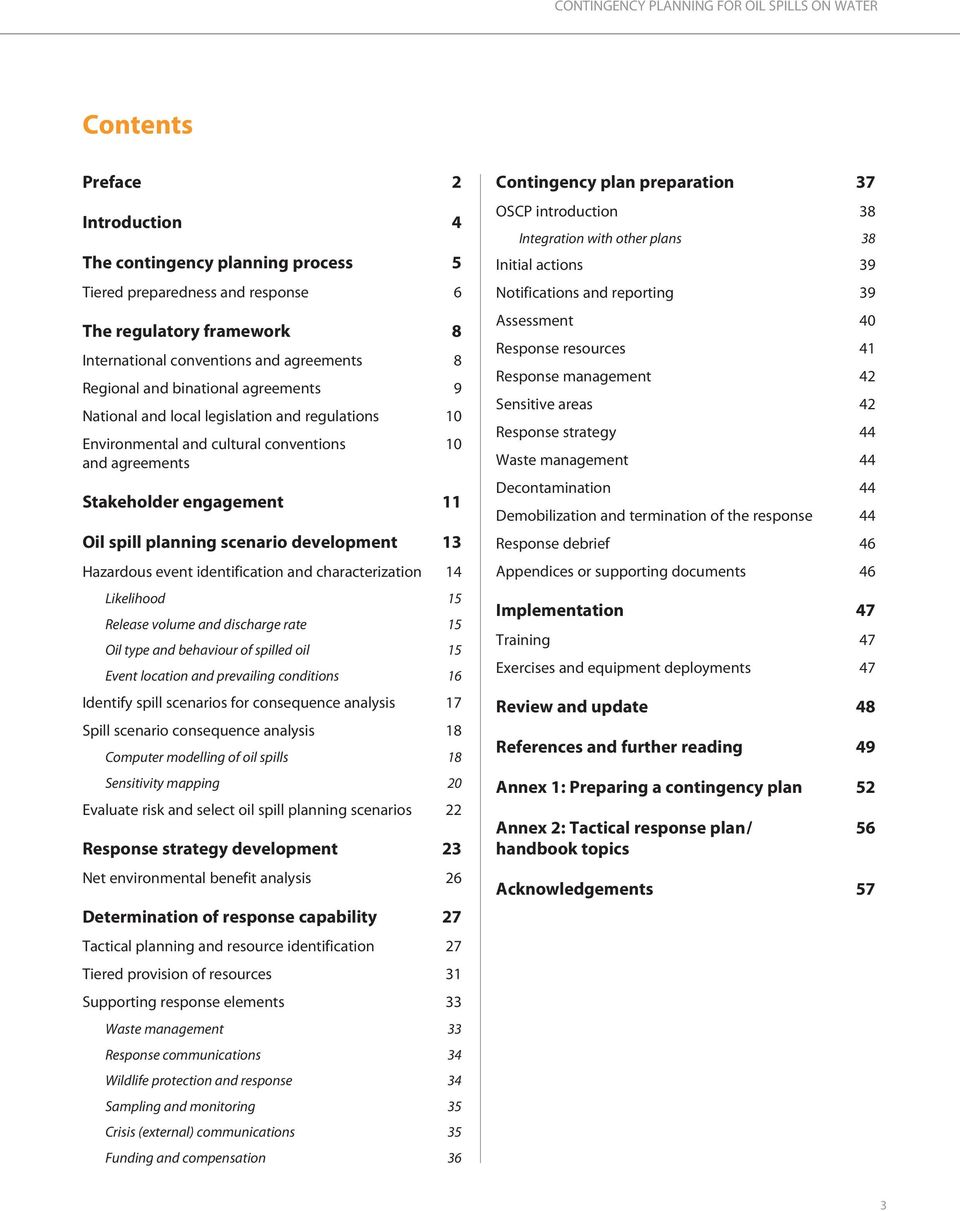
5 CONTINGENCY PLANNING FOR OIL SPILLS ON WATER Contents Preface 2 Introduction 4 The contingency panning process 5 Tiered preparedness and response 6 The reguatory framework 8 Internationa conventions and agreements 8 Regiona and binationa agreements 9 Nationa and oca egisation and reguations 10 Environmenta and cutura conventions 10 and agreements Stakehoder engagement 11 Oi spi panning scenario deveopment 13 Hazardous event identification and characterization 14 Likeihood 15 Reease voume and discharge rate 15 Oi type and behaviour of spied oi 15 Event ocation and prevaiing conditions 16 Identify spi scenarios for consequence anaysis 17 Spi scenario consequence anaysis 18 Computer modeing of oi spis 18 Sensitivity mapping 20 Evauate risk and seect oi spi panning scenarios 22 Response strategy deveopment 23 Net environmenta benefit anaysis 26 Determination of response capabiity 27 Tactica panning and resource identification 27 Tiered provision of resources 31 Supporting response eements 33 Waste management 33 Response communications 34 Widife protection and response 34 Samping and monitoring 35 Crisis (externa) communications 35 Funding and compensation 36 Contingency pan preparation 37 OSCP introduction 38 Integration with other pans 38 Initia actions 39 Notifications and reporting 39 Assessment 40 Response resources 41 Response management 42 Sensitive areas 42 Response strategy 44 Waste management 44 Decontamination 44 Demobiization and termination of the response 44 Response debrief 46 Appendices or supporting documents 46 Impementation 47 Training 47 Exercises and equipment depoyments 47 Review and update 48 References and further reading 49 Annex 1: Preparing a contingency pan 52 Annex 2: Tactica response pan/ 56 handbook topics Acknowedgements 57 3
6 IPIECA OGP Introduction Oi spi contingency panning is the process of deveoping a suitabe spi response capabiity that is in compiance with the reguatory framework and commensurate with the oi spi risks of an organization or faciity. The intent of this guide is to provide guidance on the contingency panning process for potentia oi spis in or on water. It is aimed at organizations with a risk of an accidenta reease of oi to a marine or aquatic environment, incuding those invoved in the handing, transport, production or storage of oi products. The degree of compexity invoved in the panning process wi greaty depend on the type of operation, oca conditions, and environmenta and socio-economic sensitivities. However, the overa objective is aways to deveop a capabiity to effectivey react to a spi and sustain an ongoing response that is proportionate to the risk. This capabiity requires suitabe equipment, sufficient ogistics, and competent, trained responders supported by proven, exercised pans. A reiabe system of review and maintenance wi ensure the panning remains reevant and appropriate to changing eves of risk as an organization matures or evoves. This is a cycica process that shoud remain active over the ifetime of an operation. The guide consists of nine main sections: The contingency panning process provides an overview and starting point. The reguatory framework discusses the incusion of internationa, regiona and oca agreements and reguatory requirements in an organization s contingency panning. Stakehoder engagement considers the invovement of stakehoders who share the risk and may be consuted in the panning process or in a response. Oi spi panning scenario deveopment provides guidance on the anaysis of risk and the identification of panning scenarios that cover the fu range of risk and response chaenges an organization may face. Response strategy deveopment discusses the deveopment of appropriate response strategies for the panning scenarios and the roe of net environmenta benefit anaysis (NEBA) in agreeing the most appropriate response options. Determination of response capabiity expains the identification and provision of response resources, incuding consideration of supporting eements, in buiding an overa response capabiity. Contingency pan preparation outines the compiation of the panning materia into a cear and concise, actionabe pan for use in a response, and supporting documents for suppementa materia and justification of response capabiity. Impementation discusses the use of training and exercises to buid responder competence and to test and verify that the capabiity and the pan meet the needs of the organization. Review and update expains the importance of a reguar review and update of the panning materia to maintain and improve capabiity over time. IPIECA and OGP have deveoped severa subject-specific pubications reating to the contingency panning effort. Numerous other documents and internet information portas have aso been deveoped by industry and government for specific aspects of contingency panning. Such resources are referenced where appropriate throughout this guide and are isted in the References and further reading section on pages The reader is encouraged to consut the various information sources. 4
7 CONTINGENCY PLANNING FOR OIL SPILLS ON WATER The contingency panning process The oi spi contingency panning process described in this guide is iustrated in Figure 1. To begin, panners must ceary define the assets and operations to be incuded within the panning scope. Industries such as shipping, pipeines, ports, oi handing faciities, and exporation and production differ widey in their scae of operationa activities, environmenta concerns, reguatory requirements and consequent oi spi risks. Each presents distinct chaenges in panning. Once panners have defined their scope, a thorough review of the reguatory framework is required to determine the appicabe egisative and reguatory structure. This framework wi have an infuence throughout the entire process, and panners shoud aways remain aware of the requirements and expectations. Stakehoder engagement shoud aso be addressed at the outset by estabishing who may be affected by the oi spi risk and a potentia spi s consequences and who may need to be consuted or informed during the panning effort. The process proceeds with a structured approach to deveoping spi response capabiity by: assessing risks and seecting oi spi panning scenarios that are representative of the risks; anaysing the scenarios to determine an appropriatey tiered oi spi response capabiity; compiing effective pans and thorough documentation; and impementing and verifying the desired eve of preparedness. Figure 1 The oi spi contingency panning process Organizations are then responsibe for reguary reviewing and updating a aspects of the contingency panning process and maintaining an appropriate state of preparedness over the ife of the operation. The various steps in the process draw on a wide range of discipines, incuding crisis management, operations, environmenta science, chemistry, ogistics and suppy chain management, heath and safety, government reations, risk management, engineering, pubic affairs, and ega issues and 5

8 IPIECA OGP compiance. To adequatey incorporate this diversity, organizations wi benefit from engaging a range of interna and externa expertise, and impementing the contingency panning process under the guidance of experienced oi spi response panners and responders. Whie subject matter expertise may be outsourced, it is important to ensure that the organization remains engaged in the panning process and takes ownership of its outcomes and impementation. Tiered preparedness and response The estabished three tiered structure aows those invoved in contingency panning to describe how an effective response to any oi spi wi be provided; from sma operationa spiages to a worst-case reease at sea or on and. The structure provides a mechanism to identify how individua eements of capabiity wi be cascaded. An organization s response capabiity and contingency pan shoud reate directy to the potentia spi scenarios and cover each tier, as appropriate. It is important to note that the tiers are stricty for panning purposes and, in the event of a spi, whatever resources are necessary to adequatey respond to the spi must be mobiized regardess of the tier. Panning according to the tiered approach ensures that an appropriate provision of resources is considered for a response of any magnitude as appies to an organization s risk. It enabes responders with access to adequate resources to mobiize an effective and timey initia response using pre-panned strategies and Tier 1 capabiities and to cascade in additiona resources as they adapt to any response as it unfods. Generay speaking, and uness nationa contingency pans or reguations define response eves otherwise, it is recognized internationay that tiers fa into three categories (see Box 1 on page 7). The resources hed at the three tiers work to compement and enhance the overa capabiity by enabing seamess escaation according to the requirements of the incident. An important concept is the cumuative nature of tiered response. The eements of a Tier 1 response are suppemented by higher tier capabiity and not superseded or repaced by it. There are no rigid rues for categorizing scenarios in terms of a tiered response capabiity. A nearshore spi of persistent oi woud require the cascading in of regiona resources (Tier 2), compared to the same size offshore spi of a non-persistent oi which coud be handed soey with oca resources (Tier 1). The chaenge for panners as they proceed through the panning process is to consider the scenarios and their potentia outcomes, the resources avaiabe to the organization, and the chaenges of the geographica area of interest, in making a decision on the eve of Tier 1 capabiity required and on the necessary arrangements at Tier 2 and Tier 3. For exampe, in remote ocations, where significant time and effort is required to mobiize additiona resources, oca Tier 1 capabiity wi need to be more sophisticated compared to the Tier 1 capabiity required at a project ocation near a we-deveoped area with avaiabe Tier 2 response support that can be quicky and easiy mobiized and depoyed. For further detais on the tiered response approach see IPIECA-OGP, 2014a. 6
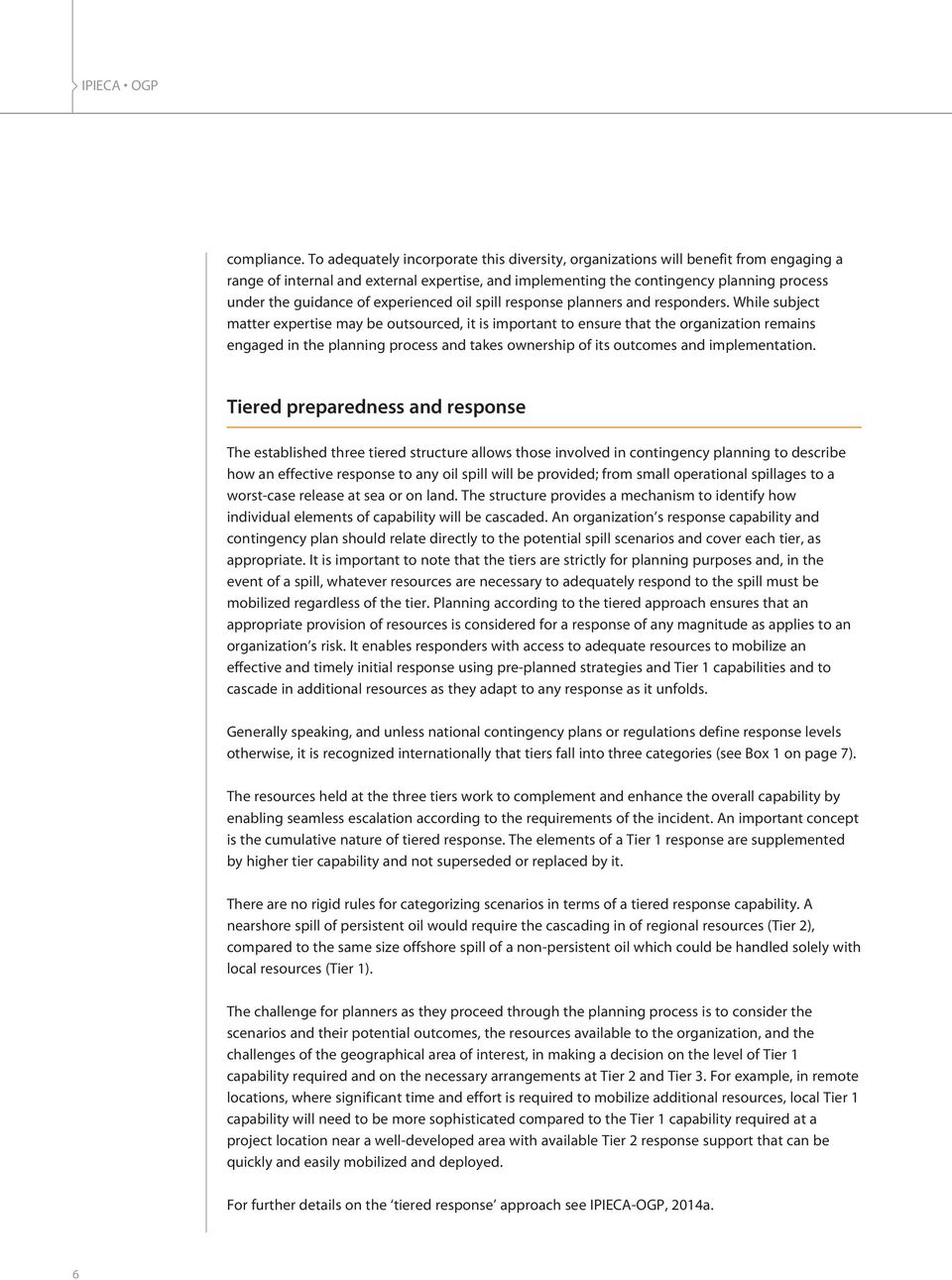
9 CONTINGENCY PLANNING FOR OIL SPILLS ON WATER Box 1 Tiered preparedness and response: a three-tiered system Tier 1 Source: OSRL Source: ECRC~SIMEC Source: ECRC~SIMEC Tier 1 capabiities describe the operator s ocay hed resources used to mitigate spis that are typicay operationa in nature occurring on or near an operator s own faciity. The resources aso provide an initia response to spis that may potentiay escaate beyond the scope of Tier 1 initia actions and capabiities. Tier 2 Tier 2 capabiities refer to additiona, often shared, nationa or regiona resources necessary to suppement a Tier 1 response or support an escaating response. Tier 2 capabiity incudes a wider seection of equipment and expertise suited to a range of strategic response options. Tier 3 Tier 3 capabiities are gobay avaiabe resources that further suppement Tiers 1 and 2. They comprise the internationa resources necessary for spis that require a substantia externa response due to incident scae, compexity and/or impact potentia. 7

10 IPIECA OGP The reguatory framework The foundation for any oi spi contingency panning effort is an understanding of the reguatory framework in which the assets and operations are ocated. Organizations shoud assess how internationa, regiona, nationa, and oca reguations and agreements may appy to their situation, and how that may affect their particuar oi spi contingency panning. Many internationa companies with spi risks aso maintain interna guideines and conformance standards, which panners must baance and integrate with government requirements. Internationa conventions and agreements Many countries have ratified the Internationa Convention on Oi Poution Preparedness, Response and Co-operation, 1990 (OPRC Convention), which provides a framework for internationa cooperation for combating major oi poution incidents and sets requirements for nationa systems of preparedness and response. It requires countries to deveop their own aws and procedures for preparing for, and responding to, oi spis ranging from oca impact to internationa scae. These shoud be encompassed within a nationa oi spi contingency pan, under the auspices of a designated nationa authority. The OPRC Convention cas for nationa authorities to work with oi and shipping industries, port authorities, and other reevant entities to unify response efforts. It is crucia that industry works with governments to deveop a cear, common interpretation of nationa requirements. There needs to be carity within both government and industry contingency pans as to who is responsibe for specific actions under a foreseeabe situations. Other internationa agreements and conventions reevant to contingency panning incude the: Protoco on Preparedness, Response and Co-operation to poution Incidents by Hazardous and Noxious Substances, 2000 (OPRC-HNS Protoco); and the Internationa Convention for the Prevention of Poution from Ships, 1973 (MARPOL). Additiona information on these and other internationa conventions, as we as a current ist of signatories, can be found on the Internationa Maritime Organization (IMO) website at Internationa iabiity and compensation conventions reevant to contingency panning for shipsource spis incude the: Civi Liabiity Convention (1992 CLC); Fund Convention (1992 Fund); Suppementary Fund Protoco (2003); Bunkers Convention (2008); and HNS (Hazardous and Noxious Substances) Convention (2010). Organizations are advised to investigate the status of conventions as we as any reevant nationa egisation on compensation and iabiity for both ship and non-ship source spis. Some countries are not signatories to the internationa conventions and/or may have impemented their own aws instead. Exampes incude the United States Oi Poution Act of 1990 (OPA 90) and the European Union Environmenta Liabiity Directive (ELD). 8
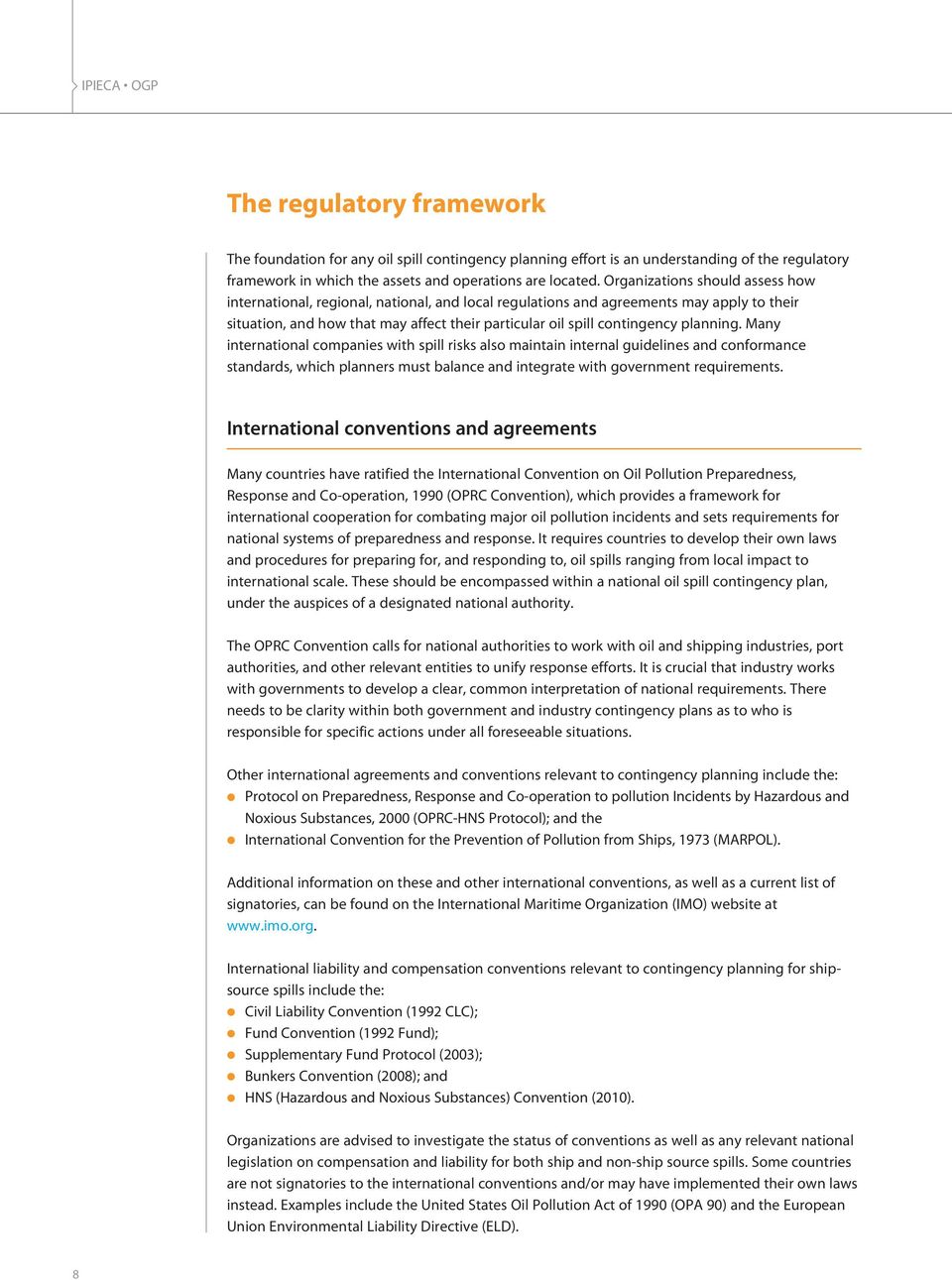
11 CONTINGENCY PLANNING FOR OIL SPILLS ON WATER For detaied information on these conventions and their considerations in deveoping procedures for caims and compensation see IPIECA-OGP, 2014b. Regiona and binationa agreements There are a growing number of regiona conventions and biatera agreements that provide a forma framework for countries to respond jointy to spis. Where there is the potentia for transboundary movement of spied oi, or if personne and equipment may need to be transported across borders, agreements can expedite response actions and sharing of resources. Prearranged procedures are vita for rapid resoution of issues such as iabiity concerns, emergency immigration and import provisions, and financia compensation processes. Organizations deveoping contingency pans shoud be aware of the current status of such agreements in their operating region. The United Nations Environment Programme (UNEP) Regiona Seas Programme has been instrumenta in driving regiona cooperation to protect common bodies of water. Most of the Regiona Seas Programmes function through Action Pans that are often underpinned by a egay-binding regiona convention ( Severa other independent, intergovernmenta programmes, for exampe the Arctic Counci and Hesinki Commission (HELCOM), were formed as a resut of regiona conventions and work cooperativey with UNEP. Source: Arctic Counci Neighbouring countries may be party to biatera or mutiatera agreements to faciitate cooperation in responding to spis in adjacent waters. This can incude conducting joint exercises, deveoping joint contingency pans, sharing information, or estabishing expedited customs and immigration procedures for equipment and trained personne. For exampe, the Canada-United States Joint Marine Poution Contingency Pan has provided a framework for cooperation since 1974; and the Manche Pan, a biatera agreement between France and the UK, has been in pace since Nationa and oca egisation and reguations Many countries and their provinces have we-estabished aws and reguations for contingency panning. These may incude compiance requirements, such as response time frames and incident reporting, tier definitions, approvas systems and various other aspects. Reguations can be specific and prescriptive in their conditions and processes. In these cases, the reguatory system wi drive the panning process and set the requirements for overa oi spi preparedness and response capabiity as we as integration with the nationa and oca oi spi contingency panning frameworks. The Arctic Counci consists of the eight Arctic States: Canada, Denmark (incuding Greenand and the Faroe Isands), Finand, Iceand, Norway, Russia, Sweden and the United States. Six internationa organizations representing Arctic Indigenous Peopes have permanent participant status. In the absence of specific nationa or oca guidance, organizations shoud adhere to the internationa and regiona protocos and conventions appicabe to their operationa area, as we 9

12 IPIECA OGP as to internationa good practice. Efforts shoud be made to achieve a common understanding of response management and capabiity with the reevant government reguatory bodies. ITOPF maintains a series of Country Profies focused on ship-source spis. The Profies provide a summary of the oi spi response arrangements and cean-up resources in many maritime nations ( Environmenta and cutura conventions and agreements Panners shoud aso consider conventions, agreements and internationa guidance on cutura and environmenta protection, particuary when deveoping sensitivity maps and estabishing priority protection areas. Box 2 provides exampes of treaties and conventions that provide a ega basis for the protection of critica habitats, species and cutura heritage. The Word Database on Protected Areas administered by the UNEP Word Conservation Monitoring Centre hods a vast amount of information on protected areas ( Box 2 Environmenta and cutura conventions and agreements Internationa exampes Convention on Wetands of Internationa Importance (Ramsar Convention) United Nations Educationa, Scientific and Cutura Organization (UNESCO) Word Heritage Convention Convention on the Conservation of Migratory Species of Wid Animas (CMS or Bonn Convention) Regiona exampes Protoco Concerning Speciay Protected Areas and Widife (SPAW) under the Cartagena Convention Japan Austraia Migratory Bird Agreement (JAMBA) Near right: Ha Long Bay, Vietnam a UNESCO Word Heritage Site. Far right: Otago Peninsua, New Zeaand a habitat for yeow-eyed penguins, an IUCN (Internationa Union for Conservation of Nature) Red List species with endangered conservation status. Source: Treis Environmenta, LLC Source: Treis Environmenta, LLC 10

13 CONTINGENCY PLANNING FOR OIL SPILLS ON WATER Stakehoder engagement Fostering open communication between industry, government and the community ensures that stakehoder priorities and expectations are understood. Eary identification of stakehoders and consistent engagement throughout the contingency panning process aows for meaningfu discussion and resoution of conficting interests and opinions whie in a non-emergency situation. It aso provides panners with the opportunity to identify important environmenta resources and socio-economic features and their vaue to the community. Potentia stakehoders may invove parties from many different backgrounds and with diverse interests (Box 3). A stakehoder can be a person or an organization with an interest or concern in response preparedness or their potentia consutation or participation in a response to an oi spi. It can aso be a oca community or indigenous group that coud potentiay be impacted by a spi in their area. The participation of certain stakehoders during the contingency panning process may be mandated by reguation, such as pubic consutation requirements or approvas by government agencies. Box 3 Potentia stakehoders Government agencies Indigenous groups Universities and research institutes Non-governmenta organizations Loca communities Loca business Vounteer organizations Ports/harbours Neighbouring faciities and industries Loca emergency responders Labour organizations Poitica parties Source: Treis Environmenta, LLC Panners wi need to identify stakehoders that have a vaid contribution to the contingency panning process, as we as those who may be engaged in sharing information. For exampe, the contact detais for oca andowners are important data for incusion in the contingency pan. Sensitivity mapping (see pages 20 21) and net environmenta benefit anaysis (NEBA) (see page 26) are important parts of the contingency panning process where invovement of oca constituents and the benefit of traditiona and oca knowedge can improve the quaity of panning. A stakehoder mapping exercise carried out in consutation with an organization s externa affairs group is one potentia method panners might use to identify the reevant parties. Contingencies need to be considered wherever an oi spi coud disrupt oca communities, for exampe those reying on subsistence fishing. More detaied information on stakehoder engagement and community consutation can be found in IPIECA-OGP, 2014c and IPIECA-OGP, 2014d. 11

14 IPIECA OGP Source: ITOPF Source: OSRL Forums hed to faciitate stakehoder engagement during panning and exercises contribute to more effective and efficient communication and reationships. Industry efforts are aso being made on regiona and goba scaes to promote cooperation between stakehoders. Programmes, such as the Goba Initiative (GI) (see Box 4), compement government and industry in regiona efforts to enhance the capacity of countries to prepare for, and respond to, marine oi spis ( Box 4 Goba Initiative regiona groups Caspian Sea, Back Sea and Centra Eurasia Region Oi Spi Preparedness Regiona Initiative (OSPRI) West, Centra and Southern Africa Region (WACAF) Southeast Asia Region (GISEA) China Programme In addition to the Goba Initiative programme, a growing number of other groups, such as ARPEL (the Regiona Association of Oi, Gas and Biofues Sector Companies in Latin America and the Caribbean), are aso invoved in promoting constructive diaogue, information sharing and capacity buiding in their regions. Panners wi benefit from an understanding of these efforts in their region and how they affect their contingency panning. 12

15 CONTINGENCY PLANNING FOR OIL SPILLS ON WATER Oi spi panning scenario deveopment A suitabe seection of oi spi panning scenarios serves as the basis for defining an effective response capabiity that is commensurate with an organization s eve of risk. In accordance with the tiered response approach, panners shoud aim to define a baanced group of scenarios that coectivey represent the range of spi risks and response chaenges within the panning scope. A number of detais are determined and anaysed in making an appropriate seection (see Box 5). Box 5 Spi scenario information, and questions that may need to be considered in its anaysis Scenario information to be determined Event Likeihood (frequency/probabiity) Oi type Voume Duration of reease Behaviour of spied oi Location of event Prevaiing hydrodynamic and environmenta conditions Trajectory and fate Geographic zone of potentia spi impact Environmenta and socio-economic sensitive resources at risk and potentia consequences if impacted. Anaysis What can go wrong? What is the chance that it coud happen? What type of oi and how much of it coud be reeased? Where coud it happen and what are the oca conditions? Where coud the spied oi go and how might it behave in the environment? What impacts coud it have and how severe coud the consequences be? This data compiation and its anaysis wi continue to inform decision making throughout the contingency panning process and shoud be incuded in the contingency panning documentation for use during a response as we as for justification of response capabiity. Figure 2 The genera process for oi spi scenario deveopment Figure 2 outines the genera process for deveoping oi spi scenarios for contingency panning. It uses the principes of oi spi risk assessment to faciitate an informed seection of scenarios. An oi spi risk assessment is a systematic method to: identify hazardous events that coud resut in spis; anayse the characteristics and ikeihood of the hazardous events; define associated oi spi scenarios and identify a seection suitabe for consequence anaysis; anayse the potentia consequences of each seected spi scenario if they were to occur; and estabish and evauate the subsequent risks to the environmenta and socio-economic resources. A number of risk assessment methodoogies exist, ranging from prescriptive and comprehensive quantitative processes to simpified quaitative approaches. Panners wi need to 13

16 IPIECA OGP estabish a risk assessment context (degree of compexity) that is appropriate for the panning scope. This wi depend on a variety of considerations, incuding the scope and type of operations, avaiabiity and reiabiity of data, risk criteria and corporate practices. Utimatey, organizations shoud empoy a risk assessment technique appropriate for their situation, in compiance with both their interna standards and the reguatory framework, and which provides resuts suitabe for making reiabe decisions regarding risk. Detaied guidance on risk assessment and the seection of scenarios can be found in IPIECA-OGP, 2013a and IMO, Hazardous event identification and characterization Panners shoud begin with a hazard identification anaysis to determine a of the operationa hazards that coud resut in a reease of oi product. IPIECA-OGP, 2013a outines a number of toos that may be used to faciitate hazard identification. A characterization of the hazardous events shoud then be undertaken to define oi spi scenarios that are representative of those hazardous events (Box 6). For fixed faciities, it is possibe to identify and describe specific hazardous events and reease scenarios. For transient operations, such as shipping, the use of appicabe generic scenarios can be appropriate. For ports or operations with a mix of shipping and fixed faciities, panners may find that a combination approach is most suitabe. Box 6 Exampes of potentia spi scenarios based on hazardous events Sma operationa/maintenance spis due to minor incidents Loss of we contro eading to a bowout Ruptured fow ines, pipeines, risers, subsea equipment due to earthquake Loss of containment due to tank storage faiure Loss of containment during offoading/transfers/bunkering Loss of containment from ship coision Loss of containment from ship grounding Loss of containment due to exposion Panners shoud be aware of the inherent differences in industries when describing scenarios for operations that are fixed, transient or a combination of the two. Source: OSRL Source: istockphoto.com 14
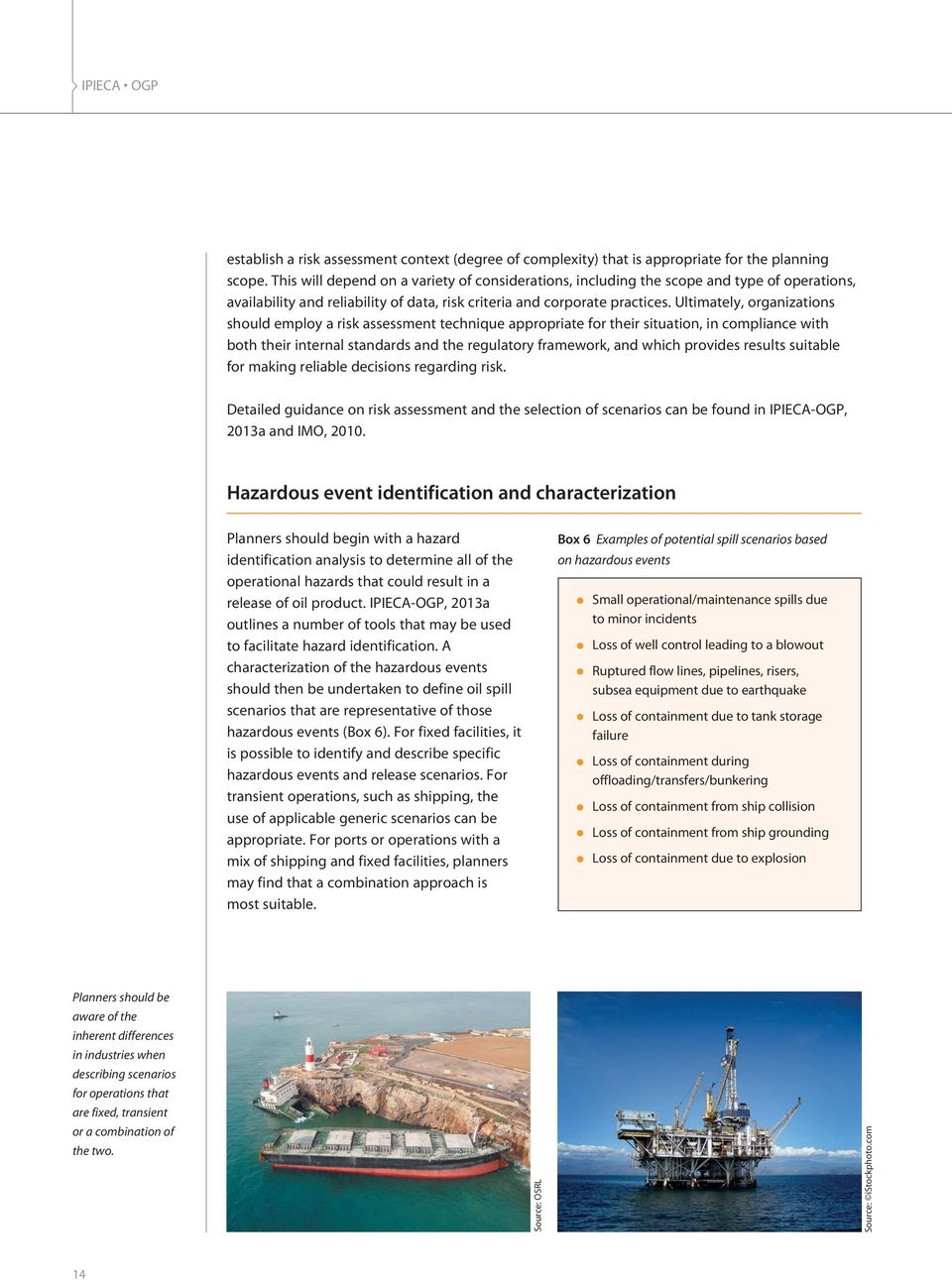
17 CONTINGENCY PLANNING FOR OIL SPILLS ON WATER The identified hazardous events are characterized in terms of the ikeihood of the event, the potentia voume and duration of the reease, the type of oi, and the ocation. Likeihood Likeihood refers to the chance an event might occur. It can be determined in genera terms or mathematicay, depending on the oi spi risk assessment context. Historica data (e.g. see Figure 3) can provide usefu information on the causes of spis and statistics on spi frequency. This can aid in determining ikeihood as we as informing the seection of spi panning scenarios. Anaysis of shipping-reated data has shown that most spis from ships occur in or cose to ports; they tend to be sma in size and are generay the resut of routine operations such as off-oading, discharging and bunkering (ITOPF, 2011a). Conversey, the occurrence of arge spis is reativey rare; however, their impact can be severe. When anaysing operations of any type, panners shoud be mindfu of distinguishing not ony the ow probabiity, high-consequence reeases associated with worst credibe case scenarios, but aso the more ikey owvoume reeases reated to sma, oca incidents. Figure 3 Petroeum spis from US Outer Continenta Shef oi and gas activities number of spis in each size category, Data from Anderson et a., 2012 Updated shipping statistics are produced by ITOPF every year. The OGP Risk Assessment Data Directory report series contains usefu information for the oi and gas production and process industries ( Many nationa agencies aso compie data on spis within their jurisdiction. Reease voume and discharge rate Reease voume can be estabished using either known fixed voumes and discharge rates or estimated voumes based on cacuations and assumptions. This can be as simpe as presuming an instantaneous reease of 100% of a fixed voume due to faiure of containment, or it can invove compex engineering and mathematica cacuations, such as estimating rates for a pipeine rupture or we bowout. Government reguations or internationa industry standards shoud aways be consuted on this subject as cacuations for determining voumes and reease rates for contingency panning are often prescribed. Panners shoud aso incude an estimation of worst credibe case discharge and ensure that the associated scenario is carried forward for consequence anaysis. Oi type and the behaviour of spied oi Panners need to understand how the anticipated oi type wi behave in the environment into which it may be spied, incuding how it wi weather or change over time. The base properties of a particuar oi wi drive the physica and chemica changes that occur when it may be spied onto water. Oi characterization is the process used for describing the unique properties of a particuar oi and its weathering profie under certain environmenta conditions. Understanding how the oi behaves provides key information for panners because it: 15
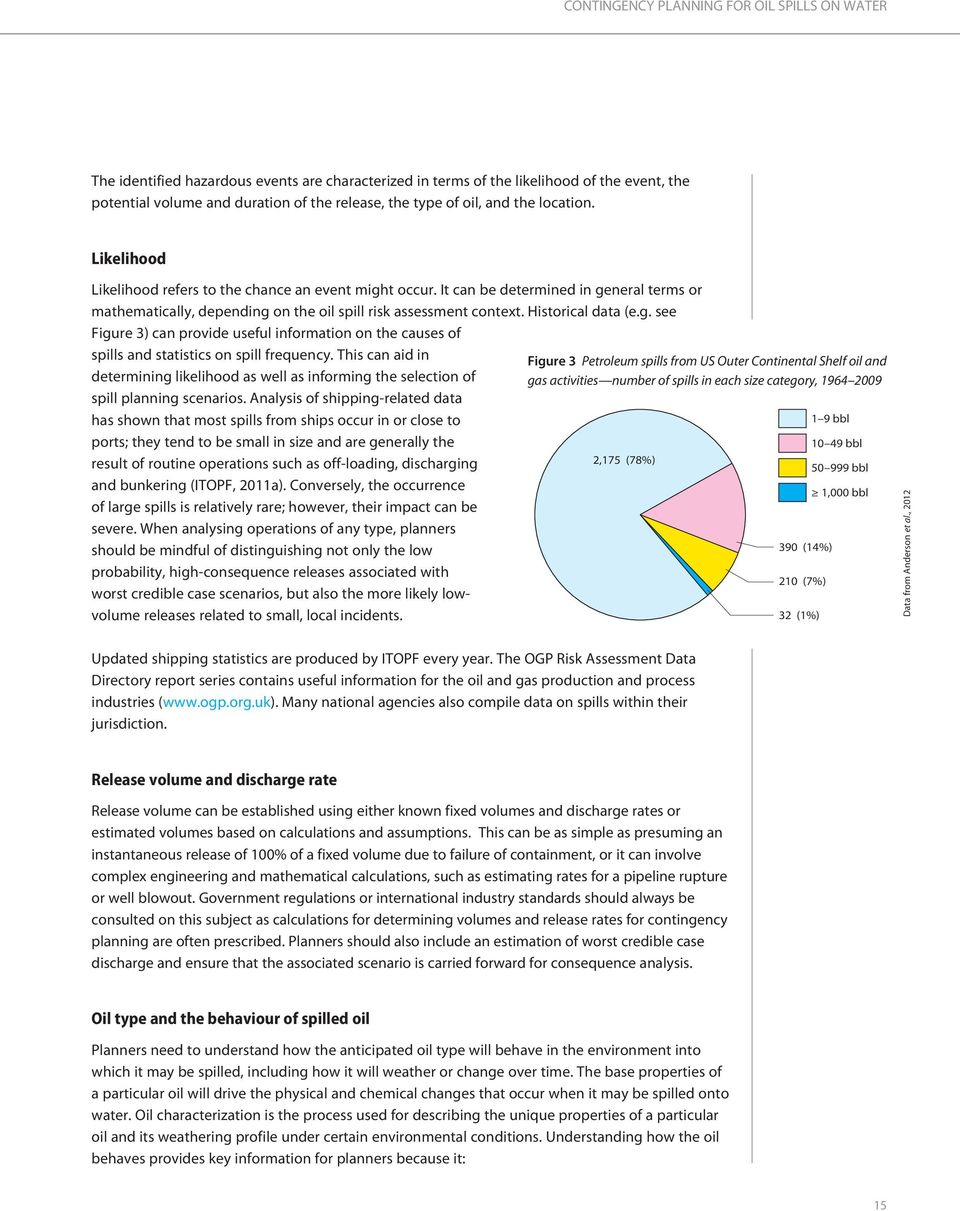
18 IPIECA OGP can be used to predict persistence in the environment and toxicity; is a required input to spi trajectory and fate modeing for consequence anayses; contributes to strategy deveopment and the choice of appropriate response techniques and equipment (for exampe understanding an oi s propensity to evaporate or emusify can aid in estabishing the efficacy and windows of opportunity for certain techniques, such as dispersant appication and in-situ burning); informs waste management decisions; and provides heath and safety panners with indicators of potentiay hazardous conditions, such as noxious fumes or dangerous fash points. The base properties and weathering behaviour of many ois have been studied and documented. If sufficient data are not avaiabe or appicabe to the organization s operating environment, aboratory and bench-scae experiments can be conducted on sampes of the product to obtain the necessary data. Exporation projects face a particuar chaenge in that the oi properties may not yet be known. In this case, panners shoud choose an anaogue oi based on their best avaiabe data. A range of possibe oi types can aso be used to capture a variety of potentia outcomes. Panners shoud be aware of the uncertainty invoved with this and the potentia pitfas when determining response measures. For more detai on weathering, oi characterization and exampes of appications in contingency panning, see aso IPIECA-OGP, 2013b; ITOPF, 2011b; and ITOPF, Event ocation and prevaiing conditions The event ocation together with an understanding of oca prevaiing conditions give panners a preiminary view of the areas that coud potentiay be affected by a spi and the response chaenges associated with the characteristics of a particuar area. Athough detaied environmenta and socio-economic sensitivities wi not have been considered at this stage, oca knowedge, environmenta/socia impact assessments, and existing sensitivity maps can provide a basis for spi response experts to highight events with the potentia for severe consequences and which may therefore be given priority for further anaysis. Figure 4 The effects of wind and current on the movement of an oi sick An oi sick moves at approximatey the same speed as the surface current and at about three percent of the wind speed the resutant movement being a vector sum of the two. 16

19 CONTINGENCY PLANNING FOR OIL SPILLS ON WATER Prevaiing conditions refers to the typica weather and hydrodynamic conditions experienced in an area. Loca meteoroogica and oceanographic, or metocean, data is a fundamenta input to predicting oi behaviour and movement (Figure 4). It is aso an important consideration for panners and responders when evauating the appropriateness of response techniques and site heath and safety considerations. Reevant data for use in oi spi scenario definition and spi modeing incude wind/current direction and speed, sea state, tides, sea and air temperature, and possiby ice. Three-dimensiona current data together with temperature and sainity profies of the water coumn are aso of particuar interest for modeing subsea reease pumes and dispersant efficacy in deep water environments. Source: Aaska Cean Seas Unique panning factors, such as ice fow or break-up periods, can affect the distribution, behaviour and fate of spied oi and choice of response method. Seasonaity shoud aways be considered, aong with data from a time frame sufficient to incude variations throughout the year. Any extreme conditions and unique panning factors that pose particuar threats shoud aso be noted, such as: hurricane, typhoon and monsoon seasons; ice fows or break-up periods; areas of high current or sea state; and temperature extremes (hot or cod). Data for use in computer modeing of oi spis shoud be based on historica records and/or modeed metocean data fieds. The avaiabiity and reiabiity of data wi vary depending on the data coection history of the region of interest. Some areas of the word s oceans have extensive databases compied over years of sophisticated monitoring, whereas remote or ess-deveoped areas may not have such detaied information to draw on. Data can be obtained from officia agencies, academic institutions and commercia organizations. In addition, experience has proven that information from oca fishermen and watermen can be invauabe, particuary during a response. Identify spi scenarios for consequence anaysis Panners shoud use the hazardous event characterization information to define representative oi spi scenarios and identify a seection suitabe for consequence anaysis. For a arge operation with hundreds of potentia events, this can be compex and wi require a rigorous approach. Sound judgment based on data obtained during the characterization must be used to choose a manageabe and meaningfu number of scenarios for detaied consequence anaysis, which can be time consuming and costy. It is recommended that the chosen scenarios be imited to a practica number and be representative of the tiered response approach. Reguatory requirements may aso define specific scenarios that wi need to be addressed. 17

20 IPIECA OGP Spi scenario consequence anaysis For each identified scenario, the potentia environmenta and socio-economic consequences shoud be determined. Predictions of oi trajectory and fate, together with an evauation of the potentia sensitive resources at risk of impact from oiing, combine to provide an estimate of the severity of an oi spi scenario. This vaue is critica in estabishing and evauating the risks associated with a spi scenario. Computer modeing of oi spis Oi spi modeing provides a forecast of oi trajectory and fate based on known or estimated oi properties and oca prevaiing conditions. Two main types of transport modeing outputs are used by panners to evauate spi scenarios. A stochastic mode (Figure 5) provides a statistica anaysis of mutipe trajectories of the same scenario simuated over a defined period of time, such as a season, using a database of historic or modeed hydrodynamic and wind data. The stochastic modeing output predicts the geographica zone of potentia impact for a spi scenario (i.e. where oi might go) and the probabiity of impact for areas within that zone, aong with associated timescaes and potentia concentrations or voume. A deterministic mode provides a simuation of the fate and transport of a singe trajectory for a specific spi scenario and one set of hydrodynamic and wind conditions (Figure 6). The output predicts the projected oi movement, timeine and voume or concentration, incuding estimates Figure 5 An exampe of stochastic modeing output Figure 6 An exampe of deterministic modeing output Source: SINTEF, using the OSCAR (Oi Spi Contingency and Response) Mode Source: SINTEF, using the OSCAR (Oi Spi Contingency and Response) Mode This image of a statistica anaysis of mutipe trajectories predicts the probabiity of where water surface oiing might occur based on a 10-day simuation using a dataset of historica hydrodynamic and wind conditions. It does not define the exact footprint of a spi scenario, but rather iustrates the zone of potentia impact within which oiing might occur and the probabiity that oi might be present within that zone. This image shows a singe trajectory from the mutipe trajectory statistica anaysis in Figure 5. It predicts the maximum thickness of oi emusion occurring on the water surface over a 10-day simuation using one input set of hydrodynamic and wind conditions. 18

21 CONTINGENCY PLANNING FOR OIL SPILLS ON WATER of beached oi. Deterministic modes can aso be used to generate a mass baance anaysis, which depicts the fate of the spied oi over time, e.g. evaporation, biodegradation, dispersion, shoreine stranding, etc. (Figure 7). Figure 7 Exampe mass baance anaysis Data source: ASA RPS This exampe of an oi mass baance graph is based on water surface area exposed to surface oi with an average thickness greater than 0.01 mm (dark brown sheen) for a 1,000 m 3 reease of IFO-180 (intermediate fue oi with a maximum viscosity of 180 centistokes). Combining stochastic resuts with any number of deterministic outputs produces vauabe information that can infuence decisions concerning strategy deveopment and the identification of necessary response capabiity. The information is aso an essentia input to the sensitivity mapping and evauation of environmenta and socio-economic risk. Correct interpretation of the data generated from modeing is a speciaist task, and care shoud be taken to ensure the materia is interpreted and presented appropriatey for the intended audience. Various organizations and companies have deveoped oi spi computer modes ranging from basic to the very sophisticated. Panners shoud use a mode that is suitabe for the spi scenarios they are anaysing. It shoud be mentioned that certain spi scenarios may not need a sophisticated mode when the spi voume is very sma or if spi movement and fate predictions can be made based on previous modeing resuts, the experience of speciaists couped with oca knowedge, or the use of the vector addition method shown in Figure 4. Modeing is a predictive too and cannot readiy repace the need for reatime surveiance during an actua incident. Deep water driing programmes, for which one or more scenarios may be a subsea reease of oi, are advised to use modes that are capabe of performing mutifaceted subsurface and surface fate and trajectory anayses. These compex modes may aso be used to simuate the appication of spi response techniques, such as the use of subsea dispersants and their potentia effectiveness, which can be usefu during strategy deveopment. It is important to note that these modes are ony capabe of making predictive estimates of fate and trajectory, and the quaity of the input data wi infuence the quaity of the mode output. Users of the modeing data shoud understand the mode imitations and the inherent difficuties in predicting oi fate processes (e.g. evaporation, emusification, etc.). Source: OSRL 19
22 IPIECA OGP Sensitivity mapping Once panners have defined what incidents coud occur, where the oi might go and how it coud behave and weather in the environment, it is then necessary to determine which environmenta and socio-economic resources coud be affected and the degree of sensitivity of those resources to accidenta oiing. Three sensitivity themes are considered: shoreine type and its genera environmenta sensitivity to oi spis; sensitive ecosystems, habitat, species and key natura resources; and sensitive socio-economic (incuding cutura heritage) features. The combined modeing output of a the spi scenarios defines the overa zone of potentia spi impact and outines the geographic area of interest for sensitivity mapping. Potentiay vunerabe sensitivities within this area of interest shoud be identified and characterized, and the probabiity of the spied oi having an impact on these resources shoud be considered. This is best accompished by deveoping a sensitivity map or anaysing existing maps of the area, which may aready be estabished and reguary maintained, usuay by government programmes, regiona cooperative efforts, or industry. The sensitivity data is used in the risk assessment process to determine the potentia consequences of a spi scenario and the probabe impacts on key habitats and species as we as socio-economic features. The evauation wi provide panners with information on the ocation of high-risk areas and the resources and data to support their prioritization for protection, for exampe for optimum shoreine excusion booming. Strategic sensitivity maps are deveoped to identify protection priorities and their ranking of importance, which is vita for setting response objectives and supporting decision making during a response. This can be a compex process and is cosey tied to net environmenta benefit anaysis (NEBA) (see page 26). Sensitive environmenta and socio-economic areas and resources at risk shoud be iustrated in sensitivity maps. Sensitivity maps aso contribute vita information during a response. They can be used to convey essentia information to on-site spi responders by iustrating the ocation of sensitive areas and resources, such as bird and turte nesting areas and maricuture faciities. The maps can aso be expanded to contain a wide range of operationa panning information such as ogistics data, sitespecific tactics for priority protection areas, trajectory modeing, equipment stockpies, staging areas, emergency medica faciities, potentia command centres, etc. Sources: Treis Environmenta, LLC 20
23 CONTINGENCY PLANNING FOR OIL SPILLS ON WATER Figure 8 Coasta sensitivity viewer webgis interface too Source: BP Angoa Sensitivity mapping can be presented as a simpe hard-copy map with tabes isting resource detais, or integrated into a geographic information system (commony referred to as GIS) capabe of containing arge voumes of data. Maps deveoped in GIS may be accessed either by printing hard copies or by viewing the information eectronicay, incuding via internet access (see Figure 8). Sensitivity maps deveoped in GIS can aso be integrated into eectronic emergency management systems, and inked to other databases for enhanced command and contro and a depiction of response activities, resources and status. This is referred to as a common operating picture (COP). Athough GIS is becoming widey used in oca and nationa administrations and by industry, it is not aways necessary and basic printed maps may be suitabe for smaer operations. It is recommended that hard-copy versions of maps are generated for use by on-site responders, as the use of eectronic devices may not aways be feasibe or reiabe in remote or extreme ocations, and the maps may serve as a record for ater reference during incident investigations and caims preparation. Care must be taken to avoid printed maps becoming too cuttered and difficut to interpret. Detaied guidance on sensitivity mapping for oi spi response can be found in IPIECA/IMO/OGP,
24 IPIECA OGP Evauate risk and seect oi spi panning scenarios After the spi scenarios are defined and anaysed, panners shoud make a fina seection that represents the fu range of response chaenges and risks against which response strategies and a tiered capabiity can be defined. This shoud refect the tiered response approach and resut in a range of scenarios covering sma operationa spis up to and incuding a worst credibe case scenario. Worst credibe case represents the scenario with the most severe consequences and which is considered pausibe. Reguatory requirements shoud aso be consuted as they may dictate specific scenarios that must be incuded in contingency panning. A common method used to faciitate and refine the fina seection of panning scenarios is a risk assessment matrix (RAM). It is used to pot the ikeihood and consequence outcomes from each of the spi scenarios and can be presented in a variety of formats. An exampe of one variation is shown in Figure 9. The matrix provides a view of the overa risk profie and a comparison of the risk associated with each potentia spi scenario. Overa risk reduction is achieved with effective prevention and mitigation measures. Reducing the ikeihood of a spi occurring through prevention is the primary aim, yet despite best intentions a residua risk aways remains. The risk comparison, together with a review of each scenario s unique infuences (e.g. oi type, prevaiing conditions, oca sensitivities), informs the choice of an appropriate set of oi spi panning scenarios to formuate mitigation measures. For smaer operations ony a few scenarios may be identified, one of which may provide the information needed to pan the most effective response strategies to mitigate risks. For arger and/or compex operations, numerous scenarios may be identified, in which case a we-rounded, representative set covering a range of risks wi need to be seected. Figure 9 Exampe of an oi spi scenario risk assessment matrix (RAM) Assess the risks: ikeihood x consequence = risk rating = Loss of containment during fue transfer quayside; 10 tonnes; diese fue t = Sma maintenance eak; 10 itres; hydrauic fuid 6 = Pipeine rupture near shore; 1,000 tonnes; ight crude n = Offoading at sea; 400 tonnes; diese fue u = Subsea eak; 1,500 tonnes; crude s = Subsea we bowout; 1,500 tonnes/day for 30 days; crude oi v = Vesse grounding oaded utra-arge crude carrier 22
25 CONTINGENCY PLANNING FOR OIL SPILLS ON WATER Response strategy deveopment After a range of oi spi panning scenarios are seected, consideration shifts to the deveopment of appropriate response strategies, which are comprised of avaiabe and viabe response techniques and which adequatey mitigate the impact and consequences of each scenario. Panners shoud consider how the response for a scenario might deveop over time and how the strategy may need to adjust as the spi evoves. The reaities of the situation and the imitations of techniques and equipment must be we understood. Extreme weather conditions, the presence of ice, highy voatie or heavy viscous ois, remote/inaccessibe ocations, and proximity to highy-sensitive areas can a heaviy infuence and restrict or dictate the seection of suitabe response techniques. In a cases, the strategy shoud be estabished in consutation with the reevant authorities and stakehoders, with consideration given to the greatest net environmenta benefit (see page 26). It is important to consider a the response techniques that are appropriate for the conditions. Source: OSRL Source: ECRC~SIMEC Source: OSRL Strategy shoud be focused on cear, attainabe goas by first estabishing a set of response objectives for the panning scenarios. Objectives are based on a number of inputs (Box 7), however, those that are argey common to a spi scenarios are to: protect the heath and safety of responders and the pubic; contro the source; contain and recover spied materia; maximize protection of sensitive areas; and minimize damage to environmenta and socio-economic resources. Beow: the presence of ice pack may precude the use of containment booms. Oi contained by the ice itsef may be recovered with appropriate skimmers, other equipment and reevant expertise. Heath, safety and, in certain circumstances, security considerations are a significant part of a response and are aways the top priority. Detaied information on estabishing strategies for the heath and safety of responders can be found in IPIECA-OGP, 2012a. Information on source contro can be Box 7 Important aspects to consider when defining scenario response objectives Heath, safety and security Reguatory requirements, such as response timeines and priorities Proximity of priority protection sites and resources at risk Stakehoder and pubic expectations and priorities Corporate phiosophy and priorities Source: Lamor 23
26 IPIECA OGP obtained from various websites incuding the Subsea We Intervention Service offered by Oi Spi Response Limited, OSPRAG, the Marine We Containment Company, and others (see page 51). The identification of sensitive resources and priority protection sites, as determined by the sensitivity mapping, provides the site-specific information to inform the NEBA discussions and deveop strategies that best meet the objectives of sensitive area protection and the minimization of damage. A response strategy can consist of a singe response technique or a combination of techniques (Box 8). Response techniques are aso commony referred to as response options or methods. An appropriate strategy for a minor scenario may consist of one or two techniques, such as surveiance and vesse-based dispersant appication. Box 8 Exampes of response techniques Surveiance and tracking Containment and recovery Dispersant appication In-situ burning Aternative technoogies (e.g. bioremediation, herding agents, etc.) Monitoring and evauation Shoreine protection Scenarios that are more compex may require one or mutipe strategies consisting of various combinations of techniques at different tier eves, possiby in different ocations or for varying seasonaity. For Shoreine assessment Shoreine cean-up exampe, a scenario with the potentia to occur both in winter when ice is present and in summer when open water conditions exist wi ikey require mutipe strategies, since the preferred techniques wi change due to the seasona conditions. A scenario with the potentia for impact on offshore, near-shore and shoreine areas wi require a strategy with a variety of techniques suitabe for use in those unique environments. Topics to be considered when estabishing response strategies are summarized in Box 9. A response techniques have advantages and disadvantages. Numerous technica papers and guidance documents detaiing the various options for on-water and shoreine response, as we as rea spi experiences, are avaiabe from a variety of sources, incuding: IPIECA-OGP Oi Spi Response Joint Industry Project ( ITOPF Technica Information Papers ( API Technica Reports ( Arctic Oi Spi Response Technoogy Joint Industry Programme ( 24
27 CONTINGENCY PLANNING FOR OIL SPILLS ON WATER Box 9 Response strategy considerations Heath, safety and security of responders and the pubic Oi spi panning scenario(s) information: Spi voume Oi properties and weathering characteristics Prevaiing and imiting conditions Predicted trajectory, fate and transport from the oi spi modeing data Distribution and sensitivity of environmenta and socio-economic resources at risk, and their prioritization for protection Response technique effectiveness and imitations, incuding: Effectiveness given the oi properties and weathering profie Time window of opportunity for the use of certain response techniques Limitations on performance and feasibiity of techniques given oca prevaiing conditions Voume of waste materia generated Reguatory framework, such as: Mandated response times Defined equipment capacity cacuations Government oi spi contingency pan restrictions or preferences for certain response techniques Internationa compensation schemes and funding Existing response resources and their avaiabiity and capabiity, such as: Speciaized oi spi response equipment Adequatey trained and experienced oi spi response personne Supporting equipment (vesses, cranes, etc.) and services (catering, housing, waste remova and disposa, etc.) Net environmenta benefit anaysis (NEBA): Stakehoder and community considerations Anaysis of the response options to inform the choice of best techniques to minimize the impacts on peope and the environment Seection of the most effective response approach based upon priorities and trade-offs 25
28 IPIECA OGP Net environmenta benefit anaysis Once the most effective and feasibe response techniques are identified for each scenario, a net environmenta benefit anaysis (NEBA) shoud be carried out to determine which of those technique(s) wi have the greatest net environmenta benefit. The NEBA process provides a means for seecting the best response actions to minimize potentia impacts on peope and the environment. It presents a usefu framework to achieve science-based panning and stakehoder consensus prior to, and away from, the emotive atmosphere prevaent at the time of a spi. NEBA uses the panning scenario information incuding data on the environmenta and socioeconomic resources identified in the sensitivity mapping process experience from previous spis, and scientific expertise to inform an assessment of the environmenta and socia impacts that coud potentiay resut from the use of certain response techniques at specific ocations. The NEBA process weighs the advantages and disadvantages, or trade-offs, of the avaiabe techniques so that an effective response may be formuated to achieve the maximum overa benefit for the environment. Finding consensus is an important part of the process; conficts do occur, and an informed discussion shoud take account of the various stakehoder priorities and concerns that may be raised at each ocation. Natura recovery (i.e. no human intervention) is used as the benchmark against which to evauate response actions. Past experiences have shown that, for some habitats, certain cean-up techniques bring itte ecoogica benefit and may worsen damage if they are too invasive. For exampe, if the use of intensive cean-up techniques on remote shoreines is not going to bring meaningfu socio-economic benefits, or if it has the potentia to exacerbate the ecoogica damage, its vaidity shoud be questioned. Such considerations shoud take account of the recreationa, economic and widife uses of the shoreines, the safety of the pubic and responders, and the possibiity of buk oi remobiizing and spreading the contamination further afied. Through the use of NEBA, the reevant stakehoders in contingency panning shoud be abe to understand the reasons why certain response options are incuded in the response strategy. If reguatory approva for a particuar technique, such as dispersant appication, is required, the NEBA discussion provides an opportunity for that technique to be evauated and pre-approved for spi situations matching the panning scenarios. Shoud a spi occur, stakehoders ony need to verify that the assumptions considered in the NEBA and the pre-approva are sti appicabe. If the actua spi situation deviates significanty from the panning scenarios, the NEBA-based approva process wi sti be expedited since many of the assumptions estabished during panning wi sti appy. Guidance on conducting a net environmenta benefit anaysis can be found in OGP-IPIECA, 2013a; IPIECA-OGP, 2014d; and Aurand et a.,
29 CONTINGENCY PLANNING FOR OIL SPILLS ON WATER Determination of response capabiity Once suitabe response strategies are assessed and agreed for the panning scenarios, focus turns to identifying the appropriate equipment, personne and ogistics resources needed to impement the strategies and ensuring their avaiabiity within the necessary time frame. Using the tiered response approach, the provision of resources shoud be fexibe and adaptabe enough to hande not ony the smaer, ow-impact spi scenarios but aso the integration of additiona regiona and goba resources to address more compex spis, such as worst credibe case scenarios or an escaating response. Utimatey, the goa of panners is to determine an adequate capabiity to mount and sustain an effective response to a spi of any magnitude as appies to an organization s unique risk profie. Determination of response capabiity consists of: defining tactics to impement the chosen response strategies; identifying the resources (equipment, personne and ogistics) to support the tactics; evauating the avaiabiity of those resources and ensuring their timey provision; and ensuring a necessary supporting response eements (e.g. communications, waste management, etc.) are incuded in the overa response capabiity. Tactica panning and resource identification Panners shoud consider how to execute the seected strategy for each panning scenario, and what equipment, personne, ogistics and supporting eements wi be necessary in each case. A combination of resources is needed to successfuy impement and sustain a response (see Box 10 on page 29). Logistics, in particuar, covers a vast array of equipment and services. The amount of ogistics and waste management support required to adequatey maintain even a sma spi is often underestimated. Panners shoud ensure that these aspects are not overooked. Determining appropriate tactica methods and the various resources necessary to support them requires input from mutipe sources and can be compex (see Box 11 on page 30). Panners shoud consider their zone of potentia impact, and the various conditions in which they might need to operate and for how ong. On-water, near-shore, shoreine and riverine settings, and even seasona variations, wi require different considerations for the type of equipment, depoyment conditions, quantity and skis of required personne, and support for maintaining operations over time. Certain techniques, such as the use of dispersants, wi have important windows of opportunity for effective use. Beow: equipment must be suitabe for the oi properties and oca operating conditions if it is to function effectivey. Source: Lamor Source: OSRL Source: ECRC~SIMEC 27
30 IPIECA OGP For each response technique, panners must determine what resources they wi need, how much of those resources are required, how quicky those resources are needed and for how ong. For exampe, when examining containment and recovery for an offshore scenario, panners need to consider: the type and amount of boom and skimmer combinations that are best suited for the oca offshore conditions and anticipated oi properties; specifications for vesses suitabe for depoying and operating the equipment; distances and trave times from staging areas for re-suppy and waste off-oading; imiting weather and sea conditions; recovery rates and waste storage requirements; and numbers of personne and their support requirements. If the spi scenario anticipates that the sick wi move toward shore, panners then address simiar issues for the near-shore techniques of the response strategy. If protected species are known to inhabit the area, there may be specia considerations for operating parameters (e.g. vesse speeds) and personne requirements (e.g. widife observers). Reguatory requirements such as recovery or containment capacity, storage capacity, or response timeines may aso heaviy infuence the arrangements and resource needs, and compiance with these requirements may need to be demonstrated within the contingency pan. Organizations are encouraged to maximize the use of oca resources when considering tactica arrangements (Figure 10). In many ocations, the majority of non-speciaist resource requirements can be sourced ocay. This reduces costs, provides opportunities for oca vendors, vesse operators and abourers, and decreases mobiization times. Loca knowedge of conditions and navigationa hazards can aso be invauabe. Consider the use of speciaized containment, recovery and temporary waste storage equipment which is compatibe with the specifications of ocay avaiabe vesses of opportunity. In this exampe, oca fishing vesses are incorporated into the containment and recovery capabiity. Figure 10 Loca non-speciaized resources can be combined with speciaized resources to maximize efficiency and the use of resident services Source: adapted from Ha et a., 2011 Source: Lamor Source: Ha et a.,
31 CONTINGENCY PLANNING FOR OIL SPILLS ON WATER Source: Whitewater Rescue Institute Use of oca businesses can provide vauabe knowedge of terrain and prevaiing conditions as we as community invovement. Box 10 Exampes of response resource categories Speciaized oi spi resources Non-speciaist resources Equipment: Equipment: Boom Dispersant spray equipment Widife response equipment Skimmers and pumps Oi spi response vesses Computer modeing Light equipment (pressure washers, ighting, generators, shoves, buckets, etc.) Vesses of opportunity (VOO) Heavy equipment (excavators, cranes, etc.) Genera communication and computer equipment (phones, radios, etc.) Temporary oi storage faciities (fastanks, dracones, infatabe barges, etc.) Aircraft for remote sensing observation and dispersant spraying Communications equipment (sateite phones, air-to-ground radio, etc.) Personne: Subject matter experts Spi response contractors Trained fied responders Government agencies Trained vesse captains and crew Trained piots and crew Logistics and suppy: Dispersants Computer modeing Sateite imagery Personne: Vesse captains and crew (VOO) Labourers Administrative staff Security Vounteers Logistics and suppy: Temporary storage faciities Staging areas Medica aid Land transport services Catering and housekeeping Accommodation Sanitary faciities Command centres Aircraft for visua observation and transport of resources Sorbent materias Spare parts Persona protective equipment Waste transport, treatment and disposa services IT (information technoogy) services 29
32 IPIECA OGP Box 11 Exampes of topics typicay addressed when determining tactics and response resource requirements Heath, safety and security issues Likey effectiveness and imitations of techniques, such as windows of opportunity, seasona variations, reguatory requirements and prevaiing or imiting conditions Recommended or required response times, recovery rates and storage capacity Recommended equipment configurations Suitabe equipment and vesse support to safey and efficienty support the tactics Identification of speciaist service providers to support impementation of the tactics, if required Quantities of equipment and personne needed to impement the tactics for the anticipated operationa periods Logistics support required to impement and sustain response eves Waste management requirements to support the tactics Types of speciaized and non-speciaized resources that can be maintained or sourced ocay Proposed ocation and condition of staging and aunch sites Shoreine access, terrain and anticipated degree of oiing Consideration for cascading additiona resources into the response if the tier eve escaates, and integration of those resources into the response Panning scenario worst credibe case voume or reguatory-mandated spi panning voume Government approvas processes and requirements for the anticipated tactics Mutua aid or cooperative arrangements for sharing regiona resources Experience and essons earned from previous responses Cutura heritage sites and the concerns of Indigenous Peopes Impacts on commercia and tourist areas Seasonaity (fishing, nesting, tourism, etc.) Widife protection and response Endangered or protected species that may be encountered Logistics covers a wide array of support and services for a response, from maintaining personne in the fied to procurement, mobiization and integration of additiona resources. Source: Treis Environmenta, LLC Source: ITOPF 30
33 CONTINGENCY PLANNING FOR OIL SPILLS ON WATER A significant spi may require a arge number of workers. These individuas wi require accommodation, transportation, meas, sanitation, medica support, decontamination, etc. This may invove an intensive ogistics operation, particuary for a remote ocation. Possibe service providers and ocations, e.g. barracks, schoos, hotes, has, etc., or providers of mobie faciities that coud be used for these purposes, shoud be identified for incusion in the contingency pan. Large amounts of protective cothing and other equipment may aso be required. Loca vendors potentiay abe to provide the projected type and amounts quicky shoud be noted. Shoreine cean-up can invove a substantia workforce, which is often suppied by oca abour. Organizations may consider training pre-identified oca abour or services for oi spi response activities. Loca community organizations, cutura factors, and abour aws can infuence training requirements, working hours, ogistics needs and manpower numbers, a of which wi affect estimations of personne resource requirements. In some jurisdictions, arge numbers of vounteers may arrive on site. If vounteers are anticipated, procedures for their integration into the response shoud be considered. For further information on the management of vounteers see IPIECA-OGP, 2014e. Time and effort must be dedicated to training oca abour to function safey and propery in an oi spi response environment, and care must be taken to provide suitabe persona protective equipment for the conditions. Source: OSRL Source: OSRL Tiered provision of resources As panners refine their ist of required equipment, personne and ogistics, they shoud evauate whether the resources currenty avaiabe to the organization are sufficient to meet tactica needs within the required time frame. The scae of tiered capabiity for each response technique wi be contingent on how many resources are needed, how quicky they wi be needed, and how rapidy they can be accessed and depoyed. This, in turn, wi greaty depend on the avaiabiity of oca and regiona resources and the distance, time and ogistica chaenges associated with mobiization and depoyment. Considerations for ensuring an adequate provision of resources are isted in Box 12 on page 31. For additiona information on tiered provision of resources see page 6 and refer to IPIECA-OGP, 2014a. 31
34 IPIECA OGP Readiy avaiabe Tier 1 capabiity is an essentia component of an effective contingency pan. The abiity to react rapidy and contain a minor oi spi in the vicinity of an organization s operating area requires immediate access to equipment, either on-site or from immediatey-avaiabe oca sources. Personne must be appropriatey trained and aware of the capabiities of the equipment and how it shoud be depoyed and operated. This wi enabe a response to be mobiized within minutes of a spi being detected. Box 12 Considerations for ensuring adequate resource provision (based on IPIECA-OGP, 2013a) Verification that existing resources, incuding mobiization times, are adequate Procurement of additiona resources at Tier 1 or Tier 2 Repositioning of existing Tier 1 or Tier 2 resources to improve response times Taking up membership with existing Tier 2 faciities or deveoping new Tier 2 faciities Ensuring access to a Tier 3 cooperative through membership Improving the faciitation and integration of Tier 3 Identification of adequate ogistic capacity (aircraft, vesses, road transport, support services), incuding the potentia need to procure, contract or retain services Minimizing the impact of barriers to the cascading of resources in from other countries or regions Waste management resources avaiabiity for handing, transport and disposa Suppy chain management reiabiity for consumabes, such as persona protective equipment (PPE) and sorbent Avaiabiity of non-speciaized abour and equipment suppy Refining training and exercise programmes to improve and expand oca capacity Avaiabiity of resources from government agencies, e.g. coastguard, miitary Deveoped regions with estabished oi spi response faciities and expertise may have ampe access to existing Tier 2 resources via contracted providers, mutua aid agreements or industry cooperatives. Areas without a regiona support system, or with difficut or proonged trave required for the mobiization of suppementary resources, shoud expore the options of either maintaining a arger Tier 1 capabiity or streamining cross-border equipment movement and upgrading ogistics and infrastructure access to improve mobiization times for Tier 3 providers. Beow: Aaska Cean Seas base in Deadhorse, Aaska It is essentia for organizations to consider the compexities of cascading arge numbers of resources into their response. Panning documentation shoud incude an escaation process and resource integration procedures for the activation and mobiization of the identified Tier 2 and Tier 3 resources, if a spi exceeds the response capabiity at Tier 1. This incudes procedures for immigration and customs, and any emergency dispensation information for cross-border movement of personne, equipment and materia. Transport of certain goods within a country may require specia transportation icences and paperwork that may deay deivery if not considered beforehand. Source: Aaska Cean Seas 32
35 CONTINGENCY PLANNING FOR OIL SPILLS ON WATER Source: OSRL Source: Aaska Cean Seas Substantia oi spi response resources are avaiabe from the oi industry s goba stockpies and commercia service providers, and through regiona and internationa agreements. In actua incidents, spis do not aways fa into convenient categories and the boundaries between tiers wi inevitaby be burred. It is, therefore, important to be prepared to invove the next highest tier from the eariest moments. It is easier to stand down mobiized resources than to try to escaate a response by caing up unprepared reserves at a ate stage. Panners may need to re-evauate strategy decisions if, upon anaysis of tactics and resources, it is determined that the necessary capabiity required to impement the initia strategy choices is not feasibe or reaistic. This can be a cycica process unti the most efficient and ogica arrangement for provision of resources is achieved. Panners shoud keep in mind that under internationa compensation regimes, the cost of strategies and resources shoud be reaistic and reasonabe. Supporting response eements There are a number of supporting eements that are essentia to an overa response capabiity. The degree of need wi be contingent on the reguatory framework, panning scenarios, operating ocation and the spi risks of the organization. They are, however, common to amost every oi spi response and shoud not be overooked when determining capabiity requirements. Waste management Recovered oi, oiy debris, and contaminated sediment and water can be generated we in excess of the origina spi voume, and waste streams must be propery managed in accordance with the oca aws and reguations for hazardous waste storage, handing and disposa. This can have major impications for an oi spi cean-up operation and can cause bottenecks and deays uness suitabe arrangements are made. A too often, oi containment and recovery or shoreine cean-up operations are sowed or discontinued temporariy for ack of adequate waste storage and/or handing capabiities. For this reason, response strategies that resut in reduced voumes of waste are preferabe. Oied waste management can be a major ogistics chaenge that can aso raise serious ega and cost issues in some countries. It must aways be coordinated with the reevant authorities, and care must be taken not to create another environmenta probem. Suitabe equipment, vehices, 33
36 IPIECA OGP Source: OSRL Source: OSRL The treatment and disposa of waste is simpified if waste types (e.g. iquid and soid waste, and oied and non-oied waste) are segregated at the cean-up site. temporary storage sites, and fina disposa methods and ocations shoud be identified and their avaiabiity agreed with the oca authorities during contingency panning; they shoud aso be identified in the contingency pan or a supporting waste management pan aong with icensed waste transport and disposa contractors. For detaied guidance see: IPIECA-OGP, 2014f; ITOPF, 2011c; and IPIECA-OGP, 2013c. Response communications Reiabe and secure communications are of paramount importance in ensuring a safe and effective response operation. Fied teams must be abe to communicate with each other and with the response management team. The eve of equipment and technoogy, and the need for subject matter experts required to operate a communications network, are often underestimated, particuary with today s prevaent use of compex technoogy. Large voumes of incoming cas can quicky overcome phone ines and deay or disrupt communications. Operations in remote areas may require additiona sateite and radio capabiity, or there may be miitary or nationa security restrictions on the type of communication equipment, frequencies and channes that may be used. If there is the potentia for hazardous environments, intrinsicay-safe radios and mobie phones must be used. A tempate response communications pan can be pre-popuated with the known detais estabished during panning, incuding any operationa imitations, requirements for permits, or restricted frequencies or devices. The types of devices avaiabe for communications and IT shoud be isted aong with radio frequencies and teephone and fax numbers. Contact information for information technoogy (IT) assistance, software management, GIS operators and other technoogy speciaists shoud aso be incuded in the contingency pan. Widife protection and response If there is the potentia for oied widife or the presence of endangered or egay-protected species, a widife response strategy shoud be agreed with government authorities, trustee agencies and stakehoders during the panning process. The care and treatment of oied widife can be contentious and may attract a high eve of attention and scrutiny. A swift and efficient 34
37 CONTINGENCY PLANNING FOR OIL SPILLS ON WATER response is more ikey to be achieved if discussion and consensus are deat with during the contingency panning process. Oied widife response requires speciaized panning, personne, equipment and faciities. Detais of the arrangements for widife protection and the response to oied widife shoud be incuded in the contingency pan or a supporting widife response pan. Information specific to this subject is avaiabe in IPIECA, 2014g. Additiona reports, guidance documents, and country profies are aso avaiabe from Sea Aarm ( Source: Andrew Mianes, Environmenta Science Services, Inc. Samping and monitoring With the possibe exception of sma spis that are quicky ceaned up, a samping and monitoring programme wi ikey be required or prudent, particuary if dispersants or in-situ burning are used. A monitoring programme may be impemented to aid in decision making, to monitor technique effectiveness, or to determine the extent of poution or the impact of the spi on the environment. Subject matter experts, quaified samping organizations and aboratories, and the equipment and ogistics required to execute a monitoring programme shoud be noted in the contingency pan. Guidance on estabishing the objectives of the monitoring programme and how to accompish them shoud aso be incuded, aong with any data and protocos that can be predetermined, such as handing and storage requirements, oca compiance requirements, avaiabe aboratory methodoogy and capabiity, and preiminary costs. Above: the presence of nesting or endangered species may infuence the choice of aowabe response activities and ogistics. Conducting samping and aboratory anayses in remote or ess-deveoped regions may present ogistica and technoogica chaenges. Loca, in-country aboratories may not be abe to perform a desired anayses. Soutions shoud be considered during panning whie there is time to expore cost-effective aternatives. Refer to ITOPF, 2012a for more detaied information. Source: OSRL Samping and monitoring procedures and resources shoud be considered during contingency panning, and shoud be described in the pan documentation. Crisis (externa) communications Oi spi incidents often attract significant interest from the media and pubic. The power of internet communication shoud not be underestimated, and the instant posting of pictures and opinions from the pubic and media shoud be expected. To aeviate the spread of misinformation, externa communication procedures for exampe media and pubic information management procedures with oi spi-specific considerations shoud be deveoped or added to an organization s overa crisis communications system. Tempates and guidance for responding to the news media, socia media and internet information portas shoud be incuded in the contingency panning documentation as a too for response personne invoved in externa communications. 35
38 IPIECA OGP Oi spi incidents often attract significant interest from the media and the pubic; those directy affected by a spi shoud be prompty and propery informed. Source: Treis Environmenta, LLC Source: ITOPF Funding and compensation Organizations wi need to consider adequate budget resources to support preparedness, incuding costs for purchasing Tier 1 resources, accessing Tier 2 and Tier 3 capabiity, training and exercising. Spi response can aso be costy, and a means of, or process for, funding the identified response strategies shoud be considered. Workers may require payment at reguar intervas, and invoices for purchased items and services may have strict payment terms. For spis in remote ocations, the ogistics required to securey transport funds to pay for wages and services shoud be considered. Ensuring that suitabe funding is in pace may require the use of insurance and externa sources of money. Reguations may require proof of funding to be incuded within the contingency pan. If the spi risks of an organization indicate that there may be environmenta or socio-economic damage or oss, there shoud be consideration for assessing impacts, and managing caims and compensation. A process for mobiizing additiona personne and resources to intake, evauate and process caims coud be incuded either in the contingency pan or in a supporting caims and compensation pan. The process wi depend upon the organization providing compensation and the country affected by the oi spi, and whether countries are signatories to internationa compensation regimes or have their own egisation. Loca businesses and individuas who are paced at a disadvantage due to the presence of poution or response activities may be eigibe for compensation. Source: Treis Environmenta, LLC Record keeping is essentia for caims and compensation processes. Panners shoud ensure that document preservation processes and any associated ega requirements, incuding the coection of vita records and data, are noted in the contingency pan. For more detaied information on caims and compensation, see ITOPF, 2012b and IPIECA-OGP, 2014b. 36
39 CONTINGENCY PLANNING FOR OIL SPILLS ON WATER Contingency pan preparation An oi spi contingency pan (OSCP) is a document, or suite of documents, that provides guidance on how to respond to an oi spi of any tier as appies to the risks of an organization. A successfu contingency pan wi faciitate an effective and efficient initia response to incidents and wi provide the decision making toos and information needed to organize and support an ongoing or escaating response whie adjusting to the reaities of changing conditions. It is important that the pan provides the instruction and information needed in a response. Additiona background information or materia not directy required in a response, such as panning justification and preparedness detais (e.g. risk assessment documentation, training and exercise programmes), shoud be avaiabe for the reguatory review process, panning assessments and ater pan review and update, and shoud be incuded in supporting documents or appendices. The pan and supporting documentation together shoud demonstrate that a rigorous panning process was undertaken in buiding response capabiity. Interna management-eve approva of the contingency pan is essentia as it confirms an organization s commitment to meet and maintain the panned eve of capabiity. Externa reguatory approva is often a mandated and controed process ensuring that egisative requirements are met. It aso confirms support and agreement from government agencies for the preparedness eves and response management cooperation outined in the pan. Depending on the compexity of an organization s operations, one OSCP may be sufficient, or a suite of documents may be more appropriate. For exampe, a number of offshore patforms in one fied may each have their own Tier 1 resources and site-specific OSCP, but may share Tier 2 and 3 capabiities coordinated under a wider OSCP. A port or termina wi ikey require ony one document covering a appicabe tiers. An OSCP with numerous response options or sensitive areas may benefit from suppementary toos for responders, such as response tactics handbooks or operationa sensitivity maps for site-specific tactica instruction. Supporting eements, such as widife response and samping and monitoring, can be incuded within the OSCP but are aso often arranged as standaone supporting pans to avoid compicating and overcrowding the main body of the OSCP with too much detai. Panners shoud scae the content appropriatey according to the type of operation, the eve of risk, and the needs of the end-user personne. It is important to keep in mind that there is no standard format for a contingency pan that meets the needs of a operations. Many organizations have contingency pan standards and practices that have been tested and proven suitabe for their activities. Some reguators prescribe a format that is dictated by government reguations or nationa oi spi contingency pan frameworks. If a reguatory-mandated ayout of a contingency pan is cumbersome for responders to navigate, the use of a standaone handbook (sometimes referred to as a Spi Emergency Fied Guide, Checkist, or Quick Guide), particuary for the initia response, may prove usefu. Some reguators do not prescribe a format, or their suggested format may be optiona. In the absence of specific guidance, organizations are encouraged to deveop pans that are appropriate for their end user and formatted in a manner that is effective for use in an emergency situation. Actionabe versus genera background information shoud be incuded in the main body of the pan to better inform responders on what specific actions they shoud be taking. The pan organization shoud be ogica; information is best provided in the same sequence as it is needed during a response. This wi aid in accessing key information and in the retention of where in the 37
40 IPIECA OGP pan the information is ocated. Diagrams and fow charts that ceary and concisey communicate the direction needed during a response are particuary hepfu. The sections beow describe the core areas that any OSCP shoud address. This is foowed by a description of potentia appendices and supporting documents. A corresponding outine is provided in Annex 1 on pages 52 55, however panners shoud recognize that no standard tempate is appicabe for a operations. Specific guidance is avaiabe for shipping in ITOPF, 2011a and for offshore oi and gas exporation, production and pipeine faciity operators in API, OSCP introduction The OSCP introduction shoud: ist the overa response aims, priorities and objectives; outine the scope (incuding a summary description of operations and spi risks) and geographica coverage of the pan; and provide instructions for document contro with respect to updates, amendments and pan distribution. The introductory section aso provides the opportunity to state corporate phiosophy and describe any integration with nationa response systems, government contingency pans or other appicabe pan coordination. Integration with other pans A response can invove the participation of a variety of organizations. Iustrations of the contingency pan integration with other pans and the nationa response framework, if any or as previousy agreed with the authorities, wi hep to avoid confusion during a response (Box 13). If externa organizations and third parties are invoved, the interface with their pans shoud be ceary stated in bridging documents. For exampe, a response to an incident invoving a ship may incude the shipowner and/or the ship s insurer or savor. It is aso commonpace for third-party service companies (e.g. driing contractors) to be invoved in impementing oi and gas projects; their participation in a response to an incident shoud be integrated. Misunderstandings and an unorganized response may resut if cear ines of cooperation and communication between the various parties are not defined. Source: OSRL If other interna emergency response pans are to be impemented concurrenty, the oi spi contingency pan shoud demonstrate how the spi response wi be managed and coordinated with additiona response operations. For exampe, a simutaneous draw on personne and ogistics 38
41 CONTINGENCY PLANNING FOR OIL SPILLS ON WATER Box 13 Integration with other pans (exampe ist) Interna emergency response pans Externa emergency response pans Medica evacuation pan Contractor emergency response pans Faciity emergency response pan Crisis management pan Business continuity pan Source contro pan We capping and containment pan Reief we pan Contractor bridging documents Firefighting response pan Savage pan Towing pan Loca authority crisis management and emergency response pans Regiona oi spi contingency pans Loca and regiona tactica pans Nationa oi spi contingency pans to support both source contro and spi response efforts can create gaps and a apse in response time if not panned appropriatey. Initia actions Initia response information is critica in guiding responders through the first hours or days of an incident. This information shoud be ocated near the front of the pan for quick access, and shoud provide the direction and information necessary for responding individuas to: assess an incident and mitigate hazards, usuay based on incompete and rapidy evoving information; activate an informed, immediate response; make required notifications; and activate additiona response resources incuding the management team, as needed. Notifications and reporting Timey notification of key interna and externa personne and organizations is instrumenta in mounting an effective response. A summary of typica notifications is provided in Box 14. Notification procedures, responsibiities and reguatory requirements (incuding forms, timeines and instructions) shoud be provided aong with a directory of contact information. Fow charts and diagrams are effective ways of dispaying the fow of notifications that are often required. The provision of a checkist and og wi assist in the documentation and evidence of timey reporting and aerts. It is important to specify the management roe responsibe for ensuring that notification and reporting requirements are met. 39
42 IPIECA OGP Box 14 Typica notifications to be incuded in the pan* Company personne Primary response team (interna or contractor) Government agencies (required and suppementa) Incident or response management team Community contacts and media press reeases Key stakehoders and and managers Nearby industry or faciities OPRC (Artice 4) and MARPOL requirements * Contact information for contractors, suppiers and other response resource providers shoud be incuded in the resources section or in a separate resource directory where information is activey kept up to date. Assessment Contingencies shoud be considered for ocating and tracking spis when conditions of ow visibiity, darkness, safety or security prevent visua surveiance from being depoyed. Information on the oi type/characteristics, spi size, ocation and trajectory path is crucia in determining the heath and safety hazards posed by the spi, the appropriate response strategies, and the identification of potentiay threatened environmenta and socio-economic sensitivities. Under certain circumstances, security assessments may be needed before workers can be depoyed. Guideines and information shoud be provided for: evauating site heath, safety and security; impementing surveiance; observing, tracking and assessing the spi, initiay and over time; determining current and forecasted meteoroogica and hydrodynamic conditions; activating modeing support for predicting oi trajectory; and evauating the potentia scae, tier eve, and impact of the incident. Detaied information on site safety and heath assessments can be found in IPIECA-OGP, 2012a. For information on oi spi surveiance, tracking and observation see IPIECA-OGP, 2014h. Source: Aaska Cean Seas Organizations are encouraged to take a proactive approach to the potentia need for escaation, with a conservativey high estimate of the potentia scae and impact of the incident. It is generay easier to stand down additiona resources than attempt to mobiize them reactivey in ast-minute haste. 40
43 CONTINGENCY PLANNING FOR OIL SPILLS ON WATER Response resources Rapid mobiization of resources is critica for mounting an effective response. Essentia response resources shoud be isted in the pan or a resource directory, aong with their sources and associated contact/activation information. The process for activating and mobiizing the primary response organizations shoud be referenced, incuding designation of the management roes with financing and mobiization signature authority. Procedures for a controed cascading of resources into a response shoud aso be incuded to aow adjustments to be made as the needs of the response are better understood. The types of response resources that shoud be described (refer to Box 10) incude, but are not imited to: spi response equipment (booms, skimmers, barges, skimming vesses, etc.); ogistics support service providers and equipment/suppies; vesses of opportunity (required vesse specifications, ists of ocay avaiabe vesses, etc.); oca abour sources and vounteers; and subject matter experts. An inventory of ocay avaiabe Tier 1 response equipment shoud aways be maintained directy in the pan. For pans covering wide geographica areas and spi risks, a compete resource ist can become extensive and be subject to frequent review and update. Maintaining an up-to-date ist can be particuary chaenging in ess deveoped areas where the avaiabiity of resources and services can fuctuate. A standaone resource directory or eectronic database may be more efficient under these circumstances. The use of an eectronic database aows for rapid and easy identification of resources and updating of information. It can aso be inked to GIS and response management software for rea-time inventory updates and status reports. For each key resource or response contractor, it is recommended that the information required for their identification, activation and mobiization be incuded (Box 15). The Internationa Offers of Assistance (IOA) Guideines deveoped by the IMO (Parker et a., 2014) provide a common set of terminoogy for significant equipment and personne types typicay offered or requested from Box 15 Reevant Information for incusion in the response resource ist Category of capabiity or response technique Equipment type Quantity Size/capacity Owner/source Contact information Location Mobiization and depoyment time Specia ogistics requirements Activation protoco, e.g. contractua arrangements or mutua aid agreement 41
44 IPIECA OGP internationa sources during Tier 3 responses. When confronted with arge or compex oi spi incidents, common use of terms wi assist in managing requests for spi response resources and offers of assistance from other countries and organizations. The resource data shoud be verified and updated reguary with strict document contro to ensure a current version is aways avaiabe with correct and reevant information. Response management It is imperative that a system is in pace for managing oi spi incidents, with a functiona incident management organization that can expand and contract in size to operate effectivey at a tier eves. An oi spi is one of many crises an organization may face, and a we-exercised incident management organization and framework shoud aready be in pace with estabished processes and procedures. This section of the contingency pan shoud describe the organization s incident management system as it appies to an oi spi response. This incudes information such as: the response organization; roes and responsibiities; management and panning processes and procedures; and response management faciity ocation and activation procedure. A cear understanding of roes and responsibiities promotes a cooperative atmosphere. An understanding of the expected participation of both interna and externa parties is critica for the management structure to function cohesivey. Roespecific checkists of responsibiities and tasks can be exceent reference guides for those who are assigned positions within the response organization. Source: ITOPF A documentation system is an essentia management process for an oi spi response. It shoud be defined in the contingency pan, or in an appendix, recognizing that there may be a government mandated approach to documentation and document preservation. The IPIECA-OGP Good Practice Guide on incident management (IPIECA-OGP, 2014i) provides additiona detai on this subject. Further information is aso avaiabe in the IMO guideines on incident management systems (IMO, 2012), the United States Federa Emergency Management Agency ICS Resource Center ( and the ITOPF Technica Information Paper on eadership, command and management (ITOPF, 2012c). Sensitive areas The immediate identification of environmenta and socio-economic sensitivities potentiay at risk from an oi spi, together with any pre-designed protection tactics, is vita in ensuring the most appropriate aocation of equipment and personne. 42
45 CONTINGENCY PLANNING FOR OIL SPILLS ON WATER Responders need cear procedures and toos for the immediate identification of potentiay threatened sensitivities, as we as the protection priorities and tactica measures deveoped and agreed during panning. This section of the pan shoud incude topics such as: identification of environmenta and socio-economic resources at risk and sensitive areas; protection priorities; sensitivity maps; and operationa sensitivity maps/site-specific tactica pans/geographica response pans. The pre-identified sensitivities and high-risk areas within the potentia geographic response area shoud be isted and their ocations shown on a map. Associated stakehoder contact information and pre-determined protection strategies and tactics shoud aso be referenced together with any imiting factors or operations that shoud be avoided. The tactica and strategic sensitivity maps must be accessibe to faciitate decisions on priority areas for protection and the choice of strategy. Operationa sensitivity maps, aso commony referred to as geographic response pans, sitespecific tactica pans or action pans, coud aso be deveoped for the most sensitive sites during contingency panning. They are effective toos for informing response teams about high-risk areas and can consist of: detais of the site-specific environmenta and socio-economic sensitivities; pictures, topographic maps and sateite imagery; protection and cean-up techniques; depoyment schematics and instructions; technique constraints and imitations; operationa features; prevaiing and imiting conditions, incuding hazardous andscape forms; seasona weather restrictions; ogistics information, incuding predetermined ocations for staging areas and temporary waste storage sites; stakehoder and and owner/manager contacts; and reguatory reporting and approvas requirements. These maps are often compied as an atas and incuded as an appendix, with an index of sites isted within the pan for reference. Depending on the size and scope of the contingency pan, they coud aternativey be incuded directy within the Response strategy or Sensitive area sections of the pan. The sensitivity mapping information shoud be arranged in a printabe format for hard-copy use by on-site personne and inked into the GIS mapping database, if one is used. More information on deveoping sensitivity maps can be found in IPIECA/IMO/OGP, An exampe of a geographica response pan atas can be found on the website of the Region 10 Regiona Response Team and Northwest Area Committee at 43
46 IPIECA OGP Response strategy The response management team must be abe to quicky gain an understanding of the strategic guidance deveoped and agreed during panning, as we as of the techniques avaiabe to them. During a response, the panned response strategies are confirmed or adapted as the situation progresses and evoves. Over time, certain techniques may become ineffective and new response options shoud be evauated and empoyed as needed. The panning process cannot predict a the potentia outcomes or conditions that may be encountered. A cear expanation of the avaiabe toos and guidance for making decisions wi assist management in adjusting the response in accordance with the actua trajectory, conditions and time to impact encountered on the day. Fow charts, decision trees or comparabe graphica approaches are common and effective methods for providing guidance on decisions reating to the response strategy and suitabiity of techniques. Summaries of the response strategies appicabe to the panning scenarios shoud be provided. Any techniques that were pre-identified using NEBA (see page 26) shoud be ceary noted. Documentation of the NEBA shoud be incuded or referenced such that it may provide a foundation for re-evauation of techniques using rea-time conditions, if they deviate from those considered in the panning scenarios. A quick reference too, such as a scenario matrix, can provide responders with critica panning scenario information in a compact, user-friendy format. Tabe 1 presents some suggested headings for a scenario matrix. Direction shoud aso be incuded for conditions that warrant no active response other than surveiance, and for situations where a response is not feasibe due to safety, weather or other restrictions. An instruction to justify and document any deviations from the panned strategies shoud be incuded. Tabe 1 Scenario matrix headings It is important to know whether the use of certain techniques has been pre-approved. If preapprova has not been obtained, guidance on the process for obtaining approva shoud be provided. Pre-approva for techniques such as dispersant appication or in-situ burning is strongy recommended, as the windows of opportunity can be time-sensitive and any deay in the mobiization of resources may compromise effectiveness. Tactica pans or handbooks to support the provision and impementation of a specific capabiity are hepfu toos for responders and management. This eve of detai is not aways required, but can provide an efficient means of compiing the mutipe features invoved in successfuy impementing response techniques from start to finish. Depending on the scope of the contingency pan, panners shoud decide whether this information is more effectivey incuded within the main contingency pan or as supporting documentation. Annex 2 on page 56 highights the topics typicay covered in tactica response pans/handbooks. 44
47 CONTINGENCY PLANNING FOR OIL SPILLS ON WATER Waste management It is essentia that panners do not ose sight of the need to pre-pan for waste management. The ack of proper waste handing, temporary storage, transport and disposa can ead to hod-ups, disruption of cean-up operations and potentia vioations of reguatory requirements. Detais and guidance for impementing the waste management strategy and recycing, treatment or disposa arrangements shoud be incuded within the oi spi contingency pan or as a separate waste management pan. Decontamination Decontamination requires unique consideration with respect to heath, safety and waste management, as we as supporting ogistics. It must be impemented from the outset of a response and be capabe of handing the decontamination of personne and the gross decontamination of equipment on a daiy basis. As resources are demobiized from the response, more comprehensive decontamination wi be required. Preidentified ocations and approved ceaning agents for decontamination shoud be isted in the pan. Large response vesses may require dedicated berths or dry docks for ceaning. Arrangements for ceaning third-party property, such as the hus of fishing boats or other vesses, may aso be considered, if appicabe. Guidance for compiing a spi-specific decontamination pan is a hepfu too for incusion. Source: OSRL Pre-identified secure areas for ceaning equipment and vesses, in particuar to prevent secondary contamination due to run-off, shoud be isted in the pan, or guidance on estabishing decontamination sites shoud be incuded. Demobiization and termination of the response Management are responsibe for ensuring that the scae of the response remains appropriate. As the needs of the response change, or as objectives are met, resources wi need to be withdrawn from the response. Over time, the organization wi be downsized as the response requirements diminish. This requires procedures for executing an ordery, we-documented process of demobiization. Guidance shoud be provided on the prioritization of resources for demobiization, keeping in mind cost-effectiveness and the most efficient utiization of resources. The pan shoud incude guidance for response termination. A response operation is usuay considered for termination when: response objectives are met; treatment end points are met; no net environmenta benefit can be achieved through a continuation of response efforts; or it is determined that a onger-term project of restoration wi be required to achieve end-point criteria. 45
48 IPIECA OGP The criteria to be considered when making the decision to terminate the operation shoud be specified aong with a process of consutation with appropriate stakehoders. The pan shoud aso identify the decision maker who has the authority to sign off competed areas and approve the termination of response operations. For additiona information on treatment end points and the competion of a response see IPIECA-OGP, 2014j. Response debrief A process for post-incident critique, with feedback of essons earned and foow-up actions, is important for continued improvement of the contingency pan and response preparedness. Postresponse reviews shoud incude the management team, fied response supervisors and externa organizations (e.g. government, contractors), as appropriate. Appendices or supporting documents Detaied information reevant to the needs of responders may not fit neaty into the main body of the contingency pan but shoud be easiy accessibe when needed. Panning information which does not contribute directy to a response shoud be documented separatey such that it does not interfere with the guidance provided in the OSCP. Appendices and supporting documents provide a means for compartmentaizing materia in an organized and accessibe manner. This might incude: overa response information heath and safety, in-fied communications and documentation forms; background information faciity descriptions and baseine environmenta and socio-economic information; frequenty updated materia or arge voumes of information site-specific tactica pans and contact and resource directories may benefit from being tracked under a document contro process separate from that used for the main body of the pan, especiay if they are to be updated frequenty; sensitivity maps and genera tactica pans can be arge documents that may easiy overwhem the main body of the pan; speciaized subject-specific guidance and pans, such as shoreine assessment, widife protection and response, samping and monitoring, caims and compensation, externa communications and waste management; and pan justification and other preparedness materia scenario panning justification, pan and equipment maintenance/audit schedues, and training and exercise programmes. It shoud be noted that critica response information typicay required in the first 12 to 24 hours of a response shoud be contained in the pan and not referenced in externa documents, to avoid using vauabe time accessing those documents and the information. 46
49 CONTINGENCY PLANNING FOR OIL SPILLS ON WATER Impementation Training The successfu impementation of a response is not ony a function of appropriate response capabiity and capacity, but is aso contingent upon the competence of the individuas invoved. Training shoud incude an appropriate eve of theory and practica eements as we as equipment depoyment, depending on the roe. Famiiarization with reevant contingency pans and procedures shoud aso form part of the training package. It is vita that those with an identified roe in a response organization receive appropriate training. Training shoud provide managers with an understanding of response management processes, and with a foundation for educated decision making. Fied managers and responders must fuy understand the technica aspects of equipment use, its imitations and safe operating requirements. For detaied guidance on oi spi training see IPIECA-OGP, 2014k. Exercises and equipment depoyments Tabetops, dris and functiona exercises are an exceent way for personne to practice in their preassigned emergency roes, and to test and verify contingency pans and procedures. Joint exercises provide the opportunity to test the roes and expectations of the various parties invoved. Exercises carried out during the initia impementation of a pan wi test the deveoped response system and ensure that it meets the objectives of the pan, as we as assure compiance with reguatory requirements. Practica depoyment of the response equipment in the operating environment wi verify that the tactica arrangements and resource specifications are appropriate, and wi highight any adjustments that need to be made. Vauabe essons can be earned from such exercises, and these shoud be used to improve contingency pans. Personne wi not ony fee more comfortabe after constructive exercising, they wi aso benefit from strengthened connections with other response team members. Important reationships with externa organizations, government entities and contractors are aso fostered during fu-scae exercises or joint simuations. Practica equipment depoyments ensure that fied responders are trained and competent in activating and impementing tactica pans. For guidance on panning and impementing exercises see IPIECA-OGP, Source: Lamor 47
50 IPIECA OGP Review and update Contingency panning and competence buiding are not one-time events. Contingency pans shoud be dynamic, and the information they contain needs to be reguary reviewed to ensure that its vaidity is maintained. At the basic eve, this may invove ensuring that contact detais and equipment ists are current, or it coud invove more fundamenta updates in ight of feedback from exercises or actua spi response activities. Shoud operations and the risk change, for exampe if new assets are introduced or additiona oi types are identified, panning changes may be introduced which, in turn, means that new strategies and capabiities wi need to be devised. Spi response technoogy and scientific data are constanty evoving due to ongoing research and deveopment as we as feedback from exercises and actua responses. The strategies and tactics in the pan shoud be periodicay reviewed and updated in ine with advancements and improvements in equipment and techniques, and to refect any improved knowedge of the potentia response area and sensitivities. In many cases, reguation wi dictate a system of review and evauation for approved pans. In the absence of reguatory guidance, organizations wi need to impement their own programme of review and audit for ensuring sustained readiness and competency. A pan hoders need to be made aware of updates that are made, and pans that have been issued shoud be subject to document contro procedures to prevent confusion and the misuse of outdated versions. New personne within the organization, as we as government agencies and contractors, wi require training and exercising to ensure they are famiiar with the processes and procedures in the contingency pan. Individuas who have previousy received training wi need to attend refresher courses to make sure their competence remains vaid. In addition, equipment and faciities wi require maintenance and care to assure sustained readiness. A schedue of maintenance and audit for response equipment, consumabes, warehouses and command post faciities shoud be defined in the pan. Source: OSRL 48
51 CONTINGENCY PLANNING FOR OIL SPILLS ON WATER References and further reading API (2013). Guideines for Offshore Oi Spi Response Pans. American Petroeum Institute Technica Report Washington, D.C. API Pubishing Services. AMSA (2013). Technica Guideine for the Preparation of Marine Poution Contingency Pans for Marine and Coasta Faciities. Austraian Maritime Safety Authority, March Anderson, C. M., Mayes, M. and LaBee, R. (2012). Update of Occurrence Rates for Offshore Oi Spis. OCS Report. BOEM BSEE Herndon: Department of Interior Bureau of Ocean Energy Management and Department of Interior Bureau of Safety and Environmenta Enforcement. Aurand, D., Wako, L. and Pond, R. (2000). Deveoping Consensus Ecoogica Risk Assessments: Environmenta Protection In Oi Spi Response Panning, A Guidebook. United States Coast Guard. Washington, D.C. DECC (2012). Guidance Notes to Operators of UK Offshore Oi and Gas Instaations (incuding pipeines) on Oi Poution Emergency Pan Requirements. UK Government, Department of Energy & Cimate Change. DECC/OPRC/OPEP Guidance, Juy Ha, C. J., Henry, W. J. III and Hyder, C. R. (2011). Hopedae Branch: A Vesse of Opportunity Success Story. In Internationa Oi Spi Conference Proceedings, March 2011, Vo. 2011, No. 1. pp. abs IMO (1990). Internationa Convention on the Oi Poution, Preparedness, Response and Co-operation (OPRC). Internationa-Convention-on- Oi-Poution-Preparedness,-Response-and-Co-operation-(OPRC).aspx IMO (1995). Manua on Oi Poution Section : Contingency Panning. Internationa Maritime Organization. IMO (2010). Manua on Oi Spi Risk Evauation and Assessment of Response Preparedness. Internationa Maritime Organization. IMO (2012). Guidance Document on the Impementation of an Incident Management System (IMS). Internationa Maritime Organization, IMO Pubishing, UK. IPIECA-OGP (2012a). Oi spi responder heath and safety. IPIECA-OGP Good Practice Guide Series, Oi Spi Response Joint Industry Project (OSR-JIP). OGP Report Number 480. IPIECA-OGP (2013a). Finding 6: Oi spi risk assessment and response panning for offshore instaations. Finding 6 of the OGP Goba Industry Response Group (GIRG) response to the Deepwater Horizon incident in the Guf of Mexico in Apri OGP-IPIECA Oi Spi Response Joint Industry Project (OSR-JIP). IPIECA-OGP (2013b). Finding 19: Guideines on oi characterization to inform spi response decisions. Finding 19 of the OGP Goba Industry Response Group (GIRG) response to the Deepwater Horizon incident in the Guf of Mexico in Apri OGP-IPIECA Oi Spi Response Joint Industry Project (OSR-JIP). IPIECA-OGP (2013c). Finding 17: The use of decanting during offshore oi spi response operations. Finding 17 of the OGP Goba Industry Response Group (GIRG) response to the Deepwater Horizon incident in the Guf of Mexico in Apri OGP-IPIECA Oi Spi Response Joint Industry Project (OSR-JIP). 49
52 IPIECA OGP IPIECA-OGP (2014a). Tiered preparedness and response: Good practice guideines for incident management and emergency response personne. IPIECA-OPG Good Practice Guide Series, Oi Spi Response Joint Industry Project (OSR-JIP). OGP Report Number 526. IPIECA-OGP (2014b). Economic assessment and compensation for marine oi spis. IPIECA-OPG Good Practice Guide Series, Oi Spi Response Joint Industry Project (OSR-JIP). OGP Report Number 524. IPIECA-OGP (2014c). Framework for oi spi preparedness and response. IPIECA-OPG Good Practice Guide Series, Oi Spi Response Joint Industry Project (OSR-JIP). OGP Report Number 520. IPIECA-OGP (2014d). Net environmenta benefit anaysis (NEBA). IPIECA-OPG Good Practice Guide Series, Oi Spi Response Joint Industry Project (OSR-JIP). OGP Report Number 527. IPIECA-OGP (2014e). Finding 15: Vounteer management. Finding 15 of the OGP Goba Industry Response Group (GIRG) response to the Deepwater Horizon incident in the Guf of Mexico in Apri OGP-IPIECA Oi Spi Response Joint Industry Project (OSR-JIP). IPIECA-OGP (2014f). Oi spi waste minimization and management: Good practice guideines for incident management and emergency response personne. IPIECA-OPG Good Practice Guide Series, Oi Spi Response Joint Industry Project (OSR-JIP). OGP Report Number 507. IPIECA-OGP (2014g). Widife response preparedness: Good practice guideines for incident management and emergency response personne. IPIECA-OPG Good Practice Guide Series, Oi Spi Response Joint Industry Project (OSR-JIP). OGP Report Number 516. IPIECA-OGP (2014h). Aeria observation of oi poution at sea. IPIECA-OPG Good Practice Guide Series, Oi Spi Response Joint Industry Project (OSR-JIP). OGP Report Number 518. IPIECA-OGP (2014i). Incident management system for the oi and gas industry. IPIECA-OPG Good Practice Guide Series, Oi Spi Response Joint Industry Project (OSR-JIP). OGP Report Number 517. IPIECA-OGP (2014j). A guide to oied shoreine assessment (SCAT) surveys. IPIECA-OPG Good Practice Guide Series, Oi Spi Response Joint Industry Project (OSR-JIP). OGP Report Number 504. IPIECA-OGP (2014k). Oi spi training: Good practice guideines on the deveopment of training programmes for incident management and emergency response personne. IPIECA-OPG Good Practice Guide Series, Oi Spi Response Joint Industry Project (OSR-JIP). OGP Report Number 499. IPIECA-OGP (2014). Oi spi exercises: Good practice guideines for the deveopment of an effective exercise programme. IPIECA-OPG Good Practice Guide Series, Oi Spi Response Joint Industry Project (OSR-JIP). OGP Report Number 515. IPIECA/IMO/OGP (2012). Sensitivity mapping for oi spi response. IPIECA-OPG Good Practice Guide Series, Oi Spi Response Joint Industry Project (OSR-JIP). OGP Report Number 477. ITOPF (2011a). Contingency Panning for Marine Oi Spis. ITOPF Technica Information Paper (TIP) 16. ITOPF (2011b). Fate of Marine Oi Spis. ITOPF Technica Information Paper (TIP) 2. 50
53 CONTINGENCY PLANNING FOR OIL SPILLS ON WATER ITOPF (2011c). Disposa of Oi and Debris. ITOPF Technica Information Paper (TIP) 9. ITOPF (2012a). Samping and Monitoring of Marine Oi Spis. ITOPF Technica Information Paper (TIP) 14. ITOPF (2012b). Preparation and Submission of Caims from Oi Poution. ITOPF Technica Information Paper (TIP) 15. ITOPF (2012c). Leadership, Command & Management of Marine Oi Spis. ITOPF Technica Information Paper (TIP) 10. ITOPF (2014). Introduction to oi spis. (Fim) OGP-IPIECA (2013a). Net Environmenta Benefit Anaysis for Effective Oi Spi Preparedness and Response. PowerPoint presentation, retrieved August 2014 from Output from the OGP Goba Industry Response Group (GIRG) Work Programme. Owens, E. H. and Tayor, E. (2007). Guideines to Evauate Oi Spi Contingency Pan Adequacy, Response Competency, and Sustained Readiness. Proceedings Asia Pacific Heath, Safety, Security and Environment Conference and Exhibition, Society of Petroeum Engineers, Richardson, TX, 6 pp. Parker, H.A., Knutson, S.R., Nico, A. and Wadsworth, T. (2014). Internationa Offers of Assistance Guideines Deveoping an IMO Too to Internationaize Oi Spi Readiness and Response. Proceedings of the Internationa Oi Spi Conference: May 2014, Vo. 2014, No. 1, pp Tayor, E., Steen, A., Meza, M., Couzigou, B., Hodges, M., Miranda, D., Ramos, J. and Moyano, M. (2008). Assessment of Oi Spi Response Capabiities: A Proposed Internationa Guide for Oi Spi Response Panning and Readiness Assessments. Technica Report IOSC White, D. and Benns, G. (2011). The Oi Spi Contingency Panning Process; A Process Commony Misunderstood. IOSC Proceedings of the Internationa Oi Spi Conference: March 2011, Vo. 2011, No. 1, pp. abs126. For information on source contro see the foowing websites: Oi Spi Response Limited, Subsea We Intervention Service Oi and Gas UK, Oi Spi Prevention and Response Advisory Group (OSPRAG) Marine We Containment Company Subsea We Response Project 51
54 IPIECA OGP Annex 1: Preparing a contingency pan The format of a contingency pan shoud be in compiance with existing: oca egisation and reguations; company poicy and standards; and the nationa contingency pan. In the absence of prescriptive content defined by government reguations or company standards, the format presented in this Annex may be used as a guideine. The content of an OSCP is intended to provide instructiona actions specific to initiating and conducting a response. If a arge voume of materia creates difficuties in navigating the core procedures and information in the main body of the pan, it may be better to incude some materia as appendices or as separate pans (supporting documents). Exampes of such materia incude sensitivity maps, tactica pans, directories and supporting eements. Materia requiring frequent updates and redistribution (e.g. contact and resource directories, operationa sensitivity maps, site-specific tactica pans) may benefit from separate document contro and tracking. In some ocations this may not be an issue; however in deveoping regions, contact information, oca suppy services and ogistics detais wi often need reguar updating. Background information and capabiity justification, which has been compied over the course of the panning effort, shoud be incuded as appendices or separate supporting documents. There is no standard format for a contingency pan that meets the needs of a organizations; the format wi vary depending on the scope of the pan and shoud be scaed accordingy, i.e. sections may be added or removed based on the eve of risk and the need for the isted pan components. Panners shoud arrange the format in the most effective manner for the particuar operation and in accordance with the oca and nationa reguatory framework. Simpe techniques, such as the use of tabs, arranging pages into sections, and creation of a weorganized tabe of contents wi hep users to navigate to key information in the pan, and wi aso simpify the pan update process. Tabes, fow charts and decision trees shoud be used as much as possibe to simpify the presentation of materia and faciitate the most efficient use of the pan in an emergency situation. A suggested format for a contingency pan is summarized beow. Introduction Overa response priorities and objectives Pan scope (incuding a summary description of operations and risks) Geographica area of coverage Integration with other pans Document contro (pan custodian, distribution, review and update records) Initia actions Initia actions and strategy decision guide Initia site safety and spi assessment Initia response priorities and objectives Initia action checkists for key personne Immediate notifications and reporting Activation of response management team 52
55 CONTINGENCY PLANNING FOR OIL SPILLS ON WATER Identification of environmenta and socio-economic sensitivities Immediatey avaiabe Tier 1 resources and contacts Activation and depoyment of Tier 1 resources Response escaation procedures Key faciity information Notifications and reporting Interna requirements and procedures Externa requirements and procedures Suppementa notifications, if any Contact detais and forms (incuded either within the main body of the pan or as a separate directory for ease of frequent updating) Assessments Site heath, safety and security assessments Spi surveiance methods (aeria surveiance, tracking buoys, etc.) Spi observation and assessment guidance Meteoroogica and hydrodynamic forecasting Spi trajectory and modeing Tier eve assessment and escaation potentia Response resources Resource inventories and services ist incuding required ogistics support, contact information and mobiization times (incuded either within the main body of the pan, or as a separate directory if ists are extensive and/or frequent updates are anticipated) Resourcing procedures Vesses of opportunity (required vesse specifications, ists of ocay avaiabe vesses, etc.) Loca abour sources and vounteers Subject matter experts or speciaity expertise Response management Response organization Roes and responsibiities Management processes and procedures Response management faciity activation and ocation Sensitive areas Identification of sensitivities Protection priorities Sensitivity maps (incude either a fu set of maps within the main body of the pan, or a reference ist of maps that are suppied in a separate document or GIS; the best arrangement wi depend on the voume, size and type of maps) Operationa sensitivity maps/site-specific tactica pans/geographica response pans (incude a fu set within the main body of the pan, or a reference ist of maps/pans that are suppied in a separate document; the best arrangement wi depend on the voume and size of the materia) 53
56 IPIECA OGP Response strategy Strategy decision guidance (fow charts, scenario matrix, NEBA decision guidance, etc.) Scenario-specific response strategy summaries Offshore, near-shore, shoreine and inand waterway response capabiities, as appicabe Reguatory pre-approvas and/or approva appication procedures Genera tactica pans, if any (incuded either within the main body of pan or as separate documents) see Annex 2 for detai Waste management Reguatory requirements Procedures (incuding segregation, minimization, site remova, etc.) Guidance for deveoping spi-specific waste management pan Pre-designated temporary storage sites Treatment and fina disposa arrangements or options Decontamination Heath and safety guidance Procedures and approved ceaning agents Pre-designated decontamination sites Guidance for deveoping a spi-specific decontamination pan Demobiization Procedures (fina equipment and vesse inspections, personne checkout, resuppy of consumabes, caims for repairs, return of hired gear, etc.) Guidance for deveoping a spi-specific demobiization pan Termination of response Guidance on estabishing treatment end points and response termination criteria Designation of the roes with authority to sign off on competed areas and approve termination of the response Response debrief Responsibiities and guideines for conducting a post-spi anaysis 54
57 CONTINGENCY PLANNING FOR OIL SPILLS ON WATER Potentia appendices or supporting documentation Genera response information Heath and safety guideines In-fied communications Documentation requirements and forms Frequenty updated information or arge voumes of materia Resource and contact directories Site-specific pans Sensitivity maps and genera tactica pans Background information Description of the faciity and/or operations (incuding faciity information, oi types and voumes handed, oi properties and weathering data, etc.) Baseine environmenta and socio-economic information Meteoroogica and hydrodynamic information (incuding both prevaiing and imiting/extreme conditions) Speciaized subject-specific pans Shoreine assessment Caims and compensation Samping and monitoring Crisis (externa) communications pubic information, media, stakehoder engagement Widife protection and response Waste management Finance and administration Human resources procedures (hiring, managing and compensating oca abour) Financia responsibiity and sources of funding Contractua agreements Pan justification and other preparedness materia Risk assessment and scenario panning Spi prevention and detection Training and exercise programme Pan and equipment review and audit schedue 55
58 IPIECA OGP Annex 2: Tactica response pan/handbook topics Tactica pans or handbooks to support the provision and impementation of a specific capabiity are hepfu toos for responders and management. This eve of detai is not aways required, but can provide an efficient means of compiing the mutipe features invoved in successfuy deivering response techniques at panned tiers from start to finish. Response capabiity overview (e.g. containment and recovery, in-situ burn, etc.) Safety and security protocos Reguatory requirements Parameters of existing pre-approva, or procedure for appying for approva Reporting requirements Reevant government agencies Inventory and mobiization of resources at each tier Resource inventory (type, use, equipment capacity or recovery rates, personne/shift) Speciaist resources Non-speciaist resources Logistics support Service providers Subject matter expertise Reevant mutua aid agreements or industry cooperative support Mobiization of resources Location of resources Procedures for activation and mobiization Cross-border movement requirements (visas, import papers) Deivery and depoyment times Appropriate staging areas and aunch points Suppy chain for consumabes Depoyment and operations Depoyment methods and schematics Constraints and imitations of use Environmenta considerations Waste management support Monitoring for effectiveness Transport requirements (vesses, aircraft, speciaized ground transport, etc.) Personne requirements Management team roes and responsibiities Fied supervisors Labourers Communications Decontamination and demobiization 56
59 CONTINGENCY PLANNING FOR OIL SPILLS ON WATER Acknowedgements The text for this guide was prepared by Lauren Gushik of Treis Environmenta, LLC. The author woud ike to thank the foowing coeagues for contributing their vauabe expertise and advice in deveoping the content of this document: David White, Marty Cramer, Dave Rouse, Rachee Sheard, Vince Mitche, Eiott Tayor, Robert Caste, John Wardrop, Marcus Russe and Chris Ha. A note of appreciation aso to Amy Anderson, Deborah McKendrick, Mero Gauvreau, Chris Gaagan, Pau Hopgood, Andrew Mianes and Ragnhid Lundmark Daae for their assistance compiing the figures and photographs. And a specia thank you to Jo Wikin for her support. 57
60 IPIECA is the goba oi and gas industry association for environmenta and socia issues. It deveops, shares and promotes good practices and knowedge to hep the industry improve its environmenta and socia performance; and is the industry s principa channe of communication with the United Nations. Through its member ed working groups and executive eadership, IPIECA brings together the coective expertise of oi and gas companies and associations. Its unique position within the industry enabes its members to respond effectivey to key environmenta and socia issues. OGP represents the upstream oi and gas industry before internationa organizations incuding the Internationa Maritime Organization, the United Nations Environment Programme (UNEP) Regiona Seas Conventions and other groups under the UN umbrea. At the regiona eve, OGP is the industry representative to the European Commission and Pariament and the OSPAR Commission for the North East Atantic. Equay important is OGP s roe in promugating best practices, particuary in the areas of heath, safety, the environment and socia responsibiity. IPIECA-OGP 2015 A rights reserved.
Incident management system for the oil and gas industry. Good practice guidelines for incident management and emergency response personnel
 Incident management system for the oi and gas industry Good practice guideines for incident management and emergency response personne The goba oi and gas industry association for environmenta and socia
Australian Bureau of Statistics Management of Business Providers
 Purpose Austraian Bureau of Statistics Management of Business Providers 1 The principa objective of the Austraian Bureau of Statistics (ABS) in respect of business providers is to impose the owest oad
Internal Control. Guidance for Directors on the Combined Code
 Interna Contro Guidance for Directors on the Combined Code ISBN 1 84152 010 1 Pubished by The Institute of Chartered Accountants in Engand & Waes Chartered Accountants Ha PO Box 433 Moorgate Pace London
Certified Once Accepted Everywhere Why use an accredited certification body?
 Certified Once Accepted Everywhere Why use an accredited certification body? Third party management systems certification is a frequenty specified requirement to operate in the goba market pace. It can
CI/SfB Ro8. (Aq) September 2012. The new advanced toughened glass. Pilkington Pyroclear Fire-resistant Glass
 CI/SfB Ro8 (Aq) September 2012 The new advanced toughened gass Pikington Pyrocear Fire-resistant Gass Pikington Pyrocear, fire-resistant screens in the façade: a typica containment appication for integrity
ASSET MANAGEMENT OUR APPROACH
 ASSET MANAGEMENT OUR APPROACH CONTENTS FOREWORD 3 INTRODUCTION 4 ASSET MANAGEMENT? 6 THE NEED FOR CHANGE 6 KEY PRINCIPLES 7 APPENDIX 1 19 GLOSSARY 20 2 FOREWORD Few things affect our customers ives as
SABRe B2.1: Design & Development. Supplier Briefing Pack.
 SABRe B2.1: Design & Deveopment. Suppier Briefing Pack. 2013 Ros-Royce pc The information in this document is the property of Ros-Royce pc and may not be copied or communicated to a third party, or used
Program Management Seminar
 Program Management Seminar Program Management Seminar The word s best management schoos are noted for their superior program execution, high eves of customer satisfaction, and continuous program improvements.
Learning from evaluations Processes and instruments used by GIZ as a learning organisation and their contribution to interorganisational learning
 Monitoring and Evauation Unit Learning from evauations Processes and instruments used by GIZ as a earning organisation and their contribution to interorganisationa earning Contents 1.3Learning from evauations
Order-to-Cash Processes
 TMI170 ING info pat 2:Info pat.qxt 01/12/2008 09:25 Page 1 Section Two: Order-to-Cash Processes Gregory Cronie, Head Saes, Payments and Cash Management, ING O rder-to-cash and purchase-topay processes
Accreditation: Supporting the Delivery of Health and Social Care
 Accreditation: Supporting the Deivery of Heath and Socia Care PHARMACY E F P T O L P E D P E C M F D T G L E F R Accreditation: Supporting the Deivery of Heath and Socia Care June 9, 2015 marks Word Accreditation
Setting up the Forensic Laboratory
 Chapter 3 Setting up the Forensic Laboratory Tabe of Contents 3.1 Setting Up the Forensic Laboratory 25 3.1.1 Forensic Laboratory Terms of Reference 26 3.1.2 The Status of the Forensic Laboratory 26 3.1.3
World Accreditation Day
 Word Accreditation Day 9 June 2016 www.pubicsectorassurance.org Accreditation: A goba too to support Pubic Poicy Accreditation: A goba too to support Pubic Poicy Standards, accreditation and conformity
CERTIFICATE COURSE ON CLIMATE CHANGE AND SUSTAINABILITY. Course Offered By: Indian Environmental Society
 CERTIFICATE COURSE ON CLIMATE CHANGE AND SUSTAINABILITY Course Offered By: Indian Environmenta Society INTRODUCTION The Indian Environmenta Society (IES) a dynamic and fexibe organization with a goba vision
Integrating Risk into your Plant Lifecycle A next generation software architecture for risk based
 Integrating Risk into your Pant Lifecyce A next generation software architecture for risk based operations Dr Nic Cavanagh 1, Dr Jeremy Linn 2 and Coin Hickey 3 1 Head of Safeti Product Management, DNV
DOING BUSINESS WITH THE REGION OF PEEL A GUIDE FOR NEW AND CURRENT VENDORS
 DOING BUSINESS WITH THE REGION OF PEEL A GUIDE FOR NEW AND CURRENT VENDORS TABLE OF CONTENTS INTRODUCTION... 1 GOVERNANCE... 1 COMMONLY PURCHASED GOODS AND SERVICES... 1 HOW TO REGISTER YOUR COMPANY...
3.3 SOFTWARE RISK MANAGEMENT (SRM)
 93 3.3 SOFTWARE RISK MANAGEMENT (SRM) Fig. 3.2 SRM is a process buit in five steps. The steps are: Identify Anayse Pan Track Resove The process is continuous in nature and handed dynamicay throughout ifecyce
Teamwork. Abstract. 2.1 Overview
 2 Teamwork Abstract This chapter presents one of the basic eements of software projects teamwork. It addresses how to buid teams in a way that promotes team members accountabiity and responsibiity, and
Introduction the pressure for efficiency the Estates opportunity
 Heathy Savings? A study of the proportion of NHS Trusts with an in-house Buidings Repair and Maintenance workforce, and a discussion of eary experiences of Suppies efficiency initiatives Management Summary
CONTRIBUTION OF INTERNAL AUDITING IN THE VALUE OF A NURSING UNIT WITHIN THREE YEARS
 Dehi Business Review X Vo. 4, No. 2, Juy - December 2003 CONTRIBUTION OF INTERNAL AUDITING IN THE VALUE OF A NURSING UNIT WITHIN THREE YEARS John N.. Var arvatsouakis atsouakis DURING the present time,
Strengthening Human Resources Information Systems: Experiences from Bihar and Jharkhand, India
 Strengthening Human Resources Information Systems: Experiences from Bihar and Jharkhand, India Technica Brief October 2012 Context India faces critica human resources (HR) chaenges in the heath sector,
INDUSTRIAL PROCESSING SITES COMPLIANCE WITH THE NEW REGULATORY REFORM (FIRE SAFETY) ORDER 2005
 INDUSTRIAL PROCESSING SITES COMPLIANCE WITH THE NEW REGULATORY REFORM (FIRE SAFETY) ORDER 2005 Steven J Manchester BRE Fire and Security E-mai: [email protected] The aim of this paper is to inform
How To Deiver Resuts
 Message We sha make every effort to strengthen the community buiding programme which serves to foster among the peope of Hong Kong a sense of beonging and mutua care. We wi continue to impement the District
Qualifications, professional development and probation
 UCU Continuing Professiona Deveopment Quaifications, professiona deveopment and probation Initia training and further education teaching quaifications Since September 2007 a newy appointed FE ecturers,
Frequently Asked Questions
 Community Heathcare Organisations Report & Recommendations of the Integrated Service Area Review Group Frequenty Asked Questions 1. What are Community Heathcare Services? Community Heathcare Services are
Specification of fibre raw material. For the documentation of fibre raw material:
 Appendix 1A Specification of fibre raw materia Suppier: Product: Manufacturer/suppier: For the documentation of fibre raw materia: Type of wood/pant and geographica origin (country/state and region/ province).
Overview of Health and Safety in China
 Overview of Heath and Safety in China Hongyuan Wei 1, Leping Dang 1, and Mark Hoye 2 1 Schoo of Chemica Engineering, Tianjin University, Tianjin 300072, P R China, E-mai: [email protected] 2 AstraZeneca
MARKETING INFORMATION SYSTEM (MIS)
 LESSON 4 MARKETING INFORMATION SYSTEM (MIS) CONTENTS 4.0 Aims and Objectives 4.1 Introduction 4.2 MIS 4.2.1 Database 4.2.2 Interna Records 4.2.3 Externa Sources 4.3 Computer Networks and Internet 4.4 Data
ICAP CREDIT RISK SERVICES. Your Business Partner
 ICAP CREDIT RISK SERVICES Your Business Partner ABOUT ICAP GROUP ICAP Group with 56 miion revenues for 2008 and 1,000 empoyees- is the argest Business Services Group in Greece. In addition to its Greek
DECEMBER 2008. Good practice contract management framework
 DECEMBER 2008 Good practice contract management framework The Nationa Audit Office scrutinises pubic spending on behaf of Pariament. The Comptroer and Auditor Genera, Tim Burr, is an Officer of the House
Oracle. L. Ladoga Rybinsk Res. Volga. Finland. Volga. Dnieper. Dnestr. Danube. Lesbos. Auditing Oracle Applications Peloponnesus
 N o r w e g i a n S e a White 60ûN ATLANTIC OCEAN UNITED KINGDOM Rio Douro Hebrid Bay of Biscay Garonne Faroe Isands Shetand Isands Orkney Isands North Loire ine Rhone Rhine Po Ebe Adriatic Batic Guf of
Avaya Remote Feature Activation (RFA) User Guide
 Avaya Remote Feature Activation (RFA) User Guide 03-300149 Issue 5.0 September 2007 2007 Avaya Inc. A Rights Reserved. Notice Whie reasonabe efforts were made to ensure that the information in this document
Human Capital & Human Resources Certificate Programs
 MANAGEMENT CONCEPTS Human Capita & Human Resources Certificate Programs Programs to deveop functiona and strategic skis in: Human Capita // Human Resources ENROLL TODAY! Contract Hoder Contract GS-02F-0010J
Leadership & Management Certificate Programs
 MANAGEMENT CONCEPTS Leadership & Management Certificate Programs Programs to deveop expertise in: Anaytics // Leadership // Professiona Skis // Supervision ENROLL TODAY! Contract oder Contract GS-02F-0010J
Corporate Governance f o r M a i n M a r k e t a n d a i M C o M p a n i e s
 Corporate Governance f o r M a i n M a r k e t a n d a i M C o M p a n i e s 23. Corporate governance towards best-practice corporate reporting John Patterson, PricewaterhouseCoopers LLP Reporting is
Business schools are the academic setting where. The current crisis has highlighted the need to redefine the role of senior managers in organizations.
 c r o s os r oi a d s REDISCOVERING THE ROLE OF BUSINESS SCHOOLS The current crisis has highighted the need to redefine the roe of senior managers in organizations. JORDI CANALS Professor and Dean, IESE
Nordic Ecolabelling of Copy and printing paper - supplementary module
 rdic Ecoabeing of Copy and printing paper - suppementary modue Version 4.1 22 June 2011 30 June 2016 rdic Ecoabeing Content What is rdic Ecoabeed copy and printing paper? 3 Why choose the rdic Ecoabe?
Chapter 2 Developing a Sustainable Supply Chain Strategy
 Chapter 2 Deveoping a Sustainabe Suppy Chain Strategy Bakan Cetinkaya Learning Goas. By reading this chapter you wi: Know the basics of competitive strategy and suppy chain strategy and understand their
Energy Performance Certificate
 Energy Performance Certificate Sampe EPC TheDomesticEnergyAssessorcom Dweing type: Date of assessment: Date of certificate: Reference number: Tota foor area: Mid-terrace house 09 June 2007 31 August 2007
Creative learning through the arts an action plan for Wales
 Creative earning through the arts an action pan for Waes 2015 2020 Audience The entire teaching workforce and government and nationa partners, incuding regiona education consortia, oca authorities, governing
COASTLINE GROUP HUMAN RESOURCES STRATEGY 2015 2017. Great homes, great services, great people.
 COASTLINE GROUP HUMAN RESOURCES STRATEGY 2015 2017 Great homes, great services, great peope. Contents Foreword 2 Executive summary 1. Achievements 5 2. Context 7 3. Our peope 9.Objectives 11 5. What we
Degree Programs in Environmental Science/Studies
 State University Memorandum of New York to Presidents Date: June 30, 2000 Vo. 00 No. I From: Office of the Provost and Vice Chanceor for Academic Affairs SLbject: Guideines for the Consideration o New
The BBC s management of its Digital Media Initiative
 The BBC s management of its Digita Media Initiative Report by the Comptroer and Auditor Genera presented to the BBC Trust s Finance and Compiance Committee, 13 January 2011 Department for Cuture, Media
APPENDIX 10.1: SUBSTANTIVE AUDIT PROGRAMME FOR PRODUCTION WAGES: TROSTON PLC
 Appendix 10.1: substantive audit programme for production wages: Troston pc 389 APPENDIX 10.1: SUBSTANTIVE AUDIT PROGRAMME FOR PRODUCTION WAGES: TROSTON PLC The detaied audit programme production wages
SNMP Reference Guide for Avaya Communication Manager
 SNMP Reference Guide for Avaya Communication Manager 03-602013 Issue 1.0 Feburary 2007 2006 Avaya Inc. A Rights Reserved. Notice Whie reasonabe efforts were made to ensure that the information in this
Business Banking. A guide for franchises
 Business Banking A guide for franchises Hep with your franchise business, right on your doorstep A true understanding of the needs of your business: that s what makes RBS the right choice for financia
Safety Simplified TERZETTO PHARMA METRICS PVT. LTD., Contact Safety Organisation
 Safety Simpified TERZETTO PHARMA METRICS PVT. LTD., Contact Safety Organisation Specific soutions to monitor the safety of the drugs a over the gobe About us We provide specific soutions to monitor the
Corporate Governance. f o r M a i n M a r k e t a n d a i M C o M p a n i e s
 Corporate Governance f o r M a i n M a r k e t a n d a i M C o M p a n i e s The London Stock Exchange woud ike to thank the foowing organisations for their contributions to this guide: Corporate Governance
The width of single glazing. The warmth of double glazing.
 Therma Insuation CI/SfB (31) Ro5 (M5) September 2012 The width of singe gazing. The warmth of doube gazing. Pikington Spacia Revoutionary vacuum gazing. Image courtesy of Lumen Roofight Ltd. Pikington
Niagara Catholic. District School Board. High Performance. Support Program. Academic
 Niagara Cathoic District Schoo Board High Performance Academic Support Program The Niagara Cathoic District Schoo Board, through the charisms of faith, socia justice, support and eadership, nurtures an
Federal Financial Management Certificate Program
 MANAGEMENT CONCEPTS Federa Financia Management Certificate Program Training to hep you achieve the highest eve performance in: Accounting // Auditing // Budgeting // Financia Management ENROLL TODAY! Contract
1. Executive Summary: The Need for Supply-Chain Risk Management
 1 1. Executive Summary: The Need for Suppy-Chain Risk Management Modern enterprises increasingy find themseves reying on others for their success. Historicay, enterprises have spent ess than a third of
A Description of the California Partnership for Long-Term Care Prepared by the California Department of Health Care Services
 2012 Before You Buy A Description of the Caifornia Partnership for Long-Term Care Prepared by the Caifornia Department of Heath Care Services Page 1 of 13 Ony ong-term care insurance poicies bearing any
Turning our experience into your expertise. Medical devices training
 Turning our experience into your expertise Medica devices training A eading training academy. Annuay we train in excess of 4000 peope. More than 70% of the top 100 medica device companies were trained
Older people s assets: using housing equity to pay for health and aged care
 Key words: aged care; retirement savings; reverse mortgage; financia innovation; financia panning Oder peope s assets: using housing equity to pay for heath and aged care The research agenda on the ageing
Education Quality Improvement Framework
 Education Quaity Improvement Framework for Undergraduate and Postgraduate Medica Education and Training in the UK The duties of a doctor registered with the Genera Medica Counci Patients must be abe to
professional indemnity insurance proposal form
 professiona indemnity insurance proposa form Important Facts Reating To This Proposa Form You shoud read the foowing advice before proceeding to compete this proposa form. Duty of Discosure Before you
Chapter 3: e-business Integration Patterns
 Chapter 3: e-business Integration Patterns Page 1 of 9 Chapter 3: e-business Integration Patterns "Consistency is the ast refuge of the unimaginative." Oscar Wide In This Chapter What Are Integration Patterns?
Undergraduate Studies in. Education and International Development
 Undergraduate Studies in Education and Internationa Deveopment Wecome Wecome to the Schoo of Education and Lifeong Learning at Aberystwyth University. Over 100 years ago, Aberystwyth was the first university
Bite-Size Steps to ITIL Success
 7 Bite-Size Steps to ITIL Success Pus making a Business Case for ITIL! Do you want to impement ITIL but don t know where to start? 7 Bite-Size Steps to ITIL Success can hep you to decide whether ITIL can
A Guide to Understanding the Implications of the Ionising Radiation (Medical Exposure) Regulations in Radiotherapy
 IPEM A Guide to Understanding the Impications of the Ionising Radiation (Medica Exposure) Reguations in Radiotherapy The Society and Coege of Radiographers The Roya Coege of Radioogists Institute of Physics
endorsed programmes With our expertise and unique flexible approach NOCN will work with you to develop a product that achieves results.
 endorsed programmes With our expertise and unique fexibe approach NOCN wi work with you to deveop a product that achieves resuts. NOCN is a eading reguated UK awarding organisation that has been creating
INDUSTRIAL AND COMMERCIAL
 Finance TM NEW YORK CITY DEPARTMENT OF FINANCE TAX & PARKING PROGRAM OPERATIONS DIVISION INDUSTRIAL AND COMMERCIAL ABATEMENT PROGRAM PRELIMINARY APPLICATION AND INSTRUCTIONS Mai to: NYC Department of Finance,
SELECTING THE SUITABLE ERP SYSTEM: A FUZZY AHP APPROACH. Ufuk Cebeci
 SELECTING THE SUITABLE ERP SYSTEM: A FUZZY AHP APPROACH Ufuk Cebeci Department of Industria Engineering, Istanbu Technica University, Macka, Istanbu, Turkey - [email protected] Abstract An Enterprise
Message. The Trade and Industry Bureau is committed to providing maximum support for Hong Kong s manufacturing and services industries.
 Message The Trade and Industry Bureau is committed to providing maximum support for Hong Kong s manufacturing and services industries. With the weight of our economy shifting towards knowedge-based and
Ricoh Healthcare. Process Optimized. Healthcare Simplified.
 Ricoh Heathcare Process Optimized. Heathcare Simpified. Rather than a destination that concudes with the eimination of a paper, the Paperess Maturity Roadmap is a continuous journey to strategicay remove
APIS Software Training /Consulting
 APIS Software Training /Consuting IQ-Software Services APIS Informationstechnoogien GmbH The information contained in this document is subject to change without prior notice. It does not represent any
All Aspects. of a...business...industry...company. Planning. Management. Finance. An Information. Technical Skills. Technology.
 A Aspects Panning of a...business...industry...company Management Finance Technica Skis Technoogy Labor Issues An Information Sourcebook Community Issues Heath & Safety Persona Work Habits Acknowedgement
Vital Steps. A cooperative feasibility study guide. U.S. Department of Agriculture Rural Business-Cooperative Service Service Report 58
 Vita Steps A cooperative feasibiity study guide U.S. Department of Agricuture Rura Business-Cooperative Service Service Report 58 Abstract This guide provides rura residents with information about cooperative
Let s get usable! Usability studies for indexes. Susan C. Olason. Study plan
 Let s get usabe! Usabiity studies for indexes Susan C. Oason The artice discusses a series of usabiity studies on indexes from a systems engineering and human factors perspective. The purpose of these
SPOTLIGHT. A year of transformation
 WINTER ISSUE 2014 2015 SPOTLIGHT Wecome to the winter issue of Oasis Spotight. These newsetters are designed to keep you upto-date with news about the Oasis community. This quartery issue features an artice
Management Accounting
 Management Accounting Course Text Professiona, Practica, Proven www.accountingtechniciansireand.ie Tabe of Contents FOREWORD...v SYLLABUS: MANAGEMENT ACCOUNTING...vii PART 1 INTRODUCTION Chapter 1: Introduction
We are XMA and Viglen.
 alearn with Microsoft 16pp 21.07_Layout 1 22/12/2014 10:49 Page 1 FRONT COVER alearn with Microsoft We are XMA and Vigen. Ca us now on 0115 846 4900 Visit www.xma.co.uk/aearn Emai [email protected] Foow
A guide to listing on the London Stock Exchange
 A guide to isting on the London Stock Exchange Pubished by White Page Ltd in association with the London Stock Exchange, with contributions from: Pubishing editor: Nige Page Pubisher: Tim Dempsey Design:
Sage Accounts Production Range
 Sage Accounts Production Range The abiity to dri-down from the face of the accounts makes reviewing accounts so easy. Sage Accounts Production Software As individua as you and your cients Jim O Leary,
Fixed income managers: evolution or revolution
 Fixed income managers: evoution or revoution Traditiona approaches to managing fixed interest funds rey on benchmarks that may not represent optima risk and return outcomes. New techniques based on separate
Performance measurement practice. The use of sanctions and rewards in the public sector
 Performance measurement practice The use of sanctions and rewards in the pubic sector The foowing individuas contributed to this report: Sascha Kiess, Diane French, Nick Soan, Dan Vaance, Daniee Wiiams.
IT Governance Principles & Key Metrics
 IT Governance Principes & Key Metrics Smawood Maike & Associates, Inc. 9393 W. 110th Street 51 Corporate Woods, Suite 500 Overand Park, KS 66210 Office: 913-451-6790 Good governance processes that moves
Early access to FAS payments for members in poor health
 Financia Assistance Scheme Eary access to FAS payments for members in poor heath Pension Protection Fund Protecting Peope s Futures The Financia Assistance Scheme is administered by the Pension Protection
READING A CREDIT REPORT
 Name Date CHAPTER 6 STUDENT ACTIVITY SHEET READING A CREDIT REPORT Review the sampe credit report. Then search for a sampe credit report onine, print it off, and answer the questions beow. This activity
Medical Waste Management Practices in Thailand
 Life Science ourna, 3 (2),2006, Panyzping, et a, Medica Waste Management Practices in Thaiand f.,, Medica Waste Management Practices in Thaiand / Kinpratoom Panyaping, Benedict Okwumabua2. Department of
Advance PLM Software Solutions for Complex Business Processes
 Advance PLM Software Soutions for Compex Business Processes Abstract As customers word-wide camour for more technoogicay rich products, be it a car, or a smartphone, manufacturers are having to contend
Pharmacovigilance and Risk Management
 Pharmacovigiance and Risk Management Suzanne Gagnon*, Peter Schueer**, James (Dachao) Fan y *ICON Cinica Research, North Waes, Pennsyvania, USA **ICON Cinica Research, Langen, Hessen, Germany y ICON Cinica
A Guide to Environmental Auditing of Hydropower Projects
 Reguating and Monitoring Capacity Buiding for Environmenta Impact Assessment (EIA) of Hydropower Project in Nepa A Guide to Environmenta Auditing of Hydropower Projects Government of Nepa Ministry of Environment,
Income Protection Solutions. Policy Wording
 Income Protection Soutions Poicy Wording Wecome to Aviva This booket tes you a you need to know about your poicy, incuding: what to do if you need to caim what s covered, and expanations of some of the
INTERNATIONAL PAYMENT INSTRUMENTS
 INTERNATIONAL PAYMENT INSTRUMENTS Dr Nguyen Minh Duc 2009 1 THE INTERNATIONAL CHAMBER OF COMMERCE THE ICC AT A GLANCE represent the word business community at nationa and internationa eves promotes word
NatWest Global Employee Banking Eastwood House Glebe Road Chelmsford Essex England CM1 1RS Depot Code 028
 To appy for this account, the printed appication must be competed and returned together with any necessary supporting documentation to the foowing address: NatWest Goba Empoyee Banking Eastwood House Gebe
SCHOOL OF FORENSIC AND INVESTIGATIVE SCIENCES
 SCHOOL OF FORENSIC AND INVESTIGATIVE SCIENCES Wecome to the Schoo of Forensic and Investigative Sciences The Schoo of Forensic and Investigative Sciences strives to be internationay-recognised for exceence
Industry guidance document Checkout workstations in retail - safe design and work practices
 Industry guidance document Checkout workstations in retai - safe design and work practices Industry guidance document Checkout workstations in retai - safe design and work practices WorkSafe Contents Foreword...
ELECTRONIC FUND TRANSFERS YOUR RIGHTS AND RESPONSIBILITIES
 ELECTRONIC FUND TRANSFERS YOUR RIGHTS AND RESPONSIBILITIES The Eectronic Fund Transfers we are capabe of handing for consumers are indicated beow, some of which may not appy your account Some of these
LADDER SAFETY Table of Contents
 Tabe of Contents SECTION 1. TRAINING PROGRAM INTRODUCTION..................3 Training Objectives...........................................3 Rationae for Training.........................................3
WHITE PAPER BEsT PRAcTIcEs: PusHIng ExcEl BEyond ITs limits WITH InfoRmATIon optimization
 Best Practices: Pushing Exce Beyond Its Limits with Information Optimization WHITE Best Practices: Pushing Exce Beyond Its Limits with Information Optimization Executive Overview Microsoft Exce is the
SAP Business Analytics. Services & Solutions for the Metals and Mining Industry
 SAP Business Anaytics Services & Soutions for the Metas and Mining Industry Niche Business Anaytics Soutions & Services SAP Soutions SAP Business Inteigence Enterprise Data warehousing Reporting & Dashboards