
Collaborative Care for Alzheimer s Disease
|
|
|
- Stuart Chambers
- 9 years ago
- Views:
Transcription
1 The Health Care Workforce for Older Americans: Promoting Team Care Institute of Medicine Symposium October 2008 Collaborative Care for Alzheimer s Disease Christopher M. Callahan, MD Cornelius and Yvonne Pettinga Professor Director, Indiana University Center for Aging Research Research Scientist, Regenstrief Institute, Inc. School of Medicine Department of Medicine Division of General Internal Medicine and Geriatrics Center for Aging Research

2 Key Assumptions in 2001 Technology will not save us from the need to provide hands-on care to millions of Americans with AD The foundation of the US health care system is primary care Primary care can t work harder We can t return to the past

3 New Technologies Won t Save Us Millions of People mild severe total No Trx Delay Slow Combined Projections of AD prevalence based on three models of the effects of therapy advances introduced in 2010 Ann Intern Med Sloane et al, Ann Rev PH 2002

4 222,000 The Primary Care Infrastructure Number of Physicians Primary Care Neurology Geriatrics Geriatric Psychiatry ,000 12,000 80% of patient visits for chronic conditions are to primary care physicians 60% of primary care practices are comprised of 3 or fewer physicians Xakellis GC. J Am Board Fam Pract Grumbach JAMA 2002

5 Working Harder is Not an Option Primary care physicians need: 10 hours per day to deliver recommended care for chronic conditions 7 hours per day for preventive services Only 60% of a 9-hour day spent face-to-face with patients Ostbye Ann Fam Med 2005; Yarnall AJPH. 2003; Medder A J Prev Med 1992

6 We Can t Return to the Past No one wants 1950s-era care 44% of physicians adjudged to be delivering poor care 33% of physician s offices rated unacceptable for patient care Home or office visit lasted 15 min Medical record is a 3 x5 card 30% all prescribed drugs were sedatives, antacids, or placebos Peterson OL. J Med Educ 1956 Callahan & Berrios. Reinventing Depression. OUP. 2005

7 The Limits of Primary Care Primary care is paralyzed by 1,000 roles and the number is growing The basic structure of primary care is unchanged over past 50 years Primary needs more resources and new models of care Callahan and Berrios. Reinventing Depression. OUP 2004 Boustani et al. J Gen Intern Med 2007

8 Collaborative Care in Primary Care What would happen if you provided guideline-level care to primary care patients with Alzheimer s disease? Patients will have less severe behavioral symptoms Caregivers of patients will have less stress Patients will be less likely to be placed in long-term care

9 Guideline-Level Care for Alzheimer s Disease 1. Make a diagnosis 2. Evaluate for treatable causes of cognitive decline 3. Consider for specialty referral 4. Educate patient and caregiver 5. Treat reversible disability due to other conditions 6. Treat behavioral disturbances without medications 7. Consider medications as appropriate 8. Coordinate care across the continuum of care 9. Track patient s outcomes longitudinally 10. Provide support for family caregiver s health AAo Neurology. Neurology. 1994; 44: Small GW et al. JAMA. 1997; 278:

10 Intervention Comprehensive screening and diagnosis program State-of-the-art caregiver education and support One year of care management led by a nurse practitioner working with the caregiver and primary care physician Access to primary care clinic-specific support group Enrollment in Alzheimer s Association safe return program Dementia medication if appropriate Guerriero Austrom M et al. Gerontologist. 2004

11 Intervention At each contact, the care manager assessed current problems using symptom checklist Based on current problems, care manager could activate standardized protocols for behavioral problems Protocols emphasized non-drug management ~12 hours of contact (50% face-to-face) per year Guerriero Austrom M et al. Gerontologist. 2004

12 Intervention Nurse care manager met with an interdisciplinary support team weekly to review new and/or difficult patients Patient s progress monitored with a web-based longitudinal tracking system Care manager served as ombudsman for patient s other chronic conditions (navigating the health care system) Care manager provided regular updates and care suggestions to primary care physicians

13 Improvement in Dementia-related Problem Behaviors 20 Patient NPI Score baseline 6 months 12 months 18 months Callahan et al. JAMA 2006 Augmented Usual Care Intervention

14 Improvement in Caregiver Stress 10 Caregiver NPI Score 5 0 baseline 6 months 12 months 18 months Callahan et al. JAMA 2006 Augmented Usual Care Intervention

15 But Does it Work? Improve recognition and diagnosis Improve education, support and resources of caregiver Improve quality of primary care Improve use and coordination of community resources Decrease Caregiver Stress Decrease Dementiarelated Problem Behaviors Decrease Rate of Cognitive Decline Decrease rate of Functional Decline Decrease Hospitalization Decrease Nursing Home Care Decrease Health Care Costs Improve patient s quality of life Mittelman et al. JAMA 1996; Neurology 2006 Callahan et al. JAMA 2006; Vickrey et al. Ann Intern Med. 2006

16 But Does it Save Money? Improve recognition and diagnosis Improve education, support and resources of caregiver Improve quality of medical care Improve use and coordination of community resources Decrease Caregiver Stress Decrease Neuropsychiatric Symptoms Decrease Rate of Cognitive Decline Decrease rate of Functional Decline Decrease Hospitalization Decrease Nursing Home Care Decrease Health Care Costs Improve patient s quality of life Mittelman et al. JAMA 1996; Neurology 2006 Callahan et al. JAMA 2006; Vickrey et al. Ann Intern Med. 2006

17 Then What Does It Cost? Screening and diagnosis program $130 per patient screened; $4,000 per patient diagnosed Advanced practice nurse care manager $1000 per patient per year for panel of patients $150 per patient per year for primary care and specialty MDs Office space within primary care practice, longitudinal tracking system, clinic-based support group $500-$2000 per patient per year Boustani et al. JGIM 2005 Callahan et al. JAMA 2006

18 Are There Potential Cost Offsets? 1 point improvement in NPI score = $250-$400 saved* or about ~$2500 saved by collaborative care Nursing home care ~$5000 per month Atypical antipsychotics cost ~$1000 per year PEG tube feeding ~$15,000 per year** Episode of delirium ~$15,000 per episode Head MRI ~$1000; functional imaging ~$2000 * Murman et al. Pharmacoeconomics 2005; ** Callahan et al. JAGS 2001 Leslie et al. Arch Intern Med 2008

19 Future Research Interventions to more aggressively coordinate: medical and psychosocial care care across sites of care including hospital, ambulatory care, nursing facilities, assisted living, acute rehab, home health care, and family caregiving Interventions that directly target reduction in acute care and long-term care Interventions that directly target inappropriate care Earlier entry to end-of-life care paradigm

What is Palliative Care
 What is Palliative Care Maine Quality Counts Portland Regional Forum Isabella N. Stumpf, DO Division Director, Palliative Medicine, Maine Medical Center Medical Director, Palliative Care, MaineHealth Disclosure
Practice Redesign for Dementia: The UCLA Alzheimer's and Dementia Care Program
 Practice Redesign for Dementia: The UCLA Alzheimer's and Dementia Care Program Zaldy S. Tan, MD, MPH Medical Director, UCLA Alzheimer s and Dementia Care Program Director, California Geriatric Education
STATE ALZHEIMER S DISEASE PLANS: CARE AND CASE MANAGEMENT
 STATE ALZHEIMER S DISEASE PLANS: CARE AND CASE MANAGEMENT Recommendations to improve the individual health care that those with Alzheimer s disease receive Arkansas California Colorado Illinois Iowa Commission
GUIDELINES FOR USE OF PSYCHOTHERAPEUTIC MEDICATIONS IN OLDER ADULTS
 GUIDELINES GUIDELINES FOR USE OF PSYCHOTHERAPEUTIC MEDICATIONS IN OLDER ADULTS Preamble The American Society of Consultant Pharmacists has developed these guidelines for use of psychotherapeutic medications
Resources for people with dementia
 Resources for people with dementia The Alzheimer Society and beyond Care of the Elderly Series Clinical Review Christopher Frank MD FCFP Sid Feldman MD FCFP Mary Schulz MSW RSW Abstract Objective To summarize
Guide to Chronic Disease Management and Prevention
 Family Health Teams Advancing Primary Health Care Guide to Chronic Disease Management and Prevention September 27, 2005 Table of Contents 3 Introduction 3 Purpose 4 What is Chronic Disease Management
Dementia: Delivering the Diagnosis
 Dementia: Delivering the Diagnosis Daniel D. Christensen, M.D. Clinical Professor of Psychiatry Clinical Professor of Neurology Adjunct Professor of Pharmacology University of Utah Diagnosing Dementia
GRACE Team Care Integration of Primary Care with Geriatrics and Community-Based Social Services
 GRACE Team Care Integration of Primary Care with Geriatrics and Community-Based Social Services Aged, Blind and Disabled Stakeholder Presentation Indiana Family and Social Services Administration August
Dementia Episodes of Care
 A Guide for Bundled Payments This document reviews the considerations in establishing a bundled payment program for services provided to patients with dementia. In addressing dementia, there are two distinct
IADC OREC and CMS Innovation Grant
 IADC OREC and CMS Innovation Grant Mary Guerriero Austrom, PhD Wesley P. Martin Professor of AD Education Department of Psychiatry Associate Dean, Diversity and Inclusion Indiana Alzheimer Disease Center
Kaiser Permanente of Ohio
 Kaiser Permanente of Ohio Chronic Disease Management Program March 11, 2011 Presenters: Amy Kramer and Audrey L. Callahan 1 Objectives 1. Define the roles and responsibilities of the Care Managers in the
Karen B. Hirschman, PhD MSW Research Assistant Professor School of Nursing. Geriatric Grand Rounds Friday, December 9, 2011 TRANSITIONS
 FROM THE HOSPITAL TO HOME: ENHANCING TRANSITIONS IN CARE Geriatric Grand Rounds Friday, December 9, 2011 Karen B. Hirschman, PhD MSW Research Assistant Professor School of Nursing 1 Transitional Care Transitional
The Teaching Nursing Home (?) PAUL R. KATZ, MD, CMD PROFESSOR OF MEDICINE UNIVERSITY OF TORONTO BAYCREST GERIATRIC HEALTH CARE SYSTEM
 The Teaching Nursing Home (?) PAUL R. KATZ, MD, CMD PROFESSOR OF MEDICINE UNIVERSITY OF TORONTO BAYCREST GERIATRIC HEALTH CARE SYSTEM Consequences of the Geriatric Tsunami Number of older adults with two
DEMENTIA EDUCATION & TRAINING PROGRAM
 The pharmacological management of aggression in the nursing home requires careful assessment and methodical treatment to assure maximum safety for patients, nursing home residents and staff. Aggressive
Montreal Cognitive Assessment (MoCA) Debbie Froese, B.M.R.-O.T., B.A. Christine Knight, Ph.D.,R.Psych.
 Montreal Cognitive Assessment (MoCA) Debbie Froese, B.M.R.-O.T., B.A. Christine Knight, Ph.D.,R.Psych. Community Geriatric Mental Health Model of Continuum of Cognition with Aging Normal Mild cognitive
Person-Centered Nurse Care Management in Home Based Care: Impact on Well-Being and Cost Containment
 Person-Centered Nurse Care Management in Home Based Care: Impact on Well-Being and Cost Containment Donna Zazworsky, RN, MS, CCM, FAAN Vice President: Community Health and Continuum Care Carondelet Health
UW Medicine Integrated Mental Health Care. Laura Collins MSW, Darcy Jaffe ARNP Jürgen Unützer, MD, MPH, MA
 UW Medicine Integrated Mental Health Care Laura Collins MSW, Darcy Jaffe ARNP Jürgen Unützer, MD, MPH, MA Why Behavioral Health Care in Primary Care? 1. Access to care: Serve patients where they are 2.
Long Term Care Formulary HCD - 09. Anti-Dementia Drugs (e.g. donepezil, galantamine, rivastigmine, memantine)
 1 of 8 USE OF CHOLINESTERASE (AChE) INHIBITORS The cholinesterase inhibitor anti-dementia drugs are indicated for the symptomatic treatment of patients with mild to moderate dementia of the Alzheimer s
Bipolar Disorder and Substance Abuse Joseph Goldberg, MD
 Diabetes and Depression in Older Adults: A Telehealth Intervention Julie E. Malphurs, PhD Asst. Professor of Psychiatry and Behavioral Science Miller School of Medicine, University of Miami Research Coordinator,
DEPRESSION Depression Assessment PHQ-9 Screening tool Depression treatment Treatment flow chart Medications Patient Resource
 E-Resource March, 2015 DEPRESSION Depression Assessment PHQ-9 Screening tool Depression treatment Treatment flow chart Medications Patient Resource Depression affects approximately 20% of the general population
Standardised care process (SCP): depression
 Standardised care process (SCP): depression Topic Identifying and responding to symptoms of depression Objective To promote evidence-based practice in how staff identify and respond to symptoms of depression
Why and how to have end-of-life discussions with your patients:
 Why and how to have end-of-life discussions with your patients: A guide with a suggested script and some basic questions to use The medical literature consistently shows that physicians can enhance end-of-life
Conjoint Professor Brian Draper
 Chronic Serious Mental Illness and Dementia Optimising Quality Care Psychiatry Conjoint Professor Brian Draper Academic Dept. for Old Age Psychiatry, Prince of Wales Hospital, Randwick Cognitive Course
The NYU Caregiver Intervention
 The NYU Caregiver Intervention Translating an Evidence-based Intervention for Spouse-Caregivers into Community Settings Mary S. Mittelman, DrPH Center of Excellence for Brain Aging and Dementia NYU Langone
Diagnosis and Initial Management of Cognitive Disorders
 Diagnosis and Initial Management of Cognitive Disorders January 29, 2016 Kelly Garrett, PhD Cathleen Obray, MD, MHS Neurosciences Clinical Program Cognitive Care Team None Disclosures Neurosciences Clinical
Health Professionals who Support People Living with Dementia
 Clinical Access and Redesign Unit Health Professionals who Support People Living with Dementia (in alphabetical order) Health Professional Description Role in care of people with dementia Dieticians and
Alzheimer s and Depression: What is the Connection?
 Alzheimer s and Depression: What is the Connection? Ladson Hinton MD Professor and Director of Geriatric Psychiatry Department of Psychiatry and Behavioral Sciences Director, Education Core, Alzheimer
The diagnosis of dementia for people living in care homes. Frequently Asked Questions by GPs
 The diagnosis of dementia for people living in care homes Frequently Asked Questions by GPs A discussion document jointly prepared by Maggie Keeble, GP with special interest in palliative care and older
ISSUED BY: TITLE: ISSUED BY: TITLE: President
 CLINICAL PRACTICE GUIDELINE PROFESSIONAL PRACTICE TITLE: Stroke Care Rehabilitation Unit DATE OF ISSUE: 2005, 05 PAGE 1 OF 7 NUMBER: CPG 20-3 SUPERCEDES: New ISSUED BY: TITLE: Chief of Medical Staff ISSUED
Attribute appropriate and inappropriate services to provider of initial visit
 Optimal Care for Acute Low Back Pain - Adults Primary Care Description The rate represents the percentage of members ages 18 and older with newly diagnosed acute low back pain who received optimal care
Geriatric Psychiatrists
 Mentoring the Next Generation of Geriatric Psychiatrists Tips for Inspiring, Encouraging, and Guiding Medical Students 7910 Woodmont Avenue Suite 1050 Bethesda, MD 20814 phone: 3016547850 [email protected]
Participating in Alzheimer s Disease Clinical Trials and Studies
 Participating in Alzheimer s Disease Clinical Trials and Studies FACT SHEET When Margaret was diagnosed with earlystage Alzheimer s disease at age 68, she wanted to do everything possible to combat the
Antipsychotic drug prescription for patients with dementia in long-term care. A practice guideline for physicians and caregivers
 SUPPLEMENT 1: (Supplementary Material for online publication) Antipsychotic drug prescription for patients with dementia in long-term care. A practice guideline for physicians and caregivers About this
Improving Dementia Care and Reducing Unnecessary Use of Antipsychotic Medications in Nursing Homes
 Improving Dementia Care and Reducing Unnecessary Use of Antipsychotic Medications in Nursing Homes Alice Bonner, PhD, RN Division of Nursing Homes Center for Clinical Standards and Quality Centers for
Alzheimer s disease. The importance of early diagnosis
 Alzheimer s disease The importance of early diagnosis Key Facts Alzheimer s disease and other dementias 1 Alzheimer's disease is the leading form of dementia and accounts for 50%-75% of all cases. 1 Vascular
Primary Care Update January 28 & 29, 2016 Alzheimer s Disease and Mild Cognitive Impairment
 Primary Care Update January 28 & 29, 2016 Alzheimer s Disease and Mild Cognitive Impairment Kinga Szigeti, MD Associate Professor UBMD Neurology UB Department of Neurology Questions How do we differentiate
TECHNICAL/CLINICAL TOOLS BEST PRACTICE 7: Depression Screening and Management
 TECHNICAL/CLINICAL TOOLS BEST PRACTICE 7: Depression Screening and Management WHY IS THIS IMPORTANT? Depression causes fluctuations in mood, low self esteem and loss of interest or pleasure in normally
Johns Hopkins Memory & Alzheimer s Treatment Center
 Memory is The Memory Center has not only provided great care to my husband, but also has helped me learn to care for myself while caring for him. - Sylvia Mackey Have you forgotten someone s name you should
Music therapy in moderate and severe dementia of Alzheimer s type: a case control study
 International Psychogeriatrics: page 1 of 9 C 2006 International Psychogeriatric Association doi:10.1017/s1041610206003206 Music therapy in moderate and severe dementia of Alzheimer s type: a case control
Elderly males, especially white males, are the people at highest risk for suicide in America.
 Statement of Ira R. Katz, MD, PhD Professor of Psychiatry Director, Section of Geriatric Psychiatry University of Pennsylvania Director, Mental Illness Research Education and Clinical Center Philadelphia
Population Health Solutions for Employers MEDIA RESOURCES
 Population Health Solutions for Employers MEDIA RESOURCES ABOUT MISSIONPOINT MissionPoint s mission is to make healthcare more affordable, accessible and improve the quality of care for our members. MissionPoint
Psychology and Aging. Psychologists Make a Significant Contribution. Contents. Addressing Mental Health Needs of Older Adults... What Is Psychology?
 AMERICAN PSYCHOLOGICAL ASSOCIATION Psychologists Make a Significant Contribution Psychology and Aging Addressing Mental Health Needs of Older Adults... People 65 years of age and older are the fastest
2016 CODING FOR FETAL ALCOHOL SPECTRUM DISORDERS
 2016 CODING FOR FETAL ALCOHOL SPECTRUM DISORDERS Listed below are the most commonly used codes applicable to FASD patient care. Code Description ICD-10-CM Primary Diagnosis P04.3 Newborn (suspected to
Arif Nazir, MD currently holds the positions of Assistant Professor of Clinical Medicine, Indiana University School of Medicine, Division of General
 Arif Nazir, MD currently holds the positions of Assistant Professor of Clinical Medicine, Indiana University School of Medicine, Division of General Internal Medicine and Geriatrics; Consultant Geriatrician,
Understanding and Improving Medication Reconciliation Between Hospitals and Nursing Homes
 Understanding and Improving Medication Reconciliation Between Hospitals and Nursing Homes Patient Safety Risk and Cost in Care Transitions White Paper November 2014 Stratis Health, based in Bloomington,
Passport Advantage Provider Manual Section 10.0 Care Management Table of Contents
 Passport Advantage Provider Manual Section 10.0 Care Management Table of Contents 10.1 Model of Care 10.2 Medication Therapy Management 10.3 Care Coordination 10.4 Complex Case Management 10.0 Care Management
Impact of VA Home Based Primary Care: Access, Quality and Cost National Health Policy Forum
 Impact of VA Home Based Primary Care: Access, Quality and Cost National Health Policy Forum Thomas Edes, MD, MS Director, Geriatrics and Extended Care Office of Clinical Operations U.S. Department of Veterans
PRACTICE BRIEF. Preventing Medication Errors in Home Care. Home Care Patients Are Vulnerable to Medication Errors
 PRACTICE BRIEF FALL 2002 Preventing Medication Errors in Home Care This practice brief highlights the results of two home health care studies on medication errors. The first study determined how often
Barriers to Effective Pain Management. Dr. Huda Abu-Saad Huijer Director Hariri School of Nursing
 Barriers to Effective Pain Management Dr. Huda Abu-Saad Huijer Director Hariri School of Nursing Introduction Unrelieved pain is a major, yet avoidable, public health problem. Despite more than 30 years
Use of Antidepressants in Nursing Home Residents. A Joint Statement of the Members of the Long Term Care Professional Leadership Council (LTCPLC)
 Use of Antidepressants in Nursing Home Residents Item 1L A Joint Statement of the Members of the Long Term Care Professional Leadership Council (LTCPLC) SUMMARY The LTCPLC wishes to provide information
Finding Meaning and Purpose in Palliative Care
 Finding Meaning and Purpose in PALLIATIVE CARE WHAT IS IT? Jeffrey Rubins, MD Director, Palliative Medicine Hennepin Health Services deriv. from pallium, to cloak How do you pronounce palliative? medical
PRACTICAL TOOLS AND RESOURCES
 PRACTICAL TOOLS AND RESOURCES Contents 1. Education and Training...1 2. Selected Evidence Based Interventions...4 3. Focusing on the Caregiver...6 Assessment...6 Respite...7 Caregiver Well-Being...7 4.
Multidisciplinary Approach to Symptom Management in MS
 Multidisciplinary Approach to Symptom Management in MS Emily Cade, M.S., CCM, CRC, CLCP Program Manager Andrew C. Carlos MS Institute Shepherd Center Atlanta, Georgia A Complex Disease A Comprehensive
ESCO- Information Technology Requirements With An Example of Solutions
 ESCO- Information Technology Requirements With An Example of Solutions Pramen Applasamy DCI Application Manager Doug Johnson, MD DCI Vice Chairman of the Board July 15, 2014 15-WEEK WEBINAR SERIES EVERY
Corporate Presentation May 13, 2015
 Corporate Presentation May 13, 2015 Creating the Next Generation of CNS Drugs Forward-Looking Statement This presentation contains forward-looking statements. These statements relate to future events and
Primary Endpoints in Alzheimer s Dementia
 Primary Endpoints in Alzheimer s Dementia Dr. Karl Broich Federal Institute for Drugs and Medical Devices (BfArM) Kurt-Georg-Kiesinger-Allee 38, D-53175 Bonn Germany Critique on Regulatory Decisions in
Depression Remission at Six Months Specifications 2014 (Follow-up Visits for 07/01/2012 to 06/30/2013 Index Contact Dates)
 Description Methodology Rationale Measurement Period A measure of the percentage of adults patients who have reached remission at six months (+/- 30 days) after being identified as having an initial PHQ-9
Update on Treatment of the Dementias
 Update on Treatment of the Dementias Mark Pippenger, MD Behavioral Neurology Associate Clinical Professor of Neurology University of Arkansas for Medical Sciences Disclosures I will be discussing off-label
Elizabeth A. Crocco, MD Assistant Clinical Professor Chief, Division of Geriatric Psychiatry Department of Psychiatry and Behavioral Sciences Miller
 Elizabeth A. Crocco, MD Assistant Clinical Professor Chief, Division of Geriatric Psychiatry Department of Psychiatry and Behavioral Sciences Miller School of Medicine/University of Miami Question 1 You
AGS REHABILITATION/ POST-HOSPITAL CARE OF THE GERIATRIC FRACTURE PATIENT. Egan Allen, MD University of Rochester
 AGS REHABILITATION/ POST-HOSPITAL CARE OF THE GERIATRIC FRACTURE PATIENT Egan Allen, MD University of Rochester THE AMERICAN GERIATRICS SOCIETY Geriatrics Health Professionals. Leading change. Improving
kaiser medicaid uninsured commission on The Role of Medicaid for People with Behavioral Health Conditions November 2012
 on on medicaid and and the the uninsured November 2012 The Role of Medicaid for People with Behavioral Health Conditions Introduction Behavioral health conditions encompass a broad range of illnesses,
How To Treat An Elderly Patient
 1. Introduction/ Getting to know our Seniors a. Identify common concepts and key terms used when discussing geriatrics b. Distinguish between different venues of senior residence c. Advocate the necessity
Alzheimer s and other related diseases: coping with behavioural disorders in the patient s home
 www.peer-review-social-inclusion.eu 2009 Alzheimer s and other related diseases: coping with behavioural disorders in the patient s home Short Report On behalf of the European Commission DG Employment,
Media Packet 10-2009. [email protected] 888-405-NPAM. PO Box 540 Ellicott City, MD 21041
 Media Packet What is a Nurse Practitioner NP Facts Who are the Nurse Practitioners in Maryland State of the State Quality of NP Practice NP Cost Effectiveness 10-2009 [email protected] 888-405-NPAM PO Box
Depression: Facility Assessment Checklists
 Depression: Facility Assessment Checklists A facility system assessment is a starting point for a quality improvement project. The checklists included in this booklet will be most useful if you take a
The ROI of Palliative Care. James Mittelberger, MD MPH March 22, 2104
 The ROI of Palliative Care James Mittelberger, MD MPH March 22, 2104 Provide the evidence and tools to develop the most effective palliative care program possible Purpose Palliative Care Financial Return
Professional Reference Series Depression and Anxiety, Volume 1. Depression and Anxiety Prevention for Older Adults
 Professional Reference Series Depression and Anxiety, Volume 1 Depression and Anxiety Prevention for Older Adults TA C M I S S I O N The mission of the Older Americans Substance Abuse and Mental Health
UNCG S.O.N. Nurse Practitioner Competency Metrics
 Yes Module on Clinical Prevention in Long-Term Care that students complete Assessment of Health Status: Obtains a relevant health history, which may be comprehensive or focused. Post test on Clinical prevention
Patients with dementia and other types of structural brain injury are predisposed to delirium (i.e., abrupt onset, temporary confusion caused by
 Dementia is the permanent loss of multiple intellectual functions resulting from neuronal death. Dementia afflicts 10% of individuals over the age of 65 and these patients survive approximately seven years
Service delivery interventions
 Service delivery interventions S A S H A S H E P P E R D D E P A R T M E N T O F P U B L I C H E A L T H, U N I V E R S I T Y O F O X F O R D CO- C O O R D I N A T I N G E D I T O R C O C H R A N E E P
Medication error is the most common
 Medication Reconciliation Transfer of medication information across settings keeping it free from error. By Jane H. Barnsteiner, PhD, RN, FAAN Medication error is the most common type of error affecting
Outcome of Drug Counseling of Outpatients in Chronic Obstructive Pulmonary Disease Clinic at Thawangpha Hospital
 Mahidol University Journal of Pharmaceutical Sciences 008; 35(14): 81. Original Article Outcome of Drug Counseling of Outpatients in Chronic Obstructive Pulmonary Disease Clinic at Thawangpha Hospital
Outpatient/Ambulatory Health Services
 Outpatient/Ambulatory Health Services Service Definition Outpatient/ambulatory medical care includes the provision of professional diagnostic and therapeutic services rendered by a physician, physician
October 2013 Family Choice: Best Practices in Care for Nursing Home Residents
 SNP Alliance Best Practices October 2013 Family Choice: Best Practices in Care for Nursing Home Residents Overview of Family Choice of New York I-SNP Independent Health s Medicare Advantage Family Choice
MEMORY LOSS: WHAT IS NORMAL?
 MEMORY LOSS: WHAT IS NORMAL? When I was first unable to remember things like the names of my friend s children or an appointment, I felt scared. Robert, 73 years old lawyer Everyone forgets things. Who
Insights into Quality Improvement. Key Observations 2014-15 Quality Improvement Plans Long-Term Care Homes
 Insights into Quality Improvement Key Observations 2014-15 Quality Improvement Plans Long-Term Care Homes Introduction Ontario has now had close to four years of experience with Quality Improvement Plans
The Ida Kayne Transitional Care Unit
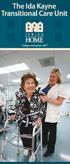 The Ida Kayne Transitional Care Unit Short-Term Rehabilitative Care for Seniors The Ida Kayne Transitional Care Unit (TCU) at the Los Angeles Jewish Home is designed to help seniors successfully transition
THE CURRENT SCIENCE OF BRAIN INJURY AND REHABILITATION
 THE CURRENT SCIENCE OF BRAIN INJURY AND REHABILITATION Tuesday, September 18, 2012 Dartmouth-Hitchcock Medical Center, Lebanon, NH Agenda 7:15 7:45 AM Registration and light breakfast 7:45 8:00 AM Welcome
ANTIPSYCHOTIC DRUG USE. HHS Has Initiatives to Reduce Use among Older Adults in Nursing Homes, but Should Expand Efforts to Other Settings
 United States Government Accountability Office Report to Congressional Requesters January 2015 ANTIPSYCHOTIC DRUG USE HHS Has Initiatives to Reduce Use among Older Adults in Nursing Homes, but Should Expand
Outline & Objectives Clinical Assessment of the Older Patient for Driving Fitness
 Outline & Objectives Clinical Assessment of the Older Patient for Driving Fitness Presented by: Linda Hill, MD, MPH Professor, UC San Diego School of Medicine A collaborative effort by the Division of