
ARTIFICIAL LIGHTING lecture notes
|
|
|
- Abigail Hoover
- 9 years ago
- Views:
Transcription
1 ARTIFICIAL LIGHTING lecture notes Dr. Habil. András Majoros Figures, images and tables by Levente Filetóth Budapest University of Technology and Economics Faculty of Architecture Department of Building Energetics and Services Prof. András Majoros: Artificial Lighting 1.

2 LIGHTING AND THE VISUAL ENVIRONMENT THE COMPONENTS OF THE VISUAL ENVIRONMENT The goal of lighting is to make the environment visible, the visual environment is a visible environment. The aim of lighting is to create an adequate visual environment. The internal visual environment comes into being by illuminating a room. Thus, there are two components of the visual environment - one is a usually furnished room with surfaces reflecting light to a greater or lesser extent, - this is a basically passive component- and - the other is light, which (as an active component) makes the room visible. The surfaces of the interior can be characterized by their reflectance, while the use of light can be described by the illuminance of the surfaces. LIGHT AND ITS QUALITY Light is the visible part of the electromagnetic spectrum between the wavelengths of l = nm. Its symbol is Φ e, its unit is Watt [W] Each wavelength corresponds to a given colour as shown in the following figure. Colours at shorter wavelengths are called cool (colours like purple and blue), colours at longer wavelengths are called warm colours (like orange and red). We use so called white light for lighting, as the natural light that human vision developed by was white light, too. It is a peculiarity of white light that it contains radiation at every wavelength of the visible range, and that the intensity of radiation at the different wavelengths vary to a certain extent. Thus, white light may vary. White lights differ from each other in colour combination, so white lights may differ in quality. The quality of white light can be characterized with its spectral distribution. There are two aspects of the quality of light that are important in practice. The quality of white lights may differ because they may contain consecutive colours in varying ratios. The quality of a white light can be characterized in practice from this point of view with the help of colour temperature. The colour temperature of a given light is the temperature of the black Prof. András Majoros: Artificial Lighting 2.

3 body, at which the spectral distribution of its radiation is nearly the same as that of the given light, its symbol is T, its unit is Kelvin [K]. A lower colour temperature means warmer light, a higher colour temperature indicates cooler light. The ratio of red is higher in warm light, while the ratio of blue is higher in cool light. The colour temperature of the incandescent lamp shown in Figure 0.2 is K. The quality of white light may also vary according to how much the colour of the surfaces illuminated by the light appear to be different when illuminated by artificial light compared to the colour they appear to be when illuminated by natural light. From this point of view, the quality of white light can be given with the help of colour rendering. The better the colour rendering of a white light, the less difference the colour of the surface shows when illuminated by it and by natural light. The degree of colour rendering can be given with the help of the colour rendering index in %, whose symbol is R a. R a = 100 % when colour rendering is perfect. Prof. András Majoros: Artificial Lighting 3.

4 THE QUALITIES OF SURFACES The reflection of surfaces can be characterized in an exact way by the reflection factor expressed as a function of wavelength ρ(λ). Surfaces can be classified into two groups: 1. The group of non-coloured surfaces. It is typical of these surfaces that they reflect nearly the same portion of light at every wavelength as shown in the following figure. When illuminated with white light, that is to say with a light containing all the colours in nearly the same proportion, these surfaces seem white, black or various shades of grey. 2. The other is the group of coloured surfaces. It is typical of these surfaces that their reflection varies greatly at different wavelengths. As wavelengths correspond to colours, the above surfaces seem to be the colour at whose range their reflection is dominant when illuminated with white light. Prof. András Majoros: Artificial Lighting 4.

5 It is essential to note that the colour of a given surface is not an inherent quality, existing independently of everything, but it is a quality affected by both the characteristics of the surface and the quality of the light that illuminates it. Consequently, what colour a surface seems to be depends on the colour distribution - the quality - of the illuminating light as well. Still, people attribute natural colours to materials. Those are the colours the materials have by natural lighting. As natural light is a white light, and its quality may vary, people associate many different natural colours with a given material. The colour of a surface is the perception generated by the spectral distribution of the light reflected from it Φ ρ (λ). It depends on the reflection factor of the surface as a function of wavelength - ρ(λ) - and on the spectral distribution of the illuminating light - Φ i (λ) as illustrated by the following equation Φ ρ (λ) = ρ(λ) * Φ i (λ) The colour of a given surface may vary. The colours associated to surfaces (materials) in our minds are the colours that they seem to have by natural lighting, so - grass is green, as natural light contains all the colours, including green, grass reflects the green part of the light, and absorbs the rest of the light. The same grass is practically black if it is illuminated with red light. - milk is white, as it reflects every part of the natural light in nearly equal measure, so the reflected light is white light. When milk is illuminated with red light, it reflects only red light, and it looks red. The spectral distribution of natural light is always changing, the components of direct sunlight, of the light of an overcast sky, that of a clear or partly cloudy sky are different, and different colours are present in these lights to differing degrees. As a result, different natural colours are associated with the surfaces and materials of the environment. We consider grass green by different sky conditions, whether the sun shines or not. Prof. András Majoros: Artificial Lighting 5.

6 THE CHARACTERISTICS OF THE VISUAL ENVIRONMENT We see the elements of our environment as having some colour and brightness. The brightness of a surface is the so called L luminance. The lighter the surface, the greater its luminance is. In a word, it is the luminance and the colour of certain elements of the surfaces we perceive. The greater the reflection (ρ) and the illuminance (E) of a surface is, the lighter it is, in other words L = ρ * E The visual environment is the spatially arranged surface elements of our field of view, that is Σ (field of view) ρ * E The visual environment is a product of the passive environment (ρ) and of active illumination (E). The two components are inseparably involved in the result. The brightness of a darker, but better illuminated surface may be the same as the brightness of a dimly illuminated lighter surface. To sum it up, the visual environment is a three dimensional coloured image of the field of view, a spatial arrangement of luminances and colours. It follows from the fact that the visual environment is a product of the environment and of illumination, that -a good visual environment is a product of a well formed interior and of adequate illumination, -neither a badly formed environment, nor inadequate illumination, can result in a good visual environment. The goal of lighting is to create an appropriate visual environment. What constitutes an adequate visual environment can vary from case to case. The visual environment has to meet a double requirement: -on the one hand, we require background information from our environment, we would like to know what is, and what is happening around us. This requirement has to do with the actual field of view. -on the other hand, we require a more or less accurate picture of a certain part of our environment. This requirement is based on the activity done in the room, and it has to do with the centre of the field of view. Usually the latter requirement, the requirement to see details clearly is more exacting. Being able to get exact information on the environment means being able to differentiate the dimensions, luminances, colours and spatial positions of the details. Prof. András Majoros: Artificial Lighting 6.

7 THE CHARACTERISTICS OF VISION The visual environment is created for people, therefore its peculiarities have to be taken into account when forming it. From the point of view of lighting, the following qualities of human vision have to be taken into account : 1. Human eyes can see nearly a hemisphere, but only a relatively small part of it, in the axis of the field of view, is perceived exactly. 2. We can see colours only in light environments. If it is dark, we can only see the environment in black and white. 3. The sensitivity of the human eye depends on the wavelength (colour) of the perceived light as shown in the figure of V λ (λ). If the intensity of the radiation reaching the eye is the same at every wavelength, we perceive as the lightest colour - the yellow-green colour at 555 nm in a light environment, - the blue-green colour of 505 nm in a dark environment. The name of V λ (λ) is the curve of spectral luminous efficacy. Prof. András Majoros: Artificial Lighting 7.

8 It follows from the above, that light seen by the eyes, as a physical effect, is not the same as the luminous flux, the sense of light. The luminous flux is the part of radiant light that produces a visual impression, its symbol is Φ, its unit is lumen [lm]. Although only the term of "luminous flux" should be used, the term "light" is often used carelessly in everyday practice. 4. The human eye can adapt its sensitivity to light. This process is called adaptation. Different levels of adaptation correspond to environments lit to various degrees. The adaptability of vision does not mean we are able to see equally well in every environment. Our vision is better in brighter environments than in darker environments. When the environment changes, when it gets brighter or darker, our vision has to adapt to it, which takes time. The time required for full adaptation is nearly one hour. 5. We are able to see clearly objects at various distances. This quality of vision is called accommodation. 6. We perceive the ratios of brightness logarithmically. Consequently, - relatively unevenly illuminated homogeneous surfaces seem to be of nearly the same brightness, - nearly evenly illuminated, non-homogeneous surfaces seem more homogeneous, - in order for a surface to be twice as bright as another, the ratio of their brightness has to be 1:10. Prof. András Majoros: Artificial Lighting 8.

9 THE VISUAL TASK AND THE VISUAL ENVIRONMENT When forming an adequate visual environment, two essential questions have to be answered:. 1. What constitutes an adequate visual environment in the given circumstances? 2. How can the visual environment be made adequate? The question of "What constitutes an adequate visual environment in the given circumstances? " can be answered on the basis of the characteristics of vision and on those of the visual task originating from the activity performed in the interior. A given visual task requires a certain visual ability. Visual ability is the accuracy and speed of visual processing. The measurable parameters of visual ability are the following: - visual accuracy, - contrast sensitivity and - speed. Visual accuracy is the reciprocal of the minimum angle α min, at which two points can be differentiated from each other. Contrast sensitivity is the reciprocal of the minimum contrast C min that can be perceived. Speed is the speed of visual processing. Visual ability is affected by the visual environment. The visual environment is characterized by its average luminance. The conditions of a well-defined visual ability are a product of a certain level of average luminance of the visual environment. In order to achieve the desired visual ability, the visual environment, as a possible field of view, has to have a certain level of average luminance. Prof. András Majoros: Artificial Lighting 9.

10 The relationship between the characteristics of visual ability and the average luminance of the field of view is illustrated by the following figure. In any visual task, the size of the part of the object to be seen as well as the distance between the object and the viewer defines a minimum angle of α *. That is the minuteness of detail we have to see the object with in order to get adequate information. The visual environment has to provide a visual accuracy appropriate for 1/ α *. Prof. András Majoros: Artificial Lighting 10.

11 Contrast C * between the brightness of an object and its surroundings defines a contrast sensitivity of 1/C *, which is required in a given visual task in order to get the correct visual information. The above two parameters (1/α * and 1/C * ) determine the minimum visual ability for a given task. As the above figure shows, the average luminance of the field of view has to be a L * t hat is larger than both L α * and L c *. How can the visual environment be changed to achieve an adequate L *, as the average luminance of the field of view? As the luminance of a surface is the product of the reflection factor (ρ) and the illuminance (E) of the surface, i.e. L = ρ * E the luminance of certain elements of the field of view can be changed either by changing the reflectance of the surfaces, or by changing their illuminance. Lighter surfaces and higher illuminances equally result in better visual ability, that is to say, they enable us to perceive smaller details and smaller contrasts. Moreover, it follows from the above equation that there are two ways of changing visual ability and/or the visual environment: - one is changing the ρ reflectance of the surfaces architecturally, - the other is changing the illuminance E by means of lighting engineering. The interior space is usually given prior to designing its lighting system. Consequently, it is the duty of lighting to provide an adequate visual environment (visual ability - average luminance of field of view) for a given activity or visual task. Prof. András Majoros: Artificial Lighting 11.

12 In order to provide the surfaces of a room with adequate illuminance, it is necessary to "put" enough light into the room. The amount of luminous flux generated and distributed in the interior has to be sufficient to illuminate certain surfaces to the required degree. LIGHT SOURCES Light sources are instruments of producing light. Light sources are technical devices which convert usually electric energy into radiation - partly to light. Based on the way they work, light sources are divided into two types of lamps: - incandescent, and - luminescent. In incandescent lamps, light is produced by the radiation of a filament at high temperature. The spectrum of the light generated in this way contains radiation at every wavelength and its spectrum is monotonous. A considerable amount of heat is generated at the same time as light. Incandescent lamps used in practice are - filament incandescent lamps, - tungsten halogen lamps for mains voltage, and - low voltage tungsten halogen reflector lamps. In luminescent lamps light is generated by excited electrons. An electric arc excites light in a socalled arc tube or on the surface of the envelope, as the case may be. The spectrum of the light generated this way is not necessarily continuous, radiation is much larger in certain narrow bands than in others, and the spectrum is not monotonous. Luminescent lamp used in practice are - fluorescent lamps, - compact fluorescent lamps, - mercury lamps, - mercury tungsten blended lamps, - metal halide lamps, and - high pressure sodium lamps. From the point of view of their practical use, light sources can be characterized by their: - construction and operation, and their - technical data: rated voltage: is the voltage that the base of the lamp can be connected to for normal operation. In incandescent and main voltage tungsten halogen lamps, it is the same as the rated voltage of the building's network, in other cases it may be different. nominal input: is the electric power consumed by the lamp alone under rated circumstances. If auxiliaries are needed for the operation of the lamp, the input of the light source - auxiliary unit is larger than that of the lamp alone. type of base: the type of technical design by which the lamp is connected to the electric network. measurements: the main measurements of a lamp, (such as diameter, length, etc.,) that are important from the point of view of installation. Prof. András Majoros: Artificial Lighting 12.
13 - the quality of light: spectral distribution: Φ e (λ) the distribution of light. colour temperature: T [K] colour rendering: R a [%] - cost efficiency: luminous efficacy: is the ratio of P r rated input of lamp and the Φ o luminous flux it produces, its symbol is K, its unit is [lm/w] Φ o lm K = P r W Luminous efficacy does not take into account the consumption of the auxiliaries! life time: is the length of time in which 50% of a large group of lamps becomes unfit for service. initial and running costs starting time: is the length of time a lamp needs to reach its total light output after it has been switched on. restarting time: is the length of time a lamp needs to reach its total light output when it is switched on soon after being switched off. temperature values the effects of circumstances on the above characteristics. Prof. András Majoros: Artificial Lighting 13.
![[lm/w] Φ o lm K = ------- ---- P r W Luminous efficacy does not take into account the consumption of the auxiliaries!](/docs-images/47/19806490/images/page_13.jpg "life time: is the length of time in which 50% of a large group of lamps becomes unfit for service.")
14 INCANDESCENT LAMPS Design and operation: Light in an incandescent lamp is produced by a tungsten filament heated by electric current. The red hot tungsten filament (about 2800 K) is in a bulb filled with a noble gas. The electric connection is made possible by a special base at one or both ends. Incandescent lamps convert only about 1/10 of the input into light. Prof. András Majoros: Artificial Lighting 14.

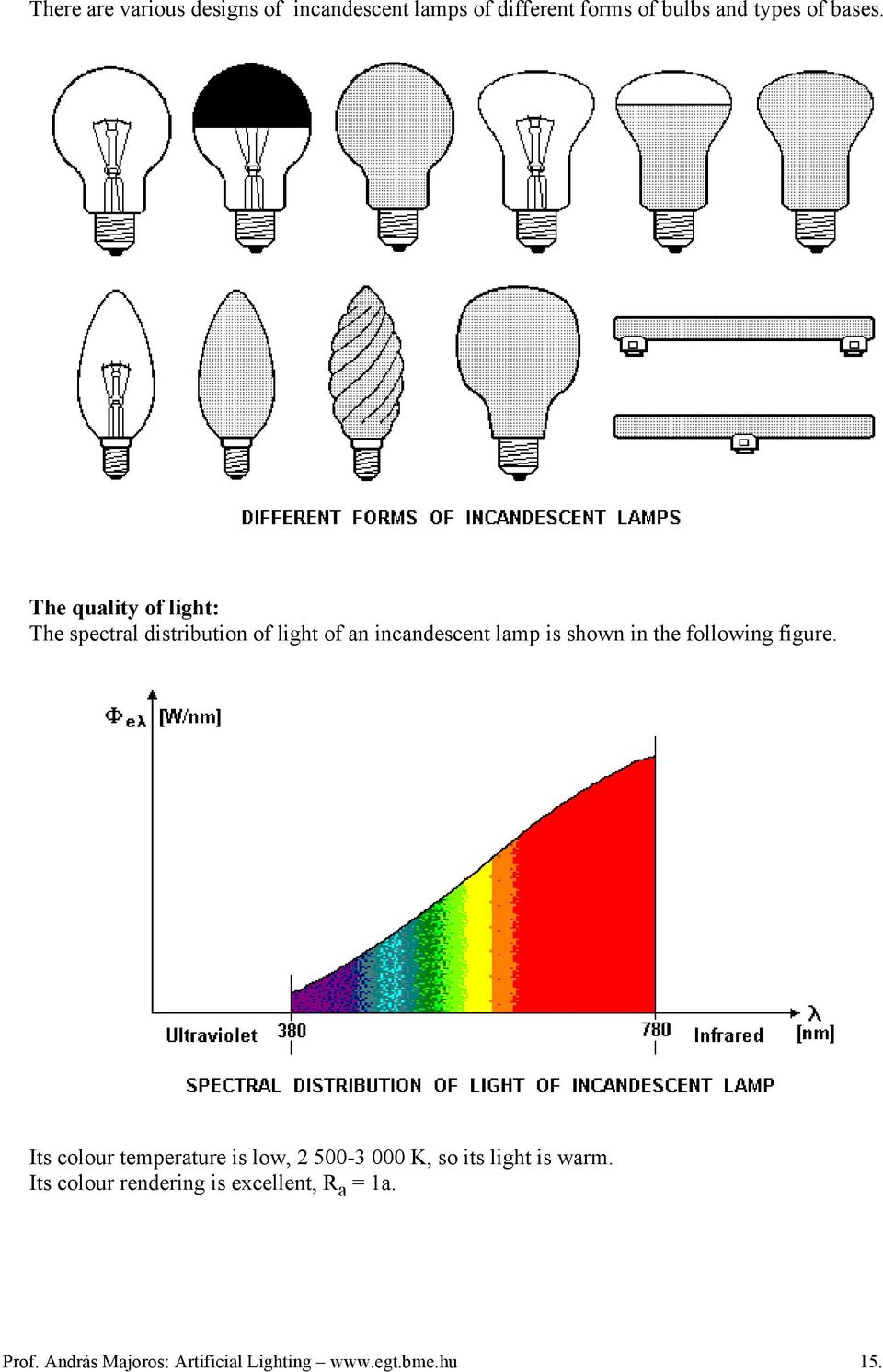
15 There are various designs of incandescent lamps of different forms of bulbs and types of bases. The quality of light: The spectral distribution of light of an incandescent lamp is shown in the following figure. Its colour temperature is low, K, so its light is warm. Its colour rendering is excellent, R a = 1a. Prof. András Majoros: Artificial Lighting 15.
16 Technical data: The rated voltage of incandescent lamps mainly used for lighting interiors is V. Low voltage - 6, 12 and 24 V - lamps are mainly used for safety reasons. The values of rated wattage of normal incandescent lamps are 25, 40, 60, 75, 100, 150, 200, 500, and W. The so-called Edison base, whose symbol is E, is the most commonly used base. E 14, E 27 and E 40 are the various sizes of the Edison base, the most common being E 27. Different bases are used for different rated inputs of lamps as follows: E 14 base is used for W, E 27 base is used for W, E 40 base is used for 150-2,000 W. The luminous flux generated by one incandescent lamp is: ,000 lm. Cost efficiency: The luminous efficacy of incandescent lamps is 6-20 lm/w. Their life time is usually 1,000 hours, but it may be more than double in certain types. Their initial cost is generally low, due to their simple design. Their initial cost per produced luminous flux is the lowest, although the price ratio of certain types may be 1:8. Their running cost per produced luminous flux is relatively high, due to their bad luminous efficacy and their short life time. Operating qualities: Incandescent lamps produce total light practically immediately after they have been switched on. (starting time is <0.1s). They provide total luminous flux without delay when they are switched on immediately after being switched off, or following a break in the voltage of the network (restarting time is <0.1 s). Their life is affected by the voltage of the voltage supply. The larger the voltage, the shorter the lamps' life time. The operating temperatures of the bulb and the base are high. Temperatures at the top of the bulb may exceed 300 o C. Temperatures along the lamps depend on the burning position. Their burning position is optional. Prof. András Majoros: Artificial Lighting 16.

17 REFLECTOR INCANDESCENT LAMPS Technical data: The design and operation of reflector incandescent lamps are the same as those of normal lamps. The difference is that the inner surface of the envelope nearest the base is mirrored, and this part of the bulb has a parabola shape. As a result, the lamp radiates light at a certain angle. Mirrored lamps are made from standard glass or with special glass - the latter are called PAR lamps. Their usual rated wattages are 40, 60, 75, 100 and 150 W, their bases are generally E 27. In reflector lamps, luminous intensity by the axis of the radiation I o and the so-called beam angle are given instead of the luminous flux. The beam angle is the angle of a cone of radiation in which the luminous intensity is 50% of the maximum at the axis I o. The usual values of the beam angle are 12 o, 15 o, 20 o, 25 o, 30 o, 35 o, 40 o and 80 o. Reflector lamps are made either with narrow beams of radiation (called spot lamps) or with wide beams of radiation (called flood lamps). Prof. András Majoros: Artificial Lighting 17.

18 TUNGSTEN HALOGEN LAMPS FOR MAINS VOLTAGE Design and operation: Their design differs from that of standard incandescent lamps in the following ways. The light source is linear, the envelope is made from quartz glass, and the tube contains halogens - hence the name. Bases are situated at both ends of the tube. Their operation is the same as that of standard incandescent lamps. The quality of light: The spectral distribution of their light is practically the same as that of standard incandescent lamps. Their colour temperature is low, 2,800-3,300 K, so the colour of their light is warm. Their colour rendering is excellent, R a = 1a. Technical data: Their rated voltage is generally between V, their rated wattages are 100, 150, 200, 250, 300, 500, 750, 1,000, 1,500 and 2,000 W. They have special bases for electric connection. The luminous flux generated by one lamp is: 1,300-44,000 lm. Cost efficiency: The luminous efficacy of these halogen lamps is lm/w, better than that of standard incandescent lamps. Their life time (2,000-3,000 hours) is longer than the life time of standard incandescent lamps. Their initial cost is generally low, due to their simple design. Their initial cost per produced luminous flux is somewhat (by about 25%) higher than that of the cheapest standard incandescent lamps. Their running cost per produced luminous flux is relatively high, due to their relatively poor luminous efficacy and relatively short life time. Operating qualities: Halogen lamps produce total light practically immediately after they are switched on (starting time is <0.1s). They provide total luminous flux without delay when they are switched on immediately after being switched off, or following a break in the voltage of the network (restarting time is <0.1 s). The operating temperature of the bulb may exceed 300 o C. Their burning position is horizontal 4-15 o. Prof. András Majoros: Artificial Lighting 18.

19 LOW VOLTAGE TUNGSTEN HALOGEN REFLECTOR LAMPS Design and operation: In these lamps, a small light source is built together with a mirror lamp, thus becoming a compact unit for further installation. They operate in essentially the same way as standard incandescent lamps. The quality of light: The spectral distribution of their light is the same as that of standard incandescent lamps. As a result of the special mirror design, their heat radiation per light is lower than that of other incandescent or halogen incandescent lamps. Their colour temperature is low, 2,800-3,000 K, so their light is warm. Their colour rendering is excellent, R a = 1a. Technical data: Their rated voltages are as a rule 6, 12 or 24 V, their rated lamp wattages are generally 10, 12, 20, 35, 50, 75 and 100 W. They have special bases. Their beam angle is usually between 8-60 o. The luminous flux generated by one lamp is: lm. Cost efficiency: Their luminous efficacy is lm/w, somewhat better than that of standard incandescent lamps, but the luminous efficacy of the lamp-transformer unit is practically the same as that of standard lamps if the loss caused by the feeding transformer is taken into account. Their life time is 2,000-5,000 hours. Their initial cost is relatively high, due partly to the transformer and partly to their complicated (lamp and mirror) design. Their initial cost per produced luminous flux is very high, -- about 15 times higher than that of simple standard incandescent lamps. Their running cost per produced luminous flux is relatively high, due to their relatively poor luminous efficacy and their relatively short life time. Operating qualities: Low voltage halogen lamps produce total light practically immediately after they are switched on (starting time is <0.1s). They provide total luminous flux without delay when they are switched on immediately after being switched off, or following a break in the voltage of the network (restarting time is <0.1 s). The operating temperature of the bulb may exceed 300 o C. Their burning position is optional. Prof. András Majoros: Artificial Lighting 19.

20 FLUORESCENT LAMPS Design and operation: The light is produced predominantly by the fluorescent powder covering the inner wall of the tube. This powder transforms the UV radiation of the gas discharge into visible light. Fluorescent lamps can only operate with the help of auxiliaries (starter, ballast, capacitor, electronic control gear, etc.). These ensure the starting and the continuity of gas discharge. The following figures show the most commonly used connections of fluorescent lamp-auxiliaries. Fluorescent lamps convert about 1/4 of their input into light. This ratio is smaller if the auxiliaries are also taken into account. Prof. András Majoros: Artificial Lighting 20.

21 The quality of light: The quality of light of fluorescent lamps may vary depending on the composition and quality of the fluorescent powder. Consequently, the spectral distribution of their light may also vary. The different quality of their light is indicated by a combination of a letter and a number, as shown in the following figure. Their colour temperature may be 2,900-6,500 K, so their light may be warm, neutral or cool. Their colour rendering varies, too, R a = 1a, 1b, 2a, 2b or 3. Technical data: The rated voltages of the tubes are between 57 and 110 V, which means that they can be operated from the 230 V of the network if the proper auxiliaries are used. The rated lamp wattage equals the input of the tube, consequently, the consumption of the auxiliary unit is higher. Depending on the sort of ballast, the input from the network exceeds that of the lamp by about - 20 % in case of normal ballast, - 10 % in case of low loss ballast and - 5 % in case of electronic ballast. The data of the rated wattages, lengths and diameters of the most commonly used fluorescent lamps are shown below: 20 W Φ 38 mm l = 590 mm 18 W Φ 26 mm l = 590 mm 14 W Φ 16 mm l = 548 mm 40 W Φ 38 mm l = 1200 mm 36 W Φ 26 mm l = 1200 mm 28 W Φ 16 mm l = 1148 mm 65 W Φ 38 mm l = 1500 mm 58 W Φ 26 mm l = 1500 mm 35 W Φ 16 mm l = 1448 mm The luminous flux generated by one lamp is: 1,000-5,400 lm. Cost efficiency: The luminous efficacy of fluorescent lamps depends on - the fluorescent powder used, - the rated wattage and - the diameter. Depending on the above parameters, their luminous efficacies are lm/w, for Φ 38 mm lm/w, for Φ 26 mm lm/w. for Φ 16 mm These values are smaller if the consumption of the necessary auxiliaries are taken into account. Their probable life time is 7,500-15,000 hours. Prof. András Majoros: Artificial Lighting 21.
22 Their initial cost is relatively high, due partly to the necessary auxiliaries and partly to their complicated design. Their initial cost per produced luminous flux is about 7 times higher than that of simple standard incandescent lamps. Their running cost per produced luminous flux is relatively low, due to their good luminous efficacy and long life time. Operating qualities: Fluorescent lamps produce total luminous flux in about 1 second after they have been switched on or after being switched off and on. Their life time mainly depends on the type of ballast used and the frequency with which they are switched on and off. The operating temperature of the tubes is o C. The burning position of the tubes is optional. Prof. András Majoros: Artificial Lighting 22.
23 COMPACT FLUORESCENT LAMPS Design and operation: Compact fluorescent lamps are usually relatively small fluorescent light sources that are or can be built together with the auxiliaries partly or completely. They operate the same way as standard fluorescent lamps. The usual types of compact fluorescent lamps - are built together with conventional or electronic ballast (fully compact), - are built together with starter and capacitor, can be plugged to the ballast or - can be plugged to the auxiliaries. Prof. András Majoros: Artificial Lighting 23.
24 The quality of light: The quality of the light of compact fluorescent lamps depends on the composition of the fluorescent powder. Consequently, the spectral distribution of their light may vary. Their colour temperature is between 2,900-6,500 K, so their light may be warm, neutral or cool. Their colour rendering is usually good, R a = 1a, 1b. Technical data: Their rated voltage depends mainly on the type. In the fully compact type it is 230, 240 V, in cases when they have to be connected to the network through auxiliaries, it is usually between 35 and 110 V. Rated lamp wattages - the input of the unit - are usually: 5, 7, 9, 11, 15, 20, 23, 24, 26, 28, 32 or 36 W. They are made either with special bases or with E 27 bases, which makes it possible to use them instead of incandescent lamps. The luminous flux generated by one lamp is: 250-2,900 lm. Cost efficiency: If they are built together with the ballast, their luminous efficacy is lm/w, if they are not, it is lm/w. Their probable life time is 8,000-10,000 hours, i.e. several hundred thousand times of switching. Their initial cost is relatively high, due to the more or less complicated design of the lamp. Their initial cost per produced luminous flux is about 3? times higher than that of simple standard incandescent lamps. Their running cost per produced luminous flux is relatively low, due to their good luminous efficacy and long life time. Prof. András Majoros: Artificial Lighting 24.
25 Operating qualities: Compact fluorescent lamps produce total luminous flux in a few seconds after they have been switched on. Total luminous flux is produced in about 1 second after they are switched off and on. Their light output depends on the environmental temperature and on their burning position. The operating temperature of the tubes is o C. The burning position of the tubes is optional. Prof. András Majoros: Artificial Lighting 25.
26 MERCURY LAMPS Design and operation: Mercury lamps belong to the group of HID (high intensity discharge) lamps. These lamps have two envelopes. The inner quartz envelope is an arc tube. The gas discharge is started by a starting electrode. The radiation generated by the electric current through mercury vapour is only partly light, its invisible part is transformed into light by the fluorescent powder on the inside surface of the outer envelope. Mercury lamps need auxiliaries (ballast or starter-transformer) for their operation. Mercury lamps convert only about 1/6 of the input into light. This ratio is smaller if the consumption of the auxiliary is taken into account. Prof. András Majoros: Artificial Lighting 26.
27 The quality of light: The quality of their light may vary depending on the fluorescent powder used. The following figure shows the spectral distribution of the light of mercury lamps. Their colour temperature is 3,350-4,000 K, so their light is warm or neutral. Their colour rendering is bad, R a = 3. Their luminance is high. Technical data: Their rated lamp voltage is V. Their rated lamp wattages are 50, 80, 125, 175, 250, 400, 700 and 1,000 W. The base of the lamps up to 125 W is usually E 27, in bigger units E 40 is used. Lamps are made with other bases, too. The luminous flux generated by one lamp is: 1,800-58,000 lm. Cost efficiency: The luminous efficacy of the lamps is lm/w, but these values are smaller if the auxiliary is taken into account. The life time of mercury lamps is 8,000-20,000 hours. Their initial cost is relatively high, due to the complicated design of the lamps and the auxiliaries needed. Their initial cost per produced luminous flux is about 13 times higher than that of simple standard incandescent lamps. Their running cost per produced luminous flux is relatively low, due to their good luminous efficacy and long life time. Operating qualities: Mercury lamps produce total luminous flux in a matter of minutes after they have been switched on. (starting time is 2-5 min.) Total luminous flux is produced in about 10 minutes after they have been switched off and on (restarting time 10 min.). The burning position of the tubes is optional. Prof. András Majoros: Artificial Lighting 27.
28 MERCURY TUNGSTEN BLENDED LAMPS Design and operation: Mercury tungsten blended lamps are mercury lamps whose ballast is a tungsten filament located between the two envelopes. The tungsten filament acts as an incandescent lamp. In this way, no auxiliary is needed, they can be used like incandescent lamps. Discharge in the quartz glass arc tube is started by a starting electrode. The radiation generated by the electric current through mercury vapour is only partly light, whose invisible part is transformed into light by the fluorescent powder on the inner surface of the outer envelope. The quality of light: The quality of the light of these lamps may vary depending on the fluorescent powder used. The spectral distribution of their light is similar to that of mercury lamps. Their colour temperature is 3,000-4,200 K, so their light is warm or neutral. Their colour rendering is bad, R a = 3. Their luminance is high. Technical data: Their rated lamp voltage is V. Their rated lamp wattages are generally 160, 250 and 500 W. The bases of lamps of 160 W are usually E 27, those of larger units are E 40. Lamps are made with other bases, too. The luminous flux generated by one lamp is: 3,000-14,000 lm. Prof. András Majoros: Artificial Lighting 28.
29 Cost efficiency: The luminous efficacy of these lamps is lm/w. The life time of mercury tungsten blended lamps is 8,000-10,000 hours. Their initial cost is relatively high, due to the complicated design of the lamp and the auxiliary needed. Their initial cost per produced luminous flux is about 11 times higher than that of simple standard incandescent lamps. Their running cost per produced luminous flux is better than that of incandescent lamps, but worse than that of other discharge lamps, due to their relatively poor luminous efficacy and long life time. Operating qualities: Mercury tungsten blended lamps produce a considerable part of the total luminous flux in 0.1 sec after they have been switched on, but they reach total luminous flux only a few minutes (in 5 min.) after switching on. Total luminous flux is produced about 10 minutes after they are switched off and on (restarting time 10 min.). The burning position of the lamps can be either optional or vertical with defined deviation. METAL HALIDE LAMPS Design and operation: Metal halide lamps are HID lamps, too. They have two envelopes. The inner quartz arc tube contains other metal halides in addition to mercury. Light is generated in the arc tube either with the help of an auxiliary electrode or with the help of a starting impulse. The outer envelope may or may not have a fluorescent powder coating. Prof. András Majoros: Artificial Lighting 29.
30 Metal halide lamps convert only about 1/4 of the input into light. This ratio is smaller if the consumption of the auxiliary is taken into account. Prof. András Majoros: Artificial Lighting 30.
31 The quality of light: Their quality of light depends on the metal halides used in the arc tube. Their spectral distribution is shown in the next figure. Their colour temperature is 3,000-6,000K, so their light may be warm, neutral or cool. Their colour rendering is usually good, R a = 1a, 1b or 2a. Technical data: Their rated lamp voltage is V. Their rated lamp wattages are 35, 75, 150, 250, 400, 1,000, 2,000 and 3,500 W. The base of the lamps are either Edison type or a special type at both ends. Metal halide lamps are produced as reflector lamps, too. The luminous flux generated by one lamp is: 2, ,000 lm. Cost efficiency: The luminous efficacy of the lamps is lm/w, these values are smaller if the auxiliary is taken into account. The life time of mercury lamps is hours. Their initial cost is relatively high, due to the complicated construction of the lamp and the auxiliary needed. Their initial cost per produced luminous flux is about 10 times higher than that of simple standard incandescent lamps. Their running cost per produced luminous flux is relatively low, due to their good luminous efficacy and more or relatively long life time. Operating qualities: Metal halide lamps produce total luminous flux in a matter of minutes after switching on (starting time is about 5 min.). Total luminous flux is produced in about 10 minutes after they are switched off and on (restarting time 10 min.). In some special types with extra built in electrodes restarting time is only a few seconds. The burning position of the tubes is usually defined. Prof. András Majoros: Artificial Lighting 31.
32 HIGH PRESSURE SODIUM LAMPS Design and operation: High pressure sodium lamps belong to the group of HID lamps. They have two envelopes. Light is produced by the electric current through high pressure sodium vapour in the arc tube, which is made of aluminum-oxide. Light is usually generated with the help of a high voltage impulse. There are, however, some types that do not require a starter. High pressure sodium lamps are made either with transparent or translucent outer bulbs. Prof. András Majoros: Artificial Lighting 32.
33 High pressure sodium lamps convert only about 1/3 of the input into light. This ratio is smaller if the consumption of the auxiliary is taken into account. The quality of light: The quality of light of sodium lamps is not very good. Its spectral distribution is shown in the following figure. The colour temperature of these lamps is 2,000-2,200 K, so their light is warm. Their colour rendering is bad, R a = 3 or 4. Technical data: Their rated lamp voltage is about V. Their rated lamp wattages are usually 50, 70, 100, 150, 250, 400, 600, 1,000, 2,000 and 3,500 W. The base of the lamps are Edison type or a special type at both ends. All of them need auxiliaries for their operation. The luminous flux generated by one lamp is: 2, ,000 lm. Cost efficiency: The luminous efficacy of the lamps is lm/w, these values are smaller if the auxiliary is taken into account. The life time of mercury lamps is 10,000-28,000 hours. Their initial cost is relatively high, due to the complicated design of the lamp and the auxiliary needed. Their initial cost per produced luminous flux is about 13 times higher than that of simple standard incandescent lamps. Their running cost per produced luminous flux is very low, due to their very good luminous efficacy and very long life time. Operating qualities: High pressure sodium lamps produce total luminous flux in 6-15 minutes after being switched on. Total luminous flux is produced in about 1-5 minutes after they are switched off and on. The burning position of the tubes is optional. Prof. András Majoros: Artificial Lighting 33.
34 THE ROUTE OF LIGHT FROM THE LIGHT SOURCE TO THE REFERENCE PLANE In artificial lighting, the interior is illuminated by the luminous flux of a lamp. The light of a light source reaches the surfaces of the room through the luminair. The surfaces of the interior more or less reflect this light, and they illuminate each other in the process. Each instance of reflection reduces the amount of available light, so finally it is absorbed. At a given moment, a given surface is illuminated at the same time both by light directly radiated from the lamp and by light indirectly reflected from the surfaces. It follows from what has been said above that every element of surface of a room is practically illuminated by a hemisphere: the hemisphere that is "seen" by the element. So a given surface of the interior is illuminated by the luminaires and surfaces it sees, in other words, the surface is exposed to the luminous flux of a hemisphere, to light coming from different directions and at different intensities. There are different ways by which the light of a light source can reach a given surface of the room. These ways as well as the quantity and quality of the utilized luminous flux of the light source vary depending on the luminaire and the surfaces. If we want to take into account all the above, and we want to plan the illumination of the interior, we must clarify the details of this chain of effects. That is why it is advisable to follow the route of light from the light source to the reference plane. The light output of a light source is characterized quantitatively by Φ o luminous flux, and qualitatively by T colour temperature and R a colour rendering. Prof. András Majoros: Artificial Lighting 34.
35 Light sources are always built into luminaires. Luminaires serve several technical and lighting functions. Their most important technical functions are: - to fix the lamp and to supply it with energy, - to protect the lamp from the environment and the environment from the lamp. Their lighting functions as follows: The lamp radiates only part of the luminous flux into the room, and it absorbs the rest. The effectiveness of a luminaire from this point of view is called the efficiency of the luminaire. The efficiency of a luminaire is the ratio of the luminous flux emitted by the luminaire Φ L and the luminous flux generated by the lamp Φ o. Its symbol is η L, its unit is [%]. From the point of view of lighting, the most important function of a luminaire is to distribute light in the room in the required stereoscopic manner. Luminaires can distribute and direct the light of lamp into space in different ways. Light distribution, 3D distribution of light emitted from a surface can be described by luminous intensity. Prof. András Majoros: Artificial Lighting 35.
36 Luminous intensity is the luminous flux per unit solid angle in question, its symbol is I, its unit is candela, [cd]. The distribution of a luminaire's light is characterized by so-called candle-power curves. A candle-power curve shows I luminous intensity in different directions on a plane laid through the luminair. As luminous intensity is a vector, each point of the candle-power curve represents the value of the luminous intensity vector pointing at the direction indicated by the point. Prof. András Majoros: Artificial Lighting 36.
37 Luminaires are classified according to their manner of lighting based on their light distribution: the ratio of luminous flux radiated up and down an endless horizontal plane lain through the luminaire. Prof. András Majoros: Artificial Lighting 37.
38 There is considerable difference between the possible utilization of the two parts of the luminous flux, since the part radiated down by the luminaire can, theoretically, reach the reference plane -in an infinitely large room-, but then the part of the luminous flux radiated up to an infinite plane can reach the reference plane only after one or more reflections, therefore only a fraction can be utilized. The ratio of illumination of a certain surface of the room is determined by the location of the luminaires in the interior and by their light distribution. Luminaires can affect the utilization of the light of a lamp in yet another way. If the transparent and/or reflecting part of the luminaire is coloured, the luminaire modifies the quality of the light of the light source. The transparent or reflecting parts of luminaires that are used for general lighting are not coloured, so they do not change the light of the light source. Prof. András Majoros: Artificial Lighting 38.
39 The light emitted from the luminaire and illuminating the surfaces of the interior, can be described by illuminance. Illuminance is the luminous flux collected by unit of surface. Its symbol is E, its unit is lux [lx]. Illuminance is an effect the surface is exposed to. Illuminance of a surface depends on the direction of the incident light. Luminous flux produces the largest illuminance on a surface that is at right angle to it. Light will not illuminate a surface that it is parallel to. It follows from the above that a luminaire close to a surface can only illuminate effectively the part of the surface closest to it. Illuminances coming simultaneously from different sources add up. Prof. András Majoros: Artificial Lighting 39.
40 Surfaces change the characteristics of light in the following way: - Each surface reflects only part of the luminous flux, and absorbs the rest, - Surfaces change the direction of light - more or less dispersing it, - Coloured surfaces change the quality of light. The Φ o luminous flux reaching a surface is - partly reflected (Φ ρ ), - partly absorbed (Φ α ) and - partly transmitted (Φ τ ), if the surface is transparent. The ratio of these parts are ρ reflection factor α absorption factor τ transmission factor The ρ reflected part of the luminous flux is the part that is visually perceptible. It is this part that can be used to illuminate the surfaces of a room. Surfaces of different quality reflect and disperse light in different ways. Surfaces can be divided into three main classes as shown in the following figure. The dispersion of reflected light can be characterized with the distribution of luminous intensity. Prof. András Majoros: Artificial Lighting 40.
41 The figure illustrates the following: - mat surfaces reflect light evenly irrespective of the direction of the incident light, - mirrors and shiny surfaces reflect light highly unevenly and depending on the direction of the incident light. In mirrors, the illuminated point can only be seen from direction "B". In shiny surfaces, the illuminated point is darker from direction "A" than "B". In mat surfaces, the illuminated point is equally bright viewed from every direction. The quality i.e. the spectral distribution of Φ o (λ), the light illuminating the surface, and of Φ ρ (λ), the light reflected from the surface, may be the same or more or less different depending on the ρ(λ) reflection function of the reflecting surfaces, according to the following equation Φ ρ (λ) = ρ(λ) * Φ o (λ) With white, grey and black surfaces, the reflected and the illuminating light are nearly identical in quality. Coloured surfaces mainly absorb their respective colours, consequently the reflected and the incident lights differ greatly in quality. A reference plane is illuminated by the luminous flux coming directly from the luminaires, and indirectly by the luminous flux coming from some of the room's surfaces. A point of the reference plane is illuminated by all the points of the room which it "sees", i.e. every surface element is illuminated by a hemisphere, whose elements can be luminaires or surfaces illuminated and reflecting light to various degrees. The reference or working plane is the part of the room the visual task refers to. Normally, it is a horizontal plane 0.85m above the floor, or in communicating areas it is the floor. What the spectator sees is that parts of his or her field of view varies in brightness and colour. How is a surface seen? An observer viewing a surface from a given direction perceives an I* luminous intensity coming from an A* virtual size of surface. It is this that makes a surface look bright to some degree. What is seen is the luminance of the surface. Prof. András Majoros: Artificial Lighting 41.
42 Luminance is the luminous intensity of an element of surface seen as a unit. Its symbol is L its unit is cd/m 2. It follows from the above that - the luminance of mirrors and shiny surfaces varies with the direction of viewing, - the luminance of mat surfaces are constant independent of the direction of viewing. From the point of view of the visual environment, using mat surfaces is more advantageous. Prof. András Majoros: Artificial Lighting 42.
43 THE REQUIREMENTS OF LIGHTING Theoretically, lighting must meet the following requirements : 1. Lighting has to ensure the accurate and speedy vision that is necessary for the given task. 2. For accurate vision, the details of the object as well as the colour and spatial location of the details have to be seen as clearly as the task requires. 3. Visual discomfort caused by lighting has to be limited to an acceptable degree. 4. While meeting the requirements of the visual task, lighting has to be cost effective. The above theoretical requirements can be met in practice if the requirements of lighting are quantified. For accurate vision it is necessary to perceive the details of the task to an appropriate degree. The exact perception of a detail of the environment means being able to differentiate between the details, their luminances and colours to the required degree as well as perceiving their spatial location. The requirement of accurate vision can be met with definable values of the following characteristics of lighting: Illuminance on the reference plane, Colour rendering, and Shadow effect. Visual discomfort can be limited with definable values of the following characteristics of lighting: The colour of light, Glare, and The ratio of luminances. Lighting serves the visual task effectively: if the installation and operation of the artificial lighting system is cost effective, and if the process of visual perception is efficient. Requirements vary from case to case, i.e. the requirements of a given activity is one of a great number of possible combinations. ILLUMINANCE ON THE REFERENCE PLANE Every visual task has a reference plane. As most tasks have to do with work, the reference plane is sometimes called the working plane, too. Unless otherwise specified, the reference plane is generally a horizontal plane 0.85 m above the floor in working areas, or the floor in circulation areas. Every visual task requires a certain degree of visual accuracy and contrast sensitivity, i.e. a certain degree of visual ability. As visual ability depends on the average luminance of the field of view, and the luminances of the elements of the field of view depend on the ρ quality of the surface and on E illuminance of the surface according to the L = ρ * E equation, the average luminance of the field of view can be changed by changing the illuminance if the surfaces of the interior (ρ ) are constant. L E In this way, the requirement of the average luminance of the field of view can be defined as a requirement of illuminance. Prof. András Majoros: Artificial Lighting 43.
44 The usual values of reflectance of the bounding surfaces of the interior are: ceiling %, walls %, floor %, and it is recommended to keep the values within in the above range. The reflection factor of the reference plane may vary greatly in practice, still it can be defined rather accurately for a given activity. Thus, we can define the illuminance by which the average illuminance of the probable field of view satisfies the requirements of the visual ability necessary for the task if we know the characteristics of the visual task as well as the probable shape of the room (i.e. the reflectance of its surfaces). Luminance greater than necessary results in a greater average luminance of the field of view (higher level of adaptation) and, consequently, in greater visual ability. While greater illuminance improves achievement and decreases fatigue, it also raises both the initial and the running costs of lighting systems. In certain cases, we can define the optimum illuminance for visual processing. It is usually much higher than the minimum value necessary for the task. In present practice, illuminance for an activity is greater than the minimum value necessary for the task, but smaller than the optimum. For example, we are able to read by less than a hundred lux of illuminance, still the standardized nominal illuminance for reading is several hundred lux, the optimum illuminance, however, is about a thousand lux. Depending on their financial possibilities, countries specify different values of illuminance for various activities. Optimum illuminance - usually several thousand lux - is only permitted for a narrow range of tasks, even in the most well-to-do countries. The visual task that lighting has to serve follows from the activity in the room. So relevant standards specify the requirements of illuminance for rooms for certain activities. Requirements vary country by country, depending mainly on their financial possibilities. Demand on illuminance is given as E n nominal illuminance. This recommended illuminance is the average value for the reference plane. The values of nominal illuminance are generally standardized, the usual values being 20, 30, 50, 75, 100, 150, 200, 300, 500, 750, 1000, 1500, 2000, 3000 and 5000 lx. The nominal illuminance for a given activity can be chosen from the above values. The required average value of illuminance on the working plane has to be provided with standardized uniformity. This is to guarantee that there is enough illuminance on the worst illuminated part of the reference plane. Prof. András Majoros: Artificial Lighting 44.
45 The spatial uniformity of illumination can be characterized by the inequality of illuminance on the reference plane as shown in the following equation and figure. ε is the coefficient of spatial uniformity. The required value of spatial uniformity is usually between 1/3 and 1/10. If the logarithmical character of visual perception is taken into account, that means that the perceived difference of luminances of a homogeneous surface illuminated with 1/3-1/10 uniformity is between 70 and 130 %. Spatial uniformity has to be larger than 1/3 in working places used for activity needing uniform lighting. In rooms that are not used for work, in rooms used for relaxation, for communication or for waiting, minimum spatial uniformity is 1/10. The required ratio of average illuminances of parts of a room used for different activities or of rooms opening into each other must be greater than 1/5. Another problem connected to lighting is its change in time. A lighting system provides its greatest illuminance when it is installed. Then illuminance is gradually reduced by the aging of the lighting system and by the dirt gathering both on the lighting system and on the surfaces of the room. Consequently, the efficiency of lighting gets worse and worse. This reduction of output due partly to the deterioration of the conditions of vision and partly of the efficiency of the lighting system is acceptable only to a certain degree. Prof. András Majoros: Artificial Lighting 45.
46 80 % of the nominal illuminance is generally regarded as the lowest acceptable limit of average illuminance. If illuminance is reduced to this lowest limit, the lighting system has to be at least partly renewed, i.e. first of all the lamps should be replaced, the luminaires should be cleaned, and at less frequent intervals the surfaces of the room should be cleaned. In designing lighting, aging is usually taken into account through the so-called coefficient of aging ν ( its usual values are ) by designing lighting systems for a value of E i = ν * E n A smaller coefficient is used in cleaner environments, and a bigger one in dirty environments. So illuminance at the time of installing the lighting system exceeds nominal illuminance, and the period between maintenances may be longer, too. How to meet the requirement of illuminance? The required E i (lx) average illuminance on the A(m 2 ) working plane can be ensured by building in Φ o luminous flux generated by light sources. The amount of this luminous flux depends on the manner of lighting and the characteristics of the room. Only part of the Φ o built in luminous flux will reach the reference plane either directly, or indirectly, reflected from other surfaces. The efficiency of lighting is the ratio of luminous flux illuminating the reference plane (E i * A) and of the built in (Φ o ) luminous flux The efficiency of illumination indicates what portion of the luminous flux generated by lamps reaches the reference plane. The efficiency of illumination depends on: - the manner of lighting (direct, semi-direct, general diffuse, semi-indirect, indirect), - the efficiency of the luminaire, - the geometrical shape of the room and the reflection of the bounding surfaces. Prof. András Majoros: Artificial Lighting 46.
47 The more direct lighting is, the better the efficiency of the luminaire, the more symmetrical the shape of the room, and the larger the reflection factor of the surfaces, the greater the efficiency of illumination will be. Various methods are used to calculate the efficiency of illumination, and the resulting values are given in tables. These values vary between 0.1 and 0.6 in practice. The efficiency of illumination is an important element of the cost-efficiency of a lighting system. A given requirement of E i average illuminance in a given interior can be met by various values of Φ o built in luminous flux, depending on the different ways of lighting. One has to choose the way that can satisfy the other requirements, as well. How to meet the requirement of uniformity in space? We can meet this requirement by taking into consideration the following circumstances affecting uniformity: - the light distribution of the luminaire (the way of lighting) Spatial uniformity improves as we move from indirect to direct lighting. -luminous flux per one luminaire, Φ L Prof. András Majoros: Artificial Lighting 47.
48 The smaller the luminous flux per one luminaire is, the greater number of are needed to ensure uniform illuminance. luminaires - the reflection of the bounding surfaces The greater the reflection of the ceiling, the walls and the floor, the better the spatial uniformity will be. The role of certain surfaces depends on their illuminance, in other words on the way of lighting. Thus, in direct lighting, it is the reflection of the walls, while in indirect lighting, it is the reflection of the ceiling that is the most important. In intermediate ways of lighting, the reflection of both the walls and the ceiling may play a role. In practice, the spatial uniformity of illuminance is considered adequate if the location of the luminaires representing different ways of lighting meet the following ratios. Most computer programmes used for designing artificial lighting calculate the values of spatial uniformity, too. ADEQUATE COLOUR RENDERING We use white light for artificial lighting. The quality of the white light of different light sources varies depending on whether, by their light, we perceive the colour of materials to be similar to their natural colour. If the colour of a surface illuminated by the lamp's light is the same as by natural light, the colour rendering of the light source is faultless. If, however, the colour of the material is Prof. András Majoros: Artificial Lighting 48.
49 perceived to be different from its natural colour, the colour rendering of the light source is more or less good. Light sources can be characterized with a colour rendering index from this point of view, and they are divided into classes of colour rendering. In faultless colour rendering, the colour rendering index R a = 100 %. If it is lower than R a = 40 %, the colour rendering of the light source is absolutely false. Depending on the visual task, different degrees of colour rendering is necessary for appropriate vision. The requirement of colour rendering is given with the respective class of colour rendering. How to meet the requirement of colour rendering? Adequate colour rendering for different visual tasks can be ensured by using lamps belonging to the right class of colour rendering, and by an adequate choice of the surfaces of the room. The colour rendering of artificial light sources: class of colour rendering - filament incandescent lamps 1a - tungsten halogen lamps for mains voltage 1a - low voltage tungsten halogen reflector lamps 1a - fluorescent lamps 1a, 1b, 2a, 2b, 3 - compact fluorescent lamps 1a, 1b - mercury lamps 3 - mercury tungsten blended lamps 3 - metal halide lamps 1a, 1b, 2, 2b - high pressure sodium lamps 3, 4 As can be seen from the above, incandescent lamps have unambiguously excellent colour rendering. In fluorescent lamps, compact fluorescent lamps and metal halide lamps, there is a choice, and the possibility of making the wrong choice. Mercury lamps, mercury tungsten blended lamps and high pressure sodium lamps are practically unfit for correct colour rendering. Each surface of the interior is illuminated by the hemisphere it "sees", so the reference plane is illuminated directly by the light of the luminaires, and by light reflected from the ceiling, the walls and the furniture. Reflected light is the light of the light sources. If a surface is coloured, light reflected from it is distorted, and its colour rendering deteriorates. If a considerable portion of the surfaces in a room is coloured, it may affect the quality of light to such a degree that the resultant colour rendering will be bad, even if the colour rendering of the lamp is adequate. Prof. András Majoros: Artificial Lighting 49.
50 It is necessary for adequate colour rendering that the surfaces of the room be coloured only to a certain degree. GOOD SHADOW EFFECT Shadow effect is seen as a problem in two ways. One is the problem of overshadowing, the other is the shadow effect that helps stereoscopic vision. If the light illuminating the reference plane is highly directed, and if something (for example a hand) casts a shadow on the surface to be illuminated, overshadowing reduces the illuminance of the very part of the reference plane that is to be illuminated. For example, in right handed writing, light from the right hand side will make the hand cast a shadow on the part of the paper that we are writing on. This shadow interferes with our work, and it has to be eliminated. However, the shadow effect that helps 3D vision is useful. In this case stereoscopic vision of some 3D object is helped by being illuminated in varying degrees from different directions. The different illuminances of surfaces of the same colour and, consequently, their different luminances make us perceive objects as being located in space. Shadow effect at a given point of space can be characterized with - the ratio of E v illuminance on vertical surfaces and of E h illuminance on horizontal surfaces or - the ratio of E z so-called cylindrical illuminance and of E h illuminance on horizontal surfaces. ( E z cylindrical illuminance is the average illuminance of vertical surfaces.) Lighting in general is considered good from the point of view of shadow effect if E v /E h or E z /E h is greater than 1/3. How to meet the requirement of shadow effect? Prof. András Majoros: Artificial Lighting 50.
51 The required ratio of E v or E z vertical and E h horizontal illuminances has to be ensured for lighting to provide adequate stereoscopic vision. Different illuminances coming from different directions in the required ratio can be achieved - by choosing luminaires of suitable light distribution, - by proper location of sufficient numbers of luminaires, and - by coordinating the reflection of the walls and the ceiling with the above. GOOD COLOUR APPEARANCE Colour appearance is good if the colour temperature of the lamp and the average illuminance provided on the reference plane are in harmony. This harmonization is based on the Kruithoff diagram. According to the diagram, lighting provided with a lamp of T* colour temperature produces different subjective effects on the observer depending on the value of illuminance, namely - if illuminance is smaller than E l *, it is perceived as cool, - if illuminance is between E l * and E u * it is perceived pleasant, - if illuminance is larger than E u * it is perceived unnatural. Furthermore, it follows from the diagram, that the subjective perception of a given E** illuminance depends on the colour temperature of the lamp, namely - if the colour temperature of the lamp is T I, it is perceived as unnatural, - if colour temperature of lamp is T II, it is perceived as pleasant, - if the colour temperature of the lamp is T III, it is perceived as cool. If lighting is pleasant at a certain combination of values of illuminance and colour temperature, colour appearance is good. How to meet the requirement of colour appearance? This requirement can be met in the following ways: Light sources are divided into three colour groups on the basis of their colour temperatures: Prof. András Majoros: Artificial Lighting 51.
52 W indicates warm light, a lamp belongs to this group, if its colour temperature is smaller than 3,300 K, N indicates neutral light, a lamp belongs to this group, if its colour temperature is between 3,300 and 5,300 K, C indicates cool light, a lamp belongs to this group, if its colour temperature is greater than 5,300 K. Nominal illuminance is divided into groups, too. The colour appearance to be expected in certain combinations of a range of illuminance and a group of light are shown in the following table. Consequently, we should use a light source that results in pleasant colour appearance by the given illuminance. Artificial light sources are classified into the following light groups: light groups - filament incandescent lamps W - tungsten halogen lamps for mains voltage W - low voltage tungsten halogen reflector lamps W - fluorescent lamps W, N, C - compact fluorescent lamps W, N, C - mercury lamps W, N - mercury tungsten blended lamps W, N - metal halide lamps W, N, C - high pressure sodium lamps W As with fluorescent lamps, the colour of the light of compact fluorescent lamps, mercury lamps, mercury tungsten blended lamps and metal halide lamps may vary, so with these lamps, too, there is a chance that the wrong choice is made, and colour appearance may be good or bad depending on the colour of light. Prof. András Majoros: Artificial Lighting 52.
53 ACCEPTABLE GLARE Glare is a condition in which vision is uncomfortable or visual recognition is reduced. It is caused by the relatively great luminance of a surface in the field of view. In artificial lighting, the greatest luminance in the room is the luminance of the luminaire, so glare is caused directly or indirectly by the luminaires. Glare may be direct or indirect. In direct glare, discomfort is caused by the visible luminaire, while in indirect glare, discomfort results from the image of the luminaire reflected on a shiny surface in the field of view. In some possible but rare cases, glare results if a mat surface is illuminated by very strong light. Glare may vary greatly. In extreme cases, visual recognition of the field of view may cease partly or completely for a time. A relatively great luminance may cause various degrees of glare depending on - the area of the bright surface causing glare. The larger the surface, the greater the glare. - the luminance of background surfaces surrounding the bright surface, i.e. the luminance of the rest of the field of view. The greater the luminance of the background, the smaller the effect of glare. - the position of the surface causing glare in the field of view. The nearer the surface of high luminance to the axis of view, the greater the glare effect. The following figure illustrates the part of the field of view most critical for glare. Glare is closely related to the light distribution of the luminaire. The luminance of lamps is so great (with the exception of fluorescent lamps, compact fluorescent lamps and some opal bulb incandescent lamps), that it is not acceptable to have them in the field of view. This is why luminaires either shade the lamp, reduce the luminance of the lamp by distributing it on a larger surface, or direct the light of the lamp in an acceptable way. The best way of protecting the viewer from glare from a lamp is to set the lampshade at a proper angle. The probability of glare depends on the type of the luminaire. In direct lighting, glare is more probable than in indirect lighting. The degrees of acceptable glare vary according to the activity in the room. The requirement of limiting glare is expressed in practice as the required degree of glare (its symbol is G). There are three degrees: - G = degree 1 means increased, - G = degree 2 means medium, - G = degree 3 means moderate limitation of the glare effect. Prof. András Majoros: Artificial Lighting 53.
54 How to meet the requirement of limiting glare? The effect of glare can be evaluated on the basis of the luminance of the luminaire from different directions, on the geometrical arrangement of the interior, and on the designed E n nominal illuminance of the room. Each E n nominal illuminance and G degree of glare has a so-called limit curve. Glare is adequately limited if the L(γ) curve, i.e. the luminance of the luminaire expressed as a function of various directions of view, is to left of (is smaller than) the limit curve of a given requirement. Good catalogues of luminaires give the L(γ) limit curve of the luminaires together with the limit curves. Indirect glare can be limited by eliminating shiny surfaces. If a shiny surface cannot be eliminated, indirect glare can be limited - in some cases by changing the positions of the observer, of the object or of the luminaire, or - by limiting reflected luminance. THE PROPER RATIO OF LUMINANCES The visual task is in the axis of the field of view during visual processing. The task and its closer and more distant surroundings have different luminances. These differences should correspond to certain ratios. How to meet the requirement of luminance ratios? Luminance ratios can be modified first of all by changing the ratios of the reflection factors of surfaces in the field of view. Luminance ratios are usually adequate, if - the reflection factor of the working plane is r = 0,2...0,5 and if the working plane is lighter than its surroundings, - the reflection factor of the furniture is r = 0,4...0,5 and - the reflection factors of the walls, of the ceiling and of the floor correspond to the above. EZ AZ "ABOVE" MIRE VONATKOZIK? ADATOK??? Prof. András Majoros: Artificial Lighting 54.
55 THE COST EFFECTIVENESS OF LIGHTING SYSTEMS A given level of illuminance can be provided with different kinds of lighting systems. These may differ in respect of the lamp, the type and shape of the luminaire, and so on. Of course, the best system is the one that is the most cost effective of all the alternatives. When comparing alternatives, initial costs, running costs and total costs should be compared. Although, the most cost-effective system can be chosen by analysis, there are some characteristics of the components of cost that can help us narrow down the number of alternatives to be considered. E.g.: - the initial cost of incandescent lamps is relatively low, but their energy cost is relatively high, - the initial costs of fluorescent, mercury, and mercury tungsten blended lamps are relatively high, but their energy costs are relatively low, - the initial cost of incandescent lamps is expected 1/ 1/ of that of discharge lamps, - the energy consumption of incandescent lamps is 4-7 times higher than that of discharge lamps. - the energy consumption of a lighting system is in inverse proportion to its efficiency of lighting as shown in the classification of ways of lighting in the following table. Direct lighting is about 5 times more effective than indirect lighting. On the strength of the above, it can be stated that 1. Incandescent lights are costeffective if they are operated for short periods. 2. Incandescent lighting should be considered when less than 100 lx illuminance is required. 3. Discharge lamps are costeffective if they are operated for long periods. 4. Discharge lamps should be used if illuminance of several 100 lx is required. 5. Indirect and semi-indirect lighting should only be used if this choice is justified by some other demand on lighting, by the use of the interior, or by some other consideration of interior design. Prof. András Majoros: Artificial Lighting 55.
56 THE COST EFFECTIVENESS OF VISUAL PROCESSING Visual processing constitutes a considerable part of human activity. As we spend more or less energy on this task, it produces more or less fatigue. Illuminance greater than what is necessary for the visual task is advantageous, as can be seen from the correlation between relative output and illuminance, and between relative tiredness and illuminance. This is further borne out by the relationship between preference and illuminance. The greater the illuminance, the higher the initial and running costs. Consequently, the values of illuminance that are proposed and actually used fall somewhere between the minimum and optimum values. How much the E n nominal illuminance proposed for a given task exceeds the minimum illuminance necessary for the task depends on how important vision is. The similarity between the curves of relative output and preference independent of any tasks is rather interesting. The range of preferred illuminance corresponds to that of optimum illuminance from the point of view of output and tiredness. Prof. András Majoros: Artificial Lighting 56.
57 DESIGNING LIGHTING Designing lighting means meeting practical requirements. The visual task is determined by the activity in the interior, therefore standards are given by the following practical requirements according to the activity performed in the interior: - average illuminance on the reference plane, by E n (lx) nominal illuminance; - spatial uniformity on the working plane, by ε (-) coefficient of uniformity; - aging; by ν coefficient of aging; - the colour of light, by W, N or C classification of the colour of light; - colour rendering, by R a, groups of colour rendering; - shadow effect, by limiting the ratios of E z /E h or E v /E h ; - acceptable glare, by G degree of glare; - the ratio of luminances, by ρ reflection factors of the surfaces of the room. It is always better to have more uniform illuminance, better colour rendering, and less glare effect than what the standards specify, because naturally they will meet the requirements better. However, average illuminance exceeding the standard is not necessarily better, therefore it is not always acceptable. It is advisable to have illuminances providing the required shadow effect as well as to have the recommended ratios of luminance. It is seldom advisable to deviate considerably from these ratios. The above listed requirements can be met by the - adequate choice of light sources, - adequate choice of luminaire, - adequate number of luminaires, - adequate placing of luminaires in the room and - suitable form of the interior. To various degrees, certain requirements depend on the characteristics of the lamp or of the luminaire, and on the conditions of the interior, as shown in the following figure. Prof. András Majoros: Artificial Lighting 57.
58 Based on the above, artificial lighting should be designed in the following steps: 1. Chose the lamp on the basis of the colour of light and the group of colour rendering. 2. Choose the luminaire on the basis of its lighting characteristics. 3. Choose the type of luminaire. 4. Determine the number of luminaires needed. 5. Install the luminaires in the room. 1. THE CHOICE OF LAMP Lamps have to be chosen for a given activity on the basis of the colour of light and of the group of colour rendering. In practice, several light sources of different output per lamp correspond to a given R a group of colour rendering and colour of light as shown in the following table. For example, the requirement of a lamp with R a = 1 colour rendering and warm light can be met by any one of the incandescent lamps, some of the fluorescent lamps, and some of the metal halide lamps. Prof. András Majoros: Artificial Lighting 58.
59 In a given case, the other requirements e.g. the dimensions of the interior and, last but not least, considerations of cost efficiency can narrow down the range of lamps and the range of output per lamp to be chosen. We have to compare the luminous efficacy, the life time and the relative costs of lamps in this process. Prof. András Majoros: Artificial Lighting 59.
60 The following considerations have to be taken into account during selection: - The luminous efficacy of incandescent lamps is much smaller than that of discharge lamps (fluorescent lamps, compact fluorescent lamps, mercury lamps, mercury tungsten blended lamps, metal halide lamps and sodium lamps). - The design of luminaires for incandescent lamps is simpler than for discharge lamps operating with auxiliaries (ballast, transformer, starter, and so is why incandescent lamps are usually much cheaper (except for low lamps). - The life time of discharge lamps is much longer than that of incandescent lamps. - The luminance of some groups of lamps (clear incandescent lamps, mercury lamps, mercury tungsten blended lamps, metal halide lamps, high pressure sodium on). This voltage halogen lamps) is too great to be accepted in the middle of the field of view, while the luminance of other groups (milky bulb incandescent lamps, fluorescent lamps) makes it more or less acceptable to have them in the field of view. To sum it up: - Lighting with incandescent lamps is justifiable when a low level of illuminance (< 100lx) and /or long working time is required. - Discharge lamps should be used if a high level of illuminance and /or long working time is required. - A high level of illuminance and a low ceiling (about 4 m) generally justify the use of fluorescent lamps. - Lamps with large output per unit should primarily be used in high rooms. THE CHOICE OF LUMINAIRE Prof. András Majoros: Artificial Lighting 60.
61 Luminaires are generally chosen on the basis of their light distribution (candle-power curve), so the choice of a luminaire is first a choice of a class of luminaires. The choice depends on how the light distribution of the luminaire is expected to affect the following characteristics of lighting - spatial uniformity of illuminance, - shadow effect, - the probability of glare, - the ratios of illuminance, - cost-effectivity. The quality of lighting usually improves as we move from direct to indirect lighting. The costeffectivity of lighting, on the other hand, deteriorates as we move towards indirect lighting. The cost of a lighting system for a given illuminance may vary by about 1:5 depending on the class of luminaire (candle power curve). In choosing a luminaire, we have to take into account the headroom of the interior, as a limiting circumstance. The more indirect the lighting is, the bigger distance has to be kept between the ceiling and the luminaire. Recommended minimum headrooms for different light distributions: - direct lighting 2.5 m, - semi-direct lighting 2.6 m, - general diffuse lighting 2.8 m, - semi-indirect lighting 3.0 m, - indirect lighting 3.5 m. If the ceiling is lower than the above recommended values, it is highly probable that either the reference plane or the ceiling will be unevenly lit. Available headroom limits the choice of the luminaire in another respect, too. Namely, in lamps of high output per unit (incandescent lamps >200W, mercury lamps, mercury tungsten blended lamps, metal halide lamps, sodium lamps) the large luminance of lamps necessitates high ceilings especially with direct, semi-direct or general diffuse lighting. When choosing a luminaire, we always have to make the most of the given conditions in order to provide the required visual environment. The type of luminaire can only be selected after the lamp and the light distribution of the luminaire has been chosen. Prof. András Majoros: Artificial Lighting 61.
62 There are a lot of luminaires with the same lamp and light distribution for a given purpose. Different firms manufacture luminaires of different forms, colours, materials and appearance. In a specific case, the luminaire has be to chosen that corresponds best to the idea of the architect. In addition to the the considerations of lighting technique and aesthetics, the following limitations have to be taken into account: the limitations presented by the structure of the room, by the requirements on the protection of the luminaire originating from the classing of the room for fire prevention and for he nature of the room (humid, dusty, etc.). When choosing a type of luminaire, we choose a group of luminaires with a certain type of lamp, with a certain light distribution, and a certain appearance (form, material). There can be great variety, however, as to the wattages or the number of lamps in the luminaire. For example, the following luminaires belong to the same type, with the same form, and lighting characteristics: 1x18W, 2x18W, 3x18W, 4x18W 1x36W, 2x36W, 3x36W, 1x58W, 2x58W, 3x58W. 3. DETERMINING THE NUMBER OF LUMINAIRES After the lamp and the luminaire have been chosen, the number of luminaires to be used should be determined as follows. 3.1 Calculating the Φ u luminous flux illuminating the working plane. Φ u = E n * ν * A r [lm] where: ν [-] is the coefficient of aging, A r [m 2 ] is the area of the reference plane. 3.2 Determining the Φ o luminous flux to be built in. where: η i [-] is the efficiency of lighting. There are various methods which give the tabulated values of the efficiency of lighting as a function of the light distribution of the luminaire (class of luminaire), of the efficiency of the lamp, of the shape of the room, of the reflection of the walls, of the reflection of the ceiling and possibly of the reflection of the floor. In the absence of data, the efficiency of lighting can be approximately calculated from the light distribution in the following way: η i in direct lighting 0.55 in semi-direct lighting 0.45 in general diffuse lighting 0.35 in semi-indirect lighting 0.25 in indirect lighting 0.15 Prof. András Majoros: Artificial Lighting 62.
63 3.3 Determining the number of luminaires When determining the number of luminaires, we have to decide how many lamps and what wattages are to be used. The total luminous flux of the lamps of the selected luminaire is Φ L = n s * Φ s where: - n s is the number of lamps in the luminaire, - Φ s [lm] is the luminous flux of a light source (lamp) The necessary number of luminaires is We can use the value thus calculated as a basis to determine the lay-out of the luminaires on the ground plan. They are usually laid out in a raster with r rows and c columns, but it is very rare to have rxc equal n L 3.4 The distance of the luminaires from the floor The floor to luminaire distance depends on the light distribution taking into account the possibilities provided by the luminaire type. The following ratios can be regarded as authoritative for determining the floor to luminaire distance. 3.5 The lay-out of the luminaires The requirement of spatial uniformity can usually be met by the proper lay-out of the luminaires. The greater number of luminaires is positioned with the greater uniformity over the reference plane, the better the spatial uniformity of illuminance will be. At the same time, the more luminaires are Prof. András Majoros: Artificial Lighting 63.
64 used to provide the Φ o required luminous flux, the more expensive the lighting system will be. Thus, one has to try to provide the required uniformity with no more luminaires than absolutely necessary. Luminaires are usually positioned in rasters, in r rows and c columns. In linear luminaires (fluorescent lamps) this means continuous rows of luminaires parallel to each other. The following figure can be considered a guide to laying out luminaires for adequate uniformity. If there is room for r number of rows and c number of columns in a given ground plan, then r x c luminaires can be arranged in a raster. Comparing the raster to the calculated number of luminaires n L, there are two cases: - If r x c = n L, or the difference is smaller than %, the number of luminaires has to be r x c. - If the difference exceeds the above limits, a new raster, or another luminaire of the same type should be used. Adjusting artificial lighting to natural lighting is another important aspect to consider when designing the lay-out of luminaires. That means it should be possible to use artificial lighting together with natural lighting, the former supplementing the latter. Therefore, the typical distribution of the natural illuminance of the room should be taken into account when designing the lay-out of artificial lighting. Prof. András Majoros: Artificial Lighting 64.
65 In rooms of side lighting, adjusting means positioning the luminaires parallel to the windows and in rows that can be switched on and off separately. In rooms of top lighting, adequate lay-out means installing the luminaires in a raster between the openings. The lay-out of the luminaires can be symmetrical or asymmetrical to the ground plan. An asymmetrical lay-out may be necessary because of the furnishing or the architectural shape of the room. Prof. András Majoros: Artificial Lighting 65.
66 4. CONTROLLING GLARE Lighting systems have to meet the standardized degree of glare for the activity in the room. This acceptability of glare has to be verified for the given type of luminaire and its given location in the room with the help of limit curves, the E n nominal illuminance in the room, and the G required degree of glare. The L L (γ) luminance distribution given by the manufacturer indicates the values of luminance seen by the observer from different angles of view. If the L L (γ) values of luminance are smaller than the limit curve belonging to a given E n nominal illuminance and G required degree of glare, the lighting system is considered adequate from the point of view of direct glare. Indirect glare in the room can be eliminated first of all by choosing the surfaces of the furniture correctly. Shiny surfaces should not be used in the part of the room where reflection of the luminaires can cause glare. Prof. András Majoros: Artificial Lighting 66.
(Refer Slide Time: 00:01:43 min)
 Illumination Engineering and Electric Utility Services Prof. N.K. Kishore Department of Electrical Engineering Indian Institute of Technology, Kharagpur Lecture No. # 9 Discharge Lamps II Welcome to the
ConstantColor CMH MR16
 GE Lighting ConstantColor CMH MR16 Reflector Ceramic Metal Halide Lamps W and 35W DATA SHEET Product information ConstantColor CMH lamps combine HPS technology (providing stability, efficiency & uniformity)
T5 LongLast. GE Lighting DATA SHEET
 GE Lighting T5 LongLast DATA SHEET Linear Fluorescent Lamps T5 LongLast High Efficiency 14W, 21W, 28W, 35W T5 LongLast High Output 24W, 39W, 49W, 54W, 8W Product information T5 LongLast lamps are triphosphor
GE ConstantColor CMH Precise MR16 20 & 35W
 GE Lighting GE ConstantColor CMH Precise MR16 2 & 35W DATA SHEE T TECHNOLOGY ConstantColor CMH lamps combine HPS technology (providing stability, efficiency & uniformity) and Metal Halide Technology (providing
T5 Watt-Miser Linear Fluorescent lamps
 GE Lighting T5 Watt-Miser Linear Fluorescent lamps DATA SHEET T5 Watt-Miser High Efficiency 13W, 20W, 26W, 33W T5 Watt-Miser High Output 21W, 36W, 46W, 51W, 76W Product information T5 Watt-Miser lamps
Stow Lighting Advisory Subcommittee Terminology Guide
 Stow Lighting Advisory Subcommittee Terminology Guide Stow Lighting Advisory Subcommittee Terminology Guide Page 1 of 9 Revision Date Description 1.0 5 Feb 2003 Beginning of first draft. 1.1 5 Mar 2003
Kolorlux. GE Lighting DATA SHEET
 GE Lighting Kolorlux High pressure Mercury lamps Kolorlux Standard 50W, 80W, 125W, 250W and 400W Kolorlux Deluxe 50W, 80W, 125W, 250W and 400W DATA SHEET Product information Kolorlux Mercury vapor lamps
ENERGY EFFICIENT LIGHTING
 ENERGY EFFICIENT LIGHTING Prof. Suryanarayana y Doolla IIT Bombay Dept. of Energy Science & Engineering Content 2 Basics of Illumination Types of light source, lighting Comparison of commercial lamps Energy
A Guide to Energy Efficient and Cost Effective Lighting
 A Guide to Energy Efficient and Cost Effective Lighting This guide provides information on how specifiers and designers can improve the quality and cost effectiveness of lighting schemes through the use
Lighting with Artificial Light
 Lighting with Artificial Light The basics of lighting Lighting with Artificial Light page 1 What is light? The visible part of electromagnetic radiation, which is made up of oscillating quanta of energy
LIGHTING and LIGHTING SYSTEMS
 LIGHTING and LIGHTING SYSTEMS Introduction Lighting is an important area of opportunity for energy savings, since it is a large fraction of use of electricity in residential and commercial buildings. Lighting
Session 15 Lighting Fundamentals
 Session 15 Lighting Fundamentals Illumination Levels - Example Illumination Levels (Cont.) Lighting Sources in the International World Incandescent: -40⁰ C (-40⁰ F) Fluorescent: -20⁰ C (-4⁰ F) minimum
PPL Electric Utilities Energy Efficiency and Conservation Program
 Category Measure Qualification Fixtures/Lamps Controls Incentive Amount T-8 Lighting Package Must replace T12. T8 Lamp Fixture $14/fixture (lamp & electronic ballast) High Performance / Replacing T12 $19/fixture
Radiation Transfer in Environmental Science
 Radiation Transfer in Environmental Science with emphasis on aquatic and vegetation canopy media Autumn 2008 Prof. Emmanuel Boss, Dr. Eyal Rotenberg Introduction Radiation in Environmental sciences Most
Apples & Pears, a CELMA guiding paper: Why standardisation of performance criteria for LED luminaires is important
 Apples & Pears, a CELMA guiding paper: Why standardisation of performance criteria for LED luminaires is important Enabling like-for-like comparison of LED luminaire performance starts with published initial
Lighting Technologies
 Lighting Technologies Dishna Schwarz Elmar Dimpl George C. Bandlamudi September 2005 Information & Knowledge Management Technical Information Energy / Environment (E) Water / Sanitation (W) Agriculture
WHITE PAPER. Source Modeling for Illumination Design. Zemax A Radiant Zemax Company
 Source Modeling for Illumination Design Source Modeling for Illumination Design Authored by: Ronald F. Rykowski and C. Benjamin Wooley Abstract As computation speeds have increased dramatically over the
THE NATURE OF LIGHT AND COLOR
 THE NATURE OF LIGHT AND COLOR THE PHYSICS OF LIGHT Electromagnetic radiation travels through space as electric energy and magnetic energy. At times the energy acts like a wave and at other times it acts
Eco-$mart, Inc. TOLL FREE: (888)329-2705 FAX: (941)377-9460
 Eco-$mart, Inc. TOLL FREE: (888)329-2705 FAX: (941)377-9460 [email protected] LED 101 Why Energy Efficient Lighting? Lighting consumes 22% of the electrical power generated in the U.S. When you select
www.osram.com/hal Delightful light.
 www.osram.com/hal Delightful light. No compromise: HALOGEN ECO lamps offer exceptional quality of light, and thanks to their longer life are more eco-friendly than incandescent lamps or standard halogen
Multi-Vapor Metal Halide Lamps
 GE Lighting Multi-Vapor Metal Halide Lamps Elliptical Clear 175W, 250W, 400W and 00W Elliptical Diffuse 175W, 250W and 400W High Output Elliptical Clear & Diffuse 250W and 400W DATA SHEET Product information
Applications. Architectural
 GE Lighting Arcstream Single Ended Metal Halide lamps 7W and 15W DATA SHEET Product information Arcstream Single Ended lamp consists of a compact high pressure metal halide discharge operating in a quartz
ATOMIC SPECTRA. Apparatus: Optical spectrometer, spectral tubes, power supply, incandescent lamp, bottles of dyed water, elevating jack or block.
 1 ATOMIC SPECTRA Objective: To measure the wavelengths of visible light emitted by atomic hydrogen and verify the measured wavelengths against those predicted by quantum theory. To identify an unknown
Rated Lumen [lm] Nominal. Volts [V] [lm]
![Rated Lumen [lm] Nominal. Volts [V] [lm]](/thumbs/40/21093811.jpg "Rated Lumen [lm] Nominal. Volts [V] [lm]") GE Lighting rcstream Metal Halide lamps Tubular Clear 25W and W Elliptical Diffuse 25W DT SHEET Product information High brightness, high quality white light with good colour rendition and energy efficiency
GE Lighting rcstream Metal Halide lamps Tubular Clear 25W and W Elliptical Diffuse 25W DT SHEET Product information High brightness, high quality white light with good colour rendition and energy efficiency
`ÉàÉÜvçvÄxÅxàtÄAvÉÅ \ÇvA 5490 S.W. 42nd St. Davie, FL 33314 1-866-899-5962 Toll free 1-954-449-6173 Local
 `ÉàÉÜvçvÄxÅxàtÄAvÉÅ \ÇvA 5490 S.W. 42nd St. Davie, FL 33314 1-866-899-5962 Toll free 1-954-449-6173 Local About: HID Lamp Systems Will I Lose The Ability To Use The High Beams: No! I only sell HID components
THERMAL RADIATION (THERM)
 UNIVERSITY OF SURREY DEPARTMENT OF PHYSICS Level 2 Classical Laboratory Experiment THERMAL RADIATION (THERM) Objectives In this experiment you will explore the basic characteristics of thermal radiation,
Lemnis public lighting BETTER VISIBILITY WITH LESS ENERGY
 Lemnis public lighting BETTER VISIBILITY WITH LESS ENERGY INDEX Index Company Profile... 03 Benefits of Public Lighting... 04 Lighting concepts... 05 Sustainable... 07 Nicole & Oprah... 08 Dimming... 10
LicensedArchitect. $6.00 Volume 15, No. 3 Fall 2011. Association of Licensed Architects
 $6.00 Volume 15, No. 3 Fall 2011 LicensedArchitect 2011 Chicago Architecture Conference - Tuesday, October 18 Accessibility Requirements for Hotels ALA Student Merit Winners CE Article - LED Illumination
Why is lighting in the workplace important?
 OSH Brief No. 3c Why is lighting in the workplace important? From the workers perspective, poor lighting at work can lead to eye strain, fatigue, headaches, stress and accidents. On the other hand, too
Principle of Thermal Imaging
 Section 8 All materials, which are above 0 degrees Kelvin (-273 degrees C), emit infrared energy. The infrared energy emitted from the measured object is converted into an electrical signal by the imaging
CONSERVATION AND LIGHTING
 CONSERVATION AND LIGHTING Light is essential for the examination and enjoyment of collection items. But in a museum light also means damage: dyes and pigments fade or change appearance and the materials
Halogen Lamps. Lamp Construction
 Halogen Lamps Lamp Construction Halogen lamps are the most advanced and multi-purpose incandescent lamps. Although they belong to the incandescent family of lamps, they are designed to provide a superior
Filters for Black & White Photography
 Filters for Black & White Photography Panchromatic Film How it works. Panchromatic film records all colors of light in the same tones of grey. Light Intensity (the number of photons per square inch) is
Overview. What is EMR? Electromagnetic Radiation (EMR) LA502 Special Studies Remote Sensing
 LA502 Special Studies Remote Sensing Electromagnetic Radiation (EMR) Dr. Ragab Khalil Department of Landscape Architecture Faculty of Environmental Design King AbdulAziz University Room 103 Overview What
Nightscape High performance floodlights and spotlights for discharge lamps
 Nightscape High performance floodlights and spotlights for discharge lamps Nightscape is a range of floodlights and spotlights which offers new possibilities for the architectural illumination of buildings.
High Pressure Mercury
 High Pressure Mercury E27 B Product Description Mixed Light lamps Product Features High-pressure mercury tube in series with a tungsten filament Runs on mains voltage without additional gear Combines a
HANDY INFORMAL LIGHTING GLOSSARY
 HANDY INFORMAL LIGHTING GLOSSARY 2 nd Generation T8s Mid-grade 800 series T8s. Typically these F32T8s have 2950 3000 catalog or photopic lumens. 3 rd Generation T8s Also called Super T8s. High-lumen 800
Energy efficient lighting for your home find out more.
 Energy efficient lighting for your home find out more. There are many different types of lighting available on the market but with a little research you can ensure that the lighting in your home meets
2.00 Artificial Workplace Lighting
 Prepared by Guaranteed by Approved by Sheets Annexes Ing. Jiří Nohejl VSU VS 10 This workplace lighting concept is valid for all facilities of ŠKODA AUTO. Table of Contents 1. General 3 1.1 Introduction
Metal Halide Pulse Start vs. Probe Start. By Dick Erdmann GE Specification Engineer
 Pulse Start vs. Probe Start By Dick Erdmann GE Specification Engineer As we enter this new age of energy awareness, the lighting community has been at the forefront finding more and more ways to conserve
Solid State Lighting Definitions for Functional and Decorative Applications
 NEMA Lighting Systems Division & American Lighting Association Joint Document: LSD 51-2009 Solid State Lighting Definitions for Functional and Decorative Applications Prepared by Solid State Lighting Section,
9W T8 LED TUBE 2FT GENERAL INFORMATION
 PRODUCT IMAGE PRODUCT IMAGE GENERAL INFORMATION Ideal alternative to 18W fluorescent T8 tubes Suitable for use with switch start fittings only Save over 80% on energy costs Instantstart start, flickerfree
Graphical displays are generally of two types: vector displays and raster displays. Vector displays
 Display technology Graphical displays are generally of two types: vector displays and raster displays. Vector displays Vector displays generally display lines, specified by their endpoints. Vector display
Hello and Welcome to this presentation on LED Basics. In this presentation we will look at a few topics in semiconductor lighting such as light
 Hello and Welcome to this presentation on LED Basics. In this presentation we will look at a few topics in semiconductor lighting such as light generation from a semiconductor material, LED chip technology,
IKEA Light Sources Technical Information Update
 Art No. IKEA Light Sources Technical Art Name Update date 10175914 HALOGEN bulb G9 40W clear 2-p 2013-02-13 20152808 HALOGEN bulb E14 28W clear 2-p 2013-02-13 20168381 HALOGEN bulb E14 18W clear 2-p 2013-02-13
ProfessionalLighting. Section1. Introduction to Lighting. SourceBook. The. for Photo, Video, Cine & Theatrical
 Section1 Introduction to Lighting ProfessionalLighting The for Photo, Video, Cine & Theatrical SourceBook Whether you are lighting a stage or set, shooting still or video, using film, tape or solid-state
Spectra of Lights: An Interactive Demonstration with Diffraction Gratings
 Grades: 4 th 12 th grade Purpose: Students will explore the properties of different types of light bulbs using diffraction grating glasses to reveal the light s unique spectra or fingerprint. The goal
Light Analysis in lighting technology
 Light Analysis in lighting technology by Norbert Unzner 2001 B&S Elektronische Geräte GmbH Table of Contents: Part I 1 Introduction 3 2 Light sources 3 3 Methods of color measurements 4 3.1 Tristimulus
Light in the Greenhouse: How Much is Enough?
 Light in the Greenhouse: How Much is Enough? by: James W. Brown http://www.cropking.com/articlelghe Most of us know that green plants need light for photosynthesis, growth, and development. As important
Ten things you should know about LED LED. Light source of the future
 Ten things you should know about Light source of the future terminology : Light Emitting Diode. MODULE: An assembly of one or more s on a printed circuit board. DRIVER: The power control used to manage
Do not touch glass part of the bulb with your hands during installation.
 HID Xenon Headbeam Lights Installation guide High quality! Do not touch glass part of the bulb with your hands during installation. When installing HID Xenon lights, place the ballast in a drafty area
LED Retro Fit the next generation in energy efficiency. Converting existing 12v systems to LED
 Benefits and Features of Retro Fitting with LED- LED Retro Fit the next generation in energy efficiency Converting existing 12v systems to LED Between 1960 and 1990, landscape lighting was still in the
The Three Heat Transfer Modes in Reflow Soldering
 Section 5: Reflow Oven Heat Transfer The Three Heat Transfer Modes in Reflow Soldering There are three different heating modes involved with most SMT reflow processes: conduction, convection, and infrared
Energy Pathways in Earth s Atmosphere
 BRSP - 10 Page 1 Solar radiation reaching Earth s atmosphere includes a wide spectrum of wavelengths. In addition to visible light there is radiation of higher energy and shorter wavelength called ultraviolet
Science In Action 8 Unit C - Light and Optical Systems. 1.1 The Challenge of light
 1.1 The Challenge of light 1. Pythagoras' thoughts about light were proven wrong because it was impossible to see A. the light beams B. dark objects C. in the dark D. shiny objects 2. Sir Isaac Newton
Chemistry 111 Lab: Intro to Spectrophotometry Page E-1
 Chemistry 111 Lab: Intro to Spectrophotometry Page E-1 SPECTROPHOTOMETRY Absorption Measurements & their Application to Quantitative Analysis study of the interaction of light (or other electromagnetic
ENERGY SAVER. Energy efficient lighting Technology report
 ENERGY SAVER Energy efficient lighting Technology report Second edition 2014 Published by: Office of Environment and Heritage Department of Premier and Cabinet 59-61 Goulburn Street, Sydney Australia Ph:
Reflection Lesson Plan
 Lauren Beal Seventh Grade Science AMY-Northwest Middle School Three Days May 2006 (45 minute lessons) 1. GUIDING INFORMATION: Reflection Lesson Plan a. Student and Classroom Characteristics These lessons
Biax T/E. Triple Biax Compact Fluorescent Lamps Non-Integrated 13W, 18W, 26W, 32W and 42W. GE Lighting. Product description.
 GE Lighting Biax T/E Triple Biax Compact Fluorescent Lamps Non-Integrated W, W, W, 32W and 42W Product description Ultra compact energy saving CFL lamps with triple-tube design give an ideal light source
Schools A GUIDE TO ENERGY EFFICIENT AND COST EFFECTIVE LIGHTING
 Schools GUIDE TO ENERGY EFFICIENT ND COST EFFECTIVE LIGHTING This guide provides information on how to improve the effectiveness of lighting in school buildings by using energy efficient lighting technology
EXPERIMENT 11 UV/VIS Spectroscopy and Spectrophotometry: Spectrophotometric Analysis of Potassium Permanganate Solutions.
 EXPERIMENT 11 UV/VIS Spectroscopy and Spectrophotometry: Spectrophotometric Analysis of Potassium Permanganate Solutions. Outcomes After completing this experiment, the student should be able to: 1. Prepare
Better Vision with LED lights
 White Paper Better Vision with LED lights Scotopic and Photopic Lumens Executive Summary... 2 The Evidence... 2 The Science behind Scotopic Lumens... 3 Control of Pupil size by Rod stimulation... 7 Conclusion...
Discontinued. LUXEON V Portable. power light source. Introduction
 Preliminary Technical Datasheet DS40 power light source LUXEON V Portable Introduction LUXEON is a revolutionary, energy efficient and ultra compact new light source, combining the lifetime and reliability
AP Physics B Ch. 23 and Ch. 24 Geometric Optics and Wave Nature of Light
 AP Physics B Ch. 23 and Ch. 24 Geometric Optics and Wave Nature of Light Name: Period: Date: MULTIPLE CHOICE. Choose the one alternative that best completes the statement or answers the question. 1) Reflection,
GE Lighting. Lighting the future. Your guide to changing to energy efficient lamps
 GE Lighting Lighting the future Your guide to changing to energy efficient lamps Out with ordinary light bulbs In with energy efficient lamps Classic incandescent light bulbs have been gradually phased
BASIC EXPOSURE APERTURES, SHUTTER SPEEDS AND PHOTO TERMINOLOGY
 BASIC EXPOSURE APERTURES, SHUTTER SPEEDS AND PHOTO TERMINOLOGY EXPOSURE Exposure is the response of a photographic emulsion to light. The emulsion is made of a material (silver) that is sensitive to light.
Superlight Compact Nano
 Willy Meyer+Sohn GmbH+Co. KG Stemmessiepener Weg 5 D-58675 Hemer Telephone: +49 (0) 23 72/98 91-0 Telefax: +49 (0) 23 72/98 91-48 E-mail: [email protected] www.meyer-lighting.com 258 00 530-1211
Exploring the Properties of the TV Monitor and Remote Control
 Name: LUMINESCENCE It s Cool Light! Class: Visual Quantum Mechanics ACTIVITY 11 Exploring the Properties of the TV Monitor and Remote Control Goal We now explore the properties of a small device that allows
LED. Light source of the future. Ten things you should know about LED
 LED Light source of the future 10 Ten things you should know about LED LED terminology LED: Light Emitting Diode. LED module: An assembly of one or more LEDs on a printed circuit board. LED driver: The
The photoionization detector (PID) utilizes ultraviolet
 Chapter 6 Photoionization Detectors The photoionization detector (PID) utilizes ultraviolet light to ionize gas molecules, and is commonly employed in the detection of volatile organic compounds (VOCs).
Take away concepts. What is Energy? Solar Energy. EM Radiation. Properties of waves. Solar Radiation Emission and Absorption
 Take away concepts Solar Radiation Emission and Absorption 1. 2. 3. 4. 5. 6. Conservation of energy. Black body radiation principle Emission wavelength and temperature (Wein s Law). Radiation vs. distance
Green Building Handbook for South Africa Chapter: Lighting Luke Osburn CSIR Built Environment
 Green Building Handbook for South Africa Chapter: Lighting Luke Osburn CSIR Built Environment Lighting consumes between about 29-35% of the energy used within commercial office space while lighting only
Color Accurate Digital Photography of Artworks
 Color Accurate Digital Photography of Artworks Robin D. Myers Better Light, Inc. 30 October 2000 2000 Better Light, Inc., all rights reserved. Introduction In the world of photography, some colors are
Name Class Date. spectrum. White is not a color, but is a combination of all colors. Black is not a color; it is the absence of all light.
 Exercises 28.1 The Spectrum (pages 555 556) 1. Isaac Newton was the first person to do a systematic study of color. 2. Circle the letter of each statement that is true about Newton s study of color. a.
Important Notes Color
 Important Notes Color Introduction A definition for color (MPI Glossary) The selective reflection of light waves in the visible spectrum. Materials that show specific absorption of light will appear the
Experiment #5: Qualitative Absorption Spectroscopy
 Experiment #5: Qualitative Absorption Spectroscopy One of the most important areas in the field of analytical chemistry is that of spectroscopy. In general terms, spectroscopy deals with the interactions
UV/VIS/IR SPECTROSCOPY ANALYSIS OF NANOPARTICLES
 UV/VIS/IR SPECTROSCOPY ANALYSIS OF NANOPARTICLES SEPTEMBER 2012, V 1.1 4878 RONSON CT STE K SAN DIEGO, CA 92111 858-565 - 4227 NANOCOMPOSIX.COM Note to the Reader: We at nanocomposix have published this
The new generation of energy saving tube lighting
 The new generation of energy saving tube lighting MASTER LEDtube GA The Philips MASTER LEDtube integrates a LED light source into a traditional fluorescent form factor. Its unique design creates a perfectly
Types of Light Emission
 Types of Light Emission Notes_2_SNC2DE_09-10 There are many sources of light. Some sources of light are natural, for example the Sun. Other sources of light are artificial, i.e. those produced through
A concise guide to Safety Glasses, the different standards and the effects of light on the eye. Contents. Links. Year of publication: 2010
 A concise guide to Safety Glasses, the different standards and the effects of light on the eye Year of publication: 2010 Produced by the leading supplier of Safety Glasses in the UK. All Rights Reserved.
OSRAM DULUX SUPERSTAR MICRO TWIST
 OSRAM DULUX SUPERSTAR MICRO TWIST Compact fluorescent integrated, spiral shape Areas of application _ Wherever compact and efficient lamps are needed _ High-quality domestic and professional environments
Color Management Terms
 Written by Jonathan Sachs Copyright 2001-2003 Digital Light & Color Achromatic Achromatic means having no color. Calibration Calibration is the process of making a particular device such as a monitor,
Adaptive strategies for office spaces in the UK climate
 International Conference Passive and Low Energy Cooling 631 Adaptive strategies for office spaces in the UK climate I. Gallou Environment & Energy Studies Programme, Architectural Association Graduate
induction lighting toll free: tel: fax:
 Induction Lighting Introducing induction lighting Induction lamps are one of the newest energy-saving lighting technologies developed in recent years. Induction lighting is based on a technology that is
LIGHTING. Reference Guide
 LIGHTING Reference Guide DISCLAIMER: CEA Technologies Inc., Natural Resources Canada, the Ontario Ministry of Energy, Energy @ Work or any other person acting on their behalf will not assume any liability
Improved predictive modeling of white LEDs with accurate luminescence simulation and practical inputs
 Improved predictive modeling of white LEDs with accurate luminescence simulation and practical inputs TracePro Opto-Mechanical Design Software s Fluorescence Property Utility TracePro s Fluorescence Property
SAMSUNG ELECTRONICS LED
 INTRODUCING: SAMSUNG ELECTRONICS LED Lamps Technical data sheet [art 4_2013 2Q] Lighting Marketing Group [EU_Q2 2013]_ Er reparation Light up your Imagination with new LED lighting! A new light with a
WAVELENGTH OF LIGHT - DIFFRACTION GRATING
 PURPOSE In this experiment we will use the diffraction grating and the spectrometer to measure wavelengths in the mercury spectrum. THEORY A diffraction grating is essentially a series of parallel equidistant
Photosynthesis Light for Horticulture
 Photosynthesis Light for Horticulture Horticulture Lamps Lighting for growth Lamps and lighting for horticulture Properly balanced Improves Specially developed More PAR Stable Wide range blue and red colours
Three Key Paper Properties
 Three Key Paper Properties Whiteness, Brightness and Shade Demystifying Three Key Paper Properties Whiteness, Brightness and Shade Xerox Supplies, See the Difference Quality Makes Prepared by: Xerox Corporation
Reflectance Measurements of Materials Used in the Solar Industry. Selecting the Appropriate Accessories for UV/Vis/NIR Measurements.
 T e c h n i c a l N o t e Reflectance Measurements of Materials Used in the Solar Industry UV/Vis/NIR Author: Dr. Jeffrey L. Taylor PerkinElmer, Inc. 710 Bridgeport Avenue Shelton, CT 06484 USA Selecting
ENERGY EFFICIENT LIGHTING SYSTEM ( Industries, Public Utilities & Residential Buildings)
 Training programme on Energy Efficient technologies for climate change mitigation in Southeast Asia ENERGY EFFICIENT LIGHTING SYSTEM ( Industries, Public Utilities & Residential Buildings) Introduction
Operating Lights. marlux with centrixbeam LIGHT OF THE NEXT GENERATION
 Operating Lights marlux with centrixbeam LIGHT OF THE NEXT GENERATION Light & Lights Ideal by itself, perfect in combination KLS Martin is the only source where you can get the X8 and X6 combination lights,
Product specifications
 The Washer Allegro AC XB is a compact, AC line powered high brightness luminaire. The series is phase-cut dimmable, and is available in color temperatures 3000K / 4000K and optics. The simplicity of the
Interference. Physics 102 Workshop #3. General Instructions
 Interference Physics 102 Workshop #3 Name: Lab Partner(s): Instructor: Time of Workshop: General Instructions Workshop exercises are to be carried out in groups of three. One report per group is due by
Perception of Light and Color
 Perception of Light and Color Theory and Practice Trichromacy Three cones types in retina a b G+B +R Cone sensitivity functions 100 80 60 40 20 400 500 600 700 Wavelength (nm) Short wavelength sensitive
Illumination Fundamentals
 . Illumination Fundamentals The LRC wishes to thank Optical Research Associates for funding this booklet to promote basic understanding of the science of light and illumination. Project Coordinator: John
Outline. Quantizing Intensities. Achromatic Light. Optical Illusion. Quantizing Intensities. CS 430/585 Computer Graphics I
 CS 430/585 Computer Graphics I Week 8, Lecture 15 Outline Light Physical Properties of Light and Color Eye Mechanism for Color Systems to Define Light and Color David Breen, William Regli and Maxim Peysakhov
Chapter 7: Life cycle analysis and life cycle costs. Topics covered
 hapter 7: Life cycle analysis and life cycle costs Topics covered 7 Life cycle analysis and life cycle costs... 185 7.1 Life cycle analysis... 185 7.2 alculation of lighting energy... 187 Normalized power