
Budget Sub allocations by category that you are submitting for approval at this time.
|
|
|
- Natalie Hensley
- 9 years ago
- Views:
Transcription
1 Bloomfield Smart Schools Investment Plan (SSIP) Overview What is the estimate of the total number of students and staff that will benefit from this Smart Schools Investment Plan based on the cumulative projects submitted to date students and staff. District s total Allocation of Smart Schools Bond Act funds: $802,089 Budget Sub allocations by category that you are submitting for approval at this time. School connectivity $216,187 Connectivity Projects for Communities NA Classroom Technology $235,550 Pre Kindergarten Classrooms Replace Transportable Classrooms High Tech Security Features NA NA NA Unallocated Funds $350,352 Timeline The district developed and the school board approved a preliminary Smart Schools Investment Plan The preliminary plan was posted on the district website for at least 30 days. The district included an address to which any written comments on the plan should be sent. The school board conducted a public hearing that enabled stakeholders to respond to the preliminary plan. This hearing may have occurred as part of a normal Board meeting, but adequate notice of the event was provided through local media and the district website for at least 2 weeks prior to the meeting. The district prepared a final plan for school board approval and such plan has been approved by the school board.
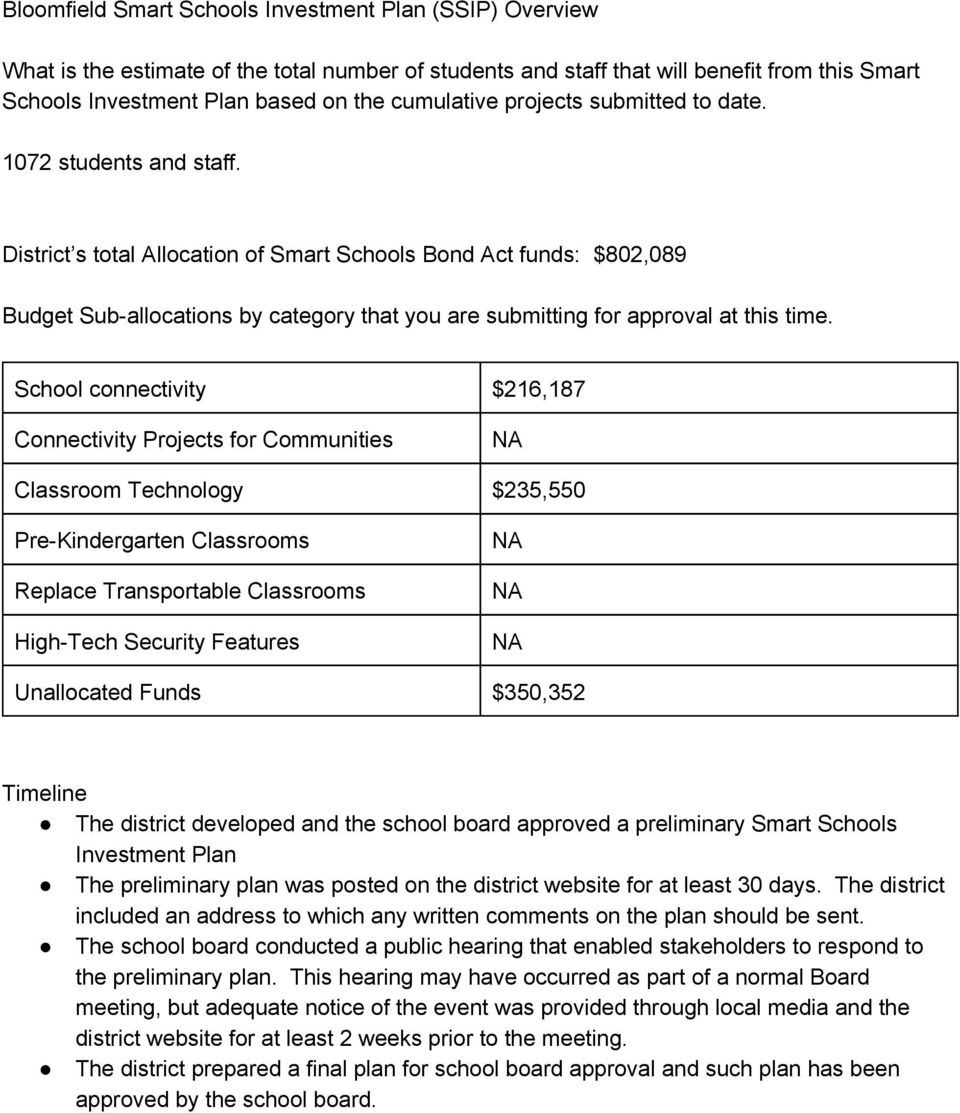
2 School connectivity 1. Briefly describe how you intend to use Smart Schools Bond Act Funds for high speed broadband and/or wireless connectivity projects in school buildings. We are replacing existing CAT5 wiring with CAT6 wiring. We are also replacing all wireless access points. The current access points have reached their end of life and the district would benefit from newer access points with more controller capabilities. 2. Briefly describe the linkage between the district s District Instructional Technology Plan and the proposed projects. There should be a direct link between this question and your response to Part E, Question 1. The district plans to use digital connectivity and technology to improve teaching and learning by: Fostering collaboration between students and between students and teachers. Encouraging and supporting project based learning. Developing digital literacy skills. Proving teachers with the tools to project documents, websites, software and other instructional materials. Ensuring college and career readiness by teaching our students about the cloud, managing files in the cloud, data security, and online safety. By ensuring we are meeting and maintaining industry standards, as well as FCC requirements for connectivity, our students and staff will have access to robust wireless connections that support the seamless integration of instruction, learning, and technology. 3. To ensure that districts maximize the return on their investment in education technology and devices, Smart Schools Bond Act funds used for technology infrastructure investments must increase the number of school buildings that meet or exceed the Federal Communications Commission minimum speed standard of 100 Mbps per 1,000 students. Please describe how you will used SSBA funds to meet this standard. The district currently meets this standard. We have 200 Mbps for our 912 students. 4. If the district wishes to have students and staff access the Internet from wireless devices within the school building or in a close proximity to it, it must first ensure that is has a robust Wi Fi network in place that has sufficient bandwidth to meet user demand. Please describe how you have quantified this demand and how you plan to meet this demand. We currently monitor the bandwidth usage in the district by taking random snapshots using graphical analysis monitoring tools at different times during the day. The technology staff also
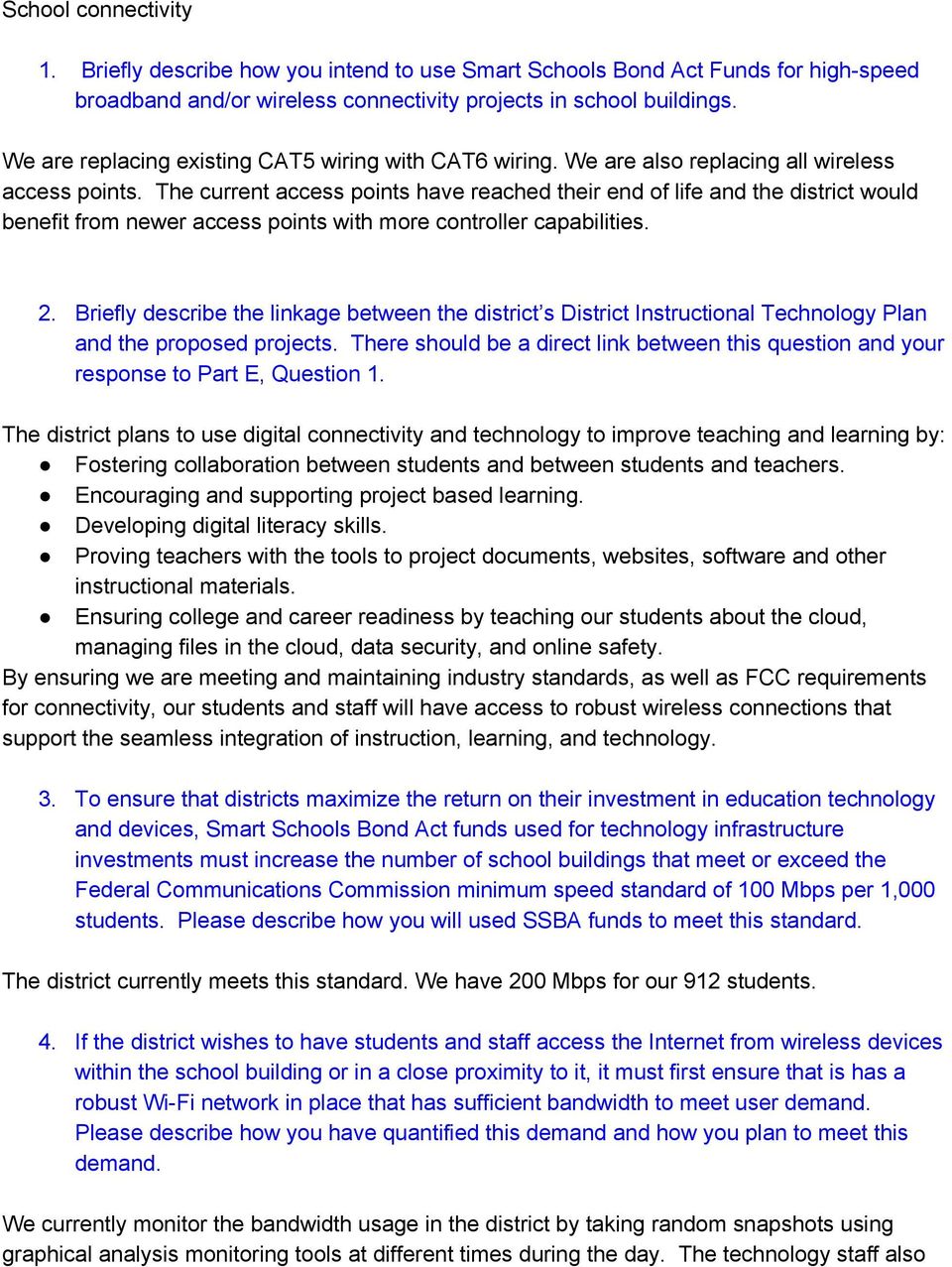
3 conducts periodic upload and download speed tests to ensure the fiber and wireless are performing at their industry standard prescribed rates. 5. Office of Facilities Planning will have to conduct a preliminary review of all capital projects, including connectivity projects. Project number: 6. Was your project eligible for an expedited review process? Indicate name and license number of the architect or engineer of record. network/access costs $88,582 outside plant costs school internal connections and components $30,141 professional services $97,464 testing other upfront costs other costs Other costs The sub allocations on this table must equal the Total allocation for this category in the overall SSIP budget.

4 Classroom Learning Technology 1. As a precondition to any purchase of devices using a Smart Schools allocation, a district must increase the number of school buildings that meet or exceed the Federal Communications Commission minimum speed standard of 100 Mbps per 1,000 students. Please describe how your district already meets or is planning to meet this standard within 12 months of plan submission. The district currently meets this standard. We have 200 Mbps for our students. 2. If the district wishes to have students and staff access the Internet from wireless devices within the school building, or in close proximity to it, it must first ensure that it has a robust WiFi network in place that has sufficient bandwidth to meet user demand. Please describe how you have quantified this demand and how you plan to meet this demand. We currently monitor the bandwidth usage in the district by taking random snapshots using graphical analysis monitoring tools at different times during the day. The technology staff also conducts periodic upload and download speed tests to ensure the fiber and wireless are performing at their industry standard prescribed rates. 3. All New York State Public School districts are required to complete and submit an Instructional Technology Plan survey to the New York State Education Department in compliance with Section 753 of the Education Law and per Part of the Commissioner s Regulations. Districts that include educational technology purchases as part of their Smart Schools Investment Plan must have a submitted and approved Instructional Technology Plan survey on file with the New York State Education Department. Our plan was submitted and the district received approval on 9/22/2015. The official letter was received 10/2/ Describe the devices you intend to purchase and their compatibility with existing or planned platforms or systems. Our major initiative is a 1:1 digital learning program for our secondary schools. For this initiative the district will be providing chromebooks to every secondary student. Bloomfield CSD is a Google Apps for Education (GAFE) district and students and staff have been using GAFE for the last four years. There has been ongoing professional development in these years. Several teachers have been modeling the use of GAFE, including Google Classroom, for their peers. Teachers have also begun flipping their classrooms and are using the classroom time to engage the students with project based learning. For this to be successful the students need access to technology. At the moment, the availability of laptop carts and a computer lab are driving the
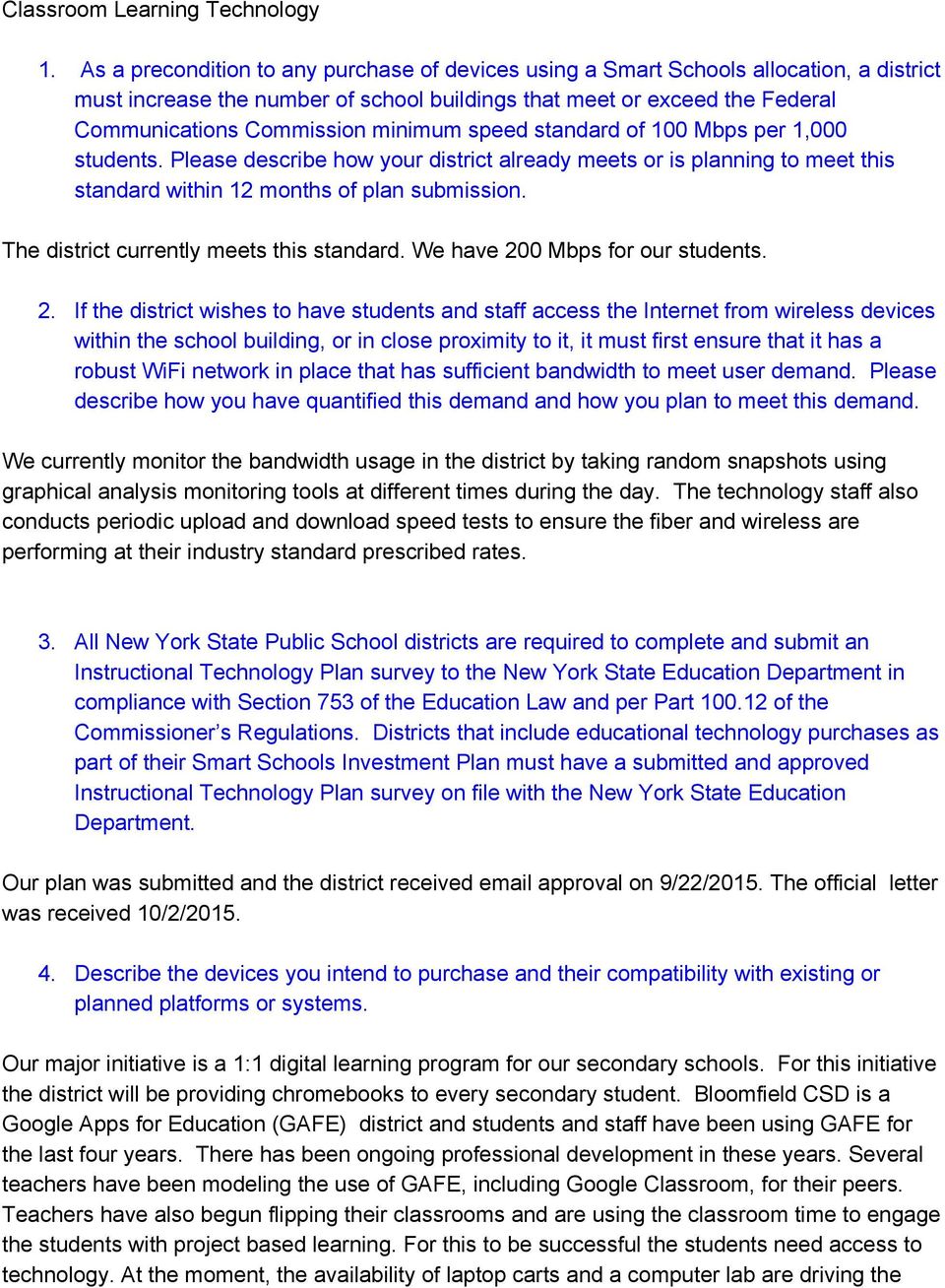
5 lesson plans of the teachers. We want to flip this so that the use of technology is driven by the lesson plan because students already have the technology in their hands. The students are quick learners and often support each other. Bloomfield has started training students to run a help desk next year in addition to being in classroom supports for both their peers and teachers. For at least the first year the chromebooks will stay in the building and to accommodate the storage and nightly charging, storage carts will be purchased. After the first year the district is considering letting the upper grades take home the devices but charging carts will still be necessary for the the other grades. The district has a robust secondary technology program. The students taking these courses already have access to a CNC machine. As part of our career and college readiness preparation the district will also purchase a 3D printer and laser engraver to support the secondary technology classes. While learning to use these machines are important skills for the students, teachers in other curricular areas will also benefit from them. Teachers will be able to make requests for the technology classes to create objects to enhance their curriculum such as historical artifacts or scientific models. 5. Describe how the proposed technology purchases will: a. enhance differentiated instruction b. expand student learning inside and outside the classroom c. benefit students with disabilities and English language learners; and d. contribute to the reduction of other learning gaps that have been identified in the school district. The expectation is that districts will place a priority on addressing the needs of students who struggle to succeed in a rigorous curriculum. Responses in this section should specifically address this concern and align with the district s Instructional Technology Plan (in particular Section E, Question 2, and Section E Question 3). As part of a universal design approach to differentiated instruction, and supporting students with disabilities, we make use of the variety of assistive technology tools that are developed for use with Google Chrome and Google Apps for Education. These include speech to text and text to speech applications, the ability to enlarge print, simplify web pages, word prediction support, and access to word processing. These tools provide all of our students with the ability to fully participate in classroom learning activities. Having a chromebook per student makes providing access to all of these tools, as they are needed, efficient. Several students with disabilities have been piloting these tools and we know they are effective in improving student learning. Despite the small size of the district, students have access to a variety of college credit bearing courses. However, there are students that may want to access additional courses that the district cannot provide. By providing students with their own chromebook, it eliminates one
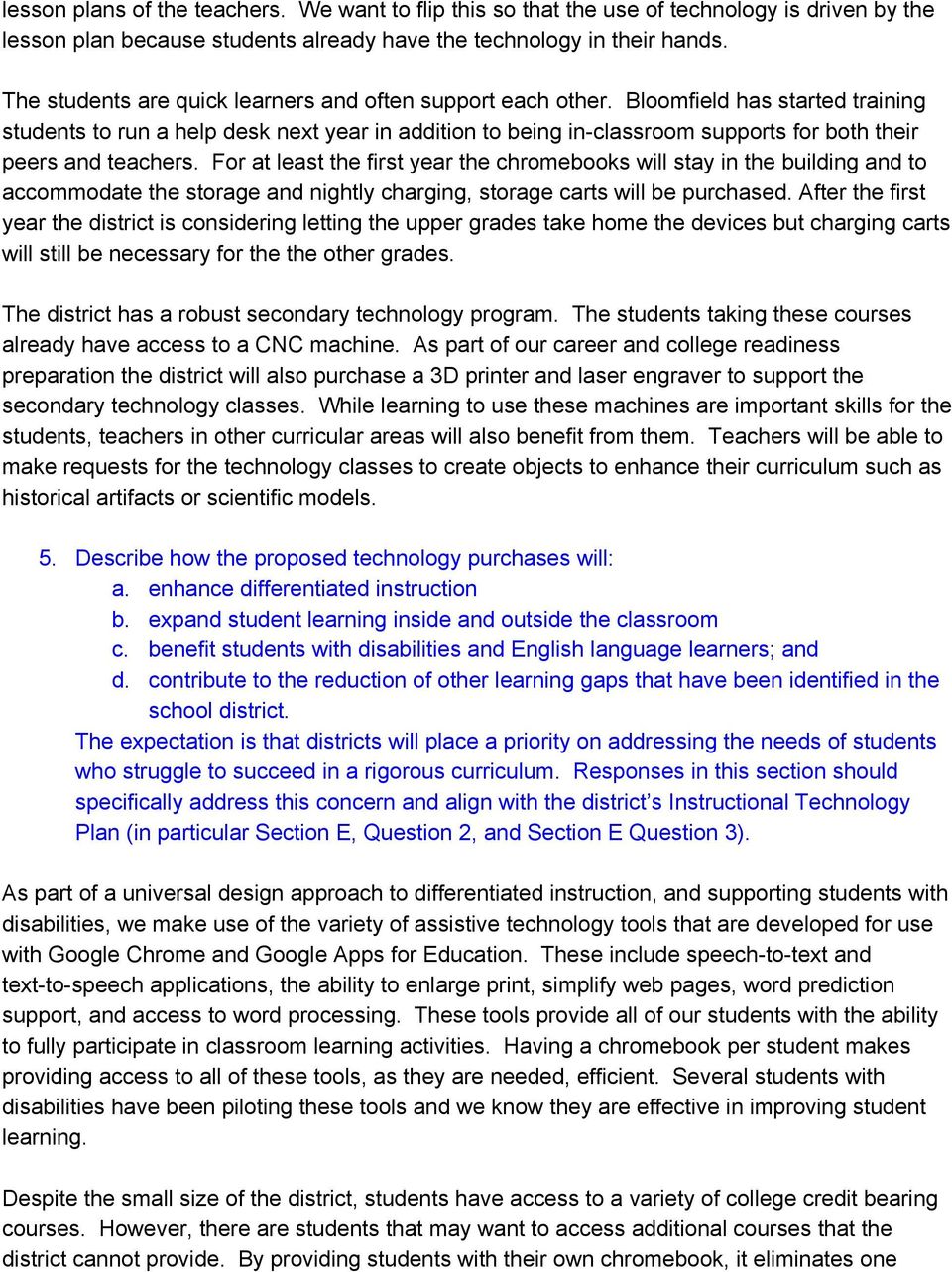
6 barrier to providing access to an online course should the student want to take one of these courses. 6. Where appropriate, briefly describe how the proposed technology purchases will enhance ongoing communication with parents and other stakeholders and help the district facility technology based regional partnerships, including distance learning and other efforts. Currently, our sixth grade team collaborates with two other districts. They share flipped classroom videos and lesson plans and the students collaborate with each other on learning projects through the use of Google applications. This serves as a model for how teachers could collaborate regionally. As a small rural district, these types of partnerships are invaluable, especially to our secondary teachers, who are often the only teacher of a particular course or subject area. Despite the small size of the district, students have access to a variety of college credit bearing courses. However, there are students that may want to access additional courses that the district cannot provide. By providing students with their own chromebook, it eliminates one barrier to providing access to an online course should the student want to take one of these courses. 7. Describe the district s plan to provide professional development to ensure that administrators, teachers and staff can employ the technology purchased to enhance instruction successfully. This should be aligned with Section F, Question 1 of the district s Instructional Technology Plan. With advances in current technology, professional development can happen in many different formats. The district encourages staff to build personal learning networks and include a variety of professional development formats as part of their personal professional development plan. The goal of all district sponsored professional development is to create training opportunities that are easily accessible, develop a common language among users regarding technology lexion, and promote the integration of technology into rich and rewarding learning experiences for our students. The focus of our professional development has been, and will continue to be: re thinking how teachers use classroom instructional time and the flipped classroom model using Google Apps for Education and the many associated tools to create collaborative learning experiences rethinking how students demonstrate their learning using technology to support all learners in the classroom using principles of Universal Design. In addition to our district sponsored professional development teachers attend professional development at the Wayne Finger Lakes Teacher Center, Wayne Finger Lakes BOCES, and

7 NYSCATE. Staff also are encouraged to participate in professional webinars and use social media to broaden their learning as well. 8. District s must contact the SUNY/CUNY teacher preparation program that supplies the largest number of the district s new teachers to request advice on innovative uses and best practices at the intersection of pedagogy and educational technology. This meeting was held on October 30, Information from that meeting has been incorporated into our professional development plan for teachers. 9. NA no non public schools within our district 10. To ensure the sustainability of technology purchases made with Smart Schools funds, districts must demonstrate a long term plan to maintain and replace technology purchases supported by Smart Schools Bond Act funds. This sustainability plan shall demonstrate a district s capacity to support recurring costs of use that are ineligible for Smart Schools Bond Act funding such as device maintenance, technical support, Internet and wireless fees, maintenance of hotspots, staff professional development, building maintenance and the replacement of incidental items. Further, such as sustainability plan shall include a long term plan for the replacement of purchased devices and equipment at the end of their useful life with other funding sources. The district maintains an extensive replacement plan for all areas of technology and this replacement plan was used in developing this plan. In developing the district s SSIP we looked at how to best leverage state aided hardware funds, BOCES aid on technology purchases, and tried to maintain a consistent overall technology budget amount supported by district funds. The technology budget already provides funds for technology related professional development. The support charge for the wireless controller contract is already funded within the district budget as are the maintenance contracts for the high school technology program equipment. 11. Districts must ensure that devices purchased with Smart Schools Bond funds will be distributed, prepared for use, maintained and supported appropriately. Districts must maintain detailed device inventories in accordance with generally accepted accounting principles. All devices are tagged and inventoried when received by the district. The district uses a commercial software product for managing all technology equipment. It is connected with our help desk ticket system. Packing slips are kept with a copy of the district PO. Staff members that have mobile technology assigned to them sign for each piece of technology with the device s serial number and asset tag noted on the sheet. As technology is assigned to

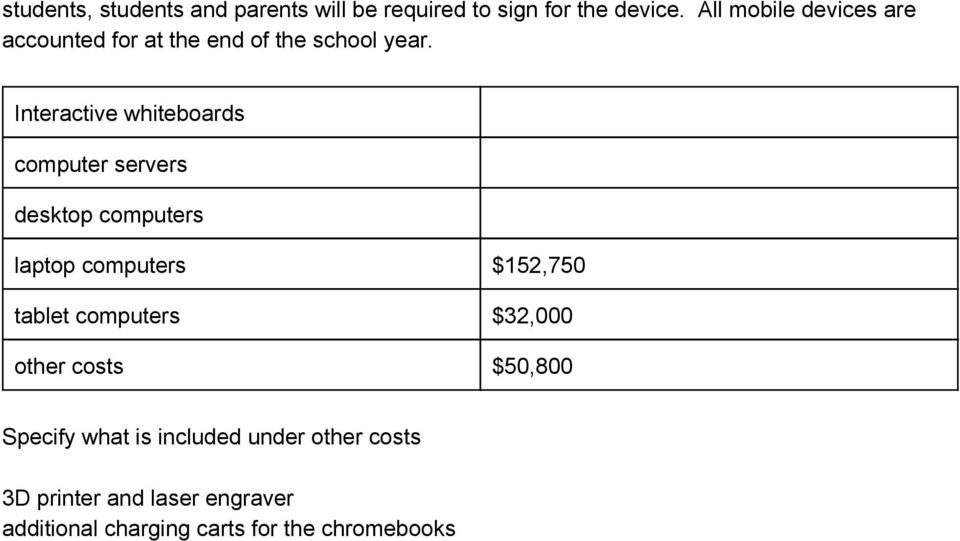
8 students, students and parents will be required to sign for the device. All mobile devices are accounted for at the end of the school year. Interactive whiteboards computer servers desktop computers laptop computers $152,750 tablet computers $32,000 other costs $50,800 Specify what is included under other costs 3D printer and laser engraver additional charging carts for the chromebooks
Honeoye Smart Schools Investment Plan (SSIP) Overview Final Plan
 Honeoye Smart Schools Investment Plan (SSIP) Overview Final Plan What is the estimate of the total number of students and staff that will benefit from this Smart Schools Investment Plan based on the cumulative
Lancaster Central School District
 Lancaster Central School District Smart Schools Bond Act Allocation Preliminary Investment Plan As presented at the December 7, 2015 meeting of the Board of Education. Public Hearing to follow on January
WALLKILL CSD Smart Schools Investment Plan
 SSIP Overview 1. Please enter the name of the person to contact regarding this submission. Yvonne Herrington 1a. Please enter their phone number for follow up questions. 845-895-7103 1b. Please enter their
SMART SCHOOLS BOND ACT Prelimary Investment Plan 2015-2016
 SMART SCHOOLS BOND ACT Prelimary Investment Plan 2015-2016 390 North Ridge Street, Rye Brook, NY 10573 914-937-3600 (t), 914-937-5871 (f) Table of Contents PLAN OVERVIEW... 3 PRECONDITIONS... 3 PLAN GOALS...
Katonah-Lewisboro School District (KLSD) PRELIMINARY SMART SCHOOLS INVESTMENT PLAN
 Katonah-Lewisboro School District (KLSD) PRELIMINARY SMART SCHOOLS INVESTMENT PLAN Ahunna Margaux Akoma, Ed D Director of Technology Katonah-Lewisboro School District TABLE OF CONTENTS I. INTRODUCTION
Technology/Smart Schools Investment Plan 2016-2019
 Technology/Smart Schools Investment Plan 2016-2019 Important Contributors Carol Eckl - DDC Alex Spada - Director of Technology Audrey Varney - Business Manager The Technology Committee (~20 Staff Members,
MORIAH CSD Instructional Technology Plan - Annually - 2015
 LEA Information A. LEA Information 1. What is the total student enrollment based on the most recent BEDS Day submission? 2. 693 What is the student enrollment by grade band based on the latest BEDS Day
NANUET UFSD Instructional Technology Plan - Annually - 2015
 LEA Information A. LEA Information 1. What is the total student enrollment based on the most recent BEDS Day submission? 2. 2,209 What is the student enrollment by grade band based on the latest BEDS Day
LONGWOOD CSD Instructional Technology Plan - Annually - 2015
 LEA Information A. LEA Information 1. What is the total student enrollment based on the most recent BEDS Day submission? 2. 9,253 What is the student enrollment by grade band based on the latest BEDS Day
Covington Community Schools Innovative Technology Finalized Planning Grant Report
 Covington Community Schools Innovative Technology Finalized Planning Grant Report Covington Community Schools believes that students learn differently and at individual paces. To ensure that our students
EAST GREENBUSH CSD Instructional Technology Plan - Annually - 2015
 LEA Information A. LEA Information 1. What is the total student enrollment based on the most recent BEDS Day submission? 2. 4,068 What is the student enrollment by grade band based on the latest BEDS Day
New York State Education Department Instructional technology plan survey
 The instructional technology plan survey is designed to allow districts the opportunity to compile all data related to their technology planning and needs in one location. The data collected in the survey
Planning Process and Methodology
 Executive Summary Our mission is to provide students and staff with technology to meet their instructional and administrative needs. This incorporates all aspects of technology including networking, end
WILLSBORO CSD Instructional Technology Plan - Annually - 2015
 LEA Information A. LEA Information 1. What is the total student enrollment based on the most recent BEDS Day submission? 2. 249 What is the student enrollment by grade band based on the latest BEDS Day
Lincoln Public Schools 2015 2018 Technology Plan. Vision for Technology Integration
 Lincoln Public Schools 2015 2018 Technology Plan The introduction of Chromebooks for staff for the 2015-2016 school year will be a game changer for teaching and learning. This cost effective solution will
Start Date: July 2015 End Date: June 2016. Technology Plan 1. West Michigan Academy of Arts & Academics 7/30/15
 District: West Michigan Academy of Arts & Academics [70902] Building: [08332] ISD: Ottawa Area ISD [70] Address: 17350 Hazel Street, Spring Lake, Michigan 49456 Contact: Cathy Cantu Phone: 616 844 9961
2013-2016. Three Year District Technology Plan. Pasco School District #1 July 1, 2013 to June 30, 2016
 2013-2016 Three Year District Technology Plan Pasco School District #1 July 1, 2013 to June 30, 2016 Development History August 2012 November 2012 December 2012 December 2012 February 2013 March 2013 April
2010-2016 TECHNOLOGY PLAN
 2010-2016 TECHNOLOGY PLAN Bland County Public Schools 361 Bears Trl. Bastian, VA 24315 www.bland.k12.va.us Six Year Technology Plan for Bland County Public Schools APPROVED BY SCHOOL BOARD MAY 23, 2011
2013 2015 Technology Plan
 Hopkins Public Schools Independent School District 270 Hopkins, Minnesota ORGANIZATION INFORMATION District/Agency/School HOPKINS PUBLIC SCHOOLS (legal name): District Number: 270 IDENTIFIED OFFICIAL WITH
PETALUMA CITY SCHOOLS DISTRICT EDUCATION TECHNOLOGY PLAN JULY 1, 2013 JUNE 30, 2018
 PETALUMA CITY SCHOOLS DISTRICT EDUCATION TECHNOLOGY PLAN JULY 1, 2013 JUNE 30, 2018 TABLE OF CONTENTS District Summary and Plan Duration (Criteria Item 1) Stakeholders Involvement (Criteria Item 2) Curriculum
SMART SCHOOLS BOND ACT FAQ - NERIC VIDEOCONFERENCE 10/27/2015
 SMART SCHOOLS BOND ACT FAQ - NERIC VIDEOCONFERENCE 10/27/2015 General 1) What is the time line for expending the money? Can the Smart School Money appropriation be on an annual basis, or does it need to
Educational Technology
 Educational Technology 0 How can we design effective instruction using technology, media, and learning theory? 0 How Educational Technology facilitates e-learning, and promotes discovery and higher order
ty School District Digita al Classrooms Plan
 Nassau Count ty School District Digita al Classrooms Plan Nassau County School Districtt Digital Classrooms Plan 1 P age The intent of the District Digital Classroom Plan (DCP) is to provide a perspective
FLORENCE SCHOOL DISTRICT TWO DISTRICT TECHNOLOGY PLAN. 2121 South Pamplico Highway, Pamplico, South Carolina 29583
 FLORENCE SCHOOL DISTRICT TWO DISTRICT TECHNOLOGY PLAN 2010 2015 Robert E. Sullivan Jr., Superintendent Mark A. Parker, Information Technology Coordinator 2121 South Pamplico Highway, Pamplico, South Carolina
Building a BYOD Strategy For Education
 A CBTS White Paper Building a BYOD Strategy For Education Chris Burns Marketing Director, CBTS 8/1/2012 www.cbts.cinbell.com Overview the BYOD Trend in Education Bring Your Own Device (BYOD) is one of
Gadsden City Schools. Page 1. State Educational Technology Directors Association www.setda.org
 Gadsden City Schools Background The American Recovery and Reinvestment Act of 2009 (ARRA) included a $650 million allocation in ESEA Title II, Part D, commonly referred to as the Enhancing Education Through
North Platte Public School District
 North Platte Public School District Student Learning, Student Achievement, Student Success District Technology Plan 2014-2019 Table of Contents Table of Contents 2 Executive Summary 3 District Description
The History of St. Joseph Classroom Technology
 With each passing year, the traditional classroom is in the process of implementing The History of St. Joseph Classroom Technology a new and exciting way to teach students. The new technology of today
Northeastern Catholic District School Board. Catholic Education in a Digital Age
 Northeastern Catholic District School Board Catholic Education in a Digital Age 1 Northeastern Catholic District School Board - Geography 2 Northeastern Catholic District School Board Mission and Vision
Teacher training and usage of ICT in education
 Teacher training and usage of ICT in education Jaco du Toit UNESCO Adviser for Communication and Information UNESCO Office for Eastern Africa Table of contents Definition of ICT-qualified; Professional
CURRICULUM Based on guidelines from the State, developed by Subject Area Committees
 CURRICULUM Based on guidelines from the State, developed by Subject Area Committees 78 INSTRUCTION How we deliver the curriculum to students TECHNOLOGY Tools to deliver and enhance instruction, and support
Lancaster City School District. Technology Plan July 1, 2012 to June 30, 2015
 Lancaster City School District Technology Plan July 1, 2012 to June 30, 2015 Adopted on May 22, 2012 SPECIAL THANKS The following people collaborated on this transformative plan for educational technology
West Mifflin Area School District Technology Department Strategic Plan 2013-2016
 West Mifflin Area School District Technology Department Strategic Plan 2013-2016 Table of Contents 1. Planning Process Overview... 2 2. Membership List... 2 3. Mission... 3 4. Technology Analysis... 3
Florida Department of Education TECHNOLOGY GUIDELINES
 Florida Department of Education TECHNOLOGY GUIDELINES The Florida Department of Education (FDOE) is pleased to provide these technology guidelines to inform schools and districts as they make technology
Engage and control Students in the ICT classroom. Provide tools to encourage participation, collaboration and safe use of technology.
 Tools to enhance teaching, keep students on task, encourage continuous assessment and reduce teacher workload. Unique and innovative solution for the provision of MFL teaching without the need for specialist
Atlantis Charter School
 Atlantis Charter School Technology Plan 2013-2017 Background Atlantis Charter School, one of the longest-standing charter schools in Massachusetts, is currently in its 18 th year of operation. The school
TECHNOLOGY AND OUR STUDENTS. A Rationale and Proposal for Expansion
 TECHNOLOGY AND OUR STUDENTS A Rationale and Proposal for Expansion Expanding the 1:1 program already in grades 5 8 to Mira Costa High School with a Bring Your Own Device Model June 5, 2013 BYOD AT MIRA
BOCES Educational Consortium Testimony
 New NY Education Reform Commission October 11, 2012 SUNY Old Westbury BOCES Educational Consortium Testimony Good morning/afternoon. My name is Dr. Lydia Begley and for the past year, I have been the Associate
PARCC Computer-based Field Test: Technical Resources Guide
 PARCC Computer-based Field Test: Technical Resources Guide Introduction In spring 2014, more than one million students in public schools across the country participated in the field testing of new computer-based
Technology Plan Cover Sheet 2016-2018 (July 1, 2015 June 30, 2018)
 Technology Plan Cover Sheet 2016-2018 (July 1, 2015 June 30, 2018) Organization Information District/Agency/School (legal name): Northeast Metro Intermediate District Number: 916 Technology Plan Status
CERTIFICATION OF SCHOOL TECHNOLOGY PLAN
 CERTIFICATION OF SCHOOL TECHNOLOGY PLAN PRESENTED TO 4580, Hanover Community School Corp 7/1/2014-6/30/2017 Approved 1st Update The above referenced school corporation's technology plan is hereby certified
Prepared by the Friday Institute for Educational Innovation
 Preliminary Recommendations to Inform State Policy Decisions January 2015 Prepared by the Friday Institute for Educational Innovation OVERVIEW The Friday Institute for Educational Innovation at North Carolina
How To Improve The Long Lake Central School District
 Long Lake Central School 2014 2017 Information Technology Plan Information Technology Mission Statement The Long Lake Central School District will utilize technology to enhance learning and provide 21
Sheldon College Bring Your Own Device
 Sheldon College Bring Your Own Device Handbook 2015 2 Table of Contents BACKGROUND 3 ELEARNING COMMITMENT 4 BYOD INTRODUCTION 5 BYOD REQUIREMENTS 2015 6 ACCEPTABLE DEVICES 7 BYOD MINIMUM SPECIFICATIONS
Definition Purpose Bring Your Own Device required Guidelines Responsibility for Devices
 Definition Bring Your Own Device (BYOD) is a policy that allows students to bring and use their own personal electronic devices at school. Devices include but may not be limited to: tablets (such as ipad),
Budgeting by Priorities: Budget Proposal Technology Customer Service Center. Support Services
 Budgeting by Priorities: Budget Proposal Technology Customer Service Center Strategic Plan Goal: Support Services Problem Statement: Technology has become an increasingly integral part of our core mission,
2015 REPORT Teachers Speak: Technology in the Classroom ORION S NEXUS K-12 TEACHER SURVEY RESULTS
 2015 REPORT Teachers Speak: Technology in the Classroom ORION S NEXUS K-12 TEACHER SURVEY RESULTS TABLE OF CONTENTS PURPOSE OF STUDY 1 SECTION 1: BLENDED LEARNING IN THE CLASSROOM TODAY 2 SECTION 2: WHAT
NASSAU COUNTY SCHOOL DISTRICT DIGITAL CLASSROOM PLAN
 NASSAU COUNTY SCHOOL DISTRICT DIGITAL CLASSROOM PLAN The Digital Classroom Plan (DCP) provides a perspective on what the district considers to be vital and critically important in relation to digital learning
K-12 Technology Support Requirements
 A White Paper from K-12 Technology Support Requirements To continuously improve the quality, depth and breadth of K-12 Technology Support - consider an opportunity to explore alternative models for providing
BALTIMORE CITY PUBLIC SCHOOLS (CITY SCHOOLS) 147
 BOARD PRIORITY 1: City Schools will have quality curricula and instruction that provide rigor, engage students, raise the bar and deliver targeted interventions to increase learning. I. PURPOSE: The focus
ICT in Education Smart Learning (I. Part) [email protected] March, 2015
 ICT in Education Smart Learning (I. Part) [email protected] March, 2015 AGENDA: Transforming Education for the Next Generation Planning to integrate ICT into education Ensuring Long-Term Success
Information Technology Plan Technology Vision for the Community College
 Information Technology Plan Technology Vision for the Community College At Caldwell Community College and Technical Institute, information technology will be a primary resource for students, faculty, staff,
Note: Survey responses are based upon the number of individuals that responded to the specific question. Response Responses Responses
 State: IN Results based on 133 survey(s). Note: Survey responses are based upon the number of individuals that responded to the specific question. What is your current job responsibility? (select one)
Minnetonka Public Schools Technology Plan
 Minnetonka Public Schools Technology Plan 2012-2015 Table of Contents State Technology Planning Requirements... 1 Summary of Audit Results... 3 Current Technology Reflections... 5 Instructional Overview...
SUSTAINABILITY. Goal: Sustain environmental literacy by ensuring effective implementation of the 2010 Environmental Literacy for Illinois Plan.
 SUSTAINABILITY Goal: Sustain environmental literacy by ensuring effective implementation of the 2010 Environmental Literacy for Illinois Plan. Objectives: 1. Develop an educated populace that will preserve,
How To Make Your School Successful Online
 informed. Planning Considerations for K-12 Communications Technology frontier.com/enterprise 1 Executive Summary K-12 schools are increasingly wanting to leverage new digital learning technologies to make
2.) Where do you primarily work? o School Site o District
 1.) What is your current job responsibility? o Librarian o Librarian Media Specialist o Library Assistant o Media Specialist o Teacher Librarian o Instructional Technology Specialist o Other 2.) Where
BASELINE DATA for STATEWIDE EDUCATIONAL TECHNOLOGY PLAN
 BASELINE DATA for STATEWIDE EDUCATIONAL TECHNOLOGY PLAN The Board of Regents and the New York State Education Department (NYSED) are seeking baseline data to define the current state of digital capacity
New York State Professional Development Standards (PDF/Word) New York State. Professional Development Standards. An Introduction
 New York State Professional Development Standards New York State Professional Development Standards (PDF/Word) Background on the Development of the Standards New York State Professional Development Standards
THE 2011 CDW-G 21ST-CENTURY CLASSROOM REPORT
 THE 2011 CDW-G 21ST-CENTURY CLASSROOM REPORT June 27, 2011 2011 CDW Government INTRODUCTION A 21st-century classroom leverages technology to engage and empower teachers and students. In 2010, CDW-G launched
Newington Public Schools Educational Technology Plan July 1, 2015 June 30, 2018
 Newington Public Schools Plan July 1, 2015 June 30, 2018 1 Table of Contents About the District Committee Members Committee NPS Moving Forward Curriculum Integration Professional Development Equitable
EMS BYOD Pilot--Frequently Asked Questions
 EMS BYOD Pilot--Frequently Asked Questions How will EMS handle inappropriate use of, damaged, or lost devices by students? Device security is a common concern of parents nation-wide as schools embark on
The Baltimore County Public Schools 2015-2019 Technology Plan
 2015-2019 Technology Plan Prepared by: The Department of Information Technology Plan Origination Date: March 2014 Plan Updated April 2015 Version 2.0 The guiding document of Baltimore County Public Schools
Mobile Technology. National Survey on. for K-12 Education. Sponsored by Amplify. Research Report Educator Edition 2013
 National Survey on Mobile Technology for K-12 Education Research Report Educator Edition 2013 Sponsored by Amplify Written and Published By: Interactive Educational Systems Design, Inc. [email protected]