
[MS-OXTNEF]: Transport Neutral Encapsulation Format (TNEF) Data Algorithm
|
|
|
- Winfred Nathaniel Griffin
- 9 years ago
- Views:
Transcription
1 [MS-OXTNEF]: Transport Neutral Encapsulation Format (TNEF) Data Algorithm Intellectual Property Rights Notice for Open Specifications Documentation Technical Documentation. Microsoft publishes Open Specifications documentation ( this documentation ) for protocols, file formats, data portability, computer languages, and standards support. Additionally, overview documents cover inter-protocol relationships and interactions. Copyrights. This documentation is covered by Microsoft copyrights. Regardless of any other terms that are contained in the terms of use for the Microsoft website that hosts this documentation, you can make copies of it in order to develop implementations of the technologies that are described in this documentation and can distribute portions of it in your implementations that use these technologies or in your documentation as necessary to properly document the implementation. You can also distribute in your implementation, with or without modification, any schemas, IDLs, or code samples that are included in the documentation. This permission also applies to any documents that are referenced in the Open Specifications documentation. No Trade Secrets. Microsoft does not claim any trade secret rights in this documentation. Patents. Microsoft has patents that might cover your implementations of the technologies described in the Open Specifications documentation. Neither this notice nor Microsoft's delivery of this documentation grants any licenses under those patents or any other Microsoft patents. However, a given Open Specifications document might be covered by the Microsoft Open Specifications Promise or the Microsoft Community Promise. If you would prefer a written license, or if the technologies described in this documentation are not covered by the Open Specifications Promise or Community Promise, as applicable, patent licenses are available by contacting [email protected]. Trademarks. The names of companies and products contained in this documentation might be covered by trademarks or similar intellectual property rights. This notice does not grant any licenses under those rights. For a list of Microsoft trademarks, visit Fictitious Names. The example companies, organizations, products, domain names, addresses, logos, people, places, and events that are depicted in this documentation are fictitious. No association with any real company, organization, product, domain name, address, logo, person, place, or event is intended or should be inferred. Reservation of Rights. All other rights are reserved, and this notice does not grant any rights other than as specifically described above, whether by implication, estoppel, or otherwise. Tools. The Open Specifications documentation does not require the use of Microsoft programming tools or programming environments in order for you to develop an implementation. If you have access to Microsoft programming tools and environments, you are free to take advantage of them. Certain Open Specifications documents are intended for use in conjunction with publicly available standards specifications and network programming art and, as such, assume that the reader either is familiar with the aforementioned material or has immediate access to it. 1 / 51
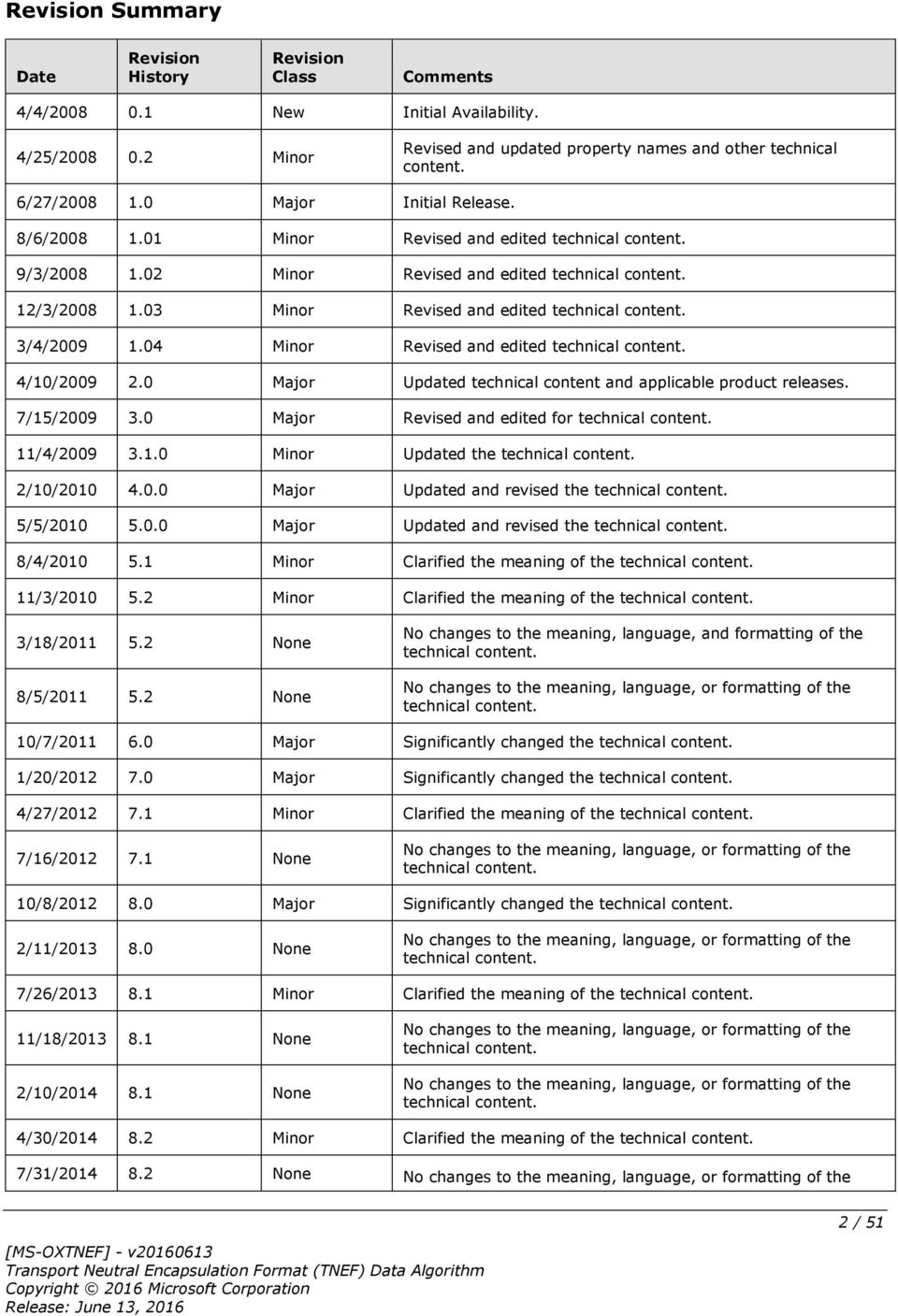
2 Revision Summary Date Revision History Revision Class Comments 4/4/ New Initial Availability. 4/25/ Minor Revised and updated property names and other technical content. 6/27/ Major Initial Release. 8/6/ Minor Revised and edited technical content. 9/3/ Minor Revised and edited technical content. 12/3/ Minor Revised and edited technical content. 3/4/ Minor Revised and edited technical content. 4/10/ Major Updated technical content and applicable product releases. 7/15/ Major Revised and edited for technical content. 11/4/ Minor Updated the technical content. 2/10/ Major Updated and revised the technical content. 5/5/ Major Updated and revised the technical content. 8/4/ Minor Clarified the meaning of the technical content. 11/3/ Minor Clarified the meaning of the technical content. 3/18/ None 8/5/ None No changes to the meaning, language, and formatting of the technical content. No changes to the meaning, language, or formatting of the technical content. 10/7/ Major Significantly changed the technical content. 1/20/ Major Significantly changed the technical content. 4/27/ Minor Clarified the meaning of the technical content. 7/16/ None No changes to the meaning, language, or formatting of the technical content. 10/8/ Major Significantly changed the technical content. 2/11/ None No changes to the meaning, language, or formatting of the technical content. 7/26/ Minor Clarified the meaning of the technical content. 11/18/ None 2/10/ None No changes to the meaning, language, or formatting of the technical content. No changes to the meaning, language, or formatting of the technical content. 4/30/ Minor Clarified the meaning of the technical content. 7/31/ None No changes to the meaning, language, or formatting of the 2 / 51
3 Date Revision History Revision Class Comments technical content. 10/30/ Minor Clarified the meaning of the technical content. 3/16/ Major Significantly changed the technical content. 5/26/ None 9/14/ None 6/13/ None No changes to the meaning, language, or formatting of the technical content. No changes to the meaning, language, or formatting of the technical content. No changes to the meaning, language, or formatting of the technical content. 3 / 51
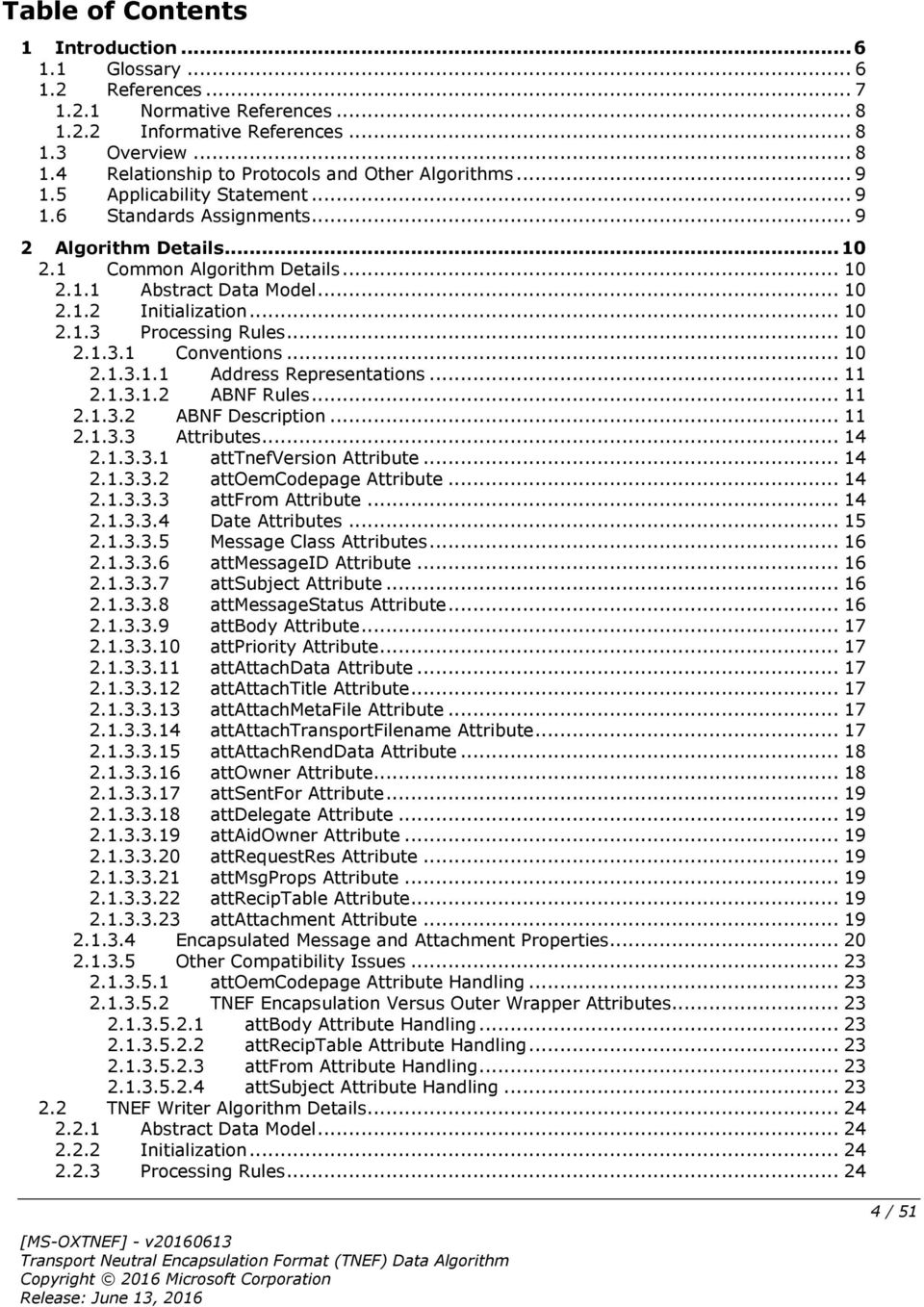
4 Table of Contents 1 Introduction Glossary References Normative References Informative References Overview Relationship to Protocols and Other Algorithms Applicability Statement Standards Assignments Algorithm Details Common Algorithm Details Abstract Data Model Initialization Processing Rules Conventions Address Representations ABNF Rules ABNF Description Attributes atttnefversion Attribute attoemcodepage Attribute attfrom Attribute Date Attributes Message Class Attributes attmessageid Attribute attsubject Attribute attmessagestatus Attribute attbody Attribute attpriority Attribute attattachdata Attribute attattachtitle Attribute attattachmetafile Attribute attattachtransportfilename Attribute attattachrenddata Attribute attowner Attribute attsentfor Attribute attdelegate Attribute attaidowner Attribute attrequestres Attribute attmsgprops Attribute attreciptable Attribute attattachment Attribute Encapsulated Message and Attachment Properties Other Compatibility Issues attoemcodepage Attribute Handling TNEF Encapsulation Versus Outer Wrapper Attributes attbody Attribute Handling attreciptable Attribute Handling attfrom Attribute Handling attsubject Attribute Handling TNEF Writer Algorithm Details Abstract Data Model Initialization Processing Rules / 51
5 atttnefversion Attribute Handling by the TNEF Writer attoemcodepage Attribute Handling by TNEF Writer attfrom Attribute Handling by the TNEF Writer Message Class Attribute Handling by the TNEF Writer attsubject Attribute Handling by the TNEF Writer attbody Attribute Handling by the TNEF Writer attmessageid Attribute Handling by the TNEF Writer attattachdata Attribute Handling by the TNEF Writer attattachtitle Attribute Handling by the TNEF Writer attattachrenddata Attribute Handling by the TNEF Writer attowner Attribute Handling by the TNEF Writer attsentfor Attribute Handling by the TNEF Writer attdelegate Attribute Handling by the TNEF Writer attmsgprops Attribute Handling by the TNEF Writer attattachment Attribute Handling by the TNEF Writer attreciptable Attribute Handling by the TNEF Writer TNEF Reader Algorithm Details Abstract Data Model Initialization Processing Rules atttnefversion Attribute Handling by the TNEF Reader attoemcodepage Attribute Handling by the TNEF Reader attfrom Attribute Handling by the TNEF Reader attmessageclass Attribute Handling by the TNEF Reader attmessageid Attribute Handling by the TNEF Reader attsubject Attribute Handling by the TNEF Reader attattachdata Attribute Handling by the TNEF Reader attattachtitle Attribute Handling by the TNEF Reader attattachrenddata Attribute Handling by the TNEF Reader attowner Attribute Handling by the TNEF Reader attsentfor Attribute Handling by the TNEF Reader attdelegate Attribute Handling by the TNEF Reader Algorithm Examples Sample Message Sample Meeting Response Security Security Considerations for Implementers Index of Security Parameters Appendix A: Product Behavior Change Tracking Index / 51

6 1 Introduction The enables the encoding of rich properties in electronic mail messages over a serial data stream. The result can be transported as a stream, as a file attachment in an arbitrary transport, or as a MIME entity body on an Internet transport. Sections 1.6 and 2 of this specification are normative. All other sections and examples in this specification are informative. 1.1 Glossary This document uses the following terms: address type: An identifier for the type of address, such as SMTP and EX. Augmented Backus-Naur Form (ABNF): A modified version of Backus-Naur Form (BNF), commonly used by Internet specifications. ABNF notation balances compactness and simplicity with reasonable representational power. ABNF differs from standard BNF in its definitions and uses of naming rules, repetition, alternatives, order-independence, and value ranges. For more information, see [RFC5234]. binary large object (BLOB): A discrete packet of data that is stored in a database and is treated as a sequence of uninterpreted bytes. body part: A part of an Internet message, as described in [RFC2045]. character set: (1) A mapping between the characters of a written language and the values that are used to represent those characters to a computer. (2) The range of characters used to represent textual data within a MIME body part, as described in [RFC2046]. checksum: A value that is the summation of a byte stream. By comparing the checksums computed from a data item at two different times, one can quickly assess whether the data items are identical. code page: An ordered set of characters of a specific script in which a numerical index (code-point value) is associated with each character. Code pages are a means of providing support for character sets and keyboard layouts used in different countries. Devices such as the display and keyboard can be configured to use a specific code page and to switch from one code page (such as the United States) to another (such as Portugal) at the user's request. display name: A text string that is used to identify a principal or other object in the user interface. Also referred to as title. address: A string that identifies a user and enables the user to receive Internet messages. encoding: A process that specifies a Content-Transfer-Encoding for transforming character data from one form to another. EntryID: A sequence of bytes that is used to identify and access an object. Internet Message Access Protocol - Version 4 (IMAP4): A protocol that is used for accessing and news items from mail servers, as described in [RFC3501]. little-endian: Multiple-byte values that are byte-ordered with the least significant byte stored in the memory location with the lowest address. 6 / 51

7 message class: A property that loosely defines the type of a message, contact, or other Personal Information Manager (PIM) object in a mailbox. Message object: A set of properties that represents an message, appointment, contact, or other type of personal-information-management object. In addition to its own properties, a Message object contains recipient properties that represent the addressees to which it is addressed, and an attachments table that represents any files and other Message objects that are attached to it. Multipurpose Internet Mail Extensions (MIME): A set of extensions that redefines and expands support for various types of content in messages, as described in [RFC2045], [RFC2046], and [RFC2047]. named property: A property that is identified by both a GUID and either a string name or a 32-bit identifier. non-delivery report: A report message that is generated and sent by a server to the sender of a message if an message could not be received by an intended recipient. plain text message body: A message body (2) for which the Content-Type value of the Text Body header field is "text/plain". A plain text message body can be identified explicitly in the content, or implicitly if it is in a message that is as described in [RFC822] or a message that does not contain a Content-Type header field. Post Office Protocol - Version 3 (POP3): A protocol that is used for accessing from mail servers, as described in [RFC1939]. recipient: An entity that can receive messages. Simple Mail Transfer Protocol (SMTP): A member of the TCP/IP suite of protocols that is used to transport Internet messages, as described in [RFC5321]. Transport Neutral Encapsulation Format (TNEF): A binary type-length-value encoding that is used to encode properties for transport, as described in [MS-OXTNEF]. Transport Neutral Encapsulation Format (TNEF) Reader: An entity that decodes a Transport Neutral Encapsulation Format (TNEF) structure after receiving a message, for the purpose of reconstructing the rich properties that are contained in the stream. Transport Neutral Encapsulation Format (TNEF) Writer: An entity that encodes or builds a Transport Neutral Encapsulation Format (TNEF) structure for the purpose of transporting rich properties. Unicode: A character encoding standard developed by the Unicode Consortium that represents almost all of the written languages of the world. The Unicode standard [UNICODE5.0.0/2007] provides three forms (UTF-8, UTF-16, and UTF-32) and seven schemes (UTF-8, UTF-16, UTF-16 BE, UTF-16 LE, UTF-32, UTF-32 LE, and UTF-32 BE). MAY, SHOULD, MUST, SHOULD NOT, MUST NOT: These terms (in all caps) are used as defined in [RFC2119]. All statements of optional behavior use either MAY, SHOULD, or SHOULD NOT. 1.2 References Links to a document in the Microsoft Open Specifications library point to the correct section in the most recently published version of the referenced document. However, because individual documents in the library are not updated at the same time, the section numbers in the documents may not match. You can confirm the correct section numbering by checking the Errata. 7 / 51
8 1.2.1 Normative References We conduct frequent surveys of the normative references to assure their continued availability. If you have any issue with finding a normative reference, please contact [email protected]. We will assist you in finding the relevant information. [MS-DTYP] Microsoft Corporation, "Windows Data Types". [MS-OXCDATA] Microsoft Corporation, "Data Structures". [MS-OXCMAIL] Microsoft Corporation, "RFC 2822 and MIME to Object Conversion Algorithm". [MS-OXCMSG] Microsoft Corporation, "Message and Attachment Object Protocol". [MS-OXCPRPT] Microsoft Corporation, "Property and Stream Object Protocol". [MS-OXOCAL] Microsoft Corporation, "Appointment and Meeting Object Protocol". [MS-OXOMSG] Microsoft Corporation, " Object Protocol". [MS-OXPROPS] Microsoft Corporation, "Exchange Server Protocols Master Property List". [RFC2119] Bradner, S., "Key words for use in RFCs to Indicate Requirement Levels", BCP 14, RFC 2119, March 1997, [RFC5234] Crocker, D., Ed., and Overell, P., "Augmented BNF for Syntax Specifications: ABNF", STD 68, RFC 5234, January 2008, Informative References [MS-OXCFOLD] Microsoft Corporation, "Folder Object Protocol". [MS-OXCSPAM] Microsoft Corporation, "Spam Confidence Level Protocol". [MS-OXORMDR] Microsoft Corporation, "Reminder Settings Protocol". [MS-OXOTASK] Microsoft Corporation, "Task-Related Objects Protocol". [MS-WMF] Microsoft Corporation, "Windows Metafile Format". [MSDN-UAF] Microsoft Corporation, "UUENCODE Attachment Format", [RFC2045] Freed, N., and Borenstein, N., "Multipurpose Internet Mail Extensions (MIME) Part One: Format of Internet Message Bodies", RFC 2045, November 1996, Overview This algorithm organizes a hierarchy of rich message properties into a flattened structure that can be represented as a serial data stream. The typical format of a particular property within the stream is: identifier (which usually also includes type information), size (where not exactly determined by type), and data. In some cases, as described in this document, groups of properties or multiple-value properties include counts. Others might include padding to enforce a particular alignment of the data. A typical scenario for using this algorithm is as follows. A TNEF Writer encodes rich properties into a serial data stream in order to transmit the properties through a messaging system that does not support those properties directly. By encoding the properties in TNEF, the properties that do not have direct representations in the underlying messaging system can be encapsulated during transport and 8 / 51
![[MS-DTYP] Microsoft Corporation, "Windows Data Types". [MS-OXCDATA] Microsoft Corporation, "Data Structures".](/docs-images/42/19533327/images/page_8.jpg "[MS-OXCMAIL] Microsoft Corporation, \"RFC 2822 and MIME to Email Object Conversion Algorithm\". [MS-OXCMSG] Microsoft Corporation, \"Message and Attachment Object Protocol\".")
9 then decoded by a TNEF Reader in order to make all the properties included in the original message available to the client application. 1.4 Relationship to Protocols and Other Algorithms This algorithm is intended to permit the transmission of rich message property information over transports that have no mechanism for representing that information natively. The output of the algorithm can be included in any of the following: A file attachment (winmail.dat). A MIME body part, as described in [RFC2045], using the "application/ms-tnef" media type. As an addition to the transmitted plain text message body using UUENCODE, as described in [MSDN-UAF], or a similar method to be decoded at the recipient end. A transmission from the sender to the recipient using whatever means are provided by the protocol employed in transmitting message information between them. Specifically, this algorithm transmits message data over Simple Mail Transfer Protocol (SMTP), Post Office Protocol - Version 3 (POP3), Internet Message Access Protocol - Version 4 (IMAP4), or other Internet protocols that incorporate MIME, as described in [RFC2045]. For conceptual background information and overviews of the relationships and interactions between this and other protocols, see [MS-OXPROTO]. 1.5 Applicability Statement The original application of the algorithm was to permit the creation and representation of message classes other than simple messages, and some additional attributes that were not natively supported by the transport protocol. This application was further extended to allow the transport of the rich set of properties required by more modern messaging clients, including named properties. For backward compatibility with the original implementation, a special attribute is used to encapsulate the new message properties, and those properties with analogues to the original implementation are usually represented using the original attribute syntax. 1.6 Standards Assignments None. 9 / 51
10 2 Algorithm Details 2.1 Common Algorithm Details This section specifies details that are common to both the TNEF Writer and TNEF Reader roles. For details specific to the TNEF Writer role, see section 2.2. For details specific to the TNEF Reader role, see section 2.3. All numeric data types in this algorithm that are greater than one byte in size are little-endian, and any handling of these values on platforms that are not little-endian are required to take this into account and perform the appropriate transformations to get correct numbers, counts, values, and so on. String examples in this document are shown in Augmented Backus-Naur Form (ABNF) format, as specified in [RFC5234]. When the string has a terminating null character, the terminating null character is included as well; for example, "[email protected]" %x00. For the purpose of string examples, the different terminating null character size in a Unicode character set (1) is not illustrated Abstract Data Model None Initialization None Processing Rules In this specification, attributes using the original syntax described in section 1.5 are referred to as "attributes" and the rich set of properties described in section 1.5 will be referred to as "properties". The TNEF stream starts with a signature, a legacy key value, an attribute containing a legacy version number, and an attribute containing the code page used by the encoder for ANSI attributes and properties. After that, the stream is a series of attributes laid out, one after the other message attributes followed by attachment attributes. The special attributes attmsgprops, attreciptable, and attattachment contain the various message and attachment properties. attmsgprops and attattachment are counted lists; attreciptable is a counted list of counted lists. Each attribute is laid out as follows: the level at which it applies (message or attachment), ID, length of the contained data, the data itself, and a simple 16-bit checksum of the bytes comprising the data. The attmsgprops attribute SHOULD be encoded after all other message attributes, and the attattachment attribute SHOULD be encoded after all other attachment attributes. Values of encapsulated properties SHOULD be used instead of any conflicting mapped attribute values. Message attributes and properties SHOULD be encoded before attachment attributes and properties. Each set of attachment attributes MUST begin with the attattachrenddata attribute, as specified in section , followed by any other attributes; attachment properties encoded in the attattachment attribute, as specified in section , SHOULD be last Conventions This algorithm uses the conventions and common definitions defined in this section for address representations and ABNF rule definitions. 10 / 51

11 Address Representations Address elements other than recipients, such as From and Sender, are represented in a Message object by a group of four properties: display name, address type, address, EntryID. In subsequent sections, these groups are referred to as described here. PidTagReceivedRepresenting_XXX: Refers to the PidTagReceivedRepresentingName ([MS- OXOMSG] section ), PidTagReceivedRepresentingAddressType ([MS-OXOMSG] section ), and PidTagReceivedRepresenting Address ([MS-OXOMSG] section ), or PidTagReceivedRepresentingEntryId ([MS-OXOMSG] section ) properties, where either would suffice to fully represent the display name, transport type, and address of a particular recipient or person on behalf of whom a message was received. PidTagSender_XXX: Refers to PidTagSenderName ([MS-OXOMSG] section ), PidTagSenderAddressType ([MS-OXOMSG] section ), and PidTagSender Address ([MS-OXOMSG] section ), or PidTagSenderEntryId ([MS-OXOMSG] section ) properties, where either would suffice to fully represent the display name, transport type, and address of a sender. PidTagSentRepresenting_XXX: Refers to PidTagSentRepresentingName ([MS-OXOMSG] section ), PidTagSentRepresentingAddressType ([MS-OXOMSG] section ), and PidTagSentRepresenting Address ([MS-OXOMSG] section ), or PidTagSentRepresentingEntryId ([MS-OXOMSG] section ) properties, where either would suffice to fully represent the display name, transport type, and address of a sender or person on behalf of whom a message was sent ABNF Rules This section specifies ABNF rules for data types common throughout section 2. For more details about these data types, see [MS-DTYP]. Data type INT16 INT32 INT64 UINT16 UINT32 OCTET CHAR ABNF rules INT16 = ["-"] 1*5DIGIT INT32 = ["-"] 1*10DIGIT INT64 = ["-"] 1*19DIGIT UINT16 = 1*5DIGIT UINT32 = 1*10DIGIT %x0-ff %x0-ff ABNF Description TNEFStream = TNEFHeader TNEFVersion OEMCodePage MessageData *AttachData TNEFHeader = TNEFSignature LegacyKey TNEFSignature = %x78.9f.3e.22 ; Any number will suffice here. This is now legacy. LegacyKey = UINT16 TNEFVersion = attrlevelmessage idtnefversion Length TNEFVersionData Checksum 11 / 51
![26), PidTagReceivedRepresentingAddressType ([MS-OXOMSG] section 2.2.1.23), and PidTagReceivedRepresentingEmailAddress ([MS-OXOMSG] section 2.2.1.24), or PidTagReceivedRepresentingEntryId ([MS-OXOMSG] section 2.](/docs-images/42/19533327/images/page_11.jpg "2.1.25) properties, where either would suffice to fully represent the display name, email transport type, and email address of a particular recipient or person on behalf of whom a message was")
12 OEMCodePage = attrlevelmessage idoemcodepage Length OEMCodePageData Checksum MessageData = *MessageAttribute [MessageProps] MessageAttribute = attrlevelmessage idmessageattr Length Data Checksum MessageProps = attrlevelmessage idmsgprops Length Data Checksum ; An attachment is determined/delimited by attattachrenddata, followed by ; other encoded attributes, if any, and ending with attattachment if there are ; any encoded properties. AttachData = AttachRendData [*AttachAttribute] [AttachProps] AttachRendData = attrlevelattachment idattachrenddata Length Data Checksum AttachAttribute = attrlevelattachment idattachattr Length Data Checksum AttachProps = attrlevelattachment idattachment Length Data Checksum ; TNEF Version. Any number will suffice here. This is now legacy. TNEFVersionData = 4*4OCTET ; This is the code page of attribute strings. The TNEF stream MUST contain a ; code page in which all characters are 8 bits ; in length, for compatibility with legacy applications that cannot handle ; strings with embedded zero characters. OEMCodePageData = PrimaryCodePage SecondaryCodePage PrimaryCodePage=UINT32 ; Secondary CodePage is unused. It SHOULD contain zero. SecondaryCodePage=%x ; The length of the following data field in bytes. All attribute lengths are ; 32-bit integers, including any terminating null characters. Length = INT32 ; Data of the attribute itself, flattened out based on the particular attribute ; according to the rules that follow. Data = 0*OCTET ; 16-bit unsigned integer that is the sum, modulo 65536, of the data bytes for ; the attribute value data, calculated over the entire length of the attribute data. ; In the case where the attribute contains enhanced properties with padding, the ; pad bytes MUST be included in the calculation. Checksum = UINT16 ; Level where attribute applies, either to the message itself or to ; an attachment. attrlevelmessage = %x01 attrlevelattachment = %x02 ; Attribute ID Tags ; TNEF Version idtnefversion = %x ; OEM Codepage. See attoemcodepage handling in section 5 and Appendix A. idoemcodepage = %x ; Message-level attributes. SHOULD all be at attrlevelmessage. idmessageattr = idmessageclass / idfrom / idsubject / iddatesent / iddaterecd / idmessagestatus / idmessageid / idbody / idpriority / iddatemodified / idreciptable / idoriginalmessageclass / idowner / idsentfor / iddelegate / iddatestart / iddateend / idaidowner / idrequestres ; PidTagMessageClass property ([MS-OXOMSG] section ) idmessageclass = %x ; PidTagSender_XXX properties, as specified in section idfrom = %x ; PidTagSubject property ([MS-OXCMSG] section ) idsubject = %x / 51

13 ; PidTagClientSubmitTime property ([MS-OXOMSG] section ) iddatesent = %x ; PidTagMessageDeliveryTime property ([MS-OXOMSG] section ) iddaterecd = %x ; PidTagMessageFlags property ([MS-OXCMSG] section ) idmessagestatus = %x ; PidTagSearchKey property ([MS-OXCPRPT] section ) idmessageid = %x ; PidTagBody property ([MS-OXCMSG] section ) idbody = %x0c ; PidTagImportance property ([MS-OXCMSG] section ) idpriority = %x0d ; PidTagLastModificationTime property ([MS-OXCMSG] section ) ; for the message iddatemodified = %x ; Message Property Encapsulation idmsgprops = %x ; PidTagMessageRecipients propety ([MS-OXCMSG] section ). ; For more details, see section idreciptable = %x ; PidTagOriginalMessageClass property ([MS-OXPROPS] section 2.821) idoriginalmessageclass = %x ; PidTagReceivedRepresenting_XXX or PidTagSentRepresenting_XXX properties, as specified in section idowner = %x ; PidTagSentRepresenting_XXX properties, as specified in section idsentfor = %x ; PidTagReceivedRepresentingEntryId property ([MS-OXOMSG] section ) iddelegate = %x ; PidTagStartDate property ([MS-OXOCAL] section ) iddatestart = %x ; PidTagEndDate property ([MS-OXOCAL] section ) iddateend = %x ; PidTagOwnerAppointmentId property ([MS-OXOCAL] section ) idaidowner = %x ; PidTagResponseRequested property ([MS-OXOCAL] section ) idrequestres = %x ; Attachment-level attributes. All MUST be at attrlevelattachment. idattachattr = idattachdata / idattachtitle / idattachmetafile / idattachcreatedate / idattachmodifydate / idattachtransportfilename ; PidTagAttachDataBinary property ([MS-OXCMSG] section ) idattachdata = %x0f ; PidTagAttachFilename property ([MS-OXCMSG] section ) idattachtitle = %x ; PidTagAttachRendering property ([MS-OXCMSG] section ) idattachmetafile = %x ; PidTagCreationTime property ([MS-OXCMSG] section ) 13 / 51
![00 ; PidTagImportance property ([MS-OXCMSG] section 2.2.1.11) idpriority = %x0d.80.04.00 ; PidTagLastModificationTime property ([MS-OXCMSG] section 2.2.2.2) ; for the message iddatemodified = %x20.80.03.](/docs-images/42/19533327/images/page_13.jpg "00 ; Message Property Encapsulation idmsgprops = %x03.90.06.00 ; PidTagMessageRecipients propety ([MS-OXCMSG] section 2.2.1.47). ; For more details, see section 2.1.3.5.2.2. idreciptable = %x04.90.06.00 ; PidTagOriginalMessageClass property ([MS-OXPROPS] section 2.")
14 idattachcreatedate = %x ; PidTagLastModificationTime property ([MS-OXCMSG] section ) ; for the attachment. idattachmodifydate = %x ; PidTagAttachTransportName property ([MS-OXCMSG] section ) idattachtransportfilename = %x ; Attachment RendData, as specified in section idattachrenddata = %x ; Attachment table row idattachment = %x Attributes This section specifies the attributes that appear in the TNEF stream, including the structure of the attributes, the message properties they map to, and any required conversions between them and message properties. Each attribute is described by a level at which it applies (message or attachment), the attribute ID, the length of the attribute data, the attribute data, and a simple checksum. They are documented in the following sections in the form "attxxxx". For example, attsubject refers to the following: attrlevelmessage idsubject Length 1*CHAR Checksum atttnefversion Attribute For details about how the TNEF Writer handles this attribute, see section For details about the TNEF Reader handles this attribute, see section attoemcodepage Attribute The attoemcodepage attribute contains the code page used by the TNEF Writer for all attribute string values, and for any ANSI strings in the encapsulated message properties. For more information about code page handling, see section attfrom Attribute The attfrom attribute is a message-level attribute that maps to and from the PidTagSender_XXX properties, as specified in section The data for this attribute encodes as follows: TRP-structure = TRP-header sender-display-name sender- empty TRP-header = trpidoneoff structure-length sender-name-length sender- -length ; Structure type trpidoneoff = %x04.00 ; The length of the entire structure. See the following description. structure-length = UINT16 ; Length of sender display name string, including the terminating null character. sender-name-length = UINT16 ; Length of sender string, including the terminating null character. sender- -length = UINT16 sender-display-name = 1*OCTET %x00 sender- = sender- -type ":" sender- -address %x00 sender- -type = 1*CHAR 14 / 51
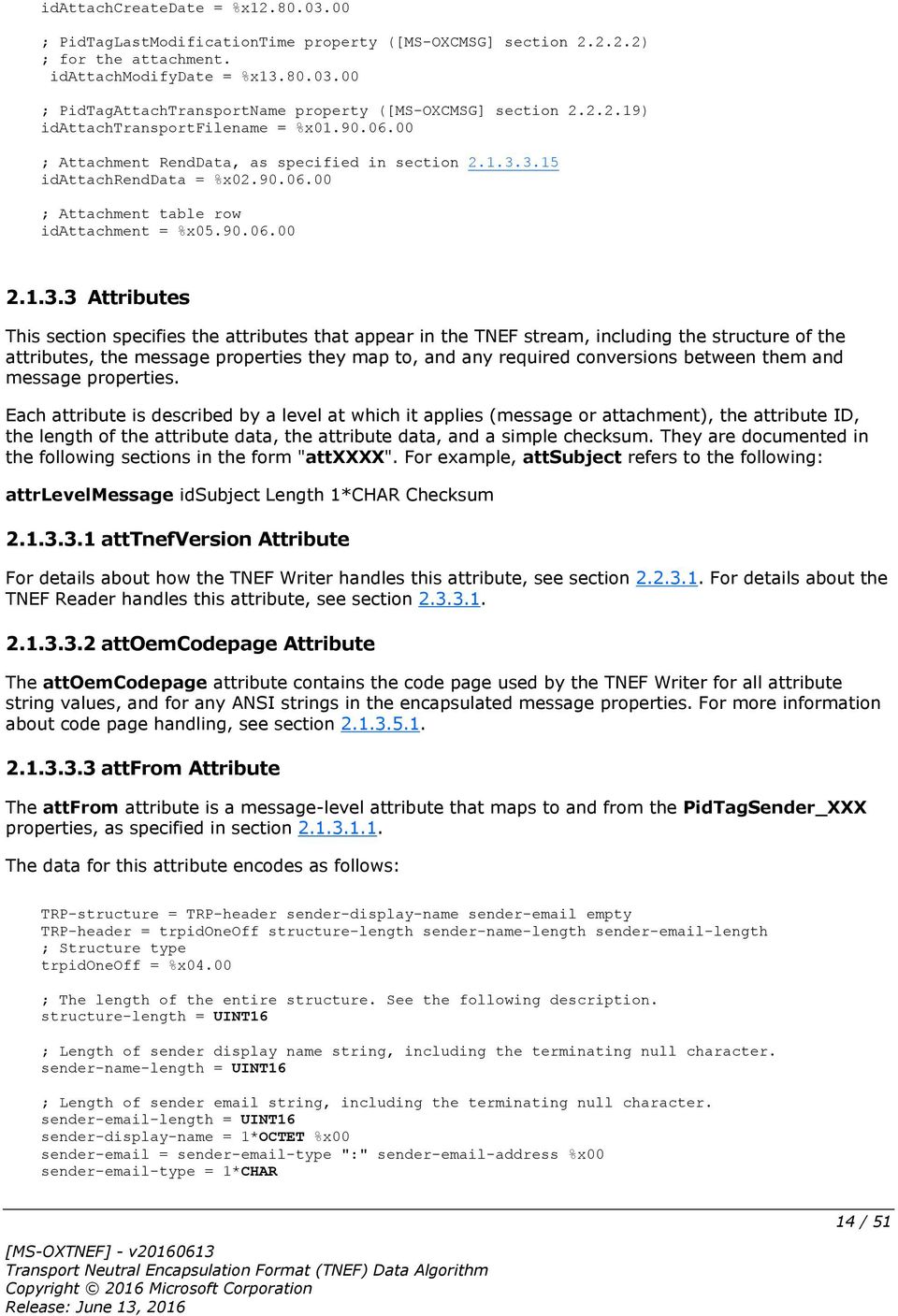
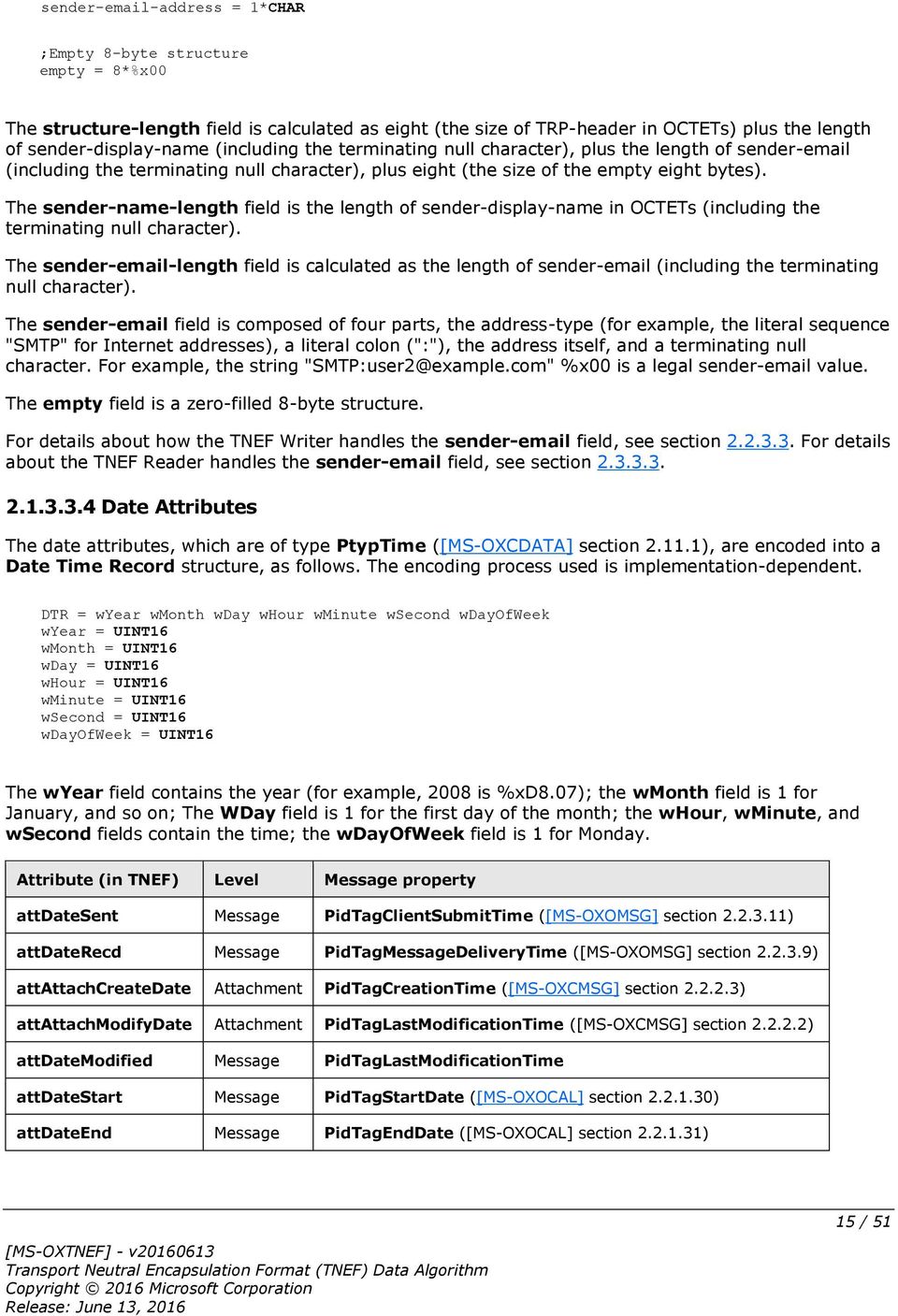
15 sender- -address = 1*CHAR ;Empty 8-byte structure empty = 8*%x00 The structure-length field is calculated as eight (the size of TRP-header in OCTETs) plus the length of sender-display-name (including the terminating null character), plus the length of sender- (including the terminating null character), plus eight (the size of the empty eight bytes). The sender-name-length field is the length of sender-display-name in OCTETs (including the terminating null character). The sender- -length field is calculated as the length of sender- (including the terminating null character). The sender- field is composed of four parts, the address-type (for example, the literal sequence "SMTP" for Internet addresses), a literal colon (":"), the address itself, and a terminating null character. For example, the string "SMTP:[email protected]" %x00 is a legal sender- value. The empty field is a zero-filled 8-byte structure. For details about how the TNEF Writer handles the sender- field, see section For details about the TNEF Reader handles the sender- field, see section Date Attributes The date attributes, which are of type PtypTime ([MS-OXCDATA] section ), are encoded into a Date Time Record structure, as follows. The encoding process used is implementation-dependent. DTR = wyear wmonth wday whour wminute wsecond wdayofweek wyear = UINT16 wmonth = UINT16 wday = UINT16 whour = UINT16 wminute = UINT16 wsecond = UINT16 wdayofweek = UINT16 The wyear field contains the year (for example, 2008 is %xd8.07); the wmonth field is 1 for January, and so on; The WDay field is 1 for the first day of the month; the whour, wminute, and wsecond fields contain the time; the wdayofweek field is 1 for Monday. Attribute (in TNEF) Level Message property attdatesent Message PidTagClientSubmitTime ([MS-OXOMSG] section ) attdaterecd Message PidTagMessageDeliveryTime ([MS-OXOMSG] section ) attattachcreatedate Attachment PidTagCreationTime ([MS-OXCMSG] section ) attattachmodifydate Attachment PidTagLastModificationTime ([MS-OXCMSG] section ) attdatemodified Message PidTagLastModificationTime attdatestart Message PidTagStartDate ([MS-OXOCAL] section ) attdateend Message PidTagEndDate ([MS-OXOCAL] section ) 15 / 51
16 Message Class Attributes The message class attribute value is stored as a zero-terminated string that holds the name specified by the client. Message class attributes in TNEF are as follows: Attribute in TNEF Level Message Property attmessageclass Message PidTagMessageClass ([MS-OXPROPS] section 2.778) attoriginalmessageclass Message PidTagOriginalMessageClass ([MS-OXPROPS] section 2.821) For details about how the TNEF Writer handles these attributes, see section For details about the TNEF Reader handles this field, see section attmessageid Attribute The attmessageid attribute is a message-level attribute that maps to the PidTagSearchKey property ([MS-OXCPRPT] section ). The PidTagSearchKey property that maps to this attribute is stored in binary, but the attribute is represented in text format. For details about how the TNEF Writer handles this attribute, see section For details about how the TNEF Reader handles this attribute, see section attsubject Attribute The attsubject attribute is a message-level attribute that maps to and from the PidTagSubject property ([MS-OXCMSG] section ). The data for this attribute is stored as a string with a terminating null character attmessagestatus Attribute The attmessagestatus attribute is a message-level attribute that maps to and from the PidTagMessageFlags property ([MS-OXCMSG] section ). The data for this attribute is stored as an unsigned 32-bit integer, with the correct bit value set to indicate the message status. For compatibility, these MUST be mapped to and from the following values: Status Attribute Flag (in TNEF) Bit Value Message Property Flag Bit Value Read fmsread 0x20 MSGFLAG_READ 0x01 Unmodified fmsmodified 0x01 MSGFLAG_UNMODIFIED 0x02 Submitted fmssubmitted 0x04 MSGFLAG_SUBMIT 0x04 Unsent fmslocal 0x02 MSGFLAG_UNSENT 0x08 Has Attachments fmshasattach 0x80 MSGFLAG_HASATTACH 0x10 If the fmsmodified attribute flag is set, then the corresponding message property flag (MSGFLAG_UNMODIFIED) is clear (that is, not set). If the fmsmodified attribute flag is clear, then the corresponding message property flag (MSGFLAG_UNMODIFIED) is set. For all other flags, either both the attribute flag and corresponding message property flag are set or both the attribute flag and corresponding message property flag are clear. 16 / 51
![778) attoriginalmessageclass Message PidTagOriginalMessageClass ([MS-OXPROPS] section 2.821) For details about how the TNEF Writer handles these attributes, see section 2.2.3.4.](/docs-images/42/19533327/images/page_16.jpg "For details about the TNEF Reader handles this field, see section 2.3.")
17 attbody Attribute The attbody attribute MAY<1> be supported. The attbody attribute is a message-level attribute that maps to and from the PidTagBody property ([MS-OXCMSG] section ). The data for this attribute is stored as a string with a terminating null character. For more details about how the TNEF Writer handles this attribute, see section attpriority Attribute The attpriority attribute is a message-level attribute that maps to and from the PidTagImportance property ([MS-OXCMSG] section ). The data for this attribute is stored as an unsigned 16-bit integer. For compatibility, these MUST be mapped to and from the following values: Priority Value (in TNEF) Message Property Value Low 3 0 Normal 2 1 High attattachdata Attribute The attattachdata attribute is an attachment-level attribute that maps to and from the PidTagAttachDataBinary property ([MS-OXCMSG] section ). The data for this attribute is stored as a binary stream. For details about how the TNEF Writer handles this attribute, see section For details about how the TNEF Reader handles this attribute, see section attattachtitle Attribute The attattachtitle attribute is an attachment-level attribute that maps to and from the PidTagAttachLongFilename property ([MS-OXCMSG] section ). The data for this attribute is stored as a string with a terminating null character. For details about how the TNEF Writer handles this attribute, see section For details about how the TNEF Reader handles this attribute, see section attattachmetafile Attribute The attattachmetafile attribute is an attachment-level attribute that maps to and from the PidTagAttachRendering property ([MS-OXCMSG] section ). The data for this attribute is stored as a binary stream. For a description of the content of the binary stream, see [MS-WMF] attattachtransportfilename Attribute 17 / 51
![6. 2.1.3.3.10 attpriority Attribute The attpriority attribute is a message-level attribute that maps to and from the PidTagImportance property ([MS-OXCMSG] section 2.2.1.11).](/docs-images/42/19533327/images/page_17.jpg "The data for this attribute is stored as an unsigned 16-bit integer.")
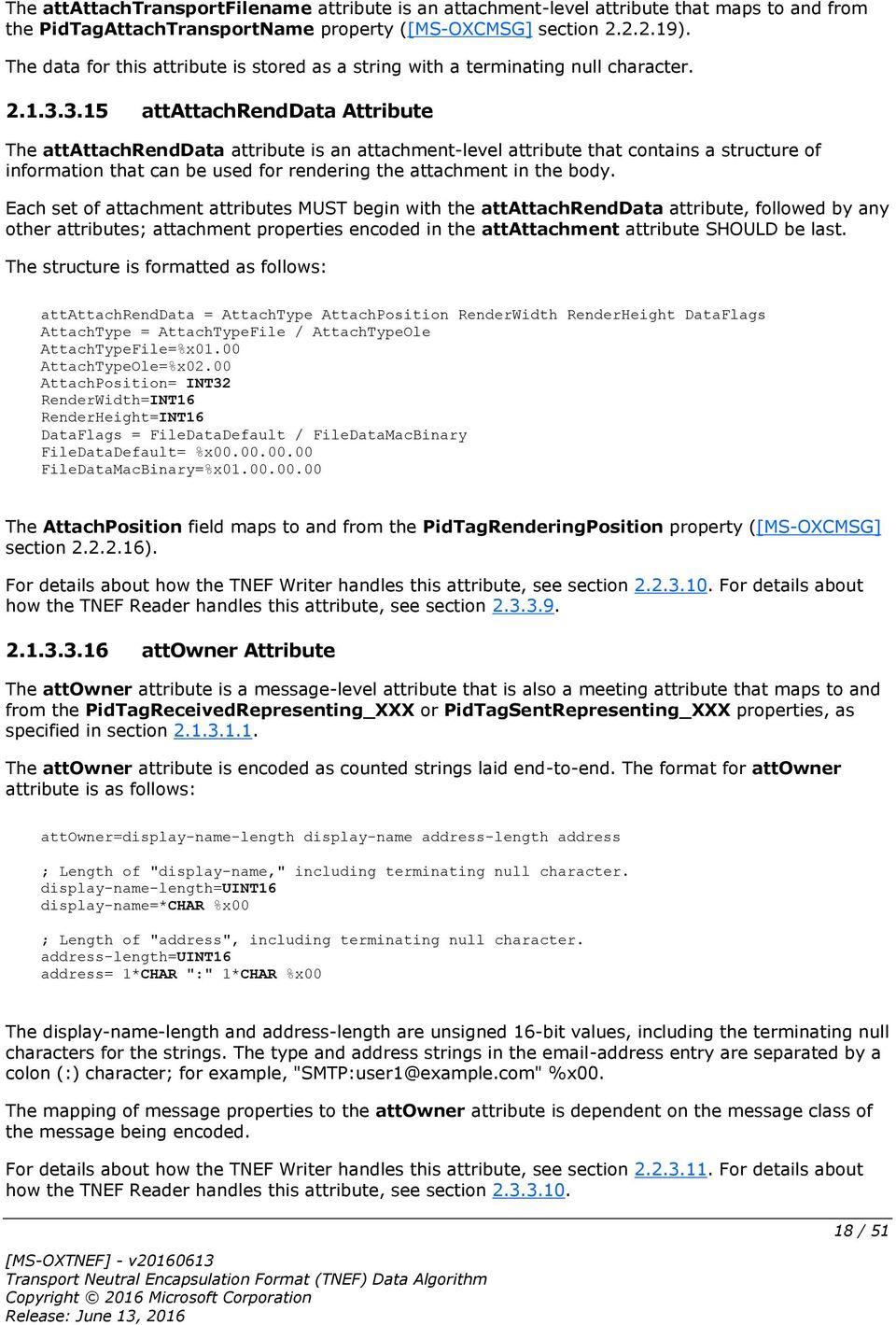
18 The attattachtransportfilename attribute is an attachment-level attribute that maps to and from the PidTagAttachTransportName property ([MS-OXCMSG] section ). The data for this attribute is stored as a string with a terminating null character attattachrenddata Attribute The attattachrenddata attribute is an attachment-level attribute that contains a structure of information that can be used for rendering the attachment in the body. Each set of attachment attributes MUST begin with the attattachrenddata attribute, followed by any other attributes; attachment properties encoded in the attattachment attribute SHOULD be last. The structure is formatted as follows: attattachrenddata = AttachType AttachPosition RenderWidth RenderHeight DataFlags AttachType = AttachTypeFile / AttachTypeOle AttachTypeFile=%x01.00 AttachTypeOle=%x02.00 AttachPosition= INT32 RenderWidth=INT16 RenderHeight=INT16 DataFlags = FileDataDefault / FileDataMacBinary FileDataDefault= %x FileDataMacBinary=%x The AttachPosition field maps to and from the PidTagRenderingPosition property ([MS-OXCMSG] section ). For details about how the TNEF Writer handles this attribute, see section For details about how the TNEF Reader handles this attribute, see section attowner Attribute The attowner attribute is a message-level attribute that is also a meeting attribute that maps to and from the PidTagReceivedRepresenting_XXX or PidTagSentRepresenting_XXX properties, as specified in section The attowner attribute is encoded as counted strings laid end-to-end. The format for attowner attribute is as follows: attowner=display-name-length display-name address-length address ; Length of "display-name," including terminating null character. display-name-length=uint16 display-name=*char %x00 ; Length of "address", including terminating null character. address-length=uint16 address= 1*CHAR ":" 1*CHAR %x00 The display-name-length and address-length are unsigned 16-bit values, including the terminating null characters for the strings. The type and address strings in the -address entry are separated by a colon (:) character; for example, "SMTP:[email protected]" %x00. The mapping of message properties to the attowner attribute is dependent on the message class of the message being encoded. For details about how the TNEF Writer handles this attribute, see section For details about how the TNEF Reader handles this attribute, see section / 51
19 attsentfor Attribute The attsentfor attribute is a message-level attribute that is also a meeting attribute that maps to and from the PidTagSentRepresenting_XXX properties, as specified in section For details about how the TNEF Writer handles this attribute, see section For details about how the TNEF Reader handles this attribute, see section attdelegate Attribute The attdelegate attribute MAY<2> be supported. The attdelegate attribute is a message-level attribute that is a meeting attribute that maps to and from PidTagReceivedRepresentingEntryId property ([MS-OXOMSG] section ). The content can be transported as a binary large object (BLOB). For details about how the TNEF Writer handles this attribute, see section For details about how the TNEF Reader handles this attribute, see section attaidowner Attribute The attaidowner attribute is a message-level attribute that is a meeting attribute that maps to and from the PidTagOwnerAppointmentId property ([MS-OXOCAL] section ). The content can be transported as a BLOB attrequestres Attribute The attrequestres attribute is a message-level attribute that is a meeting attribute that maps to and from the PidTagResponseRequested property ([MS-OXOCAL] section ). The data type of this value is a BOOLEAN ([MS-DTYP]); however, it SHOULD be transported as an INT16 value ([MS-DTYP]). The 2-byte INT16 value contains a null byte as the high-order 8 bits and the value of the PidTagResponseRequested property as the low-order 8 bits attmsgprops Attribute The attmsgprops attribute is a message-level attribute that maps to and from an arbitrary set of message properties. For a description of the encoding for this attribute, see section For details about how the TNEF Writer handles this attribute, see section attreciptable Attribute The attreciptable attribute is a message-level attribute that maps to and from the PidTagMessageRecipients property ([MS-OXCMSG] section ). For a description of the encoding for this attribute, see section attattachment Attribute The attattachment attribute is an attachment-level attribute that maps to and from an arbitrary set of properties for a single attachment. For a description of the encoding for this attribute, see section For details about how the TNEF Writer handles this attribute, see section / 51

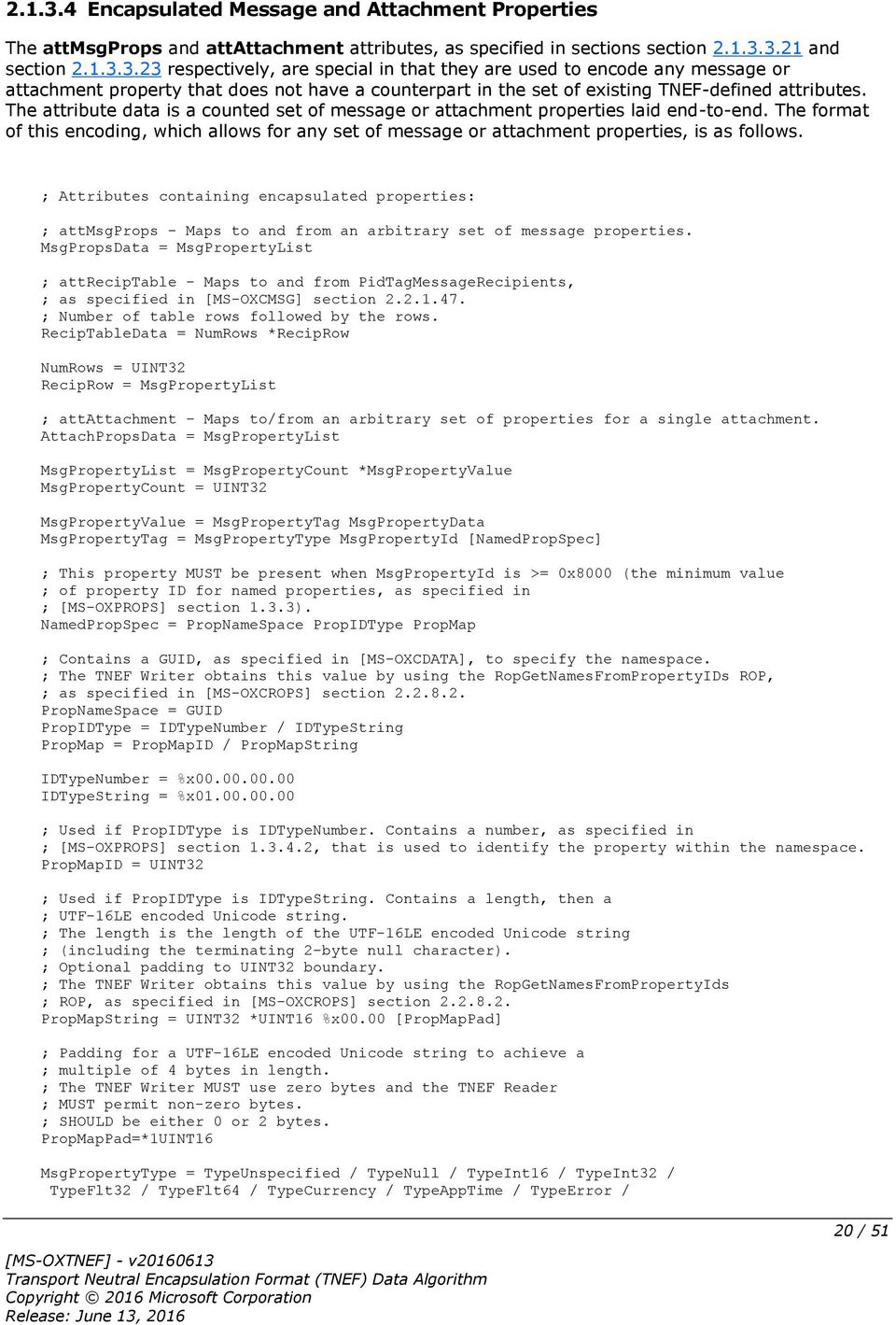
20 Encapsulated Message and Attachment Properties The attmsgprops and attattachment attributes, as specified in sections section and section respectively, are special in that they are used to encode any message or attachment property that does not have a counterpart in the set of existing TNEF-defined attributes. The attribute data is a counted set of message or attachment properties laid end-to-end. The format of this encoding, which allows for any set of message or attachment properties, is as follows. ; Attributes containing encapsulated properties: ; attmsgprops - Maps to and from an arbitrary set of message properties. MsgPropsData = MsgPropertyList ; attreciptable - Maps to and from PidTagMessageRecipients, ; as specified in [MS-OXCMSG] section ; Number of table rows followed by the rows. RecipTableData = NumRows *RecipRow NumRows = UINT32 RecipRow = MsgPropertyList ; attattachment Maps to/from an arbitrary set of properties for a single attachment. AttachPropsData = MsgPropertyList MsgPropertyList = MsgPropertyCount *MsgPropertyValue MsgPropertyCount = UINT32 MsgPropertyValue = MsgPropertyTag MsgPropertyData MsgPropertyTag = MsgPropertyType MsgPropertyId [NamedPropSpec] ; This property MUST be present when MsgPropertyId is >= 0x8000 (the minimum value ; of property ID for named properties, as specified in ; [MS-OXPROPS] section 1.3.3). NamedPropSpec = PropNameSpace PropIDType PropMap ; Contains a GUID, as specified in [MS-OXCDATA], to specify the namespace. ; The TNEF Writer obtains this value by using the RopGetNamesFromPropertyIDs ROP, ; as specified in [MS-OXCROPS] section PropNameSpace = GUID PropIDType = IDTypeNumber / IDTypeString PropMap = PropMapID / PropMapString IDTypeNumber = %x IDTypeString = %x ; Used if PropIDType is IDTypeNumber. Contains a number, as specified in ; [MS-OXPROPS] section , that is used to identify the property within the namespace. PropMapID = UINT32 ; Used if PropIDType is IDTypeString. Contains a length, then a ; UTF-16LE encoded Unicode string. ; The length is the length of the UTF-16LE encoded Unicode string ; (including the terminating 2-byte null character). ; Optional padding to UINT32 boundary. ; The TNEF Writer obtains this value by using the RopGetNamesFromPropertyIds ; ROP, as specified in [MS-OXCROPS] section PropMapString = UINT32 *UINT16 %x00.00 [PropMapPad] ; Padding for a UTF-16LE encoded Unicode string to achieve a ; multiple of 4 bytes in length. ; The TNEF Writer MUST use zero bytes and the TNEF Reader ; MUST permit non-zero bytes. ; SHOULD be either 0 or 2 bytes. PropMapPad=*1UINT16 MsgPropertyType = TypeUnspecified / TypeNull / TypeInt16 / TypeInt32 / TypeFlt32 / TypeFlt64 / TypeCurrency / TypeAppTime / TypeError / 20 / 51
21 TypeBoolean / TypeObject / TypeInt64 / TypeString8 / TypeUnicode / TypeSystime / TypeCLSID / TypeBinary / TypeMVInt16 / TypeMVInt32 / TypeMVFlt32 / TypeMVFlt64 / TypeMVCurrency / TypeMVAppTime / TypeMVSystime / TypeMVString8 / TypeMVBinary / TypeMVUnicode / TypeMVCLSID / TypeMVInt64 ; An arbitrary value that corresponds to the property. For named properties, the value is >= 0x8000 (as specified in [MS-OXPROPS] section 1.3.3). MsgPropertyId = UINT16 TypeUnspecified = %x00.00 TypeNull = %x01.00 ; Signed 16-bit value = INT16. TypeInt16 = %x02.00 TypeMVInt16 = %x02.10 ; Signed 32-bit value = INT32. TypeInt32 = %x03.00 TypeMVInt32 = %x03.10 ; Signed 32-bit floating point= FLOAT. TypeFlt32 = %x04.00 TypeMVFlt32 = %x04.10 ; 64-bit floating point= DOUBLE. TypeFlt64 = %x05.00 TypeMVFlt64 = %x05.10 ; Signed 64-bit int = OLE CURRENCY type. TypeCurrency = %x06.00 TypeMVCurrency = %x06.10 ; Application time= OLE DATE type. TypeAppTime = %x07.00 TypeMVAppTime = %x07.10 TypeError = %x0a.00 ; 16-bit Boolean (non-zero = TRUE) TypeBoolean = %x0b.00 ; Embedded object on a property. TypeObject = %x0d.00 ; 8-byte signed integer= INT64. TypeInt64 = %x14.00 TypeMVInt64 = %x14.10 ; 8-bit character string with terminating null character. TypeString8 = %x1e.00 TypeMVString8 = %x1e.10 ; UTF-16LE or variant character string with terminating 2-byte null character. TypeUnicode = %x1f.00 TypeMVUnicode = %x1f.10 ; FILETIME (a PtypTime value, as specified in [MS-OXCDATA] section ) TypeSystime = %x40.00 TypeMVSystime = %x40.10 ; OLE GUID TypeCLSID = %x48.00 TypeMVCLSID = %x48.10 ; Uninterpreted BLOB. TypeBinary = %x02.01 TypeMVBinary = %x / 51
22 ; MsgPropertyData varies by property type. Individual property values ; are formatted as specified in [MS-OXCDATA] section 2.11, with ; padding as specified in this document. MsgPropertyData = PropertyScalarContent / PropertyMultiScalarContent / PropertyMultiVariableContent ; Scalars Types Int16, Int32, Flt32, Flt64, Currency, AppTime, ; Bool, Int64, Systime, CLSID ; The data for the particular property is written to the stream and if necessary, ; padded with bytes (which SHOULD be zero) to achieve a multiple of 4-bytes in length. PropertyScalarContent = MsgPropertyContent [PropertyPad] ; PropertyPad between 0 and 3 zero-filled bytes, added to the streamed ; property values to achieve 4-byte boundary. The TNEF Writer MUST use zero bytes ; and the TNEF Reader MUST permit non-zero bytes. These pad bytes MUST be counted ; in the checksum of the containing attribute. PropertyPad=*3ZERO ZERO= %x00 ; Multi-value Scalars Types MVInt16, MVInt32, MVFlt32, MVFlt64, MVCurrency, ; MVAppTime, MVInt64, MVSystime, MVCLSID ; The number of values for the property is written to the stream as a 4-byte ; value, then the data for each value is written to the stream and if need ; be, padded with bytes (which SHOULD be zero) to achieve a multiple of 4 bytes in length. PropertyMultiScalarContent = PropertyContentCount *PropertyScalarContent PropertyContentCount = UINT32 ; Variable-length Types Unicode, String8, Object, Binary. ; These are handled as a special case of Multi-Variable-Length with the number of values=1. ; Multi-Variable-length Types MVUnicode, MVString8, MVBinary ; The number of values for the property is written to the stream as a 4-byte value. ; Then, for each value, the size of the property is written to the stream as a ; 4-byte value, then the data for the property is written to the stream and, if ; necessary, padded with zero bytes to achieve a multiple of 4 bytes in length. PropertyMultiVariableContent = MsgPropertyCount 1*PropertyVariableContent MsgPropertyCount = UINT32 ; The size of the property is written to the stream as a 4-byte value, then the data ; for the property is written to the stream and if necessary, padded with zero bytes ; to achieve a multiple of 4 bytes in length. The size includes the Interface ; Identifier at the beginning of the value stream for an object but does not include ; the padding bytes. ; ; If the property is of type PtypObject, as specified in ; [MS-OXCDATA] section , ; the value-size is followed by the Interface Identifier of the object, then the serialized ; stream of the data of the object. Only the Interface Identifier values ; %x0b c , ; %x0c c , and the Interface Identifiers of ; Message objects are supported. The size of the Interface Identifier is ; included in the calculation of value-size. ; ; If the object is an attached message (that is, it has a property type of ; PtypObject (as specified in [MS-OXCDATA] section ) and an ; Interface Identifier %x c , ; (that of a Message object), the value data is encoded as an embedded TNEF ; stream (that is, a complete TNEF stream as defined by this specification). PropertyVariableContent = MsgPropertySize MsgPropertyContent [PropertyPad] MsgPropertySize = UINT32 22 / 51
23 Other Compatibility Issues The preceding sections addressed issues of compatibility between the original implementation of TNEF and the richer implementation that is now used. This section discusses some compatibility issues within the richer implementation attoemcodepage Attribute Handling The attoemcodepage attribute, as specified in section , has been handled inconsistently between multiple implementations of TNEF. This can be particularly troublesome when forwarding messages with attached messages between systems that have different default code pages. To minimize problems caused by this inconsistent behavior, section specifies the recommended way to handle string encoding and section specifies the way to handle string decoding TNEF Encapsulation Versus Outer Wrapper Attributes It is possible to encapsulate properties in the TNEF stream that represents data that is already conveyed as part of an outer wrapper such as MIME. Because in many cases the outer wrapper properties are subject to substantial validation during transport (reverse DNs lookups and other validation), they are considered more trustworthy than information inside an attached file that otherwise could overwrite correct information with incorrect information. As a general rule, the TNEF Writer does not duplicate any data that is already being reliably transported outside the stream and the TNEF Reader does not override data from outside the stream with data from inside the stream. Individual implementations determine how this rule is applied. For more details, see [MS-OXCMAIL]. Some highlights of this behavior are specified in the following sections attbody Attribute Handling When TNEF is being sent as a MIME body part, the attbody attribute is not written to TNEF or read from TNEF either by the client or server. The plain text message body is instead transmitted in a MIME body part. For more details about attbody attribute handling by the TNEF Writer, see section For more details about MIME body parts, see [MS-OXCMAIL] attreciptable Attribute Handling When TNEF is being sent as a MIME body part, the attreciptable attribute is not written to TNEF or read from TNEF either by the client or server, except when sending or receiving a legacy nondelivery report message (the value of the attmessageclass attribute begins with "REPORT." and ends in ".DR" or ".NDR"). The requisite message recipient information is transmitted in the MIME structure instead. When TNEF is being sent as a MIME body part, when sending or receiving a legacy non-delivery report message (the value of the attmessageclass attribute begins with "REPORT." and ends in ".DR" or ".NDR"), recipient information from the attreciptable attribute is used to populate the received message recipient table. For more details about attreciptable attribute handling by the TNEF Writer, see section attfrom Attribute Handling The attfrom attribute is not written to TNEF or read from TNEF either by the client or the server for MIME messages. The requisite message recipient information is transmitted in the MIME stream instead. For more details about how the TNEF Writer encodes sender information, see section attsubject Attribute Handling 23 / 51
24 The attsubject attribute, if present for a MIME message, is overwritten by the subject value in the MIME stream. For details about how the TNEF Writer handles this attribute, see section For details about how the TNEF Reader handles this attribute, see section TNEF Writer Algorithm Details The TNEF Writer encodes or builds a TNEF stream for the purpose of transporting rich properties. This section specifies details specific to the TNEF Writer role. For details common to both the TNEF Reader and TNEF Writer roles, see section Abstract Data Model None Initialization None Processing Rules This section specifies the processing rules applied by the TNEF Writer to specific TNEF attributes. For processing rules common to the TNEF Writer and the TNEF Reader, see section atttnefversion Attribute Handling by the TNEF Writer The atttnefversion attribute, as specified in section MUST be written as %x by the TNEF Writer attoemcodepage Attribute Handling by TNEF Writer The TNEF Writer writes all ANSI strings, both the attribute strings and the encapsulated message property strings, with a consistent ANSI code page and puts its value into the attoemcodepage property, as specified in section Choose a code page that does not allow embedded zero bytes other than the zero terminator. If PidTagInternetCodepage ([MS-OXCMSG] section ) is being stored in the encapsulated properties, set it to the same value as the attoemcodepage attribute. This code page also determines the character set (1) used in MIME if this TNEF is transmitted as a MIME entity body. Do not write to an attribute any string that would suffer data loss if written using the consistent code page. Write to encapsulated properties with a Unicode data type all strings that would suffer data loss when using the consistent code page. For compatibility purposes, the attmessageclass attribute MUST be written using the consistent code page attfrom Attribute Handling by the TNEF Writer When encoding the sender- field of the attfrom attribute, as specified in section , the TNEF Writer can use the PidTagSenderName ([MS-OXOMSG] section ), PidTagSenderAddressType ([MS-OXOMSG] section ), and PidTagSender Address ([MS-OXOMSG] section ) properties if present, or access their values using the PidTagSenderEntryId property ([MS-OXOMSG] section ). 24 / 51
25 When TNEF is being used to encode an attached message, the sender information is carried in encapsulated message properties in the attfrom attribute Message Class Attribute Handling by the TNEF Writer The TNEF Writer can represent any message class, as specified in section , whose value is shown in the Message Property Value column of the following table, using the value in the Attribute value column. Attribute value (in TNEF) IPM.Microsoft Mail.Note IPM.Microsoft Mail.Read Receipt IPM.Microsoft Mail.Non-Delivery IPM.Microsoft Schedule.MtgRespP IPM.Microsoft Schedule.MtgRespN IPM.Microsoft Schedule.MtgRespA IPM.Microsoft Schedule.MtgReq IPM.Microsoft Schedule.MtgCncl Message property value IPM.Note Report.IPM.Note.IPNRN Report.IPM.Note.NDR IPM.Schedule.Meeting.Resp.Pos IPM.Schedule.Meeting.Resp.Neg IPM.Schedule.Meeting.Resp.Tent IPM.Schedule.Meeting.Request IPM.Schedule.Meeting.Canceled Values not included in the table SHOULD be written in their original form attsubject Attribute Handling by the TNEF Writer When TNEF is being used to encode an attached message, the message subject information is carried in encapsulated message properties in the attmsgprops attribute, not the attsubject attribute attbody Attribute Handling by the TNEF Writer When TNEF is being used to encode an attached message, the attbody attribute, as specified in section , MAY<3> be written and read attmessageid Attribute Handling by the TNEF Writer For compatibility, when generating a TNEF stream, the TNEF Writer MUST translate the binary representation of the attmessageid attribute, as specified in section , into a textual one by emitting the two CHAR hexadecimal equivalent per OCTET (i.e. %x01 becomes "01", %x2d becomes "2D", and so on) attattachdata Attribute Handling by the TNEF Writer The TNEF Writer can use the attattachdata attribute, as specified in section , for the attachment data if the PidTagAttachMethod property ([MS-OXCMSG] section ) of the original attachment contains the value 0x0001 (ATTACH_BY_VALUE). If the PidTagAttachMethod of the original attachment contains the value 0x0005 (ATTACH_EMBEDDED_MSG) or the value 0x0006 (ATTACH_OLE), then the TNEF Writer MUST encode the data in attattachment (section ). 25 / 51
26 attattachtitle Attribute Handling by the TNEF Writer The TNEF Writer obtains the value of the attattachtitle attribute, as specified in section , from the PidTagAttachLongFilename property ([MS-OXCMSG] section ) if it is available; otherwise, the TNEF Writer obtains the value of the attattachtitle attribute from the PidTagAttachFilename property attattachrenddata Attribute Handling by the TNEF Writer The AttachType field of the attattachrenddata attribute, as specified in section , MUST be set by the TNEF Writer to the value of the AttachTypeFile attribute when the PidTagAttachMethod property ([MS-OXCMSG] section ) for the attachment is set to ATTACH_BY_VALUE or ATTACH_EMBEDDED_MSG, and to the value of the AttachTypeOle attribute when the PidTagAttachMethod property is set to ATTACH_OLE. The RenderWidth and RenderHeight fields of the attattachrenddata attribute SHOULD be set by the TNEF Writer to the size of the system icons if the attachment is a simple file attachment, or to {- 1,-1} if the attachment is not a simple file attachment. The DataFlags field SHOULD<4> be set to FileDataDefault (%x ), regardless of the attachment s Error! Hyperlink reference not valid. property ([MS-OXCMSG] section ) value. However, if the PidTagAttachEncoding property ([MS-OXCMSG] section ) for the attachment consists of bytes %x2a f b.01, then the FileDataMacBinary bit MAY<5> be set by the TNEF Writer; otherwise the FileDataDefault field SHOULD be set by the TNEF Writer attowner Attribute Handling by the TNEF Writer If the message is either a meeting request or meeting cancellation (from the organizer, who is creating or deleting a meeting), the TNEF Writer SHOULD encode the PidTagSentRepresenting_XXX properties, as specified in section , in the attowner attribute, as specified in section If the message is a meeting response of any type (from attendee, accepting, declining, and so on), the TNEF Writer SHOULD encode the PidTagReceivedRepresenting_XXX properties, as specified in section , in the attowner attribute. The encoding used is implementation-dependent. For details about how to construct the EntryId property, see [MS-OXOMSG] section The TNEF Writer can use the discrete PidTag{Sent Rcvd}Representing Name, AddressType, and Address properties if present, or access their values by using the PidTag{Sent Rcvd}EntryId property attsentfor Attribute Handling by the TNEF Writer The TNEF Writer SHOULD encode the PidTagSentRepresenting_XXX properties, as specified in section , in the attsentfor attribute, as specified in section The TNEF Writer can use the discrete PidTagSentRepresentingName ([MS-OXOMSG] section ), PidTagSentRepresentingAddressType ([MS-OXOMSG] section ), and PidTagSentRepresenting Address ([MS-OXOMSG] section ) properties if present, or access their values by using the PidTagSentRepresentingEntryId property ([MS-OXOMSG] section ) attdelegate Attribute Handling by the TNEF Writer The TNEF Writer SHOULD encode the PidTagReceivedRepresentingEntryId properties, as specified in [MS-OXOMSG] section , in the attdelegate attribute, as specified in section / 51
27 attmsgprops Attribute Handling by the TNEF Writer The TNEF Writer SHOULD write the attmsgprops attribute, as specified in section , after all the other message attributes and immediately before all the attachment attributes. For a description of the encoding for this attribute, see section attattachment Attribute Handling by the TNEF Writer The TNEF Writer SHOULD write the encapsulated attattachment attribute, as specified in section , after all the attributes for an attachment attreciptable Attribute Handling by the TNEF Writer When TNEF is being used to encode an attached message, recipient information from the attreciptable attribute, as specified in section , is used to populate the received message recipient table. 2.3 TNEF Reader Algorithm Details The TNEF Reader decodes a TNEF stream after receiving a message, for the purpose of reconstructing the rich properties that are contained in the stream. This section specifies details specific to the TNEF Reader role. For details common to both the TNEF Reader and TNEF Writer roles, see section Abstract Data Model None Initialization None Processing Rules This section specifies the processing rules applied by the TNEF Reader to specific TNEF attributes. For processing rules common to the TNEF Writer and the TNEF Reader, see section atttnefversion Attribute Handling by the TNEF Reader The TNEF Reader MUST reject values other than %x for the atttnefversion attribute, as specified in section attoemcodepage Attribute Handling by the TNEF Reader When performing ANSI string decoding from the TNEF stream, the TNEF Reader uses the first code page determined from the following sources: 1. Any non-us-ascii MIME character set (2), if the stream was transmitted as a MIME body part and the character set (2) name is available in MIME, mapped to the most appropriate code page that does not allow embedded zero bytes other than a zero terminator. 2. The attoemcodepage attribute, as specified in section , if available and nonzero. 27 / 51
28 3. The PidTagInternetCodepage property ([MS-OXCMSG] section ), if available in the encapsulated properties, mapped to a code page that does not allow embedded zero bytes other than a null terminator. 4. The most appropriate default code page for the processing environment attfrom Attribute Handling by the TNEF Reader When reading the sender- field of the attfrom attribute, as specified in section , the TNEF Reader MUST set the PidTagSenderEntryId property ([MS-OXOMSG] section ) and SHOULD decode the attfrom attribute into the other PidTagSender_XXX properties, as specified in section attmessageclass Attribute Handling by the TNEF Reader If the attmessageclass or attoriginalmessageclass attribute, as specified in section , contains a value that is shown in the Attribute value column of the following table, the value that MUST be returned is that of the value in the Message property value column. Attribute value (in TNEF) IPM.Microsoft Mail.Note IPM.Microsoft Mail.Read Receipt IPM.Microsoft Mail.Non-Delivery IPM.Microsoft Schedule.MtgRespP IPM.Microsoft Schedule.MtgRespN IPM.Microsoft Schedule.MtgRespA IPM.Microsoft Schedule.MtgReq IPM.Microsoft Schedule.MtgCncl Message property value IPM.Note Report.IPM.Note.IPNRN Report.IPM.Note.NDR IPM.Schedule.Meeting.Resp.Pos IPM.Schedule.Meeting.Resp.Neg IPM.Schedule.Meeting.Resp.Tent IPM.Schedule.Meeting.Request IPM.Schedule.Meeting.Canceled Values not included in the table SHOULD be read in their original form. If the value of the attmessageclass or attoriginalmessageclass attribute begins with the string "Microsoft Mail v3.0 ", the TNEF Reader MUST ignore the "Microsoft Mail v3.0 " prefix when attempting to match the value of the attmessageclass or attoriginalmessageclass attribute to a value in the Attribute Value column. For example, the TNEF Reader considers the value of the attmessageclass or attoriginalmessageclass attribute Microsoft Mail v3.0 IPM.Microsoft.Mail.Note to be the same as IPM.Microsoft.Mail.Note, which corresponds to the Message Property Value IPM.Note. The TNEF Reader SHOULD ignore the checksum value for message class attributes because some legacy TNEF Writers generated non-valid checksum values attmessageid Attribute Handling by the TNEF Reader When reading the attmessageid attribute, as specified in section , from TNEF, the TNEF Reader SHOULD attempt to decode the text format back into binary format. 28 / 51
29 attsubject Attribute Handling by the TNEF Reader When the TNEF stream is being decoded, if the attsubject attribute, as specified in section , is present, it is used for the message if there is no MIME structure, if a MIME subject is not available, or if an attached message is being decoded attattachdata Attribute Handling by the TNEF Reader If the PidTagAttachMethod property ([MS-OXCMSG] section ) of the original attachment contains the value 0x0005 (ATTACH_EMBEDDED_MSG) or the value 0x0006 (ATTACH_OLE), then the TNEF Reader SHOULD ignore the attattachdata attribute, as specified in section attattachtitle Attribute Handling by the TNEF Reader The TNEF Reader MUST set the value of the PidTagAttachLongFilename property ([MS-OXCMSG] section ), which maps to the attattachtitle attribute, as specified in section attattachrenddata Attribute Handling by the TNEF Reader The TNEF Reader SHOULD set the PidTagAttachTag property ([MS-OXCMSG] section ) for the attachment to %x2a f a when the AttachTypeOle field of the attattachrenddata attribute, as specified in section , is set. The TNEF Reader SHOULD NOT set the PidTagAttachTag property for the attachment when AttachTypeFile field of the attattachrenddata attribute is set. The TNEF Reader SHOULD set the value of the PidTagAttachEncoding property ([MS-OXCMSG] section ) for the attachment to the same bytes when the DataFlags field of the attattachrenddata attribute has the FileDataMacBinary bit set. If the DataFlags field contains the value of FileDataDefault, then the TNEF Reader SHOULD NOT set the value of the PidTagAttachEncoding property for the attachment attowner Attribute Handling by the TNEF Reader If the message is either a meeting request or meeting cancellation (from the organizer, who is creating or deleting a meeting), the TNEF Reader SHOULD decode the attowner attribute, as specified in section , into the PidTagSentRepresenting_XXX properties, as specified in section If the message is a meeting response of any type (from attendee, accepting, declining, and so on), the TNEF Reader SHOULD decode the attowner attribute into the PidTagReceivedRepresenting_XXX properties, as specified in section The decoding process used is implementation-dependent, as long as the decoded property values match those that were originally encoded. For details about how to construct the PidTagReceivedRepresentingEntryId property, see [MS-OXOMSG] section The TNEF Reader MUST set the PidTag{Sent Rcvd} EntryId property and SHOULD decode the attowner attribute into the other PidTag{Sent Rcvd} Representing properties attsentfor Attribute Handling by the TNEF Reader The TNEF Reader SHOULD decode the attsentfor attribute, as specified in section , into the PidTagSentRepresenting_XXX properties, as specified in section The TNEF Reader SHOULD set the PidTagSentRepresentingEntryId property ([MS-OXOMSG] section ) and SHOULD decode the attowner attribute, as specified in section , into the other PidTagSentRepresenting_XXX properties. 29 / 51
30 attdelegate Attribute Handling by the TNEF Reader The TNEF Reader SHOULD decode the attdelegate attribute, as specified in section , into the PidTagReceivedRepresentingEntryId properties ([MS-OXOMSG] section ). 30 / 51
31 3 Algorithm Examples 3.1 Sample Message Explanation of content TNEF Signature, Value=0x223E9F78 Byte stream 78 9f 3e 22 Attach Key, Value=0x Message attribute, atttnefversion Length=4 bytes Value=0x Checksum=0x Message attribute, attoemcodepage Length=8 bytes Value= (Primary=1252, Secondary=0) e Checksum=0x00E8 e8 00 Message attribute, attmessageclass Length=24 bytes Value="IPM.Microsoft Mail.Note" %x d 2e 4d f 73 6f d c 2e 4e 6f Checksum=0x Message attribute, attpriority Length=2 bytes 01 0d / 51
32 Explanation of content Value=0x0002 (Normal Priority) Byte stream Checksum=0x Message attribute, attsubject Length=15 bytes f Value="Simple subject" %x d 70 6c a Checksum=0x057A 7a 05 Message attribute, attdatesent Length=14 bytes e Value= Tuesday, 02/17/2004, 11:25:35 d b Checksum=0x Message attribute, attdatemodified Length=14 bytes e Value= Tuesday, 02/17/2004, 12:26:09 D C A Checksum=0x011F 1F 01 Message attribute, attmessageid Length=33 bytes Value= "757BB19CDE936A4087D90BB784C58E3B" / 51
33 Explanation of content Byte stream Checksum=0x Message attribute, Encapsulation, attmsgprops Length=2256 bytes Number of properties= d Message property, PidTagAlternateRecipientAllowed ([MS-OXCMSG] section ) Value=1 (TRUE) 0b Message property, PidTagPriority ([MS-OXCMSG] section ) Value=0 (LOW) Message property, PidTagSensitivity ([MS-OXCMSG] section ) Value=0 (LOW) Message property, PidTagClientSubmitTime ([MS- OXOMSG] section ) Value=Tuesday, 02/17/2004, 19:25: AA D6 F3 D0 8B F5 C3 01 Message property, PidTagSubjectPrefix ([MS-OXOMSG] section ) Size of first property=1 1e 00 3d Value = %x00 00 Pad=3 bytes Message property, PidTagReceivedByEntryId ([MS- OXOMSG] section ) Size of first property= f b Value DC A7 40 C8 C A B4 B B 2F E F 4F 3D F E 49 5A F 33 / 51
34 Explanation of content Byte stream 4E 2F 4F 55 3D D 49 4E F F 43 4E 3D E F 43 4E 3D Pad=1 byte 00 Message property, PidTagReceivedByName ([MS- OXOMSG] section ) Size of first property=10 1e a Value="Test21uw2" %x Pad=2 bytes Message property, PidTagReceivedRepresentingEntryId ([MS-OXOMSG] section ) Size of first property= b Value DC A7 40 C8 C A B4 B B 2F E F 4F 3D F E 49 5A F 4E 2F 4F 55 3D D 49 4E F F 43 4E 3D E F 43 4E 3D Pad=1 byte 00 Message property, PidTagReceivedRepresentingName ([MS-OXOMSG] section ) Size of first property=10 Value="Test21uw2" %x00 1e a / 51
35 Explanation of content Pad=2 bytes Byte stream Message property, PidTagMessageSubmissionId ([MS- OXOMSG] section ) Size of first property=57 Value D B 61 3D 20 3B 70 3D F E 69 7A B 6C 3D 4A F D A 2D Pad=3 bytes Message property, PidTagReceivedBySearchKey ([MS- OXOMSG] section ) Size of first property=82 Value A 2F 4F 3D F E 49 5A F 4E 2F 4F 55 3D D 49 4E F F 43 4E 3D E F 43 4E 3D Pad=2 bytes Message property, PidTagReceivedRepresentingSearchKey ([MS- OXOMSG] section ) Size of first property=82 Value A 2F 4F 3D F E 49 5A F 4E 2F 4F 55 3D D 49 4E F F 43 4E 3D E F 43 4E 3D Pad=2 bytes / 51
36 Explanation of content Message property, PidTagMessageToMe ([MS-OXOMSG] section ) Value=1 (TRUE) Message property, PidTagMessageCcMe ([MS-OXOMSG] section ) Value=0 (FALSE) Message property PidTagMessageRecipientMe ([MS- OXOMSG] section ) Value=1 (TRUE) Message property, PidTagConversationTopic ([MS- OXOMSG] section ) Size of first property=15 Value="Simple subject" %x00 Byte stream 0b b b e f D 70 6C A Pad=1 byte 00 Message property, PidTagConversationIndex ([MS- OXOMSG] section ) Size of first property=22 Value C3 F5 8B D 89 1B D C9 8F 66 4E 21 9A D2 4A F2 Pad=2 bytes Message property, PidTagReceivedByAddressType ([MS-OXOMSG] section ) Size of first property=5 Value="SMTP" %x00 1e d Pad=3 bytes Message property, PidTagReceivedBy Address ([MS-OXOMSG] section ) Size of first property=40 1e / 51
37 Explanation of content %x00 Byte stream D F 6D E E 6D F 73 6F E 63 6F 6D 00 Message property, PidTagReceivedRepresentingAddressType ([MS- OXOMSG] section ) Size of first property=5 Value="SMTP" %x00 1e d Pad=3 bytes Message property, PidTagReceivedRepresenting Address ([MS- OXOMSG] section ) Size of first property=40 %x00 1e D F 6D E E 6D F 73 6F E 63 6F 6D 00 Message property, PidTagSenderName ([MS-OXOMSG] section ) Size of first property=10 Value="Test21uw2" %x00 1e 00 1A 0C a Pad=2 bytes Message property, PidTagNormalizedSubject ([MS- OXCMSG] section ) Size of first property=15 Value="Simple subject" %x00 1e 00 1D 0E f D 70 6C A / 51
38 Explanation of content Pad=1 byte Byte stream 00 Message property, PidTagRtfCompressed ([MS-OXCMSG] section ) Size of first property=150 Value AB C 5A A8 14 2F A F8 0B 60 6E 0E F 01 F7 02 A4 03 E A C0 73 B D 0A 80 9D A 09 B0 09 F B1 1A 52 0D E D E E B0 01 D C B 0B FA 34 0C B 03 0B B C9 0B A A2 0B 0A E A0 Pad=2 bytes Message property, PidTagInternetMessageId ([MS- OXOMSG] section ) Size of first property=80 Value="< D7E52DF4DB5D10536D extest.microsoft.com>" %x00 1e C A F E 6D F 6D E E 6D F 73 6F E 63 6F 6D 3E 00 Message property, PidTagIconIndex ([MS-OXOMSG] section ) Value=0xFFFFFFFF Unspecified PtypBinary property Size of first property=40 Value ff ff ff ff f DB F 2D D / 51
39 Explanation of content Unspecified property Size of first property=38 Value="Simple subject.eml" %x00.00 (Unicode) Byte stream 1f 00 f D C A E D 00 4C Pad=2 bytes Message property, PidTagAttributeHidden ([MS- OXCFOLD] section ) Value=0 (FALSE) Unspecified PtypBoolean ([MS-OXCDATA] section ) property Value=0 (FALSE) Message property, PidTagAttributeReadOnly ([MS- OXPROPS] section 2.603) Value=0 (FALSE) Message property, PidTagCreationTime ([MS-OXCMSG] section ) Value=Tuesday, 02/17/2004, 20:26:09 Message property, PidTagLastModificationTime ([MS- OXCMSG] section ) Value=Tuesday, 02/17/2004, 20:26:09 Message property, PidTagInternetCodepage ([MS- OXCMSG] section ) Value=(Primary=1252, Secondary=0) Message property, PidTagMessageLocaleId ([MS- OXCMSG] section ) Value=(Primary=1033, Secondary=0) Message property, PidTagCreatorName ([MS-OXPROPS] section 2.647) Size of first property=10 Value="Test21uw2" %x00 0b 00 f b 00 f b 00 f f5 c f5 c de 3f e f1 3f e 00 f8 3f a Pad=2 bytes / 51
40 Explanation of content Message property, PidTagCreatorEntryId ([MS-OXCMSG] section ) Size of first property=107 Value Byte stream F9 3F b DC A7 40 C8 C A B4 B B 2F E F 4F 3D F E 49 5A F 4E 2F 4F 55 3D D 49 4E F F 43 4E 3D E F 43 4E 3D Pad=1 byte 00 Message property, PidTagLastModifierName ([MS- OXCPRPT] section ) Size of first property=10 Value="Test21uw2" %x00 1e 00 fa 3f a Pad=2 bytes Message property, PidTagLastModifierEntryId ([MS- OXCMSG] section ) Size of first property=107 Value FB 3F b DC A7 40 C8 C A B4 B B 2F E F 4F 3D F E 49 5A F 4E 2F 4F 55 3D D 49 4E F F 43 4E 3D E F 43 4E 3D Pad=1 byte 00 Message property, PidTagMessageCodepage ([MS- OXCMSG] section ) Value=(Primary=1252, Secondary=0) fd 3f e / 51
41 Explanation of content Unspecified message property Value=0 Byte stream Message property, PidTagSentRepresentingFlags ([MS- OXPROPS] section ) Value=0 Unspecified message property Value= A B Unspecified message property, Value= C Unspecified PtypString ([MS-OXCDATA] section ) property Size of first property=10 Value="Test21uw2" %x00 1e a Pad=2 bytes Unspecified PtypString property Size of first property=10 Value="Test21uw2" %x00 1e a Pad=2 bytes Unspecified PtypString property Size of first property=10 Value="Test21uw2" %x00 1e a Pad=2 bytes Unspecified PtypString property Size of first property=10 1e a / 51
42 Explanation of content Value="Test21uw2" %x00 Byte stream Pad=2 bytes Unspecified PtypString property Size of first property=10 Value="Test21uw2" %x00 1e a Pad=2 bytes Unspecified PtypString property Size of first property=10 Value="Test21uw2" %x00 1e a Pad=2 bytes Message property, PidTagContentFilterSpamConfidenceLevel ([MS- OXCSPAM] section ) Value=0xFFFFFFFF Message property, PidTagMessageEditorFormat ([MS- OXOMSG] section ) Value=0x Message property, PidTagTnefCorrelationKey ([MS- OXCMSG] section ) Size of first property=12 Value ff ff ff ff f c b 6a d Message property, PidLidAgingDontAgeMe ([MS- OXCMSG] section ) PSETID_Common, MNID_ID, Id=0x850E Value=0 0b c e / 51
43 Explanation of content Message property, PidLidCurrentVersion ([MS-OXCMSG] section ) PSETID_Common, MNID_ID, Id=0x8552 Value= Message property, PidLidCurrentVersionName ([MS- OXCMSG] section ) PSETID_Common, MNID_ID, Id=0x8554 Size of first property=5 Value="11.0" %x00 Byte stream f c c E 00 A c E Pad=3 bytes Message property, PidLidReminderDelta ([MS- OXORMDR] section ) PSETID_Common, MNID_ID, Id=0x8501 Value=0 Message property, PidLidReminderSet ([MS-OXORMDR] section ) PSETID_Common, MNID_ID, Id=0x8503 Value=0 (FALSE) Message property, PidLidSideEffects ([MS-OXCMSG] section ) PSETID_Common, MNID_ID, Id=0x8510 Value=0 Message property, PidLidTaskMode ([MS-OXOTASK] section ) PSETID_Common, MNID_ID, Id=0x8518 Value=0 Message property, PidLidPrivate ([MS-OXCMSG] section ) PSETID_Common, MNID_ID, Id=0x8506 Value=0 (FALSE) Message property, PidLidUseTnef ([MS-OXOMSG] section ) PSETID_Common, MNID_ID, eb c b 00 f c fa c c b c b c / 51
44 Explanation of content Id=0x8582 Value=0 (FALSE) Message property, PidTagReadReceiptRequested ([MS- OXOMSG] section ) Value=0 (FALSE) Message property, PidTagOriginatorDeliveryReportRequested ([MS- OXOMSG] section ) Value=0 (FALSE) Unspecified PtypInteger32 ([MS-OXCDATA] section ) property Value=0xF00D29FF Unspecified PtypInteger32 property Value=13 Byte stream b b ff 29 0d f d Unspecified PtypInteger32 property Value= Unspecified PtypInteger32 property Value= Unspecified PtypString property Size of first property=14 Value="SIMPLEMESSAGE" %x00 1e e d 50 4c 45 4d Pad=2 bytes Message property, PidTagTnefCorrelationKey ([MS- OXCMSG] section ) Size of first property=56 Value f C E D 70 6C 65 2E 63 6F 6D 3E 00 Checksum for AttMsgProps 45 C1 44 / 51
45 3.2 Sample Meeting Response This example is particularly short, as it was sent by a mobile application. Explanation of content TNEF Signature, Value=0x223E9F78 Byte stream 78 9f 3e 22 Attach Key, Value=0x Message attribute, atttnefversion Length=4 bytes Value=0x Checksum=0x Message attribute, attoemcodepage Length=8 bytes Value= (Primary=1252, Secondary=0) e Checksum=0x00E8 e8 00 Message attribute, attmessageclass Length=32 bytes Value="IPM.Microsoft Schedule.MtgRespN" %x d 2e 4d f 73 6f c 65 2e 4d e 00 Checksum=0x0B b Message attribute, attpriority Length=2 bytes 01 0d / 51
46 Explanation of content Value=0x0002 (Normal Priority) Byte stream Checksum=0x Message attribute, attdatesent Length=14 bytes e Value= Wednesday, 01/16/2008, 23:28:08 d c Checksum=0x012E 2e 01 Message attribute, attdatemodified Length=14 bytes e Value= Wednesday, 01/16/2008, 23:28:08 d c Checksum=0x012E 2e 01 Message attribute Encapsulation, attmsgprops Length=136 bytes Number of properties=2 Message property, PidTagTnefCorrelationKey ([MS- OXCMSG] section ) Size of first property=12 Value f c b 6a d Message property, PidTagRtfCompressed ([MS- OXCMSG] section ) Size of first property=93 Value d b c 5a a9 be bb ed a 01 0d f7 ff 02 a4 03 e4 05 eb f3 06 b c a c d d 0a cf 3f 09 d / 51
47 Explanation of content Byte stream 0a 84 0b c2 01 d d Pad=3 bytes Checksum for attmsgprops f / 51
48 4 Security 4.1 Security Considerations for Implementers Extreme care is recommended in the use of the attreciptable attribute and the attfrom attribute, particularly by the TNEF Reader, to avoid address or identity spoofing. More information about this can be found in [MS-OXCMSG] and section of this specification. 4.2 Index of Security Parameters None. 48 / 51
49 5 Appendix A: Product Behavior The information in this specification is applicable to the following Microsoft products or supplemental software. References to product versions include released service packs. Microsoft Exchange Server 2003 Microsoft Exchange Server 2007 Microsoft Exchange Server 2010 Microsoft Exchange Server 2013 Microsoft Exchange Server 2016 Microsoft Office Outlook 2003 Microsoft Office Outlook 2007 Microsoft Outlook 2010 Microsoft Outlook 2013 Microsoft Outlook 2016 Exceptions, if any, are noted below. If a service pack or Quick Fix Engineering (QFE) number appears with the product version, behavior changed in that service pack or QFE. The new behavior also applies to subsequent service packs of the product unless otherwise specified. If a product edition appears with the product version, behavior is different in that product edition. Unless otherwise specified, any statement of optional behavior in this specification that is prescribed using the terms SHOULD or SHOULD NOT implies product behavior in accordance with the SHOULD or SHOULD NOT prescription. Unless otherwise specified, the term MAY implies that the product does not follow the prescription. <1> Section : Exchange 2003 supports the use of the attbody attribute. <2> Section : Exchange 2003 supports the use of the attdelegate attribute. <3> Section : In Exchange 2003, the TNEF Writer writes the attbody attribute when TNEF is used to encode an attached message. <4> Section : In Exchange 2003, the TNEF Writer does not set the DataFlags field to FileDataDefault. <5> Section : In Exchange 2003, the TNEF Writer sets the FileDataMacBinary bit if the PidTagAttachEncoding property ([MS-OXCMSG] section ) for the attachment consists of bytes %x2a f b / 51
50 6 Change Tracking No table of changes is available. The document is either new or has had no changes since its last release. 50 / 51
51 7 Index A Applicability 9 C Change tracking 50 Common overview 10 Common - processing rules Processing Rules - common 10 T TNEF Reader overview 27 TNEF Reader - processing rules Processing Rules - TNEF Reader 27 TNEF Writer overview 24 TNEF Writer - processing rules Processing Rules - TNEF Writer 24 Tracking changes 50 E Examples Sample Meeting Response 45 Sample Message 31 G Glossary 6 I Implementer - security considerations 48 Index of security parameters 48 Informative references 8 Introduction 6 N Normative references 8 O Overview (synopsis) 8 P Parameters - security index 48 Product behavior 49 R References informative 8 normative 8 Relationship to other protocols Relationship to other algorithms 9 S Sample Meeting Response example 45 Sample Message example 31 Security implementer considerations 48 parameter index 48 Standards assignments 9 51 / 51
[MS-ASMS]: Exchange ActiveSync: Short Message Service (SMS) Protocol
![[MS-ASMS]: Exchange ActiveSync: Short Message Service (SMS) Protocol](/thumbs/39/18194064.jpg "[MS-ASMS]: Exchange ActiveSync: Short Message Service (SMS) Protocol") [MS-ASMS]: Exchange ActiveSync: Short Message Service (SMS) Protocol Intellectual Property Rights Notice for Open Specifications Documentation Technical Documentation. Microsoft publishes Open Specifications
[MS-ASMS]: Exchange ActiveSync: Short Message Service (SMS) Protocol Intellectual Property Rights Notice for Open Specifications Documentation Technical Documentation. Microsoft publishes Open Specifications
[MS-ACCDT]: Access Template File Format. Intellectual Property Rights Notice for Open Specifications Documentation
![[MS-ACCDT]: Access Template File Format. Intellectual Property Rights Notice for Open Specifications Documentation](/thumbs/39/18715078.jpg "[MS-ACCDT]: Access Template File Format. Intellectual Property Rights Notice for Open Specifications Documentation") [MS-ACCDT]: Intellectual Property Rights Notice for Open Specifications Documentation Technical Documentation. Microsoft publishes Open Specifications documentation for protocols, file formats, languages,
[MS-ACCDT]: Intellectual Property Rights Notice for Open Specifications Documentation Technical Documentation. Microsoft publishes Open Specifications documentation for protocols, file formats, languages,
[MS-DVRD]: Device Registration Discovery Protocol. Intellectual Property Rights Notice for Open Specifications Documentation
![[MS-DVRD]: Device Registration Discovery Protocol. Intellectual Property Rights Notice for Open Specifications Documentation](/thumbs/27/12044814.jpg "[MS-DVRD]: Device Registration Discovery Protocol. Intellectual Property Rights Notice for Open Specifications Documentation") [MS-DVRD]: Intellectual Property Rights Notice for Open Specifications Documentation Technical Documentation. Microsoft publishes Open Specifications documentation for protocols, file formats, languages,
[MS-DVRD]: Intellectual Property Rights Notice for Open Specifications Documentation Technical Documentation. Microsoft publishes Open Specifications documentation for protocols, file formats, languages,
[MS-CCEIP]: Corporate Customer Experience Improvement Program Client-to-Server Protocol
![[MS-CCEIP]: Corporate Customer Experience Improvement Program Client-to-Server Protocol](/thumbs/23/1993991.jpg "[MS-CCEIP]: Corporate Customer Experience Improvement Program Client-to-Server Protocol") [MS-CCEIP]: Corporate Customer Experience Improvement Program Client-to-Server Protocol Intellectual Property Rights Notice for Open Specifications Documentation Technical Documentation. Microsoft publishes
[MS-CCEIP]: Corporate Customer Experience Improvement Program Client-to-Server Protocol Intellectual Property Rights Notice for Open Specifications Documentation Technical Documentation. Microsoft publishes
[MS-RDPESC]: Remote Desktop Protocol: Smart Card Virtual Channel Extension
![[MS-RDPESC]: Remote Desktop Protocol: Smart Card Virtual Channel Extension](/thumbs/39/18744123.jpg "[MS-RDPESC]: Remote Desktop Protocol: Smart Card Virtual Channel Extension") [MS-RDPESC]: Remote Desktop Protocol: Smart Card Virtual Channel Extension Intellectual Property Rights Notice for Open Specifications Documentation Technical Documentation. Microsoft publishes Open Specifications
[MS-RDPESC]: Remote Desktop Protocol: Smart Card Virtual Channel Extension Intellectual Property Rights Notice for Open Specifications Documentation Technical Documentation. Microsoft publishes Open Specifications
[MS-SPACSOM]: Intellectual Property Rights Notice for Open Specifications Documentation
![[MS-SPACSOM]: Intellectual Property Rights Notice for Open Specifications Documentation](/thumbs/27/9549259.jpg "[MS-SPACSOM]: Intellectual Property Rights Notice for Open Specifications Documentation") [MS-SPACSOM]: Intellectual Property Rights Notice for Open Specifications Documentation Technical Documentation. Microsoft publishes Open Specifications documentation for protocols, file formats, languages,
[MS-SPACSOM]: Intellectual Property Rights Notice for Open Specifications Documentation Technical Documentation. Microsoft publishes Open Specifications documentation for protocols, file formats, languages,
Caml Virtual Machine File & data formats Document version: 1.4 http://cadmium.x9c.fr
 Caml Virtual Machine File & data formats Document version: 1.4 http://cadmium.x9c.fr Copyright c 2007-2010 Xavier Clerc [email protected] Released under the LGPL version 3 February 6, 2010 Abstract: This
[MS-OXMSG]: Outlook Item (.msg) File Format. Intellectual Property Rights Notice for Open Specifications Documentation
![[MS-OXMSG]: Outlook Item (.msg) File Format. Intellectual Property Rights Notice for Open Specifications Documentation](/thumbs/40/21556117.jpg "[MS-OXMSG]: Outlook Item (.msg) File Format. Intellectual Property Rights Notice for Open Specifications Documentation") [MS-OXMSG]: Intellectual Property Rights Notice for Open Specifications Documentation Technical Documentation. Microsoft publishes Open Specifications documentation ( this documentation ) for protocols,
[MS-OXMSG]: Intellectual Property Rights Notice for Open Specifications Documentation Technical Documentation. Microsoft publishes Open Specifications documentation ( this documentation ) for protocols,
[MS-FAX]: Fax Server and Client Remote Protocol. Intellectual Property Rights Notice for Open Specifications Documentation
![[MS-FAX]: Fax Server and Client Remote Protocol. Intellectual Property Rights Notice for Open Specifications Documentation](/thumbs/28/12841440.jpg "[MS-FAX]: Fax Server and Client Remote Protocol. Intellectual Property Rights Notice for Open Specifications Documentation") [MS-FAX]: Intellectual Property Rights Notice for Open Specifications Documentation Technical Documentation. Microsoft publishes Open Specifications documentation for protocols, file formats, languages,
[MS-FAX]: Intellectual Property Rights Notice for Open Specifications Documentation Technical Documentation. Microsoft publishes Open Specifications documentation for protocols, file formats, languages,
[MS-FSADSA]: Active Directory Search Authorization Protocol Specification
![[MS-FSADSA]: Active Directory Search Authorization Protocol Specification](/thumbs/32/15702347.jpg "[MS-FSADSA]: Active Directory Search Authorization Protocol Specification") [MS-FSADSA]: Active Directory Search Authorization Protocol Specification Intellectual Property Rights Notice for Open Specifications Documentation Technical Documentation. Microsoft publishes Open Specifications
[MS-FSADSA]: Active Directory Search Authorization Protocol Specification Intellectual Property Rights Notice for Open Specifications Documentation Technical Documentation. Microsoft publishes Open Specifications
No Trade Secrets. Microsoft does not claim any trade secret rights in this documentation.
 [MS-SPWFCSOM]: Intellectual Property Rights Notice for Open Specifications Documentation Technical Documentation. Microsoft publishes Open Specifications documentation for protocols, file formats, languages,
[MS-SSTP]: Secure Socket Tunneling Protocol (SSTP) Intellectual Property Rights Notice for Open Specifications Documentation
![[MS-SSTP]: Secure Socket Tunneling Protocol (SSTP) Intellectual Property Rights Notice for Open Specifications Documentation](/thumbs/39/19128691.jpg "[MS-SSTP]: Secure Socket Tunneling Protocol (SSTP) Intellectual Property Rights Notice for Open Specifications Documentation") [MS-SSTP]: Intellectual Property Rights Notice for Open Specifications Documentation Technical Documentation. Microsoft publishes Open Specifications documentation for protocols, file formats, languages,
[MS-SSTP]: Intellectual Property Rights Notice for Open Specifications Documentation Technical Documentation. Microsoft publishes Open Specifications documentation for protocols, file formats, languages,
[MS-RDPEMT]: Remote Desktop Protocol: Multitransport Extension. Intellectual Property Rights Notice for Open Specifications Documentation
![[MS-RDPEMT]: Remote Desktop Protocol: Multitransport Extension. Intellectual Property Rights Notice for Open Specifications Documentation](/thumbs/40/21372087.jpg "[MS-RDPEMT]: Remote Desktop Protocol: Multitransport Extension. Intellectual Property Rights Notice for Open Specifications Documentation") [MS-RDPEMT]: Intellectual Property Rights Notice for Open Specifications Documentation Technical Documentation. Microsoft publishes Open Specifications documentation ( this documentation ) for protocols,
[MS-RDPEMT]: Intellectual Property Rights Notice for Open Specifications Documentation Technical Documentation. Microsoft publishes Open Specifications documentation ( this documentation ) for protocols,
[MS-EVEN]: EventLog Remoting Protocol. Intellectual Property Rights Notice for Open Specifications Documentation
![[MS-EVEN]: EventLog Remoting Protocol. Intellectual Property Rights Notice for Open Specifications Documentation](/thumbs/26/9433661.jpg "[MS-EVEN]: EventLog Remoting Protocol. Intellectual Property Rights Notice for Open Specifications Documentation") [MS-EVEN]: Intellectual Property Rights Notice for Open Specifications Documentation Technical Documentation. Microsoft publishes Open Specifications documentation for protocols, file formats, languages,
[MS-EVEN]: Intellectual Property Rights Notice for Open Specifications Documentation Technical Documentation. Microsoft publishes Open Specifications documentation for protocols, file formats, languages,
[MS-SPEMAWS]: SharePoint Email Web Service Protocol. Intellectual Property Rights Notice for Open Specifications Documentation
![[MS-SPEMAWS]: SharePoint Email Web Service Protocol. Intellectual Property Rights Notice for Open Specifications Documentation](/thumbs/31/15175757.jpg "[MS-SPEMAWS]: SharePoint Email Web Service Protocol. Intellectual Property Rights Notice for Open Specifications Documentation") [MS-SPEMAWS]: Intellectual Property Rights Notice for Open Specifications Documentation Technical Documentation. Microsoft publishes Open Specifications documentation for protocols, file formats, languages,
[MS-SPEMAWS]: Intellectual Property Rights Notice for Open Specifications Documentation Technical Documentation. Microsoft publishes Open Specifications documentation for protocols, file formats, languages,
[MS-WSSDM]: Windows SharePoint Services: Content Database Data Migration Communications Protocol Specification
![[MS-WSSDM]: Windows SharePoint Services: Content Database Data Migration Communications Protocol Specification](/thumbs/27/10207412.jpg "[MS-WSSDM]: Windows SharePoint Services: Content Database Data Migration Communications Protocol Specification") [MS-WSSDM]: Windows SharePoint Services: Content Database Data Migration Communications Protocol Specification Intellectual Property Rights Notice for Open Specifications Documentation Technical Documentation.
[MS-WSSDM]: Windows SharePoint Services: Content Database Data Migration Communications Protocol Specification Intellectual Property Rights Notice for Open Specifications Documentation Technical Documentation.
No Trade Secrets. Microsoft does not claim any trade secret rights in this documentation.
 [MS-EDCSOM]: Intellectual Property Rights Notice for Open Specifications Documentation Technical Documentation. Microsoft publishes Open Specifications documentation for protocols, file formats, languages,
[MS-RPCH]: Remote Procedure Call over HTTP Protocol. Intellectual Property Rights Notice for Open Specifications Documentation
![[MS-RPCH]: Remote Procedure Call over HTTP Protocol. Intellectual Property Rights Notice for Open Specifications Documentation](/thumbs/26/9233152.jpg "[MS-RPCH]: Remote Procedure Call over HTTP Protocol. Intellectual Property Rights Notice for Open Specifications Documentation") [MS-RPCH]: Intellectual Property Rights Notice for Open Specifications Documentation Technical Documentation. Microsoft publishes Open Specifications documentation for protocols, file formats, languages,
[MS-RPCH]: Intellectual Property Rights Notice for Open Specifications Documentation Technical Documentation. Microsoft publishes Open Specifications documentation for protocols, file formats, languages,
[MS-GPEF]: Group Policy: Encrypting File System Extension. Intellectual Property Rights Notice for Open Specifications Documentation
![[MS-GPEF]: Group Policy: Encrypting File System Extension. Intellectual Property Rights Notice for Open Specifications Documentation](/thumbs/30/14482686.jpg "[MS-GPEF]: Group Policy: Encrypting File System Extension. Intellectual Property Rights Notice for Open Specifications Documentation") [MS-GPEF]: Intellectual Property Rights Notice for Open Specifications Documentation Technical Documentation. Microsoft publishes Open Specifications documentation for protocols, file formats, languages,
[MS-GPEF]: Intellectual Property Rights Notice for Open Specifications Documentation Technical Documentation. Microsoft publishes Open Specifications documentation for protocols, file formats, languages,
Email Electronic Mail
 Email Electronic Mail Electronic mail paradigm Most heavily used application on any network Electronic version of paper-based office memo Quick, low-overhead written communication Dates back to time-sharing
OpenChange overview and current server implementation
 OpenChange overview and current server implementation 1 Introduction What is OpenChange? + Open Source implementation of Microsoft Exchange protocols under unix/linux + Exchange server replacement under
[MS-WSSDLIM2]: Windows SharePoint Services: Content Database Document and List Item Management Communications Version 2 Protocol Specification
![[MS-WSSDLIM2]: Windows SharePoint Services: Content Database Document and List Item Management Communications Version 2 Protocol Specification](/thumbs/30/14055005.jpg "[MS-WSSDLIM2]: Windows SharePoint Services: Content Database Document and List Item Management Communications Version 2 Protocol Specification") [MS-WSSDLIM2]: Windows SharePoint Services: Content Database Document and List Item Management Communications Version Intellectual Property Rights Notice for Open Specifications Documentation Technical
[MS-WSSDLIM2]: Windows SharePoint Services: Content Database Document and List Item Management Communications Version Intellectual Property Rights Notice for Open Specifications Documentation Technical
Application Note. Introduction AN2471/D 3/2003. PC Master Software Communication Protocol Specification
 Application Note 3/2003 PC Master Software Communication Protocol Specification By Pavel Kania and Michal Hanak S 3 L Applications Engineerings MCSL Roznov pod Radhostem Introduction The purpose of this
IP - The Internet Protocol
 Orientation IP - The Internet Protocol IP (Internet Protocol) is a Network Layer Protocol. IP s current version is Version 4 (IPv4). It is specified in RFC 891. TCP UDP Transport Layer ICMP IP IGMP Network
2- Electronic Mail (SMTP), File Transfer (FTP), & Remote Logging (TELNET)
 2- Electronic Mail (SMTP), File Transfer (FTP), & Remote Logging (TELNET) There are three popular applications for exchanging information. Electronic mail exchanges information between people and file
2- Electronic Mail (SMTP), File Transfer (FTP), & Remote Logging (TELNET)
 2- Electronic Mail (SMTP), File Transfer (FTP), & Remote Logging (TELNET) There are three popular applications for exchanging information. Electronic mail exchanges information between people and file
[MS-OXDSCLI]: Autodiscover Publishing and Lookup Protocol. Intellectual Property Rights Notice for Open Specifications Documentation
![[MS-OXDSCLI]: Autodiscover Publishing and Lookup Protocol. Intellectual Property Rights Notice for Open Specifications Documentation](/thumbs/28/13038151.jpg "[MS-OXDSCLI]: Autodiscover Publishing and Lookup Protocol. Intellectual Property Rights Notice for Open Specifications Documentation") [MS-OXDSCLI]: Intellectual Property Rights Notice for Open Specifications Documentation Technical Documentation. Microsoft publishes Open Specifications documentation for protocols, file formats, languages,
[MS-OXDSCLI]: Intellectual Property Rights Notice for Open Specifications Documentation Technical Documentation. Microsoft publishes Open Specifications documentation for protocols, file formats, languages,
[MS-GPAC]: Group Policy: Audit Configuration Extension
![[MS-GPAC]: Group Policy: Audit Configuration Extension](/thumbs/24/4079745.jpg "[MS-GPAC]: Group Policy: Audit Configuration Extension") [MS-GPAC]: Group Policy: Audit Configuration Extension Intellectual Property Rights Notice for Open Specifications Documentation Technical Documentation. Microsoft publishes Open Specifications documentation
[MS-GPAC]: Group Policy: Audit Configuration Extension Intellectual Property Rights Notice for Open Specifications Documentation Technical Documentation. Microsoft publishes Open Specifications documentation
[MS-GPSB]: Group Policy: Security Protocol Extension. Intellectual Property Rights Notice for Open Specifications Documentation
![[MS-GPSB]: Group Policy: Security Protocol Extension. Intellectual Property Rights Notice for Open Specifications Documentation](/thumbs/27/9668874.jpg "[MS-GPSB]: Group Policy: Security Protocol Extension. Intellectual Property Rights Notice for Open Specifications Documentation") [MS-GPSB]: Intellectual Property Rights Notice for Open Specifications Documentation Technical Documentation. Microsoft publishes Open Specifications documentation for protocols, file formats, languages,
[MS-GPSB]: Intellectual Property Rights Notice for Open Specifications Documentation Technical Documentation. Microsoft publishes Open Specifications documentation for protocols, file formats, languages,
WIZnet S2E (Serial-to-Ethernet) Device s Configuration Tool Programming Guide
 WIZnet S2E (Serial-to-Ethernet) Device s Configuration Tool Programming Guide Rev 0.2 This document describes how to make your own Configuration Tool for WIZ100SR, WIZ105SR and WIZ110SR of WIZnet. And
INTERNATIONAL TELECOMMUNICATION UNION
 INTERNATIONAL TELECOMMUNICATION UNION ITU-T X.690 TELECOMMUNICATION STANDARDIZATION SECTOR OF ITU (07/2002) SERIES X: DATA NETWORKS AND OPEN SYSTEM COMMUNICATIONS OSI networking and system aspects Abstract
Xbox 360 File Specifications Reference
 Xbox 360 File Specifications Reference Introduction This reference attempts to document the specifications of the custom data formats in use by the Xbox 360 console. This data has either been discovered
[MS-GPAC]: Group Policy: Audit Configuration Extension
![[MS-GPAC]: Group Policy: Audit Configuration Extension](/thumbs/34/13148891.jpg "[MS-GPAC]: Group Policy: Audit Configuration Extension") [MS-GPAC]: Group Policy: Audit Configuration Extension Intellectual Property Rights Notice for Open Specifications Documentation Technical Documentation. Microsoft publishes Open Specifications documentation
[MS-GPAC]: Group Policy: Audit Configuration Extension Intellectual Property Rights Notice for Open Specifications Documentation Technical Documentation. Microsoft publishes Open Specifications documentation
[MS-EVEN6]: EventLog Remoting Protocol Version 6.0. Intellectual Property Rights Notice for Open Specifications Documentation
![[MS-EVEN6]: EventLog Remoting Protocol Version 6.0. Intellectual Property Rights Notice for Open Specifications Documentation](/thumbs/27/11249018.jpg "[MS-EVEN6]: EventLog Remoting Protocol Version 6.0. Intellectual Property Rights Notice for Open Specifications Documentation") [MS-EVEN6]: Intellectual Property Rights Notice for Open Specifications Documentation Technical Documentation. Microsoft publishes Open Specifications documentation for protocols, file formats, languages,
[MS-EVEN6]: Intellectual Property Rights Notice for Open Specifications Documentation Technical Documentation. Microsoft publishes Open Specifications documentation for protocols, file formats, languages,
Bluetooth HID Profile
 RN-WIFLYCR-UM-.01 RN-HID-UM Bluetooth HID Profile 2012 Roving Networks. All rights reserved. Version 1.0r 1/17/2012 USER MANUAL www.rovingnetworks.com 1 OVERVIEW Roving Networks Bluetooth modules support
IBM Unica emessage Version 8 Release 6 February 13, 2015. User's Guide
 IBM Unica emessage Version 8 Release 6 February 13, 2015 User's Guide Note Before using this information and the product it supports, read the information in Notices on page 403. This edition applies to
[MS-BDSRR]: Business Document Scanning: Scan Repository Capabilities and Status Retrieval Protocol
![[MS-BDSRR]: Business Document Scanning: Scan Repository Capabilities and Status Retrieval Protocol](/thumbs/33/13114852.jpg "[MS-BDSRR]: Business Document Scanning: Scan Repository Capabilities and Status Retrieval Protocol") [MS-BDSRR]: Business Document Scanning: Scan Repository Capabilities and Status Retrieval Protocol Intellectual Property Rights Notice for Open Specifications Documentation Technical Documentation. Microsoft
[MS-BDSRR]: Business Document Scanning: Scan Repository Capabilities and Status Retrieval Protocol Intellectual Property Rights Notice for Open Specifications Documentation Technical Documentation. Microsoft
[MS-SPASA]: SharePoint Analytics Service Application Protocol. Intellectual Property Rights Notice for Open Specifications Documentation
![[MS-SPASA]: SharePoint Analytics Service Application Protocol. Intellectual Property Rights Notice for Open Specifications Documentation](/thumbs/29/13734554.jpg "[MS-SPASA]: SharePoint Analytics Service Application Protocol. Intellectual Property Rights Notice for Open Specifications Documentation") [MS-SPASA]: Intellectual Property Rights Notice for Open Specifications Documentation Technical Documentation. Microsoft publishes Open Specifications documentation for protocols, file formats, languages,
[MS-SPASA]: Intellectual Property Rights Notice for Open Specifications Documentation Technical Documentation. Microsoft publishes Open Specifications documentation for protocols, file formats, languages,
[MS-MDM]: Mobile Device Management Protocol. Intellectual Property Rights Notice for Open Specifications Documentation
![[MS-MDM]: Mobile Device Management Protocol. Intellectual Property Rights Notice for Open Specifications Documentation](/thumbs/24/3221981.jpg "[MS-MDM]: Mobile Device Management Protocol. Intellectual Property Rights Notice for Open Specifications Documentation") [MS-MDM]: Intellectual Property Rights Notice for Open Specifications Documentation Technical Documentation. Microsoft publishes Open Specifications documentation for protocols, file formats, languages,
[MS-MDM]: Intellectual Property Rights Notice for Open Specifications Documentation Technical Documentation. Microsoft publishes Open Specifications documentation for protocols, file formats, languages,
Virtual Fax API User Guide
 Virtual Fax API User Guide Introduction 2 Single Fax Job Submission (XML) 2 Protus XML Submission Services 2 Input: Job Request 2 Output: Status Response 2 Single Fax Job Submission XML Element Hierarchy
Remote login (Telnet):
 SFWR 4C03: Computer Networks and Computer Security Feb 23-26 2004 Lecturer: Kartik Krishnan Lectures 19-21 Remote login (Telnet): Telnet permits a user to connect to an account on a remote machine. A client
[MS-EVEN6]: EventLog Remoting Protocol Version 6.0
![[MS-EVEN6]: EventLog Remoting Protocol Version 6.0](/thumbs/26/9350629.jpg "[MS-EVEN6]: EventLog Remoting Protocol Version 6.0") [MS-EVEN6]: EventLog Remoting Protocol Version 6.0 Intellectual Property Rights Notice for Open Specifications Documentation Technical Documentation. Microsoft publishes Open Specifications documentation
[MS-EVEN6]: EventLog Remoting Protocol Version 6.0 Intellectual Property Rights Notice for Open Specifications Documentation Technical Documentation. Microsoft publishes Open Specifications documentation
No Trade Secrets. Microsoft does not claim any trade secret rights in this documentation.
 [MC-CSDL]: Intellectual Property Rights Notice for Open Specifications Documentation Technical Documentation. Microsoft publishes Open Specifications documentation for protocols, file formats, languages,
Smart Card Application Standard Draft
 Smart Card Application Standard Draft Contents 1 SCOPE... 6 1.1 DEFINITIONS / DOCUMENT CONVENTIONS... 6 2 KEY DATA ELEMENTS AND CONCEPTS... 7 2.1 STATIC CARD INFORMATION... 7 2.1.1 Card ID (CdID)... 7
Networking Applications
 Networking Dr. Ayman A. Abdel-Hamid College of Computing and Information Technology Arab Academy for Science & Technology and Maritime Transport Electronic Mail 1 Outline Introduction SMTP MIME Mail Access
Modbus and ION Technology
 70072-0104-14 TECHNICAL 06/2009 Modbus and ION Technology Modicon Modbus is a communications protocol widely used in process control industries such as manufacturing. PowerLogic ION meters are compatible
Chapter 7D The Java Virtual Machine
 This sub chapter discusses another architecture, that of the JVM (Java Virtual Machine). In general, a VM (Virtual Machine) is a hypothetical machine (implemented in either hardware or software) that directly
Simple Network Management Protocol
 56 CHAPTER Chapter Goals Discuss the SNMP Management Information Base. Describe SNMP version 1. Describe SNMP version 2. Background The (SNMP) is an application layer protocol that facilitates the exchange
XMP Specification. ADOBE SYSTEMS INCORPORATED Corporate Headquarters 345 Park Avenue San Jose, CA 95110-2704 (408) 536-6000 http://www.adobe.
 September XMP Specification 2005 ADOBE SYSTEMS INCORPORATED Corporate Headquarters 345 Park Avenue San Jose, CA 95110-2704 (408) 536-6000 http://www.adobe.com Copyright 2000 2005 Adobe Systems Incorporated.
HOST Embedded System. SLAVE EasyMDB interface. Reference Manual EasyMDB RS232-TTL. 1 Introduction
 Reference Manual EasyMDB RS232-TTL 1 Introduction This document explains how to use the interface EasyMDB RS232-TTL and describe the connections and the necessary commands for communicating with Cash System
Nemo 96HD/HD+ MODBUS
 18/12/12 Pagina 1 di 28 MULTIFUNCTION FIRMWARE 2.30 Nemo 96HD/HD+ MODBUS COMMUNICATION PROTOCOL CONTENTS 1.0 ABSTRACT 2.0 DATA MESSAGE DESCRIPTION 2.1 Parameters description 2.2 Data format 2.3 Description
Simple Network Management Protocol
 CHAPTER 32 Simple Network Management Protocol Background Simple Network Management Protocol (SNMP) is an application-layer protocol designed to facilitate the exchange of management information between
Chapter 4: Computer Codes
 Slide 1/30 Learning Objectives In this chapter you will learn about: Computer data Computer codes: representation of data in binary Most commonly used computer codes Collating sequence 36 Slide 2/30 Data
Sending MIME Messages in LISTSERV DISTRIBUTE Jobs
 Whitepaper Sending MIME Messages in LISTSERV DISTRIBUTE Jobs August 25, 2010 Copyright 2010 L-Soft international, Inc. Information in this document is subject to change without notice. Companies, names,
Internet Architecture and Philosophy
 Internet Architecture and Philosophy Conceptually, TCP/IP provides three sets of services to the user: Application Services Reliable Transport Service Connectionless Packet Delivery Service The underlying
Web Services Security SOAP Messages with Attachments (SwA) Profile 1.1
 1 2 3 4 Web Services Security SOAP Messages with Attachments (SwA) Profile 1.1 OASIS Standard, 1 February 2006 5 6 7 8 9 10 11 12 13 14 15 16 17 18 19 20 21 22 23 24 25 26 27 28 29 30 31 Document identifier:
Type 2 Tag Operation Specification. Technical Specification T2TOP 1.1 NFC Forum TM NFCForum-TS-Type-2-Tag_1.1 2011-05-31
 Type 2 Tag Operation Specification Technical Specification T2TOP 1.1 NFC Forum TM NFCForum-TS-Type-2-Tag_1.1 2011-05-31 RESTRICTIONS ON USE This specification is copyright 2005-2011 by the NFC Forum, and
NFC Data Exchange Format (NDEF) Technical Specification NFC Forum TM NDEF 1.0 NFCForum-TS-NDEF_1.0 2006-07-24
 NFC Data Exchange Format (NDEF) Technical Specification NFC Forum TM NDEF 1.0 NFCForum-TS-NDEF_1.0 2006-07-24 RESTRICTIONS ON USE This specification is copyright 2005-2006 by the NFC Forum, and was made
[MS-GPAC]: Group Policy: Audit Configuration Extension. Intellectual Property Rights Notice for Open Specifications Documentation
![[MS-GPAC]: Group Policy: Audit Configuration Extension. Intellectual Property Rights Notice for Open Specifications Documentation](/thumbs/24/4079155.jpg "[MS-GPAC]: Group Policy: Audit Configuration Extension. Intellectual Property Rights Notice for Open Specifications Documentation") [MS-GPAC]: Intellectual Property Rights Notice for Open Specifications Documentation Technical Documentation. Microsoft publishes Open Specifications documentation for protocols, file formats, languages,
[MS-GPAC]: Intellectual Property Rights Notice for Open Specifications Documentation Technical Documentation. Microsoft publishes Open Specifications documentation for protocols, file formats, languages,
Introduction to Web Services
 Department of Computer Science Imperial College London CERN School of Computing (icsc), 2005 Geneva, Switzerland 1 Fundamental Concepts Architectures & escience example 2 Distributed Computing Technologies
Windows 7 Security Event Log Format
 Windows 7 ecurity vent Log Format Todd Heberlein 23 ep 2010 Windows security event log provides a rich source of information to detect and analyze a wide range of threats against computer systems. Unfortunately
HTTP State Management
 HTTP State Management Candidate Version 1.1 27 Feb 2007 Open Mobile Alliance OMA-TS-HTTPSM-V1_1-20070227-C OMA-TS-HTTPSM-V1_1-20070227-C Page 2 (17) Use of this document is subject to all of the terms
Ethernet. Ethernet. Network Devices
 Ethernet Babak Kia Adjunct Professor Boston University College of Engineering ENG SC757 - Advanced Microprocessor Design Ethernet Ethernet is a term used to refer to a diverse set of frame based networking
Apple Certificate Library Functional Specification
 Apple Certificate Library Functional Specification apple 2005-01-13 apple Apple Computer, Inc. 2005 Apple Computer, Inc. All rights reserved. No part of this publication may be reproduced, stored in a
Turquoise Equities. TQ401 - Level 2 MITCH UDP Market Data. Issue 3.3 19 November 2015
 Turquoise Equities TQ401 - Level 2 MITCH UDP Market Data Issue 3.3 19 November 2015 Contents 1.0 Introduction 4 1.1 Purpose 4 1.2 Readership 4 1.3 Document Series 4 1.4 Document History 5 1.5 Enquiries
Moven Studio realtime. streaming
 Moven Studio realtime network streaming UDP protocol specification Document MV0305P Revision B, 19 December 2007 Xsens Technologies B.V. phone +31 88 XSENS 00 Pantheon 6a +31 88 97367 00 P.O. Box 559 fax
[MC-IISA]: Internet Information Services (IIS) Application Host COM Protocol
![[MC-IISA]: Internet Information Services (IIS) Application Host COM Protocol](/thumbs/27/10118964.jpg "[MC-IISA]: Internet Information Services (IIS) Application Host COM Protocol") [MC-IISA]: Internet Information Services (IIS) Application Host COM Protocol Intellectual Property Rights Notice for Open Specifications Documentation Technical Documentation. Microsoft publishes Open
[MC-IISA]: Internet Information Services (IIS) Application Host COM Protocol Intellectual Property Rights Notice for Open Specifications Documentation Technical Documentation. Microsoft publishes Open
MODBUS APPLICATION PROTOCOL SPECIFICATION V1.1b3 CONTENTS
 MODBUS APPLICATION PROTOCOL SPECIFICATION V1.1b3 CONTENTS 1 Introduction... 2 1.1 Scope of this document... 2 2 Abbreviations... 2 3 Context... 3 4 General description... 3 4.1 Protocol description...
Application Note AN0008. Data Logging Extension. For. Venus 8 GPS Receiver
 Application Note AN0008 Data Logging Extension For Venus 8 GPS Receiver Ver 1.4.17 July 25, 2014 Introduction The data logging option for the SkyTraq GPS receiver firmware allows storage of position, velocity,
How To Write Portable Programs In C
 Writing Portable Programs COS 217 1 Goals of Today s Class Writing portable programs in C Sources of heterogeneity Data types, evaluation order, byte order, char set, Reading period and final exam Important
StreamServe Persuasion SP4 StreamServe Connect for SAP - Business Processes
 StreamServe Persuasion SP4 StreamServe Connect for SAP - Business Processes User Guide Rev A StreamServe Persuasion SP4StreamServe Connect for SAP - Business Processes User Guide Rev A SAP, mysap.com,
AKD EtherNet/IP Communication
 AKD EtherNet/IP Communication Edition August 2012, Revision C Valid for firmware version 1.7 Patents Pending Part Number 903-200008-00 Keep all manuals as a product component during the life span of the
INTERNATIONAL TELECOMMUNICATION UNION
 INTERNATIONAL TELECOMMUNICATION UNION ITU-T X.691 TELECOMMUNICATION STANDARDIZATION SECTOR OF ITU (07/2002) SERIES X: DATA NETWORKS AND OPEN SYSTEM COMMUNICATIONS OSI networking and system aspects Abstract
Understanding MAPI. Julien Kerihuel, <[email protected]>
 Understanding MAPI Julien Kerihuel, Contents Introduction MAPI Overview MAPI Concepts Introduction Introduction This introduction provides a quick overview of the underlying
Transport Layer Protocols
 Transport Layer Protocols Version. Transport layer performs two main tasks for the application layer by using the network layer. It provides end to end communication between two applications, and implements
What is SOAP MTOM? How it works?
 What is SOAP MTOM? SOAP Message Transmission Optimization Mechanism (MTOM) is the use of MIME to optimize the bitstream transmission of SOAP messages that contain significantly large base64binary elements.
Extensible Storage Engine (ESE) Database File (EDB) format specification
 Extensible Storage Engine (ESE) Database File (EDB) format specification Analysis of the Extensible Storage Engine (ESE) Database File (EDB) format By Joachim Metz Summary The
Extensible Storage Engine (ESE) Database File (EDB) format specification
 Extensible Storage Engine (ESE) Database File (EDB) format specification Analysis of the Extensible Storage Engine (ESE) Database File (EDB) format By Joachim Metz Summary
Exam 1 Review Questions
 CSE 473 Introduction to Computer Networks Exam 1 Review Questions Jon Turner 10/2013 1. A user in St. Louis, connected to the internet via a 20 Mb/s (b=bits) connection retrieves a 250 KB (B=bytes) web
Apache Thrift and Ruby
 Apache Thrift and Ruby By Randy Abernethy In this article, excerpted from The Programmer s Guide to Apache Thrift, we will install Apache Thrift support for Ruby and build a simple Ruby RPC client and
SQL Server 2005 Reporting Services (SSRS)
 SQL Server 2005 Reporting Services (SSRS) Author: Alex Payne and Brian Welcker Published: May 2005 Summary: SQL Server 2005 Reporting Services is a key component of SQL Server 2005. Reporting Services
FileMaker 14. ODBC and JDBC Guide
 FileMaker 14 ODBC and JDBC Guide 2004 2015 FileMaker, Inc. All Rights Reserved. FileMaker, Inc. 5201 Patrick Henry Drive Santa Clara, California 95054 FileMaker and FileMaker Go are trademarks of FileMaker,
A Mechanism for VHDL Source Protection
 A Mechanism for VHDL Source Protection 1 Overview The intent of this specification is to define the VHDL source protection mechanism. It defines the rules to encrypt the VHDL source. It also defines the
XEP-0043: Jabber Database Access
 XEP-0043: Jabber Database Access Justin Kirby mailto:[email protected] xmpp:[email protected] 2003-10-20 Version 0.2 Status Type Short Name Retracted Standards Track Expose RDBM systems directly
Multiple electronic signatures on multiple documents
 Multiple electronic signatures on multiple documents Antonio Lioy and Gianluca Ramunno Politecnico di Torino Dip. di Automatica e Informatica Torino (Italy) e-mail: [email protected], [email protected] web
Address Resolution Protocol (ARP), Reverse ARP, Internet Protocol (IP)
 Tik-110.350 Computer Networks (3 cr) Spring 2000 Address Resolution Protocol (ARP), Reverse ARP, Internet Protocol (IP) Professor Arto Karila Helsinki University of Technology E-mail: [email protected]
Field Properties Quick Reference
 Field Properties Quick Reference Data types The following table provides a list of the available data types in Microsoft Office Access 2007, along with usage guidelines and storage capacities for each
PGP Universal Satellite Version 2.7 for Windows Release Notes
 PGP Universal Satellite Version 2.7 for Windows Release Notes Thank you for using this PGP Corporation product. These Release Notes contain important information regarding this release of PGP Universal
BLUETOOTH SERIAL PORT PROFILE. iwrap APPLICATION NOTE
 BLUETOOTH SERIAL PORT PROFILE iwrap APPLICATION NOTE Thursday, 19 April 2012 Version 1.2 Copyright 2000-2012 Bluegiga Technologies All rights reserved. Bluegiga Technologies assumes no responsibility for
Simple Network Management Protocol (SNMP) Amar J. Desai Graduate Student University of Southern California Computer Science
 Simple Network Management Protocol (SNMP) Amar J. Desai Graduate Student University of Southern California Computer Science 1 Outline Background SNMP Basics SNMP Version 1 SNMP Version 2 SNMP Management,
MetroPro Remote Access OMP-0476F. Zygo Corporation Laurel Brook Road P.O. Box 448 Middlefield, Connecticut 06455
 MetroPro Remote Access OMP-0476F Zygo Corporation Laurel Brook Road P.O. Box 448 Middlefield, Connecticut 06455 Telephone: (860) 347-8506 E-mail: [email protected] Website: www.zygo.com ZYGO CUSTOMER SUPPORT
Streaming Lossless Data Compression Algorithm (SLDC)
 Standard ECMA-321 June 2001 Standardizing Information and Communication Systems Streaming Lossless Data Compression Algorithm (SLDC) Phone: +41 22 849.60.00 - Fax: +41 22 849.60.01 - URL: http://www.ecma.ch