
South Africa: National Skills Survey, 2007
|
|
|
- Benjamin Barton
- 9 years ago
- Views:
Transcription
1 South Africa: National Skills Survey, 2007 Commissioned by the Department of Labour October 2008 Andrew Paterson, Mariette Visser & Jacques du Toit Education Science and Skills Development Research Programme Human Sciences Research Council, South Africa

2 ii Table of Contents List of Tables... List of ACRONYMS... Acknowledgements... vii xii xiv Chapter 1: Introduction Skills development, competitiveness, and wellbeing... 1 Aim of the National Skills Survey of The Skills Development Levies Act (1999)... 2 Developments in the NSDS since its inception... 2 Methodology of the National Skills Survey of Organisation of this report... 3 Chapter 2: Research design and methodology of the National Skills Survey 2007 Type of design... 5 Target population... 5 Sample frame... 6 Sampling technique... 8 Questionnaire design and pilot testing... 9 Call centre and postal strategy... 9 Response rates Data management Weighting and analysis Operationalising the term skills training Lessons learned... 13

3 iii Chapter 3: Private enterprise training in South Africa and the National Skills Development Strategy (NSDS) Introduction Participation in training Enterprises providing training Training rates to measure participation in training Training rates of permanent, non-permanent and disabled categories of employee Training rate (A) Permanent and non-permanent employee participation in training Disabled employee participation in training Training rates of permanent employees: Comparing rate A and rate B Training rate (B): Training rates of permanent employees disaggregated Enterprise size and training Training in SETAs Training rate and occupational category Training according to national and international standards Training expenditure Training expenditure as a percentage of payroll Training expenditure per trained employee and across all employees Training expenditure in SETAs Participation in the levy grant scheme Enterprise size and grant claims Grant claims by SETA Grant claims and propensity to provide training Development of workplace skills plans Enterprise size and workplace skills plans Enterprises with WSPs by SETA Registration with SETAs Enterprise size and registration with a SETA Satisfaction with services provided by the SETAs Enrolment in Learnerships Enterprise participation in Learnership programmes Registration of Learnerships between 2003 and 2005/ Equity in the NSDS... 52

4 iv Gender Gender and occupation Race Race and occupation Equity targets expressed in terms of the NSDS The NSDS from the perspective of the national skills surveys of 2003 and Summary. 63 Chapter 3 Appendix.. 65 Chapter 4: Analysis of training rates and training expenditure in private enterprises Introduction Population of enterprises Size of enterprise and workforce Distribution of enterprises and employment Ownership Number of years in operation Population of employees Distribution of permanent and non-permanent employees Disabled employees Employees who left employment in 2006/ Training rates in private enterprises in South Africa in 2006/ Training rate calculated for permanent, non-permanent and disabled Personnel: Training rate A Training rate calculated for permanent employees: Training rate B Comparison of training rates 2000, 2002/3 and 2006/ Training rate by ownership category Training by occupation Training rate by enterprise size and SETA Training rate by enterprise size Training rate at SETA level Training rate and gender Training rate and race Training rate by occupational code and race... 90

5 v Training rate by occupational code and enterprise size Expenditure on training Overall expenditure Expenditure and enterprise size Expenditure by SETA Summary Chapter 4 Appendix 98 Chapter 5: Training activities, training needs and training infrastructure Introduction Skills needs Factors causing employee turnover Meeting skills needs Skills underdeveloped or lacking in enterprises Occupations in which skills upgrading was required Factors causing enterprises to increase training in the 2006/7 financial year Training delivery modes Participation in types of training Learnerships and apprenticeships Enterprises implementing learnerships Employees registered for learnerships Apprenticeships Training according to recognised training standards Human resources development practices Training infrastructure and processes Strategic enterprise training and related documents Responsibility for training in the enterprise Relationship between enterprises and SETAs Registration of enterprises with SETAs Enterprises claiming grants Enterprises not claiming grants Ratings of SETA services Conclusion

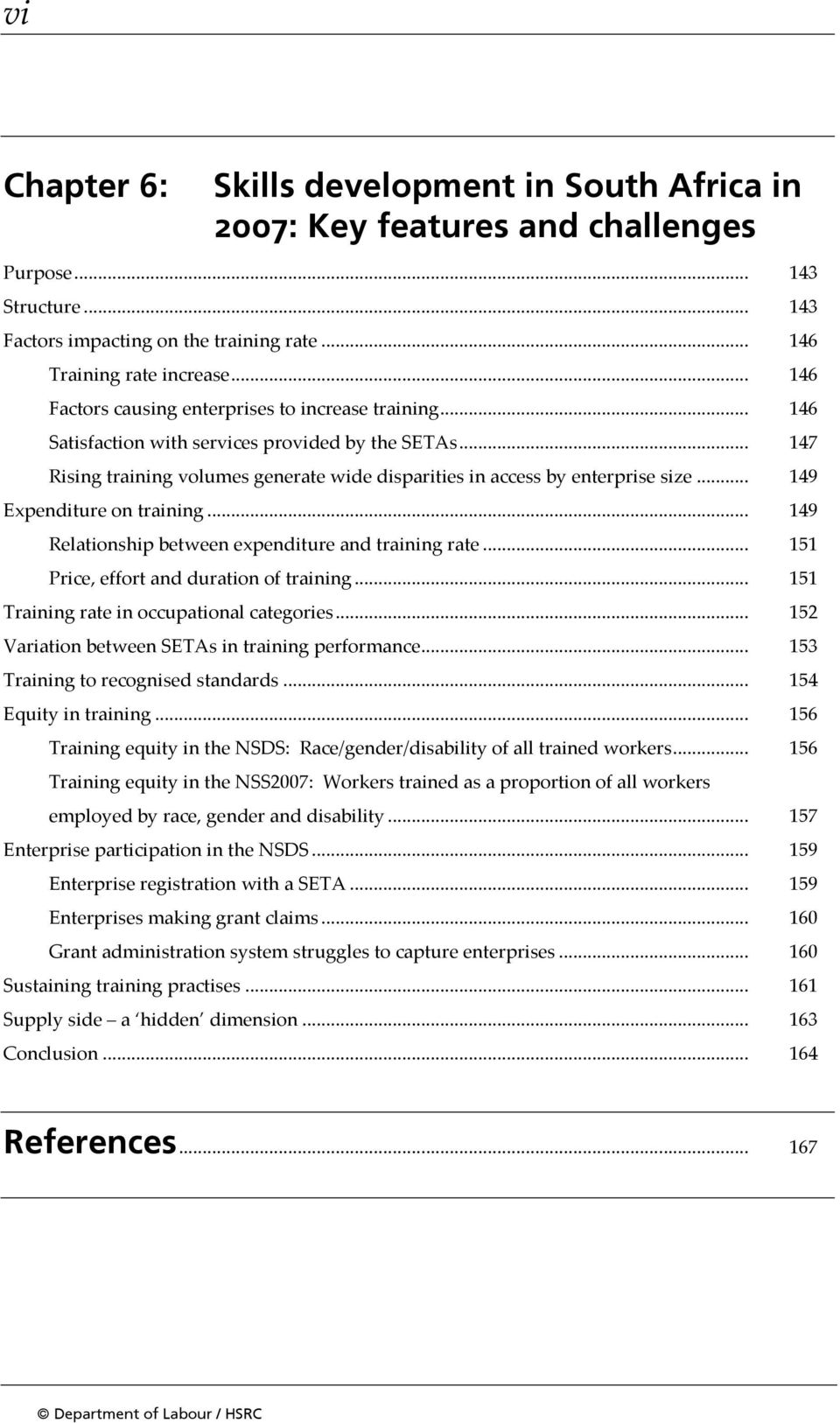
6 vi Chapter 6: Skills development in South Africa in 2007: Key features and challenges Purpose Structure Factors impacting on the training rate Training rate increase Factors causing enterprises to increase training Satisfaction with services provided by the SETAs Rising training volumes generate wide disparities in access by enterprise size Expenditure on training Relationship between expenditure and training rate Price, effort and duration of training Training rate in occupational categories Variation between SETAs in training performance Training to recognised standards Equity in training Training equity in the NSDS: Race/gender/disability of all trained workers Training equity in the NSS2007: Workers trained as a proportion of all workers employed by race, gender and disability Enterprise participation in the NSDS Enterprise registration with a SETA Enterprises making grant claims Grant administration system struggles to capture enterprises Sustaining training practises Supply side a hidden dimension Conclusion References
7 vii List of Tables TABLES Table 2.1: Sector Education and Training Authorities (SETAs) in Table 2.2: Sample frame of enterprises disaggregated by employment size and SETA 7 Table 2.3: Results of unsuccessful calls to targeted enterprises 10 Table 2.4: Results of follow-up calls 10 Table 2.5: Response rate by SETA 11 Table 2.6: Location of enterprises according to province 12 Table 3.1: Enterprises reporting employee participation in training by enterprise size in 2006/07 compared to 2002/03 20 Table 3.2: Table 3.3: Table 3.4: Table 3.5: Enterprises reporting employee participation in training by SETA in 2006/07 compared to 2002/03 Training rates for permanent employees in comparison with rates for non-permanent and disabled employees in 2002/03 and 2006/07 Training ratios for permanent, non-permanent and disabled employees by enterprise size in 2006/07 compared to 2002/03 (%) Training ratios for permanent, non-permanent and disabled employees by SETA size in 2006/07 compared to 2002/03 (%) Table 3.6: Training ratio by enterprise size and occupational category in 2002/03 and 2006/07 (%) 27 Table 3.7: Training ratio by SETA in 2006/07 compared to 2002/03 (%) 29 Table 3.8: Occupational categories NSS2003 and NSS Table 3.9: Comparison of training rates by occupational category 2002/03 and 2006/07 31 Table 3.10: Training ratio by enterprise size and occupational category in 2006/07 (%) 32 Table 3.11: Table 3.12: Table 3.13: Table 3.14: Permanent employees engaged in training according to standards by enterprise size in 2002/03 Permanent employees engaged in training according to standards by enterprise size in 2006/07 Permanent employees engaged in training according to standards by enterprise size in 2002/03 (%) Permanent employees engaged in training according to standards by enterprise size in 2006/07 (%) Table 3.15: Permanent employees engaged in structured training by SETA in 2002/03 (%) 35 Table 3.16: Permanent employees engaged in structured training by SETA in 2006/07 (%) 36 Table 3.17: Training expenditure as a percentage of payroll by enterprise size 37 Table 3.18: Average training expenditure by enterprise size in 2006/07 compared to 2002/03 (ZAR) 38 Table 3.19: Average training expenditure by enterprise size in 2006/07 compared to 2002/03 (ZAR) 38 Table 3.20: Training expenditure by SETA in 2002/03 and 2006/07 (ZAR) 39

8 viii Table 3.21: Enterprises claiming grants by size in 2006/07 compared to 2002/03 (ZAR) 40 Table 3.22: Enterprises claiming grants by SETA in 2006/07 compared to 2002/03 (ZAR) 41 Table 3.23: Enterprises claiming grants by training rate category in 2006/07 42 Table 3.24: Enterprises having workplace skills plans by size in 2006/07 compared to 2002/03 43 Table 3.25: Enterprises with workplace skills plans by SETA in 2006/07 compared to 2002/03 44 Table 3.26: Enterprises having workplace skills plans by training rate category in 2006/07 45 Table 3.27: Enterprises reporting registration with a SETA by size in 2006/07 compared to 2002/03 46 Table 3.28: Enterprise rating of SETA services by size in 2002/03 47 Table 3.29: Enterprise rating of SETA services by size in 2006/07 47 Table 3.30: Enterprise rating of SETA services by size in 2006/07 48 Table 3.31: Enterprises with employees registered in Learnerships in 2006/07 49 Table 3.32: Number and percentage of firms with employees registered in Learnerships in 2006/07 49 Table 3.33: Percentage share of learners registered in Learnerships in 2006/07 by enterprise size 50 Table 3.34: Learners registered in Learnerships by June 2003 and in 2005/06 by SETA 51 Table 3.35: Percentage share of learners registered in Learnerships by June 2002/03 compared to 2006/07 by SETA 52 Table 3.36: Training ratio by gender and enterprise size in 2006/07 compared to 2002/03 (%) 53 Table 3.37: Training ratio by gender and occupational category in 2002/03 (%) 54 Table 3.38: Training ratio by gender and occupational category in 2006/07 (%) 54 Table 3.39: Training ratio by race and enterprise size in 2006/07 compared to 2002/03 (%) 55 Table 3.40: Training ratio by race and occupational category in 2002/03 (%) 56 Table 3.41: Training ratio by race and occupational category in 2006/07 (%) 57 Table 3.42: Training access by race 1999/00, 2002/03 and 2006/07 (%) 58 Table 3.43: Training access by gender 1999/00, 2002/03 and 2006/07 (%) 58 Table 3.44: First NSDS Objectives 2001 to 2005 and Second NSDS Objectives 2005 to Table 3.45: The Core Principles of the National Skills Development Strategy, Table 3.46: Indicators for the NSDS and compared 61 Table 3.47: Table 4.1: Table 4.2: National Skills Development Strategy objectives and indicators based on data available in the National Skills Survey 2007 Number of enterprises and number of employees (Permanent and non-permanent) in 2006/07 SETA share of total employment and of total number of enterprises in the sample (%) in 2006/ Table 4.3: Ownership by enterprise size (%) in 2006/07 72 Table 4.4: Ownership by SETA (%) in 2006/07 72 Table 4.5: Number of years in operation by enterprise size in 2006/07 73 Table 4.6: Number of years in operation by SETA in 2006/07 74

9 ix Table 4.7: Employee status by enterprise size in 2006/07 75 Table 4.8: Employee status by enterprise size in 2006/07 (%) 75 Table 4.9: Employee status by SETA in 2006/07 75 Table 4.10: Employee status by SETA (%) in 2006/07 76 Table 4.11: Disabled employees by enterprise size in 2006/07 77 Table 4.12: Employee status by SETA in 2006/07 77 Table 4.13: Number of permanent employees leaving employment by enterprise size in 2006/07 78 Table 4.14: Number of permanent employees leaving employment by SETA in 2006/07 79 Table 4.15: Table 4.16: Training rates for permanent personnel in comparison with rates for non-permanent and disabled personnel in NSS2007 Training ratio of permanent, non-permanent and disabled employees by enterprise size (%) (Training Rate A) in 2006/ Table 4.17: Training rate of permanent employees (Training Rate B) in 2006/07 81 Table 4.18: Training rate of permanent employees by ownership status and enterprise size (%) in 2006/07 84 Table 4.19: Training rate of permanent employees by ownership status and SETA in 2006/07 85 Table 4.20: Training rate of permanent employees by occupational group in 2006/07 (%) 86 Table 4.21: Training rate of permanent employees by enterprise size and SETA (%) in 2006/07 87 Table 4.22: Training rate of permanent employees by gender and enterprise size (%) in 2006/07 88 Table 4.23: Training rate of permanent employees by gender and SETA in 2006/07 (%) 89 Table 4.24: Training rate of permanent employees by race and enterprise size in 2006/07 (%) 90 Table 4.25: Training rate of permanent employees by occupational category and race 2006/07 (%) 91 Table 4.26: Training ratio by SOC code (according to the OFO) and enterprise size in 2006/07 (%) 92 Table 4.27: Expenditure on training by enterprise size 2000/01 to 2006/07 93 Table 4.28: Expenditure on training by SETA 2000/01 to 2006/07 95 Table 5.1: Factors causing employee turnover by enterprise size 102 Table 5.2: Factors causing employee turnover by SETA 103 Table 5.3: Actions undertaken to meet skills needs by enterprises in 2006/07 by size of enterprise 104 Table 5.4: Actions undertaken to meet skills needs by enterprises in 2006/07 by SETA 105 Table 5.5: Skills underdeveloped or lacking in enterprises by enterprise size 106 Table 5.6: Skills underdeveloped or lacking in enterprises by SETA 107 Table 5.7: Occupations requiring skills upgrading during 2006/07 by enterprise size 108 Table 5.8: Occupations requiring skills upgraded during 2006/07 by SETA 109 Table 5.9: Factors causing enterprises to increase training in the 2006/7 year by enterprise size 110 Table 5.10: Factors causing enterprises to increase training in the 2006/7 year by SETA 112 Table 5.11: Participation of permanent employees in types of training by enterprise size 114 Table 5.12: Participation of permanent employees in types of training by SETA 114

10 x Table 5.13: Enterprises with employees registered in Learnerships by enterprise size in 2006/07 (%) 115 Table 5.14: Number of enterprises with employees registered in Learnerships by enterprise size in 2006/07 (Number) 115 Table 5.15: Enterprises with employees registered in Learnerships by SETA in 2006/07 (%) 116 Table 5.16: Enterprises with employees registered in Learnerships by SETA in 2006/07 (Number) 117 Table 5.17: Number of employees registered in Learnerships by enterprise size in 2006/ Table 5.18: Number of employees registered in Learnerships by SETA in 2006/ Table 5.19: Number of registered apprenticeships by enterprise size in 2006/ Table 5.20: Number of registered apprenticeships by SETA in 2006/ Table 5.21: Permanent employees engaged in training according to standards by enterprise size in 2006/ Table 5.22: Training according to standards by enterprise size in 2006/07 (%) 122 Table 5.23: Permanent employees engaged in structured training by SETA in 2006/07 (Number) 122 Table 5.24: Permanent employees engaged in structured training by SETA in 2006/07 (%) 123 Table 5.25: Participation of permanent employees in types of human resources development practices by enterprise size 124 Table 5.26: Human Resource Development practices used in enterprises by SETA 126 Table 5.27: Table 5.28: Table 5.29: Proportion of enterprises in possession of strategic enterprise training related documents by enterprise size (%) Proportion of enterprises in possession of strategic enterprise training related documentation by SETA (%) Allocation of responsibility in the enterprise for training in 2006/07 by enterprise size (%) Table 5.30: Allocation of responsibility in the enterprise for training in 2006/07 by SETA (%) 129 Table 5.31: Composition of the training committee by enterprise size (%) 130 Table 5.32: Composition of the training committee by SETA (%) 131 Table 5.33: Enterprises registered with a SETA by enterprise size (%) 132 Table 5.34: Enterprises registered with a SETA by enterprise size (Number) 132 Table 5.35: Enterprises registered with a SETA by SETA (%) 133 Table 5.36: Enterprises claiming and not claiming grants against levy payment by firm size (%) 134 Table 5.37: Enterprise claiming and not claiming grants against levy payment by SETA 136 Table 5.38: Enterprise ratings of SETA services by enterprise size 137 Table 5.39: Enterprise rating of the services of SETAs by SETA 138 Table 6.1 Enterprise rating of SETA services by size in 2002/03 and 2006/ Table 6.2 Training expenditure as a percentage of payroll by enterprise size 150

11 xi Table 6.3 Comparison of average expenditure (in ZAR) on training per trained employee, 2002/03 and 2006/ Table 6.4 Highest and lowest SETA performance in percentages for selected training indicators from NSS2003 and NSS Table 6.5 Training access by race as defined by NSDS targets: 1999/00, 2002/03 and 2006/07(%) 156 Table 6.6 Training access by gender as defined by NSDS targets: 1999/00, 2002/03, and 2006/07(%) 157 Table 6.7 Enterprise interaction with the levy-grant system by size in 2002/03 and 2006/07 160

12 xii List of Acronyms NSDS National Skill Development Strategy NSS2007 National Skills Survey of 2007 NSS2003 National Skills Survey of 2003 SETAs NSF SMLEs SARS FASSET BANKSETA CHIETA CTFL CETA DIDETA (SASSETA) ETDP SETA ESETA FOODBEV FIETA HWSETA ISETT INSETA LGSETA MAPPP MQA MERSETA Sector Education and Trainng Authorities National Skills Fund Small, Medium and Large enterprises South African Revenue Services Financial and Accounting Services Banking Sector Education and Training Authority Chemical Industries Education and Training Authority Clothing, Textiles, Footwear and Leather Sector Education and Training Authority Construction Education and Training Authority Previously, Diplomacy, Intelligence, Defence, and Trade and Industry Sector Education and Training Authority, amalgamated with POSLEC SETA to form Safety and Security (SASSETA) Education, Training and Development Practices Sector Education and Training Authority Energy Sector Education and Training Authority Food and Beverages Manufacturing Industry Sector Education and Training Authority Forest Industries Sector Education and Training Authority Health and Welfare Sector Education and Training Authority Information Systems, Electronics and Telecommunications Technologies Insurance Sector Education and Training Authority Local Government Sector Education and Training Authority Advertising, Publishing, Printing and Packaging Mining Qualifications Authority Manufacturing, Engineering and Related Services Education and Training Authority

13 xiii POSLEC SETA (SASSETA) PAETA (AGRISETA) PSETA SETASA (AGRISETA) SERVICES THETA TETA W&RSETA SOC SPSS ISOC OFO WSP EPWP NGOs CBOs FET HET ISOE PPPs NQF Previously, Police, Private Security, Legal and Correctional Services, amalgamated with DIDETA to form Safety and Security (SASSETA) Previously, Primary Agriculture Education and Training Authority, amalgamated with SETASA to form AGRI Sector Education and Training Authority (AGRISETA, code 20) Public Services Sector Education and Training Authority Previously, Secondary Agriculture Sector Education and Training Authority, amalgamated with PAETA to form AGRI Sector Education and Training Authority (AGRISETA, code 20) Services Sector Education and Training Authority Tourism and Hospitality Education and Training Authority Transport Education and Training Authority Wholesale and Retail Sector Education and Training Authority Standard Occupational Categories Statistical Package for the Social Sciences International Standard Occupational Code Organising Framework for Occupations Workplace Skills Plan Expanded Public Works Programme Non-governmental Organisations Community Based Organisations Further Education and Training Higher Education and Training Institutes of Sectoral or Occupational Excellence Public Private Partnerships National Qualifications Framework

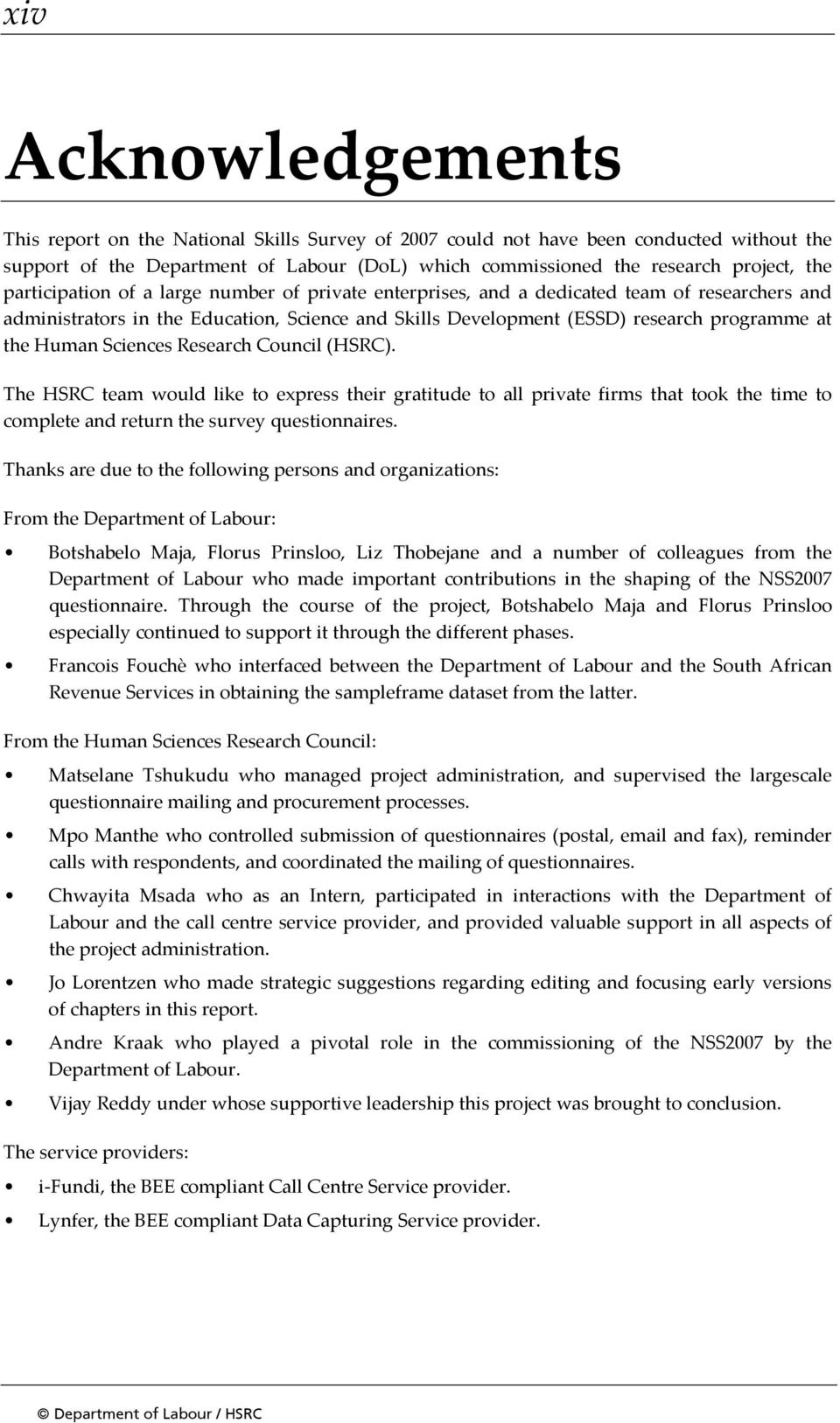
14 xiv Acknowledgements This report on the National Skills Survey of 2007 could not have been conducted without the support of the Department of Labour (DoL) which commissioned the research project, the participation of a large number of private enterprises, and a dedicated team of researchers and administrators in the Education, Science and Skills Development (ESSD) research programme at the Human Sciences Research Council (HSRC). The HSRC team would like to express their gratitude to all private firms that took the time to complete and return the survey questionnaires. Thanks are due to the following persons and organizations: From the Department of Labour: Botshabelo Maja, Florus Prinsloo, Liz Thobejane and a number of colleagues from the Department of Labour who made important contributions in the shaping of the NSS2007 questionnaire. Through the course of the project, Botshabelo Maja and Florus Prinsloo especially continued to support it through the different phases. Francois Fouchè who interfaced between the Department of Labour and the South African Revenue Services in obtaining the sampleframe dataset from the latter. From the Human Sciences Research Council: Matselane Tshukudu who managed project administration, and supervised the largescale questionnaire mailing and procurement processes. Mpo Manthe who controlled submission of questionnaires (postal, and fax), reminder calls with respondents, and coordinated the mailing of questionnaires. Chwayita Msada who as an Intern, participated in interactions with the Department of Labour and the call centre service provider, and provided valuable support in all aspects of the project administration. Jo Lorentzen who made strategic suggestions regarding editing and focusing early versions of chapters in this report. Andre Kraak who played a pivotal role in the commissioning of the NSS2007 by the Department of Labour. Vijay Reddy under whose supportive leadership this project was brought to conclusion. The service providers: i-fundi, the BEE compliant Call Centre Service provider. Lynfer, the BEE compliant Data Capturing Service provider.
Acronyms... 1. Purpose of this manual... 2. Section 1: Background to the accreditation process... 2. 1. Skills development strategy...
 Table of Contents Acronyms... 1 Purpose of this manual... 2 Section 1: Background to the accreditation process... 2 1. Skills development strategy... 2 2. The SETAs... 5 2.1. Skills planning... 5 2.2.
Institutes of Sectoral or Occupational Excellence (ISOE)
 Institutes of Sectoral or Occupational Excellence (ISOE) 1. Introduction and Purpose This document sets out the guidelines for the recognition and support of Institutes of Sectoral or Occupational Excellence
The Role of the Skills Development Facilitator and New Developments in Skills Development. Handbook
 The Role of the Skills Development Facilitator and New Developments in Skills Development May 2010 Facilitated by Fasset Handbook The views expressed in this document are not necessarily those of Fasset
Statistics on Post-School Education and Training in South Africa: 2011
 Statistics on Post-School Education and Training in South Africa: 2011 Statistics on Post-School Education and Training in South Africa: 2011 Statistics on Post-School Education and Training in South Africa:
MPUMALANGA PROVINCIAL GOVERNMENT
 MPUMALANGA PROVINCIAL GOVERNMENT PROVINCIAL HUMAN RESOURCE DEVELOPMENT STRATEGY Volume 2 (Part 4-5) Volume 2 Foreword by the Premier It gives me pleasure to announce that the Province has finally developed
Sector Skills Plan 2014-2015
 Sector Plan 2014-2015 Services SETA Sector Plan 2014/2015 1 Official sign-off It is hereby certified that this Sector Plan: was developed by the management of the Services SETA in consultation with the
The Skills Development Element
 Annexure A: Skills Development Element & BEE audit requirements/procedure The Skills Development Element The Skills Development Scorecard comprises three indicators: the first two measure monetary spend
GRADE 12 BUSINESS STUDIES LEARNER NOTES
 SENIOR SECONDARY IMPROVEMENT PROGRAMME 2013 GRADE 12 BUSINESS STUDIES LEARNER NOTES 1 The SSIP is supported by TABLE OF CONTENTS LEARNER NOTES SESSION TOPIC PAGE 3 1. Legislation skills development act
CHIETA S CREDIBLE MECHANISM FOR SKILLS PLANNING, PRESENTATION TO LMIP ROUNDTABLE 5 August 2015
 CHIETA S CREDIBLE MECHANISM FOR SKILLS PLANNING, PRESENTATION TO LMIP ROUNDTABLE 5 August 2015 1 Challenges: CHIETA, The Catalyst for Enhanced Skills, Economic Growth and Employability WHY THE NEW ELECTRONIC
THE TAX PROFESSIONAL LEARNERSHIP
 THE TAX PROFESSIONAL LEARNERSHIP CONTENT 1. What is the Tax Professional Learnership? 2 2. Who should enrol for the Learnsership? 2 3. What is a Learnership? 3 4. How does the Learnership lead to Professional
The Institute of Logistics and Supply Chain Management (ILSCM) offers specialised education and training pathways that aid in developing leaders in
 The Institute of Logistics and Supply Chain Management (ILSCM) offers specialised education and training pathways that aid in developing leaders in the industry. AVOID THE DETOURS A vital contributor to
Introduction to STEP 1
 LEARNERSHIP IMPLEMENTATION PROCESS - 10 STEPS Diagram of the 10-step implementation process Introduction to STEP 1 The importance of planning Learnership implementation Before you take the first step on
NATIONAL CERTIFICATE: BUSINESS ADMINISTRATION Level 3 (BUSINESS ADMINISTRATION LEARNERSHIP)
 NATIONAL CERTIFICATE: BUSINESS ADMINISTRATION Level 3 Learning Programme #67465 linked to SAQA # 23655 (BUSINESS ADMINISTRATION LEARNERSHIP) DOL # 23 Q 230027 46 130 3 Overview Qualification Target Group
DEPARTMENT OF LABOUR
 DEPARTMENT OF LABOUR How to start up a learnership: A guide for employers Government has introduced a training programme called leanerships. Employers play a crucial role in the implementation of learnerships.
Presentation by: Luther Lebelo SARS Executive: Employment Relations
 Presentation by: Luther Lebelo SARS Executive: Employment Relations 1 Purpose of Presentation SARS takes pride in its successful development and implementation of a capacity development programme which
South African Institute of Occupational Safety and Health
 South African Institute of Occupational Safety and Health ORIGIN Saiosh was established on 11 February 2010 on the historic day when South Africa celebrated the 20th anniversary of the release of ex State
MICT SETA STAKEHOLDER ROADSHOW
 MICT SETA STAKEHOLDER ROADSHOW 2013 NSDS Target Target AGENDA Agenda TIME DESCRIPTION PRESENTER 09h00 09h10 Welcome and Introduction Benedict Motau 09h10 09h20 MICT SETA Overview Marketing & Communications
Our programmes seek to offer: >> INDUSTRY SUPPORT Create a body of knowledge for the collective benefit of all stakeholders in the industry.
 AVOID THE DETOURS A vital contributor to the success and profitability of many organisations, from farming, to manufacturing, to mining has been Logistics and Supply Chain Management skills and services.
Learning Framework for Local Government
 Learning Framework for Local Government Local Government should aspire to building learning municipalities in which employees acquire knowledge, skills and attitudes from their daily experience, educational
OCCUPATIONS & WAGES REPORT
 THE COMMONWEALTH OF THE BAHAMAS OCCUPATIONS & WAGES REPORT 2011 Department of Statistics Ministry of Finance P.O. Box N-3904 Nassau Bahamas Copyright THE DEPARTMENT OF STATISTICS BAHAMAS 2011 Short extracts
The Role of the Skills Development Facilitator and New Developments in Skills Development. Handbook
 The Role of the Skills Development Facilitator and New Developments in Skills Development May 2011 Facilitated by Fasset Handbook Table of Contents TABLE OF CONTENTS... 1 TABLE OF ACRONYMS... 2 INTRODUCTION...
ETQA ADMINISTRATOR. Salary: R175 266. 84 per annum (All Inclusive Package)
 ETQA ADMINISTRATOR Salary: R175 266. 84 per annum (All Inclusive Package) ETQA Administrator. The successful applicant will be based in Pseta offices in Hatfield, Pretoria and will report to the ETQA Manager.
NQF Level: 2 US No: 116126
 NQF Level: 2 US No: 116126 Facilitator Guide Primary Agriculture Apply Marketing Principles in Agriculture Facilitator:.......................................... Company:..........................................
TERMS OF REFERENCE FOR STRATEGIC PLANNING & MANAGEMENT EXPERT
 TERMS OF REFERENCE FOR STRATEGIC PLANNING & MANAGEMENT EXPERT 1. Background The agency responsible for statistical information in Ghana is the Ghana Statistical Service (GSS) established in 1985 by PNDC
South African Journal of Business Management
 South African Journal of Business Management Volume 44 Number 2 June 2013 ISSN 2078-5585 SAJMDC 44(2) 1 86 (2013) Contents An investigation of the efficiency of South Africa s sector education and training
Scarce and Critical. Skills Guide 2 0 1 5
 Education, Training and Development Practices Sector Education and Training Authority Scarce and Critical Skills Guide 2 0 1 5 The ETDP SETA continues to work tirelessly to address the scarce and critical
Accreditation Application form
 Accreditation Application form SASSETA SERVES THE FOLLOWING INDUSTRIES: Legal Investigation and Private Security Policing Correctional Services Justice National Intelligence Agency South African Secret
SOUTH AFRICAN QUALIFICATIONS AUTHORITY ACT 58 OF 1995. No. 1348 26 September 2003
 SOUTH AFRICAN QUALIFICATIONS AUTHORITY ACT 58 OF 1995 No. 1348 26 September 2003 REGULATIONS RELATING TO LEVEL DESCRIPTORS FOR LEVELS 1 TO 4 OF THE NATIONAL QUALIFICATIONS FRAMEWORK The South African Qualifications
SUPPORT DOCUMENT. Employers use and views of the VET system, 2015: terms and definitions NCVER
 SUPPORT DOCUMENT Employers use and views of the VET system, 2015: terms and definitions NCVER This document was produced as an added resource for the report Employers' use and views of the VET system 2015
Case Study. The economic benefits of vocational education and training in South Africa
 Case Study The economic benefits of vocational education and training in South Africa Introduction As a developing economy, South Africa recognises the importance of a skilled workforce to enable economic
Schneps, Leila; Colmez, Coralie. Math on Trial : How Numbers Get Used and Abused in the Courtroom. New York, NY, USA: Basic Books, 2013. p i.
 New York, NY, USA: Basic Books, 2013. p i. http://site.ebrary.com/lib/mcgill/doc?id=10665296&ppg=2 New York, NY, USA: Basic Books, 2013. p ii. http://site.ebrary.com/lib/mcgill/doc?id=10665296&ppg=3 New
Post School Career Guide
 Post School Career Guide Guiding minds and shaping lives A Higher Education & Training Ministerial flagship initiative brought to you by DHET and SAQA CONTENTS ACRONYMS... 2 FOREWORD... 3 CHAPTER ONE...
Quality Assurance Framework Draft Policy for the Quality Council for Trades and Occupations Department of Labour First Version 26.07.
 Quality Assurance Framework Draft Policy for the Quality Council for Trades and Occupations Department of Labour First Version 26.07.2008 Department of Labour Quality Council for Trades and Occupations
CUSTOMER RELATIONSHIP MANAGEMENT AND ITS INFLUENCE ON CUSTOMER LOYALTY AT LIBERTY LIFE IN SOUTH AFRICA. Leon du Plessis MINOR DISSERTATION
 CUSTOMER RELATIONSHIP MANAGEMENT AND ITS INFLUENCE ON CUSTOMER LOYALTY AT LIBERTY LIFE IN SOUTH AFRICA by Leon du Plessis MINOR DISSERTATION Submitted in partial fulfilment of the requirements for the
ACADEMY OF YORK For People with a Purpose. The. The Academy OF. OF York. york. Study from Home. For People with a Purpose
 The Academy OF york The Academy OF York ACADEMY OF YORK For People with a Purpose Study from Home For People with a Purpose Your Partner in Education Academy of York is an accredited Further education
Reference Manual for Skills Development Facilitators
 Reference Manual for Skills Development Facilitators 2015 Our Vision: To be recognised as the leader in the development of a highly skilled knowledge-based information society. Our Mission: The MICT SETA
Information Booklet: Registration of Private Further Education and Training Colleges. Third Edition
 Information Booklet: Registration of Private Further Education and Training Colleges Third Edition INFORMATION BOOKLET: REGISTRATION OF PRIVATE FURTHER EDUCATION AND TRAINING COLLEGES Contact details for
NQF Level: 2 US No: 116070
 NQF Level: 2 US No: 116070 Facilitator Guide Primary Agriculture Operate and Support a Food Safety and Quality Management System in the Agricultural Supply Chain Facilitator:..........................................
YOUR FREQUENTLY ASKED QUESTIONS (FAQs) (Questions with... Answers)
 Call Centre and Client services DHET Toll free number: 0800 872 222 Fax number: 012 321 1324 Email: [email protected] YOUR FREQUENTLY ASKED QUESTIONS (FAQs) (Questions with... Answers) 1. Financial
SOCIAL AUXILIARY WORKER TRAINING INFORMATION LETTER TO LEARNERS
 SOCIAL AUXILIARY WORKER TRAINING INFORMATION LETTER TO LEARNERS CEFA is an accredited Training Provider for the Health and Welfare Sector Education and Training Authority (HWSETA) and is registered with
SECTOR ASSESMENT (SUMMARY): EDUCATION 1
 Country Partnership Strategy: Viet Nam, 2012 2015 SECTOR ASSESMENT (SUMMARY): EDUCATION 1 Sector Road Map 1. Sector Performance, Problems, and Opportunities 1. Country context. In Viet Nam, education is
National VET Provider Collection Data Requirements Policy
 National VET Provider Collection Data Requirements Policy Introduction Australian, state and territory governments are pursuing a number of reforms to support better information about vocational education
REQUEST FOR PROPOSALS CONSULTANCY FOR THE PROVISION OF AN EABC DATABASE OF BUSINESSES IN THE EAC
 REQUEST FOR PROPOSALS CONSULTANCY FOR THE PROVISION OF AN EABC DATABASE OF BUSINESSES IN THE EAC EABC has received a grant of from the African Capacity Building Foundation (ACBF) towards the Project Deepening
TABLE OF CONTENTS TABLE OF CONTENTS 2 LIST OF TABLES 6 LIST OF FIGURES 8 ACRONYMS AND ABBREVIATIONS 9 ACKNOWLEDGEMENTS 12 FOREWORD 13 SYNOPSIS 14
 TABLE OF CONTENTS 1 TABLE OF CONTENTS 2 LIST OF TABLES 6 LIST OF FIGURES 8 ACRONYMS AND ABBREVIATIONS 9 ACKNOWLEDGEMENTS 12 FOREWORD 13 SYNOPSIS 14 CHAPTER 1 28 The INSETA and its Skills Plan for the Insurance
Profiling agricultural science teachers and other teaching profesionals at FET and HET Institutions
 Profiling agricultural science teachers and other teaching profesionals at FET and HET Institutions MARCH 2008 TABLE OF CONTENTS EXECUTIVE SUMMARY 4 STUDY AIM 4 1.1 METHODOLOGY 4 1.2 KEY FINDINGS AND CONCLUSION
Statistical release P5002
 Statistical release (Preliminary) Embargoed until: 22 November 2012 13:00 Enquiries: User Information Services 012 310 8600/8351 1 Table of Contents 1. Summary of findings for the year 2011... 2 Figure
TEACHERS SERVICE COMMISSION
 TEACHERS SERVICE COMMISSION REVISED SCHEME OF SERVICE FOR NON-GRADUATE TEACHERS 1 ST JULY 2007 REVISED SCHEME OF SERVICE FOR NON-GRADUATE TEACHERS 1. AIMS AND OBJECTIVES To provide for a clearly defined
THE NEED FOR STRATEGIC LEARNERSHIPS IN FINANCE, ACCOUNTING, MANAGEMENT CONSULTING AND OTHER FINANCIAL SERVICES REPORT FOR FASSET.
 THE NEED FOR STRATEGIC LEARNERSHIPS IN FINANCE, ACCOUNTING, MANAGEMENT CONSULTING AND OTHER FINANCIAL SERVICES REPORT FOR FASSET October 2003 Research Team: Elize van Zyl (Project Leader) DP Van der Nest
A Labour Agreement allows an employer to recruit skilled overseas workers for occupations approved under the agreement.
 1 Labour Agreement information A Labour Agreement is a formal arrangement negotiated between an employer and the Australian Government and will only be considered where a genuine skills shortage exists
SABEF Kasi-to-Kasi Workshop Research
 REPORT SABEF Kasi-to-Kasi Workshop Research November 2013 Clever made simple. AGENDA BACKGROUND AND OBJECTIVES METHODOLOGY WHO DID WE SPEAK TO? DEMOGRAPHICS FINDINGS CONCLUSIONS AND KEY TAKE-OUTS 2 Background
National. icr Policy
 National icr Policy TABLE OF CONTENTS Forward Acknowledgements 1. Principles...1 1.0 Introduction...1 1.1 Vision...2 1.2 Mission...2 1.3 Policy Context...2 2. Policy Objectives...4 2.1 ICT Infrastructure...4
SKILLS TRANSFER INTERVENTIONS
 Pro-Active Assessment and RPL College SKILLS TRANSFER INTERVENTIONS TRAINING BROCHURE Freedom Through Knowledge Accredited B-BBEE Level 1 ASSESSMENT AND RPL COLLEGE (Pty) Ltd BACKGROUND: Pro-Active Assessment
PRESIDENT'S OFFICE. No. 1901. 27 November 1996 NO. 102 OF 1996: NATIONAL SMALL BUSINESS ACT, 1996.
 PRESIDENT'S OFFICE No. 1901. 27 November 1996 NO. 102 OF 1996: NATIONAL SMALL BUSINESS ACT, 1996. It is hereby notified that the President has assented to the following Act which is hereby published for
LIST OF CONTENT. 1. Different types of national instructional programmes 1. 2. Admission requirements for the national instructional programmes 1
 LIST OF CONTENT Section Page No. Introduction iii Definitions iv Concessions vi Curriculum Documents vii 1. Different types of national instructional programmes 1 2. Admission requirements for the national
The Media, Information and Communication Technologies Sector Education and Training Authority Sector Skills Plan 2013 2018
 The Media, Information and Communication Technologies Sector Education and Training Authority Sector Skills Plan 2013 2018 November 2012 Version 1.3 FOREWORD TABLE OF CONTENTS Abbreviations Used in this
National Trade Cadetships
 Schools Vocational Pathways National Trade Cadetships Discussion paper National Trade Cadetships Background Paper National Trade Cadetships Introduction The National Trade Cadetship offers the potential
DISTRIBUTIVE TRADE AND SERVICE INDUSTRIES STATISTICS
 DISTRIBUTIVE TRADE AND SERVICE INDUSTRIES STATISTICS 1. Introduction Distributive trade and service industries [DTSI] account for a substantial proportion of economic activities in every country, whether
THE NEED FOR A LEARNERSHIP IN TAXATION
 THE NEED FOR A LEARNERSHIP IN TAXATION RESEARCH REPORT SUBMITTED TO FASSET FINAL: 31 MAY 2009 RESEARCH CONDUCTED BY ACRONYMS AND ABBREVIATIONS ACCA CA CHE Fasset NQF OFO QCTO SAICA SAIPA SAIT SARS Association
Terms of Reference Concurrent Monitoring of Mid Day Meal (MDM) in Odisha
 Terms of Reference Concurrent Monitoring of Mid Day Meal (MDM) in Odisha 1. Background The Government of India has initiated a number of social welfare flagship schemes to enable improving status of human
SAQA LOGO: QUALIFICATION TITLE Bachelors Degree in Quantity Surveying (NQF level 7) based on Unit Standards. LEVEL: NQF level 7 CREDITS: 360 FIELD:
 QUALIFICATION TITLE Bachelors Degree in Quantity Surveying (NQF level ) based on Unit Standards SAQA LOGO: LEVEL: NQF level CREDITS: 360 FIELD: NSB 12: Physical Planning and Construction SUB-FIELD: Physical
Chapter 2 DEFINING THE IT INDUSTRY
 Chapter 2 DEFINING THE IT INDUSTRY 2.1 Introduction As technology convergence proceeds apace, setting the bounds of the IT Industry becomes ever more difficult. Inevitably, standard definitions in long
ACT : INCOME TAX ACT NO. 58 OF 1962 SECTION : SECTION 12H SUBJECT : ADDITIONAL DEDUCTION FOR LEARNERSHIP AGREEMENTS CONTENTS
 INTERPRETATION NOTE: NO. 20 (Issue 6) DATE: 27 November 2015 ACT : INCOME TAX ACT NO. 58 OF 1962 SECTION : SECTION 12H SUBJECT : ADDITIONAL DEDUCTION FOR LEARNERSHIP AGREEMENTS CONTENTS PAGE Preamble...
Information on Education and Training Quality Assurance (ETQA)
 Information on Education and Training Quality Assurance (ETQA) 1 Information on Education and Training Quality Assurance (ETQA) Vision: To be recognised as the leader in the development of a highly skilled
Main changes from the 2014 to 2015 academic year
 Qualification achievement rates: business rules for 2015 to 2016 Date of issue 1 September 2015 Audience Of interest to colleges and training organisations OFFICIAL Purpose 1 This document outlines the
Notice of Expression of Interest for Provision of Consultancy services for Real Estate Marketing, Branding and Sale of Housing Units at Lubowa
 NATIONAL SOCIAL SECURITY FUND DE POINT CONSULTANTS LIMITED Notice of Expression of Interest for Provision of Consultancy services for Real Estate Marketing, Branding and Sale of Housing Units at Lubowa
Guide to Requirements for Consent to Assess for Schools
 Guide to Requirements for Consent to Assess for Schools August 2011 Guide to Requirements for Consent to Assess for Schools Part A Introduction Purpose of this guide This document is designed to assist
Monyetla Work Readiness Programme
 Monyetla Work Readiness Programme Phase 4 b 2016 ROAD SHOWS About Ditsedi Based in Johannesburg our offices in Killarney; with proven and established methodologies and approaches in project management,
Maastricht Communiqué. on the Future Priorities of Enhanced European Cooperation in Vocational Education and Training (VET)
 Maastricht Communiqué on the Future Priorities of Enhanced European Cooperation in Vocational Education and Training (VET) 14 December 2004 Maastricht Communiqué on the Future Priorities of Enhanced European
The new TVET training system in Timor-Leste
 The new TVET training system in Timor-Leste Background Timor-Leste is currently transforming the Vocational Training sector from a predominantly nonformal system to a formal, regulated, Technical and Vocational,
College Principal. College SA is a registered and accredited Distance Learning College with a difference. For us, customer
 Message from the College Principal Dear Students and Friends, is a registered and accredited Distance Learning College with a difference. For us, customer service comes first, so we make it our responsibility
Membership Application Form
 Membership Application Form General Company Details Full Name of Business Physical Address Postal Address City/Town/District Location of business/head office (District) Telephone Number Email address Fax
Supply Chain Management 74149
 Introduction to Learnerships A learnership is a work-based learning programme that leads to a nationally recognised qualification that is directly related to an occupation, for example an accountant, operations
SUMMARY OF BROAD-BASED BLACK ECONOMIC EMPOWERMENT CODES OF GOOD PRACTICE AS RELATES TO CA PROFESSION
 SUMMARY OF BROAD-BASED BLACK ECONOMIC EMPOWERMENT CODES OF GOOD PRACTICE AS RELATES TO CA PROFESSION Statement 000 framework for measuring B-BBEE 1. Fundamental principles 1.1 Substance takes, precedence,
Public consultation on the future of EU-US trade and economic relations
 Public consultation on the future of EU-US trade and economic relations Introduction The US is a strategic partner of the EU. Both the EU and the US are strong promoters of free trade and investment and
Commonwealth of Virginia Job Vacancy Survey 2011-2012
 a Commonwealth of Virginia Job Vacancy Survey 2011-2012 Prepared for: Virginia Employment Commission Richmond, Virginia Prepared by: Virginia Center for Urban Development and the Survey and Evaluation
INSURANCE IN. Historical Development, Present Status and Future. Challenges
 INSURANCE IN ETHIOPIA Historical Development, Present Status and Future Challenges Hailu Zeleke August 2007 TABLE OF CONTENTS PAGE ACKNOWLEDGEMENTS vi ACRONYMS vii INTRODUCTION viif CHARTER 1: RISK - MEANING
Apprenticeship Evaluation: Learners
 BIS RESEARCH PAPER NUMBER 124 Apprenticeship Evaluation: Learners AUGUST 2013 1 The views expressed in this report are the authors and do not necessarily reflect those of the Department for Business, Innovation
AUSTIN INDEPENDENT SCHOOL DISTRICT INTERNAL AUDIT DEPARTMENT HUMAN RESOURCE AUDIT PROGRAM
 GENERAL: The Human Resources (HR) Department deals with the management of people within the organization. This includes responsibility for the process of hiring staff, recruiting and advertising positions
COPYRIGHT. Terms of Reference. for Coordination, Delivery, Monitoring and Evaluation of Sectoral Funded Training Programmes
 Terms of Reference for Coordination, Delivery, Monitoring and Evaluation of Sectoral Funded Training Programmes Terms of Reference for Coordination, Delivery, Monitoring and Evaluation of Sectoral Funded
ENGINEERING PROFESSIONALS: CRUCIAL KEY TO DEVELOPMENT AND GROWTH IN SOUTH AFRICA
 Human Sciences Development Policy Sociology of Work Research Council Research Unit Unit RESEARCH CONSORTIUM ENGINEERING PROFESSIONALS: CRUCIAL KEY TO DEVELOPMENT AND GROWTH IN SOUTH AFRICA Scarce and critical
ED 019 490 OUTLINES OF VOCATIONAL TRAINING IN TANZANIA. AUSTRALIAN DEPT. OF LABOUR AND NAT. SERVICE, PERTH PUB DATE EDRS PRICE ME -$0.25 HC-$0.52 11P.
 R E P O R T RESUMES ED 019 490 OUTLINES OF VOCATIONAL TRAINING IN TANZANIA. AUSTRALIAN DEPT. OF LABOUR AND NAT. SERVICE, PERTH PUB DATE EDRS PRICE ME -$0.25 HC-$0.52 11P. VT 004 880 DESCRIPTORS- 'VOCATIONAL
GOVERNMENT GAZETTE STAATSKOERANT
 REPUBLIC OF SOUTH AFRICA GOVERNMENT GAZETTE STAATSKOERANT VAN DIE VAN No. 19017 ACT To provide for the promotion of research, both basic and applied, and the extension and transfer of knowledge in the
Tourism and Hospitality Courses
 Tourism and Hospitality Courses Welcome to Oxbridge Academy WHY STUDY WITH US? At Oxbridge Academy, we give you the opportunity to further your education while you acquire knowledge and skills that are
2. Issues using administrative data for statistical purposes
 United Nations Statistical Institute for Asia and the Pacific Seventh Management Seminar for the Heads of National Statistical Offices in Asia and the Pacific, 13-15 October, Shanghai, China New Zealand
NATIONAL POLICY ON COMMUNITY COLLEGES OCTOBER 2014 DRAFT
 NATIONAL POLICY ON COMMUNITY COLLEGES OCTOBER 2014 DRAFT TABLE OF CONTENTS ACRONYMS AND ABBREVIATIONS... 2 SECTON 1: BACKGROUND AND CONTEXT... 3 SECTION 2: PRINCIPLES UNDERPINNING THE ESTABLISHMENT OF