
A Perspective on Early Childhood Education and Articulation. Deborah J. Cassidy, Ph.D., Professor, Human Development
|
|
|
- Crystal Doyle
- 9 years ago
- Views:
Transcription
1 A Perspective on Early Childhood Education and Articulation 2015 Deborah J. Cassidy, Ph.D., Professor, Human Development and Family Studies, University of North Carolina at Greensboro
2 Contents Introduction... 1 Goals for Articulation Agreements... 1 Benefits of Articulation Agreements... 2 Jumping the Hurdles in Our Current System of Unarticulated Agreements...4 Final Thoughts... 8 References... 9 About the Author Note: This paper was created through Early Educator Central, a web portal federally administered by the U.S. Department of Health and Human Services, Office of Child Care and Office of Head Start, in response to the need for relevant resources to enhance infant-toddler content and coursework. ICF served as the contractor under Contract #HHSP WC_HHSP T with the Department of Health and Human Services. The views expressed in the document are those of the author and ICF. No official endorsement by the U.S. Department of Health and Human Services is intended or should be inferred. A PERSPECTIVE ON ECE AND A RTICULATION i

3 Introduction The transfer of credit from community college Associate of Applied Science (A.A.S.) degree programs in early childhood education (typically total credit hours, with four to six courses in general education) to bachelor s degree programs in early childhood education has emerged as an urgent issue in early childhood education. The call for a more educated workforce is supported by the recently released report from the Institute of Medicine and the National Research Council, Transforming the Workforce for Children Birth Through Age 8: A Unifying Foundation (2015), which recommends that all lead teachers of children from birth through age 8 have a bachelor s degree in early childhood education or a related field. With the number of students enrolling in teacher education programs dramatically decreasing in the last few years, strategies to achieve higher education levels for our teaching workforce are at the forefront of the field (Sawchuk, 2014, October). One of the most cost-efficient and logical strategies is to improve articulation agreements between 2-year community college degree programs and 4-year institutions. I have learned the importance of high-quality articulation agreements from many years of experience in higher education, at the University of North Carolina at Greensboro, and through my experience as North Carolina s state child care administrator. Both positions highlighted the necessity of aligning our systems of higher education to better educate our early childhood workforce in the most efficacious manner possible. Through this paper, I share my perspective, which I have used to guide me through successful negotiation and work on these issues. Goals for Articulation Agreements At the outset, it is helpful to note the distinction between articulation and transfer of credit. Articulation is the goal: It highlights the establishment of institutional policies or other A P ERSPECTIVE ON ECE AND A RTICULATION 1

4 structures that are implemented to encourage, facilitate, and monitor the student transfer process (Hezel Associates, 2009). Transfer of credit is the process of moving a student s credits across different institutions. This distinction is important because transfer of credit can be the simple course-by-course comparison of course descriptions, resulting in a minimum number of courses being accepted by a 4-year program from a 2-year program. Articulation is what we strive for because it includes the policies to encourage, facilitate, and monitor the acceptance of course credit across 2- and 4-year institutions. Nonetheless, we must not assume that all articulation agreements are created equal. Some 4-year institutions have articulation agreements that delineate policies for transfer of credit, but these institutions limit the agreements to only a few courses. My experience leads me to support an articulation goal providing for at least 55 credit hours from the 2-year A.A.S. degree programs in early childhood education to the 4-year bachelor s degree programs in early childhood education, with 2 years of coursework remaining at the receiving institution. Benefits of Articulation Agreements Higher Education: Not only are articulation agreements beneficial to the children enrolled in early care and education programs because of the higher education levels of their teachers, but good articulation agreements are cost-effective for a state s higher education system. A cost benefit analysis that I conducted in North Carolina indicates that in the state contributed significantly less per student per year ($6,189) in the community college system than for students in the 4-year system (Cassidy, 2014), as illustrated in Table 1. This means that the state saves this amount per year in tax dollars for each student who chooses a community college over a 4-year school. 2
5 Table 1: Comparison of Annual 4-Year and 2-Year Tuition and Fees in North Carolina ( ) Tuition Fees Tuition and State (12 hours) Fees Total Contribution Per Student Community college $858 $65 $923 $5,549 4-year university tuition (average across 16 University of North Carolina campuses) $3,967 $2,129 $6,096 $11,738 Source: Cassidy, D. (2014). Cost Benefit Analysis: Using Community College Credit toward 4-Year Degrees. Unpublished Manuscript, University of North Carolina at Greensboro. However, these savings both for the student and the state are not realized for students in early childhood education if they transfer to a 4-year program and do not receive full credit for their 2-year degree (Cassidy, 2014). As shown in Table 2, a student who completes his or her first 2 years of education at a community college results in significant personal as well as state savings, compared to a student who enrolls in a 4-year degree program as a freshman. The North Carolina savings in Table 2 represent the difference between the state s contribution per student in Table 1 above, i.e. $11,738 less $5,549, for a total of $6,189. The student savings has been similarly calculated by the author. Table 2: Annual Student and State Savings through Use of 2- and 4-Year Higher Education in North Carolina ( ) Savings Per Student Per 1000 Students Savings 2 years per student (based on enrollment in community college instead of NC 4-year institution) Projected for 1,000 early childhood education (ECE) transfer students per year (approximately half of the total number of ECE transfer students yearly) Student Savings $10,346 $10,346,540 State of NC Savings $12,378 $12,378,000 Total Savings Based on 2-Year Enrollment $23,824 $23,824,000 Source: Cassidy, D. (2014). Cost Benefit Analysis: Using Community College Credit toward 4-Year Degrees. Unpublished Manuscript, University of North Carolina at Greensboro. A P ERSPE CTIV E ON ECE AND A RTICUL ATION 3

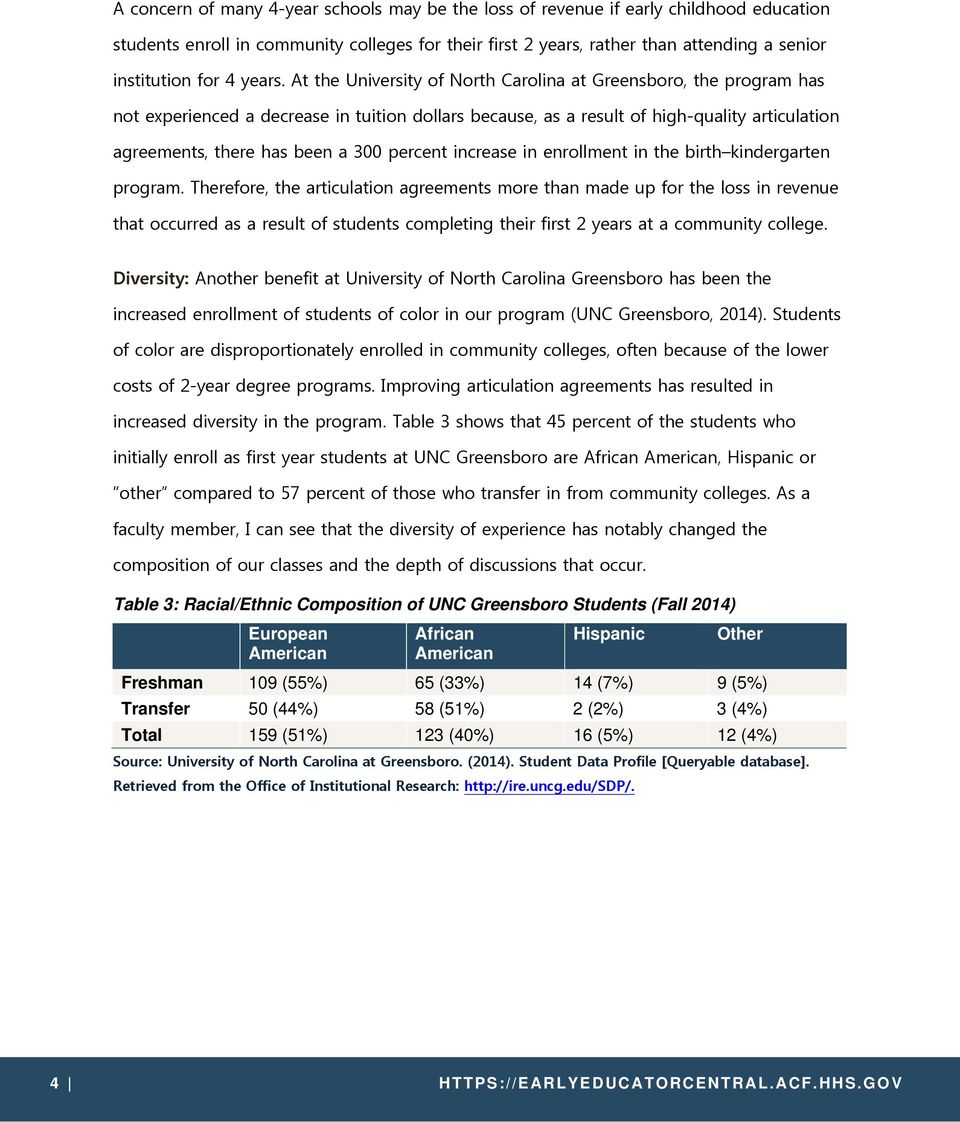
6 A concern of many 4-year schools may be the loss of revenue if early childhood education students enroll in community colleges for their first 2 years, rather than attending a senior institution for 4 years. At the University of North Carolina at Greensboro, the program has not experienced a decrease in tuition dollars because, as a result of high-quality articulation agreements, there has been a 300 percent increase in enrollment in the birth kindergarten program. Therefore, the articulation agreements more than made up for the loss in revenue that occurred as a result of students completing their first 2 years at a community college. Diversity: Another benefit at University of North Carolina Greensboro has been the increased enrollment of students of color in our program (UNC Greensboro, 2014). Students of color are disproportionately enrolled in community colleges, often because of the lower costs of 2-year degree programs. Improving articulation agreements has resulted in increased diversity in the program. Table 3 shows that 45 percent of the students who initially enroll as first year students at UNC Greensboro are African American, Hispanic or other compared to 57 percent of those who transfer in from community colleges. As a faculty member, I can see that the diversity of experience has notably changed the composition of our classes and the depth of discussions that occur. Table 3: Racial/Ethnic Composition of UNC Greensboro Students (Fall 2014) European American African American Hispanic Other Freshman 109 (55%) 65 (33%) 14 (7%) 9 (5%) Transfer 50 (44%) 58 (51%) 2 (2%) 3 (4%) Total 159 (51%) 123 (40%) 16 (5%) 12 (4%) Source: University of North Carolina at Greensboro. (2014). Student Data Profile [Queryable database]. Retrieved from the Office of Institutional Research: 4
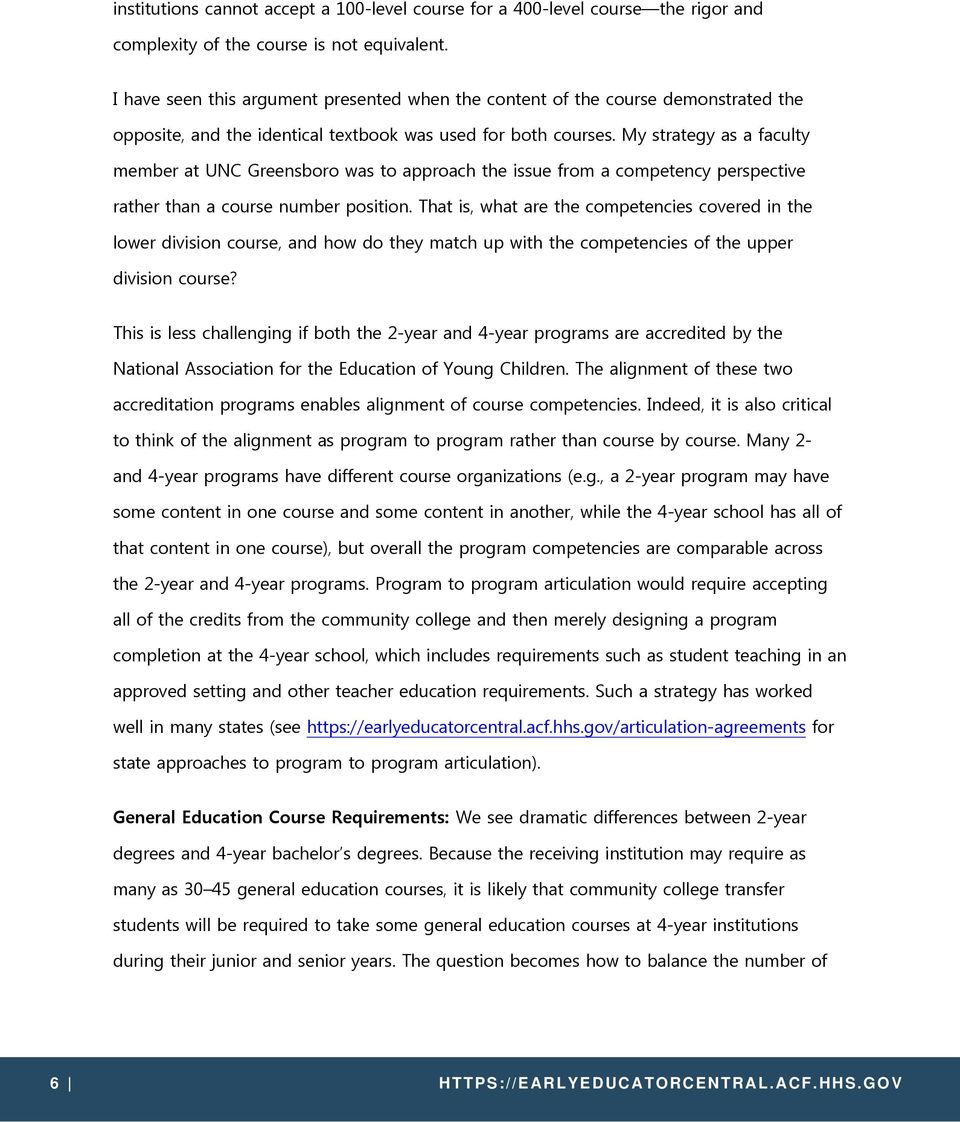
7 Jumping the Hurdles in Our Current System of Unarticulated Agreements While there are benefits to high-quality articulation agreements, there are many hurdles remaining. We know that many universities have not embraced the notion of articulation and that this is a major hurdle. Using the metaphor of an articulated bus may help us see this more clearly. Following along with the drawing below, the university 4-year degree programs represent the front rigid section, while the A.A.S. degree programs represent the rear rigid section. The articulated joint of the bus is represented by the connecting flexible policies and procedures that make up high-quality articulation agreements. In this section we explore the hurdles, as well as ideas for jumping them and creating the articulated joint that is needed. articulated joint rear rigid section front rigid section Course Competencies and Course Numbering: Course competencies has often been listed as an issue in accepting community college courses for credit at 4-year institutions. Community colleges often use course numbers equivalent to 100- and 200-level courses at 4-year institutions. Four-year programs often offer their courses in the major of early childhood education at the upper division. The argument then becomes that the 4-year A P ERSPECTIVE ON ECE AND A RTICULATION 5

8 institutions cannot accept a 100-level course for a 400-level course the rigor and complexity of the course is not equivalent. I have seen this argument presented when the content of the course demonstrated the opposite, and the identical textbook was used for both courses. My strategy as a faculty member at UNC Greensboro was to approach the issue from a competency perspective rather than a course number position. That is, what are the competencies covered in the lower division course, and how do they match up with the competencies of the upper division course? This is less challenging if both the 2-year and 4-year programs are accredited by the National Association for the Education of Young Children. The alignment of these two accreditation programs enables alignment of course competencies. Indeed, it is also critical to think of the alignment as program to program rather than course by course. Many 2- and 4-year programs have different course organizations (e.g., a 2-year program may have some content in one course and some content in another, while the 4-year school has all of that content in one course), but overall the program competencies are comparable across the 2-year and 4-year programs. Program to program articulation would require accepting all of the credits from the community college and then merely designing a program completion at the 4-year school, which includes requirements such as student teaching in an approved setting and other teacher education requirements. Such a strategy has worked well in many states (see for state approaches to program to program articulation). General Education Course Requirements: We see dramatic differences between 2-year degrees and 4-year bachelor s degrees. Because the receiving institution may require as many as general education courses, it is likely that community college transfer students will be required to take some general education courses at 4-year institutions during their junior and senior years. The question becomes how to balance the number of 6
9 in the major courses taken with the number of general education courses taken in the last 2 years. The most feasible strategy seems to be ensuring that those few general education courses taken at the community colleges transfer for general education credit at the receiving institution. Often, this demands communication between institutions at a statewide level. In North Carolina, usually it was an issue that could be resolved through communication, i.e. raising the question of why students were required to take a biology course that did not transfer when there was an equivalent course available that did transfer. It is imperative that we do not create upside programs, where transfer students take all of their major courses at the community college and then in their last 2 years take only general education courses. This creates a situation where students are too far away from their methods courses when they do their student teaching. We must strive for a balance of early childhood education and general education courses for transfer students during their final 2 years at the senior institution. Perception Around Rigor: Are Community College Students Prepared to Transfer? Many 4-year faculty members question how prepared community college A.A.S. students are for success in a bachelor s degree program. This questions the rigor of the coursework and the quality of the faculty in the community college system. To test this assertion, I compared the grade point averages (GPAs) of senior transfer students to seniors who had enrolled as freshman at UNC Greensboro.Over a 5-year period, the average GPA was 3.27 for senior transfer students and 3.35 for those who had enrolled as freshman students (Cassidy, 2007). These data are very similar to data from 10 years earlier indicating identical GPAs of 3.22 for transfer and those who enrolled as freshman at UNC Greensboro as seniors (Cassidy, 2007). All students had lower GPAs as juniors than they did as seniors. However, on average, the transfer student GPA increased from 2.72 in the earlier study to 2.98 in the most recent 5- year period (Cassidy, 2007). These data indicate the success of the community college early A P ERSPECTIVE ON ECE AND A RTICULATION 7
10 childhood education transfer students in 4-year degree programs and the rigor of the coursework and instruction. Degree and Program Types: Although a lower hurdle, it is quite likely that the articulation agreements will need to be restricted to early childhood education (2-year) to early childhood education (4-year) degrees. The agreements are often built specifically by major and may not allow students to major in other options or departments. This is due to the specificity of the content and competencies. This does limit A.A.S. degree students from total flexibility with their community college degrees. Once they choose early childhood education as a career option at the community college, it does not allow the multitude of choices that a community college Associate of Arts (predominantly or entirely general education transfer courses) would allow. Most often, this is not a concern for students and indeed fits well with their career goals. Maximizing Actual Transfers of Credit: It is important to ensure that we do not create agreements that look good upon first glance but do not stand up under scrutiny. For example, we might see the potential of hours transferring, but find, on closer examination, that the student is still required to take another 80 hours or more at the receiving institution. Indeed, the credit hours accepted are often for elective credit and do not count for actual credit in the degree program. Such agreements can also be punitive to students. In North Carolina, there is a surcharge that is applied when a student reaches 140 credit hours that is 150 percent of the tuition for all hours over this total! Final Thoughts As a faculty member at the University of North Carolina at Greensboro and former state administrator in North Carolina, I recognize firsthand the need for improved articulation agreements between 2-year and 4-year higher education institutions in early childhood education. It is essential that all young children have highly qualified teachers who possess the knowledge base to educate and nurture them. It is incumbent on all of us 2-year and 8
11 4-year faculty, state administrators, and early childhood leaders to make it happen. Many states now have early childhood education professional development advisory committees as well as meetings of 2-and 4-year early childhood education faculty that enable these relationships to develop and allow for greater understanding of the goals and priorities of the programs. There is no one right way to get it done, but rather many approaches that lead to success. There is no question that developing professional relationships across institutions is the first step. For faculty across systems and early childhood education leaders, we must establish opportunities to meet on a regular basis. These relationships are essential for great articulation agreements and great teachers! References Cassidy, D. (2014). Cost benefit analysis: Using community college credit toward 4-year degrees. Unpublished Manuscript, University of North Carolina at Greensboro. Cassidy, D. (2007). Moving beyond barriers to articulation: Developing agreements among two- and four- year institutions in early childhood education (Policy Paper No. 102). Retrieved from University of North Carolina at Greensboro website: Hezel Associates, Lumina Foundation for Education, and Western Interstate Commission for Higher Education. (2009). Best practices in statewide articulation and transfer systems research: Literature overview. Retrieved from Institute of Medicine and National Research Council. (2015).Transforming the workforce for children birth through age 8: A unifying foundation. Washington, DC: The National Academies Press. Sawchuk, S. (2014, October). Steep drops seen in teacher-prep enrollment numbers: California and other big states particularly hard hit, raising supply concerns. A P ERSPECTIVE ON ECE AND A RTICULATION 9

12 Education Week 34(9). Retrieved from University of North Carolina at Greensboro. (2014). Student Data Profile [Queryable database]. Retrieved from the Office of Institutional Research:

13 About the Author Dr. Deborah J. Cassidy is a professor of Human Development and Family Studies at the University of North Carolina at Greensboro (UNCG). During her tenure at UNCG, she has also been the Coordinator of the Birth-Kindergarten Licensure Program and Director of the Child Care Education Program, which is an on campus child care program serving more than 80 children. Additionally, she serves on the North Carolina Rated License Assessment Project (NCRLAP) at UNCG. NCRLAP conducts the assessments for the Quality Rating and Improvement System in North Carolina. From 2009 until 2013, she was the Director of the North Carolina Division of Child Development and Early Education in the Department of Health and Human Services. Her credentials include a Ph.D. in Early Childhood Education from the University of Illinois and a Master s degree from the University of Illinois in Child Development. She has authored and co-authored dozens of reports and articles dealing with early childhood issues, particularly child care quality and the professional development of early childhood teachers and providers. A P ERSPECTIVE ON ECE AND A RTICULATION 11

District of Columbia Career Guide for Early Childhood and Out of School Time Professionals
 District of Columbia Career Guide for Early Childhood and Out of School Time Professionals Pathways to Professional Growth Division of Early Learning Office of the State Superintendent of Education (OSSE)
Barriers and Opportunities The Transition from 2 to 4-year Institutions
 Barriers and Opportunities The Transition from 2 to 4-year Institutions Pamela Brown New York City College of Technology, City University of New York The National Academies September 11, 2013 1 Community
Many students attend more than one institution of higher education before they earn a
 Hot Topics in Higher Education State Policies to Improve Student Transfer By Brenda Bautsch January 2013 Many students attend more than one institution of higher education before they earn a degree. According
DUAL CREDIT IN KENTUCKY. A significant body of research indicates that a high school diploma is not sufficient for
 DUAL CREDIT IN KENTUCKY A significant body of research indicates that a high school diploma is not sufficient for the skills required in most jobs of the 21 st century. As educators strive to provide students
Committee on Educational Planning, Policies and Programs May 21, 2015. 5. UNC Degree Program Proposals...Courtney Thornton
 Committee on Educational Planning, Policies and Programs May 21, 2015 5. UNC Degree Program Proposals...Courtney Thornton Situation: UNC-Chapel Hill requests authorization to establish a Master of Arts
Memorandum of Agreement Template Statewide Associate to Baccalaureate Articulation Agreement
 Memorandum of Agreement Template Statewide Associate to Baccalaureate Articulation Agreement Introduction to the Template This template provides sample language and appendix items that can be used to develop
Challenges and Opportunities for Including Coursework on Infants and Toddlers in Higher Education Degree Programs
 Challenges and Opportunities for Including Coursework on Infants and Toddlers in Higher Education Degree Programs 2015 Lea J.E. Austin, Marcy Whitebook, Felippa Amanta, Center for the Study of Child Care
6. UNC Degree Program Establishments... Courtney Thornton
 MEETING OF THE BOARD OF GOVERNORS Committee on Educational Planning, Policies and Programs AGENDA ITEM April 14, 2016 6. UNC Degree Program Establishments... Courtney Thornton Situation: Appalachian State
Minimum Entrance Requirements The University of North Carolina
 Minimum Entrance Requirements NC College Access Conference Friday, March 5, 2010 UNC System Overview Comprised of sixteen constituent public institutions of higher education and one constituent high school
Birth - Kindergarten Program
 Birth - Kindergarten Program Professionalism. Caring. Strength. Thanks for your interest in Western Carolina University and the BK program. If you love children and want to be a vital force in shaping
How To Get A Degree In Early Childhood Education
 Directory of Early Childhood Programs in 4 Year Colleges and Universities in Michigan Counselor Name: Kelsey Laird Date(s) of Collection: 2/20/14 Name of Institution: Central Michigan University What degree
The Early Childhood Higher Education Inventory: Taking Stock of the States
 The Early Childhood Higher Education Inventory: Taking Stock of the States March 4, 2014 Hosted by: 1 Presenters Why the need for an Inventory Linda K. Smith, Deputy Assistant Secretary and Inter-Departmental
FOUR-YEAR PLANNING STRATEGIES TO MAXIMIZE COLLEGE CREDIT EARNED IN HIGH SCHOOL! Lehi Jr. High Counseling Dept.
 FOUR-YEAR PLANNING STRATEGIES TO MAXIMIZE COLLEGE CREDIT EARNED IN HIGH SCHOOL! Lehi Jr. High Counseling Dept. WHEN WILL YOU GRADUATE FROM COLLEGE OR PROFESSIONAL SCHOOL Teacher (4-5 years) Engineer (4-5
Early Childhood Teaching Policies
 Early Childhood Teaching Policies Outline Background Overview of Proposed Policies Proposed Changes to Bulletin 746 and 996 Implementation Supports Timeline 1 Support All Teachers To Be Excellent Addressing
PROFESSIONAL DEVELOPMENT OPPORTUNITIES FOR STAFF
 PROFESSIONAL DEVELOPMENT OPPORTUNITIES FOR STAFF HEAD START LEADERSHIP CONFERENCE Sally Holloway Whatcom Community College Sally Holloway Whatcom Community College Early Childhood Education Project Director
Executive Summary. Charlotte Engineering Early College High School
 Charlotte-Mecklenburg Schools William Leach, Principal 9000 Robert D Snyder Dr Charlotte, NC 28223-1 Document Generated On February 13, 2016 TABLE OF CONTENTS Introduction 1 Description of the School 2
University of Nevada, Las Vegas College of Education Box #453001 4505 S. Maryland Parkway Las Vegas, NV 89154-3001 Tel: 702-895-3375 Fax: 702-895-4068
 Institutional Overview The University of Nevada, Las Vegas (UNLV) College of Education (COE) offers its students a unique learning environment with direct preparation in PK-16 and other community settings.
Bachelor of Science in Interdisciplinary Studies
 Bachelor of Science in Interdisciplinary Studies About Shorter University Who we are Founded in 1873 and located in Rome, Georgia, Shorter University is a private, liberal arts university with a legacy
Testimony for the National Commission on Accountability in Higher Education Oklahoma State Regents for Higher Education. Pre-Collegiate Initiatives
 Testimony for the National Commission on Accountability in Higher Education Oklahoma State Regents for Higher Education Prepared by: Dr. Dolores Mize, Associate Vice Chancellor and Special Assistant to
H i g h e r Education a n d E c o n o m i c Development
 GETTING WHAT YOU PAY FOR H i g h e r Education a n d E c o n o m i c Development Julie Davis Bell Western Interstate Commission for Higher Education With support from Introduction Legislators are becoming
Dear Parents, We wish your student much success here at Bergen Community College and trust this information is helpful. Sincerely,
 Dear Parents, Making the transition from high school to college may be challenging and sometimes difficult. Students must adjust to new academic standards, make new friends, and make appropriate decisions
AGENDA ITEM III A PROPOSED NEW ACADEMIC PROGRAM
 AGENDA ITEM III A PROPOSED NEW ACADEMIC PROGRAM LOUISIANA STATE UNIVERSITY AT EUNICE Associate of Arts (A.A.) in Early Childhood Education (CIP Code 13.1204) BACKGROUND INFORMATION In June 2000, the Board
PROPOSAL TO CHANGE THE ACADEMIC MASTER PLAN
 PROPOSAL TO CHANGE THE ACADEMIC MASTER PLAN Proposed Name of Degree: B.A. Degree in Early Childhood Studies Faculty Proposing New Program: Maria K. Denney, Ph.D. & Joan Karp, Ph.D. Review and Approval:
San José Unified School District is
 The San José Unified School District Story: Implementing a College-Ready Curriculum for All Dr. Linda Murray San José Unified School District San José Unified School District is an urban district in the
Oakton Community College Transfer Guide Bachelor of Arts in Early Childhood Education ECED Available at: NEIU Main Campus (Chicago, IL)
 Page 1 of 5 Oakton Community College Transfer Guide Bachelor of Arts in Early Childhood Education ECED Available at: NEIU Main Campus (Chicago, IL) Program Description The program in Early Childhood Education
NARRATIVE & DOCUMENTATION. Program Title: Associate in Science in Early Childhood Education for Transfer (AS-T) Revised 8/26/13
 NARRATIVE & DOCUMENTATION Program Title: Associate in Science in Early Childhood Education for Transfer (AS-T) Revised 8/26/13 Criteria A. Appropriateness to Mission Item 1. Statement of Program Goals
The Role of Community Colleges in Teacher Education and Standards-Based Reform
 The Role of Community Colleges in Teacher Education and Standards-Based Reform Virginia McMillan Over the past several years, most educators in the nation have become involved, in one way or another, in
PRIDE. CHALLENGE. ACHIEVEMENT.
 PRIDE. CHALLENGE. ACHIEVEMENT. CREDENTIAL YEAR 2016 2017 Credentials Child Development Associate (CDA) skills certificate 17 cr Early Childhood Education certificate 27 cr. Early Childhood Education AAS
NAEYC Standards and Accreditation Systems: A Strategic Link for Articulation
 NAEYC Standards and Accreditation Systems: A Strategic Link for Articulation Marica Cox Mitchell Director, Higher Education Accreditation and Program Support National Association for the Education of Young
Executive Summary. College of Southern Nevada HS
 Clark County School District Ms. Barbara Collins, Administrator 6375 W. Charleston Blvd. WMH Las Vegas, NV 89146-1139 Document Generated On January 25, 2016 TABLE OF CONTENTS Introduction 1 Description
Joann A. Boughman, PhD Senior Vice Chancellor for Academic Affairs University System of Maryland
 Joann A. Boughman, PhD Senior Vice Chancellor for Academic Affairs University System of Maryland Testimony before the United States House of Representatives Committee on Education and Workforce April 2,
School of Accounting Florida International University Strategic Plan 2012-2017
 School of Accounting Florida International University Strategic Plan 2012-2017 As Florida International University implements its Worlds Ahead strategic plan, the School of Accounting (SOA) will pursue
ARTICULATION AGREEMENT BETWEEN THE DIVISION OF FLORIDA COLLEGES AND WESTERN GOVERNORS UNIVERSITY. A Statement of Philosophy and Intent
 ARTICULATION AGREEMENT BETWEEN THE DIVISION OF FLORIDA COLLEGES AND WESTERN GOVERNORS UNIVERSITY A Statement of Philosophy and Intent The State of Florida, long a national leader in higher education, has
Letter from the Editor-in-Chief: What Makes an Excellent Professor?
 The Journal of Effective Teaching an online journal devoted to teaching excellence Letter from the Editor-in-Chief: What Makes an Excellent Professor? Russell L. Herman 1 The University of North Carolina
REQUEST FOR QUALIFICATIONS
 REQUEST FOR QUALIFICATIONS BACHELORS DEGREE COLLABORATIVE IN NURSING FOR COMMUNITY COLLEGE NURSING DEGREE SEEKING STUDENTS MARIN COMMUNITY COLLEGE DISTRICT D/B/A COLLEGE OF MARIN PROJECT 15-0410 Mission
PA State System of Higher Education Board of Governors
 PA State System of Higher Education Board of Governors Effective: January 14, 1999; Section F is effective fall 1999 Page 1 of 7 Policy 1999-01: The Academic Passport and Student Transfer Policy See Also:
CONNECTICUT STATE BOARD OF EDUCATION Hartford
 CONNECTICUT STATE BOARD OF EDUCATION Hartford TO: FROM: State Board of Education Mark K. McQuillan, Commissioner of Education SUBJECT: Legislative Proposals for 2010 The following is a list of legislative
JUST THE FACTS. Memphis, Tennessee
 JUST THE FACTS Memphis, Tennessee The Institute for a Competitive Workforce (ICW) is a nonprofit, nonpartisan, 501(c)(3) affiliate of the U.S. Chamber of Commerce. ICW promotes the rigorous educational
THE STATE OF EARLY CHILDHOOD HIGHER EDUCATION IN CALIFORNIA TECHNICAL REPORT OCTOBER 2015
 THE STATE OF EARLY CHILDHOOD HIGHER EDUCATION IN CALIFORNIA TECHNICAL REPORT OCTOBER 2015 By Lea J.E. Austin, Fran Kipnis, Marcy Whitebook, and Laura Sakai CENTER FOR THE STUDY OF CHILD CARE EMPLOYMENT
PRE-TEACIIER EDUCATION ADMISSION AGREEMENT Early/Elementary Education (NK-6) Virginia Community College System AND Virginia Commonwealth University
 PRE-TEACIIER EDUCATION ADMISSION AGREEMENT Early/Elementary Education (NK-6) Virginia Community College System AND Virginia Commonwealth University Virginia's classrooms need for highly qualified teachers.
Child Care Center and Preschool Quality Framework. November 2013
 Child Care Center and Preschool Quality Framework November 2013 BrightStars: Rhode Island s Quality Rating and Improvement System for Child Care and Early Learning Programs The latest science tells us
School & Program Guide. A Family Centered Public Cyber Charter School
 School & Program Guide A Family Centered Public Cyber Charter School 1 ccaeducate.me CCA: A Family Service Organization With An Expertise In Education Each and every child can learn, and Commonwealth Charter
ACADEMIC ALERT #2003-14
 ACADEMIC ALERT #2003-14 DATE: June, 2003 DECISION: College of Arts and Sciences (CAS) New Degree Program, Bachelor of Arts (B.A.) in Social Science Rationale The B.A. in Social Science was developed to
Transferring from Community College of Allegheny County to a Four-year Institution. A General Guide to a Successful Transfer
 Transferring from Community College of Allegheny County to a Four-year Institution A General Guide to a Successful Transfer Revised March 2013 TABLE OF CONTENTS CONGRATULATIONS!... 2 WHY BEGIN AT A COMMUNITY
QUICK HITS. Credit Mobility and Postsecondary Attainment: A Multi-State Approach to Military Credit
 We are pleased to introduce this series of what we are calling Quick Hit papers: briefs on current and emerging topics in the realm of education attainment and innovation. Through this project, funded
2010-2015 Strategic Plan Template. Department of Special Education and Child Development 2010-2015 Strategic Plan
 2010-2015 Strategic Plan Template Department of Special Education and Child Development 2010-2015 Strategic Plan I. EXECUTIVE SUMMARY 1-2 pages A. Mission and goals: The mission of the Department Special
Discuss DIVERSITY AND PROFESSIONAL DISPOSITIONS 1 SECTION I CONTEXT
 Discuss DIVERSITY AND PROFESSIONAL DISPOSITIONS 1 SECTION I CONTEXT Provide the following contextual information: 1. Description of any state or institutional policies that may influence the application
Guidebook. New Hampshire Rigorous Programs of Study
 New Hampshire Rigorous Programs of Study Guidebook Based on the Development of the NH Accounting and Health Science Technologies Rigorous Plans of Study Logos Courtesy of States Career Clusters Initiative,
Ramp-Up to Readiness is a school-wide guidance program designed to increase the number and diversity of students who graduate from high school with
 Ramp-Up to Readiness is a school-wide guidance program designed to increase the number and diversity of students who graduate from high school with the knowledge, skills, and habits necessary for success
Baccalaureate Programs in the Florida College System Guiding Principles and Policies
 Baccalaureate Programs in the Florida College System December 2012 0 Introduction The Florida Legislature passed legislation in 2001 that outlines a process by which community colleges may seek approval
h i hi g h e r ed in s i g h t
 h i hi g h e r ed in s i g h t Making a College Degree Convenient, Accessible and Low-Cost Stakeholder Perspectives on Adult College Completion Efforts In order to reach the various goals for postsecondary
THE UNIVERSITY OF NORTH CAROLINA. Annual Report on Teacher Education. The University of North Carolina General Administration
 THE UNIVERSITY OF NORTH CAROLINA Annual Report on Teacher Education The University of North Carolina General Administration Fall 2012 TABLE OF CONTENTS I. EXECUTIVE SUMMARY II. TEACHER EDUCATION AND RECRUITMENT
The Pre- Eminence of California s Community College Early Childhood Education Workforce Instruction Threatened by Funding Cuts
 The Pre- Eminence of California s Community College Early Childhood Education Workforce Instruction Threatened by Funding Cuts A Joint Statement by the California Community College Early Childhood Educators
Committee on Educational Planning, Policies, and Programs October 29, 2015. 6. Transfer Student Report 2014... Kate Henz
 Committee on Educational Planning, Policies, and Programs October 29, 2015 6. Transfer Student Report 2014... Kate Henz Situation: Presentation of the Transfer Student Report Background: Information is
DEPARTMENT OF ART MISSION VISUAL ARTS MAJOR PROGRAM OBJECTIVES
 DEPARTMENT OF ART MISSION As an accredited member of the National Association of Schools of Art and Design, the Lander University Department of Art is committed to offering a thought-provoking and challenging
Northeastern Illinois University Chicago, Illinois
 Chicago, Illinois 2010 UNDERGRADUATE SPECIAL EDUCATION Teacher Preparation Program Design D While general professional coursework enhances the design of this program, there are other critical elements
10 reasons to enroll. Bachelor s in Business. Offered in Palos Heights, IL and Highland, IN
 10 reasons to enroll Bachelor s in Business Offered in Palos Heights, IL and Highland, IN Why choose Trinity? 1 Advance Your Career The Adult Studies program at Trinity Christian College lays a comprehensive
Executive Summary. Hope High School Online. Mrs. Jennifer Blackstone, Principal 5651 W Talavi Blvd., Suite 170 Glendale, AZ 85306-1893
 Mrs. Jennifer Blackstone, Principal 5651 W Talavi Blvd., Suite 170 Glendale, AZ 85306-1893 Document Generated On February 5, 2013 TABLE OF CONTENTS Introduction 1 Description of the School 2 School's Purpose
RECOMMEND APPROVAL OF BACHELOR OF APPLIED SCIENCE IN DENTAL HYGIENE AT COMMUNITY COLLEGE OF DENVER AND PUEBLO COMMUNITY COLLEGE
 Page 1 of 15 TOPIC: PREPARED BY: RECOMMEND APPROVAL OF BACHELOR OF APPLIED SCIENCE IN DENTAL HYGIENE AT COMMUNITY COLLEGE OF DENVER AND PUEBLO COMMUNITY COLLEGE DR. IAN MACGILLIVRAY, DIRECTOR OF ACADEMIC
College of Lake County Transfer Guide Bachelor of Arts in Early Childhood Education ECED Available at: NEIU Main Campus (Chicago, IL)
 Page 1 of 5 College of Lake County Transfer Guide Bachelor of Arts in Early Childhood Education ECED Available at: NEIU Main Campus (Chicago, IL) Program Description The program in Early Childhood Education
Executive Summary. Thomas A. Edison High School. Patrick J Maguire 9020 SW Beaverton-Hillsdale Hwy Portland, OR 97225-2436
 Patrick J Maguire 9020 SW Beaverton-Hillsdale Hwy Portland, OR 97225-2436 Document Generated On October 9, 2013 TABLE OF CONTENTS Introduction 1 Description of the School 2 School's Purpose 3 Notable Achievements
Deborah L. Floyd, Angela M. Garcia Falconetti, Rivka A. Felsher
 1 This chapter presents models and terminology representative of the contemporary utilization of the terms community college baccalaureate, applied baccalaureate, and workforce baccalaureate to provide