
Fixed Right First Time. Volvo Technicians, Service and Parts Managers
|
|
|
- Chastity Melton
- 9 years ago
- Views:
Transcription
1 Tech-Net Notes Fixed Right First Time Volvo Technicians, Service and Parts Managers NO: A DATE: MODEL/YEAR: C S S all engine variants, 2002 non-turbo only. V all engine variants, 2002 non-turbo only. V70XC, XC S SUBJECT: Troubleshooting Electronic Throttle System (ETS) REFERENCE: VIDA SMB TNN B TNN C TNN D TNN E TNN SB This tech note supersedes the previous TNN A dated 12/6/2005 please update your files. Description Troubleshooting Electronic Throttle System (ETS), Supplementary Information This TNN contains information and help for troubleshooting the electronic throttle system. This information should be used to fault trace, and VIDA should only be referenced when directed from this TNN. This TNN must be followed before replacing any components. From March 2006 there will be an Electronic Throttle System (ETS), software upgrade available for the vehicles listed above. The software contains changes that will reduce driver disturbances by allowing the system to better differentiate between glitches or minor disturbances, and real system faults. The upgraded software will also reduce driver disturbances due to idle oscillations caused by dirt build-up in the throttle. This TNN has been updated to guide service technicians on the changes. The fault tracing for each DTC in this TNN gives guidance on where it is appropriate to use the software as a solution for DTC's triggered in the vehicles current software. As the ETS software resides in both the Electronic Throttle Module (ETM) and the Engine Control Module (ECM), both will receive new software with the upgrade. In almost every case, it should not be necessary to exchange or clean throttle hardware to resolve concerns related to the ETS. Refer to TNN F for details on upgrade part numbers, application, and verification. Page 1 of 31

2 Downloading the ETS upgrade The vehicles ECM should first be checked for existent ETS fault codes. If any are found they should be fault traced according to the fault tracing in this TNN, to determine if the fault will be remedied by software alone or will need additional work along with the software. Downloading the latest ETS software, will only help throttle system concerns related to DTC's listed in the matrix: "DTC specific tips for ETM troubleshooting" (at the end of this document), and idle oscillation concerns related to dirt accumulation in the throttle bore. If there are any other DTC's present in the ECM, or drivability concerns not related to the throttle, they will manifest themselves again after the software if they are not addressed or repaired. When a download to/or involving the ECM has completed, and the VIDA station has sent the confirmation file to the PIE server, the ignition key should be turned off for a few seconds before an engine start attempt is made. There are two reasons for this. First is that the ECM may not make a new immobilizer attempt and the start will fail due to immobilizer blocking the start. Second is that the ECM will need the shut down to finish writing to its memory. Downloading the latest ETS software will erase all of the ECM's adapted values from its memory. So any compensation the ECM had made for airflow due to dirt build up in the throttle, or fuel adaptation for aged components, will be lost. This may be apparent from a poor idle quality or slightly poor performance immediately after the download. The vehicle may need to be driven for a while to re-establish the adaptations. Normally 20 minutes of driving with the engine fully warmed up and several idle periods is sufficient. Some vehicles may require more but most will require less. This can also be simulated in the workshop by cycling between brake torque (brake and light accelerator pressed together) and idle several times with a warm engine. Page 2 of 31
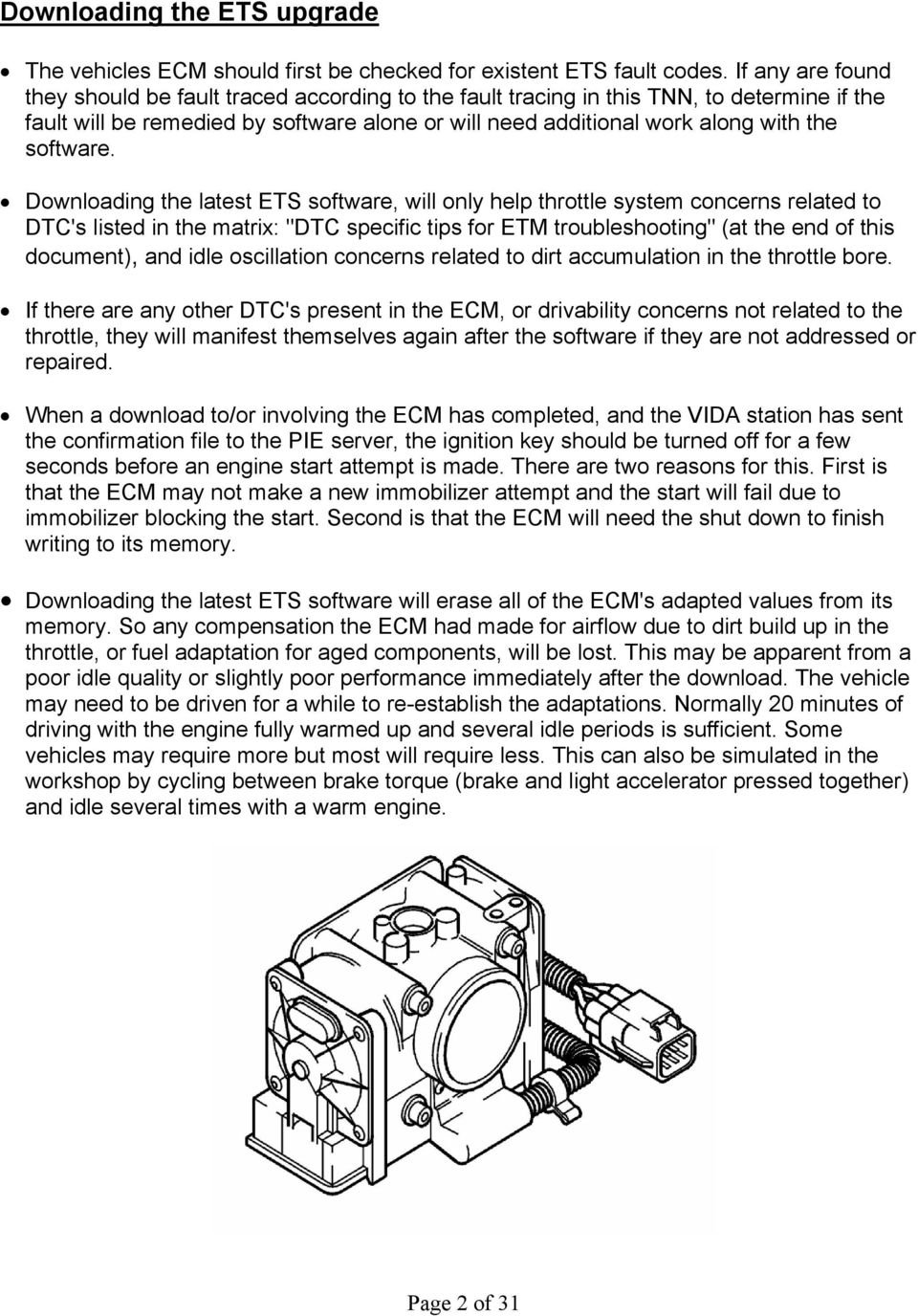
3 System Description The throttle system implemented in the above vehicles comprises an Engine Control Module (ECM), and an independent Electronic Throttle Module (ETM) that communicate with each other over the vehicles Controller Area Network (CAN). It is important to be aware that all throttle system fault codes are stored in the ECM, when either the ECM detects a fault or the ETM requests that the ECM store a fault. The CAN network is vital to the throttle operation, because the ECM uses the CAN network to make requests to the ETM for throttle positions and the ETM continuously sends updates to the ECM about its current throttle position. Several other sub systems indirectly interface with the ETS, to run cruise control and to manage engine torque for gear shifts etc. Though these systems interface with the ETS they are not internal to the ETM and need to be diagnosed independently. The fault tracing matrix later in this document gives detailed information about what fault or failure mode is behind each DTC. Cruise control switches Switches Hardwired to ECM S/V , C Steering Wheel Control Module Steering Wheel Module Cruise control switches S80, S60,(V70 XC70,2001 -) Hardwired analog signal Central Electrical Module Pulsed signal CAN Network Brake position Sensor Engine Control Module Clutch Pedal Sensor Brake light Switch Electronic Throttle Module Accelerator Pedal Module Shown without lever Page 3 of 31

4 What does the Latest Electronic Throttle System software do? General Many changes have been made to reduce driver disturbances or drivability concerns. Other changes assist the technician in fault tracing by eliminating redundant DTC's, and rationalizing the detection criteria to best trigger codes that point toward the root cause first. Additional changes were made to make the system more tolerant of short and intermittent disturbances. Throttle Position Sensors Within the throttle module two potentiometers are used to detect the position of the throttle blade. An inconsistency between the signals from the potentiometers, even for a short time, may result in one or a combination of the following DTC's; 903F, 904C, 904D, 9150, 9160, 9190, 91A7, 91B7. The potentiometers are located at either end of the common shaft that also incorporates the drive motor and throttle blade. Throttle potentiometer detail. 1. Moveable contact 2. Contact brush 3. Resistance track With the latest ETS software, some new functionality and logic is introduced to reduce erroneous detections and to sustain the drivability at a normal level for the driver even when a fault is found. Where previously small signal disturbances or discrepancies caused a DTC and limp home functionality for the driver, the new software uses a new support function in the ECM that based on the engine airflow determines the throttle opening. There are also some other new functions in the ECM and ETM, that allow the system to utilize the ETM hardware without allowing minor disturbances to be detected as faults. Throttle Cleaning With the latest ETS software the adaptation function for air leakage over the throttle blade has been enhanced to provide a greater tolerance of normal dirt build up over time. Previously the dirt build up exhausted the adaptations capacity and caused the idle speed controller difficulties in maintaining a smooth idle, and therefore customer concerns over oscillating idle. With the latest ETS software the DTC (130A) that would often accompany this on turbocharged or 6 cylinder non-turbocharged vehicles MY , has been removed and the adaptation expanded to allow for this dirt accumulation. It is only recommended to clean the throttle when a combination of DTC's 91A7, 91B7 & 130A exist in the ECM prior to updating with the latest ETS software. Page 4 of 31

5 Uneven and/or rough running without any relevant trouble codes Note! Only applies to turbo engines and natural aspirated 6-cylinder engines. The idle speed is calibrated to allow for an amount of air coming into the system from the breather. If this air is missing it will be hard for the ECM to maintain a steady idle. This is the same condition as DTC 130A, but the DTC threshold has not been reached. Downloading the latest ETS software will resolve this concern, but will need the adaptation to be reestablished. Downloading the Latest ETS software will erase any adaptation values the ECM had for the air leakage over the throttle blade. Therefore it may take some driving for the system to reestablish those adaptation values to once again compensate for the dirt that is already built up in the throttle. To allow adaptation, the adaptation function requires a fully warmed up engine, and driving with several brief periods of idle. A 5-cylinder normally aspirated engine has a similar adaptation for the idle speed, and would also require re-establishing of the adaptation. Cleaning of the throttle bore is not recommended, but would reduce the need for adaptation. The amount of air adaptation in the ECM can be read before downloading the Latest ETS software, by looking at the Air Mass Correction Factor and the Leakage Flow over the throttle blade. If the Air Mass Correction factor is lower than 0.9 and or the Leakage flow over the throttle blade is below 3kg/h, then the adaptations may need to be re-established. See the following descriptions for a reminder of the Air adaptation functions. Leakage Flow over Throttle (long term air trim at Idle) This parameter is the adaptation for the airflow at idle. The MAF is the master value and the adaptation value is what needs to be added to or subtracted from the calculated airflow. The calculated airflow +/- the adaptation value should equal the MAF value. This is a slow or long term adaptation. This adaptation value is not used as part of a diagnostic function and will not result in a fault code. But we can use it to evaluate the airflow into the intake. The adaptation value is shown in kg/h, and normal values are approximately 5-10 kg/h. There are several sources of air that are fed to the inlet manifold that do not go through the throttle or MAF e.g. air from the brake booster, the evaporative purge system, and the crankcase breather. The sum of these air sources would give us our normal adaptation value of 5-10 kg/h that does not pass through the throttle and MAF. If we take away one of these sources or restrict one of them, for example a clogged crankcase breather system, the adaptation value would go down (<5 kg/h). Dirt build up on the throttle bore can have the same effect and it is usually the result of the breather system being restricted. The breather should be checked first. If we had an air leak into the manifold the value would go up (>10 kg/h). Page 5 of 31

6 Air mass Correction value (long term adaptations of the air trim above idle) This is the part load adaptation for the mass air flow, to allow for small tolerances between engines and for aging of components. The normal value with no adaptation is 1. A number lower than 1 e.g indicates that more air is passing through the MAF sensor than calculated, e.g. if the crankcase breather system becomes blocked. One indication of this would be a low mass air flow correction value, around 0.85 or lower. A value higher than 1 might indicate an air leak into the manifold, e.g. a loose or broken vacuum line might give a value of 1.15 or higher. The Fault Code ECM-130A is set if the value of the long term AIR trim part load (air mass correction value) and the short term air trim become excessive. Unfortunately the short term air trim is not available to be viewed in VIDA, but if we have the fault code then the short term can be assumed excessive. These adaptations should not be used as a diagnosis on their own but as an indication of what path to take next. First look at the fuel trims (Lambda adaptations), to evaluate the possibility of air leakage. Then, if we have less air bypassing the throttle than normal (< 5kg/h & or <1), we might suspect that the crankcase breather may be blocked and we can use the diagnostic method in TNN B to check that. If the amount of air bypassing the throttle is higher than normal (>10kg/h & or >1), we could use the tools to pressurize the intake system and check for leakage. Do not forget to check the purge valve as a leak source, it is easy to overlook as in some cars the outlet from the system is at the back of the car. It is best checked off the vehicle. General Fault Tracing Tips Using Freeze Frames Electronic Throttle System (ETS) faults can be very intermittent and that is important to remember when checking the possible source identified in the fault tracing or in VIDA while the vehicle is in the workshop it may cause us to overlook an identified source as the root cause, because the values may be good at time of testing. Therefore a good indication of the "source" condition at the time the fault was set, is the freeze frame data available from VIDA. The freeze frame data (frozen values) will be stored just after a fault has been detected. Most of the parameters in the freeze frames are the same for all faults and reflect a general condition when a fault was detected, e.g. engine speed, load, coolant temp, vehicle speed and battery voltage. A few of the values are fault specific and are added to give a better understanding of the specific fault. An example of DTC ECM 903F - Throttle unit internal fault (signal too low or missing) The first possible source or root cause indicated in VIDA for this DTC is "the power supply to the throttle unit" and goes on to suggest checking the battery and charging system. However the condition of the battery when the car is in the workshop doesn't indicate the voltage when the fault was detected. The best source of information is available in the freeze frames, but it is the voltage seen by the ECM at the time the ETM requested the fault, and it should be kept in mind that this is not an indication of the condition of the supply wiring to the throttle itself, and this should be checked independently. But if the ECM had good voltage, the battery was good. Page 6 of 31

7 Freeze Frame for ECM 903F Fuel system status bank 1 LR: closed loop operating with two sensors Fuel system status bank 2 LR: closed loop operating with two sensors Calculated load 4.71 % Engine Coolant Temperature 87 C Short term fuel trim, bank % Long term fuel trim, bank % Short term fuel trim, bank % Long term fuel trim, bank % Engine speed 760 rpm Vehicle Speed 0 km/h Turbo pressure 30 % Battery voltage V Throttle angle, desired value % Mass air flow 23.8 kg/h Ambient temperature 33 C In this particular case the car had low battery voltage in the workshop, but as you can see from the frozen values the battery voltage was good at the time of the fault, and not the cause. Voltages below 10V should be considered carefully, if the battery condition is poor the starter draw could give low voltages during cranking. Use the other parameters in the frozen data to evaluate the driving condition at the time the data was frozen. This is an example of how the freeze frame data can be used to streamline the fault tracing, and possibly prevent wasting too much time on "Dead end" fault tracing and the possibility of finding and fixing a fault that was not actually the root cause of the problem we set out to resolve. There are some things to consider when using freeze frames for fault tracing. The freeze frames that should be used carefully are those captured for CAN network related ETM DTC's. If the ETM detects a loss of communication with the ECM, fault flags will be set in the ETM, however the DTC's in the ECM won't be stored until the communication between ETM and ECM is restored, and that is when the freeze frame data is recorded. So where ETM CAN faults are concerned, the freeze frame data will be from after the fault event. A good method to determine if the DTC was set during fault tracing is to compare the distance in the freeze frame where shown with the distance that can be read from either the CEM or CDM. Using Counters Another useful tool in VIDA for fault tracing is the counters. Counters can be used to determine when and how often the fault was detected. We have seen examples where due to low battery voltage during cranking while connected to VIDA, the VCT caused errors on the network and set communication faults in the high speed nodes. This also caused the ETM and ECM to enter a limp home mode. Using the counters for the fault code, it would be possible to see if the fault was only detected on the current drive cycle or if it had been detected previously. Model year 1999 vehicles with 5-cylinder normally aspirated engines do not support counter 1 and therefore counters are not good indicators of intermittence or occurrence on this vehicle. Page 7 of 31

8 Example of Counters Counter 1 15 Number of fault-free driving cycles since fault was last detected Counter 2 69 Total driving cycles since the DTC was set for the first time Counter 4 1 Number of driving cycles with fault since the DTC was set for the first time Counter Number of seconds of ECU operation since the DTC was set for the first time Counter 6 0 Number of seconds with test in ECU running since the DTC was set for the first time Counter 7 0 Number of seconds that the ECU detected the fault since the DTC was set for the first time Things to remember about the counters are, if counter 3 is high and counter 4 is 0 the fault happened once and many drive cycles ago, this would tell us that this fault code is not related to the customer's current concern. Counter 1 tells us how many driving cycles since the last time the diagnostic detected a fault. If this is high the diagnostic has not detected a fault for a long time, if low the fault was detected on a recent driving cycle and may be related to the customers current concern. If counters 1, 3 and 4 are 0, this indicates that there are no drive cycles since the fault was detected and the fault was set during the latest driving cycle and probably in the workshop. For a drive cycle to be counted a coolant temperature increase may be needed, but in some cases a key cycle counts as a drive cycle. Counter 5 can be useful if the fault was detected in this drive cycle, the time can be used to determine when the fault occurred. Fault tracing Controller Area Network (CAN) As mentioned earlier in this document the ETM/ECM can not function together without the CAN. The two control modules monitor the CAN continuously for problems, and are very sensitive to disturbances on the CAN. These modules will set fault codes very quickly if they detect problems on the CAN, and may go to a limp home mode because of it. If the ECM/ETM detect a fault on the CAN bus, this is not an indication that they were the cause of the problem, it is more likely they were just the most sensitive to it. As you can/will see from this document many of the other fault codes can be triggered due to a loss of communication on the CAN. Again this is a consequence of the fault and not an indication of the root cause. ETS CAN fault codes should be fault traced along with any other CAN fault codes from other modules, using the fault tracing in VIDA and supplemented by the information in TNN CAN faults generated by VIDA/VCT When the VIDA station is connected to the vehicle and the battery voltage is low this might generate fault codes. The VCT (Volvo Communication Tool) gets its power from the vehicle and either can be disturbed, and cause disturbances when it's supply voltage is low (Particularly when the engine is cranked with a weak battery). Fault codes that occur during fault tracing can be identified using freeze frames and counters, to eliminate fault tracing the wrong codes. This situation can be minimized by using a battery charger to keep the voltage stable when fault tracing for extended periods. Note! Only use the Volvo approved battery chargers, as some booster chargers produce excessive voltage, creating problems and fault codes themselves. Low battery voltage fault tracing tip (only C70 MY99-02 and S70/V70 MY99-00) Resistance in the B+ cable to the fuse box can be the root cause for many ECM/ETM fault codes. Fault trace according to Service Bulletin (released December 2001) Page 8 of 31

9 Erasing ETM memory Some fault tracing instructions recommend that the ignition be turned off and on twice, after erasing codes. The reason for this is that fault codes may have been set at the request of the ETM, but we can only erase the ECM. The ETM needs to power down fully to erase its memory; otherwise the fault may be set in the ECM again. For the ECM and ETM to power down fully the ignition should be turned off for 5 minutes the first time and 30 seconds the second time. If the cooling fan is running you will need to wait until 2 minutes after the cooling fan has stopped to ensure the ETM is powered down. This should only be necessary where the ETM's CAN controller has gone bus off due to network disturbances, and therefore will not have seen the instruction from the ECM to shut down. The ETM will shut down when the system relay times out. The DTC's that would most commonly indicate that the ETM has gone bus off are 911A, 901A, 902A, & 902B. Symptoms Limp home modes Some ETS related faults will result in the system running in a limp home status for the remainder of the drive cycle that the fault occurred in, and any following driving cycles where the fault is still present. There are different limp home levels depending on the fault detected. The limp home functions are described below: Fuel shut-off, which follows accelerator pedal (AP) position. Engine speed (RPM) is controlled by reducing fuel quantity and /or disabling the injectors one at a time, maximum engine speed (RPM) is governed by the accelerator pedal (AP) position. The absolute limit for engine speed (RPM) is approximately 5000 rpm (This particular limp home function can appear as if the engine idle is very erratic, because the ECM turns off fuel to individual cylinders to control the engine speed. Do not confuse these limp home functions for real drivability problems.) Slower throttle opening than requested. The throttle opens slower than normal because the system is only regulated by the pulse width modulated signal from the accelerator pedal (AP) position sensor. (The customer may feel a slower response to their accelerator input). Throttle closure when braking. The accelerator pedal (AP) position is ignored when the brake pedal is depressed. No response to the Accelerator pedal while the brake pedal is used. Normal accelerator response is resumed when the brake pedal is released. Throttle follows accelerator pedal (AP) position. The throttle and accelerator pedal (AP) are used as if they were mechanically connected to each other. This limp home function will always accompanied by the fuel shut off limp functionality. Throttle disabled. Power is turned off to the throttle control motor and the throttle blade goes to its mechanical stop position (approximately 20% open). This limp home function will always be accompanied by the fuel shut off limp functionality. Cruise control Disabled. Cruise control will not be available to the driver for the duration of the driving cycle in which the fault occurred. Cruise will be available on the next engine start, if there are no faults detected. Page 9 of 31

10 Combined Fault Codes Faults detected by the ETM system, will normally result in multiple fault codes. To aid in diagnosing these cases we have provided two charts below that show the fault code combinations, and in the column (Follow fault tracing for) to the right of the combination shows the fault code that should be fault traced to determine the root cause. These fault code combinations can exist with or without other fault codes that are not necessarily throttle related. Combined Fault codes For Turbo and 6 cylinder normally aspirated engines With this combination of codes Follow the fault tracing for: With this combination of codes Follow the fault tracing for: 130A, 91CF 130A 9150, 9160, 903F, 9150, C, 904D, 982A 130A, 903F, 904D, 91CF 130A 901E, 903F 901E 130A, 904D, 91A7 130A 901E, 903C, 903F 901E 91A7, 904D 91A7 902A, 903F, 904D, 902A 959F 91A7, 903C 91A7 902A, 903F, 904D 902A 91A7, 903F, 904D 91A7 902A, 903F, 959F 902A 91B7, 904D, 91A7 91B7 902A, 928C 902A 9150, F, 904C, 9150, A, 903C, 959F 902A 904D 9150, F, 904C, 9150, F, 904D 903F 904D, 91A7 9150, C, 903F 9150, F, 917F 958F 9150, F, 904C 9150, F, 959F 958F 9150, 9160, 903F 904C, 9150, A, 904D 981A 904D, 91B7 9150, 9160, 903F, 904C, 9150, A, 6805, 904D 981A 91A7 9150, 9160, 903F, 904C, 9150, A, 904D 982A 904D, 91A7, 91B7 9150, 9160, 903C, 903F, 9150, , 903F, 904D, A7 91A7 9520, 917F, 958F 9520 Page 10 of 31

11 Combined fault codes For 5 Cylinder normally aspirated engines With this combination of codes Follow the fault tracing for: With this combination of codes Follow the fault tracing for: E003, 902B E A, 912A 911A E003, 902B, 903F E F, 917F, 951F 918F 91A7, 903F, 980F 91A7 950F, 951F 950F 91A7, 903F 91A7 950F, 903F, 917F, 950F 951F 91A7, 903F, 980F, 91A7 950F, 917F, 951F 950F B7, 91A7 91B7 980F, F 91B7, 903F, 91A7 91B7 9150, 91B B7, 903F, 980F 91B7 9150, 903F, 91B7, F 91F0, 91A7 91F0 9150, 9160, 903F, 9150, B7 130A, 903F, 980F 130A 9150, 9160, 903F, 9150, F 130A, 903F 130A 9150, 9160, 903F 9150, A, 91B7 Fault trace both 9150, 9160, 903F, 9150, B7, 980F 150A, 980F, A 9150, 9160, 130A, 9150, F, 980F 902B, 903F 902B 9160, 91B B, 902A 902B 9160, 903F, 91B7, F 902B, 903F, 980F 902B 9200, 922A B, 902A, 903F, 902B 9300, 930A F, 980F 902B, 902A, 951F 902B 9400, 941F B, 902A, 903F 902B 9520, 918F B, 902A, 903F, 902B 9520, 918F, 951F F 903F, 980F 903F 9530, 950F 9530 Page 11 of 31

12 DTC specific tips for ETS/ETM troubleshooting DTC ECM-9200 Cruise control faulty signal Description This DTC is triggered if an impossible combination of cruise control buttons is detected by the ECM. Faulty signal For S60 and V , SET+ & SET- & CRUISE OFF & RESUME pressed at the same time. For longer than 0.3 seconds For V , S /70 SET+ & SET- pressed at the same time, OR CRUISE OFF & RESUME pressed at the same time. For longer than 0.3 seconds Signal too high Can be triggered if it is detected that any of the cruise switches are shorted to battery voltage, for longer than 0.3 seconds The switch status can be checked using VIDA. If the fault code is set cruise control will be denied by the ECM for the remainder of the driving cycle. Check the freeze frame and counters to determine the driving conditions and intermittence of the problem. Verify the operation of the cruise control buttons through ECM parameters in VIDA. If the buttons function correctly downloading the latest ETS software will increase the systems tolerance of accidental button pushes by increasing the detection time to 1.8 seconds ECM-921F Clutch pedal sensor, faulty signal. On a vehicle with a manual transmission the ECM calculates the gear being used, by calculating the ratio between current engine speed and road speed and matches that ratio to one of the 6 possible ratios stored in the ECM. If the ECM detects 5 gear changes in the same driving cycle where the clutch pedal is not pressed more than 10%, a fault is detected and the DTC ECM- 921F is posted, cruise control will be denied by the ECM for the remainder of the drive cycle. Downloading the latest ETS software will have no effect on this DTC. The clutch position detected by the sensor should be checked against pedal movement using VIDA. Page 12 of 31

13 ECM-922A Cruise control, faulty signal. All communication between the cruise control buttons and the ECM is via the Steering Wheel Module (SWM) over CAN. Both the ECM and SWM make several checks to make sure that the information received by the ECM about the current cruise control button status is correct. The ECM does the following checks: 1. When a button signal is sent by the SWM the module makes a calculation based on the button position, the result of this calculation (Checksum) is attached to and sent with the signal. When the ECM receives the signal it reverses the checksum calculation to make sure it agrees with the button status being sent. If the checksum and signal disagree for longer than 0.1 seconds the DTC will be set. 2. The button positions are constantly sent to the ECM, even if they have not changed, as a confirmation to the ECM that the driver has not asked for a change. An update part is attached to the button position signal, to indicate that this is a fresh signal. If the update part is missing or wrong for 0.8 seconds the ECM sets the DTC 922A. If either fault is detected the ECM will deny cruise control for the remainder of the driving cycle. Downloading the latest ETS software, will allow this diagnostic monitor to better tolerate network interruptions during engine start etc. by increasing the detection time to 0.9 seconds and by introducing a condition where the monitor is only active at road speeds where cruise control is possible ( >25KMH / 15.5mph). ECM-930A Clutch pedal sensor, faulty signal. On a vehicle with a manual transmission the ECM calculates the gear being used, by calculating the ratio between current engine speed and road speed and matches that ratio to one of the 6 possible ratios stored in the ECM. If there are 5 gear changes in the same driving cycle where the clutch pedal is not pressed more than 10%, a fault is detected and the DTC ECM-930A posted, and cruise control will be denied for the remainder of the drive cycle. Downloading the latest ETS software will have no effect on this DTC. The clutch position detected by the sensor should be checked against pedal movement using VIDA. Page 13 of 31

14 ECM-9300 Clutch pedal position sensor Signal too high Fault trace signal wire shorted to supply (>4.771V) using VIDA. Signal too low Fault trace signal wire shorted to ground (< 1.66V) using VIDA. Faulty signal This monitor was intended for production line verification only and is not tolerant of wear over time. Resulting in unnecessary DTC's and cruise control denied by the ECM for the remainder of the driving Cycle. Downloading the Latest ETS Software will remove the assembly fault monitor as the cruise will disconnect with detected gear ratio, but the signal too high/low will remain. ECM-9400 Brake pedal position sensor Signal too high (>4.15V >1.2seconds) Fault trace according to VIDA. If fault is found to be intermittent and/or fault not present when tested (use fault code counter to determine degree of intermittence), download the latest ETS software. This will increase the fault tolerance by increasing the detection time, but maintaining safety by activating an un-used mutual check between the two brake pedal sensors. Signal too low (<.449V >1.2seconds) Fault trace according to VIDA. If fault is found to be intermittent and or fault not present when tested (use fault code counter to determine degree of intermittence), download the latest ETS software. This will increase the fault tolerance by increasing the detection time, but maintaining safety by activating an un-used mutual check between the two brake pedal sensors. Signal missing Fault trace according to VIDA. If fault is intermittent (use fault code counter to determine degree of intermittence) download the latest ETS software. This will allow the ECM to tolerate intermittent disturbances in the signal, while maintaining integrity with an added check using the brake light switch. Faulty Signal This Monitor was intended for production line verification only and is not tolerant of wear over time. Resulting in unnecessary DTC's. Downloading the latest ETS software will remove this monitor, and maintain integrity using the added check of the brake light switch from the signal missing monitor. Downloading the latest ETS software will increase the ECM's ability to tolerate minor signal disturbances while still detecting signal faults. Page 14 of 31

15 ECM- 941F Brake pedal sensor faulty signal. (5 cylinder non- turbo) This DTC is to detect discrepancies between the brake pedal sensor and the brake light switch. If, for more than 0.32 seconds, the pedal sensor indicates that the pedal is pressed beyond a pre determined limit, but the brake light switch is not active, the fault is set and the DTC ECM-941F is posted in the ECM. If the DTC is posted the brake pedal position value and the brake light switch should be compared to make sure that the pedal sensor changes with pedal travel and that the switch also goes on and off with pedal travel. If the switch and sensor behave correctly, download the latest ETS software. Downloading the latest ETS software increases the detection capability of this monitor. As before detecting faults for brake light switch coming on, but now also checking that it goes off when the position sensor indicates the pedal is released. The detection time has been increased to 2 seconds and the number of detections during a driving cycle is now 30. Brake lamp operation should be verified after repair/software. ECM-950F Accelerator pedal position sensor. Analog and PWM signals from Accelerator Pedal Module differ as received by ECM The fault is detected by the ECM if it sees that the Accelerator Pedal Module (APM) analog and PWM signals (both hard wired to the ECM) differ by more than 5% for >0.4 seconds. A greater percentage is allowed when the pedal is moving dependant on the speed it is moving. For Model years the rpm has to be over 700 for the DTC to be set. For MY 2002 ignition on is required but no engine speed. Check the freeze frame and counters to determine conditions at time of detection and the degree of intermittence, if the fault was at starting and /or is very intermittent the most likely cause is signal disturbance. Downloading the latest ETS software increases the detection time to 0.7 seconds to allow more tolerance of starting times in the APM signal generator. Engine running has also been added as a requirement for all applications. Page 15 of 31

16 ECM- 951F Accelerator position sensor (AP) internal fault. This fault indicates that with engine running there was a difference >10% for >1 second between the analog signal from the APM (Accelerator Pedal Module) monitored by ECM, and the PWM (Pulse Width Modulated) signal, reported to the ECM by the ETM over the CAN bus. Larger differences are accepted if the pedal is seen to be moving (based on the analog signal and the speed of movement). This problem is most often due to a loss of communication between ECM and ETM on the CAN bus. Check for and fault trace CAN related faults. Check for fault codes directly identifying problems with the individual APM signals. If 950F is detected with 951F then fault trace 950F first. A lot of CAN disturbances happen during engine start when the battery voltage is most stressed by the starter motor load. The ECM and ETM are the most sensitive nodes to these kinds of disturbances. Use the freeze frames to determine if any CAN disturbances may have happened at engine start, another good indication of this is if the only nodes detecting CAN faults are the ECM /ETM. Then the disturbances were very short. Downloading the latest ETS software will not give increased tolerance of this fault, the DTC's must be fault traced, before ETS software is upgraded. ECM-91CF Engine Control Module Internal Fault, Faulty Signal This fault is triggered if the ECM sends a cruise active signal to the ETM, but the ETM has detected brake light switch active or the ETM is denying cruise due to another fault in the ETM. The ETM then does not agree with the ECM that cruise should be active and the fault is stored. This fault can be wrongly stored in vehicles with a 5-cylinder turbocharged engine if the fault code 130A is present. If both DTC's are present, the fault can be remedied by downloading the latest ETS software, which eliminates the incorrect link between these two DTC's. If DTC 130A is not present, or the vehicle does not have a 5- cylinder turbocharged engine, downloading the latest electronic throttle software will increase the systems tolerance to these faults, by increasing the detection time from 0.5 seconds to 2 seconds, before a fault is set. This is a communication fault between the two modules and cannot be monitored with VIDA. Downloading the latest ETS software and verifying the cruise control operation by test driving is the best method to resolve this concern. Page 16 of 31

17 ECM-91DF Brake light Switch Faulty Signal Both the ETM and ECM have hardwired connections to the brake light switch. The ECM has the brake position sensor as an additional input. The monitor checks when the ETM receives information from the ECM via CAN that the brake pedal is active (position sensor) that the brake light switch to the ETM is also active, if not a fault is set. The brake light switch wiring to the ETM should be checked for an open circuit. The brake position sensor should also be checked (this can be monitored as an ECM signal using VIDA). If ok, the latest ETS software should be downloaded to the vehicle. This will improve the systems tolerance of momentary interruptions by increasing the detection time from 0.3 seconds to 5 seconds. ECM-928C Control Module Communication problems, Signal Missing For S/V , C This DTC is triggered if an impossible combination of cruise control buttons is detected. Faulty Signal SET+ & SET- pressed at the same time, OR CRUISE OFF & RESUME pressed at the same time, for longer than 0.3 seconds Signal too high Can be triggered if it is detected that any of the cruise switches are shorted to battery voltage. For longer than 0.3 seconds The switch status can be checked using VIDA. Downloading the latest ETS software, increases the systems tolerance of accidental button pushes by increasing the detection time to 1.8 seconds. For S80, S60, XC/V with turbo engines. Most faults for this DTC are set because the cruise control button information was missing, mainly during start up of the vehicle engine. Once a fault is detected the cruise control will be disabled for the entire driving cycle. 0 vehicle speed in the freeze frame is a good indicator of a start up problem. If the fault was triggered during start or low vehicle speed Downloading the latest ETS software will resolve the concern. A greater tolerance of temporary interruption and signal drop out is introduced by, removing diagnosis of the signal at engine start up. This is achieved by only diagnosing the cruise buttons when cruise control is enabled that is, at road speeds above 25 km/h (15.5 mph). The monitors delay time has been increased from 0.3 seconds to 0.6 seconds to tolerate temporary drop outs of the CAN signals. Road test to verify cruise operation after latest ETS software is installed. Page 17 of 31

18 ECM-9180 Accelerator Pedal position sensor faulty signal ECM-9520 Accelerator pedal signal ECM-9530 Accelerator pedal signal ECM- DTC 9180 detects PWM electrical faults at the ETM, while DTC 9520 detects the same faults at the ECM. The ETM however has a shorter detection time, thus a higher sensitivity to signal drop out or disturbance. If the fault is permanent fault trace according to the current VIDA information. Use the counters to determine intermittence. If the fault is intermittent: Downloading the latest ETS software will increase the systems tolerance to short signal disturbances, by increasing the detection time, from 0.1 seconds to 0.9 seconds. This monitor detects Electrical faults in the Pulse Width Modulated (PWM) signal generated by the APM. Faults may be detected at engine start if battery is weak/low voltage. Use freeze frames to determine conditions at time of fault. If fault is permanent, fault trace according to VIDA. Downloading latest ETS software will increase ETM's tolerance of signal loss due to interference at engine start, by increasing the detection time to 0.7 seconds. A fault is detected if the analog signal from the APM exceeds an upper limit 4.85V (signal too high) or falls below the lower limit 0.15V (signal too low) for more than 0.08 seconds. This very short detection time makes this monitor intolerant of short disturbances in the signal. If the analog signal is good when tested according to VIDA, download the latest ETS software. Downloading the latest ETS software will increase the resistance to signal interference, as the monitor's detection time is increased from 0.08 seconds to 0.4 seconds for turbo and 6- cylinder non turbo, and to 0.7 seconds for 5-cylinder non turbo vehicles. A fault is detected if the ECM detects that the 5V power supply to the analog sensor in the APM, is outside the diagnostic limits: Signal too high >5.195 Volts for > 0.16 seconds ECM Volt power Supply for Accelerator Pedal module Signal too low < 4.8 Volts for > 0.16 seconds If the fault is permanent fault trace according to VIDA. If the fault is found to be caused by intermittent disturbances, downloading the latest ETS software will increase tolerance of these disturbances by monitoring the fault condition for a longer time before a fault is triggered. 0.7 seconds for 5-cylinder non turbo and 0.4 seconds all other engines. Page 18 of 31

19 ECM-917F Accelerator position Signal (PWM) in ETM. The monitor for DTC 917F detects a fault at the ETM when the PWM signal from the APM (hardwired to the ETM) does not agree with the PWM signal the ECM sends over the CAN. This fault can be, and usually is, set with DTC 9520, because short disturbances in the hardwired signal may not show up in the CAN signal, resulting in a difference between the two. And likewise short CAN disturbances will not affect the hardwired signal resulting in a difference, and a fault. If this fault is posted with any other accelerator pedal codes or CAN related fault codes fault trace those first, using this document or VIDA where the code is not included in this document. Downloading the latest ETS software changes the detection time from 0.4 seconds to 0.9 seconds, making it both less sensitive to short disturbances, and more likely to result in a fault that correctly identifies the root cause. ECM-958F Analog and PWM signals from APM differ as received by ECM The fault is detected by the ECM if it sees that the APM analog and PWM signals hard wired to the ECM differ by more than 5% for more than 0.4 seconds, with a larger % allowance if the pedal is detected as moving based on the analog signal. Most of these DTC's are set at very low rpm and low battery voltage, which would indicate engine starting. Checking the freeze frame data for low voltage, and rectifying a weak battery would solve such a concern. Downloading the latest ETS software adds an engine running condition to the monitor, making it less sensitive to start up disturbances. The detection time is also increased from 0.4 seconds s to 0.7 seconds to allow more tolerance of starting times for the signal generator in the APM. If the fault is permanent fault trace according to VIDA. Page 19 of 31

20 ECM-959F Accelerator PWM value sent to ECM from ETM Via CAN differs from the Accelerator analog signal hardwired to the ECM. This fault indicates that there was a difference >10% for >0.5 seconds between the analog signal from the APM (Accelerator Pedal Module) monitored by ECM, and the PWM (Pulse Width Modulated) signal reported to the ECM by the ETM over the CAN bus. This problem is most often due to a loss of communication between ECM and ETM on the CAN bus. Check for and fault trace CAN related faults. Check for fault codes directly identifying problems with the individual APM signals, and fault trace those as the root cause. A lot of CAN disturbances happen during engine start when the battery voltage is most stressed due to the starter motor load. The ECM and ETM are the most sensitive nodes to these kinds of disturbances. Use the freeze frames to determine if any CAN disturbances may have happened at engine start. Another good indication of this is if the only nodes detecting CAN faults are the ECM/ETM. Then the disturbances were very short. Downloading the latest ETS software will improve the monitor for DTC 959F. The monitor has been changed to increase the detection time from 0.5 seconds to 0.9 seconds, to allow CAN disturbances (most likely root cause) to be detected before the signal fault. ECM-901A CAN Bus faults detected by ECM. This fault code indicates that the CAN bus controller in the ECM has gone into bus off mode due to disturbances detected on the CAN. If this fault code is present, and there are other CAN faults present, fault trace according to TNN Downloading the latest ETS software will remove this monitor, as the DTC E000 already covers the same fault, and is used in most CAN nodes; this offers greater consistency in fault tracing CAN faults. NOTE Although this DTC is removed in the new software, the fault needs to be corrected, as any faults not addressed will still trigger DTC E000. A node detecting and reacting to a problem on the Can bus is not an indication that the node is the root cause of the concern. Use frozen values and counters to determine possible low battery conditions. Comparing total distance (Miles/ km) in the freeze frame with the current mileage in the Driver Information Module will indicate if this fault was introduced during this diagnostic session, because of disturbances from the tool (VCT), or if the DTC was set on a previous drive cycle. If the fault is set by the VCT, the fault can be ignored in fault tracing and erased when all fault tracing has been completed. Page 20 of 31

21 ECM-902A/ 902B Throttle unit Communication. This Monitor will trigger a fault if the information sent from the ETM to the ECM over the CAN, is missing for more than 0.5 seconds. This fault is most often set due to low system voltages at engine start, but can also be triggered by very short disturbances on the CAN. Use frozen values and counters to determine possible low battery conditions. Comparing total distance (Miles/ km) in the freeze frame with the current mileage in the Driver Information Module will indicate if this fault was introduced during this diagnostic session, because of disturbances from the tool (VCT), or if the DTC was set on a previous drive cycle. If the fault is set by the VCT, the fault can be ignored in fault tracing and erased when all fault tracing has been completed. Downloading the latest ETS software will make this monitor more tolerant of minor disturbances and low voltage conditions. The detection time is increased from 0.5 seconds to 0.9 seconds to filter glitches and disturbances, and a low voltage limit of 9V is introduced preventing detection at voltages below which the ETM is not expected to be running. This will not prevent disturbances from the VCT 2000 triggering the fault during fault tracing. Page 21 of 31
22 The monitor for DTC 903F checks that the actual throttle angle reported by the ETM over CAN to the ECM corresponds to the angle requested by the ECM. If the two angles do not agree by more than a predetermined limit the fault is set. Signal too low Is set when the throttle angle is changing (throttle moving) and two angles differ by more than 20% Signal missing Is set while the throttle is relatively still, and the angles differ by more than 5% for 0.42 seconds or greater. Signal too high Is set if the ETM sends a wrong or missing identification signal on the CAN. ECM-903F Electronic throttle module internal fault. Caution: this fault can be set in the workshop, by attaching the diagnostic tool to the vehicles connector See section on VCT This DTC can occur as a secondary fault to potentiometer fault 9150/9160, so if 9150/9160 is present follow fault tracing for those. This monitor is most often set as a secondary fault when a CAN glitch or disturbance occurs for more than 0.5 seconds, as the ECM may change its requested angle, but the actual angle reported from the ETM does not change due to the loss of CAN signal. Check the DTC counter to see if this was an intermittent fault, and if so download the latest software. Downloading the latest ETS software will enable this monitor to; Signal missing & Signal too low Tolerate CAN faults by adding a condition requiring an update bit with the established throttle angle. The monitor will then only compare new information to new information. A delay was also added to allow the throttle more time to change from moving to still, before the monitor evaluates the difference between the requested and actual angles at a 5% level. Signal too high Time with fault is increased from 0.5 seconds to 2.4 seconds before a fault is triggered, to tolerate momentary CAN disturbances/ interruptions. Page 22 of 31
23 This fault code indicates that the CAN bus controller in the ETM has gone into bus off mode due to disturbances detected on the CAN. If this fault code is present, and there are other CAN faults present. Fault trace according to TNN Downloading the latest ETS software will remove this monitor, as the DTC E000 already covers the same fault, and is used in most CAN network nodes; this offers greater consistency in fault tracing CAN faults. ECM-911A Throttle unit communication. NOTE Although this DTC is removed in the new software, the fault needs to be corrected, as any faults not addressed will still trigger DTC E000. A node detecting and reacting to a problem on the CAN bus is not an indication that the node is the root cause of the concern. Use Frozen Values and counters to determine possible Low battery conditions. Comparing total distance (Miles/ km) in the freeze frame with the current mileage in the Driver Information Module will indicate if this fault was introduced during this diagnostic session, because of disturbances from the tool (VCT), or if the DTC was set on a previous drive cycle. If the fault is set by the VCT, the fault can be ignored in fault tracing and erased when all fault tracing has been completed. ECM-912A Engine control module (ECM) communication. No communication detected by the ETM. This Monitor will trigger a fault if the information sent from the ECM to the ETM over the CAN, is missing for more than 0.5 seconds. This fault is most often set due to low system voltages at engine start, but can also be triggered by very short disturbances on the CAN. Use frozen values and counters to determine possible low battery conditions. Comparing total distance (miles/ km) in the freeze frame with the current mileage in the Driver Information Module will indicate if this fault was introduced during this diagnostic session, because of disturbances from the tool (VCT), or if the DTC was set on a previous drive cycle. If the fault is set by the VCT, The fault can be ignored in fault tracing and erased, when all fault tracing has been completed. Downloading the latest ETS software will make this monitor more tolerant of minor disturbances and low voltage conditions. The detection time is increased from 0.5 seconds to 0.9 seconds while driving and 4 seconds during start up to filter glitches and disturbances. This will not prevent disturbances from the VCT 2000 triggering the fault during fault tracing. Page 23 of 31
24 ECM-9190 Throttle unit, internal fault. Throttle motor control circuit. ECM-91E0 Battery voltage, to the ETM The fault indicates an under or over-current in the drive circuit for the throttle motor. This can also be triggered by an incorrect current value fed back from the motor drive circuit, or that the throttle blade does not move despite a large current applied to the motor. Check the battery voltage in the frozen values for the DTC. If the battery voltage is low, less than 10V fault trace the battery and cables. If the fault code was triggered and the battery voltage is good higher than 10V, then the fault code indicates a problem with the motor control, and the ETM should be changed to resolve the concern. This Fault code indicates that the system voltage seen by the ETM dropped below 9V over a period of 9 minutes, or exceeded 16V for 5 seconds. If the customer were to sit with the engine off and key on for an extended period (perhaps listening to the radio), it is probable that this fault code will be set. Checking the frozen values for battery voltage and engine speed will confirm this. Using a high output battery charger could trigger the high limit fault, check with the customer to determine if this has happened. Downloading the latest ETS upgrade will prevent future customer disturbances due to this condition. An engine running condition has been added as a requirement for this DTC to be set. ECM-91F0 Throttle unit, internal fault. (Motor current) This fault is detected if the current applied to the throttle motor does not correspond to the measured current consumed by the motor. This can be caused by low voltage from a weak battery, or a bad battery cable. Corrosion and or loose terminals in the connector to the ETM can also be a possible fault source. Downloading the latest ETS software will increase this monitors tolerance of temporary disturbances by increasing the evaluation time from 0.13 seconds to 10 seconds with fault, before a DTC is set. ECM-910E Throttle unit, internal fault. This DTC indicates that the ETM has detected a problem with either its memory or central processor, and has requested the ECM post this fault. Replace the ETM to solve this concern. Page 24 of 31
25 ECM-9150 Electronic throttle module (ETM), internal fault. Potentiometer #1 This DTC indicates a fault with throttle potentiometer number 1. Either the signal has exceeded its upper or lower limit for >0.8 seconds or the potentiometer does not reach the correct position during start up. The most common fault type is that a difference of more than 5% is detected between potentiometer 1&2 for 0.2 seconds or longer. Downloading the latest ETS software will allow the ETM to tolerate disturbances and wear in the potentiometers, with the introduction of new functions that enable the ETM to chose the accurate potentiometer, and monitor the performance of the chosen potentiometer using an airflow model. See section on throttle position sensor function. ECM-9160 Electronic throttle module (ETM), internal fault. Potentiometer #2 This DTC indicates a fault with throttle potentiometer number 2. Either the signal has exceeded its upper or lower limit for >0.8 seconds or the potentiometer does not reach the correct position during start up. The most common fault type is that a difference of more than 5% is detected between potentiometer 1&2 for 0.2 seconds or longer. Downloading the latest ETS software will allow the ETM to tolerate disturbances and wear in the potentiometers, with the introduction of new functions that enable the ETM to chose the accurate potentiometer, and monitor the performance of the chosen potentiometer using an airflow model. See section on throttle position sensor function. ECM-904C MIL requested by throttle unit. ECM-532D MIL requested by throttle unit. This fault is triggered to indicate when DTC 9150 and 9160 occur together, the function of this monitor is to illuminate MIL immediately if faults are detected on both potentiometers within the same drive cycle. Therefore it is a secondary fault code and 9150/9160 should be fault traced as the root cause. Downloading the latest ETS software will bring the new throttle position sensor functionality mentioned under fault codes 9150 & 9160; this removes the double failure condition. The DTC is re-used with the latest software for information, to indicate when the fuel cut off support function has been active & the number of fuel cut offs have exceeded a pre-determined limit. This is a secondary DTC and will always be accompanied by the DTC that triggered the support function. Page 25 of 31
26 ECM-91A7 Electronic throttle module (ETM), internal fault. ECM-91B7 Electronic throttle module (ETM), internal fault. This fault is detected by the ETM and uses the power consumption of the throttle motor, to determine possible high friction in the throttle. The fault is also triggered if the ETM detects that there is to great a difference between its target throttle position and the actual position. This fault can be caused by dirt build up in the throttle housing, or by a low battery voltage. Downloading the latest ETS software will improve the systems tolerance of these conditions using some of the new functionalities that give greater potentiometer accuracy and throttle control. This fault code indicates that the throttle blade was not in the expected position when the ETM was powered up. This monitor is sensitive to small differences between the throttle position sensors, and minor differences from the mechanical rest position. If one potentiometer shows that the throttle is not in the expected position, the fault will be posted. Check the fault codes intermittence, by looking at the counters, if there is a low degree of intermittence (the fault has occurred often) the throttle should be checked to ensure no foreign objects are blocking the throttle blade. Downloading the latest ETS software will increase this monitors tolerance to minor differences in the throttle potentiometers by requiring that both potentiometers show that the throttle blade is out of position before the fault is triggered. ECM-1300 Mass air flow (MAF) sensor. ECM-130A Intake air leakage, faulty signal. (5&6 Cylinder turbo and 6 cylinder non turbo.) DTC 1300 indicates that the measured mass air flow differs from an airflow range calculated by the ECM. Downloading the latest ETS software, will increase this monitors range of detection to incorporate the area previously monitored by DTC 130A. The detection time has been increased from 5 seconds to 10 seconds. DTC 130A indicates that the Mass Air Flow (MAF) sensor adaptation has reached its limitation. The MAF adaptation reaches its limitation compensating for small component tolerances and dirt accumulation in the throttle or breather system. The DTC can also be triggered if an intake hose is disconnected. Check for loose turbo hoses before downloading the latest ETS software. Downloading the latest ETS software will remove this diagnostic monitor from the system. The adaptation has been modified to compensate for real world dirt build-up in the intake system and ageing of the components. The monitor for DTC 1300 will monitor the MAF performance making DTC 130A redundant. Page 26 of 31
27 ECM-130A Mass air flow (MAF) sensor. (5-cylinder non-turbo) ECM-150A Mass air flow (MAF). This fault code indicates that the airflow calculated from engine speed, throttle angle, and air density is significantly different from the actual airflow measured by the MAF Sensor. RPM = rpm Throttle open angle = 7-40 ( steady accelerator pedal) Road speed = mph Coolant temp C The fault will be stored if the difference is too great for more than 5 seconds. Check long term fuel trim values. If the MAF value is wrong by a significant amount, this will show up as compensation in the fuel trim. Intake air leaks and fuel pressure related problems will generally have a greater influence on the fuel trim in the lower fuel trim areas (1-3) and get progressively better as you look towards the higher load areas (3-6). If the long term fuel trim values get progressively worse in the higher load areas, then the probable cause is a damaged MAF sensor. This diagnostic monitor compares the load signals from the Mass Air Flow sensor (MAF and the Manifold Absolute Pressure sensor (MAP). If the difference between the two sensors exceeds a predetermined limit the fault code is set. Possible faults are: Faulty MAF sensor. Faulty MAP sensor. Air leakage into the intake system. Incorrect camshaft timing. Check the DTC's Freeze frame to determine the long term fuel trim and engine speed when the fault is detected. If the adaptation is close to one of its limits (1.23 upper limit) or (0.75) lower limit, this would suggest that the problem lies with the MAF sensor. When comparing all five long term fuel trim values, If larger amounts of adaptation occur in fuel trim areas 3,4&5 this also indicates a probable MAF fault. MAF performance can be checked against a rough guide using engine parameters in VIDA. The parameter mass air flow g/s (grams /second) can be compared to the following values on a completely warm engine with all possible loads turned off: 1500rpm 2000rpm 2500rpm. If the values read from VIDA differ significantly from the above values the MAF is faulty, if not then the MAP sensor either has a restricted/damaged hose or the sensor is faulty. Page 27 of 31
28 ECM-260A Fuel trim upper part load bank 1 ECM-270A Fuel trim upper part load bank 2 ECM-261A Fuel trim lower part load,bank1 ECM-271A Fuel trim lower part load,bank 2 ECM-262A Fuel trim Idle, bank 1 ECM-272A Fuel trim Idle, bank2 ECM-9818 Brake Vacuum leakage ( 5-cylinder non turbo) ECM-900E Engine control module (ECM), internal fault, or air flow fault. These fault codes indicate that the lambda controller has reached either its upper or lower limit on that bank: upper limit, the adaptation has exceeded its limit 1.23 / +10% Lower limit, the adaptation has gone below its lowest limit 0.75 / -10% Downloading the latest ETS software, will enhance the systems ability to tolerate aging in the MAF sensor over time. The upper limit adaptation has been increased to 1.5 with a diagnostic limit of The lower limit has not been modified as ageing typically causes a lean offset on the MAF signal. Downloading the latest software will remove any previous adaptations and will require, some driving (20-30 minutes) to reestablish the adaptation and get good drivability. With this monitor the ECM is constantly checking the available brake vacuum; the ECM uses the manifold pressure (MAP), atmospheric pressure, and accelerator pedal, RPM, and throttle position to calculate the available vacuum. If the ECM detects that the difference between the ambient pressure and the manifold pressure is too small, a fault is detected. The fault will also be detected if the volume of intake air is too great, while the accelerator pedal is released and the engine RPM is above 700. If this DTC is present with a MAP or MAF DTC, then this is a secondary fault and the MAP/MAF faults should be fault traced. Downloading the latest ETS software, will enhance the monitor by requiring that both of the above conditions be detected to set a fault. Note This DTC did not previously exist in non turbo MY The monitor will be added to these vehicles with the latest ETS software, but the DTC 9818 is not available in the software, so DTC ECM-4038 will be used in vehicles to mean the same as 9818 in MY This DTC checks the memory and processors inside the ECM for operating errors, and there are 12 sub codes that indicate problems in different areas. For model Year 1999 sub codes 1-11 are used as described above and a fault would normally indicate that an ECM replacement will resolve the concern. For MY 1999 only the sub code 12 has been used to indicate that an air flow concern was noted. This DTC ECM-900E sub code 12 is a secondary code and will be accompanied by a DTC for an airflow error. This other primary fault should be fault traced and corrected. The ECM should not be replaced for the DTC ECM-900E sub code 12. Page 28 of 31
29 ECM-903C Throttle unit internal fault. This DTC is used internally by the ETS to inform other parts of the engine management system that a fault has been detected, and the throttle is operating in a limp home mode. This DTC will only ever occur in support of another DTC. Fault tracing should be conducted on the other ETS DTC/'s to resolve the concern. Downloading the latest ETS software will remove this DTC, as it serves no purpose to the service technician in fault tracing an ETS concern. ECM-904D Pedal sensor fault. Faulty signal ECM-914F Throttle unit internal fault, faulty signal. 5&6 cylinder turbo and 6 cylinder non turbo engines. ECM-914F Throttle unit internal fault, faulty signal. 5 Cylinder non-turbo engines ECM-913F Engine control module (ECM) internal fault, faulty signal. This DTC is intended to indicate that a text message or ETS lamp was shown to the driver. This will only be the result of a fault being detected and the relevant DTC for that fault being posted. DTC 904D offers no assistance to the workshop technician in fault tracing. Fault trace all other ETS DTC's to resolve the customers concern. Downloading the latest ETS software will change the meaning /purpose for this DTC. Now the DTC will indicate that the mechanical limp home support function has been used. The fault code is a secondary fault code and will always be accompanied by the fault code that triggered the support function. This DTC was only used in 1999 MY 5&6-cylinder turbo and 6- cylinder non-turbo vehicles, and is triggered if the ETM detects that the signals from throttle position sensors 1&2 differ by more than 5% while driving. Downloading the latest ETS software will remove this DTC as the monitoring of the potentiometers is changed. This DTC has not previously been used in the non turbo ETS, when the latest ETS software is downloaded, the fault code will be used to indicate that the Mechanical limp home function has been used. This fault code will never be posted alone and will be posted along with a root cause fault code that will need to be fault traced. This DTC is triggered by the ETM if it receives a bad identification signal from the ECM. After every work cycle in the ECM the ECM sends a confirmation signal to the ETM e.g. (AAAA) if the signal received by the ETM does not equal this correct confirmation signal (AAAA), or if the ECM requests a throttle angle outside of the operating range (more than 100% or less than 0%) the ETM sets a fault and requests that the ECM post DTC 913F. This indicates that the signal sent by the ECM was incorrect. There are no changes to this monitor in the latest ETS software. Page 29 of 31
30 ECM-980A Control module, internal fault. Diagnostic trouble code (DTC) ECM-980A is stored if the ECM calculates that engine torque has exceeded the torque allowed, for more than 0.3 seconds. The torque allowed is calculated by the ECM based on the engine speed and the accelerator pedal position. Downloading the latest ETS software will remove this diagnostic monitor, as the DTC's 981A & 982A detect the same faults and are run from an independent processor. ECM-980F Manifold Absolute Pressure (MAP) sensor, Faulty signal. For this monitor the ECM determines a calculated air mass from the RPM, throttle position, and atmospheric pressure. The ECM then compares the measured mass flow values from the MAF sensor and the MAP sensor to the calculated flow. If either differs too much from the calculated flow the DTC ECM-980F is set in the ECM. Downloading the latest ETS software will change the fault criteria to only set the fault when the MAF value is significantly greater than the calculated airflow during steady engine speeds. ECM-990A Control module, internal fault. ECM-918F Accelerator Pedal position sensor faulty signal This DTC monitors the idle speed control and will be triggered if the idle speed should be 200rpm over or 100 rpm under the target idle speed when no other throttle faults are detected. Look for other DTC's or faults within the engine/engine management that could be affecting the airflow to the engine, e.g. air leaking into the manifold etc. Downloading the latest ETS software will remove this monitor to simplify fault tracing, as all cases where the airflow to the engine can be more or less than expected are detected by other diagnostic monitors. This DTC monitors the signal quality of the PWM signal from the APM, more specifically it detects if the signal has not switched low-high or high-low in a given period of time. Check the DTC counter to determine if the problem is intermittent or permanent. If permanent fault trace according to VIDA. If intermittent download the latest ETS software. This will increase the systems tolerance to momentary signal drop-outs, by increasing the monitors fault evaluation time from 0.1 seconds to 0.9 seconds. Page 30 of 31
31 ECM-981A Control module, internal fault. For DTC 981A, the ECM uses this extra monitor (run in an independent processor) to ensure that the normal ECM systems and diagnostic monitors have not made any errors. This monitor checks that the engine torque is not too high, by calculating an allowable torque value based on engine speed and accelerator pedal position. If the engines actual torque exceeds the allowable torque value for 0.3 seconds or greater DTC ECM- 981A will be set. Downloading the latest ETS software will not have any influence on this DTC. ECM-982A Control module, internal fault. For DTC 982A the ECM uses this extra Monitor (run in an independent processor) to ensure that the normal ECM systems and diagnostic monitors have not made any errors. This monitor checks that the measured mass air flow is not below a calculated allowable mass air flow. The calculated allowable mass air flow is derived from RPM and throttle position. This value is then compared to the measured mass air flow from the MAF. If the measured value is below the allowable for longer than 0.3 seconds the DTC ECM-982A is set. Downloading the latest ETS software will improve this monitor to give better separation between MAF faults detected by DTC 1300 and this fault. This will give DTC 1300 a better opportunity to detect a fault before 982A is triggered. ECM-4038 Low brake vacuum. 5-cylinder Non-turbo After latest ETS software is applied. The DTC checks if the difference between the atmospheric pressure and the manifold pressure is too small, and that there is too great an airflow into the engine, while the accelerator pedal is released and the engine speed is below 700 RPM. If MAF or MAP DTC's are present they should be fault traced as the root cause for this DTC. VOLVO for life, Volvo Cars of North America, LLC Technical Service Please circulate, read and initial: Svc Mgr Parts Mgr TECHS Shop Foreman Warranty Administrator Page 31 of 31
INSTRUMENT PANEL. 1995 Volvo 850 DESCRIPTION & OPERATION. 1995-96 ACCESSORIES & EQUIPMENT Volvo Instrument Panels
 INSTRUMENT PANEL 1995 Volvo 850 1995-96 ACCESSORIES & EQUIPMENT Volvo Instrument Panels 850 WARNING: When working around steering column and before performing repairs, disconnect and shield battery ground
Electronic Power Control
 Service. Self-Study Programme 210 Electronic Power Control Design and Function With the Electronic Power Control system, the throttle valve is actuated only by an electric motor. This eliminates the need
Service Manual Trucks
 Service Manual Trucks Group 36 Vehicle Electronic Control Unit (MID 144), Diagnostic Trouble Code (DTC), Guide From build date 1.2007 PV776-88951780 Foreword The descriptions and service procedures contained
DIAGNOSIS SYSTEM (3S GTE and 5S FE)
 Diagnosis System (3SGTE and 5SFE) FI39 DIAGNOSIS SYSTEM (3SGTE and 5SFE) DESCRIPTION The ECM contains a builtin, selfdiagnosis system by which troubles with the engine signal network are detected and a
SAS light Check Engine Malfunction Indicator Lamp
 SAS light Check Engine Malfunction Indicator Lamp Here's how to do it: In car ECM Diagnostics/ECM Reset procedure: 1) Sit in the driver's seat. 2) Turn the ignition key to the ON position and wait three
ON-Board Diagnostic Trouble Codes
 ON-Board Diagnostic Trouble Codes The list below contains standard diagnostic trouble codes (DTC s) that are used by some manufacturers to identify vehicle problems. The codes provide below are generic
TOYOTA ELECTRONIC TRANSMISSION CHECKS & DIAGNOSIS
 Checks and Adjustments The transmission requires regular maintenance intervals if it is to continue to operate without failure. As we discussed in previous sections, transmission fluid loses certain properties
Fault codes DM1. Industrial engines DC09, DC13, DC16. Marine engines DI09, DI13, DI16 INSTALLATION MANUAL. 03:10 Issue 5.0 en-gb 1
 Fault codes DM1 Industrial engines DC09, DC13, DC16 Marine engines DI09, DI13, DI16 03:10 Issue 5.0 en-gb 1 DM1...3 Abbreviations...3 Fault type identifier...3...4 03:10 Issue 5.0 en-gb 2 DM1 DM1 Fault
Volvo Vehicle Communications Software Manual
 Volvo Vehicle Communications Software Manual August 2013 EAZ0025B47A Rev. C Trademarks Snap-on is a trademark of Snap-on Incorporated. All other marks are trademarks or registered trademarks of their respective
DTC Database (OBD-II Trouble Codes)
 Auto Consulting S.a.s di Cofano A. & C. Attrezzature diagnostiche Elaborazioni elettroniche Formazione tecnica DTC Database (OBD-II Trouble Codes) Definitions for generic powertrain diagnostic trouble
Diagnostic Fault Codes For Cummins Engines
 Section - Diagnostic Fault Codes For Cummins Engines Applies to Engine Models T, T, QSL T, QSM, QS, QSK9, QSK, QST, QSK//8 Note: These fault codes are current at date of publication. Always refer to engine
Introduction to Electronic Signals
 Introduction to Electronic Signals Oscilloscope An oscilloscope displays voltage changes over time. Use an oscilloscope to view analog and digital signals when required during circuit diagnosis. Fig. 6-01
Electronic Diesel Control EDC 16
 Service. Self-Study Programme 304 Electronic Diesel Control EDC 16 Design and Function The new EDC 16 engine management system from Bosch has its debut in the V10-TDI- and R5-TDI-engines. Increasing demands
Important: Always perform the Diagnostic System Check - Vehicle prior to using this diagnostic procedure. P0106, P0107 P0107
 Page 1 of 5 DTC P0106 DTC Descriptor 2006 Pontiac GTO GTO (VIN V) Service Manual Document ID: 1417869 DTC P0106: Manifold Absolute Pressure (MAP) Sensor Diagnostic Fault Information Important: Always perform
NISSAN FIGARO FAULT CODES AND DIAGNOSTICS
 NISSAN FIGARO FAULT CODES AND DIAGNOSTICS The Nissan Figaro uses an engine management system with the acronym ECCS you ll see it in large letters on the plenum box when you open the bonnet. It stands for
ENGINE DIAGNOSTICS & CONTROL
 ENGINE DIAGNOSTICS & CONTROL CONTROL SYSTEM WIRING DIAGRAM Page 1 Page 2 MONITORING SYSTEM AND CONTROL SYSTEM DEVICE RELATIONSHIP CHART : Applicable Component Input Battery Ignition switch A/C switch,
TOYOTA ELECTRONIC CONTROL TRANSMISSION
 Electronic Control Transmission (ECT) The Electronic Control Transmission is an automatic transmission which uses modern electronic control technologies to control the transmission. The transmission itself,
Note: This information obtained from internet sources and not verified- use at your own risk!!!!
 Cummins Engine Diagnostic Fault Codes for 2003 and later engines (generally for 2004 and later Alpines; see page 13 for earlier engine diagnostic codes): Note: This information obtained from internet sources
DESCRIPTION. DTC P0351 Ignition Coil "A" Primary / Secondary Circuit. DTC P0352 Ignition Coil "B" Primary / Secondary Circuit
 1 of 10 6/4/2012 10:38 PM Last Modified: 3-27-2012 6.4 C From: 201203 Model Year: 2013 Model: FR-S Doc ID: RM000000XH40PUX Title: FA20 ENGINE CONTROL: SFI SYSTEM: P0351-P0354: Ignition Coil "A" Primary
FUEL-16, Troubleshooting Fuel Supply Problems
 FUEL-16, Troubleshooting Fuel Supply Problems Introduction This procedure is used to troubleshooting fuel supply problems including failure of the fuel pump to start during engine cranking. Fuel Pump Not
Signature and ISX CM870 Electronics
 Signature and ISX CM870 Electronics Cummins West Training Center System Description General Information The Signature and ISX CM870 engine control system is an electronically operated fuel control system
Technical Service Information
 Technical Service Information COMPLAINT: CAUSE: 1996-20 DEFINITIONS When a VW/Audi vehicle is exhibiting a symptom or is in fail-safe, the technician, in many cases, is unable to communicate with the on-board
DTC Summaries. V8 AJ26 Engine Management 1997. Refer to page 2 for important information regarding the use of this Summary.
 DTC Summaries V8 AJ26 Engine Management 1997 OBD II MONITORING CONDITIONS: When testing for DTC reoccurrence, it can be determined if the Service Drive Cycle was of sufficient length by performing a PDU
VEHICLE SPEED CONTROL SYSTEM
 PL VEHICLE SPEED CONTROL SYSTEM 8H - 1 VEHICLE SPEED CONTROL SYSTEM TABLE OF CONTENTS page DESCRIPTION AND SPEED CONTROL SYSTEM...1 SPEED CONTROL SERVO-PCM OUTPUT....2 SPEED CONTROL SWITCHES PCM INPUT...2
TSB #: 74 Date: 9/7/2013 HOLDEN VE/WM HVAC & A/C DIAGNOSTIC HINTS
 HOLDEN VE/WM HVAC & A/C DIAGNOSTIC HINTS TSB #: 74 Date: 9/7/2013 Initial Once Read: In this technical bulletin we have listed diagnostic advice relating to the Holden VE/WM HVAC & A/C system. This information
Service Information Trucks
 Service Information Trucks Group 28 Release2 Engine Control Module (ECM), Diagnostic Trouble Code (DTC), Guide 2010 Emissions CHU CXU GU TD 89047073 Foreword The descriptions and service procedures contained
Class 5 to 7 Truck and Bus Hydraulic Brake System
 Class 5 to 7 Truck and Bus Hydraulic Brake System Diagnostic Guide 1st Edition * 5+0 Important Service tes The information in this publication was current at the time of printing. The information presented
Diesel: Troubleshooting
 Diesel: Troubleshooting Probable Cause Engine not starting Hard to start engine Runs rough at lower RPM Lack of power Diesel knock / pinking Black White Blue Low compression X X X Low fuel pressure X X
Powertrain DTC Summaries EOBD
 Powertrain DTC Summaries Quick Reference Diagnostic Guide Jaguar XJ Range V6, V8 N/A and V8 SC 2003.5 Model Year Refer to pages 2 9 for important information regarding the use of Powertrain DTC Summaries.
E - THEORY/OPERATION
 E - THEORY/OPERATION 1995 Volvo 850 1995 ENGINE PERFORMANCE Volvo - Theory & Operation 850 INTRODUCTION This article covers basic description and operation of engine performance-related systems and components.
Emissions Readiness Monitor Strategies
 Emissions Readiness Monitor Strategies A presentation by NYS DMV s Office of Clean Air for New York State Automobile Dealers Association 10/30/2012 1 What is the payoff for mastering readiness monitor
Evaporative emissions system
 just a test. Evaporative emissions system 20-48 Function description of EVAP canister system Depending upon the air pressure and ambient temperature, fuel vapor will form above the level of fuel in the
Powertrain DTC (P000-P0999) for EOBD Vehicles (Directive 98/69/EC of the European Parliament)
 Powertrain DTC (P000-P0999) for EOBD Vehicles (Directive 98/69/EC of the European Parliament) 1 Trouble Fault location Probable cause code 1 P0000 No fault found - P0001 Fuel volume regulator control -
Automotive Sensor Simulator. Automotive sensor simulator. Operating manual. AutoSim
 Automotive sensor simulator Operating manual AutoSim Contents Introduction.. page 3 Technical specifications.... page 4 Typical application of AutoSim simulator..... page 4 Device appearance... page 5
Diagnostic Trouble Code (DTC) Charts
 Diagnostic Trouble Code (DTC) Charts Note: Before proceeding to the Pinpoint Test, refer to the Diagnostic Trouble Code (DTC) Descriptions for additional information to assist in diagnosis. 6.0L Diesel
SERVICE BULLETIN No.1103
 SERVICE BULLETIN No.1103 Circulate to listed addressees COACH MODEL BULLETIN TYPE MANUAL & SECTION PARTS BOOK REVISION : T 2100 and C2000 Series : Service Information : Maintenance Manual: Chapter 3 Drive
FAULT CODE READER OBD11 FOR PETROL ENGINES PART NO
 FAULT CODE READER OBD11 FOR PETROL ENGINES PART NO 77004 HANDBOOK FAULT CODE READER FOR PETROL ENGINES with OBD11 INDEX Page 1. Introduction 4 2. Instructions 5 3. Common Terms 6 4. Precautions 6 5. Fault
APPENDIX D PUBLIC AWARENESS INFORMATION
 APPENDIX D PUBLIC AWARENESS INFORMATION READINESS FAILURE FACT SHEET Beginning December 2004, New York will implement a new motor vehicle emission testing program in 53 of New York s upstate counties,
Air conditioning, electrical testing
 just a test. Air conditioning, electrical testing 01-253 Wire and component test using VAG1598 A test box Special tools and equipment VAG 1598 A test box and VAG 1598/11 adapter cable and VAG 1598/12 VAG1526
Oregon Fuel Injection
 FORD POWERSTROKE DIAGNOSTICS 1994-2003 This guide is not a substitute for the proper diagnostic manuals and a scan tool. It is intended to be used with the proper tools to help diagnose and solve drivability
Meritor WABCO Pneumatic Antilock Braking System (ABS) 42.22
 (ABS) 2.22 Troubleshooting WARNING Before testing a vehicle equipped with Automatic Traction Control (ATC) on a dynamometer, the ATC system must be disabled. See Subject 160 for instructions. Activation
Section 7. Evaporator thermistor. Under-and-over pressure safety switches. Connections to the ECU
 Automatic Temperature Control Diagnosis and Repair Diagnosis of Automatic A/C Systems The most common automatic A/C system malfunctions tend to be the result of basic air conditioning problems. These problems
AUTOMATIC TRANSMISSION IN-CAR DIAGNOSTICS
 Learning Guide CHASSIS ELECTRICAL SPECIALIST AUTOMATIC TRANSMISSION IN-CAR DIAGNOSTICS COURSE NUMBER: C050-01 Notice Due to the wide range of vehicles makes and models, the information given during the
Lotus Service Notes Section EMP
 ENGINE MANAGEMENT SECTION EMP Sub-Section Page Diagnostic Trouble Code List EMP.1 3 'Lotus Scan' Diagnostic Tool EMP.2 43 Engine Management Component Location EMP.3 45 Mechanical Throttle Setting Procedure
Heater and Air Conditioner, Blend Air System, Troubleshooting 83.06
 A/C Performance Diagnosis Problem Warm Airflow When the Air Conditioner is On, A/C Not Working, or Poor A/C Performance (dash outlet temperature is too high) Problem Warm Airflow When the Air Conditioner
Vario Tractors - Fault Codes. Faults. all Vario tractors Tractor / General system. EDC / EMR bus fault. Fault in ECU Programming errors in ECU.
 12/1999 f 1/58 Vario Tractors - Codes 0000 000001 Date Version Page Capitel Index Docu-No. FCT_InitPage 0.0.11 A021; A022 Id rief description Description Consequences Link FENDIAS / Note ECU, EDC; ECU,
Lotus Service Notes Section EMR
 ENGINE MANAGEMENT SECTION EMR Sub-Section Page Diagnostic Trouble Code List EMR.1 3 Component Function EMR.2 7 Component Location EMR.3 9 Diagnostic Guide EMR.4 11 CAN Bus Diagnostics; Lotus TechCentre
BOSCH D-JETRONIC Volkswagen: Type 3 & 4
 BOSCH D-JETRONIC Volkswagen: Type 3 & 4 MANIFOLD PRESSURE CONTROL SYSTEM (MPC) DESCRIPTION The Bosch D-Jetronic electronic fuel injection system is composed of 3 major subsystems: the air intake system,
Throttle Body Fuel Injection
 Throttle Body Fuel Injection Initial Calibration of the TBI Disclaimer The author of this presentation assumes NO responsibility for information provided causing the owner to modify or alter their motorhome
A/C-HEATER SYSTEM - AUTOMATIC
 A/C-HEATER SYSTEM - AUTOMATIC 1995 Volvo 850 1995-96 Auto. A/C-Heater Systems Volvo 850 * PLEASE READ THIS FIRST * WARNING: To avoid injury from accidental air bag deployment, read and carefully follow
Wynn s Extended Care
 Wynn s Extended Care Every car deserves to receive the very best care... especially yours. How Do You Keep Your Reliable Transportation Reliable? Count on Wynn s Because Wynn s has been caring for cars
Table of Contents. 1.what is OBD2. 2. Product Information. 1. Safety Precautions and Warnings 1. obd2 was developed by the Califrnia Air Resources
 Table of Contents 1. Safety Precautions and Warnings 1 2. General Information 2.1 On-Board-Diagnostics (OBD )II 2 2.2 Diagnostic Trouble Codes (DTCs) 2 2.3 Location of the Data Link Connector (DTC) 3 2.4
Electronically Controlled Air Suspension (ECAS) for Trucks
 $2.50 Electronically Controlled Air Suspension (ECAS) for Trucks Maintenance Manual No. 36 Issued 7-99 ECAS System for 6 x 2 and 6 x 4 Vehicles with Rear Air Suspensions Service Notes Service Notes This
V-MAC III Fault Assignments
 V-MAC III Fault Assignments ELECTRICAL FAULTS Stp Circuit Failure Blink Sequence 4 Engine Oil Pressure Low Voltage / Open 1 1 P 100 4 128/143 4 Engine Oil Pressure High Voltage 1 1 P 100 3 128/143 9 Barometric
Turbocharger system components, servicing
 21-1 Turbocharger system components, servicing Engine codes: AAZ, 1Z, AHU Observe rules of cleanliness Page 21-10 Turbocharger hoses and lines, connecting Page 21-11 WARNING! Do not re-use any fasteners
The Aftertreatment System Technician's Guide has been revised.
 NUMBER: 2 ATS 07 S.M. REF.: Listed in Table 1 ENGINE: ATS DATE: April 2007 SUBJECT: UPDATES TO AFTERTREATMENT SYSTEM TROUBLESHOOTING PUBLICATION: 7SE63 The Aftertreatment System Technician's Guide has
RECOMMENDED TOOLS PERSONAL & VEHICLE PROTECTION SAFETY GLASSES
 PART NUMBER: 250-9612 GENERAL APPLICABILITY THIS CRUISE WAS TESTED AND VERIFIED ON: FORD FOCUS SE & S MODELS (AT/MT) FORD TRANSIT ALL MODELS RECOMMENDED TOOLS PERSONAL & VEHICLE PROTECTION SAFETY GLASSES
Typical ECM/PCM Inputs
 Typical ECM/PCM Inputs The computer system components fall into two categories: sensors (inputs) and controlled components (outputs). Each system has sensors. Not every system has all the ones listed,
CDS TROUBLESHOOTING SECTION I. VACUUM. 1.0. Weak vacuum at wand. Gauge reads normal (10hg to 14hg)
 CDS TROUBLESHOOTING SECTION I. VACUUM 1.0. Weak vacuum at wand. Gauge reads normal (10hg to 14hg) 1.1. Clogged hoses or wand tube. Disconnect hoses and carefully check for an obstruction. 1.2. Excessive
Module 21 Fuel Injectors - Dual Point Injection (DPI)
 Module 21 Fuel Injectors - Dual Point Injection (DPI) Author: Grant Swaim E-mail: [email protected] URL: www.tech2tech.net Phone: (336) 632-9882 Fax: (336) 632-9688 Postal Address: Tech-2-Tech Website
6. Diagnostics for A/C System Malfunction
 6. A: A/C OR SELF-DIAGNOSIS SYSTEMS DO NOT OPERATE TROUBLE SYMPTOM: Set temperature is not indicated on the display, switch LEDs are faulty or switches do not operate. Self-diagnosis system does not operate.
Via Raffaello,33/A - 42100 Reggio Emilia Italia Tel +39 0522.514.461 Fax +39 0522 514469 - E-mail: aftersales@landi-gas.
 Trouble Shooting Solving problems with LSI-NSI software Update to version 2.1.0 1/14 Rev.0 2/14 Rev.0 CONTENTS 1.1. Switching from petrol to gas PAGE 4 1.2. Drop at medium-high speeds PAGE 5 1.3. Functioning
Honda's Dual-Mode Charging System
 Southern Illinois University Carbondale OpenSIUC Presentations Department of Automotive Technology 10-1-2009 Honda's Dual-Mode Charging System Omar Trinidad Southern Illinois University Carbondale, [email protected]
Electronically Controlled Clutchless or Variable Drive Compressors
 Electronically Controlled Clutchless or Variable Drive Compressors On many new air conditioning systems, such as Lexus, Cadillac, Chrysler, and others, a new type of compressor has been fitted. There are
COMMON RAIL SYSTEM (CRS) SERVICE MANUAL: Operation
 ISUZU ELF 4HK1/4JJ1 Engine COMMON RAIL SYSTEM (CRS) SERVICE MANUAL: Operation Issued : June 2007 Revised : July 2009 00400601EA 2009 DENSO CORPORATION All rights reserved. This material may not be reproduced
Transmission electronic controls outline. Inputs- processing- outputs
 Transmission electronic controls outline Inputs- processing- outputs Inputs provide the system the environmental conditions that are needed to operate or check the operation of the transmission. Inputs
VOLKSWAGEN POWERTRAIN CONTROL SYSTEMS DIAGNOSTICS ONE
 LEARNING GUIDE POWERTRAIN SPECIALIST VOLKSWAGEN POWERTRAIN CONTROL SYSTEMS DIAGNOSTICS ONE COURSE NUMBER: PT310-01 Notice Due to the wide range of vehicles makes and models, the information given during
ABS/VDC WHEEL SPEED SENSOR DIAGNOSIS
 Classification: Reference: Date: BR10-007a NTB10-102a September 25, 2012 ABS/VDC WHEEL SPEED SENSOR DIAGNOSIS This bulletin has been amended to revise the Applied Vehicles and Service Information. Please
CONTINUOUSLY VARIABLE TRANSMISSION (CVT)
 GROUP 23 CONTINUOUSLY VARIABLE TRANSMISSION (CVT) CONTENTS CVT........................... 23-2 GENERAL INFORMATION............. 23-2 ELECTRONIC CONTROL SYSTEM...... 23-3 EEPROM...........................
VAG 1687 Diagnostic Tool, Checking Intake System for Leaks. Condition. Service 00-A354 00-A353
 Subject: Model(s): VAG 1687 Diagnostic Tool, Checking Intake System for Leaks All with 1.8L Turbo All with 2.7L BiTurbo 1997 2000 Group: Number: Date: 01 01 01 Oct. 26, 2001 Condition VAG 1687 Diagnostic
ON-BOARD DIAGNOSTICS ZF 6HP26 TRANSMISSION
 ON-BOARD DIAGNOSTICS ZF 6HP26 TRANSMISSION Vehicle Coverage: XK8 from 2003 model year XJ Range from 2003 model year S-Type from 2003 model year Jaguar Cars Revision Date: October 2003 Page 1 of 30 1 Contents
THERMO KING TRUCK & TRAILER UNIT ALARM CODES THIS DOCUMENT SHOWS ALL CURRENT ALARM CODES FOR THERMO KING TRUCK AND TRAILER UNITS.
 THERMO KING TRUCK & TRAILER UNIT ALARM CODES THIS DOCUMENT SHOWS ALL CURRENT ALARM CODES FOR THERMO KING TRUCK AND TRAILER UNITS. NOT ALL CODES ARE POSSIBLE ON ANY INDIVIDUAL UNIT. IF THE ALARM APPLIES
ABS- 0011 Left front wheel sensor Faulty signal. ABS- 0012 Left front wheel sensor Faulty signal. ABS- 0022 Right front wheel sensor.
 ABS- 0010 Left front wheel sensor Signal missing. Permanent fault ABS- 0011 Left front wheel sensor Faulty signal ABS- 0012 Left front wheel sensor Faulty signal ABS- 0020 Right front wheel sensor. Signal
Introduction. In this Self-study Programme we will explain to you the design and function of the CAN data bus. SSP 186/01
 Introduction The requirements relating to driving safety, driving comfort, exhaust emissions and fuel economy are are becoming ever more stringent. This entails more intensive information exchange between
2001 Mercedes-Benz ML320
 MODEL IDENTIFICATION 2001-04 STARTING & CHARGING SYSTEMS Starters - 163 Chassis WARNING: Vehicles are equipped with air bag supplemental restraint system. Before attempting any repairs involving steering
EMR 3 CAN BUS specification
 EMR 3 CAN BUS specification Version 11-3 Overview 1. SAE J1939-Standard CAN Messages... 3 1.1. EEC1:... 3 1.2. EEC2:... 5 1.3. Engine Temperature:... 6 1.4. Engine Fluid Level / Pressure:... 7 1.5. Inlet
DTC P1271/78 FUEL PRESSURE REGULATOR CIRCUIT MALFUNCTION (OPEN/SHORT) DTC P1272/78 FUEL PRESSURE REGULATOR SYSTEM MALFUNCTION
 05 596 DIAGNOSTICS ECD SYSTEM (1KD FTV)(From August, 2004) DTC P1271/78 FUEL PRESSURE REGULATOR CIRCUIT MALFUNCTION (OPEN/SHORT) 05NJ6 01 DTC P1272/78 FUEL PRESSURE REGULATOR SYSTEM MALFUNCTION For more
Diagnosing Hydraulic Problems
 Diagnosing Hydraulic Problems 1 Problems A pressure test is a key check when you need to determine if a problem is caused by something that is inside or outside of the transmission. Low automatic transmission
USER MANUAL OPERATION AND USE OF CAR WITH. Diego G3 / NEVO SEQUENTIAL GAS INJECTION SYSTEM
 USER MANUAL OPERATION AND USE OF CAR WITH Diego G3 / NEVO SEQUENTIAL GAS INJECTION SYSTEM Page 2 z 7 Table of contents 1. STARTING THE ENGINE... 3 2. CONTROL PANEL... 3 2.1 Indication of the current level
ENGINE CONTROLS AND FUEL SYSTEMS
 ENGINE CONTROLS AND FUEL SYSTEMS SPRING 2005 FORD VEHICLE COMPUTER RELEARN PROCEDURES Performing repairs or service on any of the following may require you to initiate a computer relearn procedure in order
Cat Electronic Technician 2015A v1.0 Product Status Report 4/20/2016 2:49 PM
 Page 1 of 19 Cat Electronic Technician 2015A v1.0 Product Status Report 2:49 PM Product Status Report Parameter Value Product ID WRK00337 Equipment ID WRK00337 Comments A01-52 C9 330D (THX37891) Parameter
Technical Manual. FAN COIL CONTROLLER COOLING or HEATING ANALOG or PWM Art. 119914 631001A
 COOLING or HEATING ANALOG or PWM Art. 119914 631001A TOTAL AUTOMATION GENERAL TRADING CO. LLC SUITE NO.506, LE SOLARIUM OFFICE TOWER, SILICON OASIS, DUBAI. UAE. Tel. +971 4 392 6860, Fax. +971 4 392 6850
AUTOMATIC TRANSMISSION
 23-1 AUTOMATIC TRANSMISSION CONTENTS 23109000347 SERVICE SPECIFICATIONS... 2 LUBRICANTS... 2 SPECIAL TOOLS... 2 TROUBLESHOOTI... 4 ON-VEHICLE SERVICE... 46 Essential Service... 46 A/T Control Component
Thermo Top - Troubleshooting Tree
 Thermo Top - Troubleshooting Tree 07-15-2002 CAUTION Troubleshooting requires comprehensive knowledge about the structure and theory of operation of the Thermo Top heater. Troubleshooting and repairs may
SUSPENSION AND STEERING OVERVIEW
 SUSPENSION SUSPENSION AND STEERING OVERVIEW The S40/V50 has a wide track and a long wheelbase for its relative size and weight. This gives the car stable and predictable driving characteristics. It also
ECM Diagnosis. Section 11. Learning Objectives:
 Section 11 ECM Diagnosis Learning Objectives: 1. Diagnose ECM specific Diagnostic Trouble Codes. 2 Troubleshooting the diagnostic circuit. 3. Reprogramming the ECU. Engine Control Systems II - Course 874
ECUs and Engine Calibration 201
 ECUs and Engine Calibration 201 Jeff Krummen Performance Electronics, Ltd. www.pe-ltd.com Page 1 Before we get started.. ECUs and Engine Calibration 201 The goal of this presentation is to explain the
Adaptive Cruise Control System Overview
 5th Meeting of the U.S. Software System Safety Working Group April 12th-14th 2005 @ Anaheim, California USA 1 Introduction Adaptive Cruise System Overview Adaptive Cruise () is an automotive feature that
Pressure Control Solenoid "D" Performance (Shift Solenoid Valve SLT)
 750E UTOMIC TRNSMISSION UTOMIC TRNSMISSION SYSTEM 123 DTC DESCRIPTION P2714 Pressure Control Solenoid "D" Performance (Shift Solenoid Valve SLT) Line Pressure Control Pressure Current Flow to Solenoid
PROCEDURES FOR SELF DIAGNOSTICS
 PROCEDURES FOR SELF DIAGNOSTICS Baum Tools Unlimited Inc. March 31, 1999 TAU 2.1 READING ACTUAL VALUES 1. Remove the operating console from the TAU 2. At the upper side of the operating consol there is
Global OBD Vehicle Communication Software Manual
 Global OBD Vehicle Communication Software Manual August 2013 EAZ0025B43C Rev. A Trademarks Snap-on is a trademark of Snap-on Incorporated. All other marks are trademarks or registered trademarks of their
DTC P0401, DTC P1491,
 Service Bulletin 05-026 Applies To: 1999 02 Odyssey ALL 2003 Odyssey From VIN 2HKRL18..3H500001 thru 2HKRL18..3H504511 and from VIN 5FNRL18..3B000001 thru 5FNRL18..3B067057 2003 Pilot From VIN 2HKYF18..3H500001
Workshop Repair Manual
 Workshop Repair Manual N.T. 2863A All types Basic manual: M.R. 302 - M.R. 307 - M.R. 311 - M.R. 312 M.R. 291 - M.R. 293 77 11 196 407 OCTOBER 1997 Edition Anglaise "The repair methods given by the manufacturer
ABS Flash Code (Blink Code) Instructions
 ABS Flash Code (Blink Code) Instructions Innovative Products of America Incorporated Tinker Street, Woodsttock, NY 8 Local: 8-6-00 Toll Free: 888-86-8 Fax: 8-6-600 www.ipatools.com [email protected] ABS
Operation Fenix/Renix 35
 Operation Fenix/Renix 35 Foreword The Multi-Tester plus/pro software cassette is the component that gives the diagnostic equipment its unique test characteristics: all data required to make the test system
CHASSIS - 4WD SYSTEM. Realizes stable start-off and acceleration performance
 CH-66 CHASSIS - 4WD SYSTEM 4WD SYSTEM DESCRIPTION The 4WD system of the 06 RAV4 uses an active torque control 4WD system. It is a compact, lightweight, and high performance 4WD system that optimally controls
ELECTRICAL WIRING (R.H. DRIVE VEHICLES)
 C-1 ELECTRICAL WIRING (R.H. DRIVE VEHICLES) CONTENTS GENERAL.......................... 3 WIRING HARNESS CONFIGURATION DIAGRAMS......................... 4 ENGINE COMPARTMENT................ 4 DASH PANEL...........................
Diagnostic Trouble Code (DTC) Charts and Descriptions
 2007 PCED On Board s SECTION 4: Powertrain DTC Charts and Descriptions Procedure revision date: 03/29/2006 Trouble Code (DTC) Charts and Descriptions Note: Refer to the applicable Workshop Manual section
Porsche Approved Certified Pre-Owned. Limited Warranty
 Porsche Approved Certified Pre-Owned Limited Warranty Porsche Approved. A guaranteed mark of quality. At Porsche, we re committed to exceptional performance. The inherent reliability and longevity of
Electronic Manual Gearbox
 Service. Self-Study Programme 221 Electronic Manual Gearbox Design and Function Taking the Lupo as the basis, Volkswagen has developed the world's first 3 L car that will also go into volume production.