
Task: Representing the National Debt 7 th grade
|
|
|
- Jerome Hall
- 9 years ago
- Views:
Transcription
1 Tennessee Department of Education Task: Representing the National Debt 7 th grade Rachel s economics class has been studying the national debt. The day her class discussed it, the national debt was $16,743,576,637, Rachel wants to find a way to represent this debt in a meaningful way to the class, so she decides to model the debt using jelly beans. If Rachel lets each jelly bean represent $1, what would be the volume of jelly beans? Rachel decides to use railroad boxcars to hold her jelly bean representation of the national debt. a) Describe two different ways Rachel could estimate the volume of a jelly bean. b) Before you begin your calculations, how many railroad boxcars do you think would be needed to hold Rachel s jelly beans? Why? c) Suppose that Rachel decides to use a popular size of railroad boxcar to hold her jelly beans. This particular boxcar has a capacity of cubic meters. The jelly bean that Rachel has decided to use has an average volume of 3.53 cubic centimeters. How many boxcars would Rachel need to hold her jelly bean representation of the national debt? Assume that the jelly beans are packed so that no air space is left. You may want to round the national debt to the nearest whole dollar. Explain any conversions you need. Teacher Notes: Students may not be familiar with the concept of the national debt, so teachers may want to spend a few minutes setting up the task by describing this concept. Students will need access to a calculator for this task in order to do the calculations in a timely manner. Students will also need to be familiar with conversions between metric units of measurement. Measurements quoted in the task are estimates, so the student s final answer will be an estimate as well. There are a couple of places where a student could use a rounded number in the calculation, so final answers might vary from student to student, depending on how the units are rounded. In the task, an assumption is made that the jelly beans are packed in such a way that no volume is wasted in the boxcar with airspace between the jelly beans. In reality, an estimated 20% 30% of the volume of the boxcar is wasted with airspace (depending on the size and shape of the jelly bean used to pack). This is addressed as an extension at the end of the task. To compute the inside volume of the boxcar, the following interior measurements were used: Length: 15.4 m (~50.52 feet); Width: 3.98 m (~13.06 feet); and Height: 2.90 m (~9.51 feet). To compute the volume of the jelly bean used in this problem, the jelly bean was modeled with a cylinder and estimates of the dimensions were: Height: 2 cm; Diameter: 1.5 cm. Note that both jelly beans and boxcars are not standard and sizes will vary.
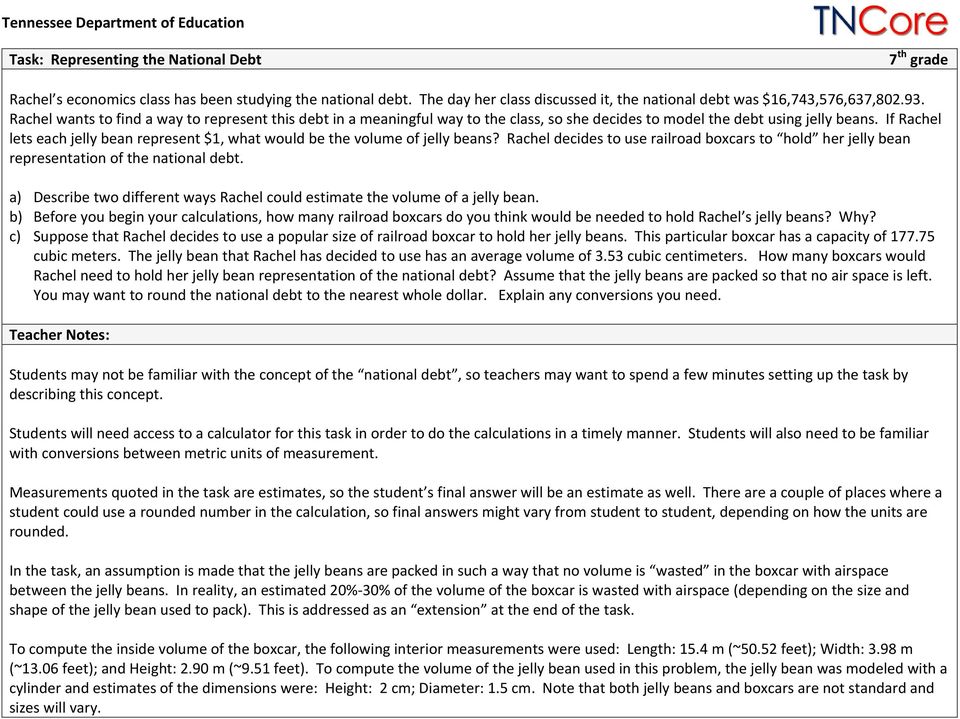
2 Common Core State Standards for Mathematical Content 7.RP.A.3 Use proportional relationships to solve multistep ratio and percent problems. Examples: simple interest, tax, markups and markdowns, gratuities and commissions, fees, percent increase and decrease, percent error. 7.G.B.6 Solve real world and mathematical problems involving area, volume and surface area of two and three dimensional objects composed of triangles, quadrilaterals, polygons, cubes, and right prisms. Essential Understandings Reasoning with ratios involves attending to and coordinating two quantities. Common Core State Standards for Mathematical Practice Mathematical Practices 1. Make sense of problems and persevere in solving them. 2. Reason abstractly and quantitatively. 3. Construct viable arguments and critique the reasoning of others. 4. Model with mathematics. 5. Use appropriate tools strategically. 6. Attend to precision. 7. Look for and make use of structure. 8. Look for and express regularity in repeated reasoning. Any number, measure, numerical expression, algebraic expression, or equation can be represented in an infinite number of ways that have the same value. COMPARISON: Numbers, expressions, and measures can be compared by their relative values. ESTIMATION: Numerical calculations can be approximated by replacing numbers with other numbers that are close and easy to compute with mentally. Measurements can be approximated using known referents as the unit in the measurement process. MEASUREMENT: Some attributes of objects are measurable and can be quantified using unit amounts. Explore Phase Possible Solution Paths Assessing and Advancing Questions a) Here are several ways that the volume can be estimated. Students may identify others. Advancing Question: 1) Treat a jelly bean as a cylinder. Measure the length and diameter of the jelly bean, take half of the diameter to find the What does a jelly bean look like? Does it resemble any shapes we have radius, and then use the formula for the volume of a cylinder. studied? 2) Measure several samples of jelly beans to find an average height and diameter, and then use the formula for the volume of a cylinder. Assessing Question: Explain to me how your estimation strategy would work. 3) Compare a jelly bean with known objects, such as centimeter
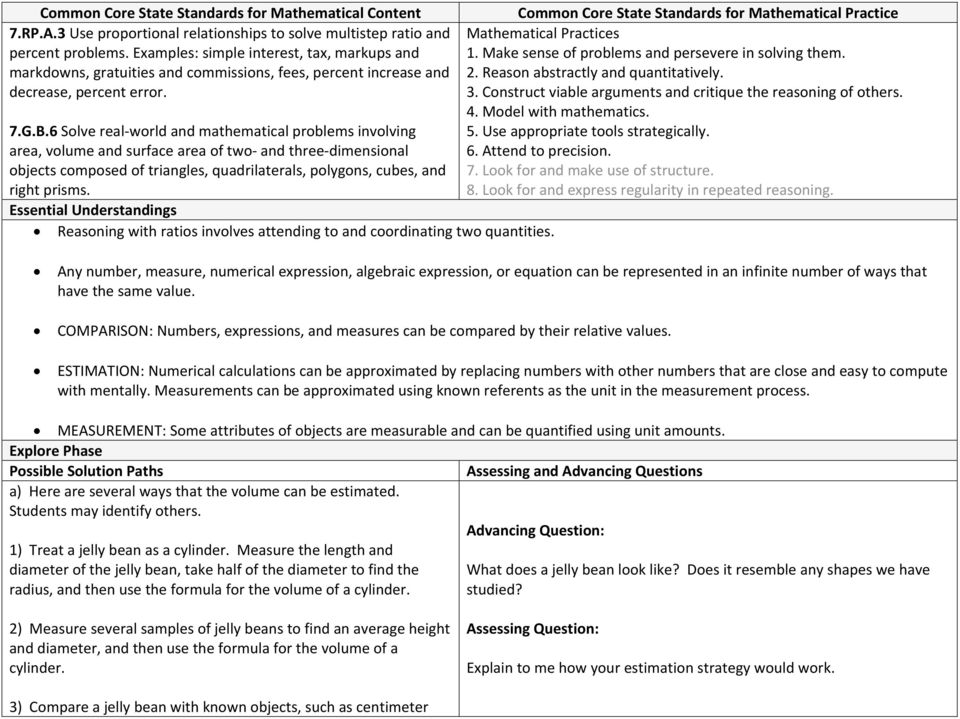
3 cubes. 4) Use a graduated cylinder partially filled with water, drop some number of jelly beans into the water, calculate the displacement, and then divide by the number of jelly beans to find an average volume. 5) Measure 50 ml of jelly beans into a graduated cylinder, count the number of jelly beans in the cylinder, and then divide 50 ml by the number of jelly beans to find the volume of one jelly bean in ml. (Note: This will require an extra conversion between ml and cm 3.) b) Answers will vary widely. It is likely that students will have no concept of the relative size of the number associated with the national debt, so expect fairly small numbers of boxcars to be chosen. c) (Note: Here, we rounded the national debt to the nearest whole dollar.) Approach 1: Convert the volume of the boxcar to cubic centimeters. Find the number of jelly beans per boxcar. Then find the number of boxcars you will need. The volume of the boxcar is m 3 = ( m 3 ) (1,000,000 cm 3 ) = 177,750,000 cm 3 The number of jelly beans per boxcar can be found by: (177,750,000 cm 3 / boxcar) / (3.53 cm 3 / jelly bean) = 50,354, jelly beans / boxcar The national debt is being represented by 16,743,576,637,803 jelly beans. (16,743,576,637,803 jelly beans) / (50,354, jelly beans / boxcar) = 332, boxcars. (Note: Students may round the number of jelly beans per car to 50,354,108. This will not impact the number of boxcars needed (to Advancing Question: What units do your measurements have? Can you work with two different units? What do you need to do next? Explain your calculations to me. Why did you convert your units? What process did you use? How do you know your answer is reasonable?

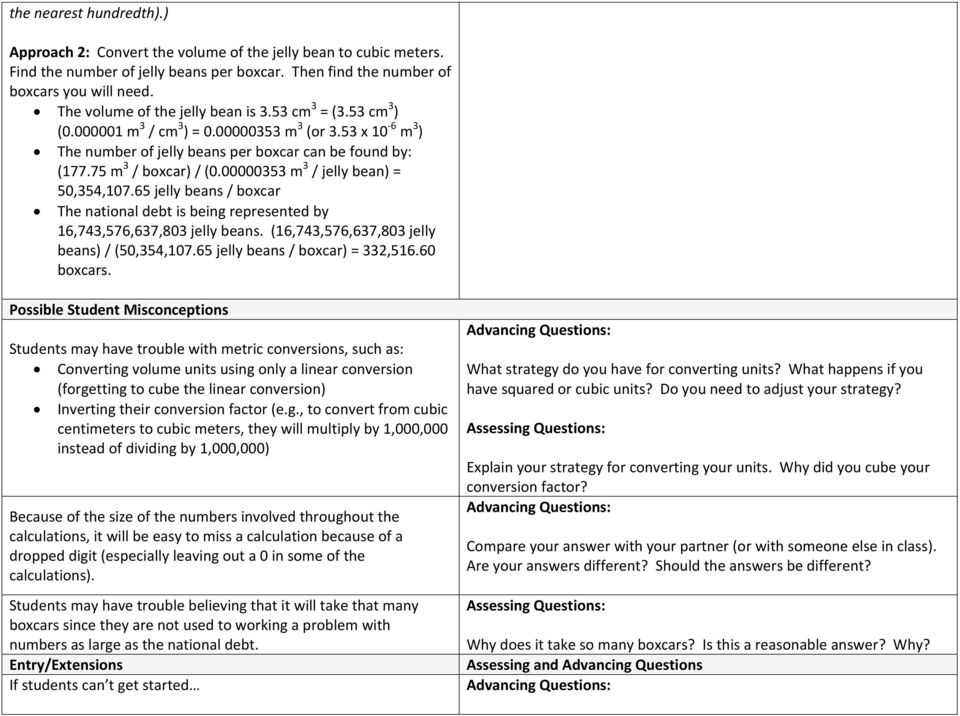
4 the nearest hundredth).) Approach 2: Convert the volume of the jelly bean to cubic meters. Find the number of jelly beans per boxcar. Then find the number of boxcars you will need. The volume of the jelly bean is 3.53 cm 3 = (3.53 cm 3 ) ( m 3 / cm 3 ) = m 3 (or 3.53 x 10 6 m 3 ) The number of jelly beans per boxcar can be found by: ( m 3 / boxcar) / ( m 3 / jelly bean) = 50,354, jelly beans / boxcar The national debt is being represented by 16,743,576,637,803 jelly beans. (16,743,576,637,803 jelly beans) / (50,354, jelly beans / boxcar) = 332, boxcars. Possible Student Misconceptions Students may have trouble with metric conversions, such as: Converting volume units using only a linear conversion (forgetting to cube the linear conversion) Inverting their conversion factor (e.g., to convert from cubic centimeters to cubic meters, they will multiply by 1,000,000 instead of dividing by 1,000,000) Because of the size of the numbers involved throughout the calculations, it will be easy to miss a calculation because of a dropped digit (especially leaving out a 0 in some of the calculations). Students may have trouble believing that it will take that many boxcars since they are not used to working a problem with numbers as large as the national debt. Entry/Extensions If students can t get started What strategy do you have for converting units? What happens if you have squared or cubic units? Do you need to adjust your strategy? Explain your strategy for converting your units. Why did you cube your conversion factor? Compare your answer with your partner (or with someone else in class). Are your answers different? Should the answers be different? Why does it take so many boxcars? Is this a reasonable answer? Why? Assessing and Advancing Questions
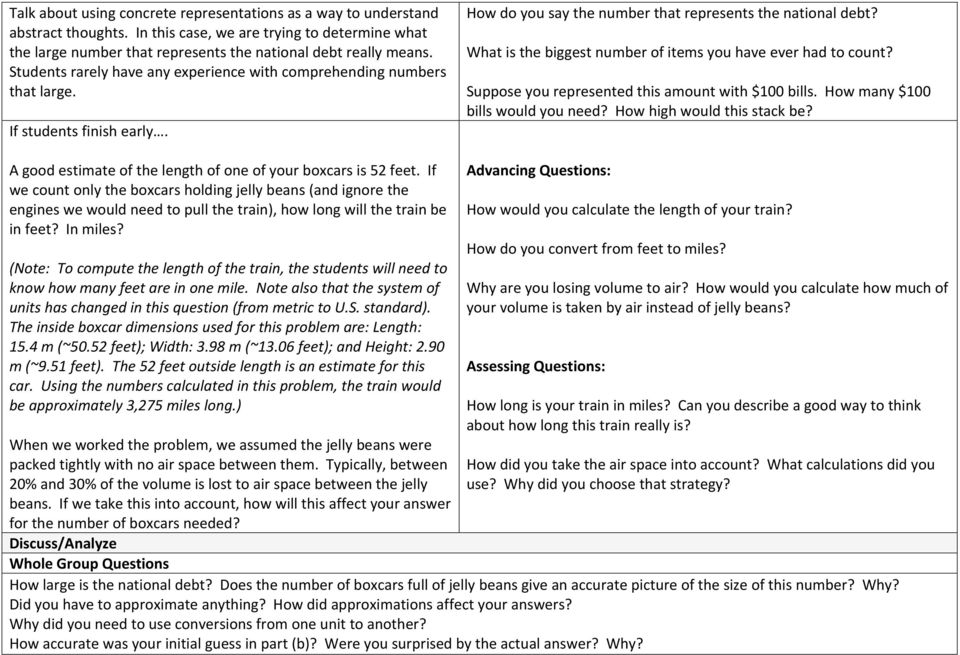
5 Talk about using concrete representations as a way to understand abstract thoughts. In this case, we are trying to determine what the large number that represents the national debt really means. Students rarely have any experience with comprehending numbers that large. If students finish early. How do you say the number that represents the national debt? What is the biggest number of items you have ever had to count? Suppose you represented this amount with $100 bills. How many $100 bills would you need? How high would this stack be? A good estimate of the length of one of your boxcars is 52 feet. If we count only the boxcars holding jelly beans (and ignore the engines we would need to pull the train), how long will the train be in feet? In miles? (Note: To compute the length of the train, the students will need to know how many feet are in one mile. Note also that the system of units has changed in this question (from metric to U.S. standard). The inside boxcar dimensions used for this problem are: Length: 15.4 m (~50.52 feet); Width: 3.98 m (~13.06 feet); and Height: 2.90 m (~9.51 feet). The 52 feet outside length is an estimate for this car. Using the numbers calculated in this problem, the train would be approximately 3,275 miles long.) When we worked the problem, we assumed the jelly beans were packed tightly with no air space between them. Typically, between 20% and 30% of the volume is lost to air space between the jelly beans. If we take this into account, how will this affect your answer for the number of boxcars needed? How would you calculate the length of your train? How do you convert from feet to miles? Why are you losing volume to air? How would you calculate how much of your volume is taken by air instead of jelly beans? How long is your train in miles? Can you describe a good way to think about how long this train really is? How did you take the air space into account? What calculations did you use? Why did you choose that strategy? Discuss/Analyze Whole Group Questions How large is the national debt? Does the number of boxcars full of jelly beans give an accurate picture of the size of this number? Why? Did you have to approximate anything? How did approximations affect your answers? Why did you need to use conversions from one unit to another? How accurate was your initial guess in part (b)? Were you surprised by the actual answer? Why?
Tennessee Department of Education. Task: Sally s Car Loan
 Tennessee Department of Education Task: Sally s Car Loan Sally bought a new car. Her total cost including all fees and taxes was $15,. She made a down payment of $43. She financed the remaining amount
Think About This Situation
 Think About This Situation A popular game held at fairs or parties is the jelly bean guessing contest. Someone fills a jar or other large transparent container with a known quantity of jelly beans and
Show that when a circle is inscribed inside a square the diameter of the circle is the same length as the side of the square.
 Week & Day Week 6 Day 1 Concept/Skill Perimeter of a square when given the radius of an inscribed circle Standard 7.MG:2.1 Use formulas routinely for finding the perimeter and area of basic twodimensional
Tennessee Department of Education
 Tennessee Department of Education Task: Pool Patio Problem Algebra I A hotel is remodeling their grounds and plans to improve the area around a 20 foot by 40 foot rectangular pool. The owner wants to use
Scope and Sequence KA KB 1A 1B 2A 2B 3A 3B 4A 4B 5A 5B 6A 6B
 Scope and Sequence Earlybird Kindergarten, Standards Edition Primary Mathematics, Standards Edition Copyright 2008 [SingaporeMath.com Inc.] The check mark indicates where the topic is first introduced
Charlesworth School Year Group Maths Targets
 Charlesworth School Year Group Maths Targets Year One Maths Target Sheet Key Statement KS1 Maths Targets (Expected) These skills must be secure to move beyond expected. I can compare, describe and solve
VOLUME of Rectangular Prisms Volume is the measure of occupied by a solid region.
 Math 6 NOTES 7.5 Name VOLUME of Rectangular Prisms Volume is the measure of occupied by a solid region. **The formula for the volume of a rectangular prism is:** l = length w = width h = height Study Tip:
Geometry Solve real life and mathematical problems involving angle measure, area, surface area and volume.
 Performance Assessment Task Pizza Crusts Grade 7 This task challenges a student to calculate area and perimeters of squares and rectangles and find circumference and area of a circle. Students must find
G C.3 Construct the inscribed and circumscribed circles of a triangle, and prove properties of angles for a quadrilateral inscribed in a circle.
 Performance Assessment Task Circle and Squares Grade 10 This task challenges a student to analyze characteristics of 2 dimensional shapes to develop mathematical arguments about geometric relationships.
Grade 5 Math Content 1
 Grade 5 Math Content 1 Number and Operations: Whole Numbers Multiplication and Division In Grade 5, students consolidate their understanding of the computational strategies they use for multiplication.
How does one make and support a reasonable conclusion regarding a problem? How does what I measure influence how I measure?
 Middletown Public Schools Mathematics Unit Planning Organizer Subject Mathematics Grade/Course Grade 7 Unit 3 Two and Three Dimensional Geometry Duration 23 instructional days (+4 days reteaching/enrichment)
Measurement. Volume It All Stacks Up. Activity:
 Measurement Activity: TEKS: Overview: Materials: Grouping: Time: Volume It All Stacks Up (7.9) Measurement. The student solves application problems involving estimation and measurement. The student is
N Q.3 Choose a level of accuracy appropriate to limitations on measurement when reporting quantities.
 Performance Assessment Task Swimming Pool Grade 9 The task challenges a student to demonstrate understanding of the concept of quantities. A student must understand the attributes of trapezoids, how to
Open-Ended Problem-Solving Projections
 MATHEMATICS Open-Ended Problem-Solving Projections Organized by TEKS Categories TEKSING TOWARD STAAR 2014 GRADE 7 PROJECTION MASTERS for PROBLEM-SOLVING OVERVIEW The Projection Masters for Problem-Solving
Area of Parallelograms (pages 546 549)
 A Area of Parallelograms (pages 546 549) A parallelogram is a quadrilateral with two pairs of parallel sides. The base is any one of the sides and the height is the shortest distance (the length of a perpendicular
Solids. Objective A: Volume of a Solids
 Solids Math00 Objective A: Volume of a Solids Geometric solids are figures in space. Five common geometric solids are the rectangular solid, the sphere, the cylinder, the cone and the pyramid. A rectangular
Pizza! Pizza! Assessment
 Pizza! Pizza! Assessment 1. A local pizza restaurant sends pizzas to the high school twelve to a carton. If the pizzas are one inch thick, what is the volume of the cylindrical shipping carton for the
Geometry Notes VOLUME AND SURFACE AREA
 Volume and Surface Area Page 1 of 19 VOLUME AND SURFACE AREA Objectives: After completing this section, you should be able to do the following: Calculate the volume of given geometric figures. Calculate
1. Kyle stacks 30 sheets of paper as shown to the right. Each sheet weighs about 5 g. How can you find the weight of the whole stack?
 Prisms and Cylinders Answer Key Vocabulary: cylinder, height (of a cylinder or prism), prism, volume Prior Knowledge Questions (Do these BEFORE using the Gizmo.) [Note: The purpose of these questions is
Geometry and Measurement
 The student will be able to: Geometry and Measurement 1. Demonstrate an understanding of the principles of geometry and measurement and operations using measurements Use the US system of measurement for
Lesson 13: The Formulas for Volume
 Student Outcomes Students develop, understand, and apply formulas for finding the volume of right rectangular prisms and cubes. Lesson Notes This lesson is a continuation of Lessons 11, 12, and Module
Basic Math for the Small Public Water Systems Operator
 Basic Math for the Small Public Water Systems Operator Small Public Water Systems Technology Assistance Center Penn State Harrisburg Introduction Area In this module we will learn how to calculate the
Georgia Department of Education Georgia Standards of Excellence Framework GSE Grade 6 Mathematics Unit 5
 **Volume and Cubes Back to Task Table In this problem-based task, students will examine the mathematical relationship between the volume of a rectangular prism in cubic units and the number of unit cubes
STATE GOAL 7: Estimate, make and use measurements of objects, quantities and relationships and determine acceptable
 C 1 Measurement H OW MUCH SPACE DO YOU N EED? STATE GOAL 7: Estimate, make and use measurements of objects, quantities and relationships and determine acceptable levels of accuracy Statement of Purpose:
Lesson 11: Volume with Fractional Edge Lengths and Unit Cubes
 Lesson : Volume with Fractional Edge Lengths and Unit Cubes Student Outcomes Students extend their understanding of the volume of a right rectangular prism with integer side lengths to right rectangular
DIMENSIONAL ANALYSIS #2
 DIMENSIONAL ANALYSIS #2 Area is measured in square units, such as square feet or square centimeters. These units can be abbreviated as ft 2 (square feet) and cm 2 (square centimeters). For example, we
Mathematics. Mathematical Practices
 Mathematical Practices 1. Make sense of problems and persevere in solving them. 2. Reason abstractly and quantitatively. 3. Construct viable arguments and critique the reasoning of others. 4. Model with
Algebra 1 2008. Academic Content Standards Grade Eight and Grade Nine Ohio. Grade Eight. Number, Number Sense and Operations Standard
 Academic Content Standards Grade Eight and Grade Nine Ohio Algebra 1 2008 Grade Eight STANDARDS Number, Number Sense and Operations Standard Number and Number Systems 1. Use scientific notation to express
2.2 Scientific Notation: Writing Large and Small Numbers
 2.2 Scientific Notation: Writing Large and Small Numbers A number written in scientific notation has two parts. A decimal part: a number that is between 1 and 10. An exponential part: 10 raised to an exponent,
Geometry Notes PERIMETER AND AREA
 Perimeter and Area Page 1 of 57 PERIMETER AND AREA Objectives: After completing this section, you should be able to do the following: Calculate the area of given geometric figures. Calculate the perimeter
In mathematics, there are four attainment targets: using and applying mathematics; number and algebra; shape, space and measures, and handling data.
 MATHEMATICS: THE LEVEL DESCRIPTIONS In mathematics, there are four attainment targets: using and applying mathematics; number and algebra; shape, space and measures, and handling data. Attainment target
The teacher gives the student a ruler, shows her the shape below and asks the student to calculate the shape s area.
 Complex area Georgia is able to calculate the area of a complex shape by mentally separating the shape into familiar shapes. She is able to use her knowledge of the formula for the area of a rectangle
8 th Grade Task 2 Rugs
 8 th Grade Task 2 Rugs Student Task Core Idea 4 Geometry and Measurement Find perimeters of shapes. Use Pythagorean theorem to find side lengths. Apply appropriate techniques, tools and formulas to determine
CCSS Mathematics Implementation Guide Grade 5 2012 2013. First Nine Weeks
 First Nine Weeks s The value of a digit is based on its place value. What changes the value of a digit? 5.NBT.1 RECOGNIZE that in a multi-digit number, a digit in one place represents 10 times as much
MD5-26 Stacking Blocks Pages 115 116
 MD5-26 Stacking Blocks Pages 115 116 STANDARDS 5.MD.C.4 Goals Students will find the number of cubes in a rectangular stack and develop the formula length width height for the number of cubes in a stack.
Teacher Page Key. Geometry / Day # 13 Composite Figures 45 Min.
 Teacher Page Key Geometry / Day # 13 Composite Figures 45 Min. 9-1.G.1. Find the area and perimeter of a geometric figure composed of a combination of two or more rectangles, triangles, and/or semicircles
Volume of Right Prisms Objective To provide experiences with using a formula for the volume of right prisms.
 Volume of Right Prisms Objective To provide experiences with using a formula for the volume of right prisms. www.everydaymathonline.com epresentations etoolkit Algorithms Practice EM Facts Workshop Game
Mathematics Common Core Sample Questions
 New York State Testing Program Mathematics Common Core Sample Questions Grade6 The materials contained herein are intended for use by New York State teachers. Permission is hereby granted to teachers and
Overview. Essential Questions. Grade 8 Mathematics, Quarter 4, Unit 4.3 Finding Volume of Cones, Cylinders, and Spheres
 Cylinders, and Spheres Number of instruction days: 6 8 Overview Content to Be Learned Evaluate the cube root of small perfect cubes. Simplify problems using the formulas for the volumes of cones, cylinders,
Florida Department of Education/Office of Assessment January 2012. Grade 6 FCAT 2.0 Mathematics Achievement Level Descriptions
 Florida Department of Education/Office of Assessment January 2012 Grade 6 FCAT 2.0 Mathematics Achievement Level Descriptions Grade 6 FCAT 2.0 Mathematics Reporting Category Fractions, Ratios, Proportional
Area of Parallelograms, Triangles, and Trapezoids (pages 314 318)
 Area of Parallelograms, Triangles, and Trapezoids (pages 34 38) Any side of a parallelogram or triangle can be used as a base. The altitude of a parallelogram is a line segment perpendicular to the base
Perimeter, Area, and Volume
 Perimeter, Area, and Volume Perimeter of Common Geometric Figures The perimeter of a geometric figure is defined as the distance around the outside of the figure. Perimeter is calculated by adding all
PIZZA! PIZZA! TEACHER S GUIDE and ANSWER KEY
 PIZZA! PIZZA! TEACHER S GUIDE and ANSWER KEY The Student Handout is page 11. Give this page to students as a separate sheet. Area of Circles and Squares Circumference and Perimeters Volume of Cylinders
Prentice Hall Mathematics Courses 1-3 Common Core Edition 2013
 A Correlation of Prentice Hall Mathematics Courses 1-3 Common Core Edition 2013 to the Topics & Lessons of Pearson A Correlation of Courses 1, 2 and 3, Common Core Introduction This document demonstrates
How do you compare numbers? On a number line, larger numbers are to the right and smaller numbers are to the left.
 The verbal answers to all of the following questions should be memorized before completion of pre-algebra. Answers that are not memorized will hinder your ability to succeed in algebra 1. Number Basics
a. Look under the menu item Introduction to see how the standards are organized by Standards, Clusters and Domains.
 Chapter One Section 1.1 1. Go to the Common Core State Standards website (http://www.corestandards.org/math). This is the main site for further questions about the Common Core Standards for Mathematics.
Characteristics of the Four Main Geometrical Figures
 Math 40 9.7 & 9.8: The Big Four Square, Rectangle, Triangle, Circle Pre Algebra We will be focusing our attention on the formulas for the area and perimeter of a square, rectangle, triangle, and a circle.
Student Outcomes. Lesson Notes. Classwork. Exercises 1 3 (4 minutes)
 Student Outcomes Students give an informal derivation of the relationship between the circumference and area of a circle. Students know the formula for the area of a circle and use it to solve problems.
Tennessee Mathematics Standards 2009-2010 Implementation. Grade Six Mathematics. Standard 1 Mathematical Processes
 Tennessee Mathematics Standards 2009-2010 Implementation Grade Six Mathematics Standard 1 Mathematical Processes GLE 0606.1.1 Use mathematical language, symbols, and definitions while developing mathematical
Illinois State Standards Alignments Grades Three through Eleven
 Illinois State Standards Alignments Grades Three through Eleven Trademark of Renaissance Learning, Inc., and its subsidiaries, registered, common law, or pending registration in the United States and other
Quick Reference ebook
 This file is distributed FREE OF CHARGE by the publisher Quick Reference Handbooks and the author. Quick Reference ebook Click on Contents or Index in the left panel to locate a topic. The math facts listed
Voyager Sopris Learning Vmath, Levels C-I, correlated to the South Carolina College- and Career-Ready Standards for Mathematics, Grades 2-8
 Page 1 of 35 VMath, Level C Grade 2 Mathematical Process Standards 1. Make sense of problems and persevere in solving them. Module 3: Lesson 4: 156-159 Module 4: Lesson 7: 220-223 2. Reason both contextually
Calculating Area, Perimeter and Volume
 Calculating Area, Perimeter and Volume You will be given a formula table to complete your math assessment; however, we strongly recommend that you memorize the following formulae which will be used regularly
Area of Circles. 2. Use a ruler to measure the diameter and the radius to the nearest half centimeter and record in the blanks above.
 Name: Area of Circles Label: Length: Label: Length: A Part 1 1. Label the diameter and radius of Circle A. 2. Use a ruler to measure the diameter and the radius to the nearest half centimeter and recd
FCAT FLORIDA COMPREHENSIVE ASSESSMENT TEST. Mathematics Reference Sheets. Copyright Statement for this Assessment and Evaluation Services Publication
 FCAT FLORIDA COMPREHENSIVE ASSESSMENT TEST Mathematics Reference Sheets Copyright Statement for this Assessment and Evaluation Services Publication Authorization for reproduction of this document is hereby
GAP CLOSING. Volume and Surface Area. Intermediate / Senior Student Book
 GAP CLOSING Volume and Surface Area Intermediate / Senior Student Book Volume and Surface Area Diagnostic...3 Volumes of Prisms...6 Volumes of Cylinders...13 Surface Areas of Prisms and Cylinders...18
Filling and Wrapping: Homework Examples from ACE
 Filling and Wrapping: Homework Examples from ACE Investigation 1: Building Smart Boxes: Rectangular Prisms, ACE #3 Investigation 2: Polygonal Prisms, ACE #12 Investigation 3: Area and Circumference of
Area & Volume. 1. Surface Area to Volume Ratio
 1 1. Surface Area to Volume Ratio Area & Volume For most cells, passage of all materials gases, food molecules, water, waste products, etc. in and out of the cell must occur through the plasma membrane.
Math-in-CTE Sample Automotive Lesson
 Math-in-CTE Sample Automotive Lesson Piston Displacement Lesson Title: Piston Displacement Lesson #: AT07 Occupational Area: Automotive Technology CTE Concept(s): Piston Displacement Math Concept(s): Formula
Common Core Unit Summary Grades 6 to 8
 Common Core Unit Summary Grades 6 to 8 Grade 8: Unit 1: Congruence and Similarity- 8G1-8G5 rotations reflections and translations,( RRT=congruence) understand congruence of 2 d figures after RRT Dilations
Surface Area Quick Review: CH 5
 I hope you had an exceptional Christmas Break.. Now it's time to learn some more math!! :) Surface Area Quick Review: CH 5 Find the surface area of each of these shapes: 8 cm 12 cm 4cm 11 cm 7 cm Find
Area of a triangle: The area of a triangle can be found with the following formula: You can see why this works with the following diagrams:
 Area Review Area of a triangle: The area of a triangle can be found with the following formula: 1 A 2 bh or A bh 2 You can see why this works with the following diagrams: h h b b Solve: Find the area of
Lesson 18 Pythagorean Triples & Special Right Triangles
 Student Name: Date: Contact Person Name: Phone Number: Teas Assessment of Knowledge and Skills Eit Level Math Review Lesson 18 Pythagorean Triples & Special Right Triangles TAKS Objective 6 Demonstrate
2nd Semester Geometry Final Exam Review
 Class: Date: 2nd Semester Geometry Final Exam Review Multiple Choice Identify the choice that best completes the statement or answers the question. 1. The owner of an amusement park created a circular
ISAT Mathematics Performance Definitions Grade 4
 ISAT Mathematics Performance Definitions Grade 4 EXCEEDS STANDARDS Fourth-grade students whose measured performance exceeds standards are able to identify, read, write, represent, and model whole numbers
COMMON CORE STATE STANDARDS FOR MATHEMATICS 3-5 DOMAIN PROGRESSIONS
 COMMON CORE STATE STANDARDS FOR MATHEMATICS 3-5 DOMAIN PROGRESSIONS Compiled by Dewey Gottlieb, Hawaii Department of Education June 2010 Operations and Algebraic Thinking Represent and solve problems involving
Unit Conversions. Ben Logan <[email protected]> Feb 10, 2005
 Unit Conversions Ben Logan Feb 0, 2005 Abstract Conversion between different units of measurement is one of the first concepts covered at the start of a course in chemistry or physics.
Area of a triangle: The area of a triangle can be found with the following formula: 1. 2. 3. 12in
 Area Review Area of a triangle: The area of a triangle can be found with the following formula: 1 A 2 bh or A bh 2 Solve: Find the area of each triangle. 1. 2. 3. 5in4in 11in 12in 9in 21in 14in 19in 13in
EMAT 6450 - Mathematics in Context
 Melissa Wilson EMAT 6450 - Mathematics in Context Course/Unit: Accelerated Coordinate Algebra/Analytic Geometry A for Unit 9, Circles and Volume (This unit corresponds to Unit 3 in Analytic Geometry. The
Area is a measure of how much space is occupied by a figure. 1cm 1cm
 Area Area is a measure of how much space is occupied by a figure. Area is measured in square units. For example, one square centimeter (cm ) is 1cm wide and 1cm tall. 1cm 1cm A figure s area is the number
B = 1 14 12 = 84 in2. Since h = 20 in then the total volume is. V = 84 20 = 1680 in 3
 45 Volume Surface area measures the area of the two-dimensional boundary of a threedimensional figure; it is the area of the outside surface of a solid. Volume, on the other hand, is a measure of the space
Math - 5th Grade. two digit by one digit multiplication fact families subtraction with regrouping
 Number and Operations Understand division of whole numbers N.MR.05.01 N.MR.05.02 N.MR.05.03 Understand the meaning of division of whole numbers with and without remainders; relate division to and to repeated
EDEXCEL FUNCTIONAL SKILLS PILOT TEACHER S NOTES. Maths Level 2. Chapter 5. Shape and space
 Shape and space 5 EDEXCEL FUNCTIONAL SKILLS PILOT TEACHER S NOTES Maths Level 2 Chapter 5 Shape and space SECTION H 1 Perimeter 2 Area 3 Volume 4 2-D Representations of 3-D Objects 5 Remember what you
Cylinder Volume Lesson Plan
 Cylinder Volume Lesson Plan Concept/principle to be demonstrated: This lesson will demonstrate the relationship between the diameter of a circle and its circumference, and impact on area. The simplest
GRADE 10 MATH: A DAY AT THE BEACH
 GRADE 0 MATH: A DAY AT THE BEACH UNIT OVERVIEW This packet contains a curriculum-embedded CCLS aligned task and instructional supports. The final task assesses student mastery of the geometry standards
NEW MEXICO Grade 6 MATHEMATICS STANDARDS
 PROCESS STANDARDS To help New Mexico students achieve the Content Standards enumerated below, teachers are encouraged to base instruction on the following Process Standards: Problem Solving Build new mathematical
Common Core State Standards for Mathematics Accelerated 7th Grade
 A Correlation of 2013 To the to the Introduction This document demonstrates how Mathematics Accelerated Grade 7, 2013, meets the. Correlation references are to the pages within the Student Edition. Meeting
Perimeter, Area and Volume What Do Units Tell You About What Is Being Measured? Overview
 Perimeter, Area and Volume What Do Units Tell You About What Is Being Measured? Overview Summary of Lessons: This set of lessons was designed to develop conceptual understanding of the unique attributes
Pre-Algebra 2008. Academic Content Standards Grade Eight Ohio. Number, Number Sense and Operations Standard. Number and Number Systems
 Academic Content Standards Grade Eight Ohio Pre-Algebra 2008 STANDARDS Number, Number Sense and Operations Standard Number and Number Systems 1. Use scientific notation to express large numbers and small
Grade 5 Common Core State Standard
 2.1.5.B.1 Apply place value concepts to show an understanding of operations and rounding as they pertain to whole numbers and decimals. M05.A-T.1.1.1 Demonstrate an understanding that 5.NBT.1 Recognize
Chapter 4: Area, Perimeter, and Volume. Geometry Assessments
 Chapter 4: Area, Perimeter, and Volume Geometry Assessments Area, Perimeter, and Volume Introduction The performance tasks in this chapter focus on applying the properties of triangles and polygons to
Performance Level Descriptors Grade 6 Mathematics
 Performance Level Descriptors Grade 6 Mathematics Multiplying and Dividing with Fractions 6.NS.1-2 Grade 6 Math : Sub-Claim A The student solves problems involving the Major Content for grade/course with
Chapter 3 Student Reading
 Chapter 3 Student Reading If you hold a solid piece of lead or iron in your hand, it feels heavy for its size. If you hold the same size piece of balsa wood or plastic, it feels light for its size. The
Measurement with Ratios
 Grade 6 Mathematics, Quarter 2, Unit 2.1 Measurement with Ratios Overview Number of instructional days: 15 (1 day = 45 minutes) Content to be learned Use ratio reasoning to solve real-world and mathematical
PA Academic Standards. 2.4. Mathematical Reasoning and Connections 2.5. Mathematical Problem Solving and Communication
 Curriculum Category Shift Standard Areas Grades K-8 and High School PA Academic Standards 2.4. Mathematical Reasoning and Connections 2.5. Mathematical Problem Solving and Communication PA Common Core
Grade 6 Mathematics Performance Level Descriptors
 Limited Grade 6 Mathematics Performance Level Descriptors A student performing at the Limited Level demonstrates a minimal command of Ohio s Learning Standards for Grade 6 Mathematics. A student at this
5th Grade Unit 1: Whole Number and Decimal Fraction Place Value to the One Thousandths (4 Weeks)
 5th Grade Unit : Whole Number and Decimal Fraction Place Value to the One Thousandths (4 Weeks) Stage Desired Results Established Goals Unit Description Students continue to extend and apply their understanding
Problem of the Month: Cutting a Cube
 Problem of the Month: The Problems of the Month (POM) are used in a variety of ways to promote problem solving and to foster the first standard of mathematical practice from the Common Core State Standards:
Overview for Families
 unit: Ratios and Rates Mathematical strand: Number The following pages will help you to understand the mathematics that your child is currently studying as well as the type of problems (s)he will solve
2. A painted 2 x 2 x 2 cube is cut into 8 unit cubes. What fraction of the total surface area of the 8 small cubes is painted?
 Black Surface Area and Volume (Note: when converting between length, volume, and mass, 1 cm 3 equals 1 ml 3, and 1 ml 3 equals 1 gram) 1. A rectangular container, 25 cm long, 18 cm wide, and 10 cm high,
Glencoe. correlated to SOUTH CAROLINA MATH CURRICULUM STANDARDS GRADE 6 3-3, 5-8 8-4, 8-7 1-6, 4-9
 Glencoe correlated to SOUTH CAROLINA MATH CURRICULUM STANDARDS GRADE 6 STANDARDS 6-8 Number and Operations (NO) Standard I. Understand numbers, ways of representing numbers, relationships among numbers,
TEKS TAKS 2010 STAAR RELEASED ITEM STAAR MODIFIED RELEASED ITEM
 7 th Grade Math TAKS-STAAR-STAAR-M Comparison Spacing has been deleted and graphics minimized to fit table. (1) Number, operation, and quantitative reasoning. The student represents and uses numbers in
Current Standard: Mathematical Concepts and Applications Shape, Space, and Measurement- Primary
 Shape, Space, and Measurement- Primary A student shall apply concepts of shape, space, and measurement to solve problems involving two- and three-dimensional shapes by demonstrating an understanding of:
Math. So we would say that the volume of this cube is: cubic units.
 Math Volume and Surface Area Two numbers that are useful when we are dealing with 3 dimensional objects are the amount that the object can hold and the amount of material it would take to cover it. For
Exercise Worksheets. Copyright. 2002 Susan D. Phillips
 Exercise Worksheets Copyright 00 Susan D. Phillips Contents WHOLE NUMBERS. Adding. Subtracting. Multiplying. Dividing. Order of Operations FRACTIONS. Mixed Numbers. Prime Factorization. Least Common Multiple.
Grade 4 Unit 3: Multiplication and Division; Number Sentences and Algebra
 Grade 4 Unit 3: Multiplication and Division; Number Sentences and Algebra Activity Lesson 3-1 What s My Rule? page 159) Everyday Mathematics Goal for Mathematical Practice GMP 2.2 Explain the meanings
Minimize the Surface Area of a Square-Based Prism
 9.3 Minimize the Surface Area of a Square-Based Prism The boxes used in packaging come in many shapes and sizes. A package must be suitable for the product, visually appealing, and cost efficient. Many
Using Proportions to Solve Percent Problems I
 RP7-1 Using Proportions to Solve Percent Problems I Pages 46 48 Standards: 7.RP.A. Goals: Students will write equivalent statements for proportions by keeping track of the part and the whole, and by solving
Grade 6 Mathematics Common Core State Standards
 Grade 6 Mathematics Common Core State Standards Standards for Mathematical Practice HOW make sense of problems, persevere in solving them, and check the reasonableness of answers. reason with and flexibly
The University of the State of New York REGENTS HIGH SCHOOL EXAMINATION INTEGRATED ALGEBRA. Thursday, August 16, 2012 8:30 to 11:30 a.m.
 INTEGRATED ALGEBRA The University of the State of New York REGENTS HIGH SCHOOL EXAMINATION INTEGRATED ALGEBRA Thursday, August 16, 2012 8:30 to 11:30 a.m., only Student Name: School Name: Print your name