
Level 4 Award in Food Safety Management for Manufacturing
|
|
|
- Hilary Ryan
- 9 years ago
- Views:
Transcription
1 Level 4 Award in Food Safety Management for Manufacturing December 2008 This qualification has a Credit Value of 6 Description This qualification covers all of the necessary aspects of food hygiene and safety in depth, providing candidates with a thorough knowledge. Essentially for managers and potential managers in the food and drink manufacturing industry, it concentrates on the need for programmes and procedures to be properly drawn up, introduced and monitored to ensure full compliance with the legislation. The qualification is firmly based on the National Occupational Standards developed by Improve, the Sector Skills Council for the food and drink manufacturing industry, and conforms to the qualification template developed by RSPH and other awarding bodies under the guidance of Improve. The aim of this qualification is to provide an in-depth knowledge of food safety and food hygiene. Holders of this qualification will have the appropriate knowledge and understanding of food safety to develop and implement food safety management systems. 1

2 Summary of Outcomes: To achieve this qualification, a candidate must: 1. Understand how food business operators can ensure compliance with relevant food safety legislation, by being able to: Explain food business operator and staff responsibilities with regard to food safety legislation Analyse the requirements of food safety legislation and procedures for compliance and enforcement 2. Understand the operational requirements needed to ensure food safety, by being able to: explain the requirements temperature control within a specified food business discuss the implementation, management and application of good hygiene practices, to include cleaning, disinfection, waste disposal and pest control explain procedures for the control of contamination and cross contamination 3. Understand how to establish food safety management procedures, by being able to: outline processes for designing and implementing food safety management procedures, including allocating resources, roles and responsibilities analyse the risks to food safety from microbial, physical, chemical and allergenic hazards in a specified food business communicate food safety management information to staff, visitors and suppliers 4. Understand the controls required for food safety, by being able to: review controls for microbial, physical, chemical and allergenic hazards in a specified food business discuss methods for monitoring and recording food safety hazards determine the corrective actions required if food safety hazards are not controlled 2

3 5. Understand how to maintain food safety management procedures, by being able to: explain methods for verifying the effectiveness of food safety management procedures describe how to implement adjustments to food safety management procedures and the circumstances which may require adjustments to be made state the need for, and benefits of, staff training and the maintenance of training records outline strategies for developing and maintaining a food safety culture within an organisation. Content: 1. Compliance with food safety legislation. Food business operator and staff responsibilities with regard to food safety legislation: the need for food safety legislation due to the effect of poor food hygiene and safety on the incidence of food related disease; effect of food related disease on consumers and food businesses; current food poisoning trends and statistics; importance of high standards of food hygiene and food safety in preventing food borne illness and the benefits to consumers and businesses of effective food safety management systems; responsibilities of food business owners, managers, supervisors and food operatives with regard to food safety legislation; responsibility of food business owners, managers, supervisors and food operatives to cooperate with Environmental Health Officers, local authorities and Trading Standards Officers in carrying out their duties; importance of maintaining appropriate food safety records and their relevance to the due diligence defence. Requirements of food safety legislation and procedures for compliance and enforcement: legislation to include the main provisions of the 2005 legislation (EC Directive 852/2004 Hygiene of foodstuffs ): The Food Hygiene (England) Regulations 2006, The Food Hygiene in Scotland Regulations 2006, The Food Hygiene (Wales) Regulations 2006, The Food Hygiene Regulations (N. Ireland) 2006; provisions of any legislation that supersedes the above; actions and responsibilities of Environmental Health Officers, local authorities and Trading Standards Officers in enforcement of legislation; role of environmental health officers and local authorities in providing advice to food businesses. 3

4 2. Operational requirements needed to ensure food safety. Requirements for temperature control: need for temperature control; extent and coverage of current legislation; efficient operation of freezers and refrigerators to maintain food safety; the temperature danger zone; reduction of microbial growth in food by time and temperature control; correct processing/cooking, cooling, chilling, freezing and, defrosting of food; importance of high temperatures during food manufacturing for destroying bacterial cells and spores; maintaining hot or cold temperatures of food; methods for assessing food temperature. Cleaning, disinfection and pest control: concept of "dirt" in the food and drink manufacturing industry; definitions of cleaning, detergent, disinfection, disinfectant, sterilisation and sanitiser; properties of detergents, disinfectants and sanitisers, their uses within the cleaning cycle; routines for cleaning food processing areas and equipment; advantages and disadvantages of manual and non-manual cleaning methods; cleaning routines to protect the product and create a safe and environmentally acceptable working environment; risks to food safety if cleaning equipment is not separated from food and food processing areas; hazards associated with contamination of food by cleaning chemicals, incidents of chemical food poisoning; principles of "in place cleaning"/"cleaning in place" and cleaning out of place ; principle areas of contamination and cross contamination from microbiological, chemical and physical sources; principles of good food hygiene practice; role of the manager in implementing and controlling an efficient and workable cleaning programme; factors to consider when designing and planning cleaning schedules; advantages and disadvantages of contract cleaning; monitoring and evaluation of the cleaning process. Storage and disposal of waste; requirements for waste disposal areas; pests associated with the food industry and their hazards; rats, mice, flies, cockroaches, psocids, pharaoh's ants, stored product insects, birds; life cycles, behaviour and contamination risk; foods attractive to pests; effect of pests on food; measures to prevent and control infestations; use of pest control contractors; monitoring procedures for the presence of pests; management role in pest control; hazards due to rodenticides and pesticides on food premises; legal obligations of owners of premises. 4

5 Procedures to control contamination and cross-contamination: definition of contamination and cross-contamination; procedures for reducing / preventing contamination and cross-contamination at different stages of food processing such as receipt of goods, storage and stock control, food handling, processing, packaging and distribution; procedures for detecting the presence of contaminants. Staff as sources of contaminants and causes of contamination; methods for ensuring high standards of personal hygiene of staff; legal requirements concerning personal hygiene of food operatives; principles of "Food Handlers - Fitness for Work"; methods for monitoring personal hygiene standards; relationship between food handling, the nature of the food and the manufacturing process; reportable medical conditions; pros and cons of medical screening; use of appropriate protective clothing; need to review and revise procedures; management of procedures 3. Food safety management procedures. Design of food safety management procedures: HACCP (Hazard Analysis and Critical Control Point) as a basis for food safety management systems; the seven principles of HACCP; HACCP terminology; advantages of HACCP; Good Manufacturing Practice; pre-requisites of a food safety management system; composition of the food safety management team; importance of a multi-disciplinary approach when devising food safety management procedures; need for, and sources of, expert advice and guidance; stages in developing and implementing the system; importance of identifying all stages and steps involved in the manufacturing process; consideration of the purpose and end-use of the product; risk assessment and the implementation of controls; consideration of safety information relating to the product (such as composition and structure, packaging, storage, distribution method and any anti-microbial treatment) during the assessment of risk and implementation of controls; data recording and record keeping; importance of records for due diligence. Need for staff to have specific duties and responsibilities for food safety; allocation of responsibilities for monitoring of control measures, supervision of food safety measures and evaluation of the food safety management procedures; specific skills, knowledge and expertise required for these duties. Risk to food safety from microbial, physical, chemical and allergenic hazards: microbial (to include toxins and mycotoxins), chemical, physical and allergenic hazards; sources of microbial hazards such as raw food, food operatives/visitors, airborne contaminants, waterborne contaminants, insects and other pests; sources of physical hazards such as buildings, installations and equipment, food operatives, packaging materials, repair and maintenance activities; sources of chemical hazards such as pesticide 5

6 and fungicide residues, cleaning chemicals, machine oil; sources of food allergens. Risk to food safety posed by specific microorganisms, such as viruses, Clostridia, Bacillus cereus, Escherichia coli, Salmonella, Campylobacter, Staphylococcus aureus and Listeria monocytogenes; particular hazards posed by spore-forming bacteria; hazards associated with specific process steps; hazards associated with specific products such as sea-food, raw food, canned food and high risk foods; conditions which allow the growth of microorganisms, the germination and growth of spores and the formation of toxins; contamination vehicles and routes; food operatives as carriers of pathogenic microorganisms. Communicate food safety management procedures: how to communicate issues related to food hygiene and food safety to staff, visitors and suppliers; need for clear and unambiguous language; need to vary the details of the food safety procedures for different job-holders and levels of staff; need to ensure that staff are made aware of their specific roles and responsibilities for food safety. 4. Controls required for food safety Control measures: control measures are required to reduce / eliminate contamination and reduce / eliminate microbial growth in food; identification of critical control points; control measures include appropriate procedures for cleaning and disinfection; appropriate procedures for supplier and stock control; appropriate procedures for the control of pests; appropriate safe working and food handling practices; appropriate temperature controls; methods for validating control measures; effectiveness of control measures for different hazards; effect of different conditions on the effectiveness of control measures. Monitoring and recording. need to monitor food safety control measures; how to monitor the effectiveness of cleaning and disinfection programmes; monitoring methods for suppliers, receipt of supplies and stock control; monitoring the levels of pest activity; monitoring staff hygiene and working practices; monitoring temperature and cooking / processing time; use of feedback from staff, supervisors, suppliers, customers, auditors and environmental health practitioners; importance of calibrating thermometers and other measuring devices; sampling procedures; need for accurate records; responsibilities of staff, supervisors and managers for monitoring and recording activities. Corrective actions: definition of corrective action, critical limit, deviation, target level and tolerance; determination of critical limits, target levels and tolerance; situations that may require corrective actions such as freezers, refrigerators, chillers and ovens at incorrect temperatures, contaminated 6

7 raw material, thawing or cooking/ processing food for too short a time, presence of pests; appropriate corrective action(s); recording procedures for corrective actions; need for staff training in use of corrective action; effect of corrective action on food safety management procedures. 5. Maintenance of food safety management procedures Verification of food safety management procedures: importance of verifying and reviewing food safety management procedures; evidence and information required for verification of food safety management procedures; verification methods such as ensuring accurate monitoring and recording, observations of staff and processes, microbiological testing, use of consultants; conduct of a review; composition of the review team; importance of regular and planned reviews of procedures. Implementation of adjustments to food safety management procedures: need to adjust food safety management procedures if a review of procedures indicates that control methods are ineffective, or if enforcement officers recommend or require changes in procedures; factors or events that may require an immediate review and evaluation of the food safety procedures; importance of communicating any changes to the procedures to relevant staff; importance of monitoring and verifying new procedures. Staff training needs: legal requirements for training in food hygiene; requirements for training / instruction within particular work areas; compilation of training programmes; training aids available for use with food safety courses; identification of learning difficulties that need to be addressed when estimating training needs; role of skills audits in assessing training needs required for the food safety management procedures; staff training records and their maintenance. Strategies for developing and maintaining a food safety culture within an organisation: value of a food safety culture to a business; requirements of a food safety culture; methods for developing a culture of food safety within an organisation; need for continuous improvement with respect to food safety; methods for ensuring continuous improvement becomes part of the policies and practices of an organisation; need for effective communication within an organisation; methods for communication of changes in protocols and procedures to groups and individuals within an organisation. 7

8 Assessment and Grading Attainment of the Learning Outcomes will be assessed by a synoptic examination set by RSPH. The examination will consist of two papers; paper one will consist of five questions which have to be answered in 90 minutes; paper two will consist of a case study to be completed in one hour. All questions on both of the papers have to be answered. The qualification is graded as either Pass or Distinction. Candidates who fail to reach the minimum standard for the Pass grade will be recorded as having failed the assessment and will not receive a certificate. In order to be awarded a Distinction, candidates must be able to recall and apply relevant knowledge and facts from the entire specification with few significant omissions and demonstrate a high level of understanding of the principles and concepts used in food safety management. The majority of answers to examination questions will be correct and relevant. Candidates who attain a mark of 80% or greater in both examination papers will be deemed to have achieved the criteria for a Distinction. In order to be awarded a Pass, candidates must be able to recall and apply relevant knowledge and facts from some parts of the specification and demonstrate a satisfactory level of understanding of the principles and concepts used in food safety management such that the candidate will be able to satisfactorily work in the food manufacturing or related industries. The majority of answers to examination questions will contain some information of relevance. Candidates who attain a mark of 50% or greater in both examination papers will be deemed to have achieved the criteria for a Pass. The examinations are provided by RSPH. Dates of examinations are contained in RSPH's timetable of examinations. Guidance: Recommended Reading: Aston, G & Tiffney, J Sprenger, R.A Wallace, C.A 2008 The Essential Guide to Food Hygiene and Safety. Eaton Publications. Hygiene for Management (14th Edition) Highfield.co.uk Limited. Intermediate HACCP (2 nd Edition) Highfield.co.uk Limited 8

9 Recommended prior learning: It is recommended that candidates have a Level 3 qualification in Food Safety, or a Level 2 qualification in Food Safety obtained before January RSPH also recommends that candidates have a level of literacy and numeracy equivalent to Level 2 (but see notes on Special Assessment Needs below) Key Skills: It is expected that the delivery of this qualification should provide opportunities for the development of the following key skills: Application of Number Levels 3 and 4 Communication Levels 3 and 4 Improving own Learning and Performance Levels 3 and 4 Problem Solving Levels 3 and 4 Working with Others Levels 3 and 4 Guidelines for key skills are shown in Appendix 1. General Higher Level Skills: It is expected that the delivery of this qualification should provide opportunities for the development of the following higher level skills: Analysis Evaluation Integration Guidelines for higher level skills are shown in Appendix 2. Other Issues: The delivery of this qualification could provide opportunities for contributing to an understanding of Spiritual, Moral, Ethical, Social, Legislative, Economic and Cultural issues and an awareness of Sustainable development, Health and Safety considerations and European developments. Possible areas for discussion are shown below. 9

10 Spiritual Moral and Ethical Social and Cultural Legislative Economic Health and Safety Sustainable Development European The qualification can contribute to an understanding of spiritual issues by allowing students to discuss how the approaches of different religions to food production were driven by considerations of food hygiene and safety. Moral and ethical issues can be developed in a discussion of the legal responsibilities of employees and employers, such as high standards of hygiene, provision of safe food and employee training. A discussion of possible reasons for changes in food poisoning trends; consumption of raw foods such as fish and shellfish; different manufacturing systems and the growth of food outlets such as sandwich bars and takeaways can contribute to an understanding of social and cultural issues. Food safety legislation is explicit in the qualification. These issues can be developed in a discussion of the need for the legislation and what businesses and managers need to do in order to comply with the legislation. A discussion of the economic effect of food related disease on consumers and food businesses and the economic benefits to consumers and businesses of effective food safety management systems can contribute to an understanding of economic issues. Health and Safety considerations are explicit in the qualification. For example, the importance of hygiene in the prevention of food poisoning, safe storage of food, HACCP, risk assessment and good manufacturing practice. Awareness of sustainable development issues can be raised through a discussion of materials used in the construction of premises and equipment, the use of packaging for food and as a factor to consider in the resourcing of raw materials from suppliers. The influence of European legislation on UK law is explicit in the specification of the qualification. 10

11 National Occupational Standards The qualification has been mapped to the following National Occupational Standards of Improve FS-K8 Understand analysis and control of food safety hazards and risks FS-K9 Understand food safety policy and practice Further details of these National Occupational Standards can be obtained from RSPH Qualifications. Restrictions on Candidate Entry: Candidates should not enter, with another awarding body, for a Level Four qualification in managing food safety in manufacturing. Special Needs: Centres that have candidates with special needs should consult RSPH's Regulations and Guidance for Candidates with Special Assessment Needs, this is available from RSPH and RSPH's web site ( Recommended Qualifications and Experience of Tutors: RSPH would expect that tutors have teaching experience and a qualification in a relevant subject area, but recognises that experienced teachers can often compensate for a lack of initial subject knowledge, or experienced practitioners for a lack of teaching experience. For the Level 4 Award in Management of Food Safety in Manufacturing, RSPH recommends that a small team of tutors is used. A suitable course team for the RSPH Level 4 Award in Management of Food Safety in Manufacturing qualification might include: Tutors with experience of the management of food manufacturing establishments and food hygiene Tutors with experience of HACCP Tutors with experience of legislation relating to food and food premises Tutors with a background in Environmental Health. Centres should be registered with RSPH 11

12 Any enquiries about this qualification should be made to: The Qualifications Department, Royal Society for Public Health, 3rd Floor, Market Towers, 1, Nine Elms Lane, London SW8 5NQ Tel Fax E.mail Web-site Appendix One: Key Skills Guidelines This qualification provides a number of opportunities for candidates to develop competence in key skills and to produce evidence towards attainment of key skills. Successful completion of the qualification does not in itself imply attainment of the listed key skills; this is dependent on the candidate producing a portfolio of evidence and the teaching and learning methods adopted by the tutor(s) and candidate in the delivery of the qualification. The specification content, which provides the most appropriate opportunity for key skill development, is signposted below. Application of Number Skill N3.1 Plan and interpret information from two different types of sources, including a large data set. Specification Content Graphical and tabular information can be used to obtain information relating to current trends and statistics relating to food-borne illness (Learning Outcome 1). Correct processing/cooking, cooling, chilling, freezing and defrosting of food (Learning Outcome 2). Processing/cooking times for batches of food can be calculated from the size of the batch and the cooking temperature. Defrosting times for 12

13 frozen food can be estimated from the weight of the food. N4.1 Develop a strategy for using application of number skills over an extended period of time. Opportunities can be established for using number skills by recording monitoring information in a graphical format (eg time and temperature charts for refrigerators, freezers and cold storage rooms), and using trends in this information to establish if corrective action might be required. Number skills can be used to develop charts for determining processing/cooking and thawing times for different batches of food 13

14 Communication Skill C3.1a Take part in a group discussion. C3.2 Read and synthesise information from at least two documents about the same subject. Each document must be a minimum of 1000 words long. C4.1a Develop a strategy for using communication skills over an extended period of time. Specification Content Any part of the content could be used as the basis for a discussion. Any part of the content could be researched from textbooks and specialist journals The development of communication skills are an important element in the qualification. For example: Strategies for developing and maintaining a food safety culture within an organisation Communicate food safety management procedures: 14

15 Improving own Learning and Performance Skill LP3.1 LP3.2 LP3.3 LP4.1 LP 4.2 LP 4.3 Set targets using information from appropriate people and plan how these will be met. Take responsibility for your learning, using your plan to help meet targets and improve your performance. Review progress and establish evidence of your achievements. Develop a strategy for improving your own learning and performance. Monitor progress and adapt your strategy to improve your performance. Evaluate your strategy and present the outcomes of your learning. Specification Content The manner in which candidates plan and carry out their programme of learning for this qualification, in consultation with their tutors/trainers, could provide evidence for this key skill or some elements of this key skill. Information and Communication Technology Skill ICT3.1 Search for information, using different sources, and multiple search criteria in at least one case. ICT4.1 Develop a strategy for using ICT skills over an extended period of time. Specification Content Information about any part of the content could be obtained from web-sites dealing with food safety. Books and articles can be accessed by on-line searches. ICT can be used over a period of time by using ICT technology for record keeping purposes, to record operational procedures and to develop and update food safety management procedures. 15

16 Problem Solving Skill PS3.1 Explore a problem and identify different ways of tackling it. PS3.2 Plan and implement at least one way of solving the problem. PS3.3 Check if the problem has been solved and review your approach to problem solving. PS4.1 Develop a strategy for Problem solving. PS4.2 Monitor progress and adapt your strategy for solving the problem. PS4.3 Evaluate your strategy and present the outcomes of your problem solving skills. Specification Content A number of areas within the specification can be delivered by using a problem-based approach to teaching and learning. For example: Pest control: measures to prevent and control infestations. Personal hygiene:: methods for ensuring high standards of personal hygiene of food operatives Corrective actions: situations that may require corrective actions; effect of corrective action on food safety management procedures 16

17 Working with Others Skill WO3.1 Plan work with others. WO3.2 Seek to develop co-operation and check progress towards your agreed objectives. WO3.3 Review work with others and agree ways of improving collaborative work in the future. Specification Content The manner in which candidates work with others in carrying out their programme of learning for this qualification, in consultation with their tutors and trainers, could provide evidence for this key skill or some elements of this key skill. WO4.1 Develop a strategy for working with others. WO4.2 Monitor progress and adapt your strategy to achieve agreed objectives. WO4.3 Evaluate your strategy and present the outcomes from your work with others. 17

18 Appendix Two: Higher Level Skills Guidelines This qualification provides a number of opportunities to promote the development of general higher level skills and abilities. Successful completion of the qualification does not in itself imply attainment of the listed skills. Promotion of the skills is dependent on the teaching and learning methods adopted by the tutor(s) and candidate in the delivery of the qualification. The specification content, which provides the most appropriate opportunity for higher level skill development, is signposted below. Analysis A central theme of the qualification is the development and implementation of food safety management procedures. This requires the analysis of potential or actual risks to food safety, analysis of procedures to determine where risks can occur and the analysis of what may have caused any breakdown in procedures Content providing opportunity for skill development discuss the implementation, management and application of good hygiene practices analyse the risks to food safety discuss methods for monitoring and recording food safety hazards determine the corrective actions required if food safety hazards are not controlled Possible Assessment Paper 1 of the assessment consists of five questions to be answered in 90 minutes. A number of these questions will be based on mini scenarios. Paper 2 of the assessment is a case study. Successful completion of the questions relating to mini scenarios and the case study will require demonstration of analytical skills 18

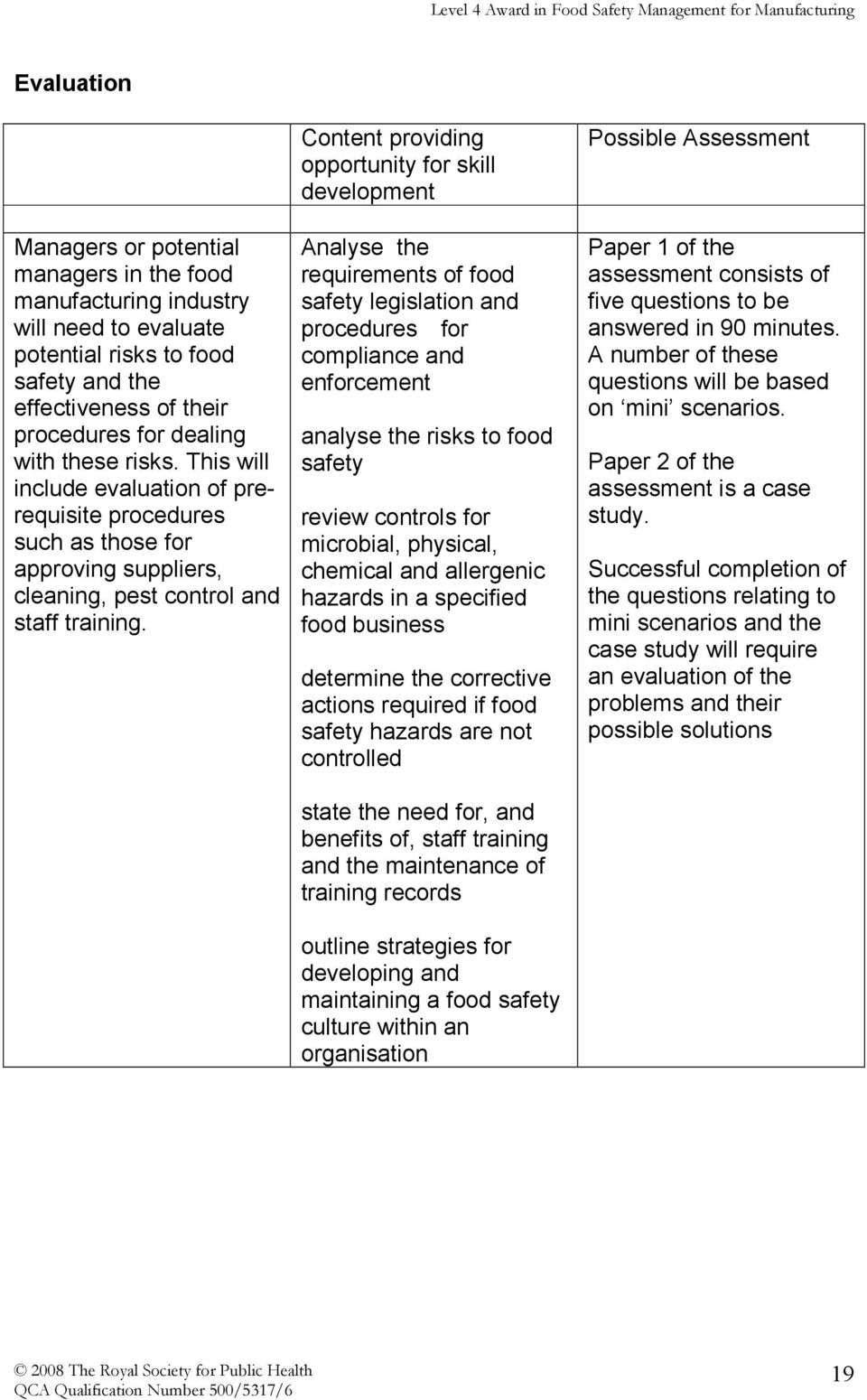
19 Evaluation Managers or potential managers in the food manufacturing industry will need to evaluate potential risks to food safety and the effectiveness of their procedures for dealing with these risks. This will include evaluation of prerequisite procedures such as those for approving suppliers, cleaning, pest control and staff training. Content providing opportunity for skill development Analyse the requirements of food safety legislation and procedures for compliance and enforcement analyse the risks to food safety review controls for microbial, physical, chemical and allergenic hazards in a specified food business determine the corrective actions required if food safety hazards are not controlled state the need for, and benefits of, staff training and the maintenance of training records outline strategies for developing and maintaining a food safety culture within an organisation Possible Assessment Paper 1 of the assessment consists of five questions to be answered in 90 minutes. A number of these questions will be based on mini scenarios. Paper 2 of the assessment is a case study. Successful completion of the questions relating to mini scenarios and the case study will require an evaluation of the problems and their possible solutions 19
20 Integration Managers and potential managers will need to integrate their analysis and evaluation of food safety hazards and risks and the various procedures for dealing with such risks into a coherent food safety management system. Content providing opportunity for skill development Management of food safety will require integration of all of the content for the qualification. Possible Assessment Paper 1 of the assessment consists of five questions to be answered in 90 minutes. A number of these questions will be based on mini scenarios. Paper 2 of the assessment is a case study. Individual questions for Paper 1 and for the case study will cover the content of more than one learning outcome. Successful completion of the assessment will require integration of knowledge and information from different aspects of the qualification. 20

Level 4 Award in HACCP Management for Food
 Level 4 Award in HACCP Management for Food Manufacturing July 2009 This qualification has a Credit Value of 4 Ofqual Qualification Number 500/66523/3 40 Guided Learning Hours Description Hazard Analysis
Qualification Specification HABC Level 3 Award in Supervising Food Safety in Catering (QCF)
 www.highfieldabc.com Qualification Specification HABC Level 3 Award in Supervising Food Safety in Catering (QCF) Qualification Number: 500/5471/5 Highfield House Heavens Walk Lakeside Doncaster South Yorkshire
The course and qualification may be taken as a stand-alone certificate, or as part of a wider course of training.
 Level 2 Foundation Award in Food Hygiene January 2016 Guided Learning Hours 7 Total Qualification Time 7 Ofqual Qualification Number 601/8306/8 Description: The RSPH Foundation Award in Food Hygiene is
Level 2 Award in. Food Safety in Catering (QCF) Specification. Ofqual Accreditation Number 600/0343/1
 Level 2 Award in Food Safety in Catering (QCF) Specification Ofqual Accreditation Number 600/0343/1 Ofqual Accreditation Start Date 01/01/2011 Ofqual Accreditation End Date 30/07/2018 Ofqual Certification
FOOD SAFETY MANAGEMENT SYSTEM
 FOOD SAFETY MANAGEMENT SYSTEM Latest Revision May 2014 Reviewer: H&S Mgr. Next Revision January 2016 Compliance Food Hygiene (England & Wales) Regulations 2006 Associated Policies Contents All H&S Policies
STUDY GUIDE: ABATTOIR HYGIENE
 STUDY GUIDE: ABATTOIR HYGIENE In Collaboration with the Directorate Veterinary Services National Department of Agriculture January 2007 Study guide Abattoir Hygiene January 2007 1 CONTENTS MODULES ABATTOIR
Name of Business. Record 1- Approved Food Suppliers List
 Record 1- Approved Food Suppliers List Supplier No. Details of Supplier (Name, address, contact details) Product Description Approved Supplier Date approved Corrective Action Reject suppliers that do not
Food manager certification/recertification training Food manager orientation of food safety programs Preparation for food management employment
 NEHA 720 South Colorado Boulevard, Suite 1000-N Denver, Colorado 80246-1926 Tel (303) 756-9090 ext. 340 Fax (303) 691-9490 Email [email protected] Web www.nehatraining.org Two-Day Syllabus NEHA
Ensure appropriate food safety practices are followed whilst food is prepared, cooked and served
 This Unit has the following elements: Element 1 (3GEN1.1) Element 2 (3GEN1.2) Apply and monitor your organisation s food safety procedures Identify and respond to food safety hazards Candidate Name: Assessment
Hygiene Standards for all Food Businesses
 Hygiene Standards for all Food Businesses Food hygiene laws are not simply a list of rules. They are intended to let food business operators assess the risks to food safety in their business and apply
Food delivery & storage
 screen 1 Food delivery & storage 7. Rubbish bags in the way of deliveries This screen shows a delivery scene with a number of potential hazards to food safety. As a starting point students are encouraged
Food safety checklist How well does your food business rate?
 FOOD SAFETY RATING GUIDE Food safety checklist How well does your food business rate? Under Council s Eat Safe Brisbane food safety rating scheme, all licensed food businesses within Brisbane will be issued
4. HOUSE RULES TRAINING
 4. HOUSE RULES TRAINING The House Rules Section contains 9 sub-sections each of which covers a particular subject of food safety management. Every House Rule sub-section begins with guidance and then provides
IFS Food Safety and Quality Management System
 This is an ideal package for Food Manufacturers looking to meet the requirements of the IFS Food Standard for quality and food safety of food products. Ensure your Food Safety & Quality Management System
Developing a school food safety plan based on HACCP system. (for school lunch box caterers)
 Developing a school food safety plan based on HACCP system (for school lunch box caterers) (I) Background/Introduction To further reduce food waste and disposable containers, the Government launched a
The Principles of Food Safety Supervision for Catering
 Unit 8: The Principles of Food Safety Supervision for Catering Unit code: K/502/3775 QCF Level 3: BTEC National Credit value: 3 Guided learning hours: 25 Aim and purpose The aim of the unit is to ensure
Leila Kakko Tampere University of Applied science TRADITIONAL FOOD IN COMBATING FOODBORNE PATHOGENS 2011
 Leila Kakko Tampere University of Applied science TRADITIONAL FOOD IN COMBATING FOODBORNE PATHOGENS 2011 World Food Programme Food quality control is necessary to ensure that food aid supplies are safe,
Good Hygiene Practices for Catering at Outdoor Events
 Good Hygiene Practices for Catering at Outdoor Events The following pages of advice are based on the requirements of Regulation (EC) 852/2004 on the Hygiene of Foodstuffs The Food Hygiene (England) Regulations
Table of Contents. Introduction... 1. Personal Hygiene... 2. Temperature Control... 5. Cross-contamination... 6. Cleaning and Sanitizing...
 Table of Contents Introduction... 1 Food Handler Certification Program... 1 Personal Hygiene... 2 Temperature Control... 5 Cross-contamination... 6 Cleaning and Sanitizing... 6 Dishwashing... 7 Food Storage...
Qualification Specification HABC Level 1 Award in Principles of Health and Safety in the Workplace (QCF)
 www.highfieldabc.com Qualification Specification HABC Level 1 Award in Principles of Health and Safety in the Workplace (QCF) Qualification Number: 600/6789/5 Highfield House Heavens Walk Lakeside Doncaster
There may be an additional section covering health and safety concerns which fall outside the scope of the national food hygiene rating scheme.
 Public Protection (food & safety) Food Premises Inspection Report Name of Business: The Merchants of Spice Address of food business: 30-32 Colegate, Norwich, NR3 1BG Date of Inspection: 5 November 2015
STUDY GUIDE: POULTRY MEAT EXAMINATION
 STUDY GUIDE: POULTRY MEAT EXAMINATION In Collaboration with the Directorate Veterinary Services National Department of Agriculture January 2007 Study guide Poultry meat examination January 2007 Studiegids
CONCEPTS OF FOOD SAFETY QUALITY MANAGEMENT SYSTEMS. Mrs. Malini Rajendran
 CONCEPTS OF FOOD SAFETY AND QUALITY MANAGEMENT SYSTEMS Mrs. Malini Rajendran Brief background 1963 - The Codex Alimentarius Commission was created by FAO and WHO to develop food standards, guidelines and
GUIDELINES TO THE LEVEL TWO CERTIFICATION IN FOOD PROTECTION
 GUIDELINES TO THE LEVEL TWO CERTIFICATION IN FOOD PROTECTION 6/2013 Certification in Food Protection Guidelines Page 1 of 11 TABLE OF CONTENTS SECTIONS PAGE NUMBER MISSION STATEMENT 2 I. DEFINITIONS 3
HAZARD ANALYSIS AND CRITICAL CONTROL POINT PRINCIPLES AND APPLICATION GUIDELINES ADOPTED. August 14, 1997
 HAZARD ANALYSIS AND CRITICAL CONTROL POINT PRINCIPLES AND APPLICATION GUIDELINES ADOPTED August 14, 1997 NATIONAL ADVISORY COMMITTEE ON MICROBIOLOGICAL CRITERIA FOR FOODS 1 TABLE OF CONTENTS EXECUTIVE
BRC Food Safety and Quality Management System. New Issue 7
 New Issue 7 This is an ideal package for Food Manufacturers looking to meet BRC Global Standard for Food Safety (Issue 7 2015) for Food Safety Quality Management Systems. Our BRC Food Safety Quality Management
Food od hygiene: still a relevant nosocomial issue
 www.webbertraining.com Page 1 Food od hygiene: still a relevant nosocomial issue Dr. Michael A. Borg Consultant (Hospital Infection ) St. Luke s Hospital, Malta Hosted by Paul Webber [email protected]
Address of food business: 25 Ranworth Road, Norwich, NR5 8EB Date of Inspection: 27 July 2015
 Public Protection (food & safety) Food Premises Inspection Report Name of Business: Spiral Spuds Address of food business: 25 Ranworth Road, Norwich, NR5 8EB Date of Inspection: 27 July 2015 Risk Rating
Food Safety and Quality Management System
 Introduction The company has planned, established, documented and implemented a food safety and quality management system for the site, which is maintained in order to continually improve its effectiveness
SQF SYSTEMS PRACTICE TEST / OCTOBER, 2012 American Food Safety Services Division, Technical and Business Services, LLC
 Introduction This document includes instructions for use and the answer key for the Implementing SQF Systems Practice Test. This Implementing SQF Systems Practice Test provides practice examination for
SAFE HEALTHY CHILDREN A Health and Safety Manual for Childcare Providers
 TABLE OF CONTENTS Chapter 7: Food Storage and Preparation Safe Food: Food Storage and Preparation 7.1 Requirements of the Day Nurseries Act... 7.2 Recommendations of the Medical Officer of Health... 7.2
BRC Food Safety Management System Implementation Workbook
 We have written this workbook to assist in the implementation of your BRC food safety management system. The workbook is divided into 8 steps that are designed to assist you in implementing your food safety
FOOD SAFETY MANAGEMENT SYSTEM Based on the principles of Hazard Analysis Critical Control Points (HACCP)
 Adult Services FOOD SAFETY MANAGEMENT SYSTEM Based on the principles of Hazard Analysis Critical Control Points (HACCP) for use in ENTER NAME OF residential, nursing or day care centre CONTENTS Page 1.0
Qualification Specification. Level 1 Award in Health and Safety for Catering
 www.highfieldabc.com Qualification Specification Level 1 Award in Health and Safety for Catering Highfield House Heavens Walk Lakeside Doncaster South Yorkshire DN4 5HZ United Kingdom Tel +44 08452260350
NHSScotland National Food Safety Assurance Manual
 NHSScotland National Food Safety Assurance Manual March 2014 Contents Page 1. Background... 4 1.2 Introduction... 5 1.3 Explanation of Hazard Analysis Critical Control Point (HACCP)... 6 1.4 The Codex
Standard 3.2.2. Food Safety Practices and General Requirements
 Standard 3.2.2 Food Safety Practices and General Requirements AUSTRALIA NEW ZEALAND FOOD STANDARDS CODE CHAPTER 3 (AUSTRALIA ONLY) A GUIDE TO THE FOOD SAFETY STANDARDS SECOND EDITION, JANUARY 2001 AUSTRALIA
HYGIENE IN THE GALLEY
 HYGIENE IN THE GALLEY - good advice for self-assessment aboard Guidance for company and ship s management and galley crew Good hygiene is thinking twice about things when cooking for others. To limit the
2009 HSC Hospitality Sample Answers
 2009 HSC Hospitality Sample Answers This document contains sample answers, or, in the case of some questions, answer may include. These are developed by the examination committee for two purposes. The
Audit Standard. Issue 4, June 2015
 Audit Standard Issue 4, June 2015 This document is published by SALSA Bloxham Mill, Barford Road, Bloxham, Banbury. OX15 4FF The information and opinion contained within is expressed in good faith. Neither
1 HOUR SAN CE CBDM Approved. Food Protection Connection. Active. by Melissa Vaccaro, MS, CHO. Managerial Control. Nutrition & Foodservice Edge
 Food Protection Connection 1 HOUR SAN CE CBDM Approved Active by Melissa Vaccaro, MS, CHO Managerial Control A HACCP Approach 12 Answers to FPC Review Questions CDMs who answer the FPC Review Questions
Introduction. Chapter 1
 Contents Chapter 1 Introduction 1 Chapter 2 What is a Food Safety Plan 2 Chapter 3 How to implement a Food Safety Plan 3 Stage 1: Planning Stage 2: Draw a flow diagram Stage 3: Develop a Food Safety Plan
HAZARD ANALYSIS CRITICAL CONTROL POINT PLAN SUMMARY SETHNESS PRODUCTS COMPANY LIQUID CARAMEL COLOR
 HAZARD ANALYSIS CRITICAL CONTROL POINT PLAN SUMMARY SETHNESS PRODUCTS COMPANY LIQUID CARAMEL COLOR I. INTRODUCTION A. CARAMEL COLOR 1. Caramel Color (Caramel) is defined in Title 21 of the U.S. Code of
General food hygiene rules
 General food hygiene rules Why food hygiene is important? Good food hygiene is essential to ensure that the food you and your family eats is safe. Poor hygiene procedures in your home can put you at risk.
Tool for the development of a Food Safety Program for Catering and Retail premises. Program. Food Safety. March 2008
 To ol fo r th e d e ve l o p m e n t of a Fo o d Safety Program for C a t e r i n g a n d R e t a i l p r e m i s e s Program Tool for the development of a Food Safety Program for Catering and Retail premises
Food Safety Management in the Hospital
 Food Safety Management in the Hospital Richard Hannay BSc, FRSH, MCIEP, MIFST Food Safety and HACCP Consultant The Bristol Children s Hospital Introduction Preparing a Safe Food Policy and Plan The Role
GUIDE TO IMPLEMENTING A REGULATORY FOOD SAFETY AUDITOR SYSTEM
 GUIDE TO IMPLEMENTING A REGULATORY FOOD SAFETY AUDITOR SYSTEM FEBRUARY 2016 2 Contents Introduction... 4 Scope and objectives... 5 Scope... 5 Objectives... 5 Responsibilities... 5 The role of the licensee
Level 3 Certificate in Printing and Graphic Communications (5261)
 Level 3 Certificate in Printing and Graphic Communications (5261) Scheme handbook www.city-and-guilds.co.uk Publications and enquiries City & Guilds publications are available from Publications Sales City
Hertfordshire Catering Food Safety Statement
 HERTFORDSHIRE COUNTY COUNCIL DATE: 28 th October 2008 VERSION: 1 REVIEW DATE: April 2009 SUBJECT: Hertfordshire Catering: Food Safety Management System This document sets out the standards for Food Safety
This quick guide provides a summary of food safety and labelling advice for small scale home producers of chutneys, pickles, flavoured oils and jams.
 This quick guide provides a summary of food safety and labelling advice for small scale home producers of chutneys, pickles, flavoured oils and jams. General Food Safety Advice Registration Food business
Food Safety Management Tools Module COACH S GUIDE. Food Safety Management Tools
 Food Safety Management Tools Module COACH S GUIDE Food Safety Management Tools Commonwealth of Australia 2007 Commonwealth of Australia 2007 2 Food Safety Management Tools Coach s Guide Contents Introduction
Tool for the development of a Food Safety Program for Childcare facilities. a Food Safety Program
 Tool for the development of a Food Safety Program for Childcare facilities Program Tool for the development of a Food Safety Program for Childcare facilities October 2008 Food Safety 1 Disclaimer The information
Draft. Draft. Procedures to maintain food safety. Food safety requirements and regulations. Introduction. Key terms.
 Learning aim A TOPIC A.1 Procedures to maintain food safety Introduction Within a hospitality business, all staff need to be aware of and comply with food safety and health and safety procedures. Consider
GUIDELINES FOR IMPLEMTING GMP IN FOOD PROCESSING
 GUIDELINES FOR IMPLEMTING GMP IN FOOD PROCESSING 2.Storage Facilities 2.1 Use of off site facilities - are they controlled 2.1.1 Where the manufacturer commissions the services of (or contracts to) off
FSTC/DASC 606 Microbiology of Foods Spring, 2016
 FSTC/DASC 606 Microbiology of Foods Spring, 2016 Instructor: Dr. Alejandro Castillo, Associate Professor, Dept. of Animal Science, 314A Kleberg Center, 845-3565, [email protected]. No specific office
EUROPEAN COMMISSION GUIDANCE DOCUMENT
 EUROPEAN COMMISSION GUIDANCE DOCUMENT Implementation of procedures based on the HACCP principles, and facilitation of the implementation of the HACCP principles in certain food businesses EUROPEAN COMMISSION
EC 691 January 1996 HACCP AND MICROBREWERIES PRACTICAL GUIDELINES OF FOOD SAFETY FOR MICROBREWERIES, BREWPUBS AND THE BEER INDUSTRY
 EC 691 January 1996 HACCP AND MICROBREWERIES PRACTICAL GUIDELINES OF FOOD SAFETY FOR MICROBREWERIES, BREWPUBS AND THE BEER INDUSTRY TABLE OF CONTENTS I. Purpose of this publication... 3 II. Introduction...
GUIDELINES. for COTTAGE INDUSTRY INVOLVED in HOME FOOD PRODUCTION
 GUIDELINES for COTTAGE INDUSTRY INVOLVED in HOME FOOD PRODUCTION ENVIRONMENTAL HEALTH PO Box 2000, 16 Garfield Street Charlottetown, PEI CIA 7N8 Tel: 368-4970 / Fax: 368-6468 These guidelines have been
HACCP: Hazard Analysis Critical Control Points. Dr. Angela Shaw Department of Food Science and Human Nutrition Extension and Outreach
 HACCP: Hazard Analysis Critical Control Points Dr. Angela Shaw Department of Food Science and Human Nutrition Extension and Outreach Information Adapted from: Hazard Analysis and Critical Control Point
Qualification specification
 Version 1, December 2014 Qualification specification Introduction 1 Qualification overview 1 Key facts 2 Qualification structure 2 Entry guidance 3 Geographical coverage 3 Delivering training 3 Assessment
FSSC 22000. Certification scheme for food safety systems in compliance with ISO 22000: 2005 and technical specifications for sector PRPs PART II
 FSSC 22000 Certification scheme for food safety systems in compliance with ISO 22000: 2005 and technical specifications for sector PRPs PART II REQUIREMENTS AND REGULATIONS FOR CERTIFICATION BODIES Foundation
Summary of Listeria monocytogenes Compliance Guideline for Small and Very Small Meat and Poultry plants that Produce Ready-To-Eat Products
 Summary of Listeria monocytogenes Compliance Guideline for Small and Very Small Meat and Poultry plants that Produce Ready-To-Eat Products A. Purpose This document is intended to assist small and very
Draft guidance for registered pharmacies preparing unlicensed medicines
 Draft guidance for registered pharmacies preparing unlicensed medicines January 2014 1 The General Pharmaceutical Council is the regulator for pharmacists, pharmacy technicians and registered pharmacies
CONTROL PLANS IN FOOD SAFETY MANAGEMENT SYSTEMS
 CONTROL PLANS IN FOOD SAFETY MANAGEMENT SYSTEMS BRC, IFS & FSSC2200 CONTROL PLANS IN FOOD SAFETY MANAGEMENT SYSTEMS BRC, IFS & FSSC2200 Different standards of food safety throughout the years have evolved
GUIDELINES TO THE OHIO DEPARTMENT OF HEALTH S CERTIFICATION IN FOOD PROTECTION
 GUIDELINES TO THE OHIO DEPARTMENT OF HEALTH S ERTIFIATION IN FOOD PROTETION To protect and improve the health of all Ohioans 9/98 ertification in Food Protection Guidelines Page 1 of 14 TABLE OF ONTENTS
Template for Review and Update of the Child Nutrition Food Safety Plan i
 Taking Care of Business: Food Safety and Finance for School Foodservice Template for Review and Update of the Child Nutrition Food Safety Plan Our Town District Child Nutrition Food Safety Plan City, Mississippi
Contents 1.0 FROM THE CHIEF EXECUTIVE 2.0 QUALITY COMMITMENT
 Contents 1.0 FROM THE CHIEF EXECUTIVE 2.0 QUALITY COMMITMENT 3.0 QUALITY Principles 4.0 QUALITY STRUCTURE AND RESPONSIBILITIES 5.0 QUALITY SYSTEM ELEMENTS 5.1 Customer Satisfaction 5.2 Buildings, Facilities,
University Food Safety Policy
 Food Safety Series September 2012 University Food Safety Policy Contents Page number 1. Policy Statement 1 2. Breach of Policy 1 3. Responsibilities and Roles 2 4. Food Safety and External Catering Providers
Edexcel BTEC Level 2 Award in Food Safety in Catering (QCF) Edexcel BTEC Level 3 Award in Supervising Food Safety in Catering (QCF)
 Specification BTEC Specialist qualifications Edexcel BTEC Level 2 Award in Food Safety in Catering (QCF) Edexcel BTEC Level 3 Award in Supervising Food Safety in Catering (QCF) Edexcel BTEC Level 4 Award
Food Safety Guidelines for the Preparation and Display of Sushi. June 2007 NSW/FA/FI005/0706
 Food Safety Guidelines for the Preparation and Display of Sushi June 2007 NSW/FA/FI005/0706 Contents Food Safety Guidelines for Sushi Contents...1 Introduction...3 Purpose and Scope...4 Acknowledgements...4
Food Safety Evaluation Checklist. Directions
 Food Safety Checklist The following self-assessment can help you find food safety gaps in your operation. It can also help you put food safety systems, such as active managerial control, into place. This
BRC/IoP Global Standard
 BRC/IoP Global Standard Food Packaging and Other Packaging Materials A guide to the revisions contained in Issue 2 of the Standard The purpose of this guide is to help companies obtain a quick overview
ISO 22000 Food Safety Management System
 This is an ideal package for Food Manufacturers looking to meet International Food Safety Standards. This system meets the requirements of International Standard ISO 22000:2005 for Food Safety Management
Introduction to food hygiene
 screen 1 Introduction to food hygiene This screen shows a kitchen scene with a number of hazards to food safety. As a starting point students are encouraged to look at the screen and suggest things that
Food Safety Is Top Priority
 In this chapter, find answers to the following questions: Why is food safety a top priority?... (page 2) What is a foodborne illness and foodborne outbreak?... (page 2) Foodborne Illness... (page 2) Foodborne
Food Hygiene Inspection Procedure
 Food Hygiene Inspection Procedure Model Procedure developed by the London Food Co-ordinating Group (Revised January 2007) Page 1 of 11 London Food Co-ordinating Group Model Food Hygiene Inspection Procedure
FOOD SAFETY POLICY Documentation Control
 FOOD SAFETY POLICY Documentation Control Reference HS/EI/020 Approving Body Directors Group Date Approved 22 Implementation Date 22 Summary of Changes from the Inclusion of Central Production Unit / Kitchen.
YOUR GUIDE TO HACCP. Public Protection Service, PO Box 14, Trafford Town Hall, Talbot Road, Stretford, Trafford, M32 OYZ
 YOUR GUIDE TO HACCP Public Protection Service, PO Box 14, Trafford Town Hall, Talbot Road, Stretford, Trafford, M32 OYZ Telephone: 0161 912 4916 Fax: 0161 912 1113 www.trafford.gov.uk Page 1 of 52 20/02/06
Click here to order the IFSQN FSSC 22000 Certification Package Now
 This comprehensive Food Safety Management System Certification package contains all the tools you will need to achieve FSSC 22000 Certification. This workbook is provided to assist in the implementation
Hazard Analysis and Critical Control Points
 Training Modules on General Food Safety Plans for the Food Industry Hazard Analysis and Critical Control Points This module is part of a training program on General Food Safety Requirements for the Food
Address of food business: 67 London Street, Norwich, NR2 1HL Date of Inspection: 13 May 2013
 Public Protection (food & safety) Food Premises Inspection Report Name of Business: Pandora s Kitchen Address of food business: 67 London Street, Norwich, NR2 1HL Date of Inspection: 13 May 2013 Inspection
ABU DHABI FOOD CONTROL AUTHORITY. Food Poisoning. www.facebook.com/adfca1. www.twitter.com/adfca. www.youtube.com/adfcamedia
 Food Poisoning جهاز أبوظبي للرقابة الغذائية ABU DHABI FOOD CONTROL AUTHORITY Food Poisoning www.facebook.com/adfca1 www.twitter.com/adfca www.youtube.com/adfcamedia Creating awareness among the consumers
4. HOUSE RULES PEST CONTROL
 4. HOUSE RULES PEST CONTROL The House Rules Section contains 9 sub-sections each of which covers a particular subject of food safety management. Every House Rule sub-section begins with guidance and then
Address of food business: 17-27 Orford Place, Norwich, NR1 3QA Date of Inspection: 25 September 2014 Date of revisit: 8 th April 2015
 Public Protection (food & safety) Food Premises Inspection Report Name of Business: Pizza Hut Address of food business: 17-27 Orford Place, Norwich, NR1 3QA Date of Inspection: 25 September 2014 Date of
Pearson Edexcel Level 3 Certificate in Hospitality Retail Outlet Management (QCF) Specification
 Pearson Edexcel Level 3 Certificate in Hospitality Retail Outlet Management (QCF) Specification NVQ/Competence-based qualification First registration January 2014 Pearson Education Limited is one of the
This document is meant to be a starting point for any company wanting to implement the safety passport scheme for their contractors on site.
 Introduction This document is meant to be a starting point for any company wanting to implement the safety passport scheme for their contractors on site. It was put together by members of the Food & Drink
Unit 1: Best practice in science (LEVEL 2)
 Unit 1: Best practice in science (LEVEL 2) Learning outcomes By completing this unit candidates will develop a thorough knowledge and understanding of the skills necessary to undertake scientific research.
A GUIDE TO AVA FOOD FACTORY GRADING SYSTEM
 A GUIDE TO AVA FOOD FACTORY GRADING SYSTEM Introduction The main objective of the Food Factory Grading System is to ensure that the food manufacturers observe good manufacturing practices so as to produce
Galatia Unit #1. Integrated Pest Management Plan (including lawn care)
 Galatia Unit #1 Integrated Pest Management Plan (including lawn care) General Description In order to comply with amendments to the Illinois Structural Pest Control Act (105ILCS 5/10-20.49 & 105ILCS 5/34-18.40),
Health and Safety Department. Health and Safety Policy. Version Author Revisions Made Date 1 Paul Daniell First Draft (in this format) 11 July 2014
 Food Safety Policy July 2014 (v2).docx Food Safety Policy Originator name: Section / Dept: Implementation date: Clive Parkinson Health and Safety Department July 2014 Date of next review: July 2016 Related
Candidate Study Guide for the Illinois Food Service Sanitation Manager Examinations
 Candidate Study Guide for the Illinois Food Service Sanitation Manager Examinations This information is intended to help you prepare for the Illinois Food Service Sanitation Manager Examinations. Part
STANDARD OPERATING PROCEDURE S (SOP S) FOR HAZARDOUS ANALYSIS CRITICAL CONTROL POINT (HACCP) PLANS
 STANDARD OPERATING PROCEDURE S (SOP S) FOR HAZARDOUS ANALYSIS CRITICAL CONTROL POINT (HACCP) PLANS RECEIVING: All food must be from approved sources. Foods must be wholesome and not adulterated. No home-prepared
MICROBIAL HAZARDS. Eating food contaminated with harmful microorganisms. These
 MICROBIAL HAZARDS Microorganisms are everywhere. They can be found in the air, in water, in soil, on animals, and even on humans. Some are beneficial, such as those used to make fermented dairy and meat
Food Safety Management System For
 Food Safety Management System For Completed by on Review Dates Signed Signed Signed Signed Signed Signed Published and printed by Amber Valley Borough Council, Town Hall, Market Place, Ripley, Derbyshire
Example of a food company quality
 Appendix A manual Example of a food company quality Contents Date: 13/03/95 RME-QLMN-OO Page 1 of 3 Section Title ISO 9001 reference 01 In trod uction 02 Purpose 03 Scope 04 Definitions 05 Management responsibility
Restaurant Grading in New York City at 18 Months Public Recognition and Use of Grades
 Restaurant Grading in New York City at 18 Months Public Recognition and Use of Grades Trends in Restaurant Sanitary Conditions and Foodborne Illnesses Introduction In July 2010, the Health Department began
Section 1 Why bother?
 Section 1 Why bother? Objectives Define the terms food hygiene, food poisoning and foodborne disease. Name the different classes of micro-organism and where they are found. Identify the main conditions