
Section 1 Why bother?
|
|
|
- Martha Hunter
- 9 years ago
- Views:
Transcription
1 Section 1 Why bother? Objectives Define the terms food hygiene, food poisoning and foodborne disease. Name the different classes of micro-organism and where they are found. Identify the main conditions bacteria need in order to grow. Explain how the growth of bacteria can be controlled. Define the term food hygiene? What is food hygiene? Food hygiene is the practice of ensuring food is safe, sound and wholesome, by protecting it from contamination, preventing bacterial multiplication and by the destruction of harmful bacteria. Define the term food poisoning What is food poisoning? Food poisoning is an illness that occurs usually between 1 and 36 hours after eating contaminated or poisoned food, the most common symptoms being diarrhoea, vomiting and dehydration. Food workers must report all instances of diarrhoea, vomiting and skin infections to a supervisor before returning to work and must not work while suffering from these symptoms. Failure to observe these rules is the most common reason for food workers being prosecuted. Define the term foodborne illness Foodborne illness is an illness that occurs when food containing harmful bacteria is ingested. This term also covers foodborne disease and food poisoning. Define the term foodborne disease Foodborne disease A disease or illness caused by micro-organisms carried by food or water. What are the causes of food poisoning? Bacteria Pathogenic bacteria are the most common cause Viruses Metals Chemicals Natural poisons in food (toadstools, green potatoes, and red kidney beans) Moulds 1 of 22

2 Factors contributing to food poisoning cases Food prepared too far in advance Cooling food too slowly Not re-heating food to high enough temperatures Using cooked food contaminated with food poisoning bacteria Poor food safety practices People most at risk The elderly Babies and toddlers Pregnant women Individuals who are already unwell Spores are small round bodies with thick walls which allow the bacteria to stay dormant but alive, over long periods of time, e.g. during freezing, defrosting, cooking and cooling. When conditions become favourable the spores germinate and active bacteria are produced once more. It is vital therefore that food is kept out of the danger zone as far as possible. Toxins are poisonous chemicals produced by certain types of bacteria, e.g. the bacteria Staphylococcus aureus produces a toxin in food, which normally causes severe illness very soon after the food is eaten. Name the different classes of micro-organism Bacteria Yeasts Fungi Moulds Viruses Conditions required for the growth of bacteria Moisture Time Food Warmth (37 C optimum for growth) Oxygen ph Once the conditions required for growth are ideal, bacteria will multiply by binary fission: simply by splitting in two. Most bacteria will double every 10 to 20 minutes. Preservation methods To preserve food, remove one or more requirement for bacterial growth. For instance, dehydrate food to remove moisture. 2 of 22

3 What is the danger zone? The danger zone is the optimum temperature range within which bacteria can multiply: +5 C to + 63 C. Important temperatures to note Cook to a minimum core temperature of 75 C: too hot for bacteria to survive. At this temperature bacteria are killed off and food is deemed safe to eat 0 to +5 C: bacteria do not multiply or multiply very slowly -18 C or below: bacteria are dormant and do not multiply at freezer temperatures Pasteurisation 72 C x 15 seconds How can bacterial growth be controlled? Good quality control systems, such as not storing raw food next to ready-to-eat and cooked food Temperature control, such as cooking food to a minimum core temperature of 75 C Personal hygiene, such as washing hands after visiting the toilet and then preparing food Cleaning and disinfecting Define the term due diligence A food business must be able to demonstrate that it has done everything within its power to safeguard consumer health. The legal requirements of food handlers Keep yourself clean Keep the workplace clean Protect food from contamination or anything that could cause harm Follow good personal hygiene practices e.g. hand washing Wear appropriate protective clothing Tell your employer if you are suffering from or are a carrier of a foodborne disease Required training of food handlers By law food handlers must receive adequate supervision, instruction/ or training in food hygiene for the work they do Those responsible for HACCP should also receive adequate training It is recommended the following takes place: Training certificates should be renewed every 3 years Training should be refreshed this generally takes place annually Training records should be kept 3 of 22

4 Food safety is best defined as making sure food is protected from harm of any kind. It is the protection of consumer health and well-being by safeguarding food from anything that can cause harm. 4 of 22

5 Section 2 Food Contamination Objectives Identify sources of bacteria and how they are introduced into the food chain Distinguish between high risk and low risk foods Define the term cross contamination and state how it occurs Spoilage, pathogenic and beneficial bacteria Name the common food poisoning bacteria Sources of bacteria Where bacteria originate Animal Poultry & eggs Vegetables Shellfish Milk Water Hands Type of bacteria E. coli Salmonella & Campylobacter Clostridium perfringens Viruses TB E. coli Staphylococcus aureus Define contamination What is contamination? Contamination is the presence of any harmful or objectionable substance in food. Examples of cross contamination - Bacterial contamination of food Direct - Raw meats touching ready-to-eat products Indirect - Using a knife to cut raw meat and then using the same knife to cut a ready-to-eat product Airborne contamination sneezing over food Preventative measures against cross contamination Store raw food and cooked food separately Keep raw meat on the bottom shelf of the fridge Use different chopping boards and knives for raw and cooked/ ready-to-eat foods Always cover foods that are stored in the fridge 5 of 22

6 Bacteria Three types of bacteria Pathogenic bacteria cause illness Beneficial bacteria used to make beer, cheese and yogurt Spoilage bacteria cause food to rot Pathogenic bacteria versus spoilage bacteria These types of bacteria differ: pathogenic strains cause illness in humans and can be difficult to detect, while spoilage bacteria cause food to rot or perish and signs can be more readily detected. Examples of common food poisoning (pathogenic) bacteria Campylobacter Salmonella E. coli It is important to note that not all bacteria cause poisoning and spoilage. Examples of beneficial bacteria Some bacteria have beneficial properties: Lactobacillus casei immunitass Lactobacillus plantarum Define the term high-risk foods High-risk foods support the growth of pathogenic bacteria because they are high in protein and water. High risk foods are usually ready-to-eat foods intended for consumption without further cooking, such as coleslaw, ready washed salad, and cooked rice. Name the three types of contamination Chemical - e.g. cleaning products and pesticides poison food products Physical - e.g. foreign objects - parts of machinery fall into products during their manufacture, such as plasters and hairs Microbial - contamination by bacteria Common foods that can cause allergic reactions in consumers Peanuts Tree nuts Eggs Shellfish Cow s milk Wheat (gluten) Soy 6 of 22

7 Symptoms of allergic reactions Tingling around the mouth Swelling around the nose, mouth and throat Difficulty breathing Rashes Vomiting Diarrhoea Cramps Anaphylactic reactions Understand procedures required for dealing with foods that may cause allergic reactions As a food handler you must be careful not to inadvertently contaminate food that is supposed to be free from allergens. For example, do not place peanuts on a surface or next to another food group that wouldn t naturally contain peanuts. You must be careful to give the correct information about ingredients to customers who ask. 7 of 22

8 Section 3 Food delivery and storage Objectives Identify the correct procedures for receiving and accepting food deliveries Identify the correct procedures for storing food Name the various food storage areas and the potential hazards associated with each area List controls/checkpoints for the hazards identified in each food storage area. Correct procedures for receiving and accepting food deliveries It is important that procedures are put in place for receiving and accepting deliveries of food products and that they are stored correctly and efficiently once the delivery has been accepted. The following procedures should be observed Audit the suppliers premises to ensure their manufacturing methods, premises and quality control procedures meet the standards you expect. Smaller businesses may not be able to do this, so it is advisable to buy from a reputable supplier. Only buy from a reputable supplier Specify delivery requirements, especially the acceptable temperature of the product Check the temperature of refrigerated and frozen products; do not accept products if not at the required temperature Check all deliveries on receipt for damaged packaging, and any spoilage to products Ensure all staff are trained on the protocol for accepting deliveries Buy the correct quantity of food never buy more than can be properly stored Keep records of deliveries so the product can be traced in the event of contamination occurring Check list for delivery vehicle/food conveyances/containers The delivery vehicle/conveyance/container must: Clean and pest-proof Weatherproof Maintained at the correct temperature: 0 C to +5 C for refrigerated and -18 C or below for frozen Not be used for transport of non food items where it may result in contamination Do not overload the vehicle Should provide effective separation of products Bulk food item containers clearly marked for food stuffs only 8 of 22

9 Correct procedure for storage of food products Dispose of outer packaging/boxes prior to storage Store raw foods (i.e. meat, poultry and shellfish) separately from cooked or prepared food. Store raw food below cooked /ready-toeat food. Rotate stock first in first out (FIFO). (Always check use-by-dates) Cleaning materials such as detergents should be stored in a separate area Foods can be preserved by drying, freezing and canning Food storage areas and potential hazards Potential hazards of dry goods storage (e.g. tins, rice and pasta) Bacterial growth due to cross contamination and excessive moisture Contamination by pest and insects Chemical contamination from cleaning agents Controls in dry goods store Dry goods store must be clean, well lit, ventilated and adequately shelved Food must be stored on shelves above the floor Containers used for storage must be covered Windows must be fitted with insect screens and the store must be kept free from infestation Potential hazards in fruit and vegetable store Insect infestation Accelerated spoilage caused by heat and moisture Soil on fresh vegetables - can be a problem because of the bacteria soil contains Controls in fruit and vegetable store Fruit and vegetable store should be clean, well lit, ventilated and pest proof Ensure good air circulation Discard spoiled fruit and vegetables as this can contaminate healthy products Store salad items and soft fruits (except bananas) in the salad drawer of the refrigerator Potential hazards in refrigerated storage Bacterial growth Cross contamination Food beyond date marking 9 of 22

10 Controls in refrigerated storage Refrigerating foods slows down the multiplication of bacteria: Maintain temperatures of 0-5 C Store raw and cooked/ready-to-eat food separately Do not place hot foods directly in the refrigerator as this will cause the temperature of the refrigerator to rise above 5 C Do not overload the fridge as cold air needs to be allowed to circulate Defrost and clean the fridge or freezer box regularly Keep doors closed to maintain the temperature Avoid prolonged storage Temperature of food should be recorded Potential hazards of freezer storage Freezer burn freezer burn damages the quality of your food Cross contamination ensure products are sealed and wrapped Control in freezer storage Freezing foods makes bacteria in the product dormant Maintain temperatures of -18 C or below Defrost and clean regularly Do not place hot foods directly into the freezer Do not overload Ensure door is kept closed Avoid prolonged storage The importance of use-by and best-before dates on foods. All pre-packaged foods come with a date indication on the label. These are either: Best before dates these usually appear on canned, dried and frozen products and indicate the date until the food may be in its best condition. It is NOT an automatic offence to sell products past their best before dates, but their quality might be compromised, e.g. biscuits can go soft. Use by dates are found on high risk foods likely to cause food poisoning. It is an offence to sell food past its use by date. If food is past its use by date it should be disposed of immediately. 10 of 22

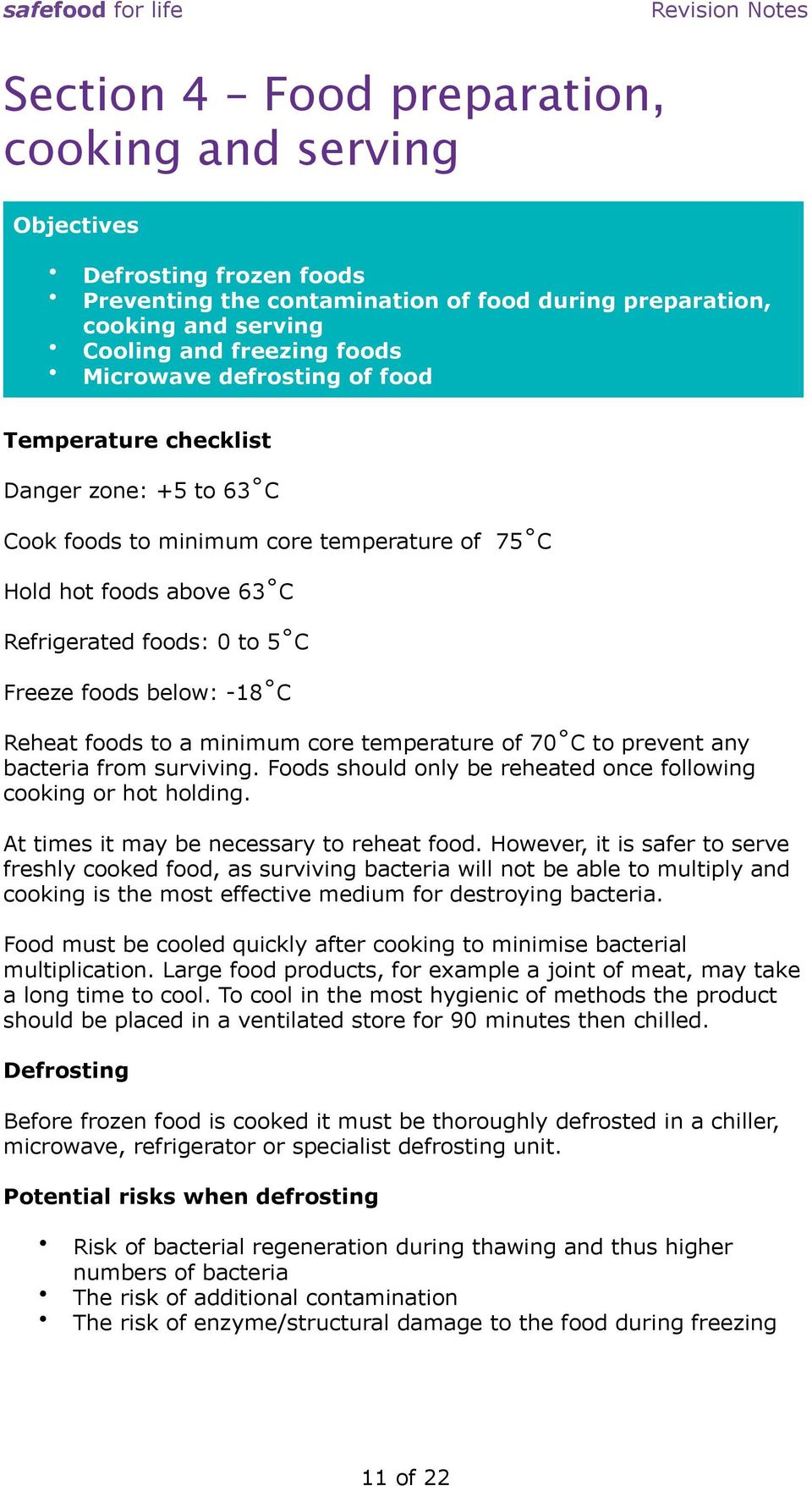
11 Section 4 Food preparation, cooking and serving Objectives Defrosting frozen foods Preventing the contamination of food during preparation, cooking and serving Cooling and freezing foods Microwave defrosting of food Temperature checklist Danger zone: +5 to 63 C Cook foods to minimum core temperature of 75 C Hold hot foods above 63 C Refrigerated foods: 0 to 5 C Freeze foods below: -18 C Reheat foods to a minimum core temperature of 70 C to prevent any bacteria from surviving. Foods should only be reheated once following cooking or hot holding. At times it may be necessary to reheat food. However, it is safer to serve freshly cooked food, as surviving bacteria will not be able to multiply and cooking is the most effective medium for destroying bacteria. Food must be cooled quickly after cooking to minimise bacterial multiplication. Large food products, for example a joint of meat, may take a long time to cool. To cool in the most hygienic of methods the product should be placed in a ventilated store for 90 minutes then chilled. Defrosting Before frozen food is cooked it must be thoroughly defrosted in a chiller, microwave, refrigerator or specialist defrosting unit. Potential risks when defrosting Risk of bacterial regeneration during thawing and thus higher numbers of bacteria The risk of additional contamination The risk of enzyme/structural damage to the food during freezing 11 of 22
12 Prevention of food contamination during food preparation Separate work areas, utensils, equipment for fish, meats and vegetables/salad Wash food in a designated food preparation sink using potable water only Minimise the time that food is left in the danger zone Minimise handling of food Prevention of contamination during holding and serving Never handle food that is ready to eat When keeping food cold it must be kept below? 5 C When keeping food hot it must be kept above? 63 C Hot food must be served within X minutes of cooking? 90 Cooling foods Use the following methods to cool food more rapidly through the danger zone Decanting Portioning Chilling Freezing and reheating Food should be suitably wrapped or placed in sealed containers Freeze food in portions Label and date food to aid stock rotation Allow air circulation Food should not be reheated more than once Reheat to a minimum core temperature of 70 C Microwave defrosting of frozen food Microwaves provide a method of cooking food. Food cooks from the outside inwards. Heat not the microwaves, kills the bacteria. Microwaves also provide a fast method of defrosting foods: it is important to ensure that food products are defrosted through to the core. Taking temperatures It is a legal requirement to ensure food is cooked to and stored at certain temperatures. In order to ensure these temperatures are being met the following measuring devices can be used and it may be useful to record all temperatures. Hard probe thermometer. When using a probe thermometer it should be properly calibrated, and cleaned using hot water and detergent after use. Before re-using the thermometer it should be disinfected with anti-bacterial wipes Infra red probe thermometer You must ensure that the core temperature is checked with a thermometer. The core is the centre or thickest part of the food. 12 of 22

13 Section 5 Personal hygiene Objectives Identify the importance of personal hygiene in the work place Recognise good personal hygiene practices Explain how poor personal hygiene practices can cause contamination of food State the legal obligations in relation to personal health and hygiene. Did you know that you can act as a carrier of food poisoning? Did you know you have a moral and legal responsibility not to contaminate food? Personal hygiene is defined as Keeping the body, including the hair and especially the hands, clean. Avoiding poor personal hygiene habits Wearing clean, protective outer clothing and appropriate headgear Why is personal hygiene important? It prevents food poisoning/contamination To comply with the law Appearance Staff morale What is a carrier? A person who harbours, and may pass on, harmful bacteria, even though that person may show no signs. There is no excuse not to wash your hands - it is a legal requirement in food premises to provide separate facilities for washing hands. The main reason food handlers wash their hands is to protect food from biological contamination. When should hands be washed? Before Starting work Handling food, especially if cooked or ready-to-eat, as the product will receive no further treatment to eradicate bacteria Changing from one job to another, e.g. between handling money and preparing food. 13 of 22

14 And after Using the toilet Handling raw meat Sneezing, coughing, blowing your nose Touching eyes, nose, face, hair, mouth, cuts Smoking, coffee/lunch breaks and cleaning duties Handling money or waste Protective clothing should be worn to protect food from bacteria that may have been picked up outside the work place. Personal clothing should be stored in a designated area away from food products as bacteria carried on clothes could contaminate the food. Protective clothing should be: Bright coloured (easily identifiable if anything drops into food product) Comfortable Washable and changed frequently (personal hygiene reasons) Without external pockets (objects then cannot become dislodged and fall into products) Fastened by means of studs, Velcro or zips (buttons may become loose and fall into products) It should also include a suitable hat and hairnet And non-slip safety footwear Food workers must not wear: Nail varnish it can chip into food Perfume/aftershave it can taint a food taste Watches and jewellery can harbour dirt and bacteria, can also fall into food Long nails can harbour bacteria, so keep nails short. Poor personal hygiene practices Smoking, coughing/sneezing over food, nail biting, nose picking, finger tasting. If a food worker has an open sore or cut, they must cover this with a brightly coloured plaster - the bright colour is easier to see if it falls into food. Food workers must report all instances of diarrhoea, vomiting and skin infections to a supervisor before returning to work and must not work while suffering from these symptoms. The employee must receive medical clearance before returning to work. 14 of 22

15 Personal injuries - The skin is a natural source of infection - Cuts which become septic contain high numbers of bacteria - Even cuts and abrasions can be infected - Poor food handling and hand washing habits can transfer bacteria to food and surfaces, i.e. cross-contamination. 15 of 22

16 Section 6 Design and layout of food premises and pest control Objectives Identify the requirements relating to the design and layout of food premises Identify the role of the Health Service Executive (HSE) in monitoring food List the main types of food pest and recognise the signs of an infestation Identify preventative and control measures for food pests The design, layout and construction of food premises should: Permit adequate cleaning Permit good food hygiene practices, including protection against cross-contamination The role of the Health Service Executive All food outlets must be registered/have prior approval with the Health Service Executive. The Health Service Executive is responsible for: Inspection of premises Operational hygiene Structural hygiene Personal hygiene Closing a food business Enforcement of legislation Enforcement officers have powers to: Enter and inspect food and premises Investigate and inspect food and premises Investigate outbreaks of food-borne disease and possible offences Remove suspect food and have it destroyed if it is considered to be unsafe to eat Serve improvement and prohibition notices Take food businesses to court for breaking food safety laws If the business is an imminent risk the enforcement officer can immediately close the business. Structural hygiene Equipment and work surfaces should be Mobile where possible Smooth, durable, non-absorbent/impervious and easy to clean 16 of 22

17 Wooden surfaces are not recommended as they are absorbent and do not permit adequate cleaning Service requirements Why is ventilation required? Provides staff comfort Prevents bacterial growth Reduces condensation and eliminates odours Why is lighting important? Safety Assists reading labels on packages Assists cleaning Assists the detection of pests Water supply Must be potable, i.e. fit to drink The water supply to food rooms, ice machines, dishwashers and glass washers must come directly from the rising mains Drains Drains must be connected either to the public sewer, a septic tank or an effluent system Grease traps should be provided to prevent blockage with grease or food waste There should be no open access to drainage systems in food rooms Refuse Bins should be fitted with lids, suitably located and emptied daily They should be operated by foot pedal so as not to contaminate hands and lined with a removal plastic liner. Prevent cross contamination within the kitchen by: Zoning Segregation of work areas for raw and cooked food Use of separate utensils, work surfaces and equipment for-ready-to eat and raw foods. Legal requirements It is a legal requirement in food premises to provide hand washing facilities. Employers must ensure that anyone who deals with food as part of their job and anyone whose work could affect food, e.g. cleaners, engineers, delivery drivers, etc, are supervised and given the required instruction and/or training appropriate to the work they carry out. They should 17 of 22

18 receive this training prior to entering a food area. First Aid equipment It is recommended in the Guide to Good Food Safety Practices that businesses have adequate & appropriate First Aid equipment, facilities & personnel on site to enable First Aid to be given In a small business a person should be appointed to take charge of the First Aid kit and call an ambulance if required In large businesses a qualified first aider may be required The first aid kit usually contains the following items: Individually wrapped sterile, adhesive dressings/plasters brightly coloured or with a metal strip so they can be detected if they fall into food Sterile eye pads Individually wrapped triangular bandages Individually wrapped sterile, waterproof dressings Disposable gloves Pest control Define a pest A food pest is any creature that lives on, or in, human food causing damage or contamination or both. The importance of pest control Pests are a hazard to public health they carry disease Pests damage and waste food Pests damage property Pests contaminate water storage tanks Signs of rodent activity e.g. mice Droppings, nibbled food packages, gnaw marks and holes, greasy smears on pipes and walls, paw marks in dust, shredded scraps of paper used for nesting. Signs of insect activity e.g. cockroach Moulted skins - cockroaches Larvae/eggs - bluebottles Webbings/Frass - mites & moths Droppings - rats & mice How can pests be controlled? The best method of preventing pest access to food premises is a mesh screen. Eliminate their food and shelter Rodent proof the building Set traps or lay bait Insect proof the building Insecticides and insectoculers Ultra violet insect killers 18 of 22

19 Section 7 Cleaning Objectives Storage and maintenance of cleaning equipment Cleaning products Cleaning programme Cloths Four stages of cleaning Cleaning equipment Storage and maintenance of cleaning equipment Store in a safe place away from food Use sluice sinks served with hot and cold water. Never wash food and utensils in a hand washing sink as cross-contamination could occur. Ensure ventilation in cleaning stores Never leave mops/cloths to soak overnight Cleaning chemicals must be clearly marked Cleaning products Detergents remove grease and dirt but do not kill bacteria, e.g. soap, wash-up liquid, washing powder, use with hot water for best results. Disinfectants (sometimes referred to as sanitisers) reduce the number of bacteria to a safe level, achieved by the use of very hot water, at 82 C or hotter, steam or chemical disinfectants. Sanitisers combined detergent and disinfectant. Sterilants kill all bacteria. Always use cleaning products according to the manufacturer s instructions It is important to disinfect/sanitise Food contact surfaces e.g. chopping boards, preparation tables etc. Hand contact surfaces e.g. handles doors, refrigerators, freezers. Contamination and bacterial multiplication hazards, e.g. cloths & mops. Cloths and their uses Cloths are a common source of contamination for this reason, single use disposable cloths are recommended. Make sure any cloths you use are clean and fit for the purpose. Different cloths should be used for different areas. 19 of 22

20 Tea towel/chef s cloth for holding hot items Dish cloth for washing dishes Single use cloths for wiping surfaces, mopping up spills, wiping hands and wiping sides of dishes before serving. The four stages of cleaning Pre-clean: removal of heavy soiling by sweeping, wiping or pre-rinsing Main-clean: use of detergents to remove grease & dirt Rinse: removal of detergent and dirt Disinfection: reduce bacteria to a safe level Guidance on cleaning equipment, e.g. chillers Remove all food Keep food under refrigeration while cleaning the chiller Clean the chiller from top to bottom Ensure the chiller is at the appropriate temperature before you return the food from the refrigerator. 20 of 22

21 Section 8 - HACCP Objectives Explain the term HACCP Give two reasons why HACCP is important in a food business 7 steps in HACCP Review of HACCP Food Safety Management Documentation HACCP Hazard Analysis Critical Control Point. Food hygiene legislation requires food businesses to have a food safety management system such as HACCP or a system based on HACCP principles. The main principle of HACCP is to try to identify a potential problem or hazard that may occur at any stage before it happens and so guarantee the quality of the food. HACCP is a system used by food businesses to: Identify any step in the activities of their food business which is critical to ensuring food safety Implement safety measures to reduce risks to health. The seven basic steps in HACCP 1. Identify the hazards associated with the food business, e.g. a hazard could be a chemical contaminant 2. Identify points where hazards may occur the hazard may occur if the food is left out when cleaning - and how this can be controlled 3. Establish limits to allow these hazards to be controlled at each critical point 4. Establish monitoring procedures to measure the limits set for each point identified at step Determine what corrective action would be required if the control of a hazard was unsuccessful 6. Establish recording procedures commensurate with the nature and extent of the food business 7. Establish verification and review procedures Review of systems A review of systems my be necessary if: The control measures are ineffective The product is unsatisfactory The type of product or ingredient changes e.g. frozen chickens are used instead of fresh, different seasoning etc. 21 of 22
22 New equipment is introduced, e.g. a new fridge, oven, etc. Complaints Poor laboratory results from food samples, etc. State the difference between a hazard and a risk. A hazard is anything that could cause harm to consumers and a risk is the likelihood that a hazard will cause harm. The use of documented food safety management systems It is a legal requirement to keep records as part of the HACCP - based food safety management system Record keeping helps to ensure that the business complies with the law and provides evidence of how the food is produced and handled Records need to show that the steps in the production and sale of food that are critical to food safety are being controlled. Types of records that might be kept Refrigerated storage, i.e. the date the food went into the fridge, daily recording of the temperature in the fridge, maintenance records Cooking and holding temperatures Cleaning records Staff training records provides evidence that staff have been trained to the required standard Pest control Goods received delivery temperatures. 22 of 22
Food delivery & storage
 screen 1 Food delivery & storage 7. Rubbish bags in the way of deliveries This screen shows a delivery scene with a number of potential hazards to food safety. As a starting point students are encouraged
FOOD HYGIENE & KITCHEN SAFETY
 FOOD HYGIENE & KITCHEN SAFETY [These are as collated for use at Union Baptist Church. We acknowledge the excellent work done by the Galashiels Presbytery in preparing the original document from which much
General food hygiene rules
 General food hygiene rules Why food hygiene is important? Good food hygiene is essential to ensure that the food you and your family eats is safe. Poor hygiene procedures in your home can put you at risk.
Good Hygiene Practices for Catering at Outdoor Events
 Good Hygiene Practices for Catering at Outdoor Events The following pages of advice are based on the requirements of Regulation (EC) 852/2004 on the Hygiene of Foodstuffs The Food Hygiene (England) Regulations
Hygiene Standards for all Food Businesses
 Hygiene Standards for all Food Businesses Food hygiene laws are not simply a list of rules. They are intended to let food business operators assess the risks to food safety in their business and apply
Table of Contents. Introduction... 1. Personal Hygiene... 2. Temperature Control... 5. Cross-contamination... 6. Cleaning and Sanitizing...
 Table of Contents Introduction... 1 Food Handler Certification Program... 1 Personal Hygiene... 2 Temperature Control... 5 Cross-contamination... 6 Cleaning and Sanitizing... 6 Dishwashing... 7 Food Storage...
Developing a school food safety plan based on HACCP system. (for school lunch box caterers)
 Developing a school food safety plan based on HACCP system (for school lunch box caterers) (I) Background/Introduction To further reduce food waste and disposable containers, the Government launched a
Level 2 Award in. Food Safety in Catering (QCF) Specification. Ofqual Accreditation Number 600/0343/1
 Level 2 Award in Food Safety in Catering (QCF) Specification Ofqual Accreditation Number 600/0343/1 Ofqual Accreditation Start Date 01/01/2011 Ofqual Accreditation End Date 30/07/2018 Ofqual Certification
Preparing Food at Home advice and legal requirements www.eastbourne.gov.uk/homecatering
 Preparing Food at Home advice and legal requirements www.eastbourne.gov.uk/homecatering Introduction This advice is aimed at people preparing food for others beside their immediate family either: a) on
Food Safety Guide for Family Day Care Educators
 Food Safety Guide for Family Day Care Educators Department of Health and Human Services About this Guide This Guide is designed to help Family Day Care (FDC) Educators make safe and healthy meals for the
SAFE HEALTHY CHILDREN A Health and Safety Manual for Childcare Providers
 TABLE OF CONTENTS Chapter 7: Food Storage and Preparation Safe Food: Food Storage and Preparation 7.1 Requirements of the Day Nurseries Act... 7.2 Recommendations of the Medical Officer of Health... 7.2
FOOD SAFETY MANAGEMENT SYSTEM Based on the principles of Hazard Analysis Critical Control Points (HACCP)
 Adult Services FOOD SAFETY MANAGEMENT SYSTEM Based on the principles of Hazard Analysis Critical Control Points (HACCP) for use in ENTER NAME OF residential, nursing or day care centre CONTENTS Page 1.0
The Professional Food Handlers Guide. (In compliance with new Australian Food Safety Standards)
 The Professional Food Handlers Guide. (In compliance with new Australian Food Safety Standards) H Y GIENIC SOLUTIO N S This booklet is designed by Kimberly-Clark to assist you and your staff in achieving
Hygiene Rules in the Catering Sector
 INFORMATION Hygiene Rules in the Catering Sector More than 100,000 cases of illness are reported every year in Germany that may have been caused by microorganisms in food, in particular bacteria, viruses
ABU DHABI FOOD CONTROL AUTHORITY. Food Poisoning. www.facebook.com/adfca1. www.twitter.com/adfca. www.youtube.com/adfcamedia
 Food Poisoning جهاز أبوظبي للرقابة الغذائية ABU DHABI FOOD CONTROL AUTHORITY Food Poisoning www.facebook.com/adfca1 www.twitter.com/adfca www.youtube.com/adfcamedia Creating awareness among the consumers
HYGIENE IN THE GALLEY
 HYGIENE IN THE GALLEY - good advice for self-assessment aboard Guidance for company and ship s management and galley crew Good hygiene is thinking twice about things when cooking for others. To limit the
STANDARD OPERATING PROCEDURE S (SOP S) FOR HAZARDOUS ANALYSIS CRITICAL CONTROL POINT (HACCP) PLANS
 STANDARD OPERATING PROCEDURE S (SOP S) FOR HAZARDOUS ANALYSIS CRITICAL CONTROL POINT (HACCP) PLANS RECEIVING: All food must be from approved sources. Foods must be wholesome and not adulterated. No home-prepared
Qualification Specification HABC Level 3 Award in Supervising Food Safety in Catering (QCF)
 www.highfieldabc.com Qualification Specification HABC Level 3 Award in Supervising Food Safety in Catering (QCF) Qualification Number: 500/5471/5 Highfield House Heavens Walk Lakeside Doncaster South Yorkshire
Introduction to food hygiene
 screen 1 Introduction to food hygiene This screen shows a kitchen scene with a number of hazards to food safety. As a starting point students are encouraged to look at the screen and suggest things that
Home Food Safety Myths and Facts for Consumers. The Partnership for Food Safety Education
 10 Home Food Safety Myths and Facts for Consumers The Partnership for Food Safety Education 2014 For more Home Food Safety Mythbusters go to www.fightbac.org Myth #1 Freezing foods kills harmful bacteria
Camp Food Safety. High risk foods. Introduction
 Camp Food Safety S Item Code FS320004 May/04 Edition no 1 (103808) 0845 300 1818 Introduction This factsheet is designed to give basic guidance for food safety at camp. More detailed information is available
REQUIREMENTS FOR TRADE SHOWS
 REQUIREMENTS FOR TRADE SHOWS All Trade Show Booth operators who give out food samples must be approved before the event and licensed by Regina Qu Appelle Health Region prior to opening. Food sold for immediate
FOOD POISONING. Information Leaflet. Your Health. Our Priority. Infection Prevention Stepping Hill Hospital
 FOOD POISONING Information Leaflet Your Health. Our Priority. Page 2 of 5 What is Food Poisoning? Food poisoning is an illness that occurs after eating or drinking anything that is contaminated. Usually
Volume RESTAURANT X. 123 Main Street, Phoenix, Arizona. Food Safety Manual
 Volume 1 RESTAURANT X 123 Main Street, Phoenix, Arizona Food Safety Manual RESTAURANT X Food Safety Training Manual Note to New Author Thank you for your interest and your enthusiasm in developing your
The course and qualification may be taken as a stand-alone certificate, or as part of a wider course of training.
 Level 2 Foundation Award in Food Hygiene January 2016 Guided Learning Hours 7 Total Qualification Time 7 Ofqual Qualification Number 601/8306/8 Description: The RSPH Foundation Award in Food Hygiene is
FOOD SAFETY MANAGEMENT SYSTEM
 FOOD SAFETY MANAGEMENT SYSTEM Latest Revision May 2014 Reviewer: H&S Mgr. Next Revision January 2016 Compliance Food Hygiene (England & Wales) Regulations 2006 Associated Policies Contents All H&S Policies
Candidate Study Guide for the Illinois Food Service Sanitation Manager Examinations
 Candidate Study Guide for the Illinois Food Service Sanitation Manager Examinations This information is intended to help you prepare for the Illinois Food Service Sanitation Manager Examinations. Part
RELEVANT HACCP CHARTS: Preparation, Service
 HOUSE RULES PERSONAL HYGIENE 4.8 RELEVANT HACCP CHARTS: Preparation, Service PERSONAL HYGIENE HOUSE RULES Why is personal hygiene important? People working in your business can contaminate food or spread
This quick guide provides a summary of food safety and labelling advice for small scale home producers of chutneys, pickles, flavoured oils and jams.
 This quick guide provides a summary of food safety and labelling advice for small scale home producers of chutneys, pickles, flavoured oils and jams. General Food Safety Advice Registration Food business
Design & layout of food premises & pest control
 screen 1 Design & layout of food premises & pest control This screen shows a busy kitchen scene with a number of hazards to food safety. As a starting point students are encouraged to look at the screen
Standard 3.2.2. Food Safety Practices and General Requirements
 Standard 3.2.2 Food Safety Practices and General Requirements AUSTRALIA NEW ZEALAND FOOD STANDARDS CODE CHAPTER 3 (AUSTRALIA ONLY) A GUIDE TO THE FOOD SAFETY STANDARDS SECOND EDITION, JANUARY 2001 AUSTRALIA
A GUIDE TO AVA FOOD FACTORY GRADING SYSTEM
 A GUIDE TO AVA FOOD FACTORY GRADING SYSTEM Introduction The main objective of the Food Factory Grading System is to ensure that the food manufacturers observe good manufacturing practices so as to produce
FIVE KEYS TO SAFER FOOD MANUAL
 FIVE KEYS TO SAFER FOOD MANUAL DEPARTMENT OF FOOD SAFETY, ZOONOSES AND FOODBORNE DISEASES FIVE KEYS TO SAFER FOOD MANUAL DEPARTMENT OF FOOD SAFETY, ZOONOSES AND FOODBORNE DISEASES INTRODUCTION Food safety
Draft. Draft. Procedures to maintain food safety. Food safety requirements and regulations. Introduction. Key terms.
 Learning aim A TOPIC A.1 Procedures to maintain food safety Introduction Within a hospitality business, all staff need to be aware of and comply with food safety and health and safety procedures. Consider
Name of Business. Record 1- Approved Food Suppliers List
 Record 1- Approved Food Suppliers List Supplier No. Details of Supplier (Name, address, contact details) Product Description Approved Supplier Date approved Corrective Action Reject suppliers that do not
Yorketown Community Children s Centre. Food Safety and Healthy Eating Policy
 Yorketown Community Children s Centre Food Safety and Healthy Eating Policy Policy Number 1 Link to CCQA Principles Family Day Care Quality Assurance (FDCQA) Quality Practices Guide (2004) Principle 4.2
Level 4 Award in Food Safety Management for Manufacturing
 Level 4 Award in Food Safety Management for Manufacturing December 2008 This qualification has a Credit Value of 6 Description This qualification covers all of the necessary aspects of food hygiene and
Cider/Perry Making on a small (Craft) scale
 Cider/Perry Making on a small (Craft) scale Recommended Food Safety/Standards Guide. This guide has been created to assist small scale cider/perry producers, not just with maintaining standards but also
HACCP and ISO 22000 food safety management synergies with Environmental Management System
 HACCP and ISO 22000 food safety management synergies with Environmental Management System Horizon 2020 Clean Technologies: Application to the food processing industry 2012 04 25 Agenda 2 Food safety standard
Food Poisoning Facts By Dr Yunes Teinaz Acting Head of Environmental Health London Borough of Hackney
 Food Poisoning Facts By Dr Yunes Teinaz Acting Head of Environmental Health London Borough of Hackney The World Health Organization (WHO) reports that each year two billion illnesses are caused by unsafe
GUIDELINES. for COTTAGE INDUSTRY INVOLVED in HOME FOOD PRODUCTION
 GUIDELINES for COTTAGE INDUSTRY INVOLVED in HOME FOOD PRODUCTION ENVIRONMENTAL HEALTH PO Box 2000, 16 Garfield Street Charlottetown, PEI CIA 7N8 Tel: 368-4970 / Fax: 368-6468 These guidelines have been
NHS Foundation Trust WARD FOOD HYGIENE POLICY
 Infection Control Committee NHS Foundation Trust WARD FOOD HYGIENE POLICY Page 1 of 9 1 CONTENTS 1 Introduction 2 Responsibility 3 Training 4 Occupational Health 5 Patient/Residents 6 Hand Hygiene 7 Protective
02.11 Food and Nutrition Services
 02.11 Purpose Audience To assure proper and safe food handling, storage, and preparation. All Department of employees. Personnel The following guidelines shall be used to monitor proper and safe food handling,
Food Safety is in Your Hands! Alejandra Menjivar Community Nutrition Educator & Alejandra Navarro Community Nutrition Educator
 Food Safety is in Your Hands! Alejandra Menjivar Community Nutrition Educator & Alejandra Navarro Community Nutrition Educator Today s Class Food Safety is Important Good Personal Hygiene Receiving and
Good Hygiene Practices - presentation by -
 Good Hygiene Practices - presentation by - National Environment Agency 9 May 2006 Introduction Outline Personal hygiene Environmental hygiene Food hygiene Hygiene Common elements Personal hygiene Environmental
Flood Information for Food Businesses
 Flooding Advice Flood Information for Food Businesses Public Health If your food business has been flooded there could be a serious risk to public health from infection and food contamination. Do not prepare
There may be an additional section covering health and safety concerns which fall outside the scope of the national food hygiene rating scheme.
 Public Protection (food & safety) Food Premises Inspection Report Name of Business: The Merchants of Spice Address of food business: 30-32 Colegate, Norwich, NR3 1BG Date of Inspection: 5 November 2015
Workbook for Developing an Active Food Safety Management System
 Workbook for Developing an Active Food Safety Management System A food safety management system will help to minimize the risk of foodborne illness in your food service establishment. It includes all the
Introduction. Chapter 1
 Contents Chapter 1 Introduction 1 Chapter 2 What is a Food Safety Plan 2 Chapter 3 How to implement a Food Safety Plan 3 Stage 1: Planning Stage 2: Draw a flow diagram Stage 3: Develop a Food Safety Plan
Requirements for Temporary Food Establishments
 Requirements for Temporary Food Establishments Public Health-Madison and Dane County Environmental Health Division 2701 International Lane, Suite 204 Madison, WI 53704 (608) 243-0330 6/8/09 Requirements
Important Information for Vendors at Temporary Events
 Important Information for Vendors at Temporary Events As a food vendor, you are responsible for ensuring that your operation complies with the Colorado Retail Food Establishment Rules and Regulations.
Food safety guide for food businesses
 Food safety guide for food businesses Class 3 Temperature Time Cross-contamination Hygiene Allergens Food safety guide for food businesses Class 3 If you would like to receive this publication in an accessible
Food Safety Evaluation Checklist. Directions
 Food Safety Checklist The following self-assessment can help you find food safety gaps in your operation. It can also help you put food safety systems, such as active managerial control, into place. This
Understanding Foodborne Illness (Food Poisoning)
 Understanding Foodborne Illness (Food Poisoning) 9 Costs of Foodborne Illness (Food Poisoning) possible law suits from customers who are ill There have been numerous cases where restaurants have been sued
Tool for the development of a Food Safety Program for Catering and Retail premises. Program. Food Safety. March 2008
 To ol fo r th e d e ve l o p m e n t of a Fo o d Safety Program for C a t e r i n g a n d R e t a i l p r e m i s e s Program Tool for the development of a Food Safety Program for Catering and Retail premises
4. HOUSE RULES TEMPERATURE CONTROL
 4. HOUSE RULES TEMPERATURE CONTROL The House Rules Section contains 9 sub-sections each of which covers a particular subject of food safety management. Every House Rule sub-section begins with guidance
Food Safety Supervisor
 FSS Manual Food Safety Supervisor Student Manual SITXOHS002A Follow Workplace Hygiene Procedures and SITXFSA001A Implement Food Safety Procedures from the Tourism and Hospitality Training Package SIT07
How clean is your kitchen?
 Learning Objectives - There can be harmful microbes found on raw food, especially raw meat - The best way to destroy harmful microbes on meat is to cook thoroughly - Always wash your hands after touching
Tool for the development of a Food Safety Program for Childcare facilities. a Food Safety Program
 Tool for the development of a Food Safety Program for Childcare facilities Program Tool for the development of a Food Safety Program for Childcare facilities October 2008 Food Safety 1 Disclaimer The information
Food safety checklist How well does your food business rate?
 FOOD SAFETY RATING GUIDE Food safety checklist How well does your food business rate? Under Council s Eat Safe Brisbane food safety rating scheme, all licensed food businesses within Brisbane will be issued
Food Safety Is Top Priority
 In this chapter, find answers to the following questions: Why is food safety a top priority?... (page 2) What is a foodborne illness and foodborne outbreak?... (page 2) Foodborne Illness... (page 2) Foodborne
Food contamination. Screen description
 screen 1 Food contamination This screen shows bacteria just about to move from raw meat to a ready-to-eat food (cream gateau). This is known as cross contamination. Use this screen to start a discussion
CAC/RCP 1-1969, Rev. 4-2003 1
 CAC/RCP 1-1969, Rev.4-2003 Page 1 of 31 RECOMMENDED INTERNATIONAL CODE OF PRACTICE GENERAL PRINCIPLES OF FOOD HYGIENE CAC/RCP 1-1969, Rev. 4-2003 1 TABLE OF CONTENTS INTRODUCTION...3 SECTION I - OBJECTIVES...3
FOREIGN MATTER MANAGEMENT 36 QUESTION ASSESSMENT
 Name: Employee I.D. or Personal I.D. Number: Company Name: Department: Head of Department: I understand that this 36 question test proves that I know what I am doing and therefore gives me no reason whatsoever
Receiving and Storage
 Receiving and Storage Lesson 10 Overview Receiving and Storage Time 30 minutes Purpose To explain the relationship between receiving, food storage, and food safety Objectives At the conclusion of this
SOUTH CAROLINA. Downloaded January 2011
 SOUTH CAROLINA Downloaded January 2011 1401. General (II) B. When meals are catered to a facility, such meals shall be obtained from a meal service establishment graded by the Department, pursuant to R.61
MICROBIAL HAZARDS. Eating food contaminated with harmful microorganisms. These
 MICROBIAL HAZARDS Microorganisms are everywhere. They can be found in the air, in water, in soil, on animals, and even on humans. Some are beneficial, such as those used to make fermented dairy and meat
Professional Food Manager Certification Training Version 4.0
 Professional Food Manager Certification Training Version 4.0 Food Safety Center for Public Health Education Developed by the NSF Center for Public Health Education v Table of Contents Chapter 1 Introduction
Safer Pest Control for Child Care Facilities
 Safer Pest Control for Child Care Facilities A Guide to Help You Get Started Contents About This Guide 1 Keeping Children Safe 1 Setting Up an Integrated Pest Management Plan 1 1. Look for Signs of Pests
Food Safety: Temperature control of potentially hazardous foods
 Food Safety: Temperature control of potentially hazardous foods Guidance on the temperature control requirements of Standard 3.2.2 Food Safety Practices and General Requirements First printed edition August
Practice Test. Practice Tests and Answer Keys. Circle the best answer to each question below. Be sure to answer all 40 questions.
 Practice Tests and Answer Keys Practice Test Name Date Circle the best answer to each question below. Be sure to answer all 40 questions. 1 Why are infants and young children at higher risk for getting
Keep It Healthy! Food Safety Employee Guide
 Keep It Healthy! Food Safety Employee Guide Your Guide to Preventing Foodborne Illness Food Protection Program 450 W State St Boise, ID 83720-0036 www.foodsafety.idaho.gov *The information provided in
Health and Safety Department. Health and Safety Policy. Version Author Revisions Made Date 1 Paul Daniell First Draft (in this format) 11 July 2014
 Food Safety Policy July 2014 (v2).docx Food Safety Policy Originator name: Section / Dept: Implementation date: Clive Parkinson Health and Safety Department July 2014 Date of next review: July 2016 Related
Template for Review and Update of the Child Nutrition Food Safety Plan i
 Taking Care of Business: Food Safety and Finance for School Foodservice Template for Review and Update of the Child Nutrition Food Safety Plan Our Town District Child Nutrition Food Safety Plan City, Mississippi
Region of Waterloo Public Health SPECIAL EVENTS. Food Vendor Requirements
 Region of Waterloo Public Health SPECIAL EVENTS Food Vendor Requirements Date: Dear Food Vendor: Region of Waterloo Public Health (ROWPH) has been notified that you will be selling, serving food and/or
Preventing Cross-Contamination
 Preventing Cross-Contamination After completing this chapter, you will be able to identify: Food that may have been contaminated during receiving How to prevent cross-contamination when storing, prepping,
NHSScotland National Food Safety Assurance Manual
 NHSScotland National Food Safety Assurance Manual March 2014 Contents Page 1. Background... 4 1.2 Introduction... 5 1.3 Explanation of Hazard Analysis Critical Control Point (HACCP)... 6 1.4 The Codex
The original inspection report is reproduced below with brief notes showing what was found at the time of the re-rating visit <in blue>.
 National Food Hygiene Rating Scheme Re-rating Premises: Adults with disabilities Daycare at the Hamlet Centre Original Inspection Date: 16.01.2012 Request Date: 31.05.2012 Re-rating Visit Date: 13.09.2012
Practice Test. 1. Which of the following statements is true? After touching raw ground beef, it is important to:
 Practice Test This test shows you what you might see on the food handler certification test. You can use the book to look up the answers. The certification test is made up of 32 questions and you will
Food manager certification/recertification training Food manager orientation of food safety programs Preparation for food management employment
 NEHA 720 South Colorado Boulevard, Suite 1000-N Denver, Colorado 80246-1926 Tel (303) 756-9090 ext. 340 Fax (303) 691-9490 Email [email protected] Web www.nehatraining.org Two-Day Syllabus NEHA
Ensure appropriate food safety practices are followed whilst food is prepared, cooked and served
 This Unit has the following elements: Element 1 (3GEN1.1) Element 2 (3GEN1.2) Apply and monitor your organisation s food safety procedures Identify and respond to food safety hazards Candidate Name: Assessment
Food Safety Guidance for Farmers Markets
 Food Safety Guidance for Farmers Markets Anyone selling food or drink from a market stall must comply with food hygiene legislation. Foods which are categorised as high risk include cooked meats, fish
YOUR GUIDE TO HACCP. Public Protection Service, PO Box 14, Trafford Town Hall, Talbot Road, Stretford, Trafford, M32 OYZ
 YOUR GUIDE TO HACCP Public Protection Service, PO Box 14, Trafford Town Hall, Talbot Road, Stretford, Trafford, M32 OYZ Telephone: 0161 912 4916 Fax: 0161 912 1113 www.trafford.gov.uk Page 1 of 52 20/02/06
Maricopa County. Food Code References for Produce. Receiving. Storage
 Maricopa County Environmental Services Department 1001 N. Central. Avenue Suite 300 Phoenix, AZ 85004 esd.maricopa.gov Food for Produce This guidance document was developed for food establishments interested
Bosch kitchen hygiene tips.
 Bosch kitchen hygiene tips. www.bosch-home.com/ae Do you know? The bathroom may have the reputation of being the dirtiest room in the house, but the kitchen is actually the danger zone filled with germs
Standard 3.1.1. Interpretation and Application
 Standard 3.1.1 Interpretation and Application AUSTRALIA NEW ZEALAND FOOD STANDARDS CODE CHAPTER 3 (AUSTRALIA ONLY) A GUIDE TO THE FOOD SAFETY STANDARDS SECOND EDITION, JANUARY 2001 AUSTRALIA NEW ZEALAND
PERSONAL GÄSTER. Guide Book FOR SERVERS AND SELLERS OF FOOD, CLASS II BEER, TOBACCO AND OTC MEDICINES
 PERSONAL GÄSTER Guide Book FOR SERVERS AND SELLERS OF FOOD, CLASS II BEER, TOBACCO AND OTC MEDICINES WHAT WAS THE RULE AGAIN? You may already know which rules apply to servers and sellers of food, Class
HACCP Plan Designing a HACCP Plan for Your Facility. Calvert County Health Department Division of Environmental Health
 HACCP Plan Designing a HACCP Plan for Your Facility Calvert County Health Department Division of Environmental Health What is a HACCP Plan? HACCP stands for Hazard Analysis Critical Control Point. It is
STUDY GUIDE: ABATTOIR HYGIENE
 STUDY GUIDE: ABATTOIR HYGIENE In Collaboration with the Directorate Veterinary Services National Department of Agriculture January 2007 Study guide Abattoir Hygiene January 2007 1 CONTENTS MODULES ABATTOIR
SOUTH CAROLINA DEPARTMENT OF AGRICULTURE FOOD SAFETY DIVISION GUIDELINES FOR FOOD PROCESSORS (REVISED)
 SOUTH CAROLINA DEPARTMENT OF AGRICULTURE FOOD SAFETY DIVISION GUIDELINES FOR FOOD PROCESSORS 2013 (REVISED) SOUTH CAROLINA DEPARTMENT OF AGRICULTURE PRODUCT TO PRODUCTION GETTING STARTED FROM SCRATCH If
Safer food bet ter business for caterers
 Safer food bet ter business for caterers This page has been left intentionally blank Working with food? What you need to know before you start It is easy for you to spread bacteria to food without realising.
Controlling rats and mice. A guide to preventing infestations and getting rid of them
 Controlling rats and mice A guide to preventing infestations and getting rid of them General information about rats and mice The house mouse and the brown rat are common rodent pests. We all have a responsibility
FOOD HANDLERS GUIDELINES
 FOOD HANDLERS GUIDELINES MEDICAL SURVEILLANCE OF FOOD HANDLERS AMPATH 2007 We are what we eat One thing that we all have in common-we eat! And we eat every day. The Economic research service suggests that
CAC/RCP 1-1969, Rev. 4-2003 1
 CAC/RCP 1-1969, Rev.4-2003 Page 1 of 31 RECOMMENDED INTERNATIONAL CODE OF PRACTICE GENERAL PRINCIPLES OF FOOD HYGIENE CAC/RCP 1-1969, Rev. 4-2003 1 TABLE OF CONTENTS INTRODUCTION...3 SECTION I - OBJECTIVES...3
ON FARM FOOD SAFETY - REDUCING THE RISK
 ON FARM FOOD SAFETY - REDUCING THE RISK The Basics of Employee Hygiene Food safety starts on the farm, and the everyday activities and actions of you and your employees can greatly affect the safety of
Food Safety Management System For
 Food Safety Management System For Completed by on Review Dates Signed Signed Signed Signed Signed Signed Published and printed by Amber Valley Borough Council, Town Hall, Market Place, Ripley, Derbyshire
Requirements for Special Event Food Vendors
 Niagara Region PUBLIC HEALTH Requirements for Special Event Food Vendors Please be advised that it is the responsibility of each Special Event Food Vendor to be aware of and in full compliance with the
FOOD SAFETY FOR HOME BAKERS
 FOOD SAFETY FOR HOME BAKERS Contents Page Inspections 2 Food Hygiene Rating Scheme 2 Registering your Business 3 Other considerations and business opportunities 3 Food Safety Management Plan How to complete