
Documentation EP channel precise load cell analysis (resistor bridge), 24 bit. Version: Date:
|
|
|
- Nicholas Thomas
- 9 years ago
- Views:
Transcription
1 Documentation 1-channel precise load cell analysis (resistor bridge), 24 bit Version: Date:

2

3 Table of contents Table of contents 1 Foreword Notes on the documentation Safety instructions Documentation issue status Product overview Introduction Technical data Basic principles of strain gauge technology Basics of communication EtherCAT basics Watchdog settings EtherCAT state machine CoE Interface Distributed Clock Mounting and Cabling Mounting Dimensions Fixing Nut torque for connectors EtherCAT EtherCAT connection EtherCAT - Fieldbus LEDs Power supply Power Connection Status LEDs for power supply Power cable conductor losses M Conductor losses 7/8" Cabling UL Requirements ATEX Notes ATEX - Special conditions BG EtherCAT Box protection enclosure ATEX Documentation Signal connection Analog voltage inputs M Commissioning/Configuration Offline configuration settings - TwinCAT Online configuration settings - TwinCAT EtherCAT slave process data settings (PDO) Configuration via TwinCAT Basic function principles Application notes Calibration and adjustment Notices on analog specifications Voltage measurement Distributed Clocks mode (EL and only) Version:

4 Table of contents 6.11 Process data Object description and parameterization Example program Restoring the delivery state Appendix General operating conditions EtherCAT Box - Accessories Support and Service Version: 1.0.1

5 Foreword 1 Foreword 1.1 Notes on the documentation Intended audience This description is only intended for the use of trained specialists in control and automation engineering who are familiar with the applicable national standards. It is essential that the following notes and explanations are followed when installing and commissioning these components. The responsible staff must ensure that the application or use of the products described satisfy all the requirements for safety, including all the relevant laws, regulations, guidelines and standards. Disclaimer The documentation has been prepared with care. The products described are, however, constantly under development. For that reason the documentation is not in every case checked for consistency with performance data, standards or other characteristics. In the event that it contains technical or editorial errors, we retain the right to make alterations at any time and without warning. No claims for the modification of products that have already been supplied may be made on the basis of the data, diagrams and descriptions in this documentation. Trademarks Beckhoff, TwinCAT, EtherCAT, Safety over EtherCAT, TwinSAFE, XFC and XTS are registered trademarks of and licensed by Beckhoff Automation GmbH & Co. KG. Other designations used in this publication may be trademarks whose use by third parties for their own purposes could violate the rights of the owners. Patent Pending The EtherCAT Technology is covered, including but not limited to the following patent applications and patents: EP , EP , DE , DE with corresponding applications or registrations in various other countries. The TwinCAT Technology is covered, including but not limited to the following patent applications and patents: EP , US with corresponding applications or registrations in various other countries. EtherCAT is registered trademark and patented technology, licensed by Beckhoff Automation GmbH, Germany Copyright Beckhoff Automation GmbH & Co. KG, Germany. The reproduction, distribution and utilization of this document as well as the communication of its contents to others without express authorization are prohibited. Offenders will be held liable for the payment of damages. All rights reserved in the event of the grant of a patent, utility model or design. Version:

6 Foreword 1.2 Safety instructions Safety regulations Please note the following safety instructions and explanations! Product-specific safety instructions can be found on following pages or in the areas mounting, wiring, commissioning etc. Exclusion of liability All the components are supplied in particular hardware and software configurations appropriate for the application. Modifications to hardware or software configurations other than those described in the documentation are not permitted, and nullify the liability of Beckhoff Automation GmbH & Co. KG. Personnel qualification This description is only intended for trained specialists in control, automation and drive engineering who are familiar with the applicable national standards. Description of symbols In this documentation the following symbols are used with an accompanying safety instruction or note. The safety instructions must be read carefully and followed without fail! Serious risk of injury! Failure to follow the safety instructions associated with this symbol directly endangers the life and health of persons. DANGER Risk of injury! Failure to follow the safety instructions associated with this symbol endangers the life and health of persons. WARNING Personal injuries! Failure to follow the safety instructions associated with this symbol can lead to injuries to persons. CAUTION Damage to the environment or devices Failure to follow the instructions associated with this symbol can lead to damage to the environment or equipment. Attention Tip or pointer This symbol indicates information that contributes to better understanding. Note 6 Version: 1.0.1

7 Foreword 1.3 Documentation issue status Version Changes Parallel connection of strain gauges updated first publication 0.5 first preliminary version Firm and hardware version The documentation refers to the firm and hardware status that was valid at the time it was prepared. The properties of the modules are subject to continuous development and improvement. Modules having earlier production statuses cannot have the same properties as modules with the latest status. Existing properties, however, are always retained and are not changed, so that these modules can always be replaced by new ones. The firmware and hardware version (delivery state) can be found in the batch number (D number) printed at the side of the EtherCAT Box. Syntax of the batch number (D number) D: WW YY FF HH WW - week of production (calendar week) YY - year of production FF - firmware version HH - hardware version Example with D No : 29 - week of production year of production firmware version hardware version 01 Version:


8 Product overview 2 Product overview Introduction Fig. 1: 1-channel precise load cell analysis (resistor bridge), 24 bit The EP3356 EtherCAT Box enables direct connection of a resistor bridge or load cell in a 4-wire connection technology. The ratio between the bridge voltage U D and the supply voltage U ref is determined simultaneously in the input circuit and the final load value is calculated as a process value on the basis of the settings in the EP3356. With automatic self-calibration (can be deactivated), dynamic filters and distributed clock support, the EP3356 with measuring cycles of 100 µs can be used for fast and precise monitoring of torque or vibration sensors. Installation [} 28] Configuration [} 49] 8 Version: 1.0.1

9 Product overview Technical data Technical data Number of inputs Signal connection sockets [} 47] Resolution Conversion time 2, for 1 resistor bridge in full bridge technology M12 24 Bit, 32 bit presentation Nominal voltage 24 V DC (-15 %/+20 %) Distributed Clocks ms, configurable, max. 10,000 samples/s yes selectable modes yes (2) Measuring error Measuring range U D Measuring range U ref Supported nominal sensitivity Min. strain gauge resistor Input filter limit frequency (hardware) Filter (software) <±0.01 % for the calculated load value in relation to the final load value with a 12 V feed and 24 mv bridge voltage (hence nominal strain gauge characteristic value of 2 mv/v), self-calibration active, 50 Hz filter active. Attention: Due to external influences such as temperature drifts [} 10] and HF-disturbances may possibly occur a not insignificant error! max. -27 mv +27 mv typ. (see note concerning voltage measuring recommended: mv rated voltage max V V typ. (see note concerning voltage measuring recommended: mv rated voltage all, resolution of parameter: 0.01 µv/v Recommended: mv/v parallel operation of strain gauges only with suitable strain gauges recommended 10 khz low pass (-3 db) Present 50 Hz, Internal resistance >200 kω (U ref ), > 1 MΩ (U d ) Special features Sensor supply Current consumption from U S (without sensor current) Power supply connection Permissible ambient temperature during operation Permissible ambient temperature during storage Configurable: 50/60 Hz FIR notch filter, IIR low pass 4-fold averager self-calibration, quadruple averager, dynamic filters, fast data sampling, parallel connection 10 V (supplied by the EP3356) 120 ma feed: 1 x M8 male socket, 4-pin downstream connection: 1 x M8 female socket, 4-pin -25 C +60 C -40 C +85 C Vibration / shock resistance conforms to EN / EN EMC immunity/emission conforms to EN / EN Dimensions Weight Installation position 126 mm x 60 mm x 40 mm approx g variable Protection class IP65, IP66, IP67 (according to EN 60529) Approvals CE, UL Version:


10 Product overview 2.3 Basic principles of strain gauge technology Basic information on the technological field of "strain gauges/load cells" as metrological instruments is to be given below. The information is of general nature; it is up to the user to check the extent to which it applies to his application. Strain gauges serve either to directly measure the static (0 to a few Hz) or dynamic (up to several KHz) elongations, compressions or torsions of a body by being directly fixed to it, or to measure various forces or movements as part of a sensor (e.g. load cells/force transducers, displacement sensor, vibration sensors). In the case of the optical strain gauge (e.g. Bragg grating), an application of force causes a proportional change in the optical characteristics of a fiber used as a sensor. Light with a certain wavelength is fed into the sensor. Depending upon the deformation of the grating, which is laser-cut into the sensor, due to the mechanical load, part of the light is reflected and evaluated using a suitable measuring transducer (interrogator). The commonest principle in the industrial environment is the electrical strain gauge. There are many common terms for this type of sensor: load cell, weighbridge, etc. Structure of electrical strain gauges A strain gauge consists of a carrier material (e.g. stretchable plastic film) with an applied metal film from which a lattice of electrically conductive resistive material is worked in very different geometrical forms, depending on the requirements. Fig. 2: Strain gauge This utilizes a behavior whereby, for example in the case of strain, the length of a metallic resistance network increases and its diameter decreases, as a result of which its electrical resistance increases proportionally. ΔR/R = k*ε ε = Δl/l thereby corresponds to the elongation; the strain sensitivity is called the k-factor. This also gives rise to the typical track layout inside the strain gauge: the resistor track or course is laid in a meandering pattern in order to expose the longest possible length to the strain. Example The elongation ε = 0.1 % of a strain gauge with k-factor 2 causes an increase in the resistance of 0.2 %. Typical resistive materials are constantan (k~2) or platinum tungsten (92PT, 8W with k ~4). In the case of semiconductor strain gauges a silicon structure is glued to a carrier material. The conductivity is changed primarily by deformation of the crystal lattice (piezo-resistive effect); k-factors of up to 200 can be achieved. Measurement of signals The change in resistance of an individual strain gauge can be determined in principle by resistance measurement (current/voltage measurement) using a 2/3/4-conductor measurement technique 10 Version: 1.0.1

11 Product overview Usually 1/2/4 strain gauges are arranged in a Wheatstone bridge (-> quarter/half/full bridge); the nominal resistance/impedance R 0 of all strain gauges (and the auxiliary resistors used if necessary) is usually equivalent to R1=R2=R3=R4=R 0. Typical values in the non-loaded state are R 0 = 120 Ω, 350 Ω, 700 Ω and 1 kω. The full bridge possesses the best characteristics such as linearity in the feeding of current/voltage, four times the sensitivity of the quarter-bridge as well as systematic compensation of disturbing influences such as temperature drift and creeping. In order to achieve high sensitivity, the 4 individual strain gauges are arranged on the carrier in such a way that 2 are elongated and 2 are compressed in each case. Fig. 3: quarter, half and full bridge The measuring bridges can be operated with constant current, constant voltage, or also with AC voltage using the carrier frequency method. Note Measuring procedure The Beckhoff EL/KL335x Terminals and the EP3356 Box support only the constant excitation Full bridge strain gauge at constant voltage (ratiometric measurement) Since the relative resistance change ΔR is low in relation to the nominal resistance R 0, a simplified equation is given for the strain gauge in the Wheatstone bridge arrangement: U D /U V = ¼ * (ΔR1-ΔR2+ΔR3-ΔR4)/R 0 ΔR usually has a positive sign in the case of elongation and a minus sign in the case of compression. A suitable measuring instrument measures the bridge supply voltage U V (or U Supply ) and the resulting bridge voltage U D (or U Bridge ), and forms the quotients from both voltages, i.e. the ratio. After further calculation and scaling the measured value is output, e.g. in kg. Due to the division of U D and U V the measurement is in principle independent of changes in the supply voltage. If the voltages U V and U D are measured simultaneously, i.e. at the same moment, and placed in relation to each other, then this is referred to as a ratiometric measurement. The advantage of this is that (with simultaneous measurement!) brief changes in the supply voltage (e.g. EMC effects) or a generally inaccurate or unstable supply voltage likewise have no effect on the measurement. A change in U V by e.g. 1 % creates the same percentage change in U D according to the above equation. Due to the simultaneous measurement of U D and U V the error cancels itself out completely during the division. 4-conductor vs. 6-conductor connection If supplied with a constant voltage of 5 to 12 V a not insignificant current flows of e.g. 12 V/350 Ω = 34.3 ma. This leads not only to dissipated heat, wherein the specification of the strain gauge employed must not be exceeded, but possibly also to measuring errors in the case of inadequate wiring due to line losses not being taken into account or compensated. In principle a full bridge can be operated with a 4-conductor connection (2 conductors for the supply U V and 2 for the measurement of the bridge voltage U D ). If, for example, a 25 m copper cable (feed + return = 50 m) with a cross section q of 0.25 mm² is used, this results in a line resistance of RL = l/ (κ * q) = 50 m / (58 S*m/mm² * 0.25 mm²) = 3.5 Ω Version:

12 Product overview If this value remains constant, then the error resulting from it can be calibrated out. However, assuming a realistic temperature change of, for example, 30 the line resistance R L changes by ΔRL =30 * 3.9 * 10-4 * 3.5 Ω = 0.41 Ω In relation to a 350 Ω measuring bridge this means a measuring error of > 0.1 %. Fig. 4: 4-conductor connection This can be remedied by a 6-conductor connection, in particular for precision applications (only possible with EL3356). Fig. 5: 6-conductor connection 12 Version: 1.0.1

13 Product overview The supply voltage U V is thereby fed to the strain gauge (= current carrying conductor). The incoming supply voltage U ref is only measured with high impedance directly at the measuring bridge in exactly the same way as the bridge voltage U D with two currentless return conductors in each case. The conductor-related errors are hence omitted. Since these are very small voltage levels of the order of mv and µv, all conductors should be shielded. The shield must be connected to pin 5 of the M12 connector. Note : No 6-conductor connection necessary The connection of a strain gauge over 4-conductor with the is sufficient because due to the shorter cable lengths no measurement errors occur. Structure of a load cell with a strain gauge One application of the strain gauge is the construction of load cells. This involves gluing strain gauges (full bridges as a rule) to an elastic mechanical carrier, e.g. a doublebending beam spring element, and additionally covered to protect against environmental influences. The individual strain gauges are aligned for maximum output signals according to the load direction (2 strain gauges in the elongation direction and 2 in the compression direction). Fig. 6: Example of a load cell The most important characteristic data of a load cell Characteristic data Please enquire tot he sensor manufacturer regarding the exact characteristic data! Note Nominal load E max Maximum permissible load for normal operation, e.g. 10 kg Nominal characteristic value mv/v Version:

14 Product overview The nominal characteristic value 2 mv/v means that, with a supply of U S =10 V and at the full load E max of the load cell, the maximum output voltage U D = 10 V * 2 mv/v *E = 20 mv. The nominal characteristic value is always a nominal value a manufacturer s test report is included with good load cells stating the characteristic value determined for the individual load cell, e.g mv/v. Minimum calibration value V min This indicates the smallest mass that can be measured without the maximum permissible error of the load cell being exceeded [RevT]. This value is represented either by the equation V min = E max / n (where n is an integer, e.g ), or in % of E max (e.g. 0.01). This means that a load cell with E max = 10 kg has a maximum resolution of V min = 10 kg / = 1 g or V min = 10 kg * 0.01 % = 1 g. Accuracy class according to OIML R60 The accuracy class is indicated by a letter (A, B, C or D) and an additional number, which encodes the scale interval d with a maximum number n max (*1000); e.g. C4 means Class C with maximally 4000d scale intervals. The classes specify a maximum and minimum limit for scale intervals d: A: 50,000 unlimited B: ,000 C: ,000 D: The scale interval n max = 4000d states that, with a load cell with a resolution of V min = 1 g, a calibratable set of scales can be built that has a maximum measuring range of 4000d * V min = 4 kg. Since V min is thereby a minimum specification, an 8 kg set of scales could be built if the application allows with the same load cell, wherein the calibratable resolution would then fall to 8 kg/4000d = 2 g. From another point of view the scale interval n max is a maximum specification; hence, the above load cell could be used to build a set of scales with a measuring range of 4 kg, but a resolution of only 2000 divisions = 2 g, if this is adequate for the respective application. Also the classes differ in certain error limits related to non-repeatability/creep/tc Accuracy class according to PTB The European accuracy classes are defined in an almost identical way (source: PTB). Class Calibration value e Minimum load Max/e Fine scales Precision scales Commercial scales Coarse scales Minimum value g <= e 100 e g <= e <=0.05 g g <= e g <= e <=2 g g <= e 20 e 50 e 20 e 20 e Maximum value g <= e 10 e Minimum application range or minimum measuring range in % of rated load This is the minimum measuring range/measuring range interval, which a calibratable load cell/set of scales must cover. Example: above load cell E max = 10 kg; minimum application range e.g. 40 % E max 14 Version: 1.0.1
![0782 mv/v. Minimum calibration value V min This indicates the smallest mass that can be measured without the maximum permissible error of the load cell being exceeded [RevT].](/docs-images/48/19055675/images/page_14.jpg "This value is represented either by the equation V min = E max / n (where n is an integer, e.g. 10000), or in % of E max (e.g. 0.01).")
15 Product overview The used measuring range of the load cell must be at least 4 kg. The minimum application range can lie in any range between E min and E max, e.g. between 2 kg and 6 kg if a tare mass of 2 kg already exists for structural reasons. A relationship between n max and V min is thereby likewise apparent: 4000 * 1 g = 4 kg. There are further important characteristic values, which are for the most part self-explanatory and need not be discussed further here, such as nominal characteristic value tolerance, input/output resistance, recommended supply voltage, nominal temperature range etc. Parallel connection of strain gauges It is usual to distribute a load mechanically to several strain gauge load cells at the same time. Hence, for example, the 3-point bearing of a silo container on 3 load cells can be realized. Taking into account wind loads and loading dynamics, the total loading of the silo including the dead weight of the container can thus be measured. The mechanically parallel-connected load cells are usually also electrically connected in parallel and connect at two arbitrarily M12 sockets of (see figure below). To this end the following must be observed: the load cells must be matched to each other and approved by the manufacturer for this mode of operation the impedance of the load cells must be such that the current feed capability of the transducer electronics (max. 350 ma) is not overloaded. Fig. 7: Parallel connection of strain gauges Sources of error/disturbance variables Inherent electrical noise of the load cell Electrical conductors exhibit so-called thermal noise (thermal/johnson noise), which is caused by irregular temperature-dependent movements of the electrons in the conductor material. The resolution of the bridge signal is already limited by this physical effect. The rms value e n of the noise can be calculated by e n = 4kTRB In the case of a load cell with R 0 = 350 Ω at an ambient temperature T = 20 C (= 293 K) and a bandwidth of the measuring transducer of 50 Hz (and Boltzmann constant k = 1.38 * J/K), the rms e n = 16.8 nv. The peak-peak noise e pp is thus approx. e pp ~ 4* e n = 67.3 nv. Example: In relation to the maximum output voltage U out-max of a bridge with 2 mv/v and Us = 5 V, this corresponds to U out-max = 5 V * 2 mv/v = 10 mv. (For the nominal load) this results in a maximum resolution of 10 mv/67.3 nv = digits. Converted into bit resolution: ln(148588)/ln(2) = 17 bits. Interpretation: a higher digital measuring resolution than 17 bits is thus inappropriate for such an analog signal in the first Version:

16 Product overview step. If a higher measuring resolution is used, then additional measures may need to be taken in the evaluation chain in order to obtain the higher information content from the signal, e.g. hardware low-pass filter or software algorithms. This resolution applies alone to the measuring bridge without any further interferences. The resolution of the measuring signal can be increased by reducing the bandwidth of the measuring unit. If the strain gauge is glued to a carrier (load cell) and wired up, both external electrical disturbances (e.g. thermovoltage at connection points) and mechanical vibrations in the vicinity (machines, drives, transformers (mechanical and audible 50 Hz vibration due to magnetostriction etc.)) can additionally impair the result of measurement. Creep Under a constant load, spring materials can further deform in the load direction. This process is reversible, but it generates a slowly changing measured value during the static measurement. In an ideal case the error can be compensated by constructive measures (geometry, adhesives). 16 Version: 1.0.1

17 Product overview Hysteresis If even elongation and compression of the load cell take place, then the output voltage does not follow exactly the same curve, since the deformation of the strain gauge and the carrier may be different due to the adhesive and its layer thickness. Temperature drift (inherent heating, ambient temperature) Relatively large currents can flow in strain gauge applications, e.g. I = U S /R 0 = 10 V / 350 Ω = 26 ma. The power dissipation at the sensor is thus P V = U*I = 10 V * 26 ma = 260 mw. Depending on application/carrier material (= cooling) and ambient temperature, a not insignificant error can arise that is termed apparent elongation. The sensor manufacturers integrate suitable compensation elements in their strain gauges. Inadequate circuit technology As already shown, a full bridge may be able (due to the system) to fully compensate non-linearity, creep and temperature drift. Wiring-related measuring errors are avoided by the 6-conductor connection. References Some organizations are listed below that provide the specifications or documents for the technological field of weighing technology: OIML (ORGANISATION INTERNATIONALE DE MÉTROLOGIE LÉGALE) PTB - Physikalisch-Technischen Bundesanstalt WELMEC - European cooperation in legal metrology DAkkS Deutsche Akkreditierungsstelle Fachgemeinschaft Waagen (AWA) im Verband Deutscher Maschinen- und Anlagenbau VDMA Version:

18 Basics of communication 3 Basics of communication 3.1 EtherCAT basics Please refer to the chapter EtherCAT System Documentation for the EtherCAT fieldbus basics. 3.2 Watchdog settings General notes for setting the watchdog ELxxxx terminals and EPxxxx boxes are equipped with a safety feature (watchdog) that switches off the outputs after a specifiable time e.g. in the event of an interruption of the process data traffic, depending on the device and settings, e.g. in OFF state. The EtherCAT slave controller (ESC) in the EL2xxx terminals and EP2xxx boxes features 2 watchdogs: SM watchdog (default: 100 ms) PDI watchdog (default: 100 ms) SM watchdog (SyncManager Watchdog) The SyncManager watchdog is reset after each successful EtherCAT process data communication with the terminal. If no EtherCAT process data communication takes place with the terminal for longer than the set and activated SM watchdog time, e.g. in the event of a line interruption, the watchdog is triggered and the outputs are set to FALSE. The OP state of the terminal is unaffected. The watchdog is only reset after a successful EtherCAT process data access. Set the monitoring time as described below. The SyncManager watchdog monitors correct and timely process data communication with the ESC from the EtherCAT side. PDI watchdog (Process Data Watchdog) If no PDI communication with the EtherCAT slave controller (ESC) takes place for longer than the set and activated PDI watchdog time, this watchdog is triggered. PDI (Process Data Interface) is the internal interface between the ESC and local processors in the EtherCAT slave, for example. The PDI watchdog can be used to monitor this communication for failure. The PDI watchdog monitors correct and timely process data communication with the ESC from the application side. The settings of the SM- and PDI-watchdog must be done for each slave separately in the TwinCAT System Manager. 18 Version: 1.0.1


19 Basics of communication Fig. 8: EtherCAT tab--> Advanced Settings--> Behavior--> Watchdog Notes: the multiplier is valid for both watchdogs. each watchdog has its own timer setting, the outcome of this in summary with the multiplier is a resulting time. Important: the multiplier/timer setting is only loaded into the slave at the start up, if the checkbox is activated. If the checkbox is not activated, nothing is downloaded and the ESC settings remain unchanged. Multiplier Both watchdogs receive their pulses from the local terminal/box cycle, divided by the watchdog multiplier: 1/25 MHz * (watchdog multiplier + 2) = 100 µs (for default setting of 2498 for the multiplier) The standard setting of 1000 for the SM watchdog corresponds to a release time of 100 ms. The value in multiplier + 2 corresponds to the number of basic 40 ns ticks representing a watchdog tick. The multiplier can be modified in order to adjust the watchdog time over a larger range. Example "Set SM watchdog" This checkbox enables manual setting of the watchdog times. If the outputs are set and the EtherCAT communication is interrupted, the SM watchdog is triggered after the set time and the outputs are erased. This setting can be used for adapting a terminal/box to a slower EtherCAT master or long cycle times. The default SM watchdog setting is 100 ms. The setting range is Together with a multiplier with a range of this covers a watchdog period between 0...~170 seconds. Calculation Multiplier = 2498 watchdog base time = 125 MHz * ( ) = seconds = 100 µs Version:

20 Basics of communication SM watchdog = * 100 µs = 1 second watchdog monitoring time. CAUTION CAUTION Note CAUTION! Undefined state possible! The function for switching off of the SM watchdog via SM watchdog = 0 is only implemented in terminals from version In previous versions this operating mode should not be used. Caution! Damage of devices and undefined state possible! If the SM watchdog is activated and a value of 0 is entered the watchdog switches off completely. This is the deactivation of the watchdog! Set outputs are NOT set in a safe state, if the communication is interrupted. Outputs in SAFEOP state The default set watchdog monitoring sets the outputs of the module in a safe state depending on the settings in SAFEOP and OP e.g. in OFF state. If this is prevented by deactivation of the watchdog monitoring in the module, the outputs can be switched or set also in the SAFEOP state. 20 Version: 1.0.1

21 Basics of communication 3.3 EtherCAT state machine The state of the EtherCAT slave is controlled via the EtherCAT State Machine (ESM). Depending upon the state, different functions are accessible or executable in the EtherCAT slave. Specific commands must be sent by the EtherCAT master to the device in each state, particularly during the bootup of the slave. A distinction is made between the following states: Init Pre-Operational Safe-Operational and Operational Boot The regular state of each EtherCAT slave after bootup is the OP state. Fig. 9: EtherCAT state machine Init After switch-on the EtherCAT slave in the Init state. No mailbox or process data communication is possible. The EtherCAT master initializes sync manager channels 0 and 1 for mailbox communication. Pre-Operational (Pre-Op) During the transition between Init and Pre-Op the EtherCAT slave checks whether the mailbox was initialized correctly. In Pre-Op state mailbox communication is possible, but not process data communication. The EtherCAT master initializes the sync manager channels for process data (from sync manager channel 2), the FMMU channels and, if the slave supports configurable mapping, PDO mapping or the sync manager PDO assignment. In this state the settings for the process data transfer and perhaps terminal-specific parameters that may differ from the default settings are also transferred. Safe-Operational (Safe-Op) During transition between Pre-Op and Safe-Op the EtherCAT slave checks whether the sync manager channels for process data communication and, if required, the distributed clocks settings are correct. Before it acknowledges the change of state, the EtherCAT slave copies current input data into the associated DP- RAM areas of the EtherCAT slave controller (ECSC). Version:
22 Basics of communication In Safe-Op state mailbox and process data communication is possible, although the slave keeps its outputs in a safe state, while the input data are updated cyclically. Operational (Op) Before the EtherCAT master switches the EtherCAT slave from Safe-Op to Op it must transfer valid output data. In the Op state the slave copies the output data of the masters to its outputs. Process data and mailbox communication is possible. Boot In the Boot state the slave firmware can be updated. The Boot state can only be reached via the Init state. In the Boot state mailbox communication via the file access over EtherCAT (FoE) protocol is possible, but no other mailbox communication and no process data communication. 22 Version: 1.0.1
23 Basics of communication 3.4 CoE Interface General description The CoE interface (CANopen over EtherCAT) is used for parameter management of EtherCAT devices. EtherCAT slaves or the EtherCAT master manage fixed (read only) or variable parameters which they require for operation, diagnostics or commissioning. CoE parameters are arranged in a table hierarchy. In principle, the user has read access via the fieldbus. The EtherCAT master (TwinCAT System Manager) can access the local CoE lists of the slaves via EtherCAT in read or write mode, depending on the attributes. Different CoE parameter types are possible, including string (text), integer numbers, Boolean values or larger byte fields. They can be used to describe a wide range of features. Examples of such parameters include manufacturer ID, serial number, process data settings, device name, calibration values for analog measurement or passwords. The order is specified in 2 levels via hexadecimal numbering: (main)index, followed by subindex. The value ranges are Index: Subindex: A parameter localized in this way is normally written as x8010:07, with preceding "x" to identify the hexadecimal numerical range and a colon between index and subindex. The relevant ranges for EtherCAT fieldbus users are: x1000: This is where fixed identity information for the device is stored, including name, manufacturer, serial number etc., plus information about the current and available process data configurations x8000: This is where the operational and functional parameters for all channels are stored, such as filter settings or output frequency Other important ranges are: x4000: In some EtherCAT devices the channel parameters are stored here (as an alternative to the x8000 range). x6000: Input PDOs ("input" from the perspective of the EtherCAT master) x7000: Output PDOs ("output" from the perspective of the EtherCAT master) Note Availability Not every EtherCAT device must have a CoE list. Simple I/O modules without dedicated processor usually have no variable parameters and therefore no CoE list.. If a device has a CoE list, it is shown in the TwinCAT System Manager as a separate tab with a listing of the elements: Version:
24 Basics of communication Fig. 10: CoE-Online tab The figure above shows the CoE objects available in device "EL2502", ranging from x1000 to x1600. The subindices for x1018 are expanded. Data management Some parameters, particularly the setting parameters of the slave, are configurable and writeable. This can be done in write or read mode via the System Manager (see the figure above) by clicking. This is useful for commissioning of the system/slaves. Click on the row of the index to be parameterised and enter a value in the "SetValue" dialog. from the control system/plc via ADS, e.g. through blocks from the TcEtherCAT.lib library. This is recommended for modifications while the system is running or if no System Manager or operating staff are available. Note Data management If slave CoE parameters are modified online, Beckhoff devices store any changes in a failsafe manner in the EEPROM, i.e. the modified CoE parameters are still available after a restart. The situation may be different with other manufacturers. Start-up list Note Startup list Changes in the local CoE list of the terminal are lost if the terminal is replaced. If a terminal is replaced with a new Beckhoff terminal, it will have the default settings. It is therefore advisable to link all changes in the CoE list of an EtherCAT slave with the Startup list of the slave, which is processed whenever the EtherCAT fieldbus is started. In this way a replacement EtherCAT slave can automatically be parameterised with the specifications of the user. If EtherCAT slaves are used which are unable to store local CoE values permanently, the Startup list must be used. 24 Version: 1.0.1
25 Basics of communication Recommended approach for manual modification of CoE parameters Make the required change in the System Manager. The values are stored locally in the EtherCAT slave If the value is to be stored permanently, enter it in the Startup list. The order of the Startup entries is usually irrelevant. Fig. 11: Startup list in the TwinCAT System Manager The Startup list may already contain values that were configured by the System Manager based on the ESI specifications. Additional application-specific entries can be created. Online/offline list While working with the TwinCAT System Manager, a distinction has to be made whether the EtherCAT device is "available", i.e. switched on and linked via EtherCAT and therefore online, or whether a configuration is created offline without connected slaves. In both cases a CoE list as shown in Fig. 1 is displayed. The connectivity is shown as offline/online. If the slave is offline The offline list from the ESI file is displayed. In this case modifications are not meaningful or possible The configured status is shown under Identity No firmware or hardware version is displayed, since these are features of the physical device Offline is shown in red Version:
26 Basics of communication Fig. 12: Offline list If the slave is online The actual current slave list is read. This may take several seconds, depending on the size and cycle time The actual identity is displayed The firmware and hardware version of the equipment according to the electronic information is displayed Online is shown in green Fig. 13: Online list 26 Version: 1.0.1
27 Basics of communication Channel-based order The CoE list is available in EtherCAT devices that usually feature several functionally equivalent channels. For example, a 4-channel analog V input terminal also has 4 logical channels and therefore 4 identical sets of parameter data for the channels. In order to avoid having to list each channel in the documentation, the placeholder "n" tends to be used for the individual channel numbers. In the CoE system 16 indices, each with 255 subindices, are generally sufficient for representing all channel parameters. The channel-based order is therefore arranged in 16 dec /10 hex steps. The parameter range x8000 exemplifies this: Channel 0: parameter range x8000:00... x800f:255 Channel 1: parameter range x8010:00... x801f:255 Channel 2: parameter range x8020:00... x802f:255 This is generally written as x80n0. Detailed information on the CoE interface can be found in the EtherCAT system documentation on the Beckhoff website 3.5 Distributed Clock The distributed clock represents a local clock in the EtherCAT slave controller (ESC) with the following characteristics: Unit 1 ns Zero point :00 Size 64 bit (sufficient for the next 584 years; however, some EtherCAT slaves only offer 32-bit support, i.e. the variable overflows after approx. 4.2 seconds) The EtherCAT master automatically synchronizes the local clock with the master clock in the EtherCAT bus with a precision of < 100 ns For detailed information please refer to the EtherCAT system description. Version:
28 Mounting and Cabling 4 Mounting and Cabling 4.1 Mounting Dimensions Fig. 14: Dimensions of the EtherCAT Box Modules All dimensions are given in millimeters. Housing properties EtherCAT Box lean body wide body Housing material Casting compound PA6 (polyamide) Polyurethane Mounting two fastening holes Ø 3 mm for M3 two fastening holes Ø 3 mm for M3 two fastening holes Ø 4,5 mm for M4 Metal parts Contacts Power feed through Installation position Protection class Brass, nickel-plated CuZn, gold-plated max. 4 A variable Dimensions (H x W x D) ca. 126 x 30 x 26,5 mm Weight IP65, IP66, IP67 (conforms to EN 60529) when screwed together ca. 126 x 60 x 26,5 mm approx. 125 g, depending on module type approx. 250 g, depending on module type 28 Version: 1.0.1
29 Mounting and Cabling Fixing Note Note or pointer While mounting the modules, protect all connectors, especially the IP-Link, against contamination! Only with connected cables or plugs the protection class IP67 is guaranteed! Unused connectors have to be protected with the right plugs! See for plug sets in the catalogue. Modules with narrow housing are mounted with two M3 bolts. Modules with wide housing are mounted with two M3 bolts to the fixing holes located at the corners or mounted with two M4 bolts to the fixing holes located centrally. The bolts must be longer than 15 mm. The fixing holes of the modules are not threaded. When assembling, remember that the fieldbus connectors increases the overall height. See chapter accessories. Mounting Rail ZS The mounting rail ZS (500 mm x 129 mm) allows the time saving assembly of modules. The rail is made of stainless steel, 1.5 mm thick, with already pre-made M3 threads for the modules. The rail has got 5.3 mm slots to mount it via M5 screws to the machine. Fig. 15: Mounting Rail ZS The mounting rail is 500 mm long, that way 15 narrow modules can be mounted with a distance of 2 mm between two modules. The rail can be cut to length for the application. Mounting Rail ZS The mounting rail ZS (500 mm x 129 mm) has in addition to the M3 treads also pre-made M4 treads to fix 60 mm wide modules via their middle holes. Up to 14 narrow or 7 wide modules may be mixed mounted. Version:
30 Mounting and Cabling Nut torque for connectors M8 connectors It is recommended to pull the M8 connectors tight with a nut torque of 0.4 Nm. Fig. 16: EtherCAT Box with M8 connectors M12 connectors It is recommended to pull the M12 connectors tight with a nut torque of 0.6 Nm. Fig. 17: EtherCAT Box with M8 and M12 connectors 30 Version: 1.0.1

31 Mounting and Cabling 7/8" connectors It is recommended to pull the 7/8" connectors tight with a nut torque of 1.5 Nm. Fig. 18: 7/8" connectors Torque socket wrenches Fig. 19: ZB8801 torque socket wrench Note Ensure the right torque Use the torque socket wrenches available by Beckhoff to pull the connectors tight (see accessories [} 126])! Version:


32 Mounting and Cabling 4.2 EtherCAT EtherCAT connection For the incoming and ongoing EtherCAT connection, the EtherCAT Box (EPxxxx) has two M8 sockets, marked in green the Coupler Box (FBB-x110) has two M12 sockets Fig. 20: EtherCAT Box: M8 (30 mm housing) Fig. 21: EtherCAT Box: M8 60 mm housing (EP9214 for example ) 32 Version: 1.0.1
33 Mounting and Cabling Fig. 22: Coupler Box: M12 Assignment There are various different standards for the assignment and colors of connectors and cables for Ethernet/ EtherCAT. Ethernet/EtherCAT Plug connector Cable Standard Signal Tx + Tx - Rx + Rx - Description Transmit Data+ Transmit Data- Receive Data+ Receive Data- M8 M12 RJ45 1 ZB9010, ZB9020, ZB9030, ZB9032, ZK , ZK1090-3xxx-xxxx ZB9031 and old versions of ZB9030, ZB9032, ZK1090-3xxx-xxxx TIA-568B Pin 1 Pin 1 Pin 1 yellow 2 orange/white 3 white/ orange Pin 4 Pin 3 Pin 2 orange 2 orange 3 orange Pin 2 Pin 2 Pin 3 white 2 blue/white 3 white/green Pin 3 Pin 4 Pin 6 blue 2 blue 3 green Shield Shield Housing Shroud Screen Screen Screen 1 ) colored markings according to EN in the four-pin RJ45 connector ZS ) wire colors according to EN ) wire colors Note Assimilation of color coding for cable ZB9030, ZB9032 and ZK1090-3xxxxxxxx (with M8 connectors) For unification the prevalent cables ZB9030, ZB9032 and ZK1090-3xxx-xxxx this means the pre assembled cables with M8 connectors were changed to the colors of EN61918 (yellow, orange, white, blue).so different color coding exists. But the electrical properties are absolutely identical. Version:
34 Mounting and Cabling EtherCAT - Fieldbus LEDs Fig. 23: EtherCAT-LEDs LED display LED Display Meaning IN L/A off no connection to the preceding EtherCAT module Lit LINK: connection to the preceding EtherCAT module flashing ACT: Communication with the preceding EtherCAT module OUT L/A off no connection to the following EtherCAT module Lit LINK: connection to the following EtherCAT module flashing ACT: Communication with the following EtherCAT module Run off Status of the EtherCAT module is Init flashes quickly Status of the EtherCAT module is pre-operational flashes slowly Status of the EtherCAT module is safe-operational Lit Status of the EtherCAT module is operational Note EtherCAT statuses The various statuses in which an EtherCAT module may be found are described in the Basic System Documentation for EtherCAT, which is available for download from our website ( under Downloads. 34 Version: 1.0.1

35 Mounting and Cabling 4.3 Power supply Power Connection The feeding and forwarding of supply voltages is done via two M8 connectors at the bottom end of the modules: IN: left M8 connector for feeding the supply voltages OUT: right M8 connector for forwarding the supply voltages Fig. 24: EtherCAT Box, Connectors for power supply Fig. 25: Pin assignment M8, Power In and Power Out Table 1: PIN assignment Pin Voltage 1 Control voltage Us, +24 V DC 2 Auxiliary voltage Up, +24 V DC 3 GNDs* *) may be connected internally to each other depending on the module: see specific 4 GNDp* module descriptions The pins M8 connectors carry a maximum current of 4 A. Two LEDs display the status of the supply voltages. Attention Don't confuse the power connectors with the EtherCAT connectors! Never connect the power cables (M8, 24 V DC ) with the green marked EtherCAT sockets of the EtherCAT Box Modules! This can damage the modules! Control voltage Us: 24 V DC Power is supplied to the fieldbus, the processor logic, the inputs and the sensors from the 24 V DC control voltage Us. The control voltage is electrically isolated from the fieldbus circuitry. Version:
36 Mounting and Cabling Auxiliary voltage Up 24 V DC The Auxiliary voltage Up supplies the digital outputs; it can be brought in separately. If the load voltage is switched off, the fieldbus functions and the power supply and functionality of the inputs are retained. Redirection of the supply voltages The IN and OUT power connections are bridged in the module (not IP204x-Bxxx and IE204x). The supply voltages Us and Up can thus easily be transferred from EtherCAT Box to EtherCAT Box. Attention Pay attention to the maximum permissible current! Pay attention also for the redirection of the supply voltages Us and Up, the maximum permissible current for M8 connectors of 4 A must not be exceeded! 36 Version: 1.0.1

37 Mounting and Cabling Supply via EP92x PowerBox modules If the machine requires higher current or if the EtherCAT Box Modules are installed far away from the control cabinet with included power supply, the usage of four cannel power distribution modules EP9214 or EP9224 (with integrated data logging, see is recommended. With these modules intelligent power distribution concepts with up to 2 x 16 A and a maximum of 2.5 mm² cable cross-section can be realized. Fig. 26: EP92x4-0023, Connectors for Power In and Power Out Fig. 27: Pin assignment 7/8, Power In and Power Out Electrical isolation Digital modules In the digital input/output modules, the grounds of the control voltage (GNDs) and the auxiliary voltage (GNDp) are connected to each other! Check this at the documentation of each used EtherCAT Box. Analog modules In the analog input/output modules the grounds of the control voltage (GNDs) and the auxiliary voltage (GNDp) are separated from each other in order to ensure electrical isolation of the analog signals from the control voltage. In some of the analog modules the sensors or actuators are supplied by Up - this means, for instance, that in the case of V inputs, any reference voltage ( V) may be connected to Up; this is then available to the sensors (e.g. smoothed 10 V for measuring potentiometers). Version:

38 Mounting and Cabling Details of the power supply may be taken from the specific module descriptions. Attention Electrical isolation may be cancelled! If digital and analog fieldbus boxes are connected directly via four-core power leads, the analog signals in the fieldbus boxes may be no longer electrically isolated from the control voltage! Status LEDs for power supply Fig. 28: Status LEDs for power supply LED display LED Display Meaning Us (Control voltage) off The power supply voltage Us is not present green illuminated red illuminated The power supply voltage Us is present Because of overload (current > 0.5 A) the sensor supply generated from power supply voltage Us was switched off for all sensors fed from this. Up (Auxiliary voltage) off The power supply voltage Up is not present green illuminated The power supply voltage Up is present 38 Version: 1.0.1
39 Mounting and Cabling Power cable conductor losses M8 The ZK2020-xxxx-yyyy power cables should not exceed the total length of 15 m at 4 A (with continuation). When planning the cabling, note that at 24 V nominal voltage, the functionality of the module can no longer be assured if the voltage drop reaches 6 V. Variations in the output voltage from the power supply unit must also be taken into account. Fig. 29: Power cable conductor losses Example 8 m power cable with 0.34 mm² cross-section has a voltage drop of 3.2 V at 4 A. Note EP92x4 Power Distribution Modules With EP9214 and EP9224 Power Distribution Modules intelligent concepts for voltage supply are available. Further information may be found under Version:
40 Mounting and Cabling Conductor losses 7/8" In the case of the power cables ZK2030-xxxx-yyy, a total length of 15 m should not be exceeded at 16 A. When wiring, note that with a rated voltage of 24 V the function of the modules can no longer be guaranteed from a voltage drop of 6 V. Variations in the output voltage from the power supply unit must also be taken into account. Fig. 30: ZK2030-xxxx-yyy - Conductor losses Alternatively, larger cable cross-section can be used, e.g. 2.5 mm Version: 1.0.1

41 Mounting and Cabling 4.4 Cabling A list of the EtherCAT cable, power cable, sensor cable, Ethernet-/EtherCAT connectors and the field assembled connectors can be found at the following link: document/catalog/main_catalog/english/beckhoff_ethercat-box-accessories.pdf You can find the corresponding data sheets at the following link: data_sheets.htm?id= EtherCAT cable Fig. 31: ZK xxx For connecting EtherCAT devices only shielded Ethernet cables that meet the requirements of at least category 5 (CAT5) according to EN or ISO/IEC should be used. Note Recommendations about cabling You may get detailed recommendations about cabling EtherCAT from the documentation "Recommendations for the design of the infrastructure for EtherCAT/Ethernet", that is available for download at EtherCAT uses 4 wires for signal transfer. Due to automatic cable detection (auto-crossing) symmetric (1:1) or cross-over cables can be used between EtherCAT devices from Beckhoff. Version:

42 Mounting and Cabling Power cable Fig. 32: ZK xxx Sensor cable Fig. 33: Selection of Beckhoff Sensor cable 42 Version: 1.0.1
43 Mounting and Cabling 4.5 UL Requirements The installation of the EtherCAT Box Modules certified by UL has to meet the following requirements. Supply voltage CAUTION CAUTION CAUTION! by a 24 V DC supply voltage, supplied by an isolating source and protected by means of a fuse (in accordance with UL248), rated maximum 4 Amp, or by a 24 V DC power source, that has to satisfy NEC class 2. A NEC class 2 power supply shall not be connected in series or parallel with another (class 2) power source! CAUTION! To meet the UL requirements, the EtherCAT Box Modules must not be connected to unlimited power sources! Networks CAUTION CAUTION! To meet the UL requirements, EtherCAT Box Modules must not be connected to telecommunication networks! Ambient temperature range CAUTION CAUTION! To meet the UL requirements, EtherCAT Box Modules has to be operated only at an ambient temperature range of 0 to 55 C! Marking for UL All EtherCAT Box Modules certified by UL (Underwriters Laboratories) are marked with the following label. Fig. 34: UL label Version:
44 Mounting and Cabling 4.6 ATEX Notes ATEX - Special conditions WARNING Observe the special conditions for the intended use of EtherCAT Box modules in potentially explosive areas directive 94/9/EU. The certified components are to be installed in the BG protection enclosure [} 45] that guarantees a protection against mechanical hazards! If the temperatures during rated operation are higher than 70 C at the feed-in points of cables, lines or pipes, or higher than 80 C at the wire branching points, then cables must be selected whose temperature data correspond to the actual measured temperature values! Observethe permissible ambient temperature range of 0-55 C for the use of EtherCAT Box modules in potentially explosive areas! Measures must be taken to protect against the rated operating voltage being exceeded by more than 40% due to short-term interference voltages! The connections of the certified components may only be connected or disconnected if the supply voltage has been switched off or if a non-explosive atmosphere is ensured! Standards The fundamental health and safety requirements are fulfilled by compliance with the following standards: EN : 2006 EN : 2005 Marking The EtherCAT Box modules certified for potentially explosive areas bear the following marking: II 3 G Ex na II T4 DEKRA 11ATEX0080 X Ta: 0-55 C II 3 G Ex na nc IIC T4 DEKRA 11ATEX0080 X Ta: 0-55 C Batch number (D number) The EtherCAT Box modules bear a batch number (D number) that is structured as follows: D: WW YY FF HH WW - week of production (calendar week) YY - year of production FF - firmware version HH - hardware version 44 Version: 1.0.1

45 Mounting and Cabling Beispiel mit Ser. Nr.: : 29 - week of production year of production firmware version hardware version BG EtherCAT Box protection enclosure WARNING Risk of electric shock and damage of device! Bring the EtherCAT system into a safe, powered down state before starting installation, disassembly or wiring of the modules! ATEX The BG protection enclosure has to be mounted over a single EtherCAT Box to fulfill the special conditions according to ATEX [} 44]. Installation Put the cables for EtherCAT, power supply and sensors/actuators through the hole of the BG protection enclosure. Fig. 35: BG , putting the cables Fix the wires for EtherCAT, power supply and sensors/actuators to the EtherCAT Box. Version:
46 Mounting and Cabling Fig. 36: BG , fixing the cables Mount the BG protection enclosure over the EtherCAT Box. Fig. 37: BG , mounting the protection enclosure ATEX Documentation Note Notes about operation of EtherCAT Box Modules (EPxxxx-xxxx) in potentially explosive areas (ATEX) Pay also attention to the continuative documentationnotes about operation of EtherCAT Box Modules (EPxxxx-xxxx) in potentially explosive areas (ATEX) that is available in the download area of the Beckhoff homepage 46 Version: 1.0.1

47 - Signal connection 5 - Signal connection 5.1 Analog voltage inputs M12 1-channel precise load cell analysis The analog input enables direct connection of a resistor bridge or load cell in a 4-wire connection technology. Fig. 38: Analog volatge input M12, resistor bridge The shield must be connected to pin 5 of the M12 connector. You can find an example for the parallel connection of strain gauges here [} 15]. Note Do not earth the cable screen of the sensor on the sensor side If a shielded sensor cable is used, it should be not grounded on the sensor side. Otherwise it may come in certain system configurations to error of measurement. Version:

48 - Signal connection Meanings of the LEDs Fig. 39: LEDs LED Color Meaning RUN green This LED indicates the terminals/boxes operating state: off blinking single flash on flickering State of the EtherCAT State Machine [} 62]: INT = Initialization of the terminal/box State of the EtherCAT State Machine: PREOP = Setting for mailbox communication and variant standard settings State of the EtherCAT State Machine: SAFEOP = Channel checking of the Sync Manager [} 62] and the Distributed Clocks: Outputs stay in safe operation mode. State of the EtherCAT State Machine: OP = Normal operation mode, mailbox- and process data communication possible State of the EtherCAT State Machine: BOOTSTRAP = mode for firmware updates of the terminal/box Measure green on Measuring active (valid process data) off Calibration active (if LED self calibration is lit) or Testing active (if LED self test is lit) filters are initialized Steady state green on The measuring value is steady off The measuring value is not steady Self Calibr. green on Calibration active Process data are not valid Self Test green on Self test active Process data are not valid Error Dif red on Channel 1 (strain gauge differential signal) is out of valid value range Internal reference voltage of channel 1 is not present Error Ref red on Channel 2 (strain gauge differential signal) is out of valid value range Internal reference voltage of channel 2 is not present Reference voltage too low (between -1 V and +1 V 48 Version: 1.0.1
49 6 Commissioning/Configuration 6.1 Offline configuration settings - TwinCAT In this part of the documentation is the manual configuration of an EtherCAT Box in TwinCAT described. Distinction between Online and Offline The distinction between online and offline refers to the presence of the actual I/O environment (drives, terminals, box-modules). If the configuration is to be prepared in advance of the system configuration as a programming system, e.g. on a laptop, this is only possible in Offline configuration mode. In this case all components have to be entered manually in the configuration, e.g. based on the electrical design (as described under Offline configuration settings - TwinCAT). If the designed control system is already connected to the EtherCAT system and all components are energized and the infrastructure is ready for operation, the TwinCAT configuration can simply be generated through scanning from the runtime system. This is referred to as online configuration. In any case, during each startup the EtherCAT master checks whether the devices it finds match the configuration. This test can be parameterized in the extended device settings. To take advantage of the current features/settings of the master, the latest version of the ESI file should always be downloaded. Therefore it is necessary to consider the following note first. Version:
50 Note Installation of the latest ESI-XML device description The TwinCAT SystemManager needs the device description files for the devices to be used in order to generate the configuration in online or offline mode. The device description are contained in the so-called ESI files (EtherCAT Slave Information) in XML format. These files can be requested from the respective manufacturer and are made available for download. The ESI files for Beckhoff EtherCAT devices are available on the Beckhoff website ( The ESI files should be saved in the TwinCAT installation directory (default: C:\TwinCAT\IO\EtherCAT). The files are read (once) when a new System Manager window is opened. A TwinCAT installation includes the set of Beckhoff ESI files that was current at the time when the Twin- CAT build was created. For TwinCAT 2.11 and higher, the ESI directory can be uploaded from the System Manager, if the programming PC is connected to the internet (TwinCAT EtherCAT-Devices Update Device Description ) Appending a module manually The EtherCAT system must be in a safe, de-energized state before the EtherCAT modules are connected to the EtherCAT network! Switch on the operating voltage, open the TwinCAT System Manager [} 61] (Config mode) Append a new I/O device. In the dialog that appears select the device EtherCAT (Direct Mode), and confirm with OK. 50 Version: 1.0.1

51 Fig. 40: Appending a new I/O device (I/O Devices -> right-click -> Append Device...) Fig. 41: Selecting the device EtherCAT Append a new box. Fig. 42: Appending a new box (Device -> right-click -> Append Box...) In the dialog that appears select the desired box (e.g. EP ), and confirm with OK. Version:

52 Fig. 43: Selecting a Box (e.g. EP ) 52 Version: 1.0.1

53 6.2 Online configuration settings - TwinCAT In this part of the documentation is the configuration of a physically existing EtherCAT box in TwinCAT described. Online configuration Scan (TwinCAT 3.x) Distinction between Online and Offline The distinction between online and offline refers to the presence of the actual I/O environment (drives, terminals, box-modules). If the configuration is to be prepared in advance of the system configuration as a programming system, e.g. on a laptop, this is only possible in Offline configuration mode. In this case all components have to be entered manually in the configuration, e.g. based on the electrical design (as described under Offline configuration settings - TwinCAT). If the designed control system is already connected to the EtherCAT system and all components are energized and the infrastructure is ready for operation, the TwinCAT configuration can simply be generated through scanning from the runtime system. This is referred to as online configuration. In any case, during each startup the EtherCAT box checks whether the devices it finds match the configuration. To take advantage of the current features/settings of the EtherCAT box, the latest version of the ESI file should always be downloaded. Therefore it is necessary to consider the following note first. Note Installation of the latest ESI-XML device description The TwinCAT SystemManager needs the device description files for the devices to be used in order to generate the configuration in online or offline mode. The device description are contained in the so-called ESI files (EtherCAT Slave Information) in XML format. These files can be requested from the respective manufacturer and are made available for download. The ESI files for Beckhoff EtherCAT devices are available on the Beckhoff website ( The ESI files should be saved in the TwinCAT installation directory (default: C:\TwinCAT\IO\EtherCAT). The files are read (once) when a new System Manager window is opened. A TwinCAT installation includes the set of Beckhoff ESI files that was current at the time when the Twin- CAT build was created. For TwinCAT 2.11 and higher, the ESI directory can be uploaded from the System Manager, if the programming PC is connected to the internet (TwinCAT EtherCAT-Devices Update Device Description ) Version:

54 The following conditions must be met before a configuration can be set up: the real EtherCAT and IO-Link hardware (devices, couplers, drives) must be present and installed the master/devices must be connected via EtherCAT cables and IO-Link cables in the same way as they are intended to be used later the devices/modules be connected to the power supply and ready for communication TwinCAT must be in CONFIG mode on the target system. The online scan process consists of: detecting the EtherCAT device (Ethernet Port at the IPC) detecting the connected EtherCAT devices. This step can be carried out independent of the precending step. troubleshooting The scan with existing configuration can also be carried out for comparison. Detecting/scanning of the EtherCAT device The online device search can be used if the TwinCAT system is in CONFIG mode (blue TwinCAT icon or blue indication in the System Manager). Fig. 44: TwinCAT CONFIG mode display Note Online scanning in Config mode The online search is not available in RUN mode (production operation). Note the differentiation between TwinCAT programming system and TwinCAT target system. The TwinCAT icon next to the Windows clock always shows the TwinCAT mode of the local IPC. The System Manager window shows the TwinCAT state of the target system. Right-clicking on I/O Devices in the configuration tree opens the search dialog. 54 Version: 1.0.1

55 Fig. 45: Scan Devices This scan mode not only tries to find EtherCAT devices (or Ethernet ports that can be used as such), but also NOVRAM, fieldbus cards, SMB etc. Not all devices can be found automatically. Fig. 46: note for automatic device scan Ethernet ports with installed TwinCAT real-time driver are shown as RT Ethernet devices. An EtherCAT frame is sent to these ports for testing purposes. If the scan agent detects from the response that an EtherCAT slave is connected, the port is immediately shown as an EtherCAT Device. Fig. 47: detected Ethernet devices After confirmation with OK a device scan is suggested for all selected devices, see following figure. Version:

56 Detecting/Scanning the EtherCAT devices Note Online scan functionality During a scan the master queries the identity information of the EtherCAT slaves from the slave EEPROM. The name and revision are used for determining the type. The respective devices are located in the stored ESI data and integrated in the configuration tree in the default state defined there. If an EtherCAT device was created in the configuration (manually or through a scan), the I/O field can be scanned for devices/slaves. Fig. 48: scan query after automatic creation of an EtherCAT device The configuration has been build and directly shifted into the online state (OPERATIONAL). The EtherCAT system should then be in a functional cyclic state, as shown in the following figure. Fig. 49: online display example Please note: all slaves should be in OP state frames/sec should match the cycle time taking into account the sent number of frames no excessive LostFrames or CRC errors should occur The configuration is now complete. It can be modified as described under the offline procedure. 56 Version: 1.0.1

57 The connected EtherCAT box (EP ) is displayed in the TwinCAT structure as you can see in the figure below. Fig. 50: Master display after scan for boxes Troubleshooting Various effects may occur during scanning. An unknown device is detected, i.e. an EtherCAT slave for which no ESI XML description is available. In this case the System Manager offers to read any ESI that maybe stored in the device. Device are not detected property Possible reasons include: faulty data links, resulting in data loss during the scan slave has invalid device description The connections and devices should be checked in a targeted manner, e.g. via the emergency scan. Then re-run the scan. Scan over existing configuration If a scan is initiated for an existing configuration, the actual I/O environment may match the configuration exactly or it may differ. This enables the configuration to be compared. Fig. 51: identical configuration If differences are detected, they are shown in the correction dialog, so that the user can modify the configuration as required. Version:

58 Fig. 52: correction dialog It is advisable to tick the Extended Information check box to reveal differences in the revision. Colour green blue light blue red Explanation This EtherCAT slave matches the entry on the other side. Both type and revision match. This EtherCAT slave is present on the other side, but in a different revision. If the found revision is higher than the configured revision, the slave maybe used provided compatibility issues are taken into account. If the found revision is lower than the configured revision, it is likely that the slave cannot be used. The found device may not support all functions that the master expects based on the higher revision number. This EtherCAT slave is ignored ( Ignore button). This EtherCAT slave is not present on the other side. Note Device selection based on revision, compatibility The ESI description also defines the process image, the communication type between master and slave/device and the device functions, if applicable. The physical device (firmware, if available) has to support the communication queries/settings of the master. This is backward compatible, i.e. newer devices (higher revision) should be supported if the EtherCAT master addresses them as an older revision. The following compatibility rule of thumb is to be assumed for Beckhoff EtherCAT Terminals/Boxes: device revision in the system >= device revision in the configuration This also enables subsequent replacement of devices without changing the configuration (different specifications are possible for drives). Example: If an EL is specified in the configuration, an EL or higher (-1020, -1021) can be used in practice. If current ESI descriptions are available in the TwinCAT system, the last revision offered in the selection dialog matches the Beckhoff state of production. It is recommended to use the last device revision when creating a new configuration, if current Beckhoff devices are used in the real application. Older revisions should only be used if older devices from stock are to be used in the application. 58 Version: 1.0.1

59 Fig. 53: correction dialog with modifications Once all modifications have been saved or accepted, click OK to transfer them to the real *.tsm configuration. Version:

60 6.3 EtherCAT slave process data settings (PDO) The process data transferred by an EtherCAT slave during each cycle (Process Data Objects, PDOs) are user data which the application expects to be updated cyclically or which are sent to the slave. To this end the EtherCAT master (Beckhoff TwinCAT) parameterizes each EtherCAT slave during the start-up phase to define which process data (size in bits/bytes, source location, transmission type) it wants to transfer to or from this slave. Incorrect configuration can prevent successful start-up of the slave. For Beckhoff EtherCAT EL/ES/EP slaves the following applies in general: The input/output process data supported by the device are defined by the manufacturer in the ESI/XML description. The TwinCAT EtherCAT Master uses the ESI description to configure the slave correctly. The process data can be modified in the system manager. See the device documentation. Examples of modifications include: mask out a channel, displaying additional cyclic information, 16-bit display instead of 8-bit data size, etc. In so-called intelligent EtherCAT devices the process data information is also stored in the CoE directory. Any changes in the CoE directory that lead to different PDO settings prevent successful startup of the slave. It is not advisable to deviate from the designated process data, because the device firmware (if available) is adapted to these PDO combinations. If the device documentation allows modification of process data, proceed as follows (see following Figure). A: select the device to configure B: in the Process Data tab select Input or Output under SyncManager (C) D: the PDOs can be selected or deselected H: the new process data are visible as linkable variables in the system manager. The new process data are active once the configuration has been activated and TwinCAT has been restarted (or the EtherCAT master has been restarted) E: if a slave supports this, Input and Output PDO can be modified simultaneously by selecting a socalled PDO record ( predefined PDO settings ). Fig. 54: Configuring the process data 60 Version: 1.0.1

61 Note Manual modification of the process data According to the ESI description, a PDO can be identified as fixed with the flag F in the PDO overview (see Figure above, J). The configuration of such PDOs cannot be changed, even if TwinCAT offers the associated dialog ( Edit ). In particular, CoE content cannot be displayed as cyclic process data. This generally also applies in cases where a device supports download of the PDO configuration, G. In case of incorrect configuration the Ether- CAT slave usually refuses to start and change to OP state. The System Manager displays an invalid SM cfg logger message: `Box 1 (EP3356)`(0022): state change aborted (requested `SAFEOP`, back to `PREOP`). `Box 1 (EP3356)`(0022): `PREOP to SAFEOP`failed! Error: `check device state for SAFEOP`. AL Status `0x0012`read and `0x0004`expected. AL Status Code `0x001e Invalid SM IN cfg`this error message ( invalid SM IN cfg or invalid SM OUT cfg ) also indicates the reason for the failed start. 6.4 Configuration via TwinCAT In the left-hand window of the TwinCAT System Manager, click on the branch of the EtherCAT Box you wish to configure (EP in this example). Fig. 55: Branch of the EtherCAT box to be configured In the right-hand window of the TwinCAT System manager, various tabs are now available for configuring the EtherCAT Box. General tab Fig. 56: General tab Version:

62 Name Id Type Comment Disabled Create symbols Name of the EtherCAT device Number of the EtherCAT device EtherCAT device type Here you can add a comment (e.g. regarding the system). Here you can deactivate the EtherCAT device. Access to this EtherCAT slave via ADS is only available if this control box is activated. EtherCAT tab Fig. 57: EtherCAT tab Type Product/Revision Auto Inc Addr. EtherCAT Addr. Previous Port Advanced Settings EtherCAT device type Product and revision number of the EtherCAT device Auto increment address of the EtherCAT device. The auto increment address can be used for addressing each EtherCAT device in the communication ring through its physical position. Auto increment addressing is used during the start-up phase when the EtherCAT master allocates addresses to the EtherCAT devices. With auto increment addressing the first EtherCAT slave in the ring has the address 0000 hex. For each further slave the address is decremented by 1 (FFFF hex, FFFE hex etc.). Fixed address of an EtherCAT slave. This address is allocated by the EtherCAT master during the start-up phase. Tick the control box to the left of the input field in order to modify the default value. Name and port of the EtherCAT device to which this device is connected. If it is possible to connect this device with another one without changing the order of the EtherCAT devices in the communication ring, then this combination field is activated and the EtherCAT device to which this device is to be connected can be selected. This button opens the dialogs for advanced settings. The link at the bottom of the tab points to the product page for this EtherCAT device on the web. Process Data tab Indicates the configuration of the process data. The input and output data of the EtherCAT slave are represented as CANopen process data objects (PDO). The user can select a PDO via PDO assignment and modify the content of the individual PDO via this dialog, if the EtherCAT slave supports this function. 62 Version: 1.0.1

63 Fig. 58: Process Data tab Sync Manager Lists the configuration of the Sync Manager (SM). If the EtherCAT device has a mailbox, SM0 is used for the mailbox output (MbxOut) and SM1 for the mailbox input (MbxIn). SM2 is used for the output process data (outputs) and SM3 (inputs) for the input process data. If an input is selected, the corresponding PDO assignment is displayed in the PDO Assignment list below. PDO Assignment PDO assignment of the selected Sync Manager. All PDOs defined for this Sync Manager type are listed here: If the output Sync Manager (outputs) is selected in the Sync Manager list, all RxPDOs are displayed. If the input Sync Manager (inputs) is selected in the Sync Manager list, all TxPDOs are displayed. The selected entries are the PDOs involved in the process data transfer. In the tree diagram of the System Manager these PDOs are displayed as variables of the EtherCAT device. The name of the variable is identical to the Name parameter of the PDO, as displayed in the PDO list. If an entry in the PDO assignment list is deactivated (not selected and greyed out), this indicates that the input is excluded from the PDO assignment. In order to be able do select a greyed out PDO, the currently selected PDO has to be deselected first. Version:
64 Note Activation of PDO assignment the EtherCAT slave has to run through the PS status transition cycle (from pre-operational to safe-operational) once (see Online tab [} 67]), and the System Manager has to reload the EtherCAT slaves ( button) PDO list List of all PDOs supported by this EtherCAT device. The content of the selected PDOs is displayed in the PDO Content list. The PDO configuration can be modified by double-clicking on an entry. Column Index Size Name Description PDO index. Size of the PDO in bytes. Name of the PDO. If this PDO is assigned to a Sync Manager, it appears as a variable of the slave with this parameter as the name. Flags F Fixed content: The content of this PDO is fixed and cannot be changed by the System Manager. SM SU M Mandatory PDO. This PDO is mandatory and must therefore be assigned to a Sync Manager! Consequently, this PDO cannot be deleted from the PDO Assignment list Sync Manager to which this PDO is assigned. If this entry is empty, this PDO does not take part in the process data traffic. Sync unit to which this PDO is assigned. PDO Content Indicates the content of the PDO. If flag F (fixed content) of the PDO is not set the content can be modified. Download If the device is intelligent and has a mailbox, the configuration of the PDO and the PDO assignments can be downloaded to the device. This is an optional feature that is not supported by all EtherCAT slaves. PDO Assignment If this check box is selected, the PDO assignment that is configured in the PDO Assignment list is downloaded to the device on startup. The required commands to be sent to the device can be viewed in the Startup [} 64] tab. PDO Configuration If this check box is selected, the configuration of the respective PDOs (as shown in the PDO list and the PDO Content display) is downloaded to the EtherCAT slave. Startup tab The Startup tab is displayed if the EtherCAT slave has a mailbox and supports the CANopen over EtherCAT (CoE) or Servo drive over EtherCAT protocol. This tab indicates which download requests are sent to the mailbox during startup. It is also possible to add new mailbox requests to the list display. The download requests are sent to the slave in the same order as they are shown in the list. 64 Version: 1.0.1

65 Fig. 59: Startup tab Column Transition Protocol Index Data Comment Description Transition to which the request is sent. This can either be the transition from pre-operational to safe-operational (PS), or the transition from safe-operational to operational (SO). If the transition is enclosed in "<>" (e.g. <PS>), the mailbox request is fixed and cannot be modified or deleted by the user. Type of mailbox protocol Index of the object Date on which this object is to be downloaded. Description of the request to be sent to the mailbox Move Up Move Down New Delete Edit This button moves the selected request up by one position in the list. This button moves the selected request down by one position in the list. This button adds a new mailbox download request to be sent during startup. This button deletes the selected entry. This button edits an existing request. CoE - Online tab The additional CoE - Online tab is displayed if the EtherCAT slave supports the CANopen over EtherCAT (CoE) protocol. This dialog lists the content of the object list of the slave (SDO upload) and enables the user to modify the content of an object from this list. Details for the objects of the individual EtherCAT devices can be found in the device-specific object descriptions. Version:

66 Fig. 60: CoE - Online tab Table 2: Object list display Column Description Index Index and sub-index of the object Name Name of the object Flags RW The object can be read, and data can be written to the object (read/write) RO The object can be read, but no data can be written to the object (read only) P An additional P identifies the object as a process data object. Value Value of the object Update List Auto Update Advanced The Update list button updates all objects in the displayed list If this check box is selected, the content of the objects is updated automatically. The Advanced button opens the Advanced Settings dialog. Here you can specify which objects are displayed in the list. 66 Version: 1.0.1

67 Fig. 61: Advanced Settings Online - via SDO Information Offline - via EDS File If this option button is selected, the list of the objects included in the object list of the slave is uploaded from the slave via SDO information. The list below can be used to specify which object types are to be uploaded. If this option button is selected, the list of the objects included in the object list is read from an EDS file provided by the user. Online tab Fig. 62: Online tab Version:
68 State Machine Init Pre-Op Op Bootstrap Safe-Op Clear Error Current State Requested State This button attempts to set the EtherCAT device to the Init state. This button attempts to set the EtherCAT device to the pre-operational state. This button attempts to set the EtherCAT device to the operational state. This button attempts to set the EtherCAT device to the Bootstrap state. This button attempts to set the EtherCAT device to the safe-operational state. This button attempts to delete the fault display. If an EtherCAT slave fails during change of state it sets an error flag. Example: An EtherCAT slave is in PREOP state (pre-operational). The master now requests the SAFEOP state (safe-operational). If the slave fails during change of state it sets the error flag. The current state is now displayed as ERR PREOP. When the Clear Error button is pressed the error flag is cleared, and the current state is displayed as PREOP again. Indicates the current state of the EtherCAT device. Indicates the state requested for the EtherCAT device. DLL Status Indicates the DLL status (data link layer status) of the individual ports of the EtherCAT slave. The DLL status can have four different states: Status No Carrier / Open Description No carrier signal is available at the port, but the port is open. No Carrier / Closed No carrier signal is available at the port, and the port is closed. Carrier / Open Carrier / Closed A carrier signal is available at the port, and the port is open. A carrier signal is available at the port, but the port is closed. Table 3: File Access over EtherCAT Download Upload With this button a file can be written to the EtherCAT device. With this button a file can be read from the EtherCAT device. 68 Version: 1.0.1
69 6.5 Basic function principles Note EL/EP3356 and special versions Unless stated otherwise, the designation EL/EP3356 always refers also to special versions such as the EL and. The measuring functions of the EL/EP3356 can be described as follows: The EL3356 Analog Input Terminal and the Analog Input Box are used to acquire the supply voltage to a load cell as a reference voltage, and the differential voltage that is proportional to the force acting on the cell. It is compulsory to connect a full bridge. If there is only a quarter or half bridge available, you have to add external auxiliary bridges. In this case you have to modify the nominal characteristic value. The reference and differential voltages are measured simultaneously Since the two voltages are measured at the same time, there is basically no need for a high-precision reference voltage with respect to the level. On changing the reference voltage, the differential voltage across the full bridge changes by the same degree. Therefore a stabilized reference voltage should be used that is subject to only low fluctuations (e.g. the EL95xx supply terminal) The change of the quotient of the differential and reference voltages corresponds to the relative force acting on the load cell. The quotient is converted into a weight and is output as process data. The data processing is subject to the following filtering procedures: the analog converter (ADC) integrates over 76 samples calculation of mean values in the averager (if activated) software filter IIR/FIR (if activated) The EL/EP3356 has an automatic compensation/self-calibration function. Default state: self-calibration activated, execution every 3 minutes errors in the analog input stages (temperature drift, long-term drift etc.) are checked by regular automatic calibration, and compensated to bring the measurement within the permitted tolerance range. the automatic function can be deactivated or activated in a controlled manner The EL/EP3356 can also be used as a 2-channel analog input terminal/box for voltage measurement [} 91]. The EL / has a timestamp function that can be activated through Distributed Clocks. The filter functionality is not available in Distributed Clocks mode. General notes The measuring ranges of both channels (supply voltage and bridge voltage) should always be used as widely as possible in order to achieve a high measuring accuracy. We recommended a supply voltage of 12 V in connection with a load cell that has such a sensitivity (e.g. 2 mv/v) that the largest possible bridge voltage ideally ±25 mv is generated. Please consider the max. input voltage (see technical data). Version:
70 Fig. 63: Max. input voltages Parallel operation of load cells is possible with the EL/EP3356. Please note: the EL3356 does not provide a supply! Hence, the power supply employed must be sufficiently large, since the total bridge resistance of all strain gauges connected together is considerably reduced due to the parallel connection. Load cells approved and calibrated by the load cell manufacturer for parallel operation should be used. The nominal characteristic values [mv/v], zero offset [mv/v] and impedance [Ω, ohm] are then usually adjusted accordingly. a 6-wire connection is expressly recommended with the EL3356 Fig. 64: Parallel connection with EL Version: 1.0.1

71 Fig. 65: Parallel connection with EP3356 Load cell signals have a low amplitude and are occasionally very sensitive to electromagnetic interference. Considering the typical system characteristics and taking into account the technical possibilities, purposeful state-of-the-art EMC protective measures are to be taken. The shield of the sensor cable can be connected to the EL3356 at the terminal points 4/8. In the case of high electromagnetic interference levels, it may be helpful to additionally connect the cable screen before the terminal using suitable screening material. the minimum permissible assigned EtherCAT cycle time for the EL/EP3356 is 100 µs. If the EL / is to be used in Distributed Clocks mode: Signal flow diagram DC must be activated the Process data [} 94] Timestamp must be activated. The filter functionality is not available then. Fig. 66: Block diagram of The EL/EP3356 processes the data in the following order: Hardware low-pass 10 KHz 2-channel simultaneous sampling at 10.5/105.5 ksps with 64-fold oversampling by delta-sigma (ΔΣ) converter and internal pre-filtration 4-fold averager (can be deactivated) Software filter (can be deactivated) Calculating the weight Version:
72 Note Measurement principle of delta-sigma (ΔΣ) converter The measurement principle employed in the EL/EP3356, with real sampling in MHz range, shifts aliasing effects into a very high frequency range, so that normally no such effects are to be expected in the KHz range. Averager In order to make use of the high data rates of the Analog-to-Digital converter (ADC) even with slow cycle times, a mean value filter is connected after the ADC. This determines the sliding mean value of the last 4 measured values. This function can be deactivated for each mode via the CoE object "Mode X enable averager". Software filter The EL/EP3356 is equipped with a digital software filter which, depending on its settings, can adopt the characteristics of a Finite Impulse Response filter (FIR filter), or an Infinite Impulse Response filter (IIR filter). The filter is activated by default as 50 Hz-FIR. In the respective measuring mode the filter can be activated (0x8000:01, 0x8000:02) [} 110] and parameterized (0x8000:11, 0x8000:12) [} 110] (the EL supports only mode 0). FIR 50/60 Hz The filter performs a notch filter function and determines the conversion time of the terminal/box. The higher the filter frequency, the faster the conversion time. A 50 Hz and a 60 Hz filter are available. Notch filter means that the filter has zeros (notches) in the frequency response at the filter frequency and multiples thereof, i.e. it attenuates the amplitude at these frequencies. The FIR filter operates as a non-recursive filter. PDO filter The filter behaves like the 50/60 Hz FIR filter described above. However, the filter frequency can be adjusted here in 0.1 Hz steps by means of an output data object. The filter frequency range extends from 0.1 Hz to 200 Hz and can be reparameterised during operation. To do this the PDO 0x1601 ( RMB filter frequency ) must be displayed in the process data and the entry PDO filter frequency must be selected in the object 0x8000:11. This function allows the EL/EP3356 to suppress interference of a known frequency in the measuring signal. A typical application, for example, is a silo that is filled and weighed by a driven screw conveyor. The rotary speed of the screw conveyor is known and can be adopted into the object as a frequency. Thus mechanical oscillations can be removed from the measuring signal. Fig. 67: Notch characteristic/amplitude curve and step response of the FIR filter IIR-Filter 1 to 8 The filter with IIR characteristics is a discrete time, linear, time invariant filter that can be set to eight levels (level 1 = weak recursive filter, up to level 8 = strong recursive filter). The IIR can be understood to be a moving average value calculation after a low-pass filter. 72 Version: 1.0.1
73 Fig. 68: Step response and Bode diagramm of the IIR filter Version:
74 Overview of conversion times Filter Settings Filter deactivate d Value 0 FIR 50 Hz 1 FIR 60 Hz PDO update time EL/ EP3356 PDO update time EL min. 10 ms Cyclesynchronous,, min. 100 µs Filter property min. 10 ms µs 50 Hz notch filter min. 10 ms µs 60 Hz notch filter Limit frequency (-3 db) [Hz] (typ.) Comment Hz Typ. conversion time µs 25 Hz Typ. conversion time µs Rise time % [s] (typ.) IIR1 Cyclesynchron Cyclesynchronous Low-pass 500 Hz a 0 =1/2 2 = Low-pass 2000 Hz a 0 =1/2 1 = IIR2 ous (up to min. 10 ms (up to min IIR3 Low-pass 125 Hz a update) µs) 0 =1/2 4 = e-3 5 IIR4 Low-pass 30 Hz a 0 =1/2 6 = 15.6 e-3 6 IIR5 Low-pass 8 Hz a 0 =1/2 8 = 3.91 e-3 7 IIR6 Low-pass 2 Hz a 0 =1/2 10 = 977 e-6 8 IIR7 Low-pass 0.5 Hz a 0 =1/2 12 = 244 e-6 9 IIR8 Low-pass 0.1 Hz a 0 =1/2 14 = 61. 0e-6 10 Dynamic IIR 11 PDO Filter frequenc y min. 10 ms 1/PDO Value[Hz]* The filter changes dynamically between the filters IIR1 to IIR8 Notch filter with adjustable frequency ca. 0,443 * PDO Value [Hz] - - Note Filter and cycle time If the FIR filters (50 or 60 Hz) are switched on, the process data are updated maximally with the specified conversion time (see table). The IIR filter works cycle-synchronously. Hence, a new measured value is available in each PLC cycle. IIR filter Differential equation: Y n = X n * a 0 + Y n-1 * b 1 with a 0 + b 1 = 1 Note a 0 = (see table), b 1 = 1 - a 0 Dynamic IIR Filter The dynamic IIR filter automatically switches through the 8 different IIR filters depending on the weight change. The idea: The target state is always the IIR8-Filter, i.e. the greatest possible damping and hence a very calm measured value. In the input variable changes rapidly the filter is opened, i.e. switched to the next lower filter (if still possible). This gives the signal edge more weight and the measured value curve can follow the load quickly. If the measured value changes very little the filter is closed, i.e. switched to the next higher filter (if still possible). Hence the static state is mapped with a high accuracy. 74 Version: 1.0.1

75 The evaluation as to whether a downward change of filter is required or whether an upward change is possible takes place continuously at fixed time intervals. Parameterisation takes place via the CoE entries 0x8000:13 and 0x8000:14 [} 110]. Evaluation takes place according to 2 parameters: The "Dynamic filter change time" object (0x8000:13) [} 110] is used to set the time interval at which the existing signal is re-evaluated. Object 0x8000:14 [} 110] is used to specify the maximum deviation that is permissible during this time without filter switching occurring. Example: The dynamic filter is to be adjusted in such a manner that a maximum slope of 0.5 digits per 100 ms (5 digits per second) is possible without the filter being opened. This results in a "calm" measured value. In the case of a faster change, however, it should be possible to immediately follow the load. Dynamic filter change time (0x8000:13) [} 110] = 10 (equivalent to 100 ms) Object 0x8000:14 [} 110] is used to specify the maximum deviation that is permissible during this time without filter switching occurring. The measured value curve is shown below for a slower (left) and faster (right) change. Fig. 69: Effect of dynamic IIR filters Left: The scales are slowly loaded. The change in the weight (delta/time) remains below the mark of 0.5 digits per 100 ms. The filter therefore remains unchanged at the strongest level (IIR8), resulting in a low-fluctuation measured value. Right: The scales are suddenly loaded. The change in the weight immediately exceeds the limit value of 0.5 digits per 100 ms. The filter is opened every 100 ms by one level (IIR8 --> IIR7 --> IIR6 etc.) and the display value immediately follows the jump. After the removal of the weight the signal quickly falls again. If the change in the weight is less than 0.5 digit per 100 ms, the filter is set one level stronger every 100 ms until IIR8 is reached. The green line is intended to clarify the decreasing "noise level" Calculating the weight Each measurement of the analog inputs is followed by the calculation of the resulting weight or the resulting force, which is made up of the ratio of the measuring signal to the reference signal and of several calibrations. Y R = (U Diff / U ref ) x A i (1.0) Calculation of the raw value in mv/v Y L = ( (Y R C ZB ) / (C n C ZB ) ) * E max (1.1) Calculation of the weight Y S = Y L * A S (1.2) Scaling factor (e.g. factor 1000 for rescaling from kg to g) Y G = Y S * (G / ) (1.3) Influence of acceleration of gravity Y AUS = Y G x Gain - Tara (1.4) Gain and Tare Version:
76 Legend Name Designation CoE Index U Diff U ref A i C n C ZB Bridge voltage/differential voltage of the sensor element, after averager and filter Bridge supply voltage/reference signal of the sensor element, after averager and filter Internal gain, not changeable. This factor accounts fort he unit standardisation from mv to V and the different full-scale deflections of the input channels Nominal characteristic value of the sensor element (unit mv/v, e.g. nominally 2 mv/v or mv/v according to calibration protocol) Zero balance of the sensor element (unit mv/v, e.g according to calibration protocol) 8000:23 [} 110] 8000:25 [} 110] E max Nominal load of the sensor element 8000:24 [} 110] A S Scaling factor (e.g. factor 1000 for rescaling from kg to g) 8000:27 [} 110] G Acceleration of gravity in m/s^2 (default: ms/s^2) 8000:26 [} 110] Gain 8000:21 [} 110] Tare 8000:22 [} 110] Conversion mode The so called conversion mode determines the speed and latency of the analog measurement in the EL/ EP3356. The characteristics: Mode Meaning typ. latency EL3356 EL and 0 High precision Analog conversion at 10.5 ksps (samples per second) Slow conversion and thus high accuracy 1 High speed / low latency Analog conversion at ksps (samples per second) Fast conversion with low latency typ. current consumption 7,2 ms x x 70 % (see Technical data [} 9] regarding nominal value) 0,72 ms - x 100 % (see Technical data [} 9] regarding nominal value) Due to the conversion principle of the EL/EP3356, the analog voltage is only available as a digital value after a defined time. This is shown in figure below. A step signal 0->1 is applied to the input. The measured value is reached and readable within the defined accuracy after 7.2 or 0.72 ms, depending on the conversion mode 0/1. At this time the timestamp is also acquired in Distributed Clocks mode. In real operation a step signal is not normally connected, but rather a higher frequency but constant signal. The EL3356 then maps the input signal with the corresponding latency for further processing, for which reason faster querying of the sampling unit at shorter intervals than the latency (EL allows up to 100 µs) makes sense for true-to-detail mapping of the analog input signal. 76 Version: 1.0.1

77 Fig. 70: Latency of the Analog-to-Digital converter It is not possible to change the specified latency. Beyond that the following are individually adjustable in each mode via CoE activation of the averager activation of the filter type of filter Fig. 71: Setting parameters in CoE belonging to the individual modes The EL3356 has only mode 0, the El has modes 0 & 1. Version:
78 Mode change (EL only) In particular for dynamic weighing procedures it may make sense to considerably change the measuring characteristic during the weighing procedure. For example, if a bulk material is filled by the sack within 5 seconds, a very open filter should initially be used so that the measured value quickly follows the fill level. During this phase it is of no importance that the measured value is very inaccurate and subject to high fluctuations. If the sack is >90 % full, filling must be slowed down and the loading must be followed with higher accuracy; the filter must be closed. Therefore the two conversion modes can be switched via the process data bit "Sample mode" in the EL and in the in relation to the processing of the analog values. The mode change takes about 30 ms, during which time the measured values are invalid and indicate this by the status byte. Fig. 72: Sample mode switching 78 Version: 1.0.1
79 6.6 Application notes Symmetric reference potential The EL/EP3356 measures the two voltages U supply und U bridge independently of each other and without electrical reference to a supply voltage. The measuring accuracy can be increased still further if an internal coupling is employed to prevent the internal measuring circuits from drifting apart. To this end the EL/ EP3356 has an internal switch that is closed in the default state and establishes a potential reference between the internal electronics and the bridge point. Fig. 73: Internal switch for increasing the measuring accuracy If several strain gauges are supplied by the same power supply and equalising currents flow that falsify the measurement, the switch can be opened via CoE 0x8000:05 [} 110]. Alternatively, electrically isolated strain gauge supplies are to be installed. Open-circuit recognition The EL/EP3356 has no express open-circuit recognition facility. If one of the bridge wires is broken, however, the voltage measured there generally moves towards the final value, thus displaying an error in the status word. Over/underrange of the supply voltage is likewise indicated. Input freeze If the terminal/box is placed in the freeze state by InputFreeze in the control word, no further analog measured values are relayed to the internal filter. This function is usable, for example, if a filling surge is expected from the application that would unnecessarily overdrive the filters due to the force load. This would result in a certain amount of time elapsing until the filter had settled again. The user himself must determine a sensible InputFreeze time for his filling procedure. For clarification: temporal control of the InputFreeze and the decision regarding its use must be realised by the user in the PLC, they are not components of the EL/EP3356. In the following example (recorded with Scope2) impulses on a 15 kg load cell are recorded; the filter is wide open at IIR1 so that steep edges occur in the signal. Version:

80 Fig. 74: Impulses on a load cell with and without InputFreeze Explanation: The weight (A) is shown in blue; the state of the InputFreeze variable, which can be controlled by the PLC program and can be TRUE/FALSE, is shown in red (B). The first two impulses (C) lead to large peak deflections in the signal. After that the following is activated in the PLC program (see example program [} 118]): if the measured value for the last cycle (cycle time 100 µs) has changed by more than 10 g (indicating a sudden load), binputfreeze is set to TRUE for 50 ms by a TOF block on the EL/EP3356 The effect can be seen in (D): The peak load is no longer acknowledged by the EL/EP3356. If it is optimally adapted to the expected force impulse, the EL/EP3356 can measure the current load value without overshoot. Gravity adaption The calculation of the weight depends on the gravitation/the Earth's gravitational force/acceleration due to gravity at the place of installation of the scales. In general, acceleration due to the gravitational pull of the earth at the place of installation is not equal to the defined standard value of g = m/s². For example, 4 zones of acceleration due to gravity are defined in Germany, in which a local acceleration due to gravity of to m/s² is to be assumed. Hence, within Germany alone there is a clear dispersion of the order of parts per thousand for acceleration due to gravity, which has a direct effect on the measured weight in accordance with the equation FG = m*g! If load cells are used in the theoretical calibration with characteristic values according to the sensor certificate calibration weights are used whose weight at the place of installation of the scales is by nature different to that at the place of origin scales of the accuracy class I to III are to be realized scales that are generally independent of acceleration due to gravity are to be realized then one should check whether the gravity correction needs to be adapted via object 8000:26 [} 110]. 80 Version: 1.0.1
81 Idling recognition Weighing is a dynamic procedure that can lead to large jumps in the bridge voltage and thus to the calculation of the value. Following a change in load, the measured value must first "settle" so that the process value is evaluable in the controller. The evaluation of the measured value and the decision over the degree of calmness can be done in the controller; however, the EL/EP3356 also offers this function, which is activated by default. The result is output in the status word. If the load value remains within a range of values y for longer than time x, then the SteadyState is activated in the StatusWord. SteadyState is set to FALSE as soon as this condition no longer applies. The parameters x and y can be specified in the CoE The evaluation is naturally considerably affected by the filter setting In the following example (recorded with TwinCAT Scope2), a 15 kg load cell is suddenly unloaded and loaded with 547 g. SteadyState is subject to a window time from 100 ms and a tolerance of 8 g (15 kg nominal value, scaling 1000; see CoE). Fig. 75: Load cell loaded and unloaded Official calibration capability "Official calibration" is a special kind of calibration that is accomplished according to special regulations with the involvement of trained personnel using prescribed aids. The use of "officially calibrated" scales is mandatory in the Central European region, in particular for the filling of foodstuffs. This ensures the correctness of the weighed quantities in a particular way. The Beckhoff EL/KL335x terminals and the EP3356 boxes cannot be officially calibrated as individual devices. However, they can be integrated as elements in applications that can then be equipped by the integrator with the required characteristics for official calibration capability using appropriate means. Version:
82 6.7 Calibration and adjustment The term "calibration" can be applied in 3 different ways to the EL/EP3356: Sensor calibration: once-only calibration of the employed sensor (strain gauge) during commissioning of the system Self-calibration: continuously repeated self-calibration of the terminal/box for the improvement of the measuring accuracy Tare: repeated gross/net compensation by taring Note EL/EP3356 and special versions Unless stated otherwise, the designation EL/EP3356 always refers also to special versions such as the EL and the. Sensor calibration The EL/EP3356 is matched to the characteristic curve of the sensor element by means of the calibration. Two values are required for this procedure: the initial value without a load ("zero balance") and fully loaded ("rated output"). These values can be determined by a calibration protocol or by a calibration using calibration weights. Fig. 76: Adaptation to the sensor curve Calibration by means of compensation in the system In the "practical" calibration, measurement takes place first with the scales unloaded, then with a defined load on the scales. The EL/EP3356 automatically calculates the existing sensor characteristic values from the measured values. Sequence: 1. Perform a CoE reset with object 0x1011:01, see Restoring the delivery state [} 124] 2. Set scale factor to 1000 (0x8000:27 [} 110]) (for declaration of weight in g) 3. Set gravity of earth (0x8000:26 [} 110]) if necessary (default: ) 4. Set gain to (0x8000:21 [} 110]) = 1 5. Set tare to 0 (0x8000:22 [} 110]) 6. Set the filter (0x8000:11 [} 110]) to the strongest level: IIR8 7. Specify the nominal load of the sensor in 0x8000:24 [} 110] ("Nominal load") 82 Version: 1.0.1
![8. Zero balance: Do not load the scales. As soon as the measured value indicates a constant value for at least 10 seconds, execute the command "0x0101" (257dec) on CoE object 0xFB00:01 [} 108].](/docs-images/39/19055675/images/83-0.png "This command causes the current mv/v value (0x9000:11 [} 109]) to be entered in the \"Zero balance\" object. Check: CoE objects FB00:02 [} 108] and FB00:03 [} 108] must contain \"0\" after execution 9.")
83 8. Zero balance: Do not load the scales. As soon as the measured value indicates a constant value for at least 10 seconds, execute the command "0x0101" (257dec) on CoE object 0xFB00:01 [} 108]. This command causes the current mv/v value (0x9000:11 [} 109]) to be entered in the "Zero balance" object. Check: CoE objects FB00:02 [} 108] and FB00:03 [} 108] must contain "0" after execution 9. Load the scales with a reference load. This should be at least 20 % of the rated load. The larger the reference load, the better the sensor values can be calculated. In object 0x8000:28 [} 110] ("Reference load"), enter the load in the same unit as the rated load (0x8000:24 [} 110]). As soon as the measured value indicates a constant value for at least 10 seconds, execute the command "0x0102" (258dec) on CoE object 0xFB00:01 [} 108]. By means of this command the EL/EP3356 determines the output value for the nominal weight ("Rated output") Check: CoE objects FB00:02 [} 108] and FB00:03 [} 108] must contain "0" after execution. 10. Reset: execute the command "0x0000" (0dec) on CoE object 0xFB00:01 [} 108]. 11. Set the filter to a lower stage. Calibration according to the sensor calibration protocol (theoretical calibration) The sensor characteristic values according to the manufacturer's certificate are communicated here directly to the EL/EP3356, so that it can calculate the load. 1. Perform a CoE reset with object 0x1011:01, see Restoring the delivery state [} 124] 2. Set scale factor to 1000 (0x8000:27 [} 110]) (for declaration of weight in g) 3. Set gravity of earth (0x8000:26 [} 110]) if necessary (default: ) 4. Set gain to (0x8000:21 [} 110]) = 1 5. Set tare to 0 (0x8000:22 [} 110]) 6. Specify the nominal load of the sensor in 0x8000:24 [} 110] ("Nominal load") 7. Adopt the "Rated output" (mv/v value 0x8000:23 [} 110]) from the calibration protocol 8. Adopt the "Zero balance" (0x8000:25 [} 110]) from the calibration protocol Note Calibration The calibration is of great importance for the accuracy of the system. In order to increase this, the filter should be set as strong as possible over the entire calibration phase. It may take several seconds before a static value is obtained. Version:
84 Note Local storage The values modified during the theoretical and practical calibration are stored in a local EEPROM. This can be written to up to 1 million time. In order to prolong the life of the EEP- ROM, therefore, the commands should not be executed cyclically. Self-calibration of the measuring amplifiers The measuring amplifiers are periodically subjected to examination and self-calibration. Several analog switches are provided for this purpose, so that the various calibration signals can be connected. It is important for this process that the entire signal path, including all passive components, is examined at every phase of the calibration. Only the interference suppression elements (L/C combination) and the analog switches themselves cannot be examined. In addition, a self-test is carried out at longer intervals. The self-calibration is carried out every 3 minutes in the default setting. Self-calibration The time interval is set in 100 ms steps with object 0x8000:31 [} 110]; default: 3 min. Duration approx. 150 ms Self-test is additional carried out together with every nth self-calibration. The multiple (n) is set with object 0x8000:32 [} 110]; default: 10 additional duration approx. 70 ms. By means of the self-calibration of the input stages at the two operating points (zero point and final value), the two measuring channels are calibrated to each other. Interface for controller The self-calibration takes place automatically at the defined intervals. In order to prevent calibration during a time-critical measurement, the automatic calibration can be disabled via the "Disable calibration" bit in ControlWord, also permanently. If it should be additional necessary to carry out a manual test, this is started by a rising edge of the "Start manual calibration" bit in the process image. While the terminal is performing a self-calibration or a self-test, the "Calibration in progress" bit is set in the process image. Once started, a self-calibration/self-test cannot be aborted. If the self-calibration has been disabled by "Disable calibration", it can nevertheless be started by the "Start calibration" process data bit. Note Self-calibration The self-calibration takes place for the first time directly after starting up the terminal/box. At this point the external reference voltage must already be applied. If the reference voltage is only applied later, the self-calibration must be manually initiated (process data bit: Start calibration ). The self-calibration must be executed at least once after each start-up. The supply voltage must be applied during the self-calibration, since otherwise the necessary reference voltages cannot be generated. A lower measuring accuracy is to be expected if the self-calibration is disabled for a longer period or permanently. After a change of the settings in the CoE (range x80nn), a self-calibration will be executed in each case (also for DisabledCalibration = TRUE), because the settings have an influence to the measuring procedure. CoE settings should be done as far as possible out of running measuring procedures. Taring When taring, the scales are "zeroed" using an arbitrary applied load; i.e. an offset correction is performed. This is necessary for the gross/net compensation of goods that cannot be weighed without a container that has a mass of its own. The EL/EP3356 supports 2 tarings; it is recommended to set a strong filter when taring. Temporary tare 84 Version: 1.0.1
85 The correction value is NOT stored in the terminal/box and is lost in the event of a power failure. To this end the command "0x0001" is executed on CoE object 0xFB00:01 [} 108] (binary dialog in the System Manager: "01 00"). This sets the tare object (0x8000:22 [} 110]) such that the display value is 0. Note: in the case of a device restart (INIT OP) the tare is not deleted. In addition this tare can be executed via the control word: Permanent tare The correction value is stored locally in the terminal's/boxes EEPROM and is not lost in the event of a power failure. To this end the command "0x0002" is executed on CoE object 0xFB00:01 [} 108] (binary dialog in the System Manager: "02 00"). This sets the tare object (0x8000:22 [} 110]) such that the display value is 0. Note Local storage The values modified during the theoretical and practical calibration are stored in a local EEPROM. This can be written to up to 1 million time. In order to prolong the life of the EEP- ROM, therefore, the commands should not be executed cyclically. Commands The functions discussed above are carried out by means of commands in the standardized object 0xFB00 [} 108]. Index Name Comment FB00:01 Request Entry of the command to be executed FB00:02 Status Status of the command currently being executed 0: Command executed without error 255: Command is being executed FB00:03 Response Optional response value of the command The function blocks FB_EcCoESdoWrite and FB_EcCoESdoRead from the TcEtherCAT.lib (contained in the standard TwinCAT installation) can be used in order to execute the commands from the PLC. Commands of the EL/EP3356 The following commands can be transferred to the terminal/box via the CoE entry 0xFB00:01 [} 108]. Command 0x0101 0x0102 0x0001 0x0002 Comment Execute zero balance Execute calibration Execute tare procedure (value is NOT saved in the terminal's/boxes EEprom) Execute tare procedure (value is saved in the terminal's/boxes EEprom) Version:
86 6.8 Notices on analog specifications Beckhoff I/O devices (terminals, boxes) with analog inputs are characterized by a number of technical characteristic data; refer to the technical data in the respective documents. Some explanations are given below for the correct interpretation of these characteristic data. Full scale value An I/O device with an analog input measures over a nominal measuring range that is limited by an upper and a lower limit (initial value and end value); these can usually be taken from the terminal/box designation. The range between the two limits is called the measuring span and corresponds to the equation (end value - initial value). Analogous to pointing devices this is the measuring scale (see IEC 61131) or also the dynamic range. For analog I/O devices from Beckhoff the rule is that the limit with the largest value is chosen as the full scale value of the respective product (also called the reference value) and is given a positive sign. This applies to both symmetrical and asymmetrical measuring spans. Fig. 77: Measuring range For the above examples this means: Measuring range 0 to 10 V: asymmetric unipolar, full scale value = 10 V, measuring span = 10 V Measuring range 4 to 20 ma: asymmetric unipolar, full scale value = 20 ma, measuring span = 16 ma Measuring range -200 to 1370 C: asymmetric bipolar, full scale value = 1370 C, measuring span = 1570 C Measuring range -10 to +10 V: symmetric bipolar, full scale value = 10 V, measuring span = 20 V This applies equally for analog output terminals/boxes. ± Measuring error [% of the full scale value] (also: measurement error) The relative measuring error is referenced to the full scale value and is calculated as the quotient of the largest numerical deviation from the true value ( measuring error ) referenced to the full scale value. The measuring error is generally valid for the entire permitted operating temperature range, also called the usage error limit and contains random and systematic portions of the referred device (i.e. all influences such as temperature, inherent noise, aging, etc.). It always to be regarded as a positive/negative span with ±, even if it is specified without ± in some cases. The maximum deviation can also be specified directly. 86 Version: 1.0.1
87 Example: Measuring range 0 to 10 V and measuring error < ± 0.3 % full scale value maximum deviation ± 30 mv in the permissible operating temperature range. Notice: since this specification also includes the temperature drift, a significantly lower measuring error can usually be assumed in case of a constant ambient temperature and thermal stabilization of the device. This applies equally for analog output terminals/boxes. Single-ended/differential typification For analog inputs Beckhoff makes a basic distinction between two types: single-ended (SE) and differential (DIFF), referring to the difference in electrical connection with regard to the potential difference. The diagram shows two-channel versions of an SE module and a DIFF module as examples for all multichannel versions. Fig. 78: Single-ended/differential typification Notice: Dashed lines indicate that the respective connection may not necessarily be present in each SE or DIFF module. The basic rule: Analog measurements always take the form of voltage measurements between two potential points. For voltage measurements a large R is used, in order to ensure a high impedance. For current measurements a small R is used as shunt. If the purpose is resistance measurement, corresponding considerations are applied. Beckhoff generally refers to these two points as input+/signal potential and input-/reference potential. For measurements between two potential points two potentials have to be supplied. Regarding the terms "single-wire connection" or "three-wire connection", please note the following for pure analog measurements: three- or four-wire connections can be used for sensor supply, but are not involved in the actual analog measurement, which always takes place between two potentials/wires. In particular this also applies to SE, even though the term suggest that only one wire is required. The term "electrical isolation" should be clarified in advance. Beckhoff IO modules feature 1 8 or more analog channels; with regard to the channel connection a distinction is made in terms of: how the channels WITHIN a module relate to each other, or how the channels of SEVERAL modules relate to each other. Version:
88 The property of electrical isolation indicates whether the channels are directly connected to each other. Beckhoff terminals/boxes always feature electrical isolation between the field/analog side and the bus/ EtherCAT side. In other words, if two analog terminals/boxes are not connected via the power contacts, the modules are effectively electrically isolated. If channels within a module are electrically isolated, or if a single-channel module has no power contacts, the channels are effectively always differential. See also explanatory notes below. Differential channels are not necessarily electrically isolated. Analog measuring channels are subject to technical limits, both in terms of the recommended operating range (continuous operation) and the destruction limit. Please refer to the respective terminal documentation for further details. Explanation Differential Single Ended Differential measurement is the most flexible concept. The user can freely choose both connection points, input+/signal potential and input-/reference potential, within the framework of the technical specification. A differential channel can also be operated as SE, if the reference potential of several sensors is linked. This interconnection may take place via the system GND. Since a differential is configured symmetrically internally (see diagram), there will be a mid-potential (X) between the two supplied potentials that is the same as the internal ground/reference ground for this channel. If several DIFF channels are used in a module without electrical isolation, the technical property VCM (common-mode voltage) indicates the degree to which the mean voltage of the channels may differ. The internal reference ground may be accessible as connection point at the terminal/box, in order to stabilize a defined GND potential in the terminal/box. In this case it is particularly important to pay attention to the quality of this potential (noiselessness, voltage stability). At this GND point a wire may be connected to make sure that V CM,max is not exceeded in the differential sensor cable. If differential channels are not electrically isolated, usually only one V CM,max is permitted. If the channels are electrically isolated this limit should not apply, and the channels voltages may differ up to the specified separation limit. Differential measurement in combination with correct sensor wiring has the special advantage that any interference affecting the sensor cable (ideally the feed and return line are arranged side by side, so that interference signals have the same effect on both wires) has very little effect on the measurement, since the potential of both lines varies jointly (hence the term common mode). In simple terms: Common-mode interference has the same effect on both wires in terms of amplitude and phasing. Nevertheless, the suppression of common-mode interference within a channel or between channels is subject to technical limits, which are specified in the technical data. If the analog circuit is designed as SE, the input/reference wire is internally fixed to a certain potential that cannot be changed. This potential must be accessible from outside on at least one point for connecting the reference potential, e.g. via the power contacts. In other words, in situations with several channels SE offers users the option to avoid returning at least one of the two sensor cables to the terminal/box (in contrast to DIFF). Instead, the reference wire can be consolidated at the sensors, e.g. in the system GND. A disadvantage of this approach is that the separate feed and return line can result in voltage/ current variations, which a SE channel may no longer be able to handle. See common-mode interference. A V CM effect cannot occur, since the module channels are internally always 'hardwired' through the input/reference potential. Typification of the 2/3/4-wire connection of current sensors Current transducers/sensors/field devices (referred to in the following simply as sensor ) with the industrial 0/4-20 ma interface typically have internal transformation electronics for the physical measured variable (temperature, current, etc.) at the current control output. These internal electronics must be supplied with energy (voltage, current). The type of cable for this supply thus separates the sensors into self-supplied or externally supplied sensors: 88 Version: 1.0.1
89 Self-supplied sensors The sensor draws the energy for its own operation via the sensor/signal cable + and -. So that enough energy is always available for the sensor s own operation and open-circuit detection is possible, a lower limit of 4 ma has been specified for the 4-20 ma interface; i.e. the sensor allows a minimum current of 4 ma and a maximum current of 20 ma to pass. For a 2-wire connection; see IEC Such current transducers generally represent a current sink and thus like to sit between + and as a variable load. Refer also to the sensor manufacturer s information. Therefore, they are to be connected according to the Beckhoff terminology as follows: preferably to single-ended inputs if the +Supply connections of the terminal/box are also to be used - connect to +Supply and Signal the sensor draws the energy/operating voltage for its own operation from 2 supply cables of its own. One or two further sensor cables are used for the signal transmission of the current loop: 1. sensor cable: according to the Beckhoff terminology such sensors are to be connected to singleended inputs in 3 cables with +/-/Signal lines and if necessary FE/shield 2. sensor cables: In the case of sensors with 4-wire connection according to +-/+Signal/-Signal, you must check whether +Signal may be connected to +Supply or Signal to Supply. Yes: then you can connect accordingly to a Beckhoff single-ended input. the Beckhoff differential input for +Signal and Signal is to be selected; +Supply and Supply are to be connected via additional cables. Notice: expert organisations such as NAMUR demand a usable measuring range <4 ma/>20 ma for error detection and adjustment, see also NAMUR NE043. The Beckhoff device documentation must be consulted in order to see whether the respective device supports such an extended signal range. In general the polarity/direction of current is to be observed due to the internal diode! Version:

90 Fig. 79: 2/3/4 wire connection as single-ended or differential connection technology 90 Version: 1.0.1
91 6.9 Voltage measurement Note EL/EP3356 and special versions Unless stated otherwise, the designation EL/EP3356 always refers also to special versions such as the EL and. The EL/EP3356 principally offers a 2-channel voltage measurement on one terminal/box with 2 very different measuring ranges of ±25 mv and ±12 V nominal voltage. The load on the one connected strain gauge can be calculated from the two simultaneously measured voltages; the EL/EP3356 already performs this calculation in the terminal/box and thus represents a 1-channel terminal/box in the sense of load calculation. The following applies to the individual channels: Channel 1: Channel 2: Typical measuring range approx to 0 to mv (equivalent to process value x to 0 to x7f.ff.ff.ff) Nominal measuring range: V max. permissible voltage -UD vs. +UD: ±13.5 V Measuring error< ±0.1 % of the full scale value, 50 Hz filter active Typical measuring range approx. -27 to 0 to +27 mv (equivalent to process value x to 0 to x7f.ff.ff.ff) Nominal measuring range: mv max. permissible voltage -Uref vs. +Uref: ±27 mv Measuring error< ±0.1 % of the full scale value, 50 Hz filter active in strain gauge mode the connected strain gauge guarantees that no impermissibly high potential differences arise inside and outside the circuit. In the standard setting the EL/EP3356 operates as a 1-channel strain gauge monitor with the process image [} 94]; the terminal/box can be switched to 2-channel voltage measurement by changing the process data. See the notes on the process image regarding this. If the EL/EP3356 is not used as a load measuring terminal/box, but rather as a 2-channel analog input measuring terminal/box, the following must be observed: The CoE settings are to be found for: Channel 1: objects under x8010:xx [} 107] Channel 2: objects under x8020:xx [} 107] the strain gauge objects under x8000:xx have no function. Exception: the averager (x8000:03 [} 110]) can also be used in voltage measuring mode and applies to both channels simultaneously. Self-calibration is not possible and useful. The two analog channels are not calibrated by the manufacturer, since this is not required for the relative measurement in strain gauge mode. This means, for example, for channel 1 with a nominal measuring range of ±12 V or a typical measuring range of ±13.5 V, that the maximum measured value x7f.ff.ff.ff can be output by one terminal/box for example as 13.4 V and by another as 13.6 V. If terminals/boxes output identical process values for identical applied voltages, meaning that they are exchangeable, each channel must be calibrated by the user by making settings for each channel in the CoE. The user calibration (CoE x80n0:17 [} 107] [offset], x80n0:18 [} 107] [gain]) or the user scaling (CoE x80n0:11 [} 107] [offset], x80n0:12 [} 107] [gain]) can be used for this. Version:
92 Note Voltage measurement In the voltage measuring mode the EL3356 is tob e connected to external GND with a single-ended connection. In addition the internal GND reference ist o be closed by the CoE switch SymmetricReferencePotential. The EP3356 supply is not usable because the box internally generated 10 V. 92 Version: 1.0.1
93 6.10 Distributed Clocks mode (EL and only) In the Distributed Clocks mode (DC mode), the precise timestamp is recorded for each measured value and transmitted to the controller as cyclic process data. To this end DC must be activated. To do this, select DC-Synchron (input based) on the "DC" tab The PDO x1a03 in the Process data management [} 94] is to be activated in the SyncManager 3 "Inputs" Fig. 80: Activation of DC and PDO timestamp in the TwinCAT System Manager The EL / operates free running with a cyclic, but not equidistant measurement; the time intervals between 2 measured values are therefore not constant. For this reason the 64-bit timestamp delivered with the process value must be evaluated by the user. In order to suppress falsification of the measurement results by upstream filters, both the software filter and the averager are deactivated in this operating mode. The measurement/calculation and provision of the measured value in the process data therefore takes place at the conversion rate corresponding to the mode: EL3356: 10.5 ksps EL /: 10.5 or ksps The minimum permissible EtherCAT cycle time is 100 µs for the EL / with and without DC mode. Version:
94 Time stamp See Notes on latency regarding [} 69] the time when the actual timestamp is acquired Process data This section describes the individual PDOs and their content. A PDO (Process Data Object) is a unit on cyclically transmitted process values. Such a unit can be an individual variable (e.g. the weight as a 32-bit value) or a group/structure of variables. The individual PDOs can be activated or deactivated separately in the TwinCAT System Manager. The "Process data" tab is used for this (visible only if the terminal/box is selected on the left). A change in the composition of the process data in the TwinCAT System Manager becomes effective only after restarting the EtherCAT system. The EL/EP3356 can be used in 2 basic operating modes 1-channel strain gauge evaluation (strain gauge, balance beam, load cell): Here, both analog input voltages are measured internally, they are calculated locally according to the internal settings in the terminal/box and the resulting load value is output to the controller as a cyclic process value. The terminal/box is to be regarded as a 1-channel terminal/box. The load value can be output as an integer or as a float/real representation. 2-channel voltage measurement: Both analog input voltages are output directly as process values; no load calculation takes place. The value and status information can be output for each channel. The basic operating mode of the EL3356 terminal / EP3356 box is determined by the selection of the process data (PDO). Note EL/EP3356 and special versions EL/EP3356, EL and have the same process data except. EL3356: no mode switching in the ControlWord Selection of process data The process data of the EL/EP3356 are set up in the TwinCAT System Manager. The individual PDOs can be activated or deactivated separately. The "Process data" tab is used for this (visible only if the terminal/box is selected on the left). 94 Version: 1.0.1

95 Fig. 81: EP process data selection in the TwinCAT System Manager If the terminal/box is selected in the System Manager (A), the Process data tab (B) shows the PDO selection. The two SyncManagers of the inputs (SM3) and outputs (SM2) can be changed (C). If one of the two is clicked on, the PDO possible for this SyncManager appears underneath it (D). PDOs that are already activated have an activated checkbox in front of them; this is activated by clicking on it. The process data which then belong to the device are listed underneath it (G). So that the individual bit meanings are visible, e.g. in the Status status word, and can be separately linked (G), ShowSubVariables must be activated in the System Manager (F). The bit position at which the subvariables are located in the status or control word Ctrl) can be taken from the address overview (H) or the following information. Predefined PDO Assignment In order to simplify the configuration, typical configuration combinations of process data are stored in the device description. The predefined configurations can be selected in the process data overview. Therefore the function is available only if the ESI/XML files are saved in the system (downloadable from the Beckhoff website). The following combinations are possible (see also previous figure, E): Version:
96 Standard (INT32): [Default setting] load calculation; 32-bit integer load value as final value according to the calculation specifications in the CoE, no further conversion necessary in the PLC Standard (REAL): Load calculation; 32-bit floating-point load value as final value according to the calculation specifications in the CoE, no further conversion necessary in the PLC 2x AnalogIn (Standard): 2-channel voltage measurement, 32-bit integer voltage value with additional information (under-range, over-range, error, TxPdoToggle) 2x AnalogIn (Compact): 2-channel voltage measurement, 32-bit integer voltage value only Default process image The default process image is standard (INT32). Fig. 82: Default process image, EL / Note regarding EL/EP3356: No switching of SampleMode in the Ctrl word 96 Version: 1.0.1
97 Function of the variables Variable: Status Meaning: The status word (SW) is located in the input process image, and is transmitted from terminal/box to the controller. Bit Nam e Mea ning SW. 15 Toggles 0 1- >0 with each updated data set SW. 14 SW Sync Error - Synchronisation error SW.1 2 SW. 11 SW. 10 SW. 9 SW Stea dy State Idling recog- ni- tion [} 79] SW. 7 Tx- Pdo Toggle Calibration in progr ess Calibration [} 82] in progr ess SW. 6 SW. 5 SW. 4 SW. 3 Error - - Data invalid Collective error display - - Input data are invalid SW. 2 SW. 1 - Overrang e - Measuring rang e exceed ed SW Variable: Value Meaning: Calculated 32-bit DINT load value in unit [1], with sign Variable: Value (Real) Meaning: Calculated 32-bit fixed point REAL load value with mantissa and exponent in unit [1] The format matches the REAL format of IEC , which in turn is based on the REAL format of IEC 559. A REAL number (single precision) is defined as follows (See also Beckhoff InfoSys: TwinCAT PLC Control: standard data types). In accordance with IEC this 32-bit variable can be directly linked with a FLOAT variable of the PLC. Bitposition (von links) (+1 hidden bit, see IE559) Funktion Sign Exponent Mantissa Variable: WcState Meaning: Cyclic diagnostic variable; 0 indicates correct data transmission Variable: Status Meaning: State of the EtherCAT device; State.3 = TRUE indicates correct operation in OP Variable: AdsAddr Meaning: AmsNet address of the EtherCAT device from AmsNetId (in this case: ) and port (in this case: 1003) Version:

98 Variable: Ctrl Meaning: The control word (CW) is located in the output process image, and is transmitted from the controller to the terminal/box. Bit CW. 15 CW. 14 CW. 13 CW. 12 CW. 11 CW. 10 Name - Tara Sample Mode Mean ing CW. 9 CW. 8 CW. 7 CW. 6 CW. 5 CW. 4 - starts tare [} 105 ] CW. 3 mod e [} 82] switc hing (EL and EP o nly) CW. 2 Input Free ze stops the measurement [} 79] CW. 1 Disable Calibration Switc hes the automatic selfcalibration [} 82] off CW. 0 Start Calibration Start s the selfcalibration [} 82] immediately See also the example program [} 118] for the dissection of the Status and CTRL variable. Variants (Predefined PDO) Fixed-point representation of the load The display of the load value can also be converted already in the terminal/box into a point representation. To do this the input PDOs are to be changed as follows: Fig. 83: Load value in fixed-point representation 98 Version: 1.0.1
![Variable: Value (Real) Meaning: Calculated 32-bit fixed point REAL load value with mantissa and exponent in unit [1] The format matches the REAL format of IEC 61131-3, which in turn is based on the](/docs-images/39/19055675/images/99-0.png "REAL format of IEC 559. A REAL number (single precision) is defined as follows (See also Beckhoff InfoSys: TwinCAT PLC Control: standard data types).")
99 Variable: Value (Real) Meaning: Calculated 32-bit fixed point REAL load value with mantissa and exponent in unit [1] The format matches the REAL format of IEC , which in turn is based on the REAL format of IEC 559. A REAL number (single precision) is defined as follows (See also Beckhoff InfoSys: TwinCAT PLC Control: standard data types). This 32-bit variable can be linked directly with a FLOAT variable of the PLC according to IEC Bit position (from left) (+1 hidden bit, see IEC 559) Function Sign Exponent Mantissa Voltage measurement The EL/EP3356 can also be used as a 2-channel analog input terminal/box for voltage measurement, see Notes [} 91]. Fig. 84: Voltage measurement Version:
100 Variable Underrange Overrange Error TxPdo Toggle Value Meaning Measurement is below range Measuring range exceeded Collective error display Toggles with each updated data set Right-justified voltage value over the respective measuring range (Range of values x x7f.ff.ff.ff) Channel 1: supply voltage Channel 2: bridge voltage Distributed Clocks In DC mode (Distributed Clocks) the process data x1a03 Timestamp must be activated. Also, the variables DcOutputShift and DcInputShift are displayed in the process data in DC mode. Upon activation of the configuration these are calculated once in the unit [ns] on the basis of the set EtherCAT cycle time (observe assigned task!) and DC shift times from the EtherCAT master settings. In the InputBased operating mode, DcInputShift indicates by how many nanoseconds [ns] before or after the global Sync the terminal/box determines your process data. For further information on this, see the EtherCAT system description. Since the EL / is not DC-triggered but determines the timestamp itself, these values have no meaning in the EL /. 100 Version: 1.0.1
101 Sync Manager (SM) PDO Assignment Inputs: SM3, PDO Assignment 0x1C13 Version:
102 Index Index of excluded PDOs Size (byte.bit) Name PDO content 0x1A00 (default) RMB Status (Resistor Measurement Bridge) Index 0x6000:02 [} 108] - Overrange Index 0x6000:04 [} 108] - Data invalid Index 0x6000:07 [} 108] - Error Index 0x6000:08 [} 108] - Calibration in progress Index 0x6000:09 [} 108] - Steady State Index 0x1C32:20 [} 104] - Sync Error 0x1A01 (default) 0x1A02 0x1A03 0x1A04 0x1A02 0x1A04 0x1A05 0x1A06 0x1A07 0x1A01 0x1A04 0x1A05 0x1A06 0x1A07 0x1A04 0x1A05 0x1A06 0x1A07 0x1A00 0x1A01 0x1A02 0x1A03 0x1A05 Index 0x1800:09 [} 104] - TxPdo Toggle 4.0 RMB Value (INT 32) Index 0x6000:11 [} 108] - Value 4.0 RMB Value (Real) Index 0x6000:12 [} 108] - Value 8.0 RMB Timestamp Index 0x6000:13 [} 108] - Value 6.0 AI Standard Channel 1 (Analog Input) Index 0x6010:01 [} 108] - Underrange Index 0x6010:02 [} 108] - Overrange Index 0x6010:07 [} 108] - Error Index 0x6010:10 [} 108] - TxPdo Toggle Index 0x6010:11 [} 108] - Value 102 Version: 1.0.1
103 Index 0x1A05 0x1A06 0x1A07 Index of excluded PDOs 0x1A00 0x1A01 0x1A02 0x1A03 0x1A04 0x1A00 0x1A01 0x1A02 0x1A03 0x1A07 0x1A00 0x1A01 0x1A02 0x1A03 0x1A06 Size (byte.bit) Name PDO content 4.0 AI Standard Channel 1 (Analog Input) 6.0 AI Standard Channel 2 (Analog Input) 4.0 AI Standard Channel 2 (Analog Input) Index 0x6010:11 [} 108] - Value Index 0x6020:01 [} 108] - Underrange Index 0x6020:02 [} 108] - Overrange Index 0x6020:07 [} 108] - Error Index 0x6020:10 [} 108] - TxPdo Toggle Index 0x6020:11 [} 108] - Value Index 0x6020:11 [} 108] - Value Outputs: SM2, PDO-Zuordnung 0x1C12 Index Index ausgeschlossener PDOs Größe (Byte.Bit) Name PDO Inhalt 0x1600 (default) RMB Control (Resistor Measurement bridge) Index 0x7000:01 [} 109] - Start calibration Index 0x7000:02 [} 109] - Disable calibration Index 0x7000:03 [} 109] - Input freeze Index 0x7000:04 [} 109] - Sample Mode (only EL / ) Index 0x7000:05 [} 109] - Tara Also see about this 2 Basic function principles [} 69] Version:
104 6.12 Object description and parameterization Note Note EtherCAT XML Device Description The display matches that of the CoE objects from the EtherCAT XML Device Description. We recommend downloading the latest XML file from the download area on the Beckhoff Website and installing it according to the installation instructions. Parameterization via the CoE directory (CAN over EtherCAT) The terminal/box is parameterized via the CoE Online tab (double-click on the respective object) or via the Process Data tab (allocation of PDOs). Please note the common CoE references, if you use/manipulate the CoE parameter: Creation of a StartUp list in case of replacement, Determination of Online/Offline Dictionary, installation of the current XML description, CoE-Reload for resetting to delivery state Index 1011 Restore default parameters Index Name Meaning Data type Flags Default 1011:0 Restore default parameters [} 124] Restore the default settings in the EtherCAT slave UINT8 RO 0x01 (1 dec ) 1011:01 SubIndex 001 If this object is set to "0x64616F6C" ("Set Value Dialog") all terminal/box-specific objects are reset to their delivery state. UINT32 RW 0x (0 dec ) 104 Version: 1.0.1
105 Index 8000 RMB Settings Version:
106 Index Name Meaning Data type Flags Default 8000:0 RMB Settings Max. subindex UINT8 RO 0x32 (50 dec ) 8000: :02 Mode0 enable filter Mode1 enable filter 0: No filters active. The terminal/box operates cycle synchronous (Only EL , 1: The filter settings of subindex 8000:11 [} 105] ) or 8000:12 [} 105] are active. BOOLEAN RW 0x01 (1 dec ) BOOLEAN RW 0x01 (1 dec ) 8000:03 Mode0 enable averager 8000:04 Mode1 enable averager (Only EL , ) 8000:05 Symmetric reference potential 8000:11 Mode0 filter settings 0: FIR 50 Hz 8000:12 Mode1 filter settings 1: FIR 60 Hz (Only EL , 2: IIR 1 ) 3: IIR 2 4: IIR 3 5: IIR 4 6: IIR 5 7: IIR 6 8: IIR 7 9: IIR :13 Dynamic filter change time Activates hardware averager BOOLEAN RW 0x01 (1 dec ) BOOLEAN RW 0x01 (1 dec ) Activates symmetric measurement [} 69] BOOLEAN RW 0x01 (1 dec ) 10: Dynamic IIR 11: PDO Filter frequency see filters [} 69] Sampling rate of dynamic filter switching Scaling 0.01 ms (100 = 1 s) (only if filters [} 69] are active and "dynamic IIR" is selected) 8000:14 Dynamic filter delta Limit value of dynamic filter switching (only if filters [} 69] are active and "dynamic IIR" is selected) UINT16 RW 0x0000 (0 dec ) UINT16 RW 0x0000 (0 dec ) UINT16 RW 0x000A (10 dec ) REAL32 RW 0x41A00000 ( dec ) = :21 Gain Scaling factor REAL32 RW 0x3F ( dec ) = :22 Tara Offset of process data value REAL32 RW 0x (0 dec ) = :23 Rated output Nominal sensitivity of sensor element in mv/v REAL32 RW 0x ( dec ) = :24 Nominal load Nominal load of force transducer/load cell/etc. (e.g. in kg or N,...) REAL32 RW 0x40A00000 ( dec ) = :25 Zero balance Zero point offset in mv/v REAL32 RW 0x (0 dec ) = :26 Gravity of earth Current gravity of earth (default ) REAL32 RW 0x411CE80A ( dec ) = :27 Scale factor This factor is for rescaling of the process data, e.g. for changing the indication from "kg" to "g", you shall enter the factor "1000" here. REAL32 RW 0x447A0000 ( dec ) = :28 Reference load Reference weight for manual calibration REAL32 RW 0x40A00000 ( dec ) = :29 Steady state window Time constant for the "steady state" bit (Idling recognition [} 79]) 8000:2A Steady state tolerance UINT16 RW 0x03E8 (1000 dec ) Tolerance window for the "steady state" bit UINT32 RW 0x (5 dec ) 8000:31 Calibration interval Calibration interval for the automatic calibration of the terminal/box (unit: 100 ms) The automatic calibration can be prevented by setting the process data bit "Disable calibration" UINT16 RW 0x0708 (1800 dec ) 106 Version: 1.0.1
107 Index Name Meaning Data type Flags Default 8000:32 Test interval This object contains the testing interval for the cyclic self test of the terminal/box This interval is always a multiple (default: 10 dec ) of the calibration interval (8000:31So the delivery state of the testing interval result from 10 x 180 s = 1800 s. The self test can be prevented by setting the process data bit "Disable calibration" UINT16 RW 0x000A (10 dec ) Index 8010, 8020 AI Settings Index Name Meaning Data type Flags Default 80n0:0 AI Settings Max. subindex UINT8 RO 0x18 (24 dec ) 80n0:01 Enable user scale User scale is enabled, if bit is set BOOLEAN RW 0x00 (0 dec ) 80n0:06 Enable filter Activates filter BOOLEAN RW 0x01 (1 dec ) 80n0:0A 80n0:0B Enable user calibration Enable vendor calibration User calibration is enabled, if bit is set BOOLEAN RW 0x00 (0 dec ) Vendor calibration is enabled, if bit is set BOOLEAN RW 0x01 (1 dec ) 80n0:11 User scale offset User scale offset INT32 RW 0x (0 dec ) 80n0:12 User scale gain User scale gain The gain is represented in fixed-point format, with the factor A value of 1 for the gain factor therefore corresponds to dec (0x hex ) and is limited to 0x7FFFF. 80n0:15 Filter settings This object defines the digital filter settings, if it is activated with index 80n0:06 [} 107]. The possible settings are numbered consecutively INT32 RW 0x (65536 dec ) UINT16 RW 0x0000 (0 dec ) 80n0:17 User calibration offset 0: 50 Hz FIR 1: 60 Hz FIR 2: IIR 1 3: IIR 2 4: IIR 3 5: IIR 4 6: IIR 5 7: IIR 6 8: IIR 7 9: IIR 8 User calibration offset INT32 RW 0x (0 dec ) 80n0:18 User calibration gain User calibration gain INT16 RW 0x4000 (16384 dec ) Version:
108 Command object, Index FB00 RMB Command Index Name Meaning Data type Flags Default FB00:0 RMB Command Max. subindex UINT8 RO 0x03 (3 dec ) FB00:01 Request Via the request object, commands can be sent to the terminal/box Command: - 0x0101: Zero adjustment - 0x0102: Calibration - 0x0001 Tara setting - 0x0002 Tara setting (Data are saved into the EEPROM) see commands [} 69] FB00:02 Status State of the current executed command 0: Command executed without errors 255: Execution of command OCTET- STRING[2] FB00:03 Response Optional return value of the command OCTET- STRING[4] RW {0} UINT8 RO 0x00 (0 dec ) RO {0} Input data, Index 6000 RMB Inputs Index Name Meaning Data type Flags Default 6000:0 RMB Inputs Max. subindex UINT8 RO 0x13 (19 dec ) 6000:02 Overrange The measuring value has reached its terminal/box value 6000:04 Data invalid The indicated process data are not valid, e.g. during calibration BOOLEAN RO 0x00 (0 dec ) BOOLEAN RO 0x00 (0 dec ) 6000:07 Error An error has occurred BOOLEAN RO 0x00 (0 dec ) 6000:08 Calibration in progress Calibration in progress. The process data indicate the last valid measuring value BOOLEAN RO 0x00 (0 dec ) 6000:09 Steady state BOOLEAN RO 0x00 (0 dec ) 6000:0E Sync error TRUE: In the last cycle the synchronization was not correct (only in DC Mode) 6000:10 TxPDO Toggle The TxPDO Toggle is toggled by the slave, if the data of the corresponding PDO was updated. BOOLEAN RO 0x00 (0 dec ) BOOLEAN RO 0x00 (0 dec ) 6000:11 Value Measuring value as 32 Bit SIGNED INTEGER INT32 RO 0x ( dec ) 6000:12 Value (Real) Measuring value as REAL REAL32 RO 0x (0 dec ) 6000:13 Timestamp Timestamp of current measuring value (only EL / in DC-Mode) UINT64 RO Input data Index 6010, 6020 AI Inputs Index Name Meaning Data type Flags Default 60n0:0 AI Inputs Max. subindex UINT8 RO 0x11 (17 dec ) 60n0:01 Underrange Value falls below the measuring range BOOLEAN RO 0x00 (0 dec ) 60n0:02 Overrange Measurement range is exceeded. BOOLEAN RO 0x00 (0 dec ) 60n0:07 Error An error has occurred, e.g.: - Over- / underrange U dif - Over- / underrange U ref - the external U ref is too low (between-1 V and +1 V) - Data invalid 60n0:10 TxPDO Toggle The TxPDO Toggle is toggled by the slave, if the data of the corresponding PDO was updated. BOOLEAN RO 0x00 (0 dec ) BOOLEAN RO 0x00 (0 dec ) 60n0:11 Value 32 Bit measuring value INT32 RO 0x (0 dec ) 108 Version: 1.0.1
109 Output data, Index 7000 RMB Outputs Index Name Meaning Data type Flags Default 7000:0 RMB Outputs Max. subindex UINT8 RO 0x05 (5 dec ) 7000:01 Start calibration The calibration can be started manually with a rising edge. Therefore, an automatic start of the calibration at an inappropriate point of time can be prevented. 7000:02 Disable calibration 0: The automatic calibration is active 1: The automatic calibration is inactive 7000:03 Input freeze The process data and the digital filter will be frozen 7000:04 Sample mode Selection of the sampling mode: BOOLEAN RO 0x00 (0 dec ) BOOLEAN RO 0x00 (0 dec ) BOOLEAN RO 0x00 (0 dec ) BOOLEAN RO 0x00 (0 dec ) 0: 10.5 khz High precision 1: 105 khz Low latency 7000:05 Tara The process data can be set to zero with a rising edge. The tara value is not stored in the EEPROM and is lost after a reset of the terminal/box 7000:11 Filter frequency Filter frequency of the variable PDO filter in 0.1 Hz, see filter [} 69] Wertebereich: value range: (equates to 0, Hz) From a value 0 or >2000, the filter behaves like a 50 Hz FIR filter BOOLEAN RO 0x00 (0 dec ) UINT16 RO 0x00 (0 dec ) Information-/diagnostic data, Index 801E, 802E AI Internal data Index Name Meaning Data type Flags Default 801E:0 AI Internal data Max. subindex UINT8 RO 0x01 (1 dec ) 801E:01 ADC raw value 1 ADC raw value INT32 RO 0x (0 dec ) Index 9000 RMB Info data Index Name Meaning Data type Flags Default 9000:0 RMB Info data Max. subindex UINT8 RO 0x11 (17 dec ) 9000:11 mv/v Current mv/v value REAL32 RO 0x (0 dec ) Index A000 RMB Diag data Index Name Meaning Data type Flags Default A000:0 RMB Diag data Max. subindex UINT8 RO 0x18 (24 dec ) A000:11 No internal referecnce supply A000:12 No internal referecnce bridge A000:13 No external reference supply No internal reference voltage at ADC input (U Ref channel) No internal reference voltage at ADC input (U Dif channel BOOLEAN RO 0x00 (0 dec ) BOOLEAN RO 0x00 (0 dec ) The external reference voltage is below ±1 V BOOLEAN RO 0x00 (0 dec ) A000:15 Overrange bridge Overranged measuring value in the bridge section BOOLEAN RO 0x00 (0 dec ) A000:16 Underrange bridge Underranged measuring value in the bridge section A000:17 Overrange supply Overranged measuring value of the reference voltage A000:18 Underrange supply Underranged measuring value of the reference voltage BOOLEAN RO 0x00 (0 dec ) BOOLEAN RO 0x00 (0 dec ) BOOLEAN RO 0x00 (0 dec ) Version:
110 Vendor configuration data, Index 801F, 802F AI Vendor data Index Name Meaning Data type Flags Default 801F:0 AI Vendor data Max. subindex UINT8 RO 0x02 (2 dec ) 801F:01 Calibration offset Offset (vendor calibration)) INT32 RW 0x01E10000 ( dec ) 801F:02 Calibration gain Gain (vendor calibration)) INT16 RW 0x4000 (16384 dec ) Standard objects, Index 1000 Device type Index Name Meaning Data type Flags Default 1000:0 Device type Device type of the EtherCAT slave: The low word contains the CoE profile used (5001). The high word contains the module profile according to the modular device profile. UINT32 RO 0x ( dec ) Index 1008 Device name Index Name Meaning Data type Flags Default 1008:0 Device name Device name of the EtherCAT slave STRING RO EL3356 / EP3356 Index 1009 Hardware version Index Name Meaning Data type Flags Default 1009:0 Hardware version Hardware version of the EtherCAT slave STRING RO 00 Index 100A Software version Index Name Meaning Data type Flags Default 100A:0 Software version Firmware version of the EtherCAT slave STRING RO 01 Index 1018 Identity Index Name Meaning Data type Flags Default 1018:0 Identity Information for identifying the slave UINT8 RO 0x04 (4 dec ) 1018:01 Vendor ID Vendor ID of the EtherCAT slave UINT32 RO 0x (2 dec ) 1018:02 Product code Product code of the EtherCAT slave UINT32 RO 0x0D1C3052 ( dec ) 1018:03 Revision Revision number of the EtherCAT slave; the low word (bit 0-15) indicates the special terminal/box number, the high word (bit 16-31) refers to the device description UINT32 RO 0x ( dec ) 1018:04 Serial number Serial number of the EtherCAT slave; the low byte (bit 0-7) of the low word contains the year of production, the high byte (bit 8-15) of the low word contains the week of production, the high word (bit 16-31) is 0 UINT32 RO 0x (0 dec ) Index 10F0 Backup parameter handling Index Name Meaning Data type Flags Default 10F0:0 Backup parameter handling Information for standardized loading and saving of backup entries 10F0:01 Checksum Checksum across all backup entries of the Ether- CAT slave UINT8 RO 0x01 (1 dec ) UINT32 RO 0x (0 dec ) 110 Version: 1.0.1
111 Index 1600 RMB RxPDO-Map Control Index Name Meaning Data type Flags Default 1600:0 RMB RxPDO-Map Control PDO Mapping RxPDO-Map control UINT8 RO 0x07 (7 dec ) 1600:01 Subindex PDO Mapping entry (object 0x7000 (RMB outputs), entry 0x01 (Start calibration)) 1600:02 Subindex PDO Mapping entry (object 0x7000 (RMB outputs), entry 0x02 (Disable calibration)) 1600:03 Subindex PDO Mapping entry (object 0x7000 (RMB outputs), entry 0x03 (Input freeze)) OCTET- STRING[10] OCTET- STRING[10] OCTET- STRING[10] 1600:04 Subindex PDO Mapping entry (4 bits align) OCTET- STRING[10] 1600:05 Subindex PDO Mapping entry (object 0x7000 (RMB outputs), entry 0x05 (Tara)) OCTET- STRING[10] 1600:06 Subindex PDO Mapping entry (3 bits align) OCTET- STRING[10] 1600:07 Subindex PDO Mapping entry (8 bits align) OCTET- STRING[10] RO 0x7000:01, 1 RO 0x7000:02, 1 RO 0x7000:03, 1 RO 0x0000:00, 1 RO 0x7000:05, 1 RO 0x0000:00, 3 RO 0x0000:00, 8 Index 1601 RMB RxPDO-Map-Filter frequency Index Name Meaning Data type Flags Default 1601:0 RMB RxPDO-Map Filter frequency PDO Mapping RxPDO-Map Filter frequency UINT8 RO 0x01 (1 dec ) 1601:01 Subindex PDO Mapping entry (object 0x7000 (RMB ouputs), entry 0x11 (Start calibration)) OCTET- STRING[10] RO 0x7000:11, 16 Index 1800 RMB TxPDO-Par Status Index Name Meaning Data type Flags Default 1800:0 RMB TxPDO-Par Status PDO Parameter TxPDO 1 UINT8 RO 0x06 (6 dec ) 1800:06 Exclude TxPDOs This entry contains the TxPDOs (Index of the Tx- PDO Mapping objects) which shall not be transmitted with TxPDO 1 OCTET- STRING[10] RO 04 1A 05 1A 06 1A 07 1A Index 1801 RMB TxPDO-Par Value (INT 32) Index Name Meaning Data type Flags Default 1801:0 RMB TxPDO-Par Value (INT32) PDO Parameter TxPDO 2 UINT8 RO 0x06 (6 dec ) 1801:06 Exclude TxPDOs This entry contains the TxPDOs (Index of the Tx- PDO Mapping objects) which shall not be transmitted with TxPDO 2 OCTET- STRING[10] RO 02 1A 04 1A 05 1A 06 1A 07 1A Index 1802 RMB TxPDO-Par Value (Real) Index Name Meaning Data type Flags Default 1802:0 RMB TxPDO-Par Value (Real) PDO Parameter TxPDO 3 UINT8 RO 0x06 (6 dec ) 1802:06 Exclude TxPDOs This entry contains the TxPDOs (Index of the Tx- PDO Mapping objects) which shall not be transmitted with TxPDO 3 OCTET- STRING[10] RO 01 1A 04 1A 05 1A 06 1A 07 1A Index 1803 RMB TxPDO-Par Timestamp Index Name Meaning Data type Flags Default 1803:0 RMB TxPDO-Par Timestamp PDO Parameter TxPDO 4 UINT8 RO 0x06 (6 dec ) 1803:06 Exclude TxPDOs This entry contains the TxPDOs (Index of the Tx- PDO Mapping objects) which shall not be transmitted with TxPDO 4 OCTET- STRING[10] RO 04 1A 05 1A 06 1A 07 1A Version:
112 Index 1804 AI TxPDO-Par Standard Ch. 1 Index Name Meaning Data type Flags Default 1804:0 AI TxPDO-Par Standard Ch.1 PDO Parameter TxPDO 5 UINT8 RO 0x06 (6 dec ) 1804:06 Exclude TxPDOs This entry contains the TxPDOs (Index of the Tx- PDO Mapping objects) which shall not be transmitted with TxPDO 5 OCTET- STRING[10] RO 05 1A 00 1A 01 1A 02 1A 03 1A Index 1805 AI TxPDO-Par Compact Ch.1 Index Name Meaning Data type Flags Default 1805:0 AI TxPDO-Par Compact Ch.1 PDO Parameter TxPDO 6 UINT8 RO 0x06 (6 dec ) 1805:06 Exclude TxPDOs This entry contains the TxPDOs (Index of the Tx- PDO Mapping objects) which shall not be transmitted with TxPDO 6 OCTET- STRING[10] RO 04 1A 00 1A 01 1A 02 1A 03 1A Index 1806 AI TxPDO-Par Standard Ch.2 Index Name Meaning Data type Flags Default 1806:0 AI TxPDO-Par Standard Ch.2 PDO Parameter TxPDO 7 UINT8 RO 0x06 (6 dec ) 1806:06 Exclude TxPDOs This entry contains the TxPDOs (Index of the Tx- PDO Mapping objects) which shall not be transmitted with TxPDO 7 OCTET- STRING[10] RO 07 1A 00 1A 01 1A 02 1A 03 1A Index 1807 AI TxPDO-Par Compact Ch.2 Index Name Meaning Data type Flags Default 1807:0 AI TxPDO-Par Compact Ch.2 PDO Parameter TxPDO 8 UINT8 RO 0x06 (6 dec ) 1807:06 Exclude TxPDOs This entry contains the TxPDOs (Index of the Tx- PDO Mapping objects) which shall not be transmitted with TxPDO 8 OCTET- STRING[10] RO 06 1A 00 1A 01 1A 02 1A 03 1A Index 1A00 RMB TxPDO-Map Status Index Name Meaning Data type Flags Default 1A00:0 RMB TxPDO-Map Status PDO Mapping RxPDO-Map Status UINT8 RO 0x0C (12 dec ) 1A00:01 Subindex PDO Mapping entry (1 bits align) OCTET- STRING[10] 1A00:02 Subindex PDO Mapping entry (object 0x6000 (RMB inputs), entry 0x02 (Overrange)) OCTET- STRING[10] 1A00:03 Subindex PDO Mapping entry (1 bits align) OCTET- STRING[10] 1A00:04 Subindex PDO Mapping entry (object 0x6000 (RMB inputs), entry 0x04 (Data invalid)) OCTET- STRING[10] 1A00:05 Subindex PDO Mapping entry (2 bits align) OCTET- STRING[10] 1A00:06 Subindex PDO Mapping entry (object 0x6000 (RMB inputs), entry 0x07 (Error)) 1A00:07 Subindex PDO Mapping entry (object 0x6000 (RMB inputs), entry 0x08 (Calibration in progress)) 1A00:08 Subindex PDO Mapping entry (object 0x6000 (RMB inputs), entry 0x09 (Steady state)) OCTET- STRING[10] OCTET- STRING[10] OCTET- STRING[10] 1A00:09 Subindex PDO Mapping entry (4 bits align) OCTET- STRING[10] 1A00:0A Subindex PDO Mapping entry (object 0x6000 (RMB inputs), entry 0x0E (Sync error)) OCTET- STRING[10] 1A00:0B Subindex PDO Mapping entry (1 bits align) OCTET- STRING[10] 1A00:0C Subindex PDO Mapping entry (object 0x6000 (RMB inputs), entry 0x10 (TxPDO Toggle)) OCTET- STRING[10] RO 0x0000:00, 1 RO 0x6000:02, 1 RO 0x0000:00, 1 RO 0x6000:04, 1 RO 0x0000:00, 2 RO 0x6000:07, 1 RO 0x6000:08, 1 RO 0x6000:09, 1 RO 0x0000:00, 4 RO 0x6000:0E, 1 RO 0x0000:00, 1 RO 0x6000:10, Version: 1.0.1
113 Index 1A01 RMB TxPDO-Map Value (INT32) Index Name Meaning Data type Flags Default 1A01:0 RMB TxPDO-Map Value (INT32) PDO Mapping Value (INT32) UINT8 RW 0x01 (1 dec ) 1A01:01 SubIndex PDO Mapping entry (object 0x6000 (RMB inputs), entry 0x11 (Value)) UINT32 RW 0x6000:11, 32 Index 1A02 RMB TxPDO-Map Value (Real) Index Name Meaning Data type Flags Default 1A02:0 RMB TxPDO-Map Value (real) PDO Mapping Value (real) UINT8 RW 0x01 (1 dec ) 1A02:01 SubIndex PDO Mapping entry (object 0x6000 (RMB inputs), entry 0x12 (Value (real))) UINT32 RW 0x6000:12, 32 Index 1A03 RMB TxPDO-Map Timestamp Index Name Meaning Data type Flags Default 1A03:0 RMB TxPDO-Map Timestamp PDO Mapping Value Timestamp UINT8 RW 0x01 (1 dec ) 1A03:01 SubIndex PDO Mapping entry (object 0x0000, entry 0x00) UINT64 RW 0x0000:00, 64 Index 1A04 AI TxPDO-Map Standard Ch.1 Index Name Meaning Data type Flags Default 1A04:0 AI supply TxPDO- Map Standard Ch. 1 PDO Mapping TxPDO Standard Ch. 1 UINT8 RW 0x07 (7 dec ) 1A04:01 SubIndex PDO Mapping entry (object 0x6010 (AI supply Inputs), entry 0x01 (Underrange)) 1A04:02 SubIndex PDO Mapping entry (object 0x6010 (AI supply Inputs), entry 0x02 (Overrange)) UINT32 RW 0x6010:01, 1 UINT32 RW 0x6010:02, 1 1A04:03 SubIndex PDO Mapping entry (4 bits align) UINT32 RW 0x0000:00, 4 1A04:04 SubIndex PDO Mapping entry (object 0x6010 (AI supply Inputs), entry 0x04 (Error)) UINT32 RW 0x6010:07, 1 1A04:05 SubIndex PDO Mapping entry (8 bits align) UINT32 RW 0x0000:00, 8 1A04:06 SubIndex PDO Mapping entry (object 0x6010, entry 0x10 (TxPDO Toggle)) 1A04:07 SubIndex PDO Mapping entry (object 0x6010, entry 0x11 (Value)) UINT32 RW 0x6010:10, 1 UINT32 RW 0x6010:11, 32 Index 1A05 AI TxPDO-Map Compact Ch.1 Index Name Meaning Data type Flags Default 1A05:0 AI supply TxPDO- Map Compact Ch. 1 PDO Mapping TxPDO Compact Ch. 1 UINT8 RW 0x01 (1 dec ) 1A05:01 SubIndex PDO Mapping entry (object 0x6010, entry 0x11 (Value)) UINT32 RW 0x6010:11, 32 Version:
114 Index 1A06 AI TxPDO-Map Standard Ch.2 Index Name Meaning Data type Flags Default 1A06:0 AI supply TxPDO- Map Standard Ch. 2 PDO Mapping TxPDO Standard Ch. 2 UINT8 RW 0x07 (7 dec ) 1A06:01 SubIndex PDO Mapping entry (object 0x6020 (AI supply Inputs), entry 0x01 (Underrange)) 1A06:02 SubIndex PDO Mapping entry (object 0x6020 (AI supply Inputs), entry 0x02 (Overrange)) UINT32 RW 0x6020:01, 1 UINT32 RW 0x6020:02, 1 1A06:03 SubIndex PDO Mapping entry (4 bits align) UINT32 RW 0x0000:00, 4 1A06:04 SubIndex PDO Mapping entry (object 0x6020 (AI supply Inputs), entry 0x04 (Error)) UINT32 RW 0x6020:07, 1 1A06:05 SubIndex PDO Mapping entry (8 bits align) UINT32 RW 0x0000:00, 8 1A06:06 SubIndex PDO Mapping entry (object 0x6020, entry 0x10 (TxPDO Toggle)) 1A06:07 SubIndex PDO Mapping entry (object 0x6020, entry 0x11 (Value)) UINT32 RW 0x6020:10, 1 UINT32 RW 0x6020:11, 32 Index 1A07 AI TxPDO-Map Compact Ch.2 Index Name Meaning Data type Flags Default 1A07:0 AI supply TxPDO- Map Compact Ch. 2 PDO Mapping TxPDO Compact Ch. 2 UINT8 RW 0x01 (1 dec ) 1A07:01 SubIndex PDO Mapping entry (object 0x6020, entry 0x11 (Value)) UINT32 RW 0x6020:11, 32 Index 1C00 Sync manager type Index Name Meaning Data type Flags Default 1C00:0 Sync manager type Usage of the Sync Manager channels UINT8 RO 0x04 (4 dec ) 1C00:01 SubIndex 001 Sync-Manager Type Channel 1: Mailbox Write UINT8 RO 0x01 (1 dec ) 1C00:02 SubIndex 002 Sync-Manager Type Channel 2: Mailbox Read UINT8 RO 0x02 (2 dec ) 1C00:03 SubIndex 003 Sync-Manager Type Channel 3: Process Data Write (Outputs) 1C00:04 SubIndex 004 Sync-Manager Type Channel 4: Process Data Read (Inputs) UINT8 RO 0x03 (3 dec ) UINT8 RO 0x04 (4 dec ) Index 1C12 RxPDO assign Index Name Meaning Data type Flags Default 1C12:0 RxPDO assign PDO Assign Inputs UINT8 RW 0x01 (1 dec ) 1C12:01 Subindex assigned TxPDO (contains the index of the corresponding TxPDO Mapping object) 1C12:02 Subindex assigned TxPDO (contains the index of the corresponding TxPDO Mapping object) UINT16 RW 0x1600 (5632 dec ) UINT16 RW - Index 1C13 TxPDO assign Index Name Meaning Data type Flags Default 1C13:0 TxPDO assign PDO Assign Inputs UINT8 RW 0x01 (1 dec ) 1C13:01 Subindex assigned TxPDO (contains the index of the corresponding TxPDO Mapping object) 1C13:02 Subindex assigned TxPDO (contains the index of the corresponding TxPDO Mapping object) 1C13:03 Subindex assigned TxPDO (contains the index of the corresponding TxPDO Mapping object) UINT16 RW 0x1A00 (6656 dec ) UINT16 RW 0x1A01 (6657 dec ) UINT16 RW Version: 1.0.1
115 Index 1C32 SM output parameter Index Name Meaning Data type Flags Default 1C32:0 SM output parameter 1C32:01 Sync mode Actual synchronization mode: Synchronization parameter of the outputs UINT8 RO 0x20 (32 dec ) 0: Free Run 1C32:02 Cycle time Cycle time (in ns): 1: Synchron with SM 3 Event (no Outputs available) 2: DC - Synchron with SYNC0 Event 3: DC - Synchron with SYNC1 Event Free Run: cycle time of the local timer Synchron with SM 2 Event: Cycle time of the master DC-Mode: SYNC0/SYNC1 Cycle time 1C32:03 Shift time Time between SYNC0-Event and Input Latch (in ns, only in DC-Mode) 1C32:04 Sync modes supported Supported synchronization modes: Bit 0 = 1: Free Run is supported Bit 1 = 1: Synchron with SM 2 Event is supported Bit 2-3 = 01: DC-Mode is supported Bit 4-5 = 01: Input Shift with local event (Outputs available) Bit 4-5 = 10: Output Shift with SYNC1 Event (only DC mode) Bit 14 = 1: dynamic times (could be measured by writing 1C32:08 [} 115]) UINT16 RW 0x0001 (1 dec ) UINT32 RW 0x000C65D4 ( dec ) UINT32 RO 0x (0 dec ) UINT16 RO 0xC007 (49159 dec ) 1C32:05 Minimum cycle time Minimum cycle time supported (in ns) UINT32 RO 0x0000C350 (50000 dec ) 1C32:06 Calc and copy time Minimum time between SYNC0 and SYNC1 event (in ns, only DC mode) UINT32 RO 0x (0 dec ) 1C32:07 Minimum delay time UINT32 RO 0x (0 dec ) 1C32:08 Command 0: Measurement of the times will be stopped 1C32:09 Maximum Delay time 1C32:0B 1C32:0C 1C32:0D SM event missed counter Cycle exceeded counter Shift too short counter 1: Measurement of the times will be started The Entries 1C32:03 [} 115], 1C32:05 [} 115], 1C32:06 [} 115], 1C32:09 [} 115], 1C33:03 [} 116], 1C33:06 [} 116], 1C33:09 [} 116] will be updated with the maximum measured values. The measured valued well be reset, if measured again Time between SYNC1-Event and output latch (in ns, only in DC mode) Number of the missed SM-Events in state OPER- ATIONAL (only in DC Mode) Number of the exceeded cycles in state OPERA- TIONAL Number of the too short distances between SYNC0 and SYNC1 Event (only in DC Mode) 1C32:20 Sync error TRUE: In the last cycle the synchronization was not correct (only in DC Mode) UINT16 RW 0x0000 (0 dec ) UINT32 RO 0x (0 dec ) UINT16 RO 0x0000 (0 dec ) UINT16 RO 0x0000 (0 dec ) UINT16 RO 0x0000 (0 dec ) BOOLEAN RO 0x00 (0 dec ) Version:
116 Index 1C33 SM input parameter Index Name Meaning Data type Flags Default 1C33:0 SM input parameter Synchronization parameter of the outputs UINT8 RO 0x20 (32 dec ) 1C33:01 Sync mode Actual synchronization mode: 0: Free Run 1: Synchron with SM 3 Event (no Outputs available) 2: DC - Synchron with SYNC0 Event 3: DC - Synchron with SYNC1 Event 34: synchronous with SM 2 event (outputs available) UINT16 RW 0x0022 (34 dec ) 1C33:02 Cycle time same as 1C32:02 [} 115] UINT32 RW 0x000C65D4 ( dec ) 1C33:03 Shift time Time between SYNC0 event and reading of the inputs (in ns, only DC mode) 1C33:04 Sync modes supported Supported synchronization modes: Bit 0: free run is supported Bit 1: synchronous with SM 2 event is supported (outputs available) Bit 1: synchronous with SM 3 event is supported (no outputs available) Bit 2-3 = 01: DC mode is supported Bit 4-5 = 01: input shift through local event (outputs available) Bit 4-5 = 10: input shift with SYNC1 event (no outputs available) Bit 14 = 1: dynamic times (measurement through writing of 1C32:08 [} 115] or 1C33:08 [} 116]) UINT32 RO 0x (0 dec ) UINT16 RO 0xC007 (49159 dec ) 1C33:05 Minimum cycle time same as 1C32:05 [} 115] UINT32 RO 0x0000C350 (50000 dec ) 1C33:06 Calc and copy time Time between reading of the inputs and availability of the inputs for the master (in ns, only DC mode) UINT32 RO 0x (0 dec ) 1C33:07 Minimum delay time UINT32 RO 0x (0 dec ) 1C33:08 Command same as 1C32:08 [} 115] UINT16 RW 0x0000 (0 dec ) 1C33:09 Maximum Delay time 1C33:0B 1C33:0C 1C33:0D SM event missed counter Cycle exceeded counter Shift too short counter Time between SYNC1 event and reading of the inputs (in ns, only DC mode) UINT32 RO 0x (0 dec ) same as 1C32:11 [} 115] UINT16 RO 0x0000 (0 dec ) same as 1C32:12 [} 115] UINT16 RO 0x0000 (0 dec ) same as 1C32:13 [} 115] UINT16 RO 0x0000 (0 dec ) 1C33:20 Sync error same as 1C32:32 [} 115] BOOLEAN RO 0x00 (0 dec ) Index F000 Modular device profile Index Name Meaning Data type Flags Default F000:0 Modular device profile F000:01 Module index distance F000:02 Maximum number of modules General information for the modular device profile UINT8 RO 0x02 (2 dec ) Index spacing of the objects of the individual channels UINT16 RO 0x0010 (16 dec ) Number of channels UINT16 RO 0x0001 (1 dec ) Index F008 Code word Index Name Meaning Data type Flags Default F008:0 Code word reserved UINT32 RW 0x (0 dec ) 116 Version: 1.0.1
117 Index F010 Module list Index Name Meaning Data type Flags Default F010:0 Module list Max. subindex UINT8 RW 0x03 (3 dec ) F010:01 SubIndex 001 RMB UINT32 RW 0x (370 dec ) F010:02 SubIndex 002 AI UINT32 RW 0x C (300 dec ) F010:03 SubIndex 003 AI UINT32 RW 0x C (300 dec ) Version:

118 6.13 Example program Note Using the example programs This document contains sample applications of our products for certain areas of application. The application notes provided here are based on typical features of our products and only serve as examples. The notes contained in this document explicity do not refer to specific applications. The customer is therefore responsible for assessing and deciding whether the product is suitable for a particular application. We accept no responsibility for the completeness and correctness of the source code contained in this document. We reserve the right to modify the content of this document at any time and accept no responsibility for errors and missing information. In this example program an EP3356 is addressed by a PLC program (for TwinCAT 2). The Zip-file ( infosys.beckhoff.com/content/1033/ep3356/resources/zip/ zip) contains the PLC*.pro and the System Manager*.tsm. The terminal can be operated via simple visualization; the function InputFreeze is programmed out by way of example. Fig. 85: Use of the example program The EL3356 terminal is to be connected as shown below: 118 Version: 1.0.1

119 Fig. 86: EL3356: Connection of the load sensor/full bridge An EL9510 power supply terminal is used here to feed the strain gauge with 10 V. The EP3356 box is to be connected as shown below: Version:

120 Fig. 87: EP3356: Connection of the load sensor/full bridge The sensor power supply of 10 V is produced in EP Version: 1.0.1
121 Procedure for starting the program After clicking the Download button, save the zip file locally on your hard disk, and unzip the *.TSM (configuration) and the *.PRO (PLC program) files into a temporary working folder Run the *.TSM file and the *.PRO file; the TwinCAT System Manger and TwinCAT PLC will open Connect the hardware in accordance with one of the two previous figures and connect the Ethernet adapter of your PC to the EtherCAT coupler / EtherCAT box (further information on this can be found in the corresponding coupler manuals) Select the local Ethernet adapter (with real-time driver, if one) under System configuration, I/O configuration, I/O devices, Device (EtherCAT); on the "Adapter" tab choose "Search...", select the appropriate adapter and confirm (see the following two figures) Fig. 88: Searching the Ethernet adapter Fig. 89: Selection and confirmation of the Ethernet adapter Activation of the configuration and confirmation (see the following two figures) Version:

122 Fig. 90: Activation of the configuration Fig. 91: Confirming the activation of the configuration Confirming new variable mapping, restart in RUN mode (see the following two figures) Fig. 92: Generating variable mapping Fig. 93: Restarting TwinCAT in RUN mode In TwinCAT PLC, under the "Project" menu, select "Rebuild all" to compile the project (see following figure) 122 Version: 1.0.1

123 Fig. 94: Compile project In TwinCAT PLC: log in with the "F11" button, confirm loading the program (see following figure), run the program with the "F5" button Fig. 95: Confirming program start Version:
124 6.14 Restoring the delivery state To restore the delivery state for backup objects in ELxxxx terminals / EPxxxx boxes, the CoE object Restore default parameters, SubIndex 001 can be selected in the TwinCAT System Manager (Config mode). Fig. 96: Selecting the Restore default parameters PDO Double-click on SubIndex 001 to enter the Set Value dialog. Enter the value in field Dec or the value 0x64616F6C in field Hex and confirm with OK. All backup objects are reset to the delivery state. Fig. 97: Entering a restore value in the Set Value dialog Note Alternative restore value In some older terminals / boxes the backup objects can be switched with an alternative restore value: Decimal value: Hexadecimal value: 0x6C6F6164 An incorrect entry for the restore value has no effect. 124 Version: 1.0.1
125 Appendix 7 Appendix 7.1 General operating conditions Protection degrees (IP-Code) The standard IEC (DIN EN 60529) defines the degrees of protection in different classes. 1. Number: dust protection and touch guard Definition 0 Non-protected 1 Protected against access to hazardous parts with the back of a hand. Protected against solid foreign objects of Ø 50 mm 2 Protected against access to hazardous parts with a finger. Protected against solid foreign objects of Ø 12,5 mm. 3 Protected against access to hazardous parts with a tool. Protected against solid foreign objects Ø 2,5 mm. 4 Protected against access to hazardous parts with a wire. Protected against solid foreign objects Ø 1 mm. 5 Protected against access to hazardous parts with a wire. Dust-protected. Intrusion of dust is not totally prevented, but dust shall not penetrate in a quantity to interfere with satisfactory operation of the device or to impair safety. 6 Protected against access to hazardous parts with a wire. Dust-tight. No intrusion of dust. 2. Number: water* protection Definition 0 Non-protected 1 Protected against water drops 2 Protected against water drops when enclosure tilted up to Protected against spraying water. Water sprayed at an angle up to 60 on either side of the vertical shall have no harmful effects. 4 Protected against splashing water. Water splashed against the disclosure from any direction shall have no harmful effects 5 Protected against water jets 6 Protected against powerful water jets 7 Protected against the effects of temporary immersion in water. Intrusion of water in quantities causing harmful effects shall not be possible when the enclosure is temporarily immersed in water for 30 min. in 1 m depth. *) These protection classes define only protection against water! Chemical Resistance The Resistance relates to the Housing of the Fieldbus/EtherCAT Box and the used metal parts. In the table below you will find some typical resistance. Character Steam Sodium base liquor (ph-value > 12) Acetic acid Argon (technical clean) Resistance at temperatures >100 C: not resistant at room temperature: resistant > 40 C: not resistant not resistant resistant Version:
126 Appendix Key resistant: Lifetime several months non inherently resistant: Lifetime several weeks not resistant: Lifetime several hours resp. early decomposition 7.2 EtherCAT Box - Accessories Fixing Ordering information ZS Description Mounting rail (500 mm x 129 mm) Marking material, plugs Ordering information ZS ZS ZS ZS ZS ZS5100-xxxx Description Fieldbus Box set M8 (contact labels, plugs) Fieldbus Box set M12 (contact labels, plugs) plugs M8, IP67 (50 pieces) plugs M12, IP67 (50 pieces) marking labels, not printed, 4 stripes at 10 pieces printed marking labels, on request Tools Ordering information ZB8800 ZB ZB ZB ZB ZB ZB Description torque wrench for M8 cables with knurl, incl. ratchet M12 ratchet for torque wrench ZB8800 M8 ratchet (field assembly) for torque wrench ZB8800 torque wrench for hexagonal plugs, adjustable torque cable key, M8/wrench size 9, for torque wrench ZB torque cable key, M12/wrench size 13, for torque wrench ZB torque cable key, M12 field assembly/wrench size 13, for torque wrench ZB Note Further accessories Further accessories may be found at the price list for Beckhoff fieldbus components and at the internet under Version: 1.0.1
127 Appendix 7.3 Support and Service Beckhoff and their partners around the world offer comprehensive support and service, making available fast and competent assistance with all questions related to Beckhoff products and system solutions. Beckhoff's branch offices and representatives Please contact your Beckhoff branch office or representative for local support and service on Beckhoff products! The addresses of Beckhoff's branch offices and representatives round the world can be found on her internet pages: You will also find further documentation for Beckhoff components there. Beckhoff Headquarters Beckhoff Automation GmbH & Co. KG Huelshorstweg Verl Germany Phone: +49(0)5246/963-0 Fax: +49(0)5246/ Beckhoff Support Support offers you comprehensive technical assistance, helping you not only with the application of individual Beckhoff products, but also with other, wide-ranging services: support design, programming and commissioning of complex automation systems and extensive training program for Beckhoff system components Hotline: +49(0)5246/ Fax: +49(0)5246/ Beckhoff Service The Beckhoff Service Center supports you in all matters of after-sales service: on-site service repair service spare parts service hotline service Hotline: +49(0)5246/ Fax: +49(0)5246/ Version:
128 Table of figures Table of figures Fig Fig. 2 Strain gauge Fig. 3 quarter, half and full bridge Fig. 4 4-conductor connection Fig. 5 6-conductor connection Fig. 6 Example of a load cell Fig. 7 Parallel connection of strain gauges Fig. 8 EtherCAT tab--> Advanced Settings--> Behavior--> Watchdog Fig. 9 EtherCAT state machine Fig. 10 CoE-Online tab Fig. 11 Startup list in the TwinCAT System Manager Fig. 12 Offline list Fig. 13 Online list Fig. 14 Dimensions of the EtherCAT Box Modules Fig. 15 Mounting Rail ZS Fig. 16 EtherCAT Box with M8 connectors Fig. 17 EtherCAT Box with M8 and M12 connectors Fig. 18 7/8" connectors Fig. 19 ZB8801 torque socket wrench Fig. 20 EtherCAT Box: M8 (30 mm housing) Fig. 21 EtherCAT Box: M8 60 mm housing (EP9214 for example ) Fig. 22 Coupler Box: M Fig. 23 EtherCAT-LEDs Fig. 24 EtherCAT Box, Connectors for power supply Fig. 25 Pin assignment M8, Power In and Power Out Fig. 26 EP92x4-0023, Connectors for Power In and Power Out Fig. 27 Pin assignment 7/8, Power In and Power Out Fig. 28 Status LEDs for power supply Fig. 29 Power cable conductor losses Fig. 30 ZK2030-xxxx-yyy - Conductor losses Fig. 31 ZK xxx Fig. 32 ZK xxx Fig. 33 Selection of Beckhoff Sensor cable Fig. 34 UL label Fig. 35 BG , putting the cables Fig. 36 BG , fixing the cables Fig. 37 BG , mounting the protection enclosure Fig. 38 Analog volatge input M12, resistor bridge Fig. 39 LEDs Fig. 40 Appending a new I/O device (I/O Devices -> right-click -> Append Device...) Fig. 41 Selecting the device EtherCAT Fig. 42 Appending a new box (Device -> right-click -> Append Box...) Fig. 43 Selecting a Box (e.g. EP ) Fig. 44 TwinCAT CONFIG mode display Version: 1.0.1
129 Table of figures Fig. 45 Scan Devices Fig. 46 note for automatic device scan Fig. 47 detected Ethernet devices Fig. 48 scan query after automatic creation of an EtherCAT device Fig. 49 online display example Fig. 50 Master display after scan for boxes Fig. 51 identical configuration Fig. 52 correction dialog Fig. 53 correction dialog with modifications Fig. 54 Configuring the process data Fig. 55 Branch of the EtherCAT box to be configured Fig. 56 General tab Fig. 57 EtherCAT tab Fig. 58 Process Data tab Fig. 59 Startup tab Fig. 60 CoE - Online tab Fig. 61 Advanced Settings Fig. 62 Online tab Fig. 63 Max. input voltages Fig. 64 Parallel connection with EL Fig. 65 Parallel connection with EP Fig. 66 Block diagram of Fig. 67 Notch characteristic/amplitude curve and step response of the FIR filter Fig. 68 Step response and Bode diagramm of the IIR filter Fig. 69 Effect of dynamic IIR filters Fig. 70 Latency of the Analog-to-Digital converter Fig. 71 Setting parameters in CoE belonging to the individual modes Fig. 72 Sample mode switching Fig. 73 Internal switch for increasing the measuring accuracy Fig. 74 Impulses on a load cell with and without InputFreeze Fig. 75 Load cell loaded and unloaded Fig. 76 Adaptation to the sensor curve Fig. 77 Measuring range Fig. 78 Single-ended/differential typification Fig. 79 2/3/4 wire connection as single-ended or differential connection technology Fig. 80 Activation of DC and PDO timestamp in the TwinCAT System Manager Fig. 81 EP process data selection in the TwinCAT System Manager Fig. 82 Default process image, EL / Fig. 83 Load value in fixed-point representation Fig. 84 Voltage measurement Fig. 85 Use of the example program Fig. 86 EL3356: Connection of the load sensor/full bridge Fig. 87 EP3356: Connection of the load sensor/full bridge Fig. 88 Searching the Ethernet adapter Fig. 89 Selection and confirmation of the Ethernet adapter Fig. 90 Activation of the configuration Version:
130 Table of figures Fig. 91 Confirming the activation of the configuration Fig. 92 Generating variable mapping Fig. 93 Restarting TwinCAT in RUN mode Fig. 94 Compile project Fig. 95 Confirming program start Fig. 96 Selecting the Restore default parameters PDO Fig. 97 Entering a restore value in the Set Value dialog Version: 1.0.1
Documentation. EL31xx. Analog Input Terminals (16 Bit) Version: Date: 5.0 2015-10-29
 Documentation Analog Input Terminals (16 Bit) Version: Date: 5.0 2015-10-29 Product overview Analog Input Terminals 1 Product overview Analog Input Terminals EL3101, EL3102, EL3104 [} 13] 1, 2 and 4 channel,
Documentation for. KL2602 and KL2622. Two-channel Relay Output Terminals for 230 V AC / 30 V DC. Version: 1.4 Date: 2013-03-20
 Documentation for KL2602 and KL2622 Two-channel Relay Output Terminals for 230 V AC / 30 V DC Version: 1.4 Date: 2013-03-20 Table of contents Table of contents 1 Foreword 1 1.1 Notes on the documentation
Brake module AX5021. Documentation. Please read this document carefully before installing and commissioning the brake module!
 Documentation Brake module AX5021 Please read this document carefully before installing and commissioning the brake module! Version : 1.2 : 2012.03.05 Date Article-no. : TDmlAX-5021-0000-0200 Page 2/8
Documentation EL5101, EL5101-0010. Incremental Encoder Interface. Version: Date: 4.0 2015-10-04
 Documentation Incremental Encoder Interface Version: Date: 4.0 2015-10-04 Table of contents Table of contents 1 Overview Incremental Encoder Interface... 5 2 Foreword... 6 2.1 Notes on the documentation...
Technical data. General specifications. Indicators/operating means. Electrical specifications Operating voltage U B Power consumption P 0 Interface
 Release date: 06-0- 09: Date of issue: 06-0- 009_eng.xml Model Number Single head system Features Parameterization interface for the application-specific adjustment of the sensor setting via the service
Modular I/O System Analog and Digital Interface Modules
 OPERATING INSTRUCTIONS Modular I/O System Analog and Digital Interface Modules Installation Operation Maintenance Document Information Document ID Title: Operating Instructions Modular I/O System Part
Technical data. General specifications. Indicators/operating means. 30 Hz Multiplex operation 30 Hz / n, n = number of sensors, n 5
 Model Number Single head system Features Parameterization interface for the application-specific adjustment of the sensor setting via the service program ULTRA 000 programmable switch outputs Hysteresis
SIMATIC NET. CP 243-2 AS-Interface Master B C. Preface Contents. Technical Description and Installation Instructions Interface to the User Program
 Preface Contents SIMATIC NET CP 243-2 AS-Interface Master Manual Technical Description and Installation Instructions Interface to the User Program 2 in the S7-200 CPU Access to the Data of the AS-i Slaves
Subminiature Load Cell Model 8417
 w Technical Product Information Subminiature Load Cell 1. Introduction... 2 2. Preparing for use... 2 2.1 Unpacking... 2 2.2 Using the instrument for the first time... 2 2.3 Grounding and potential connection...
MCR-VDC-UI-B-DC. Voltage Transducer for DC Voltages. INTERFACE Data Sheet 100260_en_01. 1 Description
 Voltage Transducer for DC Voltages TERFACE Data Sheet 000_en_0 PHOENIX CONTACT - /00 Description The MCR voltage transducer measures DC voltages in several signal ranges from 0... ±0 V DC to 0... ±0 V
Product Information. Gateway For Connecting EnDat Encoders to PROFIBUS-DP
 Product Information Gateway For Connecting EnDat Encoders to PROFIBUS-DP April 2012 PROFIBUS Gateway For Connecting EnDat Encoders Encoders with EnDat interface for connection via gateway All absolute
MINI MCR-SL-R-UI(-SP)
 Resistance/potiposition transducer INTERFACE Data Sheet 0807_en_05 Description PHOENIX CONTACT - 0/008 Features The slim MINI MCR-SL-R-UI... potiposition transducer has a width of only 6. mm and converts
ABB Drives. User s Manual. Pulse Encoder Interface Module RTAC-01
 ABB Drives User s Manual Pulse Encoder Interface Module RTAC-0 Pulse Encoder Interface Module RTAC-0 User s Manual 3AFE 64486853 REV A EN EFFECTIVE:.5.00 00 ABB Oy. All Rights Reserved. Safety instructions
Precision Miniature Load Cell. Models 8431, 8432 with Overload Protection
 w Technical Product Information Precision Miniature Load Cell with Overload Protection 1. Introduction The load cells in the model 8431 and 8432 series are primarily designed for the measurement of force
Manual TC3 PLC HMI. TwinCAT 3. Version: Date: Order No.: 1.0 2016-01-20 TF1800
 Manual TwinCAT 3 Version: Date: Order No.: 1.0 2016-01-20 TF1800 Table of contents Table of contents 1 Foreword... 4 1.1 Notes on the documentation... 4 1.2 Safety instructions... 5 2 PLC HMI... 6 Version:
Mounting Instructions. Torque Transducer. A0329 3.2 en
 Mounting Instructions Torque Transducer T5 T5 Contents 3 Page Safety instructions.............................................. 4 1 Measuring characteristics..................................... 7 2 Mounting.....................................................
Technical data. General specifications. Signal voltage 15... 30 V DC Signal duration. 1 s Input 2. Signal voltage. 1 s Analog output.
 Model Number Features Very small housing High climatic resistance 4 Bit multiturn Analog output Surge and reverse polarity protection Description This absolute rotary encoder with internal magnetic sampling
MILLENIUM INSTALLATION MANUAL NTR 735 A. Simple Automation Control Module (MAS)
 MILLENIUM Table of contents 1. INTRODUCTION 1 2. HARDWARE DESCRIPTION 2 3. INSTALLATION 5 4. CONNECTION 6 5. USER SAFETY AND PROTECTION OF EQUIPMENT 8 1. Introduction The MILLENIUM series has been designed
Digital Pressure Measuring Instrument MDR480
 Description The digital panel instrument MDR480 is designed to measure, display, and monitor pressures in industrial applications. The instrument is panel mounted with a front frame dimension of 96 mm
Documentation. EK110x, EK15xx. EtherCAT Bus Coupler. Version: Date: 3.1 2016-03-08
 Documentation EtherCAT Bus Coupler Version: Date: 3.1 2016-03-08 Overview EtherCAT Coupler 1 Overview EtherCAT Coupler Connection RJ45 EK1100 [} 14] - EtherCAT Bus Coupler EK1101 [} 16] - EtherCAT Bus
ABB i-bus EIB Logic Module LM/S 1.1
 Product Manual ABB i-bus EIB Logic Module LM/S 1.1 Intelligent Installation System Contents page 1 General... 3 1.1 About this manual... 3 1.2 Product and functional overview... 3 2 Device technology...
Electronic Pressure Switch EDS 3000
 For Your Information Electronic Pressure Switch EDS 3000 User Manual Revision: November 01, 2002 1. EDS 3000 Functions The EDS 3000 unit offers the following functions: Display pressure in psi, MPa, or
Duct Humidity Transmitter
 SDC-H Duct Humidity Transmitter Features Replaceable sensor element Humidity measurement for air ducts Minimum and maximum value memory 0 0V, 0 0mA or 0V, 4 0mA measuring signals selectable with jumpers
Whale 3. User Manual and Installation Guide. DC Servo drive. Contents. 1. Safety, policy and warranty. 1.1. Safety notes. 1.2. Policy. 1.3. Warranty.
 Whale 3 DC Servo drive User Manual and Installation Guide Contents 1. Safety, policy and warranty. 1.1. Safety notes. 1.2. Policy. 1.3. Warranty. 2. Electric specifications. 2.1.Operation ranges. 3. Connections
ABB Drives. User s Manual HTL Encoder Interface FEN-31
 ABB Drives User s Manual HTL Encoder Interface FEN-31 HTL Encoder Interface FEN-31 User s Manual 3AUA0000031044 Rev B EN EFFECTIVE: 2010-04-06 2010 ABB Oy. All Rights Reserved. 5 Safety instructions
Mounting instructions. Force transducer. A0674-2.1 en
 Mounting instructions Force transducer C2 C2 Content 3 Page Safety instructions.............................................. 4 1 Scope of supply........................................... 7 2 Application
Laser diffuse reflection light scanner with background suppression. Dimensioned drawing
 Specifications and description HRTL 3B Laser diffuse reflection light scanner with background suppression Dimensioned drawing We reserve the right to make changes DS_HRTL3B_en.fm en 01-2010/12 50114049
Series 7500 Torque Sensor
 Properties PTO (Power Take-Off) shaft with integrated torque and angle measurement Non-contact measurement system, high robustness Plug & Play solution, no additional electronics required Performance Measurement
Kit 106. 50 Watt Audio Amplifier
 Kit 106 50 Watt Audio Amplifier T his kit is based on an amazing IC amplifier module from ST Electronics, the TDA7294 It is intended for use as a high quality audio class AB amplifier in hi-fi applications
ABB i-bus EIB / KNX Analogue Input AE/S 4.2
 Product Manual ABB i-bus EIB / KNX Analogue Input AE/S 4.2 Intelligent Installation Systems This manual describes the functionality of Analogue Input AE/S 4.2. Subject to changes and errors excepted. Exclusion
Process modules Digital input PMI for 24 V DC inputs for 120 V AC inputs
 E031026 000823 Process modules Digital input PMI for inputs for 120 V AC inputs PMI Input E4, E5, GND L- PMI 120 V AC Input E4, E5, Common C E6, E7, GND L- E6, E7, Common C LEDs for the inputs operation
SIMATIC. ET 200S distributed I/O 2AO I ST analog electronic module (6ES7135-4GB01-0AB0) Preface. Properties 1. Parameters 2.
 SIMATIC ET 200S distributed I/O SIMATIC ET 200S distributed I/O 2AO I ST analog electronic module (6ES7135-4GB01-0AB0) Manual Preface Properties 1 Parameters 2 Diagnostics 3 Analog value representation
Technical Information POWER PLANT CONTROLLER
 Technical Information POWER PLANT CONTROLLER Content The Power Plant Controller offers intelligent and flexible solutions for the control of all PV power plants in the megawatt range. It is suitable for
Contactless Encoder RI360P0-QR24M0-INCRX2-H1181
 Compact, rugged housing Many mounting possibilities Status displayed via LED Immune to electromagnetic interference 1024 pulses per revolution (default) 360, 512, 1000, 1024, 2048, 2500, 3600, 4096, parametr.
Series 6000 Torque measured metal bellow coupling
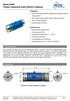 Properties Free of float metal bellow coupling with integrated torque measurement Non-contact measurement system, high robustness High torsional stiffness Limited torque of inertia Performance Measurement
Voltage Regulator SPAU 341 C. Product Guide
 Issued: July 1998 Status: Updated Version: D/25.04.2006 Data subject to change without notice Features Comprehensive voltage regulation for power transformers with on-load tapchangers in distribution substations
PCS0100en 02.2008. Persy Control Services B.V. Netherlands
 P-Bus Gateway PBGW2.128 Universal gateway between the P-bus protocol and open standard protocols. The variety of available electrical interfaces on the gateway offers a wide range of possibilities for
FN2001-A1 Network module (SAFEDLINK) Mounting Installation
 FN00-A Network module (SAFEDLINK) Mounting Installation A6V050_f_en_-- 05-0-6 Building Technologies Division Legal notice Legal notice Technical specifications and availability subject to change without
Isolated AC Sine Wave Input 3B42 / 3B43 / 3B44 FEATURES APPLICATIONS PRODUCT OVERVIEW FUNCTIONAL BLOCK DIAGRAM
 Isolated AC Sine Wave Input 3B42 / 3B43 / 3B44 FEATURES AC averaging technique used to rectify, amplify, and filter 50 Hz to 400 Hz sine-wave signals. Accepts inputs of between 20 mv to 550 V rms to give
Manual. Source Control. TwinCAT 3. Version Date 1.0 2015-06-22
 Manual TwinCAT 3 Version Date 1.0 2015-06-22 Table of Contents Table of Contents 1 Foreword... 4 1.1 Notes on the documentation... 4 1.2 Safety instructions... 5 2 Integration of the Management... 6 2.1
TM7BDM8B expansion block - TM7 - IP67-8 DI/DO - 24V DC - 0.5 A - M8 connector
 Product datasheet Characteristics TM7BDM8B expansion block - TM7 - IP67-8 DI/DO - 24V DC - 0.5 A - M8 connector Main Range of product Product or component type Range compatibility Enclosure material Bus
Application Unit, MDRC AB/S 1.1, GH Q631 0030 R0111
 , GH Q631 0030 R0111 SK 0010 B 98 The application unit is a DIN rail mounted device for insertion in the distribution board. The connection to the EIB is established via a bus connecting terminal at the
WEB log. Device connection plans
 WEB log LIGHT+ 20 BASIC 100 PRO unlimited Device connection plans Version 20160425* Copyright Copyright for this manual remains with the manufacturer. No part of this manual may be reproduced or edited,
Force measurement. Forces VECTORIAL ISSUES ACTION ET RÉACTION ISOSTATISM
 Force measurement Forces VECTORIAL ISSUES In classical mechanics, a force is defined as "an action capable of modifying the quantity of movement of a material point". Therefore, a force has the attributes
Programmable set for Ethernet Modbus/TCP in IP67 TI-BL67-PG-EN-2
 Type code Ident no. 1545065 Number of channels 2 Dimensions (W x L x H) 108 x 145 x 77.5 mm CoDeSys-programmable acc. to IEC 61131-3 Cable max. 50 m between interface and read/write head 10/100 Mbps Male
ABB i-bus KNX SA/S Switch Actuators Product Manual
 ABB i-bus KNX SA/S Switch Actuators Product Manual Contents Contents Page 1 General... 5 1.1 Using the product manual...5 1.1.1 Structure of the product manual...6 1.1.2 Notes...6 1.2 Product and functional
Contents. Document information
 User Manual Contents Document information... 2 Introduction... 3 Warnings... 3 Manufacturer... 3 Description... Installation... Configuration... Troubleshooting...11 Technical data...12 Device Scope: PCB
Procon Engineering. Technical Document PELR 1002. TERMS and DEFINITIONS
 Procon Engineering Technical Document PELR 1002 TERMS and DEFINITIONS The following terms are widely used in the weighing industry. Informal comment on terms is in italics and is not part of the formal
Original instructions Tina 3A/Aps Adaptor unit
 Original instructions Tina 3A/Aps Adaptor unit ABB Jokab Safety Varlabergsvägen 11, SE-434 39 Kungsbacka, Sweden www.abb.com/jokabsafety Read and understand this document Please read and understand this
Measuring Temperature withthermistors a Tutorial David Potter
 NATIONAL INSTRUMENTS The Software is the Instrument Application Note 065 Measuring Temperature withthermistors a Tutorial David Potter Introduction Thermistors are thermally sensitive resistors used in
Power Supply Unit, Primary Switched, Narrow Design MINI-PS-12-24DC/24DC/1
 Power Supply Unit, Primary Switched, Narrow Design MINI POWER provides: Extra narrow design with widths of 22.5 mm, 45 mm, and 67.5 mm (0.886, 1.772, and 2.657 in.) Global use due to a wide-range input
R4D0-FB-IA* FieldBarrier. Features. Assembly. Function. Connection IN + - S OUT ... ... Spur 2. Spur 1. Zone 1. Zone 0
 FieldBarrier Features Assembly 8... 12 outputs Ex ia IIC, FISCO and Entity Advanced fault isolation and diagnostics at the spur FieldBarrier in Zone 1/Div. 2 Instruments in Zone 0...1/Div. 1 For FOUNDATION
Model 5511 Filler Controller User s Manual Version 1.1 October 2011
 Thompson Scale Company WEIGHING SYSTEMS & PACKAGING MACHINERY CONTROLS 2758 Bingle Road Houston, Texas 77055 Phone: 713/932-9071 Fax: 713/932-9379 www.thompsonscale.com Model 5511 Filler Controller User
Cross-beam scanning system to detect slim objects. 100 mm 3.937 in
 891 Object Area Sensor General terms and conditions... F-17 Related Information Glossary of terms... P.1359~ Sensor selection guide...p.831~ General precautions... P.1405 PHOTO PHOTO Conforming to EMC
Addendum to the Operating Instructions
 Drive Technology \ Drive Automation \ System Integration \ Services Addendum to the Operating Instructions MOVIMOT with AS-Interface and AC Motor DT/DV Unit Replacement MOVIMOT MM..C -> MM..D with MLK3A
EXTERNAL DIMENSIONS AND PARTS
 FX2N-4DA SPECIAL FUNCTION BLOCK USER S GUIDE JY992D65901A This manual contains text, diagrams and explanations which will guide the reader in the correct installation and operation of the FX2N-4DA special
Electronic Pressure Switch EDS 300
 Electronic Pressure Switch EDS 300 User manual Page 2 of 16 Content 1. Functions of the EDS 300...3 2. Mounting...3 3. Operating keys on the membrane keypad...4 4. Digital display...4 5. Output function...5
Mounting instructions. Acceleration Transducer B12. B 26.B12.10 en
 Mounting instructions Acceleration Transducer B12 B 26.B12.10 en B12 3 Contents Page Safety instructions.............................................. 4 1 Scope of supply..............................................
Transmitter Interface Program
 Transmitter Interface Program Operational Manual Version 3.0.4 1 Overview The transmitter interface software allows you to adjust configuration settings of your Max solid state transmitters. The following
Data sheet GIOD.1 Input/output module with CAN bus. ERP no.: 5204183. www.guentner.de. Data sheet GIOD.1 V_3.0
 Data sheet GIOD.1 Input/output module with CAN bus ERP no.: 5204183 www.guentner.de Page 2 / 10 Contents 1 GIOD.1... 3 1.1 Functional description...3 1.2 Connections... 5 1.3 Electrical properties of...
NTE2053 Integrated Circuit 8 Bit MPU Compatible A/D Converter
 NTE2053 Integrated Circuit 8 Bit MPU Compatible A/D Converter Description: The NTE2053 is a CMOS 8 bit successive approximation Analog to Digital converter in a 20 Lead DIP type package which uses a differential
Analogue Input, 4-fold, MDRC AE/S 4.1, GH Q605 0054 R0001
 Analogue Input, -fold, MDRC, GH Q605 005 R0001 The analogue input is a DIN rail mounted device for insertion in the distribution board. It is connected to the EIB via the bus connecting terminal supplied.
HSP GmbH Zum Handwerkerhof 2 90530 Wendelstein Tel. 09129 / 2852-0 Fax: 09129 / 2852-11 Web: www.hsshsp.de EMAIL: [email protected] NTG-3000.
 NTG-3000 Transducer Data Sheet Document Version 2.8 Page 1 of 10 Versions / Revisions: Document Creation Author Description version date 2.0 2012-07-25 P. Compensis First official version 2.1 2012-08-24
Install the DeviceNet Module using the following procedure:
 Installation INSTALLATION INSTRUCTIONS: MCD DEVICENET MODULE Order Code: 175G9002 1. Installation Install the DeviceNet Module using the following procedure: 1. Remove control power and mains supply from
Technical Manual. FAN COIL CONTROLLER COOLING or HEATING ANALOG or PWM Art. 119914 631001A
 COOLING or HEATING ANALOG or PWM Art. 119914 631001A TOTAL AUTOMATION GENERAL TRADING CO. LLC SUITE NO.506, LE SOLARIUM OFFICE TOWER, SILICON OASIS, DUBAI. UAE. Tel. +971 4 392 6860, Fax. +971 4 392 6850
Allen-Bradley/Rockwell
 MANUFACTURER DATA SHEET High Speed Counter Manufacturer: Allen-radley/Rockwell Model Number: 1746-HSCE See www.geomartin.com for additional PDF datasheets Martin Part Number: E-014901-03 VendorPartNumber:
Proportional relief valves type AGMZO-TERS, AERS two stage, with integral or remote pressure transducer, ISO 6264 size 10, 20 and 32
 www.atos.com Table F040-1/E Proportional relief valves type AGMZO-TERS, AERS two stage, with integral or remote pressure transducer, ISO 6264 size 10, 20 and 32 AGMZO are two stage poppet type proportional
Digital input modules
 8 172 TX-I/O Digital input modules TXM1.8D TXM1.16D Two fully compatible versions: TXM1.8D: 8 inputs, each with a three-color LED (green, yellow or red) TXM1.16D: As TXM1.8X, but 16 inputs, each with a
L5354 ControlNet Communications Interface
 L5354 ControlNet Communications Interface Technical Manual HA470733 Issue 2 Copyright SSD Drives Inc 2005 All rights strictly reserved. No part of this document may be stored in a retrieval system, or
JUMPFLEX 857 Series. 0...20 ma 2...10 V. 4...20 ma. Transducers / Relay and Optocoupler Modules
 0888-0172/0002-3601 JUMPFLEX 857 Series 2.0 E 12/08 Printed in Germany Subject to design changes 2...10 V 0...20 ma 4...20 ma WAGO Kontakttechnik GmbH & Co. KG Postfach 2880 32385 Minden Hansastraße 27
Adjustment functions for both span and shift have been incorporated
 SENSORS FOR SERIES LED Type Wafer Alignment Sensor FX-0-F FT-F9 FD-F7 EX-F70/F60 M SH-7 FD-L4 M-DW The use of a safe LED light beam now allows for high precision detection with a resolution of 0!m (.8
Redundancy Module QUINT-DIODE/40
 Redundancy Module QUT DIODE provides: 00% decoupling of power supplies connected in parallel Can be installed in potentially explosive areas Load currents up to 60 A supported Easy assembly by snapping
Material: Weight: Bearing Life: Shaft Speed: Starting Torque: Mass Moment of Inertia: Shaft Loads:
 Automation / Mini Type SCH32F Hollow Shaft Encoder - Ø 32 mm Hollow Bore: Ø 6 mm to Ø 3/8 inch Resolution up to 5000 ppr IP 65 (IP 50 for IDC connector option) Electrical Specifications Code: Resolution:
Portal Software GSM-PRO Run LED displays module activity Com LED displays activity on the GSM network GSM-PRO
 GSM-PRO GSM-PRO perfect for communication CONTA-CLIP s GSM-PRO module offers a remote control and maintenance solution which allows you to monitor and control decentralized facilities. The GSM-PRO module
Temp-485-Pt100. A temperature sensor (Pt100 or Pt1000) communicating over the RS-485 bus with a simple communication protocol
 Temp-485-Pt100 A temperature sensor (Pt100 or Pt1000) communicating over the RS-485 bus with a simple communication protocol Temp-485-Pt100 Box version [600 113] Temp-485-Pt100 Cable version [600 114]
MicroMag3 3-Axis Magnetic Sensor Module
 1008121 R01 April 2005 MicroMag3 3-Axis Magnetic Sensor Module General Description The MicroMag3 is an integrated 3-axis magnetic field sensing module designed to aid in evaluation and prototyping of PNI
SYSTEM 4C. C R H Electronics Design
 SYSTEM 4C C R H Electronics Design SYSTEM 4C All in one modular 4 axis CNC drive board By C R Harding Specifications Main PCB & Input PCB Available with up to 4 Axis X, Y, Z, A outputs. Independent 25
Multi-Protocol decoder 76 200 with Load regulation
 Multi-Protocol decoder 76 2 with Load regulation For locomotives with universal motors on digital layouts operating in the DCC and Motorola data format. Features 76 2 Load regulated multi-protocol decoder
T-SERIES INDUSTRIAL INCLINOMETER ANALOG INTERFACE
 T-SERIES INDUSTRIAL INCLINOMETER ANALOG INTERFACE T-Series industrial inclinometers are compact high performance sensors used to determine inclination in roll and pitch axes with excellent precision and
THERMAL ANEMOMETRY ELECTRONICS, SOFTWARE AND ACCESSORIES
 TSI and TSI logo are registered trademarks of TSI Incorporated. SmartTune is a trademark of TSI Incorporated. THERMAL ANEMOMETRY ELECTRONICS, SOFTWARE AND ACCESSORIES IFA 300 Constant Temperature Anemometry
Combi switchbox with integrated 3/2 way pilot valve
 H Combi switchbox with integrated 3/2 way pilot valve Construction The GEMÜ combi switchbox with integrated 3/2 way pilot valve for pneumatically operated quarter turn actuators has a micro-processor controlled
QUICK START GUIDE FOR DEMONSTRATION CIRCUIT 956 24-BIT DIFFERENTIAL ADC WITH I2C LTC2485 DESCRIPTION
 LTC2485 DESCRIPTION Demonstration circuit 956 features the LTC2485, a 24-Bit high performance Σ analog-to-digital converter (ADC). The LTC2485 features 2ppm linearity, 0.5µV offset, and 600nV RMS noise.
JNIOR. Overview. Get Connected. Get Results. JNIOR Model 310. JNIOR Model 312. JNIOR Model 314. JNIOR Model 410
 The INTEG is an Ethernet I/O (digital, analog) device that monitors and controls a small set of process signals. functions as both basic I/O for integration with another application or system AND as a
AS-i 3.0 Gateways, PROFIsafe via PROFIBUS or PROFINET
 safe via BUS or NET AS-i 3.0 Gateways, safe via NET or BUS safe and Safe Link in one device up to 450 devices 2 / 1 Master, NET / BUS Slave AS-i Safety input slaves report via safe AS-i Safety output slaves
Automation System TROVIS 6400 TROVIS 6493 Compact Controller
 Automation System TROVIS 6400 TROVIS 6493 Compact Controller For panel mounting (front frame 48 x 96 mm/1.89 x 3.78 inch) Application Digital controller to automate industrial and process plants for general
Disturbance Recoder SPCR 8C27. Product Guide
 Issued: April 1999 Status: Updated Version: C/26.04.2006 Data subject to change without notice Features Versatile digital disturbance recorder module for recording various phenomena in the electric power
Electric Rotary Actuator - On/Off or programmable control actuator
 Electric Rotary Actuator - On/Off or programmable control actuator Direct mounting on quarter-turn valves Manual override standard Corrosion resistant Adjustable limit switches Multi-voltage version Type
Safety Relays ESM/ESM-F
 Safety Relays ESM/ESM-F More than safety. Safety More than safety. Emil Euchner, the company s founder and inventor of the multiple limit switch, circa 1928. Around the world the Swabian specialists in
BNI IOL-709-000-K006 BNI IOL-710-000-K006. IO-Link Sensor-Hub analog User s Guide
 BNI IOL-709-000-K006 BNI IOL-710-000-K006 IO-Link Sensor-Hub analog User s Guide Inhalt 1 Notes to the user 2 1.1 About this guide 2 1.2 Structure of the guide 2 1.3 Typographical conventions 2 Enumerations
Description. Dimensions. Features. www.pwb-encoders.com. precision works better
 Description The MEC22 is a high resolution optical hollow shaft encoder that can be fixed quickly and easily on different sizes of motor shafts. The encoder provides two square wave outputs in quadrature
AC3200 INTELLIGENT BROADBAND AMPLIFIER
 Kari Mäki 9.4.2013 1(7) AC3200 INTELLIGENT BROADBAND AMPLIFIER AC3200 is the latest leading-edge addition to AC family with extended frequency and gain ranges and integrated electrical controls in both
Analog signal converters CC-E I/I Current / current isolators
 ata sheet Analog signal converters CC-E I/I Current / current isolators The CC-E I/I is an isolator for the electrical isolation of current signals without auxiliary supply. It allows the isolation between
9000 Series Accelerometers Specifications
 Technical Data 9000 Series Accelerometers Specifications Catalog Numbers EK-43781I, EK-43782I, EK-46255I, EK-45890I, EK-43784I, EK-47086I, EK-43792I, EK-47090I, EK-43799I, EK-43794I, EK-43795I, EK-43797I,
Errors Due to Shared Leadwires in Parallel Strain Gage Circuits
 Micro-Measurements Strain Gages and Instruments Errors Due to Shared Leadwires in Parallel Strain Gage Circuits TN-516 1. Introduction The usual, and preferred, practice with multiple quarterbridge strain
Electronic timer CT-AHD.12 OFF-delayed with 1 c/o (SPDT) contact
 Data sheet Electronic timer CT-AHD.12 OFF-delayed with 1 c/o (SPDT) contact The CT-AHD.12 is an electronic time relay with OFF-delay. It is from the CT-D range. With their MDRC profile and a width of only
SZI 1029. IR Audio Transmission Technology Modulators/Radiators
 General Description The is a 5-W high-power radiator for use with all wideband and narrowband modulators. The radiator is automatically switched on by the RF carrier and can cover areas of up to 800 m
Three Channel Optical Incremental Encoder Modules Technical Data
 Three Channel Optical Incremental Encoder Modules Technical Data HEDS-9040 HEDS-9140 Features Two Channel Quadrature Output with Index Pulse Resolution Up to 2000 CPR Counts Per Revolution Low Cost Easy
Absolute rotary encoder GEL 235EC
 Absolute rotary encoder GEL 235EC EtherCAT fieldbus interface Reference D-02R-235EC (1.1) Right to technical changes and errors reserved. 2011-11 Device manufacturer and publisher: Lenord, Bauer & Co.
CAN@net II Intelligent PC/CAN Interface. Manual
 CAN@net II Intelligent PC/CAN Interface Manual IXXAT Automation GmbH Leibnizstr. 15 D-88250 Weingarten Tel.: +49 (0)7 51 / 5 61 46-0 Fax: +49 (0)7 51 / 5 61 46-29 Internet: www.ixxat.de e-mail: [email protected]
* DISCLAIMER: Contents. How to Use This Guide: COMMERCIAL INSTALL GUIDE 2
 COMMERCIAL INSTALL GUIDE 2 Contents How to Use This Guide: The first section of this guide is designed to assist you with the installation of your DECK Monitoring hardware. The revenue grade meter and