
Release Notes. EMC NetWorker Module for Databases and Applications. Release Notes. Version 8.2 and Service Packs REV 12.
|
|
|
- Arnold Long
- 9 years ago
- Views:
Transcription
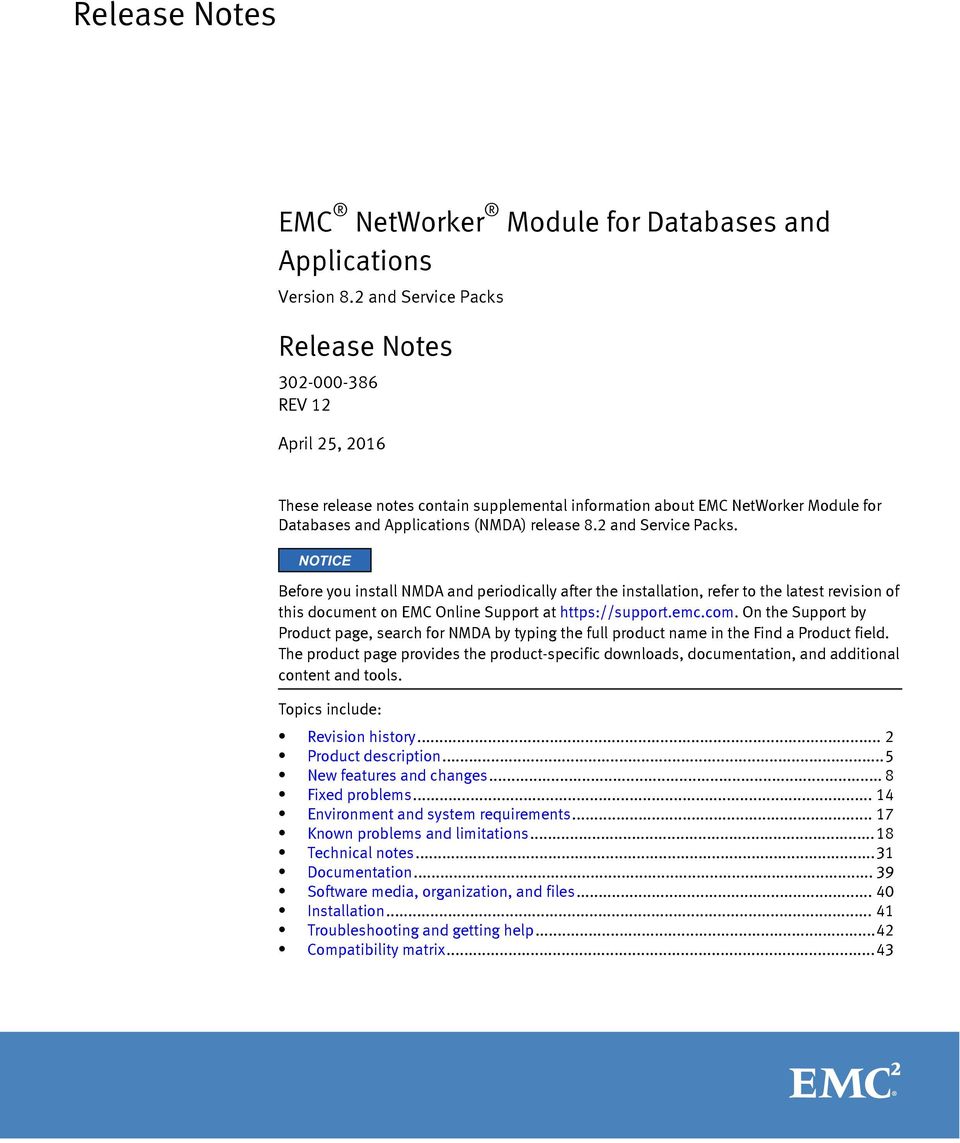
1 EMC NetWorker Module for Databases and Applications Version 8.2 and Service Packs Release Notes REV 12 April 25, 2016 These release notes contain supplemental information about EMC NetWorker Module for Databases and Applications (NMDA) release 8.2 and Service Packs. NOTICE Before you install NMDA and periodically after the installation, refer to the latest revision of this document on EMC Online Support at On the Support by Product page, search for NMDA by typing the full product name in the Find a Product field. The product page provides the product-specific downloads, documentation, and additional content and tools. Topics include: Revision history... 2 Product description...5 New features and changes... 8 Fixed problems Environment and system requirements Known problems and limitations...18 Technical notes...31 Documentation Software media, organization, and files Installation Troubleshooting and getting help...42 Compatibility matrix...43
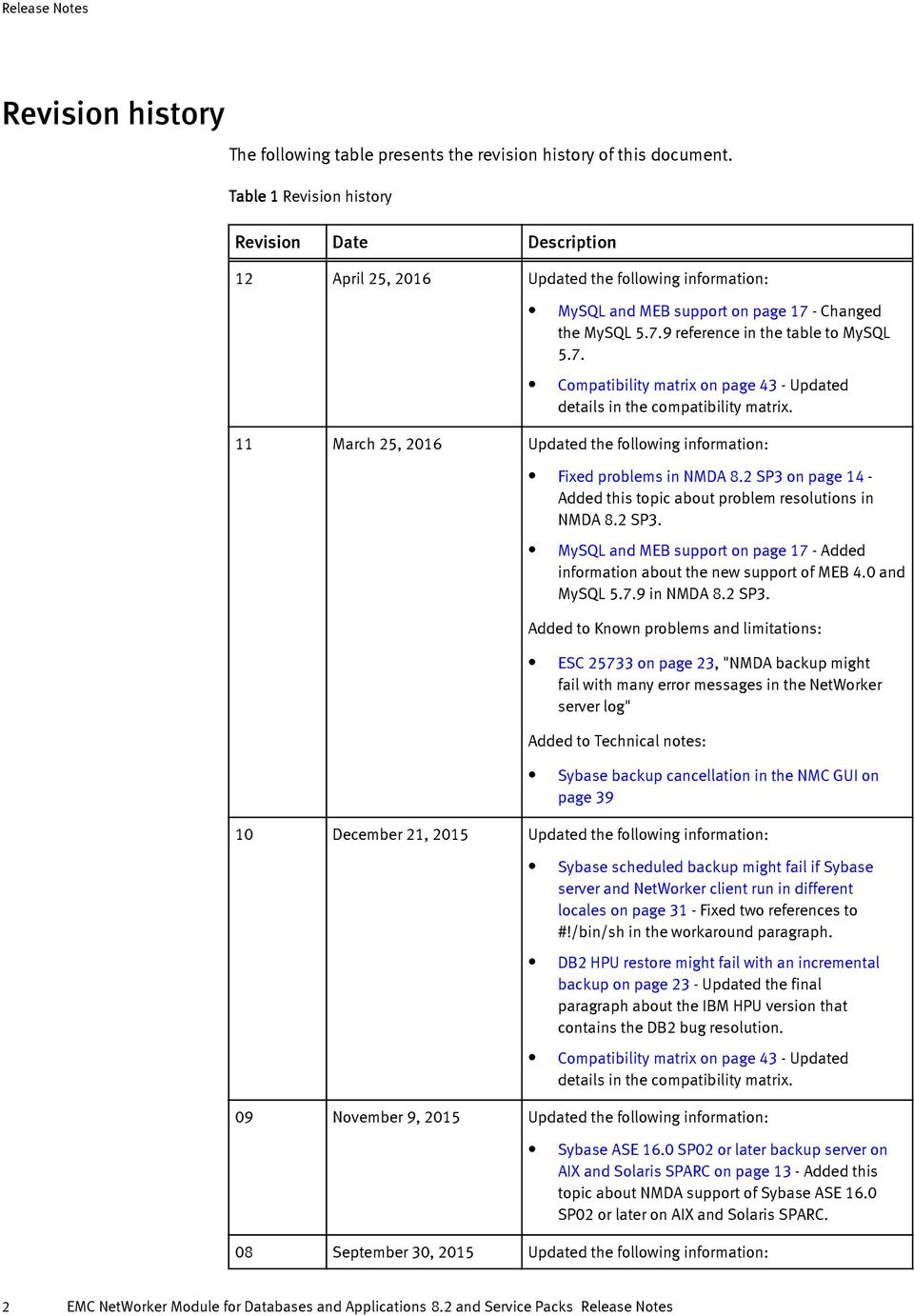
2 Revision history The following table presents the revision history of this document. Table 1 Revision history Revision Date Description 12 April 25, 2016 Updated the following information: MySQL and MEB support on page 17 - Changed the MySQL reference in the table to MySQL 5.7. Compatibility matrix on page 43 - Updated details in the compatibility matrix. 11 March 25, 2016 Updated the following information: Fixed problems in NMDA 8.2 SP3 on page 14 - Added this topic about problem resolutions in NMDA 8.2 SP3. MySQL and MEB support on page 17 - Added information about the new support of MEB 4.0 and MySQL in NMDA 8.2 SP3. Added to Known problems and limitations: ESC on page 23, "NMDA backup might fail with many error messages in the NetWorker server log" Added to Technical notes: Sybase backup cancellation in the NMC GUI on page December 21, 2015 Updated the following information: Sybase scheduled backup might fail if Sybase server and NetWorker client run in different locales on page 31 - Fixed two references to #!/bin/sh in the workaround paragraph. DB2 HPU restore might fail with an incremental backup on page 23 - Updated the final paragraph about the IBM HPU version that contains the DB2 bug resolution. Compatibility matrix on page 43 - Updated details in the compatibility matrix. 09 November 9, 2015 Updated the following information: Sybase ASE 16.0 SP02 or later backup server on AIX and Solaris SPARC on page 13 - Added this topic about NMDA support of Sybase ASE 16.0 SP02 or later on AIX and Solaris SPARC. 08 September 30, 2015 Updated the following information: 2 EMC NetWorker Module for Databases and Applications 8.2 and Service Packs Release Notes
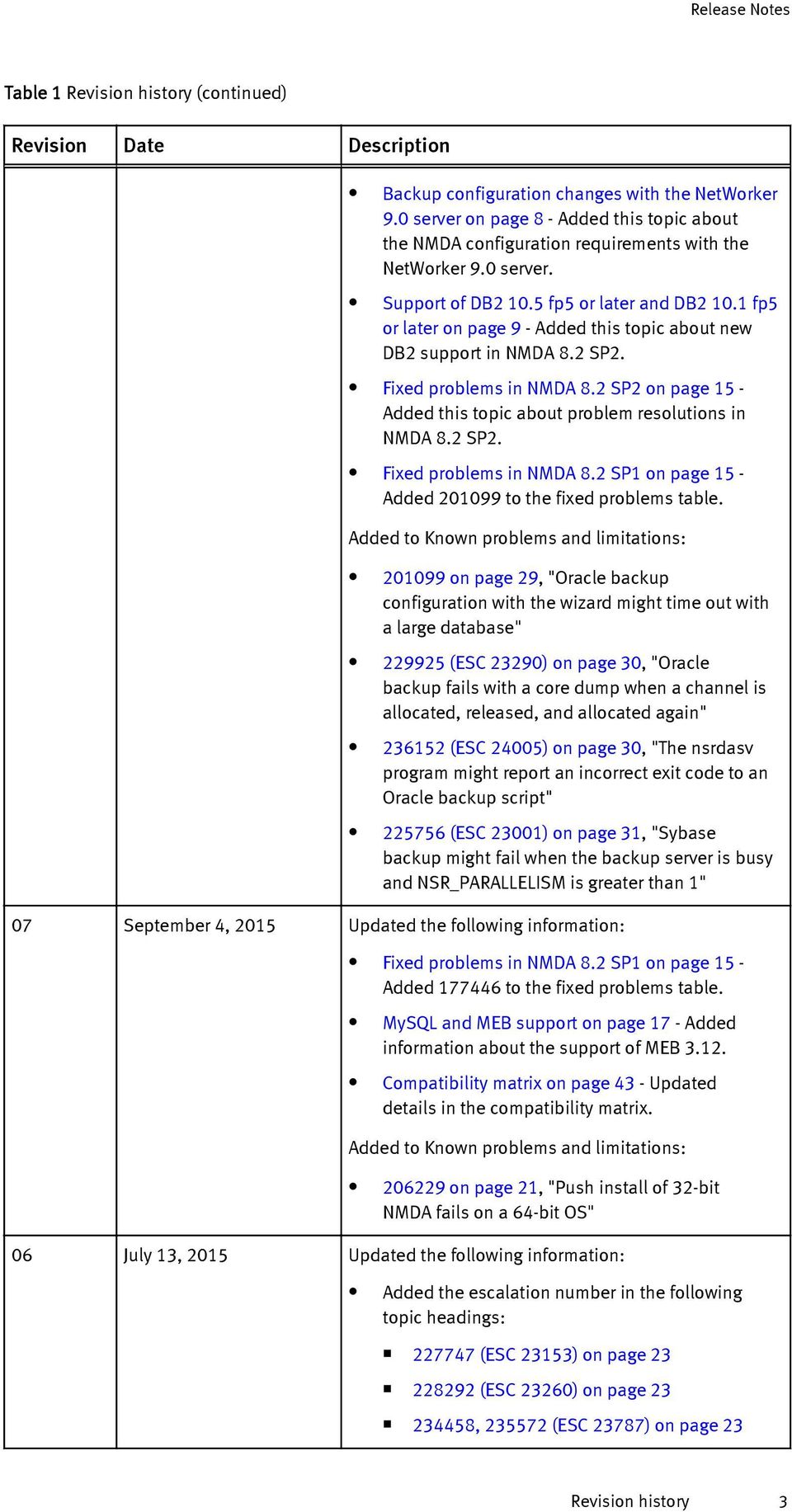
3 Table 1 Revision history (continued) Revision Date Description Backup configuration changes with the NetWorker 9.0 server on page 8 - Added this topic about the NMDA configuration requirements with the NetWorker 9.0 server. Support of DB fp5 or later and DB fp5 or later on page 9 - Added this topic about new DB2 support in NMDA 8.2 SP2. Fixed problems in NMDA 8.2 SP2 on page 15 - Added this topic about problem resolutions in NMDA 8.2 SP2. Fixed problems in NMDA 8.2 SP1 on page 15 - Added to the fixed problems table. Added to Known problems and limitations: on page 29, "Oracle backup configuration with the wizard might time out with a large database" (ESC 23290) on page 30, "Oracle backup fails with a core dump when a channel is allocated, released, and allocated again" (ESC 24005) on page 30, "The nsrdasv program might report an incorrect exit code to an Oracle backup script" (ESC 23001) on page 31, "Sybase backup might fail when the backup server is busy and NSR_PARALLELISM is greater than 1" 07 September 4, 2015 Updated the following information: Fixed problems in NMDA 8.2 SP1 on page 15 - Added to the fixed problems table. MySQL and MEB support on page 17 - Added information about the support of MEB Compatibility matrix on page 43 - Updated details in the compatibility matrix. Added to Known problems and limitations: on page 21, "Push install of 32-bit NMDA fails on a 64-bit OS" 06 July 13, 2015 Updated the following information: Added the escalation number in the following topic headings: (ESC 23153) on page (ESC 23260) on page , (ESC 23787) on page 23 Revision history 3
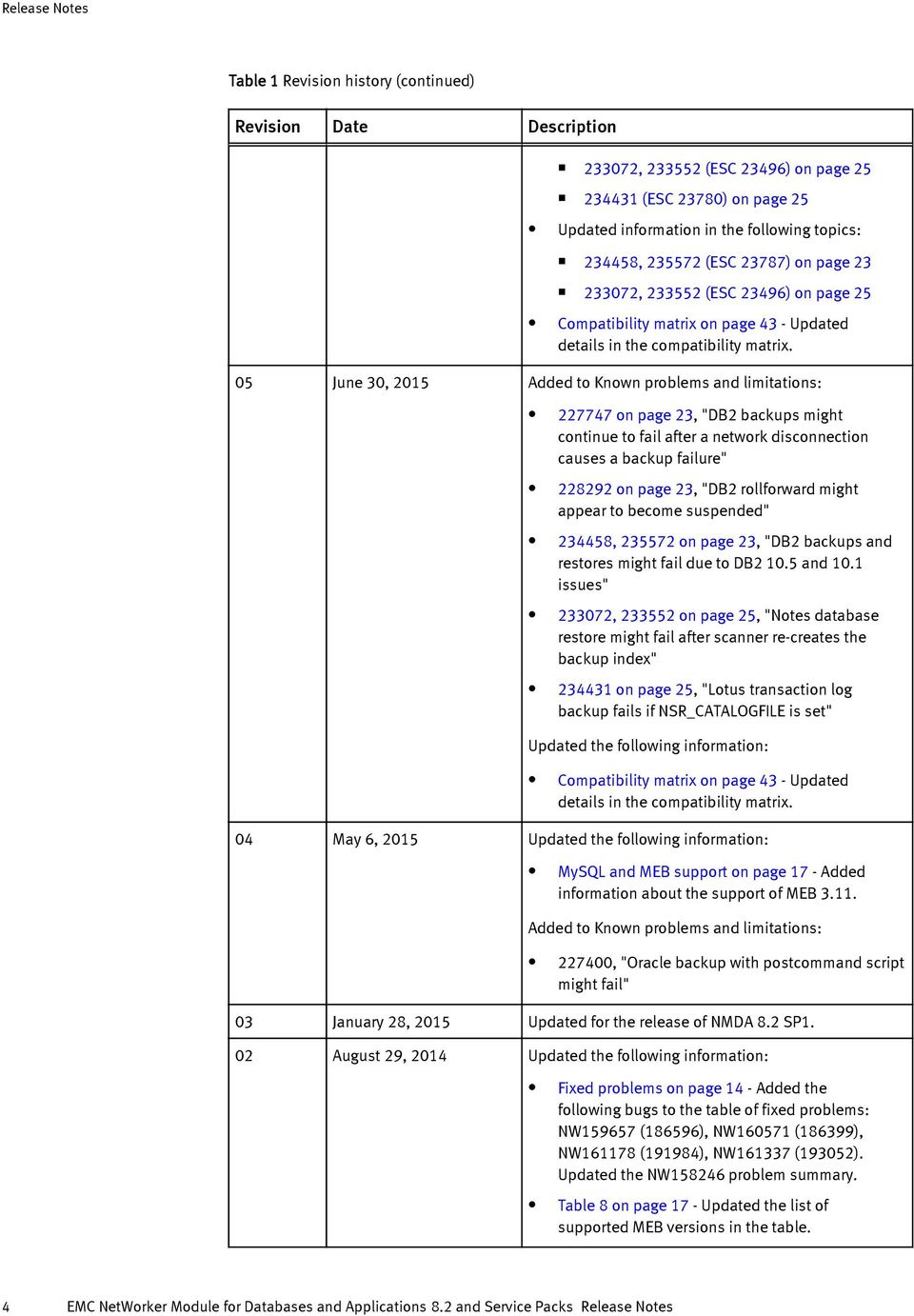
4 Table 1 Revision history (continued) Revision Date Description , (ESC 23496) on page (ESC 23780) on page 25 Updated information in the following topics: , (ESC 23787) on page , (ESC 23496) on page 25 Compatibility matrix on page 43 - Updated details in the compatibility matrix. 05 June 30, 2015 Added to Known problems and limitations: on page 23, "DB2 backups might continue to fail after a network disconnection causes a backup failure" on page 23, "DB2 rollforward might appear to become suspended" , on page 23, "DB2 backups and restores might fail due to DB and 10.1 issues" , on page 25, "Notes database restore might fail after scanner re-creates the backup index" on page 25, "Lotus transaction log backup fails if NSR_CATALOGFILE is set" Updated the following information: Compatibility matrix on page 43 - Updated details in the compatibility matrix. 04 May 6, 2015 Updated the following information: MySQL and MEB support on page 17 - Added information about the support of MEB Added to Known problems and limitations: , "Oracle backup with postcommand script might fail" 03 January 28, 2015 Updated for the release of NMDA 8.2 SP1. 02 August 29, 2014 Updated the following information: Fixed problems on page 14 - Added the following bugs to the table of fixed problems: NW (186596), NW (186399), NW (191984), NW (193052). Updated the NW problem summary. Table 8 on page 17 - Updated the list of supported MEB versions in the table. 4 EMC NetWorker Module for Databases and Applications 8.2 and Service Packs Release Notes
5 Table 1 Revision history (continued) Revision Date Description Compatibility matrix on page 43 - Updated details in the compatibility matrix. 01 June 18, 2014 Initial release of NMDA 8.2. Product description EMC NetWorker Module for Databases and Applications (NMDA) is an add-on module for the NetWorker server and client that provides backup and recovery services for DB2, Informix, Lotus Domino/Notes, MySQL, Oracle, and Sybase ASE data. NMDA replaces all the following legacy NetWorker modules on the supported UNIX, Linux, or Windows operating systems: NetWorker Module for DB2 (NMDB2) NetWorker Module for Informix (NMI) NetWorker Module for Lotus (NML) NetWorker Module for Oracle (NMO) NetWorker Module for Sybase (NMS) NOTICE You can use NMDA to restore backups that were performed with the legacy NetWorker modules. You can use the existing legacy NetWorker module enabler to perform NMDA backups after the upgrade. Major configuration changes from legacy NetWorker modules to NMDA on page 6 describes major configuration differences between the legacy modules and NMDA. New features and changes on page 8 describes the major new features and enhancements in NMDA 8.2 and Service Packs. The appropriate release of the EMC NetWorker Module for Databases and Applications Administration Guide describes all the features that NMDA supports in the corresponding software release. Environment and system requirements on page 17 provides information about the supported versions of the NetWorker software. Known problems and limitations on page 18 describes the known problems and limitations in NMDA 8.2 and Service Packs. Technical notes on page 31 describes existing NMDA features that require special considerations or require a later version of the NetWorker software. Documentation on page 39 describes the NMDA 8.2 and Service Packs documentation and related documents. Installation on page 41 provides details about installing NMDA. Before you install NMDA, review the compatibility matrix at the end of this document and the NMDA installation guide, administration guide, and other documentation at EMC Online Support. Product description 5

6 Major configuration changes from legacy NetWorker modules to NMDA The following table compares the major configurations in the legacy NetWorker modules and NMDA, and outlines any changes in those configurations. You must set most NMDA parameters in the NMDA configuration file. The NMDA configuration file templates are in the following directories: On UNIX and Linux: /nsr/apps/config On Windows: NetWorker_install_path\apps\config Table 2 Configuration changes from legacy NetWorker modules to NMDA Feature or parameter in legacy NetWorker module Corresponding feature or parameter in NMDA NSR_DEBUG_FILE = debug_file_full_path. Replaced by NSR_DIAGNOSTIC_DEST = debug_directory_full_path. NSR_ENCRYPTION parameter. Parameter is dropped. Specify backup encryption through the NSR_AES_ENCRYPTION parameter. NetWorker Module for DB2 (NMDB2): Scheduled backup (configured without the wizard) performed through the nsrdb2sv -f configuration_file command. Replaced by scheduled backup (configured without the wizard) performed through the nsrdasv -z configuration_file command. Note The NMDA configuration_file supports the NMDB2 configuration_file format. Manual backup through the db2 commands. Restore through the db2 commands. DB2_PSWD parameter. DB2_USR parameter. NSR_DB2_BACKUP_INFO parameter. No change. No change. Replaced by USER_PSWD parameter. Set the password value in the parameter through the nsrdaadmin -P command. Replaced by DB2_USER parameter. Replaced by NSR_DR_BACKUP_INFO parameter. If NSR_DB2_BACKUP_INFO was not set, NSR_DR_BACKUP_INFO is set to TRUE (default). NSR_DB2_CONFIG_FILE parameter. NSR_*_DEBUG* parameters. Replaced by NSR_DR_FILE_LIST parameter. Replaced by NSR_DEBUG_LEVEL parameter. NetWorker Module for Informix (NMI): Scheduled backup performed through the nsrdbmi shell/batch script. Manual backup performed through the onbar commands. Restore performed through the onbar commands. BOOTFILE parameter. Replaced by scheduled backup performed through the nsrdasv -z configuration_file command. No change. No change. Replaced by NSR_DR_FILE_LIST parameter. 6 EMC NetWorker Module for Databases and Applications 8.2 and Service Packs Release Notes

7 Table 2 Configuration changes from legacy NetWorker modules to NMDA (continued) Feature or parameter in legacy NetWorker module DO_BOOTFILE_BACKUPS parameter. Corresponding feature or parameter in NMDA Replaced by NSR_DR_BACKUP_INFO parameter. NetWorker Module for Lotus (NML): Scheduled backup (configured without the wizard) or manual backup performed through the nsrnotesv -z configuration_file command. Replaced by scheduled backup (configured without the wizard) or manual backup performed through the nsrdasv -z configuration_file command. Note The NMDA configuration_file supports the NML configuration_file format. Restore performed through the nsrnotesrc -z configuration_file command. Manual backup or restore performed through the NetWorker User for Lotus GUI (nwbml.exe) on Windows only. Document-level recovery performed through the nsrdocrc -z configuration_file command. Document-level recovery performed through the Notes client GUI on Windows only. LOTUSUSER parameter. No change. No change. No change. No change. Replaced by LOTUS_USER parameter. NetWorker Module for Oracle (NMO): Scheduled backup (configured without the wizard) performed through the nsrnmo shell/batch script. Manual backup performed through the Oracle RMAN interface. Restore performed through the Oracle RMAN interface. NSR_SB_DEBUG_FILE parameter. Replaced by scheduled backup (configured without wizard) performed through the nsrdasv -z configuration_file command. No change. No change. Replaced by NSR_DEBUG_LEVEL=1 parameter. NetWorker Module for Sybase (NMS): Scheduled backup performed through the nsrsyb shell/batch script. Manual backup performed through the nsrsybsv command_line_options command. Database consistency check performed through the nsrsybcc command_line_options command. Restore performed through the nsrsybrc command_line_options command. Manual backup or restore performed through the NetWorker User for Sybase GUI (nwbms.exe) on Windows only. BACKUP_OPT parameter. -G, -R, and -T options of nsrsybsv command. Replaced by scheduled backup performed through the nsrdasv -z configuration_file command. Replaced by manual backup performed through the nsrdasv -z configuration_file command. No change. No change. No change. Parameter is dropped. Replaced by NSR_DUMP_LOG_OPT parameter. Major configuration changes from legacy NetWorker modules to NMDA 7
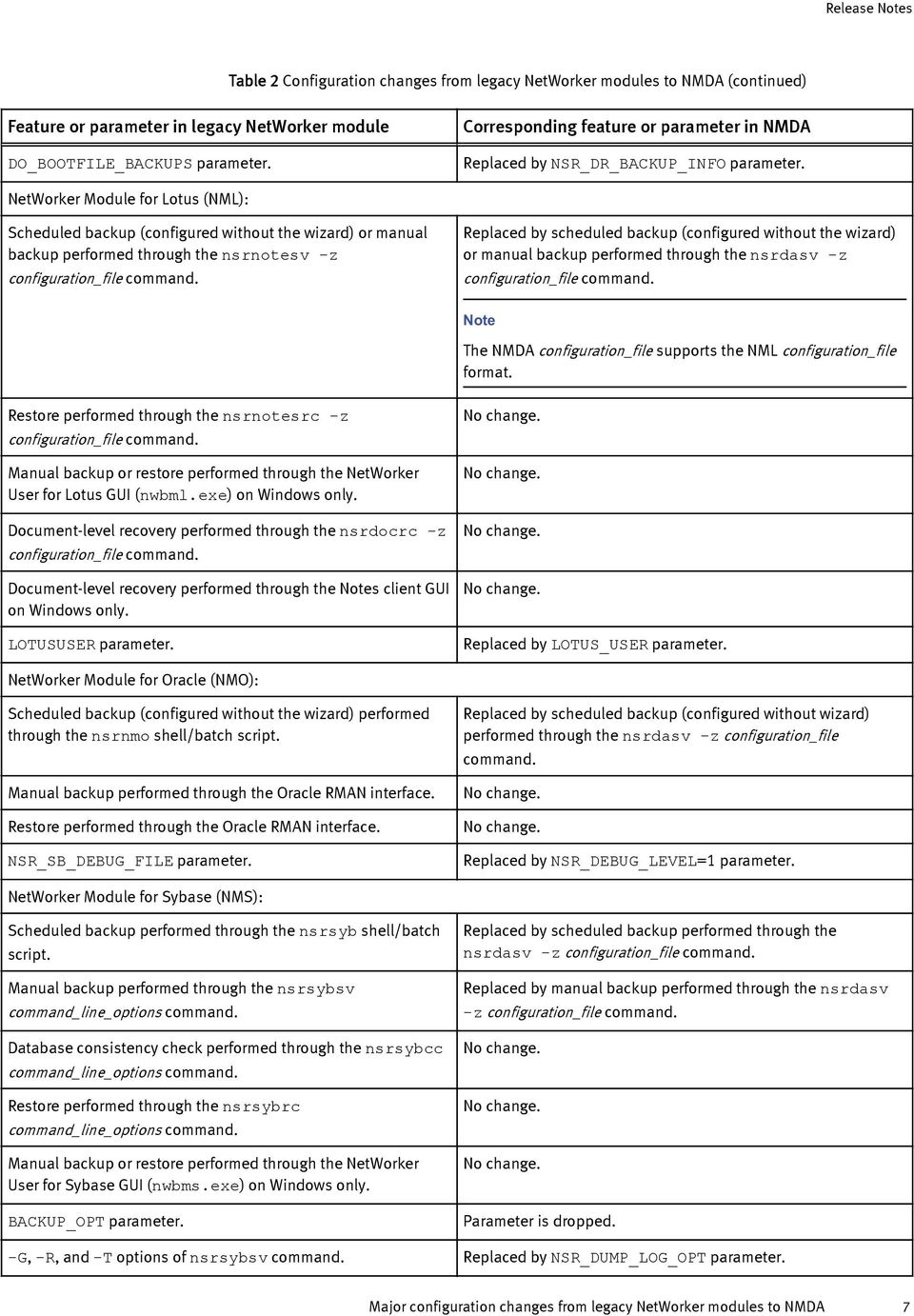
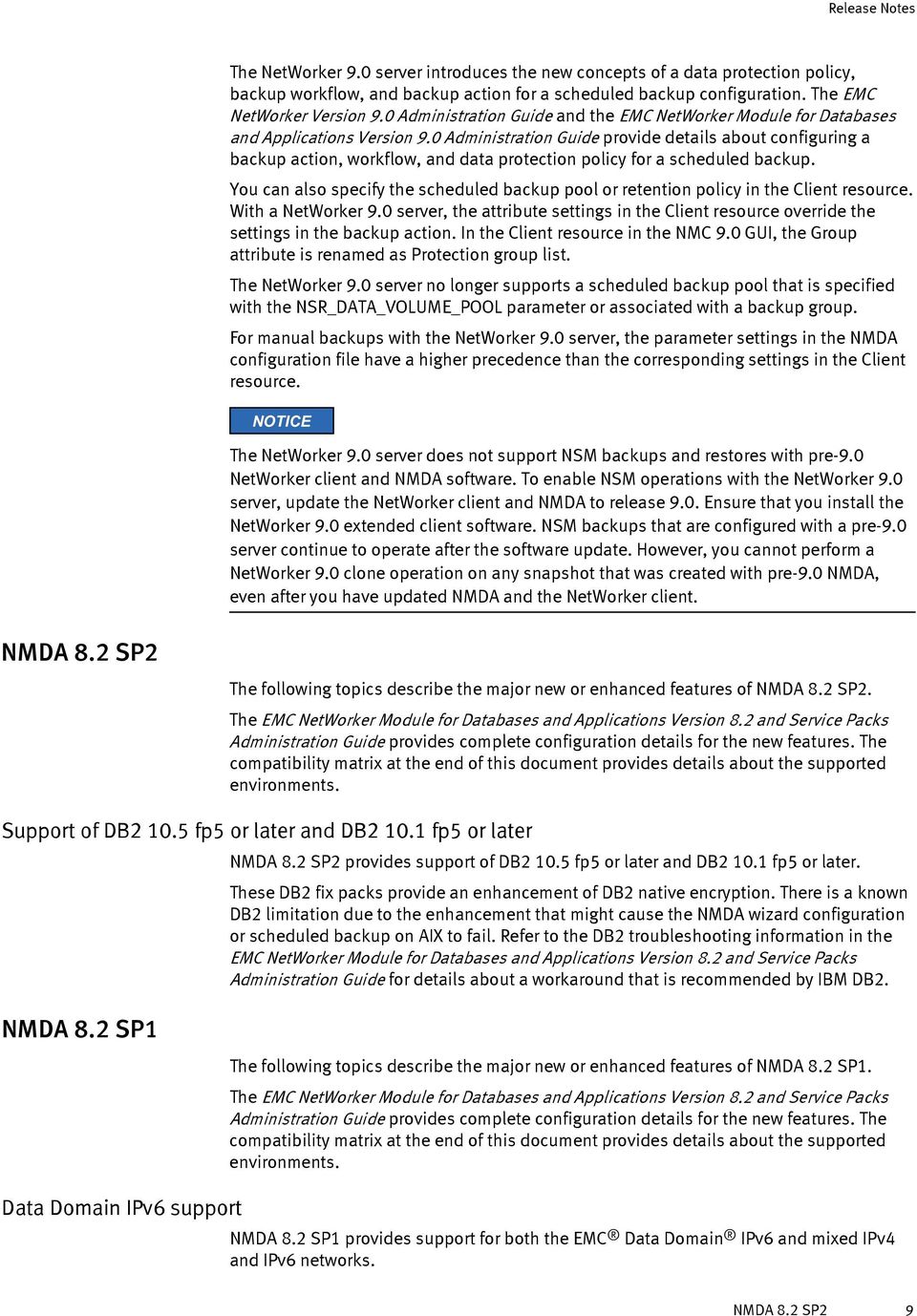
8 Table 2 Configuration changes from legacy NetWorker modules to NMDA (continued) Feature or parameter in legacy NetWorker module Corresponding feature or parameter in NMDA -l option of nsrsybsv command. Replaced by NSR_BACKUP_LEVEL parameter. -p option of nsrsybsv command. Replaced by NSR_PROMOTE_FULL parameter. -P option of nsrsybsv command, or password setting in the Client resource. Replaced by USER_PSWD parameter. Set the password value in the parameter through the nsrdaadmin -P command. -r option of nsrsybsv command. Replaced by NSR_ASE_PASSWORD parameter. -U option of nsrsybsv command, or remote user setting in the Client resource. Replaced by SYBASE_USER parameter. -V option of nsrsybsv command. Replaced by NSR_ASE_VERIFY parameter. New features and changes The following topics describe the new features and changes in NMDA 8.2 and the related Service Packs. NMDA 8.2 and Service Packs replace the previous NMDA releases on the supported Linux, UNIX, and Windows operating systems. You can use NMDA 8.2 and Service Packs to restore any backups performed with previous NMDA releases. Note Deprecated features are features supported in this NMDA release that will be removed and unsupported in a future NMDA release. Backup configuration changes with the NetWorker 9.0 server If you update the NetWorker server to release 9.0, you must change certain settings in the NMDA backup configurations to enable the NMDA backup operations with the updated NetWorker server. This requirement applies to all the NMDA 8.2 and Service Packs configurations. With the NetWorker 9.0 server, you cannot create any new configurations of Avamar deduplication backups. However, you can continue to use existing backup configurations of Avamar backups, and you can continue to restore Avamar backups by using NMDA with the NetWorker 9.0 server. The NetWorker 9.0 server does not support browse policy settings, and sets the browse policy to the same value as the retention policy. The browse policy field and resource are removed from the NMC 9.0 GUI. The NetWorker 9.0 server ignores any setting of the NSR_SAVESET_BROWSE parameter. With the NetWorker 9.0 server, the NSR_DATA_VOLUME_POOL and NSR_SAVESET_RETENTION parameters are no longer supported for scheduled backups. However, these parameters are still supported for manual backups. You can continue to use a scheduled backup configuration that was created with a pre-9.0 server. However, ensure that the destination pool and retention period values are set in the backup action that is configured for the scheduled backup. You can configure a backup action by using the Policy Action Wizard, described in the EMC NetWorker Version 9.0 Administration Guide. 8 EMC NetWorker Module for Databases and Applications 8.2 and Service Packs Release Notes

9 The NetWorker 9.0 server introduces the new concepts of a data protection policy, backup workflow, and backup action for a scheduled backup configuration. The EMC NetWorker Version 9.0 Administration Guide and the EMC NetWorker Module for Databases and Applications Version 9.0 Administration Guide provide details about configuring a backup action, workflow, and data protection policy for a scheduled backup. You can also specify the scheduled backup pool or retention policy in the Client resource. With a NetWorker 9.0 server, the attribute settings in the Client resource override the settings in the backup action. In the Client resource in the NMC 9.0 GUI, the Group attribute is renamed as Protection group list. The NetWorker 9.0 server no longer supports a scheduled backup pool that is specified with the NSR_DATA_VOLUME_POOL parameter or associated with a backup group. For manual backups with the NetWorker 9.0 server, the parameter settings in the NMDA configuration file have a higher precedence than the corresponding settings in the Client resource. NOTICE The NetWorker 9.0 server does not support NSM backups and restores with pre-9.0 NetWorker client and NMDA software. To enable NSM operations with the NetWorker 9.0 server, update the NetWorker client and NMDA to release 9.0. Ensure that you install the NetWorker 9.0 extended client software. NSM backups that are configured with a pre-9.0 server continue to operate after the software update. However, you cannot perform a NetWorker 9.0 clone operation on any snapshot that was created with pre-9.0 NMDA, even after you have updated NMDA and the NetWorker client. NMDA 8.2 SP2 The following topics describe the major new or enhanced features of NMDA 8.2 SP2. The EMC NetWorker Module for Databases and Applications Version 8.2 and Service Packs Administration Guide provides complete configuration details for the new features. The compatibility matrix at the end of this document provides details about the supported environments. Support of DB fp5 or later and DB fp5 or later NMDA 8.2 SP2 provides support of DB fp5 or later and DB fp5 or later. These DB2 fix packs provide an enhancement of DB2 native encryption. There is a known DB2 limitation due to the enhancement that might cause the NMDA wizard configuration or scheduled backup on AIX to fail. Refer to the DB2 troubleshooting information in the EMC NetWorker Module for Databases and Applications Version 8.2 and Service Packs Administration Guide for details about a workaround that is recommended by IBM DB2. NMDA 8.2 SP1 The following topics describe the major new or enhanced features of NMDA 8.2 SP1. The EMC NetWorker Module for Databases and Applications Version 8.2 and Service Packs Administration Guide provides complete configuration details for the new features. The compatibility matrix at the end of this document provides details about the supported environments. Data Domain IPv6 support NMDA 8.2 SP1 provides support for both the EMC Data Domain IPv6 and mixed IPv4 and IPv6 networks. NMDA 8.2 SP2 9
10 The EMC NetWorker Release 8.2 and Services Packs Release Notes provides information about the new support of Data Domain IPv6 networks with NetWorker software. DB2 HADR support NMDA 8.2 SP1 supports DB2 backups and restores in a DB2 High Availability Disaster Recovery (HADR) environment. The NetWorker scheduled backups always run on the active node in the HADR environment. IBM DB2 has the following restrictions with HADR support that impact NMDA functionality: Multiple standby mode is available only with DB and later. HADR is not available in partitioned database environments. DB2 does not support backups on the standby host, even if the Reads on Standby (ROS) feature is enabled. Tablespace-level restore or rollforward is not supported on either a primary or standby database. NMDA supports DB2 HADR configuration with and without Virtual IP (VIP). NMDA has the following limitations with DB2 HADR support: You cannot use the NMDA wizard to configure an HADR backup in a VIP environment. You must use the client-side manual configuration procedure through NMC. NMDA does not support DB2 HADR in a DB2 purescale environment. The EMC NetWorker Module for Databases and Applications Version 8.2 and Service Packs Administration Guide provides details about how to configure and perform DB2 HADR backups and restores. DB2 load with copy yes option support Sybase listonly option support Sybase restore parameter support NMDA supports the use of the DB2 load command with the copy yes option to save a copy of DB2 database changes during the load operation to NetWorker for later use in the database recovery. Rollforward recovery must be enabled for the database before you can use the copy yes option with the load command. The EMC NetWorker Module for Databases and Applications Version 8.2 and Service Packs Administration Guide provides details about how to use a load operation with the copy yes option to save a load-copy file and use a rollforward operation to recover the file into a database. NMDA 8.2 SP1 supports the use of the Sybase restore command, nsrsybrc, with the listonly option for obtaining structure information from the latest backup of a Sybase instance or databases, without restoring the backup. Sybase ASE 15.7 ESD#2 and later provides the listonly option support. The EMC NetWorker Module for Databases and Applications Version 8.2 and Service Packs Administration Guide provides details about how to obtain the structure information from an NMDA Sybase backup by using the Sybase listonly option. In previous NMDA releases, the Sybase restore parameters were set as nsrsybrc command line options, described in the EMC NetWorker Module for Databases and Applications Command Reference Guide. These command line options are deprecated in NMDA 8.2 SP1, and support of the command line options will be removed in the future. 10 EMC NetWorker Module for Databases and Applications 8.2 and Service Packs Release Notes

11 NMDA 8.2 SP1 provides new support for Sybase restore parameters in the NMDA configuration file. After setting the required restore parameters in the configuration file, you can perform a Sybase restore/recovery with the nsrsybrc -z configuration_file_path command. This NMDA release provides separate configuration file templates for the Sybase backup and restore parameters: nmda_sybase_backup.cfg Template for Sybase backup parameters nmda_sybase_restore.cfg Template for Sybase restore parameters The following table lists the parameters that you can set in the NMDA 8.2 SP1 configuration file for a Sybase restore/recovery. The table also lists the corresponding nsrsybrc command line options. The EMC NetWorker Module for Databases and Applications Version 8.2 and Service Packs Administration Guide provides details about how to set the Sybase parameters. Table 3 NMDA Sybase restore parameters and nsrsybrc command line options Sybase restore parameters in NMDA 8.2 SP1 Corresponding command line options DATABASE_ONLINE (new parameter) nsrsybrc -p NSR_ASE_PASSWORD nsrsybrc -r backup_password NSR_ASE_VERIFY nsrsybrc -V {header full verifyonly} NSR_BACKUP_PATHS nsrsybrc { SYBASE:/ASE_server_name SYBASE:/ASE_server_name/database_name [ SYBASE:/ASE_server_name/ database_name...] } NSR_CLIENT NSR_DEBUG_LEVEL NSR_DIAGNOSTIC_DEST (new parameter) NSR_DPRINTF (new debug parameter) NSR_ENCRYPTION_PHRASES NSR_NWPATH NSR_RECOVER_POOL NSR_RELOCATION_DEST (new parameter) NSR_SERVER NSR_XBSA_DEBUG (new debug parameter) RECOVER_LISTONLY (new parameter) nsrsybrc -c client_name nsrsybrc -D debug_level Not applicable Not applicable nsrsybrc -e AES_pass_phrase Not applicable nsrsybrc -w recover_pool nsrsybrc -d SYBASE:/ASE_server_name[/ database_name] nsrsybrc -s server_name Not applicable nsrsybrc -l {load_sql create_sql} RECOVER_UNTIL (new parameter) nsrsybrc -m {up_to_min up_to_min_noskip} -t backup_time STRIPE_DEVICE_DEST (new parameter) nsrsybrc -L temporary_file_pathname NMDA 8.2 SP1 11

12 Table 3 NMDA Sybase restore parameters and nsrsybrc command line options (continued) Sybase restore parameters in NMDA 8.2 SP1 SYBASE_USER Corresponding command line options nsrsybrc -U username USE_CONSISTENCY_CHECK nsrsybrc -k USER_PSWD nsrsybrc -P password Updated NMDA 8.2 SP1 parameters NMDA 8.2 SP1 supports the new parameter DB2_ACS_METADATA_DELETION_FORCE. You can use this parameter to enforce the deletion of the DB2 snapshot metadata save sets of a snapshot backup. You can enforce this deletion after a deletion of the corresponding NSM snapshot backup succeeded in removing the snapshot save sets but failed to remove the associated metadata save sets. NMDA 8.2 SP1 also provides new support for the Sybase restore parameters described in the preceding topic. The EMC NetWorker Module for Databases and Applications Version 8.2 and Service Packs Administration Guide provides complete details about all the supported NMDA parameters. NMDA 8.2 The following topics describe the major new or enhanced features of NMDA 8.2. The EMC NetWorker Module for Databases and Applications Release 8.2 Administration Guide provides complete configuration details for the new features. The compatibility matrix at the end of this document provides details about the supported environments. DB2 data recovery with the HPU utility NMDA 8.2 introduces support for the IBM Optim High Performance Unload (HPU) utility, which is a high-speed stand-alone utility that unloads, extracts, and repartitions backup data into DB2 databases. The HPU utility unloads data directly from an NMDA DB2 full, incremental, or delta backup to staging files and then writes the data to output files for use with the DB2 load utility. By reading the data directly from a backup image instead of through the DB2 software layer or database engine, the utility provides quick and efficient recovery of discrete volumes of data. The IBM DB2 documentation provides details about HPU and how to create the control file for HPU operations. NMDA support of the HPU utility requires HPU 4.2 Fixpack 1 or later. Lotus transaction logs backup with multiple concurrent streams NMDA 8.2 introduces support for the backup of Lotus archived transaction logs through multiple concurrent (parallel) streams during a full, incremental, or logs only backup. You can improve the backup performance by specifying that multiple concurrent data streams are sent to the NetWorker server for the backup. For a logs only backup, you must set the NSR_PARALLELISM parameter or corresponding wizard option to specify the maximum number of concurrent streams to 12 EMC NetWorker Module for Databases and Applications 8.2 and Service Packs Release Notes

13 send to the NetWorker server. During a full or incremental backup, the parameter or option that you set for the data backup is automatically used for the logs backup. Oracle recovery wizard support of TNS_ADMIN environment variable NMDA 8.2 enables you to set the Oracle TNS_ADMIN environment variable in the Oracle recovery configuration wizard to specify a nondefault location for the tnsnames.ora file. You need to set the parameter only if the file is not in the default location. The tnsnames.ora file is required to enable the proper database connections during an NMDA Oracle recovery. Sybase ASE 16.0 SP02 or later backup server on AIX and Solaris SPARC Sybase network password encryption Updated NMDA 8.2 parameters Sybase ASE 16.0 SP02 or later installs both 32-bit and 64-bit versions of the backup server on AIX and Solaris SPARC. NMDA supports only the 32-bit backup server with Sybase ASE 16.0 SP02 or later. To enable the NMDA operations with the 32-bit backup server, follow the linking instructions in the latest revision of the EMC NetWorker Module for Databases and Applications Version 8.2 and Service Packs Installation Guide. NMDA 8.2 supports the Sybase network password encryption feature. This feature encrypts login passwords for secure password transmission between the Sybase server and client. The Sybase network password encryption was introduced in Sybase ASE ESD #2, with support of a value from 0 to 2. A value of 1 restricts clients to use either the RSA public key encryption algorithms or the Sybase proprietary algorithms. A value of 2 restricts clients to use only the RSA encryption algorithms. Starting with Sybase ASE 15.7 ESD #2, the network password encryption also supports a value of 3, which indicates that the server allows only incoming clients that use the EPEP login protocol. The Sybase documentation provides more details about network password encryption. NMDA automatically encrypts the Sybase login passwords by using the algorithms configured on the Sybase ASE server. No additional configuration is needed in NMDA. NMDA 8.2 provides support for the new DB2 parameter SOURCE_DBNAME, which specifies the name of the DB2 database used for a backup of the archived logs. The parameter is mandatory for a rollforward recovery of the destination database after a restore to a different database. NMDA 8.2 no longer supports the NSR_NO_BUSY_ERRORS parameter. Use the NSR_MAX_START_RETRIES parameter instead. You do not need to use this parameter for regular operations, but only in the case of connectivity issues with the NetWorker server. The NMDA Oracle parameter NSR_RETENTION_DISABLED is unsupported. The following results occurred if you used the parameter in a prior NMDA release: Backups remained on the backup device forever unless the DBA ran the delete obsolete command on a regular basis with permissions to delete the backup entries. Clone operations failed. If you set the NSR_RETENTION_DISABLED parameter in an RMAN backup script, the NMDA Oracle backup fails with an error message. Instead of using this parameter, either NMDA

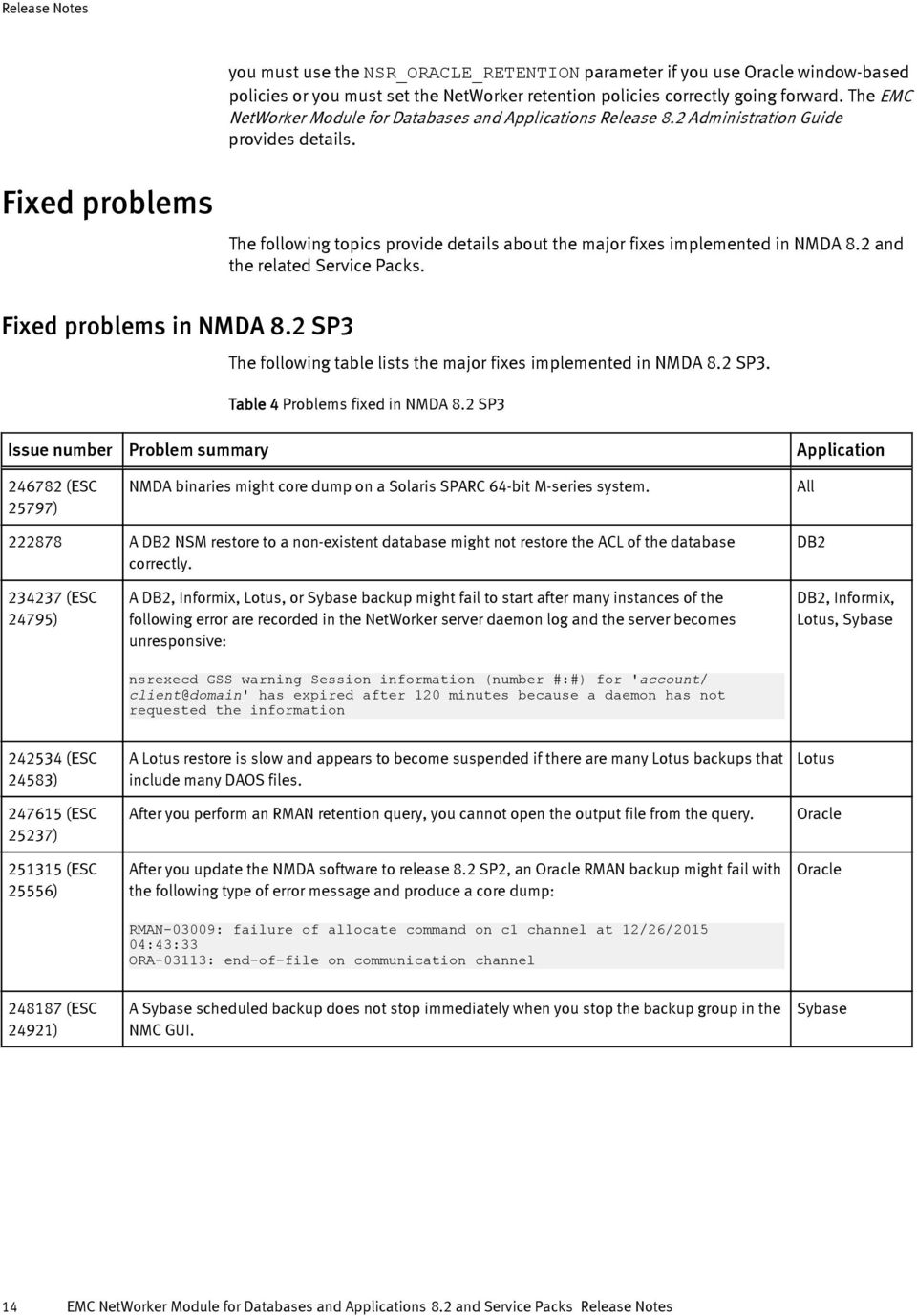
14 you must use the NSR_ORACLE_RETENTION parameter if you use Oracle window-based policies or you must set the NetWorker retention policies correctly going forward. The EMC NetWorker Module for Databases and Applications Release 8.2 Administration Guide provides details. Fixed problems The following topics provide details about the major fixes implemented in NMDA 8.2 and the related Service Packs. Fixed problems in NMDA 8.2 SP3 The following table lists the major fixes implemented in NMDA 8.2 SP3. Table 4 Problems fixed in NMDA 8.2 SP3 Issue number Problem summary Application (ESC 25797) NMDA binaries might core dump on a Solaris SPARC 64-bit M-series system. All A DB2 NSM restore to a non-existent database might not restore the ACL of the database correctly. DB (ESC 24795) A DB2, Informix, Lotus, or Sybase backup might fail to start after many instances of the following error are recorded in the NetWorker server daemon log and the server becomes unresponsive: nsrexecd GSS warning Session information (number #:#) for 'account/ client@domain' has expired after 120 minutes because a daemon has not requested the information DB2, Informix, Lotus, Sybase (ESC 24583) (ESC 25237) (ESC 25556) A Lotus restore is slow and appears to become suspended if there are many Lotus backups that include many DAOS files. After you perform an RMAN retention query, you cannot open the output file from the query. After you update the NMDA software to release 8.2 SP2, an Oracle RMAN backup might fail with the following type of error message and produce a core dump: RMAN-03009: failure of allocate command on c1 channel at 12/26/ :43:33 ORA-03113: end-of-file on communication channel Lotus Oracle Oracle (ESC 24921) A Sybase scheduled backup does not stop immediately when you stop the backup group in the NMC GUI. Sybase 14 EMC NetWorker Module for Databases and Applications 8.2 and Service Packs Release Notes
15 Fixed problems in NMDA 8.2 SP2 The following table lists the major fixes implemented in NMDA 8.2 SP2. Table 5 Problems fixed in NMDA 8.2 SP2 Issue number Problem summary Application (ESC 23153) (ESC 23260) , (ESC 23787) , (ESC 23496) (ESC 23780) After a DB2 backup fails due to a network disconnection with the NetWorker server, subsequent DB2 backups might continue to fail in certain cases. A DB2 rollforward operation might appear to become suspended if the NetWorker client file index includes many entries for non-db2 backups. Due to issues in DB and 10.1, such as APAR IT05079, a DB2 backup configuration in the wizard or a scheduled backup might fail. A restore of tablespaces in a DPF environment might fail. After the NetWorker backup index is re-created by using the scanner program, a restore of a Lotus Domino database backup might fail. If the NSR_CATALOGFILE parameter value is set in the configuration file or in the backup configuration wizard, then a Lotus transaction log backup fails. DB2 DB2 DB2 Lotus Domino Lotus Domino An Oracle scheduled backup with a postcommand script might fail if the script name starts with nsrnmodr. Oracle (ESC 23290) (ESC 24005) (ESC 23001) An Oracle backup fails with a core dump when you allocate a channel, release the channel, and then allocate another channel in the RMAN backup script. When you use a backup script that runs the nsrdasv program to perform an Oracle RMAN backup, the nsrdasv command always reports the exit code 0. A Sybase backup might fail when the backup server is busy and NSR_PARALLELISM is greater than zero. Oracle Oracle Sybase Fixed problems in NMDA 8.2 SP1 The following table lists the major fixes implemented in NMDA 8.2 SP1. Table 6 Problems fixed in NMDA 8.2 SP1 Issue number Problem summary Application Client Direct backups fail with 32-bit NMDA on 64-bit Linux because the 64-bit NetWorker client release 8.2 does not include the 32-bit libddboost.so library. The issue is fixed in the 64-bit NetWorker client release 8.2 SP1. All Note To enable Client Direct backups of a 32-bit database on 64-bit Linux, install the 64-bit NetWorker client release 8.2 SP The 32-bit NMDA software files are missing in the 64-bit NMDA zipped download file on Windows. All Fixed problems in NMDA 8.2 SP2 15

16 Table 6 Problems fixed in NMDA 8.2 SP1 (continued) Issue number Problem summary Application NW NW NW For DB2 NSM backups, the DB2 metadata save set is not removed when a point-in-time save set is removed or released. A misleading message "Unknown error category 211" might cause confusion with a Domino backup failure. An Oracle backup might fail with the following error message when the nsrmmd process is busy: DB2 Lotus Oracle Volume ID 'volume_id' is not in media database. (2:3:73) NW The nsrdasv program fails to correctly process the NLS_DATE_FORMAT parameter value that contains spaces. Oracle NW NSR_ORACLE_RETENTION is not honored if the parameter is set by the wizard. Oracle NW Oracle backups complete successfully but do not release the FIPS140 resource correctly at the end, which might cause Oracle to dump a core file. Oracle An Oracle backup configuration operation with the wizard might time out when the configuration includes a large Oracle database. Oracle NW The nsrsybrc command does not permit spaces between the -P option and the password. Sybase ASE NW An NMDA Sybase restore cannot find a backup performed during Standard Time when the restore is performed during Daylight Saving Time. Sybase ASE Fixed problems in NMDA 8.2 The following table lists the major fixes implemented in NMDA 8.2. Table 7 Problems fixed in NMDA 8.2 Issue number Problem summary Application NW154527, DB2 backup on Windows fails due to a db2sysc.exe process crash. DB2 NW The restore of a DB2 NSM snapshot backup might fail with a crash of the db2vend process. DB2 NW161337, NW NW NW160571, NW161178, DB2 redirected recovery with the db2 "rollforward db" command fails to recover the transaction logs from the backup media. With the NSR_PREFETCH_LOGS parameter set to a nonzero value, a Lotus restore with the nsrdocrc command does not prefetch any transaction logs. Lotus recovery of a Domino.nsf file with many transaction logs does not stop when End restore is selected, and the recovery continues to completion. On Linux, a Lotus scheduled backup fails with a crash of the nsrdasv program when the checkpoint restart option (CPR) is enabled. When you run the NetWorker User for Lotus GUI to recover a Lotus backup, the GUI might not display all the backed-up files included in the backup. DB2 Lotus Domino Lotus Domino Lotus Domino Lotus Domino 16 EMC NetWorker Module for Databases and Applications 8.2 and Service Packs Release Notes

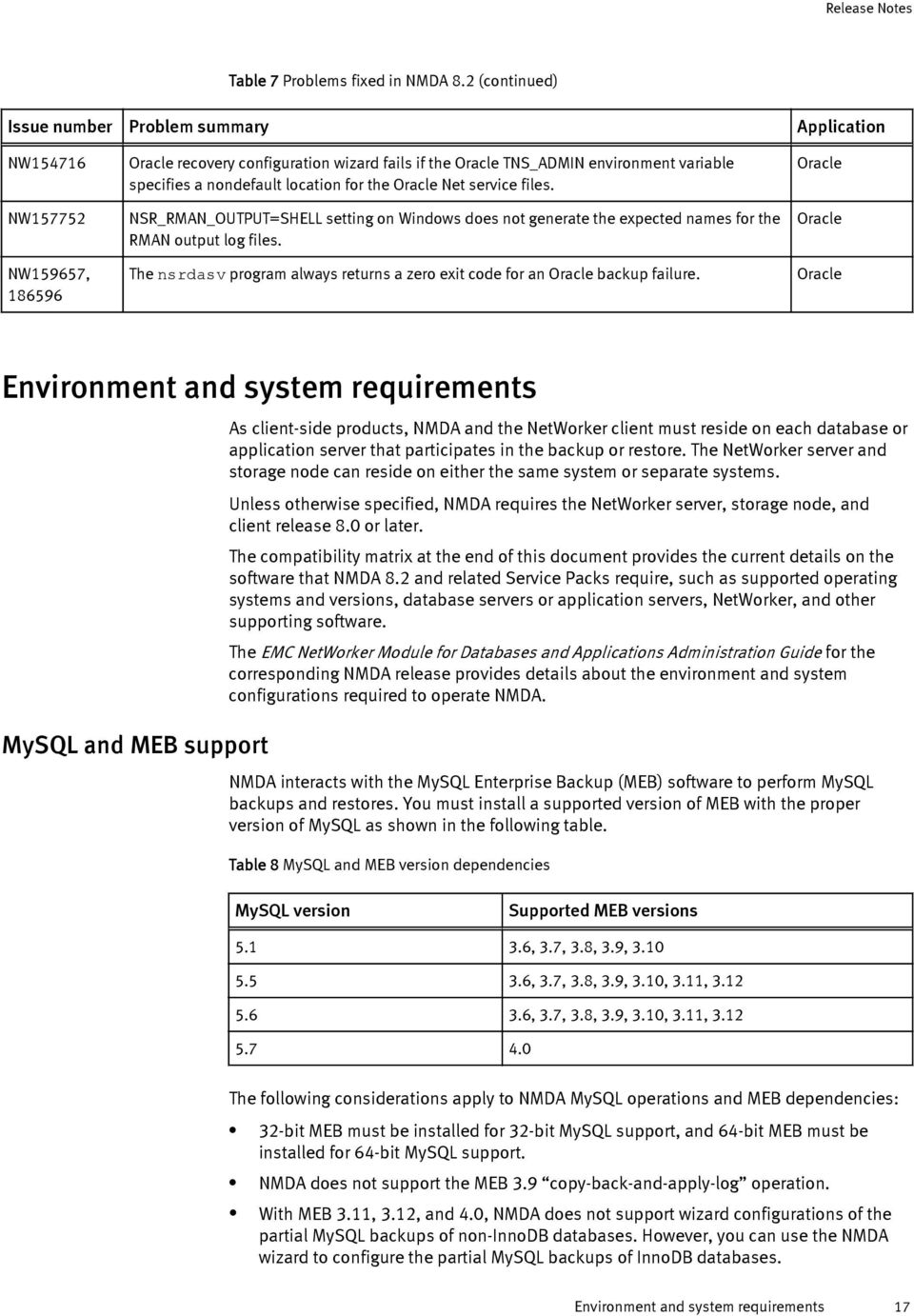
17 Table 7 Problems fixed in NMDA 8.2 (continued) Issue number Problem summary Application NW NW NW159657, Oracle recovery configuration wizard fails if the Oracle TNS_ADMIN environment variable specifies a nondefault location for the Oracle Net service files. NSR_RMAN_OUTPUT=SHELL setting on Windows does not generate the expected names for the RMAN output log files. The nsrdasv program always returns a zero exit code for an Oracle backup failure. Oracle Oracle Oracle Environment and system requirements MySQL and MEB support As client-side products, NMDA and the NetWorker client must reside on each database or application server that participates in the backup or restore. The NetWorker server and storage node can reside on either the same system or separate systems. Unless otherwise specified, NMDA requires the NetWorker server, storage node, and client release 8.0 or later. The compatibility matrix at the end of this document provides the current details on the software that NMDA 8.2 and related Service Packs require, such as supported operating systems and versions, database servers or application servers, NetWorker, and other supporting software. The EMC NetWorker Module for Databases and Applications Administration Guide for the corresponding NMDA release provides details about the environment and system configurations required to operate NMDA. NMDA interacts with the MySQL Enterprise Backup (MEB) software to perform MySQL backups and restores. You must install a supported version of MEB with the proper version of MySQL as shown in the following table. Table 8 MySQL and MEB version dependencies MySQL version Supported MEB versions , 3.7, 3.8, 3.9, , 3.7, 3.8, 3.9, 3.10, 3.11, , 3.7, 3.8, 3.9, 3.10, 3.11, The following considerations apply to NMDA MySQL operations and MEB dependencies: 32-bit MEB must be installed for 32-bit MySQL support, and 64-bit MEB must be installed for 64-bit MySQL support. NMDA does not support the MEB 3.9 copy-back-and-apply-log operation. With MEB 3.11, 3.12, and 4.0, NMDA does not support wizard configurations of the partial MySQL backups of non-innodb databases. However, you can use the NMDA wizard to configure the partial MySQL backups of InnoDB databases. Environment and system requirements 17
18 With MEB 3.11, 3.12, and 4.0, NMDA supports MySQL binary log backups only if you disable the MEB log file backups by setting MYSQL_MEB_OPTIONS=--skipbinlog. With MEB 3.12 and 4.0, NMDA does not support cloud backup and restore with OpenStack Object Storage (Swift) 1.0. With MEB 4.0, NMDA does not support the mysql.backup_sbt_history table on the backed-up MySQL instance for accessing information about online backups to tape. You must use the mminfo or nsrinfo command to obtain information about NMDA MySQL backups to a NetWorker server. The MySQL documentation provides details about MEB 4.0 limitations, which also affect the NMDA MySQL operations. MySQL 5.6 support NMDA supports MySQL release 5.6, including the new features except for the use of an encrypted login file, mylogin.cnf, for setting the backup credentials. NMDA support of new features in MySQL 5.6 requires MEB version or later to be installed on the MySQL server host. For a list of the new features supported only with MEB or later, refer to the topic Compatibility Note for MySQL Version in the MySQL Enterprise Backup User s Guide for version or later. Known problems and limitations The following tables list the known problems and limitations that apply to NMDA 8.2 and the related Service Packs: Limitations in NMDA 8.2 and Service Packs on page 18 Limitations in other products that affect NMDA 8.2 and Service Packs on page 20 The issues are grouped according to the specific application to which they apply. The first group includes the common issues that apply to multiple applications. When you contact Customer Service about an issue, use the listed issue number. Unless the entry for a known limitation indicates that it is resolved for a specific release, the limitation applies to NMDA 8.2 and all the Service Packs. A resolved limitation is listed in the fixed problems table for the release in which it is resolved. Table 9 Limitations in NMDA 8.2 and Service Packs Issue number Description Operating system Product feature Application on page 21 A push install operation fails to update the 32-bit NMDA software on a 64-bit OS. All Push install All on page 21 On Linux, NMDA installations and operations fail if the NetWorker client package is installed in a nondefault location. Linux Installation, backup, restore All 18 EMC NetWorker Module for Databases and Applications 8.2 and Service Packs Release Notes
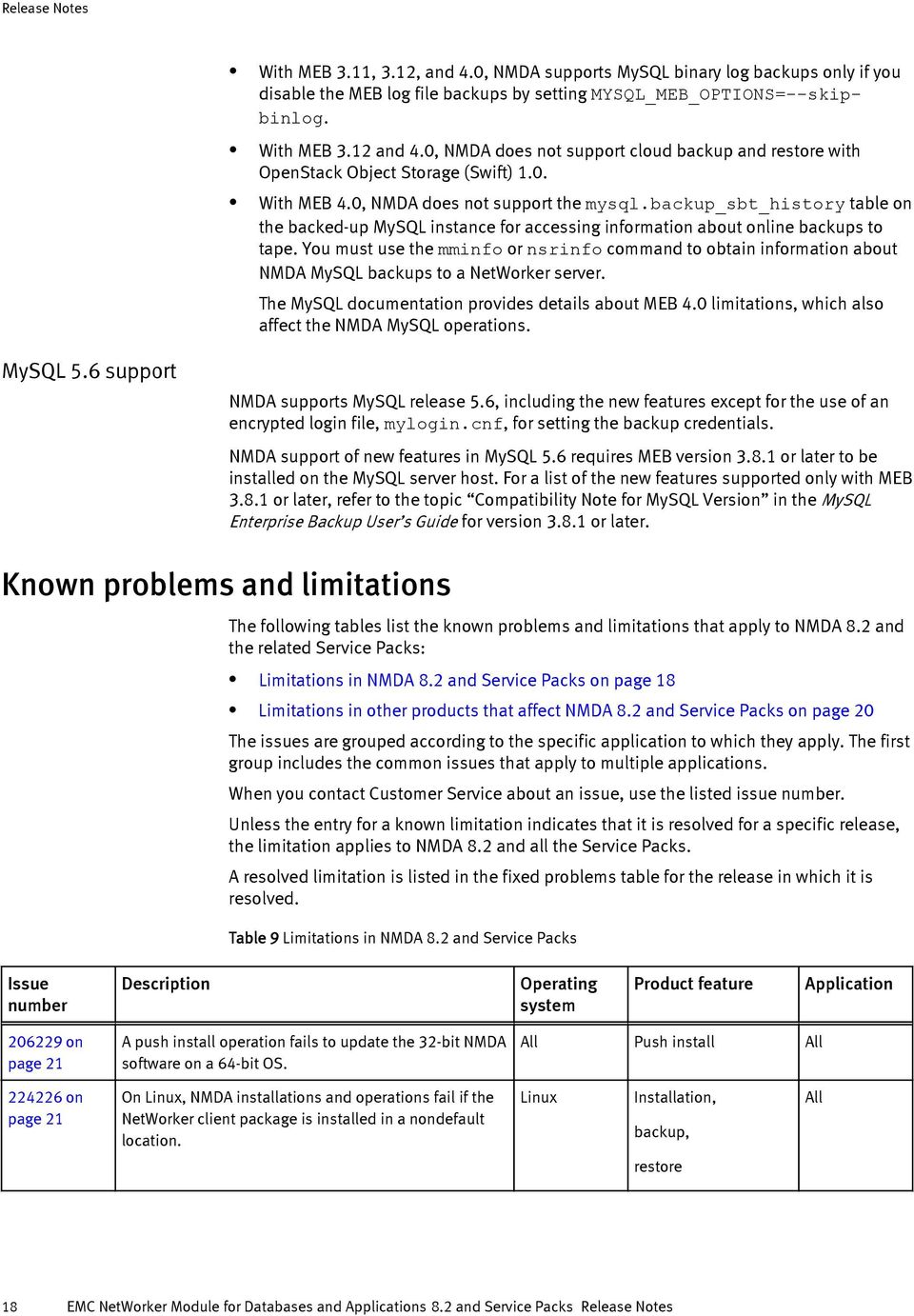
19 Table 9 Limitations in NMDA 8.2 and Service Packs (continued) Issue number Description Operating system Product feature Application ESC on page 23 An NMDA backup might fail and produce many instances of the following error message in the NetWorker server log file: AIX, Linux Backup All An existing connection was forcibly closed by the remote host (ESC 23153) on page 23 After a DB2 backup fails due to a network disconnection with the NetWorker server, subsequent DB2 backups might continue to fail in certain cases. All Backup, archive DB (ESC 23260) on page 23 A DB2 rollforward operation might appear to become suspended if the NetWorker client file index includes many entries for non-db2 backups. All Restore DB2 NW on page 24 The savegroup report for a DB2 snapshot and rollover backup does not include any save set information from the rollover part of the backup. Linux Backup, NSM DB2 NW on page 25 With 32-bit NMDA on AIX, an Informix backup fails with the following error message: AIX Backup Informix Dependent module /usr/lib/liblocktbl.so could not be loaded , (ESC 23496) on page (ESC 23780) on page 25 NW101758, NW on page 26 NW on page 27 After the NetWorker backup index is re-created by using the scanner program, a restore of a Lotus Domino database backup might fail. If the NSR_CATALOGFILE parameter value is set in the configuration file or in the backup configuration wizard, then a Lotus transaction log backup fails. A Lotus backup of 64-bit Domino on AIX might cause the Domino server to crash or become suspended or the backup might fail with a specific error message. A Lotus full database backup might expire before the dependent transaction log backups because NMDA Lotus does not create dependencies between the backups. All Restore Lotus Domino All Backup Lotus Domino AIX Backup Lotus Domino All Backup Lotus Domino NW on page 27 Conversion of a MySQL client-side to server-side configuration with the nsrdaadmin -W command Linux Configuration conversion MySQL fails. NW on page 27 When you run the nsrinfo command to obtain information about MySQL backups, the command displays an error message. Linux Backup MySQL LGTsc06110 o n page 28 Japanese Oracle backup information might be displayed incorrectly in the NMC program. All Backup, internationalization Oracle Known problems and limitations 19
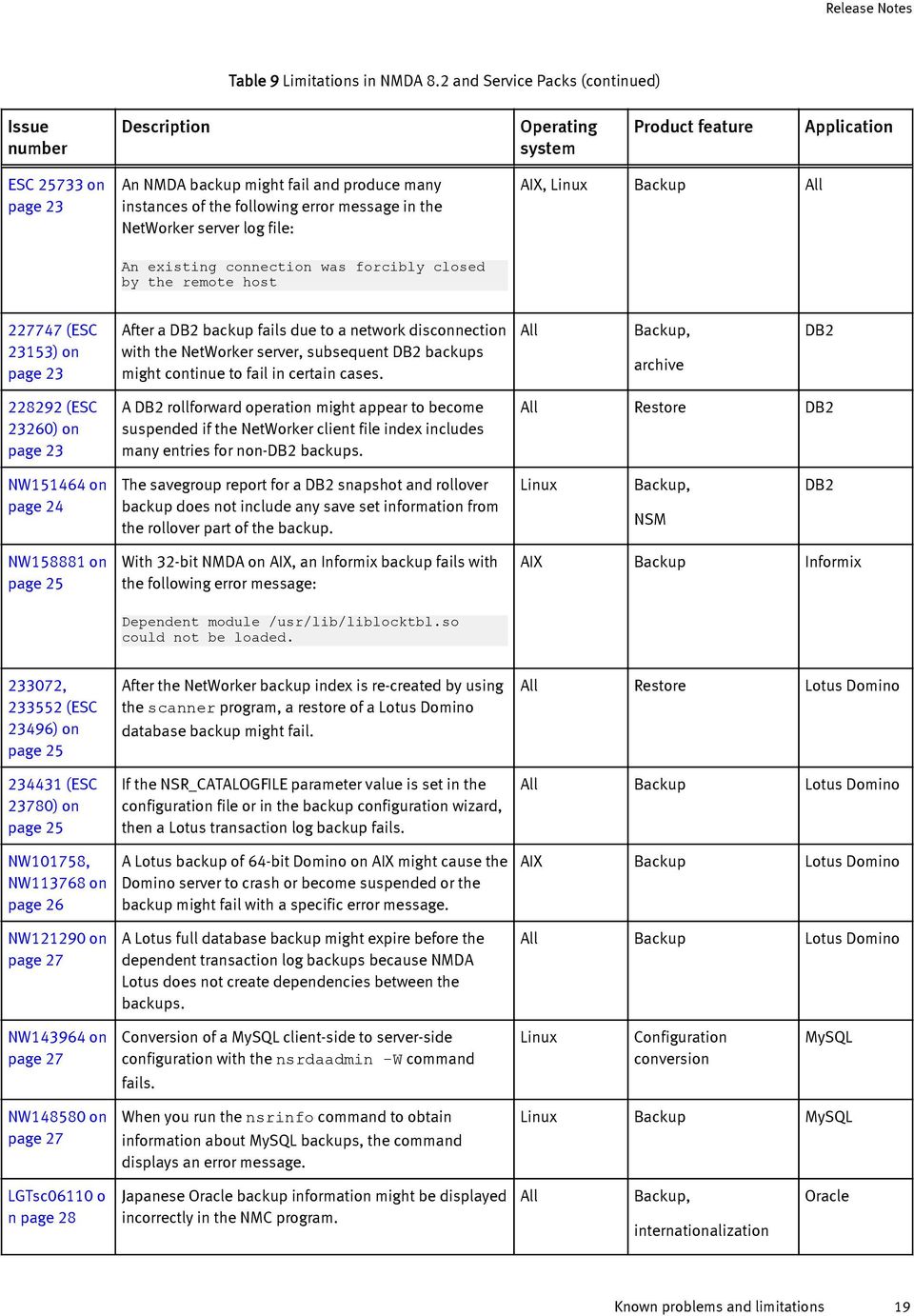
20 Table 9 Limitations in NMDA 8.2 and Service Packs (continued) Issue number Description Operating system Product feature Application NW on page on page 29 NMDA Oracle save set bundling or policy uniformity fails for a multinode Oracle RAC backup, but the backup is successful and fully recoverable. An Oracle backup configuration operation with the wizard might time out when the configuration includes a large Oracle database. All Backup Oracle All Configuration wizard Oracle An Oracle scheduled backup with a postcommand script might fail if the script name starts with nsrnmodr. All Backup Oracle (ESC 23290) on page (ESC 24005) on page 30 NW on page 30 NW on page (ESC 23001) on page 31 An Oracle backup fails with a core dump when you allocate a channel, release the channel, and then allocate another channel in the RMAN backup script. When you use a backup script that runs the nsrdasv program to perform an Oracle RMAN backup, the nsrdasv command always reports the exit code 0. If a Sybase manual or scheduled backup attempts to back up more than 200 databases, the backup might fail. A Sybase scheduled backup might fail if the Sybase server and NetWorker client run in different locales. A Sybase backup might fail when the backup server is busy and NSR_PARALLELISM is greater than 1. All Backup Oracle All Backup Oracle All Backup Sybase ASE All Backup Sybase ASE All Backup Sybase ASE Table 10 Limitations in other products that affect NMDA 8.2 and Service Packs Issue number Description Operating system Product feature Application NW on page 22 Due to a NetWorker limitation in non-english locales, backup configuration with the wizard fails. All Configuration wizard, internationalization All on page 23 Due to a DB2 bug, if you use the HPU utility to unload and restore an NMDA DB2 incremental backup, then the operation might fail with an error. All Restore DB , (ESC 23787) on page 23 Due to issues in DB and 10.1, such as APAR IT05079, a DB2 backup configuration in the wizard or a scheduled backup might fail. A restore of tablespaces in a DPF environment might fail. All Backup, restore DB2 NW on page 24 NW on page 24 Due to a DB2 bug, if you run a multisession DB2 backup and use the db2 prune command to delete backup entries from the DB2 history file, the command might leave some entries in the file. Due to a DB2 limitation, NMDA does not delete the logs from the NetWorker server during a db2 prune All Backup DB2 All Backup DB2 20 EMC NetWorker Module for Databases and Applications 8.2 and Service Packs Release Notes

21 Table 10 Limitations in other products that affect NMDA 8.2 and Service Packs (continued) Issue number Description Operating system Product feature Application operation if the NMDA configuration file pathname in the LOGARCHOPTn parameter exceeds 30 ASCII characters. NW on page 28 Due to an Oracle limitation, Oracle backup problems might occur when the RMAN script contains non-ascii data. All Backup, internationalization Oracle NW on page 29 Due to Oracle bug , a point-in-time recovery of an Oracle 12c table, table partition, or pluggable database (PDB) might fail if you use manual channel allocation. All Restore Oracle NW on page 29 Due to Oracle bug , an Oracle 12cR1 container or pluggable database snapshot backup with NSM fails on Windows if some of the datafiles are not located on a snapshotable device. Windows Backup, NSM Oracle Common NMDA problems and limitations Push install of 32-bit NMDA fails on a 64-bit OS This section contains the NMDA problems and limitations that apply to all the applications (DB2, Informix, Lotus Domino/Notes, MySQL, Oracle, Sybase) that NMDA supports If you try to update 32-bit NMDA on a 64-bit OS by using the software distribution (push install) feature from the NetWorker server, the push install operation fails with the following type of error message: nsrcpd NSR warning No upgrade clients available for the selected products As a workaround, update the 32-bit NMDA software manually on a 64-bit OS: 1. Uninstall the existing 32-bit NMDA software according to the uninstall instructions in the NMDA installation guide for the module version. 2. Install the updated 32-bit NMDA software according to the install instructions in the latest NMDA installation guide. Installations and operations fail on Linux with NetWorker client installed in nondefault location On Linux, if the NetWorker client package is installed in a nondefault location, then NMDA operations cannot load the FIPS140 shared libraries. As a result, the following issues occur: The NMDA installation fails with the following error message: Unable to load FIPS-140 module: The FIPS140 shared library could not be found Common NMDA problems and limitations 21
22 The NMDA binaries are installed correctly, but the automated wizard registration fails with the error. All other NMDA operations fail with the same error message, including backups, restores, and backup deletions. As a workaround, perform the following steps: 1. Run the following command as the root user to create the required symbolic link: # ln -s /relocation_path/lib/nsr /usr/lib/nsr 2. If you want to use the NMDA wizard, then run the appropriate command from the following table as the root user to register the wizard. Note To manually unregister the wizard, use the command from the table but replace the option -i with -u. Table 11 Command to register the wizard Database or application Wizard registration command DB2 nsrdb2ra -i Informix nsrifmxra -i Lotus nsrlotusra -i MySQL nsrmysqlra -i Oracle nsrorara -i Sybase nsrsybra -i 3. To enable NMDA MySQL operations, run the following commands as the root user to create the required symbolic links: # ln -s /relocation_path/lib64/libmysqlapi.so.2 /usr/lib64/ libmysqlapi.so.2 # ln -s /relocation_path/lib64/libmysqlapiwrap.so /usr/lib64/ libmysqlapiwrap.so # ln -s /relocation_path/lib/libnsrmysql.so /usr/lib/libnsrmysql.so Backup configuration with the wizard fails in non-english locale NW Due to a NetWorker limitation in non-english locales, if the NetWorker server is installed in a nondefault path that includes any non-ascii characters, the configuration of a backup with the wizard fails with the following error message: Failed to open lockbox non-ascii_dir_name\nsr\lockbox\client_name \clb.lb As a workaround, perform either of the following actions: Configure the backup manually with the NMC method, without the wizard. Ensure that the installation path of the NetWorker server does not include any non- ASCII characters. 22 EMC NetWorker Module for Databases and Applications 8.2 and Service Packs Release Notes
23 NMDA backup might fail with many error messages in the NetWorker server log DB2 problems and limitations ESC An NMDA backup might fail and produce many instances of the following error message in the NetWorker server log file: An existing connection was forcibly closed by the remote host The NetWorker server might also become suspended. As a workaround, remove any suspended NMDA process, and restart the NetWorker server if required. This section contains NMDA problems and limitations specific to DB2 operations. DB2 HPU restore might fail with an incremental backup Due to a DB2 bug, if you use the IBM Optim High Performance Unload (HPU) utility to unload and restore an NMDA DB2 incremental backup, then the unload and restore operation might fail with the INZU366I HPU return code 8 (reason code 0x283a001). The DB2 bug is resolved in IBM HPU v DB2 backups might continue to fail after a network disconnection causes a backup failure (ESC 23153) After a DB2 backup fails due to a network disconnection with the NetWorker server, subsequent DB2 backups might continue to fail in certain cases because the libnsrdb2 shared library blocks the subsequent backups even when the network connection is resumed. The issue is resolved in NMDA 8.2 SP2. DB2 rollforward might appear to become suspended (ESC 23260) A DB2 rollforward operation might appear to become suspended if the NetWorker client file index includes many entries for non-db2 backups. The rollforward operation incorrectly searches index entries in all namespaces instead of searching only the backup entries in the DB2 namespace, which might take an extended period of time. The issue is resolved in NMDA 8.2 SP2. DB2 backups and restores might fail due to DB and 10.1 issues , (ESC 23787) Due to issues in DB and DB2 10.1, such as APAR IT05079, the following NMDA operations might fail: The configuration of a DB2 scheduled backup in the wizard might fail. A DB2 scheduled backup might fail. DB2 problems and limitations 23
24 A restore of tablespaces in a DPF environment might fail due to a change in the vendor context input from DB2 with respect to the type of restore. The restore failure produces the following error message: No match for a database image file was found based on the source database alias "database_name" and timestamp "backup_timestamp" provided The issue is resolved in NMDA 8.2 SP2. DB2 snapshot and rollover backup does not report the rollover save set details NW When you use NMDA with NSM to perform a DB2 snapshot and rollover backup, the savegroup report does not include any save set information from the rollover part of the backup. The savegroup report includes information from the snapshot backup only. DB2 prune operation might fail to delete all entries from DB2 history file NW Due to a DB2 bug, if you run a multisession DB2 backup and then use the db2 prune command to delete the backup entries from the DB2 history file, the command deletes the index entries on the NetWorker server but might leave some of the entries in the DB2 history file. The DB2 bug is fixed in DB2 9.7 fp4. As a workaround, run the db2 prune command again without the and delete option to delete the remaining entries in the DB2 history file. For example: db2 prune history with force option and delete db2 prune history with force option DB2 prune operation does not delete the logs from the NetWorker server in certain cases NW NMDA does not delete the DB2 transaction logs from the NetWorker server during a DB2 prune operation if the NMDA configuration file pathname specified in the LOGARCHOPTn parameter exceeds 30 ASCII characters. This character length limitation is a DB2 limitation. The LOGARCHOPTn parameter is set when configuring an automatic backup of DB2 transaction logs. The issue is a result of DB2 not setting the NMDA configuration file pathname correctly in the Comment field of the corresponding DB2 history file record when the pathname exceeds 30 ASCII characters. As a workaround, you can perform the following steps. 1. Run the db2 update history command to update the Comment field in the DB2 history file to point to an NMDA configuration file pathname that does not exceed 30 ASCII characters. For example, the following db2 list history command output shows that the Comment field in the history file does not contain a valid NMDA configuration file pathname: db2 list history archive log all for db hat List History File for hat Op Obj Timestamp+Sequence Type Dev Earliest Log Current Log Backup ID EMC NetWorker Module for Databases and Applications 8.2 and Service Packs Release Notes
25 X D O S LOG C Comment: Start Time: End Time: Status: P EID: 25 Location: /usr/lib/libnsrdb2.so Informix problems and limitations You can run the following db2 update history command to update the Comment field with a valid configuration file pathname: db2 update history eid 25 with comment \"@/space/db2inst1/nmda.cfg \" 2. Rerun the db2 prune command. Informix backup fails with 32-bit NMDA on AIX To prevent this issue in future archive log backups, use an NMDA configuration file pathname that does not exceed 30 ASCII characters in the LOGARCHOPTn parameter. This section contains NMDA problems and limitations specific to Informix operations. NW With 32-bit NMDA on AIX, an Informix backup fails with the following error message: Dependent module /usr/lib/liblocktbl.so could not be loaded. As a workaround, run the following command as root, to remove the following symbolic link before you perform any Informix backups: rm /usr/lib/liblocktbl.so This link removal ensures that the 32-bit NMDA Informix library can locate the correct 32- bit libraries. Lotus Domino/Notes problems and limitations This section contains NMDA problems and limitations specific to Lotus Domino/Notes operations. Notes database restore might fail after scanner re-creates the backup index , (ESC 23496) After the NetWorker backup index is re-created by using the scanner program, a restore of a Lotus Domino database backup might fail. The failure is caused when the backup index is not rebuilt correctly by the scanner program. The scanner program stops rebuilding the backup index if a backup save set includes a file that was skipped during the backup, for example, due to errors in opening the file. The issue is resolved in NMDA 8.2 SP2. Lotus transaction log backup fails if NSR_CATALOGFILE is set (ESC 23780) If the NSR_CATALOGFILE parameter value is set in the configuration file or in the backup configuration wizard, then a Lotus transaction log backup fails. Informix problems and limitations 25
26 The issue is resolved in NMDA 8.2 SP2. Backup of 64-bit Domino on AIX might fail NW101758, NW An NMDA Lotus backup of 64-bit Domino on AIX might cause the Domino server to crash or become suspended or the backup might fail with the following error message: notes_sess_open: Exiting with error: The call to NotesInitExtended failed: 433 To prevent the issues NW and NW113768, perform the following steps on the AIX Domino host after the NMDA software is installed: 1. Log in as the Notes user, run the following commands, and record the command output: > ulimit -a > echo $LDR_CNTRL 2. Log in as the root user, and run the following commands: # ulimit -a # echo $LDR_CNTRL # dump -o /usr/bin/nsrexecd If any of the following conditions is true, perform step 3 on page 26 to step 5 on page 26: a. The data limit reported by the ulimit command for the root user is lower than for the Notes user. b. The LDR_CNTRL value for the root user is different than for the Notes user. c. The output from the dump nsrexecd command contains the following information: maxdata 0x Shut down the NetWorker client that is running on the Domino host by using the nsr_shutdown command. 4. Perform the appropriate action, depending on the issues found: a. Set the data limit for the root user to the same value as for the Notes user. b. Set the LDR_CNTRL parameter for the root user to the same value as for the Notes user. c. Run the following ldedit command on the nsrexecd executable to decrease the amount of memory that it uses: # /usr/ccs/bin/ldedit -bmaxdata:0x /usr/bin/nsrexecd 5. Restart the NetWorker client. If the issue occurs on the AIX Domino host before you have performed the preceding steps: 1. Shut down the Domino server. 2. Reboot the whole machine. 3. Perform the preceding step 1 on page 26 to step 5 on page EMC NetWorker Module for Databases and Applications 8.2 and Service Packs Release Notes
27 Lotus full backups might expire before dependent transaction logs MySQL problems and limitations NW NMDA Lotus does not create dependencies between any transaction log backups (performed during an incremental backup or transaction log only backup) and full database backups. As a result, a database backup might expire before the corresponding transaction log backups. You cannot use the transaction log backups to restore and recover the data without the full backup. If you have encountered this issue with your backups, the backups expired from the NetWorker online indexes might not be deleted immediately from the backup media. As a workaround, run the scanner i command or the nsrck L7 command to rebuild the online indexes so that you can still use full backups for restore operations. To reduce the possibility of encountering this issue, set the browse policy and retention policy of the Domino and Notes backups to a much longer time than the recovery point objective (RPO). For example, if the RPO is 1 week and you perform full backups on Sundays and incremental backups for the rest of the week, set the browse policy and retention policy to 2 weeks for both full backups and incremental backups. This setting ensures that the software retains the backups on the media to achieve the RPO of 1 week. This section contains NMDA problems and limitations specific to MySQL operations. Conversion of MySQL client-side to server-side configuration fails NW When you use the nsrdaadmin -W command to convert a MySQL client-side configuration to a server-side configuration, the conversion fails with the following error message: 75525:nsrdaadmin: NMDA wizard conversion is not supported for application type specified: 7. As a workaround, use the wizard and select your existing client-side configuration file on the Specify the NMDA configuration file template page to create a new configuration. You can delete the old client-side configuration when the wizard configuration has completed successfully. The nsrinfo command does not display MySQL backup information NW When you run the nsrinfo command to obtain information about MySQL backups from the NetWorker client file index, the command does not provide the backup information. You need to use the nsrinfo command to obtain specific types of information about MySQL backups, such as the binary log start number and log position information. The nsrinfo command used to query MySQL backup information displays the following error message: 90955:nsrinfo: The MySQL client attributes could not be decoded. As a workaround, update the NetWorker client software to release or later. MySQL problems and limitations 27
28 Oracle problems and limitations This section contains NMDA problems and limitations specific to Oracle operations. Japanese Oracle backup information might be displayed incorrectly in NMC program LGTsc06110 When a scheduled NMDA Oracle backup is run in a Japanese environment and the output from RMAN or from a preprocessing or postprocessing script (used for the backup) is not UTF8 text, the Japanese backup information displayed in the NMC program might appear incorrectly as box or question mark characters. As a workaround, perform the following actions: Use the NSR_RMAN_ARGUMENTS parameter to redirect the RMAN output to a specified log file. Specify "echo off" in any preprocessing and postprocessing scripts used for the scheduled NMDA Oracle backup. Backup problems might occur due to non-ascii data in RMAN script NW Due to Oracle bug , an NMDA Oracle backup might fail or some parameters might be ignored in a non-english locale when the following conditions exist: NMDA internationalization is set up. The character sets of the RMAN script and Oracle database are different. A non-ascii character is included in the parms option or send command in the RMAN script. For example, if the database uses the UTF8 character set and the RMAN script uses the EUC-JP character set, an NMDA Oracle backup fails when the parms option or send command in the RMAN script contains any non-ascii data. As a result, the NMDA software does not support non-ascii data in the RMAN script when the character set of the RMAN script (set through the NLS_LANG environment variable) differs from the character set of the Oracle database in a non-english locale. NMDA Oracle save set bundling or policy uniformity fails for multinode RAC backups NW If you configure the NMDA Oracle save set bundling or policy uniformity feature, then a multinode Oracle RAC backup generates the following warning: No information could be obtained from the backup piece file. The backup is successful and fully recoverable, but the save set bundling or policy uniformity feature fails. As a workaround: On UNIX or Linux, create a symbolic link that points the /nsr/apps directory on every RAC node to a file system pathname on a shared disk, which is accessible from all the nodes. On Windows, set NSR_TMPDIR in the nwora.res file on every RAC node to a file system pathname on a shared disk, which is accessible from all the nodes. 28 EMC NetWorker Module for Databases and Applications 8.2 and Service Packs Release Notes
29 Oracle 12c point-in-time recovery might fail with manual channel allocation NW Due to Oracle bug , a point-in-time recovery of an Oracle 12c table, table partition, or pluggable database (PDB) might fail if you use manual channel allocation with the allocate channel command. As a workaround, use automatic channel allocation with the configure channel command for a point-in-time recovery of an Oracle 12c table, table partition, or PDB. Oracle 12cR1 container or pluggable database snapshot backup fails on Windows if some datafiles are not on a snapshotable device NW Due to Oracle bug , an Oracle 12cR1 snapshot backup of a container or pluggable database on Windows fails when some of the datafiles are not located on a snapshotable device. For example, you run the following RMAN command to back up a database that consists of datafiles 1 to 5, but datafiles 3 and 4 are not on a snapshotable device: backup proxy full format '%d_%u' database; The backup fails with the following error message: ORA-00600: internal error code, arguments: [krbbbdr_inconsistent_pdbid] As a workaround, exclude from the proxy backup any datafiles that are not on a snapshotable device, and back up those datafiles in a separate backup command without the proxy option. For example, in the previous example where datafiles 3 and 4 are not on a snapshotable device, run two separate backups by using the following separate RMAN commands: backup proxy full format '%d_%u' datafile 1,2,5; backup full format '%d_%u' datafile 3,4; Oracle backup configuration with the wizard might time out with a large database When you use the configuration wizard to create or modify an Oracle backup configuration, the wizard operation might time out when the configuration includes a large Oracle database. The issue is resolved in NMDA 8.2 SP1. Oracle problems and limitations 29
30 Oracle backup with postcommand script might fail You can use a postcommand script during an Oracle scheduled backup to back up files to prepare an Oracle server for disaster recovery. The backup with the postcommand script might fail if the script name starts with nsrnmodr. The issue is resolved in NMDA 8.2 SP2. Oracle backup fails with a core dump when a channel is allocated, released, and allocated again (ESC 23290) An Oracle backup fails with a core dump when you allocate a channel, release the channel, and then allocate another channel in the RMAN backup script. As a workaround, do not allocate an additional channel after you release a channel in the RMAN backup script. The issue is resolved in NMDA 8.2 SP2. The nsrdasv program might report an incorrect exit code to an Oracle backup script (ESC 24005) When you use a backup script that runs the nsrdasv program to perform an Oracle RMAN backup, the nsrdasv command always reports the exit code 0, which indicates a successful backup. If the backup fails, this exit code is incorrect, which prevents the proper diagnosis of the backup issue. The issue is resolved in NMDA 8.2 SP2. Sybase ASE problems and limitations Backup of more than 200 databases might fail This section contains NMDA problems and limitations specific to Sybase ASE operations. NW If a Sybase manual or scheduled backup attempts to back up more than 200 databases, the backup might fail. Note The limit of 200 databases is based on a maximum size of 30 bytes for a Sybase database name. The database limit might be higher for a backup of databases with names of smaller sizes. As a workaround, perform two or more smaller Sybase backups instead of one large Sybase backup, where each smaller backup backs up fewer than 200 databases. For example, perform one of the following operations: Perform two or more Sybase manual backups with the nsrdasv command, with each nsrdasv command backing up fewer than 200 databases. Perform two or more Sybase scheduled backups that each back up fewer than 200 databases. For each backup, create a separate Client resource and separate configuration file with each configuration file specifying a difference set of databases for the backup. 30 EMC NetWorker Module for Databases and Applications 8.2 and Service Packs Release Notes
31 Sybase scheduled backup might fail if Sybase server and NetWorker client run in different locales NW A Sybase scheduled backup might fail if the Sybase server and NetWorker client run in different locales. As described in the EMC NetWorker Module for Databases and Applications Administration Guide, you must set the NSR_LOCALE parameter to the required locale in the NMDA configuration file for a Sybase manual backup configuration or a client-side scheduled backup configuration. However, NSR_LOCALE is not supported for a server-side scheduled backup or a probe-based backup. As a workaround for a server-side scheduled backup or a probe-based backup, you can set the LANG environment variable in the NetWorker start script that is installed with the NetWorker client software on the Sybase server host. For example on Linux, insert the LANG setting lines at the beginning of the start script after the "#!/bin/sh" line: #!/bin/sh LANG=en_US.UTF-8 export LANG Sybase backup might fail when the backup server is busy and NSR_PARALLELISM is greater than 1 Technical notes Client Direct backups and restores (ESC 23001) An NMDA Sybase backup does not honor the NSR_MAX_START_RETRIES parameter setting when the backup server is busy and NSR_PARALLELISM is set to a value greater than 1. As a result, the backup fails with the following error message: _nwbsa_is_retryable_error: received a network error (Severity 0 Number -13): busy As a workaround, set the NSR_PARALLELISM parameter to the value 1. The issue is resolved in NMDA 8.2 SP2. This section provides supplementary technical notes for implementing NMDA 8.2 and the related Service Packs. Some of these notes describe issues that are dependent on the functionality of other products used with NMDA. NMDA supports Client Direct backups to an AFTD or DD Boost device. NMDA also supports the Client Direct feature for NSM snapshot backups of DB2 or Oracle data to these types of devices. Client Direct operations with an AFTD NMDA supports Client Direct backups to and restores from an AFTD. This support requires specific NetWorker software, depending on the operating system: For an AFTD on UNIX or Linux, NetWorker server and storage node release 8.1 or later For an AFTD on Windows, NetWorker server and storage node release 8.0 or later Client Direct operations with a DD Boost device NMDA supports Client Direct backups to and restores from a DD Boost device over an IP or Fibre Channel (FC) connection. NMDA supports the FC connection on all the platforms where NetWorker 8.1 or later provides the same support. Technical notes 31
32 NMDA support of Client Direct operations with DD Boost devices over FC requires the following software: NetWorker server, storage node, and client release 8.1 or later Data Domain DD OS release 5.3 or later Configuration wizards Note The latest versions of the EMC NetWorker Release Notes and the EMC NetWorker and EMC Data Domain Boost Deduplication Devices Integration Guide provide details about supported platforms and any limitations for the DD Boost over FC support. For DD Boost over IP only, Client Direct backups require ONCplus version B or later installed on HP-UX Consider the following limitations for Client Direct backups: NMDA does not support Client Direct Lotus backups that are checkpoint restart enabled due to the dependence of the checkpoint restart feature on the storage node nsrmmd process to ensure that data is written to a device. NMDA does not support Client Direct backups to DD Boost devices for 64-bit Sybase ASE 15.0.x on HP Itanium. NMDA does not require any additional licenses to perform deduplication operations with a DD Boost device, provided that the NetWorker server and Data Domain system are configured and licensed for distributed segment processing through the DD Boost license. Client Direct snapshot operations for DB2 or Oracle data NMDA supports Client Direct backups and restores with an AFTD or DD Boost device for a DB2 or Oracle snapshot backup performed with NSM. By default, NMDA with NSM tries to use the Client Direct feature for both of the following operations: Rolling over the snapshot to secondary storage during a snapshot and rollover backup or a rollover-only backup Restoring from secondary storage during a restore from rollover If a proxy host (mount host) is used, Client Direct operations occur between the proxy host and the device. If a Client Direct operation is not possible, then the backup or restore is automatically routed through the storage node. NMDA support of Client Direct snapshot backups and restores with NSM requires the NetWorker server, storage node, and client release 8.1 or later. Note With NetWorker release 8.1 or later, the NSM feature integrates and replaces the previous stand-alone EMC NetWorker PowerSnap Modules. NSM is available as part of the NetWorker client software. NMDA supports the following configuration wizards: Scheduled backup configuration wizards for all NMDA applications (DB2, Informix, Lotus Domino/Notes, MySQL, Oracle, Sybase) Recovery configuration wizard for Oracle 32 EMC NetWorker Module for Databases and Applications 8.2 and Service Packs Release Notes
33 Features supported with the Oracle wizards Features not supported with the wizards NMDA includes wizards for configuring Oracle scheduled backups and Oracle recovery. The configuration wizard also provides the recommended method to create and modify an NMDA configuration for an Oracle snapshot backup with NSM. The wizard ensures the correct sequence of configuration steps and the verification of configuration dependencies. NMDA support of the Oracle snapshot configuration wizard requires NMC release 8.1 SP1 or later. The NetWorker client release 8.1 or later with the NSM feature must be installed on the NMDA host. NMDA supports database authentication with an Oracle wallet (Oracle Secure External Password Store) in the Oracle configuration wizard. When the wallet feature is set up for the database connection on the NMDA host, you do not need to specify a database username and password for the database credentials in the wizard. NMDA also provides full support in the Oracle configuration wizard for operating system authentication on UNIX and Linux systems. In the wizard, you can specify only the OS username to use operating system authentication, which enables you to configure the backup of any objects, such as an entire database, individual tablespaces and datafiles, or archived redo logs only. The scheduled backup configuration wizards do not support the following features: Configuration of probe-based (event-based) backups Note When you create a NetWorker Client resource with the wizard, you can associate the resource with a probe by selecting the Probe attribute in the Client resource in NMC, outside of the wizard. Configuration of backups in active-active application clusters, such as DB2 Database Partitioning Feature (DPF), Informix Multi-node Active Clusters for High Availability or High Availability Clusters, Oracle Real Application Cluster (RAC), and Sybase ASE Cluster Edition Note NMDA documentation uses the MACH acronym for both Informix technologies: Informix Multi-node Active Clusters for High Availability and High Availability Clusters. Configuration of DB2 snapshot backups with NSM. Configuration of split-mirror-based backups of Oracle ASM data with EMC Replication Manager Configuration of two different database backups in the same Client resource Modification of a backup configuration that was created with the wizard from a legacy NetWorker module Modification of a client-side NMDA configuration that was created with the NMC method (without a wizard) Configuration wizards 33
34 Note Conversion of backup configurations You must convert a client-side configuration to a server-side (wizard) configuration before you can use the wizard to modify the configuration. The Oracle recovery configuration wizard does not support the configuration of Oracle RMAN scripts in a cluster environment. You must convert an existing legacy NetWorker module configuration, created with or without a configuration wizard, to an NMDA configuration before you can use the configuration with NMDA. Major configuration changes from legacy NetWorker modules to NMDA on page 6 describes the configuration changes that occurred between the legacy NetWorker modules and NMDA. NOTICE Immediate cloning support Probe-based backups During the conversion of an NMDB2 4.0 or NMO 5.0 probe-based backup configuration, the nsrdaadmin -M command does not update the NetWorker Probe resource associated with the backup. You must update the Probe resource manually. If you want to use the NMDA configuration wizard to modify an NMDA configuration that was created without the wizard, you must convert the NMDA client-side (nonwizard) configuration to an NMDA server-side (wizard) configuration. NMDA provides support of automatic cloning for an NMDA scheduled backup. You can set a clone operation to start immediately after each save set in the group is backed up (immediate cloning) or start only after all save sets in the group are backed up. To enable immediate cloning in the Group resource, you can select the Clones attribute and set the Clone Mode attribute to Start on each save set completion. The EMC NetWorker Administration Guide provides details. NMDA support of immediate cloning requires the NetWorker server release 8.1 SP1 or later. NMDA supports probe-based (event-based) backups. NMDA does not support probe-based backups for snapshot backups with NSM. Backups and restores in cloud configurations NMDA provides support for backups and restores in private or public cloud configurations for all supported databases and applications. NMDA provides the same cloud support as NetWorker, including an option to send the application backup directly to a cloud device, if required. The NMDA support of cloud backups and restores requires the NetWorker server and client release 8.0 or later. The EMC NetWorker documentation provides details about how to configure and perform cloud operations. 34 EMC NetWorker Module for Databases and Applications 8.2 and Service Packs Release Notes
35 Backup operations that Avamar deduplication does not support EMC Avamar deduplication operations do not support the following features: AES encryption, checksumming, or compression of deduplicated data through the NSR_AES_ENCRYPTION, NSR_CHECKSUM, or NSR_COMPRESSION parameter, respectively If NSR_AES_ENCRYPTION, NSR_CHECKSUM, or NSR_COMPRESSION is set for a deduplication backup, the NMDA software applies the AES encryption, checksumming, or compression, respectively, to only the metadata that is stored on the NetWorker storage node. Cloning or staging of deduplicated data on the Avamar server Only the metadata (hash information) stored on the NetWorker backup volumes can be cloned or staged. However, deduplicated data on the Avamar server can be replicated to another Avamar server that has been configured as a replication node by EMC Professional Services. Avamar documentation and the EMC NetWorker Administration Guide provide details on replication of deduplicated data. Avamar deduplication backups with NSM do not support the following operations: Backup of data in instant (PIT) backups Note NSM deduplication backups support only the backup of data that is rolled over to secondary storage. Backup of raw devices or volumes The NSM documentation provides details on any additional requirements and limitations of the NSM deduplication backups and restores. Support for multiple installations of multiple databases on the same host Specific combinations of 32-bit and 64-bit application software can coexist on the same 64-bit AIX, HP-UX PA-RISC, Linux, Solaris SPARC, or Windows system. For example: 32-bit and 64-bit Lotus Domino server might be installed on the same 64-bit AIX system. 32-bit Informix and 64-bit DB2 server might be installed on the same 64-bit Windows system. The appropriate application documentation provides details on the versions of 32-bit and 64-bit application software that can coexist on the same 64-bit system. The NMDA support for 32-bit and 64-bit application coexistence on 64-bit systems includes the following limitations: You cannot use the NMDA wizard to configure backups of 32-bit DB2 or 32-bit Lotus on a 64-bit Windows system where 32-bit and 64-bit applications coexist. You cannot use the NMDA wizard to configure backups of 32-bit Lotus on a 64-bit AIX system where 32-bit and 64-bit applications coexist. You cannot use the NetWorker User for Lotus program for backups or restores of 32- bit Notes on a 64-bit Windows system where 32-bit and 64-bit applications coexist. 32-bit or 64-bit Sybase cannot coexist with DB2, Informix, Lotus Domino/Notes, or Oracle on a 64-bit Windows system. You cannot relocate the software on a 64-bit Linux or Solaris SPARC system where 32- bit and 64-bit applications coexist. Backup operations that Avamar deduplication does not support 35
36 DB2 purescale support The EMC NetWorker Module for Databases and Applications Installation Guide describes how to install and configure NMDA for 32-bit and 64-bit application coexistence on a 64-bit system. NMDA supports DB2 purescale, which is an active-active application cluster with a shared-disk architecture. You can configure purescale to automatically back up logs generated by each member node, to the NetWorker backup device. NMDA supports all the features of a DB2 purescale system except the following features: Automatic failover during scheduled backups Backup configuration with the wizard Snapshot-based backups, due to DB2 limitations NMDA support of DB2 purescale requires DB2 release 10.1 or later on the operating systems that support DB2 purescale. Support of delta and incremental purescale backups requires DB fp4 or later as required by DB2. The IBM documentation and the compatibility matrix at the end of this document provide details and requirements of the operating systems for DB2 purescale. Backup and recovery of Domino server fails with secured console Lotus backup features If a Lotus Domino server is configured with a secured (password-protected) console, NMDA cannot back up or recover the Lotus databases. Under these conditions, backups and recoveries fail and report the following error: Notes Library initialization failed, error = 417 For backups and recoveries to succeed, you must remove the password protection for the Domino server console by using the Domino Administrator program or the Set Secure command. The Domino Administrator online help provides instructions on removing password protection. NOTICE To use NMDA backups with 64-bit Domino on AIX, follow the steps in Backup of 64-bit Domino on AIX might fail on page 26 before you perform the first backup. Note If DAOS backups were performed with the NetWorker save command, as required for the NW issue workaround in NMDA 1.0, then you must restore the DAOS backups with the NetWorker recover command. Lotus restartable backups NMDA supports Lotus restartable scheduled backups through the NetWorker checkpoint restart feature. This feature enables you to restart an NMDA Lotus backup from a known good point called a checkpoint, avoiding the backup of any files that were successfully 36 EMC NetWorker Module for Databases and Applications 8.2 and Service Packs Release Notes
37 backed up during the failed backup. The backup is restarted only within the restart window of the backup group. NMDA Lotus checkpoint granularity is always at the file level. The checkpoint option is disabled for browselist save sets. Note NMDA Lotus restartable backups do not support Client Direct backups to Data Domain, described in Client Direct backups and restores on page 31. Child process termination for cancelled Lotus backups If a Lotus manual or scheduled backup is cancelled while child processes are waiting for writable volumes on the NetWorker server, the child processes might not be terminated. To terminate the child processes, make available the writable volumes on the NetWorker server, as requested by the Lotus backup. When the volumes become available, the backup resumes and immediately fails, and the processes are then terminated. Prevent memory allocation failure with 32-bit Lotus Domino restores on AIX If an NMDA Lotus restore with 32-bit Lotus Domino on AIX involves multiple parallel processes (for example, NSR_PARALLELISM is set to a value greater than 1) and produces a memory allocation failure, set the environment variable value EXTSHM=ON and rerun the restore, based on IBM recommendations. For example, with 32-bit Domino on AIX: If an NMDA Lotus restore fails with a memory allocation error, set EXTSHM=ON on the command line where you run the nsrnotesrc program. If an NMDA Lotus directed recovery through the NetWorker User for Lotus program fails with a memory allocation error, uncomment the following line in the nsrlotus_remrecov script: EXTSHM=ON; export EXTSHM Recovery report from NetWorker User for Lotus contains unexpected characters When NetWorker User for Lotus is used to recover a Domino database that has non-ascii characters in its name, the file name might be displayed incorrectly in the GUI. Note On Windows, if the non-ascii characters in the nsrnotesrc command line output are not readable, ensure that you use the proper code page for the language. For example, if the language is Spanish, type the following command to set the proper code page before you use the nsrnotesrc command for recovery: chcp 1251 Multiplexing for Oracle11g multisection backups is supported with AFTDs only Due to Oracle11g and NetWorker limitations, NetWorker multiplexing for multisection backups (a new feature with Oracle11g) is supported with AFTDs only, not with tape or regular file type devices. If you have tape or regular file type devices, you should configure a separate NetWorker device for each RMAN channel to avoid multiplexing in NetWorker. Prevent memory allocation failure with 32-bit Lotus Domino restores on AIX 37
38 If you multiplex the Oracle11g multisection backups on a tape or regular file type device and then experience a hang at restore time, use a single RMAN channel to restore the multisection Oracle backups. Prevent possible degradation of NMDA restore performance with Oracle Due to an Oracle limitation, degradation of NMDA restore performance might occur if NetWorker multiplexing is used with NMDA for Oracle backups. If NetWorker multiplexing is enabled, you can prevent the restore performance degradation by including the set parallelmediarestore off command in the RMAN restore script that is used for the Oracle restore. For example, the following RMAN restore script contains the required Oracle command to disable the multiplexing during the Oracle restore: set parallelmediarestore off; run { allocate channel c1 type SBT_TAPE ; restore database; release channel c1; } Prevent possible performance issues with Oracle Exadata backups If an Oracle Exadata database server is running on Linux and the backup data is sent over an Infiniband connection, you can prevent any backup performance issues by setting the following parameter with the parms option for each backup channel in the RMAN script: NSR_SOCK_BUF_UNSET=YES The following RMAN script includes the parameter setting for each channel: run { allocate channel c1 type SBT parms ENV=(NSR_SOCK_BUF_UNSET=YES) ; allocate channel c2 type SBT parms ENV=(NSR_SOCK_BUF_UNSET=YES) ; backup database; } release channel c1; release channel c2; The same environment variable, NSR_SOCK_BUF_UNSET=YES, must also be set on the NetWorker storage node host where the backup will be sent. You can set the environment variable in the NetWorker startup script (for example, /etc/init.d/networker) on UNIX and Linux systems, and in the system environment variables on Microsoft Windows. The storage node must be restarted in order for the environment variables to take effect. The NetWorker documentation provides details on setting environment variables. This environment variable setting causes the NMDA and NetWorker software to not tune the socket buffer size, which results in better performance with an Infiniband connection. Raw devices are not supported with Oracle NSM operations on 64-bit Linux Due to NSM limitations, NMDA does not support Oracle proxy operations with raw devices that use NSM on 64-bit Linux. 38 EMC NetWorker Module for Databases and Applications 8.2 and Service Packs Release Notes
39 Rollback restore fails for Oracle NSM backup in FRA If you create a copy of an Oracle datafile or archived log to the FRA, and then perform a successful NSM snapshot backup of that copy in the recovery area, a rollback restore of the backup fails to restore the Oracle datafile or archived log to its original location outside the recovery area. The rollback restore produces the following RMAN error: ORA-27037: unable to obtain file status Note The FRA is a directory where RMAN places all of the disk type backups it creates (backups not created with NMDA). The NMDA software can back up the backups from the recovery area. For example, you create a datafile copy and an NSM snapshot backup as follows: 1. Use the backup as copy datafile command to create a datafile copy of the file /fs1/test1.dbf to the recovery area located at /fs2. The datafile copy is created as /fs2/datafile/o1_mf_test1_2nnplt1z_.dbf. 2. Use the backup proxy recovery area command to perform an Oracle NSM backup of the datafile copy in the recovery area. Then if you perform a rollback restore of this snapshot backup, the restore occurs to / fs2. The restore produces the RMAN error because RMAN expects the backed-up file to be restored to /fs1, the original file location. As a workaround, use the additional command restore...from datafilecopy to restore from the datafile copy in the recovery area to the original datafile location. Sybase backup cancellation in the NMC GUI Starting with NMDA 8.2 SP3, you can cancel a Sybase scheduled backup in progress by stopping the backup group in the NMC GUI. When you cancel a Sybase backup in progress, you can disregard the following type of error that appears in the Sybase ASE log: Backup Server: : Archive API error for device='nsrsyb::.sybase157.pubs6..5./nsr/apps/tmp/sybtmp_27935.txt:: 000': Vendor application name=emc, Library version=200, API routine=syb_write(), Message=24146:nsrdasv: Error from server SYBASE157: Msg 8009, Level 16, State 1 Error encountered by Backup Server. Please refer to Backup Server messages for details. The canceled Sybase backup creates a user-owned restricted directory, username_tmpfiles, in the nsr/apps/tmp directory. The restricted directory is owned by the OS user that called the nsrdasv command during the backup. Documentation The following sections describe related documentation and any corrections or additions for the NMDA documentation. Rollback restore fails for Oracle NSM backup in FRA 39
40 Related documentation The compatibility matrix at the end of this document provides the latest details about the platforms, operating systems, database servers, application servers, and other software components that NMDA supports. The following documentation provides information about NMDA and is available at EMC Online Support: The NetWorker Module for Databases and Applications documentation set: Administration guide Information on how to configure and use NMDA Installation guide Information on how to install or update NMDA in stand-alone and cluster environments Release notes Information on new NMDA features and changes, fixed problems, and known limitations Command reference guide Reference information on NMDA commands and options The NetWorker client, storage node, and server documentation set, including (but not limited to) the following documents: Administration guide Information on how to configure and maintain the NetWorker software Installation guide Information on how to install or update the NetWorker software on supported platforms Release notes Information on new NetWorker features and changes, fixed problems, and known limitations Command reference guide Reference information on NetWorker commands and options Data Domain deduplication devices integration guide Information on how to configure and use Data Domain device systems Disaster recovery guide Information on how to prepare for and perform disaster recovery with NetWorker Licensing guide Information on how to enable and license the NetWorker software NetWorker Snapshot Management integration guide Information on the NSM requirements for snapshot backups and restores Other EMC documentation: Replication Manager documentation Information on the Replication Manager releases and requirements for snapshot backups and restores of Oracle ASM The following additional documentation might be useful: Database or application server documentation Database or application database backup and recovery documentation Software media, organization, and files The EMC NetWorker Module for Databases and Applications Installation Guide for NMDA 8.2 or the related Service Pack describes the NMDA software media, organization, and files. 40 EMC NetWorker Module for Databases and Applications 8.2 and Service Packs Release Notes
41 Installation The EMC NetWorker Module for Databases and Applications Installation Guide describes how to install, update, uninstall, and license NMDA. Coexistence of NMDA software NMDA does not support the coexistence of NMDA with any other legacy NetWorker module release on the same system. NMDA does not support the coexistence of different NMDA releases on the same system. NMDA reinstall after NetWorker software update If you relocate the NetWorker client installation directory, for example, during a NetWorker software update on the database or application server host where NMDA is installed, you must uninstall and reinstall NMDA. Licensing To enable NMDA operations after the end of an evaluation period, obtain and install an NMDA license enabler. If you updated from a legacy NetWorker module to the NMDA software, you can continue to use the legacy enabler for NMDA operations. To enable NSM snapshot operations, obtain and install a separate NSM license enabler. NMDA wizard and GUI installations on supported platforms NMDA installs the configuration wizard for all the applications or databases that the wizard supports on the given platform, regardless of which database or application is actually installed on the system. The wizard also displays all the supported applications accordingly as the available choices of applications for which backups can be configured. If Lotus or Sybase is not installed on a Windows system, NMDA still installs the NetWorker User for Lotus and NetWorker User for Sybase GUI programs on the system. The programs are displayed under the Start menu. Remote update of NMDA by push installation You can update NMDA on one or more remote NMDA hosts with the software distribution (push installation) feature from a centralized NetWorker server. You can perform a push installation with either the Software Administration wizard or the nsrpush command. Note You cannot perform a push installation in a cluster environment. You can perform a push installation of NMDA on the following NMDA platforms (NMDA bitness in parentheses): AIX (32-bit, 64-bit) HP PA-RISC (32-bit, 64-bit) HP Itanium (64-bit) Linux x86 (32-bit) Installation 41
42 Linux x64 (64-bit) Solaris AMD (64-bit) Solaris SPARC (32-bit, 64-bit) Windows x86 (32-bit) Windows x64 (64-bit) The EMC NetWorker Module for Databases and Applications Installation Guide describes the push installation requirements and procedures. Troubleshooting and getting help The EMC support page provides access to licensing information, product documentation, advisories, and downloads, as well as how-to and troubleshooting information. This information may enable you to resolve a product issue before you contact EMC Customer Support. Support page To access the support page: 1. Go to 2. Type a product name in the Find a Product box. 3. Select the product from the list that appears. 4. Click the arrow next to the Find a Product box. 5. (Optional) Add the product to the My Saved Products list by clicking Add to My Saved Products in the upper corner of the Support by Product page. Knowledgebase The EMC Knowledgebase contains applicable solutions that you can search for either by solution number (for example, ######) or by keyword. To search the EMC Knowledgebase: 1. Click the Search link at the top of the page. 2. Type either the solution number or keywords in the search box. 3. (Optional) Limit the search to specific products by typing a product name in the Scope by product box and then selecting the product from the list that appears. 4. Select Knowledgebase from the Scope by resource list. 5. (Optional) Specify advanced options by clicking Advanced options and specifying values in the available fields. 6. Click the Search button. Online communities Go to the EMC Community Network at for peer contacts, conversations, and content on product support and solutions. Interactively engage online with customers, partners, and certified professionals for all EMC products. Live chat To engage EMC Customer Support by using live interactive chat, click Join Live Chat on the Service Center panel of the support page. Service requests For in-depth help from EMC Customer Support, submit a service request by clicking Create Service Request on the Service Center panel of the support page. 42 EMC NetWorker Module for Databases and Applications 8.2 and Service Packs Release Notes
43 Note Compatibility matrix To open a service request, you must have a valid support agreement. Contact the EMC sales representative for details about obtaining a valid support agreement or with questions about the account. To review an open service request, click the Service Center link on the Service Center panel, and then click View and manage service requests. The following compatibility matrix provides the latest details about the platforms, operating systems and versions, database servers or application servers, and other software components supported by NMDA 8.2 and Service Packs. Compatibility matrix 43
44 EMC NetWorker Module for Databases and Applications (NMDA) without EMC NetWorker Snapshot Management (NSM); stand-alone configurations Module Version Module Platform (Module bit-ness) Supported OS IMPORTANT: Notes are provided at the end of the table NMDA 8.2.x Linux x86 (32-bit) Red Hat Enterprise Linux AS, ES, WS (RHEL) Linux x64 (64-bit) Supported OS Version SuSE Linux Enterprise Server (SLES) 9, 10, 11, 12 7 CentOS Linux 4 5, 6, 7 Redflag Asianux Server 3 Oracle Linux 1 4, 5, 6 Red Hat Enterprise Linux AS, ES, WS (RHEL) SuSE Linux Enterprise Server (SLES) 9, 10, 11, 12 7 CentOS Linux 4 5, 6, 7 Redflag Asianux Server 3 Oracle Linux 1 4, 5, 6, 7 Supported IBM DB2 Version Supported Informix IDS Version 4, 5, 6, , 9.7, , 11.70, , 5, 6, , 9.7 8, 10.1, , 11.70, Supported Lotus Domino/Notes Version Domino Server 8.0.x, 8.5.x, 9.0.x Supported MySQL Version 5.1, 5.5, 5.6, 5.7 Domino Server 9.0.x 5.1, 5.5, 5.6, 5.7 Supported Oracle Version IBM System Z (64-bit) Red Hat Enterprise Linux AS, ES, WS 4, 5, 6 9.5, 9.7, 10.1, gR2, 12cR1 SuSE Linux Enterprise Server (SLES) 9, 10, 11 IBM Power AIX (32-bit) IBM AIX 6.1, Domino Server 8.0.x, 8.5.x, 9.0.x IBM Power AIX (64-bit) IBM AIX 6.1, , 9.7, 10.1, , 11.70, Domino Server 8.0.x, x, 9.0.x Supported Sybase ASE Version 11gR1, 11gR , gR1,11gR2,12cR , 15.5, 15.7, gR1, 11gR2, 12cR1 HP PA-RISC (64-bit) HP-UX 11iv2, 11iv , gR1, 11gR2 HP Itanium (64-bit) HP-UX 11iv2, 11iv3 9.5, 9.7, 10.1, , 11.70, Oracle SPARC (32-bit) Oracle Solaris Domino Server 8.0.x, 8.5.x Oracle SPARC (64-bit) Oracle Solaris 10, , 9.7, 10.1, , 11.70, Oracle x64 (64-bit) Oracle Solaris 10, , 9.7, 10.1, , 11.70, Windows x86 (32-bit) Windows 2003 R2, Vista, 9.5, 9.7, , 11.70, Notes & Domino Server 2008, 2008 R2, x, 8.5.x, 9.0.x 7, 8, gR1, 11gR2, 12cR , 15.5, 15.7, , 15.5, 15.7, , 15.5, 15.7, gR1, 11gR2, 12cR1 11gR1, 11gR2, , 15.5, 15.7, cR1 11gR1, 11gR , 15.5, 15.7
45 EMC NetWorker Module for Databases and Applications (NMDA) without EMC NetWorker Snapshot Management (NSM); stand-alone configurations Module Version Module Platform (Module bit-ness) Supported OS Supported OS Version Supported IBM DB2 Version Supported Informix IDS Version Windows x64 (64-bit) Windows 2003 R2, Vista, 2008, 2008 R2, 7, 8, 2012, 2012 R2 9.5, 9.7, 10.1, , 11.70, Notes Consult the latest NMDA Release Notes for limitations, required patches, and more information. NMDA supports NetWorker (Server, Client and Storage Node) versions 8.0 and up NMDA supports o host o o Supported Lotus Domino/Notes Version Domino Server 8.0.x, 8.5.x, 9.0.x Supported MySQL Version Supported Oracle Version 11gR1, 11gR2, 12cR1 Supported Sybase ASE Version , 15.5, 15.7, 16.0 all combinations of OS s and databases (i.e. DB2, Informix, Lotus, MySQL, Oracle, Sybase) versions in this table, provided that the OS is supported by both database and the NetWorker Client installed on the NMDA raw devices, and all file systems supported by both the application and the NetWorker Client installed on the NMDA host; if the database is Oracle, ASM and ACFS are supported, too all FixPacks/PatchSets for all database releases in this table (e.g. stated support for Oracle 11.2 implies support for Oracle too; stated support for IDS implies support for FC3 too, etc.) o all Service Packs, Updates, patches, etc, of all OS s listed in this table (e.g. stated support for Oracle Linux 5 implies support for Oracle Linux 5 Update 4 too, stated support for Asianux Server 3 implies support for Asianux Server 3 SP 3 too, stated support for AIX 6.1 implies support for AIX 6.1 TL06 too, etc.) Supported and required bitnesses of involved components: For hosts having a single application installed: For support of Sybase ASE installed on an AIX, HP-UX PA- RISC, or Oracle SPARC host: 32-bit NMDA 8.2 supports both 32-bit and 64-bit Sybase ASE, regardless of whether the OS or the CPU is 32-bit or 64- bit; See the latest NMDA Release Notes for required bitness of the NetWorker Client installed on the NMDA host For support of all other applications and/or OS s: 32-bit NMDA supports 32-bit versions of the installed application, and 64-bit NMDA supports 64-bit versions of the installed application, regardless of whether the OS or the CPU is 32-bit or 64-bit. See the latest NMDA Release Notes for required bitness of the NetWorker Client installed on the NMDA host For hosts having multiple applications installed: see the latest NMDA Release Notes for supported environments and procedures. Deduplication support: o NMDA supports client direct deduplication to Data Domain device on most (see Release Notes for details) environments for which the NetWorker Client installed on the NMDA host supports file system client direct restores. o NMDA supports deduplication to Avamar on most (see Release Notes for details) environments for which the NetWorker Client installed on the NMDA host supports file system deduplication to Avamar. NMDA supports all virtualization environments (such as VMware, Hyper-V, Solaris zone and LDOM, AIX LPAR and WPAR, HP npar and vpar, HP IVM etc,) at the guest-level, provided that the application, NMDA, and the NetWorker Client running on this guest-os support natively this OS. 1 Linux supported with or without UEK (Unbreakable Enterprise Kernel) for Oracle. 2 Solaris 11 (x64) supported for Informix, Oracle and Sybase ASE. 4 CentOS supported for MySQL. 6 RHEL 7 supported for DB2, Lotus Domino, MySQL, Oracle, Sybase ASE. 7 SLES 12 supported for DB2, Lotus Domino, Oracle and Sybase ASE. 8 Linux 64-bit is not supported for DB2 fp9 or later fix packs.
46 EMC NetWorker Module for Databases and Applications (NMDA) without EMC NetWorker Snapshot Management (NSM); cluster configurations Module Version NMDA IBM DB2 Support NMDA supports active-passive cluster configurations: o on all clusters supported by both DB2 and the NetWorker Client installed on the NMDA host active-active application cluster configurations (DPF and purescale): o on all environments supported by both DB2 and NetWorker Client installed on the NMDA host NMDA and up supports: DB2 HADR: o on all environments supported by both DB2 and NetWorker Client installed on the NMDA host Informix IDS Support Lotus Domino/Notes Support NMDA supports NMDA supports active-passive cluster active-passive cluster configurations: configurations: o on all clusters supported o on all clusters by both IDS and the supported by both NetWorker Client installed Lotus Domino and on the NMDA host the NetWorker Client active-active application installed on the cluster configurations (MACH NMDA host 11) o on all environments supported by both IDS and the NetWorker Client installed on the NMDA host MySQL Support Oracle Support NMDA supports: active-passive cluster configurations: o on all clusters supported by both Oracle and the NetWorker Client installed on the NMDA host active-active application cluster configurations (RAC) o on all clusters supported by both Oracle and the NetWorker Client installed on the NMDA host o on all Oracle OSD clusterware versions supported by Oracle o on raw devices, ASM and all Cluster File Systems supported by Oracle Sybase ASE Support NMDA supports active-passive cluster configurations: o on all clusters supported by both ASE and the NetWorker Client installed on the NMDA host active-active application cluster configurations (ASE Cluster Edition): o on all environments supported by both ASE and the NetWorker Client installed on the NMDA host
47 EMC NetWorker Module for Databases and Applications (NMDA) with EMC NetWorker Snapshot Management (NSM) NSM NSM NSM Platform NMDA 8.2 NMDA 8.2 Version Product (NSM bit-ness) Oracle Support DB2 Support IMPORTANT: Notes are provided at the end of the table NSM NSM for Symmetrix DMX / Linux x64 (64-bit) 8.2.x VMAX HP Itanium (64-bit) 8.1.x IBM Power AIX (64-bit) Oracle SPARC (64-bit) Windows x64 (64-bit) NSM for CLARiiON / VNX Linux x64 (64-bit) IBM Power AIX (64-bit) Oracle SPARC (64-bit) Windows x64 (64-bit) Notes Consult the latest NMDA Release Notes for limitations, required patches, etc. For DB2 and Oracle single-instance, un-clustered, or active-passive cluster configurations: o A check-marked NMDA/NSM combination in this table denotes that this combination is supported provided that all NSM requirements (e.g. homogeneous/heterogeneous configurations, multi-path software, etc.) have been met provided that the bit-nesses of NSM and NMDA are the same for all single-instance, un-clustered or clustered, Oracle and DB2 versions supported by NMDA without NSM on all OS s supported by both NMDA and NSM on raw devices, and on all file systems supported by both NMDA and NSM with all versions of NetWorker (Client, Server and Storage Node) supported by both NMDA and NSM For Oracle active-active application cluster configurations (RAC) o NMDA supports all environments supported by NMDA and NSM for single-instance Oracle (in this table), with the additional limitations support only for NSM for CLARiiON, and for NSM for Symmetrix in homogeneous environment support for raw devices, only on o Oracle SPARC and either Oracle SunCluster or Veritas Cluster Server o HP-UX Itanium 64-bit and Veritas Cluster Server support for cluster file systems, only on o Oracle SPARC and Veritas Cluster Server and Veritas Cluster File System o HP-UX Itanium 64-bit and Veritas Cluster Server and Veritas Cluster File System o Linux x64 and Oracle OSD Cluster and Oracle Cluster File System 2 (OCFS2)
48 Copyright EMC Corporation. All rights reserved. Published in the USA. Published April 25, 2016 EMC believes the information in this publication is accurate as of its publication date. The information is subject to change without notice. The information in this publication is provided as is. EMC Corporation makes no representations or warranties of any kind with respect to the information in this publication, and specifically disclaims implied warranties of merchantability or fitness for a particular purpose. Use, copying, and distribution of any EMC software described in this publication requires an applicable software license. EMC², EMC, and the EMC logo are registered trademarks or trademarks of EMC Corporation in the United States and other countries. All other trademarks used herein are the property of their respective owners. For the most up-to-date regulatory document for your product line, go to EMC Online Support ( 44 EMC NetWorker Module for Databases and Applications 8.2 and Service Packs Release Notes
Release Notes. EMC NetWorker Module for Databases and Applications. Release Notes. Release number 8.2 and Service Packs 302-000-386 REV 03
 EMC NetWorker Module for Databases and Applications Release number 8.2 and Service Packs Release Notes 302-000-386 REV 03 January 28, 2015 These release notes contain supplemental information about EMC
EMC NetWorker Module for Databases and Applications
 EMC NetWorker Module for Databases and Applications Version 8.2 and Service Packs Administration Guide 302-001-217 REV 06 Copyright 2009-2016 EMC Corporation. All rights reserved. Published in the USA.
EMC NetWorker Module for Databases and Applications Release 1.0
 EMC NetWorker Module for Databases and Applications Release 1.0 Installation Guide P/N 300-009-222 REV A01 EMC Corporation Corporate Headquarters: Hopkinton, MA 01748-9103 1-508-435-1000 www.emc.com Copyright
EMC NetWorker Module for Databases and Applications Release 1.0
 EMC NetWorker Module for Databases and Applications Release 1.0 Administration Guide P/N 300-009-220 REV A01 EMC Corporation Corporate Headquarters: Hopkinton, MA 01748-9103 1-508-435-1000 www.emc.com
EMC Avamar 7.2 for IBM DB2
 EMC Avamar 7.2 for IBM DB2 User Guide 302-001-793 REV 01 Copyright 2001-2015 EMC Corporation. All rights reserved. Published in USA. Published June, 2015 EMC believes the information in this publication
EMC NetWorker Module for Oracle Release 5.0
 EMC NetWorker Module for Oracle Release 5.0 Administration Guide P/N 300-006-990 REV A02 EMC Corporation Corporate Headquarters: Hopkinton, MA 01748-9103 1-508-435-1000 www.emc.com Copyright 2003-2009
DB2 9 for LUW Advanced Database Recovery CL492; 4 days, Instructor-led
 DB2 9 for LUW Advanced Database Recovery CL492; 4 days, Instructor-led Course Description Gain a deeper understanding of the advanced features of DB2 9 for Linux, UNIX, and Windows database environments
EMC NetWorker Module for SAP with Oracle
 EMC NetWorker Module for SAP with Oracle Release 4.5 Administration Guide P/N 300-014-209 REV 02 Copyright 2009-2013 EMC Corporation. All rights reserved. Published in the USA. Published October, 2013
How To Use Networker With Orgsap With Orgos.Org Software On A Powerbook (Orchestra) On A Networkor (Orroboron) With An Ipa (Ororor) With A Networker
 EMC NetWorker Module for SAP with Oracle Release 3.0.2 Multiplatform Version Release Notes P/N 300-003-576 Rev A02 June 11, 2008 These release notes contain supplemental information about EMC NetWorker
Release Notes P/N 300-003-623 REV A05
 EMC NetWorker Module For Microsoft Exchange Server Release 5.0 Release Notes P/N 300-003-623 REV A05 April 8, 2008 These release notes contain supplemental information about EMC NetWorker Module for Microsoft
Administration Guide - Documentum idataagent (DB2)
 Page 1 of 65 Administration Guide - Documentum idataagent (DB2) TABLE OF CONTENTS OVERVIEW Introduction Key Features Supported Environments Full Range of Backup and Recovery Options Scheduling Efficient
TABLE OF CONTENTS. Administration Guide - SAP for Oracle idataagent. Page 1 of 193 OVERVIEW SYSTEM REQUIREMENTS - SAP FOR ORACLE IDATAAGENT
 Page 1 of 193 Administration Guide - SAP for Oracle idataagent TABLE OF CONTENTS OVERVIEW Introduction Key Features Full Range of Backup and Recovery Options SnapProtect Backup Command Line Support Backup
EMC Legato NetWorker Module for Lotus ADMINISTRATION GUIDE. Release 3.0 Multiplatform Version P/N E2-2243-01
 EMC Legato NetWorker Module for Lotus Release 3.0 Multiplatform Version ADMINISTRATION GUIDE P/N E2-2243-01 EMC Corporation Corporate Headquarters: Hopkinton, MA 01748-9103 1-508-435-1000 www.emc.com Copyright
TABLE OF CONTENTS. Administration Guide - SAP for MAXDB idataagent. Page 1 of 89 OVERVIEW SYSTEM REQUIREMENTS - SAP FOR MAXDB IDATAAGENT
 Page 1 of 89 Administration Guide - SAP for MAXDB idataagent TABLE OF CONTENTS OVERVIEW Introduction Key Features Full Range of Backup and Recovery Options SnapProtect Backup Command Line Support Backup
Symantec NetBackup Getting Started Guide. Release 7.1
 Symantec NetBackup Getting Started Guide Release 7.1 21159722 Contents NetBackup Getting Started Guide... 5 About NetBackup... 5 How a NetBackup system works... 6 How to make a NetBackup system work for
SnapManager for Oracle 2.2. Anand Ranganathan Product & Partner Engineer (PPE)
 SnapManager for Oracle 2.2 Anand Ranganathan Product & Partner Engineer (PPE) Agenda Introduction Key Features Concepts Platform & Protocol Support Installation & Configuration New in Version 2.2 Coming
EMC NetWorker Snapshot Management for NAS Devices
 EMC NetWorker Snapshot Management for NAS Devices Version 8.2 SP1 Integration Guide 302-001-579 REV 01 Copyright 1990-2015 EMC Corporation. All rights reserved. Published in USA. Published January, 2015
Release Notes P/N 300-011-331 REV A01
 EMC NetWorker Release 7.6 and Service Packs Release Notes P/N 300-011-331 REV A01 September 24, 2010 These release notes contain supplemental information about the EMC NetWorker 7.6 and 7.6 Service Pack
Symantec Backup Exec 2014 Icon List
 Symantec Backup Exec 2014 Icon List Alerts Image Description Alert needs attention Alerts Alert needs attention Alert needs attention Alert needs attention Error Error Error Error Informational alert Informational
VERITAS NetBackup 6.0 Database and Application Protection
 VERITAS NetBackup 6.0 Database and Application Protection INNOVATIVE DATA PROTECTION When it comes to database and application recovery, VERITAS Software has a clear goal in mind simplify the complexity
CA ARCserve Backup. UNIX and Linux Data Mover Guide. r16
 CA ARCserve Backup UNIX and Linux Data Mover Guide r16 This Documentation, which includes embedded help systems and electronically distributed materials, (hereinafter referred to as the Documentation )
EMC NetWorker Module for Microsoft Exchange Server Release 5.1
 EMC NetWorker Module for Microsoft Exchange Server Release 5.1 Installation Guide P/N 300-004-750 REV A02 EMC Corporation Corporate Headquarters: Hopkinton, MA 01748-9103 1-508-435-1000 www.emc.com Copyright
FOCUS ON: FDR/UPSTREAM S ONLINE DATABASE SOLUTIONS
 April 2002 FOCUS ON: FDR/UPSTREAM S ONLINE DATABASE SOLUTIONS Features and support at a glance User Experience My company s Oracle DBA said, I love UPSTREAM as it works so well with RMAN. FDR/UPSTREAM
EMC NetWorker. Licensing Guide. Release 8.0 P/N 300-013-596 REV A01
 EMC NetWorker Release 8.0 Licensing Guide P/N 300-013-596 REV A01 Copyright (2011-2012) EMC Corporation. All rights reserved. Published in the USA. Published June, 2012 EMC believes the information in
Configuring and Integrating Oracle
 Configuring and Integrating Oracle The Basics of Oracle 3 Configuring SAM to Monitor an Oracle Database Server 4 This document includes basic information about Oracle and its role with SolarWinds SAM Adding
External Data Connector (EMC Networker)
 Page 1 of 26 External Data Connector (EMC Networker) TABLE OF CONTENTS OVERVIEW SYSTEM REQUIREMENTS INSTALLATION (WINDOWS) INSTALLATION (UNIX) GETTING STARTED Perform a Discovery Perform a Migration ADVANCED
Attix5 Pro Server Edition
 Attix5 Pro Server Edition V7.0.3 User Manual for Linux and Unix operating systems Your guide to protecting data with Attix5 Pro Server Edition. Copyright notice and proprietary information All rights reserved.
PATROL Console Server and RTserver Getting Started
 PATROL Console Server and RTserver Getting Started Supporting PATROL Console Server 7.5.00 RTserver 6.6.00 February 14, 2005 Contacting BMC Software You can access the BMC Software website at http://www.bmc.com.
CA ARCserve Backup for Windows
 CA ARCserve Backup for Windows Agent for Microsoft SharePoint Server Guide r15 This documentation and any related computer software help programs (hereinafter referred to as the "Documentation") are for
Reflection DBR USER GUIDE. Reflection DBR User Guide. 995 Old Eagle School Road Suite 315 Wayne, PA 19087 USA 610.964.8000 www.evolveip.
 Reflection DBR USER GUIDE 995 Old Eagle School Road Suite 315 Wayne, PA 19087 USA 610.964.8000 www.evolveip.net Page 1 of 1 Table of Contents Overview 3 Reflection DBR Client and Console Installation 4
Isilon OneFS. Version 7.2.1. OneFS Migration Tools Guide
 Isilon OneFS Version 7.2.1 OneFS Migration Tools Guide Copyright 2015 EMC Corporation. All rights reserved. Published in USA. Published July, 2015 EMC believes the information in this publication is accurate
TABLE OF CONTENTS OVERVIEW SYSTEM REQUIREMENTS - SAP FOR ORACLE IDATAAGENT GETTING STARTED - DEPLOYING ON WINDOWS
 Page 1 of 44 Quick Start - SAP for Oracle idataagent TABLE OF CONTENTS OVERVIEW Introduction Key Features Full Range of Backup and Recovery Options SnapProtect Backup Command Line Support Backup and Recovery
Symantec NetBackup 7 Clients and Agents
 Complete protection for your information-driven enterprise Overview Symantec NetBackup provides a simple yet comprehensive selection of innovative clients and agents to optimize the performance and efficiency
EMC NetWorker. Security Configuration Guide. Version 8.2 SP1 302-001-577 REV 02
 EMC NetWorker Version 8.2 SP1 Security Configuration Guide 302-001-577 REV 02 Copyright 2014-2015 EMC Corporation. All rights reserved. Published in USA. Published February, 2015 EMC believes the information
Best Practices. Using IBM InfoSphere Optim High Performance Unload as part of a Recovery Strategy. IBM Smart Analytics System
 IBM Smart Analytics System Best Practices Using IBM InfoSphere Optim High Performance Unload as part of a Recovery Strategy Garrett Fitzsimons IBM Data Warehouse Best Practices Specialist Konrad Emanowicz
Veritas NetBackup 6.0 Database and Application Protection
 Veritas NetBackup 6.0 Database and Application Protection Innovative data protection When it comes to database and application recovery, Symantec has a clear goal in mind simplify the complexity of database
Technical Note P/N 300-011-099 REV A05 September 20, 2010
 EMC NetWorker Microsoft Exchange 2010 Backup and Recovery Support with EMC NetWorker Technical Note P/N 300-011-099 REV A05 September 20, 2010 This technical note describes the backup and recovery procedure
Arcserve Backup for Windows
 Arcserve Backup for Windows Agent for Microsoft SharePoint Server Guide r16 Pre-release Document, only for reference This Documentation, which includes embedded help systems and electronically distributed
TIBCO Managed File Transfer Platform Server for UNIX Release Notes
 TIBCO Managed File Transfer Platform Server for UNIX Release Notes Software Release 7.2.0 November 2015 Two-Second Advantage 2 Important Information SOME TIBCO SOFTWARE EMBEDS OR BUNDLES OTHER TIBCO SOFTWARE.
Symantec NetBackup for DB2 Administrator's Guide
 Symantec NetBackup for DB2 Administrator's Guide UNIX, Windows, and Linux Release 7.5 Symantec NetBackup for DB2 Administrator's Guide The software described in this book is furnished under a license agreement
Symantec NetBackup for Lotus Notes Administrator's Guide
 Symantec NetBackup for Lotus Notes Administrator's Guide for UNIX, Windows, and Linux Release 7.5 Symantec NetBackup for Lotus Notes Administrator's Guide The software described in this book is furnished
Content Server Installation Guide
 Content Server Installation Guide Version 5.3 SP3 July 2006 Copyright 1994-2006 EMC Corporation. All rights reserved. Table of Contents Preface... 11 Chapter 1 Server Installation Quick Start... 13 Installing
StreamServe Persuasion SP5 Control Center
 StreamServe Persuasion SP5 Control Center User Guide Rev C StreamServe Persuasion SP5 Control Center User Guide Rev C OPEN TEXT CORPORATION ALL RIGHTS RESERVED United States and other international patents
Symantec NetBackup for Oracle Administrator's Guide
 Symantec NetBackup for Oracle Administrator's Guide UNIX, Windows, and Linux Release 7.5 Symantec NetBackup for Oracle Administrator's Guide The software described in this book is furnished under a license
CA ARCserve Backup for Windows
 CA ARCserve Backup for Windows Agent for Sybase Guide r16 This Documentation, which includes embedded help systems and electronically distributed materials, (hereinafter referred to as the Documentation
EMC NetWorker Module for Microsoft Applications Release 2.3. Application Guide P/N 300-011-105 REV A02
 EMC NetWorker Module for Microsoft Applications Release 2.3 Application Guide P/N 300-011-105 REV A02 EMC Corporation Corporate Headquarters: Hopkinton, MA 01748-9103 1-508-435-1000 www.emc.com Copyright
How To Use A Microsoft Networker Module For Windows 8.2.2 (Windows) And Windows 8 (Windows 8) (Windows 7) (For Windows) (Powerbook) (Msa) (Program) (Network
 EMC NetWorker Module for Microsoft Applications Release 2.3 Application Guide P/N 300-011-105 REV A03 EMC Corporation Corporate Headquarters: Hopkinton, MA 01748-9103 1-508-435-1000 www.emc.com Copyright
Release Notes P/N 300-012-130 Rev A01
 EMC HomeBase Version 6.5 Release Notes P/N 300-012-130 Rev A01 March 17, 2011 These release notes contain supplemental information about EMC HomeBase Server and Agent Release 6.5. Topics include: Revision
CA ARCserve Backup. UNIX and Linux Data Mover Guide. r15
 CA ARCserve Backup UNIX and Linux Data Mover Guide r15 This documentation and any related computer software help programs (hereinafter referred to as the "Documentation") are for your informational purposes
EMC Data Protection Search
 EMC Data Protection Search Version 1.0 Security Configuration Guide 302-001-611 REV 01 Copyright 2014-2015 EMC Corporation. All rights reserved. Published in USA. Published April 20, 2015 EMC believes
Testking.E20-891.118Q
 Testking.E20-891.118Q Number: E20-891 Passing Score: 800 Time Limit: 120 min File Version: 4.6 http://www.gratisexam.com/ E20-891 Backup Recovery Solutions Expert Exam for Technology Architects It would
EMC Avamar 7.0 and EMC Data Domain System
 EMC Avamar 7.0 and EMC Data Domain System Integration Guide P/N 300-015-224 REV 02 Copyright 2001-2013 EMC Corporation. All rights reserved. Published in the USA. Published July, 2013 EMC believes the
Oracle 11g Database Administration
 Oracle 11g Database Administration Part 1: Oracle 11g Administration Workshop I A. Exploring the Oracle Database Architecture 1. Oracle Database Architecture Overview 2. Interacting with an Oracle Database
BrightStor ARCserve Backup
 BrightStor ARCserve Backup Support for Oracle Backup and Restore on Windows 64-Bit Platform - 1 - TABLE OF CONTENTS 1. Summary... 3 2. Backup and Restore Process... 3 3. RMAN Command and Script Template...
TECHNICAL NOTE. Technical Note P/N 300-999-649 REV 03. EMC NetWorker Simplifying firewall port requirements with NSR tunnel Release 8.
 TECHNICAL NOTE EMC NetWorker Simplifying firewall port requirements with NSR tunnel Release 8.0 and later Technical Note P/N 300-999-649 REV 03 February 6, 2014 This technical note describes how to configure
Turbo Charge Your Data Protection Strategy
 Turbo Charge Your Data Protection Strategy Data protection for the hybrid cloud 1 WAVES OF CHANGE! Data GROWTH User EXPECTATIONS Do It YOURSELF Can t Keep Up Reliability and Visibility New Choices and
Backup Exec 12.5 Icons Glossary
 Backup Exec 12.5 Icons Glossary Note: Some icons in this glossary are shown larger than their actual size. Action icons Alert icons Backup Exec Service Manager icons DB2 backup and restore icons DPM restore
Siebel Installation Guide for UNIX. Siebel Innovation Pack 2013 Version 8.1/8.2, Rev. A April 2014
 Siebel Installation Guide for UNIX Siebel Innovation Pack 2013 Version 8.1/8.2, Rev. A April 2014 Copyright 2005, 2014 Oracle and/or its affiliates. All rights reserved. This software and related documentation
EMC Data Domain Boost for Oracle Recovery Manager (RMAN)
 White Paper EMC Data Domain Boost for Oracle Recovery Manager (RMAN) Abstract EMC delivers Database Administrators (DBAs) complete control of Oracle backup, recovery, and offsite disaster recovery with
Xpresstransfer Online Backup Manager General Technical FAQ
 Xpresstransfer Online Backup Manager General Technical FAQ 1. General..... 2 1.1. Can you explain the concept briefly on how the Xpresstransfer software works?... 2 2. Xpresstransfer Online Backup Manager
BackupAssist v6 quickstart guide
 Using the new features in BackupAssist v6... 2 VSS application backup (Exchange, SQL, SharePoint)... 2 Backing up VSS applications... 2 Restoring VSS applications... 3 System State backup and restore...
IBM Endpoint Manager Version 9.2. Patch Management for SUSE Linux Enterprise User's Guide
 IBM Endpoint Manager Version 9.2 Patch Management for SUSE Linux Enterprise User's Guide IBM Endpoint Manager Version 9.2 Patch Management for SUSE Linux Enterprise User's Guide Note Before using this
Restoring To A Different Location With EBU And RMAN An AppsDBA Consulting White Paper
 An White Paper Contents 1. OVERVIEW... 1 1.1 DEFINITIONS... 1 2. ENTERPRISE BACKUP UTILITY... 2 2.1 ARCHITECTURE... 2 2.1.1 Target Database... 2 2.1.2 Catalog... 2 2.1.3 Media Management Layer (MML)...
SEP sesam Online/Hot Backup & Restore for Databases and Application Protection
 SEP sesam Online/Hot Backup & Restore for Databases and Application Protection Lösungen im Einsatz 1 SEP sesam Data Availability Network Online/Hot Backup & Restore for Databases and Recovery Application
How To Write An Emma Document On A Microsoft Server On A Windows Server On An Ubuntu 2.5 (Windows) Or Windows 2 (Windows 8) On A Pc Or Macbook (Windows 2) On An Unidenor
 EMC Avamar 7.0 for Windows Server User Guide P/N 300-015-229 REV 04 Copyright 2001-2014 EMC Corporation. All rights reserved. Published in the USA. Published May, 2014 EMC believes the information in this
Administration GUIDE. SharePoint Server idataagent. Published On: 11/19/2013 V10 Service Pack 4A Page 1 of 201
 Administration GUIDE SharePoint Server idataagent Published On: 11/19/2013 V10 Service Pack 4A Page 1 of 201 Getting Started - SharePoint Server idataagent Overview Deployment Configuration Decision Table
IBM Tivoli Storage Manager Version 7.1.4. Introduction to Data Protection Solutions IBM
 IBM Tivoli Storage Manager Version 7.1.4 Introduction to Data Protection Solutions IBM IBM Tivoli Storage Manager Version 7.1.4 Introduction to Data Protection Solutions IBM Note: Before you use this
EMC NetWorker. Licensing Process Guide SECOND EDITION P/N 300-007-566 REV A02. EMC Corporation Corporate Headquarters: Hopkinton, MA 01748-9103
 EMC NetWorker Licensing Process Guide SECOND EDITION P/N 300-007-566 REV A02 EMC Corporation Corporate Headquarters: Hopkinton, MA 01748-9103 1-508-435-1000 www.emc.com Copyright 2009 EMC Corporation.
Agenda. Overview Configuring the database for basic Backup and Recovery Backing up your database Restore and Recovery Operations Managing your backups
 Agenda Overview Configuring the database for basic Backup and Recovery Backing up your database Restore and Recovery Operations Managing your backups Overview Backup and Recovery generally focuses on the
VMware vsphere Data Protection 6.1
 VMware vsphere Data Protection 6.1 Technical Overview Revised August 10, 2015 Contents Introduction... 3 Architecture... 3 Deployment and Configuration... 5 Backup... 6 Application Backup... 6 Backup Data
IBM TSM DISASTER RECOVERY BEST PRACTICES WITH EMC DATA DOMAIN DEDUPLICATION STORAGE
 White Paper IBM TSM DISASTER RECOVERY BEST PRACTICES WITH EMC DATA DOMAIN DEDUPLICATION STORAGE Abstract This white paper focuses on recovery of an IBM Tivoli Storage Manager (TSM) server and explores
CA ARCserve Backup for Windows
 CA ARCserve Backup for Windows Agent for Sybase Guide r16.5 This Documentation, which includes embedded help systems and electronically distributed materials, (hereinafter referred to as the Documentation
SecureVault Online Backup Service FAQ
 SecureVault Online Backup Service FAQ C0110 SecureVault FAQ (EN) - 1 - Rev. 19-Nov-2007 Table of Contents 1. General 4 Q1. Can I exchange the client type between SecureVault PC Backup Manager and SecureVault
WHAT S NEW WITH EMC NETWORKER
 WHAT S NEW WITH EMC NETWORKER Unified Backup And Recovery Software 1 Why EMC NetWorker? Centralized Management Industry-Leading Data Deduplication Advanced Application Support Broad Backup-To-Disk Capabilities
Technical Notes. EMC NetWorker Performing Backup and Recovery of SharePoint Server by using NetWorker Module for Microsoft SQL VDI Solution
 EMC NetWorker Performing Backup and Recovery of SharePoint Server by using NetWorker Module for Microsoft SQL VDI Solution Release number 9.0 TECHNICAL NOTES 302-001-760 REV 01 September, 2015 These technical
Symantec NetBackup 7.5 Clients and Agents
 Complete protection for your information-driven enterprise Data Sheet: Data Protection Overviewview Symantec NetBackup provides a simple yet comprehensive selection of innovative clients and agents to
Table of Contents. Online backup Manager User s Guide
 Table of Contents Backup / Restore VMware Virtual Machines... Error! Bookmark not defined. Backup virtual machines running on VMware ESXi / ESX Server with VDDK / non VDDK... 2 Requirements and recommendations...
VMware@SoftLayer Cookbook Backup, Recovery, Archival (BURA)
 VMware@SoftLayer Cookbook Backup, Recovery, Archival (BURA) IBM Global Technology Services: Khoa Huynh ([email protected]) Daniel De Araujo ([email protected]) Bob Kellenberger ([email protected]) 1
Oracle Database 10g: Backup and Recovery 1-2
 Oracle Database 10g: Backup and Recovery 1-2 Oracle Database 10g: Backup and Recovery 1-3 What Is Backup and Recovery? The phrase backup and recovery refers to the strategies and techniques that are employed
VMware vsphere Data Protection Evaluation Guide REVISED APRIL 2015
 VMware vsphere Data Protection REVISED APRIL 2015 Table of Contents Introduction.... 3 Features and Benefits of vsphere Data Protection... 3 Requirements.... 4 Evaluation Workflow... 5 Overview.... 5 Evaluation
CA SiteMinder. Web Agent Installation Guide for Apache-based Servers. r12.5. 2nd Edition
 CA SiteMinder Web Agent Installation Guide for Apache-based Servers r12.5 2nd Edition This Documentation, which includes embedded help systems and electronically distributed materials, (hereinafter referred
Symantec NetBackup PureDisk Deduplication Option Guide
 Symantec NetBackup PureDisk Deduplication Option Guide Windows, Linux, and UNIX Release 6.6.5 Revision 1 The software described in this book is furnished under a license agreement and may be used only
Attix5 Pro Server Edition
 Attix5 Pro Server Edition V7.0.2 User Manual for Mac OS X Your guide to protecting data with Attix5 Pro Server Edition. Copyright notice and proprietary information All rights reserved. Attix5, 2013 Trademarks
ADSMConnect Agent for Oracle Backup on Sun Solaris Installation and User's Guide
 ADSTAR Distributed Storage Manager ADSMConnect Agent for Oracle Backup on Sun Solaris Installation and User's Guide IBM Version 2 SH26-4063-00 IBM ADSTAR Distributed Storage Manager ADSMConnect Agent
CA SiteMinder. Web Agent Installation Guide for IIS 12.51
 CA SiteMinder Web Agent Installation Guide for IIS 12.51 This Documentation, which includes embedded help systems and electronically distributed materials (hereinafter referred to as the Documentation
Replicating File Data with Snap Enterprise Data Replicator (Snap EDR)
 TECHNICAL OVERVIEW Replicating File Data with Snap Enterprise Data Replicator (Snap ) 1. Abstract...1 2. Introduction to Snap...1 3. Product Architecture...1 4. Replicate Data Management Tool...2 4.1.
Technical Note P/N 300-010-410 REV A06 July 20, 2011
 EMC NetWorker Technical Note P/N 300-010-410 REV A06 July 20, 2011 This technical note contains important information about upgrading your NetWorker environment. For the latest information regarding issues
EMC Data Domain Boost for Oracle Recovery Manager (RMAN)
 White Paper EMC Data Domain Boost for Oracle Recovery Manager (RMAN) Abstract EMC delivers Database Administrators (DBAs) complete control of Oracle backup, recovery, and offsite disaster recovery with
SEP Support Definitions and Services
 SEP Support Definitions and Services (For customers with valid Support Contracts signed before 01.03.2015 the conditions from this document are applicable.) Introduction SEP AG provides a variety of support
CA SiteMinder. Web Agent Installation Guide for Apache-based Servers 12.51
 CA SiteMinder Web Agent Installation Guide for Apache-based Servers 12.51 This Documentation, which includes embedded help systems and electronically distributed materials (hereinafter referred to as the
Release Notes. LiveVault. Contents. Version 7.65. Revision 0
 R E L E A S E N O T E S LiveVault Version 7.65 Release Notes Revision 0 This document describes new features and resolved issues for LiveVault 7.65. You can retrieve the latest available product documentation
HP 3PAR Recovery Manager 4.5.0 Software for Microsoft Exchange Server 2007, 2010, and 2013
 HP 3PAR Recovery Manager 4.5.0 Software for Microsoft Exchange Server 2007, 2010, and 2013 Release Notes Abstract This release notes document is for HP 3PAR Recovery Manager 4.5.0 Software for Microsoft
Online Backup Client User Manual Linux
 Online Backup Client User Manual Linux 1. Product Information Product: Online Backup Client for Linux Version: 4.1.7 1.1 System Requirements Operating System Linux (RedHat, SuSE, Debian and Debian based
Objectif. Participant. Prérequis. Pédagogie. Oracle Database 11g - Administration Workshop II - LVC. 5 Jours [35 Heures]
![Objectif. Participant. Prérequis. Pédagogie. Oracle Database 11g - Administration Workshop II - LVC. 5 Jours [35 Heures]](/thumbs/22/1587798.jpg "Objectif. Participant. Prérequis. Pédagogie. Oracle Database 11g - Administration Workshop II - LVC. 5 Jours [35 Heures]") Objectif Back up and recover a database Configure Oracle Database for optimal recovery Administer ASM disk groups Use an RMAN backup to duplicate a database Automating Tasks with the Scheduler Participant
Objectif Back up and recover a database Configure Oracle Database for optimal recovery Administer ASM disk groups Use an RMAN backup to duplicate a database Automating Tasks with the Scheduler Participant
TABLE OF CONTENTS GETTING STARTED ADVANCED. User Guide - Oracle RAC idataagent. Page 1 of 150 OVERVIEW NEW FEATURES SYSTEM REQUIREMENTS
 Page 1 of 150 User Guide - Oracle RAC idataagent TABLE OF CONTENTS OVERVIEW Introduction Key Features Add-On Components Terminology NEW FEATURES SYSTEM REQUIREMENTS SUPPORTED FEATURES GETTING STARTED DEPLOYMENT
IBM Sterling Control Center
 IBM Sterling Control Center System Administration Guide Version 5.3 This edition applies to the 5.3 Version of IBM Sterling Control Center and to all subsequent releases and modifications until otherwise
User Guide. CTERA Agent. August 2011 Version 3.0
 User Guide CTERA Agent August 2011 Version 3.0 Copyright 2009-2011 CTERA Networks Ltd. All rights reserved. No part of this document may be reproduced in any form or by any means without written permission
Open Systems SnapVault (OSSV) Best Practices Guide
 Technical Report Open Systems SnapVault (OSSV) Best Practices Guide TR-3466 Revised for OSSV 3.0 ABSTRACT This document is a guide to help aid in the understanding and deployment of Open Systems SnapVault