
vshield Administration Guide vshield Manager 4.1 vshield Edge 1.0 vshield App 1.0 vshield Endpoint Security 1.0
|
|
|
- Eleanor Lyons
- 9 years ago
- Views:
Transcription
1 vshield Administration Guide vshield Manager 4.1 vshield Edge 1.0 vshield App 1.0 vshield Endpoint Security 1.0 This document supports the version of each product listed and supports all subsequent versions until the document is replaced by a new edition. To check for more recent editions of this document, see EN

2 vshield Administration Guide You can find the most up-to-date technical documentation on the VMware Web site at: The VMware Web site also provides the latest product updates. If you have comments about this documentation, submit your feedback to: Copyright 2010 VMware, Inc. All rights reserved. This product is protected by U.S. and international copyright and intellectual property laws. VMware products are covered by one or more patents listed at VMware is a registered trademark or trademark of VMware, Inc. in the United States and/or other jurisdictions. All other marks and names mentioned herein may be trademarks of their respective companies. VMware, Inc Hillview Ave. Palo Alto, CA VMware, Inc.

3 Contents About This Book 9 vshield Manager and vshield Zones 1 Overview of vshield 13 vshield Components 13 vshield Manager 13 vshield Zones 13 vshield Edge 14 Standard vshield Edge services (including Cloud Director) 14 Advanced vshield Edge services 14 vshield App 14 vshield Endpoint 15 Migration of vshield Components 15 VMware Tools 15 Ports Required for vshield Communication 15 2 vshield Manager User Interface Basics 17 Logging in to the vshield Manager User Interface 17 Accessing the Online Help 18 vshield Manager User Interface 18 vshield Manager Inventory Panel 18 Refreshing the Inventory Panel 18 Searching the Inventory Panel 18 vshield Manager Configuration Panel 19 3 Management System Settings 21 Identify Your vcenter Server 21 Register the vshield Manager as a vsphere Client Plug in 22 Identify DNS Services 22 Set the vshield Manager Date and Time 23 Identify a Proxy Server 23 Download a Technical Support Log from a Component 23 Back Up vshield Manager Data 24 View vshield Manager System Status 24 Add an SSL Certificate to Identify the vshield Manager Web Service 24 4 Zones Firewall Management 27 Using Zones Firewall 27 Default Rules 28 Layer 4 Rules and Layer 2/Layer 3 Rules 28 Hierarchy of Zones Firewall Rules 28 Planning Zones Firewall Rule Enforcement 28 Create a Zones Firewall Rule 29 Create a Layer 2/Layer 3 Zones Firewall Rule 30 VMware, Inc. 3

4 vshield Administration Guide Validating Active Sessions against the Current Zones Firewall Rules 31 Revert to a Previous Zones Firewall Configuration 31 Delete a Zones Firewall Rule 32 5 User Management 33 Managing User Rights 33 Managing the Default User Account 34 Add a User 34 Assign a Role and Rights to a User 34 Edit a User Account 34 Delete a User Account 35 6 Updating System Software 37 View the Current System Software 37 Upload an Update 37 Review the Update History 38 7 Backing Up vshield Manager Data 39 Back Up Your vshield Manager Data on Demand 39 Schedule a Backup of vshield Manager Data 40 Restore a Backup 40 8 System Events and Audit Logs 41 View the System Event Report 41 System Event Notifications 42 vshield Manager Virtual Appliance Events 42 vshield App Events 42 Syslog Format 42 View the Audit Log 43 9 Uninstalling vshield Components 45 Uninstall a vshield App or vshield Zones 45 Uninstall a vshield Edge from a Port Group 46 Uninstall Port Group Isolation from an ESX Host 46 Uninstall a vshield Endpoint Module 47 Unregister an SVM from a vshield Endpoint Module 47 Uninstall the vshield Endpoint Module from the vsphere Client 47 vshield Edge and Port Group Isolation 10 vshield Edge Management 51 View the Status of a vshield Edge 51 Specify a Remote Syslog Server 52 Managing the vshield Edge Firewall 52 Create a vshield Edge Firewall Rule 52 Validate Active Sessions Against Current vshield Edge Firewall Rules 53 Manage NAT Rules 53 Manage DHCP Service 54 Manage VPN Service 56 Manage Load Balancer Service 58 Start or Stop vshield Edge Services 59 4 VMware, Inc.
5 vshield App and vshield Endpoint 11 vshield App Management 63 Send vshield App System Events to a Syslog Server 63 Back Up the Running CLI Configuration of a vshield App 64 View the Current System Status of a vshield App 64 Force a vshield App to Synchronize with the vshield Manager 64 Restart a vshield App 65 View Traffic Statistics by vshield App Interface 65 Download the Firewall Logs of a vshield App Flow Monitoring 67 Using Flow Monitoring 67 View a Specific Application in the Flow Monitoring Charts 68 Change the Date Range of the Flow Monitoring Charts 68 View the Flow Monitoring Report 68 Add an App Firewall Rule from the Flow Monitoring Report 69 Delete All Recorded Flows 70 Editing Port Mappings 70 Add an Application Port Pair Mapping 70 Delete an Application Port Pair Mapping 71 Hide the Port Mappings Table App Firewall Management 73 Using App Firewall 73 Securing Containers and Designing Security Groups 73 Default Rules 74 Layer 4 Rules and Layer 2/Layer 3 Rules 74 Hierarchy of App Firewall Rules 74 Planning App Firewall Rule Enforcement 74 Create an App Firewall Rule 75 Create a Layer 2/Layer 3 App Firewall Rule 77 Creating and Protecting Security Groups 77 Add a Security Group 77 Assign Resources to a Security Group 78 Validating Active Sessions against the Current App Firewall Rules 78 Revert to a Previous App Firewall Configuration 79 Delete an App Firewall Rule vshield Endpoint Events and Alarms 81 View vshield Endpoint Status 81 Alarms 82 Host Alarms 82 SVM Alarms 82 VM Alarms 83 Events 83 Audit Messages 86 VMware, Inc. 5

6 Appendixes A Command Line Interface 89 Logging In and Out of the CLI 89 CLI Command Modes 89 CLI 90 Moving Around in the CLI 90 Getting Help within the CLI 91 Securing CLI User Accounts and the Privileged Mode Password 91 Add a CLI User Account 91 Delete the admin User Account from the CLI 92 Change the CLI Privileged Mode Password 92 Command Reference 93 Administrative Commands 93 list 93 reboot 93 shutdown 94 Commands 94 configure terminal 94 disable 94 enable 95 end 95 exit 95 interface 96 quit 96 Configuration Commands 97 clear vmwall rules 97 cli ssh allow 97 copy running config startup config 97 database erase 98 enable password 98 hostname 99 ip address 99 ip name server 99 ip route 100 manager key 100 ntp server 101 set clock 101 setup 102 ssh 102 syslog 103 write 103 write erase 104 write memory 104 Debug Commands 104 debug copy 104 debug packet capture 105 debug packet display interface 105 debug remove 106 debug service 107 debug service flow src 107 debug show files 108 VMware, Inc. 6

7 Show Commands 108 show alerts 108 show arp 109 show clock 109 show configuration 109 show debug 110 show ethernet 110 show filesystem 111 show gateway rules 111 show hardware 112 show hostname 112 show interface 112 show ip addr 113 show ip route 113 show iptables 113 show kernel message 114 show kernel message last 114 show log 115 show log alerts 115 show log events 115 show log last 116 show manager log 116 show manager log last 117 show ntp 117 show process 118 show route 118 show running config 118 show service 119 show service statistics 119 show services 119 show session manager counters 120 show session manager sessions 120 show slots 121 show stacktrace 121 show startup config 121 show syslog 122 show system events 122 show system load 122 show system memory 123 show system network_connections 123 show system storage 123 show system uptime 124 show version 124 show vmwall log 124 show vmwall rules 124 Diagnostics and Troubleshooting Commands 125 export tech support scp 125 link detect 125 ping 125 ping interface addr 126 show tech support 126 ssh 126 telnet 127 VMware, Inc. 7
8 traceroute 127 validate sessions 128 User Administration Commands 128 default web manager password 128 user 128 web manager 129 Terminal Commands 129 clear vty 129 reset 130 terminal length 130 terminal no length 130 Deprecated Commands 131 B Troubleshooting 133 Troubleshooting vshield Manager Installation 133 vshield OVA File Extracted to a PC Where vsphere Client Is Not Installed 133 Problem 133 Solution 133 vshield OVA File Cannot Be Installed in vsphere Client 133 Problem 133 Solution 133 Cannot Log In to CLI After the vshield Manager Virtual Machine Starts 134 Problem 134 Solution 134 Cannot Log In to the vshield Manager User Interface 134 Problem 134 Solution 134 Troubleshooting Operation Issues 134 vshield Manager Cannot Communicate with a vshield App 134 Problem 134 Solution 134 Cannot Configure a vshield App 134 Problem 134 Solution 134 Firewall Block Rule Not Blocking Matching Traffic 135 Problem 135 Solution 135 No Flow Data Displaying in Flow Monitoring 135 Troubleshooting Port Group Isolation Issues 135 Validate Installation of Port Group Isolation 135 To validate installation of Port Group Isolation 135 Verify Install or Uninstall Script 136 Validate the Data Path 136 Details of the fence util Utility 137 Troubleshooting vshield Edge Issues 138 Virtual Machines Are Not Getting IP Addresses from the DHCP Server 138 Load Balancer Does Not Work 138 Load Balancer Throws Error 502 Bad Gateway for HTTP Requests 139 VPN Does Not Work 139 Troubleshooting vshield Endpoint Issues 139 Thin Agent Logging 139 Component Version Compatibility 140 Index 141 VMware, Inc. 8

9 About This Book This manual, the vshield Administration Guide, describes how to install, configure, monitor, and maintain the VMware vshield system by using the vshield Manager user interface, the vsphere Client plug in, and command line interface (CLI). The information includes step by step configuration instructions, and suggested best practices. Intended Audience This manual is intended for anyone who wants to install or use vshield in a VMware vcenter environment. The information in this manual is written for experienced system administrators who are familiar with virtual machine technology and virtual datacenter operations. This manual assumes familiarity with VMware Infrastructure 4.x, including VMware ESX, vcenter Server, and the vsphere Client. VMware Technical Publications Glossary VMware Technical Publications provides a glossary of terms that might be unfamiliar to you. For definitions of terms as they are used in VMware technical documentation go to Document Feedback VMware welcomes your suggestions for improving our documentation. If you have comments, send your feedback to [email protected]. vshield Documentation The following documents comprise the vshield documentation set: vshield Administration Guide, this guide vshield Quick Start Guide vshield API Programming Guide Technical Support and Education Resources The following sections describe the technical support resources available to you. To access the current version of this book and other books, go to Online and Telephone Support To use online support to submit technical support requests, view your product and contract information, and register your products, go to Customers with appropriate support contracts should use telephone support for the fastest response on priority 1 issues. Go to VMware, Inc. 9
10 vshield Administration Guide Support Offerings To find out how VMware support offerings can help meet your business needs, go to VMware Professional Services VMware Education Services courses offer extensive hands on labs, case study examples, and course materials designed to be used as on the job reference tools. Courses are available onsite, in the classroom, and live online. For onsite pilot programs and implementation best practices, VMware Consulting Services provides offerings to help you assess, plan, build, and manage your virtual environment. To access information about education classes, certification programs, and consulting services, go to 10 VMware, Inc.

11 vshield Manager and vshield Zones VMware, Inc. 11

12 vshield Administration Guide 12 VMware, Inc.

13 1 Overview of vshield 1 VMware vshield is a suite of security virtual appliances built for VMware vcenter Server and Vmware ESX integration. vshield is a critical security component for protecting virtualized datacenters from attacks and misuse helping you achieve your compliance mandated goals. This guide assumes you have administrator access to the entire vshield system. The viewable resources in the vshield Manager user interface can differ based on the assigned role and rights of a user, and licensing. If you are unable to access a screen or perform a particular task, consult your vshield administrator. This chapter includes the following topics: vshield Components on page 13 Migration of vshield Components on page 15 VMware Tools on page 15 Ports Required for vshield Communication on page 15 vshield Components vshield includes components and services essential for protecting virtual machines. vshield can be configured through a web based user interface, a vsphere Client plug in, a command line interface (CLI), and REST API. To run vshield, you need one vshield Manager virtual machine and at least one vshield App or vshield Edge module. vshield Manager The vshield Manager is the centralized network management component of vshield and is installed from OVA as a virtual machine by using the vsphere Client. Using the vshield Manager user interface, administrators install, configure, and maintain vshield components. A vshield Manager can run on a different ESX host from your vshield App and vshield Edge modules. The vshield Manager leverages the VMware Infrastructure SDK to display a copy of the vsphere Client inventory panel. For more on the using the vshield Manager user interface, see Chapter 2, vshield Manager User Interface Basics, on page 17. vshield Zones vshield Zones, included with the vshield Manager, provides firewall protection for traffic between virtual machines. For each Zones Firewall rule, you can specify the source IP, destination IP, source port, destination port, and service. VMware, Inc. 13

14 vshield Administration Guide vshield Edge NOTE You must obtain an evaluation or full license to use vshield Edge. vshield Edge provides network edge security and gateway services to isolate the virtual machines in a port group, vds port group, or Cisco Nexus 1000V. The vshield Edge connects isolated, stub networks to shared (uplink) networks by providing common gateway services such as DHCP, VPN, NAT, and Load Balancing. Common deployments of vshield Edge include in the DMZ, VPN Extranets, and multi tenant Cloud environments where the vshield Edge provides perimeter security for Virtual Datacenters (VDCs). Standard vshield Edge services (including Cloud Director) Firewall: Supported rules include IP 5 tuple configuration with IP and port ranges for stateful inspection for TCP, UDP, and ICMP. Network Address Translation: Separate controls for Source and Destination IP addresses, as well as TCP and UDP port translation. Dynamic Host Configuration Protocol (DHCP): Configuration of IP pools, gateways, DNS servers, and search domains. Advanced vshield Edge services Site to Site Virtual Private Network (VPN): Uses standardized IPsec protocol settings to interoperate with all major firewall vendors. Load Balancing: Simple and dynamically configurable virtual IP addresses and server groups. vshield Edge supports syslog export for all services to remote servers. vshield App NOTE You must obtain an evaluation or full license to use vshield App. vshield App is an interior, vnic level firewall that allows you to create access control policies regardless of network topology. A vshield App monitors all traffic in and out of an ESX host, including between virtual machines in the same port group. vshield App includes traffic analysis and container based policy creation. vshield App installs as a hypervisor module and firewall service virtual appliance. vshield App integrates with ESX hosts through VMsafe APIs and works with VMware vsphere platform features such as DRS, vmotion, DPM, and maintenance mode. vshield App provides firewalling between virtual machines by placing a firewall filter on every virtual network adapter. The firewall filter operates transparently and does not require network changes or modification of IP addresses to create security zones. You can write access rules by using vcenter containers, like datacenters, cluster, resource pools and vapps, or network objects, like Port Groups and VLANs, to reduce the number of firewall rules and make the rules easier to track. You should install vshield App instances on all ESX hosts within a cluster so that VMware vmotion operations work and virtual machines remain protected as they migrate between ESX hosts. By default, a vshield App virtual appliance cannot be moved by using vmotion. The Flow Monitoring feature displays allowed and blocked network flows at the application protocol level. You can use this information to audit network traffic and troubleshoot operational. 14 VMware, Inc.
15 Chapter 1 Overview of vshield vshield Endpoint NOTE You must obtain an evaluation or full license to use vshield Endpoint. vshield Endpoint delivers an introspection based antivirus solution. vshield Endpoint uses the hypervisor to scan guest virtual machines from the outside without a bulky agent. vshield Endpoint is efficient in avoiding resource bottlenecks while optimizing memory use. vshield Endpoint installs as a hypervisor module and security virtual appliance from a third party antivirus vendor (VMware partners) on an ESX host. vshield Endpoint provides the following features: On demand file scanning in a service virtual machine. On access file scanning in a service virtual machine. Migration of vshield Components The vshield Manager and vshield Edge virtual appliances can be automatically or manually migrated based on DRS and HA policies. The vshield Manager must always be up, so you must migrate the vshield Manager whenever the current ESX host undergoes a reboot or maintenance mode routine. Each vshield Edge should move with its secured port group to maintain security settings and services. vshield App and Port Group Isolation services cannot be moved to another ESX host. If the ESX host on which these services reside requires a manual maintenance mode operation, you must de select the Move powered off and suspended virtual machines to other hosts in the cluster check box to ensure these virtual appliances are not migrated. These services restart after the ESX host comes online. VMware Tools Each vshield virtual appliance includes VMware Tools. Do not upgrade or uninstall the version of VMware Tools included with a vshield virtual appliance. Ports Required for vshield Communication The vshield Manager requires the following ports to be open: REST API: 80/TCP and 443/TCP Graphical User Interface: 80/TCP to 443/TCP and initiates connections to vsphere vcenter SDK. SSH access to the CLI (not enabled by default): 22/TCP VMware, Inc. 15

16 vshield Administration Guide 16 VMware, Inc.

17 2 vshield Manager User Interface 2 Basics The vshield Manager user interface offers configuration and data viewing options specific to vshield use. By utilizing the VMware Infrastructure SDK, the vshield Manager displays your vsphere Client inventory panel for a complete view of your vcenter environment. NOTE You can register the vshield Manager as a vsphere Client plug in. This allows you to configure vshield components from within the vsphere Client. For more, see Register the vshield Manager as a vsphere Client Plug in on page 22. The chapter includes the following topics: Logging in to the vshield Manager User Interface on page 17 Accessing the Online Help on page 18 vshield Manager User Interface on page 18 Logging in to the vshield Manager User Interface You access the vshield Manager management interface by using a Web browser. To log in to the vshield Manager user interface 1 Open a Web browser window and type the IP address assigned to the vshield Manager. The vshield Manager user interface opens in an SSH session. 2 Accept the security certificate. NOTE To use an SSL certificate for authentication, see Add an SSL Certificate to Identify the vshield Manager Web Service on page 24. The vshield Manager login screen appears. 3 Log in to the vshield Manager user interface by using the username admin and the password default. You should change the default password as one of your first tasks to prevent unauthorized use. See Edit a User Account on page Click Log In. VMware, Inc. 17
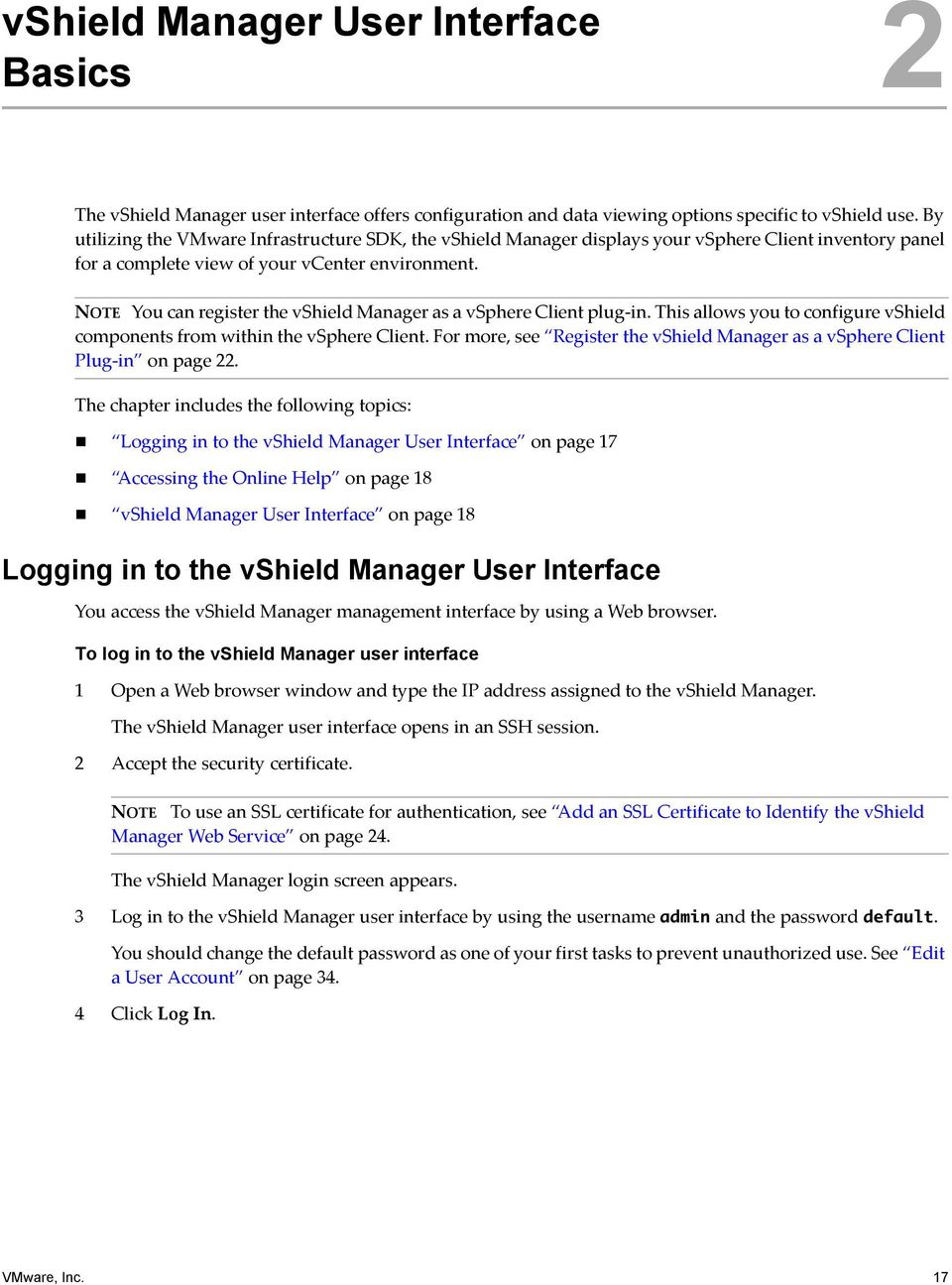
18 vshield Administration Guide Accessing the Online Help The Online Help can be accessed by clicking in the upper right of the vshield Manager user interface. vshield Manager User Interface The vshield Manager user interface is divided into two panels: the inventory panel and the configuration panel. You select a view and a resource from the inventory panel to open the available details and configuration options in the configuration panel. When clicked, each inventory object has a specific set of tabs that appear in the configuration panel. vshield Manager Inventory Panel The vshield Manager inventory panel hierarchy mimics the vsphere Client inventory hierarchy. Resources include the root folder, datacenters, clusters, port groups, ESX hosts, and virtual machines, including your installed vshield App and vshield Edge modules. As a result, the vshield Manager maintains solidarity with your vcenter Server inventory to present a complete view of your virtual deployment. The vshield Manager is the only virtual machine that does not appear in the vshield Manager inventory panel. vshield Manager settings are configured from the Settings & Reports resource atop the inventory panel. The inventory panel offers multiple views: Hosts & Clusters, Networks, and Secured Port Groups. The Hosts & Clusters view displays the datacenters, clusters, resource pools, and ESX hosts in your inventory. The Networks view displays the VLAN networks and port groups in your inventory. The Secured Port Groups view displays the port groups protected by vshield Edge instances. The Hosts & Clusters and Networks views are consistent with the same views in the vsphere Client. There are differences in the icons for virtual machines and vshield components between the vshield Manager and the vsphere Client inventory panels. Custom icons are used to show the difference between vshield components and virtual machines, and the difference between protected and unprotected virtual machines. Table 2-1. vshield Virtual Machine Icons in the vshield Manager Inventory Panel Icon Description A powered on vshield App in active protection state. A powered off vshield App. A powered on virtual machine that is protected by a vshield App. A powered on virtual machine that is not protected by a vshield App. Refreshing the Inventory Panel To refresh the list of resources in the inventory panel, click. The refresh action requests the latest resource information from the vcenter Server. By default, the vshield Manager requests resource information from the vcenter Server every five minutes. Searching the Inventory Panel To search the inventory panel for a specific resource, type a string in the field atop the vshield Manager inventory panel and click. 18 VMware, Inc.
19 Chapter 2 vshield Manager User Interface Basics vshield Manager Configuration Panel The vshield Manager configuration panel presents the settings that can be configured based on the selected inventory resource and the output of vshield operation. Each resource offers multiple tabs, each tab presenting information or configuration forms corresponding to the resource. Because each resource has a different purpose, some tabs are specific to certain resources. Also, some tabs have a second level of options. VMware, Inc. 19
20 vshield Administration Guide 20 VMware, Inc.

21 3 Management System Settings 3 The vshield Manager requires communication with your vcenter Server and services such as DNS and NTP to provide details on your VMware Infrastructure inventory. The chapter includes the following topics: Identify Your vcenter Server on page 21 Register the vshield Manager as a vsphere Client Plug in on page 22 Identify DNS Services on page 22 Set the vshield Manager Date and Time on page 23 Identify a Proxy Server on page 23 Download a Technical Support Log from a Component on page 23 View vshield Manager System Status on page 24 Add an SSL Certificate to Identify the vshield Manager Web Service on page 24 Identify Your vcenter Server After the vshield Manager is installed as a virtual machine, log in to the vshield Manager user interface to connect to your vcenter Server. This enables the vshield Manager to display your VMware Infrastructure inventory. To identify your vcenter Server from the vshield Manager 1 Log in to the vshield Manager. Upon initial login, the vshield Manager opens to the Configuration > vcenter tab. If you have previously configured the vcenter tab form, perform the following steps: a b Click the Settings & Reports from the vshield Manager inventory panel. Click the Configuration tab. The vcenter screen appears. 2 Under vcenter Server Information, type the IP address of your vcenter Server in the vsphere Server IP Address/Name field. 3 Type your vsphere Client login user name in the Administrator User Name field. This user account must have administrator access. VMware, Inc. 21
22 vshield Administration Guide 4 Type the password associated with the user name in the Password field. 5 Click Save. The vshield Manager connects to the vcenter Server, logs on, and utilizes the VMware Infrastructure SDK to populate the vshield Manager inventory panel. The inventory panel is presented on the left side of the screen. This resource tree should match your VMware Infrastructure inventory panel. The vshield Manager does not appear in the vshield Manager inventory panel. Register the vshield Manager as a vsphere Client Plug-in The vsphere Plug in option lets you register the vshield Manager as a vsphere Client plug in. After the plug in is registered, you can open the vshield Manager user interface from the vsphere Client. To register the vshield Manager as a vsphere Client plug-in 1 If you are logged in to the vsphere Client, log out. 2 Log in to the vshield Manager. 3 Click Settings & Reports from the vshield Manager inventory panel. 4 Click the Configuration tab. The vcenter screen appears. 5 Under vsphere Plug in, click Register. Registration might take a few minutes. 6 Log in to the vsphere Client. 7 Select an ESX host. 8 Verify that vshield Install appears as a tab. You can install and configure vshield components from the vsphere Client. Identify DNS Services You must specify at least one DNS server during vshield Manager setup. The specified DNS servers appear in the vshield Manager user interface. In the vshield Manager user interface, you can specify up to three DNS servers that the vshield Manager can use for IP address and host name resolution. To identify a DNS server 1 Click Settings & Reports from the vshield Manager inventory panel. 2 Click the Configuration tab. The vcenter screen appears. 3 Under DNS Servers, type an IP address in Primary DNS IP Address to identify the primary DNS server. This server is checked first for all resolution requests. 4 (Optional) Type an IP address in the Secondary DNS IP Address field. 5 (Optional) Type an IP address in the Tertiary DNS IP Address field. 6 Click Save. 22 VMware, Inc.
23 Chapter 3 Management System Settings Set the vshield Manager Date and Time You can set the date, time, and time zone of the vshield Manager. You can also specify a connection to an NTP server to establish a common network time. Date and time values are used in the system to stamp events as they occur. To set the date and time configuration of the vshield Manager 1 Click Settings & Reports from the vshield Manager inventory panel. 2 Click the Configuration tab. 3 Click Date/Time. 4 In the Date and Clock field, type the date and time in the format YYYY MM DD HH:MM:SS. 5 In the NTP Server field, type the IP address of your NTP server. You can type the hostname of your NTP server if you have set up DNS service. 6 From the Time Zone drop down menu, select the appropriate time zone. 7 Click Save. Identify a Proxy Server If you use a proxy server for network connectivity, you can configure the vshield Manager to use the proxy server. The vshield Manager supports application level HTTP/HTTPS proxies such as CacheFlow and Microsoft ISA Server. To identify a proxy server 1 Click Settings & Reports from the vshield Manager inventory panel. 2 Click the Configuration tab. 3 Click HTTP Proxy. 4 From the Use Proxy drop down menu, select Yes. 5 (Optional) Type the host name of the proxy server in the Proxy Host Name field. 6 Type the IP address of the proxy server in the Proxy IP Address field. 7 Type the connecting port number on your proxy server in the Proxy Port field. 8 Type the User Name required to log in to the proxy server. 9 Type the Password associated with the user name for proxy server login. 10 Click Save. Download a Technical Support Log from a Component You can use the Support option to download the system log from a vshield component to your PC. Asystem log can be used to troubleshoot operational issues. To download a vshield component system log 1 Click Settings & Reports from the vshield Manager inventory panel. 2 Click the Configuration tab. 3 Click Support. VMware, Inc. 23
24 vshield Administration Guide 4 Under Tech Support Log Download, click Initiate next to the appropriate component. Once initiated, the log is generated and uploaded to the vshield Manager. This might take several seconds. 5 After the log is ready, click the Download link to download the log to your PC. The log is compressed and has the proprietary file extension.blsl. You can open the log using a decompression utility by browsing for All Files in the directory where you saved the file. Back Up vshield Manager Data You can use the Backups option to back up vshield Manager data. See Chapter 7, Backing Up vshield Manager Data, on page 39. View vshield Manager System Status The Status tab displays the status of vshield Manager system resource utilization, and includes the software version details, license status, and serial number. The serial number must be registered with technical support for update and support purposes. To view the system status of the vshield Manager 1 Click Settings & Reports from the vshield Manager inventory panel. 2 Click the Configuration tab. 3 Click Status. 4 (Optional) Click Version Status to review the current version of system software running on your vshield components. The Update Status tab appears. See View the Current System Software on page 37. Add an SSL Certificate to Identify the vshield Manager Web Service You can generate or import an SSL certificate into the vshield Manager to authenticate the identity of the vshield Manager web service and encrypt information sent to the vshield Manager web server. As a security best practice, you should use the generate certificate option to generate a private key and public key, where the private key is saved to the vshield Manager. To generate an SSL certificate 1 Click Settings & Reports from the vshield Manager inventory panel. 2 Click the Configuration tab. 3 Click SSL Certificate. 4 Under Generate Certificate Signing Request, enter the following information: Field Common Name Organization Unit Organization Name City Name State Name Country Code Description Enter the name that matches the site name. For example, if the IP address of vshield Manager management interface is , enter Enter the department in your company that is ordering the certificate. Enter the full legal name of your company. Enter the full name of the city in which your company resides. Enter the full name of the state in which your company resides. Enter the two digit code that represents your country. For example, the United States is US. 24 VMware, Inc.
25 Chapter 3 Management System Settings Field Key Algorithm Key Size Description Select the cryptographic algorithm to use from either DSA or RSA. Select the number of bits used in the selected algorithm. 5 Click Generate. To import an SSL certificate 1 Click Settings & Reports from the vshield Manager inventory panel. 2 Click the Configuration tab. 3 Click SSL Certificate. 4 Under Import Signed Certificate, click Browse at Certificate File to find the file. 5 Select the type of certificate file from the Certificate File drop down list. 6 Click Apply. VMware, Inc. 25
26 vshield Administration Guide 26 VMware, Inc.
27 4 Zones Firewall Management 4 vshield Zones provides firewall protection access policy enforcement. Traffic details include sources, destinations, direction of sessions, applications, and ports being used. Traffic details can be used to create firewall allow or deny rules. NOTE You can upgrade vshield Zones to vshield App by obtaining a vshield App license. vshield App enhances vshield Zones protection by offering Flow Monitoring, custom container creation (Security Groups), and container based access policy creation and enforcement. You do not have to uninstall vshield Zones to install vshield App. All vshield Zones instances become vshield App instances, the Zones Firewall becomes App Firewall, and the additional vshield App features are enabled. This chapter includes the following topics: Using Zones Firewall on page 27 Create a Zones Firewall Rule on page 29 Create a Layer 2/Layer 3 Zones Firewall Rule on page 30 Validating Active Sessions against the Current Zones Firewall Rules on page 31 Revert to a Previous Zones Firewall Configuration on page 31 Delete a Zones Firewall Rule on page 32 Using Zones Firewall Zones Firewall is a centralized, hierarchical firewall for ESX hosts. Zones Firewall enables you to create rules that allow or deny access to and from your virtual machines. Each installed vshield Zones enforces the App Zones rules. You can manage Zones Firewall rules at the datacenter, cluster, and port group levels to provide a consistent set of rules across multiple vshield Zones instances under these containers. As membership in these containers can change dynamically, Zones Firewall maintains the state of existing sessions without requiring reconfiguration of firewall rules. In this way, Zones Firewall effectively has a continuous footprint on each ESX host under the managed containers. When creating Zones Firewall rules, you create 5 tuple firewall rules based on specific source and destination IP addresses. VMware, Inc. 27
28 vshield Administration Guide Default Rules By default, Zones Firewall enforces a set of rules allowing traffic to pass through all vshield Zones instances. These rules appear in the Default Rules section of the Zones Firewall table. The default rules cannot be deleted or added to. However, you can change the Action element of each rule from Allow to Deny. Layer 4 Rules and Layer 2/Layer 3 Rules Zones Firewall offers two sets of configurable rules: L4 (Layer 4) rules and L2/L3 (Layer 2/Layer 3) rules. Layers refer to layers of the Open Systems Interconnection (OSI) Reference Model. Layer 4 rules govern TCP and UDP transport of Layer 7, or application specific, traffic. Layer 2/Layer 3 rules monitor traffic from ICMP, ARP, and other Layer 2 and Layer 3 protocols. You can configure Layer 2/Layer 3 rules at the datacenter level only. By default, all Layer4 and Layer 2/Layer 3 traffic is allowed to pass. Hierarchy of Zones Firewall Rules Each vshield Zones instance enforces Zones Firewall rules in top to bottom ordering. A vshield Zones instance checks each traffic session against the top rule in the Zones Firewall table before moving down the subsequent rules in the table. The first rule in the table that matches the traffic parameters is enforced. Zones Firewall rules are enforced in the following hierarchy: 1 Data Center High Precedence Rules 2 Cluster Level Rules 3 Data Center Low Precedence Rules (seen as Rules below this level have lower precedence than cluster level rules when a datacenter resource is selected) 4 Secure Port Group Rules 5 Default Rules Zones Firewall offers container level and custom priority precedence configurations: Container level precedence refers to recognizing the datacenter level as being higher in priority than the cluster level. When a rule is configured at the datacenter level, the rule is inherited by all clusters and vshield agents therein. A cluster level rule is only applied to the vshield Zones instances within the cluster. Custom priority precedence refers to the option of assigning high or low precedence to rules at the datacenter level. High precedence rules work as noted in the container level precedence description. Low precedence rules include the Default Rules and the configuration of Data Center Low Precedence rules. This flexibility allows you to recognize multiple layers of applied precedence. At the cluster level, you configure rules that apply to all vshield Zones instances within the cluster. Because Data Center High Precedence Rules are above Cluster Level Rules, ensure your Cluster Level Rules are not in conflict with Data Center High Precedence Rules. Planning Zones Firewall Rule Enforcement Using Zones Firewall, you can configure allow and deny rules based on your network policy. The following examples represent two common firewall policies: Allow all traffic by default. You keep the default allow all rules and add deny rules based on Flow Monitoring data or manual App Firewall configuration. In this scenario, if a session does not match any of the deny rules, the vshield App allows the traffic to pass. Deny all traffic by default.you can change the Action status of the default rules from Allow to Deny, and add allow rules explicitly for specific systems and applications. In this scenario, if a session does not match any of the allow rules, the vshield App drops the session before it reaches its destination. If you change all of the default rules to deny any traffic, the vshield App drops all incoming and outgoing traffic. 28 VMware, Inc.
29 Chapter 4 Zones Firewall Management Create a Zones Firewall Rule Zones Firewall rules allow or deny traffic based on the following criteria: Criteria Source (A.B.C.D/nn) Source Port Destination (A.B.C.D/nn) Destination Application Destination Port Protocol Description IP address with netmask (nn) from which the communication originated Port or range of ports from which the communication originated. To enter a port range, separate the low and high end of the range with a colon. For example, 1000:1100. IP address with netmask (nn) which the communication is targeting The application on the destination the source is targeting Port or range of ports which the communication is targeting. To enter a port range, separate the low and high end of the range with a colon. For example, 1000:1100. Transport protocol used for communication You can add destination and source port ranges to a rule for dynamic services such as FTP and RPC, which require multiple ports to complete a transmission. If you do not allow all of the ports that must be opened for a transmission, the transmission fails. To create a firewall rule at the datacenter level 1 In the vsphere Client, go to Inventory > Hosts and Clusters. 2 Select a datacenter resource from the resource tree. 3 Click the vshield Zones tab. 4 Click Zones Firewall. By default, the L4 Rules option is selected. To create L2/L3 rules, see Create a Layer 2/Layer 3 Zones Firewall Rule on page Do one of the following: Click Add to add a new rule to the Data Center Low Precedence Rules (Rules below this level have lower precedence...). Select a row in the Data Center High Precedence Rules section of the table and click Add. A new appears below the selected row. 6 Double click each cell in the new row to select the appropriate information. You must type IP addresses in the Source and Destination fields, and port numbers in the Source Port and Destination Port fields. 7 (Optional) Select the new row and click Up to move the row up in priority. 8 (Optional) Select the Log check box to log all sessions matching this rule. 9 Click Commit to save the rule. To create a firewall rule at the cluster level 1 In the vsphere Client, go to Inventory > Hosts and Clusters. 2 Select a cluster resource from the resource tree. 3 Click the vshield Zones tab. 4 Click Zones Firewall. By default, the L4 Rules option is selected. To create L2/L3 rules, see Create a Layer 2/Layer 3 Zones Firewall Rule on page 30. VMware, Inc. 29
30 vshield Administration Guide 5 Click Add. A new row appears in the Cluster Level Rules section of the table. 6 Double click each cell in the new row to select the appropriate information. You must type IP addresses in the Source and Destination fields, and port numbers in the Source Port and Destination Port fields. 7 (Optional) Select the new row and click Up to move the row up in priority. 8 (Optional) Select the Log check box to log all sessions matching this rule. 9 Click Commit to save the rule. To create a firewall rule at the port group level 1 In the vsphere Client, go to Inventory > Networking. 2 Select a port group from the resource tree. 3 Click the vshield Zones tab. 4 Click Zones Firewall. 5 Click Add. A new row is added at the bottom of the Secure Port Group Rules section. 6 Double click each cell in the new row to select the appropriate information. You must type IP addresses in the Source and Destination fields, and port numbers in the Source Port and Destination Port fields. 7 (Optional) Select the new row and click Up to move the row up in priority. 8 (Optional) Select the Log check box to log all sessions matching this rule. 9 Click Commit to save the rule. Create a Layer 2/Layer 3 Zones Firewall Rule The Layer 2/Layer 3 firewall enables configuration of allow or deny rules for common Data Link Layer and Network Layer requests, such as ICMP pings and traceroutes. You can change the default Layer 2/Layer 3 rules from allow to deny based on your network security policy. Layer 4 firewall rules allow or deny traffic based on the following criteria: Criteria Source (A.B.C.D/nn) Destination (A.B.C.D/nn) Protocol Description IP address with netmask (nn) from which the communication originated IP address with netmask (nn) which the communication is targeting Transport protocol used for communication To create a Layer 2/Layer 3 firewall rule 1 In the vsphere Client, go to Inventory > Hosts and Clusters. 2 Select a datacenter resource from the resource tree. 3 Click the vshield Zones tab. 4 Click Zones Firewall. 5 Click L2/L3 Rules. 6 Click Add. A new row is added at the bottom of the DataCenter Rules section of the table. 30 VMware, Inc.
31 Chapter 4 Zones Firewall Management 7 Double click each cell in the new row to type or select the appropriate information. You can type IP addresses in the Source and Destination fields 8 (Optional) Select the Log check box to log all sessions matching this rule. 9 Click Commit. Validating Active Sessions against the Current Zones Firewall Rules By default, a vshield Zones instance matches firewall rules against each new session. After a session has been established, any firewall rule changes do not affect active sessions. The CLI command validate sessions enables you to validate active sessions against the current Zones Firewall rule set to purge any sessions that are in violation of the current rule set. After a firewall rule set update, you should validate active sessions to purge any existing sessions that are in violation of the updated policy. After the Zones Firewall update is complete, issue the validate sessions command from the CLI of a vshield Zones instance to purge sessions that are in violation of current policy. To validate active sessions against the current firewall rules 1 Update and commit the Zones Firewall rule set at the appropriate container level. 2 Open a console session on a vshield Zones instance issue the validate sessions command. vshieldzones> enable Password: vshieldzones# validate sessions Revert to a Previous Zones Firewall Configuration The vshield Manager saves a snapshot of App Firewall settings each time you commit a new rule. Clicking Commit causes the vshield Manager to save the previous configuration with a timestamp before adding the new rule. These snapshots are available from the Revert to Snapshot drop down menu. To revert to a previous App Firewall configuration 1 In the vsphere Client, go to Inventory > Hosts and Clusters. 2 Select a datacenter or cluster resource from the inventory panel. 3 Click the vshield Zones tab. 4 Click Zones Firewall. 5 From the Revert to Snapshot drop down list, select a snapshot. Snapshots are presented in the order of timestamps, with the most recent snapshot listed at the top. 6 View snapshot configuration details. 7 Do one of the following: To return to the current configuration, select the option from the Revert to Snapshot drop down list. Click Commit to overwrite the current configuration with the snapshot configuration. VMware, Inc. 31
32 vshield Administration Guide Delete a Zones Firewall Rule You can delete any App Firewall rule you have created. You cannot delete the any rules in the Default Rules section of the table. To delete an App Firewall rule 1 Click an existing row in the Zones Firewall table. 2 Click Delete. 3 Click Commit. 32 VMware, Inc.
33 5 User Management 5 Security operations are often managed by multiple individuals. Management of the overall system is delegated to different personnel according to some logical categorization. However, permission to carry out tasks is limited only to users with appropriate rights to specific resources. From the Users section, you can delegate such resource management to users by granting applicable rights. User management in the vshield Manager user interface is separate from user management in the CLI of any vshield component. This chapter includes the following topics: Managing User Rights on page 33 Add a User on page 34 Assign a Role and Rights to a User on page 34 Edit a User Account on page 34 Delete a User Account on page 35 Managing User Rights Within the vshield Manager user interface, a user s rights define the actions the user is allowed to perform on a given resource. Rights determine the user s authorized activities on the given resource, ensuring that a user has access only to the functions necessary to complete applicable operations. This allows domain control over specific resources, or system wide control if your right encompasses the System resource. The following rules are enforced: A user can only have one right to one resource. A user cannot add to or remove assigned rights and resources. Table 5-1. vshield Manager User Rights Right R CRUD Description Read only Read and Write Table 5-2. vshield Manager User Resources Resource System Datacenter Cluster None Description Access to entire vshield system Access to a specified datacenter resource Access to a specified cluster resource Access to no resources VMware, Inc. 33
34 vshield Administration Guide Managing the Default User Account The vshield Manager user interface includes one default user account, user name admin, which has rights to all resources. You cannot edit the rights of or delete this user. The default password for admin is default. Change the password for this account upon initial login to the vshield Manager. See Edit a User Account on page 34. Add a User Basic user account creation requires assigning the user a login name and password. To create a new user account 1 Click Settings & Reports from the vshield Manager inventory panel. 2 Click the Users tab. 3 Click Create User. The New User screen opens. 4 Type a User Name. This is used for login to the vshield Manager user interface. This user name and associated password cannot be used to access the vshield App or vshield Manager CLIs. 5 (Optional) Type the user s Full Name for identification purposes. 6 (Optional) Type an Address. 7 Type a Password for login. 8 Re type the password in the Retype Password field. 9 Click OK. After account creation, you configure right and resource assignment separately. Assign a Role and Rights to a User After creating a user account, you can assign the user a role and rights to system resources. The role defines the resource, and the right defines the user s access to that resource. To assign a role and right to a user 1 Click Settings & Reports from the vshield Manager inventory panel. 2 Click the Users tab. 3 Double click the Resource cell for the user. 4 From the drop down menu that opens, select an available resource. 5 Double click the Access Right cell for the user. 6 From the drop down menu that opens, select an available access right. Edit a User Account You can edit a user account to change the password. To edit an existing user account 1 Click Settings & Reports from the vshield Manager inventory panel. 2 Click the Users tab. 3 Click a cell in the table row that identifies the user account. 34 VMware, Inc.
35 Chapter 5 User Management 4 Click Update User. 5 Make changes as necessary. If you are changing the password, confirm the password by typing it a second time in the Retype Password field. 6 Click OK to save your changes. Delete a User Account You can delete any created user account. You cannot delete the admin account. Audit records for deleted users are maintained in the database and can be referenced in an Audit Log report. To delete a user account 1 Click Settings & Reports from the vshield Manager inventory panel. 2 Click the Users tab. 3 Click a cell in the table row that identifies the user account. 4 Click Delete User. VMware, Inc. 35
36 vshield Administration Guide 36 VMware, Inc.
37 6 Updating System Software 6 vshield software requires periodic updates to maintain system performance. Using the Updates tab options, you can install and track system updates. This chapter includes the following topics: View the Current System Software on page 37 Upload an Update on page 37 Review the Update History on page 38 View the Current System Software The current versions of vshield component software display under the Update Status tab. To view the current system software 1 Click Settings & Reports from the vshield Manager inventory panel. 2 Click the Updates tab. 3 Click Update Status. Upload an Update vshield updates are available as offline updates. When an update is made available, you can download the update to your PC, and then upload the update by using the vshield Manager user interface. When the update is uploaded, the vshield Manager is updated first, after which, each vshield App is updated. If a reboot of either the vshield Manager or a vshield App is required, the Update Status screen prompts you to reboot the component. In the event that both the vshield Manager and all vshield App instances must be rebooted, you must reboot the vshield Manager first, and then reboot each vshield App. To upload an update 1 Click Settings & Reports from the vshield Manager inventory panel. 2 Click the Updates tab. 3 Click Upload Settings. 4 Click Browse to locate the update. 5 After locating the file, click Upload File. VMware, Inc. 37
38 vshield Administration Guide 6 Click Confirm Install to confirm update installation. There are two tables on this screen. During installation, you can view the top table for the description, start time, success state, and process state of the current update. View the bottom table for the update status of each vshield App. All vshield App instances have been upgraded when the status of the last vshield App is displayed as Finished. 7 After the vshield Manager reboots, click the Update Status tab. 8 Click Reboot Manager if prompted. 9 Click Finish Install to complete the system update. 10 Click Confirm. Review the Update History The Update History tab lists the updates that have already been installed, including the installation date and a brief description of each update. To view a history of installed updates 1 Click Settings & Reports from the vshield Manager inventory panel. 2 Click the Updates tab. 3 Click Update History. 38 VMware, Inc.
39 7 Backing Up vshield Manager Data 7 You can back up and restore your vshield Manager data, which can include system configuration, events, and audit log tables. Configuration tables are included in every backup. You can, however, exclude system and audit log events. Backups are saved to a remote location that must be accessible by the vshield Manager. Backups can be executed according to a schedule or on demand. This chapter includes the following topics: Back Up Your vshield Manager Data on Demand on page 39 Schedule a Backup of vshield Manager Data on page 40 Restore a Backup on page 40 Back Up Your vshield Manager Data on Demand You can back up vshield Manager data at any time by performing an on demand backup. To back up the vshield Manager database 1 Click Settings & Reports from the vshield Manager inventory panel. 2 Click the Configuration tab. 3 Click Backups. 4 (Optional) Select the Exclude System Events check box if you do not want to back up system event tables. 5 (Optional) Select the Exclude Audit Logs check box if you do not want to back up audit log tables. 6 Type the Host IP Address of the system where the backup will be saved. 7 (Optional) Type the Host Name of the backup system. 8 Type the User Name required to log in to the backup system. 9 Type the Password associated with the user name for the backup system. 10 In the Backup Directory field, type the absolute path where backups are to be stored. 11 Type a text string in Filename Prefix. This text is prepended to the backup filename for easy recognition on the backup system. For example, if you type ppdb, the resulting backup is named as ppdbhh_mm_ss_dayddmonyyyy. 12 From the Transfer Protocol drop down menu, select either SFTP or FTP. 13 Click Backup. Once complete, the backup appears in a table below this form. 14 Click Save Settings to save the configuration. VMware, Inc. 39
40 vshield Zones Administration Guide Schedule a Backup of vshield Manager Data You can only schedule the parameters for one type of backup at any given time. You cannot schedule a configuration only backup and a complete data backup to run simultaneously. To schedule periodic backups of your vshield Manager data 1 Click Settings & Reports from the vshield Manager inventory panel. 2 Click the Configuration tab. 3 Click Backups. 4 From the Scheduled Backups drop down menu, select On. 5 From the Backup Frequency drop down menu, select Hourly, Daily, or Weekly. The Day of Week, Hour of Day, and Minute drop down menus are disabled based on the selected frequency. For example, if you select Daily, the Day of Week drop down menu is disabled as this field is not applicable to a daily frequency. 6 (Optional) Select the Exclude System Events check box if you do not want to back up system event tables. 7 (Optional) Select the Exclude Audit Log check box if you do not want to back up audit log tables. 8 Type the Host IP Address of the system where the backup will be saved. 9 (Optional) Type the Host Name of the backup system. 10 Type the User Name required to login to the backup system. 11 Type the Password associated with the user name for the backup system. 12 In the Backup Directory field, type the absolute path where backups will be stored. 13 Type a text string in Filename Prefix. This text is prepended to each backup filename for easy recognition on the backup system. For example, if you type ppdb, the resulting backup is named as ppdbhh_mm_ss_dayddmonyyyy. 14 From the Transfer Protocol drop down menu, select either SFTP or FTP, based on what the destination supports. 15 Click Save Settings. Restore a Backup To restore an available backup, the Host IP Address, User Name, Password, and Backup Directory fields in the Backups screen must have values that identify the location of the backup to be restored. When you restore a backup, the current configuration is overridden. If the backup file contains system event and audit log data, that data is also restored. IMPORTANT Back up your current data before restoring a backup file. To restore an available vshield Manager backup 1 Click Settings & Reports from the vshield Manager inventory panel. 2 Click the Configuration tab. 3 Click Backups. 4 Click View Backups to view all available backups saved to the backup server. 5 Select the check box for the backup to restore. 6 Click Restore. 7 Click OK to confirm. 40 VMware, Inc.
41 8 System Events and Audit Logs 8 System events are events that are related to vshield operation. They are raised to detail every operational event, such as a vshield App reboot or a break in communication between a vshield App and the vshield Manager. Events might relate to basic operation (Informational) or to a critical error (Critical). This chapter includes the following topics: View the System Event Report on page 41 System Event Notifications on page 42 Syslog Format on page 42 View the Audit Log on page 43 View the System Event Report The vshield Manager aggregates system events into a report that can be filtered by vshield App and event severity. To view the System Event report 1 Click Settings & Reports from the vshield Manager inventory panel. 2 Click the System Events tab. 3 (Optional) Select one or more vshield App instances from the vshield field. All vshield App instances are selected by default. 4 From the and Severity drop down menu, select a severity by which to filter results. All severities are included by default. You can select one or more severities at a time. 5 Click View Report. 6 In the report output, click an Event Time link to view details about a specific event. VMware, Inc. 41
42 vshield Administration Guide System Event Notifications vshield Manager Virtual Appliance Events Power Off Power On Interface Down Interface Up Local CLI Run show log follow command. Run show log follow command. Run show log follow command. Run show log follow command. GUI NA NA NA NA CPU Memory Storage Local CLI Run show process monitor command. Run show system memory command. Run show filesystem command. GUI See View vshield Manager System Status on page 24. See View vshield Manager System Status on page 24. See View vshield Manager System Status on page 24. vshield App Events Power Off Power On Interface Down Interface Up Local CLI Run show log follow command. Run show log follow command. Run show log follow command. Run show log follow command. Syslog NA See Syslog Format on page 42. e1000: mgmt: e1000_watchdog_task: NIC Link is Up/Down 100 Mbps Full Duplex. For scripting on the syslog server, search for NIC Link is. e1000: mgmt: e1000_watchdog_task: NIC Link is Up/Down 100 Mbps Full Duplex. For scripting on the syslog server, search for NIC Link is. GUI Heartbeat failure event in System Event log. See View the System Event Report on page 41. See View the Current System Status of a vshield App on page 64. See View the Current System Status of a vshield App on page 64. See View the Current System Status of a vshield App on page 64. CPU Memory Storage Session reset due to DoS, inactivity, or data timeouts Local CLI Run show process monitor command. Run show system memory command. Run show filesystem command. Run show log follow command. Syslog NA NA NA See Syslog Format on page 42. GUI See View the Current System Status of a vshield App on page 64. See View the Current System Status of a vshield App on page 64. See View the Current System Status of a vshield App on page 64. Refer to the System Event Log. See View the System Event Report on page 41. Syslog Format The system event message logged in the syslog has the following structure: syslog header (timestamp + hostname + sysmgr/) Timestamp (from the service) Name/value pairs Name and value separated by delimiter '::' (double colons) Each name/value pair separated by delimiter ';;' (double semi-colons) 42 VMware, Inc.
43 Chapter 8 System Events and Audit Logs The fields and types of the system event are: Event ID :: 32 bit unsigned integer Timestamp :: 32 bit unsigned integer Application Name :: string Application Submodule :: string Application Profile :: string Event Code :: integer (possible values: ) Severity :: string (possible values: INFORMATION LOW MEDIUM HIGH CRITICAL) Message :: View the Audit Log The Audit Logs tab provides a view into the actions performed by all vshield Manager users. The vshield Manager retains audit log data for one year, after which time the data is discarded. To view the Audit Log 1 Click Settings & Reports from the vshield Manager inventory panel. 2 Click the Audit Logs tab. 3 Narrow the output by clicking one or more of the following column filters: Column User Name Module Operation Status Operation Span Description Select the login name of a user who performed the action. Select the vshield resource on which the action was performed. Select the type of action performed. Select the result of action as either Success or Failure. Select the vshield component on which the action was performed. Local refers to the vshield Manager. VMware, Inc. 43
44 vshield Administration Guide 44 VMware, Inc.
45 9 Uninstalling vshield Components 9 This chapter details the steps required to uninstall vshield components from your vcenter inventory. This chapter includes the following topics: Uninstall a vshield App or vshield Zones on page 45 Uninstall a vshield Edge from a Port Group on page 46 Uninstall Port Group Isolation from an ESX Host on page 46 Uninstall a vshield Endpoint Module on page 47 NOTE The vshield Quick Start Guide details installation of vshield components. Uninstall a vshield App or vshield Zones Uninstalling a vshield App or vshield Zones removes the agent from the network. CAUTION Uninstalling a vshield App or vshield Zones places the ESX host in maintenance mode. After uninstallation is complete, the ESX host reboots. If any of the virtual machines that are running on the target ESX host cannot be migrated to another ESX host, these virtual machines must be powered off or migrated manually before the uninstallation can continue. If the vshield Manager is on the same ESX host, the vshield Manager must be migrated prior to uninstalling the vshield App or vshield Zones. To uninstall a vshield App or vshield Zones instance 1 Log in to the vsphere Client. 2 Select the ESX host from the inventory tree. 3 Click the vshield tab. 4 Click Uninstall for the vshield App or vshield Zones service. The instance is uninstalled. VMware, Inc. 45
46 vshield Administration Guide Uninstall a vshield Edge from a Port Group You can uninstall a vshield Edge from a port group by using the vsphere Client. CAUTION If you have enabled Port Group Isolation, you must migrate or power off the virtual machines on the ESX host from which you want to uninstall a vshield Edge. Uninstalling Port Group Isolation places the ESX host in maintenance mode. After uninstallation is complete, the ESX host reboots. If any of the virtual machines that are running on the target ESX host cannot be migrated to another ESX host, these virtual machines must be powered off or migrated manually before the uninstallation can continue. If the vshield Manager is on the same ESX host, the vshield Manager must be migrated prior to uninstalling Port Group Isolation. If you did not install and enable Port Group Isolation on an ESX host, you do not have to migrate virtual machines to uninstall a vshield Edge. To uninstall a vshield Edge 1 Log in to the vsphere Client. 2 Go to View > Inventory > Networking. 3 Click the Edge tab. 4 Click Uninstall. Uninstall Port Group Isolation from an ESX Host Uninstalling Port Group Isolation requires multiple steps that must be performed in the following order. CAUTION Uninstalling Port Group Isolation places the ESX host in maintenance mode. After uninstallation is complete, the ESX host reboots. If any of the virtual machines that are running on the target ESX host cannot be migrated to another ESX host, these virtual machines must be powered off or migrated manually before the uninstallation can continue. If the vshield Manager is on the same ESX host, the vshield Manager must be migrated prior to uninstalling Port Group Isolation. To uninstall Port Group Isolation 1 Migrate all vshield Edge instances and their secured port groups off the ESX host from which Port Group Isoaltion is being uninstalled. 2 Go to View > Inventory > Networking. 3 Right click the vds from which Port Group Isolation will be uninstalled. 4 Select vshield > Disable Isolation. 5 Go to View > Inventory > Hosts and Clusters. 6 Click the ESX host from the vsphere Client inventory panel on which Port Group Isolation is installed. 7 Click the vshield tab. 8 Click Uninstall for to the vshield Edge Port Group Isolation service. 46 VMware, Inc.
47 Chapter 9 Uninstalling vshield Components Uninstall a vshield Endpoint Module Before you uninstall the a vshield Endpoint module from the vshield Manager, you must unregister the SVM from the vshield Endpoint module. CAUTION Uninstalling vshield Endpoint places the ESX host in maintenance mode. After uninstallation is complete, the ESX host reboots. If any of the virtual machines that are running on the target ESX host cannot be migrated to another ESX host, these virtual machines must be powered off or migrated manually before the uninstallation can continue. If the vshield Manager is on the same ESX host, the vshield Manager must be migrated prior to uninstalling vshield Endpoint. Unregister an SVM from a vshield Endpoint Module You must specify the virtual machine ID of the SVM to unregister the SVM from the vshield Endpoint module Unregistering an SVM Request: DELETE <vshieldmanager-uri>/endpointsecurity/svm/<vmid> : DELETE /api/1.0/endpointsecurity/svm/vm-1234 HTTP/1.1 host: :80 Authorization: Basic YWRtaW46ZGVmYXVsdA== Response: HTTP 204 No Content: The Endpoint Security VM is successfully unregistered. HTTP 401 Unauthorized: The username or password sent in Authorized header is wrong. HTTP 405 Method Not Allowed: If the vmid is missed in the URI. HTTP 400 Bad Request: Internal error codes. Please refer the Error Schema for more details =Acquiring data from VC failed for <> 40007=SVM with moid: <> not registered 40015=vmId is malformatted or of incorrect length : <> Uninstall the vshield Endpoint Module from the vsphere Client Uninstalling an vshield Endpoint module puts the ESX host into maintenance mode and reboots it. CAUTION Migrate your vshield Manager and any other virtual machines to another ESX host to avoid shutting down these virtual machines during reboot. To uninstall an vshield Endpoint module from an ESX host 1 Log in to the vsphere Client. 2 Select an ESX host from the inventory tree. 3 Click the vshield tab. 4 Click Uninstall for to the vshield Endpoint service. Uninstallation removes port group epsec-vmk-1 and vswitch epsec-vswitch-2. VMware, Inc. 47
48 vshield Administration Guide 48 VMware, Inc.
49 vshield Edge and Port Group Isolation VMware, Inc. 49
50 vshield Administration Guide 50 VMware, Inc.
51 10 vshield Edge Management 10 vshield Edge provides network edge security and gateway services to isolate the virtual machines in a port group, vds port group, or Cisco Nexus 1000V. The vshield Edge connects isolated, stub networks to shared (uplink) networks by providing common gateway services such as DHCP, VPN, NAT, and Load Balancing. Common deployments of vshield Edge include in the DMZ, VPN Extranets, and multi tenant Cloud environments where the vshield Edge provides perimeter security for Virtual Datacenters (VDCs). This chapter includes the following topics: View the Status of a vshield Edge on page 51 Specify a Remote Syslog Server on page 52 Managing the vshield Edge Firewall on page 52 Manage NAT Rules on page 53 Manage DHCP Service on page 54 Manage VPN Service on page 56 Manage Load Balancer Service on page 58 Start or Stop vshield Edge Services on page 59 View the Status of a vshield Edge The Status option presents the network configuration and status of services of a vshield Edge module. Details include interface addressing and network ID. You can use the network ID to send REST API commands to a vshield Edge module. To view the status of a vshield App 1 In the vsphere Client, go to Inventory > Networking. 2 Select an internal port group that is protected by a vshield Edge. 3 Click the Edge tab. 4 Click the Status link. VMware, Inc. 51
52 vshield Administration Guide Specify a Remote Syslog Server You can send vshield Edge events, such as violated firewall rules, to a syslog server. To specify a remote syslog server 1 In the vsphere Client, go to Inventory > Networking. 2 Select an internal port group that is protected by a vshield Edge. 3 Click the vshield Edge tab. 4 Click the Status link. 5 Under Remote Syslog Servers, place the cursor in the top text box and type the IP address of a remote syslog server. 6 Click Commit to save the configuration. Managing the vshield Edge Firewall The vshield Edge provides firewall protection for incoming and outgoing sessions. The default firewall policy allows all traffic to pass. In addition to the default firewall policy, you can configure a set of rules to allow or deny traffic sessions to and from specific sources and destinations. You manage the default firewall policy and firewall rule set separately for each vshield Edge agent. You can change the Default Policy from Allow to Deny on a vshield Edge to deny any sessions that do not match any of the current firewall rules. Create a vshield Edge Firewall Rule vshield Edge firewall rules police traffic based on the following criteria: Criteria Source IP Source Port Destination IP Destination Port Protocol Direction Action Description IP address from which the communication originated. To enter an IP address range, use a hyphen. For example, Port or range of ports from which the communication originated. To enter a port range, use a hyphen. For example, IP address which the communication is targeting. To enter an IP address range, use a hyphen. For example, Port or range of ports which the communication is targeting. To enter a port range, use a hyphen. For example, Transport protocol used for communication. Direction of transmission. Options are IN, OUT, or BOTH. Action to enforce on transmission. Options are ALLOW or DENY. The default action on all traffic is ALLOW. You can add destination and source port ranges to a rule for dynamic services such as FTP and RPC, which require multiple ports to complete a transmission. If you do not allow all of the ports that must be opened for a transmission, the transmission is blocked. To create a vshield Edge firewall rule 1 In the vsphere Client, go to Inventory > Networking. 2 Select an internal port group that is protected by a vshield Edge. 3 Click the vshield Edge tab. 4 Click the Firewall link. 52 VMware, Inc.
53 Chapter 10 vshield Edge Management 5 Click Add. A new row appears in the table. 6 Double click each cell in the row to enter or select the appropriate information. You must type IP addresses in the Source and Destination fields. 7 (Optional) Click Log to send log events to a specified syslog server when the firewall rule is violated. 8 (Optional) Select the new row and click Move Up to move the rule up in priority. 9 Click Commit to save the rule. Validate Active Sessions Against Current vshield Edge Firewall Rules By default, a vshield Edge matches firewall rules against each new session. After a session has been established, any firewall rule changes do not affect active sessions. The CLI command validate sessions enables you to validate active sessions against the current vshield Edge firewall rule set to purge any sessions that are in violation of the current rule set. After a firewall rule set update, you should validate active sessions to purge any existing sessions that are in violation of the updated policy. After a vshield Edge firewall update is complete, issue the validate sessions command from the CLI of a vshield Edge instance to purge sessions that are in violation of current policy. To validate active sessions against the current firewall rules 1 Update and commit the vshield Edge firewall rule set. 2 Open a console session on a vshield Edge instance to issue the validate sessions command. vshieldedge> validate sessions Manage NAT Rules The vshield Edge provides network address translation (NAT) service to protect the IP addresses of internal, private networks from the public network. You must configure NAT rules to provide access to services running on privately addressed virtual machines. The NAT service configuration is separated into SNAT and DNAT rules. An SNAT rule translates a private internal IP address into a public IP address for outbound traffic. A DNAT rule maps a public IP address to a private internal IP address. NAT rules adhere to the following criteria: Criteria Original (Internal) Source IP/Range Translated (External) Source IP/Range Translated (Internal) Destination IP/Range and Port/Range Original (External) Destination IP/Range and Port/Range Protocol Log Description SNAT only. Internal IP address or IP address range of protected virtual machines. To enter an IP address range, use a hyphen. For example, SNAT only. External IP address or IP address range used to masquerade internal addressing of protected virtual machines. To enter an IP address range, use a hyphen. For example, DNAT only. Internal IP address or IP address range of protected virtual machines. To enter an IP address range, use a hyphen. For example, DNAT only. External IP address or IP address range used to masquerade internal addressing of protected virtual machines. To enter an IP address range, use a hyphen. For example, DNAT only. Transport protocol used for communication. Select the check box to send NAT events to a configured syslog server. VMware, Inc. 53
54 vshield Administration Guide To configure an SNAT rule for a vshield Edge 1 In to the vsphere Client, go to Inventory > Networking. 2 Select an Internal port group where a vshield Edge has been installed. 3 Click the vshield Edge tab. 4 Click the NAT link. 5 Under Direction OUT (SNAT), click Add Rule. A new row appears in the table. 6 Double click each cell in the row to enter the appropriate information. 7 Click Commit to save the rule. To configure a DNAT rule for a vshield Edge 1 In to the vsphere Client, go to Inventory > Networking. 2 Select an Internal port group where a vshield Edge has been installed. 3 Click the vshield Edge tab. 4 Click the NAT link. 5 Under Direction In (DNAT), click Add Rule. A new row appears in the table. 6 Double click each cell in the row to enter or select the appropriate information. 7 Click Commit to save the rule. Manage DHCP Service vshield Edge supports IP address pooling and one to one static IP address allocation. Static IP address binding is based on the vcenter managed object ID and interface ID of the requesting client. vshield Edge DHCP service adheres to the following rules: Listens on the vshield Edge internal interface for DHCP discovery. Uses the IP address of the internal interface on the vshield Edge as the default gateway address for all clients, and the broadcast and subnet mask values of the internal interface for the container network. To add a DHCP IP pool 1 In the vsphere Client, go to Inventory > Networking. 2 Select an internal port group that is protected by a vshield Edge. 3 Click the vshield Edge tab. 4 Click the DHCP link. 5 Under IP Pools, click Add Pool. A new row appears in the table. 6 Double click each cell in the row to enter or select the appropriate information. The Primary Name Server and Secondary Name Server fields refer to DNS service. You must enter the IP address of a DNS server for hostname to IP address resolution. The Domain Name and Lease Time fields are optional. The default lease time is one day. 54 VMware, Inc.
55 Chapter 10 vshield Edge Management 7 Click Commit to save the rule. 8 If DHCP service has not been enabled, enable DHCP service. See Start or Stop vshield Edge Services on page 59. To add a DHCP static binding 1 In the vsphere Client, go to Inventory > Networking. 2 Select an internal port group that is protected by a vshield Edge. 3 Click the vshield Edge tab. 4 Click the DHCP link. 5 Under Static Bindings, click Add Bindings. A new row appears in the table. 6 Double click each cell in the row to enter or select the appropriate information. The Primary Name Server and Secondary Name Server fields refer to DNS service. You must enter the IP address of a DNS server for hostname to IP address resolution. The Domain Name and Lease Time fields are optional. The default lease time is one day. 7 Click Commit to save the rule. 8 If DHCP service has not been enabled, enable DHCP service. See Start or Stop vshield Edge Services on page 59. VMware, Inc. 55
56 vshield Administration Guide Manage VPN Service vshield Edge modules support site to site IPSec VPN between a vshield Edge and remote sites. Figure vshield Edge Providing VPN Access from a Remote Site to a Secured Port Group At this time, vshield Edge supports pre shared key mode, IP unicast traffic, and no dynamic routing protocol between the vshield Edge and remote VPN routers. Behind each remote VPN router, you can configure multiple subnets to connect to the internal network behind a vshield Edge through IPSec tunnels. These subnets and the internal network behind a vshield Edge must have non overlapping address ranges. You can deploy a vshield Edge agent behind a NAT device. In this deployment, the NAT device translates the VPN address of a vshield Edge into a publicly accessible address facing the Internet. Remote VPN routers use this public address to access the vshield Edge. Remote VPN routers can be located behind a NAT device as well. You must provide both the VPN native address and the NAT public address to set up the tunnel. On both ends, static one to one NAT is required for the VPN address. To configure VPN on a vshield Edge 1 In the vsphere Client, go to Inventory > Networking. 2 Select an internal port group that is protected by a vshield Edge. 3 Click the vshield Edge tab. 4 Click the VPN link. 5 Type an External IP Address for the VPN service on the vshield Edge. 6 Type the NATed Public IP that represents the External IP Address to the external network. 7 Select the Log check box to log VPN activity. 8 Click Apply. Next, identify a peer site. 56 VMware, Inc.
57 Chapter 10 vshield Edge Management To identify a VPN peer site 1 In the vsphere Client, go to Inventory > Networking. 2 Select an internal port group that is protected by a vshield Edge. 3 Click the vshield Edge tab. 4 Click the VPN link. 5 Under Peer Site Configuration, click Create Site. 6 Type a name to identify the site in Site Name. 7 Type the IP address of the site in Remote EndPoint. 8 Type the Shared Secret. 9 Type an MTU threshold. 10 Click Add. Next, add a tunnel to connect to the site. To identify a VPN peer tunnel 1 In the vsphere Client, go to Inventory > Networking. 2 Select an internal port group that is protected by a vshield Edge. 3 Click the vshield Edge tab. 4 Click the VPN link. 5 Under Peer Site Configuration, select the appropriate peer from the Select or create a site drop down list. 6 Click Add Tunnel. 7 Double click the Tunnel Name cell and type a name to identify the tunnel. 8 Double click the Remote Site Subnet cell and enter the IP address in CIDR format (A.B.C.D/M). 9 Double click the Encryption cell and select the appropriate encryption type. 10 Click Commit. 11 Enable VPN service. See Start or Stop vshield Edge Services on page 59. VMware, Inc. 57
58 vshield Administration Guide Manage Load Balancer Service The vshield Edge provides load balancing for HTTP traffic. Load balancing (up to Layer 7) enables Web application auto scaling. Figure vshield Edge Providing Load Balancing Service for Protected Virtual Machines You map an external (or public) IP address to a set of internal servers for load balancing. The load balancer accepts HTTP requests on the external IP address and decides which internal server to use. Port 80 is the default listening port for load balancer service. To configure load balancer service 1 In the vsphere Client, go to Inventory > Networking. 2 Select an internal port group that is protected by a vshield Edge. 3 Click the vshield Edge tab. 4 Click the Load Balancer link. 5 Click Add Configuration above the External IP Addresses table. A new row appears in the table. 6 Enter the External IP Address for the service. 7 Select the routing algorithm from the Algorithm drop down list. 8 (Optional) Select the Log check box to send a syslog event for each request to the external IP address. 9 Click Add. 10 Enter the IP address of the first web server and click Add. You can add additional web servers in the same manner. 11 Click Commit. 12 If load balancer service has not been enabled, enable the service. See Start or Stop vshield Edge Services on page VMware, Inc.
59 Chapter 10 vshield Edge Management Start or Stop vshield Edge Services You can start and stop the VPN, DHCP, and load balancing services of a vshield Edge from the vsphere Client. By default, all services are stopped, or in Not Configured state. NOTE You should configure a service before starting it. To manage services on a vshield Edge 1 In the vsphere Client, go to Inventory > Networking. 2 Select an internal port group that is protected by a vshield Edge. 3 Click the vshield Edge tab. 4 Click the Status link. 5 Under Edge Services, select a service and click Start to start the service. Select a service and click Stop to stop a running service. 6 If a service has been started but is not responding, click Refresh Status to send a synchronization request from the vshield Manager. to the vshield Edge. VMware, Inc. 59
60 vshield Administration Guide 60 VMware, Inc.
61 vshield App and vshield Endpoint VMware, Inc. 61
62 vshield Administration Guide 62 VMware, Inc.
63 11 vshield App Management 11 vshield App is an interior, vnic level firewall that allows you to create access control policies regardless of network topology. A vshield App monitors all traffic in and out of an ESX host, including between virtual machines in the same port group. vshield App includes traffic analysis and container based policy creation. vshield App installs as a hypervisor module and firewall service virtual appliance. vshield App integrates with ESX hosts through VMsafe APIs and works with VMware vsphere platform features such as DRS, vmotion, DPM, and maintenance mode. vshield App provides firewalling between virtual machines by placing a firewall filter on every virtual network adapter. The firewall filter operates transparently and does not require network changes or modification of IP addresses to create security zones. You can write access rules by using vcenter containers, like datacenters, cluster, resource pools and vapps, or network objects, like Port Groups and VLANs, to reduce the number of firewall rules and make the rules easier to track. You can monitor the health of vshield App instances by using the vshield Manager user interface and by sending vshield App system events to a syslog server. This chapter includes the following topics: Send vshield App System Events to a Syslog Server on page 63 Back Up the Running CLI Configuration of a vshield App on page 64 View the Current System Status of a vshield App on page 64 Send vshield App System Events to a Syslog Server You can send vshield App system events to a syslog server. To send vshield App system events to a syslog server 1 Log in to the vshield Manager user interface. 2 Select a vshield App from the inventory panel. 3 Click the Configuration tab. 4 Click Syslog Servers. 5 Type the IP Address of the syslog server. 6 From the Log Level drop down menu, select the event level at and above which to send vshield App events to the syslog server. For example, if you select Emergency, then only emergency level events are sent to the syslog server. If you select Critical, then critical, alert, and emergency level events are sent to the syslog server. 7 Click Add to save new settings. You send vshield App events to up to five syslog instances. VMware, Inc. 63
64 vshield Administration Guide Back Up the Running CLI Configuration of a vshield App The CLI Configuration option displays the running configuration of the vshield App. You can back up the running configuration to the vshield Manager to preserve the configuration. To back up the running CLI configuration of a vshield App 1 Log in to the vshield Manager user interface. 2 Select a vshield App from the inventory panel. 3 Click the Configuration tab. 4 Click CLI Configuration. 5 Click Backup Configuration. The configuration is populated in the Backup Configuration field. You can cut and paste this text into the vshield App CLI at the Configuration mode prompt. View the Current System Status of a vshield App The System Status option lets you view and influence the health of a vshield App. Details include system statistics, status of interfaces, software version, and environmental variables. To view the health of a vshield App 1 Log in to the vshield Manager user interface. 2 Select a vshield App from the inventory panel. 3 Click the Configuration tab. 4 Click System Status. From the System Status screen, you can perform the following actions: Force a vshield App to Synchronize with the vshield Manager on page 64 Restart a vshield App on page 65 View Traffic Statistics by vshield App Interface on page 65 Download the Firewall Logs of a vshield App on page 65 Force a vshield App to Synchronize with the vshield Manager The Force Sync option forces a vshield App to re synchronize with the vshield Manager. This might be necessary after a software upgrade. To force a vshield App to re-synchronize with the vshield Manager 1 Log in to the vshield Manager user interface. 2 Select a vshield App from the inventory panel. 3 Click the Configuration tab. 4 Click System Status. 5 Click Force Sync. 64 VMware, Inc.
65 Chapter 11 vshield App Management Restart a vshield App You can restart a vshield App to troubleshoot an operational issue. To restart a vshield App 1 Log in to the vshield Manager user interface. 2 Select a vshield App from the inventory panel. 3 Click the Configuration tab. 4 Click System Status. 5 Click Restart. 6 Click OK in the pop up window to confirm reboot. View Traffic Statistics by vshield App Interface You can view the traffic statistics for each vshield interface. To view traffic statistics by vshield port 1 Log in to the vshield Manager user interface. 2 Select a vshield App from the inventory panel. 3 Click the Configuration tab. 4 Click System Status. 5 Click an interface under the Port column to view traffic statistics. For example, to view the traffic statistics for the vshield App management interface, click mgmt. Download the Firewall Logs of a vshield App You can download a log of the firewall activity from a vshield App. The firewall log details the results of the firewall operation based on matching firewall rules against traffic. To download and view the firewall log for a vshield App 1 Log in to the vshield Manager user interface. 2 Select a vshield App from the inventory panel. 3 Click the Configuration tab. 4 Click System Status. 5 Under App Firewall, click Show Logs. The vshield App uploads the log to the vshield Manager. 6 To download the log from the vshield Manager to your PC, click Download App Firewall Logs. VMware, Inc. 65
66 vshield Administration Guide 66 VMware, Inc.
67 12 Flow Monitoring 12 Flow Monitoring is a traffic analysis tool that provides a detailed view of the traffic on your virtual network that passed through a vshield App. The Flow Monitoring output defines which machines are exchanging data and over which application. This data includes the number of sessions, packets, and bytes transmitted per session. Session details include sources, destinations, direction of sessions, applications, and ports being used. Session details can be used to create App Firewall allow or deny rules. You can use Flow Monitoring as a forensic tool to detect rogue services and examine outbound sessions. This chapter includes the following topics: Using Flow Monitoring on page 67 View a Specific Application in the Flow Monitoring Charts on page 68 Change the Date Range of the Flow Monitoring Charts on page 68 View the Flow Monitoring Report on page 68 Add an App Firewall Rule from the Flow Monitoring Report on page 69 Editing Port Mappings on page 70 Using Flow Monitoring The Flow Monitoring tab displays throughput statistics as returned by a vshield App. Flow Monitoring displays traffic statistics in three charts: Sessions/hr: Total number of sessions per hour Server KBytes/hr: Number of outgoing kilobytes per hour Client/hr: Number of incoming kilobytes per hour Flow Monitoring organizes statistics by the application protocols used in client server communications, with each color in a chart representing a different application protocol. This charting method enables you to track your server resources per application. Traffic statistics display all inspected sessions within the time span specified. The last seven days of data are displayed by default. VMware, Inc. 67
68 vshield Administration Guide View a Specific Application in the Flow Monitoring Charts You can select a specific application to view in the charts by clicking the Application drop down menu. To view the data for a specific application in the Flow Monitoring charts 1 In the vsphere Client, go to Inventory > Hosts and Clusters. 2 Select a datacenter or cluster resource from the resource tree. 3 Click the vshield App tab. 4 Click Flow Monitoring. 5 From the Application drop down menu, select the application to view. The Flow Monitoring charts are refreshed to show data corresponding to the selected application. Change the Date Range of the Flow Monitoring Charts You can change the date range of the Flow Monitoring charts for an historical view of traffic data. To change the date range of the Flow Monitoring chart 1 In the vsphere Client, go to Inventory > Hosts and Clusters. 2 Select a datacenter or cluster resource from the resource tree. 3 Click the vshield App tab. 4 Click Flow Monitoring. The charts are updated to display the most current information for the last seven days. This might take several seconds. 5 In the Start Date field, type a new date. This date represents the date furthest in the past on which to start the query. 6 Type a new date in the End Date field. This represents the most recent date on which to stop the query. 7 Click Update Chart. View the Flow Monitoring Report The Flow Monitoring report presents the traffic statistics in tabular format. The report supports drilling down into traffic statistics based on the following hierarchy: 1 Select the firewall action: Allowed or Blocked. 2 Select an L4 or L2/L3 protocol. L4: TCP or UDP L2/L3: ICMP, Other IPv4, or ARP 3 If an L2/L3 protocol was selected, select an L2/L3 protocol or message type. 4 Select the traffic direction: Incoming, Outgoing, or Intra (between virtual machines). 5 Select the port type: Categorized (standardized ports) or Uncategorized (non standardized ports). 6 Select an application protocol or port. 68 VMware, Inc.
69 Chapter 12 Flow Monitoring 7 Select a destination IP address. 8 Source a source IP address. At the source IP address level, you can create an App Firewall rule based on the specific source and destination IP addresses. To view the Flow Monitoring report 1 In the vsphere Client, go to Inventory > Hosts and Clusters. 2 Select a datacenter or cluster resource from the resource tree. 3 Click the vshield App tab. 4 Click Flow Monitoring. The charts update to display the most current information for the last seven days. This might take several seconds. 5 Click Show Report. 6 Drill down into the report. 7 Click Show Latest to update the report statistics. Add an App Firewall Rule from the Flow Monitoring Report By drilling down into the traffic data, you can evaluate the use of your resources and send session information to App Firewall to create a new Layer 4 allow or deny rule. App Firewall rule creation from Flow Monitoring data is available at the datacenter and cluster levels only. To add an App Firewall rule from the Flow Monitoring report 1 In the vsphere Client, go to Inventory > Hosts and Clusters. 2 Select a datacenter resource from the resource tree. 3 Click the vshield App tab. 4 Click Flow Monitoring. The charts update to display the most current information for the last seven days. This might take several seconds. 5 Click Show Report. 6 Expand the firewall action list. 7 Expand the Layer 4 protocol list. 8 Expand the traffic direction list. 9 Expand the port type list. 10 Expand the application or port list. 11 Expand the destination IP address list. 12 Review the source IP addresses. 13 Select the Zones Firewall column radio button for a source IP address to create an App Firewall rule. A pop up window opens. Click Ok to proceed. The App Firewall table appears. A new table row is displayed at the bottom of the Data Center Low Precedence Rules or Cluster Level Rules section with the session information completed. VMware, Inc. 69
70 vshield Administration Guide 14 (Optional) Double click the Action column cell to change the value to Allow or Deny. 15 (Optional) With the new row selected, click Up to move the rule up in priority. 16 (Optional) Select the Log check box to log all sessions matching this rule. 17 Click Commit to save the rule. Delete All Recorded Flows At the datacenter level, you can delete the data for all recorded traffic sessions within the datacenter. This clears the data from charts, the report, and the database. Typically, this is only used when moving your vshield Zones deployment from a lab environment to a production environment. If you must maintain a history of traffic sessions, do not use this feature. To delete traffic statistics for a datacenter 1 Select a datacenter resource from the inventory panel. 2 Click the Flow Monitoring tab. 3 Click Delete All Flows. 4 Click Ok in the pop up window to confirm deletion. CAUTION You cannot recover traffic data after you click Delete All Flows. Editing Port Mappings When you click Edit Port Mappings, a table appears, listing well known applications and protocols, their respective ports, and a description. vshield recognizes common protocol and port mappings, such as HTTP over port 80. Your organization might employ an application or protocol that uses a non standard port. In this case, you can use Edit Port Mappings to identify a custom protocol port pair. Your custom mapping appears in the Flow Monitoring report output. The Edit Port Mappings table offers complete management capabilities, and provides a model for you to follow. You cannot edit or delete the default entries. Add an Application-Port Pair Mapping You can add a custom application port mapping to the port mappings table. To add an application port-pair mapping 1 Go to Inventory > Networking in the vsphere Client. 2 Select a port group from the inventory panel. 3 Click the Flow Monitoring tab. 4 Click Edit Port Mappings. 5 Click a row in the table. 6 Click Add. A new row is inserted above the selected row. 7 Double click the Application cell and type the application name. 8 Double click the Port Number cell and type the port number. 9 Double click the Protocol cell to select the transport protocol. 70 VMware, Inc.
71 Chapter 12 Flow Monitoring 10 Double click the Resource cell to select the container in which to enforce the new mapping. The ANY value adds the port mapping to all containers. 11 Double click the Description cell and type a brief description. 12 Click Hide Port Mappings. Delete an Application-Port Pair Mapping You can delete any application port pair mapping from the table. When you delete a mapping, any traffic to the application port pair is listed as Uncategorized in the Flow Monitoring statistics. To delete an application-port pair mapping 1 Go to Inventory > Networking in the vsphere Client. 2 Select a port group from the inventory panel. 3 Click the Flow Monitoring tab. 4 Click Edit Port Mappings. 5 Click a row in the table. 6 Click Delete to delete it from the table. Hide the Port Mappings Table When you click Edit Port Mappings, the label changes from Edit Port Mappings to Hide Port Mappings. Click Hide Port Mappings. VMware, Inc. 71
72 vshield Administration Guide 72 VMware, Inc.
73 13 App Firewall Management 13 vshield App provides firewall protection through access policy enforcement. The App Firewall tab represents the vshield App firewall access control list. NOTE App Firewall rules apply to vshield App instances, but not vshield Edge or vshield Endpoint instances. The Zones Firewall tab becomes the App Firewall tab when the vshield App license is activated. This chapter includes the following topics: Using App Firewall on page 73 Create an App Firewall Rule on page 75 Create a Layer 2/Layer 3 App Firewall Rule on page 77 Creating and Protecting Security Groups on page 77 Validating Active Sessions against the Current App Firewall Rules on page 78 Revert to a Previous App Firewall Configuration on page 79 Delete an App Firewall Rule on page 79 Using App Firewall The App Firewall service is a centralized, hierarchical firewall for ESX hosts. App Firewall enables you to create rules that allow or deny access to and from your virtual machines. Each installed vshield App enforces the App Firewall rules. You can manage App Firewall rules at the datacenter, cluster, and port group levels to provide a consistent set of rules across multiple vshield App instances under these containers. As membership in these containers can change dynamically, App Firewall maintains the state of existing sessions without requiring reconfiguration of firewall rules. In this way, App Firewall effectively has a continuous footprint on each ESX host under the managed containers. Securing Containers and Designing Security Groups When creating App Firewall rules, you can create rules based on traffic to or from a specific container that encompasses all of the resources within that container. For example, you can create a rule to deny any traffic from inside of a cluster that targets a specific destination outside of the cluster. You can create a rule to deny any incoming traffic that is not tagged with a VLAN ID. When you specify a container as the source or destination, all IP addresses within that container are included in the rule. A security group is a trust zone that you create and assign resources to for App Firewall protection. Security groups are containers, like a vapp or a cluster. Security groups enables you to create a container by assigning resources arbitrarily, such as virtual machines and network adapters. After the security group is defined, you add the group as a container in the source or destination field of an App Firewall rule. See Creating and Protecting Security Groups on page 77. VMware, Inc. 73
74 vshield Administration Guide Default Rules By default, the App Firewall enforces a set of rules allowing traffic to pass through all vshield App instances. These rules appear in the Default Rules section of the App Firewall table. The default rules cannot be deleted or added to. However, you can change the Action element of each rule from Allow to Deny. Layer 4 Rules and Layer 2/Layer 3 Rules The App Firewall tab offers two sets of configurable rules: L4 (Layer 4) rules and L2/L3 (Layer 2/Layer 3) rules. Layers refer to layers of the Open Systems Interconnection (OSI) Reference Model. Layer 4 rules govern TCP and UDP transport of Layer 7, or application specific, traffic. Layer 2/Layer 3 rules monitor traffic from ICMP, ARP, and other Layer 2 and Layer 3 protocols. You can configure Layer 2/Layer 3 rules at the datacenter level only. By default, all Layer4 and Layer 2/Layer 3 traffic is allowed to pass. Hierarchy of App Firewall Rules Each vshield App enforces App Firewall rules in top to bottom ordering. A vshield App checks each traffic session against the top rule in the App Firewall table before moving down the subsequent rules in the table. The first rule in the table that matches the traffic parameters is enforced. The rules are enforced in the following hierarchy: 1 Data Center High Precedence Rules 2 Cluster Level Rules 3 Data Center Low Precedence Rules (seen as Rules below this level have lower precedence than cluster level rules when a datacenter resource is selected) 4 Secure Port Group Rules 5 Default Rules App Firewall offers container level and custom priority precedence configurations: Container level precedence refers to recognizing the datacenter level as being higher in priority than the cluster level. When a rule is configured at the datacenter level, the rule is inherited by all clusters and vshield agents therein. A cluster level rule is only applied to the vshield App within the cluster. Custom priority precedence refers to the option of assigning high or low precedence to rules at the datacenter level. High precedence rules work as noted in the container level precedence description. Low precedence rules include the Default Rules and the configuration of Data Center Low Precedence rules. This flexibility allows you to recognize multiple layers of applied precedence. At the cluster level, you configure rules that apply to all vshield App instances within the cluster. Because Data Center High Precedence Rules are above Cluster Level Rules, ensure your Cluster Level Rules are not in conflict with Data Center High Precedence Rules. Planning App Firewall Rule Enforcement Using App Firewall, you can configure allow and deny rules based on your network policy. The following examples represent two common firewall policies: Allow all traffic by default. You keep the default allow all rules and add deny rules based on Flow Monitoring data or manual App Firewall rule configuration. In this scenario, if a session does not match any of the deny rules, the vshield App allows the traffic to pass. Deny all traffic by default.you can change the Action status of the default rules from Allow to Deny, and add allow rules explicitly for specific systems and applications. In this scenario, if a session does not match any of the allow rules, the vshield App drops the session before it reaches its destination. If you change all of the default rules to deny any traffic, the vshield App drops all incoming and outgoing traffic. 74 VMware, Inc.
75 Chapter 13 App Firewall Management Create an App Firewall Rule App Firewall rules allow or deny traffic based on the following criteria: Criteria Source (A.B.C.D/nn) Source Port Destination (A.B.C.D/nn) Destination Application Destination Port Protocol Description Container, direction in relation to container, or IP address with netmask (nn) from which the communication originated. Port or range of ports from which the communication originated. To enter a port range, separate the low and high end of the range with a colon. For example, 1000:1100. Container, direction in relation to container, or IP address with netmask (nn) which the communication is targeting. The application on the destination the source is targeting. If you select a protocol from the drop down list, the well known port for the selected protocol appears in the Destination Port field. Port or range of ports which the communication is targeting. To enter a port range, separate the low and high end of the range with a colon. For example, 1000:1100. Transport protocol used for communication. You can add destination and source port ranges to a rule for dynamic services such as FTP and RPC, which require multiple ports to complete a transmission. If you do not allow all of the ports that must be opened for a transmission, the transmission fails. To create a firewall rule at the datacenter level 1 In the vsphere Client, go to Inventory > Hosts and Clusters. 2 Select a datacenter resource from the resource tree. 3 Click the vshield App tab. 4 Click App Firewall. By default, the L4 Rules option is selected. To create L2/L3 rules, see Create a Layer 2/Layer 3 App Firewall Rule on page Do one of the following: Click Add to add a new rule to the Data Center Low Precedence Rules (Rules below this level have lower precedence...). Select a row in the Data Center High Precedence Rules section of the table and click Add. A new appears below the selected row. 6 Double click each cell in the new row to select the appropriate information. You can type IP addresses in the Source and Destination fields, and port numbers in the Source Port and Destination Port fields. 7 (Optional) Select the new row and click Up to move the rule up in priority. 8 (Optional) Select the Log check box to log all sessions matching this rule. 9 Click Commit to save the rule. NOTE Layer 4 firewall rules can also be created from the Flow Monitoring report. See Add an App Firewall Rule from the Flow Monitoring Report on page 69. VMware, Inc. 75
76 vshield Administration Guide To create a firewall rule at the cluster level 1 In the vsphere Client, go to Inventory > Hosts and Clusters. 2 Select a cluster resource from the resource tree. 3 Click the vshield App tab. 4 Click App Firewall. By default, the L4 Rules option is selected. To create L2/L3 rules, see Create a Layer 2/Layer 3 App Firewall Rule on page Click Add. A new row appears in the Cluster Level Rules section of the table. 6 Double click each cell in the new row to select the appropriate information. You can type IP addresses in the Source and Destination fields, and port numbers in the Source Port and Destination Port fields. 7 (Optional) Select the new row and click Up to move the row up in priority. 8 (Optional) Select the Log check box to log all sessions matching this rule. 9 Click Commit to save the rule. NOTE Layer 4 firewall rules can also be created from the Flow Monitoring report. See Add an App Firewall Rule from the Flow Monitoring Report on page 69. To create a firewall rule at the port group level 1 In the vsphere Client, go to Inventory > Networking. 2 Select a port group from the resource tree. 3 Click the vshield App tab. 4 Click App Firewall. 5 Click Add. A new row is added at the bottom of the Secure Port Group Rules section. 6 Double click each cell in the new row to select the appropriate information. You can type IP addresses in the Source and Destination fields, and port numbers in the Source Port and Destination Port fields. 7 (Optional) Select the new row and click Up to move the row up in priority. 8 (Optional) Select the Log check box to log all sessions matching this rule. 9 Click Commit to save the rule. NOTE Layer 4 firewall rules can also be created from the Flow Monitoring report. See Add an App Firewall Rule from the Flow Monitoring Report on page VMware, Inc.
77 Chapter 13 App Firewall Management Create a Layer 2/Layer 3 App Firewall Rule The Layer 2/Layer 3 firewall enables configuration of allow or deny rules for common Data Link Layer and Network Layer requests, such as ICMP pings and traceroutes. You can change the default Layer 2/Layer 3 rules from allow to deny based on your network security policy. Layer 2/Layer 3 firewall rules allow or deny traffic based on the following criteria: Criteria Source (A.B.C.D/nn) Destination (A.B.C.D/nn) Protocol Description Container, direction in relation to container, or IP address with netmask (nn) from which the communication originated Container, direction in relation to container, or IP address with netmask (nn) which the communication is targeting Transport protocol used for communication To create a Layer 2/Layer 3 firewall rule 1 In the vsphere Client, go to Inventory > Hosts and Clusters. 2 Select a datacenter resource from the resource tree. 3 Click the vshield App tab. 4 Click App Firewall. 5 Click L2/L3 Rules. 6 Click Add. A new row is added at the bottom of the DataCenter Rules section of the table. 7 Double click each cell in the new row to type or select the appropriate information. You can type IP addresses in the Source and Destination fields 8 (Optional) Select the Log check box to log all sessions matching this rule. 9 Click Commit. NOTE Layer 2/Layer 3 firewall rules can also be created from the Flow Monitoring report. See Add an App Firewall Rule from the Flow Monitoring Report on page 69. Creating and Protecting Security Groups The Security Groups feature enables you to create custom containers to which you can assign resources, such as virtual machines and network adapters, for App Firewall protection. After a security group is defined, you add the security group to a firewall rule for protection. Add a Security Group In the vsphere Client, you can add a security group at the datacenter resource level. To add a security group by using the vsphere Client 1 Click a datacenter resource from the vsphere Client. 2 Click the vshield App tab. 3 Click Security Groups. 4 Click Add Group. VMware, Inc. 77
78 vshield Administration Guide 5 Double click the row and type a name for the group. 6 Click Add. After security group creation is complete, assign resources to the group. Assign Resources to a Security Group You can assign virtual machines and network adapters to a security group. These resources have associated IP addresses that define the source or destination parameters for which an App Firewall rule enforces an access policy. To assign resources to a security group 1 Click a datacenter resource from the vsphere Client. 2 Click the vshield App tab. 3 Click Security Groups. 4 Click the arrow next to the name of a security group to expand the details of the group. 5 Select a vnic from the drop down list and click Add. The selected vnic appears under vnic Membership. Repeat these steps for each vnic you want to place in this security group. 6 Click Commit. After assigning resources, add the security group to a firewall rule as a container. See Create an App Firewall Rule on page 75. Validating Active Sessions against the Current App Firewall Rules By default, a vshield Edge matches firewall rules against each new session. After a session has been established, any firewall rule changes do not affect active sessions. The CLI command validate sessions enables you to validate active sessions that are in violation of the current rule set. You would use this procedure for the following scenarios: You updated the firewall rule set. After a firewall rule set update, you should validate active sessions to purge any existing sessions that are in violation of the updated policy. You viewed sessions in Flow Monitoring and determined that an existing or historical flow requires a new access rule. After creating a firewall rule that matches the offending session, you should validate active sessions to purge any existing sessions that are in violation of the updated policy. After the App Firewall update is complete, issue the validate sessions command from the CLI of a vshield App to purge sessions that are in violation of current policy. To validate active sessions against the current firewall rules 1 Update and commit the App Firewall rule set at the appropriate container level. 2 Open a console session on a vshield App issue the validate sessions command. vshieldapp> enable Password: vshieldapp# validate sessions 78 VMware, Inc.
79 Chapter 13 App Firewall Management Revert to a Previous App Firewall Configuration The vshield Manager saves a snapshot of App Firewall settings each time you commit a new rule. Clicking Commit causes the vshield Manager to save the previous configuration with a timestamp before adding the new rule. These snapshots are available from the Revert to Snapshot drop down list. To revert to a previous App Firewall configuration 1 In the vsphere Client, go to Inventory > Hosts and Clusters. 2 Select a datacenter or cluster resource from the inventory panel. 3 Click the vshield App tab. 4 Click App Firewall. 5 From the Revert to Snapshot drop down list, select a snapshot. Snapshots are presented in the order of timestamps, with the most recent snapshot listed at the top. 6 View snapshot configuration details. 7 Do one of the following: To return to the current configuration, select the option from the Revert to Snapshot drop down list. Click Commit to overwrite the current configuration with the snapshot configuration. Delete an App Firewall Rule You can delete any App Firewall rule you have created. You cannot delete the any rules in the Default Rules section of the table. To delete an App Firewall rule 1 Click an existing row in the App Firewall table. 2 Click Delete. 3 Click Commit. VMware, Inc. 79
80 vshield Administration Guide 80 VMware, Inc.
81 14 vshield Endpoint Events and Alarms 14 vshield Endpoint delivers an introspection based antivirus solution. vshield Endpoint uses the hypervisor to scan guest virtual machines from the outside without a bulky agent. vshield Endpoint is efficient in avoiding resource bottlenecks while optimizing memory use. vshield Endpoint health status is conveyed by using alarms that show in red and yellow on the vcenter Server console. In addition, more status information can be gathered by looking at the event logs. IMPORTANT Your vcenter Server must be correctly configured for vshield Endpoint security: Not all guest operating systems are supported by vshield Endpoint. Virtual machines with non supported operating systems are not protected by the security solution. All virtual machines (with supported operating systems) that reside on a vshield Endpoint protected ESX host must be protected by a vshield Endpoint module. Not all ESX hosts in a vcenter Server must be protected by the security solution, but each protected ESX must have an SVM installed on it. CAUTION vmotion migration of a protected virtual machine are blocked if the target ESX is not enabled for vshield Endpoint. Make sure that the resource pool for vmotion of protected virtual machines contains only security enabled ESX hosts. This chapter includes the following topics: View vshield Endpoint Status on page 81 Alarms on page 82 Events on page 83 Audit Messages on page 86 View vshield Endpoint Status Monitoring a vshield Endpoint instance involves checking for status coming from the vshield Endpoint components: the security virtual machine (SVM), the ESX host resident vshield Endpoint module, and the protected virtual machine resident thin agent. To view vshield Endpoint status 1 In the vsphere Client, go to Inventory > Hosts and Clusters. 2 Select a datacenter, cluster, or ESX host resource from the resource tree. 3 Click the vshield App tab (or vshield tab on ESX hosts). 4 Click Endpoint Status. VMware, Inc. 81
82 vshield Administration Guide Alarms Alarms signal the vcenter Server administrator about vshield Endpoint events that require attention. Alarms are automatically cancelled in case the alarm state is no longer present. vcenter Server alarms can be displayed without a custom vsphere plug in. See the vcenter Server Administration Guide on events and alarms. Upon registering as a vcenter Server extension, the vshield Manager defines the rules that create and remove alarms, based on events coming from the three vshield Endpoint components: SVM, vshield Endpoint module, and thin agent. Rules can be customized. For instructions on how to customize rules for alarms, see the vcenter Server documentation. In some cases, there are multiple possible causes for the alarm. The tables that follow list the possible causes and the corresponding actions you might want to take for remediation. vshield Endpoint defines three sets of alarms: Host Alarms on page 82 SVM Alarms on page 82 VM Alarms on page 83 Host Alarms Host alarms are generated by events affecting the health status of the vshield Endpoint module. Table Warnings (Marked Yellow) Possible Cause SVM is registered, but vshield Endpoint module does not see any virtual machines to protect. No requests for protection are coming from any virtual machines. No virtual machines are currently protected. Action Usually a transient state occurring while existing virtual machines are being moved with vmotion, or are just coming up. No action required. The ESX host has no virtual machines yet, or only virtual machines with non supported operating systems. No action required. Check the vshield Manager console for the status of the virtual machines that should be protected on that host. If one or more have an error status, the Endpoint thin agents in those machines may be malfunctioning. Table Errors (Marked Red) Possible Cause The SVM version is not compatible with the vshield Endpoint module version. Action Install compatible components. Look in the vshield Endpoint Installation Guide for compatible versions for vshield Endpoint module and SVM. SVM Alarms SVM alarms are generated by events affecting the health status of the vshield Endpoint module. Table Red SVM Alarms Problem The vshield Monitor is not receiving status from the SVM. The SVM failed to initialize Action Either there are network issues between the vshield Monitor and the SVM, or the SVM is not operating properly. Contact your security provider for help with SVM errors. 82 VMware, Inc.
83 Appendix 14 vshield Endpoint Events and Alarms VM Alarms VM alarms are generated by events affecting the health status of the vshield Endpoint module. Table Warnings Possible Cause The SVM is overloaded. The virtual machines will not be protected while the alarm persists. The thin agent in one or more virtual machines is initialized but not reporting events. Those virtual machines are not protected while this warning persists. Action Check resources allocation for the SVM and allocate more resources, if necessary. Check the vcenter Server event log for the ESX the SVM is attached to. An event code of 1002 can indicate an overloaded SVM. This is usually a transient alarm that does not require attention. If it persists or turns to red, look at the vcenter Server event log for the protected VM. An event code of 1000 indicates a non functioning thin agent. Table Errors Possible Cause The thin agent version is not compatible with the vshield Endpoint module The thin agent is not reporting vshield Endpoint events. The virtual machine is not protected. The virtual machine is still powered on, but the thin agent is disabled. The virtual machine is not protected. Action Install compatible components. Look in the vshield Endpoint Installation Guide for compatible versions for vshield Endpoint module and SVM. The thin agent is malfunctioning, or not initialized. Look at the event log to see if the thin agent was initialized successfully. If the error persists, this thin agent is malfunctioning. (A virtual machine that is shutting down or in the process of a vmotion move does not generate a red alarm.) Events Events are used for logging and auditing conditions inside the vshield Endpoint based security system. Events can be displayed without a custom vsphere plug in. See the vcenter Server Administration Guide on events and alarms. Events are the basis for alarms that are generated. Upon registering as a vcenter Server extension, the vshield Manager defines the rules that create and remove alarms. Default base arguments for an event are the reported time and the vshield Manager event_id. Table 14 6 lists vshield Endpoint events reported by the SVM and the vshield Manager (VSM) in order by code number. The table shows the even code, name, the VC arguments, the event category, and a description. In the Event Category column, events that generate error alarms are colored red. Events that generate warning alarms are colored yellow. Table vshield Endpoint Events Code Name VC Arguments Event Category Description 0001 VSM_FSFD_EVENT_VERSION_MISMATCH timestamp, SVM version of FSFD protocol, FSFD version of FSFD protocol error vshield Endpoint: The SVM was contacted by a non compatible version of the vshield Endpoint Thin Agent VSM_FSFD_EVENT_DISK_FULL timestamp warning The vshield Endpoint Thin Agent encountered a ʺdisk fullʺ error while attempting to write to the local disk VSM_FSFD_EVENT_TIMEOUT timestamp warning A timeout occurred in the communication between the SVM and the Thin Agent. VMware, Inc. 83
84 vshield Administration Guide Table vshield Endpoint Events (Continued) Code Name VC Arguments Event Category Description 0005 VSM_FSFD_EVENT_UNKNOWN_STATE timestamp warning N/A 0006 VSM_FSFD_EVENT_MISSING_TIMER timestamp error Lost communication with Thin Agent VSM_FSFD_EVENT_TIMER_RESTORED timestamp, FSFD version of FSFD protocol info Established communication with Thin Agent VSM_VM_EVENT_CONNECTED timestamp info VM has connected with the SVM VSM_VM_EVENT_DISCONNECTED timestamp info VM has disconnected from the SVM 1002 VSM_VM_EVENT_UNKNOWN_STATE timestamp warning Thin Agent Health Status Information has been lost. N/A VM_POWERED_OFF timestamp info Detected VM power off VSM_SVM_EVENT_ENABLED timestamp, SVM version of LKM protocol, SVM version of FSFD info protocol, port SVM is listening on. SVM enabled VSM_SVM_EVENT_INIT_FAILURE timestamp error SVM initialization failed VSM_SVM_EVENT_FSFD_FLOOD_DETECTED timestamp warning SVM detected high volume of vshield Endpoint events VSM_SVM_EVENT_DROPPED_EVENTS timestamp warning Health Status information has been lost VSM_SVM_EVENT_MISSING_REPORT timestamp error vshield Manager lost communication with SVM VSM_SVM_EVENT_REPORT_RESTORED timestamp info vshield Manager communication with SVM have been restored VSM_HOST_EVENT_VERSION_MISMATCH timestamp, SVM version of LKM error protocol, Host version of LKM protocol vshield Endpoint: The SVM was contacted by a non compatible version of the vshield Endpoint module VSM_HOST_EVENT_UNKNOWN_STATE timestamp warning vshield Endpoint Module Status Information has been lost VSM_HOST_EVENT_SVM_REGISTERED timestamp info SVM is registered with the vshield Manager VSM_HOST_EVENT_SVM_UNREGISTERED timestamp info SVM is unregistered with the vshield Manager VSM_HOST_EVENT_VMS_CONNECTED timestamp, Host version of vshield Endpoint module protocol info vshield Endpoint module has connected with SVM VSM_HOST_EVENT_VMS_DISCONNECTED timestamp info vshield Endpoint module has disconnected from the SVM 84 VMware, Inc.
85 Appendix 14 vshield Endpoint Events and Alarms Possible causes for events are listed in Table 14 7: Table Possible Causes for Events Code Event Possible Cause 0001 VSM_FSFD_EVENT_VERSION_MISMATCH Compatible versions of the vshield Endpoint modules must be used. Please refer to the vshield Endpoint Installation guide for a compatibility list VSM_FSFD_EVENT_DISK_FULL The vshield Endpoint Thin Agent may need to write to a file on the local disk for file remediation purposes, as well as for temporary storage. The file location for the temporary files is: %SYSTEMROOT%\temp\vmware\eps010\ For remediation purposes, the needed storage is comparable to the size of the file being remediated. It is recommended that local disks are at 95% or less capacity. Running out of disk space may prevent vshield Endpoint from functioning properly and from effectively protecting the affected VM VSM_FSFD_EVENT_TIMEOUT VM is slow to respond to SVM requests. This may happen when the VM is temporarily running low on CPU resources VSM_FSFD_EVENT_UNKNOWN_STATE N/A 0006 VSM_FSFD_EVENT_MISSING_TIMER Thin agent is not operating properly VSM_FSFD_EVENT_TIMER_RESTORED N/A 1000 VSM_VM_EVENT_CONNECTED VM configured for vshield Endpoint protection will generate this event when loaded on the corresponding ESX host, for example, during power up or incoming vmotion VSM_VM_EVENT_DISCONNECTED VM configured for vshield Endpoint protection will generate this event when loaded on the corresponding ESX host, for example, during shutdown or outgoing vmotion VSM_VM_EVENT_UNKNOWN_STATE Heavy load of event reporting on the SVM, or a communication problem between the SVM and the vshield Manager. N/A VM_POWERED_OFF N/A 2000 VSM_SVM_EVENT_ENABLED N/A 2001 VSM_SVM_EVENT_INIT_FAILURE vshield Endpoint SVM component failed to initialize. Please consult partner SVM installation documentation for causes VSM_SVM_EVENT_FSFD_FLOOD_DETECTED The SVM is overloaded. The number of events exceeds the maximum concurrent events threshold VSM_SVM_EVENT_DROPPED_EVENTS Heavy load of event reporting on the SVM, or communication problem between the SVM and the vshield Manager VSM_SVM_EVENT_MISSING_REPORT 1 Check SVM status. 2 Check network connection between vshield Manager and SVM VSM_SVM_EVENT_REPORT_RESTORED N/A 3000 VSM_HOST_EVENT_VERSION_MISMATCH Compatible versions of the vshield Endpoint modules must be used. Please refer to the vshield Endpoint Installation guide for a compatibility list VSM_HOST_EVENT_UNKNOWN_STATE Heavy load of event reporting on the SVM, or communication problem between the SVM and the vshield Manager VSM_HOST_EVENT_SVM_REGISTERED N/A 3004 VSM_HOST_EVENT_SVM_UNREGISTERED N/A 3005 VSM_HOST_EVENT_VMS_CONNECTED N/A 3006 VSM_HOST_EVENT_VMS_DISCONNECTED N/A VMware, Inc. 85
86 vshield Administration Guide Audit Messages Audit messages include fatal errors and other important audit messages and are logged to vmware.log. The following conditions are logged as AUDIT messages: Thin agent initialization success (and version number.) Thin agent initialization failure. Successfully found SCSI device to communicate with the security virtual machine (SVM). Failure to create filter device object, or failure to attach to device stack. Established first time communication with SVM. Failure to establish communication with SVM (when first such failure occurs). Generated log messages have the following substrings near the beginning of each log message: vf-audit, vf-error, vf-warn, vf-info, vf-debug. 86 VMware, Inc.
87 Appendixes VMware, Inc. 87
88 vshield Administration Guide 88 VMware, Inc.
89 A Command Line Interface A Each vshield virtual machine contains a command line interface (CLI). This appendix details CLI usage and commands. User account management in the CLI is separate from user account management in the vshield Manager user interface. This appendix includes the following topics: Logging In and Out of the CLI on page 89 CLI Command Modes on page 89 CLI on page 90 Moving Around in the CLI on page 90 Getting Help within the CLI on page 91 Securing CLI User Accounts and the Privileged Mode Password on page 91 Command Reference on page 93 Logging In and Out of the CLI Before you can run CLI commands, you must initiate a console session to a vshield virtual machine. To open a console session within the vsphere Client, select the vshield virtual machine from the inventory panel and click the Console tab. You can log in to the CLI by using the default user name admin and password default. You can also use SSH to access the CLI. By default, SSH access is disabled. Use the ssh command to enable and disable the SSH service on a vshield virtual appliance. See ssh on page 102. To log out, type exit from either Basic or Privileged mode. CLI Command Modes The commands available to you at any given time depend on the mode you are currently in. NOTE vshield Edge virtual machines have Basic mode only. Basic: Basic mode is a read only mode. To have access to all commands, you must enter Privileged mode. Privileged: Privileged mode commands allow support level options such as debugging and system diagnostics. Privileged mode configurations are not saved upon reboot. You must run the write memory command to save Privileged mode configurations. VMware, Inc. 89
90 vshield Administration Guide Configuration: Configuration mode commands allow you to change the current configuration of utilities on a vshield virtual machine. You can access Configuration mode from Privileged mode. From Configuration mode, you can enter Interface configuration mode. Interface Configuration: Interface Configuration mode commands allow you to change the configuration of virtual machine interfaces. For example, you can change the IP address and IP route for the management port of the vshield Manager. CLI Run commands at the prompt as shown. Do not type the ( ), < >, or [ ] symbols. command A.B.C.D (option1 option2) <0-512> [word] Text and numerical values that must be entered are italicized. Multiple, required keywords or values are enclosed in parentheses and separated by a pipe character. Required value and numerical ranges are enclosed in angle brackets. An optional keyword or value is enclosed in square brackets. Moving Around in the CLI The following commands move the pointer around on the command line. Keystrokes CTRL+A CTRL+B or the left arrow key CTRL+C CTRL+D CTRL+E CTRL+F or the right arrow key CTRL+K CTRL+N or the down arrow key CTRL+P or the up arrow key CTRL+U CTRL+W ENTER ESC+B ESC+D ESC+F SPACE Description Moves the pointer to beginning of the line. Moves the pointer back one character. Ends any operation that continues to propagate, such as a ping. Deletes the character at the pointer. Moves the pointer to end of the line. Moves the pointer forward one character. Deletes all characters from the pointer to the end of the line. Displays more recent commands in the history buffer after recalling commands with CTRL+P (or the up arrow key). Repeat to recall other recently run commands. Recalls commands in the history, starting with the most recent completed command. Repeat to recall successively older commands. Deletes all characters from the pointer to beginning of the line. Deletes the word to the left of pointer. Scrolls down one line. Moves the pointer back one word. Deletes all characters from the pointer to the end of the word. Moves the pointer forward one word. Scrolls down one screen. 90 VMware, Inc.
91 Appendix A Command Line Interface Getting Help within the CLI The CLI contains the following commands for assisting your use. Command Description? Moves the pointer to the beginning of the line. sho? exp+tab show? show log? list Displays a list of commands that begin with a particular character string. Completes a partial command name. Lists the associated keywords of a command. Lists the associated arguments of a keyword. Displays the verbose options of all commands for the current mode. Securing CLI User Accounts and the Privileged Mode Password You must manage CLI user accounts separately on each vshield virtual machine. By default, you use the admin user account to log in to the CLI of each vshield virtual machine. The CLI admin account and password are separate from the vshield Manager user interface admin account and password. You should create a new CLI user account and remove the admin account to secure access to the CLI on each vshield virtual machine. User account management in the CLI conforms to the following rules. You can create CLI user accounts. Each created user account has administrator level access to the CLI. You cannot change the password for any CLI user account on a vshield Manager or vshield App virtual machine. If you need to change a CLI user account password, you must delete the user account, and then re add it with a new password. You can change the password of any non admin account on the vshield Edge. The CLI admin account password and the Privileged mode password are managed separately. The default Privileged mode password is the same for each CLI user account. You should change the Privileged mode password to secure access to the CLI configuration options. IMPORTANT Each vshield virtual machine has two built in CLI user accounts for system use: nobody and vs_comm. Do not delete or modify these accounts. If these accounts are deleted or modified, the virtual machine will not work. Add a CLI User Account You can add a user account with a strong password to secure CLI access to each vshield virtual machine. After adding a user account, you should delete the admin user account. To add a CLI user account 1 Log in to the vsphere Client. 2 Select a vshield virtual machine from the inventory. 3 Click the Console tab to open a CLI session. 4 Log in by using the admin account. manager login: admin password: manager> 5 Switch to Privileged mode. manager> enable password: manager# VMware, Inc. 91
92 vshield Administration Guide 6 Switch to Configuration mode. manager# configure terminal 7 Add a user account. manager(config)# user root password plaintext password 8 Save the configuration. manager(config)# write memory Building Configuration... Configuration saved. [OK] 9 Exit the CLI. manager(config)# exit manager# exit Delete the admin User Account from the CLI After adding a CLI user account, you can delete the admin user account to secure access to the CLI. IMPORTANT Do not delete the admin user account until you add a user account to replace the admin account. This prevents you from being locked out of the CLI. To delete the admin user account 1 Log in to the vsphere Client. 2 Select a vshield virtual machine from the inventory. 3 Click the Console tab to open a CLI session. 4 Log in by using a user account other than admin. 5 Switch to Privileged mode. 6 Switch to Configuration mode. 7 Delete the admin user account. manager(config)# no user admin 8 Save the configuration. 9 Run the exit command twice to log out of the CLI. Change the CLI Privileged Mode Password You can change the Privileged mode password to secure access to the configuration options of the CLI. To change the Privileged mode password 1 Log in to the vsphere Client. 2 Select a vshield virtual machine from the inventory. 3 Click the Console tab to open a CLI session. 4 Log in to the CLI. 5 Switch to Privileged mode. 6 Switch to Configuration mode. 7 Change the Privileged mode password. manager(config)# enable password (hash plaintext) password 92 VMware, Inc.
93 Appendix A Command Line Interface 8 Save the configuration. 9 Run the exit command twice to log out of the CLI. 10 Log in to the CLI. 11 Switch to Privileged mode by using the new password. Command Reference The command reference details each CLI command, including syntax, usage, and related commands. Administrative Commands on page 93 Commands on page 94 Configuration Commands on page 97 Debug Commands on page 104 Show Commands on page 108 Diagnostics and Troubleshooting Commands on page 125 User Administration Commands on page 128 Terminal Commands on page 129 Deprecated Commands on page 131 Administrative Commands list Lists all in mode commands. list Basic, Privileged, Configuration, Interface Configuration vshieldmgr> list enable exit list ping WORD quit show interface show ip route ssh WORD telnet WORD telnet WORD PORT traceroute WORD... reboot Reboots a vshield virtual machine. You can also reboot a vshield App from the vshield Manager user interface. See Restart a vshield App on page 65. reboot VMware, Inc. 93
94 vshield Administration Guide Privileged vshield# reboot Related Commands shutdown shutdown In Privileged mode, the shutdown command powers off the virtual machine. In Interface Configuration mode, the shutdown command disables the interface. To enable a disabled interface, use no before the command. [no] shutdown Privileged, Interface Configuration vshield# shutdown or vshield(config)# interface mgmt vshield(config-if)# shutdown vshield(config-if)# no shutdown Related Commands reboot Commands configure terminal Switches to Configuration mode from Privileged mode. configure terminal Privileged vshield# configure terminal vshield(config)# Related Commands interface disable Switches to Basic mode from Privileged mode. disable 94 VMware, Inc.
95 Appendix A Command Line Interface Basic vshield# disable vshield> Related Commands enable enable Switches to Privileged mode from Basic mode. enable Basic vshield> enable password: vshield# Related Commands disable end Ends the current CLI mode and switches to the previous mode. end Basic, Privileged, Configuration, and Interface Configuration vshield# end vshield> Related Commands exit quit exit Exits from the current mode and switches to the previous mode, or exits the CLI session if run from Privileged or Basic mode. exit Basic, Privileged, Configuration, and Interface Configuration VMware, Inc. 95
96 vshield Administration Guide vshield(config-if)# exit vshield(config)# exit vshield# Related Commands end quit interface Switches to Interface Configuration mode for the specified interface. To delete the configuration of an interface, use no before the command. [no] interface (mgmt p0 u0) Option mgmt p0 u0 Description The management port on a vshield virtual machine. vshield App p0 interface. vshield App u0 interface. Configuration vshield# configure terminal vshield(config)# interface mgmt vshield(config-if)# or vshield(config)# no interface mgmt Related Commands show interface quit Quits Interface Configuration mode and switches to Configuration mode, or quits the CLI session if run from Privileged or Basic mode. quit Basic, Privileged, and Interface Configuration vshield(config-if)# quit vshield(config)# Related Commands end exit 96 VMware, Inc.
97 Appendix A Command Line Interface Configuration Commands clear vmwall rules Resets the firewall rule set on a vshield App to the default rule set. This is a temporary condition that can be used to troubleshoot firewall issues. You can restore the firewall rule set by performing a force sync operation for the vshield App from the vshield Manager. Fore more information on forcing synchronization, see Force a vshield App to Synchronize with the vshield Manager on page 64. clear vmwall rules Privileged Usage Guidelines vshield App CLI manager# clear vmwall rules Related Commands show vmwall log show vmwall rules cli ssh allow Enable or disable access to the CLI via SSH session. [no] cli ssh allow Configuration Usage Guidelines Use this command with the ssh command to allow or disallow CLI access via SSH. manager(config)# ssh start manager(config)# cli ssh allow Related Commands ssh copy running-config startup-config Copies the current system configuration to the startup configuration. You can also copy and save the running CLI configuration of a vshield App from the vshield Manager user interface. See Back Up the Running CLI Configuration of a vshield App on page 64. copy running-config startup-config Privileged VMware, Inc. 97
98 vshield Administration Guide manager# copy running-config startup-config Building Configuration... Configuration saved. [OK] Related Commands show running-config show startup-config database erase Erases the vshield Manager database, resetting the database to factory defaults. This command clears all configuration data from the vshield Manager user interface, including vshield App configurations, event data, and so forth. The vshield Manager CLI configuration is not affected by this command. database erase Privileged Usage Guidelines vshield Manager CLI manager# database erase enable password Changes the Privileged mode password. You should change the Privileged mode password for each vshield virtual machine. CLI user passwords and the Privileged mode password are managed separately. The Privileged mode password is the same for each CLI user account. enable password (hash plaintext) password Option hash plaintext password Description Masks the password by using the MD5 hash. You can view and copy the provided MD5 hash by running the show running-config command. Keeps the password unmasked. Password to use. The default password is default. Configuration vshield# configure terminal vshield(config)# enable password plaintext abcd123 Related Commands enable 98 VMware, Inc.
99 Appendix A Command Line Interface hostname Changes the name of the CLI prompt. The default prompt name for the vshield Manager is manager, and the default prompt name for the vshield App is vshield. hostname word Option word Description Prompt name to use. Configuration vshield(config)# hostname vs123 vs123(config)# ip address Assigns an IP address to an interface. On the vshield virtual machines, you can assign an IP addresses to the mgmt interface only. To remove an IP address from an interface, use no before the command. [no] ip address A.B.C.D/M Option A.B.C.D M Description IP address to use. Subnet mask to use. Interface Configuration vshield(config)# interface mgmt vshield(config-if)# ip address /24 or vshield(config)# interface mgmt vshield(config-if)# no ip address /24 Related Commands show interface ip name server Identifies a DNS server to provide address resolution service. You can also identify one or more DNS servers by using the vshield Manager user interface. See Identify DNS Services on page 22. To remove a DNS server, use no before the command. VMware, Inc. 99
100 vshield Administration Guide [no] ip name server A.B.C.D Option A.B.C.D Description IP address to use. Configuration vshield(config)# ip name server or vshield(config)# no ip name server ip route Adds a static route. To delete an IP route, use no before the command. [no] ip route A.B.C.D/M W.X.Y.Z Option A.B.C.D M W.X.Y.Z Description IP address to use. Subnet mask to use. IP address of network gateway. Configuration vshield# configure terminal vshield(config)# ip route / or vshield(config)# no ip route / Related Commands show ip route manager key Sets a shared key for authenticating communication between a vshield App and the vshield Manager. You can set a shared key on any vshield App. This key must be entered during vshield App installation. If the shared key between a vshield App and the vshield Manager is not identical, the service cannot install and is inoperable. manager key key Option key Description The key that the vshield App and vshield Manager must match. 100 VMware, Inc.
101 Appendix A Command Line Interface Privileged Usage Guidelines vshield App CLI vshield# manager key abc123 Related Commands setup ntp server Identifies a Network Time Protocol (NTP) server for time synchronization service. Initial NTP server synchronization might take up to 15 minutes. From the vshield Manager user interface, you can connect to an NTP server for time synchronization. See Set the vshield Manager Date and Time on page 23. All vshield App instances use the NTP server configuration of the vshield Manager. You can use this command to connect a vshield App to an NTP server not used by the vshield Manager. To remove the NTP server, use no before the command. [no] ntp server (hostname A.B.C.D) Option hostname A.B.C.D Description Hostname of the NTP server. IP address of NTP server. Configuration Usage Guidelines vshield App CLI vshield# configure terminal vshield(config)# ntp server or vshield# configure terminal vshield(config)# no ntp server Related Commands show ntp set clock Sets the date and time. From the vshield Manager user interface, you can connect to an NTP server for time synchronization. All vshield App instances use the NTP server configuration of the vshield Manager. You should use this command if you meet one of the following conditions. You cannot connect to an NTP server. You frequently power off and power on a vshield App, such as in a lab environment. A vshield App can become out of sync with the vshield Manager when it is frequently power on and off. VMware, Inc. 101
102 vshield Administration Guide set clock HH:MM:SS MM DD YYYY Option HH:MM:SS MM DD YYYY Description Hours:minutes:seconds Month Day Year Privileged vshield(config)# set clock 00:00: Related Commands ntp server show clock show ntp setup Opens the CLI initialization wizard for vshield virtual machine installation. You configure multiple settings by using this command. You run the setup command during vshield Manager installation and manual installation of vshield App instances. Press ENTER to accept a default value. setup Basic Usage Guidelines The Manager key option is applicable to vshield App setup only. manager(config)# setup Default settings are in square brackets '[]'. Hostname [manager]: IP Address (A.B.C.D or A.B.C.D/MASK): Default gateway (A.B.C.D): Old configuration will be lost, and system needs to be rebooted Do you want to save new configuration (y/[n]): y Please log out and log back in again. manager> ssh Starts or stops the SSH service on a vshield virtual appliance. ssh (start stop) 102 VMware, Inc.
103 Appendix A Command Line Interface Configuration Usage Guidelines Starting the SSH service and enabling CLI access via SSH (cli ssh allow) allows user to access the CLI via SSH. manager(config)# ssh start manager(config)# cli ssh allow or manager(config)# no cli ssh allow manager(config)# ssh stop Related Commands cli ssh allow syslog Identifies a syslog server to which a vshield virtual machine can send system events. You can also identify one or more syslog servers by using the vshield Manager user interface. See Send vshield App System Events to a Syslog Server on page 63. To disable syslog export, use no before the command. [no] syslog (hostname A.B.C.D) Option hostname A.B.C.D Description Hostname of the syslog server. IP address of syslog server. Configuration vshield(config)# syslog Related Commands show syslog write Writes the running configuration to memory. This command performs the same operation as the write memory command. write Privileged manager# write VMware, Inc. 103
104 vshield Administration Guide Related Commands write memory write erase Resets the CLI configuration to factory default settings. write erase Privileged manager# write erase write memory Writes the current configuration to memory. This command is identical to the write command. write memory Privileged, Configuration, and Interface Configuration manager# write memory Related Commands write Debug Commands debug copy Copies one or all packet trace or tcpdump files and exports them to a remote server. You must enable the debug packet capture command before you can copy and export files. debug copy (scp ftp) URL (packet-traces tcpdumps) (filename all) Option scp ftp URL packet-traces tcpdumps filename all Description Use SCP as transport protocol. Use FTP as transport protocol. Add a URL in the format userid@<ip_address>:<directory>. For example: admin@ :/tmp Copy and export packet traces. Copy and export system tcpdumps. Identify a specific packet trace or tcpdump file to export. Copy and export all packet trace or tcpdump files. Privileged 104 VMware, Inc.
105 Appendix A Command Line Interface Usage Guidelines vshield App CLI vshield# debug copy ftp tcpdumps all Related Commands debug packet capture debug remove debug show files debug packet capture Captures all packets processed by a vshield App, similar to a tcpdump. Enabling this command can slow vshield App performance. Packet debug capture is disabled by default. To disable packet capture, use no before the command. [no] debug packet capture (segment 0 interface (mgmt u0 p0)) [expression] Option segment 0 interface (mgmt u0 p0) expression Description The segment on the vshield App for which the debug function captures tcpdump information. Segment 0 is the only active segment. Segments 1 and 2 have been deprecated. The specific interface from which to capture packets. Interface p1, u1, p2, u2, p3, and u3 have been deprecated. A tcpdump formatted string. You must use an underscore between words in the expression. Privileged Usage Guidelines vshield App CLI vshield# debug packet capture segment 0 host_ _port_8 Related Commands debug copy debug packet display interface debug packet display interface Displays all packets captured by a vshield App or vshield Edge interface, similar to a tcpdump. Enabling this command can impact vshield App or vshield Edge performance. To disable the display of packets, use no before the command. VMware, Inc. 105
106 vshield Administration Guide vshield App [no] debug packet display interface (mgmt u0 p0) [expression] Option mgmt u0 p0 expression Description The specific vshield App interface from which to capture packets. A tcpdump formatted string. You must use an underscore between words in the expression. vshield Edge [no] debug packet display interface (intif extif) [expression] Option intif extif expression Description The specific vshield Edge interface from which to capture packets. A tcpdump formatted string. You must use an underscore between words in the expression. Privileged Usage Guidelines vshield App or vshield Edge CLI vshield# debug packet display interface mgmt host_ _and_port_80 Related Commands debug copy debug packet capture debug remove Removes one or all packet trace or tcpdump files from a vshield App. debug remove (packet-traces tcpdumps) (filename all) Option packet-traces tcpdumps filename all Description Remove one or all packet trace files. Remove one or all tcpdump files. Identify a specific packet trace or tcpdump file to export. Remove all packet trace or tcpdump files. Privileged Usage Guidelines vshield App CLI vshield# debug remove tcpdumps all 106 VMware, Inc.
107 Appendix A Command Line Interface Related Commands debug copy debug packet capture debug service Enables logging for a service, noting the specific engine for the service and the severity of events to log. You can run the show services command to view the list of running services. To disable logging for a specific service, use no before the command. [no] debug service (ice sysmgr vdb word) (low medium high) Option service ice sysmgr vdb word low medium high Description Name of the service. vshield App protocol decoding engine. vshield App system manager. Deprecated. Reserved for technical support. Low severity events. Medium severity events. High severity events. Privileged Usage Guidelines vshield App CLI vshield# debug _SAFLOW-FTPD-Dynamic-Port-Detection sysmgr high Related Commands show services debug service flow src Debugs messages for a service that is processing traffic between a specific source to destination pair. You can run the show services command to view the list of running services. To disable logging, use no before the command. [no] debug service flow src A.B.C.D/M:P dst W.X.Y.Z/M:P Option service A.B.C.D M P W.X.Y.Z Description The name of the service. Source IP address to use. Source subnet mask to use. Source port to use. Destination IP address of use. VMware, Inc. 107
108 vshield Administration Guide Option M P Description Destination subnet mask to use. Destination port to use. Privileged Usage Guidelines vshield App CLI. A source or destination value of /0:0 matches all values. vshield# debug _SAFLOW-FTPD-Dynamic-Port-Detection src /24:1234 dst /24:4567 Related Commands show services debug show files Shows the tcpdump files that have been saved. debug show files Privileged Usage Guidelines vshield App CLI vshield_zones_host_49_269700# debug show files total 0 -rw-r--r Jun 23 16:04 tcpdump.d0.0 Related Commands debug copy debug remove Show Commands show alerts Shows system alerts as they relate to the protocol decoders or network events. If no alerts have been raised, no output is returned. show alerts (vulnerability decoder events) Option vulnerability decoder events Description Deprecated. Alerts raised by protocol decoder errors. Alerts raised by network events. 108 VMware, Inc.
109 Appendix A Command Line Interface Basic, Privileged Usage Guidelines vshield App CLI vshield# show alerts events IP address HW type Flags HW address Mask Device x1 0x6 00:00:00:00:00:81 * virteth x1 0x2 00:0F:90:D5:36:C1 * mgmt show arp Shows the contents of the ARP cache. show arp Basic, Privileged vshield# show arp IP address HW type Flags HW address Mask Device x1 0x6 00:00:00:00:00:81 * virteth x1 0x2 00:0F:90:D5:36:C1 * mgmt show clock Shows the current time and date of the virtual machine. If you use an NTP server for time synchronization, the time is based on Coordinated Universal Time (UTC). show clock Basic, Privileged vshield# show clock Wed Feb 9 13:04:50 UTC 2005 Related Commands ntp server set clock show configuration Shows either the current global configuration or the configuration for a specified service on a vshield Edge. show configuration (dhcp firewall ipsec lb nat syslog system) Option dhcp firewall Description Show the current DHCP configuration. Show the current firewall configuration. VMware, Inc. 109
110 vshield Administration Guide Option ipsec lb nat syslog system Description Show the current VPN configuration. Show the current Load Balancer configuration. Show the current NAT configuration. Show the current syslog configuration. Show the current global configuration. Basic, Privileged Usage Guidelines vshield Edge CLI vshieldedge# show configuration system show debug Show the debug processes that are enabled. You must enable a debug path by running the debug packet or one of the debug service commands. show debug Basic, Privileged Usage Guidelines vshield App CLI vshield# show debug No debug logs enabled Related Commands debug service debug service flow src show ethernet Shows Ethernet information for virtual machine interfaces. show ethernet Basic, Privileged 110 VMware, Inc.
111 Appendix A Command Line Interface vshield# show ethernet Settings for mgmt: Supported ports: [ TP ] Supported link modes: 10baseT/Half 10baseT/Full 100baseT/Half 100baseT/Full 1000baseT/Full Supports auto-negotiation: Yes Advertised link modes: 10baseT/Half 10baseT/Full 100baseT/Half 100baseT/Full 1000baseT/Full Advertised auto-negotiation: Yes Speed: 100Mb/s Duplex: Full show filesystem Shows the hard disk drive capacity for a vshield virtual machine. vshield App instances have one disk drive; the vshield Manager has two disk drives. show filesystem Basic, Privileged vshield# show filesystem Filesystem Size Used Avail Use% Mounted on /dev/hda3 4.9G 730M 3.9G 16% / /dev/hda6 985M 17M 919M 2% /tmp /dev/hda7 24G 1.7G 21G 8% /common show gateway rules Shows the current IP rules running on the vshield App. show gateway rules Privileged vshield# show gateway rules bufsz:8192 inadaquate for all rules; new bufsz = 9980 size of rule_details = 36 Kernel Rules Begin Proxy Id = 0, Service Name = proxy-unused, Num Threads = 0 ACTION=FORWARD Proxy Id = 1, Service Name = proxy-zombie, Num Threads = 0 ACTION=FORWARD Proxy Id = 2, Service Name = vproxy-forward-allow, Num Threads = 0 ACTION=VPROXY Proxy Id = 3, Service Name = vproxy-reverse-allow, Num Threads = 0 ACTION=UNKNOWN... VMware, Inc. 111
112 vshield Administration Guide show hardware Shows the components of the vshield virtual machine. show hardware Basic, Privileged manager# show hardware -[0000:00] Intel Corporation 440BX/ZX/DX BX/ZX/DX Host bridge [0000:01] Intel Corporation 82371AB/EB/MB PIIX4 ISA Intel Corporation 82371AB/EB/MB PIIX4 IDE Intel Corporation 82371AB/EB/MB PIIX4 ACPI VMware Inc Virtual Machine Communication Interface +-0f.0 VMware Inc Abstract SVGA II Adapter BusLogic BT-946C (BA80C30) [MultiMaster 10] [0000:02] Intel Corporation 82545EM Gigabit Etherne t Controller (Copper) [0000:03]--... show hostname Shows the current hostname for a vshield Edge. show hostname Basic, Privileged Usage Guidelines vshield Edge CLI vshieldedge# show hostname show interface Shows the status and configuration for all interfaces or a single interface. You can also view interface statistics for a vshield App from the vshield Manager user interface. See View the Current System Status of a vshield App on page 64. show interface [mgmt p0 u0] Option mgmt p0 u0 Description Management interface vshield App P0 interface vshield App port U0 interface Basic, Privileged 112 VMware, Inc.
113 Appendix A Command Line Interface manager# show interface mgmt Interface mgmt is up, line protocol is up index 1 metric 1 mtu 1500 <UP,BROADCAST,RUNNING,MULTICAST> HWaddr: 00:50:56:9e:7a:60 inet /22 broadcast Auto-duplex (Full), Auto-speed (1000Mb/s) input packets , bytes , dropped 0, multicast packets 0 input errors 0, length 0, overrun 0, CRC 0, frame 0, fifo 0, missed 0 output packets , bytes , dropped 0 output errors 0, aborted 0, carrier 0, fifo 0, heartbeat 0, window 0 Related Commands interface show ip addr Shows the protocol addresses configured on a vshield Edge for all devices. show ip addr Basic, Privileged vshield# show ip addr show ip route Shows the IP routing table. show ip route [A.B.C.D/M] Option A.B.C.D M Description IP address to use. Subnet mask to use. Basic, Privileged vshield# show ip route Codes: K - kernel route, C - connected, S - static, > - selected route, * - FIB route S>* /0 [1/0] via , mgmt C>* /24 is directly connected, mgmt Related Commands ip route show iptables Shows the IP routing table. VMware, Inc. 113
114 vshield Administration Guide show iptables [filter mangle nat raw] Option filter mangle nat raw Description Show the packet filtering table. Show the mangle table. The mangle table is responsible for modification of the TCP packet QoS bits before routing occurs. Show the NAT table. NAT facilitates the transformation of the destination IP address to be compatible with the firewallʹs routing table. Show the raw table. The raw table is used to set a mark on packets that should not be handled by the connection tracking system. Basic, Privileged vshield# show iptables show kernel message Shows the last 10 kernel messages for a vshield Edge. show kernel message Basic, Privileged Usage Guidelines vshield Edge CLI vshieldedge# show kernel message Related Commands show kernel message last show kernel message last Shows last n kernel messages for a vshield Edge. show kernel message last n Basic, Privileged Usage Guidelines vshield Edge CLI vshieldedge# show kernel message last 20 Related Commands show kernel message 114 VMware, Inc.
115 Appendix A Command Line Interface show log Shows the system log. show log [follow reverse] Option follow reverse Description Update the displayed log every 5 seconds. Show the log in reverse chronological order. Basic, Privileged vshield# show log Aug 7 17:32:37 vshield_118 syslog-ng[27397]: Configuration reload request received, reloading configuration; Aug 7 17:32:37 vshield_118 udev[21427]: removing device node '/dev/vcs12' Aug 7 17:32:37 vshield_118 udev[21429]: removing device node '/dev/vcsa12' Aug 7 17:32:37 vshield_118 udev[21432]: creating device node '/dev/vcs12' Aug 7 17:32:37 vshield_118 udev[21433]: creating device node '/dev/vcsa12' Aug 7 17:33:37 vshield_118 ntpdate[21445]: adjust time server offset sec Aug 7 17:34:37 vshield_118 ntpdate[21466]: adjust time server offset sec Aug 7 17:35:37 vshield_118 ntpdate[21483]: adjust time server offset sec... Related Commands show log alerts show log events show log last show log alerts Shows the log of firewall rule alerts. show log alerts Basic, Privileged Usage Guidelines vshield App CLI vshield# show log alerts Related Commands show log show log events Shows the log of vshield App system events. show log events VMware, Inc. 115
116 vshield Administration Guide Basic, Privileged Usage Guidelines vshield App CLI vshield# show log events Related Commands show log show log last Shows last n lines of the log. show log last n Option n Description number of log lines to display Basic, Privileged vshield# show log last 2 Feb 9 12:30:55 localhost ntpdate[24503]: adjust time server off set sec Feb 9 12:31:54 localhost ntpdate[24580]: adjust time server off set sec Related Commands show log show manager log Shows the system log of the vshield Manager. show manager log [follow reverse] Option follow reverse Description Update the displayed log every 5 seconds. Show the log in reverse chronological order. Basic, Privileged Usage Guidelines vshield Manager CLI vshield# show manager log SEM Debug Nov 15, :46:23 PM PropertyUtils Prefix:applicationDir 116 VMware, Inc.
117 Appendix A Command Line Interface SEM Debug Nov 15, :46:23 PM PropertyUtils Props Read:[] SEM Info Nov 15, :46:23 PM RefreshDb UpdateVersionNumbers info does not e xist SEM Debug Nov 15, :46:23 PM RefreshDb Applications: [] SEM Info Nov 15, :46:23 PM RefreshDb Compiler version pairs found: [] Related Commands show manager log last show manager log last Shows the last n number of events in the vshield Manager log. show manager log last n Option n Description Number of events to display. Basic, Privileged Usage Guidelines vshield Manager CLI manager# show manager log last 10 Related Commands show manager log show ntp Shows the IP address of the network time protocol (NTP) server. You set the NTP server IP address by using the vshield Manager user interface. show ntp Basic, Privileged Usage Guidelines vshield Manager CLI manager# show ntp NTP server: Related Commands ntp server VMware, Inc. 117
118 vshield Administration Guide show process Shows information related to vshield Edge processes. show process (list monitor) Option list monitor Description List all currently running processes on the vshield Edge. Continuously monitor the list of processes. Basic, Privileged Usage Guidelines vshield Edge CLI vshieldedge# show process list show route Shows the current routes configured on a vshield Edge. show route Basic, Privileged Usage Guidelines vshield Edge CLI vshieldedge# show route show running-config Shows the current running configuration. show running-config Basic, Privileged vshield# show running-config Building configuration... Current configuration:! segment 0 default bypass! 118 VMware, Inc.
119 Appendix A Command Line Interface Related Commands copy running-config startup-config show startup-config show service Shows the status of the specified vshield Edge service. show service (dhcp ipsec lb) Option dhcp ipsec lb Description Show the status of the DHCP service. Show the status of the VPN service. Show the status of the Load Balancer service. Basic, Privileged Usage Guidelines vshield Edge CLI vshieldedge# show service dhcp show service statistics Shows the current status of all services on a vshield Edge. Details include the running status for VPN and the Load Balancer, DHCP leases, and iptable entries for firewall and NAT. show service statistics Basic, Privileged Usage Guidelines vshield Edge CLI vshieldedge# show service statistics show services Shows the services protected by a vshield App. show services Basic, Privileged Usage Guidelines vshield App CLI. In the example, _SAFLOW FTPD Dynamic Port Detection is the full name of a service. You must copy and paste this string into the debug service command as the service name. VMware, Inc. 119
120 vshield Administration Guide vshield# show services nproxy_d_t_0001 is ACTIVE _SAFLOW-FTPD-Dynamic-Port-Detection _SAFLOW-MSRPC-Dynamic-Port-Detection _SAFLOW-ORACLE-Dynamic-Port-Detection-Reverse _SAFLOW-FTPD-Dynamic-Port-Detection-Reverse _SAFLOW-SUNRPC-Dynamic-Port-Detection _SAFLOW-MSRPC-Dynamic-Port-Detection-Reverse _SAFLOW-SUNRPC-Dynamic-Port-Detection-Reverse _SAFLOW-ORACLE-Dynamic-Port-Detection _SAFLOW-Generic-Single-Session-Inverse-Attached _SAFLOW-Generic-Single-Session-Forward-Attached Related Commands debug service debug service flow src show session-manager counters Shows historical statistics on the sessions processed by a vshield App, such as the number of SYNs received, the number of re transmitted SYNs, and so forth. show session-manager counters Basic, Privileged Usage Guidelines vshield App CLI vshield# show session-manager counters sa_tcp_sockets_allocated_high_water_mark 8 sa_tcp_tw_count_high_water_mark 3 SA_TCP_STATS_OpenreqCreated 61 SA_TCP_STATS_SockCreated 61 SA_TCP_STATS_NewSynReceived 61 SA_TCP_STATS_RetransSynReceived 0 Related Commands show session-manager sessions show session-manager sessions Shows the current sessions in process on a vshield App. show session-manager sessions Basic, Privileged Usage Guidelines vshield App CLI 120 VMware, Inc.
121 Appendix A Command Line Interface vshield# show session-manager sessions Active Internet connections (servers and established) Proto Recv-Q Send-Q Local Address Foreign Address State tcp : :* LISTEN tcp : :* LISTEN V_Listen tcp : :* LISTEN Related Commands show session-manager counters show slots Shows the software images on the slots of a vshield virtual machine. Boot indicates the image that is used to boot the virtual machine. show slots Basic, Privileged manager# show slots Recovery: System Recovery v0.3.2 Slot 1: 13Aug PDT Slot 2: * 16Aug PDT (Boot) show stacktrace Shows the stack traces of failed components. If no components have failed, no output is returned. show stacktrace Basic, Privileged vshield# show stacktrace show startup-config Shows the startup configuration. show startup-config Basic, Privileged vshield# show startup-config VMware, Inc. 121
122 vshield Administration Guide Related Commands copy running-config startup-config show running-config show syslog Shows the syslog configuration. show syslog Basic, Privileged vshield# show syslog *.* -/var/log/messages *.emerg /dev/tty1 Related Commands syslog show system events Shows the latest vshield Edge system events which have not yet been read by the vshield Manager. show system events [follow reverse] Option follow reverse Description Update the displayed log every 5 seconds. Show the log in reverse chronological order. Basic, Privileged Usage Guidelines vshield Edge CLI vshieldedge# show system events show system load Shows the average processing load on a vshield Edge. show system memory Basic, Privileged Usage Guidelines vshield Edge CLI 122 VMware, Inc.
123 Appendix A Command Line Interface vshield# show system mem MemTotal: kb MemFree: kb Buffers: kb show system memory Shows the summary of memory utilization. show system memory Basic, Privileged vshield# show system mem MemTotal: kb MemFree: kb Buffers: kb show system network_connections Shows the currently opened network connections and listening interfaces for a vshield Edge. show system network_connections Basic, Privileged Usage Guidelines vshield Edge CLI vshield# show system network_connections show system storage Shows the disk usage details for a vshield Edge. show system storage Basic, Privileged Usage Guidelines vshield Edge CLI vshield# show system storage VMware, Inc. 123
124 vshield Administration Guide show system uptime Shows the length of time the vshield virtual machine has been operational since last reboot. show system uptime Basic, Privileged vshield# show system uptime 0 day(s), 8 hour(s), 50 minute(s), 26 second(s) show version Shows the software version currently running on the virtual machine. show version Basic, Privileged vshield# show version show vmwall log Shows the sessions that matched a firewall rule. show vmwall log [follow reverse] Basic, Privileged Usage Guidelines vshield App CLI vshield# show vmwall log Related Commands show vmwall rules show vmwall rules Shows the firewall rules that are active on the vshield App. show vmwall rules Basic, Privileged Usage Guidelines vshield App CLI 124 VMware, Inc.
125 Appendix A Command Line Interface vshield# show vmwall rules Printing VMWall Rules and IP Lists... Related Commands clear vmwall rules show vmwall log Diagnostics and Troubleshooting Commands export tech-support scp Exports the system diagnostics to a specific location via Secure Copy Protocol (SCP). You can also export system diagnostics for a vshield virtual machine from the vshield Manager user interface. See Download a Technical Support Log from a Component on page 23. export tech-support scp URL Option URL Description Enter the complete path of the destination. Basic and Privileged vshield# export tech-support scp user123@host123:file123 link-detect Enables link detection for an interface. Link detection checks the status of an interface as enabled or disabled. Link detection is enabled by default. To disable link detection for an interface, use no before the command. [no] link-detect Interface Configuration vshield(config-if)# link-detect or vshield(config-if)# no link-detect ping Pings a destination by its hostname or IP address. ping (hostname A.B.C.D) Option hostname A.B.C.D Description The hostname or IP address of the target system. VMware, Inc. 125
126 vshield Administration Guide Basic, Privileged Usage Guidelines Enter CTRL+C to end ping replies. vshield# ping ping interface addr Pings an external destination from the internal address of a virtual machine protected by a vshield Edge. ping interface addr (source hostname A.B.C.D) (destination hostname A.B.C.D) Option source hostname A.B.C.D destination hostname A.B.C.D Description The hostname or internal IP address of a virtual machine protected by a vshield Edge. The hostname or IP address of the destination. Basic, Privileged Usage Guidelines vshield Edge only This command is useful for debugging IPSec related issues. Enter CTRL+C to end ping replies. vshieldedge# ping interface addr show tech support Shows the system diagnostic log that can be sent to technical support by running the export tech-support scp command. show tech support Basic, Privileged vshield# show tech support Related Commands export tech-support scp ssh Opens an SSH connection to a remote system. 126 VMware, Inc.
127 Appendix A Command Line Interface ssh (hostname A.B.C.D) Option hostname A.B.C.D Description The hostname or IP address of the target system. Basic, Privileged vshield# ssh server123 telnet Opens a telnet session to a remote system. telnet (hostname A.B.C.D) [port] Option hostname A.B.C.D port Description The hostname or IP address of the target system. Listening port on remote system. Basic, Privileged vshield# telnet server123 or vshield# telnet server traceroute Traces the route to a destination. traceroute (hostname A.B.C.D) Option hostname A.B.C.D Description The hostname or IP address of the target system. Basic, Privileged vshield# traceroute traceroute to ( ), 30 hops max, 40 byte packets ( ) ms ms ms ( ) ms ms ms ( ) ms ms ms ( ) ms ms ms VMware, Inc. 127
128 vshield Administration Guide validate sessions Validates the existing sessions against the current set of firewall rules. validate sessions Privileged Usage Guidelines vshield App CLI vshieldapp# validate sessions User Administration Commands default web-manager password Resets the vshield Manager user interface admin user account password to default. default web-manager password Privileged mode Usage Guidelines vshield Manager CLI manager# default web-manager password Password reset user Adds a CLI user account. The user admin is the default user account. The CLI admin account and password are separate from the vshield Manager user interface admin account and password. You cannot change the password for a CLI user. You must delete a user account and re add it to change the password. If you must change a password, create a new user account to prevent CLI lockout. IMPORTANT Each vshield virtual machine has two built in CLI user accounts for system use: nobody and vs_comm. Do not delete or modify these accounts. If these accounts are deleted or modified, the virtual machine will not work. To remove a CLI user account, use no before the command. 128 VMware, Inc.
129 Appendix A Command Line Interface [no] user username password (hash plaintext) password Option username hash plaintext password Description Login name of the user. Masks the password by using the MD5 hash. You can view and copy the provided MD5 hash by running the show running-config command. Keeps the password unmasked. Password to use. Configuration vshield(config)# user newuser1 password plaintext abcd1234 or vshield(config) no user newuser1 web-manager Starts the Web service on the vshield Manager. The Web service is started after the vshield Manager is installed. To stop the web service (HTTP daemon) on the vshield Manager, use no before the command. This command makes the vshield Manager unavailable to Web Console browser sessions. [no] web-manager Configuration Usage Guidelines vshield Manager CLI. You can use this command after you have run the no web-manager command to stop and then restart the HTTP services of the vshield Manager. manager(config)# no web-manager manager(config)# web-manager Terminal Commands clear vty Clears all other VTY connections to the CLI. clear vty Privileged manager# clear vty VMware, Inc. 129
130 vshield Administration Guide reset Resets the terminal settings to remove the current screen output and return a clean prompt. reset Basic, Privileged, Configuration manager# reset Related Commands terminal length terminal no length terminal length Sets the number of rows to display at a time in the CLI terminal. terminal length <0-512> Option Description Enter the number of rows to display. If length is 0, no display control is performed. Privileged manager# terminal length 50 Related Commands reset terminal no length terminal no length Negates the terminal length command. terminal no length Privileged manager# terminal no length Related Commands reset terminal length 130 VMware, Inc.
131 Appendix A Command Line Interface Deprecated Commands The vshield CLI contains commands that have been deprecated. The following table lists deprecated commands. Table A-1. Deprecated Commands Command close support-tunnel copy http URL slot (1 2) copy http URL temp copy scp URL slot (1 2) copy scp URL temp debug export snapshot debug import snapshot debug snapshot list debug snapshot remove debug snapshot restore duplex auto duplex (half full) speed ( ) ip policy-address linkwatch interval <5-60> mode policy-based-forwarding open support-tunnel set support key show raid show raid detail VMware, Inc. 131
132 vshield Administration Guide 132 VMware, Inc.
133 B Troubleshooting B This section guides you through troubleshooting common vshield issues. This appendix covers the following topics: Troubleshooting vshield Manager Installation on page 133 Troubleshooting Operation Issues on page 134 Troubleshooting Operation Issues on page 134 Troubleshooting Port Group Isolation Issues on page 135 Troubleshooting vshield Edge Issues on page 138 Troubleshooting vshield Endpoint Issues on page 139 Troubleshooting vshield Manager Installation vshield OVA File Extracted to a PC Where vsphere Client Is Not Installed Problem I obtained the vshield OVA file and downloaded it to my PC. If I do not have the vsphere Client on my PC, how do I install vshield? Solution You must have the vsphere Client to install vshield. vshield OVA File Cannot Be Installed in vsphere Client Problem When I try to install the vshield OVA file, the install fails. Solution If a vshield OVA file cannot be installed, an error window in the vsphere Client notes the line where the failure occurred. Send this error information with the vsphere Client build information to VMware technical support. VMware, Inc. 133
134 vshield Administration Guide Cannot Log In to CLI After the vshield Manager Virtual Machine Starts Problem I cannot log in to the vshield Manager CLI after I installed the OVF. Solution Wait a few minutes after completing the vshield Manager installation to log in to the vshield Manager CLI. In the Console tab view, press Enter to check for a command prompt if the screen is blank. Cannot Log In to the vshield Manager User Interface Problem When I try to log in to the vshield Manager user interface from my Web browser, I get a Page Not Found exception. Solution The vshield Manager IP address is in a subnet that is not reachable by the Web browser. The IP address of the vshield Manager management interface must be reachable by the Web browser to use vshield. Troubleshooting Operation Issues vshield Manager Cannot Communicate with a vshield App Problem I cannot configure a vshield App from the vshield Manager. Solution If you cannot configure the vshield App from the vshield Manager, there is a break in connectivity between the two virtual machines. The vshield management interface cannot talk to the vshield Manager management interface. Make sure that the management interfaces are in the same subnet. If VLANs are used, make sure that the management interfaces are in the same VLAN. Another reason could be that the vshield App or vshield Manager virtual machine is powered off. Cannot Configure a vshield App Problem I cannot configure a vshield App. Solution This might be the result of one of the following conditions. The vshield App virtual machine is corrupt. Uninstall the offending vshield App from the vshield Manager user interface. Install a new vshield App to protect the ESX host. The vshield Manager cannot communicate with the vshield App. The storage/lun hosting the vshield configuration file has failed. When this happens, you cannot make any configuration changes. However, the firewall continues to run. You can store vshield virtual machines to local storage if remote storage is not reliable. Take a snapshot or create a TAR of the affected vshield App by using the vsphere Client. Send this information to VMware technical support. 134 VMware, Inc.
135 Appendix B Troubleshooting Firewall Block Rule Not Blocking Matching Traffic Problem I configured an App Firewall rule to block specific traffic. I used Flow Monitoring to view traffic, and the traffic I wanted to block is being allowed. Solution Check the ordering and scope of the rule. This includes the container level at which the rule is being enforced. Issues might occur when an IP address based rule is configured under the wrong container. Check where the affected virtual machine resides. Is the virtual machine behind a vshield App? If not, then there is no agent to enforce the rule. Select the virtual machine in the resource tree. The App Firewall tab for this virtual machine displays all of the rules that affect this virtual machine. Place any unprotected virtual machines onto a vshield protected switch or protect the vswitch that the VM is on by installing a vshield. Enable logging for the App Firewall rule in question. This might slow network traffic through the vshield App. Verify vshield App connectivity. Check for the vshield App being out of sync on the System Status page. If out of sync, click Force Sync. If it is still not in sync, go to the System Event log to determine the cause. No Flow Data Displaying in Flow Monitoring Problem I have installed the vshield Manager and a vshield App. When I opened the Flow Monitoring tab, I did not see any data. Solution This might be the result of one or more of the following conditions. You did not allow enough time for the vshield App to monitor traffic sessions. Allow a few minutes after vshield App installation to collect traffic data. You can request data collection by clicking Get Latest on the Flow Monitoring tab. Traffic is destined to virtual machines that are not protected by a vshield App. Make sure your virtual machines are protected by a vshield App. Virtual machines must be in the same port group as the vshield App protected (p0) port. There is no traffic to the virtual machines protected by a vshield App. Check the system status of each vshield App for out of sync issues. Troubleshooting Port Group Isolation Issues Validate Installation of Port Group Isolation To validate installation of Port Group Isolation 1 Make sure that the same port group and virtual machines are not also configured for vcloud Service Director network isolation or LabManager cross host fencing. Double encapsulation mode is not supported currently. 2 Verify that the Port Group Isolation bundle is installed: esxupdate query 3 Verify that vshd is running. ESXi: ps grep vsh. The results might contain more than one instance, which is ok. ESX Classic: ps eaf grep vshd VMware, Inc. 135
136 vshield Administration Guide 4 Verify that the kernel module is loaded: vmkload_mod l grep vshd -ni 5 Verify that the mirror virtual machine is powered on. On the ESX host, look for a powered on virtual machine with nahe vshield-infra-ni-<string>. 6 Verify that the Port Group Isolation virtual machine is connected to the correct port group. 7 Verify that the VMX files for the protected virtual machines contain the filter entries. Open the VMX file and search for filter15. There should be three entries. Make sure these entries are present on the correct Ethernet card. Each VMX file should have only three entries per vnic related to the fence module (filter15). If the entries are repeated, that means that the VMX file had isolation entries from a previous configuration that was not cleaned up and later duplicate entries were added. 8 Verify that all virtual machines belonging to the port group have identical filter settings in the VMX files. 9 Verify that the vshd configuration is intact. a b Go to /etc/opt/vmware/vslad/config. Review the files in this directory. Ensure all files contain some data. They should not be empty. If all of the above is correct, the ESX host is set up properly for Port Group Isolation. Verify Install or Uninstall Script The installation script creates the following entities. Creates a user named vslauser and sets a default password. To see if the user was added: vi /etc/passwd Adds the role vslauser and associates the user vslauser to the role. Adds entries to start vshd and the script svm-autostart across every reboot. You can verify this on ESXi by looking for entries related to vshd and svm autostart in the file /etc/chkconfig.db. On ESX, you can verify this by doing find / -name *vsh* and confirming that there are scripts named S<value>vslad and svm-autostart. Adds an entry to the services list on ESX to expose VSHD services. You can verify this entry by opening the file /etc/vmware/hostd/proxy.xml and searching for word vsh. The removal script removes all of the operations created by the installation script. Removes user vslauser. Removes the role vslauser. Removes the init entries for vshd and svm-autostart. Removes the vshd entry from proxy.xml. Validate the Data Path To troubleshoot packet drops, such as a ping between virtual machines in the same isolated port group 1 Make sure that addresses, routes, netmasks, and gateways are configured correctly. 2 Install tcpdump on a virtual machine in the isolated port group. 3 Run a packet capture inside that virtual machine. 4 Ping from the problematic virtual machine to the virtual machine where captures are running. If an ARP packet is received, that means that broadcast packets are received. If you do not receive an ARP packet, that means none of the packets were received. 136 VMware, Inc.
137 Appendix B Troubleshooting To troubleshoot if broadcast packets are being received but unicast packets are being dropped 1 Run /opt/vmware/vslad/fence-util setswitchmode 1 on all ESX hosts in question. This command instructs the vshd module to broadcast all fenced packets. If after running the command on all hosts things start working, most of the times, this means that the issue lies with mirror virtual machines because mirror virtual machines are required to be configured correctly for the unicast packet delivery to work. For more on fence-util, see Details of the fence util Utility on page On each ESX host, check the mirror virtual machine s NICs to make sure that at least one NIC is connected to the vswitch to which these virtual machines are connected. 3 Confirm that the filter entries for this NIC in the mirror virtual machines VMX files are correct. All of the entries for that vswitch should have the same LanId? value. After fixing the problem, reset the mode to 0 by running /opt/vmware/vslad/fence-util setswitchmode 0. 4 Confirm that the packets are reaching the other ESX host. If the mirror virtual machines are misconfigured, packets are dropped at the destination ESX host, not by the source host. If still things are not working, this would most likely mean that the unicast switching is broken somewhere on the physical boxes in the network. This is rare because if broadcast packets are reaching, that means physical connectivity is present between the virtual machines communicating with each other. If broadcast is working and unicast is not working even after putting all vshd modules in broadcast mode using fence utils, then problems may be present in the physical network for such unicasts. There is also a chance of more than one vshield Manager, Port Group Isolation, vcenter installations on the same network. In that case, some of the host key MAC addresses may get duplicated within the same physical network. Because of this, the broadcast traffic may work fine, but the unicast traffic may reach the wrong hosts because the physical switches on the network may learn about same MAC from two different places. To troubleshoot if no packets are being received and broadcasts are being dropped 1 Confirm that the two ESX hosts are present on a common physical network and on the same VLAN. 2 In the case of legacy switches, confirm that the same port group is connected to the same named vswitch on all the ESX hosts in question. 3 Confirm that the NIC connected to these vswitches connect to the same physical network. 4 Run /opt/vmware/vslad/fence-util info command multiple times on all ESX hosts to see if any dropped packet counters are incremented. This module also shows dropped packet numbers for unfenced packets entering into fenced vnics. This would mean that all the other broadcasts on the network are dropped when they reach the fenced vnic. Look for Fenced From VM and Fenced To VM counters. 5 Isolate the point where packets are getting dropped by running captures on the ESX interface at both ends. In cases where packets are coming out of source ESX but are not reaching the destination ESX, there are rare chances that some intelligent device in between may be dropping these packets because of an unknown eth type in the packets. Details of the fence-util Utility Log Level indicates debug log level. Hostkey is the configured host ID. There is a printing mistake in the fence util program where its attaching a 0 at the end of the host id. host id of 0x30 means host Id 3. Configured LAN MTUs refer to the explicitely set MTU values via vsdh. VMware, Inc. 137
138 vshield Administration Guide Port Id is the first column in all other tables (Active Ports, Switch State, and Portstats). This is a unique identifier assigned by the vshd module for each fence enabled port. This ID is internal and has no external meaning. It is the dvfilter name for that port type casted to Uint64. The port ID is useful to query values for a specific port using the fenceutil portinfo <portid> command which outputs details of only one port. Active Ports shows all the ports/vnics where fencing is active. This includes the mirror vnics. Your first host has five ports enabled for fencing, two of which are mirror vnics. The mirror vnics can be identified by a special fence ID of fffffe. The OPI column indicates the fence ID. In your setup, the first host has one fence with ID The next column indicates LanId? configured for that port. This is an indication of which vswitch the ports might be connected to. In the output below, your first host has two vswitches (legacy + dvswitches). One has been assigned LanId? 1 and the other one has LanId? 2. Thus, you see two mirror virtual machine vnics (one for each vswitch) with different LanIds? in active ports. Switch State shows the learning table of the internal unicast learning in fence module. Inner MAC means the MAC of destination VM, the outer MAC means the hostkey MAC of the host on which this VM is present. The learning builds this table by looking at packets and it tries to learn which VM is on which host. This way, when one VM on that host tries to reach another virtual machine, this table is looked up. If the destination VMʹs mac is seen in the inner MAC column, then the OuterMac? is used as the destination hostkeymac to be put in the Outer MAC header added by the fence module. If an entry is not found here, such a packet will be broadcast (outer MAC headerʹs destination MAC will be set to broadcast.). Like any other learning system, this one also has mechanisms to time out / modify learnt entries. This will take care of things like VMs moving to different hosts or to make sure that the table does not grow too much in size with stale mac entries. The used/age/seen bits represent the flags used by fence module to track frequency of these MAC entries. The learning is done on a per port level, hence you would see the same inner MAC outer MAC pairs on different ports. This table also shows same hostkey mac in outer MAC sections because even for VMs on the same host, the same code is used where a packet is encapsulated and sent from source port and decapsulated on the destination port. There is no optimization for same host VMs. Thus for VMs on the same host, the outer MAC will be hostkeymac of the same host. Port Statistics shows packet stats on a per port basis. One port per row. The from and To vm stats indicate packets to and from vm. The subcategories indicate the specifics about the packet. The details of each counter are in the following structure. Let me know if you need any more info on this. Troubleshooting vshield Edge Issues Virtual Machines Are Not Getting IP Addresses from the DHCP Server To determine why protected virtual machines are not being assigned IP addresses by a vshield Edge 1 Verify DHCP configuration was successful on the vshield Edge by running the CLI command: show configuration dhcp. 2 Check whether DHCP service is running on the vshield Edge by running CLI command: show service dhcp 3 Ensure that vmnic on virtual machine and vshield Edge is connected (vcenter > Virtual Machine > Edit Settings > Network Adapter > Connected/Connect at Power On check boxes). When both a vshield App and vshield Edge are installed on the same ESX host, disconnection of NICs can occur if a vshield App is installed after a vshield Edge. Load-Balancer Does Not Work To determine why the load balancer service on a vshield Edge is not working 1 Verify that the Load balancer is running by running the CLI command: show service lb. Load balancer can be started by issuing the start command. 2 Verify the load balancer configuration by running command: show configuration lb. This command also shows on which external interfaces the listeners are running. 138 VMware, Inc.
139 Appendix B Troubleshooting Load-Balancer Throws Error 502 Bad Gateway for HTTP Requests To determine why the load balancer service on a vshield Edge is throwing a 502 Bad Gateway error This error occurs when the backend or Internal servers are not responding to requests. 1 Verify that internal server IP addresses are correct. The current configuration can be seen through the vshield Manager or through the CLI command show configuration lb. 2 Verify that internal server IP addresses are reachable from the vshield Edge internal interface. 3 Verify that internal servers are listening on the IP:Port combination specified at the time of load balancer configuration. If no port is specified, then IP:80 must be checked. The internal server must not listen on only :80; either :80 or <internal ip>:80 must be open. VPN Does Not Work To determine why VPN does not work on a vshield Edge 1 Verify that the other endpoint of the tunnel is configured correctly. Use the CLI command: show configuration ipsec 2 Verify that IPSec service is running on the vshield Edge. To verify using the CLI command: show service ipsec. IPSec service has to be started by issuing the start command. If ipsec is running and any errors have occurred at the time of tunnel establishment, the output of show service ipsec displays relevant information. 3 Verify the configuration at both ends (vshield Edge and remoteend), notably the shared keys. 4 Debug MTU or fragmentation related issues by using ping with small and big packet sizes. ping -s 500 ip-at-end-of-the-tunnel ping -s 2000 ip-at-end-of-the-tunnel Troubleshooting vshield Endpoint Issues Thin Agent Logging vshield Endpoint thin agent logging is done inside the protected virtual machines. Two registry values are read at boot time from the windows registry. They are polled again periodically. There are two registry values, log_dest and log_level. The two entries are located in the following registry locations: HKLM\System\CurrentControlSet\Services\VFileScsiFilter\Parameters\log_dest HKLM\System\CurrentControlSet\Services\VFileScsiFilter\Parameters\log_level Both are DWORD bit masks that can be any combination of the following values: log_dest log_level WINDBLOG VMWARE_LOG AUDIT ERROR WARN INFO DEBUG 0x1 0x2 0x1 0x2 0x4 0x8 0x10 VMware, Inc. 139
140 vshield Administration Guide By default, the values in release builds are set to VMWARE_LOG and AUDIT. For more on monitoring vshield Endpoint health, see Chapter 14, vshield Endpoint Events and Alarms, on page 81. Component Version Compatibility The SVM version and the thin agent version must be compatible. (There will be a compatibility matrix available after 1.0 for version compatibility checking.) To retrieve version numbers for the various components, do the following: SVM: strings libepsec.so grep BUILD_NUMBER provides the build number. Also, the audit logs prints the build number when libepsec.so is initialized. GVM: Right click on the properties of the driver files to get the build number. Also, the audit logs prints the build number (vmware.log for release). vshield Endpoint Module: The esxupdate command provides the installed module version. Also, the audit logs print the build number. 140 VMware, Inc.
141 Index A accessing online help 18 adding a user 34 admin user account 34 alarms for vshield Endpoint 82 App Firewall 73 about L4 and L2/L3 rules 74 adding L2/L3 rules 77 adding L4 rules 75 adding rules from Flow Monitoring 69 Default Rules 74 deleting rules 79 hierarchy of rules 74 planning rule enforcement 74 Revert to Snapshot 79 validate sessions 78 Audit Logs 43, 77, 78 audit messages for vshield Endpoint 86 B backing up the vshield Manager 24 Backup Configuration 64 Backups 24 on-demand 39 restoring 40 scheduling 40 basic mode of CLI 89 block sessions 31, 53, 78 C clear vmwall rules 97 clear vty 129 CLI backing up configuration 64 configuration mode 90 help 91 interface mode 90 logging in 89 modes 89 privileged mode 89 syntax 90 Cluster Level Rules 28, 74 command syntax 90 configuration mode of CLI 90 configure terminal 94 connecting to vcenter Server 21 copy running-config startup-config 97 Create User 34 D data on-demand backups 39 restoring a backup 40 scheduling backups 40 Data Center High Precedence Rules 28, 74 Data Center Low Precedence Rules 28, 74 database erase 98 date 23 date range for Flow Monitoring 68 debug copy 104 debug packet capture 105 debug packet display interface 105 debug remove 106 debug service 107 debug service flow src 107 debug show files 108 Default Policy 52 Default Rules 28, 74 default web-manager password 128 deleting a port mapping 71 deleting a user 35 DHCP 54 disable 94 DNS 22 downloads, firewall logs 65 E Edit Port Mappings 70 add a mapping 70 deleting 71 Hide Port Mappings 71 editing a user account 34 enable 95 enable password 98 end 95 events sending to syslog 63 syslog format 42 vshield App 42 vshield Manager 42 events for vshield Endpoint 83 VMware, Inc. 141
142 vshield Administration Guide exit 95 export tech-support scp 125 F firewall about 27 add vshield Edge firewall rule 52 adding L2/L3 rules 77 adding L4 rules 29, 75 adding rules from Flow Monitoring 69 adding Zones Firewall L2/L3 rules 30 App Firewall, about 73 deleting rules 32, 79 logs 65 planning rule enforcement 28, 74 Revert to Snapshot 79 validate sessions 31, 53, 78 flow analysis date range 68 Flow Monitoring adding a App Firewall rule 69 date range 68 show report 68 Force Sync 64 G GUI logging in 17 online help 18 H help CLI 91 GUI 18 Hide Port Mappings 71 hierarchy of App Firewall rules 74 hierarchy of Zones Firewall rules 28 history of updates 38 host alarms for vshield Endpoint 82 hostname 99 Hosts & Clusters view 18 HTTP proxy 23 I installing, updates 37 interface 96 interface mode of CLI 90 inventory panel 18 ip address 99 ip name server 99 ip route 100 L L2/L3 rules about 74 adding 30, 77 L4 rules about 74 adding 29, 75 link-detect 125 list 93 Load Balancer 58 login CLI 89 vshield Manager 17 logs audit 43, 77, 78 firewall 65 technical support 23 M manager key 100 N NAT 53 Networks view 18 NTP 23 ntp server 101 O online help 18 P password 34 ping 125 ping interface addr 126 plug-in 22 Port Group Isolation, uninstall 46 port mappings 70 add 70 deleting 71 hiding 71 privileged mode of CLI 89 proxy service 23 Q quit 96 R reboot 93 reports audit log 43, 77, 78 system events 41 reset 130 restarting a vshield App VMware, Inc.
143 Index restoring backups 40 Revert to Snapshot 79 roles and rights about 33 assigning to a user 34 rules adding L2/L3 rules to App Firewall 77 adding L2/L3 rules to Zones Firewall 30 adding L4 rules to App Firewall 75 adding L4 rules to Zones Firewall 29 deleting App Firewall rules 79 deleting Zones Firewall rules 32 S scheduling backups 40 Secure Port Group Rules 28, 74 Secured Port Groups view 18 security groups about 73 add 77 assign resources 78 serial number of vshield Manager 24 services DNS 22 NTP 23 proxy 23 set clock 101 setup 102 show alerts 108 show arp 109 show clock 109 show configuration 109 show debug 110 show ethernet 110 show filesystem 111 show gateway rules 111 show hardware 112 show hostname 112 show interface 112 show ip addr 113 show ip route 113 show kernel message 114 show kernel message last 114 show log 115 show log alerts 115 show log events 115 show log last 116 Show Logs 65 show manager log 116 show manager log last 117 show ntp 117 show process 118 Show Report 68 show route 118 show running-config 118 show service 119 show service statistics 119 show services 119 show session-manager counters 120 show session-manager sessions 120 show slots 121 show stacktrace 121 show startup-config 121 show syslog 122 show system events 122 show system load 122 show system memory 123 show system network_connections 123 show system storage 123 show system uptime 124 show tech support 126 show version 124 show vmwall log 124 show vmwall rules 124 shutdown 94 ssh 126 SSL certificate 24 start or stop vshield Edge services 59 status of update 37 of vshield Manager 24 vshield App 64 vshield Edge 51 vshield Endpoint 81 SVM alarms for vshield Endpoint 82 sync with vcenter 21 syncing a vshield App 64 syntax for CLI commands 90 syslog CLI 103 vshield Edge 52 syslog format 42 Syslog Server 63 System Events 41 System Status 64 Force Sync 64 Restart 65 show firewall Logs 65 traffic stats 65 system time 23 T technical support log 23 telnet 127 terminal length 130 terminal no length 130 VMware, Inc. 143
144 vshield Administration Guide time 23 traceroute 127 traffic analysis date range 68 traffic stats for a vshield App 65 U uninstall Port Group Isolation 46 vshield App 45 vshield Edge 46 vshield Endpoint module 47 vshield Zones 45 unregister a vshield Endpoint SVM 47 Update History 38 Update Status 37 Update User 34 Updates installing 37 Update History 38 Update Status 37 user 128 user interface, logging in 17 Users adding 34 admin account 34 assigning a role and rights 34 changing a password 34 deleting 35 editing 34 roles and rights 33 V validate sessions 128 views Hosts & Clusters 18 Networks 18 Secured Port Groups 18 VM alarms for vshield Endpoint 83 VPN 56 vshield vshield App 14 vshield Edge 14 vshield Endpoint 15 vshield Manager 13 vshield App about 14 CLI configuration 64 firewall logs 65 forcing sync 64 notification based on events 42 restarting 65 sending events to syslog server 63 System Status 64 traffic stats 65 uninstall 45 vshield Edge about 14 add firewall rule 52 add NAT rules 53 DHCP 54 firewall Default Policy 52 validate sessions 53 Load Balancer 58 start or stop services 59 status 51 syslog 52 uninstall 46 VPN 56 vshield Endpoint about 15 alarms 82 audit messages 86 events 83 host alarms 82 status 81 SVM alarms 82 uninstall 47 unregister SVM 47 VM alarms 83 vshield Manager about 13 accessing online help 18 Backups 24 date and time 23 DNS 22 inventory panel 18 logging in 17 notification based on events 42 NTP 23 on-demand backups 39 proxy service 23 restoring a backup 40 scheduling a backup 40 serial number 24 SSL Certificate 24 status 24 Support 23 sync with vcenter Server 21 system events 41 user interface panels 18 vsphere Plug-in VMware, Inc.
145 Index vshield Zones about 13 uninstall 45 Zones Firewall 27 vsphere Plug-in 22 W web-manager 129 write 103 write erase 104 write memory 104 Z Zones Firewall 27 adding L2/L3 rules 30 adding L4 rules 29 deleting rules 32 hierarchy of rules 28 planning rule enforcement 28 validate sessions 31 VMware, Inc. 145
146 vshield Administration Guide 146 VMware, Inc.
vshield Administration Guide
 vshield Manager 5.1 vshield App 5.1 vshield Edge 5.1 vshield Endpoint 5.1 This document supports the version of each product listed and supports all subsequent versions until the document is replaced by
vshield Quick Start Guide vshield Manager 4.1 vshield Edge 1.0 vshield App 1.0 vshield Endpoint 1.0
 vshield Manager 4.1 vshield Edge 1.0 vshield App 1.0 vshield Endpoint 1.0 This document supports the version of each product listed and supports all subsequent versions until the document is replaced by
vshield Quick Start Guide
 vshield Manager 5.0 vshield App 5.0 vshield Edge 5.0 vshield Endpoint 5.0 This document supports the version of each product listed and supports all subsequent versions until the document is replaced by
Installing and Configuring vcloud Connector
 Installing and Configuring vcloud Connector vcloud Connector 2.7.0 This document supports the version of each product listed and supports all subsequent versions until the document is replaced by a new
Installing and Configuring vcloud Connector
 Installing and Configuring vcloud Connector vcloud Connector 2.0.0 This document supports the version of each product listed and supports all subsequent versions until the document is replaced by a new
vshield Quick Start Guide
 vshield Manager 5.0.1 vshield App 5.0.1 vshield Edge 5.0.1 vshield Endpoint 5.0.1 This document supports the version of each product listed and supports all subsequent versions until the document is replaced
vcloud Director User's Guide
 vcloud Director 5.5 This document supports the version of each product listed and supports all subsequent versions until the document is replaced by a new edition. To check for more recent editions of
Installing and Configuring vcenter Multi-Hypervisor Manager
 Installing and Configuring vcenter Multi-Hypervisor Manager vcenter Server 5.1 vcenter Multi-Hypervisor Manager 1.1 This document supports the version of each product listed and supports all subsequent
vshield Installation and Upgrade Guide
 vshield Manager 5.5 vshield Edge 5.5 vshield Endpoint 5.5 This document supports the version of each product listed and supports all subsequent versions until the document is replaced by a new edition.
vcloud Air - Virtual Private Cloud OnDemand Networking Guide
 vcloud Air - Virtual Private Cloud OnDemand Networking Guide vcloud Air This document supports the version of each product listed and supports all subsequent versions until the document is replaced by
VMware vcenter Log Insight Getting Started Guide
 VMware vcenter Log Insight Getting Started Guide vcenter Log Insight 1.5 This document supports the version of each product listed and supports all subsequent versions until the document is replaced by
VMware vcloud Air Networking Guide
 vcloud Air This document supports the version of each product listed and supports all subsequent versions until the document is replaced by a new edition. To check for more recent editions of this document,
Installing and Configuring vcenter Support Assistant
 Installing and Configuring vcenter Support Assistant vcenter Support Assistant 5.5 This document supports the version of each product listed and supports all subsequent versions until the document is replaced
vshield API Programming Guide vshield Manager 4.1 vshield App 1.0 vshield Edge 1.0 vshield Endpoint 1.0
 vshield API Programming Guide vshield Manager 4.1 vshield App 1.0 vshield Edge 1.0 vshield Endpoint 1.0 This document supports the version of each product listed and supports all subsequent versions until
Application Discovery Manager User s Guide vcenter Application Discovery Manager 6.2.1
 Application Discovery Manager User s Guide vcenter Application Discovery Manager 6.2.1 This document supports the version of each product listed and supports all subsequent versions until the document
Managing Multi-Hypervisor Environments with vcenter Server
 Managing Multi-Hypervisor Environments with vcenter Server vcenter Server 5.1 vcenter Multi-Hypervisor Manager 1.0 This document supports the version of each product listed and supports all subsequent
Cloud Director User's Guide
 Cloud Director 1.0 This document supports the version of each product listed and supports all subsequent versions until the document is replaced by a new edition. To check for more recent editions of this
Installing and Administering VMware vsphere Update Manager
 Installing and Administering VMware vsphere Update Manager Update 1 vsphere Update Manager 5.1 This document supports the version of each product listed and supports all subsequent versions until the document
VMware vcenter Update Manager Administration Guide
 VMware vcenter Update Manager Administration Guide Update 1 vcenter Update Manager 4.0 This document supports the version of each product listed and supports all subsequent versions until the document
VMware vcenter Log Insight Administration Guide
 VMware vcenter Log Insight Administration Guide vcenter Log Insight 1.5 This document supports the version of each product listed and supports all subsequent versions until the document is replaced by
vsphere Upgrade Update 1 ESXi 6.0 vcenter Server 6.0 EN-001804-02
 Update 1 ESXi 6.0 vcenter Server 6.0 This document supports the version of each product listed and supports all subsequent versions until the document is replaced by a new edition. To check for more recent
Integrated Virtual Debugger for Visual Studio Developer s Guide VMware Workstation 8.0
 Integrated Virtual Debugger for Visual Studio Developer s Guide VMware Workstation 8.0 This document supports the version of each product listed and supports all subsequent versions until the document
Offline Data Transfer to VMWare vcloud Hybrid Service
 Offline Data Transfer to VMWare vcloud Hybrid Service vcloud Connector 2.5.0 This document supports the version of each product listed and supports all subsequent versions until the document is replaced
vsphere App HA Installation and Configuration Guide
 vsphere App HA Installation and Configuration Guide VMware vsphere App HA 1.0 This document supports the version of each product listed and supports all subsequent versions until the document is replaced
vsphere Replication for Disaster Recovery to Cloud
 vsphere Replication for Disaster Recovery to Cloud vsphere Replication 5.8 This document supports the version of each product listed and supports all subsequent versions until the document is replaced
VMware Data Recovery. Administrator's Guide EN-000193-00
 Administrator's Guide EN-000193-00 You can find the most up-to-date technical documentation on the VMware Web site at: http://www.vmware.com/support/ The VMware Web site also provides the latest product
vsphere Upgrade vsphere 6.0 EN-001721-03
 vsphere 6.0 This document supports the version of each product listed and supports all subsequent versions until the document is replaced by a new edition. To check for more recent editions of this document,
VMware Identity Manager Connector Installation and Configuration
 VMware Identity Manager Connector Installation and Configuration VMware Identity Manager This document supports the version of each product listed and supports all subsequent versions until the document
vcenter Chargeback User s Guide vcenter Chargeback 1.0 EN-000186-00
 vcenter Chargeback 1.0 EN-000186-00 You can find the most up-to-date technical documentation on the VMware Web site at: http://www.vmware.com/support/ The VMware Web site also provides the latest product
Deployment and Configuration Guide
 vcenter Operations Manager 5 This document supports the version of each product listed and supports all subsequent versions until the document is replaced by a new edition. To check for more recent editions
Web Application Firewall
 Web Application Firewall Getting Started Guide August 3, 2015 Copyright 2014-2015 by Qualys, Inc. All Rights Reserved. Qualys and the Qualys logo are registered trademarks of Qualys, Inc. All other trademarks
vshield Administration Guide
 vshield Manager 5.5 vshield App 5.5 vshield Edge 5.5 vshield Endpoint 5.5 This document supports the version of each product listed and supports all subsequent versions until the document is replaced by
vsphere Replication for Disaster Recovery to Cloud
 vsphere Replication for Disaster Recovery to Cloud vsphere Replication 6.0 This document supports the version of each product listed and supports all subsequent versions until the document is replaced
Virtual Data Centre. User Guide
 Virtual Data Centre User Guide 2 P age Table of Contents Getting Started with vcloud Director... 8 1. Understanding vcloud Director... 8 2. Log In to the Web Console... 9 3. Using vcloud Director... 10
vsphere Host Profiles
 ESXi 5.1 vcenter Server 5.1 This document supports the version of each product listed and supports all subsequent versions until the document is replaced by a new edition. To check for more recent editions
Getting Started with ESXi Embedded
 ESXi 4.1 Embedded vcenter Server 4.1 This document supports the version of each product listed and supports all subsequent versions until the document is replaced by a new edition. To check for more recent
Reconfiguring VMware vsphere Update Manager
 Reconfiguring VMware vsphere Update Manager vsphere Update Manager 5.5 This document supports the version of each product listed and supports all subsequent versions until the document is replaced by a
VMware Software Manager - Download Service User's Guide
 VMware Software Manager - Download Service User's Guide VMware Software Manager 1.1 This document supports the version of each product listed and supports all subsequent versions until the document is
Basic System Administration ESX Server 3.0.1 and Virtual Center 2.0.1
 Basic System Administration ESX Server 3.0.1 and Virtual Center 2.0.1 This document supports the version of each product listed and supports all subsequent versions until the document is replaced by a
VMware vcenter Update Manager Administration Guide
 VMware vcenter Update Manager Administration Guide vcenter Update Manager 4.0 This document supports the version of each product listed and supports all subsequent versions until the document is replaced
VMware vcenter Support Assistant 5.1.1
 VMware vcenter.ga September 25, 2013 GA Last updated: September 24, 2013 Check for additions and updates to these release notes. RELEASE NOTES What s in the Release Notes The release notes cover the following
vcenter Chargeback User s Guide
 vcenter Chargeback 1.6 This document supports the version of each product listed and supports all subsequent versions until the document is replaced by a new edition. To check for more recent editions
SonicWALL SRA Virtual Appliance Getting Started Guide
 COMPREHENSIVE INTERNET SECURITY SonicWALL Secure Remote Access Appliances SonicWALL SRA Virtual Appliance Getting Started Guide SonicWALL SRA Virtual Appliance5.0 Getting Started Guide This Getting Started
Reconfiguration of VMware vcenter Update Manager
 Reconfiguration of VMware vcenter Update Manager Update 1 vcenter Update Manager 4.1 This document supports the version of each product listed and supports all subsequent versions until the document is
VMware vsphere Data Protection Evaluation Guide REVISED APRIL 2015
 VMware vsphere Data Protection REVISED APRIL 2015 Table of Contents Introduction.... 3 Features and Benefits of vsphere Data Protection... 3 Requirements.... 4 Evaluation Workflow... 5 Overview.... 5 Evaluation
Virtual Appliance Setup Guide
 The Barracuda SSL VPN Vx Virtual Appliance includes the same powerful technology and simple Web based user interface found on the Barracuda SSL VPN hardware appliance. It is designed for easy deployment
Advanced Service Design
 vcloud Automation Center 6.0 This document supports the version of each product listed and supports all subsequent versions until the document is replaced by a new edition. To check for more recent editions
VMware Mirage Web Manager Guide
 Mirage 5.1 This document supports the version of each product listed and supports all subsequent versions until the document is replaced by a new edition. To check for more recent editions of this document,
VMware vcloud Networking and Security Overview
 VMware vcloud Networking and Security Overview Networks and Security for Virtualized Compute Environments WHITE PAPER Overview Organizations worldwide have gained significant efficiency and flexibility
Management Pack for vrealize Infrastructure Navigator
 Management Pack for vrealize Infrastructure Navigator This document supports the version of each product listed and supports all subsequent versions until the document is replaced by a new edition. To
SonicWALL Global Management System Configuration Guide Standard Edition
 SonicWALL Global Management System Configuration Guide Standard Edition Version 2.3 Copyright Information 2002 SonicWALL, Inc. All rights reserved. Under copyright laws, this manual or the software described
Barracuda Link Balancer Administrator s Guide
 Barracuda Link Balancer Administrator s Guide Version 1.0 Barracuda Networks Inc. 3175 S. Winchester Blvd. Campbell, CA 95008 http://www.barracuda.com Copyright Notice Copyright 2008, Barracuda Networks
VMware vcenter Log Insight Security Guide
 VMware vcenter Log Insight Security Guide vcenter Log Insight 2.0 This document supports the version of each product listed and supports all subsequent versions until the document is replaced by a new
Microsegmentation Using NSX Distributed Firewall: Getting Started
 Microsegmentation Using NSX Distributed Firewall: VMware NSX for vsphere, release 6.0x REFERENCE PAPER Table of Contents Microsegmentation using NSX Distributed Firewall:...1 Introduction... 3 Use Case
vcloud Suite Licensing
 vcloud Suite 5.5 This document supports the version of each product listed and supports all subsequent versions until the document is replaced by a new edition. To check for more recent editions of this
Using the vcenter Orchestrator Plug-In for vsphere Auto Deploy 1.0
 Using the vcenter Orchestrator Plug-In for vsphere Auto Deploy 1.0 vcenter Orchestrator 4.2 This document supports the version of each product listed and supports all subsequent versions until the document
QuickStart Guide vcenter Server Heartbeat 5.5 Update 2
 vcenter Server Heartbeat 5.5 Update 2 This document supports the version of each product listed and supports all subsequent versions until the document is replaced by a new edition. To check for more recent
VMware vcenter Operations Standard Installation and Administration Guide
 VMware vcenter Operations Standard Installation and Administration Guide vcenter Operations Standard 1.0 This document supports the version of each product listed and supports all subsequent versions until
Deployment Guide: Transparent Mode
 Deployment Guide: Transparent Mode March 15, 2007 Deployment and Task Overview Description Follow the tasks in this guide to deploy the appliance as a transparent-firewall device on your network. This
Basic System Administration ESX Server 3.0 and VirtualCenter 2.0
 Basic System Administration ESX Server 3.0 and VirtualCenter 2.0 Basic System Administration Revision: 20090213 Item: VI-ENG-Q206-219 You can find the most up-to-date technical documentation at: http://www.vmware.com/support/pubs
vrealize Operations Manager Customization and Administration Guide
 vrealize Operations Manager Customization and Administration Guide vrealize Operations Manager 6.0.1 This document supports the version of each product listed and supports all subsequent versions until
Virtual Web Appliance Setup Guide
 Virtual Web Appliance Setup Guide 2 Sophos Installing a Virtual Appliance Installing a Virtual Appliance This guide describes the procedures for installing a Virtual Web Appliance. If you are installing
vcenter Support Assistant User's Guide
 vcenter Support Assistant 5.5 This document supports the version of each product listed and supports all subsequent versions until the document is replaced by a new edition. To check for more recent editions
Migrating to vcloud Automation Center 6.1
 Migrating to vcloud Automation Center 6.1 vcloud Automation Center 6.1 This document supports the version of each product listed and supports all subsequent versions until the document is replaced by a
vcenter CapacityIQ Installation Guide
 vcenter CapacityIQ 1.5.1 This document supports the version of each product listed and supports all subsequent versions until the document is replaced by a new edition. To check for more recent editions
VMware vcenter Log Insight Getting Started Guide
 VMware vcenter Log Insight Getting Started Guide vcenter Log Insight 2.0 This document supports the version of each product listed and supports all subsequent versions until the document is replaced by
vsphere Security ESXi 6.0 vcenter Server 6.0 EN-001466-04
 ESXi 6.0 vcenter Server 6.0 This document supports the version of each product listed and supports all subsequent versions until the document is replaced by a new edition. To check for more recent editions
VMware Virtual Desktop Manager User Authentication Guide
 Technical Note VMware Virtual Desktop Manager User Authentication Guide VMware Virtual Desktop Manager The purpose of this guide is to provide details of user authentication in VMware Virtual Desktop Manager
Extreme Control Center, NAC, and Purview Virtual Appliance Installation Guide
 Extreme Control Center, NAC, and Purview Virtual Appliance Installation Guide 9034968 Published April 2016 Copyright 2016 All rights reserved. Legal Notice Extreme Networks, Inc. reserves the right to
Installing and Using the vnios Trial
 Installing and Using the vnios Trial The vnios Trial is a software package designed for efficient evaluation of the Infoblox vnios appliance platform. Providing the complete suite of DNS, DHCP and IPAM
Setup for Failover Clustering and Microsoft Cluster Service
 Setup for Failover Clustering and Microsoft Cluster Service Update 1 ESX 4.0 ESXi 4.0 vcenter Server 4.0 This document supports the version of each product listed and supports all subsequent versions until
COMMANDS 1 Overview... 1 Default Commands... 2 Creating a Script from a Command... 10 Document Revision History... 10
 LabTech Commands COMMANDS 1 Overview... 1 Default Commands... 2 Creating a Script from a Command... 10 Document Revision History... 10 Overview Commands in the LabTech Control Center send specific instructions
Barracuda Link Balancer
 Barracuda Networks Technical Documentation Barracuda Link Balancer Administrator s Guide Version 2.2 RECLAIM YOUR NETWORK Copyright Notice Copyright 2004-2011, Barracuda Networks www.barracuda.com v2.2-110503-01-0503
Upgrading Horizon Workspace
 Horizon Workspace 1.5 This document supports the version of each product listed and supports all subsequent versions until the document is replaced by a new edition. To check for more recent editions of
Request Manager Installation and Configuration Guide
 Request Manager Installation and Configuration Guide vcloud Request Manager 1.0.0 This document supports the version of each product listed and supports all subsequent versions until the document is replaced
Steps for Basic Configuration
 1. This guide describes how to use the Unified Threat Management appliance (UTM) Basic Setup Wizard to configure the UTM for connection to your network. It also describes how to register the UTM with NETGEAR.
vcenter Operations Manager for Horizon Supplement
 vcenter Operations Manager for Horizon Supplement vcenter Operations Manager for Horizon 1.6 This document supports the version of each product listed and supports all subsequent versions until the document
ESX 4 Patch Management Guide ESX 4.0
 ESX 4 Patch Management Guide ESX 4.0 This document supports the version of each product listed and supports all subsequent versions until the document is replaced by a new edition. To check for more recent
VMware Workspace Portal Reference Architecture
 VMware Workspace Portal 2.1 TECHNICAL WHITE PAPER Table of Contents Executive Summary.... 3 Overview.... 4 Hardware Components.... 5 VMware vsphere.... 5 VMware Workspace Portal 2.1.... 5 VMware Horizon
vrealize Infrastructure Navigator Installation and Configuration Guide
 vrealize Infrastructure Navigator Installation and Configuration Guide vrealize Infrastructure Navigator 5.8.4 This document supports the version of each product listed and supports all subsequent versions
Virtual Managment Appliance Setup Guide
 Virtual Managment Appliance Setup Guide 2 Sophos Installing a Virtual Appliance Installing a Virtual Appliance As an alternative to the hardware-based version of the Sophos Web Appliance, you can deploy
VMware vcenter Configuration Manager and VMware vcenter Application Discovery Manager Integration Guide
 VMware vcenter Configuration Manager and VMware vcenter Application Discovery Manager Integration Guide vcenter Configuration Manager 5.6 vcenter Application Discovery Manager 6.2 This document supports
Avalanche Site Edition
 Avalanche Site Edition Version 4.8 avse ug 48 20090325 Revised 03/20/2009 ii Copyright 2008 by Wavelink Corporation All rights reserved. Wavelink Corporation 6985 South Union Park Avenue, Suite 335 Midvale,
642 523 Securing Networks with PIX and ASA
 642 523 Securing Networks with PIX and ASA Course Number: 642 523 Length: 1 Day(s) Course Overview This course is part of the training for the Cisco Certified Security Professional and the Cisco Firewall
Using the VMware vrealize Orchestrator Client
 Using the VMware vrealize Orchestrator Client vrealize Orchestrator 7.0 This document supports the version of each product listed and supports all subsequent versions until the document is replaced by
VMware vrealize Operations for Horizon Installation
 VMware vrealize Operations for Horizon Installation vrealize Operations for Horizon 6.0 This document supports the version of each product listed and supports all subsequent versions until the document
VMware vsphere Replication Administration
 VMware vsphere Replication Administration vsphere Replication 6.1 This document supports the version of each product listed and supports all subsequent versions until the document is replaced by a new
PHD Virtual Backup for Hyper-V
 PHD Virtual Backup for Hyper-V version 7.0 Installation & Getting Started Guide Document Release Date: December 18, 2013 www.phdvirtual.com PHDVB v7 for Hyper-V Legal Notices PHD Virtual Backup for Hyper-V
VMware vcenter Log Insight Installation and Administration Guide
 VMware vcenter Log Insight Installation and Administration Guide vcenter Log Insight 1.0 This document supports the version of each product listed and supports all subsequent versions until the document
VMware vcenter Operations Manager for Horizon Supplement
 VMware vcenter Operations Manager for Horizon Supplement vcenter Operations Manager for Horizon 1.7 This document supports the version of each product listed and supports all subsequent versions until
Cisco WebEx Meetings Server Administration Guide
 First Published: October 21, 2012 Last Modified: October 21, 2012 Americas Headquarters Cisco Systems, Inc. 170 West Tasman Drive San Jose, CA 95134-1706 USA http://www.cisco.com Tel: 408 526-4000 800
SSL VPN. Virtual Appliance Installation Guide. Virtual Private Networks
 SSL VPN Virtual Appliance Installation Guide Virtual Private Networks C ONTENTS Introduction... 2 Installing the Virtual Appliance... 2 Configuring Appliance Operating System Settings... 3 Setting up the
vsphere Datacenter Administration Guide
 vsphere Datacenter Administration Guide ESX 4.1 ESXi 4.1 vcenter Server 4.1 This document supports the version of each product listed and supports all subsequent versions until the document is replaced
VMware Identity Manager Administration
 VMware Identity Manager Administration VMware Identity Manager 2.6 This document supports the version of each product listed and supports all subsequent versions until the document is replaced by a new
About the VM-Series Firewall
 About the VM-Series Firewall Palo Alto Networks VM-Series Deployment Guide PAN-OS 6.0 Contact Information Corporate Headquarters: Palo Alto Networks 4401 Great America Parkway Santa Clara, CA 95054 http://www.paloaltonetworks.com/contact/contact/
vsphere Web Access Administrator's Guide
 vsphere Web Access Administrator's Guide vsphere Web Access 4.1 ESX 4.1 vcenter Server 4.1 This document supports the version of each product listed and supports all subsequent versions until the document
Virtual Appliance Setup Guide
 Virtual Appliance Setup Guide 2015 Bomgar Corporation. All rights reserved worldwide. BOMGAR and the BOMGAR logo are trademarks of Bomgar Corporation; other trademarks shown are the property of their respective
Hillstone StoneOS User Manual Hillstone Unified Intelligence Firewall Installation Manual
 Hillstone StoneOS User Manual Hillstone Unified Intelligence Firewall Installation Manual www.hillstonenet.com Preface Conventions Content This document follows the conventions below: CLI Tip: provides