
Should Colleges Focus More on Personal and Social Responsibility?
|
|
|
- Susanna Randall
- 9 years ago
- Views:
Transcription
1 Should Colleges Focus More on Personal and Social Responsibility? Initial Findings from Campus Surveys Conducted for the Association of American Colleges and Universities as Part of Its Initiative, Core Commitments: Educating Students for Personal and Social Responsibility Survey Administered and Report Written By Eric L. Dey and Associates Center for the Study of Higher and Postsecondary Education University of Michigan School of Education 610 E. University Ann Arbor, MI Core Commitments is supported by a generous grant from the John Templeton Foundation 2008
2 Should Colleges Focus More on Personal and Social Responsibility? Overview On behalf of the Association of American Colleges and Universities (AAC&U), researchers at the University of Michigan s Center for the Study of Higher and Postsecondary Education surveyed 23,000 undergraduate students and 9,000 campus professionals (faculty, academic administrators, and student affairs staff) at 23 institutions participating in the Templeton Foundation-supported initiative, Core Commitments: Educating Students for Personal and Social Responsibility. Data from the initial administration of the Personal and Social Responsibility Institutional Inventory (PSRII) in fall 2007 assessed the campus environment along five dimensions of personal and social responsibility: (1) striving for excellence; (2) cultivating personal and academic integrity; (3) contributing to a larger community; (4) taking seriously the perspectives of others; and (5) developing competence in ethical and moral reasoning. About Core Commitments Core Commitments: Educating Students for Personal and Social Responsibility aims to reclaim and revitalize the academy s role in fostering students development of personal and social responsibility. It is designed to help campuses create learning environments in which all students reach for excellence in the use of their talents, take responsibility for the integrity and quality of their work, and engage in meaningful practices that prepare them to fulfill their obligations as students in an academic community and as responsible global and local citizens. About the Personal and Social Responsibility Institutional Inventory The PSRII is a campus climate survey developed as part of the Core Commitments initiative. It is designed to gauge participants perceptions about the opportunities for learning and engagement with issues of personal and social responsibility across an institution. The Inventory consists of three types of questions about the five dimensions, tailored for each of the four constituent groups: Attitudinal items: participants choose the degree to which they agree with a statement about the institution (choosing from Strongly Agree, Agree Somewhat, Disagree Somewhat, Strongly Disagree, No Basis for Judgment) Behavioral items: participants choose the degree to which they experience a particular phenomenon at the institution (choosing from Frequently, Occasionally, Never) Open-ended items: participants provide text related to experiences, programs, and practices at the institution that help students to develop personal and social responsibility. Should Colleges Focus More on Personal and Social Responsibility? 2

3 Initial Findings Colleges and universities strive to promote a wide range of outcomes among the students that they enroll and serve. One goal of the Core Commitments projects is to ascertain whether students, faculty, student affairs staff, and academic administrators think personal and social responsibility should be a major focus of college education, and how well they think their institutions are successfully focusing on such outcomes. Data from the Core Commitments PSRII effort clearly demonstrate the importance of personal and social responsibility as a necessary component of a college education: Across the board, students, faculty, administrators, and student affairs staff on the 23 campuses believe that personal and social responsibility should be a major focus of attention at their own college or university. Despite the perceived value of attending to these issues, all surveyed groups reported that their campuses were not focusing enough attention on issues of personal and social responsibility. FINDING 1: Across all categories, students and campus professionals strongly agree that personal and social responsibility should be a major focus of a college education. More than 50% of the respondents said they strongly agree that each of the five dimensions should be a major focus at their institutions (see Figure 1). When the strongly agree and agree somewhat responses are combined, there is a nearly universal consensus (92 99%) that these dimensions should be a major focus of a college education. Among the five dimensions, cultivating personal and academic integrity received the most support, with 70% of students and 90% of campus professionals indicating that they strongly agree that it should be an important institutional focus. Among constituent groups, a higher percentage of the campus professionals made up of faculty, student affairs staff, and academic administrators were more strongly convinced than students that each of the five dimensions should be a major focus at their institutions. Should Colleges Focus More on Personal and Social Responsibility? 3

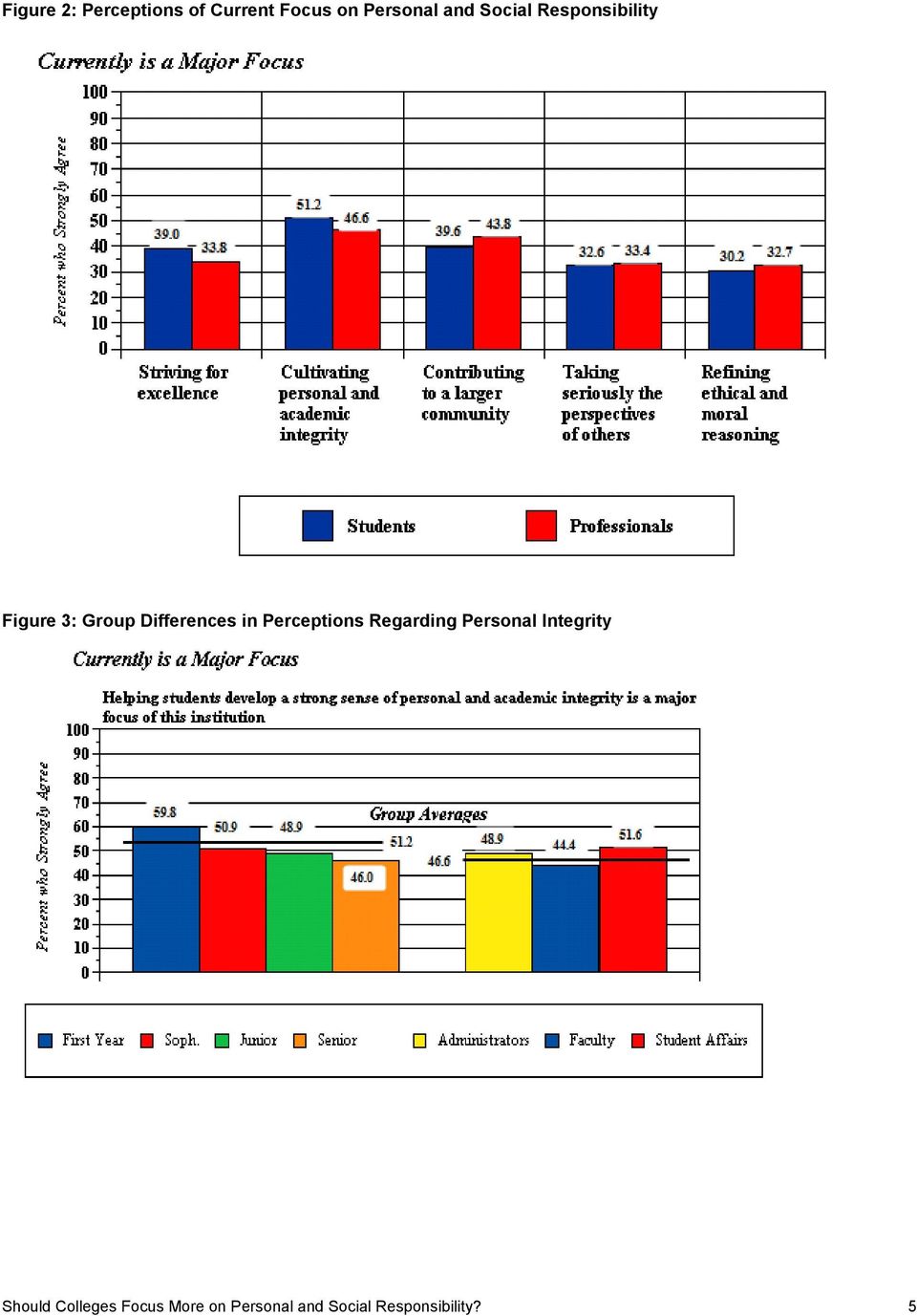
4 Figure 1: Strong Agreement for Focusing on Personal and Social Responsibility FINDING 2: Across all groups surveyed, far fewer individuals agreed that personal and social responsibility was currently a major focus on their campus. There is a clear gap between what they perceive should be and what is. Despite the strong agreement about the value of focusing on personal and social responsibility, the PSRII respondents were substantially more critical about whether their campuses are actually focusing enough on these issues. (See Figure 2.) The difference between should be and is currently dropped more than 50% in some areas of personal and social responsibility. When the strongly agree and agree somewhat responses are combined, the contrast between should be and is currently diminishes. With regard to striving for excellence, for example, only 4 out of 10 students, and 3 out of 10 campus professionals, said they strongly agree that their campuses made this dimension a major focus. Perceptions of the current institutional focus across the different dimensions vary depending upon the group surveyed. Among campus professionals, academic administrators and student affairs staff were more likely to strongly agree that their institutions are making the five dimensions a major focus, compared to faculty, who were slightly more critical on the topic. Among students, first-year students tended to have the most positive views of the institutional focus on the five dimensions, with a steady decrease by class year.(see Figure 3 for results associated with personal and academic integrity, which was the most strongly endorsed dimension generally.) Should Colleges Focus More on Personal and Social Responsibility? 4

5 Figure 2: Perceptions of Current Focus on Personal and Social Responsibility Figure 3: Group Differences in Perceptions Regarding Personal Integrity Should Colleges Focus More on Personal and Social Responsibility? 5
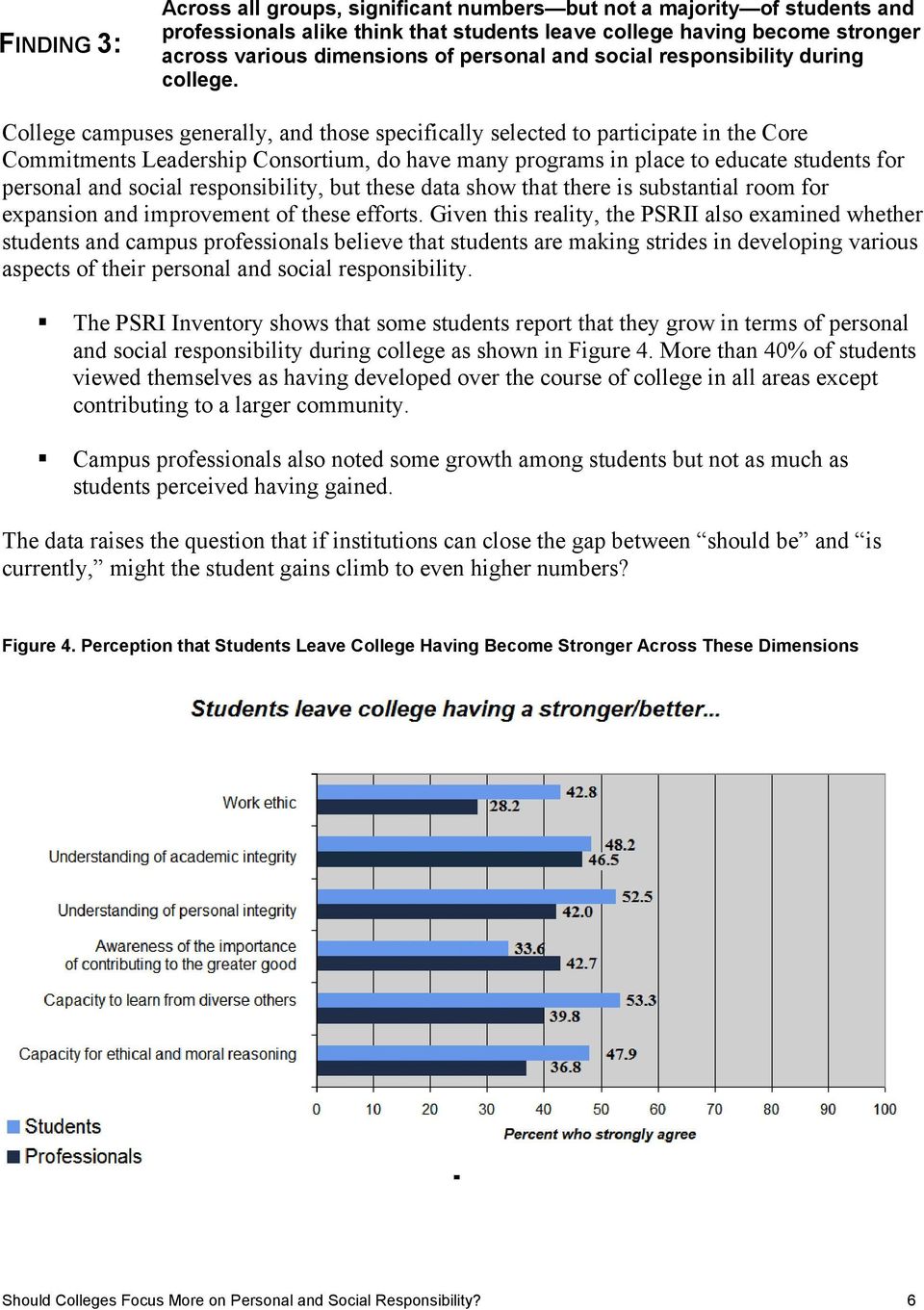
6 FINDING 3: Across all groups, significant numbers but not a majority of students and professionals alike think that students leave college having become stronger across various dimensions of personal and social responsibility during college. College campuses generally, and those specifically selected to participate in the Core Commitments Leadership Consortium, do have many programs in place to educate students for personal and social responsibility, but these data show that there is substantial room for expansion and improvement of these efforts. Given this reality, the PSRII also examined whether students and campus professionals believe that students are making strides in developing various aspects of their personal and social responsibility. The PSRI Inventory shows that some students report that they grow in terms of personal and social responsibility during college as shown in Figure 4. More than 40% of students viewed themselves as having developed over the course of college in all areas except contributing to a larger community. Campus professionals also noted some growth among students but not as much as students perceived having gained. The data raises the question that if institutions can close the gap between should be and is currently, might the student gains climb to even higher numbers? Figure 4. Perception that Students Leave College Having Become Stronger Across These Dimensions Should Colleges Focus More on Personal and Social Responsibility? 6
7 Conclusion Campus climate surveys are vital to examining the real vs. the ideal view of campus environments. The findings presented from the PSRII are intended to encourage dialogue about the five dimensions. Students, campus professionals, and higher education leaders can then explore together contrasting perceptions and areas of strong agreement in an effort to enhance opportunities for students to cultivate a commitment to excellence and integrity, to engage across differences on and off campus, and to develop moral discernment and action in their public and private lives. The data provided by the PSRII is institutionally focused and intended to help campus leaders identify what they can do to enhance awareness of existing programs and perceptions, and to fill gaps in current practices in order to develop a more coherent and pervasive institutional climate suitable for educating students for personal and social responsibility. There is a great deal more consensus about how much is offered on campus when "strongly agree" is combined with "somewhat agree," which raises an important question for the field: "Is 'somewhat agree' good enough?" The report was prepared by the University of Michigan s Core Commitments Research Group Mary Antonaros, Cassie Barnhardt, Matthew Holsapple, Karen Moronski, and Veronica Vergoth, under the direction of Eric L. Dey. Special thanks to the Core Commitments project staff, Core Commitments advisory board, AAC&U staff, and Leadership Consortium team leaders, who reviewed drafts of this report. For more information on Core Commitments, please visit Should Colleges Focus More on Personal and Social Responsibility? 7
8 Appendix A. The Core Commitments Leadership Consortium Twenty-three institutions from across all sectors of higher education comprise the Core Commitments Leadership Consortium, which is designed to bring together the most promising institutional practices related to educating students for personal and social responsibility as well as to deepen and extend these efforts. Chosen on the basis of work already accomplished and on an articulated plan to deepen and extend that work, these institutions were selected from a pool of more than 125 applicants in The Leadership Consortium members are: Allegheny College, Pennsylvania Babson College, Massachusetts Bowling Green State University, Ohio California State University, Northridge, California Concordia College Moorhead, Minnesota Elizabethtown College, Pennsylvania Miami University, Ohio Michigan State University, Michigan Middlesex Community College, Massachusetts Oakland Community College, Michigan Portland State University, Oregon Rollins College, Florida Sacred Heart University, Connecticut Saint Anselm College, New Hampshire Saint Mary s College of California, California St. Lawrence University, New York United States Air Force Academy, Colorado United States Military Academy, New York University of Alabama at Birmingham, Alabama University of Central Florida, Florida University of the Pacific, California Wagner College, New York Winthrop University, South Carolina Should Colleges Focus More on Personal and Social Responsibility? 8
9 Appendix B: Background material The Five Dimensions of Personal and Social Responsibility AAC&U has identified five key dimensions of personal and social responsibility that form the core of the PSRII: 1. Striving for excellence: developing a strong work ethic and consciously doing one s very best in all aspects of college; 2. Cultivating personal and academic integrity: recognizing and acting on a sense of honor, ranging from honesty in relationships to principled engagement with a formal academic honors code; 3. Contributing to a larger community: recognizing and acting on one s responsibility to the educational community and the wider society, locally, nationally, and globally; 4. Taking seriously the perspectives of others: recognizing and acting on the obligation to inform one s own judgment; engaging diverse and competing perspectives as a resource for learning, citizenship, and work; 5. Developing competence in ethical and moral reasoning: developing ethical and moral reasoning in ways that incorporate the other four responsibilities; using such reasoning in learning and in life. While these five dimensions do not encompass all aspects of conscience and citizenship, they offer a compelling claim as the initial focus for a widespread reengagement with campus values and ethics. PSRII Methodology Supported by a grant from the Templeton Foundation, the initial inventory was developed in 2006 under the direction of Lee Knefelkamp and Richard Hersh with research assistance from Lauren Ruff. The survey items were carefully designed to measure aspects of a campus climate that are related to each of the five dimensions. This work began with a thorough review of the psychology and developmental literatures to clarify the definitions identify character traits, and relevant behavioral manifestations of each of the dimensions. Building upon the established definitions, the climate/ congruence/ dissonance literatures were examined to identify reasonable markers for each dimension, with the goal of establishing ten markers each with five examples. A multifaceted sampling strategy was devised to survey four different constituents: students, faculty, academic administrators, and student affairs staff. This approach provided comprehensive data regarding how well institutions are embedding education for civic and moral responsibility. The initial inventory was then refined in cooperation with Eric L. Dey and his associates at the Center for the Study of Higher and Postsecondary Education at the University of Michigan. In the Fall of 2007 data were gathered from 23 schools participating in the Core Commitments and yielded responses of sufficient size and variety to be representative of the four populations on participating campuses. The overall survey response rates were 28% for the student survey and 47% for the professional surveys, and were statistically adjusted to account for bias in response patterns. However, since the project design did not randomly select institutions to participate in the Core Commitments effort the overall sample is not representative of the four populations nationally. Should Colleges Focus More on Personal and Social Responsibility? 9
10 A Note about the Data Campus climate data is self reported data that focuses on participants perceptions of the campus environment. It does not capture what an institution is actually doing with regard to the phenomena under investigation. The PSRII results may point to: (a) a lack of awareness about existing programs and practices related to personal and social responsibility, (b) a lack of impact of these programs and practices on the overall institutional culture, or (c) actual gaps in programs and practices. The Leadership Consortium institutions are using their own data to probe the situation on their individual campuses. Because campuses differ dramatically in terms of mission, culture, size, and population, this report does not compare data across individual institutions. Hence, the data is reported in the aggregate across the 23 schools. The data is disaggregated where relevant by factors such as students year in school, for example, or by professional category (faculty, student affairs staff, and academic administrators). To better highlight comparisons with student responses, several graphs combine faculty, student affairs staff, and academic administrators into a single professional category when differences across these groupings are modest. Should Colleges Focus More on Personal and Social Responsibility? 10

How To Know If A College Is A Place For Perspective Taking
 Engaging Diverse Viewpoints: What Is the Campus Climate for Perspective-Taking? community perspectives excellence integrity ethics Eric L. Dey and Associates University of Michigan Core Commitments: Educating
ASSESSING FOR LEARNING
 ASSESSING FOR LEARNING Building a Sustainable Commitment Across the Institution Peggy L. Maki Stylus Publishing, LLC Sterling, VA 2004 (204 pages) This book offers colleges and universities a framework
Marketing Plan. Achieving NECC Enrollment and Image Enhancement Goals. Supporting Existing College and Presidential Priorities Priorities 7/1/10
 Marketing Plan 7/1/10 Achieving NECC Enrollment and Image Enhancement Goals Supporting Existing College and Presidential Priorities Priorities TABLE OF CONTENTS I. INTRODUCTION Page 3 II. ASSESSMENT: A.
Academic Affairs Working Plan 2014-17
 1 Division of Academic Affairs Academic Affairs Working Plan 2014-17 Strategic planning in Academic Affairs is guided by the five goals of the SJSU Strategic Plan: Vision 2017 and the planning previously
THE ADMINISTRATIVE UNIT ASSESSMENT HANDBOOK
 THE ADMINISTRATIVE UNIT ASSESSMENT HANDBOOK GUIDELINES FOR PLANNING AND IMPLEMENTING MEASURING STUDENT SUPPORT SERVICES & ADMINISTRATIVE OUTCOMES Within institutional effectiveness, departments (academic
6 Essential Characteristics of a PLC (adapted from Learning by Doing)
 6 Essential Characteristics of a PLC (adapted from Learning by Doing) 1. Shared mission, vision, values, goals Educators in a PLC benefit from clarity regarding their shared purpose, a common understanding
NASPAA s Research Universities Report 3/4/16
 NASPAA s Research Universities Report 3/4/16 Data Source: 2014-2015 NASPAA Annual Data Report N= 109 schools, 120 programs 70% of Research Universities Fall 2015 Current Enrollment 15552 students Average
Gettysburg College. Co-Curricular Learning Assessment Plan. Subcommittee on Learning Outside the Classroom. June 15, 2003.
 Gettysburg College Co-Curricular Learning Assessment Plan Subcommittee on Learning Outside the Classroom June 15, 2003 Submitted by: Julie Ramsey David Wright David Steinour Robin Wagner Thomas Mottola
Developing Market-Relevant Curricula and Credentials: Employer Engagement for Community Colleges in Partnerships
 For more information please contact: Holly Parker VP, Economic Opportunity [email protected] 734.769.2900 x219 Developing Market-Relevant Curricula and Credentials: Employer Engagement for Community
Data show key role for community colleges in 4-year
 Page 1 of 7 (https://www.insidehighered.com) Data show key role for community colleges in 4-year degree production Submitted by Doug Lederman on September 10, 2012-3:00am The notion that community colleges
the Defence Leadership framework
 the Defence Leadership framework Growing Leaders at all Levels Professionalism Loyalty Integrity Courage Innovation Teamwork Foreword One of the founding elements of Building Force 2030, as outlined in
Chapter 3. Methodology
 22 Chapter 3 Methodology The purpose of this study is to examine the perceptions of selected school board members regarding the quality and condition, maintenance, and improvement and renovation of existing
Miami University Ohio. James Madison University
 Miami University Ohio Mission Statement: Miami provides the opportunities of a major university while offering the personalized attention found in the best small colleges. It values teaching and intense
St. Bonaventure University Strategic Plan Update June 2016
 St. Bonaventure University Strategic Plan Update June 2016 On Friday, June 10 th, the University Planning Commission presented the draft of the University s Strategic Plan to the Board of Trustees and
TALENT REVIEWS AND HIGH-POTENTIAL OVERCOMING FIVE COMMON CHALLENGES
 WHITE PAPER By ERIC HANSON, PH.D. EXECUTIVE CONSULTANT DDI WHITE PAPER THE TALENT REVIEW AND HIGH-POTENTIAL 1 TALENT REVIEWS AND HIGH-POTENTIAL IDENTIFICATION: OVERCOMING FIVE COMMON CHALLENGES The annual
Q1 2009 Homeowner Confidence Survey. May 14, 2009
 Q1 2009 Homeowner Confidence Survey Results May 14, 2009 The Zillow Homeowner Confidence Survey is fielded quarterly to determine the confidence level of American homeowners when it comes to the value
The Baldrige Model. Prof. Yacov Kedem Dr. Edna Benshalom Mofet Institute, Israel
 Quality Management in Institutes of Higher Education The Baldrige Model Prof. Yacov Kedem Dr. Edna Benshalom Mofet Institute, Israel The 4 th International Conference Education, Research and Development
California State University, Stanislaus GENERAL EDUCATION: ASSESSMENT CHRONOLOGY
 California State University, Stanislaus GENERAL EDUCATION: ASSESSMENT CHRONOLOGY The General Education Program has taken the following steps toward assessment of the quality of General Education. 1997/1998
A Guide. to Assessment of Learning Outcomes. for ACEJMC Accreditation
 A Guide to Assessment of Learning Outcomes for ACEJMC Accreditation Accrediting Council on Education in Journalism and Mass Communications, 2012 This guide explains ACEJMC s expectations of an assessment
In recent years conversations among development
 Major gift metrics that matter By Thomas W. Grabau While the metrics used to measure development performance vary widely, clearly stated goals are essential. And thoughtful analysis of the metrics with
LEADING VALUES AND MORAL DILEMMA DISCUSSIONS
 LEADING VALUES AND MORAL DILEMMA DISCUSSIONS Learn step by step how to lead engaging and animated discussions of character, values, and moral issues using hypothetical, curriculum based, or real life dilemmas.
University System of Georgia Enrollment Trends and Projections to 2018
 University System of Georgia Enrollment Trends and Projections to 2018 Introduction: Projections of USG Headcount Enrollment Enrollment projections use past trends and information on other variables to
STRATEGIC PLAN 2015-2020
 STRATEGIC PLAN 2015-2020 EXECUTIVE SUMMARY Georgia Regents University Division of Enrollment & Student Affairs participates in annual strategic planning so that the division can clarify goals and focus
The 360 Degree Feedback Advantage
 viapeople Insight - Whitepaper The 360 Degree Feedback Advantage How this powerful process can change your organization Karen N. Caruso, Ph.D. Amanda Seidler, Ph.D. The 360 Degree Feedback Advantage Champions
A Guide to Learning Outcomes, Degree Level Expectations and the Quality Assurance Process in Ontario
 A Guide to Learning Outcomes, Degree Level Expectations and the Quality Assurance Process in Ontario A Guide to Learning Outcomes, Degree Level Expectations and the Quality Assurance Process in Ontario
other distance education innovations, have changed distance education offerings.
 WEB TABLES DEPARTMENT OF EDUCATION JUNE 2014 NCES 2014-023 Enrollment in Distance Education Courses, by State: Fall 2012 Postsecondary enrollment in, particularly those offered online, has rapidly increased
UNIVERSITY OF MIAMI SCHOOL OF BUSINESS ADMINISTRATION MISSION, VISION & STRATEGIC PRIORITIES. Approved by SBA General Faculty (April 2012)
 UNIVERSITY OF MIAMI SCHOOL OF BUSINESS ADMINISTRATION MISSION, VISION & STRATEGIC PRIORITIES Approved by SBA General Faculty (April 2012) Introduction In 1926, we embarked on a noble experiment the creation
Bryant University Student Diversity Advocates
 Student Diversity Advocates The Institution and Its Students Bryant University, founded in 1863, is a private, independent institution located in Smithfield, Rhode Island, 12 miles northwest of Providence.
Leadership and Management Competencies
 Leadership and Management Competencies 0 The Saskatchewan Public Service Vision: The Best Public Service in Canada Our Commitment to Excellence Dedicated to service excellence, we demonstrate innovation,
EDUCATIONAL LEADERSHIP PROGRAM Recognition. Standards:
 EDUCATIONAL LEADERSHIP PROGRAM Recognition Standards: District Level For institutions undergoing NCATE Accreditation and ELCC Program Review For Advanced Programs at the Master, Specialist, or Doctoral
Consent to Appointment as Registered Agent
 Consent to Appointment as Registered Agent This form is used by the person or business entity that agrees to act as the registered agent for a limited liability company. Every person or business entity
Self Assessment Tool for Principals and Vice-Principals
 The Institute for Education Leadership (IEL) brings together representatives from the principals' associations, the supervisory officers' associations, councils of directors of education and the Ministry
Research Brief. Gap in Dental Care Utilization Between Medicaid and Privately Insured Children Narrows, Remains Large for Adults.
 Gap in Dental Care Utilization Between Medicaid and Privately Insured Children Narrows, Remains Large for Adults Authors: Marko Vujicic, Ph.D.; Kamyar Nasseh, Ph.D. The Health Policy Institute (HPI) is
NATSAP/ IECA Best Practices Between Educational Consultants and Program Members
 NATSAP/ IECA Best Practices Between Educational Consultants and Program Members 2015 National Association of Therapeutic Schools and Programs Independent Educational Consultants Association 1 Contents
2015 2016 Division of Student Affairs Strategic Plan
 2015 2016 Division of Student Affairs Strategic Plan Mission, Vision, and Core Values of the Division of Student Affairs The Chicago State University s Division of Student Affairs (DOSA) maintains, expands
April 15, 2014. The Honorable Phil Scott The Office of the Lieutenant Governor 115 State Street Montpelier, Vermont 05633. Dear Lt.
 April 15, 2014 The Honorable Phil Scott The Office of the Lieutenant Governor 115 State Street Montpelier, Vermont 05633 Dear Lt. Governor Scott, Thank you for the opportunity to present our credentials
GOAL #1: Promote a culture of quality academic advising through advisor education, recognition and reward, and advising program assessment.
 ADVISING GOALS AND * *Advising goals and outcomes have been formulated with the help of Academic Advising at Oregon State and Washington State Universities. GOAL #1: Promote a culture of quality academic
DOÑA ANA BRANCH COMMUNITY COLLEGE. Strategic Plan. 2003 Revision THIS DOCUMENT REFLECTS FINAL EDITING COMPLETED APRIL 10, 2003.
 DOÑA ANA BRANCH COMMUNITY COLLEGE Strategic Plan 2003 Revision THIS DOCUMENT REFLECTS FINAL EDITING COMPLETED APRIL 10, 2003. Table of Contents DABCC Mission Statement....................................................
Development for Online Graduate
 Research Support and Skill Development for Online Graduate Students Laura Knight Lynn, PhD, Executive Director Daniel Salter, PhD Director, Strategic Research Initiatives Louis Milanesi, PhD Director,
Taking Bold Steps. Taking Bold Steps.
 Taking Bold Steps. Taking Bold Steps. Introduction Faculty, staff, and students at Indiana University Kokomo revisited the campus 2011-2015 strategic plan in response to a call for a university wide strategic
Division of Student Affairs. Strategic Plan 2011-2015 Revised 8/30/2010
 Division of Student Affairs Strategic Plan 2011-2015 Revised 8/30/2010 2 Table of Contents Section I Overview 2 Section II Strategic Plan: Mission, Vision, Core Values, Goals 3 Section III Strategic Initiatives
Audiology Survey Report: Annual Salary Trends 2010 2012
 Audiology Survey Report: Annual Salary Trends 2010 2012 AMERICAN SPEECH-LANGUAGE-HEARING ASSOCIATION April 10, 2013 Written by Gail Brook, Surveys and Analysis Contents Introduction 2 Survey Report Highlights
JAMES M. MITCHELL P.O. Box 1555 Selma, Al 36702-1555 (334) 875-5875 [email protected]
 JAMES M. MITCHELL P.O. Box 1555 Selma, Al 36702-1555 (334) 875-5875 [email protected] PROFESSIONAL EXPERIENCE PRESIDENT 8/2000 - Present WALLACE COMMUNITY COLLEGE SELMA P.O. Box 2530, Selma, Alabama 36702-2530
UNIVERSITY OF CALIFORNIA Office of Academic Personnel Academic Personnel Manual (APM) Policy Development Process Guide
 Overview The at the University of California Office of the President manages the Academic Personnel Manual (APM) policy development process from inception to issuance on behalf of the Provost and Executive
Strategic Planning Project
 Final Report Strategic Planning Project Deliverables: Strategic Planning Process Strategic Plan: FY14 16 SUBMITTED BY: JEFF HOYE MICHAEL DESOUSA CPS HR Consulting 241 Lathrop Way Sacramento, CA 95815 t:
Q2 Which university will you be attending? American University (366) Arizona State University (367) Boston University (368) Brown University (439)
 Decline Offer Survey Thank you for considering the University of Washington during your search for a graduate degree program. We understand that many factors influence each applicant s decision in selecting
How To Rank A Graduate School
 Graduate School Rankings Debate: U.S. News and World Report --and beyond Every year, U.S. News and World Report publishes a ranking of different graduate programs and, every year, college and university
ASSESSMENT AND QUALITY ENHANCEMENT
 ASSESSMENT AND QUALITY ENHANCEMENT FOR INSTITUTIONAL EFFECTIVENESS Table of Contents Outcomes Assessment... 3 Assessment Learning Cycle... 4 Creating assessment for Learning... 4 Nine Principles-Assessment
PRINCIPLES OF GOOD PRACTICE FOR STUDENT AFFAIRS AT CATHOLIC COLLEGES AND UNIVERSITIES
 PRINCIPLES OF GOOD PRACTICE FOR STUDENT AFFAIRS AT CATHOLIC COLLEGES AND UNIVERSITIES Introduction The purpose of these Principles is to provide a framework for student affairs professionals who work at
6. UNC Degree Program Establishments... Courtney Thornton
 MEETING OF THE BOARD OF GOVERNORS Committee on Educational Planning, Policies and Programs AGENDA ITEM April 14, 2016 6. UNC Degree Program Establishments... Courtney Thornton Situation: Appalachian State
Impacts of Sequestration on the States
 Impacts of Sequestration on the States Alabama Alabama will lose about $230,000 in Justice Assistance Grants that support law STOP Violence Against Women Program: Alabama could lose up to $102,000 in funds
Three-Year Moving Averages by States % Home Internet Access
 Three-Year Moving Averages by States % Home Internet Access Alabama Alaska Arizona Arkansas California Colorado Connecticut Delaware Florida Georgia Hawaii Idaho Illinois Indiana Iowa Kansas Kentucky Louisiana
2001 National Name Exchange
 2001 National Name Exchange Committee on Cooperative Minority Student Recruitment Annual Report http://www.grad.washington.edu/nameexch/national/ Prepared for the 26 th Annual Meeting Durham, North Carolina
Student Leadership Development Model
 St. Cloud State University Department of Residential Life Student Leadership Development Model Mission of the Department of Residential Life The Department of Residential Life works to provide a student
Bowling Green State University Assessment Report 2013 2014 Recreation and Wellness
 Bowling Green State University Assessment Report 2013 2014 Recreation and Wellness Submitted By Kelsey Gabbard, Graduate Assistant for Student Programming and Leadership Date: May 2014 Department Website
Conclusion and Request for Continued Accreditation
 chapter 12 Conclusion and Request for Continued Accreditation Our thematic self-study was valuable for the university in a number of ways. We were able to analyze and appreciate the breadth and depth of
University of Detroit Mercy. Performance Communication System (PCS)
 Supervisor Manual 1/5/11 Supervisor Manual Table of Contents The 3 The PCS Process 5 Preparing for the Discussion Meeting 7 Tips for Good Communication 7 Performance Expectations 8 Behavioral Competencies
Appendix A: Annotated Table of Activities & Tools
 APPENDIX A Annotated Table of Activities and Tools MODULE 1: Get Ready for Inquiry ( Activities) Activity 1.1 Activity 1.2 Activity 1.3 Activity 1.4 Activity 1.5 How Data Can Help Us in the School Improvement
The Elementary Education Program Brandeis University Waltham, MA 02454
 The Elementary Education Program Brandeis University Waltham, MA 02454 The Brandeis Education Program seeks to prepare teachers with a strong liberal arts background who possess the knowledge, point of
Public School Teacher Experience Distribution. Public School Teacher Experience Distribution
 Public School Teacher Experience Distribution Lower Quartile Median Upper Quartile Mode Alabama Percent of Teachers FY Public School Teacher Experience Distribution Lower Quartile Median Upper Quartile
The Questionable Employment Tax Practices Initiative Progress Report
 The Questionable Employment Tax Practices Initiative Progress Report April, 2011 QETP Oversight Team Members Include: Internal Revenue Service U.S. Department of Labor National Association of State Workforce
FOREIGN LANGUAGE ENROLLMENTS IN K-12 PUBLIC SCHOOLS: Are Students Prepared for a Global Society?
 FOREIGN LANGUAGE ENROLLMENTS IN K-12 PUBLIC SCHOOLS: Are Students Prepared for a Global Society? Executive Summary Since 1968, the American Council on the Teaching of Foreign Languages (ACTFL) has conducted
Annual Salaries. For additional information, please contact:
 Annual Salaries For additional information, please contact: Jeanette Janota, Surveys & Analysis American Speech-Language-Hearing Association 2200 Research Boulevard Rockville, MD 20850-3289 800-498-2071,
FOCUS MONASH. Strategic Plan 2015 2020
 F CUS FOCUS MONASH Strategic Plan 2015 2020 2 Vice-Chancellor s Introduction 4 Over the last half century, Monash University has forged a path that reflects the ambitions of its beginnings and signals
Legal Aid Board Training. 2010 Legal Aid Education P, Session 1, Page 1 Session 1. Introduction
 to Legal Aid 2010 Legal Aid Education P, Session 1, Page 1 Session 1 Governance as Leadership What is governance? Governance is the exercise of authority, direction and control of an organization in order
College Completion in Connecticut: The Impact on the Workforce and the Economy
 College Completion in : The Impact on the Workforce and the Economy February 2012 Investing in Individuals and Society through College Completion 30 25 20 15 10 5 0 Higher Levels of Education and Skills
SREB State College and Career Readiness Initiative
 SREB State College and Career Readiness Initiative Teacher Development to Increase College and Career Readiness Guidelines and Promising Practices for States College and career readiness is an increasingly
Designing Student Assessment to Strengthen Institutional Performance in Associate of Arts Institutions
 Designing Student Assessment to Strengthen Institutional Performance in Associate of Arts Institutions M A R V I N W. P E T E R S O N C A T H E R I N E H. A U G U S T I N E M A R N E K. E I N A R S O N
Chex Systems, Inc. does not currently charge a fee to place, lift or remove a freeze; however, we reserve the right to apply the following fees:
 Chex Systems, Inc. does not currently charge a fee to place, lift or remove a freeze; however, we reserve the right to apply the following fees: Security Freeze Table AA, AP and AE Military addresses*
Copyright 2013. All rights reserved. Suggested Citation:
 Initial Findings Copyright 2013. All rights reserved. Suggested Citation: Syvertsen, A. K., Metzger, A., & Wray-Lake, L. (2013). Key findings from the Roots of Engaged Citizenship Project. Minneapolis,
Sales Checkpoint Performance Feedback System
 Sales Checkpoint Performance Feedback System Technical Development Manual January, 2014 Profiles International, Inc. Profiles Office Park 5205 Lake Shore Drive Waco, Texas USA 76710 CONTENTS Chapter 1:
NAIC ANNUITY TRAINING Regulations By State
 Select a state below to display the current regulation and requirements, or continue to scroll down. Light grey text signifies states that have not adopted an annuity training program. Alabama Illinois
Leadership Self Assessment
 Leadership Self Assessment This self assessment is designed to help leaders determine which leadership skills they may need to develop. It focuses on eight components dealing with (1) providing direction,
EDUCATIUS COLLEGE & UNIVERSITY SERVICES
 EDUCATIUS COLLEGE & UNIVERSITY SERVICES THE SCHOLARSHIP PROGRAM Boston, Massachusetts, U.S.A. www.educatiusuniversity.org. EDUCATION EXPERIENCE EXCELLENCE THE SCHOLARSHIP PROGRAM FOR INTERNATIONAL STUDENTS
MISSION / VISION / VALUES FRAMEWORK
 MISSION / VISION / VALUES FRAMEWORK The Mission / Vision / Values Framework builds on the strengths of Concordia today and provides the vision and strategies to build an even stronger and more vital Concordia
Class & Labor Implementation Committee Summarized Report of Action Steps & Ongoing Owners
 Class & Labor Implementation Committee Summarized Report of Action Steps & Ongoing Owners The Class & Labor Implementation Committee has 17 members and began meeting in March 2013 to advice on the implementation
Higher Education in New England: Enrollment and Migration. Presentation by the New England Board of Higher Education February 13, 2014
 Higher Education in New England: Enrollment and Migration Presentation by the New England Board of Higher Education February 13, 2014 About NEBHE Interstate agency, chartered by New England Governors in
How To Teach General Education At Grianethenanford College
 The General Education Handbook Effective Winter 2015 The General Education Handbook The purpose of the handbook is to familiarize the reader with the goals, philosophy and outcomes of General Education
High Risk Health Pools and Plans by State
 High Risk Health Pools and Plans by State State Program Contact Alabama Alabama Health 1-866-833-3375 Insurance Plan 1-334-263-8311 http://www.alseib.org/healthinsurance/ahip/ Alaska Alaska Comprehensive
The Emotional Competence Framework
 The Emotional Competence Framework 1 SOURCES: This generic competence framework distills findings from: MOSAIC competencies for professional and administrative occupations (U.S. Office of Personnel Management);
Promising Practices & Organizational Structures: Promoting Community College Student Success
 Promising Practices & Organizational Structures: Promoting Community College Student Success Ronald Williams The College Board Mary Ziskin Don Hossler Indiana University Emily Chung Jerry Lucido University
Educating and Empowering the Next Generation of Women Leaders
 Educating and Empowering the Next Generation of Women Leaders Call for Proposals 2015 Contact: Sasha Patterson, Ph.D. NEW Leadership Program Manager Center for American Women and Politics Eagleton Institute
MCH LEADERSHIP SKILLS SELF-ASSESSMENT
 MCH LEADERSHIP SKILLS SELF-ASSESSMENT This self-assessment corresponds to the Maternal and Child Health Leadership Competencies Version 3.0, by the MCH Leadership Competencies Workgroup (Eds), June 2009.
Parent Coordinator Resource Guide & Toolkit. The JOINING PROCESS
 Parent Coordinator Resource Guide & Toolkit The JOINING PROCESS The JOINING PROCESS THE JOINING PROCESS: Developing Positive Relationships between Families and Schools What you ll learn As you complete
Self-Assessment Tool for Service-Learning Sustainability
 Self-Assessment Tool for Service-Learning Sustainability distributed by Community-Campus Partnerships for Health to assist our higher education-based members in their service-learning efforts This self-assessment
State-Specific Annuity Suitability Requirements
 Alabama Alaska Arizona Arkansas California Colorado Connecticut Delaware District of Columbia Effective 10/16/11: Producers holding a life line of authority on or before 10/16/11 who sell or wish to sell
Running head: THE EFFECTS OF EXTRA-CURRICULAR ACTIVITIES
 Extra-Curricular Activities 1 Running head: THE EFFECTS OF EXTRA-CURRICULAR ACTIVITIES The Effects of Extra-Curricular Activities on Student s Perceived Academic Self-Efficacy Extra-Curricular Activities