
Time Series Forecasting Techniques
|
|
|
- Iris Wilkerson
- 9 years ago
- Views:
Transcription
1 03-Mentzer (Sales).qxd 11/2/ :33 AM Page 73 3 Time Series Forecasting Techniques Back in the 1970s, we were working with a company in the major home appliance industry. In an interview, the person in charge of quantitative forecasting for refrigerators explained that their forecast was based on one time series technique. (It turned out to be the exponential smoothing with trend and seasonality technique that is discussed later in this chapter.) This technique requires the user to specify three smoothing constants called α, β, and γ (we will explain what these are later in the chapter). The selection of these values, which must be somewhere between 0 and 1 for each constant, can have a profound effect upon the accuracy of the forecast. As we talked with this forecast analyst, he explained that he had chosen the values of 0.1 for α, 0.2 for β, and 0.3 for γ. Being fairly new to the world of sales forecasting, we envisioned some sophisticated sensitivity analysis that this analyst had gone through to find the right combination of the values for the three smoothing constants to accurately forecast refrigerator demand. However, he explained to us that in every article he read about this technique, the three smoothing constants were always referred to as α, β, and γ, in that order. He finally realized that this was because they are the 1st, 2nd, and 3rd letters in the Greek alphabet. Once he realized that, he simply 73
2 03-Mentzer (Sales).qxd 11/2/ :33 AM Page SALES FORECASTING MANAGEMENT took 1, 2, and 3, put a decimal point in front of each, and there were my smoothing constants. After thinking about it for a minute, he rather sheepishly said, You know, it doesn t work worth a darn, though. INTRODUCTION We hope that over the years we have come a long way from this type of time series forecasting. First, it is not realistic to expect that each product in a line like refrigerators would be accurately forecast by the same time series technique we probably need to select a different time series technique for each product. Second, there are better ways to select smoothing constants than our friend used in the previous example. To understand how to better accomplish both of these, the purpose of this chapter is to provide an overview of the many techniques that are available in the general category of time series analysis. This overview should provide the reader with an understanding of how each technique works and where it should and should not be used. Time series techniques all have the common characteristic that they are endogenous techniques. This means a time series technique looks at only the patterns of the history of actual sales (or the series of sales through time thus, the term time series). If these patterns can be identified and projected into the future, then we have our forecast. Therefore, this rather esoteric term of endogenous means time series techniques look inside (that is, endo) the actual series of demand through time to find the underlying patterns of sales. This is in contrast to regression analysis, which is an exogenous technique that we will discuss in Chapter 4. Exogenous means that regression analysis examines factors external (or exo) to the actual sales pattern to look for a relationship between these external factors (like price changes) and sales patterns. If time series techniques only look at the patterns that are part of the actual history of sales (that is, are endogenous to the sales history), then what are these patterns? The answer is that no matter what time series technique we are talking about, they all examine one or more of only four basic time series patterns: level, trend, seasonality, and noise. Figure 3.1 illustrates these four patterns broken out of a monthly time series of sales for a particular refrigerator model. The
3 03-Mentzer (Sales).qxd 11/2/ :33 AM Page 75 Time Series Forecasting Techniques 75 level is a horizontal sales history, or what the sales pattern would be if there were no trend, seasonality, or noise. For a product that is sold to a manufacturing concern as a component in another product whose demand is stable, the sales pattern for this product would be essentially level, with no trend, seasonality, or noise. In our example in Figure 3.1, however, the level is simply the starting point for the time series (the horizontal line), with the trend, seasonality, and noise added to it. Trend is a continuing pattern of a sales increase or decrease, and that pattern can be a straight line or a curve. Of course, any business person wants a positive trend that is increasing at an increasing rate, but this is not always the case. If sales are decreasing (either at a constant rate, an increasing rate, or a decreasing rate), we need to know this for forecasting purposes. In our example in Figure 3.1, trend is expressed as a straight line going up from the level. Seasonality is a repeating pattern of sales increases and decreases that occurs within a one-year period or less ( seasonal patterns of longer than one year are typically referred to as cycles, but can be forecast using the same time series techniques). Examples of seasonality Figure 3.1 Time Series Components F01 A01 S01 O01 N01 D01 F02 S02 O02 N02 D02 F03 S03 O03 N03 D Demand Level Trend Seasonality Noise
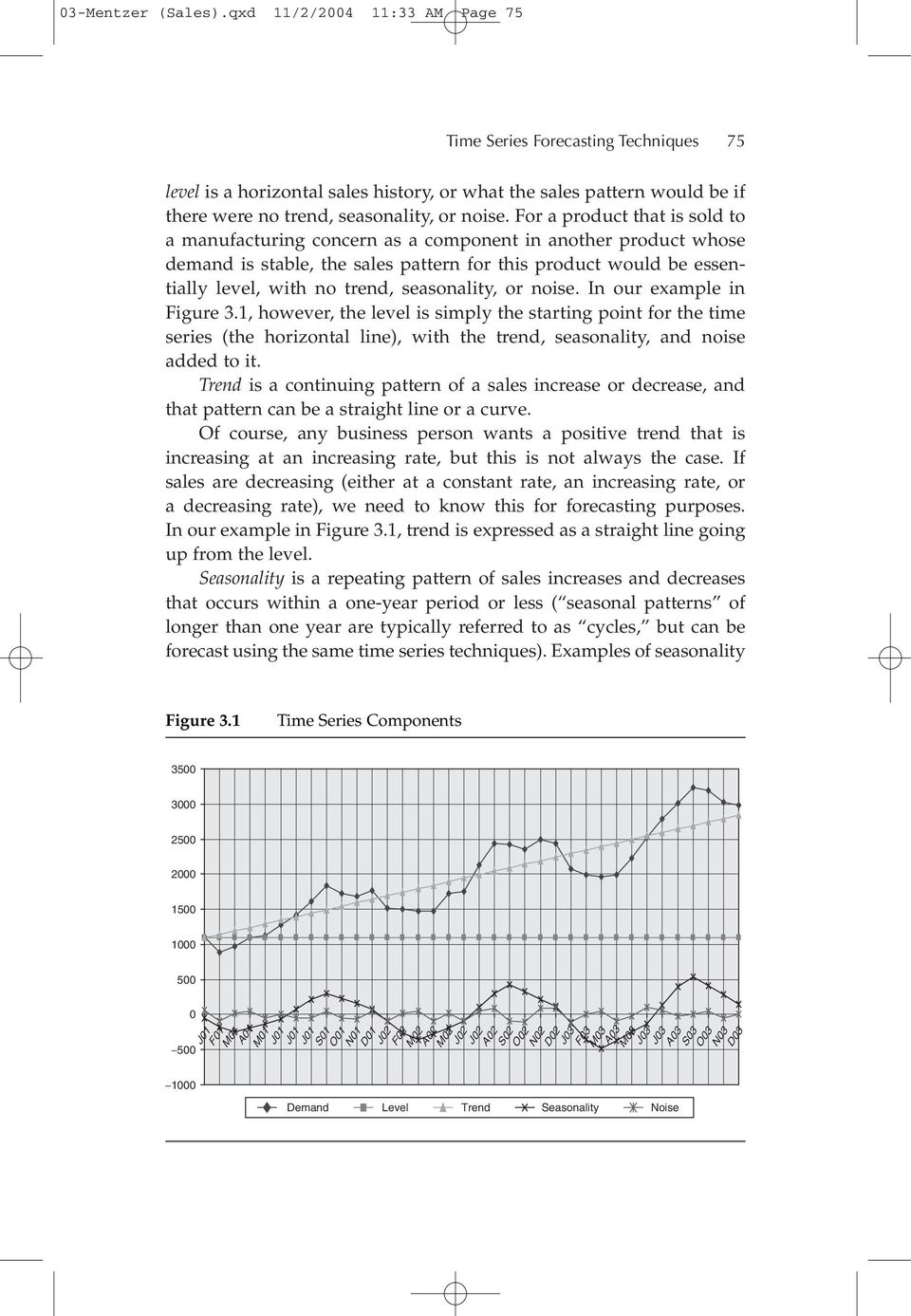
4 03-Mentzer (Sales).qxd 11/2/ :33 AM Page SALES FORECASTING MANAGEMENT are high sales every summer for air conditioners, high sales of agricultural chemicals in the spring, and high sales of toys in the fall. The point is that the pattern of high sales in certain periods of the year and low sales in other periods repeats itself every year. When broken out of the time series in Figure 3.1, the seasonality line can be seen as a regular pattern of sales increases and decreases around the zero line at the bottom of the graph. Noise is random fluctuation that part of the sales history that time series techniques cannot explain. This does not mean the fluctuation could not be explained by regression analysis or some qualitative technique; it means the pattern has not happened consistently in the past, so the time series technique cannot pick it up and forecast it. In fact, one test of how well we are doing at forecasting with time series is whether the noise pattern looks random. If it does not have a random pattern like the one in Figure 3.1, it means there are still trend and/or seasonal patterns in the time series that we have not yet identified. We can group all time series techniques into two broad categories open-model time series techniques and fixed model time series techniques based on how the technique tries to identify and project these four patterns. Open-model time series (OMTS) techniques analyze the time series to determine which patterns exist and then build a unique model of that time series to project the patterns into the future and, thus, to forecast the time series. This is in contrast to fixed-model time series (FMTS) techniques, which have fixed equations that are based upon a priori assumptions that certain patterns do or do not exist in the data. In fact, when you consider both OMTS and FMTS techniques, there are more than 60 different techniques that fall into the general category of time series techniques. Fortunately, we do not have to explain each of them in this chapter. This is because some of the techniques are very sophisticated and take a considerable amount of data but do not produce any better results than simpler techniques, and they are seldom used in practical sales forecasting situations. In other cases, several different time series techniques may use the same approach to forecasting and have the same level of effectiveness. In these latter cases where several techniques work equally well, we will discuss only the one that is easiest to understand (following the philosophy, why make something complicated if it does not have to be). This greatly reduces the number of techniques that need to be discussed.
5 03-Mentzer (Sales).qxd 11/2/ :33 AM Page 77 Time Series Forecasting Techniques 77 Because they are generally easier to understand and use, we will start with FMTS techniques and return to OMTS later in the chapter. FIXED-MODEL TIME SERIES TECHNIQUES FMTS techniques are often simple and inexpensive to use and require little data storage. Many of the techniques (because they require little data) also adjust very quickly to changes in sales conditions and, thus, are appropriate for short-term forecasting. We can fully understand the range of FMTS techniques by starting with the concept of an average as a forecast (which is the basis on which all FMTS techniques are founded) and move through the levels of moving average, exponential smoothing, adaptive smoothing, and incorporating trend and seasonality. The Average as a Forecast All FMTS techniques are essentially a form of average. The simplest form of an average as a forecast can be represented by the following formula: Forecast t +1 = Average Sales 1 to t = N S t /N (1) where: S = Sales N = Number of Periods of Sales Data (t) In other words, our forecast for next month (or any month in the future, for that matter) is the average of all sales that have occurred in the past. The advantage to the average as a forecast is that the average is designed to dampen out any fluctuations. Thus, the average takes the noise (which time series techniques assume cannot be forecast anyway) out of the forecast. However, the average also dampens out of the forecast any fluctuations, including such important fluctuations as trend and seasonality. This principle can be demonstrated with a couple of examples. Figure 3.2 provides a history of sales that has only the time series components of level and noise. The forecast (an average) does a fairly good job of ignoring the noise and forecasting only the level. However, Figure 3.3 illustrates a history of sales that has the time series components of level and noise, plus trend. As will always happen when t =1

6 03-Mentzer (Sales).qxd 11/2/ :33 AM Page SALES FORECASTING MANAGEMENT Figure 3.2 Average as a Forecast: Level and Noise F01 A01 S01 O01 N01 D01 F02 S02 O02 N02 D02 F03 S03 O03 N03 D03 J04 Demand Forecast the average is used to forecast data with a trend, the forecast always lags behind the actual data. Because the average becomes more sluggish as more data are added, the lagging of the forecast behind the actual sales gets worse over time. If our example in Figure 3.3 had been a negative trend, lagging behind would have meant the average would have always forecast high. As a final example, Figure 3.4 illustrates a history of sales that has the time series components of level and noise, plus seasonality. Notice that the average has the unfortunate effect of losing (dampening out) the seasonal pattern. Thus, we would lose this important component of any possible forecast. The conclusion from these three illustrations is that the average should only be used to forecast sales patterns that contain only the time series components of level and noise. Remember that FMTS techniques assume certain patterns exist in the data. In the case of the average, we are assuming there is no trend or seasonality in the data. This is why we stated earlier that the forecast for the next period is also the forecast for all future periods. Because the data are supposed to be level, there should be no pattern of sales increasing (trend) or increasing and

7 03-Mentzer (Sales).qxd 11/2/ :33 AM Page 79 Time Series Forecasting Techniques 79 Figure 3.3 Average as a Forecast: Level, Trend, and Noise F01 A01 S01 O01 N01 D01 F02 S02 O02 N02 D02 F03 S03 O03 N03 D03 J04 Demand Forecast Figure 3.4 Average as a Forecast: Level, Seasonality, and Noise F01 A01 S01 O01 N01 D01 F02 S02 O02 N02 D02 F03 S03 O03 N03 D03 J04 Demand Forecast

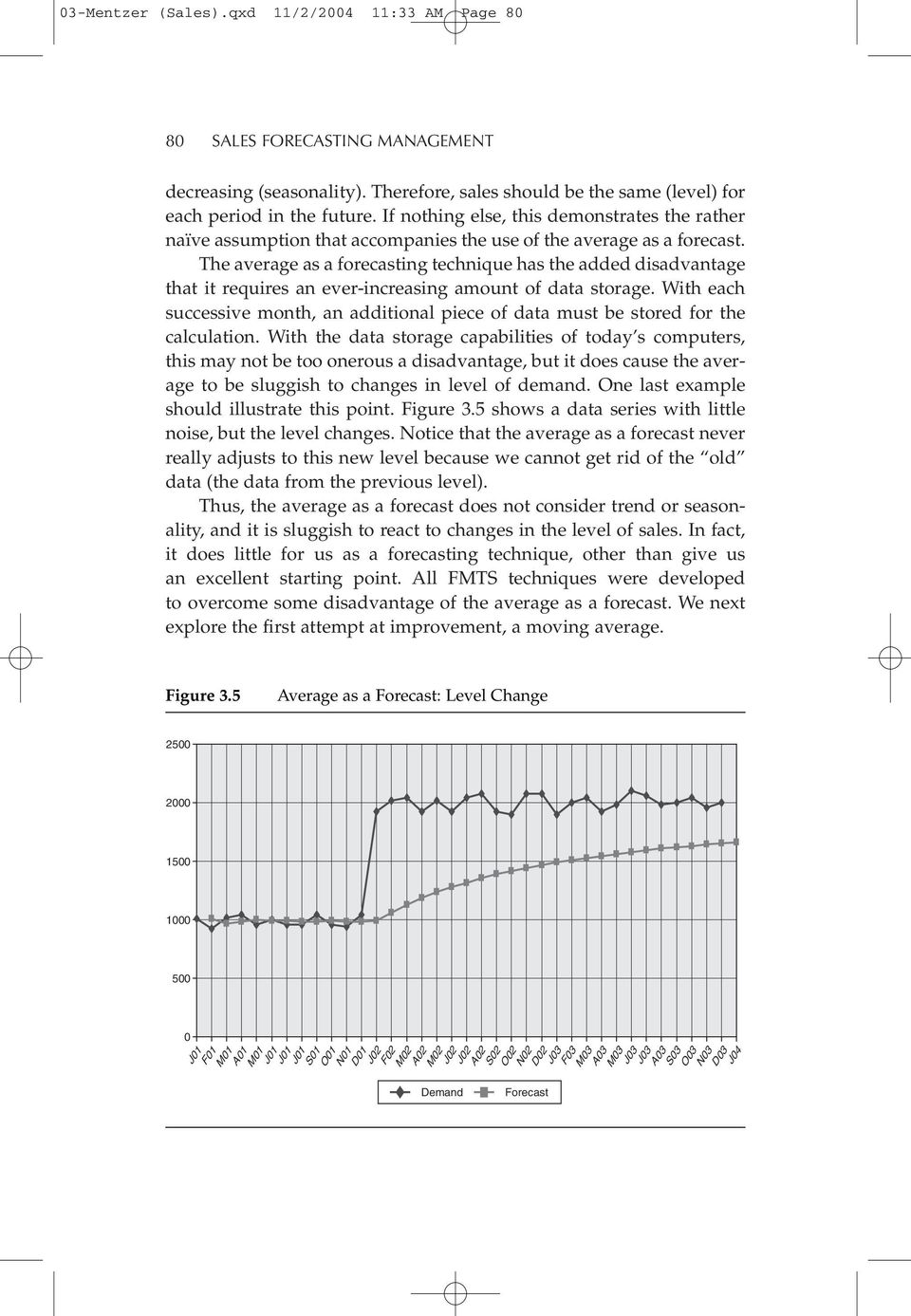
8 03-Mentzer (Sales).qxd 11/2/ :33 AM Page SALES FORECASTING MANAGEMENT decreasing (seasonality). Therefore, sales should be the same (level) for each period in the future. If nothing else, this demonstrates the rather naïve assumption that accompanies the use of the average as a forecast. The average as a forecasting technique has the added disadvantage that it requires an ever-increasing amount of data storage. With each successive month, an additional piece of data must be stored for the calculation. With the data storage capabilities of today s computers, this may not be too onerous a disadvantage, but it does cause the average to be sluggish to changes in level of demand. One last example should illustrate this point. Figure 3.5 shows a data series with little noise, but the level changes. Notice that the average as a forecast never really adjusts to this new level because we cannot get rid of the old data (the data from the previous level). Thus, the average as a forecast does not consider trend or seasonality, and it is sluggish to react to changes in the level of sales. In fact, it does little for us as a forecasting technique, other than give us an excellent starting point. All FMTS techniques were developed to overcome some disadvantage of the average as a forecast. We next explore the first attempt at improvement, a moving average. Figure 3.5 Average as a Forecast: Level Change F01 A01 S01 O01 N01 D01 F02 S02 O02 N02 D02 F03 S03 O03 N03 D03 J04 Demand Forecast
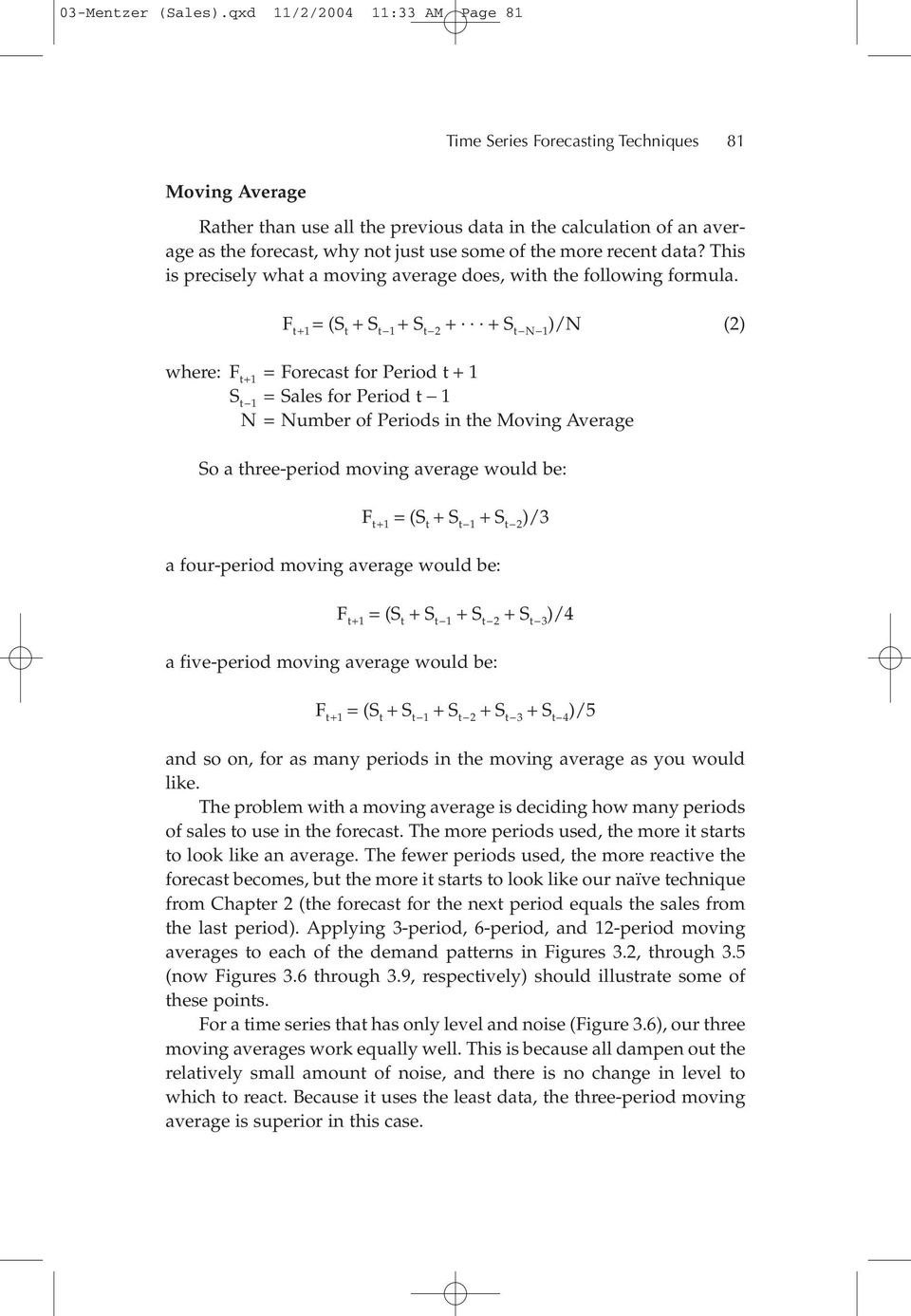
9 03-Mentzer (Sales).qxd 11/2/ :33 AM Page 81 Time Series Forecasting Techniques 81 Moving Average Rather than use all the previous data in the calculation of an average as the forecast, why not just use some of the more recent data? This is precisely what a moving average does, with the following formula. F t+1 = (S t + S t 1 + S t S t N 1 )/N (2) where: F t+1 = Forecast for Period t + 1 S t 1 = Sales for Period t 1 N = Number of Periods in the Moving Average So a three-period moving average would be: F t+1 = (S t + S t 1 + S t 2 )/3 a four-period moving average would be: F t+1 = (S t + S t 1 + S t 2 + S t 3 )/4 a five-period moving average would be: F t+1 = (S t + S t 1 + S t 2 + S t 3 + S t 4 )/5 and so on, for as many periods in the moving average as you would like. The problem with a moving average is deciding how many periods of sales to use in the forecast. The more periods used, the more it starts to look like an average. The fewer periods used, the more reactive the forecast becomes, but the more it starts to look like our naïve technique from Chapter 2 (the forecast for the next period equals the sales from the last period). Applying 3-period, 6-period, and 12-period moving averages to each of the demand patterns in Figures 3.2, through 3.5 (now Figures 3.6 through 3.9, respectively) should illustrate some of these points. For a time series that has only level and noise (Figure 3.6), our three moving averages work equally well. This is because all dampen out the relatively small amount of noise, and there is no change in level to which to react. Because it uses the least data, the three-period moving average is superior in this case.
10 03-Mentzer (Sales).qxd 11/2/ :33 AM Page SALES FORECASTING MANAGEMENT However, for the time series with trend added (Figure 3.7), very different results are obtained. The longer the moving average, the less reactive the forecast, and the more the forecast lags behind the trend (because it is more like the average). Again, this is because moving averages were not really designed to deal with a trend, but the shorter moving averages adjust better (are more reactive) than the longer in this case. An interesting phenomenon occurs when we look at the use of moving averages to forecast time series with seasonality (Figure 3.8). Notice that both the three-period and the six-period moving averages lag behind the seasonal pattern (forecast low when sales are rising and forecast high when sales are falling) and miss the turning points in the time series. Notice also that the more reactive moving average (three-period) does a better job of both of these. This is because in the short run (defined here as between turning points), the seasonal pattern simply looks like trend to a moving average. However, the 12-period moving average simply ignores the seasonal pattern. This is due to the fact that any average dampens out Figure 3.6 Moving Average as a Forecast: Level and Noise F01 A01 S01 O01 N01 D01 F02 S02 O02 N02 D02 F03 S03 O03 N03 D03 J04 Demand 3 Month MA 6 Month MA 12 Month MA

11 03-Mentzer (Sales).qxd 11/2/ :33 AM Page 83 Time Series Forecasting Techniques 83 Figure 3.7 Moving Average as a Forecast: Level, Trend, and Noise F01 A01 S01 O01 N01 D01 F02 S02 O02 N02 D02 F03 S03 O03 N03 D03 J04 Demand 3 Month MA 6 Month MA 12 Month MA Figure 3.8 Moving Average as a Forecast: Level, Seasonality, and Noise F01 A01 S01 O01 N01 D01 F02 S02 O02 N02 D02 F03 S03 O03 N03 D03 J04 DEMAND 3 Month MA 6 Month MA 12 Month MA

12 03-Mentzer (Sales).qxd 11/2/ :33 AM Page SALES FORECASTING MANAGEMENT Figure 3.9 Moving Average as a Forecast: Level Changes F01 A01 S01 O01 N01 D01 F02 S02 O02 N02 D02 F03 S03 O03 N03 D03 J04 Demand 3 Month MA 6 Month MA 12 Month MA random fluctuations (noise) and any patterns that are the same length as the average. Because this time series has a 12-month seasonal pattern, a 12-month moving average completely loses the seasonal component in its forecast. This is particularly dangerous when you consider how many sales managers use a simple 12-month moving average to generate a forecast they are inadvertently dampening out the seasonal fluctuations from their forecasts. Finally, let s look at the time series where the level changes (Figure 3.9). Again, the longer moving average tends to dampen out the noise better than the shorter moving average, but the shorter moving average reacts more quickly to the change in level. Thus, what we need in a moving average is one that acts like an average when there is only noise in the time series (dampens out the noise but uses less data than an average), but acts like a naïve forecast when the level changes (puts more weight on what happened very recently). The problem with this is how to recognize the difference in a change that is noise, as opposed to a change in level, a trend, or a seasonal pattern.

13 03-Mentzer (Sales).qxd 11/2/ :33 AM Page 85 Time Series Forecasting Techniques 85 A final problem with the moving average is that the same weight is put on all past periods of data in determining the forecast. It is more reasonable to put greater weight on the more recent periods than the older periods (especially when a longer moving average is used). Therefore, the question when using a moving average becomes how many periods of data to use and how much weight to put on each of those periods. To answer this question about moving averages, a technique called exponential smoothing was developed. Exponential Smoothing Exponential smoothing is the basis for almost all FMTS techniques in use today. It is easier to understand this technique if we acknowledge that it was originally called an exponentially weighted moving average. Obviously, the original name was too much of a mouthful for everyday use, but it helps us to explain how this deceptively complex technique works. We are going to develop a moving average, but we will weight the more recent periods of sales more heavily in the forecast, and the weights for the older periods will decrease at an exponential rate (which is where the exponential smoothing term came from). Regardless of that rather scary statement, we are going to accomplish this with a very simple calculation (Brown & Meyer, 1961). F t+1 =αs t + (1 α) F t (3) where: F t = Forecast for Period t S t = Sales for Period t 0 <α<1 In other words, our forecast for next period (or, again, any period in the future) is a function of last period s sales and last period s forecast, with this α thing thrown in to confuse us. What we are actually doing with this exponential smoothing formula is merely a weighted average. Because α is a positive fraction (that is, between 0 and 1), 1 αis also a positive fraction, and the two of them add up to 1. Any time we take one number and multiply it by a positive fraction, take a second number and multiply it by the reciprocal of the positive fraction (another way of saying 1 the first

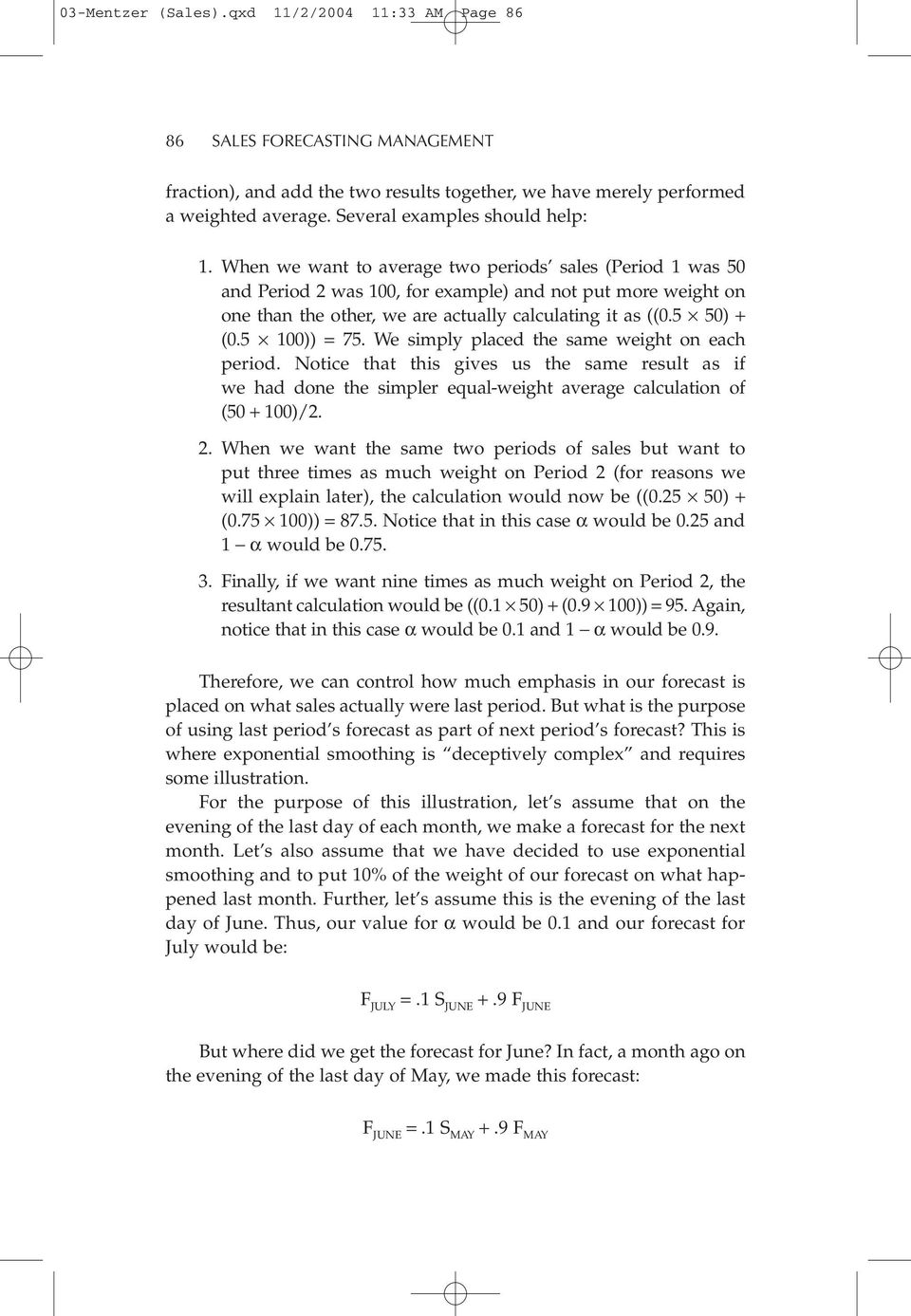
14 03-Mentzer (Sales).qxd 11/2/ :33 AM Page SALES FORECASTING MANAGEMENT fraction), and add the two results together, we have merely performed a weighted average. Several examples should help: 1. When we want to average two periods sales (Period 1 was 50 and Period 2 was 100, for example) and not put more weight on one than the other, we are actually calculating it as ((0.5 50) + ( )) = 75. We simply placed the same weight on each period. Notice that this gives us the same result as if we had done the simpler equal-weight average calculation of ( )/2. 2. When we want the same two periods of sales but want to put three times as much weight on Period 2 (for reasons we will explain later), the calculation would now be (( ) + ( )) = Notice that in this case α would be 0.25 and 1 αwould be Finally, if we want nine times as much weight on Period 2, the resultant calculation would be ((0.1 50) + ( )) = 95. Again, notice that in this case α would be 0.1 and 1 αwould be 0.9. Therefore, we can control how much emphasis in our forecast is placed on what sales actually were last period. But what is the purpose of using last period s forecast as part of next period s forecast? This is where exponential smoothing is deceptively complex and requires some illustration. For the purpose of this illustration, let s assume that on the evening of the last day of each month, we make a forecast for the next month. Let s also assume that we have decided to use exponential smoothing and to put 10% of the weight of our forecast on what happened last month. Further, let s assume this is the evening of the last day of June. Thus, our value for α would be 0.1 and our forecast for July would be: F JULY =.1 S JUNE +.9 F JUNE But where did we get the forecast for June? In fact, a month ago on the evening of the last day of May, we made this forecast: F JUNE =.1 S MAY +.9 F MAY
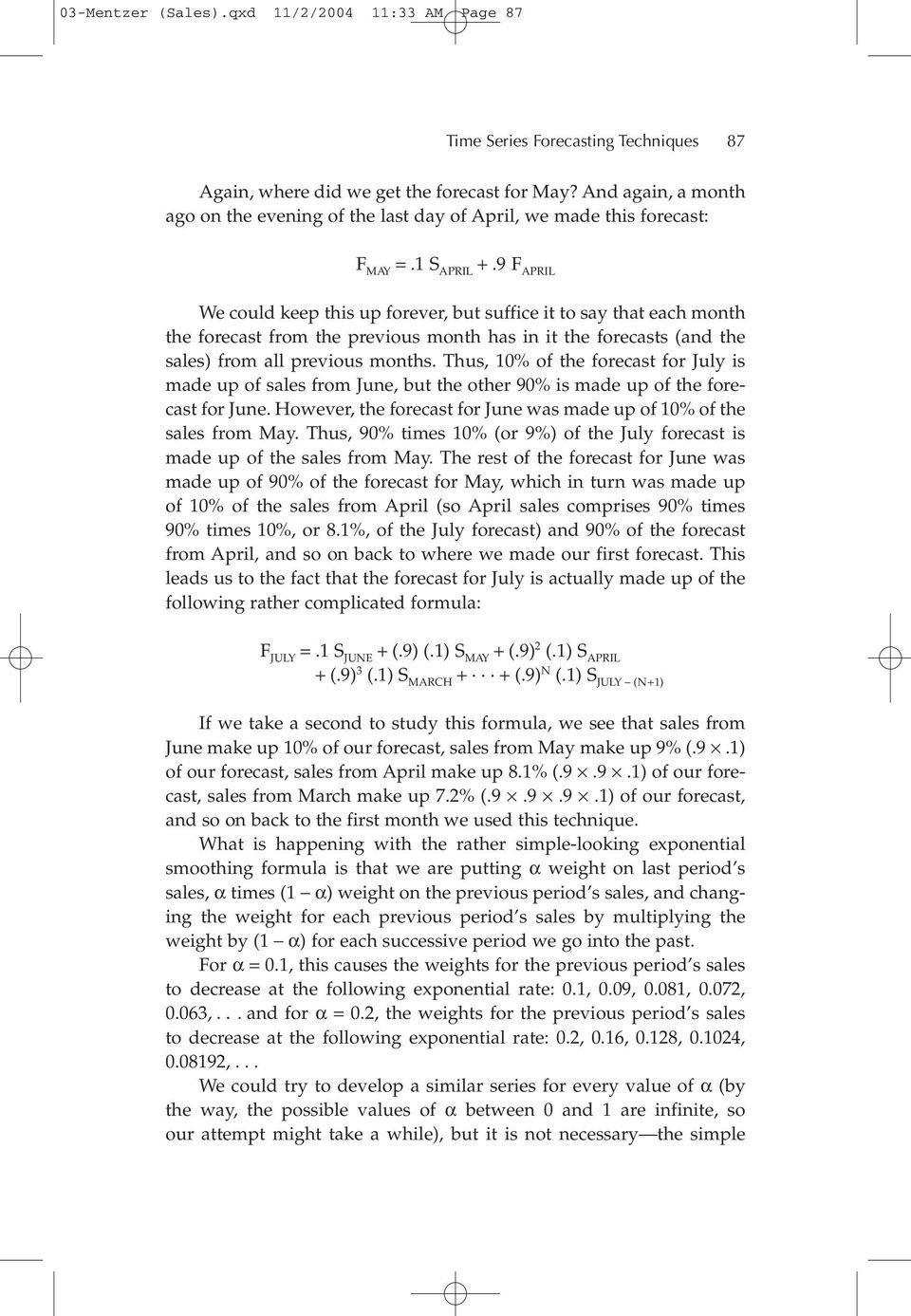
15 03-Mentzer (Sales).qxd 11/2/ :33 AM Page 87 Time Series Forecasting Techniques 87 Again, where did we get the forecast for May? And again, a month ago on the evening of the last day of April, we made this forecast: F MAY =.1 S APRIL +.9 F APRIL We could keep this up forever, but suffice it to say that each month the forecast from the previous month has in it the forecasts (and the sales) from all previous months. Thus, 10% of the forecast for July is made up of sales from June, but the other 90% is made up of the forecast for June. However, the forecast for June was made up of 10% of the sales from May. Thus, 90% times 10% (or 9%) of the July forecast is made up of the sales from May. The rest of the forecast for June was made up of 90% of the forecast for May, which in turn was made up of 10% of the sales from April (so April sales comprises 90% times 90% times 10%, or 8.1%, of the July forecast) and 90% of the forecast from April, and so on back to where we made our first forecast. This leads us to the fact that the forecast for July is actually made up of the following rather complicated formula: F JULY =.1 S JUNE + (.9) (.1) S MAY + (.9) 2 (.1) S APRIL + (.9) 3 (.1) S MARCH (.9) N (.1) S JULY (N+1) If we take a second to study this formula, we see that sales from June make up 10% of our forecast, sales from May make up 9% (.9.1) of our forecast, sales from April make up 8.1% (.9.9.1) of our forecast, sales from March make up 7.2% ( ) of our forecast, and so on back to the first month we used this technique. What is happening with the rather simple-looking exponential smoothing formula is that we are putting α weight on last period s sales, α times (1 α) weight on the previous period s sales, and changing the weight for each previous period s sales by multiplying the weight by (1 α) for each successive period we go into the past. For α =0.1, this causes the weights for the previous period s sales to decrease at the following exponential rate: 0.1, 0.09, 0.081, 0.072, 0.063,... and for α =0.2, the weights for the previous period s sales to decrease at the following exponential rate: 0.2, 0.16, 0.128, , ,... We could try to develop a similar series for every value of α (by the way, the possible values of α between 0 and 1 are infinite, so our attempt might take a while), but it is not necessary the simple
16 03-Mentzer (Sales).qxd 11/2/ :33 AM Page SALES FORECASTING MANAGEMENT exponential smoothing formula does it for us. We do need to remember, however, that the higher the value of α, the more weight we are putting on last period s sales and the less weight we are putting on all the previous periods combined. In fact, as α approaches one, exponential smoothing puts so much weight on the past period s sales and so little on the previous periods combined, that it starts to look like our naïve technique (F t+1 = S t ) from Chapter 2. Conversely, as α approaches zero, exponential smoothing puts more equal weight on all periods and starts to look much like the average as a forecast. This leads us to some conclusions about what the value of α should be: 1. The more the level changes, the larger α should be, so that exponential smoothing can quickly adjust. 2. The more random the data, the smaller α should be, so that exponential smoothing can dampen out the noise. Several examples should help illustrate these conclusions. For our first illustration, we can use the data pattern from Figure 3.9 for the moving average, now Figure 3.10 for exponential smoothing. Figure 3.10 Exponential Smoothing as a Forecast: Level Change F01 A01 S01 O01 N01 D01 F02 S02 O02 N02 D02 F03 S03 O03 N03 D03 J04 Demand Alpha =.1 Alpha =.5 Alpha =.8

17 03-Mentzer (Sales).qxd 11/2/ :33 AM Page 89 Time Series Forecasting Techniques 89 In Figure 3.10, we can see three exponential smoothing forecasts of the time series. All three do a fairly good job when the level is stable, but the higher the value of α in the forecast, the quicker it reacts to the change in level. Because a low value of α is much like an average, the forecast for the low α never quite reaches the new level. However, a very different result is found when we observe the forecasts of the time series in Figures 3.11 and Figure 3.11 is a reproduction of the data series used in Figures 3.2 and 3.6 and represents a time series with no trend and a low amount of noise. In this series, the exponential smoothing forecasts with various levels of α all perform fairly well. However, in the time series of Figure 3.12, which has a stable level but a high amount of noise, the forecasts with the higher values of α overreact to the noise and, as a result, jump around quite a bit. The forecast with the lower level of α does a better job of dampening out the noise. Given these illustrations of our conclusions about the value of α that should be used, we have in exponential smoothing a technique that overcomes many of the problems with the average and the moving average as forecasting techniques. Exponential smoothing is less Figure 3.11 Exponential Smoothing as a Forecast: Low Noise F01 A01 S01 O01 N01 D01 F02 S02 O02 N02 D02 F03 S03 O03 N03 D03 J04 Demand Alpha =.1 Alpha =.5 Alpha =.8

18 03-Mentzer (Sales).qxd 11/2/ :33 AM Page SALES FORECASTING MANAGEMENT Figure 3.12 Exponential Smoothing Average as a Forecast: High Noise F01 A01 S01 O01 N01 D01 F02 S02 O02 N02 D02 F03 S03 O03 N03 D03 J04 Demand Alpha =.1 Alpha =.5 Alpha =.8 cumbersome than the average because exponential smoothing only requires the values of last period s sales and forecast and the value of α. Exponential smoothing solves the problems with the moving average of how much data to use and how to weight it by using an exponentially decreasing weight for all previous periods. However, with exponential smoothing we are still faced with a dilemma: How do we determine whether the level is changing or if it is simply noise and, thus, what the value of α should be? To answer this dilemma, the next group of techniques (called adaptive smoothing) was developed. Adaptive Smoothing Although a number of adaptive smoothing techniques exist, they all have one thing in common: each is an attempt to automatically select the value of α. Because there are so many adaptive smoothing techniques and they all work essentially equally well, we will only discuss the simplest of this group of techniques here. This adaptive smoothing approach uses the absolute value of the percent error from

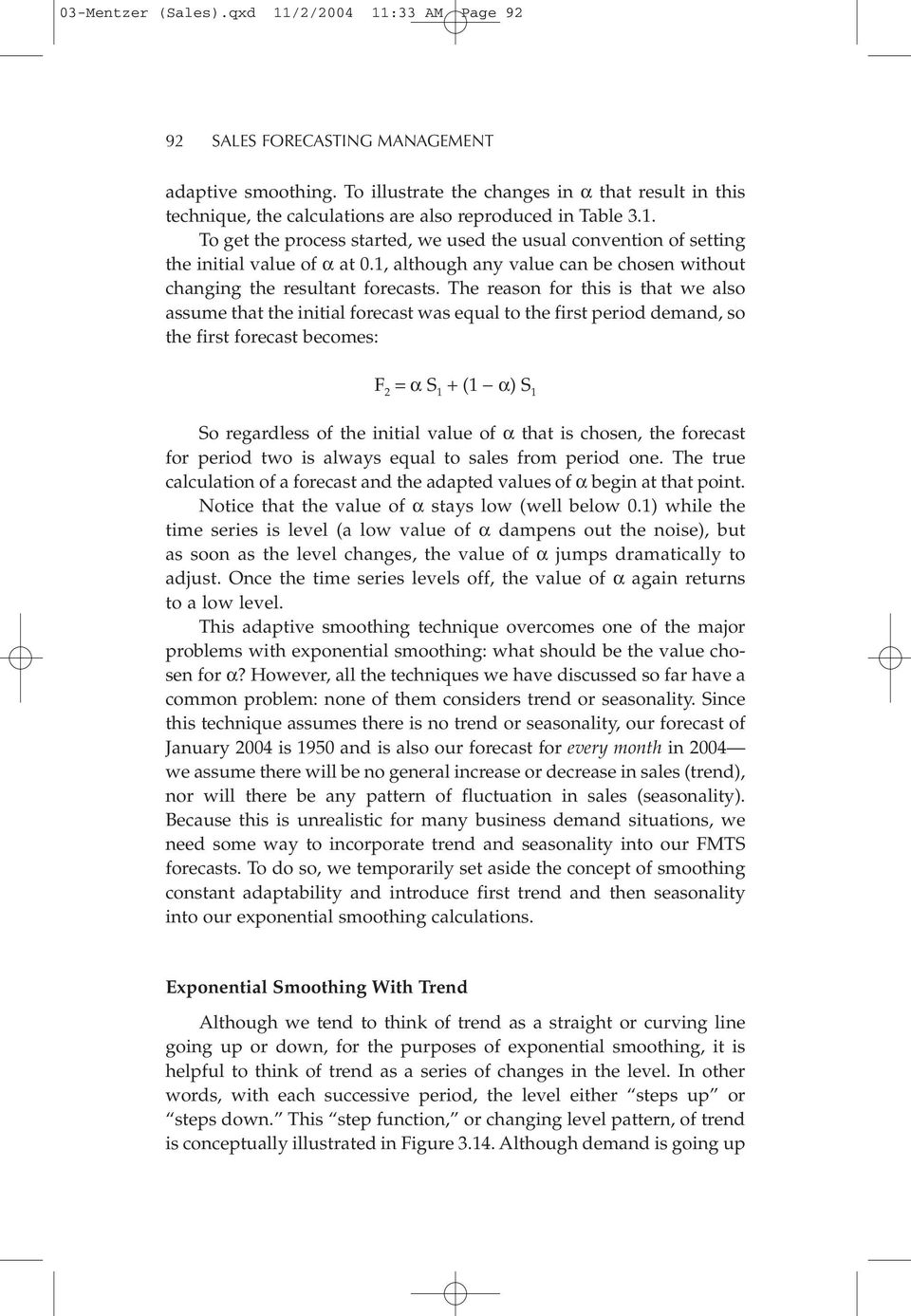
19 03-Mentzer (Sales).qxd 11/2/ :33 AM Page 91 Time Series Forecasting Techniques 91 the previous period s forecast to adjust the value of α for the next period s forecast (Trigg & Leach, 1967). Thus, the original exponential smoothing formula is still used: F t+1 =αs t + (1 α) F t (4) but after each period s sales are recorded, the value of α is adjusted for the next period by the following formula: α t+2 = (F t+1 S t+1 )/S t+1 = PE t+1 (5) Because Equation (5) can produce values outside the range of α, this calculation is adjusted by the following rules: If PE t+1 is equal to or greater than 1.0, then α t+2 = If PE t+1 is equal to 0.0, then α t+2 = We can illustrate the adaptability of this technique by forecasting the times series with level change in Figure 3.10, now Figure 3.13 for Figure 3.13 Adaptive Smoothing as a Forecast: Level Change F01 A01 S01 O01 N01 D01 F02 S02 O02 N02 D02 F03 S03 O03 N03 D03 J04 Demand Forecast

20 03-Mentzer (Sales).qxd 11/2/ :33 AM Page SALES FORECASTING MANAGEMENT adaptive smoothing. To illustrate the changes in α that result in this technique, the calculations are also reproduced in Table 3.1. To get the process started, we used the usual convention of setting the initial value of α at 0.1, although any value can be chosen without changing the resultant forecasts. The reason for this is that we also assume that the initial forecast was equal to the first period demand, so the first forecast becomes: F 2 =αs 1 + (1 α) S 1 So regardless of the initial value of α that is chosen, the forecast for period two is always equal to sales from period one. The true calculation of a forecast and the adapted values of α begin at that point. Notice that the value of α stays low (well below 0.1) while the time series is level (a low value of α dampens out the noise), but as soon as the level changes, the value of α jumps dramatically to adjust. Once the time series levels off, the value of α again returns to a low level. This adaptive smoothing technique overcomes one of the major problems with exponential smoothing: what should be the value chosen for α? However, all the techniques we have discussed so far have a common problem: none of them considers trend or seasonality. Since this technique assumes there is no trend or seasonality, our forecast of January 2004 is 1950 and is also our forecast for every month in 2004 we assume there will be no general increase or decrease in sales (trend), nor will there be any pattern of fluctuation in sales (seasonality). Because this is unrealistic for many business demand situations, we need some way to incorporate trend and seasonality into our FMTS forecasts. To do so, we temporarily set aside the concept of smoothing constant adaptability and introduce first trend and then seasonality into our exponential smoothing calculations. Exponential Smoothing With Trend Although we tend to think of trend as a straight or curving line going up or down, for the purposes of exponential smoothing, it is helpful to think of trend as a series of changes in the level. In other words, with each successive period, the level either steps up or steps down. This step function, or changing level pattern, of trend is conceptually illustrated in Figure Although demand is going up
21 03-Mentzer (Sales).qxd 11/2/ :33 AM Page 93 Time Series Forecasting Techniques 93 Table 3.1 Adaptive Smoothing Forecast Calculations Percent Absolute Month Demand Forecast Error PE or α t F A A S O N D F S O N D F S O N D J
22 03-Mentzer (Sales).qxd 11/2/ :33 AM Page SALES FORECASTING MANAGEMENT Figure 3.14 Trend in a Time Series Units Demand L t+2 T t+2 L t+1 T t+1 L t t t+1 t+2 Period in a straight line, we can conceive of it as a series of increases in the level (the dashed horizontal lines). This is much like climbing a set of stairs. Although we make steady progress up the stairs, we are actually stepping up one step each period (the amount we step up, or the height of each step, on a set of stairs is called the riser). The height of each step (the riser) is what we call trend in exponential smoothing, and that trend is designated in Figure 3.14 as T. For period t + 1, the trend is the amount the level changed from period t to period t + 1 (L t+1 L t ), or T t+1. Similarly for period t + 2, the trend is the amount the level changed from period t + 1 to period t + 2 (L t+2 L t 1 ), or T t+2. To understand the calculation of trend in exponential smoothing, we must also understand that an exponential smoothing calculation is just a weighted average of two measures of the same thing. Our original exponential smoothing formula (Equation 4) was: F t+1 =αs t + (1 α) F t In this calculation, S t is one measure of past sales (last period s sales) and F t is another measure of past sales (a weighted average
23 03-Mentzer (Sales).qxd 11/2/ :33 AM Page 95 Time Series Forecasting Techniques 95 of sales in all periods prior to t). Thus, we were taking a weighted average of two measures of the same thing. We are now going to do the same thing for level and trend with the following formulae (Holt et al., 1960): where: L = Level T = Trend 0 < α<1 0 < β<1 L t =αs t + (1 α) (L t 1 + T t 1 ) (6) T t =β(l t L t 1 ) + (1 β)t t 1 (7) Notice that Equation (6) looks very similar to our earlier exponential smoothing forecast calculation we still use α in the same way and we still use last period s sales. This difference is the addition of trend into the second part of Equation (6) and the fact that it is not a forecast for next period (F t+1 ) but rather a measure of level for this period (L t ). In fact, in our original exponential smoothing formula (Equation [4]), we did not include trend because we assumed it did not exist. Because trend was assumed not to exist, our estimate of level this period was our forecast of next period. What we need are two estimates of level for this period so we can exponentially smooth them. The first estimate is simply sales for this period. Since we assume there is no seasonality in the time series (an assumption we will discard in the next section), then this sales value has no seasonality in it. Because the trend is a change in level from one period to the next, any given value of sales does not have trend in it (that is, trend is in the change in sales from one period to the next, not any single sales value). Finally, when we perform the weighted averaging of the exponential smoothing calculation in Equation (6), we get rid of the noise. (Remember that averaging removes noise.) Since this logic says there is no trend or seasonality in the sales value and we will get rid of this noise when we do our exponential smoothing calculation, we are only left with one time series component in the sales value, and that component is level. The second estimate of level is our estimate of level from last period, plus the estimate of how much level should have changed from
24 03-Mentzer (Sales).qxd 11/2/ :33 AM Page SALES FORECASTING MANAGEMENT last period to this period (that is, the trend). This gives us two measures of level to exponentially smooth with α. Our two estimates of trend in Equation (7) are how much the level changed from last period to this period and our estimate of trend from last period. These two measures of trend are exponentially smoothed with our new smoothing constant, β. β is just like α in that it is a positive fraction (that is, between zero and one). It is designated by a different Greek symbol to indicate that α and β can have different values. Once we have our new estimates of level (L) and trend (T), we can forecast as far into the future as we want by taking the level and adding to it the trend per period times as many periods into the future as we want the forecast. This can be represented by the following formula: F t+m = L t + (T t m) (8) where: m = the number of periods into the future to forecast. To illustrate this technique, consider the time series with trend introduced in Figure 3.3, now Figure 3.15 for exponential smoothing with trend. To illustrate the calculations involved in this technique, Table 3.2 provides the calculations of level and trend and a forecast forward for one period throughout the time series (also provided in Figure 3.15). For the purposes of illustration, we arbitrarily chose the value of 0.1 for α and the value of 0.2 for β. Notice that to get the process started, we used the usual convention of assuming the level for the first period equaled first period demand, and the trend for the first period equaled the change in demand from the first to the second period. To provide a forecast for any period more than one in the future (April 2004, for example), it is merely a task of taking the most recent value of level that has been calculated (in this case, December 2003) and adding to it the most recent value of trend that has been calculated (also in this case, December 2003) times the number of months into the future that we wish to forecast (because April is four months past December, it would be times four). For April 2004, the calculations are: F A04 = L D03 + (T D03 m) F A04 = (106 4) F A04 = 5038
25 03-Mentzer (Sales).qxd 11/2/ :33 AM Page 97 Time Series Forecasting Techniques 97 Figure 3.15 Exponential Smoothing With Trend as a Forecast F01 A01 S01 O01 N01 D01 F02 S02 O02 N02 D02 F03 S03 O03 N03 D03 J04 Demand Forecast Now that we have the logic for introducing trend into the exponential smoothing calculations, it is fairly easy to also bring in seasonality. Exponential Smoothing With Trend and Seasonality To introduce seasonality, let s first think of a simple demand example where we sell 12,000 units of a product every year. If there is no trend, no noise, and no seasonality, we would expect to sell 1,000 units every month (that is, the level). If, however, we noticed that every January we sold, on average, 1,150 units, there is clearly a pattern here of selling more than the level in January. In fact, we are selling 1,150/1,000, or 1.15, times the level. This value of 1.15 is called a multiplicative seasonal adjustment and means that sales in that month are 15% higher than they would be without a seasonal pattern. Similarly, a seasonal adjustment of 1.00 means that sales are right at the non-seasonal level, and a seasonal adjustment of 0.87 means that sales are 13% below what we would expect if there was no seasonal pattern.
26 03-Mentzer (Sales).qxd 11/2/ :33 AM Page SALES FORECASTING MANAGEMENT Table 3.2 Exponential Smoothing With Trend Forecast Calculations Level Trend Month Demand (α = 0.1) (β = 0.2) Forecast F A A S O N D F S O N D F S O N D J
27 03-Mentzer (Sales).qxd 11/2/ :33 AM Page 99 Time Series Forecasting Techniques 99 We are now going to use this concept of a multiplicative seasonal adjustment to introduce seasonality into the exponential smoothing calculations. Again, we will develop two different measures of each seasonal adjustment and take a weighted average of them (through exponential smoothing) to come up with our new estimate. To do this, however, we also need to update our formulae for Exponential Smoothing with Trend (Equations [6] and [7]) to take into account the fact that seasonality is now assumed to exist. This leads us to the following formulae (Winters, 1960): L t =α(s t /SA t C ) + (1 α) (L t 1 + T t 1 ) (9) T t =β(l t L t 1 ) + (1 β) T t 1 (10) SA t =γ(s t /L t ) + (1 γ) (SA t C ) (11) where: L = Level T = Trend SA t = Seasonal Adjustment for Period t C = The Cycle Length of the Seasonal Pattern (that is, the cycle length for a 12-month pattern is C = 12) 0 < α < 1 0 < β < 1 0 < γ < 1 We have revised our calculation for level to take seasonality into account in our first estimate of level. Recalling our previous example of annual sales of 12,000, how would we take the seasonality out of January sales? If sales were 1,150 and our previous estimates of the seasonality adjustment for January were 1.15, we can de-seasonalize January sales simply by dividing the sales value of 1,150 by the seasonal adjustment of This gives us a de-seasonalized value of 1,000 precisely the value we said was the expected level if there were no seasonality. Thus, by dividing sales for any period by the seasonal adjustment for the same period last year (that is, divide sales for January 2004 by the seasonal adjustment for January 2003), we have an estimate in the first formula of level with the seasonality taken out (recall that the original formula already took out the trend and the noise). Because the second part of this formula contains the level from the last period,
28 03-Mentzer (Sales).qxd 11/2/ :33 AM Page SALES FORECASTING MANAGEMENT which was de-seasonalized at that time, we now have two estimates of level to exponentially smooth. Thankfully, the formula for trend (Equation [10]) does not change. Therefore, we do not have to revisit it here. However, we now have added a formula to calculate the seasonal adjustments (Equation [11]). Again, we need two estimates of the seasonal adjustment for each period, so we can exponentially smooth each. This means we have 12 of these calculations per year if we are forecasting monthly sales, 52 if we are forecasting weekly, and 4 if we are forecasting quarterly. The first part of Equation (11) is, again, a throwback to our initial example. If we take the sales value for this period and divide it by the most recently calculated level (which was just done two formulas before and is L t ), we have one estimate of the seasonal adjustment for this period. In our initial example, we did the same thing when we divided 1,150 by 1,000 to obtain 1.15 as our estimate of the seasonal adjustment for January. For our second estimate of the seasonal adjustment for this period, we need to look back one year to the same period last year. We can now exponentially smooth these two estimates of the seasonal adjustment for this period using the smoothing constant, γ. Again, γ is just like α and β in that it is a positive fraction (that is, between zero and one). It is designated by a different Greek symbol to indicate that α, β, and γ can all have different values. Once we have our new estimates of level (L), trend (T), and seasonal adjustments (SA), we can forecast as far into the future as we want by taking the level, adding to it the trend per period times as many periods into the future as we want the forecast, and multiplying that result by the most recent seasonal adjustment for that period. This can be represented by the following formula: F t+m = (L t + (T t m)) SA t C+m (12) where: m = the number of periods into the future to forecast. The last component of Equation (12) probably needs a little illustration. If we have just received sales for December 2003 and want to forecast April 2004, we will use the values of L and T calculated in December 2003 (in this case, December 2003 is t ) for the first part of the forecast. However, our most recent estimate of the seasonal adjustment for April was calculated back in
29 03-Mentzer (Sales).qxd 11/2/ :33 AM Page 101 Time Series Forecasting Techniques 101 April The symbol to represent using this value is to take t (December 2003); subtract C, or 12, months from it (placing us in December 2002); and add to it m, or 4, months to bring us to the seasonal adjustment for April To illustrate this technique, we will go all the way back to our original time series with trend and seasonality introduced in Figure 3.1, now Figure 3.16, for exponential smoothing with trend and seasonality. To illustrate the calculations involved in this technique, Table 3.3 provides the calculation of level, trend, seasonality, and a forecast forward for one period throughout the time series (also provided in Figure 3.16). For the purposes of illustration, we arbitrarily chose the value of 0.1 for α, the value of 0.2 for β, and the value of 0.15 for γ. Notice that to get the process started, we used the usual convention of assuming the level for the first period equaled first period demand, the trend for the first period equaled the change in demand from the first to the second period, and the initial 12 seasonal adjustment values were equal to Notice, also, that this technique does a pretty terrible job Figure 3.16 Exponential Smoothing With Trend and Seasonality as a Forecast F01 A01 S01 O01 N01 D01 F02 S02 O02 N02 D02 F03 S03 O03 N03 D03 J04 Demand Forecast
30 03-Mentzer (Sales).qxd 11/2/ :33 AM Page SALES FORECASTING MANAGEMENT Table 3.3 Exponential Smoothing With Trend and Seasonality Forecast Calculations Level Trend Seasonality Month Demand (α = 0.1) (β = 0.2) (γ = 0.15) Forecast F A A S O N D F S O N D F S O N D J
31 03-Mentzer (Sales).qxd 11/2/ :33 AM Page 103 Time Series Forecasting Techniques 103 of forecasting until at least one year of the seasonal pattern is available. Thus, exponential smoothing with trend and seasonality needs at least one complete year of data before it is warmed up and can start to forecast fairly effectively. To provide a forecast for any period more than one in the future (April 2004, for example), it is merely a task of taking the most recent value of level that has been calculated (in this case, December 2003), adding to it the most recent value of trend that has been calculated (also in this case, December 2003), times the number of months into the future we wish to forecast (because April is four months past December, it would be times four), and multiplying this value by the seasonal adjustment for April of last year (2003). For April 2004, the calculations are: F A04 = (L D03 + (T D03 m)) SA F A04 = ( (45 4)) 1.18 F A04 = 2874 Now that we have introduced the components of trend and seasonality into our basic exponential smoothing formula, we can return to the idea of how to set the value of the smoothing constants. However, now it is not simply a matter of choosing a value for α, but one of choosing values for β and γ, as well. In fact, the accuracy of exponential smoothing with trend and seasonality is very sensitive to the values chosen for the smoothing constants, so this is no small matter. Adaptive Exponential Smoothing With Trend and Seasonality As with regular adaptive smoothing, there are several techniques that are adaptive and consider trend and seasonality. One of the most complex computationally is called the Self Adaptive Forecasting Technique (SAFT) and was developed more than 35 years ago (Roberts & Reed, 1969). SAFT is a heuristic technique that examines different combinations of α, β, and γ to arrive at the most accurate forecast. For each forecast each period, SAFT tries each combination of α, β, and γ starting with a value of 0.05 for each and incrementally increasing the values by 0.05 until a value of 0.95 for each is reached. For each of these
32 03-Mentzer (Sales).qxd 11/2/ :33 AM Page SALES FORECASTING MANAGEMENT 6,859 ( , where the 19 is the number of values between 0 and 1, incrementing by 0.05 at a time) combinations, SAFT starts at the beginning of the time series and forecasts using exponential smoothing with trend and seasonality, and it records the resultant value of MAPE. Once the lowest MAPE value combination of α, β, and γ is determined, a local search for a lower MAPE is implemented by examining the values of α, β, and γ above and below each value (including the original three values) at a rate of change of For example, if the first search found the lowest value of MAPE to come from the combination of α=0.15, β=0.20, and γ =0.30, SAFT would then try all the combinations of α =0.11, 0.12, 0.13, 0.14, 0.15, 0.16, 0.17, 0.18, 0.19; β=0.16, 0.17, 0.18, 0.19, 0.20, 0.21, 0.22, 0.23, 0.24; and γ=0.26, 0.27, 0.28, 0.29, 0.30, 0.31, 0.32, 0.33, These 729 (9 9 9) combinations are compared to the original best MAPE combination and, again, the lowest combination is chosen. It should be clear by now that SAFT is a very computationally cumbersome technique (after all, it requires 7,588 trial forecasts for each product each period before it actually makes a forecast) and, as a result, is in little use today. More computationally efficient versions of SAFT try to calculate values of α, β, or γ and use a heuristic similar to SAFT for the smoothing constants that are not directly calculated. As with adaptive smoothing, because these adaptive exponential smoothing techniques with trend and seasonality essentially all work equally well, we will only discuss the simplest of this group of techniques here. This adaptive smoothing approach, called Adaptive Extended Exponential Smoothing (AEES), uses the absolute value of the percent error from the previous period s forecast to adjust the value of α for the next period s forecast and uses the SAFT heuristic to adjust the values of β and γ (Mentzer, 1988). Thus, the exponential smoothing with trend and seasonality formulae (Equations [9], [10], [11], and [12]) are still used, L t =α(s t /SA t C ) + (1 α) (L t 1 + T t 1 ) T t =β(l t L t 1 ) + (1 β) T t 1 SA t =γ(s t /L t ) + (1 γ) (SA t C ) F t+m = (L t + (T t m)) SA t C+m
33 03-Mentzer (Sales).qxd 11/2/ :33 AM Page 105 Time Series Forecasting Techniques 105 but after each period s sales are recorded, the value of α is adjusted for the next period by Equation (5), repeated here as: α t+2 = (F t+1 S t+1 )/S t+1 = PE t+1 Because this calculation can still produce values outside the range of α, this calculation is again adjusted by the following rules: If PE t+1 is equal to or greater than 1.0, then α t+2 = If PE t+1 is equal to 0.0, then α t+2 = Once the new value of α has been calculated, AEES tries each combination of β and γ starting with a value of 0.05 for each and incrementally increasing the values by 0.05 until a value of 0.95 for each is reached. For each of these 361 (19 19, where the 19 is the number of values between 0 and 1, incrementing by 0.05 at a time) combinations, AEES starts at the beginning of the time series and forecasts using exponential smoothing with trend and seasonality and records the resultant value of MAPE. Once the lowest MAPE value combination of the calculated value of α and the heuristic values of β and γ is determined, a local search for a lower MAPE is implemented by examining the values of β and γ above and below each value (including the original two values) at a rate of change of For example, if the first search found the lowest value of MAPE to come from the calculated value of α=0.15, and combination of β=0.20, and γ=0.30, AEES would then try all the combinations of β=0.16, 0.17, 0.18, 0.19, 0.20, 0.21, 0.22, 0.23, 0.24; and γ =0.26, 0.27, 0.28, 0.29, 0.30, 0.31, 0.32, 0.33, These 81 (9 9) combinations are compared to the original best MAPE combination and, again, the lowest combination is chosen. It should be clear by now that AEES is a much less computationally cumbersome technique than SAFT. AEES requires 442 trial forecasts for each product each period before it actually makes a forecast, rather than the 7,588 trial forecasts of SAFT. Further, the exact value of α is calculated rather than the approximation obtained from the SAFT heuristic. We can illustrate the adaptability of AEES by forecasting the times series with trend and seasonality used in the last section. (See Figure 3.17.) Notice that the forecast in Figure 3.17 tracks the demand better
34 03-Mentzer (Sales).qxd 11/2/ :33 AM Page SALES FORECASTING MANAGEMENT Figure 3.17 AEES With Trend and Seasonality as a Forecast F01 A01 S01 O01 N01 D01 F02 S02 O02 N02 D02 F03 S03 O03 N03 D03 J04 Demand Forecast than the forecast in Figure This is due to the adaptability of α, β, and γ. Also, the year-to-date MAPE for exponential smoothing with trend and seasonality (Figure 3.16) at the end is 9.73%, while the same calculation for AEES (Figure 3.17) is 7.00%. FIXED-MODEL TIMES SERIES TECHNIQUES SUMMARY Considerable effort has been devoted over time to testing the various FMTS techniques discussed here (and variations on these techniques as well) over a wide variety of time series and forecasting horizons and intervals. (For a summary of these efforts, see Mentzer & Gomes, 1994.) To date, no FMTS technique has shown itself to be clearly superior to any of the other FMTS techniques across a wide variety of forecasting levels and time horizons. For this reason, it is recommended that FMTS users keep in mind where the general category of techniques works well and the time series scenario for which each technique was designed. In general, FMTS techniques should be used when a limited amount of data is available on anything other than an actual history
35 03-Mentzer (Sales).qxd 11/2/ :33 AM Page 107 Time Series Forecasting Techniques 107 Table 3.4 FMTS Technique Selection Guidelines Time Series Component Characteristics Stable Level, with No Trend or Seasonality Changing Level, with No Trend or Seasonality Level and Trend Level, Trend, and Seasonality Changing Level, Trend, and Seasonal Patterns FMTS Technique Exponential Smoothing Adaptive Smoothing Exponential Smoothing with Trend Exponential Smoothing with Trend and Seasonality AEES of sales (that is, little data on outside factors such as price changes, economic activity, promotional programs, and so on). This lack of outside (exogenous) data precludes the use of regression (discussed in the next chapter). Further, FMTS techniques are useful when the time series components change fairly regularly. That is, the trend rate changes, the seasonal pattern changes, or the overall level of demand changes. FMTS is much more effective at adjusting to these changes in time series components than are the OMTS techniques to be discussed next, which require more data with stable time series components over a long period of time. In terms of which FMTS to use in which situations, a general guideline is provided in Table 3.4. However, remember that these are only general guidelines, and it is best to incorporate these techniques into a system (such as the one discussed in Chapter 6) that allows the system to try each FMTS technique on each forecast to be made and select the one that works best in terms of accuracy. With these general guidelines established, we will now move on to a discussion of the open-model time series (OMTS) techniques. OPEN-MODEL TIMES SERIES TECHNIQUES Open-model time series (OMTS) techniques assume that the same components exist in any time series level, trend, seasonality, and noise but take a different approach to forecasting these components. Where FMTS techniques assume that certain components exist in the time
36 03-Mentzer (Sales).qxd 11/2/ :33 AM Page SALES FORECASTING MANAGEMENT series and use one set of formulae to forecast this series (that is, the formulae are fixed ), OMTS techniques first analyze the components in the time series to see which exist and what is their nature. From this information, a set of forecasting formulae unique to that time series is built (that is, the formulae are open until the time series components are analyzed). Various forms of OMTS exist, including decomposition analysis (Shiskin 1961a, 1961b), spectral analysis (Nelson, 1973), fourier analysis (Bloomfield, 1976), and auto-regressive moving average (ARMA) or Box-Jenkins analysis (Box & Jenkins, 1970). All of these OMTS techniques have in common the fact that they first try to analyze the time series to determine the components and, as a result, require a considerable amount of history before any forecasts can be made. For instance, many OMTS techniques recommend no less than 48 periods of data prior to using the technique. Obviously, this is a disadvantage for situations where a limited amount of history is available. OMTS techniques also have in common the need for considerable understanding of quantitative methods to properly use the techniques. The analysis with OMTS can become quite complex and require considerable input from the forecaster. For these reasons (large data requirements and considerable user experience), OMTS techniques have seen limited use in practice (Mentzer & Kahn, 1995; Mentzer & Cox, 1984a). Improvements in systems technology have made OMTS techniques easier to use (as we will see in Chapter 6), but the data requirements still limit their use. As with FMTS techniques, there is no evidence that the performance of one of these OMTS techniques is clearly superior to any of the others. Thus, we will again only discuss the simplest of the OMTS techniques here. This technique is called decomposition analysis. To demonstrate decomposition analysis, we will use the time series presented at the beginning of the chapter in Figure 3.1. Like all OMTS techniques, the purpose of decomposition analysis is to decompose the data into its time series components. The first step in doing this is to remove noise and seasonality from the original time series. As we discussed earlier in the chapter, one of the characteristics of a moving average is that it dampens out any noise and dampens out any regular pattern of fluctuation that has a pattern length that is equal to the number of periods in the moving average. Thus, one of the first things we have to do in decomposition analysis is make a judgment about how long the seasonal pattern is.
37 03-Mentzer (Sales).qxd 11/2/ :33 AM Page 109 Time Series Forecasting Techniques 109 Visual examination of Figure 3.1 will, we hope, lead us to conclude that the seasonal pattern takes 12 months. Therefore, a 12-month moving average should remove noise and seasonality from the time series. As in the discussion earlier in the chapter, the value of the moving average in any given period is our estimate of level, and how much that level estimate changes from one period to the next is our estimate of trend. However, because our purpose here is not to forecast, but to decompose the data, we will perform this moving average calculation in a slightly different way than previously discussed. This calculation is as follows: MA t = (S t 5 + S t 4 + S t 3 + S t 2 + S t 1 + S t + S t+1 + S t+2 + S t+3 + S t+4 + S t+5 + S t+6 ) / 12 Notice that this is a centered moving average, which means that we take an average of 12 months and assign that value to the month in the center. The purpose of this is to find a more accurate estimate of the level. If we placed the moving average value at the end of the 12 months used in the calculation, it would have too much old data (lower trend) to accurately represent the level for that period. Conversely, if we place the moving average value at the beginning of the 12 months used in the calculation, it would have too much new data (higher trend) to actually represent the level at that period. Thus, the best place to position this estimate of level is in the center of the periods used in its calculation. Because this moving average contains the level and the trend, we can simply take the difference between each period to determine the trend. Similarly, since the moving average contains the level and the trend, if we subtract it from the original time series (which contained level, trend, seasonality, and noise), the result is a series of data that contains only the seasonality and the noise. These calculations are demonstrated in Table 3.5. We now have decomposed the original time series into the level and the trend. All that is left is to remove the noise from the data series containing seasonality and noise, and we will have our final component, seasonality. Again, to remove noise we use an average. However, because each month of the year represents a different season, we want to perform this average calculation within each season. Thus, we take all the January values and average them, then take an average of all the February values, and so on for all 12 months. This calculation is shown
38 03-Mentzer (Sales).qxd 11/2/ :33 AM Page SALES FORECASTING MANAGEMENT Table 3.5 Decomposition Analysis Level Seasonality Month Demand and Trend Trend and Noise Seasonality Forecast 1104 F A A S O N D F S O N D F S O N D J
39 03-Mentzer (Sales).qxd 11/2/ :33 AM Page 111 Time Series Forecasting Techniques 111 Table 3.6 Decomposition of Seasonality Month Average January February March April May June July August September October November December in Table 3.6, and the resultant values are added to Table 3.5 in the Seasonality column. Notice that this is not a multiplicative seasonal adjustment like we used in FMTS. Rather, it is an additive seasonal adjustment; to determine the seasonal adjustment, we add it to (not multiply it by) the level plus trend. We now have our most recent estimate of level (2,584 in June 2003), our most recent estimate of trend (45 units per month from June 2003), and our most recent estimates of the additive seasonal adjustments for the last 12 months. To forecast a future period (such as January 2004), we take the last estimate of level and add to it the trend times the number of periods into the future. To this value, we add the seasonal adjustment. For January 2004, the calculation is: Forecast Jan04 = Level June03 + (7 Trend June03 ) + Seasonality Jan03 = (7 45) 203 = 2696 This example illustrates just how much data are required to complete OMTS analysis. Although we have 3 years of monthly data in this example, for all but June, only two values were available to estimate the seasonality adjustment for each season (month). With another year s data, three values would be available for each season, which should improve the seasonality adjustment estimates. However, one of the primary drawbacks to OMTS is this dependency on a large amount of data.
40 03-Mentzer (Sales).qxd 11/2/ :33 AM Page SALES FORECASTING MANAGEMENT SUMMARY In this chapter, we have covered a number of time series techniques. All have in common a recognition of the time series components level, trend, seasonality, noise. FMTS techniques deal with these components by assuming certain components are (and are not) in the data, while OMTS techniques analyze the data to determine which components exist. This greater level of sophistication in OMTS is somewhat ameliorated by the considerable data requirements for analysis. Another characteristic of all the techniques included in this chapter is the fact that they ignore other factors that might have influenced demand, such as price changes, advertising, trade promotions, sales programs, competitive actions, economic activity, and so on. In many cases, much of what time series techniques classify as noise can be explained by looking at these exogenous factors. In the next chapter, we turn our attention to regression analysis, a technique that considers these exogenous factors.
Time series Forecasting using Holt-Winters Exponential Smoothing
 Time series Forecasting using Holt-Winters Exponential Smoothing Prajakta S. Kalekar(04329008) Kanwal Rekhi School of Information Technology Under the guidance of Prof. Bernard December 6, 2004 Abstract
Time Series and Forecasting
 Chapter 22 Page 1 Time Series and Forecasting A time series is a sequence of observations of a random variable. Hence, it is a stochastic process. Examples include the monthly demand for a product, the
A Practical Guide to Technical Indicators; (Part 1) Moving Averages
 A Practical Guide to Technical Indicators; (Part 1) Moving Averages By S.A Ghafari Over the past decades, attempts have been made by traders and researchers aiming to find a reliable method to predict
A Short Guide to Significant Figures
 A Short Guide to Significant Figures Quick Reference Section Here are the basic rules for significant figures - read the full text of this guide to gain a complete understanding of what these rules really
Pre-Algebra Lecture 6
 Pre-Algebra Lecture 6 Today we will discuss Decimals and Percentages. Outline: 1. Decimals 2. Ordering Decimals 3. Rounding Decimals 4. Adding and subtracting Decimals 5. Multiplying and Dividing Decimals
Forecasting in supply chains
 1 Forecasting in supply chains Role of demand forecasting Effective transportation system or supply chain design is predicated on the availability of accurate inputs to the modeling process. One of the
Association Between Variables
 Contents 11 Association Between Variables 767 11.1 Introduction............................ 767 11.1.1 Measure of Association................. 768 11.1.2 Chapter Summary.................... 769 11.2 Chi
Preliminary Mathematics
 Preliminary Mathematics The purpose of this document is to provide you with a refresher over some topics that will be essential for what we do in this class. We will begin with fractions, decimals, and
Basic numerical skills: FRACTIONS, DECIMALS, PROPORTIONS, RATIOS AND PERCENTAGES
 Basic numerical skills: FRACTIONS, DECIMALS, PROPORTIONS, RATIOS AND PERCENTAGES. Introduction (simple) This helpsheet is concerned with the ways that we express quantities that are not whole numbers,
for the Bill Hanlon [email protected]
 Strategies for Learning the Math Facts Bill Hanlon [email protected] The more sophisticated mental operations in mathematics of analysis, synthesis, and evaluation are impossible without rapid and accurate
FAIR VALUE ACCOUNTING: VISIONARY THINKING OR OXYMORON? Aswath Damodaran
 FAIR VALUE ACCOUNTING: VISIONARY THINKING OR OXYMORON? Aswath Damodaran Three big questions about fair value accounting Why fair value accounting? What is fair value? What are the first principles that
2) The three categories of forecasting models are time series, quantitative, and qualitative. 2)
 Exam Name TRUE/FALSE. Write 'T' if the statement is true and 'F' if the statement is false. 1) Regression is always a superior forecasting method to exponential smoothing, so regression should be used
Welcome to Basic Math Skills!
 Basic Math Skills Welcome to Basic Math Skills! Most students find the math sections to be the most difficult. Basic Math Skills was designed to give you a refresher on the basics of math. There are lots
Simple Regression Theory II 2010 Samuel L. Baker
 SIMPLE REGRESSION THEORY II 1 Simple Regression Theory II 2010 Samuel L. Baker Assessing how good the regression equation is likely to be Assignment 1A gets into drawing inferences about how close the
Elasticity. I. What is Elasticity?
 Elasticity I. What is Elasticity? The purpose of this section is to develop some general rules about elasticity, which may them be applied to the four different specific types of elasticity discussed in
ph. Weak acids. A. Introduction
 ph. Weak acids. A. Introduction... 1 B. Weak acids: overview... 1 C. Weak acids: an example; finding K a... 2 D. Given K a, calculate ph... 3 E. A variety of weak acids... 5 F. So where do strong acids
Objectives of Chapters 7,8
 Objectives of Chapters 7,8 Planning Demand and Supply in a SC: (Ch7, 8, 9) Ch7 Describes methodologies that can be used to forecast future demand based on historical data. Ch8 Describes the aggregate planning
6.4 Normal Distribution
 Contents 6.4 Normal Distribution....................... 381 6.4.1 Characteristics of the Normal Distribution....... 381 6.4.2 The Standardized Normal Distribution......... 385 6.4.3 Meaning of Areas under
1.7 Graphs of Functions
 64 Relations and Functions 1.7 Graphs of Functions In Section 1.4 we defined a function as a special type of relation; one in which each x-coordinate was matched with only one y-coordinate. We spent most
Chapter 10. Key Ideas Correlation, Correlation Coefficient (r),
 Chapter 0 Key Ideas Correlation, Correlation Coefficient (r), Section 0-: Overview We have already explored the basics of describing single variable data sets. However, when two quantitative variables
Time Value of Money 1
 Time Value of Money 1 This topic introduces you to the analysis of trade-offs over time. Financial decisions involve costs and benefits that are spread over time. Financial decision makers in households
Chapter 4 Online Appendix: The Mathematics of Utility Functions
 Chapter 4 Online Appendix: The Mathematics of Utility Functions We saw in the text that utility functions and indifference curves are different ways to represent a consumer s preferences. Calculus can
MANAGEMENT OPTIONS AND VALUE PER SHARE
 1 MANAGEMENT OPTIONS AND VALUE PER SHARE Once you have valued the equity in a firm, it may appear to be a relatively simple exercise to estimate the value per share. All it seems you need to do is divide
MULTIPLICATION AND DIVISION OF REAL NUMBERS In this section we will complete the study of the four basic operations with real numbers.
 1.4 Multiplication and (1-25) 25 In this section Multiplication of Real Numbers Division by Zero helpful hint The product of two numbers with like signs is positive, but the product of three numbers with
3. Time value of money. We will review some tools for discounting cash flows.
 1 3. Time value of money We will review some tools for discounting cash flows. Simple interest 2 With simple interest, the amount earned each period is always the same: i = rp o where i = interest earned
NUMBER SYSTEMS APPENDIX D. You will learn about the following in this appendix:
 APPENDIX D NUMBER SYSTEMS You will learn about the following in this appendix: The four important number systems in computing binary, octal, decimal, and hexadecimal. A number system converter program
Section 4.1 Rules of Exponents
 Section 4.1 Rules of Exponents THE MEANING OF THE EXPONENT The exponent is an abbreviation for repeated multiplication. The repeated number is called a factor. x n means n factors of x. The exponent tells
Duration Gap Analysis
 appendix 1 to chapter 9 Duration Gap Analysis An alternative method for measuring interest-rate risk, called duration gap analysis, examines the sensitivity of the market value of the financial institution
Digital System Design Prof. D Roychoudhry Department of Computer Science and Engineering Indian Institute of Technology, Kharagpur
 Digital System Design Prof. D Roychoudhry Department of Computer Science and Engineering Indian Institute of Technology, Kharagpur Lecture - 04 Digital Logic II May, I before starting the today s lecture
COST THEORY. I What costs matter? A Opportunity Costs
 COST THEORY Cost theory is related to production theory, they are often used together. However, the question is how much to produce, as opposed to which inputs to use. That is, assume that we use production
Part 1 Expressions, Equations, and Inequalities: Simplifying and Solving
 Section 7 Algebraic Manipulations and Solving Part 1 Expressions, Equations, and Inequalities: Simplifying and Solving Before launching into the mathematics, let s take a moment to talk about the words
Click on the links below to jump directly to the relevant section
 Click on the links below to jump directly to the relevant section What is algebra? Operations with algebraic terms Mathematical properties of real numbers Order of operations What is Algebra? Algebra is
Breakeven, Leverage, and Elasticity
 Breakeven, Leverage, and Elasticity Dallas Brozik, Marshall University Breakeven Analysis Breakeven analysis is what management is all about. The idea is to compare where you are now to where you might
Pricing I: Linear Demand
 Pricing I: Linear Demand This module covers the relationships between price and quantity, maximum willing to buy, maximum reservation price, profit maximizing price, and price elasticity, assuming a linear
Investment Appraisal INTRODUCTION
 8 Investment Appraisal INTRODUCTION After reading the chapter, you should: understand what is meant by the time value of money; be able to carry out a discounted cash flow analysis to assess the viability
Name Partners Date. Energy Diagrams I
 Name Partners Date Visual Quantum Mechanics The Next Generation Energy Diagrams I Goal Changes in energy are a good way to describe an object s motion. Here you will construct energy diagrams for a toy
How to Forecast Your Revenue and Sales A Step by Step Guide to Revenue and Sales Forecasting in a Small Business
 How to Forecast Your Revenue and Sales A Step by Step Guide to Revenue and Sales Forecasting in a Small Business By BizMove Management Training Institute Other free books by BizMove that may interest you:
Chapter 3 Review Math 1030
 Section A.1: Three Ways of Using Percentages Using percentages We can use percentages in three different ways: To express a fraction of something. For example, A total of 10, 000 newspaper employees, 2.6%
Solving Quadratic Equations
 9.3 Solving Quadratic Equations by Using the Quadratic Formula 9.3 OBJECTIVES 1. Solve a quadratic equation by using the quadratic formula 2. Determine the nature of the solutions of a quadratic equation
Chapter 19 Operational Amplifiers
 Chapter 19 Operational Amplifiers The operational amplifier, or op-amp, is a basic building block of modern electronics. Op-amps date back to the early days of vacuum tubes, but they only became common
Demand Forecasting When a product is produced for a market, the demand occurs in the future. The production planning cannot be accomplished unless
 Demand Forecasting When a product is produced for a market, the demand occurs in the future. The production planning cannot be accomplished unless the volume of the demand known. The success of the business
Unit 1 Number Sense. In this unit, students will study repeating decimals, percents, fractions, decimals, and proportions.
 Unit 1 Number Sense In this unit, students will study repeating decimals, percents, fractions, decimals, and proportions. BLM Three Types of Percent Problems (p L-34) is a summary BLM for the material
INTRODUCTION TO COTTON OPTIONS Blake K. Bennett Extension Economist/Management Texas Cooperative Extension, The Texas A&M University System
 INTRODUCTION TO COTTON OPTIONS Blake K. Bennett Extension Economist/Management Texas Cooperative Extension, The Texas A&M University System INTRODUCTION For well over a century, industry representatives
Maths Workshop for Parents 2. Fractions and Algebra
 Maths Workshop for Parents 2 Fractions and Algebra What is a fraction? A fraction is a part of a whole. There are two numbers to every fraction: 2 7 Numerator Denominator 2 7 This is a proper (or common)
Industry Environment and Concepts for Forecasting 1
 Table of Contents Industry Environment and Concepts for Forecasting 1 Forecasting Methods Overview...2 Multilevel Forecasting...3 Demand Forecasting...4 Integrating Information...5 Simplifying the Forecast...6
Updates to Graphing with Excel
 Updates to Graphing with Excel NCC has recently upgraded to a new version of the Microsoft Office suite of programs. As such, many of the directions in the Biology Student Handbook for how to graph with
Solutions to Problem Set #2 Spring, 2013. 1.a) Units of Price of Nominal GDP Real Year Stuff Produced Stuff GDP Deflator GDP
 Economics 1021, Section 1 Prof. Steve Fazzari Solutions to Problem Set #2 Spring, 2013 1.a) Units of Price of Nominal GDP Real Year Stuff Produced Stuff GDP Deflator GDP 2003 500 $20 $10,000 95.2 $10,504
EXPONENTIAL FUNCTIONS 8.1.1 8.1.6
 EXPONENTIAL FUNCTIONS 8.1.1 8.1.6 In these sections, students generalize what they have learned about geometric sequences to investigate exponential functions. Students study exponential functions of the
Representation of functions as power series
 Representation of functions as power series Dr. Philippe B. Laval Kennesaw State University November 9, 008 Abstract This document is a summary of the theory and techniques used to represent functions
In this chapter, you will learn to use cost-volume-profit analysis.
 2.0 Chapter Introduction In this chapter, you will learn to use cost-volume-profit analysis. Assumptions. When you acquire supplies or services, you normally expect to pay a smaller price per unit as the
The Taxman Game. Robert K. Moniot September 5, 2003
 The Taxman Game Robert K. Moniot September 5, 2003 1 Introduction Want to know how to beat the taxman? Legally, that is? Read on, and we will explore this cute little mathematical game. The taxman game
ideas from RisCura s research team
 ideas from RisCura s research team thinknotes april 2004 A Closer Look at Risk-adjusted Performance Measures When analysing risk, we look at the factors that may cause retirement funds to fail in meeting
For additional information, see the Math Notes boxes in Lesson B.1.3 and B.2.3.
 EXPONENTIAL FUNCTIONS B.1.1 B.1.6 In these sections, students generalize what they have learned about geometric sequences to investigate exponential functions. Students study exponential functions of the
2.2 Elimination of Trend and Seasonality
 26 CHAPTER 2. TREND AND SEASONAL COMPONENTS 2.2 Elimination of Trend and Seasonality Here we assume that the TS model is additive and there exist both trend and seasonal components, that is X t = m t +
Excel Formatting: Best Practices in Financial Models
 Excel Formatting: Best Practices in Financial Models Properly formatting your Excel models is important because it makes it easier for others to read and understand your analysis and for you to read and
Social Return on Investment
 Social Return on Investment Valuing what you do Guidance on understanding and completing the Social Return on Investment toolkit for your organisation 60838 SROI v2.indd 1 07/03/2013 16:50 60838 SROI v2.indd
COLLEGE ALGEBRA. Paul Dawkins
 COLLEGE ALGEBRA Paul Dawkins Table of Contents Preface... iii Outline... iv Preliminaries... Introduction... Integer Exponents... Rational Exponents... 9 Real Exponents...5 Radicals...6 Polynomials...5
1.6 The Order of Operations
 1.6 The Order of Operations Contents: Operations Grouping Symbols The Order of Operations Exponents and Negative Numbers Negative Square Roots Square Root of a Negative Number Order of Operations and Negative
47 Numerator Denominator
 JH WEEKLIES ISSUE #22 2012-2013 Mathematics Fractions Mathematicians often have to deal with numbers that are not whole numbers (1, 2, 3 etc.). The preferred way to represent these partial numbers (rational
(Refer Slide Time: 2:03)
 Control Engineering Prof. Madan Gopal Department of Electrical Engineering Indian Institute of Technology, Delhi Lecture - 11 Models of Industrial Control Devices and Systems (Contd.) Last time we were
A Quick Tutorial in MACD: Basic Concepts. By Gerald Appel and Marvin Appel
 A Quick Tutorial in MACD: Basic Concepts By Gerald Appel and Marvin Appel The Moving Average Convergence-Divergence Indicator (MACD) has been a staple of technical analysis since Gerald invented it more
The Concept of Present Value
 The Concept of Present Value If you could have $100 today or $100 next week which would you choose? Of course you would choose the $100 today. Why? Hopefully you said because you could invest it and make
Chapter 4: Nominal and Effective Interest Rates
 Chapter 4: Nominal and Effective Interest Rates Session 9-10-11 Dr Abdelaziz Berrado 1 Topics to Be Covered in Today s Lecture Section 4.1: Nominal and Effective Interest Rates statements Section 4.2:
Student Outcomes. Lesson Notes. Classwork. Discussion (10 minutes)
 NYS COMMON CORE MATHEMATICS CURRICULUM Lesson 5 8 Student Outcomes Students know the definition of a number raised to a negative exponent. Students simplify and write equivalent expressions that contain
Temperature Scales. The metric system that we are now using includes a unit that is specific for the representation of measured temperatures.
 Temperature Scales INTRODUCTION The metric system that we are now using includes a unit that is specific for the representation of measured temperatures. The unit of temperature in the metric system is
Time needed. Before the lesson Assessment task:
 Formative Assessment Lesson Materials Alpha Version Beads Under the Cloud Mathematical goals This lesson unit is intended to help you assess how well students are able to identify patterns (both linear
This explains why the mixed number equivalent to 7/3 is 2 + 1/3, also written 2
 Chapter 28: Proper and Improper Fractions A fraction is called improper if the numerator is greater than the denominator For example, 7/ is improper because the numerator 7 is greater than the denominator
ECON 459 Game Theory. Lecture Notes Auctions. Luca Anderlini Spring 2015
 ECON 459 Game Theory Lecture Notes Auctions Luca Anderlini Spring 2015 These notes have been used before. If you can still spot any errors or have any suggestions for improvement, please let me know. 1
Market Potential and Sales Forecasting
 Market Potential and Sales Forecasting There s an old saying derived from a Danish proverb that goes, It s difficult to make predictions, especially about the future. As difficult as predicting the future
Vieta s Formulas and the Identity Theorem
 Vieta s Formulas and the Identity Theorem This worksheet will work through the material from our class on 3/21/2013 with some examples that should help you with the homework The topic of our discussion
Unit 7 The Number System: Multiplying and Dividing Integers
 Unit 7 The Number System: Multiplying and Dividing Integers Introduction In this unit, students will multiply and divide integers, and multiply positive and negative fractions by integers. Students will
Time Value of Money. 2014 Level I Quantitative Methods. IFT Notes for the CFA exam
 Time Value of Money 2014 Level I Quantitative Methods IFT Notes for the CFA exam Contents 1. Introduction...2 2. Interest Rates: Interpretation...2 3. The Future Value of a Single Cash Flow...4 4. The
You and your friends head out to a favorite restaurant
 19 Cost-Volume-Profit Analysis Learning Objectives 1 Identify how changes in volume affect costs 2 Use CVP analysis to compute breakeven points 3 Use CVP analysis for profit planning, and graph the CVP
Determine If An Equation Represents a Function
 Question : What is a linear function? The term linear function consists of two parts: linear and function. To understand what these terms mean together, we must first understand what a function is. The
Decision Making under Uncertainty
 6.825 Techniques in Artificial Intelligence Decision Making under Uncertainty How to make one decision in the face of uncertainty Lecture 19 1 In the next two lectures, we ll look at the question of how
Polynomial and Rational Functions
 Polynomial and Rational Functions Quadratic Functions Overview of Objectives, students should be able to: 1. Recognize the characteristics of parabolas. 2. Find the intercepts a. x intercepts by solving
Performance Assessment Task Bikes and Trikes Grade 4. Common Core State Standards Math - Content Standards
 Performance Assessment Task Bikes and Trikes Grade 4 The task challenges a student to demonstrate understanding of concepts involved in multiplication. A student must make sense of equal sized groups of
SYSTEMS OF EQUATIONS AND MATRICES WITH THE TI-89. by Joseph Collison
 SYSTEMS OF EQUATIONS AND MATRICES WITH THE TI-89 by Joseph Collison Copyright 2000 by Joseph Collison All rights reserved Reproduction or translation of any part of this work beyond that permitted by Sections
Geometry Notes PERIMETER AND AREA
 Perimeter and Area Page 1 of 57 PERIMETER AND AREA Objectives: After completing this section, you should be able to do the following: Calculate the area of given geometric figures. Calculate the perimeter
CHAPTER 4 DIMENSIONAL ANALYSIS
 CHAPTER 4 DIMENSIONAL ANALYSIS 1. DIMENSIONAL ANALYSIS Dimensional analysis, which is also known as the factor label method or unit conversion method, is an extremely important tool in the field of chemistry.
Graphical Integration Exercises Part Four: Reverse Graphical Integration
 D-4603 1 Graphical Integration Exercises Part Four: Reverse Graphical Integration Prepared for the MIT System Dynamics in Education Project Under the Supervision of Dr. Jay W. Forrester by Laughton Stanley
High School Algebra Reasoning with Equations and Inequalities Solve systems of equations.
 Performance Assessment Task Graphs (2006) Grade 9 This task challenges a student to use knowledge of graphs and their significant features to identify the linear equations for various lines. A student
FORECASTING. Operations Management
 2013 FORECASTING Brad Fink CIT 492 Operations Management Executive Summary Woodlawn hospital needs to forecast type A blood so there is no shortage for the week of 12 October, to correctly forecast, a
Lesson 26: Reflection & Mirror Diagrams
 Lesson 26: Reflection & Mirror Diagrams The Law of Reflection There is nothing really mysterious about reflection, but some people try to make it more difficult than it really is. All EMR will reflect
Solutions of Linear Equations in One Variable
 2. Solutions of Linear Equations in One Variable 2. OBJECTIVES. Identify a linear equation 2. Combine like terms to solve an equation We begin this chapter by considering one of the most important tools
RELEVANT TO ACCA QUALIFICATION PAPER P3. Studying Paper P3? Performance objectives 7, 8 and 9 are relevant to this exam
 RELEVANT TO ACCA QUALIFICATION PAPER P3 Studying Paper P3? Performance objectives 7, 8 and 9 are relevant to this exam Business forecasting and strategic planning Quantitative data has always been supplied
Exponents and Radicals
 Exponents and Radicals (a + b) 10 Exponents are a very important part of algebra. An exponent is just a convenient way of writing repeated multiplications of the same number. Radicals involve the use of
1 Sufficient statistics
 1 Sufficient statistics A statistic is a function T = rx 1, X 2,, X n of the random sample X 1, X 2,, X n. Examples are X n = 1 n s 2 = = X i, 1 n 1 the sample mean X i X n 2, the sample variance T 1 =
Constrained optimization.
 ams/econ 11b supplementary notes ucsc Constrained optimization. c 2010, Yonatan Katznelson 1. Constraints In many of the optimization problems that arise in economics, there are restrictions on the values
Analysis of Bayesian Dynamic Linear Models
 Analysis of Bayesian Dynamic Linear Models Emily M. Casleton December 17, 2010 1 Introduction The main purpose of this project is to explore the Bayesian analysis of Dynamic Linear Models (DLMs). The main
Definition 8.1 Two inequalities are equivalent if they have the same solution set. Add or Subtract the same value on both sides of the inequality.
 8 Inequalities Concepts: Equivalent Inequalities Linear and Nonlinear Inequalities Absolute Value Inequalities (Sections 4.6 and 1.1) 8.1 Equivalent Inequalities Definition 8.1 Two inequalities are equivalent
Chapter 3. The Concept of Elasticity and Consumer and Producer Surplus. Chapter Objectives. Chapter Outline
 Chapter 3 The Concept of Elasticity and Consumer and roducer Surplus Chapter Objectives After reading this chapter you should be able to Understand that elasticity, the responsiveness of quantity to changes
Forces between charges
 Forces between charges Two small objects each with a net charge of Q (where Q is a positive number) exert a force of magnitude F on each other. We replace one of the objects with another whose net charge
5.4 Solving Percent Problems Using the Percent Equation
 5. Solving Percent Problems Using the Percent Equation In this section we will develop and use a more algebraic equation approach to solving percent equations. Recall the percent proportion from the last
Simple Inventory Management
 Jon Bennett Consulting http://www.jondbennett.com Simple Inventory Management Free Up Cash While Satisfying Your Customers Part of the Business Philosophy White Papers Series Author: Jon Bennett September
The Binomial Distribution
 The Binomial Distribution James H. Steiger November 10, 00 1 Topics for this Module 1. The Binomial Process. The Binomial Random Variable. The Binomial Distribution (a) Computing the Binomial pdf (b) Computing
If A is divided by B the result is 2/3. If B is divided by C the result is 4/7. What is the result if A is divided by C?
 Problem 3 If A is divided by B the result is 2/3. If B is divided by C the result is 4/7. What is the result if A is divided by C? Suggested Questions to ask students about Problem 3 The key to this question
Stock Valuation: Gordon Growth Model. Week 2
 Stock Valuation: Gordon Growth Model Week 2 Approaches to Valuation 1. Discounted Cash Flow Valuation The value of an asset is the sum of the discounted cash flows. 2. Contingent Claim Valuation A contingent
Domain of a Composition
 Domain of a Composition Definition Given the function f and g, the composition of f with g is a function defined as (f g)() f(g()). The domain of f g is the set of all real numbers in the domain of g such
Revision Notes Adult Numeracy Level 2
 Revision Notes Adult Numeracy Level 2 Place Value The use of place value from earlier levels applies but is extended to all sizes of numbers. The values of columns are: Millions Hundred thousands Ten thousands