
Evaluation Support guide 1.2 Developing a Logic Model
|
|
|
- Sarah Boone
- 9 years ago
- Views:
Transcription
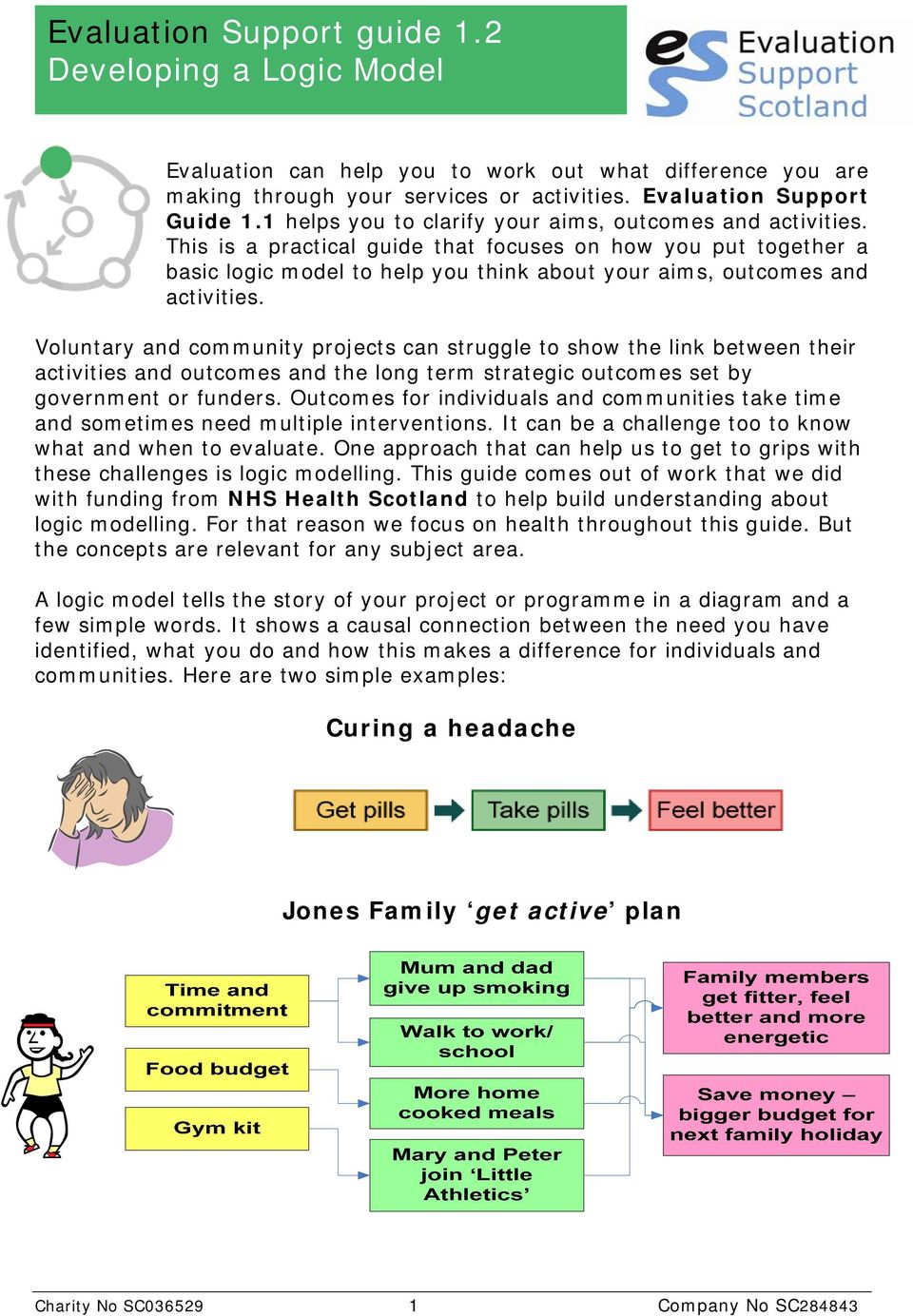
1 Evaluation Support guide 1.2 Developing a Logic Model Evaluation can help you to work out what difference you are making through your services or activities. Evaluation Support Guide 1.1 helps you to clarify your aims, outcomes and activities. This is a practical guide that focuses on how you put together a basic logic model to help you think about your aims, outcomes and activities. Voluntary and community projects can struggle to show the link between their activities and outcomes and the long term strategic outcomes set by government or funders. Outcomes for individuals and communities take time and sometimes need multiple interventions. It can be a challenge too to know what and when to evaluate. One approach that can help us to get to grips with these challenges is logic modelling. This guide comes out of work that we did with funding from NHS Health Scotland to help build understanding about logic modelling. For that reason we focus on health throughout this guide. But the concepts are relevant for any subject area. A logic model tells the story of your project or programme in a diagram and a few simple words. It shows a causal connection between the need you have identified, what you do and how this makes a difference for individuals and communities. Here are two simple examples: Curing a headache Jones Family get active plan Charity No SC Company No SC284843
2 Logic models can help you to: 1. Think about why your project or programme exists, why you do what you do and why you think that makes a difference. They can help you explore and develop a shared understanding about these things. 2. Plan a new project. In fact logic modelling is really a fancy word for planning. It can help you to think about the need and what you will do to address that need. 3. Communicate your thinking to people who support or benefit from your work. 4. Develop your evaluation plan. A logic model can help you to identify what you expect to happen, and when. It can therefore provide a pathway or road map for measuring progress. 5. Identify project or programme risks and how you might manage them. Types of logic models There are many types of logic model. People use different versions for different purposes. In this Guide we concentrate on the two models that are most frequently used for evaluation. The Weaver s Triangle The simplest version of the logic model is The Weaver s Triangle. This planning and evaluation tool is adapted from the Charities Evaluation Services Planning Triangle developed by Jayne Weaver. You can use this model to help you to clarify your aims and activities (see Support Guide 1.1: Clarifying your aims, outcomes and activities). Example: Glasburgh Health Project Aim Improve community health Outcomes 1. people have more access to support & advice 2. people feel less isolated 3. people can cope better 4. people make healthier choices Activities a. Complementary therapy: 1 b. Crèche: 1 c. One to one work: 1, 2 & 3 d. Group activities: all d. Information services: 1 & 3 e. Policy work: 1 Charity No SC Company No SC284843

3 Community projects with a limited number of activities and outcomes will probably find the Weaver s Triangle is enough to help them clarify their logic and identify what to evaluate. You can make the triangle more sophisticated by drawing arrows or making numbered connections between the activities and outcomes as we have done in the example above. You can also try to sequence your outcomes. However it can become a bit untidy and may limit your ability to question some of the underlying logic assumptions. The Weavers Triangle is not always good at showing visually the connection between different parts of the model or identifying at what point things happen. So, for more complex organisations or programmes, you might want to use the next model. The Wisconsin Model One of the most common formats for logic modelling comes from the University of Wisconsin s United Way programme which is itself drawn from work on log frames. There are references at the end of this Guide. Here are the components of the logic model framework: There is an example on the next page (not including assumptions and external factors): Charity No SC Company No SC284843

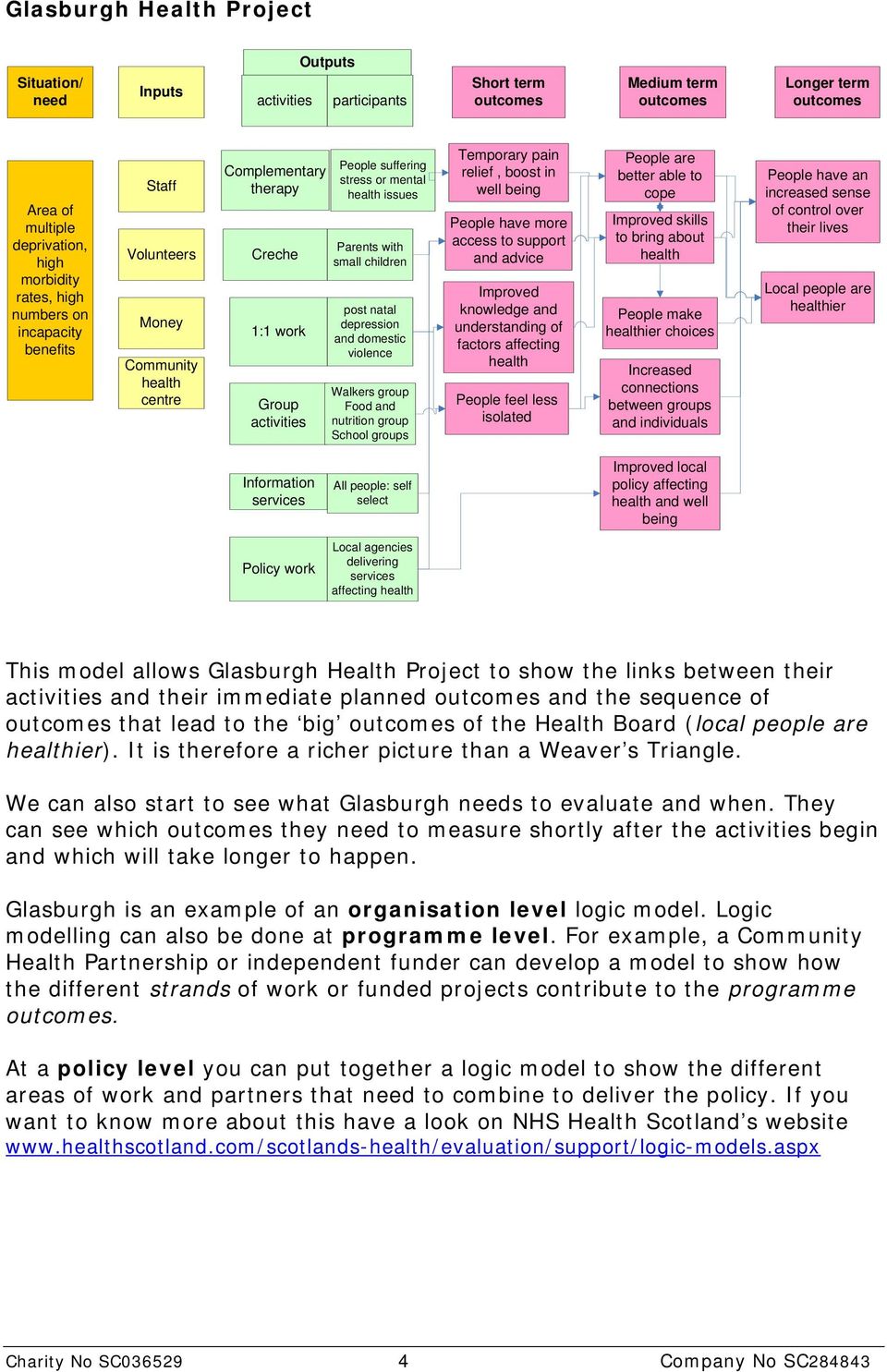
4 Glasburgh Health Project Situation/ need Inputs activities Outputs participants Short term outcomes Medium term outcomes Longer term outcomes Area of multiple deprivation, high morbidity rates, high numbers on incapacity benefits Staff Volunteers Money Community health centre Complementary therapy Creche 1:1 work Group activities People suffering stress or mental health issues Parents with small children post natal depression and domestic violence Walkers group Food and nutrition group School groups Temporary pain relief, boost in well being People have more access to support and advice Improved knowledge and understanding of factors affecting health People feel less isolated People are better able to cope Improved skills to bring about health People make healthier choices Increased connections between groups and individuals People have an increased sense of control over their lives Local people are healthier Information services Policy work All people: self select Local agencies delivering services affecting health Improved local policy affecting health and well being This model allows Glasburgh Health Project to show the links between their activities and their immediate planned outcomes and the sequence of outcomes that lead to the big outcomes of the Health Board (local people are healthier). It is therefore a richer picture than a Weaver s Triangle. We can also start to see what Glasburgh needs to evaluate and when. They can see which outcomes they need to measure shortly after the activities begin and which will take longer to happen. Glasburgh is an example of an organisation level logic model. Logic modelling can also be done at programme level. For example, a Community Health Partnership or independent funder can develop a model to show how the different strands of work or funded projects contribute to the programme outcomes. At a policy level you can put together a logic model to show the different areas of work and partners that need to combine to deliver the policy. If you want to know more about this have a look on NHS Health Scotland s website Charity No SC Company No SC284843
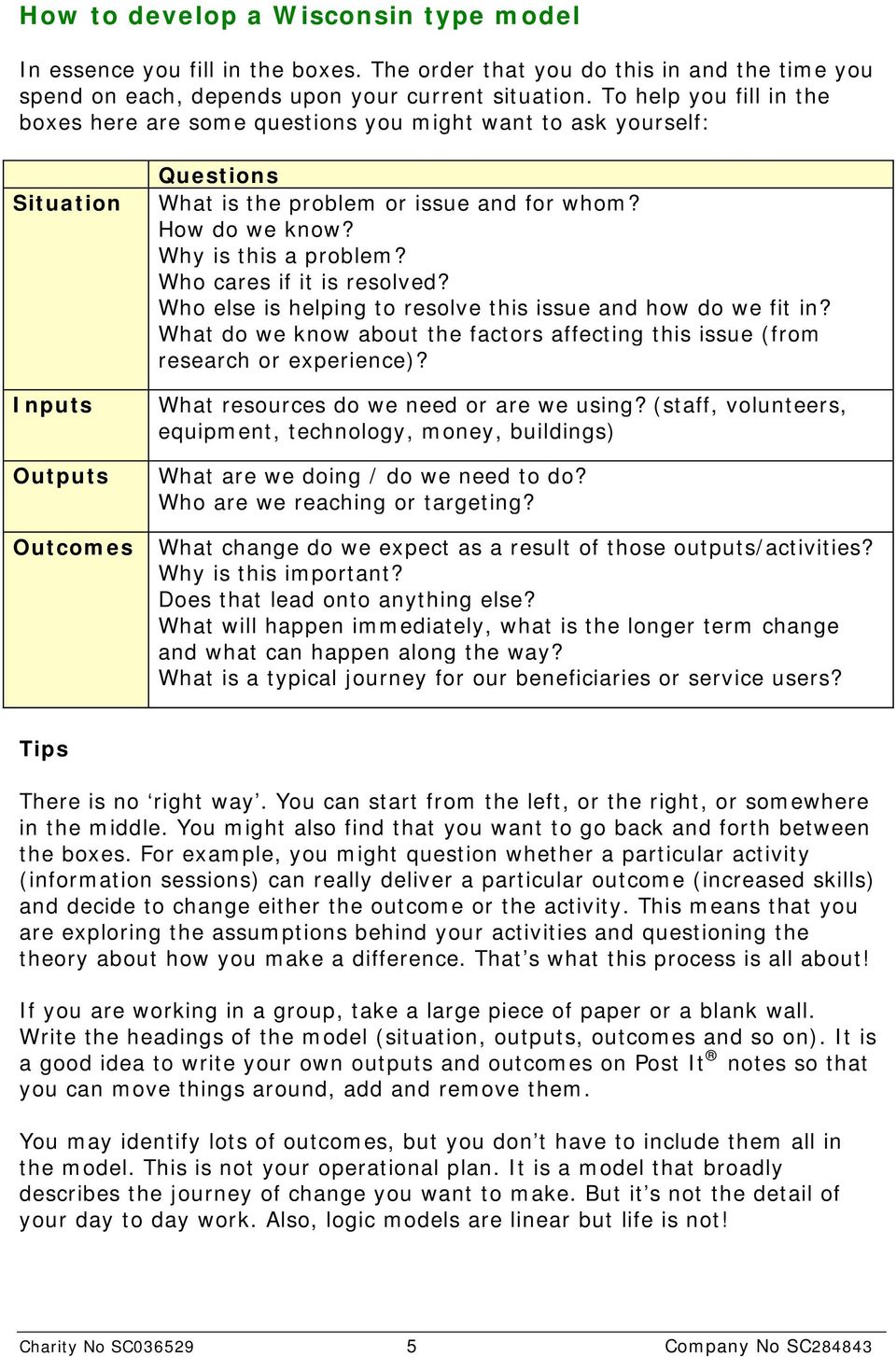
5 How to develop a Wisconsin type model In essence you fill in the boxes. The order that you do this in and the time you spend on each, depends upon your current situation. To help you fill in the boxes here are some questions you might want to ask yourself: Situation Inputs Outputs Outcomes Questions What is the problem or issue and for whom? How do we know? Why is this a problem? Who cares if it is resolved? Who else is helping to resolve this issue and how do we fit in? What do we know about the factors affecting this issue (from research or experience)? What resources do we need or are we using? (staff, volunteers, equipment, technology, money, buildings) What are we doing / do we need to do? Who are we reaching or targeting? What change do we expect as a result of those outputs/activities? Why is this important? Does that lead onto anything else? What will happen immediately, what is the longer term change and what can happen along the way? What is a typical journey for our beneficiaries or service users? Tips There is no right way. You can start from the left, or the right, or somewhere in the middle. You might also find that you want to go back and forth between the boxes. For example, you might question whether a particular activity (information sessions) can really deliver a particular outcome (increased skills) and decide to change either the outcome or the activity. This means that you are exploring the assumptions behind your activities and questioning the theory about how you make a difference. That s what this process is all about! If you are working in a group, take a large piece of paper or a blank wall. Write the headings of the model (situation, outputs, outcomes and so on). It is a good idea to write your own outputs and outcomes on Post It notes so that you can move things around, add and remove them. You may identify lots of outcomes, but you don t have to include them all in the model. This is not your operational plan. It is a model that broadly describes the journey of change you want to make. But it s not the detail of your day to day work. Also, logic models are linear but life is not! Charity No SC Company No SC284843
6 Testing the Model One of the benefits of logic modelling is that it allows you to question your logic and to identify things that might go wrong. This is where the Assumptions and External Factors come in. To help you identify your assumptions and external factors here are some questions to ask yourself: Questions Assumptions Is it meaningful/ worth doing? You may have accurately identified a problem, but other people might be more concerned about other problems. Ask yourself who cares and why? Is it plausible? Can those activities really deliver those outcomes? Are you setting yourself up for failure by promising too much? Do you understand how you bring about change in the short and long term? Can the outcomes be sustained? Is it doable? Do you have enough resources to deliver your activities? Are your activities practical as well as desirable? Do you have enough commitment from relevant partners? Is it testable? Will you be able to tell if things are progressing (or not)? Will you be able to convince others? External Factors (this is like a risk analysis) What changing factors might help or hinder your work with, or impact on, the people or communities you want to benefit? (Political, economic, environmental, demographic, technological, legal). Can you do anything about these factors? What agencies can support or threaten your work? Using the model to develop a monitoring and evaluation plan A logic model gives you a causal roadmap or a pathway of cause and effect. From here you can begin to identify the things that tell you whether you are making expected progress. The table sets out some evaluation questions. Evaluation questions Process Situation Is our analysis of the problem correct? Has it changed? Environmental scanning, research Inputs Are resources available and being used as planned? Financial, people and resource management Activities Are we delivering the activities as planned and to agreed standards? Recording activities Checking satisfaction Quality checks Participants Are we reaching the right people? What factors are affecting take up? Recording participation Asking participants Outcomes Are we making a difference? Collecting information at the beginning and end Charity No SC Company No SC284843

7 Your evaluation can also test out whether your assumptions were right and what external factors helped or got in the way of your plans. This might be particularly helpful if you want to replicate your project or programme. Example: The Jones Family decided to get active (see page 1). Their evaluation plan might look like the following Were they motivated, did they have their gym kits? Did they do what they said they would do? Did they get fitter? Were the assumptions right? External factors? Ask each other! Check the gym bag! Number of days without smoking for Mum and Dad Number of home cooked meals, number of times they walk to work Weight check before and after one month. Ask each other how they are feeling, how much energy they have and so on. Use a pedometer to measure distance walked to work each week. Did they have enough time to walk to school? Did home cooked meals save them money? Local gym closed down (hindered plan) Mum s best friend also gave up smoking (helped) Measuring the right outcomes at the right time The logic model gives you a structure for measuring the right outcomes at the right time. So, for example Glasburgh Health Project might measure their short term outcomes (such as pain relief) for all of their participants and then follow up a sample of participants for a medium term outcome (such as people are better able to cope). They may not have the resources to measure the long term outcome (people are healthier). However they could refer to research to say that it is reasonable to assume that if people have pain relief and are better able to cope then longer term they will be healthier. See our website for guides to help you evaluate outputs and outcomes. And finally two things we have learnt from doing logic modelling One of the most useful aspects of logic modelling is involving people (staff, volunteers, partners and other stakeholders) in the process. Often the process of creating the logic model is more useful than the diagram produced at the end. Logic models are never perfect. Don t spend too much time refining your model. Get it to a good enough point and then get on with the work! But revisit your model so that you can modify it to reflect any major changes in your understanding about the logic and assumptions of your programme. Charity No SC Company No SC284843

8 What next? Now that you know how to use logic models to clarify your aims, outcomes and activities, you are ready to think about your indicators. You can find out more in Support Guide 2.1: Developing and Using Indicators. References University of Wisconsin main citation: E Taylor-Powell, S Steele & M Douglah (1996): Planning a program evaluation. Retrieved April 2002, from University of Wisconsin-Extension-Cooperative Extension, Program Development and Evaluation Unit Web site: Another good site is the Kellogg Foundation: This work was originally commissioned by NHS Health Scotland on behalf of the Scottish Government's Implementation Steering Group for Community-led Health Improvement. For more tools and information, please see: The Scottish Community Development Centre has resources and a logic model for community-led health improvement If you need advice about evaluation, or would like a copy of this guide in large print, Braille or audio, please contact Evaluation Support Scotland on [email protected] or For other Evaluation Support Guides please visit our website: Charity No SC Company No SC284843

Social Return on Investment
 Social Return on Investment Valuing what you do Guidance on understanding and completing the Social Return on Investment toolkit for your organisation 60838 SROI v2.indd 1 07/03/2013 16:50 60838 SROI v2.indd
Look after your mental health
 Look after your mental health It s important to take care of yourself and get the most from life. This booklet suggests 10 practical ways to look after your mental health. What is mental health? Hi, how
Strategic Planning. Strategic Planning
 4 Strategic Planning Strategic Planning 1 4 TABLE OF CONTENTS Strategic Planning 3... What is Strategic Planning? 3... Why do Strategic Planning? 4... Assessing Your Strategic Planning 5... Developing
Funding success! How funders support charities to evaluate
 Funding success! How funders support charities to evaluate A review of Evaluation Support Accounts with Laidlaw Youth Trust and Lloyds TSB Foundation for Scotland The process of working with ESS has greatly
Table of Contents GIVING 2 KIDS SIX BASICS OF WISE GIVING REVISED 15 APRIL 2015 3
 Table of Contents What are you going to do? 4 Six Basics of wise giving: 5 1. Know your goal 5 2. Know your community 6 3. Choose your giving method 7 4. Get the right mix of skills 9 5. Develop a strategy
Workforce capacity planning model
 Workforce capacity planning model September 2014 Developed in partnership with 1 Workforce capacity planning helps employers to work out whether or not they have the right mix and numbers of workers with
Getting funding and planning successful projects. Big Lottery Fund guide to outcomes
 Getting funding and planning successful projects Big Lottery Fund guide to outcomes Getting funding and planning successful projects: Big Lottery Fund s guide to outcomes Further copies available from:
Cognitive and behavioural therapy (CBT) for people with depression and anxiety What skills can service users expect their therapists to have?
 Cognitive and behavioural therapy (CBT) for people with depression and anxiety What skills can service users expect their therapists to have? Cognitive and behavioural therapy (CBT) for people with depression
Free training courses
 Free training courses delivered by the Health Improvement Team feel well be well Health is everyone s business...here s how to make it yours westlothianchcp.org.uk The Health Improvement Team The Health
Social Return on Investment. an introduction
 Social Return on Investment an introduction SROI an introduction in association with 1 Introduction Social Return on Investment (SROI) is an innovative way to measure and account for the value you create
Glasgow Association for Mental Health Money and Debt Project: Evaluation Feedback
 Glasgow Association for Mental Health Money and Debt Project: Evaluation Feedback Evaluation by Philip O Hare, Clinical Governance Support Unit, Partnerships, NHS Greater Glasgow and Clyde. Patricia Grieve,
How To Help Someone With Dementia
 Occupational therapy and Dementia Occupational therapy helping people to live with dementia Occupational therapy Helping people to live life their way Occupational therapy helping people to live with dementia
3. What examples are there of good practice to encourage and maintain volunteers in community sport?
 Inquiry into Support for Community Sport Ayr United Football Academy Ayr United Football Academy (www.aufa.org.uk) has been incorporated as an entirely autonomous not for profit limited company and is
Assessments and the Care Act
 factsheet Assessments and the Care Act Getting help in England from April 2015 carersuk.org factsheet This factsheet contains information about the new system of care and support that will come into place
How to Measure and Report Social Impact
 How to Measure and Report Social Impact A Guide for investees The Social Investment Business Group January 2014 Table of contents Introduction: The Development, Uses and Principles of Social Impact Measurement
March 10, 2015 CONFERENCE CALL DOCUMENTATION FOR C.N.A.s Presented by Dwana Jackson, CNA, AIPP Quality Specialist
 March 10, 2015 CONFERENCE CALL DOCUMENTATION FOR C.N.A.s Presented by Dwana Jackson, CNA, AIPP Quality Specialist Good morning everyone and welcome to today s conference call, our topic today is documentation
Free debt help. for your community. debt help. Free debt counselling from an award winning charity. Lifting people out of debt and poverty
 CALL FREE ON 0800 328 0006 (01274 760839 may be cheaper from a mobile) Free debt help for your community Free debt counselling from an award winning charity Lifting people out of debt and poverty debt
A guide to prostate cancer clinical trials
 1 A guide to prostate cancer clinical trials In this fact sheet: What is a clinical trial? Why are trials done? What are trials looking into at the moment? How are clinical trials done? Should I take part
The Code of Good Impact Practice. June 2013
 The Code of Good Impact Practice June 2013 Inspiring Impact The Code of Good Impact Practice has been developed through a sector-wide public consultation and the input of a working group of 17 organisations
What is the Aspire Schools Challenge? 10 easy steps to complete your Aspire Challenge!
 10 easy steps to complete your Aspire Challenge! 1. Choose your challenge 2. Set the date 3. Set your fundraising target 4. Tell parents/carers using the template letter provided 5. Give every child a
Volunteering Matters
 Why Volunteering Matters The Case for Change @scotvolforum #WhyVolunteeringMatters Why do we need a Case for Change? The rates of volunteering across the whole Scottish population have now been static
Engage Government & Community 2 PLAN REFLECT ACT
 Step 6: Monitor and Evaluate 7 Improve & Revise Services 1 Engage Government & Community 2 Establish Leadership & Management Structure REFLECT PLAN 6 Monitor & Evaluate ACT 3 Adapt the Community-Based
CEDAR. Clinical Education Development and Research. Goal Setting. in Low Intensity CBT (Physical Health Series) Paul Farrand & Joanne Woodford
 CEDAR Clinical Education Development and Research Goal Setting in Low Intensity CBT (Physical Health Series) Paul Farrand & Joanne Woodford 1 Acknowledgement: This booklet is based on the material included
A GUIDE FOR PEOPLE WITH HIV IN THEIR TEENS AND EARLY ADULTHOOD
 student life going to university or College: A GUIDE FOR PEOPLE WITH HIV IN THEIR TEENS AND EARLY ADULTHOOD ncb.org.uk/lifelinks student life 2 So you re thinking of going to university or college and
CREATIVE S SKETCHBOOK
 Session Plan for Creative Directors CREATIVE S SKETCHBOOK THIS SKETCHBOOK BELONGS TO: @OfficialSYP 1 WELCOME YOUNG CREATIVE If you re reading this, it means you ve accepted the We-CTV challenge and are
An introduction to impact measurement
 An introduction to impact measurement Contents 1 Introduction 2 Some definitions 3 Impact measurement at BIG 4 Setting impact measures for programmes APPENDICES A External Resources (separate document)
Changes to special educational needs and disability support
 Changes to special educational needs and disability support Easy read guide for children and young people Who is this guide for? This guide will be useful if you: are a child or a young person have a learning
Gaining Customer Knowledge Clinical Microsystem Observation Worksheet
 Clinical Microsystem Observation Worksheet CONTEXT Aim: Build customer knowledge through observation 1 2 Outcomes select a patient population Aim What s the general aim? Given our wish to limit or reduce
Social Care Support - The Facts You Need to Know
 Factsheet What does the Care Act mean for me? Getting social care support under the new law in England This factsheet concentrates on parts of the Care Act which will most affect people who use social
A M B A S S A D O R S
 AMBASSADORS 1 TEL: 020 8875 1805 Email:[email protected] Web:www.backupteam.org.uk Content 1. Who are Back Up Ambassadors? 2. What do Back Up Ambassadors do? 3. What we ask from you 4. What
How To Live With A Brain Injury
 Goole Neuro-Rehabilitation Centre We aim to provide the best quality neurobehavioural rehabilitation for people with complex and challenging needs after brain injury. Ultimately, we want to enable service
Measuring the Impact of Volunteering
 Measuring the Impact of Volunteering Why is measuring the impact of volunteering important? It is increasingly important for organisations or groups to describe the difference that volunteering makes to,
AEDC User Guide: Schools
 Our Children Our Communities Our Future AEDC User Guide: Schools This AEDC user guide leads schools through the steps they might take when thinking about how to respond to AEDC data for their community.
Prepared by. Mary Michaud, MPP. State Coordinator for Local Program Evaluation. University of Wisconsin Extension May 2003
 Prepared by Mary Michaud, MPP State Coordinator for Local Program Evaluation University of Wisconsin Extension May 2003 How is evaluation built into program design? Several key steps will help build evaluation
2. Planning your support how to use your Personal Budget
 2. Planning your support how to use your Personal Budget About this guide A Personal Budget is money from a local authority that can be used to pay for social care services and support. The money may be
Evaluation Theory: Who Needs It? Jean A. King
 Evaluation Theory: Who Needs It? Jean A. King An important question If evaluation is a field of practice, then what is an appropriate role for theory in evaluation? Theory? Practice?... there is nothing
Requirements Management In Action. A beginners guide to Requirements Management
 Requirements Management In Action A beginners guide to Requirements Management Table of Contents Introduction How to Capture Requirements What is Traceability? Tips to Capture Better Requirements Conclusion
Module 2: Introduction to M&E frameworks and Describing the program
 Module 2: Introduction to M&E frameworks and Describing the program Learning Objectives Understand the 4 basic steps required to develop M & E plans Learn to develop goals and objectives Learn to develop
Making Connections. Using a theory of change to develop planning and evaluation
 Making Connections Using a theory of change to develop planning and evaluation By Jean Ellis, Diana Parkinson and Avan Wadia for Charities Evaluation Services February 2011 Background to this guide This
Interview Questions for Midwifery Posts
 Interview Questions for Midwifery Posts CC 20 Inclusive Learning It is Edge Hill s aim to make our services and provision accessible to all our users. If you need us to present our information in a different
Patient survey report 2008. Category C Ambulance Service User Survey 2008 North East Ambulance Service NHS Trust
 Patient survey report 2008 Category C Ambulance Service User Survey 2008 The national Category C Ambulance Service User Survey 2008 was designed, developed and co-ordinated by the Acute Surveys Co-ordination
Developing a Theory of Change
 A Constituency Voiice Tool Developing a Theory of Change A Framework for Accountability and Learning for Social Change A Keystone Guide Keystone operates on open source principles. We invite you to share
Exercise therapy and the treatment of mild or moderate depression in primary care
 Exercise therapy and the treatment of mild or moderate depression in primary care Up and running? Executive summary Why isn t exercise referral offered by GPs? According to our research, only 42% of GPs
Career development in employing organisations: practices and challenges from a UK perspective
 Career development in employing organisations: practices and challenges from a UK perspective This paper is based on an input to the Guidance for Workforce Development Conference, held by CEDEFOP in Thessaloniki,
AN ELECTRONIC NEWSLETTER FOR PROFESSIONALS WHO WORK WITH CHILDREN AND YOUNG PEOPLE ACROSS CENTRAL BEDFORDSHIRE
 AN ELECTRONIC NEWSLETTER FOR PROFESSIONALS WHO WORK WITH CHILDREN AND YOUNG PEOPLE ACROSS CENTRAL BEDFORDSHIRE Issue 1: January February 2012 Dear reader, Welcome to the first edition of Young Carers News,
Induction: first 12 weeks of employment. e-learning options
 Dementia Care and Support: Training Pathways Current Learning Options Topic areas are listed in the left hand column. Currently available ways of meeting the learning needs are listed in the right hand
Here to help sort out problems with your legal service provider
 How do we sort out problems? Our job is to look at complaints about service providers in a fair way and without taking sides. If we think the service complained about was of a reasonable standard, we will
Gay Men s Support Work
 Gay Men s Support Work Evaluation Report to Big Lottery Fund December 2014 Page 1 of 7 Context Of an estimated 107,800 people living with HIV in the UK, 40% live in the greater London area and the majority
COMPLEMENTARY THERAPIES AND MENTAL HEALTH
 COMP THERAPIES 8pp ART:Layout 1 23/11/2009 14:58 Page 1 COMPLEMENTARY THERAPIES AND MENTAL HEALTH COMP THERAPIES 8pp ART:Layout 1 23/11/2009 14:58 Page 2 SAMH, Scotland s leading mental health charity,
Living with a lung condition:
 Living with a lung condition: how exercise and eating well can make a difference to your life This information is for people living with a lung condition in the UK and your family and carers. It will help
Interview Questions for Nursing Posts
 Interview Questions for Nursing Posts CC 33 Careers Centre Always remember that an interview is a formal process. Even if you have had a clinical placement on a ward where you are being interviewed for
GUIDANCE NOTES FOR APPLICANTS
 GUIDANCE NOTES FOR APPLICANTS Please read these notes carefully, as well as the Job Description and Person Specification, before completing and submitting your application. APPLICATION INFORMATION Please
Banking made clear. Information pack for people with learning disabilities.
 Banking made clear Information pack for people with learning disabilities. This handy guide provides information about how you can: open and manage your own bank account keep safe when you are using your
Banking made clear. Information pack for people with learning disabilities.
 Banking made clear Information pack for people with learning disabilities. This handy guide provides information about how you can: open and manage your own bank account keep safe when you are using your
Theories of Change and Logic Models: Telling Them Apart Heléne Clark Director, ActKnowledge [email protected] 212-817-1906
 Theories of Change and Logic Models: Telling Them Apart Heléne Clark Director, ActKnowledge [email protected] 212-817-1906 Andrea A. Anderson Research Associate, Aspen Institute Roundtable on Community
Feel threatened? We can give you peace of mind
 Glasgow Housing Association www.gha.org.uk Your community Feel threatened? We can give you peace of mind Better homes, better lives, a better Glasgow Your community Anti-social behaviour is a complex and
DAY ONE ICE-BREAKERS AND INTRODUCTION. Hello. Name of the activity Objectives
 DAY ONE ICE-BREAKERS AND INTRODUCTION Hello This will set the tone for the workshop: it is easy and fun, it helps participants to relax and start to get to know each other. 5 minutes None Group work The
Alcohol and mental health
 Alcohol and mental health Alcohol and mental health For many people, having an alcoholic drink is one of life s pleasures. For most of them that s not a problem, but some people have a troubled relationship
How To Write A Customer Profile Sheet
 How to understand your customers needs and expectations. This information sheet will help you to A) improve the way you collect information from and about your customers. B) use the information to plan
Rights Advocacy Recovery Voices Rights Advocacy Recovery Voices Rights Advoca Recovery Voices Rights Advocacy Recover.
 Recovery Voices Rights Advocacy Recov Voices Rights Advocacy Recovery Voices Rights Advocacy Recovery Voices Rights Advocacy Recovery Voices Rights Advoca Recovery Voices Rights Advocacy Recover Voices
How To Be Successful In Danish Culture
 THE PERSONA AND CUSTOMER JOURNEY 1. Story telling You have been out and have been talking to your natives. Now is the time to share the stories you have heard in your teams and to capture the insights.
3 Good practice in reducing anti-social behaviour and working with young people who have offended or are at risk of offending
 3 Good practice in reducing anti-social behaviour and working with young people who have offended or are at risk of offending Introduction There is little conclusive evidence in the UK of what works in
Community Based Rehabilitation (CBR)
 Community Based Rehabilitation (CBR) Many different agencies are now reviewing their experience of many years of support to CBR. These evaluations will hopefully feed into the global review that is being
prepared in making referrals through Choose and Book, which doesn t create any additional work for me.
 Health Management Limited has been appointed as the supplier to deliver Fit for Work (previously Health and Work Service) in England and Wales. The following is a personal account of a service user s journey.
Health and Care Together
 BUSINESS NAME Health and Care Together Health and Care Together Wigan Borough Local Involvement Network Summer 2009 Wigan Borough Local Involvement Network (LINk) Newsletter 16 November 2011 Use your experience
impact report April 2013 - March 2014
 impact report April 2013 - March 2014 introduction BigLifeFamilies supports parents, children and families from excluded or disadvantaged communities to achieve their full potential by delivering high
Evaluating Participation. A guide and toolkit for health and social care practitioners
 Evaluating Participation A guide and toolkit for health and social care practitioners September 2013 This publication was developed by Gary McGrow, Social Researcher, the Scottish Health Council, in partnership
Young Person s Guide to CFS/ME
 Young Person s Guide to CFS/ME The Royal College of Paediatrics and Child Health This leaflet has been developed as part of the Evidence based guideline for management of CFS/ME (Chronic Fatigue Syndrome
IMPROVING DENTAL CARE AND ORAL HEALTH A CALL TO ACTION. February 2014 Gateway reference: 01173
 1 IMPROVING DENTAL CARE AND ORAL HEALTH A CALL TO ACTION February 2014 Gateway reference: 01173 2 Background NHS dental services are provided in primary care and community settings, and in hospitals for
About you. Personal Information and your identity. a little extra help
 About you Personal Information and your identity a little extra help Keeping you safe and stopping fraud More and more people are worried about identity theft and fraud. We re working 24/7 to keep your
Registration form For Organisations
 Registration form For Organisations Please complete this form to enable us to update the information we hold about your organisation. This information will be entered onto our database and used in conjunction
Information for children about borderline personality disorder (BPD).
 Information for children about borderline personality disorder (BPD). This information is designed to be used in conjunction with discussions with children and their families about their parent s mental
Writing a press release and speaking to the media: for local and national support groups in. England, Northern Ireland, Scotland and Wales
 Writing a press release and speaking to the media: for local and national support groups in England, Northern Ireland, Scotland and Wales 2 Contents page Introduction 3 What should be in your press release?
Logic Models in Public Health Program Management
 Public Health Performance Management Centers for Excellence Logic Models in Public Health Program Management Visit us: Public Health Performance Management Centers for Excellence Funded by the U. S. Centers
Your guide to. Communicating with people with a learning disability
 Your guide to Communicating with people with a learning disability About this guide This guide is designed to provide a brief introduction to communication, and the problems faced by someone with a learning
Start Learning Joomla!
 Start Learning Joomla! Mini Course Transcript 2010 StartLearningJoomla.com The following course text is for distribution with the Start Learning Joomla mini-course. You can find the videos at http://www.startlearningjoomla.com/mini-course/
How to Outsource Without Being a Ninnyhammer
 How to Outsource Without Being a Ninnyhammer 5 mistakes people make when outsourcing for profit By Jason Fladlien 2 Introduction The way everyone does outsourcing is patently wrong, and this report is
Guide for the Development of Results-based Management and Accountability Frameworks
 Guide for the Development of Results-based Management and Accountability Frameworks August, 2001 Treasury Board Secretariat TABLE OF CONTENTS Section 1. Introduction to the Results-based Management and
It s Not Right! Neighbours, Friends and Families for Older Adults. What You Can Do to Keep Yourself Safe From Abuse
 It s Not Right! Neighbours, Friends and Families for Older Adults What You Can Do to Keep Yourself Safe From Abuse Everyone has the right to be safe and free from abuse. No one should experience abuse.
How to open a bank account
 2 Easy read How to open a bank account Self-directed support: an Easy Read guide to getting the help and support you need Self-directed support: an Easy Read guide to getting the help and support you need
Community Multiple Sclerosis Team Patient Information Leaflet
 Community Multiple Sclerosis Team Patient Information Leaflet Shining a light on the future Introduction We hope this leaflet will provide you with information that you will find useful when attending
New Beginnings: Managing the Emotional Impact of Diabetes Module 1
 New Beginnings: Managing the Emotional Impact of Diabetes Module 1 ALEXIS (AW): Welcome to New Beginnings: Managing the Emotional Impact of Diabetes. MICHELLE (MOG): And I m Dr. Michelle Owens-Gary. AW:
first steps in monitoring and evaluation
 helping you do better what you do best 4 Coldbath Square London EC1R 5HL t +44 (0) 20 7713 5722 f +44 (0) 20 7713 5692 e [email protected] w www.ces-vol.org.uk Company limited by guarantee Registered