
THE PUBLIC DEBT OF COUNTRIES FROM EURO ZONE. THE SNOWBALL EFFECT
|
|
|
- Jared Taylor
- 9 years ago
- Views:
Transcription
1 THE PUBLIC DEBT OF COUNTRIES FROM EURO ZONE. THE SNOWBALL EFFECT Senior Investment Analyst, SSIF Broker. 95 Andrei RĂDULESCU, PhD Abstract Five years after the start of the worst financial and economic crisis since the end of the World War II the euro area countries are confronted with the persistence of the public debt crisis. The recent literature on macro-financial topics identifies the main factors that determined the launch of the sovereign debt crisis in Europe. One of the consequences of this crisis consists in the public debt effect. Several European countries pay an interest rate higher than the nominal GDP rate, leading to a snowball effect for the public debt. This short article reviews the main factors that determined the launch of the sovereign debt crisis and computes the public debt effect for the Euro Zone (12) member countries. Rezumat La cinci ani de la declanşarea celei mai severe crize economicofinanciare mondiale din ultimele decenii economiile europene continuă să se confrunte cu criza datoriilor suverane. Literatura recentă pe teme macro-financiare identifică factorii principali care au condus la declanşarea crizei datoriilor suverane în Europa. Una dintre consecinţele acestei crize constă în efectul de bulgăre de zăpadă observat la nivelul datoriei publice. O serie de state europene se finanţează la costuri care depăşesc ritmul de evoluţie a PIB nominal, determinând o rostogolire a datoriei publice.
2 Acest articol trece în revistă factorii fundamentali care au determinat criza datoriilor suverane în Europa şi estimează efectul de bulgăre de zăpadă pentru 12 economii din Zona Euro. Keywords: public debt crisis, snowball effect, Euro Zone, interest rate spread JEL Classification: G12, E43, E62 Five years after the start of the worst world economic-financial crisis of the past decades, the European economies are still confronted with the crisis of the sovereign debts. Started in Greece, more than two years ago, this disease started to spread among the European economies (particularly the southern side), as well as from the public finances towards the banking sector (run-on-the-bank phenomenon). The financial markets keep on testing the solidity of the Euro zone. As it may be noticed from the chart below (Figure 1), the current risk premiums of the European states are higher than those from the summer of 2011 (as reference period for the crisis of the sovereign debts from the developed economies, through the prism of USA losing its AAA rating and of the attacks on the Italian financial markets). 96

3 CDS level in the European countries Figure no.1 Source: CNBC, The evolution of the risk premiums is reflected in the cost of state financing. The differential of financing cost (the interest spread) between Germany and most of the Euro zone countries peaked during the recent period (cases of Spain and Italy). Noticeable, from the launch of the Euro (1999) and until the start of the world financial crisis, the interest spread between Germany and the other states from the Euro zone was very low. Practically, the financial markets didn t grant importance to the differences existing between the European countries in terms of macroeconomic situation (foreign equilibrium, domestic equilibrium). The macro-financial literature of the recent years presented several factors which influence the evolution of the interest spread: the perception on the investment risk worldwide (attitude towards risk of the international investors), the situation of the public finances/the default risk, the risk of liquidity, the size of the banking sector, etc. It is generally accepted that the global risk factor (which incorporates the expectations on the evolution of the world economy and of the financial markets) is the determining element for the evolution of 97

4 the interest spread. During the final years of the Great Moderation 1 the perception on the global risk was very low; the international investors were paying little attention to the macroeconomic risks specific to each economy (such as the foreign or domestic imbalances). For instance, the paper of Barbosa and Costa (2010) shows econometrically that before the Lehman Brothers bankruptcy, the global risk factor was determining 70% of the evolution of the interest spread among the countries from the Euro zone. The paper of Gerlach et al. (2010) also proves that the global risk factor determines 90% of the evolution of this interest differential. We must mention, however, that after the Lehman Brothers bankruptcy, other factors such as the default risk (sovereign bankruptcy) and the risk of liquidity gained in importance in determining the interest spread. During the recent period of increased risk aversion we witnessed the phenomenon of flight-to-quality, the German bonds being the favourites of the international financial flows (during the recent period too, the interest for the German state bonds on 10 years reached record minimal values, while the interest for the short-term bonds was even negative). At the same time, within the context of the first wave of the crisis, most governments intervened with expansionist budget policies, which deteriorated the situation of the public finances. Overall, at the level of the Euro zone, the proportion of the public debt within the GDP increased from 66% in 2007 to over 88% in the first quarter of Within such context, the European governments are confronted with a discipline imposed by the financial markets, as also noticed by the paper of Sgherri and Zoli (2009). In other words, after the start of the global financial crisis, particularly after the Lehman Brothers bankruptcy (the peak of the worldwide liquidity crisis), the financial markets started to take into consideration the differences between states in terms of 1 The Great Moderation is the period which started in mid 1980s, characterised by a low volatility of the economic activity. 98

5 (internal/external) macroeconomic equilibrium: the countries whose public financers deteriorated severely or which had other macro-financial imbalances paid higher interests. For instance, the paper of Schuknecht et al. (2010) proves that the impact of the budget deficit and of the public debt on the size of the interest spread increased 3-4 times and even 7-8 times after the Lehman Brothers bankruptcy. The paper of Barbosa and Costa (2010) also proves that the default risk and the liquidity risk contributed with about 50% to the interest spread of the European economies in September December The contribution of the liquidity risk was higher particularly during the Lehman Brothers bankruptcy, while the contribution of the default risk was higher in the second half of 2009, with the start of the Greek crisis. The paper of Gerlach et al. (2010) shows that a 1 p.b. increase of the bid/ask spread for the state bonds quotations determined a 0.43 p.b. increase of the interest spread. The article also shows the importance of the banking sector dimension to the determination of the interest rate spread (contribution of about 1 p.b. at its evolution during the periods of volatility of the Great Recession ). The paper of Barrios et al. (2009) shows the importance of the budget deficit evolution to the determination of spread (1 p.p. budget deficit over the German level determined a 2.4 p.b spread from the interest rate of the German state bonds). Theoretically, the best explanation for the evolution of the interest rates spreads within the Euro zone states was given by De Grauwe (2011). In a monetary union the member states have no control on the currency which they borrow. The markets know this and the sanction the economies having important macroeconomic imbalances (budgetary included) and which depend on external funds (such as the economies from southern Europe). From developed states they became mere 99

6 emerging economies within the European Monetary Union after the Great Recession 2 started. The high level of the interest rate spread noticed currently in the economies having important macroeconomic imbalances within the Euro zone may be, on the medium term, a factor of real economic divergence. Practically, these economies are confronted with the so-called snowball effect of the public debt: the cost of financing the state exceeds the rate of the nominal GDP growth. The most obvious case is represented by Italy, country in which this effect of the public debt has been manifesting relentlessly for the past 11 years. At the same time, most economies from the region were confronted with this snowball phenomenon immediately after the first wave of the Great Recession (as of 2008). While countries such as Germany, Belgium, Luxemburg, Austria and Finland managed to recover in 2010, this phenomenon is still active in Greece, Portugal, Ireland, Italy, Spain, Netherlands and France. The first economy of the region Germany was confronted with this phenomenon for over a decade (until 2006), evolution determined by the macro-financial efforts to reintegrate the Eastern Germany. This effect of the public debt was among the factors which determined the Berlin administration to implement several structural reforms in the early 2000 years, before the start of the Great Recession. The efficiency and necessity of these measures could be observed during the period of the world crisis, the German economy consolidating its position of European leader. On the other hand, Spain recorded a process of reducing the public debt for about one decade ( ), the cost of financing being below the growth rate of the nominal GDP (within the general low level of the interest rates during the Great Moderation, and also due to the convergence of the Spanish economy towards the average of the Euro zone). 2 The denomination of great recession refers to the period after the start of the global recession (2007), whose effects produced the strongest recession of the world economy after the World War Two. 100

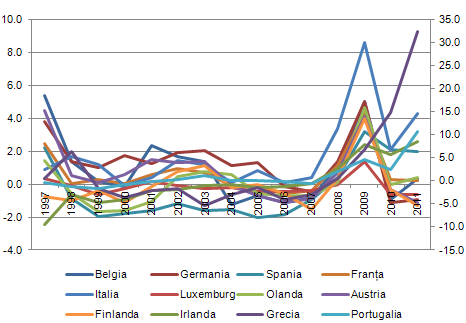
7 Figure no.2 Public Debt (% GDP) in the Euro Zone countries. The snowball effect Source: Own calculations based on Eurostat, IMF data The phenomenon of the public debt rolling risks becoming permanent. The financial markets are aware of the difficulty of the processes of macroeconomic adjustment of these economies, reason why they are penalised through the interest rate. But, if the reduction of the public debt was not possible before 2007 when the markets didn t pay attention to the macroeconomic imbalances, it is obvious that this is impossible under the present macro-financial conditions. 101

8 Public Debt (% PIB). The snowball effect Figure no.3 Source: Own calculations based on Eurostat, IMF data At the same time, the signal given by the financial markets to the authorities responsible for the implementation of the macroeconomic policies in these states is clear: measures have to be adopted which to curb the increase of the public debt and to restore partially the trust. The cost of financing could be reduced below the growth rate of the nominal GDP only by restarting the investments, by setting priorities for the public expenditure, by reducing the proportion of the informal economy, by structural reforms of the labour market and of the services sector, by selling state assets etc. The authorities responsible with the implementation of the macroeconomic policies in the European Union must correct this problem (which contributes to a higher divergence between the member states) by concrete measures aimed to stimulate the investments in these economies and by decreasing the cost of financing these states. 102

9 *** This paper was supported financially through the project "Postdoctoral studies in economy: Program for the continuous formation of the elite researchers - SPODE" cofinanced from the European Social Fund, through the Sectoral Operational Program Human Resources Development , contract no. POSDRU/89/1.5/S/ References 1. Barbosa L., S. Costa (2010) - Determinants of sovereign bond yield spreads in the euro area, Banco de Portugal, Economics and Research Department, Working Papers Barrios S., P. Iversen, M. Lewandowska, R. Setzer (2009) - Determinants of intra euro area government bond spreads during the financial crisis, European Economy, Economic Papers, No De Grauwe P. (2011) - Managing a Fragile Eurozone, CESifo Forum, 12(2), pp Gerlach S., A. Schulz, B. Guntram (2010) - Banking and Sovereign Risk in the Euro Area, CEPR Discussion Papers, No Schuknecht L., J. von Hagen, G. Wolswijk (2010) - Government bond risk premiums in the EU revisited the impact of the financial crisis, European Central Bank, Working Paper Series, No Sgherri S., E. Zoli (2009) - Euro Area Sovereign Risk During the Crisis, IMF Working Paper, No. 09/

Managing the Fragility of the Eurozone. Paul De Grauwe University of Leuven
 Managing the Fragility of the Eurozone Paul De Grauwe University of Leuven Paradox Gross government debt (% of GDP) 100 90 80 70 UK Spain 60 50 40 30 20 10 0 2000 2001 2002 2003 2004 2005 2006 2007 2008
Stability in the Eurozone: Challenges and Solutions
 Stability in the Eurozone: Challenges and Solutions Ludger Schuknecht Director General Economic and Fiscal Policy Strategy; International Economy and Finance IMFS Working Lunch, Frankfurt (Main), 15 July
THE CURRENT ACCOUNT OF ROMANIA EVOLUTION, FACTORS OF INFLUENCE, FINANCING
 THE CURRENT ACCOUNT OF ROMANIA EVOLUTION, FACTORS OF INFLUENCE, FINANCING Abstract Camelia MILEA, PhD The balance of the current account is a tool used to establish the level of economic development of
PUBLIC DEBT SIZE, COST AND LONG-TERM SUSTAINABILITY: PORTUGAL VS. EURO AREA PEERS
 PUBLIC DEBT SIZE, COST AND LONG-TERM SUSTAINABILITY: PORTUGAL VS. EURO AREA PEERS 1. Introduction This note discusses the strength of government finances in, and its relative position with respect to other
VAKIFBANK GLOBAL ECONOMY WEEKLY
 VAKIFBANK GLOBAL ECONOMY WEEKLY Is Italy Going To Be The New Weak Link After Greece? T. Vakıflar Bankası T.A.O 25 July 2011 No: 27 1 Vakıfbank Economic Research Introduction... Debt crisis which has threatened
The EMU and the debt crisis
 The EMU and the debt crisis MONETARY POLICY REPORT FEBRUARY 212 43 The debt crisis in Europe is not only of concern to the individual debt-ridden countries; it has also developed into a crisis for the
ECONOMIC AND MONETARY DEVELOPMENTS
 Box 6 SMALL AND MEDIUM-SIZED ENTERPRISES IN THE EURO AREA: ECONOMIC IMPORTANCE AND FINANCING CONDITIONS This box reviews the key role played by small and medium-sized enterprises (SMEs) in the euro area
Attribution 4.0 International (CC BY 4.0) This presentation is licensed under a Creative Commons Attribution 4.0 International license.
 Attribution 4.0 International (CC BY 4.0) This presentation is licensed under a Creative Commons Attribution 4.0 International license. Therefor you are free to share and adapt this presentation even for
Working Paper Series. Government bond risk premiums in the EU revisited the impact of the financial crisis. no 1152 / february 2010
 Working Paper Series no 1152 / february 2010 Government bond risk premiums in the EU revisited the impact of the financial crisis by Ludger Schuknecht, Jürgen von Hagen and Guido Wolswijk WORKING PAPER
WHITE PAPER NO. III. Why a Common Eurozone Bond Isn t Such a Good Idea
 CENTER FOR FINANCIAL STUDIES WHITE PAPER NO. III JULY 2009 Why a Common Eurozone Bond Isn t Such a Good Idea Otmar Issing Europe s World, Brussels, Belgium Center for Financial Studies Goethe-Universität
Is the Eurocrisisover? Paul De Grauwe London School of Economics
 Is the Eurocrisisover? Paul De Grauwe London School of Economics Outline of presentation Legacy of the sovereign debt crisis Design failures of Eurozone Redesigning the Eurozone Towards a political union?
European Monetary Union Chapter 20
 European Monetary Union Chapter 20 1. Theory of Optimum Currency Areas 2. Background for European Monetary Union 1 Theory of Optimum Currency Areas 1.1 Economic benefits of a single currency Monetary effi
General Government debt: a quick way to improve comparability
 General Government debt: a quick way to improve comparability DEMBIERMONT Christian* BIS Bank for International Settlements, Basel, Switzerland [email protected] In simple words the General
Recent U.S. Economic Growth In Charts MAY 2012
 Recent U.S. Economic Growth In Charts MAY 212 GROWTH SINCE 29 The Growth Story Since 29 Despite the worst financial crisis since the Great Depression and a series of shocks in its aftermath, the economy
Mario Draghi: Europe and the euro a family affair
 Mario Draghi: Europe and the euro a family affair Keynote speech by Mr Mario Draghi, President of the European Central Bank, at the conference Europe and the euro a family affair, organised by the Bundesverband
THE CDS AND THE GOVERNMENT BONDS MARKETS AFTER THE LAST FINANCIAL CRISIS. The CDS and the Government Bonds Markets after the Last Financial Crisis
 THE CDS AND THE GOVERNMENT BONDS MARKETS AFTER THE LAST FINANCIAL CRISIS The CDS and the Government Bonds Markets after the Last Financial Crisis Abstract In the 1990s, the financial market had developed
No. 03/11 BATH ECONOMICS RESEARCH PAPERS
 Sovereign Credit Default Swaps and the Macroeconomy Yang Liu and Bruce Morley No. 03/11 BATH ECONOMICS RESEARCH PAPERS Department of Economics 1 Sovereign Credit Default Swaps and the Macroeconomy Yang
Fiscal Consolidation During a Depression
 NIESR Fiscal Consolidation During a Depression Nitika Bagaria*, Dawn Holland** and John van Reenen* *London School of Economics **National Institute of Economic and Social Research October 2012 Project
European Debt Crisis and Impacts on Developing Countries
 July December 2011 SR/GFC/11 9 SESRIC REPORTS ON GLOBAL FINANCIAL CRISIS 9 SESRIC REPORTS ON THE GLOBAL FINANCIAL CRISIS European Debt Crisis and Impacts on Developing Countries STATISTICAL ECONOMIC AND
ACCESS TO FINANCE. of SMEs in the euro area, European Commission and European Central Bank (ECB), November 2013.
 ACCESS TO FINANCE Improving access to finance is essential to restoring growth and enhancing competitiveness. Investment and innovation are not possible without adequate financing. Difficulties in accessing
Be prepared Four in-depth scenarios for the eurozone and for Switzerland
 www.pwc.ch/swissfranc Be prepared Four in-depth scenarios for the eurozone and for Introduction The Swiss economy is cooling down and we are currently experiencing unprecedented levels of uncertainty in
Fewer net errors and omissions, that is a new format of the balance of payments
 Fewer net errors and omissions, that is a new format of the balance of payments The size of net errors and omissions in the balance of payments decreased from 4.4% to 2.3% of GDP. This resulted from data
Klicken Sie, um das Titelformat. zu bearbeiten. The Eurocrisis: new challenges for the EU s. economic policy. Thomas Westphal. 23th of February 2015
 The Eurocrisis: new challenges for the EU s Klicken Sie, um das Titelformat economic policy zu bearbeiten Thomas Westphal Klicken Director Sie, General um das European Format Policy des Untertitel-Masters
United States House of Representatives. Subcommittee on Capital Markets, Insurance, and Government Sponsored Enterprises
 United States House of Representatives Subcommittee on Capital Markets, Insurance, and Government Sponsored Enterprises Credit Default Swaps on Government Debt: Potential Implications of the Greek Debt
Portugal Programme Assessment
 1 Portugal Programme Assessment European Commission, DG ECFIN 15 May, 2014 2 Root causes of Portugal's initial imbalances and need for assistance Macroeconomic imbalances Low GDP and productivity for more
Conducting Monetary Policy with Large Public Debts. Gita Gopinath Harvard University
 Conducting Monetary Policy with Large Public Debts Gita Gopinath Harvard University 1 Large Public Debts Net Government debt to GDP Greece 155 Japan 134 Portugal 111 Italy 103 Ireland 102 United States
It is with great pleasure that I address you here today. I would like to. thank Luis for providing this opportunity. The subject that I will discuss
 Ladies and gentlemen, It is with great pleasure that I address you here today. I would like to thank Luis for providing this opportunity. The subject that I will discuss today, is recovery and reform.
FROM GOVERNMENT DEFICIT TO DEBT: BRIDGING THE GAP
 FROM GOVERNMENT DEFICIT TO DEBT: BRIDGING THE GAP Government deficit and debt are the primary focus of fiscal surveillance in the euro area, and reliable data for these key indicators are essential for
THE ANALYSIS OF PRIVATE HEALTH INSURANCE PENETRATION DEGREE AND DENSITY IN EUROPE
 THE ANALYSIS OF PRIVATE HEALTH INSURANCE PENETRATION DEGREE AND DENSITY IN EUROPE Gheorghe Matei, Professor Ph.D University of Craiova Faculty of Economics and Business Administration Craiova, Romania
Economic Outlook of Finland
 Economic Outlook of Finland Pentti Hakkarainen Deputy Governor 9 June 2011 1 2 Heading for stable monetary conditions 1865 1999 MARKKA joins silver standard EURO taken into use 3 Two roles of the Bank
Portugal: restoring credibility and confidence
 MINISTÉRIO DAS FINANÇAS Portugal: restoring credibility and confidence London School of Economics and Political Science Vitor Gaspar February 1, 2012 MINISTÉRIO DAS FINANÇAS 1 Outline 1. On the way to
Why Treasury Yields Are Projected to Remain Low in 2015 March 2015
 Why Treasury Yields Are Projected to Remain Low in 5 March 5 PERSPECTIVES Key Insights Monica Defend Head of Global Asset Allocation Research Gabriele Oriolo Analyst Global Asset Allocation Research While
2. UK Government debt and borrowing
 2. UK Government debt and borrowing How well do you understand the current UK debt position and the options open to Government to reduce the deficit? This leaflet gives you a general background to the
and monetary developments
 economic developments box 8 unemployment developments in the euro area The situation in euro area s has worsened significantly since the start of the economic and financial crisis in 28. After reaching
The Legal Protection Insurance Market in Europe. October 2013
 The Legal Protection Insurance Market in Europe October 2013 The Legal Protection Insurance Market in Europe October 2013 In its latest publication RIAD, the International Association of Legal Protection
UPDATE ON CURRENT MACRO ENVIRONMENT
 1 Oct 213 Macro & Strategy Equity Credit Commodities 13 13 #1 Global Strategy #1 Multi Asset Research #3 Global Economics #2 Equity Quant #2 Index Analysis #3 SRI Research 12 sector teams in the Top 1
PUBLIC DEBT MANAGEMENT FUNDAMENTAL COMPONENT OF PUBLIC POLICY 1
 PUBLIC DEBT MANAGEMENT FUNDAMENTAL COMPONENT OF PUBLIC POLICY 1 Maria Pascal (Andriescu) Alexandru Ioan Cuza University of Iaşi [email protected] Abstract. The global financial crisis has put considerable
72/2015-21 April 2015
 72/2015-21 April 2015 Provision of deficit and debt data for 2014 - first notification Euro area and EU28 government deficit at 2.4% and 2.9% of GDP respectively Government debt at 91.9% and 86.8% In 2014,
STABILITY PROGRAMME 2014-2017
 STABILITY PROGRAMME 2014-2017 COUNCIL OF MINISTERS APRIL 30 2014 Stability Programme 2014-2017 The Council of Ministers has approved today the referral to Brussels of: The Stability Programme 2014-2017,
ING Europe Invest Autocall 2020
 5,00% potential annual yield Maturity: 4 years maximum Risk profile: see page 4 Capital not guaranteed at Maturity by the Issuer Risk class peculiar to ING Luxembourg* 0 1 2 3 4 5 6 Description ING Europe
An outlook on the Spanish economy Official Monetary and Financial Institutions Forum (OMFIF), London
 09.02.2016 An outlook on the Spanish economy Official Monetary and Financial Institutions Forum (OMFIF), London Luis M. Linde Governor I would like to thank OMFIF and Mr. David Marsh for the invitation
Productivity slowdown: Comparative perspectives Euro area and Germany
 Productivity slowdown: Comparative perspectives Euro area and Germany Marcel Fratzscher DIW Berlin and Humboldt University Berlin PIIE Workshop Washington DC, 16 November 2015 The crisis trap Financial/banking
A European Unemployment Insurance Scheme
 A European Unemployment Insurance Scheme Necessary? Desirable? Optimal? Grégory Claeys, Research Fellow, Bruegel Zsolt Darvas, Senior Fellow, Bruegel Guntram Wolff, Director, Bruegel July, 2014 Key messages
A CRITICAL ANALYSIS OF THE FACTORS LYING BEHIND RECENT PUBLIC DEBT ACCUMULATION IN ROMANIA
 A CRITICAL ANALYSIS OF THE FACTORS LYING BEHIND RECENT PUBLIC DEBT ACCUMULATION IN ROMANIA Irina BILAN Alexandru Ioan Cuza University of Iași Faculty of Economics and Business Administration Iași, Romania
CURRENT ACCOUNT BALANCE, PRIVATE DEBT AND EURO AREA SOVEREIGN DEBT CRISIS: A COMPARISON OF NORTH AND SOUTH
 CURRENT ACCOUNT BALANCE, PRIVATE DEBT AND EURO AREA SOVEREIGN DEBT CRISIS: A COMPARISON OF NORTH AND SOUTH Authors: Isadora LAZĂR 1, Mădălina Ecaterina ANDREICA 2 A bstract: The objective of this paper
Europe s Financial Crisis: The Euro s Flawed Design and the Consequences of Lack of a Government Banker
 Europe s Financial Crisis: The Euro s Flawed Design and the Consequences of Lack of a Government Banker Abstract This paper argues the euro zone requires a government banker that manages the bond market
COMMUNICATION FROM THE COMMISSION 2014 DRAFT BUDGETARY PLANS OF THE EURO AREA: OVERALL ASSESSMENT OF THE BUDGETARY SITUATION AND PROSPECTS
 EUROPEAN COMMISSION Brussels, 15.11.2013 COM(2013) 900 final COMMUNICATION FROM THE COMMISSION 2014 DRAFT BUDGETARY PLANS OF THE EURO AREA: OVERALL ASSESSMENT OF THE BUDGETARY SITUATION AND PROSPECTS EN
Statistics Netherlands. Macroeconomic Imbalances Factsheet
 Macroeconomic Imbalances Factsheet Introduction Since the outbreak of the credit crunch crisis in 2008, and the subsequent European debt crisis, it has become clear that there are large macroeconomic imbalances
Global Currency Hedging
 Global Currency Hedging John Y. Campbell Harvard University Arrowstreet Capital, L.P. May 16, 2010 Global Currency Hedging Joint work with Karine Serfaty-de Medeiros of OC&C Strategy Consultants and Luis
Main trends in industry in 2014 and thoughts on future developments. (April 2015)
 Main trends in industry in 2014 and thoughts on future developments (April 2015) Development of the industrial sector in 2014 After two years of recession, industrial production returned to growth in 2014.
Annual Economic Report 2015/16 German council of economic experts. Discussion. Lucrezia Reichlin, London Business School
 Annual Economic Report 2015/16 German council of economic experts Discussion Lucrezia Reichlin, London Business School Bruegel Brussels, December 4 th 2015 Four parts I. Euro area economic recovery and
COMPARED EXPERIENCES REGARDING PUBLIC DEBT MANAGEMENT
 COMPARED EXPERIENCES REGARDING PUBLIC DEBT MANAGEMENT MIRELA-ANCA POSTOLE, RODICA GHERGHINA, IOANA DUCA, IRINA ZGREABAN ACADEMY OF ECONOMIC SCIENCES, TITU MAIORESCU UNIVERSITY BUCHAREST [email protected],
Fiscal sustainability, long-term interest rates and debt management
 Fiscal sustainability, long-term interest rates and debt management Fabrizio Zampolli Bank for International Settlements Basel A presentation at the Dubrovnik Economic Conference 13-14 June 2013 The opinions
Bank credit developments in Spain European Association of Public Banks (EAPB) Annual Congress
 10.11.2015 Bank credit developments in Spain European Association of Public Banks (EAPB) Annual Congress Fernando Restoy Deputy Governor 1. Introduction Good morning everyone. It is a pleasure for me
Sovereign Contagion in Europe: Evidence from the CDS Market
 Sovereign Contagion in Europe: Evidence from the CDS Market Paolo Manasse*, Luca Zavalloni** Bologna University*,Warwick University** Copenhagen Business School, Copenhagen, September 23, 2013 Plan of
For a Europe-wide coordinated levy on wealth
 The nature of the crisis For a Europe-wide coordinated levy on wealth - European ATTAC Network - A constantly increasing disparity of wealth is an intrinsic aspect of capitalism. Wealth grows faster than
Economic commentaries
 No. 3 211 Economic commentaries Liquidity in the foreign exchange market for EUR/NOK Kathrine Lund, Department for Market Operations and Analysis, Norges Bank* *The views expressed in this article are
Highlights from the OECD Sovereign Borrowing Outlook N 4 *
 Highlights from the OECD Sovereign Borrowing Outlook N 4 * by Hans J. Blommestein, Ahmet Keskinler and Perla Ibarlucea Flores ** Abstract OECD governments are facing unprecedented challenges in the markets
How To Be Cheerful About 2012
 2012: Deeper into crisis or the long road to recovery? Bart Van Craeynest Hoofdeconoom Petercam [email protected] 1 2012: crises looking for answers Global slowdown No 2008-0909 rerun Crises
ING Bank N.V. (NL) 4Y EUR Euro Stoxx 50 Autocallable Note
 4Y Euro Stoxx 50 Autocallable te 8.00% potential annual yield Product term: 4 years maximum MiFID profile: see page 3 Capital non-guaranteed at maturity by the Issuer Description 4Y Euro Stoxx 50 Autocallable
Turkish Arab Economic Forum June 29, 2012. Mehmet Şimşek. Minister of Finance
 Turkish Arab Economic Forum June 29, 2012 Mehmet Şimşek Minister of Finance 1 Outline Turkey: Short Term Outlook Managing a Soft Landing Fallout from the Euro Crisis Turkey & MENA REBALANCING Growing ON
DOCTORAL (Ph.D) THESIS
 DOCTORAL (Ph.D) THESIS UNIVERSITY OF KAPOSVÁR FACULTY OF ECONOMIC SCIENCE Department of Finance and Economics Head of Doctors School: DR. GÁBOR UDOVECZ Doctor of the Hungarian Academy of Sciences Supervisor:
Re-Thinking Sovereign Debt Summit
 The Only Win-Win Solution for Europe Requires a Fresh Start on Greece State-Building and a Fresh Start on Greece Correctly Calculating Debt Relief from Prior Restructurings -- Japonica Partners Internal
Vanguard Investments Hong Kong Limited December 2015
 PRODUCT KEY FACTS Vanguard FTSE Developed Europe Index ETF Vanguard Investments Hong Kong Limited December 2015 This is an exchange traded fund. This statement provides you with key information about this
FISCAL CONSOLIDATION: HOW MUCH IS NEEDED TO REDUCE DEBT TO A PRUDENT LEVEL?
 Please cite this paper as: OECD (1), Fiscal Consolidation: How Much is Needed to Reduce Debt to a Prudent Level?, OECD Economics Department Policy Notes, No. 11, April. ECONOMICS DEPARTMENT POLICY NOTE
FINANCIALISATION AND EXCHANGE RATE DYNAMICS IN SMALL OPEN ECONOMIES. Hamid Raza PhD Student, Economics University of Limerick Ireland
 FINANCIALISATION AND EXCHANGE RATE DYNAMICS IN SMALL OPEN ECONOMIES Hamid Raza PhD Student, Economics University of Limerick Ireland Financialisation Financialisation as a broad concept refers to: a) an
Key Highlights on Italian Economy
 Key Highlights on Italian Economy Incontro con l Ambasciatore Reinhard Schäfers e il prof. Roland Berger Franco Bassanini 25 Marzo 2014 Cassa depositi e prestiti Italian economy / Key highlights GDP is
How To Find Out If International Debt Securities And Gdp Are Related
 Are Securities Secure: Study of the Influence of the International Debt Securities on the Economic Growth Darya Bonda 1 and Sergey Mazol 2 1 Belarus State Economic University, Minsk, Belarus [email protected]
The global economy Banco de Portugal Lisbon, 24 September 2013 Mr. Pier Carlo Padoan OECD Deputy Secretary-General and Chief Economist
 The global economy Banco de Portugal Lisbon, 24 September 213 Mr. Pier Carlo Padoan OECD Deputy Secretary-General and Chief Economist Summary of presentation Global economy slowly exiting recession but
Standard & Poor's Puts Ratings On Eurozone Sovereigns On CreditWatch With Negative Implications
 December 5, 2011 Standard & Poor's Puts Ratings On Eurozone Sovereigns On CreditWatch With Negative Implications Primary Credit Analysts: Moritz Kraemer, Frankfurt (49) 69-33-99-9249; [email protected]
Investment insight. Fixed income the what, when, where, why and how TABLE 1: DIFFERENT TYPES OF FIXED INCOME SECURITIES. What is fixed income?
 Fixed income investments make up a large proportion of the investment universe and can form a significant part of a diversified portfolio but investors are often much less familiar with how fixed income
The Mexican Economy: Facts and Opportunities
 Manuel Sánchez Santander Global Fixed Income Summit London, England, September 20, 2012 Contents 1 Structural features 2 Recent developments and outlook 3 Inflation and monetary policy 4 Economic challenges
Global Support to Develop Domestic Bond Markets in Emerging Market Economies and Developing Countries The Italian Experience.
 Global Support to Develop Domestic Bond Markets in Emerging Market Economies and Developing Countries The Italian Experience. 22/23 September 2008 Frankfurt am Main Pierpaolo Battista Italian Ministry
44 ECB STOCK MARKET DEVELOPMENTS IN THE LIGHT OF THE CURRENT LOW-YIELD ENVIRONMENT
 Box STOCK MARKET DEVELOPMENTS IN THE LIGHT OF THE CURRENT LOW-YIELD ENVIRONMENT Stock market developments are important for the formulation of monetary policy for several reasons. First, changes in stock