
Appendix A: BMP Fact Sheets
|
|
|
- Hubert Pitts
- 9 years ago
- Views:
Transcription
1 Appendix A: BMP Fact Sheets INTRODUCTION (under development) 1 Dry Well 2 Infiltration Basin 8 Infiltration Trench 14 Permeable Pavement 20 Detention Pond 28 Detention Vault 34 We t Pon d 3 8 Ve g e t a t e d Sw a l e 4 4 Ve g e t a t e d Bu f f e r St r i p 5 0 Constructed Wetland 54 Ve g e t a t e d Ro c k Fi l t e r 6 2 Bioretention 68 Media Filter 76 Swirl Separator 84 Drain Insert 90 Water Quality Inlet 94 Vegetated Roof 100 R a i n w a t e r H a r v e s t i n g S o u r c e C o n t r o l R e s o u r c e s Fact Sheets 1

2 San Francisco Stormwater Design Guidelines Dry Well Also known as: roof runoff control, stormwater drainage well, stormwater injection well, bored well, infiltration gallery, seepage pit Roof Leader Building Foundation Overflow Pipe Splash Block Observation Well foot Soil Cover Typical Minimum 2-foot Depth 2 to 5-foot Diameter Typical Minimum Infiltration Rate of 1/2-inch per hour 9 9 Non-Woven Geotextile Fabric or Well Walls 10 1½ to 3-inch Coarse Aggregate 11 Description A dry well is an underground stormwater storage structure with no outlet other than percolation to the soil. Dry wells collect stormwater and allow it to infiltrate into the surrounding soil for groundwater recharge, much like infiltration trenches. However, while infiltration trenches tend to be long narrow trenches at the surface, dry wells are vertical holes dug into the ground. According to the EPA, a drywell is considered to be a Class V stormwater drainage well if it is any bored, drilled, or driven shaft, or dug hole that is deeper than its widest surface dimension, or an improved sinkhole, or a subsurface fluid distribution system (an infiltration system with piping to enhance infiltration capabilities). 2 F a c t S h e e t s

3 Dry wells that fall under the Class V injection well category must submit an inventory form to the EPA. There are two main types of dry wells: Unlined dry wells consist of an earthen pit filled with gravel, riprap, rubble or other debris. Such pits resist collapse but their storage capacity is limited because their interior column is filled with crushed stone. These dry wells are more prone to sediment clogging, but are less expensive to construct. Lined dry wells are typically contained by a reinforced concrete cylinder with perforated sides and bottom, allowing greater storage volume. Lined dry wells achieve the same stormwater management function of volume reduction as infiltration basins, but differ from infiltration basins in that they are underground and tend to be smaller. Pollutant Removal Low Volume Reduction Target Pollutants Sediment Trash Nutrients Metal Organics Bacteria Peak Flow Reduction Oil/Grease Moderate High Requires Pre-Treatment Dry Well Benefits Reduces runoff volume and rate - zero discharge. Improves water quality - good for removing fine sediment and adsorbed pollutants. Enhances groundwater recharge and contributes to stream base flow. Minimal space requirements. Visually unobtrusive. Limitations Must have minimum soil infiltration rate of 0.5 inches/hour, not appropriate for Hydrologic Soil Types C and D (impermeable soils). If infiltration rates exceed 5 inches/hour, runoff should be fully treated prior to infiltration to protect groundwater quality. 4-foot minimum separation from basin bottom to groundwater is required, unless the Regional Water Quality Control Board approves otherwise. Depth to bedrock must be over 4 feet for infiltration-based systems. Not suitable in areas with contaminated groundwater or sediment. Siting challenges in urban areas (must be >10 ft from any building or road). Potentially expensive in urban areas because they are underground. Fact Sheets 3

4 San Francisco Stormwater Design Guidelines Siting Dry wells are often used to infiltrate stormwater runoff from roofs and parking lots, but can be used in a variety of other applications. Dry wells that infiltrate runoff from roof downspouts have been successful in the long term because roof runoff contains little sediment. Other applications often require pre-treatment screening and/or a bypass route for flows that exceed the dry well capacity. Drainage area and slope: Dry wells are recommended for small drainage areas with low pollutant loadings, such as rooftops less than 0.25 acres in size. Dry wells should not be used at sites with a slope greater than 15%. Setbacks: Dry wells should be placed a minimum of 10 feet downgradient or 100 feet upgradient of building foundations. If the drainage area is less than 1000 square feet or if the drainage area is less than 5000 square feet and adjacent buildings have waterproofed foundations, these setbacks can be reduced to 5 and 50 feet, respectively. In addition, infiltration-based BMPs must be at least 5 feet from any property line and 150 feet from any drinking water well. Soils and infiltration rate: The soil infiltration rate should be between 0.5 and 5 inches per hour. If the infiltration rate exceeds 5 inches per hour, then runoff should be fully treated prior to infiltration to protect groundwater quality. Generally, dry wells are not suitable for areas with relatively impermeable soils containing clay, silt, or artificial fill. Groundwater protection: Because dry wells rely on infiltration, the potential for groundwater contamination must be carefully evaluated. Dry wells should not be used in areas where the seasonally high groundwater elevation is less than 10 feet beneath the dry well invert. They are also unsuitable for sites that use or store chemicals or hazardous materials, unless those materials are prevented from entering the dry well. In these areas, other BMPs that do not allow interaction with the groundwater should be considered. A geotechnical investigation should ascertain how the stormwater runoff will move in the soil both horizontally and vertically, accounting for any geological conditions that could inhibit water movement. 4 F a c t S h e e t s

5 Design Considerations Soils: Pit-type dry wells should be filled with double-washed locally available rock with a diameter range of 1.5 to 3 inches (AASHTO size 2 or 3). To minimize sedimentation from lateral soil movement in simple dry wells, the sides and top of the dry well gravel matrix can be lined with a permeable filter fabric such as needled nonwoven polypropylene fiber filters (e.g., Mirafi 140N, Amoco 4547, or Geotex 451). The bottom of the dry well should remain open to maximize infiltration. Pre-Treatment: Sediment and trash accumulation can markedly shorten the operating life of the well, requiring more frequent, large-scale rehabilitation. In areas with high sediment loads, a dry well may require pre-screening to prevent sediment and trash from clogging the well. Consider pairing dry wells with: vegetated buffer strips, vegetated swales, detention ponds, or vortex/swirl separators. Dry Well Overflow: Dry wells should be constructed to operate off-line, allowing for flows exceeding storage capacity to bypass the dry well and enter the sewer system or another BMP. Where possible, dry wells should have a drainage mechanism, such as an underdrain, in case of clogging. Access: Dry wells should have a direct access path for inspection and maintenance activities. A perforated observation pipe can be inserted vertically into the dry well to allow inspectors to monitor the drawdown rate. If needed, the observation pipe may be used in conjunction with a suitable pump to drain the dry well. Sizing: Dry wells have a minimum depth of 2 feet. Usually they have a diameter no wider than 12 feet, with typically one foot of soil cover on top. The dry well should be designed to drain within 24 to 48 hours. Dry wells for San Francisco can be sized using the volumebased calculations described in Step 7 of the Stormwater Control Plan chapter of the Guidelines. An electronic sizing tool is also provided with the Guidelines and is hosted on the SFPUC website at in the Stormwater Design Guidelines section. The sizing tool is the same as that for infiltration trenches, with due consideration for changed geometry. Fact Sheets 5

6 San Francisco Stormwater Design Guidelines Operations and Maintenance Dry well longevity can be increased by careful geotechnical evaluation prior to construction, and by designing and implementing an inspection and maintenance plan. Dry wells should only be constructed after the entire area draining to the facility has been stabilized. During construction care should be taken to divert sediment-laden runoff away from the well. Good construction practices should minimize over-compaction, sediment generation, and smearing. The table on the following page provides more information on typical postconstruction inspection and maintenance activities. Typical Inspection Activities for Dry Wells Activity Check observation wells 48 hours after the end of wet weather. Failure to percolate within this time period indicates clogging. Inspect pretreatment devices and diversion structures for sediment build-up and structural damage. Schedule Post-construction and semi-annually (beginning and end of rainy season) Typical Maintenance Activities for Dry Wells Activity Remove sediment and oil / grease from pretreatment devices and overflow structures. If dry well has not drained within 48 hours after end of storm, drain well via pumping, clean perforated piping and gravel media, and excavate soil walls of unlined dry well to expose clean soil (typically 2 inches). Schedule Semi-annually or as needed Upon failure (expected to be > 10 years) Cost Dry well construction costs can range from $4-$9 per cubic foot of storage volume, but costs vary widely depending on design configuration, location, soils, and material availability. Annual maintenance costs have been reported to be around 5 to 10 percent of capital costs. 6 F a c t S h e e t s

7 References AND RESOURCES California Stormwater Quality Association Stormwater Best Management Practice Handbook: New and Redevelopment. Environmental Protection Agency. Storm Water Injection Well Best Management Practices. 2 June 2008 < types_stormwater.html>. Tredyffrin Township, Chester County, Pennsylvania. Stormwater Management: Front Yard / Back Yard Watershed Solutions. 2 June 2008 < departments/stormwater/>. Dry Well Fact Sheets 7

8 San Francisco Stormwater Design Guidelines Infiltration Basin Also known as: soakage basin, infiltration pond Surface Runoff and Storm Drain Inlet Forebay to Prevent Erosion and Spread Flow Pre-Treatment and Stilling Basin year Flood Level 10-year Flood Level year Flood Level 6 Cleanouts Overflow Structure Embankment 2-foot Sand Bed Minimum Infiltration Rate of 1/2-inch per hour Underdrain with Shut-off Valve Outfall with Rip Rap to Prevent Erosion Description An infiltration basin is a shallow impoundment over permeable soil that captures stormwater, stores it, and allows it to infiltrate, using the natural filtering ability of the soil to remove stormwater pollutants. This practice has a high removal efficiency for fine sediment and associated pollutants. However, coarse sediment and oils will plug the basin and should be removed using appropriate pretreatment practices, such as vegetated swales, before runoff reaches the basin. A forebay at the entrance to the basin will also extend the basin s longevity and reduce maintenance costs. In addition to removing pollutants, infiltration basins also help recharge groundwater. As with any infiltration BMP, the potential for groundwater contamination must be carefully considered, especially if groundwater is used for human consumption or agricultural purposes. A key feature of an infiltration basin is its vegetation. Deep-rooted plants on the basin bottom reduce the risk of clogging and increase the infiltration capacity by creating small conduits through which water can infiltrate. Dense vegetation also impedes soil erosion and scouring of the basin floor. 8 F a c t S h e e t s

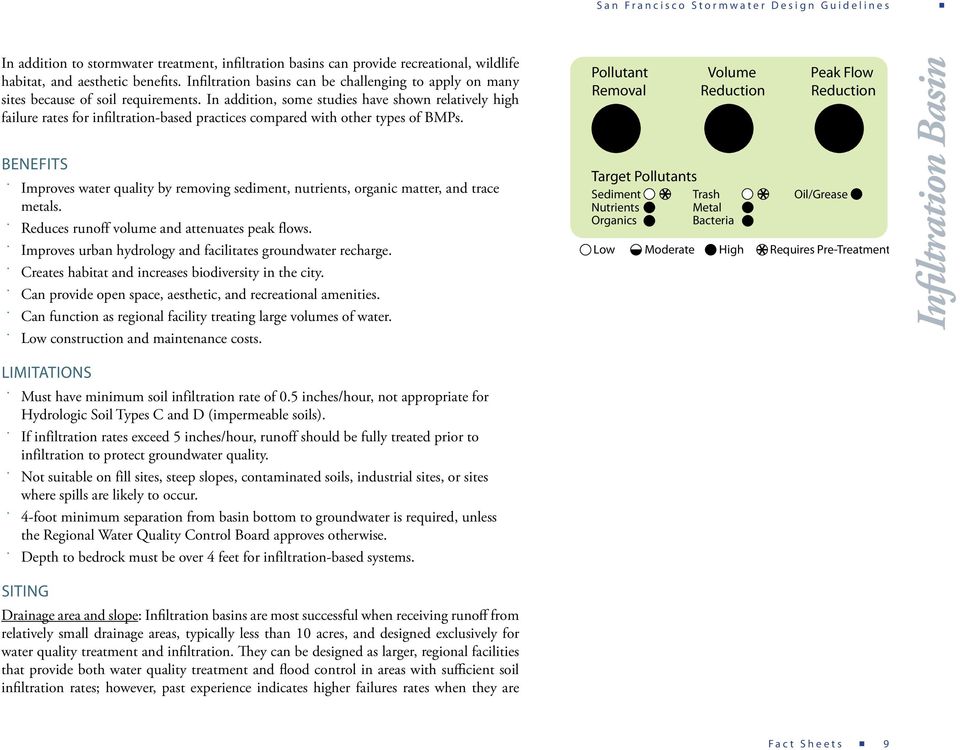
9 In addition to stormwater treatment, infiltration basins can provide recreational, wildlife habitat, and aesthetic benefits. Infiltration basins can be challenging to apply on many sites because of soil requirements. In addition, some studies have shown relatively high failure rates for infiltration-based practices compared with other types of BMPs. Benefits Improves water quality by removing sediment, nutrients, organic matter, and trace metals. Reduces runoff volume and attenuates peak flows. Improves urban hydrology and facilitates groundwater recharge. Creates habitat and increases biodiversity in the city. Can provide open space, aesthetic, and recreational amenities. Can function as regional facility treating large volumes of water. Low construction and maintenance costs. Pollutant Removal Low Volume Reduction Target Pollutants Sediment Trash Nutrients Metal Organics Bacteria Peak Flow Reduction Oil/Grease Moderate High Requires Pre-Treatment Infiltration Basin Limitations Must have minimum soil infiltration rate of 0.5 inches/hour, not appropriate for Hydrologic Soil Types C and D (impermeable soils). If infiltration rates exceed 5 inches/hour, runoff should be fully treated prior to infiltration to protect groundwater quality. Not suitable on fill sites, steep slopes, contaminated soils, industrial sites, or sites where spills are likely to occur. 4-foot minimum separation from basin bottom to groundwater is required, unless the Regional Water Quality Control Board approves otherwise. Depth to bedrock must be over 4 feet for infiltration-based systems. Siting Drainage area and slope: Infiltration basins are most successful when receiving runoff from relatively small drainage areas, typically less than 10 acres, and designed exclusively for water quality treatment and infiltration. They can be designed as larger, regional facilities that provide both water quality treatment and flood control in areas with sufficient soil infiltration rates; however, past experience indicates higher failures rates when they are Fact Sheets 9
10 San Francisco Stormwater Design Guidelines used in this manner. Infiltration basins should not be used at sites with a drainage area slope greater than 15%. Soils and infiltration rate: Infiltration basins can be implemented where infiltration rates are 0.5 inches per hour or greater. However, if infiltration rates are greater than 5 inches per hour, runoff should be fully treated prior to infiltration to protect groundwater quality. Infiltration rates can be determined through geotechnical investigations. Geotechnical reports must be used to determine how stormwater runoff will move in the soil (horizontally and vertically), and whether there are any geological conditions that could inhibit the movement of water. Soils should not have more than 30% clay content or 40% clay and silt combined. Setbacks: Infiltration basins should be placed a minimum of 10 feet downgradient or 100 feet upgradient of building foundations. If the drainage area is less than 1000 square feet or if the drainage area is less than 5000 square feet and adjacent buildings have waterproofed foundations, these setbacks can be reduced to 5 and 50 feet, respectively. In addition, infiltration-based BMPs must be at least 5 feet from any property line and 150 feet from any drinking water well. Groundwater protection: The seasonally high groundwater elevation and depth to bedrock should both be at least 10 feet from the basin invert to protect groundwater quality. Baseflow should not be present in the watershed. If hazardous materials and other harmful substances are stored or used within the contributing drainage area, an infiltration basin should not be used unless these materials can be effectively prevented from entering stormwater draining to the basin. If this cannot be accomplished, other BMPs that do not allow interaction with the groundwater should be considered. An infiltration basin in Waterworks Gardens at the King County East Division Reclamation Plant, Renton, WA, is part of an environmental art park that treats stormwater. Runoff flows through stormwater treatment ponds, and the wetlands form an earth/water sculpture that funnels, captures and releases water. Design Considerations Dimensions: Infiltration basins are generally between 1 and 4 feet deep with side slopes no steeper than 3H:1V to provide bank stability and allow for mowing. The bottom of the basin should be graded as flat as possible to provide uniform ponding and infiltration across the basin bottom. Vegetation: Vegetation on the basin bottom and sides must be capable of surviving up to 72 hours under water. Native vegetation is preferred. 10 F a c t S h e e t s

11 Pretreatment: Pretreatment measures should be used to prevent clogging of the basin bottom if runoff is expected to contain heavy sediment loads or oils and greases. Vegetated swales and sediment basins provide effective pretreatment, especially if implemented as a treatment train. The upstream drainage should be completely stabilized before the basin is constructed and construction techniques should minimize sedimentation and compaction of the basin bottom. Online vs. offline configuration: Infiltration basins can be constructed such that they operate off-line (high flows bypass the basin) or online (all flows are directed to the infiltration basin). When basins are constructed online, an overflow structure must be included in the design to accommodate flows that exceed the basin capacity. Access: Infiltration basin design should emphasize accessibility and ease of maintenance. Where possible the basin should have an underdrain with a shutoff valve, which allows the basin to be drained and accessed for maintenance in the event that clogging or soil saturation occurs. Infiltration Basin Sizing: Infiltration basins are sized using the volume-based calculations described in Step 7 of the Stormwater Control Plan chapter of the Guidelines. Infiltration basins should be designed to infiltrate all stored runoff within 24 to 48 hours. An electronic sizing tool is also provided with the Guidelines and is hosted on the SFPUC website at stormwater.sfwater.org in the Stormwater Design Guidelines section. A dimension-based formula is also included with the sizing tool, which allows the user to specify dimensions based on site constraints. The tool will then calculate the volume of water treated and will indicate whether the performance measure has been met. Operations and Maintenance Proper soil conditions, sufficient pretreatment measures, and well-designed operations and maintenance programs are the key to implementing successful and long-lasting infiltration basins. As described above, maintenance reduction features should be incorporated into infiltration basins and, as with all BMPs, infiltration basins should have a direct access path for maintenance activities. A spill response plan must be developed which clearly identifies the emergency steps to be taken in the event of an accidental release of large quantities of hazardous or harmful substances to the basin. The table below provides more information on typical post-construction inspection and maintenance activities. Fact Sheets 11

12 San Francisco Stormwater Design Guidelines Typical Inspection Activities for Infiltration Basins Activity Check for ponding 72 hours after the end of wet weather. Failure to percolate within this time period indicates clogging. Dead or dying grass is another indication of inadequate percolation. Inspect pretreatment devices and diversion structures for sediment build-up and structural damage. Check for erosion of side slopes and around invert. Check for signs of petroleum hydrocarbon contamination. Schedule Post-construction and semi-annually (beginning and end of rainy season) Typical Maintenance Activities for Infiltration Basins Activity Mow / maintain vegetation and remove litter. Remove sediment and oil / grease from pretreatment devices and overflow structures. Dethatch basin bottom. Stabilize eroded banks with erosion control mat or mulch and revegetate. If petroleum hydrocarbon contamination identified, implement appropriate source control and pretreatment measures. Remove sediment deposits and regrade when accumulated sediment volume exceeds 10% of basin. If clogging occurs, remove accumulated sediment, the disc or otherwise aerate bottom of basin. Avoid soil compaction during the process. Rehabilitate basin to original storage capacity and 72-hour drain rate by excavating basin bottom to expose clean soil (typically 2 inches) and replanting. Schedule At least semi-annually As needed Upon failure 12 F a c t S h e e t s

13 Cost If adequate space is available, infiltration basins are relatively cost-effective stormwater treatment measures because little infrastructure is needed for their construction. However, site-specific conditions such as excavation, reconfiguration of existing storm drain systems to route runoff to basins, and other logistical considerations can cause significant variations in cost. CASQA (2003) cites examples of costs ranging from approximately $3 to $18 per cubic foot of storage. Annual maintenance costs are estimated to be approximately 5% to 10% of construction costs (EPA 2006). Adherence to siting, design, and maintenance guidelines will prevent early clogging and failure and reduce costs later on. References AND RESOURCES California Stormwater Quality Association TC-11: Infiltration Basin. California BMP Handbook- New Development and Redevelopment. Emmons & Olivier Resources. Presentation: Minnesota Low Impact Development Comparison Study Cost Comparison. 18 June 2008 < com/pdfs/resources/lid/development_&_maintenance_cost.pdf>. Infiltration Basin Environmental Protection Agency. National Pollutant Discharge Elimination System Menu of Stormwater BMPs: Infiltration Basin. 18 June 2008 < epa.gov/npdes/stormwater/menuofbmps/index.cfm?action=browse>. Lee, G. Fred The Right BMPs? Stormwater 1: June 2008 < U.S. Department of Transportation Federal Highway Adminstration Stormwater Best Management Practices in an Ultra-Urban Setting: Selection and Monitoring. 8 June 2008 < Fact Sheets 13

14 San Francisco Stormwater Design Guidelines Infiltration Trench Also known as: infiltration gallery, soakage trench Pre-Treatment Required to Limit Large Particle Sedimentation Surface Flow 2 25-foot Maximum Trench Width 3 Observation Well 4 Pea Gravel Surface 5 5 Coarse Gravel inch Sand Filter 7 Minimum Infiltration Rate of 1/2-inch per hour Optional Filter Fabric 3- to 8-Foot Trench Depth DESCRIPTION An infiltration trench is a long, narrow, rock-filled trench that receives stormwater runoff and allows it to infiltrate. Infiltration trenches have no outlet. Before entering the trench, runoff should pass through stormwater pretreatment measures, such as vegetated swales, sediment basins, or swirl separators, to remove coarse sediment that can clog the void spaces between the stones and render the trench ineffective. Pretreated runoff is stored in the void spaces and slowly infiltrates through the bottom of the trench into the soil matrix, thus contributing to groundwater recharge. 14 F a c t S h e e t s

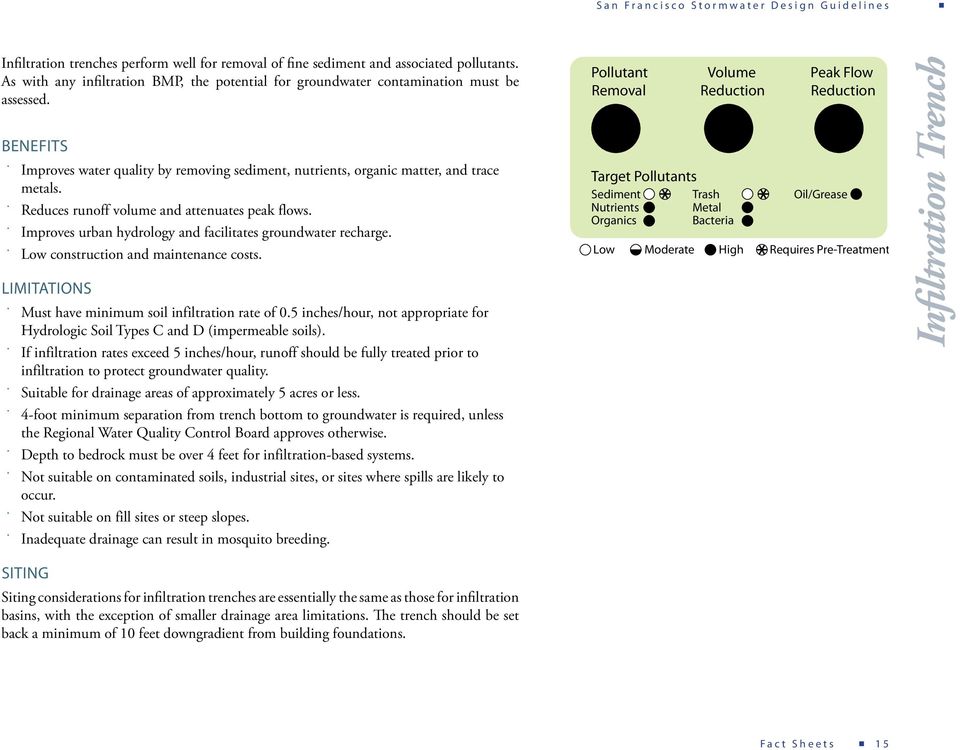
15 Infiltration trenches perform well for removal of fine sediment and associated pollutants. As with any infiltration BMP, the potential for groundwater contamination must be assessed. Benefits Improves water quality by removing sediment, nutrients, organic matter, and trace metals. Reduces runoff volume and attenuates peak flows. Improves urban hydrology and facilitates groundwater recharge. Low construction and maintenance costs. Limitations Must have minimum soil infiltration rate of 0.5 inches/hour, not appropriate for Hydrologic Soil Types C and D (impermeable soils). If infiltration rates exceed 5 inches/hour, runoff should be fully treated prior to infiltration to protect groundwater quality. Suitable for drainage areas of approximately 5 acres or less. 4-foot minimum separation from trench bottom to groundwater is required, unless the Regional Water Quality Control Board approves otherwise. Depth to bedrock must be over 4 feet for infiltration-based systems. Not suitable on contaminated soils, industrial sites, or sites where spills are likely to occur. Not suitable on fill sites or steep slopes. Inadequate drainage can result in mosquito breeding. Pollutant Removal Low Volume Reduction Target Pollutants Sediment Trash Nutrients Metal Organics Bacteria Peak Flow Reduction Oil/Grease Moderate High Requires Pre-Treatment Infiltration Trench Siting Siting considerations for infiltration trenches are essentially the same as those for infiltration basins, with the exception of smaller drainage area limitations. The trench should be set back a minimum of 10 feet downgradient from building foundations. Fact Sheets 15
16 San Francisco Stormwater Design Guidelines Drainage area and slope: Infiltration trenches are most successful when used for relatively small drainage areas, typically less than 5 acres. These areas can have high impervious cover. Infiltration trenches should not be used at sites with a drainage area slope greater than 15%. Soils and infiltration rate: Infiltration trenches can be implemented where infiltration rates are 0.5 inches per hour or greater. However, if infiltration rates are greater than 5 inches per hour, runoff should be fully treated prior to infiltration to protect groundwater quality. Infiltration rates can be determined through geotechnical investigations. Geotechnical reports should also be used to determine how stormwater runoff will move in the soil (horizontally and vertically), and whether there are any geological conditions that could inhibit the movement of water. Soils should not have more than 30% clay content or 40% clay and silt combined. Setbacks: Infiltration trenches should be placed a minimum of 10 feet downgradient or 100 feet upgradient of building foundations. If the drainage area is less than 1000 square feet or if the drainage area is less than 5000 square feet and adjacent buildings have waterproofed foundations, these setbacks can be reduced to 5 and 50 feet, respectively. In addition, infiltration-based BMPs must be at least 5 feet from any property line and 150 feet from any drinking water well. This infiltration vault doubles as a parking strip along the Sustainable Streetscapes and Fish Habitat Enhancement Project: Crown Street, Vancouver, British Columbia. Groundwater protection: The seasonally high groundwater elevation and depth to bedrock should both be at least 4 feet from the basin invert to protect groundwater quality. If hazardous materials and other harmful substances are stored or used within the contributing drainage area, an infiltration trench should not be used unless these materials can be effectively prevented from entering stormwater draining to the trench. If this cannot be accomplished, other BMPs that do not allow interaction with the groundwater should be considered. Design Considerations Dimensions: Infiltration trenches are generally between 3 and 8 feet deep and not more that 25 feet wide. They should have a flat surface and bottom to promote uniform infiltration across the trench. The top two inches should be a pea gravel filter layer with optional filter fabric below. Trench fill material should be double washed locally available rock with a diameter range of 1.5 to 2.5 inches and a porosity of about 35%. Below the rock layer is 16 F a c t S h e e t s

17 a 6-inch deep sand filter layer. There should be no vertical piping in an infiltration trench to avoid classification as a Class V injection well. The sides of the trench can be lined with filter fabric to prevent adjacent soils from clogging the rock. Pretreatment: Pretreatment measures to remove coarse sediment, oils, and greases before runoff reaches the infiltration trench are critical to prevent clogging and failure. Whether the trench is configured to receive concentrated inflow from a pipe or channel or to receive overland sheet flow, one or more pretreatment practices should be used to remove gross solids before runoff reaches the trench. Pretreatment measures include swirl separators, vegetated swales, and sediment basins. The upstream drainage should be completely stabilized before the trench is constructed, and construction techniques should minimize compaction of trench bottom. Overflow: Infiltration trenches should be designed to operate off-line, such that only design flows are diverted to the trench and the remainder are bypassed. Access: Designs for infiltration trenches should emphasize accessibility and ease of maintenance. Where possible the trench should have an underdrain with a shutoff valve to allow drainage in case the rock becomes clogged. An observation well (a perforated PVC leading to the bottom of the trench) should be included in the design to allow monitoring of the drawdown rate. Infiltration Trench Sizing: Infiltration trenches are sized using the volume-based calculations described in Step 7 of the Stormwater Control Plan chapter of the Guidelines. They should hold the design volume within the void space of the rock layer and should infiltrate all stored runoff within 24 to 48 hours. An electronic sizing tool is also provided with the Guidelines and is hosted on the SFPUC website at in the Stormwater Design Guidelines section. A dimension-based formula is also included with the sizing tool, which allows the user to specify dimensions based on site constraints. The tool will then calculate the volume of water treated and will indicate whether the performance measure has been met. Fact Sheets 17

18 San Francisco Stormwater Design Guidelines Operations and Maintenance Proper soil conditions, sufficient pretreatment measures, and well-designed operations and maintenance programs are the key to implementing successful and long-lasting infiltration trenches. As described above, maintenance reduction features should be incorporated into infiltration trenches and, as with all BMPs, infiltration trenches should have a direct access path for maintenance activities. A spill response plan must be developed which clearly identifies the emergency steps to be taken in the event of an accidental release of large quantities of hazardous or harmful substances to the trench. The table below provides more information on typical post-construction inspection and maintenance activities. Typical Inspection Activities for Infiltration Trenches Activity Check observation wells 48 hours after the end of wet weather. Failure to drain within this time period indicates clogging. Inspect pretreatment devices and diversion structures for sediment build-up and structural damage. Schedule Post-construction and semi-annually (beginning and end of rainy season) Typical Maintenance Activities for Infiltration Trenches Activity Schedule Remove sediment and oil / grease from pretreatment devices and overflow structures. As needed Replace pea gravel when clogged. Rehabilitate trench to original storage capacity and 48-hour drain rate by removing trench rock, tilling the bottom of the Upon failure trench, and replacing the bottom layer of sand. 18 F a c t S h e e t s

19 Cost Typical construction costs, including contingency and design costs, have been estimated at $5 per cubic foot of runoff treated; however, Caltrans has reported costs as high as $50 per cubic foot of runoff for trenches installed as retrofit measures (CASQA, 2003). Annual maintenance costs are estimated at between 5% and 20% of construction costs. Fairfax (2005) estimates the lifespan of an infiltration trench at 10 years for its cost analysis; however, the lifespan may be increased by adhering to pretreatment and maintenance protocols. References AND RESOURCES California Stormwater Quality Association TC-10: Infiltration Trench. California BMP Handbook- New Development and Redevelopment. Environmental Protection Agency Stormwater Technology Fact Sheet: Infiltration Trench (EPA 832-F ). Infiltration Trench Fairfax County Virginia Stormwater Program LID BMP Fact Sheet Infiltration Trenches. H. Barbaro and C. Kurison Evaluating Hydrodynamic Separators, Massachussets Highway Department. The Stormwater Manager s Resource Center. Stormwater Management Fact Sheet: Infiltration Trench. 18 June 2008 < Fact Sheets 19

20 San Francisco Stormwater Design Guidelines Permeable Pavement Also known as: pervious paving, porous pavement, grass pavers, green parking, pervious concrete, pervious asphalt, turf blocks, unit pavers, ungrouted brick/stone, crushed aggregate 1 Overflow to Collection System Pavers with Open Spaces filled with Gravel or Sand 2 4 Fine Gravel or Coarse Sand Bedding Layer 3 5 Transition Layer (Medium Gravel) 4 6 Coarse Gravel Storage Layer 5 Underdrain (if necessary) Subgrade Infiltration where Feasible 8 Description Permeable pavement is any porous load-bearing surface that temporarily stores rainwater prior to infiltration or drainage to a controlled outlet. Stormwater is stored in an underlying aggregate layer until it either infiltrates into the soil below, facilitating groundwater recharge, or is routed to the collection system. Research and monitoring projects have shown that permeable pavement reduces annual runoff volumes by approximately 60%, attenuates peak flows, and improves water quality by removing oil and grease, metals, and suspended solids. It does not typically remove nutrients. 20 F a c t S h e e t s

21 Permeable pavement systems are allowed on alleyway traffic lanes with prior approval from DPW, but not allowed on traffic lanes on streets classified as arterials or collectors. They are also appropriate in areas with light to medium-duty loads, such as parking lots, street-side parking areas, driveways, bike paths, patios, and sidewalks. Infiltration rates of permeable surfaces may decline over time to varying degrees depending on design and installation, sediment loads, and consistency of maintenance. To be considered a permeable pavement, the system must meet two criteria: (1) the depth of the aggregate layer must be sufficient to store the treatment volume and (2) the underlying soils must be able to drain the stored stormwater in less than 48 hours or an underdrain must drain the stored stormwater in 48 hours. Systems that do not meet these criteria are not considered permeable pavement and are instead considered a simple pervious surface. Benefits Reduces runoff volume and attenuates peak flows. Improves water quality by reducing fine grain sediment, organic matter, and trace metals. Reduces the heat island effect. Facilitates groundwater recharge. Provides noise reduction. May increase driving safety by reducing ponding. May increase safety for persons with disabilities by providing textured, non-slip surfaces and reducing ponding. Can be used as a design element to provide aesthetic benefits. Construction costs can be comparable or less than traditional paving. Pollutant Removal Low Volume Reduction Target Pollutants Sediment Trash Nutrients Metal Organics Bacteria Peak Flow Reduction Oil/Grease Moderate High Requires Pre-Treatment Permeable Pavement Limitations Limited to paved areas with slow and low traffic volumes. Maintenance costs can be greater than for traditional paving. Depth to bedrock and groundwater must be greater than 4 feet for infiltration based systems. Fact Sheets 21
22 San Francisco Stormwater Design Guidelines Siting Site conditions, including soil type, depth to bedrock, slope, and adjacent land uses, should be assessed to determine whether infiltration is appropriate beneath permeable pavement and to ensure that off-site sediment and pollutants are not directed onto the permeable surface. Drainage area and slope: Permeable pavement should be used on relatively flat sites to facilitate infiltration and minimize erosion. Typically, permeable pavement is not recommended for slopes greater than 5 percent. It is best suited for receiving runoff from impervious areas; if non-paved areas will drain to permeable pavement, it is important to filter sediment out of runoff before it reaches the permeable pavement to prevent the surface from clogging. Most types of permeable pavement can receive run-on from adjacent areas: permeable asphalt and concrete should be at least 33 percent of the total drainage area, while permeable pavers should be at least 66 percent of the total drainage area. Soils: The infiltration rate of the underlying soil should be at least 0.5 inches per hour if the system is designed for infiltration. Permeable pavement can also be installed over soils which have an infiltration rate less than 0.5 in/hr or even over contaminated soil or groundwater as long as a liner system (if required due to contamination) and underdrain are used to direct the stored water back to the collection system. Soils should also able to sustain traffic loading without excessive deformation. Country Lanes in Vancouver, Brtitish Columbia enhance the alley s aesthetic quality and reduce stormwater discharge to the City s stormsewer system by allowing runoff to flow over vegetation and infiltrate into the ground. Setbacks: Infiltration-based permeable pavement systems should be placed a minimum of 10 feet downgradient or 100 feet upgradient of building foundations. If the drainage area is less than 1000 square feet or if the drainage area is less than 5000 square feet and adjacent buildings have waterproofed foundations, these setbacks can be reduced to 5 and 50 feet, respectively. In addition, infiltration-based BMPs must be at least 5 feet from any property line and 150 feet from any drinking water well. Groundwater protection: If intended to infiltrate stormwater, permeable pavement should not be installed within 4 feet of bedrock or the seasonally high water table. To minimize risk of groundwater contamination, permeable pavement should not be used in areas with potentially hazardous materials or high pollutant loading, such as fueling stations, maintenance yards, industrial sites, or chemical storage areas. 22 F a c t S h e e t s
23 Design Considerations Pervious pavement can be integrated into a variety of landscapes such as roads (both in driving lanes and parking lanes), sidewalks, plazas, terraces and patios, and other hardscape features. These materials are supplied in a variety of colors and patterns to aesthetically enhance public spaces. Permeable pavement pairs effectively with other BMPs, including planter boxes, rain gardens and vegetated swales. Materials: Permeable pavement consists of a series of layered elements that allows percolation of stormwater. From top to bottom these layers are: a surface material, a bedding layer (also called a choking layer), a transition (or base) layer and a storage (or subbase) layer of permeable base rock, and the native soil. Common materials for the paving surface include: Permeable hot-mix asphalt: similar to standard hot-mix asphalt but with reduced aggregate fines (typically 2.5 inches deep) Permeable concrete: similar to standard concrete, but without the fine aggregate (sand and finer) and with optional special admixtures incorporated (typically 4 to 8 inches deep depending on loading) Interlocking block pavers: either cast-in-place or pre-cast concrete blocks with small joints or openings that can be filled with soil and grass or gravel Plastic grid systems: Grid of plastic rings that interlock and are covered with soil and grass or gravel Permeable Pavement Beneath this top layer is a 2 to 3-inch deep bedding layer (i.e., choker course) of fine gravel (AASHTO No. 8 or 9). The fine gravel provides some filtration of runoff without significantly reducing the surface infiltration rate of the overlying pavement. Below the bedding layer is a 3 to 4-inch deep transition (i.e., base) layer of 3/8-inch to 3/4- inch diameter crushed stone (AASHTO No. 57). Underneath this layer is a storage (i.e., subbase) layer of 3/4-inch to 1/2-inch diameter crushed stone (AASHTO No. 3). The storage layer should be as deep as needed to store the water quality volume, with a minimum depth of 6 inches. To increase porosity, reduce the presence of fines in the aggregate, and improve structural stability, all media should be clean, washed, open-graded crushed stone. Generally filter fabric is not recommended underneath the storage layer, but may be advisable in specific cases to prevent fines in the subgrade from moving into Fact Sheets 23
24 San Francisco Stormwater Design Guidelines the storage layer. A perforated underdrain should be used if the infiltration rate of the underlying soils is less than 0.5 inches per hour. An underdrain and impermeable liner should be used if the underlying soils or groundwater are contaminated. Pretreatment: To minimize clogging, sediment and trash should be screened prior to flow through permeable pavement and surfaces should undergo regular street cleaning and/ or vacuuming. Other techniques, such as the use of a vegetated buffer strip around the pervious pavement where it receives runoff from off-site, can also help reduce sediment loads. Permeable pavers are used in parking spaces in Germany Overflow: To accommodate large storm flows that exceed the capacity of the subsurface storage layer, the permeable pavement surface should have a perimeter trench called an overflow edge. This trench collects sheet flow from the saturated pavement surface, either directing it to the collection system or to an infiltration BMP such as an infiltration basin or trench. Where infiltration is not advisable, permeable pavement designs can incorporate a perforated underdrain beneath the paving layer. After stormwater percolates through the paving and subsurface media, the underdrain conveys flows to another BMP or to the collection system. Sizing: Permeable pavement can be sized using the volume-based calculations described in Step 7 of the Stormwater Control Plan chapter of the Guidelines. An electronic sizing tool is also provided with the Guidelines and is hosted on the SFPUC website at stormwater.sfwater.org in the Stormwater Design Guidelines section. Pervious asphalt in Portland, OR. Operations and Maintenance Permeable pavement requires periodic maintenance to retain its infiltration capacity. Permeable pavement should be vaccuumed once or twice annually. Vaccuuming has been found to be most effective when sediments are dry. If routine cleaning does not restore infiltration rates, then partial or full reconstruction of the pervious surface may be required. Also, broken or damaged pavement needs to be removed and replaced. Once a year, the paving should be tested to determine if it is clogged. This can be done in 5 minutes using a stopwatch and a sprinkler. The table on the following page provides more information on typical post-construction inspection and maintenance activities. 24 F a c t S h e e t s
25 Typical Inspection Activities for Permeable Pavement Activity Inspect to ensure pavement is functioning properly. Inspect adjacent areas for potential erosion or vegetation damage. Inspect porous areas for clogging with sediment, debris, or trash. Ensure that paving dewaters between storms. If planted, monitor health of vegetation. Inspect surface for structural deterioration. Inspect outlets for clogging. Measure infiltration rate. Schedule Post-construction Semi-annually Annually Typical Maintenance Activities for Permeable Pavement Activity Schedule Vacuum permeable surface. Semi-annually (beginning and end of rainy season) Reseed or replant bare areas. Replace or repair damaged pavement. Annually or as needed Maintain planted areas adjacent to pavement Lift surface paving units to clean and/or replace underlying aggregate - may require special disposal if containing metals or hazardous materials. Every years or as needed Permeable Pavement If routine maintenance does not restore the infiltration rate, rehabilitate pavement by removing and replacing clogged section. Upon failure (expected to be > 20 years) Fact Sheets 25
26 San Francisco Stormwater Design Guidelines Cost Permeable pavement can be up to 25 percent cheaper than traditional pavement when all construction and drainage costs are included. City of Portland staff estimate $2.45 per square foot for porous asphalt; not including construction. Porous concrete costs between $2 and $8.00 per square foot. The California Stormwater Management Association estimates a one-acre permeable pavement surface to incur $10,000 in total construction costs, and $4,000 in annual maintenance costs. Other estimates for installation costs average $10 per square foot. Permeable paving surfaces are expected to last for up to 25 years if properly maintained. References AND RESOURCES California Stormwater Quality Association TC-50: Water Quality Inlet. Stormwater Best Management Practice Handbook: New and Redevelopment. Fairfax County, Virginia LID BMP Fact Sheet: Permeable/Porous Pavements. 19 Jun 2008 < draft.doc>. Lake Superior Duluth Streams Minnesota Stormwater Manual, Version 1.0: Pervious Pavement. 9 Jun 2008 < paving.html>. North Carolina State University and A&T State University Cooperative Extension Urban Waterways: Pemeable Pavements, Green Roofs, and Cisterns. 19 June 2008 < Santa Clara Valley Urban Runoff Pollution Prevention Program (SCVURPPP) BMP Fact Sheets: Porous Pavement. 9 Jun 2008 < com/pdfs/2003workshop/three/porous_pavement.pdf>. Stormwater Management Fact Sheet: Porous Pavement. 9 Jun 2008 < stormwatercenter.net/>. 26 F a c t S h e e t s
27 Permeable Pavement Fact Sheets 27
28 San Francisco Stormwater Design Guidelines Detention Pond Also known as: detention pond, dry pond, dry detention basin, extended detention basin 25-foot Minimum Distance from Structures Erosion Protection Infiltration where Feasible Traditional Detention Pond Design Storm Elevation Sediment Accumulation Sediment Filter (Rip-rap, Fabric Sock, Trash Rack) Primary Outlet Overflow Inlet Trash Rack Emergency Spillway Outflow Water Quality Orifice Extended Detention Pond Description Detention ponds are temporary holding areas for stormwater that store peak flows and slowly release them, lessening the demand on treatment facilities during storm events and preventing flooding. Generally, detention ponds are designed to fill and empty within 24 to 48 hours of a storm event and therefore could reduce peak flows and combined sewer overflows. If designed with vegetation, ponds can also create wildlife habitat, and improve air quality. They can also be used to provide flood control by including additional flood detention storage. Three types of detention ponds are detailed below. They are all considered dry detention ponds because unlike wet ponds or retention basins, which are designed to have a permanent pool of water, all of these drain completely between storms Traditional dry detention ponds simply store water and then gradually release it into the collection system. Dry detention ponds do not provide water quality benefits, as they only detain stormwater for a short period of time. Dry detention ponds are good solutions for areas with poorly draining soils, or a high groundwater table, which limit infiltration. 28 F a c t S h e e t s
29 Extended dry detention ponds are designed to hold the first flush of stormwater for a minimum of 24 hours. Extended dry detention ponds have a greater water quality benefits than traditional detention ponds because the extended hold-time allows sediment particles to settle to the bottom of the pond. Multi-purpose detention ponds are only filled with water during storm events and can act as open spaces such as large play areas, dog parks, or athletic fields during dry weather. Benefits Reduces runoff volume and attenuates peak flows. Improves water quality by removing particulate matter and sediment (extended detention ponds only). Removes trash and debris. Reduces flooding. Low construction and maintenance costs. Good for sites where infiltration is not an option. Multi-purpose detention ponds create habitat and increase biodiversity in the city. Multi-purpose detention ponds provide open space and aesthetic amenity. Pollutant Removal Low Volume Reduction Target Pollutants Sediment Trash Nutrients Metal Organics Bacteria Peak Flow Reduction Oil/Grease Moderate High Requires Pre-Treatment Detention Pond A dry detention pond in the Algeurao Mem-Martins, located outside of Lisbon, Portugal, provides flood control during the short, wet season and serves as a neighborhood park with picnic tables, frequented by children riding bicycles and skateboards, during the rest of the year. Fact Sheets 29
30 San Francisco Stormwater Design Guidelines Limitations Limited pollutant removal potential (except extended detention ponds); ineffective at removing soluble pollutants (all types). Potential for groundwater contamination in coarse, well-drained soils (primarily extended detention ponds). 5-acre minimum drainage area for extended detention ponds. Inadequate drainage can result in mosquito breeding. Application limited by depth to bedrock and slope. Site must have no risk of land slippage if soils are heavily saturated. Must be sited with sufficient distance from existing foundations, roads, subsurface infrastructure, drinking water wells, septic tanks, and drain fields. Detention ponds can take on a formal arrangement in a courtyard space such as this one. Siting There are relatively few siting constraints for detention ponds, making them one of the most applicable technologies for stormwater management. Drainage area and slope: Extended detention ponds should be used at sites with a minimum drainage area of five acres. On smaller sites, the outlet orifice diameter necessary for a 24 to 48 hour drawdown time becomes very small, and is thus prone to clogging. In addition, it is generally more cost-effective to control larger drainage areas due to the economies of scale in basin construction. All detention pond types can be used on sites with slopes up to about 15%. The local slope in the immediate pond area needs to be relatively flat, however, in order to maintain reasonably flat side slopes. Soils and infiltration rate: Detention ponds can be used on almost all soil types and geology. In areas with rapidly percolating soils (over 2.5 inches per hour) such as coarse sands, detention ponds may need an impermeable liner to prevent groundwater contamination. A dry detention pond sited within a Children s play space in Augustenborg, Malmö/Sweden tests different methods of reducing and detaining peak stormwater flows while enhancing the neighborhood. Depth to groundwater: The base of the pond should not intersect the groundwater table to avoid creating a permanent pool where mosquitoes could breed. 30 F a c t S h e e t s
31 Design Considerations Dimensions: Detention ponds generally consist of a depressed area of land, or an area that is surrounded by earthen berms, where stormwater is directed and stored during storm events. Extended detention ponds have greatest pollutant removal capability when designed with a long flow path from inlet to outlet; a length to width ratio of at least 1.5:1 is recommended. No minimum or maximum slope requirements for the pond bottom have been set; however, the slope should be flat enough in the direction of flow to maintain a low flow velocity, but with enough elevation drop to avoid stagnant water and ensure that flow can move through the system. A rock-lined channel from inlet to outlet, called a pilot channel, should be included to convey low flows through the pond. Detention pond side slopes should be 3:1 (H:V) or flatter to minimize erosion and safety concerns and facilitate mowing. Detention ponds can also be hardscape architectural elements, in which case vertical walls are acceptable. Pond depths of 2 to 5 feet are considered optimal. Vegetation: Vegetation within the detention zone (up to the elevation of the design storm) appears to increase pollutant removal and decrease resuspension of accumulated sediment. Plants selected for this zone should be able to withstand both wet and dry periods. Woody plants can be used, but they are better suited to the areas above the elevation of the design storm, as they may cause accumulation of debris or block the flow path, thereby increasing the potential for standing water. If sufficient space is available, a vegetated buffer around the pond can be used to slow overland runoff entering via the side slopes and can help prevent access to the pond if desired. Detention Pond Pretreatment: Pond maintenance is reduced when runoff passes through a forebay or sedimentation basin that allows coarse sediment particles to settle before reaching the main pond. The forebay is typically 10 percent of the detention basin volume. Inlet structures: An energy dissipation structure should be included at the pond inlet to prevent erosion and resuspension of accumulated sediment. Stilling basins should not be used for this purpose because they create a pool of standing water where mosquitoes can breed. Outlet structures: A typical detention pond outlet system includes a primary outlet, an overflow device for storms greater than the design storm, and an emergency overflow for large flood events. For extended detention ponds, the primary outlet is a water quality In urban commercial centers, detention ponds serve as a visual amenity and natural oasis. Fact Sheets 31
32 San Francisco Stormwater Design Guidelines orifice or valve that regulates the drawdown time of the pond; 48 hours is recommended for optimal pollutant removal and prevention of mosquito breeding. An overflow weir or riser should be set at the elevation of the design storm for all online ponds. Additionally, online ponds must include a separate emergency weir or spillway to safely pass runoff from large flood events (pass the 25-year event with one foot of freeboard, and safely pass the 100-year event). A trash rack should be used to prevent clogging of outlet structures. The outlet should include a valve that can stop outflows from the pond in case of a spill in the watershed; this valve can be the same valve that is used to regulate pond drawdown time. Any outfall pipes greater than 48 inches in diameter must be fenced for safety. Finally, if the pond discharges to a natural waterway, the pond outfall should be stabilized to prevent erosion. Next to a workplace or school, a detention pond can provide a place for relaxation and repose. Access: A ramp and perimeter access to the main pond and sediment forebay should be included in the design of detention ponds to facilitate access for inspection and maintenance. Sizing: Detention ponds are sized using the volume-based calculations described in Step 7 of the Stormwater Control Plan chapter of the Guidelines. An electronic sizing tool is also provided with the Guidelines and is hosted on the SFPUC website at sfwater.org in the Stormwater Design Guidelines section. Detention ponds are typically sized for a drawdown time of 12 to 48 hours, depending on the type of pond. Any runoff that exceeds the holding capacity is discharged back into the collection system. Operations and Maintenance Maintenance requirements for detention ponds consist mainly of periodic sediment removal, vegetation management, and vector abatement if needed. The table on the following page provides more information on typical post-construction inspection and maintenance activities. A detention pond can support water-loving plants, even in an urban setting. Cost The construction, design, and permitting costs for an above ground detention pond with a one acre-foot storage volume are estimated at approximately $42,000 (CASQA, 2003; SMRC). However, CASQA (2003) also cites an example of a 0.3 acre-foot Caltrans detention pond that cost $160,000, highlighting the difficulty in developing construction cost estimates. The annual cost of routine maintenance is typically estimated at about 3 to 5 percent of construction costs. 32 F a c t S h e e t s
33 Typical Inspection Activities for Detention Ponds Activity Inspect pond for standing water to confirm drawdown time of no more than 48 hours after end of wet weather. Inspect for erosion of banks or bottom and for presence of burrows or other damage to embankments. Confirm that inlet and outlet structures are operational and free of debris. Monitor sediment accumulation in the main pond and forebay. Typical Maintenance Activities for Detention Ponds Activity If standing water present more than 48 hours, adjust outflow devices or regrade pond bottom. Remove trash and debris, especially at outlet structures. Correct erosion or damage to banks and bottom. Repair inlet and outlet structures as needed. Mow to prevent establishment of woody vegetation in areas below the elevation of the design storm. Seed or sod to restore dead or damaged vegetation. Remove sediment from forebay. Remove sediment when the pond volume has been reduced by 25%. Schedule Semi-annually (beginning and end of rainy season) Annually (end of rainy season) Schedule Semi-annually (beginning and end of rainy season) Annually Every 5-7 years Every years Detention Pond References AND RESOURCES California Stormwater Quality Association TC-22 Extended Detention Basin. California Best Management Practice Handbook - New Development and Redevelopment. San Fancisco Public Utilities Commission Urban Watershed Planning Charrette: Low Impact Design Toolkit. The Stormwater Manager s Resource Center. Stormwater Management Fact Sheet: Dry Extended Detention Pond. 18 June 2008 < Fact Sheets 33
34 San Francisco Stormwater Design Guidelines Detention Vault Also known as: wet vault, detention tank Inlet Maintenance Access and Ladders Live Storage Permanent Pool Coarse Sediment Baffle at 25 to 50% of Volume Flow Restrictor Sized to Drain in 48 Hours Fine Sediment Outflow to Storm Drain Description A detention vault is an underground stormwater storage tank typically made of reinforced concrete that is designed to accommodate a permanent water pool. For extended detention, the vault may have a constricted outlet that causes a temporary rise of the water level, which drains over the course of 48 hours following the end of each storm. Inflow can come from runoff from a drain grate located at the ground surface, or from a subsurface storm drain pipe. Detention tanks are a form of detention vaults that utilize oversized pipes to detain runoff. The minimum pipe diameter used for the detention tank is generally 36 inches. A flow restrictor at the downstream end of the tank limits outflow, causing runoff to be temporarily stored in the tank. The tank bottom is typically at least 0.5 feet below the inlet and outlet to provide dead storage for sediment. A manhole with a sump is located immediately upstream of the tank to control inflow and capture larger sediment F a c t S h e e t s
35 Benefits Reduces flooding and peak flow rate. Removes solids, floatables, and other particulate pollutants. Few space limitations can be placed underground in most areas. Advantageous in areas unsuitable for infiltration. Versatile, wide variety of appropriate scales and locations. Limitations Potentially high excavation and installation costs. Minimal water quality treatment achieved. Single purpose not beneficial to wildlife or community at large. Requires regular removal of sediment build-up to prevent noxious gas accumulation. Requires regular maintenance for vector control and to prevent clogging. Vault must be large enough to meet minimum OSHA confined space entry requirements. Pollutant Removal Low Volume Reduction Target Pollutants Sediment Trash Nutrients Metal Organics Bacteria Peak Flow Reduction Oil/Grease Moderate High Requires Pre-Treatment Detention Vault Siting Detention vaults can be sized to treat any drainage area, but are most practical for drainage areas less than 10 acres. They are typically constructed using at least 3,000 psi structural reinforced concrete and are designed for H-20 traffic loading, which enables them to be installed beneath streets and parking lots. Designs often include baffles and peak flow bypasses to improve retention of solids and floatables. Because they are underground, they may be more expensive, and can be expensive to retrofit in existing built areas. However, detention vaults can detain a significant volume of stormwater, more so than many other BMPs. Design Considerations Dimensions: Detention tanks are typically greater than 3 feet in diameter. Detention vaults are usually greater than 7 feet in internal height and typically range from 4 to 10 feet in width, but these dimensions can vary significantly based on site conditions, project resources, and design intent. The vault shape is usually rectangular with a length to width ratio of 2:1 or greater; however, some designs employ a circular vault shape. Manhole covers over the inlet and outlet of the vault allow entry for maintenance. Vault floors Fact Sheets 35
36 San Francisco Stormwater Design Guidelines should be sloped at least 5% from the edges towards the center axis, and should be sloped longitudinally towards the inlet to facilitate sediment removal. Inlets and outlets should be placed at opposite corners of the vault to maximize the flow path length. To facilitate access, ladders should be built into vault walls, and ventilation pipes must allow air into the space before maintenance workers can be allowed to enter. Treatment: Detention vaults do not target removal of dissolved nutrients, metals, or organic material. As sediment levels increase in the vault, resuspension can occur, which reduces the treatment efficiency of the BMP. Without pretreatment screening, vaults can fill up quickly and clog with large solids. A vegetated swale can be used to remove larger solids and to convey flow to the detention vault. If a higher level of treatment is required, a detention vault can be paired with a downstream filtration device. Some media filters, such as the Delaware and DC Sand Filters, utilize a wet vault followed by a filter chamber. Flow Configuration: Wet vaults can be designed as offline or online devices. In the offline configuration, only flows less than or equal to the design treatment capacity are directed to the vault. In the online configuration, all flows are routed to the device, but the vault typically contains an internal bypass to direct high flows around the sedimentation area. This helps to prevent re-suspension of settled sediment. Sizing: Detention vaults are sized using the volume-based calculations described in Step 7 of the Stormwater Control Plan chapter of the Guidelines. An electronic sizing tool is also provided with the Guidelines and is hosted on the SFPUC website at sfwater.org in the Stormwater Design Guidelines section. Operations and Maintenance Maintenance of detention vaults includes post-construction and annual inspections. During the first wet season of operation following construction, inspect the vault twice for debris, sediment, and petroleum product accumulation. Use these findings to establish an annual inspection and removal schedule. Because accumulated sediment reduces treatment efficiency over time, removal of accumulated material with an eductor or vactor truck may be required every one to two years. Floatables may need to be removed separately due to the presence of petroleum products. The table on the following page provides more information on typical postconstruction inspection and maintenance activities. 36 F a c t S h e e t s
37 Typical Inspection Activities for Detention Vaults Activity Inspect vault twice during first wet season of operation, setting cleaning frequency accordingly. Inspect for cracks, inlet or outlet area erosion, and clogging. Typical Maintenance Activities for Detention Vaults Activity Remove litter, oil, and grease from inlet and outlet areas. Remove accumulated sediment when the 0.5 to 1-ft deep sediment storage zone is full may require special disposal if sediment contains metals or trace organic compounds. Schedule Post-construction Semi-annually Schedule Semi-annually (beginning and end of rainy season) Bi-annually or as needed Detention Vault Cost Detention vaults can be more expensive than other BMPs because they require excavation and concrete lining, but they can achieve significant reduction in stormwater peak flow. In Denver, Colorado, a 14,000 square foot detention vault with a sand filter and pump cost $15,000 for installation, including permits, fees, and labor, and an estimated $10,000 per year in maintenance costs. References AND RESOURCES California Stormwater Quality Association MP-50: Wet Vault. California Best Management Practice Handbook- Municipal. City of Seattle Title Stormwater, Grading, and Drainage Control. Stormwater Treatment Technical Requirements Manual Vol. 4. Department of Natural Resources and Parks, King County, Washington Surface Water Design Manual. Fact Sheets 37
38 San Francisco Stormwater Design Guidelines Wet Pond Also known as: stormwater pond, retention pond, wet extended detention pond Inlet Forebay: 6-inch Rock-filled Storage Depth Aquatic Bench Maximum Capacity Live Storage Permanent Storage: 3-foot, 6-inch Pool Depth Infiltration Where Feasible 7 Overflow Control Structure 8 Outlet 9 Description Wet ponds are constructed basins that have a permanent pool of water throughout the wet season, potentially extending throughout the year. The primary removal mechanism is settling while stormwater runoff resides in the pool. Where algae is present, algal uptake also aids stormwater treatment. Nutrient uptake also occurs through biological activity in the sediment and water. Wet ponds differ from constructed wetlands in that they are typically deeper, ranging from 3 to 6 feet, and have less vegetative cover. Wet ponds are among the most cost-effective and widely used stormwater treatment practices. The typical configuration of a wet pond includes forebay storage, permanent storage, and live storage areas. The forebay is a small inlet pool that allows settling of coarse and medium grained sediment. Permanent storage refers to the permanent pool of water remaining in the wet pond between storm events and during dry weather. If intended as wildlife habitat or permanent water feature, supplemental water may be required to maintain the permanent pool during the dry season. Live storage refers to the remaining storage capacity in the wet pond that will vary based on stormwater influx. The stormwater 38 F a c t S h e e t s
39 in the live storage area will generally drain from the pond 24 to 48 hours after the end of a storm event. Benefits Reduces stormwater volume and peak flow. Removes many stormwater pollutants via sedimentation and biological transformation. Can be an attractive and recreational public park amenity. Creates wildlife and wetland habitat. Suitable for sites with poor infiltration rates. Suitable for large drainage areas. Pollutant Removal Target Pollutants Sediment Nutrients Organics Low Volume Reduction Trash Metal Bacteria Peak Flow Reduction Oil/Grease Moderate High Requires Pre-Treatment Wet Pond Limitations Requires relatively large land area and large drainage area (around 25 acres), thus making it a good choice for master-planned and multi-parcel developments. Supplemental water required to maintain permanent pool may outweigh volume reduction benefits. If seasonally dry, may appear dusty or unsightly. Siting Drainage area and slope: Wet ponds must be sited on a relatively flat area with less than 2 percent slope, but can receive drainage from upstream slopes of up to 15 percent. While there is no minimum slope requirement, there must be enough elevation drop from the pond inlet to the pond outlet to ensure that water can flow through the system by gravity. Though they only occupy 2 to 3 percent of their contributing drainage area, wet ponds require sufficient drainage to maintain a permanent pool, typically around 25 acres or more. Soils and infiltration rate: Because they do not infiltrate stormwater, wet ponds can be used in almost all soil types. In Mediterranean climates like San Francisco, wet ponds may either be allowed to evaporate in the dry season, or may be supplemented with an alternative source of influent water. Dry-weather water sources could be street and irrigation runoff, recycled water, groundwater, or other urban water applications. Fact Sheets 39
40 San Francisco Stormwater Design Guidelines A wet pond serves as a focal point in this residential courtyard, providing air and water-quality benefits, as well as enhancing the aesthetic appeal of the courtyard. Depth to groundwater: Wet ponds may intersect the groundwater table, though this should be avoided in areas where either the stormwater or the groundwater could be contaminated. Design Considerations Vegetation: Though typically deeper than wetland plant rooting depth, wet ponds should incorporate an aquatic bench around their perimeter. The aquatic bench is a shallow shelf between 1 and 3 feet deep that supports wetland vegetation. In addition to facilitating stormwater treatment via biofiltration, this feature also helps to stabilize the soil at the edge of the pond and enhances habitat and aesthetic value. Native species that can tolerate drought and inundation should be used wherever possible. Common stormwater wetland plant species include cattail (Typha latifolia), bulrush (Scirpus spp.), and reeds (Phragmites spp.). However, cattails tend to require more maintenance because they can easily spread to nearby areas and become a nuisance. Pretreatment: A pretreatment forebay can settle out coarse sediment before it reaches the main pool. Forebays are typically about 10 percent of the total wet pond volume, can store up to 6 inches of stormwater temporarily, and are located near the pond inlet. This can greatly reduce regular maintenance costs, though accumulated sediment should be removed from the forebay every five to seven years. A vegetated buffer should be created around the pond to protect the banks from erosion, and to provide some pollutant removal before runoff enters the pond by overland flow. This landscaping can also make the pond a more aesthetic asset to the community. Larger wet ponds may provide an opportunity for recreation. Treatment: Wet ponds are among the most effective BMPs to remove pollutants from stormwater, along with constructed wetlands. While the degree of treatment varies with the volume and retention time of the permanent pool, wet ponds have been shown to remove on average 80 percent of suspended solids, percent of nitrogen and phosphorus, 70 percent of bacteria, and 30 percent of metals. Drainage: Stormwater should be conveyed to and from all wet ponds safely and to minimize downstream erosion potential. The wet pond outfall should always be stabilized to prevent scour. An emergency spillway should be provided to safely convey large flood events into the combined sewer system or a receiving water body. If discharging to streams, lakes, or 40 F a c t S h e e t s
41 the bay or ocean, designers should provide shade around the outflow channel to prevent warming that could adversely affect aquatic species. Overflow: Wet ponds should be designed with a non-clogging outlet such as a weir outlet with a trash rack or a reverse slope pipe that is at least 3 inches in diameter. Because reverse slope pipes draw water from below the level of the permanent pool, they are less likely to be clogged by floating debris. If the wet pond is on-line, meaning it receives continuous flow that cannot be diverted, principle and emergency spillways should provide at least 1 foot of freeboard during the 25 year storm, and should safely pass the 100 year flood. Wet Pond Access: For ease of maintenance, wet ponds should incorporate direct access to both the forebay and the main pool of ponds. In addition, ponds should generally have a drain to draw down the pond or forebay to facilitate periodic sediment removal. Sizing: Wet ponds are sized using the volume based calculations described in Step 7 of the Stormwater Control Plan chapter of the Guidelines. An electronic sizing tool is also provided with the Guidelines and is hosted on the SFPUC website at sfwater.org in the Stormwater Design Guidelines section. To minimize short circuiting, wet ponds should always be designed with a length to width ratio of at least 1.5:1. In addition, the design should incorporate features to lengthen the flow path through the pond, such as baffles or underwater berms designed to create a longer flow path through the pond. Combining these two measures helps ensure that the entire pond volume is used to treat stormwater. Another feature that can improve treatment is to use multiple ponds in series as part of a treatment train approach to pollutant removal. This redundant treatment can also help slow the rate of flow through the system. Operations and Maintenance In addition to incorporating features into the pond design to minimize maintenance, some regular maintenance and inspection practices are needed on a seasonal and an annual basis. The table on the following page provides more information on typical post-construction inspection and maintenance activities. Fact Sheets 41
42 San Francisco Stormwater Design Guidelines Typical Inspection Activities for Wet Ponds Activity Inspect for erosion damage, animal burrows, and structural integrity, especially of pond outlet. Inspect for signs of hydrocarbon build-up and deal with appropriately. Monitor for sediment accumulation in the forebay and main pond. Examine to ensure that inlet and outlet devices are operational and free of debris. Schedule Semi-annually (beginning and end of rainy season) Typical Maintenance Activities for Wet Ponds Activity Remove debris from and clean inlet and outlet structures. Remove accumulated trash and debris from forebay and edges of main pond. Mow or trim side slopes if vegetated. Repair undercut or eroded areas. Stock permanent pool with mosquitofish (Gambusia spp.). Remove accumulated sediment from forebay area. Replant vegetation as necessary. Remove sediment from permanent pool when volume has significantly decreased, or if the pond becomes eutrophic. Schedule Semi-annually (beginning and end of rainy season) Every 5 to 7 years Every 20 to 50 years 42 F a c t S h e e t s
43 Cost Typical wet pond costs range from $0.50 to $1.00 per cubic foot ($17.50-$35.00 per cubic meter) of storage area, but vary by size and site location. New wet ponds in undeveloped areas are easier and cheaper to construct than retrofit ponds in developed areas. For reference, the City of Austin spent $584,000 on a 2.5 acre-foot wet pond, and Caltrans spent $448,000 on a 0.8 acre-foot wet pond. Operations and maintenance costs should be low, typically between 3 and 5 percent of construction costs, and wet ponds can last well over 20 years. Caltrans estimates annual maintenance costs for a wet pond treating 4.2 acres to be $17,000 per year; in contrast, King County estimates annual wet pond maintenance costs to be $3,000 per pond. On-site disposal can reduce sediment removal costs by up to 50 percent. Wet Pond References AND RESOURCES California Stormwater Quality Association TC-20: Wet Pond. California Best Management Practice Handbook- Municipal. Center for Watershed Protection Stormwater Management Fact Sheet: Wet Pond. 5 Jun 2008 < City of Seattle Title Stormwater, Grading & Drainage Control Code. Stormwater Treatment Technical Requirements Manual Vol. 4. United States Environmental Protection Agency NPDES Stormwater Technology Fact Sheet: Wet Detention Pond Fact Sheet (EPA 832-F ). 5 June 2008 < Fact Sheets 43
44 San Francisco Stormwater Design Guidelines Vegetated Swale Also known as: grassed channel, grassy swale, dry swale, biofilter. Stormwater Runoff Maximum 5% Channel Slope Check Dams Recommended for Slopes Over 5% 6-inch Grass Height Recommended Maximum Treatment Depth 2/3 of Grass Height Trapezoidal Form 6 10-foot Maximum Channel Bottom Width 3:1 Maximum Channel Bank Slope Infiltration Description A vegetated swale is a broad, shallow channel with dense vegetation covering the side slopes and bottom. The vegetation enhances sedimentation, traps particulate pollutants (suspended solids and trace metals), and reduces flow velocities as stormwater flows along the swale bottom. Some infiltration also occurs, which decreases runoff volume and provides additional filtering. Vegetated swales can be designed as part of the stormwater conveyance system and can potentially eliminate the need for curbs, gutters and storm drains. They are also wellsuited to treat runoff from roads and highways because of their linear nature. Swales can be paired with many other treatment measures, such as wet ponds, infiltration basins, and wetlands. The three most common design variations of the vegetated swale are known as the dry swale, the wet swale, and the grassed swale. The dry swale is designed as a linear, sloped bioretention system (see Bioretention fact sheet). It is sized to capture and filter the water quality volume (WQv). The WQv filters through engineered soil media at the base of the dry swale and is infiltrated into the native soils or collected by an underdrain system. 44 F a c t S h e e t s
45 A wet swale is designed as a linear, sloped wet basin. There is a permanent pool of water at the base of the swale, and the WQv is captured and detained in the upper part of the swale. The shallow standing water in wet swales can lead to vector concerns and is therefore not generally recommended for residential applications. In contrast to the volume-based dry and wet swales, the grassed channel (also called a biofiltration swale) is a flow-based system sized to treat the water quality flow (WQf). The vegetation in the grassed channel provides some filtration and solids removal as the WQf is conveyed through the system. The treatment effectiveness is correlated to the residence time of the WQf in the swale, and therefore, flow-based swales can be considerably longer than a typical treatment BMP. Benefits Reduces runoff volume and attenuates peak flows. Improves water quality by removing sediment, particulate matter, and trace metals. Creates habitat and increases biodiversity in the city. Infiltration of runoff improves urban hydrology and facilitates groundwater recharge. Provides aesthetic amenities. Improves air quality. Low installation costs. Low maintenance requirements. Pollutant Removal Low Volume Reduction Target Pollutants Sediment Trash Nutrients Metal Organics Bacteria Peak Flow Reduction Oil/Grease Moderate High Requires Pre-Treatment Vegetated Swale Limitations Impractical in areas with very flat or very steep topography or with erosive or poorly drained soils. Little removal of dissolved pollutants and bacteria. Poor pollutant removal if vegetation vigor and density is degraded. Poor pollutant removal and vulnerable to erosion when flow velocities are high Limited to relatively small drainage areas. Fact Sheets 45
46 San Francisco Stormwater Design Guidelines Siting Drainage area and slope: Vegetated swales can be used to treat runoff from small drainage areas with up to 5 acres of impervious surface. Swales are best used on sites with relatively flat slopes. Larger drainage areas and steeper slopes result in flow velocities that are too high to allow adequate treatment and may cause erosion of the swale bottom and side slopes. Soils and infiltration rate: Vegetated swales are most effective on soils that allow infiltration. Care should be taken to avoid soil compaction. If infiltration is desired, the underlying soil drainage rate should exceed 0.5 inches per hour. In some cases, however, swales can be installed on top of impermeable soils by excavating the native soil and replacing it with a layer of well-drained planting medium and an underdrain. Soils that consist mainly of gravels and coarse sands may also be problematic if they cannot support dense enough vegetation growth to adequately treat runoff. If there is a concern about groundwater contamination in an area with coarse soils, the swale may be lined. Depth to groundwater: There should be at least 4 feet of separation between the bottom of the swale and the water table to prevent a moist swale bottom, which impacts the growth of grass and other plants not accustomed to long periods of root inundation. This separation also helps prevent groundwater contamination and mosquito breeding. Design Considerations Dimensions: Swales should generally have a trapezoidal shape with a flat bottom (in the direction perpendicular to flow) to promote even flow across the whole width of the swale. The bottom width should be between 2 and 10 feet. The minimum allows for ease of mowing if grass is used and ensures adequate planted area for water quality treatment; the maximum prevents the formation of small channels within the swale bottom. Side slopes are generally designed to be 3:1 (H:V) or greater to increase the treatment area, prevent erosion, accommodate mowing, and slow runoff entering the swale from the sides. However, if an architectural edge is desired and runoff does not enter from the swale sides, hardscaped vertical sides and a broad, flat bottom may be designed. The length of flowbased swales is typically determined by providing 5 to 10 minutes of residence time for pollutant removal, with a minimum length requirement of 100 feet. There is no maximum length. 46 F a c t S h e e t s
47 The recommended longitudinal slope for swales is typically between 1% and 6%, with a slope around 2% being preferred. Limiting the longitudinal slope helps maintain a low flow velocity. Check dams can be installed in swales to promote additional infiltration and should be used if the longitudinal slope exceeds 5%. Vegetation: A dense vegetative cover on the swale bottom and side slopes filters pollutants out of runoff and helps reduce flow velocities and protect the swale from erosion. Fine, close-growing grasses are ideal because increasing the surface area of the vegetation exposed to runoff improves the effectiveness of the swale. Native wildflowers and ground covers can also be used. Vegetation that can tolerate both wet and dry conditions as well as accumulations of sediment and debris are best-suited for swales. No runoff shall be allowed to flow in the swale until the vegetation is established. Irrigation may be required until vegetation is established. Because swales rely on dense vegetation for pollutant removal and flow attenuation, proper sun exposure for selected plantings must be carefully considered. If grasses are used, the swale should receive a minimum of 6 hours of sunlight daily during the summer months throughout the length of the swale. Alternative vegetation should be considered if sun exposure is limited. Examples of vegetation appropriate for swales can be found in the Vegetation Palette, Appendix D of the Guidelines. Vegetated Swale Flow: Flow depth should be limited to 4 to 6 inches to facilitate pollutant removal. The maximum flow velocity in a vegetated swale should be 1 foot per second under flow conditions designed to provide water quality treatment. Under higher flow conditions, the maximum velocity should be 3 feet per second to avoid erosion. A high-flow bypass should be used if velocities will exceed this value. A flow spreader should be used at the swale inlet to dissipate energy and spread runoff evenly across the swale bottom. If a swale discharges to a slope rather than to a piped system or confined channel, an energy dissipater should be used at the outlet. Sizing: Vegetated swales are sized using the flow-based or volume-based calculations described in Step 7 of the Stormwater Control Plan chapter of the Guidelines. An electronic sizing tool is also provided with the Guidelines and is hosted on the SFPUC website at in the Stormwater Design Guidelines section. Fact Sheets 47
48 San Francisco Stormwater Design Guidelines Typical Inspection Activities for Vegetated Swales Activity Check that the swale drains within the design drawdown time (typically 48 hours). Inspect for erosion, damage to vegetation, channelization of flow, debris and litter, and sediment accumulation. Inspect level spreader for clogging and correct as necessary. Schedule Post-construction and semi-annually (beginning and end of rainy season) Semi-annually (beginning and end of rainy season) Annually Typical Maintenance Activities for Vegetated Swales Activity Regularly water during the first three months as vegetation establishes roots. Mow grass to maintain a height of 3-4 inches. Remove litter prior to mowing. Provide weed control, if necessary, to control invasive species. Remove litter, branches, rocks, blockages, and other debris. Repair any erosion rills, gullies, or damaged areas within channel and replant bare areas as necessary. Remove sediment from head of swale if vegetation growth is inhibited or if the sediment is blocking the even spreading of water to the rest of the swale. Plant alternative vegetation if original vegetation is not successfully established. Reseed and apply mulch to damaged areas. Rototill or cultivate the surface of the soil bed if the swale does not drain within 48 hours after the end of wet weather. Remove sediment build-up from the bottom of the swale once it has accumulated to 10% of the original design volume. Schedule Post-construction As needed (frequently) Semi-annually (beginning and end of rainy season) Annually As needed (infrequently) 48 F a c t S h e e t s
49 Operations and Maintenance If properly designed and regularly maintained, vegetated swales can last indefinitely. Pretreatment designed to remove trash and coarse sediment will reduce the maintenance burden for the swale itself. The primary maintenance objective for vegetated swales is to maintain the hydraulic and removal efficiency of the channel with a dense, healthy vegetative cover. During construction, it is important to stabilize the swale before the vegetation has been established, either with a temporary grass cover, or the use of natural or synthetic erosion control products. The table on the previous page provides more information on typical post-construction inspection and maintenance activities. Cost EPA (1999) reports that construction costs range from $5 to $9 per linear foot for a 15- foot wide (top width) swale to $8.50 to $50 per linear foot depending on the width and depth of the swale. SMRC (2008) and EPA (2008) both estimate $0.50 per square foot ($7.50 per linear foot for a 15-foot wide swale). EPA (1999) provides tables showing capital costs and annual operations and maintenance costs for swales. Construction of vegetated swales can be less expensive than other more traditional conveyance systems such as concrete ditches or sewers. Annual maintenance costs are estimated at about 6% of construction costs (EOR Inc.). Vegetated Swale References AND RESOURCES California Stormwater Quality Association TC-30: Vegetated Swale. California BMP Handbook- New Development and Redevelopment. City of Seattle Title Stormwater, Grading, and Drainage Control. Stormwater Treatment Technical Requirements Manual Vol. 4. Emmons & Olivier Resources. Presentation: Minnesota Low Impact Development Comparison Study Cost Comparison. 18 June 2008 < com/pdfs/resources/lid/development_&_maintenance_cost.pdf>. Environmental Protection Agency. National Pollutant Discharge Elimination System Menu of Best Management Practices Fact Sheets: Grassed Swales. 18 June 2008 < Fact Sheets 49
50 San Francisco Stormwater Design Guidelines Vegetated Buffer Strip Also known as: grassed filter strip, vegetated filter, infiltration planter strip 1 2 Curb Cuts Evenly Disperse Run-off Inflow Thick Vegetation on Slope with 15% Maximum Incline 60-foot Maximum Road Width per Buffer foot Minimum Buffer Strip Width 4 Infiltration where Feasible 5 Description Vegetated buffer strips are sloping planted areas designed to treat and infiltrate sheet flow from adjacent impervious surfaces. They slope away from the impervious surface and are most often planted with grass, though other uniformly distributed plant species are also appropriate. Buffer strips function by slowing stormwater runoff and allowing sediment and other pollutants to settle and infiltrate. Vegetated buffer strips are well-suited to treating runoff from roads and highways, roof downspouts, small parking lots, and pervious surfaces. They are also appropriate for the outer zone of a stream buffer, or as pretreatment for another stormwater BMP that provides detention or storage. In addition, they are generally attractive features that tend to be viewed as landscape amenities rather than as stormwater infrastructure. Benefits Improves water quality. Attenuates peak flows, recharges groundwater. Good for roadside shoulders and landscape buffers. 50 F a c t S h e e t s
51 Attractive landscape feature. Minimal maintenance required. Easy to customize to varying site conditions. Limitations Not appropriate for industrial or contaminated sites. Limited ability to treat large drainage areas. Limited stormwater volume reduction. May require irrigation in dry season, depending upon species. Persistent stormwater pollutants may accumulate in sediments, such as metals, oil, and grease. Siting Drainage area and slope: In general, buffer strips are thought to be effective at treating contributing areas that are up to twice the size of the buffer area. Because buffer strips cannot treat large amounts of runoff, the maximum drainage width (with the direction of flow being towards the buffer) of the contributing drainage area should be 60 feet. In general, a buffer strip should be at least 15 feet wide in the direction of flow to provide water quality treatment. Both the top and toe of the slope should be flat and even to encourage sheet flow and prevent erosion. The top of the strip should be set 2 to 5 inches below the adjacent pavement or contributing drainage area, so that vegetation and sediment accumulation at the edge of the strip does not prevent runoff from entering. Though once thought to help evenly distribute flow at the top of the buffer strip, level spreaders such as berms, sawtooth concrete borders, or rock trenches are no longer encouraged, because they tend to erode, wash out, and require more maintenance. Pollutant Removal Low Volume Reduction Target Pollutants Sediment Trash Nutrients Metal Organics Bacteria Peak Flow Reduction Oil/Grease Moderate High Requires Pre-Treatment Vegetated Buffer Strip Buffer strips should be sited on gentle slopes between 1 and 15 percent. Steeper slopes may trigger erosion during heavy rain events, thus eliminating water quality benefits. If the buffer strip slope is less than 0.5 percent, or if the underlying soil has infiltration rates of less than 0.5 inches per hour, an underdrain system should be installed to facilitate drainage. The underdrain would be sited at the toe of the buffer strip and connected to the municipal collection system or a stormwater detention or retention BMP. The upstream boundary of the filter should be contiguous to the contributing drainage area. Fact Sheets 51
52 San Francisco Stormwater Design Guidelines Soils and infiltration rate: Planting soil should be at least six inches deep. Native soil can be used if approved by the project landscape architect. For engineered vegetative strips, the facility surface should be graded flat prior to placement of vegetation. If infiltration is desired, the underlying soil matrix should drain at a rate of at least 0.5 inches per hour. Design Considerations Vegetation: The vegetative surface should extend across the full width of the area being drained. The thicker and more uniform the plant cover, the greater the stormwater management benefits. In San Francisco s Mediterranean climate, native plants that can tolerate both inundation and drought should be used where possible, to minimize irrigation and fertilizer costs. Initial establishment of vegetation requires attentive care including appropriate watering, fertilization, and prevention of excessive flow across the facility until vegetation completely covers the area and is well established. Use of a permanent irrigation system may help provide the maximum water quality performance. Sizing: Vegetated buffer strips are sized using the flow-based calculations described in Step 7 of the Stormwater Control Plan chapter of the Guidelines. An electronic sizing tool is also provided with the Guidelines and is hosted on the SFPUC website at sfwater.org in the Stormwater Design Guidelines section. Operations and Maintenance The maintenance of vegetated buffer strips mainly consists of vegetation management. Recent research indicates that grass height and mowing frequency have little impact on pollutant removal; consequently, mowing may only be necessary once or twice a year for safety and aesthetics. Weed supression must be done much more frequently than mowing. Once a month is a typical weed supression schedule. The table on the following page provides more information on typical post-construction inspection and maintenance activities. 52 F a c t S h e e t s
53 Typical Inspection Activities for Vegetated Buffer Strips Activity Schedule After first rain event, inspect for standing water and erosion. Post-construction Inspect for standing water, trash accumulation, erosion, Annually damage to vegetation, and sediment accumulation. Typical Maintenance Activities for Vegetated Buffer Strips Activity Schedule Regularly water during first three months as vegetation Post-construction estalblishes roots. Control invasive weeds. Monthly Remove litter and mow or trim vegetation. Annually or as needed Regrade to eliminate standing water. Vegetated Buffer Strip Cost The cost of a vegetated buffer strip depends upon the dimensions and location of the strip. One useful proxy estimate is the cost of sod, which is about $0.30 to $0.70 per square foot. This equates to $13,000 to $17,000 per acre. Once established, vegetated buffer strips require little maintenance. Typical maintenance costs are estimated at $350 per acre per year. References AND RESOURCES Alameda Countywide Clean Water Program Vegetated Buffer Strips. C.3 Stormwater Technical Guidance, v1.0. California Stormwater Quality Association TC-31 Vegetated Buffer Strip. California Best Management Practice Handbook. Fact Sheets 53
54 San Francisco Stormwater Design Guidelines Constructed Wetland Also known as: stormwater wetland, treatment wetland, stormwater marsh Surface Wetland Inlet Pipe Berm Irregular Bottom Surface 3 Open Water Surface Overflow Outlet and Observation Well Valve for Drainage and Maintenance Berm Outflow Infiltration where Feasible Description Constructed wetlands are man-made wetlands designed to collect and purify stormwater through microbial transformation, plant uptake, settling and adsorption. Water is stored in shallow vegetated pools that are designed to support wetland plants. Constructed wetlands have some of the same ecological functions as natural wetlands and are beneficial for flood control and water quality improvement. Wetlands must be paired with other filtration or biofiltration BMPs that remove sediment and litter from stormwater prior to its entry into the wetland. There are two main types of constructed wetland: surface and subsurface flow wetlands. 9 Surface flow wetlands maintain a shallow and relatively constant depth of standing or slow-flowing water year-round, and contain both emergent vegetation and open water. Vegetated areas foster microbial communities that transform and remove 54 F a c t S h e e t s
55 stormwater pollutants, while open water areas aid in pathogen removal, hydraulic circulation, and mosquito abatement if the wetland is stocked with mosquitofish. Subsurface flow wetlands are more commonly used in Europe and are sometimes called reed beds or vegetated rock filters. Water in these systems flows below the ground surface through a planted substrate such as rock, gravel, or sand. Most of the treatment action occurs in the biofilm that grows on the substrate media. Compared to surface flow wetlands, subsurface flow wetlands generally require less land area and tend to have fewer mosquito management issues, but may be more expensive to construct and maintain. As a sub-category of vegetated rock filters, subsurface flow wetlands are planted with wetland vegetation; other types of vegetated rock filters may contain non-hydrophytic plants that do not require constant inundation. Constructed wetlands have been shown to reduce total suspended solids, phosphorus, nitrogen, metals, and bacteria by 50 to 90 percent, depending on system design and influent water quality. Treatment occurs primarily in the root zone of wetland plants (for surface flow wetlands) or in the rock media (for subsurface flow wetlands) via microbial transformation, sedimentation, and plant uptake. Pollutant Removal Low Volume Reduction Target Pollutants Sediment Trash Nutrients Metal Organics Bacteria Peak Flow Reduction Oil/Grease Moderate High Requires Pre-Treatment Constructed Wetland Benefits Effective at removing stormwater pollutants (sediment, nutrients, organic compounds, pathogens, heavy metals). Reduces stormwater peak flows, can reduce overall volume if runoff is stored and used. Attractive landscape feature and potential community park amenity. Provides valuable wetland habitat. Good in areas unsuitable for infiltration or with high groundwater table. Easily customizable to various sizes and dimensions, based on site, budget, and design intent. Can be designed to treat and store water for local non-potable use (e.g. for irrigation, toilet flushing, or fire protection) depending on site conditions and stormwater characteristics. Fact Sheets 55
56 San Francisco Stormwater Design Guidelines Limitations Requires relatively large land area. May require supplemental water source in dry season. Seasonal variation in water quality improvement as plants senesce in winter. Vegetation may appear dead or unkempt in winter and summer. Siting Drainage area and slope: Though they only occupy 1 to 3 percent of their contributing drainage area, stormwater wetlands require sufficient drainage to maintain a permanent pool, typically around 25 acres or more. Wetlands must be sited on a relatively flat area with less than 2 percent slope, but can receive drainage from upstream slopes of up to 15 percent. While there is no minimum slope requirement, there must be enough elevation drop from inlet to outlet to ensure that water can flow through the system by gravity. Soils and dry season water supply: Because they do not infiltrate stormwater, constructed wetlands can be used in almost all soil types. In Mediterranean climates like San Francisco, wetlands may either be allowed to evaporate in the dry season, or may be supplemented with an alternative source of influent water. Dry-weather alternative water sources could be street and irrigation runoff, groundwater, greywater, or other urban water applications. To treat greywater with wetlands, however, system design should follow wastewater treatment wetland guidelines rather than stormwater guidelines. Permitting and project review processes for greywater/wastewater treatment wetlands differ significantly from those applied to stormwater wetlands. The Regional Water Board will need to be informed of such design proposals early on in the process. For more information on using wetlands to treat greywater, see Depth to groundwater: Wetlands may intersect the groundwater table, though this should be avoided in areas where either the stormwater or the groundwater could be contaminated. In these areas, an impermeable liner can keep wetland and groundwater separate. El Monte Sagrado - Living Resort and Spa in Taos, NM recycles almost all of its wastewater for landscape irrigation after treating the wastewater in a Tidal Wetland Living Machine. In addition, stormwater is captured and used to replenish ponds and waterfalls throughout the resort. Design Considerations Vegetation: The health of wetland vegetation is integral to the ability of stormwater wetlands to improve water quality. Wetlands should have zones of both very shallow (less than 6 inches) and moderately shallow (6 to 18 inches) standing water to maintain both vegetated 56 F a c t S h e e t s
57 Subsurface Wetland Constructed Wetland Berm Medium and Coarse Gravel Inlet Pipe Mulched Surface Wetland Vegetation Overflow Outlet and Observation Well Perforated Pipe Adjustable Stand Pipe Controls Water Level Outflow Infiltration where Feasible Fact Sheets 57
58 San Francisco Stormwater Design Guidelines and open water areas. Vegetated areas foster more microbial and plant treatment action, while open water areas can support mosquitofish (Gambusia spp.) to minimize mosquito breeding. Though native emergent plants should be used wherever possible, common stormwater wetland plant species include cattail (Typha latifolia), bulrush (Scirpus spp.), and reeds (Phragmites spp.). Cattails tend to require more maintenance because they can easily spread to nearby areas and become a nuisance. If draining freeway or parking lot runoff, salt tolerant species such as cordgrass or pickleweed may be used. Pretreatment: Although pretreatment via settling of coarse sediment and debris occurs in a wetland forebay area, other BMPs may be paired with a stormwater wetland to enhance treatment effectiveness. Vegetated swales or buffer strips may help filter stormwater before it enters a stormwater wetland; alternatively or additionally, sediment removal devices such as a water quality inlet, a swirl separator, a media filter, or even a vegetated rock filter can trap sediment prior to treatment by a wetland. This can reduce maintenance needs in the wetland itself. Drainage and Overflow: Inlet and outlet configurations for surface and subsurface flow constructed wetlands can vary, and should be designed by the project engineer to reflect site constraints and design goals. Subsurface flow wetland inlets can be located at the media surface or at depth, and can flow either directly into the treatment facility or into a rock drainfield area to dissipate pipe flow velocity. One potential outlet configuration consists of two outflow pathways: a reverse slope pipe leading to a stand pipe, which regulates extended detention water levels, and an operable maintenance drain to facilitate full drainage when necessary. As an alternative or in complement to the reverse slope pipe, an underdrain may be used to regulate outflow from the constructed wetland. The underdrain would connect to the reverse slope pipe or to the adjustable stand pipe, which can be opened or closed to regulate the hydraulic head or pressure. All pipes should be at least 3 inches in diameter to prevent clogging. Sizing: Wetlands must be sized by a qualified engineer. To enhance pollutant removal, stormwater wetlands should have a length to width ratio of at least 1.5:1. Stormwater wetlands commonly occupy three to five percent of the drainage area. An electronic sizing tool using volume-based calculations is provided with the Guidelines and is hosted on the SFPUC website at in the Stormwater Design Guidelines section. However, in the case of wetlands, the tool should be used for planning purposes 58 F a c t S h e e t s
59 only, such as determining the general footprint and preliminary dimensions. This calculator is not intended to inform detailed design drawings. Operations and Maintenance Wetlands should incorporate design features to make sediment cleanout of both the forebay and the main body of the wetland easier. Wetlands should have direct maintenance access to the forebay, to allow sediment cleanout every 5 to 7 years. In addition, the main body of the wetland should have a drain so it can be drawn down for more infrequent dredging. The table on the following page provides more information on typical post-construction inspection and maintenance activities. Cost Though relatively expensive compared to other BMPs, constructed wetlands can achieve significant water quality improvement as well as volume reduction and peak flow attenuation for large drainage areas. Though costs vary widely based on system design, location, and desired treatment level, the California BMP Handbook estimates that a 1 acre-foot wetland might cost $57,000, or $2.62 per square foot for a half-acre twofoot deep wetland. Maintenance costs are estimated to be between 3 and 5 percent of construction costs; however, this will vary considerably from system to system. Constructed Wetland Fact Sheets 59
60 San Francisco Stormwater Design Guidelines Typical Inspection Activities for Constructed Wetlands Activity Check inlets and outlets for signs of clogging or erosion. Monitor vegetation to ensure successful root establishment. Inspect for invasive vegetation and remove where possible. Inspect for signs of mosquito breeding. Monitor for sediment accumulation in the forebay and main wetland. Check inlets and outlets for signs of clogging, erosion, or other damage. Schedule Post-construction Semi-annually (beginning and end of rainy season) Annually Typical Maintenance Activities for Constructed Wetlands Activity Schedule Remove debris from and clean inlet and outlet structures. Semi-annually (beginning and end of Trim vegetation as needed. rainy season) Plant additional vegetation if at least 50% of the surface area has not established. Harvest wetland plants that have been choked out by Annually or as needed sediment build-up. Repair undercut or eroded areas. Remove sediment from the forebay with an eductor or vactor truck and dispose of sediment properly - may require special disposal if contaminated with metals or other persistent Every 5 to 7 years pollutants. Regrade or raise wetland berms as sediment and root mass accumulates. Every 20 to 50 years 60 F a c t S h e e t s
61 References AND RESOURCES California Stormwater Quality Association TC-21: Constructed Wetlands. California Best Management Practice Handbook- Municipal. Center for Watershed Protection Stormwater Management Fact Sheet: Stormwater Wetland. 5 Jun 2008 < City of Seattle T itle Stormwater, Grading & Drainage Control Code. Stormwater Treatment Technical Requirements Manual Vol. 4. San Francisco Public Utilities Commission Urban Stormwater Planning Charrette: Low Impact Design Toolkit: What Will You do with San Francisco s Stormwater? Smith, Brooke Ray Re-Thinking Wastewater Landscapes: Constructed Wetlands for Urban-Ecological Mutualism in San Francisco. Masters thesis, University of California, Berkeley. United States Environmental Protection Agency Constructed Wetlands for Wastewater Treatment and Wildlife Habitat: 17 Case Studies. 17 Jun 2008 < Constructed Wetland Fact Sheets 61
62 San Francisco Stormwater Design Guidelines Vegetated Rock Filter Also known as: packed bed filter, rock-reed filter, subsurface flow constructed wetland, reed bed, vegetated submerged bed Inlet 4-foot Filter Depth Perforated Pipe 3 Water Surface Elevation Aerobic Zone Anaerobic Zone Coarse Aggregate Impermeable Liner Stand Pipe Outlet Outflow Description Vegetated rock filters (VRF) are basins or tanks filled with gravel or other similar media that support vegetation. Stormwater flows through the rock media just below the surface, thus eliminating surface water but maintaining a sufficient seasonal or perennial water level to sustain the vegetation. Water flows through the system by gravity, with the primary direction of movement either being horizontal, across the length of a treatment cell, or vertical, percolating down a deeper tank to an underdrain. Horizontal flow systems are more common, but can require more space to achieve the same level of treatment. In either case, no ponding or surface exposure of the water should occur, but the water level should remain relatively constant in order to support vegetation. To maintain the appropriate subsurface water level, VRFs typically contain an impermeable liner. 62 F a c t S h e e t s
63 When planted with hydrophilic plants that can withstand root inundation, these systems are also called subsurface flow constructed wetlands. However, because the term wetland connotes a specific set of plant species that require wetland habitat, vegetated rock filter describes a broader category of vegetated stormwater treatment facilities that may contain non-wetland plant species. Benefits Effective stormwater pollutant removal. Attenuates peak flows and reduces stormwater volume. Creates wildlife habitat. Attractive landscape feature. Minimal risk of mosquito breeding if subsurface water level maintained. Limitations Requires relatively large land area. Requires flat slope. Vegetation may appear unkempt in dry season. Treatment effectiveness decreases in winter as plants senesce. Nutrient removal is cyclic vegetation must be harvested to remove nitrogen and phosphorus from wastewater permanently. Pre-treatment via filtration or settling recommended for stormwater with heavy sediment and/or litter load. More expensive than surface flow constructed wetlands, and with fewer habitat benefits. Pollutant Removal Low Volume Reduction Target Pollutants Sediment Trash Nutrients Metal Organics Bacteria Peak Flow Reduction Oil/Grease Moderate High Requires Pre-Treatment Vegetated Rock Filter Siting Drainage area and slope: Vegetated rock filters are a widely applicable stormwater management practice that can function in a broad range of scales, drainage areas, and land use types. They should be located on sites with less than 2 percent slope. The hydraulic head, however, should be great enough to ensure gravity flow; usually about 3 to 5 feet. Because they are not intended for infiltration, VRFs are appropriate BMPs in areas with low-permeability or contaminated soils. Fact Sheets 63
64 San Francisco Stormwater Design Guidelines Design Considerations Dimensions: Length to width ratios are typically between 2:1 and 4:1; however, some designs include multiple VRF cells in series with a length to width ratio of 1:2 each. VRFs are usually designed to treat the first flush of rainfall runoff at a filter loading rate of 1 to 4 inches per hour. Sizing based on this premise results in VRF footprints that are 2 to 5 percent of the contributing drainage area. Materials: The typical filter media used are gravel, sand, or rocks at a depth ranging from 1 to 3 feet, which is the typical rooting depth for most wetland plants. In addition to pretreatment measures (discussed below) VRF cell design can help to prevent clogging by specifying larger gravel at the inlet and outlet (1.5 to 3 inches in diameter) and smaller pea gravel (0.5 inch diameter) in the main bed area. Vegetation: In order to maximize performance and minimize maintenance, VRF vegetation should be adapted to local climatic conditions. Plant species should be tolerant of both drought conditions during the dry season, and inundated conditions in the winter. Common wetland plant species are Typha latifolia (cattail), Scirpus acutus or S. californica (bulrush), and Phragmites spp. (reeds), but many other hydrophytic species may also be used. Pretreatment: To prevent litter, sediment or debris from entering and clogging the gravel bed, it is recommended that VRFs include screens, a sediment forebay, or other equivalent pretreatment measures. Vegetated buffer strips or swales can also be used as part of a treatment train to remove gross solids upstream of the VRF, thereby extending the life of the filter media. Treatment: VRFs perform a wide variety of chemical, physical and biological processes that remove pollutants from stormwater runoff. Filtration in the filter media is considered to be the primary removal mechanism. However, additional removal occurs through microbial biodegradation as well as pollutant uptake by the vegetation. VRFs have shown the ability to remove a high level of suspended solids (80% removal), nutrients (50%), organic compounds, bacteria (70%), and heavy metals (50%). In contrast to sand filters, the VRF includes a permanent body of sub-surface water, which creates an anaerobic zone for removing nitrate. With an adequate hydraulic residence time and sufficient supply of carbon in the anaerobic zone, VRFs have been able to remove 80 to 99% of nitrates from stormwater runoff. 64 F a c t S h e e t s
65 Drainage and Overflow: Inlet and outlet configurations for vegetated rock filters and constructed wetlands can vary, and should be designed by the project engineer to reflect site constraints and design goals. VRF inlets can be located at the media surface or at depth, and can flow either directly into the treatment facility or into a rock drainfield area to dissipate pipe flow velocity. One potential outlet configuration consists of two outflow pathways: a reverse slope pipe leading to a stand pipe, which regulates extended detention water levels, and an operable maintenance drain to facilitate full drainage when necessary. As an alternative or in complement to the reverse slope pipe, an underdrain may be used to regulate outflow from the VRF. The underdrain would connect to the reverse slope pipe or to the adjustable stand pipe, which can be opened or closed to regulate the hydraulic head or pressure. The outlet pipe should be situated between 4 and 6 inches below the top of the filter to allow outflow only above a certain water depth. In case of overflow, a surface drain should convey peak stormwater flows to the municipal collection system or to a receiving water body. Sizing: Vegetated rock filters can be sized using the flow or volume-based calculations described in Step 7 of the Stormwater Control Plan chapter of the Guidelines. Horizontal flow VRFs that incorporate storage above the filter bed are likely more suited to volumebased sizing. Conversely, vertical flow VRFs that do not incorporate much storage above the filter bed are more suited to flow-based sizing. An electronic sizing tool is also provided with the Guidelines and is hosted on the SFPUC website at in the Stormwater Design Guidelines section. Vegetated Rock Filter Operations and Maintenance VRFs can last over twenty years, but require regular inspection and maintenance to ensure proper operation. Treatment effectiveness is significantly reduced if the system becomes clogged with debris or sediment. Despite San Francisco s Mediterranean climate, supplemental watering during extended summer dry periods may not be required. Several studies indicate that it is possible to maintain VRF treatment function in dry weather because the filtration process is fairly independent of plant activity, and because the biofilm bacteria that provide biological treatment can often recuperate from desiccation within a day or two of hydric conditions. If wetland plants are used, such as meadow grasses that can grow in both wet and dry conditions, watering may not be required. However, if aquatic wetland species are desired, other non-potable irrigation sources such as high Fact Sheets 65
66 San Francisco Stormwater Design Guidelines groundwater or greywater may be used. The table below provides more information on typical post-construction inspection and maintenance activities. Typical Inspection Activities for Vegetated Rock Filters Activity Check inlets and outlets for clogging, erosion, and sediment build-up. After first storm, check that desired residence time has been achieved (i.e. with tracer dye). Monitor vegetation to ensure successful root establishment. Inspect for sediment build-up in the gravel bed. Inspect for invasive plants and remove them. Remove accumulated sediment from the forebay. Schedule Post-construction Annually Typical Maintenance Activities for Vegetated Rock Filters Activity Schedule Regularly water during the first three months as vegetation Post-construction establishes roots. Remove debris from inlets and outlets to avoid clogging. Replace vegetation if necessary to maintain at least 50% Annually surface area coverage in plants after the second growing season. Major rehabilitation: if sediment build-up is preventing flow, remove gravel from VRF cell, replace with clean gravel, and Every 20 years replant. 66 F a c t S h e e t s
67 Cost Typical costs associated with VRFs include land costs, site investigation and clearing, earthwork, operations and maintenance, and materials: impermeable liner, gravel media, plants, inlet and outlet structures and pipes. Much of the capital cost derives from the liner and gravel items, which can be 50 percent or more of total cost. Without a liner, a prototypical sub-surface wetland treating 100,000 gallons per day might have a $362,500 capital cost with $6,000 per year for operations and maintenance. With a plastic membrane liner, the same system might cost $466,700 up front, with the same maintenance costs. Maintenance costs are estimated at about 3 to 5 percent of construction costs. References AND RESOURCES California Stormwater Quality Association TC-21: Constructed Wetlands. California Stormwater BMP Handbook New and Re-Development. Center for Watershed Protection Stormwater Management Fact Sheet: Stormwater Wetland. 18 June 2008 < Ellis, J.B., R.B.E. Shutes and D.M. Revitt Guidance Manual for Constructed Wetlands. Bristol: Environment Agency. Vegetated Rock Filter Environmental Protection Agency Wastewater Technology Fact Sheet. Wetlands: Subsurface Flow (EPA 832-F ). State of Georgia Georgia Stormwater Management Manual Volume II. August University of New Hampshire Stormwater Center Gravel Wetland Fact Sheet. 18 June 2008 < United States Department of Transportation, Federal Highway Administration. Section Vegetated Rock Filters. Stormwater Best Management Practices in an Ultra- Urban Setting: Selection and Monitoring. 4 Jun 2008 < gov/environment/ultraurb/uubmp3p9.htm>. Winer, R National Pollutant Removal Performance Database for Stormwater Treatment Practices, 2nd Edition. Fact Sheets 67
68 San Francisco Stormwater Design Guidelines Bioretention Also known as: bioretention cell, bioretention planter, above-ground planter, flow-through planter, stormwater planter, and rain garden Curbside Flow-Through Planter Parking Egress Zone with Curb Cut 1 Dense Wet- and Dry-Tolerant Vegetation 2 6-inch Maximum Ponding Depth 2 to 3-inch Mulch Depth 18-inch Bioretention Planting Soil Perforated Pipe in Gravel Jacket (If Infiltration not Feasible) Infiltration where Feasible Description Bioretention refers to the use of stormwater facilities that rely on vegetation and either native or engineered soils to capture, infiltrate, transpire, and remove pollutants from runoff, thereby reducing stormwater volume, attenuating peak flow, and improving stormwater quality. Bioretention BMPs feature vegetation that can tolerate periodic inundation, and contain engineered soils with high organic content. If designed properly, they can be an aesthetic and habitat amenity as well as a stormwater treatment facility. 68 F a c t S h e e t s
69 Bioretention systems can be designed as infiltration-based systems if the native soils beneath the facility are sufficiently permeable and there are no other constraints to infiltration such as soil or groundwater contamination. If infiltration is not feasible, they can be designed as flow-through systems that are contained within an impermeable liner and use an underdrain to direct treated runoff back to the collection system. A note on terminology: bioretention facilities that are installed directly in the ground in a depressed area of the landscape where runoff collects are typically called rain gardens ; those that are contained within a curb or hard-walled container are typically called planters. Benefits Easy and inexpensive to install. Wide range of scales and site applicability. Reduces runoff volume where infiltration is feasible and attenuates peak flows. Improves water quality and air quality. Increases effective permeable surfaces in highly urbanized areas. Creates habitat and increases biodiversity in the city. Provides aesthetic amenity. Facilitates groundwater reacharge (infiltration-based systems only). Facilitates evapotranspiration. Limitations Requires relatively flat site and sufficient hydraulic head for filtration. Vegetation requires maintenance and can look overgrown or weedy, seasonally it may appear dead. Siting Because they tend to be small and versatile, bioretention systems can be used in a variety of contexts, including residential yards, office and commercial storefronts, parks, roadway median strips and right-of-ways, parking lots, and other landscaped areas. They are also easily integrated into highly urban retrofit projects. Infiltration-based Flow-through Bioretention Fact Sheets 69
70 San Francisco Stormwater Design Guidelines Drainage area: Rain gardens should not receive runoff from more than 1 acre of drainage area and may need to be broken into multiple cells with multiple inlets when treating stormwater from large contributing areas. The drainage area for planters should not exceed15,000 square feet. Setbacks: To avoid damage to adjacent building foundations, infiltration-based bioretention systems should be placed a minimum of 10 feet downgradient or 100 feet upgradient of foundations. If the drainage area is less than 1000 square feet or if the drainage area is less than 5000 square feet and adjacent buildings have waterproofed foundations, these setbacks can be reduced to 5 and 50 feet, respectively. In addition, infiltration-based BMPs must be at least 5 feet from any property line and 150 feet from any drinking water well. There are no setback requirements for waterproof, lined, flow-through systems or systems with no run-on, provided a waterproof separation barrier is used between the BMP drain rock and adjacent foundations. Flow-through systems can be integrated into a building s foundation walls either at grade within a curb or above ground using a contained planter. They are typically placed where the building frontage meets the public right-of-way and can be designed to extend over the private property line. Slope and soils: Bioretention facilities are best suited to sites that have less than a 5 percent slope. For slopes greater than 5 percent, they can incorporate check dams or other flow control devices to retard flow. For infiltration-based systems, the drainage rate of the native soil should be at least 0.5 inches per hour, but no more than 5 inches per hour to avoid groundwater contamination. The bottom of the planting medium should be at least 4 feet above both the seasonally high groundwater elevation and bedrock elevation. There are no native soils requirements for flow-through systems. Rain garden captures and infiltrates stormwater from the paved surface in Mint Plaza, San Francisco. Design Considerations Materials: The surface of the bioretention facility is typically covered in a 2- to 3-inch layer of mulch or compost where some filtration occurs and microorganisms degrade hydrocarbons and organic material. In very urban settings, pea gravel or river rock may be a more appropriate surface material to reduce maintenance needs. This upper layer captures larger solids and can be replaced fairly easily; however, with the exception of systems capturing roof runoff, additional pretreatment is recommended for all bioretention systems. Typical pretreatment methods for bioretention include vegetated buffer strips, swales, and sediment forebays. Curbside bioretention systems capturing street runoff 70 F a c t S h e e t s
71 Rain Garden Water from Paved or Landscaped Surfaces and Roof (Maximum contributing area of 1 acre) Splash Block Minimum 10 feet from Foundation (see p. 70) Minimum 2-foot Rain Garden Width Dense, Wet- and Dry-Tolerant Vegetation Ponding Depth, 6 to 12 inches Mulch, 2 to 3 inch depth 18-inch Bioretention Planting Soil Bioretention Native Soils Suitable for Infiltration Berm 1 Inlet from Roof or other Source Contained Flow-Through Planter 2 Water-tight Container 3 Mulch 1 4 Bioretention Planting Soil 5 Gravel 6 Wet- and Dry-Tolerant Plants Underdrain to Collection System Fact Sheets 71
72 San Francisco Stormwater Design Guidelines should have, at minimum, a shallow gravel area at the curb inlet to capture larger solids and protect the planted system from erosive flows. Beneath the surface layer is layer of bioretention planting soil at least 18 inches deep. The planting soil is comprised of 60% sand and 40% compost or 50% sand, 30% compost, and 20% topsoil (by volume). The mixture should have an organic content between 4 to 10% (weight/weight), a clay content less than 5% (weight/weight), and a long-term design hydraulic conductivity of 4 in/hr. A recommended gradation for the planting soil is provided in the table below. Flow-through systems also require a 12-inch layer of gravel below the planting medium that houses the perforated underdrain. Other materials include splash blocks, flow spreaders, or other energy dissipation devices to prevent erosion at the flow inlet. Alvarado Elementary School rain catcher planted with rain garden plantings. Photo: Mara Seiling Recommended Gradation for Bioretention Planting Soils US Sieve Number 3/8 No. 4 No. 8 No. 16 No. 30 No. 40 No. 100 No. 200 Percent Passing Residential rain garden in Maplewood, MN captures and infiltrates runoff from both residential yard and the street. Photo: Vegetation: Where possible, use native vegetation and/or plants that provide habitat value for local insects, birds, and other species. The plant palette should be selected for viability in well-drained soil, as well as periods of inundation during the rainy season. Vegetation should be drought-tolerant, especially at the edges which remain primarily dry, but may require irrigation during initial establishment and during the dry season, depending on the application and species used. Trees planted in flow-through planters require more intensive maintenance, and often show limited growth and vigor. Therefore, containers should not be used for street tree plantings except in limited situations with underground constraints and where sidewalk widths are sufficient to accommodate large containers. 72 F a c t S h e e t s
73 Drainage: During rain events, the bioretention system will fill with a few inches of water. If the underlying soils cannot infiltrate the collected water within the desired drain time (typically 12 to 48 hours), then a flow-through system with an underdrain is recommended. 12 hours is sufficient to provide treatment; drain times longer than 48 hours are not recommended as they can cause vector problems and impact plant growth. Overflow: During larger storm events, ponding depths increase until collected runoff reaches the elevation of an overflow device, typically a weir or a riser. Excess flows are conveyed to the collection system or another BMP such as a vegetated swale, constructed wetland, detention pond, or vault. Sizing: Bioretention facilities are sized using the volume-based calculations described in Step 7 of the Stormwater Control Plan chapter of the Guidelines. An electronic sizing tool is also provided with the Guidelines and is hosted on the SFPUC website at stormwater.sfwater.org in the Stormwater Design Guidelines section. In general, rain gardens should be between 5 and 10 percent of the impervious area draining to them and should be at least 2 feet wide. Case Study: Portland, OR Glencoe Elementary School in SE Portland installed a rain garden on their school grounds in 2003 to prevent neighborhood-wide sewer overflow problems while providing aesthetic and educational amenities to the schoolyard. The completed rain garden is a 2,000 square foot infiltration and detention system that manages runoff from 35,000 square feet of impermeable surfaces with a total cost of $98,000. Bioretention Some proprietary bioretention systems, such as Contech s UrbanGreen BioFilter and Americast s Filterra, are sized using flow-based calculations. Follow the manufacturer s instructions or contact the manufacturer to size these proprietary flow-based systems, and then verify with the sizing tool provided that the system meets required performance measures for the Port or SFPUC. Operations and Maintenance Like any landscape feature, bioretention facilities must be pruned, mulched and watered until the vegetation is established. Semi-annual plant maintenance is recommended, including weeding, mulching, and the replacement of diseased or dead plants. Mulch and compost improve the soil s ability to capture water. Because some of the sediment that enters the planters has may form a crust on the soil surface, limiting the porosity of the soils, some raking of the mulch and soil surface may also necessary to maintain high infiltration rates. Periodic trash removal may also be necessary. The table on the following page provides more information on typical post-construction inspection and maintenance activities. Rain Garden at Glencoe Elementary School in Portland, OR. Fact Sheets 73
74 San Francisco Stormwater Design Guidelines Typical Inspection Activities for Bioretention Activity After first storm event, inspect for proper drainage, erosion, and proper inlet and outlet functioning. Monitor vegetation to ensure successful root establishment. Inspect for erosion, clogging, and vegetation damage. Schedule Post-construction Semi-annually (beginning and end of rainy season) Formal rain garden in Portland, OR frames an outdoor patio area. Typical Maintenance Activities for Bioretention Activity Regularly water during the first three months as vegetation establishes roots. Trim vegetation as needed to maintain desired appearance. Remove debris from inlets and outlets to avoid clogging. Add mulch to bare areas. Replace dead or diseased plants. Regrade soil surface if erosion or scouring has occurred. Till soil and replant if the system does not drain within the design drain time. Schedule Post-construction Monthly or as needed Semi-annually (beginning and end of rainy season) Annually As needed (expected to be 3 to 5 years) Cost Rain gardens can be a low cost way to manage small volumes of stormwater, such as on a residential property. Beyond the cost of plant purchase and irrigation, capital costs are minimal since rain gardens do not typically require an underdrain, filter fabric, or other man-made devices. The more elaborate the garden, the more expensive installation becomes. Rain gardens are typically about 600 square feet, and average $8 per square foot in construction cost. 74 F a c t S h e e t s
75 The costs of installing and maintaining a bioretention planter vary depending on size, materials, and maintenance requirements of selected plantings. Installation cost for one 500 square foot concrete planter box with a 4-inch underdrain was estimated at $4,000; maintenance costs for the same planter are estimated at $500 per year. Construction of another planter bed was estimated at a cost of $2.10 per square foot of impervious surface area, or $32.70 per square foot of planter bed. References AND RESOURCES California Stormwater Quality Association SD-11: Roof Runoff Controls. California BMP Handbook- New Development and Redevelopment. Bioretention Fairfax County, Virginia LID BMP Fact Sheet: Planter Boxes. 17 Jun < New York State Department of Environmental Conservation Chapter 9: Redevelopment: Alternative Stormwater Management Practice: Stormwater Planters. New York State Stormwater Management Design Manual. United States Environmental Protection Agency. Bioretention (Rain Gardens) Fact Sheet. 3 June 2008 < index.cfm?action=browse>. United States Environmental Protection Agency Stormwater BMP Design Guide Volume 2: Vegetative Biofilters (EPA/600/R-04/121A). Wisconsin Department of Natural Resources. Rain Gardens: A How-To Manual for Homeowners. Fact Sheets 75
76 San Francisco Stormwater Design Guidelines Media Filter Sand filters also known as: inert media filter, filtration basin, Delaware sand filter, Austin sand filter, Washington D.C. sand filter Other media filters also known as: organic media filter, sorptive media filter, compost stormwater filter, peat filter, biofilter, resin filter, perimeter filter Inlet Temporary Ponding Level 1 2 Perimeter Sand Filter Permanent Pool Level Access Grates Gravel Bed Sand Bed Perforated Underdrain Overflow Outlet Pipe Description Media filters detain and treat stormwater via filtration and adsorption of pollutants to the filter media. The most common filter media is sand. Filters utilizing sand as the filter medium will be referred to as sand filters in this fact sheet, whereas filters using other media, including organic materials such as compost and peat, and inorganic mineral materials such as iron-amended resin, activated carbon, and zeolite, will be referred to as media filters. Sand filters are generally two-chambered treatment devices consisting of a pretreatment sedimentation area to remove larger solids and a filtration area to remove fine solids, metals, organics, and some bacteria. They are estimated to remove 80 percent of total suspended solids, 50 percent of total phosphorus, 25 percent of total nitrogen, 40 percent of fecal coliform, and 50 percent of heavy metals from typical stormwater runoff. There are two general categories of sand filters: 76 F a c t S h e e t s
77 Surface filters, also known as Austin sand filters, consist of sedimentation and filter chambers that are at ground-level and typically earthen. Because this filter type is flush with the ground plane, it is usually easier to maintain, but takes up more footprint area at a site. Perimeter (subsurface) filters, also known as Washington D.C. or Delaware sand filters, consist of two parallel trench chambers located in concrete vaults below an impervious surface, such as a parking lot. In this case, the pretreatment is built into the filter system as a sedimentation chamber that removes gross solids before stormwater passes to the filtration chamber. The US EPA has more information about distinctions between types of sand filters. Commercially available sand filter products include the StormFilter and the VortFilter. Pollutant Removal Low Volume Reduction Target Pollutants Sediment Trash Nutrients Metal Organics Bacteria Peak Flow Reduction Oil/Grease Moderate High Requires Pre-Treatment Media Filter Media filters containing both organic and mineral filtration materials generally have greater ion exchange capacity than sand filters, and therefore can more effectively remove soluble metals and other dissolved pollutants. This renders media filters particularly effective for roadways and highly industrial sites that contribute higher concentrations of metals to stormwater runoff, particularly zinc and copper. These filters have been shown to consistently remove over 85 percent of oil and grease, 82 percent of heavy metals, and around 40 percent of total phosphorus. There are also two main types of non-sand media filters: Flatbed (surface) filters wherein stormwater percolates vertically through a bed of media material exposed to open air the ground surface. Subsurface (drop-in) filters wherein cartridges containing filter media are placed in concrete vaults located below grade, with the number of cartridges a function of design flow rates. Stormwater flows horizontally through the cartridge, then downward to an underdrain system. They are considered easier to maintain than flatbed filters. Additionally, a range of proprietary media filters are also available, such as the Aqua- Filter Stormwater Filtration System, Contech s StormFilter and BayFilter, and others. Both sand and other types of media filters are designed as either flow-based or volumebased treatment devices. Volume-based filters are designed with storage to completely capture the treatment volume and then filter it through the media within a desired Fact Sheets 77
78 San Francisco Stormwater Design Guidelines drawdown time (typically 48 hours). Flow-based filters are designed with filtration rates that are sufficient to pass the treatment flowrate without requiring storage. Flow-based designs require the use of specialized media with very high hydraulic conductivities, and therefore, flow-based designs are typically only used in proprietary media filters. Benefits Effective removal of suspended solids, oil and grease, debris, and other attached pollutants. Effective removal of dissolved stormwater pollutants (media filters only); certain types of media may target specific pollutant removal if desired. Applicable in most soil types, appropriate in areas with poor infiltration. Easily customizable to varying site size and dimension constraints. Readily available materials (sand filters). Limitations Minimal stormwater volume reduction, some peak flow attenuation. Requires flat site and sufficient hydraulic gradient to support gravity flow. Requires periodic maintenance to prevent clogging with sediment, trash, or other debris. Limited ability to remove dissolved pollutants such as soluble metals such as copper and zinc (sand filters). Provides low to moderate level of nitrogen removal and may increase nitrate levels. Siting Drainage area and slope: The drainage area treated by sand filters is typically between 2 to 5 acres. Both sand and media filters are best suited for relatively flat sites (less than 5 percent slope), but must have sufficient hydraulic head (3 to 5 feet) to allow runoff to flow through the filter. The scale of the filter may affect its functionality; large scale systems like playing field filters may be more appropriate for detention and infiltration, while smaller filters can be more easily integrated into a dense urban environment as flowthrough treatment facilities. 78 F a c t S h e e t s
79 Depth to groundwater and bedrock: For sand and media filters that allow infiltration, the groundwater and bedrock should both be at least four feet below the base of the filter to prevent filter damage and groundwater contamination. Design Considerations Materials: All types of media filters typically include 18 to 24 inches of filter media above a 12-inch gravel underdrain layer. In peat or compost systems, the filter media generally includes of an upper layer high in organic content, an intermediate layer of peat mixed with sand, and a lower layer composed primarily of sand. Compost filters typically consist of an18-inch layer of mixed compost material. These organic media have a high cation exchange capacity which helps capture dissolved constituents. For inorganic media filters other than sand, most products are proprietary and will have manufacturer instructions to guide design considerations. Both the open and underground units require 3 to 5 feet of head to operate properly and are designed with overflows. Media filters can be lined with concrete or can infiltrate if the underlying soil has in infiltration rate of at least 0.5 inches per hour. Media Filter Pretreatment: As with other filtration systems, sediment will accumulate on the media surface, thus slowing the filtration capacity of the filter over time. To minimize sediment loading, the filter chamber should be preceded by a forebay or sedimentation chamber where suspended particles, oil, and grease can settle. Complementary BMPs such as vegetated swales, vegetated buffer strips, water quality inlets, swirl separators can also help screen large particulates and trash prior to entry into the media filter. Drainage: Media filters can connect directly to the collection system, can provide pretreatment for detention or storage BMPs, or can infiltrate into the underlying soil matrix. Overflow: Media filters can be designed as online or offline devices. In the online configuration, all flows from the collection system are routed to the media filter. Flows greater than the water quality event are captured by an overflow device and conveyed back to the collection system. In the offline configuration, only the volume treatable by the filter is diverted into the device; all excess flows are directed to the collection system. This configuration limits exposure to large storm events and erosive flows, which can shorten the effective life of the filter media. In areas with flooding or flow control requirements, Fact Sheets 79
80 San Francisco Stormwater Design Guidelines it may be preferable to design media filters as offline devices and direct larger flows to detention or infiltration BMPs such as detention vaults or ponds constructed wetlands. Sizing: Media filters are sized using the volume-based calculations described in Step 7 of the Stormwater Control Plan chapter of the Guidelines. An electronic sizing tool is also provided with the Guidelines and is hosted on the SFPUC website at sfwater.org in the Stormwater Design Guidelines section. Volume-based sand filters are designed to store the treatment volume within the sedimentation and filter chambers and to drain within a desired drawdown time, typically 24 to 48 hours. The available storage space includes the active sedimentation volume as well as the volume above the filter bed. Some proprietary media filter systems are sized using flow-based calculations. The treatment capacity of the flow-based media filter should be greater than or equal to the treatment flowrate of the contributing drainage area. A simplified flow-based calculator has been provided on the SFPUC website (see above). However, it is highly recommended that the manufacturer be contacted directly and that their instructions be used to size these proprietary flow-based systems. As with volume-based filters, sedimentation pretreatment should be provided upstream of the filter. Operations and Maintenance While sand filters are an ancient form of water treatment, other types of media filters are a relatively new technology, and precise maintenance procedures are still being refined. Typical maintenance of media filters involves replacing the top 2 to 3 inches of media every few years and cleaning out the sediment from the sedimentation chamber. This sediment is removed and disposed of in a manner similar to street catch basin maintenance. The table on the following page provides more information on typical post-construction inspection and maintenance activities. 80 F a c t S h e e t s
81 Typical Inspection Activities for Media Filters Activity Check that the filter surface is not clogged and that the filter is draining within the design drawdown time (typically 48 hours). Check that the storage chamber does not leak when standing water is present. Check to ensure that filter bed is clean of debris and that sediment storage zone in sedimentation chamber is not more than 6 inches deep or 50% full. Inspect grates, inlets, outlets, and overflow spillways for clogging, erosion, cracking, or water damage. Schedule Post-construction and semi-annually (beginning and end of rainy season) Annually Media Filter Typical Maintenance Activities for Media Filters Activity Remove trash and debris from inlet, outlet, sedimentation chamber, filter bed, and overflow devices to rpevent clogging. Remove sediment from sedimentation chamber when depth exceeds 6 inches or 50% of storage capacity. Repair or replace damaged or clogged parts of filter fabric. If water ponds at surface for more than 48 hours, clean or replace top 2 to 3 inches of saturated / clogged filter media. Properly dispose of contaminated or saturated sediment after cleaning - may require special disposal if contains metals, pathogens, or trace organic compounds. Schedule Semi-annually (beginning and end of rainy season) Annually or as needed As needed As needed (expected to be >3 years) Fact Sheets 81
82 San Francisco Stormwater Design Guidelines Cost Construction costs for a surface sand filter that treats a one acre drainage area are estimated at $18,500. Capital costs decrease with increasing drainage area. Perimeter sand filters tend to be less expensive, particularly if they are pre-cast rather than cast in place. Pre-cast perimeter media filters that treat a one acre drainage area range from $6,000 to $11,000. Annual maintenance costs average about 5 percent of the initial construction cost, and the media itself typically needs to be replaced or cleaned every 2 years. The cost to replace the sand, filter fabric, and underlying gravel of a media filter is estimated at $1,700; however, a thorough and regular maintenance plan can significantly reduce these ongoing costs. References AND RESOURCES IDEQ Compost Stormwater Filter. Storm Water Best Management Practices Catalog 39. September Center for Watershed Protection Stormwater Management Fact Sheet: Sand and Organic Filter. California Stormwater Quality Association (CASQA) TC-40: Media Filters. California BMP Handbook- Municipal. January Georgia Stormwater Management Manual, Volume 2 (Technical Handbook). Chapter 3.2.4: Sand Filters. Accessed 3 June 2008, < com/>. United States Environmental Protection Agency Wastewater Technology Fact Sheet: Sand Filters. EPA 832-F September F a c t S h e e t s
83 Media Filter Fact Sheets 83
84 San Francisco Stormwater Design Guidelines Swirl Separator * Also known as: vortex separator, hydrodynamic separator, swirl concentrator Inlet Outflow Floatables Settleables Description Swirl separators are circular flow-through structures that use a vortex action to separate coarse sediment and floatables (trash, debris, and oil) from stormwater. Manufacturers have developed several proprietary versions of swirl separators for stormwater treatment, all of which function differently and include different internal components. In all devices, stormwater is piped into a round chamber tangential to the side walls, creating centrifugal forces that spin stormwater around the outside of the chamber. In some devices, heavier sediment particles slide down a cone and settle into a collection chamber below. In others, the swirling inflow descends to a screened area where sediments are trapped and drop to a collection chamber and treated water passes through to the outside, eventually to the outlet. In either case, entraining the water in this circular motion provides significant removal of target pollutants within a relatively small footprint. Floatables are also removed by these devices; typically they are trapped by a baffle or inside the screened area either during the swirling motion or before the runoff discharges through an outlet pipe. * Swirl separators alone do not constitute compliance with San Francisco s stormwater requirements and are not considered treatment to the Maximum Extent Practicable (MEP) by the Regional Water Board. They are best used as part of a treatment train. Swirl separators are not effective in removing soluble pollutants and smaller, less-settleable solids. They can provide effective pretreatment when paired with filtration devices, such as media filters or bioretention areas, to achieve higher removals of nutrients, metals, and organics. 84 F a c t S h e e t s
85 Because swirl separators can be placed underground and come in a wide range of sizes, some small enough to fit within a standard manhole, they can be useful for removing settleables and floatables in areas where land availability is limited and tight retrofits are needed. The size of the drainage area they can treat is limited by the capacities of the largest models. Benefits Improves water quality by removing coarse sediment and floatables; some models remove oil and grease. Some models attenuate peak flows. Low space requirements. Good for sites where infiltration not an option. Ideal as part of a treatment train. May be more cost-effective pre-treatment device than traditional wet or dry detention basin. May provide treatment in less space than wet vaults or detention basins. Due to sealed top and inlet configuration, mosquito control may be less of an issue than for wet detention basins. Low maintenance costs. Pollutant Removal Low Volume Reduction Target Pollutants Sediment Trash Nutrients Metal Organics Bacteria Peak Flow Reduction Oil/Grease Moderate High Requires Pre-Treatment Swirl Separator Limitations Swirl separators alone do not constitute compliance with San Francisco s stormwater requirements and are not considered treatment to the Maximum Extent Practicable (MEP) by the Regional Water Board. Is not effective for removal of dissolved pollutants, fine sediments, and pollutants that adhere to fine sediment. Some systems have standing water between storms that could raise mosquito breeding concerns. Drainage area is limited by capacity of largest models. Relatively high capital and installation costs. No aesthetic value. No habitat value. Fact Sheets 85
86 San Francisco Stormwater Design Guidelines Siting Soil depth and stability, site slopes, and groundwater depth may affect the applicability of swirl separators to different sites. Design Considerations Design variations in commercial units: Commercially available swirl separators for stormwater treatment vary in their geometry, radial baffle design, and internal circular chambers. Combined Sewer Overflow (CSO) studies indicate that the main determinant of performance with regard to device geometry is the ratio of swirl chamber diameter to inlet diameter (D2/D1), with efficiency decreasing as D2/D1 approaches 1 (Sullivan et al, 1982). Some manufacturers include baffles or other devices, thereby creating a dampened vortex, to help particles settle out; others contend that free vortex creates less turbulence thereby increasing removal efficiency. Some include an inner chamber designed to enhance removal efficiency. Whether the inclusion of chambers and baffles gives better performance is unknown. Generally, a nonturbulent environment that allows particles to settle and floatables to rise, and protection against re-entrainment of settled particles is considered ideal conditions for treatment. Consult with manufacturers to determine the best product for the specific site conditions and treatment needs. Treatment: Swirl separators are most effective where the pollutant load is primarily coarse sediment and floatables and where pretreatment of these pollutant types is desired to remove the treatment burden from downstream BMPs. Experience with swirl separators for treating CSOs, the original use of the technology, suggests that the practical lower limit for removal is a particle diameter of microns, depending on the specific gravity of the particle. For reference, it is generally believed that other treatment measures such as wetponds and extended detention basins can remove smaller particles down to microns. However there is little data to support these numbers. Swirl separators may also be useful for pretreatment near stormwater hotspots, such as gas stations, where high concentrations of pollutants are likely to occur. Sizing: Depending on the manufacturer, swirl separators can treat design flows from 0.75 to 300 cfs, with units ranging from 4 feet in diameter for the smallest precast units to 40 feet in diameter for custom units. 86 F a c t S h e e t s
87 Separators can be configured as online or offline devices. If configured as an offline facility, the device is designed to treat the full peak flow of the inlet pipe (hydraulic capacity equals treatment capacity). If the separator is an online facility, however, commercially available units typically have a peak flow through the inlet pipe about four times greater than the flow the device is designed to treat (hydraulic capacity equals four times treatment capacity). Flows that exceed the treatment capacity but not the hydraulic capacity can still pass through the device; however less pollutant removal is achieved. Designers should refer to the manufacturer s specifications to determine whether a product will be able to treat the desired flow. Operations and Maintenance Because there are no moving parts, swirl separators are generally not considered to be maintenance intensive when compared with land-based BMPs such as swales and treatment ponds. However, without regular maintenance these devices are prone to the following: Swirl Separator Accumulated sediment reducing available treatment volume; Sediment resuspension during high flow storm events; Accumulated floating material being released and discharged during high flow events; and Accumulation of pollutants to the point where contents are characterized as hazardous for petroleum hydrocarbons or soluble metals. The rate at which each system accumulates pollutants is site-specific, and most manufacturers recommend at least one inspection per month during the first year after installation. Vactor or vacuum trucks are typically used for maintenance, so unobstructed access to the treatment chambers is important to facilitate removal of accumulated pollutants. The table on the following page outlines typical post-construction inspection and maintenance activities and schedules for swirl separators, but these will vary by manufacturer. Project sponsors should adhere to the maintenance plan specified by the manufacturer of the chosen product. Fact Sheets 87
88 San Francisco Stormwater Design Guidelines Typical Inspection Activities for Swirl Separators Activity Determine long-term maintenance schedule by visual inspection of floatables and sediment accumulation and by measurement of sediment deposition rate using a probe or dipstick. Check inlet and outlet pipes for obstructions. Pump out unit and inspect for damage. Schedule Monthly during first year of operation Annually Typical Maintenance Activities for Swirl Separators Activity Remove accumulated sediment, debris, and floatables. Special disposal of floatables may be necessary if petroleum products are present. Schedule Annually or as needed Cost Capitol costs for pre-cast units range from $10,000 to $60,000 depending on the size, manufacturer, and model. Custom units are generally more expensive. Installation costs are site-specific depending on the need to relocate utilities, working space, and depth of installation, but are typically approximately one-half to one times the unit cost. Several sources cite operations and maintenance costs of approximately $1,000 per year, varying from year to year. References AND RESOURCES Barbaro, Henry L. and Clay Kurison, Evaluating Hydrodynamic Separators. Road Ecology Center escholarship Repository, John Muir Institute of the Environment, University of California, Davis. California Stormwater Quality Association MP-51: Vortex Separator. California BMP Handbook- New Development and Redevelopment. Environmental Protection Agency Stormwater Technology Fact Sheet: Hydrodynamic Separators (EPA 832-F ). 88 F a c t S h e e t s
89 Swirl Separator Fact Sheets 89
90 San Francisco Stormwater Design Guidelines Drain Insert * Also known as: storm drain inlet protection, catch basin insert, baffle box, litter insert, drainage basin protection Stormwater Enters Drain 1 Treated Outflow To Collection System Debris is Caught in Polypropylene Sack Debris is Caught in Plastic or Metal Mesh Debris is Caught in Various Filter Trays Description Drain inserts are manufactured filters, fabrics, or screens placed in a trench drain or catch basin to remove sediment and debris. Drain inserts are a flow-through separator technology, designed to provide treatment but not peak flow attenuation or volume reduction. There are three main types of drain insert: socks, boxes, and trays. A sock insert refers to fabric, usually polypropylene, that attaches either to the inlet frame or to the grate. Socks are meant for vertical (drop) inlets. Boxes are constructed of plastic or wire mesh filled with filtration media. Trays are rows of filtration media held in place by trays or mesh grates. The trays may hold different types of media, including: polypropylene, porous polymer, treated cellulose, and activated carbon. * Drain inserts alone do not constitute compliance with San Francisco s stormwater requirements and are generally not considered treatment to the Maximum Extent Practicable (MEP) by the Regional Water Board. They are best used as part of a treatment train. Benefits Low installation and maintenance costs. Can be implemented at many types of locations and at many scales. Easy retrofit tool. Requires no additional space beyond standard drainage system. 90 F a c t S h e e t s
91 Easy access for inspection and maintenance. Minimal risk of mosquito breeding because no standing water. Captures sediment, metals, and oil and grease. Ideal as part of a treatment train. Limitations Drain inserts alone do not constitute compliance with San Francisco s stormwater requirements and are generally not considered treatment to the Maximum Extent Practicable (MEP) by the Regional Water Board. Not suitable for large areas or areas with heavy sediment or litter loading. Requires regular maintenance to avoid clogging. May require size modification to fit into drain inlets. If located on a road shoulder or median, maintenance may require traffic control. Once saturated with stormwater constituents, requires proper disposal. No aesthetic appeal. No habitat value. Pollutant Removal Low Volume Reduction Target Pollutants Sediment Trash Nutrients Metal Organics Bacteria Peak Flow Reduction Oil/Grease Moderate High Requires Pre-Treatment Drain Insert Siting Drain inserts are recommended primarily for retrofit situations or as pretreatment devices upstream of other BMPs. Drain inserts can be installed in nearly any storm drainage system because they require no additional space. Design Considerations Treatment: Stormwater constituent removal varies by type of drain insert. Metal or plastic screens catch sediment, litter, and organic debris. Fabric inserts can trap oil/grease as well as sediment, litter, and debris. Filter inserts generally achieve the highest level of treatment, and can target other pollutants that sorb to the solids, such as metals and nutrients. Skimmers and absorbent pads can increase hydrocarbon removal. According to the California BMP Handbook, drain inserts can achieve total suspended solid (TSS) effluent concentrations ranging from mg/l with a median value of 27 mg/l. Drain inserts are recommended for use as pretreatment upstream of other stormwater BMPs. Fact Sheets 91
92 San Francisco Stormwater Design Guidelines Overflow: Flows greater than the treatment event may bypass the drain insert through the catch basin s curb opening or may overflow from the insert into the catch basin. Installation and sizing: In general, drain inserts are designed to be installed beneath the inlet. They can attach to the inlet grate or to the catch basin frame. However, because most drain inlet products are proprietary technologies, sizing and installation should follow specifications provided by individual manufacturers. Operations and Maintenance Drain insert maintenance is relatively simple, since filter media can be easily removed and replaced. Drain inserts should be inspected frequently to prevent clogging. During installation, ensure that stormwater enters the unit and does not leak around the perimeter. Leakage between the frame of the insert and the frame of the drain inlet can easily occur with vertical (drop) inlets. The table below provides more information on typical postconstruction inspection and maintenance activities. Typical Inspection Activities for Drain Inserts Activity Ensure that stormwater directly enters drain insert without bypassing. Inspect for clogging or water damage. Monitor for sediment accumulation in and upstram of the insert. Ensure that inlet and outlet devices are free of debris and are operational. Schedule Post-construction Semi-annually Typical Maintenance Activities for Drain Inserts Activity Clean insert and remove debris from upsteam side. Modify insert placement if stormwater begins to bypass the drain insert. Replace insert material, dispose of saturated insert properly - may require special disposal if it accumulates heavy metals, oil and grease, or trace organic compounds. Schedule Semi-annually or as needed Every 3 to 5 years 92 F a c t S h e e t s
93 Cost Drain inserts tend to be less costly than other treatment BMPs, but also have a shorter structural life (individual inserts can last between one and three years) and offer less stormwater management benefit. Initial cost of individual inserts ranges from under $100 to about $2,000, but purchasing in bulk is more common and reduces purchase cost. As examples, Reusable Drain Guard (Dawg) costs $ per insert and Ultra-Urban Filter (AbTech) costs $ per unit. References AND RESOURCES California Stormwater Quality Association MP-52: Drain Inserts. Stormwater Best Management Practice Handbook: New and Redevelopment. Drain Insert Caltrans Treatment BMP Technology Report (CTSW-RT ). California Department of Transportation. Dawg, Inc Drain Guard Catch Basin Insert Products. 28 May 2008 < United States Environmental Protection Agency EPA New England s Center for Environmental Industry and Technology: Storm Water Virtual Trade Show. 28 May 2008 < abtech filter.html>. Fact Sheets 93
94 San Francisco Stormwater Design Guidelines Water Quality Inlet * Also known as: trapping catch basin, oil/grit separator, or oil/water separator Inlet Access Manholes Sediment Trash Rack Emergency Overflow 5 Oil Outflow 6 7 Description Water quality inlets (WQIs) consist of one or more chambers that promote settling of coarse materials and separation of oil from stormwater. Some WQIs also contain screens to help retain larger or floating debris, and some of the newer designs include a coalescing unit that helps promote oil/water separation. These devices are effective for capturing suspended solids and hydrocarbon spills, but are not very effective at removing other pollutants found in stormwater runoff such as bacteria, nutrients, metals, and organics. They are best used in conjunction with other BMPs that perform infiltration, detention, or bioretention of stormwater. * Water quality inlets alone do not constitute compliance with San Francisco s stormwater requirements and are generally not considered treatment to the Maximum Extent Practicable (MEP) by the Regional Water Board. They are best used as part of a treatment train. Most WQI designs include three vault chambers, with peak flow bypasses and baffles to improve retention of solids and floatables. In a three-chambered configuration, the first chamber captures larger solids, the middle chamber traps oil, grease, and other floatables, and the final chamber collects and discharges the treated runoff. 94 F a c t S h e e t s
95 The first chamber area may include plate settlers, screens, or other means of improving sedimentation. Similarly, the oil/grease chamber may include absorbent pillows, coalescing plates, and baffles to improve removal of hydrocarbons. As sediment levels increase in the vault, re-suspension can occur, which reduces the treatment efficiency of the BMP. Water quality inlets are primarily designed to remove sediment from stormwater runoff by gravity settling. A WQI with a one-hour detention time can be expected to remove 20 to 40 percent of sediments, as well as some hydrocarbons. Only slight, if any, removal of nutrients, metals, and organic pollutants is typically achieved. To achieve higher levels of treatment, WQIs should be used along with other BMPs as part of a treatment train. Benefits Effectively trap trash, debris, oil and grease, and other floatables. Can provide spill control for contaminated or heavily polluted runoff. Good for areas where land requirements and cost prohibit use of larger BMPs. Effective as part of a treatment train to reduce the burden on downstream BMPs. Pollutant Removal Low Volume Reduction Target Pollutants Sediment Trash Nutrients Metal Organics Bacteria Peak Flow Reduction Oil/Grease Moderate High Requires Pre-Treatment Water Quality Inlet Limitations Depending on their design, water quality inlets alone may not constitute compliance with San Francisco s stormwater requirements and are generally not considered treatment to the Maximum Extent Practicable (MEP) by the Regional Water Board. Minimal peak flow or volume reduction. Periodic standing water can foster mosquito breeding. Limited removal of dissolved pollutants (e.g. nutrients, emulsified oil). Pollutants trapped by inlet can re-enter stormwater during subsequent storms. Requires frequent cleaning. Not effective for large drainage areas. No aesthetic value. No habitat value. Fact Sheets 95
96 San Francisco Stormwater Design Guidelines Siting Water quality inlets are most effective for drainage areas of one acre or less. WQIs are often used in industrial applications such as airport runways, equipment washdown areas, and gas station parking lots. WQIs should be constructed near a storm drain network so that flow can be easily diverted to the inlet for treatment. Inlets can be situated at the ground surface or underground, and they are available as pre-manufactured or cast-in-place units. Reinforced concrete is typically used to construct below-grade inlets. A WQI should be water tight to prevent possible groundwater contamination. Design Considerations The WQI can be configured to receive runoff from a drain inlet grate or from a subsurface storm drain pipe. The piped configuration essentially seals off the permanent pool from the surrounding environment, which reduces the potential for mosquito breeding. Overflow: In an offline configuration, only flows less than or equal to the design treatment capacity are directed to the water quality inlet. In an online configuration, all flows are routed to the device, but the vaults typically contain an internal bypass to redirect high flows around the sedimentation area. This helps prevent re-suspension of settled sediment. Sizing: A water quality inlet must have sufficient capacity to convey the water quality event, if designed as an offline device, or the flood control event, if designed as an online device. Typically, WQIs are off-line, meaning only diverted flows enter the system as opposed to all stormwater flows. These off-line units generally are sized to handle the first 0.5 to 1 inch of runoff from drainage areas, known as the water quality event or the first flush. Upstream flow splitting structures divert runoff to the offline structure. Online WQIs are sized to accommodate the entire hydraulic capacity of the inlet pipe. Online WQIs are often fitted with diffusion baffles at the inlets and high flow bypasses to prevent turbulent flow from entering the unit and re-suspending settled pollutants. Outlet configurations should be sized to drain the water quality volume within the desired time. WQIs are sized using the volume-based calculations described in Step 7 of the Stormwater Control Plan chapter of the Guidelines. An electronic sizing tool is also provided with the Guidelines and is hosted on the SFPUC website at sfwater.org in the Stormwater Design Guidelines section. 96 F a c t S h e e t s
97 Operations and Maintenance Water quality inlets must be regularly inspected and accumulated sediment must be removed. A lack of regular clean-outs can lead to re-suspension of settled stormwater pollutants, rendering the WQI ineffective. Because WQIs can accumulate potentially toxic sediments (metals, hydrocarbons, and trace organic compounds adsorb to soil particles), proper disposal in a hazardous waste landfill by trained personnel may be required. The table below provides more information on typical post-construction inspection and maintenance activities. Typical Inspection Activities for Water Quality Inlets Activity Inspect for clogging, erosion, and sediment build-up. Ensure that system does not cause back-ups or flooding. After each storm, check to see whether maintenance or cleaning is required. Keep a log of the amount of sediment collected and date removed. Health inspectors should perform routine inspections to prevent mosquito breeding. Schedule Post-construction As needed Water Quality Inlet Typical Maintenance Activities for Water Quality Inlets Activity Schedule Remove surface debris and sediment from inlets to avoid clogging. At least twice during each wet season, remove settled sediment with a vactor truck by trained operators. Semi-annually or as Dispose of settled sediment properly - may require special needed disposal if contaminated with metals or trace organic compounds. Apply mosquito and vector control treatment in areas with standing water. Fact Sheets 97
98 San Francisco Stormwater Design Guidelines Cost Water quality inlet costs vary widely depending on size and depth. A typical pre-cast catch basin costs between $2,000 and $3,000, but oil/water separators can be more expensive. For a cast-in-place WQI, construction costs range from $5,000 to $16,000 with an average cost of $8,500. Pre-manufactured units are generally less expensive than cast-inplace units. Maintenance costs can be expensive if residuals are toxic and require special disposal. Vactor trucks, the most common means of cleaning catch basins, cost between $125,000 and $150,000. It may be possible to share a vactor truck between communities because cleaning usually takes place semi-annually and each truck can typically hold 10 to 15 cubic yards of material (enough storage for 3 to 5 catch basins). References AND RESOURCES California Stormwater Quality Association TC-50: Water Quality Inlet. Stormwater Best Management Practice Handbook: New and Redevelopment. United States Environmental Protection Agency Storm Water Technology Fact Sheet: Water Quality Inlets (EPA 832-F ). 98 F a c t S h e e t s
99 Water Quality Inlet Fact Sheets 99
100 San Francisco Stormwater Design Guidelines Vegetated Roof Also known as: eco-roof, green roof Leaf Screen 1 3 Gravel Drought-tolerant Plants Growing Medium (less than 2 inches) Filter Fabric 5 8 Drainage and Storage 6 Roof Barrier and Waterproof Membrane Roof Structure Gutter System for Overflow DESCRIPTION Vegetated roofs are roofs that are entirely or partially covered with vegetation and soils. Vegetated roofs have been popular in Europe for decades and are now gaining popularity in the U.S. recently because they provide multiple environmental benefits. Vegetated roofs improve water quality by filtering contaminants as the runoff flows through the growing medium or through direct plant uptake. Studies have shown reduced concentrations of suspended solids, copper, zinc, and PAHs (polycyclic aromatic hydrocarbons) from vegetated roof runoff. The engineered soils absorb rainfall and release it slowly, thereby reducing the runoff volumes and delaying peak flows. Rainfall retention and detention volumes are influenced by the storage capacity of the engineered soils, antecedent moisture conditions, rainfall intensity, and duration. A typical vegetated roof has been found to retain 50 to 65 percent of annual rainfall and reduce peak flows for large rain events (those exceeding 1.5 inches) by approximately 50 percent. 100 F a c t S h e e t s
101 Vegetated roofs fall under two categories: intensive or extensive. Intensive roofs, or rooftop gardens, are heavier, support larger vegetation and can usually be designed for use by people. Extensive vegetated roofs are lightweight, uninhabitable, and use smaller plants. Vegetated roofs can be installed on most types of commercial, multifamily, and industrial structures, as well as on single-family homes, garages, and sheds. Vegetated roofs can be used for new construction or to re-roof an existing building. Candidate roofs for a green retrofit must have sufficient structural support to hold the additional weight of the vegetated roof, which is generally 10 to 25 pounds per square foot saturated for extensive roofs and more for intensive roofs. Vegetated Roof The Academy of Sciences building has a nearly 2.5-acre vegetated roof. Photo: Rana Creek- Living Architecture Fact Sheets 101
102 San Francisco Stormwater Design Guidelines BENEFITS Provides insulation and can lower cooling costs for the building. Extends the life of the roof a green roof can last twice as long as a conventional roof, saving replacement costs and materials. Provides noise reduction. Reduces the urban heat island effect. Lowers the temperature of stormwater runoff, which maintains cool stream and lake temperatures for fish and other aquatic life. Creates habitat and increases biodiversity in the city. Provides aesthetic and recreational amenities. Intensive vegetated roofs provide usable open space in addition to their stormwater management function. LIMITATIONS Poor design or installation can lead to potential leakage and/or roof failure. Limited to roof slopes less than 20 degrees (40 percent or a 5 in 12 pitch). Requires additional structural support to bear the added weight. Potentially increased seismic hazards with increased roof weight. Long payback time for installation costs based on energy savings. May attract unwanted wildlife. Inadequate drainage can result in mosquito breeding. Irrigation may be necessary to establish plants and maintain them during extended dry periods. Vegetation requires maintenance and can look overgrown or weedy; seasonally it can appear dead. 102 F a c t S h e e t s
103 DESIGN CONSIDERATIONS An intensive vegetated roof may consist of shrubs and small trees planted in deep soil (more than 6 inches) arranged with walking paths and seating areas. In contrast, an extensive vegetated roof includes a shallow layer of soil (less than 6 inches) with lowgrowing vegetation and is more appropriate for roofs with structural limitations. Both categories of vegetated roofs include engineered soils as a growing medium, subsurface drainage piping, and a waterproof membrane to protect the roof structure. Based on findings from the City of Portland (2006) and the Puget Sound Action Team (2005), roofs with slopes up to 40 degrees are appropriate for extensive vegetated roofs, though slopes between 5 and 20 degrees are most suitable (slope ratio of 1:12 and 5:12). All vegetated roofs are assembled in layers. The top layer includes the engineered soils and the plants. The soil is a lightweight mix that includes some organic material. Under the soil is a drainage layer that includes filter fabric to keep the soil in place and a core material that stores water and allows it to drain off the roof surface. Next is the root barrier, which prevents the roots from puncturing the waterproof membrane that lies below it, and finally there is the roof structure. COST AND MAINTENANCE A typical roof size of a single-family home in San Francisco is estimated at 1,500 square feet, while commercial buildings are closer to 10,000 square feet. The costs of vegetated roofs vary widely depending on the size and the type of roof but average $18 per square foot to install. Each vegetated roof installation will have specific operation and maintenance guidelines provided by the manufacturer or installer. Intensive vegetated roofs generally require more continued maintenance than extensive roofing systems. In the first few years watering, light weeding, and occasional plant feeding will ensure that the roof vegetation becomes established. Routine inspection of the waterproof membrane and the drainage systems are important to the roof longevity. Annual maintenance costs are estimated at $5.49 per square foot, which includes aeration, plant and soil inspection, flow monitoring and reporting. Vegetated Roof Examples In San Francisco, CA... San Francisco has several completed vegetated roof projects including: the new Academy of Sciences vegetated roof which is 2.5 acres or approximately 100,000 square feet, the Environmental Living Center in Hunter s Point, a 2-acre intensive vegetated roof on North Beach Place, the Yerba Buena Gardens located above a parking garage, Portsmouth Square located above a garage in Chinatown, and the Griffith Pump Station. In Chicago, IL... Chicago s first green roof was a 20,000 square foot roof on the City Hall that was constructed in In 2005, the city launched its Green Roof Grant Program, awarding $5,000 each to 20 selected residential and small commercial green roof projects (each with a footprint of less than 10,000 square feet). As of October 2006, more than 250 public and private green roofs were under design and construction in Chicago, totaling more than 1 million square feet of green roofs. The city also developed policies that encourage green roof development in Chicago. For example, all new and retrofit roofs in the city must meet a 0.25 solar reflectance, which green roofs are effective in meeting but traditional roofs are not. Also, the city offers a density bonus for roofs that have a minimum of 50 percent vegetative cover. Vegetated Roof Fact Sheets 103
104 San Francisco Stormwater Design Guidelines References and Resources Carollo Engineers [Unpublished Memo] Low Impact Development Literature Review. City and County of San Francisco. City of Chicago Chicago Green Roofs. Chicago: Office of the Environment. 18 June 2008 < main.htm>. City of Portland Ecoroofs. Portland: Office of Sustainable Development. 18 June 2008 < City of Portland Ecoroof Questions and Answers. Portland: Bureau of Environmental Services. 18 June 2008 < com/shared/cfm/image.cfm?id=153098>. Wildflowers grow among other plants on the Griffith Pump Station vegetated roof in San Francisco. City of Toronto Greenroofs. 18 June 2008 < Hopper, L.J., Ed Living Green Roofs and Landscapes Over Structure. Time Saver Standards for Landscape Architecture, 2nd Edition, Hoboken: John Wiley and Sons. Low Impact Development Center, Inc Maintenance of Greenroofs. 18 June 2008 < Puget Sound Action Team Low Impact Development: Technical Guidance Manual for Puget Sound. Publication No. PSAT Olympia: Puget Sound Action Team and Washington State University Pierce County Extension. 18 June 2008 < Snodgrass, Edmund C. and Lucie L. Snodgrass Green Roof Plants. Portland: Timber Press, Inc. Vegetated roofs can be designed to be visible from the street to add unique textures and colors to building design. United States Environmental Protection Agency. Green Roof Presentation. 3 June 2008 < 104 F a c t S h e e t s
105 Vegetated Roof Examples (cont.) In Toronto, Ontario... The City of Toronto initiated a green roof demonstration project in 2000 to find solutions to overcome technical, financial and information barriers to the widespread adoption of green roof infrastructure in the marketplace. In February 2006, the Toronto City Council approved the Green Roof Pilot Program, allocating $200,000 from Toronto Water s budget to encourage green roof construction. Subsidies of $10 per square meter ($0.93 per square foot) and up to a maximum of $20,000 will be available to private property owners for new and retrofit green roof projects. Additionally, the Green Roof Strategy recommended the following actions: use green roofs for all new and replacement roofs on city-owned buildings; use zoning and financial incentives to make green roofs more economically desirable; initiate an education and publicity program for green roofs; provide technical and design assistance to those interested in green roof building; identify a green roofs resource person for each city division; develop a database of green roofs in the city; conduct and support ongoing monitoring and research on green roofs; add a green roof category to the Green Toronto Awards; and establish partnerships with other institutions. Vegetated Roof Fact Sheets 105
106 San Francisco Stormwater Design Guidelines Rainwater Harvesting Also known as: rain barrel, cistern, rainwater collection 1 Leaf Screen 1 2 Pump Screened Maintenance Opening 3 Water Reused for Non-potable Uses Splash Block First Flush Diverter Overflow to Collection System DESCRIPTION Rainwater harvesting is the practice of collecting and using rainwater from impervious surfaces such as roofs and patios. It is an age-old technology; communities in ancient Rome were designed with individual cisterns and paved courtyards, which captured rainwater to augment supply from the city s aqueducts. Today, rainwater harvesting is growing in popularity as people look for ways to use water resources more wisely. Many rural areas around the world rely on rainwater as their primary water source, but areas served by municipal water have tended to overlook rainwater as a water resource. San Francisco would like to change that by promoting rainwater harvesting in our urban setting. 106 F a c t S h e e t s
107 It is now legal to divert stormwater from San Francisco s combined sewer system. In 2005, city staff amended the plumbing code via Ordinance , making it possible to direct rainwater to alternative locations such as rain gardens, rain barrels, and cisterns. The relevant Plumbing Code is Section , which reads: Roofs, inner courts, vent shafts, light wells or similar areas having rainwater drains, shall discharge directly into a building drain or building sewer, or to an approved alternate location based on approved geotechnical and engineering designs. There are currently two rainwater harvesting strategies being promoted for San Francisco: rain barrels and cisterns. Rain barrels are small containers, typically ranging from 50 to 100 gallons, designed to capture rainwater runoff from roofs that can be used for irrigation, vehicle washing, or other non-potable applications. Rain barrels are inexpensive, easy to install and maintain, and well suited to small-scale residential sites. Cisterns are larger than rain barrels, ranging from 100 gallons on a small residential site to millions of gallons beneath schools and parks. They can be installed above or below ground, or even on the roof, depending upon site conditions. In addition to irrigation and vehicle washing, water from cisterns can be used for heating and cooling and toilet flushing if properly connected to indoor plumbing. The table on the following page lists the required components for cistern systems. The Public Utilities Commission, the Department of Public Health, and the Department of Building Inspection have partnered to encourage the safe use of rainwater for irrigation and toilet flushing without requiring treatment to potable standards. No permit is required to install a rain barrel that does not connect to an indoor plumbing system. However, all cisterns require a permit from the Department of Building Inspection. Systems designed to collect and treat rainwater for potable uses will be inspected and permitted on a caseby-case basis. The following permits are needed for the installation of rainwater harvesting systems: A disconnected downspout and rain barrel. Photo: Clean Air Gardening Rainwater Harvesting Plumbing permits are required for all rainwater harvesting systems servicing indoor fixtures, regardless of cistern size Electrical permits are required for all systems using pumps or other electrical equipment or controls Building permits are required for cistern footings, foundations, enclosures, and roof Installation of a cistern in Sausalito, CA. Photo: Sherwood Engineers Fact Sheets 107
108 San Francisco Stormwater Design Guidelines structures Grading and erosion control permits may be required for underground facilities All systems must comply with the City of San Francisco Planning Code, the City of San Francisco and Building Code, and the 2007 City of San Francisco Plumbing Code, which consists of the 2007 California Plumbing Code, the 2006 Uniform Plumbing Code, and the 2007 City of San Francisco Plumbing Code Amendments. Cambria Elementary School s cistern in Cambria, CA captures runoff water from its 12-acre campus for storage in a 2-million-gallon cistern beneath the school s athletic fields. Photo: Rehbein Environmental Solutions, Inc. www. rehbeinsolutions.com/projects/cambria.html Required System Components for Cisterns 1. Roof surfaces serving as catchments for watering shall not include copper or materials treated with fungicides or herbicides. 2. Gutters must be fully screened, continuous grade. 3. Storage containers, tank liners, and tank coatings must be listed as food grade, or be approved for potable water storage. Containers must be opaque, water tight, vented, completely covered and screened. 4. All openings must be screened. 5. For above-ground systems, spigot and/or hose bibb for drawing water must be at least 2 inches from the bottom and must be labeled NONPOTABLE. 6. Overflow device must be equal in size to the total of all inlets and must lead to an approved discharge location with approved air gap. 7. First flush diverter must be automatic self-draining with clean out. 8. Safety labels (non-potable, vector hazard, drowning hazard icons shown below). 9. Installation of gutters, leaders, downspouts, piping, fittings, valves, and screens must comply with California Plumbing Code. * 10. All plumbing materials must be listed with a recognized testing agency such as NSF or ANSI. * 11. University of Southern California approved backflow prevention device located at the service connection with no fixtures between it and the water meter. * 12. Outdoor spigots must have an atmospheric vacuum breaker attached. * Only if connected to indoor plumbing 108 F a c t S h e e t s
109 BENEFITS Offsets the volume of potable water used for non-potable applications, such as irrigation and toilet flushing. Keeps relatively clean water out of the combined sewer system, thereby enhancing the performance and lengthening the life of the City s combined sewer infrastructure. Reduces the volume and peak flows of stormwater entering the sewer, thereby reducing flooding and combined sewer discharges. Reduces the energy and chemicals needed to treat stormwater in the City s sewage treatment plants. Reduces the energy expended transporting potable water from distant sources. Low maintenance requirements (for above ground cisterns). Good for sites where infiltration is not an option. LIMITATIONS Limited storage capacity. Provides no water quality improvements. Requires infrastructure (pumps or valves) to use stored water. Inadequate maintenance can result in mosquito breeding and/or algae production. Siting Both rain barrels and above-ground cisterns must be sited in a stable, flat area. Rain barrels and cisterns may not block the path of travel for fire safety access. Overflow locations, which can include rain gardens, additional rain barrels or cisterns, or a discharge point to the collection system, must be designed to both direct outflow away from building foundations and prevent nuisance flows to adjacent properties. Overflow may not discharge water across a public right-of-way. Tanks should be placed in a cool or shaded area to avoid algal growth. Rainwater Harvesting Examples In Cambria, CA... The elementary school in Cambia captures all of the stormwater from the 12-acre campus and stores it in large pipes under 130,000 square feet of new athletic fields. Up to 2 million gallons of water can be stored. The stored water is used to irrigate the fields year round. In Seattle, WA... The Seattle Public Utilities (SPU) RainCatcher Pilot Program includes cisterns that are used for rainwater collection for stormwater runoff flow and volume control and to offset potable water needs. Cisterns include an operable valve that can be opened during the wet season, discharging a small amount of water onto an adjacent permeable surface such as a lawn or rain garden to slow down flow, or closed to store up to 500 gallons of roof runoff, which can be used later for irrigation. Each cistern costs the SPU a total of $1000, with $325 of that sum going to the wholesale purchase of the cistern and $675 to installation and the SPU overhead. SPU installs the cisterns at no cost to the participant, provides maintenance and support, and evaluates the performance over time. SPU is currently analyzing the impact of cisterns on the Combined Sewer System as part of a grant. SPU also sells rain barrels to households in the SPU s direct service areas. The rain barrels cost $59 each for the SPU customers and $69 for non-customers. Rainwater Harvesting Fact Sheets 109
110 San Francisco Stormwater Design Guidelines DESIGN CONSIDERATIONS Proper design and sizing of the rainwater harvesting system are critical to ensure full peak flow benefits. Prior to harvesting rainwater from the roof, the roof must be cleaned, and the downspout must be disconnected from the sewer and connected to the rainwater harvesting system. Regardless of the size, all rainwater harvesting systems include the following basic components: conveyance, storage, and distribution. Stormwater from roof downspouts is conveyed through pipes from the roof or drainage management area to a storage area. Water is stored in the system until it is distributed either by gravity through a spigot or by a pump. Some pretreatment is required to prevent clogging (e.g., leaf screens and first-flush diverters) before the stormwater enters storage. Rain barrels and cisterns should be made of dark material to prevent light from entering the container. This will avoid algal growth. All openings should be screened to prevent litter and mosquitoes or other vectors from entering. Generally, cisterns have an operable manhole opening on the top that allows access for maintenance and monitoring. Pipes conveying rainwater to indoor fixtures must be yellow. Label all rainwater harvesting system pipes and fixtures, including toilet tanks: NON-POTABLE WATER, DO NOT DRINK. Label your rain barrel and cistern with safety stickers provided by the SFPUC at 1155 Market Street. Mills College in Oakland, CA employs a rain catchment system that includes cascading bronze sculptural elements that direct rainwater into cisterns for storage and reuse. Photo: Rumsey Engineers OPERATIONS AND MAINTENANCE Semi-annual inspection is advisable to confirm that all the parts are operable and not leaking. Rainwater harvesting systems, including drainage management area and gutters, must be kept clear of debris and all screens must be properly maintained to prevent mosquitoes and other vectors from breeding. Rain barrels and cisterns should be cleaned annually with a non-toxic cleaner, such as vinegar. All backflow prevention assemblies must be tested annually by the system owner using a certified tester approved by the City and County of San Francisco (see approved testers at: EHSdocs/ehsCrossflowdocs/cbpat0108.pdf). Regular use of the water stored in systems between rain events is critical to ensure that storage is available for the next storm event. During the rainy season, it can be difficult to use the stored water because irrigation is generally not necessary. The stored water can be used during the rainy season for other non-potable uses such as toilet flushing or fire suppression. The table on the following page provides more information on typical post-construction inspection and maintenance activities. 110 F a c t S h e e t s
111 Typical Inspection Activities for Rainwater Harvesting Activity Check that all parts are operational and not leaking. Check backflow prevention assemblies using a certified tester approved by the City and County of San Francisco (see approved testers at: cbpat0108.pdf). Schedule Post-construction and semi-annually (beginning and end of rainy season) Annually Typical Maintenance Activities for Rainwater Harvesting Activity Schedule Clean with a non-toxic cleaner, such as vinegar. Annually Clear litter and debris from drainage management area, gutters, system, and screens. Use stored water periodically during the rainy season to As needed ensure that storage is available for the next rain event. COST The cost of rainwater harvesting systems typically varies between $1 to $2 per gallon of capacity, depending on the size and type. Generally, According to the Low Impact Development Center (2007), small residential rain barrels that connect to the existing gutters can be as inexpensive as $225-$300 for gallons of roof storage. A large-scale surface cistern costs approximately $40,000 for storage of 20,000 gallons of stormwater. Cisterns installed underground tend to have higher installation and maintenance costs. Rainwater Harvesting Examples (cont.) In Oakland, CA... The Natural Science Building on the campus of Mills College in Oakland, CA has been designed with a Rainwater Collection System that will reduce water use and serve as an important educational opportunity for students occupying and learning in the building. Laboratories are notorious for their use of large volumes of water, due to equipment washing requirements. If designed with traditional water efficiency standards, this building would have used more water in one year than homes in the surrounding area. The Natural Science Building s Rainwater Catchment system, in combination with other water efficient strategies incorporated in the design of the laboratories, will reduce domestic water use by approximately 60%, capturing and using an estimated 50,000 to 60,000-gallons of water annually. The system is designed as an attractive sculptural element serving as a teaching tool for faculty and students. The roof, which also hosts an array of photovoltaic panels, directs rainwater to a functioning, water-collecting sculpture. A header box at the parapet of the roof sends the water cascading down a series of bronze sculptural elements to a gallon stainless steel storage tank created from a recycled mayonnaise container. Before the water is supplied to the building, it is filtered with sub-micron and UV light filters and then directed to toilets and trap primers. The simple system uses readily available water purification components. When rainwater is not available, the system is backed up by the city s water system. Fact Sheets 111 Rainwater Harvesting
112 San Francisco Stormwater Design Guidelines In urban areas, underground cisterns can store stormwater runoff from paved surfaces. Above-ground cisterns can be attached to irrigation systems in residential settings Solar Panel to Power Pump Overflow Drains to Collection System Pump Screen on Gutter Prevents Large Debris from Entering Cistern First Flush Diverter Screened Access Prevents Mosquite Breeding 4 Outflow to Nonpotable Use 4 Overflow to Collection System 5 Valve to Drain for Maintenance 5 Pump with Maintenance Access 6 Design Storm Elevation 7 Trash Rack 112 F a c t S h e e t s
113 References and Resources Kinkade-Levario, Heather, Design For Water: Rainwater Harvesting, Stormwater Catchment, and Alternate Water Reuse. Gabriola Island, BC: New Society Publishers. Lancaster, Brad Rainwater Harvesting for Drylands and Beyond, Volume 1. Tucson: Rainsource Press. Los Angeles County Development Planning for Stormwater Management: A Manual For the Standard Urban Stormwater Mitigation Plan (SUSMP). Los Angeles: Department of Public Works. 18 June 2008 < NPDES/SUSMP_MANUAL.pdf>. Low Impact Development Center, Inc Cost of Rain Barrels and Cisterns, Sizing of Rain Barrels and Cisterns. 18 June 2008 < raincist/raincist_cost.htm and sizing.htm>. Rehbein Environmental Solutions, Inc Cambria Elementary School. 18 June 2008 < Assembling a rainwater harvesting system at Cesar Chavez Elementary School, San Francisco, CA. Rainwater Harvesting Tom Richmond and Associates Start at the Source: Design Guidance Manual for Stormwater Protection. San Francisco: Bay Area Stormwater Management Agencies Association. 18 June 2008 < c3_related_info/startatthesource/start_at_the_source_full.pdf>. TreeHugger Seattle RainCatcher Pilot Program. 18 June 2008 < treehugger.com/files/2005/03/seattle_raincat_1.php>. Fact Sheets 113
114 San Francisco Stormwater Design Guidelines 114 F a c t S h e e t s
115 Source Control Resources The following references and resources provide guidance on source control measures. Specific land uses and activities that require source control measures as specified in Attachment 4 of the Phase II General Permit include: 100,000 sq. ft. commercial developments: loading/unloading dock areas, repair/ maintenance bays, vehicle/equipment wash areas Restaurants: equipment/accessory wash areas Retail gasoline outlets: fueling area Automotive repair shops: fueling area, repair/maintenance bays, vehicle/equipment wash areas, loading/unloading dock areas Parking lots: parking area, oil contamination and performance maintenance References and Resources City of San Diego Model Standard Urban Storm Water Mitigation Plan (SUSMP) for San Diego County. City of Ventura Ventura Countywide Technical Guidance Manual for Stormwater Quality Control Measures. Los Angeles County Department of Public Works A Manual for the Standard Urban Stormwater Mitigation Plan (SUSMP). Orange County Flood Control District and the Incorporated Cities of Orange County Draft Model Water Quality Management Plan (WQMP) for County of Orange. State Water Resources Control Board Order Number DWQ. 17 November 2008 < stormwater/docs/final_attachment4.pdf>. Fact Sheets 115
Appendix A: BMP Fact Sheets
 San Francisco Stormwater Design Guidelines Appendix A: BMP Fact Sheets Introduction 2 Dry Well 6 Infiltration Basin 12 Infiltration Trench 18 Permeable Pavement 24 Detention Pond 32 Detention Vault 38
DESCRIPTION OF STORMWATER STRUCTURAL CONTROLS IN MS4 PERMITS
 DESCRIPTION OF STORMWATER STRUCTURAL CONTROLS IN MS4 PERMITS Phase I MS4 permits require continuous updating of the stormwater system inventory owned and operated by the MS4. They also include inspection
PRIVATE TREATMENT CONTROL BMP OPERATION AND MAINTENANCE VERIFICATION FORM BIORETENTION FACILITIES, VEGETATED SWALES & HIGHER RATE BIOFILTERS
 BIORETENTION FACILITIES, VEGETATED SWALES & HIGHER RATE BIOFILTERS Check here for Address or phone number change the fiscal year (July 1 June 30), and date(s) maintenance was performed. Under Inspection,
APPENDIX F. RESIDENTIAL WATER QUALITY PLAN: ALLOWABLE BMP OPTIONS
 APPENDIX F. RESIDENTIAL WATER QUALITY PLAN: ALLOWABLE BMP OPTIONS The following section provides descriptions, advantages, limitations, and schematics of allowable best management practices (BMPs) for
SUSTAINABLE URBAN DRAINAGE SYSTEMS
 overflow can lead into a permeable conveyance system to increase further the benefit and reduce the need for pipe systems. Pollutant removal rates have been shown to be high, with some pollutants being
Interlocking Concrete Pavement Institute (ICPI) Model Stormwater Ordinance for Permeable Interlocking Concrete Pavements August 2010
 Interlocking Concrete Pavement Institute (ICPI) Model Stormwater Ordinance for Permeable Interlocking Concrete Pavements August 2010 Background What are permeable interlocking concrete pavements (PICP)?
BMP #: Dry Wells / French Drains
 Structural BMP Criteria BMP #: Dry Wells / French Drains A Dry Well, or French Drain, is a variation on an Infiltration Trench that is designed to temporarily stores and infiltrate rooftop runoff. Key
Outlet stabilization structure
 Overview of Sedimentation and Erosion Control Practices Practice no. 6.41 Outlet stabilization structure Erosion at the outlet of channels, culverts, and other structures is common, and can cause structural
SE-10 STORM DRAIN INLET PROTECTION. Objectives
 STORM DRAIN INLET PROTECTION SE-10 Objectives Erosion Control - EC Sediment Control - SE Tracking Control - TC Wind Erosion Control - WE Non-Storm Water Management - NS Waste and Materials Management -
Stormwater/Wetland Pond Construction Inspection Checklist
 : Construction Inspection ChecklistsTools Stormwater/Wetland Pond Construction Inspection Checklist Project: Location: Site Status: Date: Time: Inspector: SATISFACTORY/ UNSATISFACTORY COMMENTS Pre-Construction/Materials
Guidelines for. Permeable Pavement
 What is permeable pavement? Guidelines for Permeable Pavement When rainwater falls on conventional pavement, such as concrete, it accumulates and then flows across and off of this impervious surface as
Underground Injection Control Storm Water Information
 Underground Injection Control Storm Water Information Best Management Practices DEQ has reviewed the EPA definition of a subsurface fluid distribution system and the infiltration design best management
BMP 6.4.6: Dry Well / Seepage Pit
 BMP 6.4.6: Dry Well / Seepage Pit A Dry Well, or Seepage Pit, is a variation on an Infiltration system that is designed to temporarily store and infiltrate rooftop runoff. Key Design Elements Fllow Infiltration
Index. protection. excavated drop inlet protection (Temporary) 6.50.1 6.51.1. Block and gravel inlet Protection (Temporary) 6.52.1
 6 Index inlet protection excavated drop inlet protection (Temporary) 6.50.1 HARDWARE CLOTH AND GRAVEL INLET PROTECTION Block and gravel inlet Protection (Temporary) sod drop inlet protection ROCK DOUGHNUT
Operation & Maintenance Document Templates
 Appendix G Operation & Maintenance Document Templates The following templates are provided to assist project applicants in preparing stormwater treatment measure maintenance plans, which municipalities
Table 4.9 Storm Drain Inlet Protetion Applicable for
 BMP C220: Storm Drain Inlet Protection Purpose To prevent coarse sediment from entering drainage systems prior to permanent stabilization of the disturbed area. Conditions of Use Type of Inlet Protection
Storm Drain Inlet Protection
 Objectives EC Erosion Control SE Sediment Control TR Tracking Control WE Wind Erosion Control Non-Stormwater NS Management Control Waste Management and WM Materials Pollution Control Legend: Primary Objective
Storm Drain Inlet Protection
 Categories EC Erosion Control SE Sediment Control TC Tracking Control WE Wind Erosion Control Non-Stormwater NS Management Control Waste Management and WM Materials Pollution Control Legend: Primary Category
Permeable Pavement Operation & Maintanence Guide
 Permeable Pavement Operation & Maintanence Guide Permeable pavement at Olympic Park, Waitakere Final Construction result What are permeable pavements? Permeable pavements are hard surface paving systems
Permeable Pavement Construction Guide
 Permeable Pavement Construction Guide Permeable pavement at Olympic Park, Waitakere Final Construction result What are permeable pavements? Permeable pavements are hard surface paving systems that reduce
Post-Construction Stormwater Management Checklist* (5,000 SF or Greater)
 Applicability: Required for projects that create and/or replace 5,000 square feet or greater of impervious surface (i.e. asphalt roads, concrete structures, building area, sidewalks, etc.). Impervious
Detention Ponds. Detention Ponds. Detention Ponds. Detention Ponds. Detention Ponds. Detention Ponds. CIVL 1112 Detention Ponds - Part 1 1/12
 CIVL 1112 - Part 1 1/12 The water cycle, also known as the hydrologic cycle, describes the continuous movement of water on, above and below the surface of the Earth. The water cycle, also known as the
City of Shelbyville Site Inspection Checklist
 City of Shelbyville Site Inspection Checklist General Information Project Name: KYR10 Permit Number: Date: Project Location: Contractor: Conractor Representative: Inspector's Name: Title: Signature : Weather
Permeable Pavement Treatment Capacity
 Permeable Pavement Treatment Capacity April 20 2011 This investigation will analyze the pollutant removal capacity of various types of permeable paving techniques. Daniel Sullivan Joseph Fleury Contents
Land Disturbance, Erosion Control and Stormwater Management Checklist. Walworth County Land Conservation Department
 Land Disturbance, Erosion Control and Stormwater Management Checklist Walworth County Land Conservation Department The following checklist is designed to assist the applicant in complying with the Walworth
Construction Site Inspection Checklist for OHC000004 By making use of some simple Best Management Practices (BMPs) a construction site operator can
 Construction Site Inspection Checklist for OHC000004 By making use of some simple Best Management Practices (BMPs) a construction site operator can do his or her share to protect Ohio's water resources
Guidelines for Control of Water Runoff on Small Lots. Revised 6/09
 Guidelines for Control of Water Runoff on Small Lots Revised 6/09 Table of Contents Introduction and Purpose 3 Administrative Procedures 3 Plan Submittal Requirements 3 General Design Criteria 4 Dry Wells
Low Impact Development Checklist
 New Jersey Stormwater Best Management Practices Manual February 2004 A P P E N D I X A Low Impact Development Checklist A checklist for identifying nonstructural stormwater management strategies incorporated
Pervious Pavers. By: Rich Lahren. Hebron Brick & Block Supply
 Pervious Pavers By: Rich Lahren Hebron Brick & Block Supply Stormwater Management and Control Issues Past emphasis was on flood control Today s emphasis is also on pollution More impermeable areas are
Minimizes sediment and debris from entering storm drains that lead to waterways and watercourses.
 4.5-p DRAIN INLET PROTECTION Alternative Names: DI protection, Drop Inlet Protection DESCRIPTION Storm drain inlet (DI) protection slows and ponds stormwater, and filters sediment and debris before it
Chapter 3 CULVERTS. Description. Importance to Maintenance & Water Quality. Culvert Profile
 Chapter 3 CULVERTS Description A culvert is a closed conduit used to convey water from one area to another, usually from one side of a road to the other side. Importance to Maintenance & Water Quality
Retention/Irrigation. Design Considerations. Soil for Infiltration Area Required Slope Environmental Side-effects
 Description Retention/irrigation refers to the capture of stormwater runoff in a holding pond and subsequent use of the captured volume for irrigation of landscape of natural pervious areas. This technology
Local Road Assessment and Improvement Drainage Manual
 Local Road Assessment and Improvement Drainage Manual Donald Walker, T.I.C. Director, author Lynn Entine, Entine & Associates, editor Susan Kummer, Artifax, design Transportation Information Center University
CITY UTILITIES DESIGN STANDARDS MANUAL
 CITY UTILITIES DESIGN STANDARDS MANUAL Book 2 (SW) SW9 June 2015 SW9.01 Purpose This Chapter provides information for the design of open channels for the conveyance of stormwater in the City of Fort Wayne.
BMP-7. A sediment filter or an excavated impounding area around a storm drain drop inlet or curb inlet.
 BMP-7 BMP: STORM DRAIN INLET PROTECTION Definition A sediment filter or an excavated impounding area around a storm drain drop inlet or curb inlet. To prevent sediment from entering storm drainage systems
Storm Water Runoff. Managing. A Self-Assessment Guide for Wisconsin Businesses. Storm water runoff is coming. This guide provides businesses
 Managing Storm Water Runoff A Self-Assessment Guide for Wisconsin Businesses Storm water runoff is coming under increasing scrutiny as both a source of pollutants to our lakes and streams, and as a cause
Operations and Maintenance Plan The Residences at Johnson Farm 189 Landham Road Sudbury, Massachusetts. Submitted to: Town of Sudbury
 Operations and Maintenance Plan The Residences at Johnson Farm 189 Landham Road Sudbury, Massachusetts Submitted to: Town of Sudbury December 2011 Table of Contents 1.0 Introduction... 1 1.1 Responsibility...
Soakage Trenches. A better way to manage stormwater. Thinking Globally and Acting Locally
 Soakage Trenches A better way to manage stormwater Thinking Globally and Acting Locally A partnership of the Scranton Sewer Authority, The Lackawanna River Corridor Association and the citizens of Scranton
Scheduling Maintenance for Infiltration Basins and Trenches
 Visual Inspection for Infiltration Practices Visual inspection is a rapid assessment procedure for qualitatively evaluating the functionality of a stormwater best management practice (BMP). Visual inspections
CHAPTER 17: STORM SEWER STANDARDS. 17.00 Introduction. 17.01 Administration. 17.02 Standards 17.1
 CHAPTER 17: STORM SEWER STANDARDS 17.00 Introduction 17.01 Administration 17.02 Standards 17.1 17.00 INTRODUCTION The purpose of this chapter is to provide guidance for the design and construction of storm
C.3 Workshop Track 2: Sizing Calculations and Design Considerations for LID Treatment Measures
 C.3 Workshop Track 2: Sizing Calculations and Design Considerations for LID Treatment Measures Jill Bicknell, P.E., EOA, Inc. Santa Clara Valley Urban Runoff Pollution Prevention Program Presentation Overview
Property Care White Papers. Site Drainage: Monitor and Maintain
 Monitor and Maintain Site Drainage Good site drainage is an important part of keeping water issues from affecting the building. The upkeep of existing systems should be an important part of any maintenance
CASFM Stormwater Quality Field Trip June 23rd, 2011
 CASFM Stormwater Quality Field Trip June 23rd, 2011 The 2011 CASFM Stormwater field trip included 42 attendees coming from as far south as Colorado Springs up to the Denver area and another 12 who joined
Chapter 2 Stormwater Pollution Prevention Plan (SWPPP) for Park Operations
 SWPPP for Park Operations 2 Chapter 2 Stormwater Pollution Prevention Plan (SWPPP) for Park Operations Bordered by Lake Washington & Lake Sammamish, the City of Bellevue has more than 60 miles of streams,
How to Build a Rain Garden at Your Home
 How to Build a Rain Garden at Your Home Virginia gets an average of 45.22 inches of rain a year. Rain that runs off your roof or patio can flow into a sewer pipe, stream or groundwater. Why not put it
Permeable Interlocking Concrete Pavements
 Permeable Interlocking Concrete Pavements Program 000003 Revised 1-29-08 Permeable Interlocking Concrete Pavements This program is registered with the AIA/CES and ASLA CPE for continuing education professional
STANDARD AND SPECIFICATIONS FOR STORM DRAIN INLET PROTECTION
 STANDARD AND SPECIFICATIONS FOR STORM DRAIN INLET PROTECTION Design Criteria Drainage Area The drainage area for storm drain inlets shall not exceed one acre. The crest elevations of these practices shall
Storm Drain Inlet Protection for Construction Sites (1060)
 Storm Drain Inlet Protection for Construction Sites (1060) Wisconsin Department of Natural Resources Conservation Practice Standard I. Definition A temporary device installed in or around a storm drain
City of Atlanta. Department of Watershed Management. Post-Development Stormwater Management Ordinance Summary of Revisions
 City of Atlanta Department of Watershed Management Post-Development Stormwater Management Ordinance Summary of Revisions Cory Rayburn, CPESC Environmental Program Manager [email protected] Stormwater
Porous Pavement Alternatives Cost Analysis
 Porous Pavement Alternatives Cost Analysis Prepared by Century West Engineering for Metro This cost analysis compares the construction costs of six different types of pavement for three different scenarios.
Green Infrastructure for Single Family Residences
 Green Infrastructure for Single Family Residences CITY OF ATLANTA STORMWATER GUIDELINES Prepared for CITY OF ATLANTA, GEORGIA DEPARTMENT OF WATERSHED MANAGEMENT NOVEMBER 2012 Prepared by AMEC Environment
A perforated conduit such as pipe, tubing or tile installed beneath the ground to intercept and convey ground water. or structures.
 BMP: SUBSURFACE DRAIN Definition A perforated conduit such as pipe, tubing or tile installed beneath the ground to intercept and convey ground water. PurRoses 1. To prevent sloping soils from becoming
4.1. Permeable Pavement Systems
 4.1. Permeable Pavement Systems Permeable Pavement provides the structural support of conventional pavement, but allows stormwater to drain directly through the surface into the underlying stone base and
Sustainable Drainage Systems (SUDS) A guide for developers
 Sustainable Drainage Systems (SUDS) A guide for developers We are the Environment Agency. It s our job to look after your environment and make it a better place for you, and for future generations. Your
Stormwater Ponds. c ıty of a bı le ne st or m wat e r utı lıty dıv ısı on
 CLEAN WATER FACT SHEET Stormwater Ponds c ıty of a bı le ne st or m wat e r utı lıty dıv ısı on Rapid growth in the City of Abil ene and consequent development, as well as construction of culverts, drains,
Storm Drain Inlet Protection - IP
 Storm Drain Inlet Protection - IP DEFINITION A temporary protective device formed around a storm drain drop inlet to trap sediment. PURPOSE To prevent sediment from entering storm drainage systems, prior
A Developer s Guide: Watershed-Wise Development
 A Developer s Guide: Watershed-Wise Development Environmental Protection What is a watershed? It does not matter how far away you build from a creek, lake, or the ocean, you are in a watershed. Another
STORMWATER MANAGEMENT CHECKLIST
 STORMWATER MANAGEMENT CHECKLIST *This checklist must be completed and part of the Land Disturbing Permit submittal for review if the acreage disturbed is one (1) acre or more: I. SUPPORTING DATA Narrative
GREEN ROOFS. Location. Design SMALL COMMERCIAL GUIDE CITY OF ATLANTA, GEORGIA DEPARTMENT OF WATERSHED MANAGEMENT
 SMALL COMMERCIAL GUIDE CITY OF ATLANTA, GEORGIA DEPARTMENT OF WATERSHED MANAGEMENT GREEN ROOFS A green roof is a system consisting of waterproofing material, growing medium, and vegetation, and is used
Planning, Health and Environment Division
 18 Planning, Health and Environment Division A Planning Guide to Sustainable Drainage Systems Introduction Working in co-operation with the Environment Agency, Severn Trent Water Ltd., the Highway Authority
Mosquito Control Guidelines
 Appendix G Mosquito Control Guidelines This appendix presents the guidance for designing and maintaining stormwater treatment measures to control mosquitoes from ACCWP s Vector Control Plan. Project sponsors
10/4/2012. 40 slide sample of Presentation. Key Principles to Current Stormwater Management
 40 slide sample of Presentation Please contact [email protected] if you would like the complete presentation Key Principles to Current Stormwater Management Distributed Control Measures Integrated
DRAFT. 2.11 Pervious Pavement. Description
 2.11 Pervious Pavement Figure 1 Porous Concrete at Indian Run Park in Dublin, Ohio. Description Pervious pavement systems consist of a permeable pavement surface layer and one or more underlying aggregate
Town of Elkton & Cecil Soil Conservation District Checklist for Joint Agency Review Stormwater Management / Erosion and Sediment Control
 Town of Elkton & Cecil Soil Conservation District Checklist for Joint Agency Review Stormwater Management / Erosion and Sediment Control Project Name: Tax Map Parcel: Acreage: Plat: ADC Map & Grid Engineering
Storm Drain Inlet Protection for Construction Sites (1060)
 Storm Drain Inlet Protection for Construction Sites (1060) Wisconsin Department of Natural Resources Conservation Practice Standard I. Definition A temporary device installed in or around a storm drain
Block and Gravel Inlet Protection (BIP)
 Block and Gravel Inlet Protection (BIP) Practice Description Block and gravel inlet protection is a sediment control barrier formed around a storm drain inlet by the use of standard concrete block and
PP-1. Introduction. 4.2.4. Permeable Pavement (PP) 4.2.4. Permeable Pavement (PP)
 PP-1. Introduction Permeable Pavements are alternative paving surfaces that capture and temporarily store the Target Treatment Volume (Tv) by filtering runoff through voids in the pavement surface into
Permeable Interlocking Concrete Pavements
 Permeable Interlocking Concrete Pavements Rick Crooks, Director of Business Development Mutual Materials Co. Bellevue, WA 1-800-477-3008 [email protected] Stormwater Management Approaches: Restrict
ALKS SIDEW II. TK TK TK TK TK TK TK TK 40 BOSTON COMPLETE STREETS GUIDELINES DRAFT - JULY 2011 BOSTON TRANSPORTATION DEPARTMENT
 40 Sidewalk Materials Materials and Sidewalk Zones Permeable Pavement Accessibility The key components of sidewalk construction are material selection and installation. These two aspects should come together
Homeowner s Guide to Drainage
 Homeowner s Guide to Drainage a scottsdale homeowner s guide to drainage produced by the city of scottsdale s stormwater management division Transportation Department TABLE OF CONTENTS Introduction 2 Drainage
Drainage A Crucial Component for Athletic Field Performance. Part Three: Sub-Surface Installed Drainage Systems
 www.stma.org Drainage A Crucial Component for Athletic Field Performance Part Three: Sub-Surface Installed Drainage Systems Water is applied to maintained turfgrass areas by irrigation or precipitation.
Permeable Interlocking Concrete Pavements. The Stormwater Problem
 Permeable Interlocking Concrete Pavements The Stormwater Problem 1 Stormwater Management Objectives Water Quantity Accommodate water volumes & peak flows Water Quality Control pollutant levels A Low Impact
Recommendations for future developments
 C Recommendations for future developments C.1 Reducing flood risk through site layout and design C.1.1 C.1.2 Flood risk should be considered at an early stage in deciding the layout and design of a site
CLACKAMAS COUNTY ZONING AND DEVELOPMENT ORDINANCE
 1008 STORM DRAINAGE (3/24/05) 1008.01 PURPOSE To minimize the amount of stormwater runoff resulting from development utilizing nonstructural controls where possible, maintain and improve water quality,
4.3 Cisterns and Rain Barrels
 4.3 Cisterns and Rain Barrels Rain barrels, cisterns, and tanks are structures designed to intercept and store runoff from rooftops. Rain barrels are used on a small scale while cisterns and tanks may
LOW IMPACT DEVELOPMENT TOOLKIT. prepared for the city of mesa, arizona
 LOW IMPACT DEVELOPMENT TOOLKIT prepared for the city of mesa, arizona low impact development toolkit prepared for the city of mesa By the Team of: With Funding From: Water Infrastructure finance authority
Waste Handling & Disposal
 Objectives Cover Contain Educate Reduce/Minimize Product Substitution Description Improper storage and handling of solid wastes can allow toxic compounds, oils and greases, heavy metals, nutrients, suspended
Emergency Spillways (Sediment basins)
 Emergency Spillways (Sediment basins) DRAINAGE CONTROL TECHNIQUE Low Gradient Velocity Control Short-Term Steep Gradient Channel Lining Medium-Long Term Outlet Control Soil Treatment Permanent [1] [1]
Low Impact Development Permeable Paving
 Low Impact Development Permeable Paving An education initiative funded by the Department of Ecology June 11, 2013 How to Participate in a Webinar chat send to host Polling box will appear at first poll
ARTICLE 16 Retention Best Management Practices
 ARTICLE 16 Retention Best Management Practices T1600 Introduction This section provides guidance on a number of retention based stormwater BMP s that can be used to meet the Kane County 0.75-inch retention
Permeable Interlocking Concrete Pavement (PICP) A Low Impact Development Tool Training for Schools and Universities
 Permeable Interlocking Concrete Pavement (PICP) A Low Impact Development Tool Training for Schools and Universities Presented by: Interlocking Concrete Pavement Institute The Low Impact Development Center,
City of Paso Robles Community Development Department Construction Site Storm Water Quality Requirements
 City of Paso Robles Community Development Department Construction Site Storm Water Quality Requirements Overview of the City s Construction Storm Water Program The City of Paso Robles is committed to protecting
PART V BEST MANAGEMENT PRACTICES
 PART V BEST MANAGEMENT PRACTICES 5.0 Retention System Design and Performance Criteria 5.1 Description Retention system is defined as a storage area designed to store a defined quantity of runoff, allowing
Chapter 5.0. Stormwater Credits for Innovative Site Planning
 Chapter 5.0 Stormwater Credits for Innovative Site Planning Chapter 5. Stormwater Credits...Introduction 5.0 Stormwater Credits In Maryland, there are many programs at both the State and local level that
Seattle Public Utilities. Natural Drainage Systems (NDS) Maintenance Manual
 Seattle Public Utilities Natural Drainage Systems (NDS) Maintenance Manual 1 Revision Date: December 2007 2 Table of Contents I. Overview... 4 II. How to Use This Manual... 4 III. NDS Contacts... 4 List
3.4 DRAINAGE PLAN. 3.4.1 Characteristics of Existing Drainages. 3.4.2 Master Drainage System. Section 3: Development Plan BUTTERFIELD SPECIFIC PLAN
 3.4 DRAINAGE PLAN This section describes the existing onsite drainage characteristics and improvements proposed within this Specific Plan. Following this description, drainage plan development standards
1800 Washington Boulevard, Baltimore, MD 21230-1718 www.mde.maryland.gov 410-537-3000 800-633-6101 TTY Users 800-735-2258 Larry Hogan, Governor Boyd
 ENVIRONMENTAL SITE DESIGN (ESD) REDEVELOPMENT EXAMPLES OCTOBER 2010 1800 Washington Boulevard, Baltimore, MD 21230-1718 www.mde.maryland.gov 410-537-3000 800-633-6101 TTY Users 800-735-2258 Larry Hogan,
Green Alley. Handbook. The Chicago. Richard M. Daley, Mayor City of Chicago. An Action Guide to Create a Greener, Environmentally Sustainable Chicago
 The Chicago Green Alley Handbook An Action Guide to Create a Greener, Environmentally Sustainable Chicago Printed on recycled paper, 30% post-consumer waste Richard M. Daley, Mayor City of Chicago Cheri
Updates on Pervious Pavement Design and Construction. Jason T. Peterein, P.E. June 19, 2012
 Updates on Pervious Pavement Design and Construction Jason T. Peterein, P.E. June 19, 2012 Program Outline Pervious Pavement Basics Pervious Pavement Construction Maintenance MSD Regulations Update Permeable
Permeable Interlocking Concrete Pavements
 Permeable Interlocking Concrete Pavements Rick Crooks, Director of Business Development Mutual Materials Co. Bellevue, WA 1-800-477-3008 [email protected] Stormwater Management Approaches: Restrict
Florida Department of Environmental Protection
 Florida Department of Environmental Protection Background Mobile vehicle and equipment washing involves washing at a location where vehicles are based (such as a trucking company, warehouse, bus station,